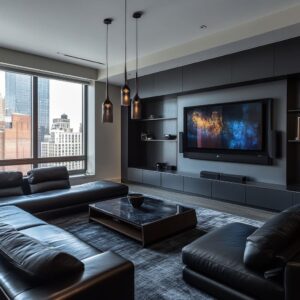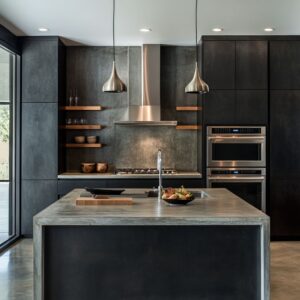
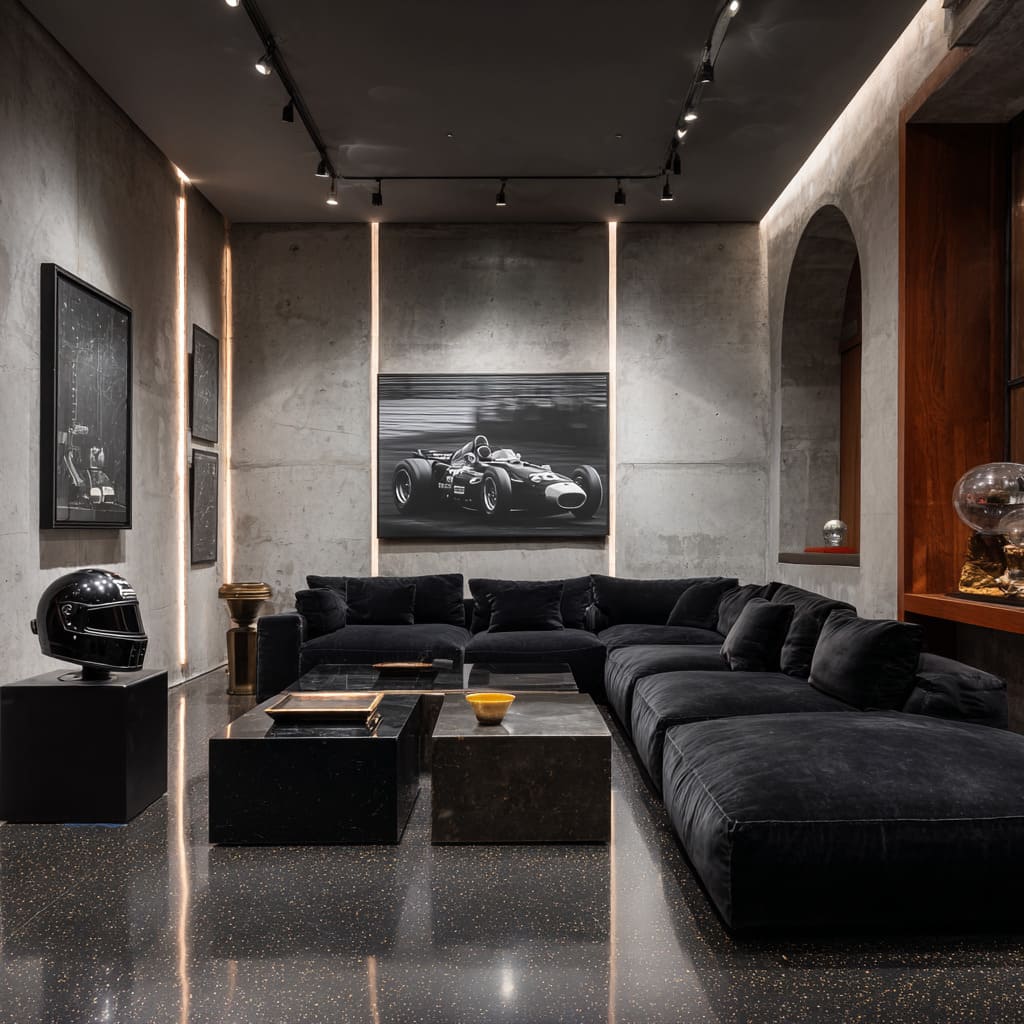
A strong wave of luxury man cave ideas has moved past the crowded den toward spaces that feel composed, warm, and calm, where long horizons guide the eye and light sketches the plan rather than blasting it. Across high-end photo spreads and studio portfolios, luxury man cave design often reads like a lounge or club distilled to its essential moves: a single horizontal line that ties everything together, a ceiling that behaves like an instrument, one textured wall that carries the mood, and a handful of objects treated like a collection rather than storage.
The result is a room that looks costly without shouting, that feels grown-up without going cold, and that channels expensive man cave ideas through restraint, spacing, and material contrast instead of size alone.
Long horizons: how a single line controls the room
In many upscale lounges the eye catches one continuous line before it notices any object—fire ledges that stretch from corner to corner, floating media consoles set exactly to seat height, bars that run unbroken under shallow shelving—so the composition has a “spine. ” That line becomes a quiet anchor for high-end man cave design, because matching heights start to rhyme across the room: coffee table tops align with cushion seams, display bases sit level with the sofa seat, and upper shelves echo a ceiling band so the whole wall reads as one elevation.
When floors are laid lengthwise with that horizon, the room stretches visually; when a mirror sits opposite the flame, glow doubles and the space feels deep even when it’s compact. This approach shows how upscale man cave ideas can produce a calm, expensive read by repeating one datum instead of piling on features.
Light that draws, not floods
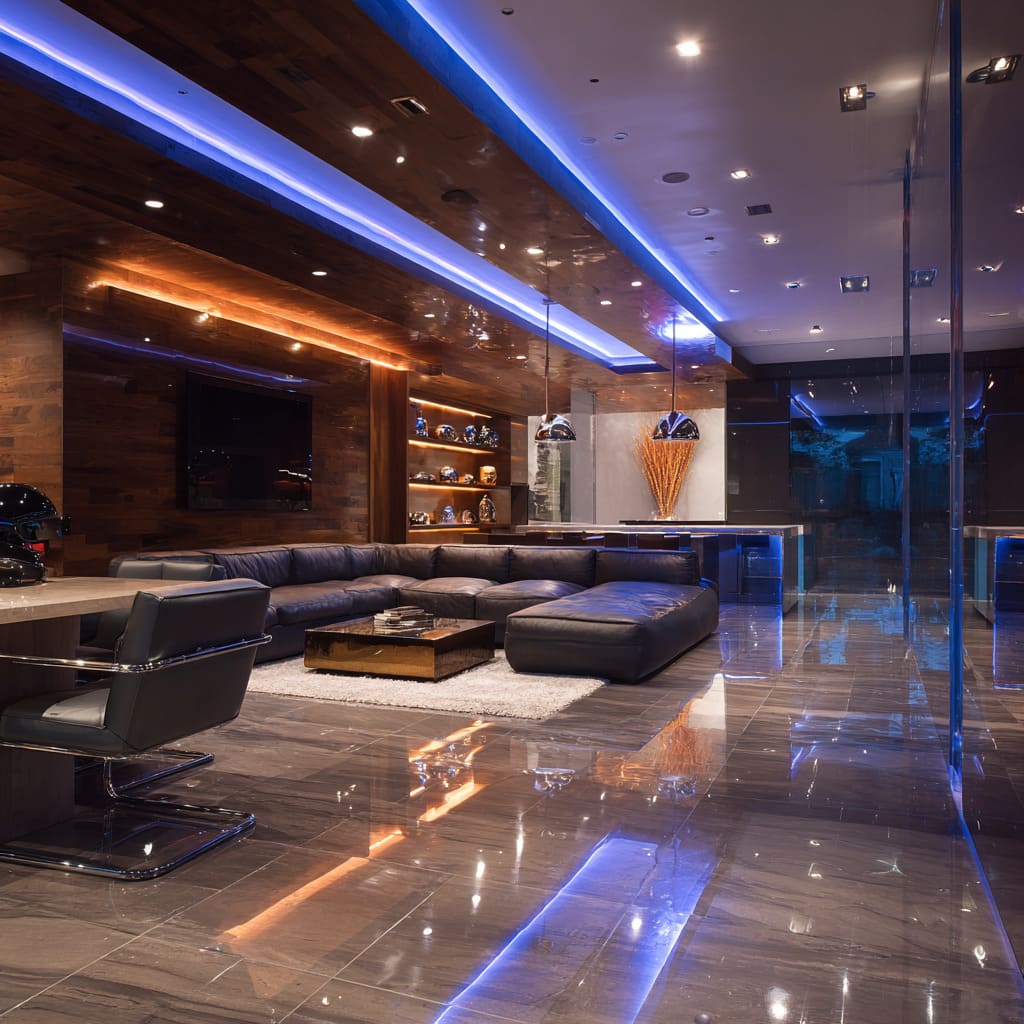
Modern man cave lighting rarely depends on visible bulbs; it sketches edges, grazes texture, and maps seating from above. Perimeter coves separate stone from ceiling so heavy materials look lighter; narrow trenches frame the conversation pit like a plan view; slim picture lights sit low enough to wash art rather than the ceiling; and hidden strips sweep down ribbed timber or split-face stone so peaks glow and recesses fall away.
In many luxury man cave design schemes, two light colors help the room self-organize—cooler runs along the travel path, warmer bands over the TV wall or bar—so mood changes without a switch wall. Reflection is placed carefully: gloss lives high on a ceiling panel where it doubles the lines, while matte rugs and bouclé cut glare right where feet land.
The overall effect fits expensive man cave ideas because the room looks considered in photos and welcoming in person, with the brightest hits on texture and display rather than on faces.
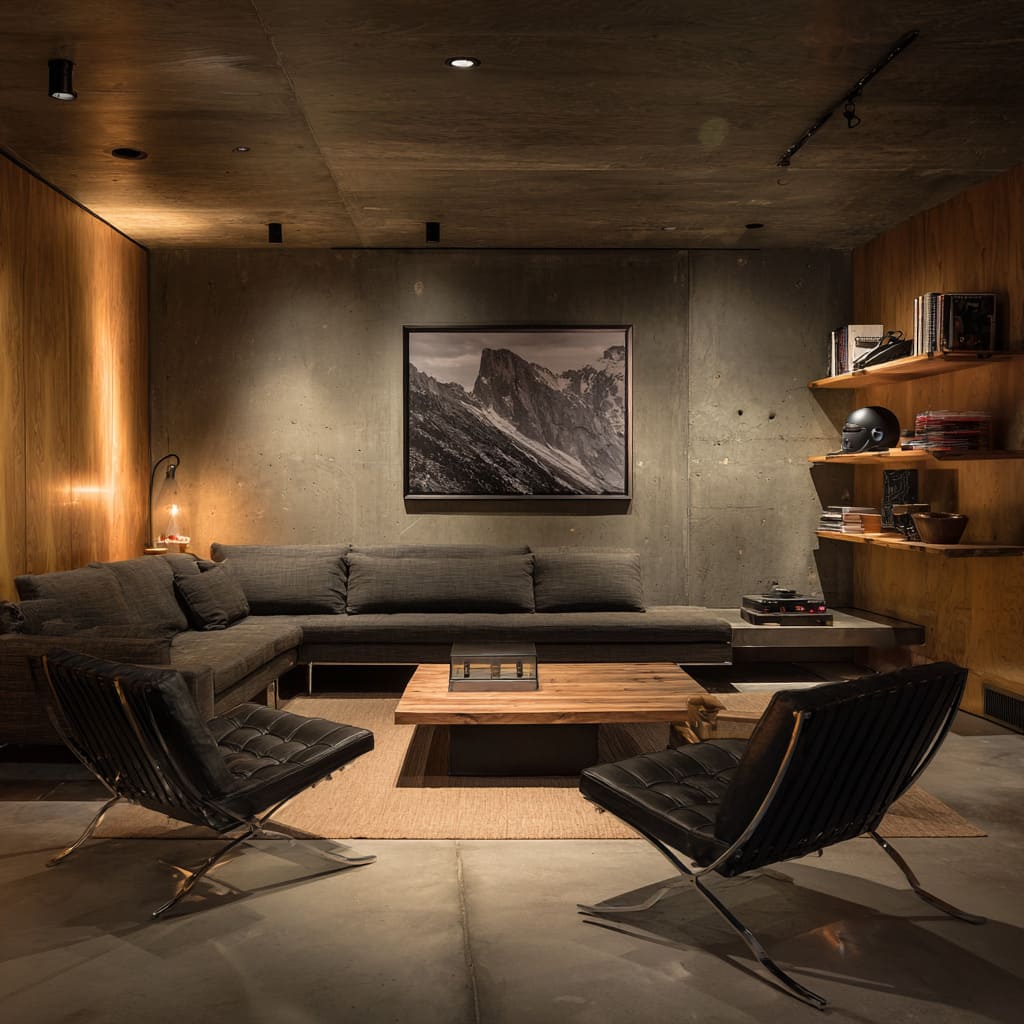
Material pairings that read costly through contrast
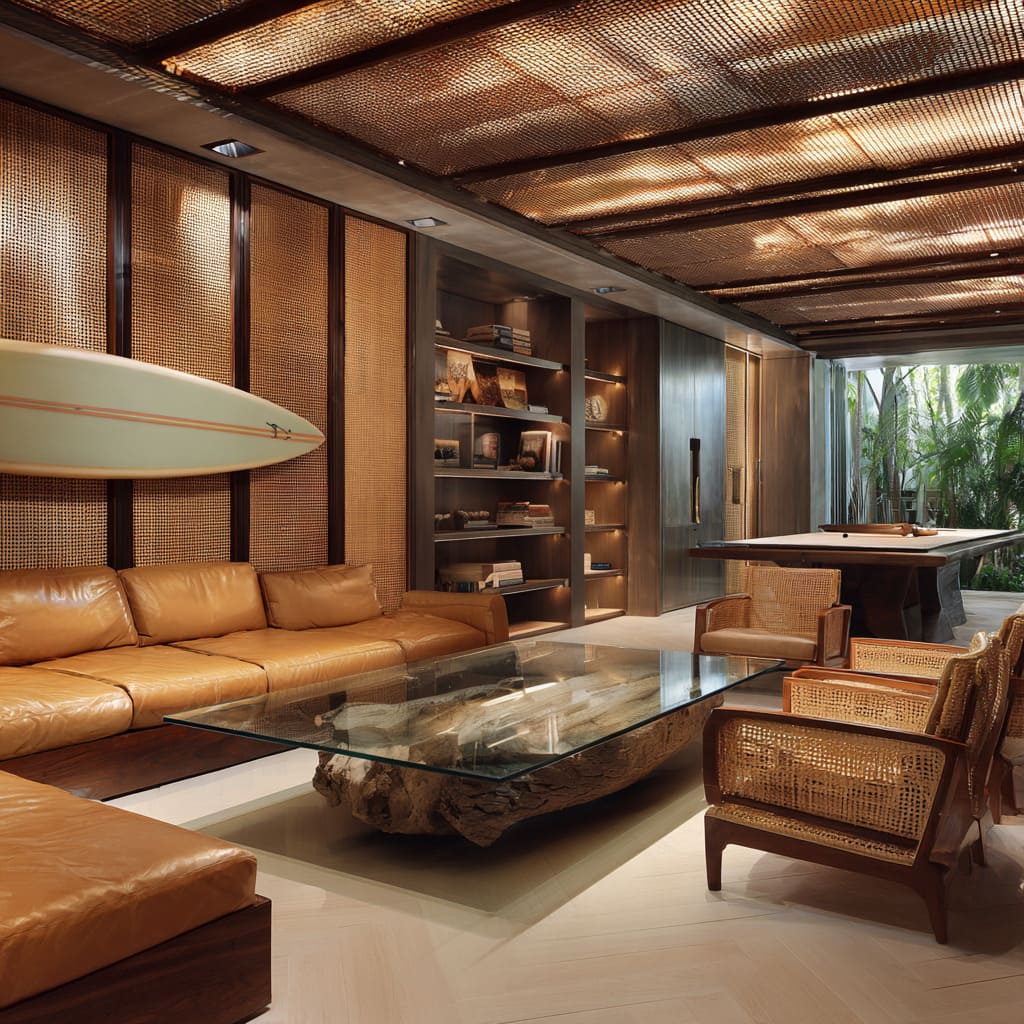
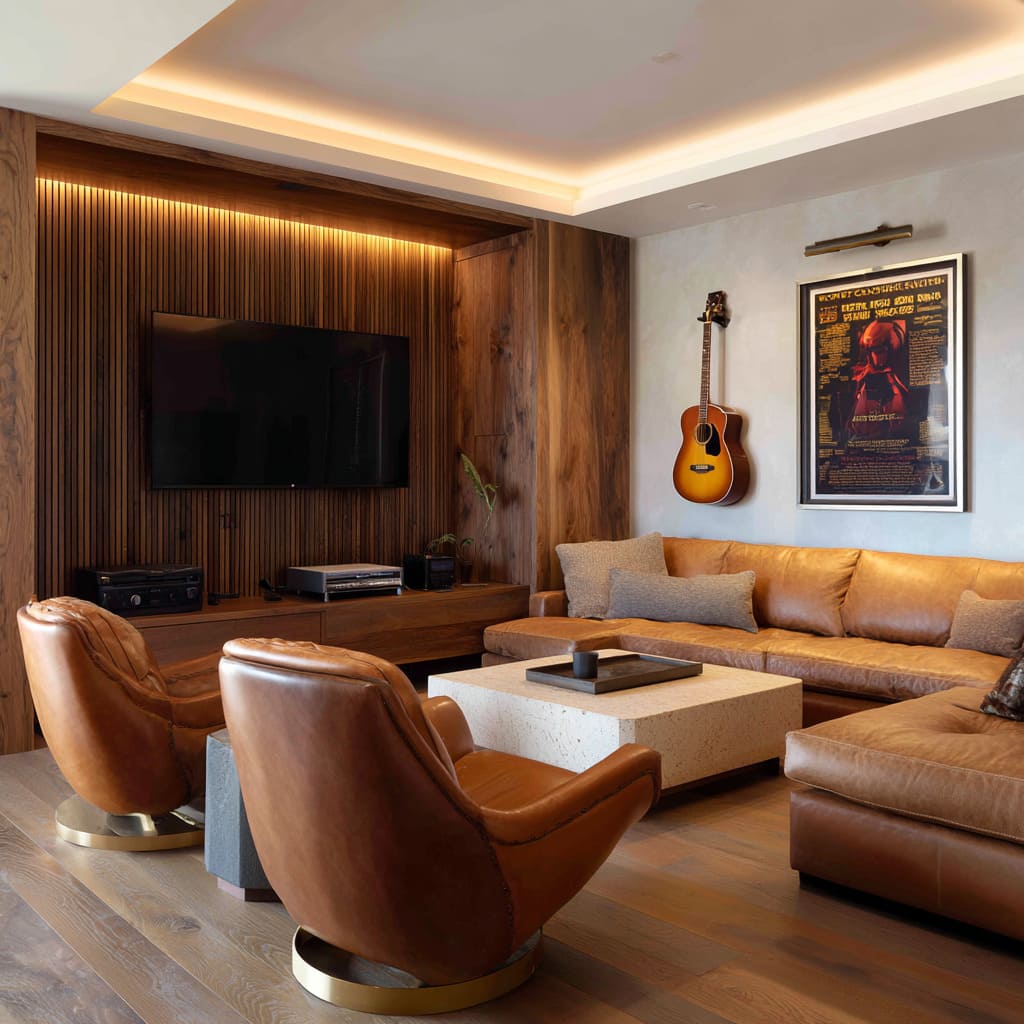
Instead of loud finishes everywhere, luxury man cave ideas tend to stage a conversation between coarse and smooth: rough cleft stone beside matte leather; ribbed wood fields next to satin plaster; driftwood mass under a knife-edge glass top; terrazzo with tiny metal flecks that wink only as someone moves. Metals are used as punctuation rather than armor—brass lips on small tables, ring bases on swivel chairs, a slim frame on a poster, a quiet bar edge that catches the cove glow—so shine has intent and timing.
Glass often hovers as a plane rather than a box, with clear pucks or fine reveals that let light travel around the piece, and concrete shows up as a monolith with a recessed shadow at the floor so mass looks light. This pairing strategy sits at the heart of high-end man cave design: the luxury is in the mix and the spacing, not in covering every surface.
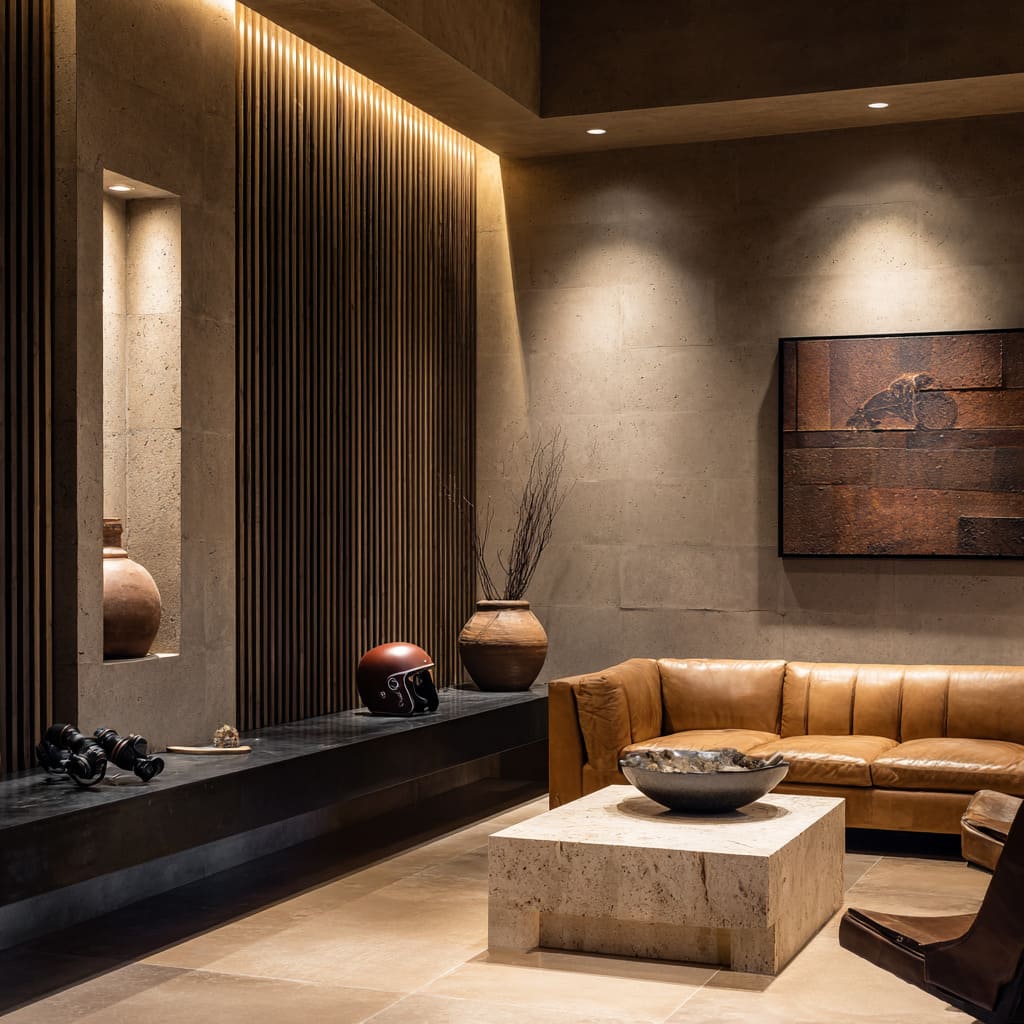
Scale, spacing, and the discipline of less and larger
Where rustic spaces once relied on many small stones or many narrow beams, the modern, upscale look swaps clutter for scale. Fewer, larger blocks make a wall read like a single stone landscape; beams sit on a crisp white ceiling so the grid looks intentional; shelves keep generous gaps so one clay pot or metal object can sit with breathing room; and display bays stay deep and even so helmets or model cars appear curated rather than stored.
Negative space becomes an active material—part of the design rather than leftover air—which is why upscale man cave ideas often feel serene even with strong materials in play.
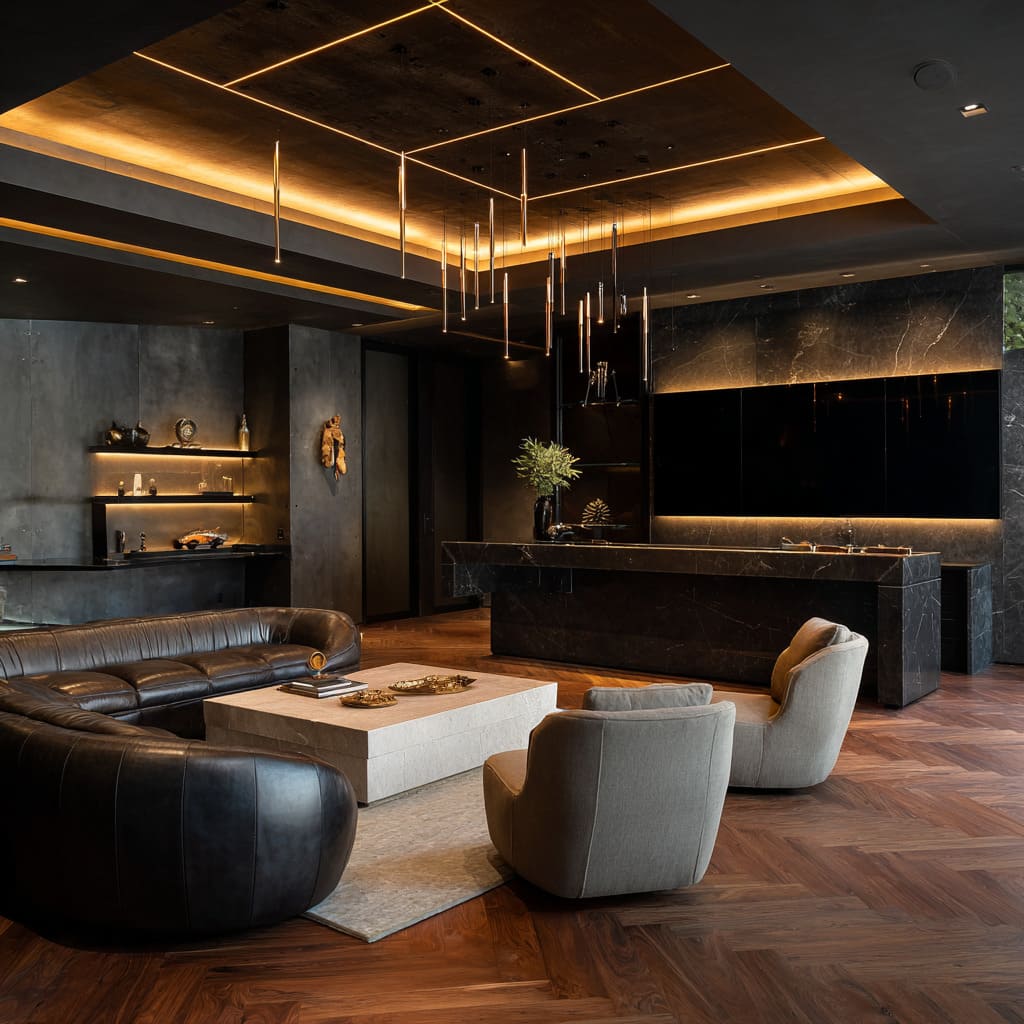
Float, shadow, and the illusion of lightness
A signature of luxury man cave design is the sense that heavy pieces hover: recessed plinths under stone cubes, kick lines pulled back under islands, deep shadow reveals around fireplace openings, and media consoles that read as black blades floating at seat height. When light grazes from underneath a bench or along a baseboard, corners brighten and the perimeter breathes; when a monolithic table sits one finger above a rug line, the mass looks deliberate rather than bulky.
These micro-moves amplify the feeling of expense because they rely on proportion and shadow rather than thickness alone.
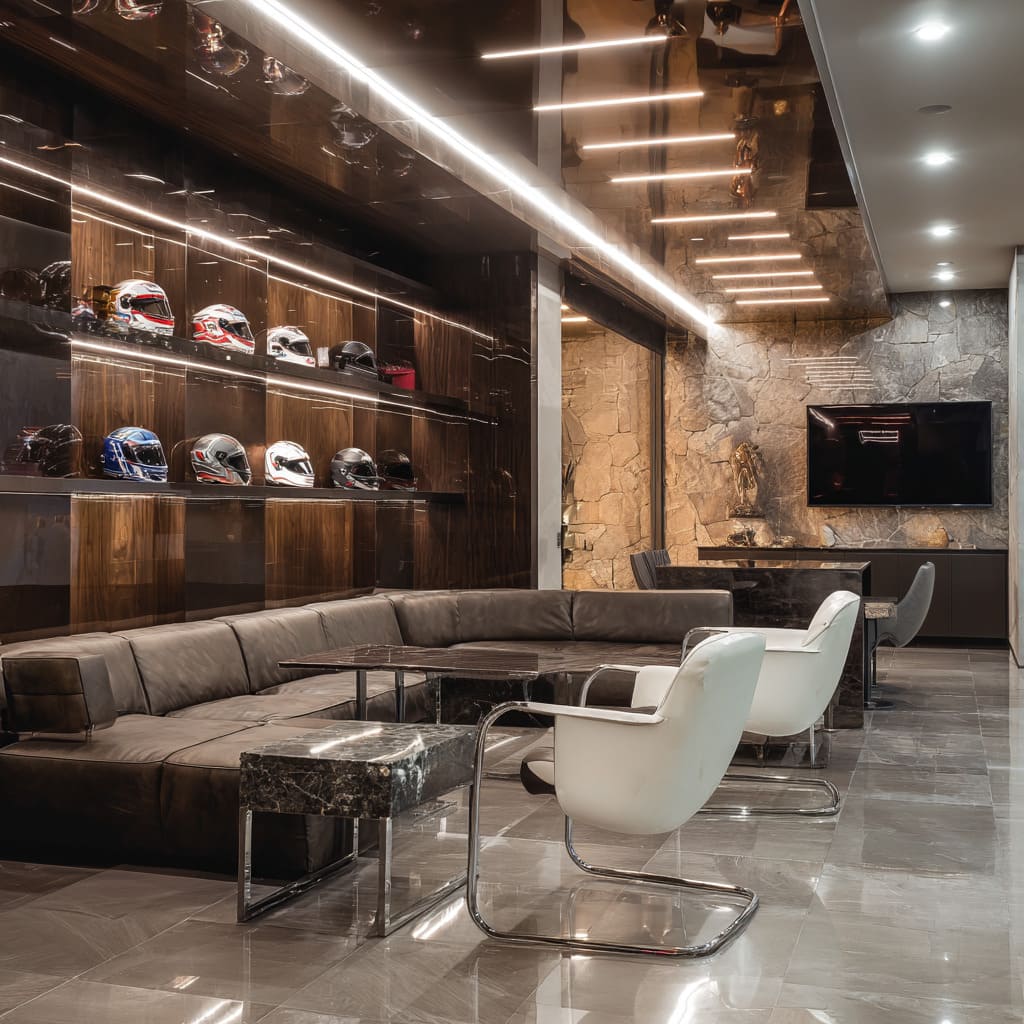
Curves that soften a boxy plan
Straight lines shape the envelope, but curves set the social tone. Channel-back sofas arc around a pale center table; radius-edge terrazzo softens the middle of a strong timber scheme; round side tables sit just proud of cushion seams so a glass finds a home without a tray.
Swivel chairs on brass rings add motion and a hint of shine while rounding off square seating groups. This quiet contrast—curves nested inside order—keeps high-end man cave design friendly in spaces that might otherwise feel rigid.
Gallery logic for objects and memorabilia
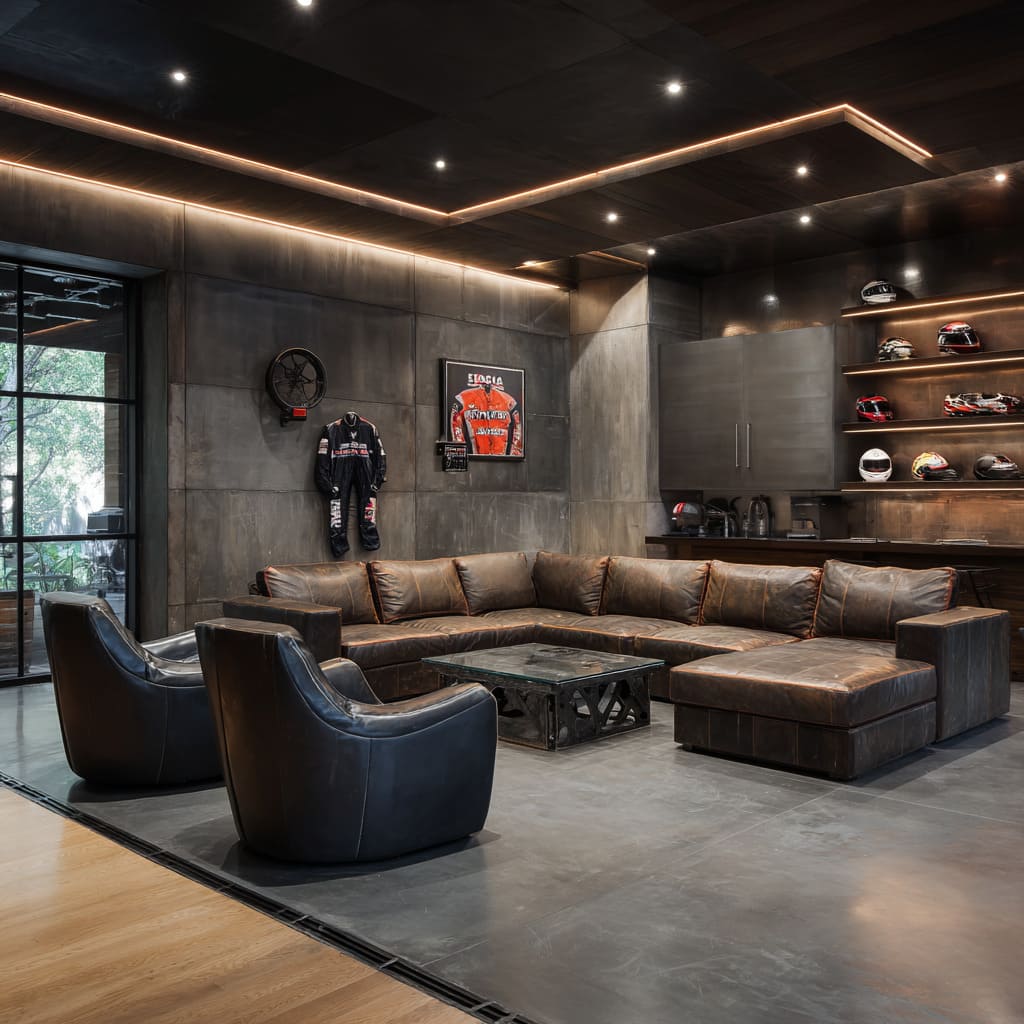
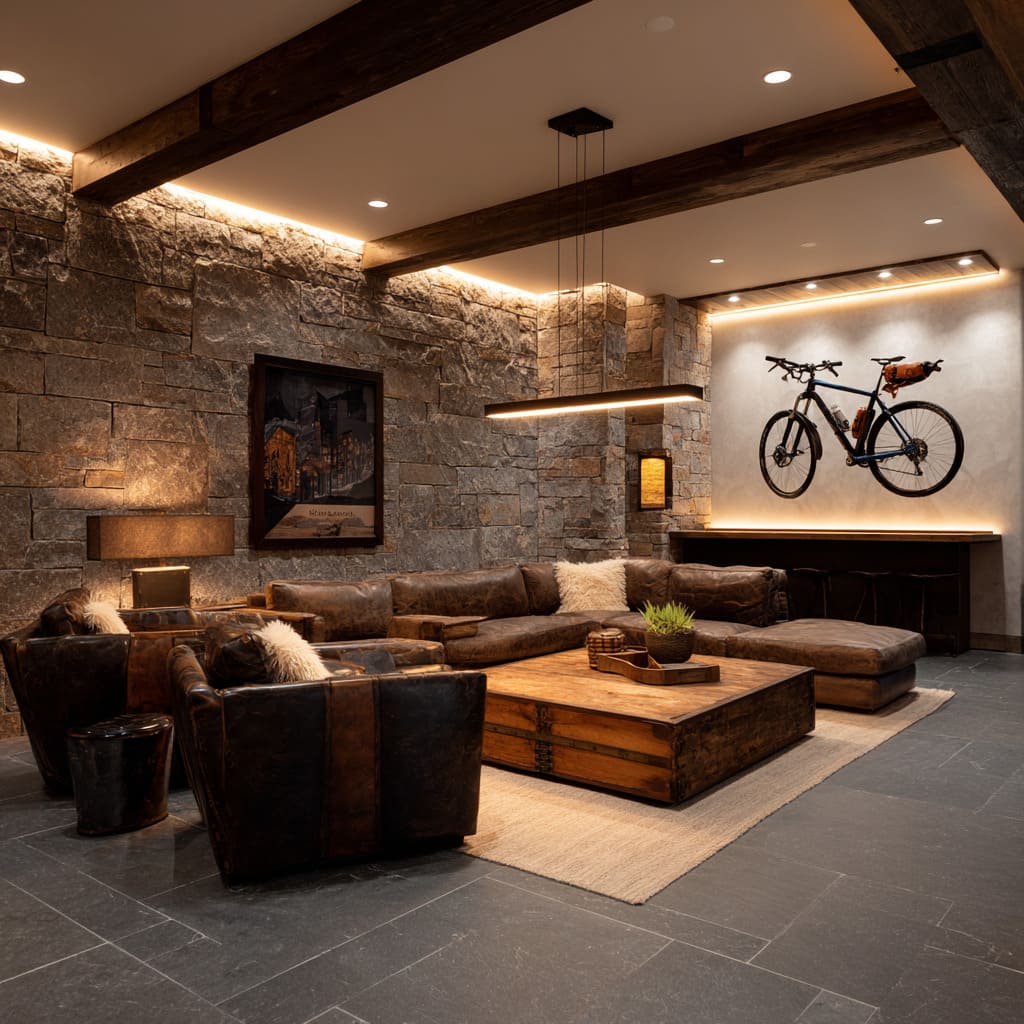
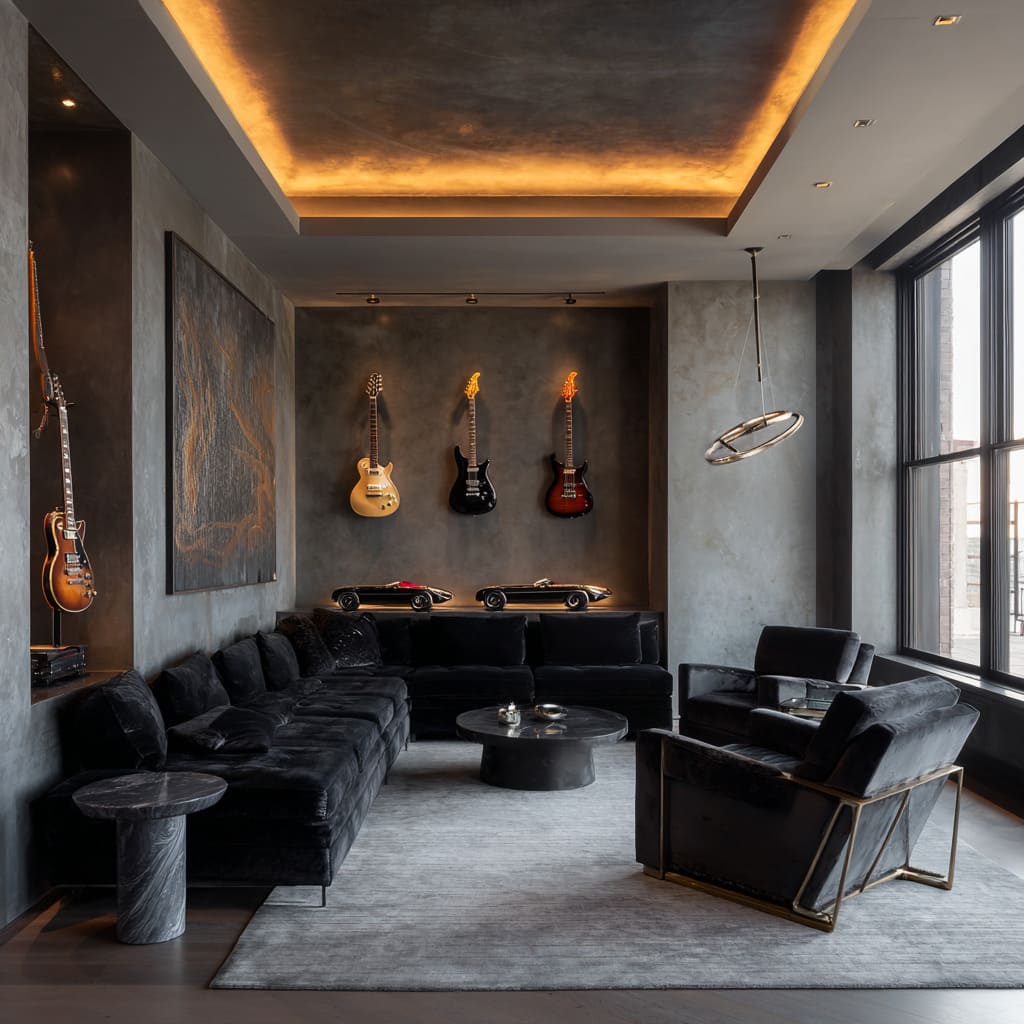
In the most persuasive luxury man cave ideas, collections behave like art. Guitars hang on a shallow ledge with tiny uplights, spaced so the darkest finishes sit closer together and a sunburst reads as a counterpoint; racing suits stand between panel seams so the wall becomes the frame; helmets live in deep, even cubbies with warm face lighting so visors stay clear; a bicycle rests in a niche where the glow highlights tire edges and the saddle bag.
Heights fall into a strict rhythm—frame bottoms aligned with seat backs, base shelves level with cushion tops—so the sofa acts like a pedestal for the whole composition. The story feels personal, but the wall stays calm.
Ways collections stay calm and rich
- Single grid first, objects second; the bay sets the rule
- Warm, even light aimed at faces of objects, not from the top alone
- One saturated accent in a field of stone and leather (a red helmet or mint board) to hold the palette together
- Breathing room built in: one piece per cubby or a balanced trio with varied heights
Ceilings with a reason to exist
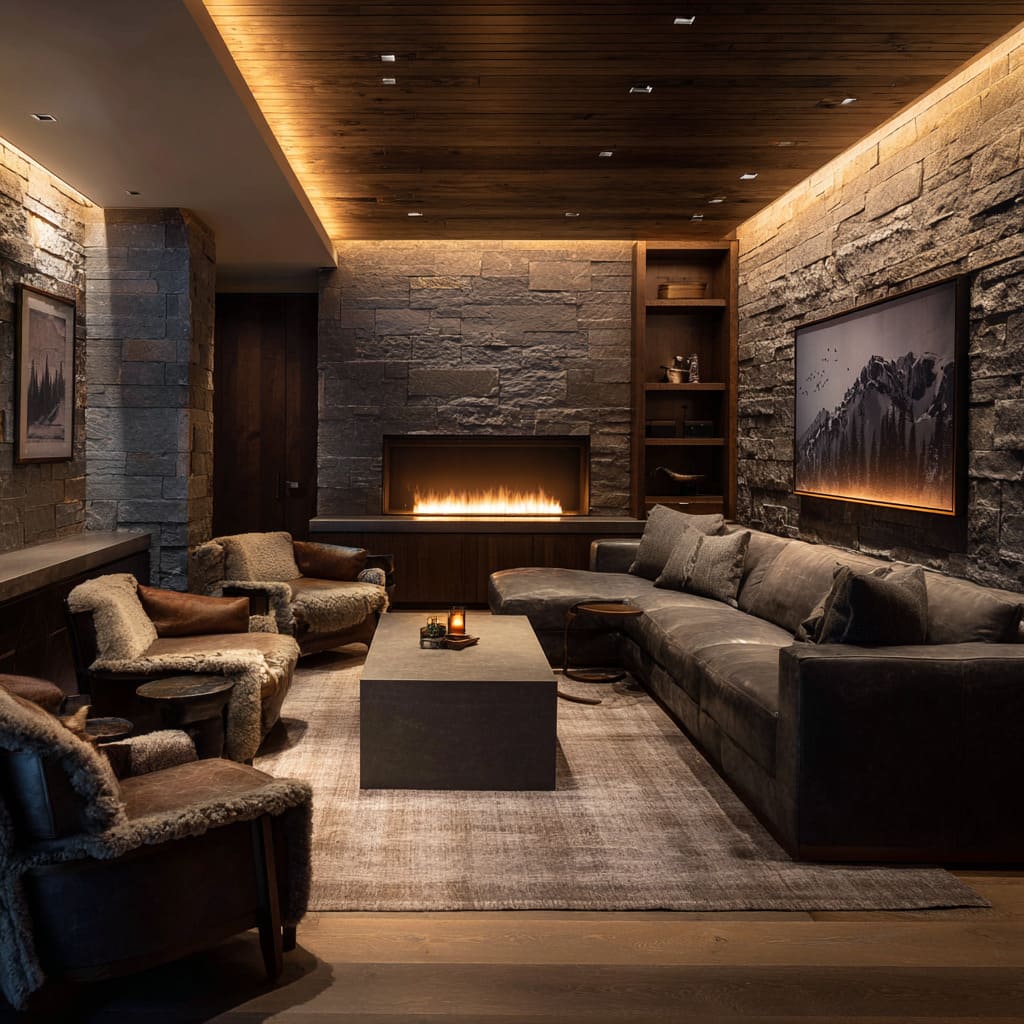
The ceiling often carries identity in expensive man cave ideas: glossy walnut panels double thin light bars into mirrored rails; woven mesh or cane glows like a lantern lid and throws a faint lattice shadow; tray edges wash walls so the center sits deeper and quieter; recessed outlines echo the seating footprint like a luminous diagram. When a beam depth matches a cove recess, structure and light read as one move; when the ceiling’s graphic points to the center, the plan feels intuitive before anyone sits down.
Color: warmth with a steady hand
Much of luxury man cave design relies on a leather spectrum—saddle, cognac, caramel, tobacco—kept mostly matte so tone does the work. Dark stone or charcoal plaster cools the envelope; walnut or oak adds heat; and the center often brightens via a pale rug, terrazzo flecks, or a light stone table so the middle of the room glows in photos and in person.
The art strategy is equally quiet: monochrome motorsport prints, dark mountain scenes with subtle backlight, or a six-frame horizon sequence that slides from warm to cool to balance a jute rug. Color reads as temperature control, not theme.
Texture sequencing that can be felt from across the room
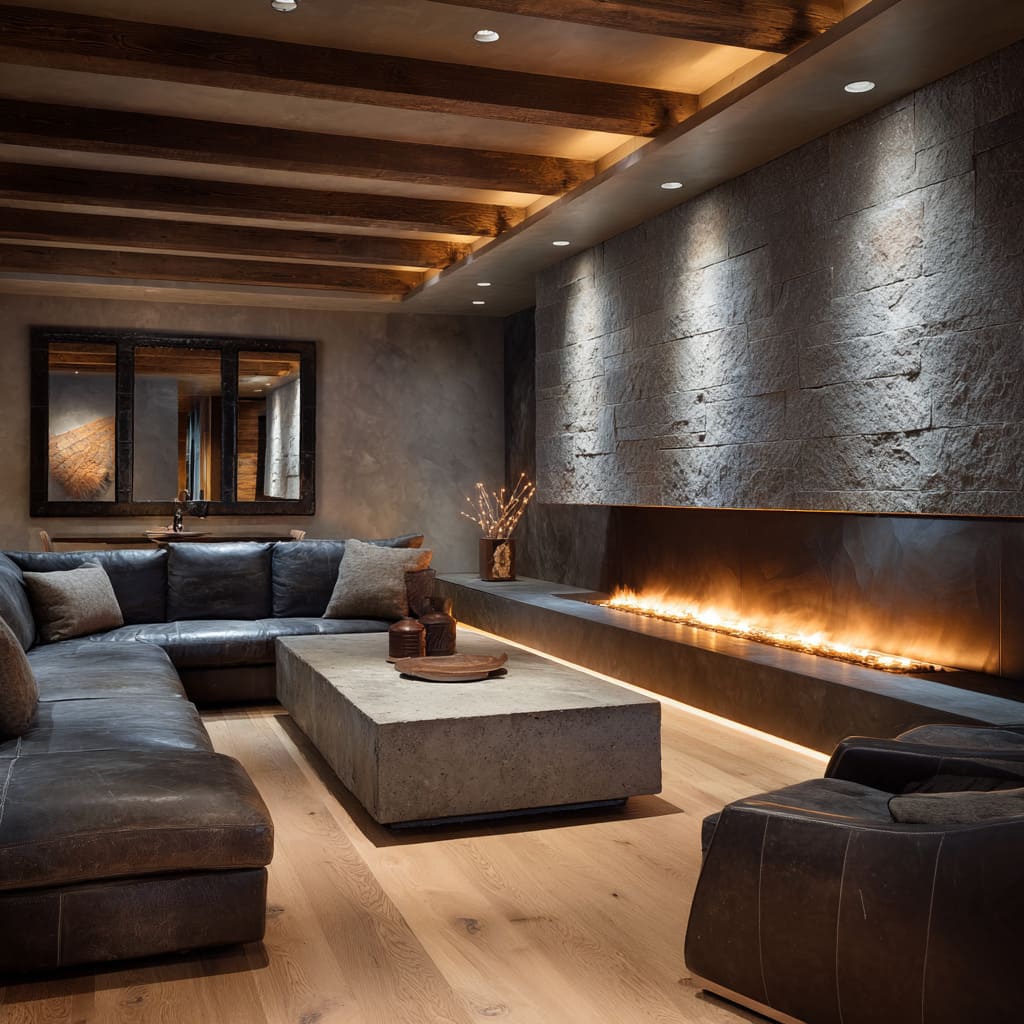
Texture lands in an intentional stack: wire-brushed timber on walls and beams; smooth plaster where the eye rests; soft boucle and velvet at the seat; crisp glass or honed stone in the center; shag or sisal exactly where feet touch down to cut floor reflections. Shearling appears on the inward faces of club chairs so backs look rugged from afar and seats feel plush up close.
Cane shows up in two different scales—one at the wall, one at the ceiling or chair panels—so patterns rhyme without duplication. The room looks layered because every layer has a role.
Zoning without partitions: reading the plan at a glance
A visitor can often read high-end man cave design from the door thanks to cues above and below. Ceiling rectangles outline the conversation pit; chevrons on the floor point toward the center; a floating console at seat height forms a soft boundary to the media zone; a bar ledge pushes out just enough to invite a lean while the back counter glows like a horizon.
When objects, light, and floor direction agree, the room feels composed without any walls.
Art and image: grown-up placement
Art often sits low enough that frame bottoms align with cushion tops, turning the sofa into a base; picture lights mount close and tight so they wash the piece, not the ceiling; dark art on dark stone receives a subtle backlit frame so it floats instead of disappearing. The strictness pays off in photography: displays stay visible above low backs, reflective planes stay above eye height, and the lightest object—the table, the rug—holds the center of the shot.
Micro-moves that sell quiet luxury
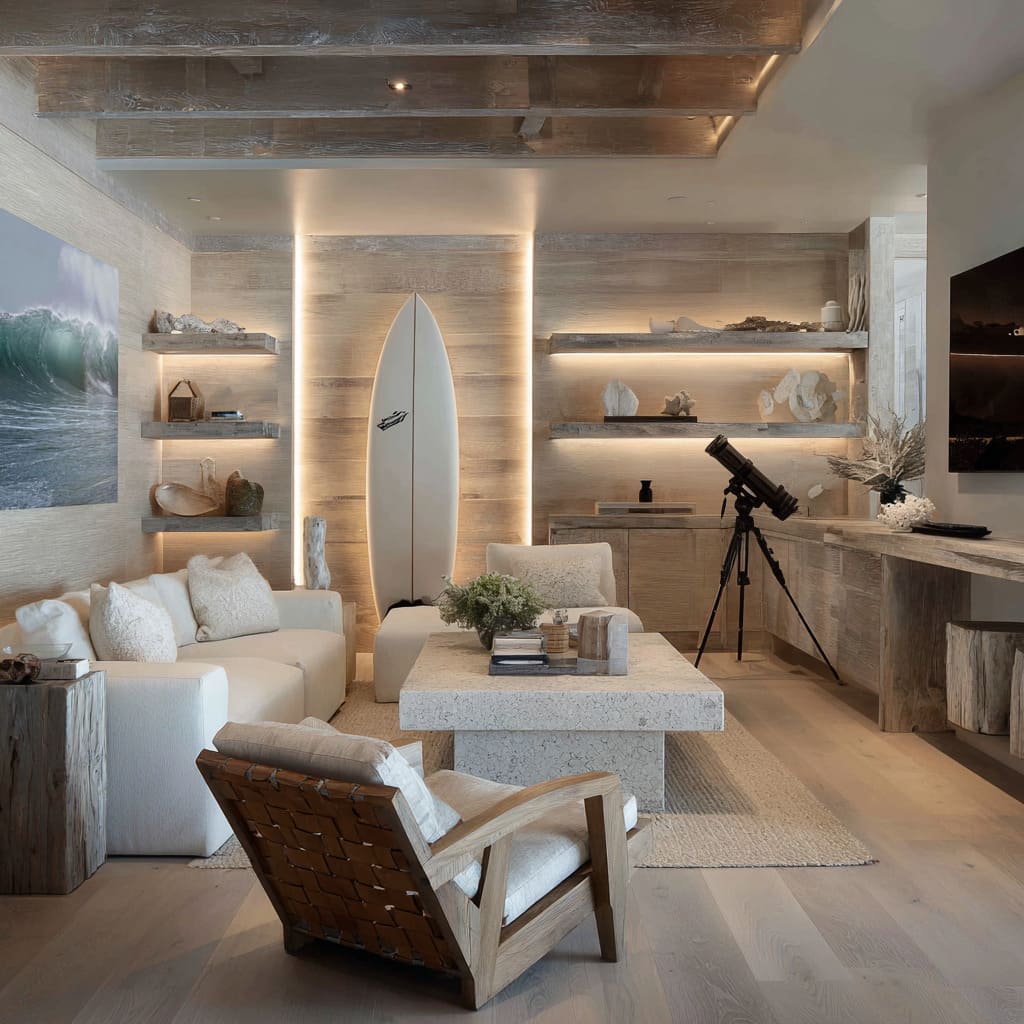
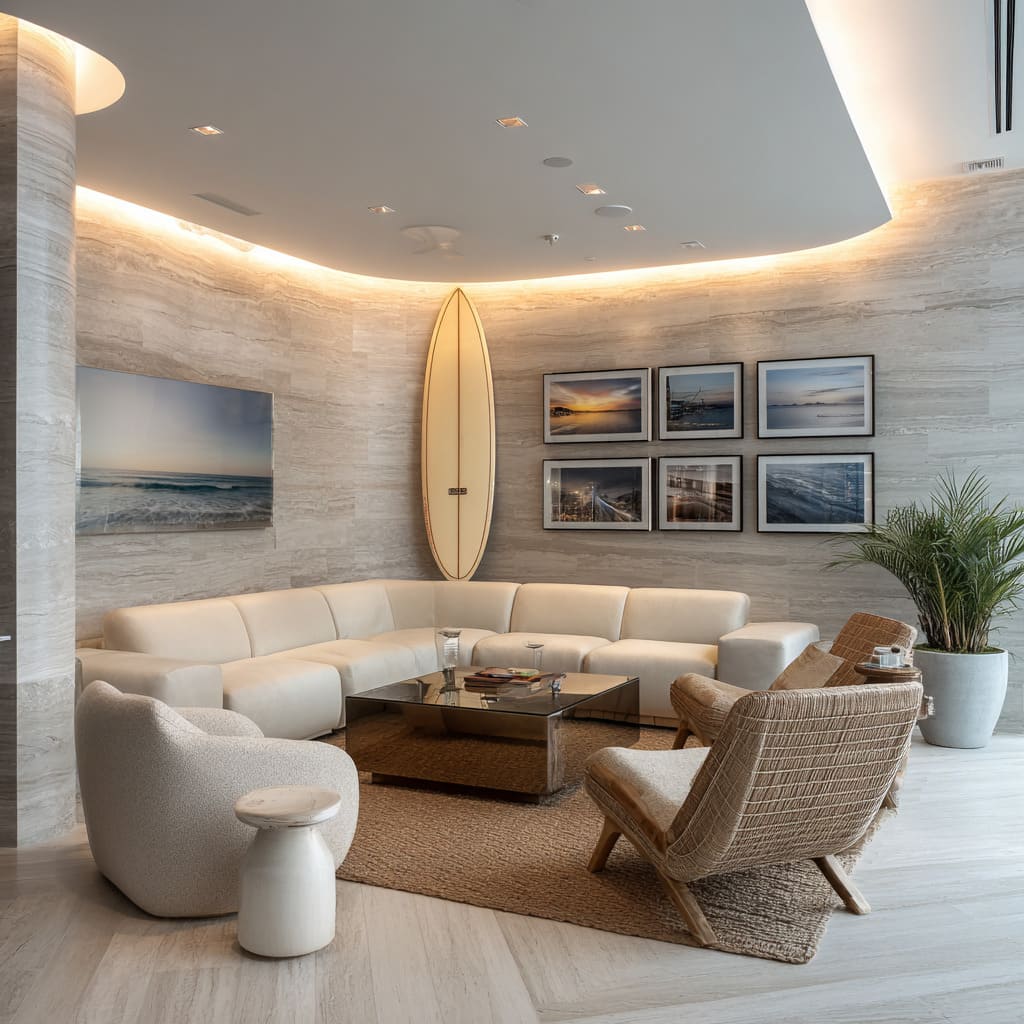
Across the best upscale man cave ideas, small decisions carry surprising weight: trunk tables with brass straps signal history without clutter; a telescope placed high enough to clear the table reads like a promise of use, not a prop; a driftwood base under a sharp glass slab balances mass and clarity; a single bundle of reeds or one carved panel warms a glossy bar; a surfboard mounted as a horizontal stripe or a vertical totem sets a datum that steadies the wall. None of these choices rely on logos or slogans, yet the room feels personal and expensive.
Style recipes that hold under many layouts
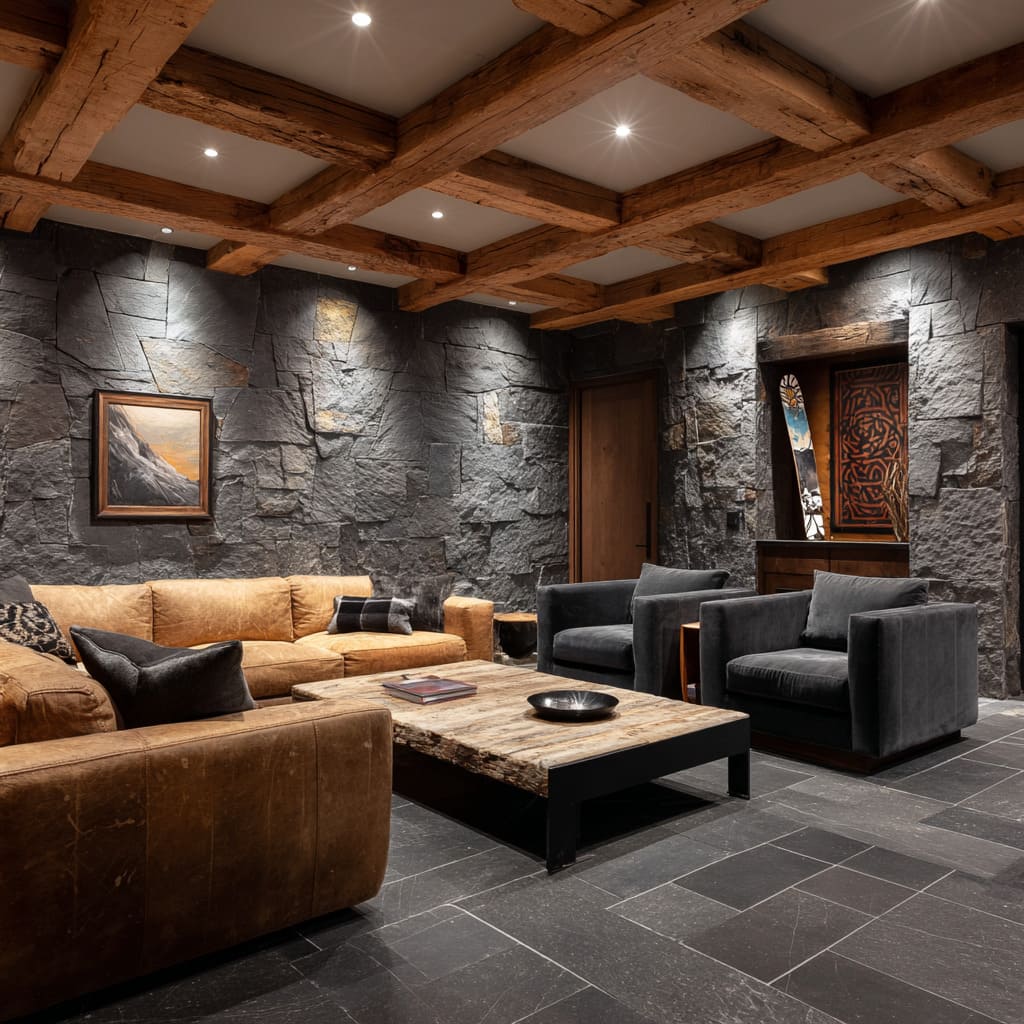
- Mountain modern: fractured stone in large slabs, caramel leather with honest wear, a tight beam grid on a white ceiling, a raw-edged wood slab across a pale center table, slate underfoot that aligns quietly with overhead rhythm.
- Urban gloss club: high-gloss ceiling with linear trenches, dark stone with bronzed metal, curved channel-back seating around a light centerpiece, apron glows that make monolithic counters hover.
- Coastal craft lounge: cane in two pattern scales, cognac leather on a wood plinth, driftwood mass under knife-edge glass, a mint or cream board acting as a calm stripe, pale herringbone floors that borrow angles from exterior greenery.
- Motorsport suite: dark steel panels in a precise grid, a racetrack outline of ceiling light above tobacco leather seating, hero mounts for gear, evenly spaced open shelves where visors sit clear.
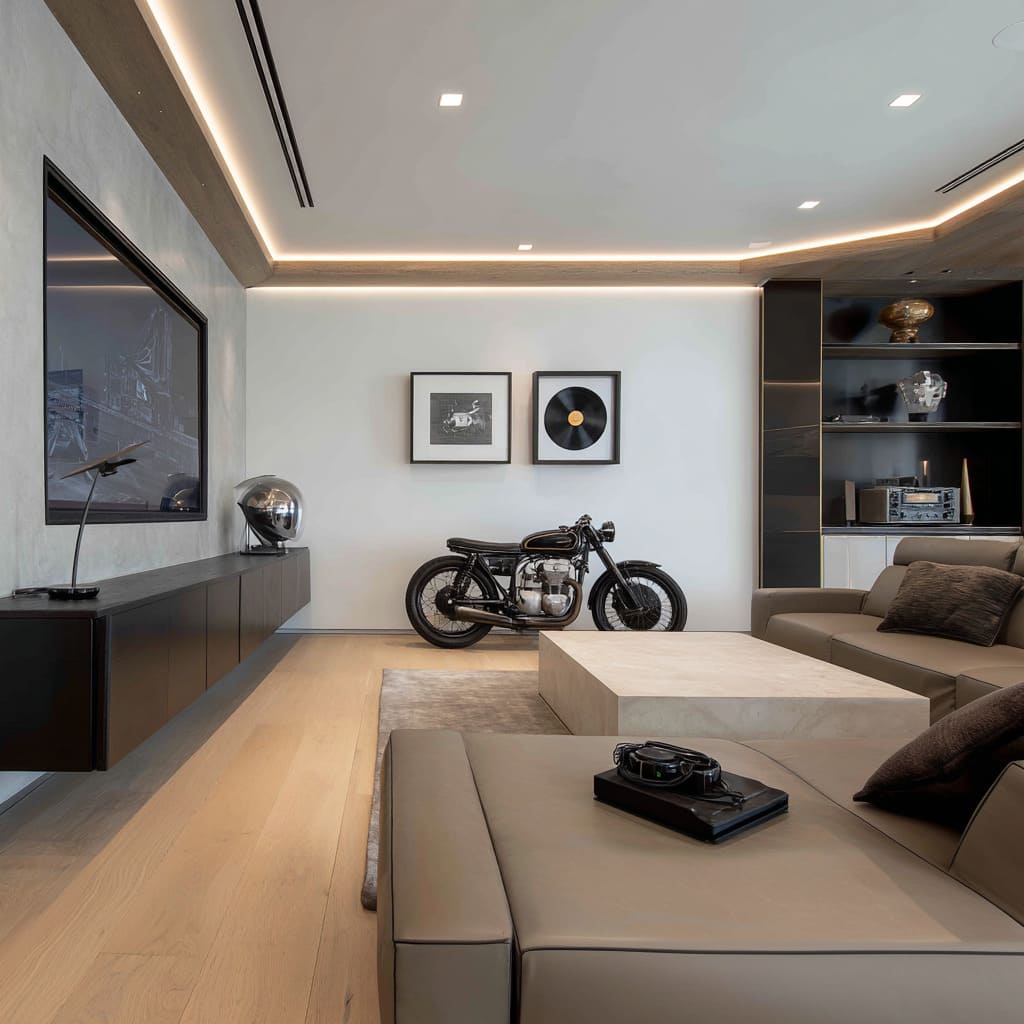
- Minimal studio with one machine: micro-cement and crisp white walls, a floating black media blade at seat height, a limestone monolith table, one motorcycle or bike as sculpture with nothing competing nearby.

Furniture behavior that feels made for the room
Tables that meet cushion height read like extensions of the sofa and keep the center stable; swivels on ring bases introduce a hint of shine while making conversation angles flexible; plinth sofas lift upholstery just enough for daylight to glide under; side tables slip a disk over a cushion seam so a glass lands naturally; radius edges soften the heavy look of stone without taking away mass. The mix supports a luxury man cave design language where comfort and composition share the same rules.
Floors as silent guides
Chevron and herringbone often point toward seating to guide footsteps; micro-sparkle terrazzo animates movement under low light without turning the floor into a show; jute and sisal place tactile commas exactly where reflections would otherwise pool. The path feels obvious without tape, and the camera finds a rhythm as it moves.
The subtraction list
The calm that defines expensive man cave ideas often comes from what’s missing: scattered spotlights that hit eyes or glossy floors near seats; shelves packed edge to edge; repeated branding once a single category—helmets, guitars, racing prints—has spoken; color noise at the center when pale stone or a light rug keeps the focal plane clear. The edit turns into the luxury.
Organizing frameworks that keep the look coherent
- Horizon logic: one line to rule heights—seat, console, base shelf, light band
- Field + accent: one textured wall field, one smooth counter-field, one reflective plane up high
- Grid before story: decide the cubby count and spacing, then let objects enter
- Light map: outline zones from the ceiling and edges; keep the brightest hits on texture and displays
- Palette ladder: stone or plaster as cool base, leather as warm middle, pale center piece for lift
- Texture stack: rough wall → smooth seat → crisp center → soft rug
A general arc many designs follow
The most convincing luxury man cave ideas usually take shape in a quiet sequence: a horizon line appears first and everything else begins to reference it; a single textured wall comes next and sets the mood, while the ceiling gains either a gloss panel that doubles lines or a woven screen that breathes; one object earns hero status and receives its own pool of light; seating falls into place with one curved piece to soften the grid and one pale or mid-tone table to mediate the palette; shelves accept a strict grid with wide breathing room; and a final organic note—a driftwood base, a carved panel, a small bundle—balances all the metal and glass. Without a single technical note, the room lands in the space where high-end man cave design feels both collected and composed.