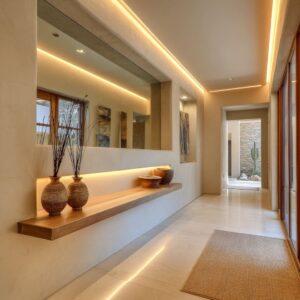
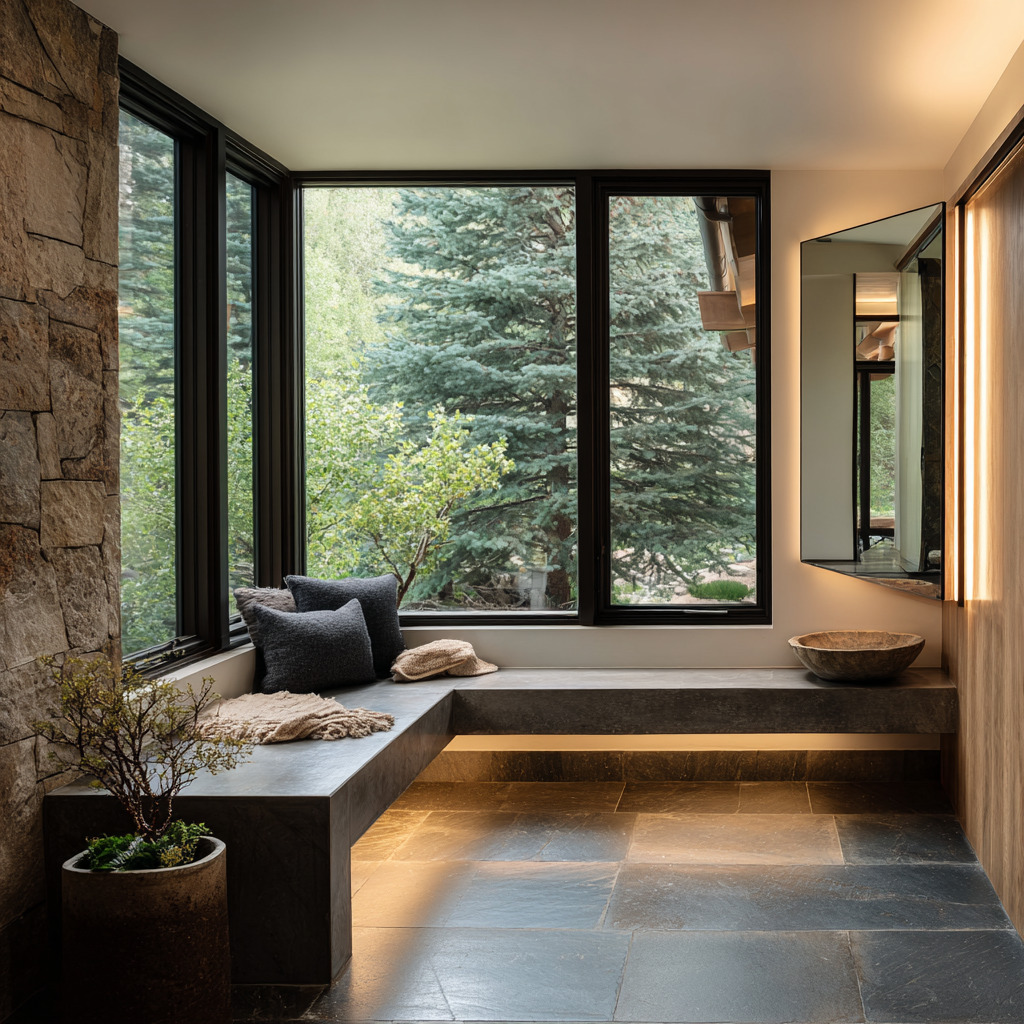
A corner mirror is more than a reflective surface; it behaves like a soft hinge between planes, a pause that gathers light, color, and texture into one composed moment. Across many interiors—from relaxed coastal apartments to dense urban dwellings and quiet hillside retreats—certain corner mirror ideas keep showing up because they coax calm out of awkward angles: a single datum line that runs through the turn; a bench that bends with a radius instead of a hard joint; a narrow frame rhythm that steadies bright glass; and a warm halo that sits right where two walls meet.
In these settings the glass rarely screams; it edits. Rather than multiplying clutter, it selects a subject—one sconce, a branch silhouette, a slice of sky—and lets that single note appear twice.
This article gathers those moves into an organized, design-forward read on corner wall mirror ideas, corner mirror decor ideas, and the wider world of mirror corner decoration, with a blogger-like cadence that stays focused on what the eye reads: composition, proportion, material tone, and the choreography of light.
Corners as visual hinges: why one “through-line” settles an angle
In strong room designs the corner stops behaving like an end point and starts acting as a visual hinge, and the simplest way to make this happen is a single line that continues through the angle. Sometimes it’s a bench that slides along one wall and wraps lightly around the turn, sometimes a cove of light that traces an L, and sometimes a thin shelf or headband at the ceiling that links both planes into one horizon.
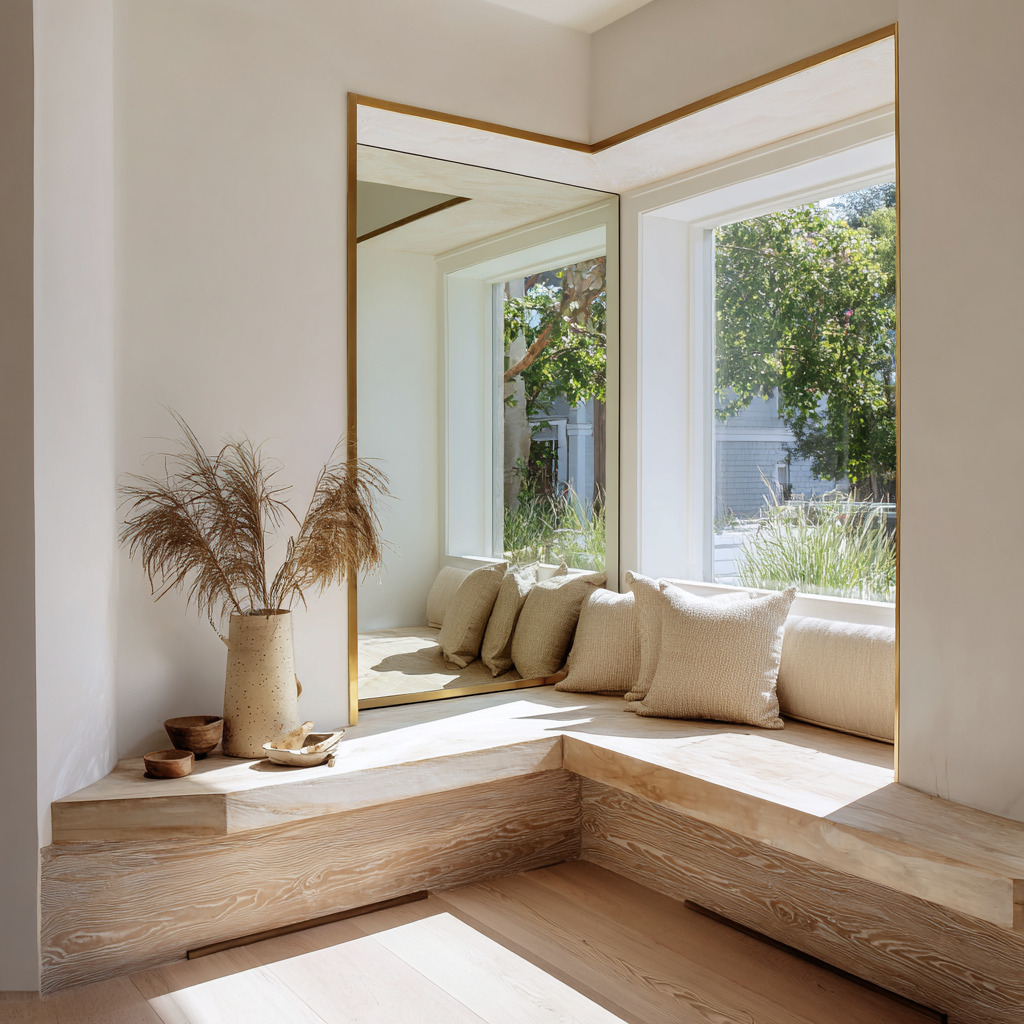
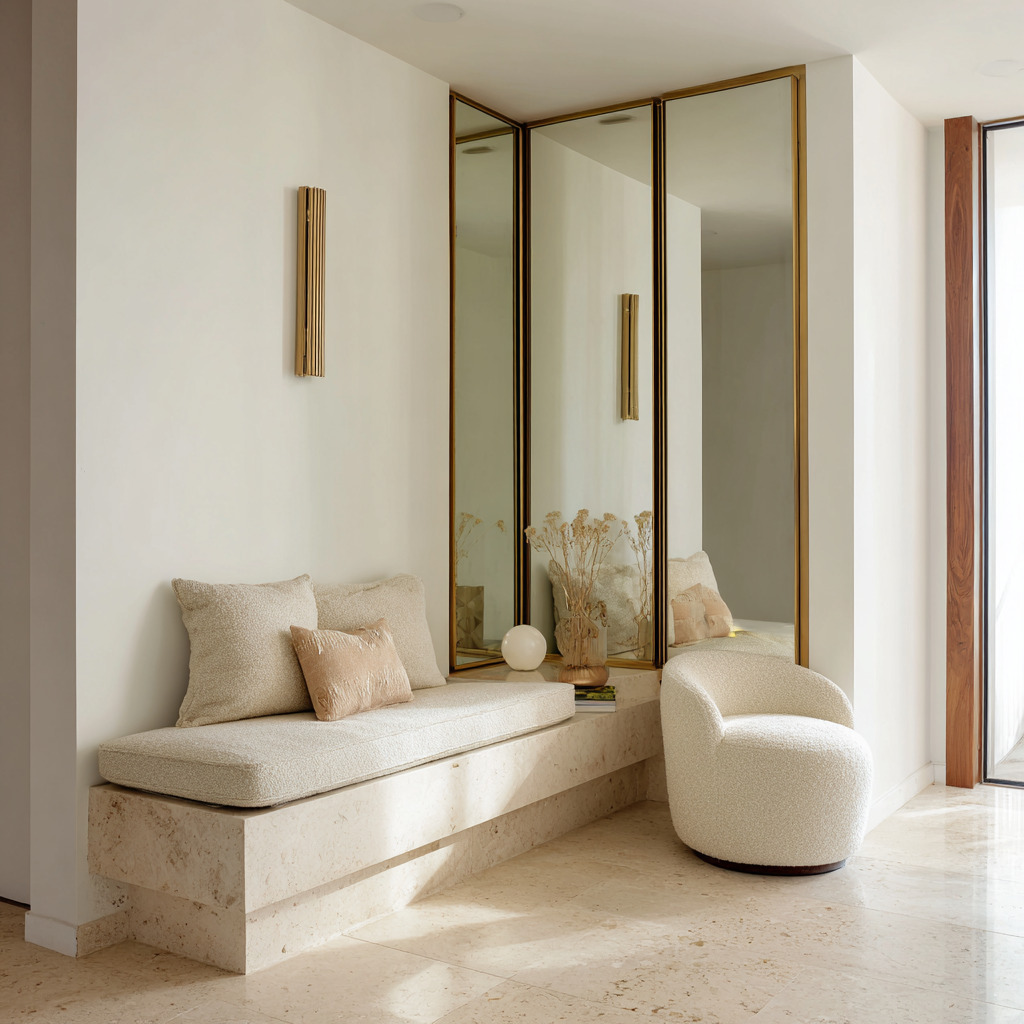
When this through-line exists, a mirror can fold or “kiss” the return without feeling pasted on; the glass becomes a quiet continuation of that larger move. The result is an edited reflection: long daylight rhythms glide across cushions, a plant shows up as a calm silhouette rather than a busy bouquet, and the corner reads like a composed pause.
In this sense, the most convincing mirror corner decoration treats glass as part of a bigger sentence formed by seat, light, and frame, not a loud exclamation mark.
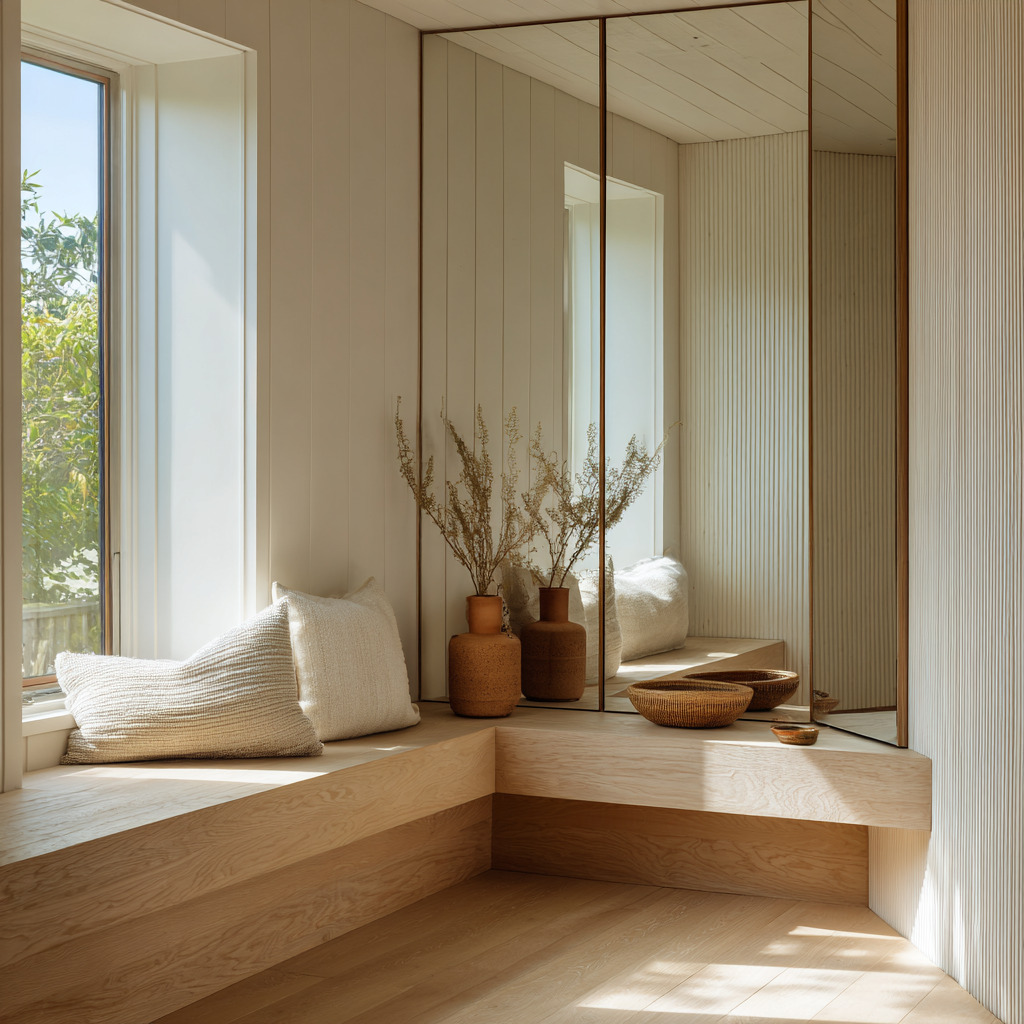
Mirror typologies that keep rooms calm
Over time, a few families of corner mirror ideas prove especially reliable for sculpting a corner’s mood.
- The Hinge Panel: a single fold or facet that lands right on the angle—glare breaks into gentle planes, and the corner reads as one move instead of two surfaces.
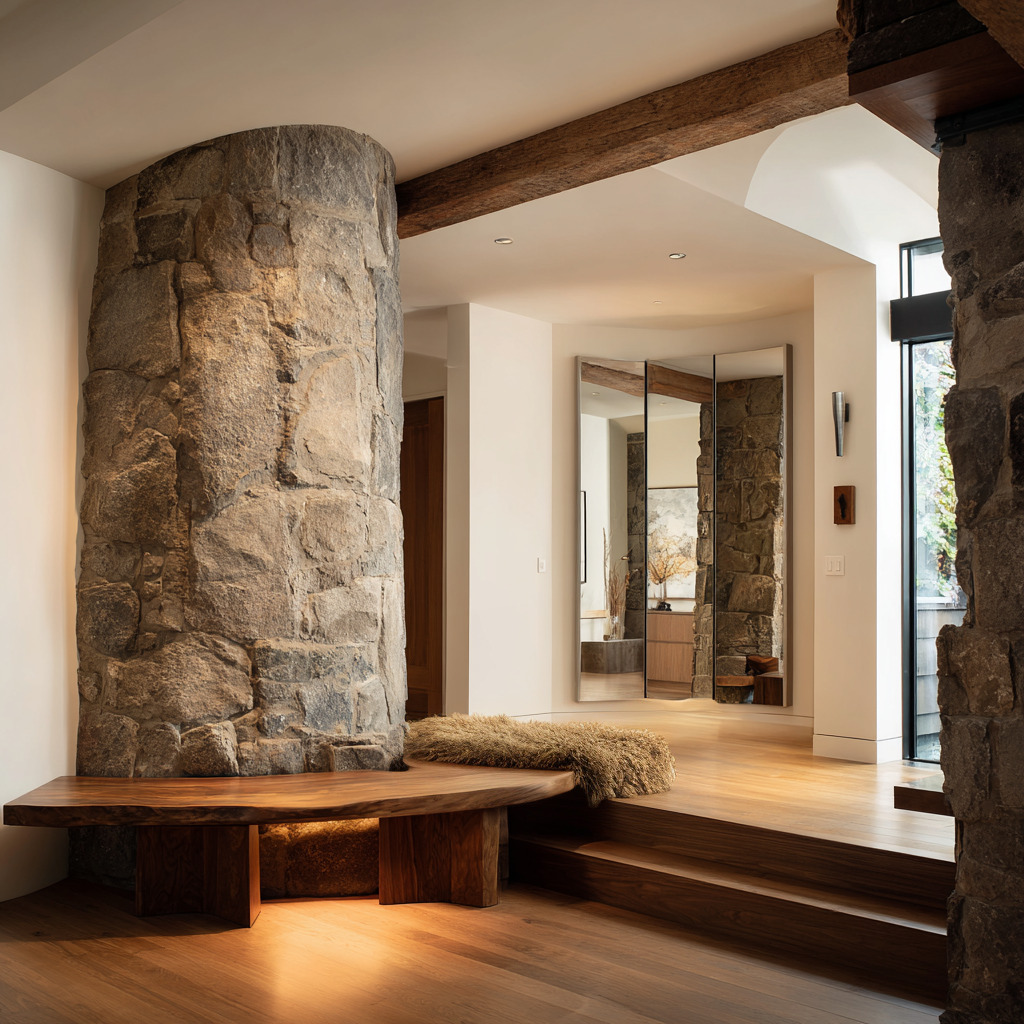
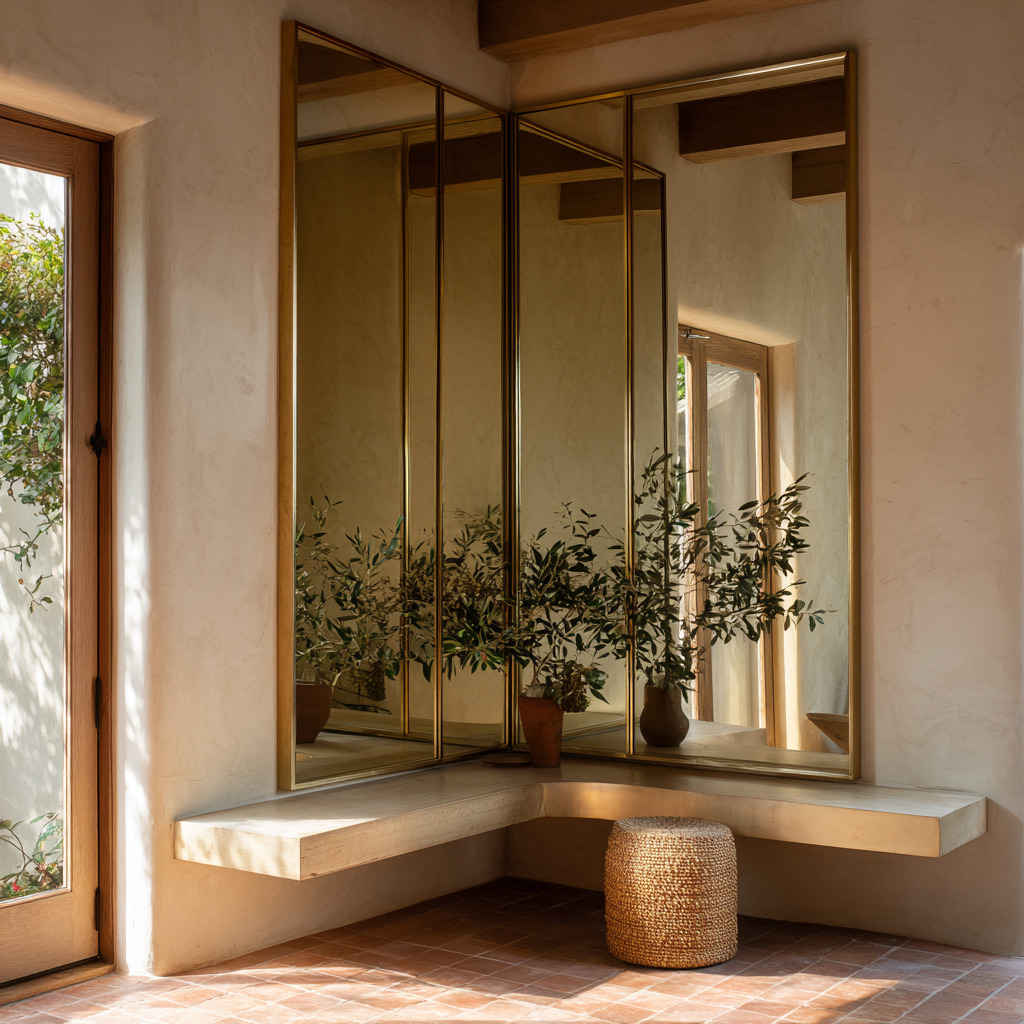
- The Screen: multiple narrow leaves with slim frames—reflections compress into tidy stripes and the eye tracks rhythm, not shine.
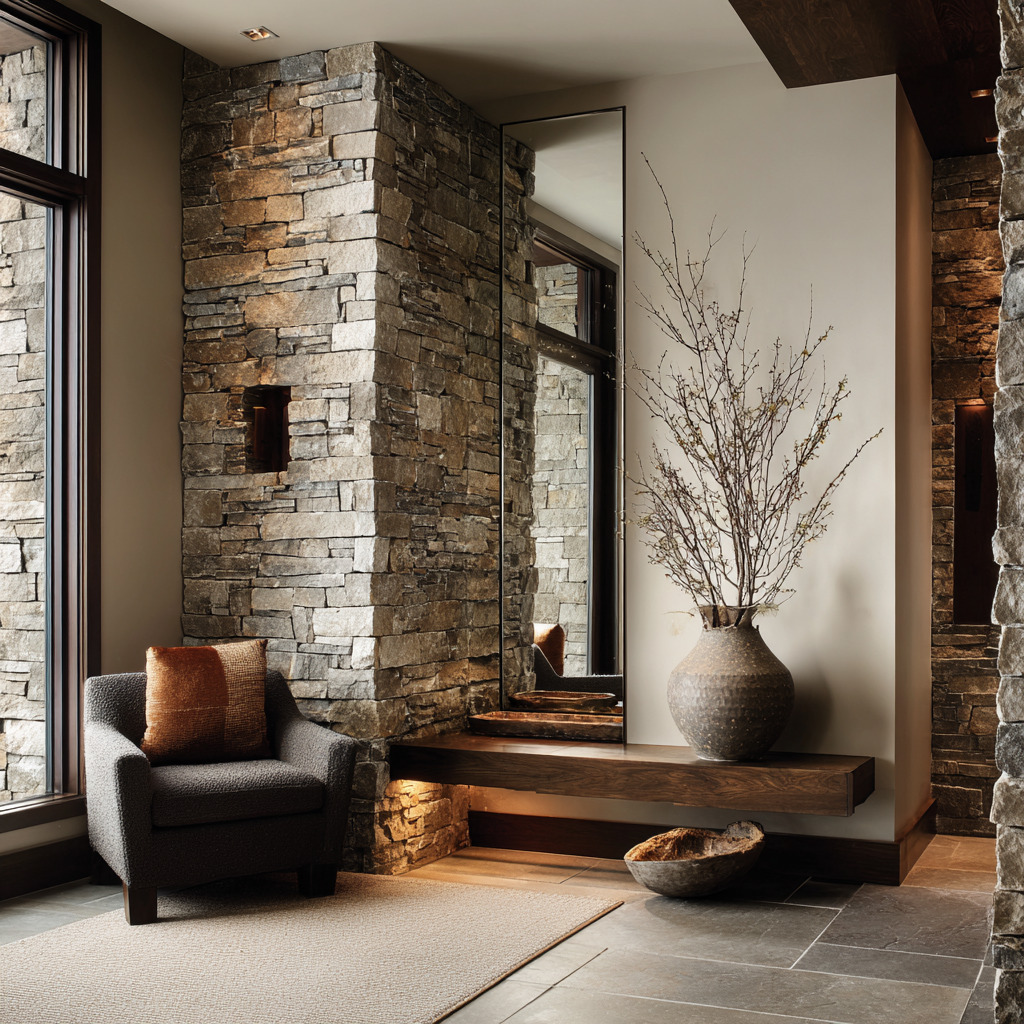
- The Slot: a floor-to-ceiling pane treated like a vertical opening between masses—the mind reads “void,” which feels architectural and serene.
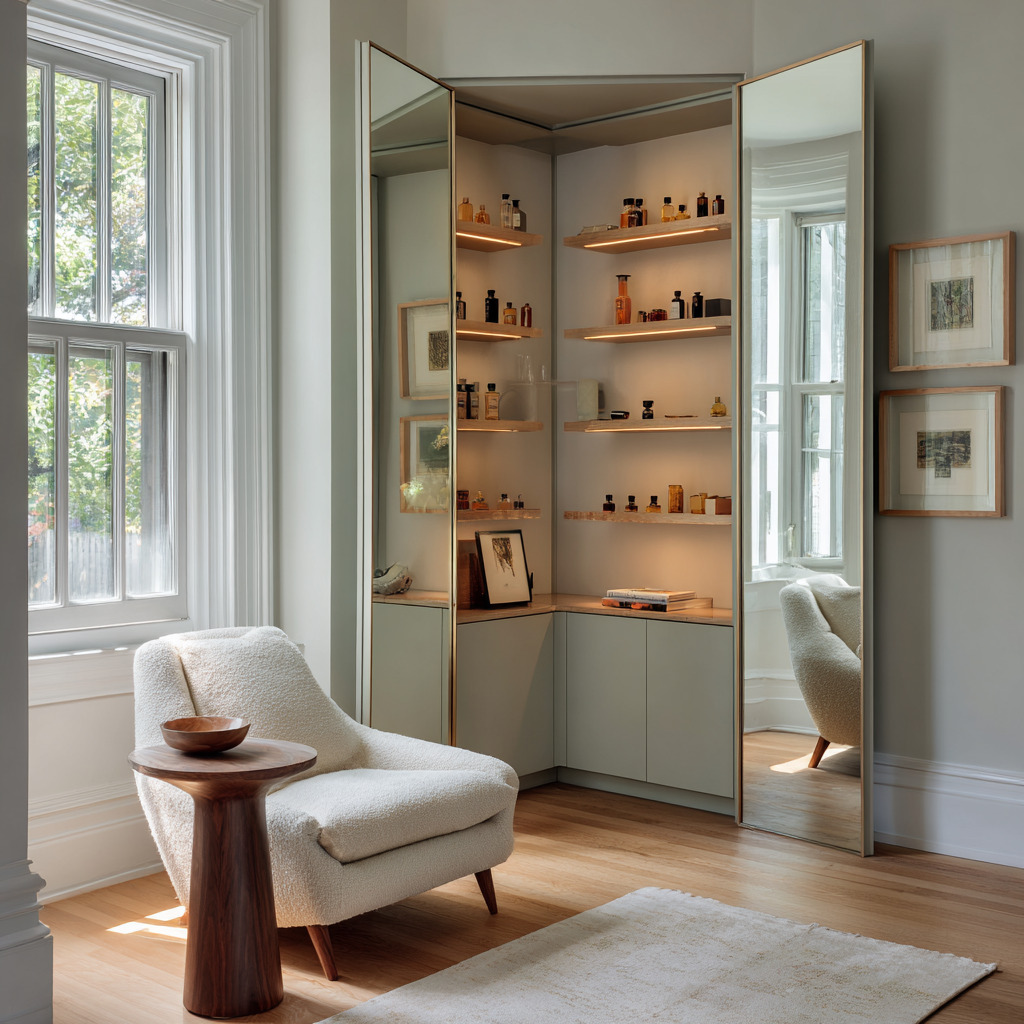
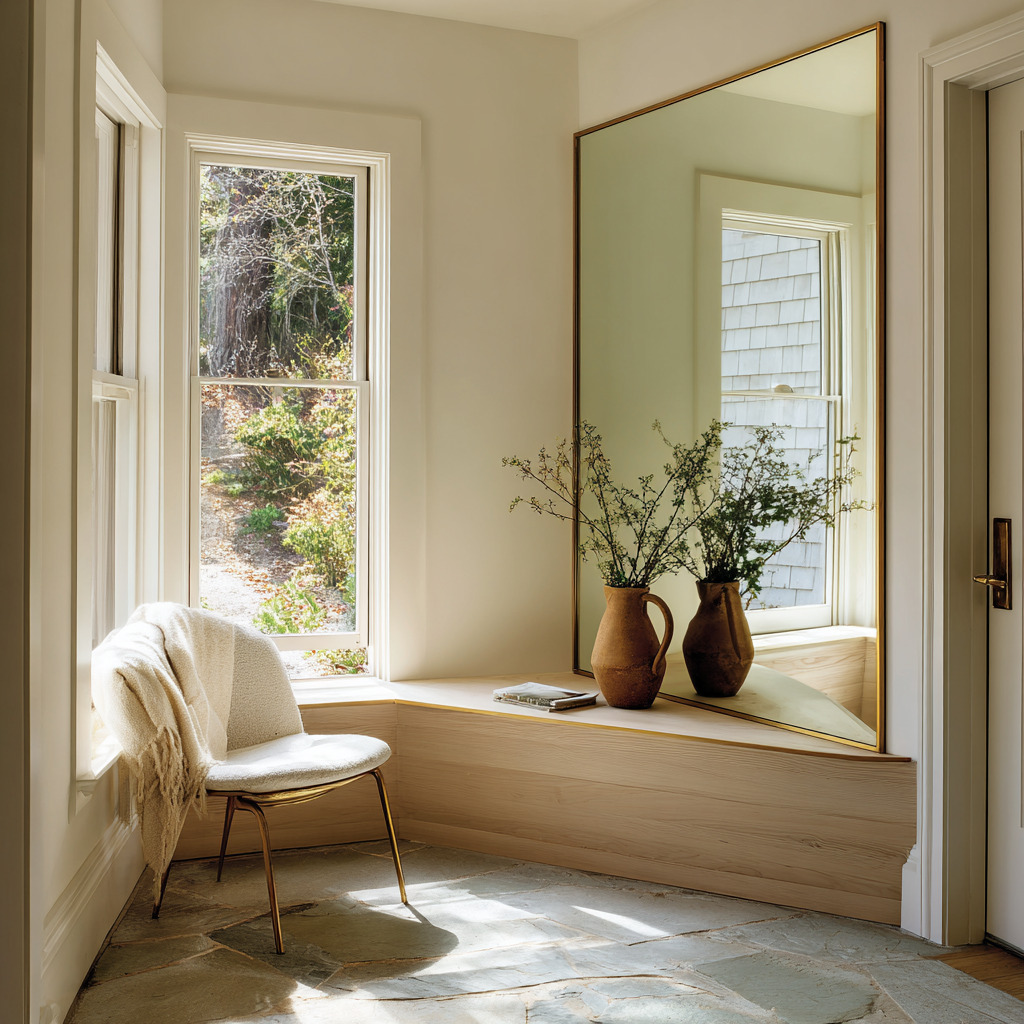
- TheReturn: one generous field on the long wall that barely overlaps the short return—daylight appears to arrive from three sides without filling the room with brightness.
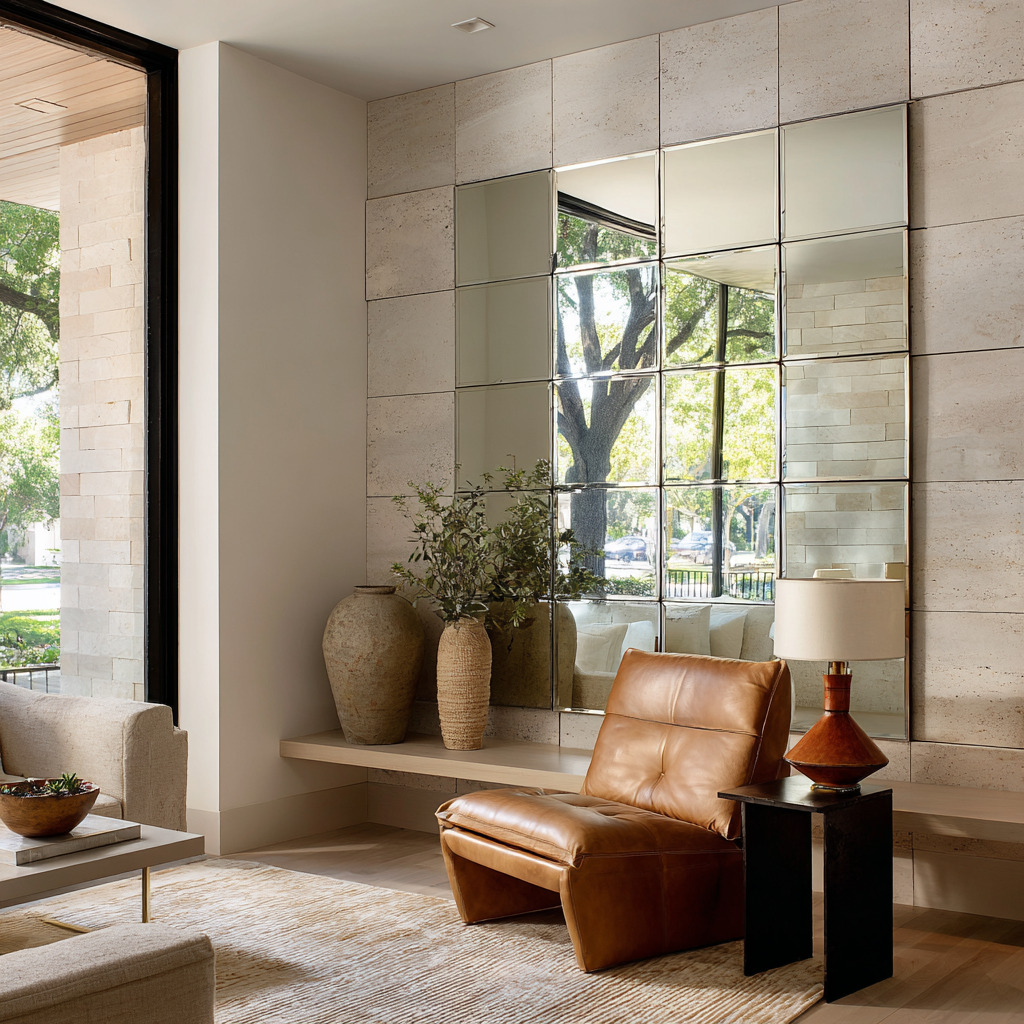
- The Grid Insert: small square tiles set within stone or timber—micro-bevels scatter light into a fine lattice so faces remain readable and soft.
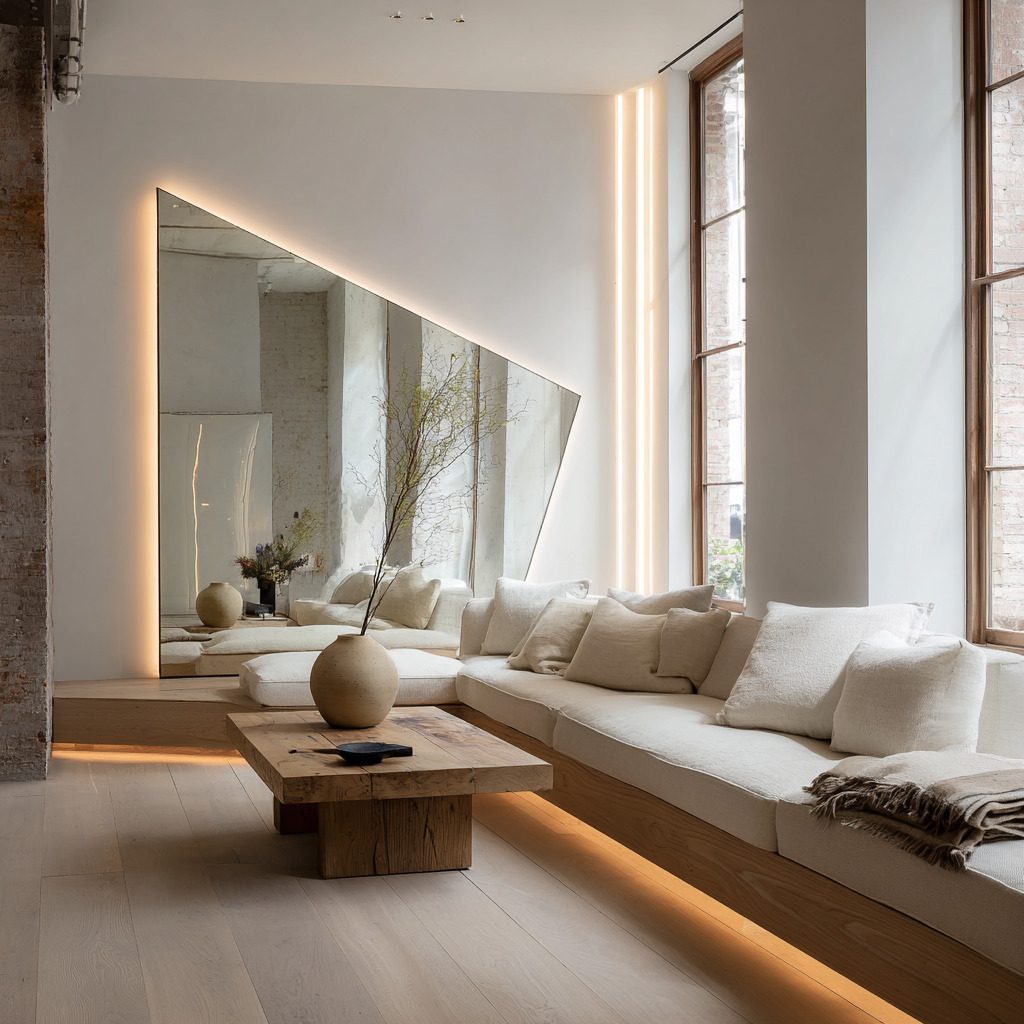
- The Shard: an irregular polygon with one glowing edge—gentle tension enlivens quiet lounges, especially when a long sofa becomes the stabilizing datum.
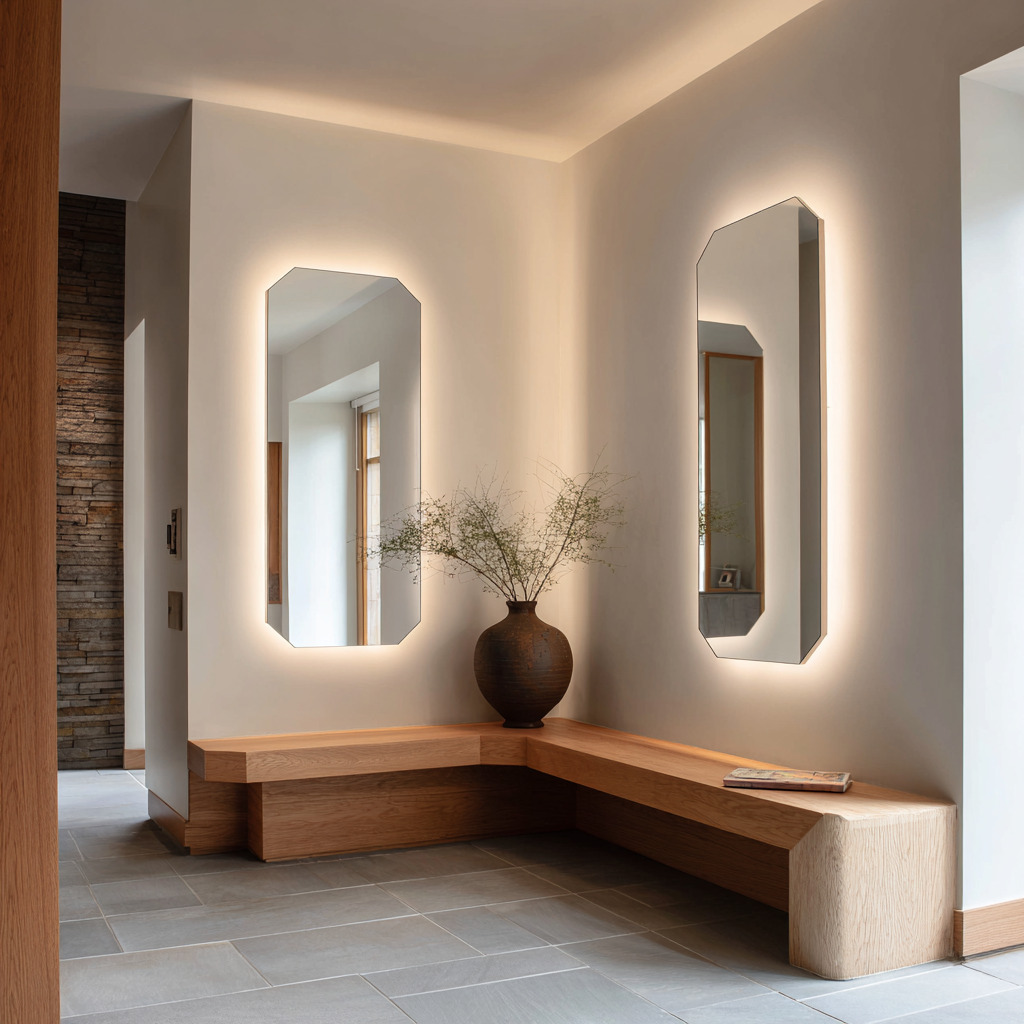
- The Courtyard Twins: two backlit panes on adjacent walls plus a radius bench—the inside corner feels cushioned and welcoming, like a tiny courtyard of light.
- The Offset Blades: slim verticals held slightly proud of the wall with dark frames—gaps cast repeat shadows, so the corner gains a slow pulse even in stillness.
Framing and alignment: how order appears without shouting
The best corner wall mirror ideas lean on alignment rather than size: frames line up with window mullions so reflected grids feel tidy; vertical joints of a three-leaf screen register with wall boards or ceiling planks so the room’s existing lines do the calming; and a thin metal “headband” at the ceiling quietly traces the L so both panes feel capped without heavy trim.
Sometimes the middle panel in a triptych is only a breath wider than the flanking leaves; this tiny proportion nudge centers the composition without needing formal symmetry anywhere else. Even chamfered edges or clipped corners matter here—they add a sliver of shadow and echo bench radii, replacing a severe angle with a softened join that feels intentional at body height where knees and bags move past.
Bench logic: when the seat is the real corner move
Look closely and the bench is the unsung hero of many corner mirror decor ideas. A bench that flows through the turn pulls both walls into the same thought, letting the glass act as a backdrop rather than a spectacle.
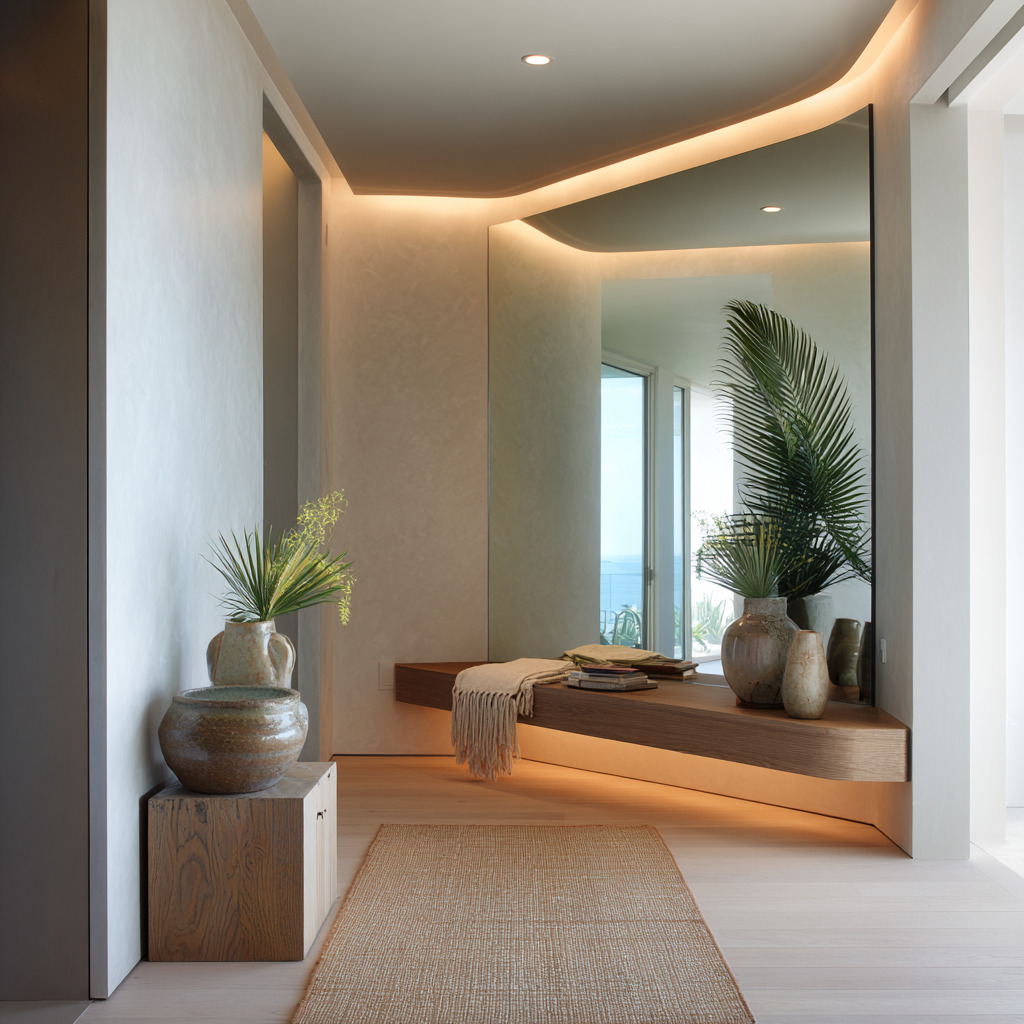
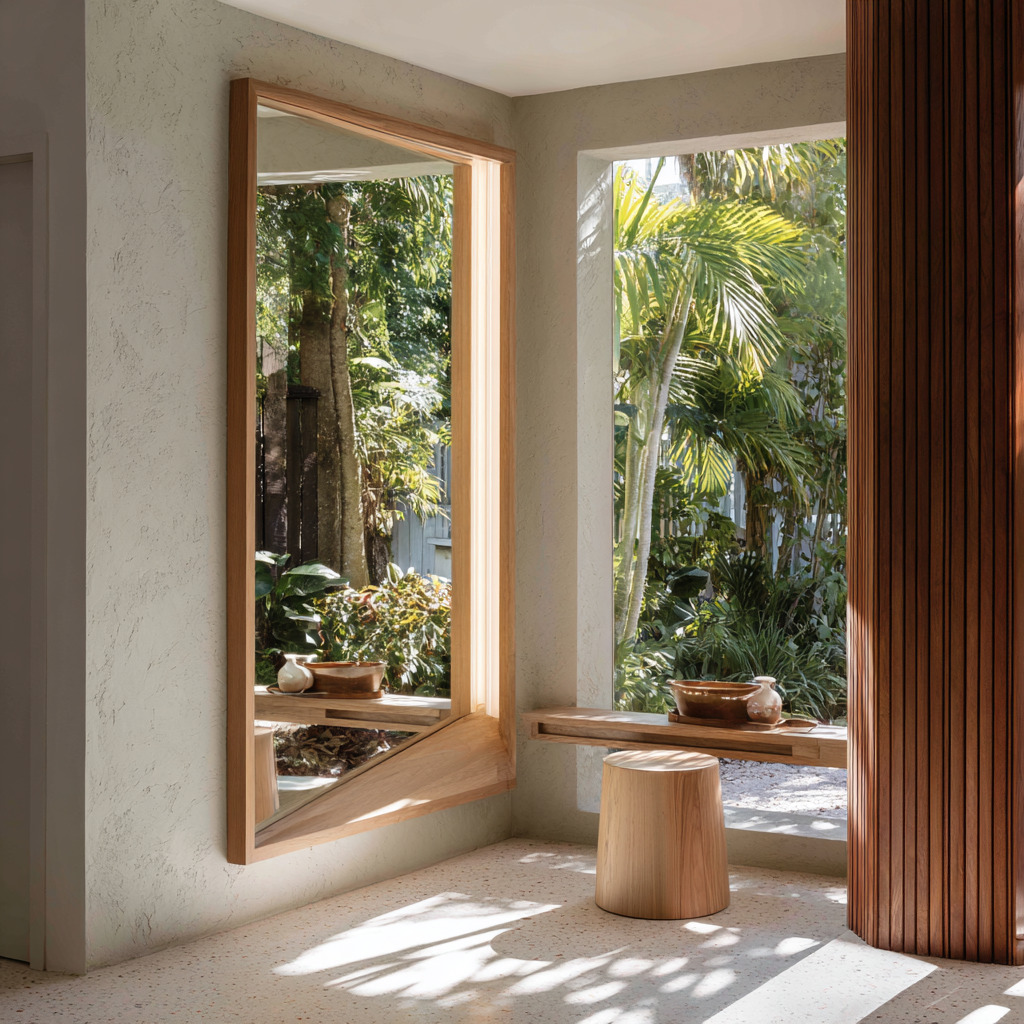
A generous inside radius spares shins, a tapering return preserves walking clearance in narrow halls, and a floating read—whether through a small reveal or a warm skirt of light—keeps stone or timber from feeling blocky. Terracotta laid on the diagonal, a woven stool that tucks under the seat, or a simple plinth that stops just short of the floor all contribute to a sense that mass has breath.
When the bench does the turning, the mirror can stay quiet, and the corner still reads complete.
Light choreography: halos, seams, and sunset-in-a-slot
Light is the language that turns glass from shiny to gentle. A barely-there halo that thickens near the inside edge of a corner makes the right-angle feel cushioned; the wall reads softly luminous rather than hard lit.
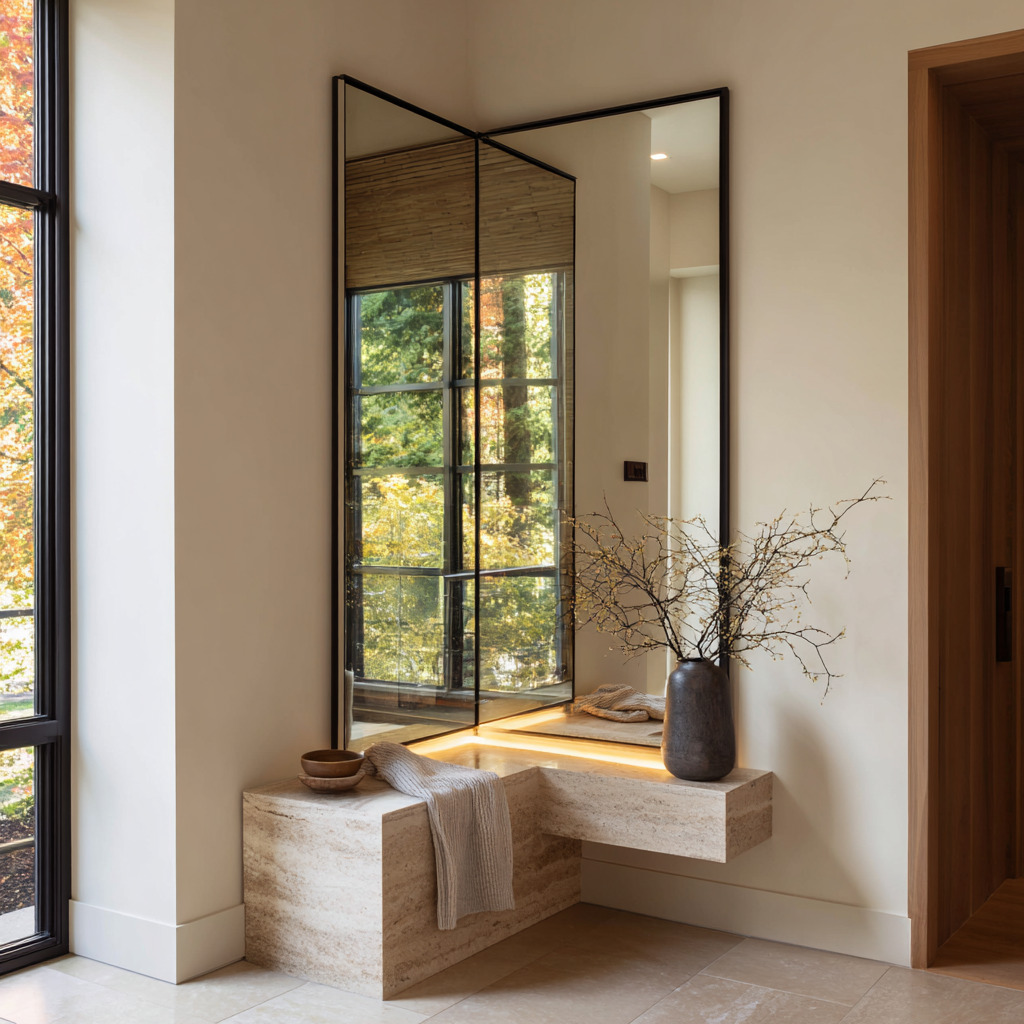
A thin warm line placed exactly where mirror leaves meet creates a seam that looks intentional and doubles as a stage for small bowls or folded textiles kept deliberately low. A cove that bends the corner weaves both walls into one horizon, so the mirror supports a larger band of glow instead of competing with it.
In deeper recesses, a vertical light slot along one side reads like sunset caught in a seam—a mood move more than a fixture. Under-glows beneath benches or consoles float mass just enough that stone and wood feel calm instead of heavy.
Material tone and texture: warm notes, matte neighbors, and edited aging
Warm metal frames—champagne, soft brass—repeated once elsewhere (at a door lever, a slim chair leg, or a ceiling reveal) knit the palette so the frame’s warmth feels deliberate. Where mirror meets stone, timber often becomes the peacemaker; a thick ledge washed with a low graze or an oak plinth beneath a mirror well brings touch and color into a mineral field.
Antiqued surfaces matter not for nostalgia but for optics: softly speckled glass filters garden greens into a painterly wash, providing scale without harshness. Matte neighbors—plaster, boucle, ribbed cladding, jute—keep shine under control so the mirror never dominates.
In aggregate these choices yield mirror corner decoration that reads layered and gentle rather than glossy and loud.
Curating reflections: choosing the subject, not collecting the room
Editors of strong spaces treat reflections like content to be curated. A single sconce becomes a pair without installing another fixture; one tall branch shows up twice as a delicate silhouette that tames mineral weight; a slice of sky or a far aperture hints at distance without turning a corridor into a full panorama.
Objects stay under the midline and slide slightly off-center, letting the reflected window remain the lead character rather than a pile of styling. Negative space becomes a subject in itself—open wall, soft horizon, the quiet edge of a doorway—so the mirror presents calm, not clutter.
This is where corner mirror ideas do their best work: not by multiplying everything, but by selecting one thing and letting it read clearly.

Shape languages and what they signal to the eye
Shape changes mood. Faceted panels break large reflections into restful planes and keep views legible without flare.
Narrow leaves turn brightness into rhythm; the eye tracks cadence, not faces. Irregular polygons add a measured tension that suits very calm lounges, especially when one glowing edge line is repeated under a seat or at a jamb so the family resemblance holds.
Gridded inserts, with small bevels that catch sunlight like a fine lattice, compress glare and keep portraits readable; they also make a corner feel like a window-within-a-wall—an effect that is particularly strong when framed by travertine, limestone, or pale timber. Across climates—coastal, desert edge, or temperate garden towns—these shape strategies hold because they are about how the eye reads order, not about trend.
Proportion moves that barely register yet change everything
The strongest corner wall mirror ideas rely on tiny proportion moves: a center leaf a whisper wider than its neighbors; a frame slim enough to feel like a pencil line, yet thick enough to take a soft chamfer; a bench that keeps its depth consistent across the long run but narrows just as it turns; a halo that swells near the angle and thins toward the outer edges; a plinth that stops short of the floor to leave a lit pocket of air. None of these are loud.
All of them build to a mood where glass feels part of the room’s grammar rather than a bright, isolated noun.
Color and atmosphere: how warmth, charcoal, and green play through glass
Warm brass lines, amber troughs of light, rust pillows, caramel leather, and clay vessels create a shared temperature that softens stone and cool plaster; repeated in the reflection, the warmth lands twice without feeling saturated. One charcoal anchor—a window frame, a steel shadow line, a dark chair—holds the center so a sandy palette doesn’t drift.
Greenery works best when low and airy: olive, fig, or palm fronds that read as fronds, not as dense bushes; the plant animates both reality and reflection while leaving the glass plane open. Across general regions where daylight is strong, this trio—warm metal, a single dark anchor, and a restrained green—gives corner mirror decor ideas a calm, breathable atmosphere.
Spatial illusions that act quietly
Mirrors opposite a short stair can lengthen the approach just enough that the body relaxes before stepping up; along a breezy hall, a wide pane under a bending cove reads like continuous light, turning a tight pass-through into a soft lounge edge. When a pane on the long wall just kisses the return, daylight reads as if it comes from three sides, lending depth without adding a window.
Pillows seen twice make a seat feel longer; a single lantern or bowl staged on a hovering console becomes a measured marker on a visual axis that carries through multiple openings. In all cases the trick is restraint: the illusion is gentle because the content is edited.
Styling at the micro scale: low horizons, off-center beats, and textures that tuck
At the scale of hands and eyes, small arrangements make outsized differences. Low horizons—books and bowls kept beneath the seam—leave the glass clean and let a warm line of light read without interruption.
Off-center placement keeps reflections dynamic while maintaining a sense of ease. Woven stools, poufs, and nested tables slide under benches, adding texture without stealing floor room.
Throws land where an under-glow grazes the seat, so the cloth reads soft rather than staged. Artwork, when present, leans into corners below eye level, ceding territory to the mirror while still giving the corner a human note.
Organizing the universe of corner mirror decor
By reflection strategy
- Single subject doubled (sconce, branch, aperture).
- Window proxy (kissed-return or hinge near a real opening).
- Mood field (antiqued glass filtering garden color).
- Negative space as content (sky or open wall).
By seat relationship
- L-bench as primary move, mirror as quiet backdrop.
- Hovering console bridging a vertical slot.
- Deep niche with a low plinth for books and vessels.
- Tapered bench for hallways with a lit skirt.
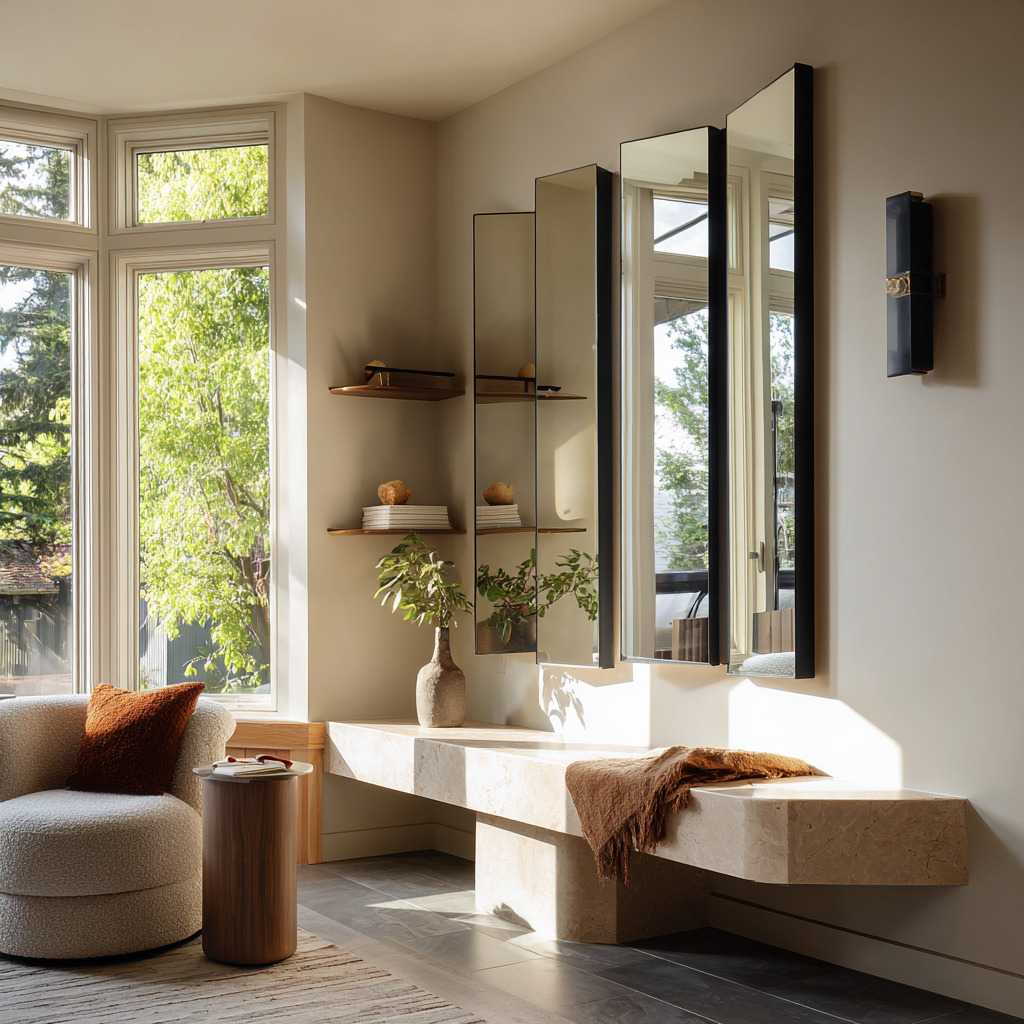
By frame rhythm
- Pencil-thin metal that echoes mullions.
- Three-leaf compositions with a calm, wider center.
- Offset blades with dark gaps that cast shadows.
- Gridded tile fields with micro-bevels.
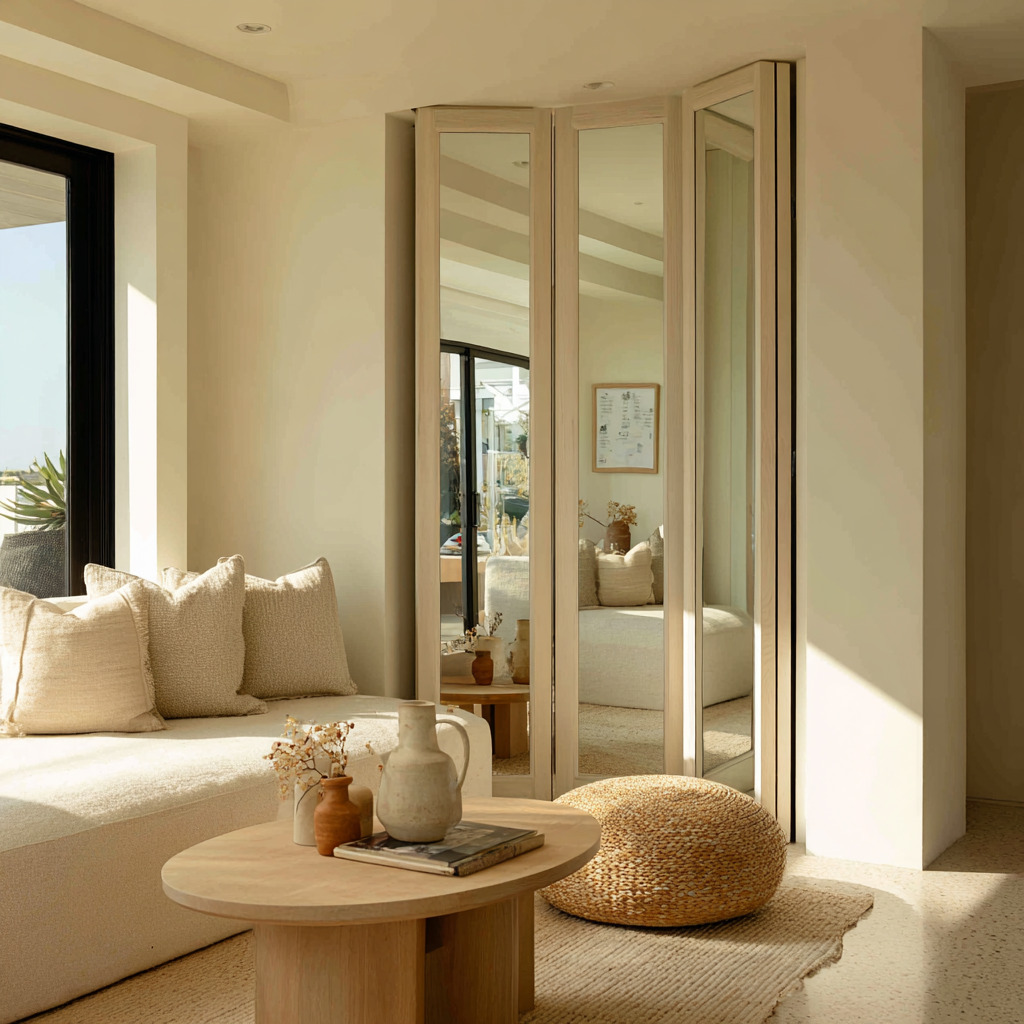
By light behavior
- Halo thickened at the inside edge.
- Seam line riding the joint of two panes.
- Cove that bends the corner as a single horizon.
- Vertical slot that reads like captured sunset.
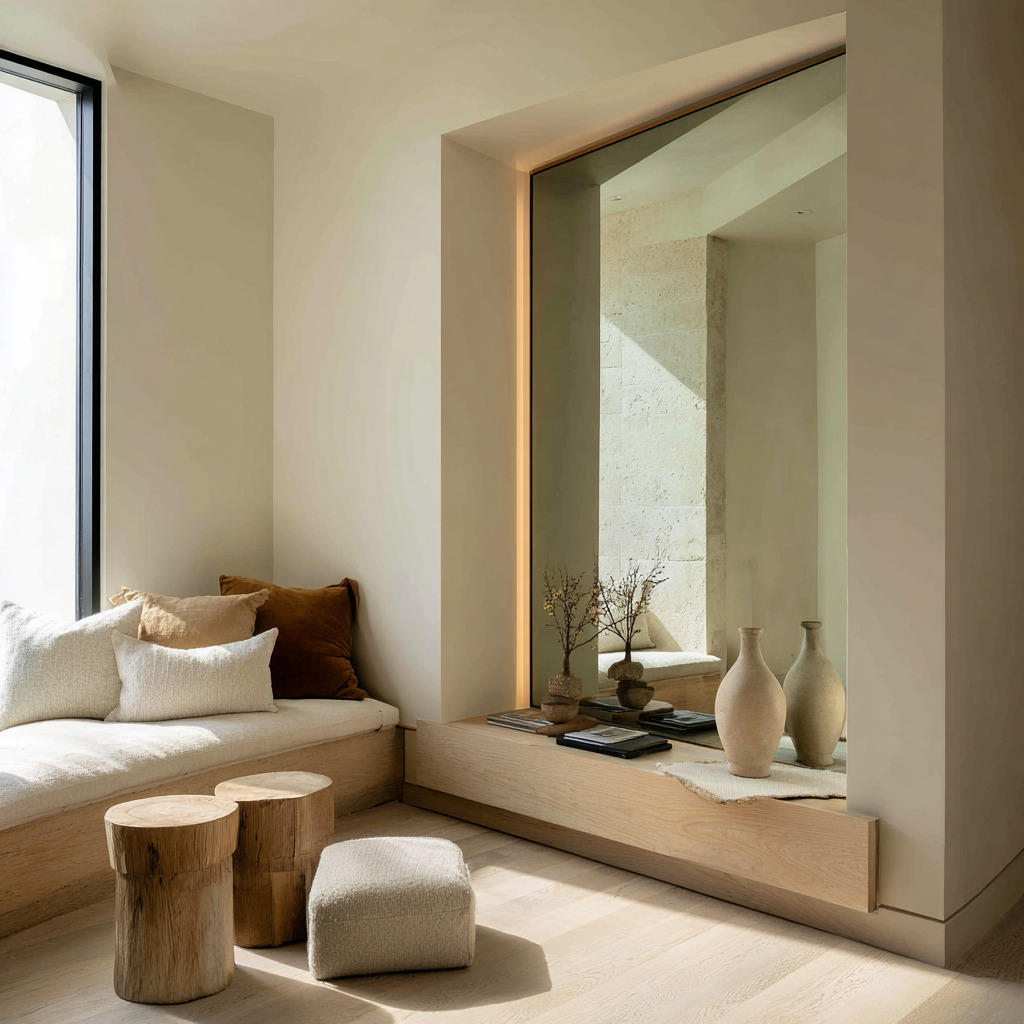
Within the broader family of corner mirror ideas, rooms often adopt a handful of repeatable signatures that are also strong corner wall mirror ideas for serene living spaces: narrow framed leaves that keep reflections in order; tall slots that behave like architectural openings; gentle grids that scale brightness down; and backlit twins that transform a tight angle into a small courtyard of glow. When styled as corner mirror decor ideas, these signatures pair with low, textural objects—clay, linen, woven fiber—so the plane of glass remains clear and the reflection edits itself.
As a category, mirror corner decoration thrives on alignment with existing lines, on warm metal accents that appear once more in the room, and on a single green silhouette set low and off-center, allowing sky, negative space, and a measured stripe of light to become the real “view” the mirror presents.
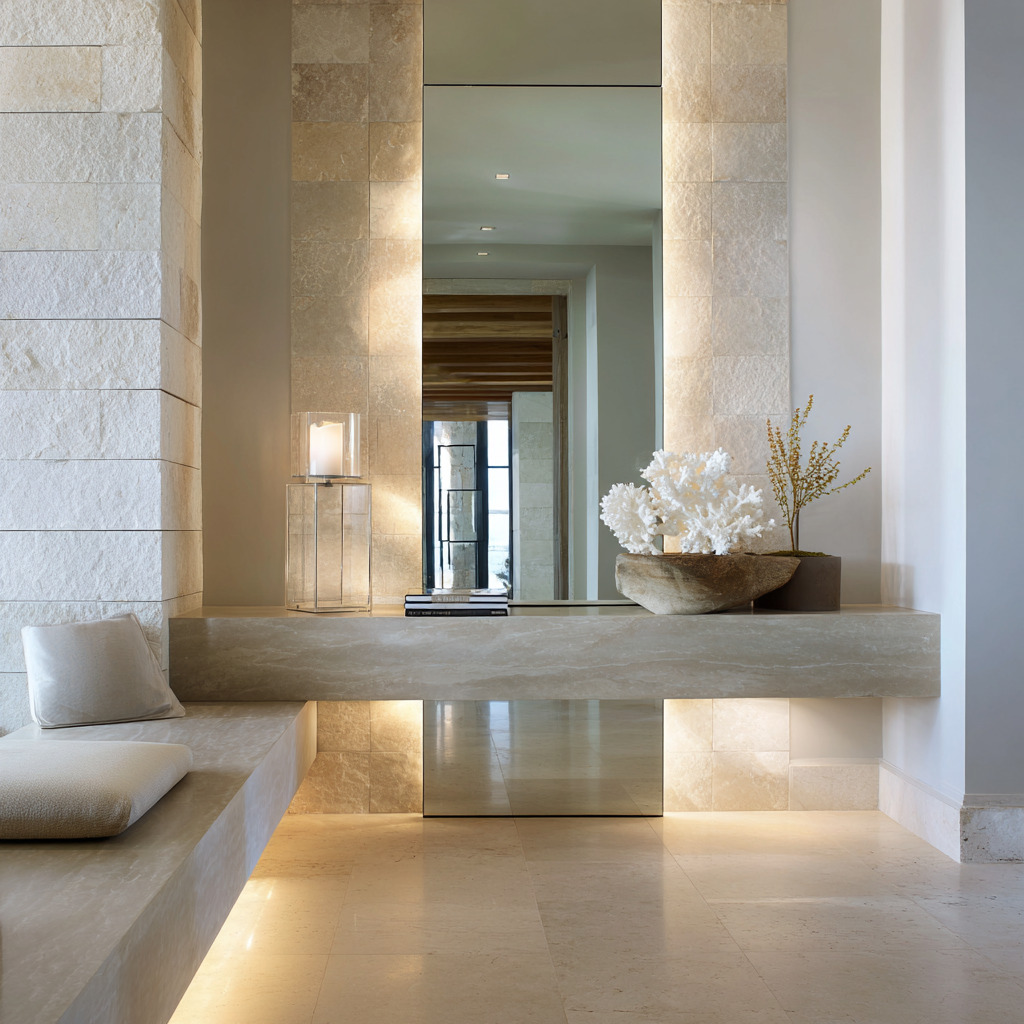
A compact atlas
- Stone mass + timber bridge + vertical slot of glass: mineral calm softened by grain and a lit pocket of air.
- Backlit twins + radius bench + one tall vase at the turn: a small courtyard effect where the corner feels cushioned.
- Return pane + brass edge + long pale bench: quiet depth that appears to collect daylight from three sides.
- Antiqued fold + warm datum behind seating + slim floor lamps just outside the angle: a dusk-like vignette that shows scale without glare.
- Offset mirror blades + dark frames + shelves that match bench thickness: a tidy built-in language with a slow, kinetic shadow beat.
Conclusion
Because these compositions are rooted in how the eye reads order—line through the angle, reflection selection, frame rhythm, light at the seam—they adapt easily to different settings, from breezy coastal towns with strong midday glare to shaded urban neighborhoods where borrowed light matters. Materials shift—travertine becomes timber, terrazzo becomes plank, brass becomes patinated bronze—but the grammar holds: calm stripes instead of big sheets, warm halos instead of hot spots, benches that turn with kindness, and reflections treated as edited views rather than multipliers of stuff.
Taken together, this is the core of lasting corner mirror ideas: a set of visual strategies that make corners feel composed, grounded, and quietly generous—places where light lingers, textures speak softly, and the room’s rhythm carries through the turn without losing its ease.