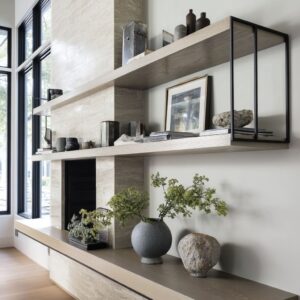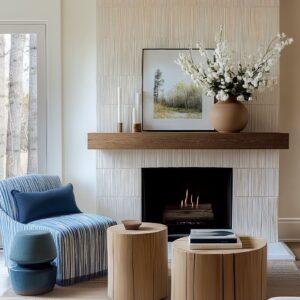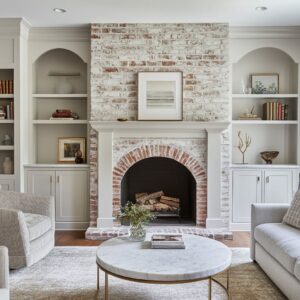
A living room built around fire can feel composed rather than loud when the elements that shape the view—planes of plaster, bands of stone, ribs of timber, soft textiles, and thin lines of metal—agree on a rhythm. Across many creative modern fireplace living room design ideas, the most persuasive rooms share a few quiet habits: corners are treated like soft hinges rather than dead ends; one shared seat-height horizon steadies the whole elevation; heavy masses appear to hover with a finger-width of darkness or a warm underglow; ribbed textures compress toward the ember; and objects arrive in small, disciplined trios with generous air around them.
The result is a mood where flame acts as one steady note inside a field of calm materials, daylight folds in softly, and the eye moves in smooth paths instead of bumping from feature to feature. This article gathers those habits into an organized read on modern fireplace living room design, focused entirely on appearance and styling rather than construction, and uses them to explain why certain spaces feel both restful and visually rich at the same time.
This article shares visual interior styling ideas for living rooms with fireplaces. It is general design commentary, not construction advice or code guidance.
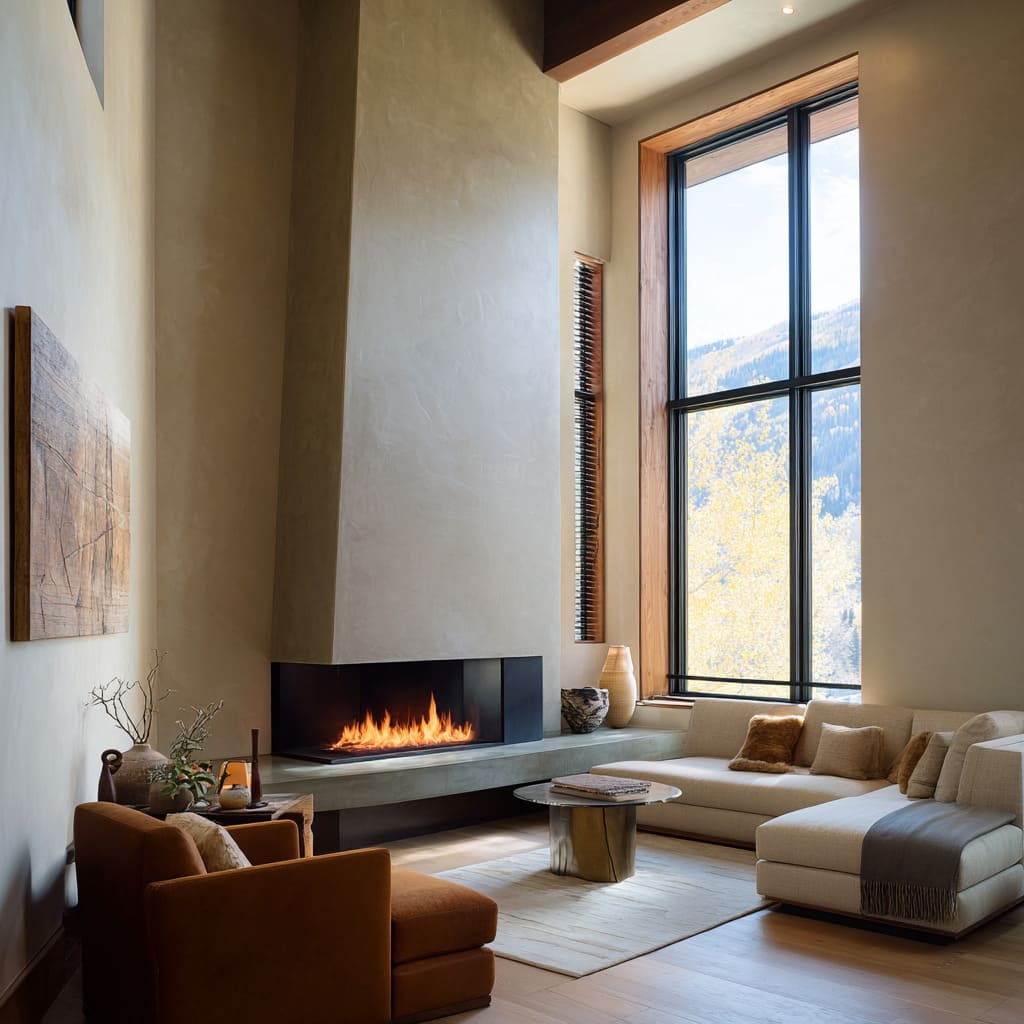
Corners as soft hinges rather than terminations
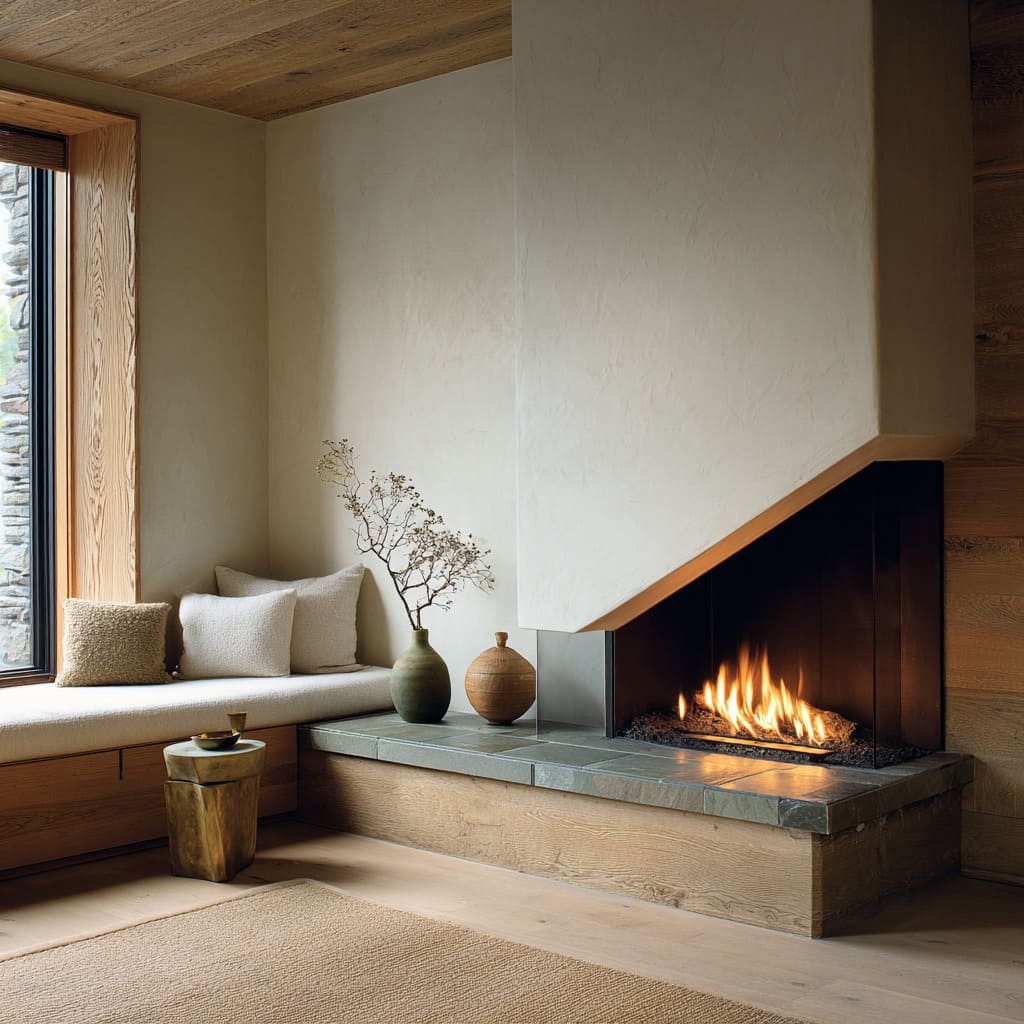
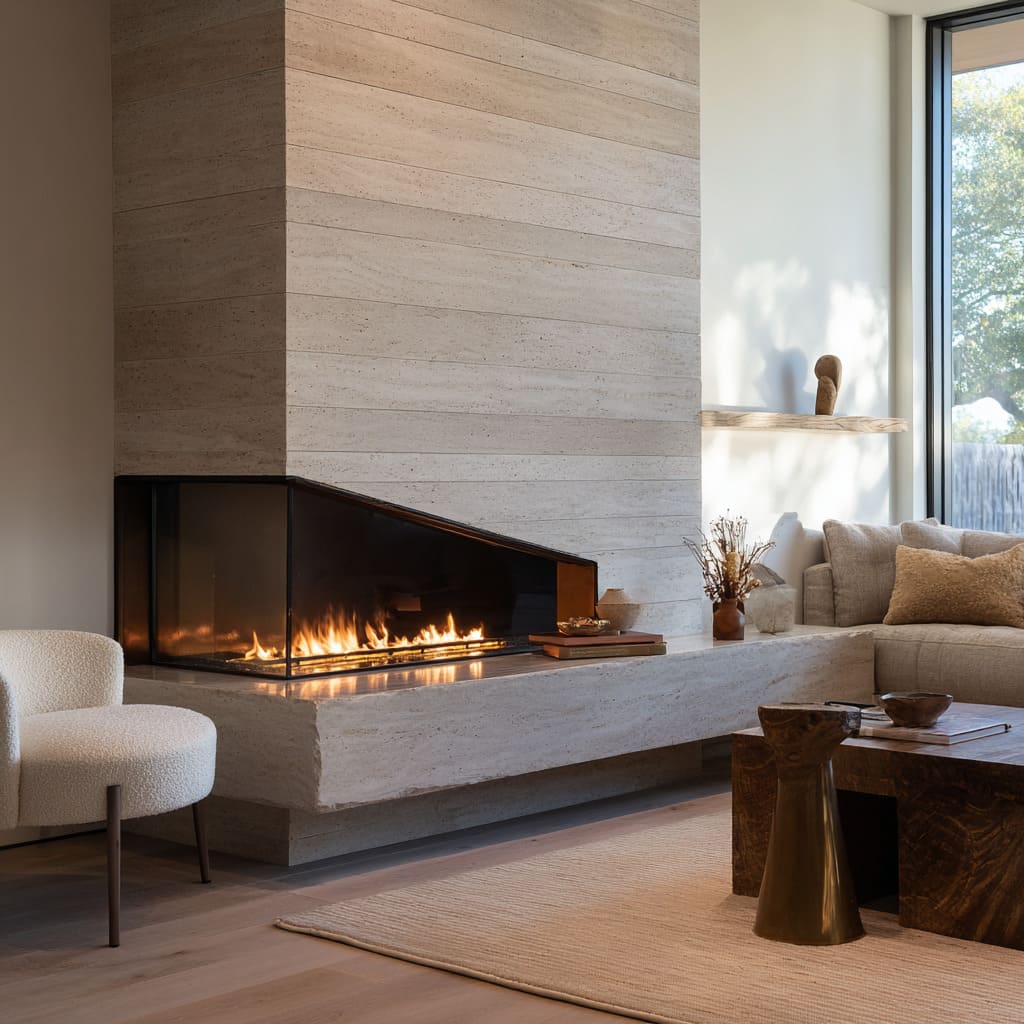
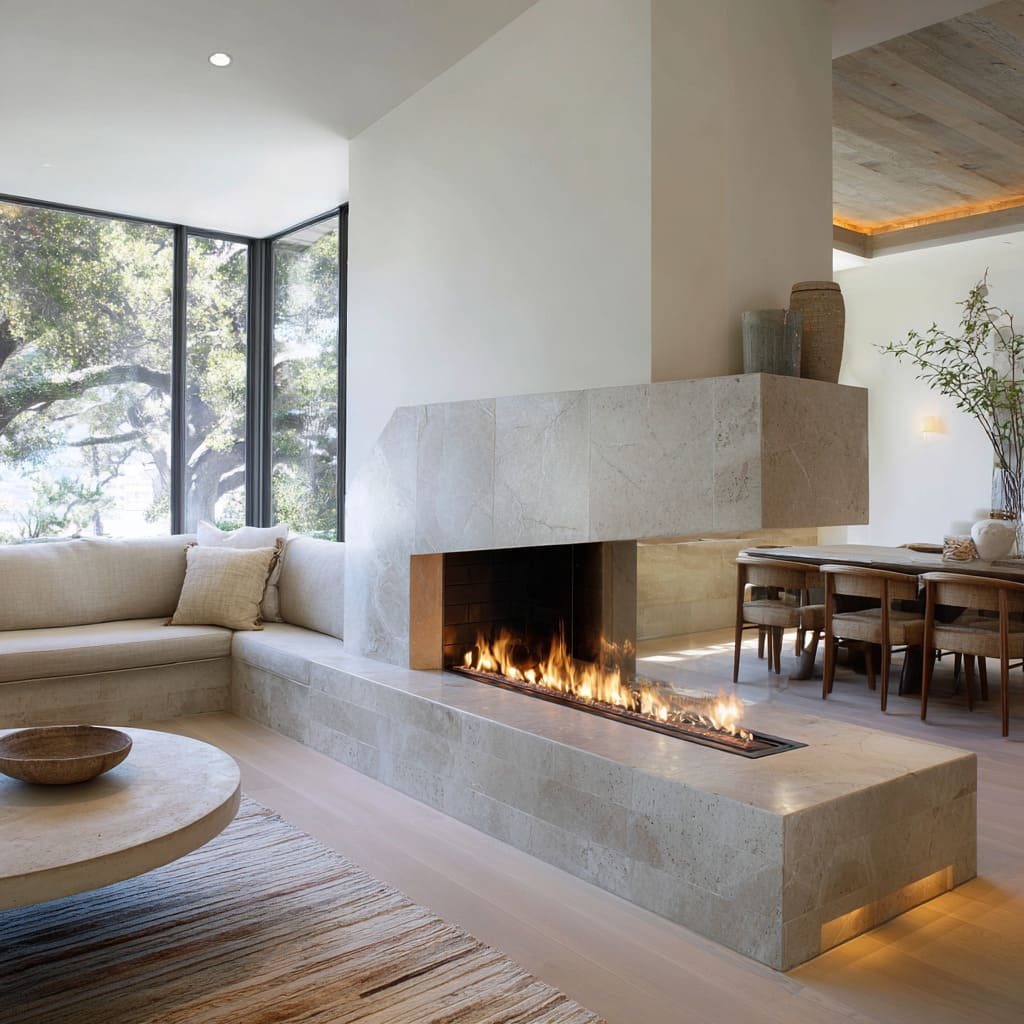
In many creative modern fireplace living room design ideas, the corner becomes the most serene spot in the room when a continuous element bridges the turn: a hearth slab that wraps, a bench that arcs into glazing, a rib field that keeps its spacing across both planes, or a glass firebox that returns so the flame line does not stop abruptly.
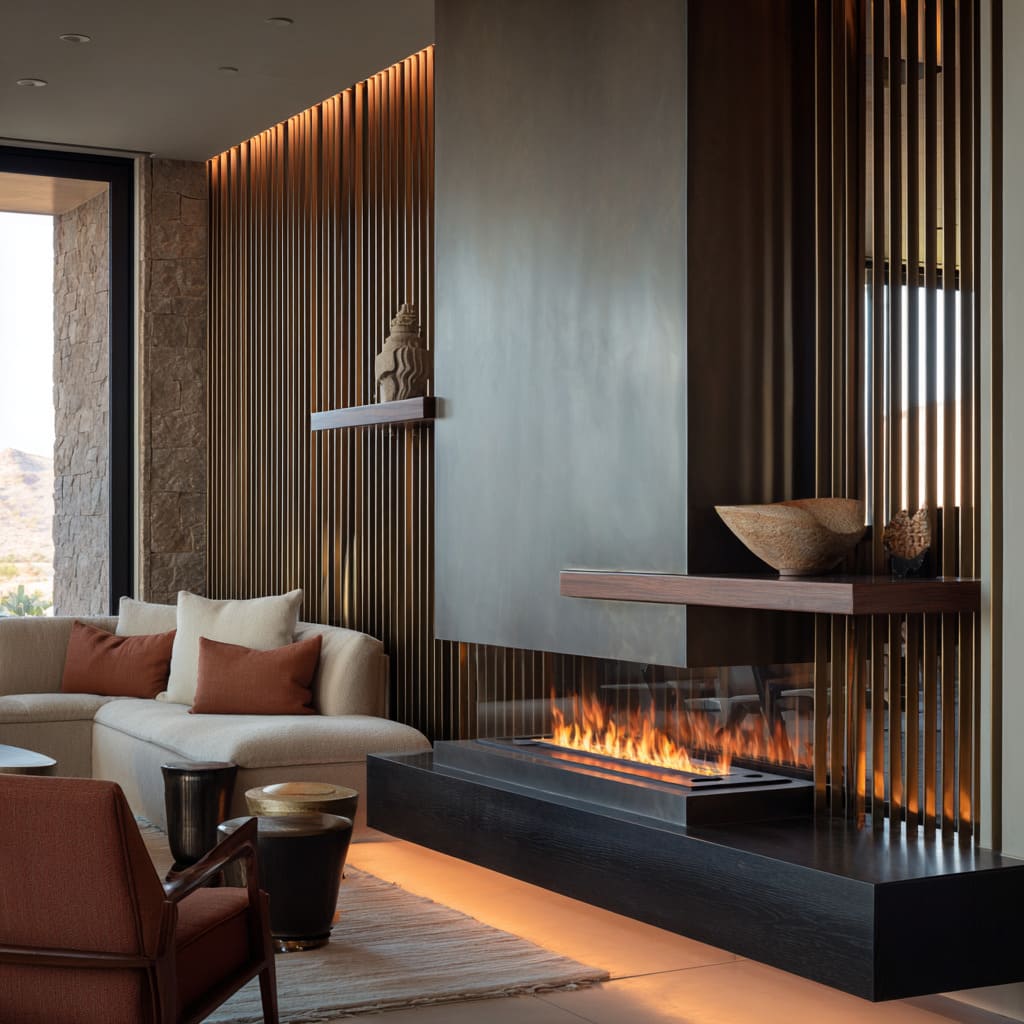
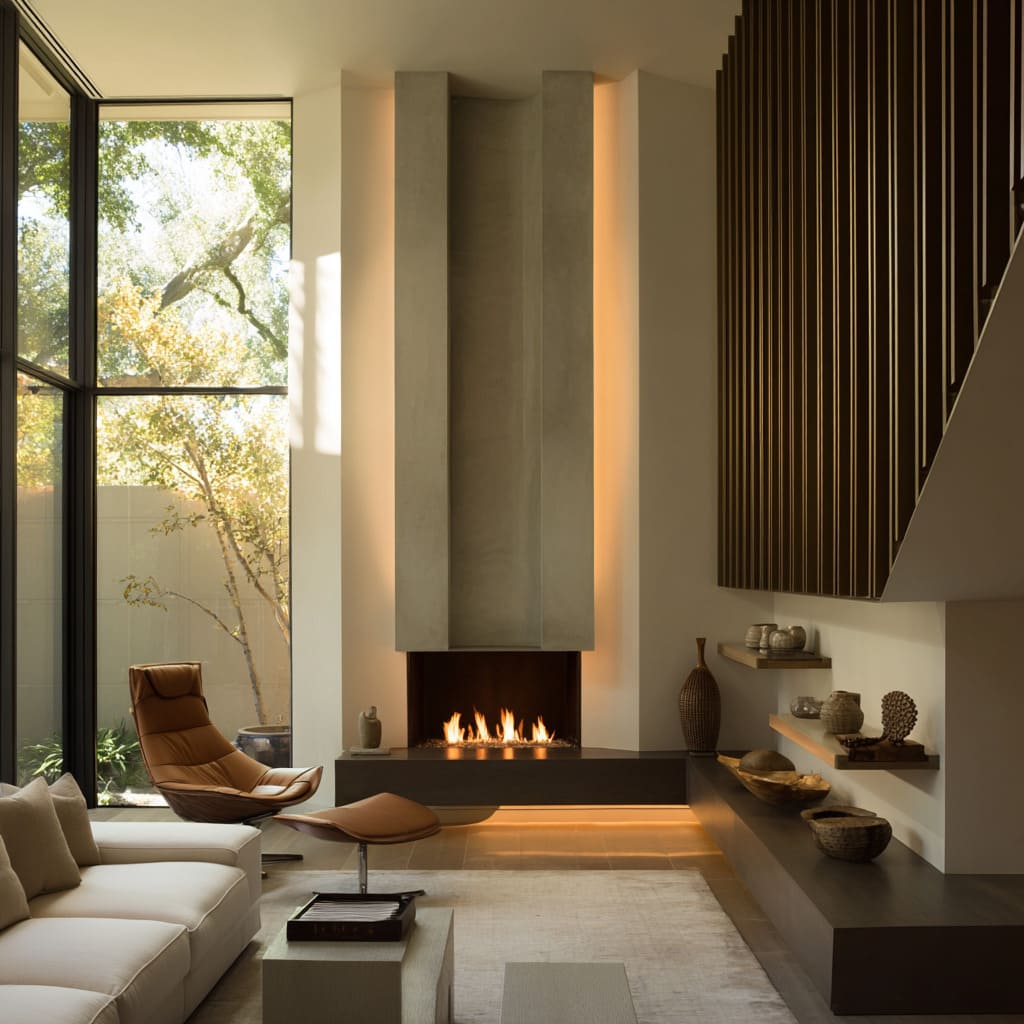
A gentle radius at a window bench or hearth nose turns a hard light break into a gradient; daylight slides rather than snaps, and posture naturally shifts toward the view. Faceted chimneys contribute their own kind of softness when each crease catches a thin ribbon of side-grazed glow; the mass reads like folded paper, and the angle works as a visual hinge that carries rhythm through the turn.
In these scenes, corners stop feeling leftover and start reading as a composed moment that links seat, wall, and view in one move—an approach that keeps modern fireplace ideas calm even with strong forms at play.
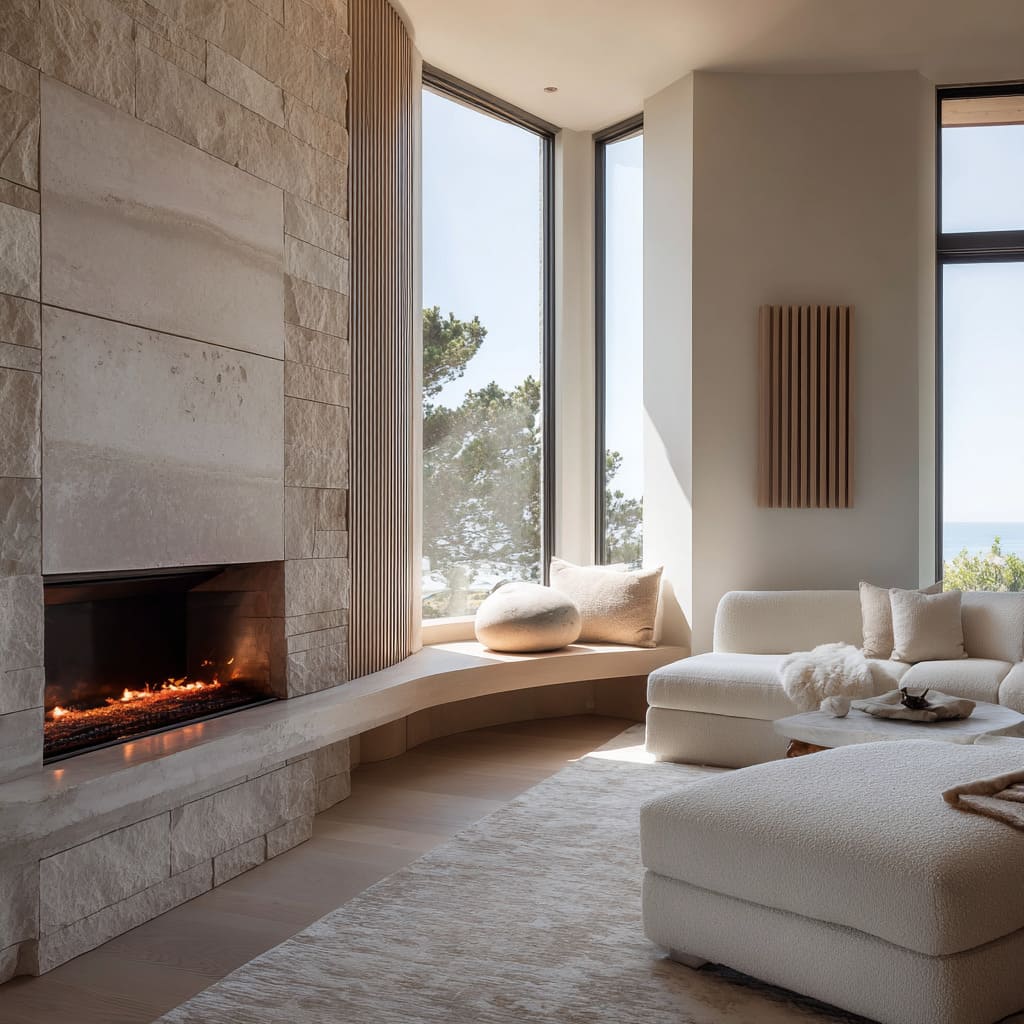
The power of a single horizon
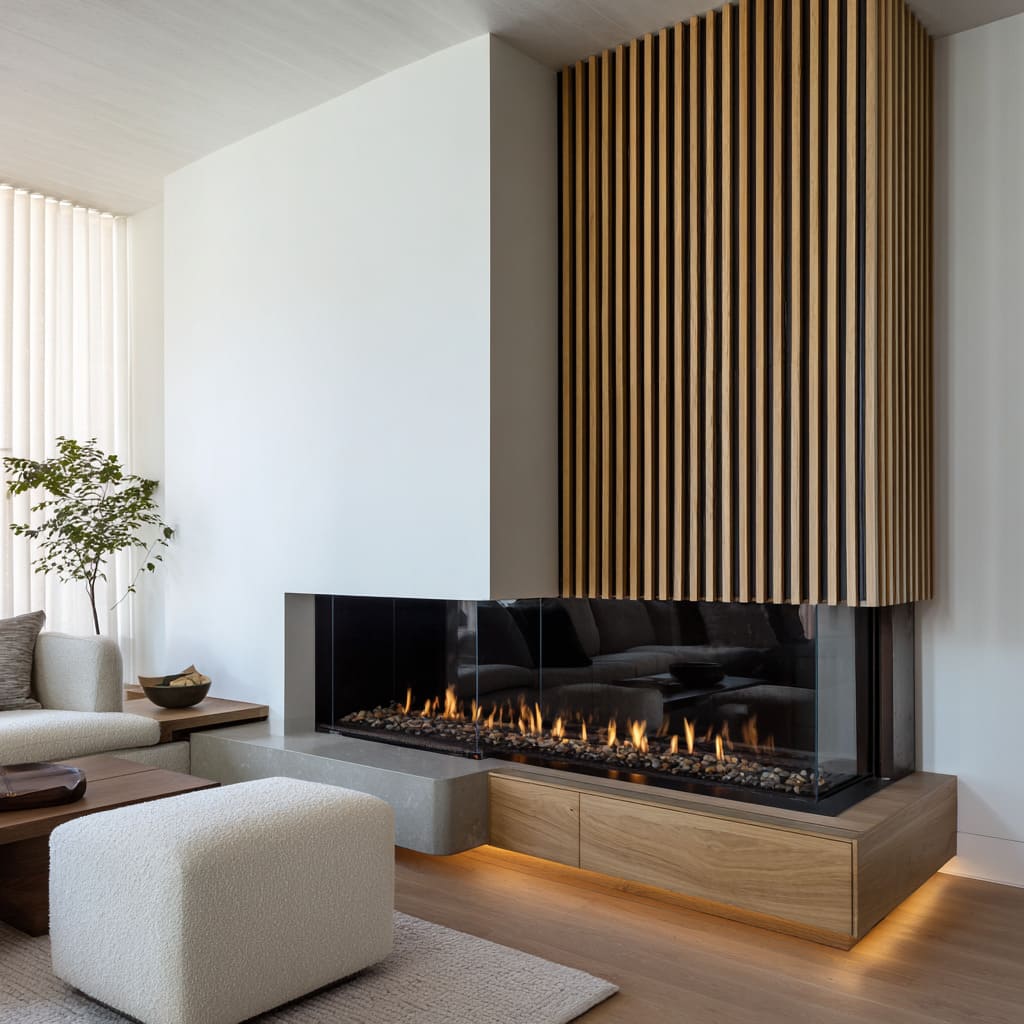
One of the clearest patterns in modern fireplace living room design is the use of a shared seat-height band that runs across elements: hearth top, adjacent bench, window stool, and even the line where sofa cushions sit. Once that horizon exists, separate parts behave as one piece of furniture across the room, and the fire feels embedded in the lounge rather than pasted on a wall.
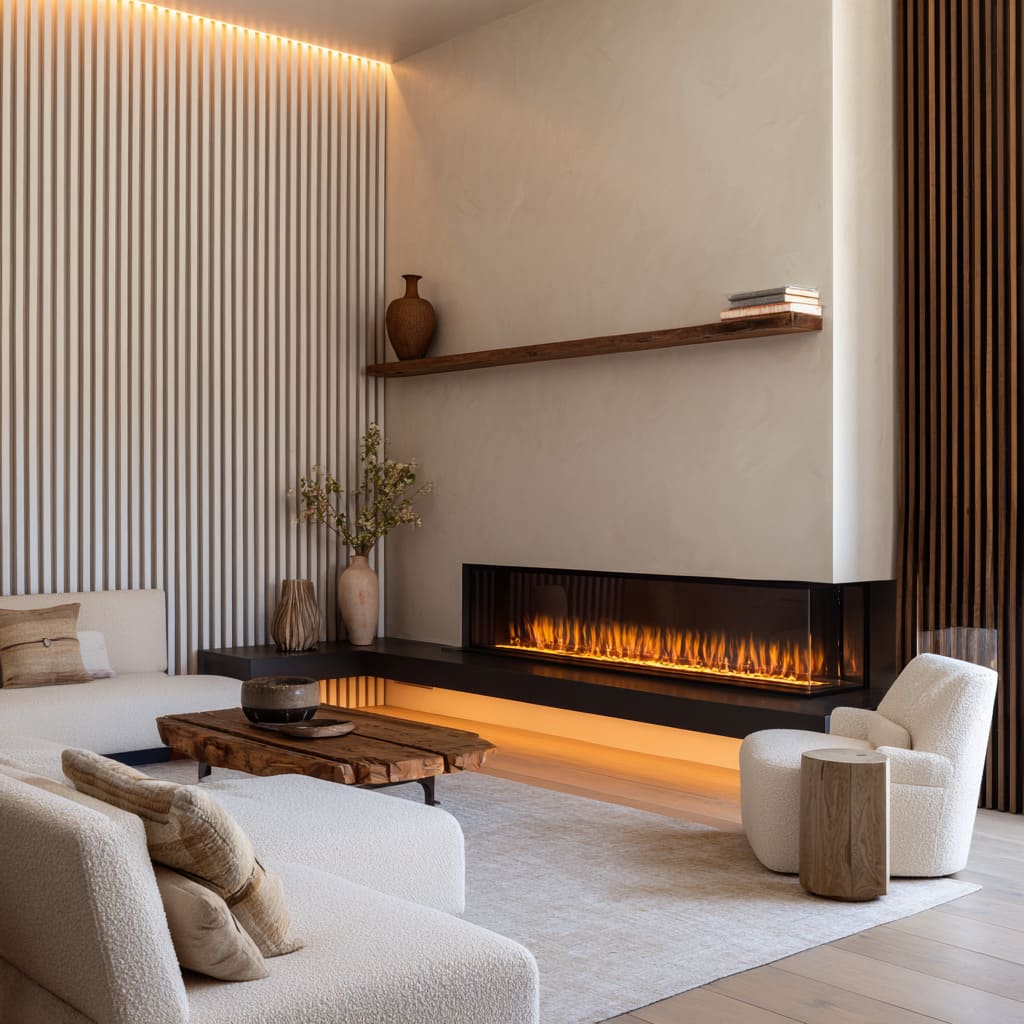
The effect is strongest when a consistent thickness echoes along the elevation—the mantel blade, the shelf in a niche, the window stool depth—so the eye registers a repeating beat without needing overt decoration. Art often respects this cadence by placing its horizon lines or densest strokes on the same level; small objects—vessels, shallow bowls, a short stack of books—tend to land at the datum ends or where a ledge turns the corner, tying punctuation to the room’s underlying meter.
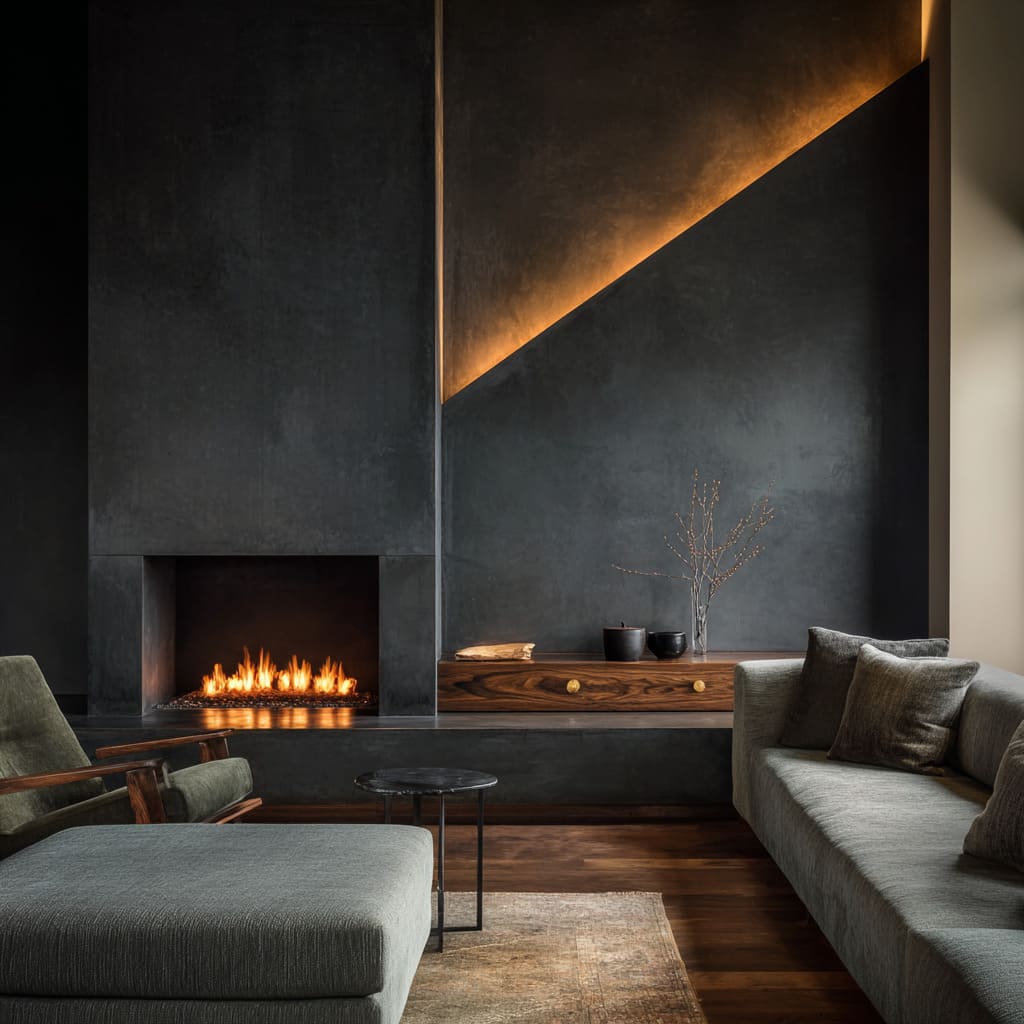
Mass that seems to hover: turning weight into line
Heavy materials gain grace when they are lifted visually. Instead of spotlighting the face of a hearth, many creative modern fireplace living room design ideas use a narrow darkness (a reveal) or a warm under-glow beneath the mass to erase the heaviest shadow and let the slab appear to float.
The hover is often mirrored above with a blade-thin mantel that projects just enough to throw a slim shadow line.
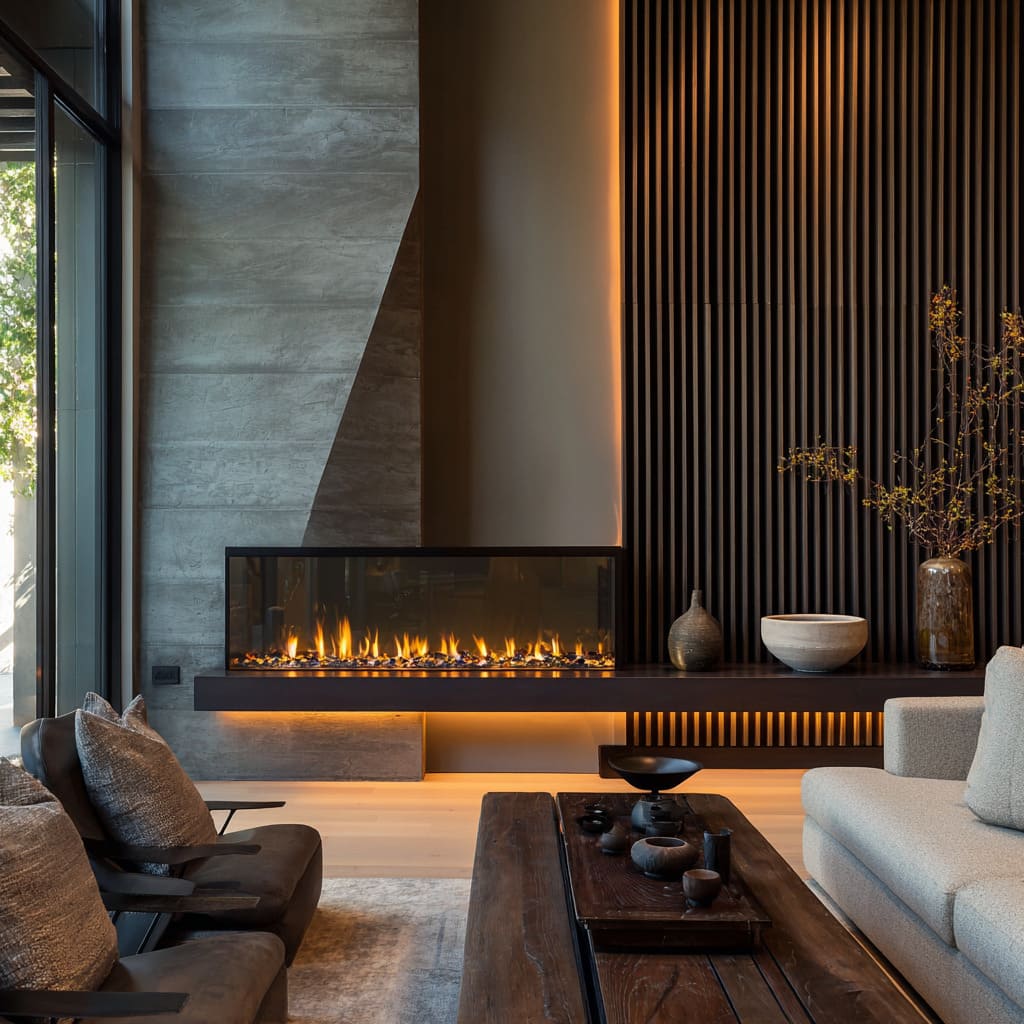
Together, those two “lifts” frame the fire pocket as a suspended stripe. In rooms that rely on big stone courses or dense plaster, this approach turns volume into drawing: you read lines and planes rather than a block, and the flame becomes a calm, precise accent below, not a bright rectangle fighting a heavy base.
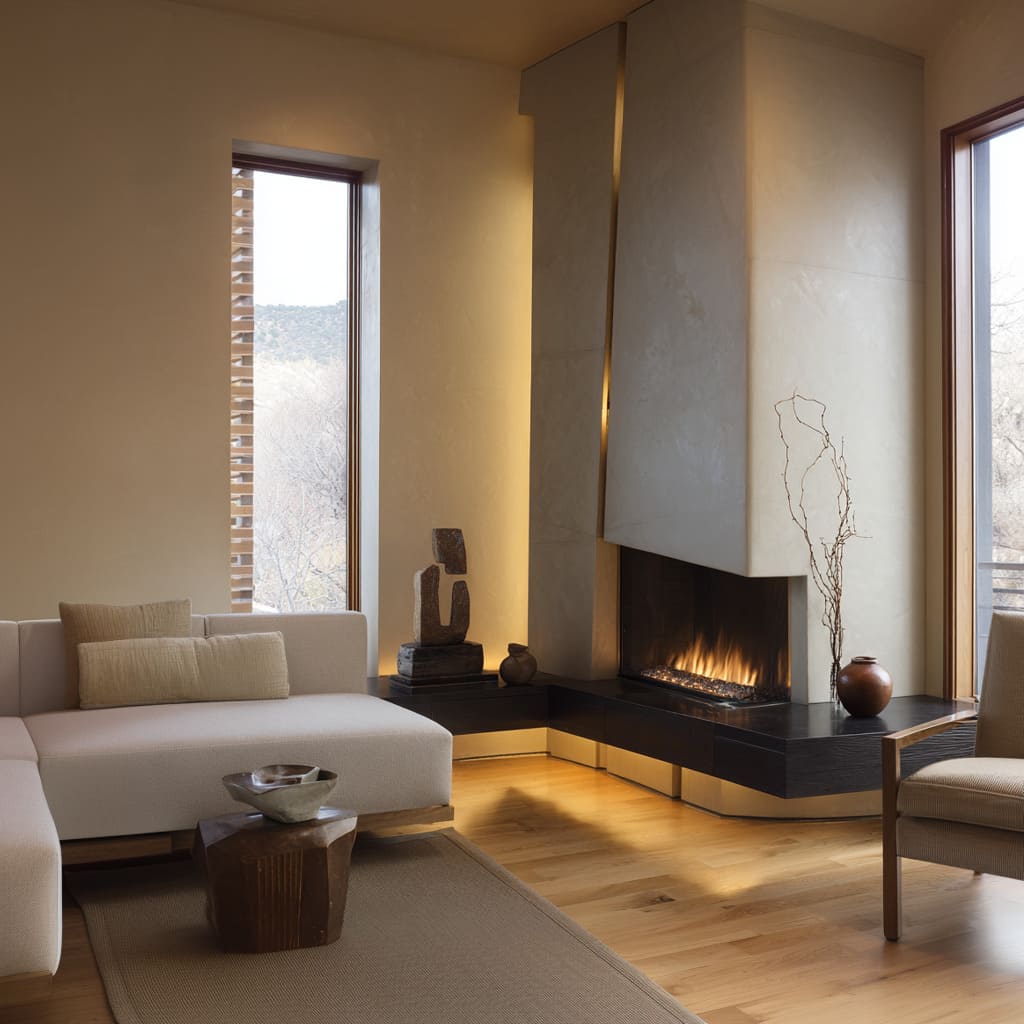
Ribbed textures in three pitches that guide attention without loud contrast
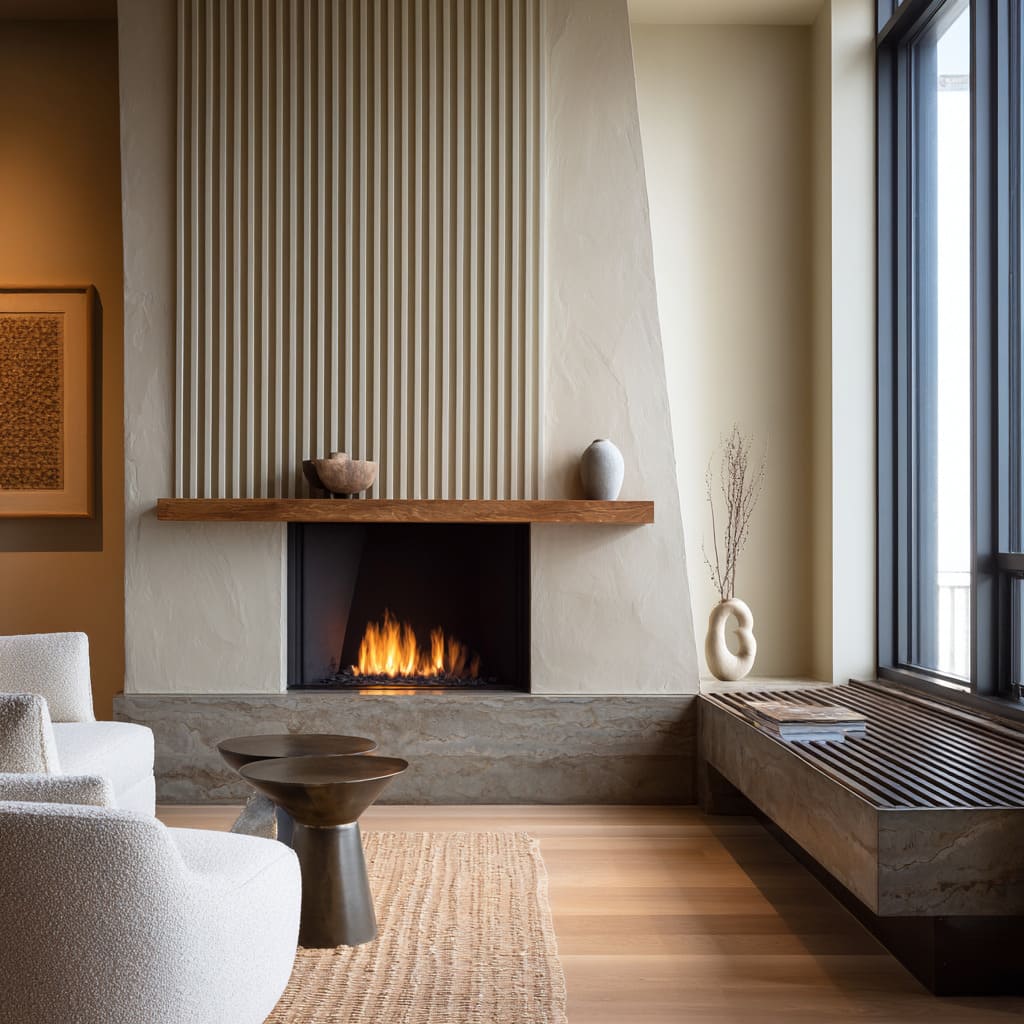
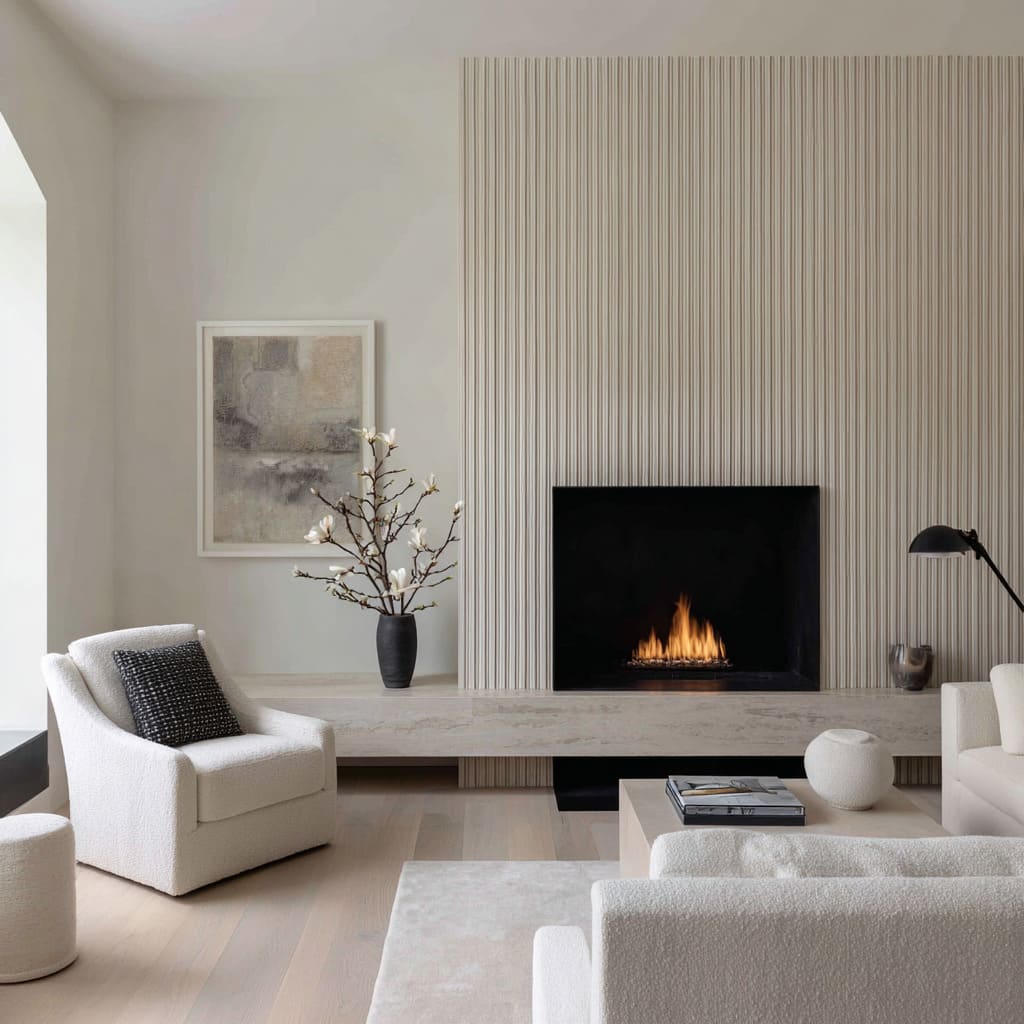
A recurring language in modern fireplace living room design is the pitch ladder: wide ceiling boards, medium wall slats, and tight flutes or fine ribs at the fire pocket. This step-down in spacing quietly funnels attention toward the ember without changing color.
When windows are near, mullion spacing often echoes one of the rib pitches so that architecture and millwork hum at the same frequency.
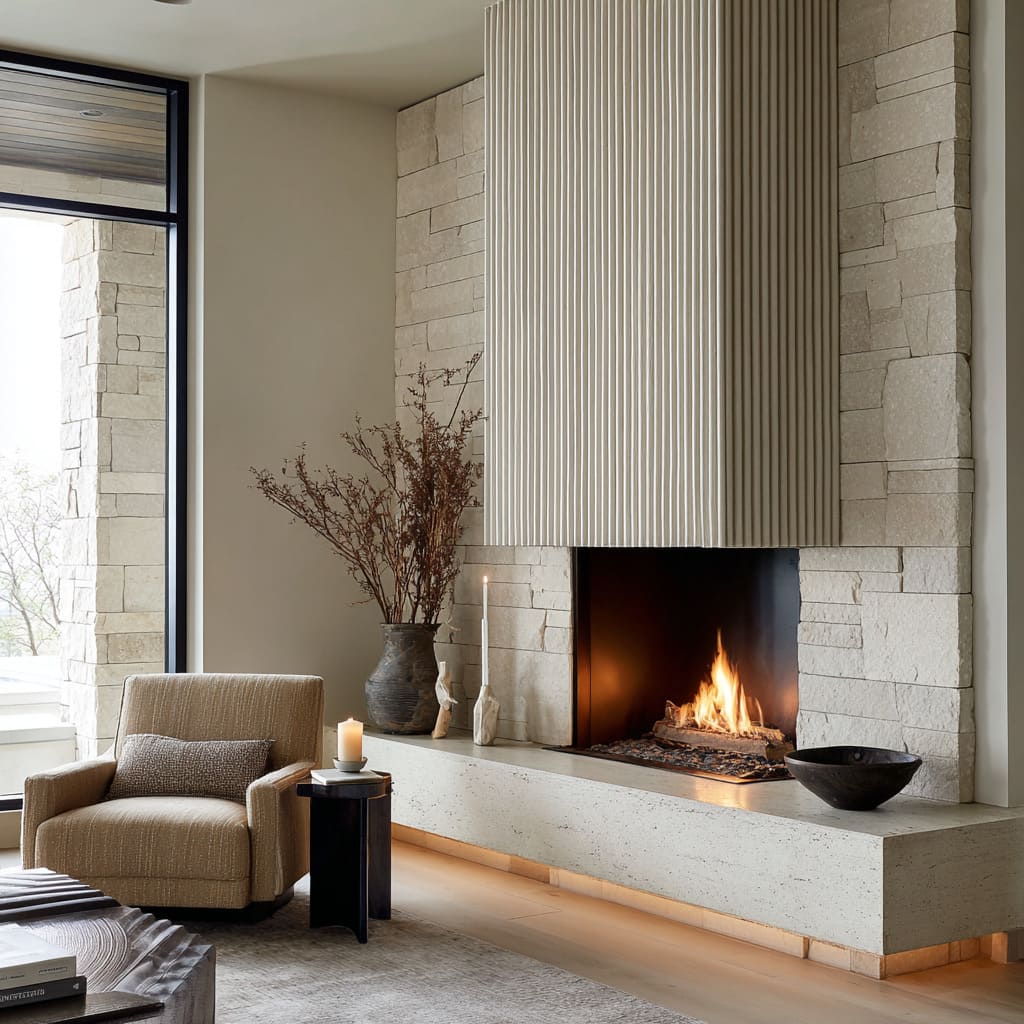
The balance improves when one adjacent wall remains plain; pattern fatigue drops, and the ribbed field reads as depth rather than busy surface. A single irregular silhouette—a bonsai-like tree, a branchy arrangement, a rounded vase—keeps the order from feeling rigid and introduces a soft counter-shape that plays well with vertical rhythm.
Light used as outline and edge rather than spotlight
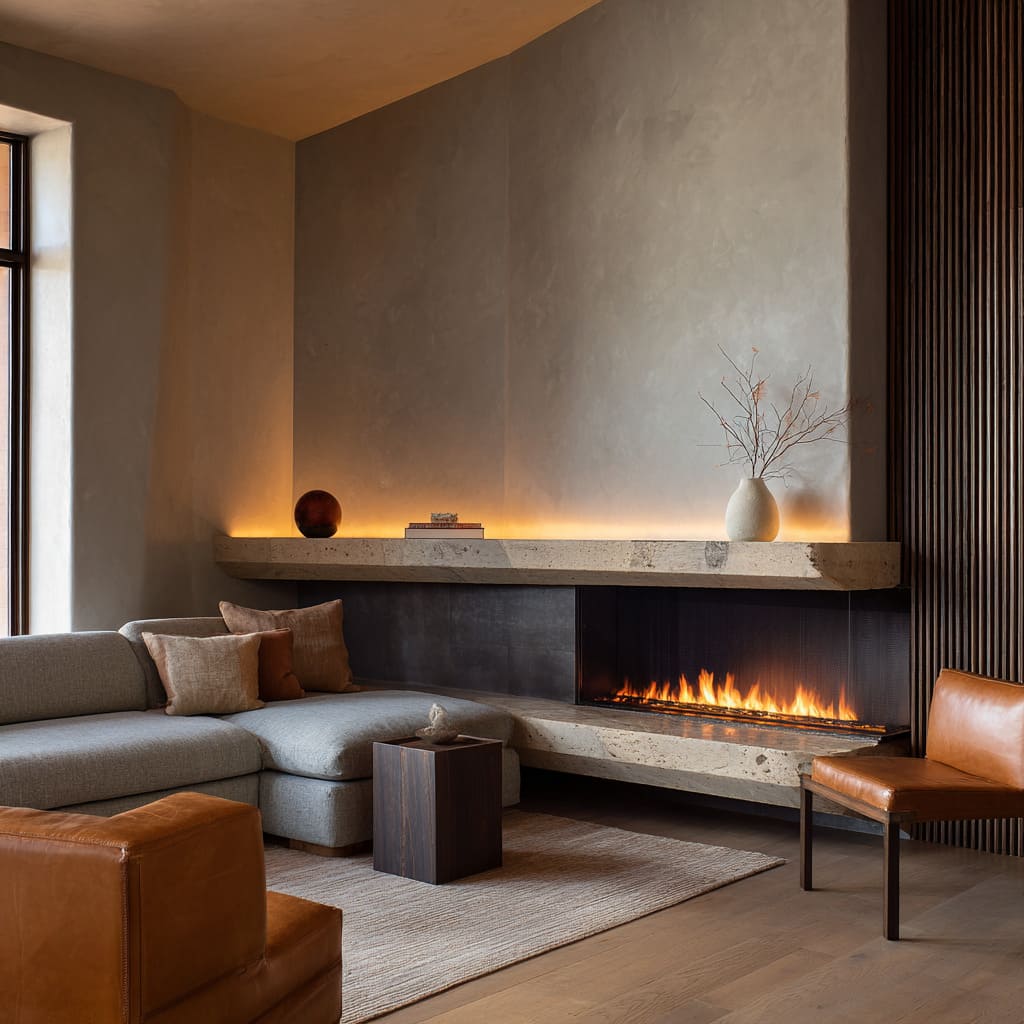
The most composed rooms draw with light instead of blasting it. Three families of glow keep showing up in creative modern fireplace living room design ideas: an undercut that floats a hearth or bench; a side wash that skims plaster or ribs and turns texture into soft relief; and a backlit reveal behind a tapered or faceted shroud that lifts the chimney off the wall like a lantern panel.
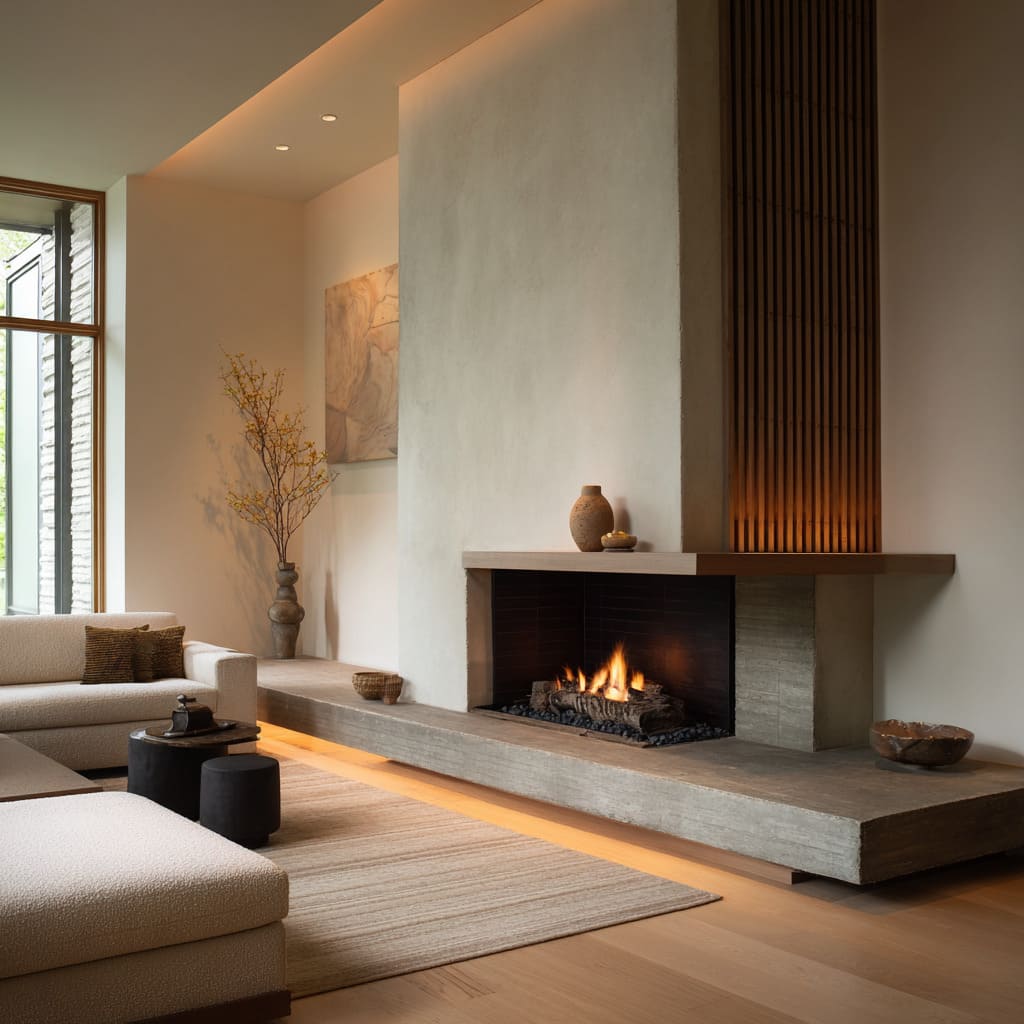
By day, brightness leans on pale walls and reflected daylight; by night, the base layer of under-cabinet or under-hearth glow carries the room while the flame becomes the only moving highlight. Because lighting is placed to outline forms, even strong materials feel weightless, and the eye reads silhouettes and horizons without glare.
Reflection managed for length, calm, and color depth
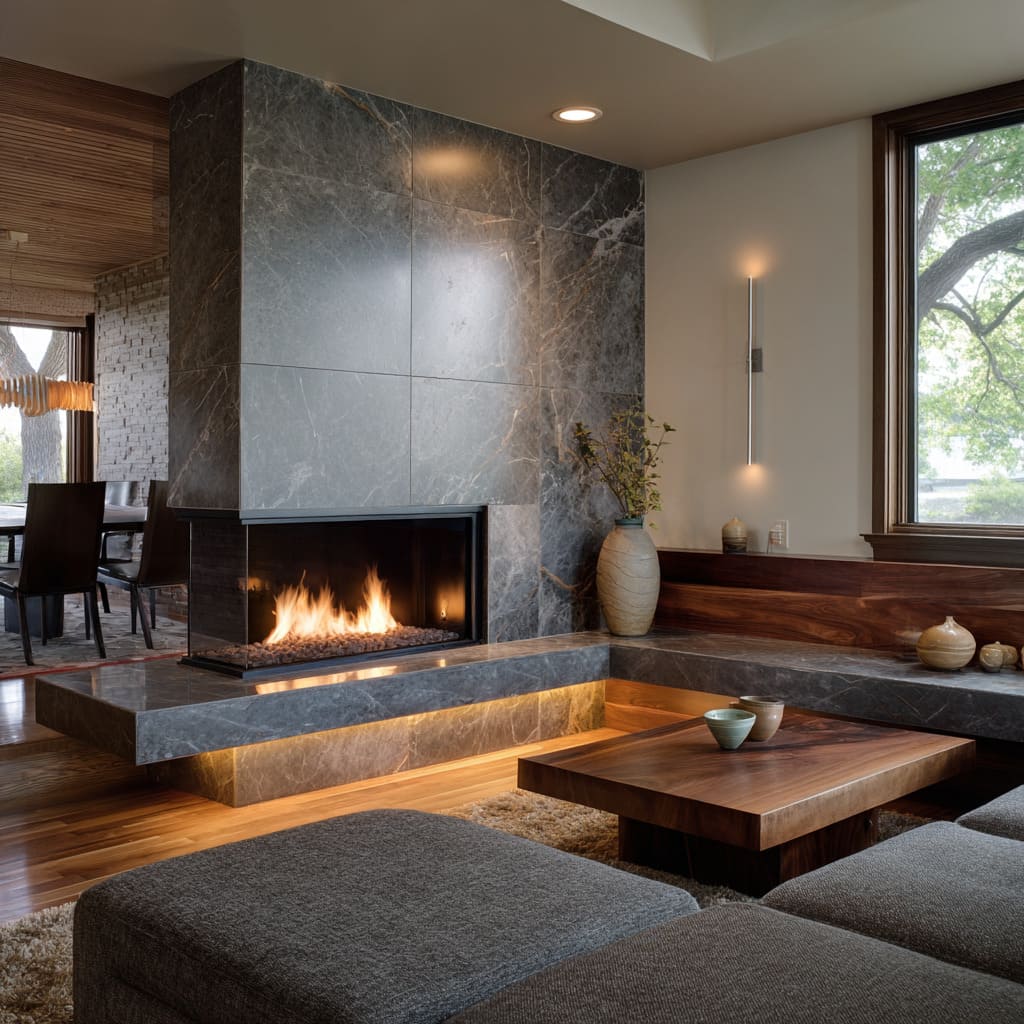
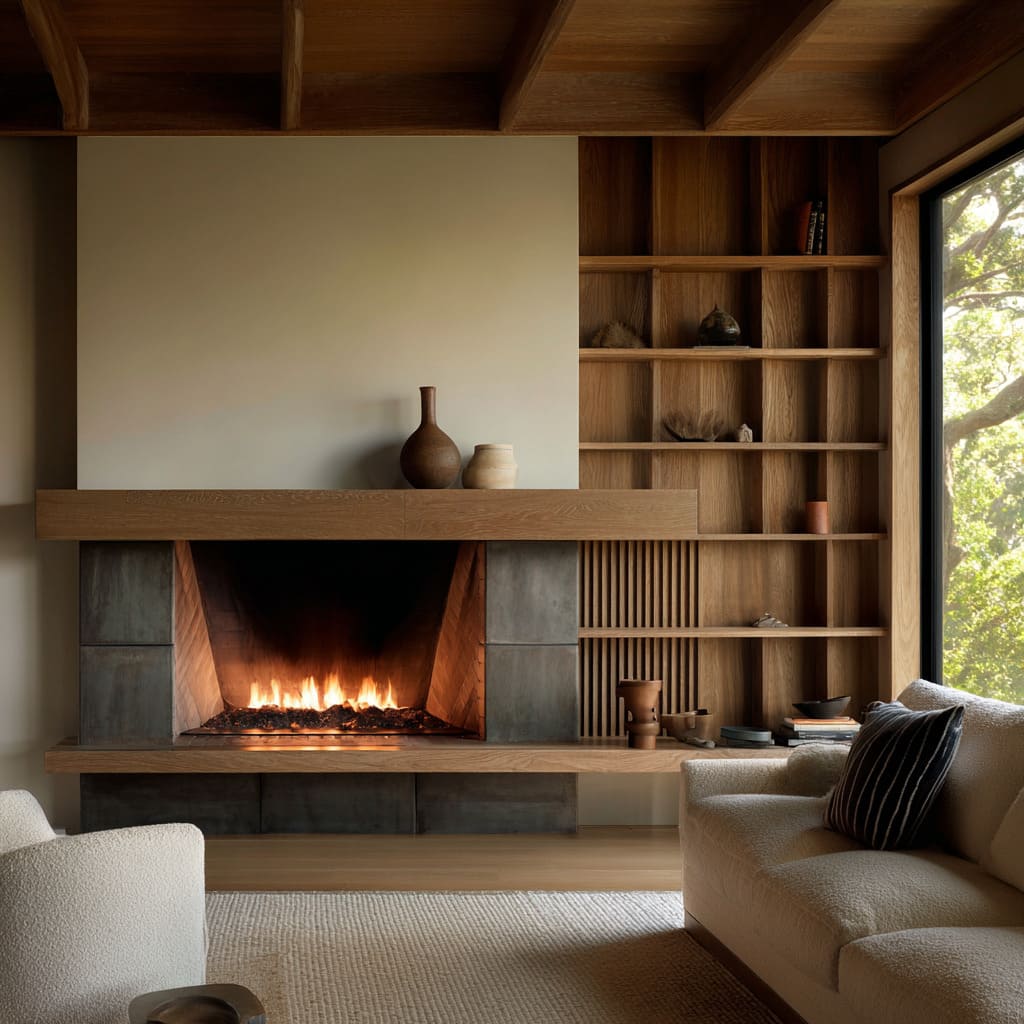
Reflection can lengthen a room or turn into noise. The successful scenes tune it carefully: dark fire liners deepen color and hide internal distractions; splayed cheek planes pivot the main sightline away from adjacent glazing and keep the flame saturated during the day; glossy planes, if used, sit on axis with the long run of the flame so they extend the line rather than fragment it.
Low matte coffee tables help by absorbing stray highlights so that window and fire reflections stay on vertical planes where they belong. The net effect is a room that feels longer and quieter, with the flame reading as a confident line instead of a shimmering box.
Geometry that stays calm: one purposeful diagonal, a few gentle curves, and restful horizontals
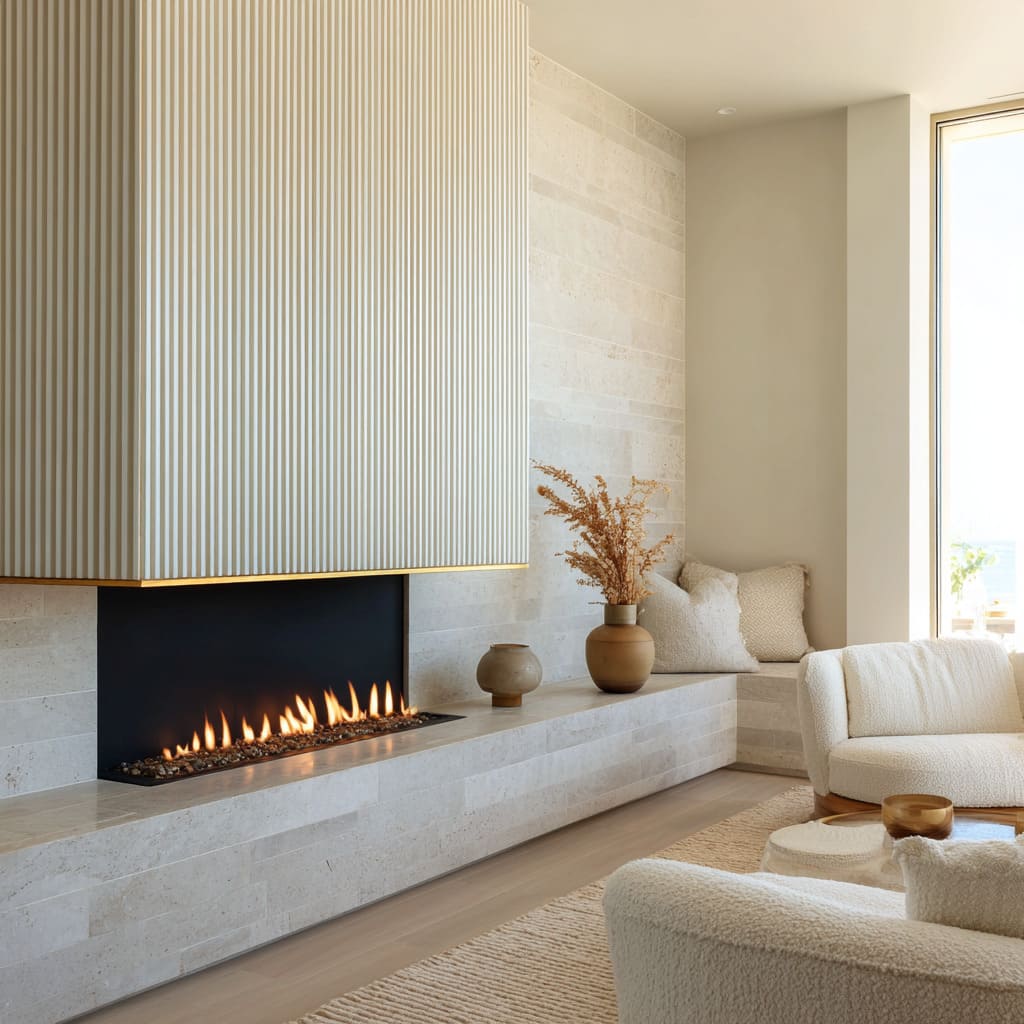
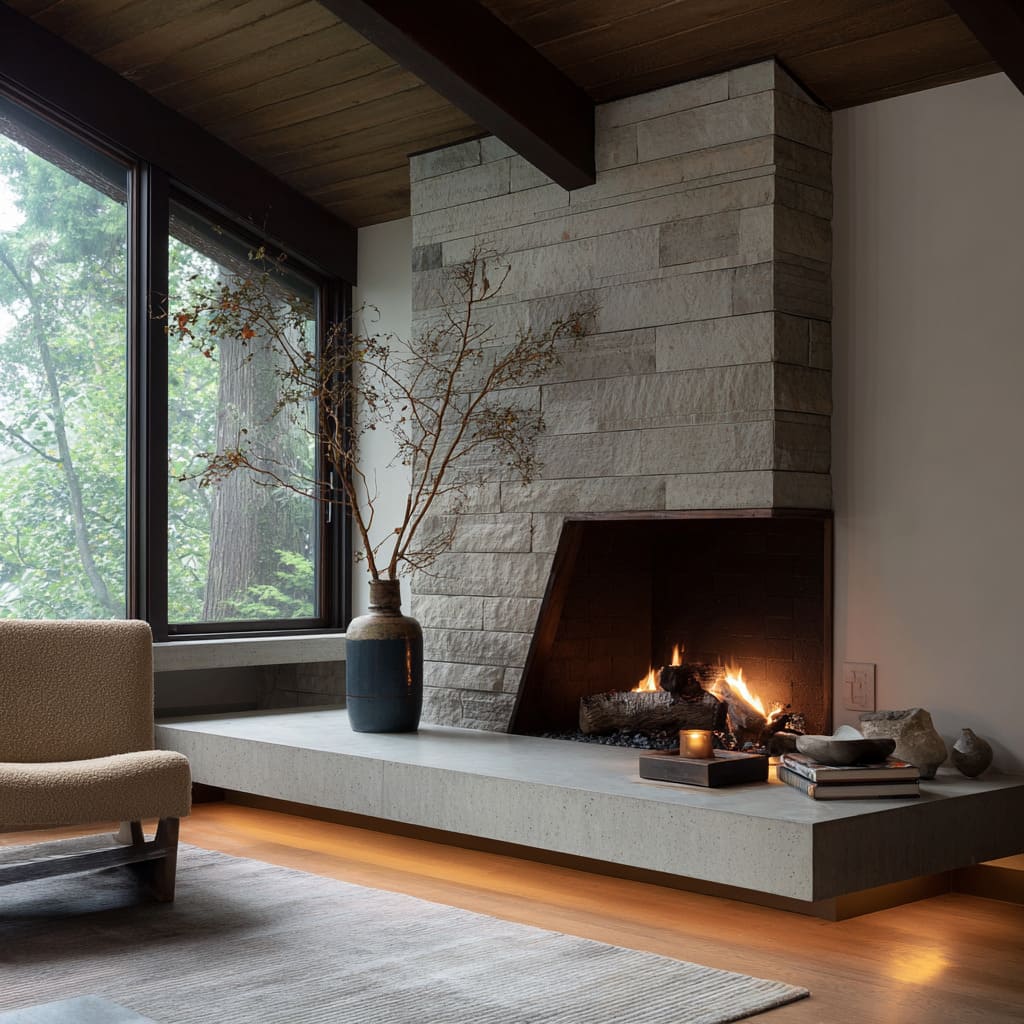
While horizontals carry the main melody, a single diagonal—an angled baffle, a leaning chimney face, or a slanted cove—can steer the eye and tame tall volume. Scarcity matters; one strong diagonal is plenty.
Curves land where bodies meet surfaces: a rounded hearth nose, a radius bench sliding into glazing, cloud-like armchairs and ottomans that soften a rectilinear seating island. Faceted plaster shrouds take a different route, letting creases catch light as drawn lines so the chimney reads as folded rather than heavy.
With this mix, geometry stays serene: direction is clear, volume feels intentional, and the flame has a clean runway.
Palette control by pairing opposites and limiting glint
The palette in creative modern fireplace living room design ideas often relies on paired opposites rather than loud contrast: cool veined stone with warm walnut or oak; pale plaster fields with a few bronze-toned edges; charcoal liners set against sandy textiles. Shifts in sheen do more work than shifts in hue.
Metal appears as a line, not a sheet—a hairline toe under a hearth, a razor-thin shelf edge, a small drum side table—the kind of glint that catches ember light without turning the wall glossy. These precise highlights warm a neutral field while leaving the big surfaces calm, helping the room look collected rather than decorated.
Objects placed like beats in music: short–medium–tall, with space as part of the composition
Styling follows a measured meter. On mantels and ledges, the most effective arrangements use three objects with distinct heights and matte finishes, spaced so that the voids do half the work; the end of a timber belt or the point where a ledge turns the corner becomes a natural place to land the grouping.
Branch silhouettes against pale plaster counter mass and frame a view without crowding it.
Coffee tables avoid wide, shiny trays and lean toward raw timber blocks, stone slabs with soft edges, or a round top on a reflective base that quietly carries cove and flame shimmer into the center. The result is a set of still-lifes that feel rooted in the architecture rather than layered on top.
Furniture forms that echo the architecture without competing with it
Sofas in such rooms tend to be low and blocky, with cushion tops hovering near the hearth band so seating and stone read as one continuous seat line. Rounded armchairs and ottomans bring relief to straight runs.
Coffee tables often echo architectural moves at a smaller scale: a monolithic timber cube under smooth plaster; a chunky black mass under light flutes; a broad walnut slab whose grain runs in the same direction as the flame line for a lengthening effect. Rugs carry texture instead of pattern—looped wool, jute with tooth, shag under muscular upholstery—giving depth underfoot while keeping attention on the elevation where the fire lives.
Windows and fire as partners
In spaces that sit between landscape and lounge, glazing is not the rival of the fire; it is the collaborator. Mullion spacing mirrors rib spacing; the sill aligns with the hearth so both read as one horizon; frames stay charcoal or black so exterior greens and blues pull the palette cooler while the flame, brass toes, and warm timber hold the center.
Curved benches at the window corner replace hard angles with a soft recline, and when a glass fire turns the corner, it sends a narrow flicker toward the view while keeping the main burn legible from the seating island. This synchronized rhythm keeps the whole side of the room consistent and restful.
Frequency mapping
A helpful way to read these modern fireplace living room design ideas is by visual frequency.
- Low – Low-frequency elements are big calm planes and coarse textures (broad plaster, large stone courses, deep rugs).
- Mid – Mid-frequency elements include ceiling boards, window mullions, and wall slats.
- High -High-frequency elements are tight flutes, fine metal ribs, and small woven textures.
The most resolved rooms place high next to low rather than stacking high on high; a fine rib field sits beside a smooth plaster plane, a tight metal liner sits under a broad stone belt. With that mix, shimmer remains legible, and the eye has places to rest.
Thematic families that recur across strong ideas
By vertical character
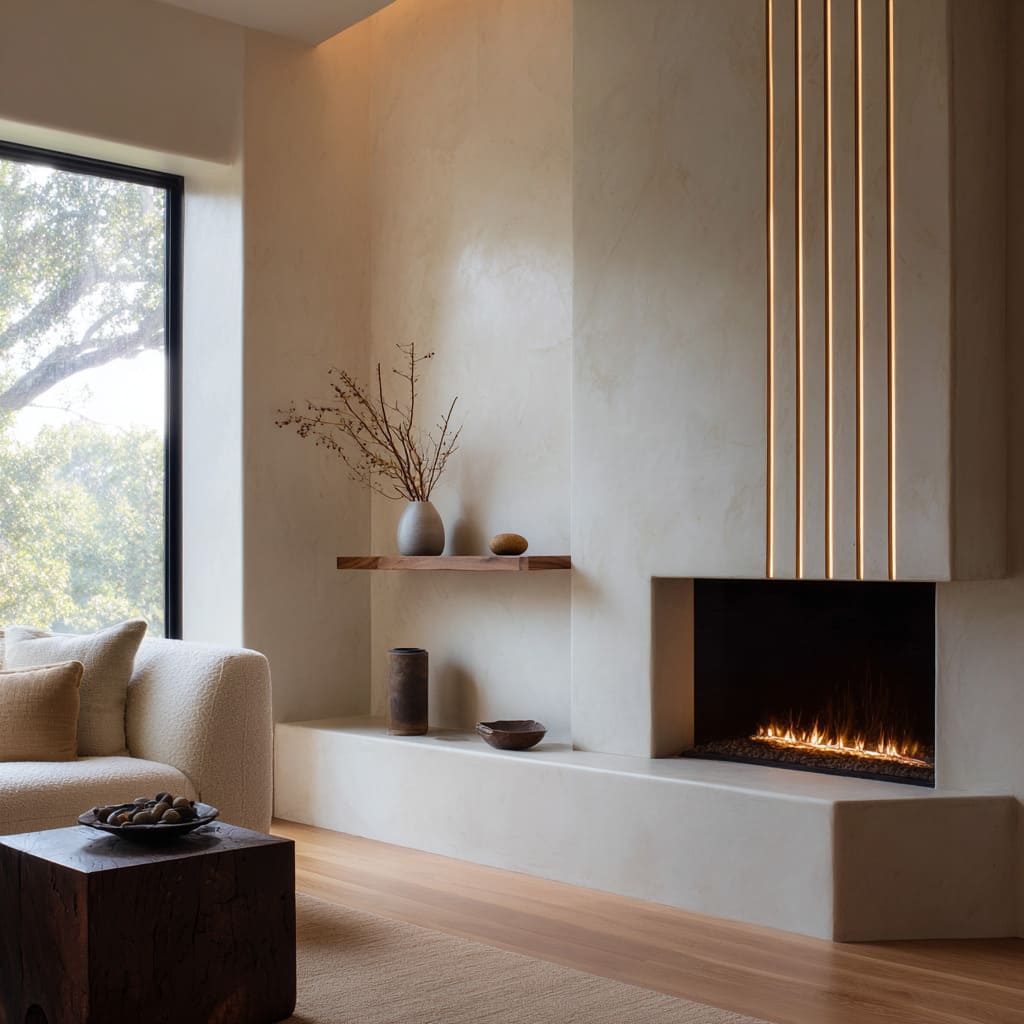
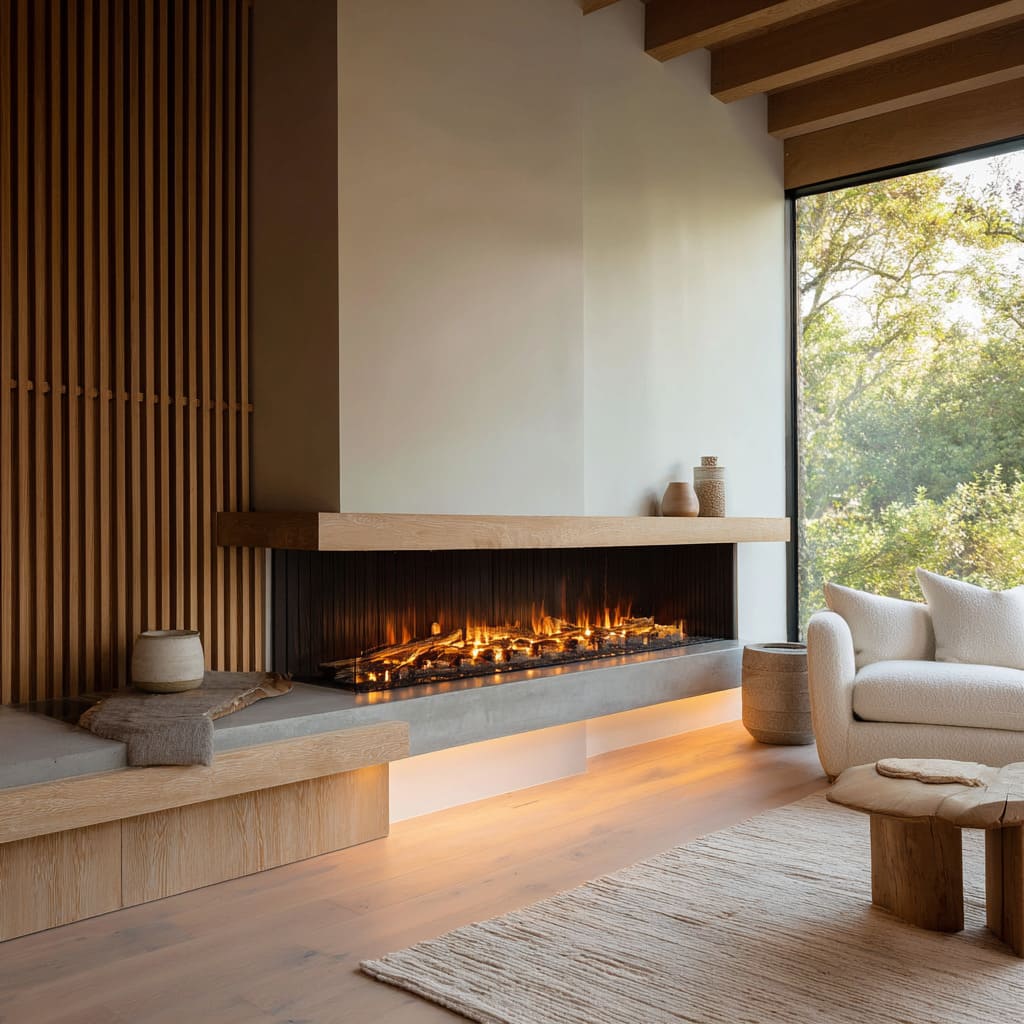
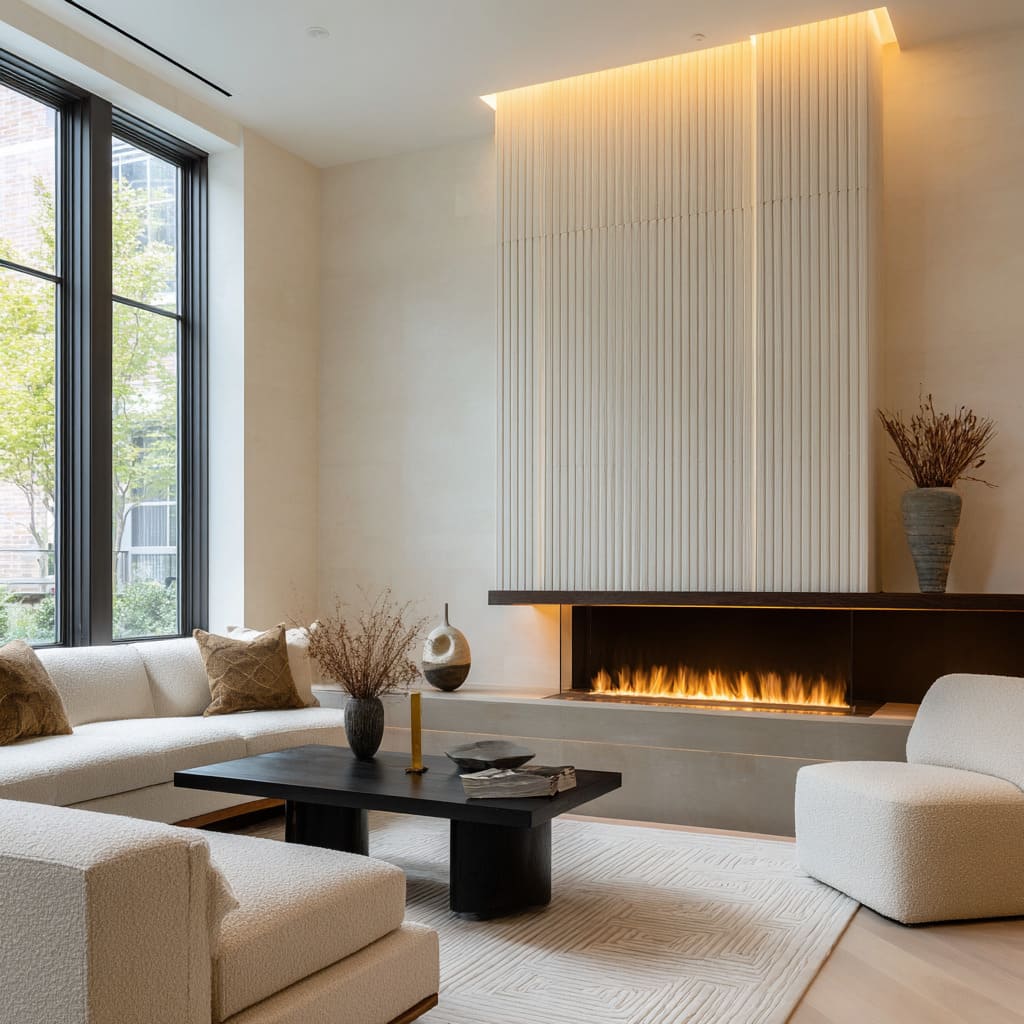
- Lantern Chimney: tall pale flutes disappearing into a shallow cove; a blade-thin dark shelf slices below; the linear fire floats under a soft glow.
- Rib Trio Wall: wide boards above, medium slats beside, tight ribs at the pocket; a single bonsai-like silhouette keeps the order from feeling stiff.
- Fieldstone + Fine Canopy: rustic blocks below, delicate fluted hood above, joined by a hairline of warm metal and a low amber toe that lifts the mass.
By corner strategy
- Radius Bridge: a curved bench across glazing lets daylight grade across surfaces and turns the corner into a lounging arc.
- Glass Return: a long flame wraps the angle so the line reads unbroken from the main lounge and the side view borrows flicker.
- Hinge Ribs: a rib field that continues through the turn keeps the angle from reading like a stop and allows long shadows to slide.
By light grammar
- Undercut Hover: a warm line under hearth or bench erases the heaviest shadow and floats the form.
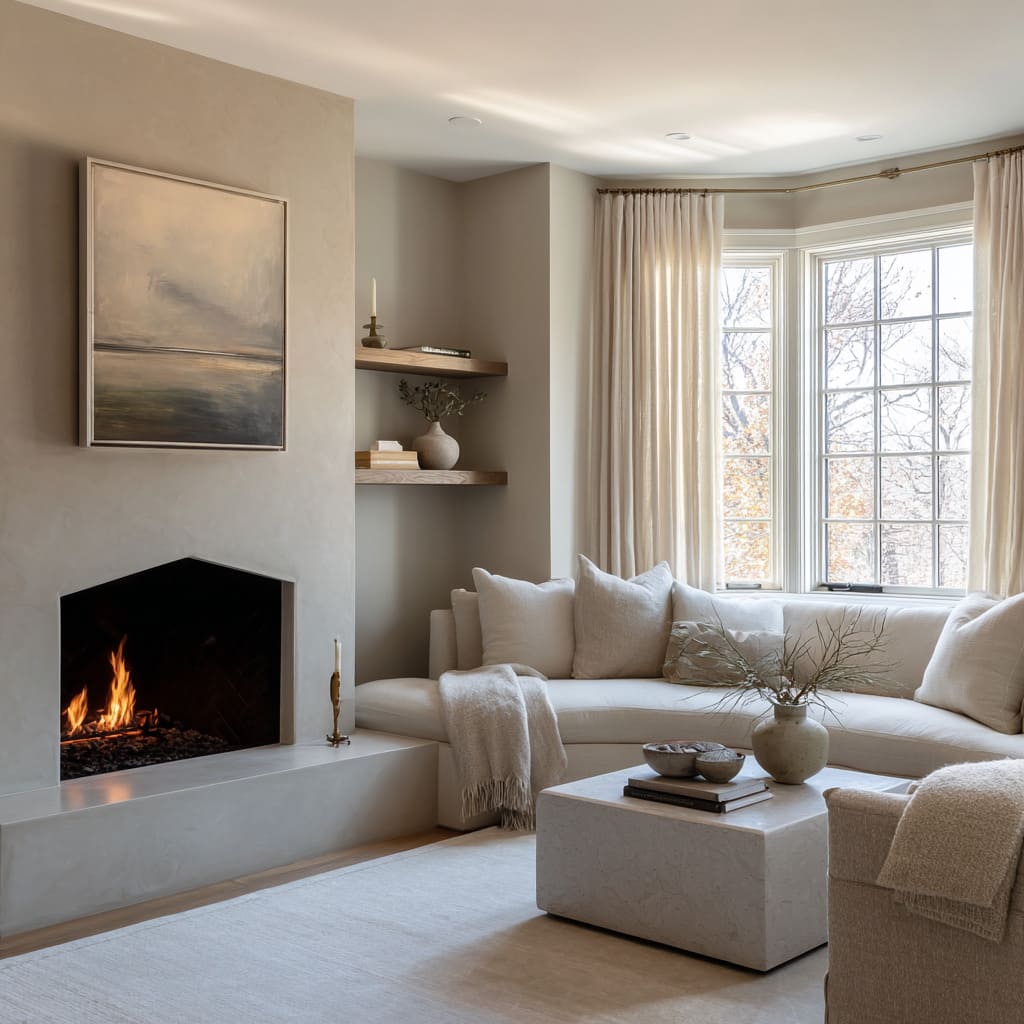
- Cove Skim: soft wash down flutes or plaster flattens glare and makes texture read as relief.
- Backlit Reveal: a thin glow behind a tapered or faceted shroud separates chimney from wall so mass looks light.
By palette duo
- Mineral + Timber: veined stone paired with walnut end-grain; the conversation is about grain and vein rather than color.
- Plaster + Brass Line: pale fields warmed by a toe or shelf edge; glint appears where the eye expects weight.
- Charcoal Pocket + Sand Textiles: the darkest tone stays inside the fire, the rest of the room sits in oat and milk.
Small moves with big visual payoff
Several subtle tactics carry oversized visual impact in creative modern fireplace living room design ideas. Splayed cheeks at the opening pivot view paths and deepen the look of the fire pocket while reducing daytime glare; a single purposeful diagonal within a mostly horizontal stone composition gives the flame a sense of launch; thickness that tapers as it nears glass keeps masonry light at the view edge; one reflective table base echoes cove and flame shimmer into the center while the matte top avoids clutter; a metal accent used twice—the toe and the shelf edge—produces all the warm glint the room needs.
These are small choices, but they compress effort into lines and shadows rather than layers of objects.
How composition, light, and objects create a calm narrative in modern fireplace living rooms
Seen together, these habits read like a quiet narrative. Corners act as hinges, not stops.
A single horizon lets seats, stone, and window share one line. Masses lift a finger-width from the floor and a blade-width from the wall.
Ribs compress toward the ember.

Light draws edges and reveals texture without glare. Metal appears as a whisper, not a sheet.
Objects arrive in measured trios with air around them. Windows align with the room’s meter so flame and view work in tandem.
Low, mid, and high frequencies sit in balance. With those parts in place, creative modern fireplace living room design ideas feel steady, generous, and visually rich without relying on loud color or heavy ornament—rooms that read clearly at a glance and continue to reward slow looking over time.