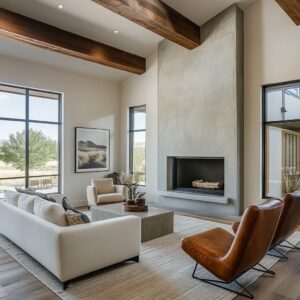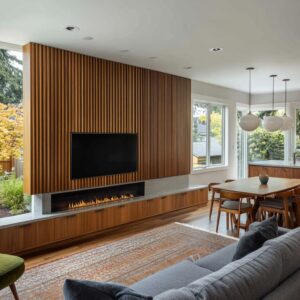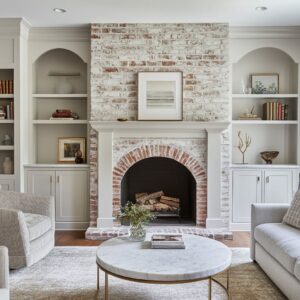
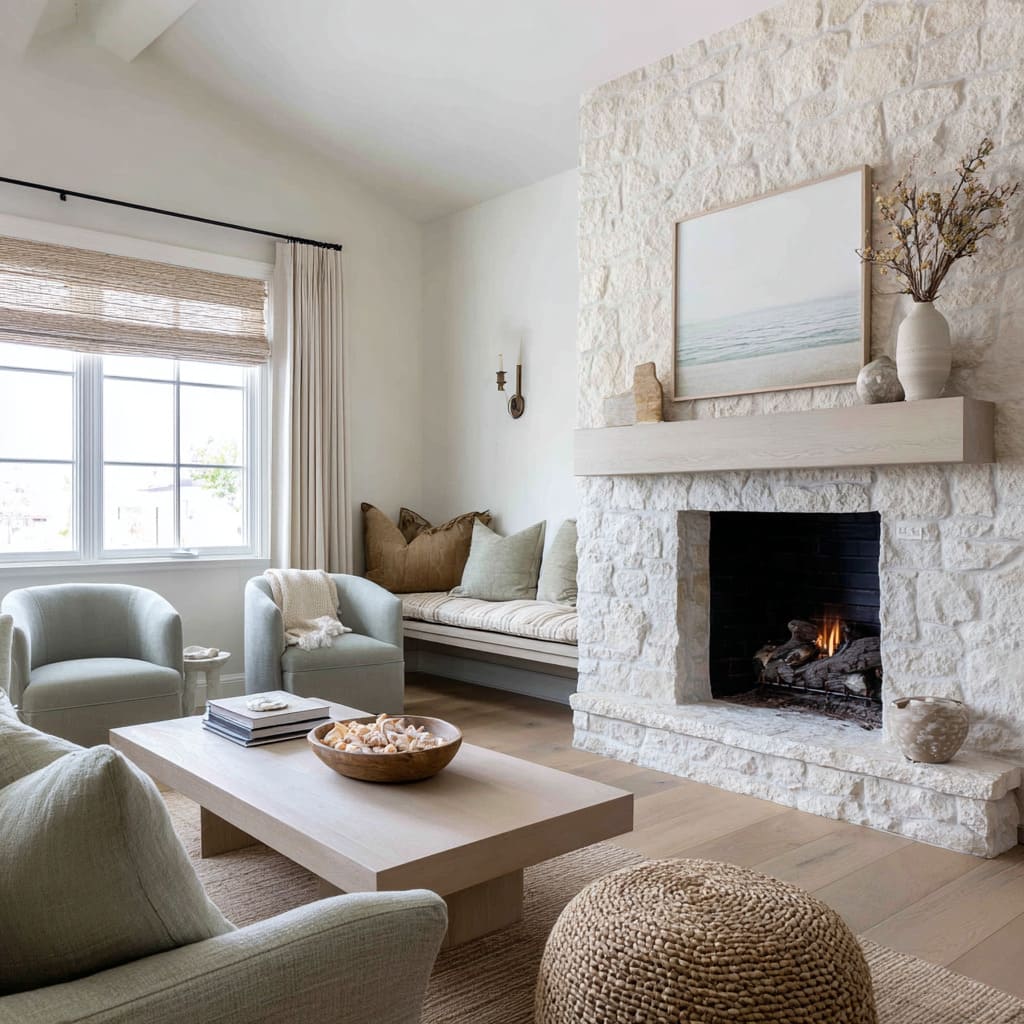
Modern western springs living room design reads as quiet confidence: stone and oak in close conversation, light that glows instead of glares, and furniture lines that agree on a steady, human-height horizon. The look feels grounded yet airy, shaped by the village’s tree-lined calm rather than by novelty for its own sake.
This language of calm relies on a handful of visual habits repeated across many designs —habits that turn a fireplace wall into a composed anchor, a window bay into real seating, and shelves into places where air counts as much as objects.
This article gathers those traits and shows how they organize the room’s appearance, focusing on styling, composition, and mood. Western springs interior design leans into subtle alignment, soft textures, and gentle color, becoming a recognizable style family.
The Calm Grid: One Horizon to Quiet the Design
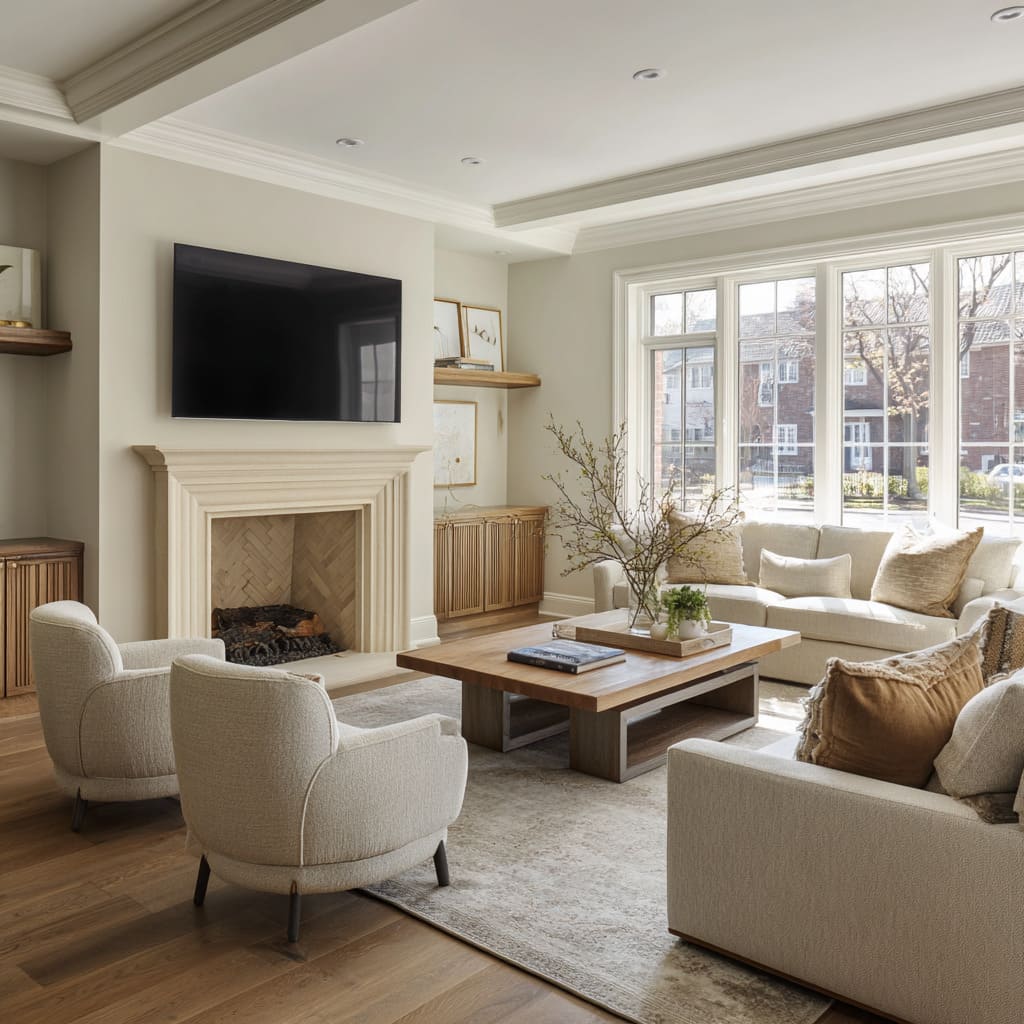
A recurring signature in western springs design ideas is the “calm grid,” a set of consistent lines that your eye registers even if you never measure a thing. Seat cushions on sofas and chairs, boxed window-bench cushions, and the hearth lip typically land within a narrow band; art and mantel lines hover just above, not too high, not too low.
Because these lines match, the space feels steady—objects relate like parts of one sentence, not scattered words.
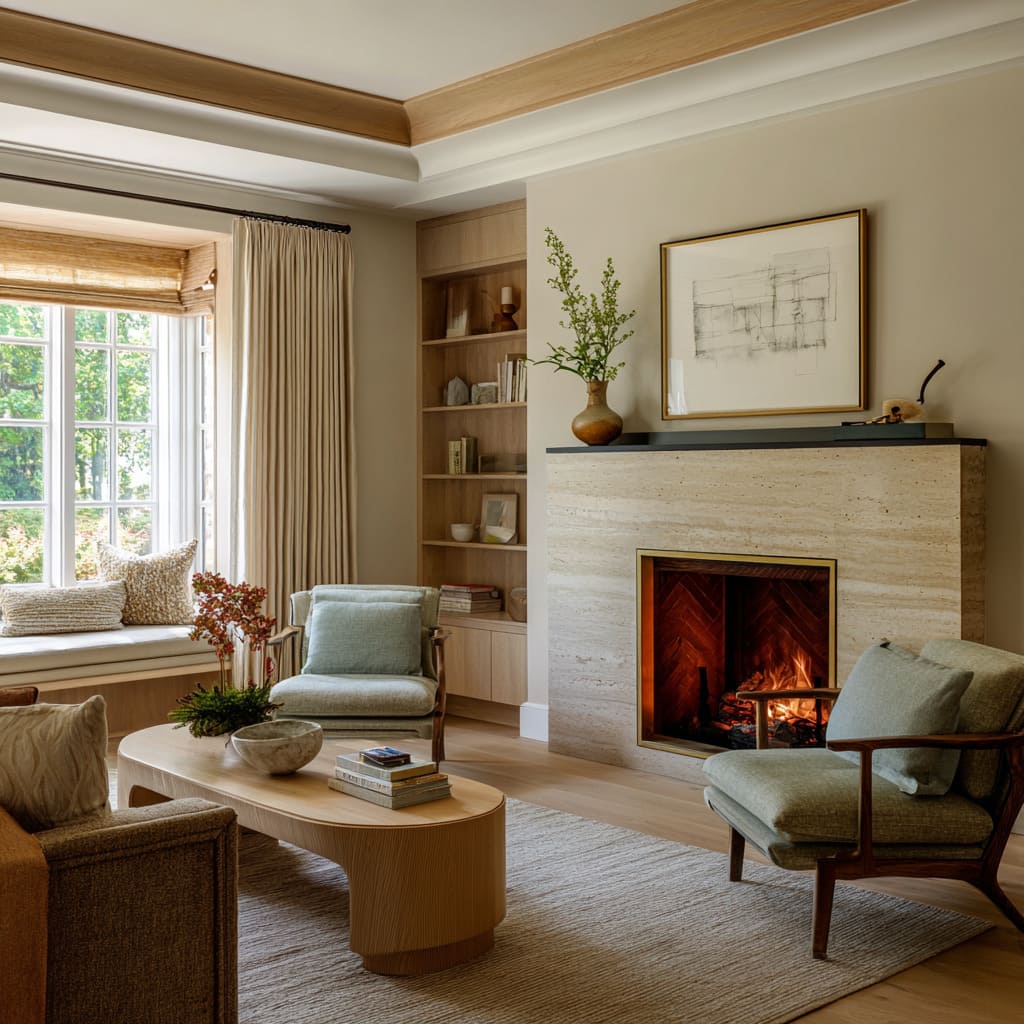
Trim profiles—baseboard steps, stool and casing returns, and softened mantel edges—speak the same dialect, so reflections roll rather than flash. Even in designs with beams or shallow coffers, the lower band of seat height remains the true organizing force, a quiet datum that keeps conversation between fire, glass, and furniture balanced.
This is the heartbeat of western springs living room design: rather than loud contrast, the room prefers measured alignment that relaxes the gaze and lets materials do the storytelling.
Stone and Oak as One Field: Palette Logic Without Drama
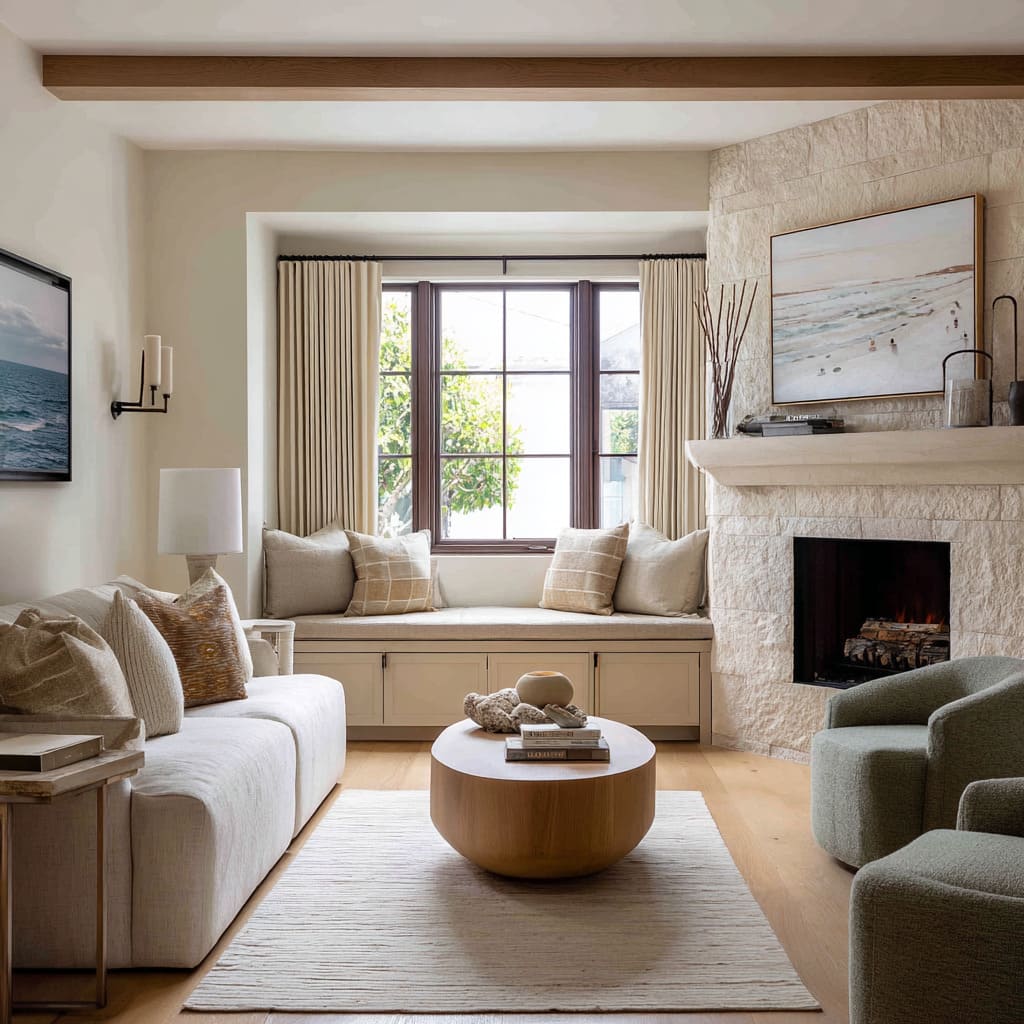
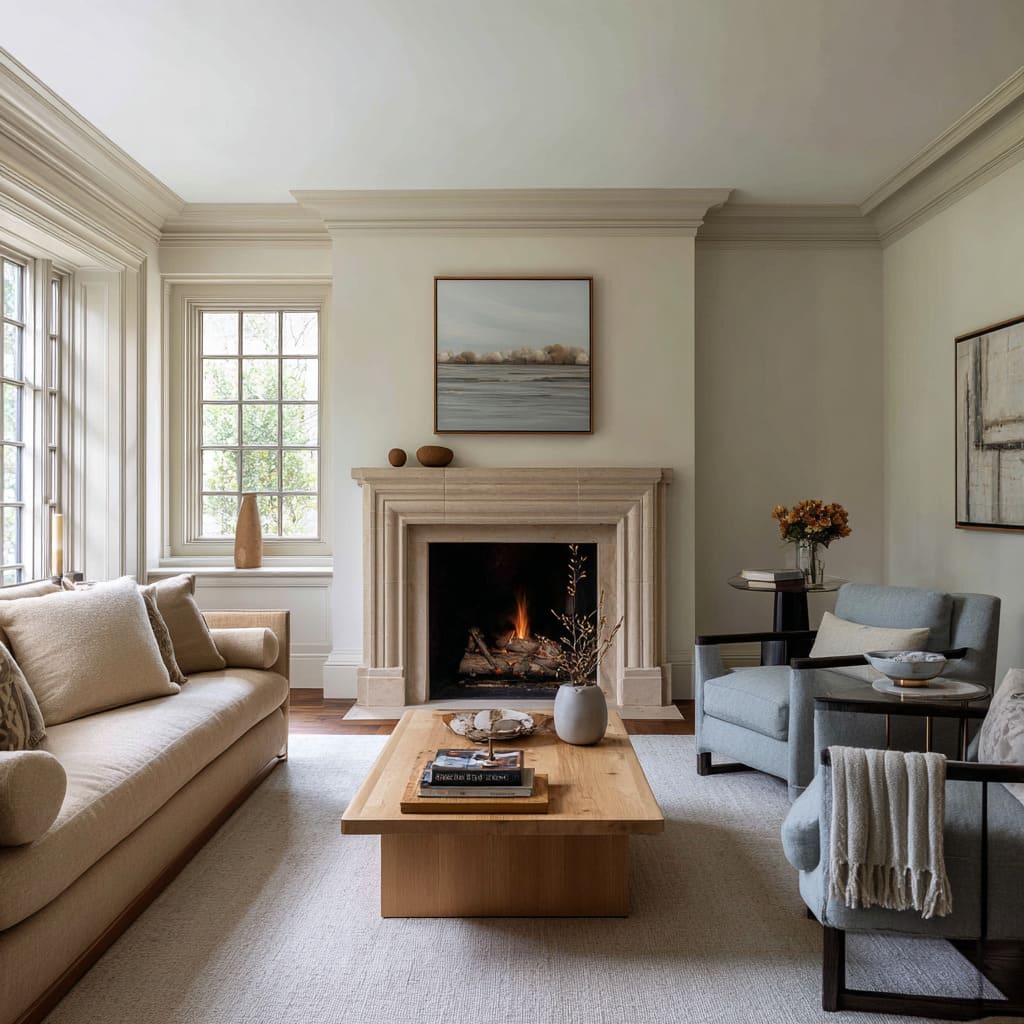
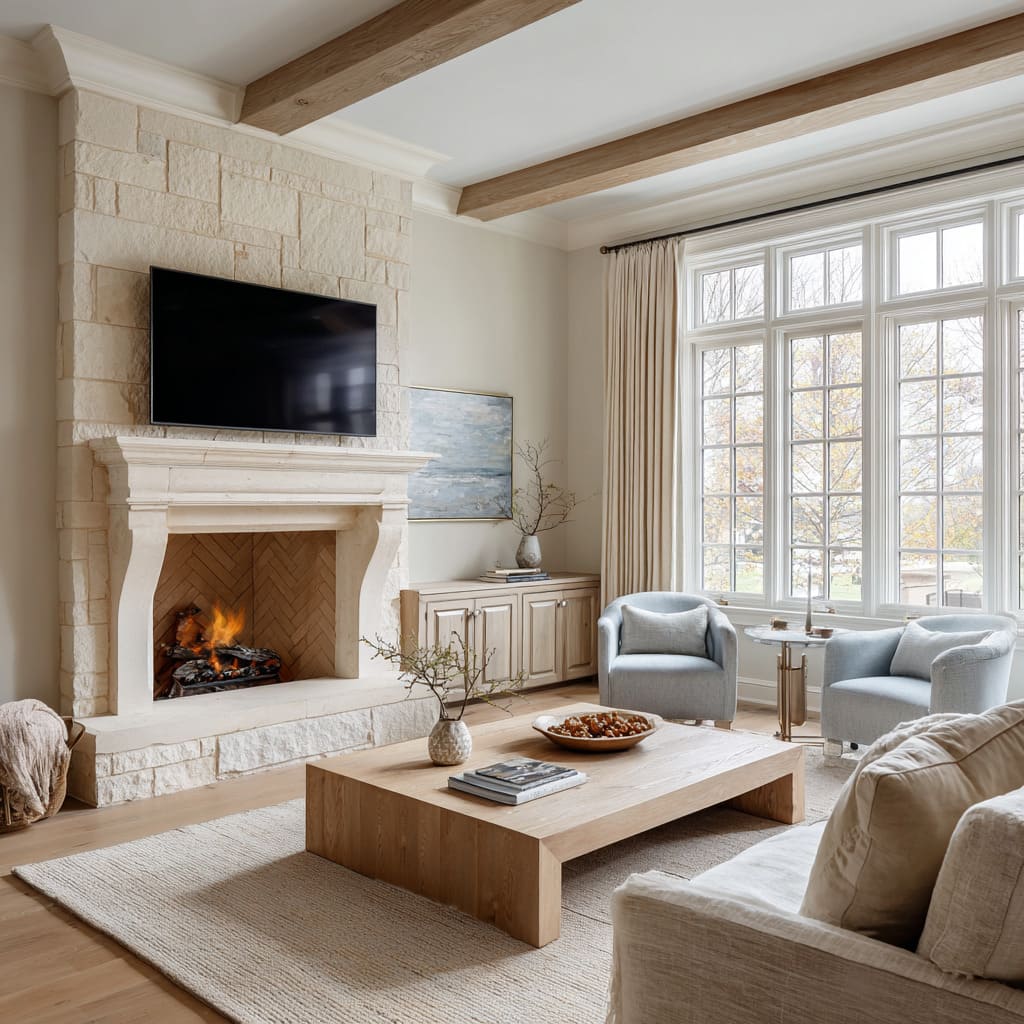
In western springs interiors, light limestone, travertine, or lime-washed brick creates a sandy base that pairs easily with pale or mid-tone oak. The two often read as one field—stone’s cool grain softened by wood’s warmth—so the room gains depth without relying on heavy color.
Greens arrive as soft nods to street trees: sage swivel chairs, sea-glass cushions, or a blue-green throw that keeps company with daylight.
Metal stays quiet and warm in small drops—sconce backplates, picture-light rims, thin rods—just enough glint to catch evening light. Textiles are the real spice rack: bouclé, ribbed wool, tight loop, nubby flatweave.
Their texture adds grain while staying close in tone, allowing a TV, a dark vase, or a framed landscape to sit in the scene without shouting. The total effect is a near-neutral field—sand, wheat, fog, oak—with one or two micro-notes (rust, sky, clove) that stitch the palette to the seasons.
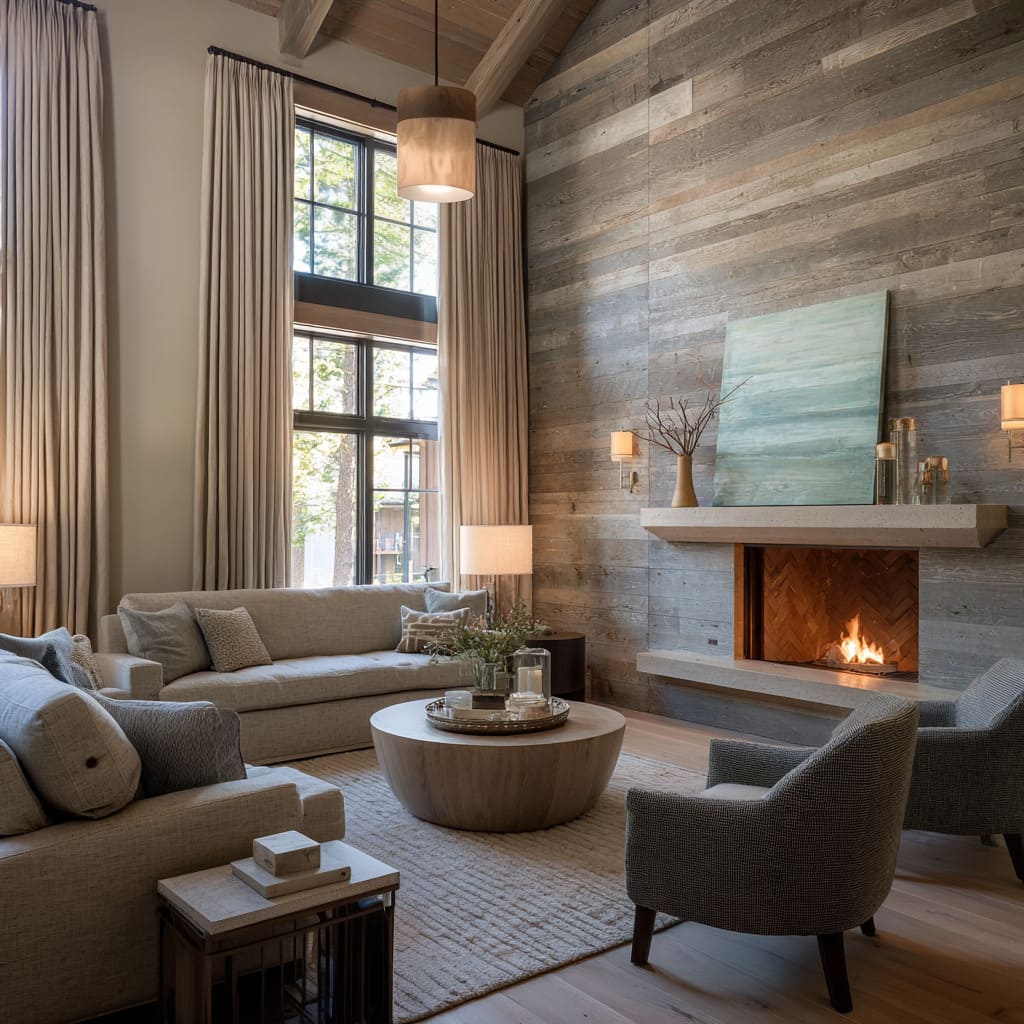
Fireplaces That Behave Like Furniture: Faces, Openings, and Inside-Only Pattern
Fireplace faces in living room design in western springs style prefer smooth authority over ornate display. Limestone slabs with shadow-line joints, travertine with a crisp metal reveal, lime-washed brick turned to soft texture—these faces feel monolithic yet gentle.
Shelves are slim, sometimes absent; where a mantel exists, it often mirrors shelf thickness elsewhere, tying the elevation into one measure. Pattern concentrates inside the opening: chevron or herringbone firebrick glows behind the flame while the face stays calm.
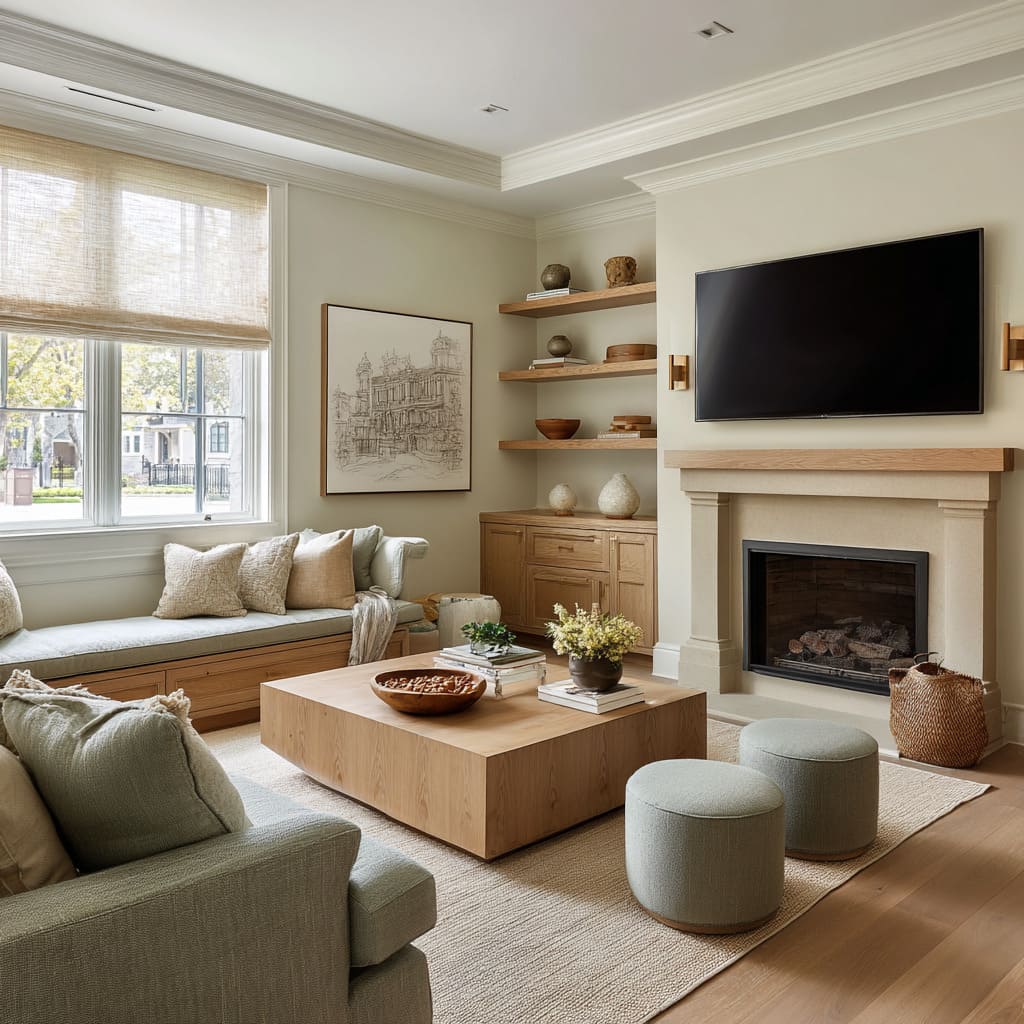
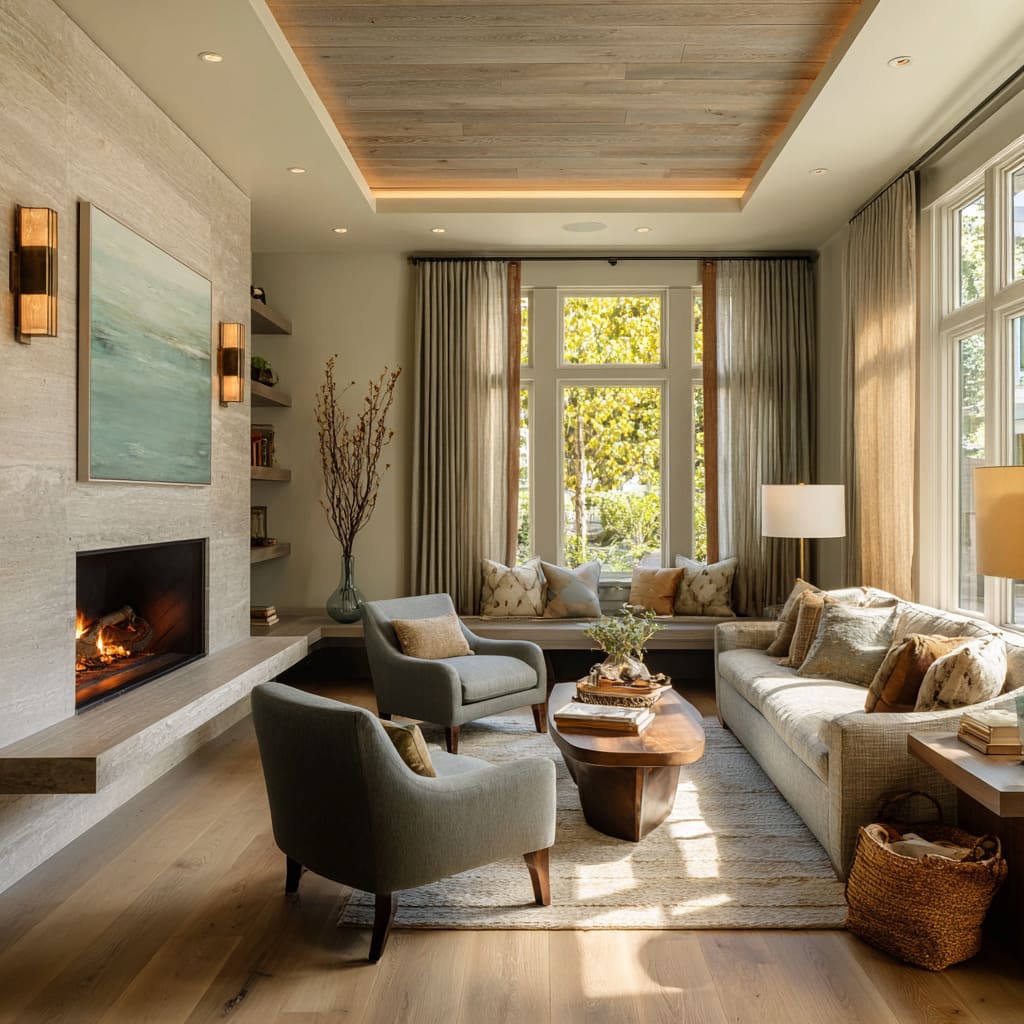
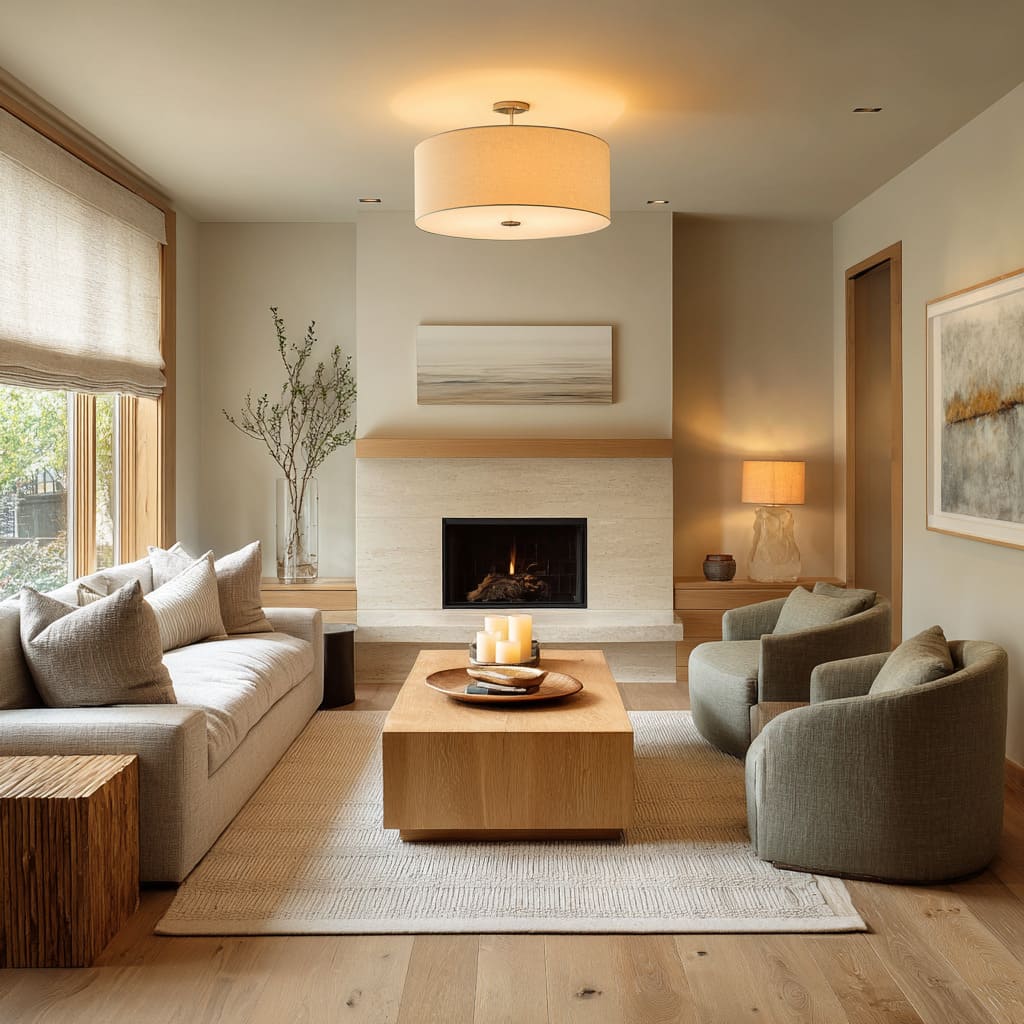
Linear fires gain a floating stone bench that stretches the wall, reads as seating, and pushes the horizontal note farther across the room. Sconces may graze the mantel edge so lighting and masonry read as one gesture; picture lights keep art present at night, preventing the screen from being the only luminous plane.
In the aggregate, fire and furniture feel coauthored—the hearth is not a relic, the TV not an intruder, and the coffee table not a random island, but three parts arranged to share weight.
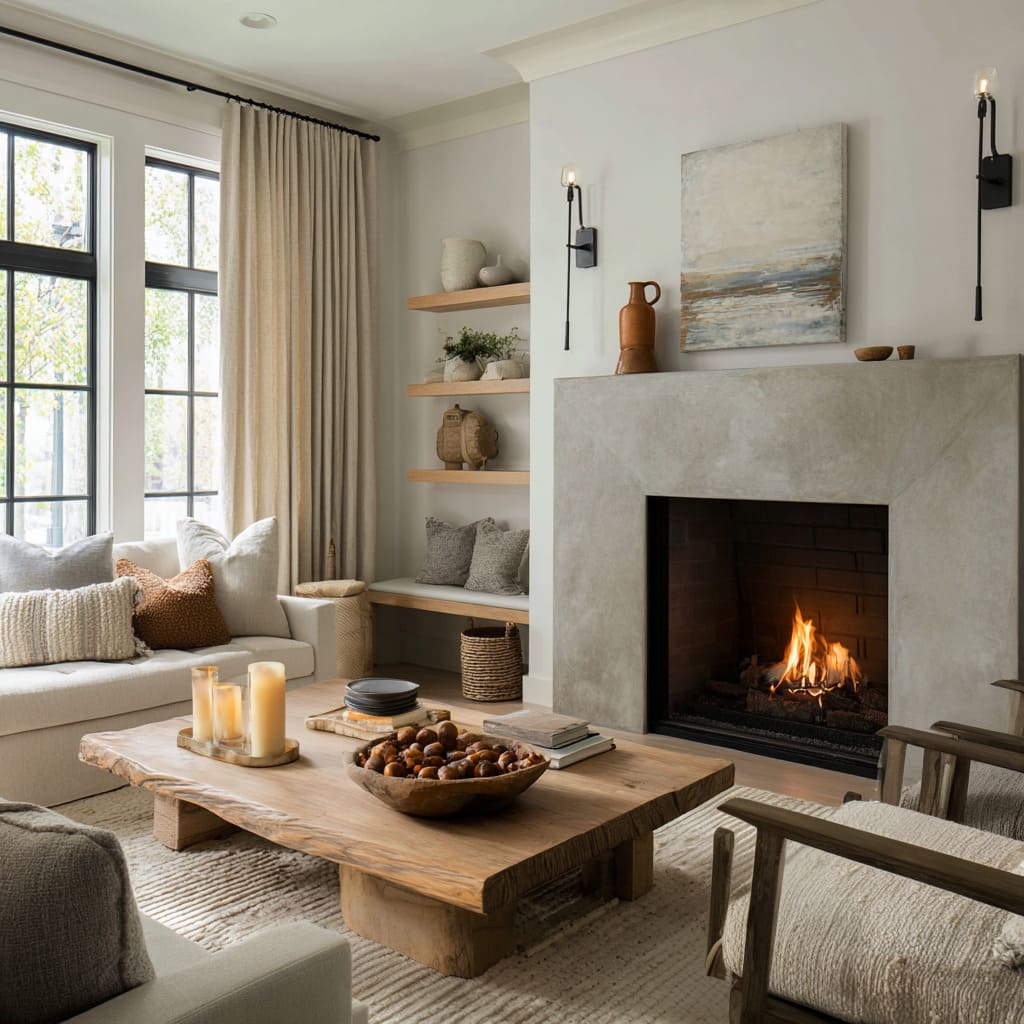
Windows Treated as Furnished Zones: Benches, Drapery, and Gentle Framing
A window bay is rarely dead space in western springs interior design; it becomes a furnished zone that actually hosts people. Benches sit at real seat height with boxed cushions and quiet drawer reveals, more lounge than sill, more daily life than occasional perch.
Drapery stacks tightly at the jamb or sits inside the return so casing stays visible, letting millwork keep its voice. Panels hang high and wide to showcase glass; woven Romans filter glare without dulling daylight.
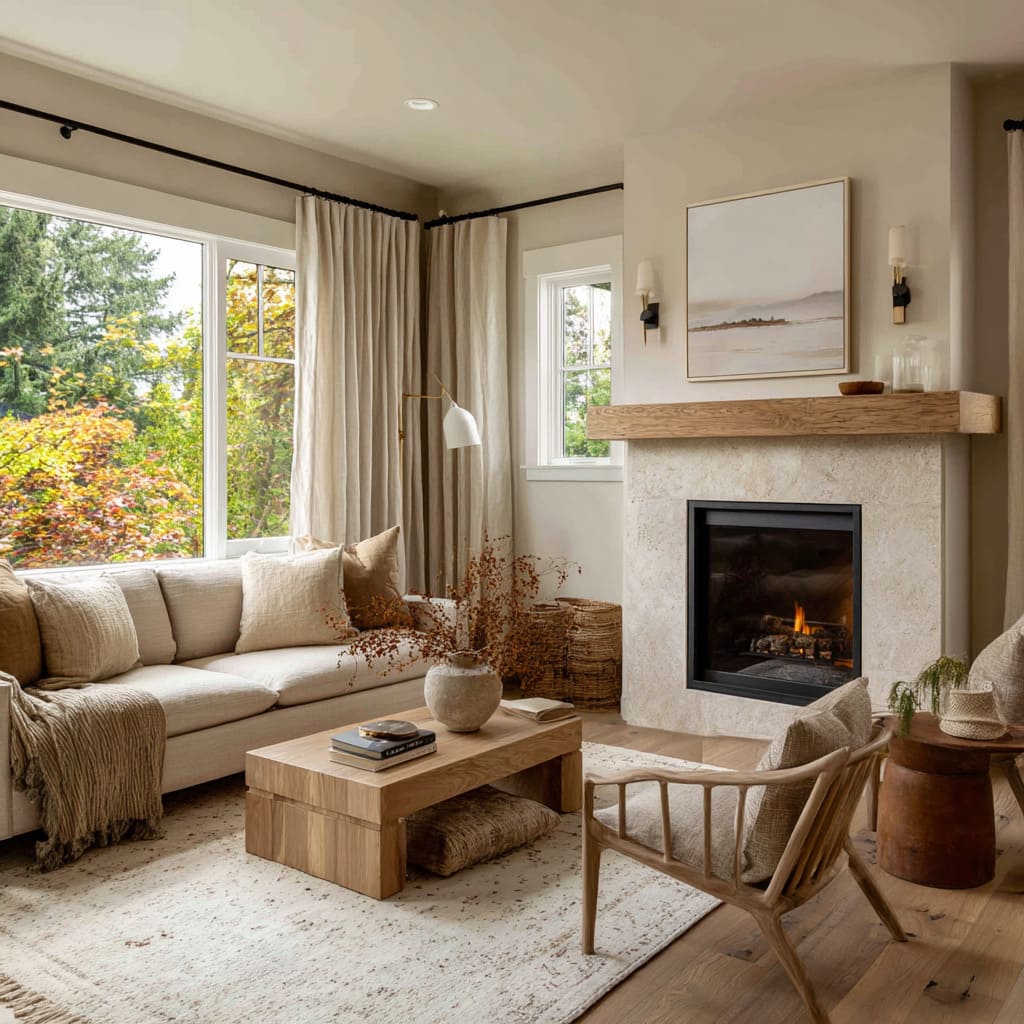
Corner stitching is common—paired short benches or a slim drinks stand means the glass corner belongs to the seating plan, not to circulation. Hardware lines whisper across the room: black window muntins, slim black rods, and black sconce stems echo one another in thin, tidy strokes.
The result is a window wall that behaves like furniture and light at once, not a blank opening waiting for the rest of the room to decide its purpose.
Seating: Equal Heights, Mixed Postures, Rounded Silhouettes
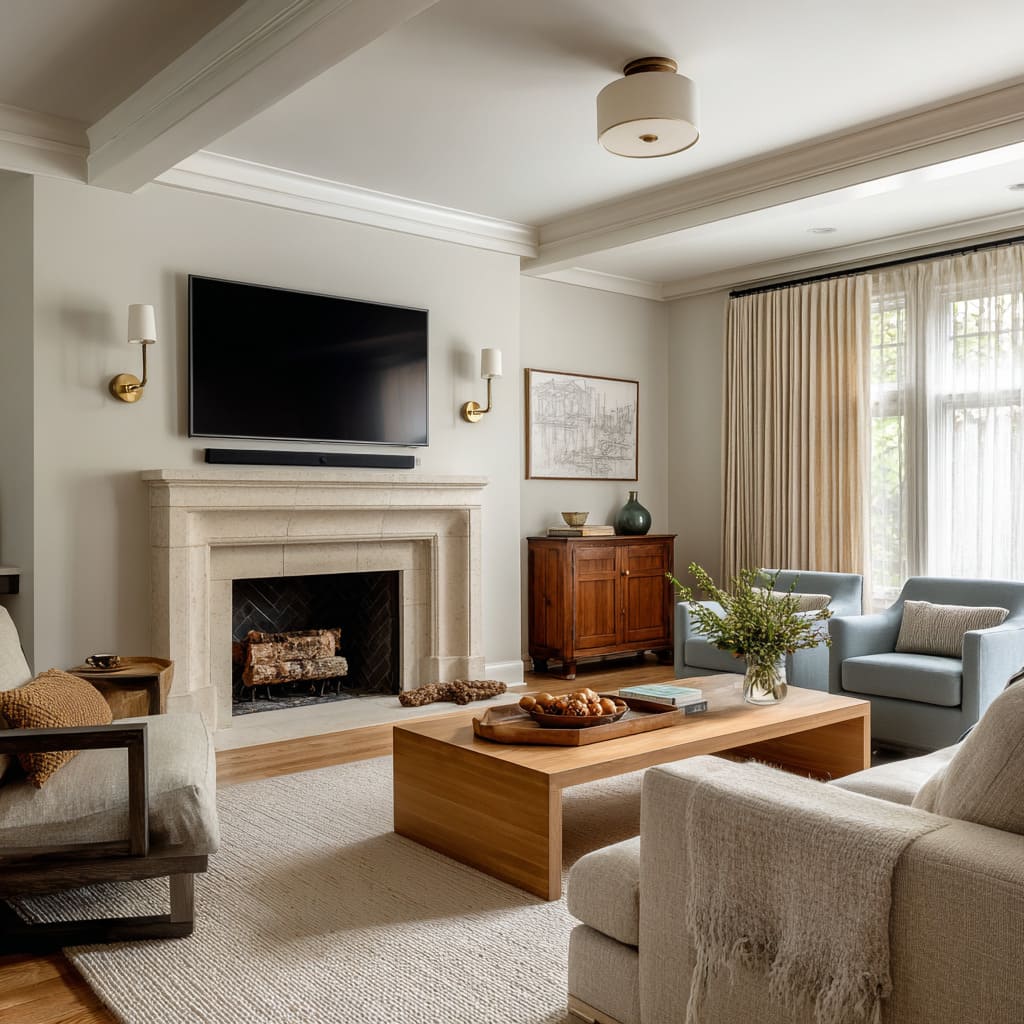
Seating in western springs living room design reads calm because cushion horizons match. A bench-armed sofa, two barrel swivels, a spindle chair with open frame—their seats land near the same line, so pillows align and the room avoids roller-coaster silhouettes.
Posture still varies: one deeper sofa supports sprawling, tighter lounge chairs invite upright talk, poufs flex for kids and guests.
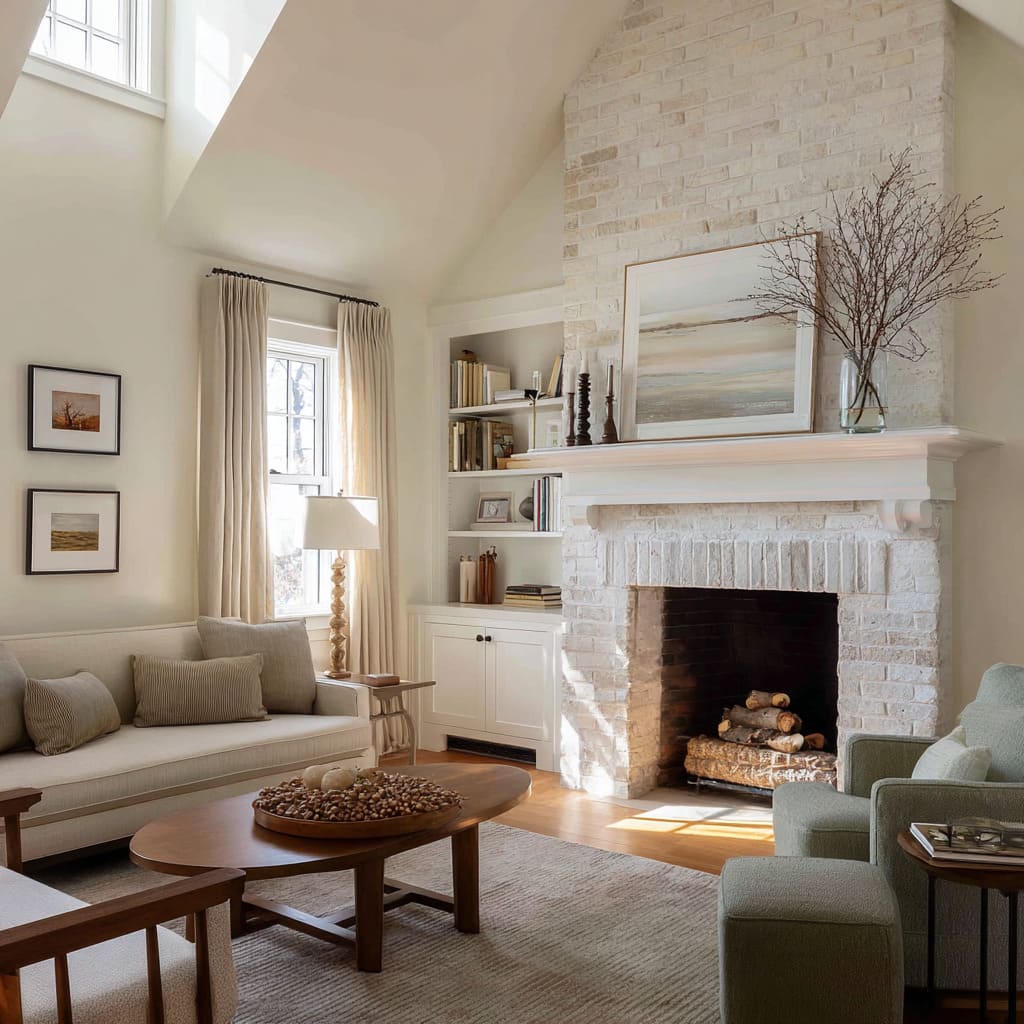
Rounded edges matter in compact footprints: swivel tubs, racetrack curves, and softened corners keep knee lanes open and reduce visual scratchiness. Open-frame chairs near windows preserve views and keep corners from feeling packed.
The arrangement reads like choreography, not chance—each piece differs enough to feel collected, yet all share the same horizon so the eye drifts rather than stops and starts.
Coffee Tables: Curves, Mass, and Shadow
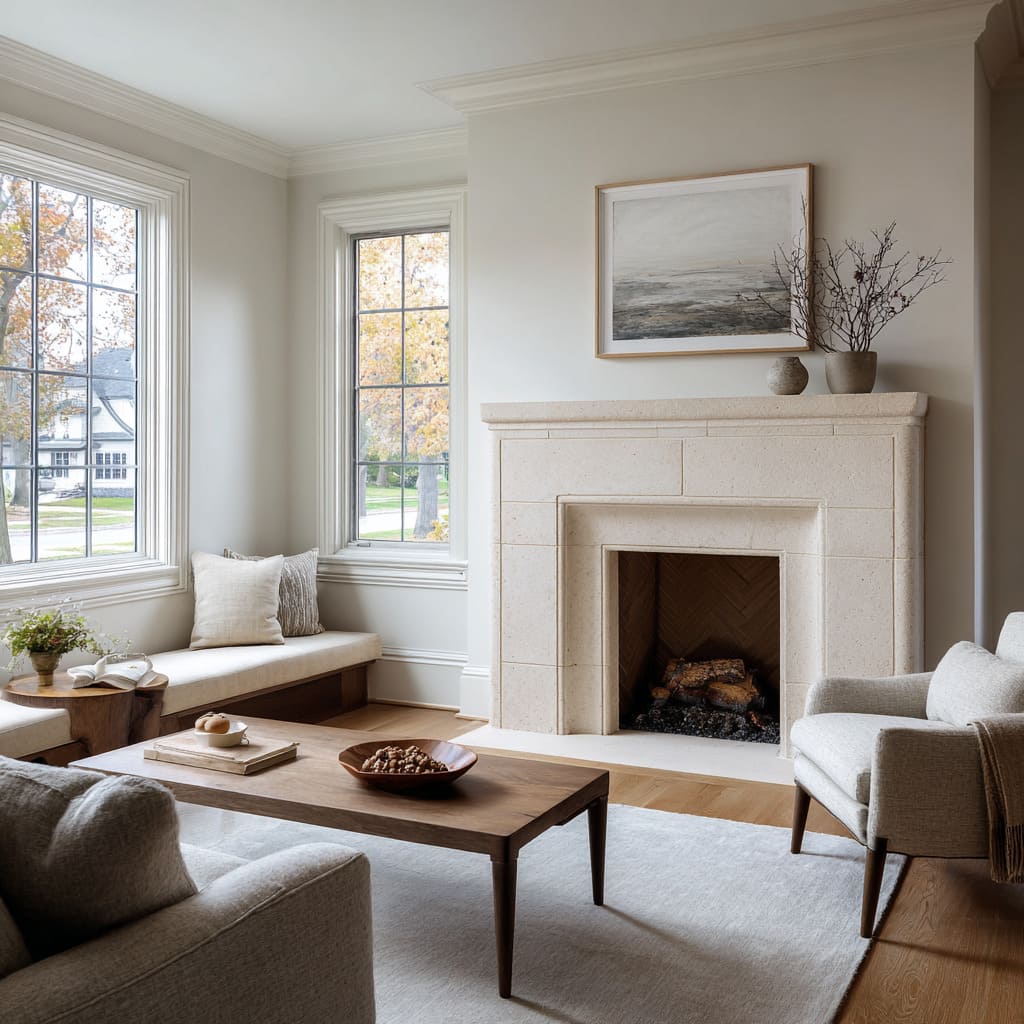
Coffee tables do a surprising amount of compositional work in western springs interior settings. Rounds and ovals soften rooms that contain many rectangles; clover-leaf tops create knee-clearance lanes in tight ranch plans.
A square plank mass can anchor a generous seating rectangle, especially when books and bowls gather at the edges, leaving the center open so wood grain reads as one field.
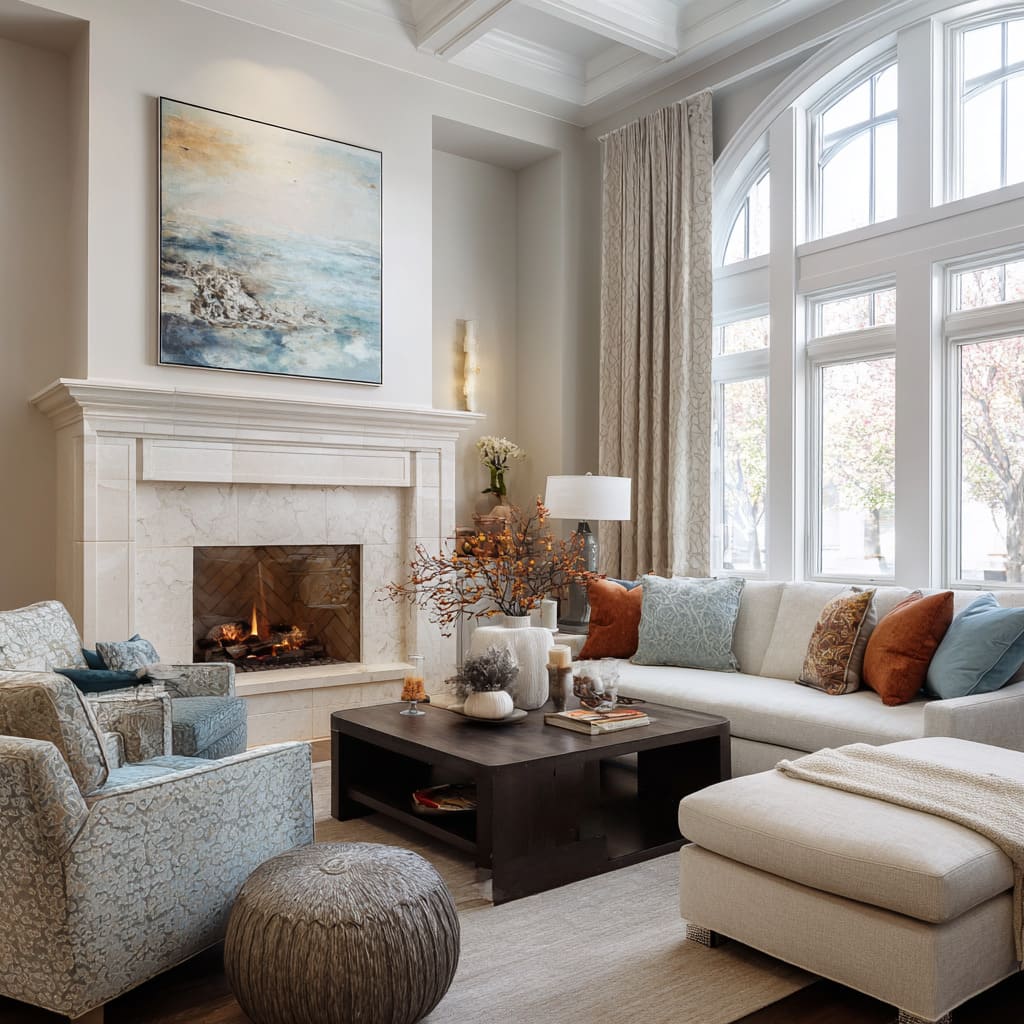
Sculpted “bridge” forms—slim tops that lift at the ends—add motion and reveal more rug around the base, increasing the sense of air. In all cases, the table’s edge profile and leg reveal manage shadow: a finger-width of darkness around a lifted top can make a solid mass feel lighter and help the rug’s rib or loop stay visible as a texture, not a pattern fight.
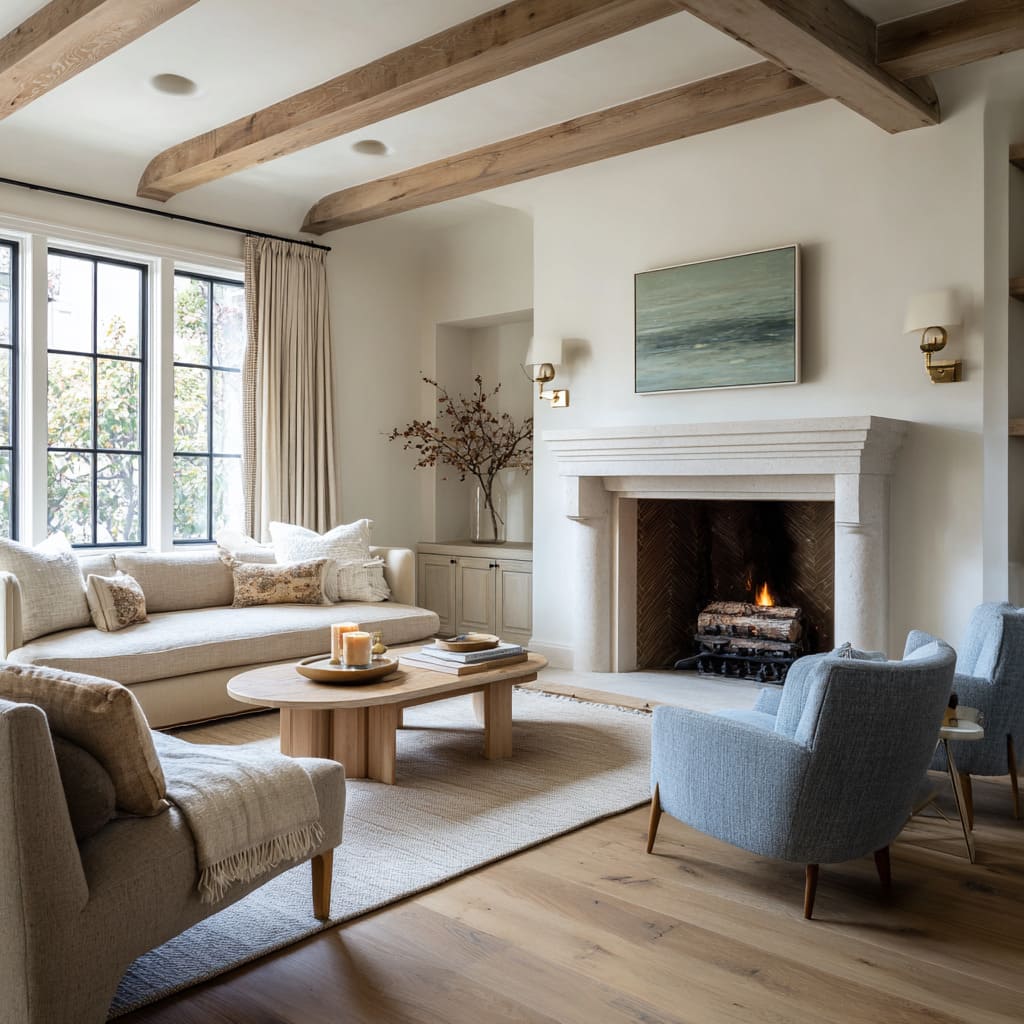
Shelving and Styling: Negative Space as a First-Class Material
Styling in western springs design ideas treats air like an object. Shelf thickness repeats across the room—matching the TV frame reveal, the bench edge, and the mantel cap—so a single measure becomes the room’s quiet rule.
Books cluster by tone, not by author color wheel, with darker weight near the hearth or a central vase and paler spines drifting outward; this keeps shelves from buzzing. Objects arrive in trios or in a low-high pair, with generous space between groups so the field breathes.
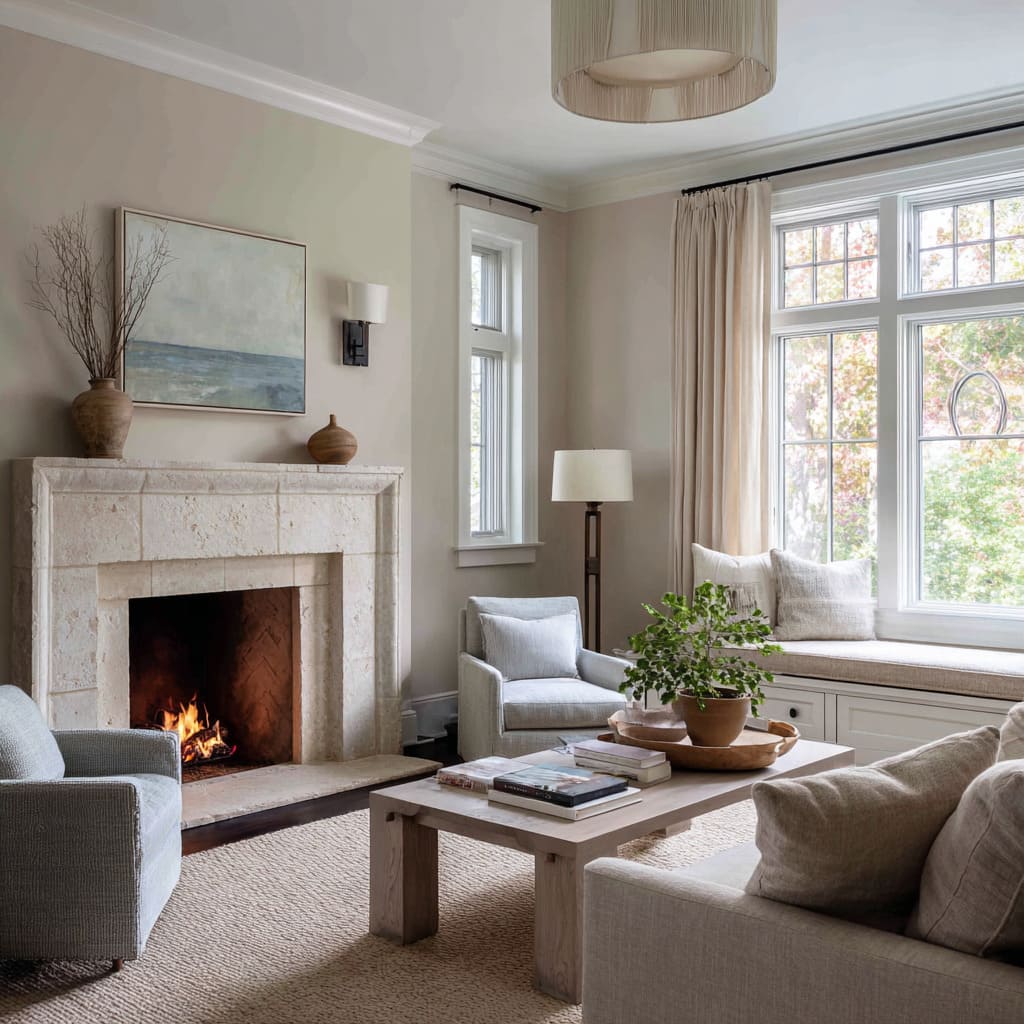
On mantels, a single centered landscape or a narrow print paired with one stone bowl leaves plenty of quiet wall, which keeps the fire opening as the true event. The language is “edited abundance”: enough items to show life, few enough that air still carries equal authority.
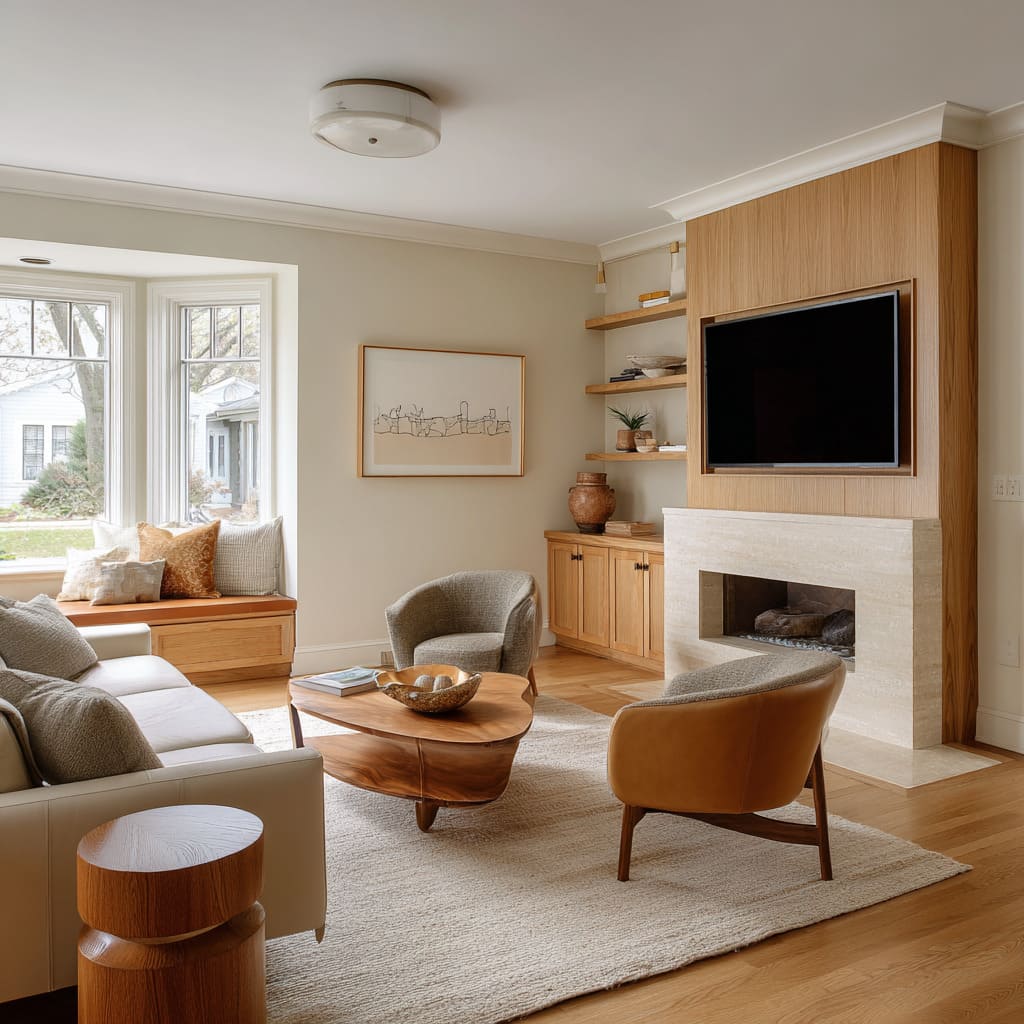
Lighting: Glow Belts, Soft Punctuation, and Controlled Shine
Light is drawn like a sketch for mood rather than a diagram for lumens. Cove or tray perimeters create a glow belt, flattening hot spots and letting stone and plaster blush gently.
Sconces placed low enough to graze the mantel bind fixture and masonry into one element; picture lights keep art from going dull at night; small brass points—backplates, tiny knobs—add twinkle without veering into glare. A drum ceiling light or low-aimed lamp warms the same temperature as flame, joining artificial and natural warmth into one envelope.
Rather than a spotlight show, the room prefers glow that makes materials audible, not loud.
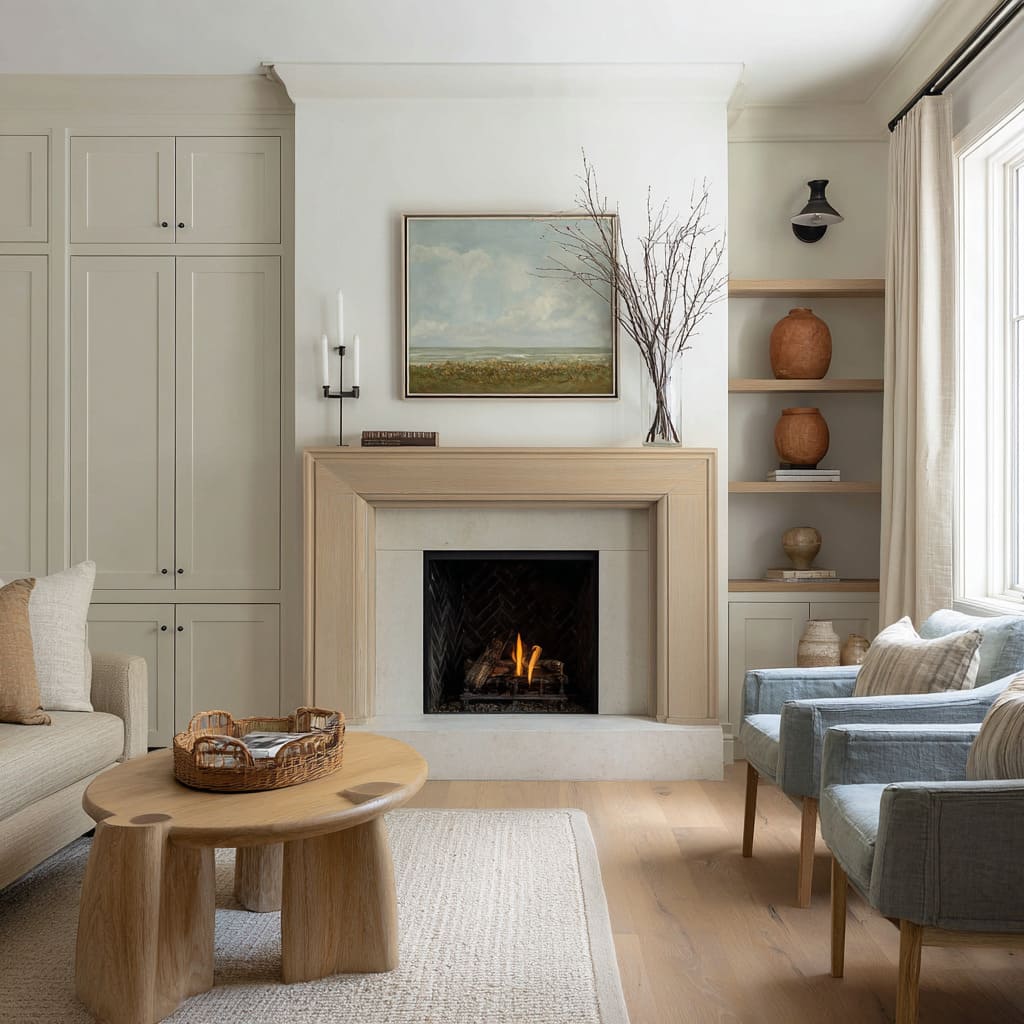
Rugs and Floors: Texture as Pattern and Borders for Breathing Design
Rugs lean on texture: looped neutrals, ribbed fields, speckled flatweaves that hide traffic, crumbs, and pet life without stumbling into busy graphics. Orientation often nudges the eye toward the fire—subtle ribs point, not shout.
Many designs feel “wall-to-wall in spirit,” yet a wood perimeter remains visible; this thin border keeps architecture present and stops the floor from reading like carpet. Layering appears, but carefully: a pale, tight rug over medium oak brightens without glare, leaves a walk lane behind swivels, and allows the coffee table to land perfectly centered so the plan reads intentional.
Micro-Palettes
- Sand + wheat + pale oak + sage. Calm foundation; green nods to neighborhood foliage without grabbing attention.
- Limestone + sky-blue chairs + oak beams. A light, coastal-leaning mood formed by material warmth rather than seaside symbols.
- Travertine + matte black pin-lines + sea-glass textiles. Crisp edges, soft tint; black acts as a pencil mark, not a block.
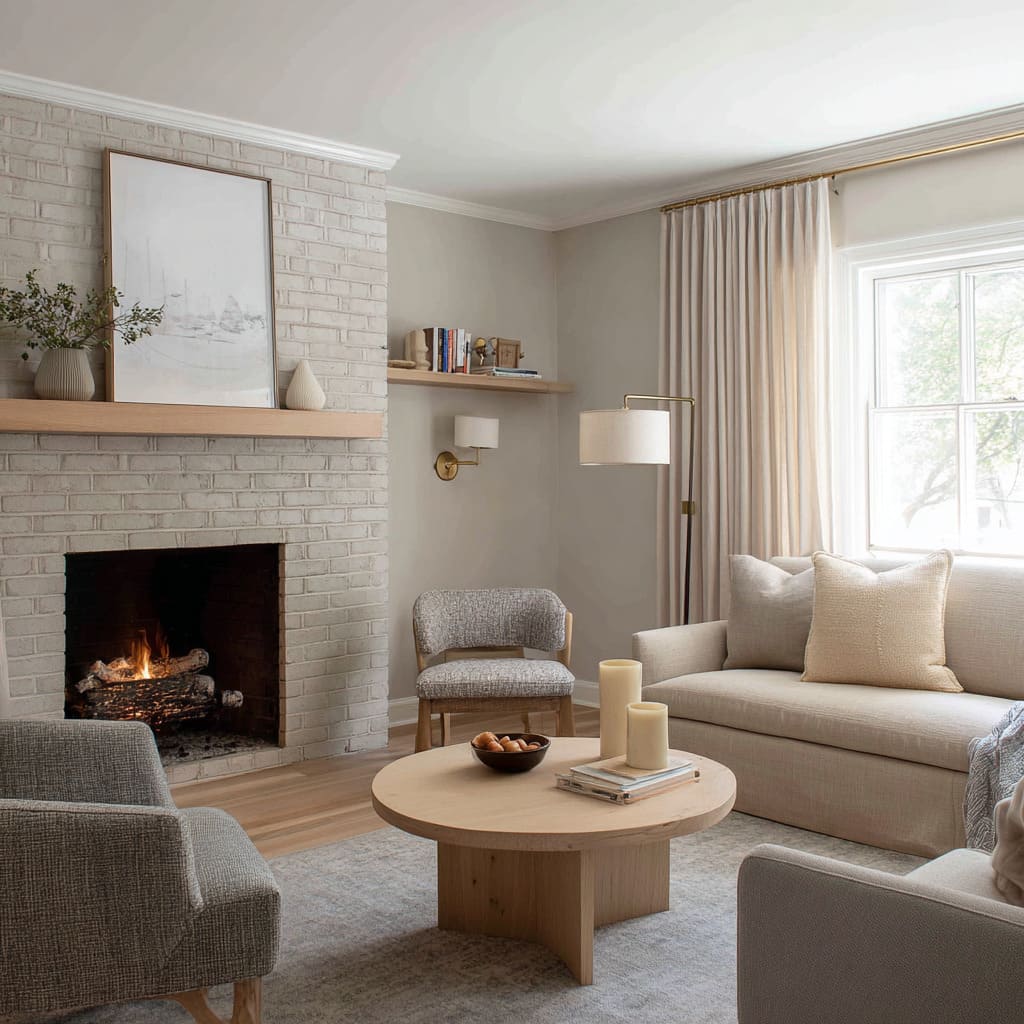
- Lime-washed brick + rounded furniture + tiny brass points. Texture leads; shine stays restrained.
- Pale stone + live-edge table + ribbed rug. One tactile star with everything else in supporting roles.
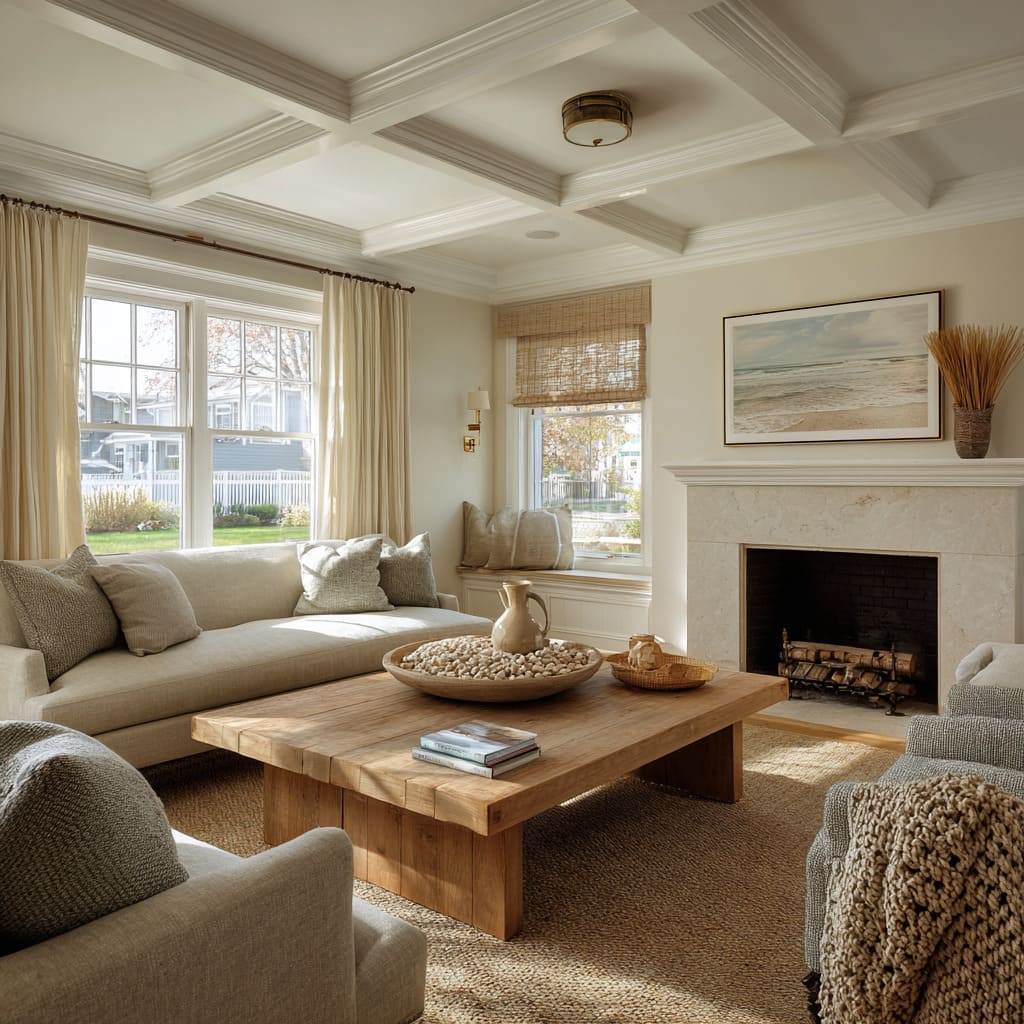
Each combination keeps color in a range where daylight can do the work. The goal is not absence of color but the feeling that hue comes from materials and light first, fabrics second, and paint last.
Typologies Within the Style: How the Language Adapts
In single-story ranch layouts, curves become essential traffic tools: clover tables, barrel chairs, and swivel tubs clear knee lanes and soften low ceilings. In classic two-story settings with center halls, mantels step quietly, seating arranges in rectangles, and built-ins carry ribbed or slatted panels for movement without color.
Cottage and Cape layouts push plaster-smooth faces and small, firm sconces, leaning on looped rugs and linen panels for heft. Great room designs with cathedral height lean on vertical cladding or tall stone to scale the wall, then use double-height drapery and low, rounded furniture to bring the scale back to human comfort.
The vocabulary shifts with the envelope yet remains legible as western springs interior design because alignment, texture discipline, and gentle palettes keep returning.
Subtle Moves
The style’s finesse sits in details that rarely announce themselves. A finger-width shadow line between hearth stone and floor lifts the mass so it reads crafted, not heavy.
Pattern stays inside the fire opening—chevron brick glows behind flame—while the face remains smooth; the eye feels activity without visual buzz. A sconce placed off-center balances a landscape canvas so the wall breathes rather than stands rigid.
An oversize canvas landing inside a coffer bay borrows the ceiling grid as a frame. Thin black lines from window muntins, rods, and sconce stems stitch across the room, keeping the drawing continuous.
One curved element—a racetrack table, a rounded pouf—softens an room full of right angles and makes circulation look natural rather than squeezed.
Another helpful grouping looks at function inside appearance:
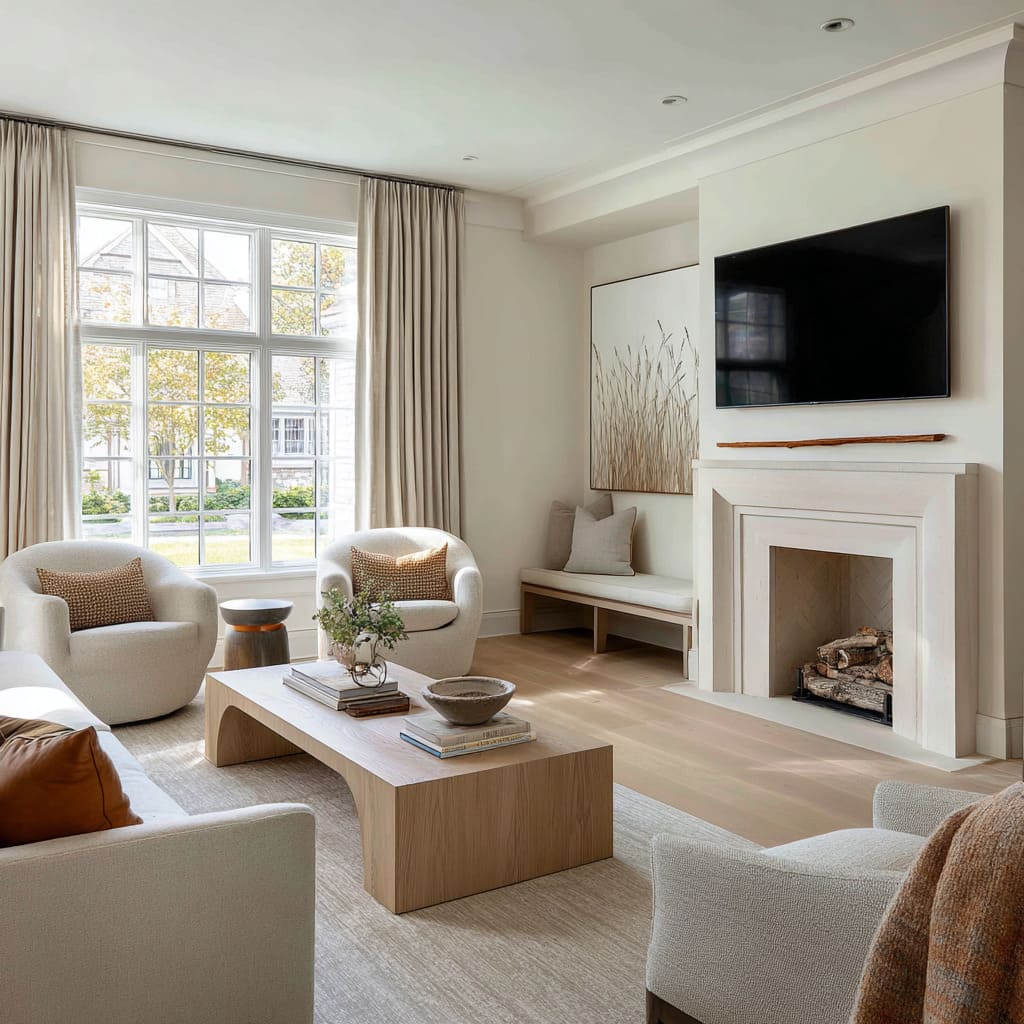
- Anchor elements: fireplace face, coffee table, main sofa.
- Link elements: mantel line to window stool, shelf thickness to TV reveal.
- Softeners: rounded chairs, poufs, racetrack tops, linen panels.
- Accents: one rust pillow, a branch in a tall vase, a small brass detail.
The Style in One Long Breath
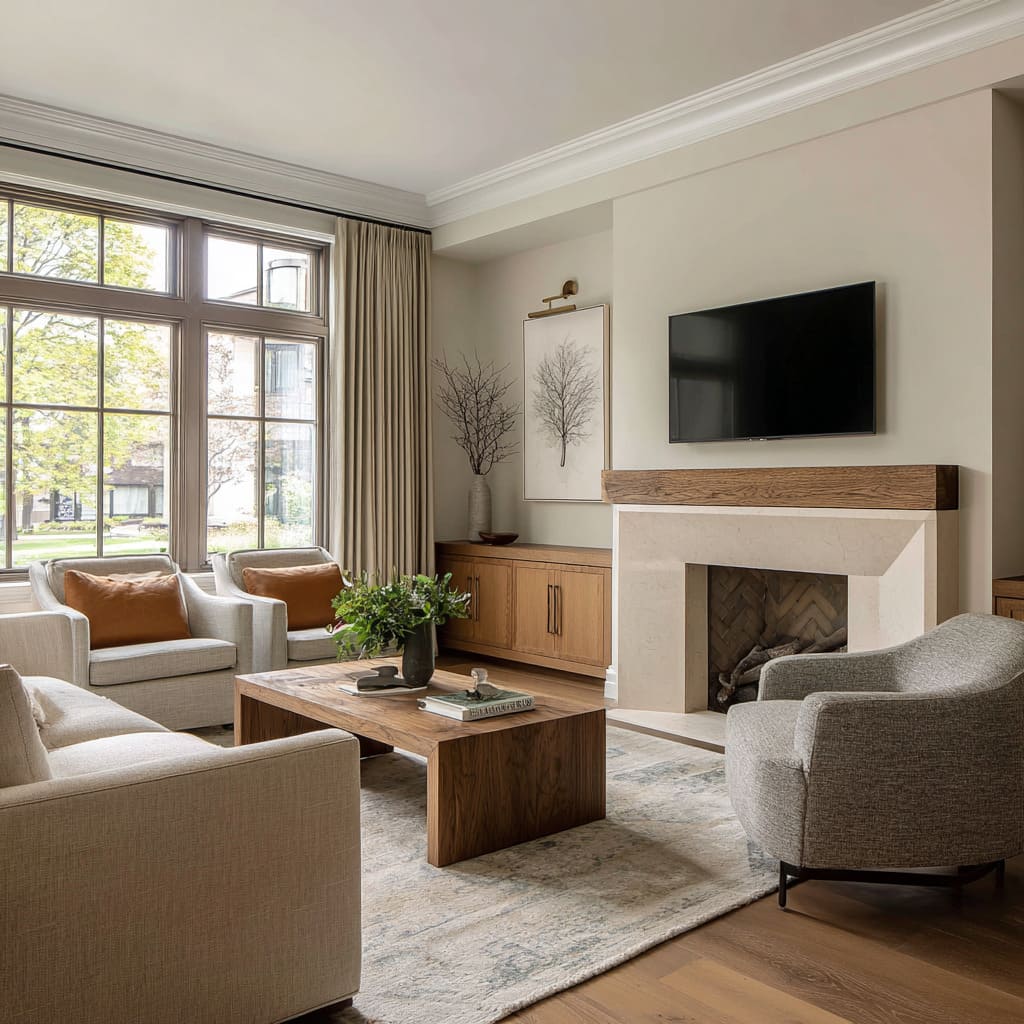
Living room design in western springs style is a set of visual manners rather than a list of items:
- a steady cushion horizon;
- stone and oak reading as one field;
- pattern tucked inside the firebox, not splashed across faces;
- benches that look like they belong to the lounge rather than the trim carpenter;
- shelves where air shares billing with clay and wood;
- lighting that sketches glow belts and soft punctuation instead of spotlit drama;
- rugs that bring texture over print;
- coffee tables that guide traffic and show shadow;
- and micro-palettes that let daylight and flame paint the color story.
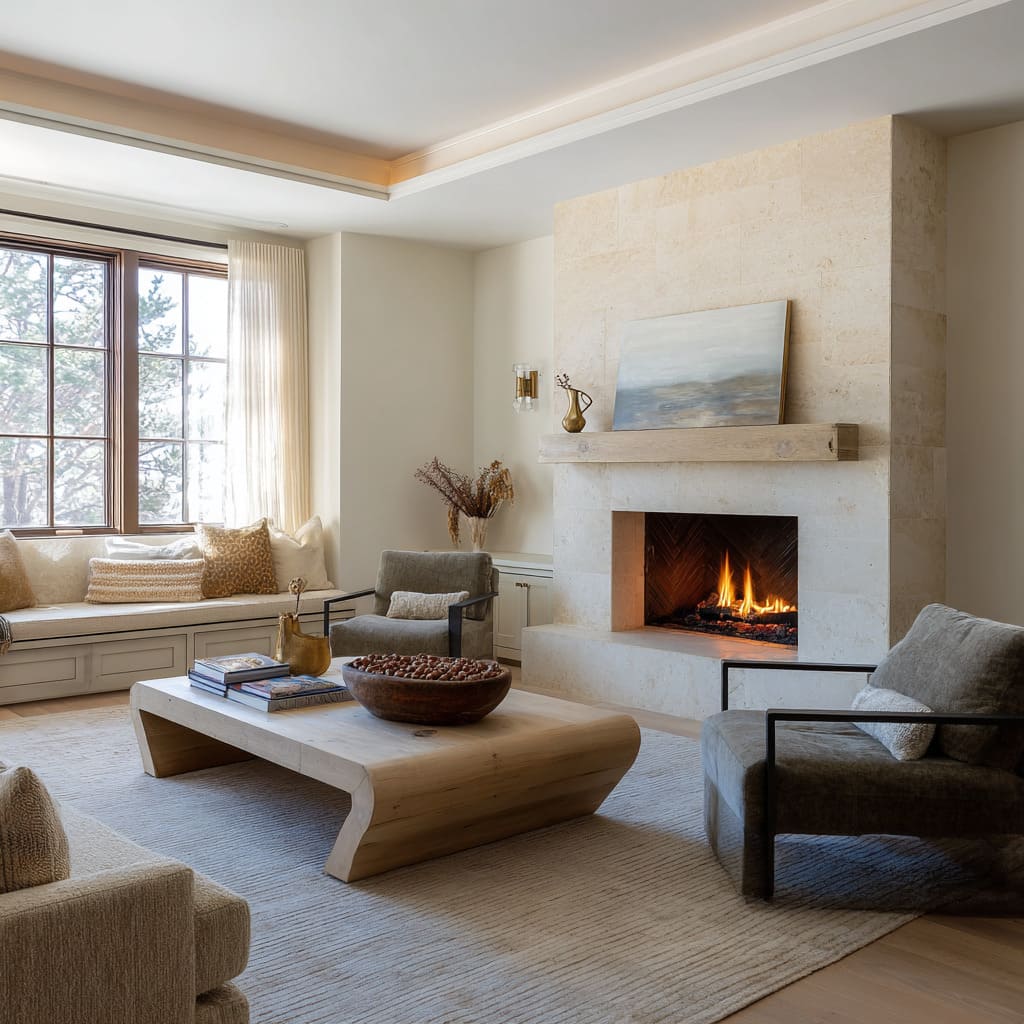
Taken together, these manners build rooms that feel restful and complete—places where conversation, reading, kids’ games, and evening quiet all seem baked into the composition. That is the enduring charm of western springs design ideas: restraint used with feeling, detail used with purpose, and comfort written directly into the look.