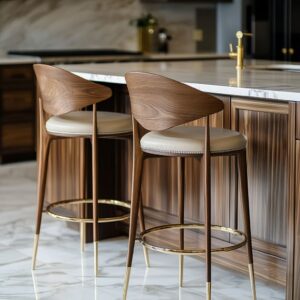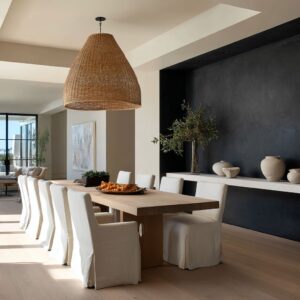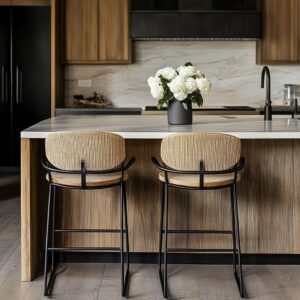
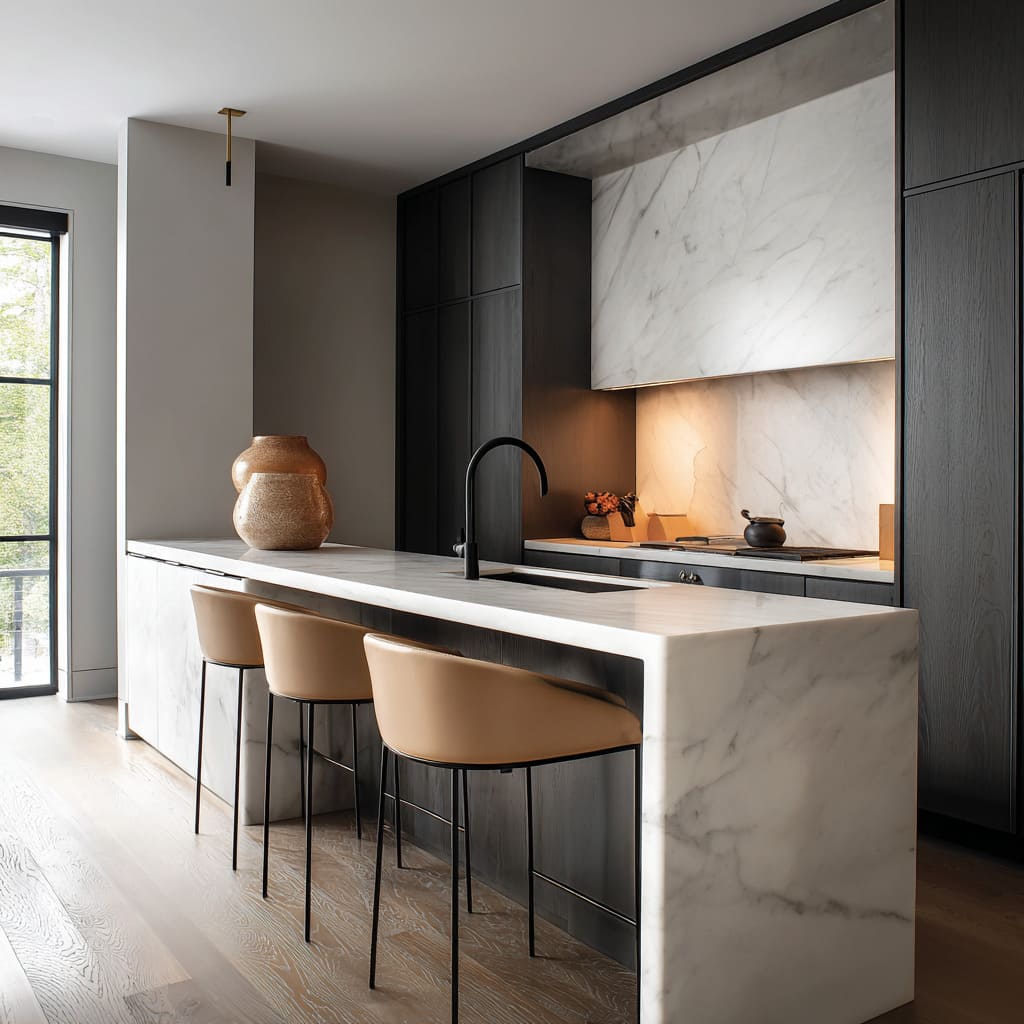
A white stone island can behave like a quiet stage in the kitchen design: a broad, pale surface with calm veining and crisp geometry, while the seating line supplies most of the personality. The design of bar stools for white kitchen islands has moved far beyond simple “extra chairs.
” They function as compact visual summaries of the whole palette—bridging stone, wood, metal, and light in a single object. The island slab usually holds the largest moves: the thickness of the top, the direction of the veining, the way waterfall edges sit against the floor.
Around this, the stools are given the job of translating the architecture into human scale. Their height controls the horizon at counter level, their color eases the jump from bright stone to darker cabinets, and their bases echo or soften the black lines already present in hardware and window frames.
When seen together, the island and stools read as a single composition: a white mass holding steady while a row of compact sculptures brings warmth, softness, and rhythm to the front edge.
Color as Mediator Between Stone, Wood, and Dark Accents
Color in such kitchens is rarely loud; it tends to live in narrow temperature shifts rather than bright contrasts. A typical palette might combine white or off-white stone, pale oak floors, and black or charcoal joinery.
In that setting, stool color becomes a mediator between extremes. Warm camel, cognac, or saddle-tan leather sits comfortably between pale stone and deeper wood tones, creating a gradual transition instead of a harsh jump.
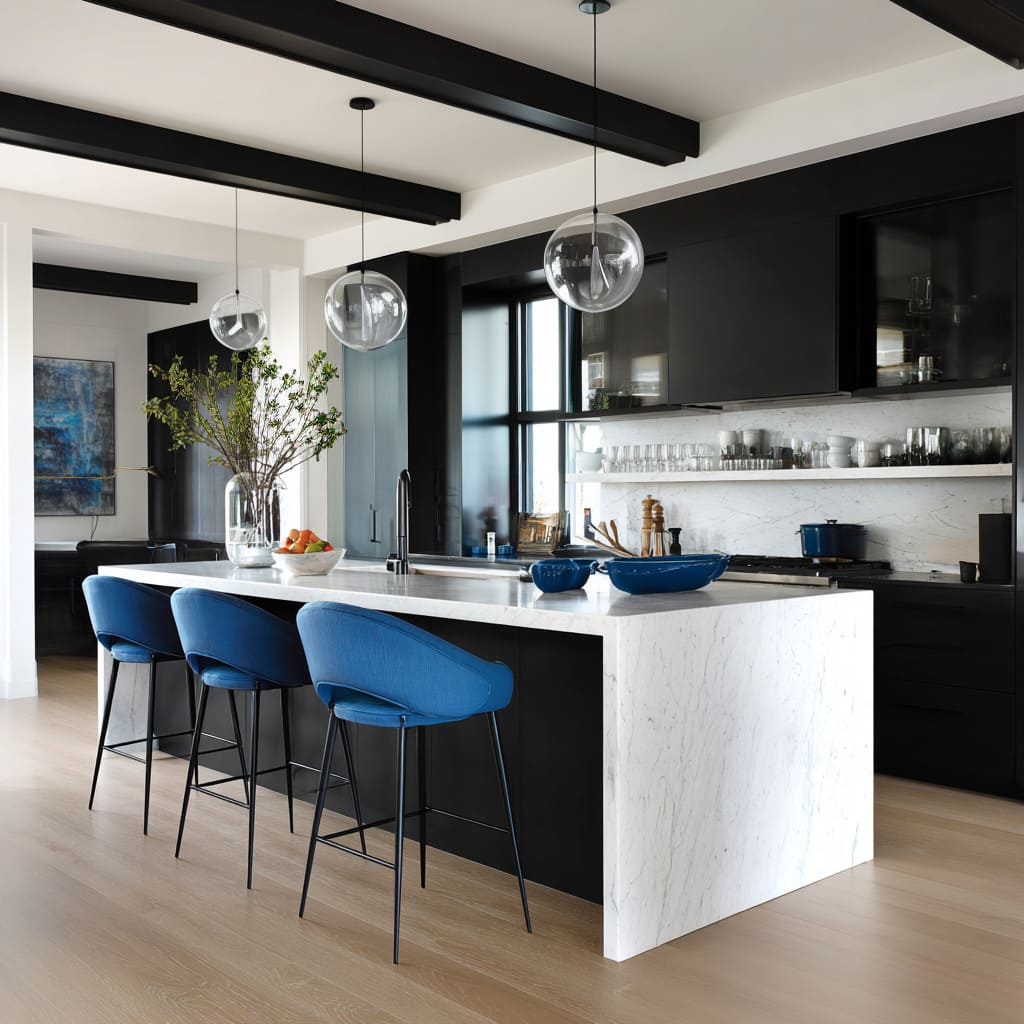
Cooler tones—powder-blue, soft gray, or olive velvet—often sit between white marble veining and the black of hood, faucet, or metal frames. This is where stool ideas for white kitchen island design become surprisingly precise: the hue is usually not a perfect match to any single surface but a bridge that belongs to two or three materials at once.
A caramel stool can echo cutting boards, floor planks, and the warm undertone of the stone in one move. A blue stool can feel related to both gray veining and a misty painting nearby, tying the art wall back to the island edge.
Instead of large patches of color, the kitchen relies on these controlled notes at the seating line to shift mood from strict to relaxed, from cool to welcoming.
Horizon Lines and Visual Calm at Counter Height
A recurring visual rule in such interiors is the protection of one clean horizontal line: the edge of the island top. In many scenes, stool backs are designed or adjusted so they sit just under the counter surface, keeping the main horizon clear.
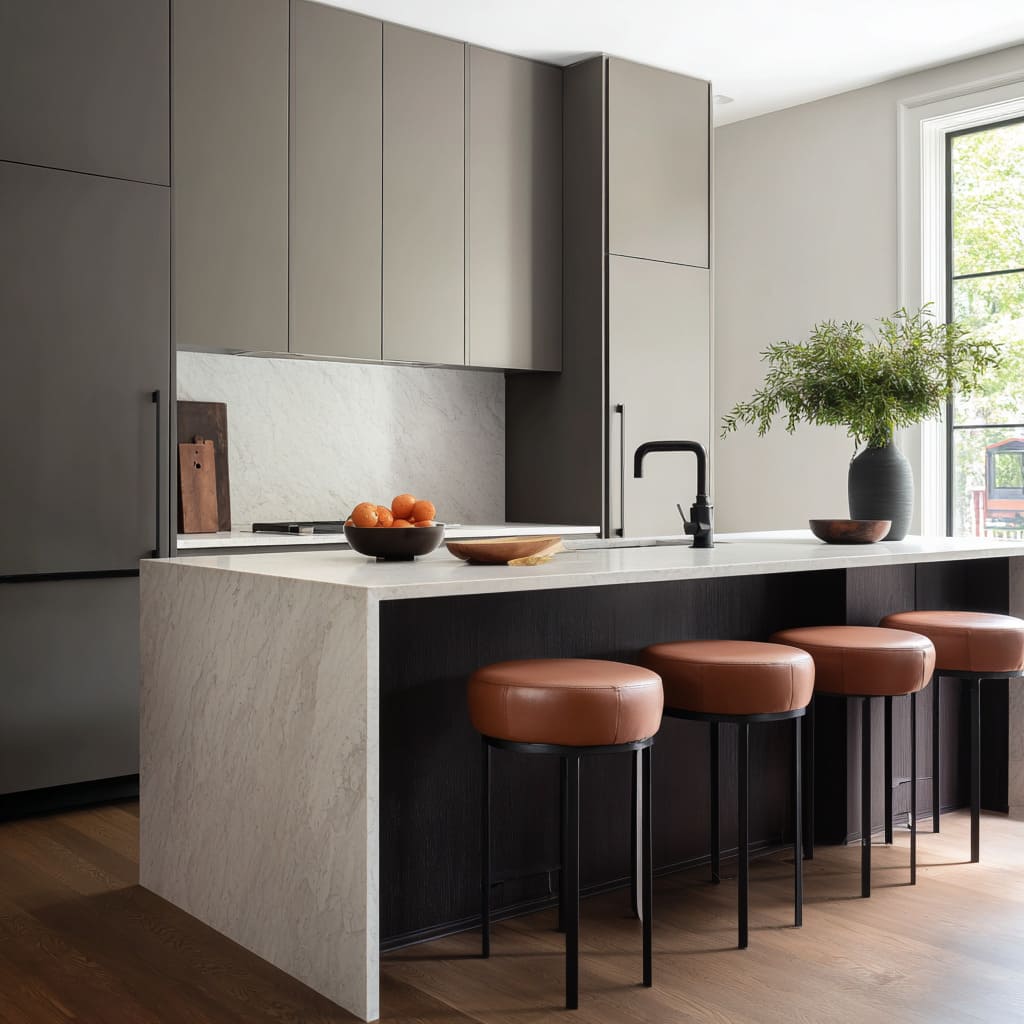
Low backs, backless cylinders, or half-moon shells allow the viewer’s eye to follow the stone edge without interruption, which makes the island itself feel long, calm, and continuous. This is particularly effective in smaller spaces, where tall backs would quickly create a fence in front of the slab.
The absence or modest height of backs does not remove comfort; it simply shifts it into subtle curves and cupped seats rather than tall silhouettes. In more compact kitchens, cylindrical leather poufs or simple round seats tuck entirely under the overhang, leaving only a soft line of color in front of the stone.
In larger islands, boxy stools with low backs can still maintain this rule by keeping their upper edge just below the countertop. This shared horizon gives the whole kitchen a steady center line; cabinets, backsplash, and wall lights create additional bands above, but the island edge remains the main calm reference running through the room.
Bases, Frames, and the Architectural Grid
How Legs and Sleds Extend the Room’s Structure
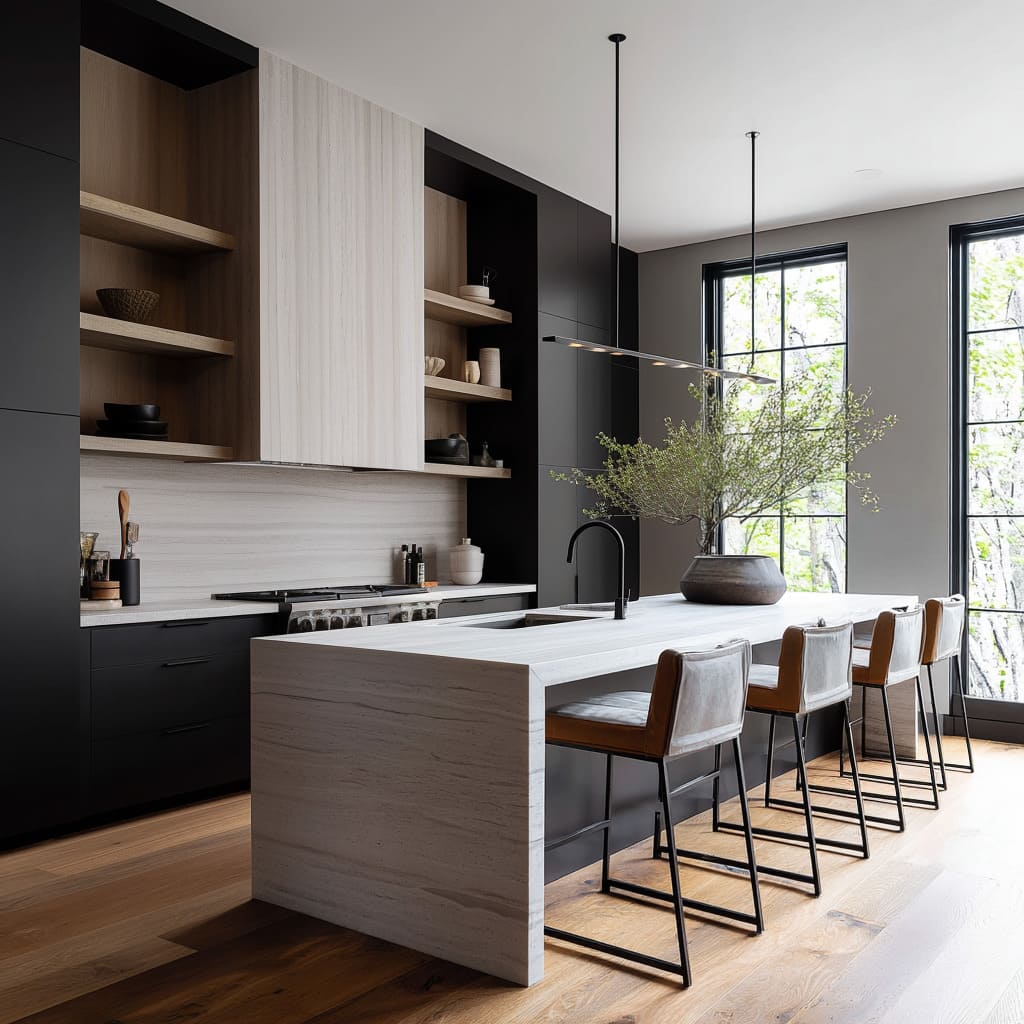
While seats carry color and comfort, the bases of the stools quietly echo the architecture. Thin black frames behave almost like drawn lines over the floor, repeating the graphic language of window mullions, long drawer pulls, and shadow gaps between panels.
In many design concepts, white kitchen island bar stools sit on sled bases that trace crisp rectangles. These rectangles often run parallel to the floorboards, the island’s seating edge, or the lower cabinetry lines.
The effect is a soft extension of the grid already present in the space: the stools look like mobile fragments of the built structure rather than separate objects.
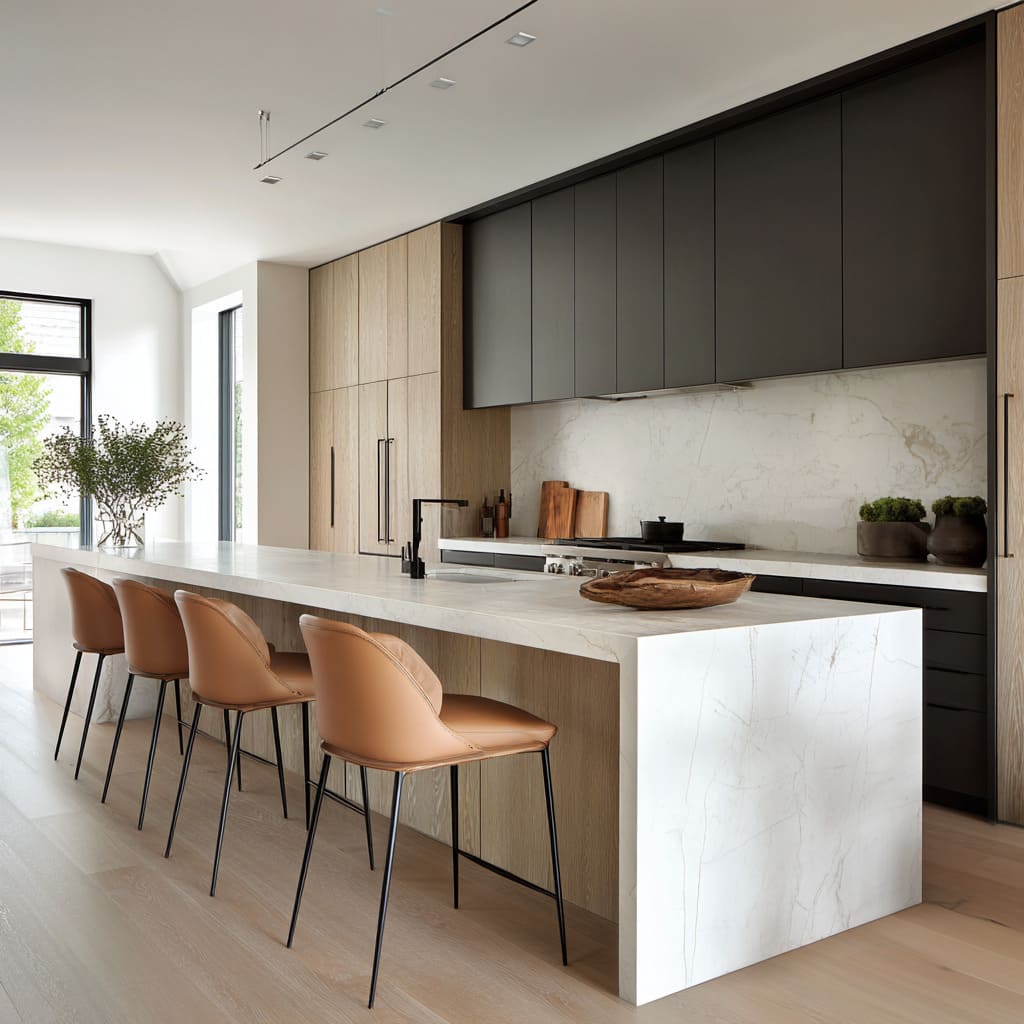
Spidery, four-leg frames work differently. They punctuate the floor with small points and slender diagonals, keeping the base light and letting more of the floor planks show.
This approach suits islands with strong stone veining or heavier cabinetry; the delicate frames prevent the composition from feeling overloaded near the ground. Occasionally, a deeper, squarer sled is used to make stools appear more grounded, especially in kitchens where the island is paired with ribbed cladding or strong vertical stone.
In each case, the base isn’t random. It responds to the type of lines the room already uses: strict rectangles, fine verticals, long horizontals, or a mix of all three.
Shape Language: Curves, Boxes, and the Mood of the Island
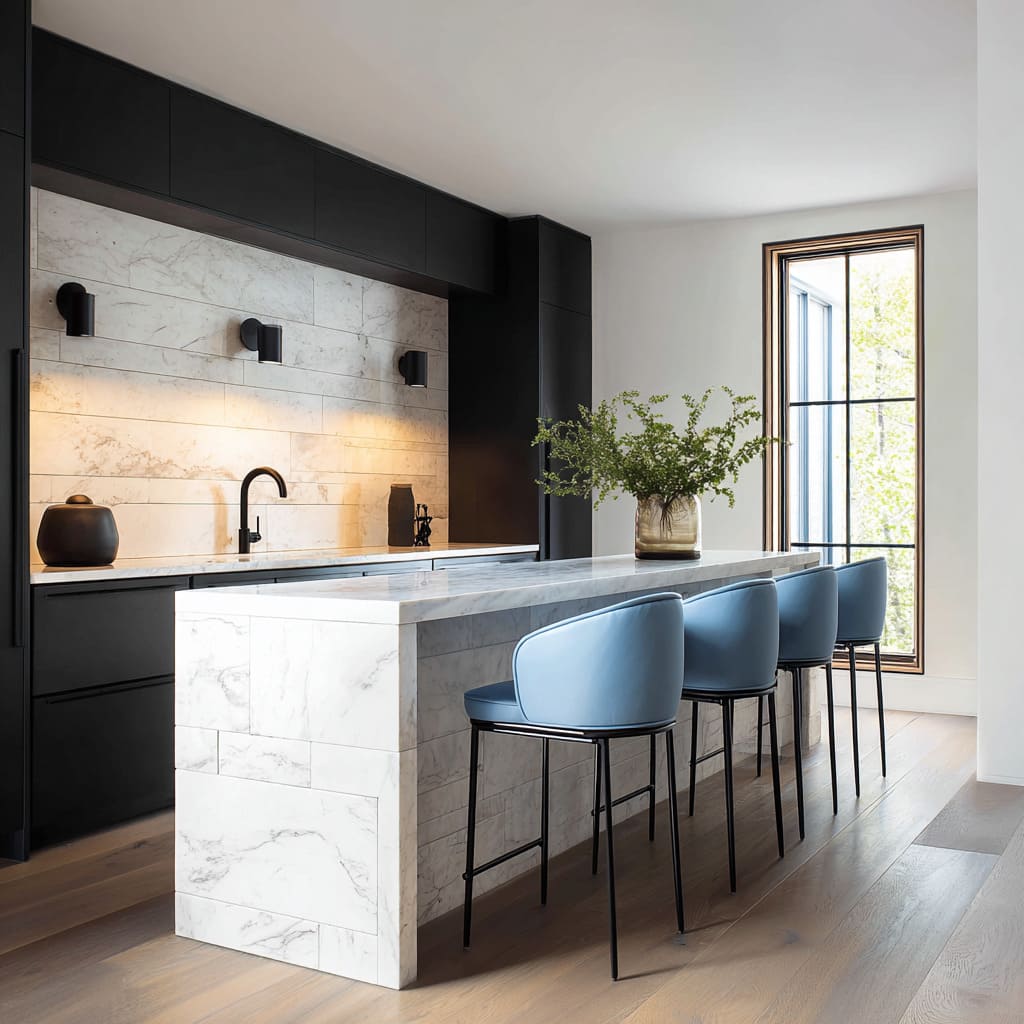
The outline of the seat and back is one of the fastest ways to change the mood of a white island. When the architecture is very strict—sharp waterfall edges, slab backsplashes, rectangular hoods—curved stools are often introduced as a counterpoint.
Rounded bucket shells, half-moon backs, and softly cupped seats bring a gentle contour to the front edge. They echo the circular mouths of vases, the rounded corners of window casings, or the arcs of faucets, while still respecting the underlying geometric order.
The result is a kitchen that feels structured yet relaxed, where the strict stone mass meets a softer social zone.
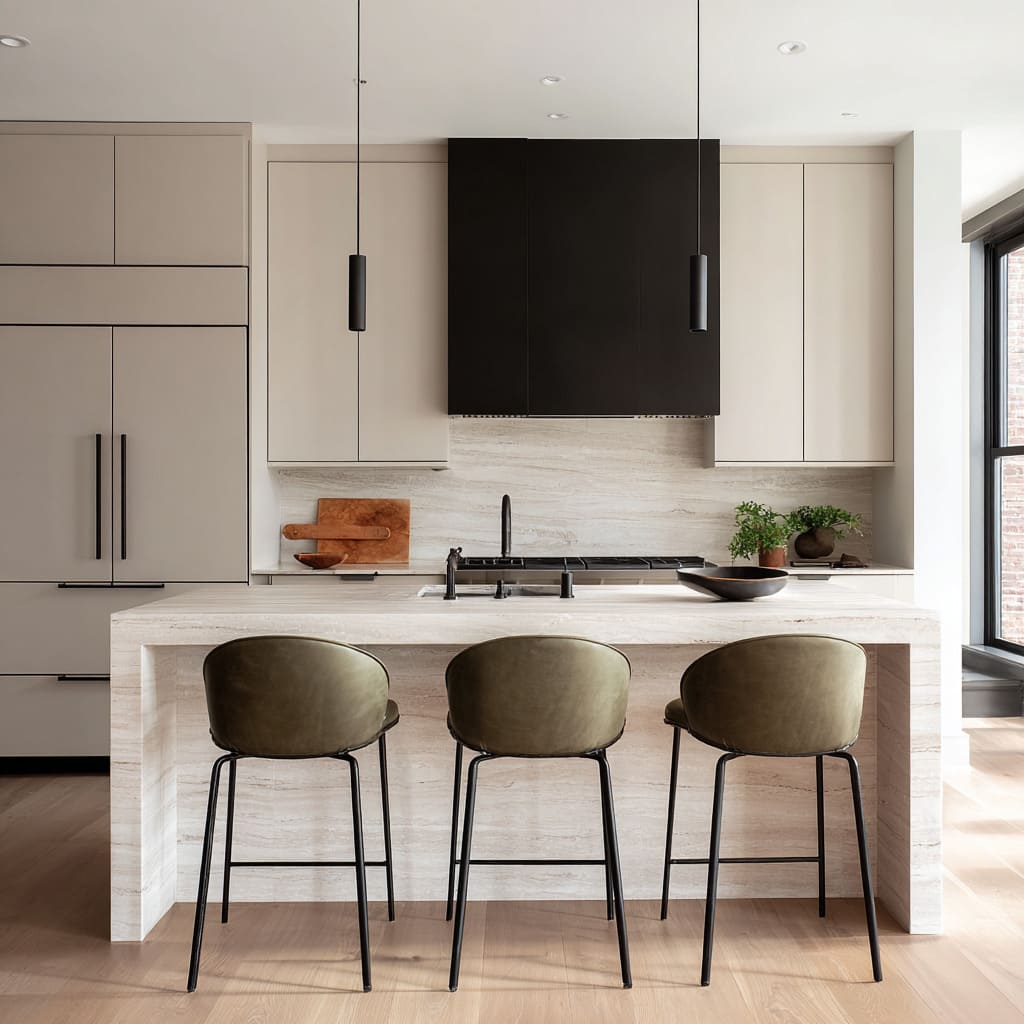
Boxier stools send a different message. Leather cubes or squared backs on sled bases reinforce the rectilinear character of the island.
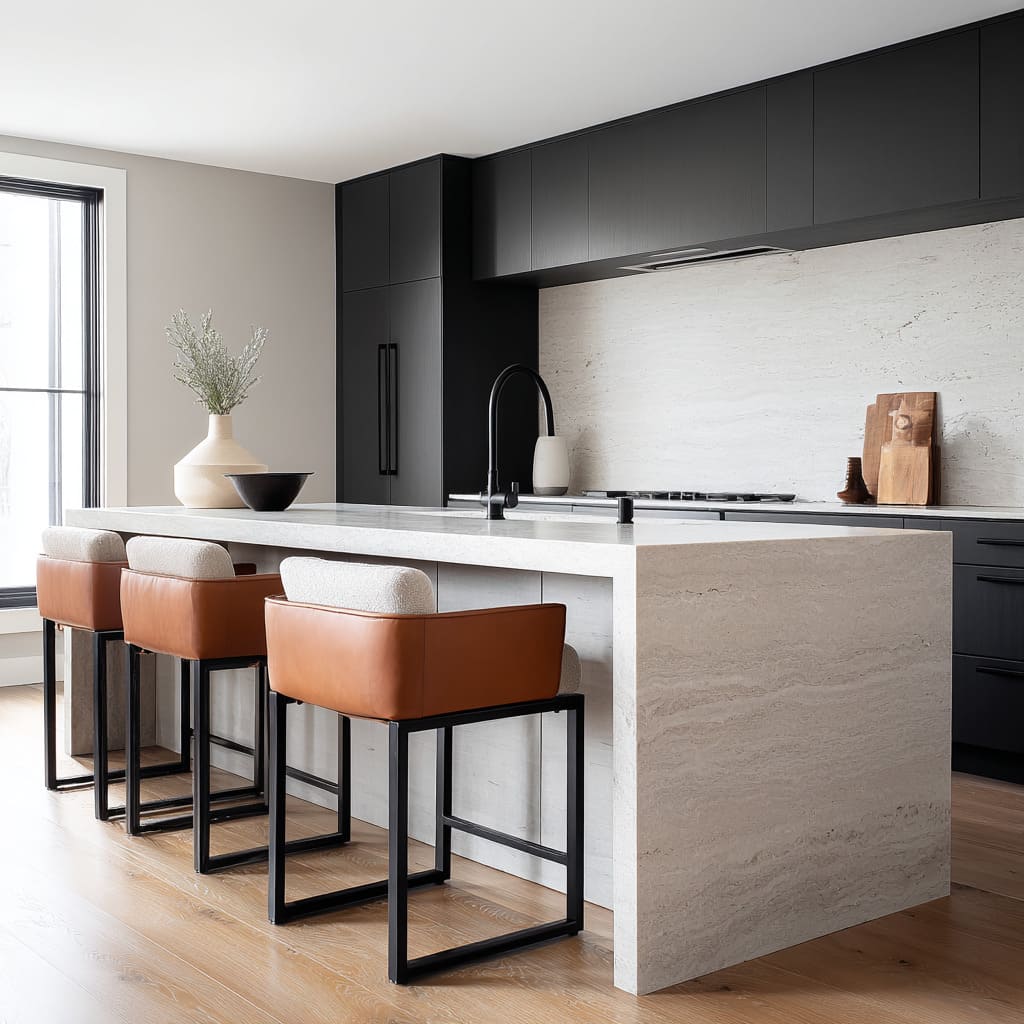
Their vertical fronts can align almost like miniature panels with the waterfall face, making seating read as part of the mass rather than separate pieces. This approach suits interiors where the stone itself has rich texture—travertine with pitting, ribbed cladding, or strongly lined backsplashes.
Instead of adding more curves, the stools join the family of blocks and stripes, becoming upholstered accents inside the larger composition of planes. Backless cylinders occupy a third category: compact, almost playful shapes that punctuate the space without taking over.
They are especially useful where the island needs to feel long and dominant, because the lack of backs keeps the stone visually unbroken.
Texture and Light Behavior in Upholstery and Stone
Micro-Scale Texture vs. Large-Scale Veining
Large surfaces in these types of kitchens—the island, backsplash, tall cabinets—usually control the big light effects: broad reflections, long veins, and the general sheen level of the room. Stools step in at the micro scale.
Their fabrics and leathers manage how light behaves at the human touch points. Bouclé or nubby weaves, for example, create tiny shadows across a white or pale cushion, so the seat looks soft and inviting without needing bulky padding.
Smooth leather displays a gentle, controlled sheen that catches the glow of nearby pendants but does not glare against honed stone.
Balancing Matte and Sheen
Some kitchen designs can pair honed, almost powdery stone with slightly more reflective leather seats. The stone absorbs light in a soft, diffused way, while the leather catches thin highlights along a curved back or the top of a cylindrical pouf.
This balance keeps the front edge lively without making it shiny. Where the island surface itself resembles travertine or another textured stone, the stools often shift toward calmer surfaces: smooth camel upholstery or refined gray fabric that lets the stone keep the role of main texture.
In all cases, the seating line is where the room negotiates between tactile comfort and visual clarity. The exact degree of matte or gloss on the upholstery decides how strongly the stools register in daylight and under artificial light.
Small Details as Signals of Craft
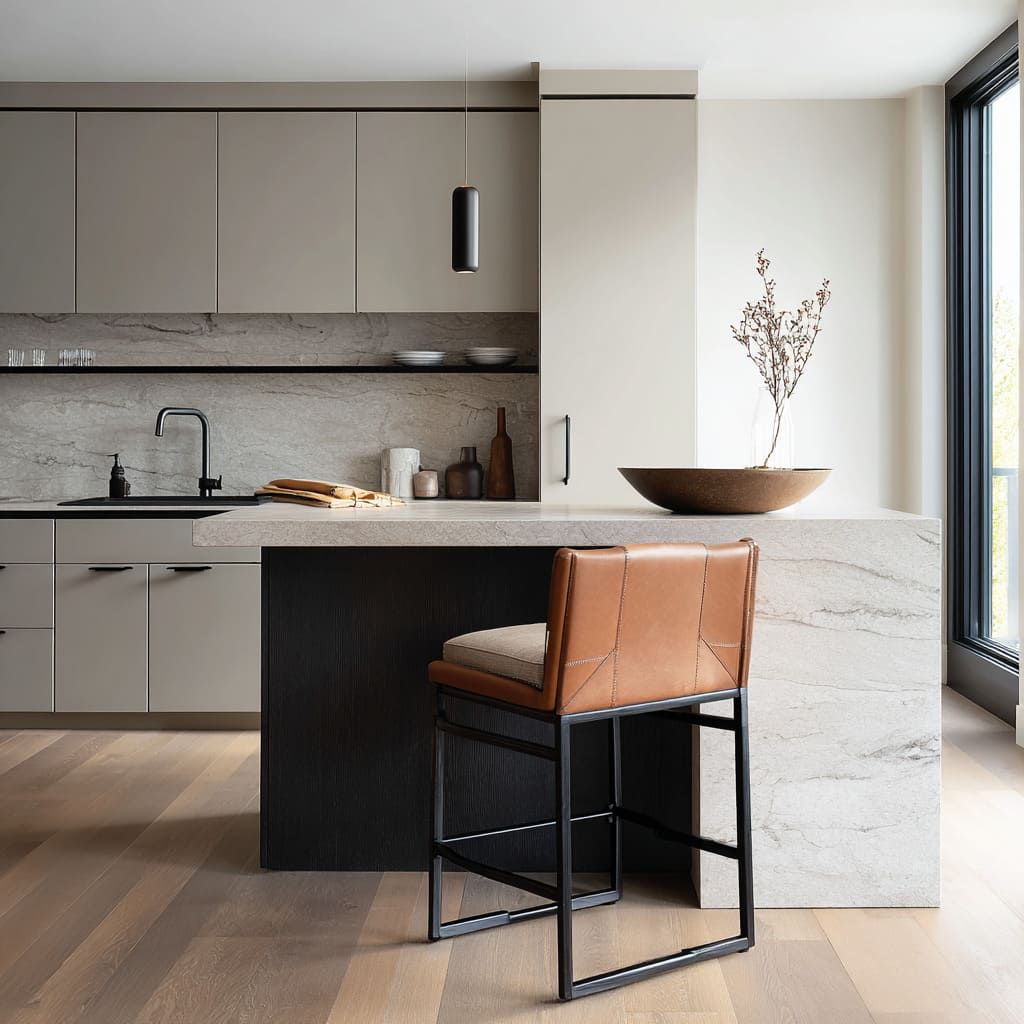
Seams and trims are used very carefully. A single vertical stitch down a tan back, a subtle baseball seam over a caramel top, or a thin contrasting welt along the edge of a bucket seat adds just enough detail to imply craft without turning the stool into decoration.
These lines often echo other fine stripes in the room—cabinet reveals, grout lines, ribbed panels—so that the notion of “fine grain” appears both in the stone and in the upholstery.
Rhythm, Spacing, and the Tempo of Seating
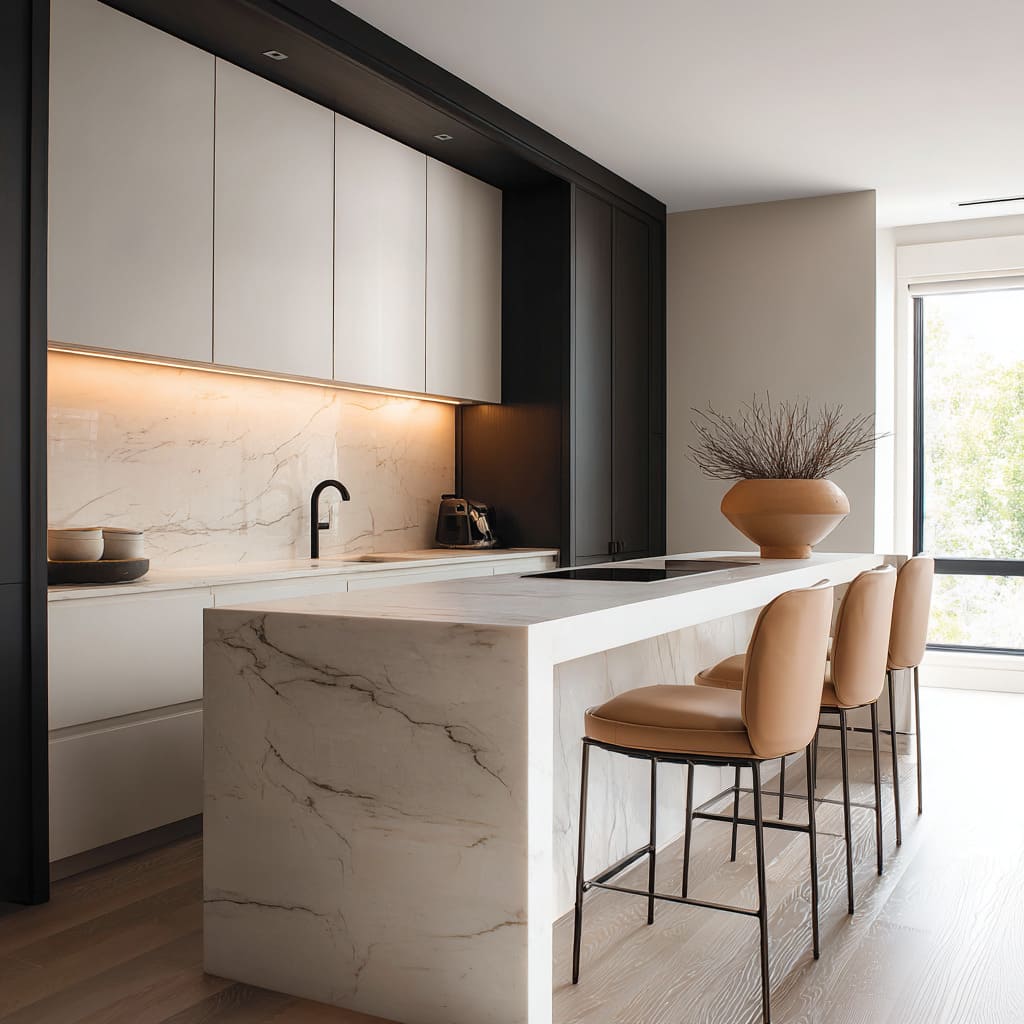
The number of stools and their spacing along the island give the front face a clear rhythm. Three boxes on sleds can feel generous and measured; four slim shells can read as a steady, faster beat.
Because these kitchens avoid heavy ornament, the sequence of stool silhouettes becomes one of the main patterns in the room. This is where bar stool ideas for a white kitchen go deeper than selecting a stylish model: the interval between each seat, the decision to stop at two or to extend to four, and the relationship to cabinet panel widths all shape how the island reads.
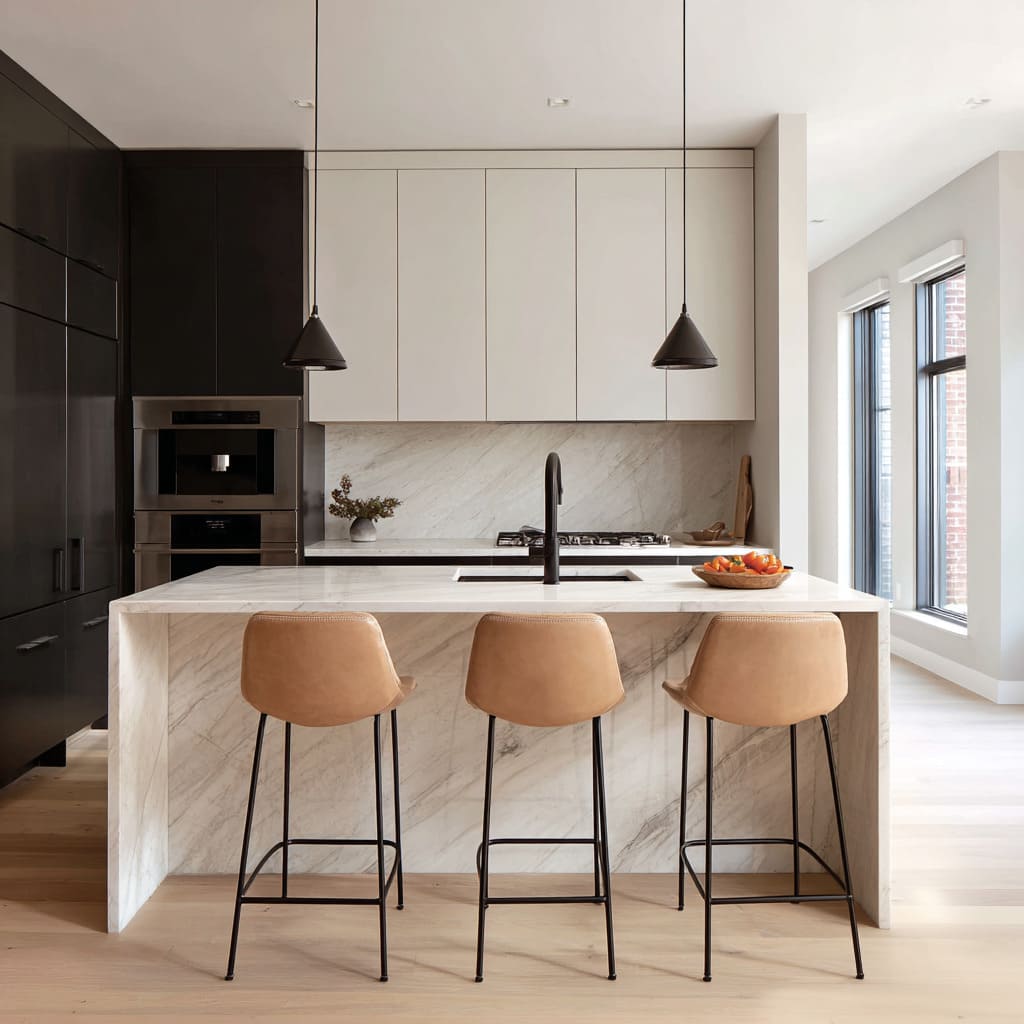
In some schemes, the spacing lines up almost perfectly with the grain or layout behind the island. Sled bases echo the direction and spacing of floor planks, or their positions align with the vertical breaks of tall pantry doors.
In others, a deliberate asymmetry appears: two stools grouped closer together at one end, with a stretch of bare stone on the other, balancing a tall vase or a stack of books. A single stool placed in a carved-out niche can turn the island into something closer to a console or writing perch, rather than a full bar.
These arrangements say a lot about the intended use of the island—quick coffee spots, social seating for groups, or one focused place to sit and read—without any text or accessories spelling it out.
Grain Direction, Stone Pattern, and How Stools Respond
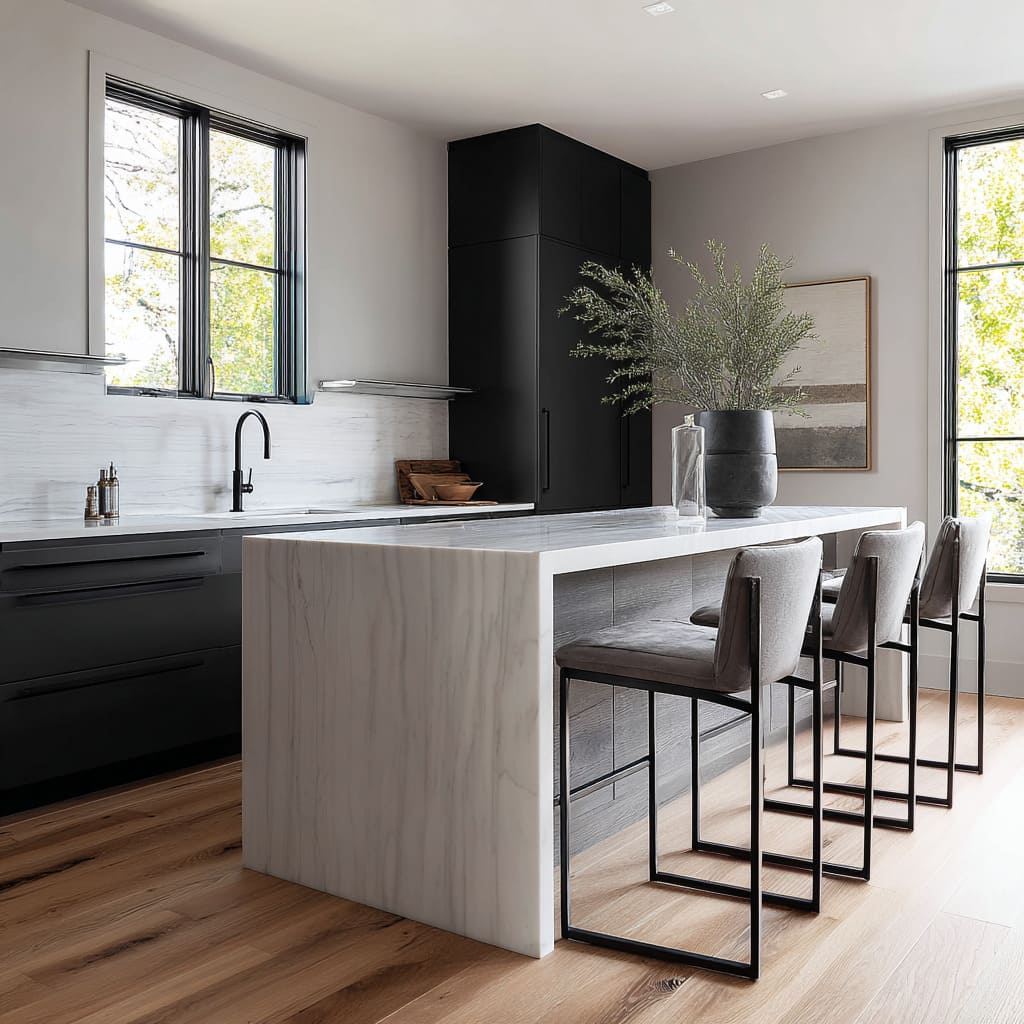
Stone grain is one of the most powerful visual tools in a white island scheme, and stools are carefully chosen to either reinforce or soften its effect. Lengthwise veining that runs from one end of the island to the other already stretches the space visually.
When sled bases, floorboards, and low rectangular stool fronts all run in the same direction, the island feels even longer and more linear, almost like a runway. This works well where the design aims for a strong sense of order and flow.
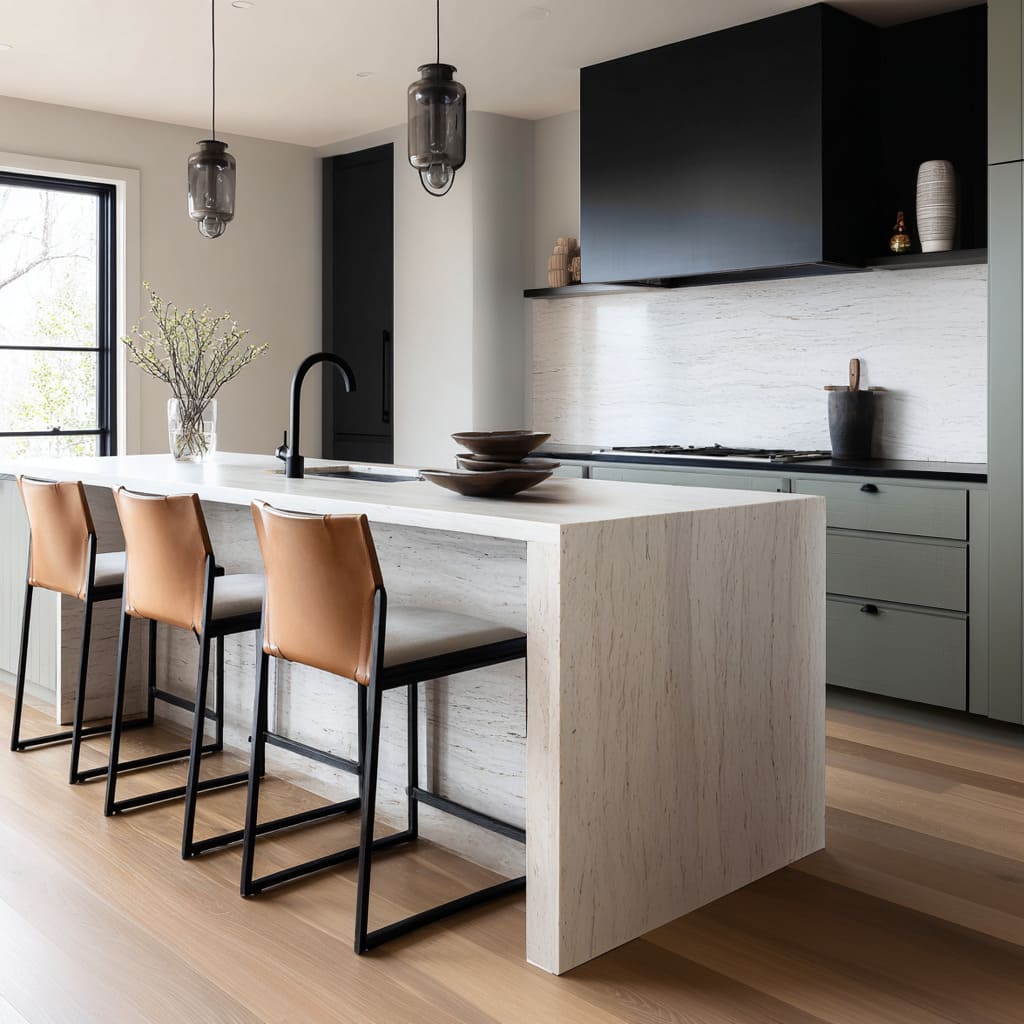
In other cases, the stone is laid in courses or shows more pronounced joints. Here, seating helps manage the rhythm.
Rounded seats can soften the repeat of seams, while half-moon backs add a gentle curve against a field of long stripes. If the island veining is subtle and continuous, cooler fabric tones—soft gray, muted blue—can call attention to the grain by contrast, framing it with a quieter band at the front.
Where horizontal grain is echoed in the cabinetry below the overhang, stools in calm colors but sharper silhouettes keep the focus on line and proportion rather than pattern. The result is a tuned relationship: grain controls the main direction, and stool geometry either amplifies that movement or introduces gentle pauses.
Coordination with Lighting, Fixtures, and Decorative Objects
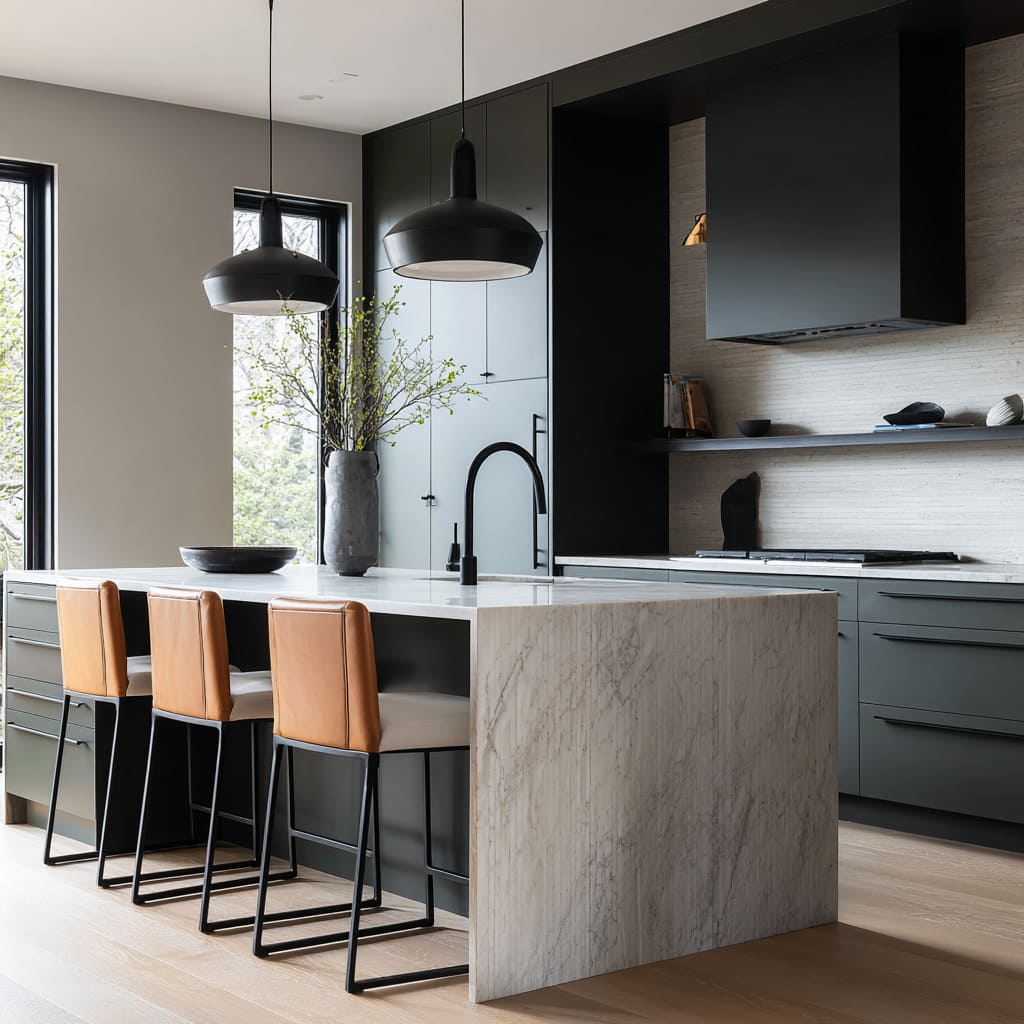
Lighting is usually restrained, letting stone and seating take the leading roles. Clear glass pendants or small, minimal heads allow the island and stools to carry the main character without competition from heavy shades.
In such settings, the bar seats often become the primary color or texture in the lower half of the room, while the pendants act more like sources of glow than focal objects. In other designs, broader dome shades or layered glass cylinders echo the shapes used at the stools—rounded seats below, softened cylinders above—creating a vertical conversation between seating and ceiling.
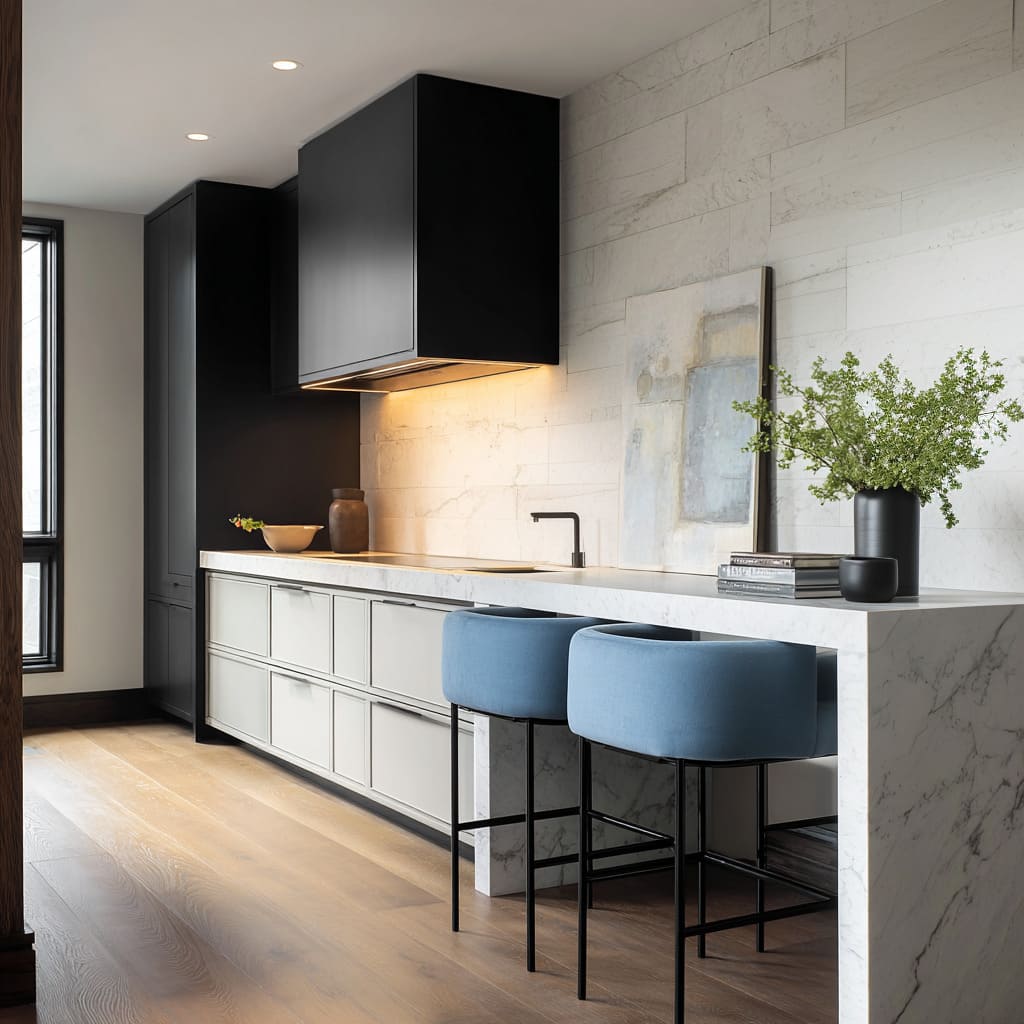
Decorative objects on the island are almost always scaled to interact with the stools. A tall vase with airy branches will often rise from the surface just beyond the seating line, giving a vertical complement to the horizontal run of backs.
Stacks of books under trays or vases lift small compositions so that fruit bowls, ceramics, or foliage land near the level of pendant rims or faucet arcs. This helps the eye travel in a diagonal path: from the floor and stool bases, up through the line of upholstery, across the stone top, and into the cluster of objects and lights above.
Even soap dispensers and cutting boards are placed where they echo, rather than fight, the seating rhythm.

Atmosphere Shifts: How Stool Typologies Change the Feel
Curved Shells and Soft Buckets
Curved bucket stools with slim frames can tend to soften the strict geometry of white islands. They suggest comfort and ease, especially when paired with pale woods and quiet veining.
Powder-blue fabric or muted olive velvet on these forms adds a calm, almost cloud-like tone to the seating line, making the island feel welcoming without any obvious decoration.
Cylinders and Compact Rounds
Backless cylindrical stools in warm leather introduce a more informal mood. They resemble small drums or capped columns lined under the overhang, giving the bar a relaxed, social character.
Because they stay low, the island preserves its full visual height and weight, while the row of circles reads as a friendly, approachable band of color.
Boxy Forms and Low Rectangles
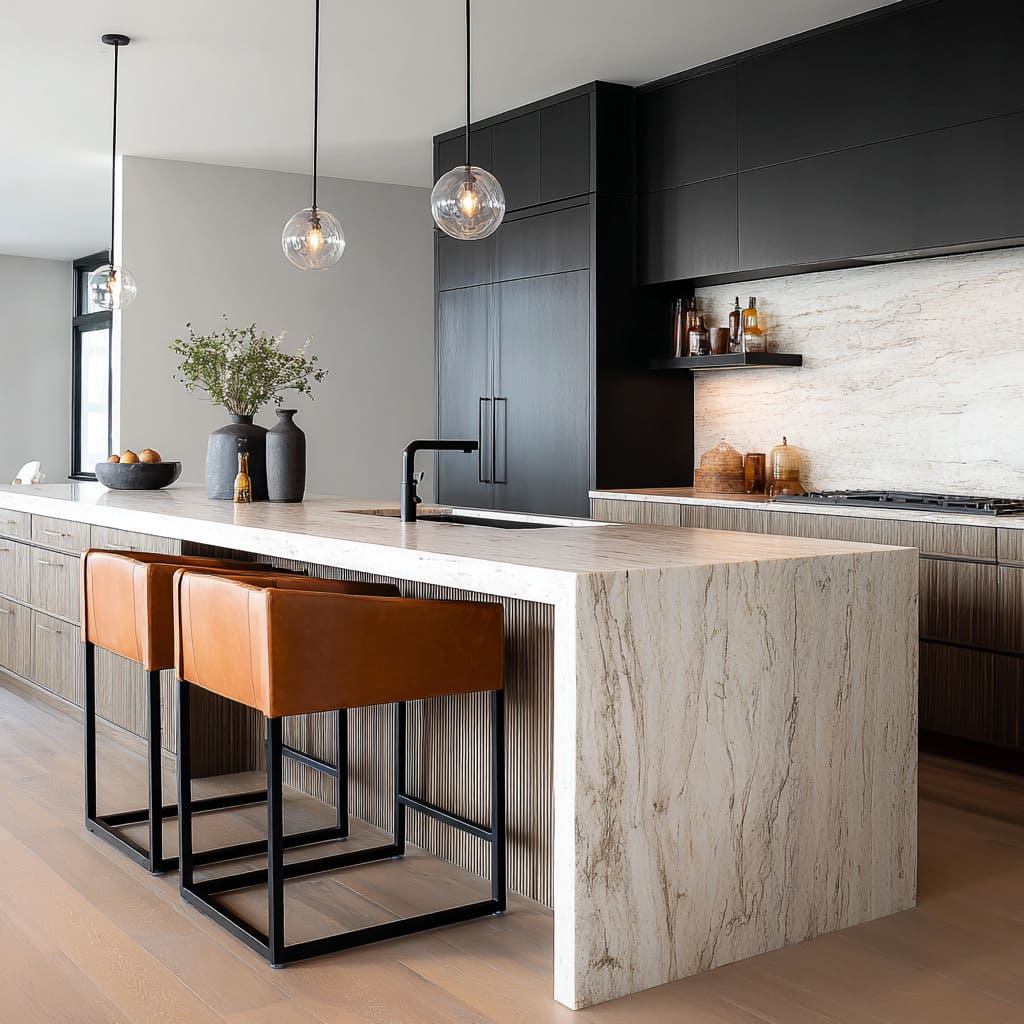
Boxy stools on sled bases bring more solidity. Cognac leather sleeves or camel backs with pale seat pads create a strong but controlled set of shapes.
These pieces join naturally with islands that show travertine-like pitting, ribbed lower cladding, or strong slab backsplashes, where the visual story is already about structure and stripe. In these rooms, a white kitchen island with bar stools of this type feels composed and steady, almost like a series of small, upholstered blocks supporting the daily life of the space.
The Island, the Stools, and the Overall Composition
When all of these elements come together—color bridges, horizon control, base geometry, texture, rhythm, grain, and lighting—the seating line becomes the main interpreter of the island. Instead of simply providing a place to sit, the stools decide how the white block is read: as a long architectural bar, as a more intimate counter, as a social hub, or as a quiet, sculptural mass with one or two special perches.
Contemporary ideas with bar stools for a white island often use the seating line to express nuances that the stone alone cannot show: how warm the kitchen feels, how casual or formal it behaves, how strongly it aligns with black architectural elements, and how much softness it invites near the working zone.
Within this language, white kitchen island bar stools take on roles far beyond their footprint. They refine transitions between materials, organize sightlines at eye level, and compress the palette into a handful of carefully chosen objects.
As a result, many modern kitchens are defined less by the island’s exact stone and more by the way its seating line has been tuned—by the color of the upholstery, the outline of the backs, the type of base, and the silent alignments with grids and grains that run through the whole room. In this context, bar stool ideas for a white kitchen are not isolated styling choices but part of a complete interior composition, with every curve, stitch, and line participating in the overall visual logic of the space.
Shared Patterns in Contemporary White Island Seating
Viewed together, current stool ideas for white kitchen island design demonstrate a few consistent themes: the use of leather and textured fabrics to manage warmth and light; the preference for low backs that respect the stone horizon; the reliance on black frames and sleds to echo mullions, pulls, and shadow gaps; and the careful dialogue between grain direction and stool geometry. In many interiors, an observer might first notice the impressive stone slab or the high contrast between cabinets and walls.
Yet it is the line of seats that actually holds the composition together, anchoring the island in the everyday, human scale of the room.
The stools operate as translators between architecture and touch, between the clarity of the white island and the variety of tones that surround it. Modern bar stools for white kitchen islands are therefore less an accessory and more a core component of the design language, quietly shaping how the space feels long after the stone, cabinets, and lighting have been chosen.