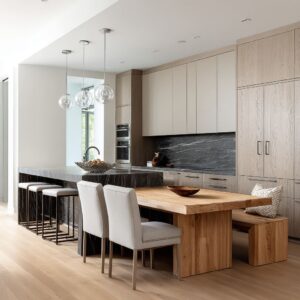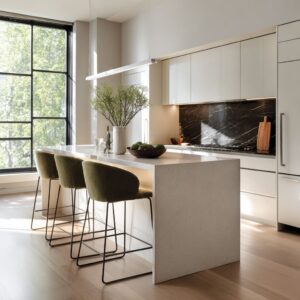
Modern kitchen island dining table combo ideas focus less on adding seats to a counter and more on shaping one calm, sculptural core that carries both cooking and gathering. The island and the table act can like two attitudes of the same object: one part serious and grounded for chopping, plating, and setting things down; the other part warmer, more tactile, and tuned to hands, elbows, and conversation.
They often let this dual personality appear through very simple means. A stretch of stone runs along the work side while a timber plane slips off the front or end, or a single material flows in one level and only changes its expression through what surrounds it.
The combination works almost like a stage: the stone portion holds tools and small rituals of daily food prep, while the wooden section hosts cups, plates, laptops, and relaxed posture. When the mass is treated as one continuous volume instead of two separate pieces, the room gains a clear “anchor” that organizes everything else—tall cabinets, views, benches, and even the way people move around it.
That anchor does not shout; it stays quiet and legible, a long bar or folded block that the rest of the kitchen adjusts to, so circulation, sightlines, and seating all revolve around one steady form.
Material Dialogue Between Stone and Wood
Behind the calm look, kitchen island dining table hybrid ideas almost always hinge on a precise conversation between cool stone and warm wood. Stone is given the more disciplined role: it forms waterfall blocks, continuous counters, or monolithic volumes in pale beige, soft grey, charcoal, or nearly white finishes.
These surfaces feel composed and serious, even when their veining is gentle; the island reads as a reliable slab that can take heat, water, and daily wear. Wood, by contrast, is the social counterpart.
As soon as the surface shifts from stone to oak, walnut, or another timber, the body language of the object changes. Edges soften, grain lines suggest touch, and any live edges or rounded profiles almost invite fingers to trace along them.
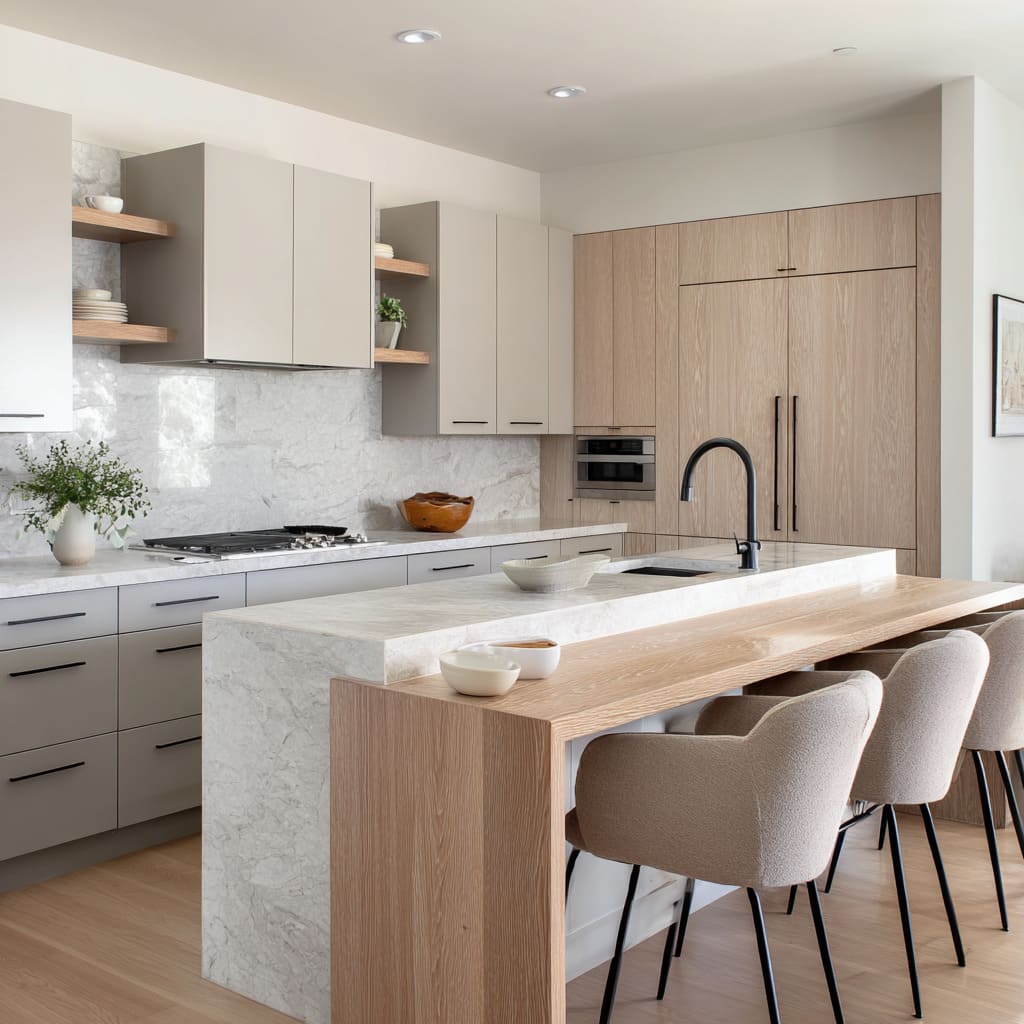
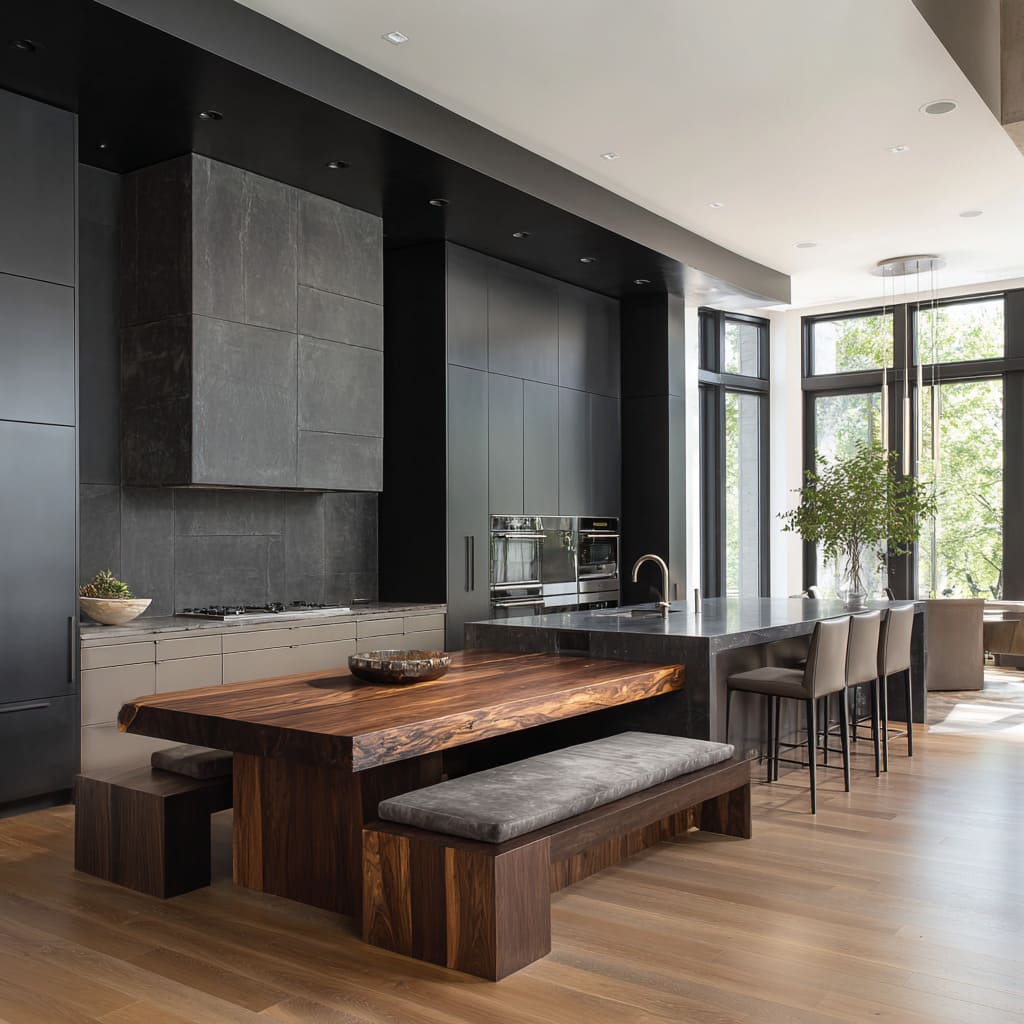
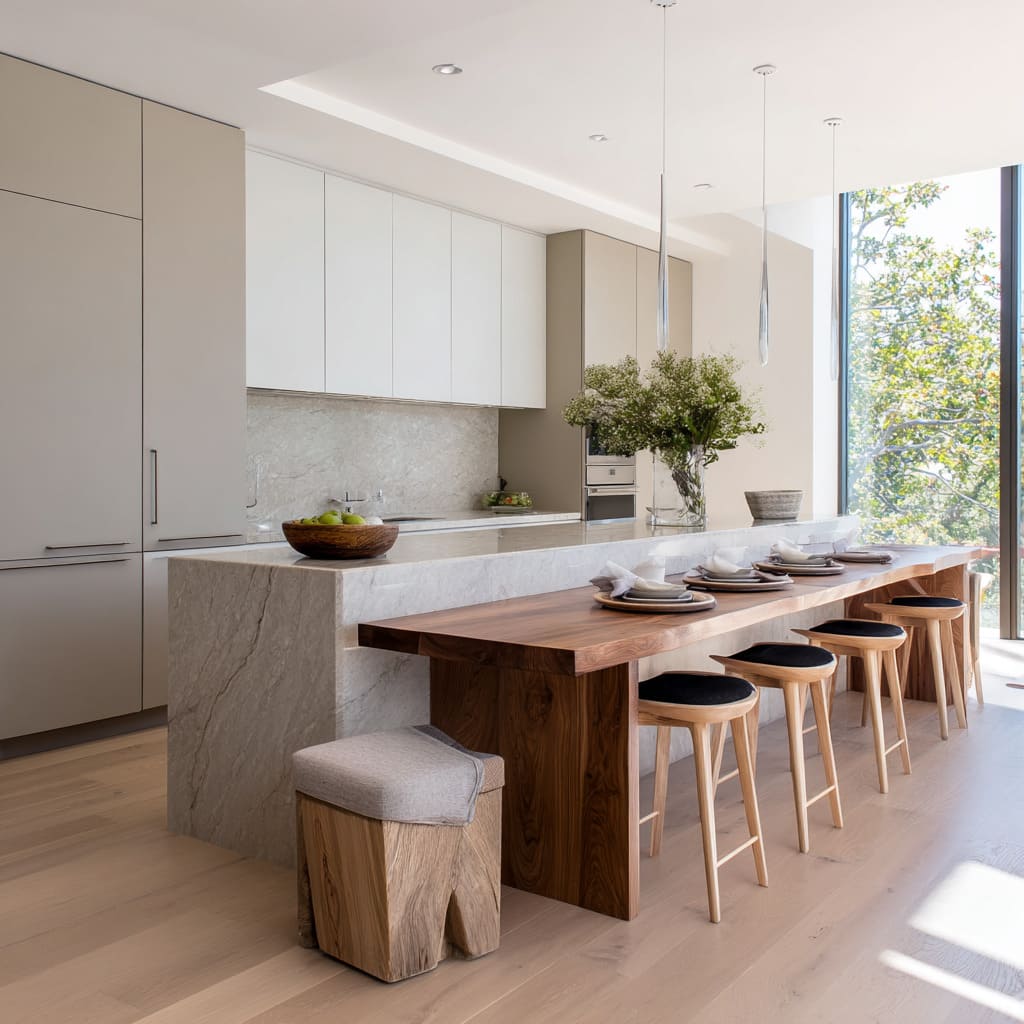
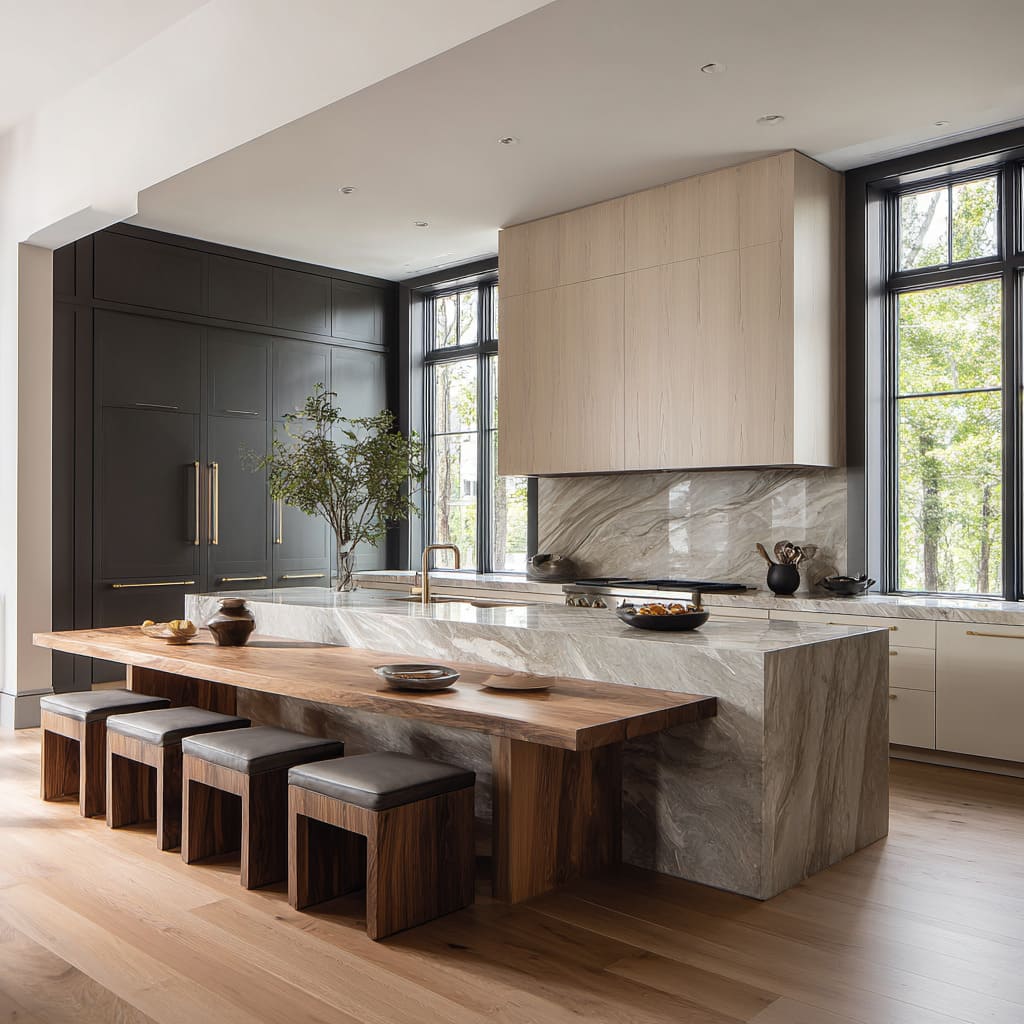
Within one island, this material dialogue can play out in subtle ways: a dark, pencil-veined stone may sit above a walnut extension that behaves like a wooden shadow; a pale stone block may grow a warm oak “bridge” on one side; or a live-edge slab with dramatic grain may slide up against very quiet cabinetry in putty or sand tones. The key visual move is that the join is kept clean.
Stone and wood meet with a straight, crisp line, a tiny height difference, or a gentle slope. That seam becomes the moment where the eye understands the shift from task to gathering, from cool precision to warmth and company, without any need for extra ornament.
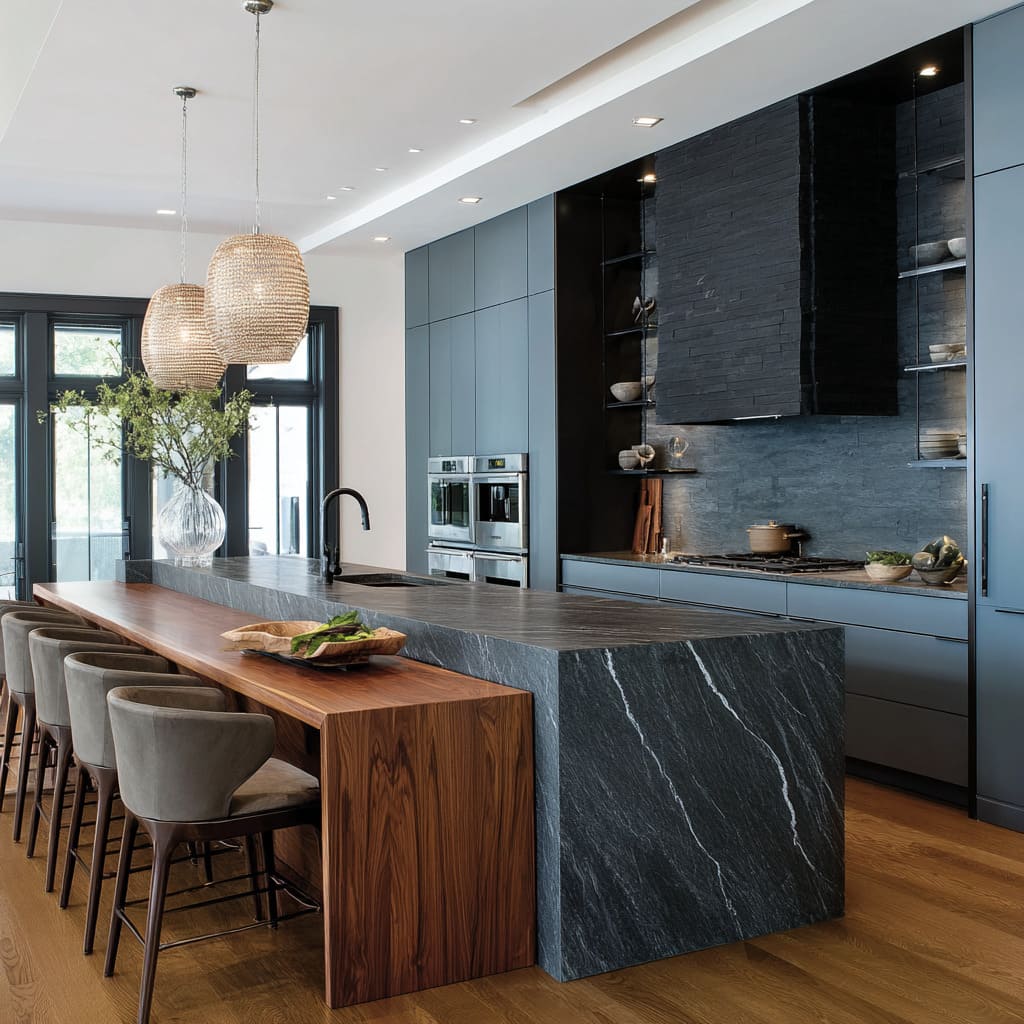
Height, Steps, and Slopes: Quiet Ways to Divide Roles
Levels in these spaces are an understated but powerful tool for shaping how the island and table are perceived. Designers often let the working surface sit slightly higher, with sinks, chopping boards, and small appliances staying within that elevated band, while the dining plane steps down just enough that the seated body feels anchored and comfortable.
The step may be only a few centimeters, but it creates a kind of visual relief: a high counter in stone, then a subtle ledge, then a lower wood plane that projects into the room. Under directional light from a window or pendant, this difference generates a narrow line of shadow that acts almost like a slim horizontal frame between the two roles.
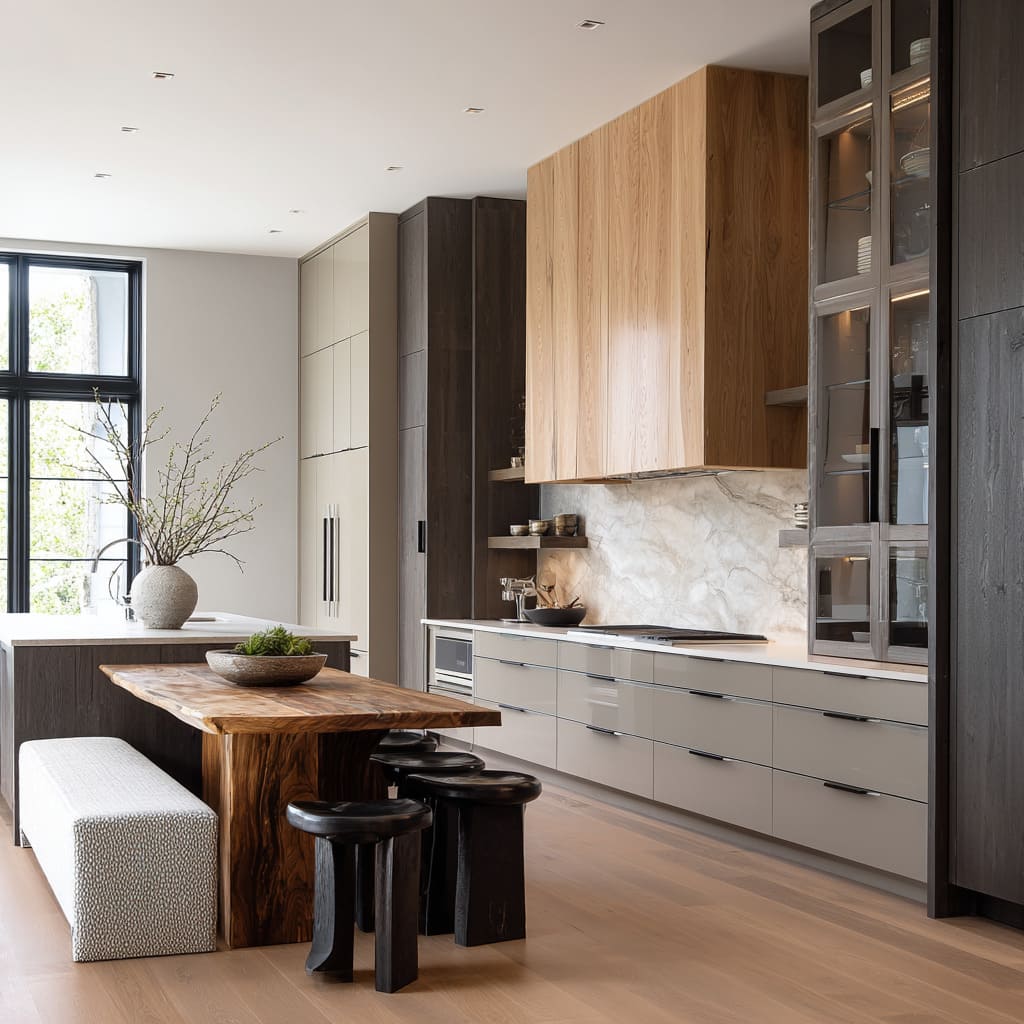
Some kitchen designs explore variations on that idea. In a few concepts, the stone runs in one continuous level, and the table section is not lower at all; instead, the change of role is communicated by absence of clutter, by the placement of stools, and by the backdrop behind each portion of the surface.
In more sculptural schemes, the stone top actually slopes toward the diners and then hands off to a horizontal timber band. That sloped cut creates a sense of movement frozen in material: the working side seems to lean forward into the social side, as if it is passing things over.
Without drawing attention to itself, the vertical choreography tells the eye where tasks happen, where bodies settle, and how the same block can support both in a seamless way.
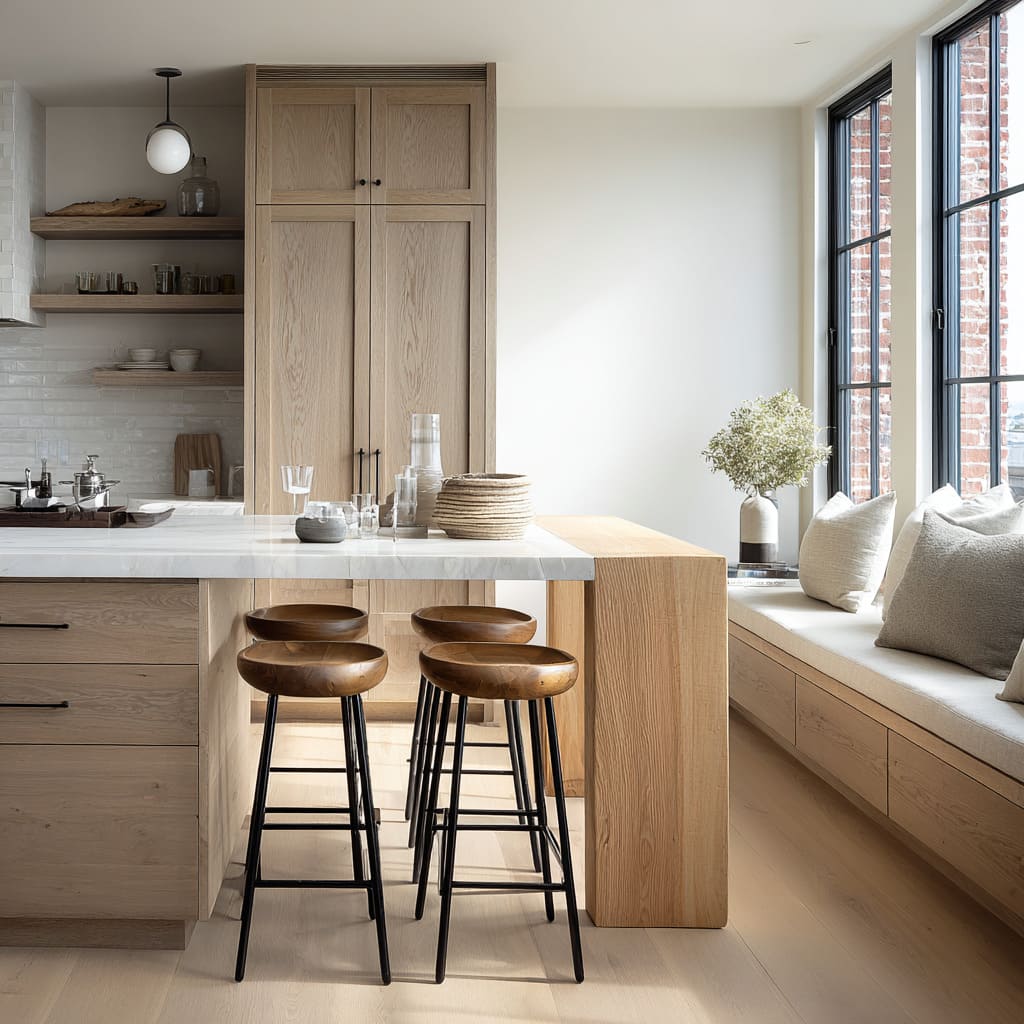
Seating Typologies
Seating around an island and table is not neutral; it acts like a social diagram that explains how the combo is meant to be used. Several recurring typologies appear:.
- Tall stools in a row create a bar-like lane: people face the cook, watch the range or sink, lean on elbows, and perch for short periods. These stools often have slim, dark legs and seats in mid-tone leathers or fabrics that sit between the value of the stone and the wood.
- Full dining chairs with arms or enveloping backs signal longer stays. Their rounded shapes soften the strict geometry of the island and table, and their upholstery adds visual volume that feels closer to a living room than a quick breakfast bar.
- Benches and window seats bring in a different mood entirely. A plinth bench with a soft cushion or a built-in window seat with deep pillows hints at kids sliding in, couples sitting close, and guests stretching out rather than perching.
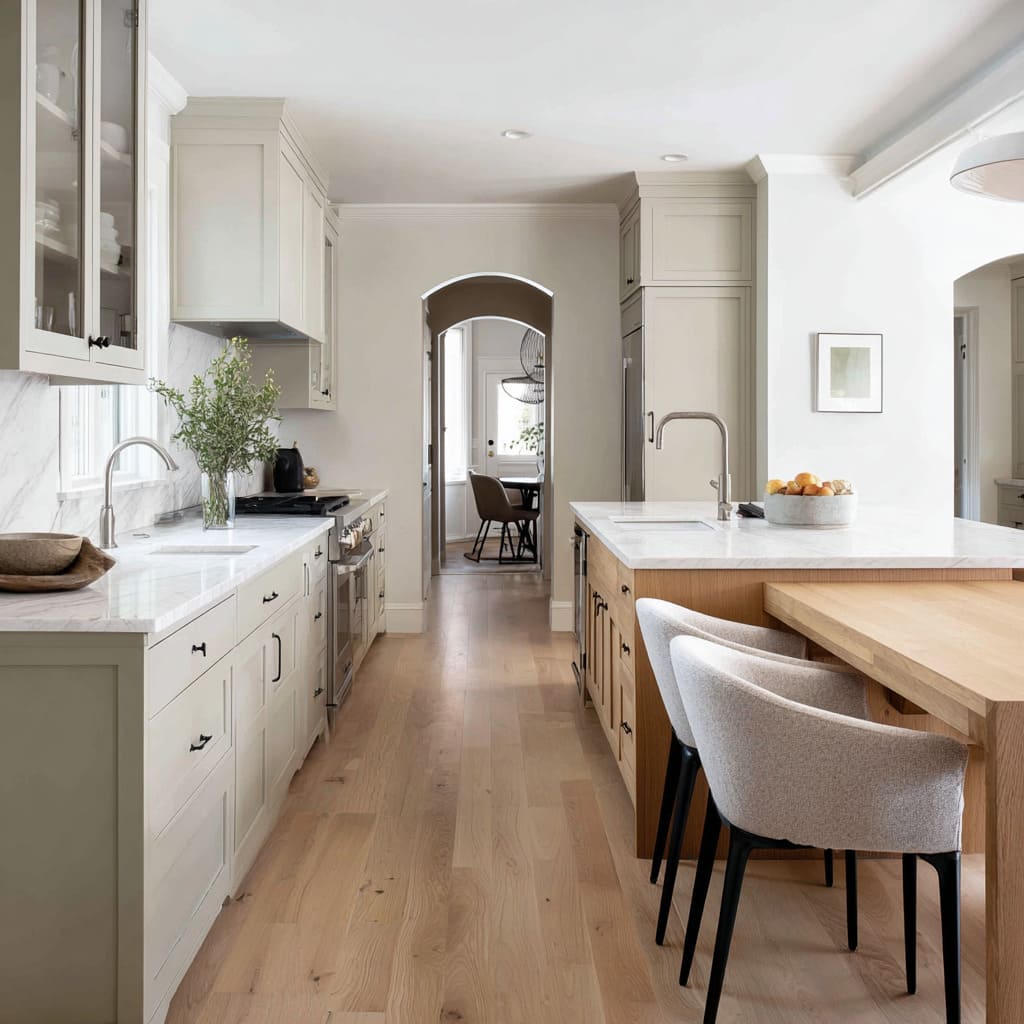
This variety is often used to establish zones. A live-edge table may pair a long, cloud-soft bench on one side and sculptural stools on the other, allowing one side to behave like a lounge rail and the other like a more active perch.
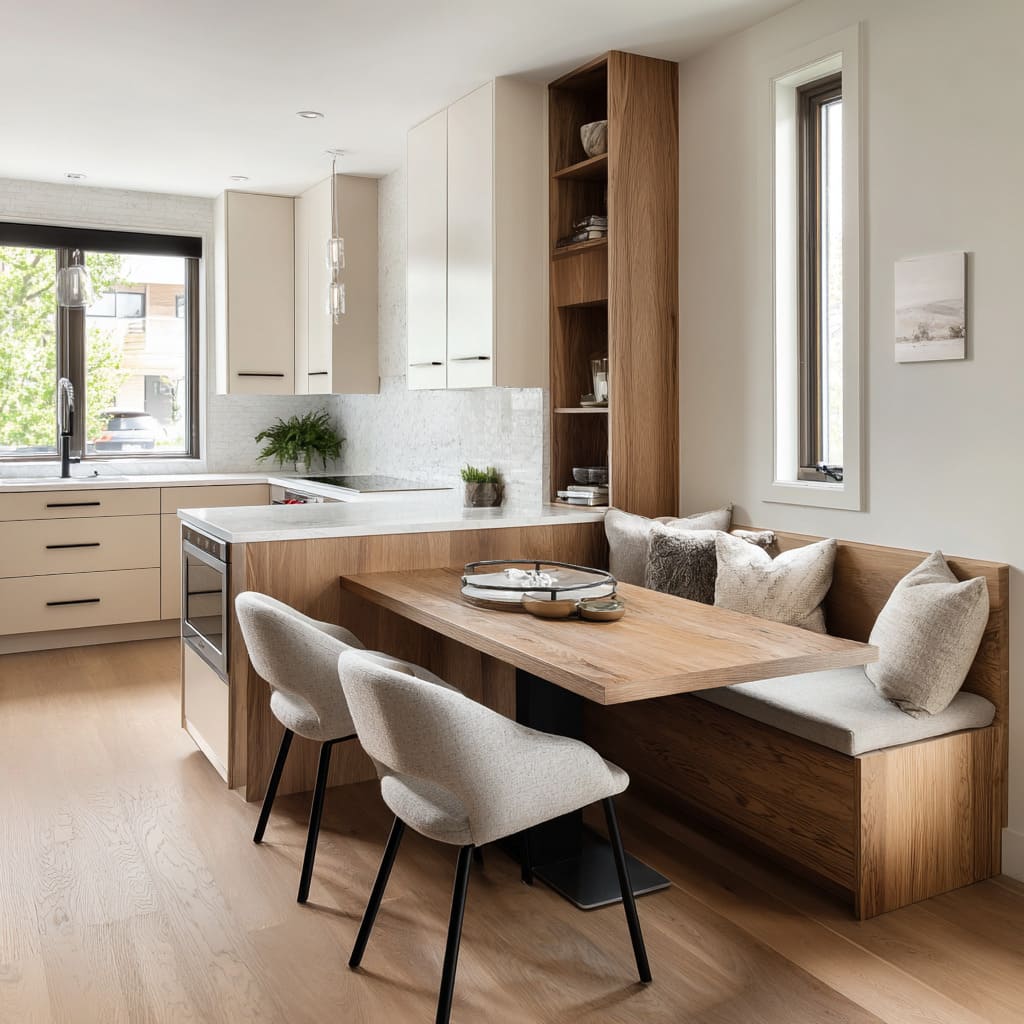
Cube ottomans tucked under a wood band give an intimate, almost lounge-like feeling under a heavy stone island; they can be pulled out for close, informal seating or hidden to let the table read as a clean, uninterrupted strip. In more compact corners, a built-in bench continues the line of the base cabinets, turning the end of a peninsula into something like a café booth, while two light chairs across from it keep the nook from feeling boxed in.
In every case, the color and shape of seating are tuned to sit between the materials: mid-tone greys, taupes, and sands mediate between dark stone and warm timber, and rounded silhouettes act like cushions against a linear architectural frame.
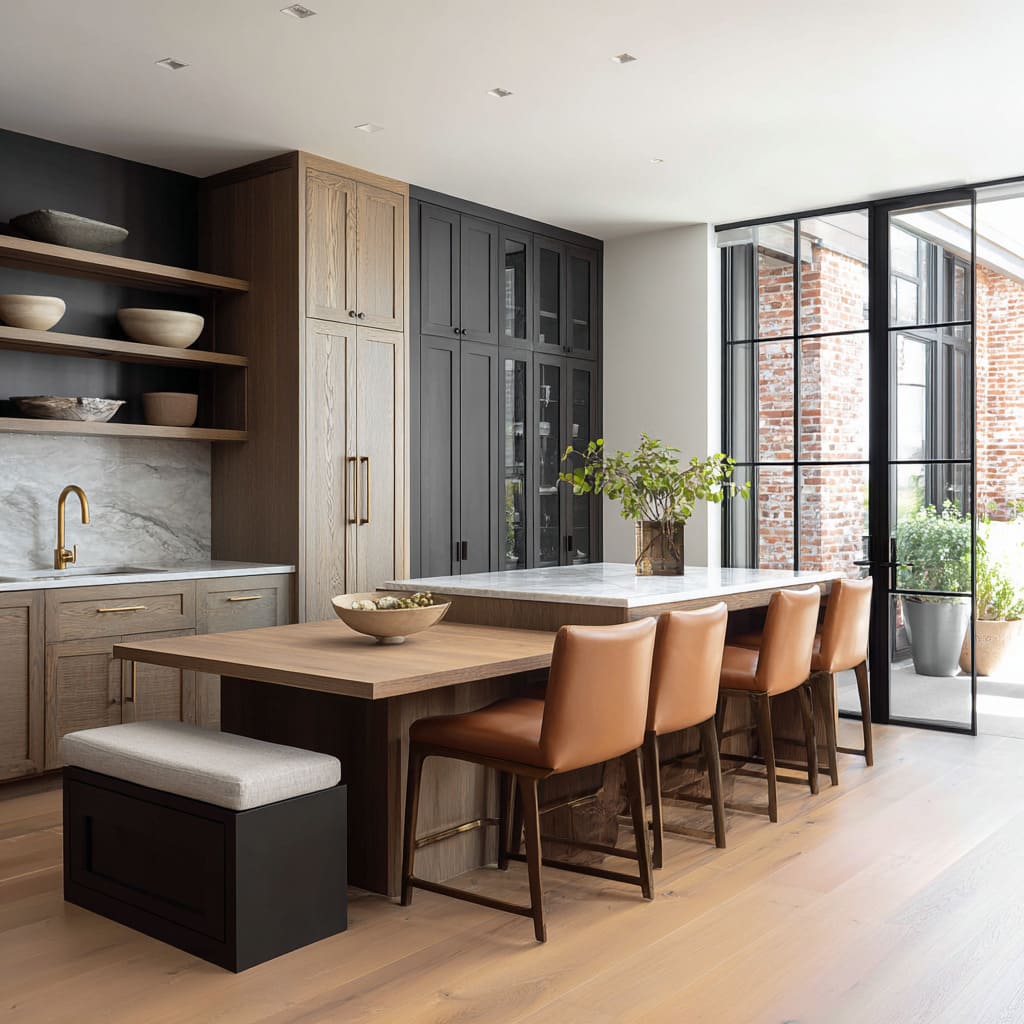
Backdrops, Windows, and Benches Around an Island and Dining Table Combo
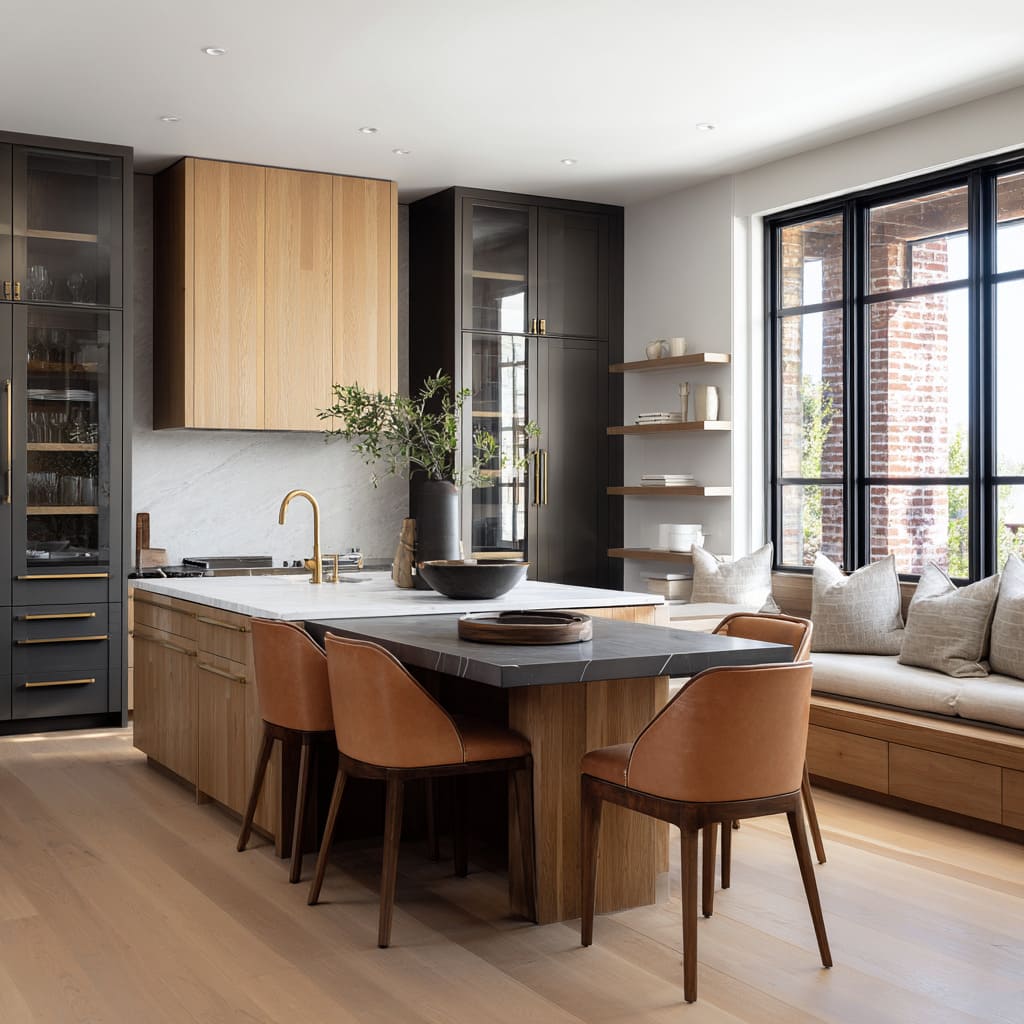
The broader layout around an island and dining table combo is just as carefully composed as the object itself. Tall cabinets often act as a dark, calm backdrop in charcoal, deep blue-grey, or black-stained wood, so that the stone and wood of the island advance visually into the foreground.
When that backdrop is broken, it is usually for deliberate reasons: a central field of lighter stone tiles behind the range, a wood-wrapped hood that mirrors the tones of the table, or glass-front cabinets whose softly lit shelves add a gentle glow and a hint of formality.
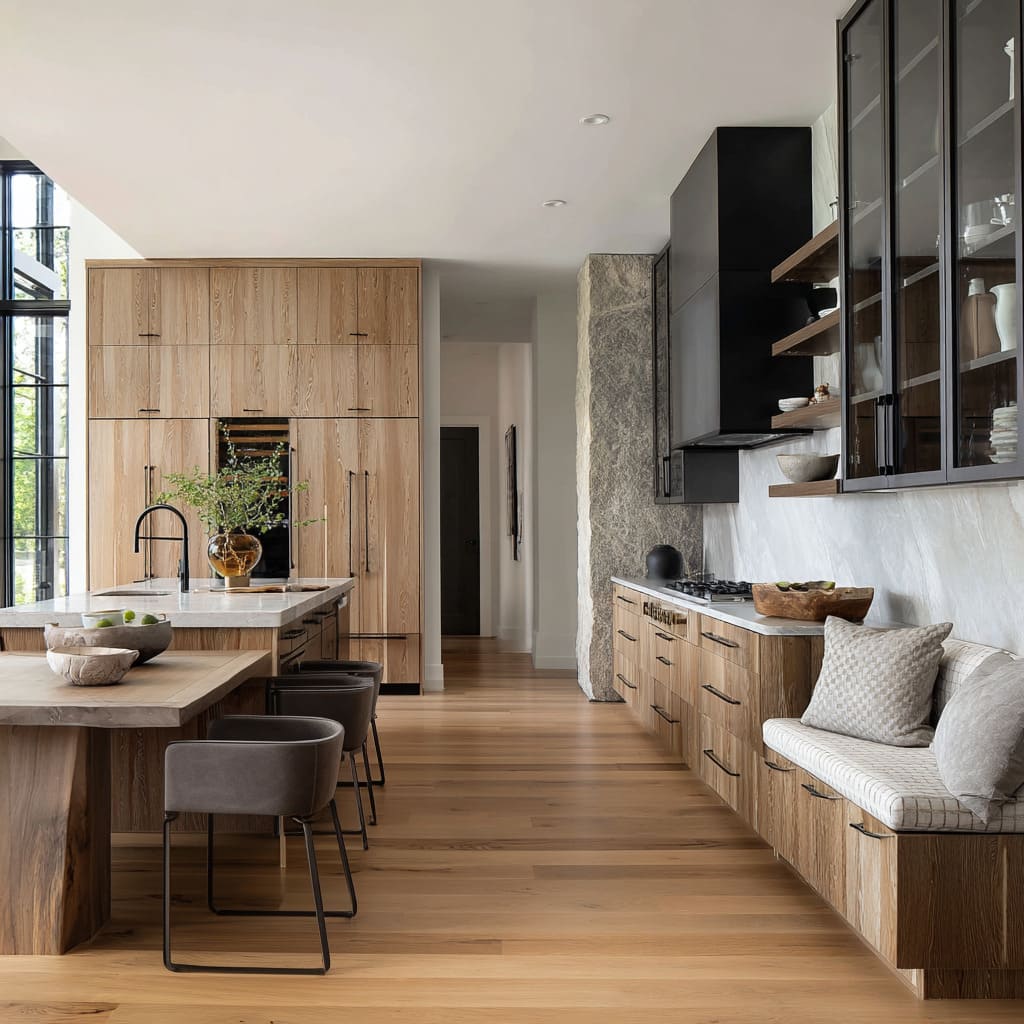
On the opposite side, large windows, steel-framed glass doors, or double-height glazing bring in views of trees, courtyards, or gardens. Island seating nearly always faces toward these openings, allowing diners to look outward while staying close to the work zone.
Built-in benches beneath windows connect seating to structure. A long bench in the same oak as the island base can run under black-framed windows, with oversized cushions leaning against the frames.
That bench becomes a second social line parallel to the dining edge: someone can recline there while friends sit at stools nearby, creating a conversation that stretches from worktop to nook without breaking sightlines. In narrow galleylayouts, a simple archway at the far end works like a soft punctuation mark; the island extension may point directly toward that arch, so sitting at the table means looking through toward the next room, while standing at the sink maintains a more traditional line of focus toward the cooking wall.
Styling, Objects, and Lighting
Small objects and lighting choices carry an outsized role in explaining how each area of the combo is meant to function. Styling often follows a quiet pattern.
On the stone side, items feel more task-focused: cutting boards, bowls ready for ingredients, a tray with a coffee set, a carafe, maybe a cluster of jars near the cooktop. On the wood side, the visual rhythm loosens.
Often there is just a single vase, a stack of woven dishes, a couple of low bowls, or a clear run of surface left almost empty. This difference in density alone marks one area as active and the other as ready to welcome plates, laptops, or books.
Greenery is placed with particular intent. A tall glass vase of branches sits at or near the transition point between stone and wood in several concepts, almost like a vertical hinge where the object shifts from one role to another.
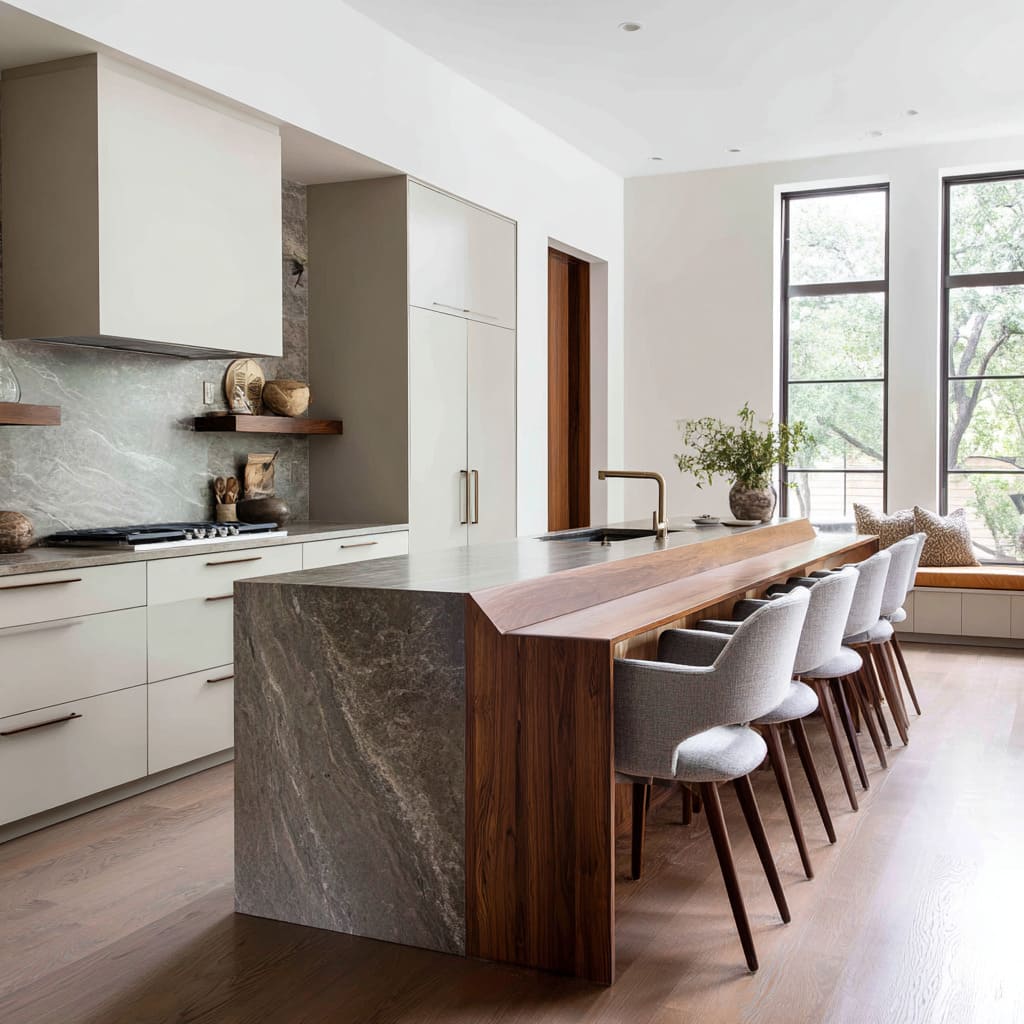
The foliage echoing tree canopies outside connects interior surfaces with landscape, turning the join line into a subtle “meeting” of nature and crafted material. Lighting supports the same narrative.
Over islands, slim pendants hang like simple lines, doing enough to mark the center without adding visual clutter. Over long wood stretches, these pendants sometimes thin out or become more decorative—glass beads, soft globes, or delicate metal stems that cast pools of warmer light.
Under-cabinet or shelf lighting grazes textured stone or ribbed surfaces behind the island, enhancing shadows and emphasizing horizontal bands. Together, objects and light sketch a script where the eye understands at a glance which parts are for activity, which parts are for sitting, and how the two overlap in a relaxed way.
Layouts
One of the most interesting aspects of contemporary kitchen island dining table combo ideas is how many different social layouts emerge from a relatively simple typology. Some compositions behave like elongated bar lanes: a row of stools along one face, bodies oriented toward the range or sink, and the island operating as a long rail where quick breakfasts, drinks, and casual conversations take place while someone cooks across from them.
Others lean toward the feeling of a communal slab. A broad table in walnut or oak meets the side of a stone island and wraps around one end, with benches running along both sides and chairs or stools pulled up at the head.
This allows guests to sit facing each other, share dishes in the center, and still remain within arm’s reach of the working counter. In large rooms, the two modes sometimes appear in parallel.
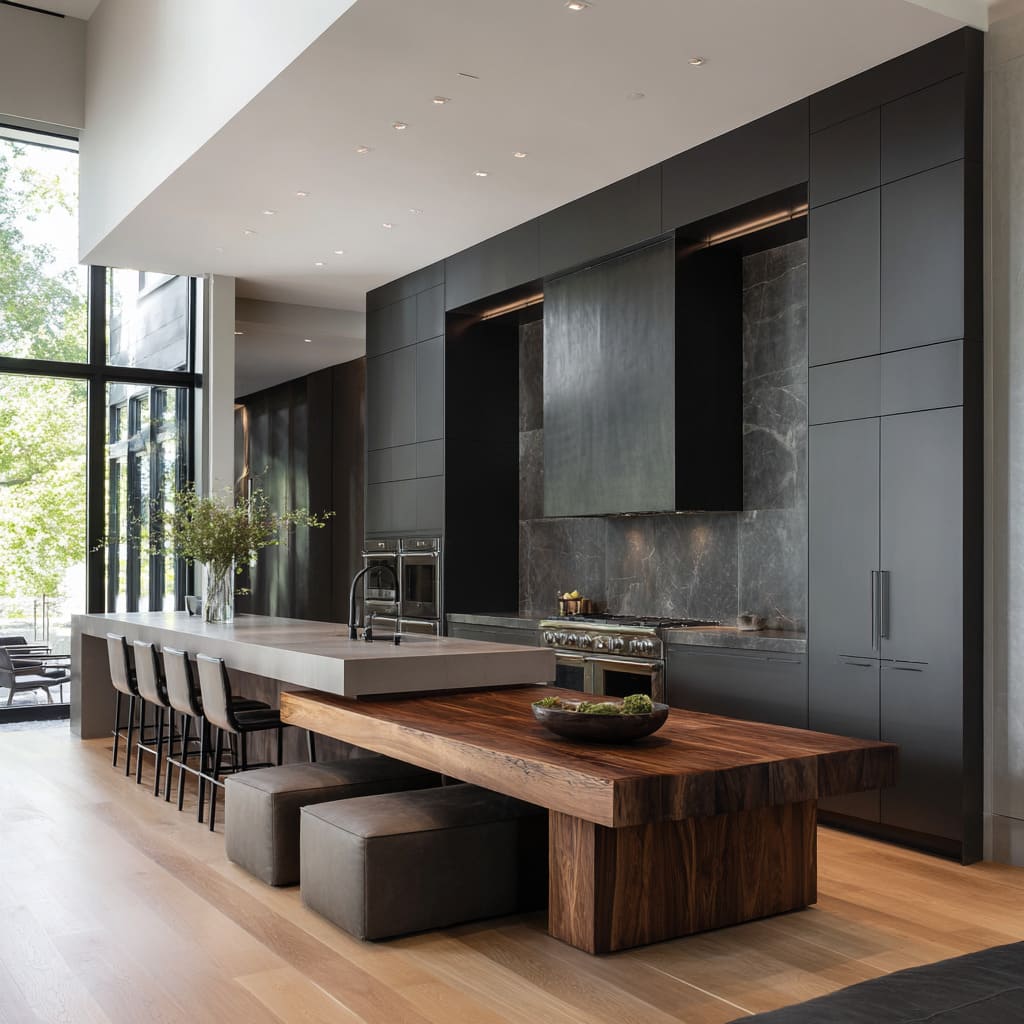
A stone island with tall stools stretches along the cooking wall concept, while a full-length table aligned with it sits just a step away, with benches and soft chairs around it. The result is a double axis: an upper, more upright lane for short interactions, and a lower, more relaxed line for longer gatherings.
Even in a small kitchen dining room combo with island, this logic appears in compressed form; a peninsula can extend into a corner where built-in seating and a modest table turn a single block of cabinetry into prep surface, everyday eating zone, and social nook all at once, without extra furniture floating in the middle of the floor.
Atmosphere and Mood
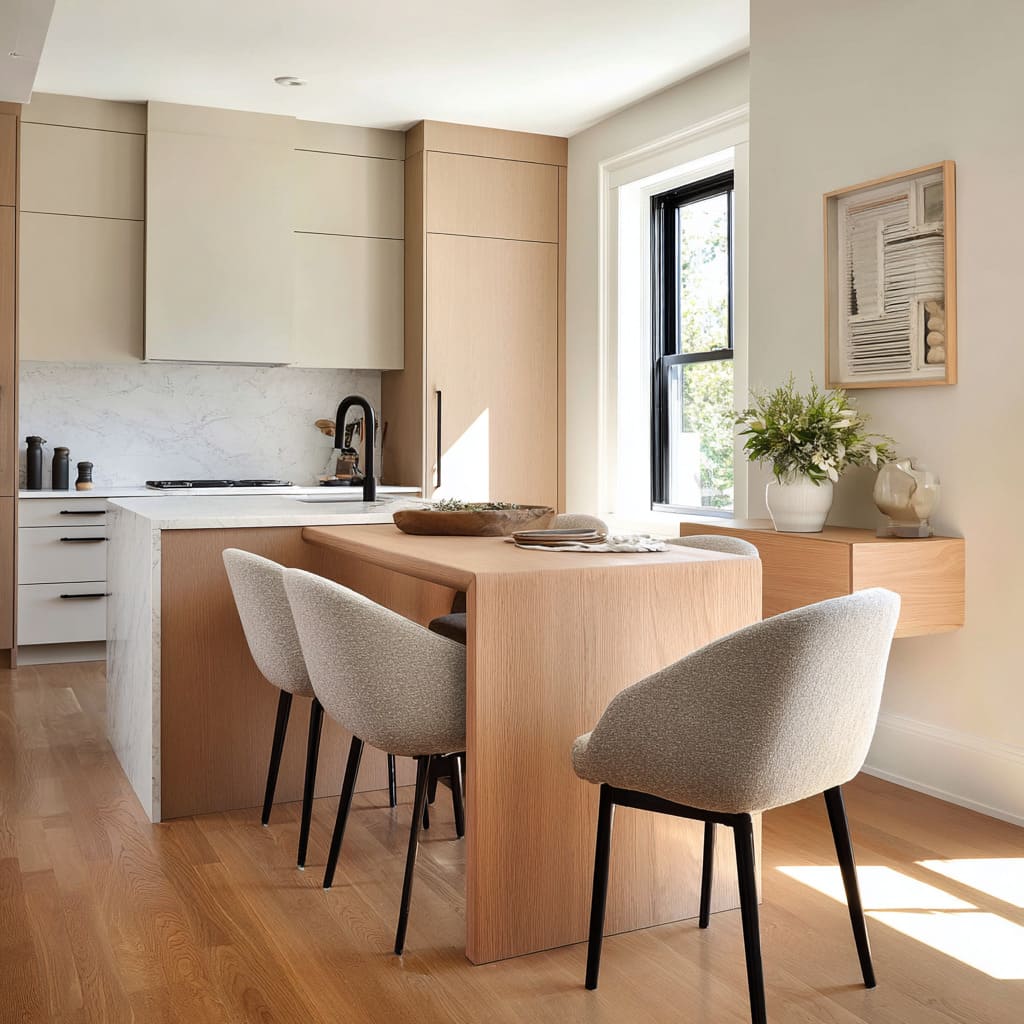
The mood of each island–dining composition comes from how disciplined or expressive the designers allow the materials and forms to be. In calm, minimal schemes, stone is often soft and matte with restrained veining, cabinets sit in even bands of greige, sand, or putty, and wood appears in clear, straight grain.
The island and table may run as one flat level or in a gentle step-down, with only a single solid leg or slab marking the dining end. Stools in sand or grey perch on slender black legs; benches integrate seamlessly with cabinet bases; and light moves in simple glides across smooth surfaces.
The emotional tone in these spaces is steady and easy, suited to long days where the same block hosts breakfast, laptop work, homework, evening drinks, and late snacks. In more expressive concepts, prominent grain and irregular edges become the main feature.
A live-edge slab with rich, swirling patterns takes center stage against simple, low-contrast cabinetry. Its thickness, visible end grain, and slight curvature along the edge inject a sense of natural energy, while benches in textured fabrics and solid, sculptural stools hold that energy in place.
Even here, the rest of the room stays calm: neutral drawers, aligned pulls, softly glowing cabinets, and a consistent floor tone ensure that strong wood does not overpower the interior. Whether quiet or expressive, the island–dining combination acts as the emotional heart of the kitchen, concentrating texture, touch, and social life into one elongated piece that keeps the entire space visually and atmospherically coherent.
Conclusion
Taken together, these ideas show how a single island–table piece can quietly organize the whole kitchen design, turning it into a shared space rather than a split zone of “work here, eat there. ” Stone, wood, seating, and light are used with enough precision that the change from prep to dining is understood through material, height, and background instead of big gestures.
Benches, stools, chairs, window seats, and small styling details then fine-tune how people sit, face each other, and relate to the view or the cooking wall. The result is a calm, coherent core that can host fast everyday tasks and slow social moments with the same ease.