The entire atmosphere of a black white living room design is often decided long before sofas and cushions are chosen; it is set by the wall that carries the TV, fireplace, or main storage. That surface behaves less like a plain background and more like a structured canvas that holds the whole composition together.
Vertical battens, ripple panels, slim bricks, or shiplap lines run quietly behind the scenes, shaping how the eye reads height, width, and depth. When these surfaces are kept in black, charcoal, off-white, or soft beige, they form a neutral “stage” where contrast is controlled by darkness and light rather than by bright color.
The TV becomes one more rectangle in a considered arrangement, often stacked over a fireplace or centered above a long cabinet, while the panel lines behind it keep the screen from floating aimlessly. Around this wall, everything else—coffee tables, armchairs, vases, greenery, rug patterns—behaves like a cast of supporting characters.
The result is that the living room does not feel like scattered furniture inside four walls but like a single cohesive scene anchored by one clear, calm focal plane.
The panel wall as visual anchor: rhythm, “speeds,” and alignment
Decorative wall panel design for living rooms often works through rhythm rather than loud detail. Panels and planks are not just added for texture; they set a tempo.
Slim vertical battens behind a TV create a fast, even rhythm, while wide boards or brick courses set a slower pace. Many schemes layer these speeds carefully: narrow vertical ribs on the central section, long horizontal cabinets below, and calm, almost blank, upper wall above.
The TV and fireplace are then aligned with this grid so that edges coincide with panel joints or cabinet breaks. That invisible alignment is what makes the wall feel composed, even if most viewers never consciously notice it.
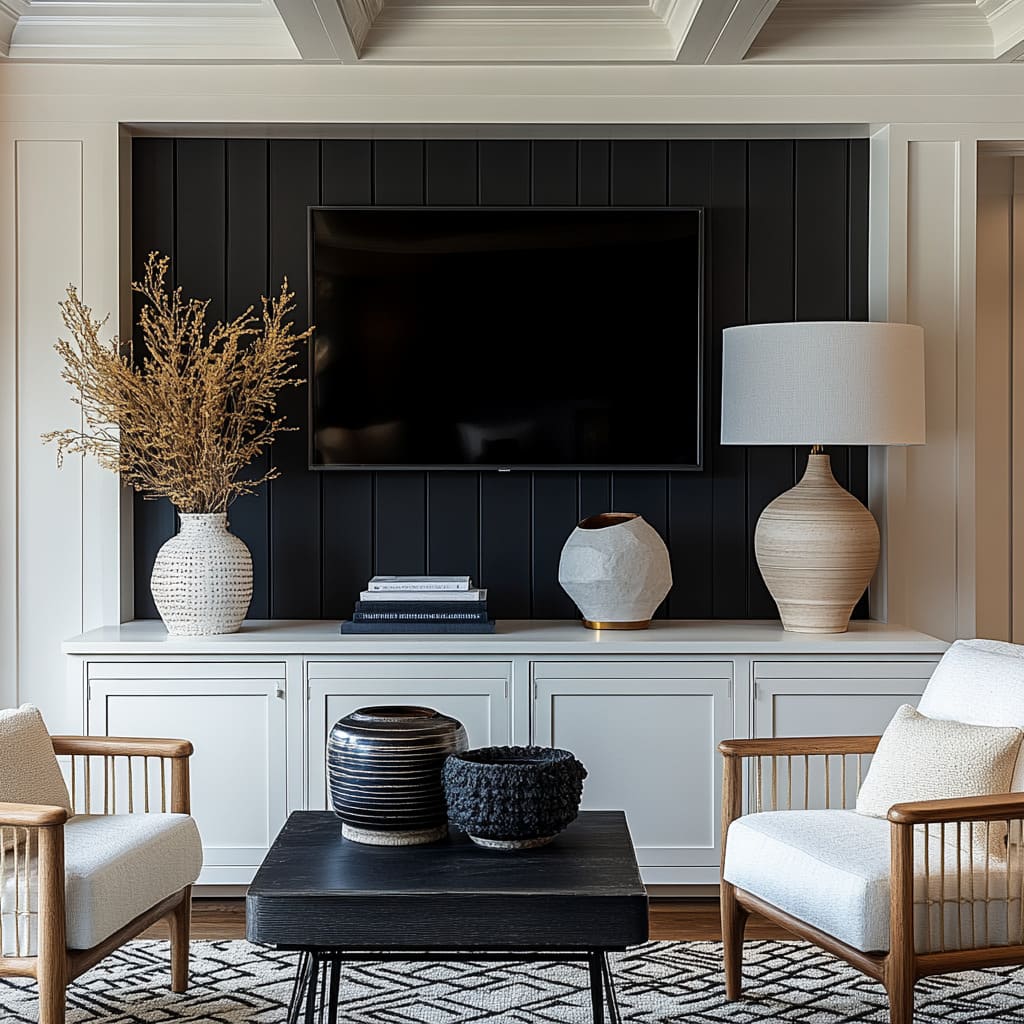
Designers often play with combinations such as:.
- Fast vertical – slender battens, ripple panels, fine brick or grooved boards.
- Slow vertical – wider boards, ribbed cabinet fronts, tall black barn doors.
- Slow horizontal – shiplap planks, long base cabinets, wide mantle lines.
- Static blocks – marble surrounds, black inset panels, simple cube consoles.
When these layers are stacked correctly, the living-room wall reads as one integrated structure: panels establish rhythm, cabinets and consoles give weight, and the TV and fireplace form the calm central totem.
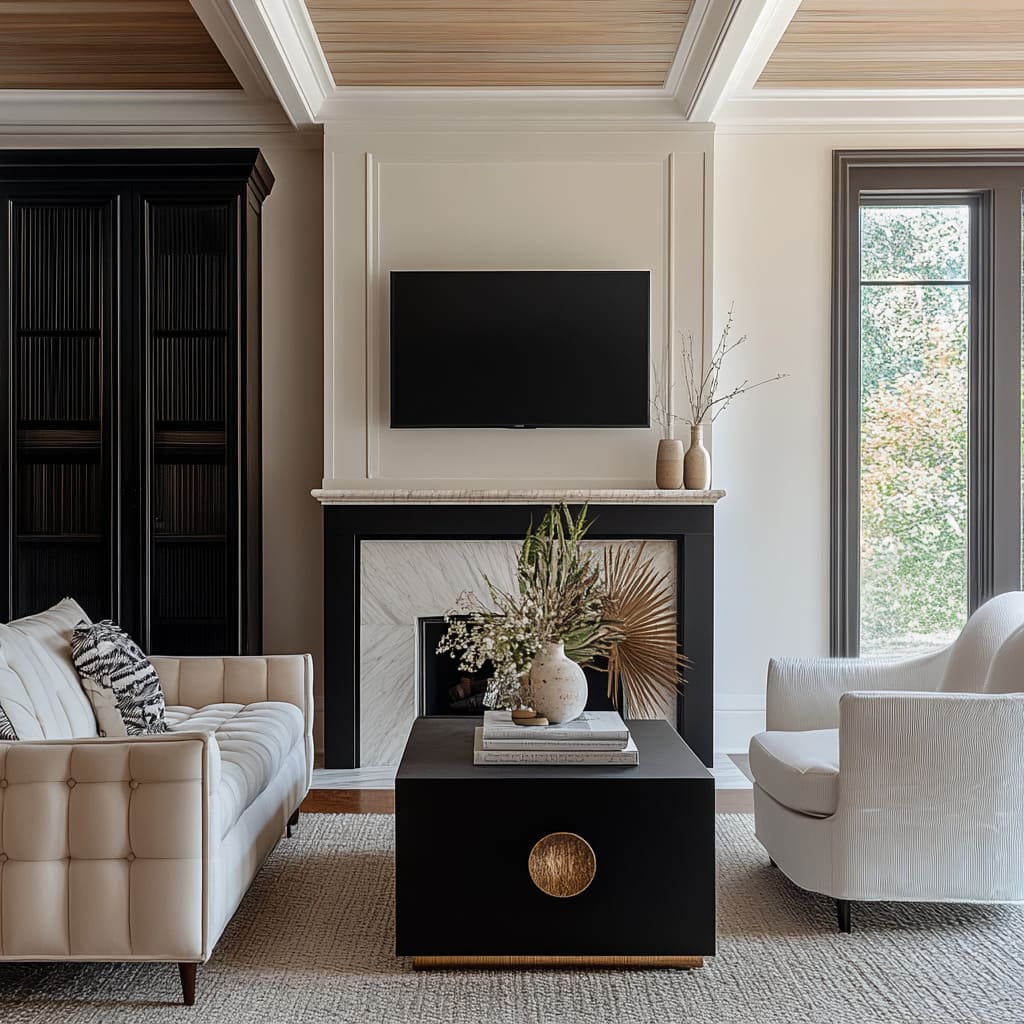
Black as depth, white as volume: contrast that feels quiet, not harsh
A recurring idea in simple black and white living room ideas is that black is treated like a space rather than just a color. Charcoal panel walls, black brick insets, dark barn doors, or inky fireplace boxes act like pockets of depth—visually receding so that light furniture can step forward.
White and off-white take the role of volume and matter: painted panels, bricks, ripple plaster, upholstery, and shelving become the “solid” elements that catch light. This inversion of the usual expectation (light as background, dark as object) has a strong spatial effect.
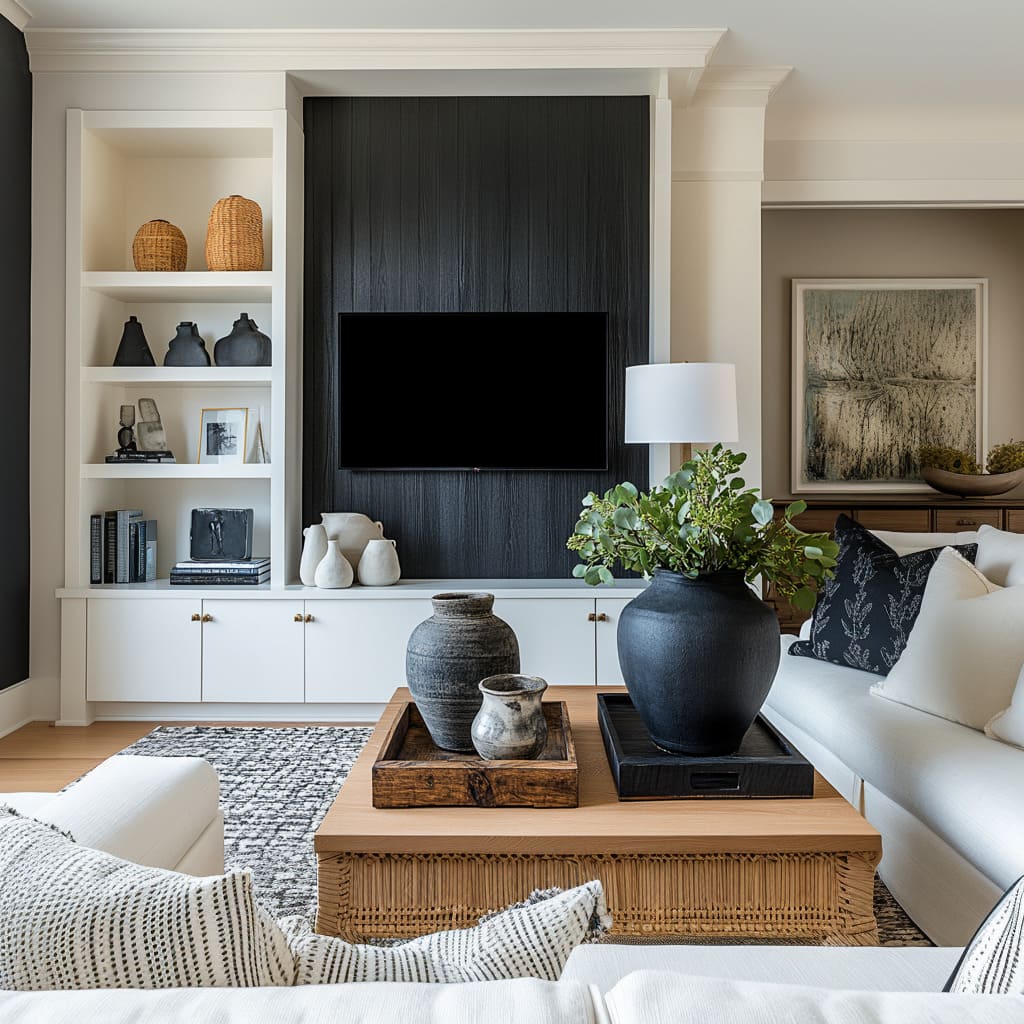
A dark TV wall framed by white built-ins feels like a deep opening inside a bright shell, and white sofas or armchairs placed in front of that opening read as sculptural pieces standing in a quiet void.
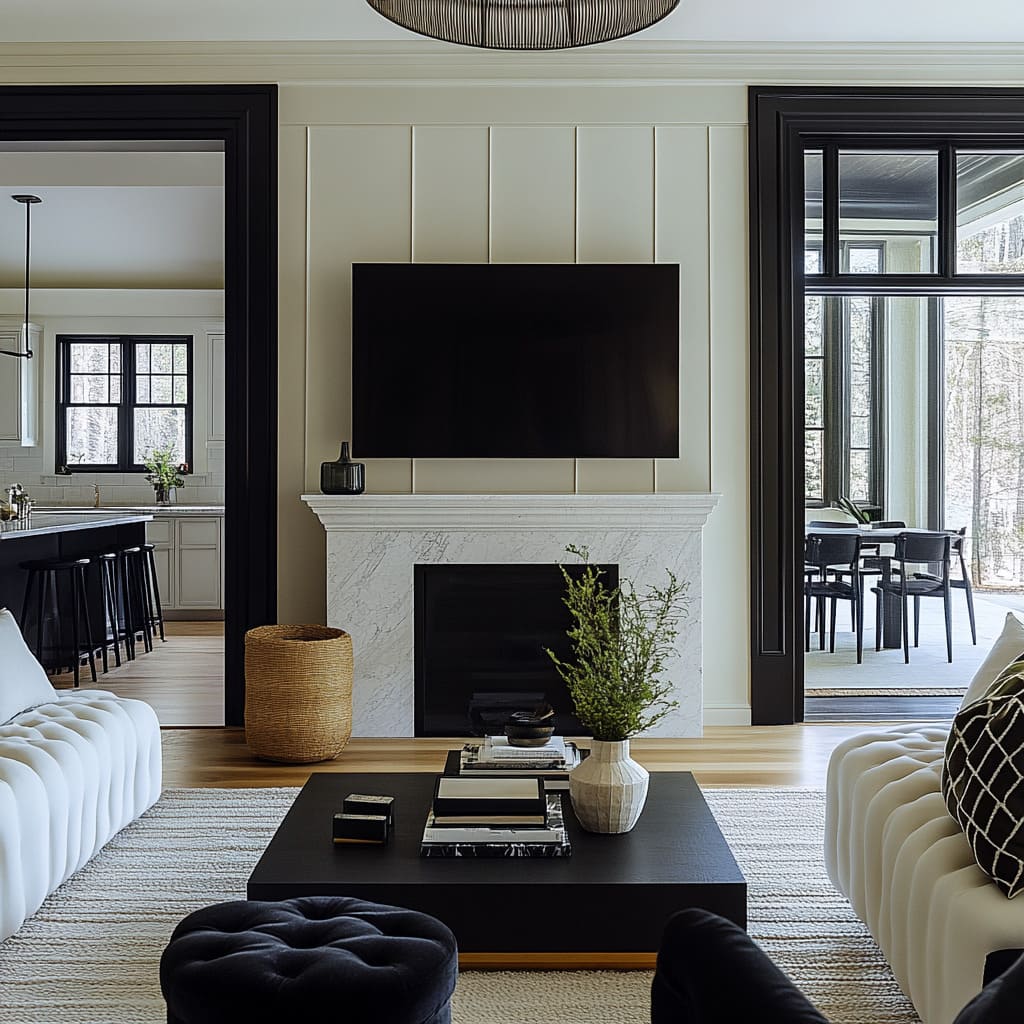
Because of this, black is often concentrated in a few zones—the panel inset, the coffee table, a long media console—rather than sprinkled everywhere. Where black does appear on movable items, it tends to be in compact, grounded forms: drum tables, cube tables, small ottomans, slim sideboards with vertical texture.
This keeps the darker tone associated with weight, shadow, and structure, while white remains linked to softness, seating, and daylight. The palette stays extremely simple, but the feeling in the room is layered and calm rather than flat and graphic.
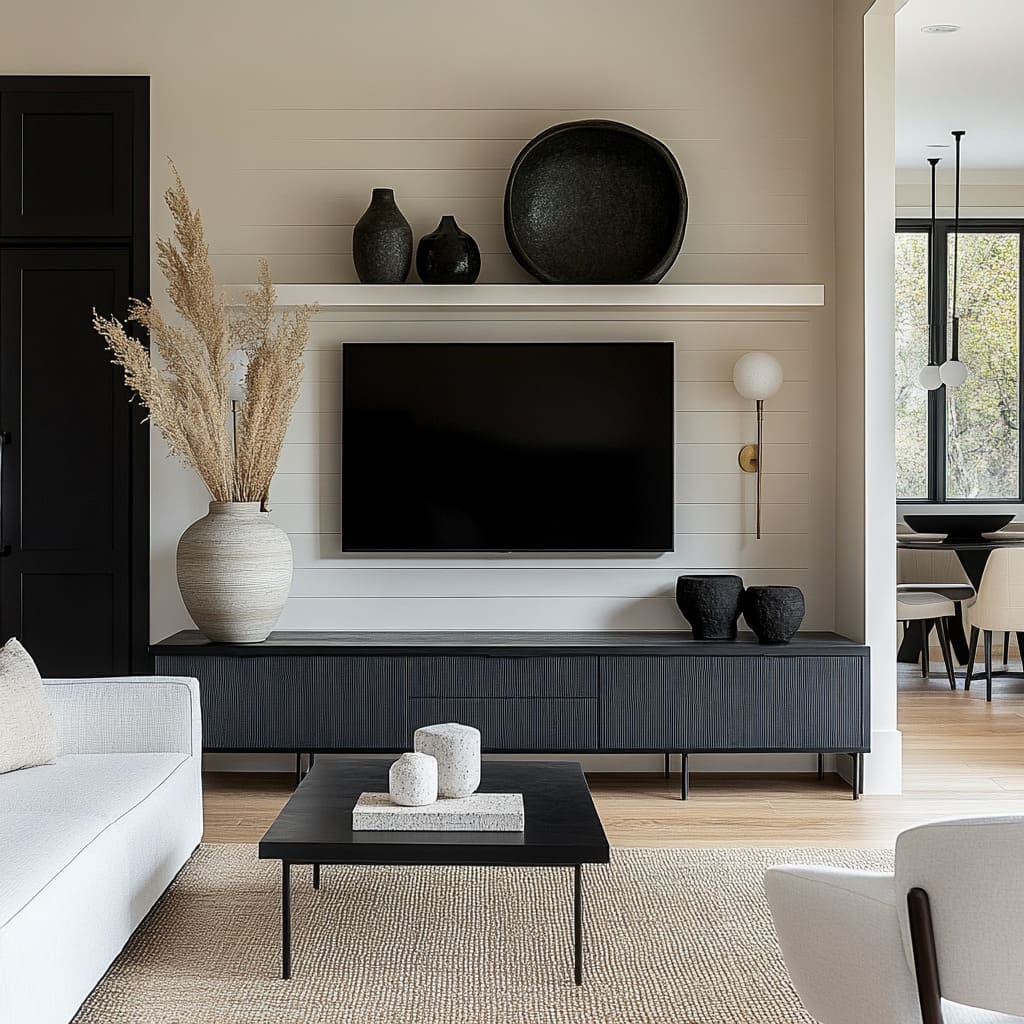
Line direction as design language: vertical, horizontal, and the power of scale
In black-and-white panel concepts, line direction is almost a design language of its own. Vertical systems—fluted panels, battens, ribbed cabinet doors, tall barn doors, spindled chair backs—pull the eye upward and stretch the room’s height.
Horizontal systems—shiplap, low consoles, long media units, brick courses—calm the composition and quietly widen the space. Many desings combine the two in a way that feels like a musical score: fast vertical rhythm at the center, slower horizontal lines under and around it, and then furniture that either echoes or softens those directions.
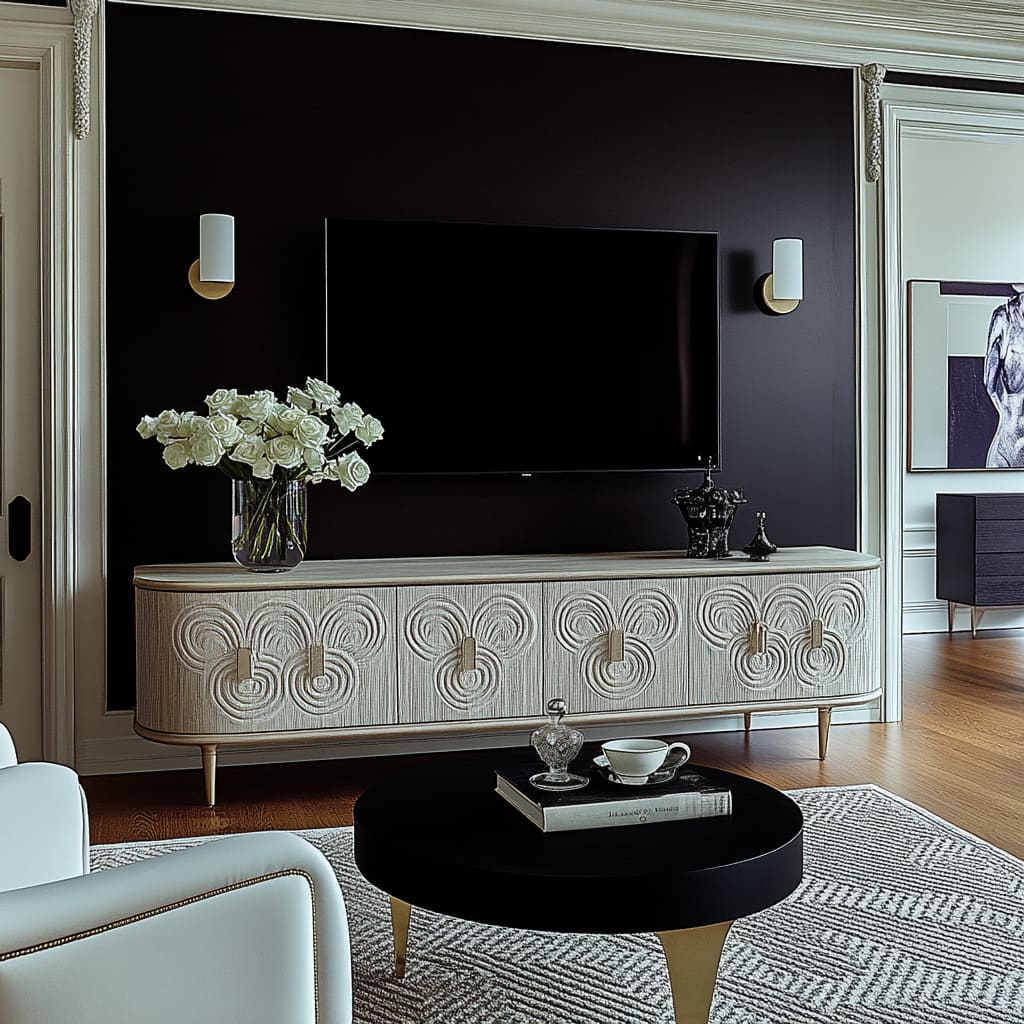
A typical wall might look like this:.
- Vertical black planks in the central TV area, forming a dark column.
- A long white cabinet with subtle grooves running the width of the wall.
- Shallow horizontal shadow gaps framing the whole panel zone.
- A coffee table whose form either reinforces one direction (a long black block) or acts as a soft counterpoint (a round drum).
Scale is crucial. Large grid panels in light wood feel calm and architectural, while very tight ribs or micro-grooves in black absorb light and create a velvety effect.
Ripple panels with irregular waves slow the eye even more, turning the wall into something that feels almost like fabric rather than a hard plane. When all these layers are tuned, the panel wall becomes a quiet “engine” of structure behind the living-room scene.
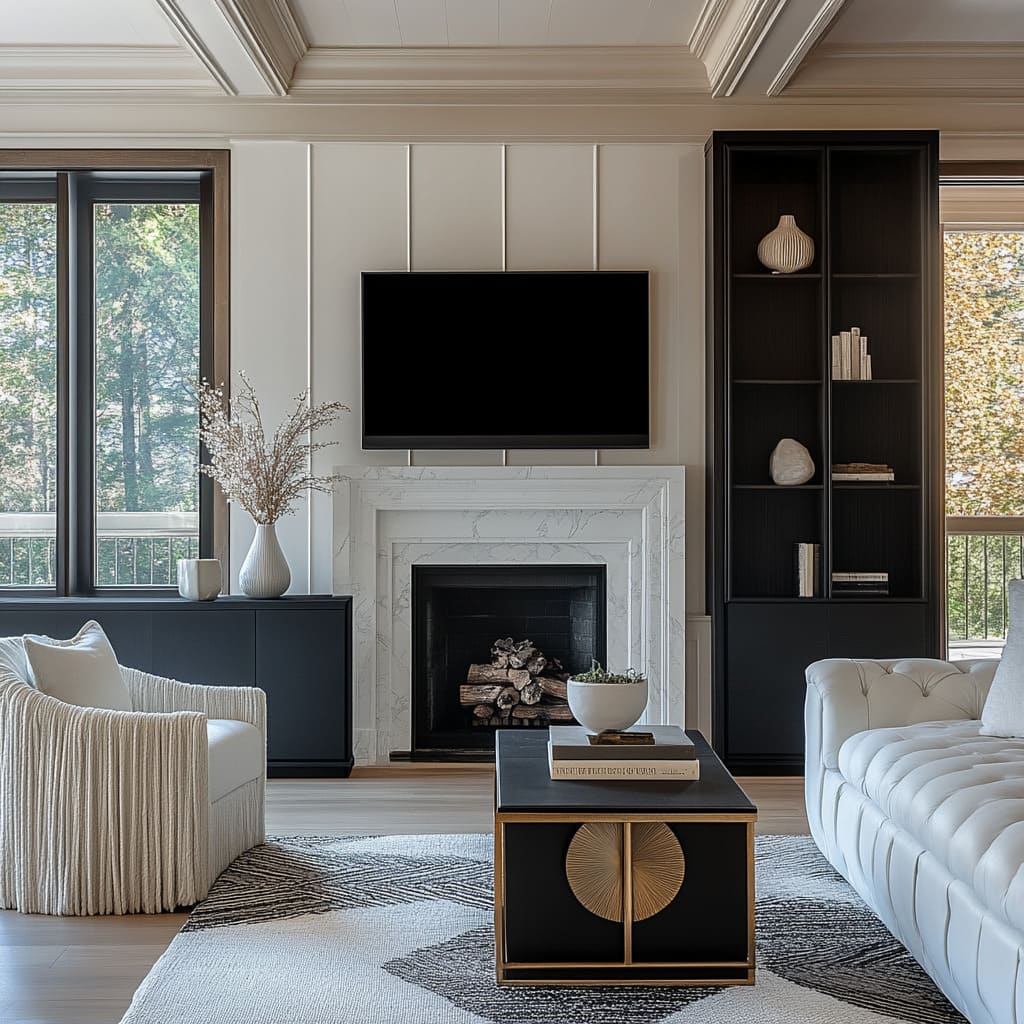
Texture on panel walls: from ripple plaster to painted brick
Decorative wall panel design for living rooms often relies on texture rather than color to create interest. Painted brick in matte white allows small shadows to sit in the mortar lines, giving a soft grid behind the TV.
Ripple panels in pale sand tones create vertical waves that catch daylight in small highlights and dips, adding motion to an otherwise still wall. Fine battens painted in off-white or cream bring structure without visual noise, and wide oak grids give a gentle, architectural calm.
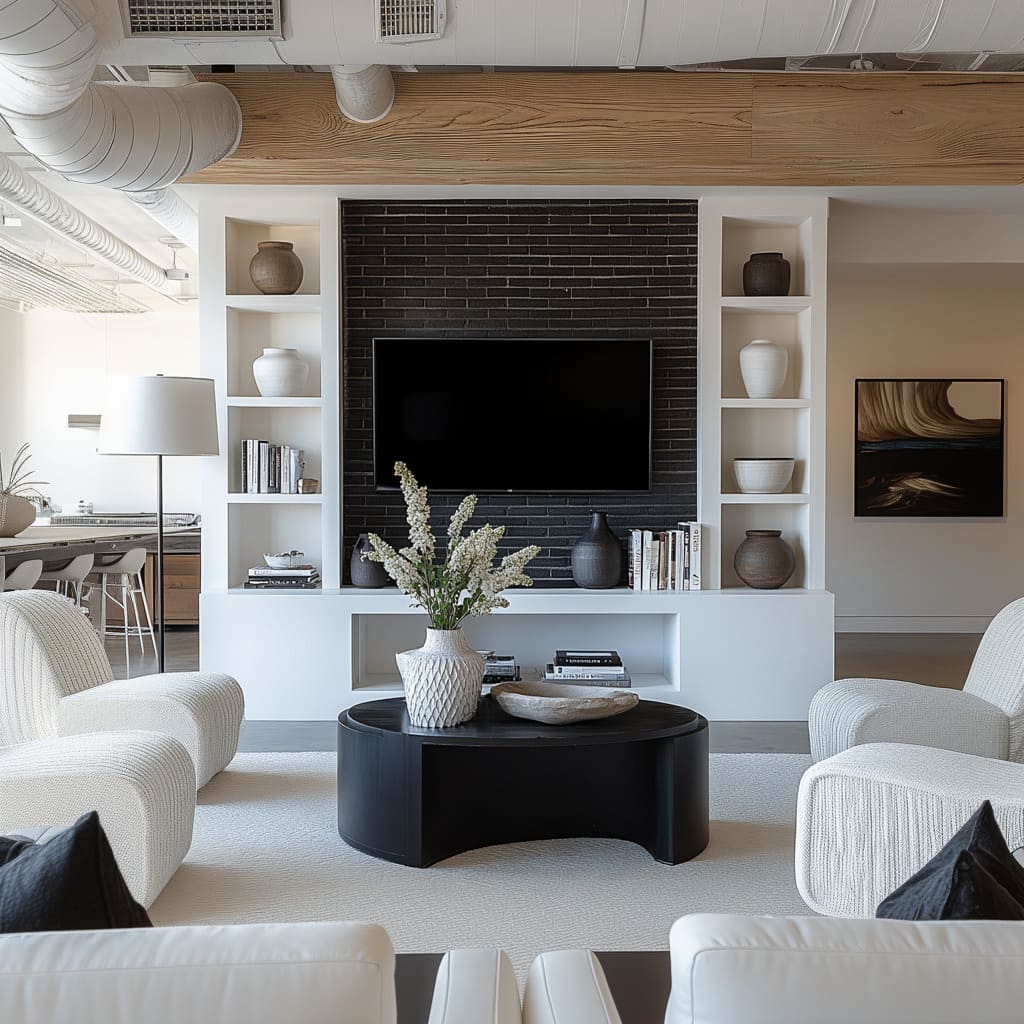
Several kinds of texture can be used:.
- Structured texture – shiplap, brick, medium-width planks, large grids.
- Micro texture – very thin vertical ribs, fine grooves, perforated or woven fronts.
- Organic texture – ripple panels, subtly uneven plaster, hand-shaped ceramics on shelves.
.
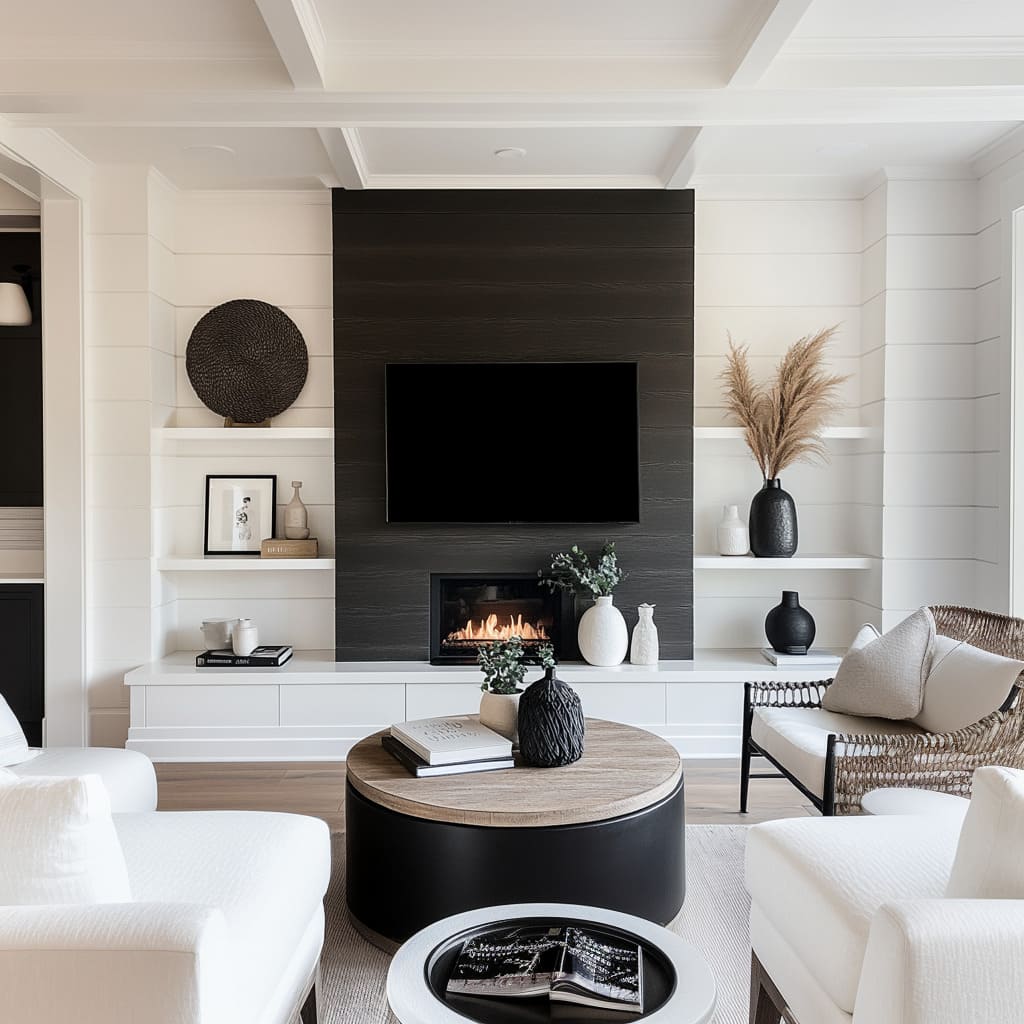
Finish plays a large role in how these surfaces feel. Matte black panels swallow light, making a TV almost disappear when it is off, while glossy objects in front—vases, glass pieces, small bowls—pick up reflections and bring life back into the scene.
Soft, chalky whites on panel walls pair with slightly more reflective marble or ceramic accents, so the wall seems to breathe rather than glare. The mix of matte and gloss, rough and smooth, is what gives a limited palette a layered, almost tactile richness.
Furniture that talks to the panel wall: echo, contrast, and sculptural forms
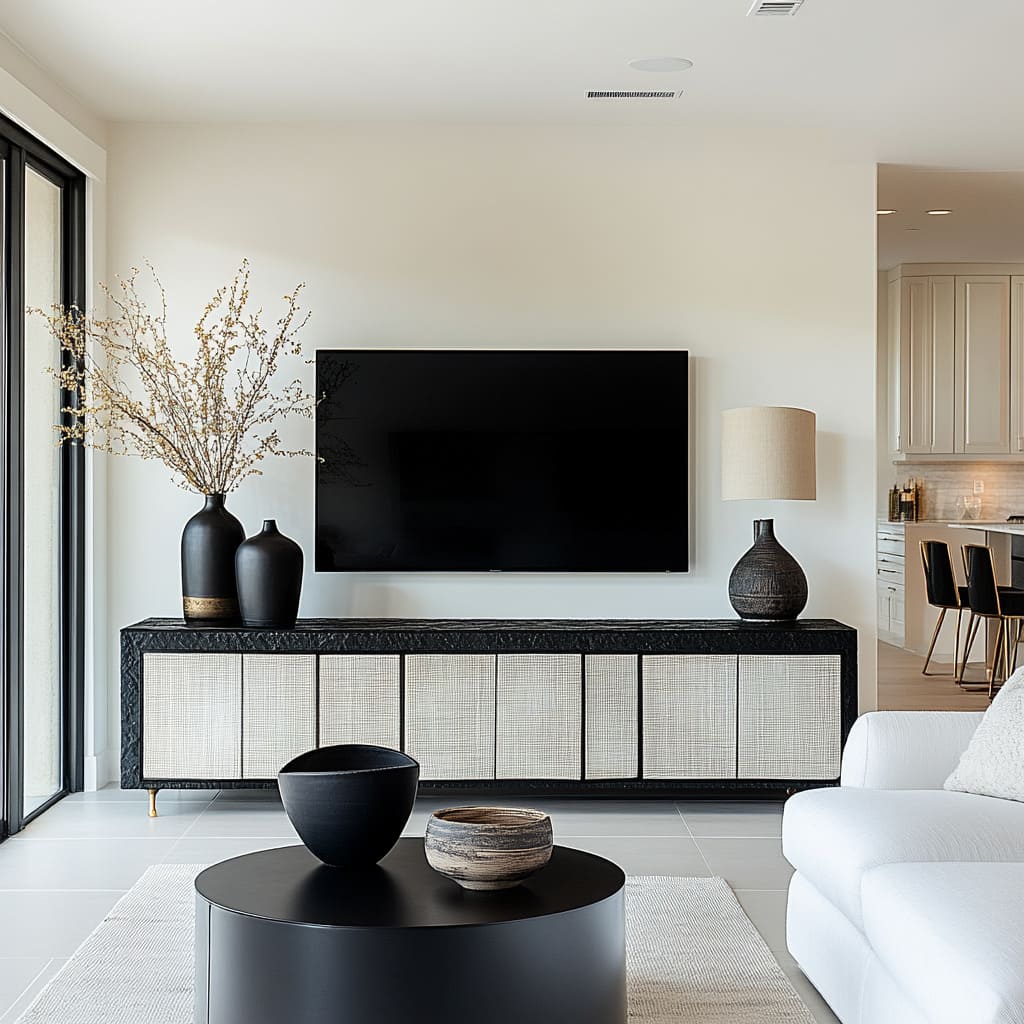
In many schemes based on simple black and white living room design, furniture is chosen less for style labels and more for how it talks to the panel background. When walls are strongly vertical, seating often repeats that rhythm through channel tufting or elongated cushion seams.
Sofa backs with deep channels echo battens behind them; pleated armchairs reflect the soft folds hinted at by ripple panels; ribbed console doors mirror the grooves in the feature wall. Even pieces like slipcovered sofas and relaxed armchairs, common in more casual or coastal spaces, tend to have skirt lengths or proportions that line up with base cabinets and shelf heights.
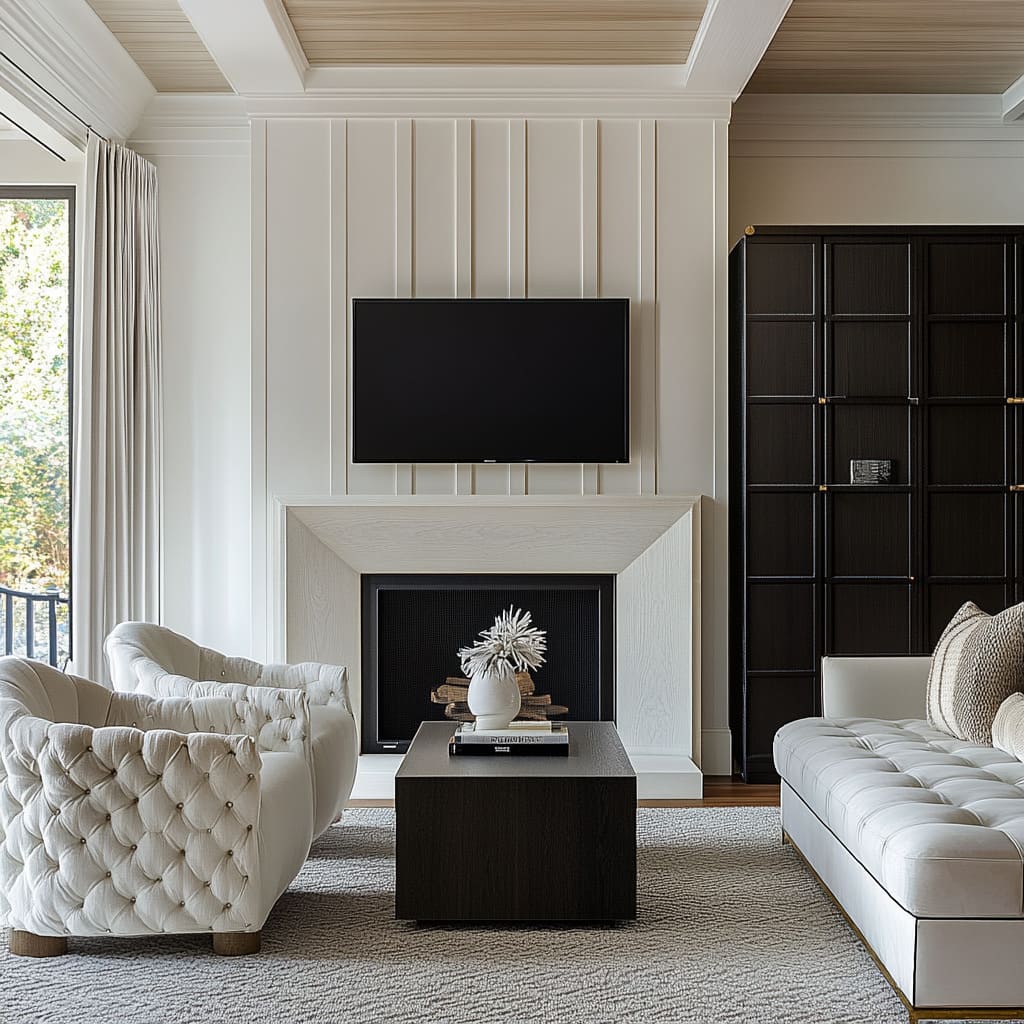
At the same time, certain pieces are deliberately different from the panel language to stop the room becoming too rigid. Round coffee tables, curved chaise ends, delicate wire chairs, and sculptural sideboards with carved circular motifs all soften the strict lines of the wall.
Black drum tables placed in front of a dark panel wall still read as objects because of their curved silhouette and low height; light wood tables with rattan sides introduce a warm counterpoint to a black inset. In many cases, the living room design reads almost like a composition of shapes: vertical rectangles behind, low blocks in the center, soft curves in the foreground, and a series of small vertical marks formed by branches, lamps, and vases.
The success of the space rests on this quiet conversation between wall structure and furniture geometry.
Shelving, sideboards, and the art of “quiet display”
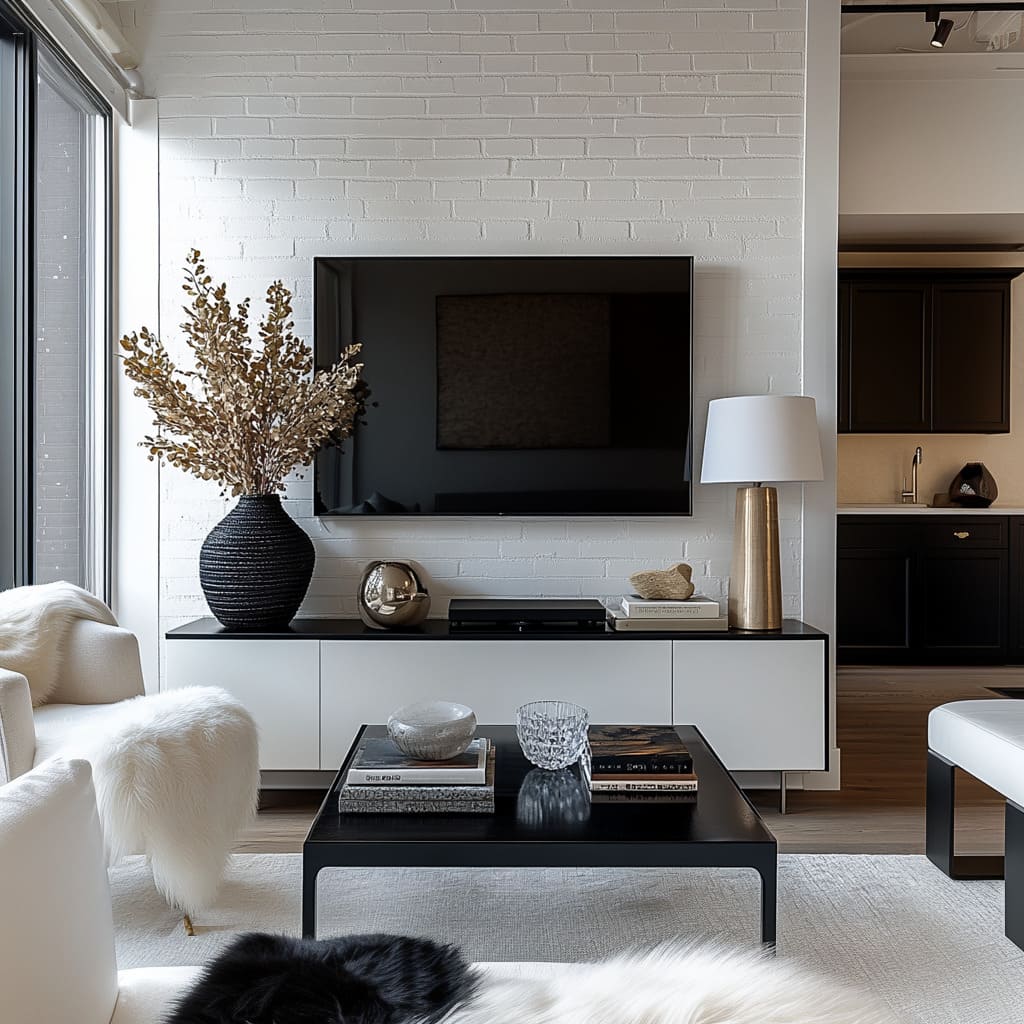
Built-in shelving and sideboards within panel compositions do more than store items; they set the tone of the entire black-and-white space. Full-height white shelving around a charcoal brick inset keeps the central dark zone framed in light, while carefully spaced objects—rounded bowls, soft ceramics, neat book stacks—give the wall a relaxed, curated character.
Long white cabinets beneath panel walls connect both sides of a composition and introduce a low horizontal line that anchors seating arrangements and rugs. Dark media units with woven fronts or vertical fluting bring depth and pattern at eye level without competing with the panel texture behind.
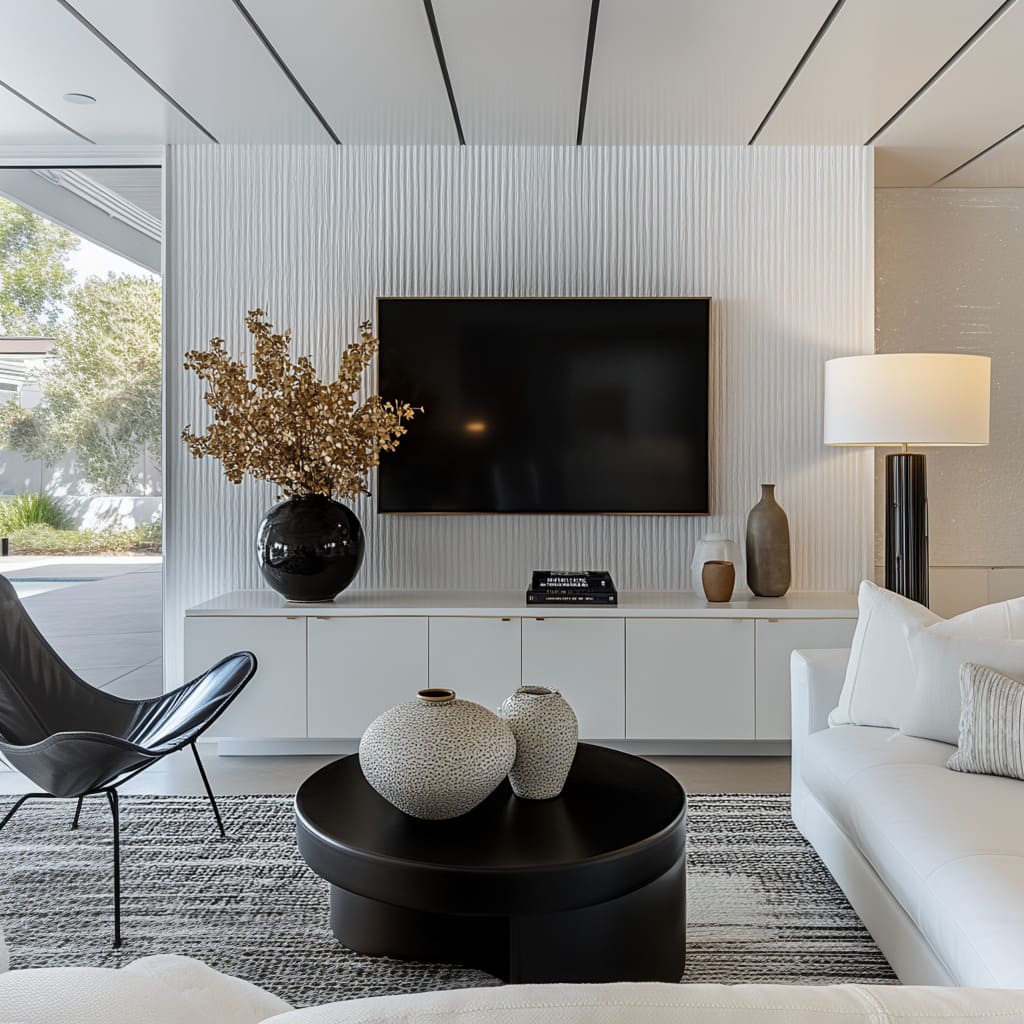
The way objects are placed on these surfaces is highly controlled. Shelves often remain partly empty, using negative space as a design element.
Items tend to be grouped in small families: a tall vase with branches, a mid-height bowl, a stack of books, a low sculptural piece. Dark and light pieces alternate gently from shelf to shelf so the eye moves in a slow, balanced rhythm.
On sideboards, tall vases bookend the arrangement, while medium and small objects fill the middle in stepped heights. A single polished metal sphere, a small frosted glass piece, or a brass detail on a lamp introduces a tiny spark of shine that stands out precisely because the surroundings are so matte.
These decisions give the panel wall softness and personality while keeping the overall look calm.
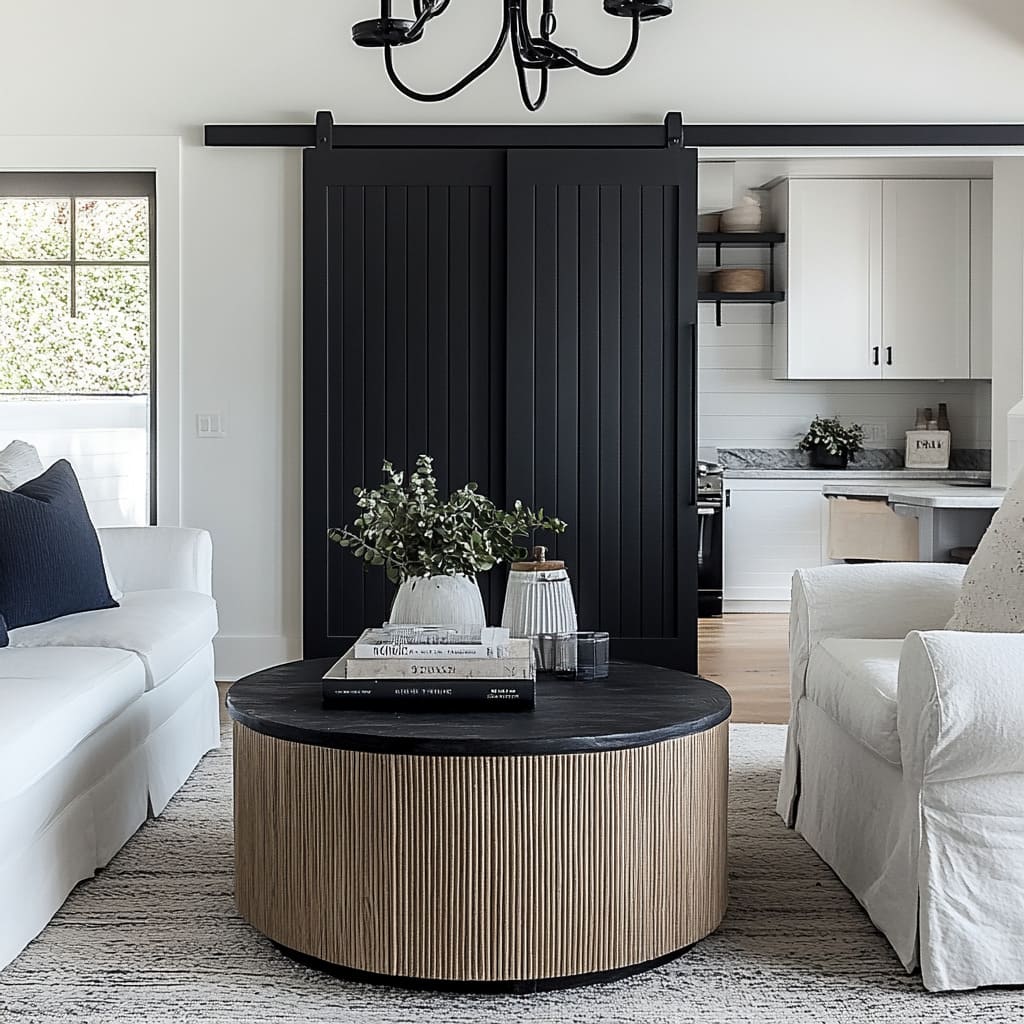
Natural elements and greenery as structural lines
Greenery in such designs rarely behaves like casual decoration. It functions almost like another kind of line within the decorative wall panel design ideas for living rooms.
Tall branches in dark vases rise beside the TV, subtly matching the height of the upper shelves or trimming. Pampas grass in oversized floor vessels reaches toward the ceiling, softening the join between wall and roof plane.
Desert plants or cacti in light pots sit on consoles, adding vertical accents whose shapes are irregular but still graphic enough to hold their own against strong panel grids.
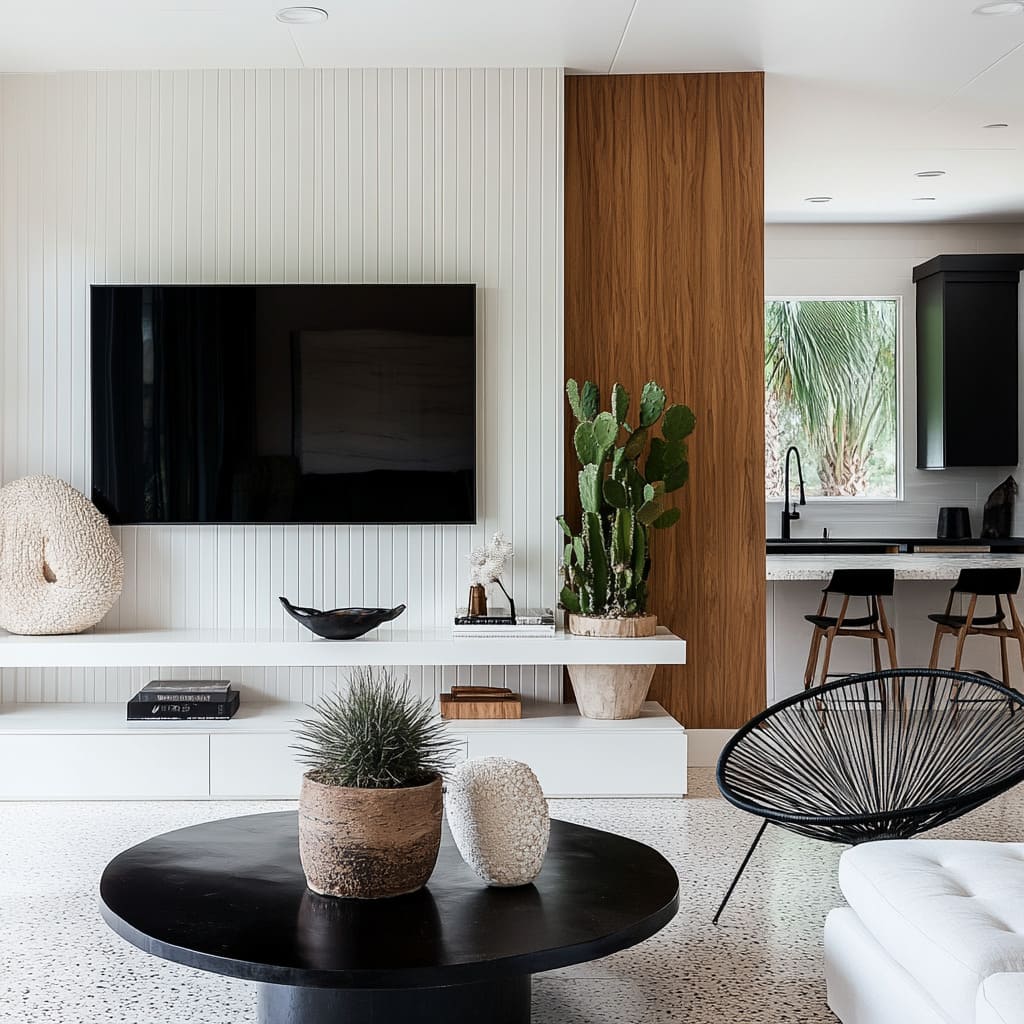
Alongside plants, other natural elements play similar structural roles. Woven baskets on top shelves echo the warm tones of wood ceilings or floors and create rounded silhouettes above the straight horizontal of the built-ins.
Jute and wool rugs introduce a soft ground layer that connects dark tables with light sofas. Wooden trays, stone bowls, and hand-formed ceramics move along sideboards and coffee tables like small landscape features—some tall and spiky, some low and smooth.
These organic pieces are always tuned in color to the palette: beige stems, muted greens, sandy browns. The result is that nature feels integrated into the architectural rhythm of the wall rather than simply added on for warmth.
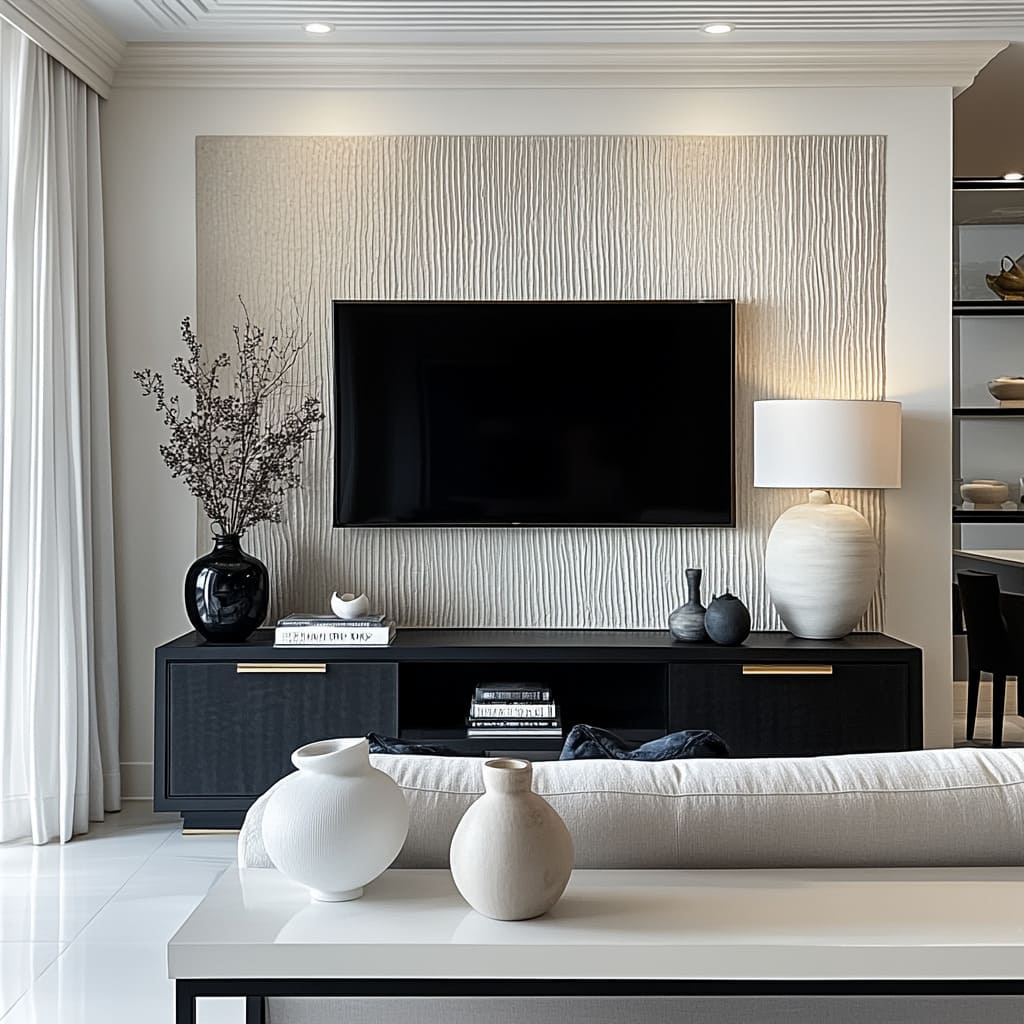
Extending the panel story into ceilings, kitchens, and adjacent zones
A striking feature of many schemes based on a simple black and white living room concept is how the panel logic continues into connected spaces. Doorways to kitchens or dining zones are often framed with bold black trims that echo the central panel wall, forming visual brackets that hold the living room in the middle.
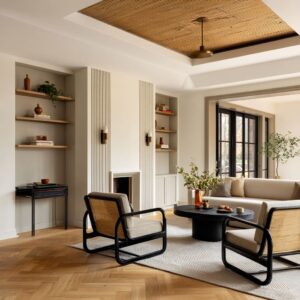
Sliding doors with black frames or black barn rails repeat dark horizontal lines established by media units and coffee tables. Shifts in ceiling treatment—such as coffered structures with light wood infill, peaked ceilings with warm boards, or beams aligned with the panel grid—extend the sense of order upwards.
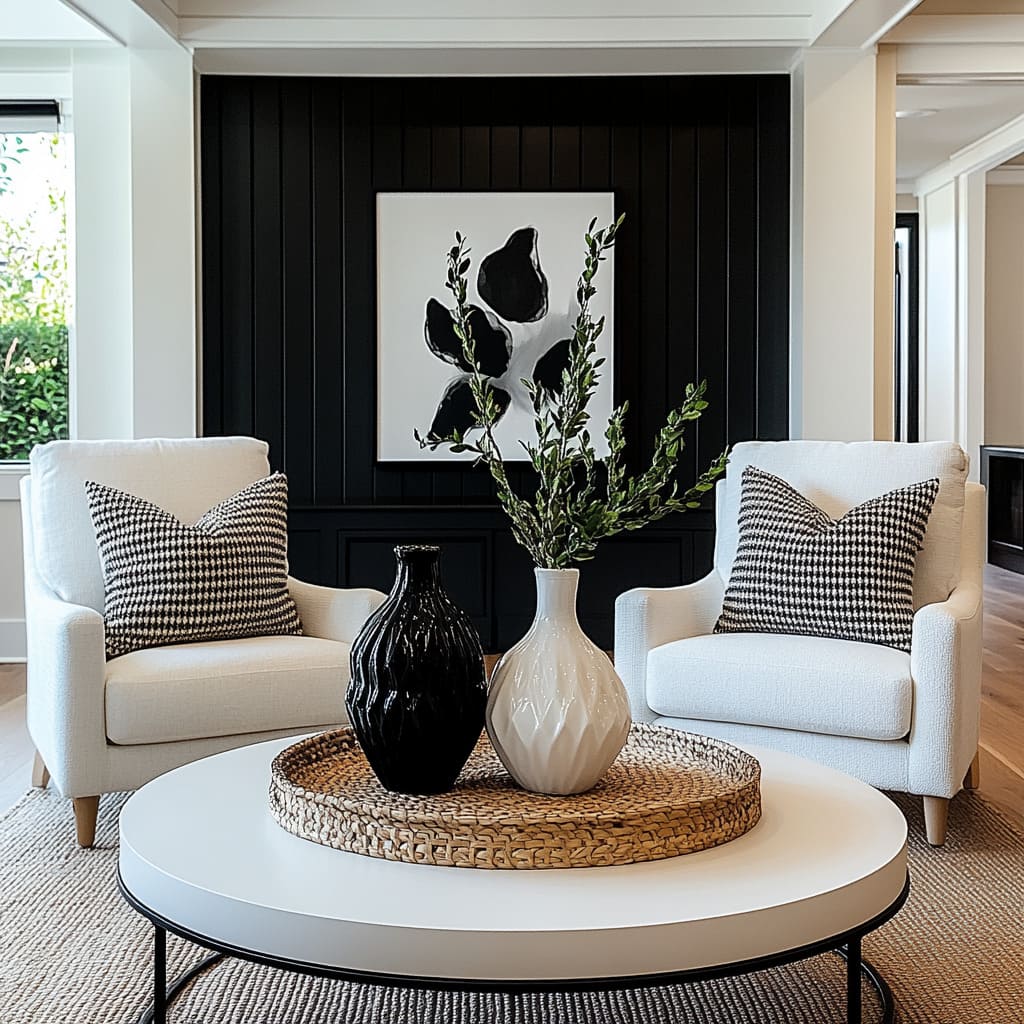
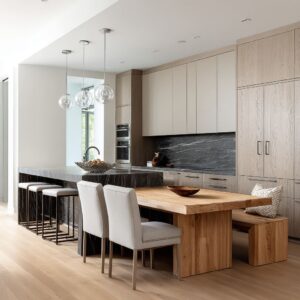
Beyond the living room, islands in neutral kitchens pick up the same dark tone as the TV wall, while cabinets remain pale so that the black elements read as one continuous thread from room to room. Dining chairs in black around a pale table on a porch or adjoining area prolong this contrast outside.
Even light fixtures participate: black metal chandeliers above seating areas echo the graphics of the panel wall without blocking its view, and simple wall sconces with white globes and small brass details act as tiny punctuation marks on light surfaces. Through these repetitions, the decorative panel wall becomes more than a single feature; it acts as a central theme that flows through ceilings, openings, and adjacent furniture, tying the home’s main spaces into a single visual story.
Archetypes of black-and-white living rooms
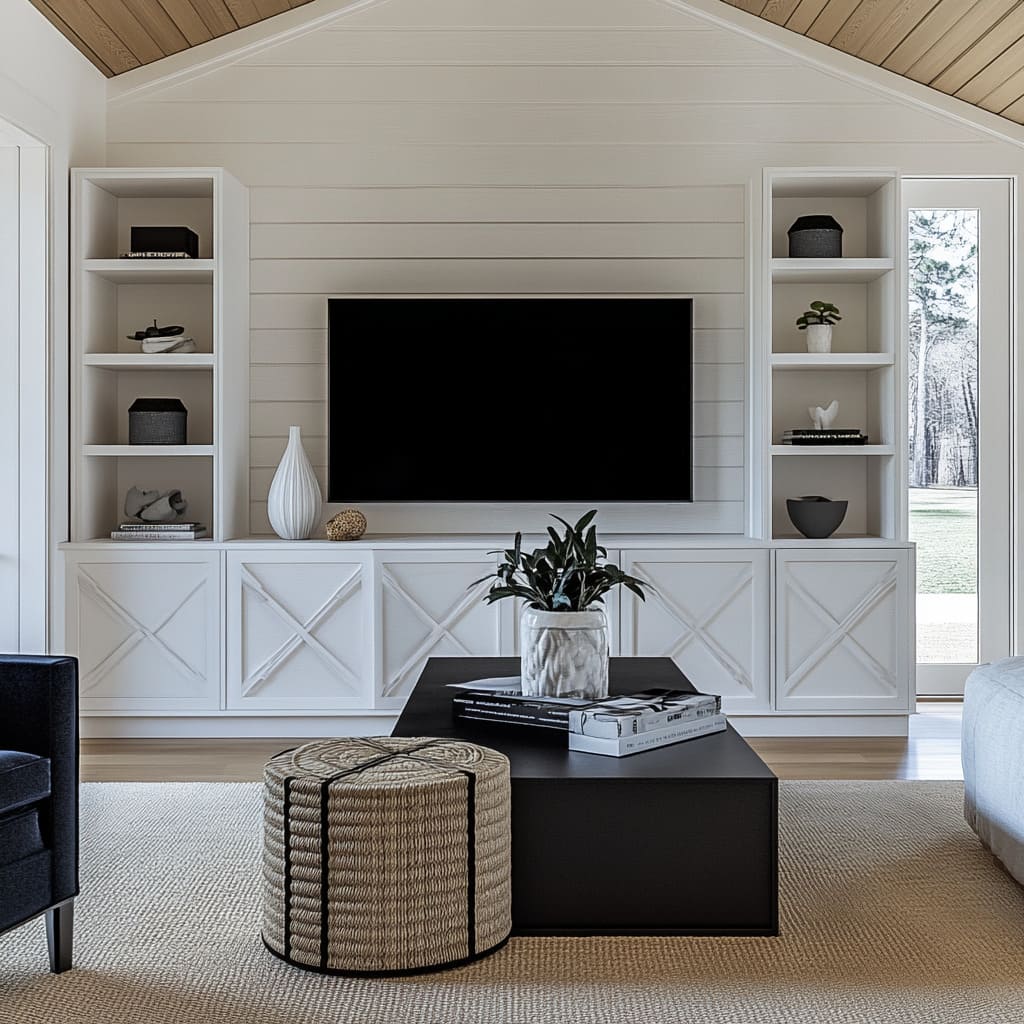
Looking at these design ideas together, several recurring archetypes emerge within the broader world of simple black and white living room concept schemes. One type groups dark panel fields with white seating: a tall black inset behind the TV, flanked by pale shelves, with soft off-white sofas and armchairs standing out as silhouettes.
Another type flips the contrast: white panel walls, ripple plaster, or painted brick carry most of the texture, while black appears as a few decisive forms—a cube coffee table, a long media console, a framed TV inset. A third type treats the fireplace and TV as a central spine, setting them in marble or soft beige and surrounding them with black cabinets and bright seating, so the vertical stack of rectangles becomes the quiet heart of the room.
Other variations lean toward relaxed coastal or modern farmhouse character through slipcovered sofas, black barn doors, and woven textures, or toward a more gallery-like mood with sculptural sideboards, drum tables, and curated pottery. Across all of them, the panel wall remains the key tool: it sets rhythm through lines, creates depth through color, hosts the main technical elements without allowing them to dominate visually, and supports a layered mix of furniture, decor, and natural pieces.
Even in the most restrained palettes, this combination of structure, texture, and careful object placement is what gives black-and-white living rooms a sense of richness and calm that feels anything but plain.