White and terracotta form a pairing that carries both calm and warmth, and the most interesting design outcomes appear when these two tones are allowed to interact like characters with different roles. In many interiors built around a white and terracotta kitchen design, clay becomes the grounded layer that feels rooted and steady, while white behaves like the quiet present-day backdrop that lets objects, shelves, and cooking spaces breathe.
Clay appears in different intensities—from patchy bricks that look sun-softened to smooth large rectangles that almost behave like a drawn grid. Meanwhile, whites shift from cool chalk to warm bone and creamy shades that soften the transition between walls, counters, and the warm floor.
What makes this pairing intriguing is not simply the contrast in color, but how each tone changes the sense of age, depth, and emotional temperature in the space. Clay carries a suggestion of time, while white reshapes the lines into a fresh structure.
Together they create designs that feel composed, steady, and quiet, even when packed with detail.
This relationship sets the foundation for everything that follows: clay becoming either the base underfoot, the wrap around a cabinet run, or the backdrop of a glossy wall; white shaping the geometry of islands, shelves, and storage; and both tones forming layered stories through texture, pattern, and placement.
Floor-Driven Atmospheres: How Terracotta Defines the Look
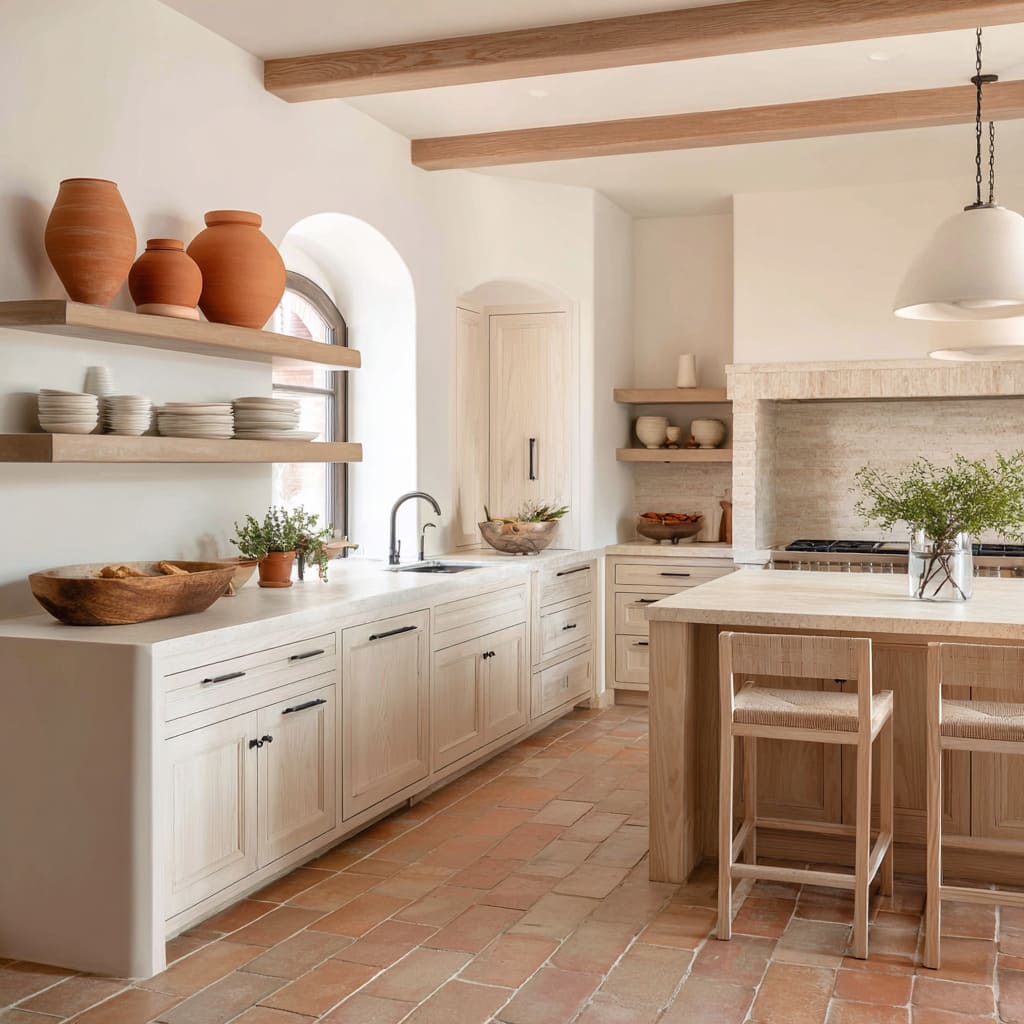
In most ideas grounded in clay, the floor is more than a surface; it behaves like the emotional anchor of the entire composition. Designs built around white kitchen cabinets and terracotta floor ideas often show that the floor’s tone, sheen, size, and layout completely determine the atmosphere within the room.
For example, small bricks in uneven tones turn the kitchen design into something reminiscent of a quiet courtyard, while larger glazed tiles form a clean and graphic grid beneath a very crisp white layout.
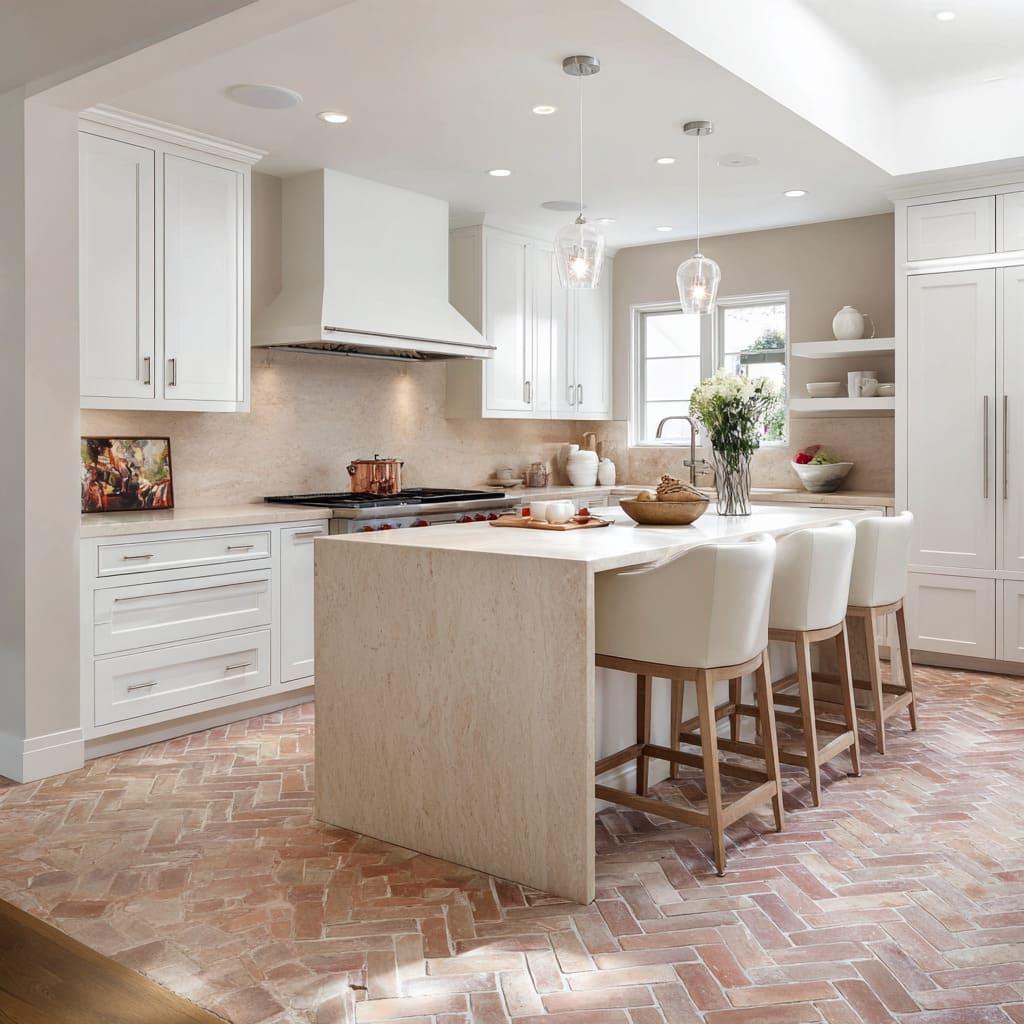
How terracotta shifts mood depending on pattern
- Herringbone bricks introduce movement that pulls the eye toward a cooking zone or opens the path toward a seating area.
- Large uniform tiles make the floor behave like a textured rug, allowing the room to feel structured and minimal.
- Patchy or limewashed clay pieces hold a cloudy, softened character where whites appear even brighter in response.
How sheen creates character
- Satin or glossy terracotta reflects outlines of islands and stools, giving the floor a mild mirror quality.
- Matte terracotta absorbs light and looks almost chalky, grounding the cabinetry and calming the entire composition.
Because terracotta shifts so easily from rustic to contemporary depending on its treatment, it becomes one of the most flexible warm bases for kitchen designs built around light cabinetry and stone counters. Even when whites dominate the upper part of the room, the clay floor provides a subtle equilibrium between warmth and clarity.
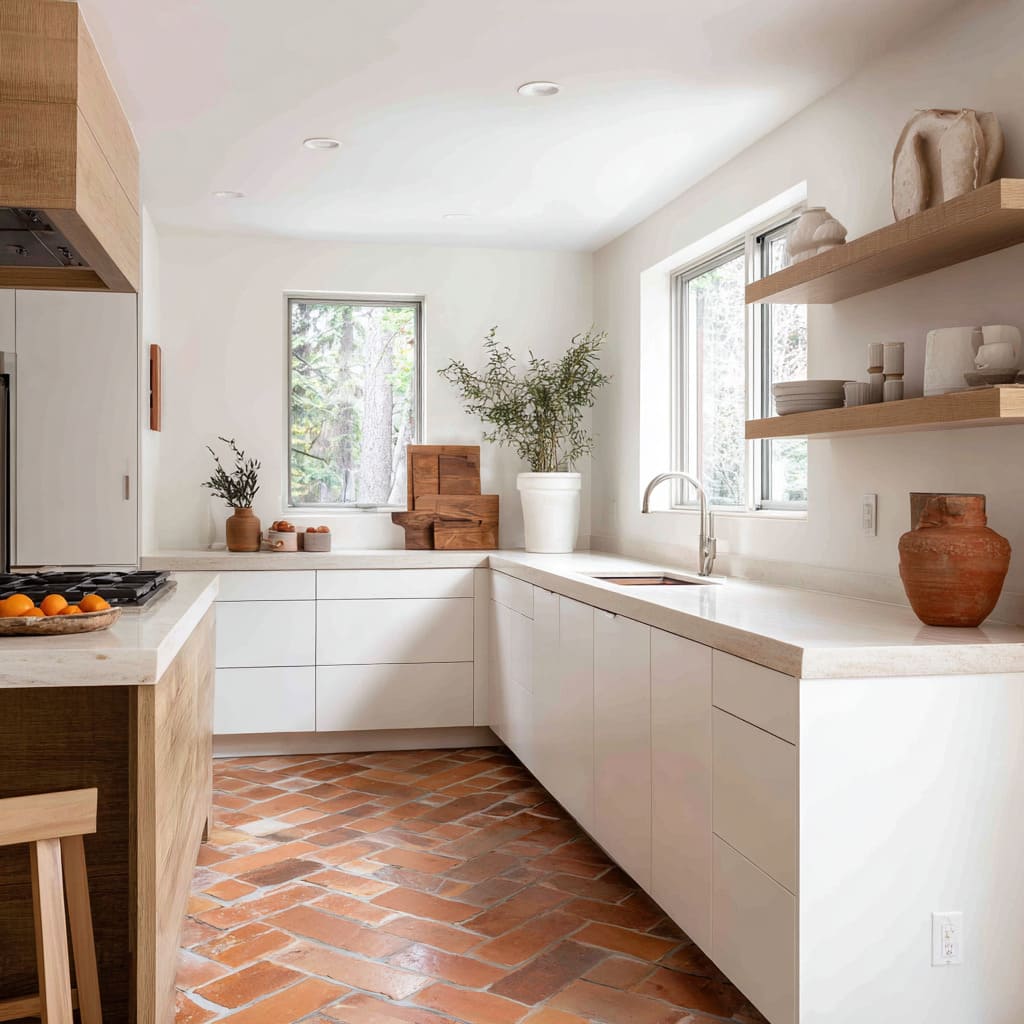
Islands as Sculptural Objects Within Pale and Clay-Toned Designs
Whether formed from pale stone, creamy composite, soft blush clay, or a balanced mix of these materials, islands often act as sculptural anchors. They define how terracotta interacts with white and how the eye travels through the room.
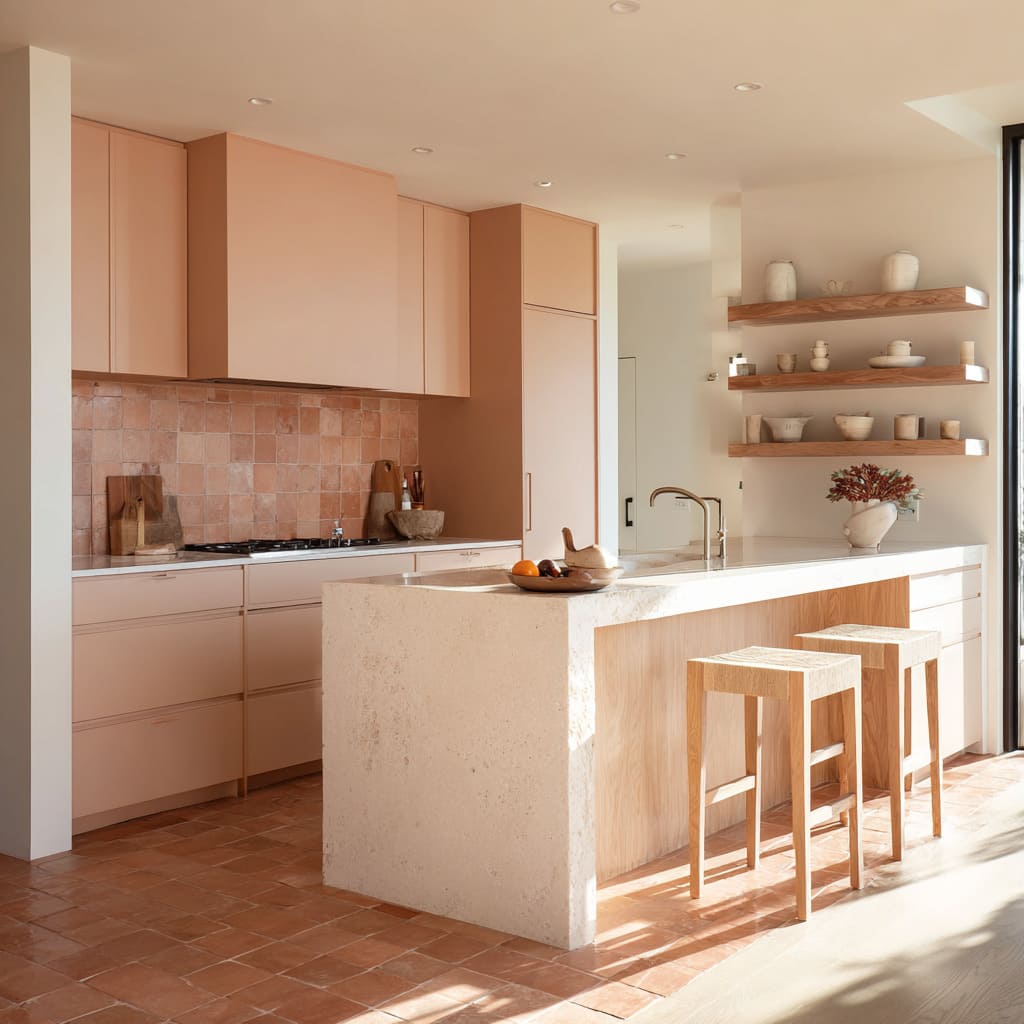
In many terracotta and white kitchen design ideas, islands are treated not as functional blocks but as carved shapes that sit inside a clay field. Some islands appear monolithic, wrapped on all sides with veined pale stone that visually floats above terracotta tiles.
Others are divided into two parts: one side built with white panels and the other clad in a warmer stone with visible veining, creating a dual-material object that shifts character as someone moves around it.
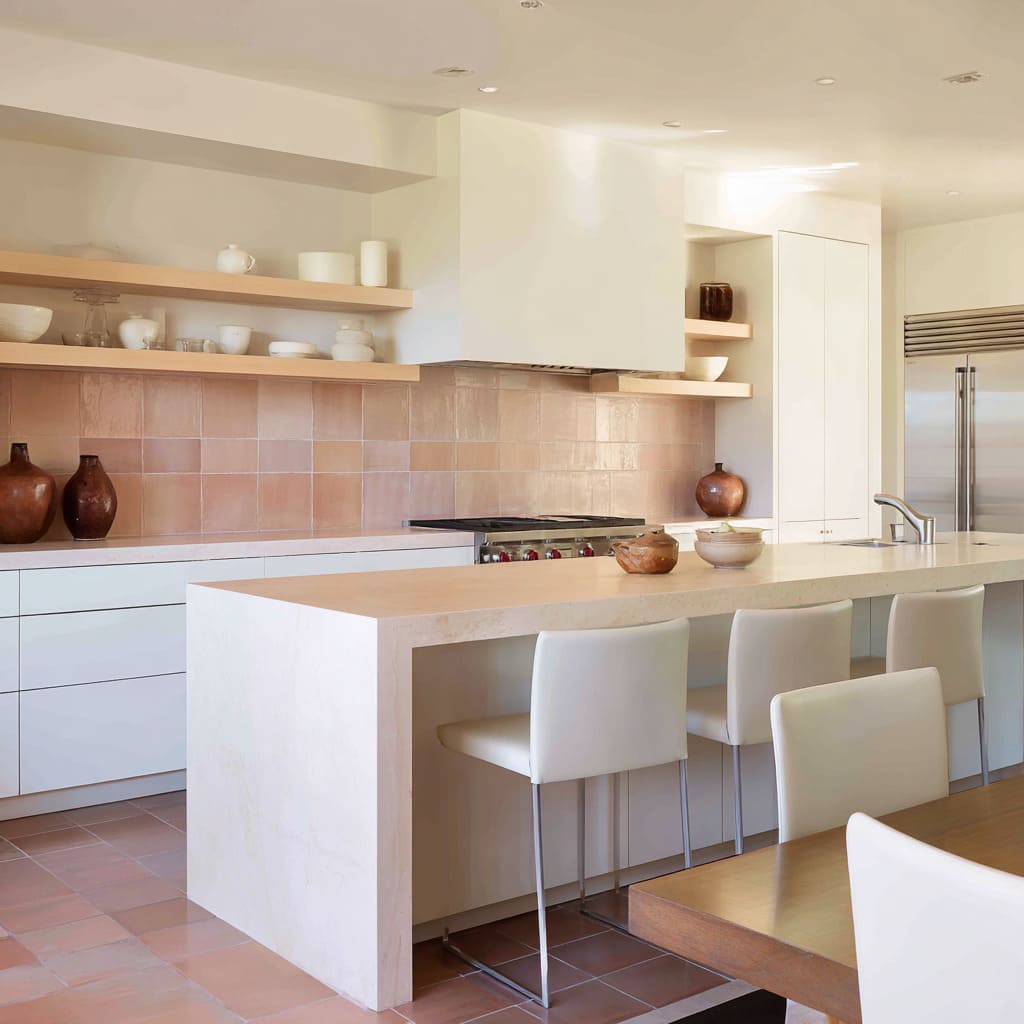
Recurring sculptural strategies include:
- Waterfall edges used as quiet planes rather than attention-grabbing features
- Seating niches built into pale stone blocks with timber tones hidden inside the recess
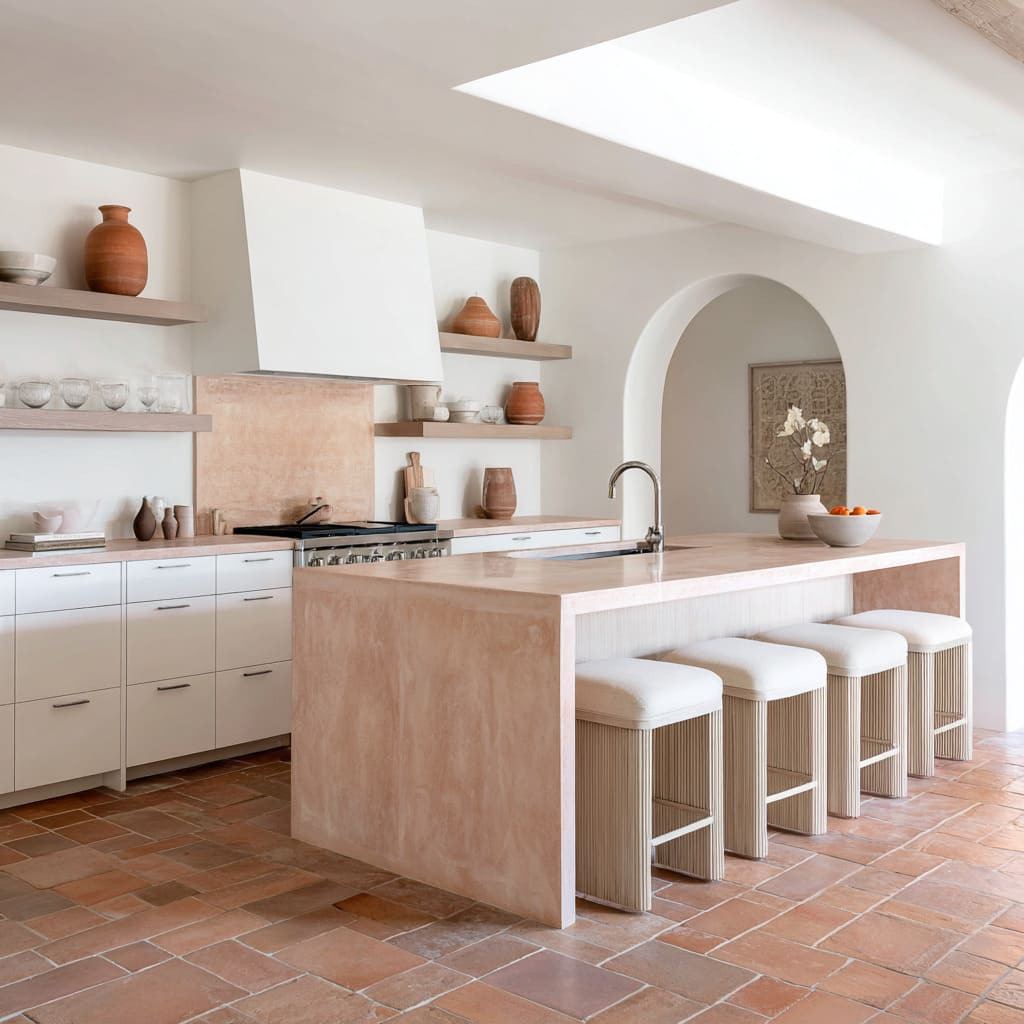
- Clay-wrapped islands that feel like refined pieces of the floor rising upward
- White peninsula volumes acting as glowing, crisp attachments inside warm-toned designs
Because terracotta is inherently earthy and grounded, islands take on an even stronger visual role. They become standing forms inside a clay landscape, especially when stool shapes, slim legs, or curved seats tuck into the volume without interrupting the silhouette.
The combination creates depth and a sense of layered stillness.
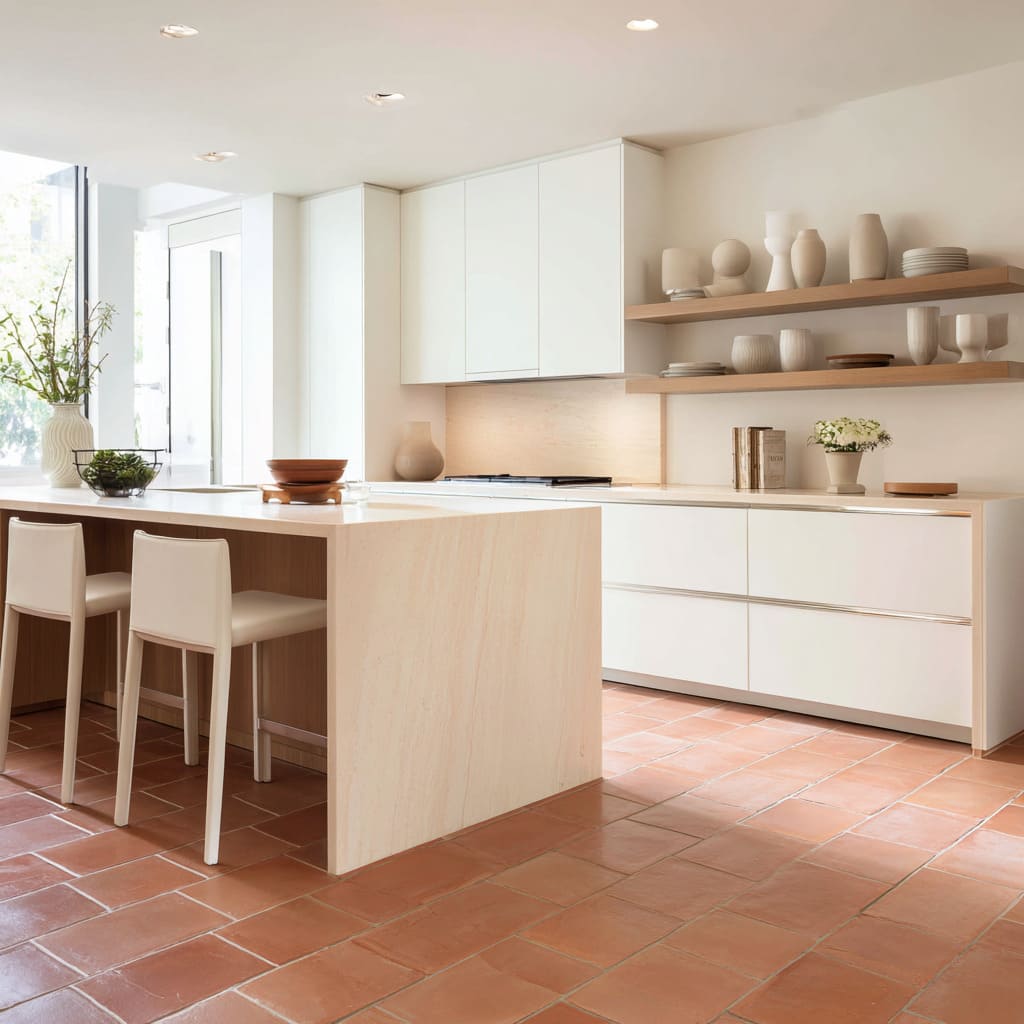
Shelving, Timber Accents, and Pottery as the Carriers of Warmth
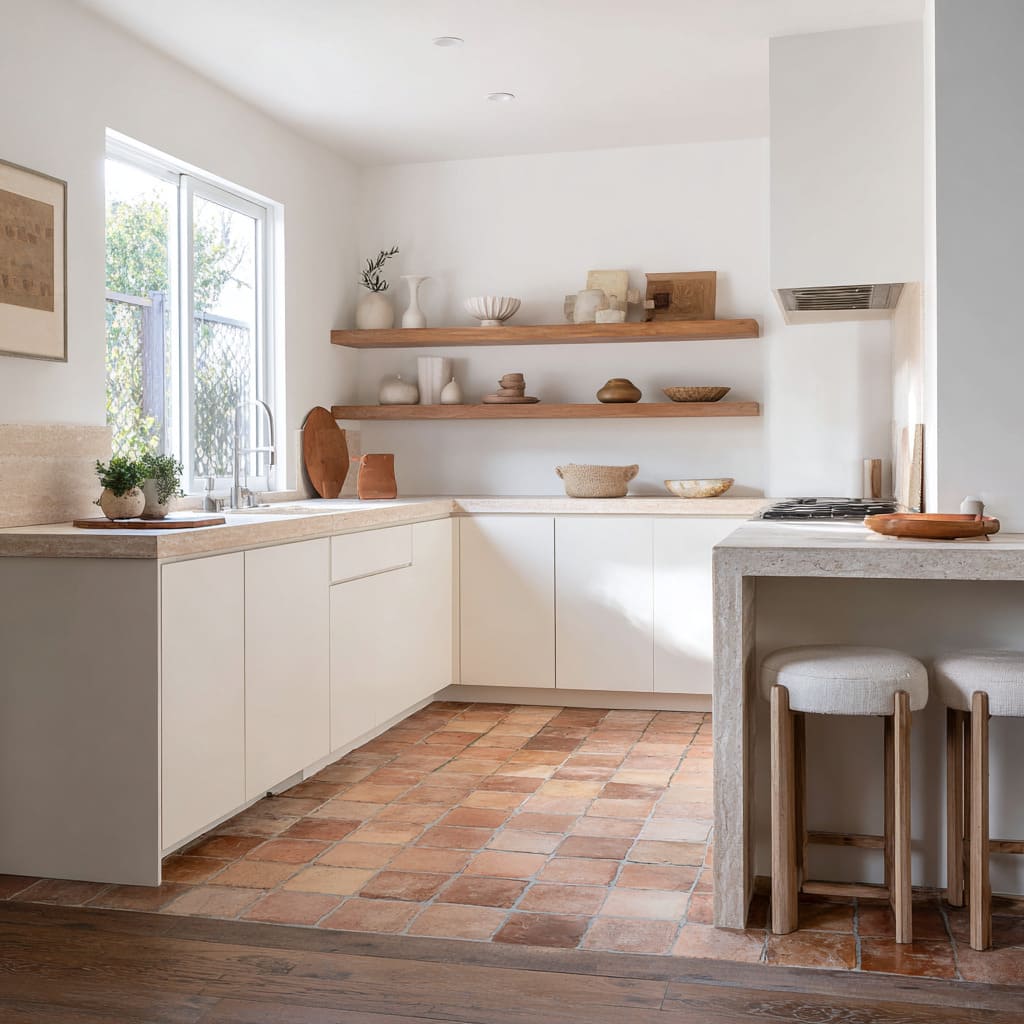
Shelves and small timber details do more than hold objects—they knit together clay and white in nearly every one of the design directions. Many ideas with terracotta floors and white cabinets rely on shelves to act as color mediators.
Their tone usually sits between the clay underfoot and the pale cabinet fronts, making them a mid-level anchor that balances the vertical stack of materials. The objects arranged on these shelves serve as tiny echoes of the palette, repeating either light tones or clay touches at eye level.
Subtle design rhythms created by shelf arrangements:
- Tall clay jars placed deliberately at the ends to balance visual weight
- Mostly white ceramics on long floating shelves, creating soft silhouettes
- Occasional clay or wood pieces placed in corners like punctuation marks
- Negative space used deliberately so shelves feel architectural rather than busy
Shelves also connect to other elements: honey-toned timber reappears in bar stool legs, recessed island pockets, vertical cabinet accents, and even on overhead beams in farmhouse-leaning compositions. The combined effect is a layered path for the eye, moving from clay floor, to wood shelving, to pale cabinets, to white ceiling, with pottery playing the supporting role of color echo and tonal softener.
The Role of Light: Reflection, Tone, and How Clay Behaves During the Day
Clay interacts with light in ways that pale materials cannot. Its mid-tone nature, its varied saturation, and its changes in surface sheen make it one of the most reactive elements.
In designs influenced by ideas with white kitchen with terracotta floor tiles, daylight becomes part of the composition. As sun moves across glossy bricks or blush clay panels, certain tiles flare while others quiet down, giving the floor a shifting quality that makes the entire lower half of the kitchen feel alive.
Light-driven changes observed across designs:
- Skylights creating a direct wash across clay-wrapped islands, making them glow
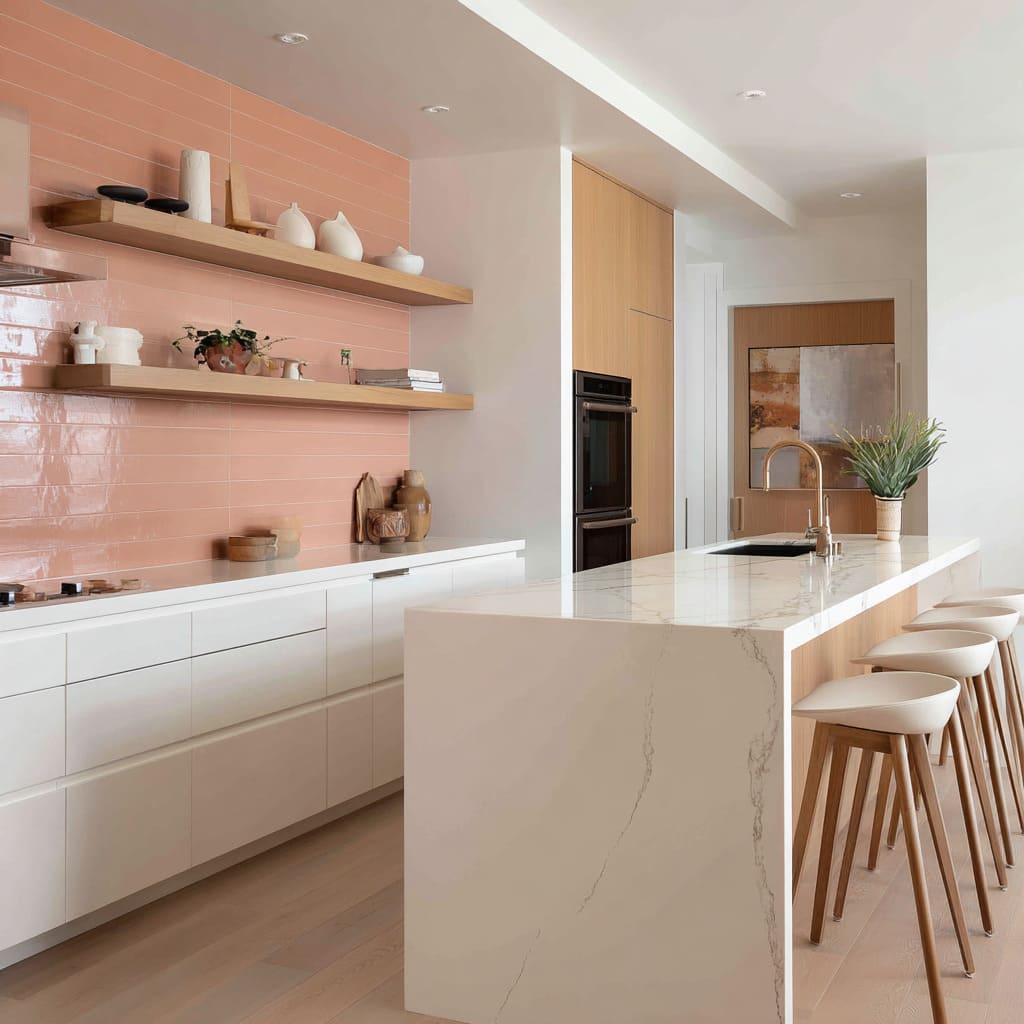
- Glossy terracotta walls acting as subtle mirrors that amplify movements and shelf silhouettes
- Limewashed bricks softening strong white cabinets during midday sun
- Thick stone counters glowing softly when the floor reflects warm light upward
Because white surfaces bounce daylight so efficiently, the clay tones never feel heavy. Instead, the space changes character throughout the day: bright and crisp during late morning, and deeper, more intimate in late afternoon as shadows stretch across bricks or blush tiles.
Spatial Definitions: How Terracotta Acts as a Path, Zone, or Visual Marker
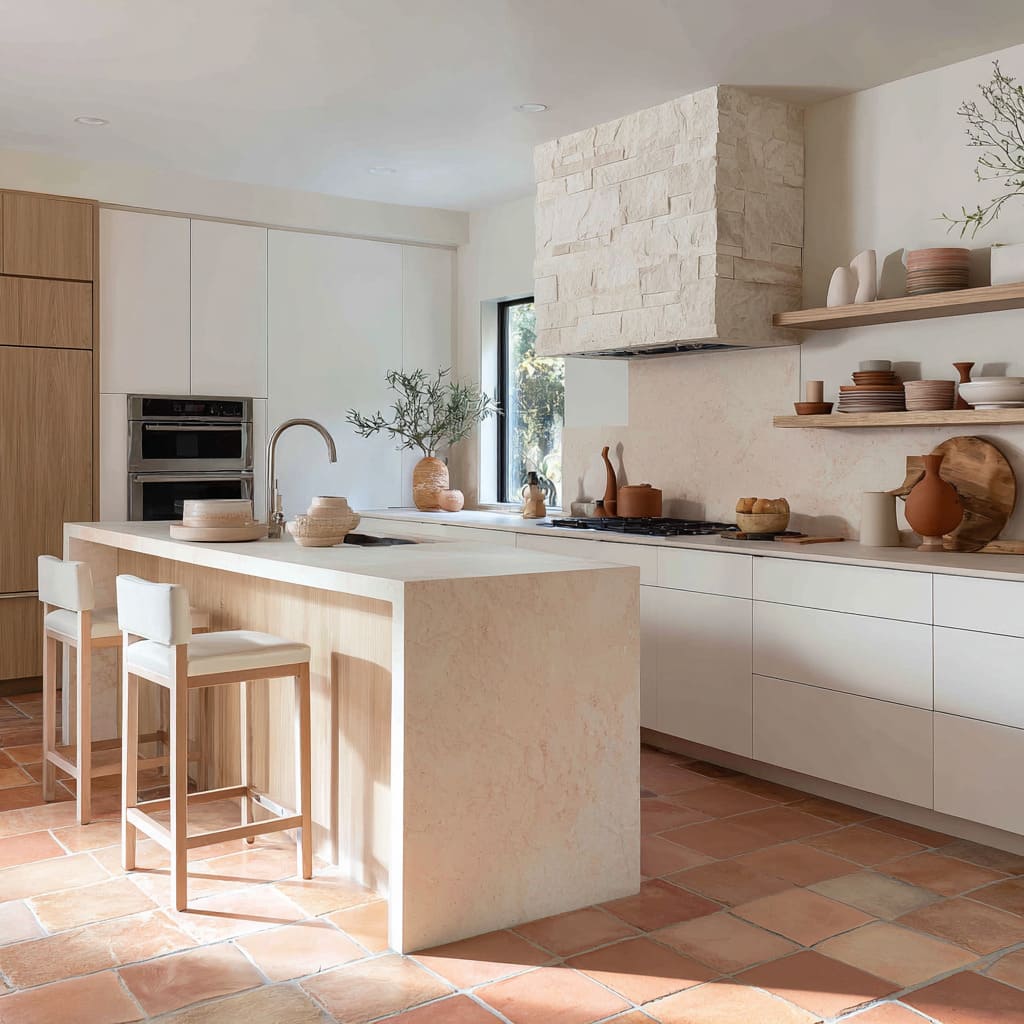
Clay is used as a boundary system in many compositions. Instead of building walls, they let terracotta act as a natural zone marker.
This makes the space feel organized without clutter, especially in open-layout homes or studios. In styles similar to ideas with terracotta floors and white cabinets, the clay often appears only where the main work zone sits.
Examples of subtle spatial zoning created by clay:
- Brick inlay running under cabinets like a built-in runner that marks the cooking path
- A solid clay stripe placed inside a U-shaped kitchen to define a compact workspace
- Full clay floors only in the kitchen area, with timber flooring in adjacent rooms
- Clay backsplash panels aligning with the island to form a central axis within the space
These approaches turn terracotta into a visual guide, not simply a surface finish. It leads the eye toward windows, seating, or cooktop areas.
Even without words or symbols, the floor itself describes how the kitchen flows and where key activities sit.
Textures, Tones, and Atmospheres: Profiles of Distinct Clay–White Styles
Different combinations of clay and white create distinct personalities. When seen together, these approaches form a full catalog of ways pale cabinetry and clay tones can cooperate.
In interiors shaped by ideas with terracotta floors and white cabinets, these atmospheres appear again and again:
Courtyard-Inspired Calm
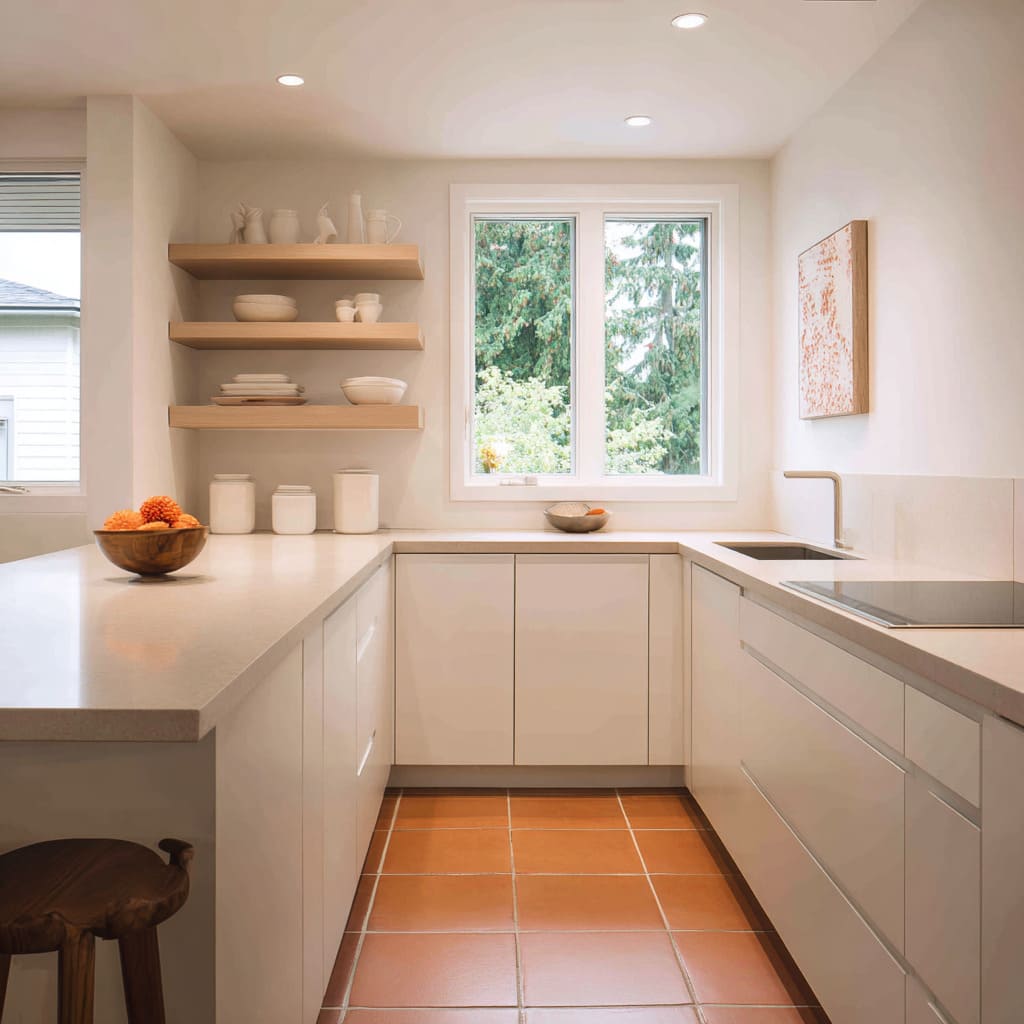
Small bricks with tonal variation, soft cream cabinets, simple shelves, minimal styling, and windows framing bright outdoor greens.
Contemporary Clay Gallery
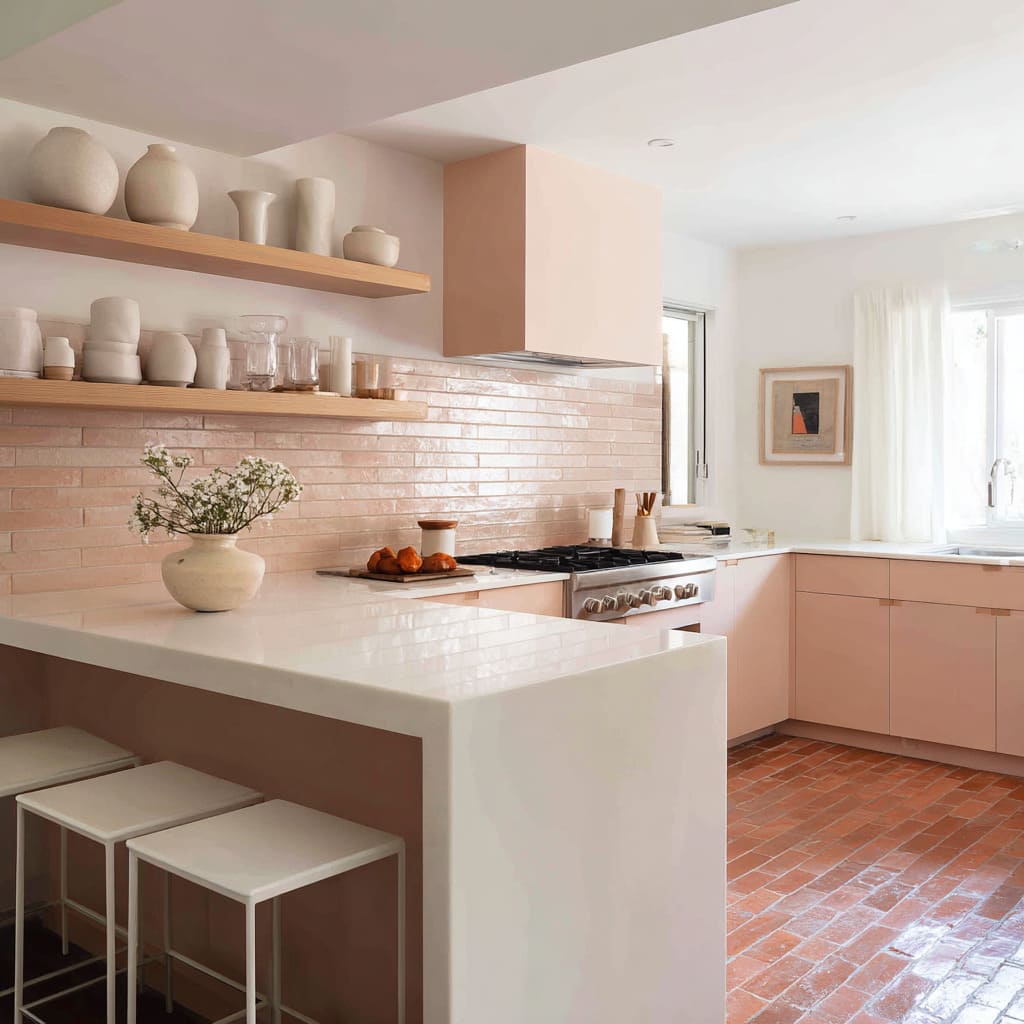
Large pale stone island slabs, glossy terracotta wall tiles, white drawers with tight reveals, and sculptural shelves arranged like curated displays.
Soft Farmhouse Warmth
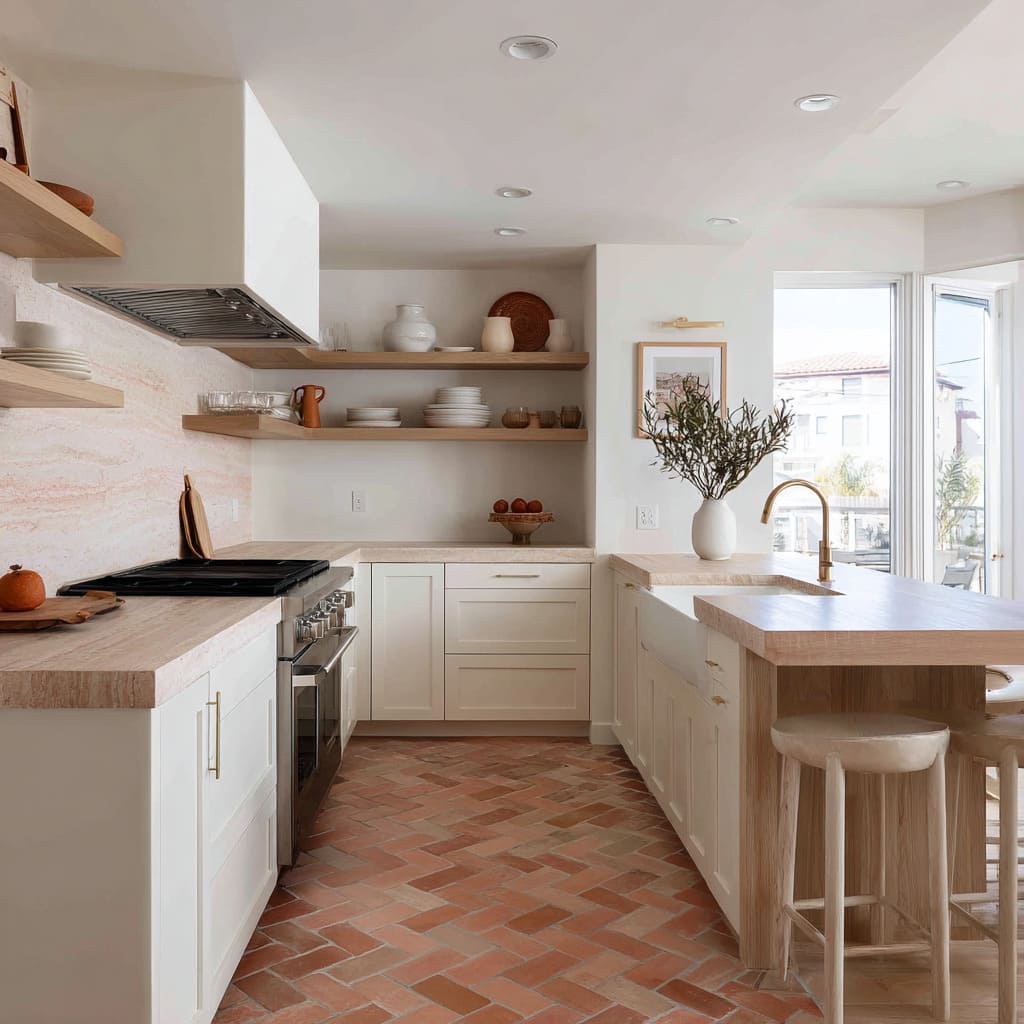
Herringbone brick floors, painted shaker fronts, brass taps, deep timber shelves, citrus bowls, and pottery that echoes floor tones.
Mediterranean Clay Envelope
Clay-wrapped islands, blush tile backsplashes, tall arches, and plaster-like hoods that create a sculptural layer above the terracotta floor.
Urban Loft Blend
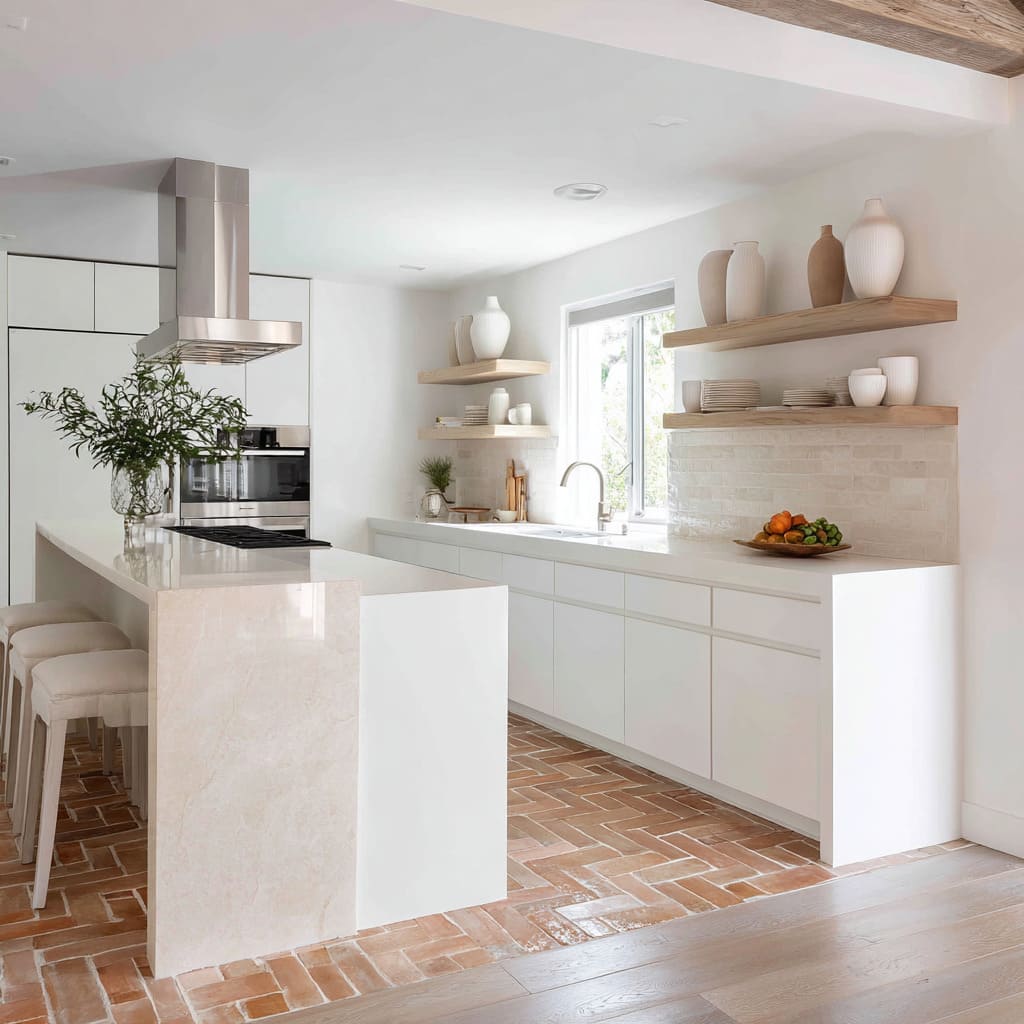
Light timber floors, glossy clay wall panels acting like paintings, long stone islands, and slim stools blending into a pale environment. Each of these styles grows from the same core palette: clay underfoot or behind key surfaces, pale cabinets, and quiet wood accents.
Yet the atmosphere shifts completely depending on how the clay is positioned, how much variation it has, and how the light interacts with it.
The Power of Clay When Paired With White Cabinetry
Across all variations, terracotta consistently transforms pale storage into something more grounded. In designs built around ideas with terracotta floors and white cabinets, the clay floor keeps soft whites from drifting into clinical territory.
The pairing creates stability and visual depth, especially when the bricks include a mix of peach, blush, sandy beige, and russet tones.
Shelves, hood blocks, island forms, pottery, branches, stools, and artwork all become part of the clay–white dialogue. Objects are chosen and placed with surprising delicacy: nothing loud, nothing overly ornamental, nothing competing for new color dominance.
Instead, everything is arranged to echo the floor in small scales, forming a layered sequence of clay tones across different heights. This setup makes the design feel anchored at the base and light above it.
The eye travels smoothly from clay to cream to pale stone to soft timber to white wall. In every case, the clay adds warmth, the white adds structure, and the result feels balanced, modern, and quietly expressive—never heavy, and never empty.
A Warm–Pale Dialogue: Clay as Earth, White as Space
When stepping back and looking at these ideas as a whole, it becomes clear why so many interiors embrace this pairing. The compositions move beyond simple color blocking.
Clay represents the earth—the grounded element—while white becomes the open surface that allows breath and structure. Together, they create atmospheres that feel calm, warm, and visually clear.
In one final perspective, the pairing can be seen as the meeting of two essential qualities: the warmth of a clay path and the stillness of a pale architectural box. In designs built around ideas with white kitchen with terracotta floor tiles, this combination is handled with quiet restraint, letting clay travel between floor, cabinets, islands, and backsplashes in carefully measured doses.
White never overwhelms; terracotta never clutters. Each sustains the other, forming an environment that feels composed and timeless, grounded and fresh, familiar and refined at the same time.