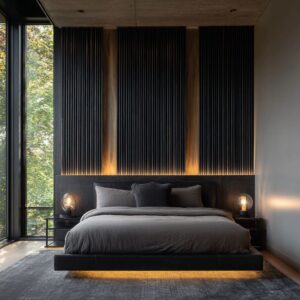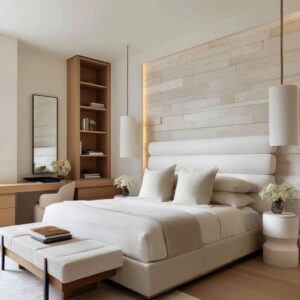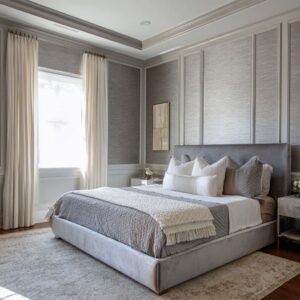
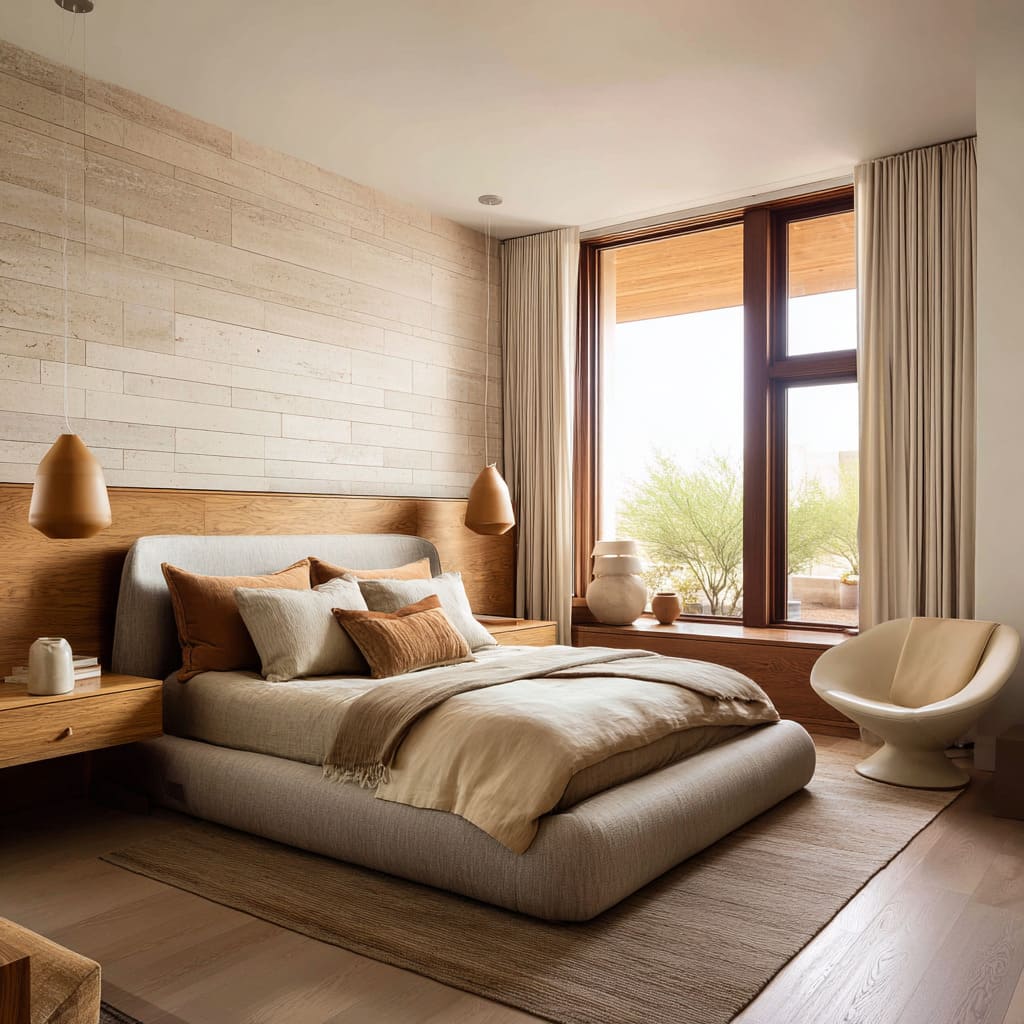
Modern sand-theme bedrooms often treat color as a full spatial envelope instead of stopping it at a single accent wall. Walls, ceilings, built-ins, and even stone cladding can be tuned into one family of oat, stone, and driftwood beige so that the room feels wrapped rather than decorated.
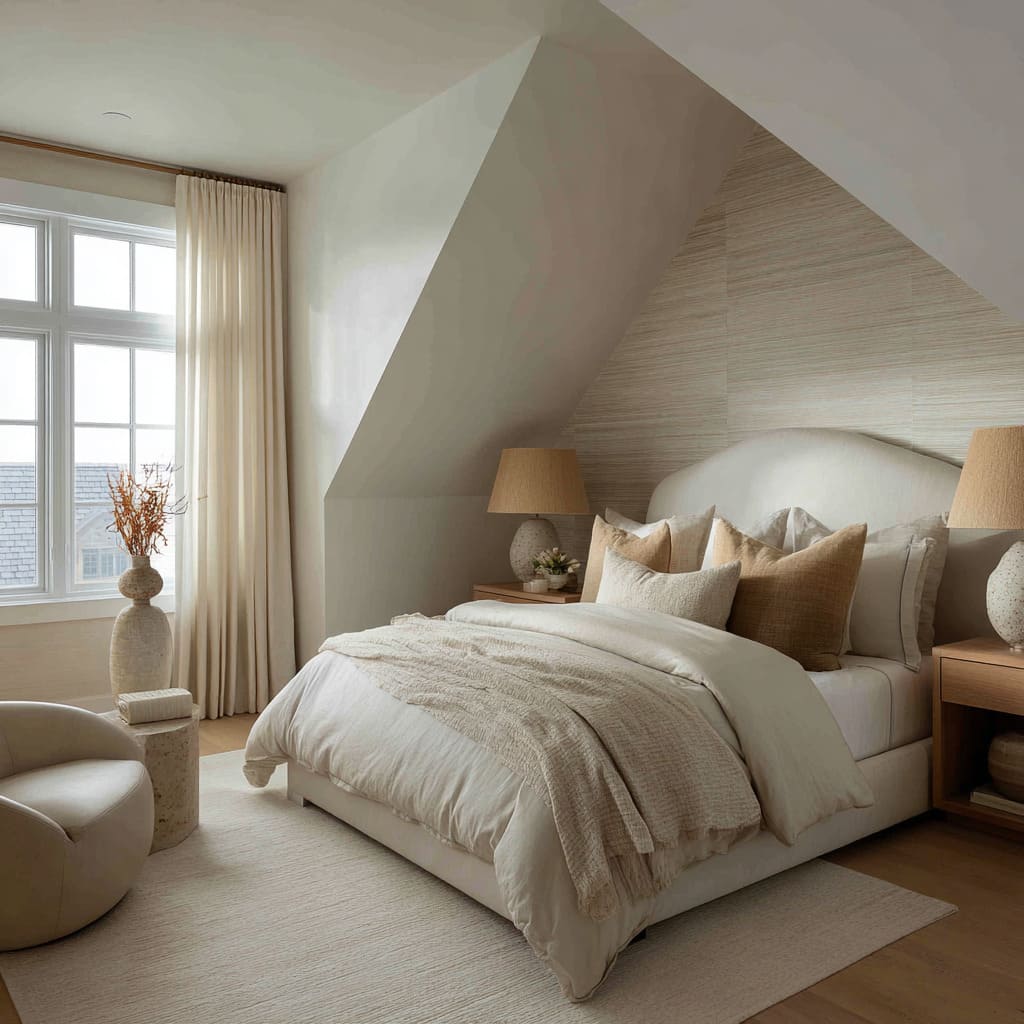
Sand paint can run over the walls and sloped ceilings, removing the usual line where roof and wall meet; the design behaves like a soft shell, and the angles become gentle folds instead of sharp breaks. In other ideas, the envelope is formed with material changes instead of paint shifts: vertical boards, shallow ribbed panels, or linen-effect wallcoverings sit in almost identical tones, so the eye notices depth and texture before it notices material borders.
Stone slabs in quiet sand veining stretch from floor to ceiling and read as part of this same envelope, especially when their bands are close to wall color. The overall effect is that sand becomes the “air” of the room, not a patch of color.
Furniture, artwork, and small objects operate inside that air, and because the background is this continuous, calm field, even very subtle moves in shape and texture start to feel important. The modern approach is less about a painted feature and more about a full-body skin in one hue family, tuned so that the volume itself feels padded, held, and visually quiet.
Temperature Bands of Sand and the Moods They Carry
Contemporary sand bedroom designs use temperature shifts inside the same color family to create very different atmospheres. Pale seashell sand with a slight gray cast sets up light that feels clear and airy, especially when paired with black window frames or misty beams; the room takes on a loft-like calm, where tree foliage and sky outside stand out as the main sources of color.
Neutral oat and stone shades form a second band, often used in suburban-feeling rooms where the goal is softness without any noticeable “tone. ”.
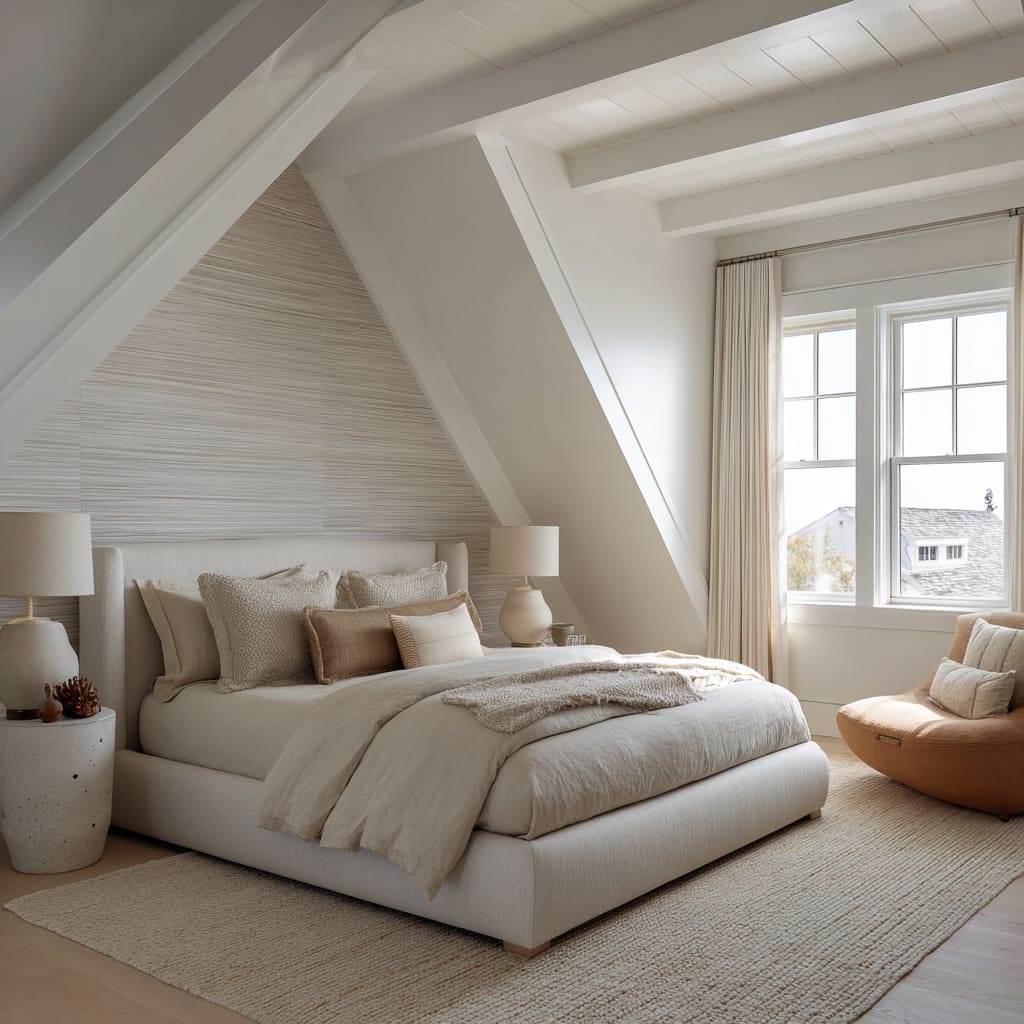
Here, walls, bedding, and rugs hover within a narrow spectrum, so deeper notes in wood and pottery become the natural anchors. A third band leans toward honey, wheat, and pale caramel.
Sand sits close to amber: travertine-like slabs glow under warm lamps, honey oak beams darken slightly at their edges, and the whole room feels closer to a desert canyon or late afternoon light. Rather than switching to obvious gold or brown, designers use micro shifts inside sand itself: cooler tones rise to ceilings and high walls, mid temperatures sit at headboard and bedding level, and the richer caramel notes appear in pillows, art, and ceramic pieces.
This layered use of temperature allows one palette to express coastal clarity, neutral serenity, or desert warmth without ever leaving the sand family, so the style remains modern, controlled, and cohesive.
Vertical and Horizontal Sand Lines as Silent Structure
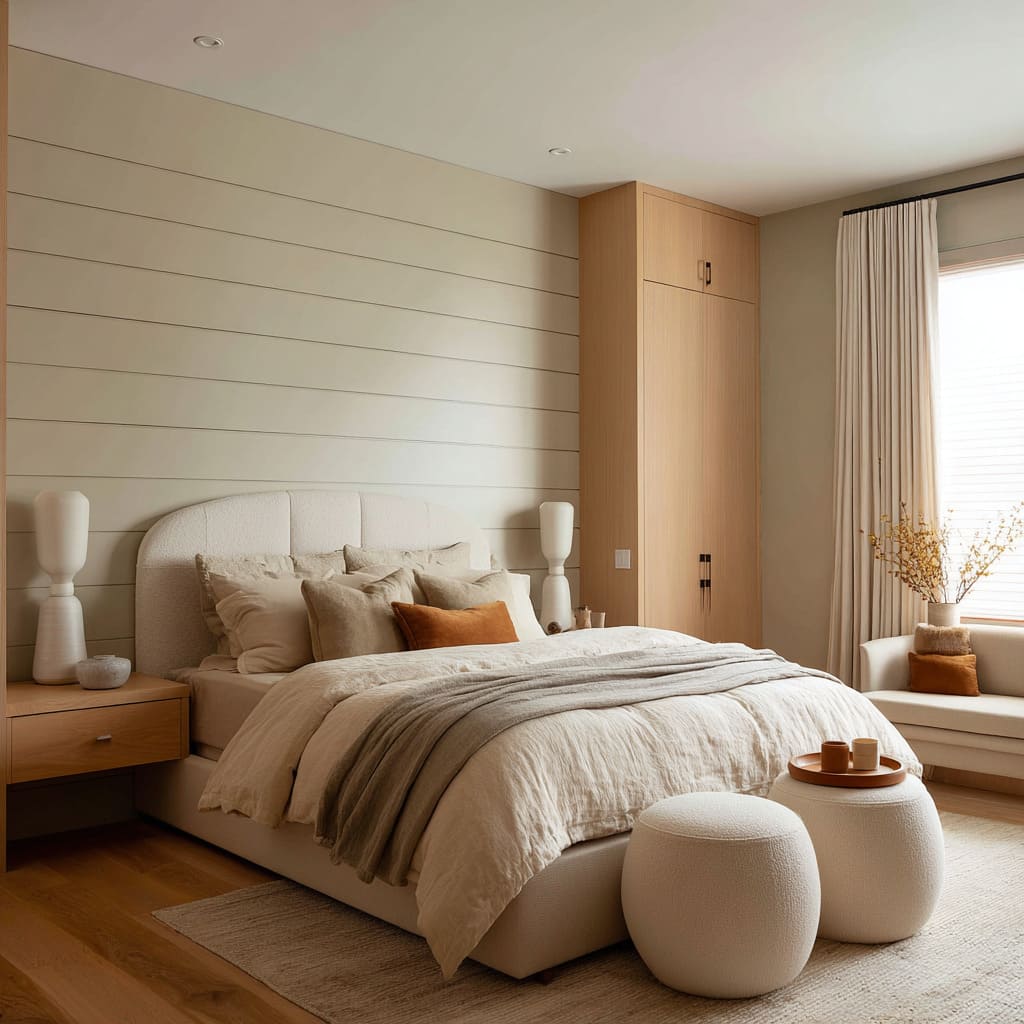
One of the most modern traits in sand-theme bedroom designs is the way lines silently organize space. Vertical systems—ribbed headboards, tall padded panels, narrow wall battens, full-height curtains—stretch the room visually and give the bed a strong “spine.
” They are often aligned with window mullions or wardrobe doors, so architecture, textile, and joinery share one rhythm. Horizontal systems work in counterpoint: stone veins running left–right, wide boards on headboard walls, long consoles under TVs, and low platform beds all lay down slow, calm lines that settle the volume.
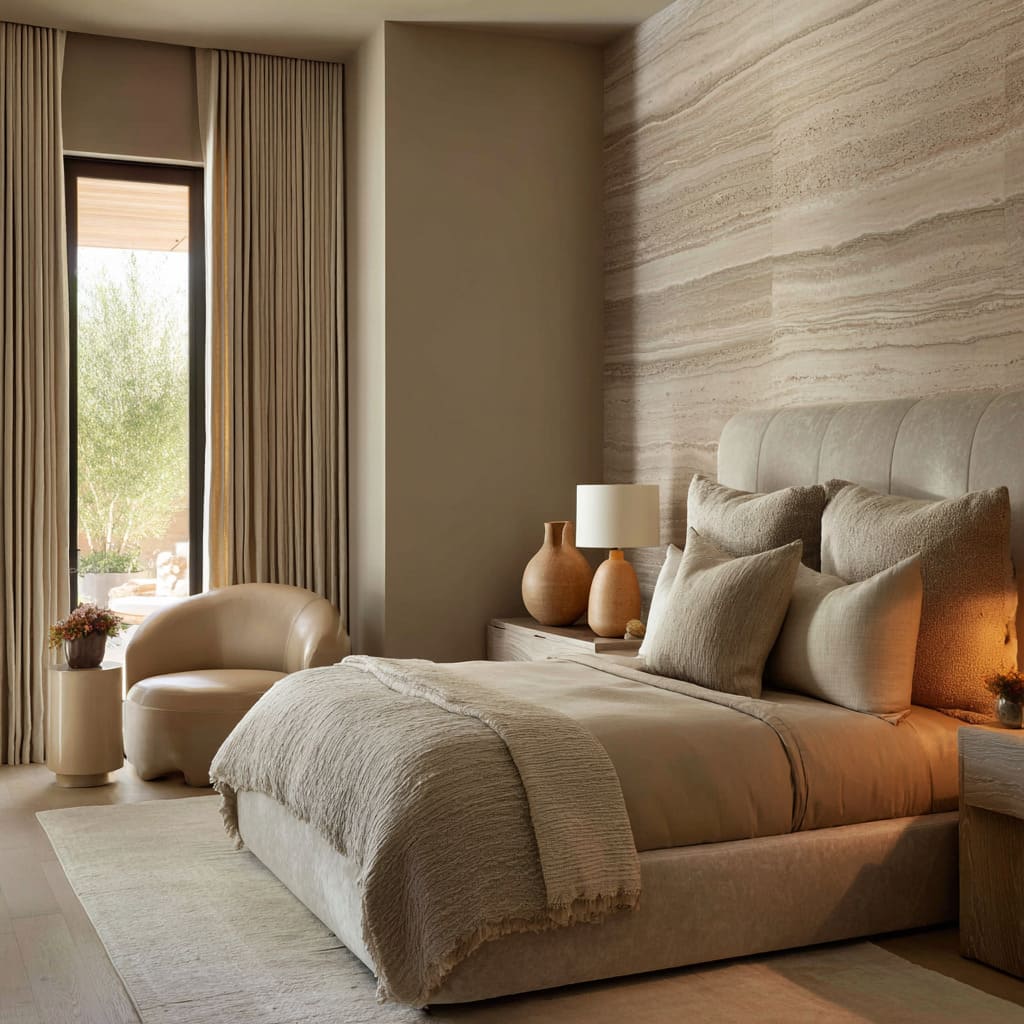
Together they form a kind of cross-weave. A room where the walls are stratified stone and the bed base runs as a thick sand bar at floor level feels grounded even if the ceiling rises high above.
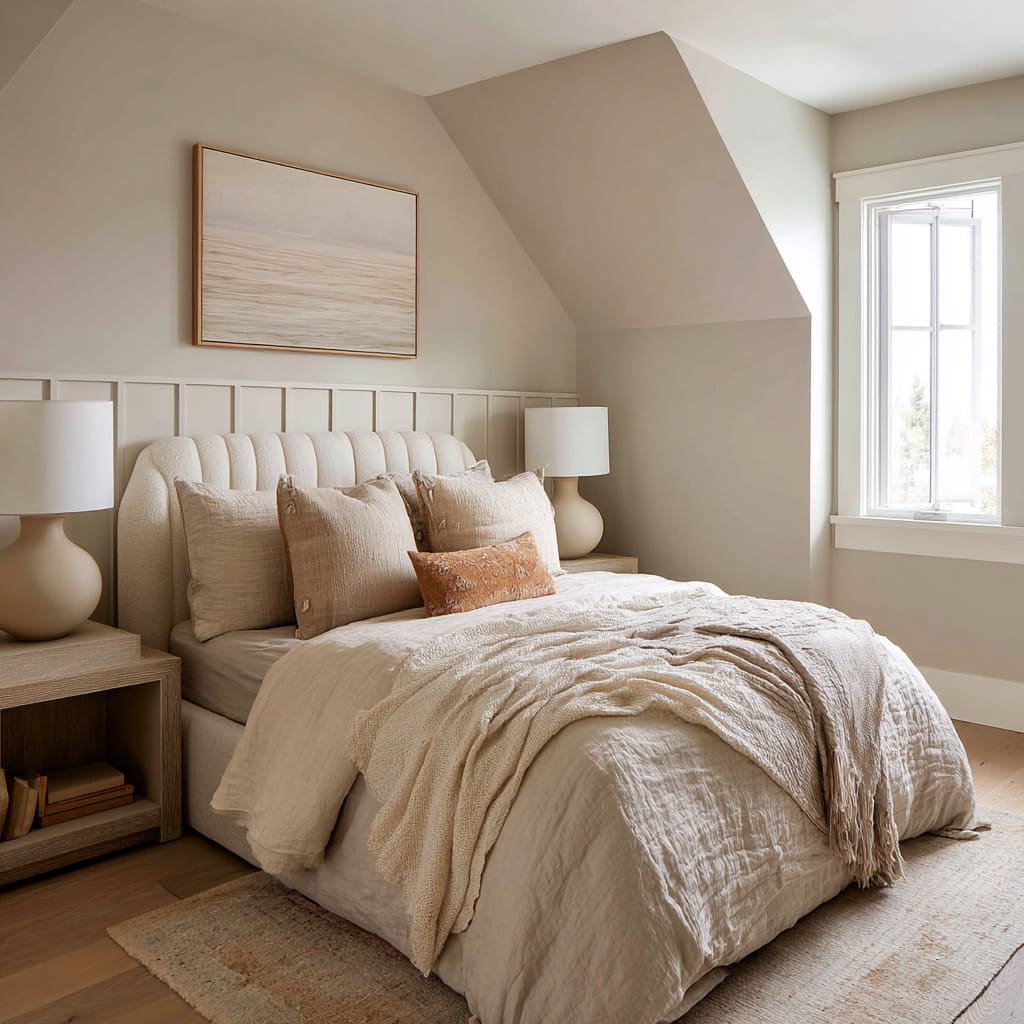
Another room where vertical wall boards sit behind the bed and a horizontal landscape painting floats above creates a quiet grid that tames a steep roof pitch. Because all of these lines live inside similar sand tones, they never read as aggressive pattern.
Instead, they control proportion and focus: they widen narrow rooms, lift low ceilings, and frame the bed as the clear center point. The contemporary approach here uses color and lines as structural tools, so that the room can host strong architecture, TV walls, and storage without ever feeling chopped or restless.
Texture Scale in Sand: From Stone Dust to Chunky Rugs
Modern sand bedroom ideas rely heavily on texture scale to avoid flatness while keeping the palette restrained. Instead of throwing in bold contrasts, they change the grain of surfaces.
Backgrounds carry the finest textures: linen-effect wallcovering, satin-smooth plaster, faint vertical grooves, or subtle gloss stripes. These micro patterns catch light just enough to keep walls from feeling blank, but they never shout.
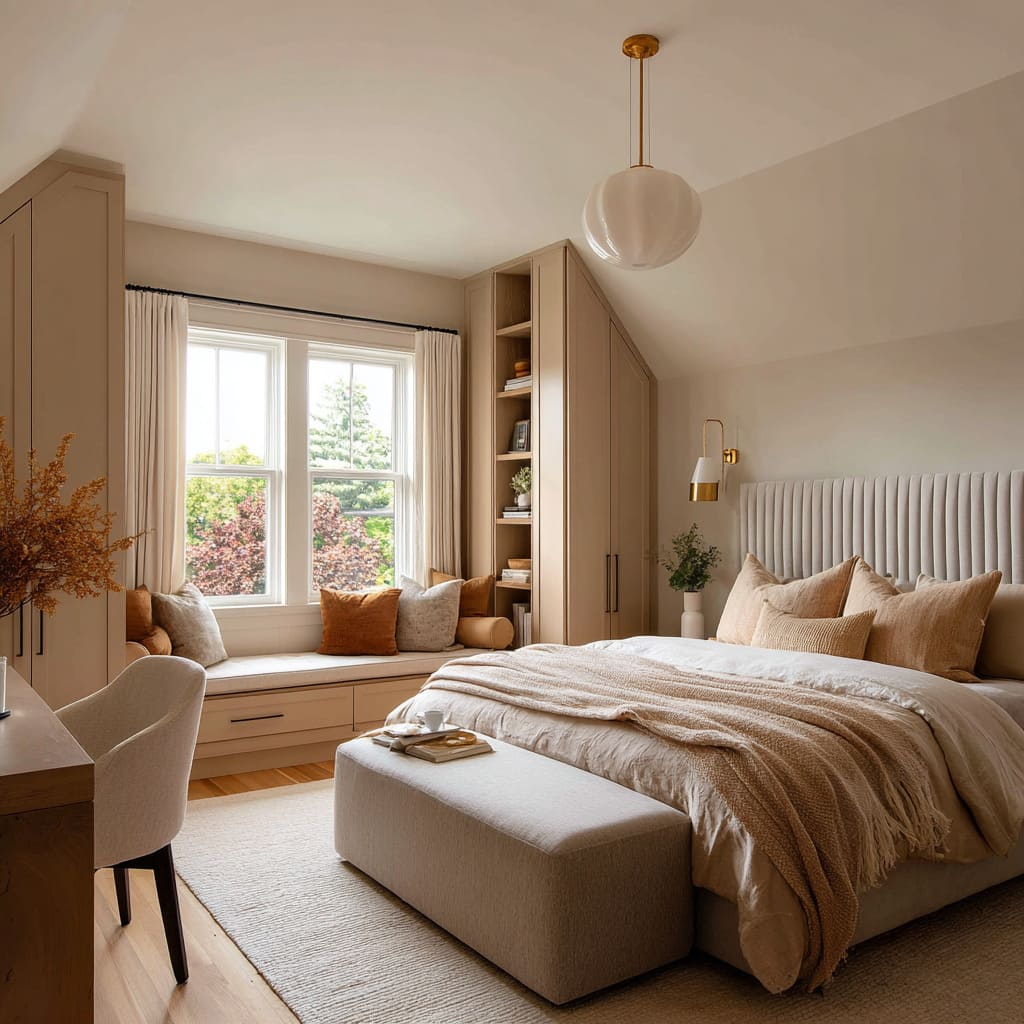
Mid-scale textures sit where hands and bodies touch. Headboards in bouclé or heathered weaves, linen duvets with gentle crinkles, and nubby throws with soft fringe all build a second layer of tactile depth.
The eye reads these surfaces as soft, but it is the hand that would feel the real difference between them. At floor level, the largest textures appear: heavy woven rugs in oat shades, braided or looped underfoot, often covering most of the visible floor; ribbed rugs whose fine ridges run parallel to the bed; and thick knit throws that spill off the mattress and down toward the ground.
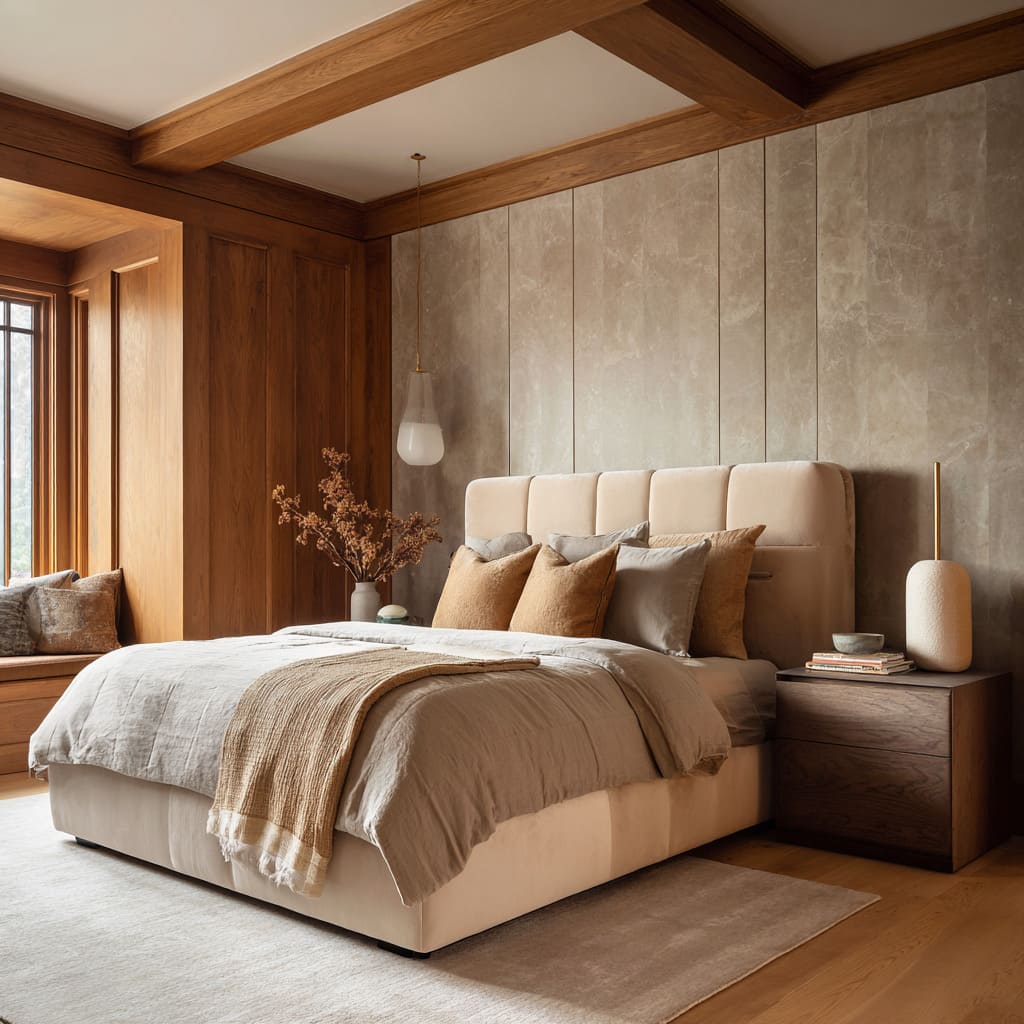
A simple way to see the hierarchy is:.
- Background: fine grain (wall panels, faint stripes, soft stone veining)
- Mid-body: medium grain (bouclé headboards, linen, textured throws)
- Ground: large grain (chunky rugs, strong weaves, braided mats)
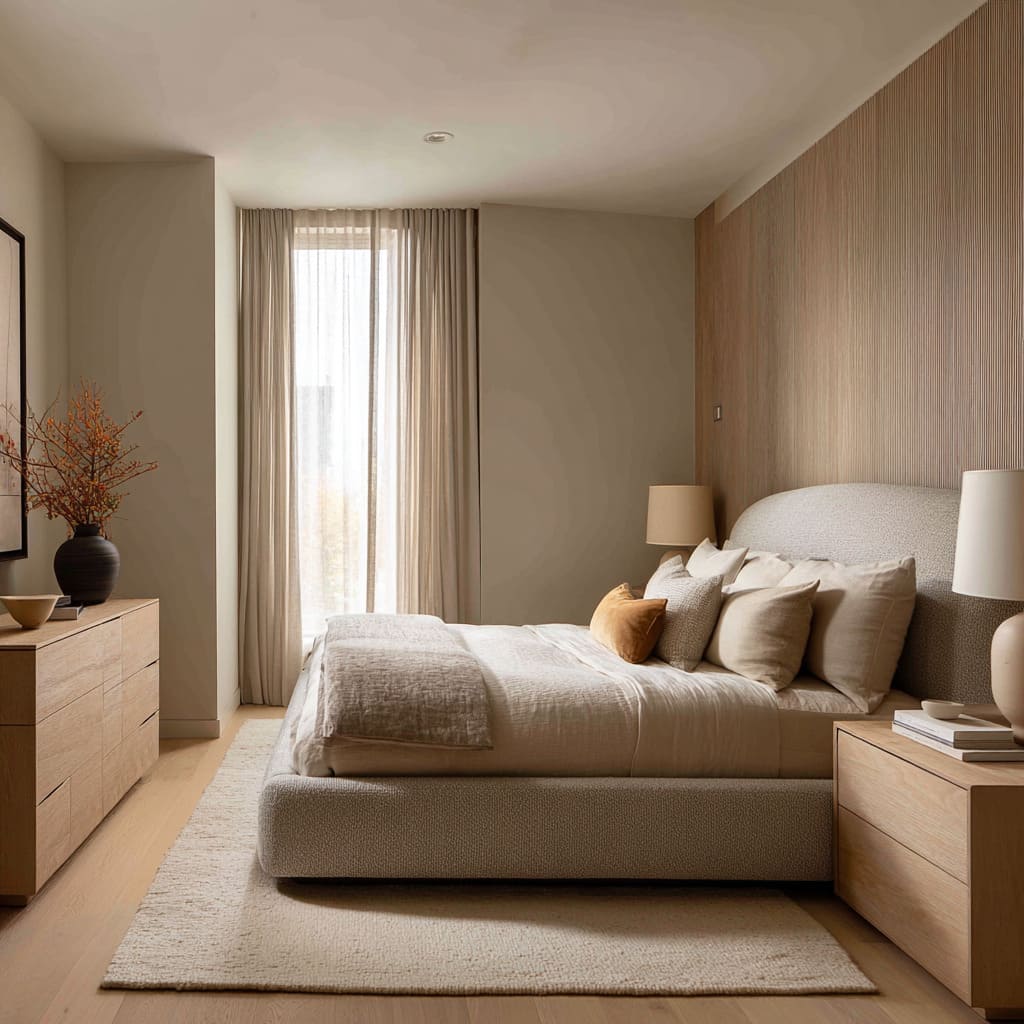
Because almost all of these surfaces live within sand and off-white, the room feels rich but not noisy. That layered texture is doing the visual work that pattern or strong color contrast would normally do in more traditional schemes, and it gives the palette a contemporary quiet luxury character.
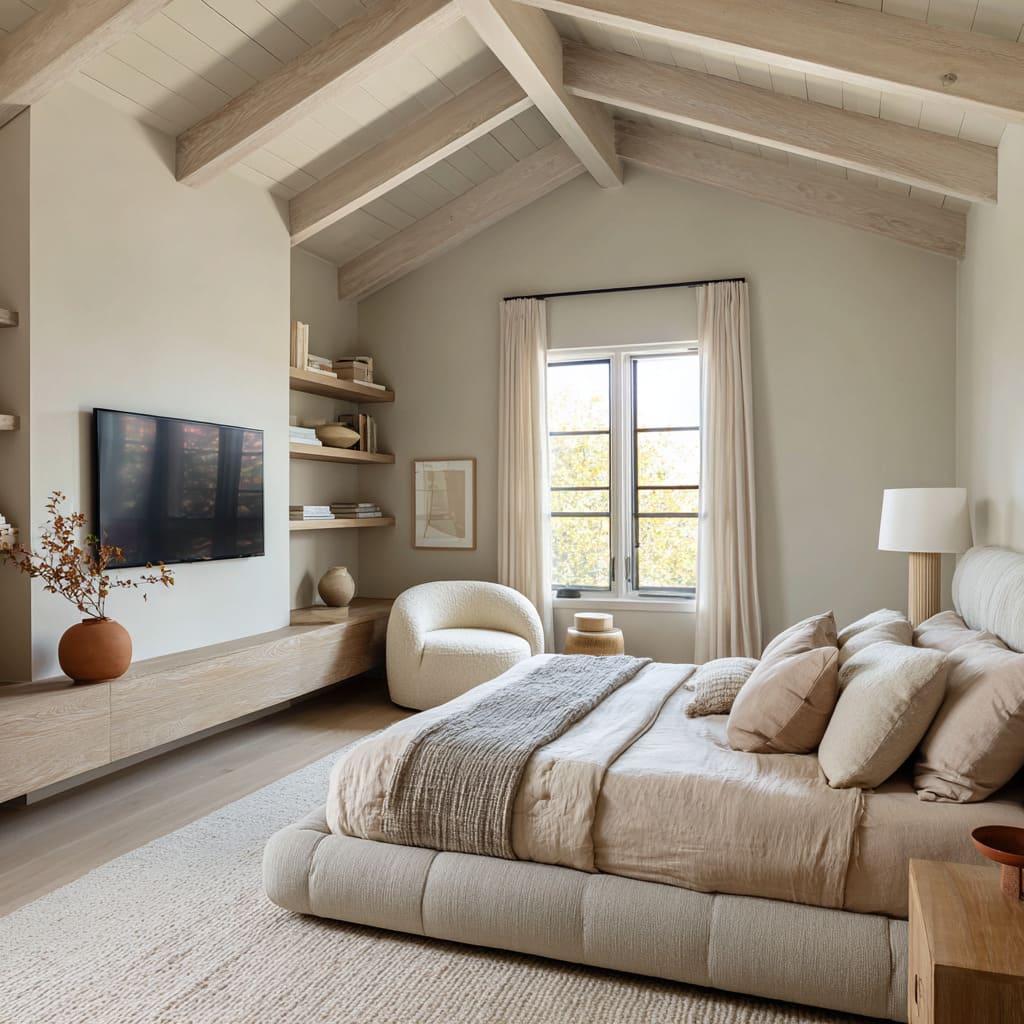
Soft Sand Volumes: Beds and Chairs as Sculpted Topography
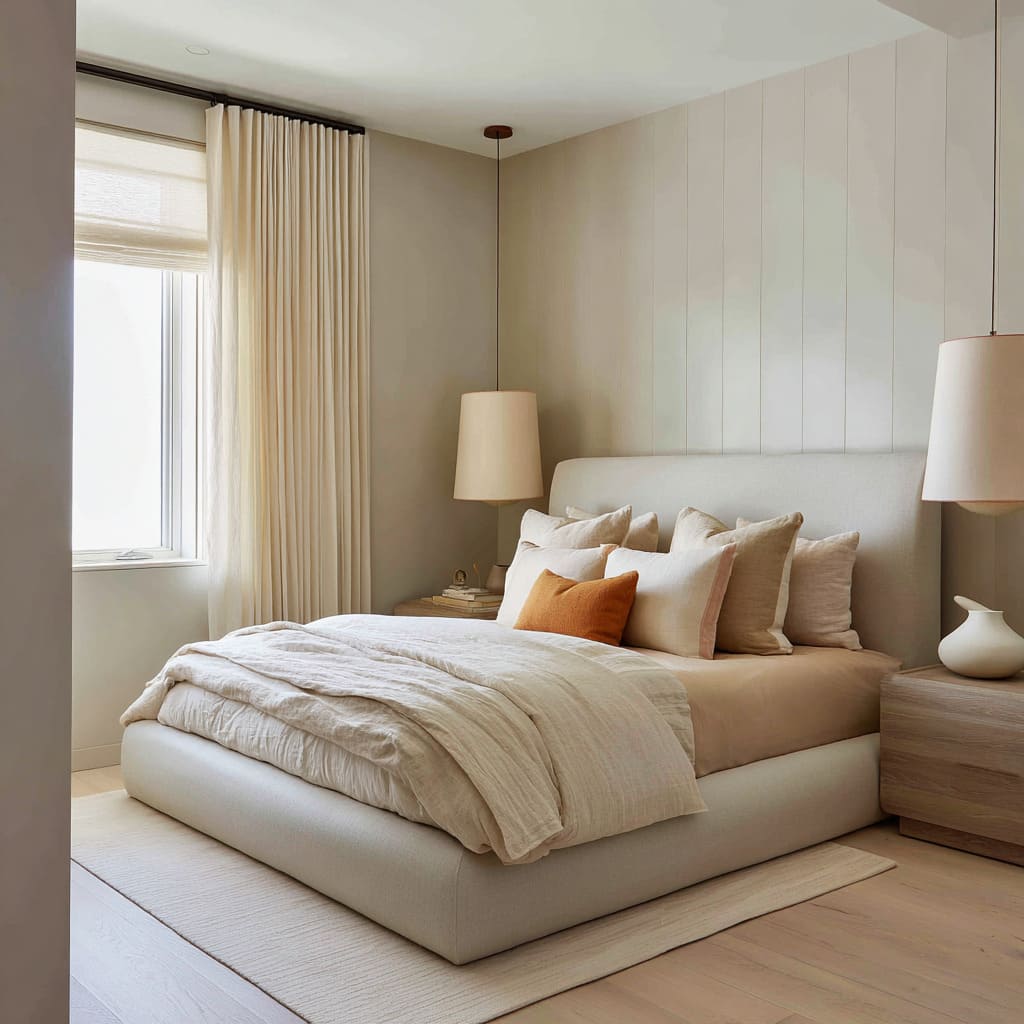
Furniture in modern sand designs often reads less like separate objects and more like sculpted topography inside a larger sand landscape. Low, fully upholstered beds with thick bases and rounded corners appear again and again, wrapped in bouclé, tight linen, or smooth stone-toned fabric.
Their sides are sometimes channel-tufted in horizontal bands, so the bed becomes a stack of padded “steps” linked to the architecture around it. These forms sit close to the floor and often touch a pale rug with no visible legs, which makes them feel like padded platforms rising gently out of the room’s surface.
Lounge chairs follow the same language: swivel seats shaped like pebbles, deep bouclé shells near windows, compact chairs with curved backs and no sharp corners. Small stools at the foot of the bed repeat this geometry as barrel forms, upholstered cylinders, or rounded ottomans.
Side tables are equally simple: stone or stone-look cylinders, timber plinths, and smooth discs in pale sand.
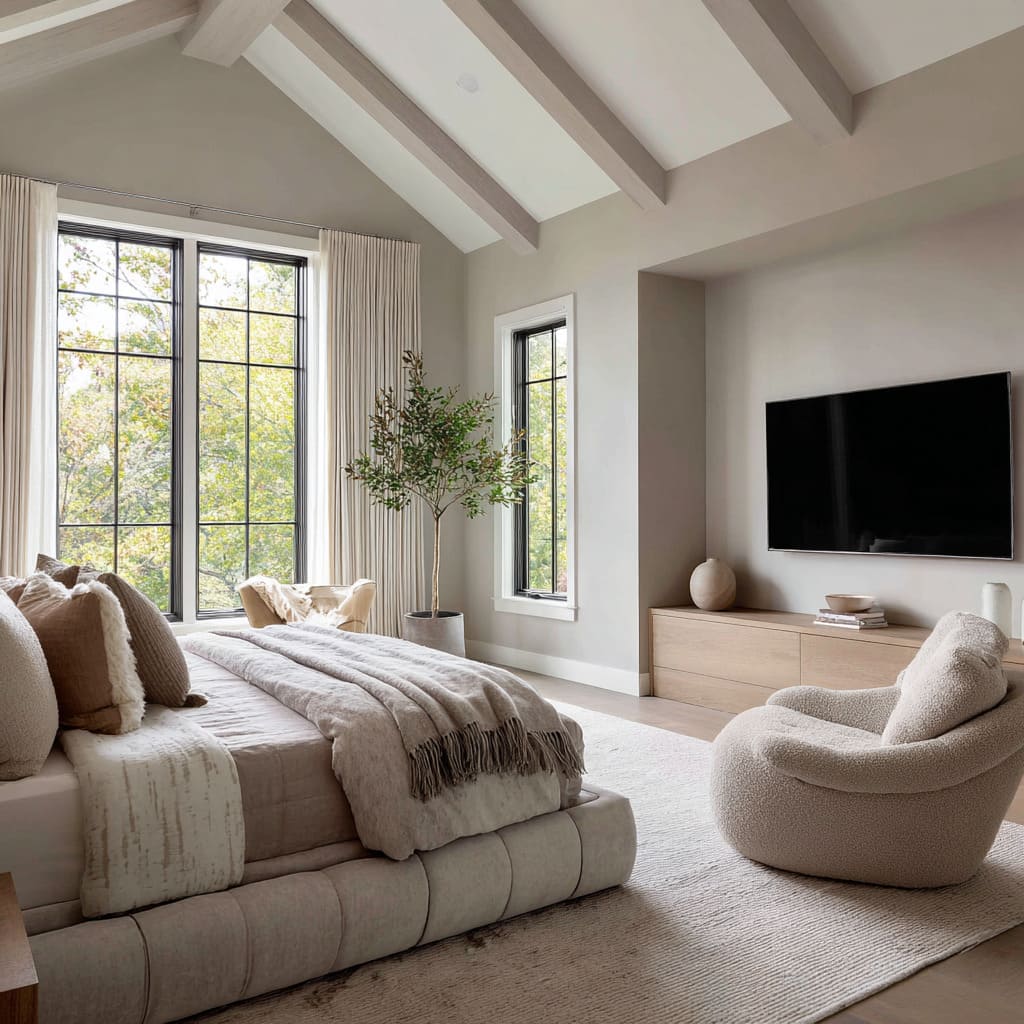
Taken together, these elements create three-dimensional “soft geography” inside the sand envelope:.
- Beds as broad, low plateaus
- Chairs as rounded boulders
- Stools as smaller stones or mounds
- Side tables as carved blocks or columns
Because color contrast is minimal, the room expresses itself mainly through these volumes. The modern approach favors fullness over spindly legs, and curves over ornate carving, letting sand act as a single material translated into different shapes and thicknesses rather than as a paint color applied over unrelated furniture.
Accent Color as Thread, Not Splash, in Sand Bedrooms
Contemporary sand-theme bedroom designs handle accent color with unusual restraint, turning it into a subtle thread that runs through the room rather than a loud splash. Deep tones like rust, camel, and terracotta rarely appear on large surfaces.
Instead, they show up in compact but strategic touches: a single lumbar cushion at the center of the bed, a matching pillow on a window seat, a ceramic vase on a console, the shade of a pendant over the nightstand, or the frame of a large picture window.
These small areas of color create triangles of connection:.
- Warm triangle:
- Rust cushion on the bed
- Clay pendant shades at each bedside
- Terracotta vases on a nearby console
- Camel lounge chair near the window
Black is often used not as a mood color but as outline: window frames, TV screens, tiny hardware, slender rods for curtains. Because all of the surroundings sit in sand tones, these dark lines behave like ink drawings inside a pale composition, giving clarity but not changing the palette.
Green appears mostly through plants or views of trees and desert shrubs outside; it becomes a live accent, often the only cool hue in an otherwise warm room. This controlled color strategy fits modern sensibilities: sand holds almost everything, and accent tones touch just enough surfaces to link bed, seating, storage, and landscape into one continuous color story without any single object trying to dominate.
Sand as a Way to Calm Sloped Roofs and Attic Geometry
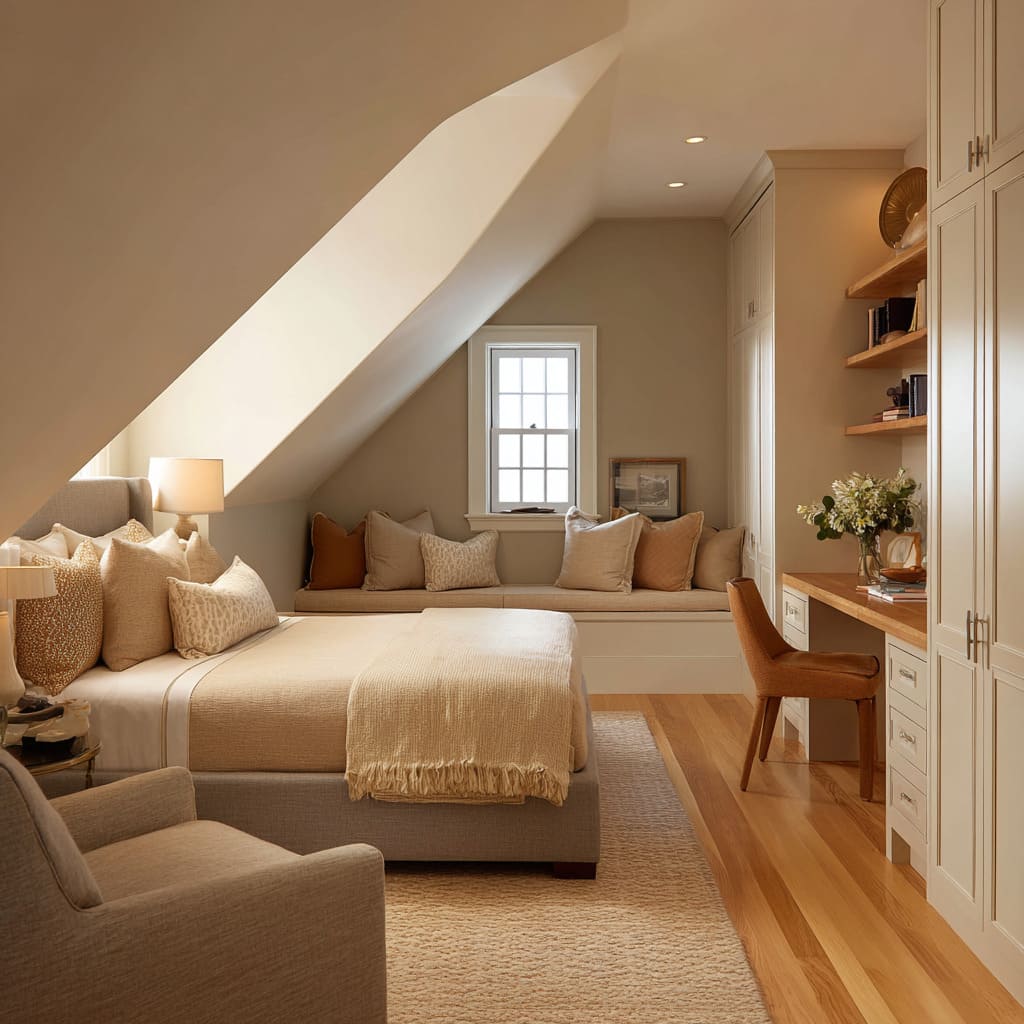
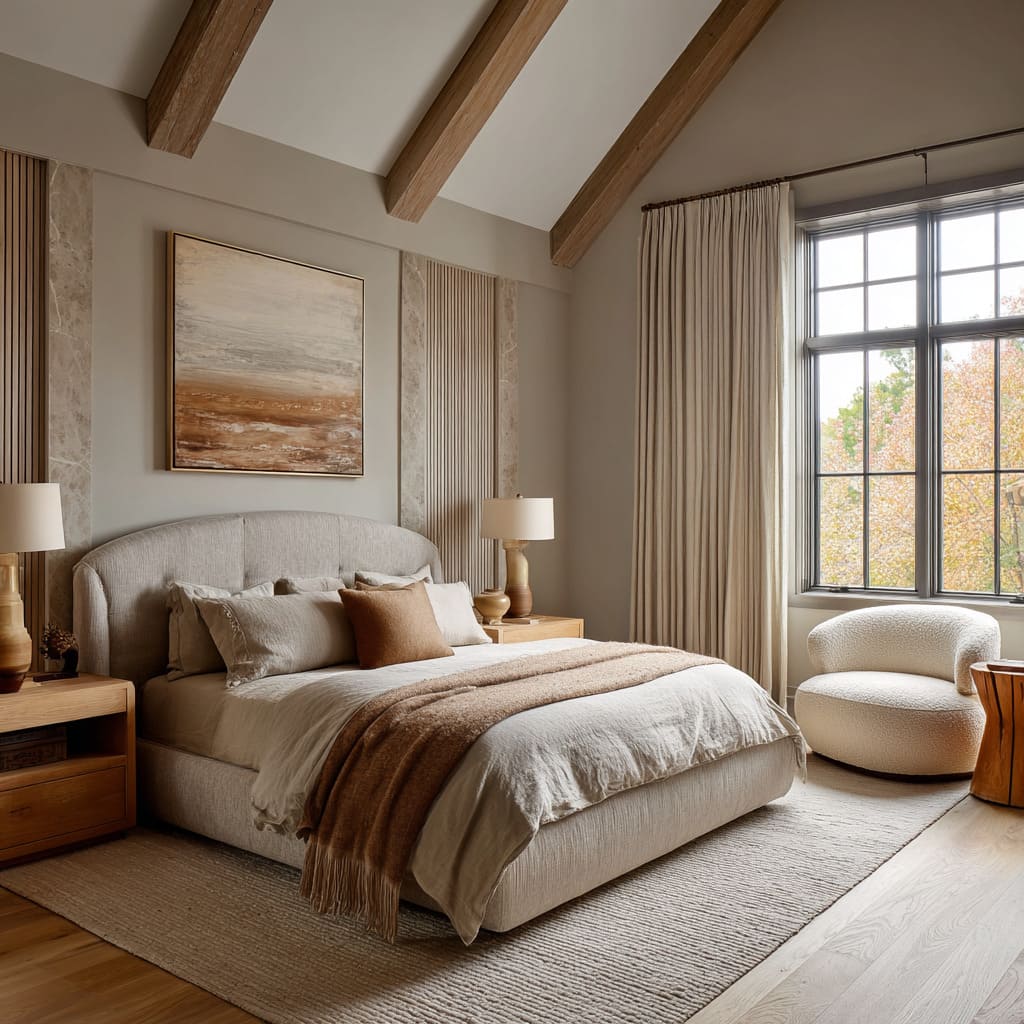
When bedrooms sit under pitched roofs, in spaces that could easily feel chopped or awkward, sand becomes an important tool for calming those shapes. When sloped ceilings and upper walls share the same pale sand or greige tone, the break between vertical and angled planes softens; the room feels wrapped rather than sliced.
The bed here can have its own vertical base inside this wrap: narrow ribbed boards, shallow paneling, or padded headboard walls run up to a chosen height, then the roof continues above in smoother paint. The headboard and its backdrop become a clear rectangular zone inside the angled volume, so the bed looks anchored instead of pushed into a corner.
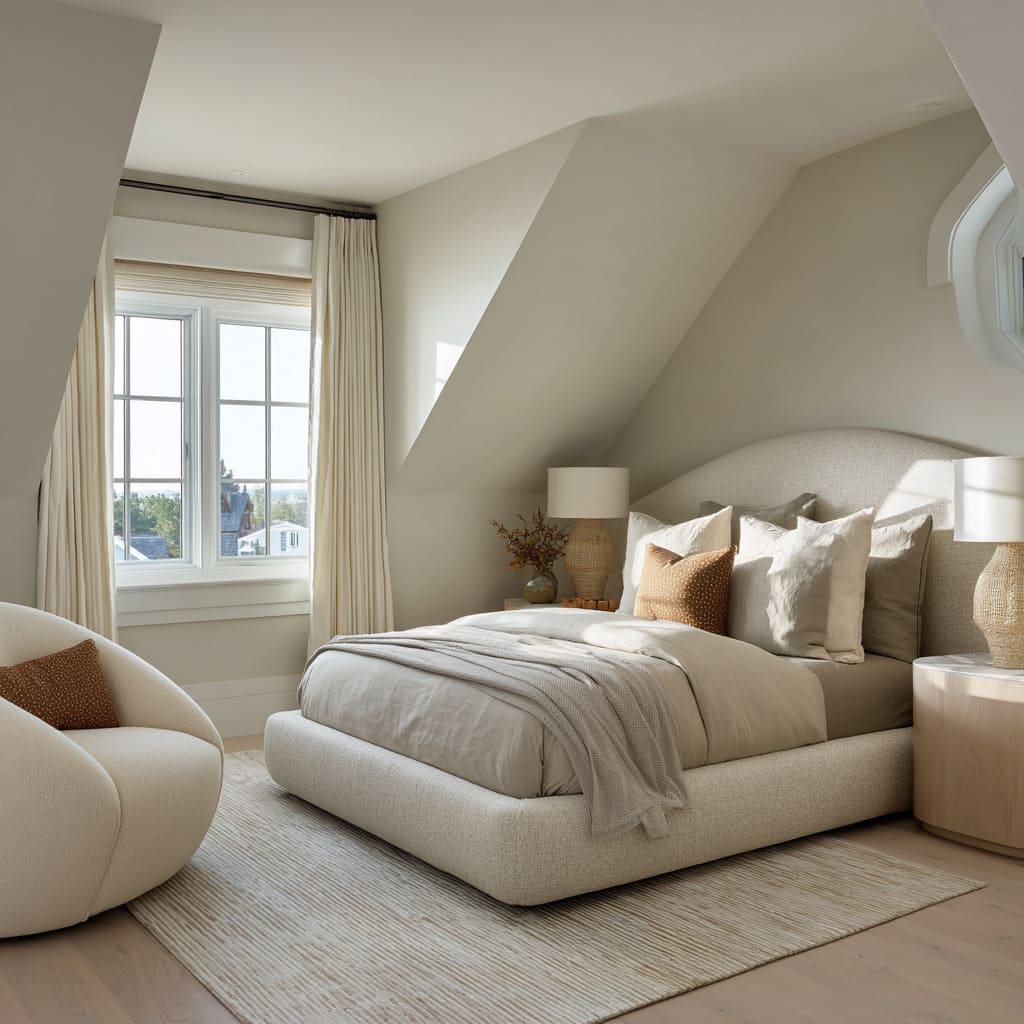
Beams in slightly darker, weathered oak help sketch structure without harsh contrast; their cool brown or gray undertone pairs with greige walls or gray-sand throws on the bed so the upper half of the room forms a quiet, unified “frame. ” Along low knee walls, long benches and desks in sand or light wood run horizontally, turning what might have been empty or awkward space into integrated seating or work surfaces.
Cushions and pillows on these benches repeat the tones of bedding and accent cushions, bridging functions and dissolving architectural oddities. The result is that the eye reads the entire attic shell as a single, soft chamber with a few clear vertical moves around the bed, instead of seeing a collection of difficult corners.
Sand Bedrooms as Multi-Use Suites Held Together by One Palette
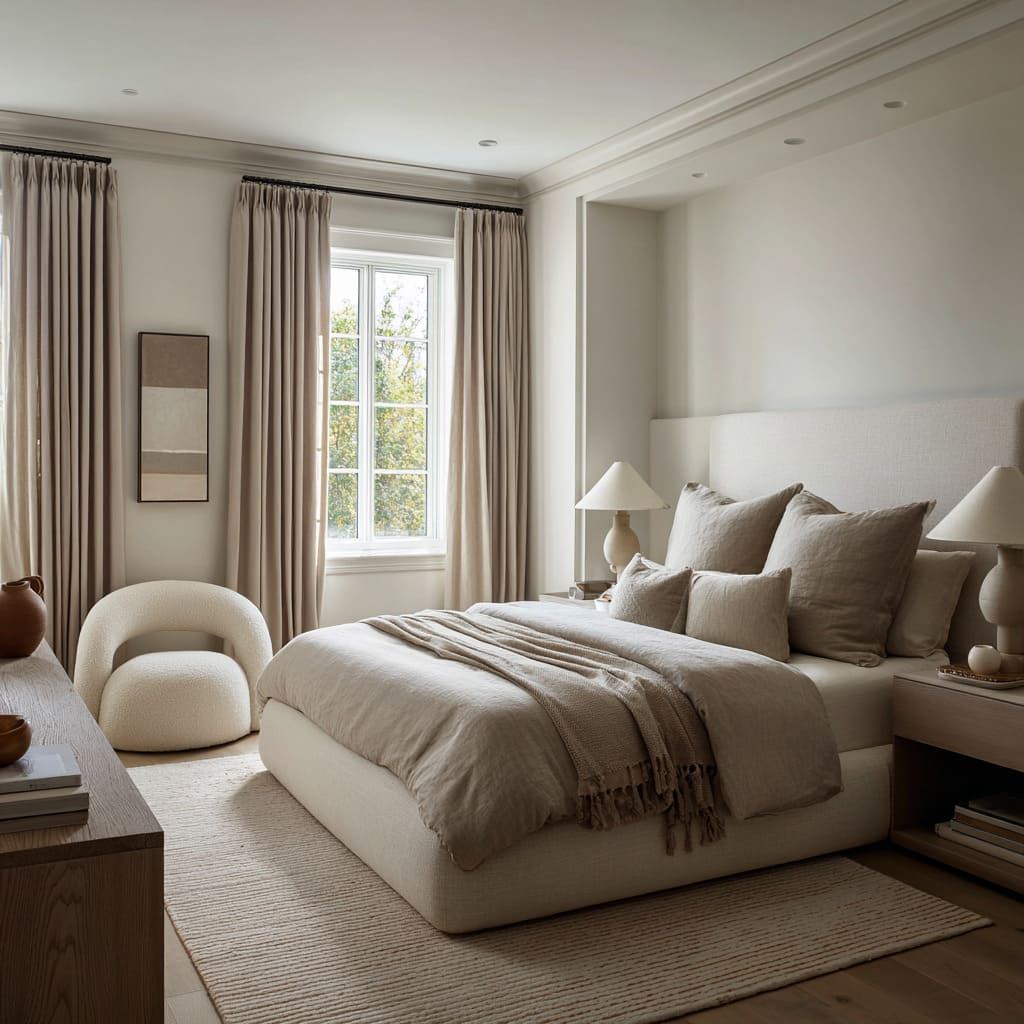
Desk zones, window seats, reading benches, and long storage runs can be folded into the same room, and sand is what keeps all these functions from feeling like separate rooms squeezed together. Cabinetry around the bed—wardrobes, open shelves, integrated desks—tends to share a greige or pale sand finish, sometimes two or three steps darker than the walls but within the same family.
The bed’s textiles then pick up a lighter or slightly cooler sand variant, while window seats and benches match the warmer tones in the floor or wood banding. A repeating cast of materials helps glue the program together:.
- Ribbed or paneled headboard walls echo plank doors on wardrobes
- A rust cushion on the bed repeats on the window bench
- Bouclé on a chair near the TV echoes bouclé on stools or bed bases
- Timber desk tops match ceiling beams or long consoles
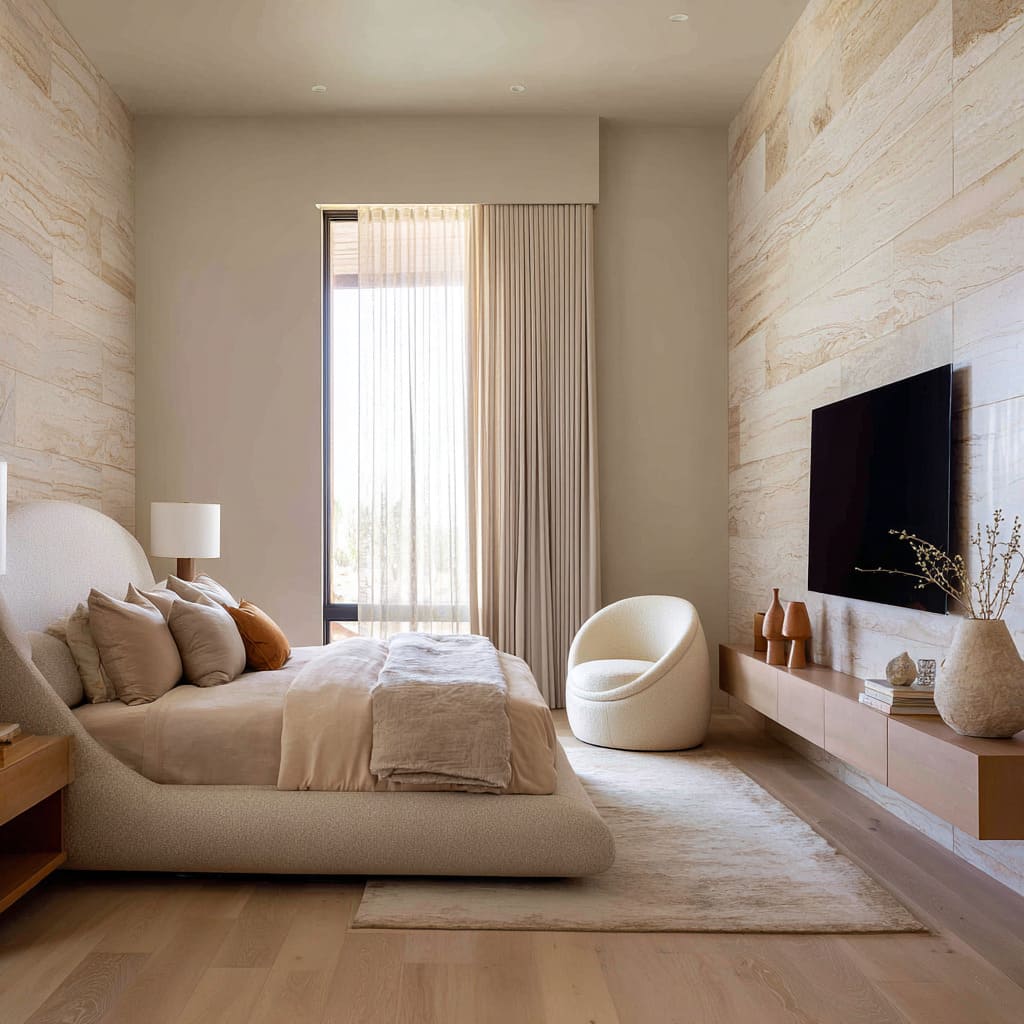
Lighting also plays a stitching role. Pendant lamps over nightstands might share a shape or finish with a brass desk lamp; wall sconces near the bed repeat the metal used in small shelf brackets or hardware.
Because all of this sits inside a sand envelope, the room can hold the activities of reading, working, sleeping, and lounging without visual noise. The layout may be busy, but the eye experiences it as one soft, continuous environment in oat, stone, and caramel tones, with work tools, books, and personal objects sliding almost quietly into place.
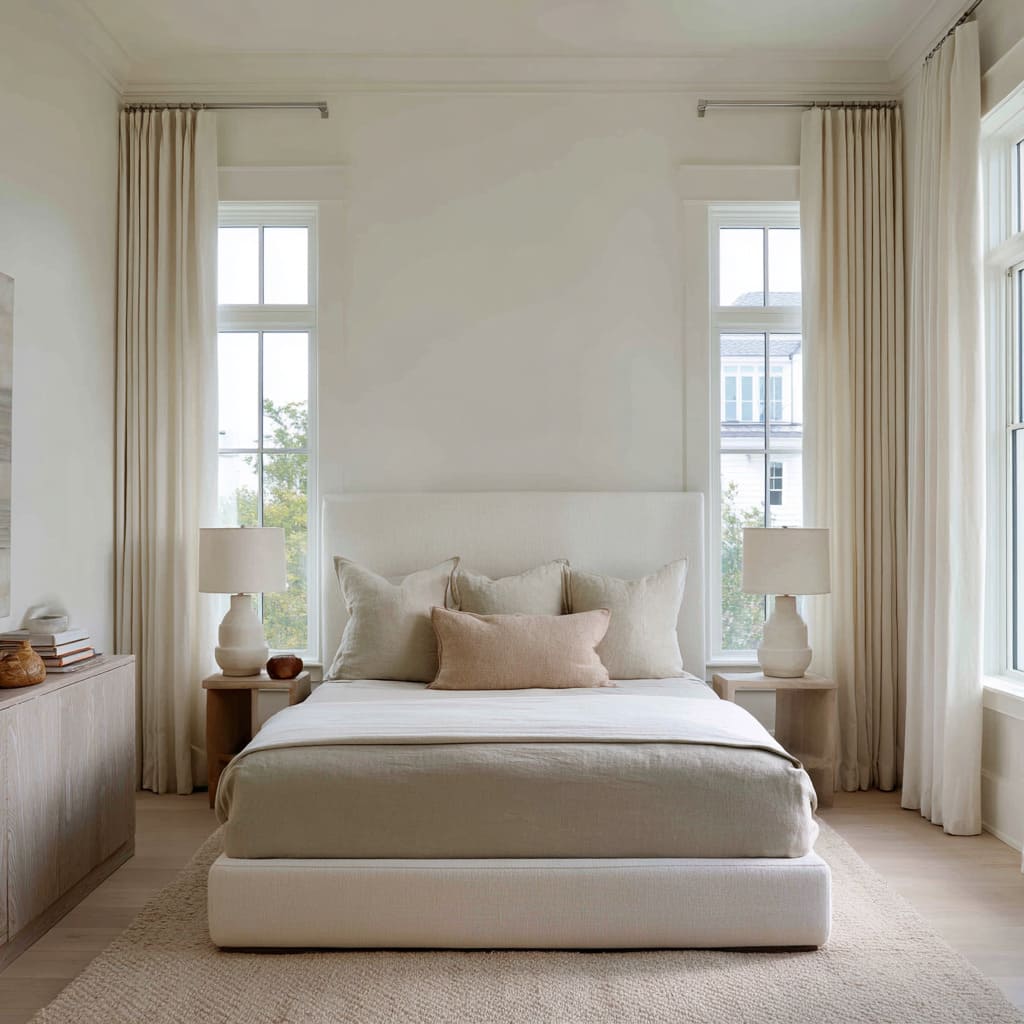
Light as a Partner to Sand: Daylight Columns and Lamp Glow
Light is one of the most important partners to sand, and the palette is tuned specifically to respond to different kinds of light. Daylight enters through tall windows, often with slim black or dark wood frames, and passes first through sheer curtains in off-white or pale sand.
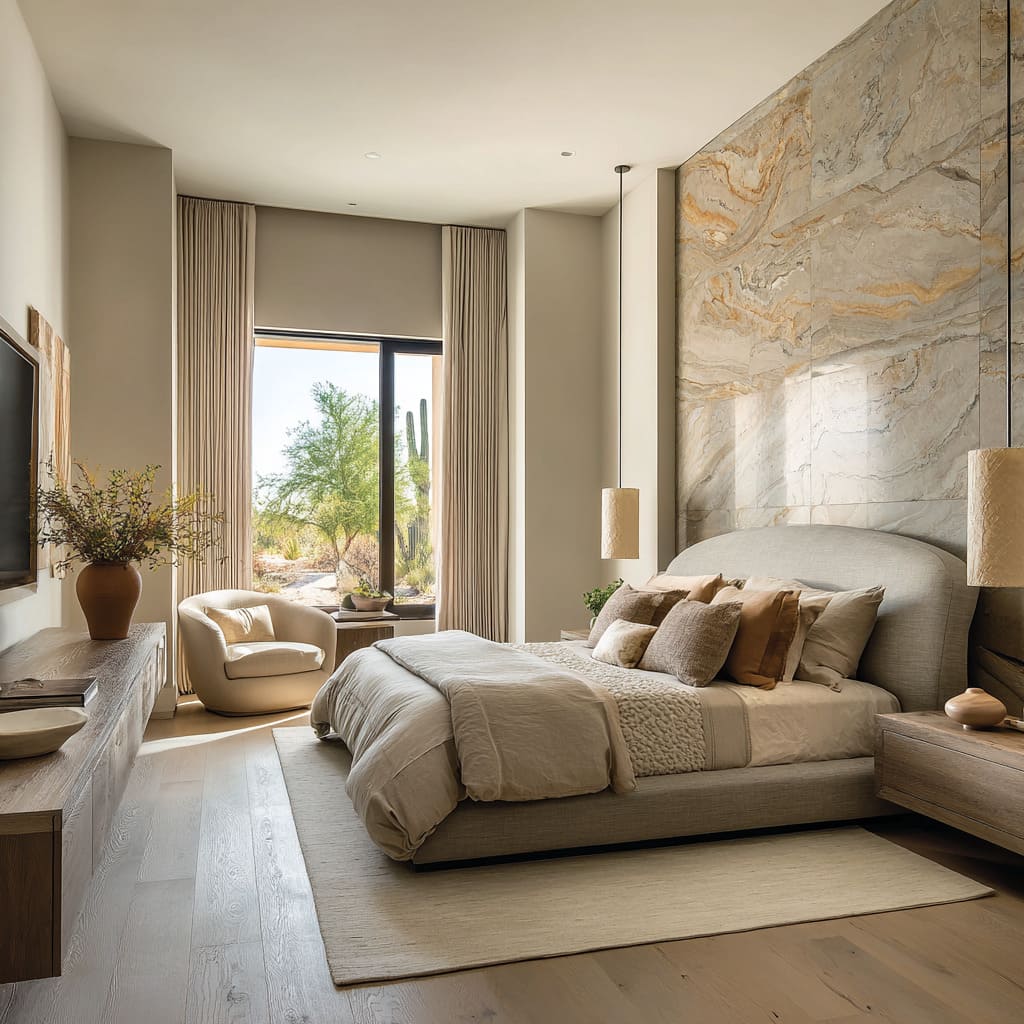
Those sheers turn daylight into vertical bands of soft brightness instead of hard beams. In rooms where stone feature walls sit opposite windows, the veins and bands of the stone catch this filtered light, each stripe brightening or dimming slightly, so the wall behaves almost like a large, calm painting.
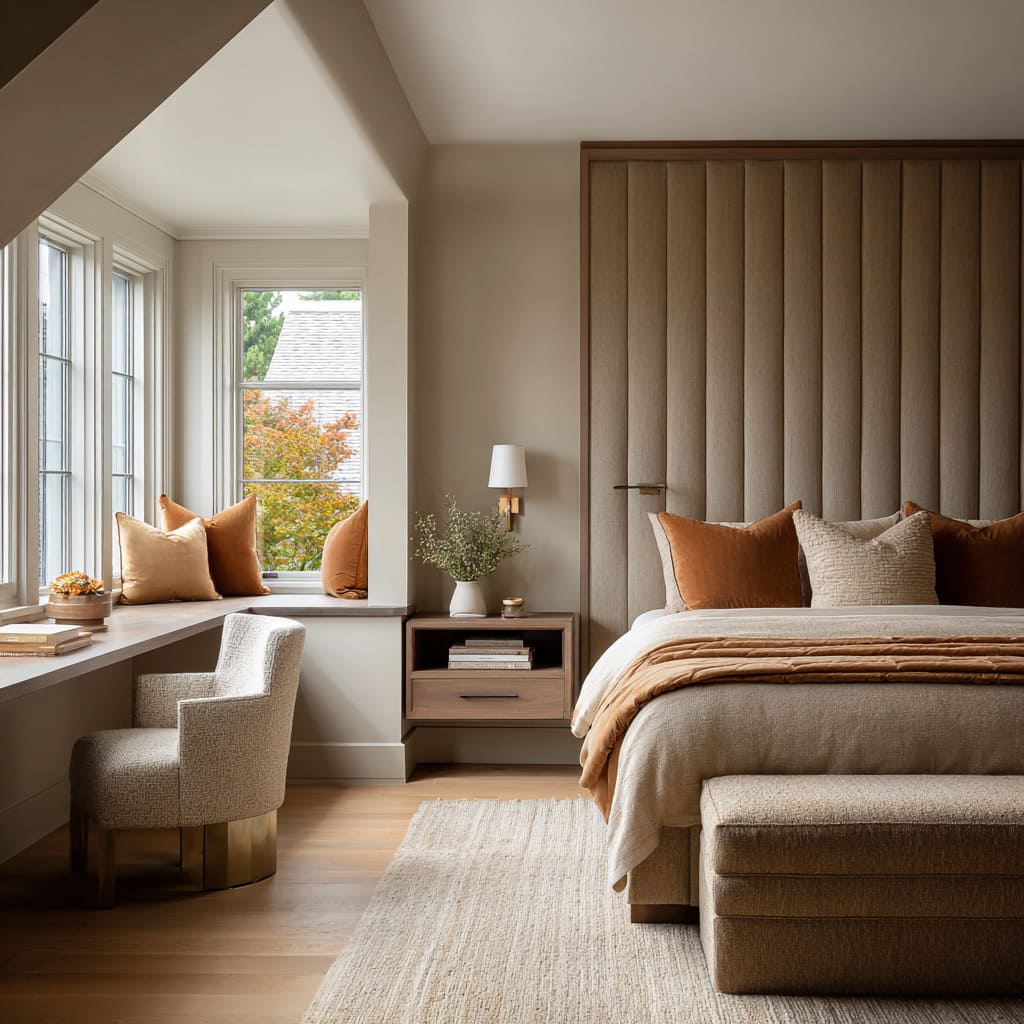
Full-height drapes in creamy sand frame the sheers and add another vertical rhythm, matching headboard panels and cupboard lines around the bed. When lamps take over in the evening, warm-toned shades—parchment pendants, linen drums, fabric cylinders—cast local pools of light onto sand textiles and bouclé chairs.
Pendant lamps hung low on each side of the bed create two vertical columns of glow that flank the headboard and turn that area into a soft focal plane. Table lamps with rounded ceramic bases and matte sand finishes read like small sculptures by day and gentle suns by night.
Because walls and ceilings sit in light greige and off-white, lamplight bounces softly, filling corners without strong hotspots. The palette is chosen so that under daylight, sand feels refined and airy, while under lamplight it deepens into honey and clay, giving the same room two distinct moods without any change in color recipe.
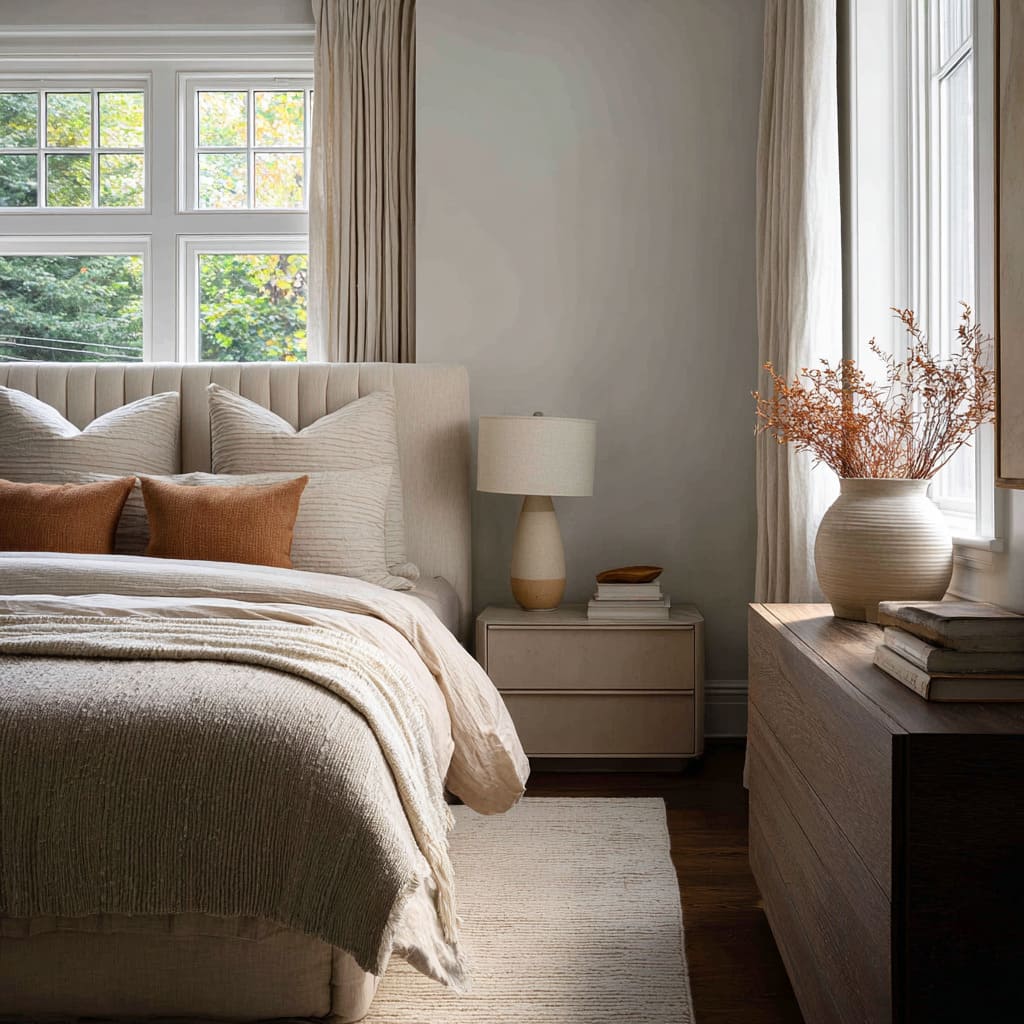
Controlled Sand Palettes with Small Signs of Life
Despite their careful control and neutral focus, modern designs avoid looking static. Small clues of human presence are threaded through the sand compositions, and they carry more weight precisely because the background is so calm.
Throws are frequently placed casually along one side of the bed or draped diagonally over a corner, with fringed edges allowed to trail toward the floor. The folds and slumps feel intentional and stand out against the otherwise disciplined geometry of panels and beams.
Books appear in tiny stacks on nightstands, in open cubbies, on consoles, and along bench backs; their neutral covers maintain the palette, but their edges and spines create small horizontal rhythms and stories of use.
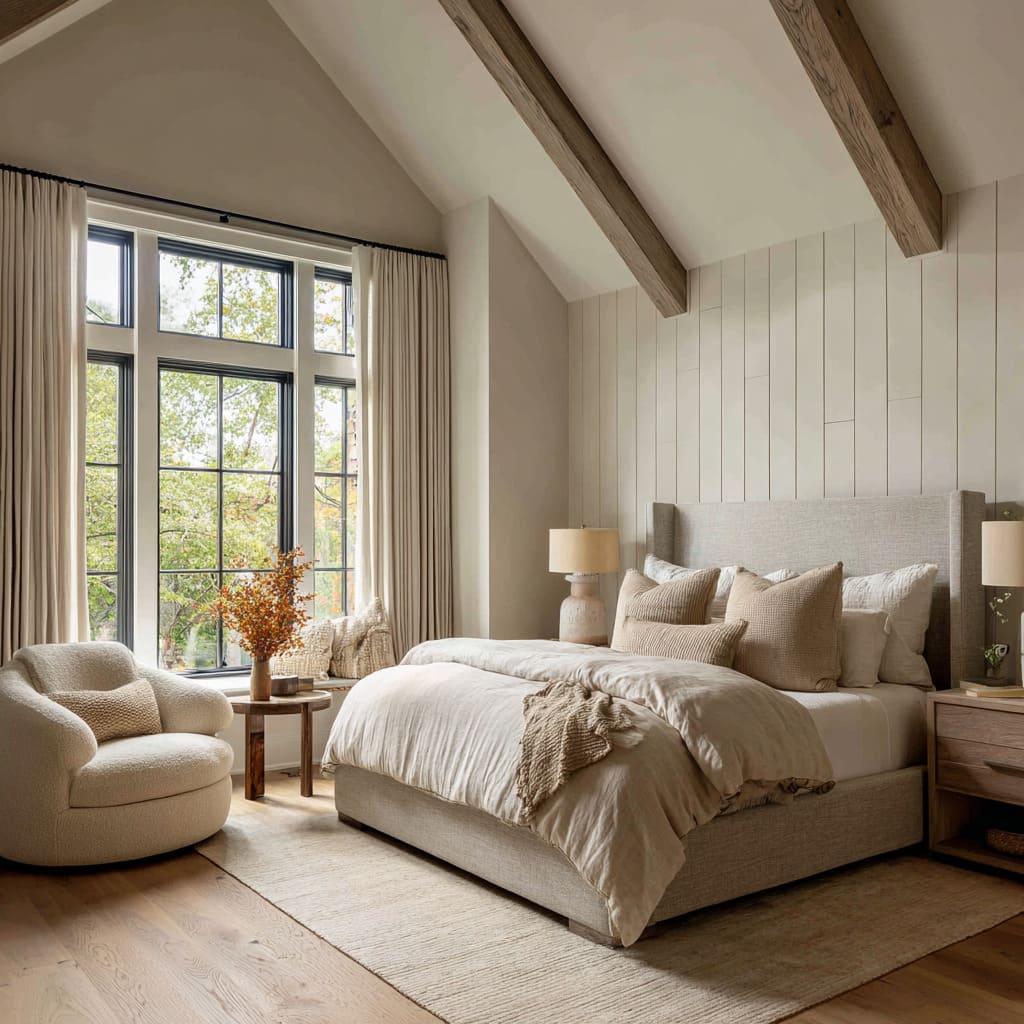
Shallow dishes on bedside tables hint at jewelry or keys; cups and trays on benches suggest slow mornings; pastries on a desk or window seat indicate that work and rest blend quietly in the space. Seasonal details show up in pinecones, dried stems with autumn tones, or a single branch in a rounded vase.
These elements echo outdoor foliage—trees with shifting leaves, desert shrubs, or soft rooftop views—and make the palette feel connected to time as well as space. Left–right symmetry is often broken slightly: one side of the bed might hold a solid stone cylinder, the other a floating shelf; one nightstand sees a tall lamp with books, the other only a vase and a cup.
In a strict color scheme, those tiny imbalances keep the room from feeling overly staged and help sand register as a living backdrop rather than a showroom finish.
Sand Bedrooms and Landscape: Coastal, Urban, and Desert Readings
A final aspect of modern sand-theme bedroom designs is how strongly they respond to the implied landscape outside, even when that landscape is only hinted at. In designs with cooler sand and greige shells, black-framed windows, and views of trees or muted rooftops, the palette behaves like soft city light: the greens outside become the main emotional color; interior sand feels like mist or stone, and the space reads as an elevated, quiet refuge in an urban setting.
In designs where stone feature walls carry warm veining and outdoor scenes show rocky gardens, cacti, or dry shrubs, sand moves into a desert register. Here, travertine-like surfaces and terracotta objects echo the ground outside, and clay pendant shades feel related to the earth.
In more timber-framed rooms, with honey oak beams, thick wood paneling, and views of loosely defined countryside or distant foliage, sand slides toward farmhouse or lodge territory. Here the interplay between grey-sand duvets and caramel throws connects textile and grain, and the room feels like a warm interior carved out of wood and stone.
The important point is that the sand palette itself can tilt toward coastal, urban, or desert moods without huge shifts in color, simply by changing veining, wood tone, and what appears through the glass. Modern sand-inspired designs use this flexibility to stay neutral and calm inside while quietly mirroring the climate and character outside, which gives them a strong sense of place even when the palette remains restrained and consistent.