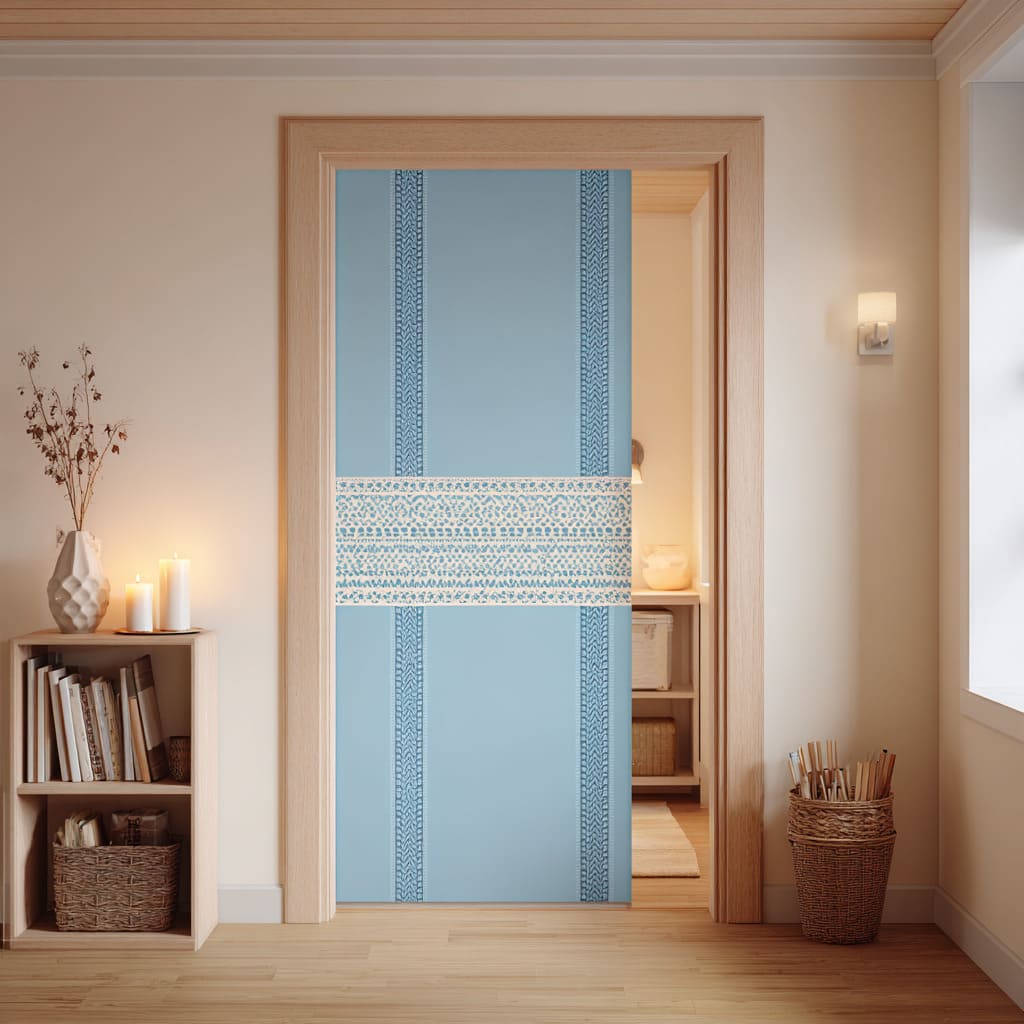
Interior doors can quietly carry an unexpectedly rich amount of seasonal atmosphere when treated as if they were garments rather than architectural barriers. Instead of surrounding a room with objects, the surface of a door becomes a vertical textile field—smooth, flat, uninterrupted—and therefore perfect for subtle visual storytelling.
This approach makes Christmas decorations for inside doors feel immersive without ever overwhelming a room. Knit-inspired bands, lace strips, forest motifs, or ribbon-grid layouts behave like wearable textiles scaled up to the size of a panel.
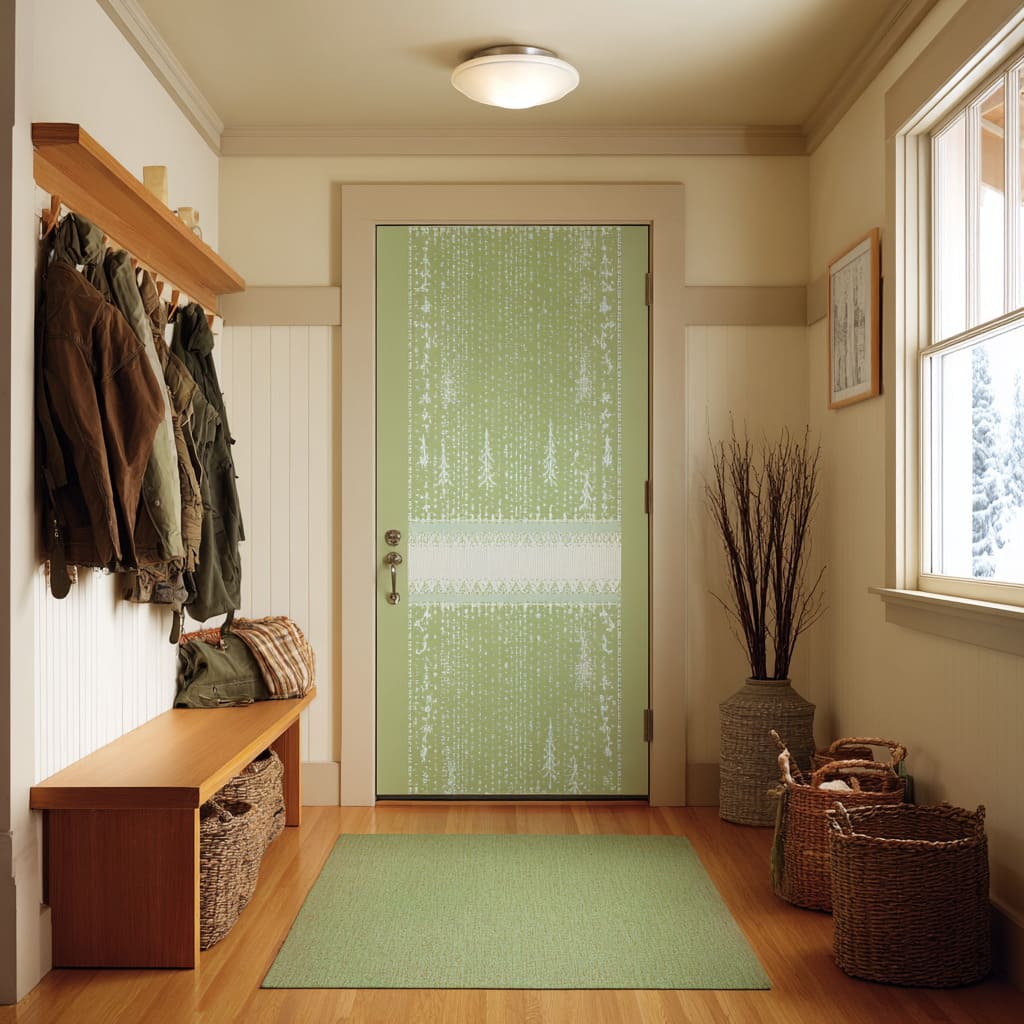
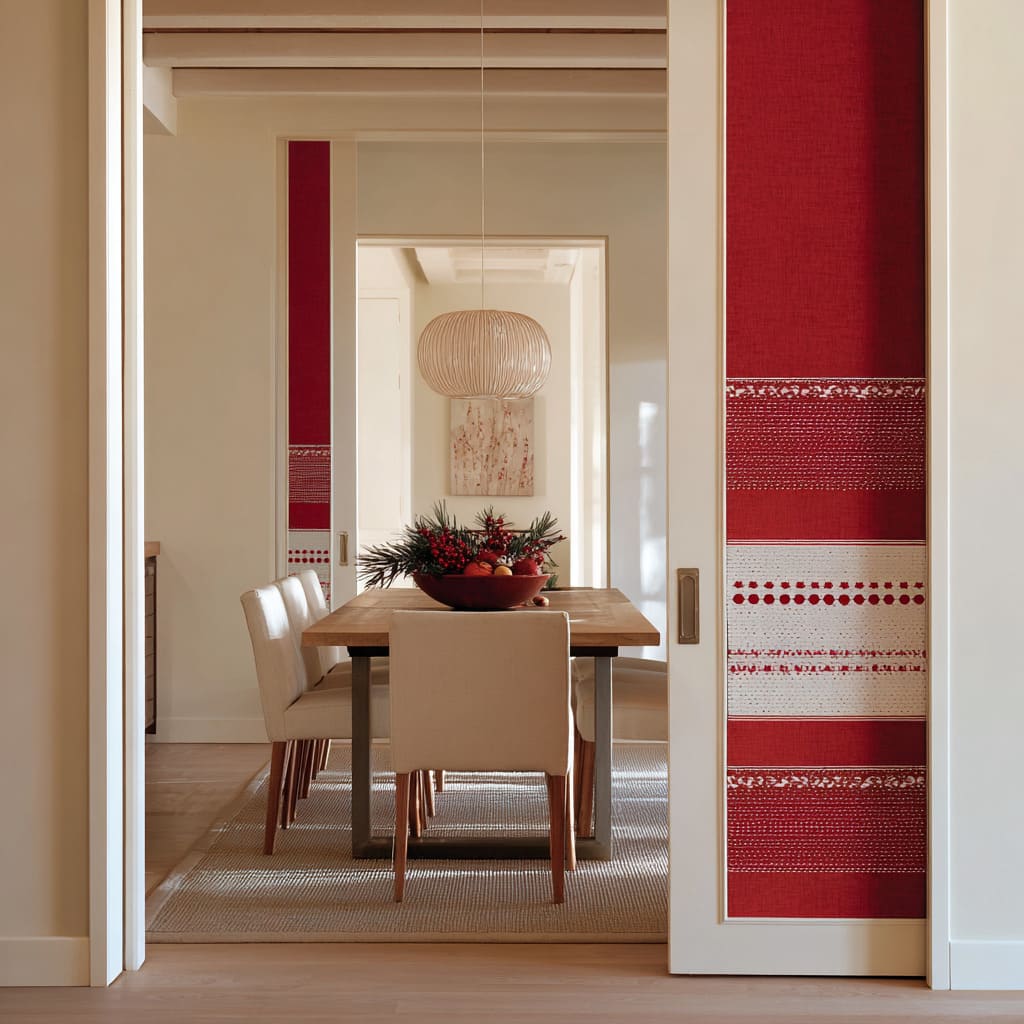
The interior can seem to “dress” itself in winter layers: a door wrapped like a soft red sweater, a hallway entrance wearing lace as if frost embroidered its surface, or a mudroom door clad in pale green knit that suggests melting snowflakes. The appeal comes from how sac surfaces read like fabrics stretched over large planes, adding seasonal softness without clutter.
Because the surrounding walls, floors, and furniture often remain neutral, these textile-like door panels become temporary winter coats for the architecture—added for December, quietly removed when the season ends. They transform movement through a home into a seasonal gesture: stepping from one room to the next feels like passing through a soft corridor of winter layers rather than through bare trim and drywall.
Patterns Aligned With Human Scale and Architectural Rhythm
One of the most sophisticated visual strategies among simple inside door Christmas decorating ideas is the placement of stripes, motifs, and patterned bands in ways that sync with the human body and the geometry of the room. This is not mechanical measurement—it is emotional proportioning.
Tall vertical bands emphasize the height of an opening and mirror the way the eye follows upright lines. Mid-height “belt” stripes intersect where hands usually move toward a handle, giving the pattern a sense of interaction.
Meanwhile, strong upper stripes or denser motifs near eye level anchor the seasonal mood where people glance first. At the same time, these seasonal patterns often align with architectural bones: door bands run parallel to ceiling beams, crossbars echo table edges, or forest tape borders integrate perfectly with chair-rail height.
This gives decorating inside doors for Christmas a sense of belonging rather than sticking-on. A horizontal stripe can feel like a festive lintel; a central band may act like the waistline of a winter garment; perimeter borders can make a plain slab feel like a framed artwork.
These alignments—some literal, some simply felt—create harmony between festive surfaces and the permanent proportions of the house, resulting in doors that feel seasonally dressed yet still rooted in the room’s natural structure.
Color as Emotional Temperature: Five Seasonal Palettes
Color plays a quiet but central role in decorating inside doorways for Christmas, shaping emotional temperature rather than shouting for attention. Five dominant palettes emerge across these ideas, each bringing its own psychological landscape:.
A. Red and Cream: Warm, Focused, Festive
- Strong holiday energy without clutter
- Works beautifully when paired with soft neutral architecture
- Reads as crisp and intentional when used in exact stripes or borders
B. Green and White: Forest-Based Calm
- Evokes silent tree lines, winter paths, and natural simplicity
- Balances beautifully with natural wood floors and cabinetry
- Often used in mudrooms or kitchens for a fresh, outdoors-meets-indoors tone
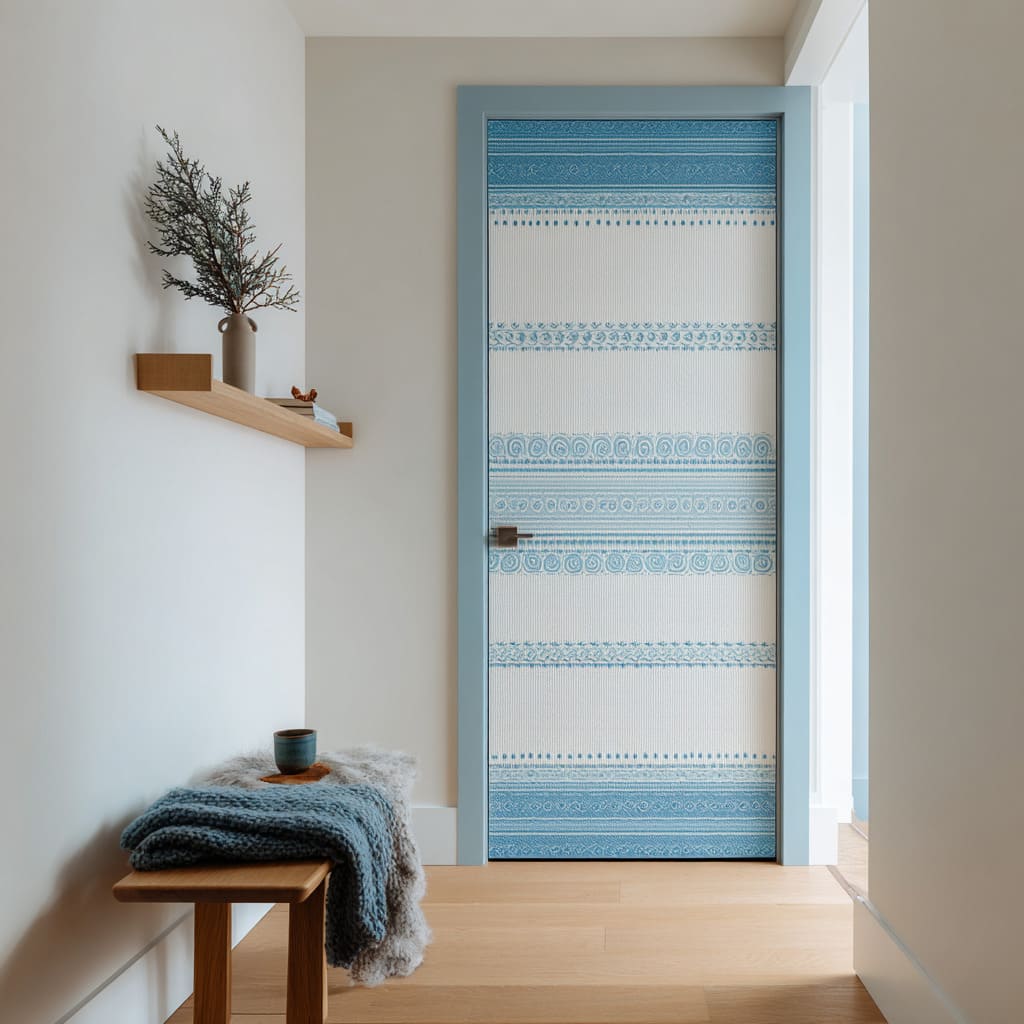
C. Blue and White: Cool, Quiet, Snow-Shadow Mood
- Offers winter atmosphere without traditional red or green
- Pairs well with light wood benches and candle glow
- Creates calm transitions between rooms
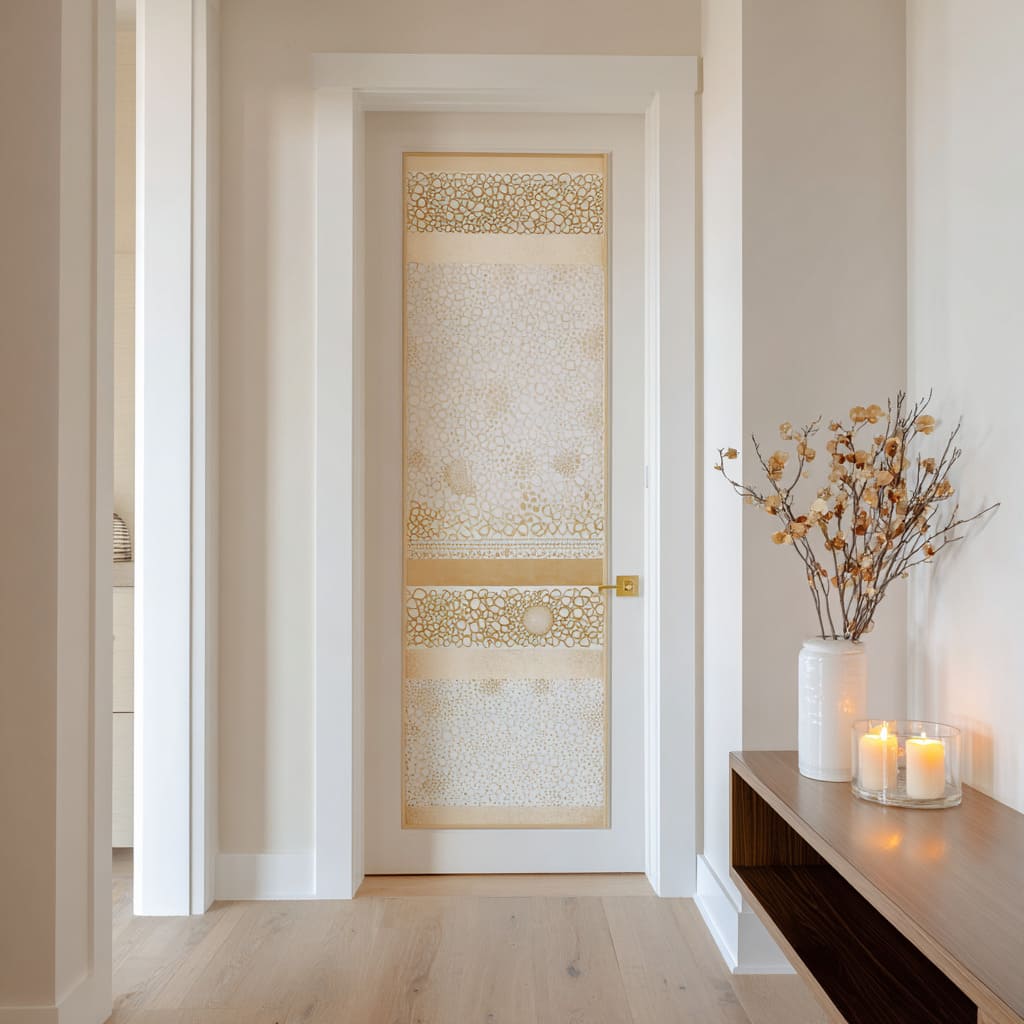
D. Gold on White: Light as Holiday Color
- Feels like candle halos or floating shimmer
- Works particularly well in bright hallways
- Minimal yet luxurious
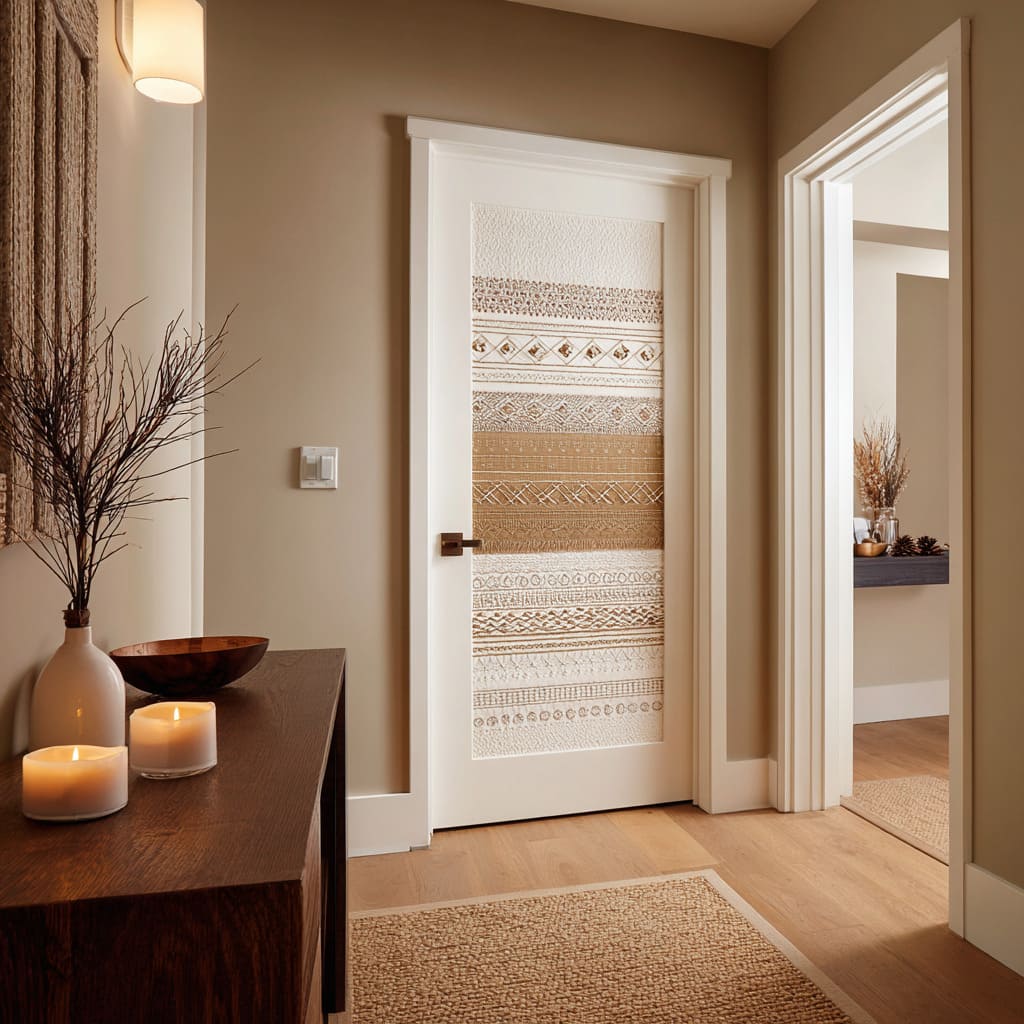
E. Caramels and Browns: Fireside Neutrality
- Uses knitted stripes and natural textures
- Gives a cocoon-like effect for passageways
- Allows seasonal layers without altering an existing beige-neutral home
Such palettes show that doors can create seasonal tone by shifting undertones rather than filling rooms with themed objects. Instead of ornaments, the color fields themselves communicate December.
Texture-Based Storytelling: Lace, Knit, Ribbon, Grain, and Forest
Texture—in visual rather than tactile form—is one of the smartest tools for decorating interior doors for Christmas. Such doors rely on the appearance of fibers, stitching, embroidery, or woven rhythm to supply meaning.
The effect is created through printed tape, paper, or fabric bands but reads as deeply textile-like.
Textural Languages for Door Decorating
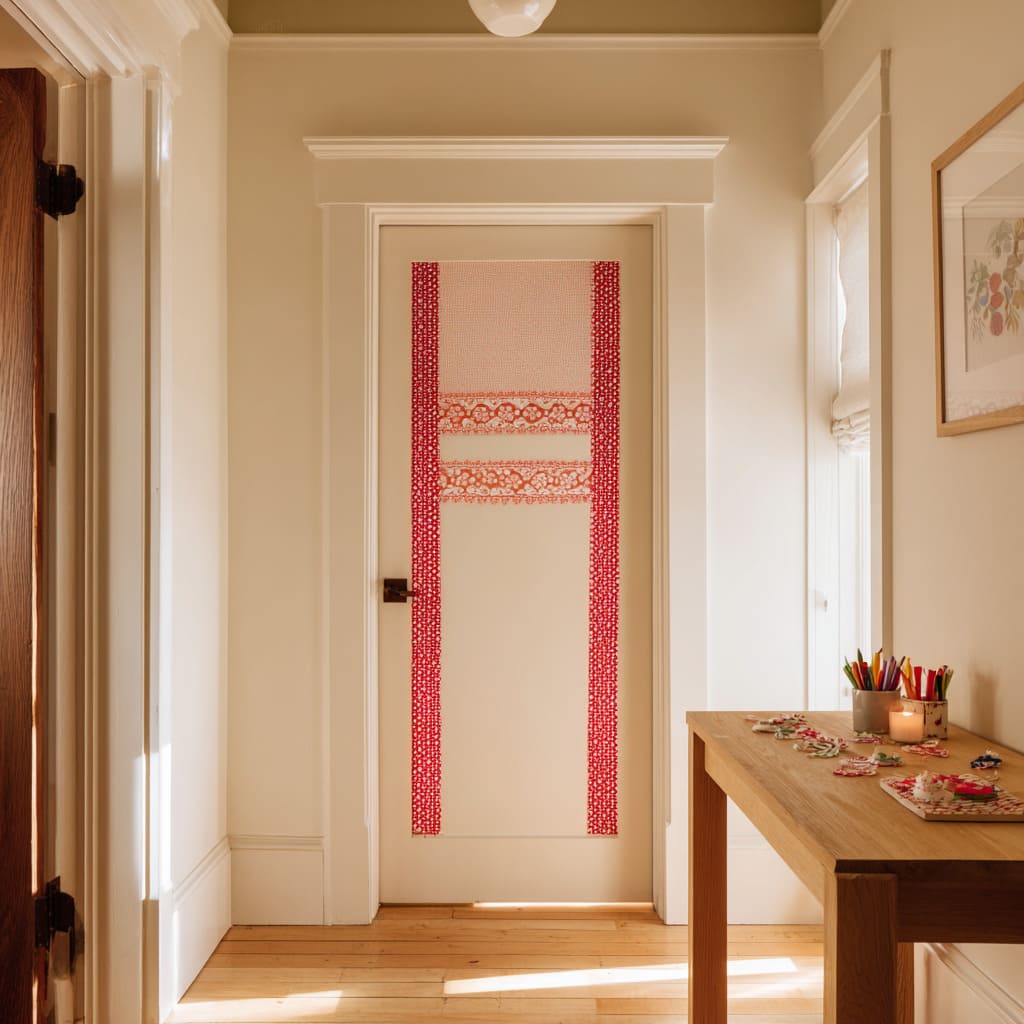
- Knit Patterns
- Repeating dots, short dashes, cable-like verticals
- Evoke sweaters, blankets, or winter garments
- Perfect for wide door panels or sliding surfaces
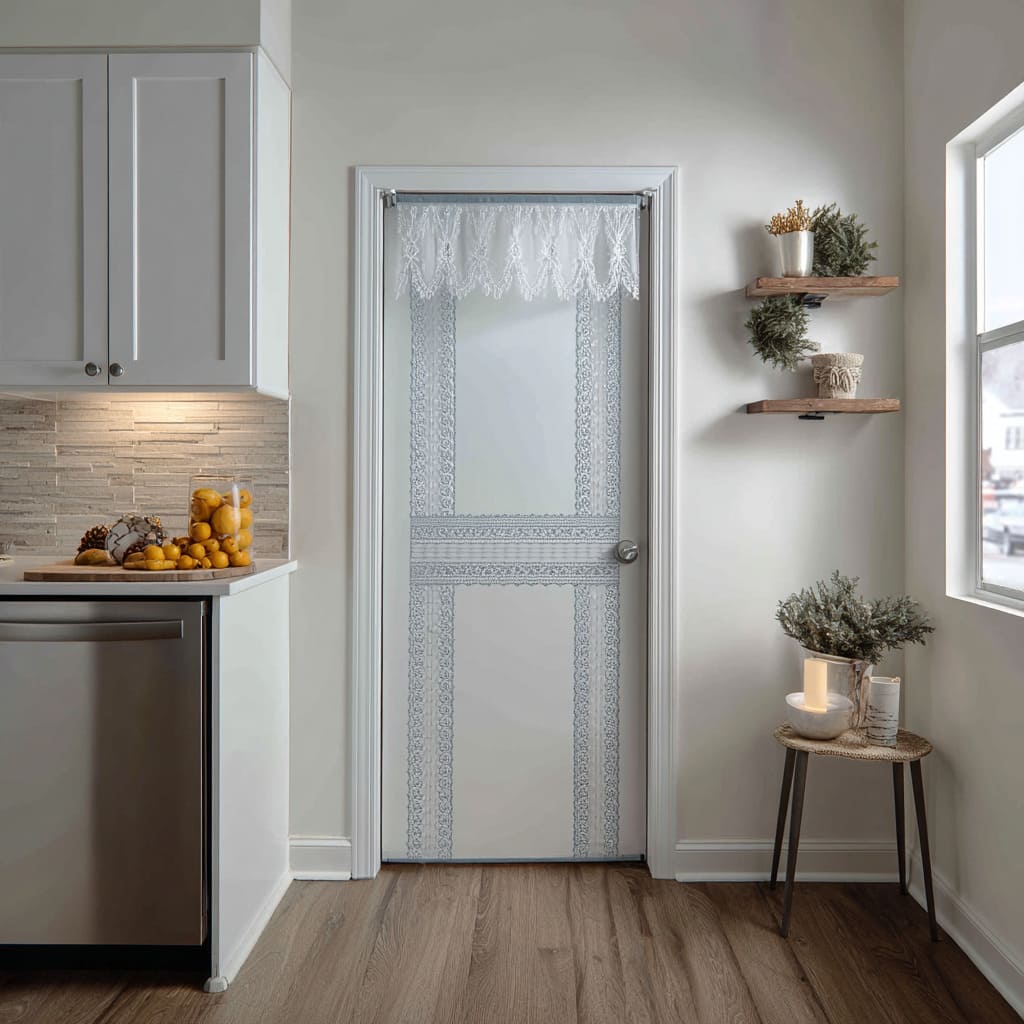
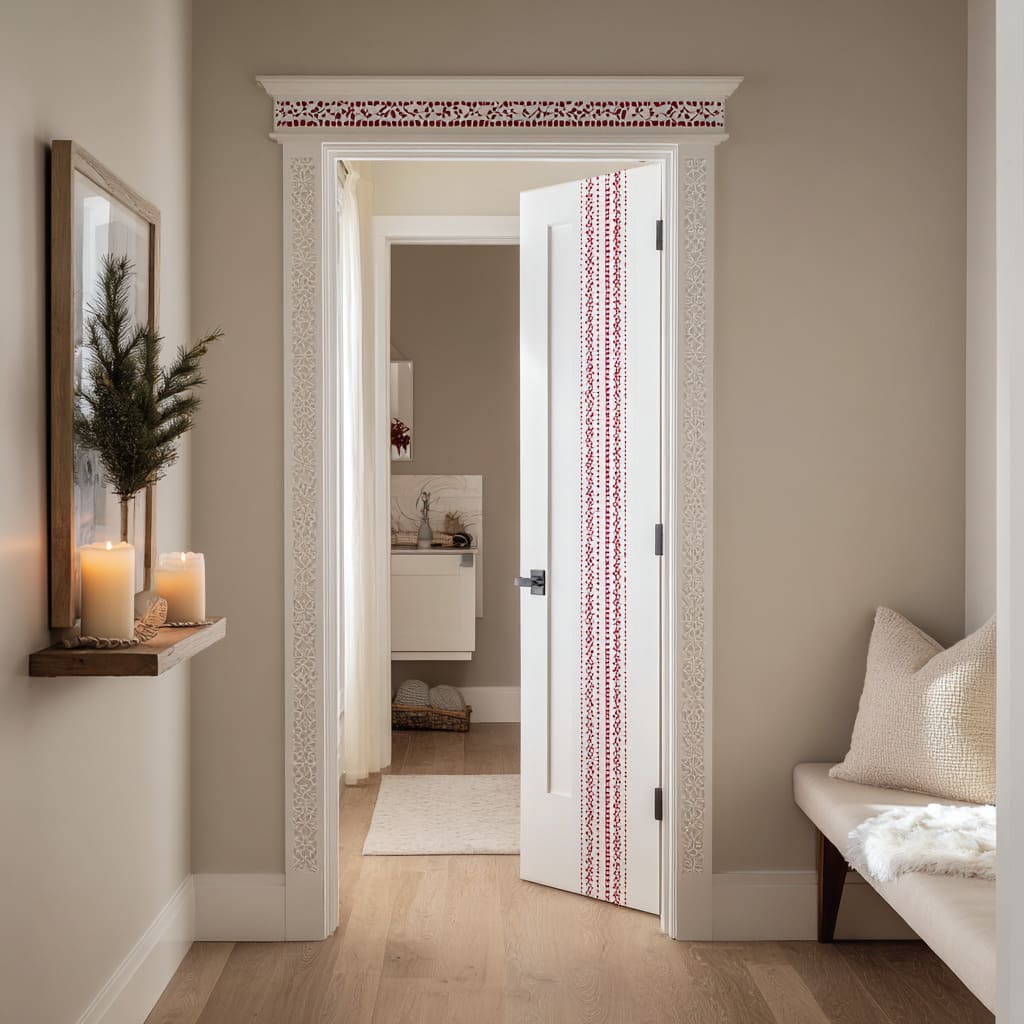
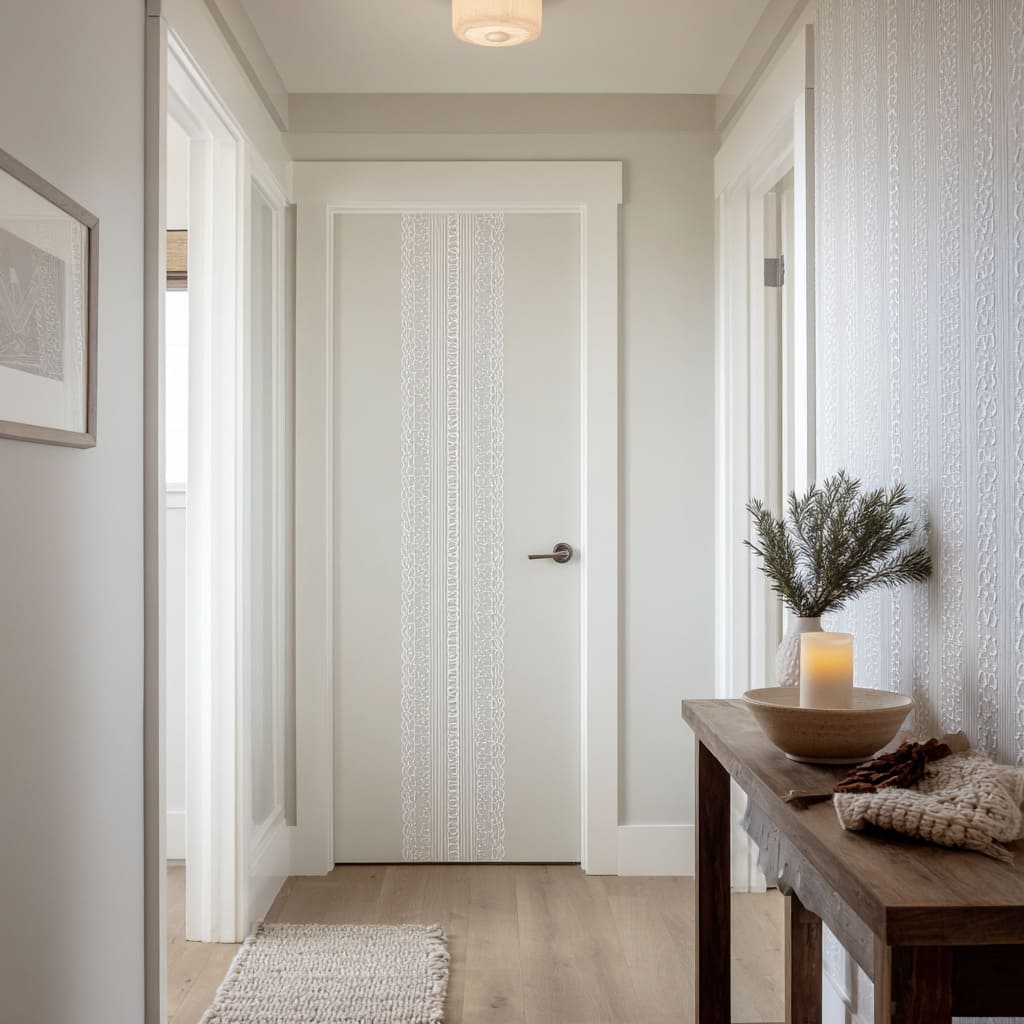
- Lace-Inspired Details
- Tone-on-tone cutouts, delicate white-on-white motifs
- Behave like frost, mist, or winter breath
- Ideal for minimalist or Scandinavian-leaning spaces
- Forest-Motif Textures
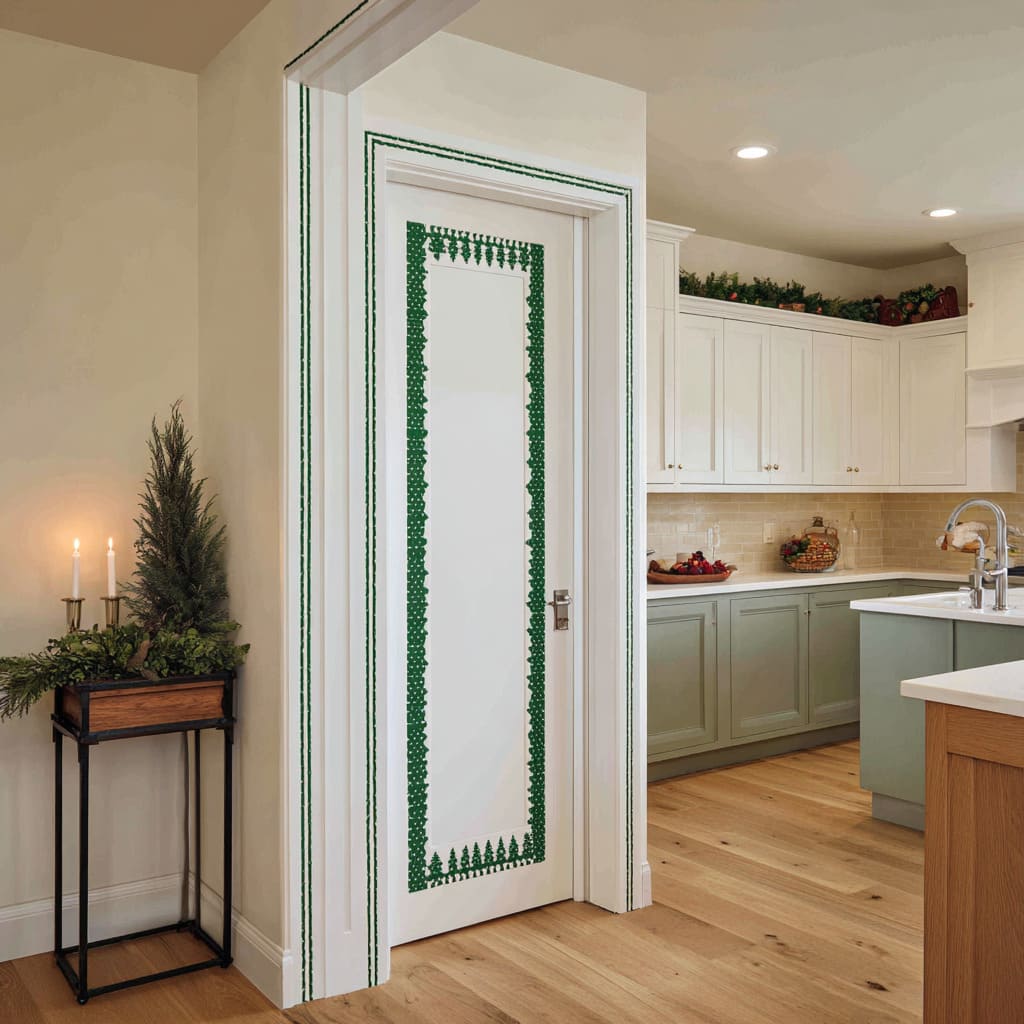
- Rows of small pine silhouettes
- Vertical banding that behaves like trunks
- Strong in mudrooms, kitchens, or entrances
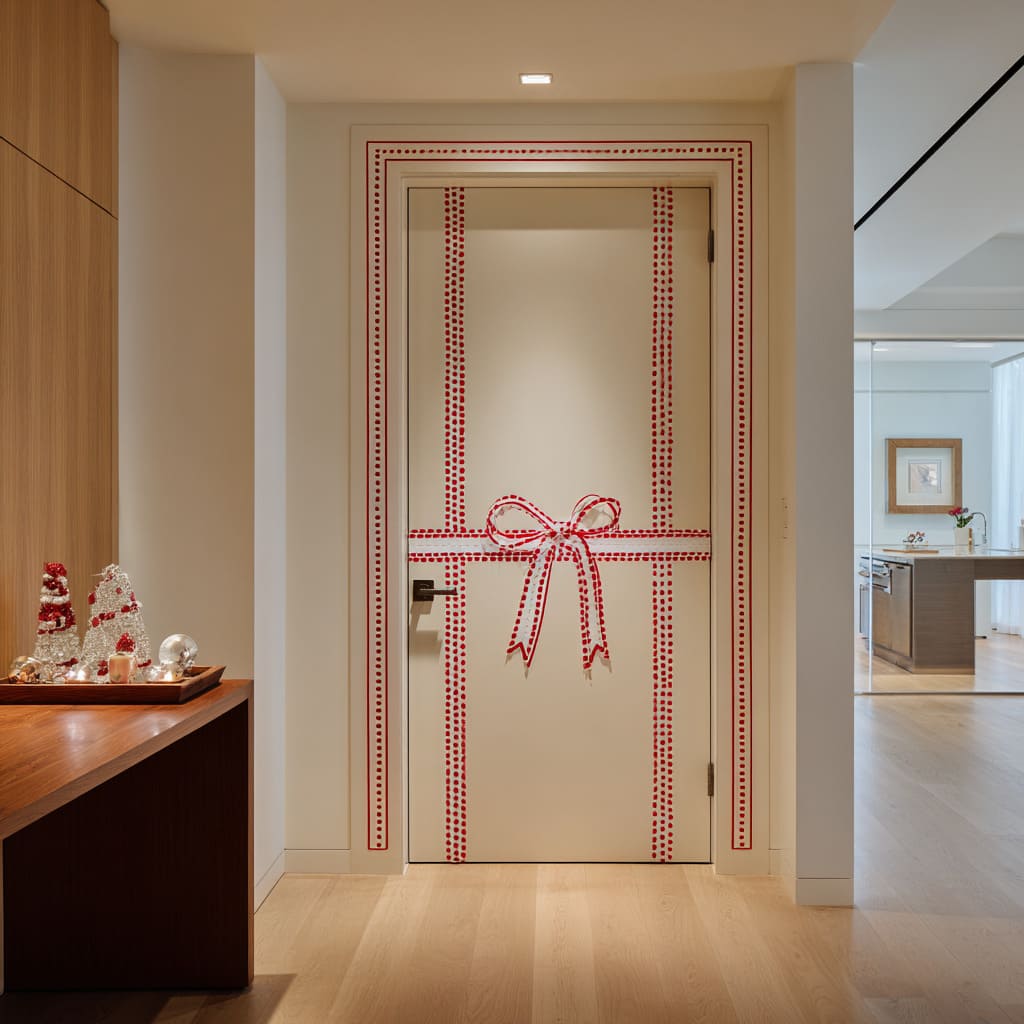
- Ribbon-Grid Logic
- Horizontal and vertical bands mimicking gift wrap
- A central bow drawn or constructed visually
- Suits modern interiors with clean lines
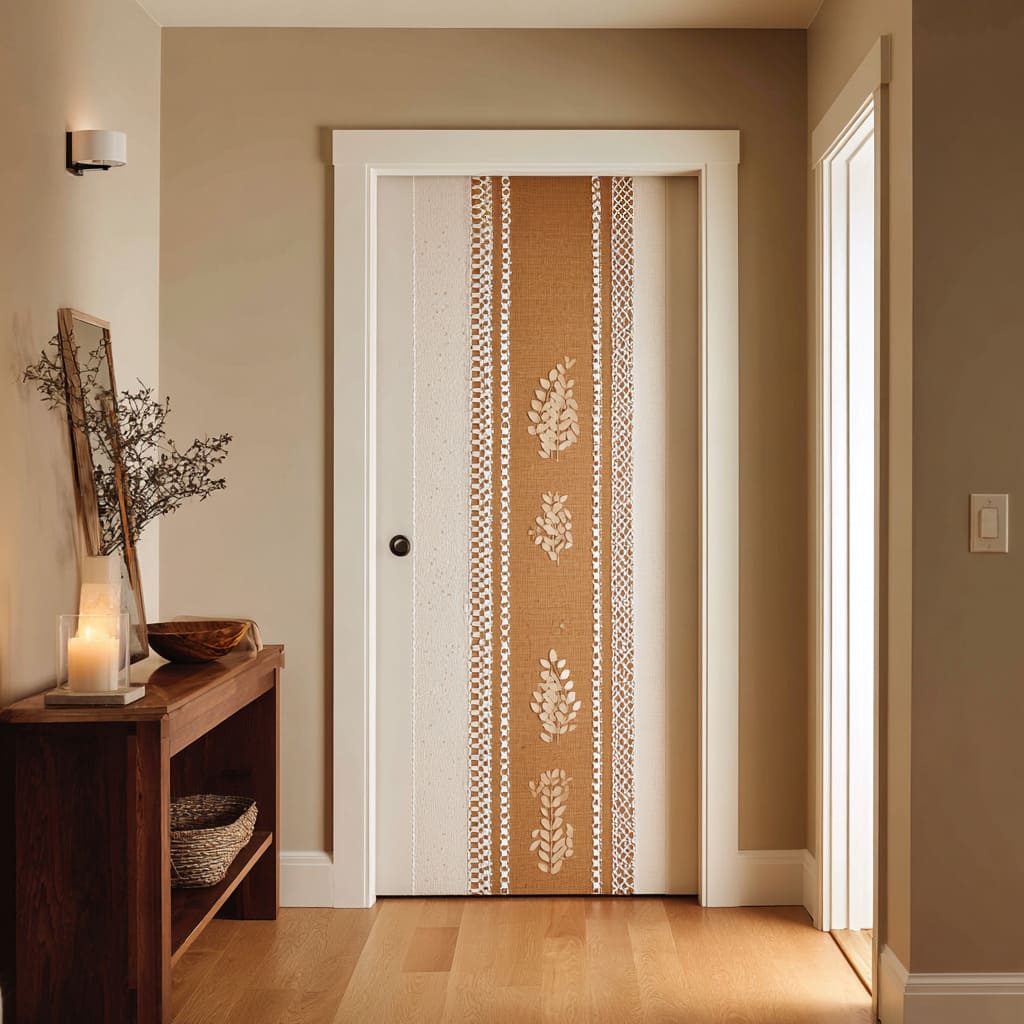
- Grain Sack / Burlap Visuals
- Warm brown central panels decorated with simple leaf silhouettes
- Pairs naturally with wooden consoles and candlelight
- Rustic yet graphic
These textures make the door surface feel alive, layered, and seasonally tuned—even without any literal holiday objects.
Negative Space as Winter Air
One of the most overlooked insights in inside door Christmas decorating ideas is how much of the surface is intentionally left plain. These undecorated areas act like the “air” between snowflakes or the quiet field between the knit motifs of a sweater.
When a door has large unpatterned sections—like broad cream areas, wide white mid-zones, or the untouched lower half—the decorated bands float rather than press. This makes the room feel more spacious and calmer than a fully covered door would.
Negative space:.
- Keeps the pattern from feeling too dense
- Creates visual breathing room in small corridors
- Helps the seasonal areas read as highlights rather than entire repaints
- Allows surrounding furniture to remain simple without competing
Even bold concepts like the full ribbon-grid wrap maintain empty fields between bands, preventing overstimulation. This principle also allows the home’s everyday palette to shine through—white, greige, pale wood—supporting seasonal change without erasing the interior’s identity.
The empty fields serve as silent winter atmosphere rather than blank filler.
Seasonal Thresholds: Doors as Emotional Transition Points
A door decorated for the season does not merely look festive; it affects how movement through the home feels. Many of these concepts treat decorated doors as emotional checkpoints rather than only visual objects.
This is particularly strong when considering inside door decorations for Christmas.
Examples of Threshold Effects
- A dining room framed by red knit panels turns the act of entering into a symbolic passage into celebration.
- A hallway door bordered by lace and topped with candles becomes a soft arrival zone between rooms of different light levels.
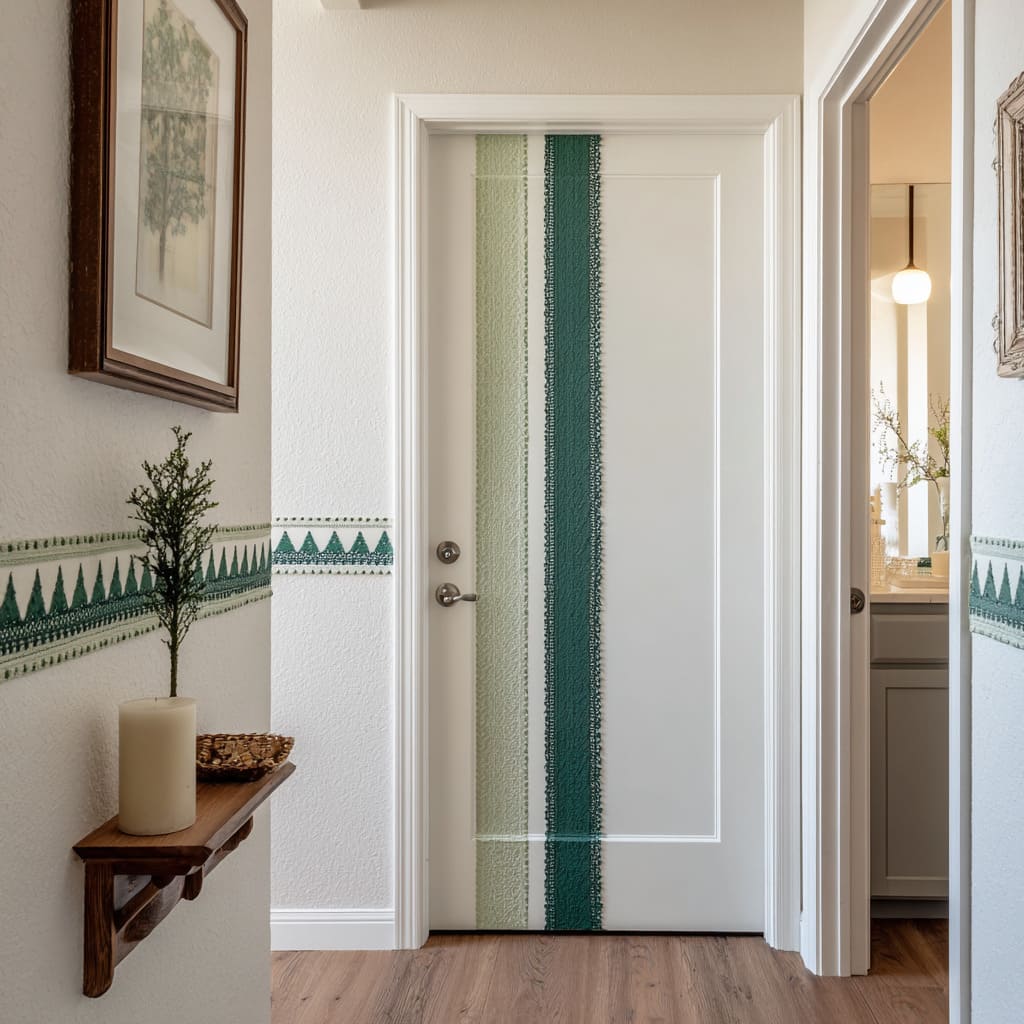
- A mudroom door wrapped in mint knit with a snowy gradient acts as the shift between outdoor cold and indoor warmth.
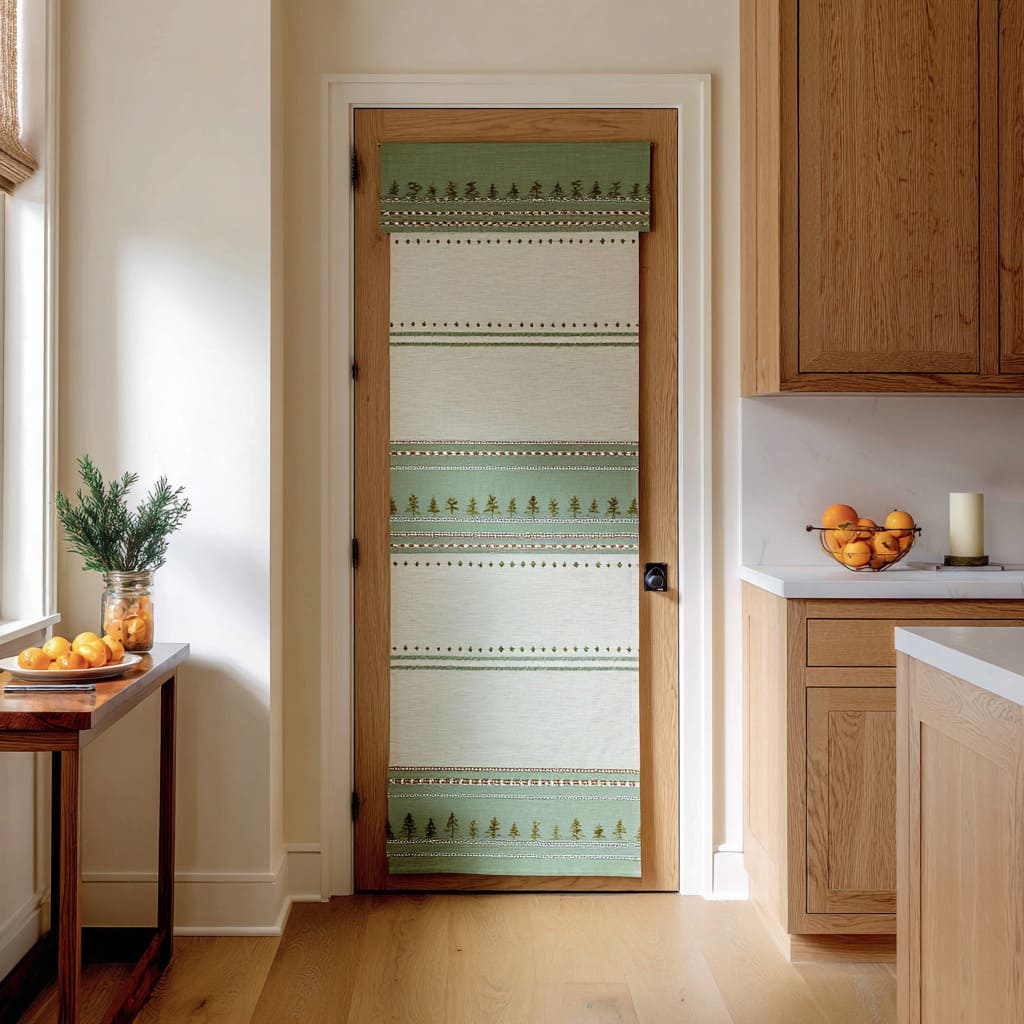
- A kitchen side door in pale sage bands becomes a seasonal landmark inside an otherwise functional workspace.
These thresholds shape micro-narratives in daily life: stepping in from outdoors, leaving the busyness of cooking, or entering a social dining area. The decorated door becomes a moment of atmosphere, not an ornamented slab.
How Doors Interact With Nearby Still-Life Vignettes
A recurring, highly effective visual strategy is pairing the decorated door with a tiny vignette that echoes one of its patterns or colors. This gives inside door frame Christmas decorations a sense of belonging within the broader room.
These still-lifes are never excessive; they are usually made from three or four elements placed deliberately.
Common Elements That Reflect Door Motifs
- Candles
- Flames align with horizontal pattern belts
- Turn printed motifs into glowing partners
- Create visual warmth on cold-color doors
- Branches or Twigs
- Repeat the linework of stripes or tiny tree motifs
- Provide loose organic contrast to rigid patterning
- Citrus or Berries
- Echo small circular marks in knit or dotted bands
- Add warmth without introducing heavy decor
- Textiles
- A knit throw on a bench repeats door texture
- A ribbon or folded cloth references pattern
- Baskets or Wood Objects
- Balance the softness of lace or knit
- Add grounded visual weight
These vignettes form a bridge between decorated architecture and the lived-in room, creating unity without clutter.
Pattern Logic Across Doors: Symmetry, Asymmetry, and Flow
Beyond patterns themselves lies the logic of how they are arranged. Some concepts use symmetry to create calm and centered compositions; others use slight asymmetry to introduce gentle motion or tension.
This arrangement logic underpins many inside door frame Christmas decorations and determines the emotional energy of a hallway or room.
Symmetry
- Seen in ribbon-grid gift-wrap doors, burlap-strip doors, and centered knit panels
- Creates order, stability, and formality
- Works well in dining rooms and entryways
Asymmetry
- Found in green forest stripes placed off-center or pink-and-red tape designs grouped in upper zones
- Gives a sense of movement and improvisation
- Perfect for corridors, craft-infused areas, or relaxed mudrooms
Directional Flow
- Dense motifs at the top with thinner patterns below create an upward, floating effect
- Tree borders around waist height draw the eye horizontally into the next space
- Vertical knit bands pull attention toward height rather than width
Pattern logic determines whether a door feels calm, lively, playful, or contemplative.
Doors as Seasonal Artworks Within Neutral Interiors
Seasonal door treatments become powerful focal points inside quiet shells. This is where inside doorway Christmas decorations work like gallery pieces: framed by white or pale trim, the door is almost a canvas.
Blue knit stripes stand out like textile paintings; gold circles shimmer like abstract art; sage forest bands behave like a stitched landscape. Surrounding walls remain bare, ensuring the door carries the holiday mood alone.
When the only companion is a bench, shelf, or console with a candle and a branch, the decorated door takes on the status of a seasonal artwork—made of tape, paper, or fabric, but visually as complete as a framed December print. The benefit of this artistic approach is that the interior remains uncluttered; the door itself performs the storytelling.
Even tall lobbies or long hallways gain warmth without losing their openness. The door becomes the December painting, the hallway becomes the gallery, and seasonal atmosphere fills the home through a single vertical composition.
Comprehensive Observations From All Angles
This final section gathers the most subtle design insights and frames them as a unified visual language. It reflects how interior door Christmas decorating ideas function across multiple spatial and emotional dimensions.
Visual Principles Extracted
- Seasonal identity through pattern, not objectsSeasonal mood comes from knit, lace, forest, ribbon, or gold patterns rather than ornaments or figurines.
- Integration with architectural rhythmPatterns align with beams, panel lines, trim, bench height, and nearby sightlines.
- Color families chosen for feelingReds for focus, greens for forest calm, blues for quiet winter, gold for light, browns for fireside mood.
- Texture as atmosphereKnit and lace create psychological warmth even when no actual fabric is used.
- Thresholds as emotional scenesDoors become soft gateways between daily zones—kitchens, hallways, mudrooms, dining spaces.
- Calm surroundings as stageNeutral flooring, walls, and furniture amplify the effect of decorated panels.
- Vignettes that whisper rather than shoutOne candle, one branch, one bowl of citrus can support an entire seasonal storyline.
- Balance of symmetry and loosenessSome doors are strict and graphic; others feel crafted and improvised; both work depending on pattern flow.
These principles reveal that inside door Christmas decorating ideas can be minimal, immersive, playful, elegant, textured, or calm—yet all share the same core philosophy: the architecture is the medium, and the season is carried by the surface of the door, not by objects scattered around it.
Final Multi-Perspective View
Decorating a home’s interior passages with seasonal visuals is not about building Christmas sets; it is about shaping how movement feels. When doors act as winter textiles, forest belts, gift-wrap grids, golden lanterns, or soft lace screens, they redefine the emotional temperature of rooms.
The holiday moment becomes embedded in transitions rather than confined to focal points. A door becomes a temporary winter canvas, a vertical garment, or a forest panel connecting one lived space to another.
Through these strategies, inside door decorations for Christmas, inside doorway Christmas decorations, and every related visual approach turn the quietest parts of a home—the thresholds—into some of its most atmospheric December scenes.