A headboard usually does several jobs at once, so the interesting shift in in modern alternative headboard designs is not that the bed loses a single object. It is that the jobs get separated, reassigned, and sometimes made invisible.
The wall becomes the backrest without looking padded. Light becomes the boundary without looking like a frame.
A line at pillow height becomes the organizer of the whole scene, even if it is only a thin band.
The pillow horizon, treated like a design datum
The decisive line in bedroom designs is not ceiling height and not the top of an art piece. It is the height where pillows stack, slump, and spread.
That horizon is treated like a datum, the same way a designer treats a fireplace mantel height or a countertop line. Once that line is defined, the bed stops feeling like a loose pile of textiles and starts feeling like an intentional mass sitting inside a larger structure.
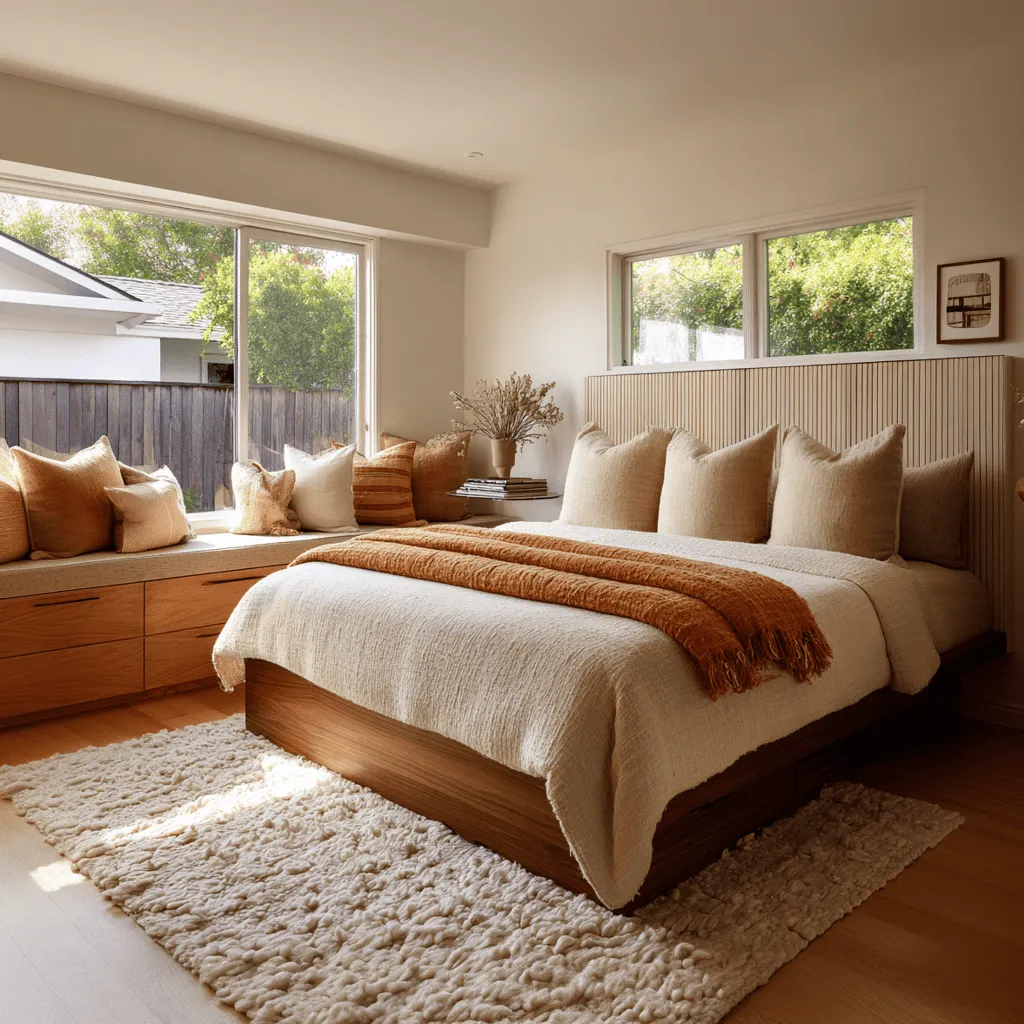
You can see this idea in many design concepts. For example, the one with the long ribbed wood band that sits behind pillows and continues under a window, with a bench running beside it.
The band’s power is not that it is wood or that it is ribbed. It is that it behaves like a calibrated background field: repetitive grooves give the pillows a stable backdrop, and grazing daylight turns the surface into a slow gradient.
The headboard effect comes from rhythm plus light, not from thickness. Then the bench, although not directly behind the bed, completes the wall by echoing pillow language in a different scale: smaller cushions, varied tones, and a more casual cluster.
The bed stays primary because the pillows are bigger and more unified; the bench stays supportive because its cushion mix is lighter and more broken up. One long wall becomes a linked sequence: sleeping zone, lounging edge, and a quiet area for objects to land without visual mess.
This is one of the major patterns behind headboard alternatives: widening the bed wall without widening the bed. The wall is extended sideways through adjacent elements that share the same tone family or the same linear grammar.
The bed ends up feeling more settled because it is no longer a lonely rectangle centered on a blank plane; it is part of a longer composition that implies the room was planned as a whole.
Replacing height with depth
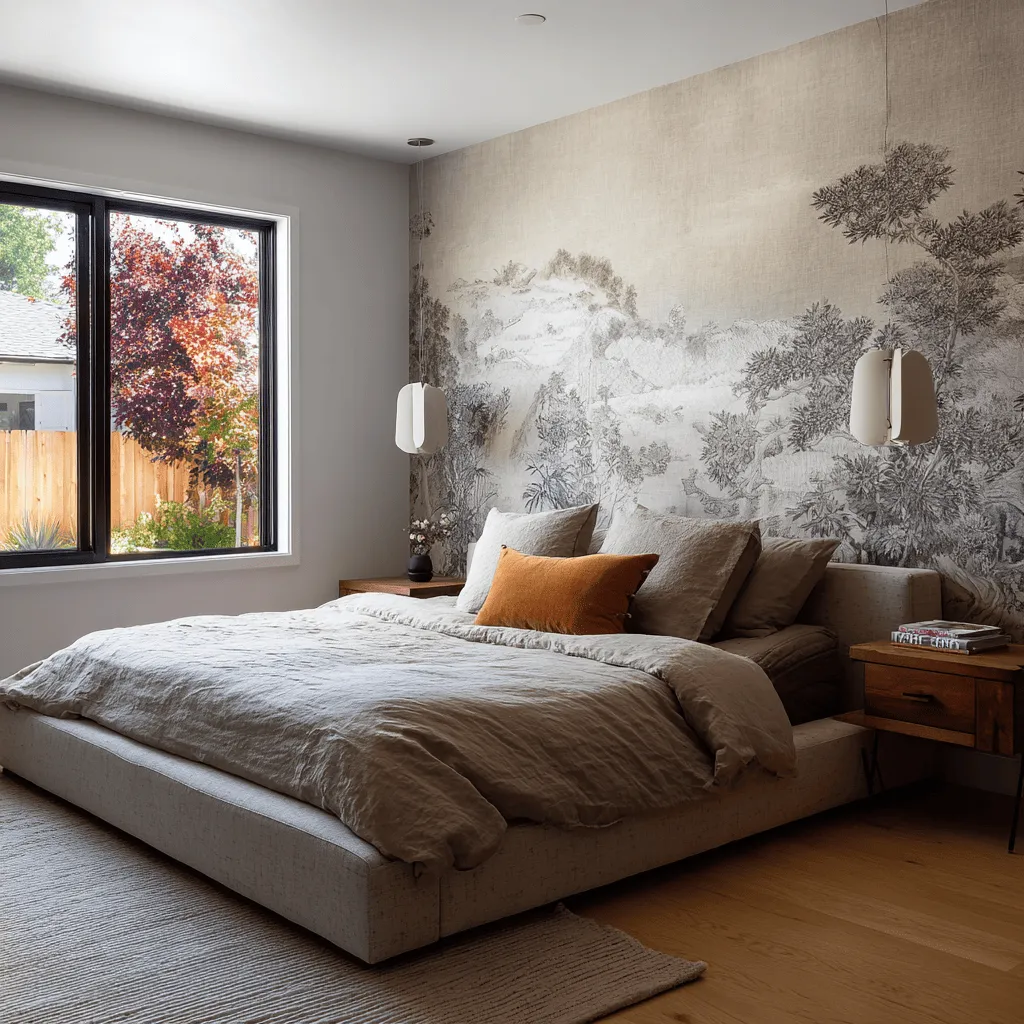
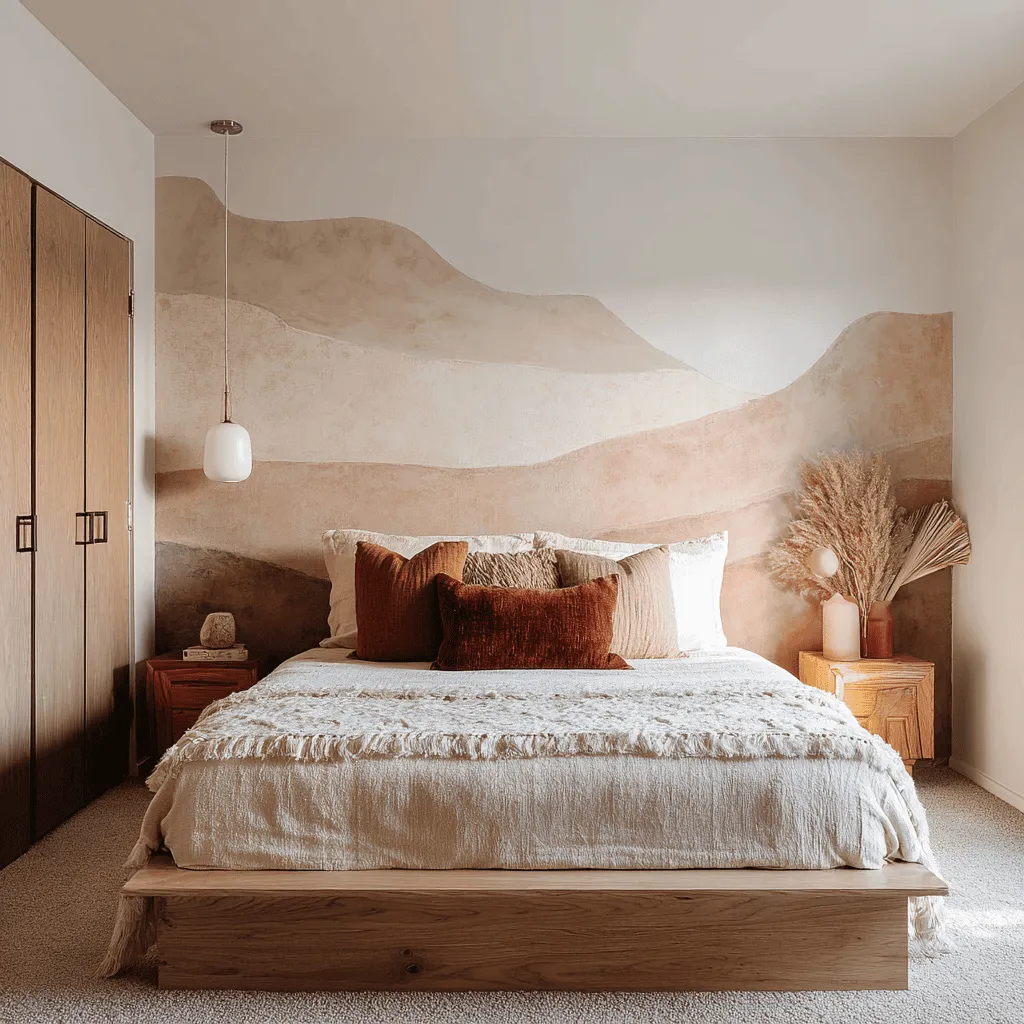
Another idea is the replacement of height with depth. A full-wall landscape mural does not try to compete with a tall upholstered piece.
Instead, it pushes the bed backward into an atmospheric scene. The headboard job is done by perceived distance: pale negative space, soft mountains, darker tree mass shifting to one side to counterbalance a window.
The mural is not only decoration; it is weight distribution. It loads visual density where the architecture needs it, then lets the bed sit in front like the foreground layer of a painting.
Even the pendants become part of the illusion. They hang at roughly pillow level, so the mind accepts them as markers of the bed zone, almost like invisible posts that define boundaries without drawing a box.
Depth replacements tend to work best when the bed stays low. Low beds do something sneaky: they let the wall speak without being cut in half.
When the wall is the identity, tall furniture silhouettes can interrupt the story. That is why modern headboard alternatives lean on a modest head element or none at all, paired with a strong background idea.
The bed becomes the grounded base layer. The wall becomes the identity layer.
Boundary without bulk
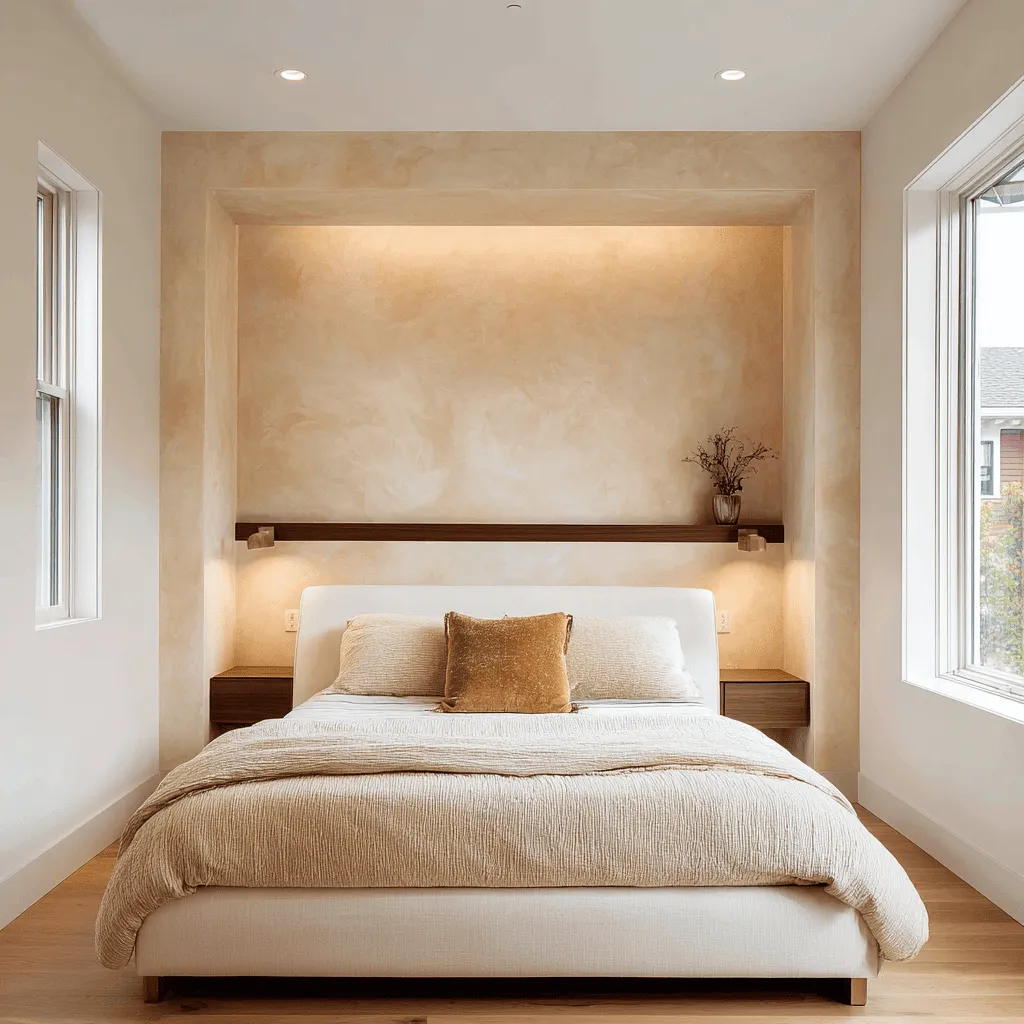
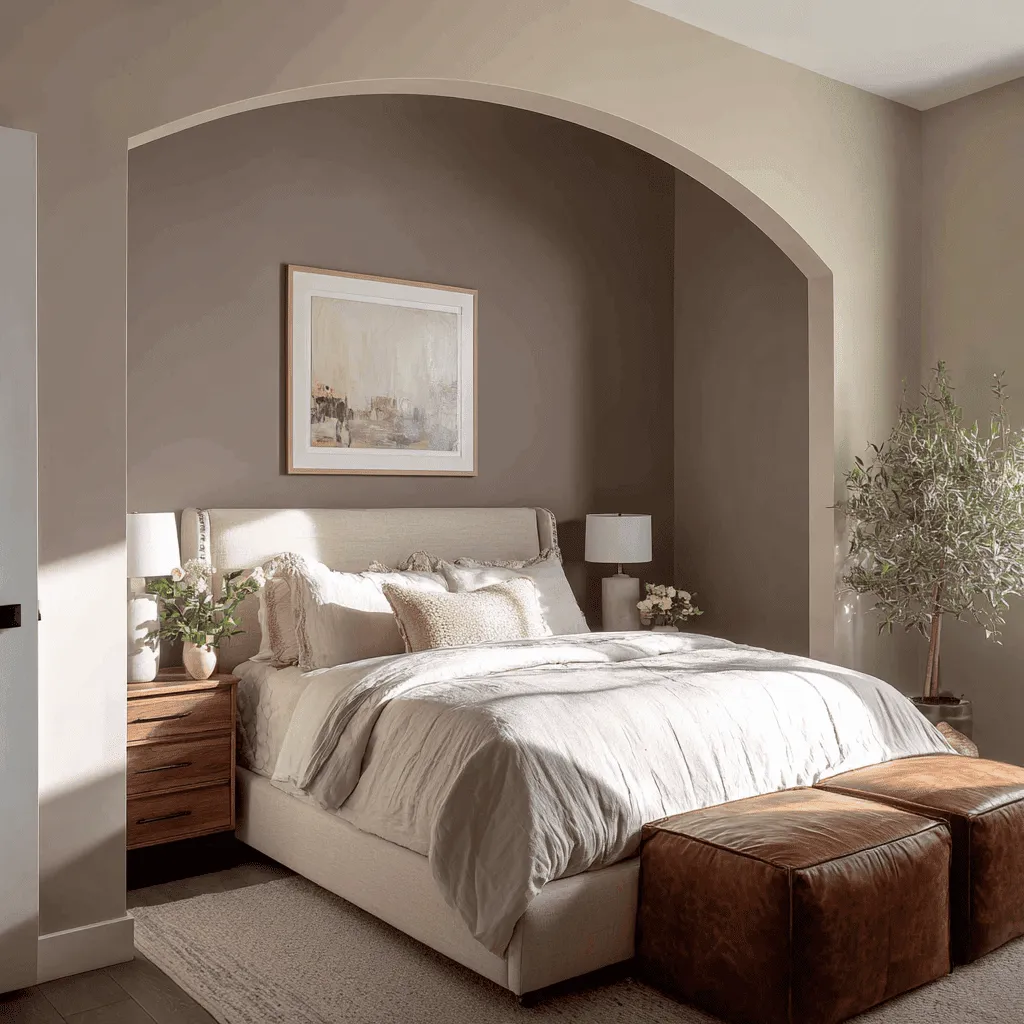
A third design pattern is what could be called boundary without bulk. The architectural niche concept is a perfect example.
The bed sits in front of a recessed stage, which produces a shadow frame around the sleeping zone. Shadow is doing the headboard work.
Inside the niche, the finish stays tonal and clouded, so it feels alive without turning into a pattern. Then a single long shelf hits the pillow horizon and divides the wall into two calm fields: an upper field that can breathe and a lower field that belongs to the bed.
When small pools of warm light appear near the ends, the room quietly assigns ritual zones. Not by adding objects, but by shaping where attention falls at night.
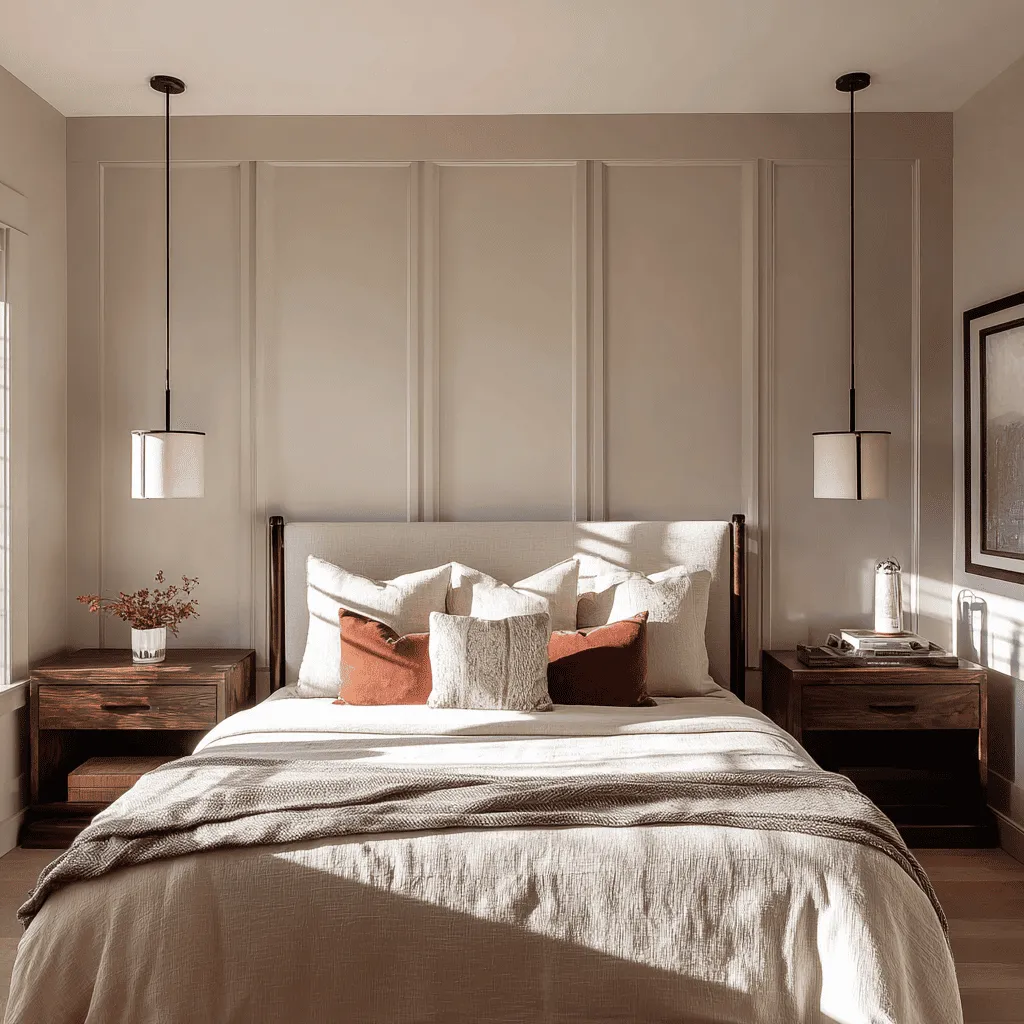
Notice how often a shelf line, ledge line, band line, or low rail is used to set that pillow horizon. Sometimes it is literal wood.
Sometimes it is leather. Sometimes it is a low wall of texture.
Sometimes it is only the implied line created by lamps and art placement. The job stays the same: create a stable landing zone for softness so the pillow stack feels contained rather than chaotic.
Identity above, comfort below
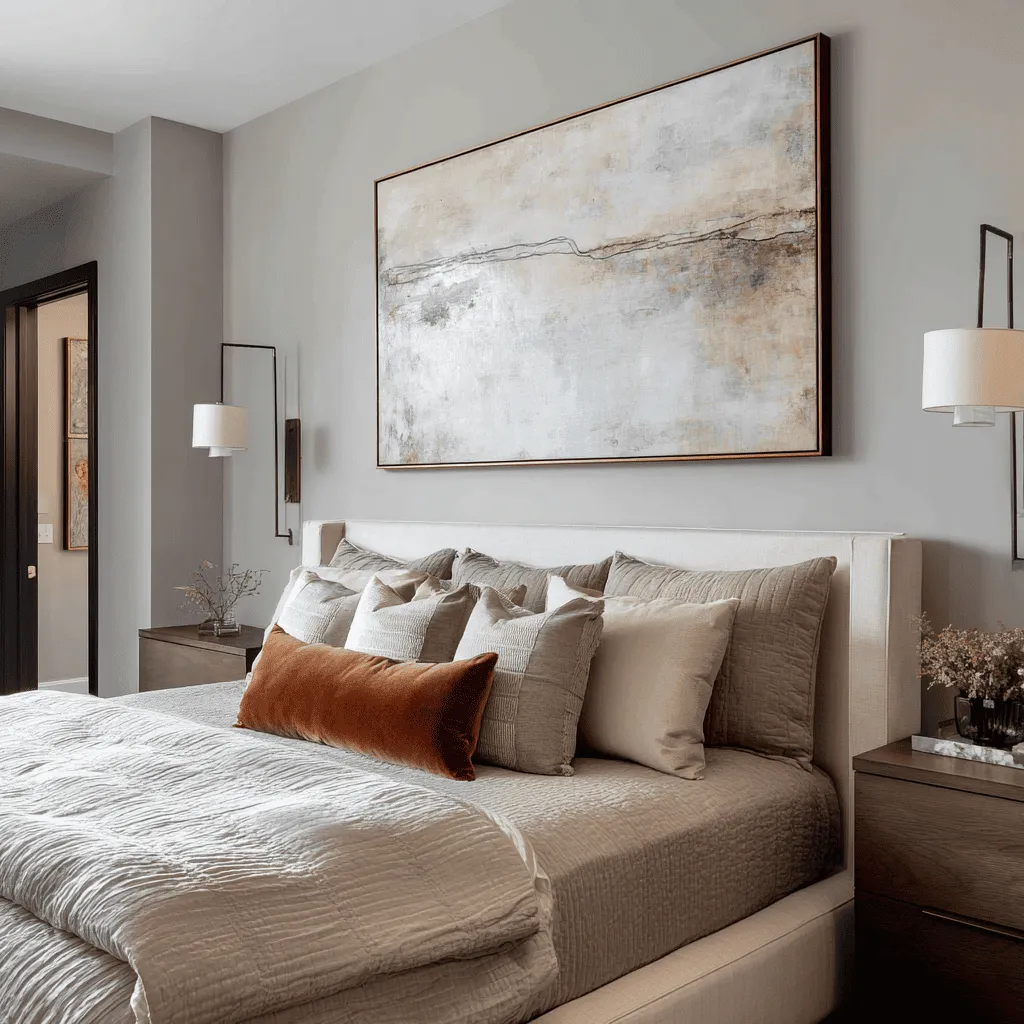
Oversized art can be used like a crown shows a related strategy: identity above, comfort below. The upholstered bed element is allowed to be simple, while a wide framed piece supplies scale and focus.
The trick is not merely hanging art. It is matching the art’s internal geometry to the room’s organizing geometry.
A thin horizontal mark in the artwork echoes the long rust lumbar pillow; the wall’s cool tones are warmed by a thin frame edge; a slim mirror panel introduces one vertical counter-line so the composition does not become an endless run of horizontals. The wall becomes structured without turning into a gallery clutter situation.
This leads to a useful distinction: some headboard alternatives create a background field, while others create a focal object. A background field can be fluted wood, cane panels, plaster movement, mirror haze, dot-perforation glow, or a mural band system.
A focal object can be a single large relief, a sculptural wall light, a textile hanging treated as artwork, or a folding screen set behind the bed. Both can replace a headboard, but they change the room’s emotional center in different ways.
Background fields often calm the room by making the wall feel already finished. Focal objects often add personality by giving the wall one strong moment and letting everything else quiet down.
Texture that shifts through the day
Textile as surface depth, not as an image
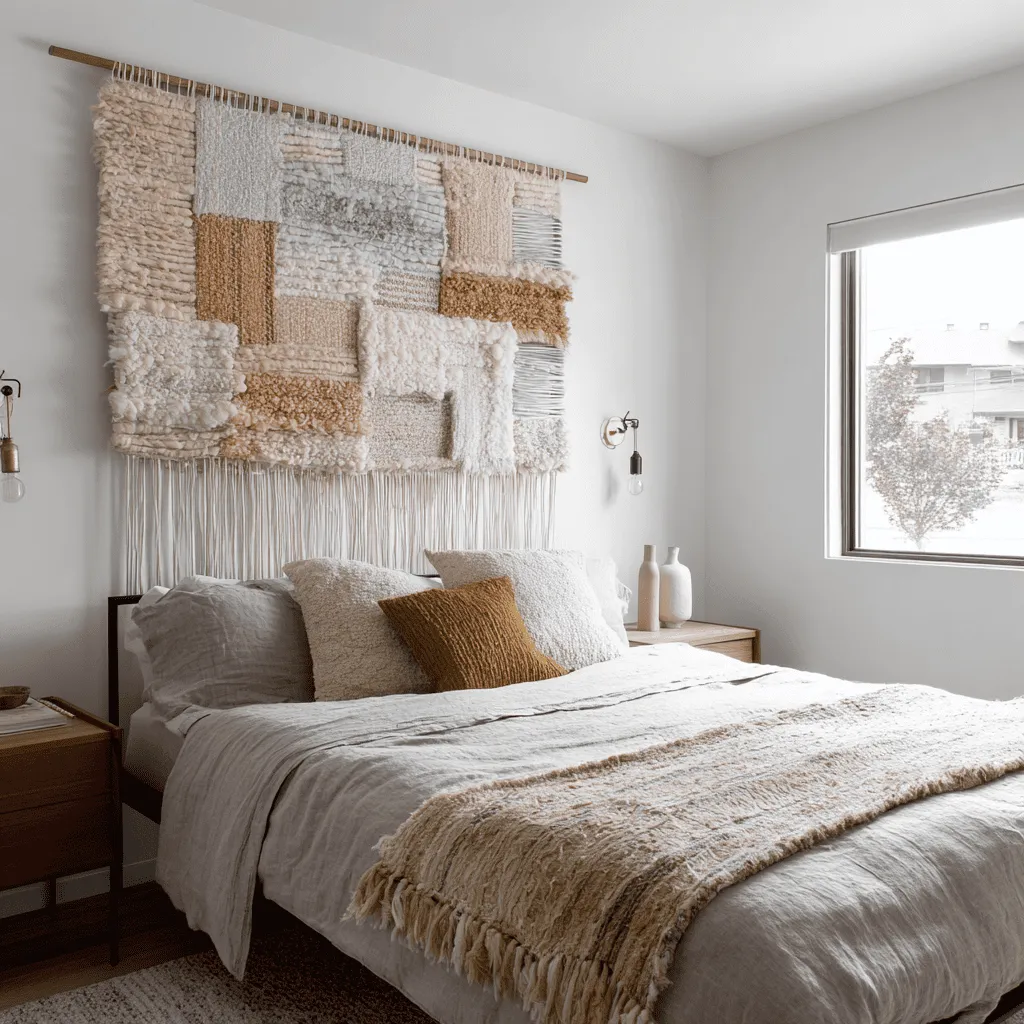
The textile wall hanging works because it does not behave like a flat image. It behaves like thickness, shadow, and touch translated into a surface.
Patchwork blocks of different pile heights create a shifting micro-landscape as daylight moves. A fringe zone drops toward pillow height and forms a soft veil behind the bed’s top edge.
The bed frame stays visually light (thin metal, minimal profile) so the textile owns the vertical presence. Then a single warmer cushion note acts as a temperature adjuster, preventing the palette from becoming overly pale.
The lamps avoid ornamental drama so the wall’s texture remains the main story.
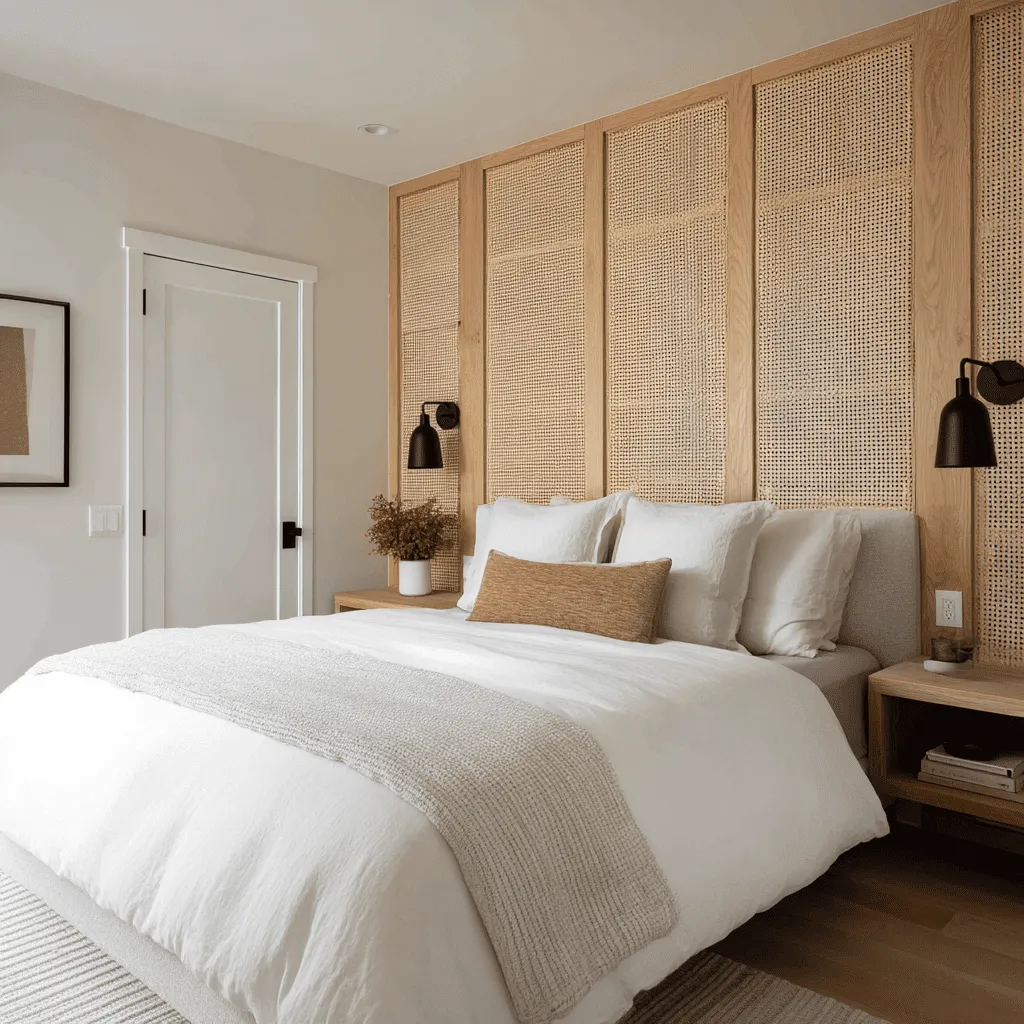
These textile and woven headboard alternative concepts often rely on dual-scale texture: calm from the doorway, rich up close. Cane panel walls do the same.
From a distance, cane becomes a warm neutral field. At closer range, the weave has tiny irregularities that prevent the wall from feeling sterile.
The vertical stiles create order, the weave prevents rigidity. A matte black sconce on top becomes a crisp marker that defines the bed width without fighting the weave.
Walls that behave like drawings
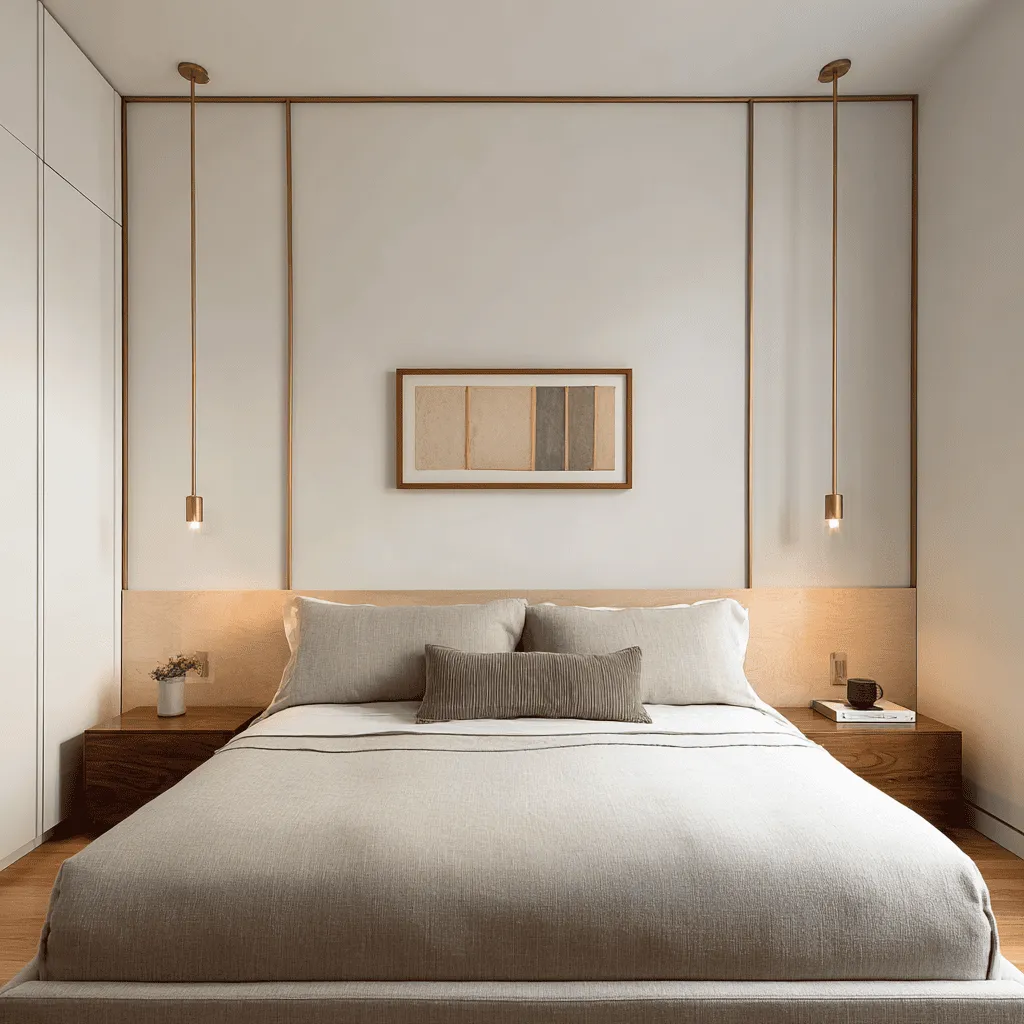
Some of the strongest visual control, interestingly, comes from ideas instead of a headboard that are basically line drawings on the wall. The brass rail grid with a low wood band makes the bed wall feel like a proportion study.
The rails supply vertical structure; the wood band supplies horizontal stability; pendants land like punctuation near the bed edges. The art stays small because the wall already has a large structural gesture.
Even the bedding echoes the headboard concept with thin lines near the top edge, so the bed speaks the same language as the wall: restrained marks rather than busy pattern.
Line systems keep showing up because they solve a specific bedroom anxiety: the fear that the bed wall will look unfinished unless something tall is placed behind it. These design concepts prove that height is only one way to claim the wall.
Another way is to define the zone with measured lines and balanced empty space. Empty space becomes a sign of control rather than absence.
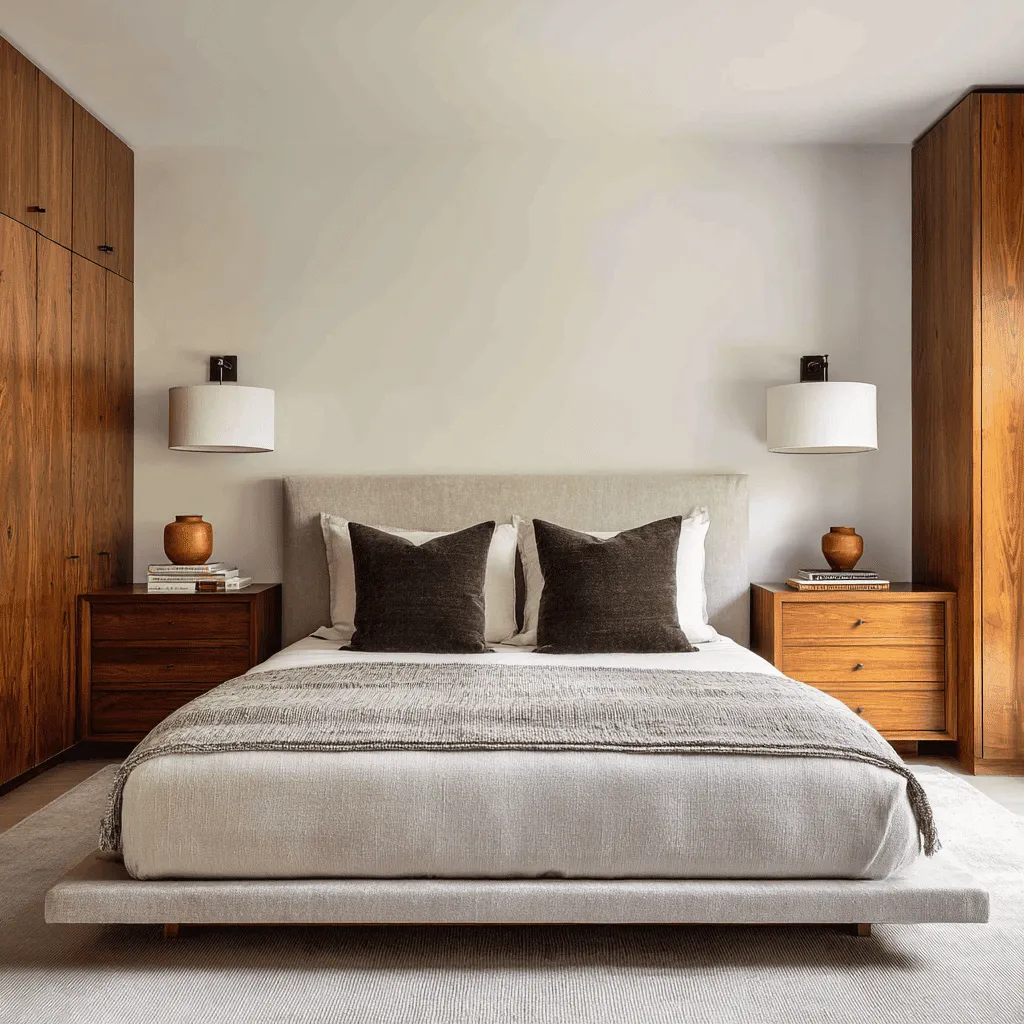
That idea becomes explicit in the blank-wall concept. Here, the backdrop is nothing.
The wall’s job gets handed to proportion, symmetry, and bookends. Tall wood volumes at the sides act as brackets; lamps become the main graphic; darker pillows become small weights that prevent the bed from dissolving into pale tones.
The room’s discipline moves from surface decoration to spacing decisions. The head element becomes a quiet horizon rather than a statement.
The bed wall feels intentional because the edges are doing the framing and the middle is allowed to breathe.
Paint and plaster as shelter signals
Painted geometry offers a different kind of framing. A wide painted arch creates a shadow-zone effect without building an alcove.
The arch feels sheltering because it softens the wall’s depth perception; the bed sits in front of a darker field that makes lamp light richer and bedding tones warmer by contrast. A small artwork remains secondary because the painted gesture is already the big structure.
The arch also plays a psychological trick: a single continuous curve can soften the room’s many right angles, so the sleeping zone feels less boxy without adding extra objects.
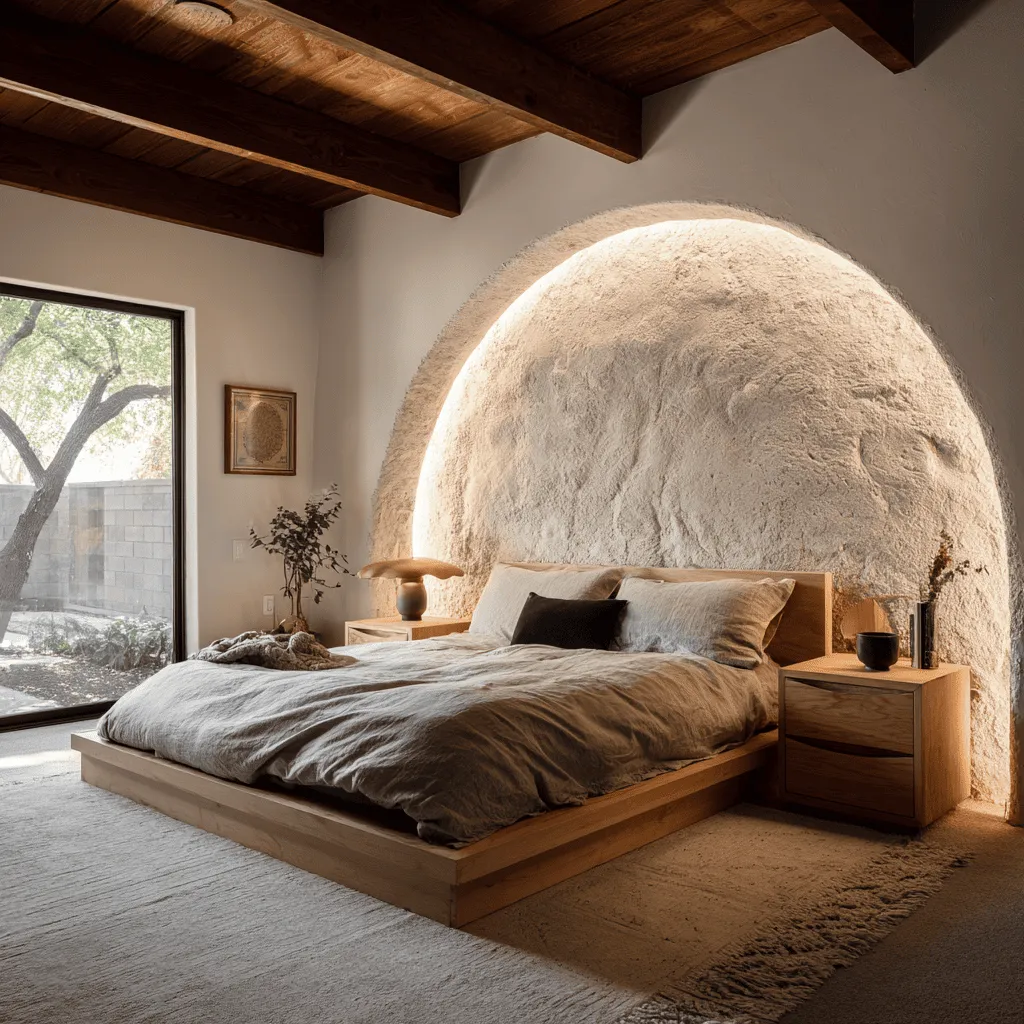
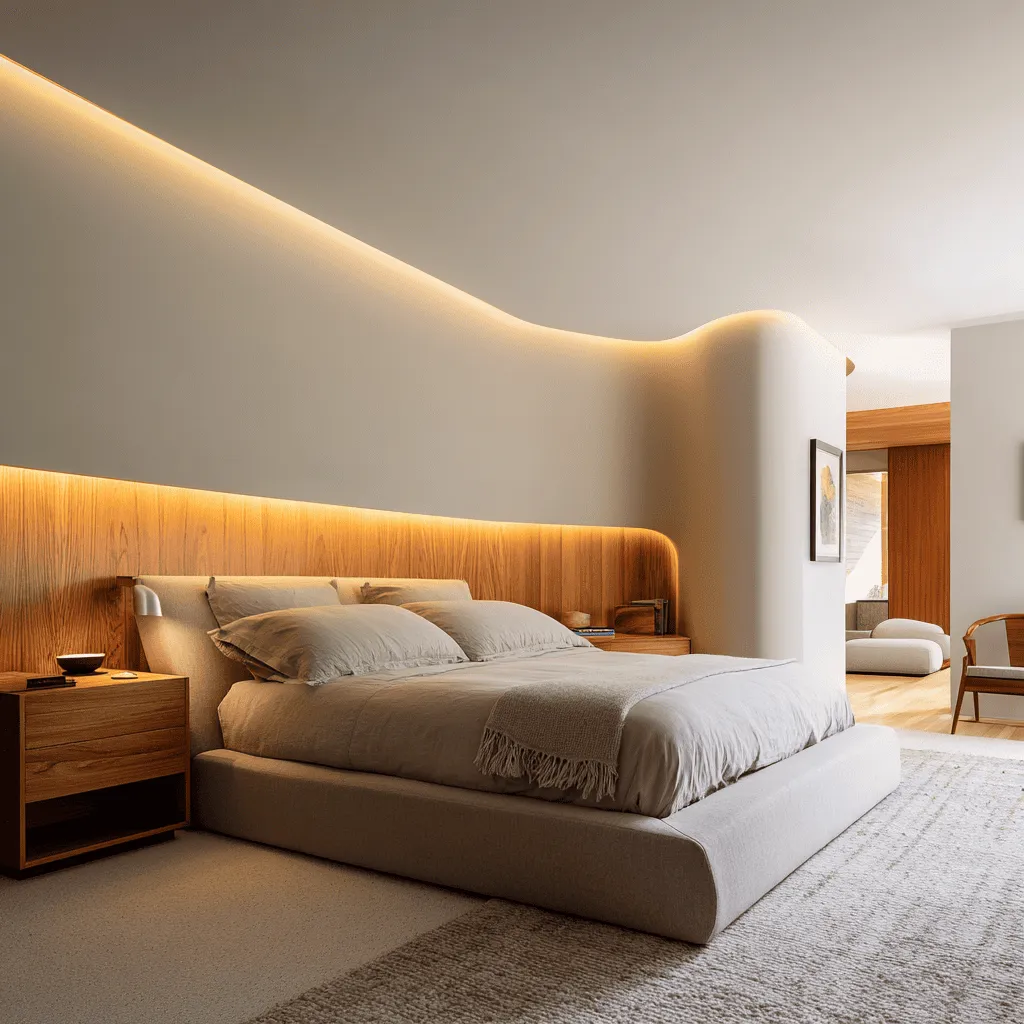
The curved plaster halo goes further by turning that painted idea into sculptural presence, then editing it with a thin glow line. The glow does not decorate; it outlines.
Outline changes how texture is perceived. A mottled surface can feel rustic or uncontrolled, but a clean perimeter light makes it feel intentional, like a shape being traced.
The bed stays low; the bedding stays relaxed; one dark pillow anchors the center so the glow does not wash everything into one pale field. It is a headboard role built from boundary, shelter, and night mood, with very few items.
Light acting as the backdrop
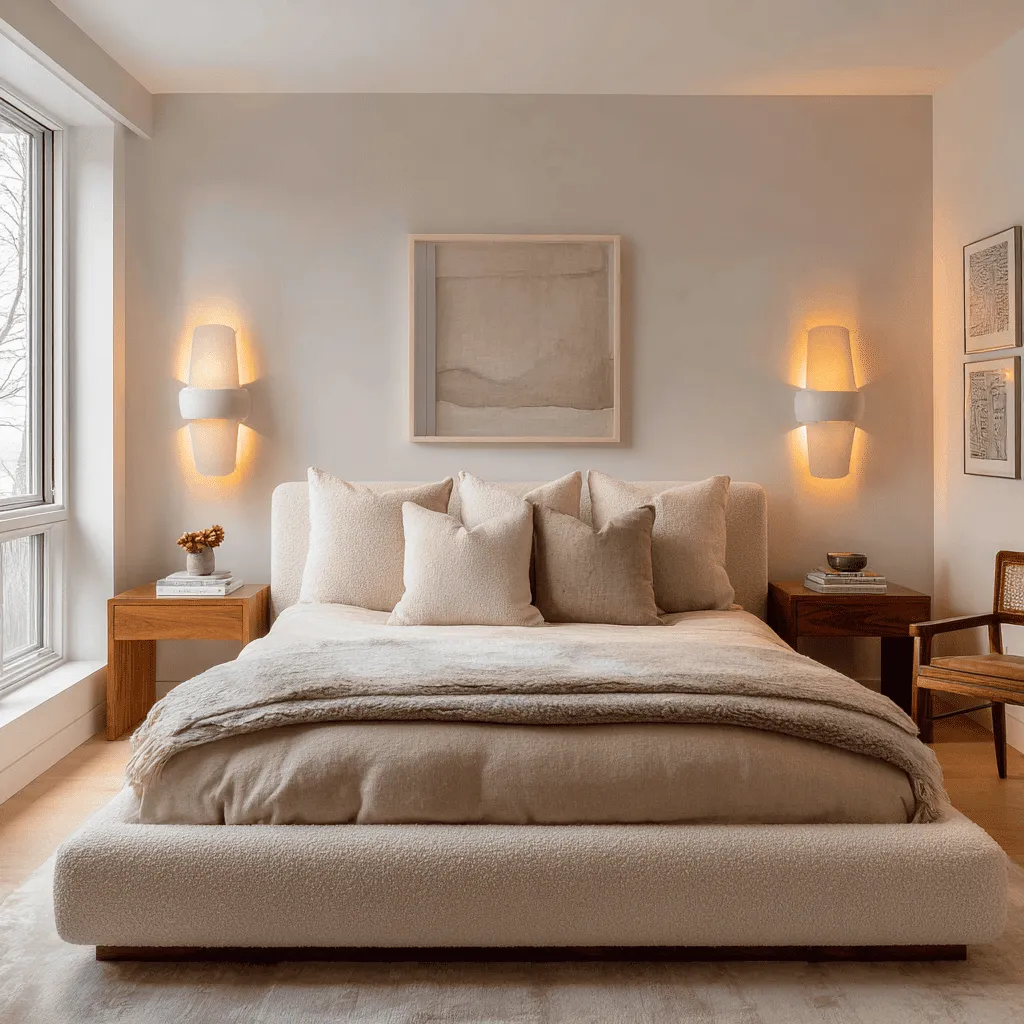
Light-led headboard concepts are especially revealing because they show how much of a headboard’s role is psychological. Two large sculptural wall lights can supply mass, framing, and warmth without altering the wall finish.
They work like parentheses around the bed: the pillow mound becomes the central ridge, the lights become the side anchors, and a small centered artwork keeps the axis stable. The wall itself stays plain, which makes the mood adaptable; the identity lives in the glow rather than in permanent surface pattern.
This is where non traditional headboard ideas often land: not in more decoration, but in more intentional atmosphere.
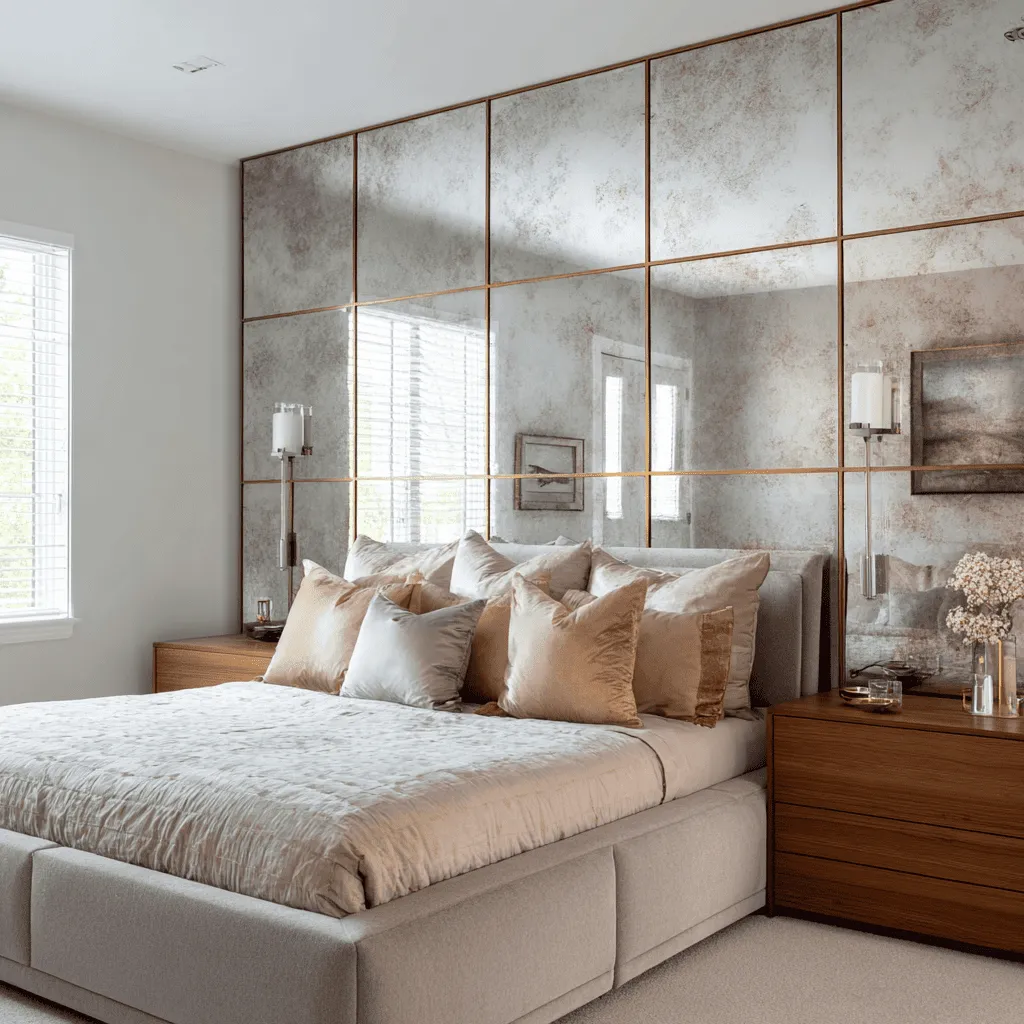
Some alternative headboard concepts can use reflection, because they solve a different visual problem: bedrooms that feel flat. The antiqued mirror grid does not aim for crisp reflection.
It aims for softened depth. The mirror borrows light from windows, carries it over a large surface, and adds a gentle haze that reads like glow rather than glare.
The grid dividers turn reflection into geometry, so the wall feels structured instead of chaotic. Plush tonal bedding is essential here because it stops the reflective wall from turning cold; the softness becomes the counterweight to the wall’s shimmer.
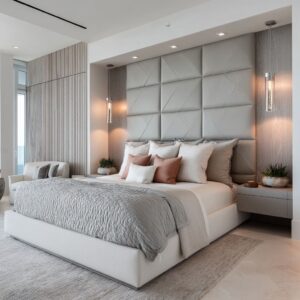
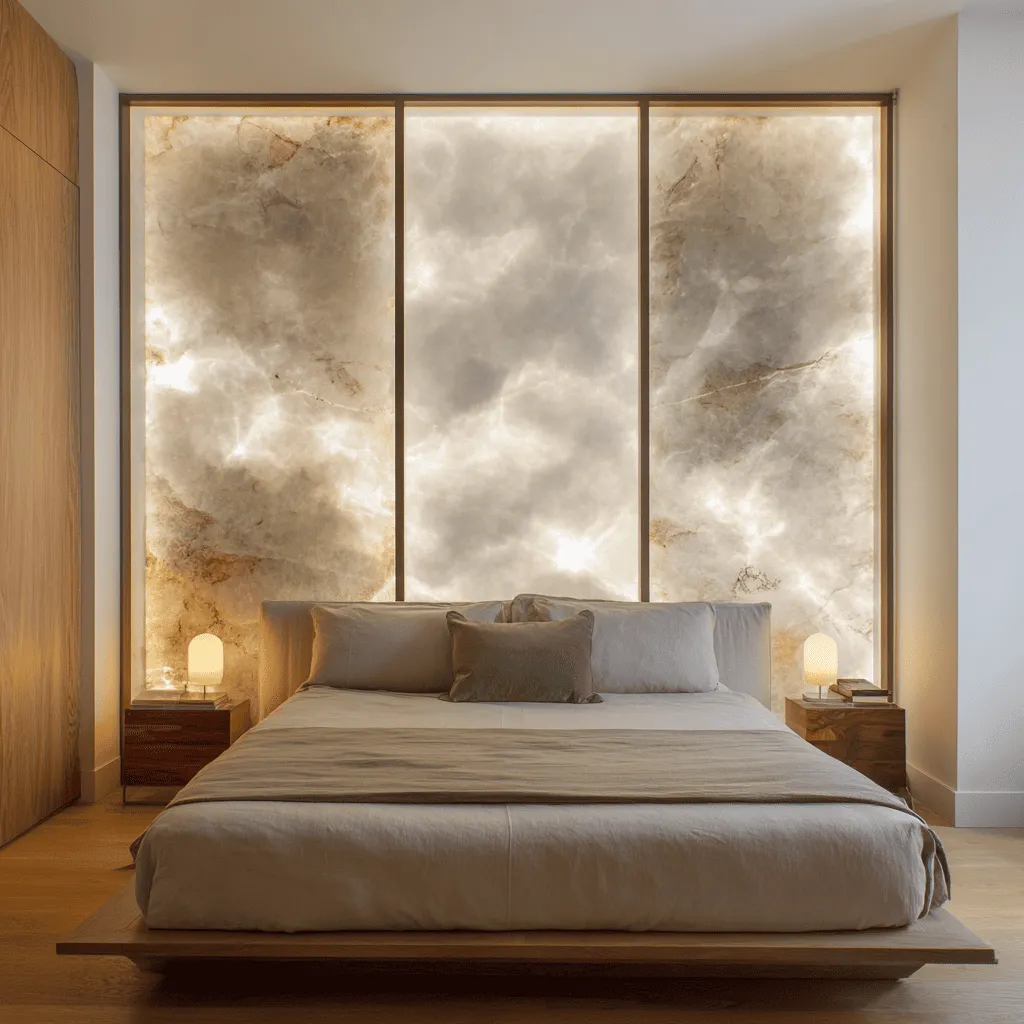
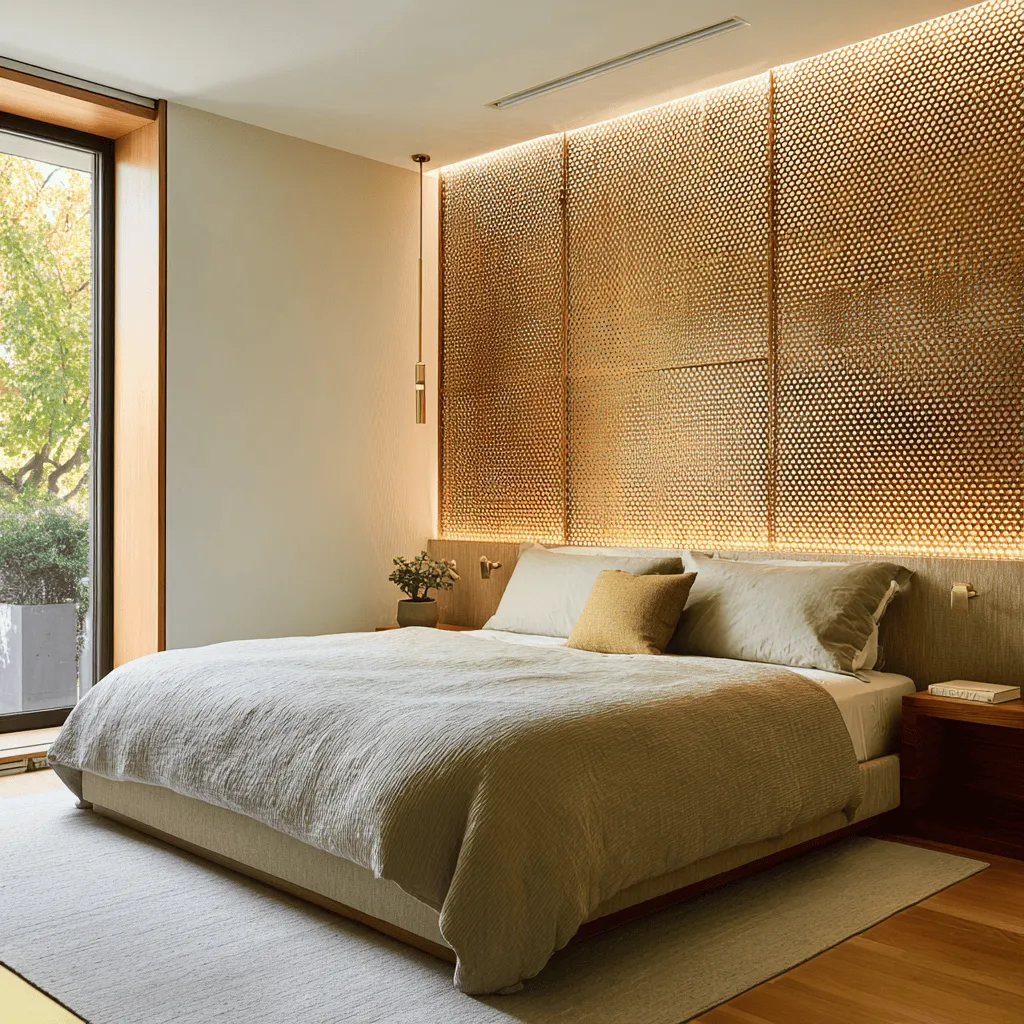
Perforated backlit screens and translucent glowing panels also operate on borrowed light, but with more control. The perforated surface gives scale without heaviness because it is visually porous.
Tiny repeated openings create a soothing consistency from afar, then reveal pattern up close. The glowing resin-like panels behave differently: they create a contained halo that feels like a private window that reveals nothing beyond it.
The seams between panels prevent the glow from turning into a blank light box; the wall still has proportion and rhythm. In both cases, the bed needs strong horizontal calm to balance the vertical drama, which is why runners, platform edges, and low silhouettes matter so much.
Wood as art
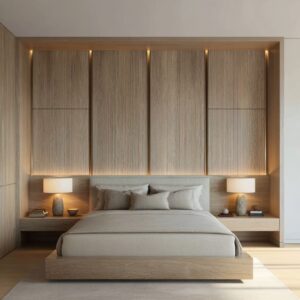
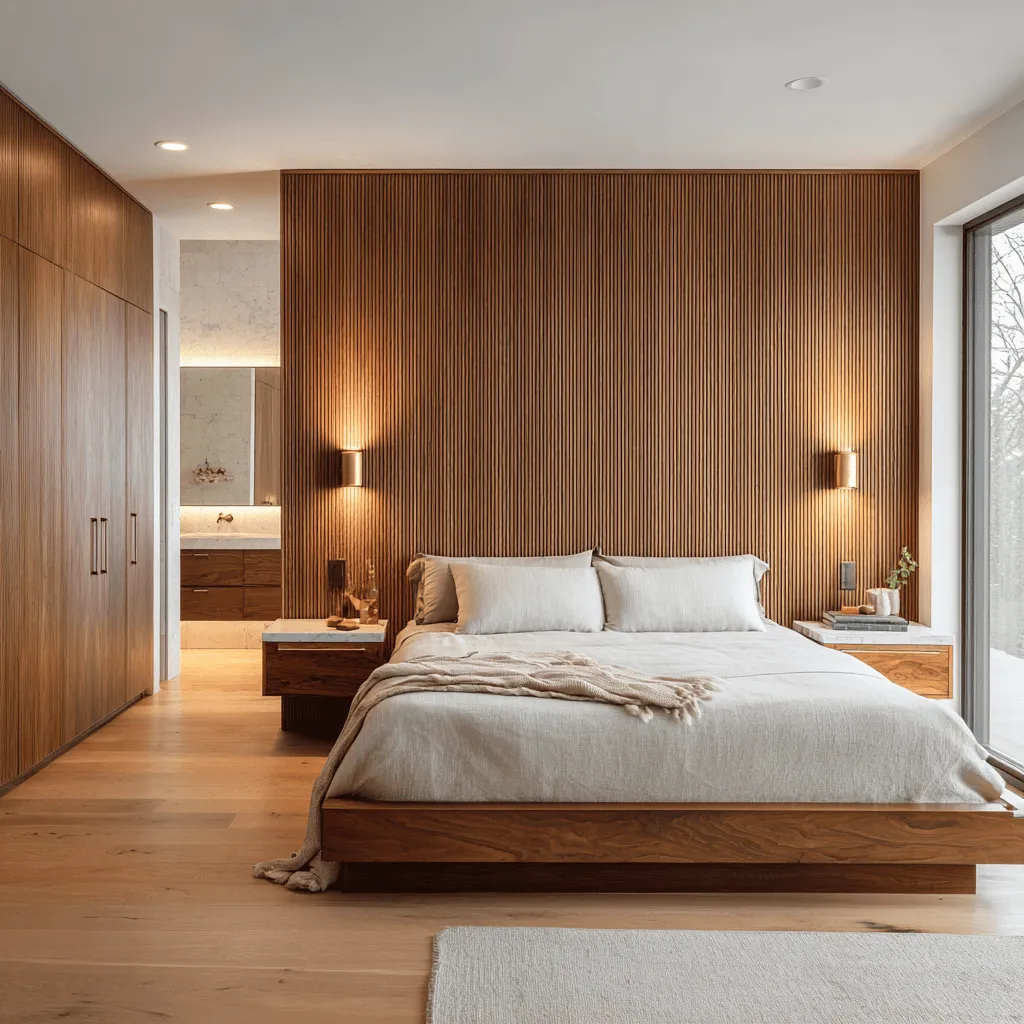
Material fields that carry strong texture often rely on the same balancing trick: micro texture on one surface, macro calm on another. Full-height fluted wood walls are micro texture fields.
They can hold attention without needing art because the grooves create endless small shadow shifts. But micro texture can feel relentless if everything else is linear.
That is why these rooms often include relief pauses: pale stone-like nightstand tops cutting a horizontal plane through the vertical field, or relaxed bedding folds breaking the wall’s strict rhythm. A sconce grazing the flutes turns the wall into a gradient, so the headboard role becomes an atmosphere rather than a panel.
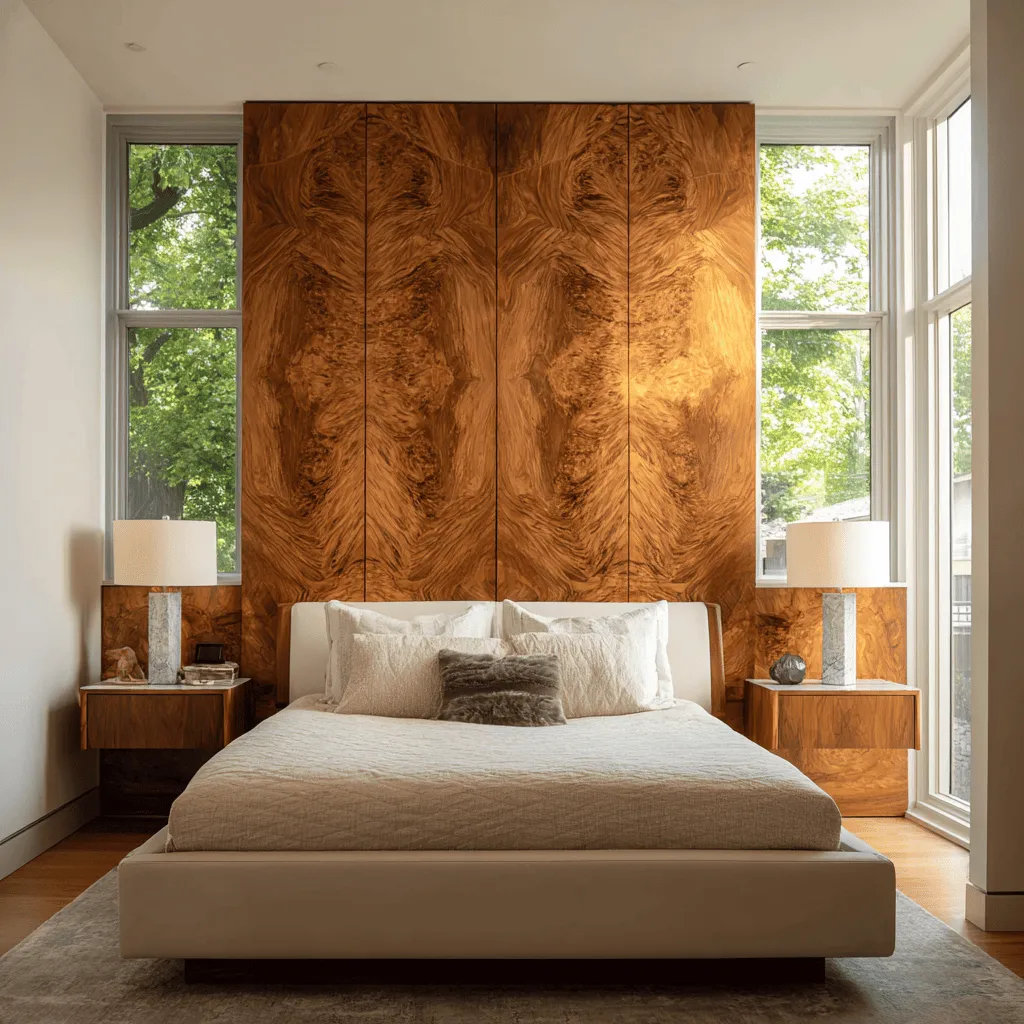
Bookmatched veneer wings take the idea of wall-as-art and give it ceremony through symmetry. Mirrored grain patterns create a center axis that the bed can sit within, almost like the wall is folding inward to hold the sleeping zone.
Windows at the sides become bright borders that sharpen the wood’s depth, and the bedside objects repeat the wall’s proportions in miniature: tall rectangular lamp bases echo tall wood panels; pale lamp shades calm the grain’s movement. The bedding stays quiet because the wall already contains visual motion.
One darker fuzzy pillow concentrates contrast where it can stand up to the wall’s presence without scattering the room with multiple accents.
Stone and plaster fields that don’t shout
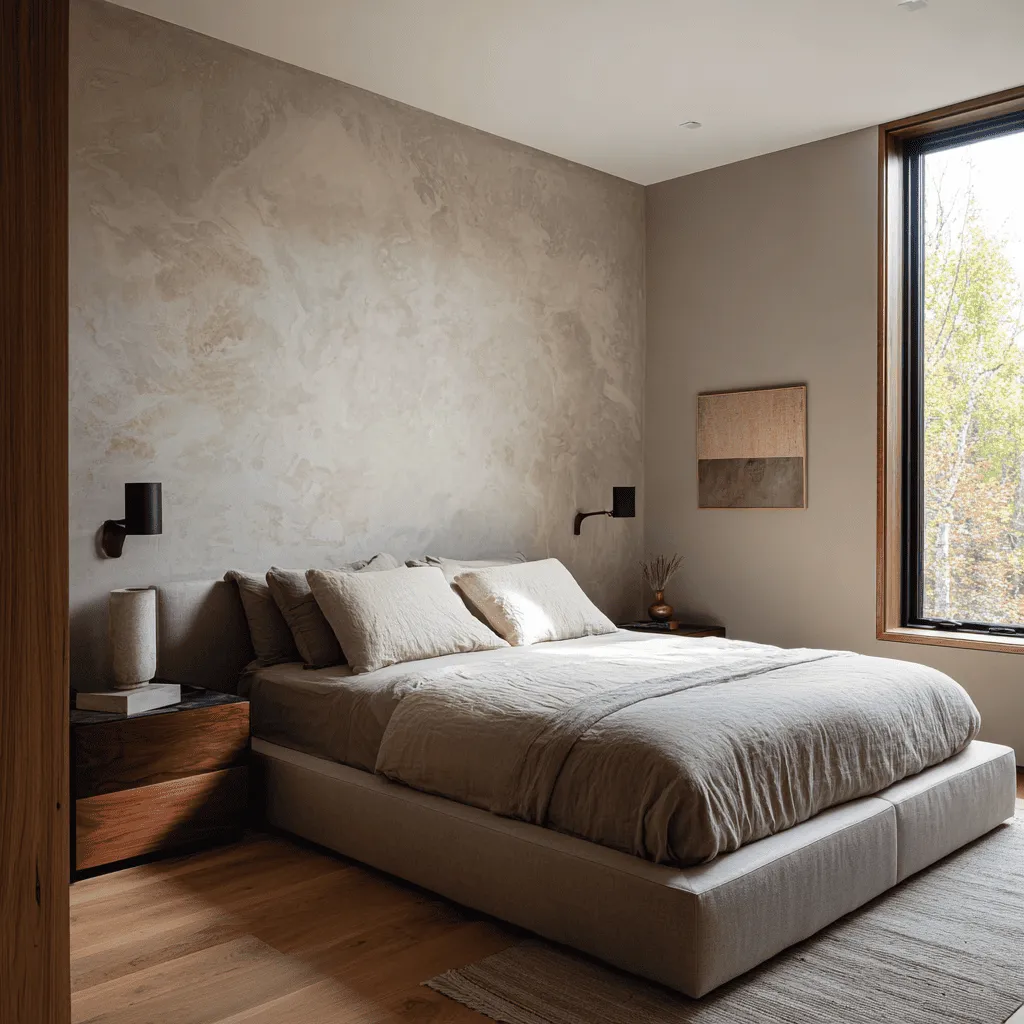
Plaster-based concepts succeed when the texture scale is slow and broad. Broad tonal movement supports bedding wrinkles because it does not compete at the same scale.
This is easy to miss and crucial: when wall texture is too fine, it can make textiles look messy by comparison; when wall texture is broad, textiles look intentional and soft. In the corner-wrap plaster idea, the wall’s large-scale movement provides depth, while the window view supplies fine organic pattern from trees.
The bed sits between those scales, so the room feels rich without being busy.
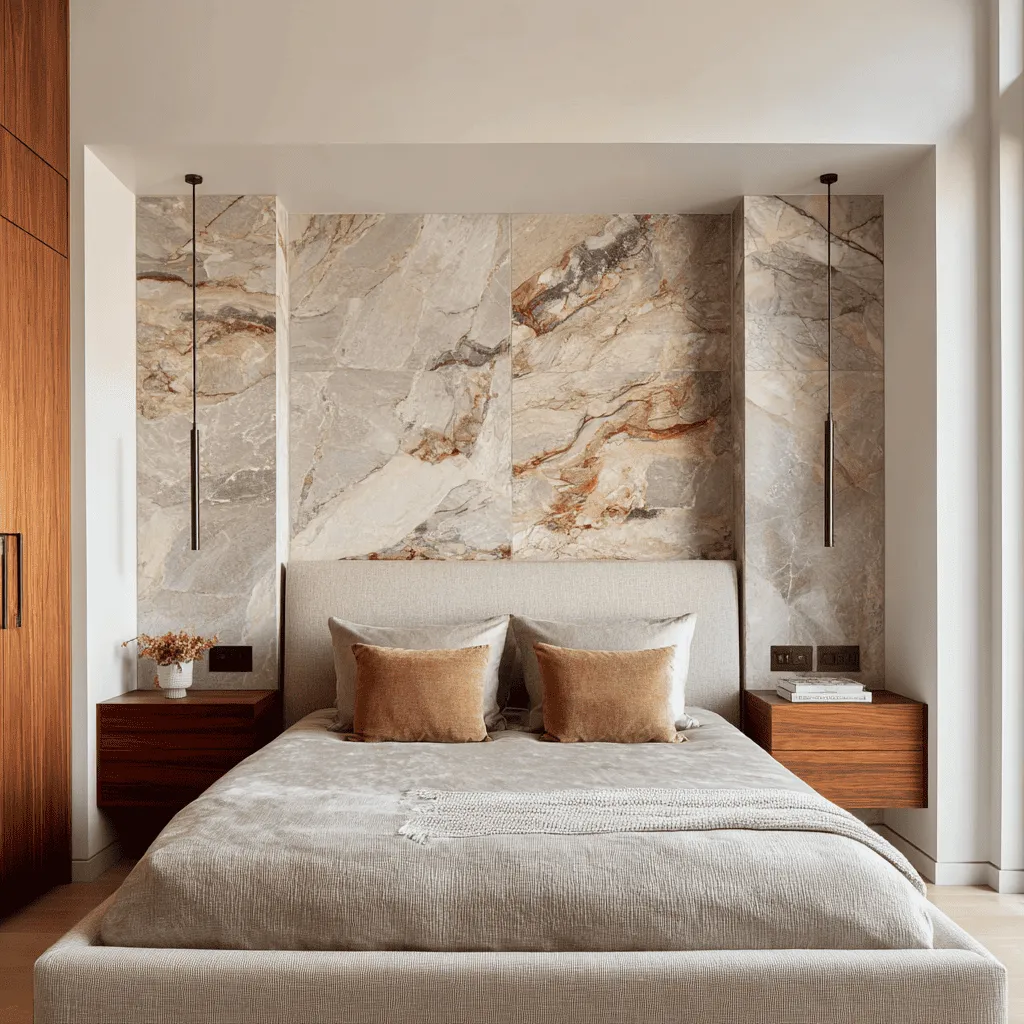
Stone-look slabs inside a niche rely on the same scale logic, but with veining instead of plaster clouds. Vein movement becomes the wall’s artwork.
The upholstered head element stays matte and pale because it is not competing; it is buffering the pillow zone. Small tan pillows echo the stone’s warm streaks so the wall and bed feel tied together.
Slim pendants add straight vertical calm against the organic wall, giving the eye a stable reference point.
Belts, horizons, and long lines
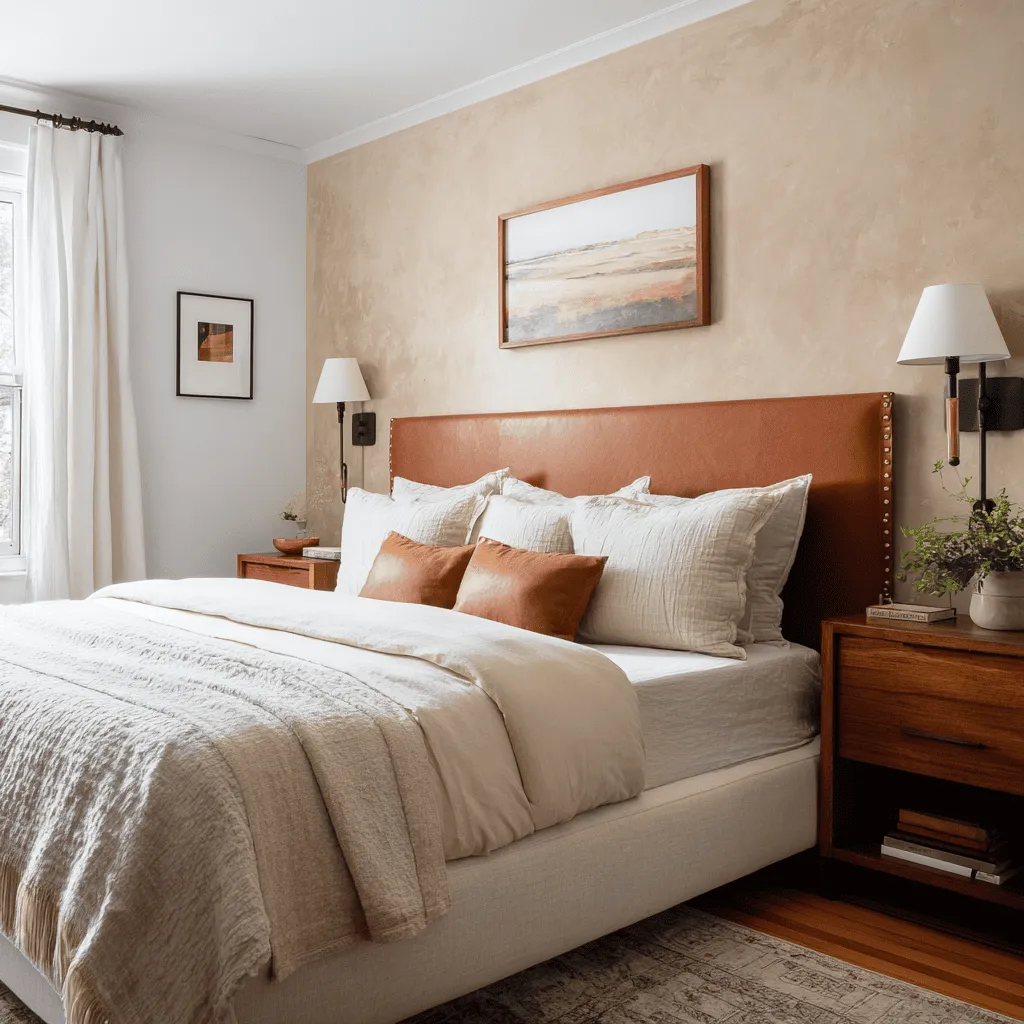
Then there are alternative headboard ideas that transform the headboard role into a continuous belt. A long leather band at pillow height turns the bed wall into a graphic composition.
It changes how the eye measures the room: the bed feels tied to the wall’s width rather than standing as an isolated object. Small stud rhythm gives micro detail; lamps at the ends act as vertical stops; a long artwork above repeats the horizontal grammar with generous spacing so the wall does not feel stacked.
The result is definition without tall furniture drama.
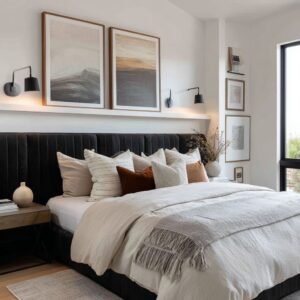
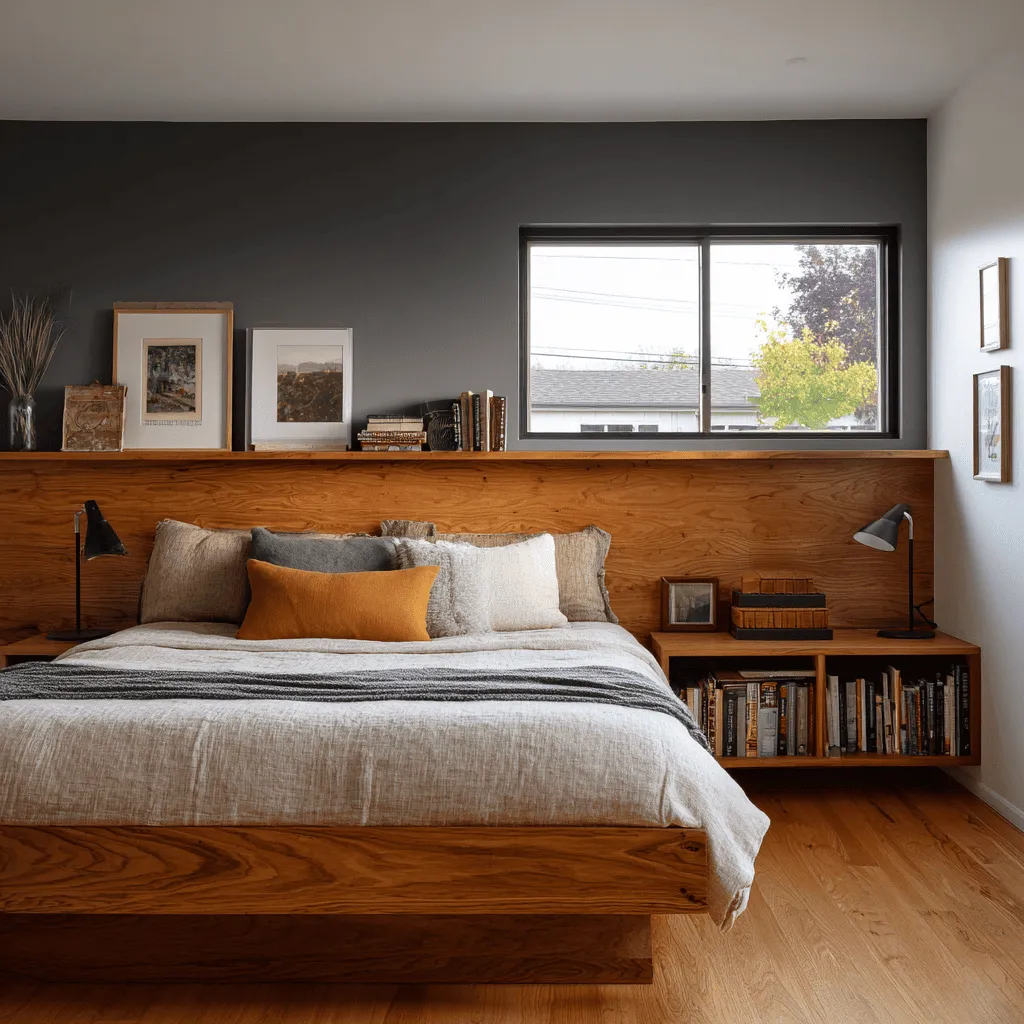
The long shallow ledge under a high wide window takes the belt concept and makes it lived-in. Leaning frames, spaced objects, and book stacks create a casual horizon line that can shift over time without breaking the wall’s order.
Dark wall behind intensifies wood warmth without extra ornament. Black task lamps dissolve into the background and add diagonal energy to a mostly horizontal composition, keeping the wall from becoming too flat.
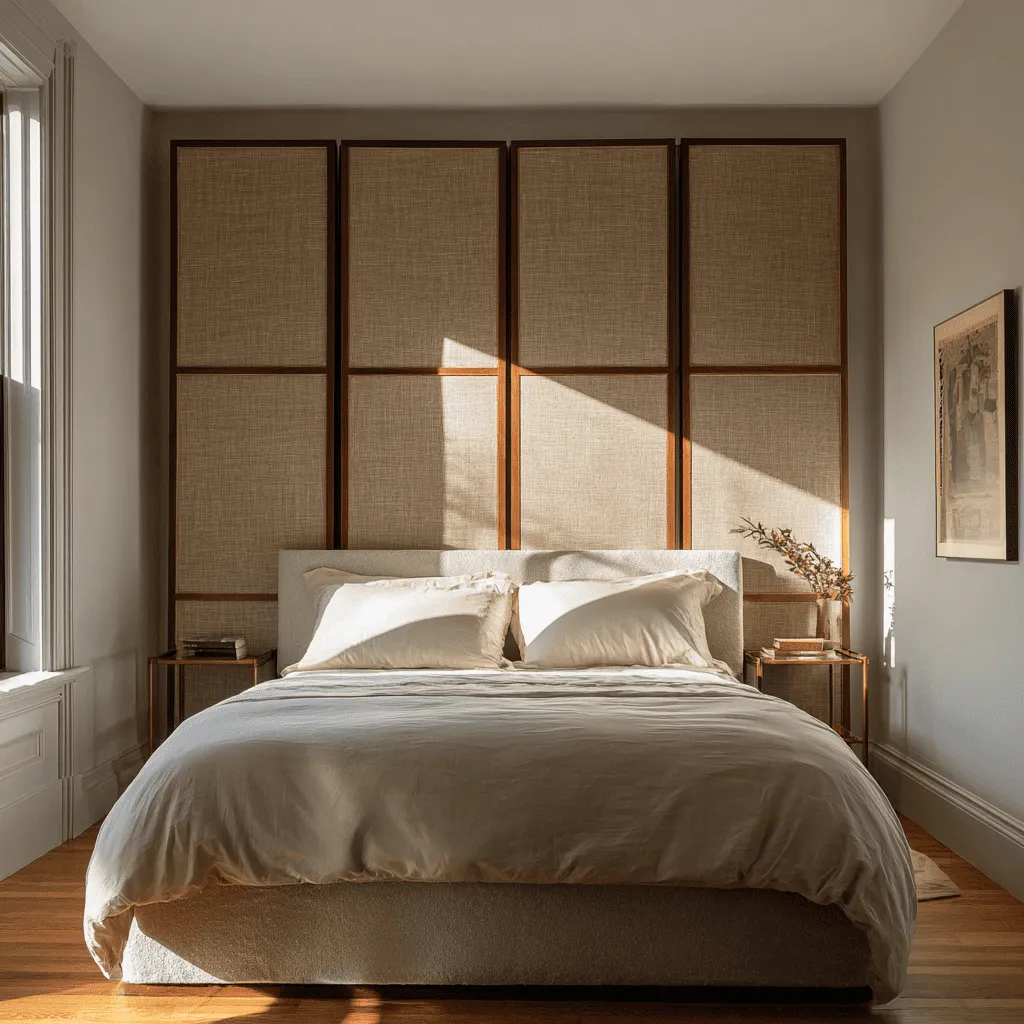
A folding screen placed behind the bed adds a different kind of depth: not depth as illusion, but depth as layering. The wall becomes a background, the screen becomes a mid-layer, and the bed becomes the foreground.
Repeated rectangles in the screen panels create rhythm; woven infill adds tactile detail without a loud motif. Sunlight cutting diagonally through the weave becomes part of the composition, turning the bed wall into something that changes through the day.
Slim nightstands remain crucial so the screen stays visible near the lower zone, keeping the backdrop continuous.
Art fields that replace furniture presence
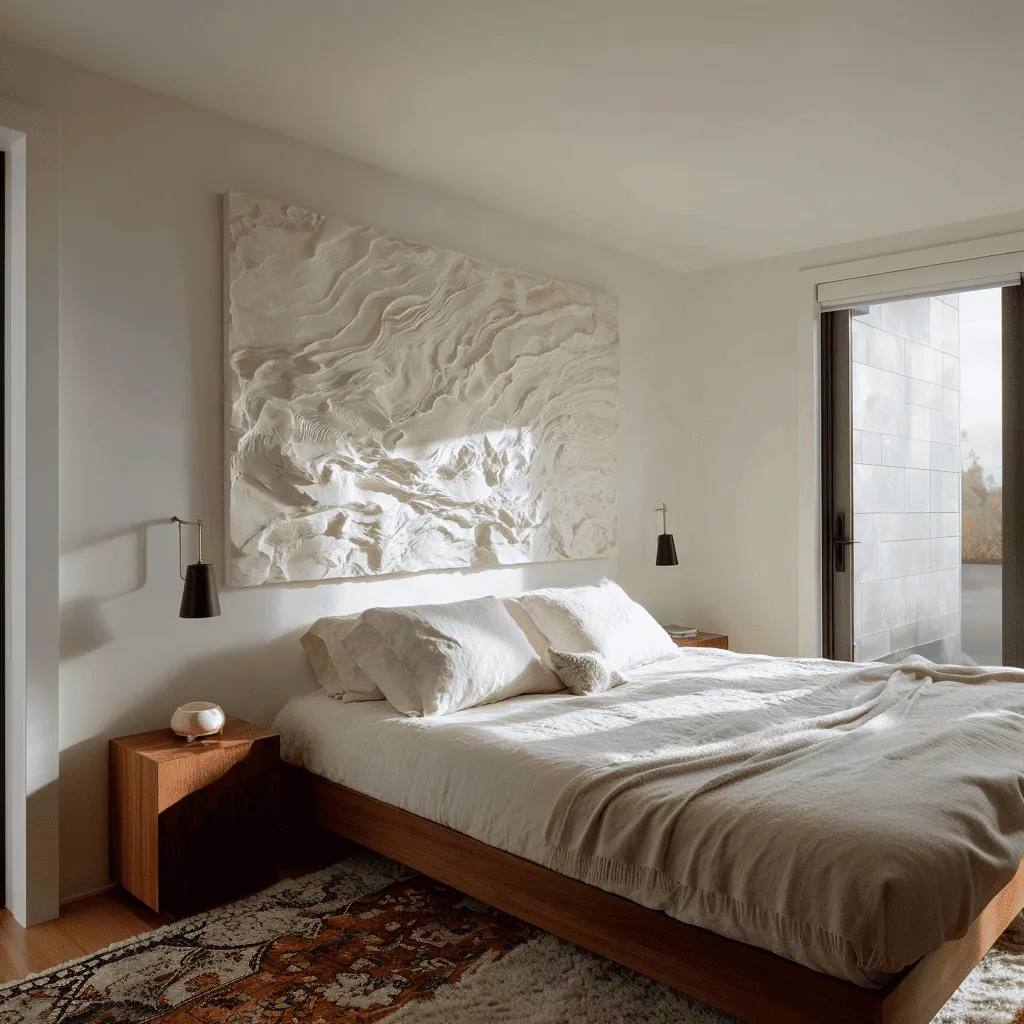
Some of the most persuasive headboard substitute ideas are the ones that treat the bed wall like a curated exhibit rather than a furniture vignette. A large plaster bas-relief hung low acts like a wide sculptural panel that belongs to the pillow zone.
Because it is monochrome, shadow becomes the pattern. Strong daylight produces a second image made entirely from relief and shade, so the bed wall changes mood without added objects.
A traditional rug with deeper tones can add a layer of memory and soften the contemporary wall moment, preventing the room from feeling overly staged. Dark swing-arm fixtures at the sides act as crisp punctuation so the pale relief does not wash out.
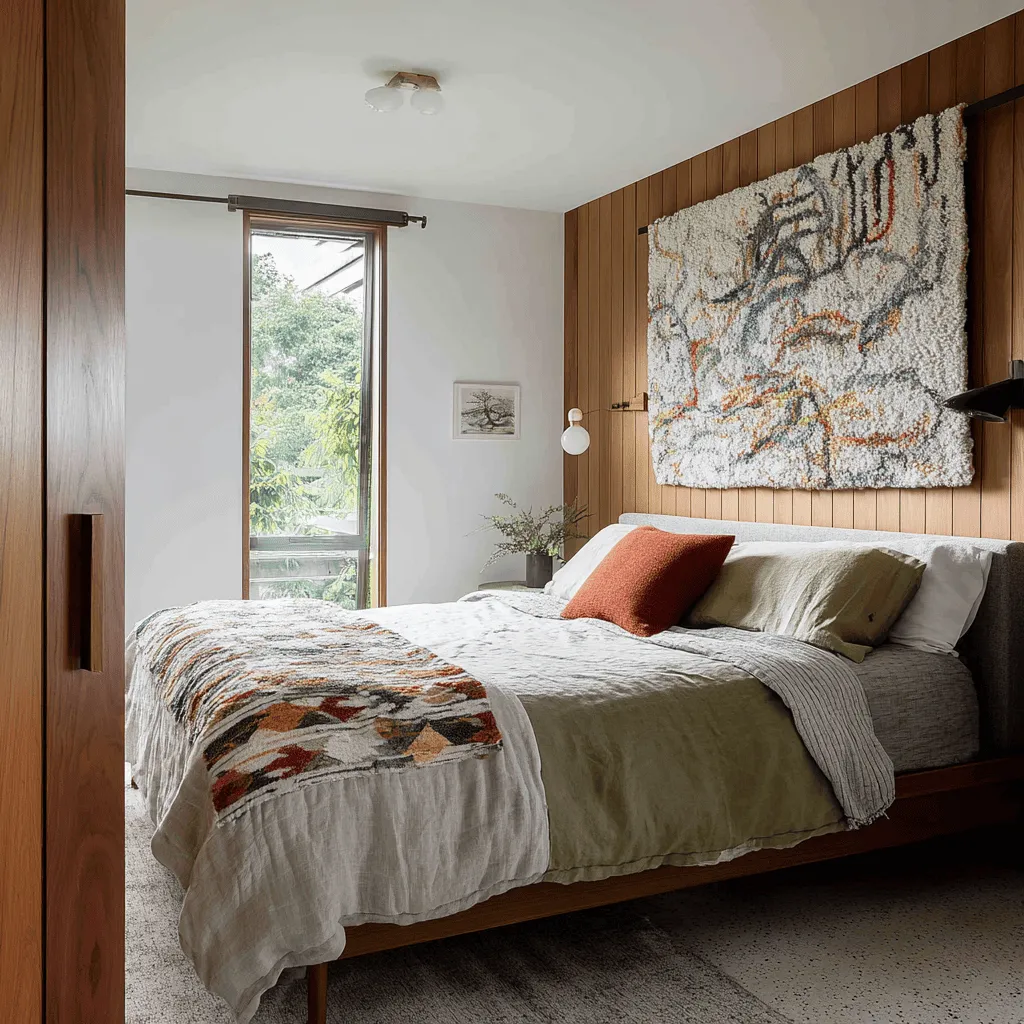
Textile-as-art can do something similar, but with softness instead of relief. A museum-style hanging on a rod, set against vertical slats, creates a wall moment with depth and fiber shadow.
The slats provide a measured background rhythm; the textile supplies irregularity and color. The bedding can echo the textile in a calmer way (one throw with related tones, or one coverlet that borrows a single hue) so the wall feels integrated rather than random.
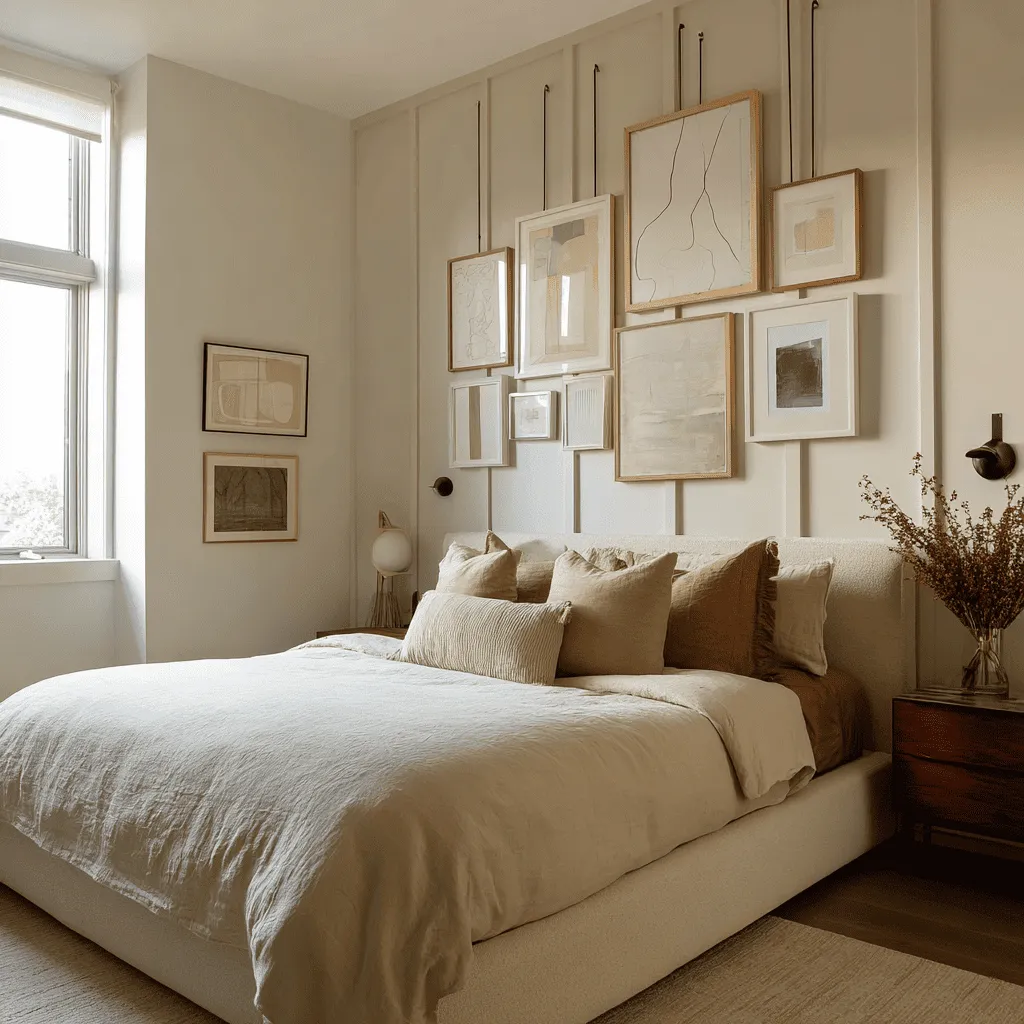
The gallery-rail art wall takes this further by spreading identity into a field of frames rather than one statement. The trick is hierarchy inside the cluster: one larger piece anchors, medium pieces step, smaller pieces fill.
Vertical battens behind create an underlying cadence, and hanging cords echo that cadence so the wall feels layered without becoming chaotic. The bed stays restrained in silhouette so the wall can be taller and more present than a typical upholstered piece, yet still feel breathable because the frames stay pale and the content stays tonal.
The common thread
The headboard role is not one object. It is a choreography of contrasts: horizontal stability versus vertical lift, soft mass versus crisp markers, broad background fields versus small punctuation objects, daylight behavior versus night behavior, and micro texture versus macro calm.
The most successful concepts give the bed a place to belong in the room’s visual grammar, even if the wall stays plain or the bed stays minimal.
And that is why the most satisfying unconventional headboard ideas keep returning to the same few levers: the pillow horizon as a datum; the side bookends as brackets; the wall as a field that can carry light; and a limited number of shapes repeated in different materials so the room feels coherent without feeling matched.