A black and silver bedroom lives on the edge between shadow and glow, yet the best spaces don’t rely on loud metallic paint or heavy blocks of color; they rely on calm moves that steer the eye with value, texture, and proportion. In such interiors, silver behaves like softened daylight spread through fabric and matte finishes, while black behaves like ink that outlines, anchors, or quietly collects light.
The result is black and silver room designs where the palette looks simple at a glance but reveals layered systems on closer inspection: gentle gradients on drapery pleats, ribbed panel shadows that read like soft stripes, narrow polished lines that blink in and out as you walk, and bed compositions that stage a luminous center against a dark frame.
Silver as Light, Not Metal
Silver in such designs is less a color and more a way the surfaces handle brightness. Think crushed or washed textiles that scatter light softly, velvet with a faint nap that turns points of brightness into a haze, linen and tweed that blur highlights across a wider area, and over-dyed rugs that hold light like watercolor paper rather than mirror it back.
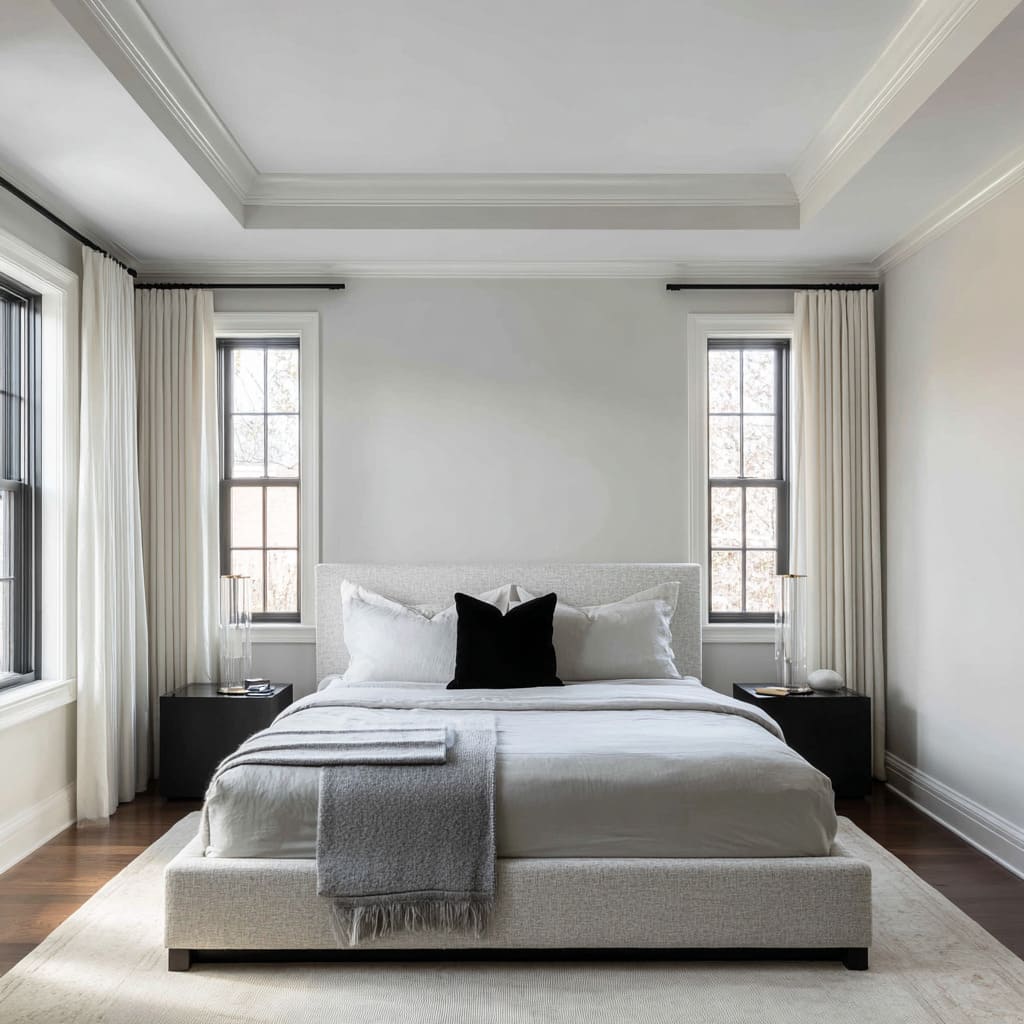
This approach gives black and silver bedroom ideas a soft radiance. Silver is placed where the body rests and where the eye should relax—on the bed face, in the curtain field, across the rug plane—while black settles into edges, bands, or a single feature wall to provide structure.
In a well-balanced composition, the soft center carries the light; the dark perimeter keeps the mood steady.
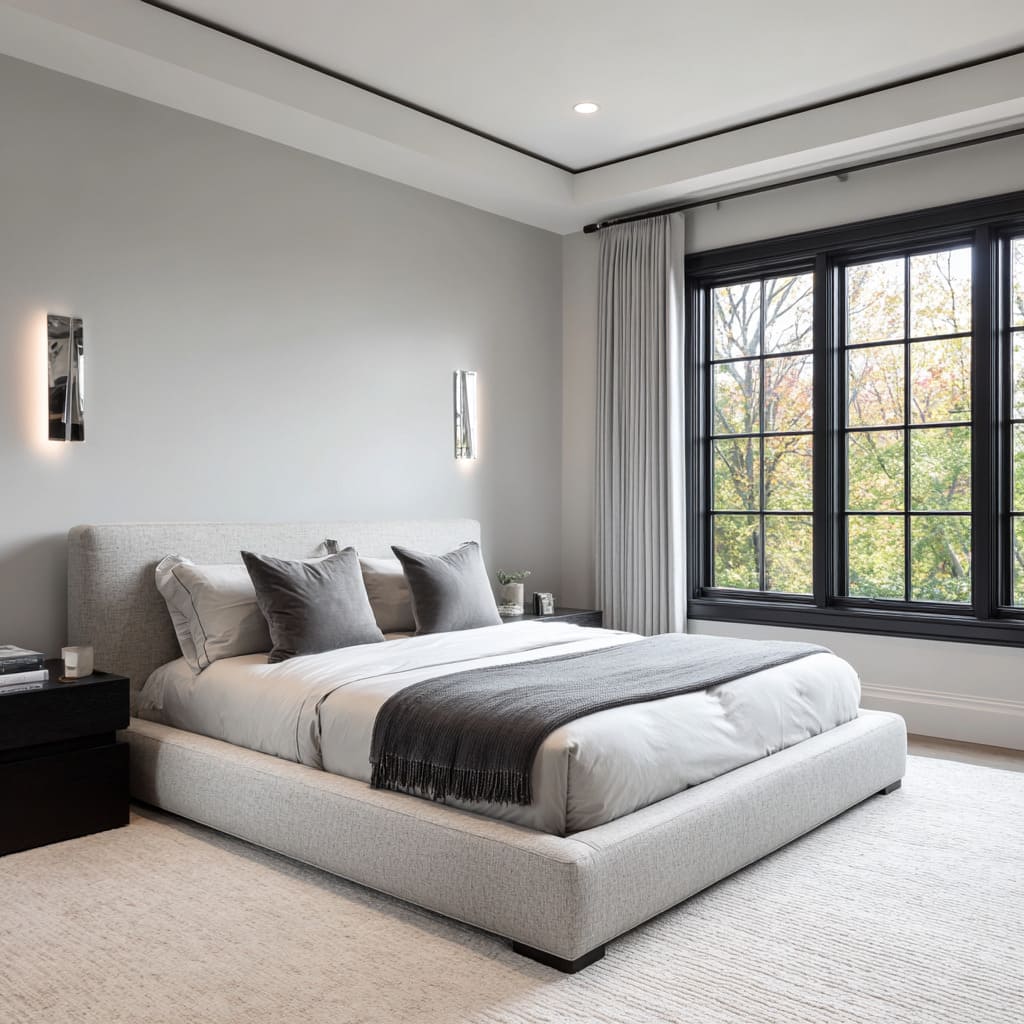
Black as Drawing, Not Weight
Black works like linework rather than mass. Sometimes it’s a full band that runs the width of the headboard, a vertical column that punctuates a pale wall, or a thin seam that reads like ink.
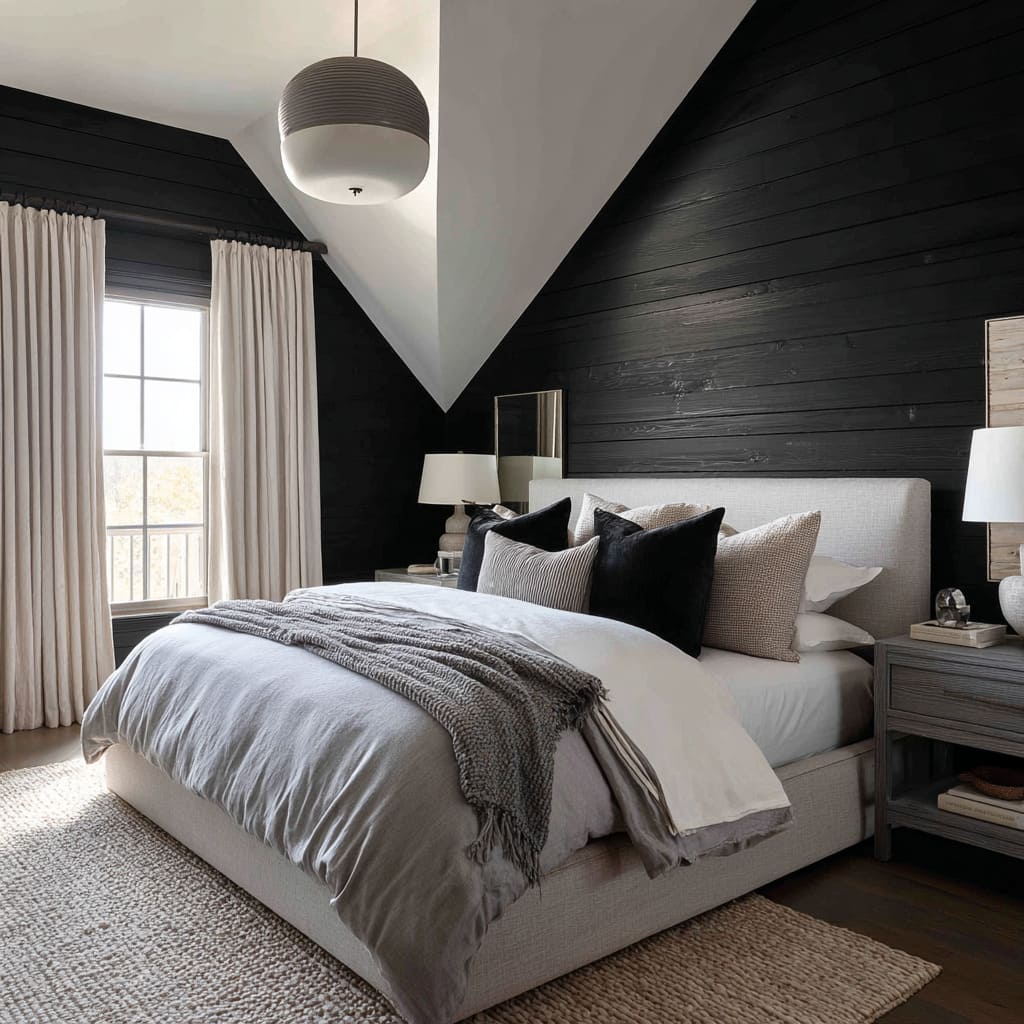
Many black silver bedroom ideas reduce black to precision marks: slim window muntins, inlay stripes, lamp stems, pendant cords, and refined furniture outlines. These marks give clarity without heaviness.
A particularly refined pattern repeats black at three scales—the ceiling beams as bold strokes, the window grid as mid-weight strokes, and the throw or pillow as fine strokes—so one visual rhythm ties the space together.
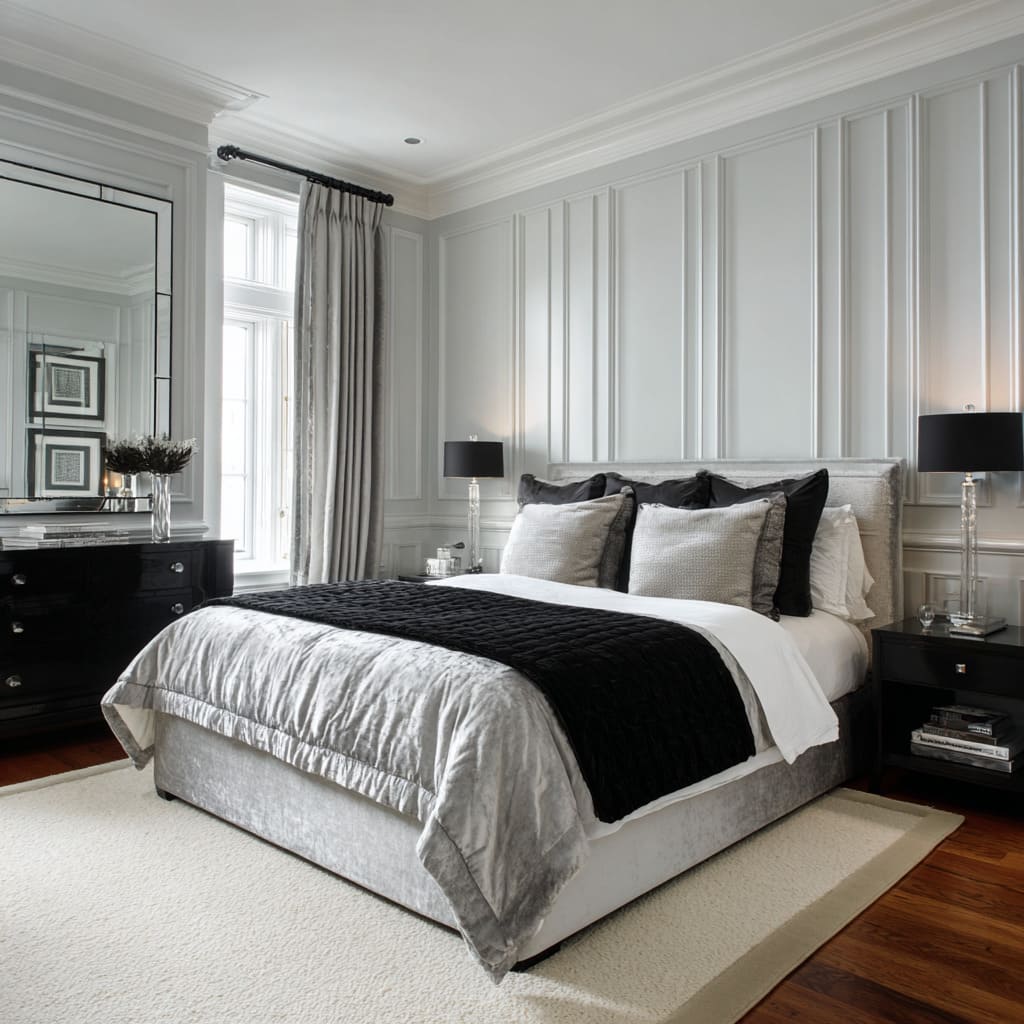
The Value Ladder: The Secret of Calm Contrast
The quiet power in bedroom ideas in black and silver is a value ladder that moves from dark to mid to light in steady progression. Darks—nightstands, rods, base lines—sit at the frame; mid-tones—bedding, rug, drapery—form the volume; and lights—sheets, mirror rims, lamp shades—punctuate the center.
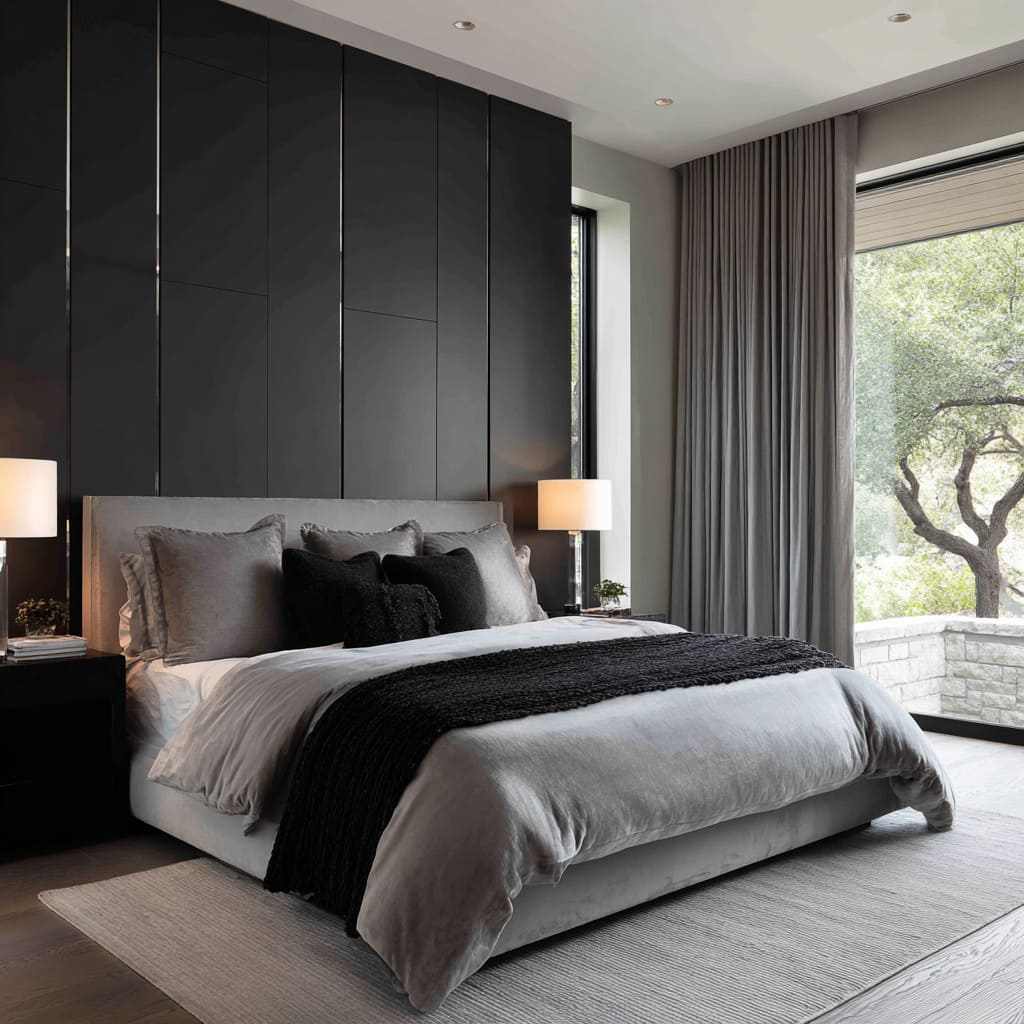
This ladder ensures the palette feels calm even when the contrast looks bold. For instance, a matte-black wall behind a silver velvet bed instantly deepens the light on the bedding, while ivory lamps balance the upper visual weight.
Calm drama depends on these transitions, not on extremes.
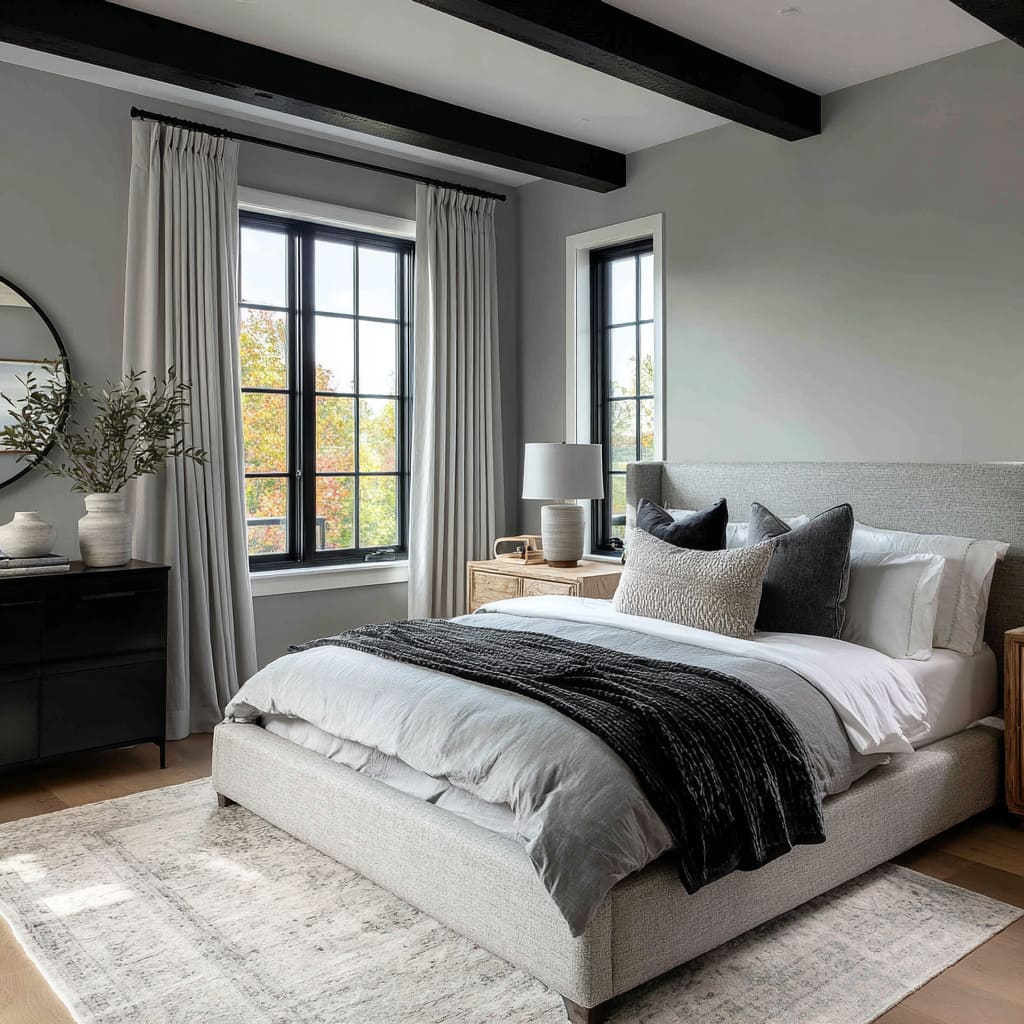
Rhythm Through Ribs, Grids, and Shadows
Patterns of repetition bring hidden order to silver black bedroom ideas. Vertical slats bend across corners to form sculptural backdrops.
Wall battens or panel ribs echo in lamp stems and curtain folds, creating layered rhythm. Window grids align with rug checks so that floor, wall, and ceiling speak one visual language.
Even the shine is rhythmic: polished seams or mirror rims catch light in micro doses. These rhythms turn minimal compositions into rooms that feel alive without visual noise.
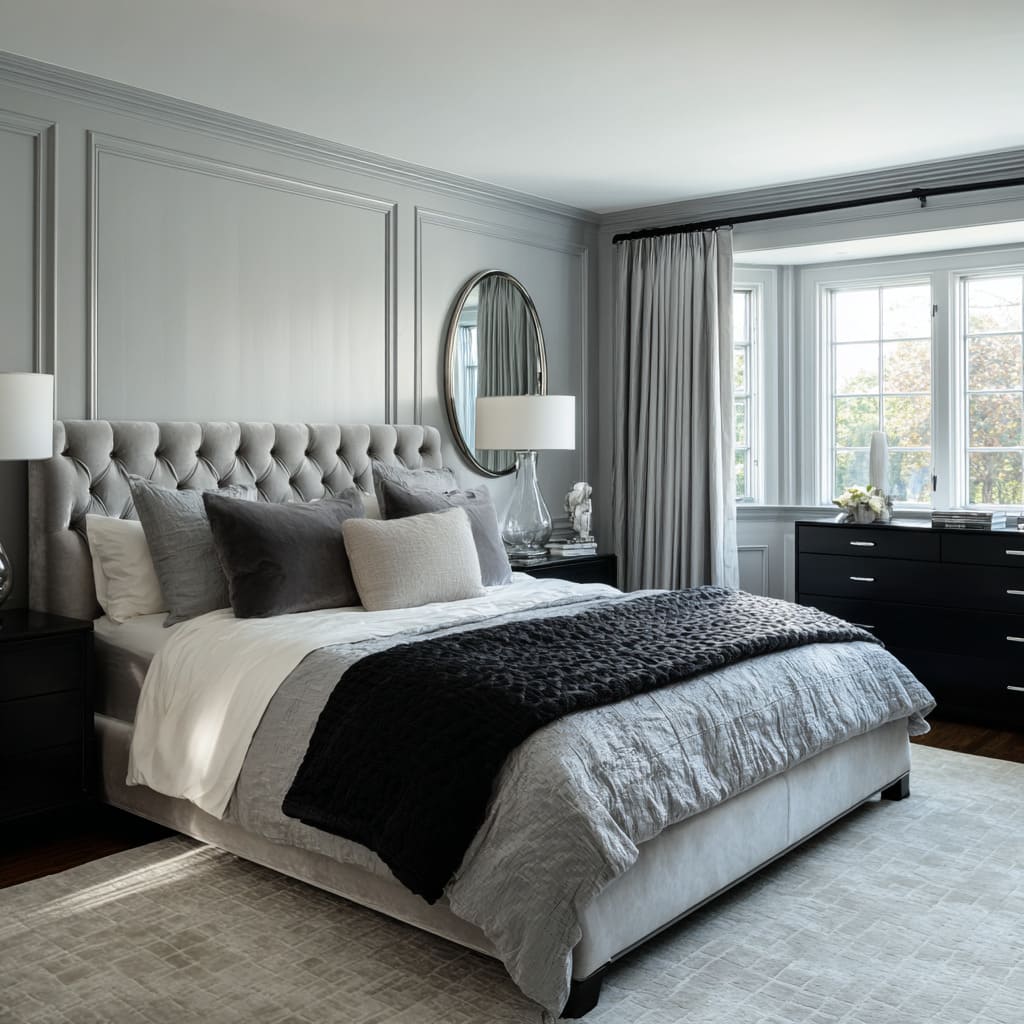
Common Rhythmic Systems in Black and Silver Rooms
- Vertical rib systems: repeated lines in wall panels, curtain pleats, or fabric strié.
- Grid echoes: window mullions mirrored in rug geometry.
- Shine rhythms: thin polished edges and chrome pendants repeating wall structures.
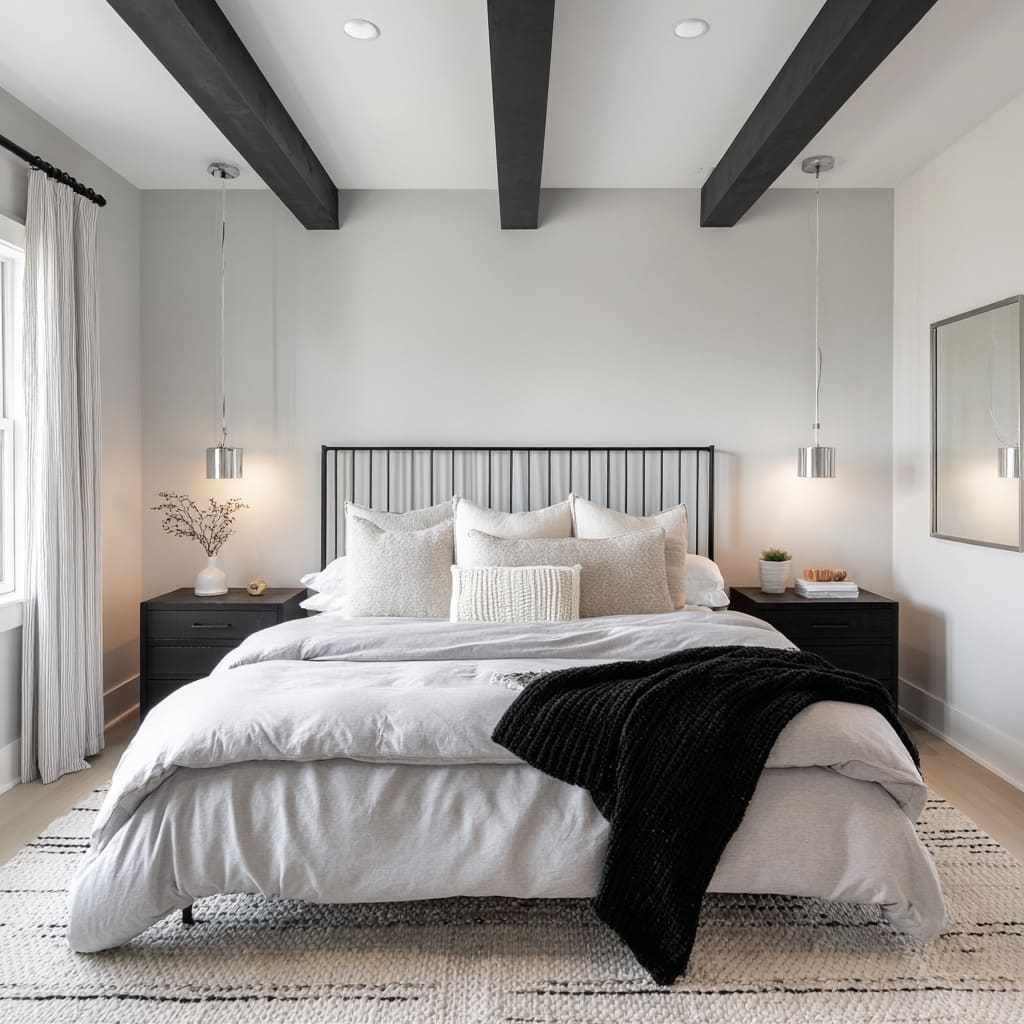
Balancing Soft and Sharp Geometry
Shape balance makes these black and silver room designs emotionally steady. Hard geometry holds the outline—frames, grids, furniture boxes—while soft geometry humanizes the scene—tufted dimples, winged headboards, round mirrors, or loop-pile rugs.
The contrast between strict and yielding shapes prevents the dark palette from feeling stern. Beds become sculptural clouds framed by black precision, and every soft fold answers a straight edge somewhere nearby.
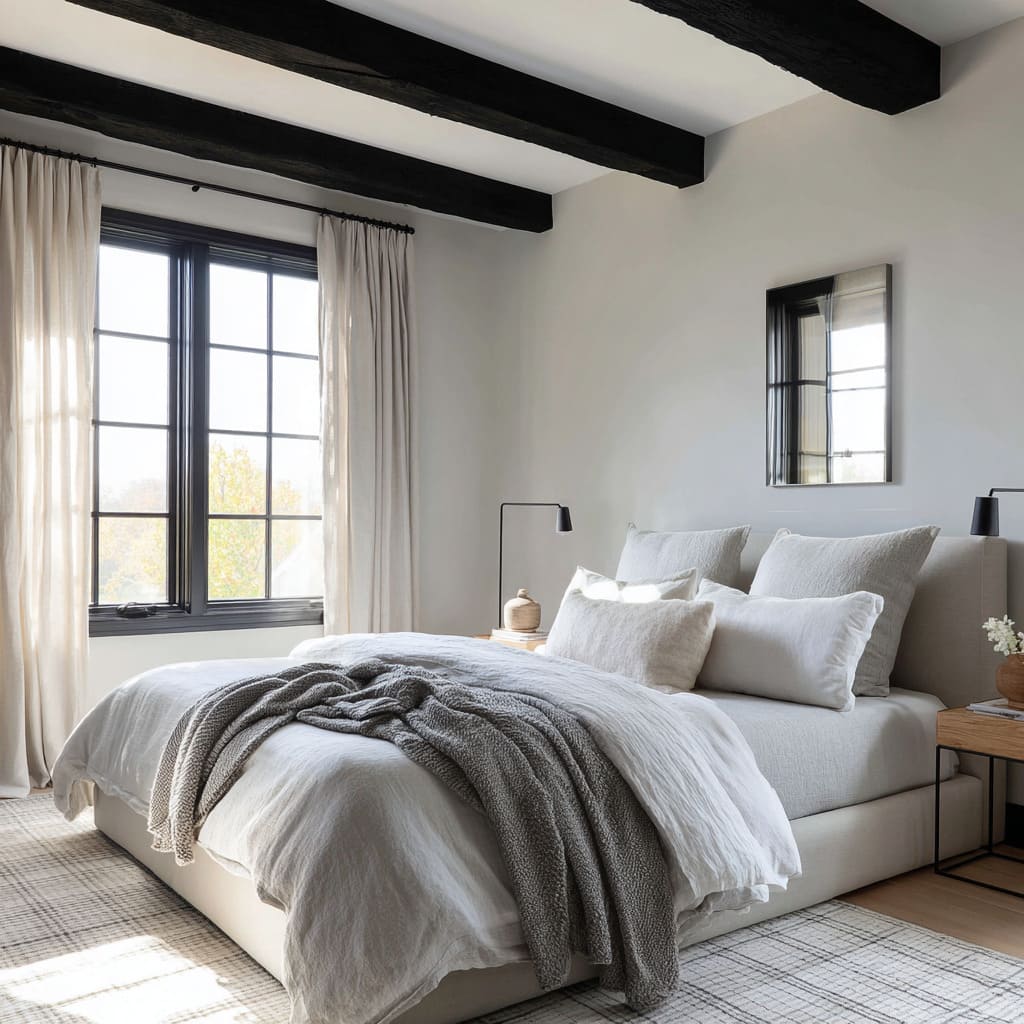
Small Shine, Big Impact
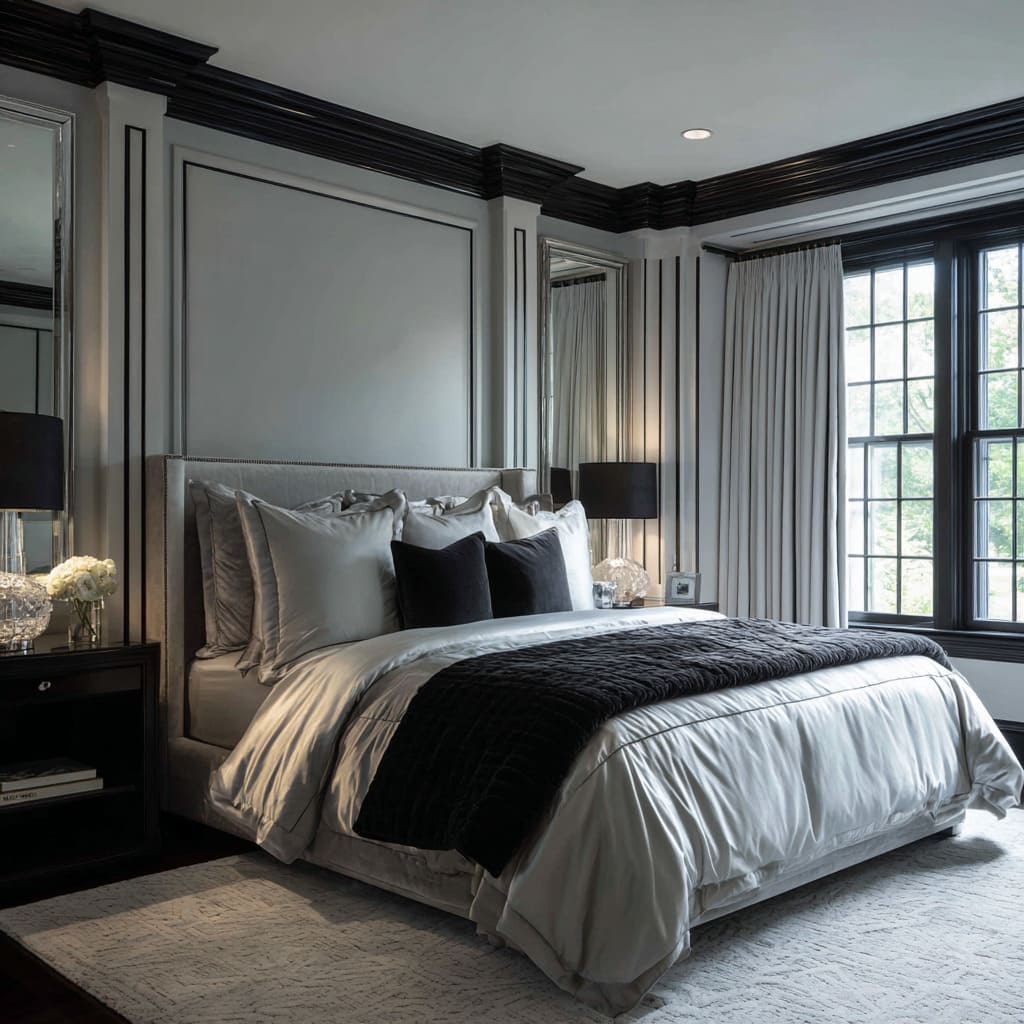
Micro-reflective details behave like jewelry for the room. Chrome pendants sit like cufflinks above nightstands, crystal stems lift small cylinders of warm light, and mirror rims return soft glints of lamp glow.
The shine is modest but deliberate, always placed along existing lines rather than scattered randomly. Often, the luxury comes from this control—light that grazes rather than glares, reflection that doubles structure rather than decoration.
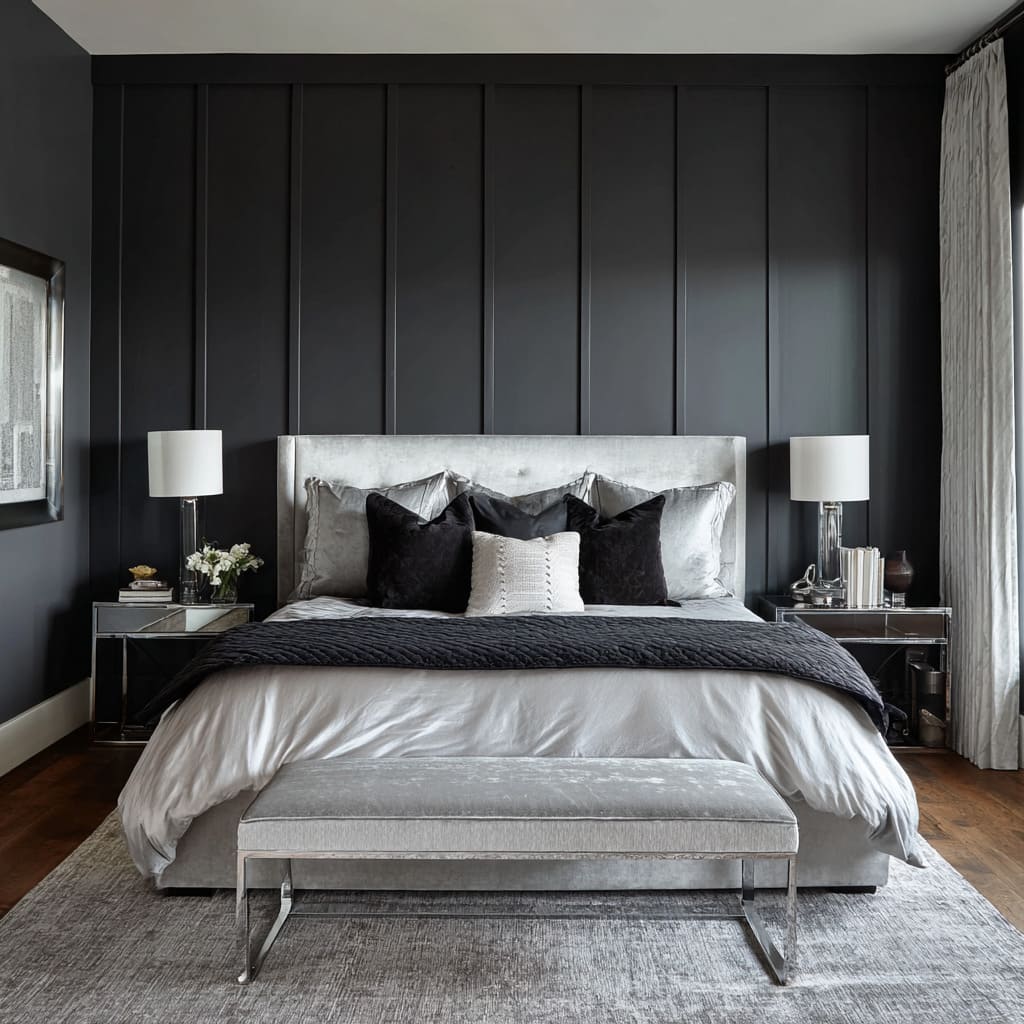
Shadow as Texture
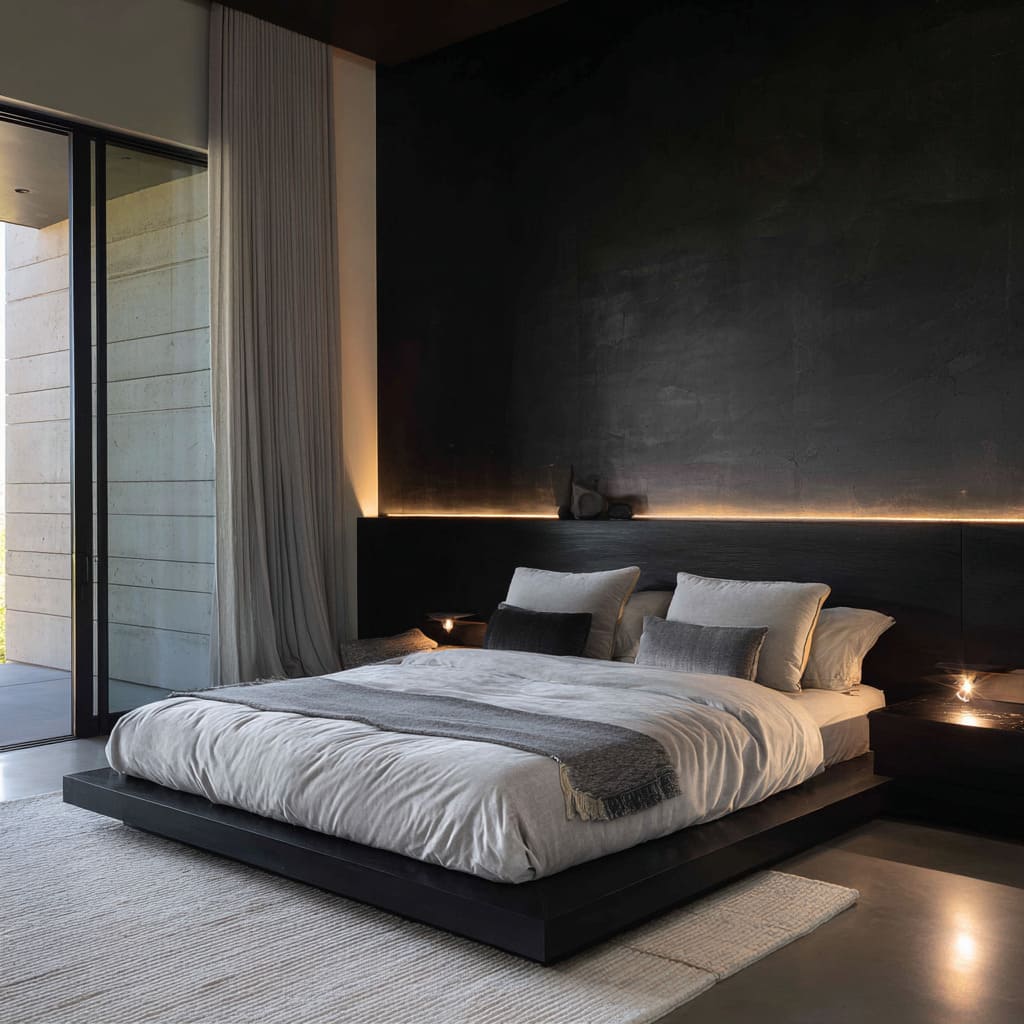
Shadow itself is a design material. A floating platform leaves a thin line of darkness under the bed, turning weight into lightness.
A black niche absorbs brightness and makes silver fabrics appear deeper. A continuous grazing light along a ledge draws a gentle horizon across a dark wall.
Throws and folds create measured shadow bars across bedding. These layers of dimness turn contrast into emotion.
Shadow and glow are twin halves of the same softness.
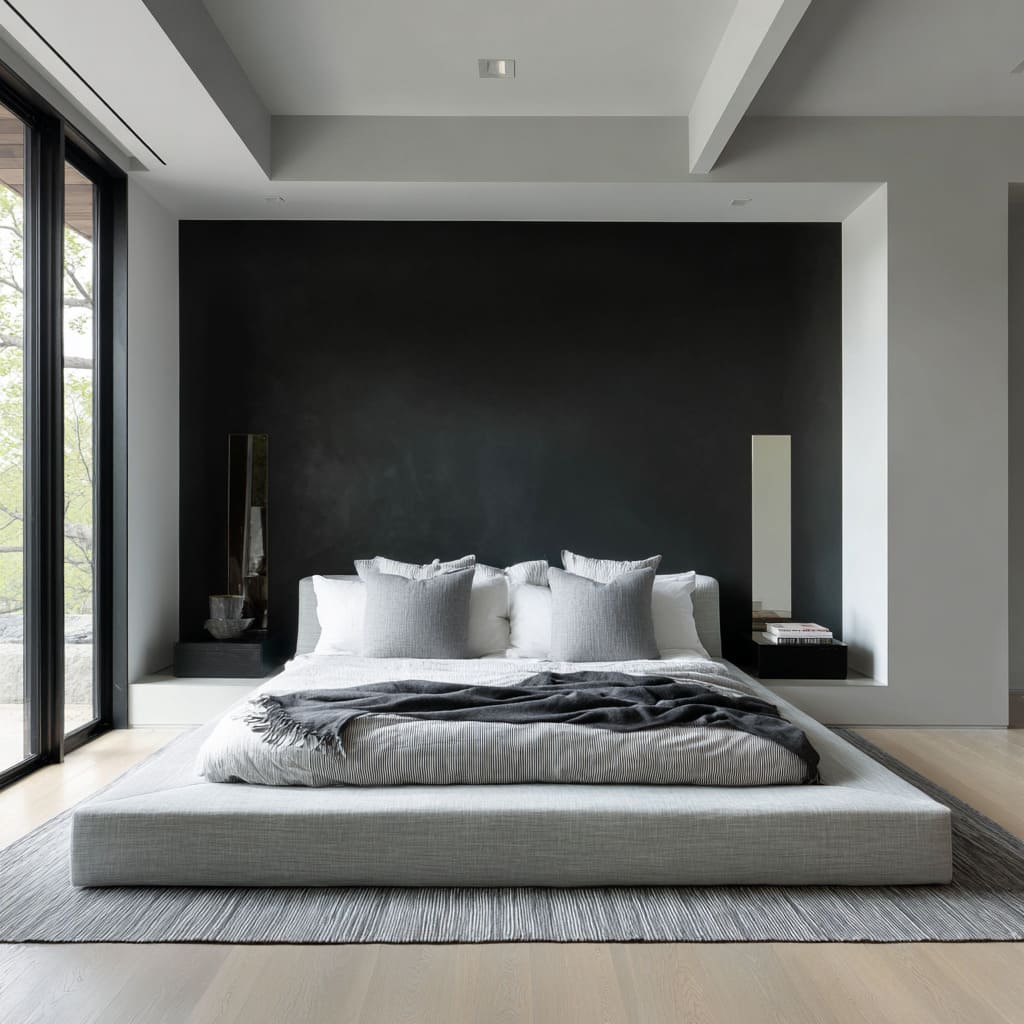
Visual Systems Behind the Calm
These interiors often rely on unspoken visual systems that make them appear effortlessly balanced. Among the most common:.
- Center-Luminous / Edge-Dark System: Silver or pale tones sit at the core; black frames hold the edges.
- One Mark Organizes All: A single dark band, niche, or column defines hierarchy.
- Triple Rhythm Echo: One vertical language repeated at multiple scales.
- Soft-Inside / Sharp-Outside: Plush at the core, precise at the border.
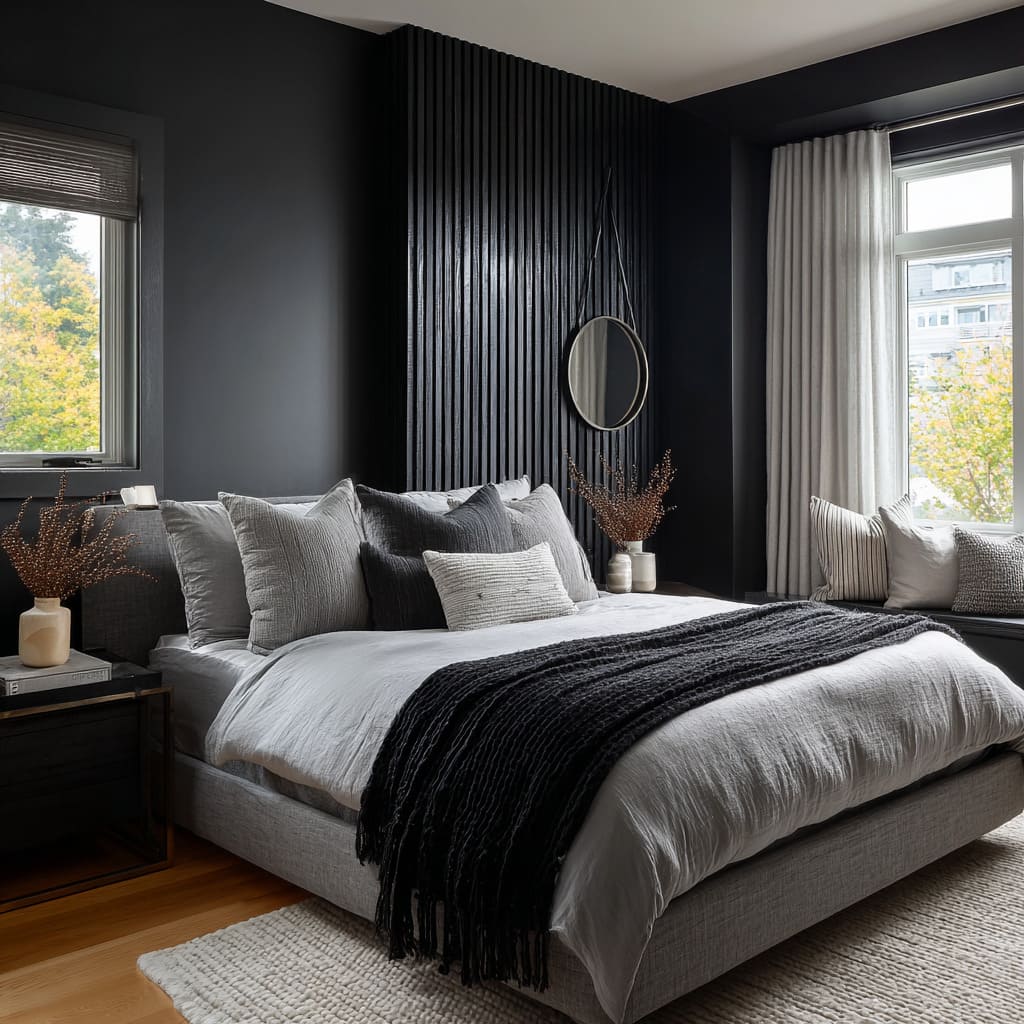
Hidden Organization Strategies
To understand how designers structure the look in black and silver room designs, it helps to see silent strategies:
Axis Pairing
- Horizontal bed mass balanced by ceiling lines or narrow sconces.
- Vertical pendants or beams mirroring horizontal bedding to steady proportions.
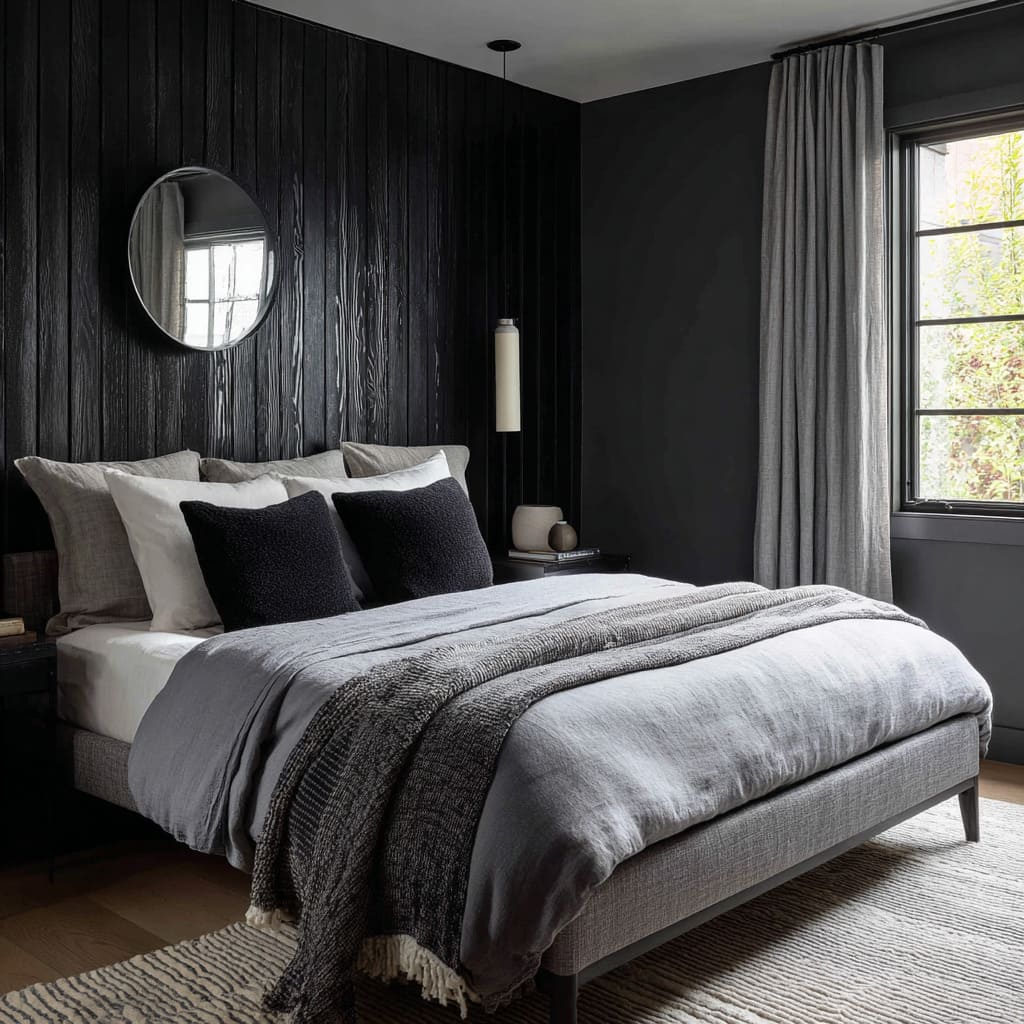
Edge Signatures
- Thin black crowns or base lines sharpening pale walls.
- Pinstripe seams adding light to matte surfaces.
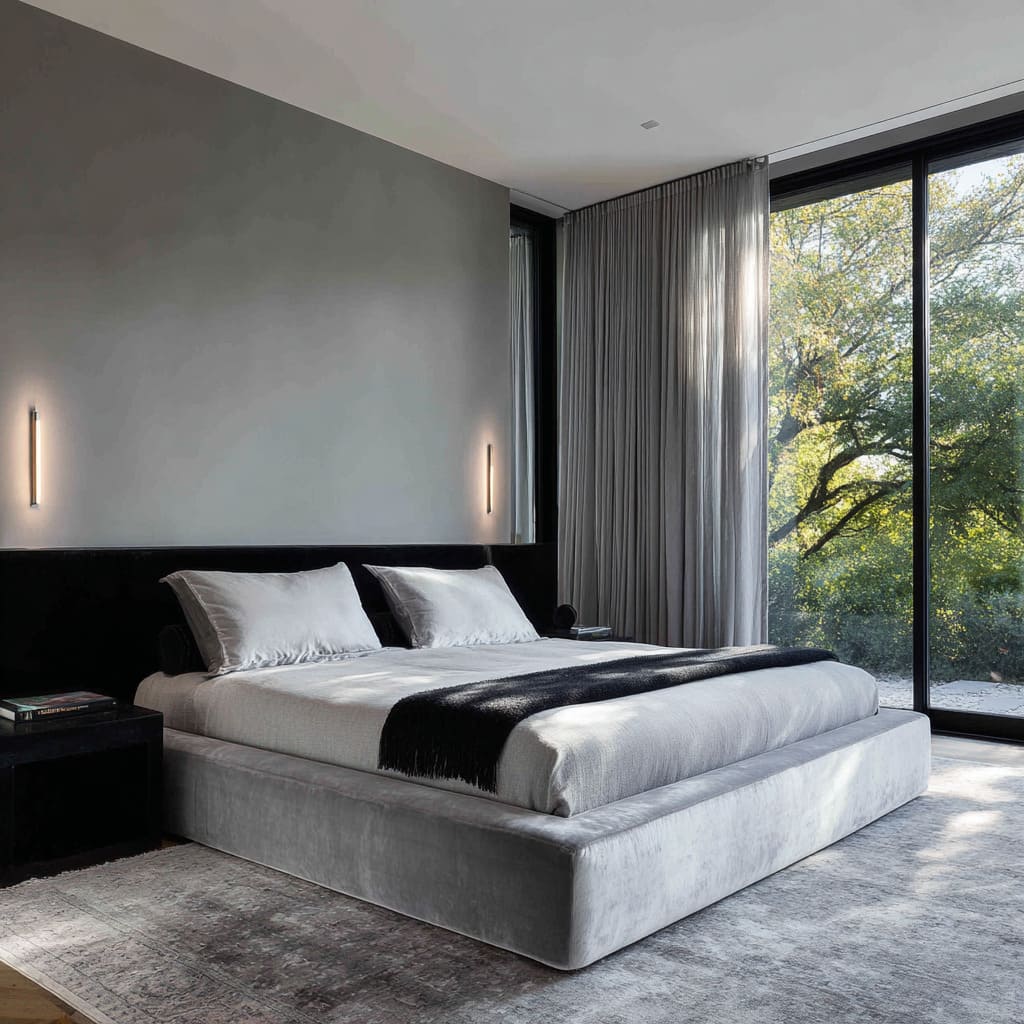
Textile Hierarchies
- White sheets for clarity, silver duvet for volume, charcoal throw for punctuation.
- Pillows layered from warm stone to graphite to anchor transitions.
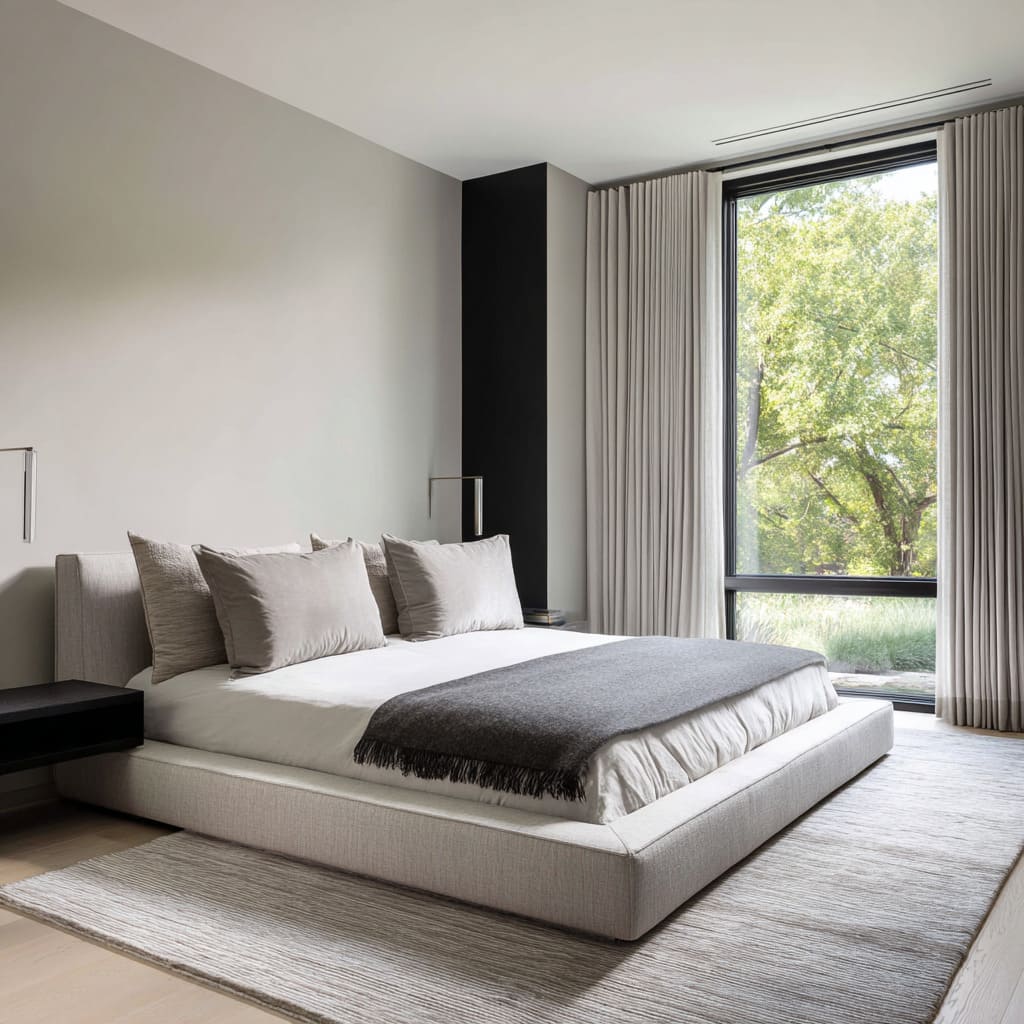
Composed Reflections
- Mirrored objects placed to catch ribbed panels or structured light sources, never clutter.
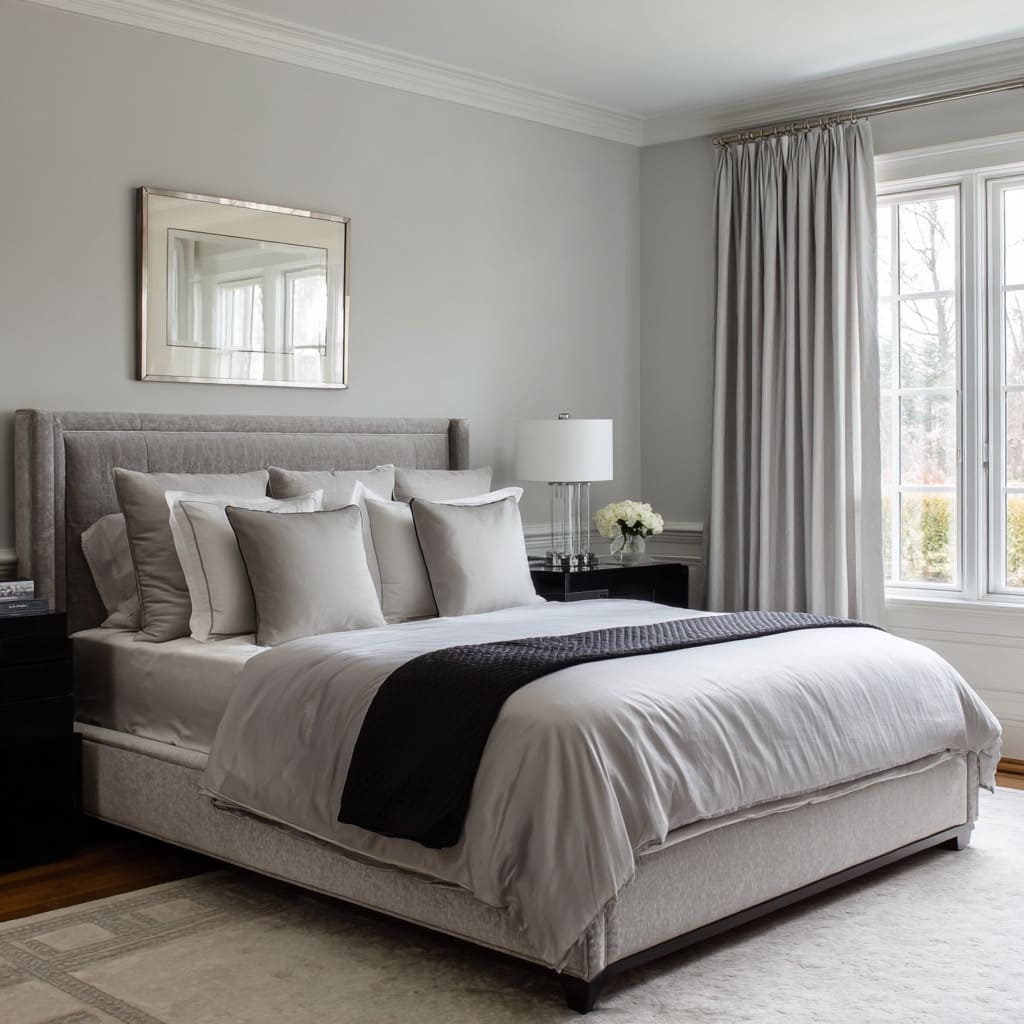
The Luxury of Restraint
What makes such black and silver bedroom ideas enduring is discipline. They avoid overload and find elegance in order, proportion, and quiet glow.
Silver remains tactile, black remains structural, and every mid-tone bridges the two. Textures lead over colors; small lights matter more than big fixtures; and shadow lines tell as much of the story as any furniture piece.
The look travels easily—from urban apartments to coastal homes—because it’s built on light behavior rather than trend.
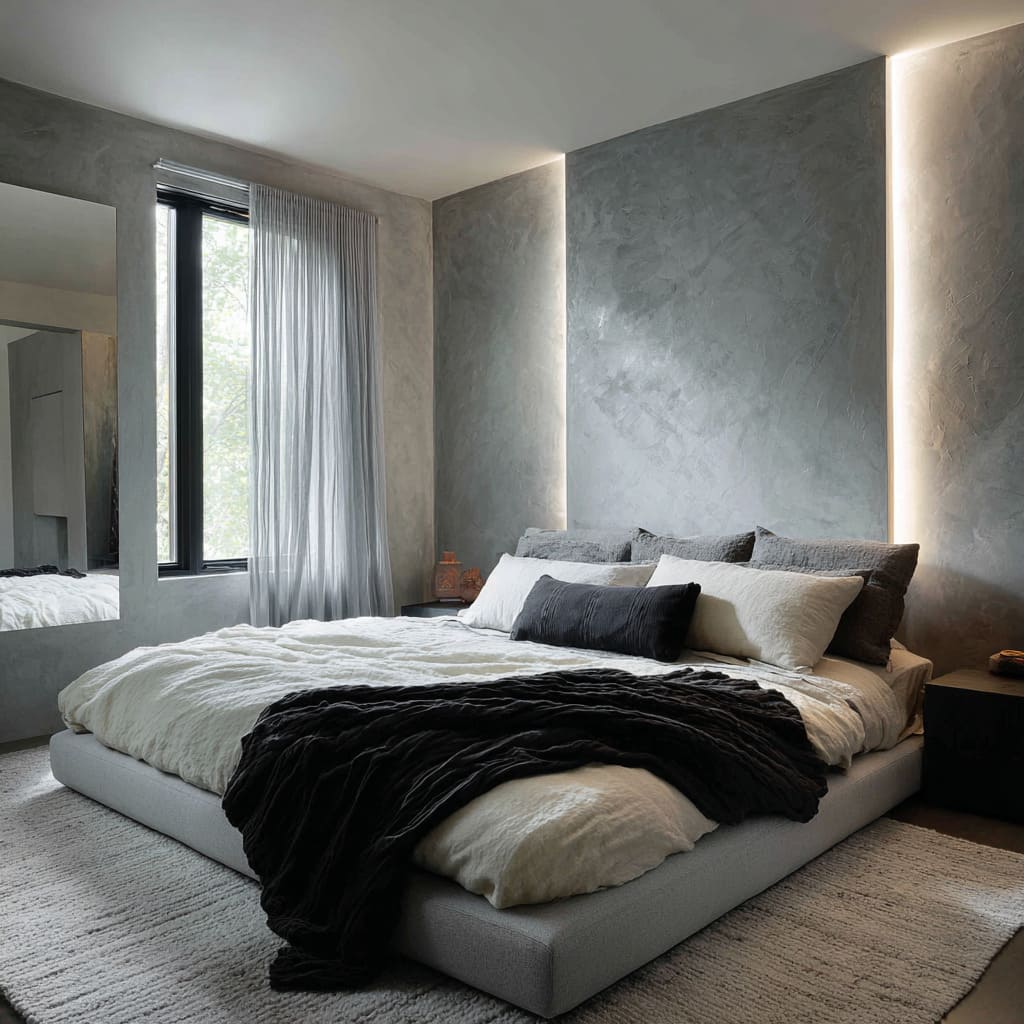
The Last Impression: Calm Drama Done Well
In black and silver room designs, the palette feels complete before a single object enters. Light rests softly on crushed velvet; dark bands frame the scene; silver pleats guide daylight in vertical gradients.
Every detail—pinstripe seam, crystal column, matte rib—belongs to one quiet conversation about how contrast can feel peaceful. These designs prove that drama doesn’t need noise: it only needs rhythm, proportion, and the calm intelligence of black and silver balanced to the breath.