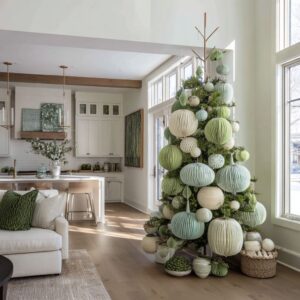

Modern seasonal styling has gradually shifted from large floor-standing displays to the much more controlled surface of the wall, where framed artwork can hold an entire December mood. When the wall becomes the focus, holiday expression turns cleaner, lighter, and far more adaptable.
The most interesting part is that this strategy allows the central festive idea to sit above everyday activity—meals, lounging, reading—without interfering with function. Instead of relying on large objects placed around the room, the vertical surfaces take on the role traditionally associated with a tree or full mantel display.
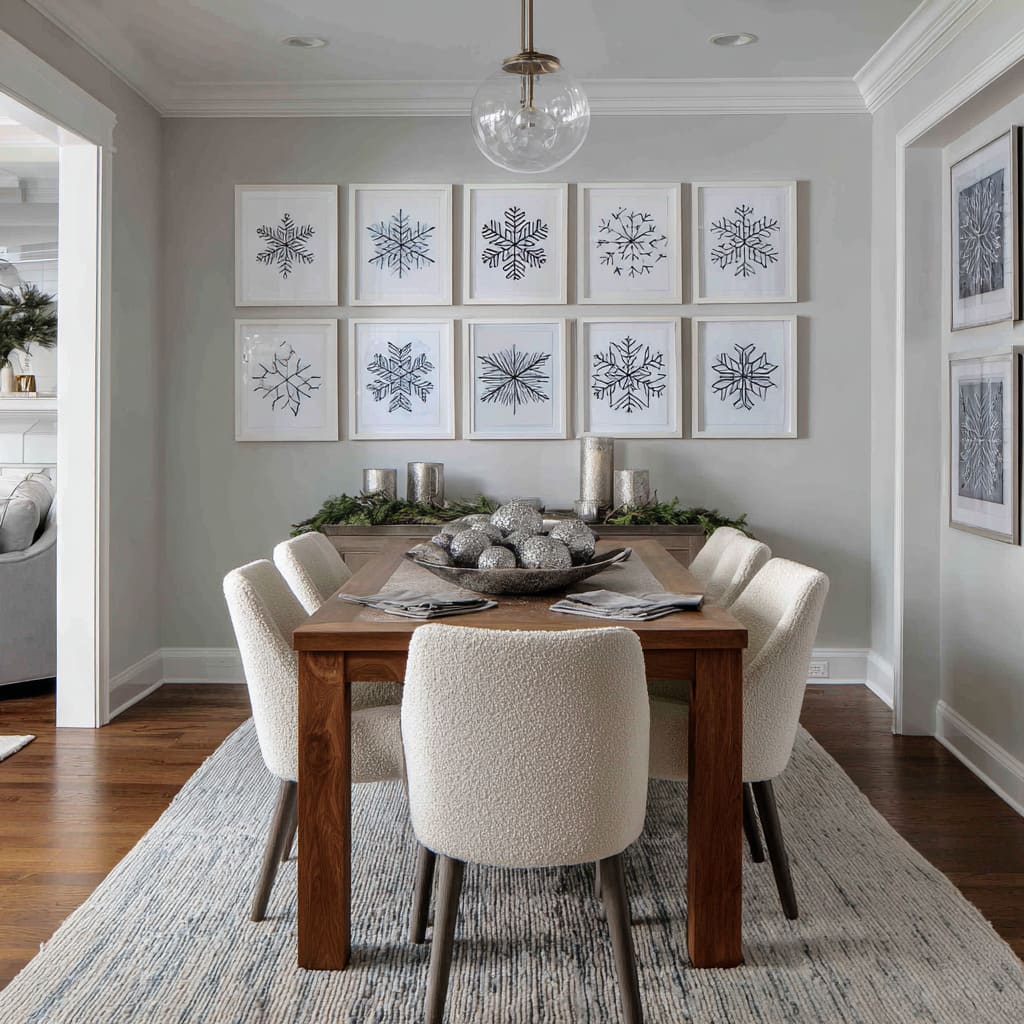
This approach turns framed pieces into a kind of visual anchor, a quiet but unmistakable statement that shapes the whole space. The arrangement can be a large grid of snowflakes, a single textile panel with deep seasonal color, a cluster of embroidered motifs, or a full wall of stylized ornaments.
In every case, the room settles around this structured, lifted accent, granting it center stage while allowing furniture and small objects to support it in subtle ways. This is where simple Christmas decorations acquire depth: they come not from quantity but from the intention behind one defined surface.
How Graphic Symbols Become Seasonal Stories Without Literal Imagery
Holiday symbols can be translated into graphic languages that avoid clichés while still carrying emotional weight. Interior schemes explore motifs such as snow crystals, evergreen shapes, pine branches, candy stripes, textile fragments, or abstract bursts reminiscent of ornaments.
Each motif gains power through refinement rather than literal depiction. Instead of showing a full decorated tree, artwork might break the idea into geometric fragments arranged in balanced pairs or grids.
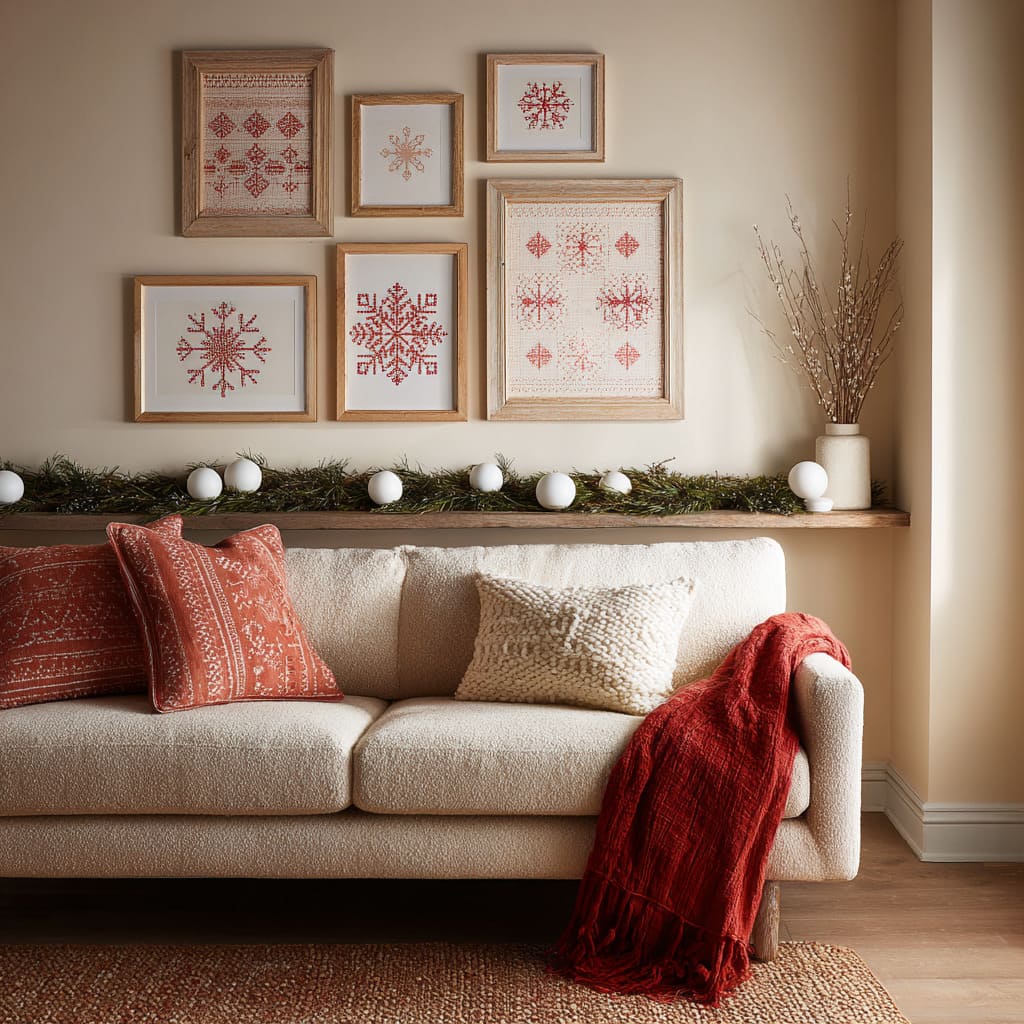
Snowflakes may appear as linear diagrams, medallions, or folk-inspired stitch patterns. Even ornament themes can blur into circular compositions, bursts of lines, or glossy color studies.
This conceptual treatment gives wall art a sense of intentionality, as though each piece were created for a seasonal gallery rather than borrowed from standard decor. The visual storytelling becomes layered: one viewer might see snow, another sees lace, another sees fireworks or starbursts.
The richness lies in that ambiguity, which naturally elevates what some would categorize as cute easy Christmas decorations into something more refined and collected.

Structural Order: Why Grids, Pairs, and Large Singles Create Calm
The rhythm created by framed arrangements plays a major role in shaping the mood. While motifs vary greatly, the hanging logic remains highly disciplined.
Different approaches carry different atmospheres:.
Grids
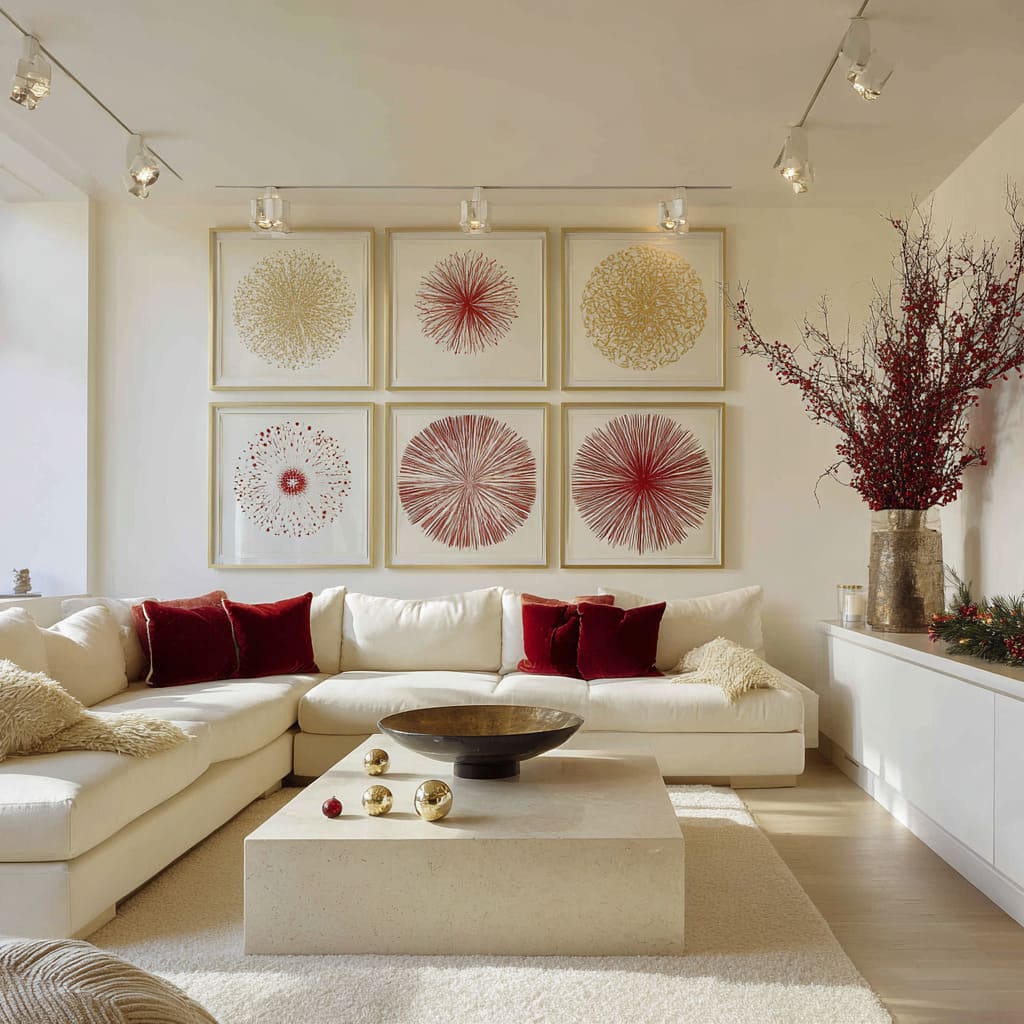
Grids—such as a three-by-four snowflake panel, a two-row ornament wall, or a six-frame burst series—offer a strong sense of composure. They contain lively content within a steady structure.
Their advantages include:
- Balanced repetition that quiets the intensity of patterns
- Predictable spacing that supports even the boldest colors
- A gallery-like presence that feels curated rather than improvised
Pairs
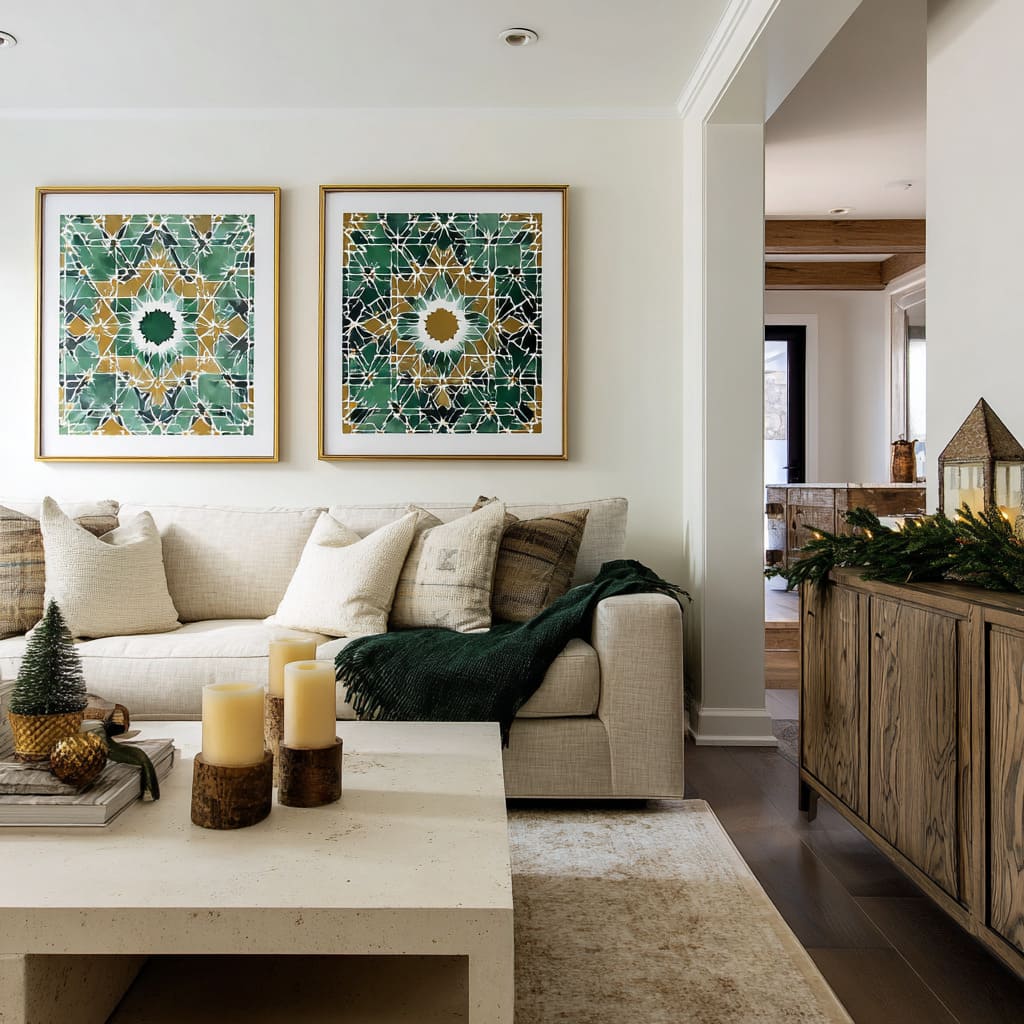
Pairs, like dual starry skies or two green-and-gold panels, behave almost architecturally. They frame the sofa or the bed, creating symmetry without overwhelming the wall.
Their simplicity can feel meditative.
Single Bold Pieces
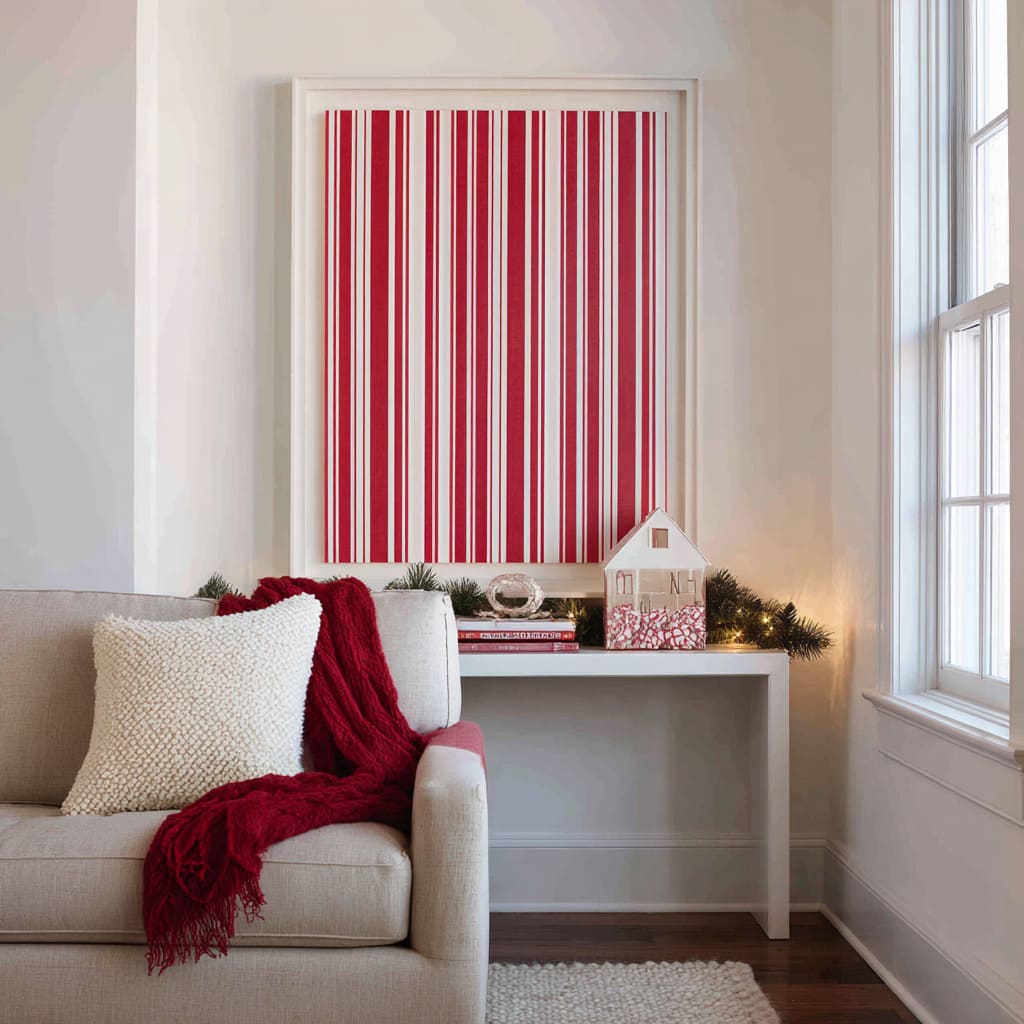
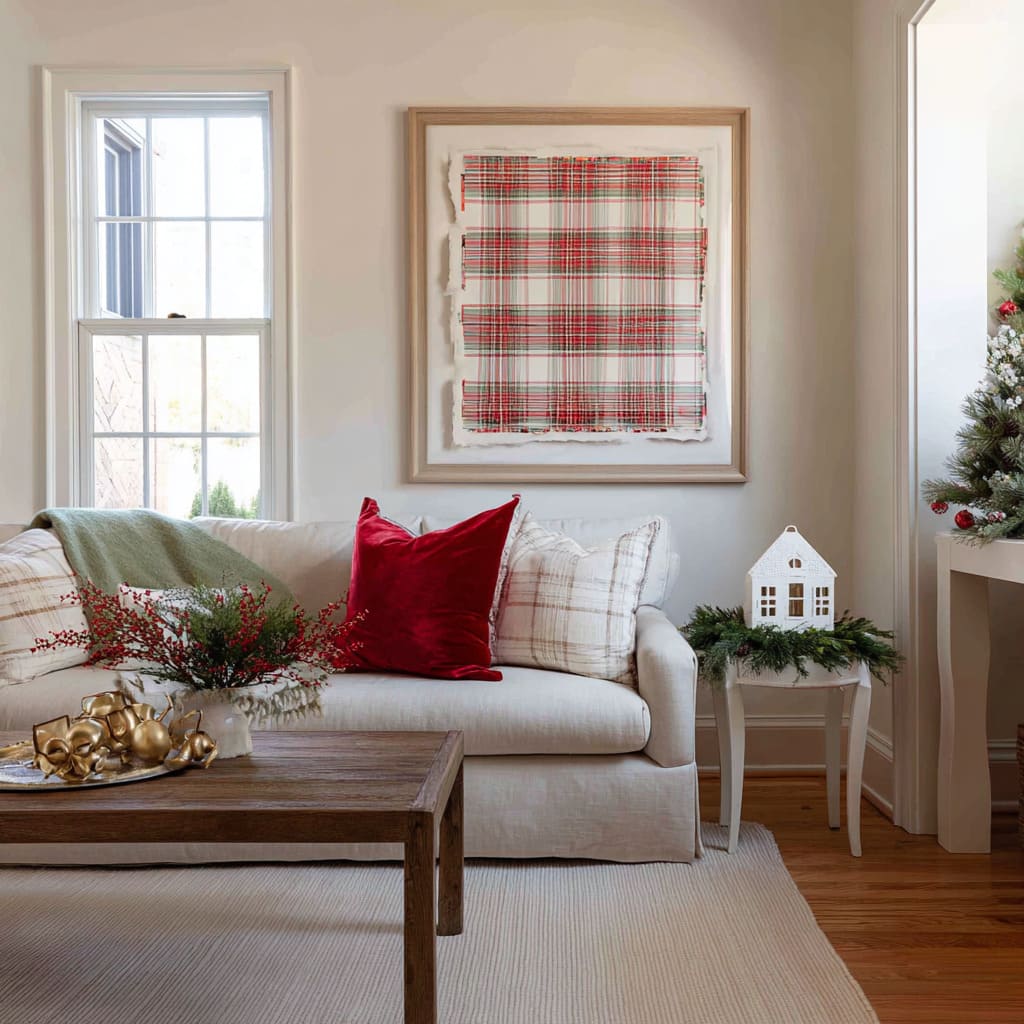
A single framed textile—striped, plaid, embroidered—acts like a seasonal mural. The surrounding space appears calmer and more open because the eye has one focal point.
This suits compact living areas or minimalist layouts. Together, these arrangements reveal a lesson: organization is the unseen force behind easy Xmas decoration ideas that feel serene rather than chaotic.
Textile Language: How Cloth Becomes Art and Atmosphere
One of the most distinctive aspects of this style is the recurring presence of fabric, either real or implied, inside frames. Textile-based artwork has a gentle softness, even behind glass, that instantly connects with winter.
It echoes blankets, scarves, table linens, and woven decor familiar during colder seasons. There are several expressions of textile-inspired art within these decorating concepts:.
- Actual cloth framed: tartan squares, striped fabrics, embroidered samples, or frayed textile fragments intentionally displayed.
- Printed cloth illusions: patchwork motifs, lace-like patterns, or repeated ornament illustrations resembling old fabric medallions.
- Textures suggested by layout: gridded arrangements that mimic quilt blocks, or repeated circles that feel like stitched points.

The emotional quality here is strong; textile art touches memory, family tradition, and craft. When paired with soft pillows, woven rugs, and plush throws, the art becomes part of a larger sensory theme, converting simple and easy Christmas decorations into layered seasonal narratives.
Seasonal Symbols as Abstracted Design Languages
More than any other element, abstraction allows holiday artwork to slip naturally into sophisticated spaces. When familiar symbols are reduced into lines, shapes, or fragments, they transform from literal illustrations into design languages.
A snowflake becomes a geometric star. A tree becomes a triangle stack or a delicate branch study.
An ornament becomes a circle filled with layered color. This shift supports rooms that want a festive character without leaning into novelty.
The versatility is remarkable:.
- A charcoal sky with golden bursts feels like winter dusk, yet it could stay on the wall long after December.
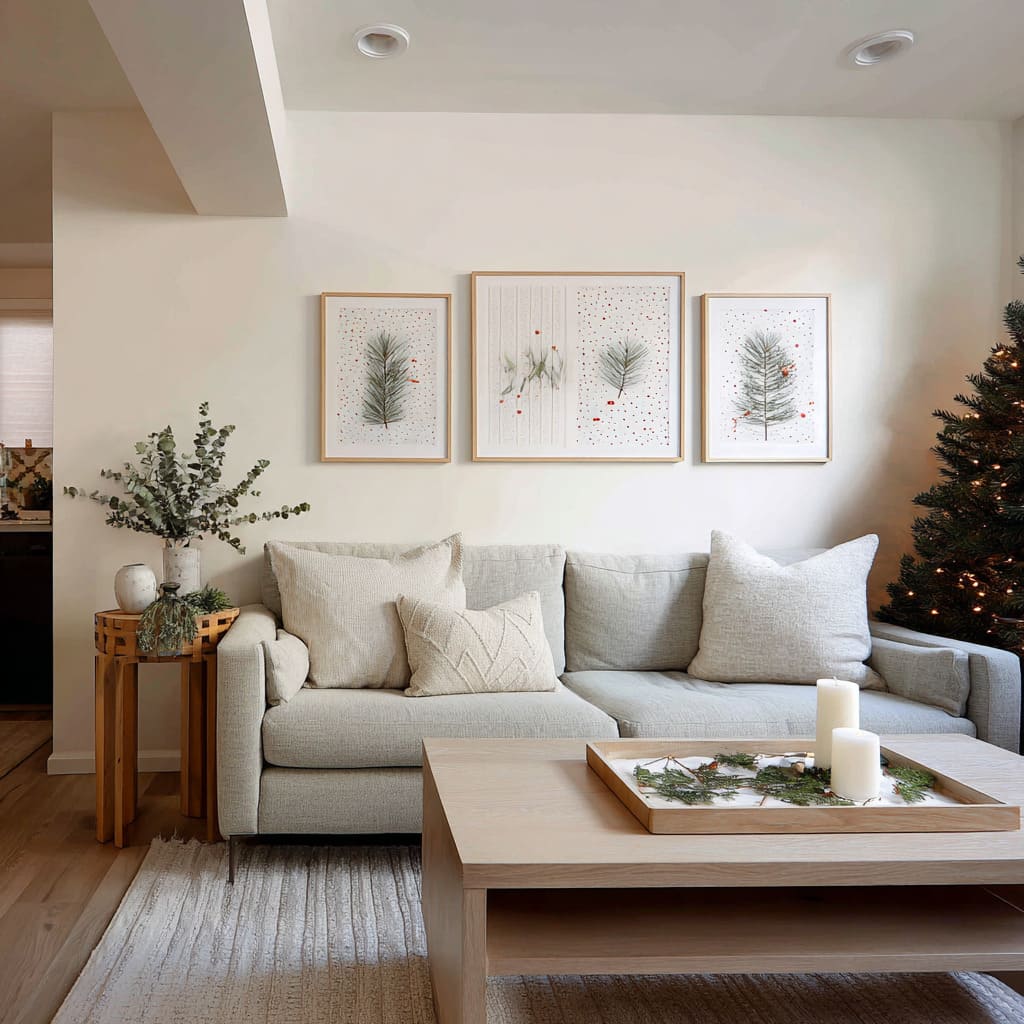
- Pine branches printed with speckled backgrounds introduce a forest theme without overwhelming the palette.
- A textile scrap with torn edges suggests family stories simply through its imperfection.
- Embroidered symbols mimic handmade craft in a refined, curated way.

By keeping shapes recognizable but not literal, such interiors achieve a seasonal feeling that continues through winter, supporting styles ranging from Nordic minimalism to urban contemporary setups. This approach naturally overlaps with what many refer to as easy elegant Christmas decorations, but it expands them through artistic restraint.
Color Discipline: Why Limited Palettes Feel More Luxurious
Color behaves like the stabilizing thread across all examples. Often, a room limits itself to one dominant holiday tone, supported by neutrals and softened by material warmth.
This tightly controlled approach prevents visual overload and strengthens the impact of the wall art.
The Red-Focused Approach
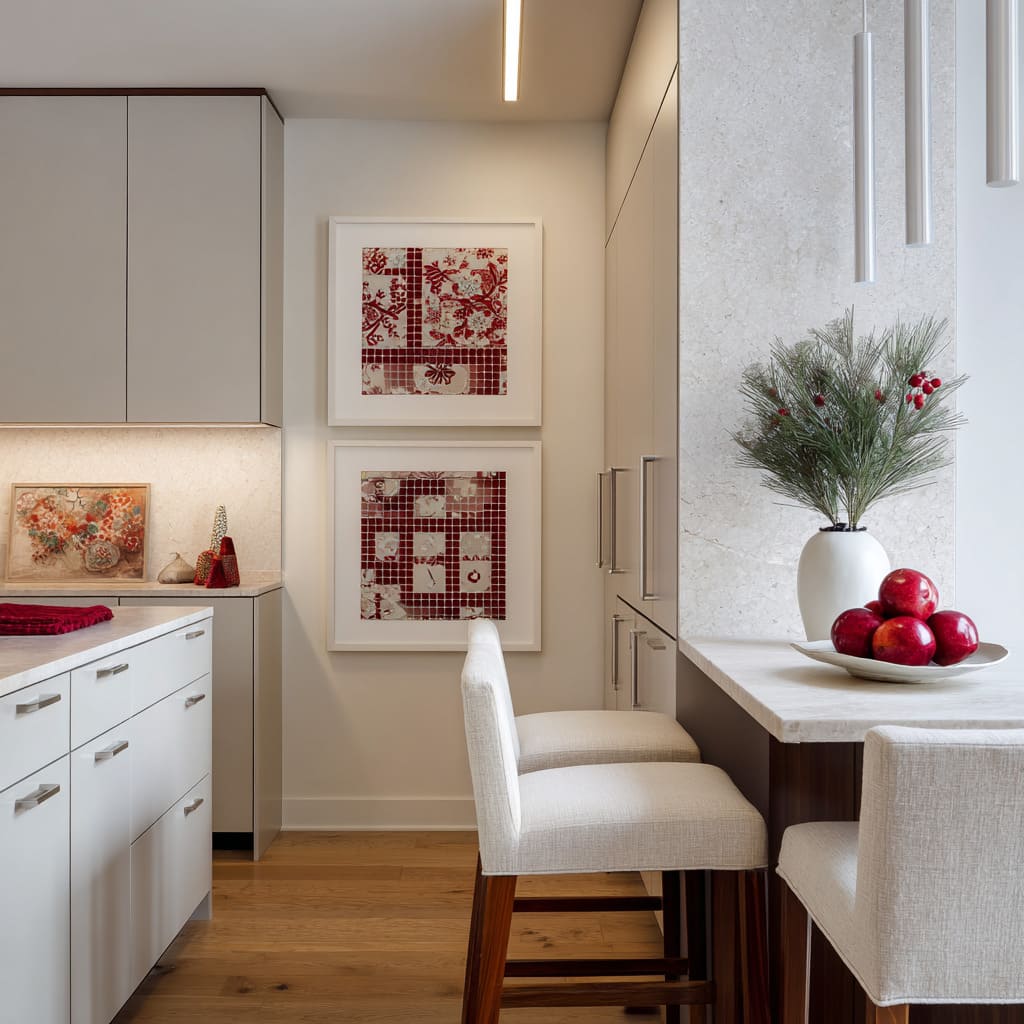
This palette includes tartan panels, ornament grids, textile scrap frames, and cranberry circle compositions. Red appears only where it matters most—inside the artwork, one statement pillow, a throw, or a bowl of fruit.
Its placement is deliberate, creating vertical and horizontal alignments between wall and furniture. When the surrounding environment uses cream, oak, muted gray, or brushed metals, the red feels rich rather than loud.

The Green-Focused Approach
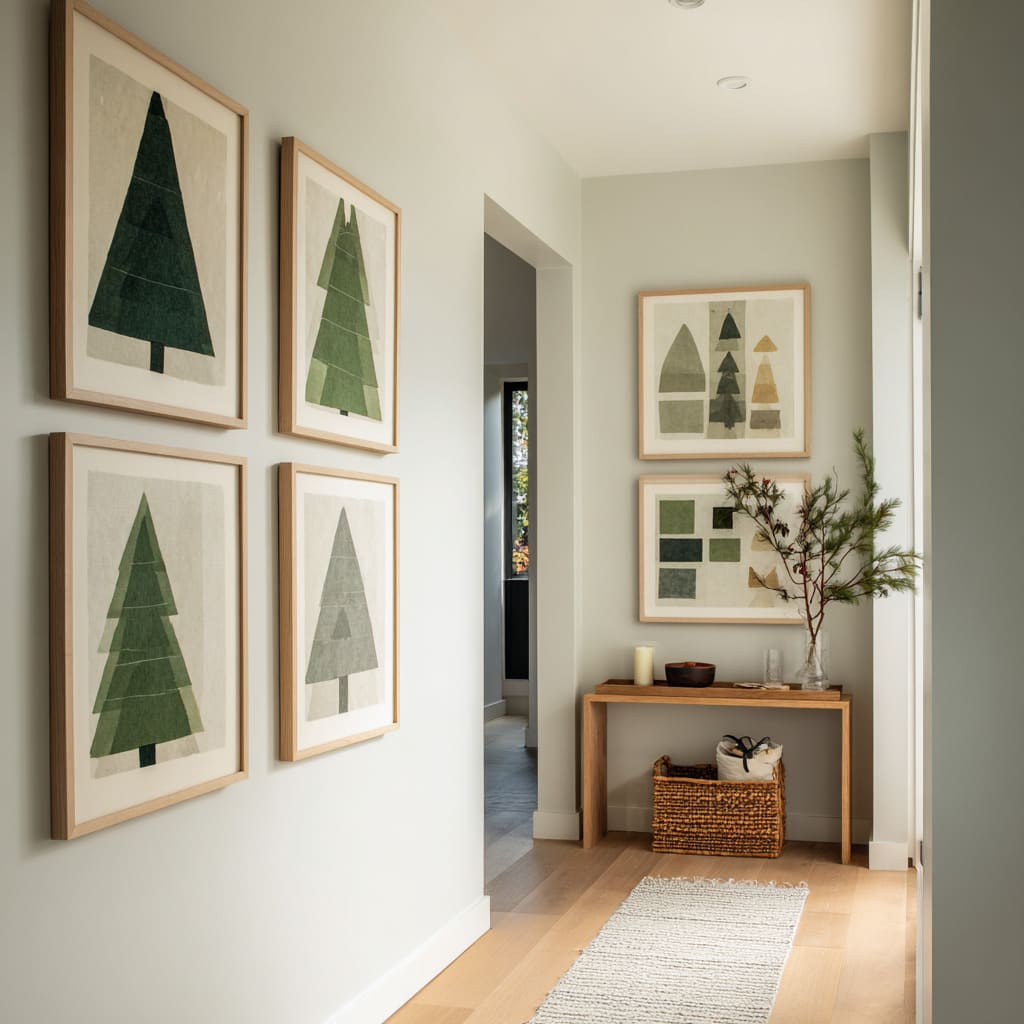
Green leans into nature themes: tree studies, pine branches, conifer silhouettes, or geometric forests. Here, the palette feels botanical rather than strictly festive, perfect for prolonged winter styling.
The key is pairing green artwork with light wood frames, gentle whites, and soft beige textiles so the space stays bright.
Metallic and Charcoal
Gold, pale brass, and charcoal emphasize nighttime atmosphere: starry skies, abstract bursts, or tall metallic trees. These combinations make a room glow subtly in evening light.
This discipline is part of what transforms otherwise modest setups into graceful, collected scenes—proof that palette control is one of the most powerful tools in creating simple Christmas decorations that feel intentional rather than improvised.

Interaction Between Art, Furniture, and Small Objects
A defining quality in these interiors is how framed pieces never sit alone—they converse with the objects in the room. This relationship ties the vertical and horizontal planes together.
Echoed Shapes
Circles in artwork appear again as ornaments in shallow bowls, round candle holders, or berries. Lines in a candy-stripe piece echo in stacked books or ribbon-wrapped gifts.
Tree forms in prints connect to vases with real greenery.
Echoed Materials
Wood frames match console tables, benches, or flooring. Linen-textured mats pair with nubby upholstery.
Matte ceramics echo the soft whites inside artwork.
Echoed Color Points
A single terracotta pillow relates to tiny warm doors in a triptych. A green throw lines up under a grid of tree prints.
A pale blue cushion recalls hats in penguin illustrations.

These connections make the room feel cohesive and relieve the framed art of the burden of carrying all the holiday expression alone. The wall leads, the objects respond, and the viewer perceives the composition as a coordinated whole—one of the most effective forms of simple and easy Christmas decorations that still feel layered.

Using Transitional Spaces as Mini Galleries
Seasonal decorating often focuses on living or dining zones, but such concepts reveal the power of smaller architectural moments. Corridors, hall entries, and compact console corners can carry seasonal identity with refined restraint.
A hallway lined with geometric tree prints becomes a calm passage that feels part of the overall seasonal mood. A narrow console under a framed red-border print becomes a soft pause between rooms, especially when framed by a glowing vertical strand of lights.
An entry corridor with tall gold-rendered trees turns a lesser-used wall into a dramatic greeting point.
Such concepts succeed because they rely on scale and repetition rather than volume. They demonstrate that festive styling does not need expansion; it needs focus.
When a wall is given a defined purpose, even a tiny zone can project quiet December charm. This is an example of easy Xmas decoration ideas expressed through discipline rather than abundance.

Atmosphere Through Softness, Memory, and Story
Beyond motifs and color, such interiors engage deeper emotional notes. Some rely on softness: plush sofas under snowy artwork, shaggy rugs below penguin galleries, or bouclé chairs under snowflake grids.
Others pull from memory—framed plaid cloth, folk-style cross-stitch motifs, or vignettes containing tiny houses, bells, or miniature forests. A space containing a village triptych above a bed or a cloth scrap preserved like an heirloom resonates with personal storytelling, even when the viewer does not know the exact narrative.
This interplay of comfort and nostalgia forms a quiet emotional layer that supports the visual scheme.
Even abstract pieces carry emotional meaning when arranged with care. A pair of starburst canvases above a pale sectional suggests winter nights and warm gatherings indoors.
A framed striped textile above a console evokes wrapping paper and gift-making rituals without depicting them directly. Through all of this, holiday character emerges slowly, without relying on excess or spectacle, aligning naturally with many people’s ideals of easy elegant Christmas decorations.

Quiet Luxury Through Shape Repetition and Material Warmth
One of the most compelling aspects of these designs is how they create depth and richness with minimal objects. Warm wood surfaces act as grounding elements under graphic walls.
Stone-topped tables add weight under airy prints. Soft textiles counterbalance rigid frames.
This push-pull between structure and warmth creates an effect that feels quietly luxurious. Shapes repeat in thoughtful ways: circles recur in bowls, prints, ornaments, and candle holders; rectangles in books, frames, and console silhouettes; triangles in trees and folded fabrics.

It is this density of relational detail—not the quantity of items—that gives each room its character. You can see this in spaces where one framed print and a few supporting objects build an entire festive expression.
The harmony comes from alignment, repetition, and gentle interplay. This approach is what aligns many of these scenes with simple Christmas decorations that still feel elevated.
Framed Seasonal Art as a Long-Life Winter Feature
A key distinction is how seasonal they feel without being temporary. Artworks can be abstract enough to remain through the full winter season: branches, medallions, geometric forests, or textile-inspired patterns work long after the holidays pass.
Even more festive pieces—tartan, red bursts, ornament patterns—can remain if the supporting decor shifts softly toward neutral tones. This makes framed art a highly flexible element: it carries the seasonal tone in December but continues to contribute visual structure later.
This is also why framed pieces are so effective in compact apartments, multi-use rooms, or open layouts. They offer decoration without clutter, presence without intrusion, and seasonal character without occupying space needed for daily life.
Because of this, they embody the spirit of easy Xmas decoration ideas while staying visually rich.

The Power of Framed Art in Everyday Holiday Styling
Such ideas reveal a design philosophy where the wall becomes the central storyteller and where the rest of the room responds in gentle, coordinated strokes. Through grids, textiles, abstract motifs, color discipline, and small echoed details, framed art shapes the entire mood.
It offers structure, clarity, and personality. It gives December atmosphere without overwhelming function.
And it helps a room feel festive even when using restrained palettes and minimal accents.
This approach supports everything from Nordic-inspired living rooms to cozy bedroom retreats, from compact kitchens to transitional hallways. Whether the artwork is scientific snowflake studies, simplified tree silhouettes, playful penguin portraits, or intricate patchwork-like panels, the result is a thoughtful seasonal environment.
The atmosphere blends softness and structure, warmth and clarity, story and abstraction. These compositions demonstrate how cute easy Christmas decorations can co-exist with refined interiors, ultimately showing that framed pieces are not just accents—they are the backbone of a curated holiday interior.