Many people look for dark green sofa living room ideas because the color feels confident, but it also carries two quiet anxieties at the same time: fear of heaviness (the room shrinking, turning dim, feeling “serious”), and fear of randomness (the sofa reading like a single bold piece that the room’s design doesn’t support). What’s a striking decorating idea for such cases is that the sofa can behave less like an “accent.
” It can behave like a value anchor—a deep, steady tone that makes everything else in the interior design look cleaner, calmer, and more deliberate.
Quick Pairing Formulas
A dark green sofa looks most “planned” when the room gives it a few quiet partners in value, warmth, and shape—so the sofa isn’t the only deep element doing all the work. The goal is simple: let the green feel like a calm base tone while the space stays bright, readable, and comfortable.
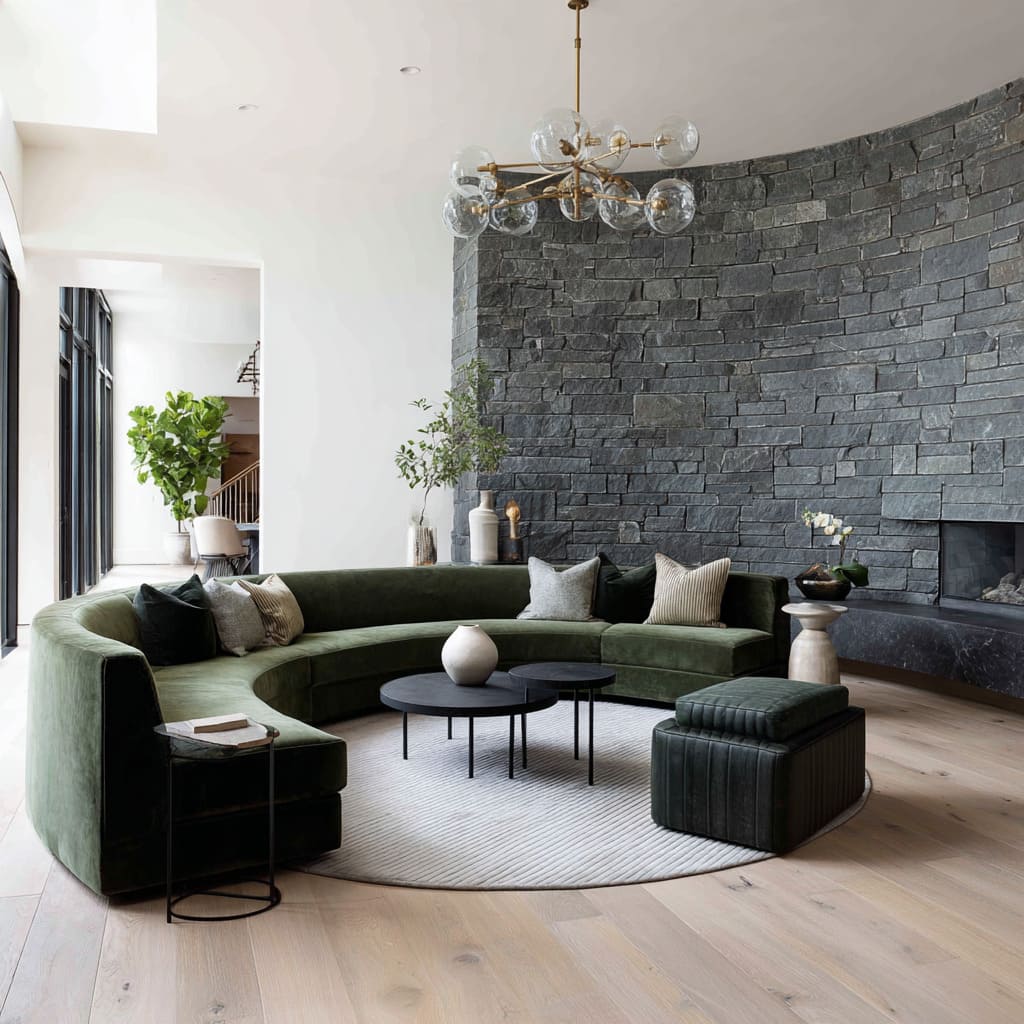
Repeating depth as structure (so the sofa doesn’t feel random)
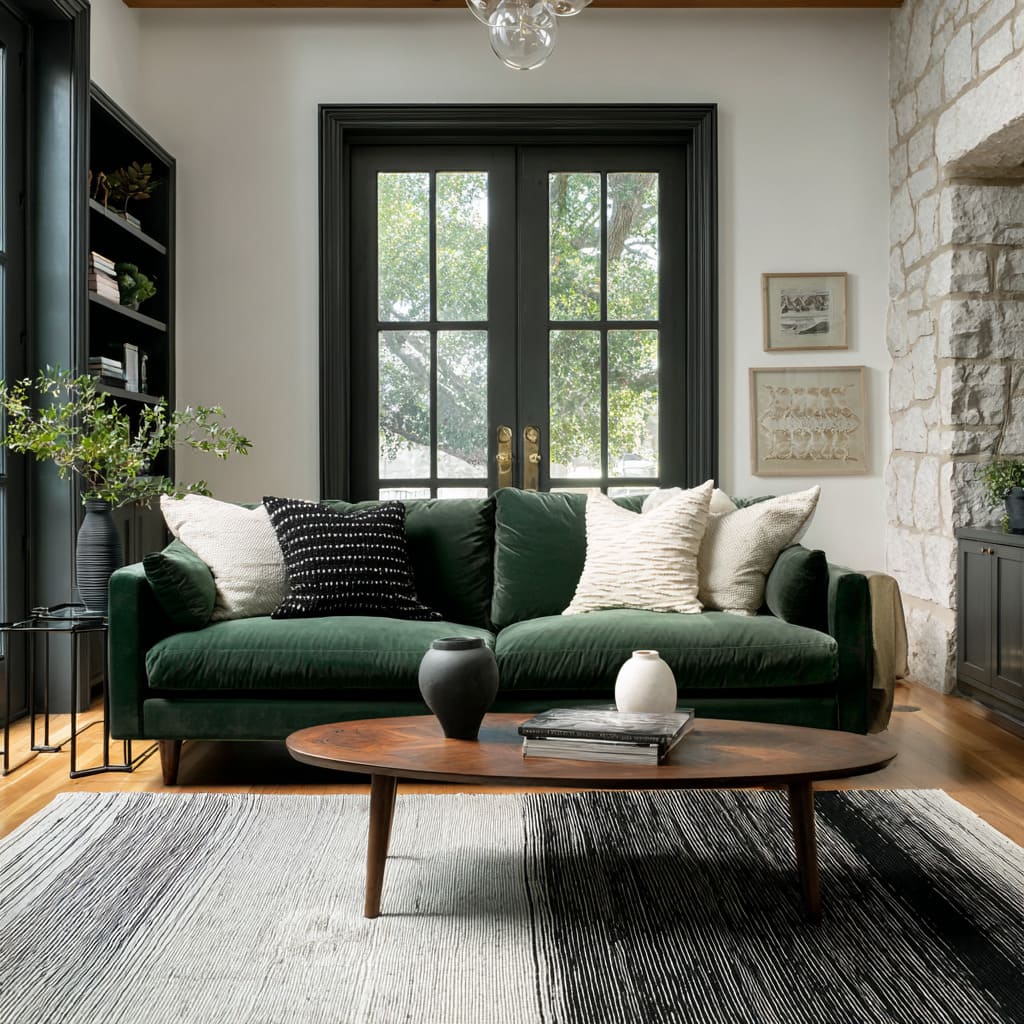
- Black-framed windows or doors, dark trim, or one set of dark built-ins
- A ceiling beam or a thin black line in lighting/table frames
- One matte-black object on the coffee table (a vase or bowl) to echo the sofa’s depth in a small dose
Adding warmth in “small sparks,” not many colors
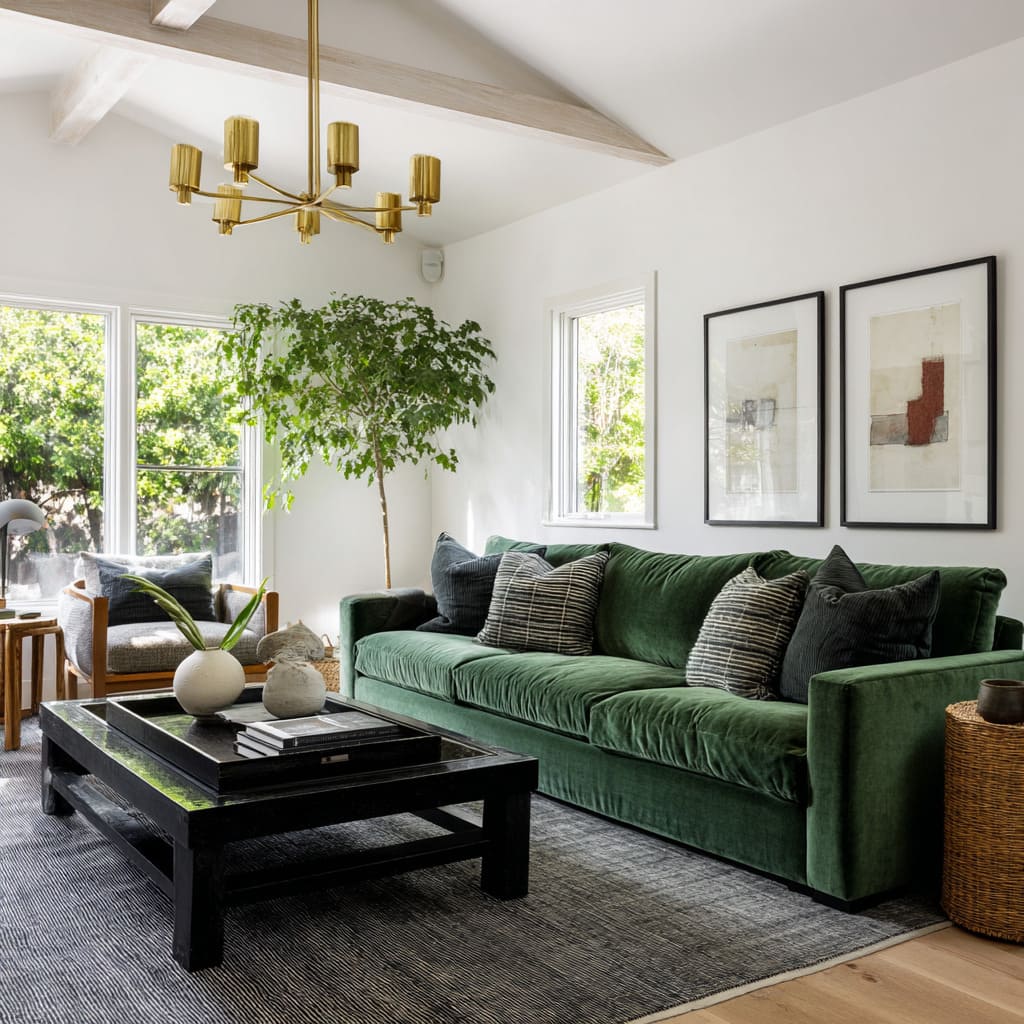
- Warm wood floors and a wood coffee table (even better if the table has a lighter top than the sofa)
- Brass or warm metal lighting for glow and a slightly dressy finish
- A single warm accent, used once: rust chair, ochre pillow, or caramel leather pouf (one is enough)
Using “lightness tricks” that keep the center open
- Glass-top or open-base tables that keep the rug visible
- A rug that stays pale or medium in value, with thin stripes or a faint grid for order
- Cream pillows in mixed textures (nubby, knit, woven) to create a soft bright edge on the green
Leting curves soften strong lines
- Oval/round tables to relax boxy sofa + window geometry
- A circular rug to form a clear seating island, especially in larger or open-plan rooms
- Globe lighting (clear glass) to add sparkle without visual bulk
Quick pillow formula that stays calm
- 2 cream textured pillows (ends)
- 1 striped lumbar (thin dark lines)
- 1 warm accent pillow (ochre/rust) or 1 darker pillow (charcoal) for a moodier look
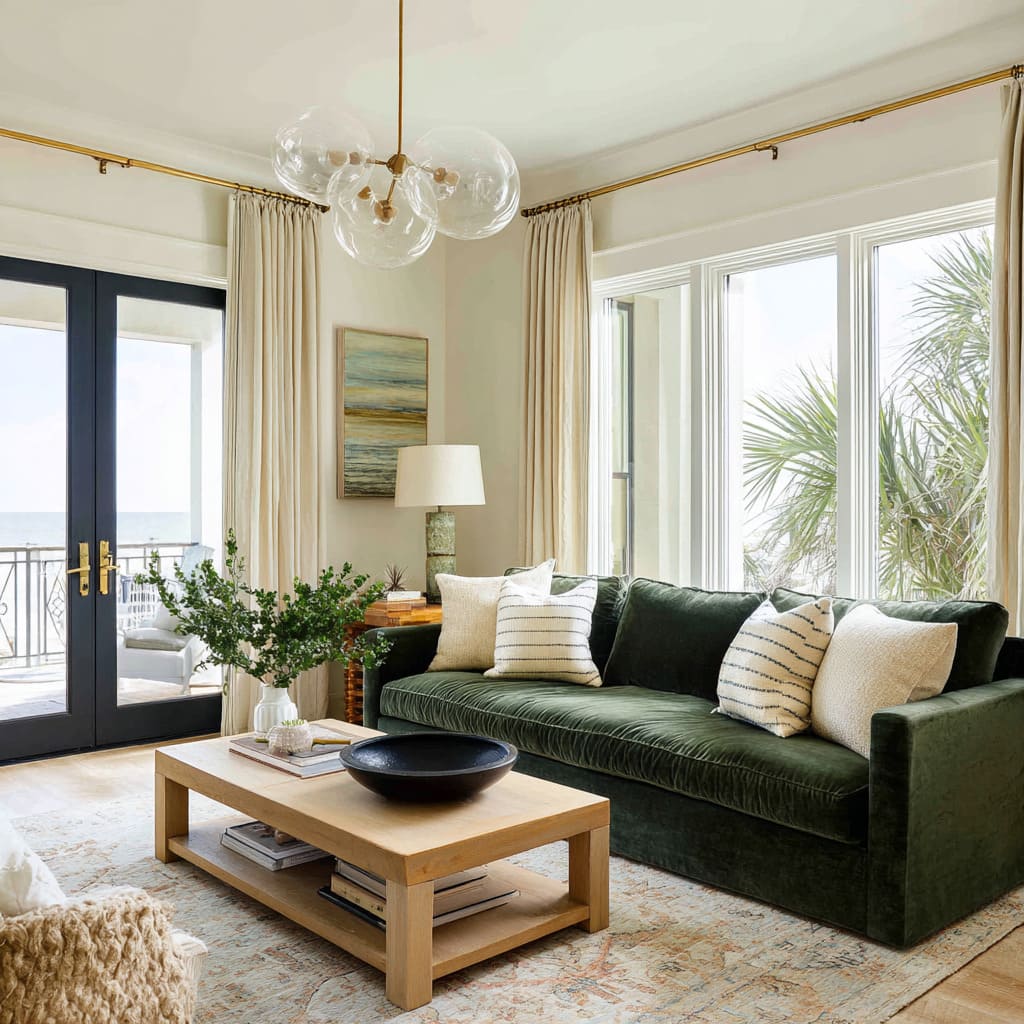
Dark green as a “shadow line” that makes the look intentional
A stylish move is letting the sofa act like the room’s lowest, richest shadow. That sounds simple, but visually it’s powerful: once a deep green mass sits low in the composition, pale walls stop reading like “blank default” and start reading like “chosen calm.
” The sofa can be as long, low, and slightly lifted on slim legs. That tiny air gap underneath is doing a lot of invisible work: it prevents the green from turning into a solid block, and it lets the interior design keep a sense of airflow even when the color is saturated.

The effect is strongest when the design also contains at least one other deep note that is structural, not decorative—black door frames, dark window muntins, a charcoal media wall, exposed beams, a grid wall, or a stone fireplace. When the deep value appears in architecture, the sofa stops feeling like an isolated “statement” and starts feeling like the soft part of a broader framework.
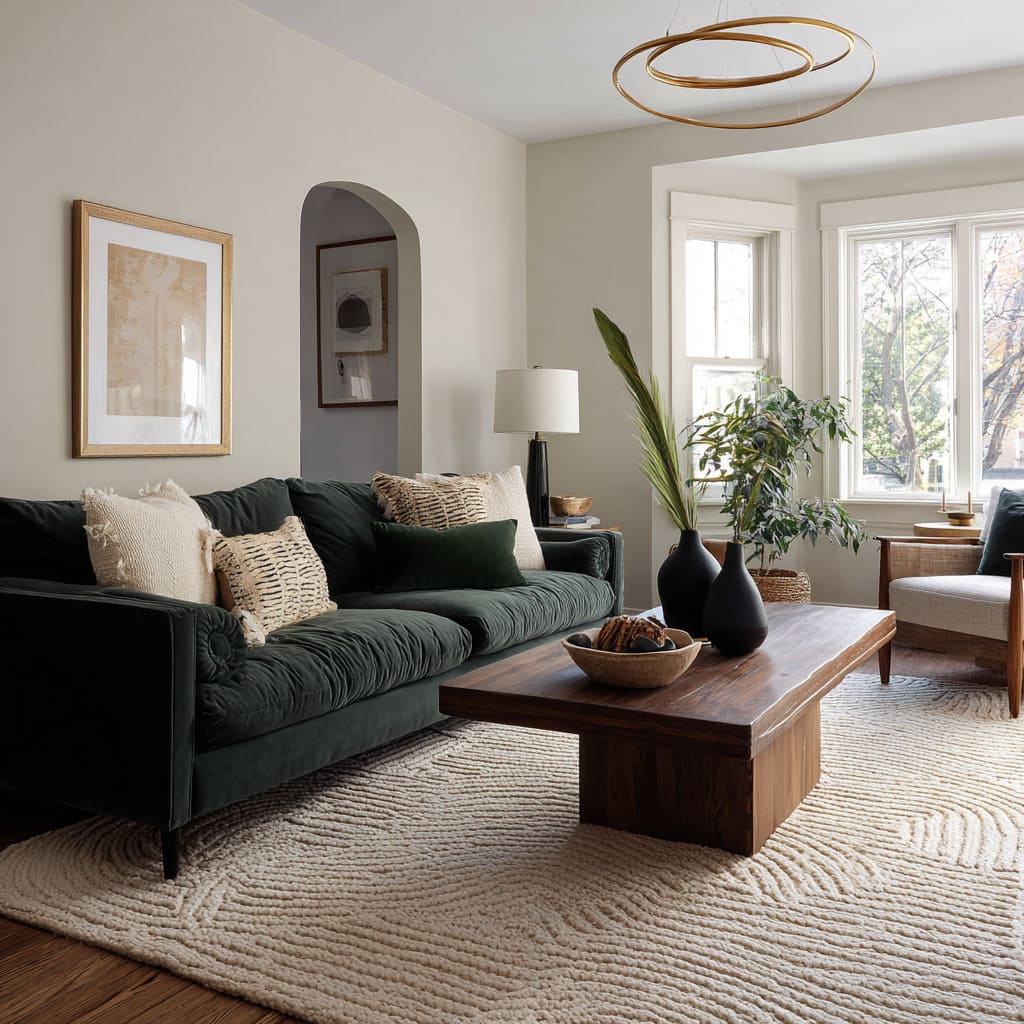
This is why dark green couch living room ideas often look best when the design isn’t trying to “repeat green” everywhere. It repeats depth in other places, so the sofa reads supported.

Fabric optics: why velvet-like green reads “rich,” and flat green reads “stiff”
A smart detail is how often the green can be matte, plush, velvety, or nap-shifting. That’s not decoration talk; that’s light behavior.
Dark green becomes expensive-looking when it shows micro-variation: highlight bands on cushion tops, gentle shading in tufting pockets, soft tonal shifts where the pile changes direction.
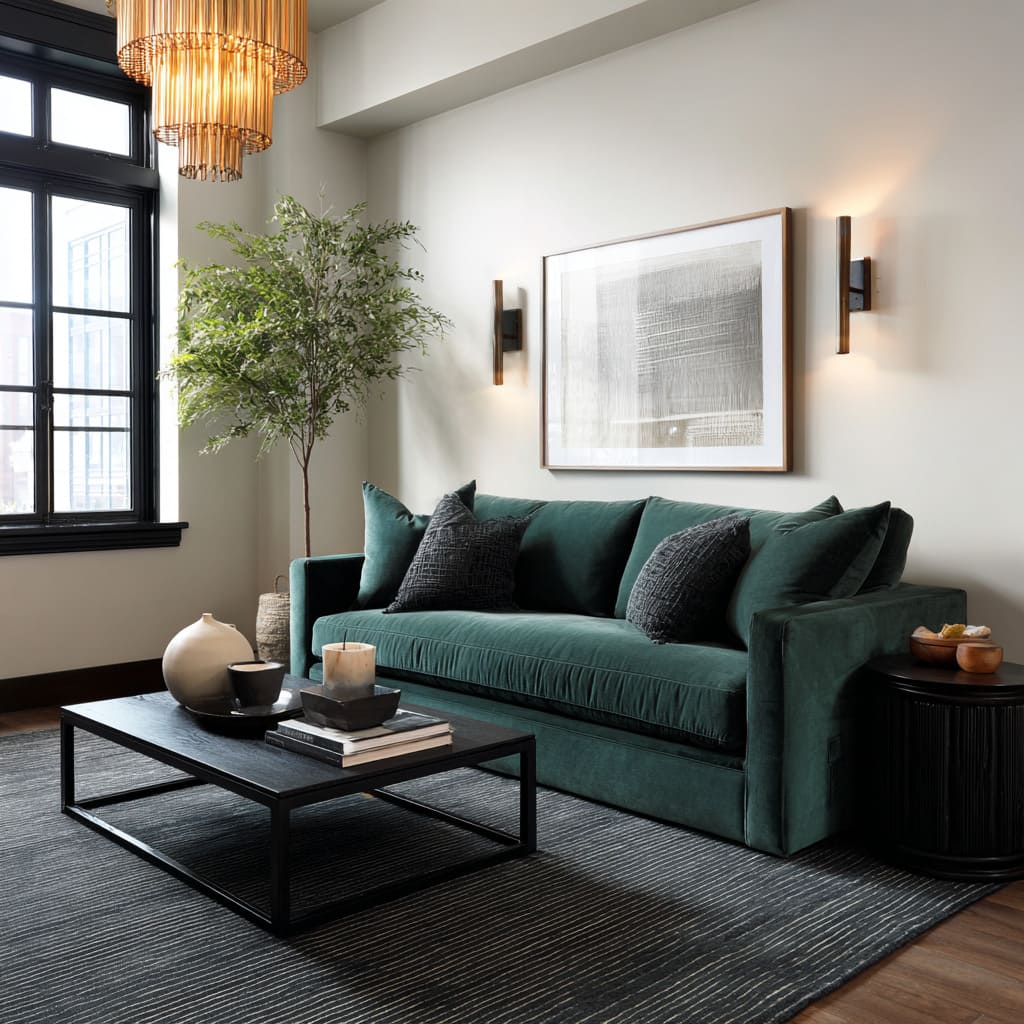
Three visual mechanisms:.
- Tufting / channels create micro-shadows. Those tiny dimples break up the surface, so the sofa becomes readable in layers instead of one heavy slab.
- Matte absorbs glare and keeps green “grown-up.” Shiny green can look loud or costume-like; matte green looks grounded, closer to foliage than ornament.
- Nap creates a camera-friendly gradient. The green doesn’t turn into a flat silhouette when it carries a quiet shimmer that keeps it dimensional even in strong daylight.
So the “luxury” feeling isn’t coming from more objects. It’s coming from how the green fabric performs under light.
Letting darkness be “punctured,” not solid
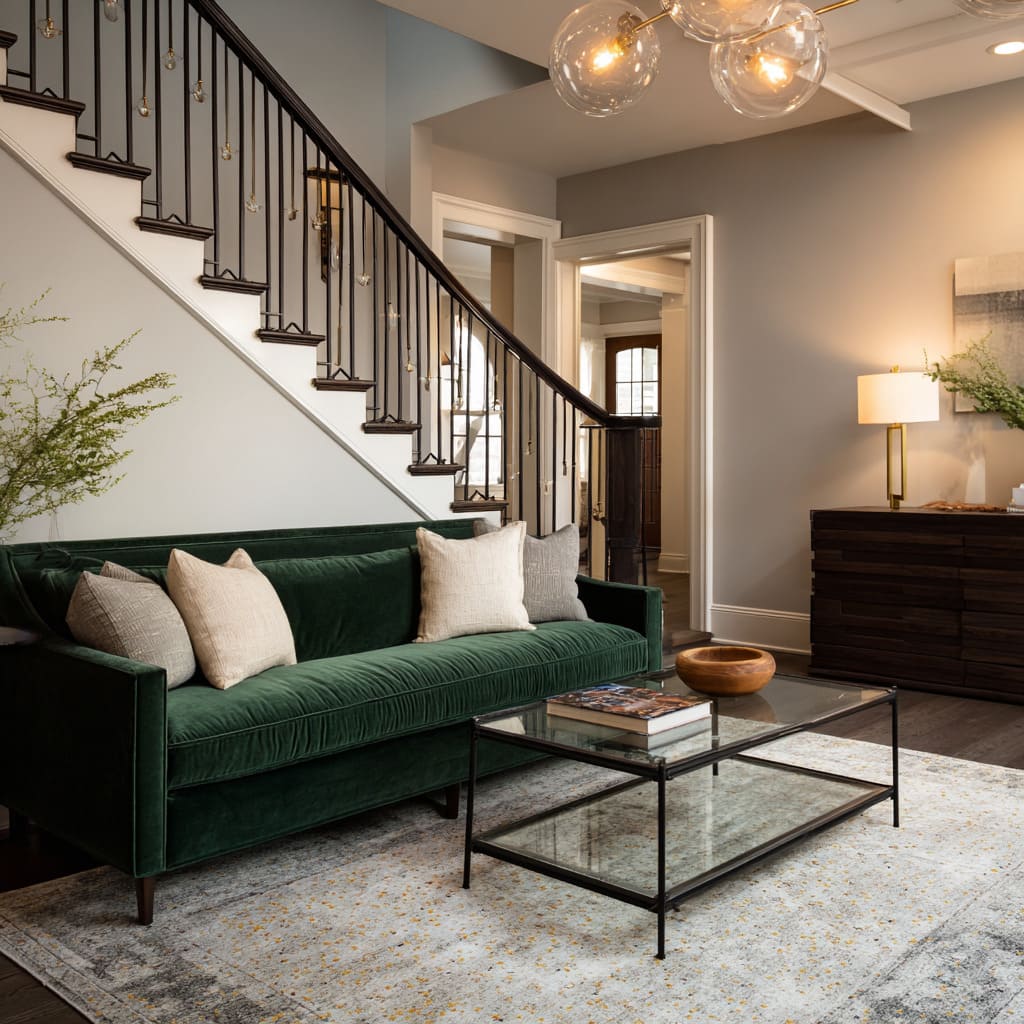
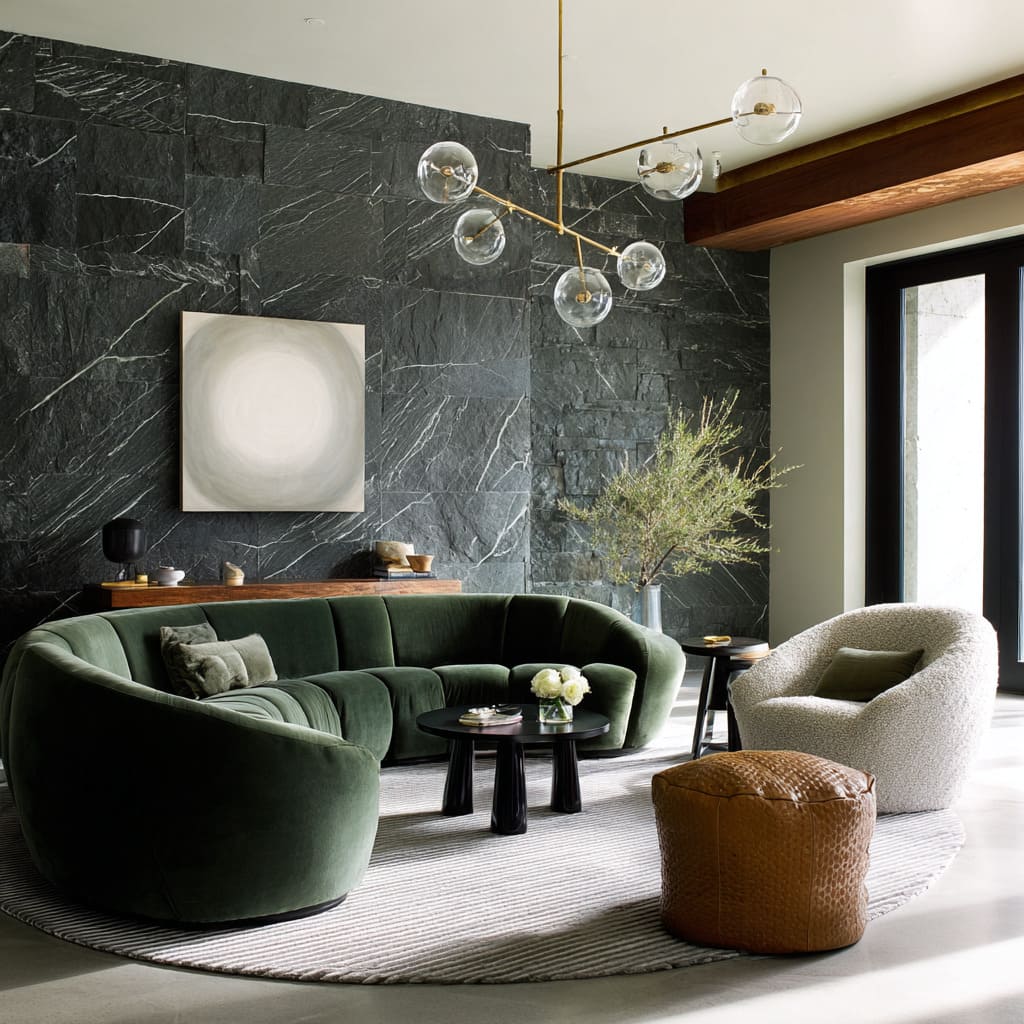
Interior design concepts often solve heaviness by using dark features that are not continuous blocks: black-framed doors with glass panes, tall windows with view depth, open shelving with negative space, chandeliers made of clear globes. The trick is that these dark elements contain transparency or air pockets, so the eye never feels trapped by a solid dark rectangle.
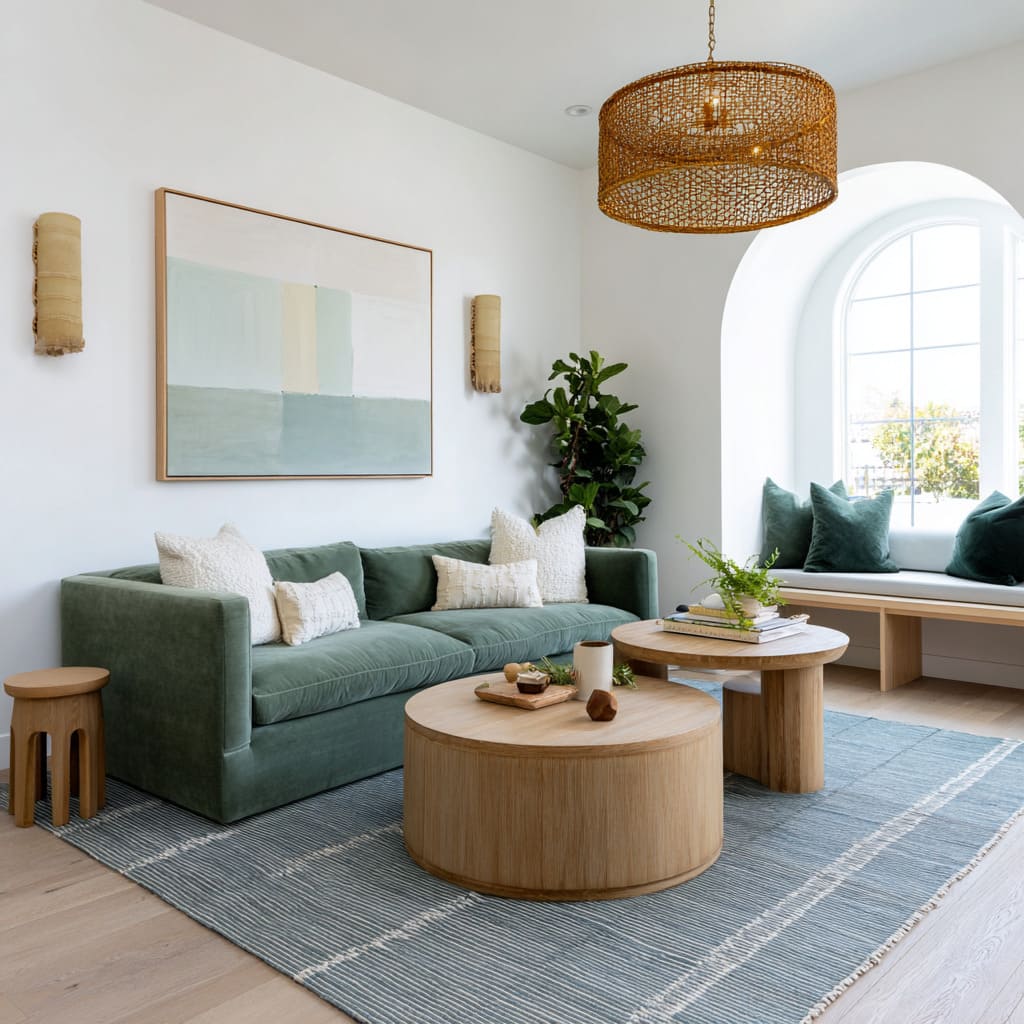
That’s also why glass-topped tables are also an option: they let the rug remain visible, so the floor plane keeps doing its job as the “zone definition” layer. In design with a deep sofa, hiding the rug under a heavy table reduces the room’s clarity.
Showing the rug keeps the room readable, and readability is what people often mistake for “more spacious. ”.
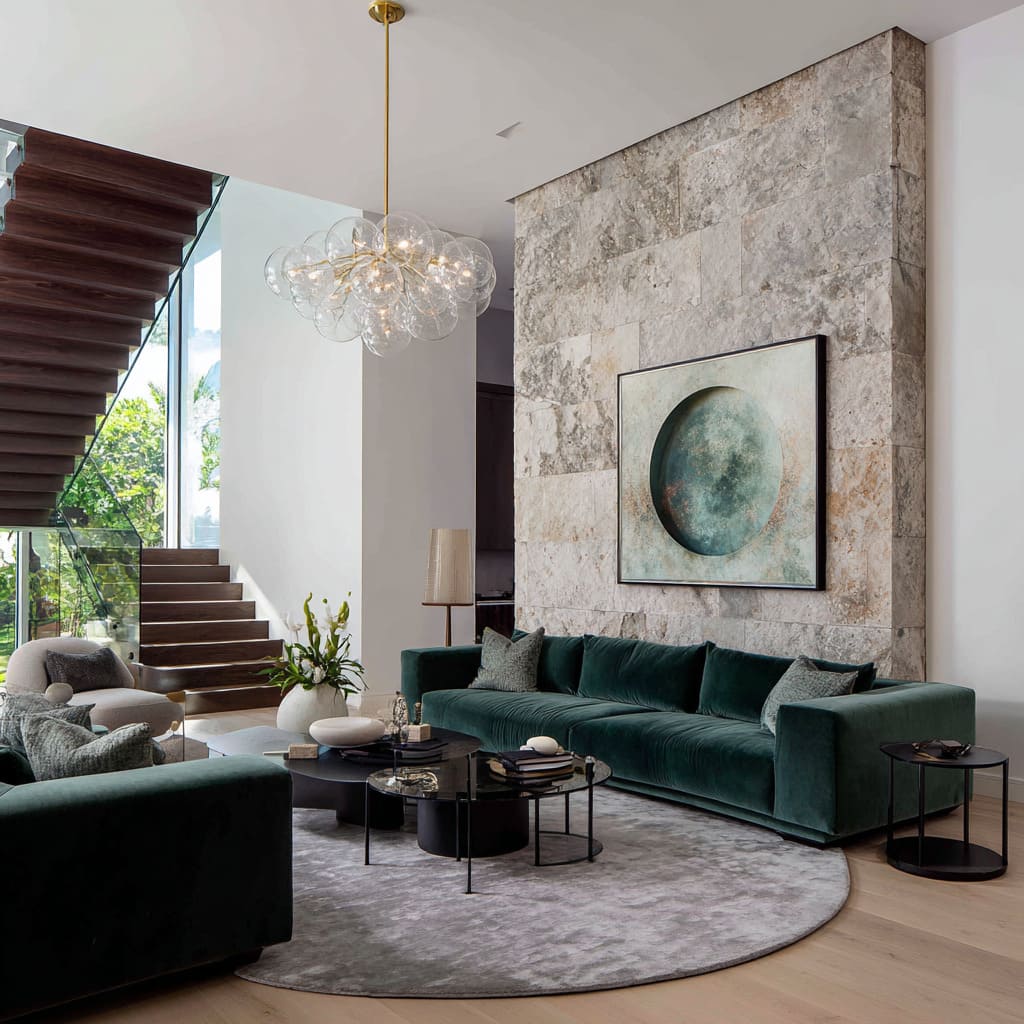
This is the core behind many dark green couch decorating ideas that feel light: the design uses darkness as outlines, frames, and slim profiles—then relies on daylight and translucency to keep those outlines from turning into weight.
A quiet rule: repeat line language, not sofa color
One of the most sophisticated moves is that repetition should not happen through hue. It happens through line language:
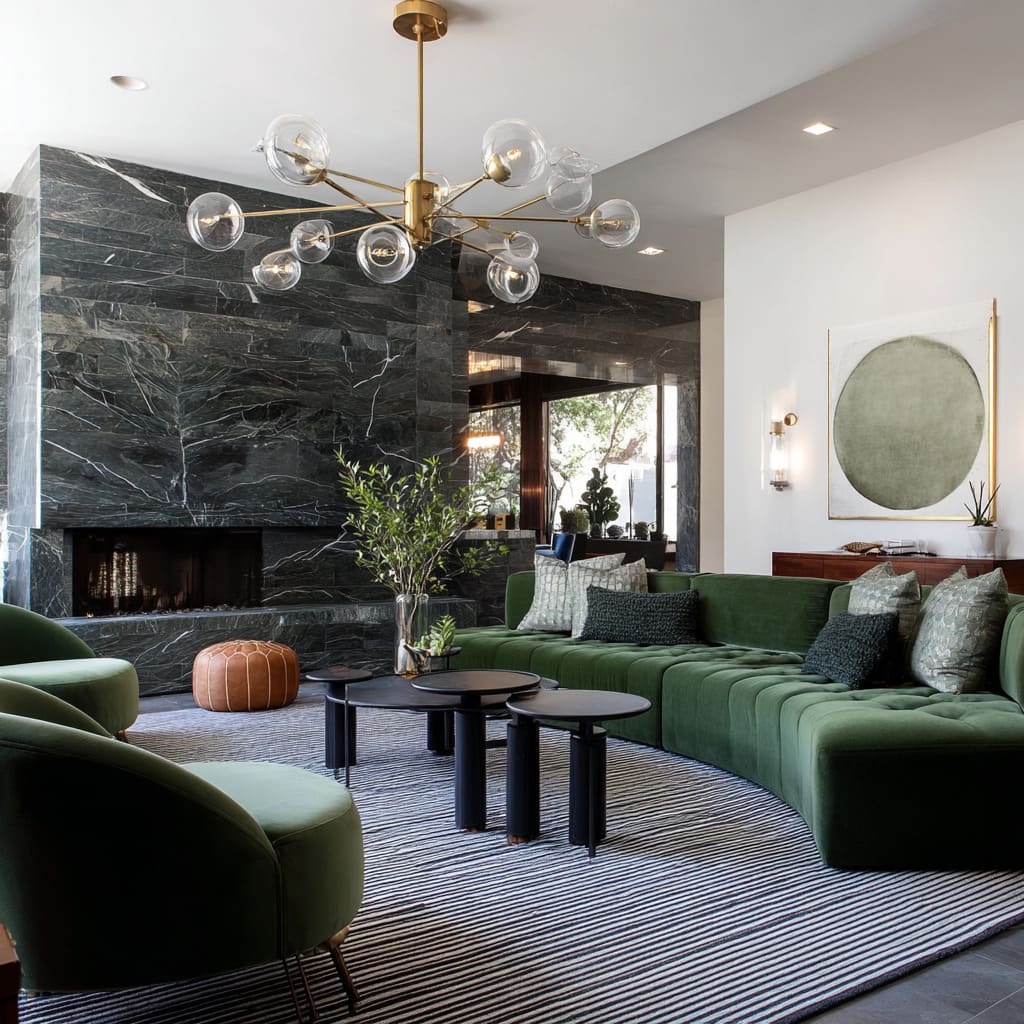
- Thin black stripes in pillows echo thin black stripes in rugs.
- Window muntins echo linear rugs, and both echo stair railings.
- Black metal table frames echo black door frames.
- A grid rug echoes a paneled grid wall.
This matters because it keeps the interior design from becoming theme-y. Instead of “green everywhere,” the room becomes “consistent geometry everywhere,” and green becomes the one deep note sitting inside that geometry.
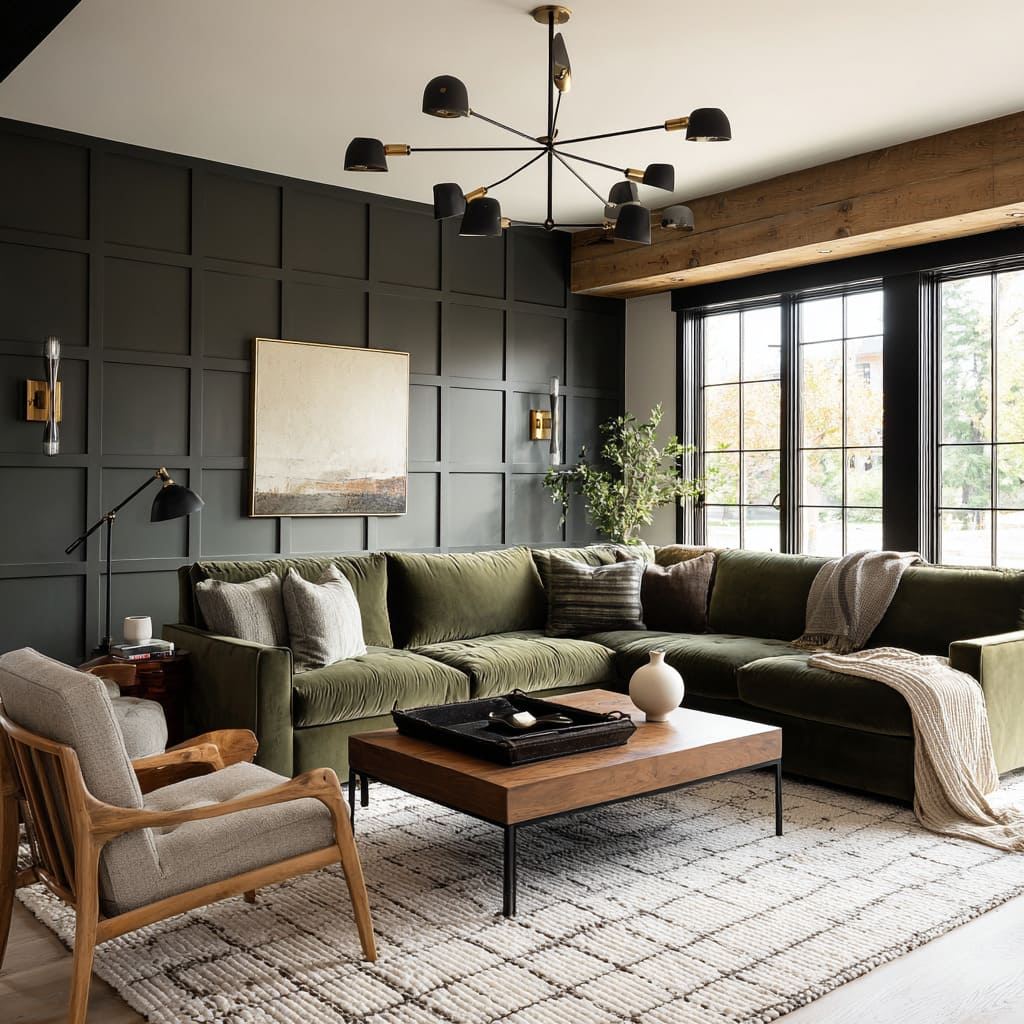
This is exactly where dark green sofa decorating ideas become less about “what matches green” and more about “what makes green look deliberate. ” The answer is often: consistent thin lines, repeated at different scales, so the room feels designed even when the palette stays tight.
Pillows aren’t only color
Pillows can be a tool for managing the sofa’s boundary. That’s a subtle point many people miss.
On a dark green sofa, pillows do one of two jobs:.
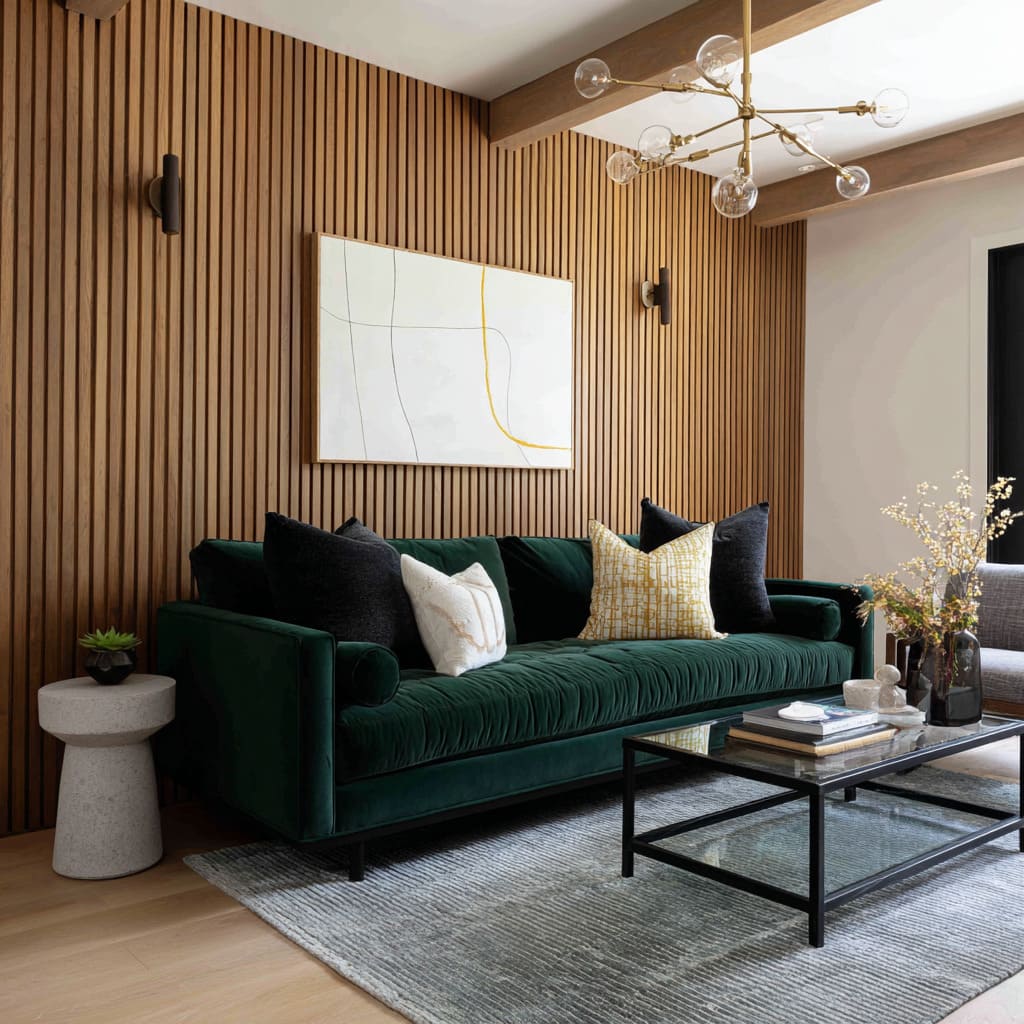
A) “Foam edge” brightness (light pillows on dark upholstery)
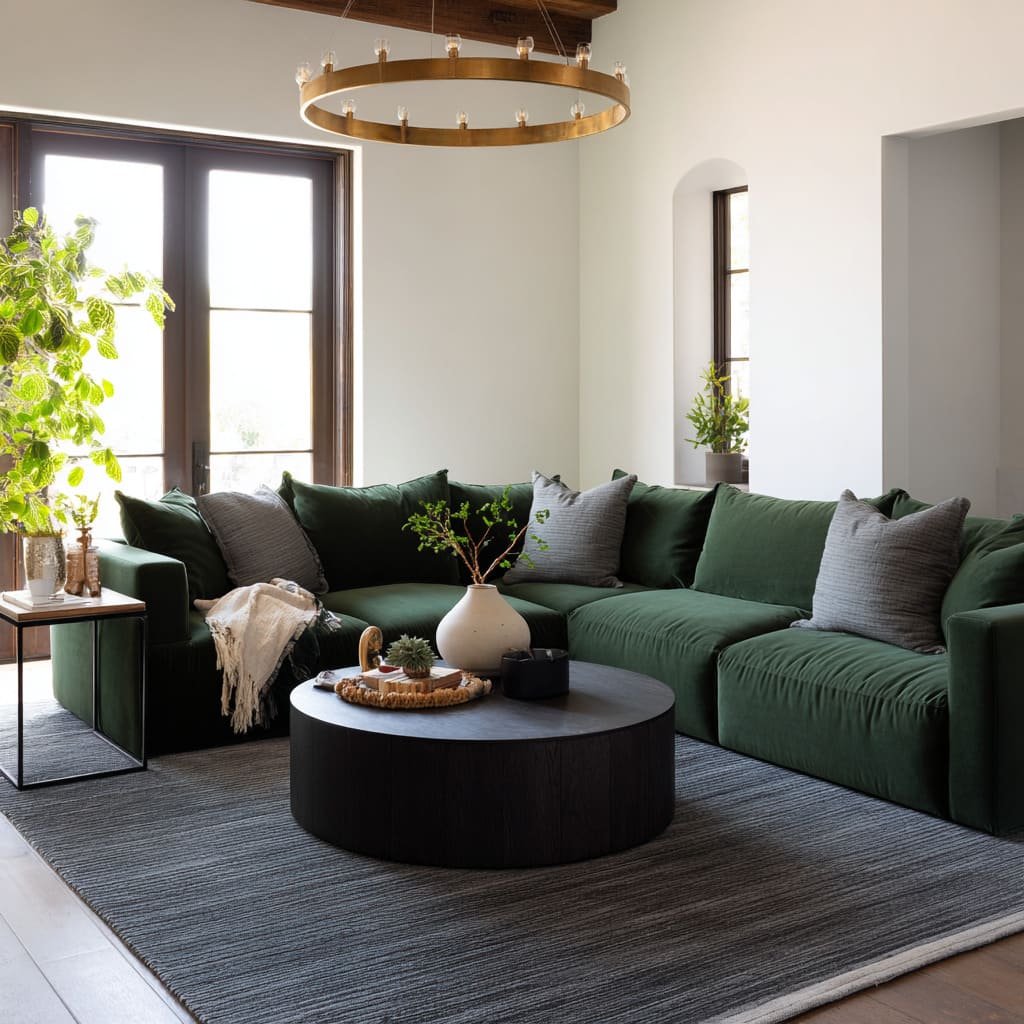
Creamy, textured pillows placed near the corners brighten the sofa’s silhouette and stop it from reading as a single dark mass. This makes the interior design feel lighter without changing the sofa color at all.
Texture matters here: chunky knits, nubby weaves, bouclé-like surfaces create highlights that feel soft rather than stark.
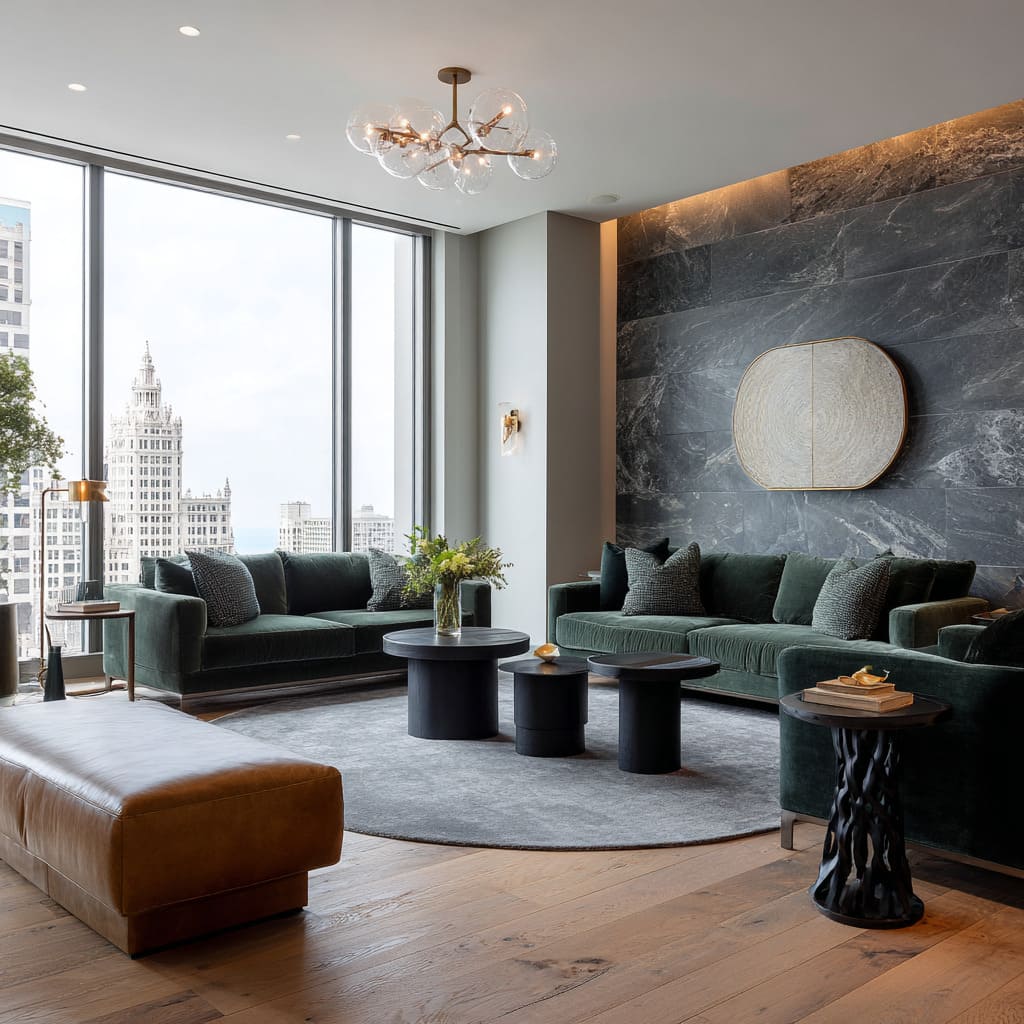
B) “Dark-on-dark continuity” (charcoal pillows on green)
Darker pillows can keep the sofa surface continuous and calm, so the green reads like a dyed textile plane instead of a dark base with bright stickers on it. The interior design then uses light elsewhere (art, molding, glass) to keep it from sinking.
Both approaches avoid chaos by limiting the palette and letting texture do the variety work.
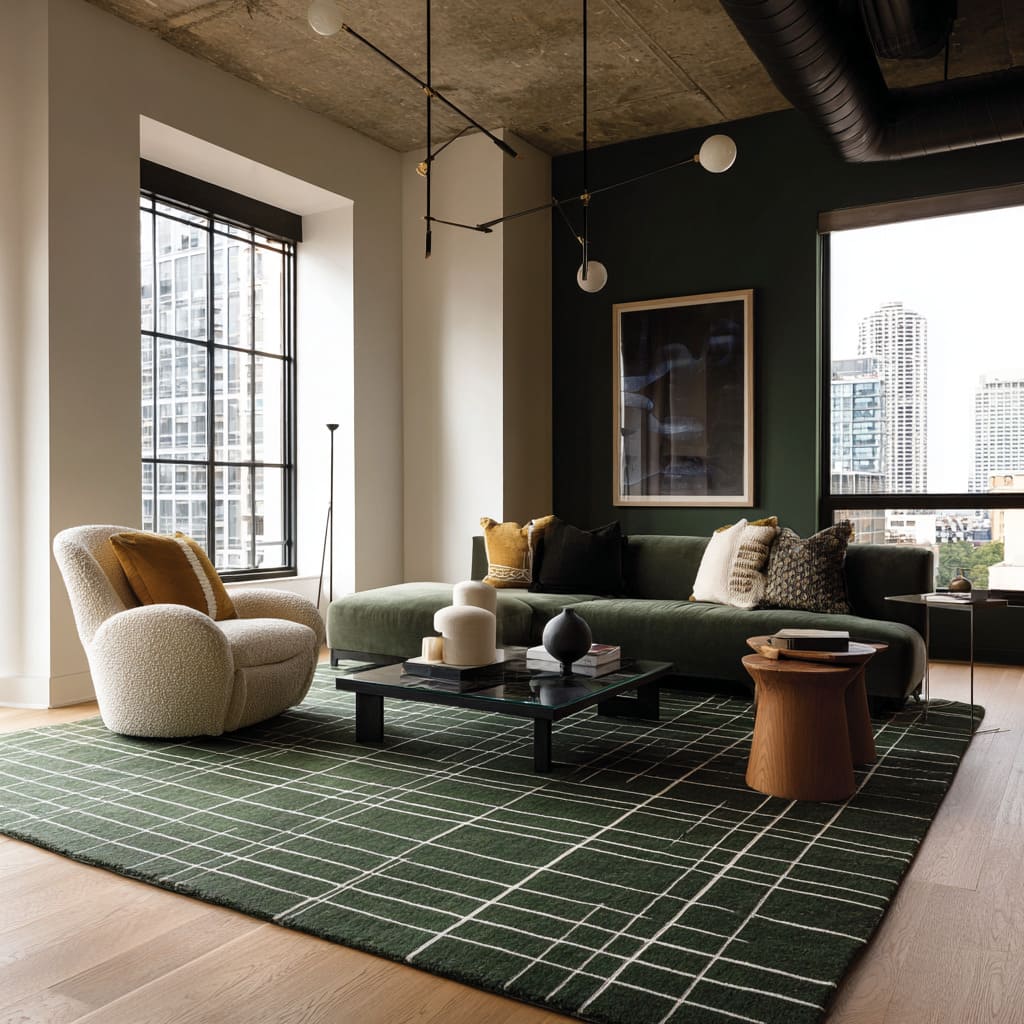
Green looks better when the room builds a controlled warmth triangle
Dark green can lean cool, especially next to black, stone, or gray. Many interior designs quietly correct this with a repeating warmth triangle made from:.
- Wood (floors, beams, coffee tables, mantels)
- Warm metal (brass chandeliers, sconces, warm-toned curtain rods)
- Earth accents (rust, terracotta, camel leather, muted mustard)
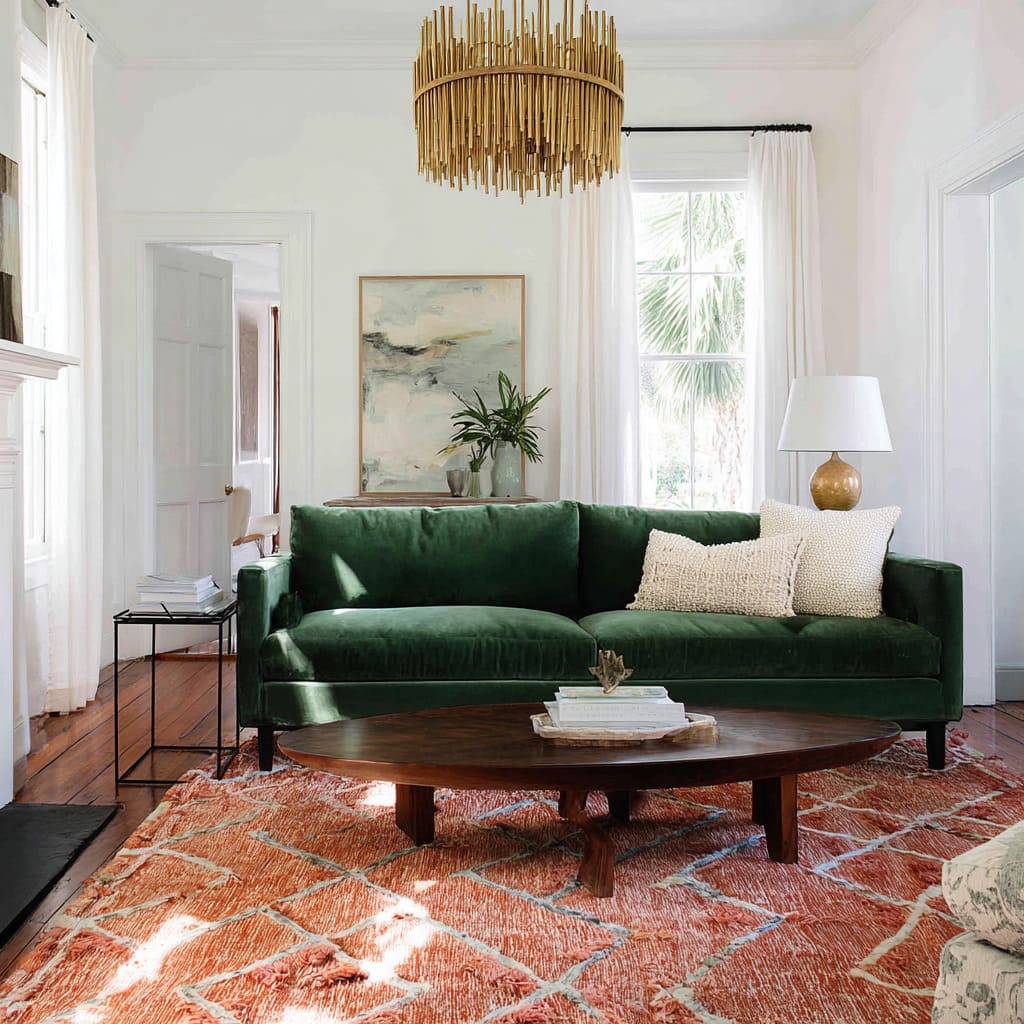
The interesting part is how restrained the warmth is. Often it can appear as one accent chair, one pillow, one leather pouf, or one warm-toned light fixture.
The warmth is concentrated, not scattered, which prevents the room from feeling busy. Green then reads natural and calm, not cold and formal.
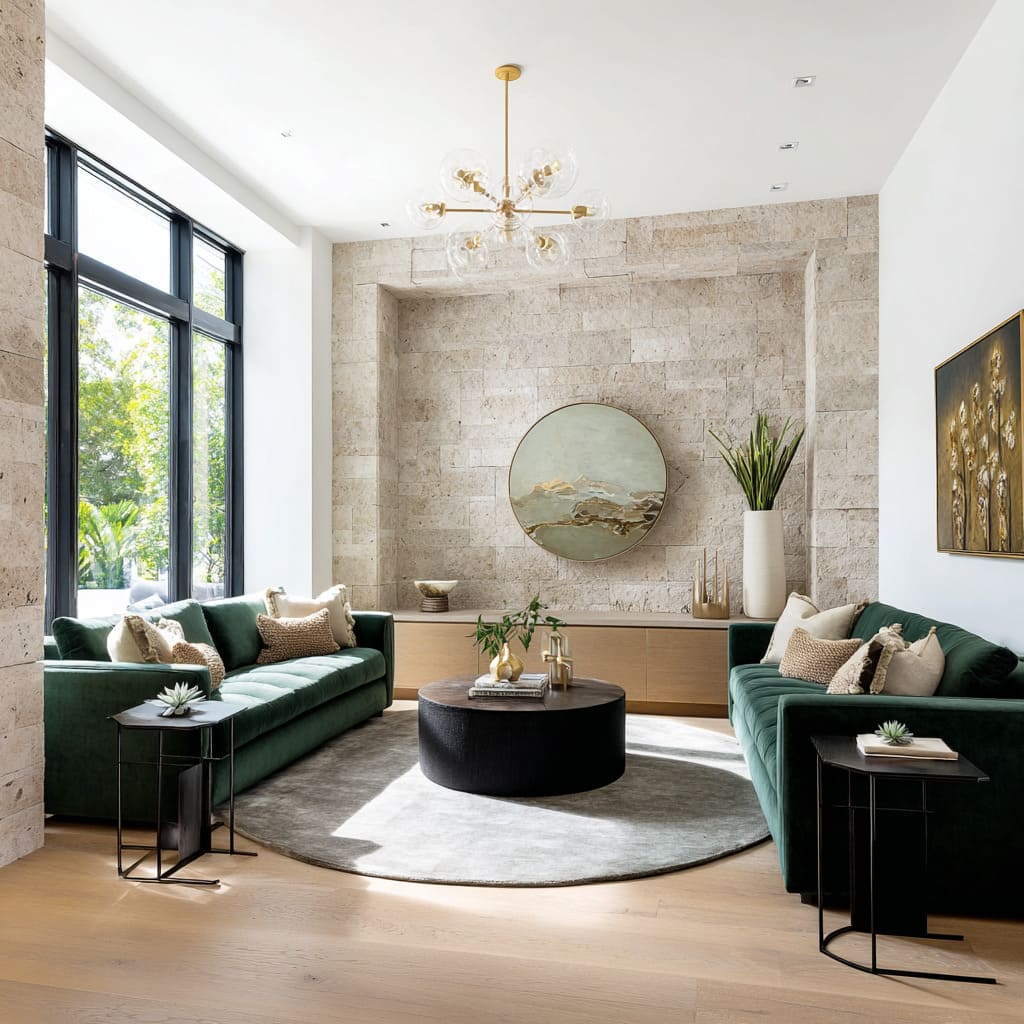
This warmth triangle is especially clear in living room ideas with a dark green sofa that want to feel “breezy” but not empty: a bright envelope plus one deep green anchor plus one warm correction note.
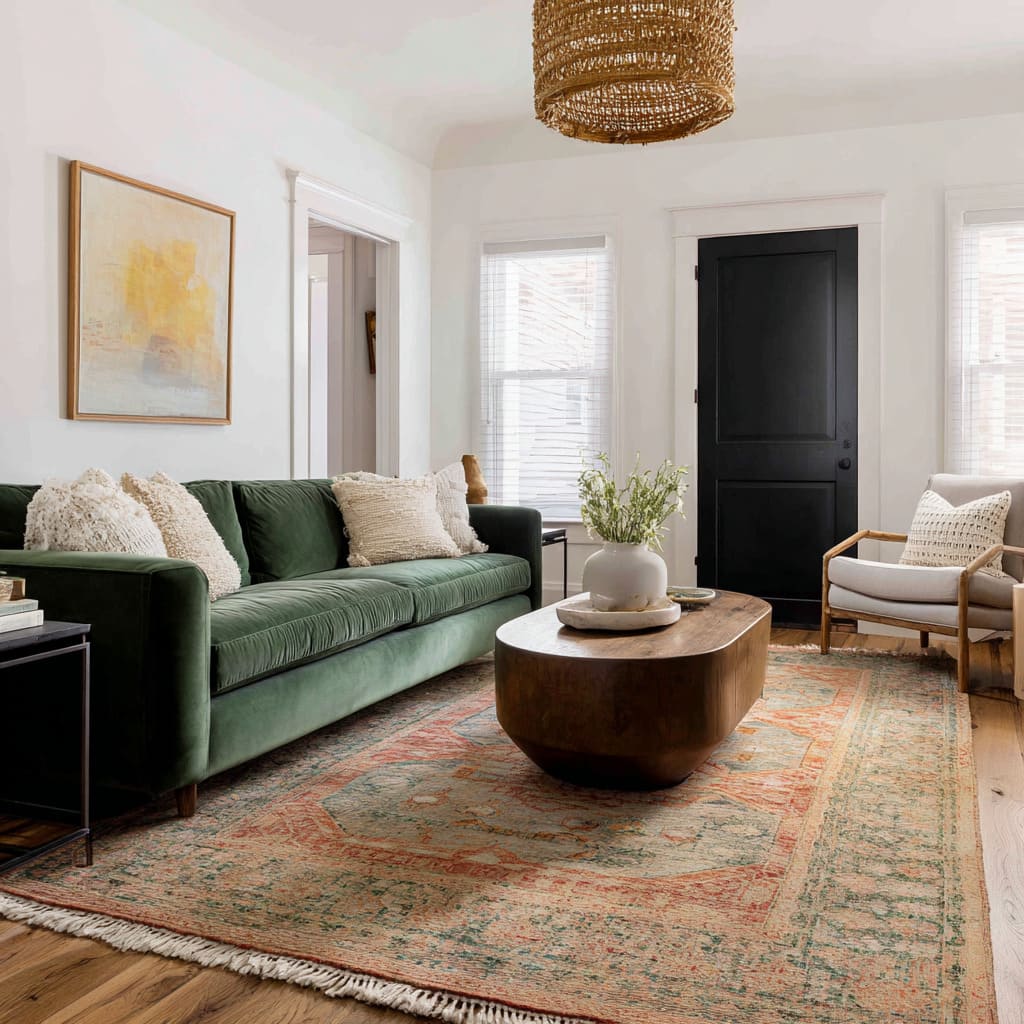
Rugs turn the sofa into a placed island
The rug logic sometimes is unusually disciplined. Rugs aren’t described as decoration; they behave like floor framing systems:
- Light rugs with soft speckling expand the floor visually and lift the sofa’s weight.
- Striped rugs add direction and rhythm, stretching long rooms and making seating feel aligned.
- Grid rugs measure the zone, making large sectionals look “drawn in” rather than parked.
- Circular rugs soften architecture-heavy rooms and turn seating into a conversation island instead of furniture lined against walls.
What’s not obvious: rugs often echo the wall’s organizing idea.
- Grid wall → faint grid rug. Strong linear architecture → subtle stripe rug.
- Dramatic stone wall → calm round rug and round tables.
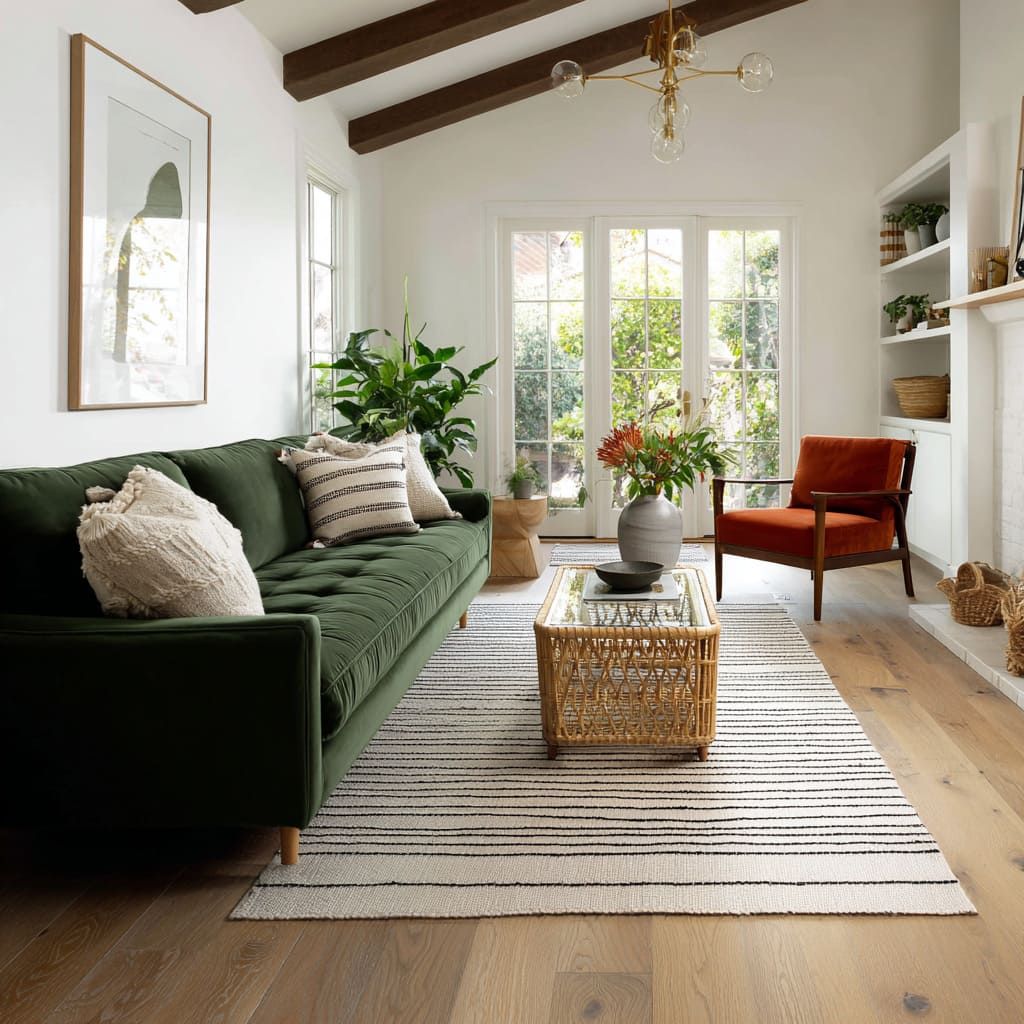
Coffee tables: the center manages weight
The table choices aren’t random style picks; they’re weight management strategies:.
- Glass + thin black frames keep sightlines open and repeat architectural black lines without adding mass.
- Oval and round tables soften rooms dominated by rectangles (windows, paneling, doors, stair diagonals), making the center feel humane.
- Thick wood blocks provide stability when the room needs a second “serious” object so the sofa isn’t carrying all gravity alone.
- Clusters of small round black tables behave like punctuation marks—low, layered, sculptural—so the center feels designed even with minimal styling.
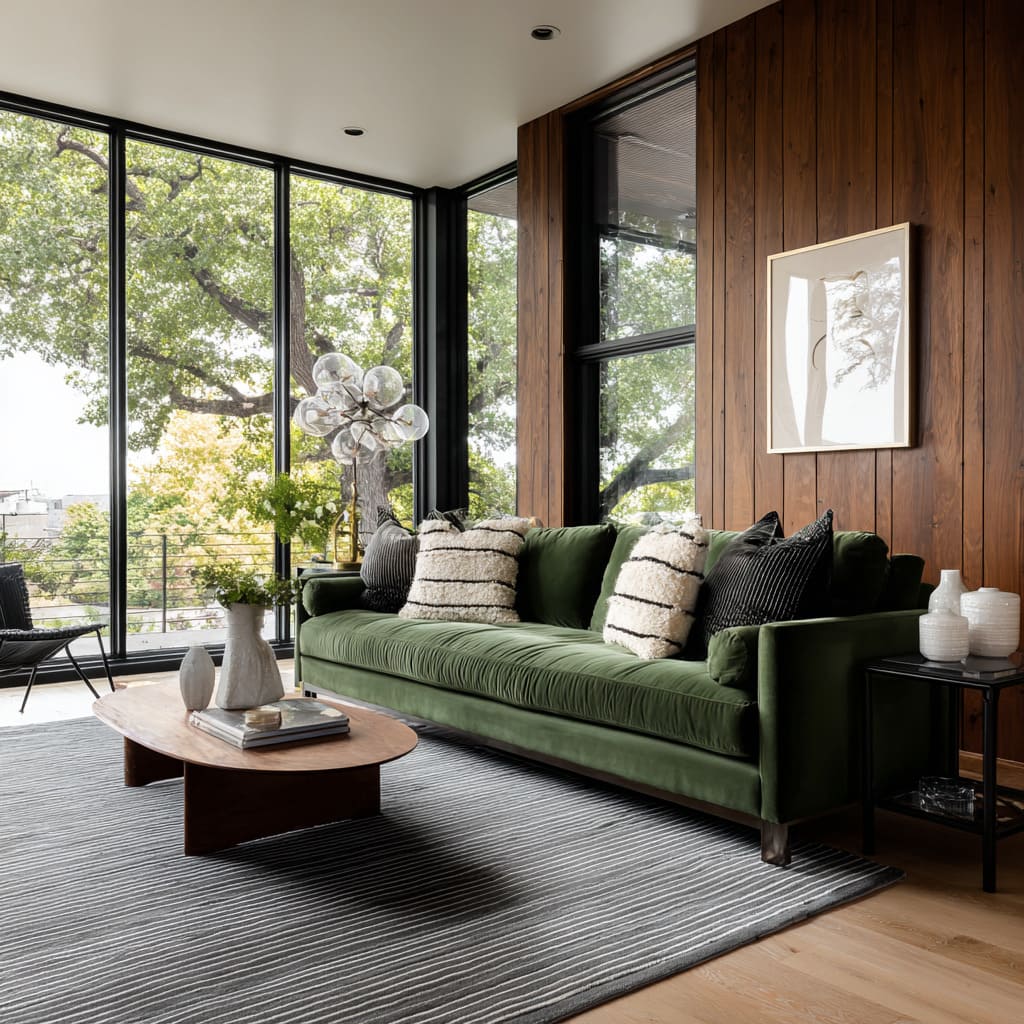
The styling itself is consistently “low and calm”: books as flat platforms, one pale vase for value contrast, one darker vessel for depth repetition, and enough negative space to signal control. That negative space is one of the strongest “quiet luxury” cues running through the set.
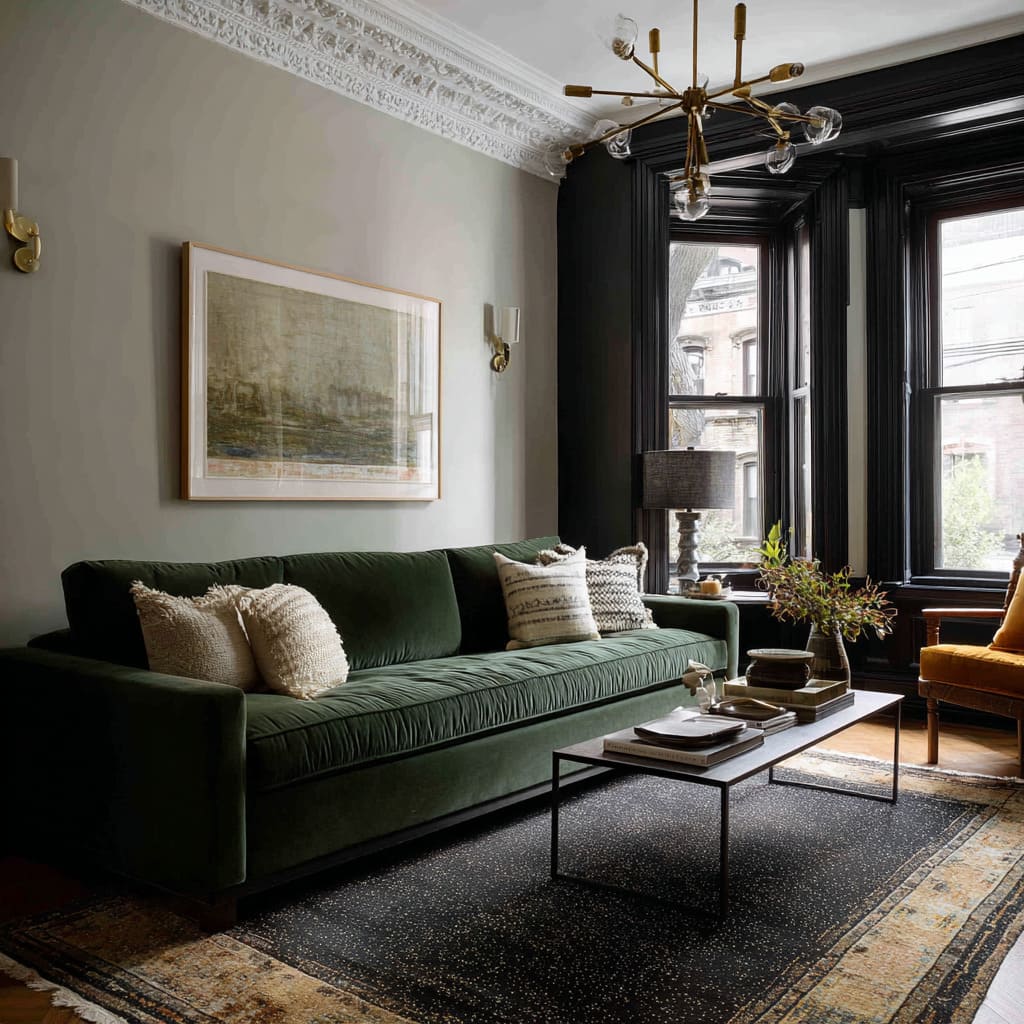
The sofa wall becomes finished through “framing,” not filling
A wall strategy, which can be used in multiple forms:.
- One large artwork centered to calibrate scale and stop the wall from feeling undecided.
- Pair of sconces flanking the art to create a bracketed zone—finished, symmetrical, calm.
- Slatted wood or grid panel walls providing rhythm so the sofa reads like a planned foreground layer.
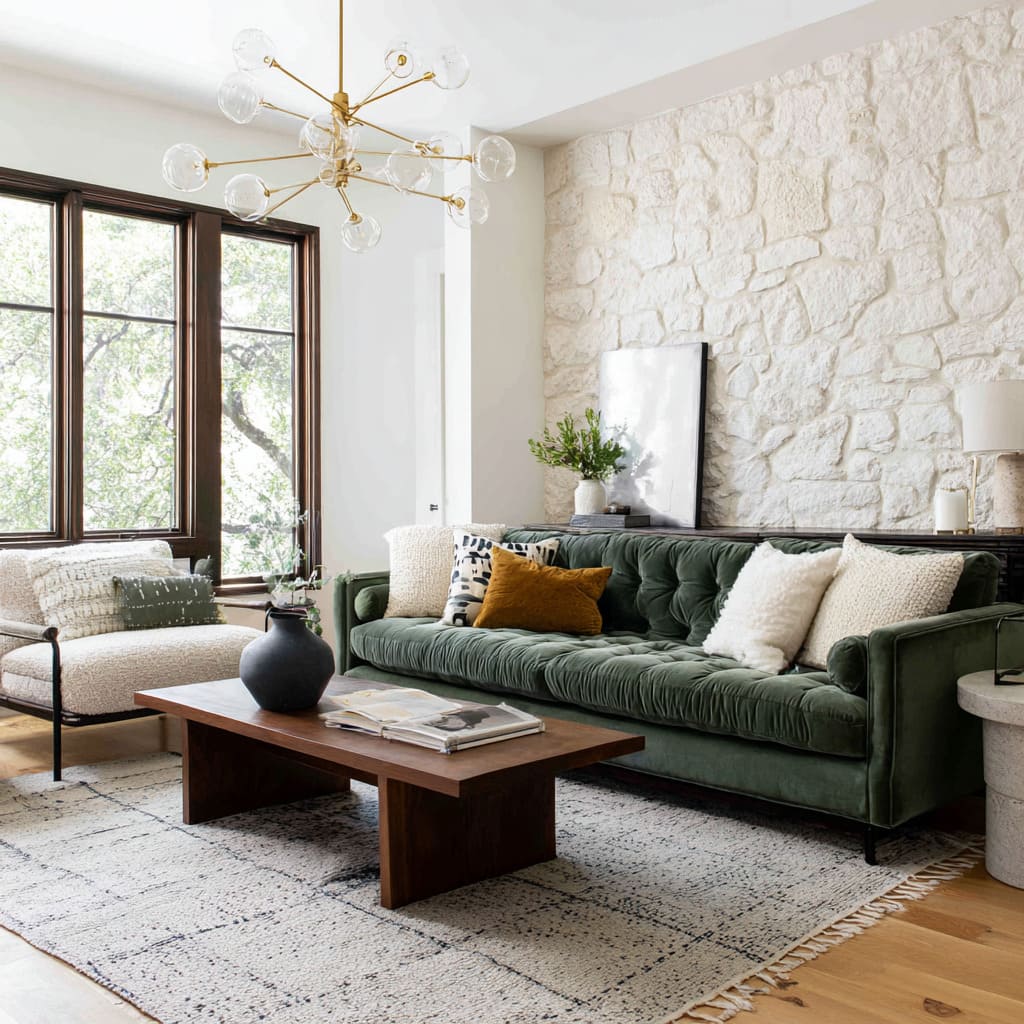
- Stone backdrops providing texture interest without color noise, letting green feel organic.

This is why many examples of living room design with a dark green sofa look complete with fewer objects: the wall is treated like a structured composition (center, brackets, rhythm) rather than a shelf for many small items.
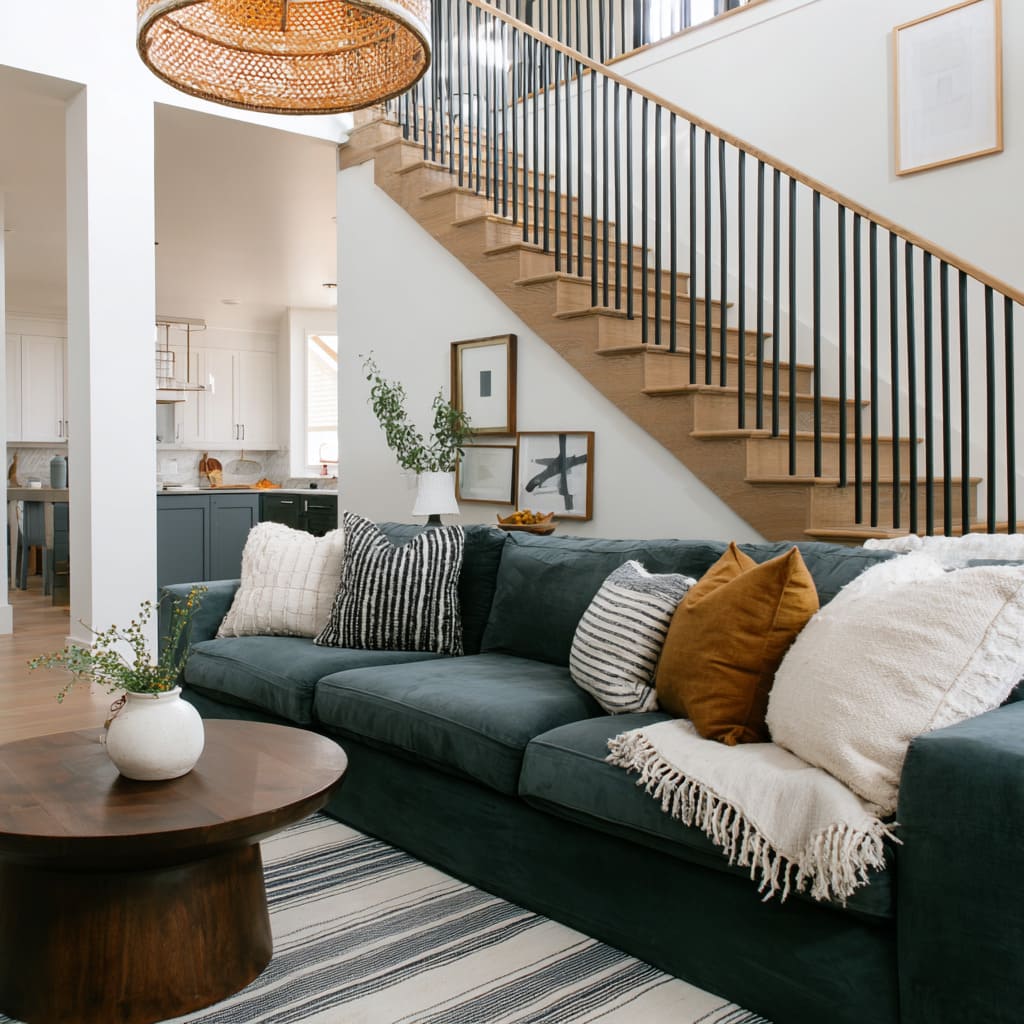
Stairs and open-plan layouts: green becomes the stabilizer
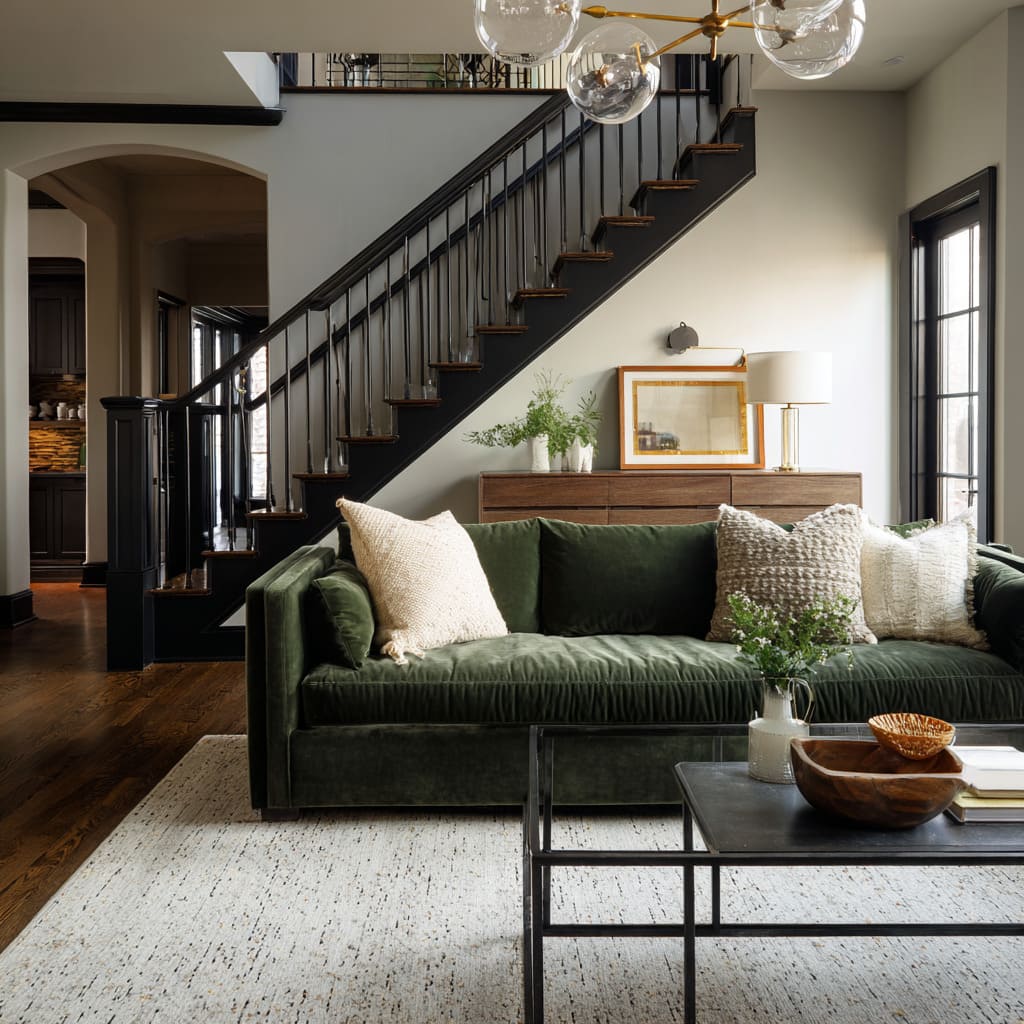
The diagonal black railing can visually dominate. The dark green sofa works because it counters diagonal energy with a long horizontal base.
It anchors the bottom of the stair composition so the living area stops feeling like a waiting zone under a slanted graphic.
Two extra moves make designs with stairs feel polished instead of busy:.
- A pale, wide rug that extends beyond the sofa footprint, clearly claiming territory for the seating zone.
- Thin black frames (table bases, sconces) that echo the railing, so the stair doesn’t feel like a separate language from the furniture.
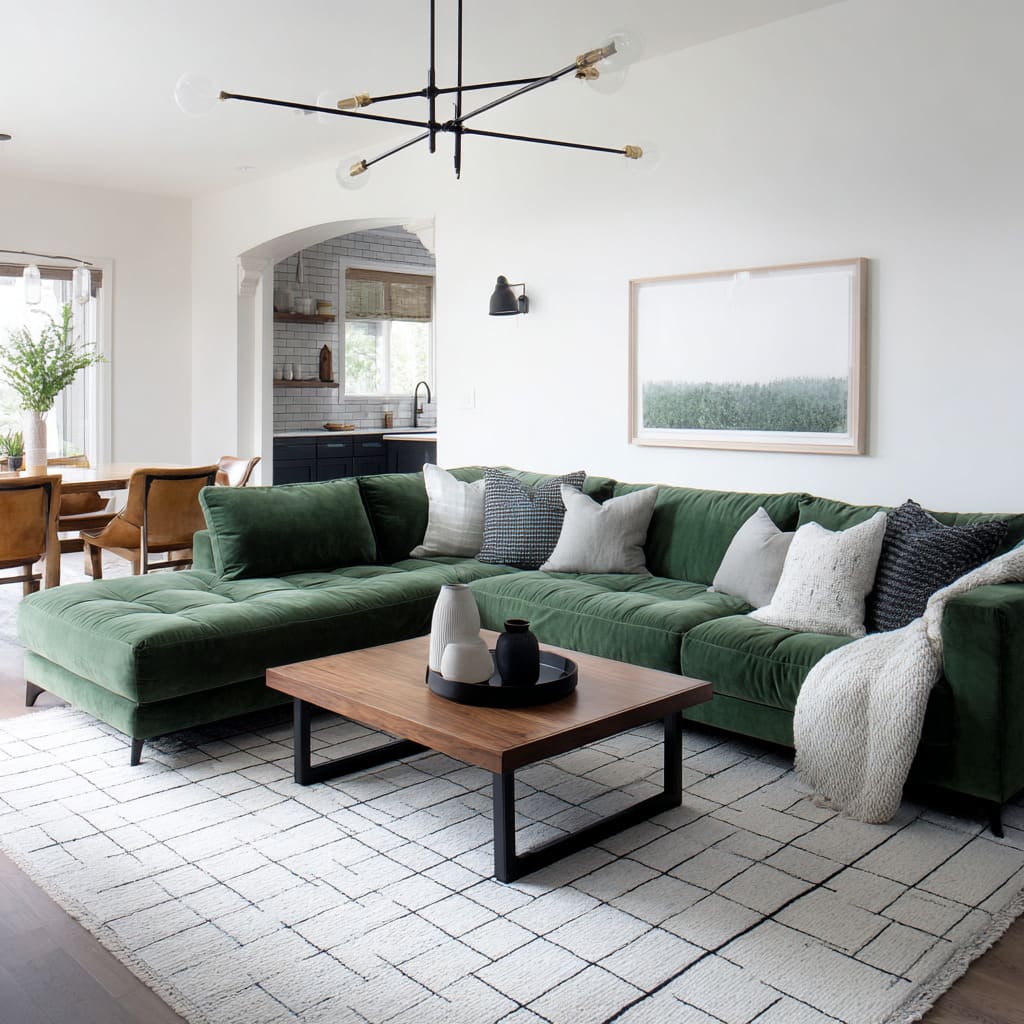
The sofa becomes the soft counterweight to strict black architecture—deep, quiet, touchable—so the room reads welcoming even when the structure is bold.
Architecture-heavy luxury interior designs: green as a neutral with depth
The high-rise and stone-wall interior designs can have a different personality of such a sofa: green becomes “quiet luxury seating. ” The palette tightens into a few big materials (stone, glass, wood, green textile), and the interior design relies on scale rather than object count.
Round rugs, round art discs, and glass globe lighting repeat a soft geometry theme so the drama never turns harsh.
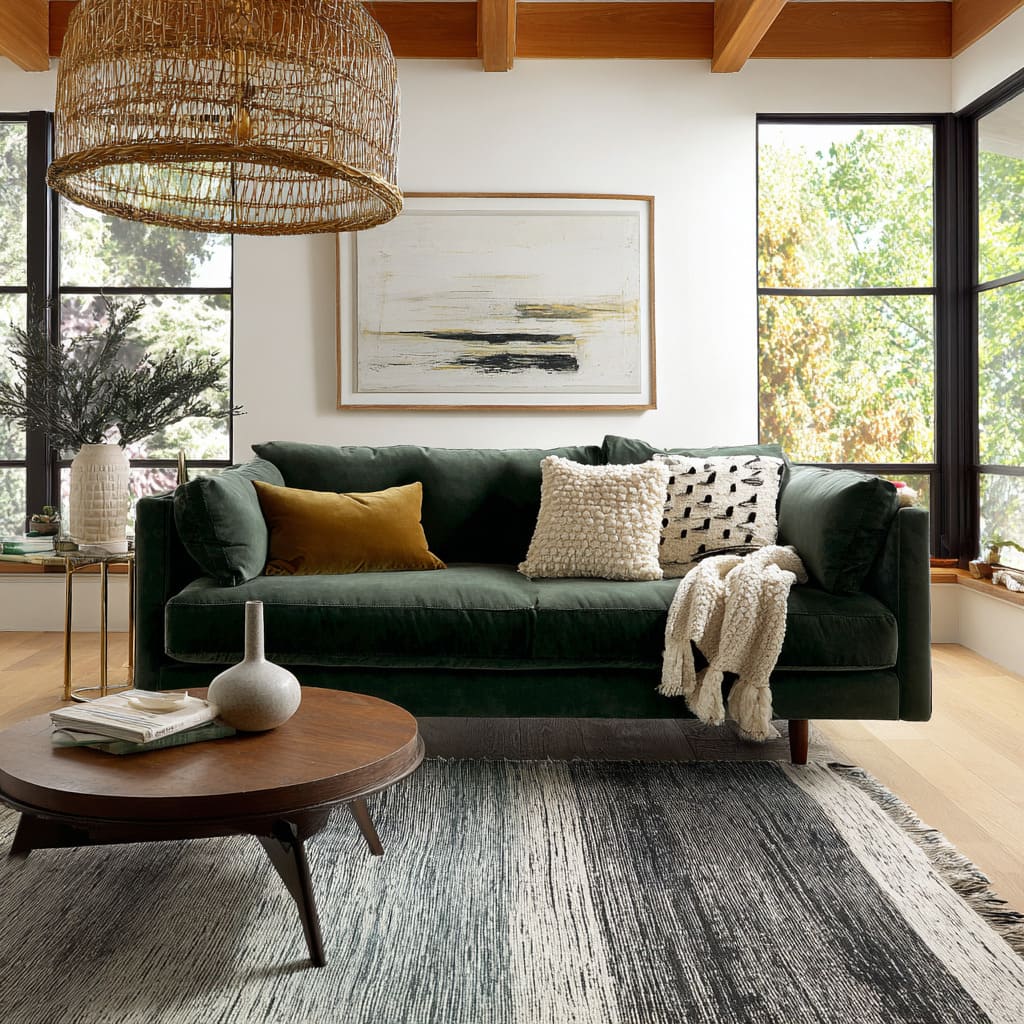
A key pattern is that green is allowed to sit next to very strong materials (black stone, charcoal veining) because the interior deisgn supplies two balancing forces: huge daylight and soft forms. The result is not “moody cave,” but composed calm with a deep base tone.
Conclusion
Dark green works best when the interior treats it as a steady value anchor, not a loud accent. The look turns “planned” when depth is repeated in one or two structural places (black frames, charcoal wall, dark trim), while warmth stays controlled (wood + one warm metal + one earth note).
Keep the center visually open with pale rugs, glass or slim tables, and soft curves, and let texture—not extra colors—do the richness. In the end, the green sofa becomes the room’s calm shadow line: it makes light walls feel chosen, shapes feel intentional, and the whole living area feel finished with fewer objects.