Mirrors in living spaces have taken on a more intentional role than ever before. They’re no longer only for checking reflection or catching light—they now serve as tools for shaping visual flow, reinforcing architectural patterns, and setting the tone of a room.
Whether installed in full-wall grids, used as recessed panels, or placed with a slight tilt, mirrors contribute to the structure and balance of interior compositions.
Current styles focus less on shine and more on atmosphere. Toned finishes, warm patinas, and subtle edges allow mirrors to blend into textured surroundings, adding depth without drawing attention through glare.
Some reflect structure by repeating elements—beams, arches, or columns—while others soften the setting with curves or clusters that offset strict geometry.
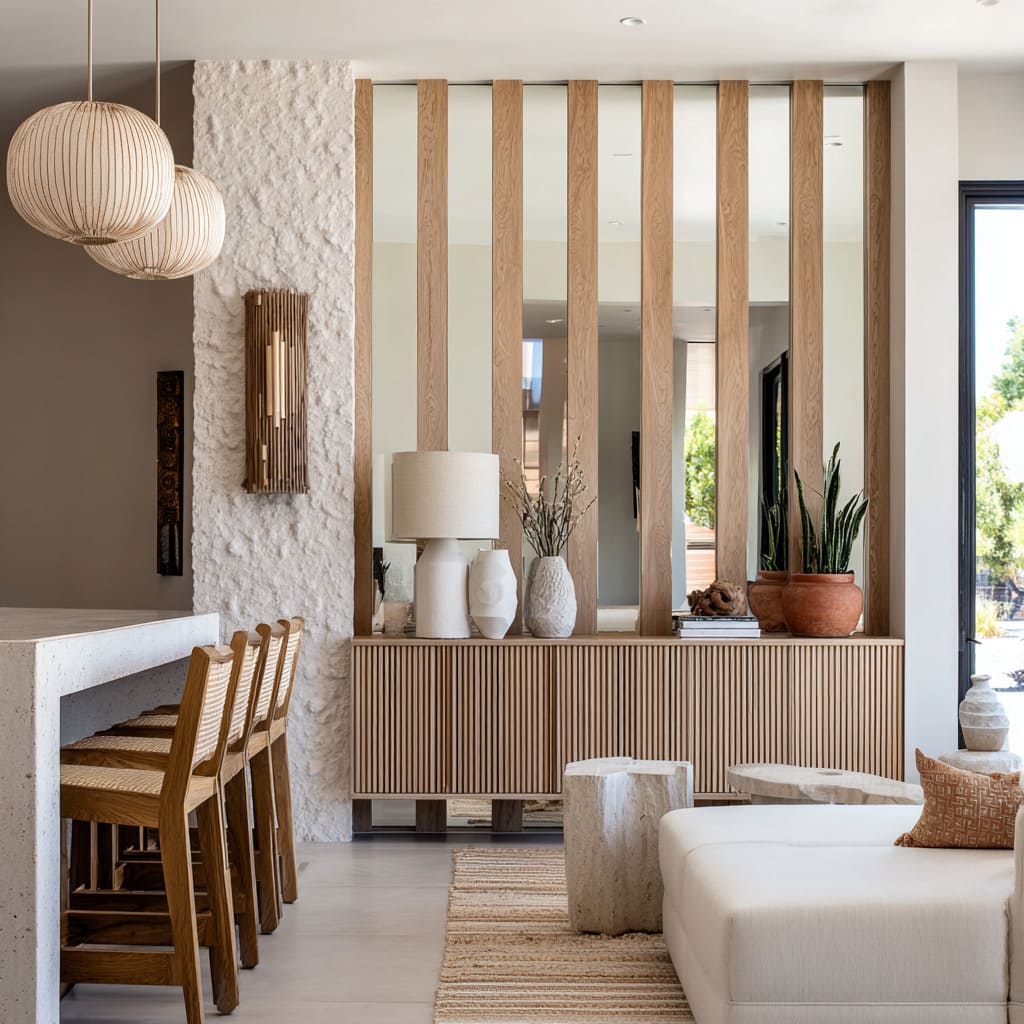
The shift leans heavily into context. A mirror might echo nearby shapes, align with ceiling breaks, or duplicate a palette through its filtered reflection.
The visual impact is layered and intentional, with mirrors acting less like additions and more like active surfaces that respond to the rest of the room. This approach reshapes how mirrors are used—not as accents, but as quiet instruments of rhythm, scale, and mood.
Built Into the Structure: Mirrors as Architectural Elements
Mirrors that echo the shape of the room feel integrated, not added. In many current interiors, reflective surfaces no longer act like wall decorations—they align with built forms.
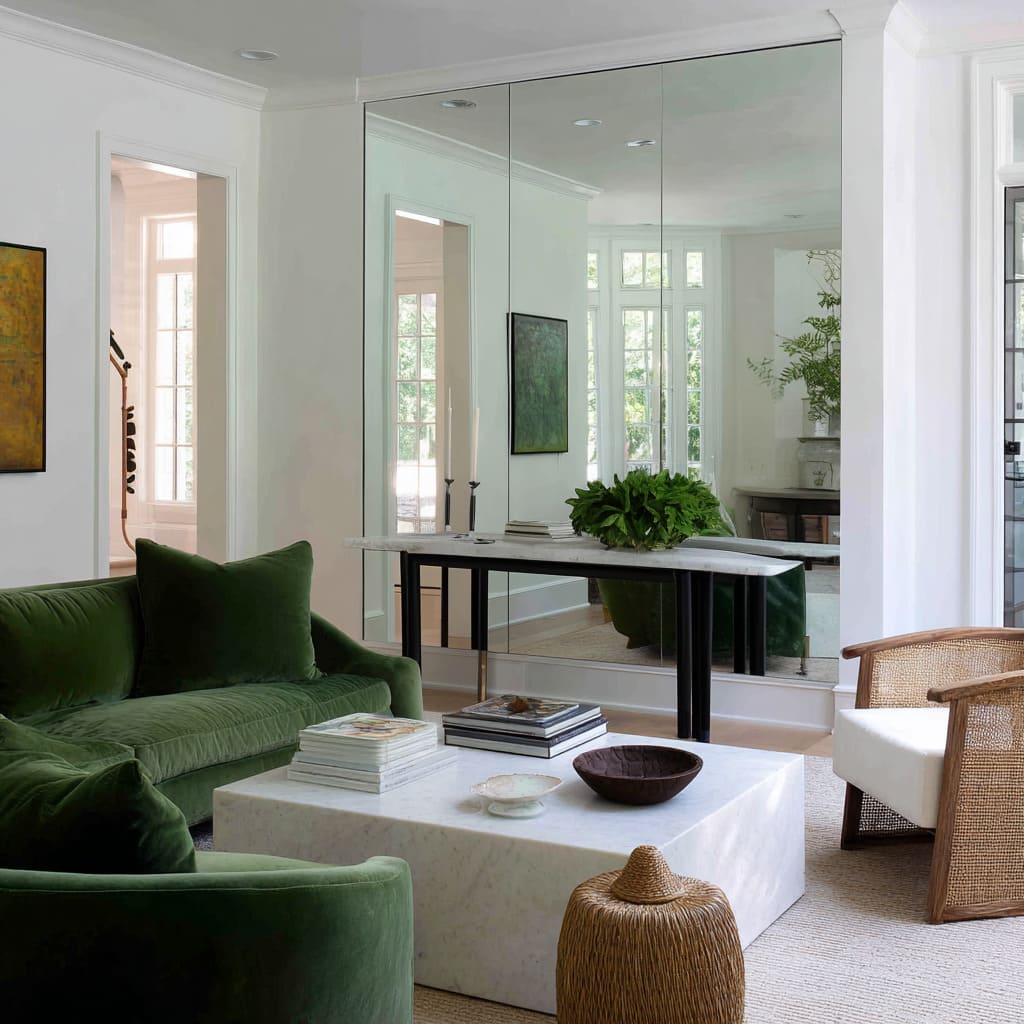
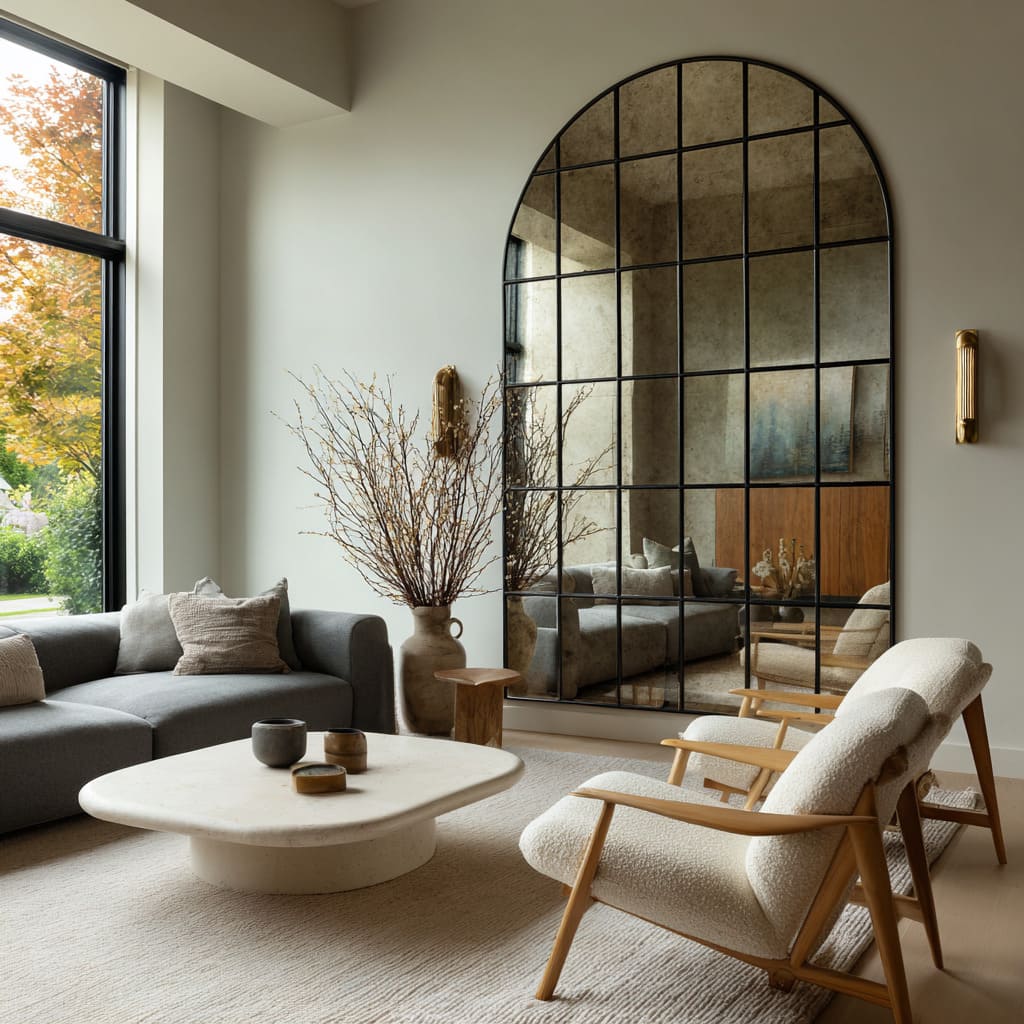
Arched frames follow the shape of windows, vertical strips match the rhythm of wood paneling, and full-height panels mimic the proportion of sliding doors or fireplace columns. These reflective forms respond to the room’s geometry as if they belong to the construction itself.
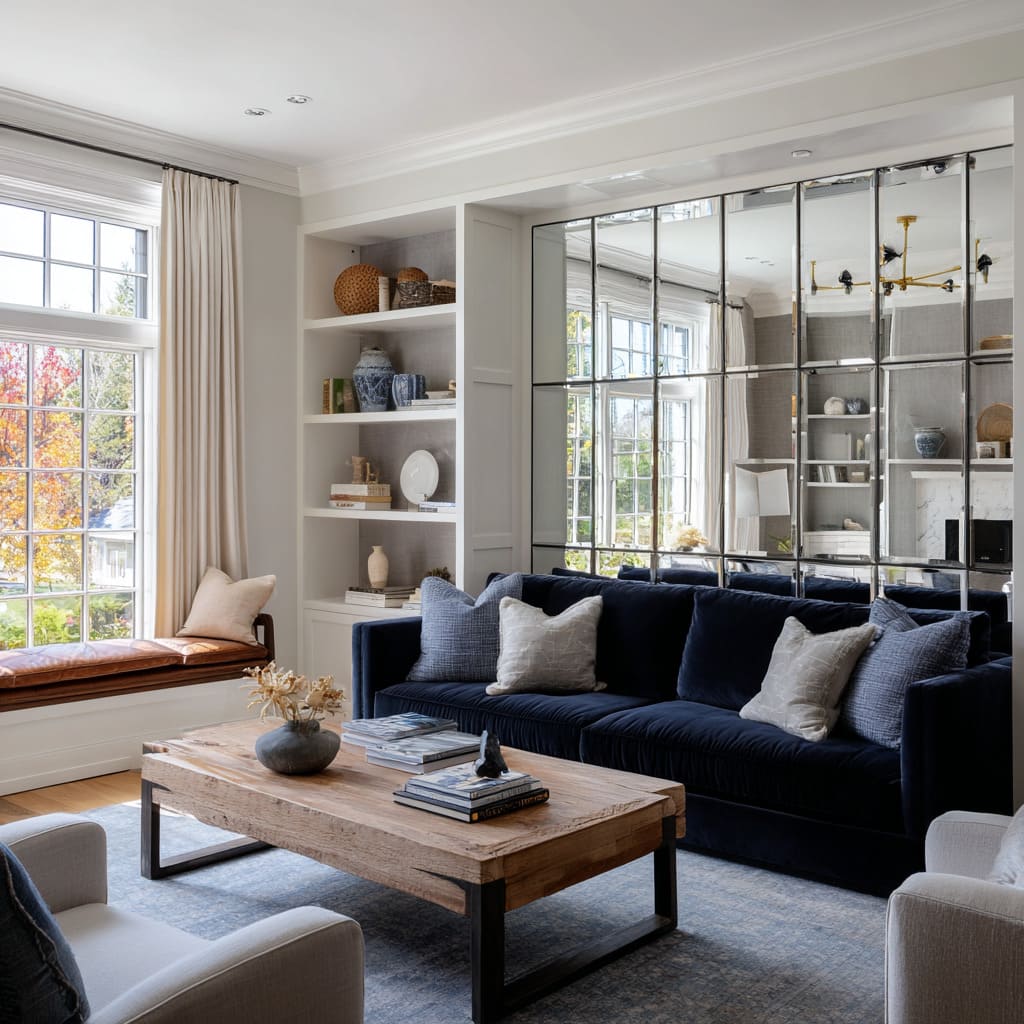
The result is a surface that behaves less like an object and more like part of the wall. Subtle framing details—like grid mullions, flush mounts, or narrow wood trims—anchor the mirror visually without calling too much attention to itself.
In some cases, mirrors even mirror each other across the room, creating spatial continuity that feels intentional rather than improvised. This approach gives many living room mirror ideas a stronger presence by making reflection feel structural, rather than decorative.
Grid and Rhythm: Fractured Reflection as Design Language
Breaking a reflection into parts changes how it’s perceived. Gridded mirror panels, narrow vertical slices, and modular layouts do more than decorate—they bring rhythm and spacing to a surface that otherwise might dominate with glare.
Segmenting a large mirror can turn it from a flat glare patch into a controlled visual field. The seams and frames act like punctuation, spacing out the reflected content and controlling how the eye moves across it.
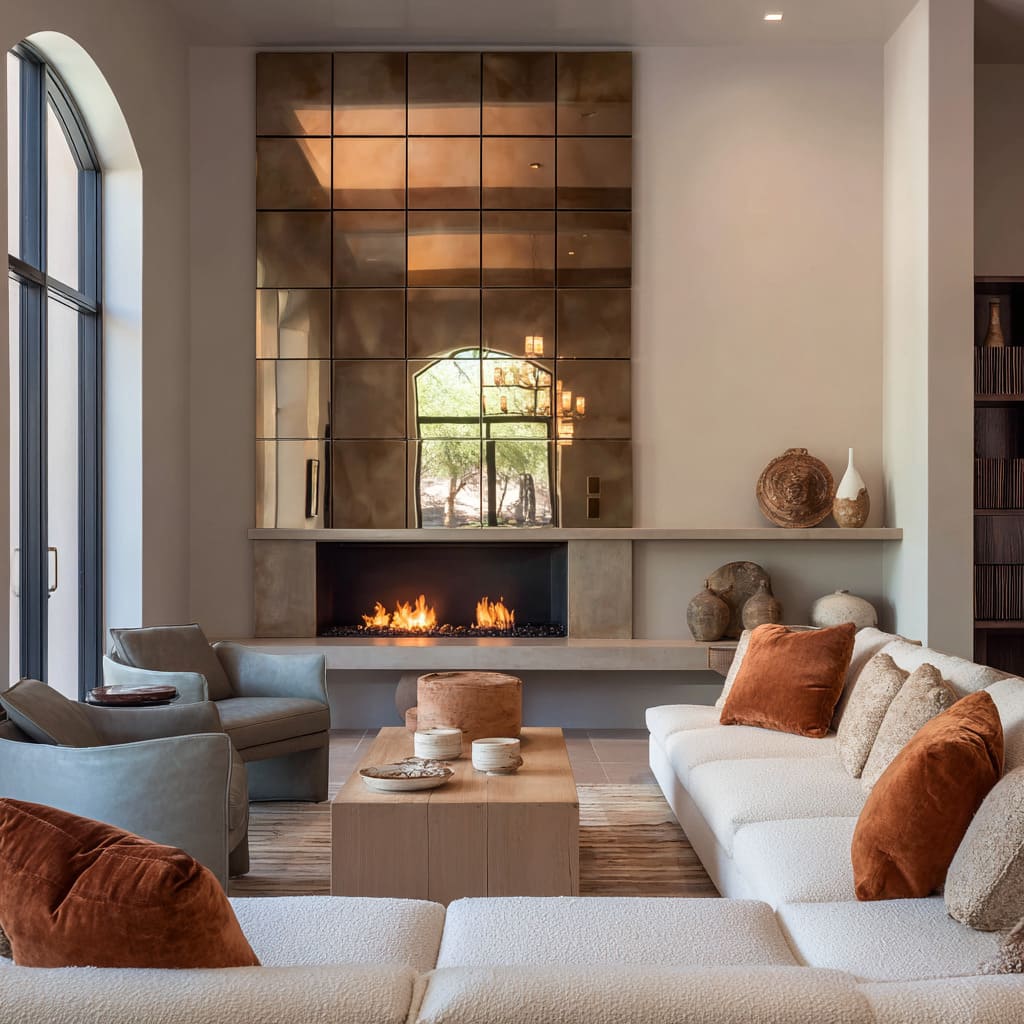
This approach is especially useful in rooms where symmetry or order plays a big role. Mirrors placed in rhythmic panels support that order while still offering reflection.
The mirrored surface becomes more than a copy—it becomes pattern. This kind of treatment works well with textured walls, earthy materials, and sculptural lighting, where the reflection picks up detail but doesn’t flatten it.
Many of the best decorative mirrors for living room settings now follow this direction—less glossy, more composed, and shaped by repetition rather than surface alone.
Surface as Mood: Tint, Patina, and Smoked Reflection
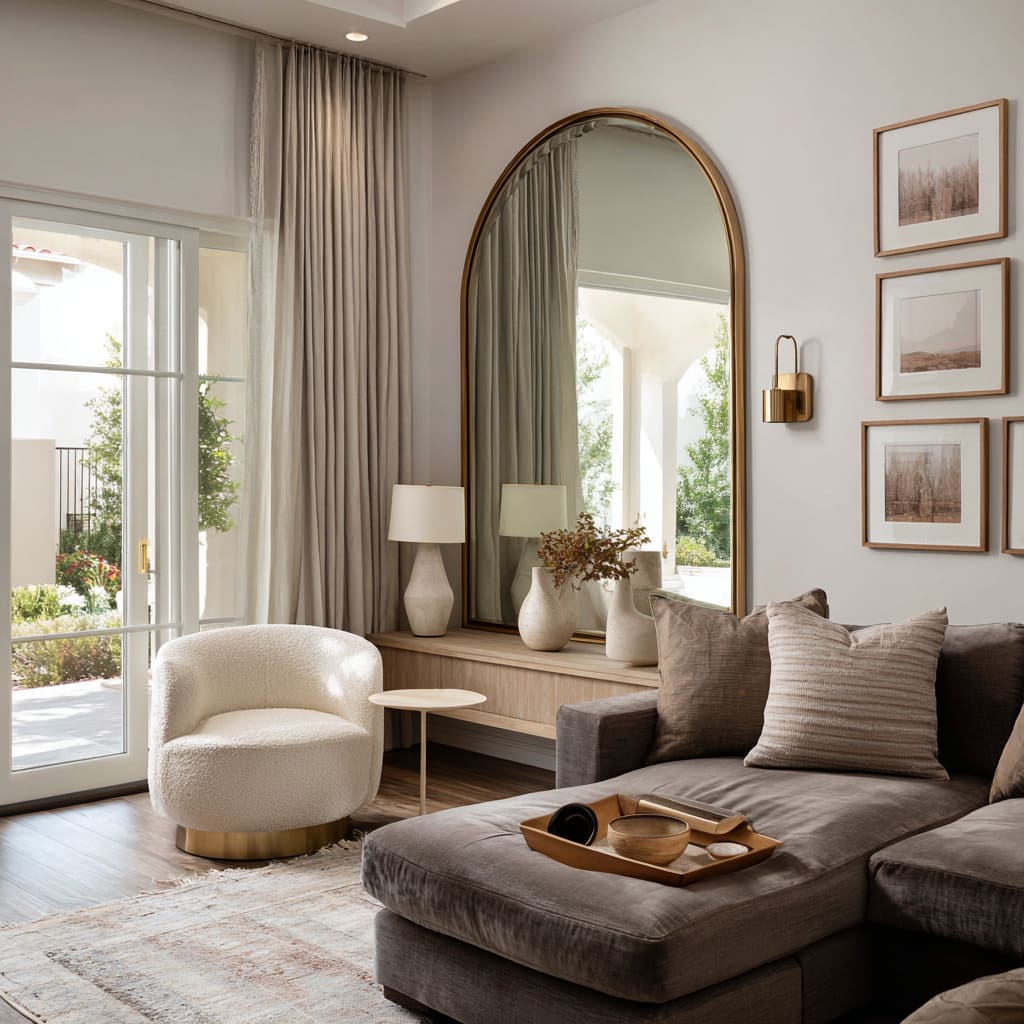
Glass doesn’t need to shine to leave an impression. In modern living spaces, mirrors with warm bronze tones, smoked finishes, or aged patina quietly shift from clean reflection to visual atmosphere.
These aren’t hyper-polished sheets; they are toned surfaces that gently dim clarity, blur outlines, and soften what they reflect. Aged speckling can turn harsh sunlight into a warm shimmer, and smoky bronze can compress strong contrast into layered tone.
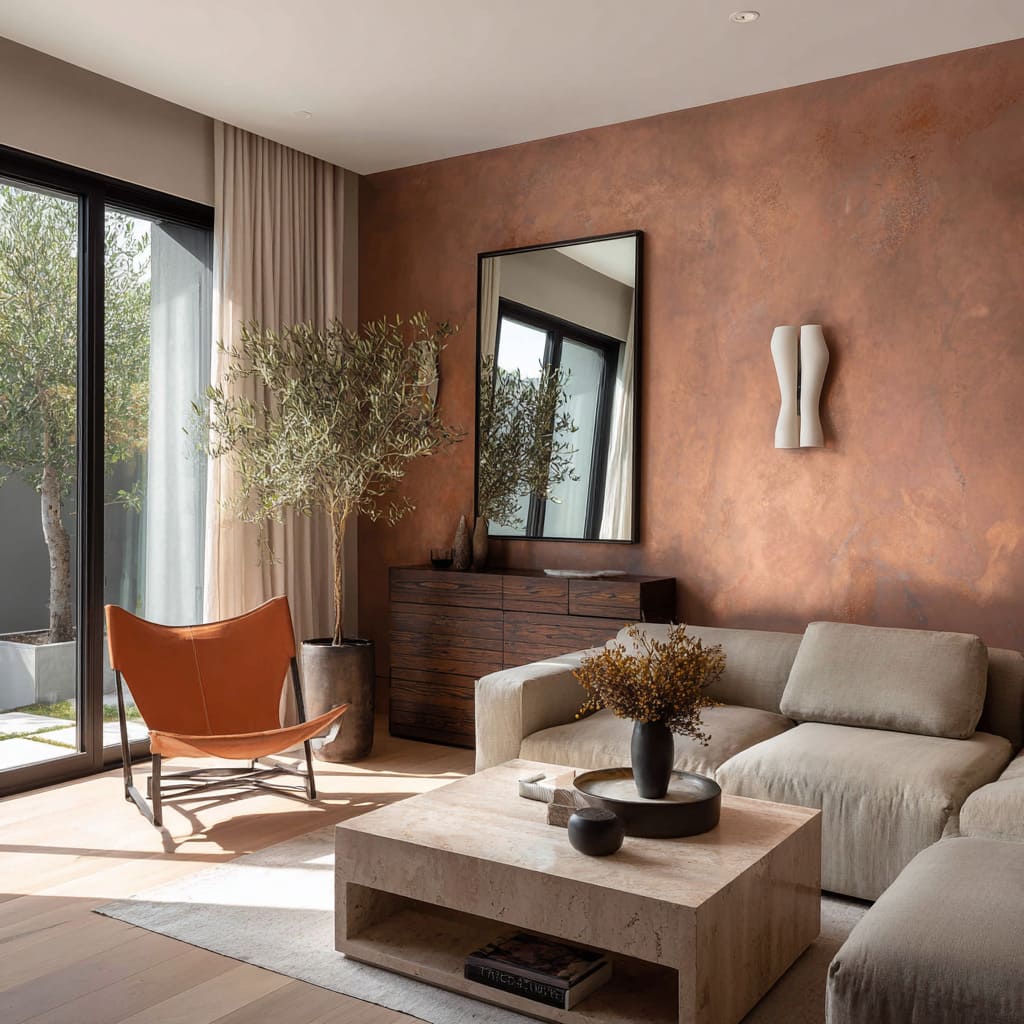
Instead of acting like a spotlight, the mirror surface becomes a kind of visual filter—subtle, softened, and suggestive. It’s this filtered effect that brings a cinematic softness to many large living room mirror ideas, especially where daylight or bold color might otherwise overwhelm.
These mirrors often echo the color of nearby walls, furnishings, or metal trims, which helps them sit back into the composition without vanishing entirely. Their presence is moody rather than loud, more like the effect of light seen through tinted glass than a mirror hanging on a wall.
Mirrored Echo: How Reflection Extends Composition
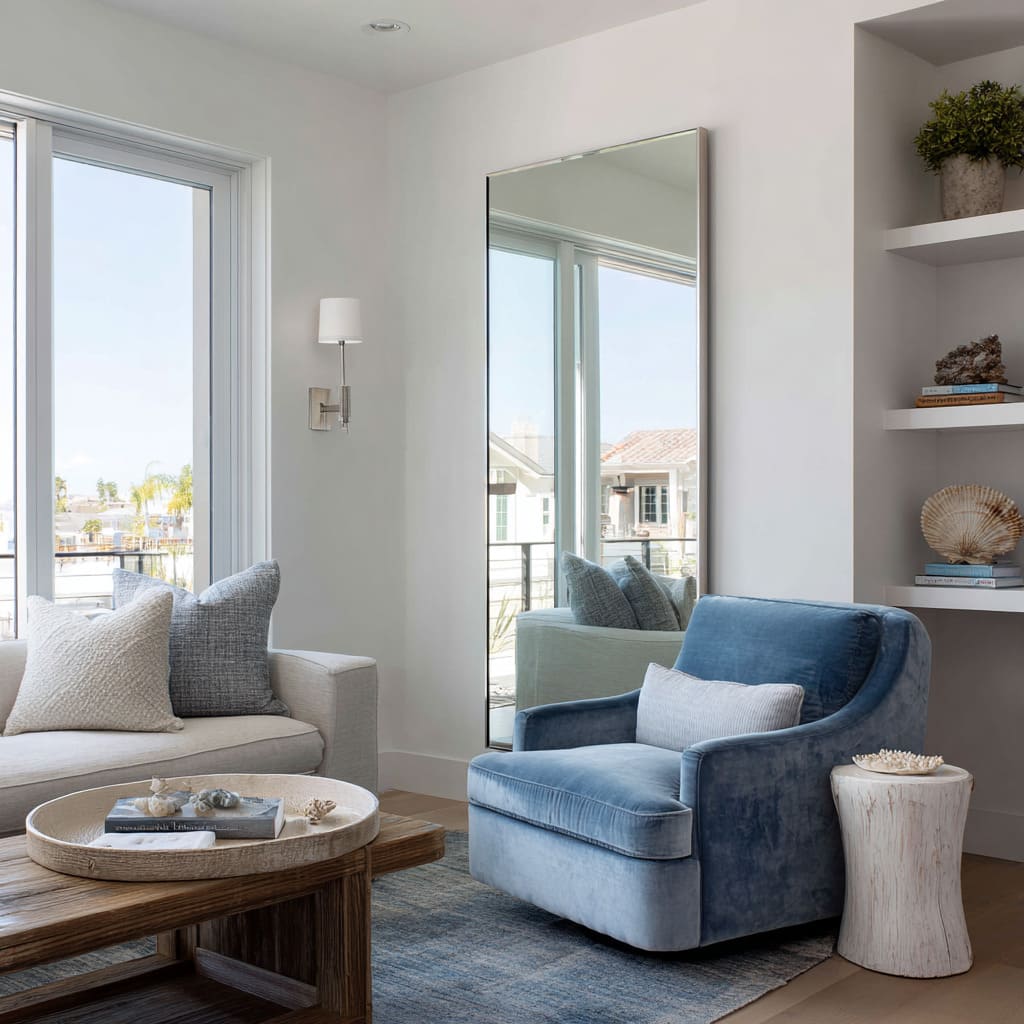
Furniture placement can turn reflection into visual rhythm. Instead of floating mirrors wherever space allows, some interiors pair them with key elements—benches, wall sconces, consoles, or planters—so that what gets reflected completes a visual layout.
This alignment is never random. A low table might appear twice, anchoring a horizontal; a wall light’s reflection may form the other half of a symmetrical column; and sculptural branches can seem to grow twice, creating vertical flow.
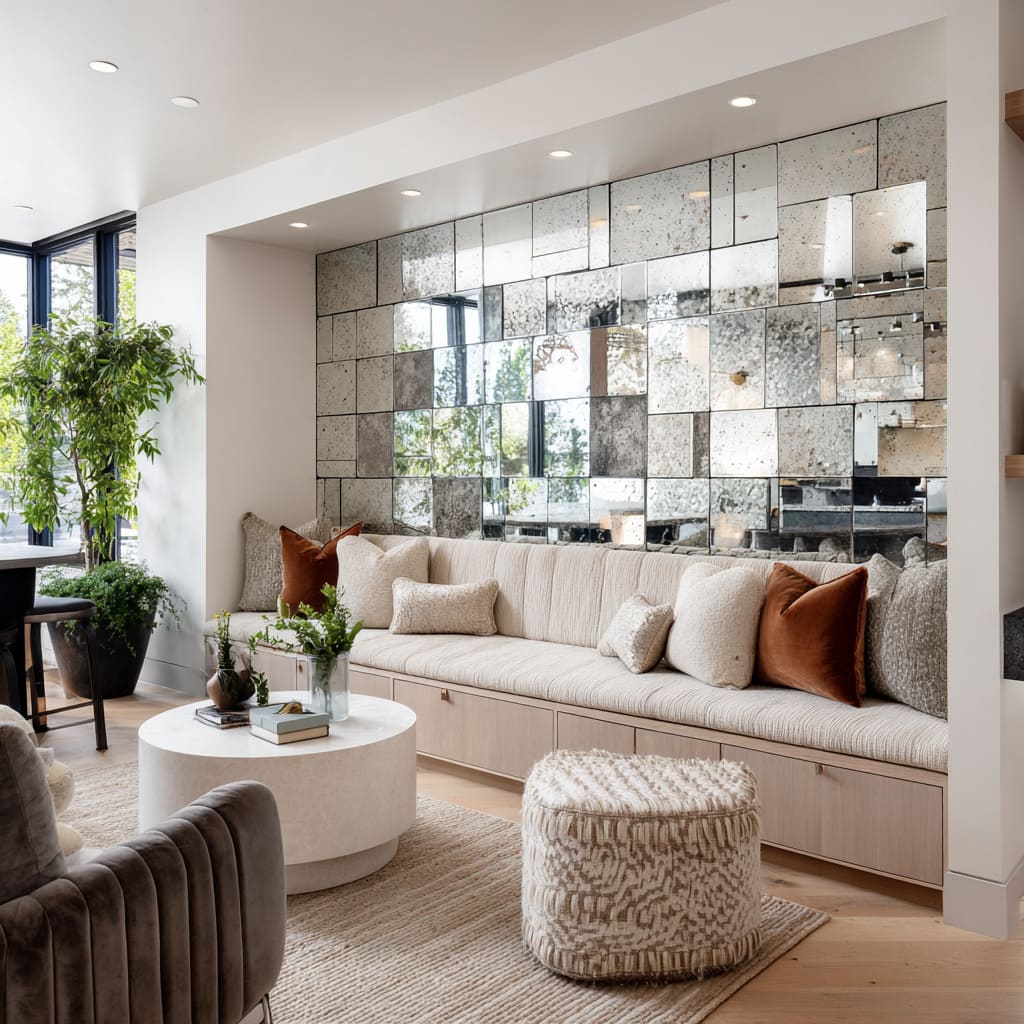
This deliberate positioning of mirror and furniture creates visual clarity, even in layered or richly textured interiors. Mirrors used this way work in tandem with layout logic.
They’re not there just to reflect but to support. A console topped with pottery, centered under a mirror, feels more structured when its objects bounce back with equal weight.
In layouts using modern wall mirror design for living rooms, this approach brings balance without repetition—reflection becomes a quiet reinforcement of the design’s order, not a doubling of its noise.
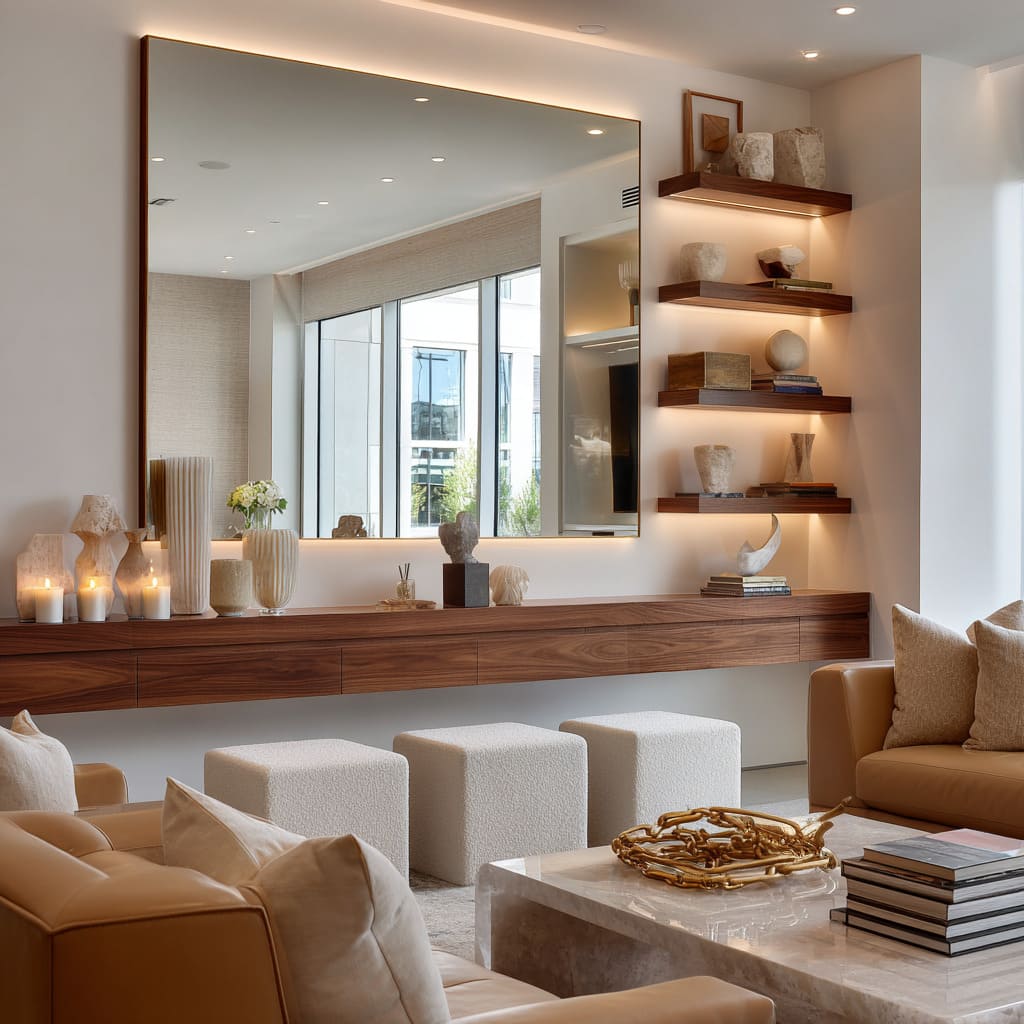
Light as Material: Mirrors That Cast Instead of Reflect
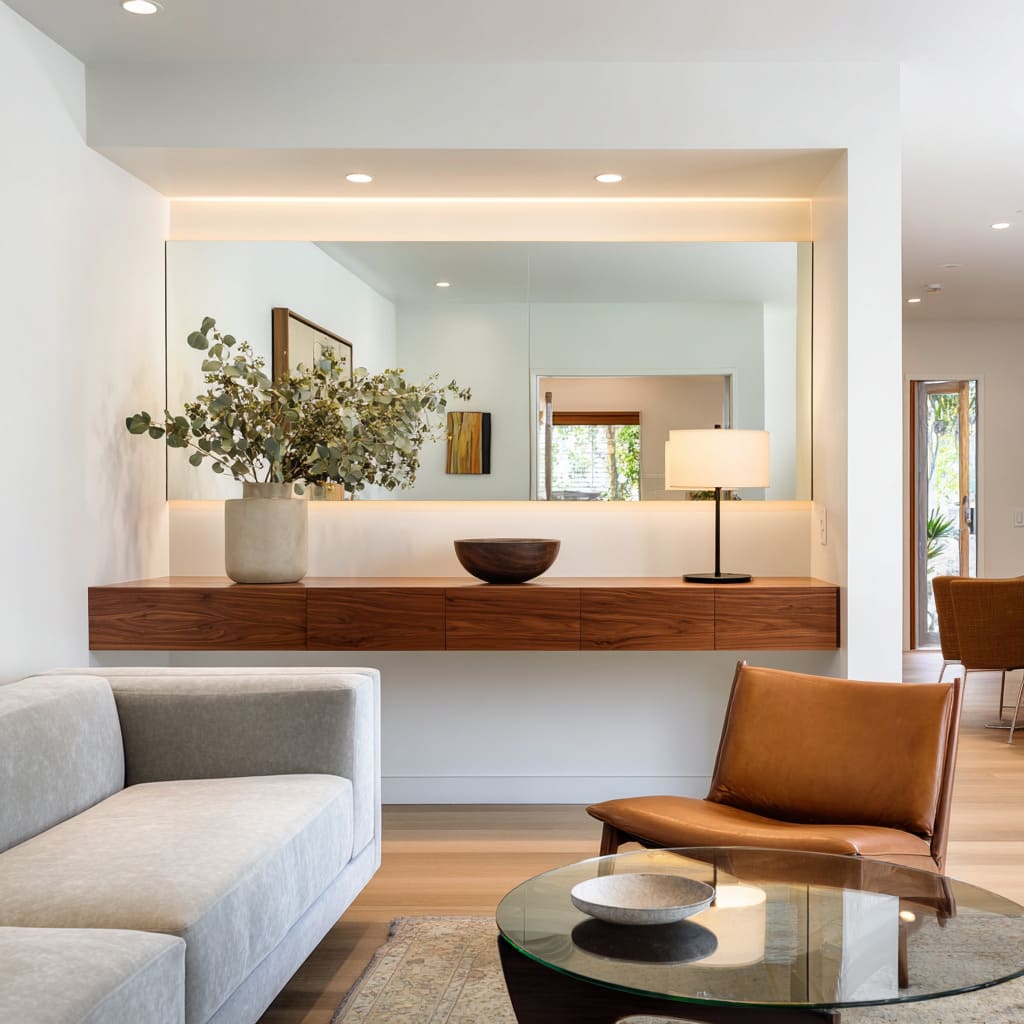
Mirrors can create light without reflecting a single object clearly. In recent interiors, the glow surrounding a mirror matters as much as the surface itself.
Backlit panels, recessed LED strips, and corner installations with hidden lights build halos around glass, softening the transition between reflection and wall. This turns a mirror into a light-emitting surface—something that glows rather than shines.
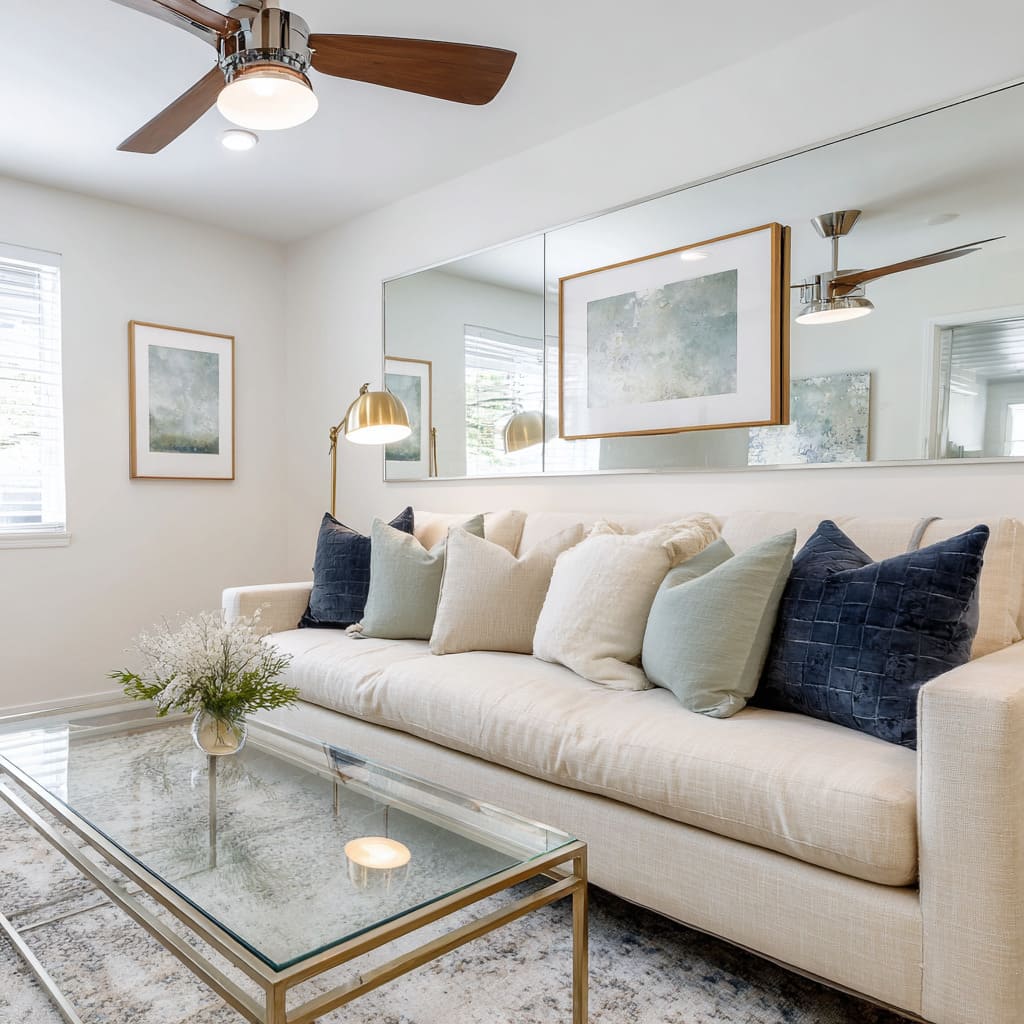
The glass may appear to hover, especially when set behind a floating console or placed in a shallow niche. At certain angles, sunlight is caught by slightly tilted mirrors and flung upward or sideways, casting brightness in ways usually reserved for skylights or clerestory windows.
In smaller or lower-light rooms, this quiet use of reflection becomes a way to lift the atmosphere without relying on overhead fixtures. This approach can be seen in many creative takes on mirror design for living rooms, where mirrors are shaped not by frame but by light, blending the boundary between surface and architecture.
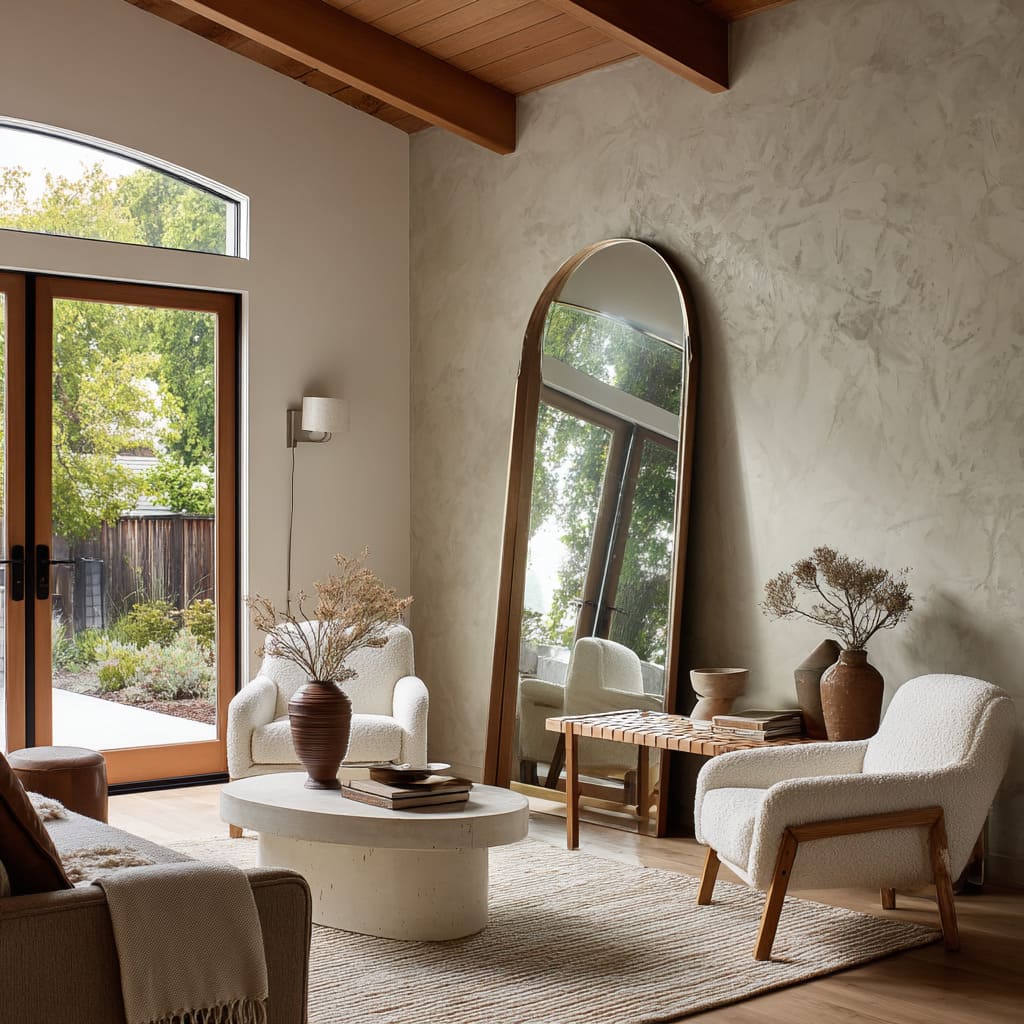
Soft Edges in Hard Spaces: Organic Forms Against Geometry
Not all mirrors need to follow the shape of the wall. In fact, some of the most distinct living room wall mirror ideas use contrast to reset the rhythm of the room.
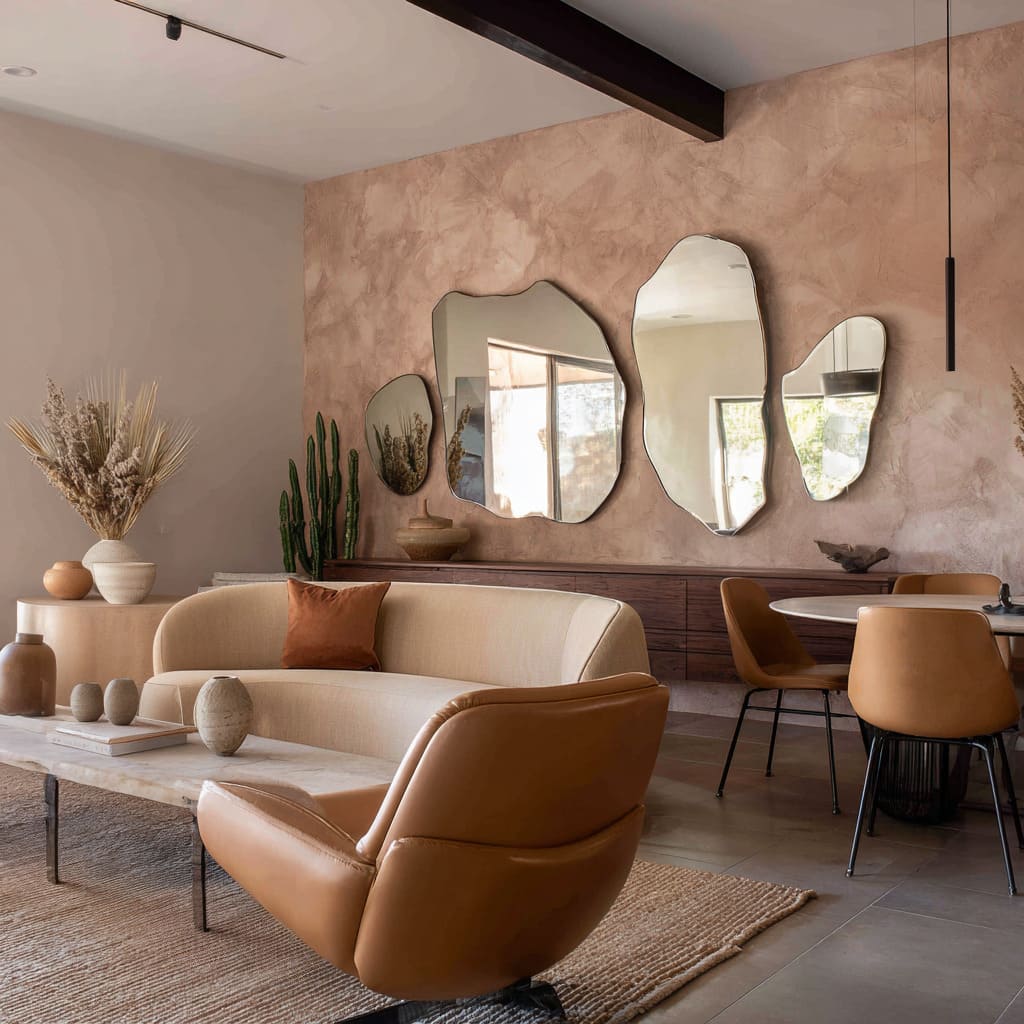
Rounded, irregular, or softly arched mirrors punctuate the grid of flat walls and straight corners. Their outlines don’t conform—they interrupt.
The result is not disruption but relief. These softer shapes visually relax the space, offering balance against right-angled beams, square consoles, and vertical shelving.
A cluster of pebble-like mirrors, for instance, brings movement without the need for bold pattern or bright color. A single oversized arch can shift attention upward in a way a rectangle won’t.
These forms create a tactile atmosphere, even though nothing about them is textured. Instead of sharp outlines, they offer suggestion and flow—mirrors that feel shaped by nature, not cut from a template.
Reflections with Layers: Turning Glass into Visual Depth
Flat mirrors don’t always deliver flat effects. In many living rooms today, mirrors are being paired with additional layers—whether that’s wall art partially covering the pane, floating shelves built into mirrored recesses, or even multiple mirrors stacked into a composition.
This setup produces an optical layering where the viewer sees objects, their reflection, and the reflected surroundings at the same time. The mirror acts like a stage set with foreground, midground, and backdrop all visible in one view.
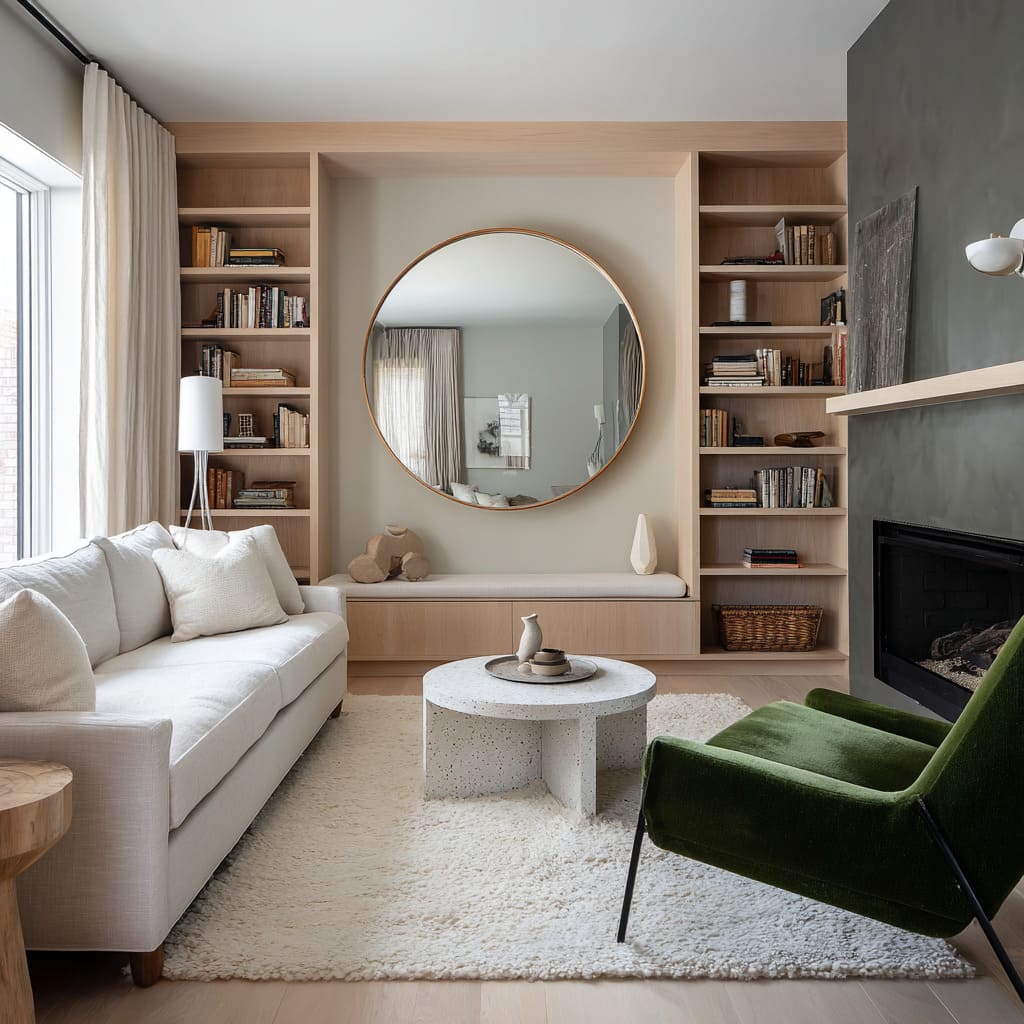
A framed print overlapping glass might throw a light shadow onto the reflection, while a sculptural object set in front of the mirror appears twice—one solid, one ghostlike. This kind of spatial compression feels dynamic and dimensional without needing physical depth.
It’s an especially effective move in compact spaces, where mirror wall decor ideas for a living room can multiply the experience of volume through clever visual overlap rather than surface expansion. The result is a mirror that feels active even when the rest of the room stays still.
Design Between the Lines: Negative Space as Mirror Composition
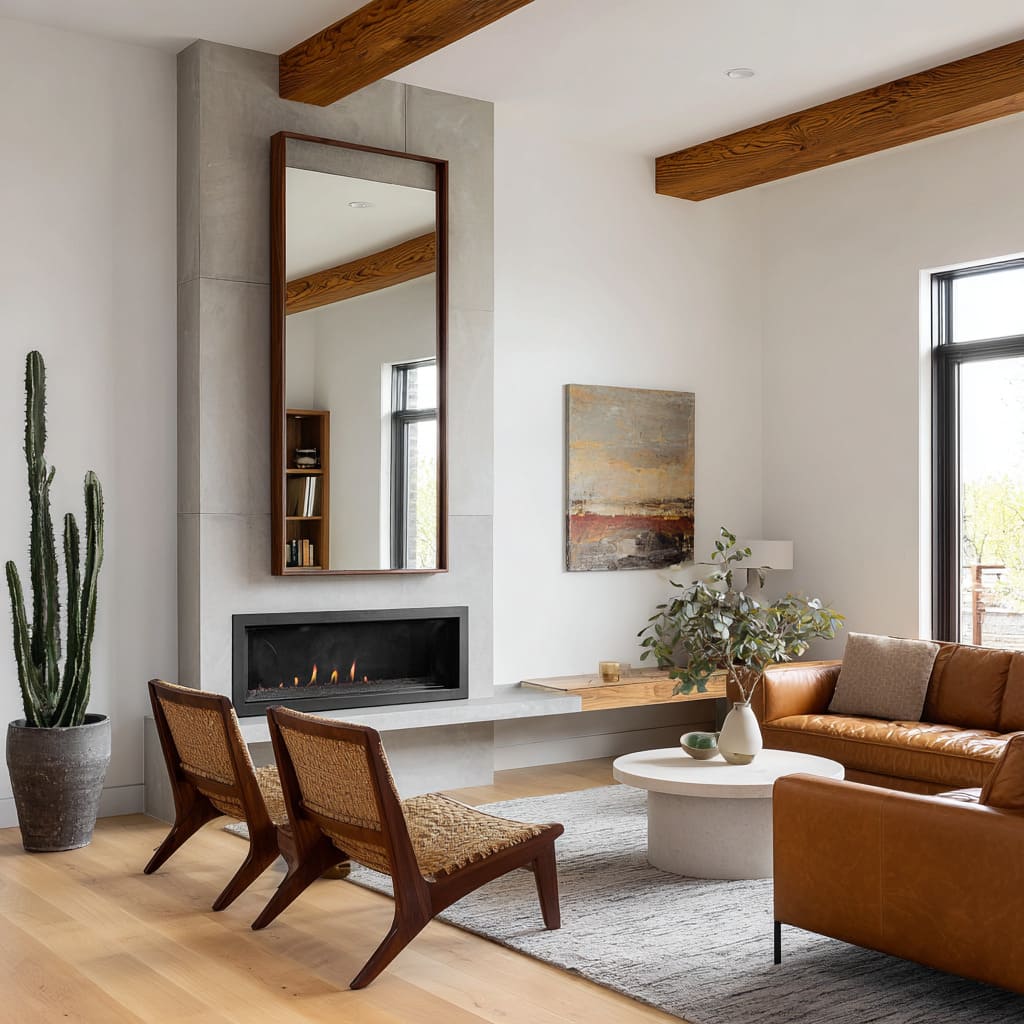
Sometimes it’s the space between that holds the attention. Mirrors arranged in strips, slivers, or triptychs don’t rely on size alone—they use spacing to create rhythm.
A small gap between mirrored panels can behave like a silent frame, introducing shadow lines that punctuate the wall without adding physical bulk. This use of negative space builds a layered effect where contrast and repetition work in silence.
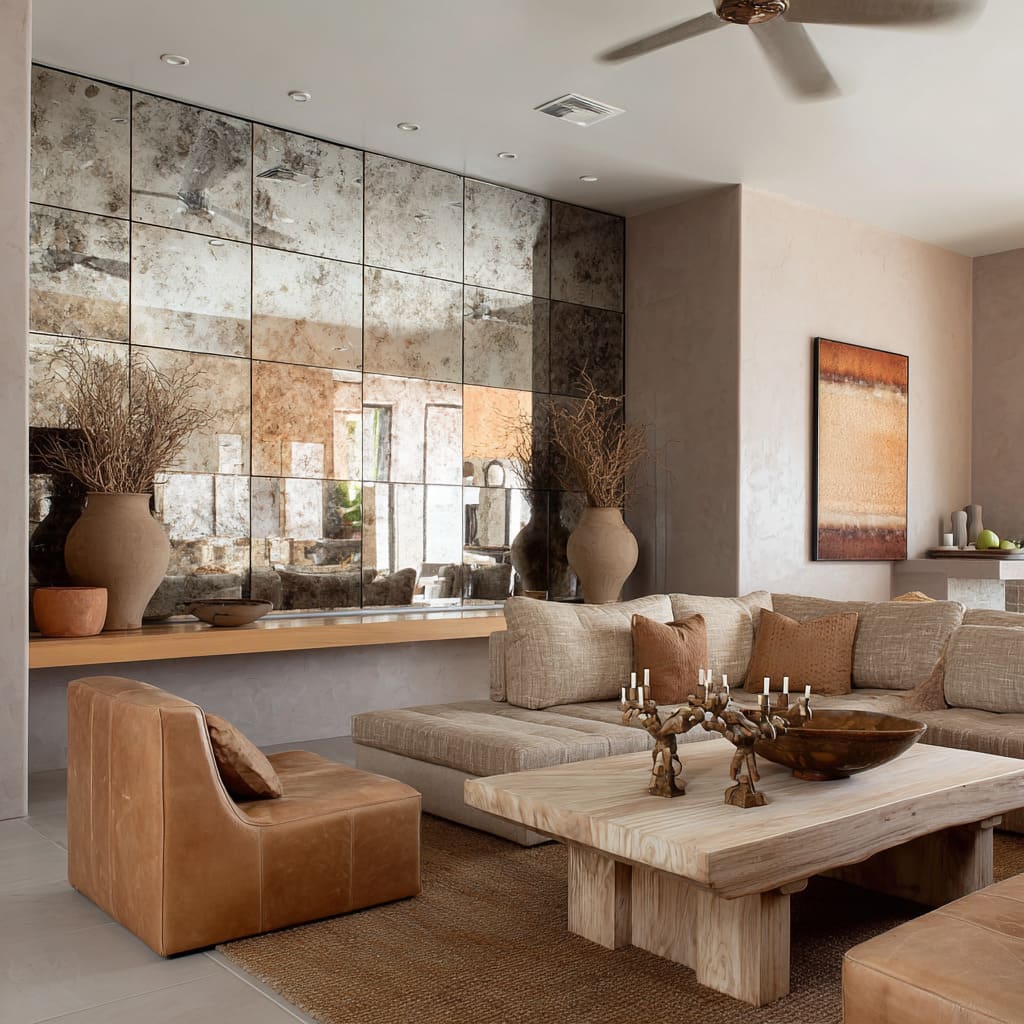
A mirror may be divided into three vertical slats, with the middle gap reflecting the shape of a nearby lamp, turning a blank wall into a triplet of quiet accents. A mirror tilted a degree or two off-center catches daylight differently, bending the reflection into diagonal lines or unexpected overlaps.
These slight disruptions are subtle enough to miss at first glance, but they shift the visual weight of the room in clever ways. In many thoughtfully arranged mirror walls in living rooms, these gaps, shadows, and pauses hold the room together just as much as the mirrored surface itself.
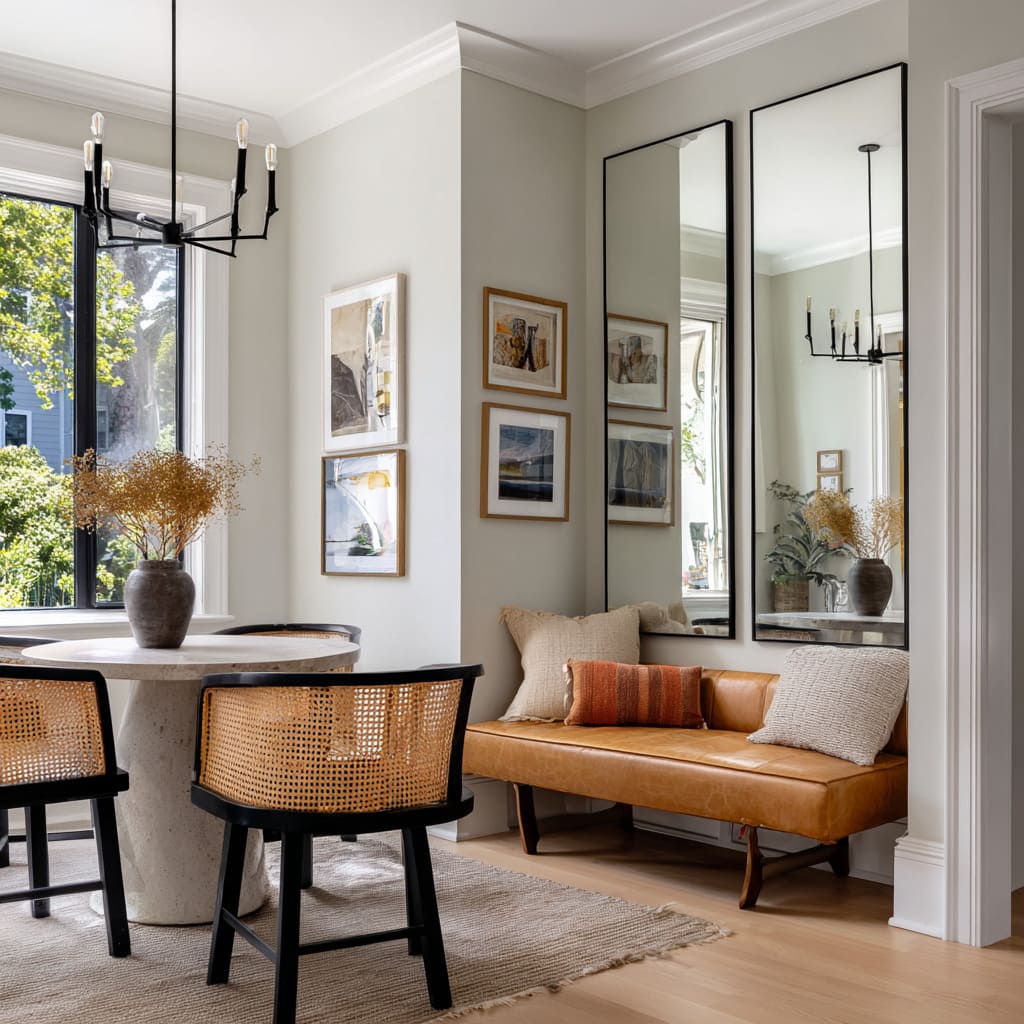
Material Balance: Surfaces That Work with Reflection
Mirrors react to what surrounds them—so the materials nearby carry weight. In many current interiors, the focus has shifted toward finishes that complement reflective surfaces instead of clashing with them.
Earthy tones and matte textures—like raw plaster, walnut, travertine, leather, and boucle—offer a muted backdrop that helps glass settle into the scene without feeling too sharp or showy. When a mirror picks up the beige of a limewashed wall or the soft texture of shearling upholstery, the effect is warmer and more grounded.
This balance keeps the reflection from becoming the main character in the room. Instead, it joins a broader visual story.
The subtle absorption of surrounding colors helps the mirror reflect with softness, carrying warm undertones rather than stark white flashes or overly crisp duplicates. In many living room wall mirror decor ideas, the smartest results come not from size or placement alone—but from how the mirror interacts with color, grain, and light already present in the room.
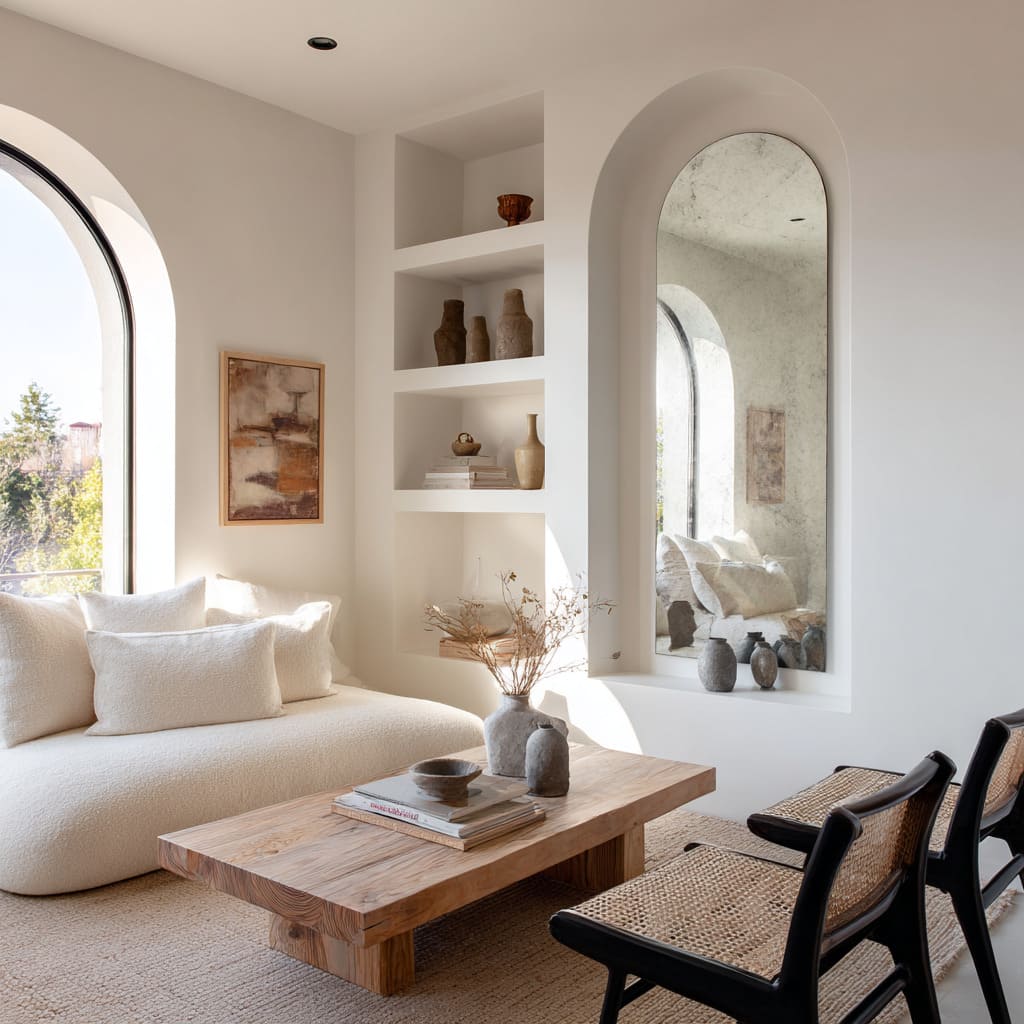
Corner Reflections: Mirrored Edges That Expand Space
Mirrors placed at corners do something flat mirrors can’t—they shift the room’s shape. Where two reflective panels meet at a right angle, the line between them nearly vanishes.
This setup tricks the eye into sensing additional volume, bending the room visually outward and doubling both directions in one clean stroke. The corner turns into a visual hinge, where walls stretch further and seating groups appear more open.
It’s not about scale—it’s about perception. A narrow living room can feel wider, a windowless corner brighter, simply because the reflection folds the layout into itself.
The use of wraparound panels or mirrored L-shapes often draws attention to otherwise overlooked areas, like console walls or small lounge zones. In the right material tone, these installations don’t call out—they quietly reshape how the room is read.
Their effect lingers even when the mirrors fade into the background.
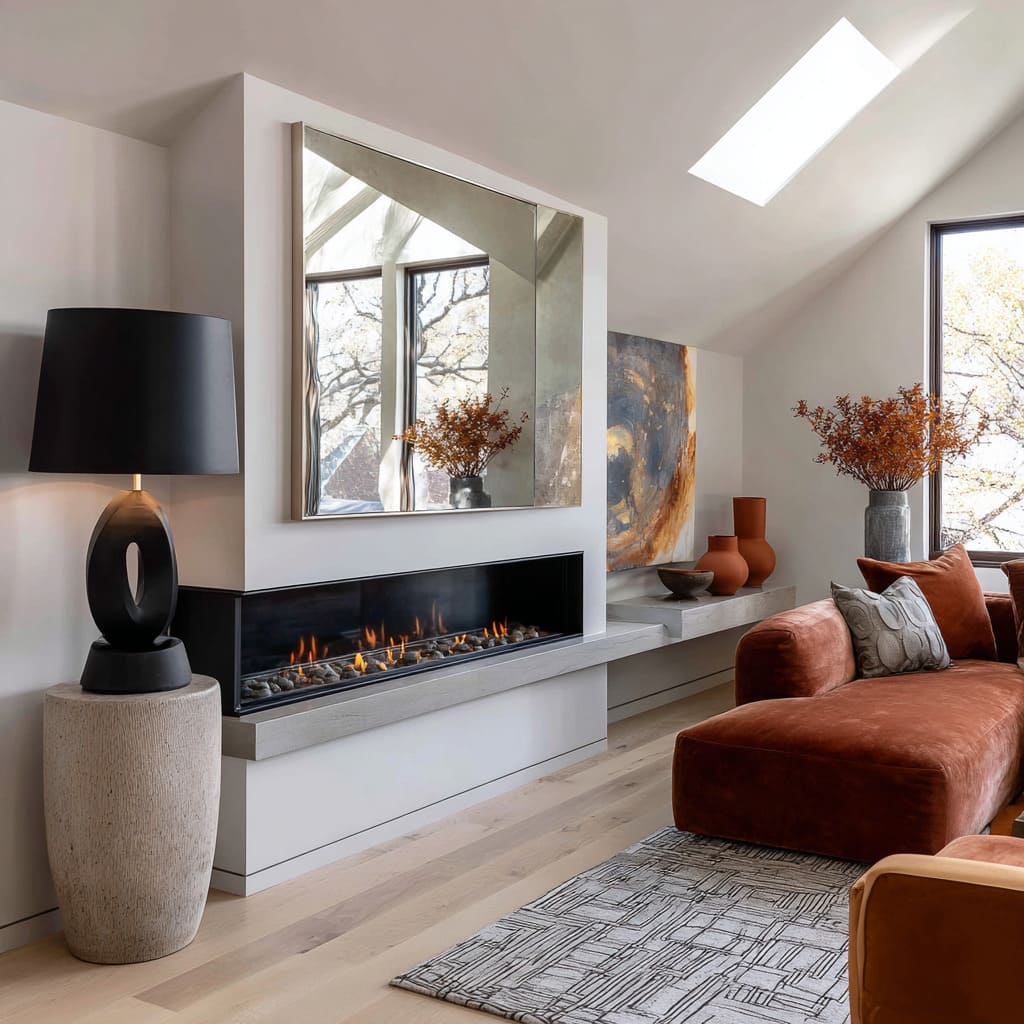
Mirrored Motifs: Reflection That Repeats What Matters
Mirrors can do more than expand space—they can highlight what’s already important. In thoughtful interiors, reflection is used to double down on key visual elements.
An arch mirrored inside a square grid, a tall cactus appearing twice its size, or ceiling beams stretching infinitely overhead—these are moments where the mirror doesn’t scatter attention but sharpens it. By repeating specific architectural lines, mirrors underscore the room’s core rhythm.
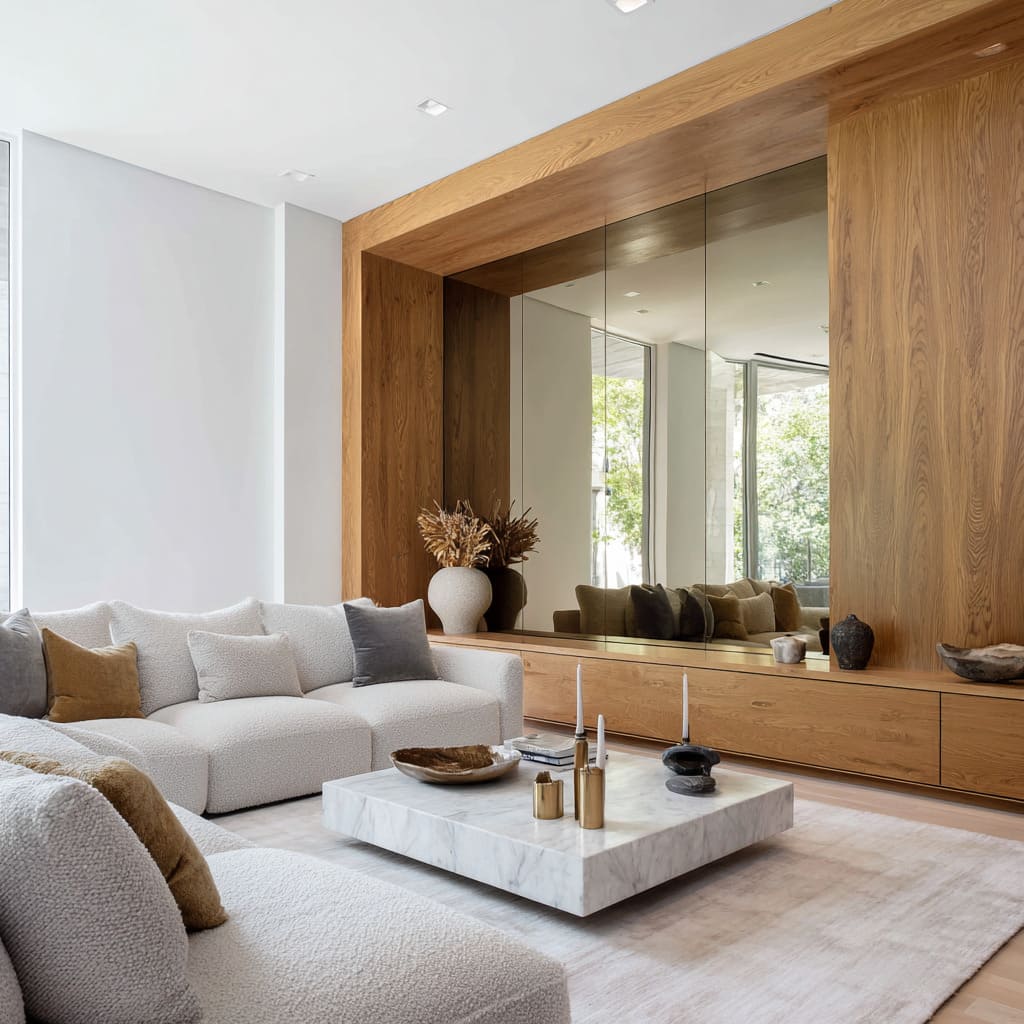
This is especially powerful in spaces that rely on shape repetition or symmetry to create structure. Instead of bouncing around whatever happens to fall in frame, the reflection becomes selective.
It shows what matters and hides what doesn’t. For those interested in decorating living room walls with mirrors, this approach is less about adding surface and more about reinforcing the space’s internal logic.
A mirrored panel placed opposite a key detail can quietly emphasize the room’s spine—its true center—without announcing itself.
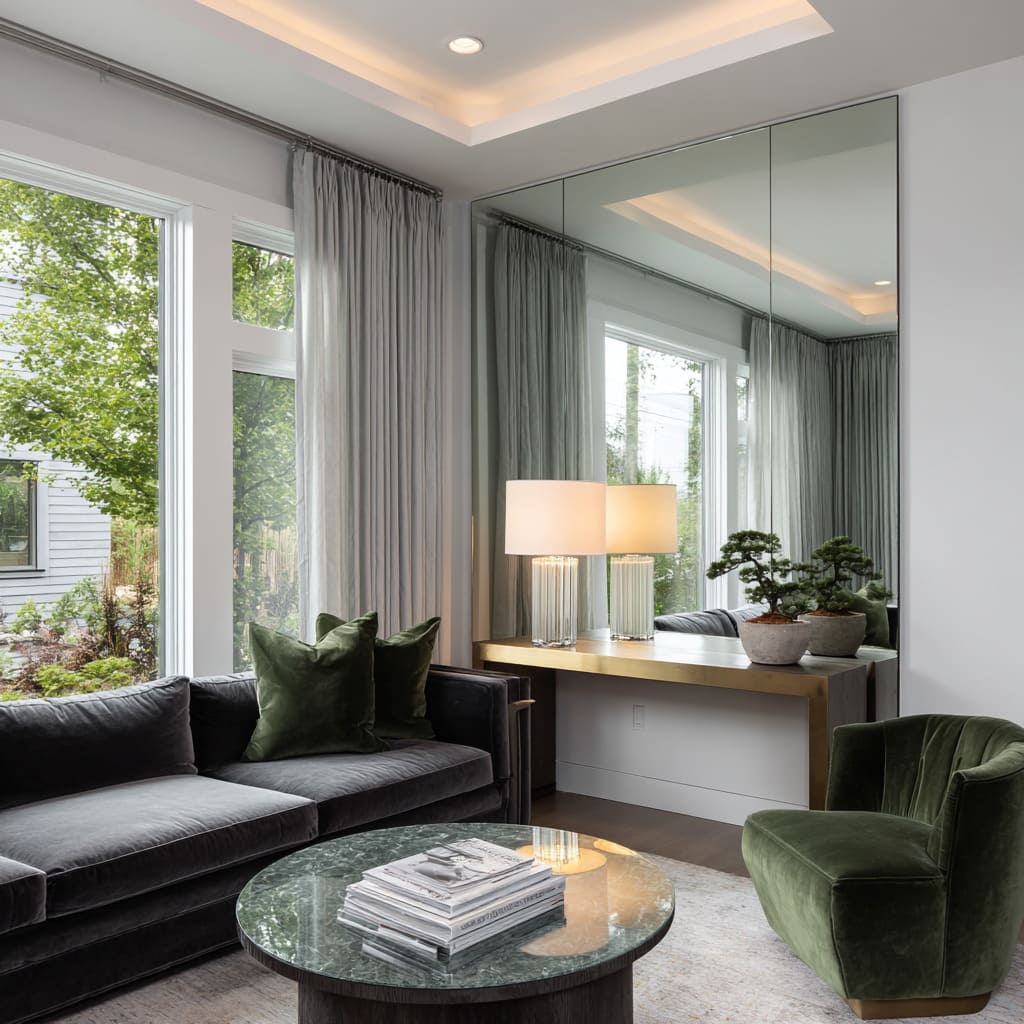
Glass as Canvas: Reflections That Behave Like Moving Art
Some mirrors aren’t about seeing yourself—they’re about watching the room shift. In many lounge setups, the mirror serves as more than a tool—it behaves like a soft, ambient display.
Silhouettes from nearby furniture, color changes from shifting daylight, the faint outline of curtain folds or plant movement—these become part of the composition. A mirror mounted in the right location turns every passing hour into a new image, shaped by what’s reflected and how.
The goal isn’t clarity—it’s atmosphere. This use of reflection trades functionality for depth, turning glass into an ambient layer that floats across the wall.
The best lounge mirror ideas work not through scale or polish, but through subtle response. A mirror in this context becomes a surface of quiet motion—adjusting as the light dims, as people pass, as shadows drift.
It becomes less about looking and more about watching.
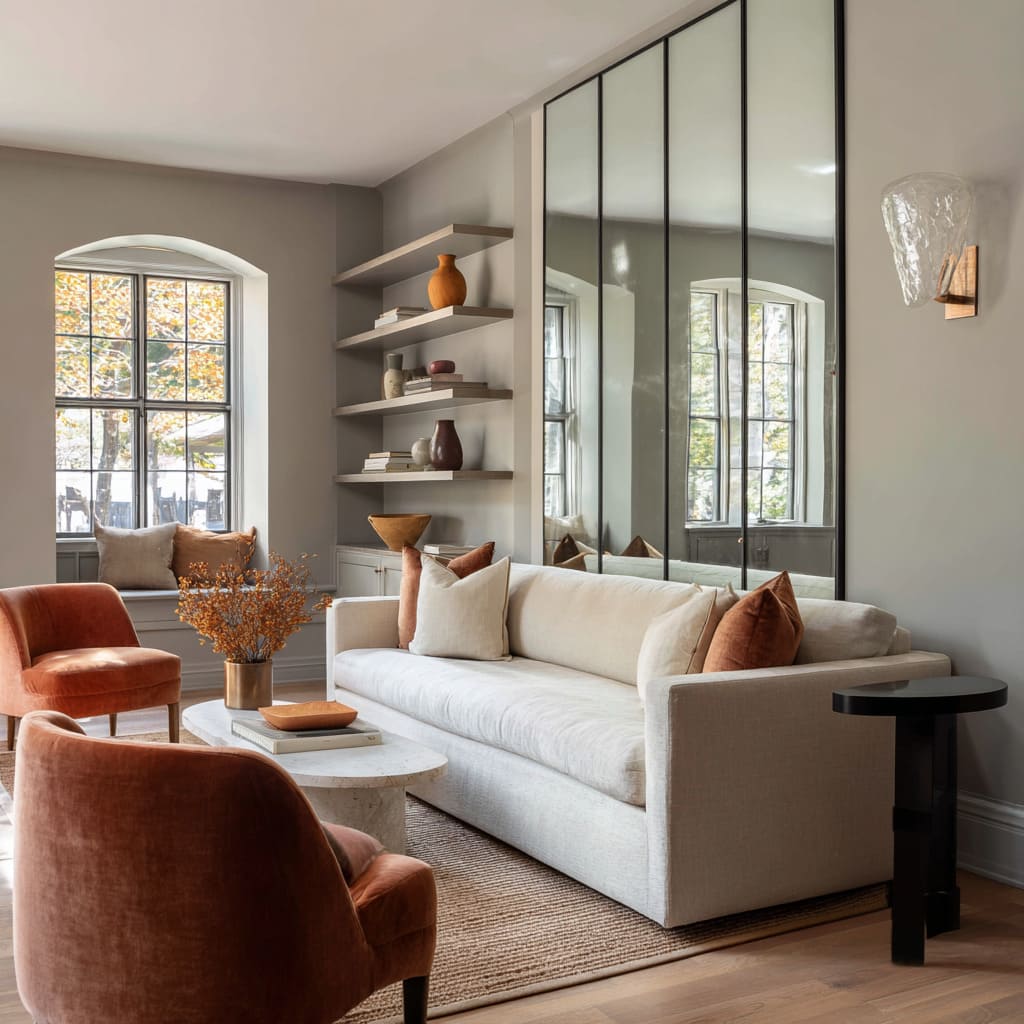
Reflection as Composition: The Role of Mirrors in Contemporary Interiors
Today’s mirror design moves far beyond utility—it becomes part of how a space is visually structured. Rather than hanging as isolated pieces, mirrors now participate in the room’s full composition.
Their framing lines echo windows, their glow mimics natural light, and their surface tone blends into curated palettes of plaster, linen, and stone. The result is a sense of volume and calm created without aggressive visual tools.
These mirrors don’t compete—they complete.
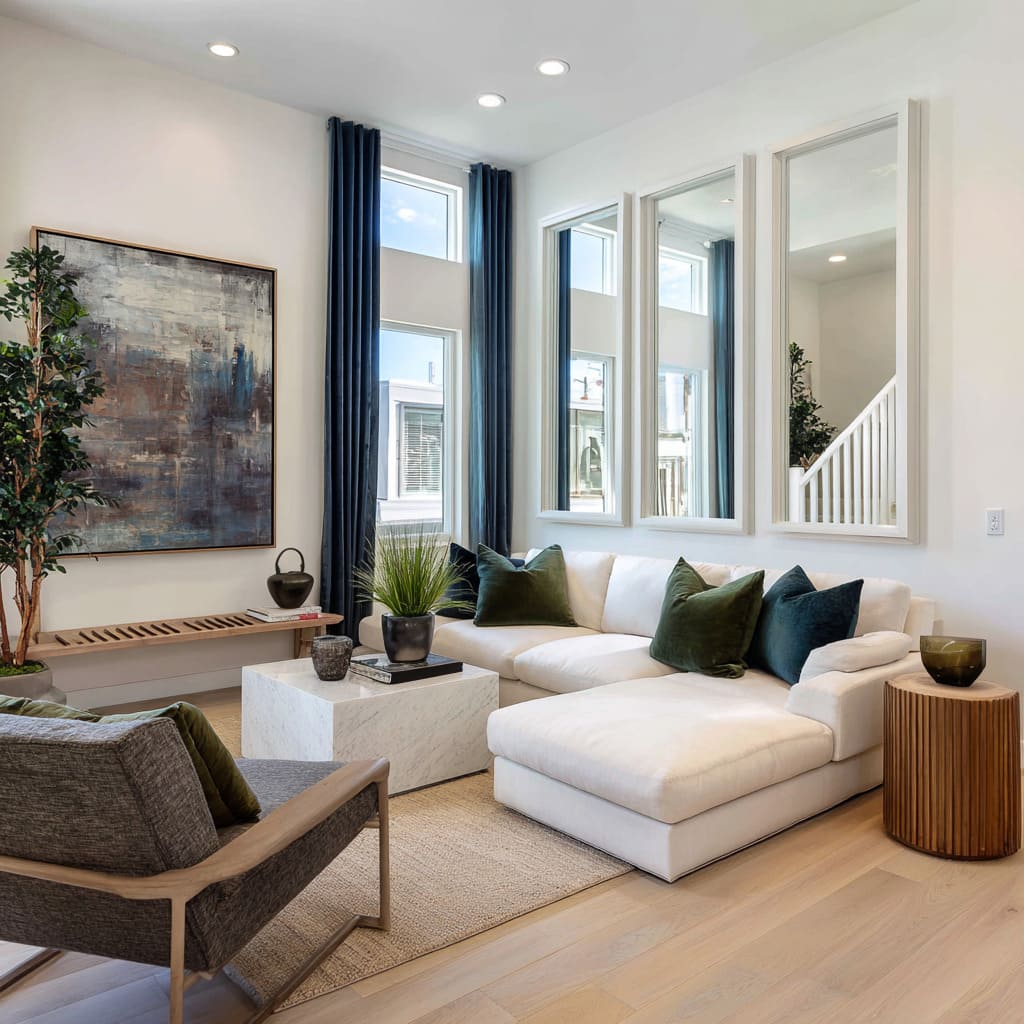
In many interiors, mirrors act like instruments of spatial rhythm. Each placement is tuned to reinforce structure or repeat shape, whether it’s through vertical panels that align with door frames or soft arches that interrupt rigid geometry.
Their finishes—whether bronzed, lightly aged, or smoke-tinted—subtly reduce harsh glare and convert raw reflection into something quieter. Mirrors pick up detail but leave behind noise.
The best examples aren’t trying to be noticed. They sit inside the architecture, adjusting how corners read, how furniture appears anchored, or how daylight behaves across the floor.
They don’t shout to be admired. Instead, they shape the room from the background, giving depth, balance, and a sense of thoughtful placement.
In this approach, a mirror isn’t decoration—it’s a layer of the room’s thinking.