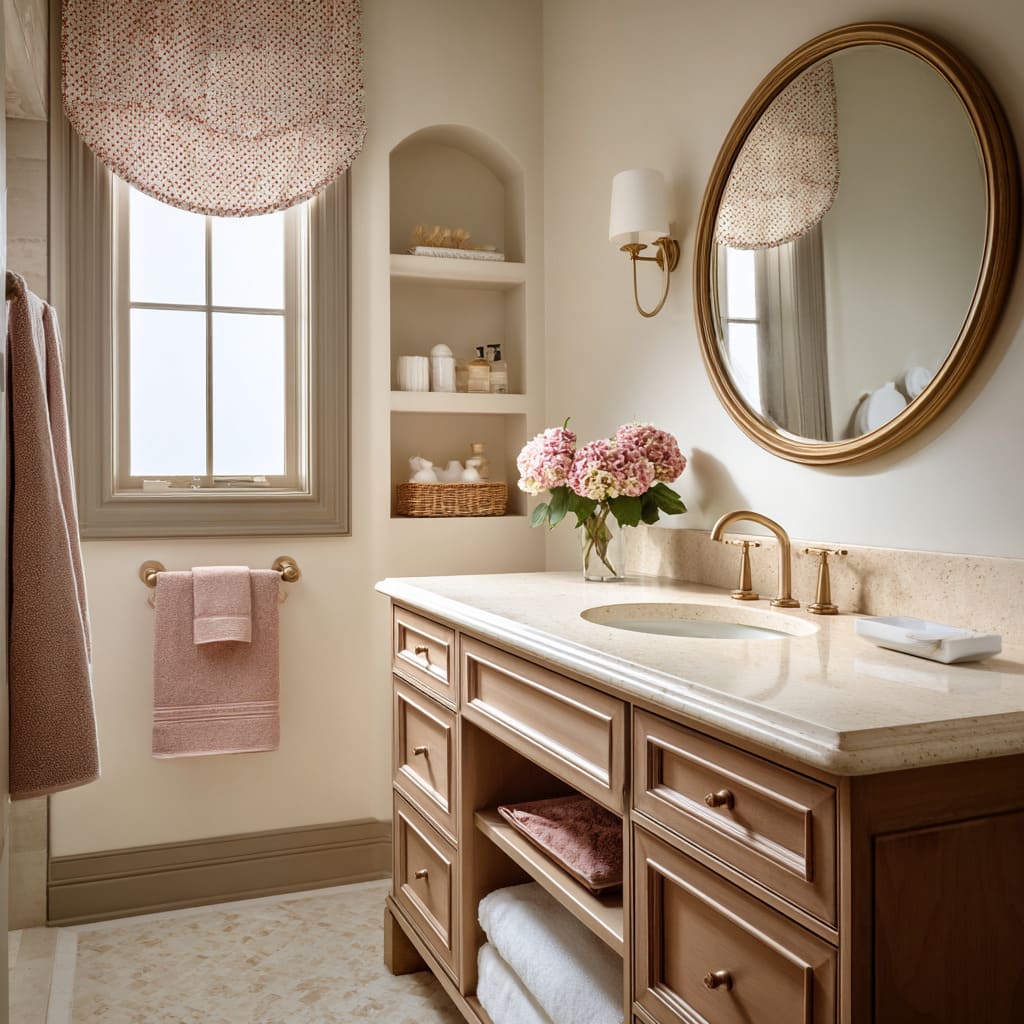
Textile at the top of the window behaves less like a decorative accessory and more like a soft continuation of the wall. This is especially clear in bathroom valance ideas where the upper fabric line resets the perceived height of the room.
A structured band mounted close to the crown or ceiling visually becomes the “start” of the wall, even if the plaster sits slightly higher. The effect is subtle: the eye simply accepts the valance as the architectural cap, which gives even a compact vanity wall a sense of clarity and composure.
In designs with tall vertical elements—mirrors, panel grooves, narrow windows—the top band becomes a mediator between architecture and textile. It tames visual noise and gives the wall a calm, readable hierarchy.
Whether the cloth is pleated, gathered, scalloped, or set into a pelmet, the upper line governs how the rest of the composition behaves. This is why valances are so effective in small rooms; the upper band controls rhythm and mood without needing floor-length drapery.
It becomes a quiet frame for the light, a soft reinterpretation of the window’s geometry, and an atmosphere-setting gesture that spreads warmth or coolness across the entire design concept.
How Valances Re-Draw Window Proportions Without Construction
Changing a window’s visual size does not require actual remodeling. Many bathroom window valance ideas achieve this purely through proportion, placement, and textile density.
A continuous band that stretches wall-to-wall can make a narrow window appear wider, while a valance that ends slightly inside the frame creates a neat matting effect that sharpens the window’s shape. Some designs use a deep, structured pelmet to “widen” the architectural opening, while others take the opposite approach by framing all four sides with curtain panels, giving the window a cozy, wrapped quality.
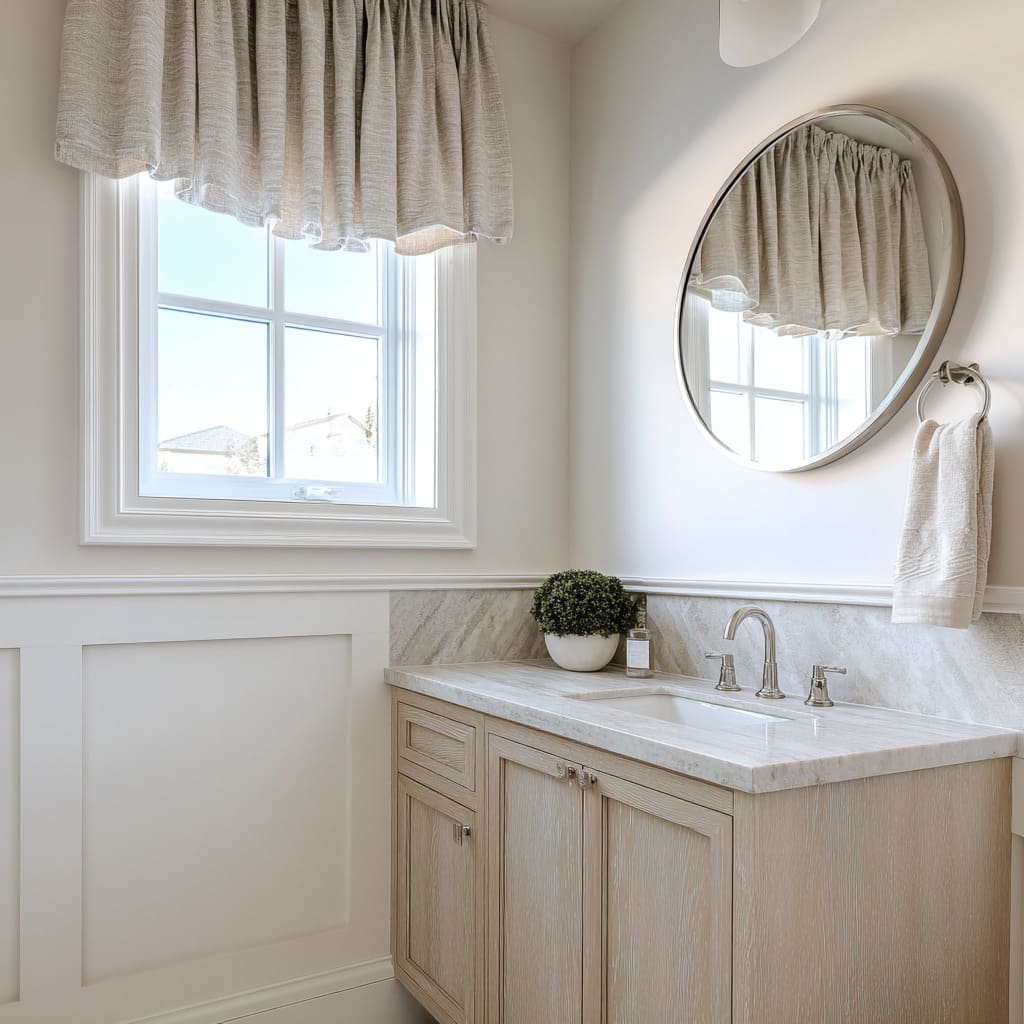
In multi-pane windows, a long shade or valance that covers upper sash lines will merge the panes into one cohesive unit. In contrast, scalloped hems that align with mullions reinforce the window’s inherent divisions.
This reshaping can also extend vertically: high-mounted valances lift the visual ceiling, and balloon forms lower it for added intimacy. Overall, proportion editing is one of the most powerful traits of textile above the glass, letting the room become taller, narrower, wider, or more grounded simply through the way fabric is placed.

Texture as a Visual Language: From Pebble Prints to Fine Pleats
The world of bathroom valance window ideas relies heavily on texture rather than loud pattern. Small-scale prints—pebbles, faint lines, tiny grids—read as soft haze from afar and reveal themselves only when the viewer approaches.
This dual behavior is useful in bathrooms, where space is compact and the textile sits close to eye level. Subtle prints generate interest without overwhelming the wall.
Three major texture families emerge:.

A. Micro-Motifs
- Pebble-like dots that compress and stretch as fabric gathers
- Tiny check patterns that play against plaster or wood
- Neutral speckled weaves that glow when light passes through
B. Linear Weaves
- Fine crosshatch cloths that behave like soft tweed
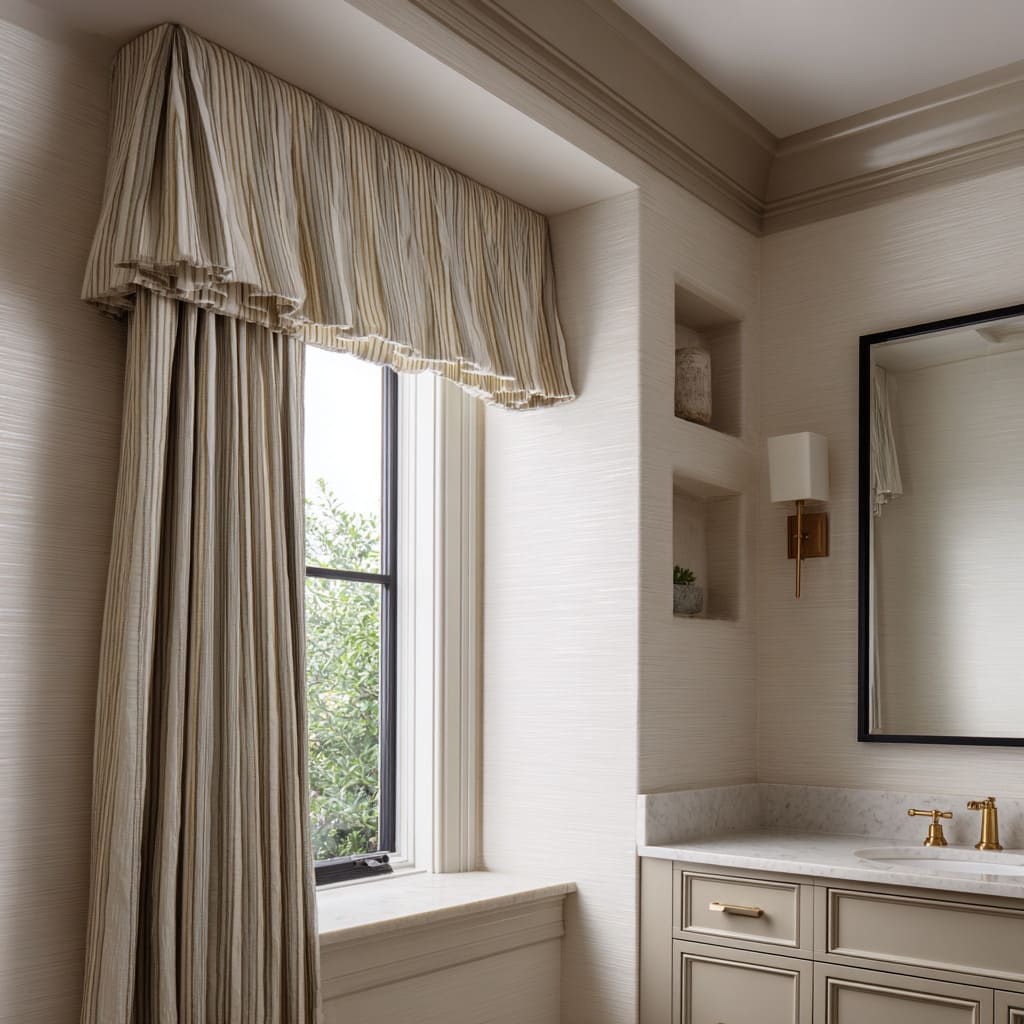
- Narrow vertical stripes that shimmer when folded
- Subtle horizontal streaks that soften structured hems
C. Structural Textures
- Deep pleats that cast thin shadow lines
- Box-pleated panels that read as tailored planes
- Ruched hems that add movement without chaos
Across all these types, the emphasis remains on mood, depth, and softness. Texture becomes the room’s “quiet pattern,” an atmospheric presence rather than a dominant graphic.
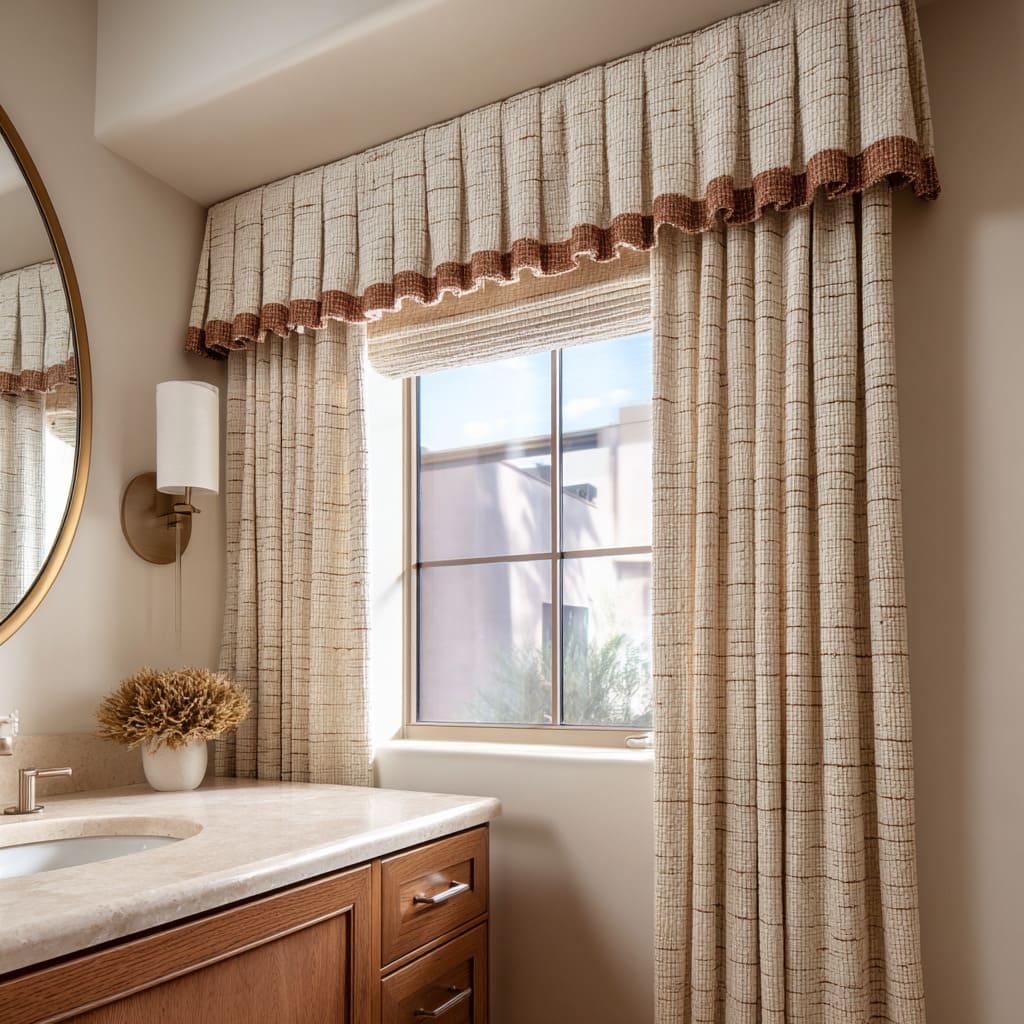
Curves, Straight Lines, and the Subtle Geometry of Softness
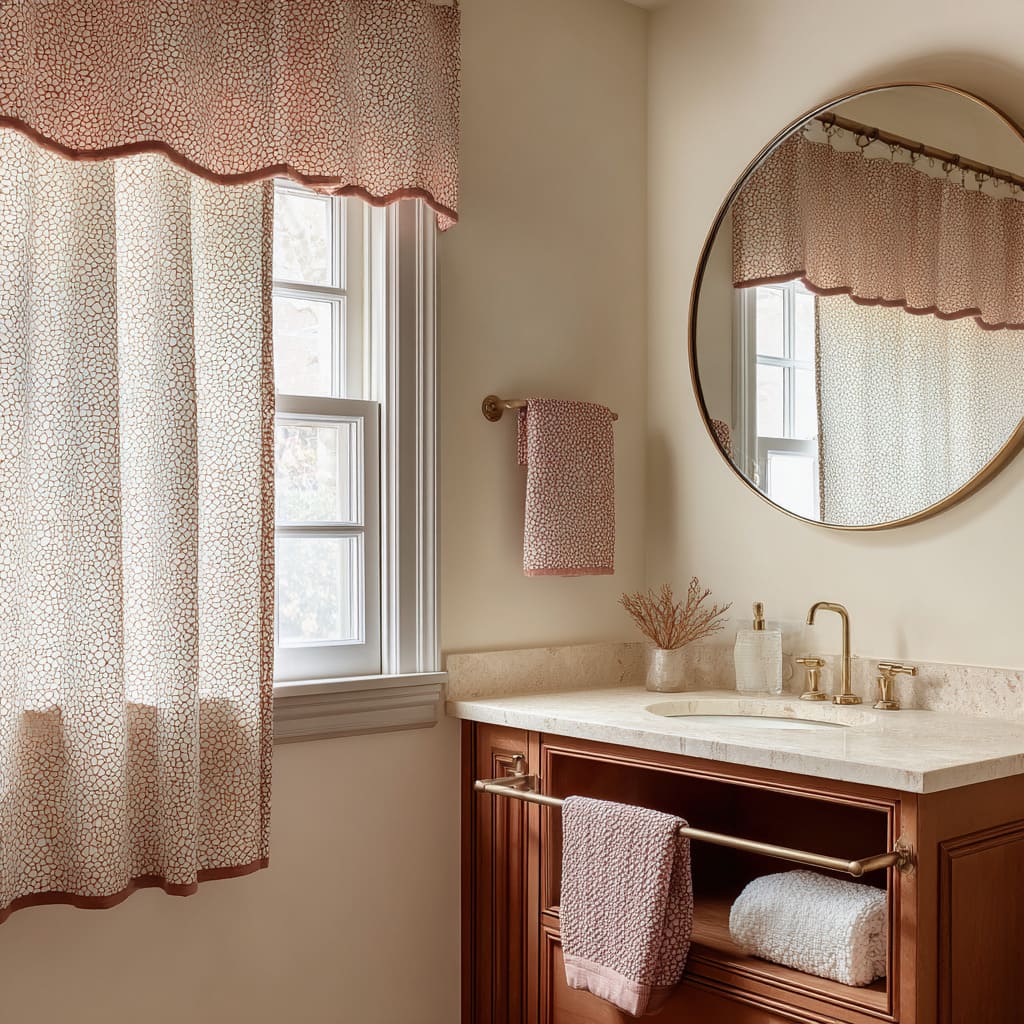
In bathrooms where architecture is naturally rectilinear—rectangular tiles, squared trim, straight-edged mirrors—the valance often becomes the place where curvature enters the scene. Scalloped hems bring a soft wave above the glass, especially when edges are bound with a contrasting color.
Balloon shapes form gentle arcs that pair well with arched niches or oval mirrors. Rolled hems add a playful sequence of small cylinders, creating a tactile line that feels both orderly and relaxed.
Meanwhile, straight bottoms on pleated or boxy valances communicate structure, discipline, and clarity.
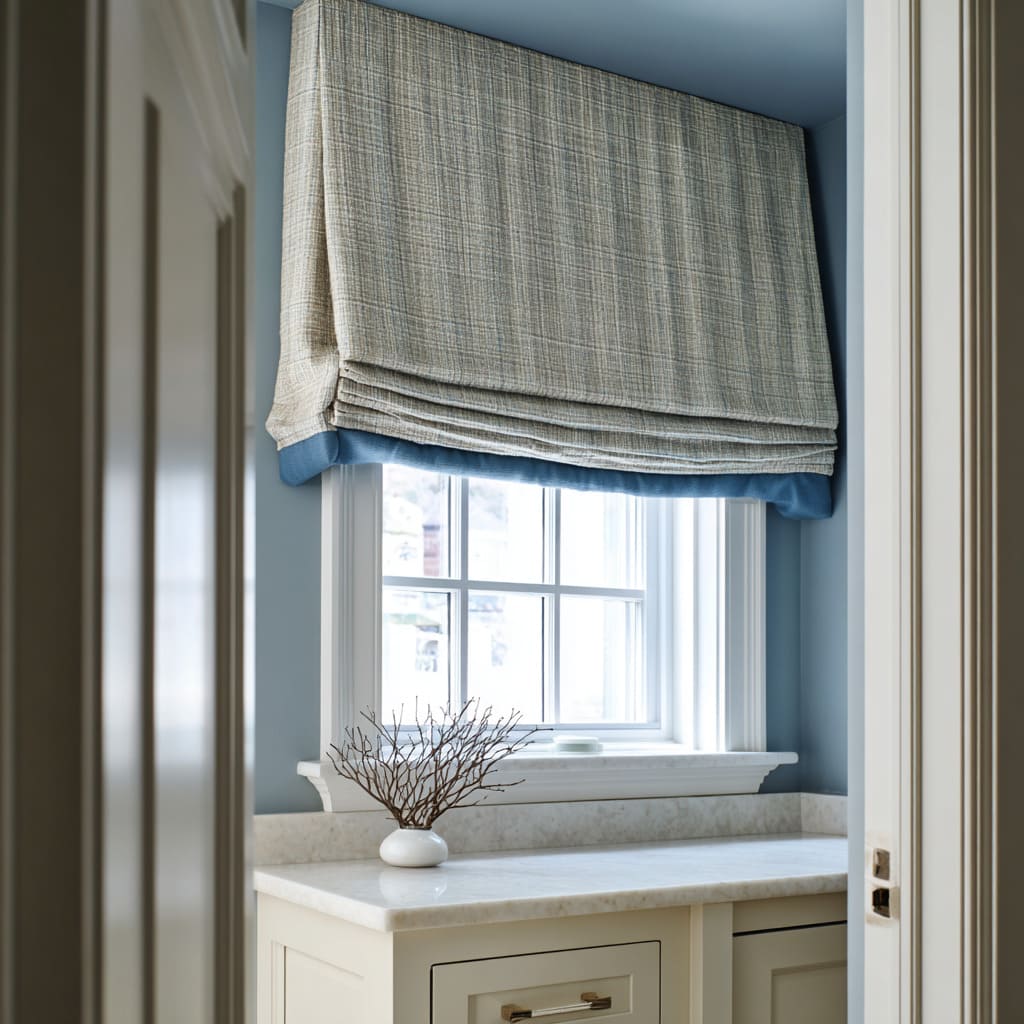
The trick is not mixing too many curve types at once. Rooms where scallops appear on the valance often echo them subtly in stone counters, artwork edges, faucet shapes, or styling items.
Spaces with strict hems tend to choose squared mirrors and linear sconces. This quiet coordination creates an internal logic: one room speaks in arcs, another in straight panels, another in rhythmic folds.
Geometry becomes emotional:.
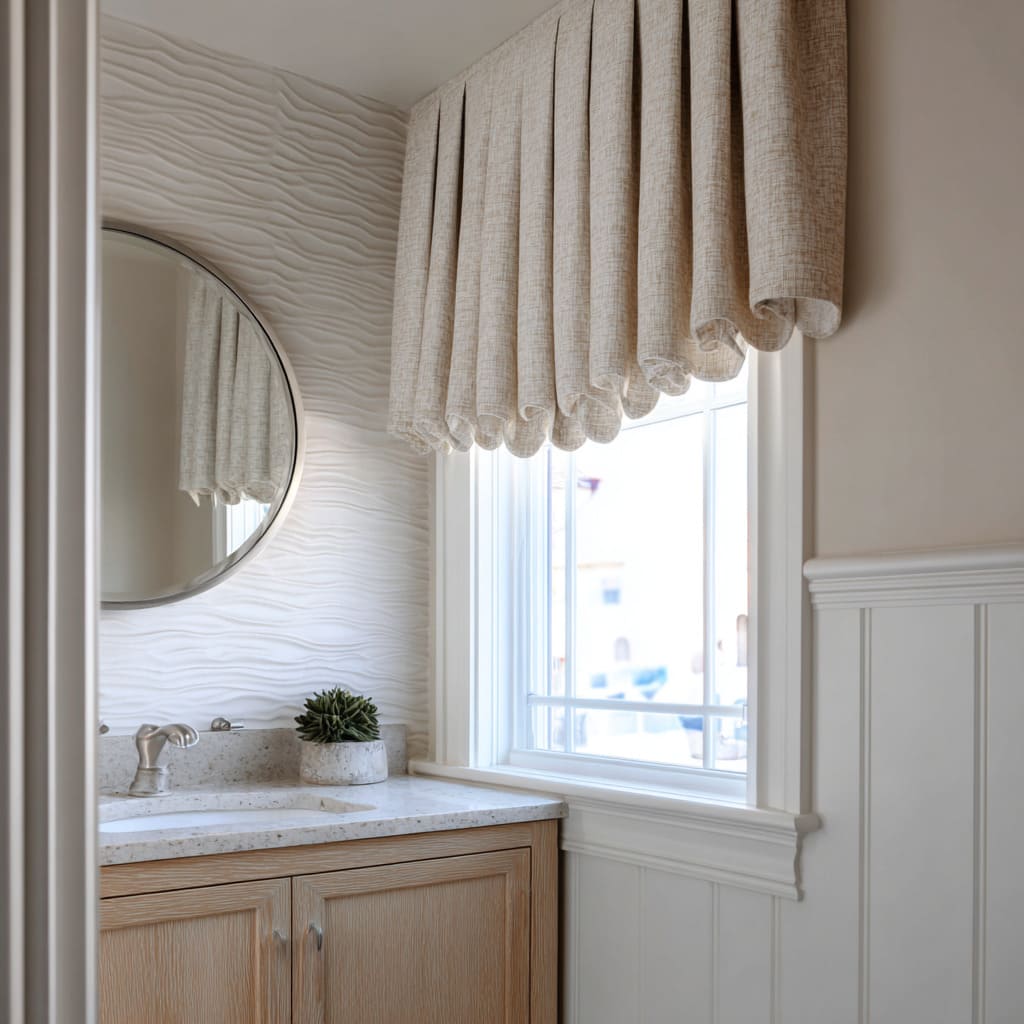
Soft curves → gentle, powder-room warmth
Straight hems → hotel-like composure
Rolled edges → playful yet calm detail
Through these decisions, the top of the window sets the behavioral tone for the entire vanity wall.
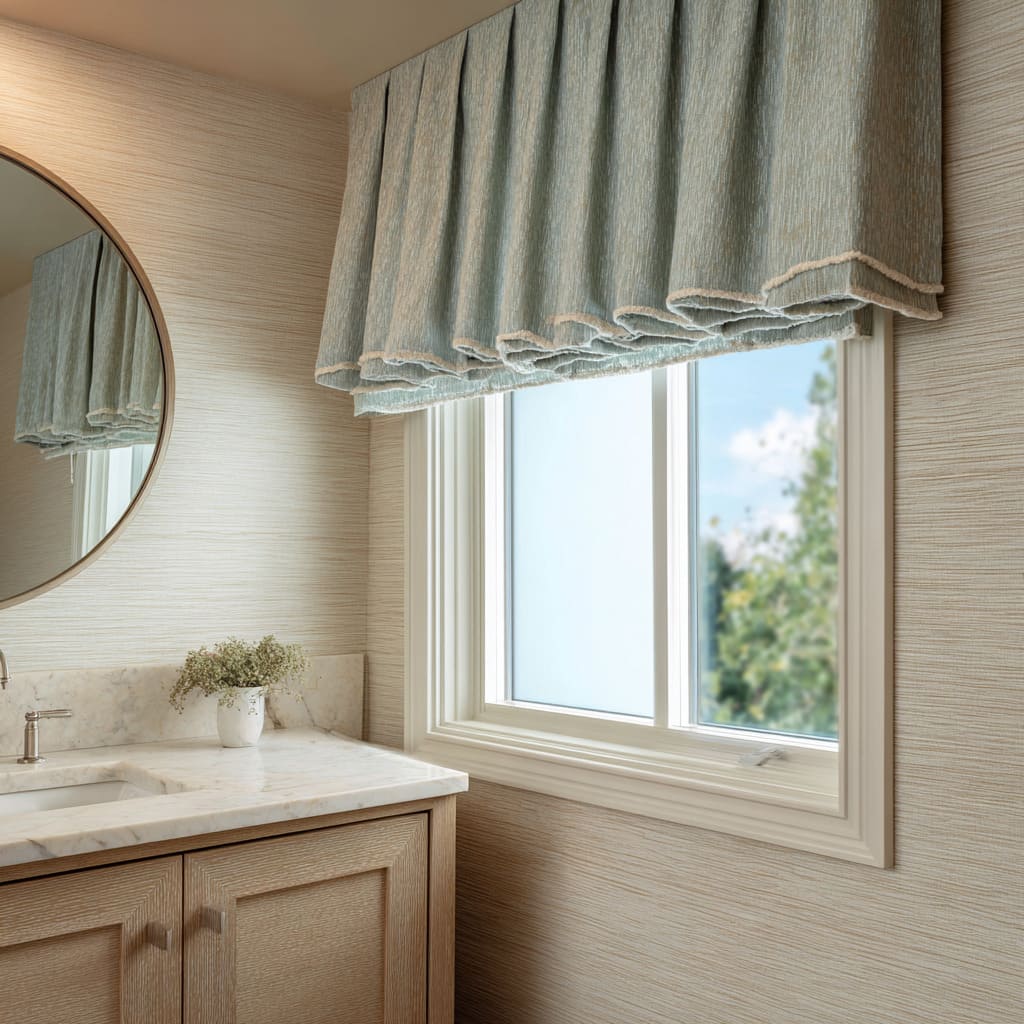
How Color Strategy Turns a Valance Into the Atmosphere-Maker
Color in valances is rarely explosive; far more often it sits within a narrow spectrum that the rest of the room gently extends. Warm yellows, biscuit tones, blush pinks, rose speckles, sandy neutrals, sky blues, dusty greys—all appear as “temperature setters” rather than accents.
Some concepts use the valance as the richest version of the palette: deep rose against warm wood, sky-toned check against misty walls, golden pebble patterns beside honey wood. Others keep the valance pale and let the layers below—curtains, shades, towels—hold the stronger color.
A small bathroom window valance ideas layout especially benefits from this restrained method: one strong hue at the top guides the entire sightline without overwhelming the compact space.
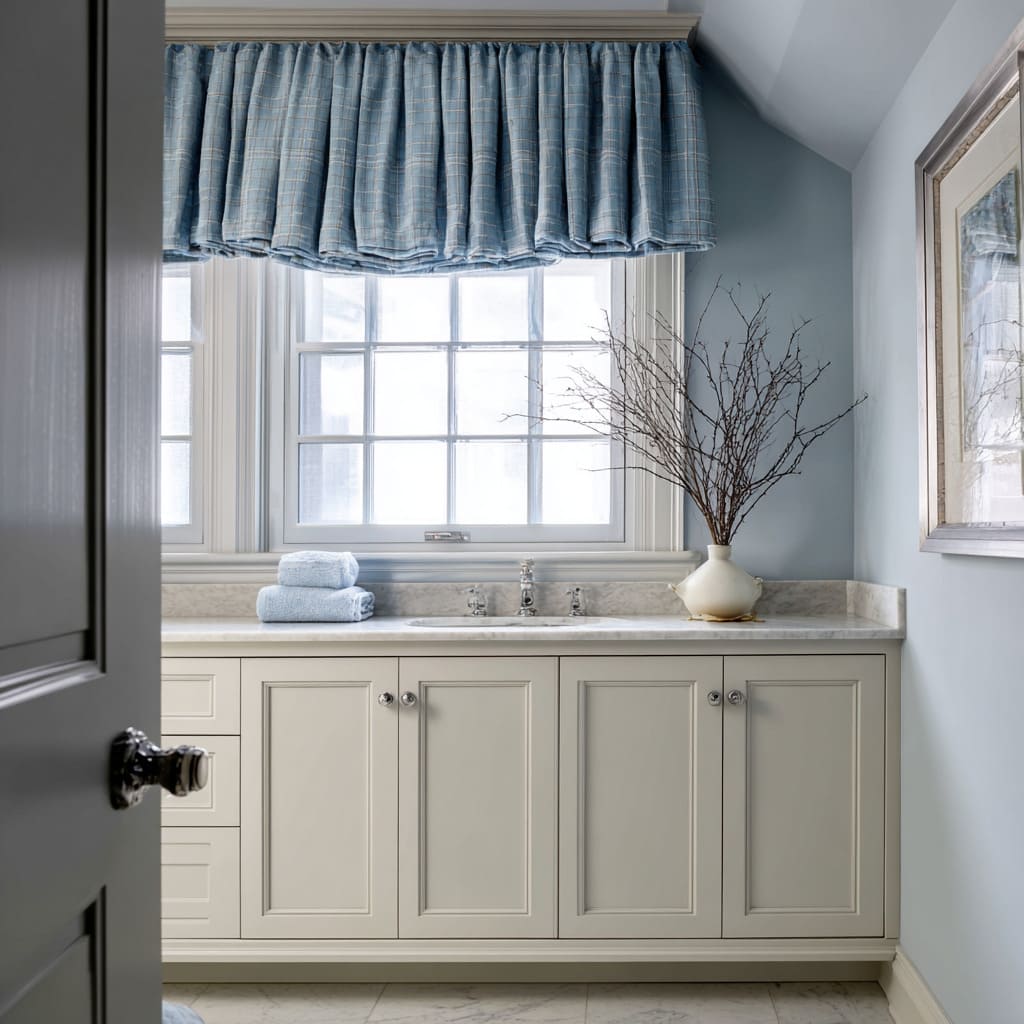
Color continuity across materials (wood undertones, stone veining, paint warmth, towel hues, floral choices) keeps the textile integrated. It becomes the emotional starting point rather than a separate piece of décor.
Light further enhances this: translucent cloth glows, opaque cloth creates contrast, patterned cloth softens or amplifies daylight. The valance becomes a tone-setting filter for everything that lies beneath it.
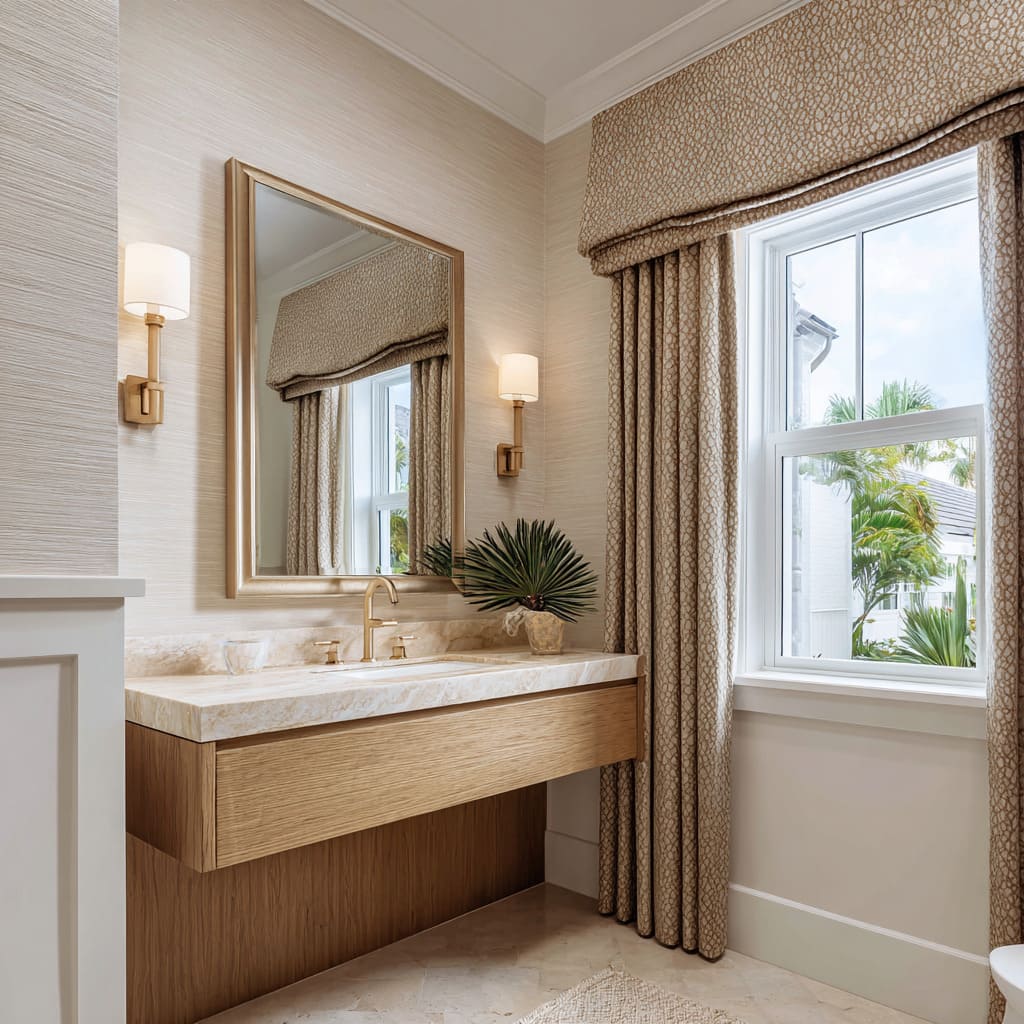
Layering and Hierarchy: How Textiles Build Atmospheric Depth
Many compelling bathroom compositions rely on three-level textile structures rather than a single fabric piece. A structured header provides order, a soft shade adds intimacy, and long panels introduce vertical flow.
This hierarchy is not about complexity but about balance. A pale header can stabilize a stronger color below, as seen in valance-plus-Roman combinations.
A patterned pelmet can feel grounded when neutral side panels frame it. A balloon shade can be the sole expressive moment atop a wall of quiet cabinetry.
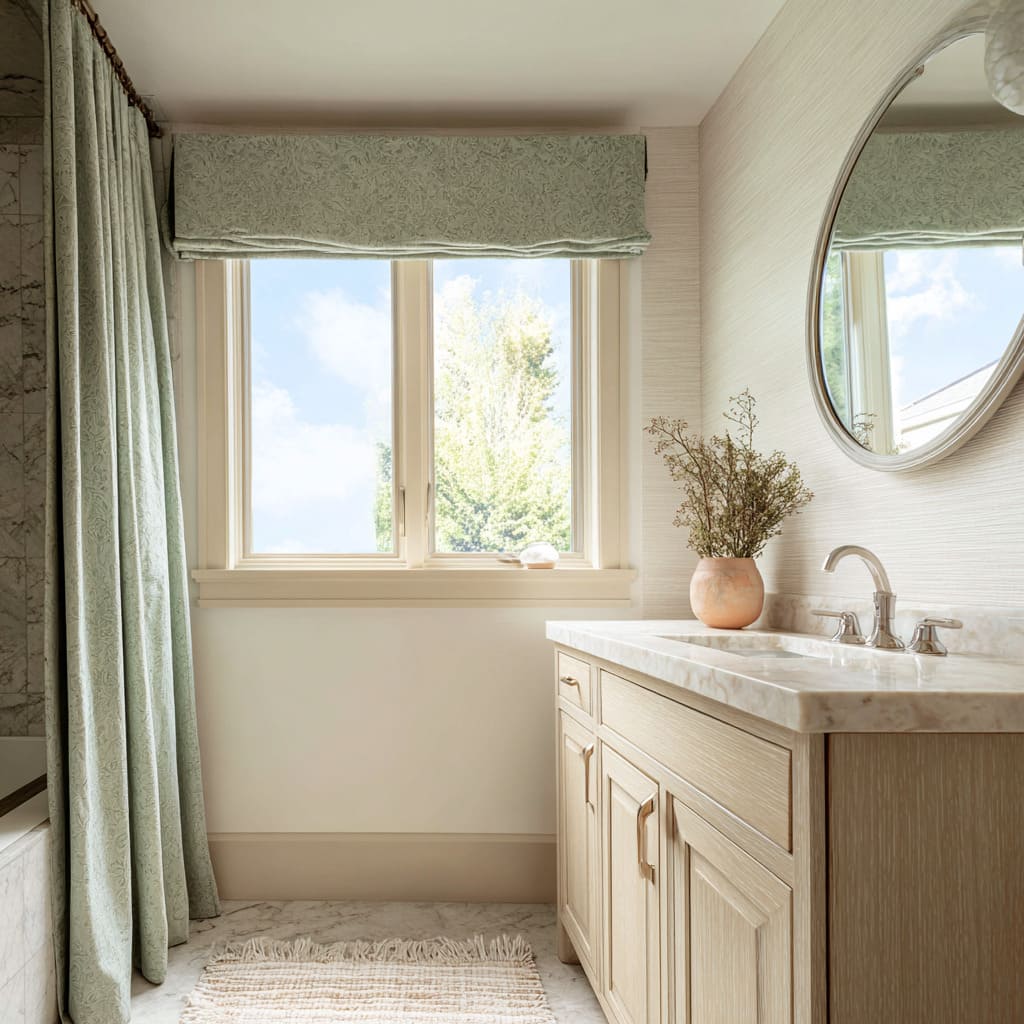
Sometimes the valance leads; other times it recedes, allowing the shade to become the main visual layer. This layered strategy allows the bathroom to express multiple textures at once: crisp at the top, soft in the center, grounded at the sides.
The fabric assembly becomes a window-based equivalent of a styled shelving niche or a mixed-material backsplash—rich, dimensional, calm. Layering also helps control light distribution: upper folds filter glare, mid folds diffuse brightness, and lower openings illuminate the counter.
The textile ensemble becomes a mood machine.
How Mirrors, Reflections, and Light Amplify the Textile Story
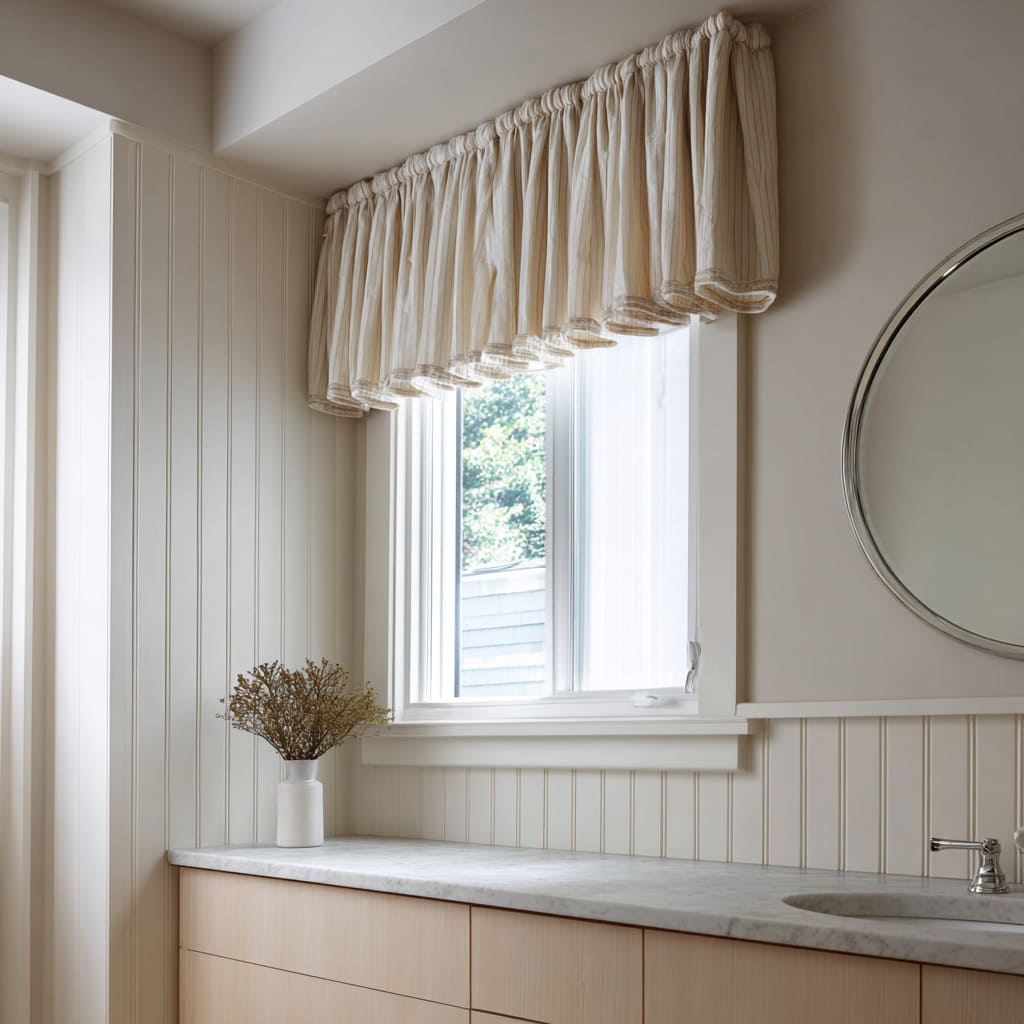
Mirrors in such bathroom scenes often act as “second valances,” duplicating patterns, scallops, folds, or color bands. This creates the illusion of more fabric in the room without adding physical layers.
Round mirrors frame scalloped bands like soft crowns. Tall mirrors capture vertical pleats in reflection, doubling their emphasis.
Even small mirrors can bounce the valance back into view, making the upper part of the bathroom feel immersive. Reflected fabrics often appear at a different scale due to angle and distance, providing an elegant form of visual variation.
Light also interacts with fabric in meaningful ways:.
- Pebble prints glow when backlit, revealing tiny shapes as soft halos.
- Stripes vibrate slightly as direct sunlight moves through folds.
- Sheer cloth animates the shadow of window muntins behind it.
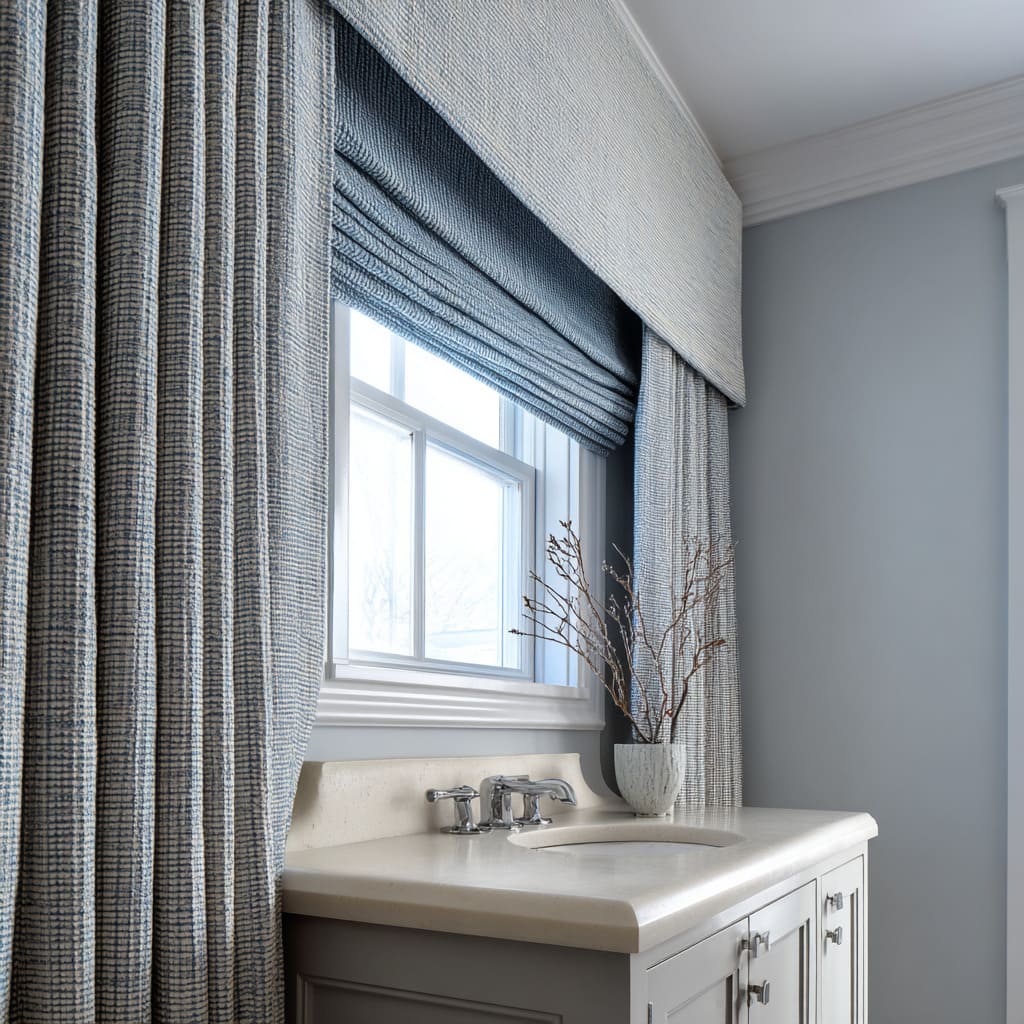
In effect, the valance becomes a cinematic filter between outdoors and indoors. Combined with mirror reflections, the textile takes on a double presence—once on the window, once in the mirrored field—giving even minimalist bathrooms a tactile richness.
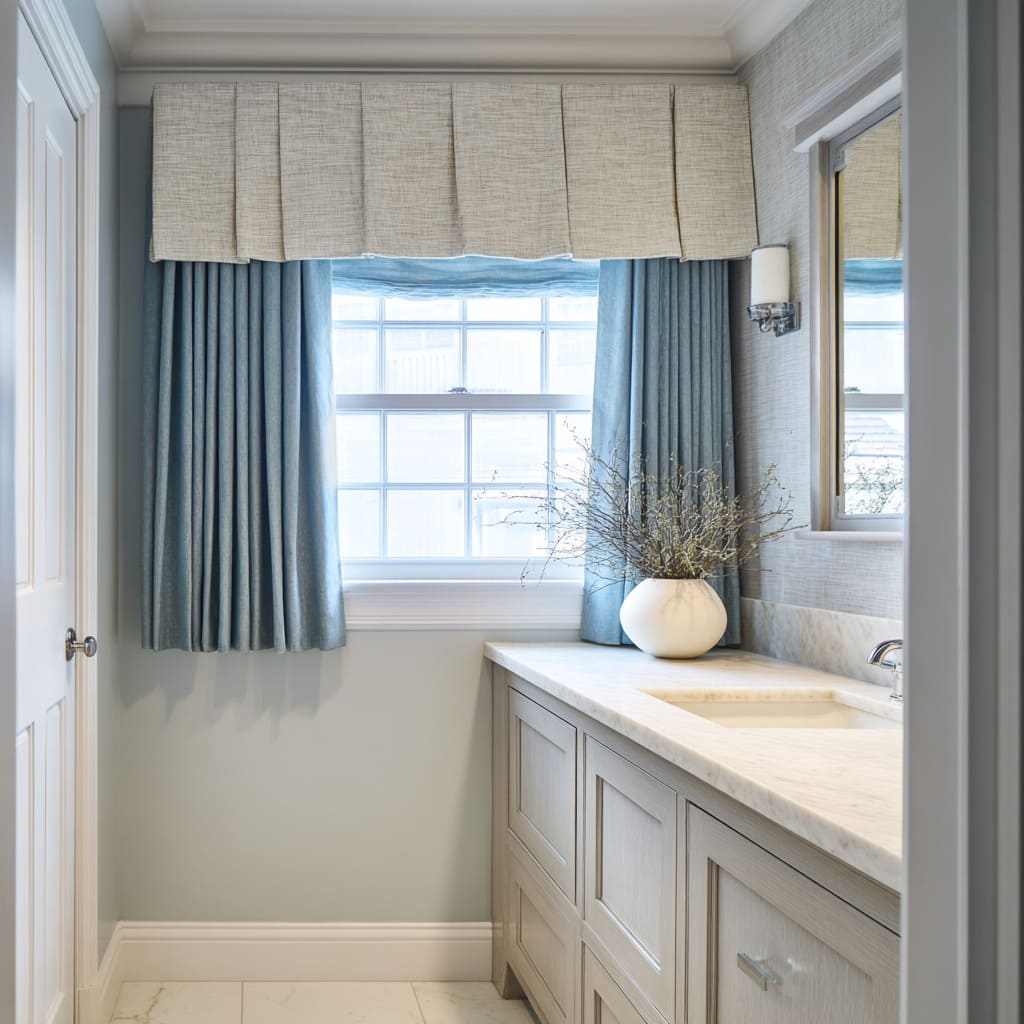
Mood Families: Distinct Aesthetic Personalities Created by Valances
Across many interior examples, valances fall into recognizable mood groups shaped by color, pattern, and structure.
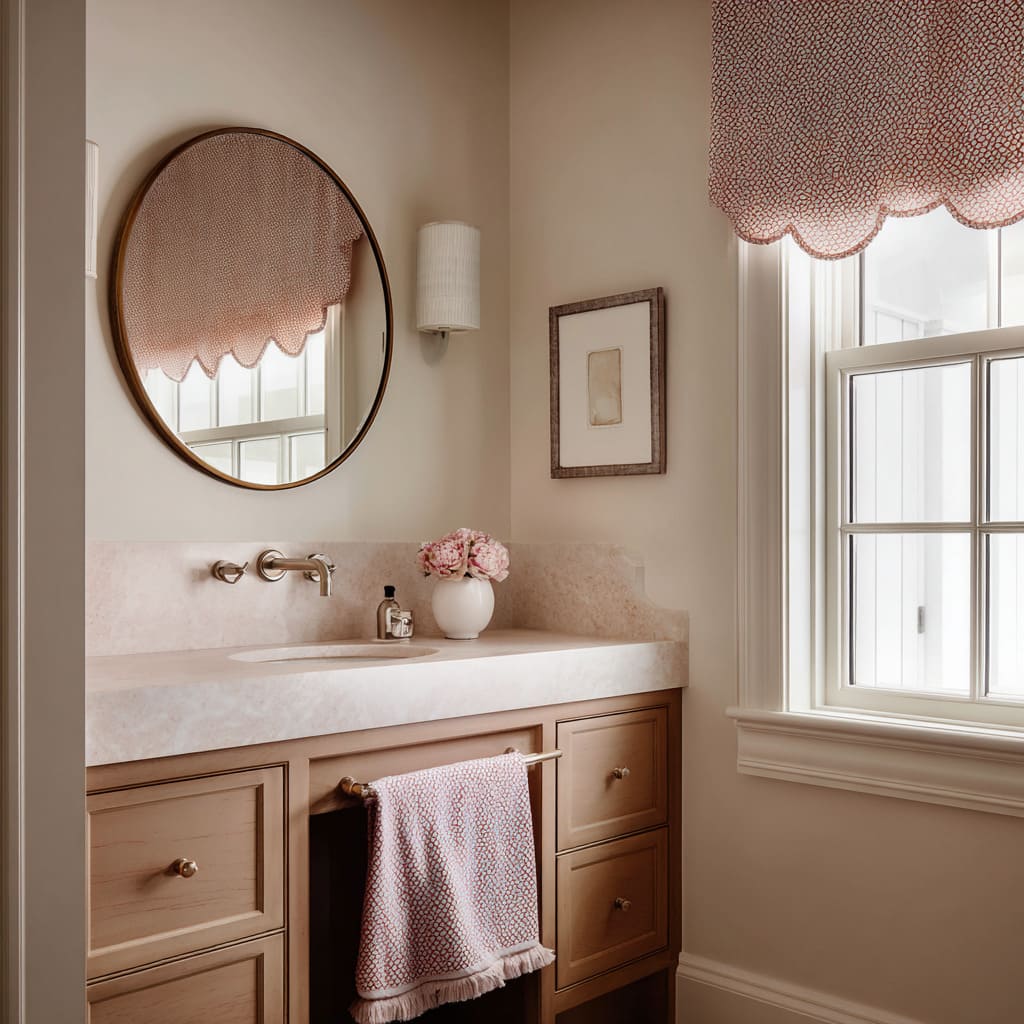
A. Soft Nostalgic Warmth
Warm rose, biscuit, soft yellow, scalloped hems, balloon dips, warm wood, brass details, and flowers. Such bathroom designs feel gently flattering and quietly decorative.
B. Spa-Calm Neutrals
Creams, stone-toned pleats, crosshatch weaves, minimal hardware, subtle plants. Textiles echo the serenity of spas or boutique hotels.
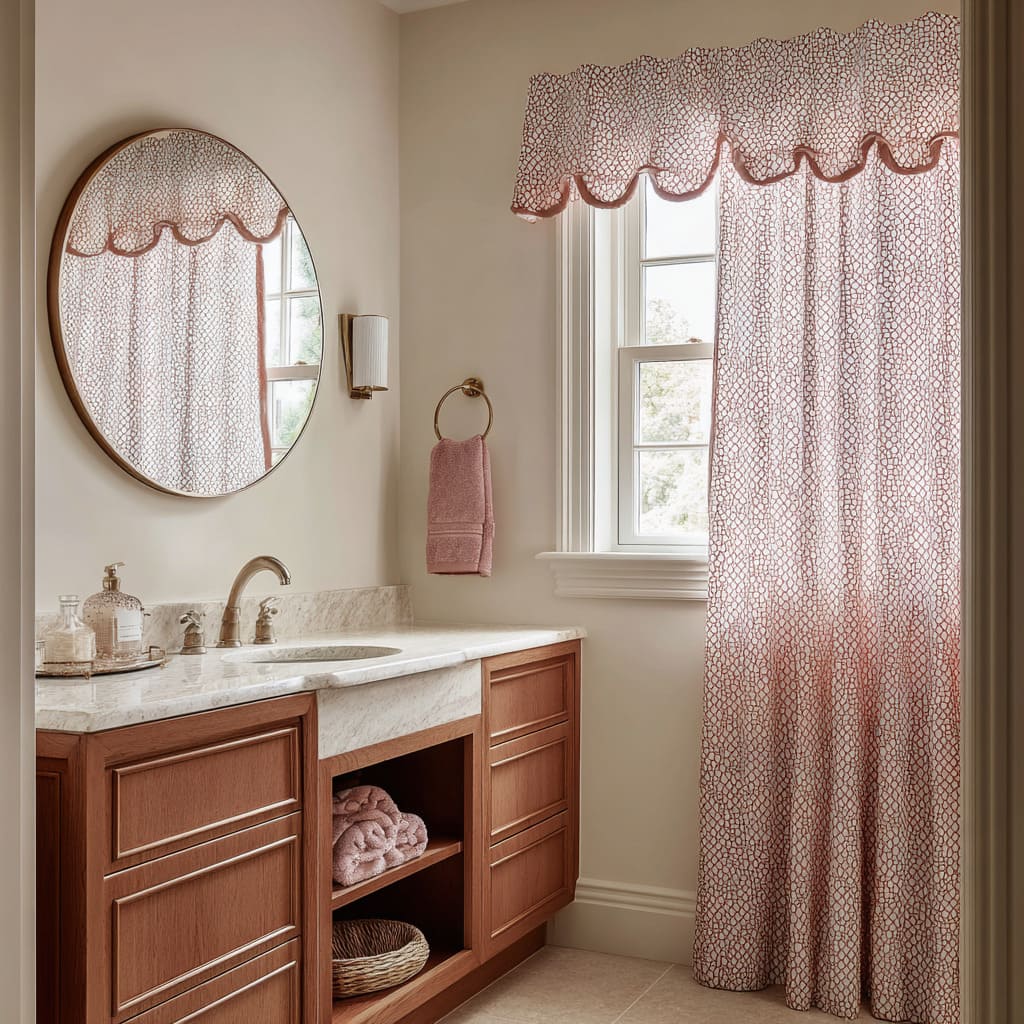
C. Nature-Linked Freshness
Green checks, sky-blue shading, sandy linen, foliage outside the window reflected in gentle patterns. Here the valance acts like an interior translation of the outdoor palette.
D. Structured Modern Quiet
Grey stripes, tailored box hems, crisp lines, simple wood, restrained ceramics. Such designs favor order but allow the valance to soften the geometry.
These groups are not rigid categories but recurring atmospheres shaped by thoughtful textile choices. Whether the goal is softness, clarity, or connection to nature, the fabric band above the window becomes the emotional anchor.

The Valance as a Bridge Between Interior Elements
Because the valance sits between ceiling and glass, it naturally links architectural and decorative layers. Patterns and tones in the textile often reappear in cabinet grain, stone veining, tile rhythm, or small décor.
A grey bathroom valance might echo a stone backsplash in faint marbling, or a rose-speckled valance might find its counterpart in warm wood tones. Vertical folds often mirror vertical grain in vanity doors; scallops often find quiet repetitions in rounded sinks, arched shelves, or curved metalwork.
Branches in vases mimic mullion lines or pleat rhythms. Towels below repeat colors above in grounded blocks of fabric.
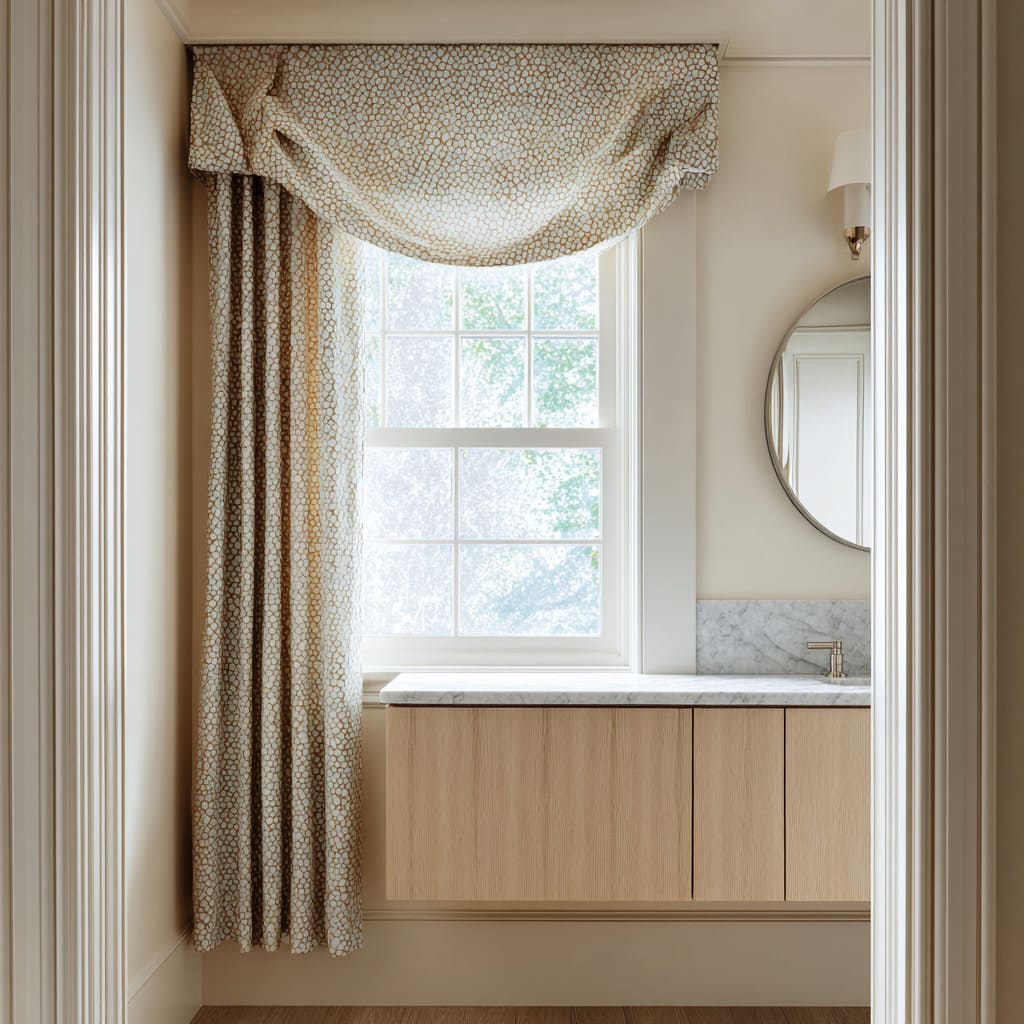
Even the outdoor view often enters the conversation: pale blue valances with sky beyond, leaf-toned fabrics paired with garden greenery, striped cloth answering linear stone walls outside. Through all of this, the textile at the top becomes the mediator—connecting upper and lower halves of the wall, echoing the natural environment, and organizing the visual temperature of the room.
Small-Space Intelligence: How Textile Behavior Changes Compact Rooms
In compact layouts, especially those with tight vanity zones, textiles must carry visual work without overwhelming the footprint. This is where small bathroom window valance ideas shine.
Gathering, pleating, scalloping, and looping all compress or expand the apparent height of the wall. Fine patterns prevent the fabric from feeling heavy.
Light-filtering materials reduce the contrast between bright outdoors and shaded interiors, making the room feel gentler.
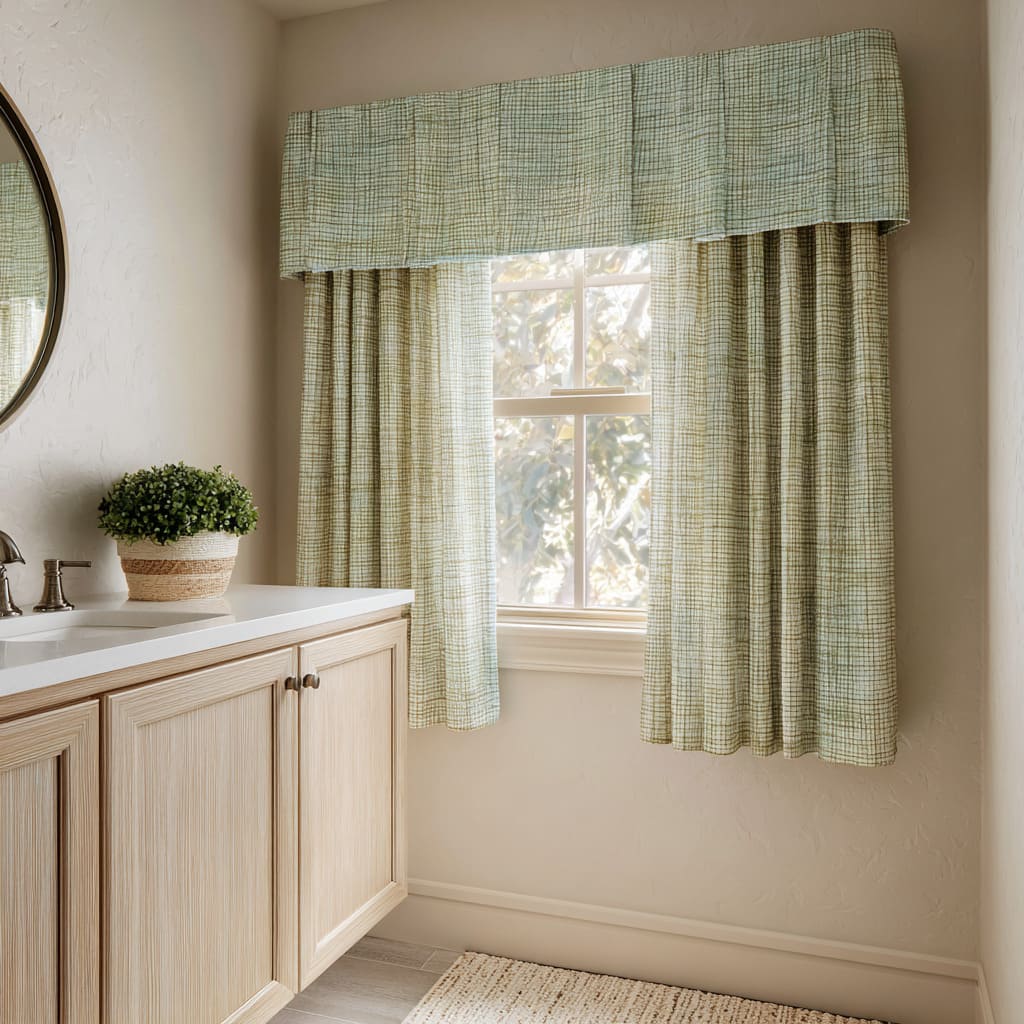
Valances also substitute for full drapery in small bathroom layouts, letting the upper part of the wall feel finished without crowding the area around mirrors, sconces, or storage. When paired with compact decorative elements—a vase of twigs, a single towel, a simple plant—the fabric creates the primary expressive moment, while the rest of the space stays clear and grounded.
This textile-driven strategy allows small rooms to gain identity and softness without adding clutter or additional fixtures.

The Unified Vision: Why the Top of the Window Directs the Whole Composition
At the deepest level, bathroom textiles succeed when they not only decorate the window but also choreograph the entire setting around them. A structured pelmet encourages linear cabinetry, boxy mirror frames, and crisp metal trims.
A gathered valance makes room for round mirrors, curved faucets, soft flowers, and organic materials. A patterned textile invites echo in towels, art, or colored accessories, while a tonal fabric strengthens a minimalist palette.
Valances also influence how light enters the design, how shadows fall on stone or wood, and how the eye reads the window as an architectural element.
The band of fabric is not merely decorative; it is the mood-setter, the height regulator, the color anchor, the rhythm stabilizer, and often the only expressive flourish in an otherwise restrained bathroom. In this way, bathroom valance ideas shape the room not by drawing attention to themselves but by defining the structure through which the entire design is perceived.