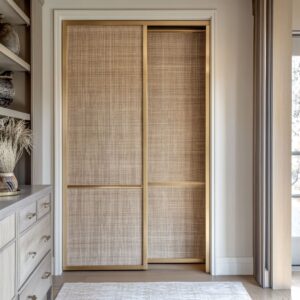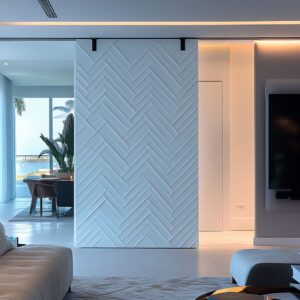
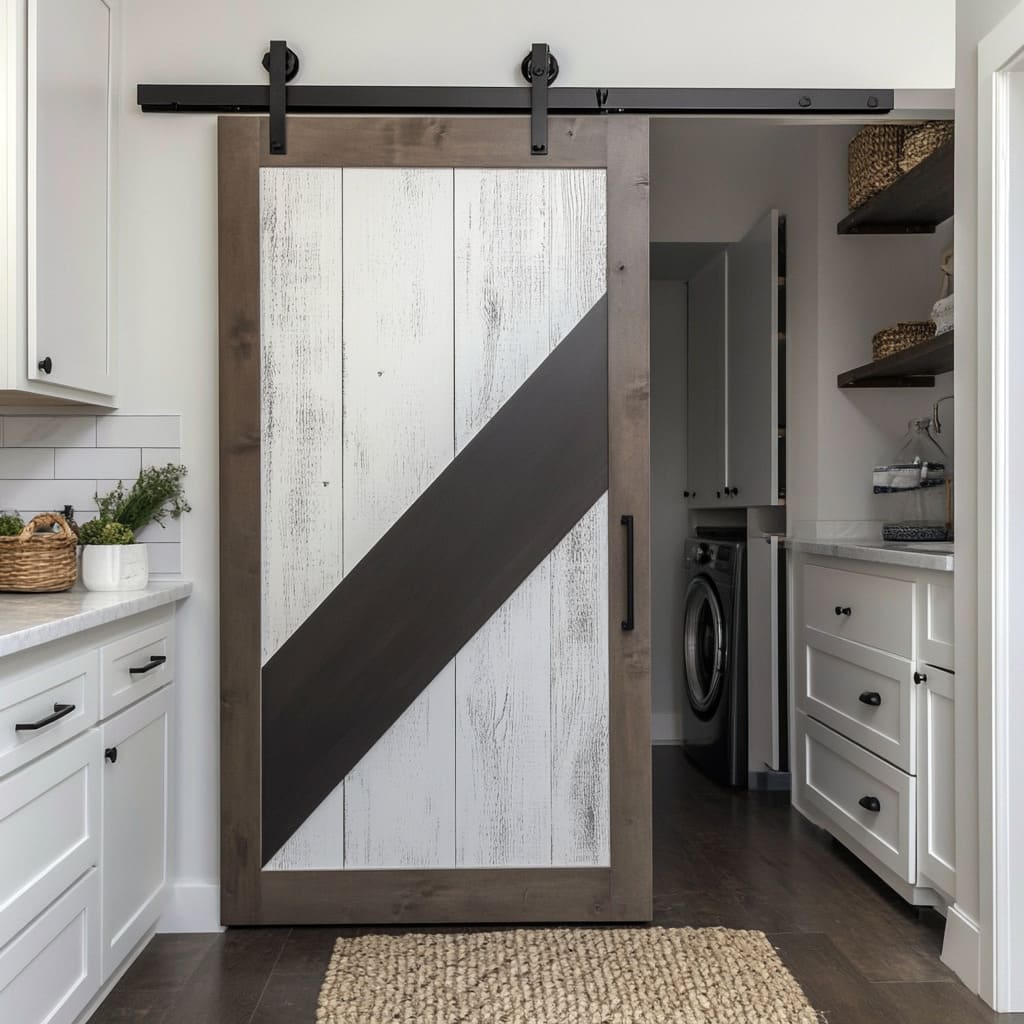
One of the most defining qualities in the design of farmhouse interior doors is the use of directional planking—not as rustic decoration, but as a subtle system that shapes the mood of the room. Vertical, diagonal, horizontal, and chevron directions act almost like visual currents, guiding how the eye moves through an entryway, kitchen, dining space, or bedroom.
Vertical planks bring height and create a calm slow rhythm that supports woven benches, tall sconces, or narrow shelving. Diagonals introduce a soft tilt that keeps still rooms from feeling stiff.
Chevron or X-arranged planks appear in many modern farmhouse compositions as “structured motion,” offering gentle geometry without feeling busy. Horizontal strips, whether full-width bands or short stacked segments, work like little horizon lines that stabilize areas with many verticals.
Underneath all of these patterns lies an important principle: the direction of the grain becomes the quiet drawing on the surface, guiding attention without needing high contrast.
Tonal Concepts and Color Grouping
Tone defines the emotional temperature of farmhouse doors, but it also defines how the door sits inside the room’s palette. Many farmhouse interior door ideas rely on toned-down families of hues—taupes, soft charcoals, oat neutrals, muted greys, white oak, dusty blue, or cream woods.
Designers often create “mini palettes” inside the door itself: a deeper lower field and a lighter upper field, or multi-toned stripes arranged with careful restraint. A diagonal field in one tone interacting with vertical planks in another tone becomes a compressed palette within a single leaf.
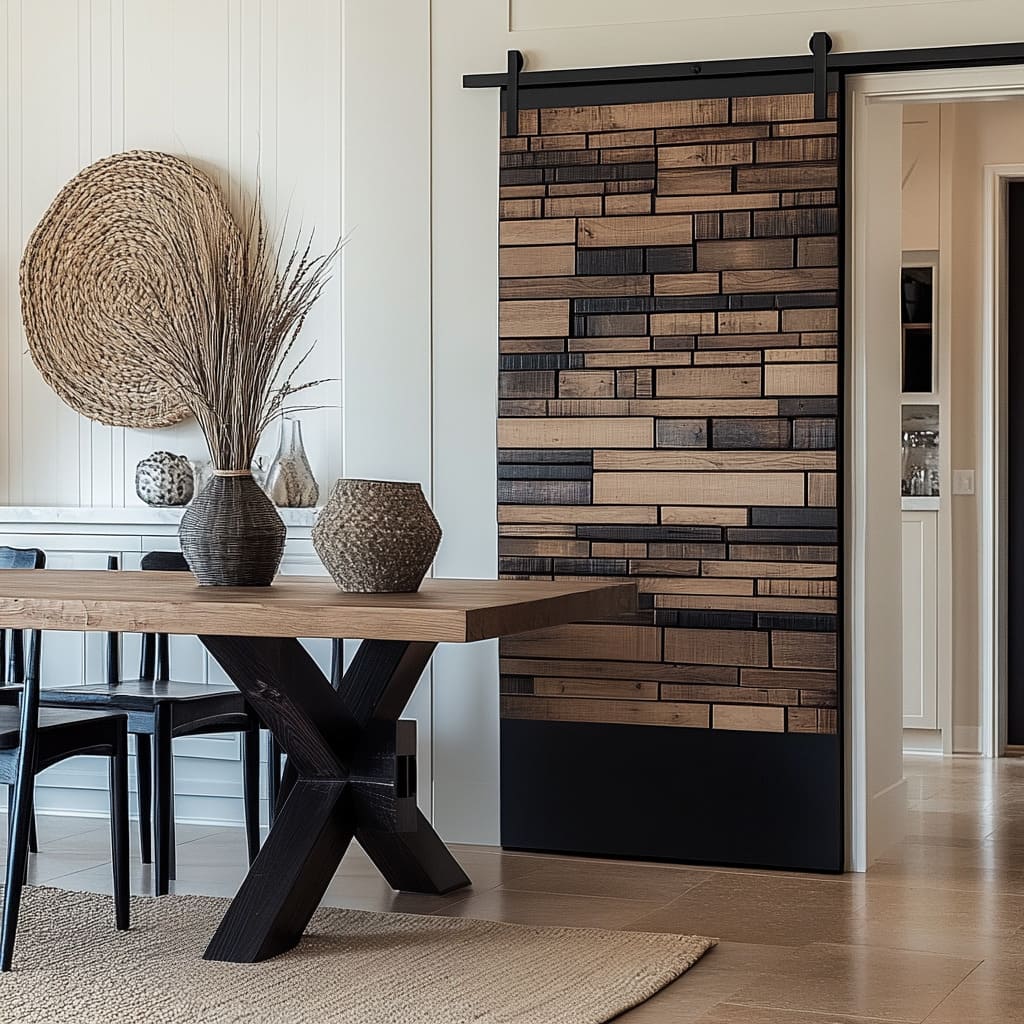
A repeated pattern emerges across many door examples: when plank direction is bold, the tones stay calm; when tones vary widely, direction stays simple. This keeps farmhouse interiors peaceful even when the door carries a strong identity.
Across entries, dining rooms, and transitional spaces, tones tend to echo materials like natural jute rugs, lightly stained shelving, warm metals, or woven pendant lights, giving the door a steady place in the palette.
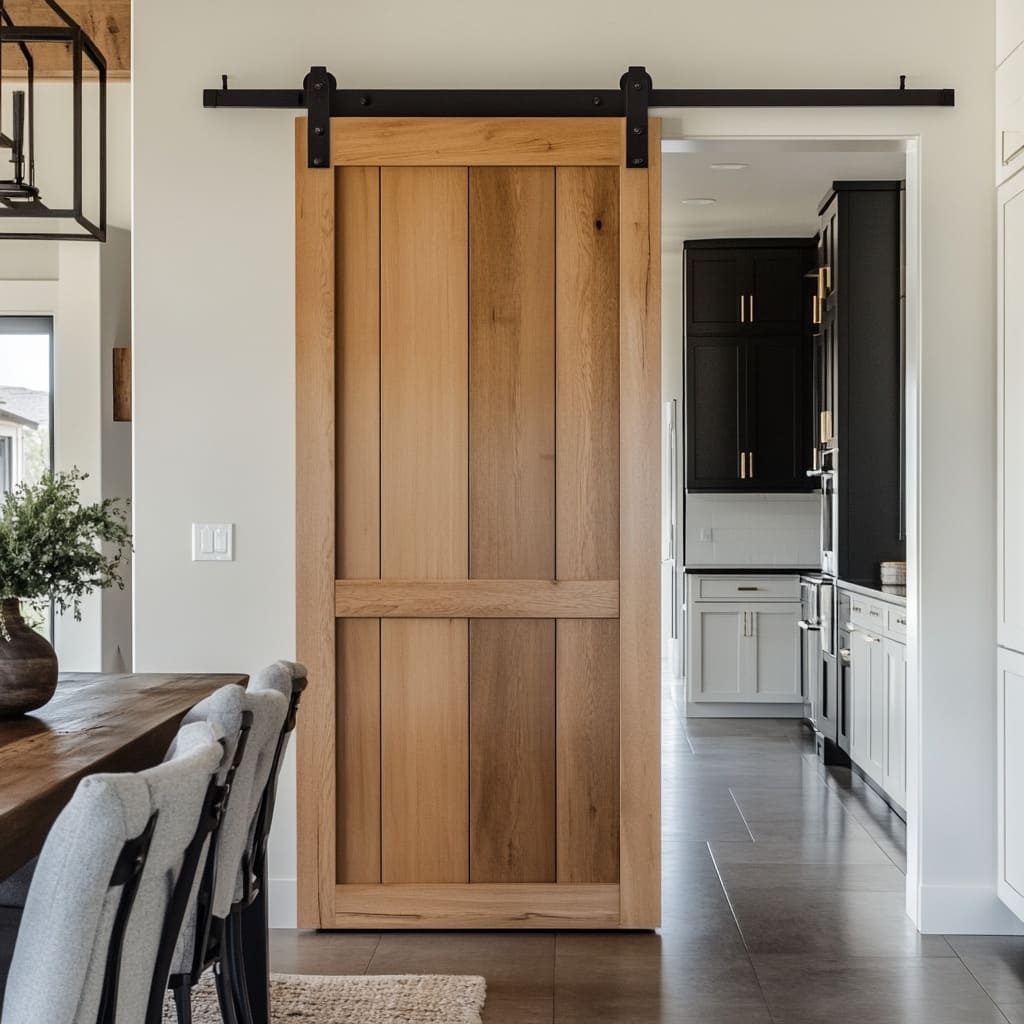
Grain Orientation and Scale
Within many farmhouse style doors, grain plays a surprisingly sophisticated role. Grain orientation—vertical, diagonal, chevron, or patchwork—creates the subtle “drawing” on the panel, while grain scale determines how soft or expressive the surface appears.
Large cathedral waves in natural oak bring warmth and a crafted feeling suitable for living rooms. Fine straight grain allows diagonal compositions to look controlled rather than chaotic.
Ribbed narrow grain creates a textile-like softness, especially when paired with white trim or tan walls.
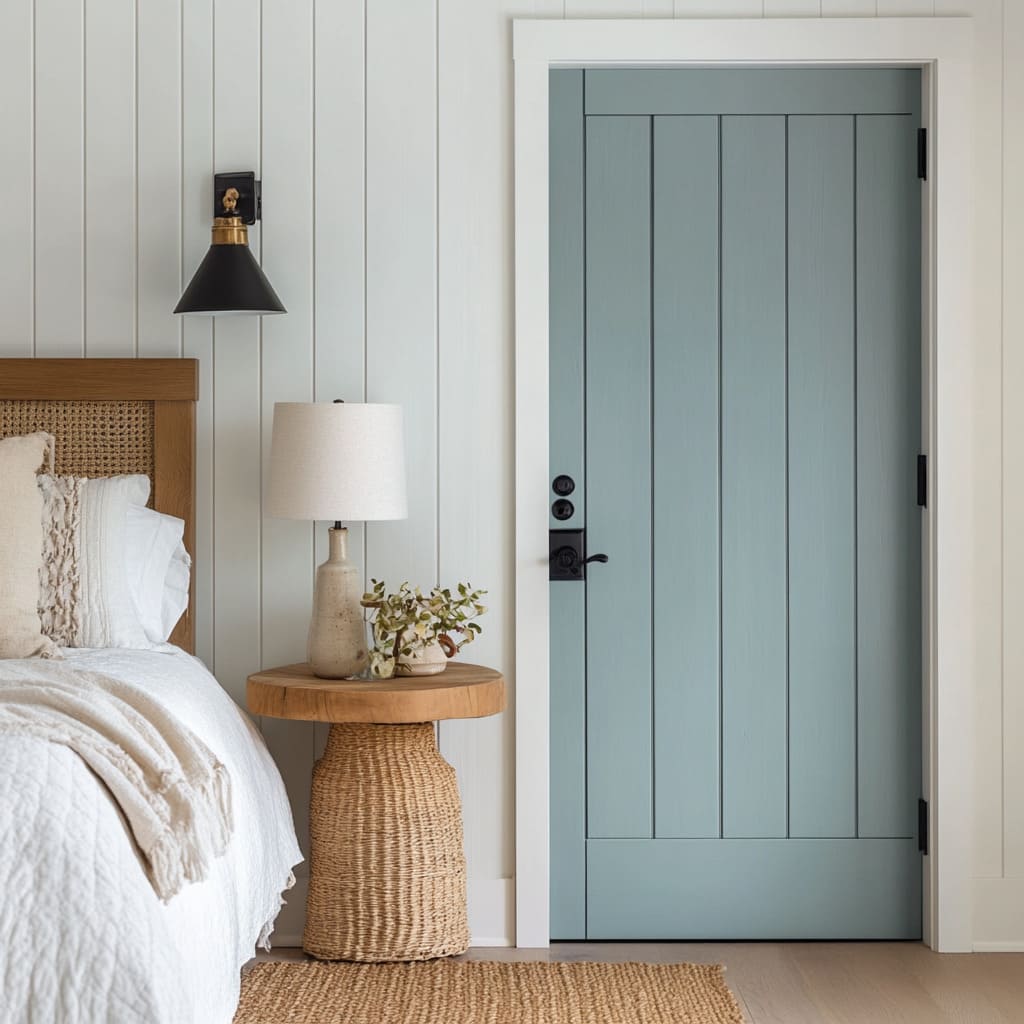
Mosaic-style short planks create a sense of layered craft, almost like a small relief sculpture. Across examples, grain is used the way interior stylists use textiles: some rooms call for a bold wool weave, others for a quiet linen texture.
This relationship between wood fiber and overall composition makes farmhouse doors feel handcrafted even when their forms are modern.
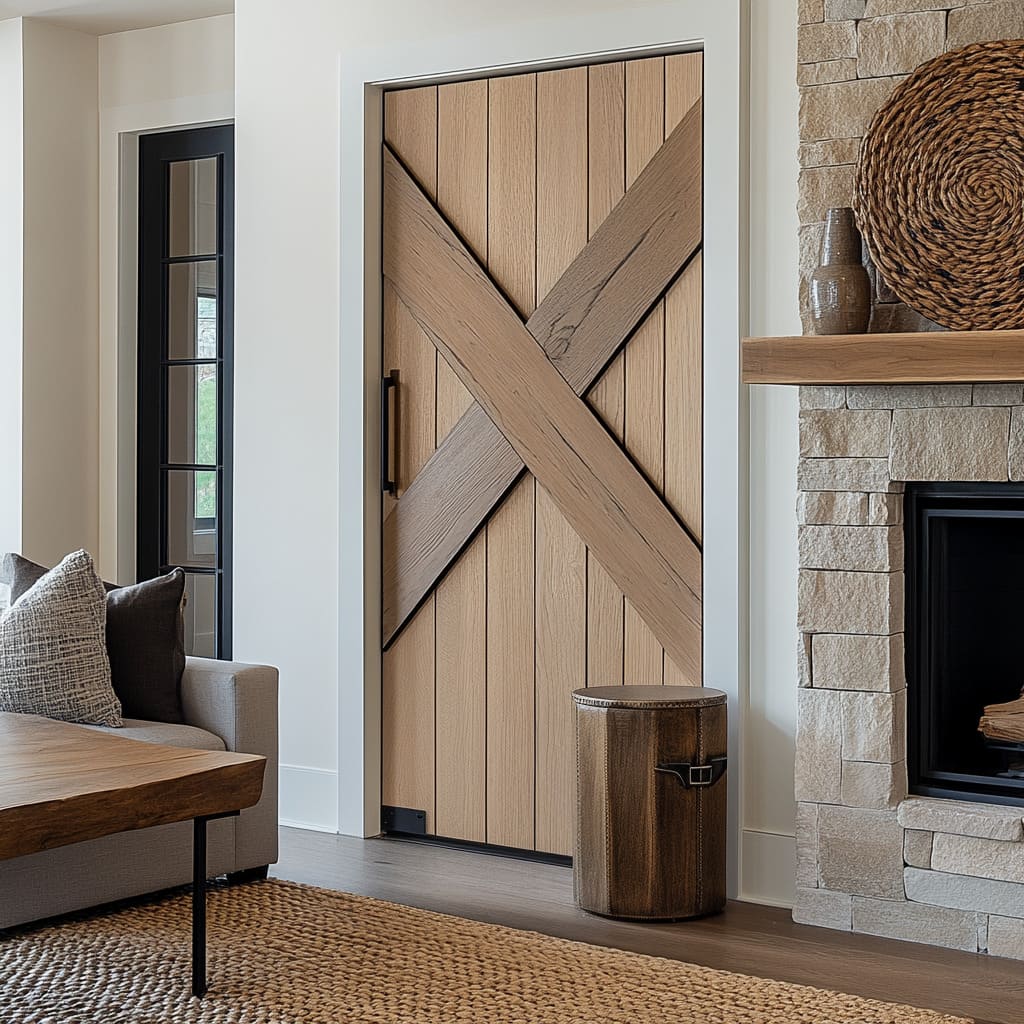
Frames, Casings, and Borders as Visual Boundaries
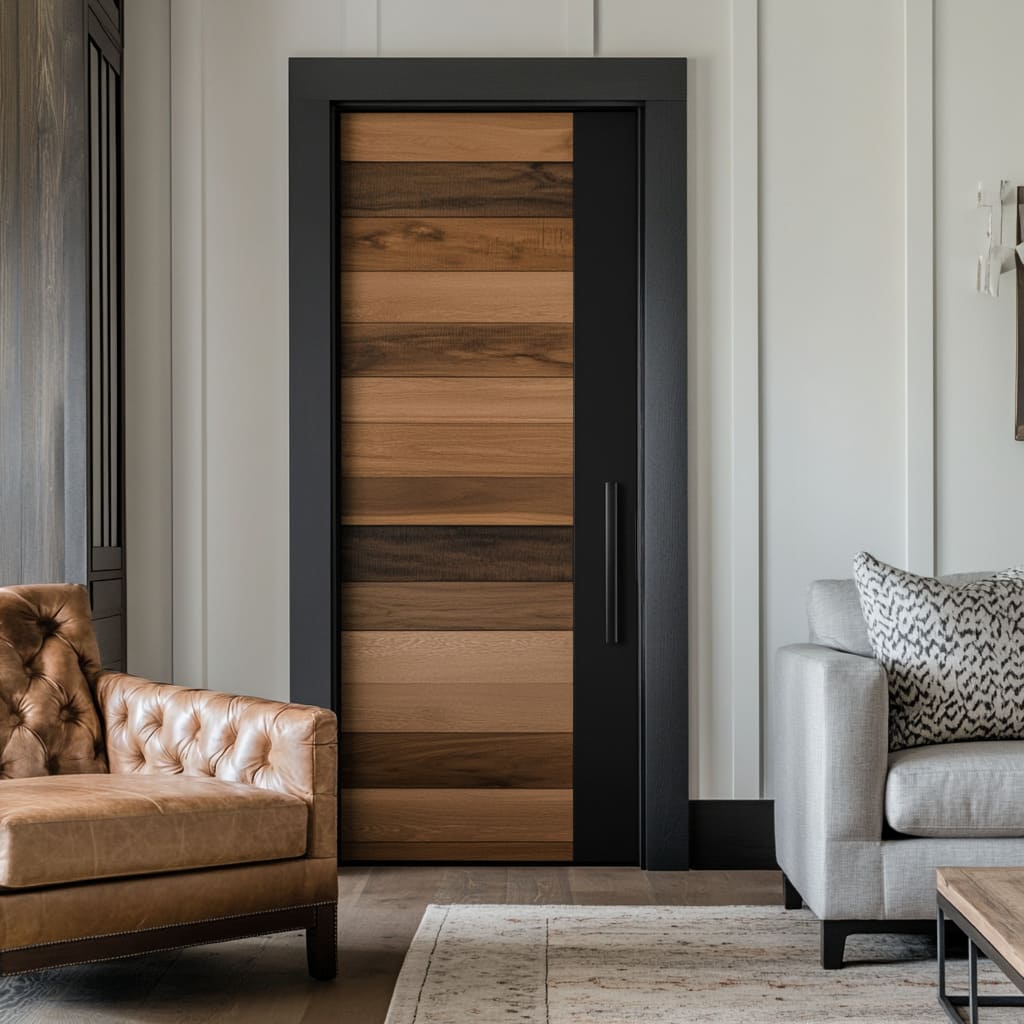
The border around a door is often overlooked, yet in many farm style door design examples, the frame is as important as the door surface itself. Thick black casings emphasize vertical edges and turn a door into a framed artwork within the wall.
Warm taupe or mid-toned frames soften the transition between door and wall, blending the panel into nearby cabinetry or shelving.
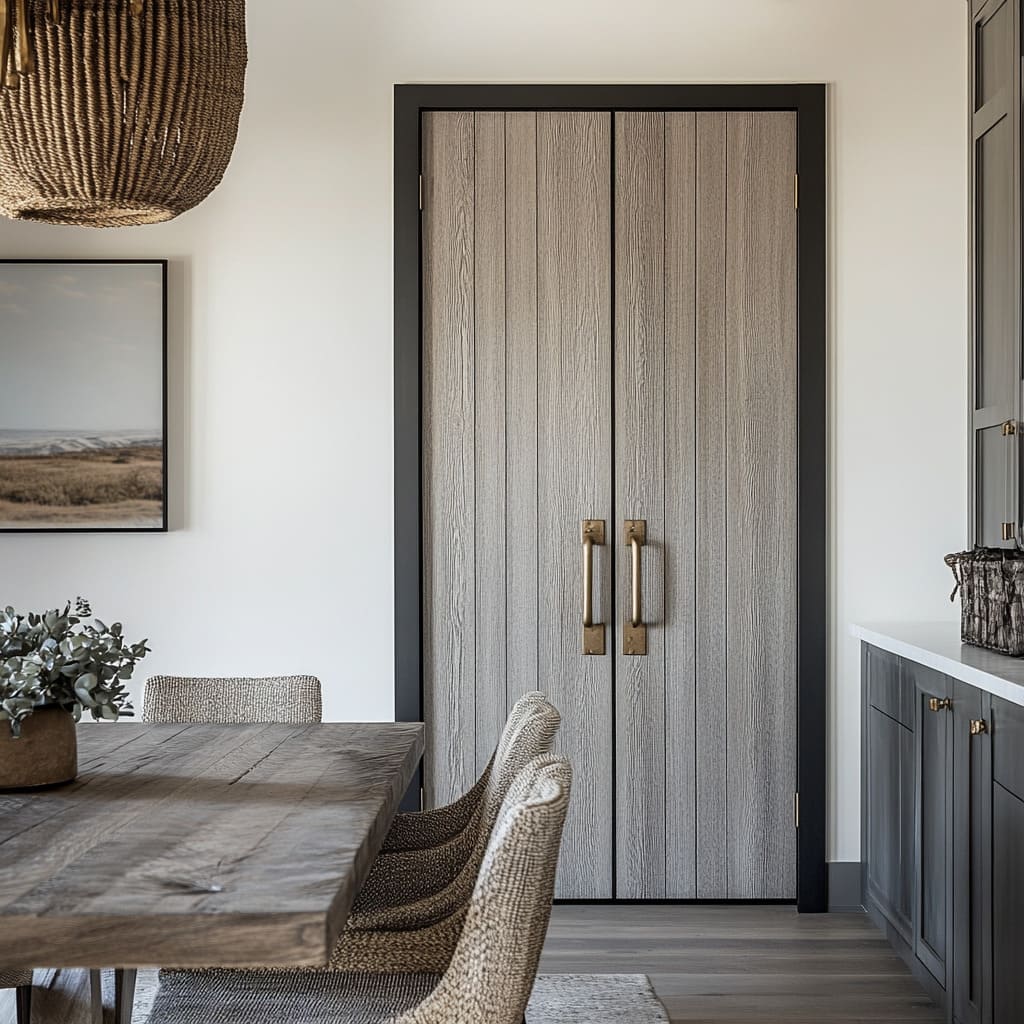
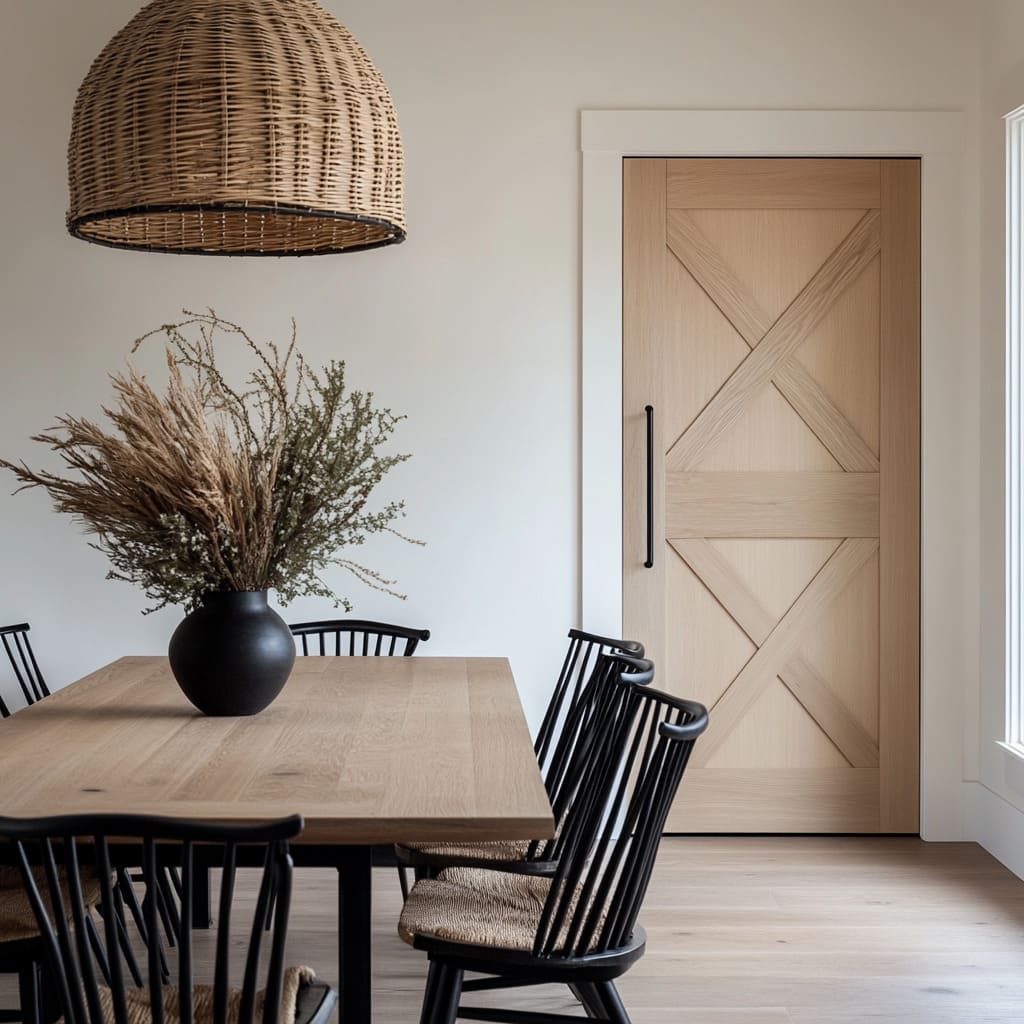
White frames highlight pale wood doors and allow X-patterns, chevron arrangements, or ribbing to stand out clearly against deeper wall colors. Minimal frames—or frames painted very close to wall color—allow the door to appear like an extension of the wall surface, creating a seamless architectural effect in calm dining spaces.
The frame color also often ties directly to other architectural lines in the room: black window grids, dark railings, the top line of a sideboard, or the base of woven pendants.
Hardware as Visual Punctuation
Hardware is not merely an accessory; it is a small but critical visual marker that echoes other dark or metallic accents inside the space. In many farmhouse style interior doors, long vertical pulls emphasize height and create a steady line against directional planking.
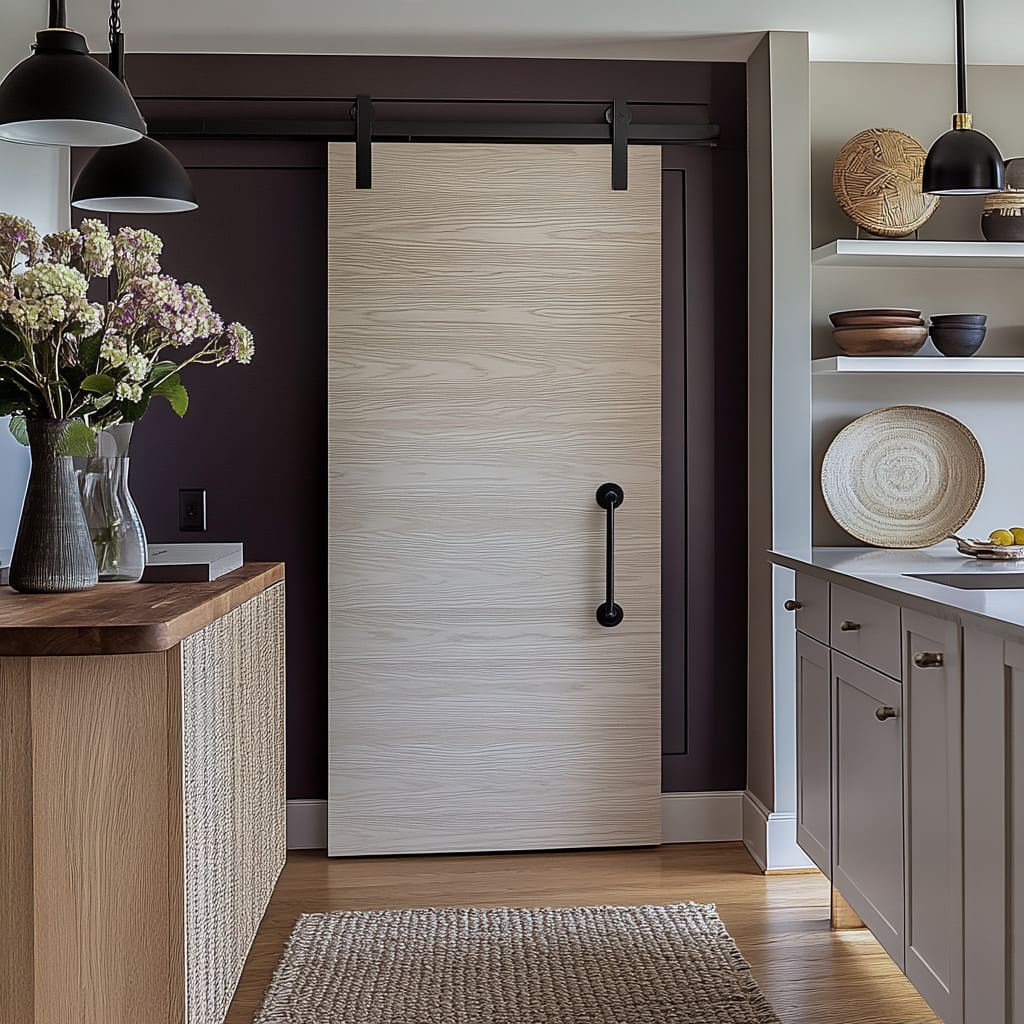
Short horizontal levers strategically interrupt diagonal or chevron compositions, preventing them from feeling overly angular. Black hardware ties the door to black-framed artwork, black chair legs, dark pendant stems, or the rail of a sliding track.
Brass hardware brings warmth and continuity with brass faucets, warm-tinted sconces, or soft metallic decor. Some doors carry hardware placed slightly lower or slightly off-center, which makes tall doors feel approachable and visually balanced, especially in designs with many steep lines.
The handle, lock, and hinge form a mini-sequence that quietly organizes the door surface.
Door–Wall Relationships: Contrast, Direction, and Shared Rhythm
The relationship between door and wall determines whether a door becomes a focal point or a calm backdrop. Horizontal shiplap walls often pair with diagonal or chevron doors so that one surface provides stability while the other provides movement.
Vertical wall paneling pairs beautifully with doors that have soft diagonals or mid-tone geometric fields, allowing the vertical lines to act as a quiet scaffolding behind the angled compositions.
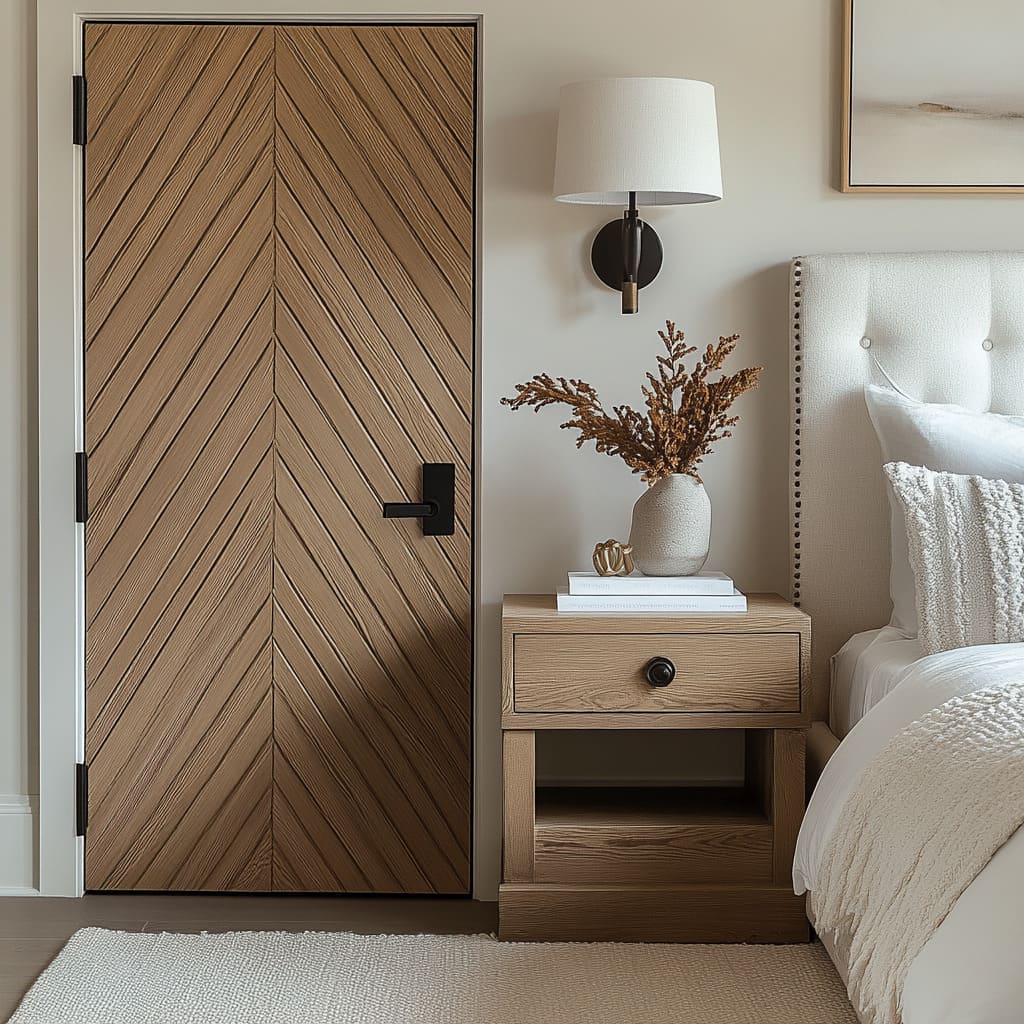
Plain painted walls serve as ideal backdrops for doors with multi-tone stripes, block-plank mosaics, or strong X shapes, ensuring that graphic elements do not compete with wall texture. Some spaces reverse the logic entirely: a pale chevron door nearly dissolves into a pale wall with matching trim, preserving calmness while offering subtle depth when light hits the surface.
Across all of these combinations, walls and doors form a collaborative visual equation.
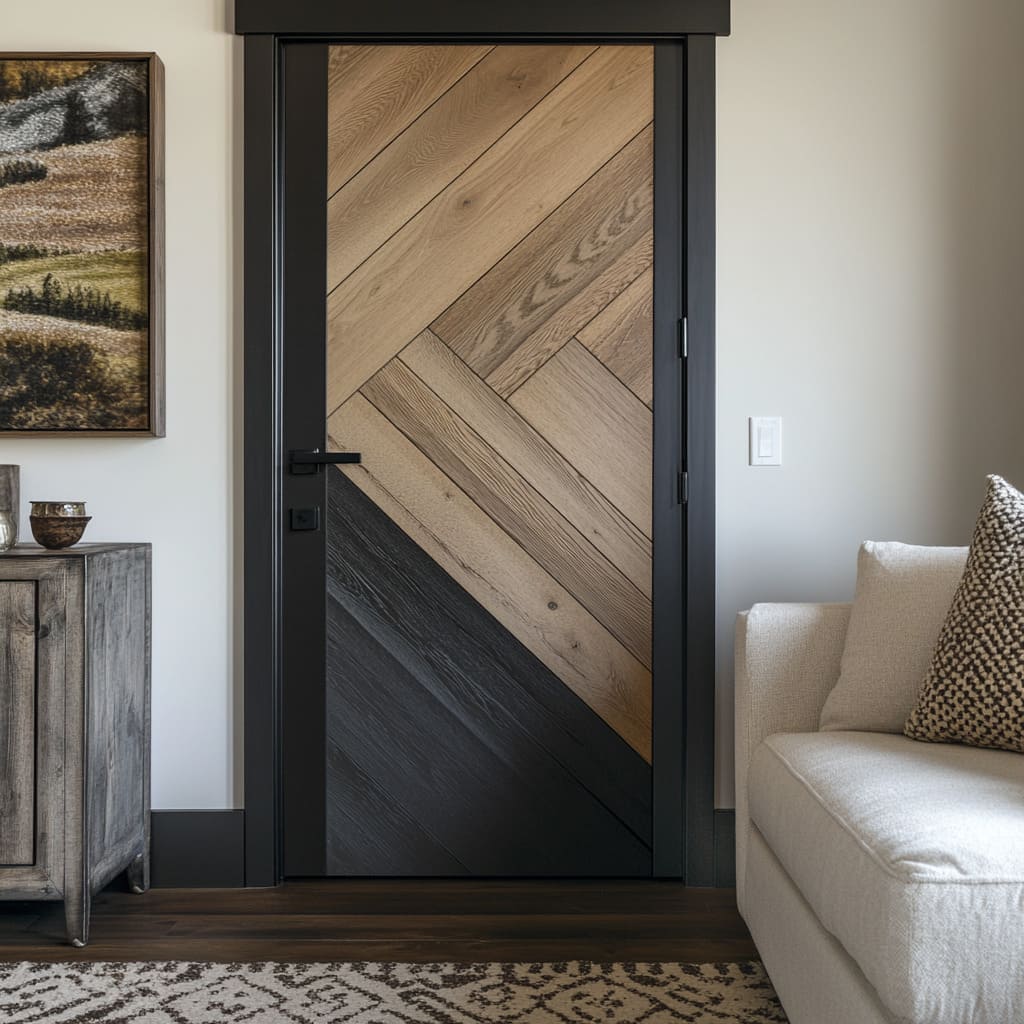
Furniture, Rugs, and Accessories That Support Door Composition
Adjacent decor plays a vital role in how farmhouse doors are perceived. Woven benches, cane nightstands, wicker pendants, or chunky baskets echo the linear textures of planks.
Rugs with soft diamond motifs or faint stripes anchor graphic doors in living rooms without overwhelming them. Neutral sofas with subtle pillows let warm-toned oak doors feel grounded and cohesive.
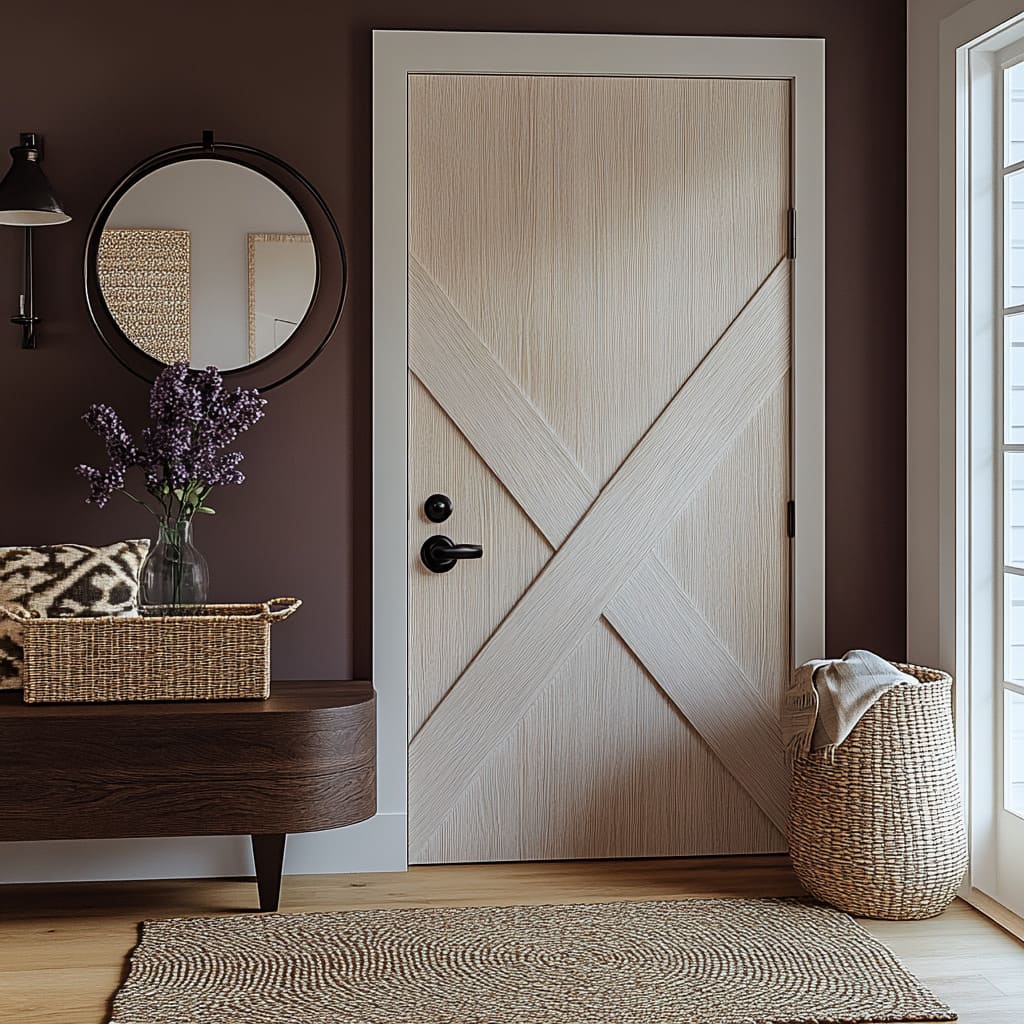
Dining tables with substantial wood grain connect to the grain variations inside multi-tone striped doors. Circular mirrors, round wall trays, or curved vases soften the strong diagonal or vertical geometry of a door, bringing balance through shape.
In every scenario, the furniture and decor behave as supporting characters that echo or counter the door’s main compositional elements.
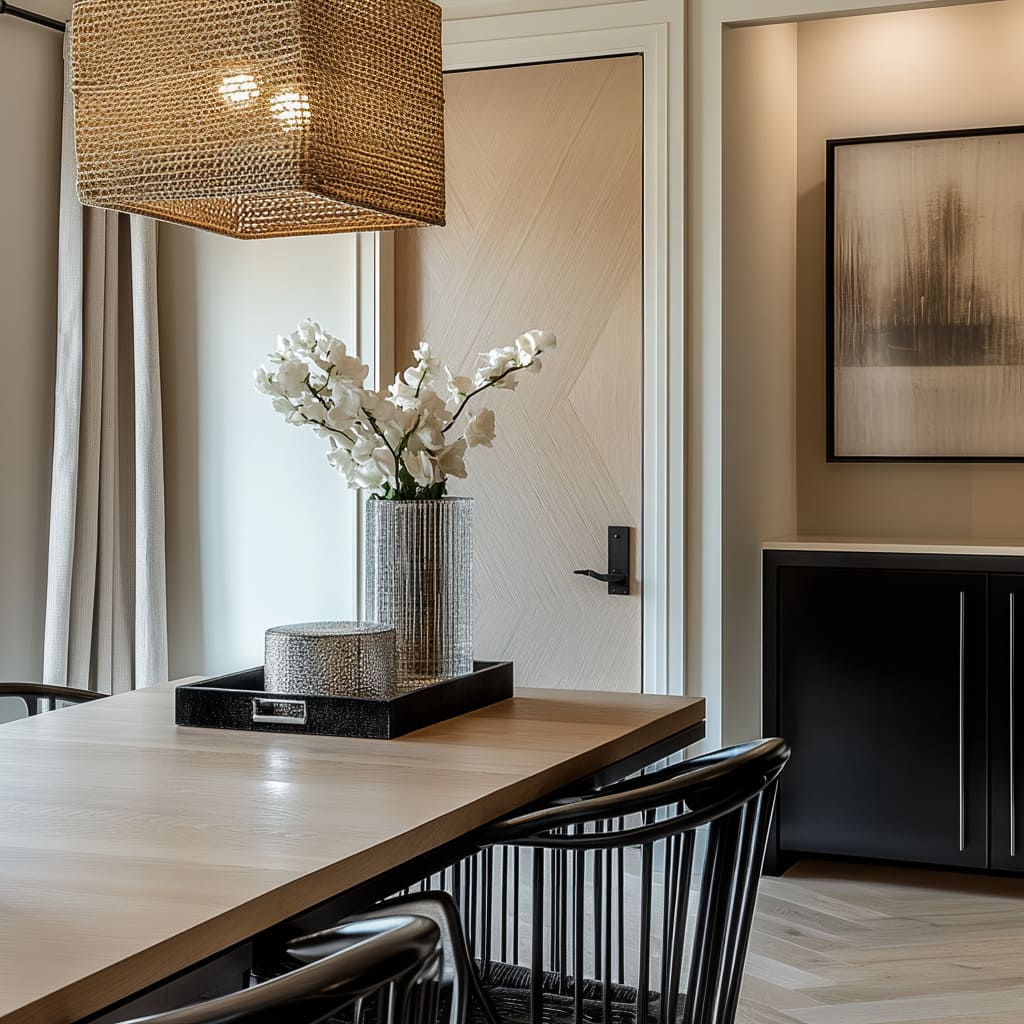
Plank-Based Families: Chevron, Horizontal Stack, Vertical Stripe, and Soft-X
A clear taxonomy of patterns appears when reviewing many farmhouse door designs:.
A – Chevron and Soft Angled Arrangements
Quiet movement created by symmetrical or near-symmetrical angled boards, ideal when tones are close.
B – Horizontal Stacks and Block Compositions
Layered planks arranged in stripes or patchwork, providing depth similar to stacked stone or woven panels.
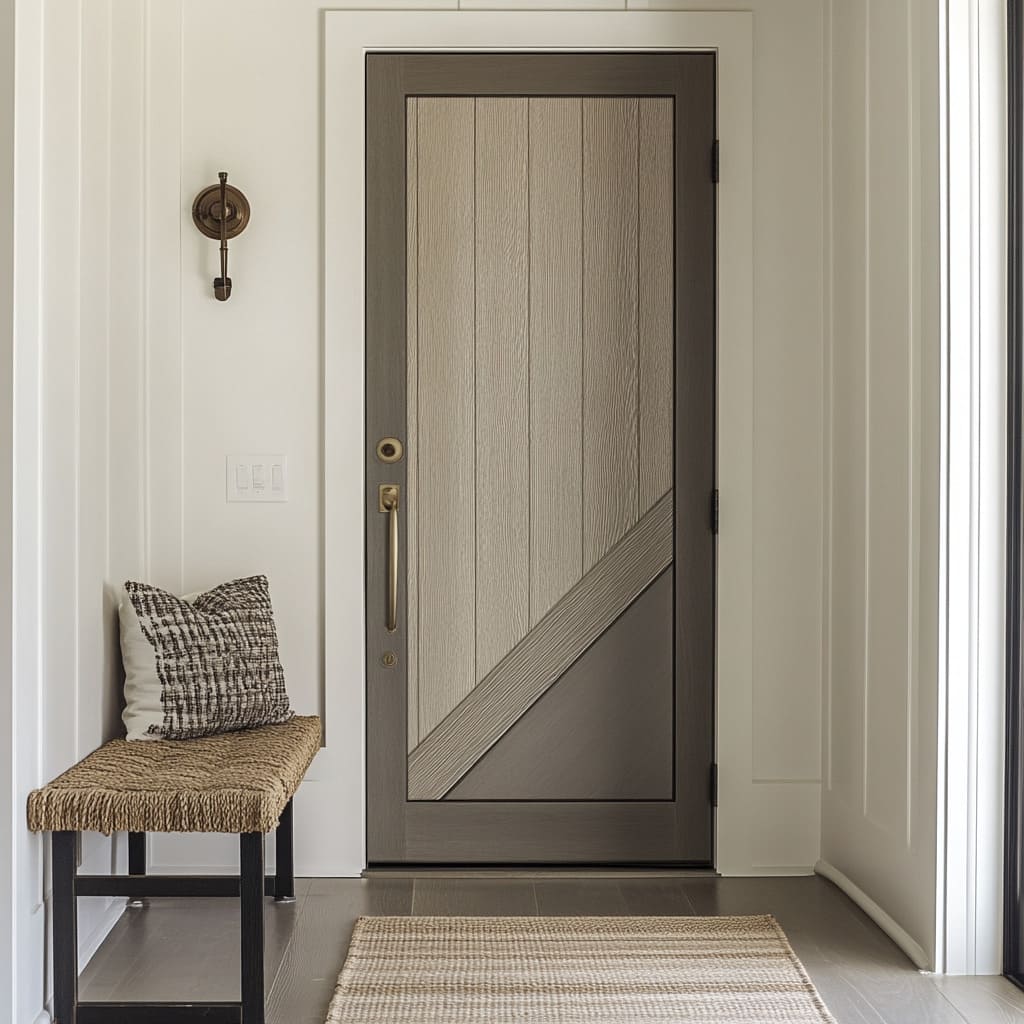
C – Vertical Stripe Structures
Mixed-tone vertical planks forming clean rhythmic panels that feel handcrafted yet orderly.
D – Subtle X Arrangements
X-shapes made without heavy beams, relying only on grain direction and plank alignment.
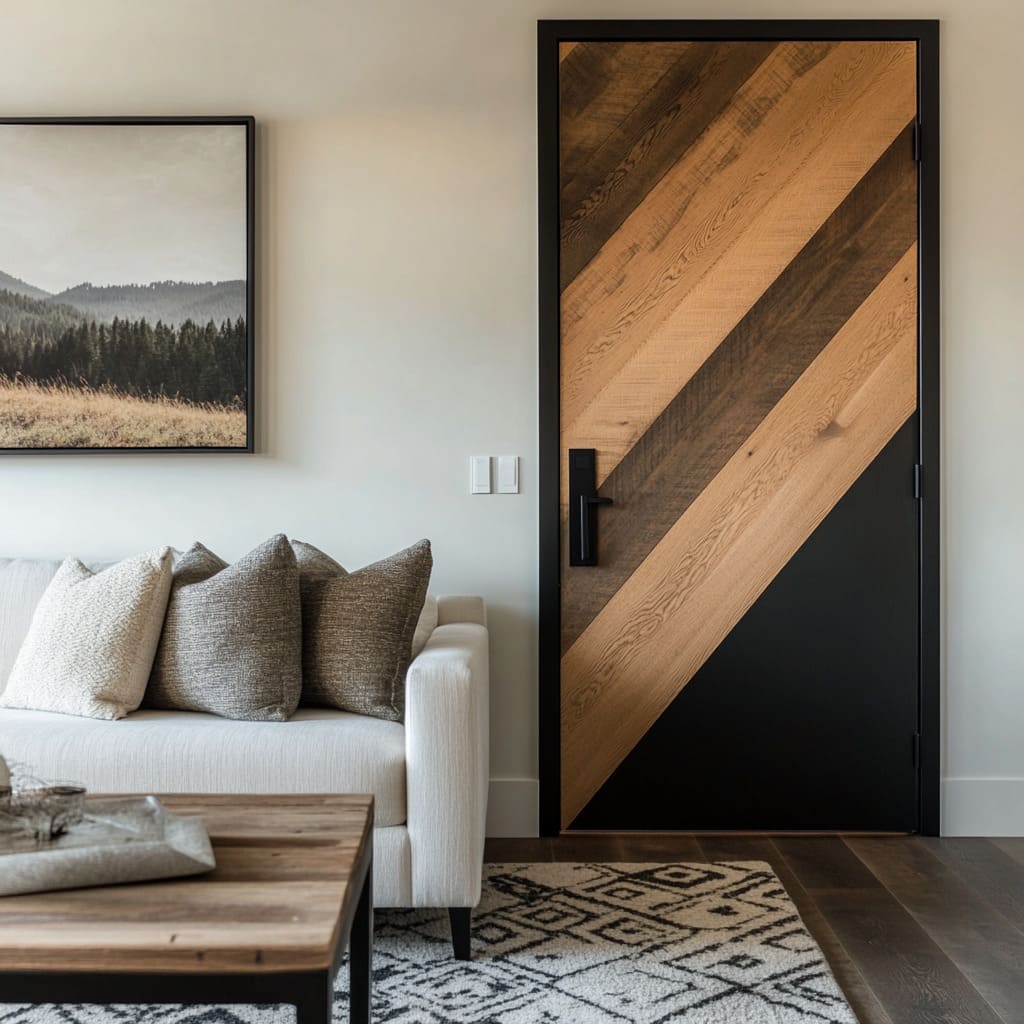
These pattern families shape the overall visual personality of farmhouse interiors: some designs get a confident graphic gesture; others receive a very soft rhythmic motion that blends into the architectural envelope.
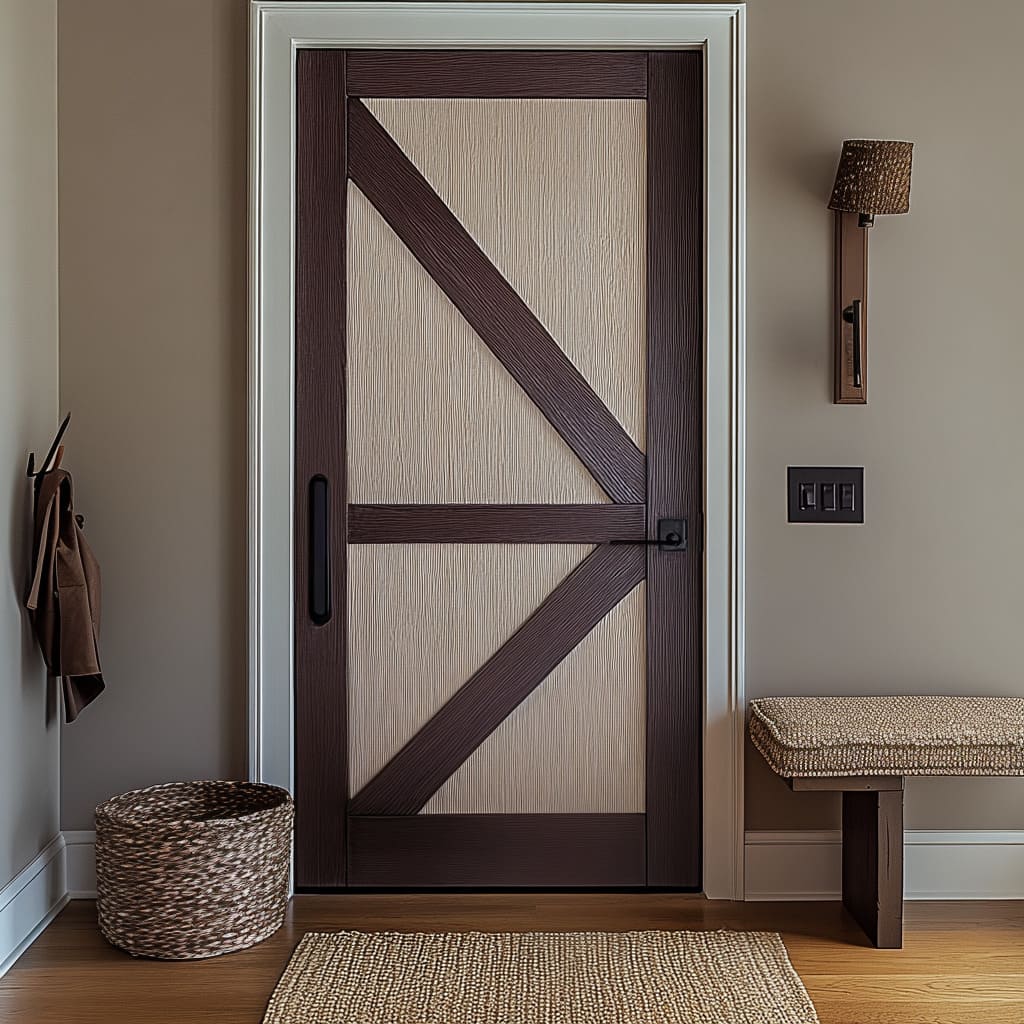
Spatial Roles: How Doors Shift in Importance Across Different Rooms
Farmhouse doors take on different roles depending on where they sit.
- Entries often carry diagonal or tonal directional planks that offer a small moment of interest as one enters the home.
- Dining Rooms frequently feature chevron or cross-pattern doors because the door becomes part of the scene, standing beside large tables and pendant fixtures.
- Living Rooms host bolder striped or multi-tone doors that behave like quiet focal points complementing fireplaces, woven rugs, or structured seating.
- Bedrooms favor pale vertical planks, dusty muted colors, or gentle grain that feels restful.
- Utility or laundry zones often welcome high-contrast compositions, where dark stripes or black hardware help the door stand out among cabinetry and appliances.
This functional distribution shapes how each door’s pattern, tone, and hardware are chosen.
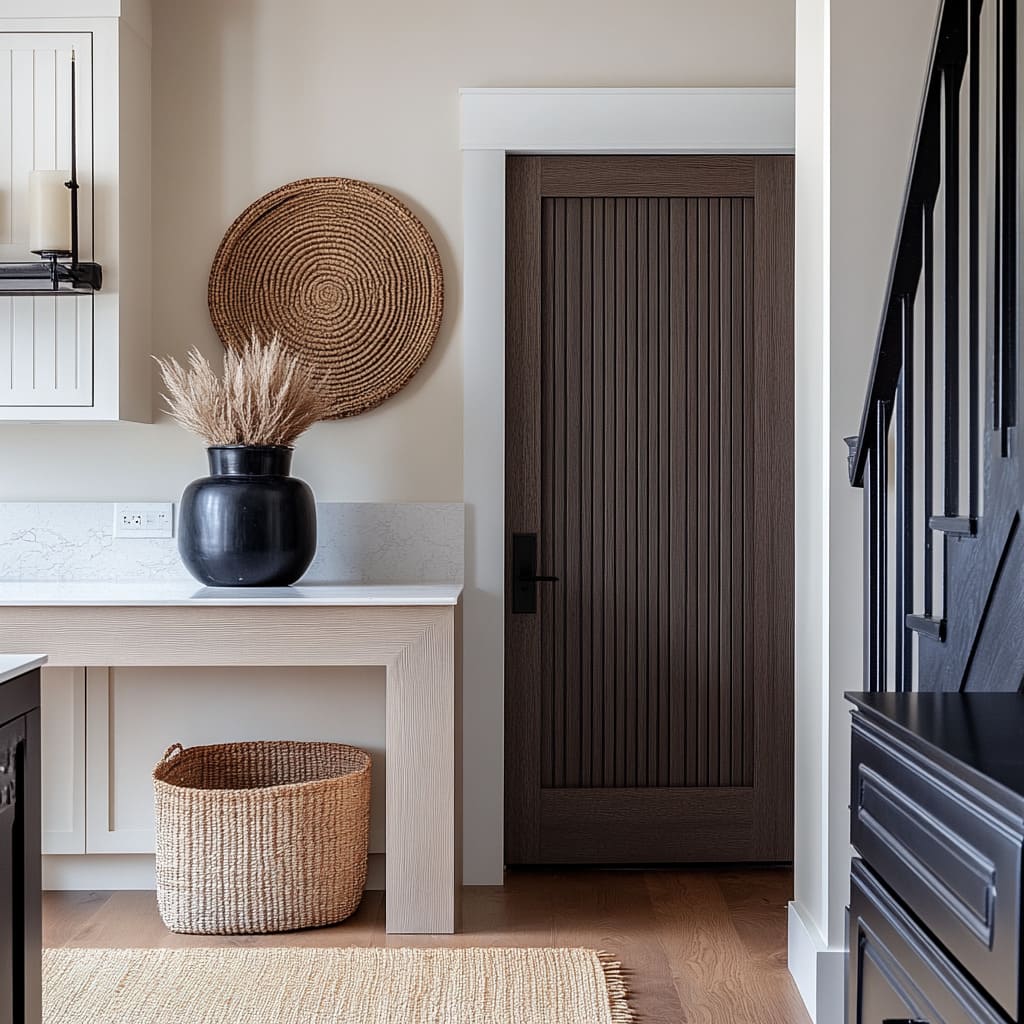
Material Combinations and Textural Dialogue
Modern farmhouse interiors rely heavily on natural materials; doors contribute to this palette by connecting multiple elements in one surface. Warm woods echo woven pendant lights.
Matte black handles connect to nearby black frames. Taupe trims tie to warm ceramics sitting on kitchen shelves.
Pale painted panels relate to stone-toned backsplashes or light rugs. Grain variation echoes the organic lines in wooden consoles or floating shelves.
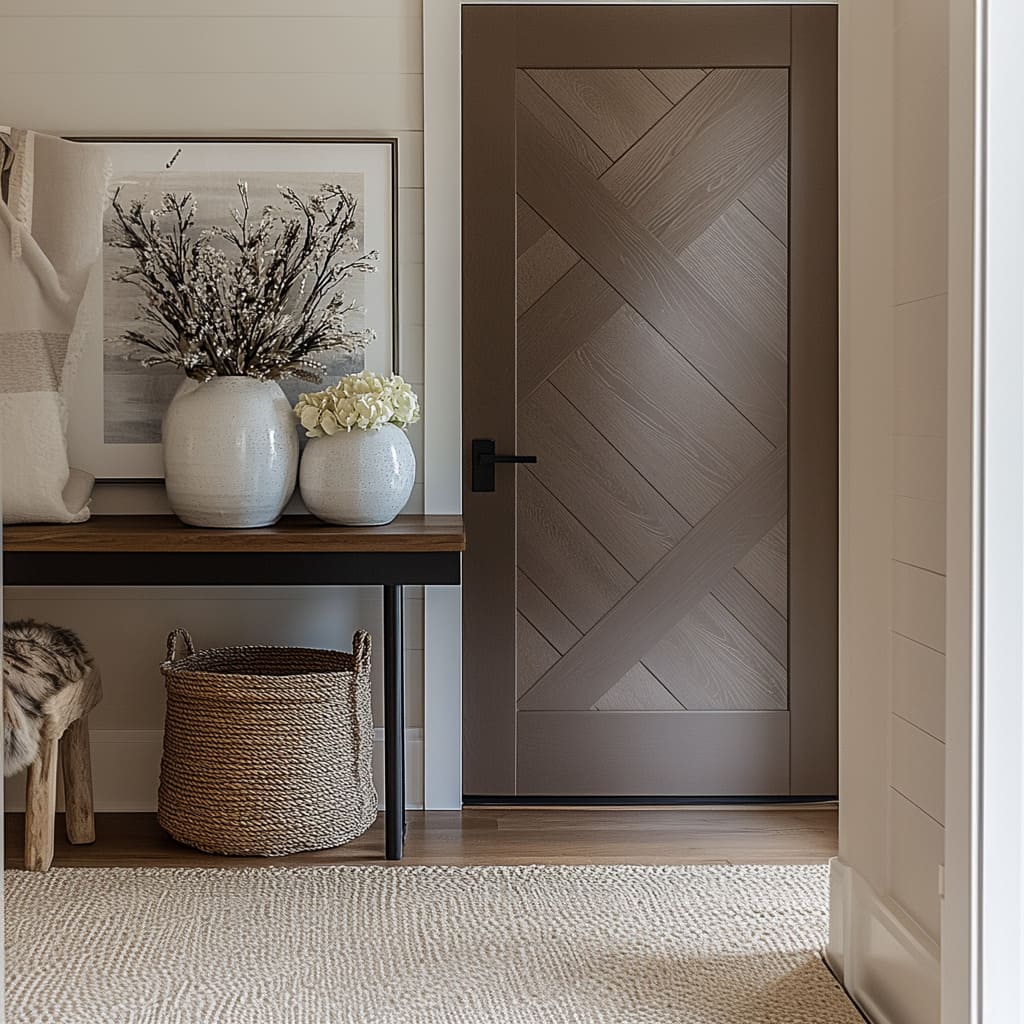
Common material links include:
- Pale wood doors + white shiplap
- Multi-tone striped doors + abstract artwork
- X-pattern oak doors + woven jute rugs
- Ribbed mid-brown doors + round woven wall trays
By repeating textures in quiet ways, doors become part of a layered natural language.
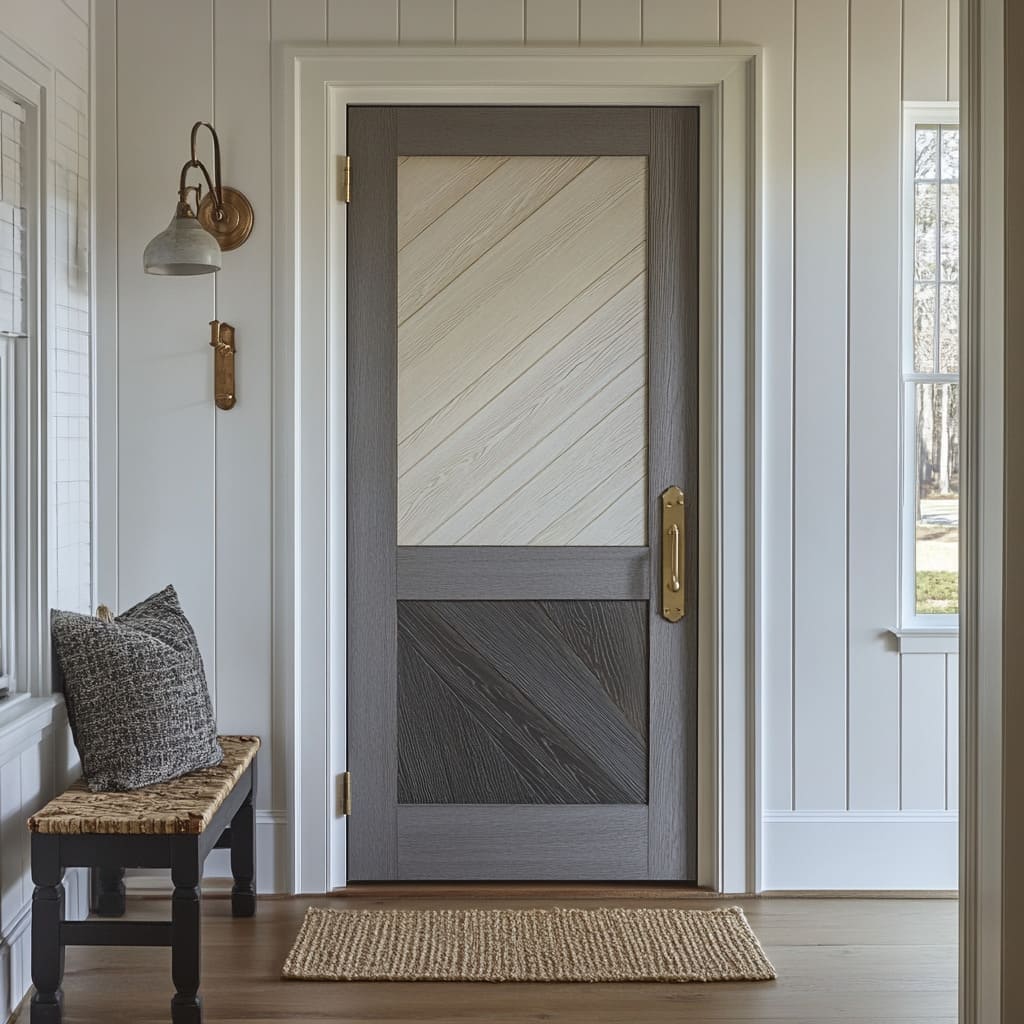
The Door as a Visual Anchor
The farmhouse door can become a small architectural statement—less about rustic history and more about composition, proportion, and the tone of the space. Many farmhouse interior door ideas position the door as the bridge between cabinetry colors, flooring tones, upholstery, and lighting.
Multi-tone plank doors echo the warm and cool elements inside a living room. Chevron doors reflect the slow movement of dried florals on a sideboard.
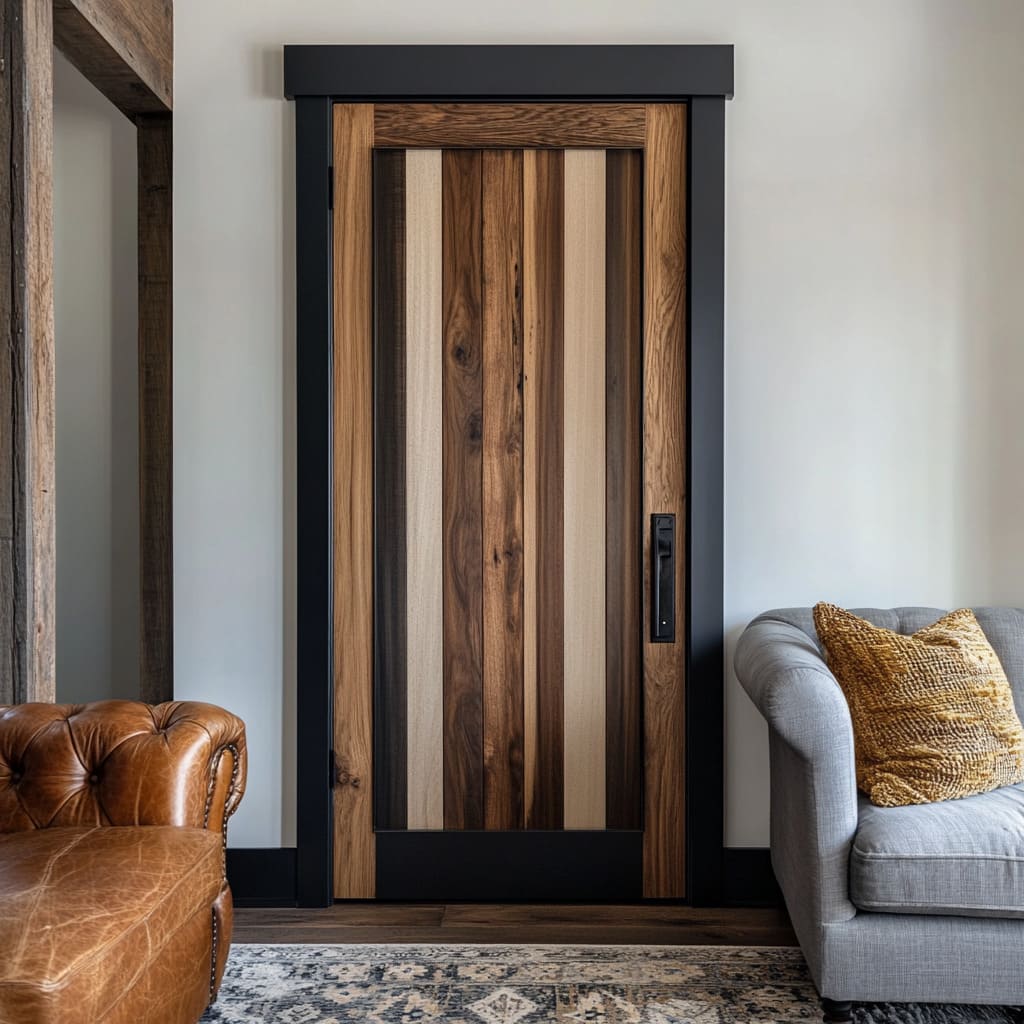
Ribbed vertical panels resonate with woven baskets or tall stems in vases. Even minimal sliding panels in extremely light wood operate like quiet breathing spaces between more decorated areas.
The door is both an accent and a connector, absorbing patterns from one side of the room and echoing colors from the other. Through line direction, tone harmony, grain expression, and proportional clarity, farmhouse doors transform ordinary thresholds into crafted focal points that feel settled and stylistically integrated.
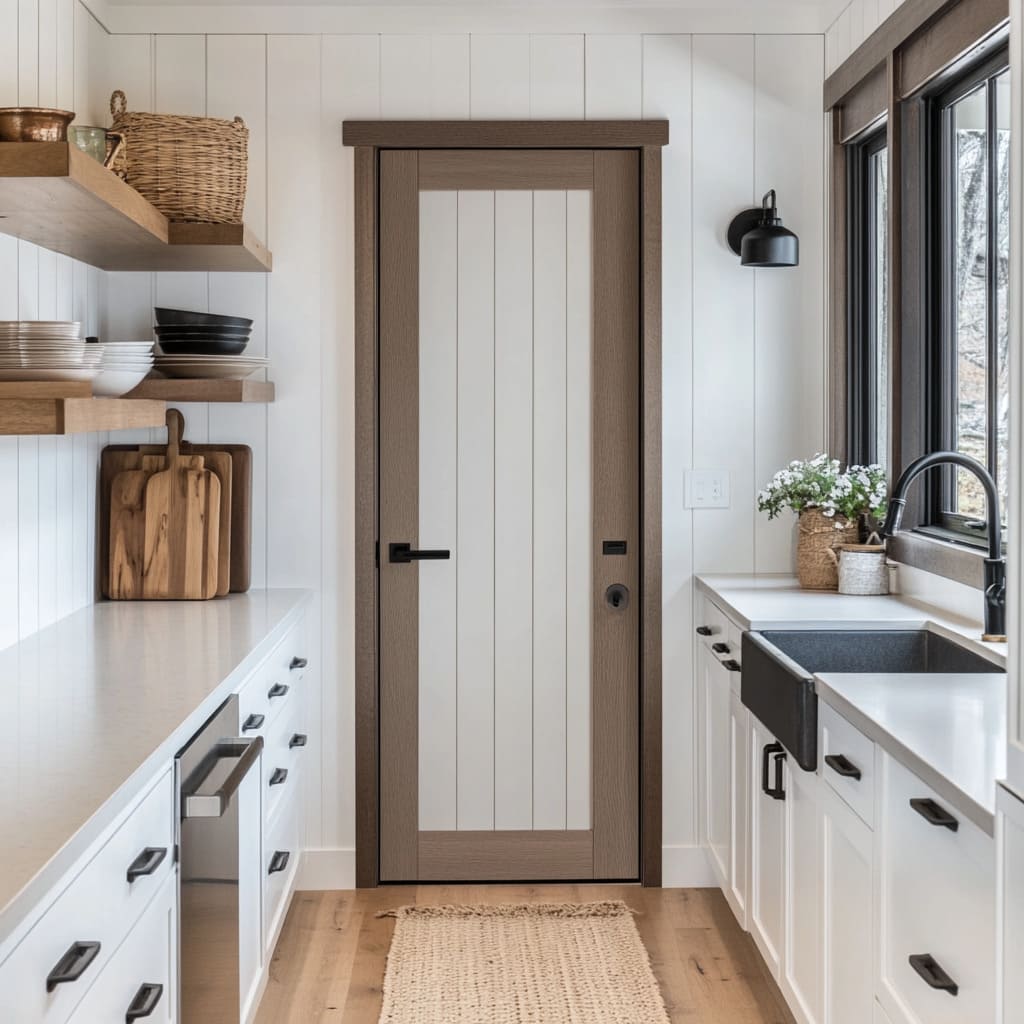
How Farmhouse Doors Carry Identity
While each door carries unique features, they all share a design approach rooted in calm material honesty and controlled styling. Some doors emphasize calm vertical rhythm, others rely on angled intersections or layered stripe narratives, but all of them speak through their surfaces and relationships with surrounding elements.
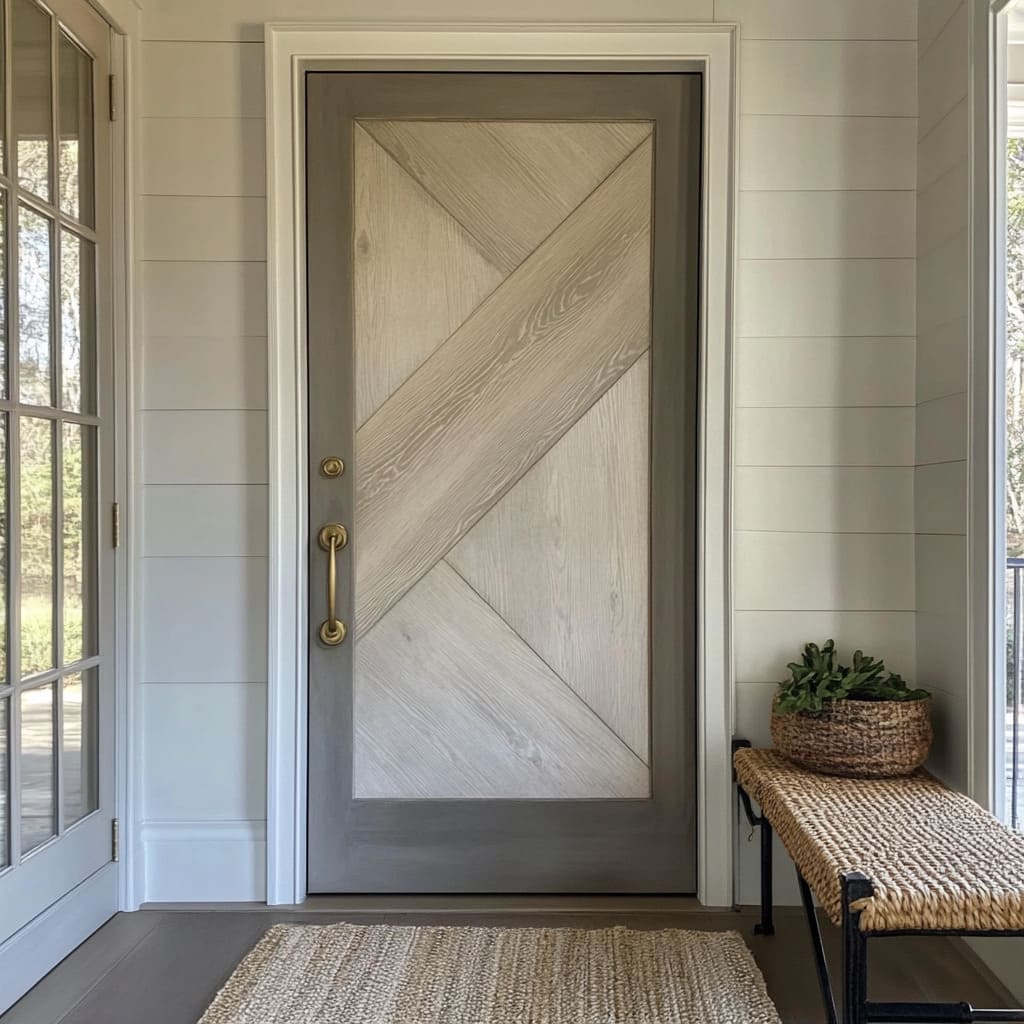
When viewed collectively, they form a broad interpretation of the farmhouse aesthetic—ranging from soft modern minimalism to expressive but curated patterned panels. These designs show how a door can behave as both a practical boundary and a decorative axis line for an entire interior style.
Farmhouse Mood Through Door Composition
In contemporary interior designs, farmhouse style shifts toward softer palettes, refined lines, and thoughtful material pairing. Doors become the perfect medium to express this evolution because they naturally sit between spaces and carry both form and texture.
Whether through a subtle X motif, a chevron field, a multi-tone vertical stripe arrangement, or a block-like mosaic, each door pattern reflects a layer of visual understanding shaped by the home’s atmosphere. Within this evolving language, farmhouse style interior doors bring together calm grain, controlled contrast, refined patterns, and soft natural styling to create interiors that feel grounded and character-rich without relying on heavy rustic cues.