The most interesting thing in many formal dining room ideas is that the “formal” feeling rarely comes from one obvious statement piece. It comes from a system of small visual decisions that quietly organize attention: where the eye lands first, what it reads second, and how the room stays calm even when the table is fully set and people are moving around.
Formality can be built through rhythm, controlled contrast, and a kind of visual etiquette—an invisible code that makes the interior design feel prepared for guests.
A useful way to read such interior design concepts is to look for three hidden roles:.
- An anchor: one dominant element that gives the room gravity (often the table plane, sometimes the ceiling, sometimes the window wall).
- A frame: vertical and horizontal boundaries that “dress” the space (drapery columns, black window grids, coffer lines, tray edges, rugs that behave like stages).
- A softener: texture and shape choices that prevent the room from feeling stern (rounded corners, bouclé loop surfaces, velvet nap, airy branches, porous glass lighting).
What makes the interior design feel high-level is how often the anchor and the frame are doing the heavy work, so the decor can stay restrained without the room looking empty.
What makes a dining room feel formal
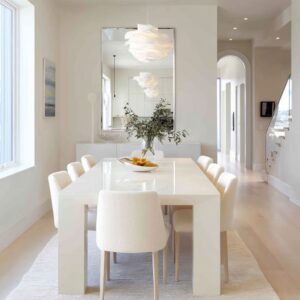
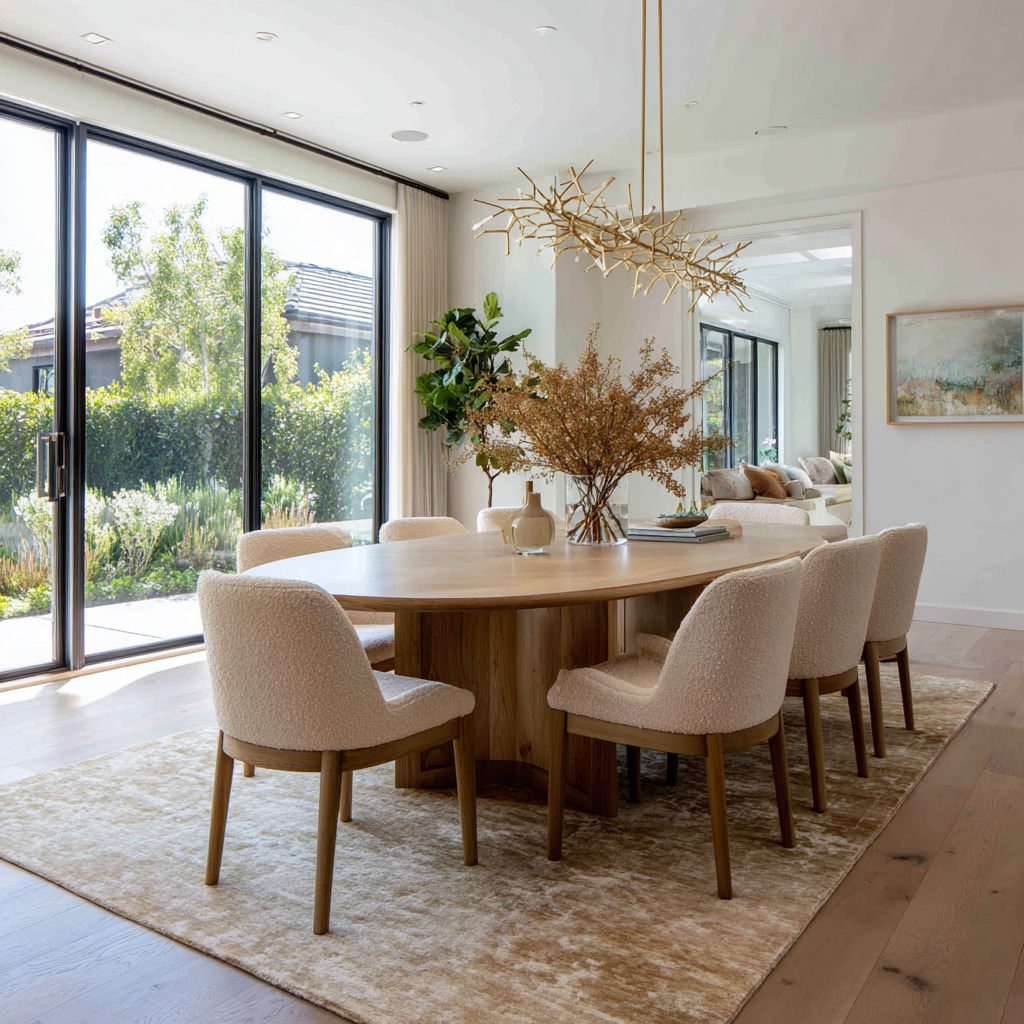
A formal dining room reads “occasion-ready” because the room has a clear order of attention: the table is the anchor, the lighting marks the center, and the perimeter stays edited so the main scene feels intentional. Formal doesn’t require heavy traditional details—your examples prove it can come from restraint, repetition, and material depth: one confident table plane, chairs that form a clean rhythm, and lighting that creates a flattering evening layer.
A simple checklist you can scan in 10 seconds
- Symmetry or disciplined alignment: major elements line up (table, light, sideboard, art).
- Fewer, larger statements: one oversized art piece beats many small frames (see your gallery-scale art wall moments).
- Controlled palette: either calm neutrals with texture (bouclé + warm wood), or one saturated accent used on purpose (deep blue drapery, teal chairs).
- Richer surface behavior: matte stone, honed slab tops, velvet/chenille depth, micro-texture weaves.
- Layered lighting: overhead + soft side glow (pendants/chandelier plus sconces or lamps).
- A “stage” boundary: rug and/or ceiling detail that frames the dining zone.
Two common mistakes
- Making the room “busy-pretty” with many small items instead of one scaled focal moment.
- Choosing a formal table + formal light, then leaving the perimeter blank (no sideboard, no art, no drapery), which makes the room feel unfinished.
Formality as visual choreography: axis, procession, and arrival
A subtle pattern repeats: the strongest interior design concepts behave like they have an “arrival sequence,” even when you’re already standing inside them. Long tables, lengthwise ceiling planks, coffer grids, and pendant rows all pull your sightline in one direction.
This creates a quiet sense of ceremony because the room feels composed around an axis, not sprinkled with objects.
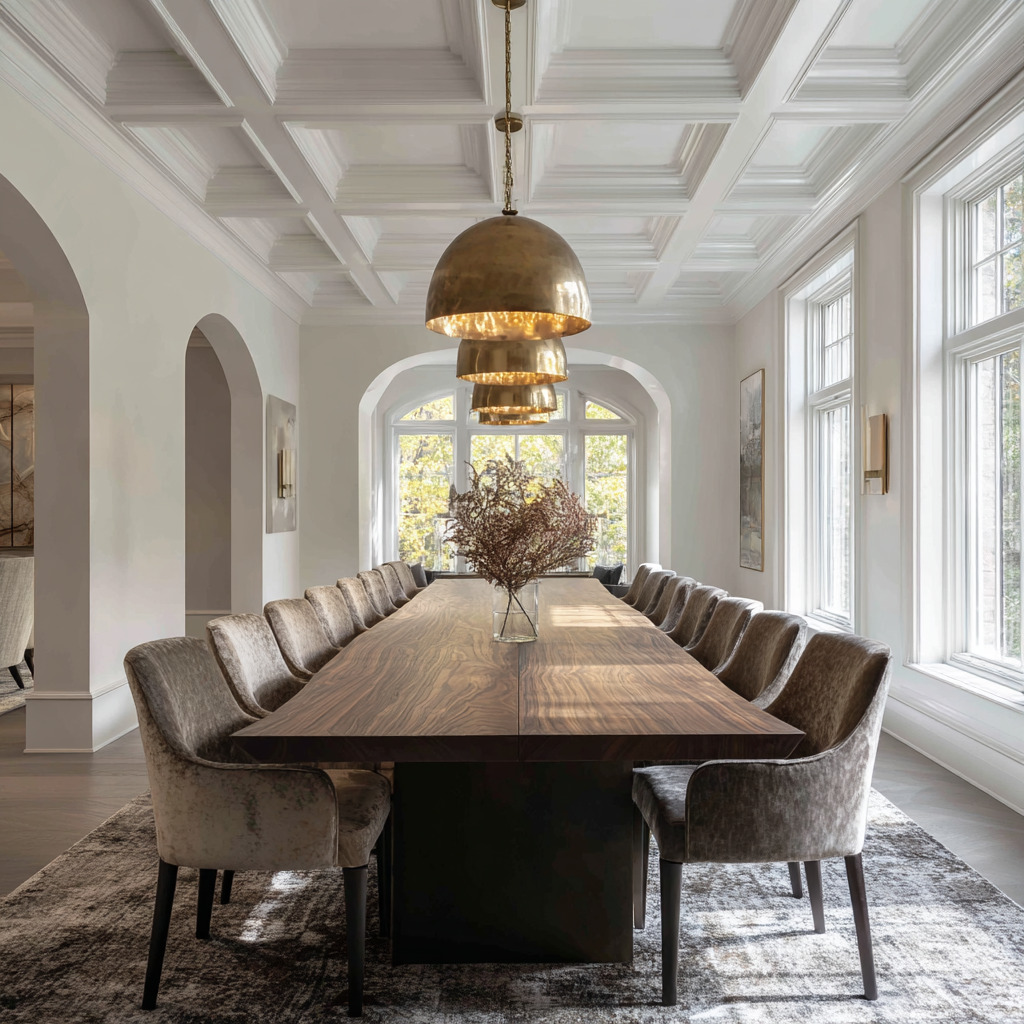
That axis is reinforced in several ways:.
- Repeated openings or layered views (arches, corridors, glimpses into the next lounge) add depth that reads like a hosting narrative: dinner is one chapter, not the whole book. The dining area feels important because it sits inside a larger, curated flow.
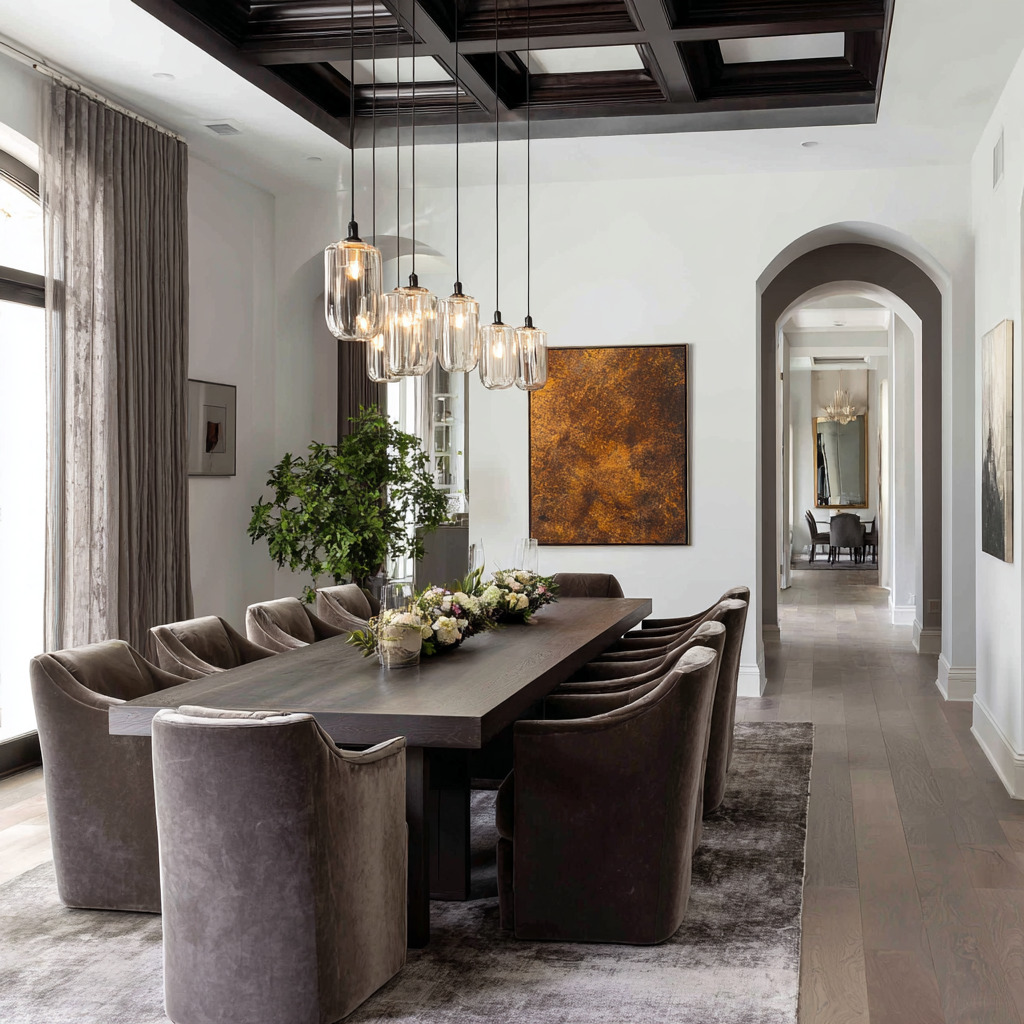
- Lighting arranged in a row turns the table into a runway of attention. It stops the common “one fixture floating in the middle” problem and instead gives the full length of the table equal status. Visually, it removes the accidental hierarchy of “best seat under the light.”
- Ceiling features that align with the table do something even more powerful: they imply that the table was placed where it belongs, not where it fit. When ceiling lines agree with table orientation, the room reads intentional before you even notice furniture.
This is why a space can feel formal without ornate trim or a traditional chandelier silhouette. The room is “formal” because it has clear visual order—like a well-composed photograph where every major line supports the subject.
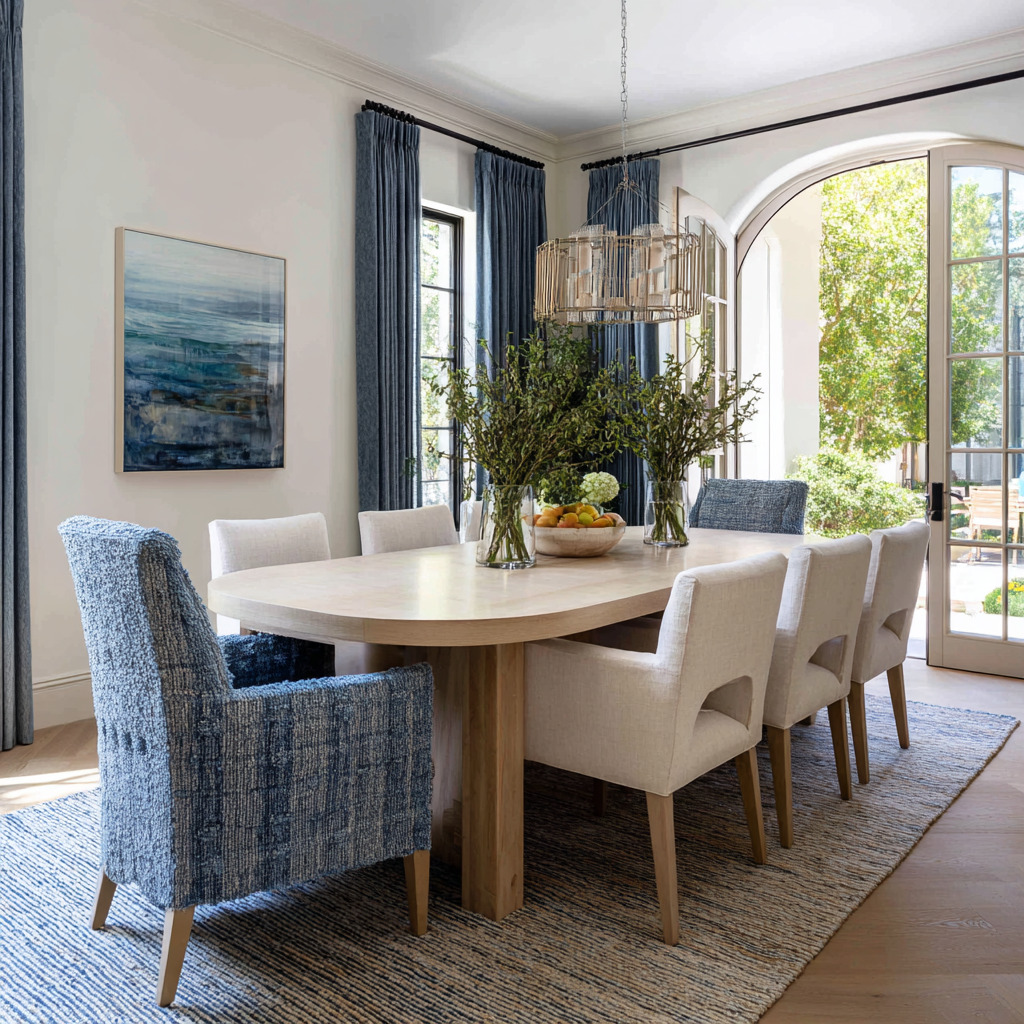
The table plane as a social signal
The tabletop isn’t only where dinner happens. It behaves like a horizon line—an element that sets the emotional tone of the entire scene.
Thickness reads as permanence
A thick top (wood slab, pale stone-like plane) immediately communicates importance. Not because it is heavy in a literal sense, but because it looks non-temporary.
Thin tops can read nimble and casual; thicker ones read established. That “established” feeling is one of the quiet roots of formality.
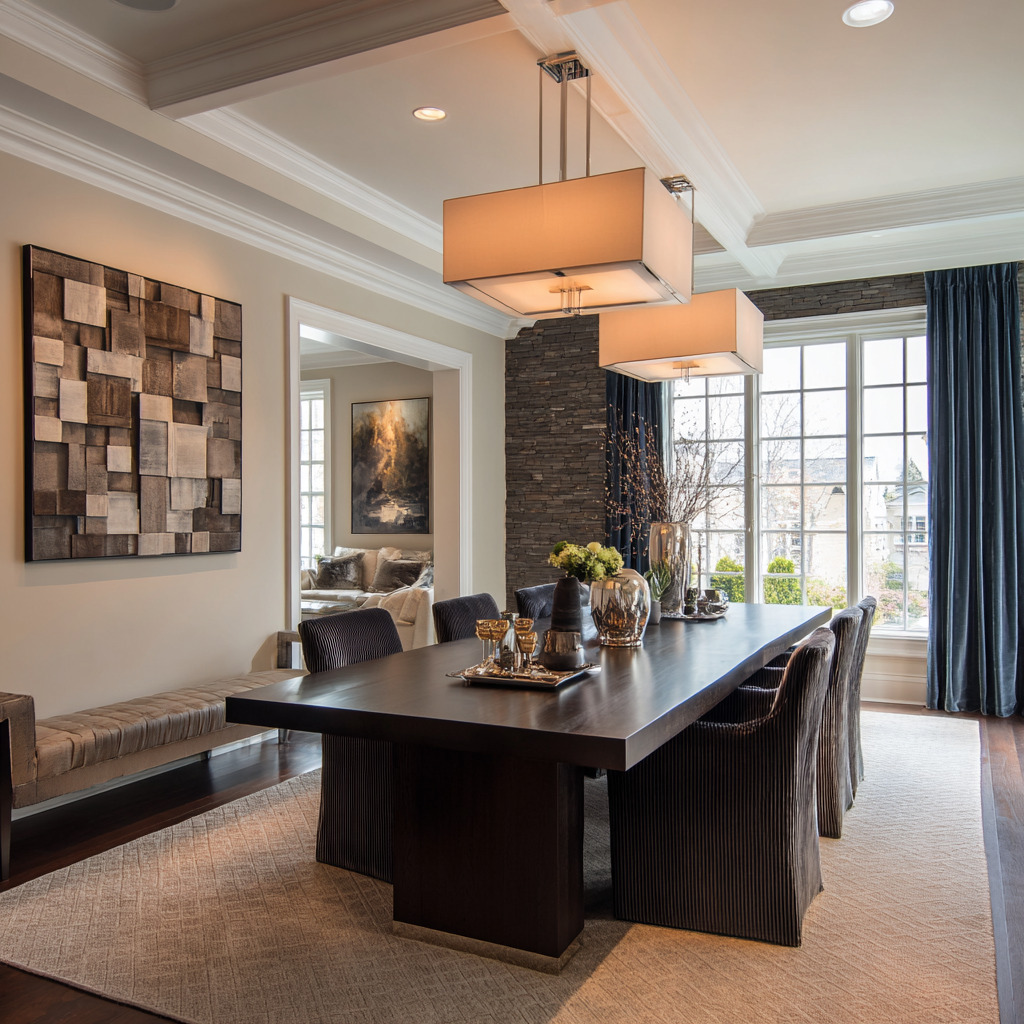
Matte vs. reflective is mood control
Interior design can use reflection like a dial:.
- Matte, low-gloss planes make daylight feel gentle and evenly spread, creating calm. They keep the room from looking shiny or restless.
- Softly reflective planes create a polished impression, but the best examples avoid mirror-like glare. Instead, the surface holds light as a mild shimmer—enough to feel refined, not enough to become the main event.
The interesting point is that reflection often substitutes for decoration. A softly reflective tabletop can provide “activity” without adding objects.
The room feels alive because light moves on the surface.
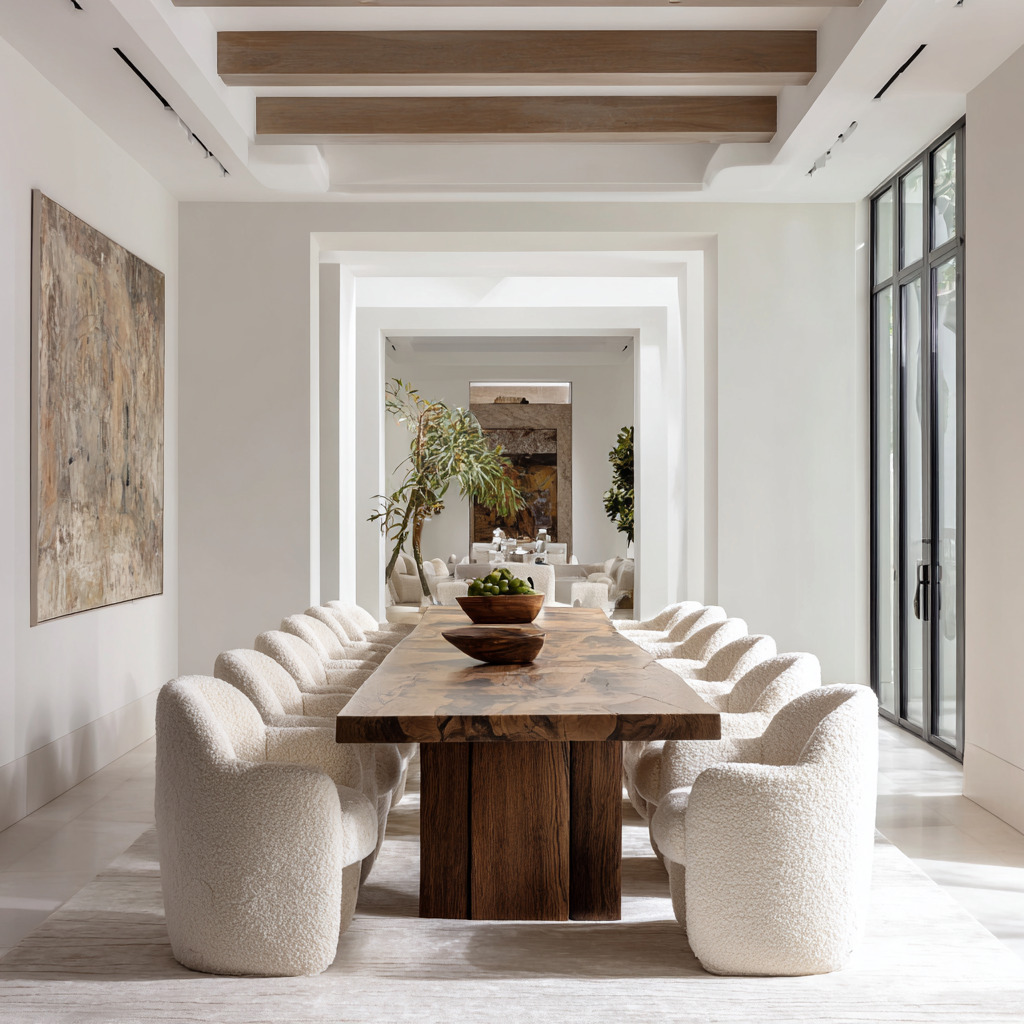
Edge character changes the room’s posture
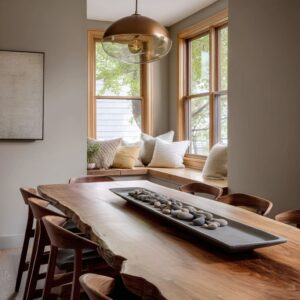
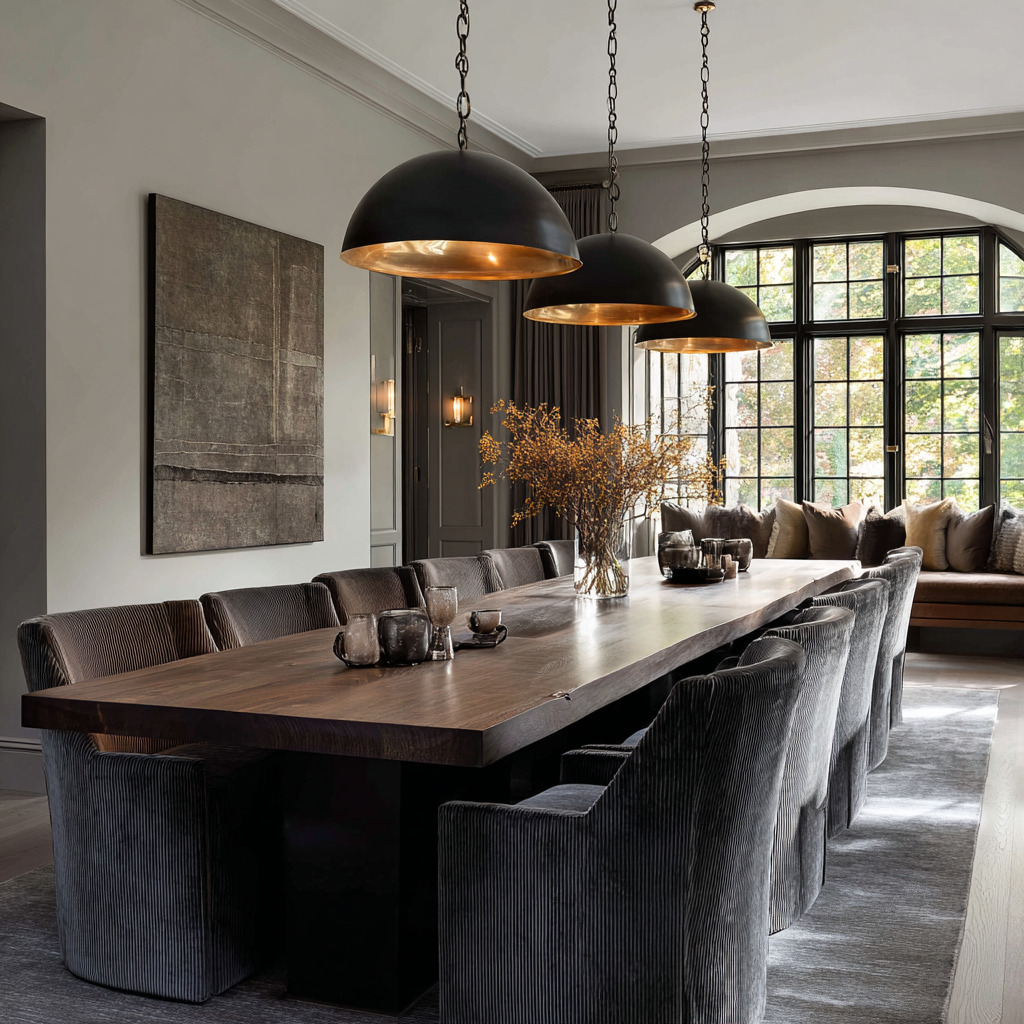
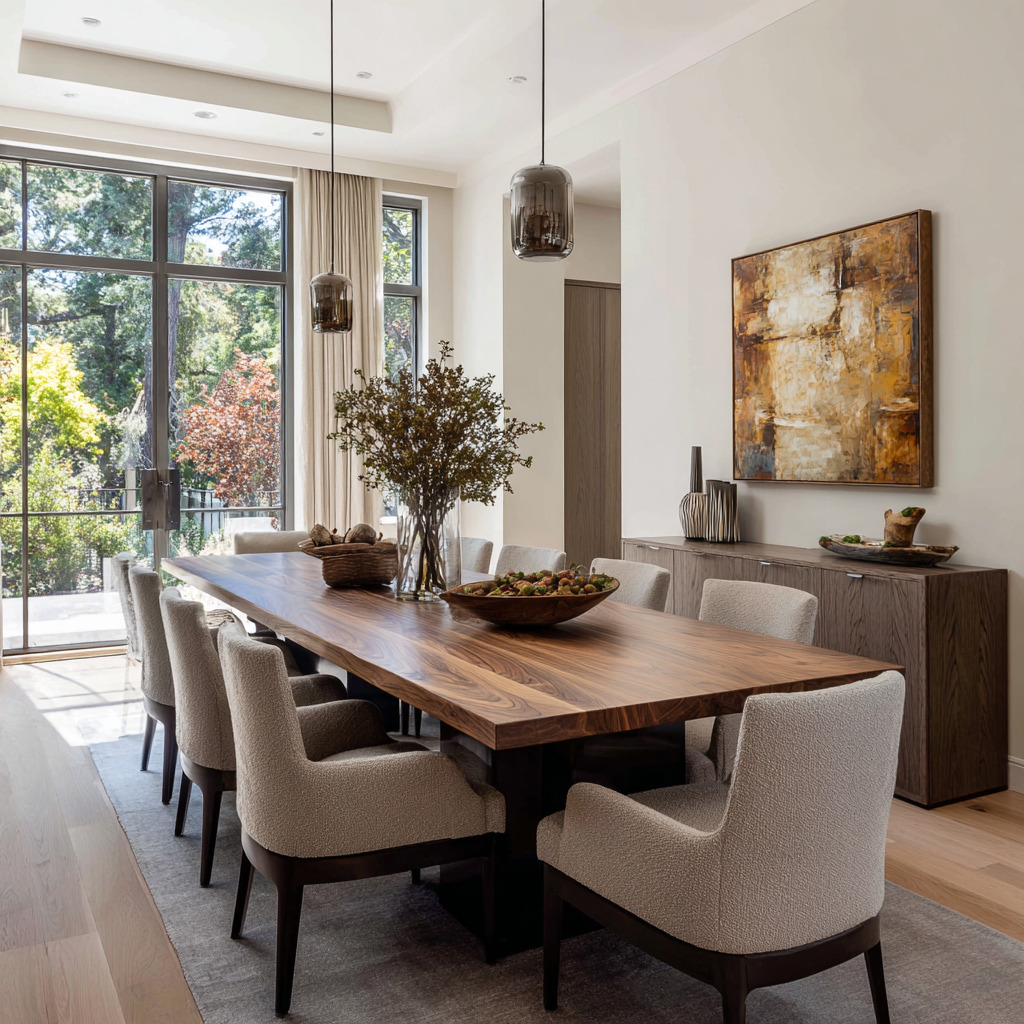
A crisp edge reads precise and serious; a live edge reads human and grounded. The stronger rooms use live edge as a softening device, not as rustic styling.
The formality is still there because the table remains monolithic and centered; the organic perimeter simply prevents the interior design from slipping into boardroom stiffness.
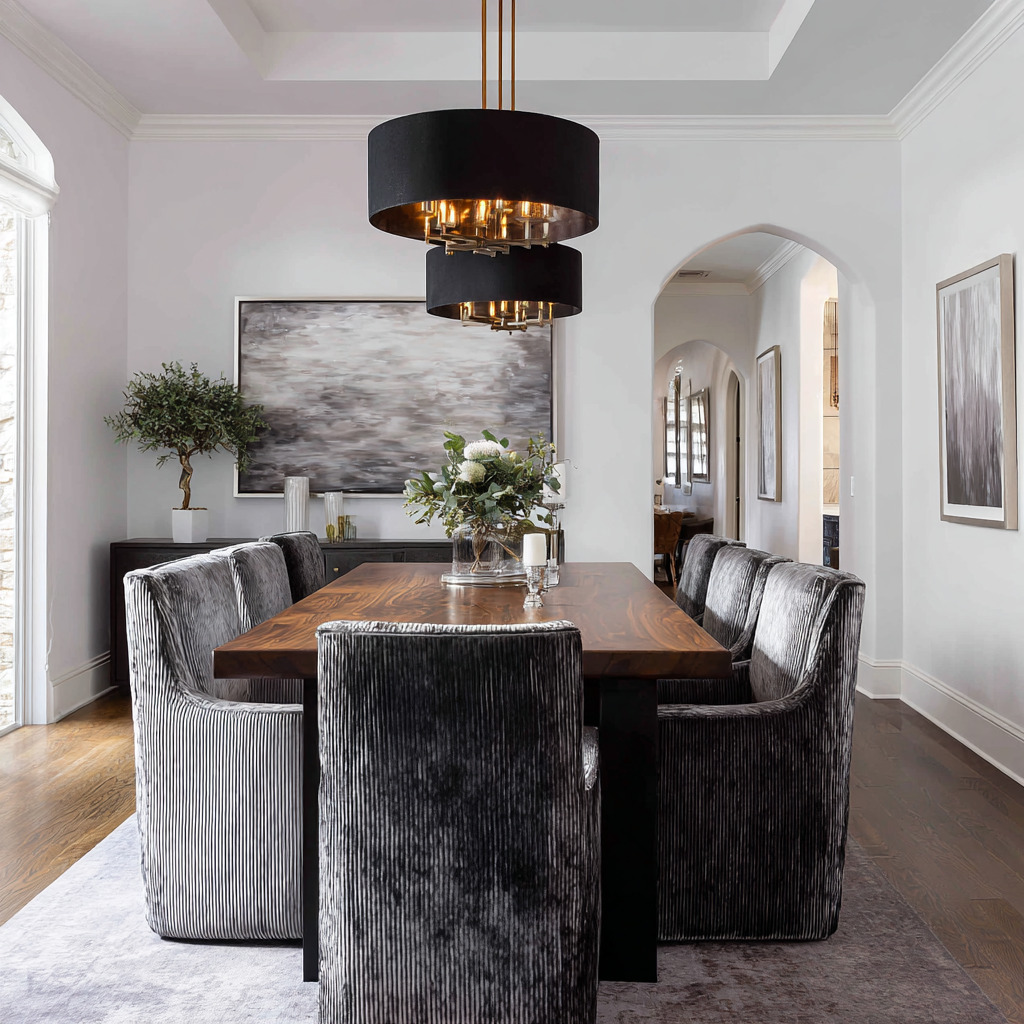
Chair upholstery as the room’s “clothing,” and why micro-texture matters
If the table is the anchor, chairs are the emotional temperature. Many of the most non-obvious luxury signals come from upholstery surfaces that behave differently under light.
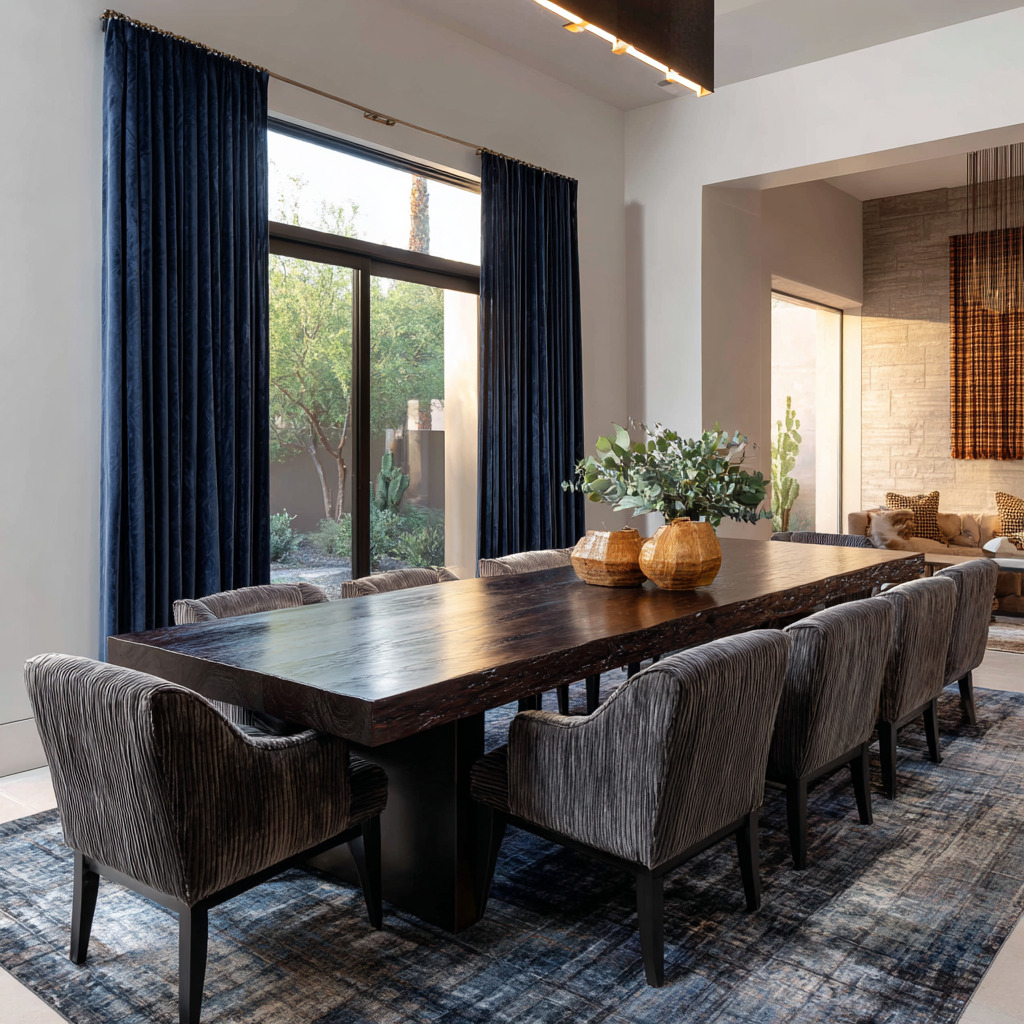
Velvet and nap: controlled movement
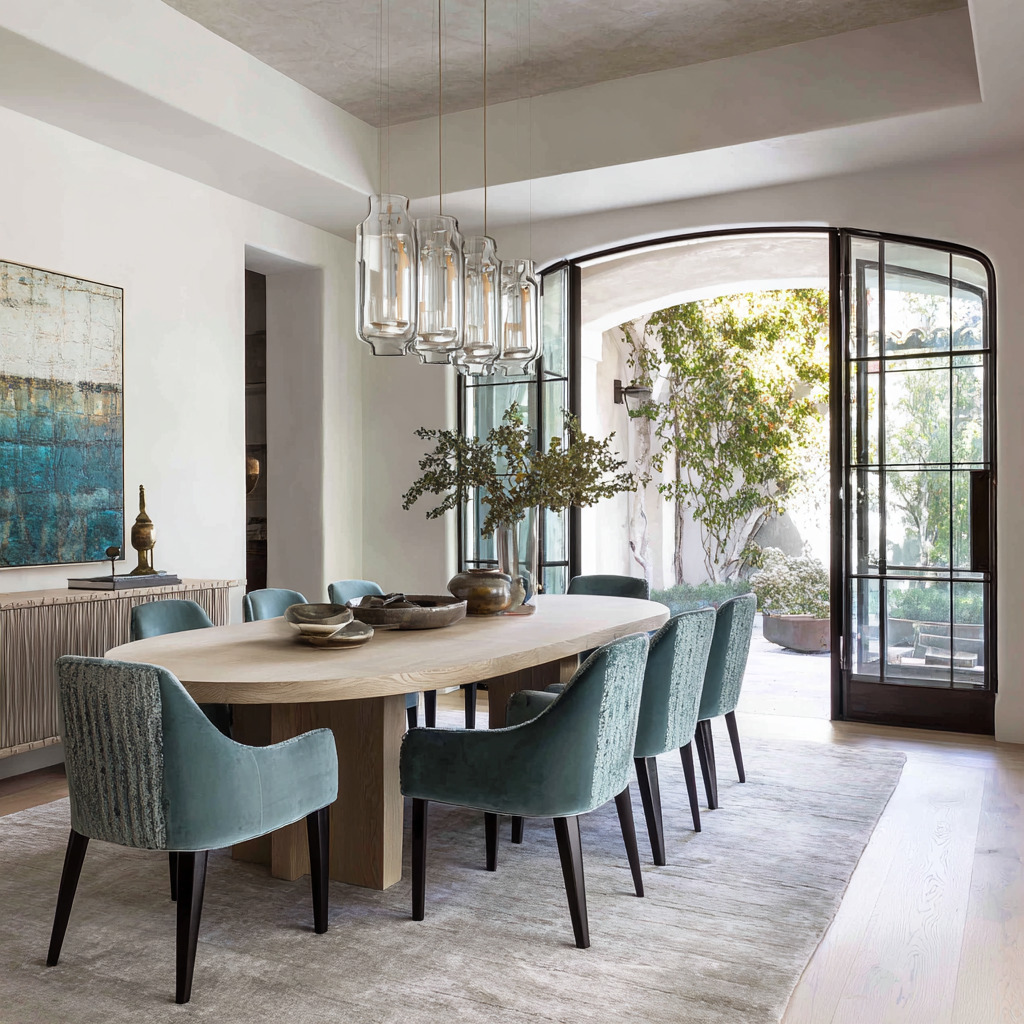
Teal velvet, smoky velvet-like seating, and ribbed channel upholstery all share a similar advantage: the surface changes as you move. That creates depth without pattern.
In formal rooms, that’s a big deal because bold pattern can easily turn the scene busy—especially when the table is set with plates, glasses, and candles.
- Ribbing/channeling adds shadow lines that function like built-in ornament. It makes a “plain” chair look rich once warm lighting turns on.
- Mottled velvet/patina-like textures keep saturated color from looking flat. The color feels layered—cool in shadow, warmer where light grazes it—so the chair becomes a color field with dimension.
Bouclé: softness that still reads composed
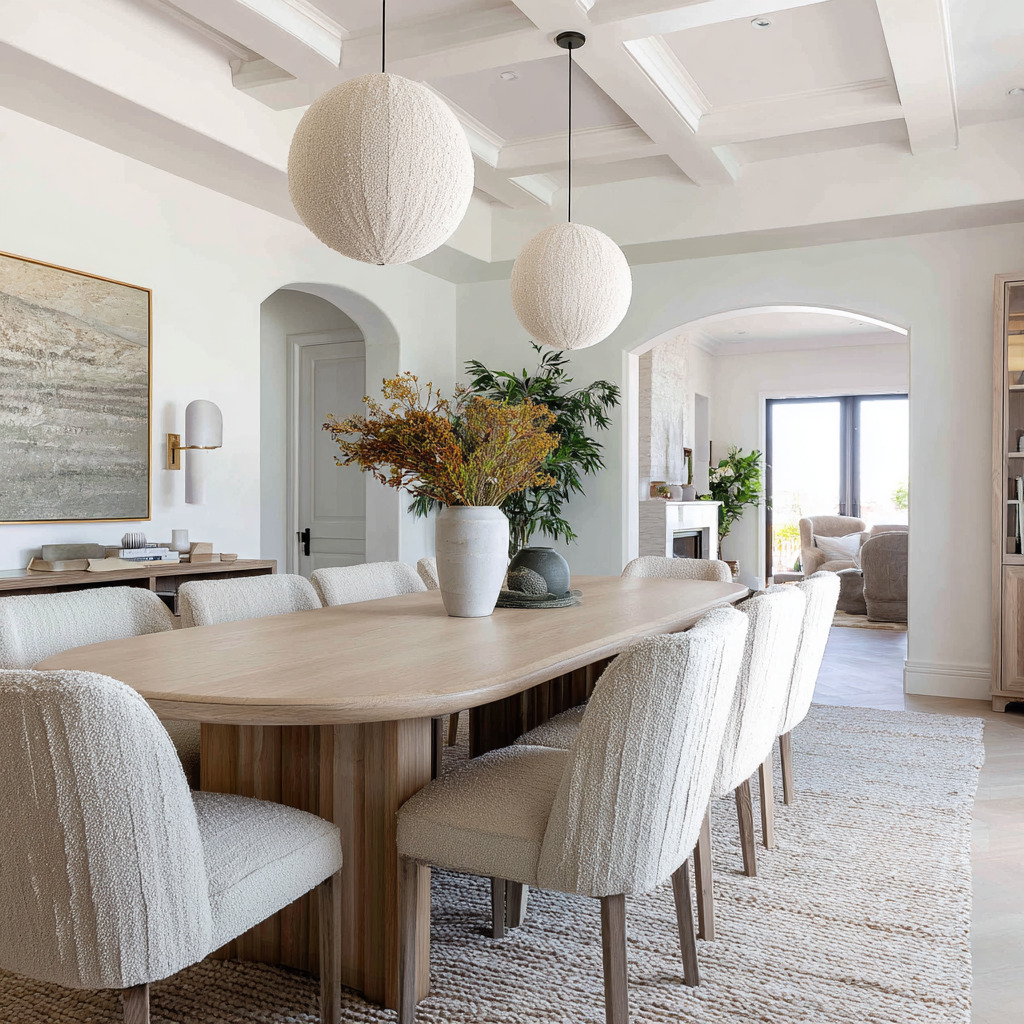
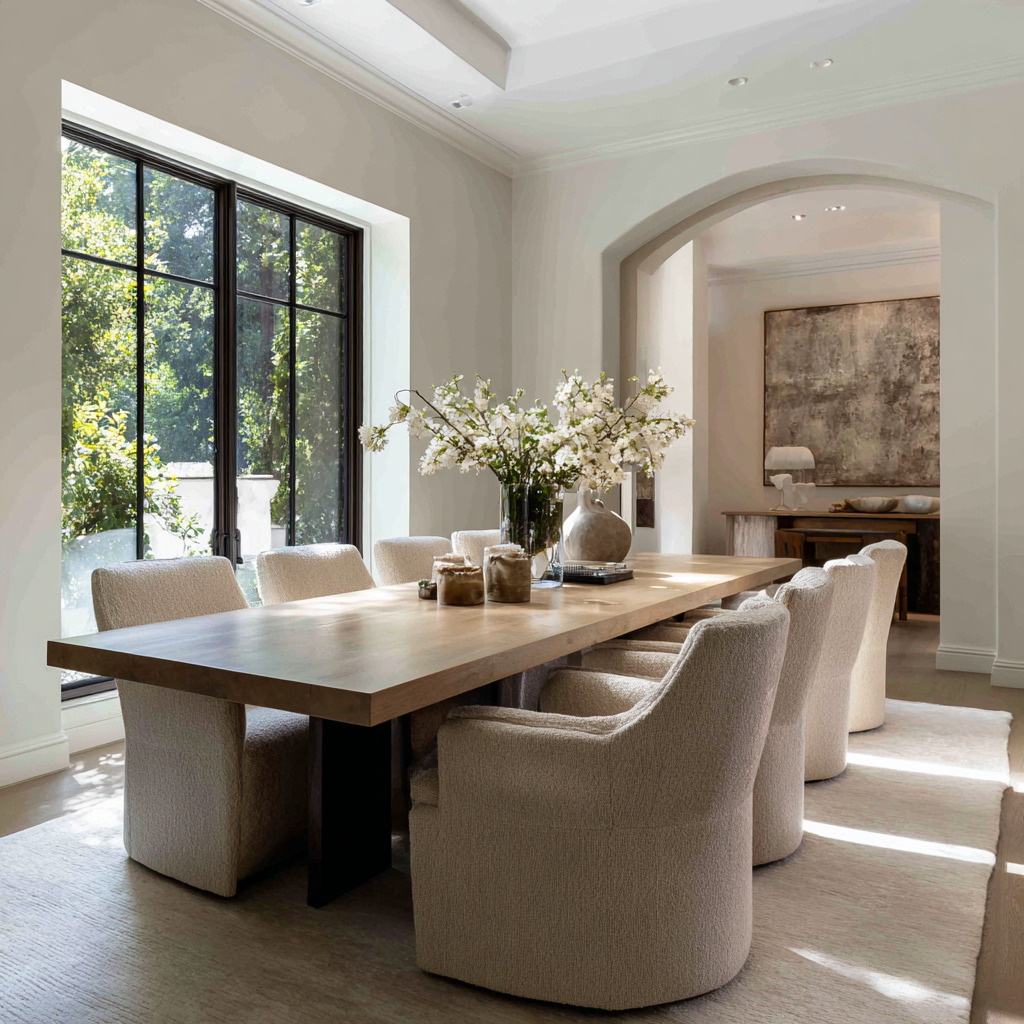
Bouclé appears repeatedly, but the stronger versions are not fluffy or casual. They read dense, compact, and consistent in loop scale.
That density is the difference between “cozy” and “refined. ” It gives comfort while still looking intentional.
Bouclé also performs a subtle balancing act in bright rooms: it adds shadow and visual weight without adding darker color. So the palette can stay light while the seating still feels substantial.
Mixed upholstery: social hierarchy without clutter
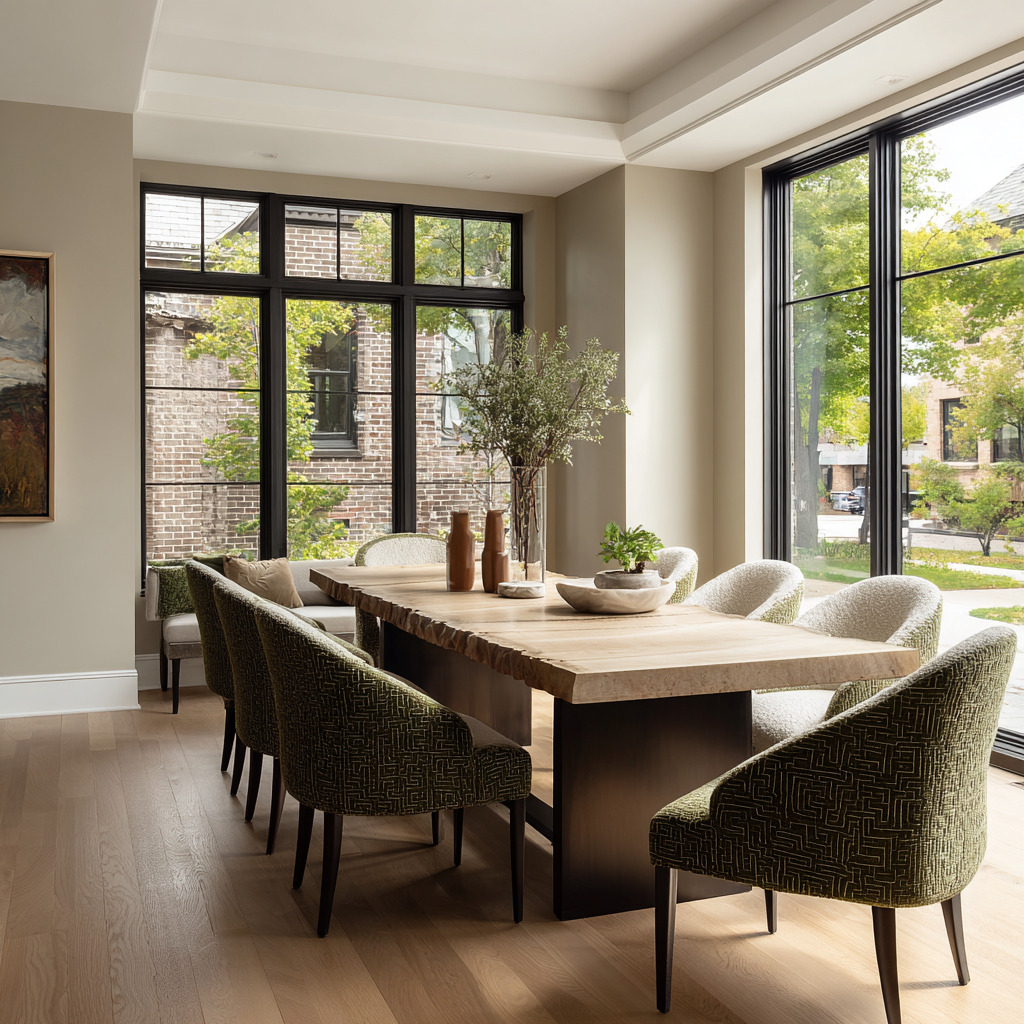
The most sophisticated “mix” moments are not random. They place a patterned or darker chair family where structure is needed (often on the long sides), while lighter or looped upholstery appears where softness is needed.
The mix reads designed because it creates a controlled dialogue: structured texture on one side, cloud-like texture on the other, all held together by repeated wood tones or repeated silhouettes.
This is one of the clearest examples of contemporary formal dining room ideas thinking like composition rather than matching sets.
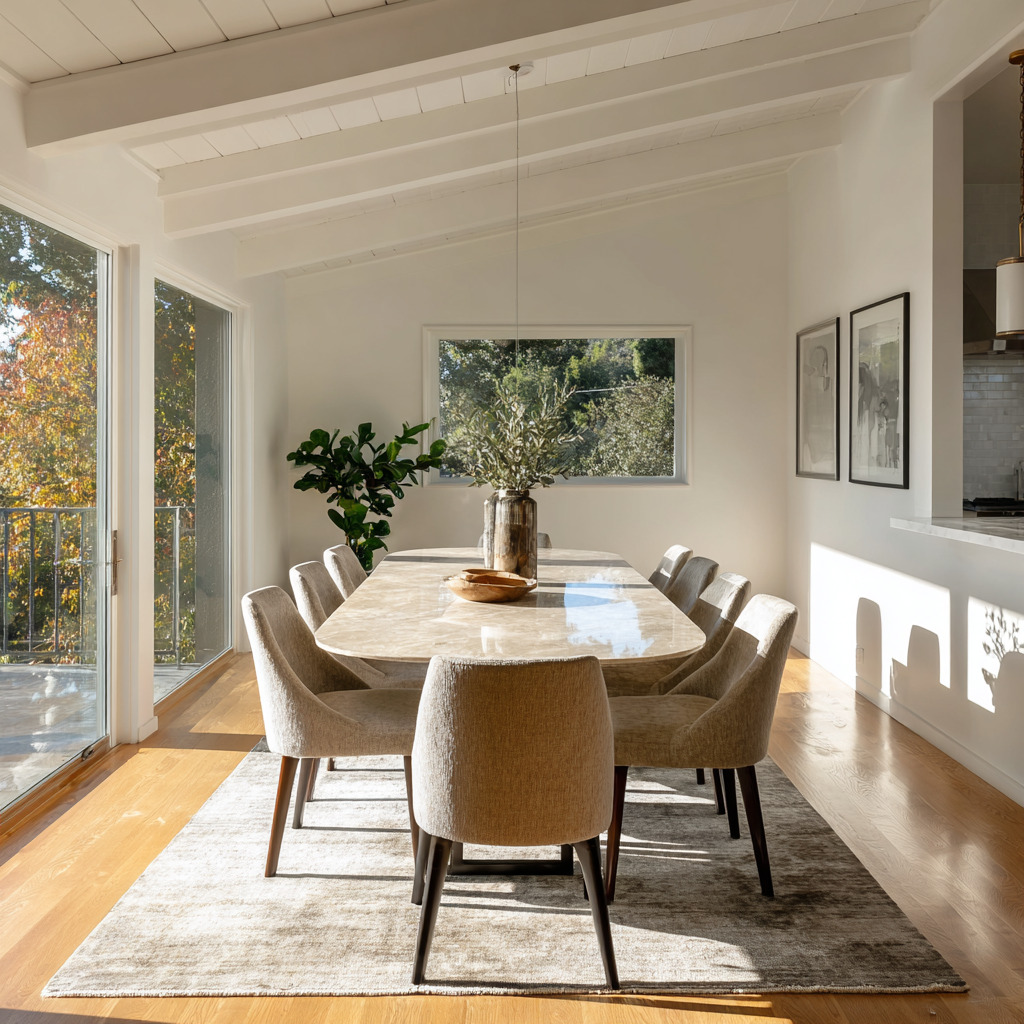
The lower-half “shadow band”: why calm floors look expensive
One of the least discussed ideas in formal dining styling is that the room often becomes calmer when the lower half behaves like a single, quiet mass.
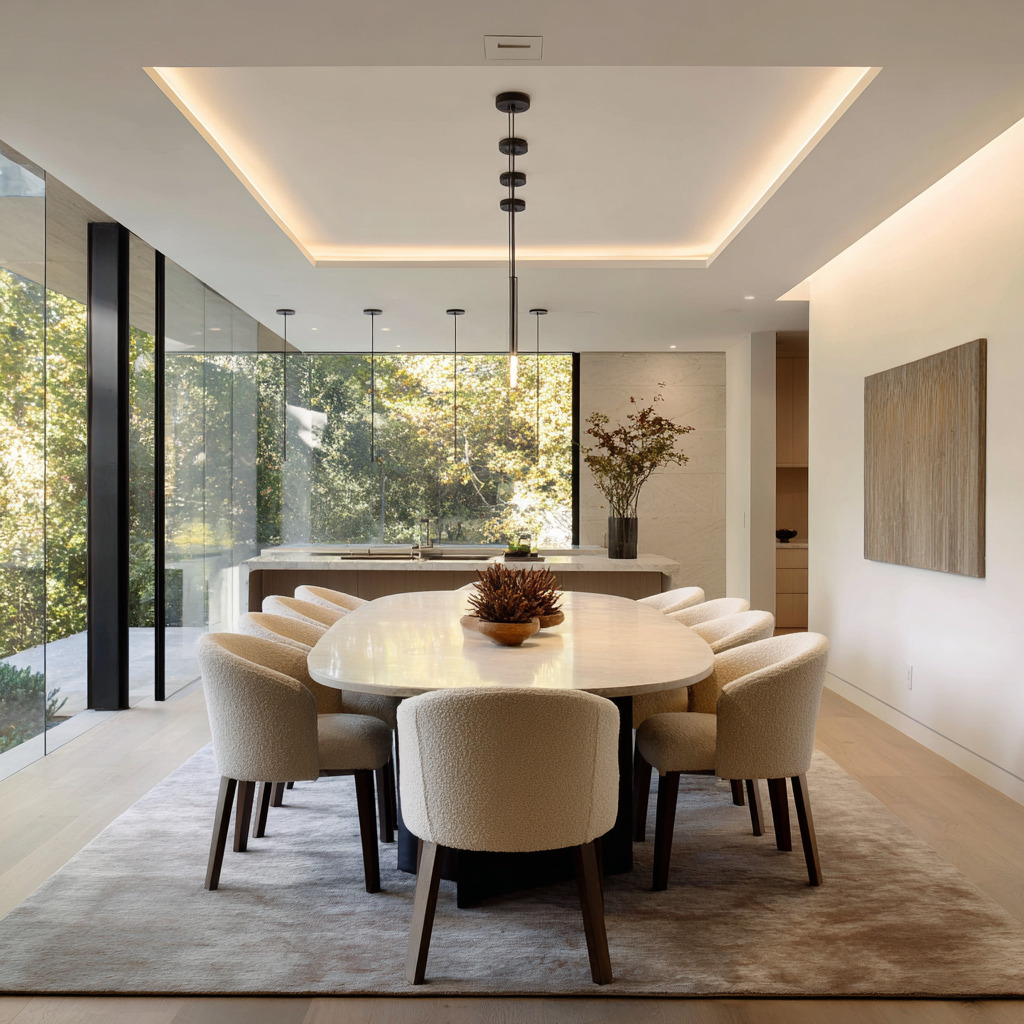
Interior design concepts can do this by:.
- Keeping chair legs and table bases in darker tones so the bottom third of the room collapses into a unified shadow band.
- Using rugs with low-contrast pattern or misty variation so chair movement doesn’t create visual noise.
- Choosing pedestals instead of multiple legs so the under-table view doesn’t become a forest of lines.
This is not about hiding things; it’s about preventing the most chaotic zone (where legs move, chairs slide, feet appear and disappear) from becoming visually loud. The result is a composed room that still feels alive.
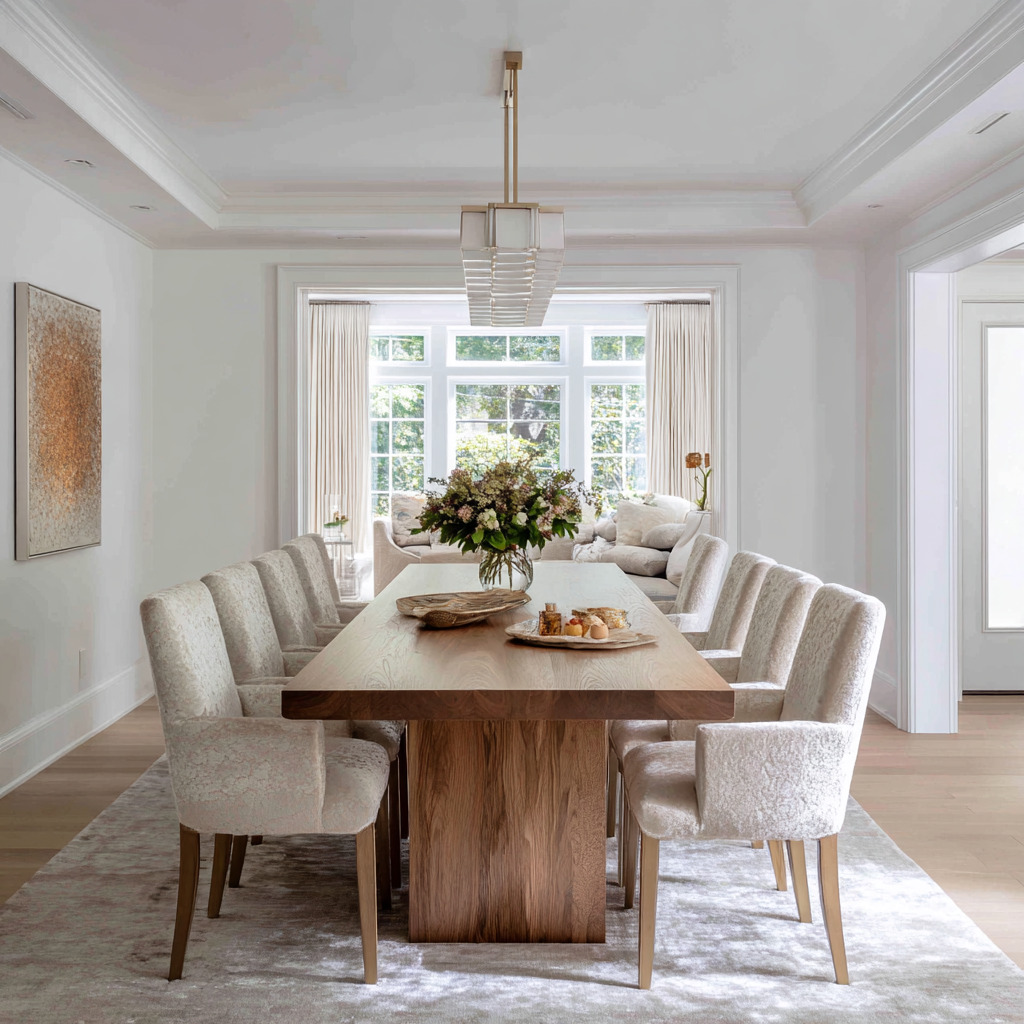
This principle sits at the center of many formal dining room decorating ideas, even when people don’t name it: calm the lowest zone, and the whole room looks quieter and more elevated.
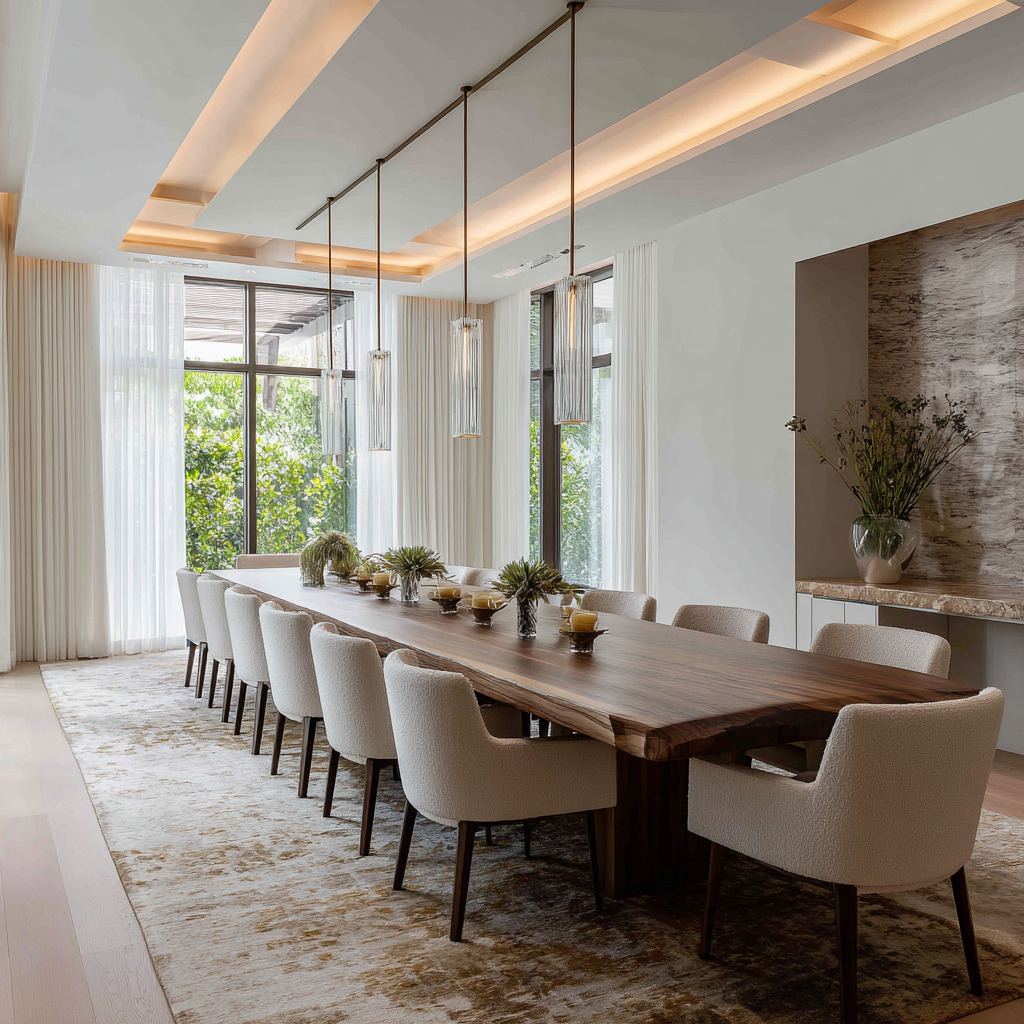
Rugs as stages: boundary, softness, and the illusion of scale
Rugs rarely act like decoration. They act like territory.
A rug becomes a stage when it does three things at once:.
- Defines the dining “island” in open layouts, giving the area its own identity without walls.
- Absorbs contrast so dark tables don’t feel harsh and light chairs don’t feel washed out.
- Creates visual generosity because a rug that extends well beyond chair footprints signals that the scene was planned, not squeezed.
The most refined rugs here avoid loud motifs. Instead, they use:.
- painterly tonal shifts,
- gentle striation,
- cloudy, low-contrast texture,
- subtle linear movement.
These surfaces behave like a quiet canvas. They support the table and chairs, but they don’t compete with glassware, cutlery, or floral shapes later.

The ceiling as a canopy: an overlooked source of formality
A design idea in modern formal dining rooms is that the ceiling can do the job that traditional chandeliers and heavy trim once did: it marks the dining zone as special. This happens in different languages:
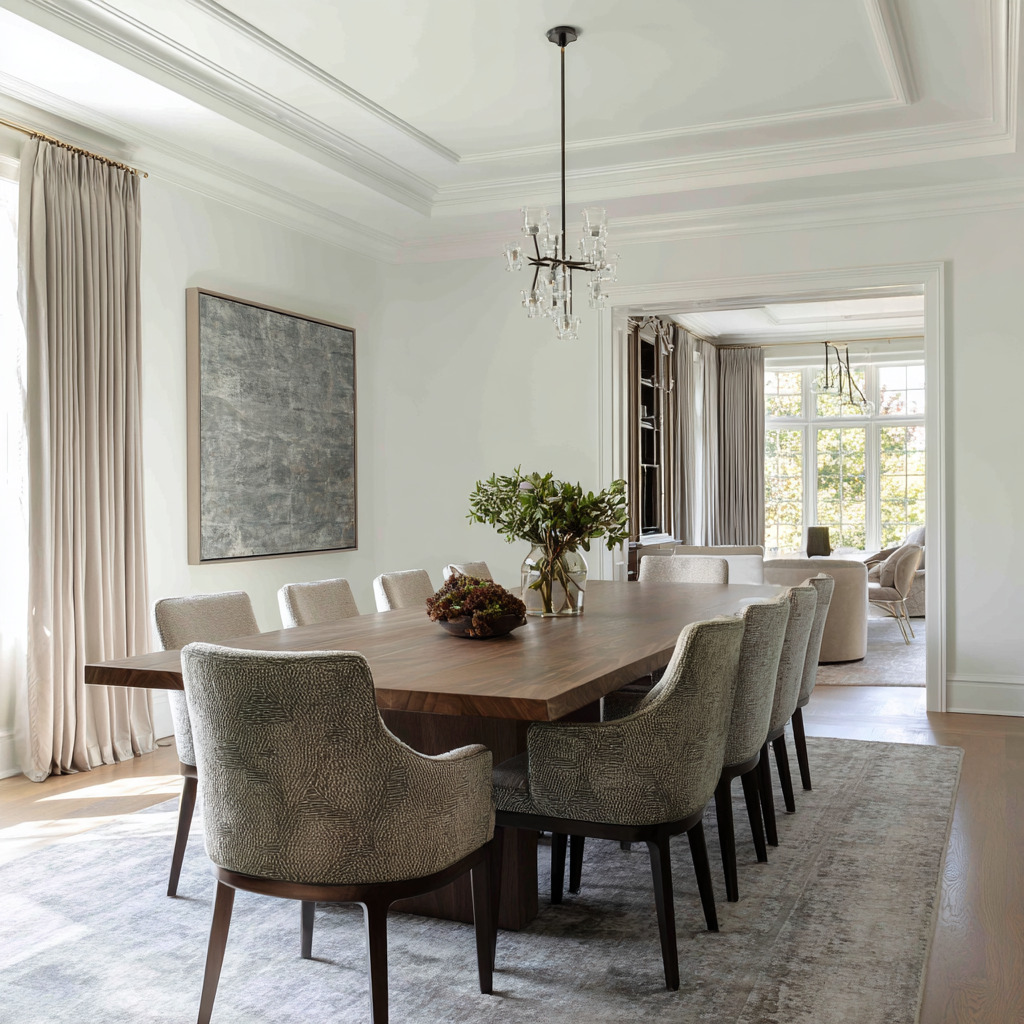
- Coffer grids create a disciplined overhead rhythm that reads ceremonial.
- Wood plank insets act like a warm canopy, giving the dining area its own “roof” inside the larger room.
- Tray edges and stepped planes quietly frame the center of the space, making the table look placed with purpose.
- Perimeter glow (soft light lines at ceiling edges) behaves like a halo: it flatters the room at night and gives the dining zone a gentle, contained atmosphere without visual clutter.
What’s striking is how these ceilings often reduce the need for extra decor. When the overhead plane is memorable, the walls can stay calmer and the table styling can stay lighter.

Lighting as mood architecture: outline, glow, and social comfort
Lighting can behave less like “illumination” and more like a sculptural layer that shapes emotion.
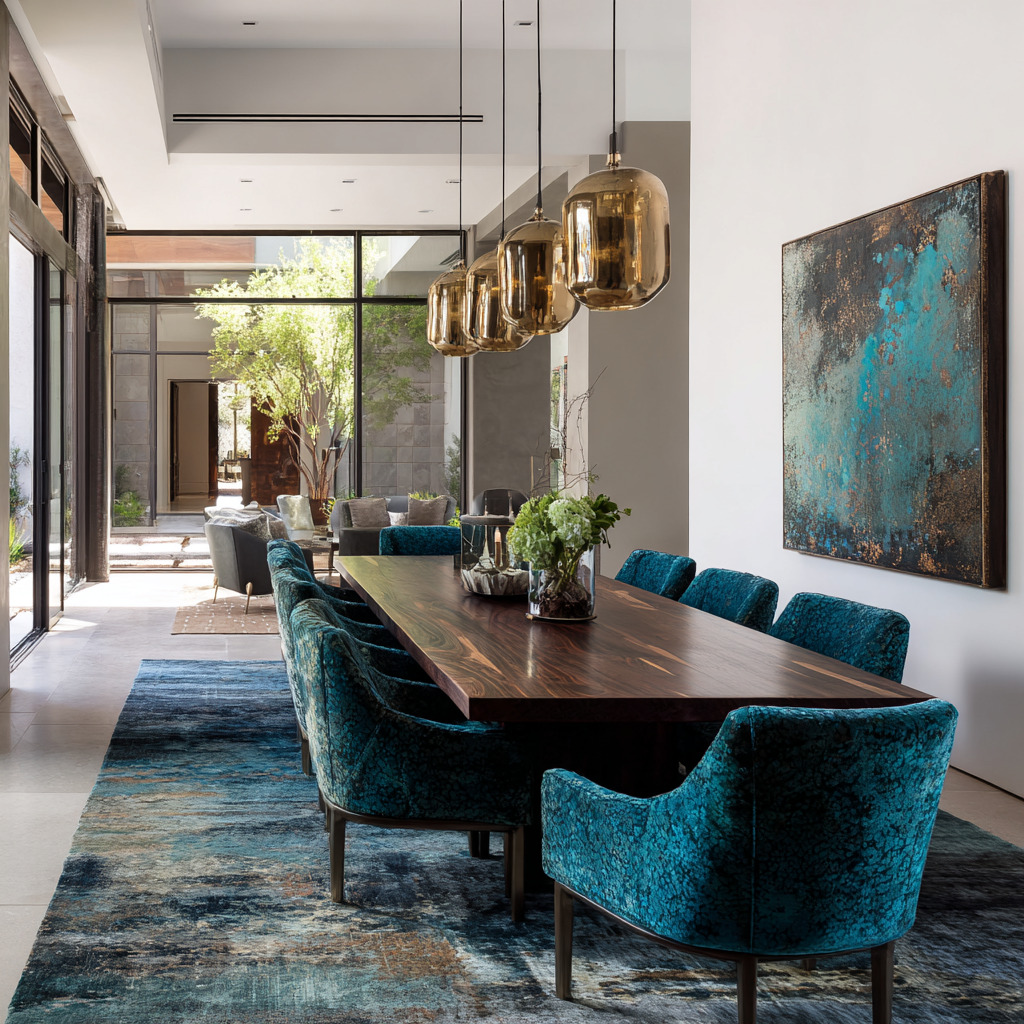
Open-frame and clear-glass fixtures: presence without blockage
Where there are arches, garden views, or strong window geometry, airy fixtures are used so the room can breathe. The light becomes an outline that signals a centerpiece while staying visually transparent.
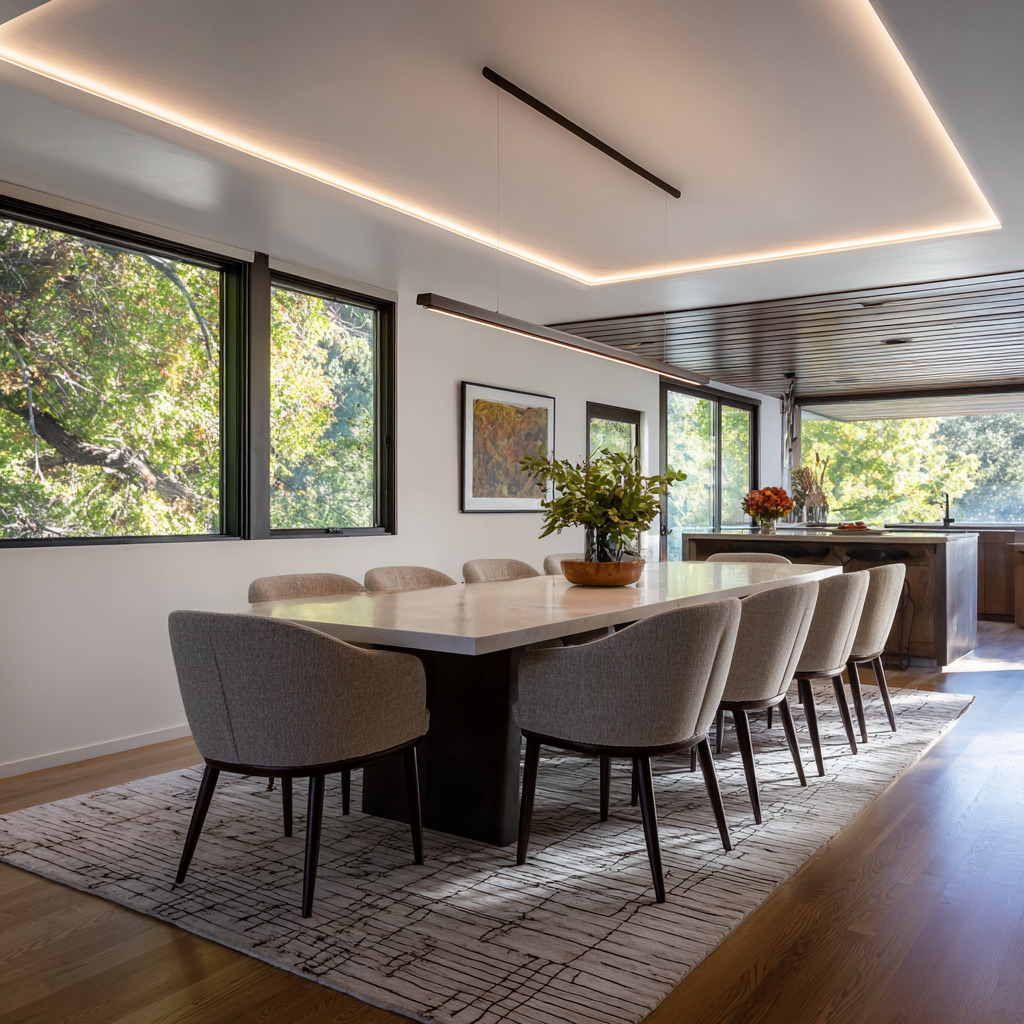
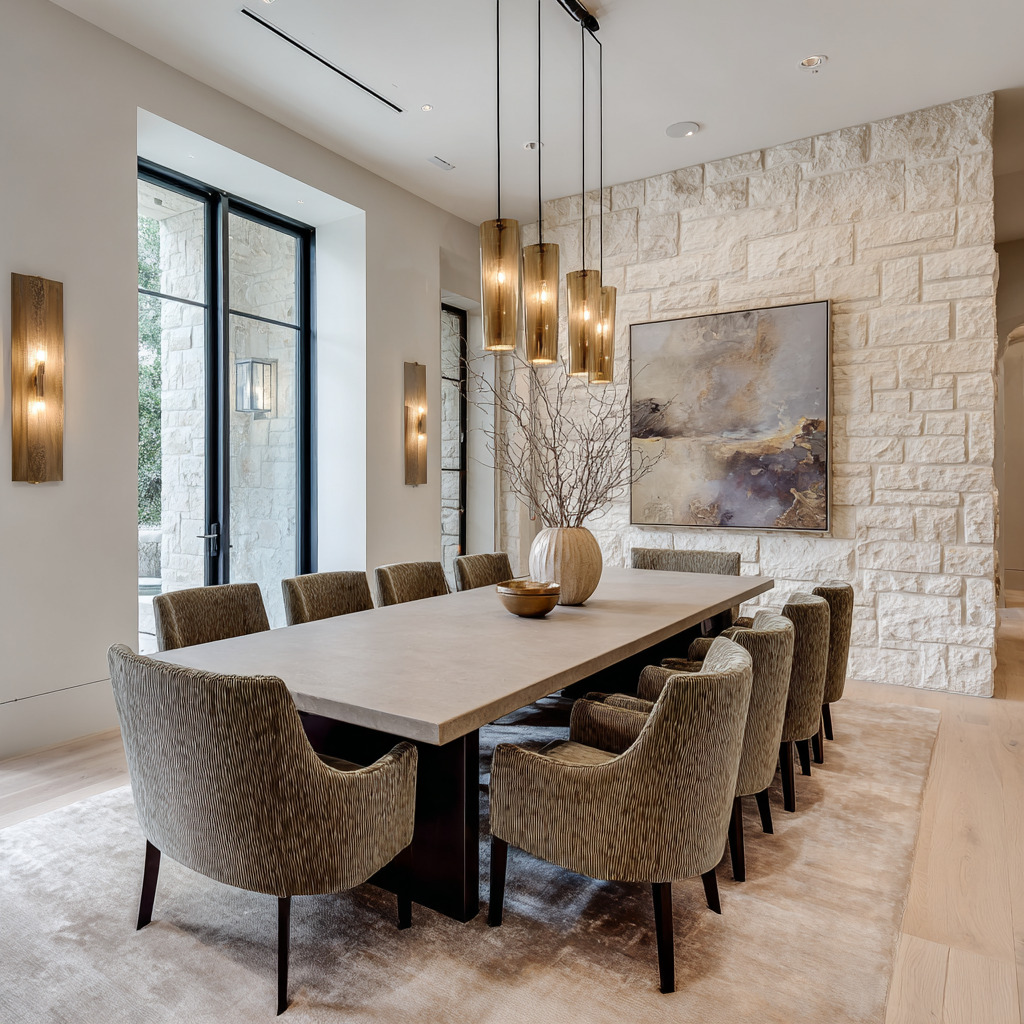
Amber and smoky glass: warmth that reads like hospitality
Warm-toned glass pendants do something subtle: they tint the atmosphere. The room feels evening-ready even in daylight because the fixtures carry a warm core visually.
At night, the same fixtures make faces look softer and surfaces feel richer.
Double-drum and “light volume” fixtures: a ceiling inside the ceiling
The layered drum example is especially revealing. A large shade creates a formal outline; a smaller lower shade tightens scale and focuses the glow.
The effect is architectural: the light feels like an intentional volume hovering over the table, not a single point source. This is how a room can feel ceremonial without sparkle.
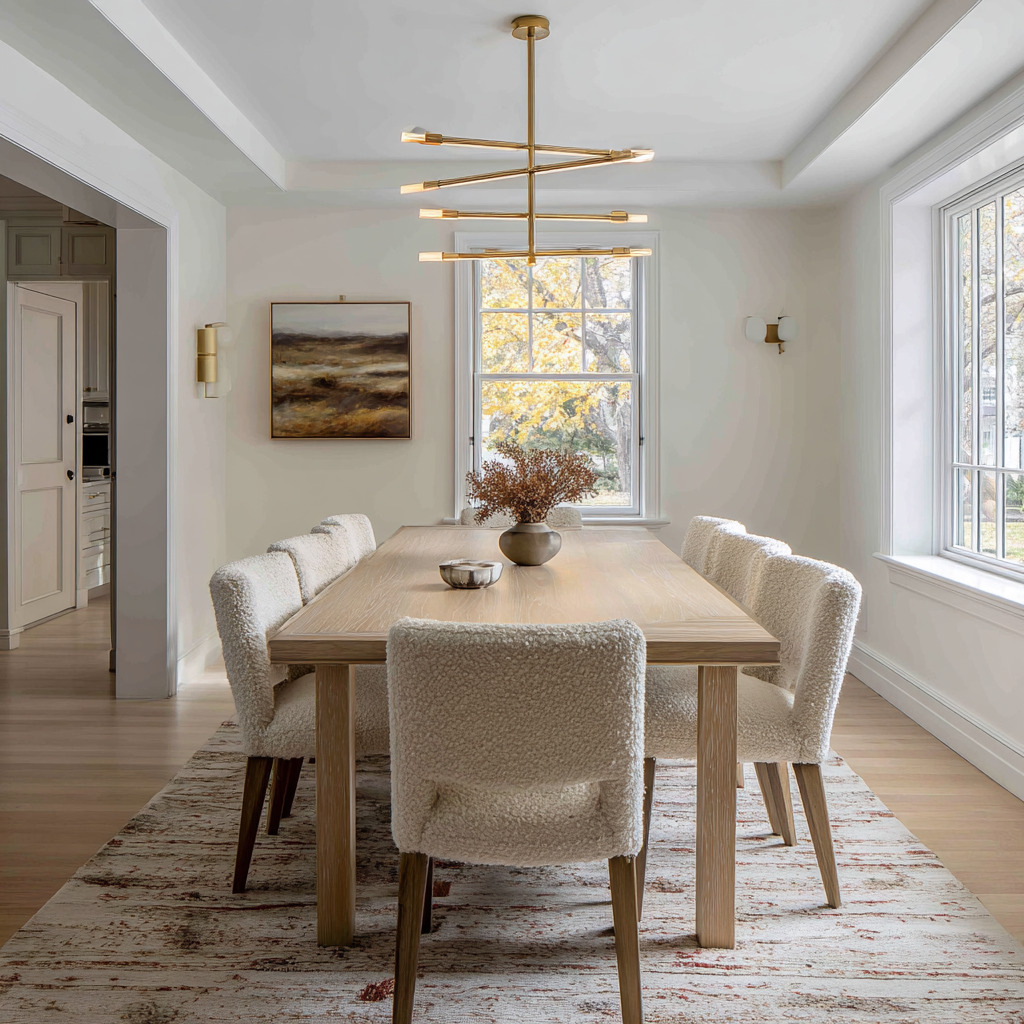
These strategies belong to formal dining decorating ideas that prioritize human comfort: flattering glow, even distribution, and a sense that every seat is part of the main scene.

Drapery as vertical architecture: columns of color, height, and restraint
Curtains can behave like architectural elements—soft columns that give walls posture. The most effective drapery moves are not about pattern; they are about:.
- weight and fold discipline (thick, consistent vertical lines),
- height emphasis (fabric lines pull the eye upward),
- color placement (deep blue used as a single large “mass” instead of multiple small accents).
Deep drapery also acts as a mood tool: it visually narrows bright openings, which makes the dining table feel like the center of attention. This is one of the cleanest ways to create intimacy without adding objects.
Importantly, drapery often replaces wall decoration. A wall can stay quiet because fabric already supplies richness, depth, and a finished edge.
Walls and art: negative space as a luxury signal
Interior design can use one large artwork rather than multiple frames. The non-trivial point is why that reads formal:
- A single large piece creates a clear focal anchor.
- The surrounding wall becomes controlled negative space, which reads curated rather than empty.
- The room avoids the “decorated in parts” feeling and instead looks like it was composed as a whole.
Art also serves as temperature balancing:.
- warm abstract tones stabilize cool neutrals,
- blue-toned pieces tie drapery or teal upholstery into one story,
- hazy, mineral palettes echo stone textures without copying them.
This approach defines decorating ideas for a formal dining room that feel current: fewer objects, stronger scale decisions, and walls that behave like calm backdrops for gatherings.
The outdoor view as living artwork: brightness without visual clutter
Interior design can lean on garden views, trees, or courtyard glimpses as a design layer. The best rooms treat the outdoors like a moving mural:.
- black window grids create a graphic frame, turning trees into “composed scenery” rather than random background,
- arched doors behave like a soft portal, echoing oval tables and rounded chair backs,
- daylight becomes a styling element, casting temporary shadow shapes that change throughout the day.
When the exterior view is treated as part of the composition, the interior can stay edited. The room feels rich not because it contains many objects, but because it contains depth, motion, and layered light.
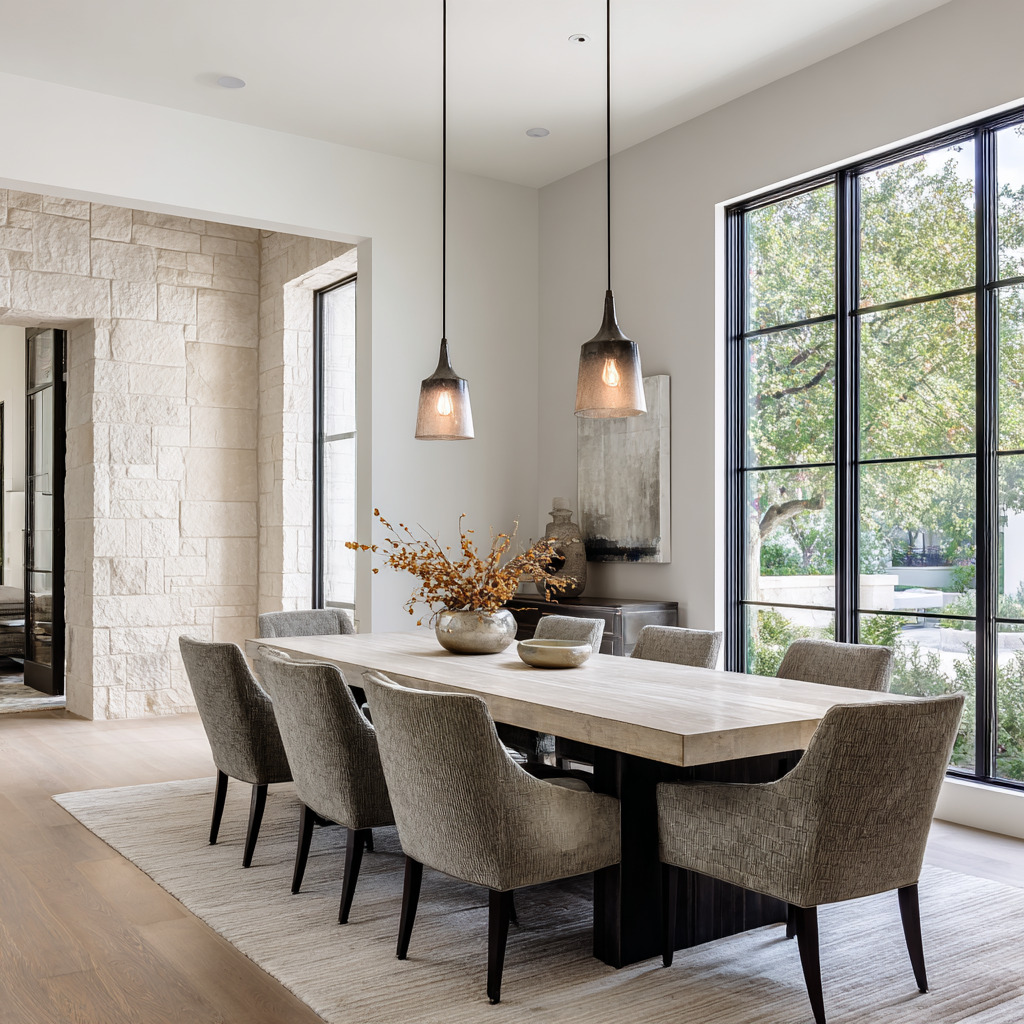
Table styling as height logic: porous centerpieces and quiet grouping
The strongest table ideas avoid the common mistake of either over-decorating or leaving the table feeling unfinished. They solve it with height logic:
- one medium-tall element that stays airy (branches, open stems, see-through structure),
- one low, weighty element (bowl, ceramic piece, clustered vessels),
- and plenty of open tabletop left visible.
Porosity is crucial: airy stems allow conversation and sightlines while still creating a ceremonial vertical accent. Low objects add gravity so the centerpiece doesn’t feel flimsy.
Grouping keeps the table from looking scattered; open space keeps it from feeling crowded.
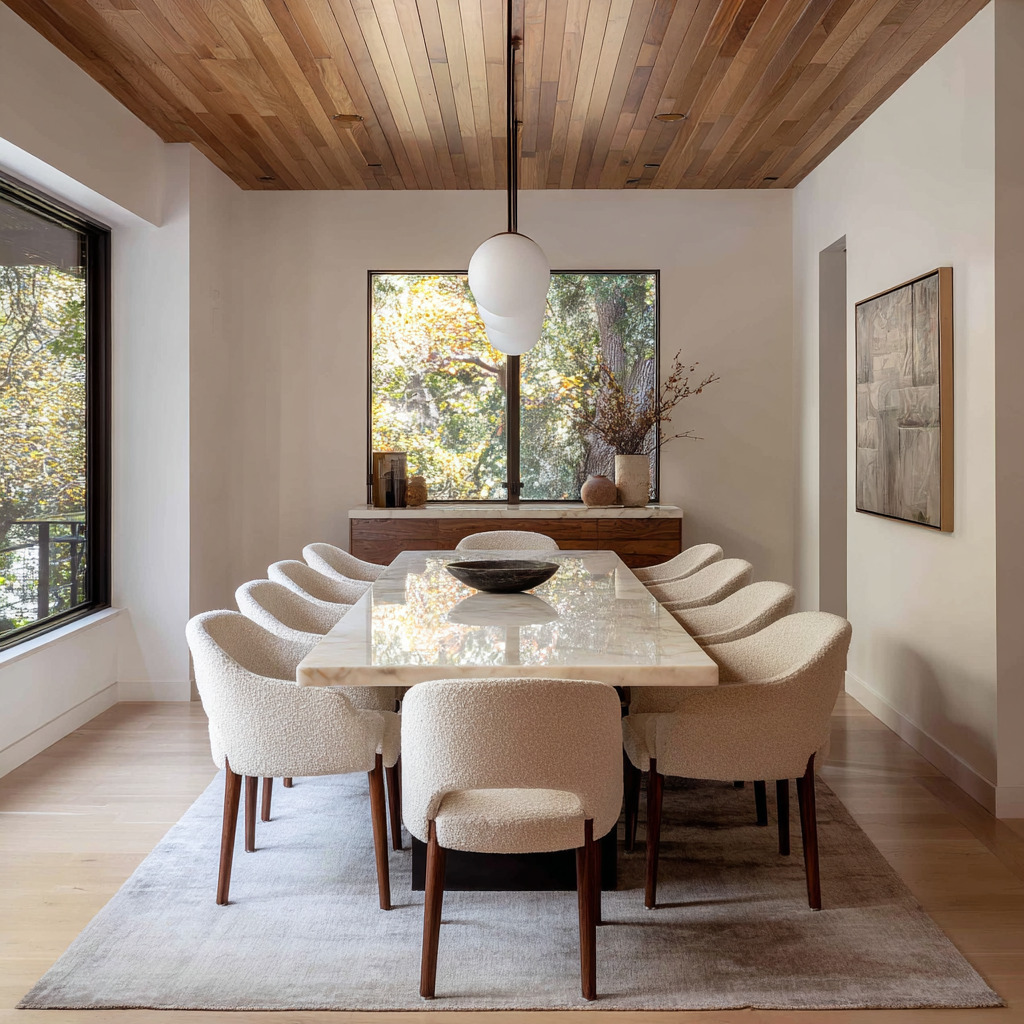
This is where formal dining design ideas become quietly advanced: they don’t treat the centerpiece as a decoration; they treat it as a structural counterweight to the table’s long horizontal line.
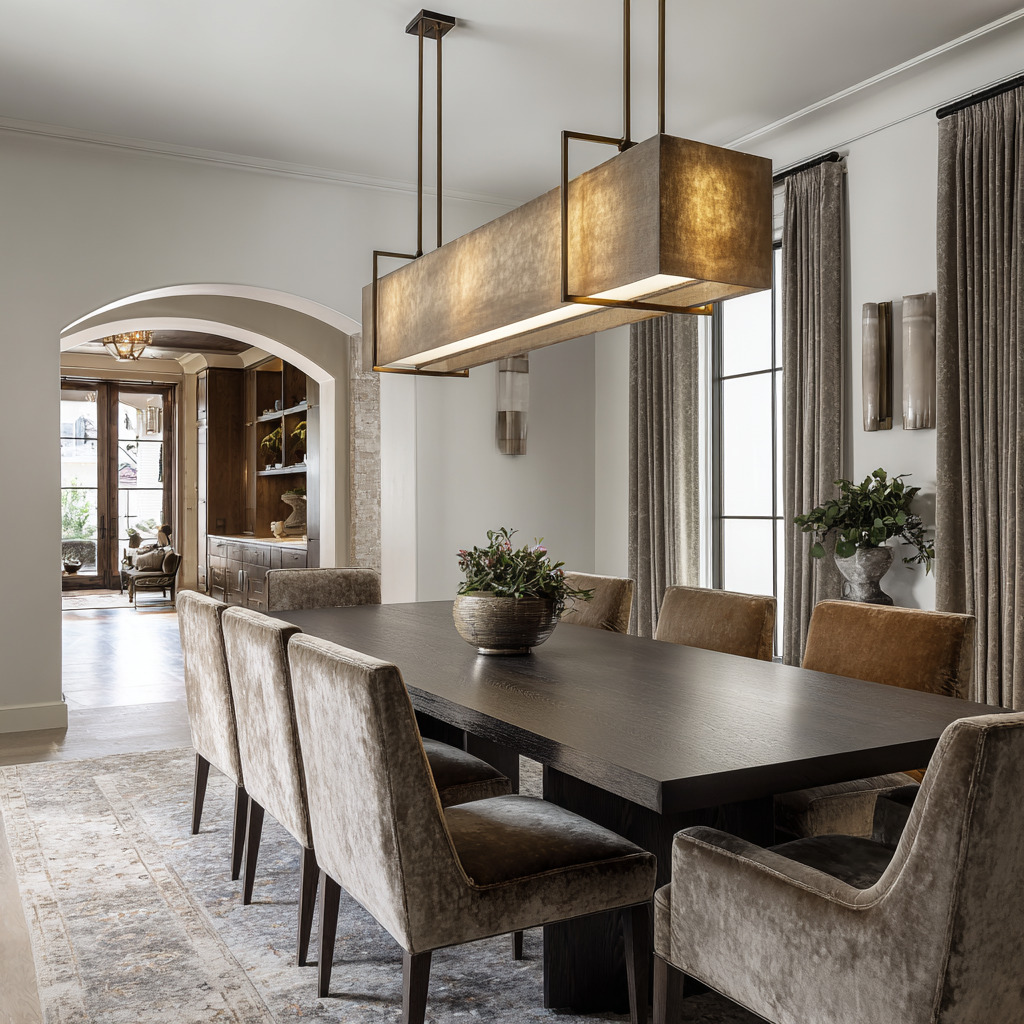
Color strategy: disciplined contrast, not loud variety
Formal interior design can be dramatic without using many colors. Common color structures include:.
- one deep color mass (often drapery or upholstery) paired with pale walls and floors,
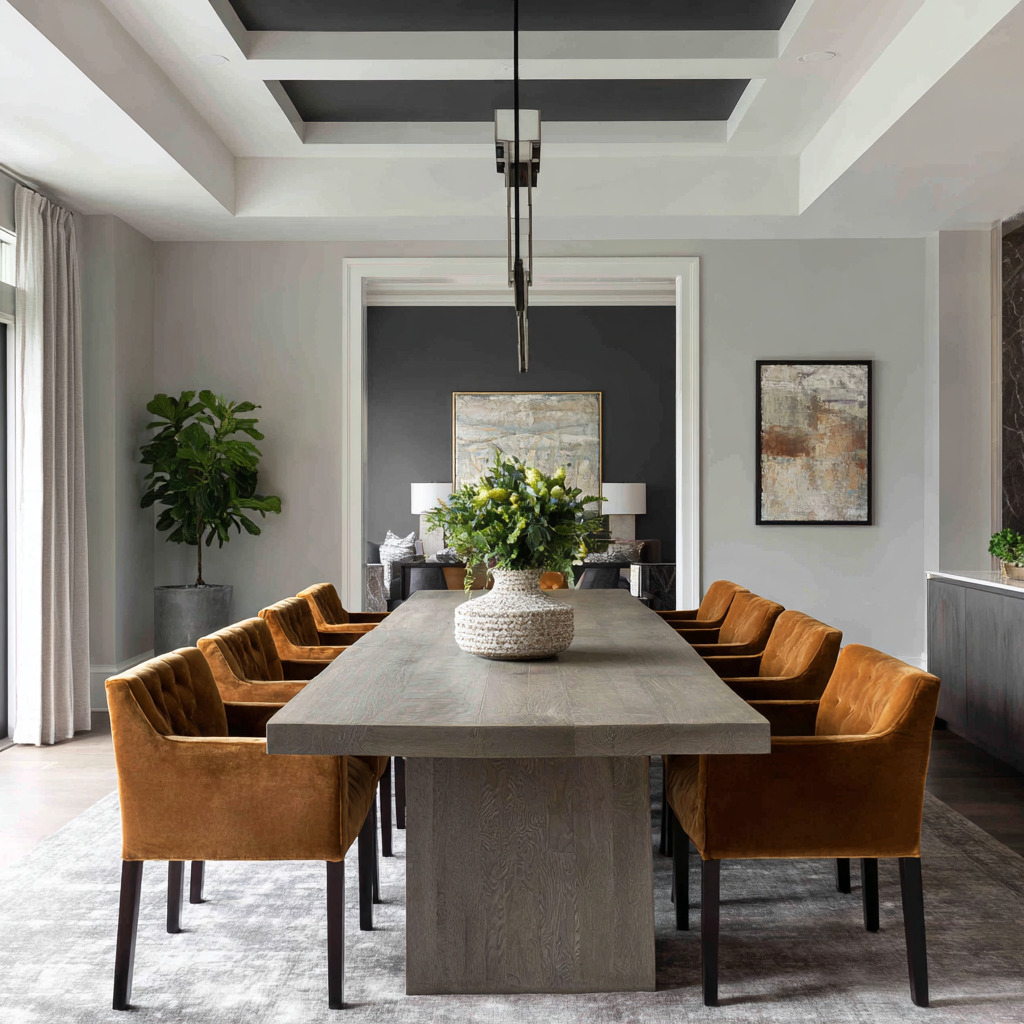
- warm/cool tension (amber light over teal seating; warm wood against cool greige envelopes),
- mid-tone buffers (smoky chair upholstery between a dark table and bright walls).
The key is that color is used in large, deliberate blocks rather than scattered accents. That block approach looks composed, and composition reads formal.
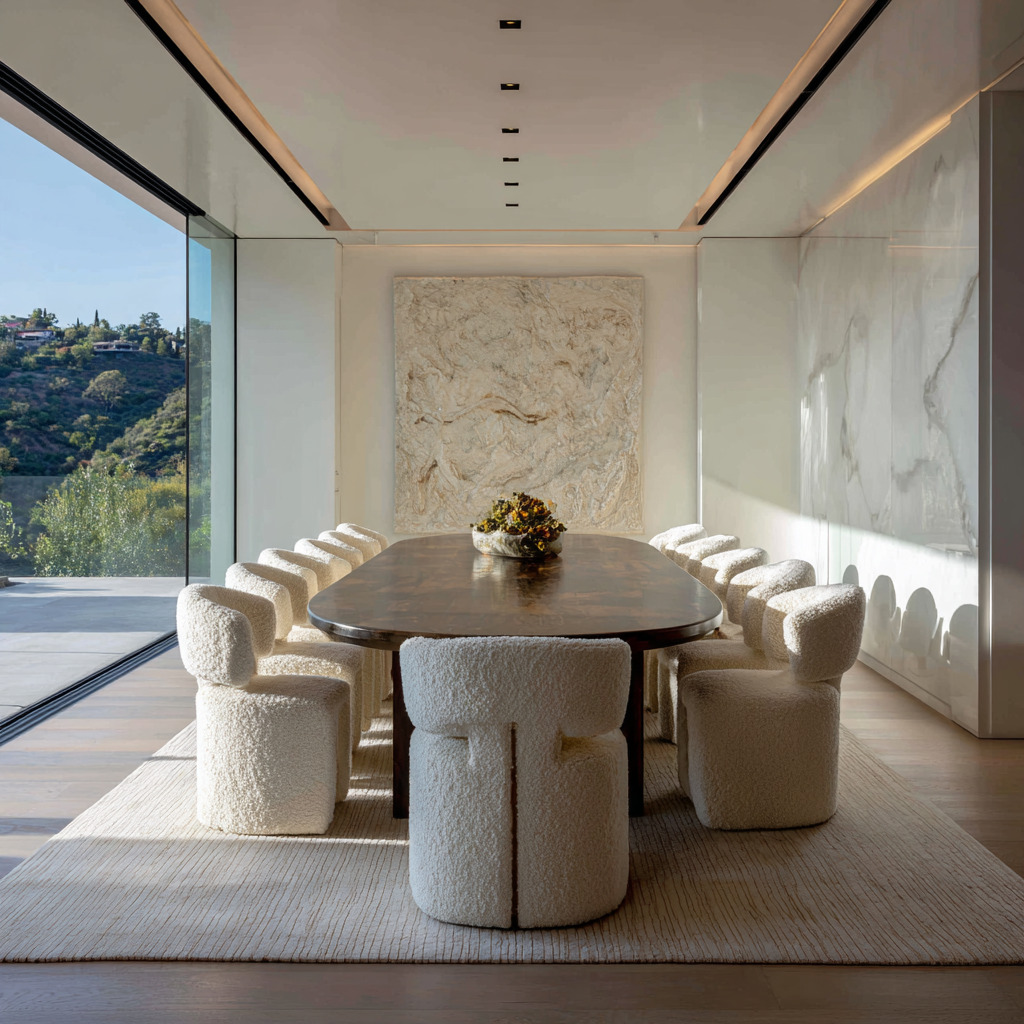
This is also why many scenes feel “evening-ready” without changing décor: the color structure already anticipates warm glow and shadows.
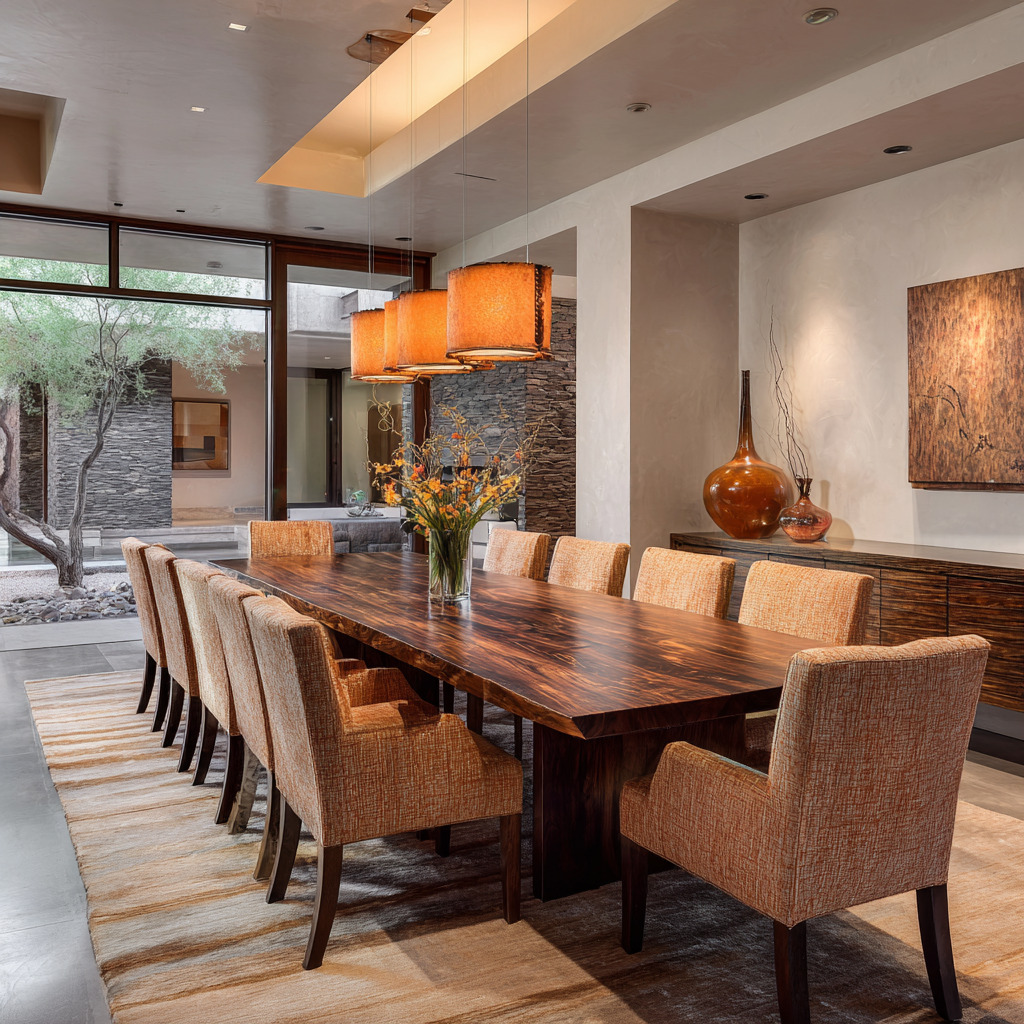
What these rooms quietly agree on
Taken together: formality today often comes from editing, rhythm, and surface behavior rather than ornament.
- Rhythm: repeated chairs, repeated pendants, repeated window mullions, repeated ceiling geometry.
- Editing: fewer objects, larger scale, calmer walls, simpler table scenes.
- Surface behavior: matte calmness, soft reflection, micro-texture that comes alive under warm light.
- Comfort coded into the look: rounded silhouettes, dense upholstery, rugs that read soft, lighting that feels flattering.
That combination captures formal dining room decorating ideas as a modern language: the room looks composed in daylight, and it becomes intimate at night without needing theatrical gestures.
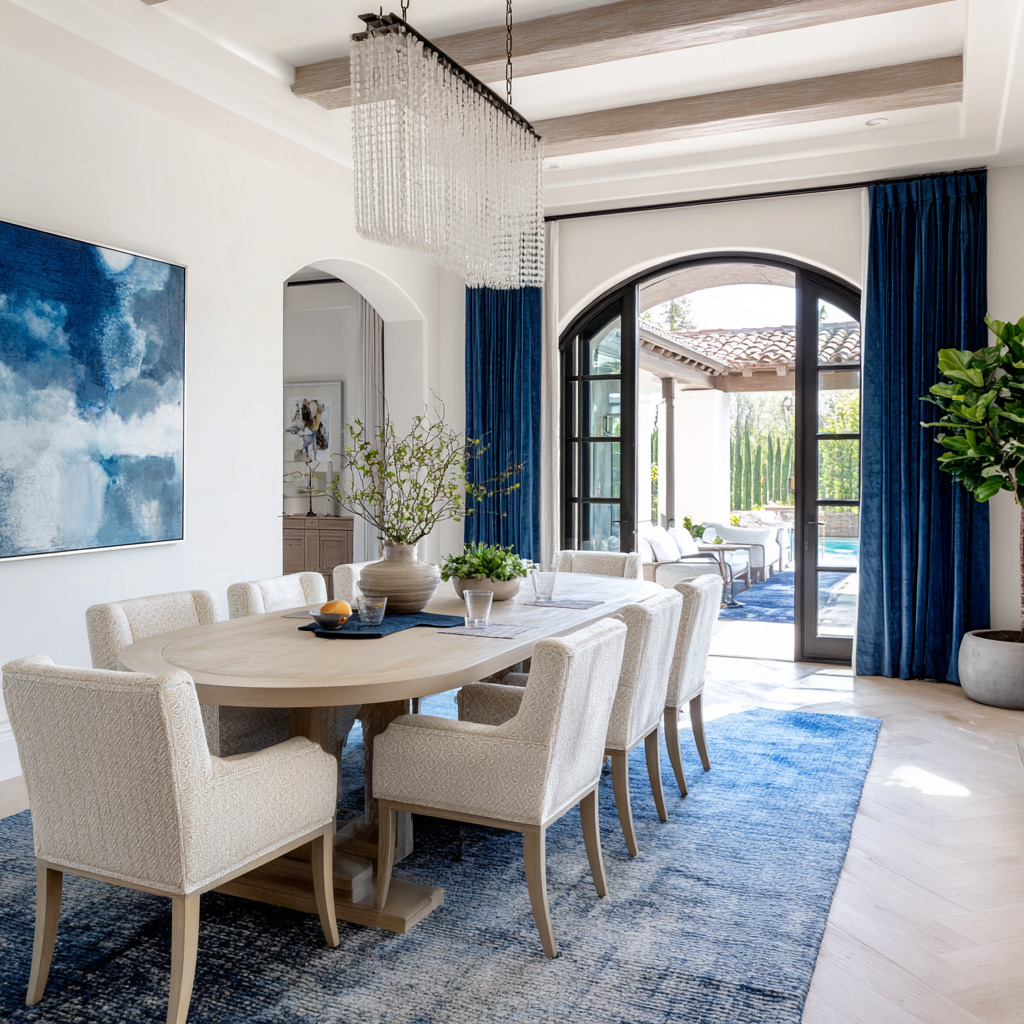
And that is the central thread running through the strongest formal dining design ideas: the room feels special because it is organized—visually, emotionally, and socially—while still leaving space for the real event: people, food, conversation, and the gentle movement of light.