Shiplap ceilings have quietly shifted from being a purely stylistic reference to becoming a powerful visual tool that shapes how interior designs are perceived, experienced, and remembered. In many contemporary designs, the ceiling is no longer treated as a neutral background but as an active surface that influences proportion, light, and mood.
When shiplap is introduced overhead, it changes how rooms stretch or compress, how daylight moves through the interior, and how furniture, windows, and walls relate to one another. This piece looks closely at shiplap used on ceilings as a design language rather than a material choice, examining how line direction, tone, wrapping strategies, lighting, and interaction with furnishings subtly guide the atmosphere of living rooms, dining areas, reading spaces, and transitional zones.
Through layered visual observations, the focus remains on how shiplap ceilings shape interior character and spatial clarity without relying on ornament or technical explanation.
Direction of the Boards: Stretching, Widening, and Tilting Space
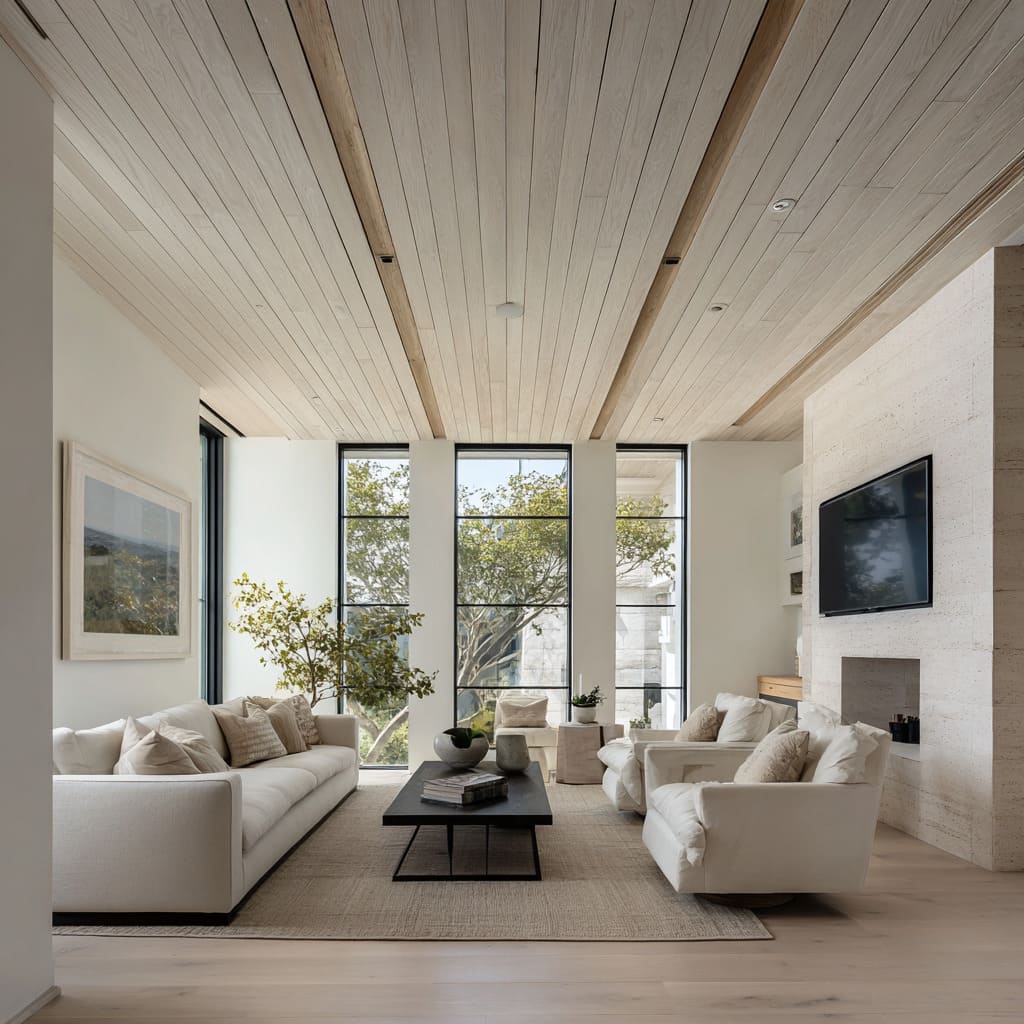
The direction in which shiplap boards run is one of the quiet tools that reshapes proportions in a room. Boards laid along the long axis of a space visually “stretch” it; they turn a conventional rectangular living room into a calm gallery, guiding the eye from a bank of windows toward a fireplace or artwork.
In long living rooms and dining zones, this direction helps the space feel deliberate rather than corridor-like, because every line overhead supports the main circulation and the placement of seating clusters. In smaller, more compact rooms, turning the boards across the narrow dimension can have the opposite effect: instead of emphasizing length, the lines work horizontally to make the footprint feel wider, which suits wraparound sofas, conversation pits, and square breakfast corners where the aim is gathering in the center rather than moving along a path.
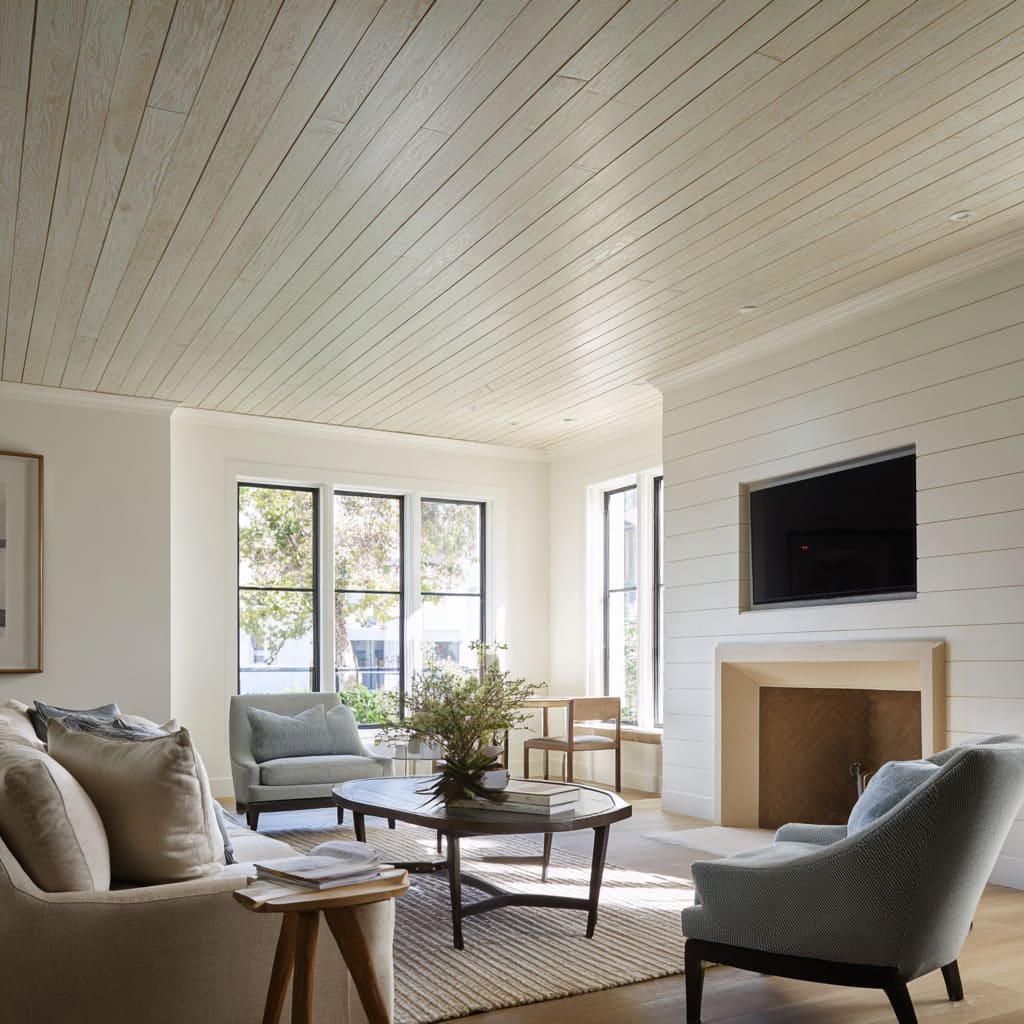
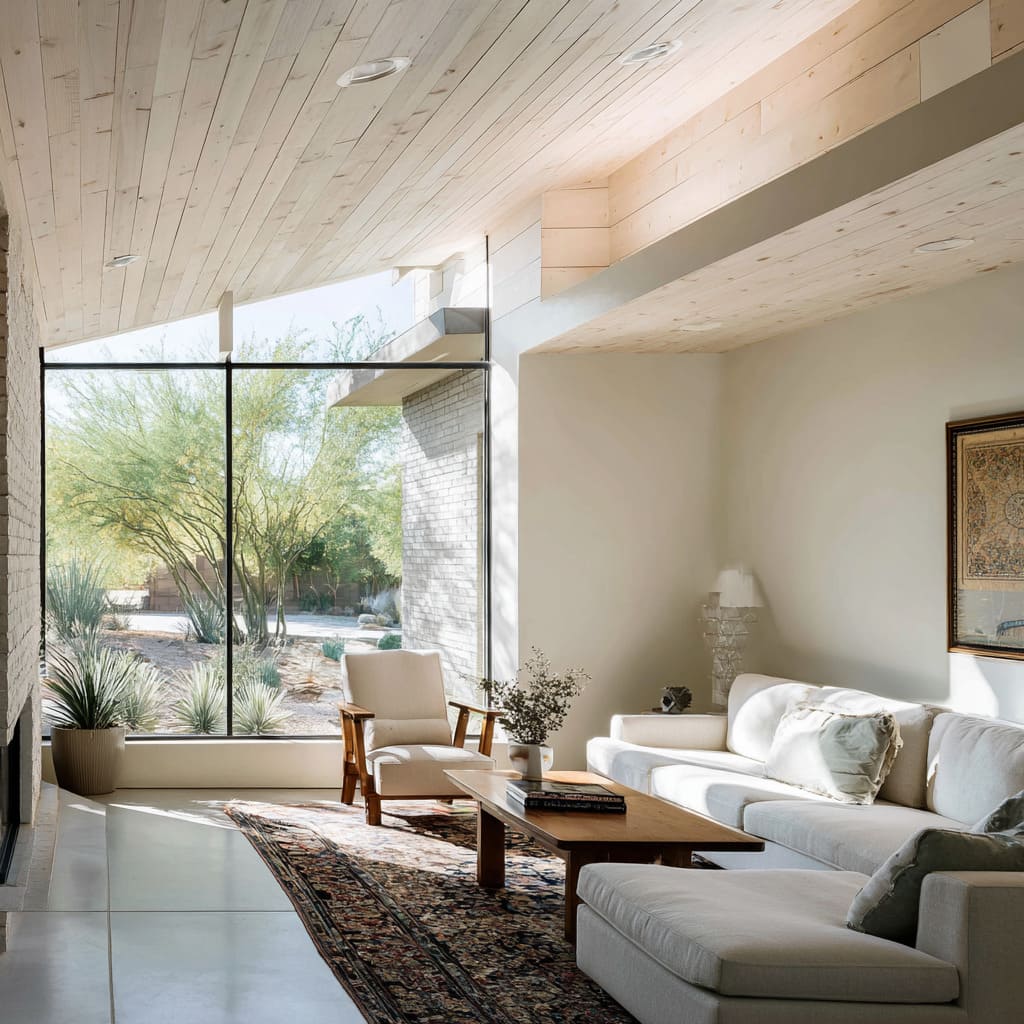
Sloped or diagonal boards introduce a different kind of drama. Where ceilings follow rooflines or tilt toward large glass walls, the grain becomes a visual ramp carrying daylight from the high side down toward the sofas or banquettes.
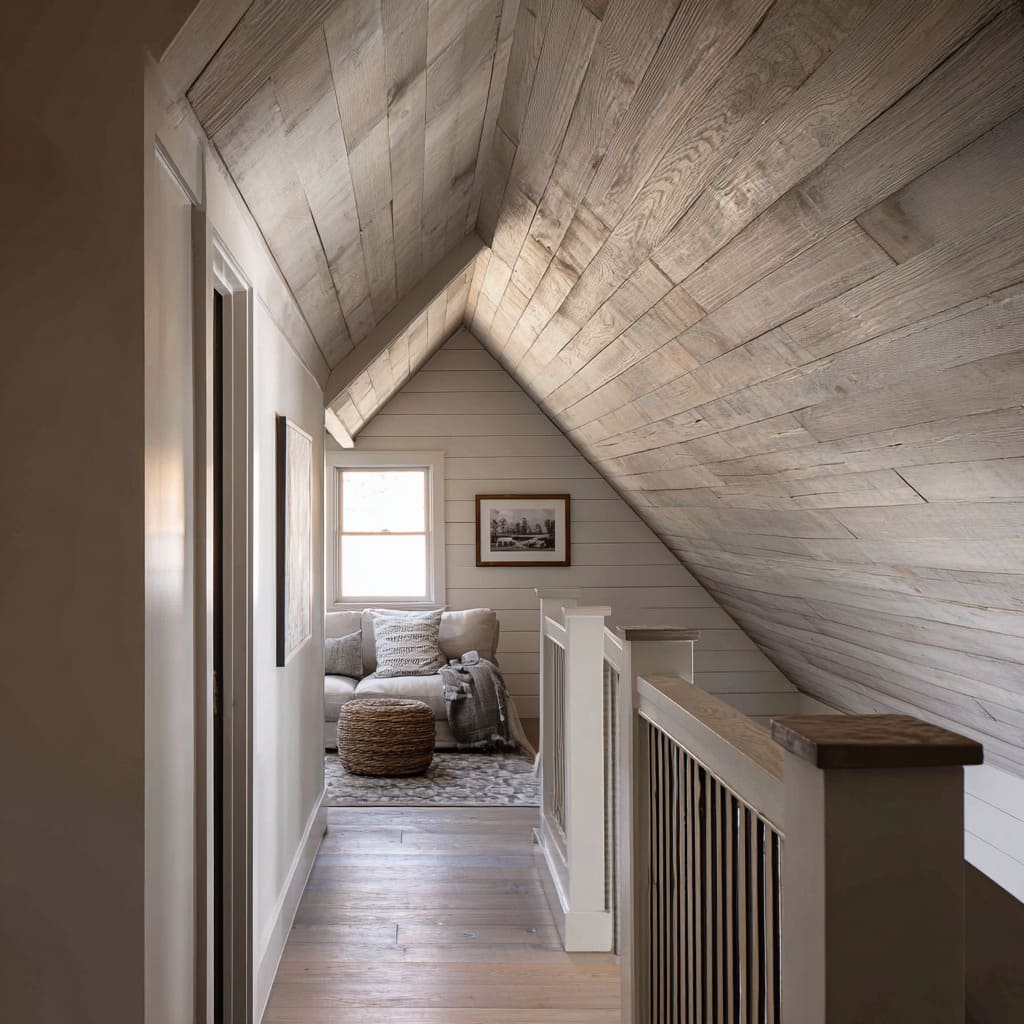
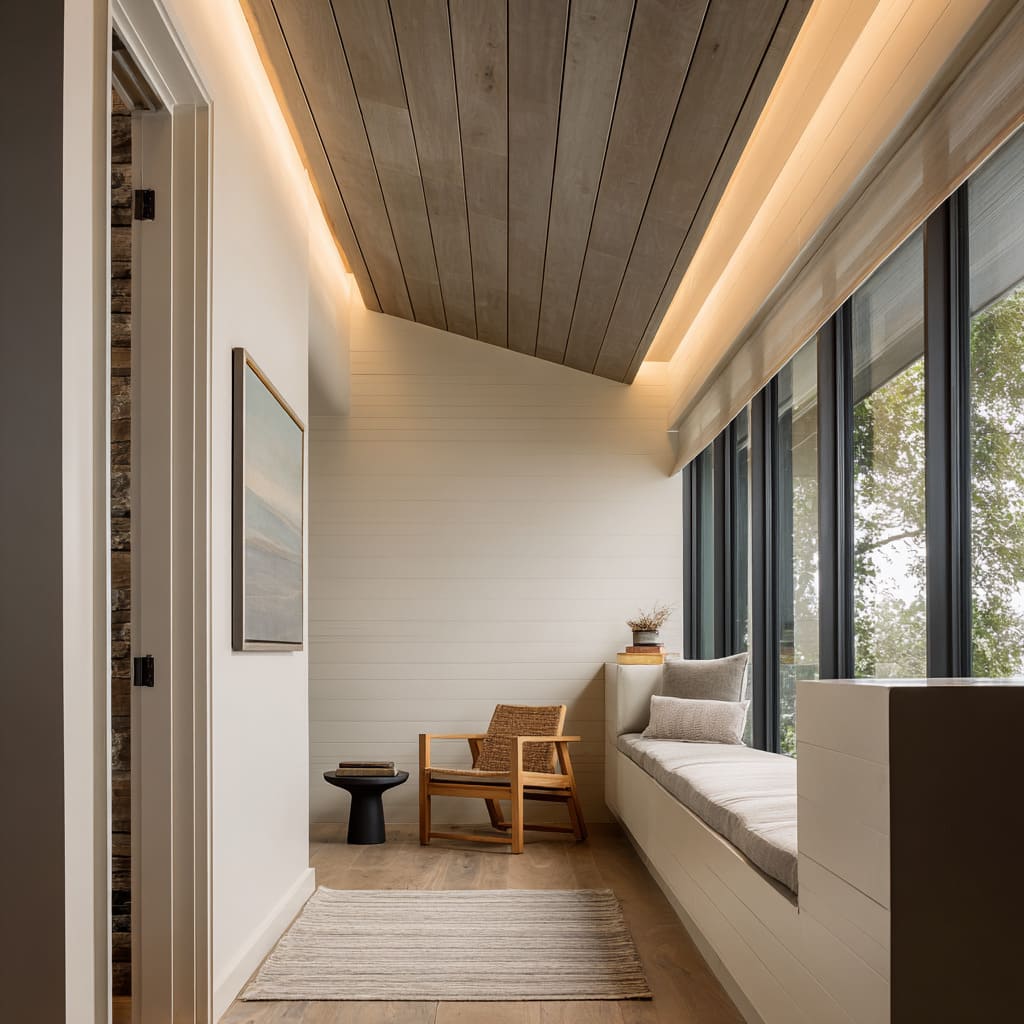
A nature-inspired living room designs with shiplap roof that continues outside feel almost like an indoor porch, because the diagonal boards pull the sun visually into the seating zone. In attic landings and reading nooks, boards that wrap steep slopes and meet at a ridge create tunnel-like perspectives that compress and then release the visitor into a small lounge at the end.
Horizontal boards on these slopes calm the complex geometry of the roof, while the grain subtly animates the walk through the space. Direction, more than any other single decision, defines whether shiplap supports a stretched gallery, a widened nest, a dynamic slope, or a wrapped passage.
Canopies, Rafts, Alcoves, and Tunnels: Shiplap as Volume-Shaper
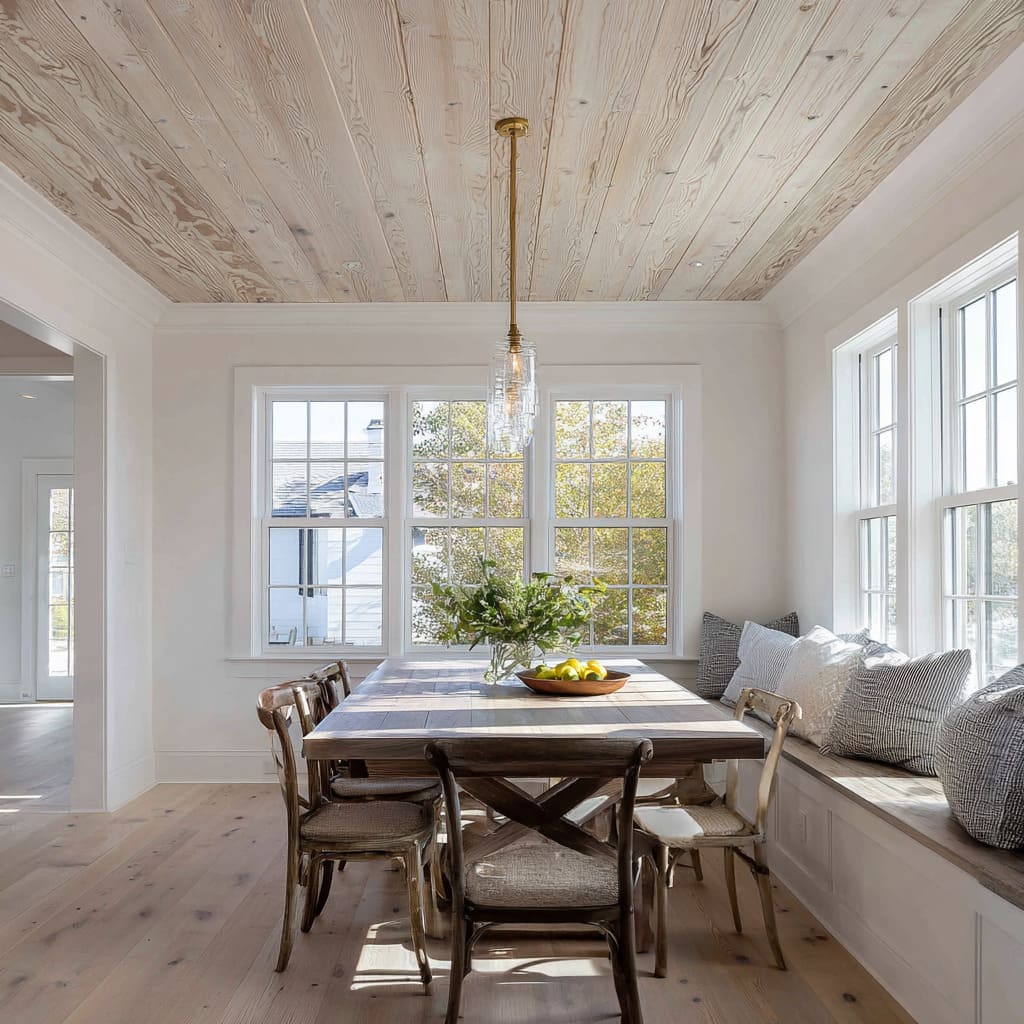
Shiplap overhead not only covers volume, it frequently defines which volume matters. The boards can form a canopy: a continuous timber lid spanning exactly over a living area or dining table, turning that zone into the social heart of a larger open plan.
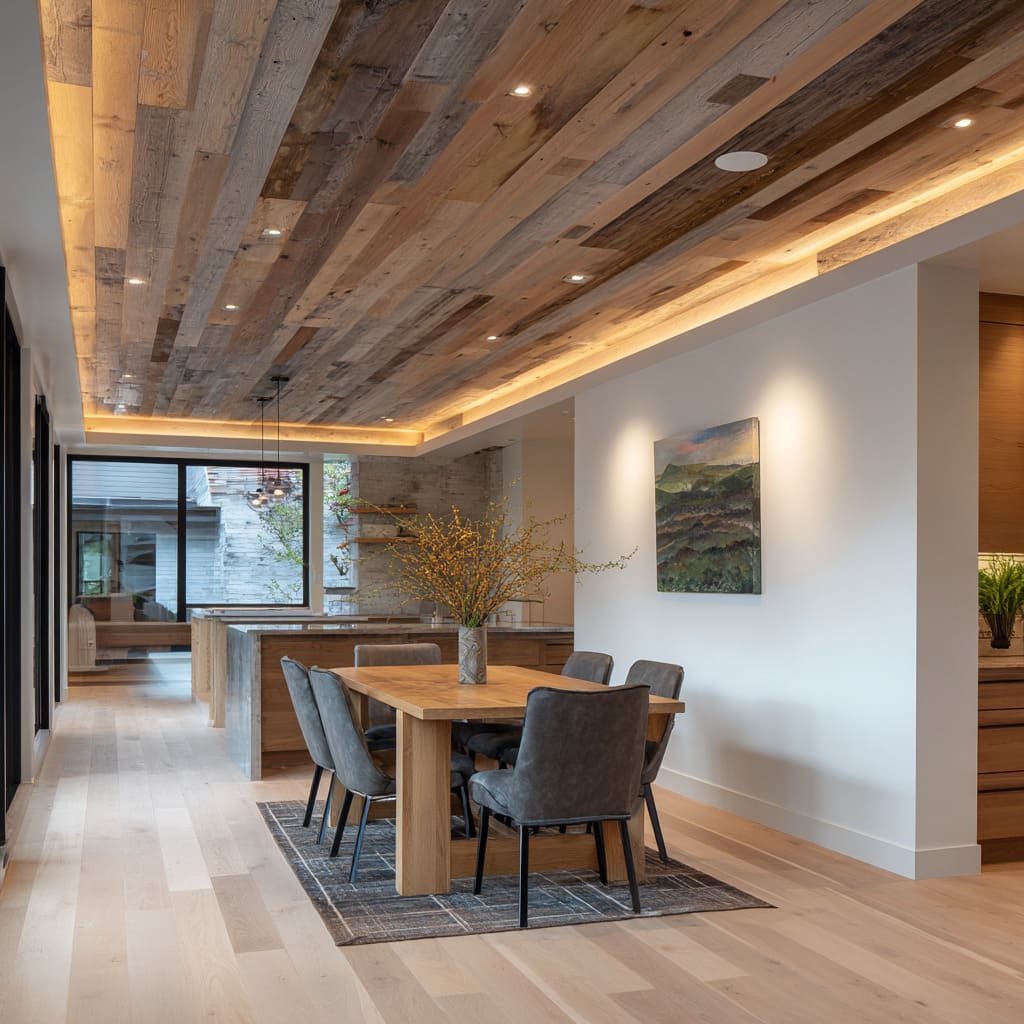
The canopy may run wall-to-wall or sit inside a white border, but in both cases it signals that the activity beneath it is central. When the timber patch does not reach the walls and is instead framed by plaster and a slim reveal of light, it becomes a raft, a floating rectangle in the center of the ceiling that behaves almost like a piece of furniture overhead.
A reclaimed-wood raft above a dining table, surrounded by a golden halo of LED, makes the table feel like the solid anchor under a suspended plank collage, giving the design an intense focal core without adding bulk to the plan.
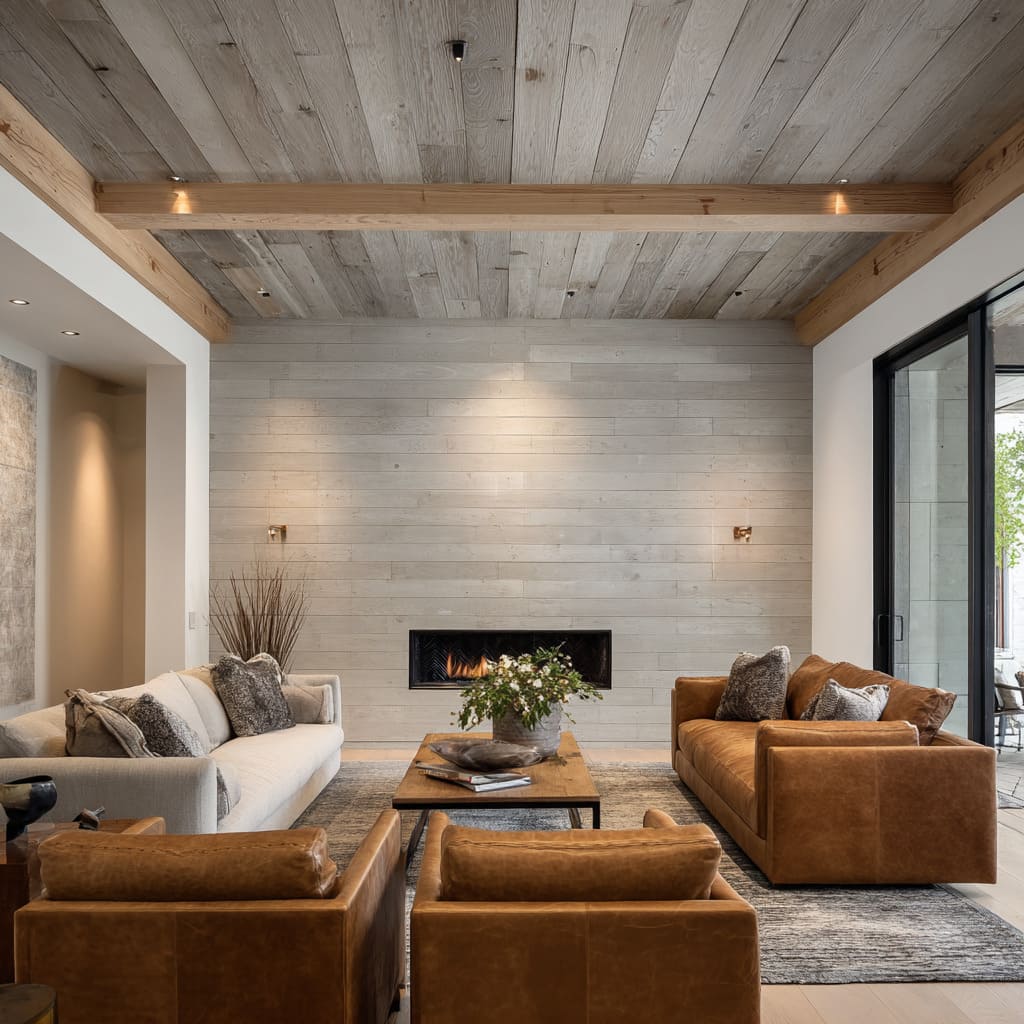
Other spaces use shiplap to form alcoves and tunnels. A silvered timber ceiling and wall wrapping a fireplace area inside otherwise plain white walls reads as a timber alcove, a box slid into the shell of the house that contains the fire, the sofas, and the warm leather.
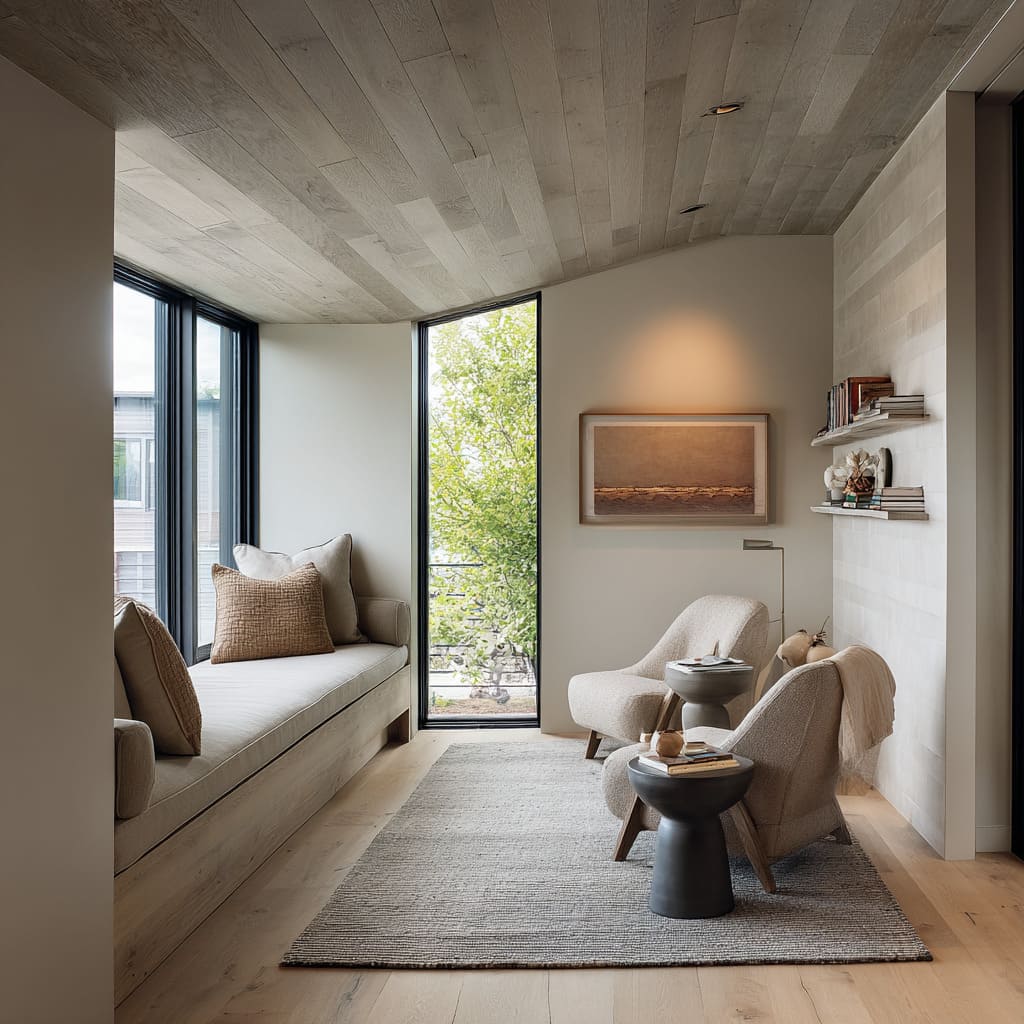
Beyond the alcove, the white envelope takes over again; this shift tells the eye where the intimate zone of the room begins and ends, even when the floor stays continuous. In upper floors, where roof pitches create natural funnels, shiplap often wraps both slopes and the short end wall, turning the landing into a tunnel that leads to a small chair or reading corner.
The boards bring the roof down to human scale and suggest that the walk along the corridor is a deliberate experience, not a leftover space between rooms. Taken together, these approaches show shiplap acting like a spatial tool: defining pockets, marking centers, and making circulation routes feel purposeful.
Color and Tone: Ceiling as Light Filter and Mood Setter
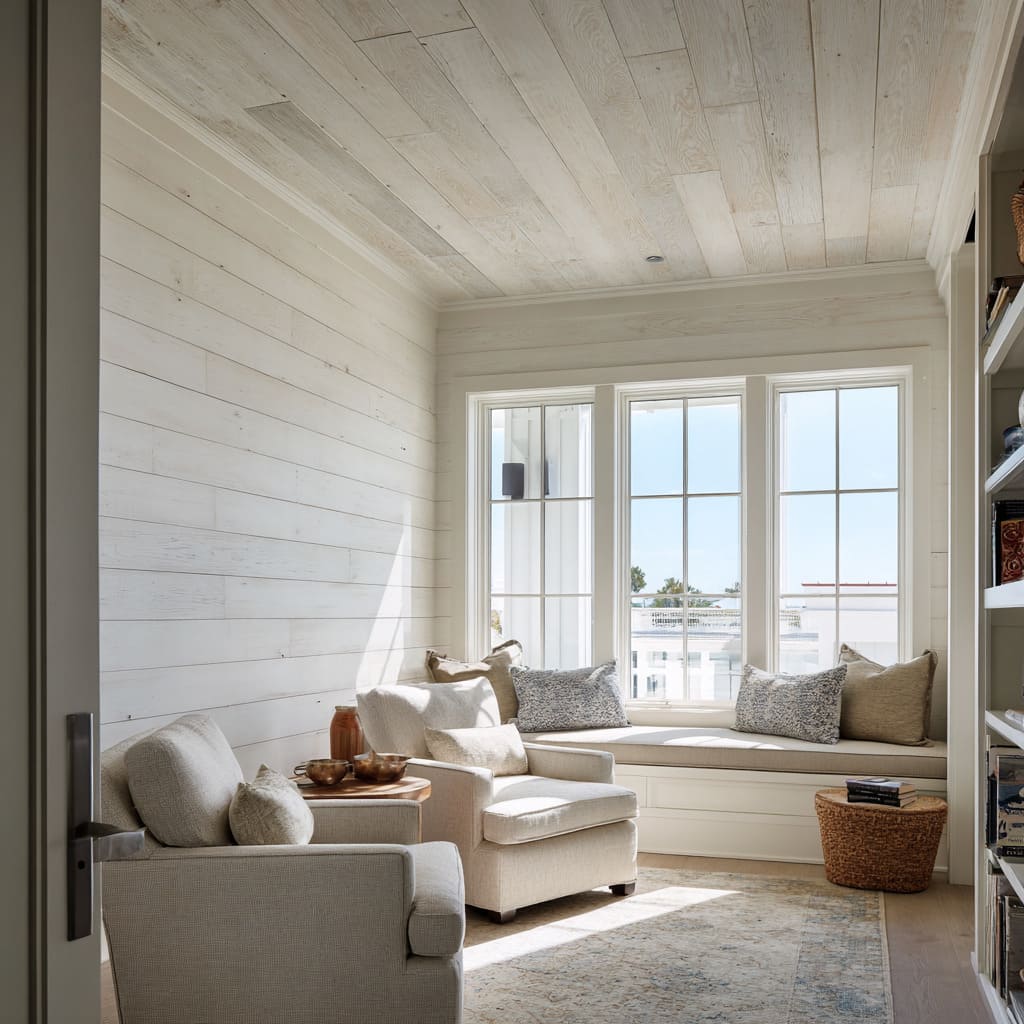
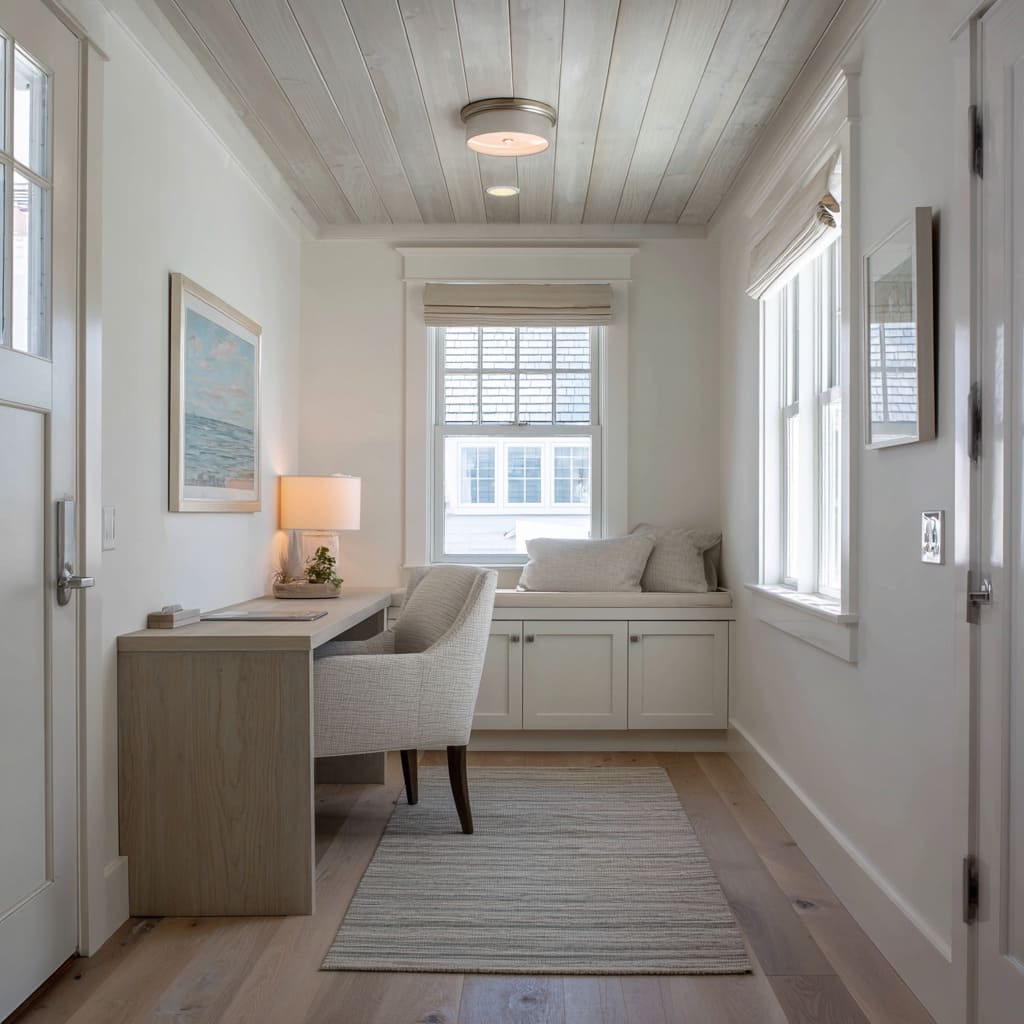
Tone is the second language of shiplap after direction, and it quickly turns the same pattern of boards into entirely different atmospheres. White or whitewashed timber across both ceiling and upper walls creates a bright container where light bounces softly, shadows dissolve, and ceilings of modest height feel easily tall enough.
Because the grain and joints remain visible, the surface retains a sense of craftsmanship and line, but it does not add weight. This suits compact sitting rooms, cottage-like living space designs, and sunwashed reading corners where the aim is to create a light wooden box with a relaxed, calm interior design.
Blond and sandy boards suggest a more coastal or porch-like character: they recall decks, boardwalks, and weathered pergolas, and they sit comfortably between pale floors and stronger outdoor stone or planting. When such ceilings extend from interior to terrace, they blur the line between covered porch and living room, so the table or sofa below feels equally connected to the house and the garden.
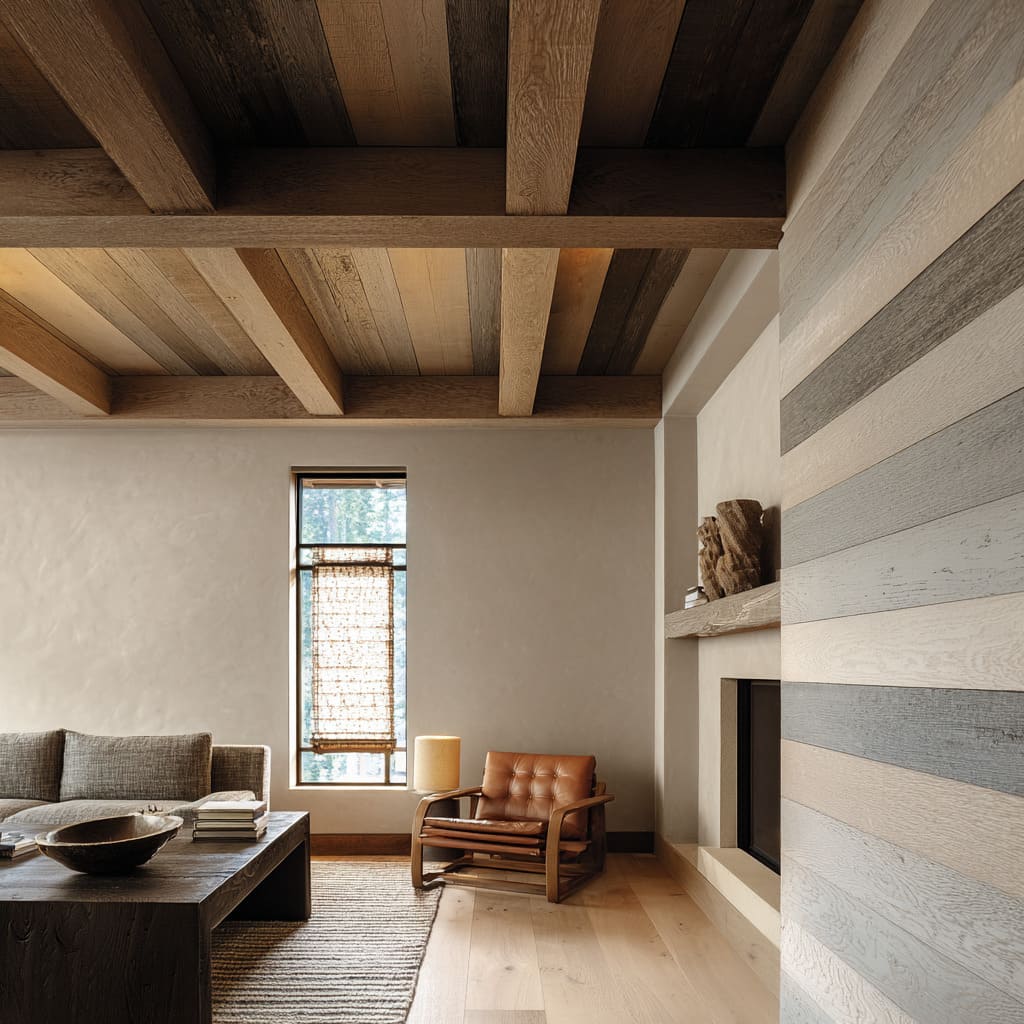
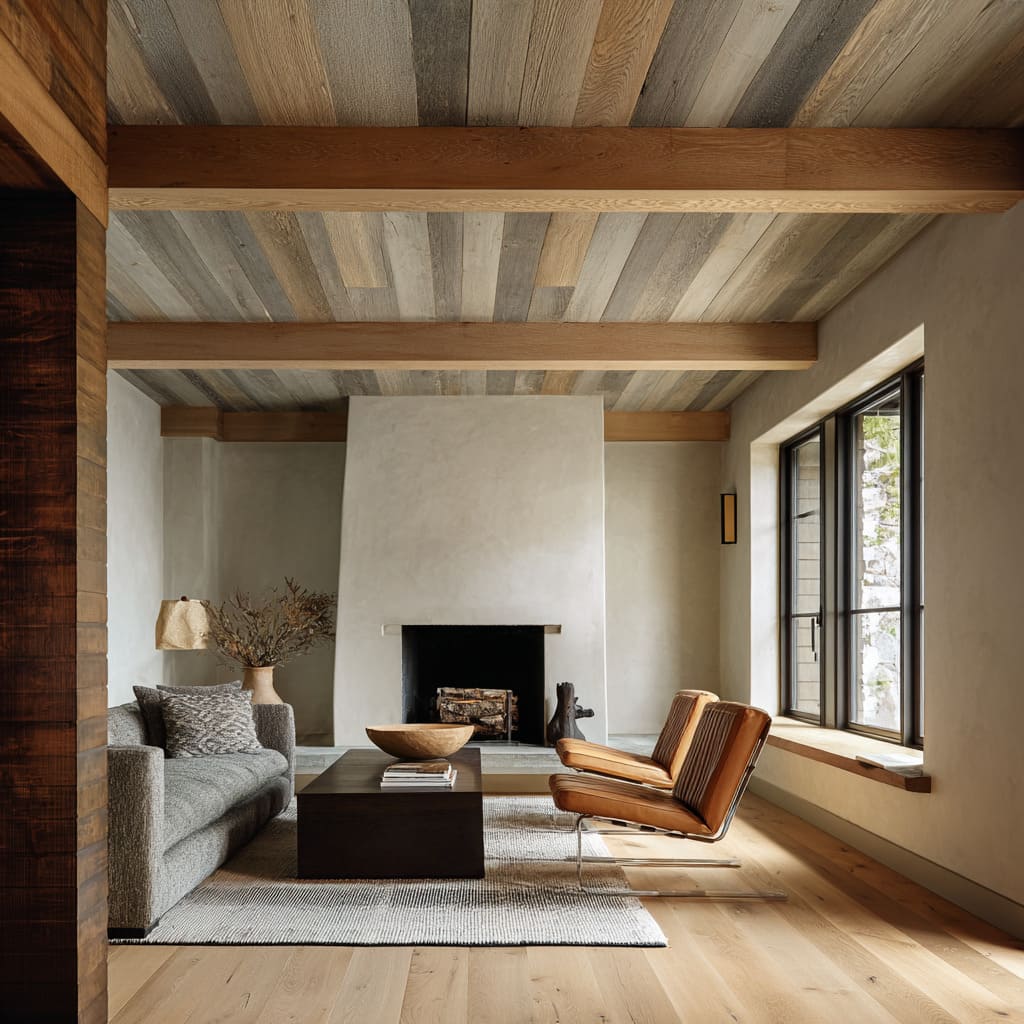
Mixed-tone shiplap, with boards ranging from silvery gray to toast-brown, introduces pattern and memory into the upper plane. Ceiling bays where darker tones are clustered near beams and lighter tones fall between them create woven gradients of light and shadow.
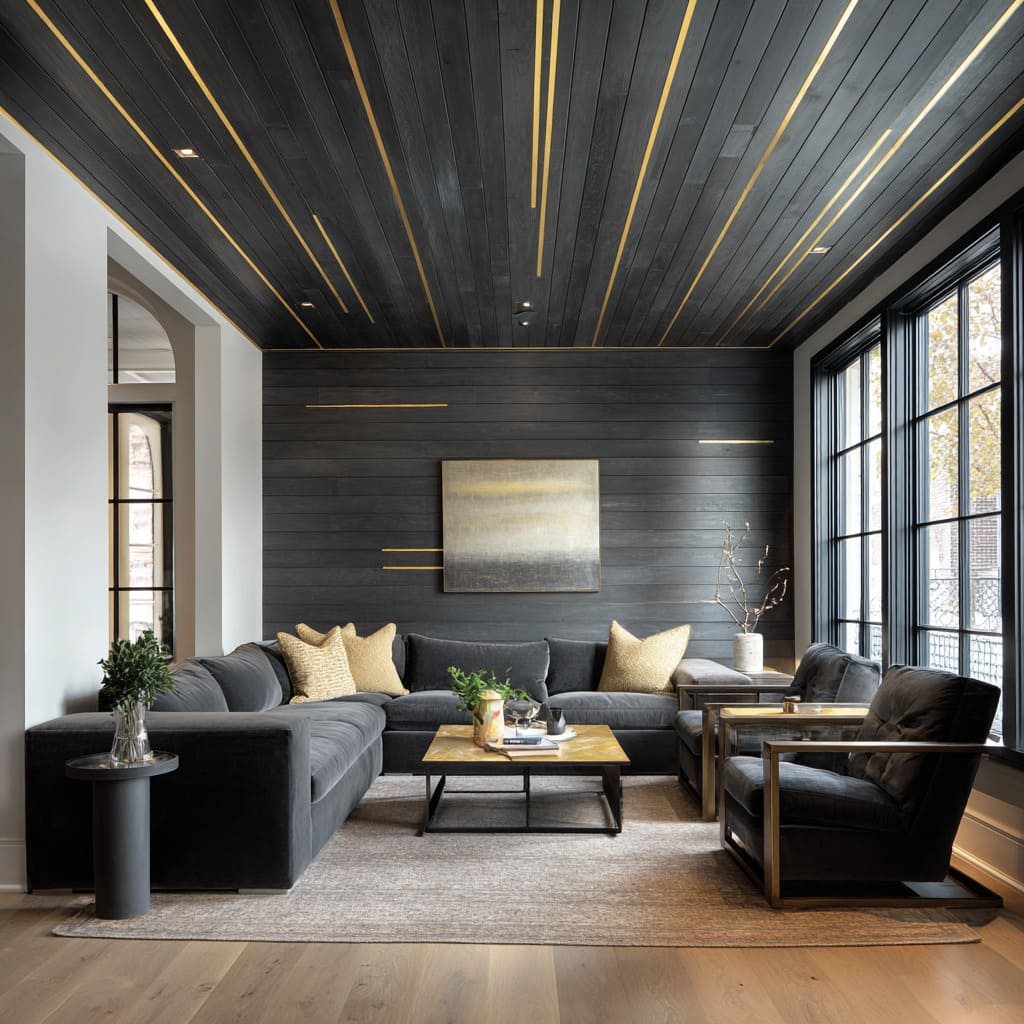
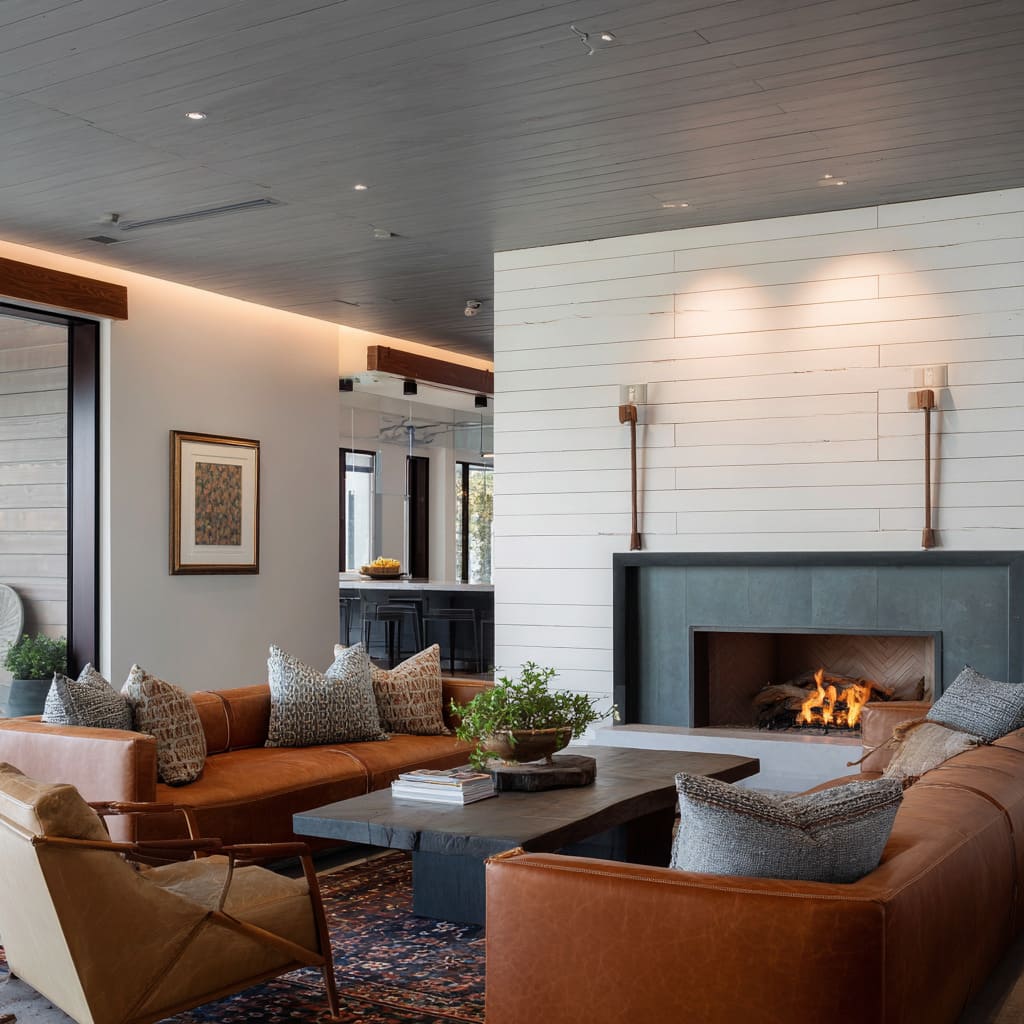
When these tones reappear on a striped fireplace wall with horizontal boards in the same color family, the room design gains a quiet dialogue between overhead and vertical surfaces, creating cohesion without relying on bold color. At the darker end of the spectrum, charcoal and deep gray shiplap converts the ceiling into a night sky for media lounges and conversation pits.
In such designs, the rich tone allows caramel leather, brass inlays, and warm textiles to glow; the ceiling recedes visually, and the warm materials at human level become the brightest parts of the composition. Concealed perimeter light or brass inlay lines often soften the heaviness, making the dark plane hover lightly above white walls rather than pressing down, which keeps the mood dramatic but comfortable.
Shiplap with Beams and Frames: Quiet Grids Overhead
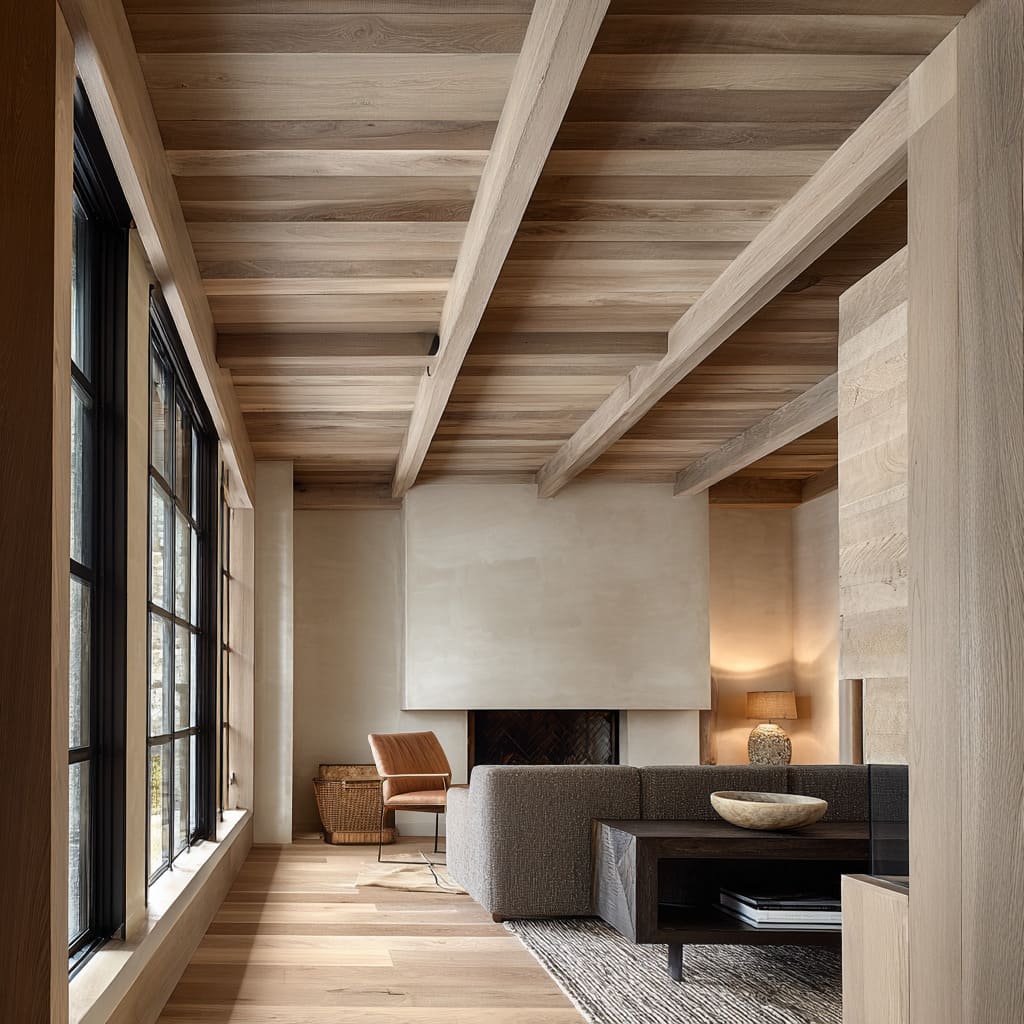
When beams intersect shiplap, the ceiling turns into a measured grid that organizes the entire interior design. Thick oak beams crossing mixed-toned planks form bays that echo the layout of seating and fireplaces below.
One bay might correspond to the area over a sofa and coffee table, another over the hearth, another over a circulation stripe between them. This rhythm allows large rooms to feel structured without the need for visible structural complexity elsewhere.
With beams in a slightly warmer tone than the planks, the linear system becomes legible: the beams are read as ribs, the shiplap as the skin stretched between them. The contrast keeps the eye moving calmly from bay to bay instead of losing orientation in a large timber field.
Hierarchies of Line
Designers often use beams sparingly to avoid competing with the already linear geometry of shiplap:.
- Single framing beams near fireplaces or dining areas create a strong visual frame, sometimes hosting spotlights that graze the wall surface below.
- Slender repeating beams in long rooms create a rhythm of bays that match the depth of seating clusters, so each cluster feels like it belongs to a specific “ceiling field.”
- Transitions between beam zones and plain shiplap mark changes in function, such as the step from a living zone into a circulation corridor.
Because beams align with window mullions, built-in cabinetry, or structural shifts in the walls, they frequently reveal an underlying grid that the observer may not consciously see. The ceiling thus quietly coordinates elements that are physically separate: a beam over a window mullion, a chimney breast aligned with a plank seam, a kitchen island sitting exactly under a central bay.
All of these alignments communicate order and intentionality, even when the furniture below is informal or eclectic.
Lighting and Timber: Drawing with Light Instead of Only Brightening
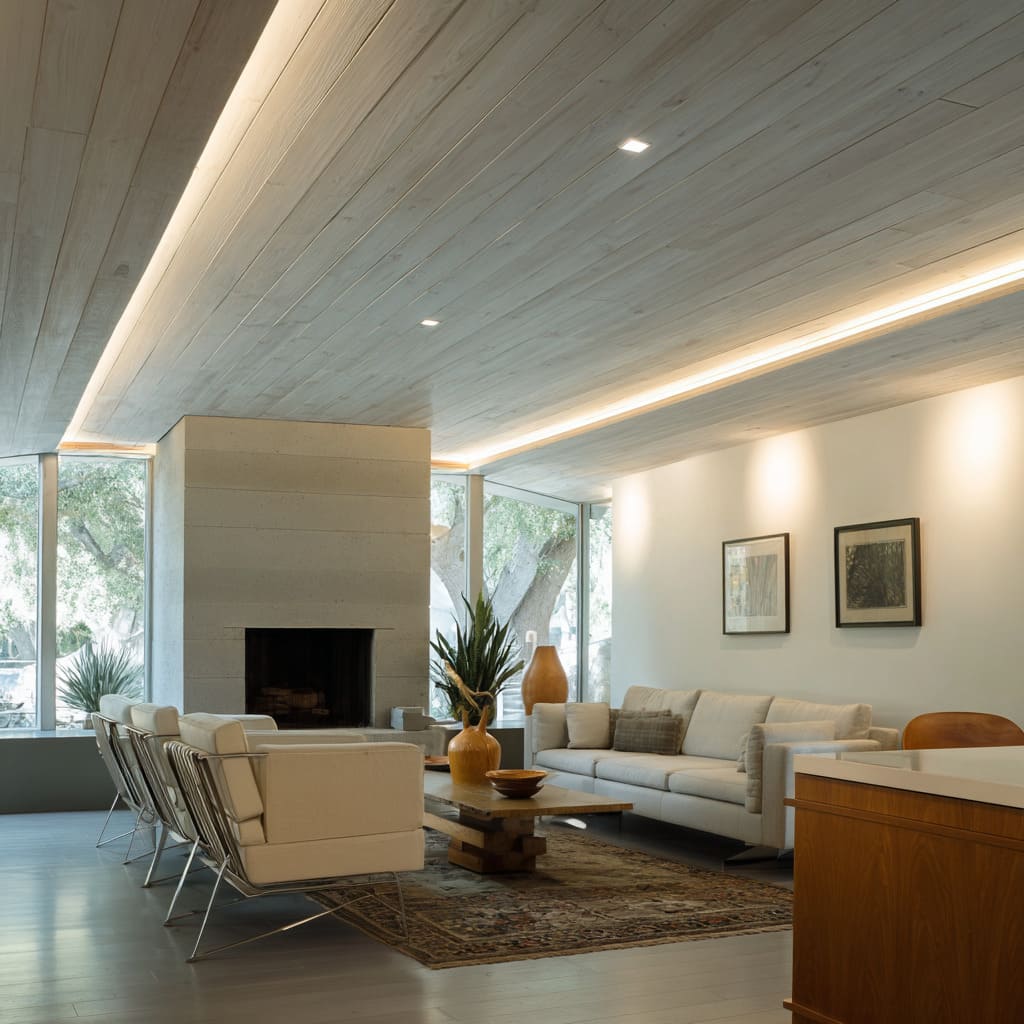
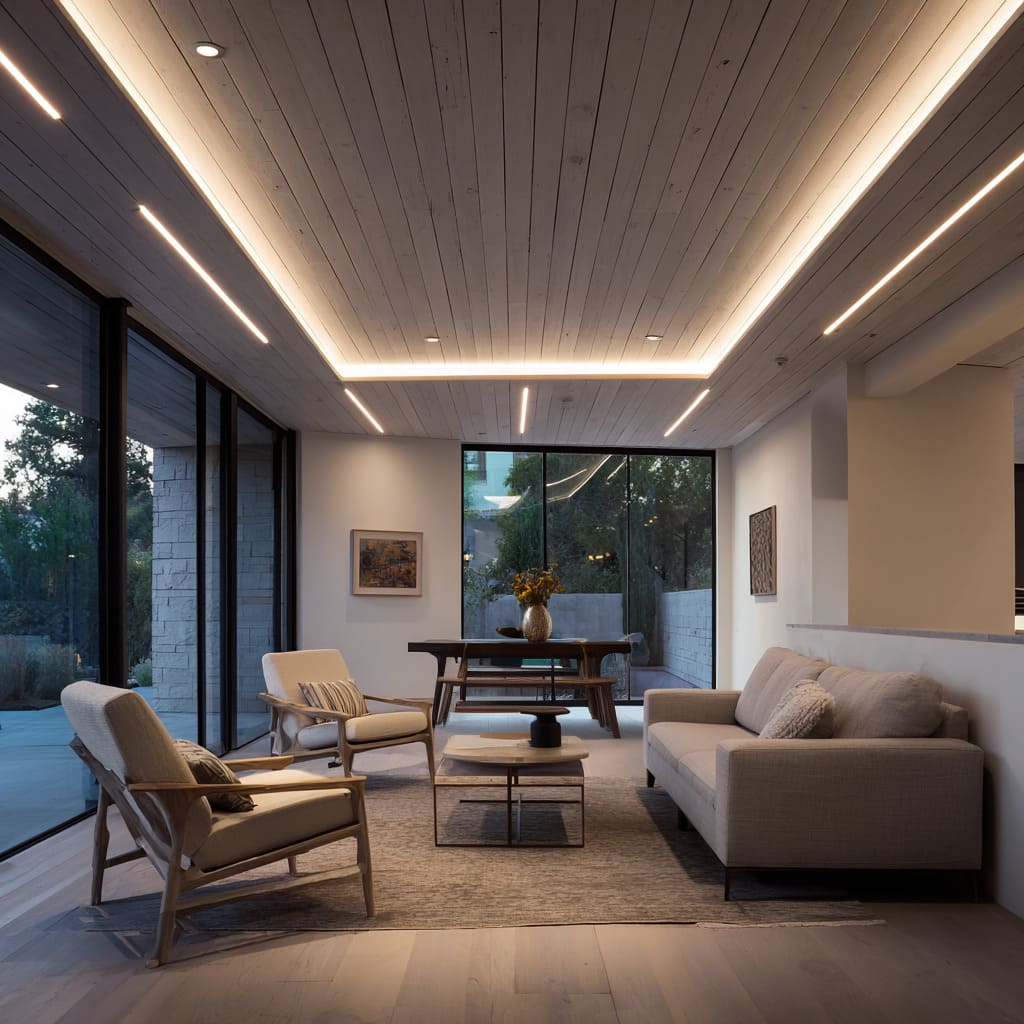
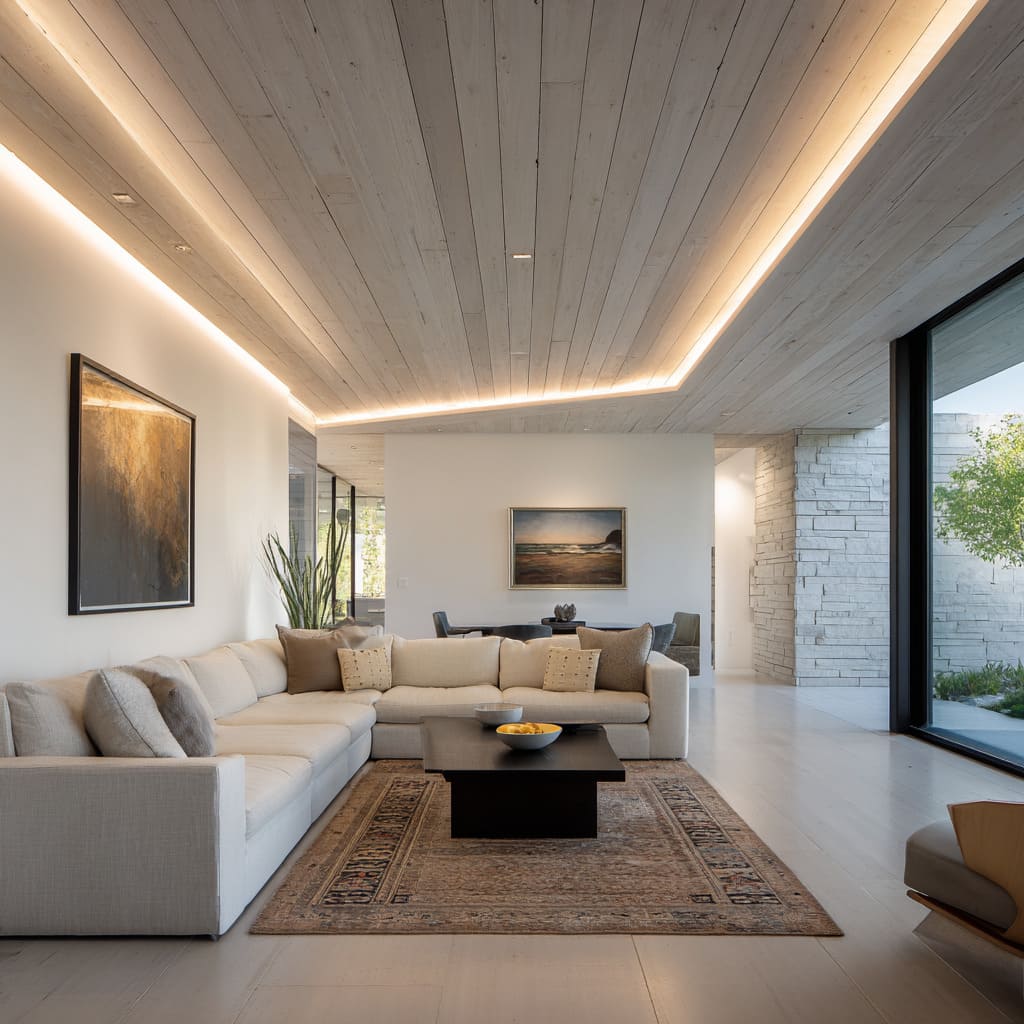
Lighting and shiplap interact as if the ceiling were a sheet of paper for drawn light. Concealed perimeter channels allow light to wash up the boards from the edges, making the center slightly darker and emphasizing the grain as it recedes.
In living rooms and lounges where a slim recess runs around the entire volume, this creates an effect of the timber lid floating above the walls, separated by a halo of warm light. The illuminated outline often mirrors the footprint of the main social zone: the glowing frame in plan is almost identical to the boundary of the rug and the arrangement of sofas and coffee tables.
Even in long, narrow rooms, edge lighting can soften the potential tunnel effect by framing the usable zone in a warm band and leaving the center for more subtle downlights.
Layers of Light on Shiplap
Within this broad strategy, several distinct light treatments appear:.
- Perimeter glow: LEDs hidden in setbacks at the wall–ceiling junction, turning the shiplap into a softly lit surface with a darker center.
- Linear bars: slim fixtures running parallel to the planks, overlaying bold lines of light on the fine grid of board joints, especially in evening sitting rooms.
- Recessed downlights: small, color-matched trims that punctuate the timber plane sparingly, creating pools of light on tables and seating without interrupting the grain.
- Pendant focal points: single or grouped pendants over dining tables that drop from shiplap, forming a vertical axis connecting ceiling and tabletop, often echoed by warm objects such as bowls of lemons or ceramic vases.
These layered combinations turn the ceiling into an instrument for shaping the mood throughout the day. By day, shiplap primarily reflects natural light and adds subtle shadow at each joint.
By night, the combination of glowing edges, linear bars, and small downlights reinterprets the same boards as a graphic pattern, mapping out the main social areas and emphasizing certain lines while letting others fade into gentle darkness. The timber keeps the lighting from feeling overly technical: even sharp linear fixtures become softer when their glare diffuses across grain and knots.
Relationship with Windows, Daylight, and Landscape
Shiplap ceilings can play a main role in designs with strong window compositions, and the relationship between boards and glazing is crucial. Boards can run directly toward tall windows or glass walls, pulling the interior visually toward the landscape beyond.
The ceiling thus acts as a directional device, guiding attention from sofas and benches out to tree lines, gardens, or distant views. Pale boards that echo the tones of exterior trunks, fields, or stone terraces strengthen the link, so the ceiling reads as the indoor continuation of outdoor horizontals.
Interplay of Grids and Shadows
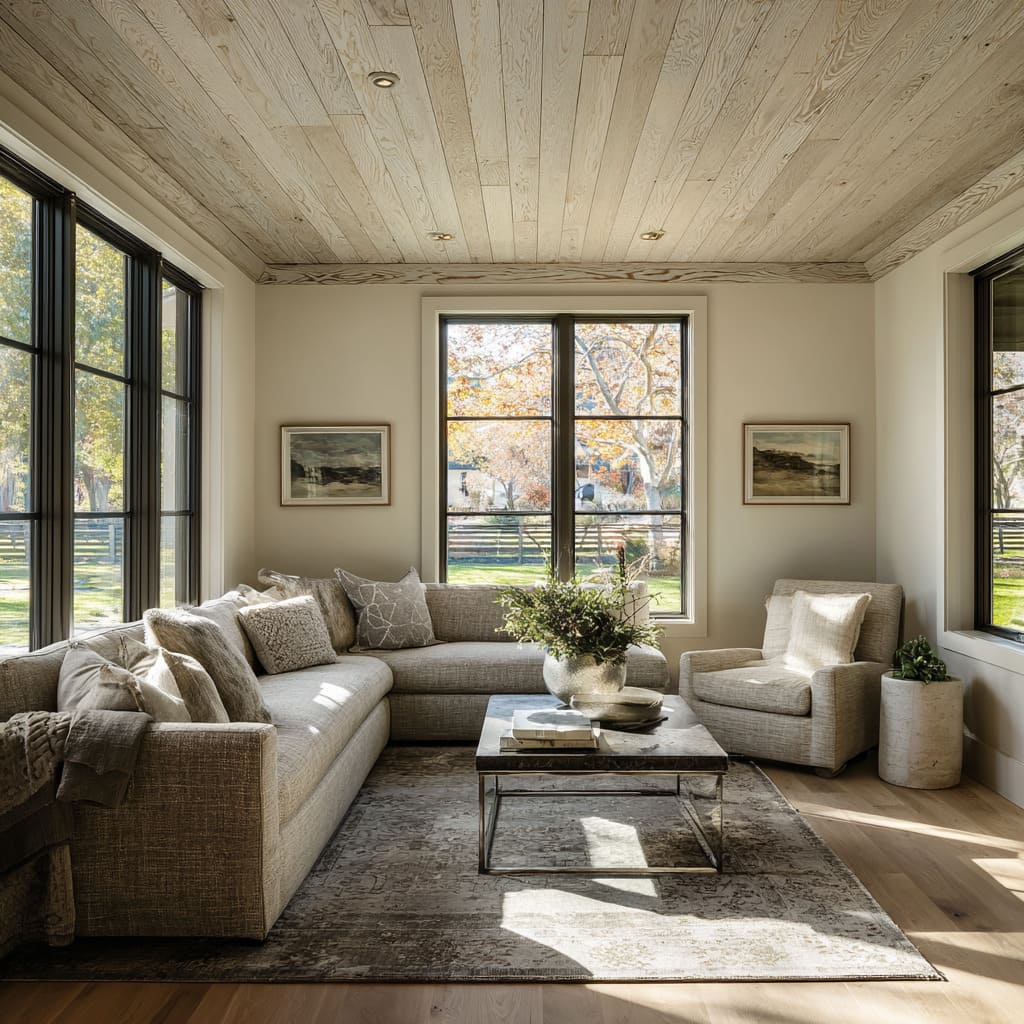
Where windows use dark frames and slim mullions, shiplap adds a soft counter-pattern overhead. Vertical black bars frame the view and create sharp shadows; horizontal timber joints provide a quieter structure.
As the sun moves, mullion shadows fall across the boards, layering temporary dark stripes over the permanent linear pattern. In bright designs where white shiplap covers both ceiling and upper walls, this moving shadow pattern adds life to an otherwise restrained palette, making the space change subtly throughout the day without any alteration in furniture or decor.
In designs where shiplap continues outside as a soffit, the boundary between interior and terrace becomes particularly thin: the same boards are visible on both sides of the glass, so the occupant reads the interior ceiling and exterior overhang as one continuous plane. This continuity pairs especially well with low, rectilinear sofas and simple tables that sit close to the glass, allowing the view and the timber canopy to handle most of the visual work while furnishings stay quiet and supportive.
Shiplap on Ceilings and Walls: Envelopes, Feature Planes, and Wrapped Corners
The ceiling and one or more walls can be clad in the same boards, producing shiplap wall and ceiling ideas that define certain pockets as distinct zones inside a larger open shell. When shiplap runs across the ceiling and down behind the sofa or fireplace, the room gains a timber envelope that feels like a box inserted into the larger space.
This is particularly effective in lounges where a darker charcoal shiplap ceiling continues down behind the sectional and is punctuated by thin brass inlay lines: the ceiling is no longer a separate surface but part of a continuous wrapper that sets the mood for the entire seating zone. Other walls in the same room may stay white and smooth, allowing the wrapped corner to claim visual dominance while the rest of the space retreats into a supporting role.
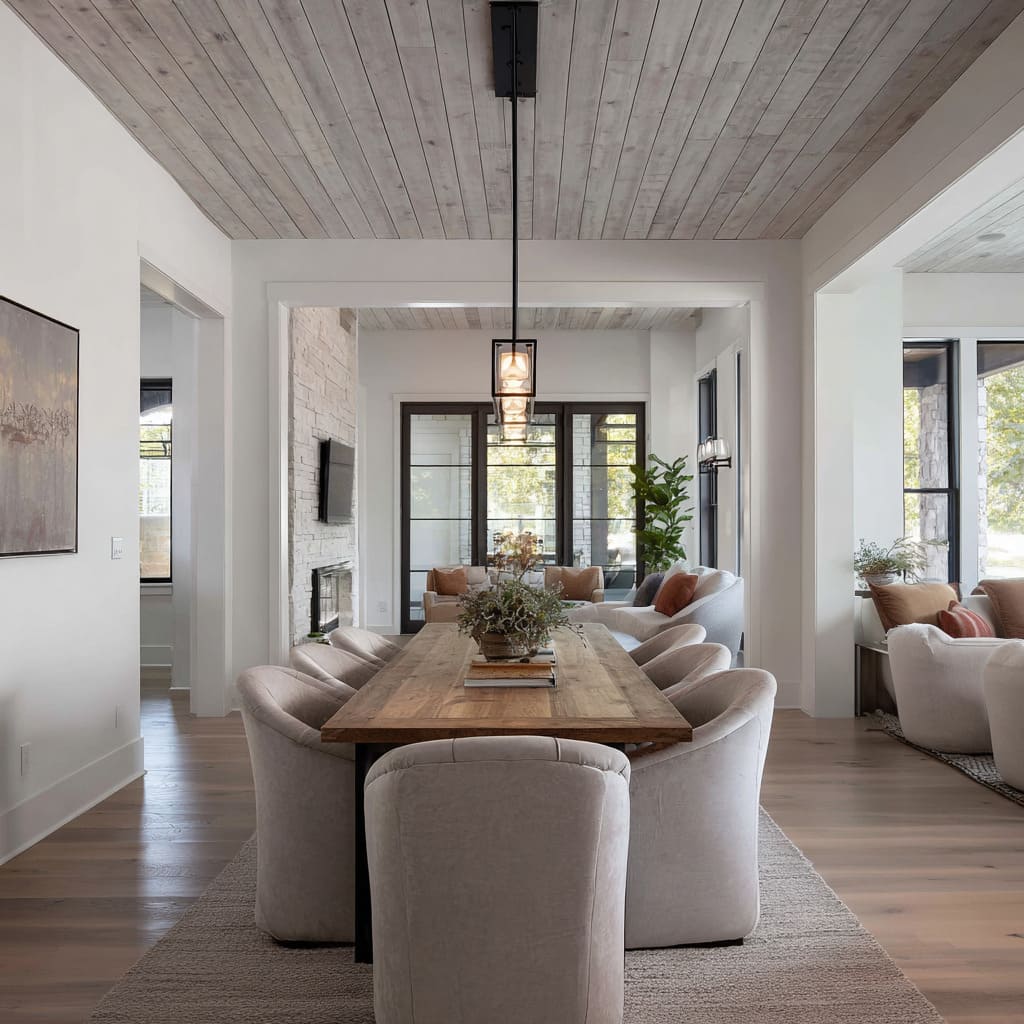
In more luminous interior designs, white or pale timber boards cover the ceiling and upper walls, while lower walls transition to plaster or paneling. This creates the impression of a wooden lantern sitting on a more solid base: light appears to emanate from the timber envelope, while the plainer lower band quietly holds built-ins and doorways.
Wrapped corners are especially powerful in small room designs, where a shiplap ceiling and one wall can create a sense of intentional intimacy around a window seat, banquette, or reading chair. Conversely, limiting timber to a single wall and the ceiling above it—say, around a fireplace alcove—allows the shiplap to function like a visual frame: everything within that frame (fire, sofas, coffee table, rug) belongs to a more focused, cocooned universe, even when the adjacent space stays bright and spare.
Furniture, Textiles, and Objects: Echoing the Linear Language
The effect of shiplap overhead is reinforced when furniture and decor pick up its linear language in softer, smaller-scale ways. Wide timber boards on the floor that run in the same direction as the ceiling planks create a timber “tube” effect, with the occupants moving inside a long, calm envelope.
Rugs with ribbed textures or subtle stripes echo this logic at a lower plane; when such rugs are sized to match the footprint of the main seating group or dining setting, they reinforce the zoning already indicated by ceiling bays or rafts. Sofas and benches can be low and rectilinear, echoing the horizontal emphasis above.
Cushions and throws then introduce a softer, broken version of the same geometry: quilted seams, stitched lines, and striped fabrics that speak the same language in a relaxed tone.
Objects on tables and shelves help tune the balance between strict linear order and informal daily life. Wooden coffee tables with strong grain and plank-like tops can appear as smaller cousins of the ceiling boards, especially when their tones match darker or lighter portions of the overhead mix.
Bowls, vases, and books arranged sparingly on tables interrupt the linearity with rounded, organic shapes, preventing the design from feeling overly controlled. Vertical elements such as slim floor lamps, tall vases, or plant stems subtly counterbalance the horizontal dominance, drawing the eye upward along the planks.
The key visual effect is that the entire interior design seems to work with one underlying rhythm: the ceiling provides the dominant beat, the furniture forms the stable bass line, and textiles and objects supply quieter syncopations that keep the composition human and lived-in.
Mood Families: Retreat, Porch, Gallery, Cottage, and Urban Lounge
Different combinations of tone, direction, wrapping, and lighting in shiplap ceilings tend to fall into recognizable mood families. Retreat spaces—reading nooks, attic landings, small lounges—often rely on wrapped shiplap and lower perceived ceilings: boards on sloped or low ceilings, sometimes extended down one or two walls, with warm concealed lighting and soft textiles below.
The result is a hushed, compressed envelope ideal for quiet activities. Porch-like interiors sit at the other end, with light timber extending toward views, sometimes continuing outdoors; large glass panels and indoor planting give the impression of a covered terrace brought indoors.
Mixed sandy and blond boards, low rectilinear upholstery, and minimal decoration let the shiplap and the landscape take the lead.
Gallery-like living rooms can lean on uniform pale oak or gray shiplap, minimal beams, and carefully placed lighting. Such designs often display art on plaster walls while allowing the ceiling to unify the long volume, so the test of correctness becomes alignment and restraint rather than ornamentation.
Cottage and farmhouse rooms can use whitewashed boards on ceilings and sometimes walls, paired with paneling, banquettes, and rustic tables; here, shiplap provides a historic texture while a soft palette and modern furniture keep the space feeling current.
Finally, urban-style lounges can rely on darker shiplap, metal inlays, or reclaimed boards framed in white, combined with leather seating, brass accents, and strategic lighting. Shiplap can be the main source of character overhead, creating a sophisticated envelope that feels equally suitable for daytime lounging and evening gatherings.
Each mood family emerges not from one decision, but from layered small moves in timber tone, plank direction, wrapping, beam presence, and light distribution.
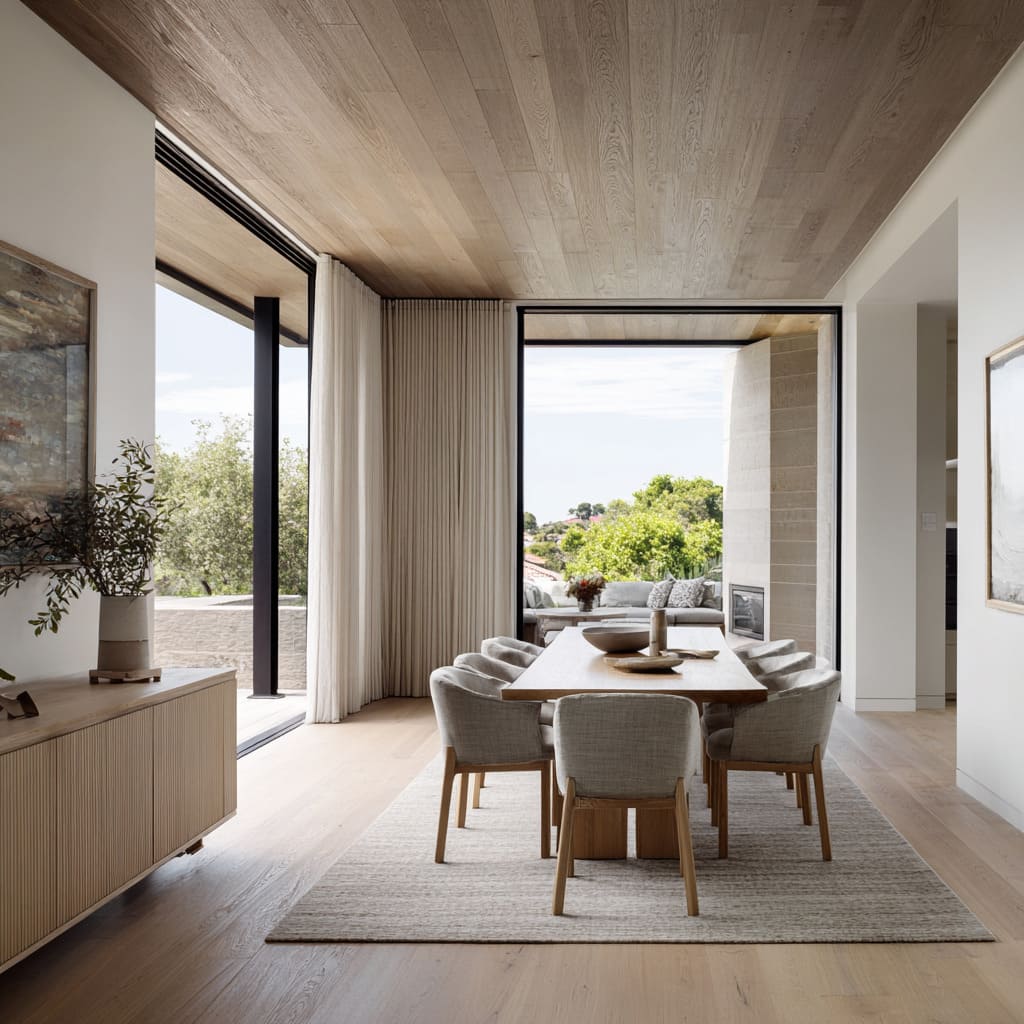
Social Cores and Dining Tables Under Timber Lids
Dining areas and social cores benefit especially from a defined ceiling story, and many interior designs place shiplap directly above the table or central sofa group as if it were an invisible structural requirement. A long plank of timber serving as a dining table often sits under boards running in the same direction, creating a strong axis that visually links plate, tabletop, and ceiling.
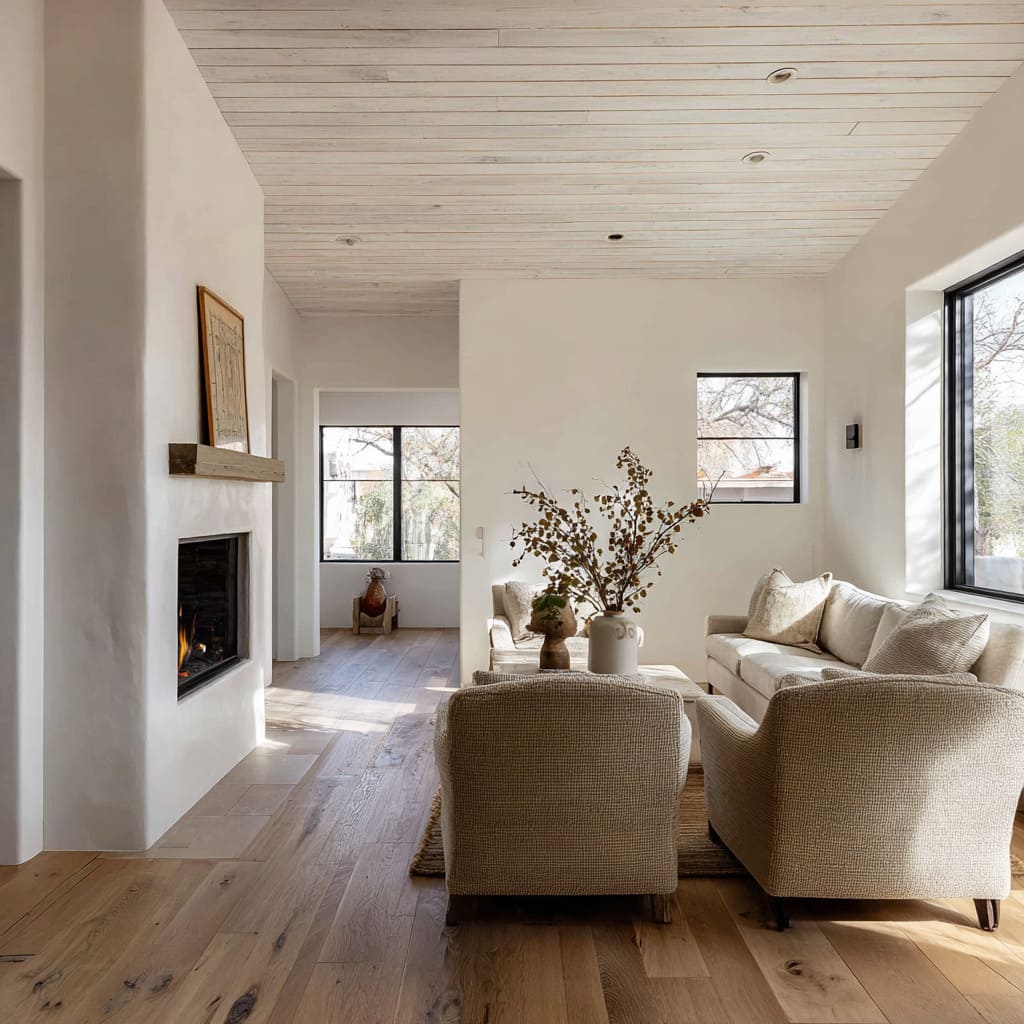
Pendant lights sometimes trace this axis, forming a vertical column of interest from the canopy plate at the ceiling down to fruit bowls or vases below. In designs where shiplap forms only a raft in the center of the ceiling, the raft tends to be the same size or slightly larger than the footprint of the table and chairs; a rug of similar dimension on the floor then creates a triple stacking of rectangles: soft textile below, furniture in the middle, timber patch above.
This stacking gives dining rituals a distinct stage inside an open-plan house without requiring any partitions.
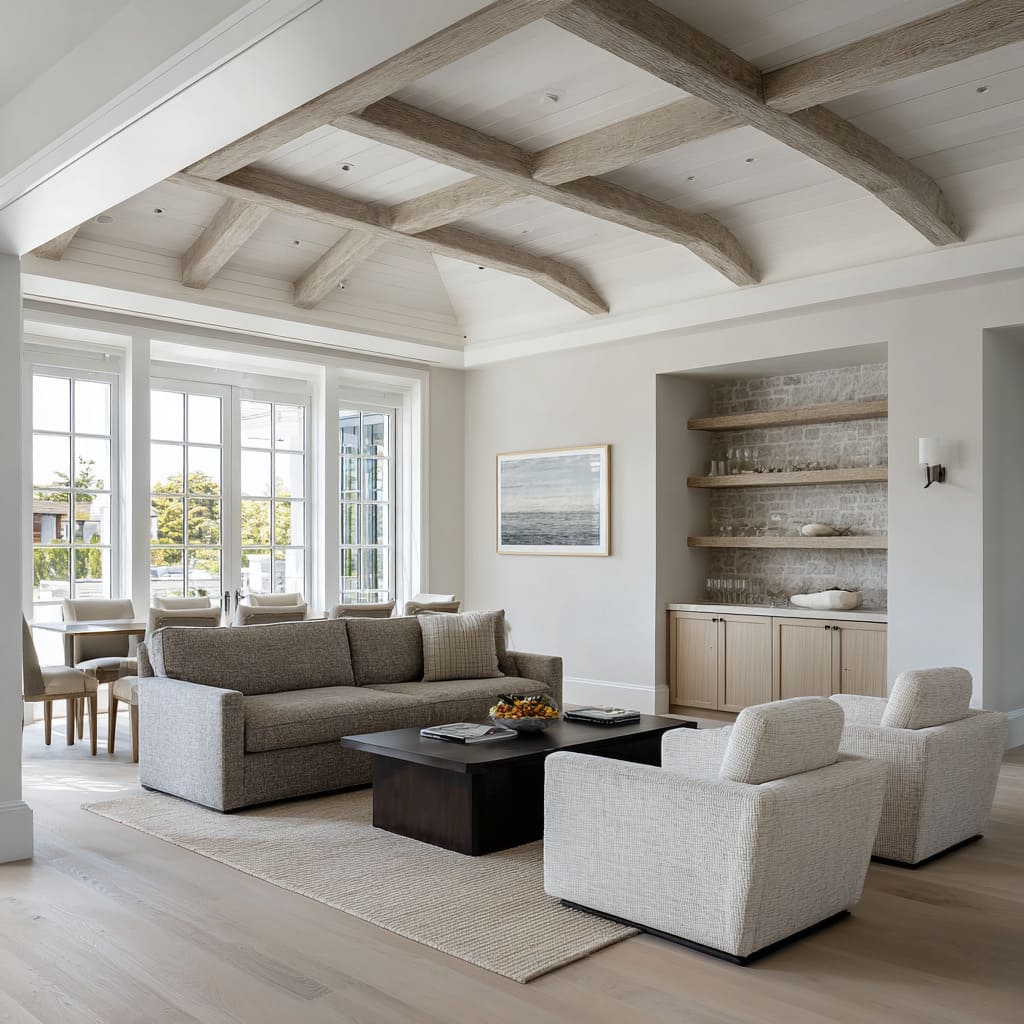
Living areas often follow a related pattern, with shiplap running over the main seating cluster and stopping just behind it or being framed by beams or borders that align with the outer edges of the rug. Sectionals or pairs of sofas then sit inside this implicit box, while side chairs and small tables occupy its edges or sit just beyond, floating between the defined zone and the adjoining spaces.
In design concepts where the ceiling continues seamlessly into adjacent areas, a subtle shift in lighting—downlights, linear strips, or lack of fixtures—marks where the most intense social activity happens. By handling the social core overhead instead of only on the floor, interior designs feel anchored along all three dimensions: plan, section, and elevation work together.
This is one reason shiplap ceiling design plays such a defining role; the boards are not just chosen for texture, but for their capacity to pull architecture, furniture, and daily life into one coherent visual field.
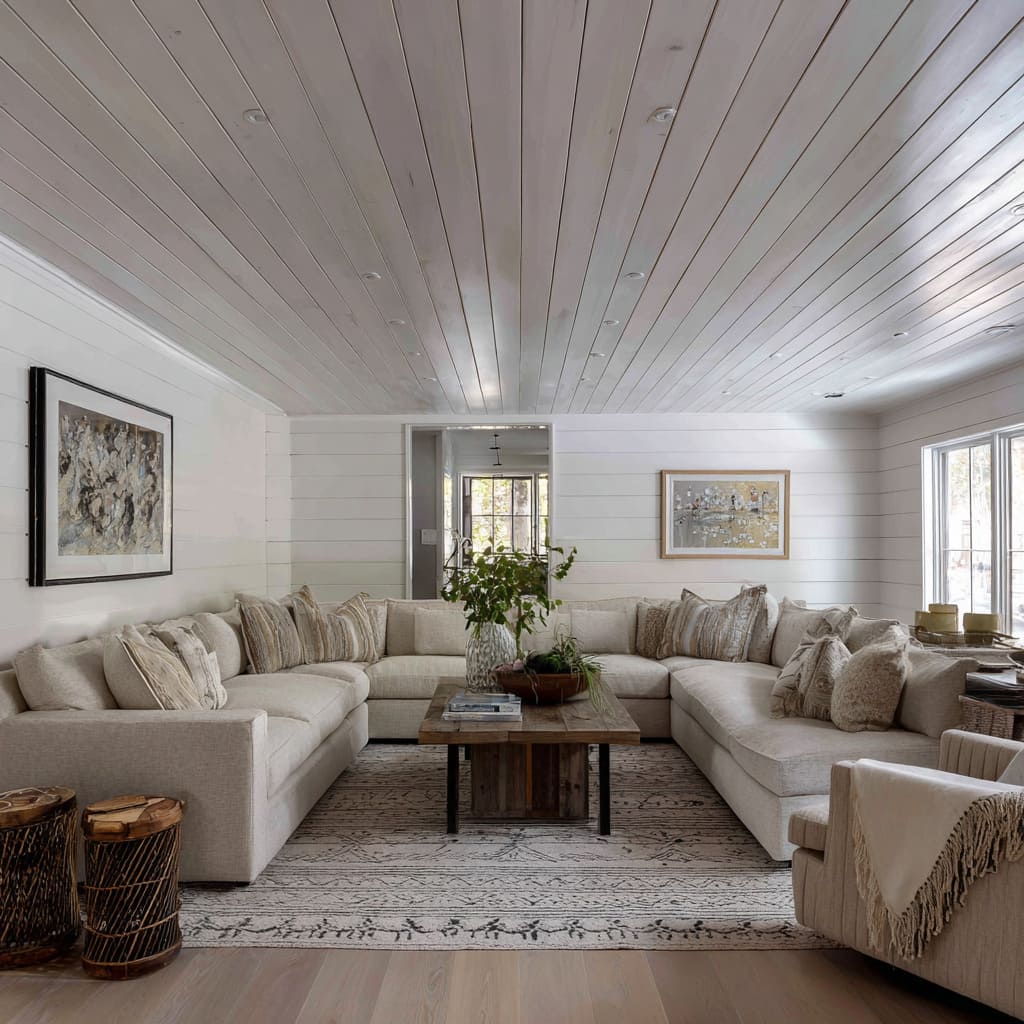
Shiplap as the Linking Surface
Taken together, such patterns show shiplap operating as a linking surface that connects structural rhythm, light, furnishings, and landscape in a single continuous language. At the most basic level, planked timber overhead introduces a repeatable horizontal line that can run, fold, wrap, and pause in different parts of a plan.
Once that line exists, windows, beams, lighting tracks, built-in benches, fireplace walls, and rugs can all be tuned to it, either by aligning exactly or by playing against it with vertical or diagonal counterpoints. In bright designs, this leads to timber lids that reflect daylight and make walls and furniture feel gently washed by an even glow.
In darker or moodier compositions, it supports intimate enclosures where warm materials and firelight stand out like points of intensity under a calm, dark plane. With this layered approach, shiplap ceiling ideas move far beyond rustic nostalgia; they become a strategic way to knit together contemporary interior designs where open plans, large glass areas, and minimal color palettes require a strong yet subtle organizing element.