A primary bedroom that feels restorative does not happen because the room is pale, expensive, or styled with a few soft pillows. It happens when the room reduces strain.
Soothing bedroom interior designs should not be built by stripping everything down or by filling the room with decorative extras. Calm designs work because they lower visual friction while keeping a small amount of gentle richness.
That is the foundation of a retreat-like primary bedroom.
In practical terms, that means the room should ask less of the eye, soften hard boundaries, keep contrast in check, and give the body more than one way to settle into the space. The result is a primary bedroom that supports rest before you even lie down.
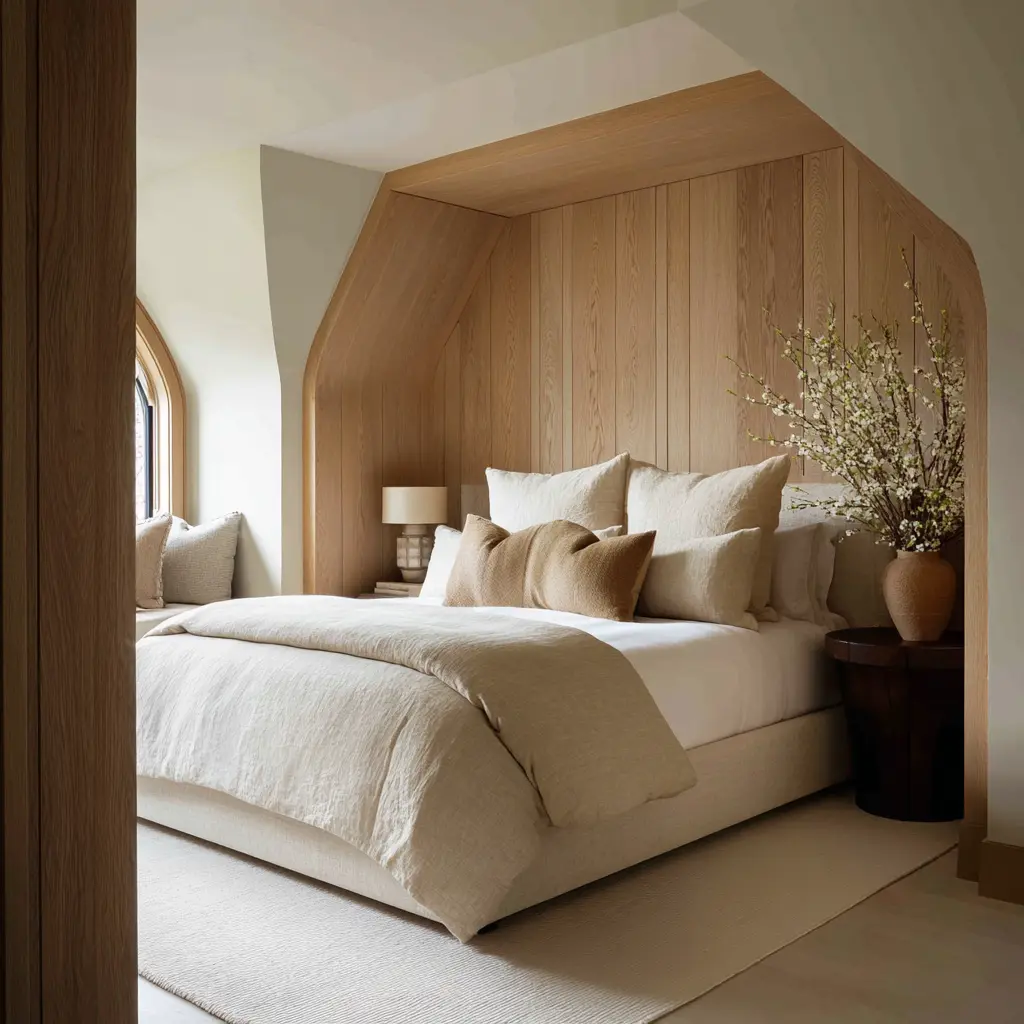
This is why some bedrooms with simple finishes feel deeply restorative, while others with similar colors still feel cold, unfinished, or slightly tense. The difference is not the color family alone.
It is the way the room manages proportion, light, texture, visual rhythm, and the emotional sense of shelter.
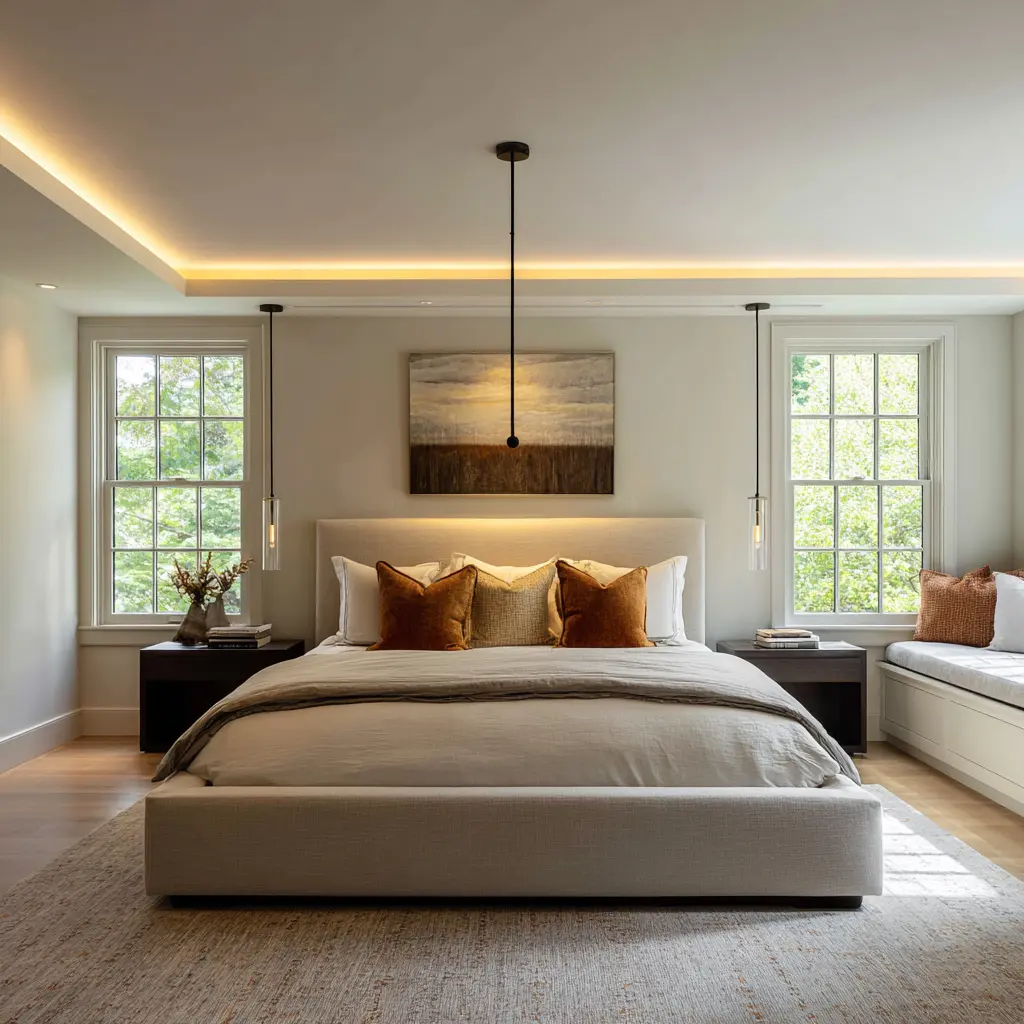
A Calm Primary Bedroom as a Sensory Retreat
Many people assume the retreat look comes from neutrals. Neutrals can help, but the real pattern is more specific than that.
Bedrooms do not become restful by removing all variation. They became restful by doing six things at once:
- compressing contrast
- slowing the eye
- softening boundaries
- grounding the bed
- limiting stronger accents to small areas
- giving the room at least one extra place to pause besides the bed
That last point matters more than it may seem. A bedroom starts to feel like a private refuge when it supports slow habits, not only sleep.
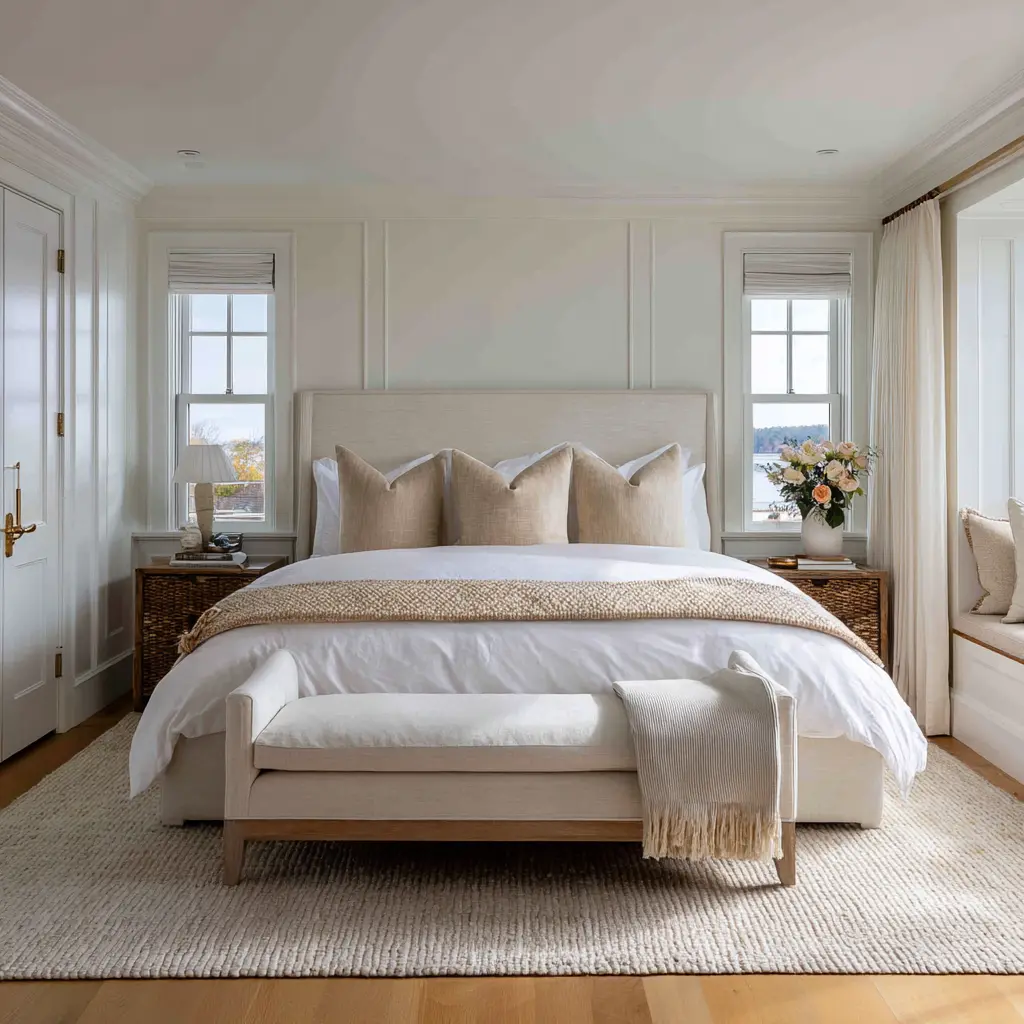
A bench by a window, a built-in daybed, a small chair in a bright corner, or even a soft bench at the foot of the bed tells the body that this room is meant for staying, not only for collapsing into bed at the end of the day. So the retreat effect is not about decorating more.
It is about editing the room so that it carries less friction.
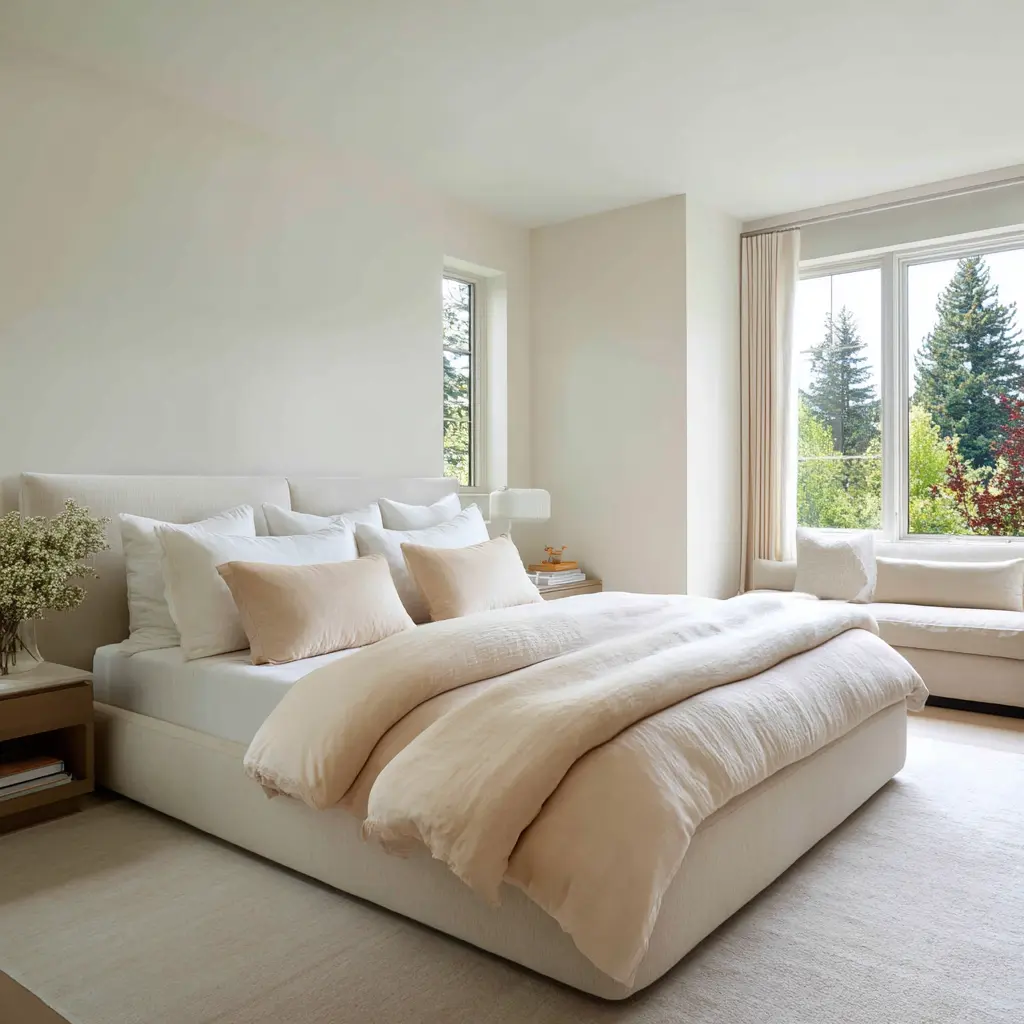
The Five Balances Every Restful Bedroom Has to Solve
Calm bedroom designs can solve the same five design tensions, even though they looked different from one another.
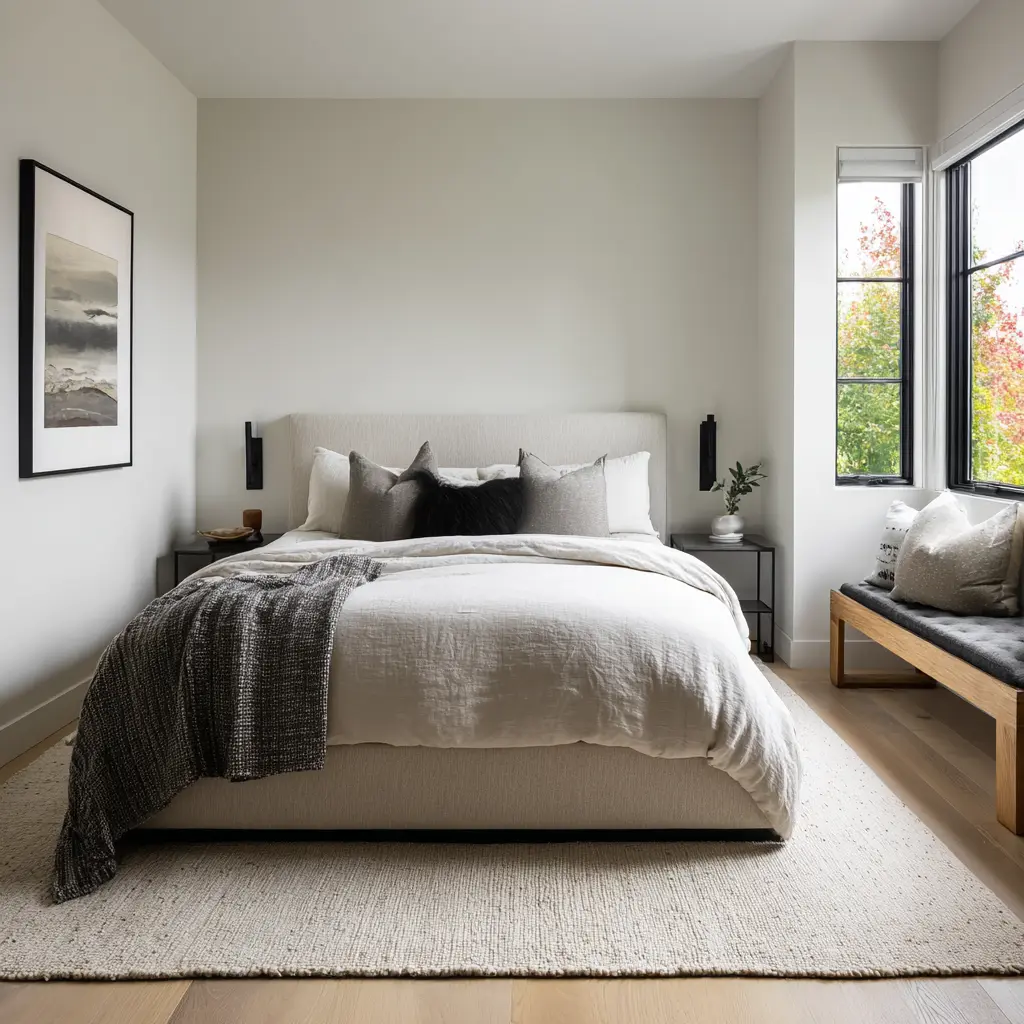
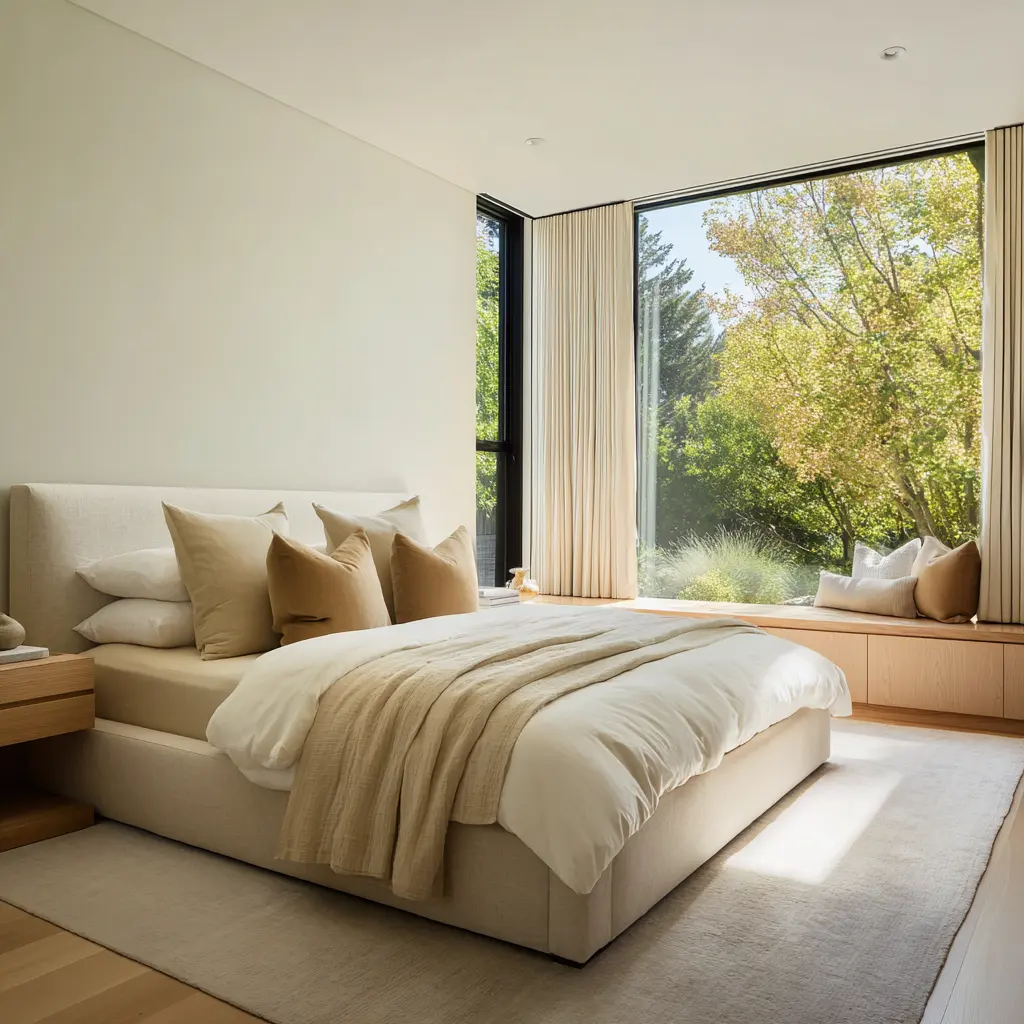
1) Openness and shelter must exist together
A good retreat bedroom needs air, but it also needs protection. If the room is too open, it feels exposed.
If it is too enclosed, it feels heavy. The interior design solution can find the middle point through moves like full-height drapery around large windows, low beds beneath tall walls, soft vaulted ceilings, and bed walls that feel gently framed rather than flat and empty.
This is why a bright room can still feel sheltered. The protection does not have to come from dark paint.
It can come from form: a winged headboard, a recessed wall, an alcove, a sloped ceiling, or curtains that soften the outer edges of the room. A pale design can still feel deeply held if its shape suggests containment.
2) Softness needs definition
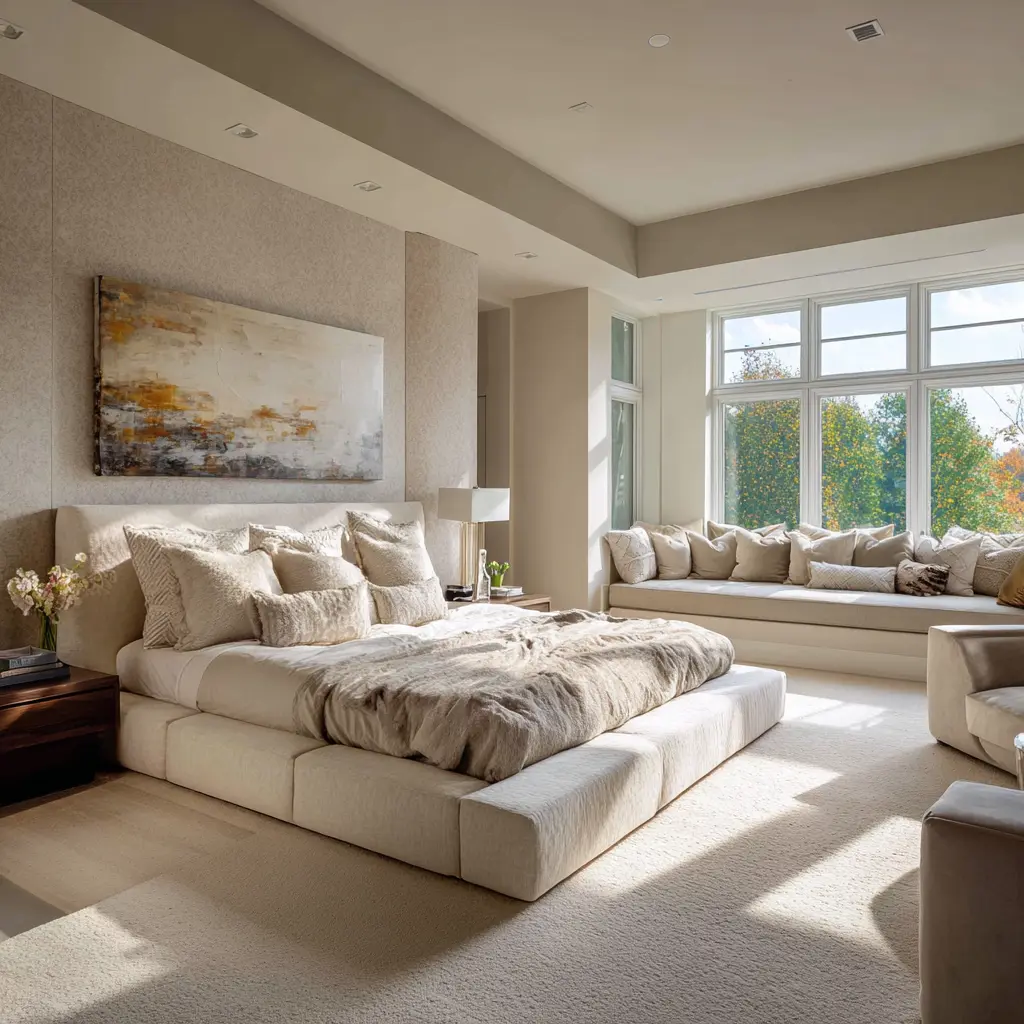
A room filled only with pale soft material can lose shape. Then it stops feeling soothing and starts feeling vague.
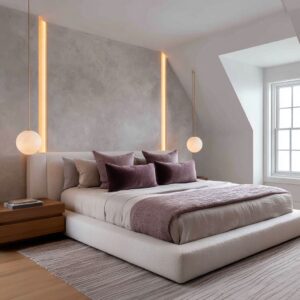
Calm bedrooms let softness dominate, but they still include one stabilizing layer: a darker wood nightstand, a thin black pendant, a narrow metal sconce, a warm wood wall, a single rust-toned pillow group, or a trim line that gives the eye a place to land. This is one of the strongest takeaways: softness feels best when it is lightly anchored.
Without that anchor, the room can drift.
3) Order works best with one relaxed gesture
A primary bedroom design with too much precision can feel staged. A room with too little structure can feel messy.
There is a simple formula: a formal backbone and one or two easy, human moves.
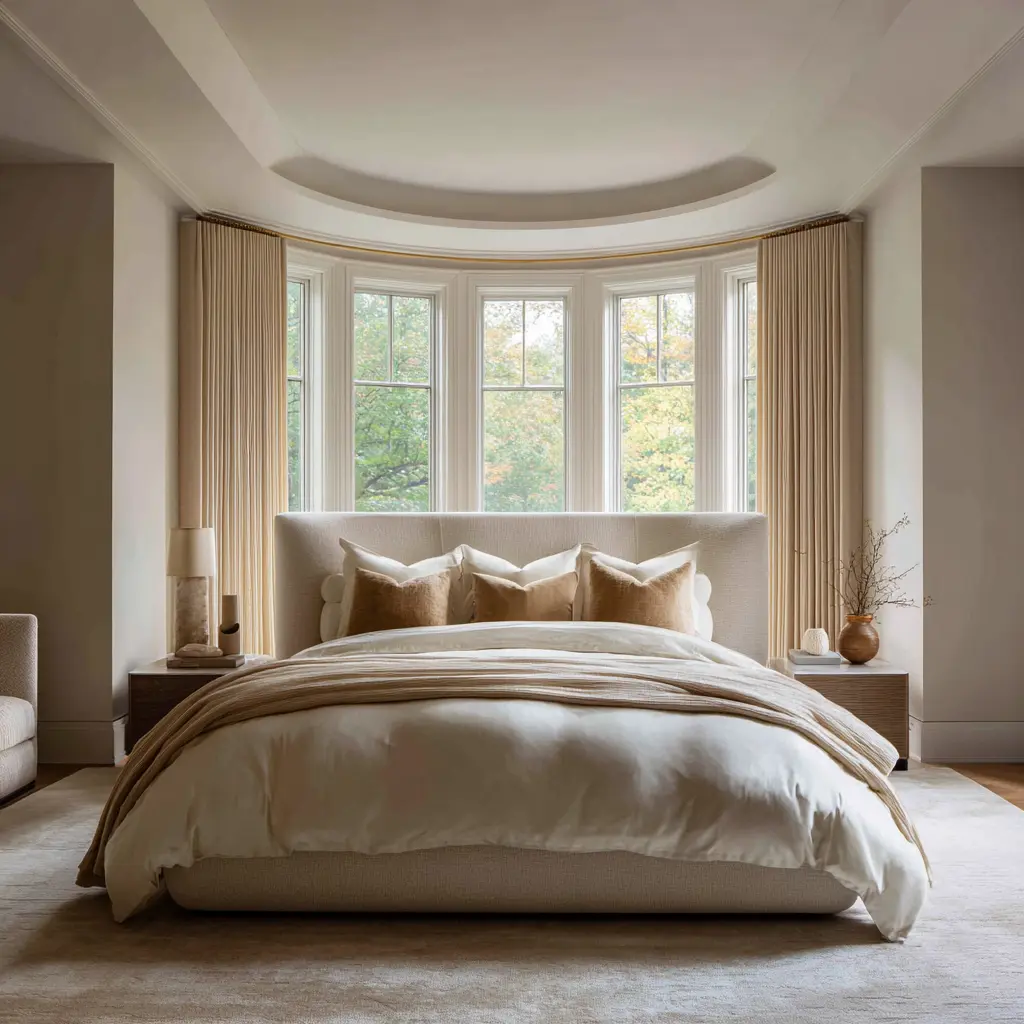
That backbone might be a centered bed, matching bedside lamps, a clear wall composition, or a balanced ceiling treatment. The softer move might be a loosely draped throw, a slightly off-center bench cushion, or a single side corner that feels a little less exact than the rest of the room.
That small imperfection matters. It keeps the room from feeling rigid and lets the space feel lived in.
4) Brightness only works when it is contained
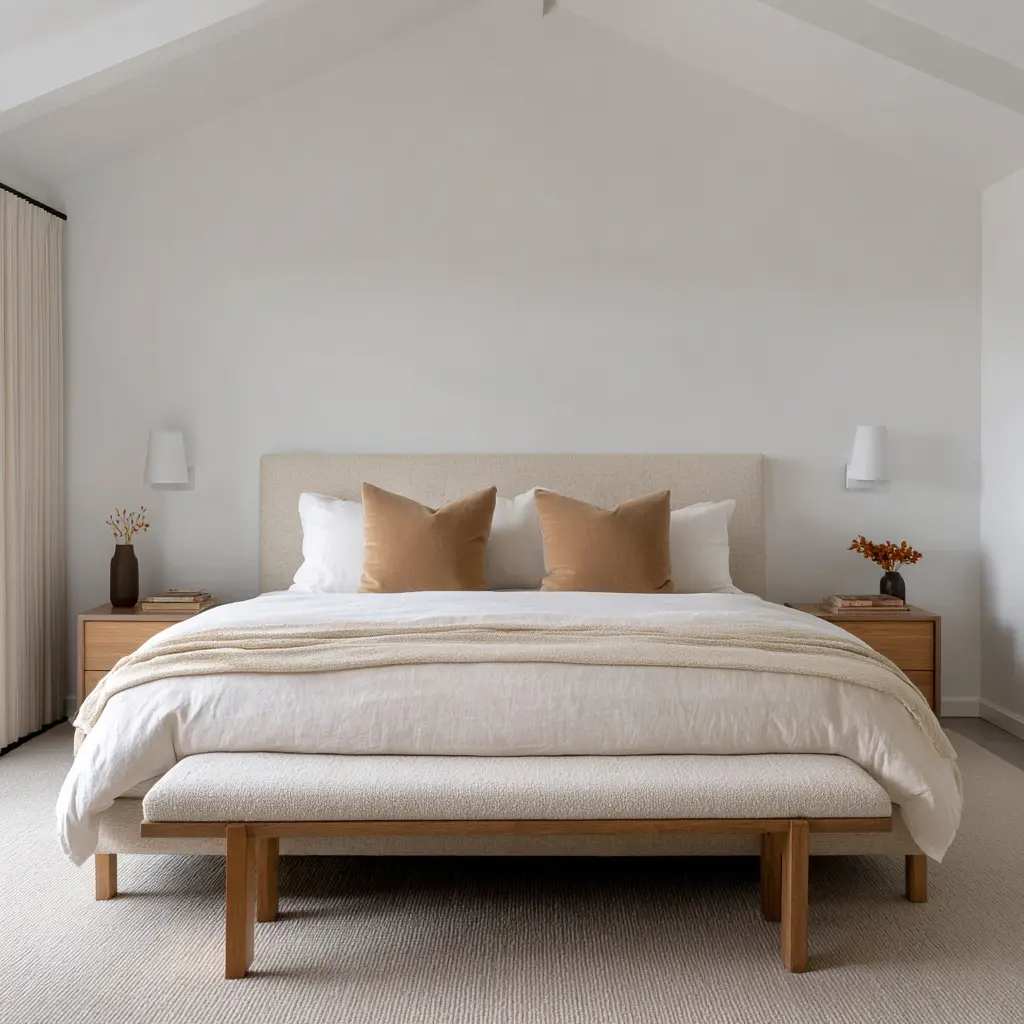
A bright bedroom is not automatically restful. Brightness becomes soothing only after it is softened.
Interior design concepts that handle light use some versions of the same filter ideas: matte fabrics, warm undertones, curtains close in value to the walls, a large rug to absorb glare, and window trim or framing that stops daylight from blowing out the room visually. In some cases, cove lighting can also soften the edge where wall and ceiling meet, which made the room feel less hard.
The goal is not brightness alone. The goal is bounded brightness.
5) Simplicity must still feel rich
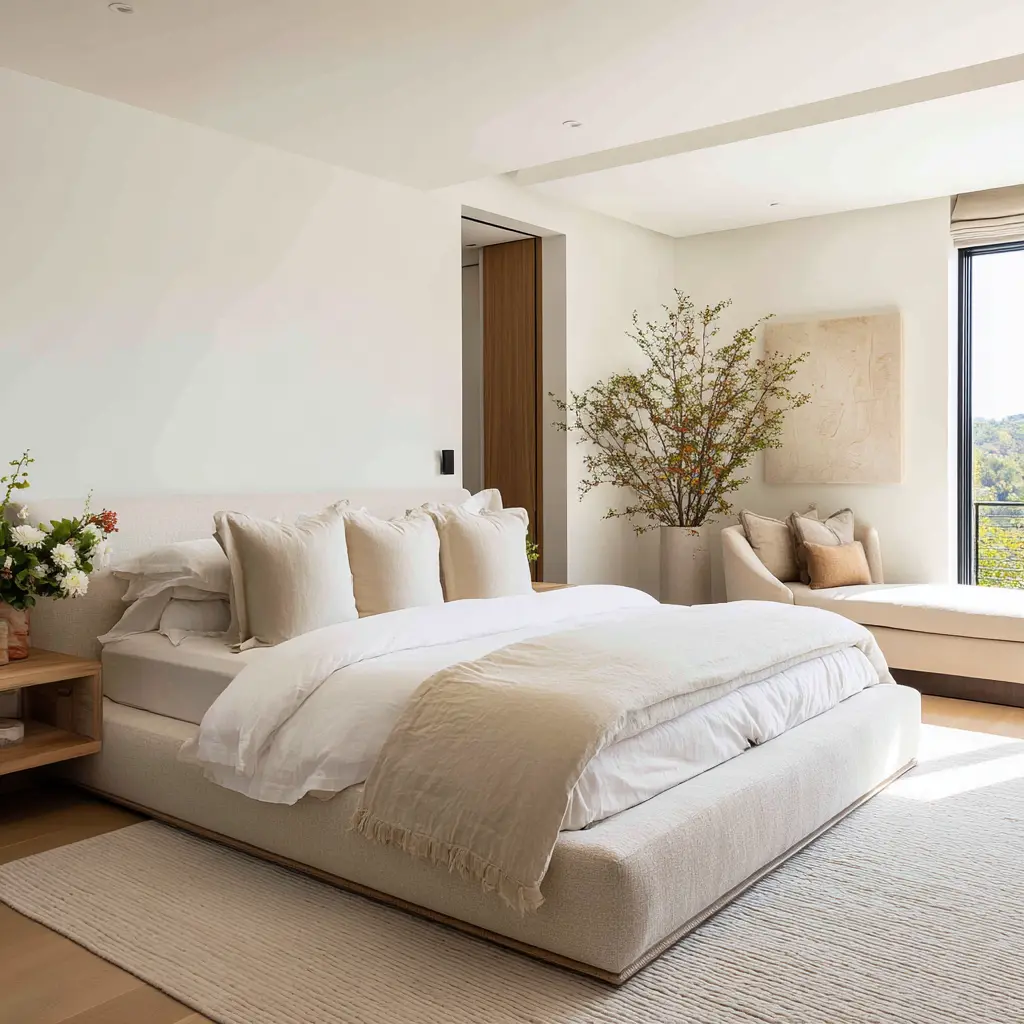
A calm room should not feel cluttered, but it should not feel empty either. Calm primary bedroom design ideas shift richness away from loud color and busy detail and place it in quieter things: surface texture, slight tonal steps, dry-looking wood, soft shadow, filtered daylight, and greenery outside the window.
This is why such interior designs often feel full even with very few decorative objects. Their richness comes from material and atmosphere, not from many separate accessories.
Why Low, Broad Beds Work So Well
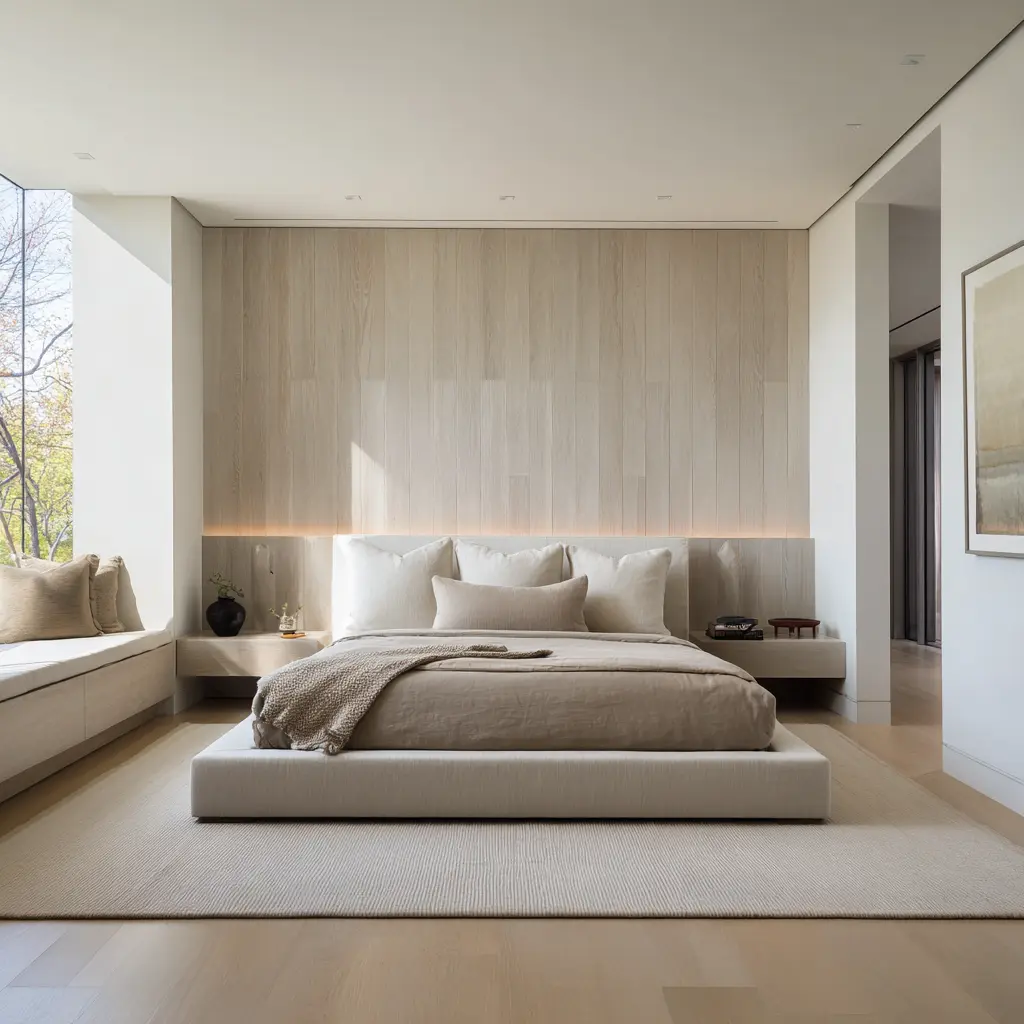
One of the modern primary bedroom design moves is a low, wide bed. This is not only a trend detail.
It changes the emotional weight of the room. A lower bed drops the visual center of gravity.
It reduces the upright tension in the space. It stretches the main resting mass horizontally instead of pushing it upward.
The primary bedroom starts to feel more settled and less formal.
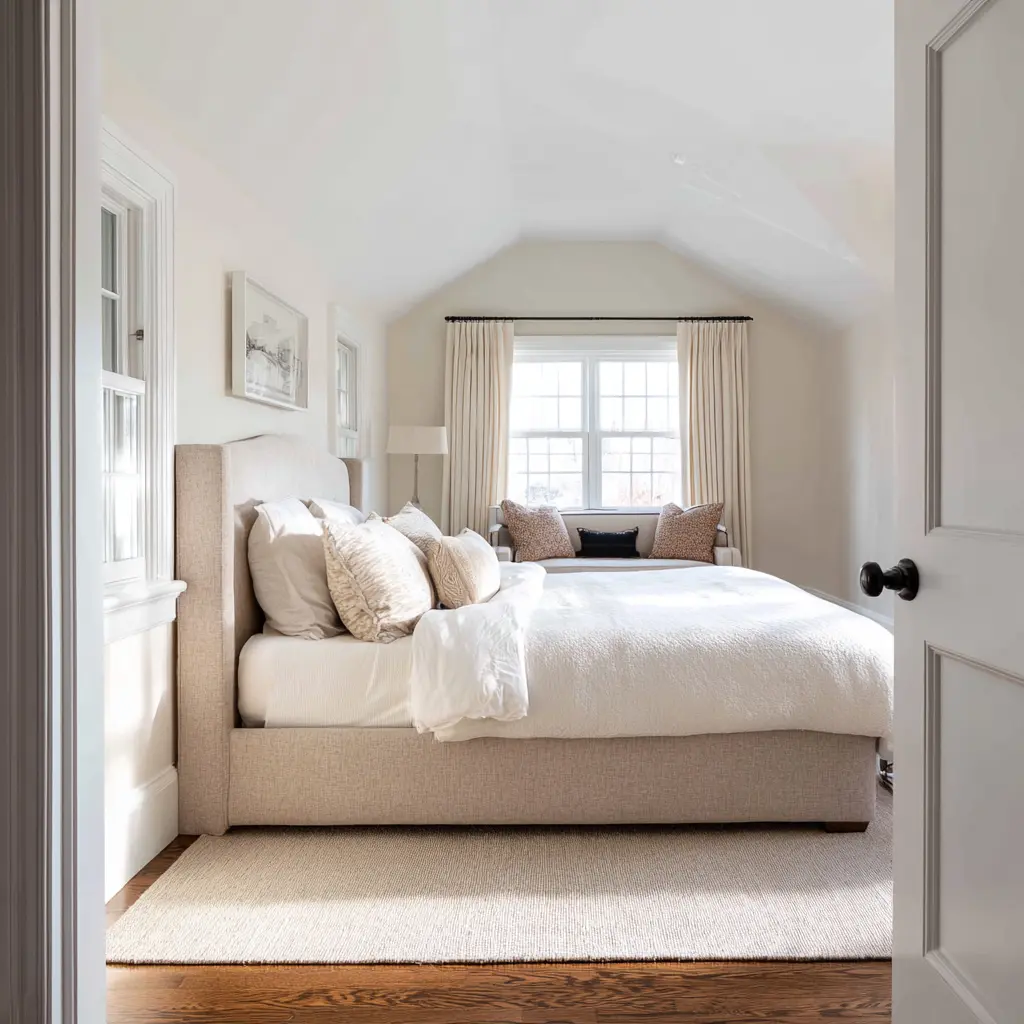
In plain terms, a low bed makes the room easier on the nervous system. That same effect becomes even stronger when the bed is paired with other long, low elements: a bench at the foot, a long rug, a floating ledge, a built-in window seat, or a broad folded blanket that stretches across the mattress.
Even in rooms with tall ceilings, the body-contact zone stayed wide and low. The architecture could rise above, but the resting experience remained close to the floor and calm in its proportions.
Treat the Bed as a Soft Field, Not a Standalone Object
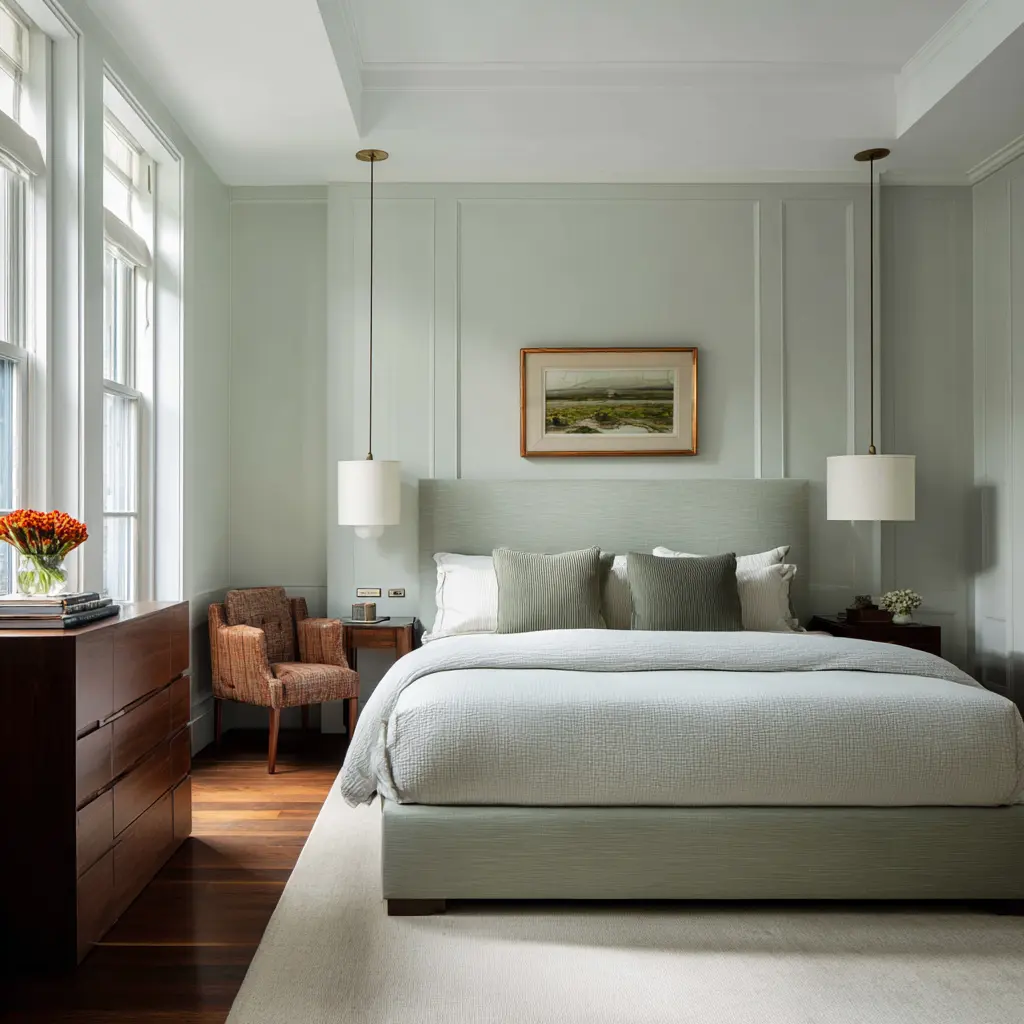
Retreat bedroom designs do not make the bed feel like a separate piece of furniture dropped into the room. They make it feel like the central soft terrain of the room.
That shift is subtle, but powerful. You see it when the bed blends into the rug below, the wall behind, the headboard, and the room’s larger tonal family.
Instead of sharp edges between all these layers, the forms start to merge. The bed becomes part of a larger soft field.
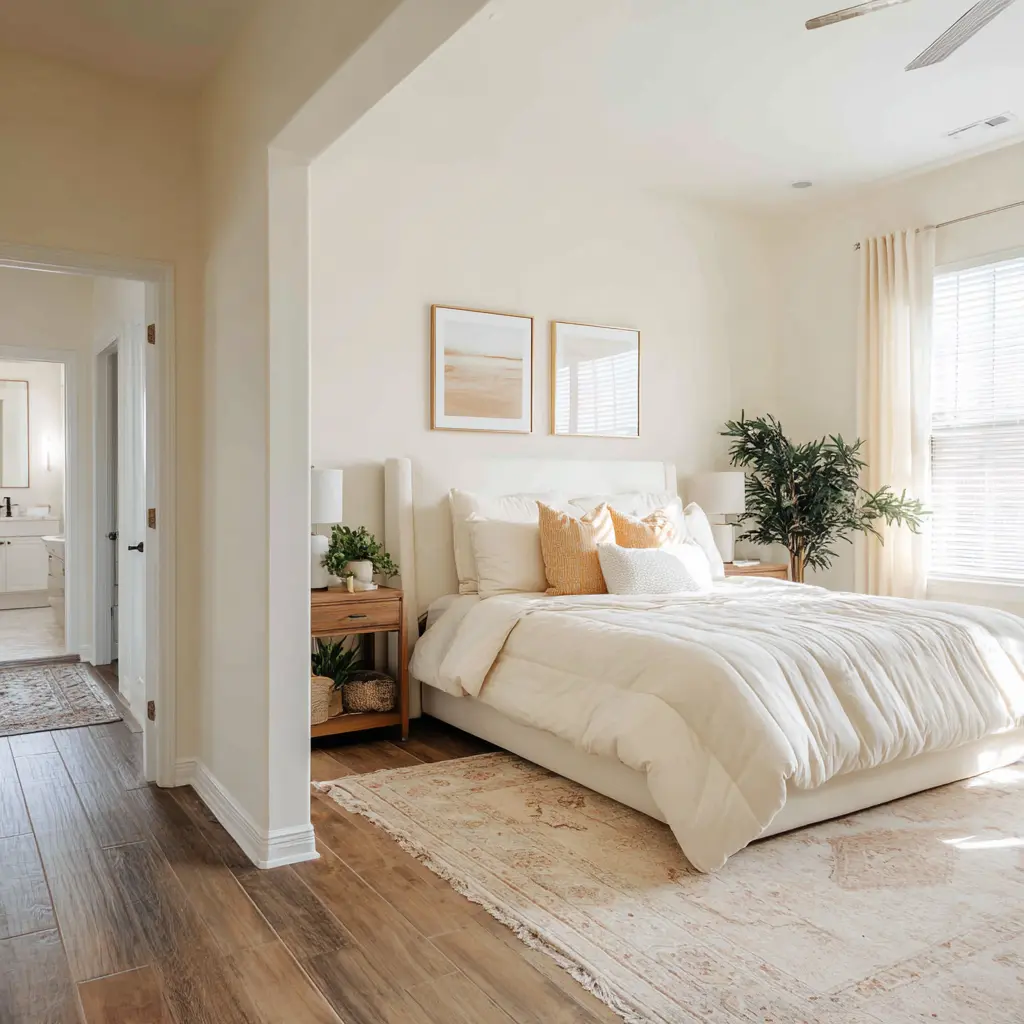
That is one reason a bedroom can feel deeply restful even without many dramatic design moves. When the bed visually belongs to the architecture and the floor plane, the room feels quieter and more connected.
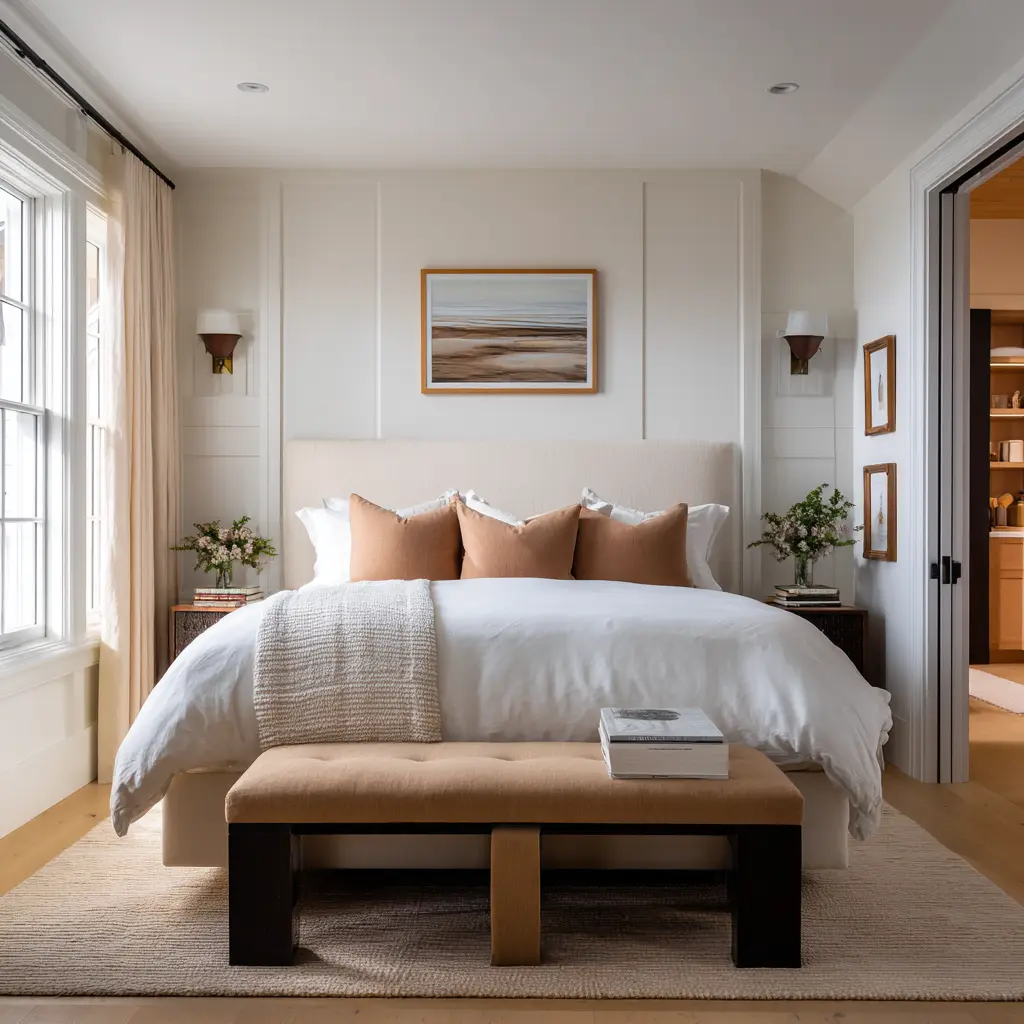
This can be done in several ways:
- keep the bed frame, bedding, rug, and wall tones close together
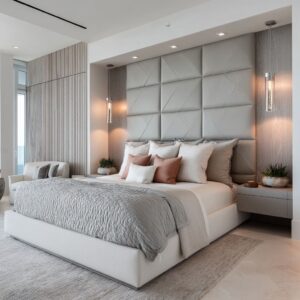
- use a headboard wall, padded wall, or framed niche around the bed
- avoid overly contrasting bed linens that break the bed into many separate parts
- let the rug beneath the bed act like a calm platform rather than a strong decorative moment
The bed should feel like the emotional center of the room, but not like a loud object.
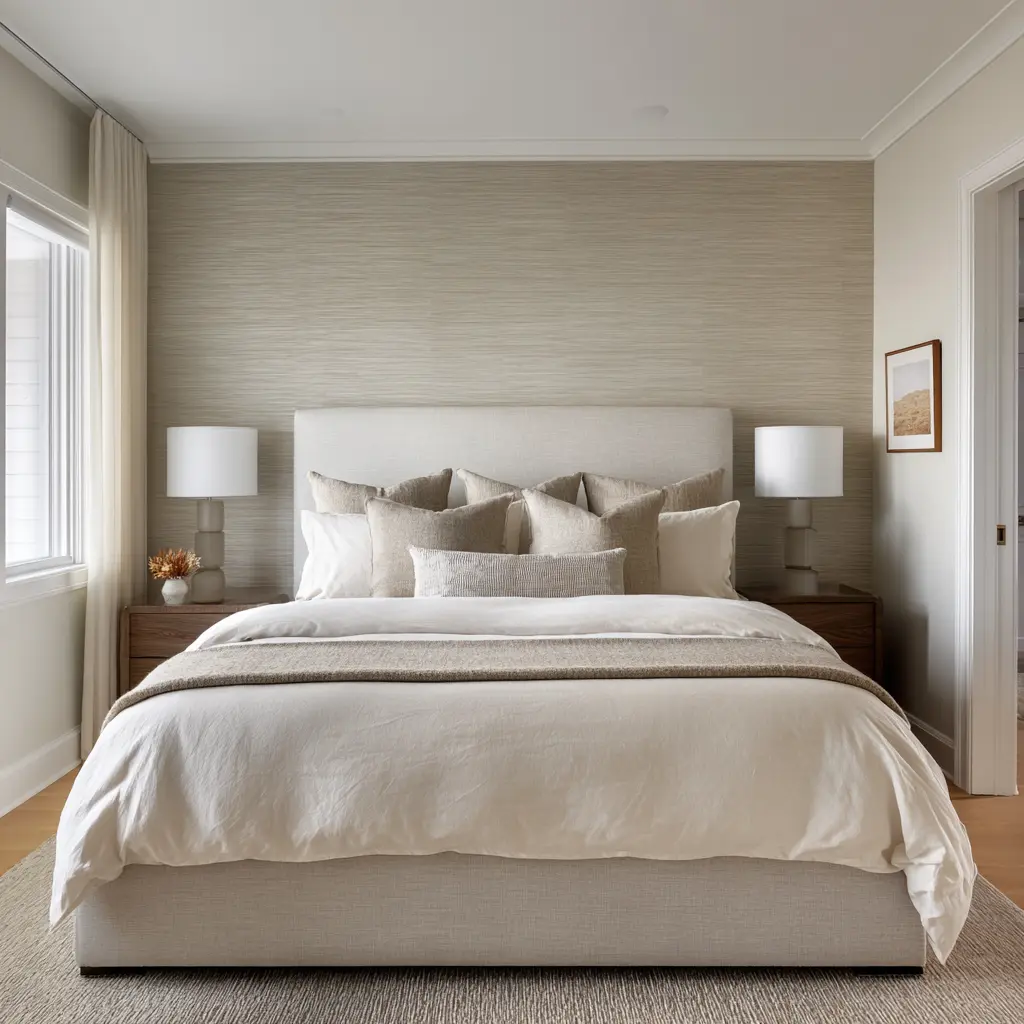
Tonal Range Matters More Than the Exact Color
A calm retreat bedroom does not have to be beige. Effective calm bedroom designs can use pale sage, warm ochre, dusty lavender accents, soft rust notes, or camel details.
What matters is not the exact hue. What matters is the small distance between neighboring tones.
When adjacent surfaces differ only slightly, the eye moves more slowly. Edges soften.
The room feels less broken up. Separate objects begin to read as larger, calmer masses.
This is the true value of a restrained palette. So instead of asking whether a room should be white, beige, gray, or sage, a better question is this: how sharp are the tonal jumps from one surface to the next?
A room feels calmer when those jumps stay small.
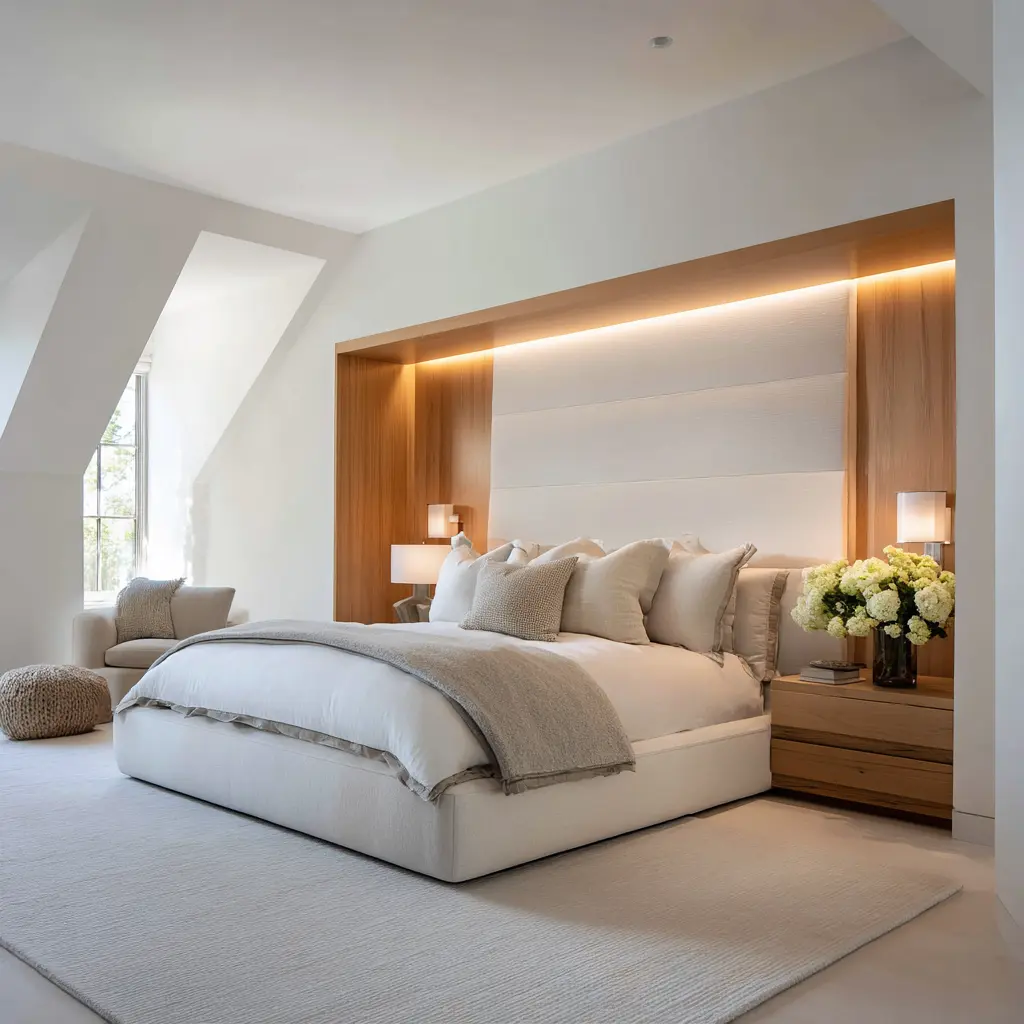
That is also why stronger colors work best in small, predictable places: a pair of front pillows, one throw, one bench cushion, a single artwork, or one compact dark piece of furniture. A small concentrated accent gives warmth and depth.
The same accent repeated all around the room would raise the room’s energy too much. Small islands of emphasis help.
Scattered emphasis does not.
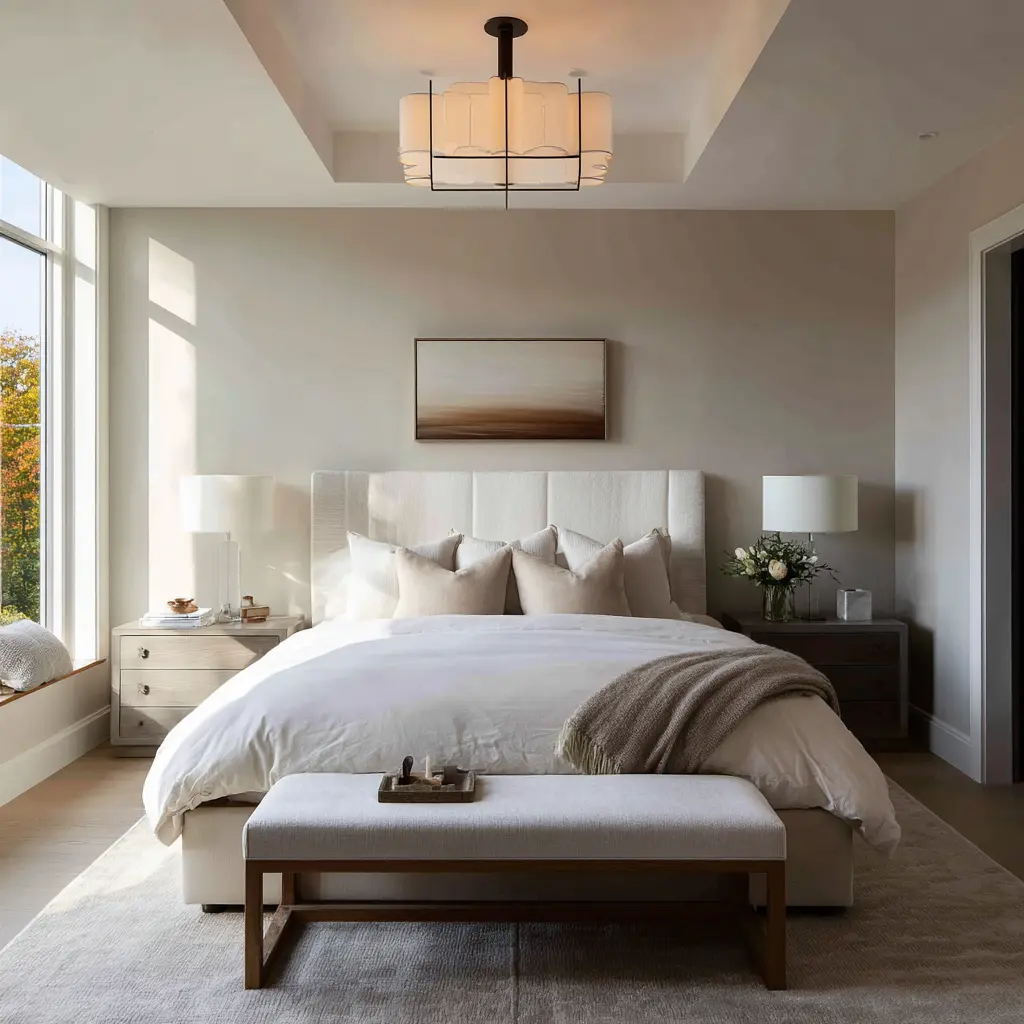
Empty Wall Space Is Doing More Than You Think
One of the most overlooked tools in restful bedroom ideas is the large, quiet wall plane. Many calm design concepts left major wall areas mostly untouched.
That is not a lack of design. It is part of the design.
A broad unbroken wall gives the eye a place to rest. It slows down visual processing.
It keeps the room from turning into a row of competing focal points. It also makes the soft furnishings below feel more intentional.
In a calm primary bedroom, blankness can work the way silence works in music. It gives everything else room to breathe.
This is why a room can start to feel more expensive and more settled when you remove the extra art, reduce the busy molding mix, or stop trying to activate every large surface. Sometimes the most useful design move is leaving one wall alone.
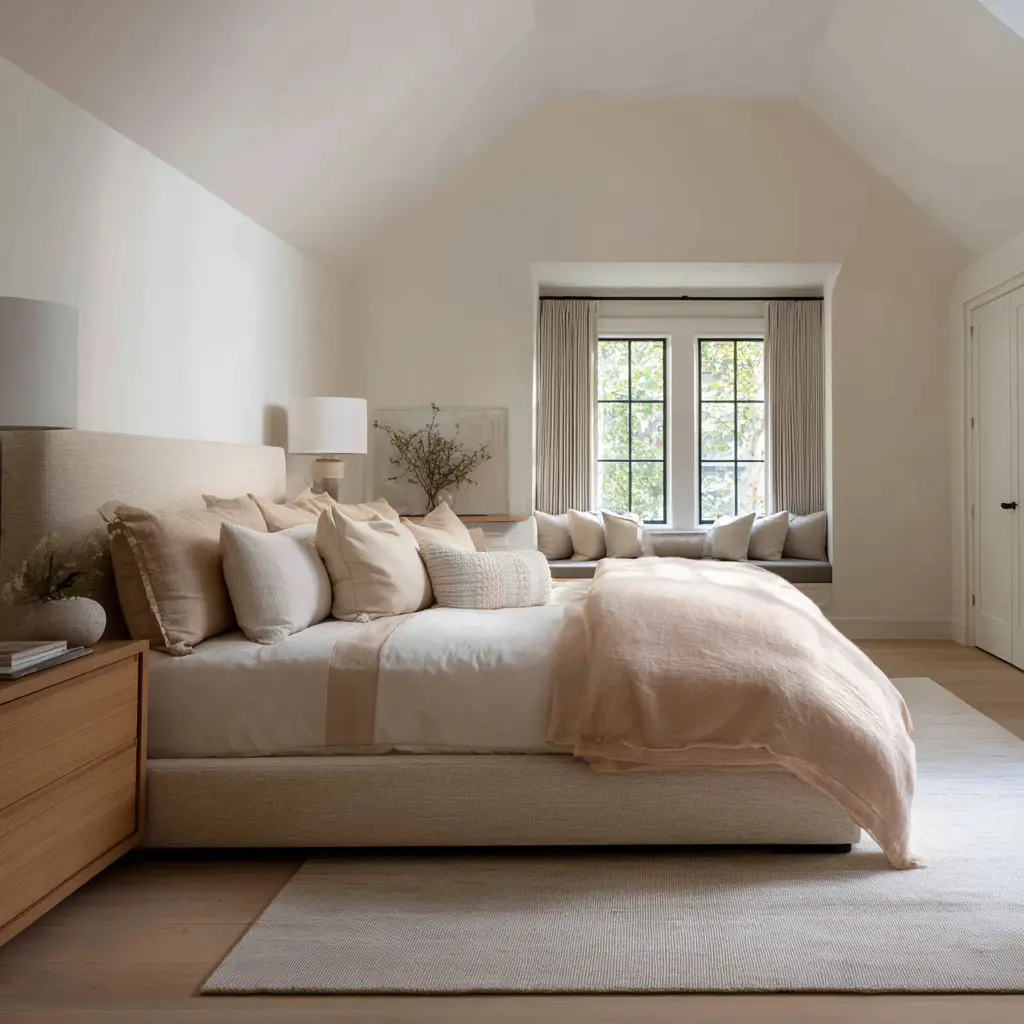
Texture Carries the Room When Color Stays Soft
If the color palette is quiet, surface behavior becomes even more important. Calm bedrooms can lean heavily on matte, dry-looking materials: upholstery, woven wallcoverings, soft rugs, pale painted walls, linen-like bedding, washed woods, bouclé-like upholstery, and other low-sheen finishes.
It is quite seldom for retreats to depend on hard shine.
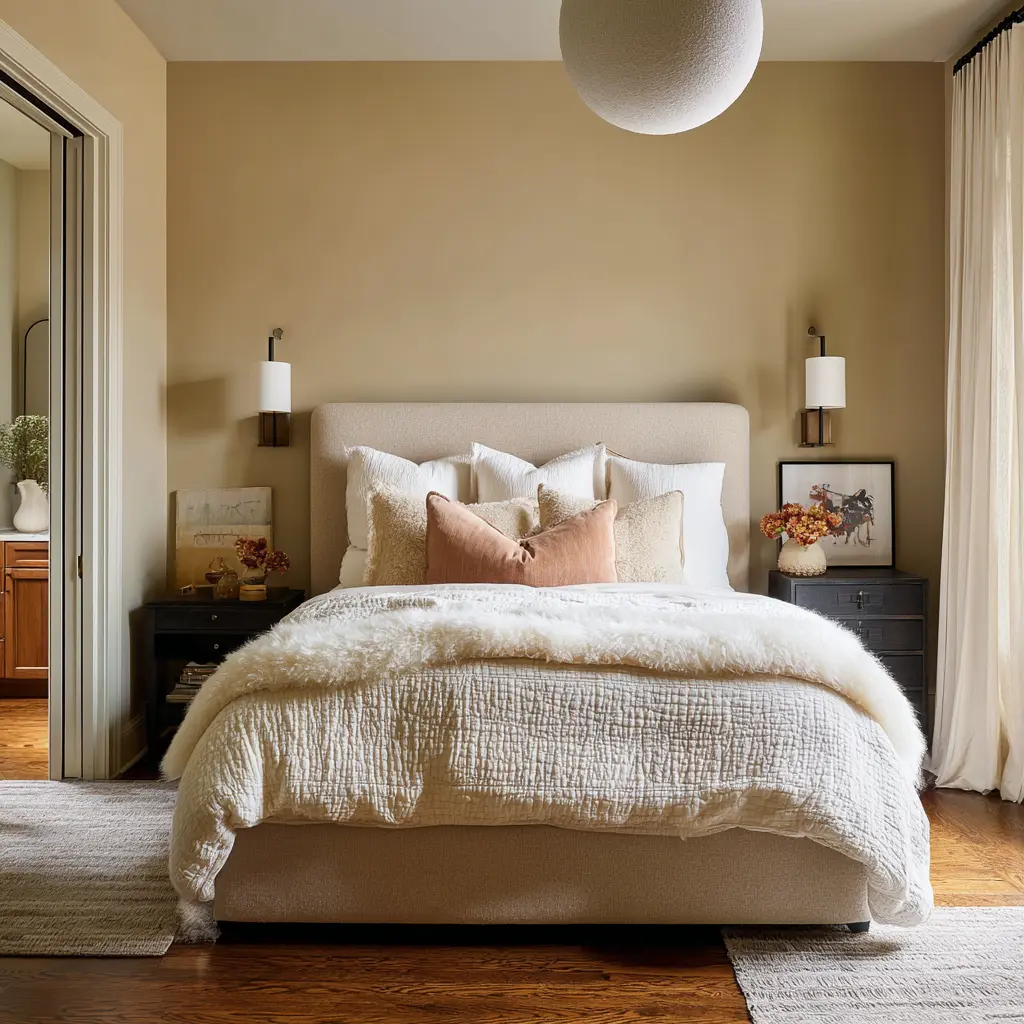
That matters because matte surfaces absorb light instead of throwing it back sharply. They lower glare, soften edges, and make daylight feel calmer.
This is one of the hidden lessons: a pale primary bedroom with glossy finishes can feel more alert than a slightly deeper room with matte materials. So if a bedroom feels too harsh even though the palette is soft, the issue may not be the color.
It may be the finish.
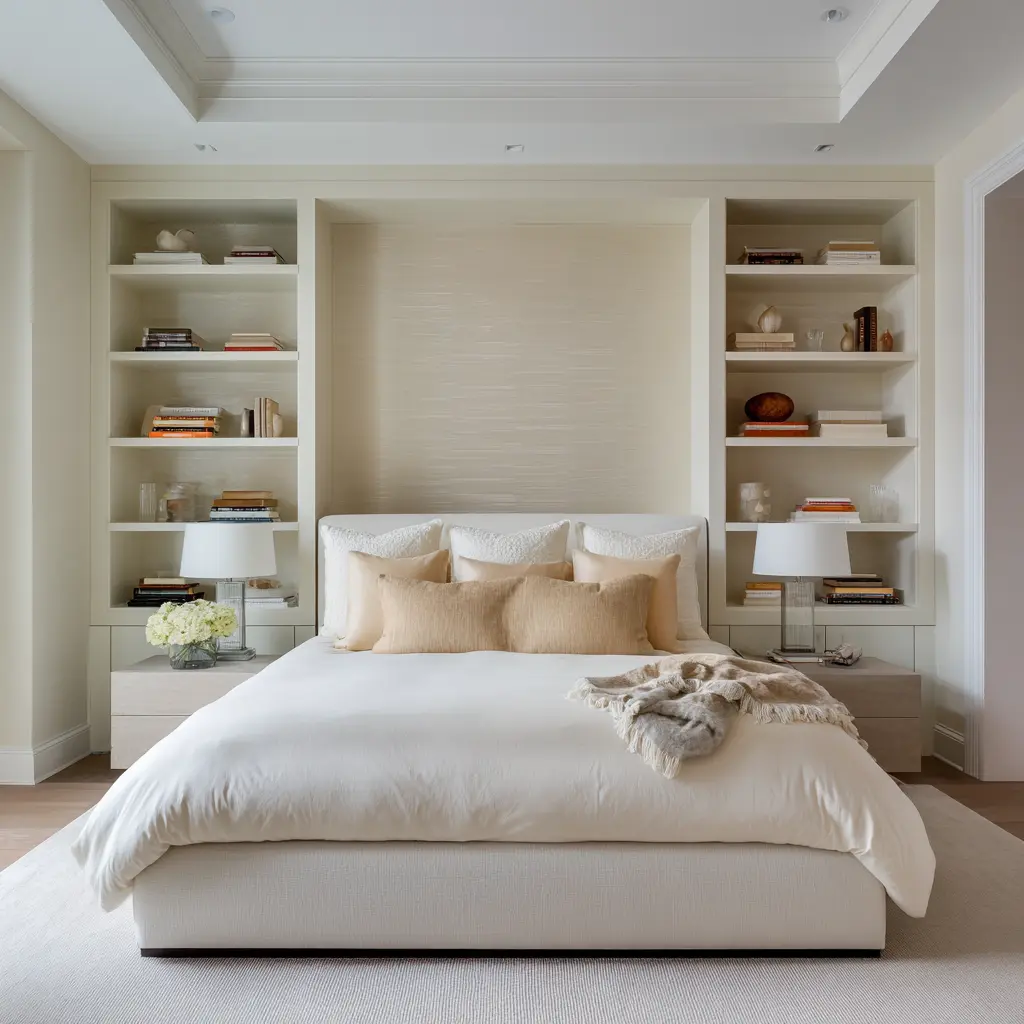
Let Nature Carry Some of the Visual Life
Another interesting design pattern: the room can stay quiet because the window view carries much of the visual movement. Instead of loading the bedroom with patterned wallpaper, loud art, and many accessories, primary bedrooms can let trees, sky, and greenery provide irregularity and motion.
The interior remained soft and edited, while the exterior supplied changing texture.
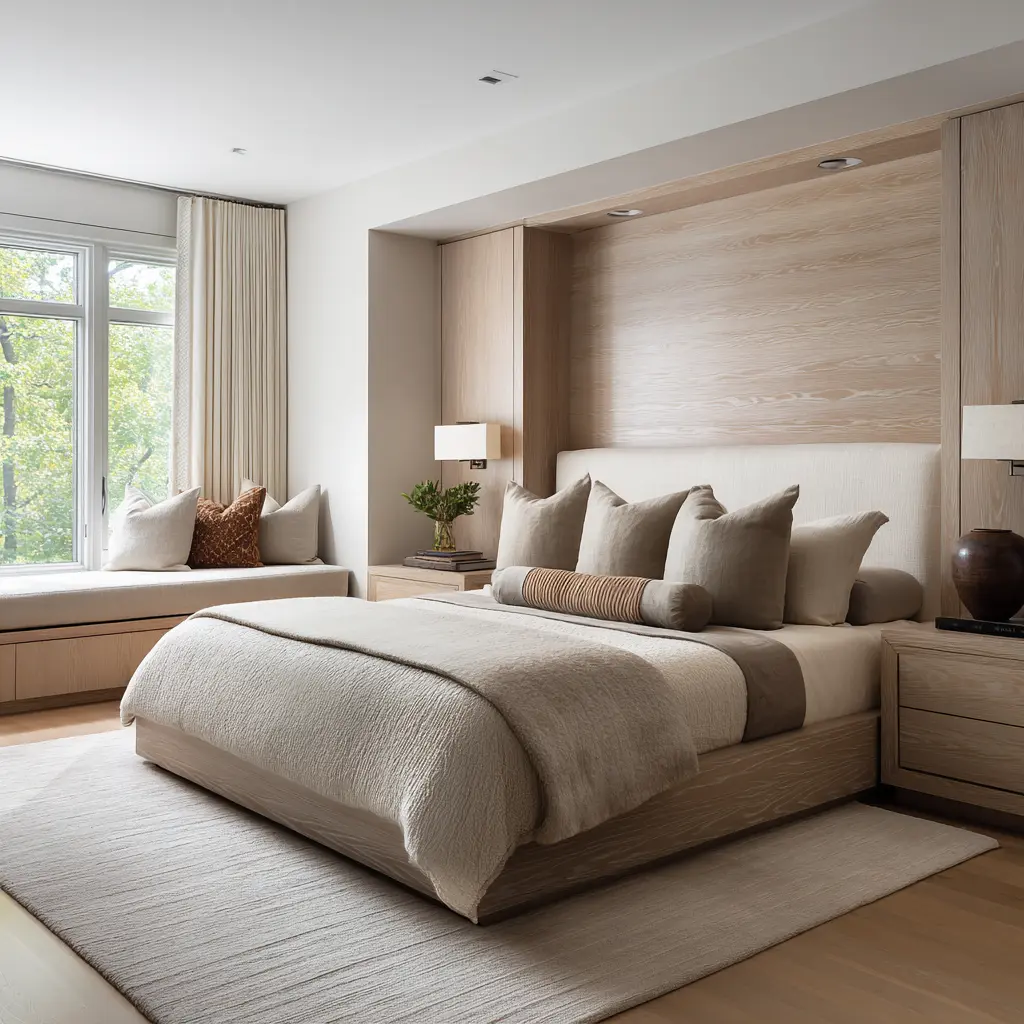
You could think of this as borrowed complexity. The room stays hushed, but it never feels lifeless, because the view beyond the glass introduces shape, color variation, and seasonal change in a way that does not strain the eye.
This works especially well when the view is framed rather than chaotic. Corner windows, bay windows, narrower vertical windows, and built-in benches facing planting all support this effect.
A quiet interior design paired with a living view often feels richer than a busier room with no visual link to the outside.
Adding a Second Stillness Zone
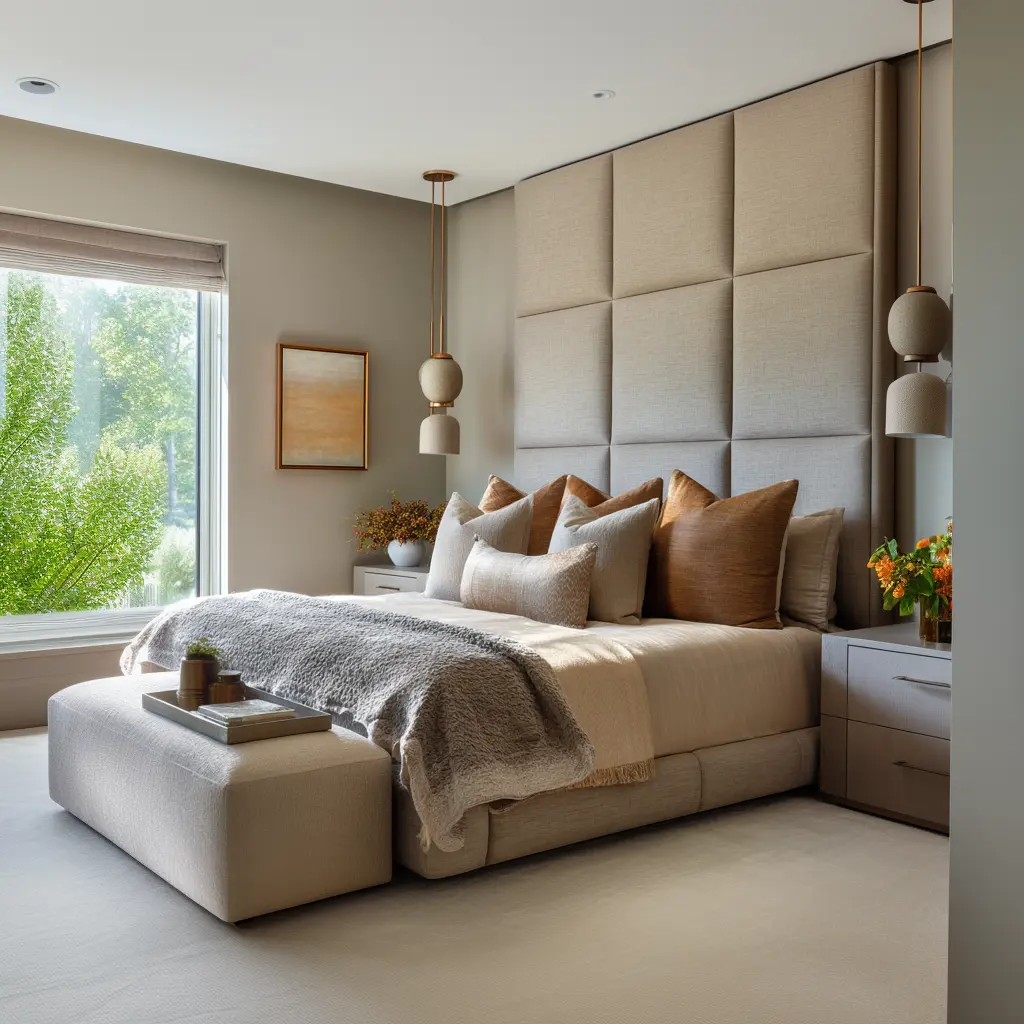
This may be the strongest non-obvious finding in modern primary bedroom design ideas. A bedroom begins to feel like a retreat when it supports slowness beyond sleep.
That second zone can be modest. It does not need to be large.
But its presence changes the room’s psychological category.
- A window seat says you can sit with light.
- A bench at the foot of the bed says you can pause before bed.
- A lounge chair says you can remain in the room without a task.
- A built-in daybed says the room supports lingering.
This is a deeper form of comfort than adding another decorative object. If a bedroom has beautiful finishes but offers no place to pause except the mattress, it may still feel like a sleep station.
Once you add a second stillness zone, the room starts to feel like a private refuge.
Architecture as the Main Decorative Layer
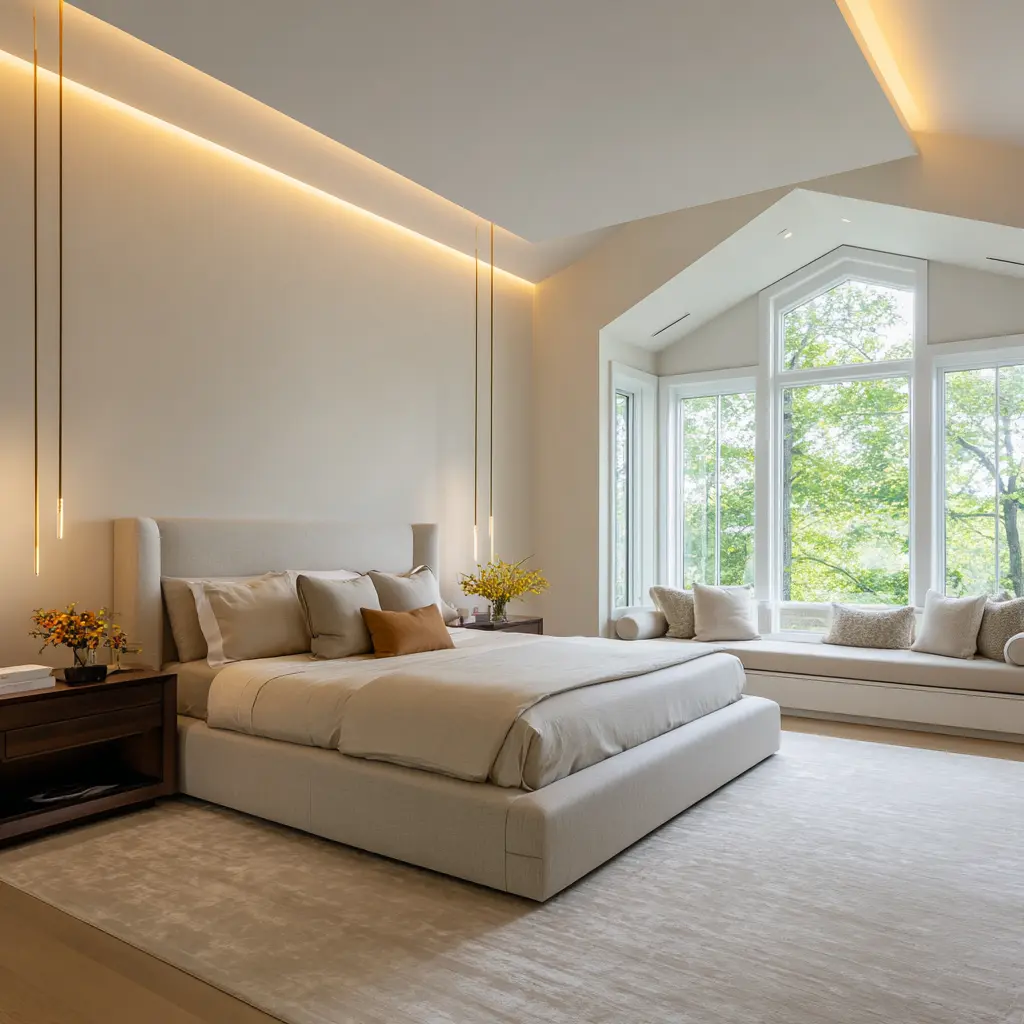
Elegant retreat bedrooms are not rich because they have many accessories. They can be rich because the architecture is doing the decorative work.
That included:
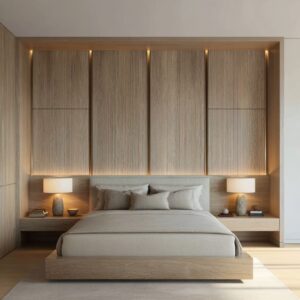
- slatted wall panels
- recessed niches
- padded wall grids
- tray ceilings
- cove lighting
- alcoves
- integrated ledges
- built-in benches
- full-height wood backdrops
This is a powerful approach because it lets the room feel complete with very little surface clutter. It also keeps the largest visual moves broad and stable rather than small and scattered.
In a retreat bedroom, broad low-intensity features outperform many small interesting details. A large soft wall, a long bench, a wide rug, a broad headboard, or a full wall of pale wood often does more for the room than a collection of smaller decorative moments.
Do Not Ignore the Lower Third of the Room
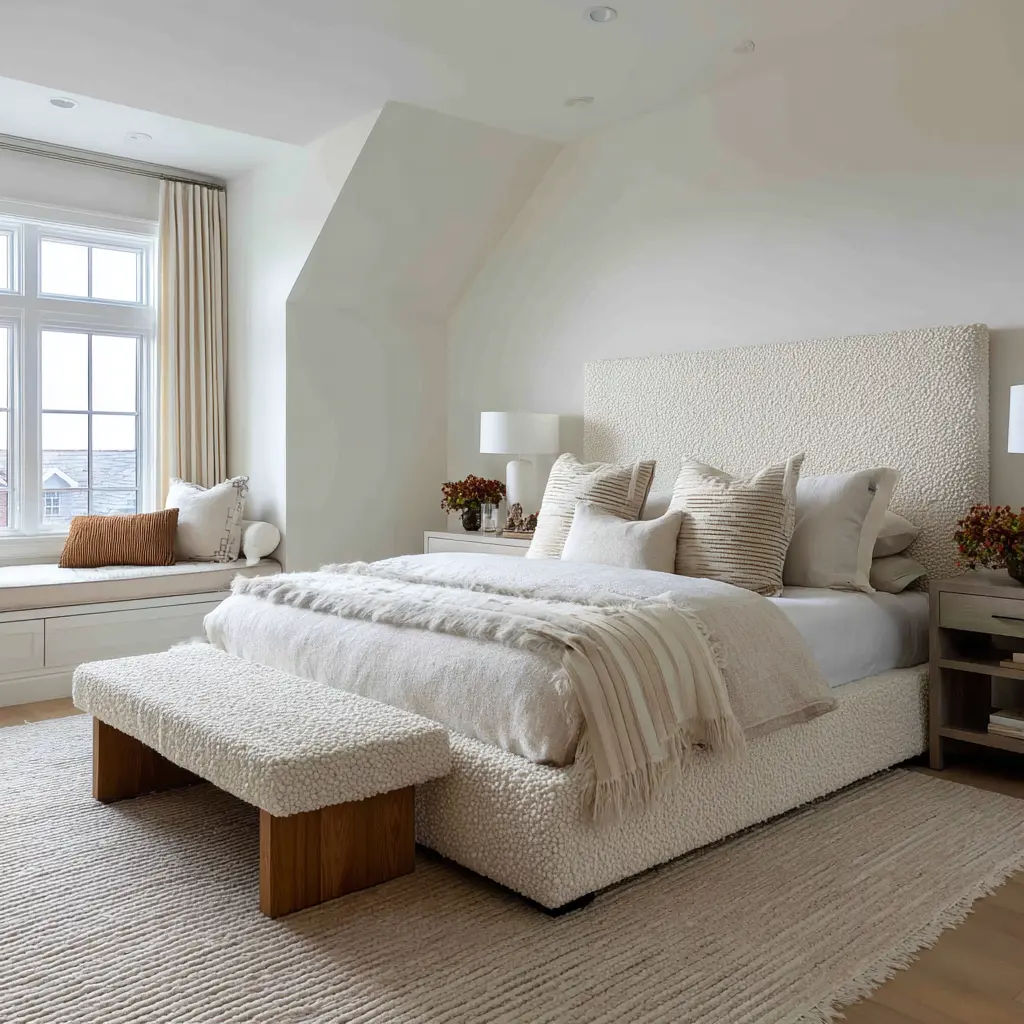
A bedroom can have a beautiful upper half and still fail to feel restorative if the lower zone is visually broken. Calm interior designs soften the floor level with:
- large rugs
- full carpet
- low platforms
- benches
- floating nightstands that keep the floor more open
- broad upholstered pieces near the bed
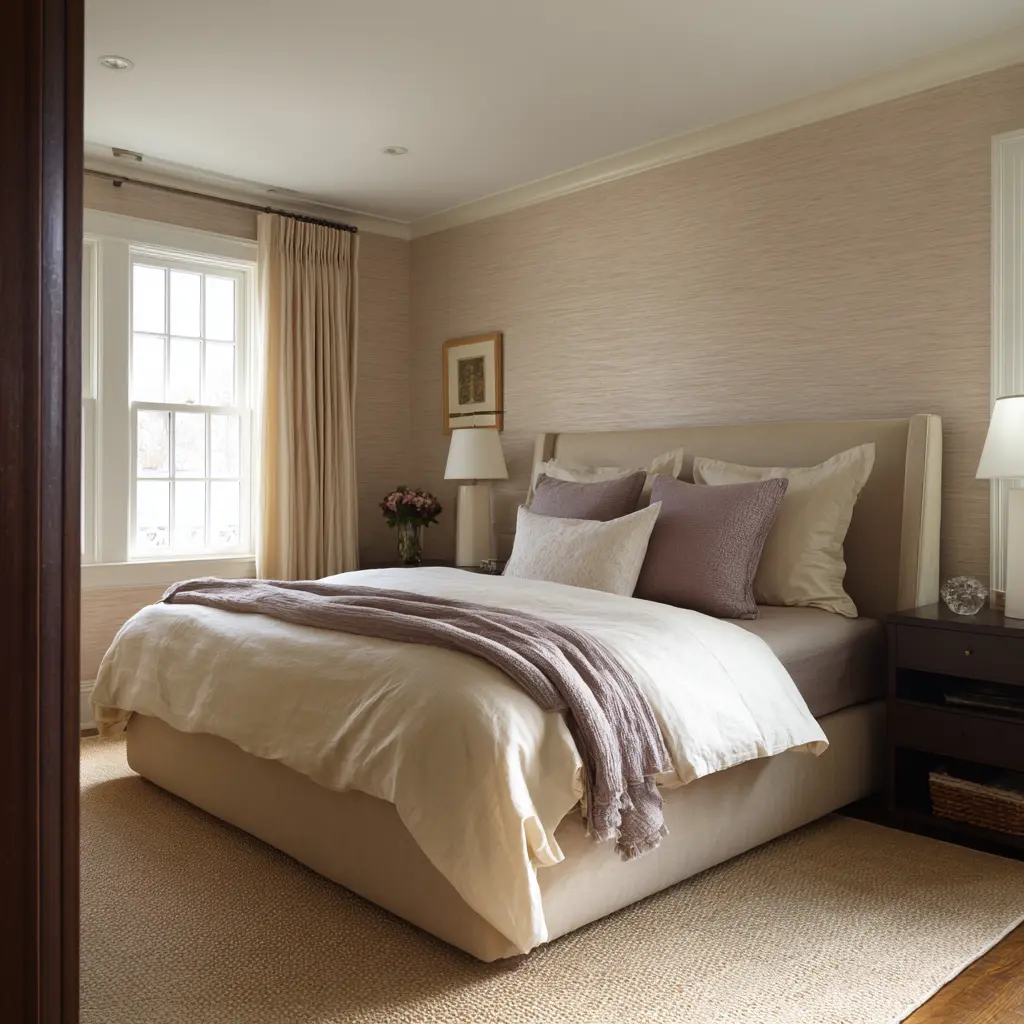
This matters because the lower third of the room controls how the body enters, steps, lands, and settles. If the floor zone feels too hard, too segmented, or too active, the room will not fully relax, even if the colors above are soft.
A calm room needs a calm landing.
What Usually Breaks the Retreat Effect
There are the most common ways a bedroom loses its restorative quality. The first is too many separate focal points.
If the art, wall treatment, bed styling, lighting, window, and accessories all compete equally, the eye stays busy. The second is contrast spread too widely through the room.
Dark-light alternation can help in thin, contained notes, but once it starts appearing everywhere, the room becomes more active. The third is too much shine.
Hard reflective finishes sharpen edges and make daylight harsher.
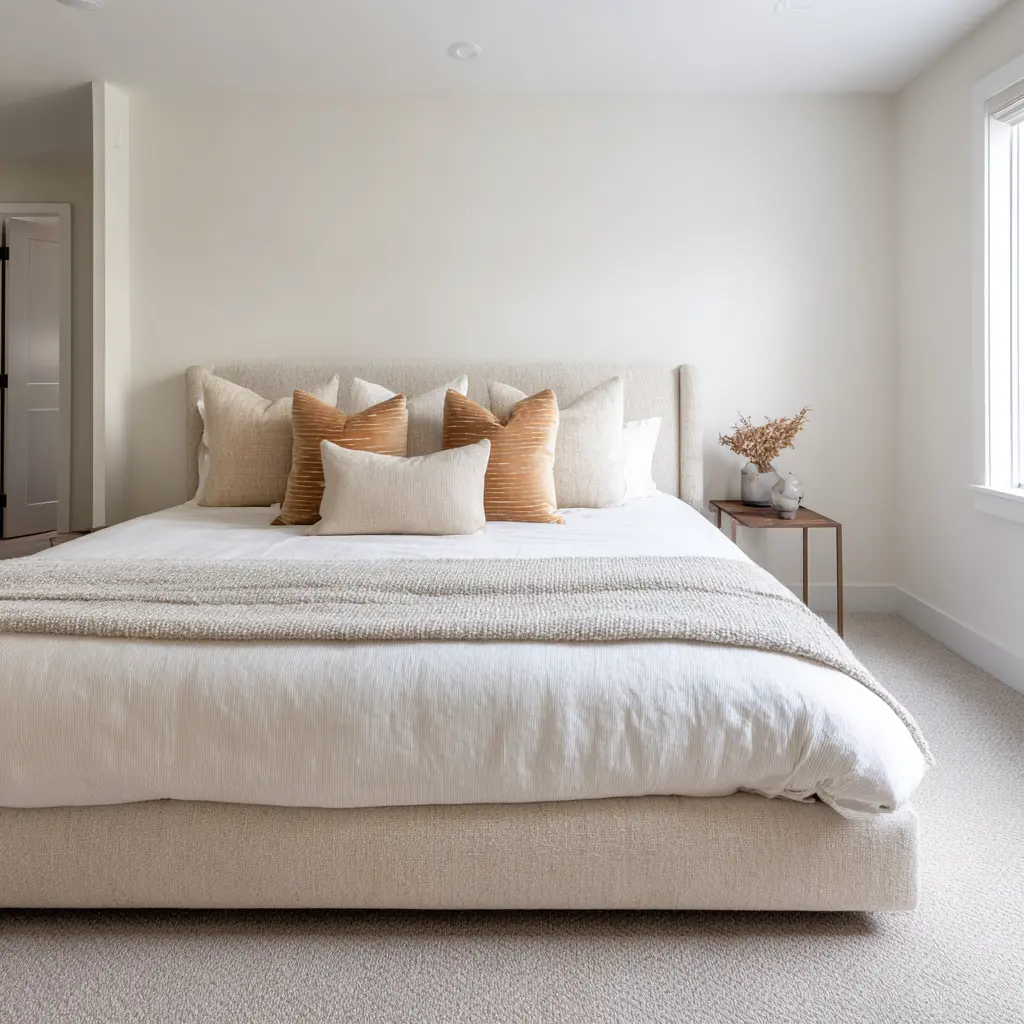
The fourth is a pale palette with no anchor. A very light room still needs one stabilizer, whether that comes from warm wood, a darker lamp line, a rust pillow group, or one deeper piece of furniture.
The fifth is a room with no second-purpose zone. Even a beautiful bedroom can feel less restorative if it offers no pause beyond the bed itself.
A Practical Way to Build the Look
If you want a primary bedroom to carry this retreat quality, the room should do seven things together:
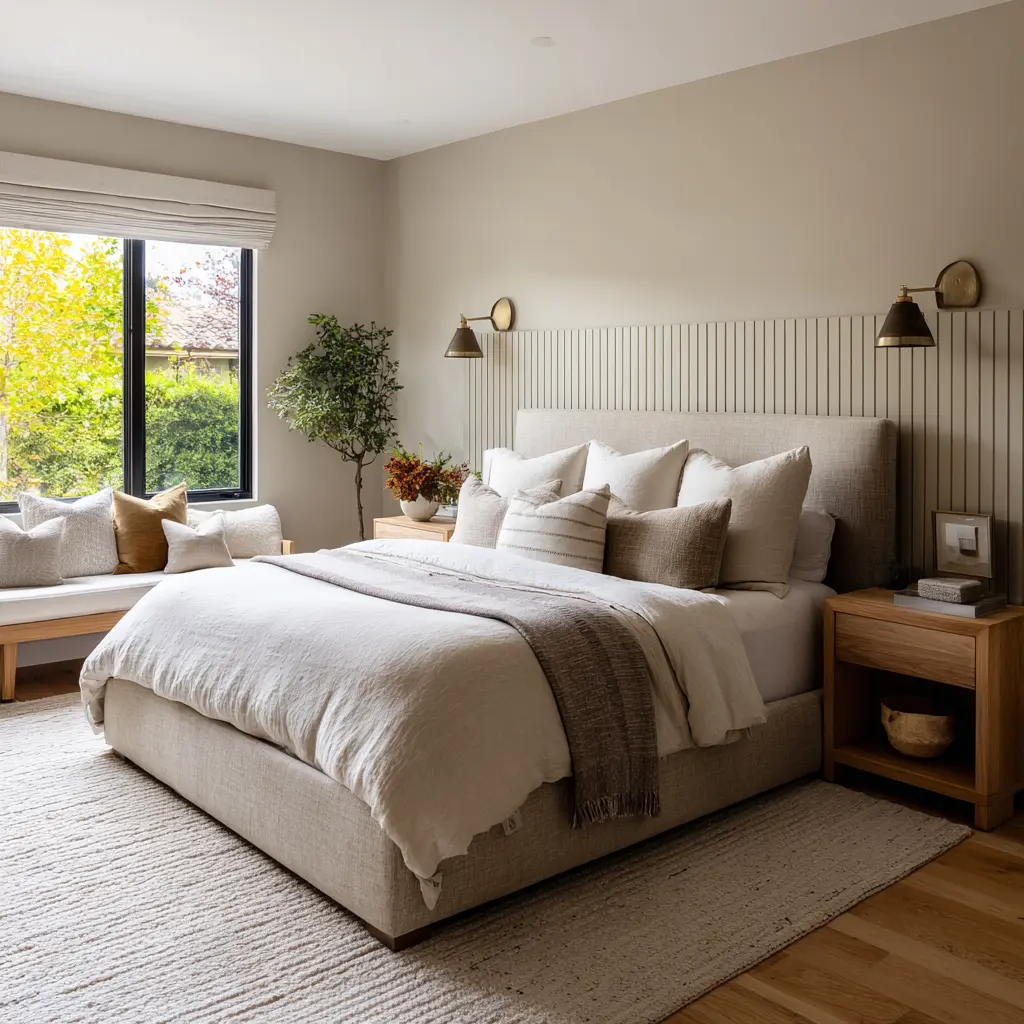
- Lower the center of gravity with a low bed, broad base, and long horizontal lines.
- Keep the tonal range close so the room feels connected rather than chopped into many parts.
- Give the bed some form of enclosure through a winged headboard, a wall panel, a niche, drapery wrap, or framing millwork.
- Use texture where stronger color is absent so the room still feels full.
- Let the outdoor view, greenery, or one organic arrangement bring a little living softness into the space.
- Add one compact anchor such as warm wood, a thin dark fixture, a muted metal sconce, or a concentrated warm pillow band.
- Create one pause ritual through a bench, chair, daybed, lounge corner, or window seat.
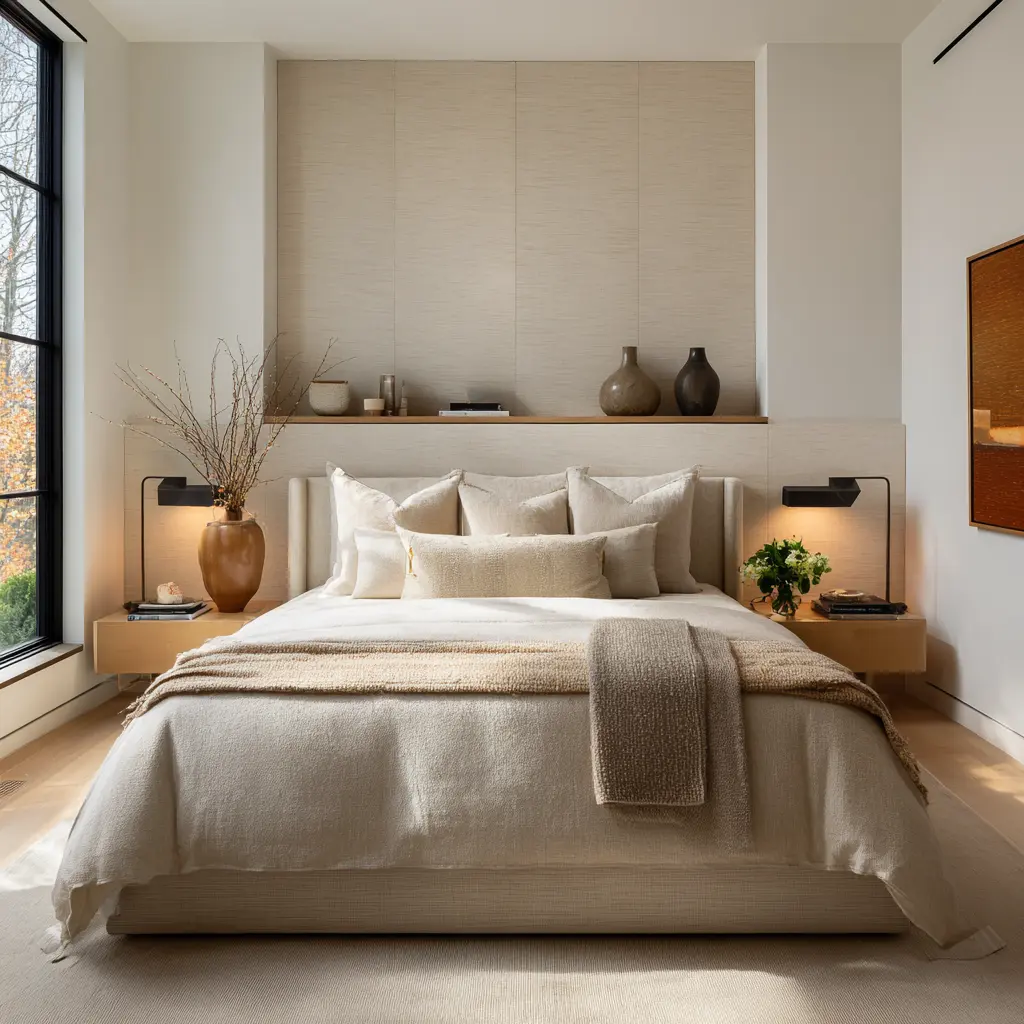
When those moves work together, the interior design starts to feel less like a decorated bedroom and more like a space designed to lower strain.
The Meaning of a Calm Retreat Bedroom
The strongest primary bedrooms are not the ones with the most styling. They are the ones with the clearest sense of settledness.
They reduce visual conflict. They ground the body low.
They soften boundaries. They keep variation gentle.
They contain brightness instead of letting it flare. They include one or two anchoring notes.
And they support quiet non-sleep habits that make the room worth staying in.
That is why retreat bedrooms feel restorative even before the lights go down. They are not simply soft.
They are edited, shaped, and tuned so that every major choice makes the room easier to inhabit.