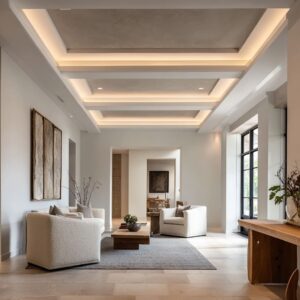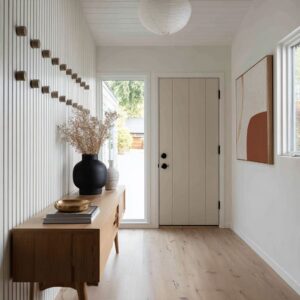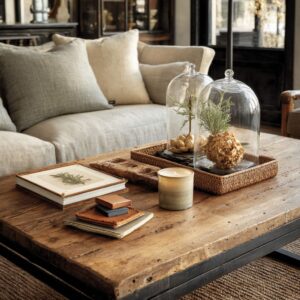
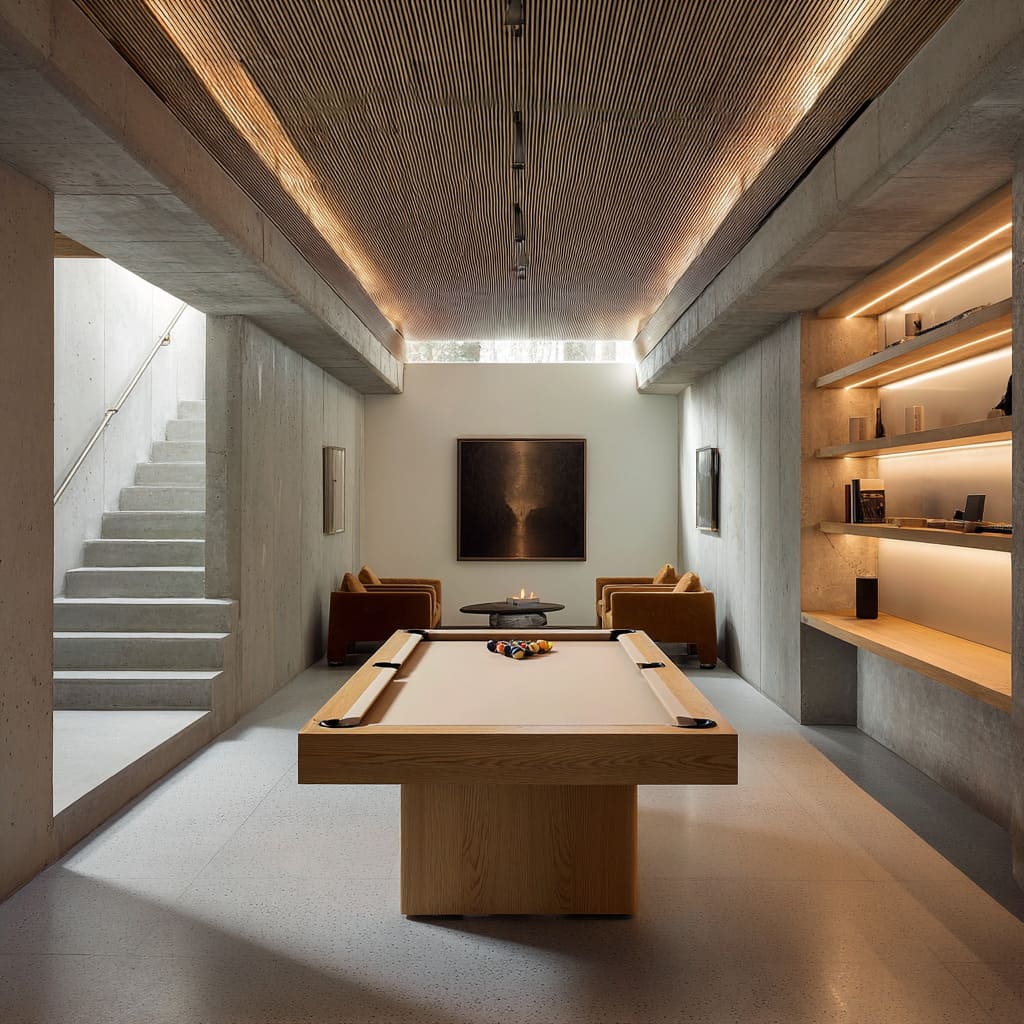
If you’ve ever imagined a basement as more than storage space, these basement billiard room ideas prove that underground can look high-end.
The new generation of basement pool table room ideas focuses on design that feels calm, strong, and architectural—more like a lounge or gallery than a game cave. Below is a deep look at how designers shape these rooms into inviting spaces using wood tones, lighting, rhythm, and texture.
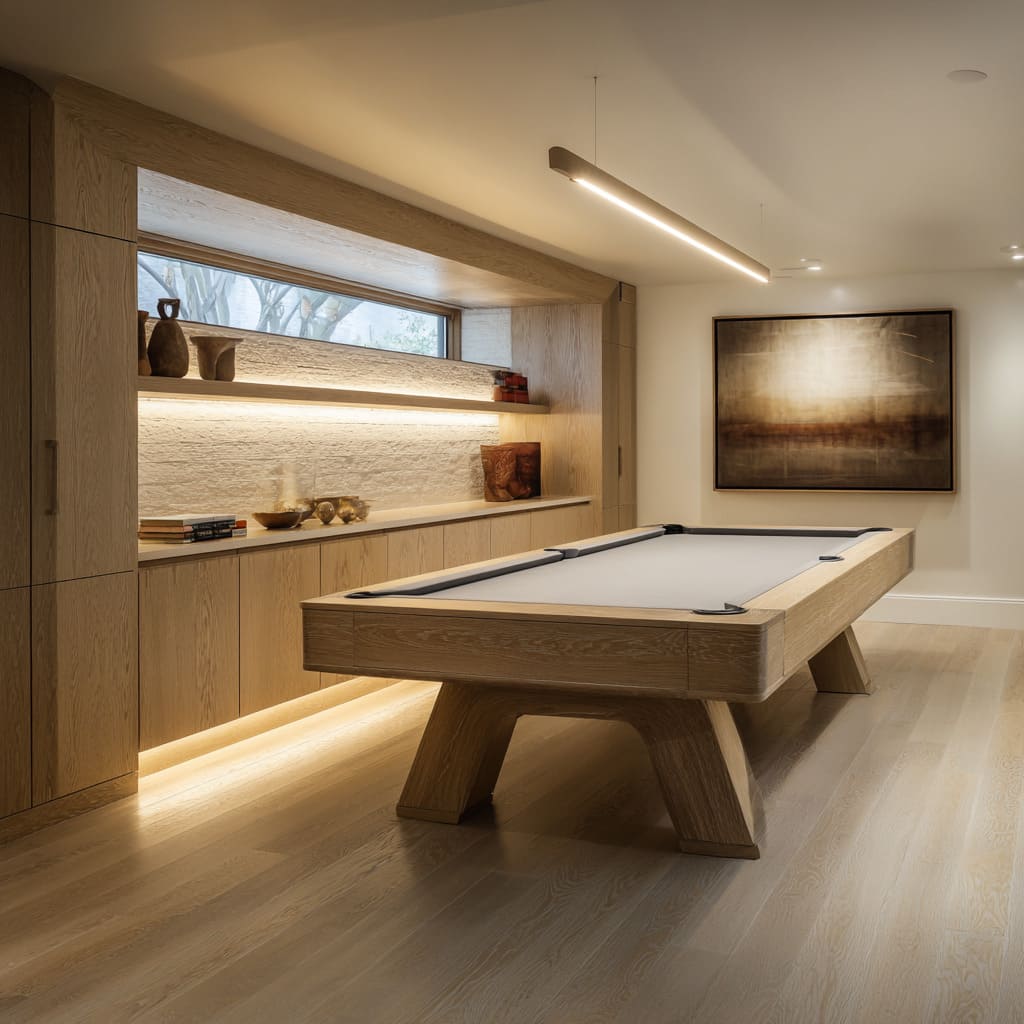
The Mood: Calm Strength, Not Flash
Modern pool table in basement ideas often start from restraint. The best rooms are built around one tone of timber and one stone or plaster color.
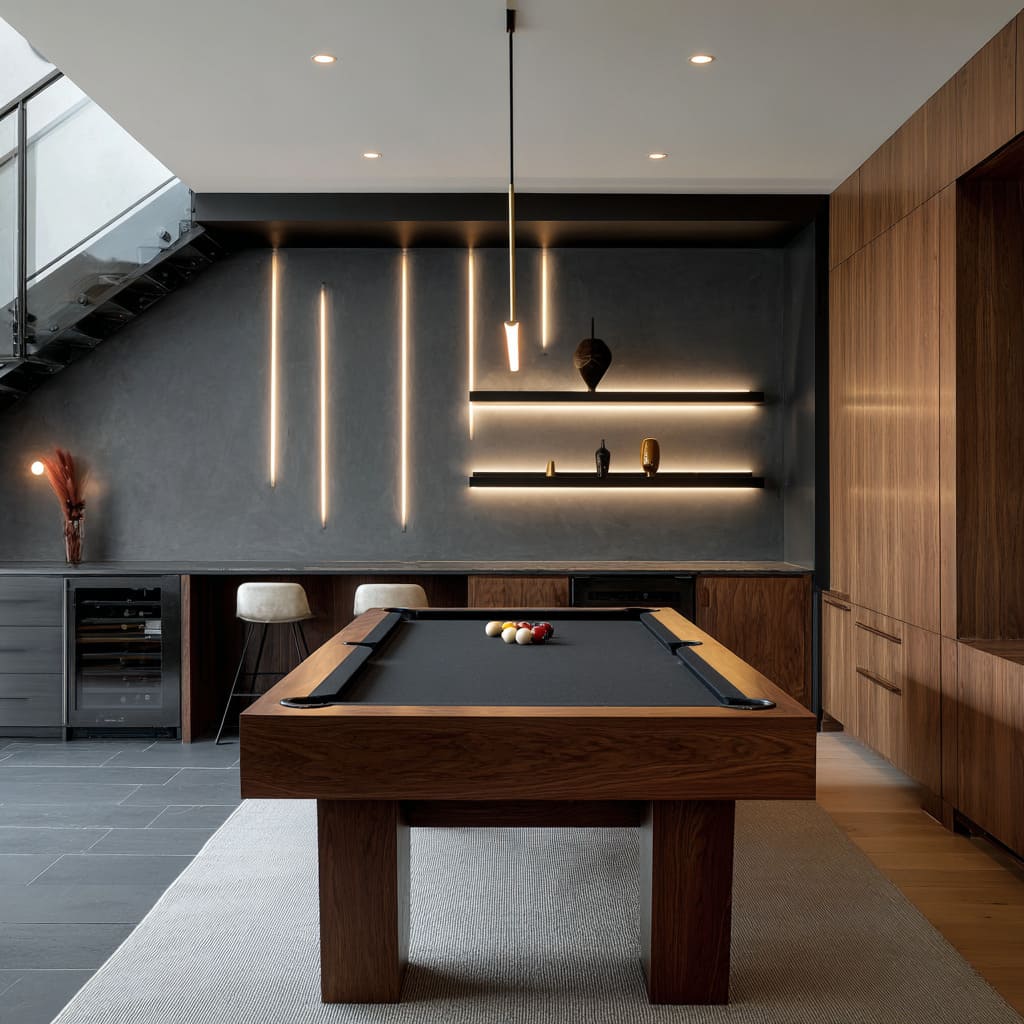
Oak, walnut, or ash set the tone—rich enough for warmth but quiet enough to blend with concrete or limestone. Instead of bright colors, designers rely on value balance: pale woods against cool grays, dark woods against warm brass, or creamy plasters paired with black accents.
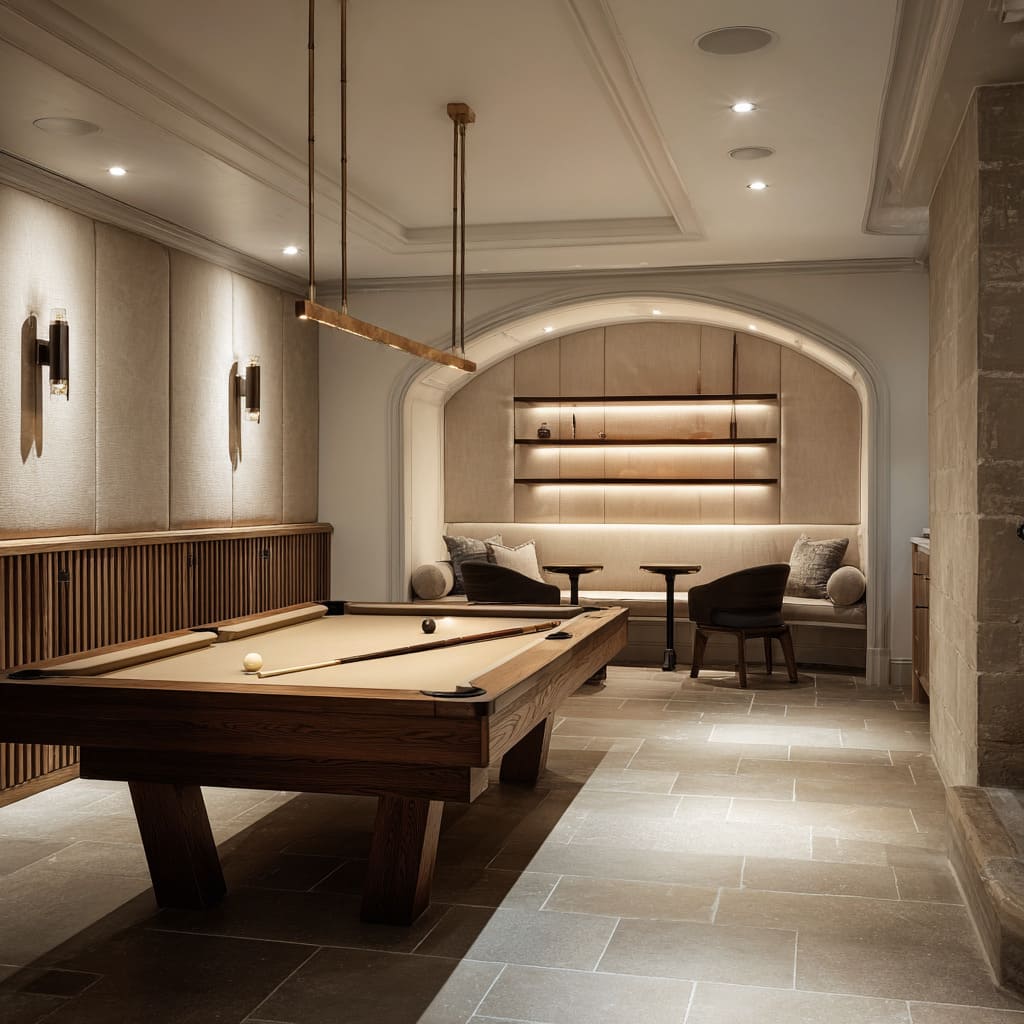
A strong table becomes the sculptural centerpiece. Whether it’s oak with chunky legs or walnut with splayed supports, the table’s geometry decides the whole visual rhythm.
Every line—rails, rugs, shelves, even the artwork horizon—follows it.
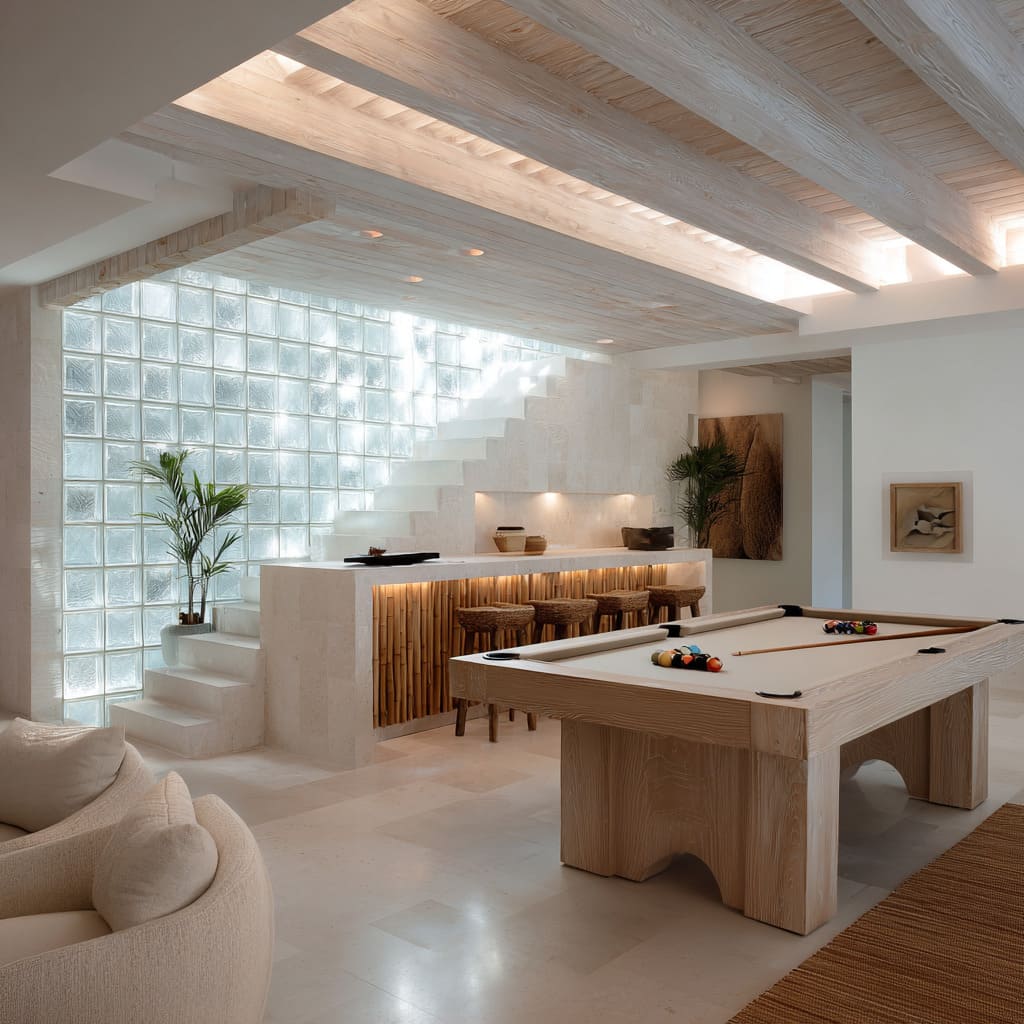
Lighting That Draws
Lighting in today’s basement billiard room ideas is less about lumens and more about composition. A narrow pendant aligned to the table’s strike line gives focus and direction.
Perimeter coves and toe-kick lights “float” the cabinetry and banquettes, avoiding that boxed-in basement feel.
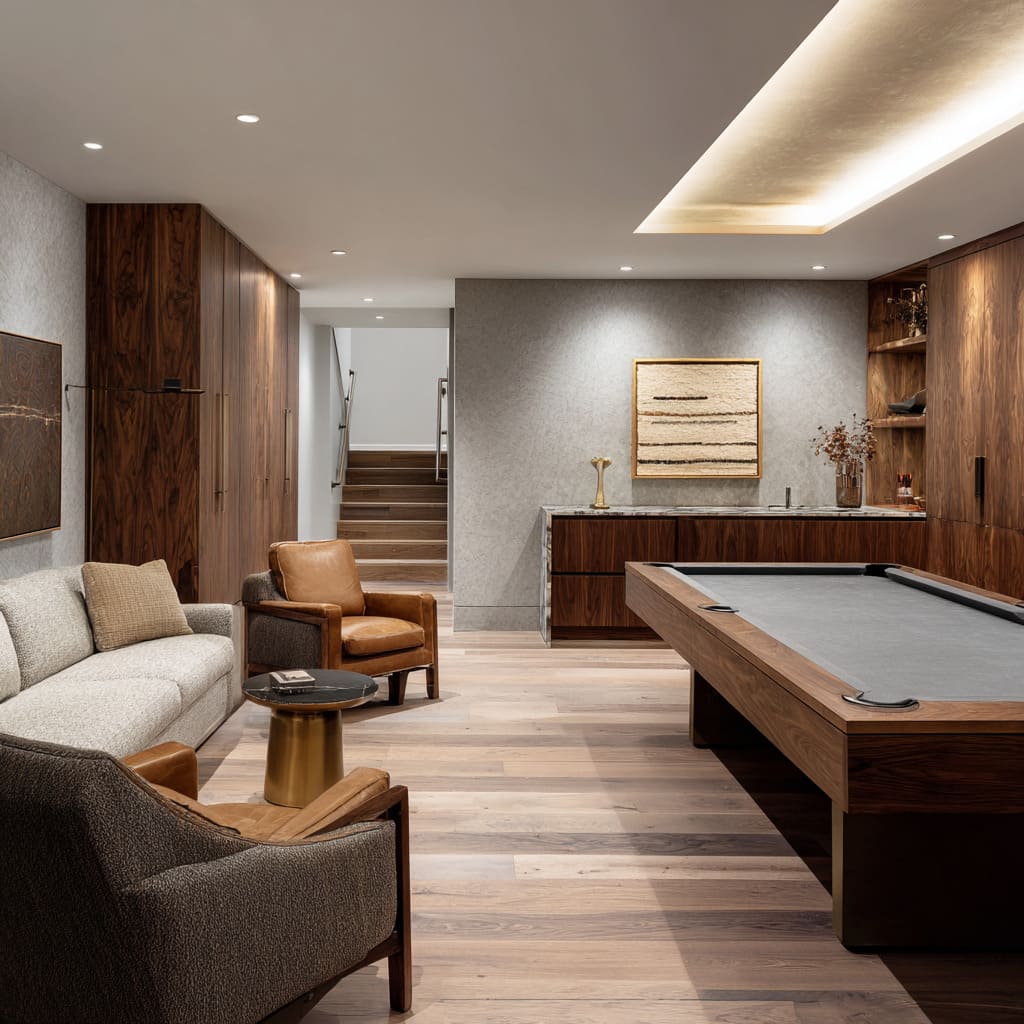
Vertical light slots carved into plaster walls mimic the rhythm of cue sticks while adding depth and calm. Some designers graze stone from below instead of above, letting rough textures glow softly.
The trick is to treat every light as a drawn line—each one connecting function, proportion, and sightline.
Materials That Whisper Luxury
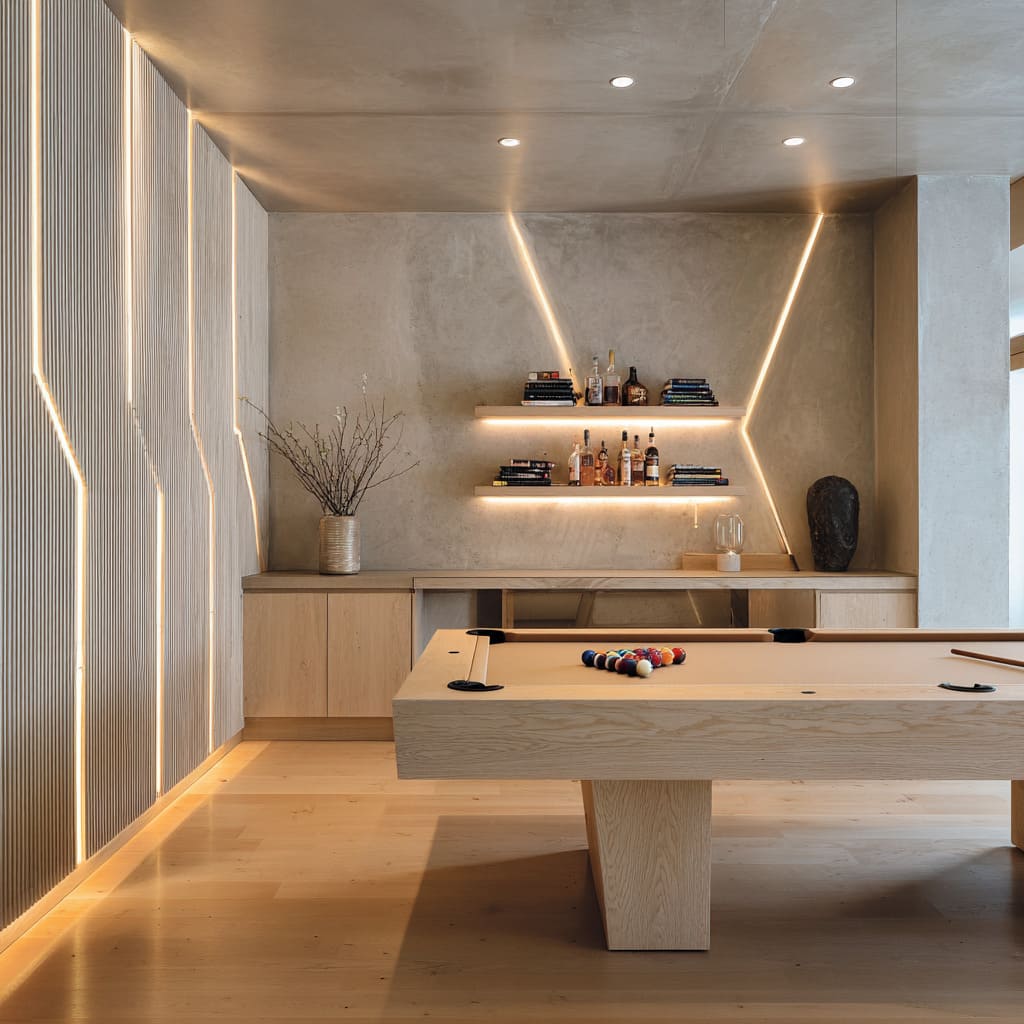
Unlike traditional heavy designs and dark moods, new basement pool table room ideas mix matte and raw finishes. Light oak paired with sand-colored felt, ribbed stone, or linen plaster brings warmth without gloss.
When designers use darker palettes—charcoal plaster, walnut cabinetry—they counterbalance it with soft glows and a few warm metal notes.
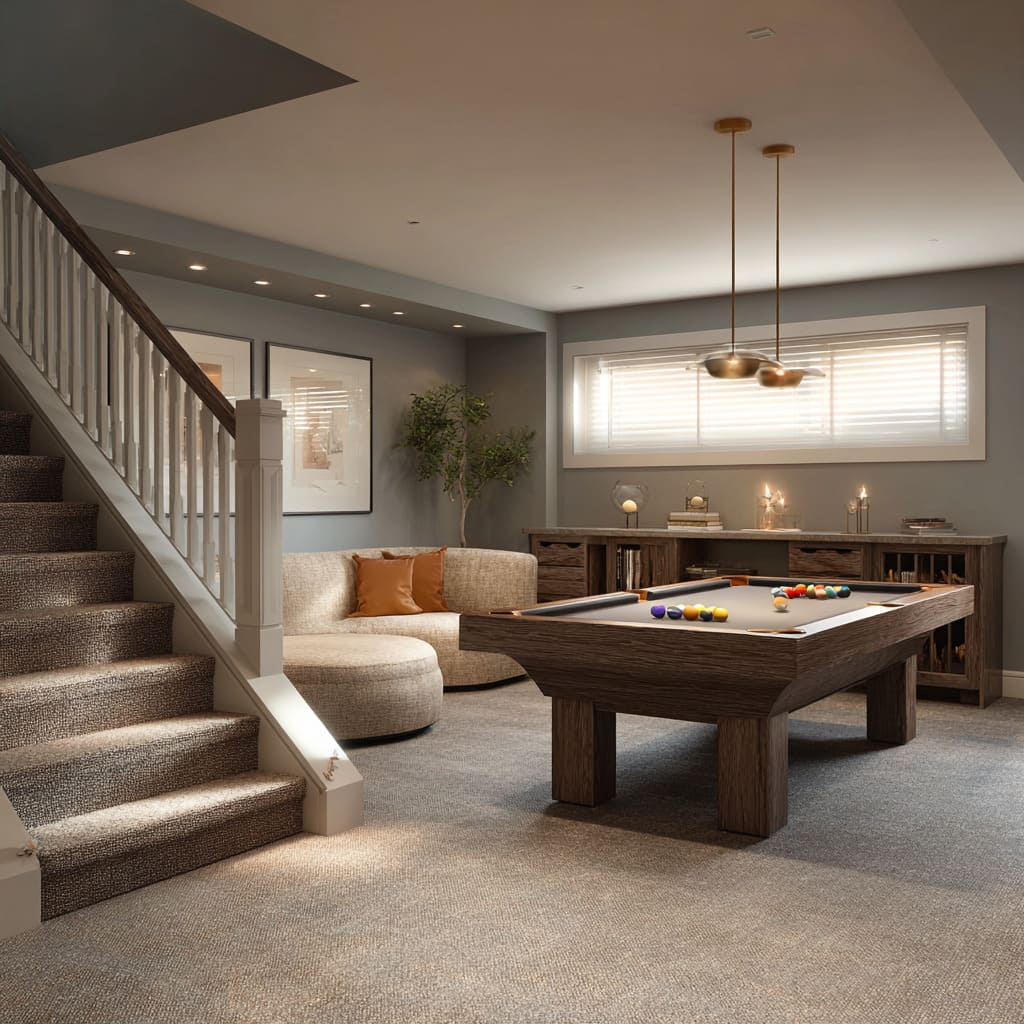
A common move: run one material across multiple planes. Wood ceilings that extend into stair enclosures, stone floors that climb partway up the wall, or plaster wrapping into arches.
These transitions make the basement feel like an integral floor, not an afterthought.
Rhythm and Repetition as Design Tools
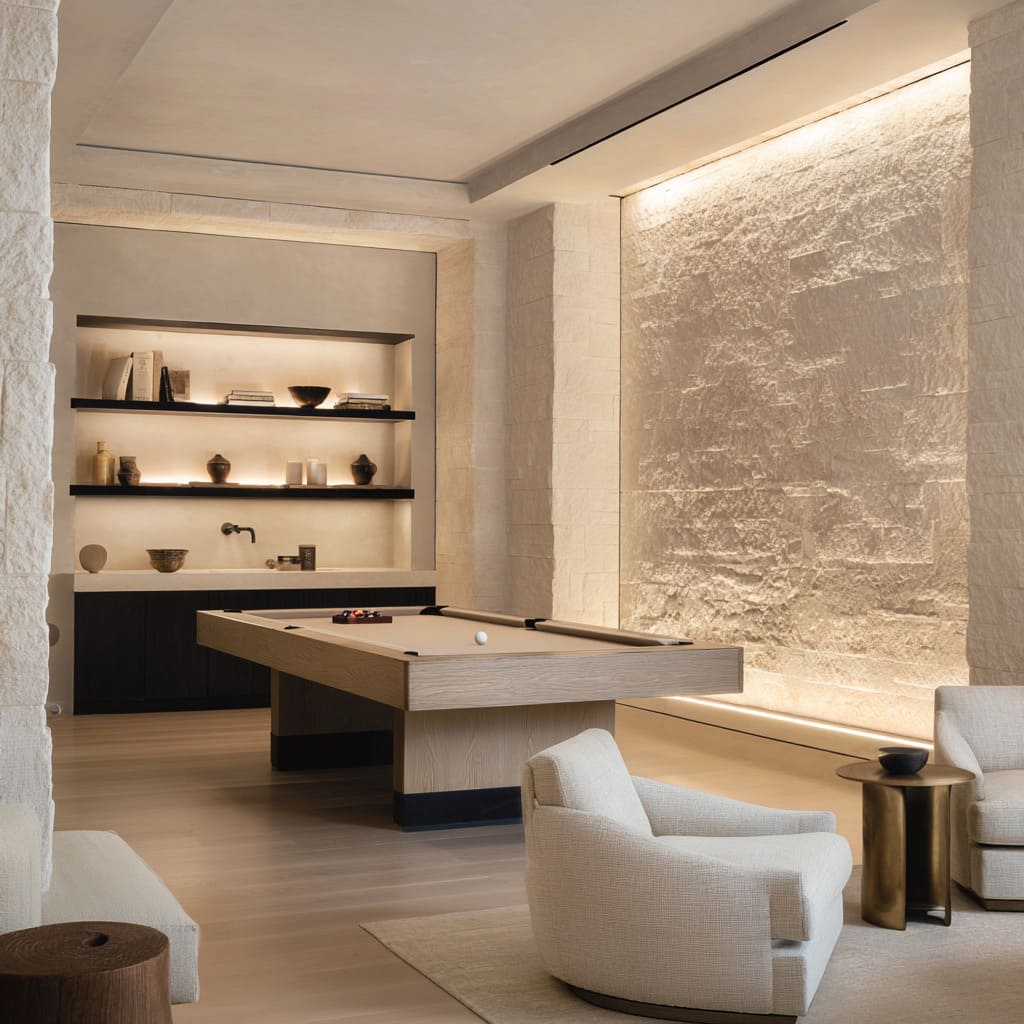
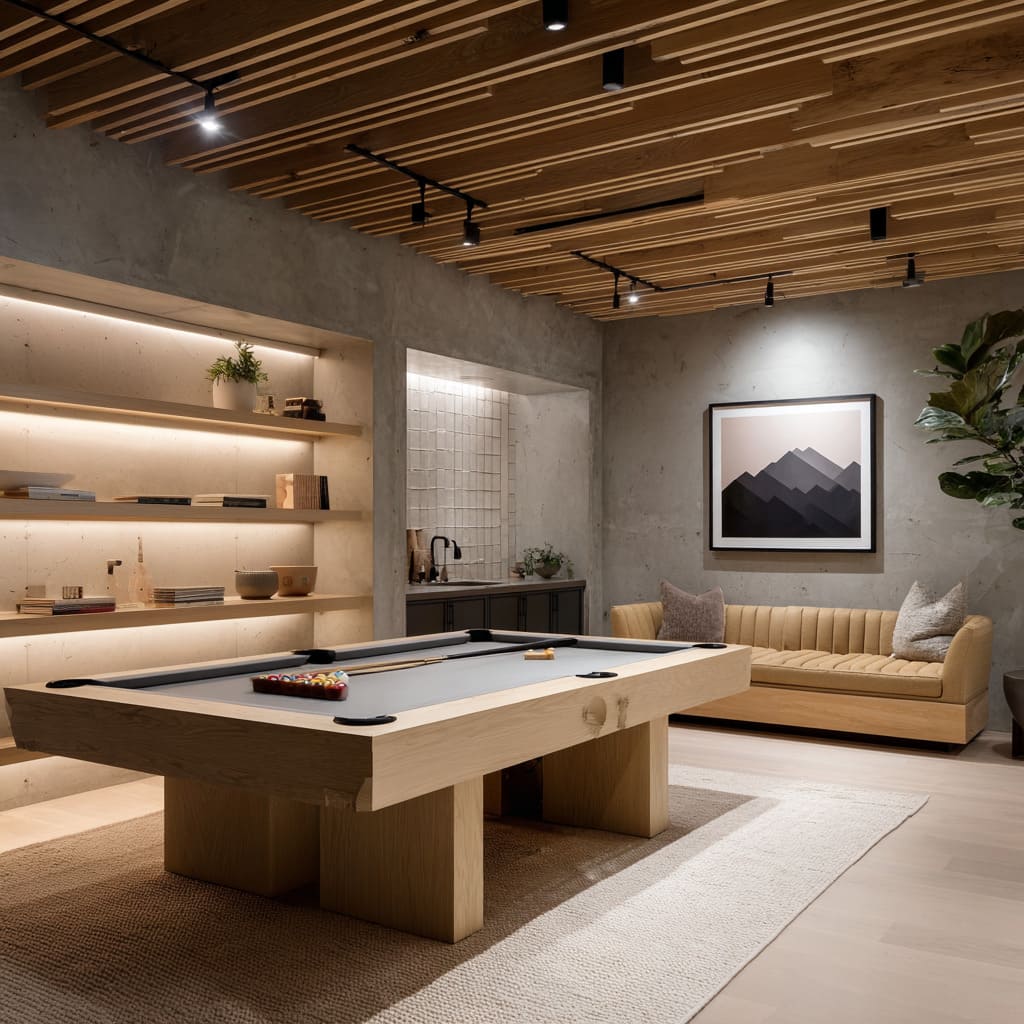
Modern billiard rooms are built on rhythm, not decoration. Linear slats on walls, narrow battens on ceilings, or fluted panels on a cabinet front give order and visual continuity.
The best designs use two intersecting rhythms—horizontal for calm, vertical for height.
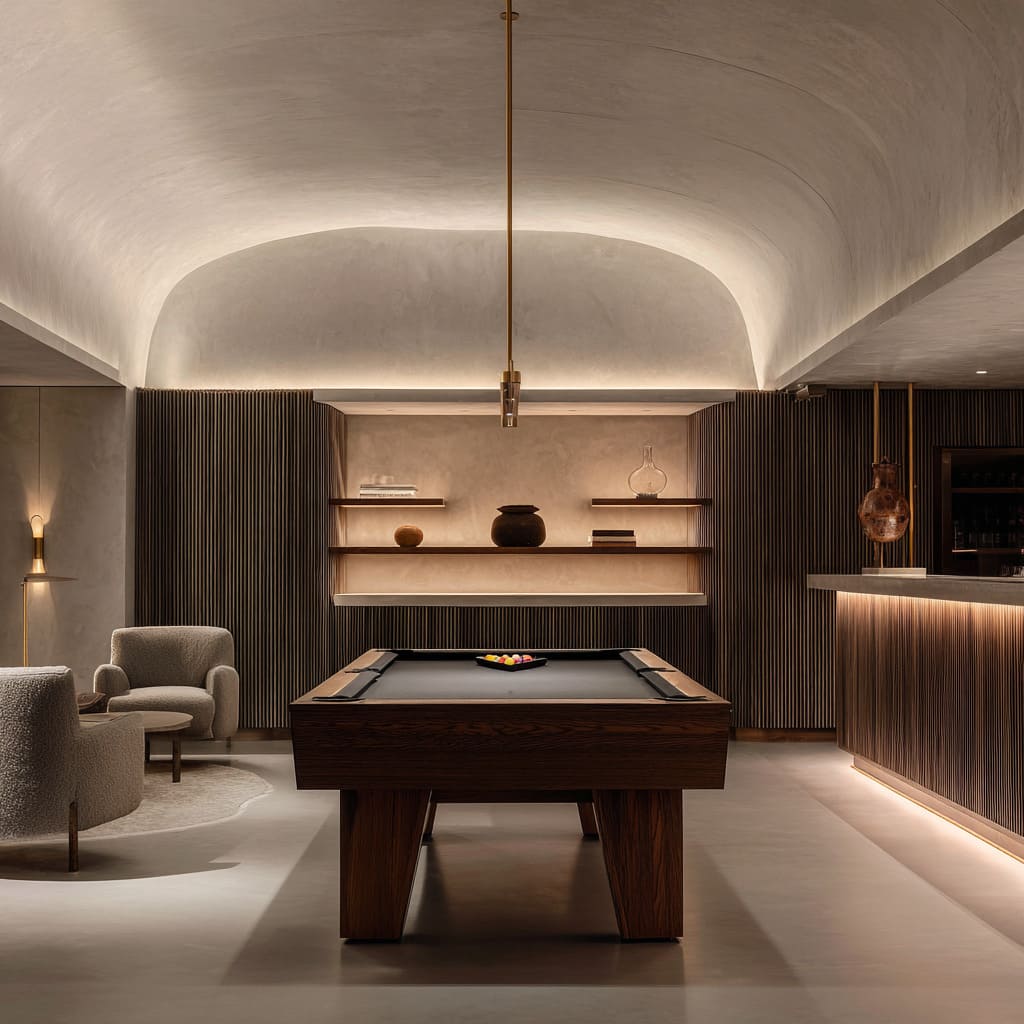
Rugs, benches, and cabinetry align precisely to the table’s geometry. Even the seams of stone flooring or the spacing of pendant lights often echo the pockets’ positions.
This level of discipline makes the room look composed even with minimal ornament.
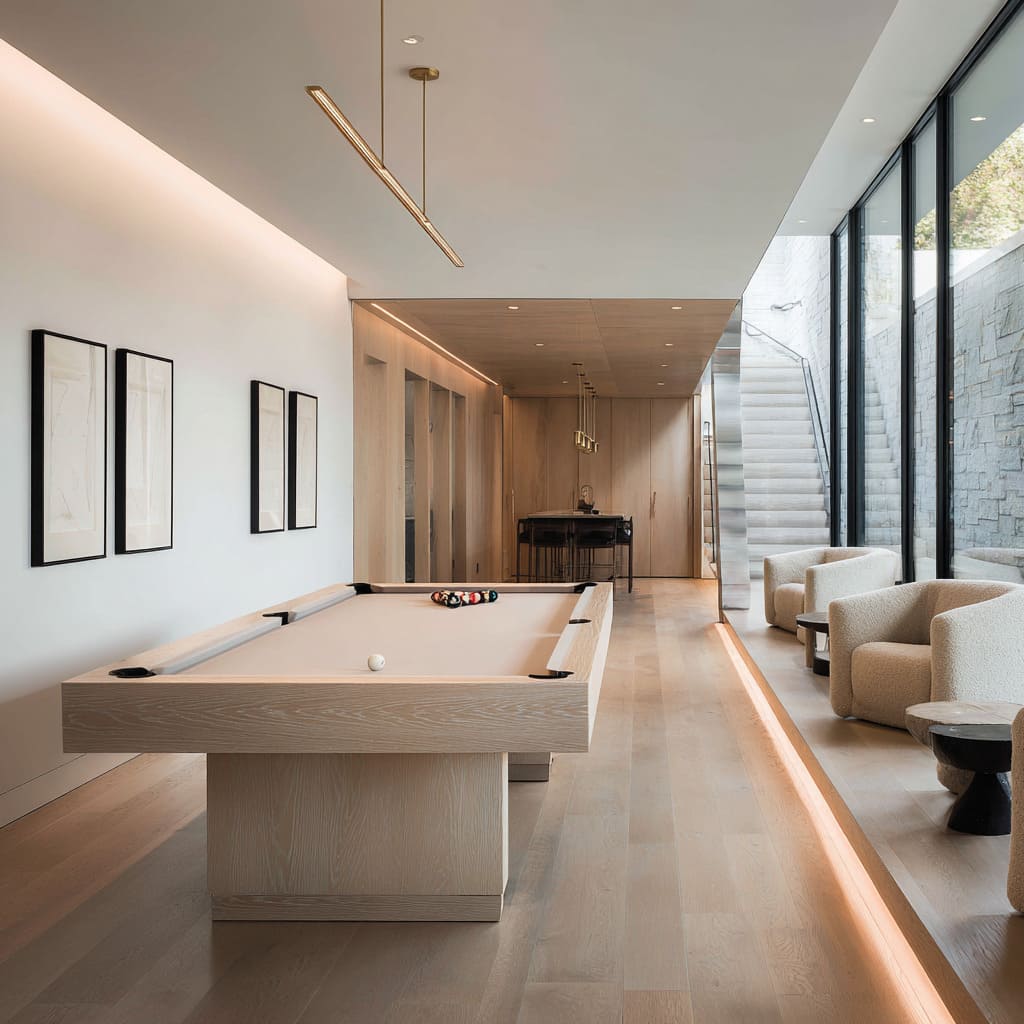
Seating and Layout: Observing the Game in Comfort
Basements are rarely large, so every inch counts. A curved sectional facing the table invites conversation without blocking walk paths.
Floating benches or daybeds underlit with soft amber light add comfort while keeping the floor clear.
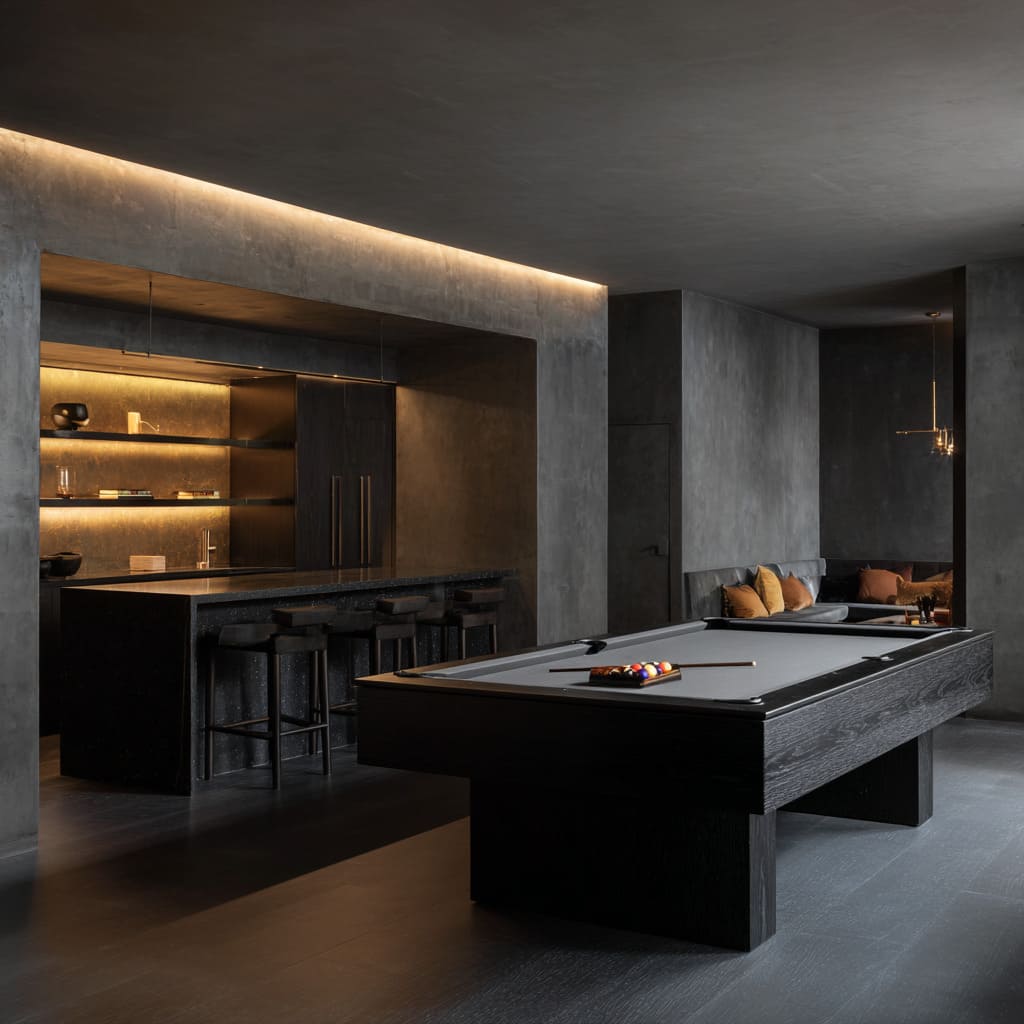
Rugs should frame the play area, not cover the whole floor. Designers size them to match cue reach, leaving a margin of hard flooring around.
This keeps the visual order clean and maintains performance for play.
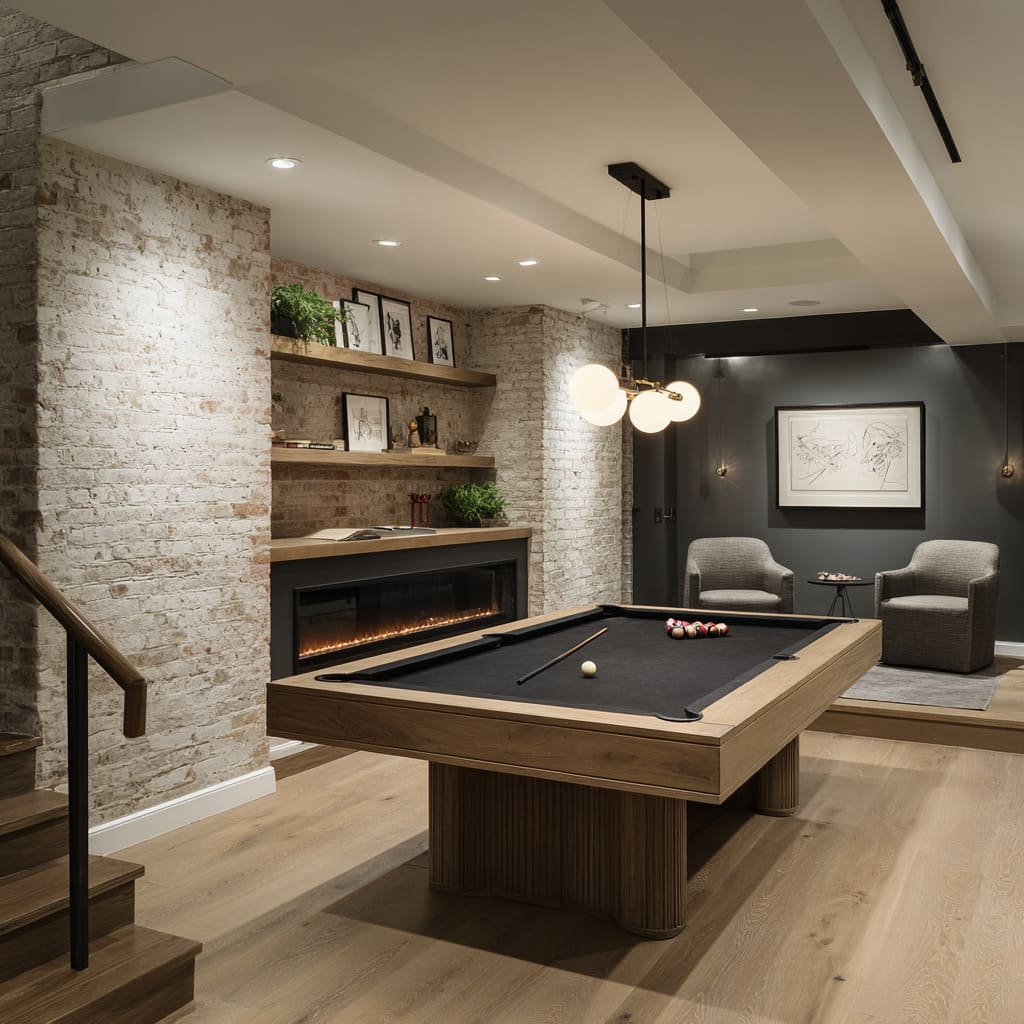
Shelves, and Styling with Purpose
Storage and display merge quietly in modern basement billiard room ideas. Handle-less cabinetry, floating ledges, and recessed vitrines keep clutter out of sight.
Lighting often comes from the back or underside, turning glass and ceramics into silhouettes rather than spotlit clutter.
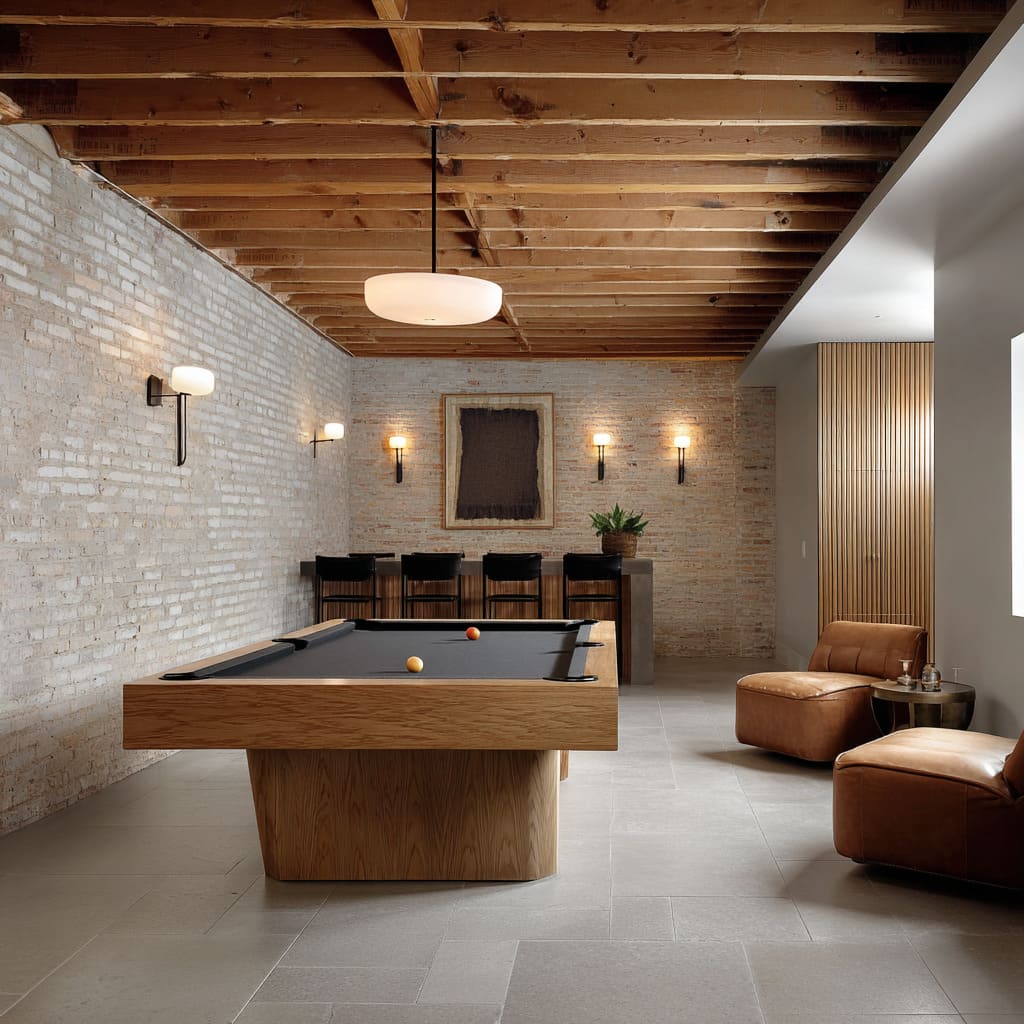
A shelf can sit in a shallow arch, behind ribbed wood, or even in onyx that glows from within. Mirrors are used sparingly—to double light, not add glitz.
Three or four objects per shelf, spaced like musical notes, keep the wall readable and serene.
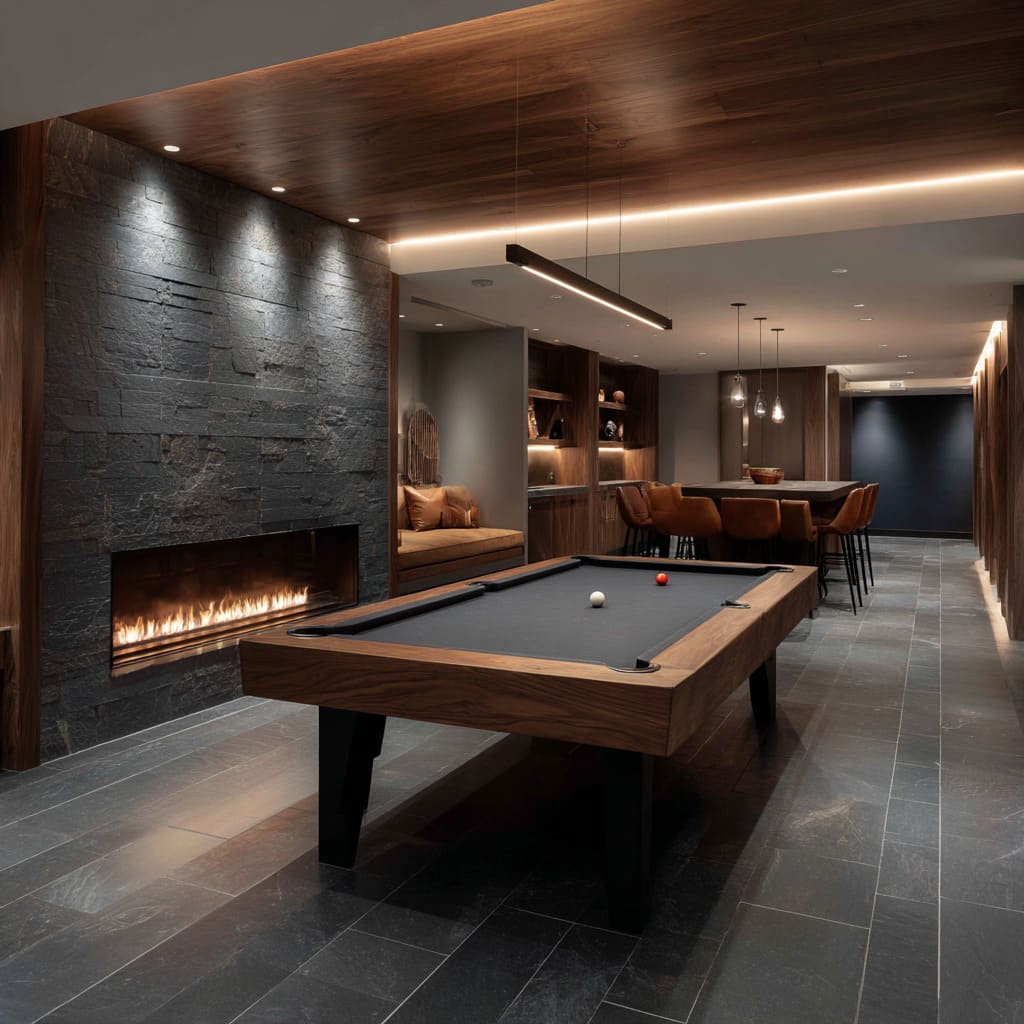
Ceiling Treatments That Define Character
Basements rarely have tall ceilings, yet designers transform this limitation into strength. Shallow coffers, walnut canopies, or plaster trays with concealed coves create texture without bulk.
Beams in light wood draw the eye along the table’s axis, while diffused coves inside recesses mimic daylight.
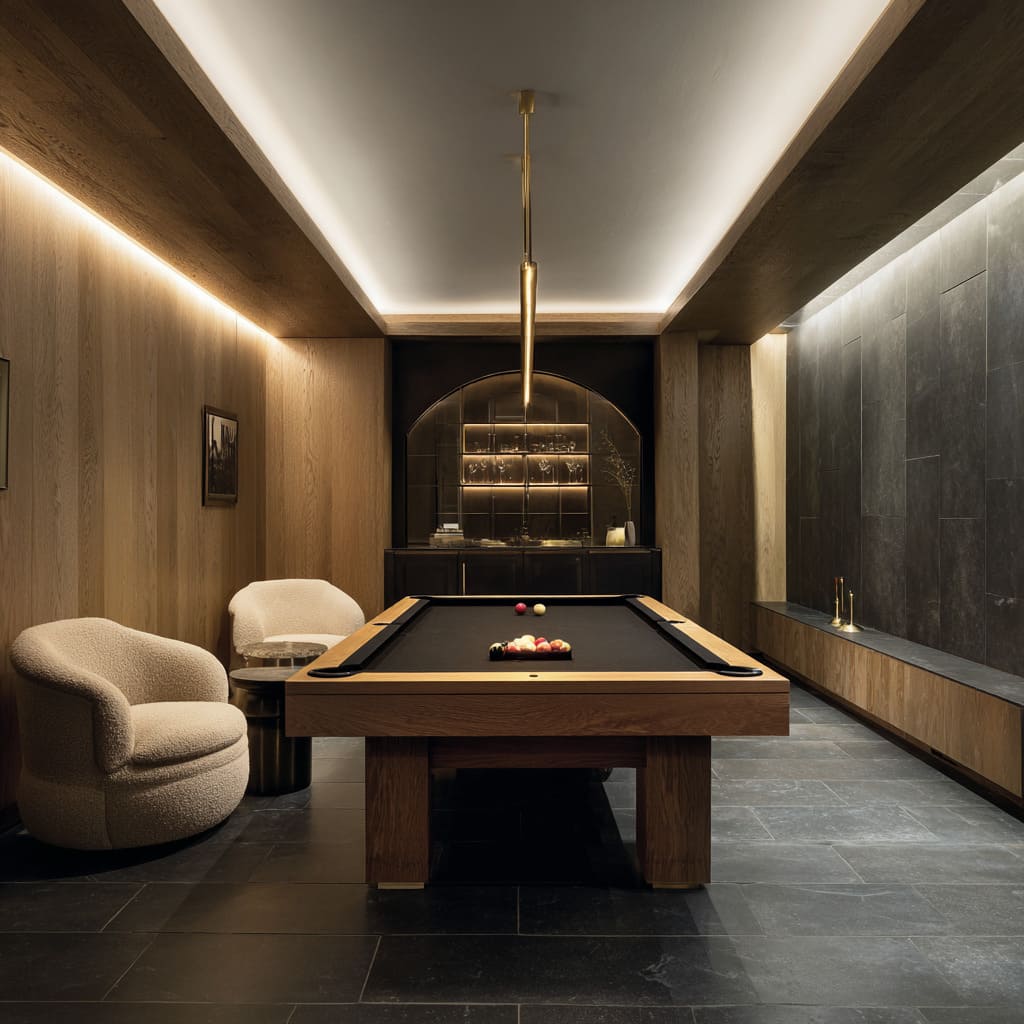
This approach removes the “flat lid” effect and replaces it with a soft floating plane—something that feels deliberate, not leftover from above.
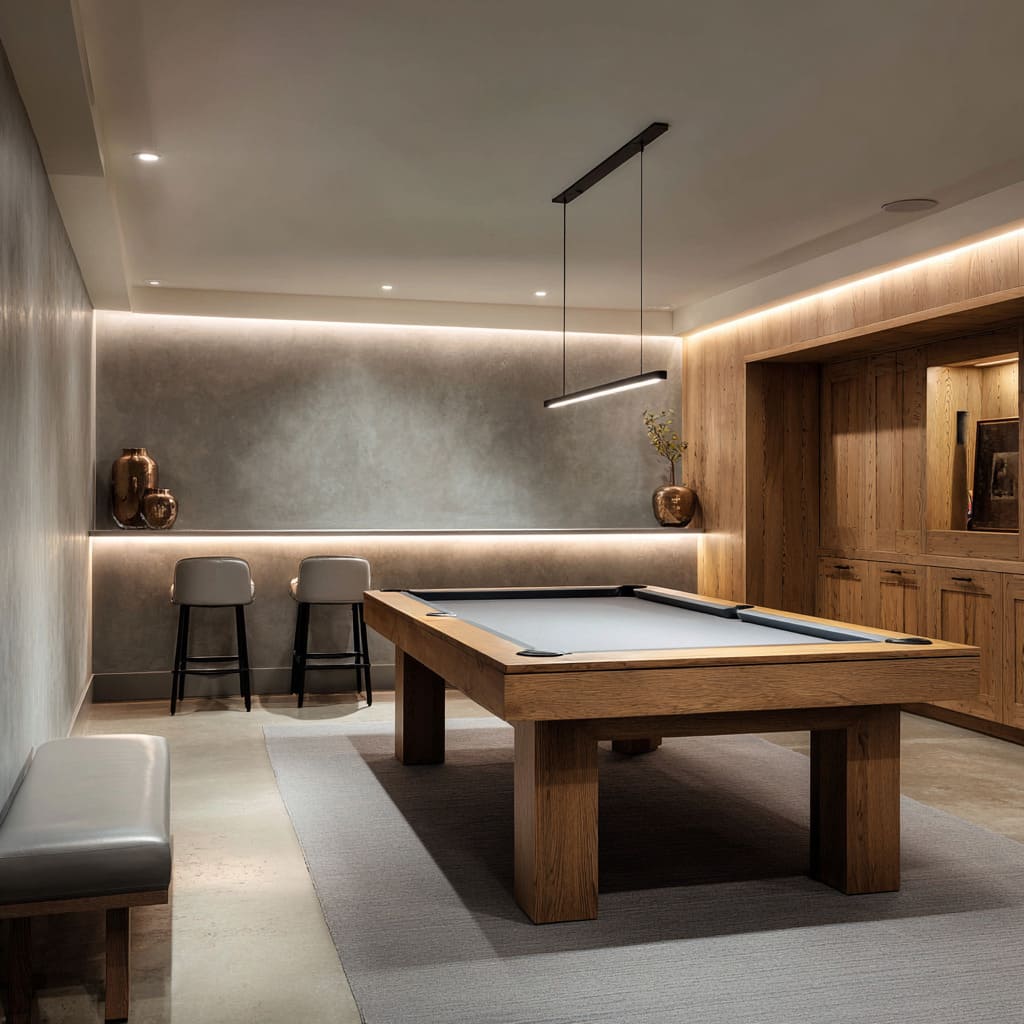
Contrast: The Secret of Depth in Compact Spaces
In basements where natural light is limited, contrast becomes the design language. One rough wall paired with a smooth ceiling, a single dark cabinet against pale plaster, or warm brass details punctuating a gray shell—these contrasts build depth without requiring large volumes.
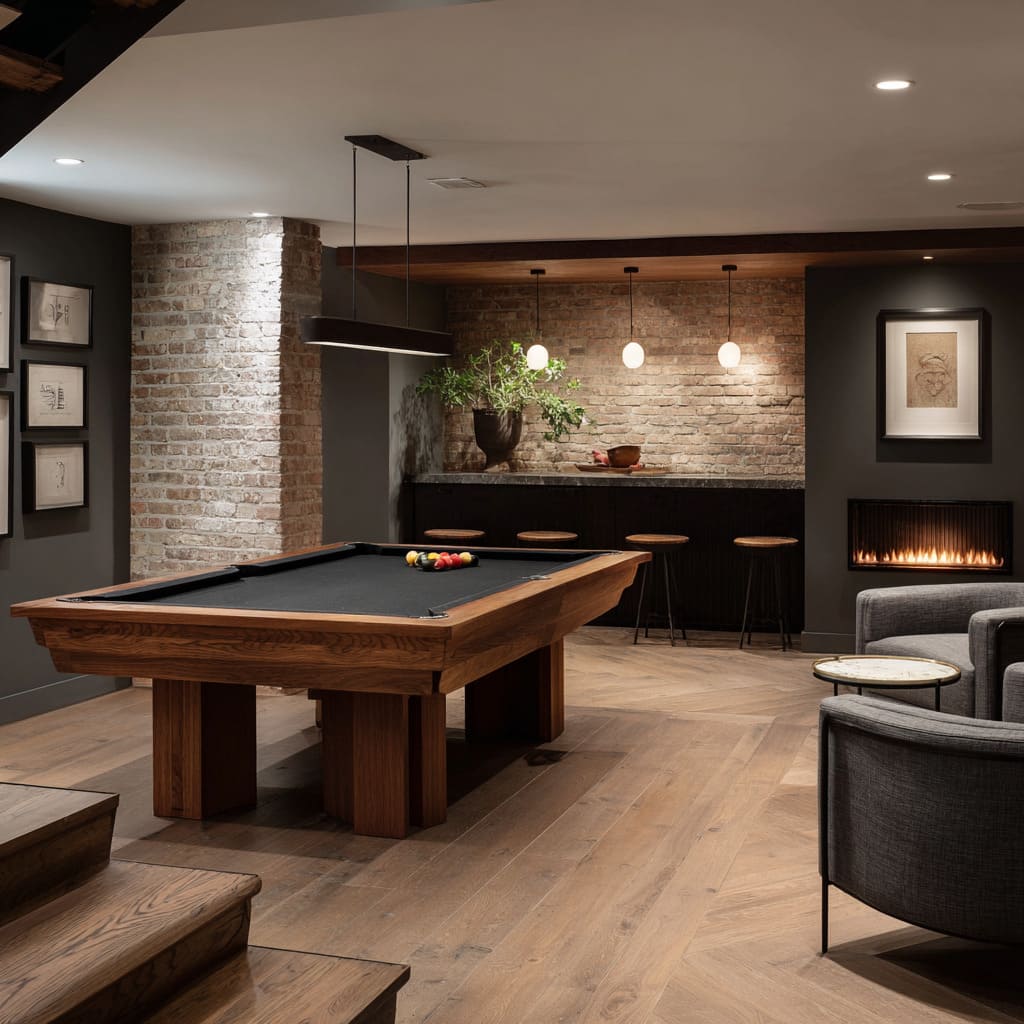
Even small asymmetries keep the room alive. A pendant hung slightly off-center to favor the break end or a shelf stack with one heavier base shelf brings natural rhythm and avoids stiffness.
Turning the Basement into a Real Room
The new wave of pool table in basement ideas blurs the boundary between recreation and refined living. The spaces now borrow cues from living rooms, entertaiment areas, and art studios.
Large woven rugs, boucle or leather seating, matte pottery, and soft abstract art connect play with relaxation.
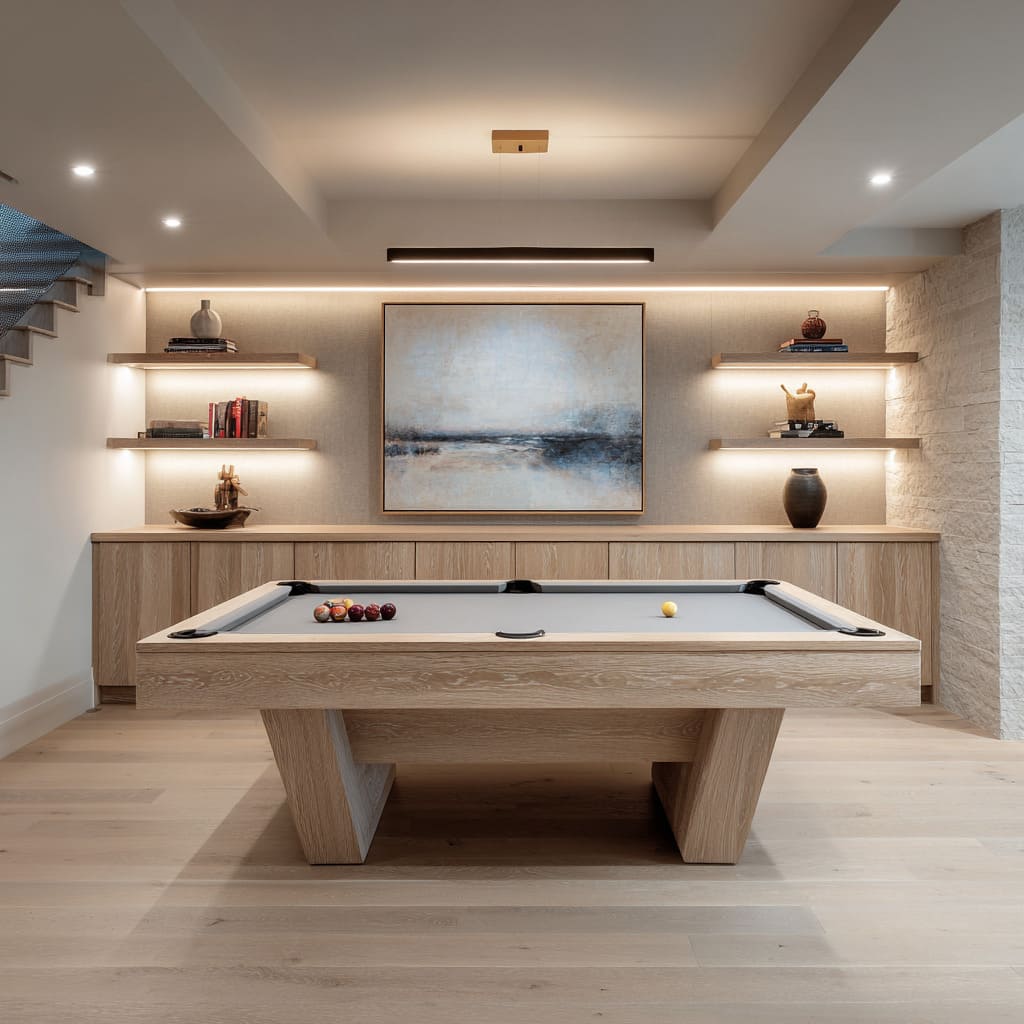
Designers often hide structural quirks—like columns or stair wells—by integrating them into shelving or lighting plans. The result is not “finished basement,” but a fully designed interior that just happens to be below ground.
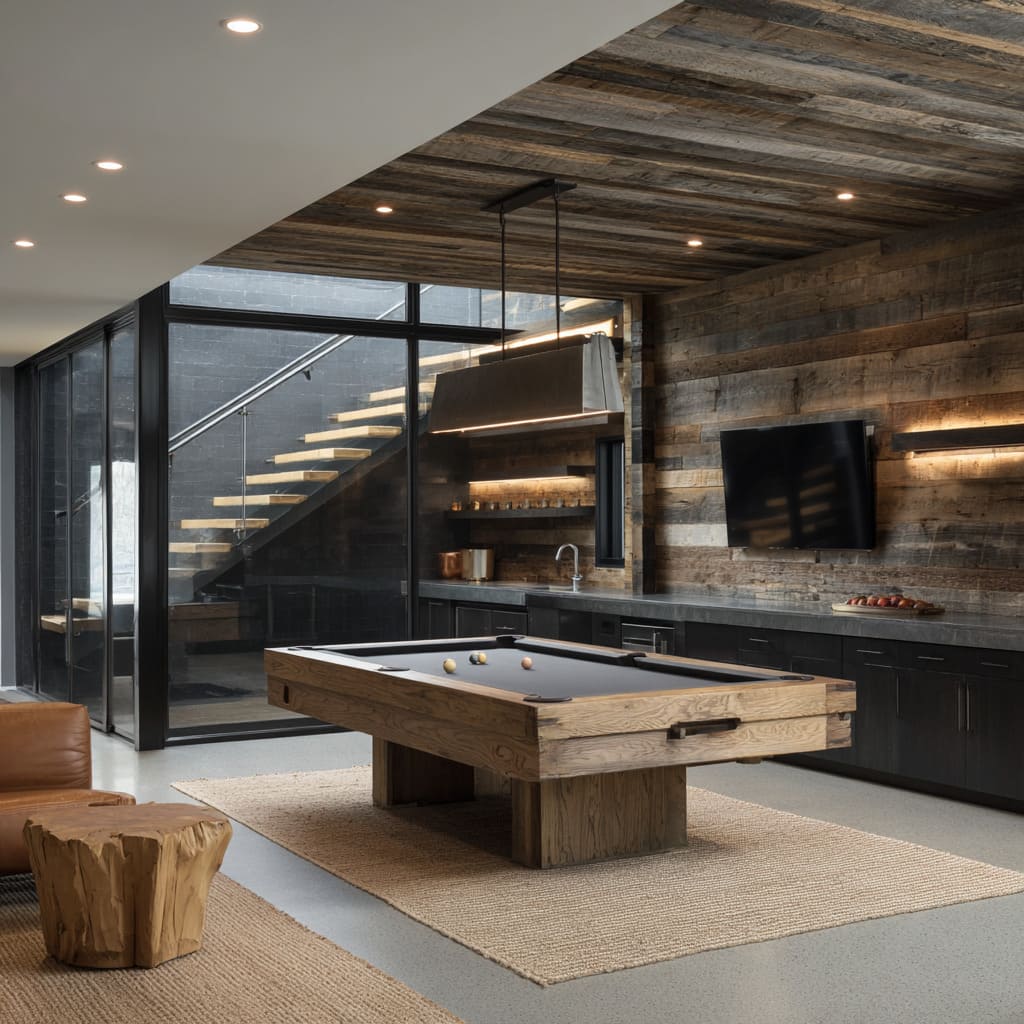
Key Points Defining a Modern Basement Billiard Look
One Timber and One Neutral Tone
Modern basement billiard rooms rely on visual discipline rather than a mix of colors.
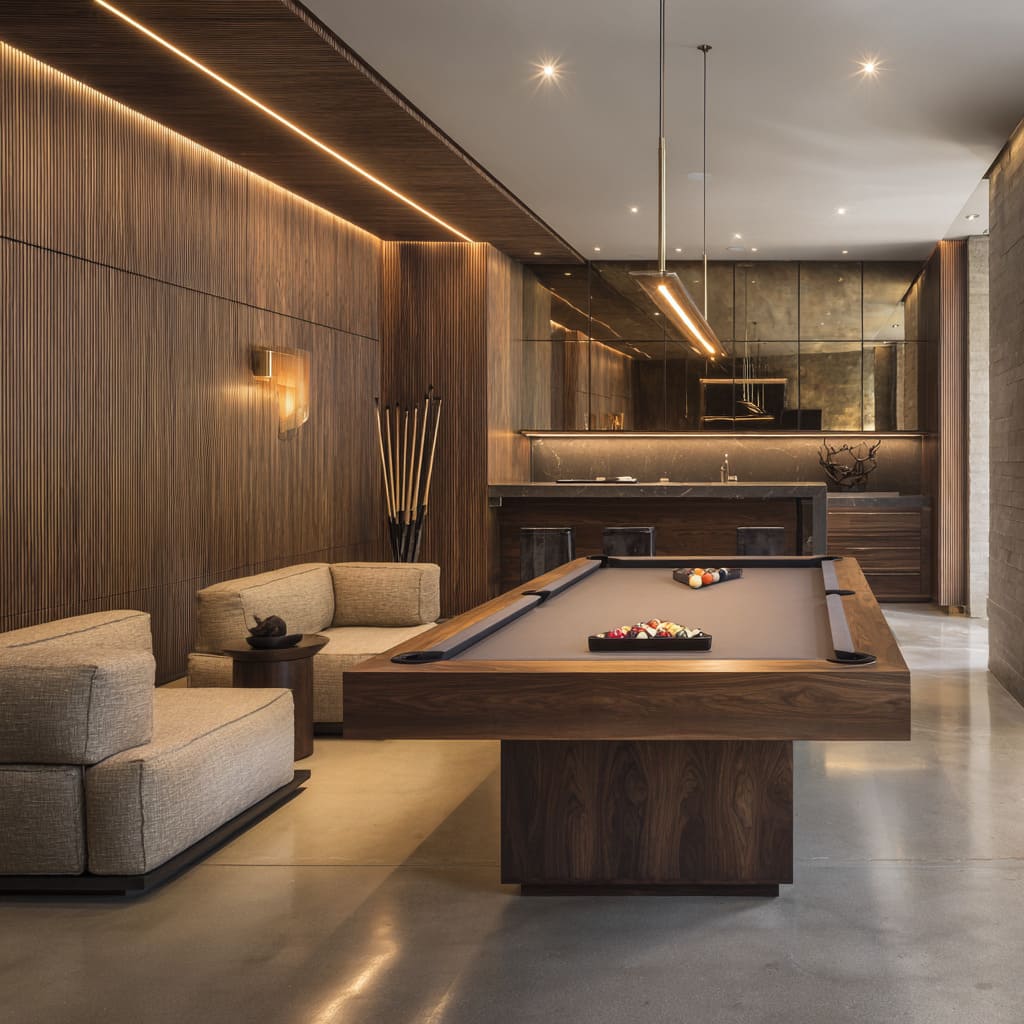
The combination of a single wood tone—oak, walnut, or ash—and one neutral backdrop like plaster, limestone, or matte concrete gives the room a calm visual order. This limited palette allows light, shadow, and grain direction to shape the atmosphere, so warmth comes from texture instead of decoration.
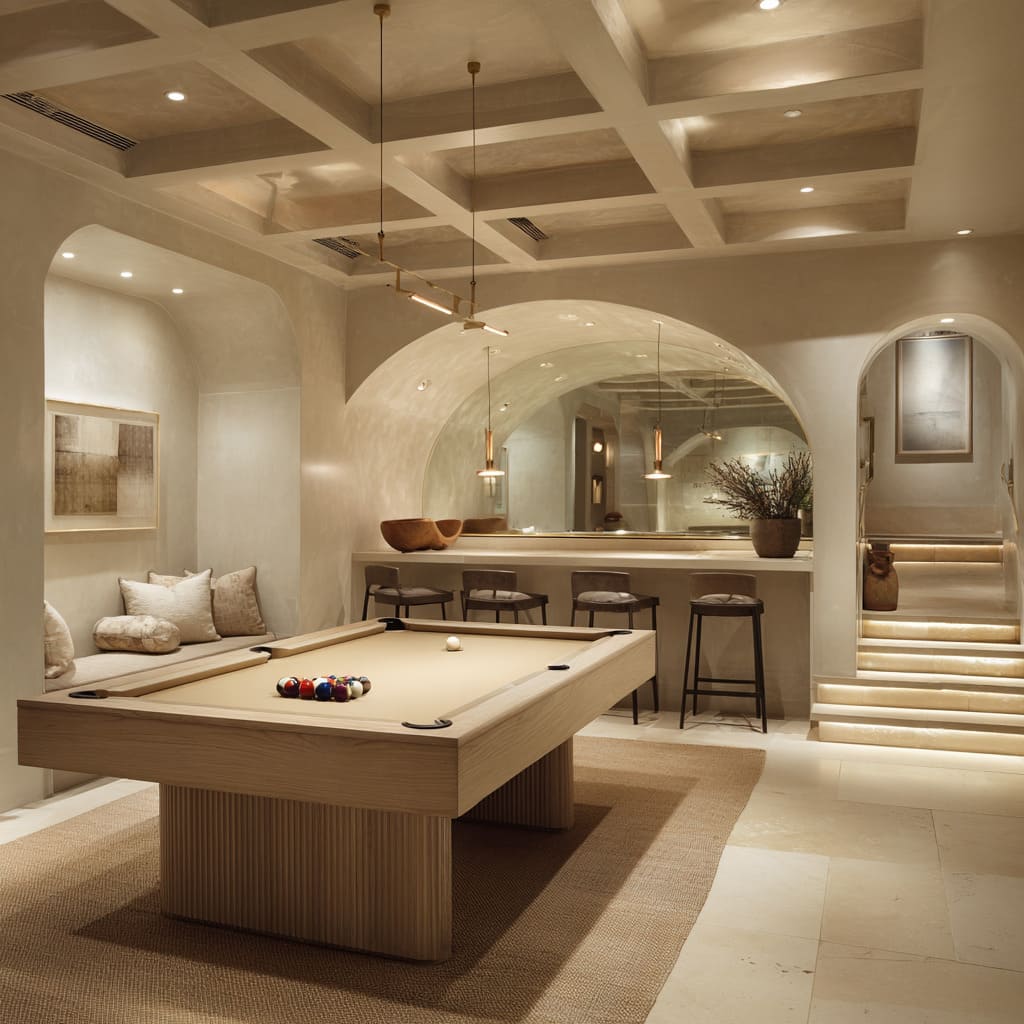
Visual, Not Just Physical Centering of the Table
The pool table should command attention as the architectural heart of the space.
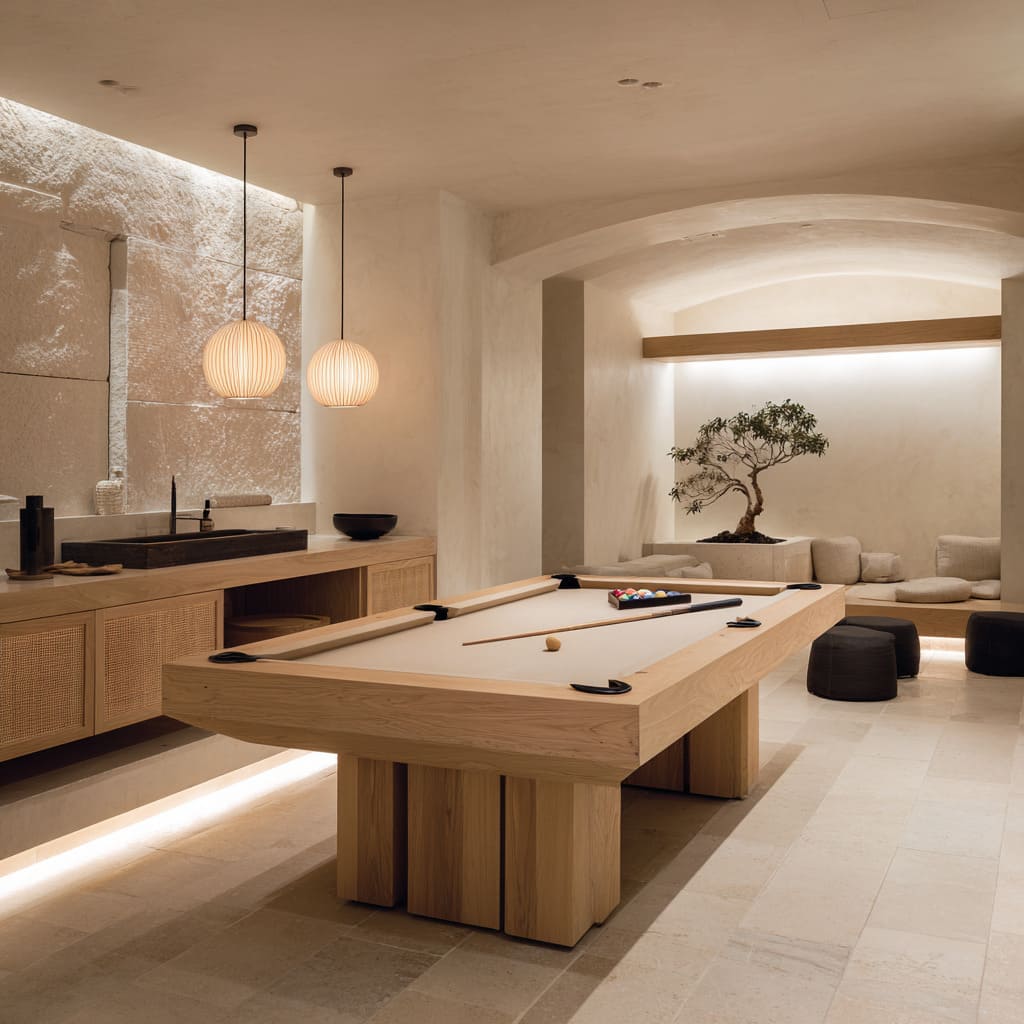
Designers often center it through visual cues such as aligning the floorboards, rug edges, or artwork horizons rather than relying on the room’s geometry. This technique builds subtle balance, ensuring that the table feels integrated even when walls or beams are uneven.
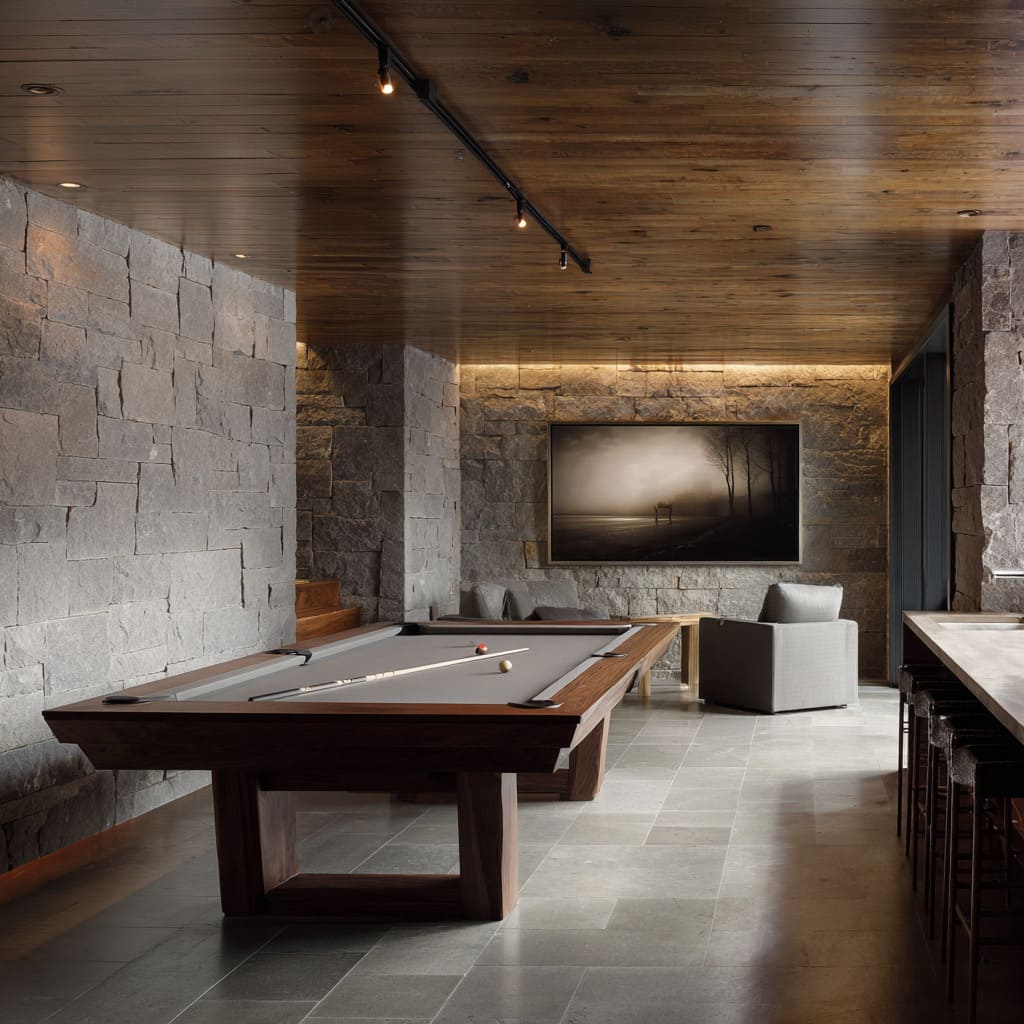
Layered Lighting at Multiple Heights
Depth and character come from layered illumination rather than a single bright source. Pendant lights focused over the table, grazing wall lights that reveal texture, and soft toe-kick lighting near cabinetry or benches together form a gentle hierarchy.
These layers turn the basement into a warm, luminous volume rather than a low ceiling with isolated fixtures.
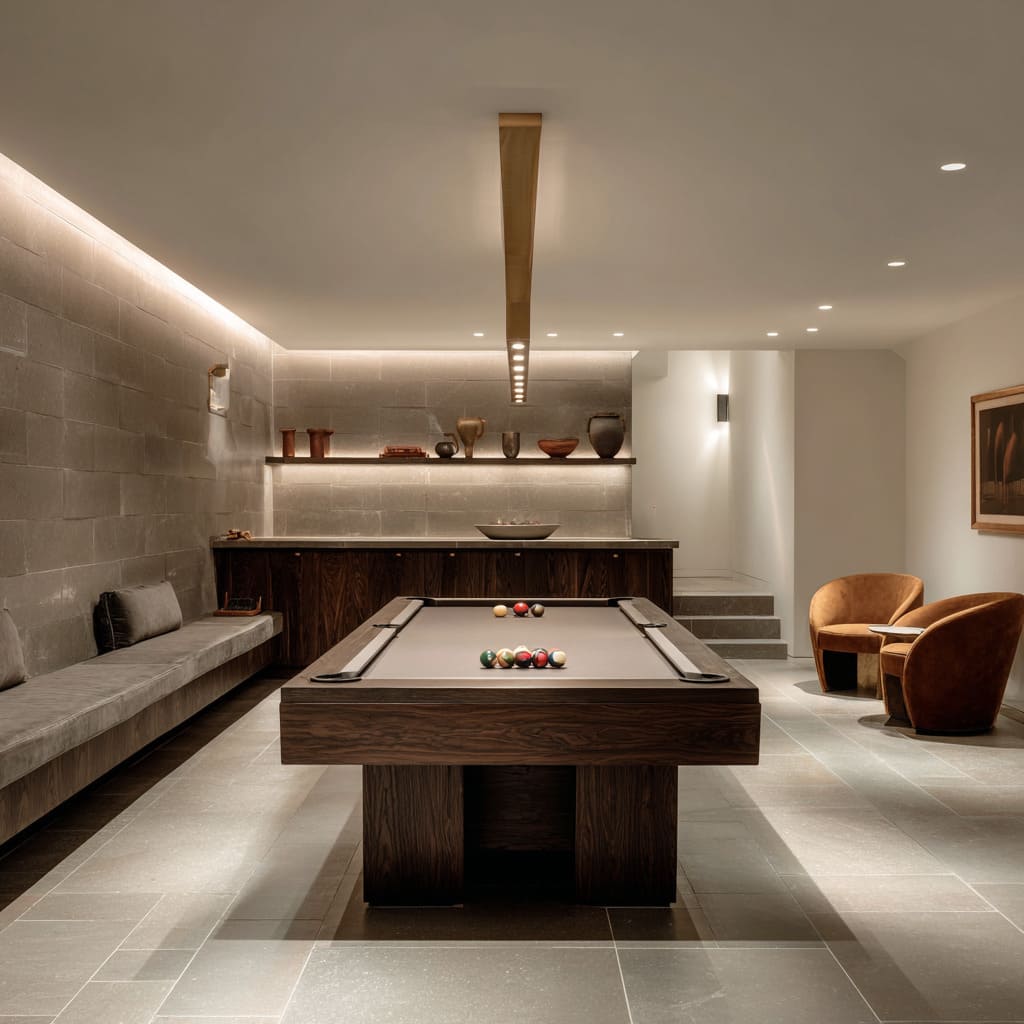
Minimal, Weighted Shelving Composition
Shelves are not storage—they are rhythm lines within the design. The modern approach favors a few sculptural pieces such as matte ceramics or books stacked horizontally, each spaced with intention.
This restraint lets negative space become part of the composition, allowing light to trace long shadows and keeping focus on the table and materials.
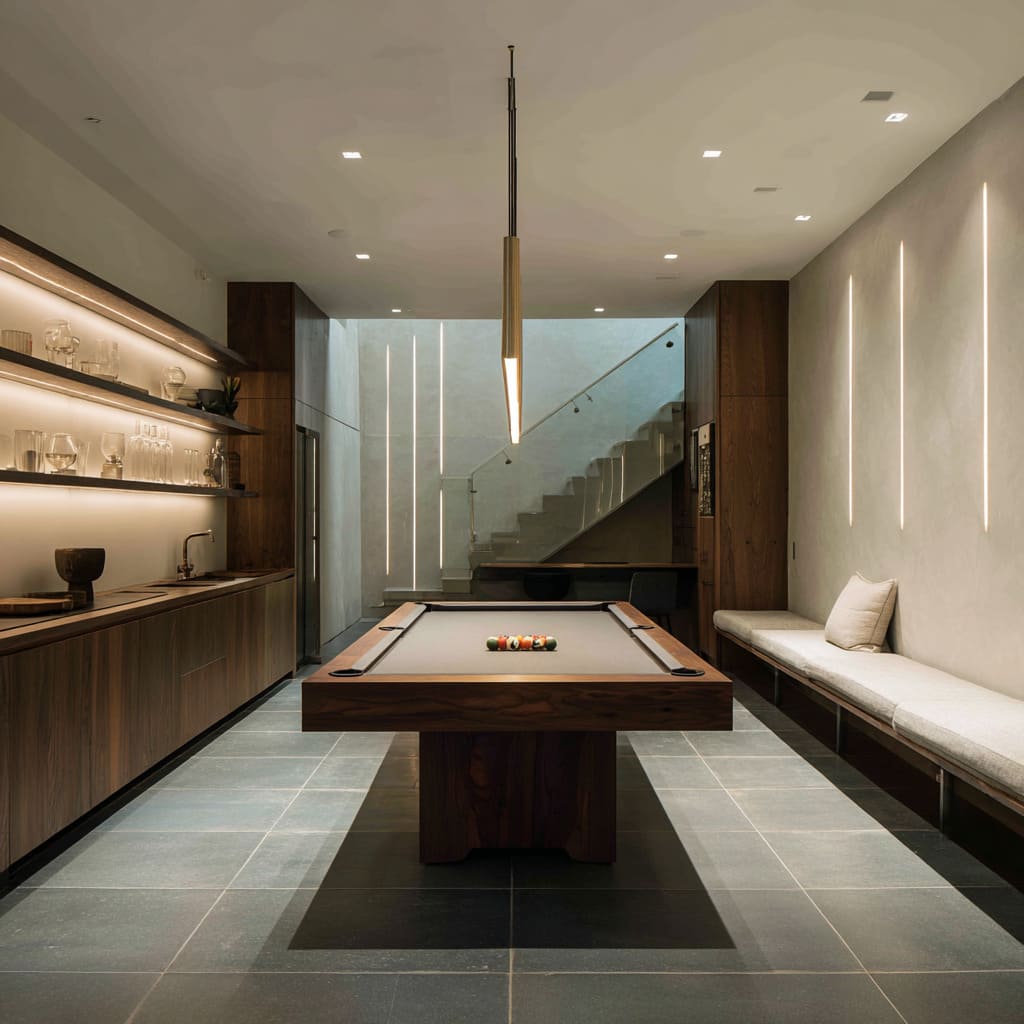
One Organic Accent for Balance
Within all the timber, stone, and straight geometry, a living or organic element brings contrast. A bonsai, a tall branch in a ceramic vase, or a leafy plant adds an irregular silhouette that softens precision and introduces quiet life to the basement setting.
The key is scale—one strong organic form rather than several small ones.
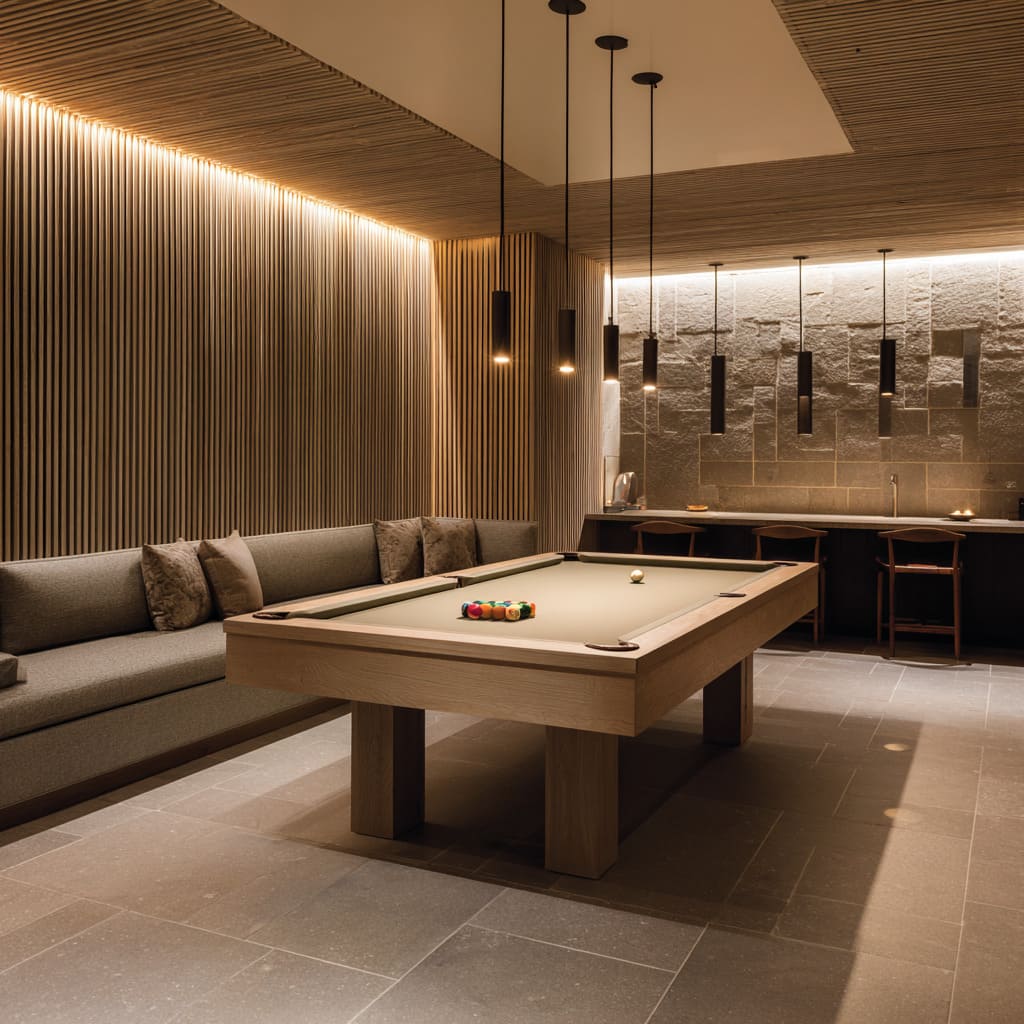
Asymmetry as a Source of Calm
Perfect symmetry often feels staged, while slight imbalance brings natural rhythm. Hanging a pendant slightly toward the break end of the table or placing a small lounge area off-axis introduces movement and ease.
Asymmetry gives personality to an otherwise strict modern layout and makes the basement feel designed for people, not diagrams.
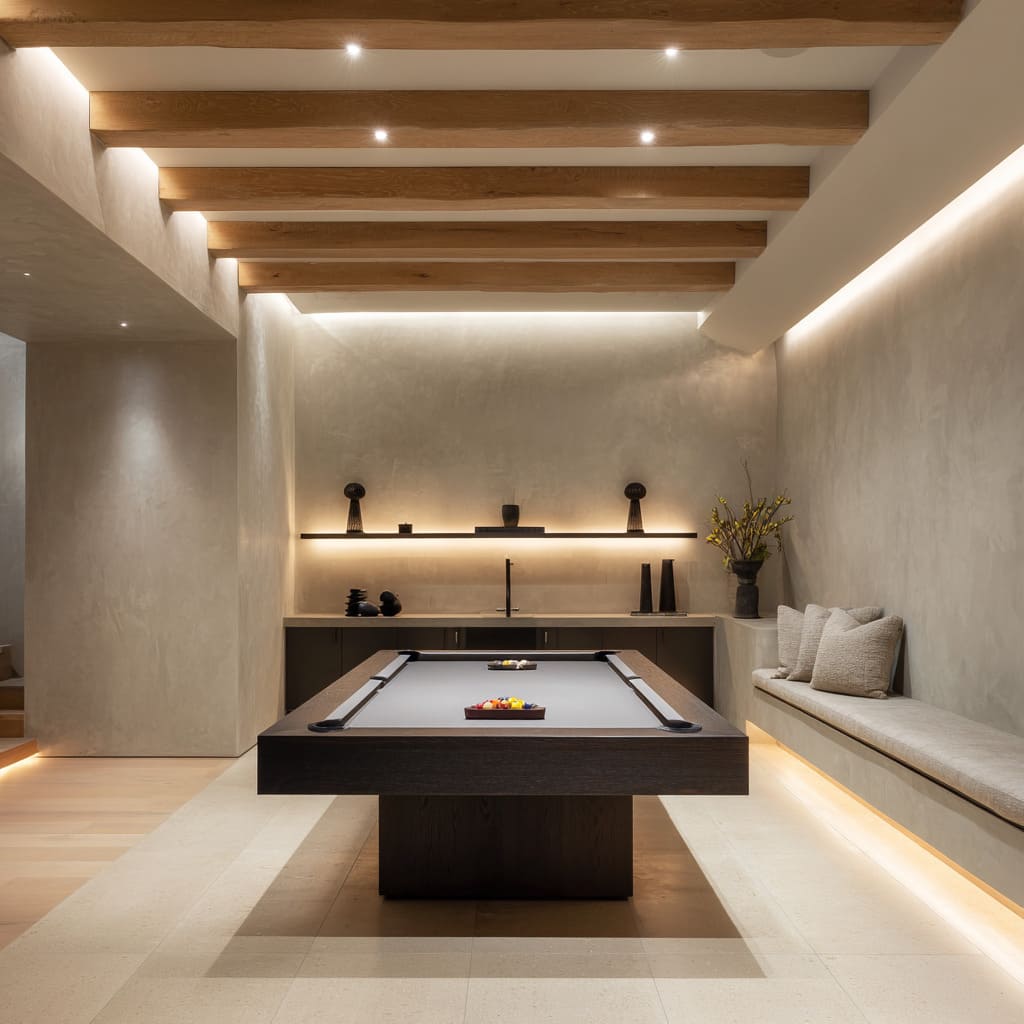
Why These Designs Work
What makes these basement billiard room ideas so visually powerful is the use of order and restraint. Instead of relying on color or gimmicks, designers control alignment, shadow, and proportion.
The table is treated as part of the architecture, lighting behaves like a drawing tool, and materials flow continuously across surfaces.
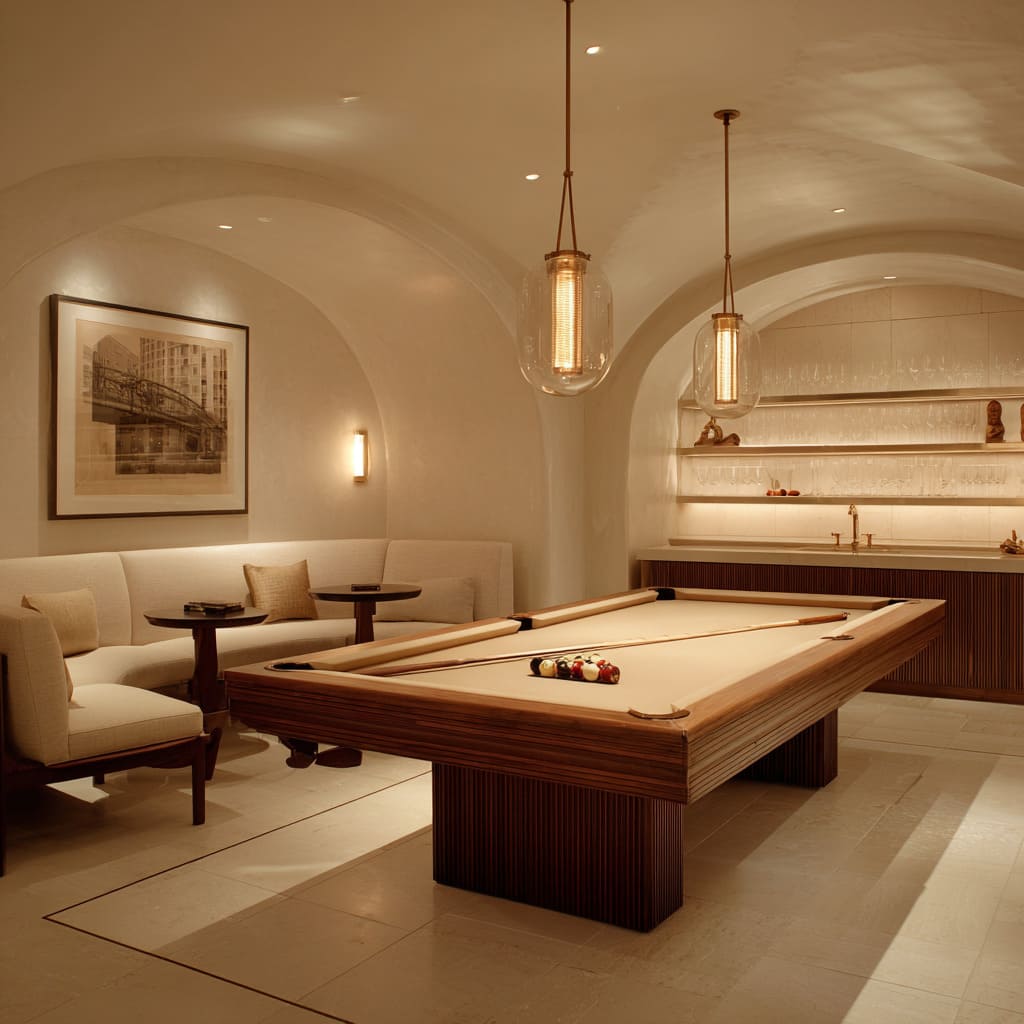
That’s why even compact basements can feel calm, sophisticated, and inviting—because everything, from the ceiling beam to the cue rack, participates in one visual rhythm.
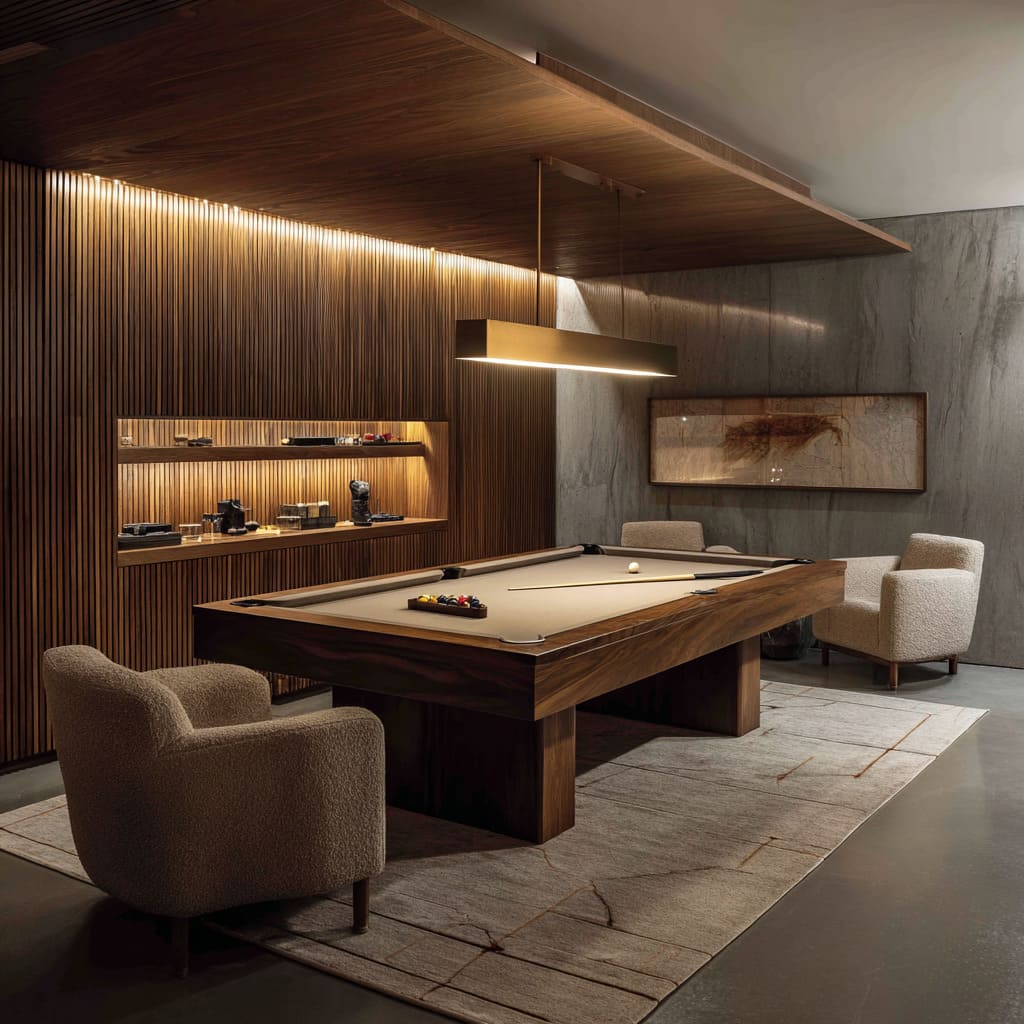
Final Thoughts
Modern basement pool table room ideas prove that a game space doesn’t have to shout for attention. It can whisper—with soft light, disciplined lines, and materials that age gracefully.
The result is not just a room for play, but a quietly confident space that adds genuine style to your home.
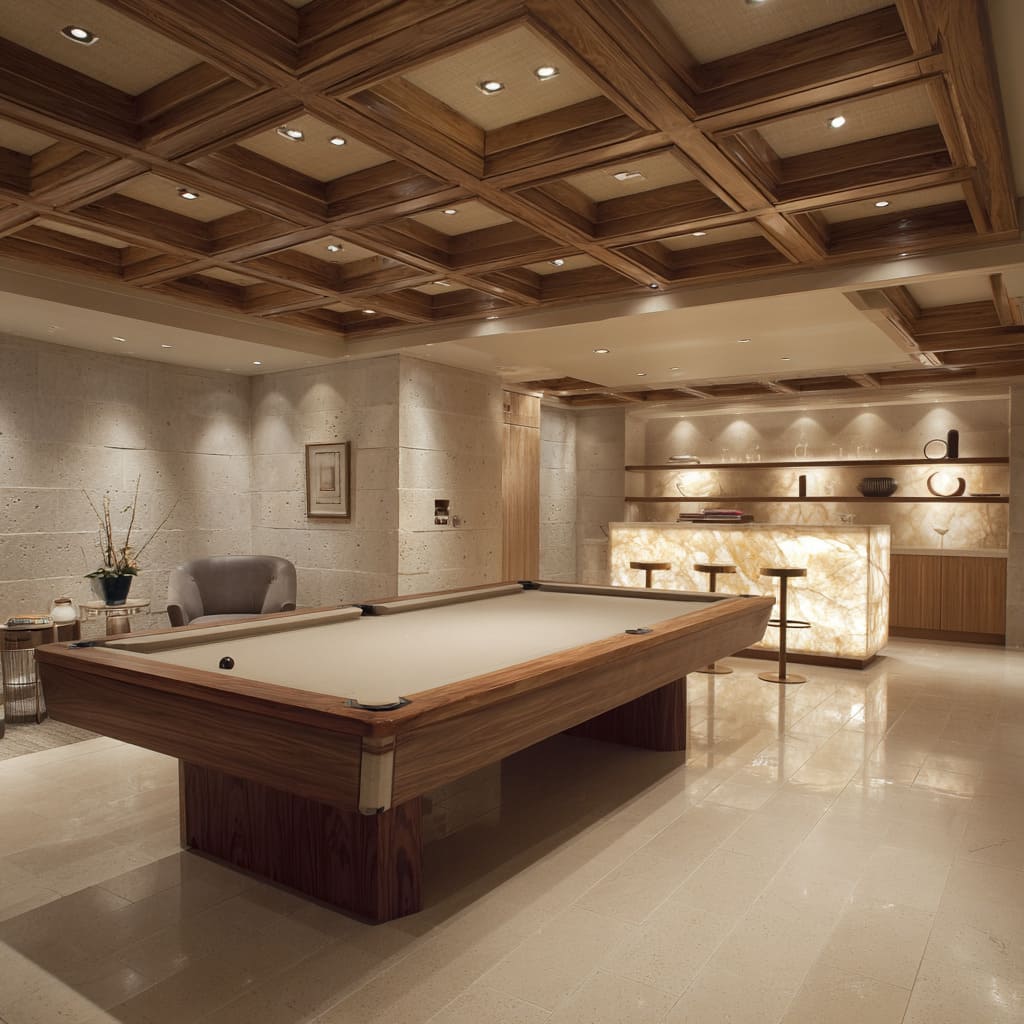
When done right, a pool table in basement becomes the anchor of a relaxed social hub—one that feels crafted, not decorated.