Modern farmhouse bathroom design often operates on a simple but powerful tension: memory of rural life held inside a very calm, contemporary shell. Instead of leaning on themed décor, such bathroom designs can use a small vocabulary of elements—timber beams, vertical paneling, plank walls, cottage-style windows, barn-like door proportions—and place them within pared-back envelopes of stone, plaster, and glass.
The result is not a nostalgic set dressing but a quiet, structured interior where references to barns, attics, and old washrooms are distilled into clean lines and controlled textures. Warm wood, soft stone, and gentle metal finishes form the backbone of this language, but proportion and composition are just as important as material.
Axial views toward a tub, balanced rhythms of doors and drawers on a long vanity, or a single gabled niche at the end of a corridor carry more weight than any decorative sign or slogan. The mood that emerges is steady and reassuring: such designs look as if they could sit in a rural setting, in a suburb, or even in a city apartment while still feeling rooted in one coherent idea of “modern farmhouse.
”.
Layouts: Axes, Bays, and Gallery-Like Rooms
Spatial planning does much of the visual work in farmhouse bathroom design ideas, even before finishes are chosen. Some design layouts shape the atmosphere so clearly:.
The corridor with an end focus
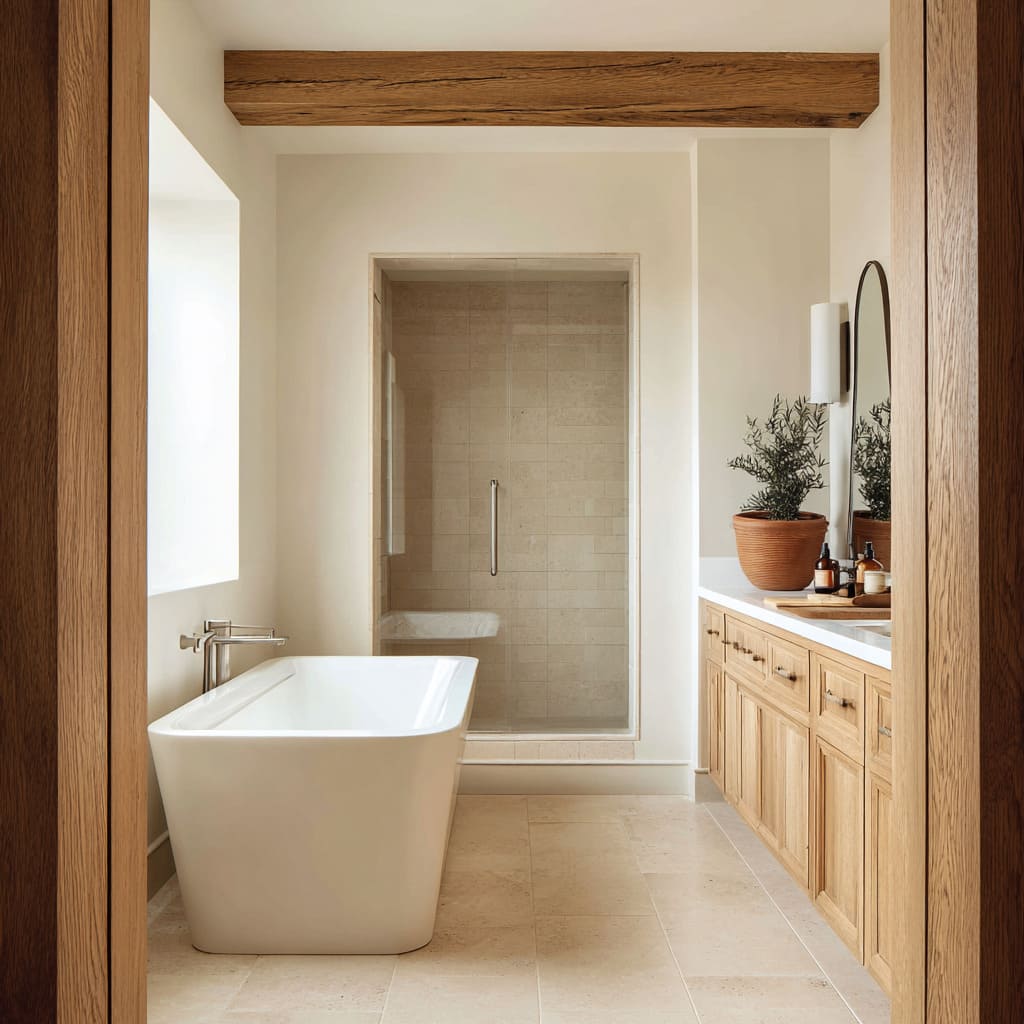
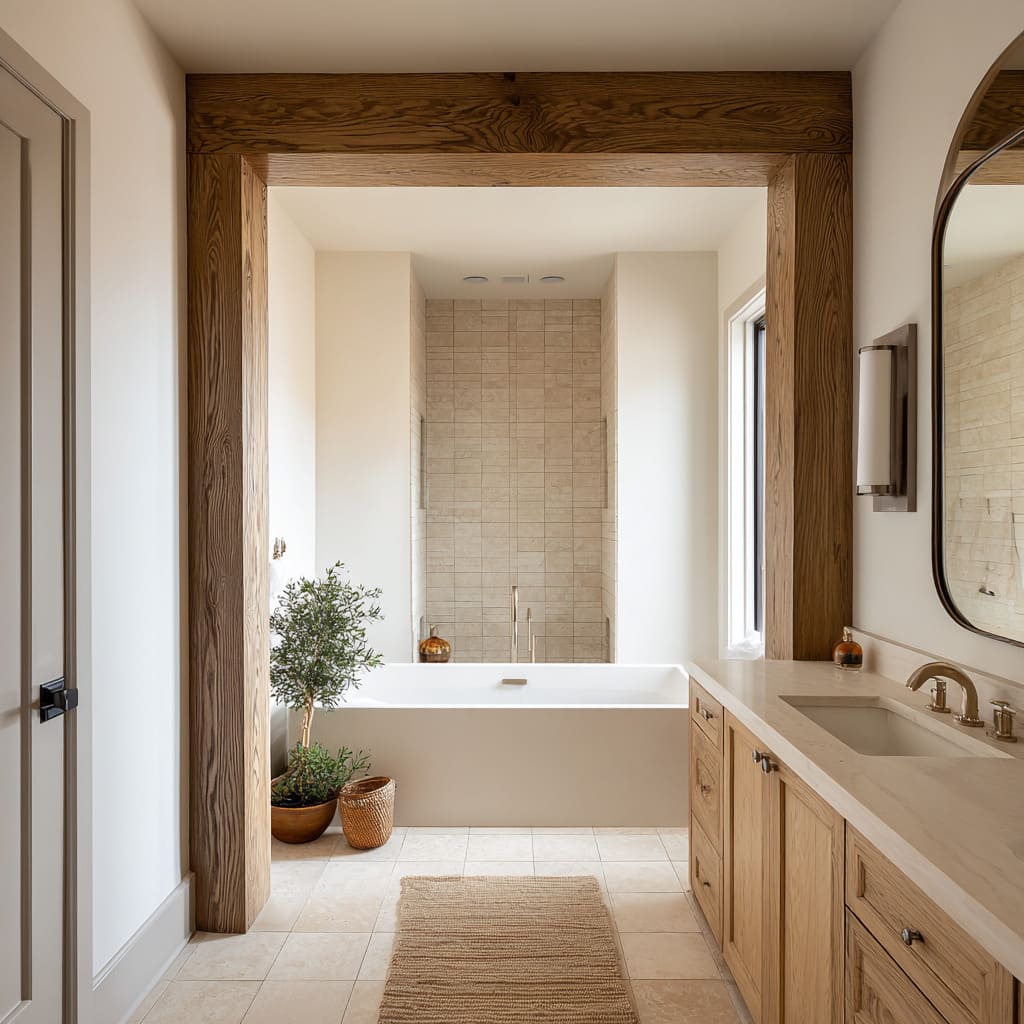
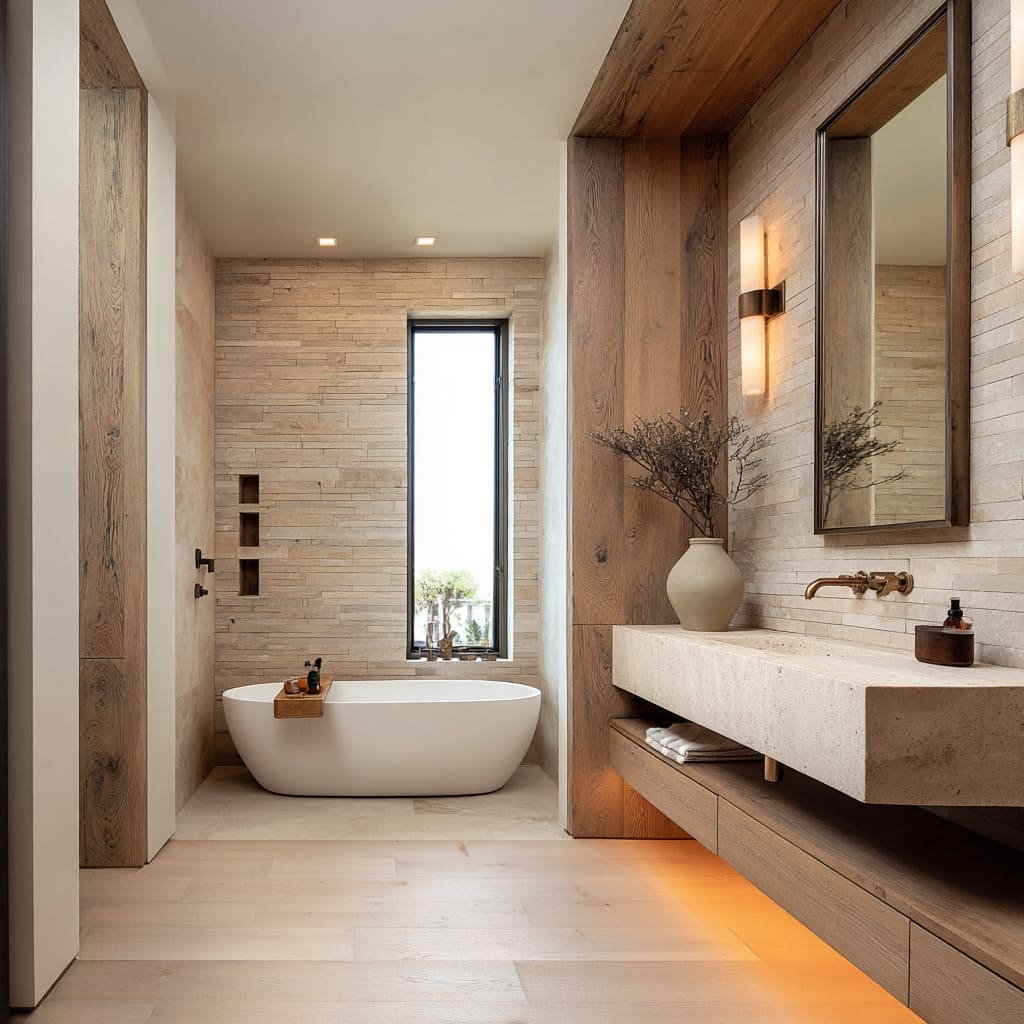
Long, narrow rooms are often organized as calm passages that lead directly toward a framed tub niche or window. Beams, floor planks, runners, and even vertical tiles all tend to align with this axis, turning the tub into a soft focal point at the far end rather than just another fixture along a wall.
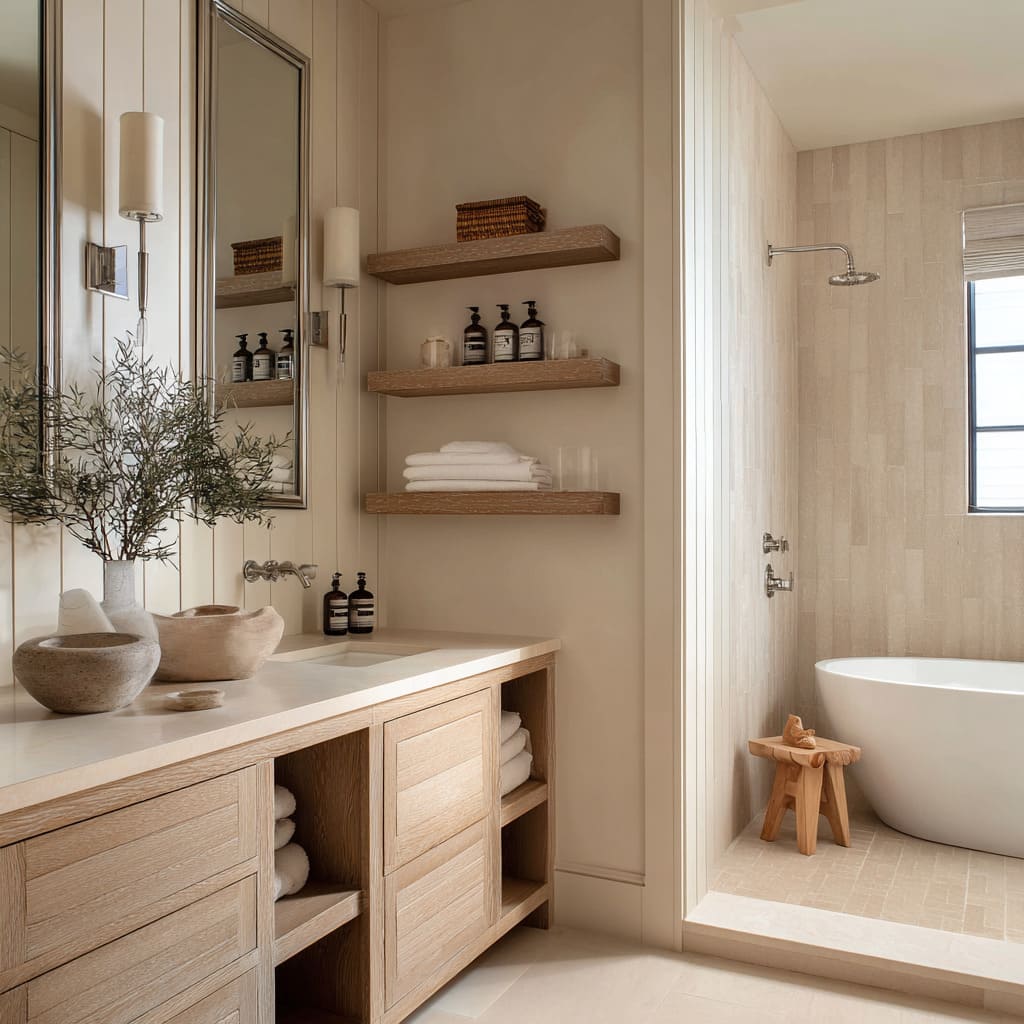
The centered bay or “chapel” focus
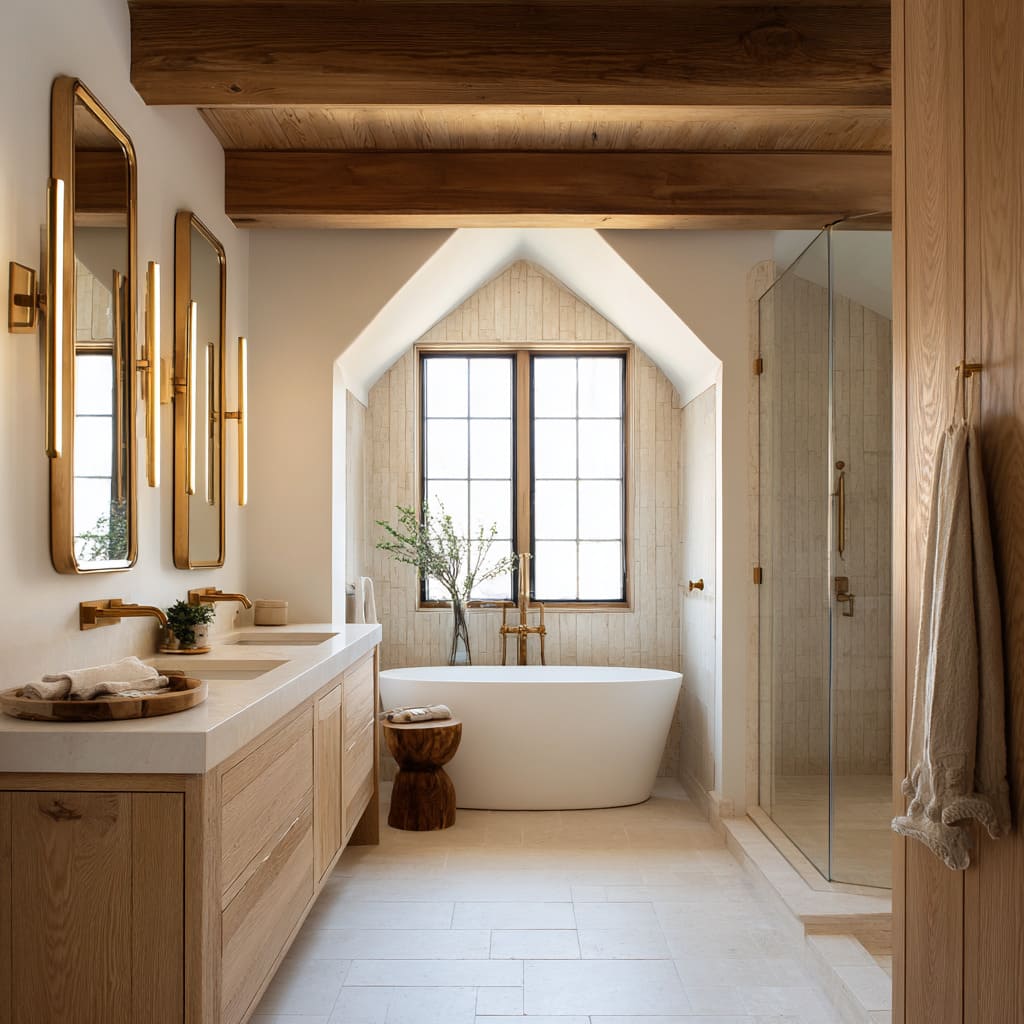
The tub may sit in a shallow recess, under a gable, or against a stone or plank feature wall with a window centered above. The rest of the space then rotates visually around this bay, with vanity and shower zones arranged as supporting layers.
Everything quietly acknowledges that this central opening is the visual anchor.
The “gallery strip” arrangement
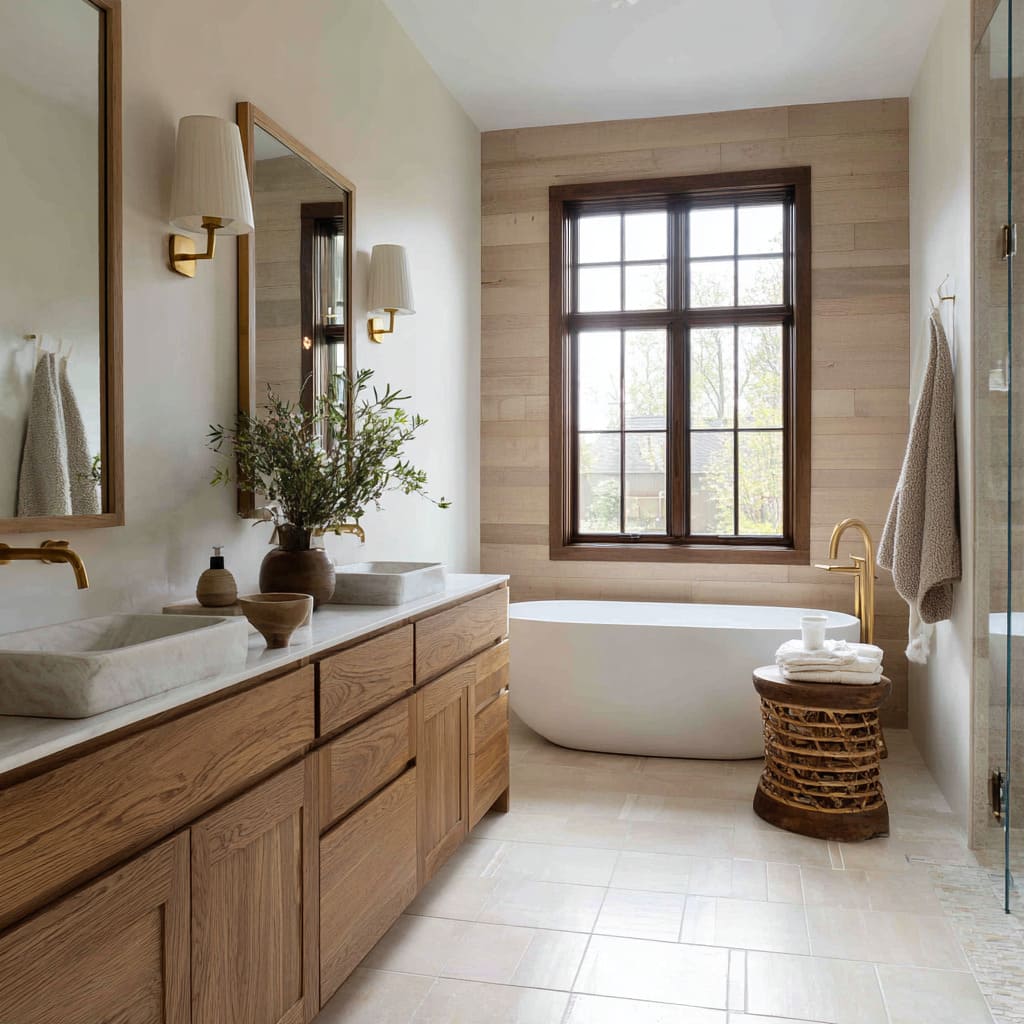
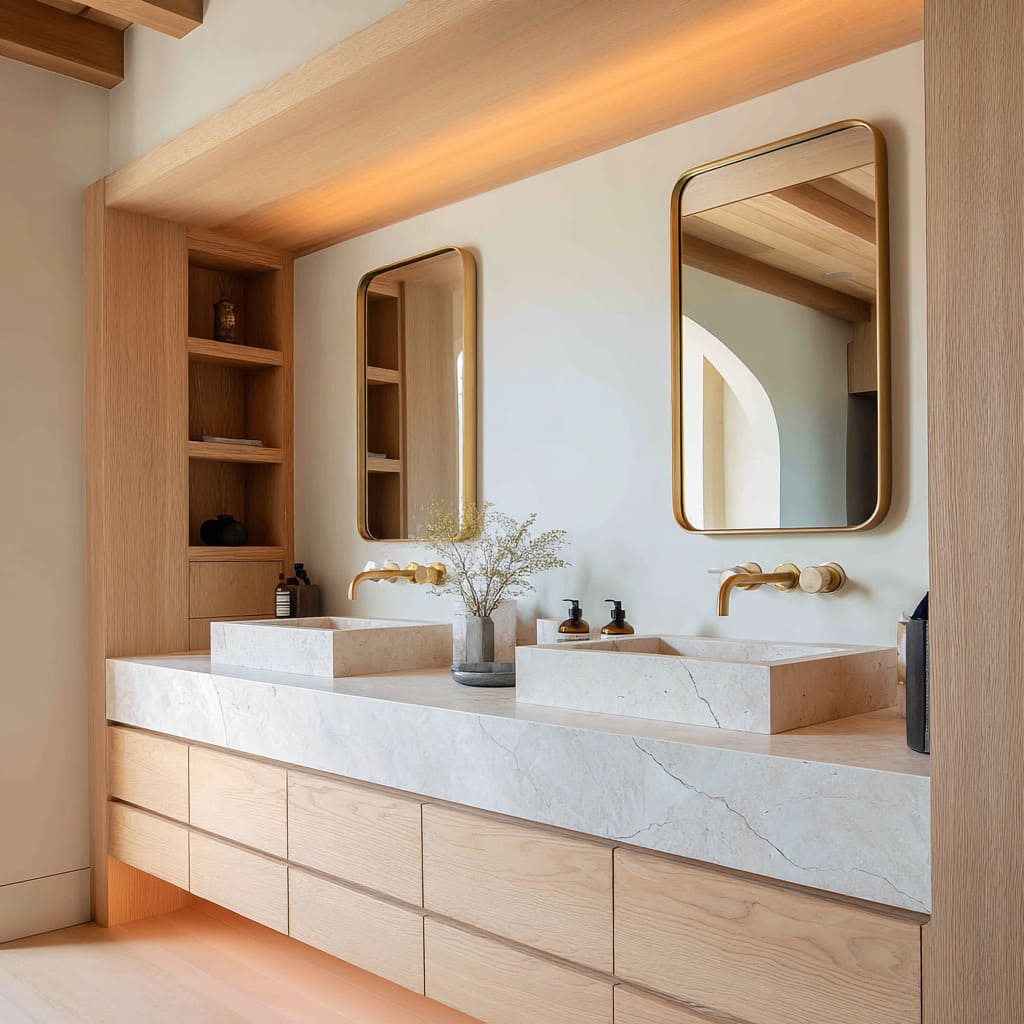
In wider space designs, a long vanity can run along one side and a tub or shower zone occupies the opposite side, leaving a clear path through the middle. Rugs, runners, and lighting often reinforce this gallery-like strip.
The vanity elevation reads almost like a composed wall of cabinets, mirrors, and sconces—more like a sideboard wall in a dining room than a simple sink zone.
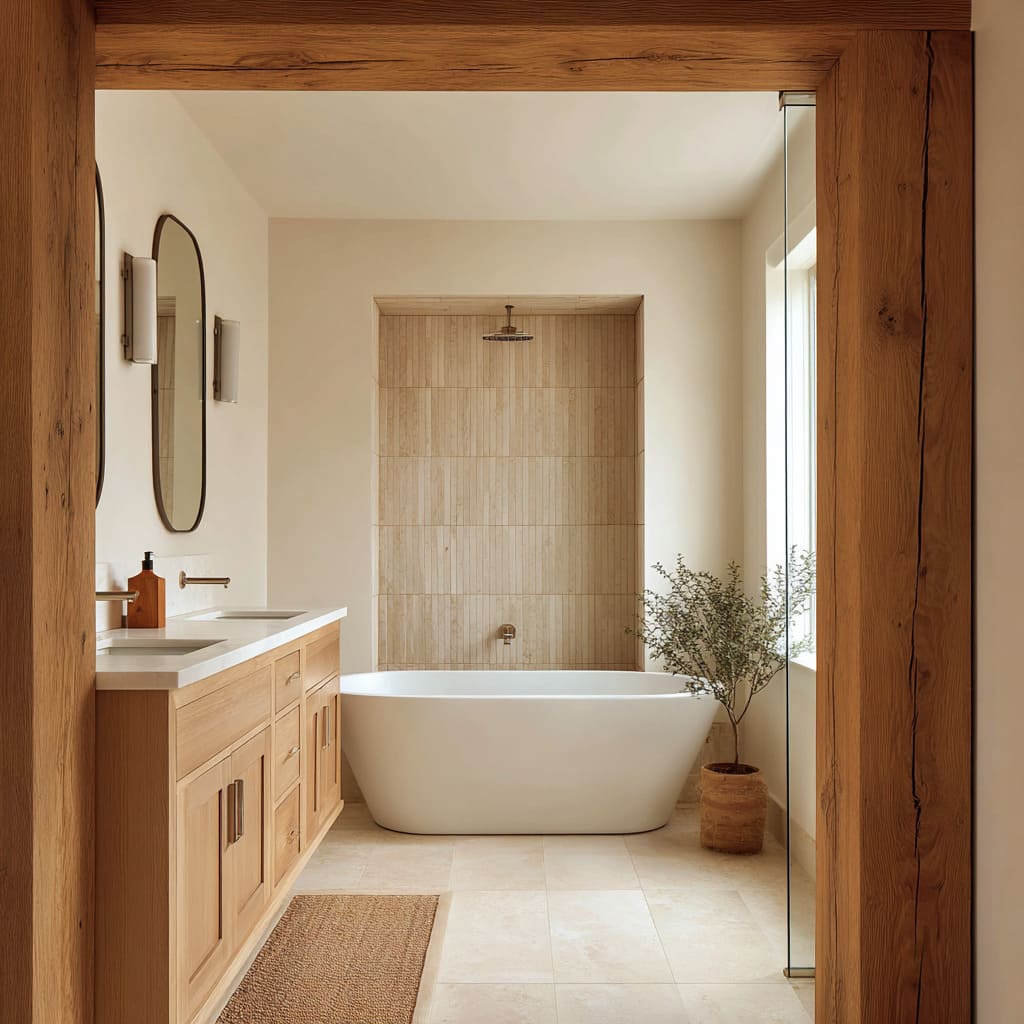
Such layouts matter because they change how the design feels. A corridor layout suggests a gentle progression toward a bathing ritual, a centered bay encourages standing still and letting the space surround the body, and a gallery strip allows the vanity to behave almost like daily furniture in a living space.
All three types can be modern farmhouse, but each choice sets up a distinct emotional tempo.
Walls as Quiet Architecture: Paneling, Grids, and Stone Shells
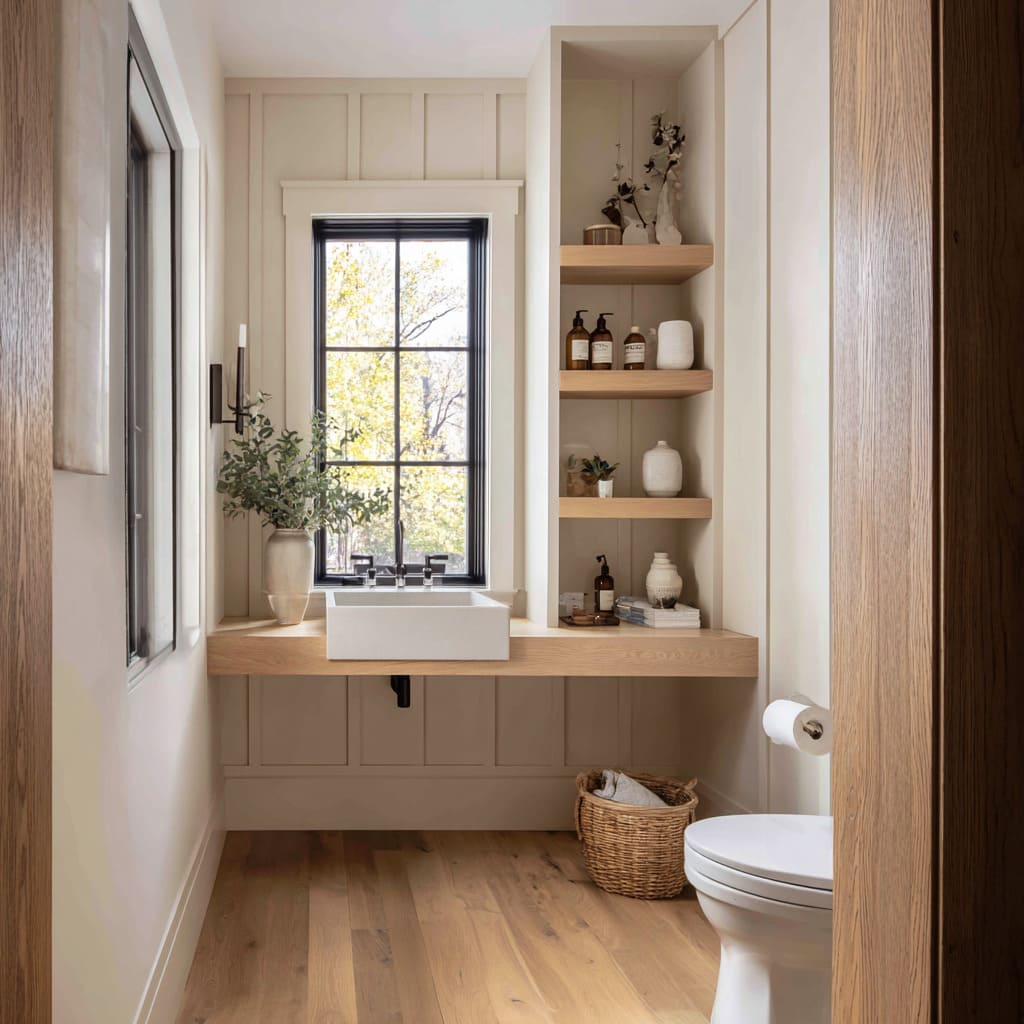
Walls in this style are not just backgrounds; they act like calm, shallow reliefs that hold the character of the space. There is a wide spectrum of treatments, and each carries its own family of farmhouse style bathroom ideas wrapped in contemporary restraint.
Vertical paneling and wainscot
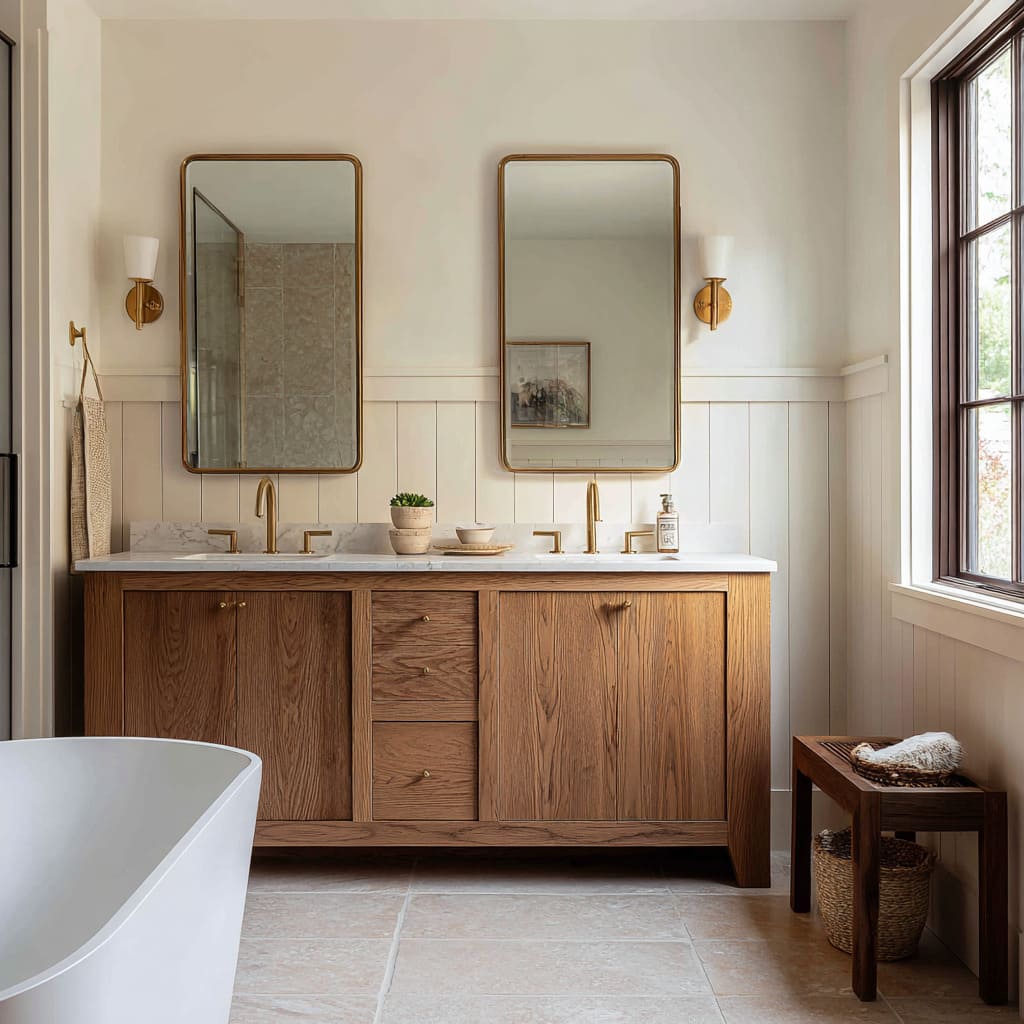
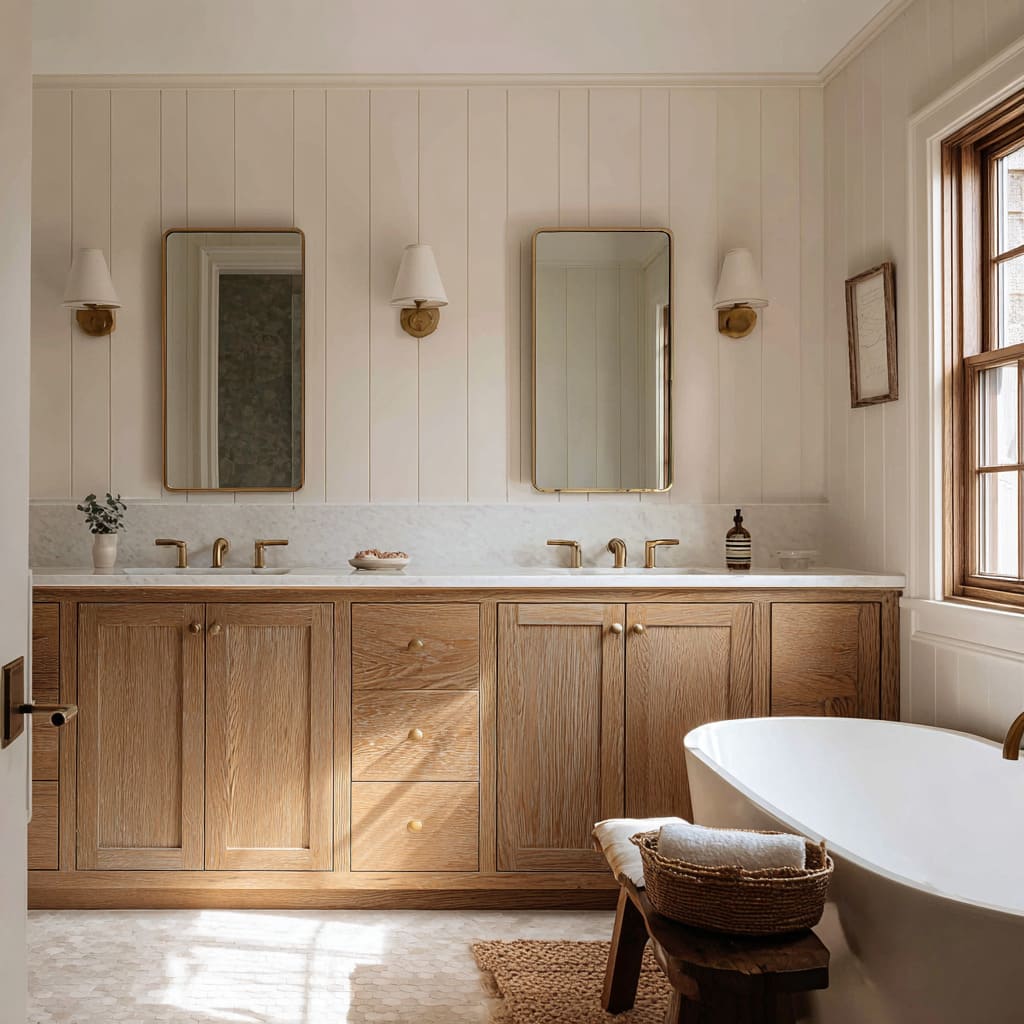
Vertical boards—whether they read as tongue-and-groove, shiplap, or flat planks with slim grooves—bring an instant farmhouse memory. When they wrap the lower half of the room as wainscot, they create a strong base zone that visually supports tubs and vanities while leaving the upper wall light and quiet.
When paneling rises all the way to the ceiling, it changes role and becomes the main architecture of the room, turning the entire shell into a soft timber backdrop.
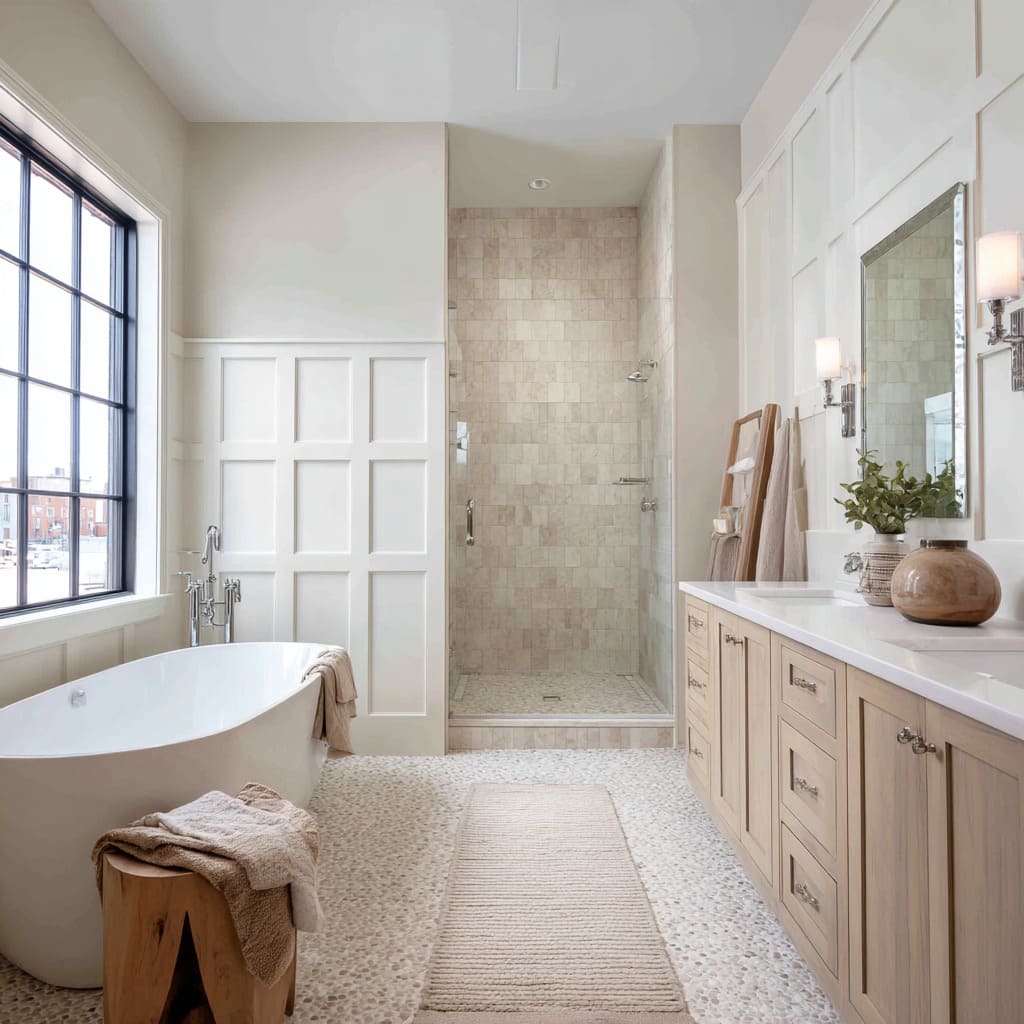
Gridded panel walls
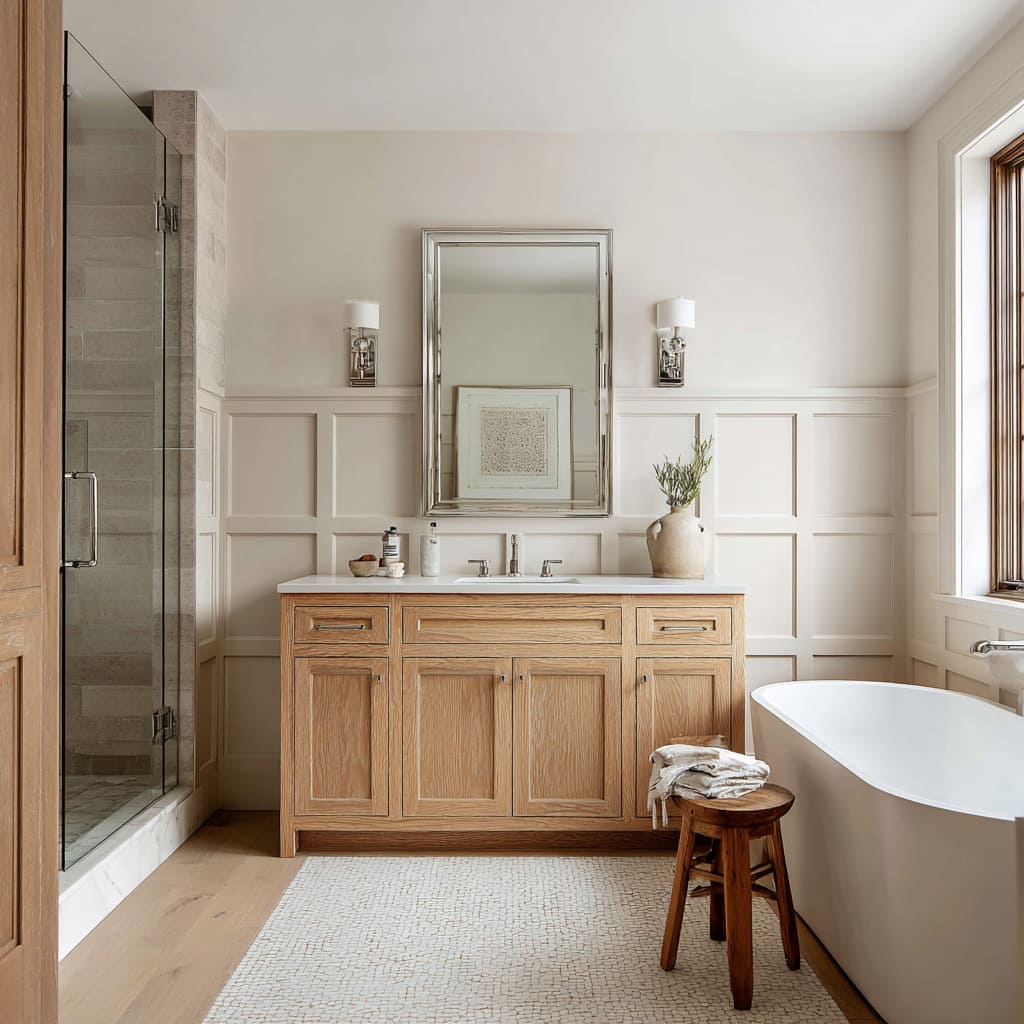
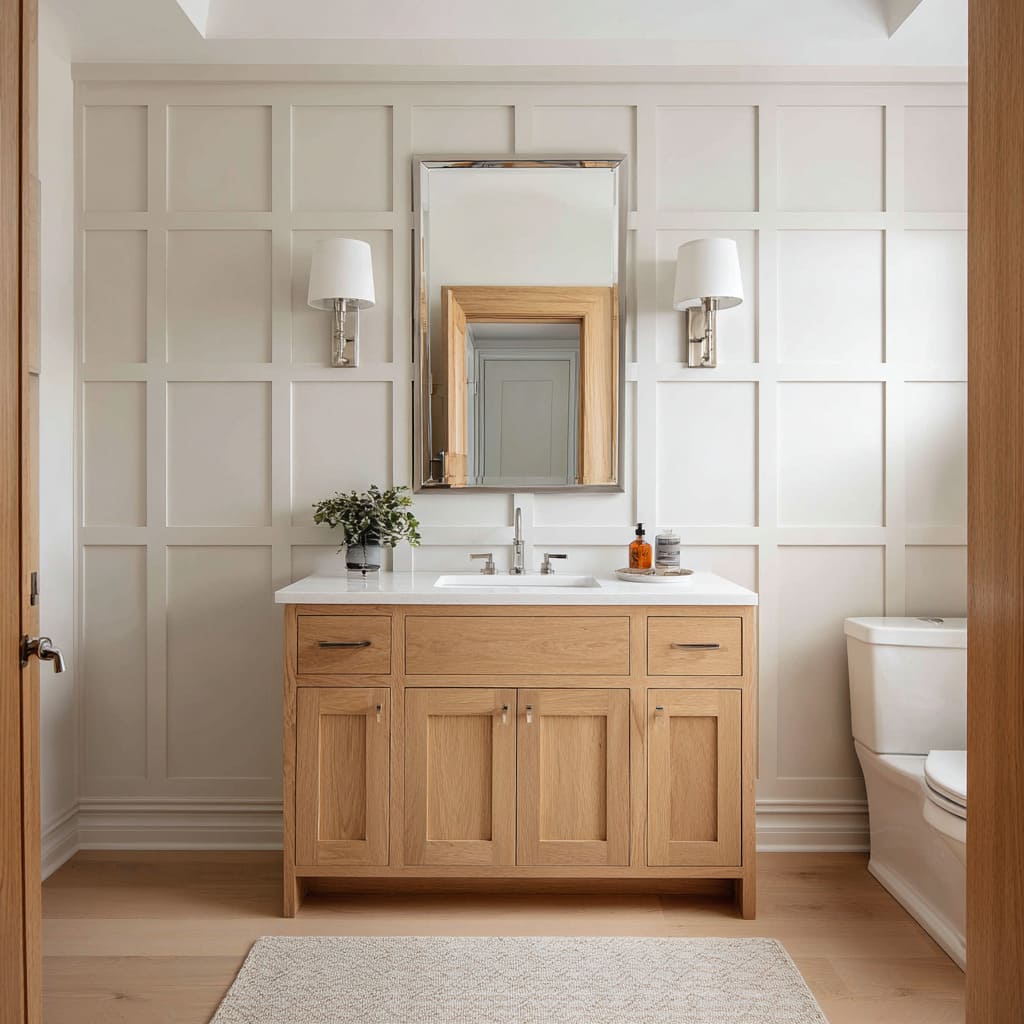
Some designs use rectilinear grids of panels, sometimes only to half height, sometimes all the way up. These grids feel closer to classic townhouses than barns, but when paired with oak vanities and soft flooring, they still slip neatly into a farmhouse-based language.
The grid rhythm gently divides the wall into squares that sit at roughly body height, eye level, and ceiling level, so the room feels measured around the person standing inside it.
Stone and tile shells
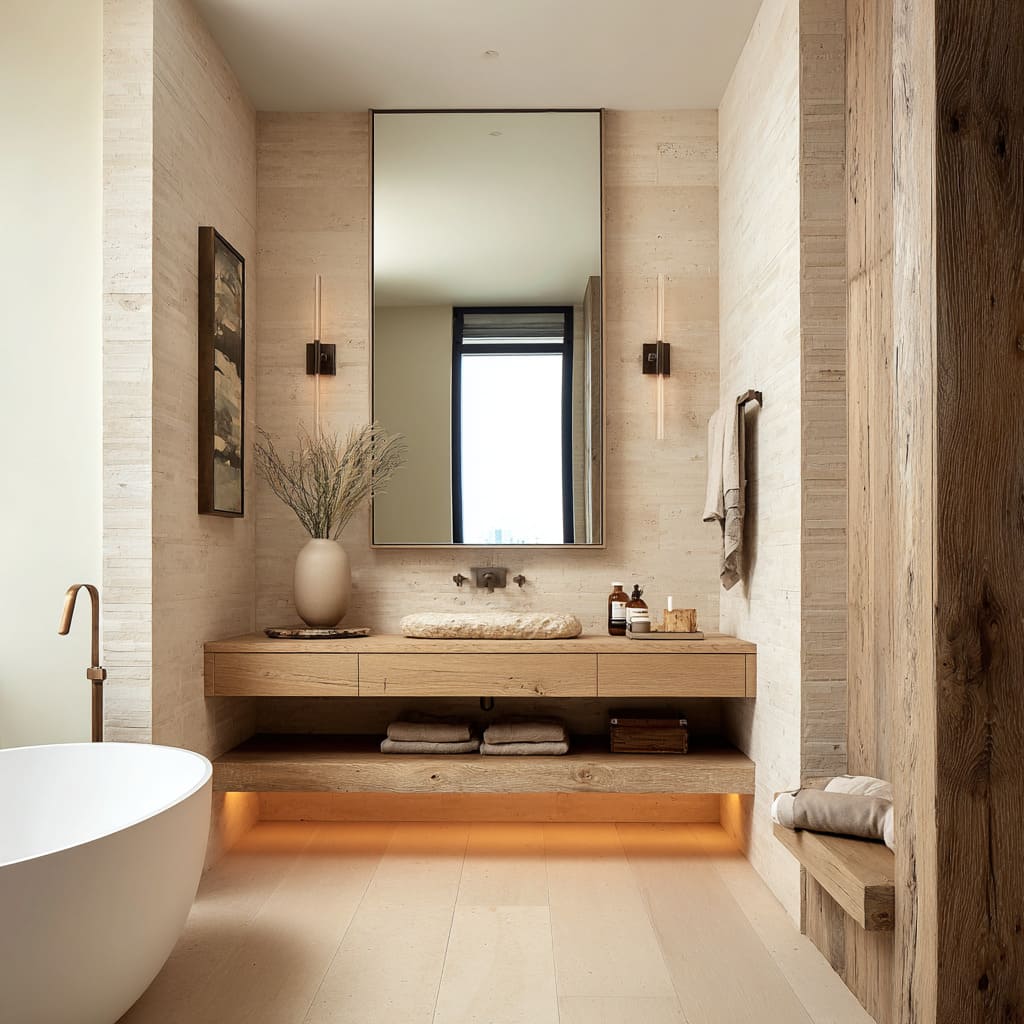
Other designs can trade painted timber for thin stone strips or stacked stone walls. Slim horizontal courses in pale tones give a soft, linen-like striation, while rugged stone blocks evoke exterior walls brought indoors.
In both cases, the stone behaves like a shell: tub niches, vanities, and vertical windows are carved into this envelope so water and light seem to live inside a solid volume. Very small tile modules, ribbed backsplashes, and handmade-feeling squares add another layer of grain, catching light in tiny ridges and keeping the surfaces lively without resorting to graphic patterns.
Collectively, such wall strategies show how much of modern farmhouse character can be held in shallow relief and fine joints rather than strong color or bold motifs. The walls feel built, not decorated.
Framing From Above: Beams, Canopies, and Roof Memories
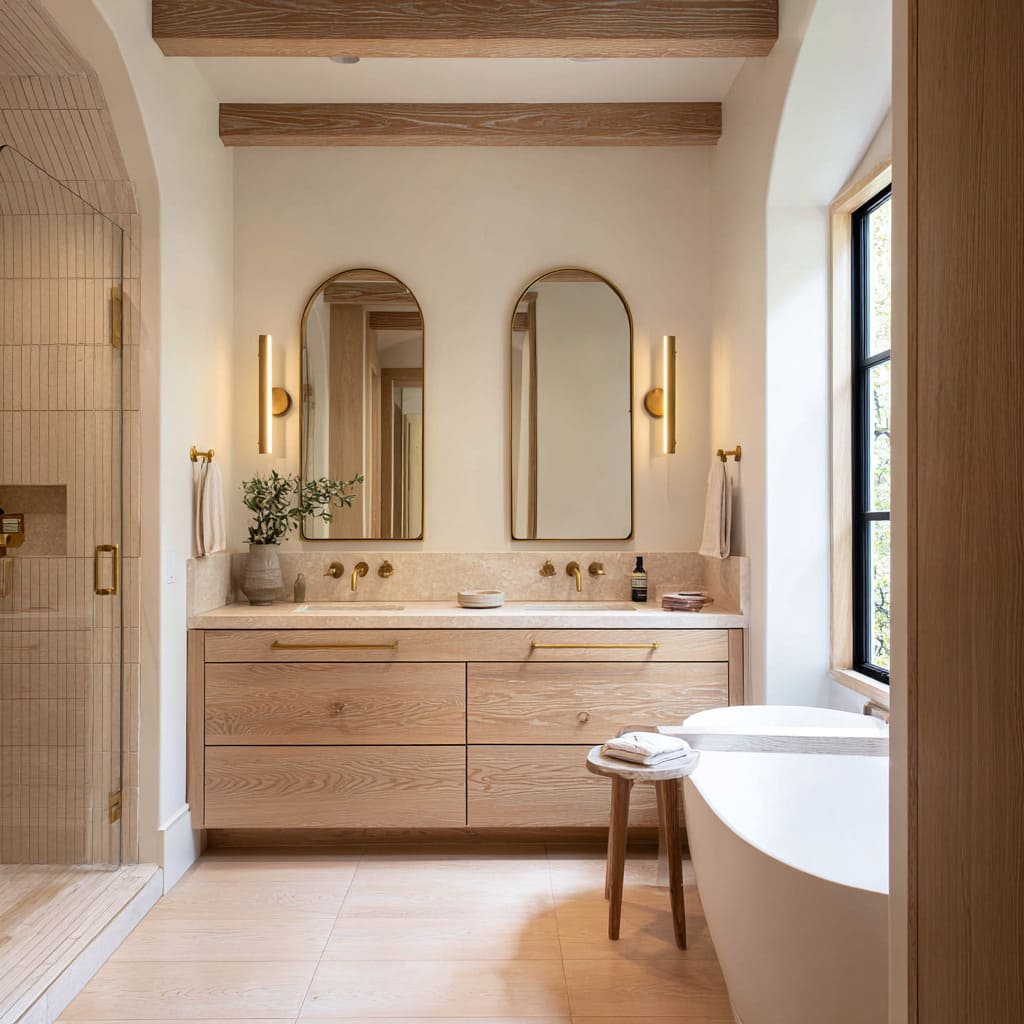
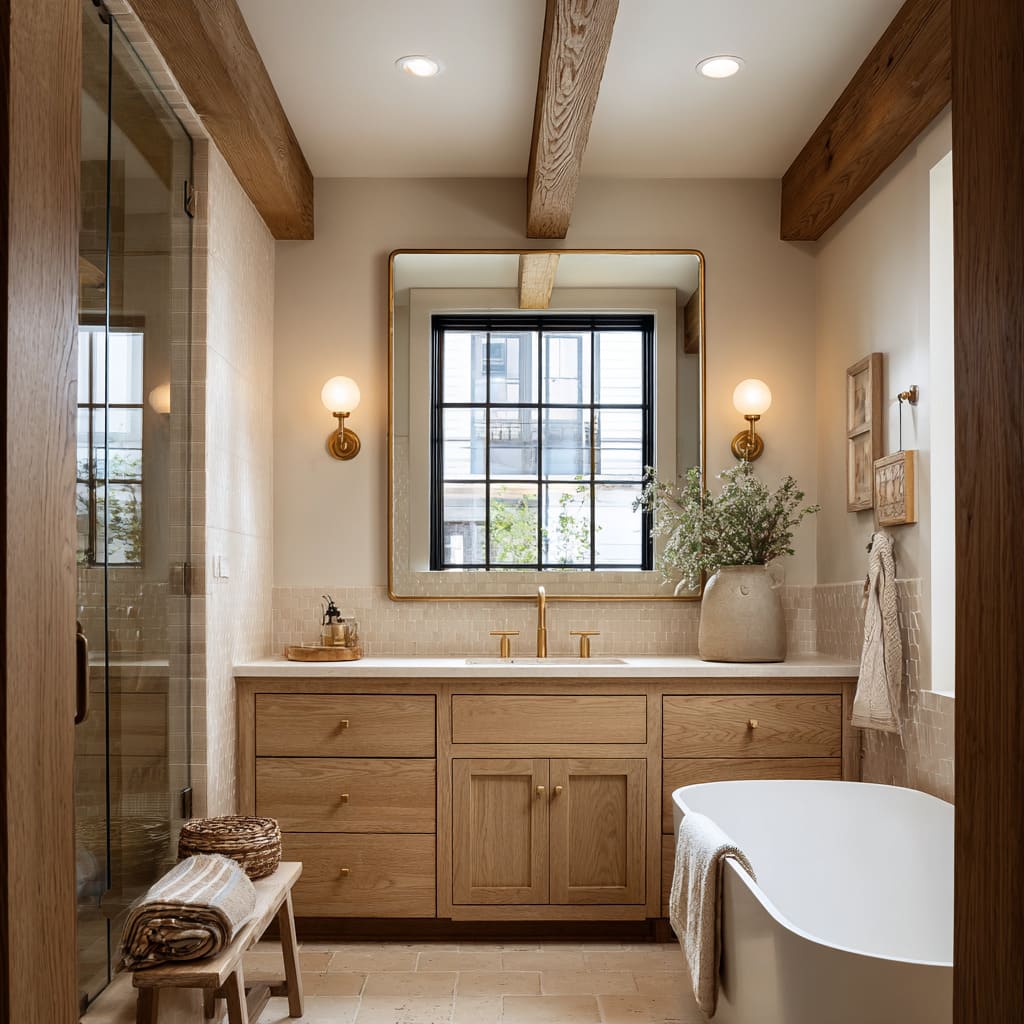
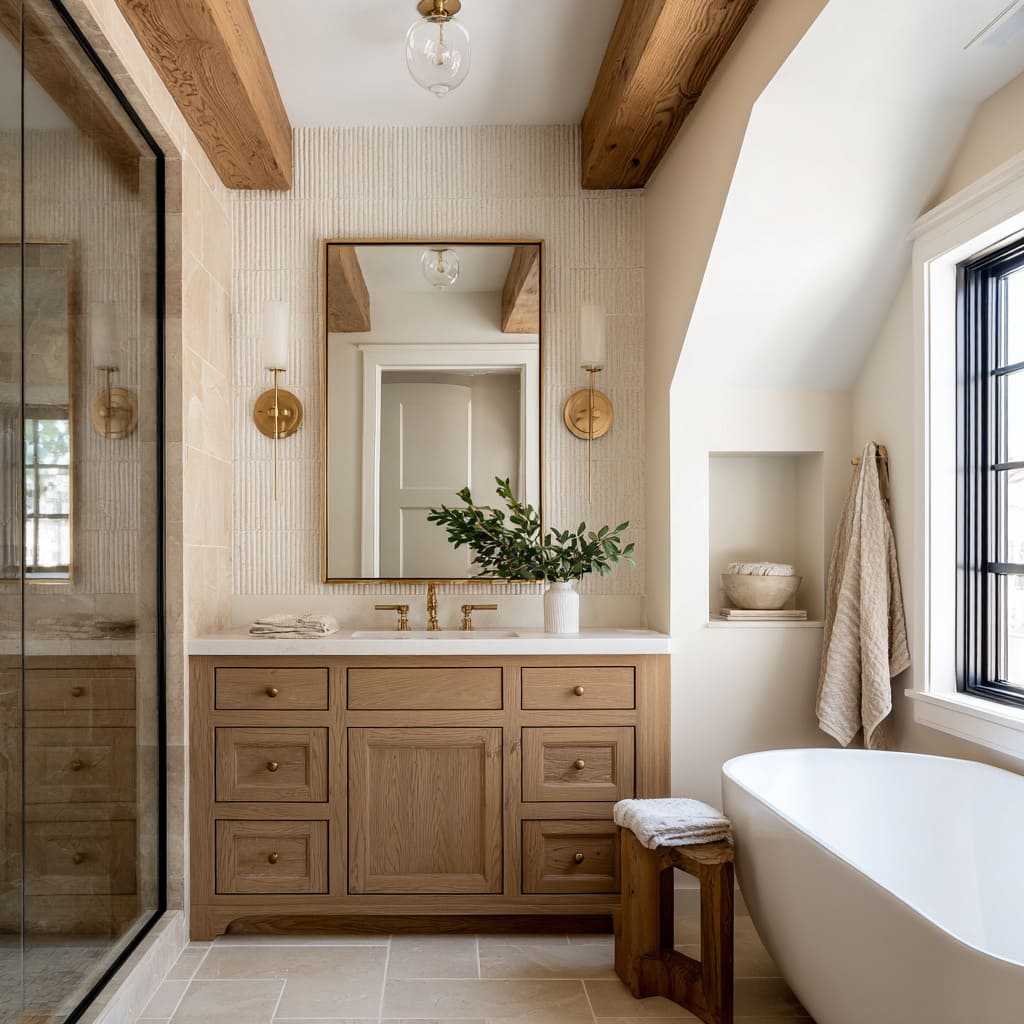
Ceilings and overhead elements are unusually active in this style and have a large influence on mood. Exposed timber beams, often in oak with visible grain but smooth surfaces.
They rarely feel rough; instead, they sit against pale plaster like calm horizontal strokes. Their spacing often aligns with mirror centers, window axes, or key fixtures, creating an invisible grid that ties wall composition to ceiling structure.
Alongside beams, canopies and soffits can appear as precise overhead planes in wood or stone. A vanity might sit under a timber “lid” that wraps down one side wall, or a stone ceiling slab may align with a tub niche below.
These canopies compress height in specific zones and release it elsewhere, which builds a sense of sheltered corners within an otherwise open room. A person washing at the vanity feels tucked under a low roof, while the tub, left under full ceiling height, feels more open and airy.
Sloped ceilings and gabled openings add another layer of association, recalling attics, roofs, and old farm structures. A gable framing a tub or a sloped ceiling above a niche makes the room feel as if it lives directly under a roof, even in new construction.
These forms are rarely emphasized with heavy trim; their power comes from simple geometry and careful connection to beams, tile direction, and window positions. The ceiling, in other words, behaves like a quiet partner in the composition, strengthening the farmhouse story without shouting for attention.
Wood Stories and the Role of the Vanity
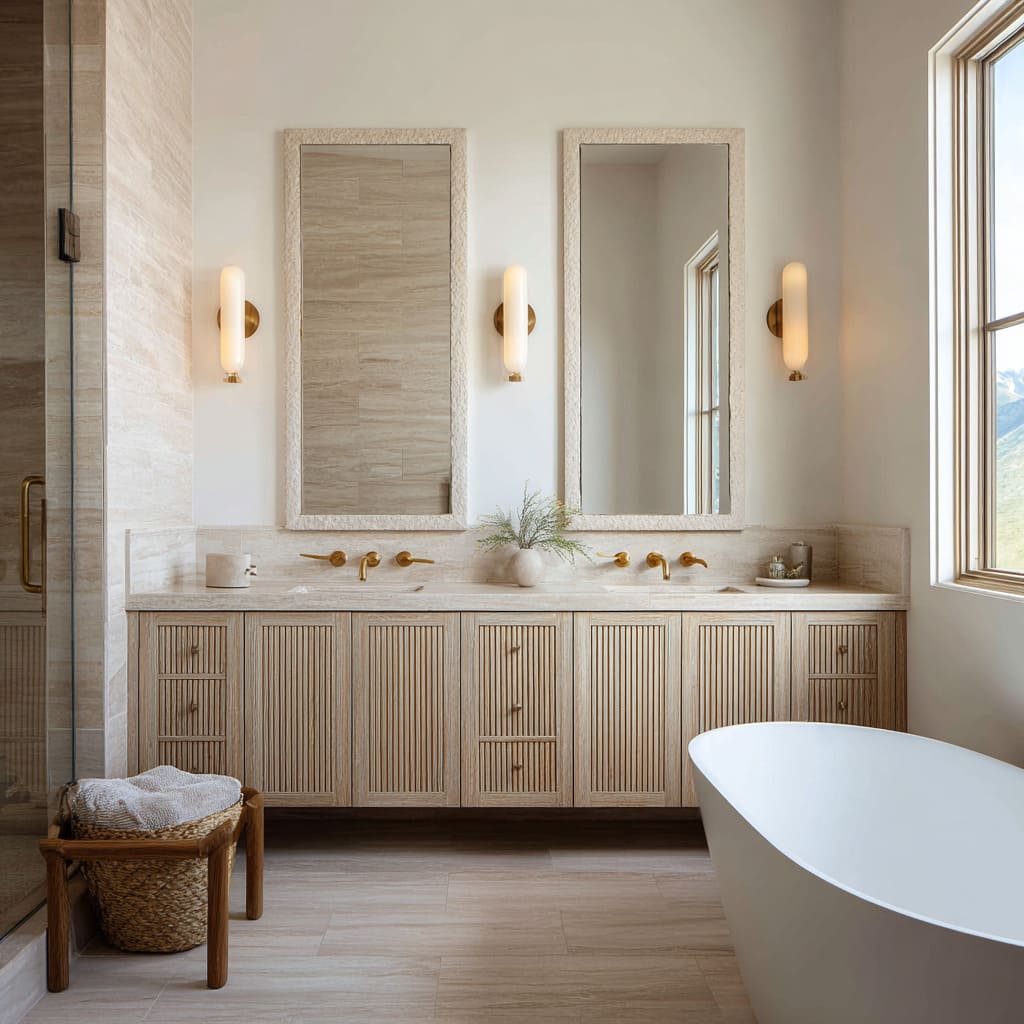
Wood is the main carrier of warmth in such bathroom designs, and much of that warmth flows through the vanity. Many interior designs treat the vanity as if it were a piece of furniture borrowed from another room, and this attitude is at the heart of many farmhouse bathroom vanity ideas.
Classic framed doors with visible rails, soft mid-tone stains, and small round knobs create cabinets that could just as easily sit in a pantry or a dining room as under a sink. Recessed toe kicks, short legs, or floating bases adjust the weight: a cabinet sitting almost solidly on the floor feels substantial and traditional, while one lifted slightly or floating with an underglow feels lighter and more tailored.
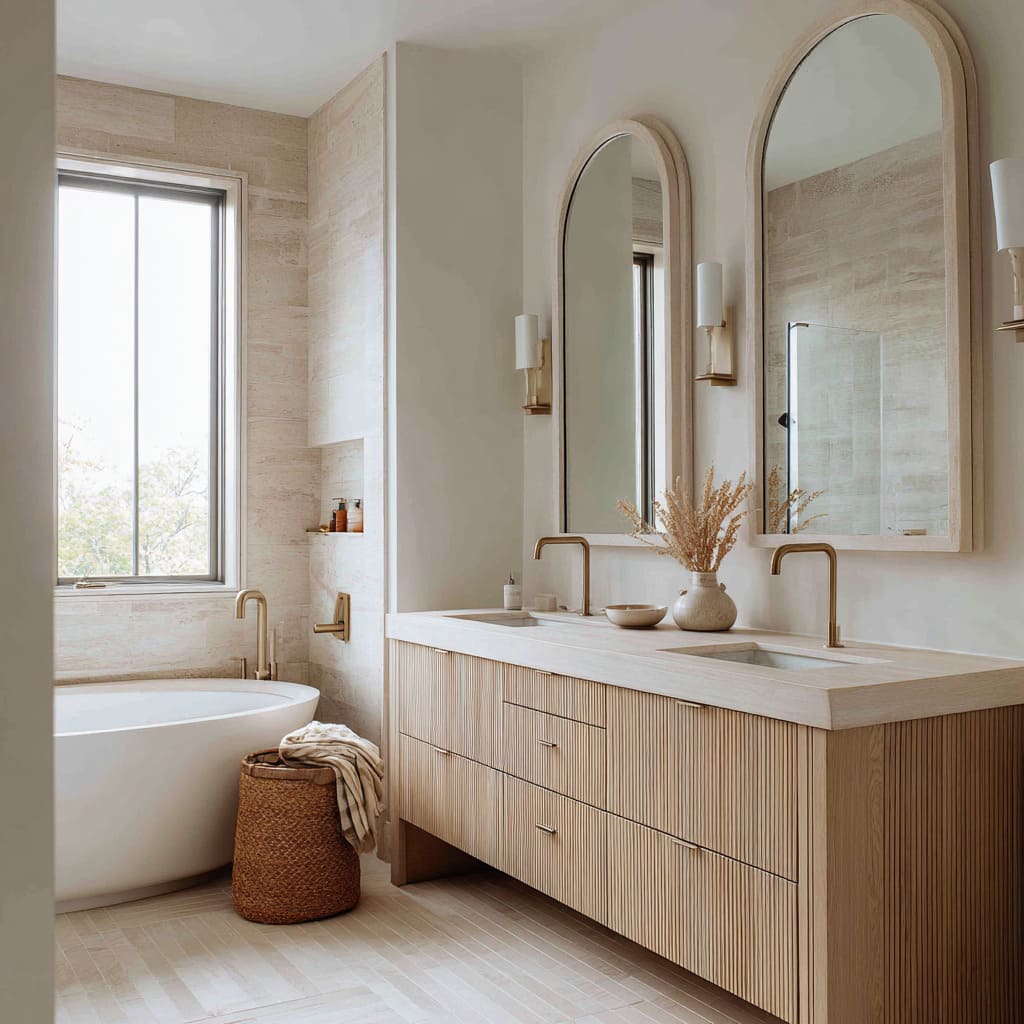
Front treatments distinguish different personalities. Shaker-style panels suggest familiar kitchen joinery, reeded or fluted fronts bring a finer, textile-like texture that catches light in narrow vertical bands, and completely flat fronts in strong-grained timber sit comfortably inside more minimal rooms.
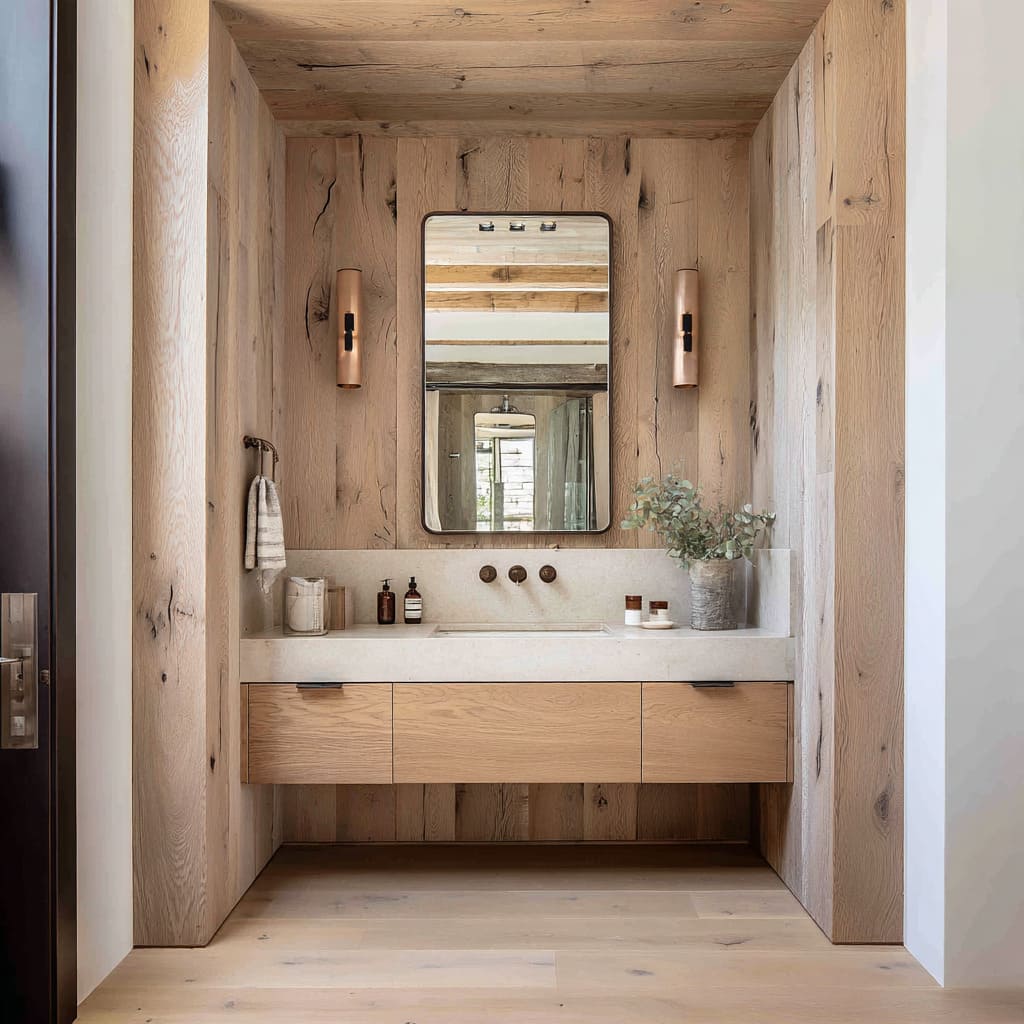
The choice of wood tone also shifts the story: pale oak with discreet grain reads as fresh and luminous; deeper, warmer tones with visible knots and cathedrals evoke barns and cabins; and full timber niches that wrap ceiling and walls around the vanity feel almost like small wooden cabins inserted into plaster shells. By adjusting just these aspects—framing detail, tone, leg or toe-kick treatment, and grain exposure—designers can move along a whole spectrum from informal rural washstand to refined, hotel-like installation while staying firmly inside the same overall language.
Stone, Tile, and Texture: Calm Surfaces With Depth
The hard surfaces in such design concepts carry a lot of nuance, especially in rooms that lean heavily on modern farmhouse bathroom ideas with stone-based shells. Thin horizontal strips of limestone or porcelain in cream and sand tones build a gentle striation that resembles stacked stone softened by age.
When used behind vanities or around tubs, this kind of surface makes the wall feel thick and grounded while still remaining visually calm. The joints are usually fine and the color variation subtle, so the eye reads a soft field rather than a loud pattern.
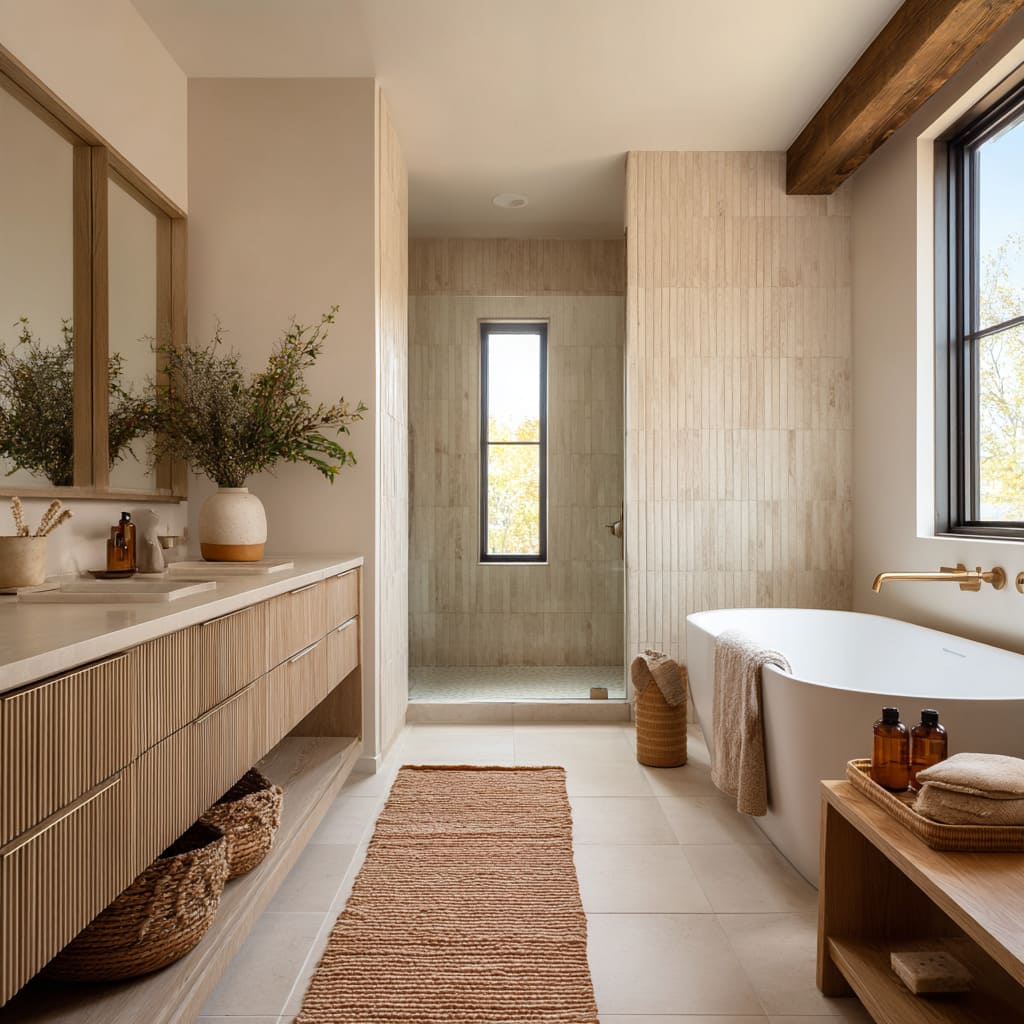
Flooring tends to stay within this gentle approach: large-format tiles in pale limestone shades, plank-like porcelains that echo timber without mimicking it too literally, and pebble-like composite floors with rounded, dimpled textures. These floors invite slow movement; the feet travel over surfaces that refer quietly to river stones, old flagstone, or weathered outdoor pavers without borrowing any rustic harshness.
In wet zones, tile direction becomes a tool: vertical stacks in shower and tub niches stretch height, while horizontal formats can widen shorter walls. Ribbed tiles behind vanities, handmade-look squares around the lower wall, and stone basins carved as relaxed troughs or sharp cubes all explore different depths of texture while staying within a soft, neutral palette.
These combinations show how a room can feel richly layered even when nearly every surface sits in some variation of beige, cream, or light grey.
Metals and Hardware: Thin Lines of Brass and Black
Metals function like a fine drawing laid over the softer backdrop of wood and stone. Tub fillers, faucets, pulls, shower frames, sconce stems, mirror frames, and hooks form a network of lines and dots at hand and eye level.
Warm brass and brushed gold are frequent choices, especially where oak vanities and cream walls dominate. In those cases, metal reads almost like captured sunlight: linear wall-mounted taps, slender sconce rods, and tiny knobs all glint softly against the neutral surfaces.
Because the finish is rarely harshly polished, the effect stays gentle rather than flashy.
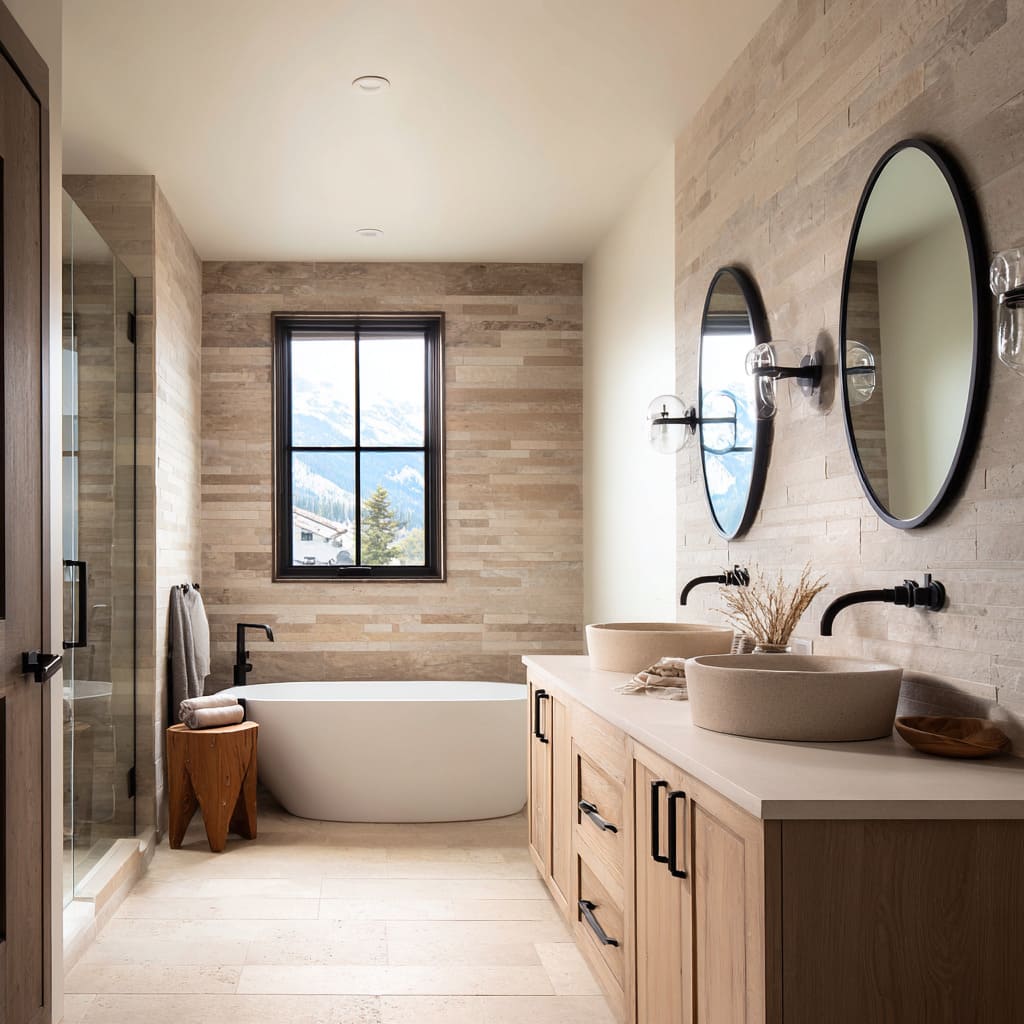
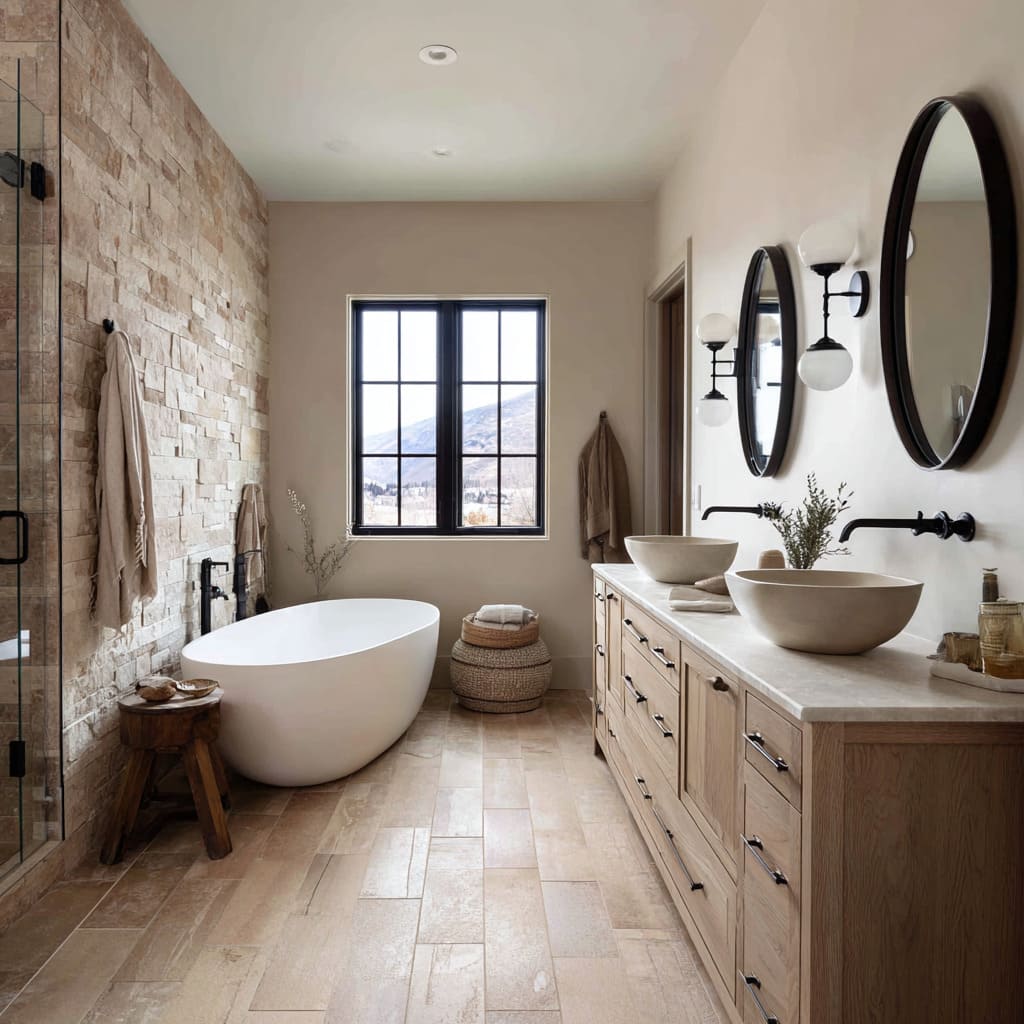
Black metal plays a different role. Thin black frames around windows, shower partitions, and round or rectangular mirrors refer back to utilitarian farmhouse hardware, cast iron pans, and gate hinges.
Against pale stone and white tubs, these lines become graphic strokes that bring structure without weight. When black appears consistently—in window muntins, pulls, frames, and hooks—it ties the room together with a quiet outline, particularly in schemes that tilt toward a lodge or mountain mood.
Cooler nickel or chrome sometimes enters spaces with more formal panel grids and white walls, offering a slightly urban, hotel-like note while still sitting comfortably alongside timber and stone. In all cases, metal choice and repetition form a kind of punctuation system: tiny dots at drawer fronts, horizontal bars as pulls, circular backplates for sconces, and slim arcs of spouts keep the visual language coherent and measured.
Color and Light: Warm Neutrals, Window Games, and Mirror Rhythms
Color often tends to stay deliberately restrained, which gives more room for light and shadow to define the mood. Most schemes occupy a narrow band of whites, creams, oatmeal tones, pale oak, and soft taupes.
Darker elements can appear as accents—black frames, deeper beams, dark handles or hooks—rather than as large fields. Instead of relying on contrast in hue, such designs lean on contrast in texture and depth: smooth plaster against ribbed tile, matte stone against reflective metal, flat paneling against woven fiber.
Windows and mirrors are crucial to this strategy and sit at the center of many farmhouse bathroom mirror ideas. Tall vertical windows over tubs, slim slit openings in stone walls, large square cottage windows, and industrial-style frames with divided panes all act as light sources and visual anchors.
Mirrors often repeat the size or proportion of windows so that reflections read like second openings to the outside. A mirror placed directly opposite a strong window can create the sensation of a twin window, effectively expanding the perceived width without adding more glass.
Sconces around such mirrors are scaled to sit between face and eye height, and they cast soft light onto ribbed backsplashes and textured walls, emphasizing fine details rather than washing everything in flat brightness. Under-shelf and under-vanity lighting adds another layer for evening use, turning stone plinths and timber bases into warm bands that feel almost like low, glowing hearths.
Tubs, Showers, and the Feeling of Daily Ritual
Within this language, tubs and showers are more than functional zones; they are the places where the whole concept comes into focus. Freestanding tubs tend to cluster into two broad characters.
Some have straight, almost architectural sides and read like simple troughs set along the wall, which aligns closely with farmhouse master bathroom ideas that favor practical shapes refined into modern silhouettes. Others have generous ovals with thick rims, leaning into a softer, spa-like personality that still sits well against paneling and stone strips.
Showers often share material with the tub zone—same tile, similar stone—but they are framed differently. Rectangular openings or arched entries, slightly recessed doors, and tight alignment with panel transitions all help the shower feel like a carved recess within the volume rather than a separate glass box dropped into the room.
Tall vertical tiles inside these recesses heighten the sense of sheltered height, while narrow benches and built-in niches keep storage absorbed into the surface. In larger interiors, the interplay between soaking and washing zones creates a kind of dual ritual: a more ceremonial, centered tub moment that responds to modern farmhouse master bathroom ideas and a more focused, utilitarian shower composition that remains visually calm so it does not compete for attention.
When the two share an axis, the whole room reads as a single calm sequence of actions; when they are offset, the space feels like a suite of connected but distinct pockets.
Objects, Textiles, and Everyday Layers
Styling is deliberately restrained yet plays a crucial role in softening the structure. Baskets under vanities, woven stools beside tubs, jute runners along circulation paths, and pebble-textured rugs over stone floors bring a family of fibers that all live in the same muted, natural range.
Rather than serving as accent color, they supply density and warmth, bridging the gap between hard, cool surfaces and the body. Simple timber stools and benches extend the wood story away from the main cabinetry, acting as small, movable elements that signal slow routines—resting a towel, placing a tray, sitting for a moment.
Greenery is almost always light and airy: tall branches, grasses, olive or eucalyptus stems arranged in matte or stoneware vessels. They echo the vertical formats of tiles and panel grooves but with irregular lines that gently disturb the strict geometry.
Bottles, bowls, and trays sit in tidy, low compositions near sinks and tubs, often in amber glass, stone, or ceramic, adding weight without distraction. Even art tends to stay within the same palette, with small abstract pieces or textured reliefs repeating the colors of stone and wood rather than introducing bright hues.
In this way, everyday objects act less like accessories and more like quiet indicators of life: they show where hands reach, feet step, and routines unfold, all while leaving the structure of the room clearly visible. These subtle layers illustrate how many ideas for farmhouse bathrooms are realized through the selection and placement of a few grounded, tactile items rather than extensive surface decoration.
Rural, Urban, and Lodge Variants Within One Language
Farmhouse style designs can lean closer to rural cottages, with vertical paneling, simple framed doors, shaded sconces, and pale plank floors that feel ready for bare feet after time outdoors. Others can tilt toward a lodge mood, with stone-plank walls, slightly moodier color shifts, and stronger black hardware that pairs well with views of hills or forest.
A more urban interpretation appears where panel grids feel almost Georgian, industrial-style windows look over rooftops, and polished metal fittings echo classic hotel references while wood and woven elements keep the farmhouse connection intact.
In all such cases, the shift does not come from radical changes in form but from emphasis. More paneled grid and chrome: the space drifts toward a city townhouse.
More stone strips, black frames, and rugged stools: the room picks up a mountain-lodge flavor. More full timber niches and beams, with plaster left quiet around them: the interior feels like a contemporary take on barn conversions.
Each variant offers its own branch of farmhouse bathrooms ideas without breaking away from the shared foundation of warm wood, gentle stone, controlled texture, and clear spatial structure.
Bringing the Strategies Together as a Coherent Design Language
Taken together, such design approaches form a very coherent set of modern farmhouse bathroom ideas that go far beyond a few typical motifs. The style emerges from how layouts are composed, how walls are built as quiet reliefs rather than blank planes, how ceilings and beams frame unknown rituals below, and how wood, stone, and metal interact at different heights.
Vanities can be treated as serious pieces of furniture, not just storage; tubs and showers are given architectural presence rather than being left as functional afterthoughts; and objects are chosen sparingly to maintain a calm, lived-in clarity. Within this framework, farmhouse bathroom design ideas can move between corridor-like room layouts with strong axial focus, centered bays that feel almost chapel-like, gallery arrangements where vanities behave as long sideboards, and compact compositions where mirror and window are set in deliberate conversation.
Because the palette stays tightly controlled and the themes are expressed mainly through proportions, textures, and alignments, the same set of strategies can support spaces that feel rural, suburban, or urban without losing their connection to a shared idea of home. That is where farmhouse style bathroom ideas show their depth: through persistent attention to how everyday rituals sit inside structured, quiet rooms shaped by timber, stone, soft light, and finely balanced detail.
In this context, farmhouse bathroom mirror ideas, farmhouse bathroom vanity ideas, farmhouse master bathroom ideas, and wider farmhouse bathrooms ideas all read less like separate categories and more like different corners of one continuous visual language that can adapt to many settings while keeping its calm, grounded character.