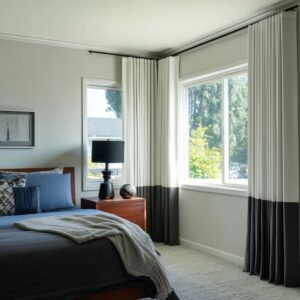
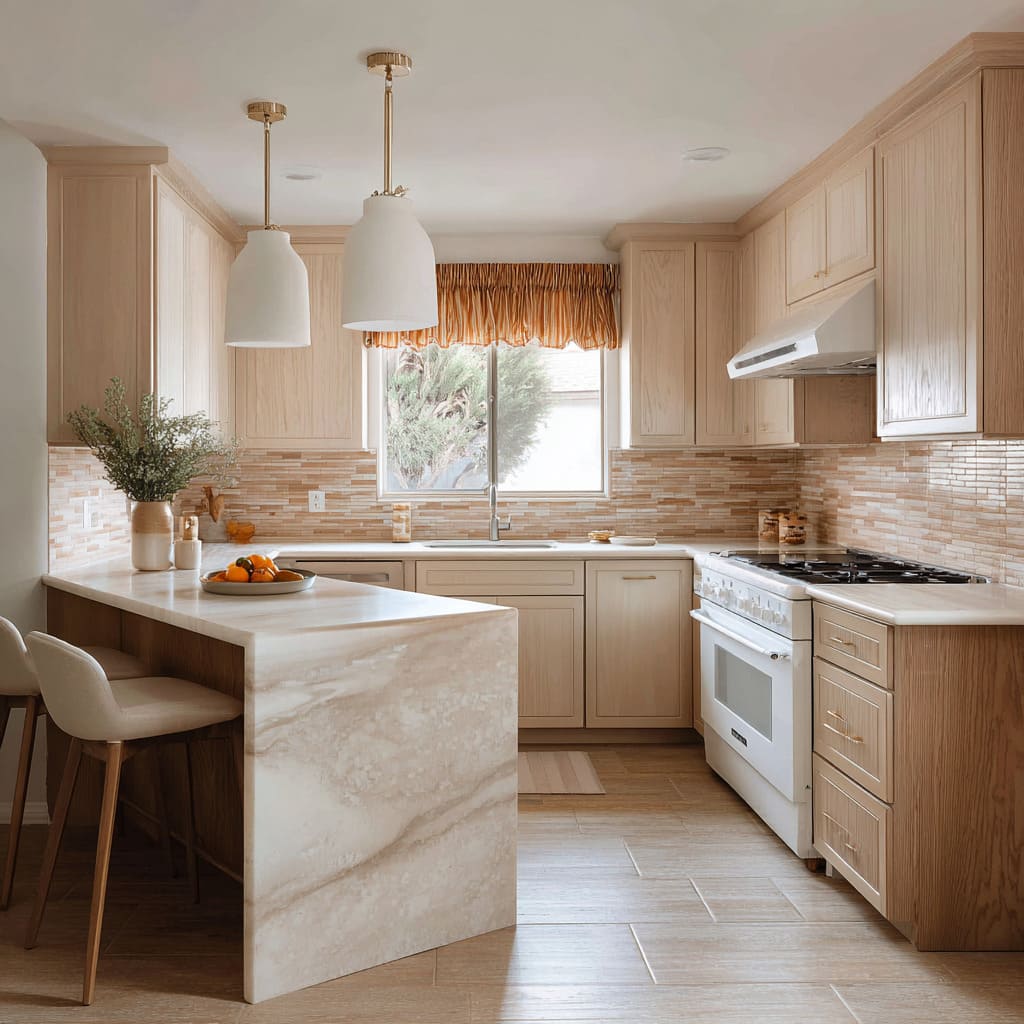
In many contemporary kitchen designs, the sink wall functions like a small stage where materials, light, and daily objects all share the same frame. The valance becomes one of the key lines in that frame, sitting between the hard geometry of cabinets and the moving scene outdoors.
Rather than acting as decoration added at the end, the fabric band often behaves like a gentle horizon: it sets where the eye pauses between ceiling and countertop, it defines a soft border where daylight enters, and it organizes how the view sits among tile joints and cabinet divisions. When the cloth runs neatly from cabinet to cabinet, the window stops feeling like an isolated opening and starts reading as a carefully arranged part of the millwork composition.
In this sense, the window wall is not just a structural necessity; it becomes a designed image where glass, tile, hardware, plants, and textiles all play clear roles, with the valance as the single soft line that ties everything together.
Soft Architecture: Valances Acting Like Built Elements
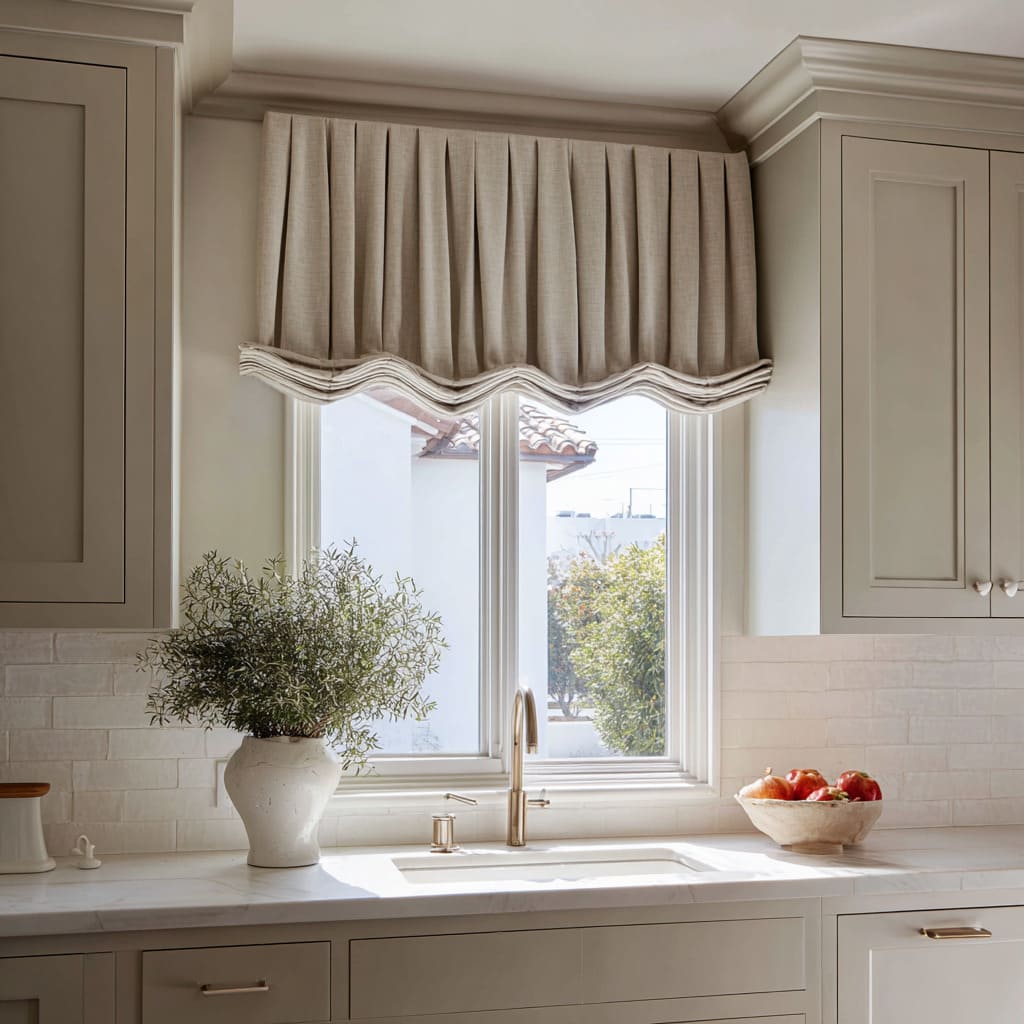
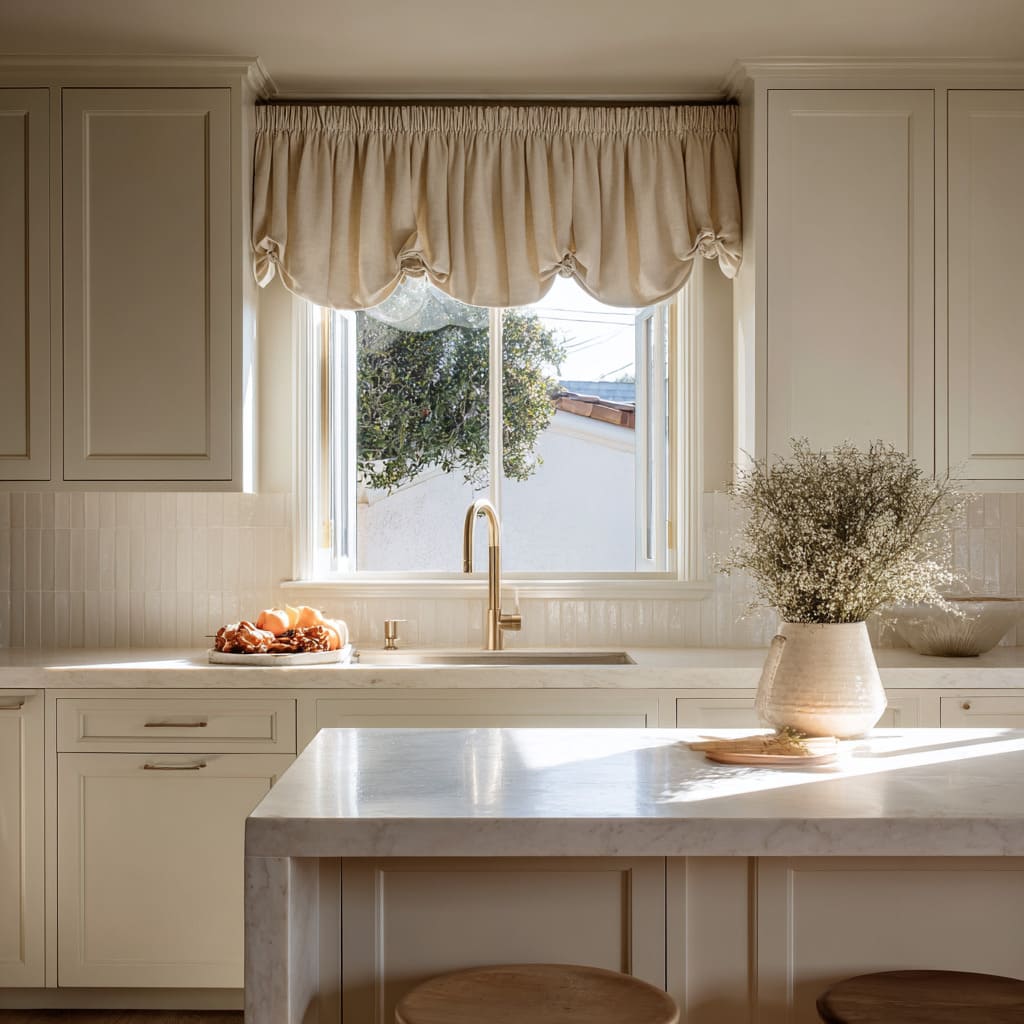
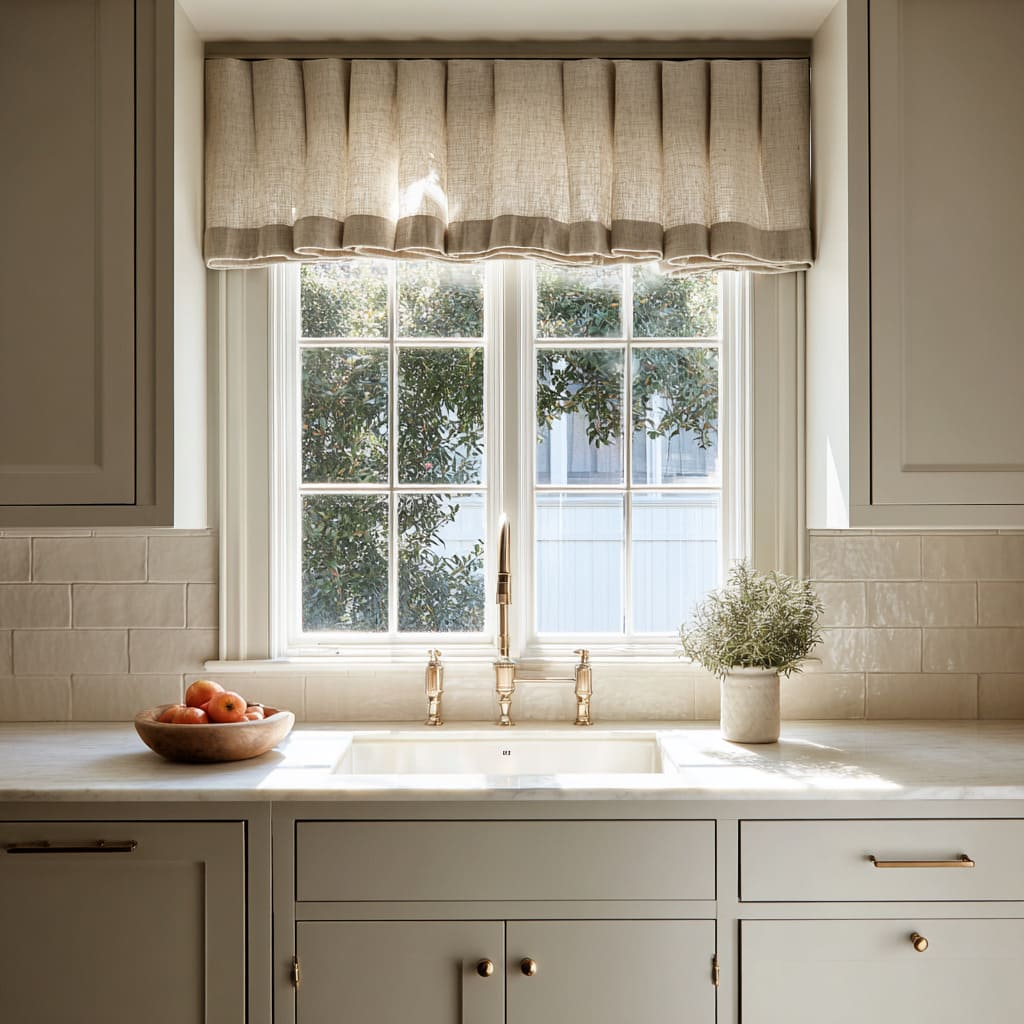
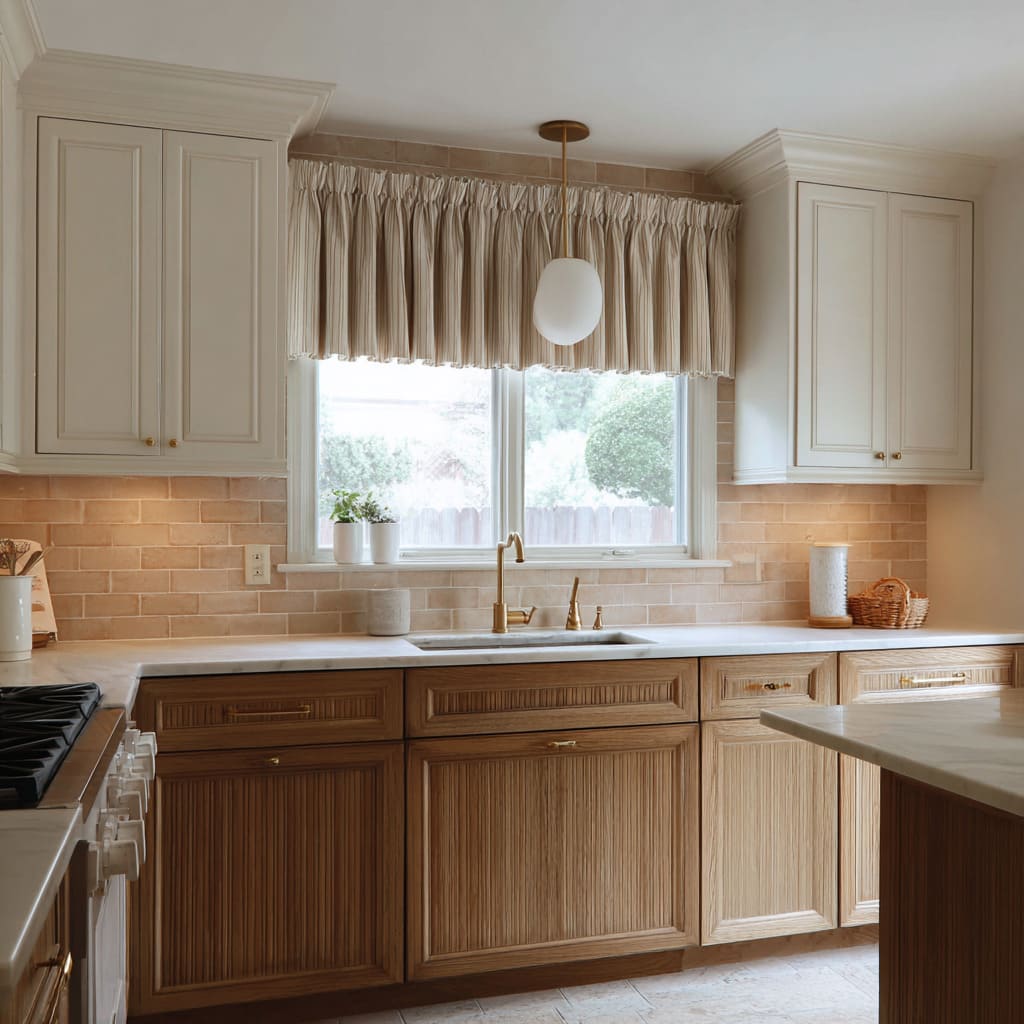
Modern treatments often show fabric behaving almost like a built feature. Boxed valances with crisp corners, deep vertical pleats that echo fluted panels, or structured bands that sit flush under crown profiles all blur the line between textile and carpentry.
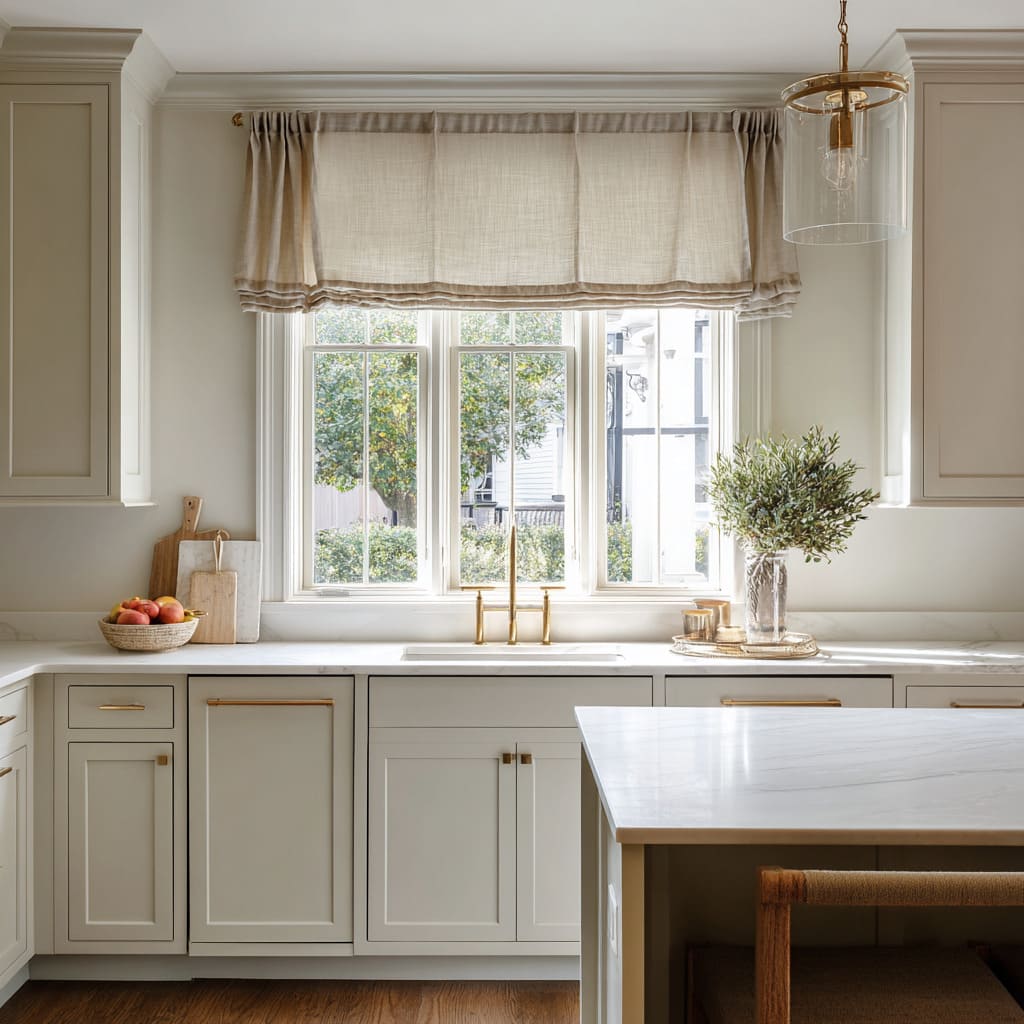
Instead of a loose strip of cloth, the valance reads like a soft cornice or a slim lintel, giving the window a completed top in conversation with cabinet doors and trim. Some designs use regular pleats that reflect the spacing of doors; others line up their lower edge with the top of a backsplash, so the fabric becomes part of a stacked system of horizontal bands: counter, tile, valance, crown.
Even relaxed linen valances gain architectural presence when they are carefully aligned with cabinet frames and kept to a generous but controlled fullness. This approach gives the sink wall a sense of intentional order, where the fabric line is as important as any piece of woodwork in shaping the overall scene.
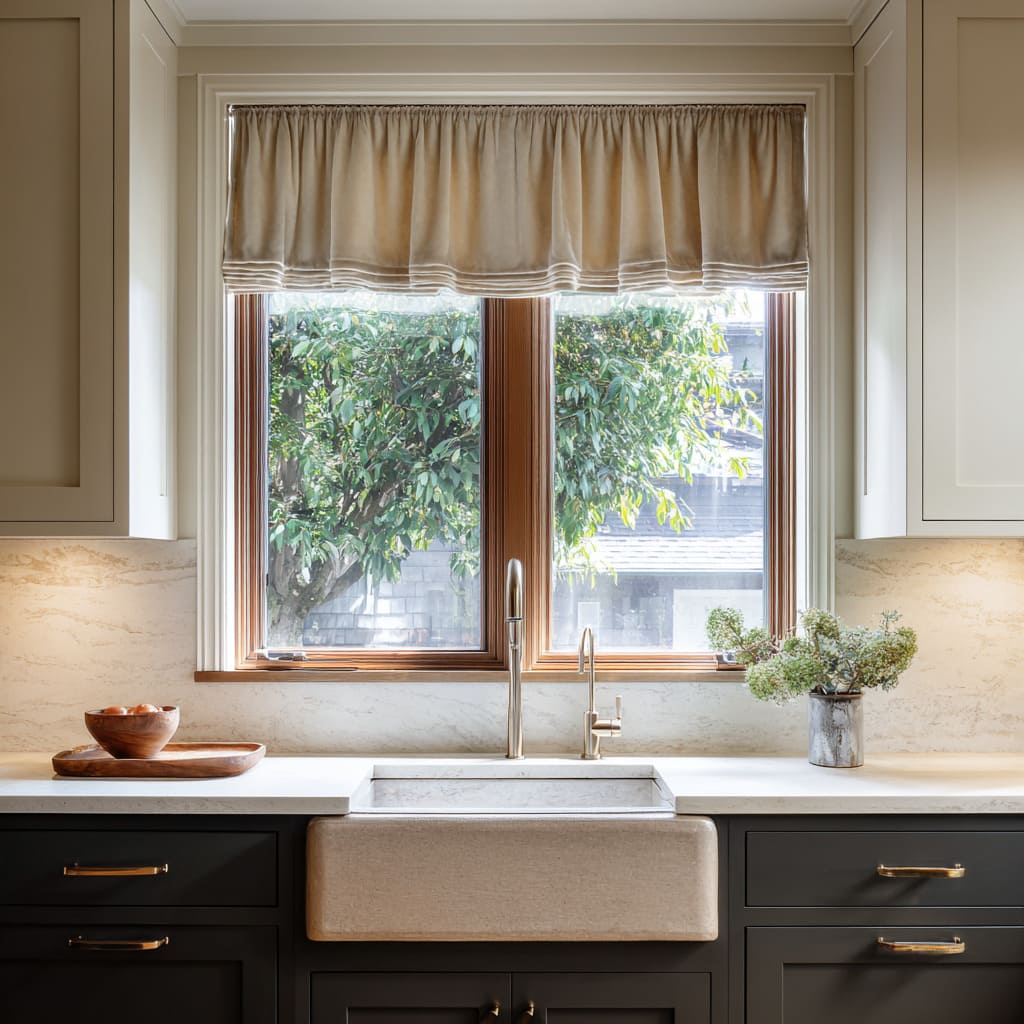
Editing Light and View: How Valances Slice the Outdoors
One of the most subtle roles of a valance is how it edits the view and the daylight. A deep scallop can reveal the tops of shrubs while hiding harsh upper brightness; a straight band at one third of the window height can keep the glare away from eyes at the sink while leaving the middle band of garden clearly visible.
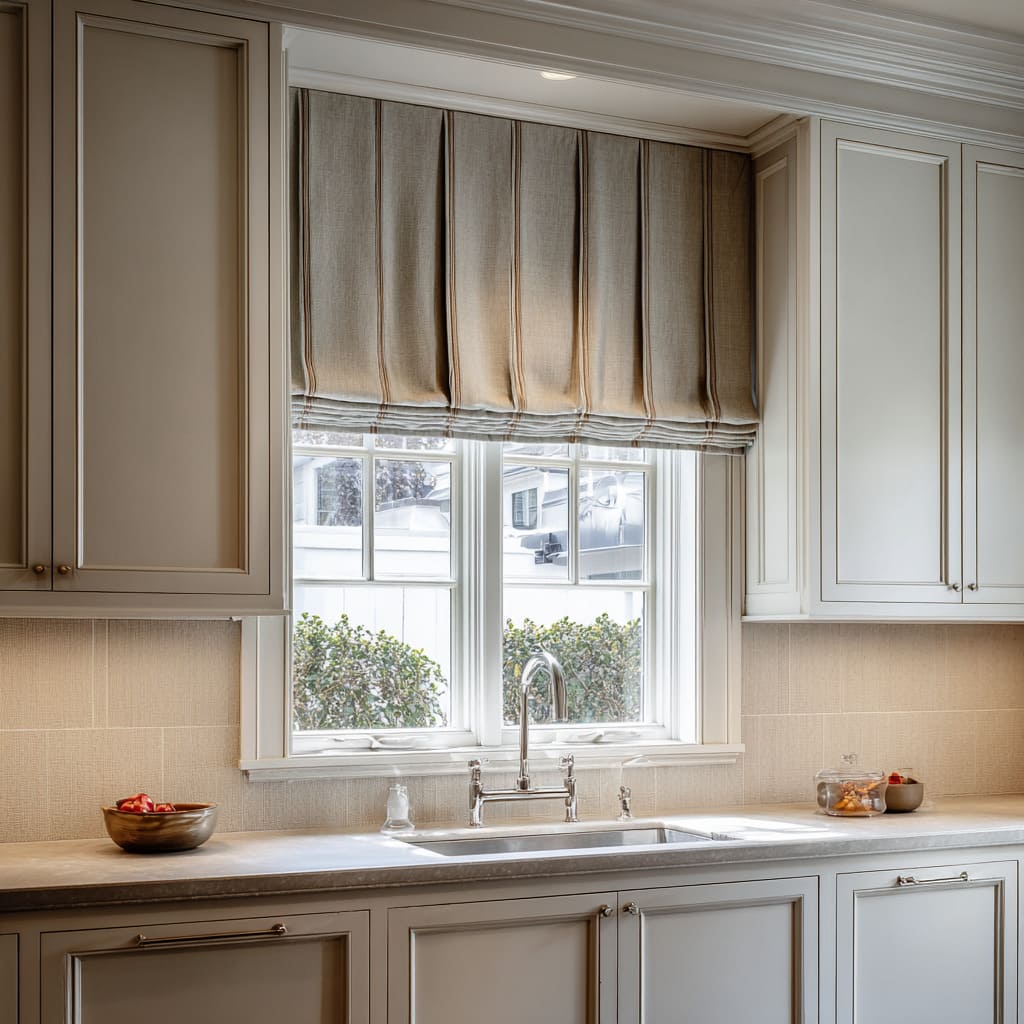
Tie-up shapes with gently lifted scoops can divide the glass into three separate vistas, each showing a slightly different part of the exterior: a tree trunk here, a roofline there, a strip of sky in the center. Semi-sheer fabrics let the outline of trees turn into soft silhouettes, turning the outside scene into a kind of living artwork rather than a literal view.
These choices change how the kitchen feels through the day. Instead of a single bright rectangle, the window turns into a layered composition of cloth, shadow, and edited outdoor fragments, so the wall behind the sink feels considered and calm even when the world outside is busy or uneven.
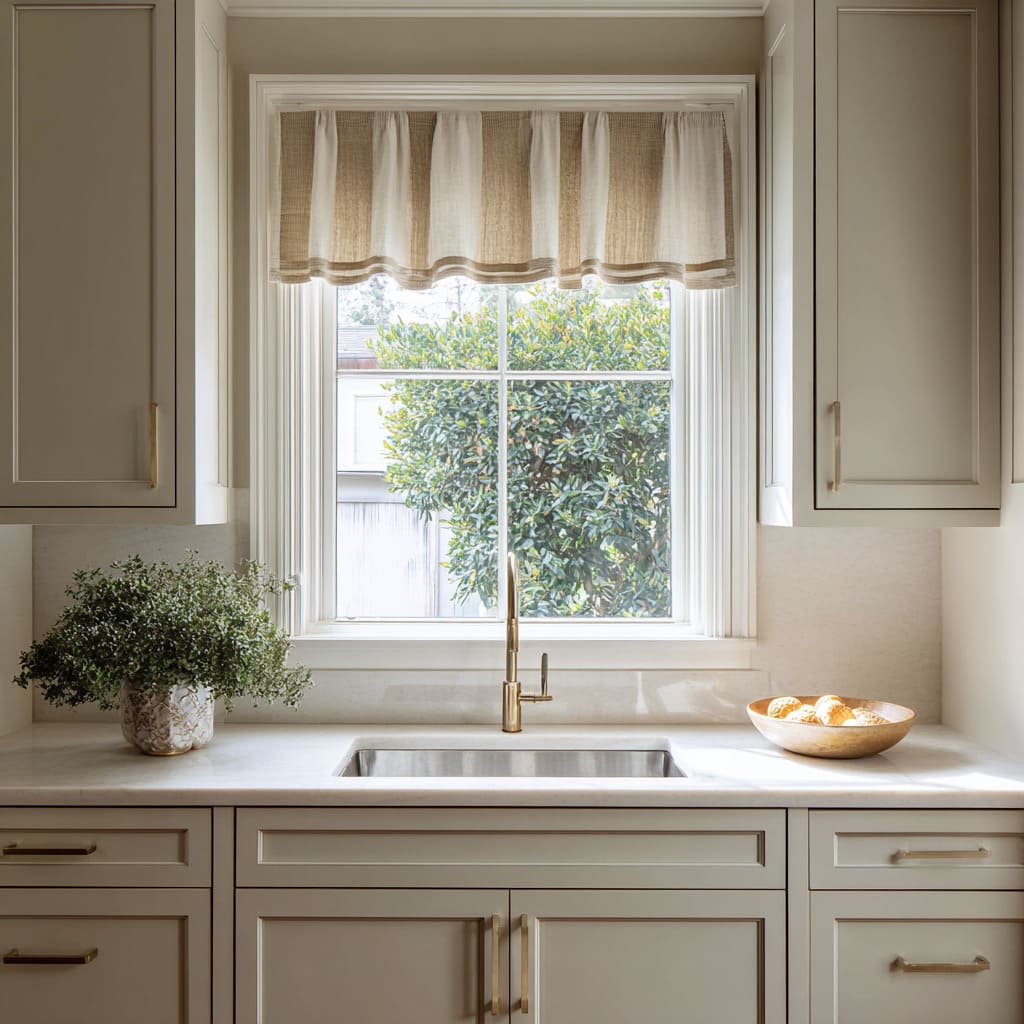
Rhythm in Fabric: Vertical Lines, Horizontal Bands, and Soft Arcs
The language of line is everywhere in these design approaches, and the valance often decides which rhythm dominates. Some designs emphasize vertical movement: narrow pleats, channelled folds, or ribbed fabrics that mirror the tall proportions of cabinet stiles and backsplash tiles.
These vertical cloth structures support the sense of height, connecting faucet stems, mullions, and pendant cords into a quiet forest of lines. Other treatments lean into curves: scooped hems, scallops, rounded tie-up shapes that echo bowls on the counter, pendant globes, and the round crowns of trees outside.
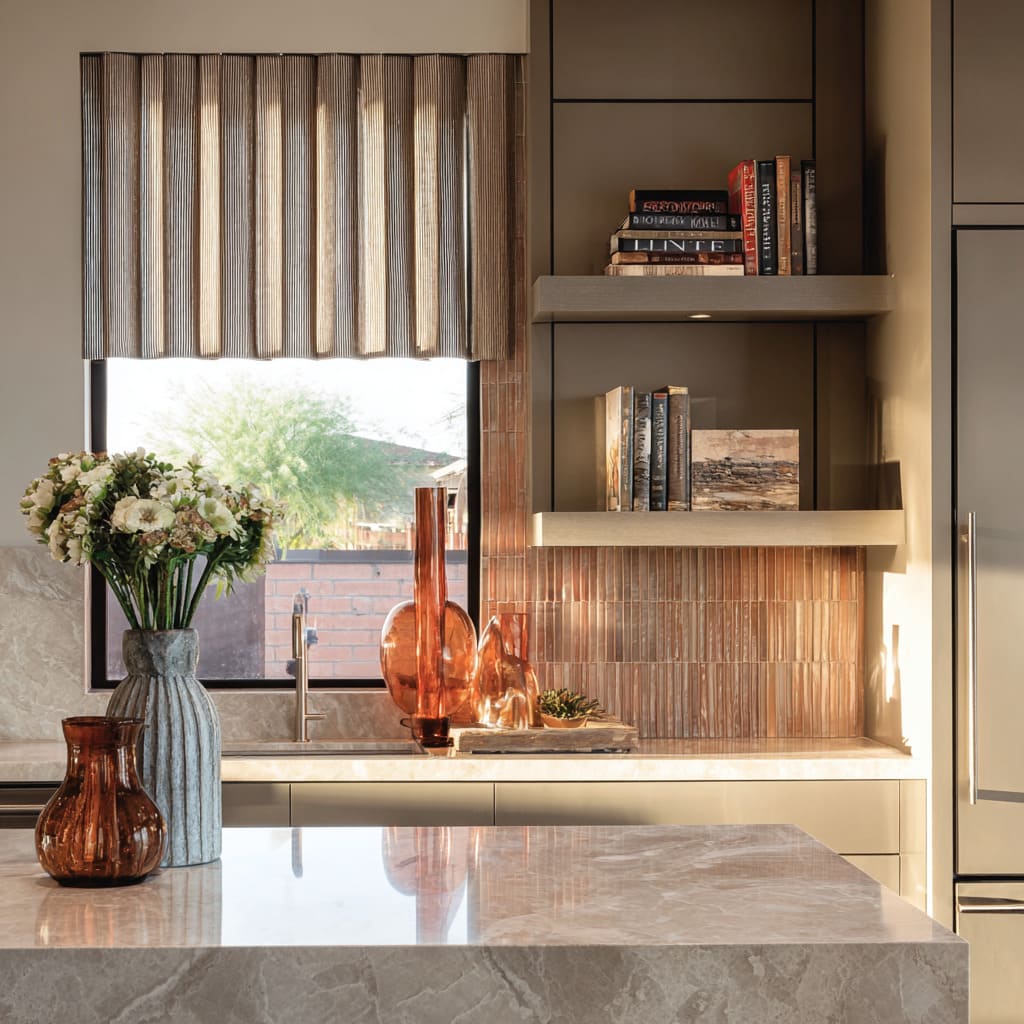
A third group mixes the two, with rigid vertical pleats topped or finished by a gently irregular lower edge. This mixture often produces the most layered reading of the wall, because it acknowledges both the strict order of cabinetry and the softer outlines of foliage and ceramic pieces.
The valance becomes the place where these directions meet, converting the whole sink wall into a balanced rhythm of straight and curved forms.
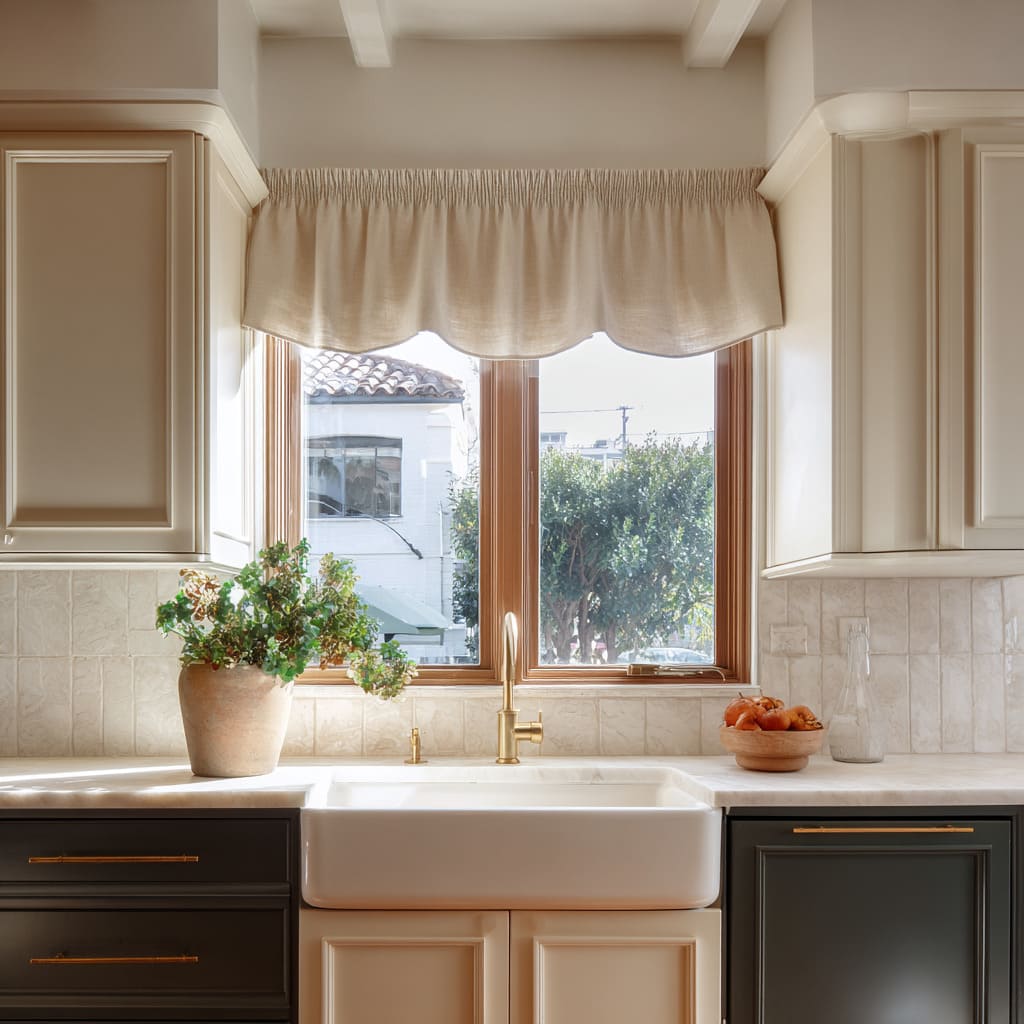
Texture Stories: Linen, Woven Fibers, and Structured Cloth
Texture often carries more meaning than print or color in current kitchen window valance ideas. Linen with a loose slub catches the light along its threads, making even a single flat panel feel alive as daylight moves.
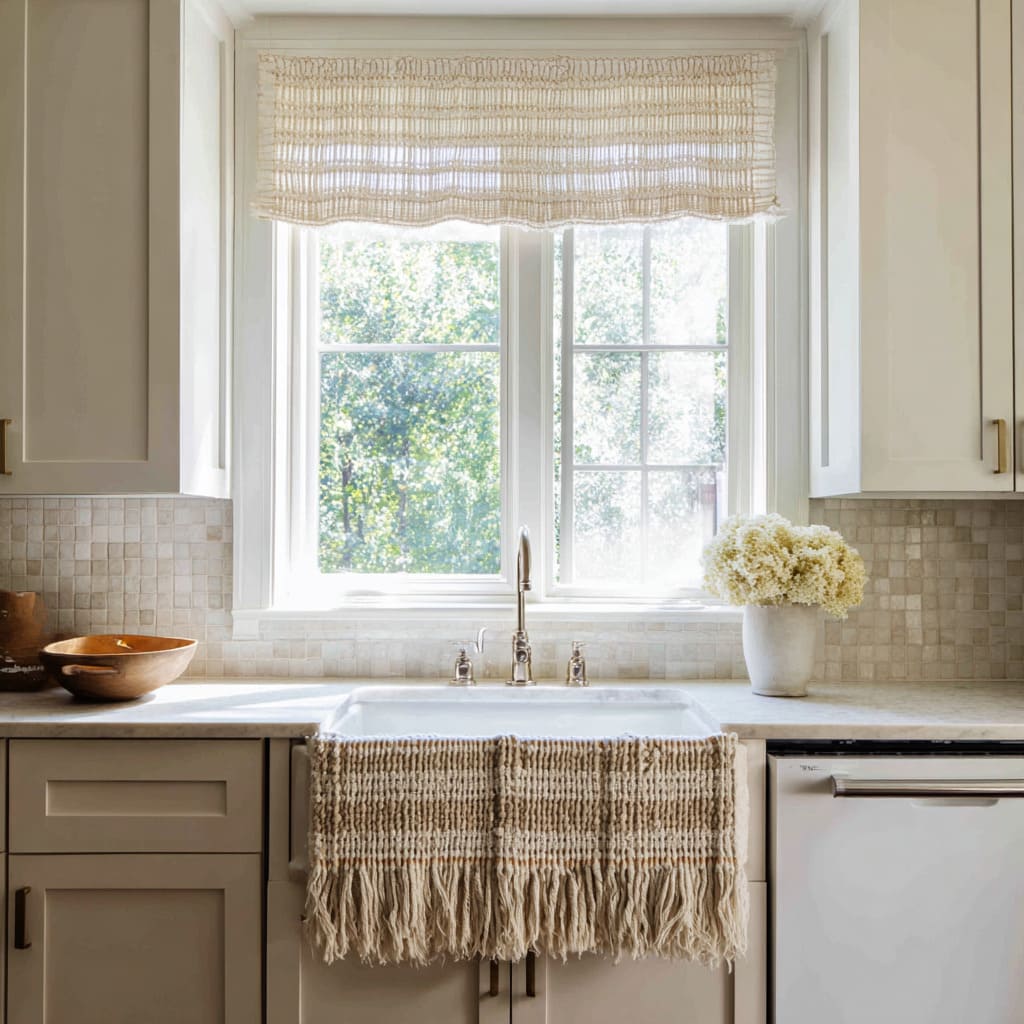
More open weaves, similar to softened reed or basket materials, allow tiny shafts of brightness to pass through, so the fabric glows wherever the warp and weft open up.
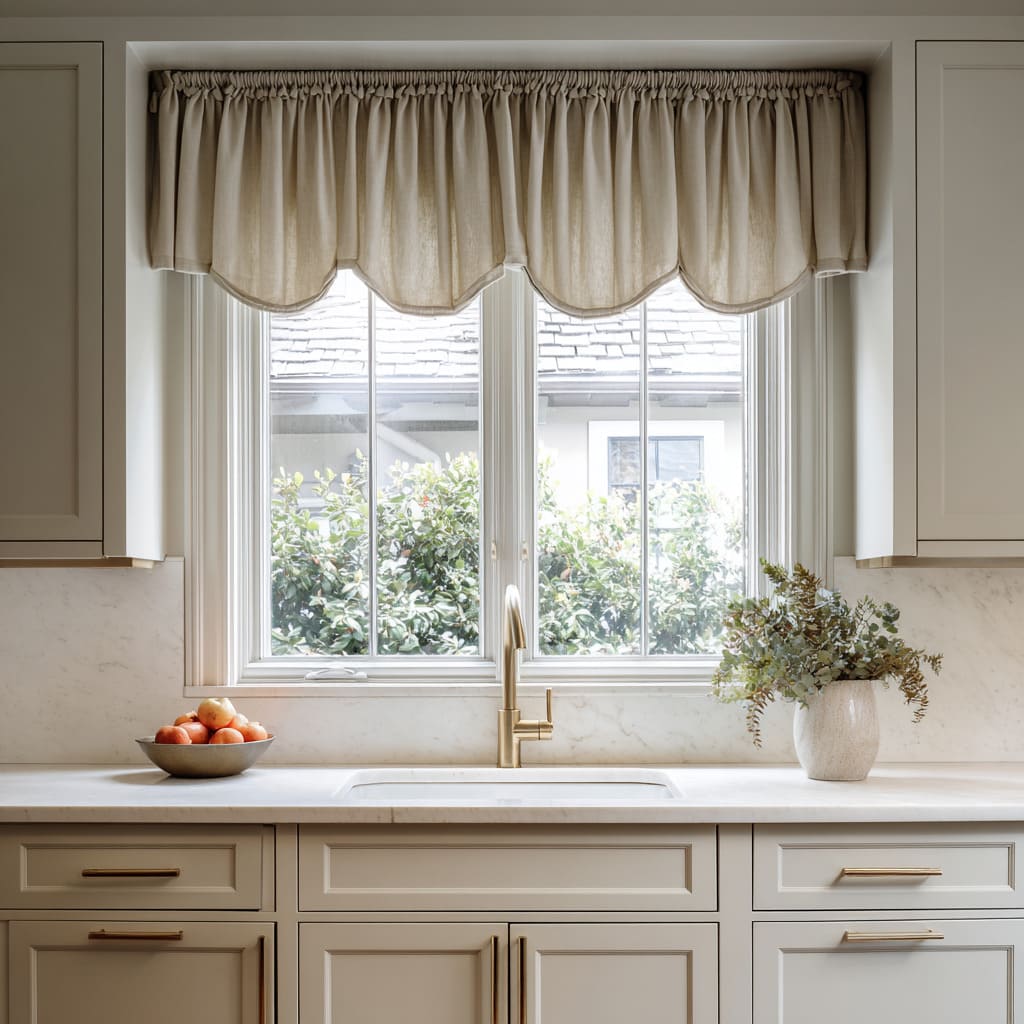
These textures pair strongly with natural materials nearby: a woven shade above a farmhouse sink resonates with wooden bowls, chopping boards, and the irregular pattern of leaves pressed against the glass. Semi-sheer structured cloths with vertical ribs reinforce the linear logic of subway tiles without competing, while boxed treatments in smooth, finely woven fabric add calm near heavy stone or strongly grained timber.
In all of these cases, the textile is chosen to speak fluently with the surfaces around it, turning the top of the window into a small chapter of the room’s larger material story.
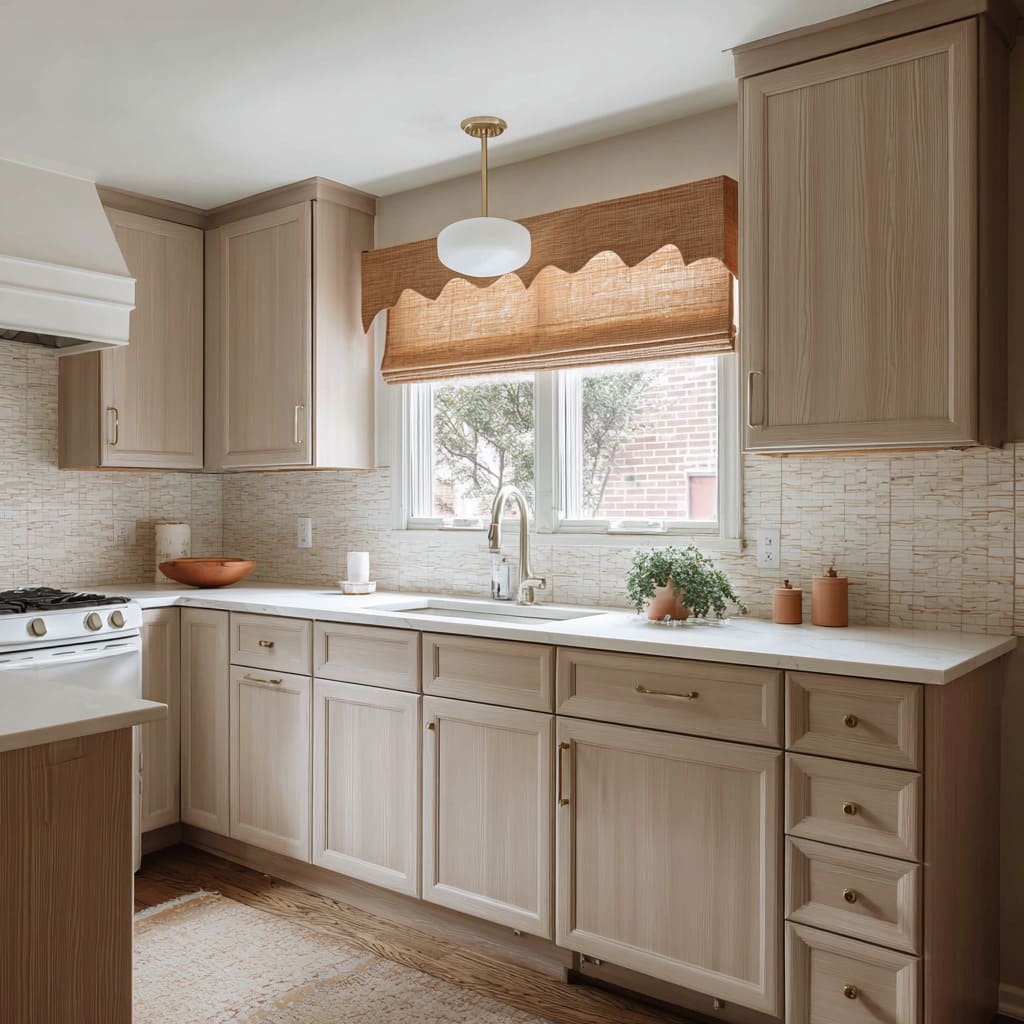
Color Bands and the Emotional Temperature of the Wall
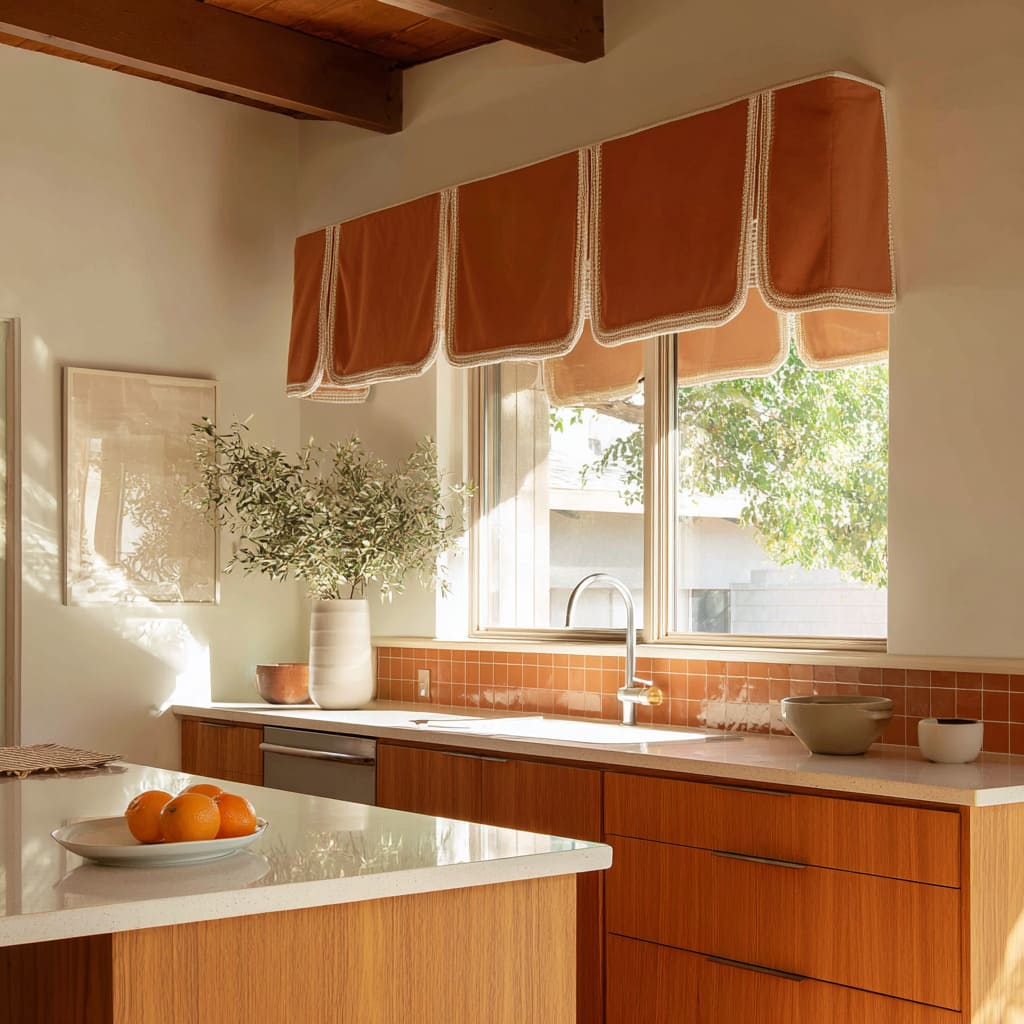
Color in valances is often handled with restraint, yet it has disproportionate influence. A single band of strong terracotta can pull together warm streaks hiding in backsplash tiles, ceramics on the counter, and hints of tone in stools or floor planks.
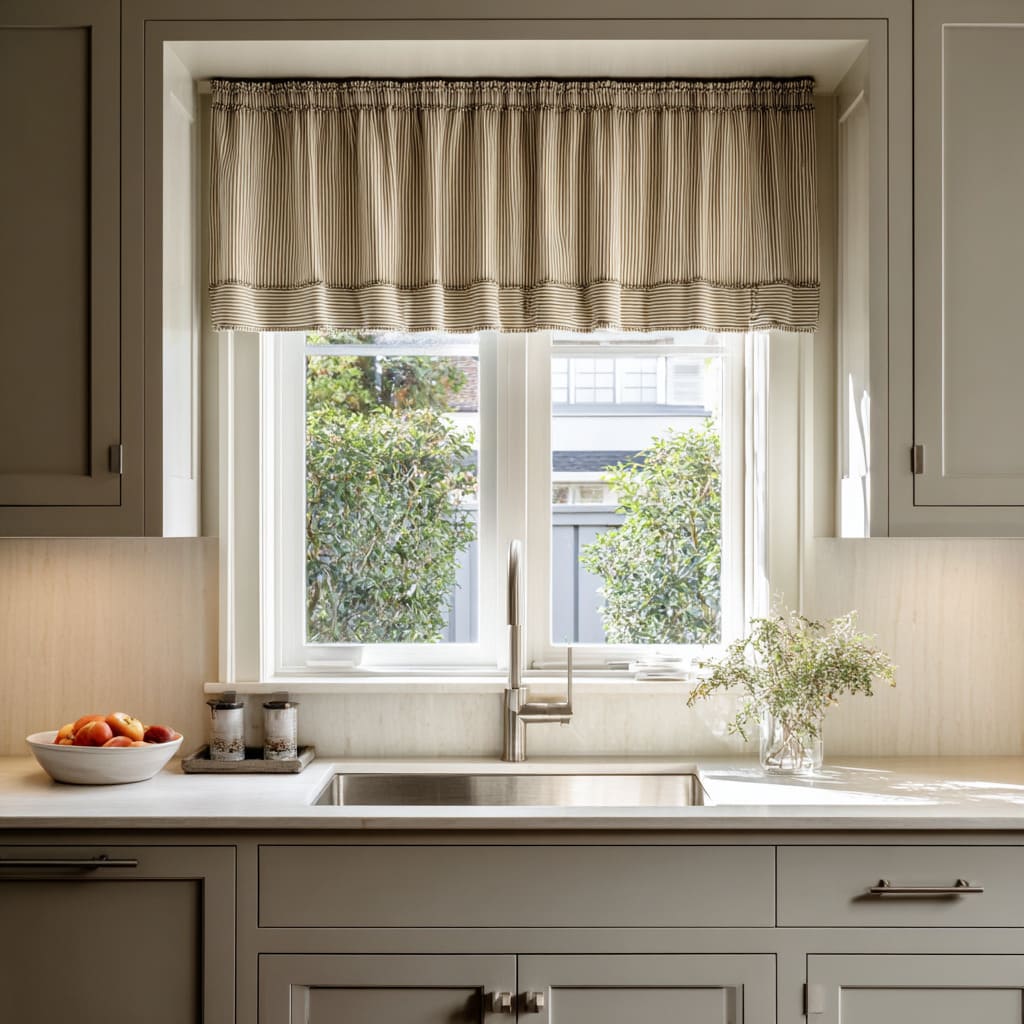
A soft oatmeal band can sit perfectly between pale stone and deeper base cabinets, calming what might otherwise feel like a sharp break in value. Striped borders at the top or bottom act like subtle underlines: a slim contrast band near the rod suggests a finished edge under the trim; a wider stripe at the hem gives the cloth just enough weight to stand up visually to tall cabinet doors.
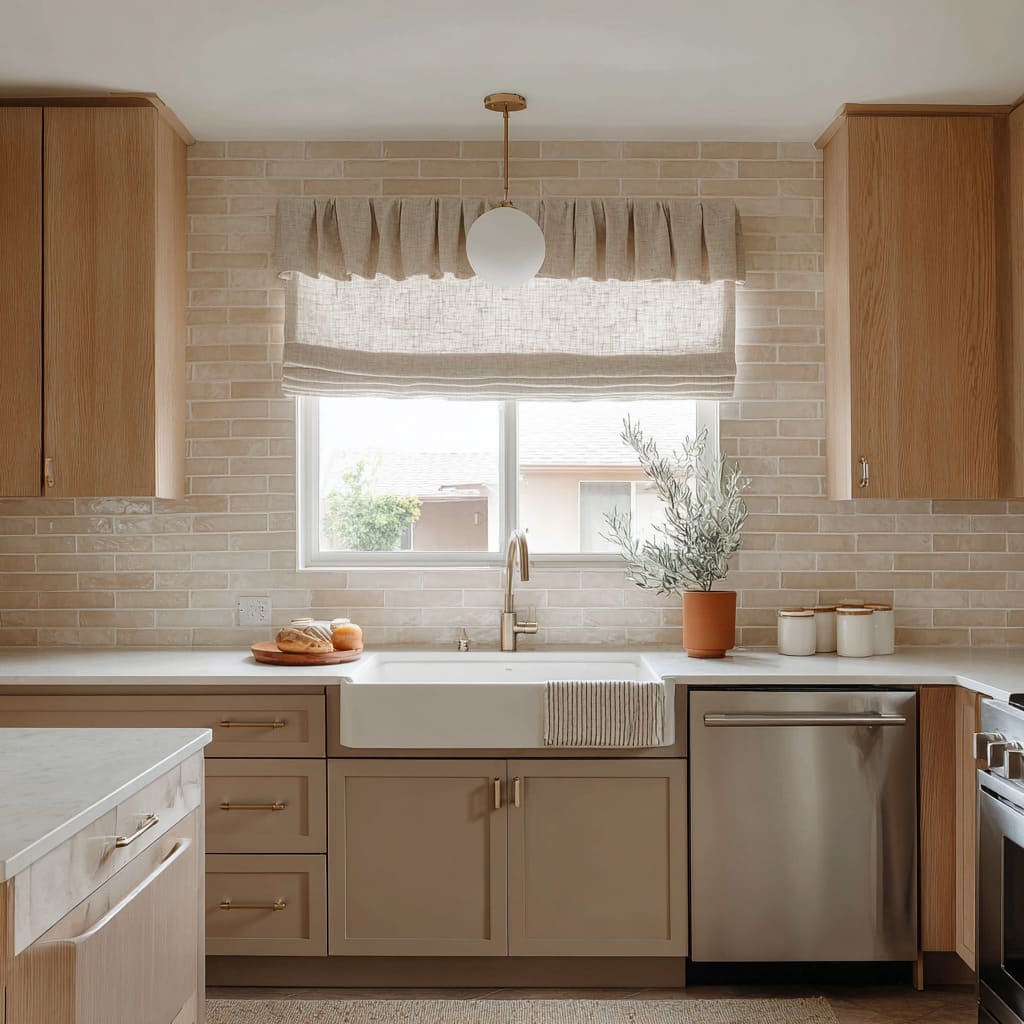
Some designs keep the body of the valance in quiet neutrals and let a narrow contrasting stripe hold all the pattern, which allows the window to feel layered without introducing busy motifs. These color bands shape the emotional reading of the wall: one saturated strip can make a room feel sunny and lively, while a series of tone-on-tone neutrals can support a softer, more grounded atmosphere.
Layering and Combination Treatments Around the Sink
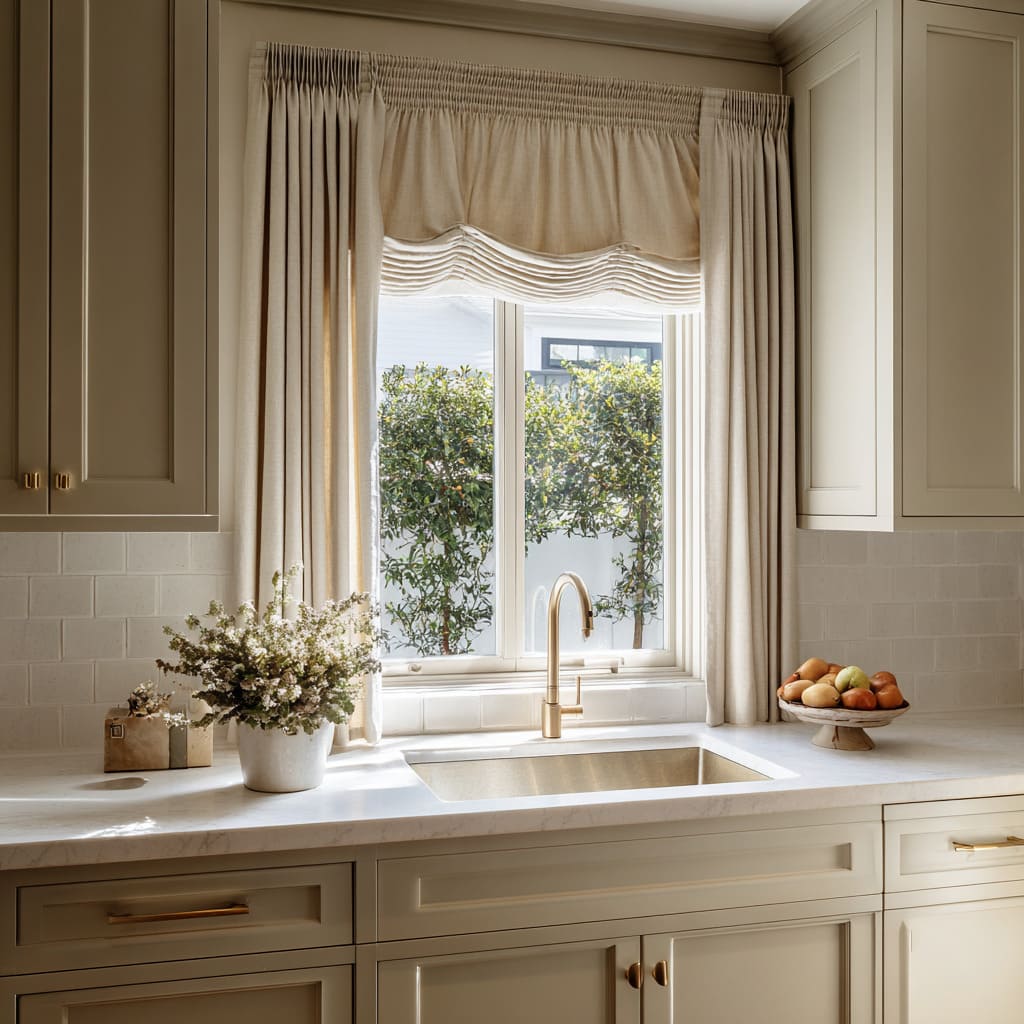
Layered compositions give kitchen windows a sense of depth that suits spaces with rich tile or mixed cabinet finishes. A short band above a relaxed Roman shade allows one fabric to handle framing while the other manages soft modulation of light.
Side panels paired with a central draped band make the opening feel more like a framed recess than a simple rectangle of glass.
A woven upper piece can be paired with a heavier, more tactile cloth covering the front of the sink, so the working zone is wrapped in fiber from eye level to knee level. These layering patterns often follow a hierarchy: the top element acts as the visual outline, the middle manages view and sunlight, and the lower textile supplies tactility and warmth.
Within that hierarchy, color and texture are balanced so that no single layer dominates; instead, the window reads as one continuous vertical column of textiles stepping down from ceiling line to countertop edge.
Dialogues with Cabinetry, Tile, and Hardware
Valances gain much of their character from how they interact with the surrounding surfaces. A straight, neatly banded valance in a pale neutral can make raised-panel cabinets feel calmer, because it adds a smooth pause above the sink where the eye can rest before reading the detail of the doors.
Vertical pleats above vertically laid tiles create a strong column-like effect that suits kitchen designs with tall ceilings and narrow windows. In contrast, a softly scalloped edge just brushing the midline of the glass can soften a wall covered in hard-edged tiles, especially when cabinet faces are simple and flat.
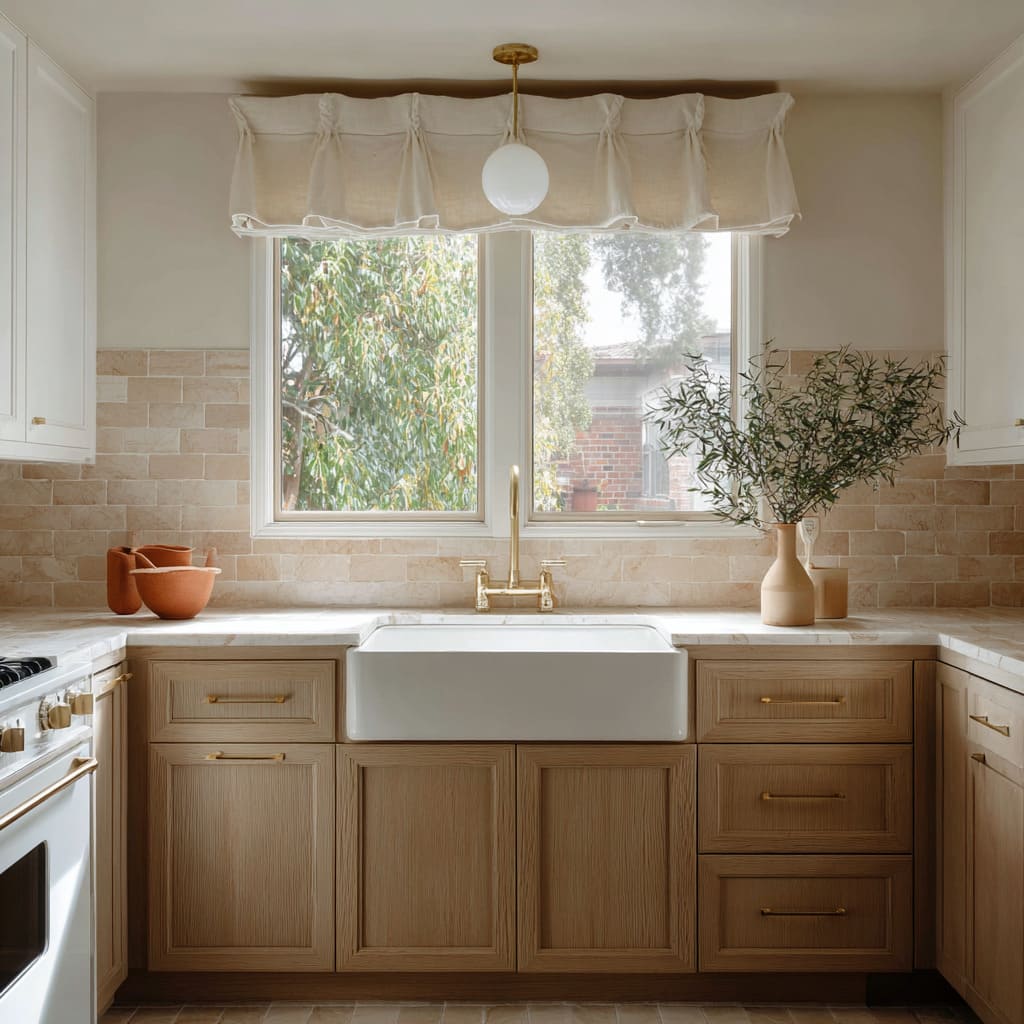
Hardware plays into this conversation as well: warm metal faucets rising in front of sandy linen repeat the same tone; slender bridge faucets align with central pleats or scoops and act as anchors for the fabric line. In this way, the textile never stands alone; it is in continuous dialogue with joinery, grout lines, and metal profiles, completing the composition rather than competing with it.
Countertop Objects as Partners to the Cloth
Objects placed on the counter beneath the window work as supporting actors to the valance. Their shapes often echo the fabric’s outline:.
- Rounded hems sit above bowls piled with fruit, curved ceramic vases, or soft mounds of flowers.
- Strong vertical pleats sit above tall bottles, upright cutting boards, or stacks of neatly aligned plates.
- Woven shades work harmoniously with baskets, wooden boards, and matte clay pieces.
Color echoes also matter. A citrus-colored valance may be mirrored by oranges in a bowl, a clay pot, or subtle streaks in linear tiles.
Neutral linens find partners in crusty loaves on boards, pale stoneware, and muted green stems in white jars. Importantly, these items usually stay low, leaving a band of wall or tile visible between counter and cloth.
That empty space is what lets the fabric keep its role as the main soft line, with all the objects acting as rhythm and variation beneath it. The result is a quiet vertical stack: light at the top, textile, tile, counter, and then small items in dialogue with the fabric above.
The Central Axis: Pendant, Valance, Glass, and Sink
Many compositions rely on a single strong vertical line that runs from ceiling to basin. A pendant often hangs in front of the valance, its cord dividing the fabric, then continuing visually through the window mullion and down to the faucet spout.
The deepest point of a scallop or the most pronounced pleat is frequently placed on this line, turning the central axis into a deliberate alignment of light, cloth, glass, and metal.
Even in kitchen designs with asymmetric layouts—open shelving on one side and a tall pantry on the other—this vertical spine lends balance. It acts as a visual anchor in the middle of varied forms.
Striped or banded hems may underline this axis horizontally, but the main emphasis remains vertical. The coordination of pendant, valance, and faucet gives the eye a clear path and prevents the window from appearing disconnected from the rest of the room, turning the sink wall into a cohesive structural feature.
Style Spectrum: From Quiet Neutrals to Graphic Statements
Within the broad field of kitchen valance ideas, there is a wide spectrum between barely-there treatments and strong graphic statements. At one end sit neutral linen bands with soft folds and minimal detail, designed to murmur in the background while tile and cabinetry carry most of the visual weight.
At the other end are boldly colored valances in rich clay or pumpkin tones, or striped designs where alternating light and mid tones create a clear pattern at the top of the window.
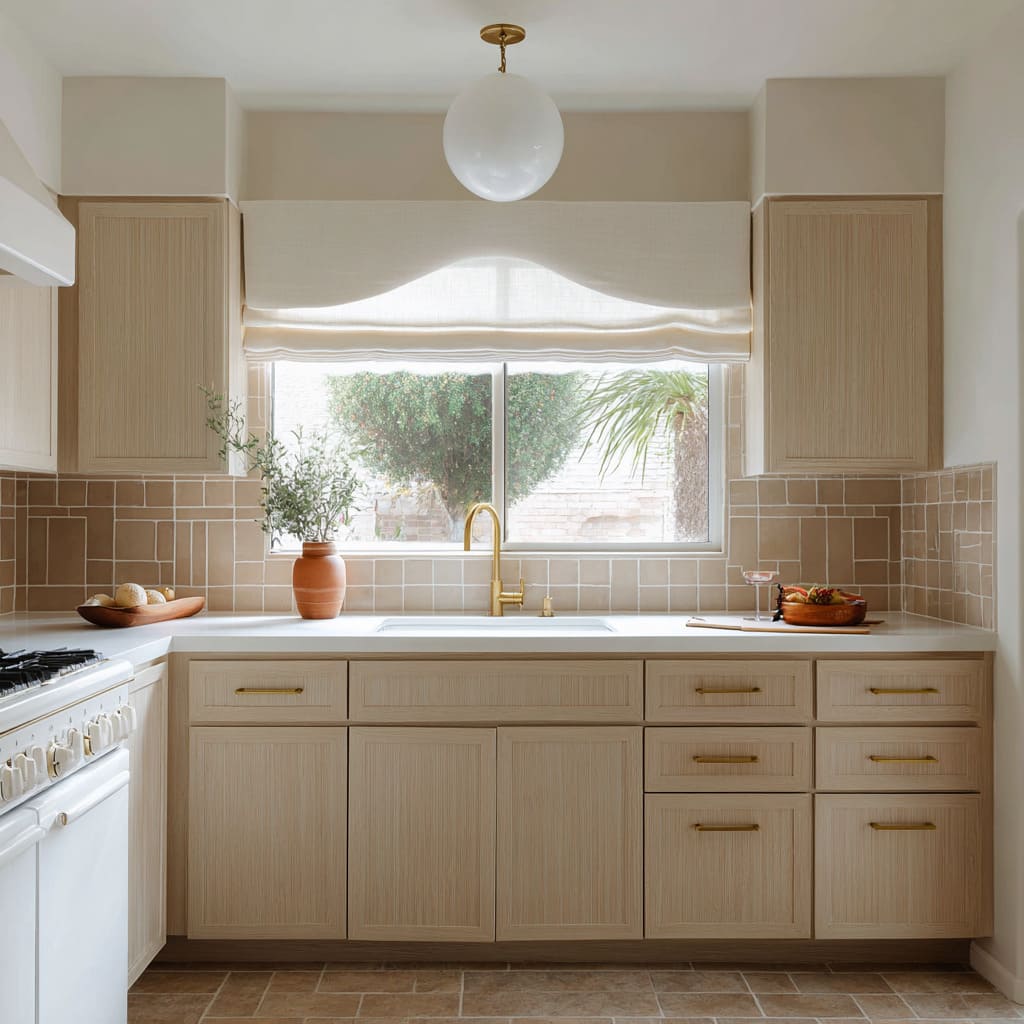
Between these poles lie semi-structured pieces with subtle contrast bands, reed-like weaves that echo wood, and subdued ticking stripes that hint at traditional textiles while keeping the overall impression fresh. These varied approaches allow kitchen designs with different personalities to still maintain a sense of calm: even the bright treatments usually keep to one main color or one controlled pattern, so the room feels considered rather than noisy.
The fabric line at the window becomes a way to set the tone of the interior without filling the space with many competing accents.
Curtains, Café Bands, and the Softest Layer of the Room
The valance can connect to a longer curtain panel, a café band, or a relaxed shade, creating a continuum of fabric from top to mid-height. These compositions sit within the wider family of kitchen curtain valance ideas, where the cloth does not simply cap the window but frames it and sometimes wraps part of the working zone as well.
Side panels that just graze the countertop edge, or under-sink skirts that share the same weave as the valance, introduce a sense of softness around the main work area.
At the same time, short café curtains at eye level quietly echo the line of the valance above, creating two separate yet related bands of textile. Also, compact windows can carry a single striped or two-tone valance that supplies all the pattern needed, letting the rest of the room rely on wood, stone, and ceramic.
The common thread in these modern kitchen window valance ideas is the idea of fabric as the softest surface in the room: the place where light is filtered, outdoor views are edited, and the character of the kitchen is gently expressed in folds, bands, and subtle shadows.