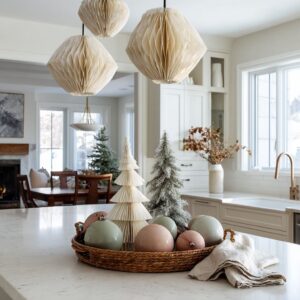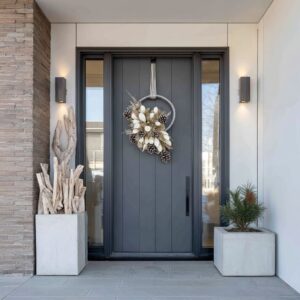
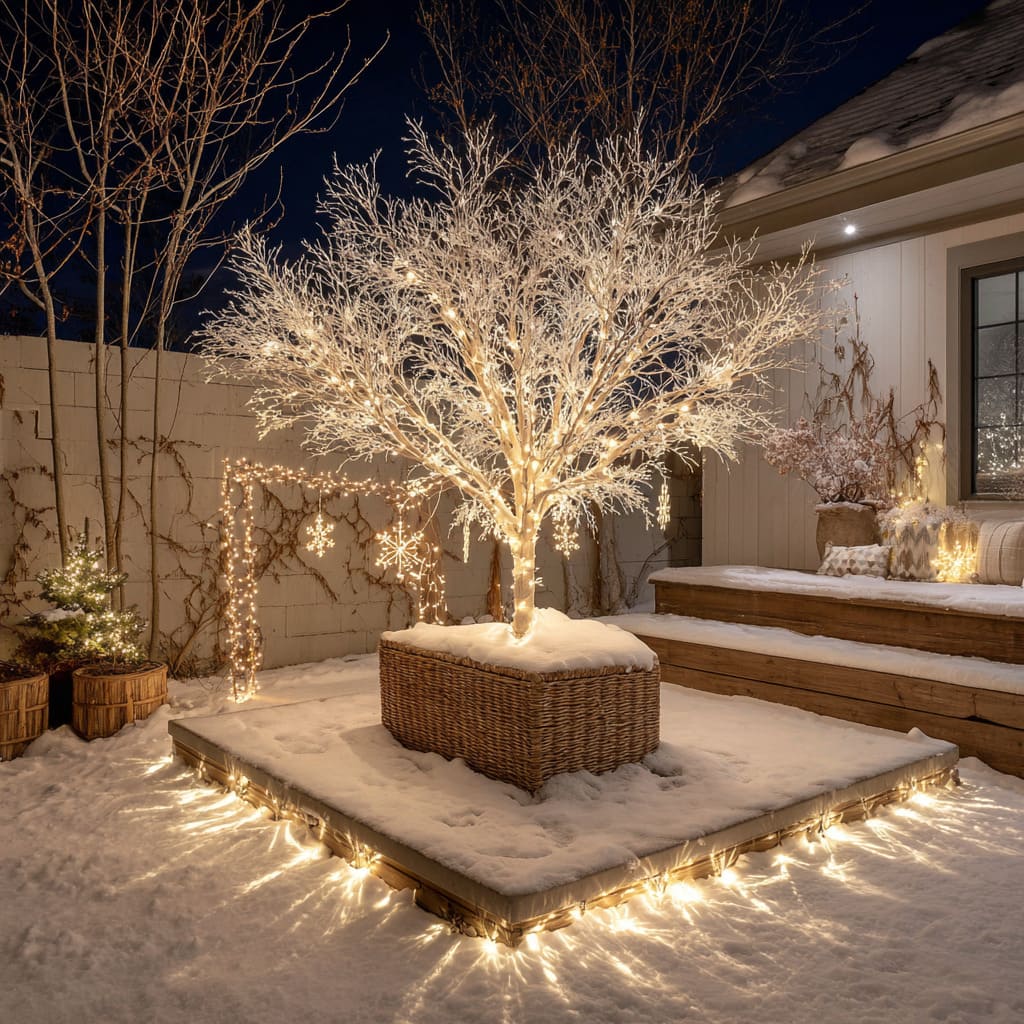
Holiday decorating outside is shifting into quieter territory. The look is less about how much can be stacked onto a tree and more about how every shape, surface, and light placement works within the space.
Where once the goal was to cover every inch in color and sparkle, the focus now leans toward restraint, rhythm, and texture.
Modern outdoor setups pay close attention to what surrounds the tree—furniture, lighting, even the material of the ground underfoot. Details like a single ribbon, a soft cluster of handmade ornaments, or the curve of a planter often speak louder than glitter-heavy layers.
The tree itself may no longer hold the center of the scene, sharing attention with sculptural lighting, textured seating, or a quiet mix of raw materials.
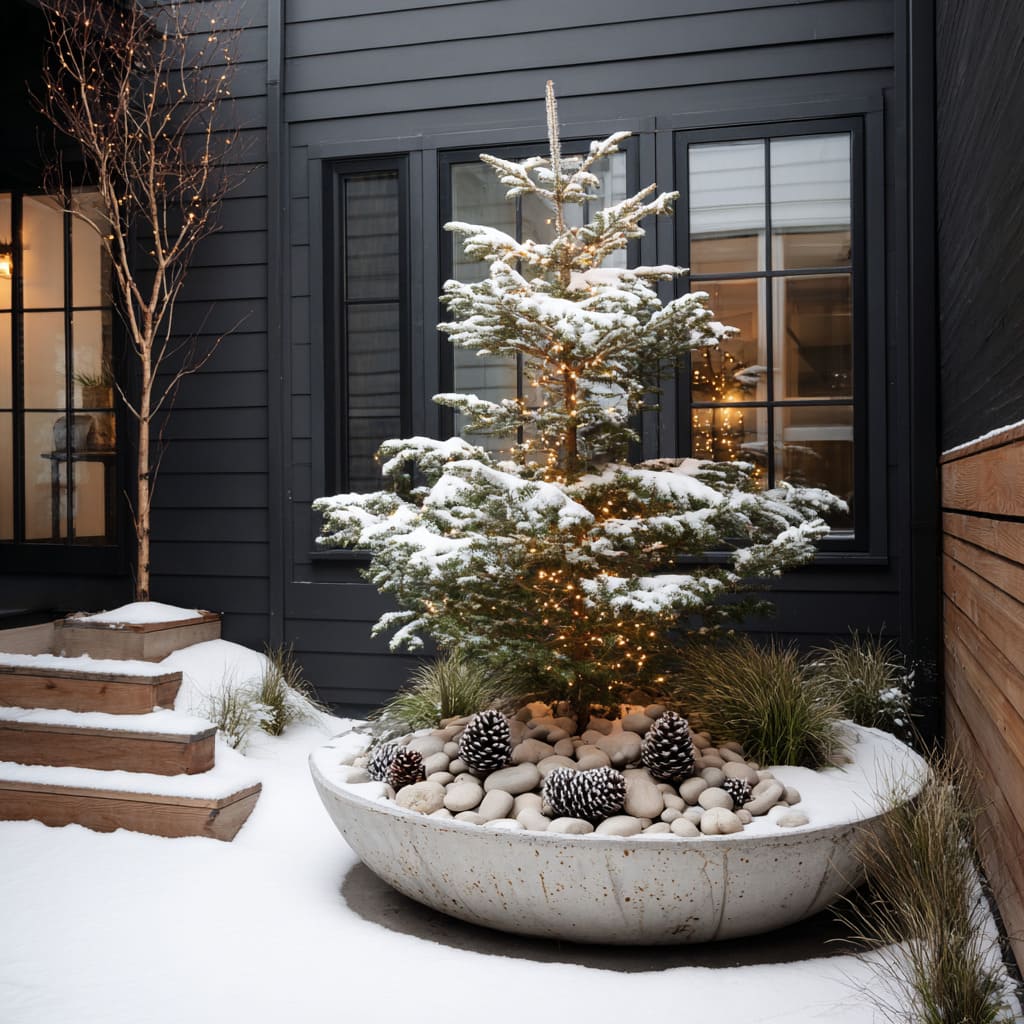
Subtle shapes, negative space, and muted palettes replace the louder tones of traditional decorating. Materials often echo the home’s structure, with every element feeling part of one continuous setting.
Instead of fighting for attention, light and form move together—drawing focus without overwhelming the eye.
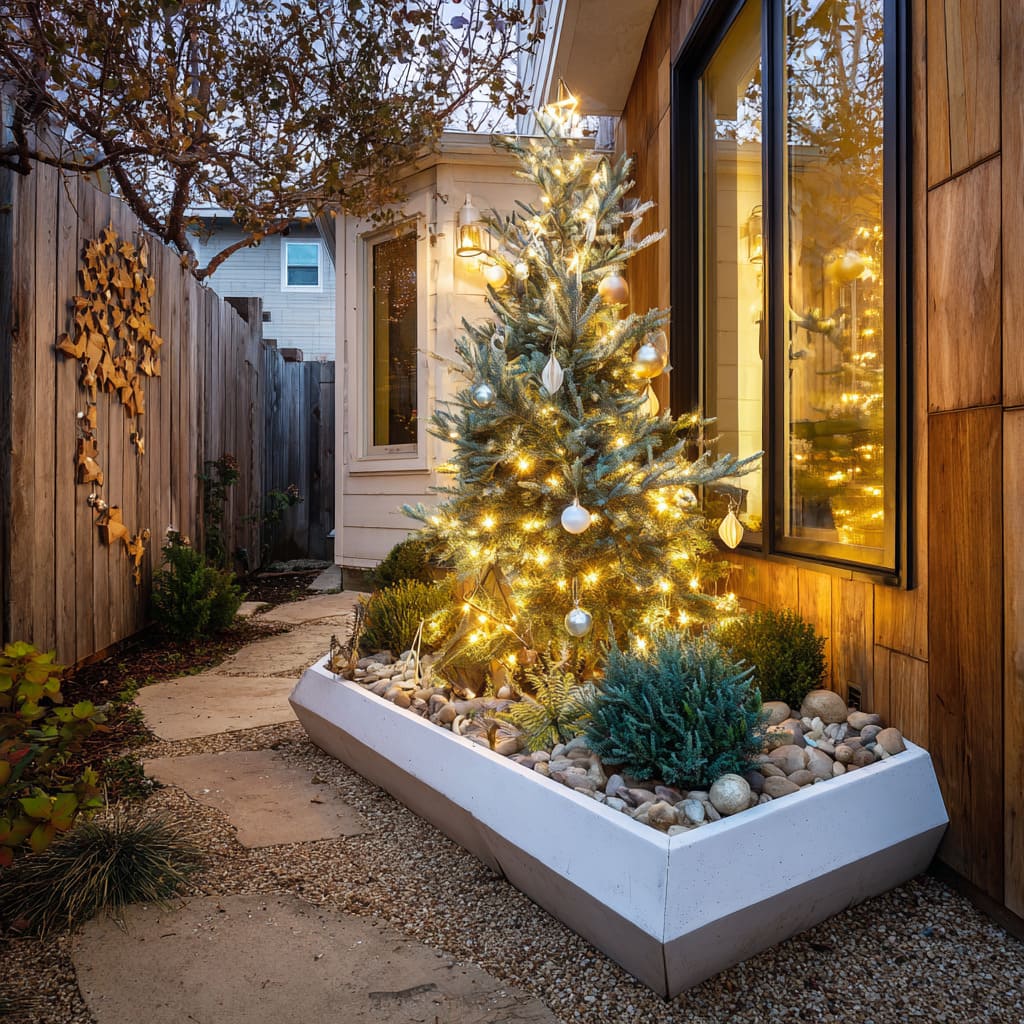
This shift creates a festive mood that feels more designed than dressed up. The spaces aren’t louder, just more considered.
And in many cases, that’s exactly what makes them stand out.
Lighting as a Sculptural Outline
In modern outdoor Christmas tree decorating ideas, lighting isn’t added as an accessory—it becomes the outline, the structure, the rhythm. Instead of layering string lights until branches disappear, many setups treat each light as a design mark.
Some trees feature wide spacing between soft white bulbs, using the gaps to shape air and form, letting the tree breathe visually. Others draw your focus with quiet, calculated placement: a warm line tracing the edge of a raised platform, a cluster of micro-lights revealing the curve of a single limb.
One striking approach uses orb lights as visual punctuation—each sphere positioned not just for glow, but for its role in building symmetry and scale. Where traditional décor might blur a tree into one glowing mass, modern settings highlight space between branches, framing the tree as a sculptural object.
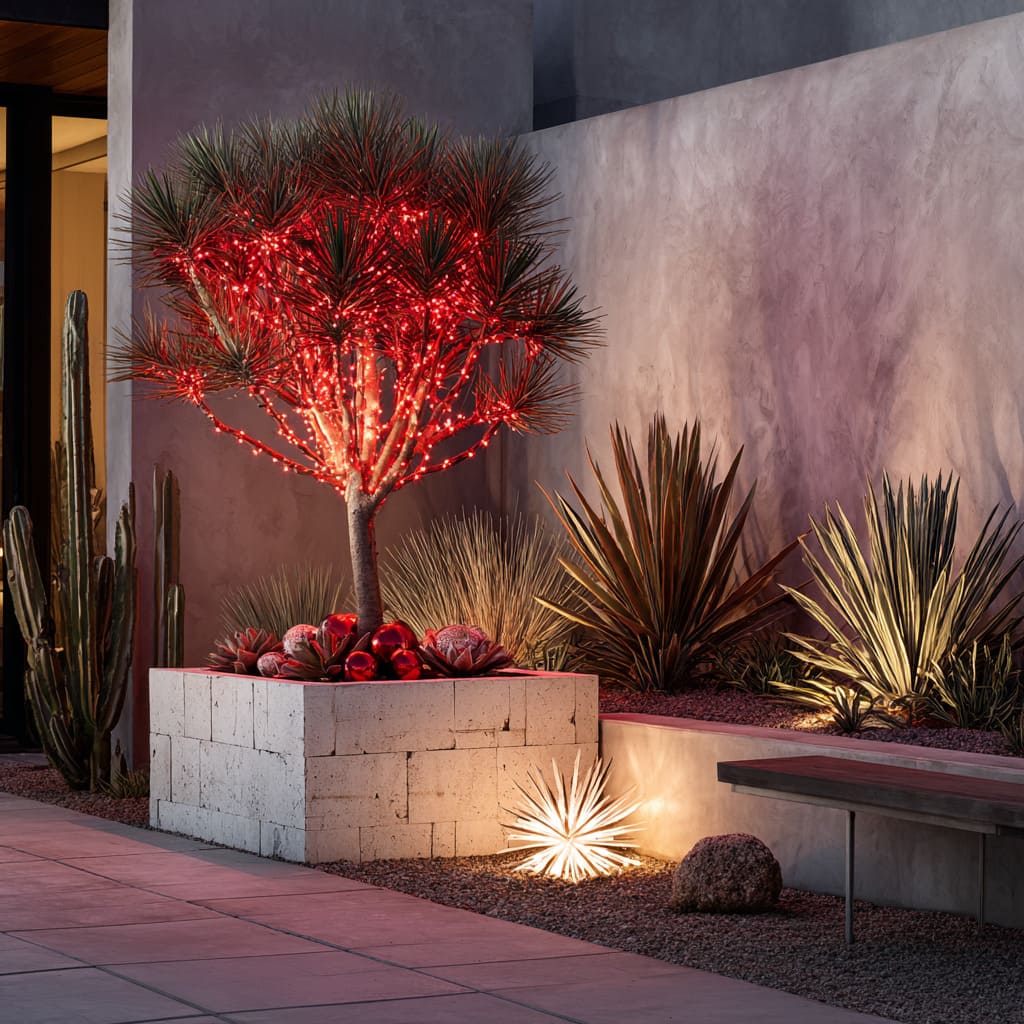
In some desert-inspired patios, red LED strands are coiled tightly into sparse, vertical trees, pushing the foliage toward a more graphic, almost fiery presence. This kind of treatment doesn’t rely on excess—it draws strength from structure, from contrast, from the way light carves into shadow.
The result is an outline that speaks as much through what it leaves dark as what it illuminates.
Palette Reduced to Key Signals
Color, in these outdoor Christmas tree ideas, is treated more like a rhythm than a display. Instead of layering ten shades of festive, most scenes are built on pared-down combinations—often matte, neutral surroundings with one bold accent.
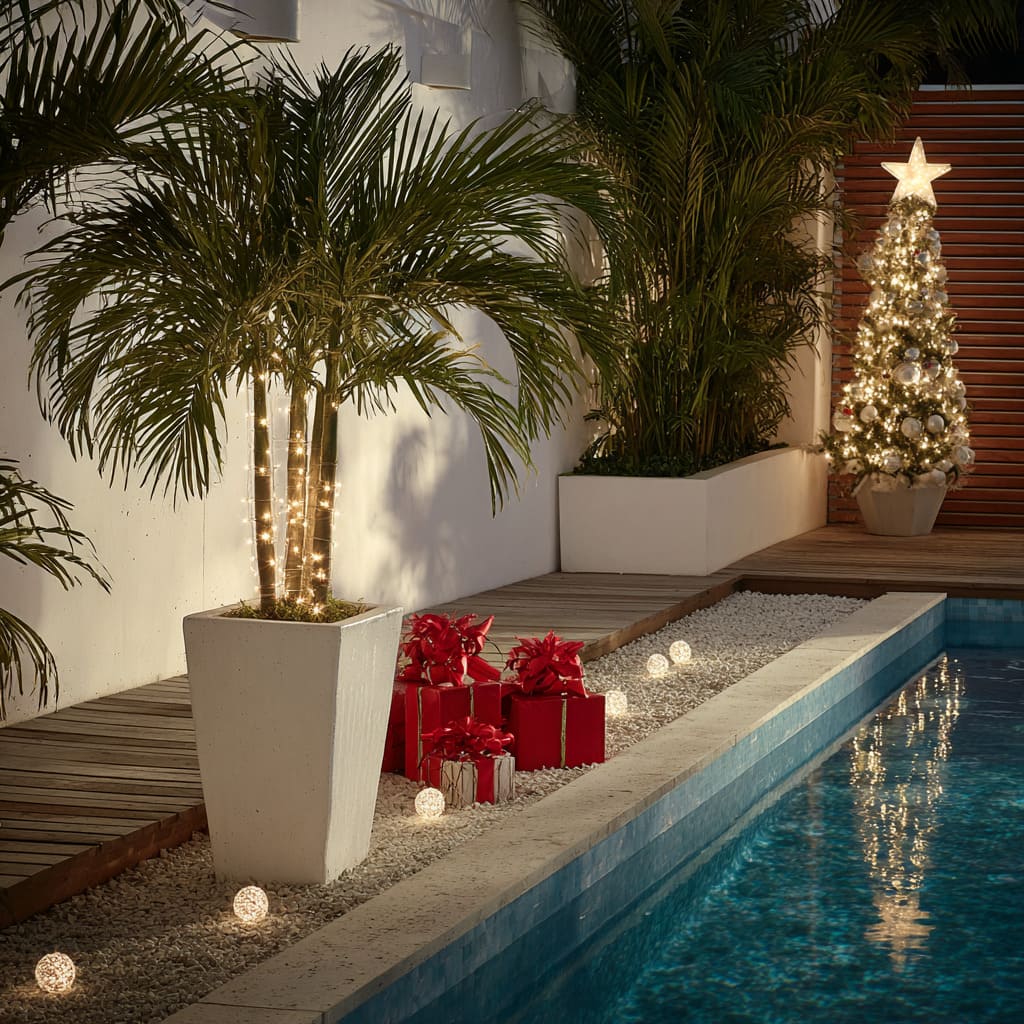
The idea isn’t to avoid color, but to let each tone work harder. One arrangement might pair soft gravel and whitewashed containers with sharply glossy red gifts, letting the red act as a deliberate spark in a calm field.
Another might sit golden light stars against a ground of river stones and sanded wood, giving the shine a textured contrast to bounce against.
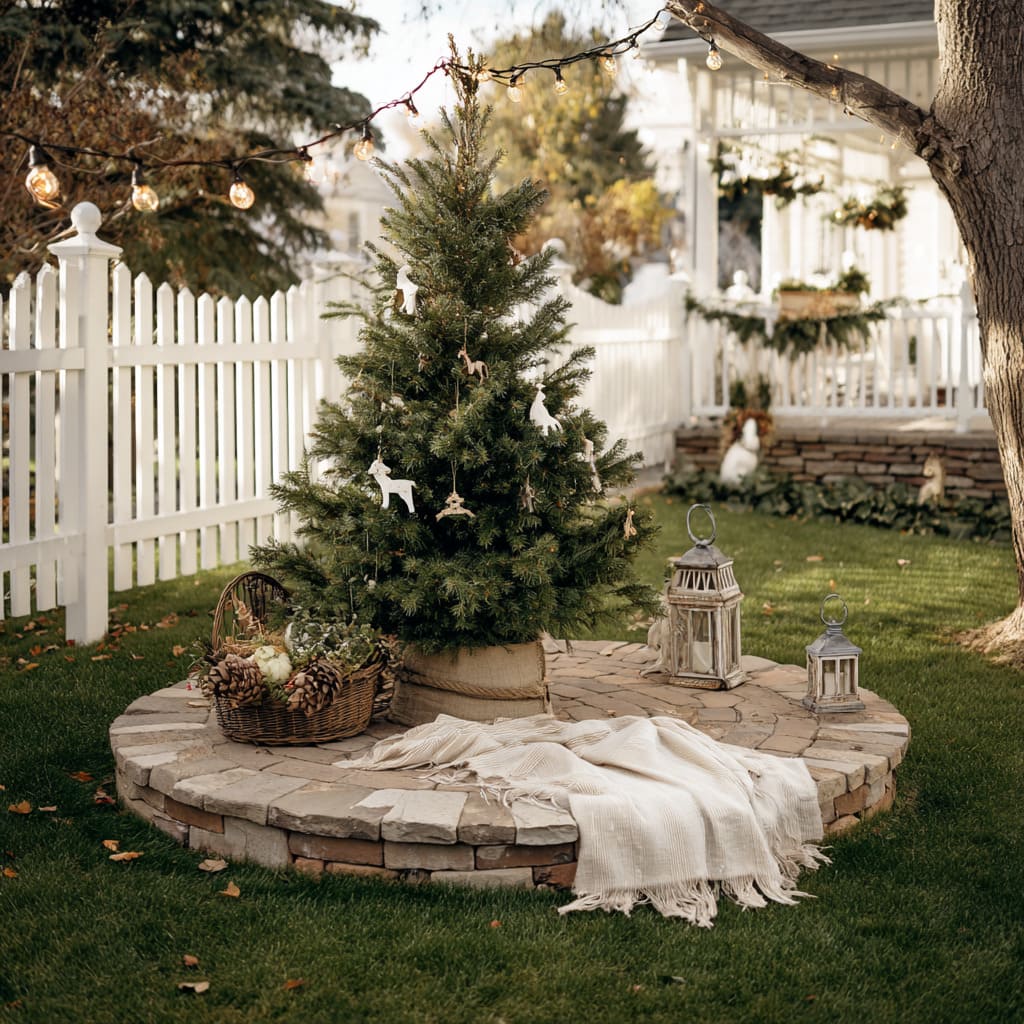
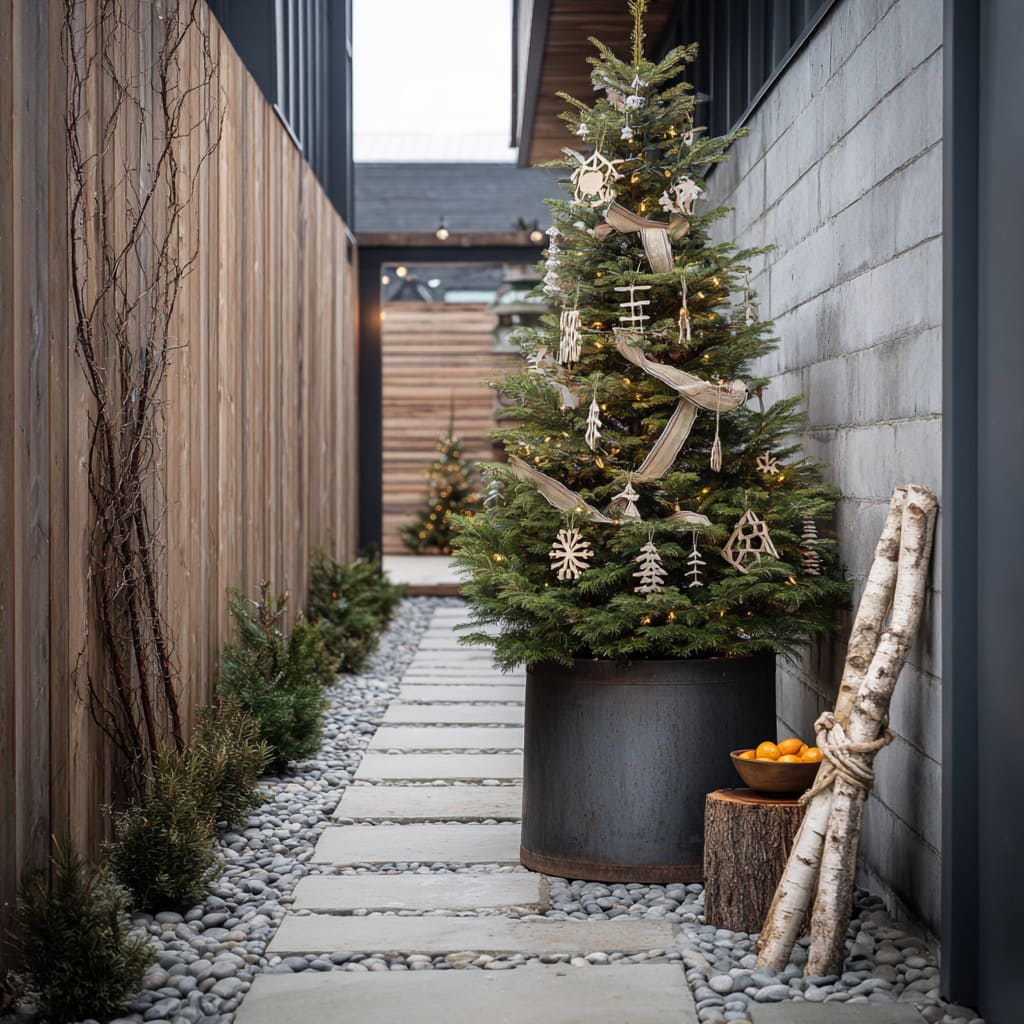
This restraint makes individual elements more visible. A single white ornament in a field of frosted needles, or a burst of pale citrus tucked beside birch logs, can become the visual anchor in an otherwise muted layout.
It’s not about subtlety for subtlety’s sake—it’s about precision. These designs make the most of fewer tones, knowing that one well-placed warm gold or rich charcoal can guide the eye without distraction.
That sense of direction is what gives these scenes their quiet strength—each choice standing clearly, cleanly, and with purpose.
Emphasis on Negative Volume and Rhythm
In many modern outdoor tree decorating ideas, it’s the space around the tree—not the tree itself—that shapes the mood. Instead of filling every branch, these designs leave room to breathe.
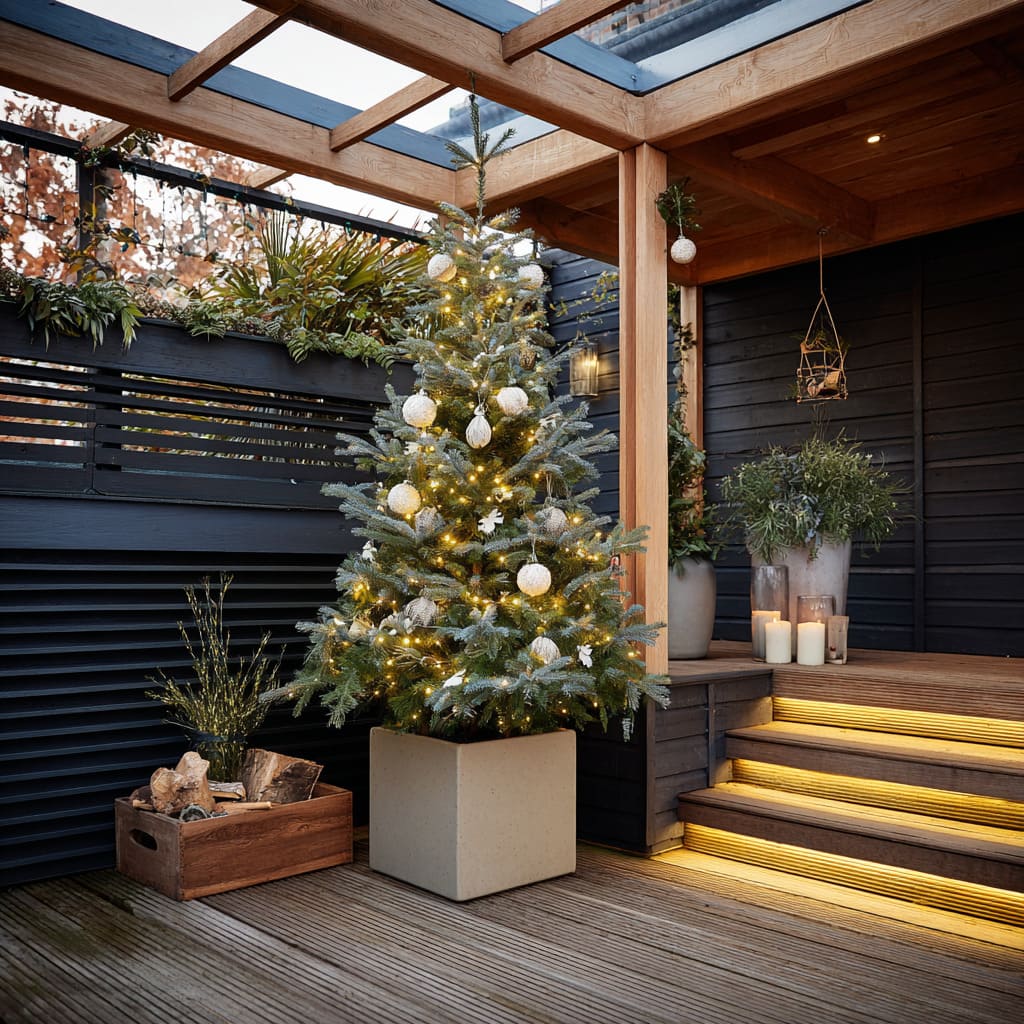
That openness becomes part of the structure. On a pergola-covered deck, strands of lights are not draped to cover but spaced to allow the slatted walls and shadows behind to remain visible.
Bare branches peek through, offering a shifting rhythm of light and dark that reacts to the background instead of hiding it.
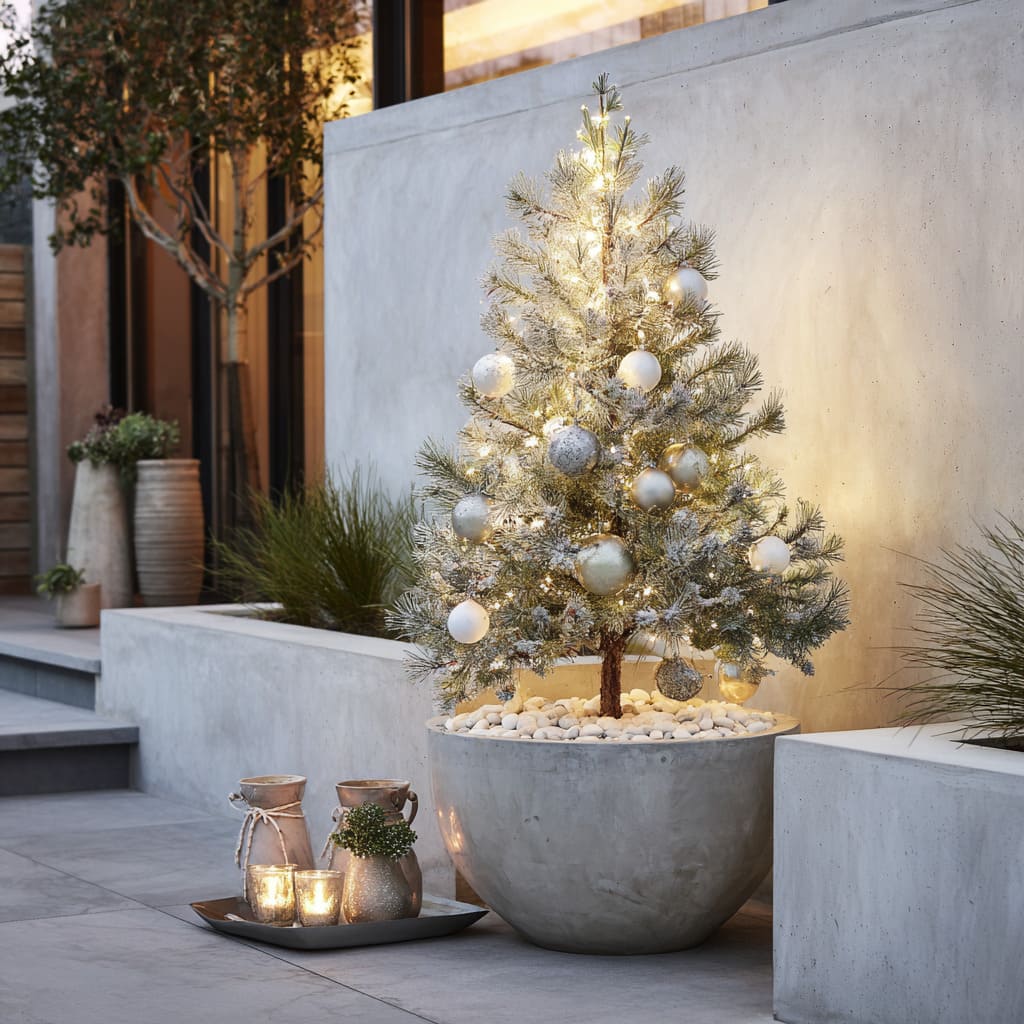
A snow-dusted tree in a wide bowl planter makes this even more visible. With its slender shape and thinly lit limbs, the full branch structure is revealed against a warm vertical wall.
The open space between branches becomes a grid of soft light and falling shade. In some setups, the gaps between lights are just as important as the bulbs themselves—they allow the design to breathe, stretch, and hold tension.
These compositions feel less like holiday decoration and more like a quiet spatial study—where rhythm, shadow, and air are all part of the layout.
Material Echo and Site Connection
What makes some modern setups for decorating outside trees for Christmas feel so visually grounded is the way they echo their environment. Materials aren’t randomly chosen—they respond to what’s already there.
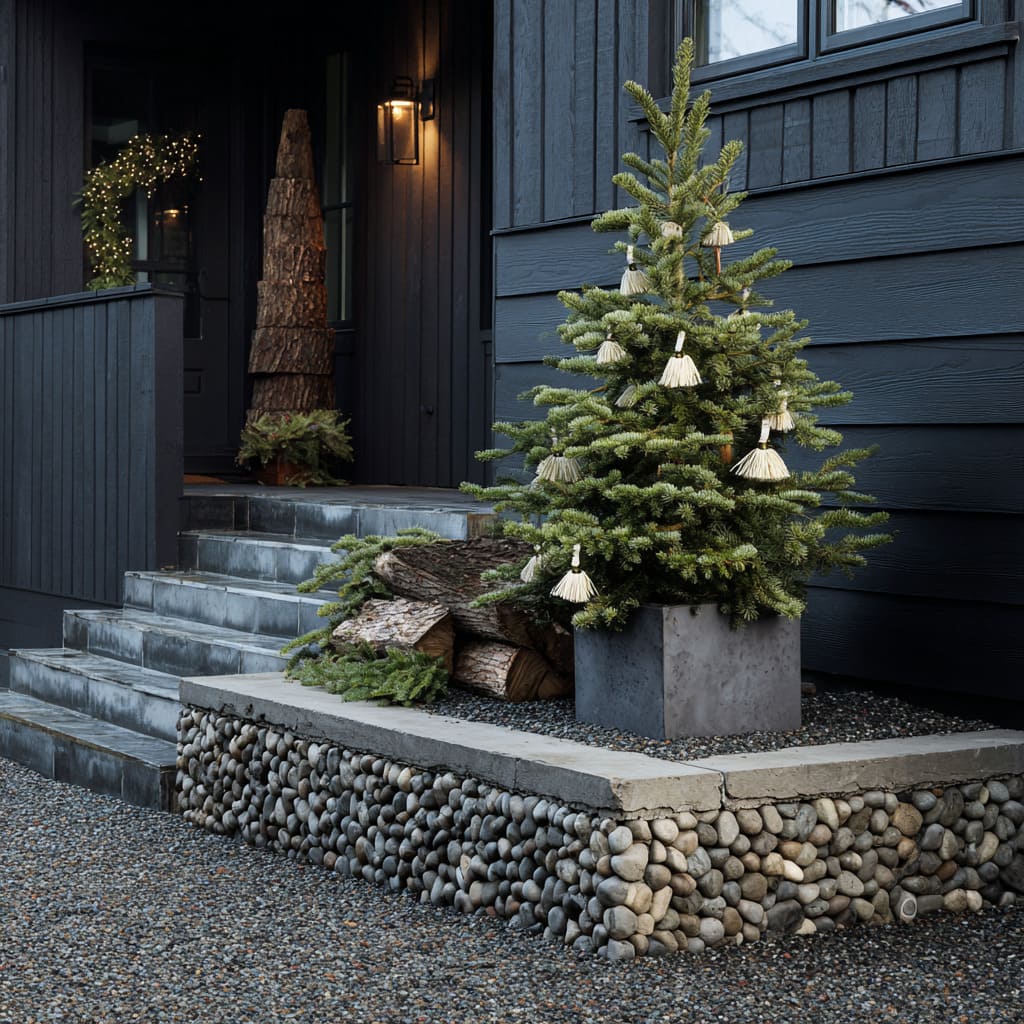
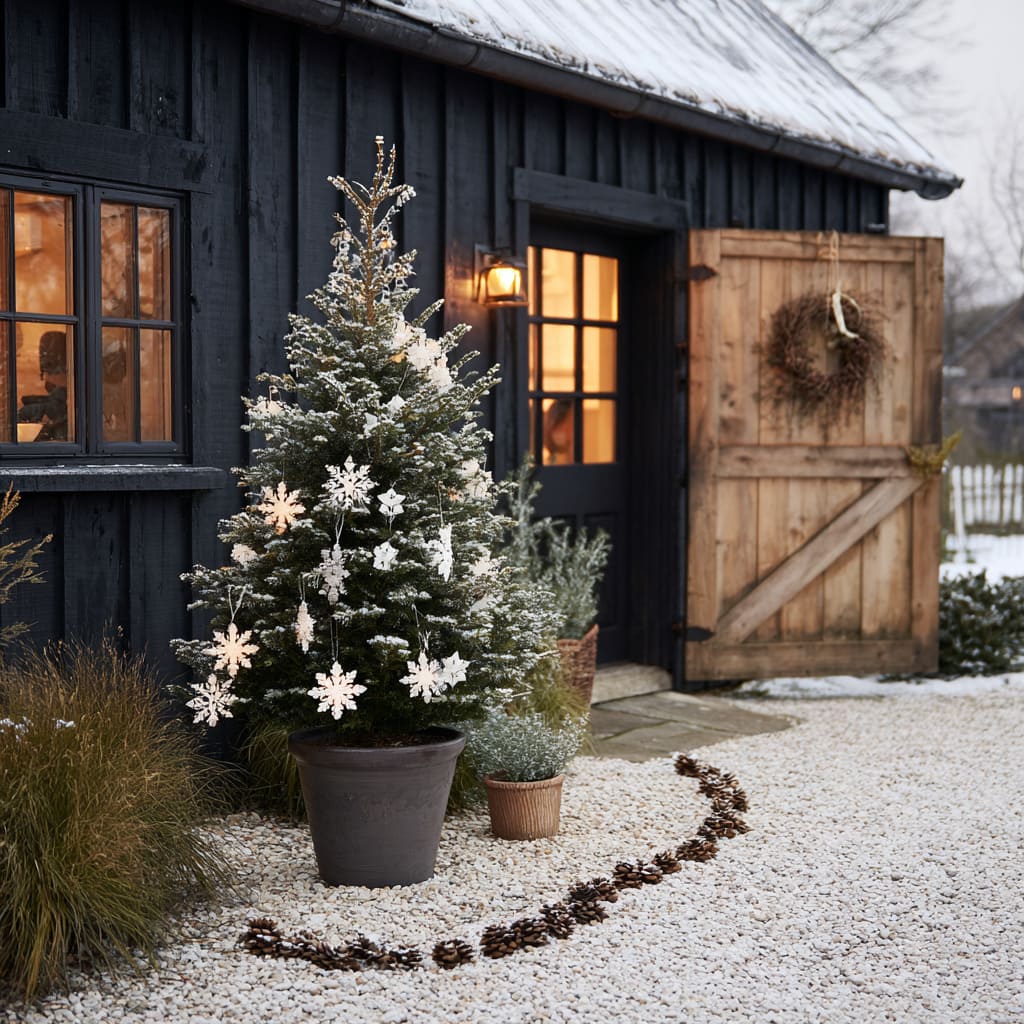
A tree placed beside charcoal-painted siding might wear pale tassels that echo the wood’s grainy texture, adding softness without stepping away from the palette. A warm-toned patio can reflect its wall paneling in small copper elements, placed not for attention but for cohesion.
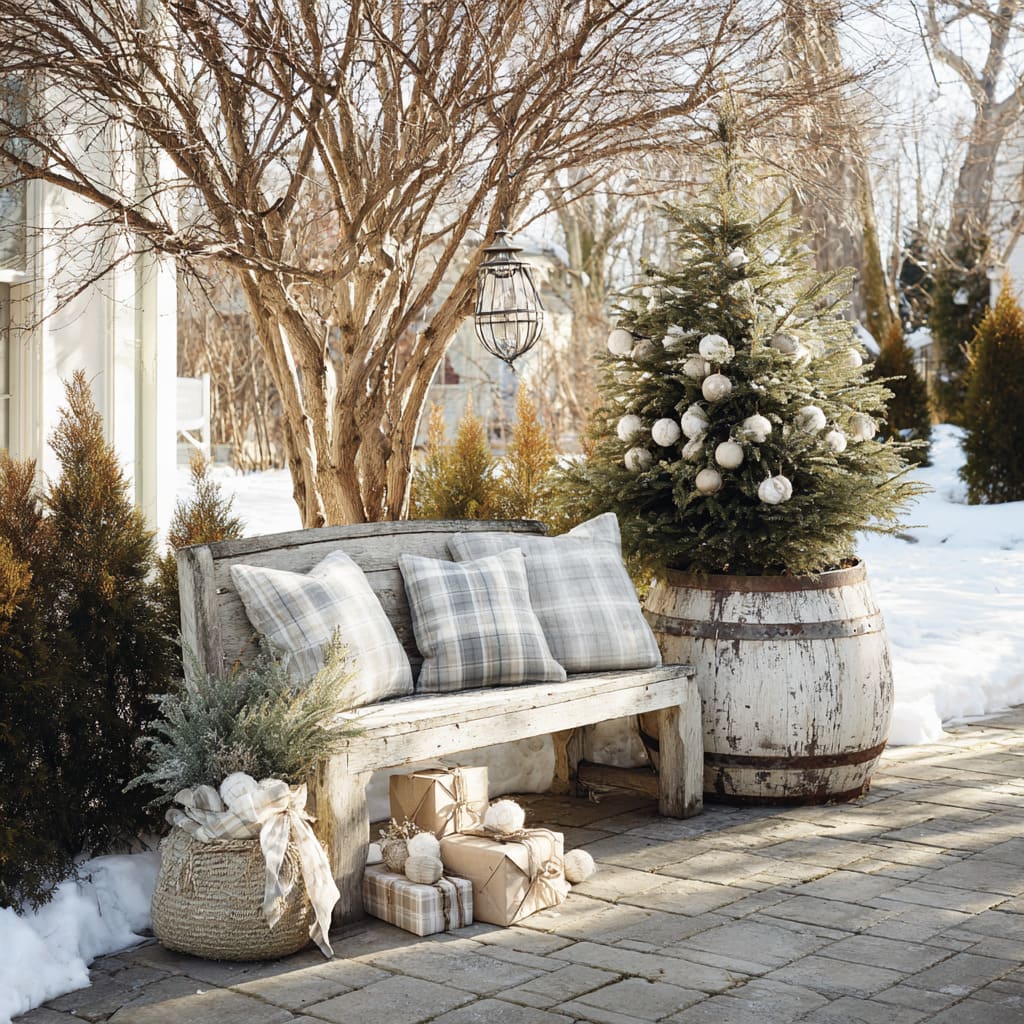
These subtle echoes are everywhere. Pinecones around a planter may pick up the color of nearby trim.
A woven ribbon might mirror the lines of a deck’s railing. Even the surface of the planter itself—matte concrete, warm ceramic, or rough terracotta—often ties back to the walls, pavers, or siding it sits beside.
This alignment pulls the entire setting into one composition, where the tree feels like part of the space instead of something added on top. It’s this blending that gives outdoor holiday decorating a new kind of depth—rooted in texture, tone, and thoughtful repeat.
Ornament Shapes as Mini Sculptures
In many of the current ideas for decorating an outdoor Christmas tree, ornaments no longer act as filler—they stand on their own, with scale and shape that feel deliberate and textured. Instead of relying on small, glossy spheres clustered in bulk, such setups focus on forms that read like objects with weight.
Large ribbed paper globes, wooden slices etched with wintry motifs, or sculpted clay pieces hang in sparse arrangement, creating moments of pause. Their size alone alters how the tree is viewed—forcing the eye to read each one before taking in the full composition.
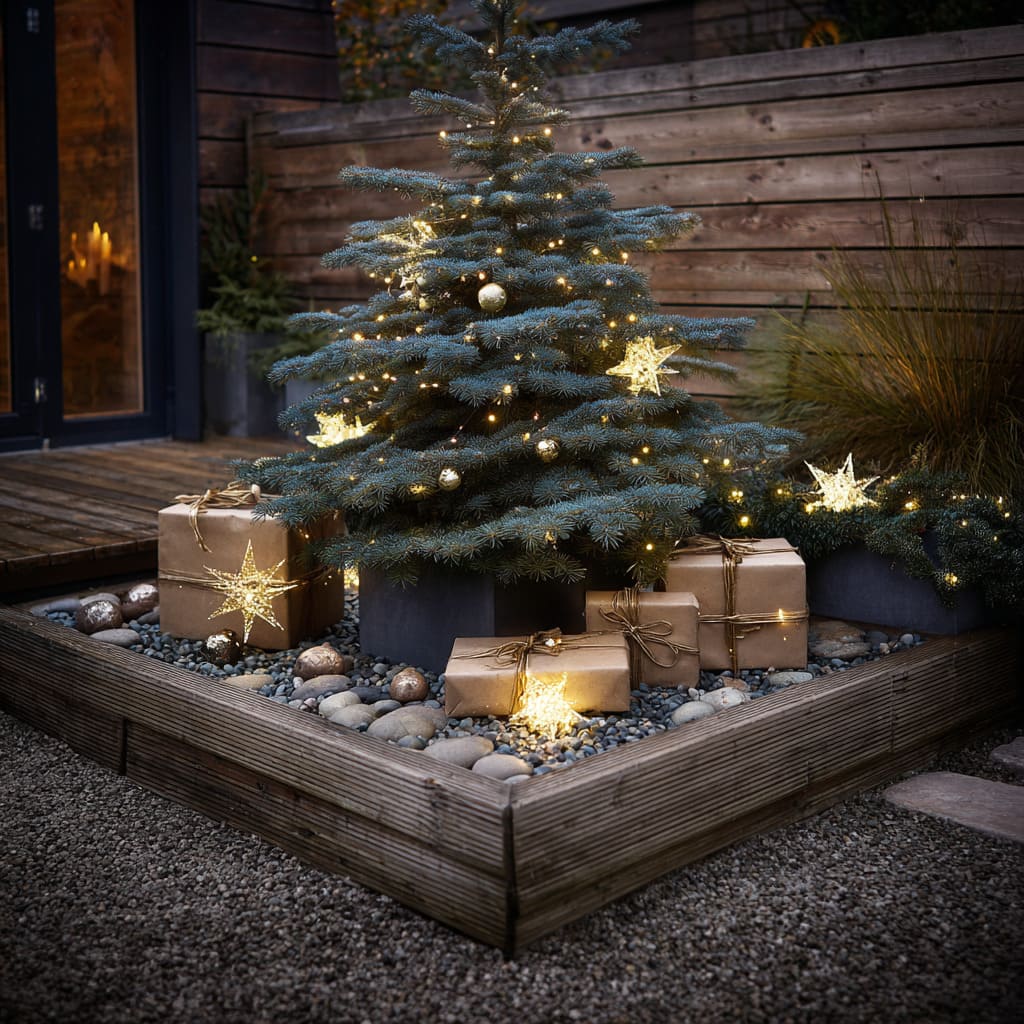
Geometric stars crafted from metal wire, for instance, introduce sharp contrast to soft branches, while lantern-shaped decorations add vertical rhythm. These pieces don’t just decorate—they interrupt the pattern of needles and light, creating pockets of shadow, silhouette, and reflection.
Some hang freely, catching movement in the wind. Others are oversized for their tree, producing a scale play that’s quietly playful.
The result is closer to outdoor sculpture than seasonal décor—a tree that holds visual rhythm through form, not volume.
Guided Gaze through Layered Details
Careful placement of small supporting elements gives structure to the broader view. Instead of filling space, these outdoor Xmas tree ideas often lead the eye from point to point with subtle markers.
A linen ribbon wrapped diagonally pulls attention across the branches, creating a soft visual path that guides downward to a base element—a grouping of birch logs, or a bowl of bright citrus. Each item feels connected, yet separated by space that allows them to register individually.
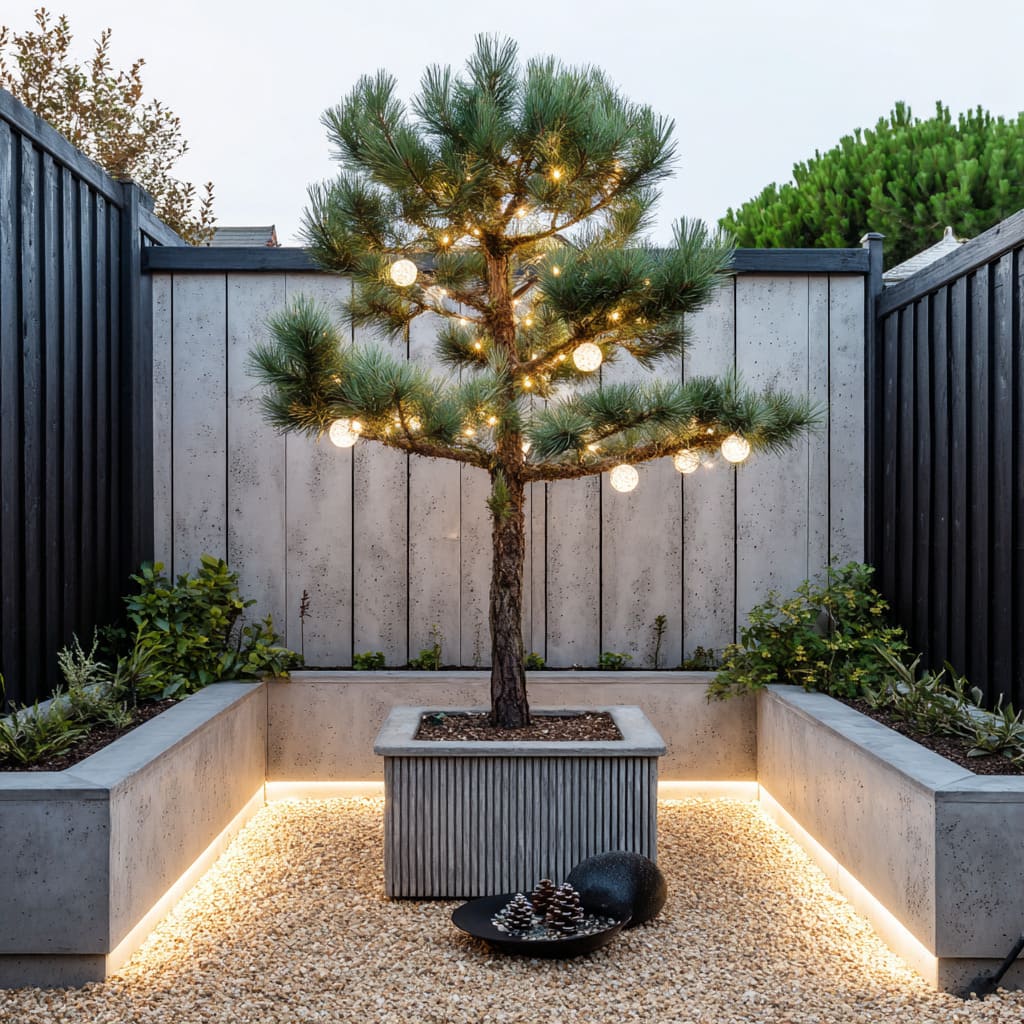
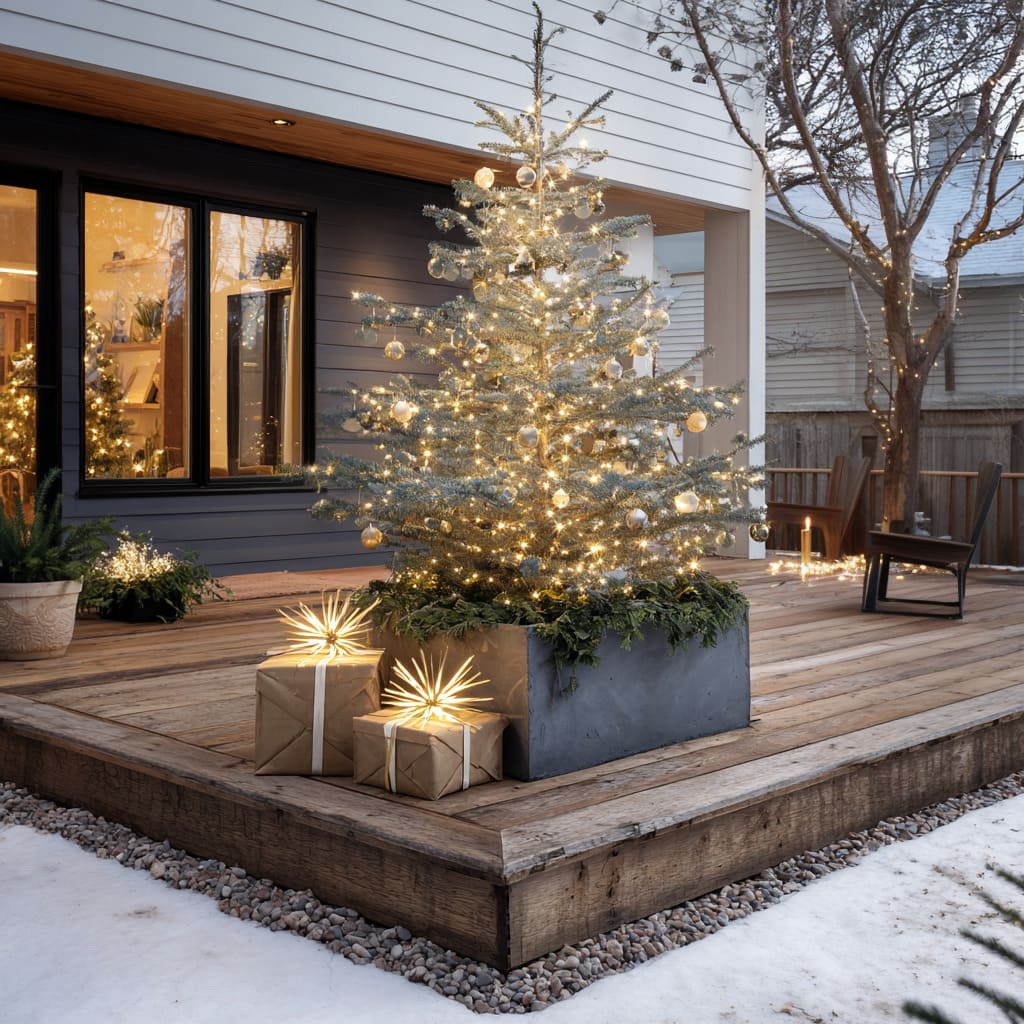
This layering isn’t excessive—it’s paced. At a raised deck scene, glowing starbursts placed atop gift boxes become more than lighting; they echo the shape of the tree above, repeating that tapering outline at a smaller scale.
In other cases, a string of lights may travel from tree to seating area, pulling your gaze across zones. Everything is placed with rhythm in mind—foreground to middle to background.
These quiet anchors work together to stage the entire view, letting each element hold its moment without pushing for attention. It’s this kind of restraint and composition that gives such setups their sense of focus, even when the materials are few.
Fusion with Furniture and Seating
What stands out in many of today’s most thoughtful outdoor setups is how easily furniture becomes part of the holiday scene. Trees aren’t planted in isolation—they’re paired with benches, deck platforms, swings, or built-in seating areas that absorb them into the overall composition.
Under-bench LED lighting doesn’t only illuminate—it defines. It outlines the edge of a space, casting soft warmth across gravel or wood, while giving the tree a grounded sense of place.
A light ribbon under a seat edge can give the illusion that the whole space hovers.
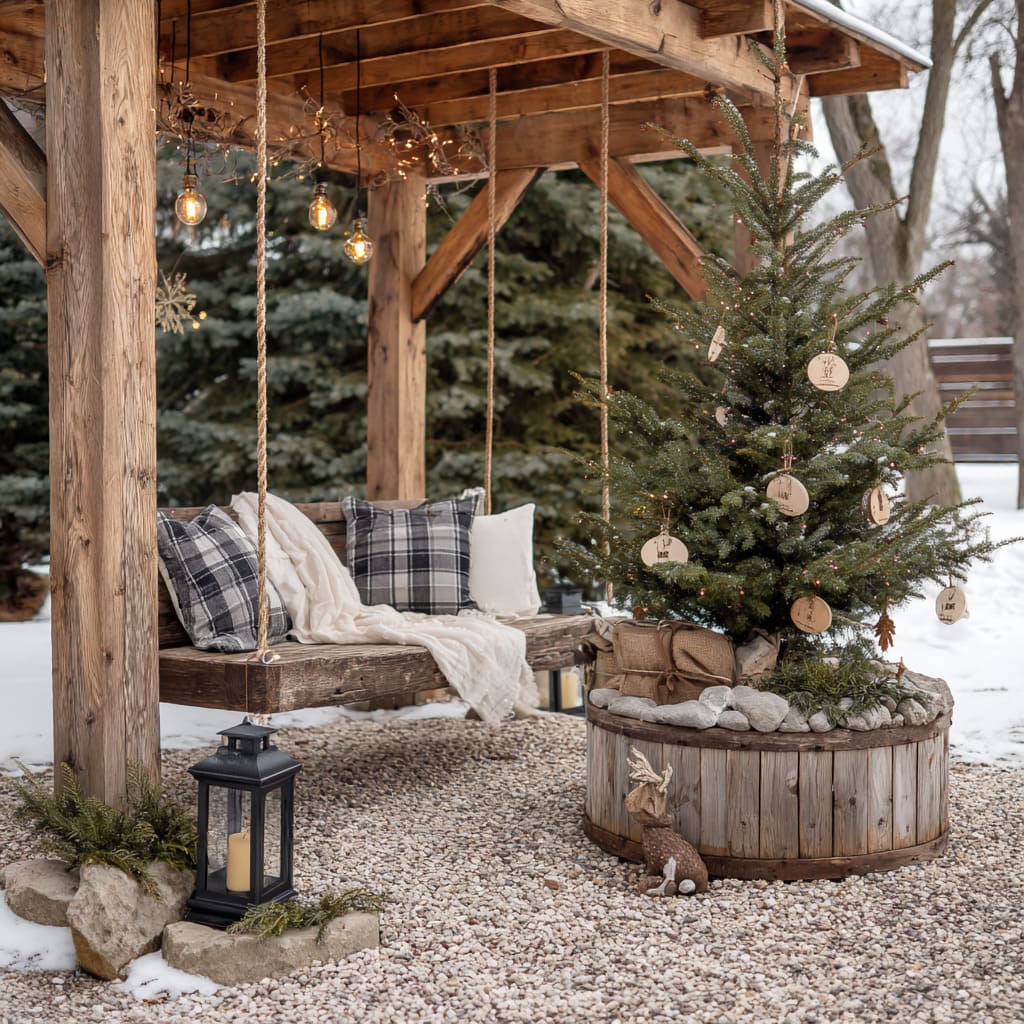
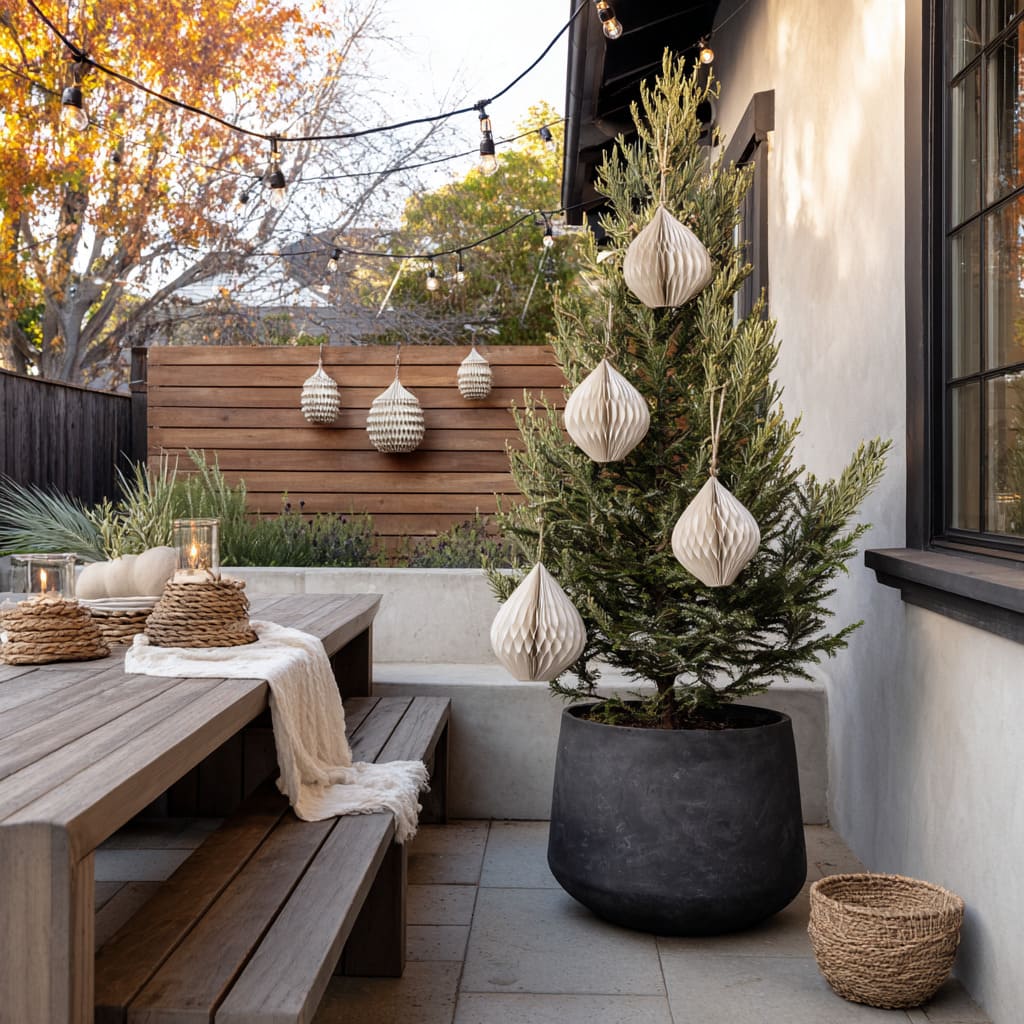
In more casual setups, a swing bench or picnic table plays a quieter role. Draped throws and soft cushions echo the color palette of nearby decorations.
A tree in a barrel planter might sit just beside a suspended seat, and the proximity alone softens the display—giving it the look of a lived-in corner rather than a styled feature. These elements shift the tree from centerpiece to component.
It becomes part of where people sit, linger, and talk, which adds comfort to form without over-explaining it. This balance is often missing from traditional layouts, and it’s one of the more understated shifts shaping ideas for decorating outside trees for Christmas.
Handcrafted Texture to Counter Uniformity
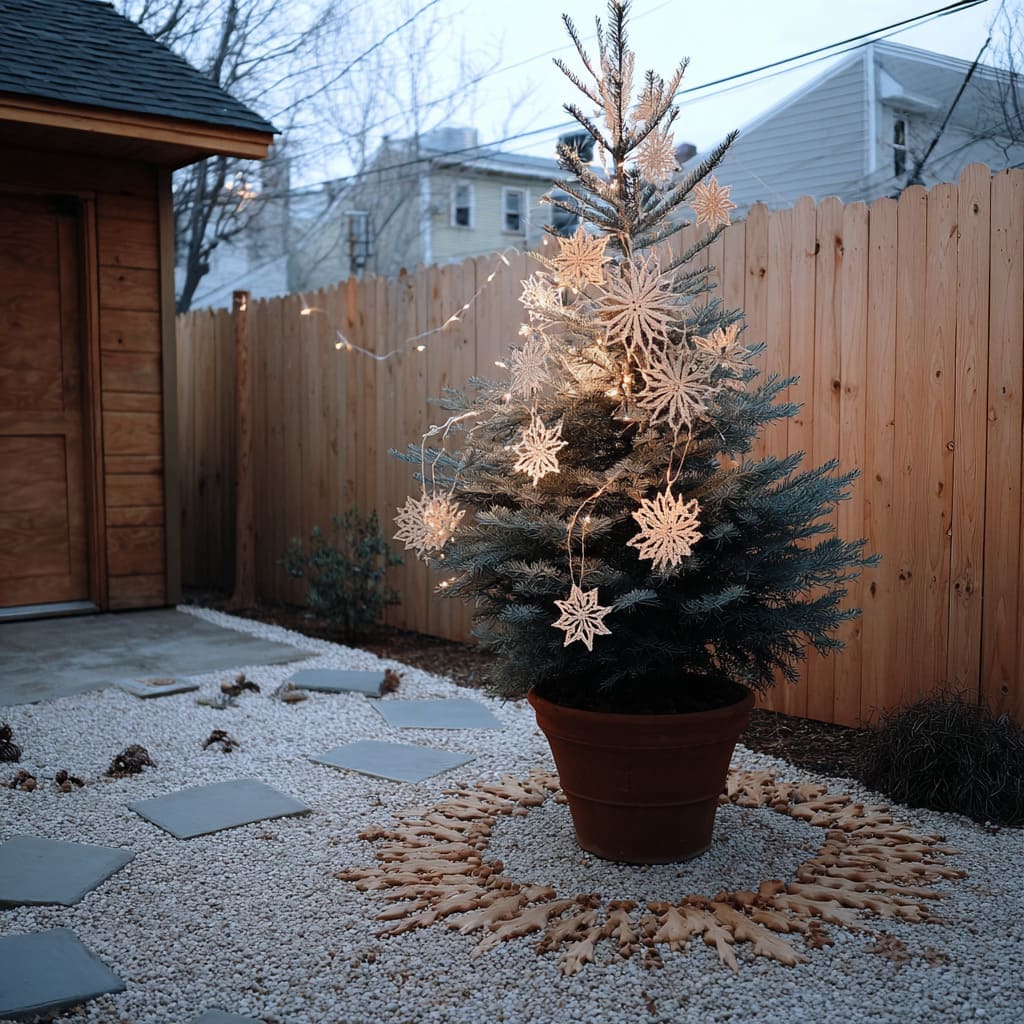
A well-balanced outdoor setup often mixes sleek materials with something that feels handmade—bringing texture, warmth, and variation that interrupts too much polish. Where modern planters and smooth siding set the tone, pieces like yarn snowflakes or kraft-paper boxes bring the relief.
It’s this kind of human-scale imperfection—crocheted stars, roughly cut paper ornaments, twine-tied bundles—that makes the scene feel less like a storefront window and more like a real home setting.
These handmade items aren’t treated as fillers—they’re focal in their own way. Their tactile quality draws the eye, especially when placed in high contrast against matte concrete or brushed metal.
A soft ornament made from natural fiber becomes a counterpoint to a clean-lined backdrop. And because these materials carry trace textures—woven ridges, frayed edges, hand-folded creases—they bring softness that light alone can’t create.
In a layout where every piece counts, this kind of visual break is what keeps the setup from feeling too still, too perfect, or too far removed from touch.
Unexpected Focal Moves
What defines many of today’s standout setups is how they shift the attention away from the tree itself. Instead of making the evergreen the automatic centerpiece, some ideas for decorating outside trees for Christmas position the tree as part of a shared visual dialogue.
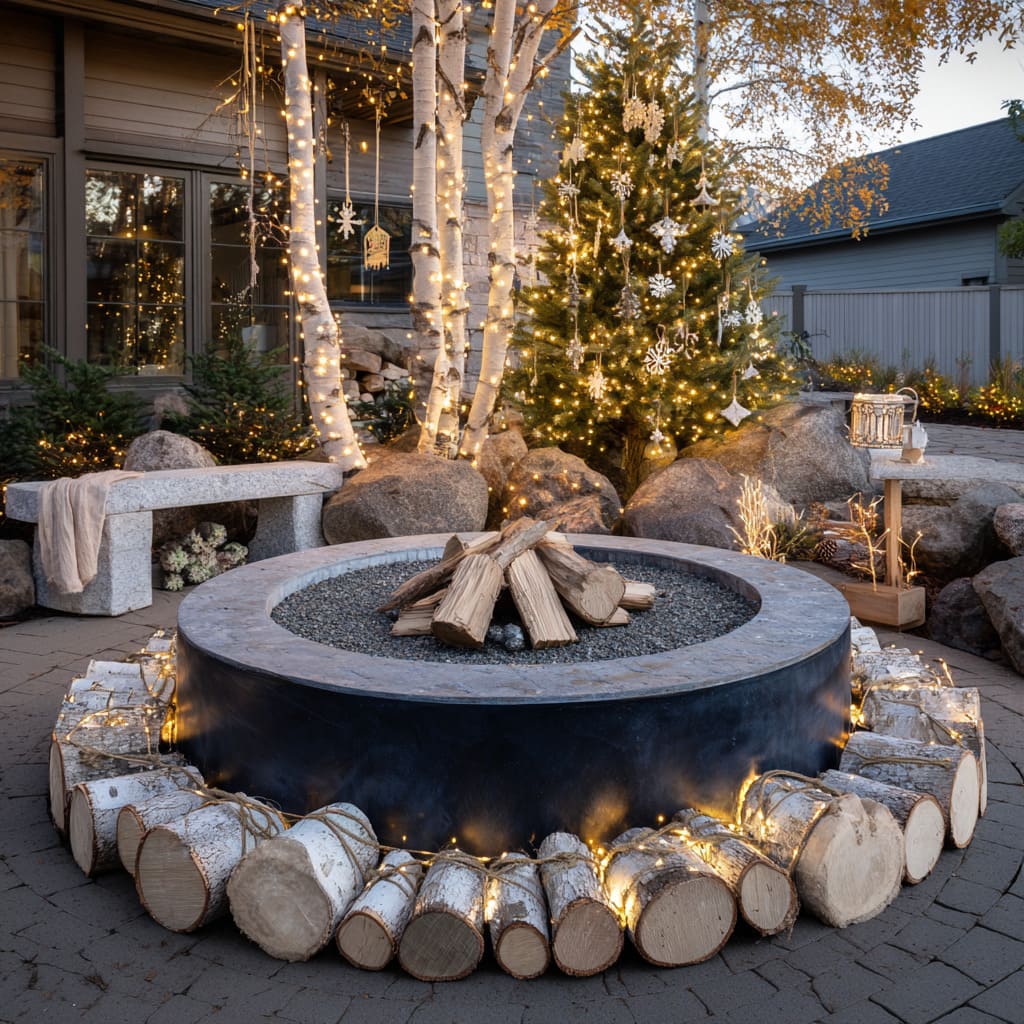
A bare deciduous specimen, lightly dusted with snow and wrapped in glowing string lights, may become the central piece—its branching form acting like a seasonal sculpture. In another layout, a fire pit encircled by lit birch logs turns the warmth of the setting into the anchor, with the Christmas tree playing a quieter supporting role.
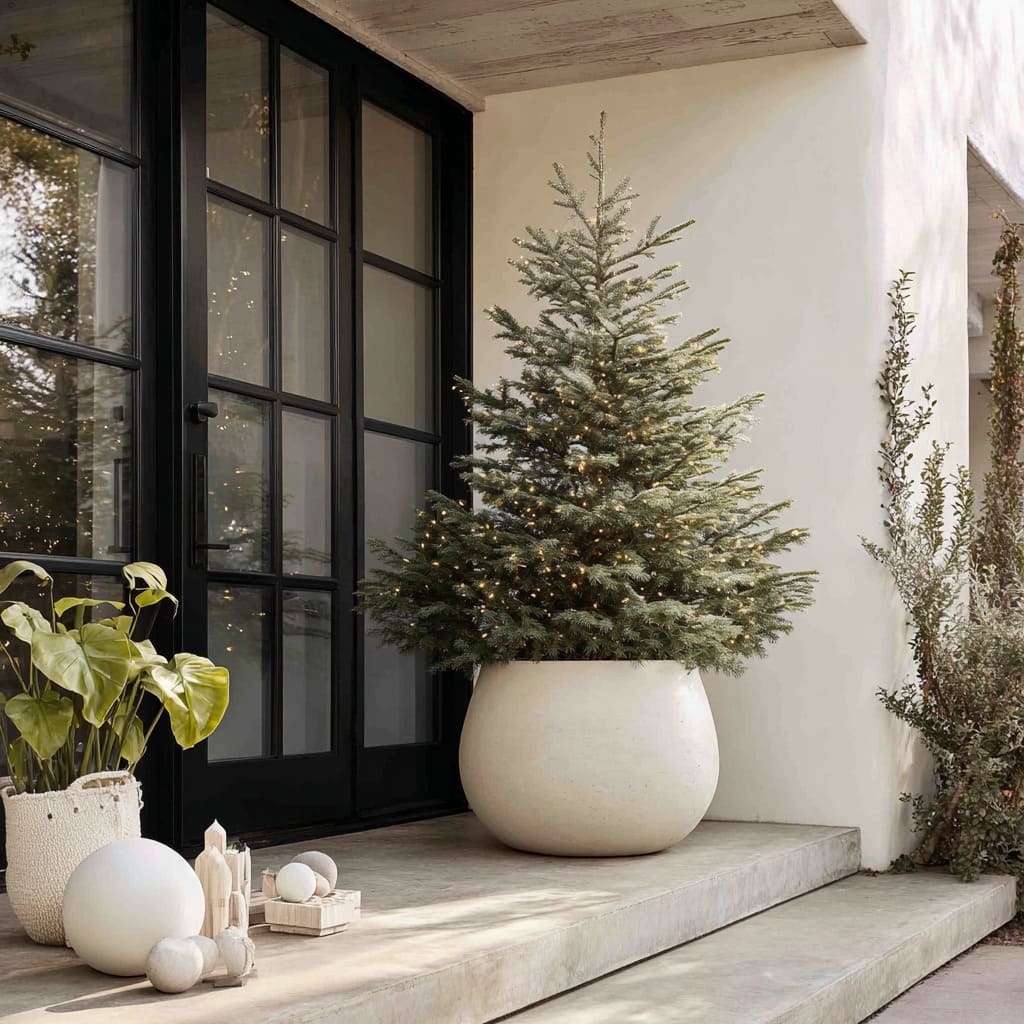
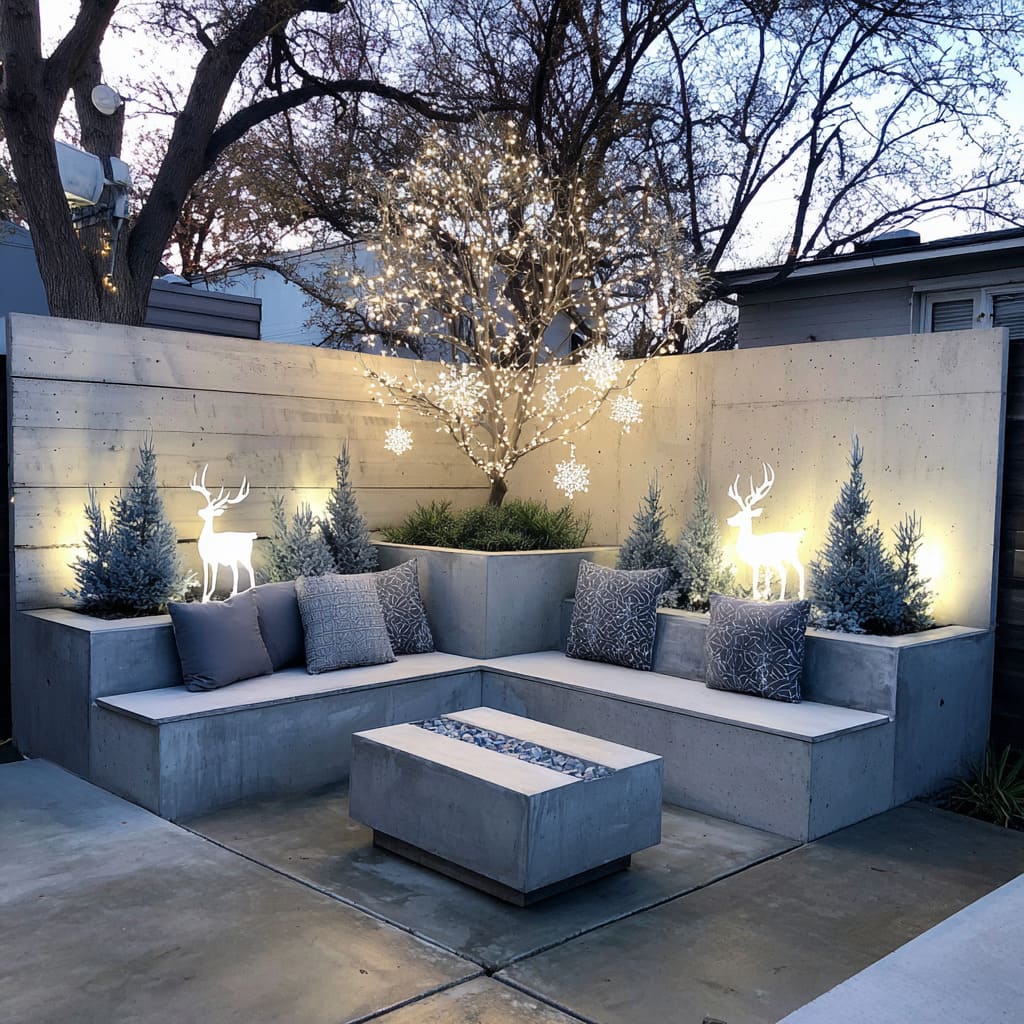
Even a grouping of low, frosted pines along a built-in bench can carry the mood more strongly than a tall, ornamented tree ever would. These shifts create a broader stage—one where the tree no longer commands every glance, but integrates into a layered space filled with rhythm, contrast, and variation.
This approach allows lighting, objects, and landscape elements to interact visually. It also changes how the space feels in motion—viewed from different angles, the focus shifts, and the story unfolds in parts.
That balance is rarely seen in traditional layouts where the entire scene orbits around a single tall fir.
How This Differs from Traditional Décor
The contrast with conventional setups is easy to spot—but what makes this style feel new is how consistently these choices hold together.
- Color is kept tight. No floods of red and green—just a refined mix of neutrals, soft metallics, and one accent hue at most.
- Ornaments are few, but considered. No bauble overload. A single oversized shape may hold more impact than a dozen standard ones.
- Light is used to shape. It’s not sprayed across every surface—it traces, defines, and even floats.
- Surfaces echo the setting. Concrete planters pick up the tone of the walls. Wood ornaments reflect the decking. Nothing jars.
- Space is left open. Gaps between lights, bare areas of gravel, and clean bench lines make room for shadow and shape.
- Furniture folds into the scene. A swing, a deck edge, or a built-in seat becomes part of the tree’s visual rhythm.
- Handcrafted pieces show up. Paper ornaments, yarn textures, natural wrapping—they contrast softly against clean structures.
These aren’t decorations layered on top—they’re part of the space. Everything from the planter material to the shape of a light fixture connects with the layout.
The overall feel is quieter, more focused, but richer in visual language. It’s a shift from visual overload to visual intent—where shape, scale, and material set the tone, and every piece earns its place.