Modern interior designs increasingly treat curtains as active design elements rather than quiet background pieces. Instead of small repeating prints or purely functional fabric, window panels now behave like vertical artworks that shape light, organize space, and set the emotional tone of a room.
Through large-scale motifs, refined color fields, layered sheers, sculptural folds, and thoughtful composition, modern interiors use curtains to define entire atmospheres—soft, dramatic, botanical, geometric, or calm—while supporting the overall flow of furniture and decor.
Curtains as Vertical Art
Curtains can be planned as large artworks rather than neutral backdrops. Instead of small repeating motifs, the fabric surface often behaves like a mural that fills the height of the wall and organizes the whole composition of the room.
This approach is at the core of many modern window curtain ideas, where the textile becomes the primary carrier of mood and visual direction. Typical characteristics of this “vertical art” approach include:
- Overscaled motifs
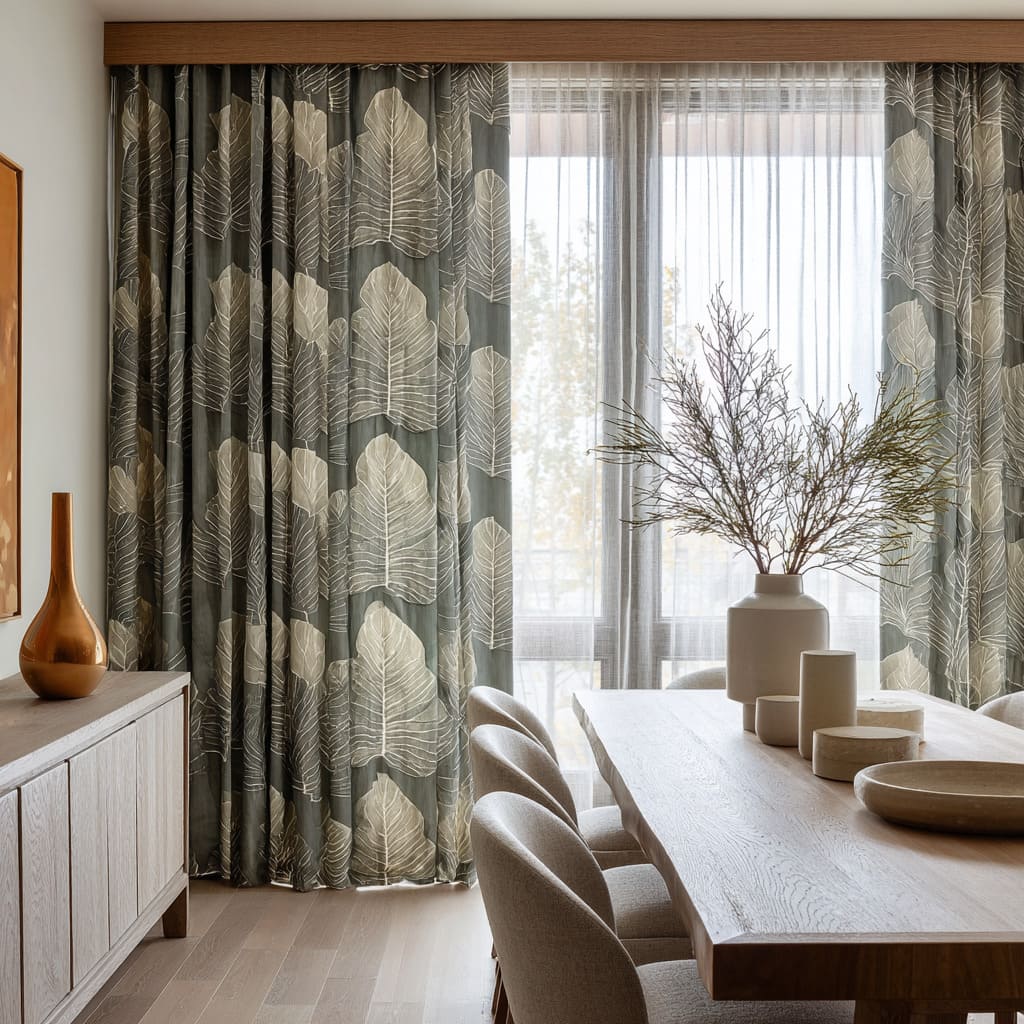
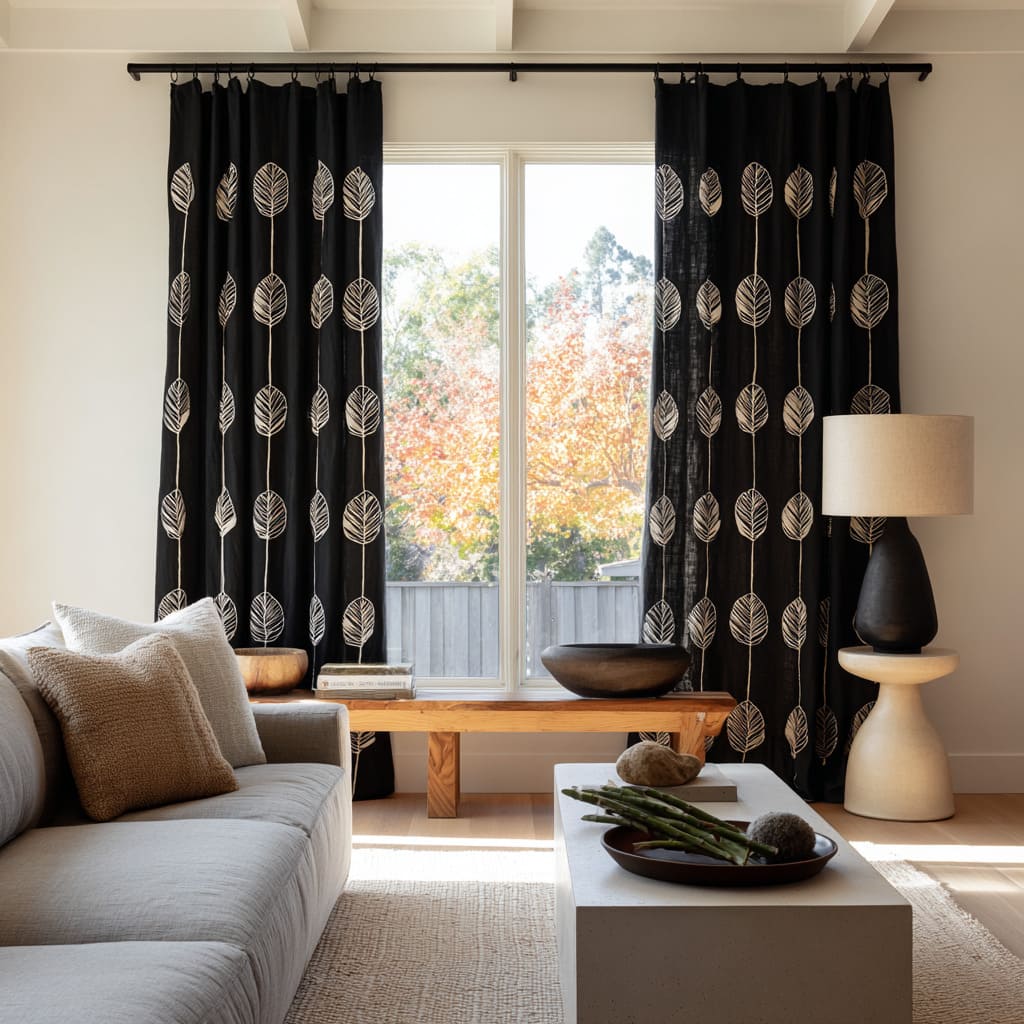
- Leaf silhouettes that read almost like a wall of foliage.
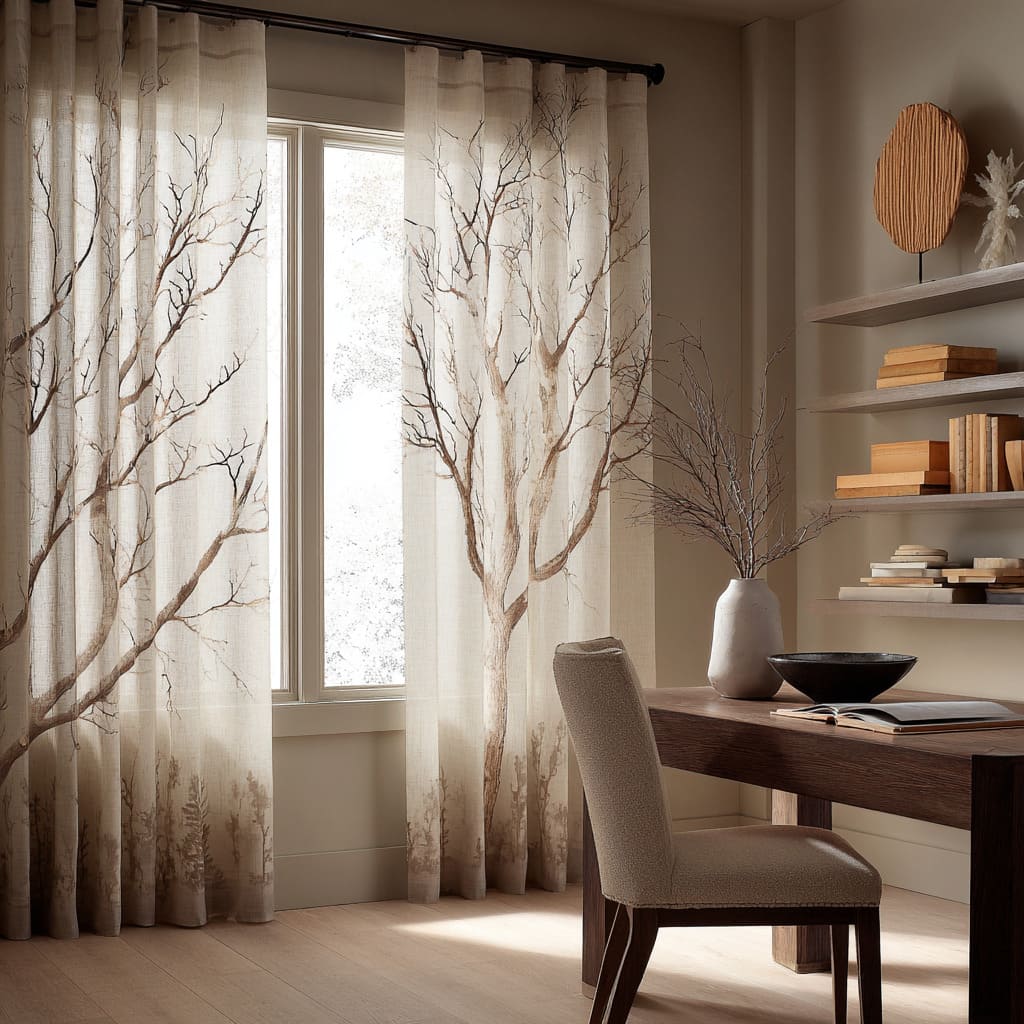
- Tree graphics that rise from floor to rod and feel like a stylized grove.
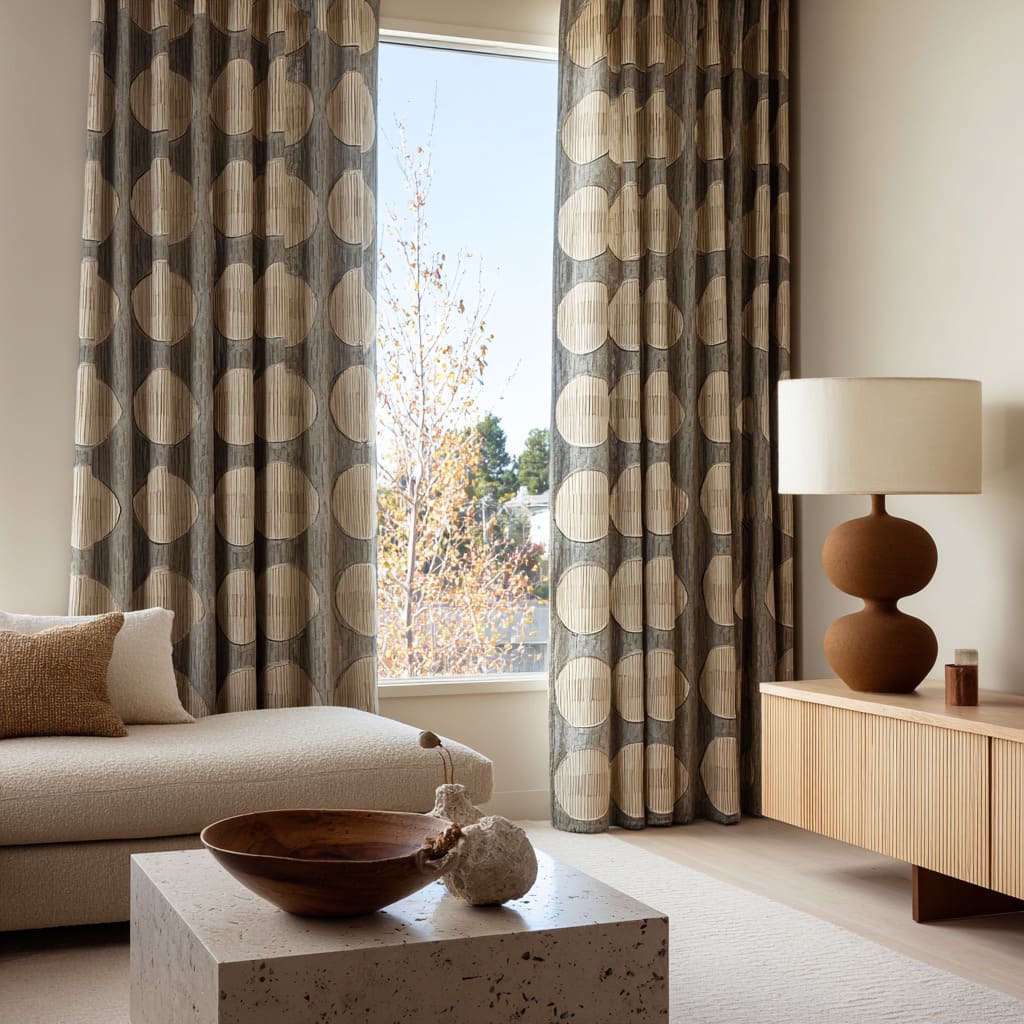
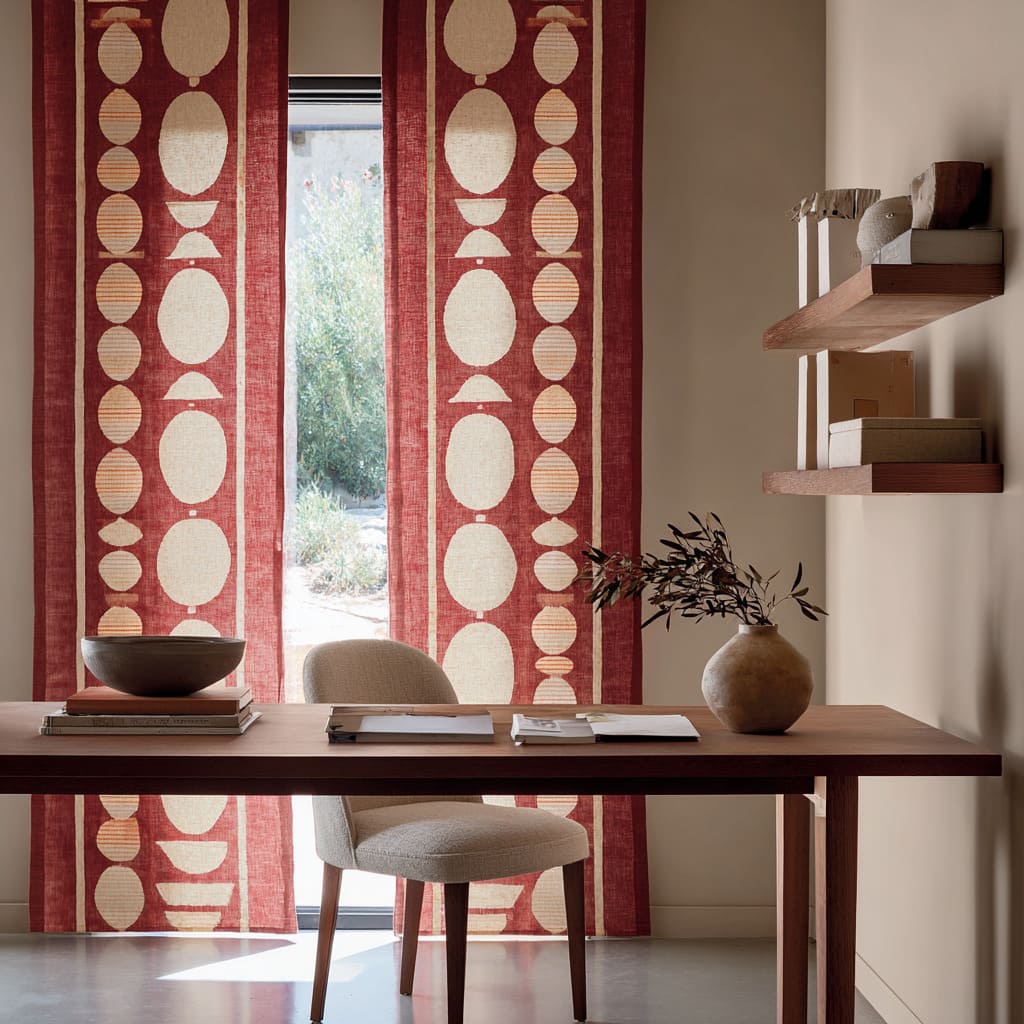
- Large circles, orbits, and disks that occupy an entire fold rather than a tiny portion of the cloth.
- Motifs intentionally placed near eye level, at the hem, or in strong vertical bands instead of scattered randomly.
- Walls, cabinets, and upholstered pieces often stay quiet and neutral, letting the textile “speak” for the room.
- Art on the walls is frequently reduced in size or kept subtle so it does not compete with the curtain field.
- The view outside becomes part of the composition, framed by the graphic textile as if it were a changing painting.
This mindset turns window fabric into a full-height canvas. Each window then holds one strong visual idea—forest, rippling water, lunar calendar, soft relief grid—and the rest of the room simply supports that choice.
Color Fields and Emotional Atmosphere
Curtain color can be treated less as an accent and more as an emotional field that quietly defines how a room feels at different times of day. Many schemes can be read as a sequence of color atmospheres, each intentionally tuned to the role of the space.
Within that broader family of modern window treatment ideas, several repeated color strategies appear:
Pale, light-catching neutrals
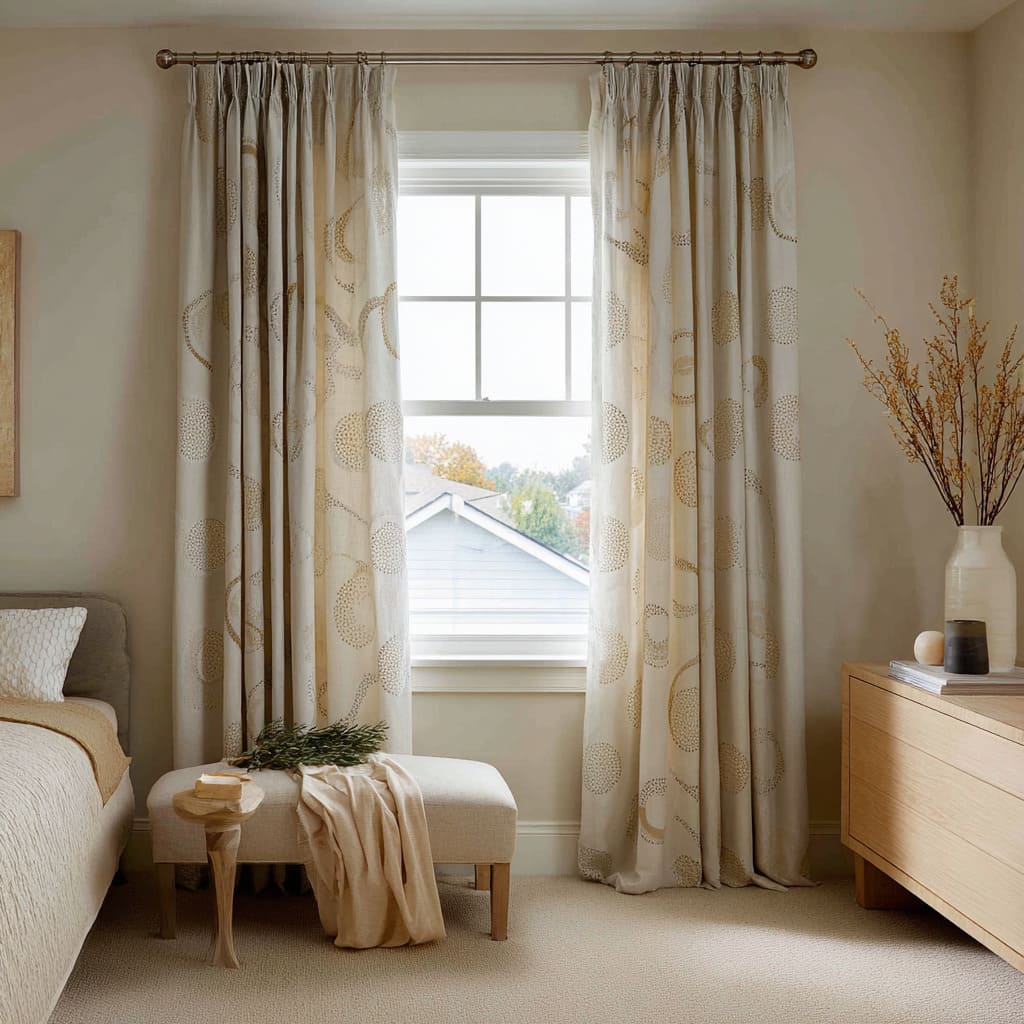
- Cream, oatmeal, sand, misty taupe, and stone shades wrap bedrooms and calm sitting areas in a soft envelope.
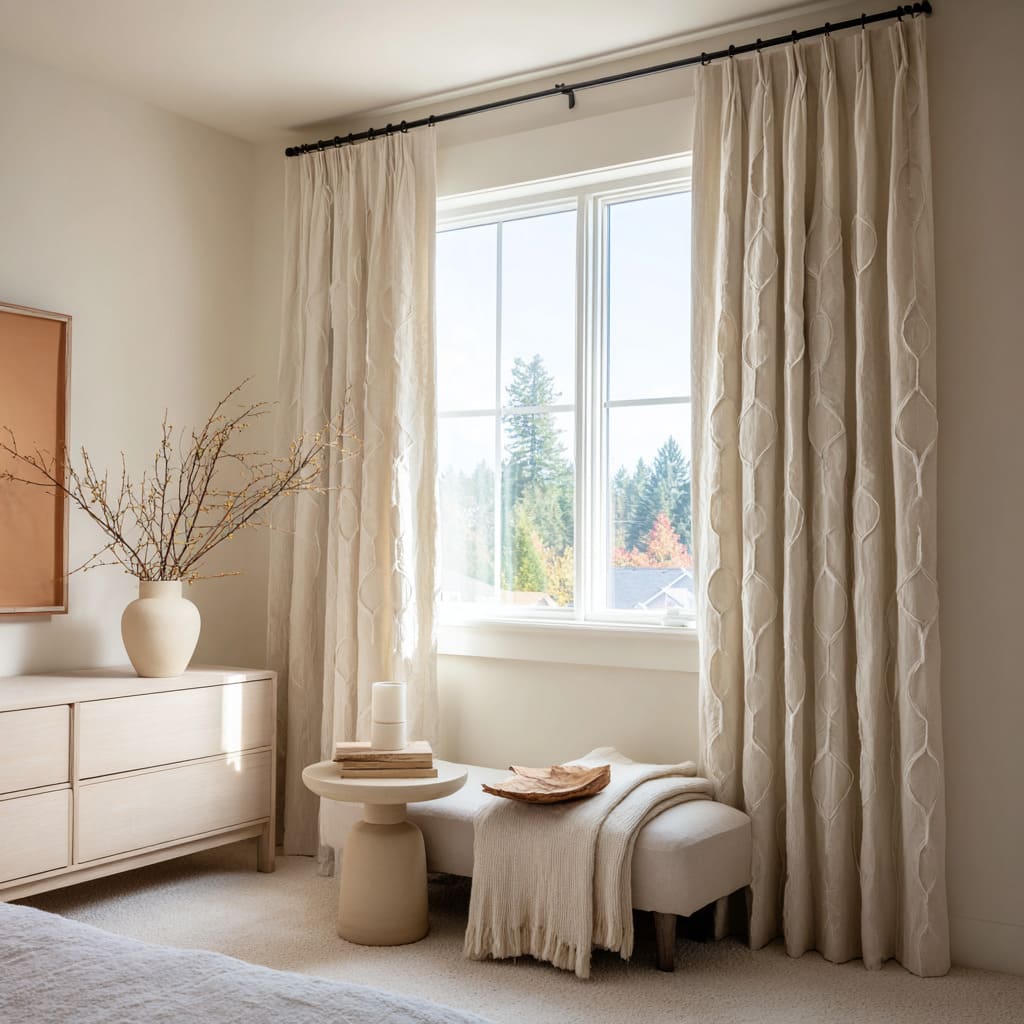
- Pattern is often tone-on-tone or expressed only through relief and shadow, so the color reads as one gentle field.
- Sunlight passing through pale fabric creates a glow that links walls, rugs, and upholstery into one continuous, calm volume.
Deep, saturated textiles
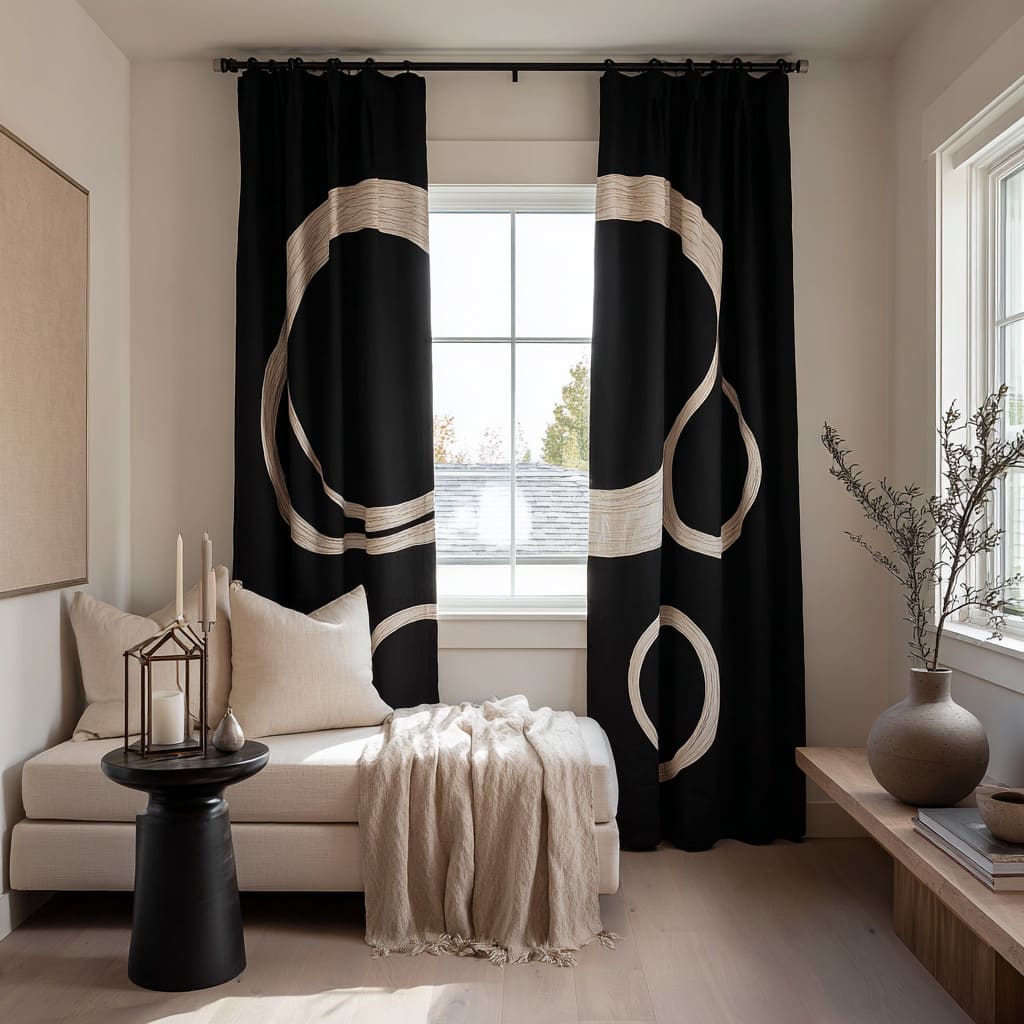
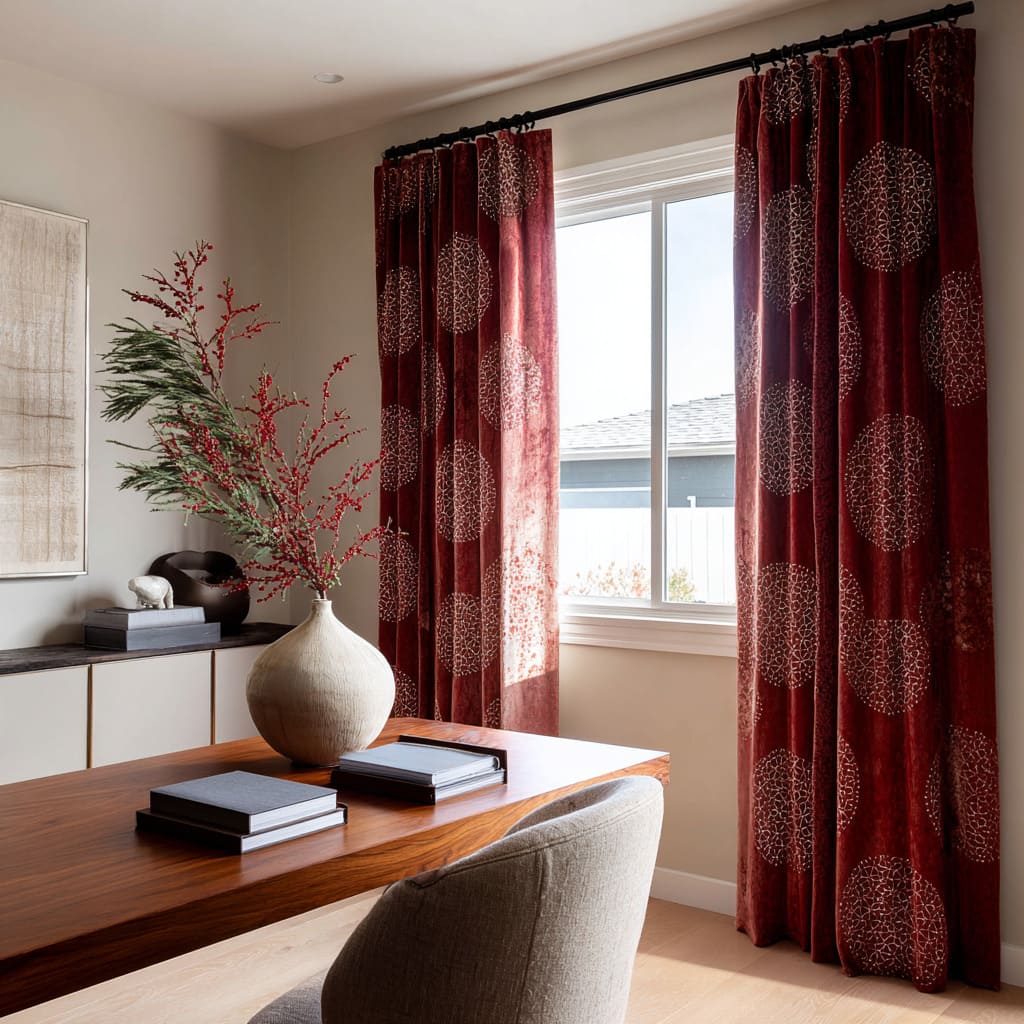
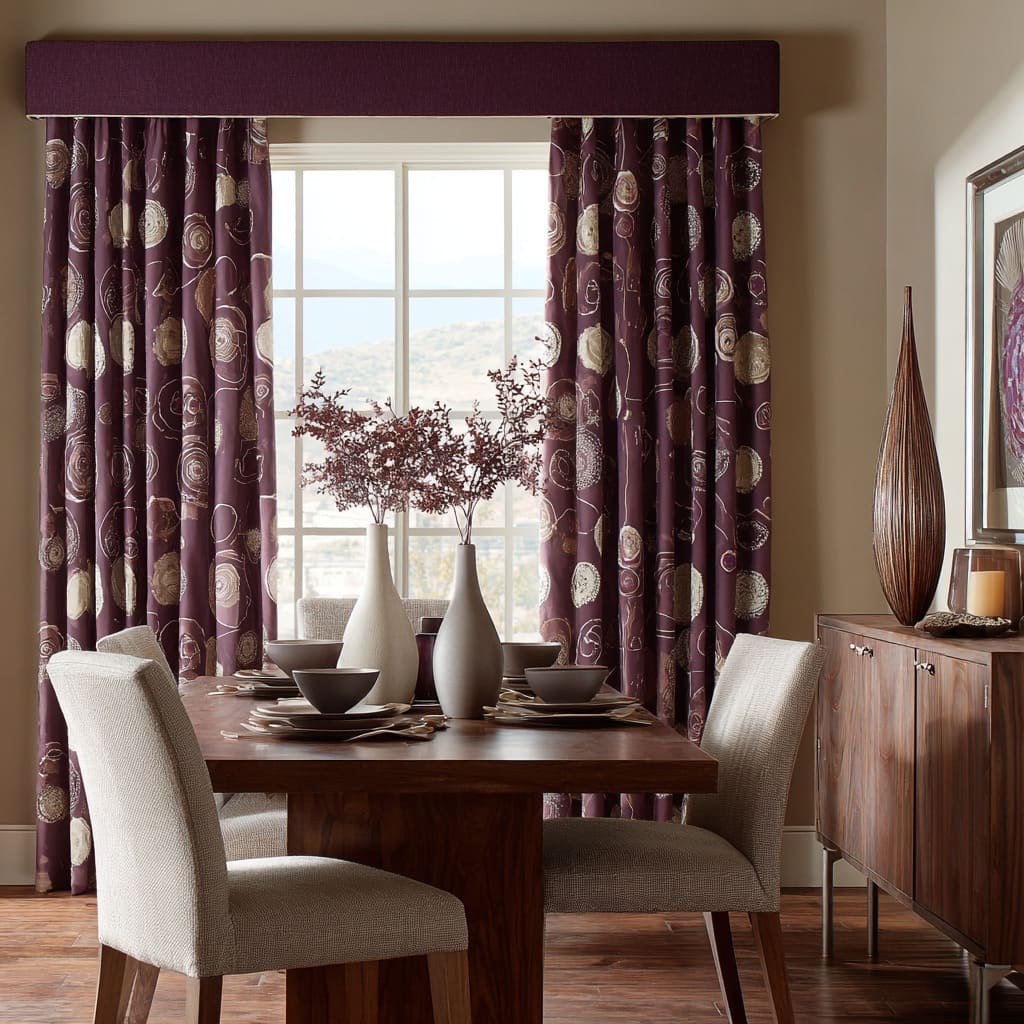
- Plum, berry, deep red, teal, charcoal, and black fabrics are reserved for dining areas, home offices, and living spaces that benefit from denser mood.
- Pale motifs (leaves, circles, tree silhouettes) glow strongly against the dark ground, creating depth without relying on shine.
- Such curtains often run from ceiling to floor and sit on rods that stretch wall to wall, so the color reads almost as a full textile wall.
Grounding and dipping at the hem
- Many designs introduce a darker or warmer band at the bottom, as if the curtain has been dipped in sand, taupe, or khaki dye.
- This creates a visual plinth that links the fabric to wood floors, stone tiling, and baseboards.
- The “dipped” effect also helps the curtain feel practical and rooted, especially in dining rooms and kitchens where use is frequent.
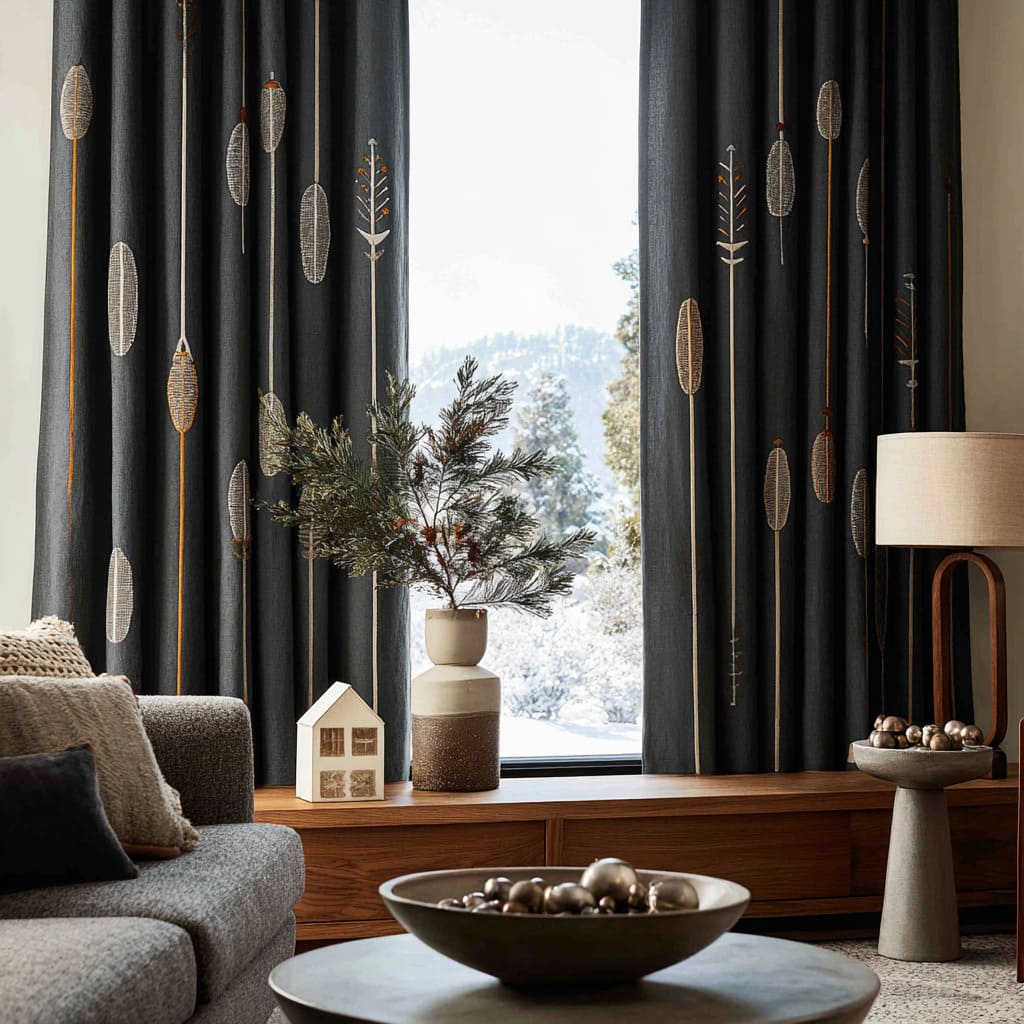
Color in such curtains is not simply decorative; it quietly manages psychological weight. Pale fields create breathing space; deep fields generate intimacy and enclosure; darker hems and bands offer balance so the fabric feels anchored rather than floating.
Circles, Orbits, and Soft Geometry
Modern striking textiles often rely on circular or rounded motifs, but these are rarely cute polka dots. Instead they form complex, layered systems that add structure and quiet movement to the window.
Many of such compositions sit comfortably under the wider umbrella of modern window covering ideas and show how soft geometry can carry the main narrative in a room. Key patterns include:
- Clustered dotted circles on neutral grounds
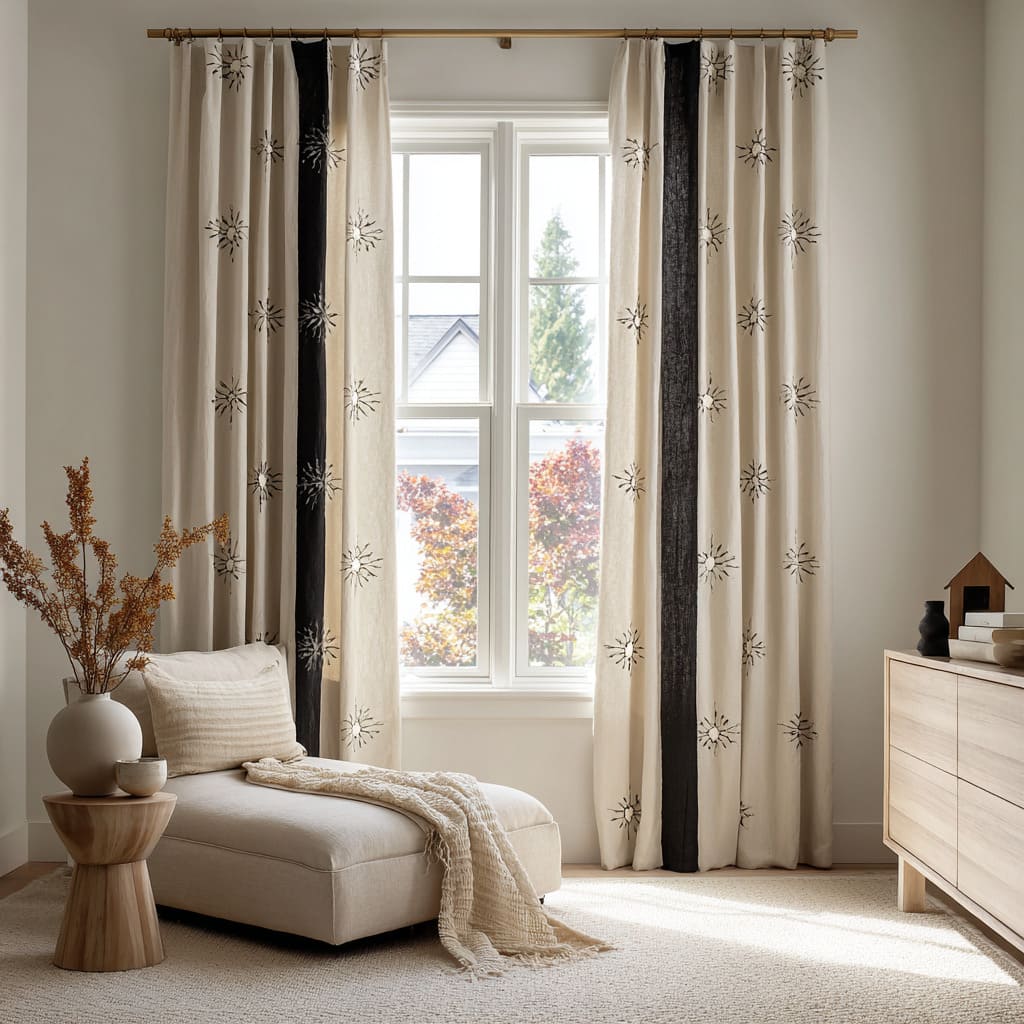
- Beige or cream panels scattered with dotted rounds in wheat or gold, appearing like faint suns or stylized flower heads.
- Density shifts within each circle, with some areas tightly stitched and others more open, giving a hand-drawn feel.
- Circles bending and fragmenting as folds form, which introduces a sense of slow drifting movement.
- Slate or berry curtains with loops, spirals, and rings in chalky or metallic tones.
- Regular rows of sand-colored circles with fine vertical stripes inside, forming a soft geometric grid.
- Curtains that resemble stacked coins or medallions, repeating in staggered columns so the pattern never feels mechanical.
- Interior elements—lamps with stacked bases, round vases, shallow bowls—echoing these shapes in three dimensions.
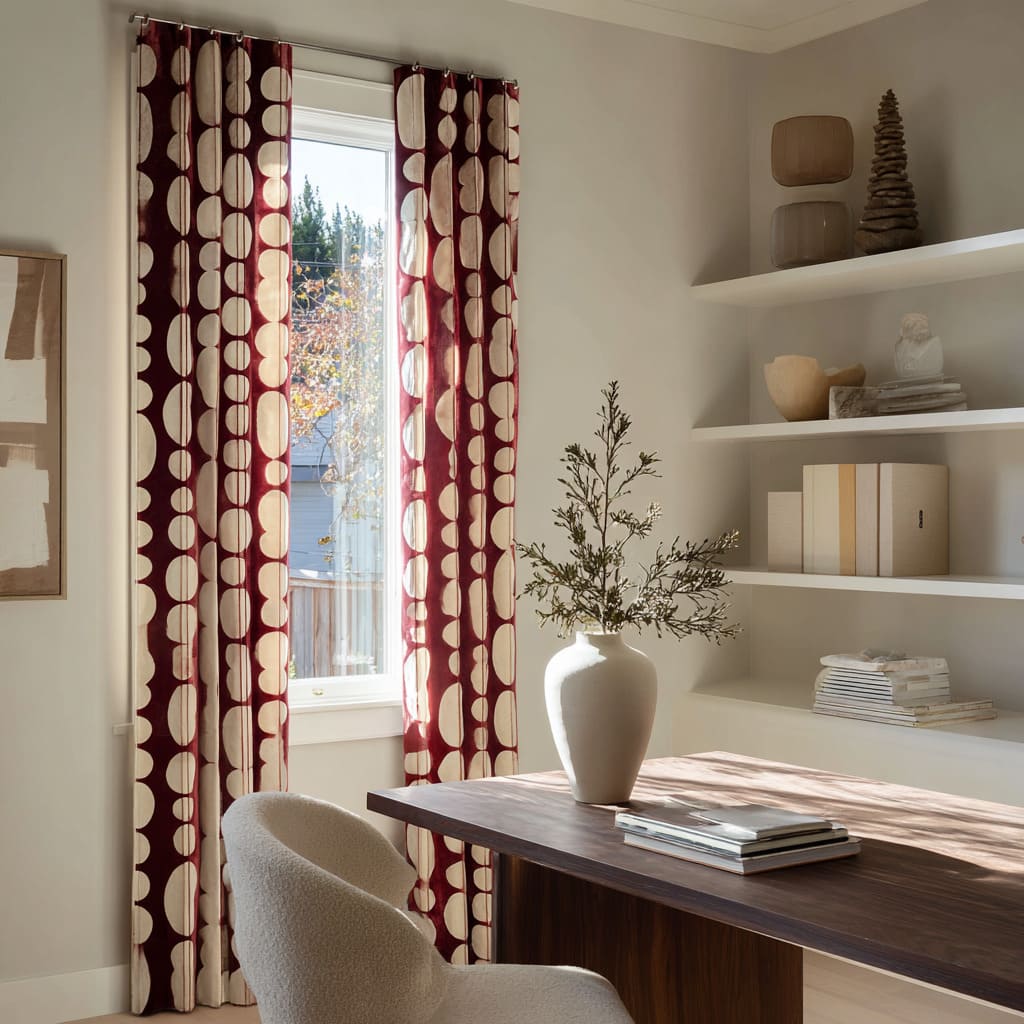
In living, dining, and office space designs, such circular systems quietly organize the vertical surface. They soften rectilinear architecture and furniture, yet also give the room a disciplined rhythm: slow repetition, controlled variation, and strong recognition from a distance.
Botanical and Forest Stories in Textile Form
Another major group of patterns translates trees, branches, and leaves into graphic, stylized textiles. Such fabrics do not aim for naturalistic illustration; instead they compress the idea of a grove or canopy into simplified motifs that work well with contemporary window curtains ideas.
Several distinct directions appear:.
- Tree trunk and branch silhouettes
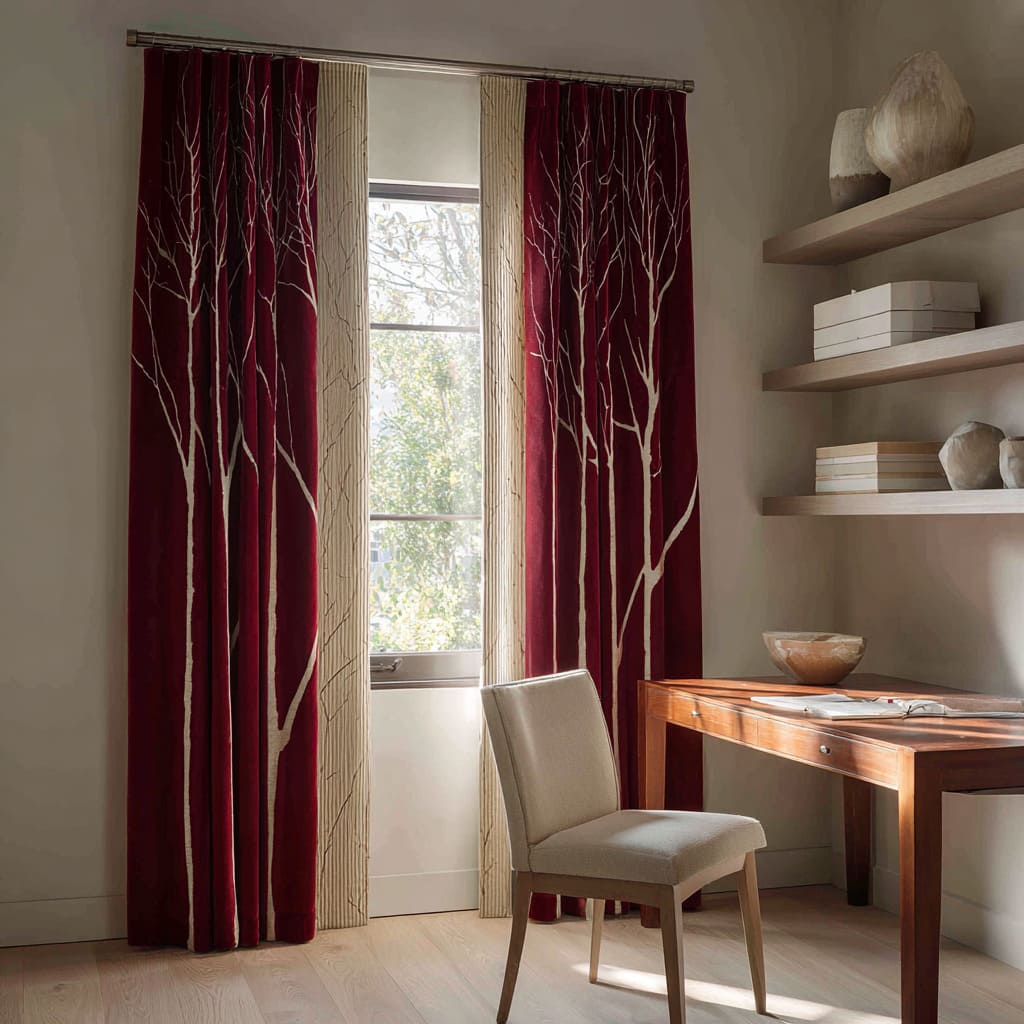
- Panels with tall trunks that start at the hem and branch out into fine networks near the upper third of the curtain.
- Designs where branch lines cross from one panel to another, so that when the curtains close, a continuous tree illustration emerges.
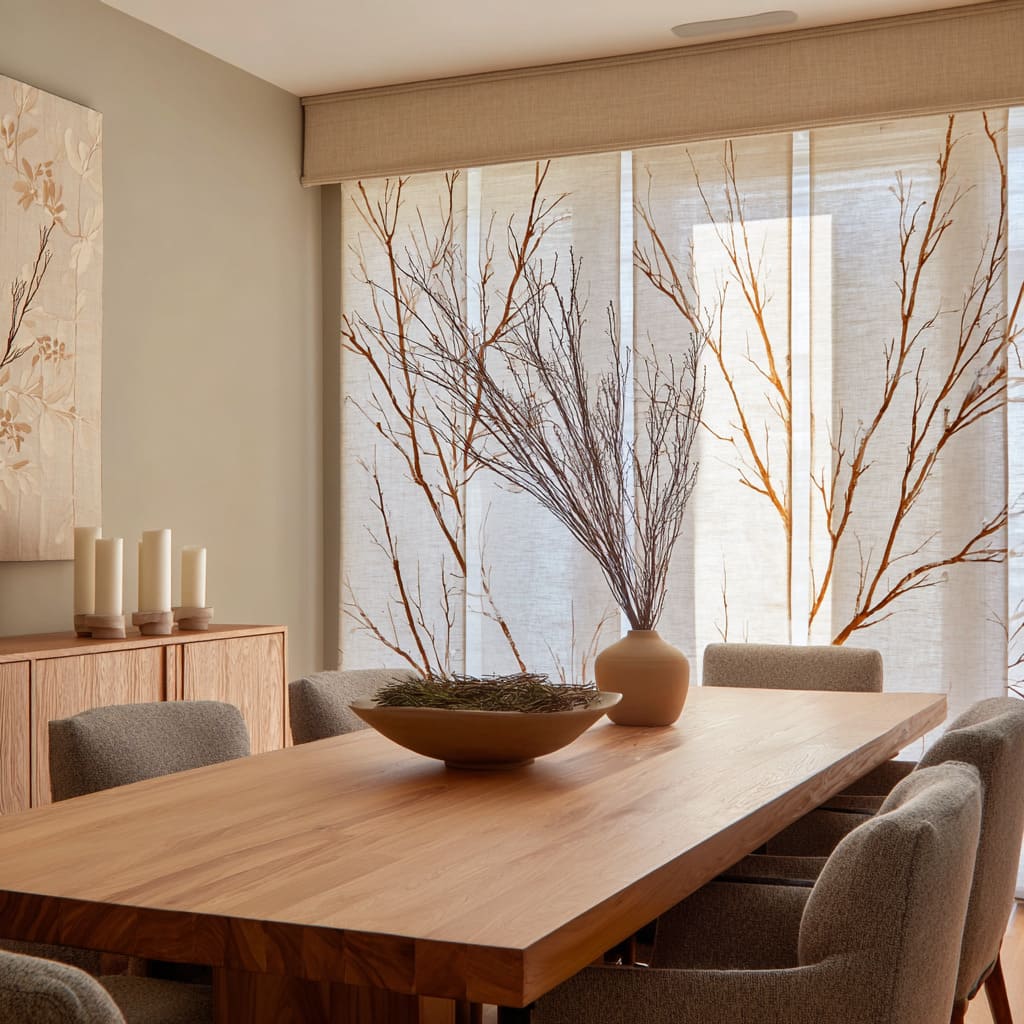
- Home offices and dining spaces where real twigs in vases align visually with printed branches behind, making the motif feel almost three-dimensional.
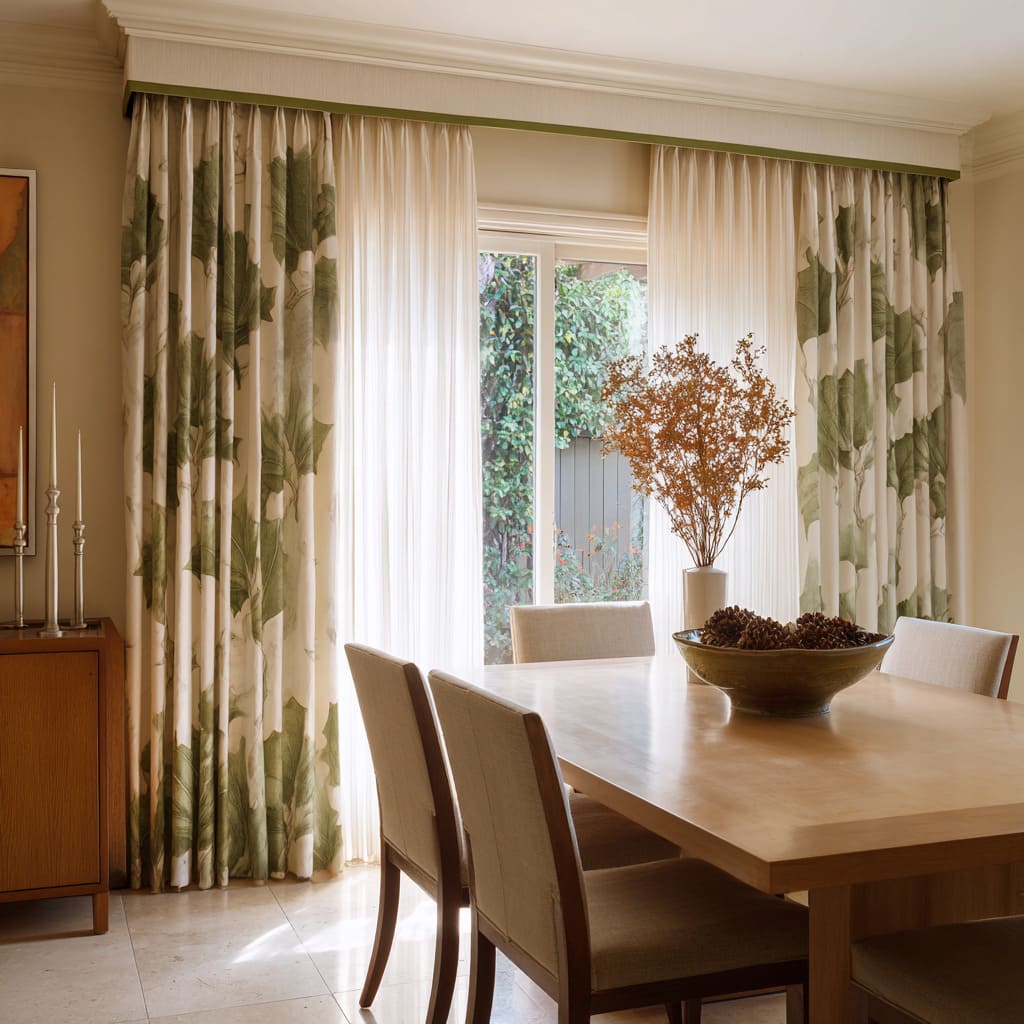
- Leaf forms so large that only a few sit on each panel, overlapping and stacking from floor to ceiling.
- Scenes where a taupe curtain carries branches at seated eye level, and the adjacent plaster wall continues the drawing as carved or painted relief.
- This continuity makes the boundary between textile and architecture less obvious; the window becomes part of a larger mural.
- Soft sheers in front of the glass add a vertical veil, so real outdoor branches appear as yet another layer of the same theme.
Botanical curtain concepts in such schemes are not simply “nature themed. ” They create an interior grove effect, where drawn trees, real greenery, and distant outdoor foliage all echo one another in different scales and levels of abstraction.
Light, Sheers, and the Glow Between Indoors and Outdoors
Sheer layers often sit at the center of the composition, acting as a gentle membrane between the deep-patterned side panels and the view outside. Rather than treating sheers as a generic utility layer, these design ideas treat them as active components within wider modern window treatment ideas for shared spaces and dining areas.
Their roles include:.
Soft light columns
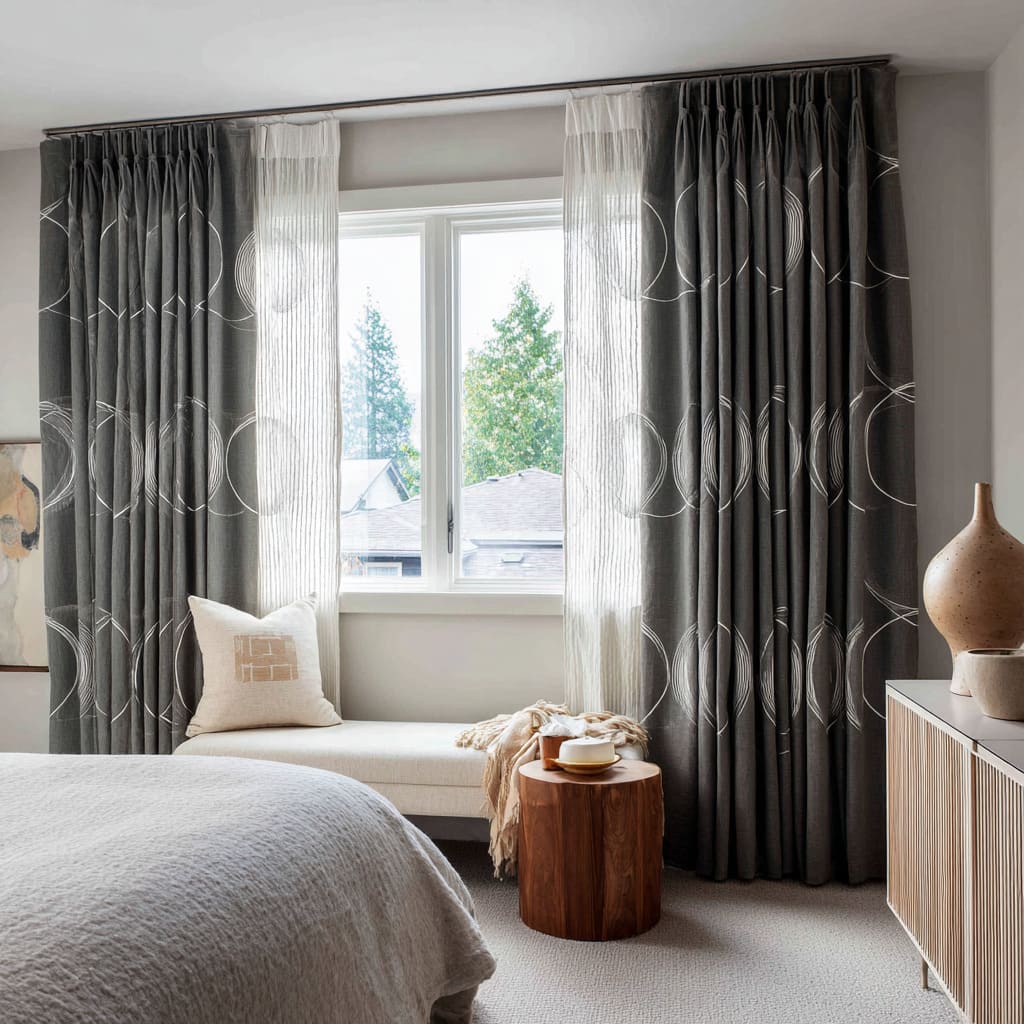
- White or cream sheers placed between strong colored side panels—teal, plum, berry, graphite—create a bright vertical stripe.
- This soft central column stops deep color from feeling too heavy and makes the window appear taller.
- During the day, the sheers flatten the contrast between indoors and outdoors, allowing table settings and furniture to remain visually calm.
Textured light filters
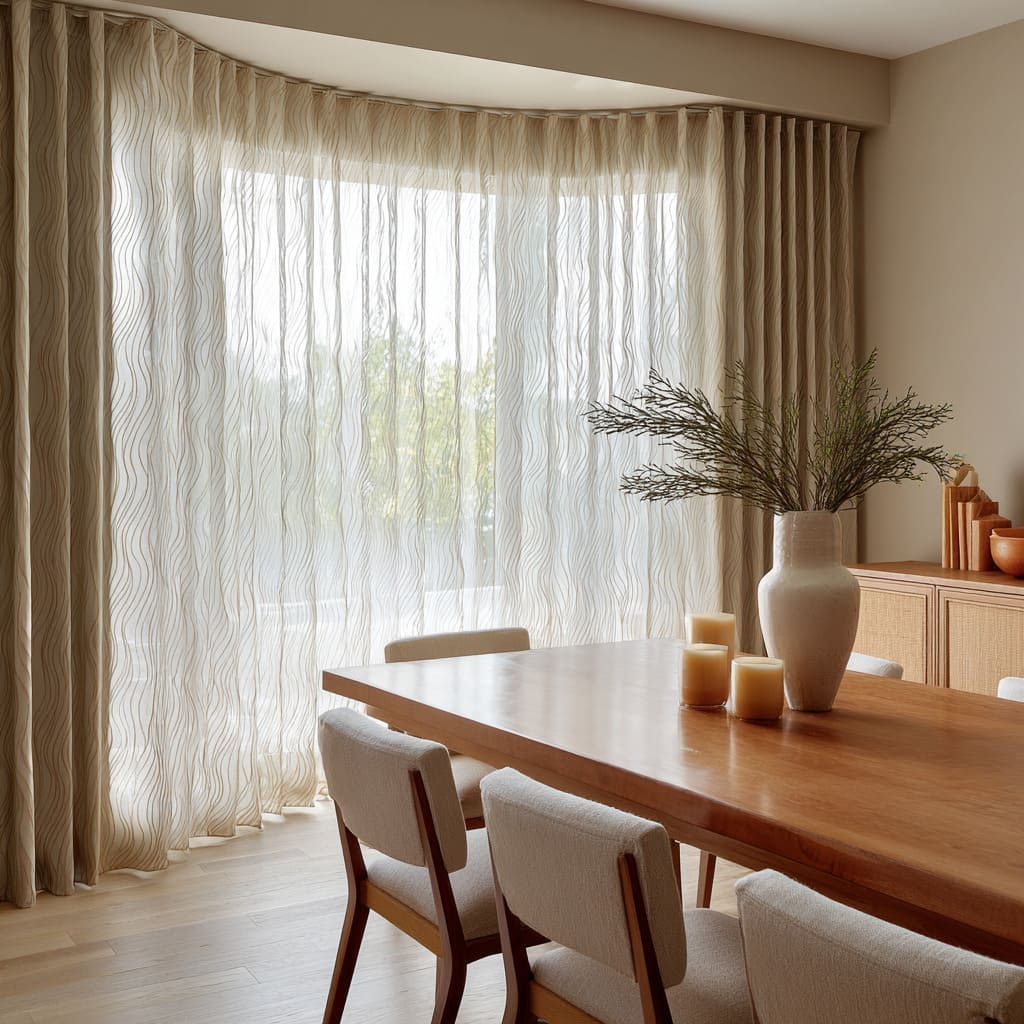
- Sheers with vertical ribbing, fine pleats, or gently wavy printed lines introduce barely-there pattern.
- In dining design concepts, dense pleats combined with wavy prints create a double rhythm: vertical folds and horizontal ripples.
- Light grazing these surfaces brings out the texture, making the window wall feel like a screen of water or mist.
Composed silence between stronger motifs
- In sequences where side panels carry leaves, circles, or tree trunks, the sheer center acts as a pause in the visual story.
- The eye moves from pattern on the left, through calm light in the middle, to pattern on the right, which produces a measured tempo.
- The view itself becomes softened scenery, with tree silhouettes and rooftops appearing as pale shapes rather than sharp detail.
Through this lens, sheers are not placeholders; they are quiet protagonists. They compress daylight into a gentle surface, they moderate strong textiles around them, and they frame everyday rituals—meals, work, reading—in a layer of diffused, comfortable brightness.
Symmetry, Asymmetry, and the Single “Loud” Panel
Modern curtain layouts rarely default to simple, mirrored symmetry. There is a purposeful play between balanced compositions and asymmetric ones, which gives windows a more nuanced, curated presence and feeds directly into many modern window covering ideas for bedrooms and small sitting corners.
Several layout strategies stand out:.
- Asymmetric pairings
- One side of the window dressed with a calm, almost plain drape; the other side carries a bold pattern of circles, branches, or abstract marks.
- Furniture placement follows this logic: benches and chaises often sit under the quiet side, while dressers or cabinets stand beneath the busier panel.
- The patterned panel becomes a vertical story or “column of narrative,” balancing the more restful presence of the other side.
- Strong side panels on both sides of the window, but with a sheer layer or lighter insert in the middle to break the field into three parts.
- In some scenes, a narrow window is flanked by two small but intense panels, almost like fabric totems.
- The rest of the wall stays relatively bare so that the two slim, patterned curtains read like art pieces rather than traditional drapery.
- A simple desk or bench aligns centrally, making the human activity in the room feel framed by these textile pillars.
By shifting between symmetric and asymmetric structures, these curtain compositions avoid a formal hotel look. Instead, they create a sense of thoughtful imbalance where one side of the window can be visually heavy, the other soft, and the whole wall feels more layered and expressive.
Vertical Lines, Horizontal Lines, and Rhythms in the Room
Much of the sophistication can come from the fine-tuned relationship between vertical and horizontal elements. Curtains take responsibility for vertical rhythm, while furniture and joinery provide horizontal stability.
This layered rhythm is central to many refined contemporary window treatment ideas. The interaction can be summarized as follows:
- Vertical emphasis from the window wall
- Full-height panels mounted close to the ceiling produce long, uninterrupted drops.
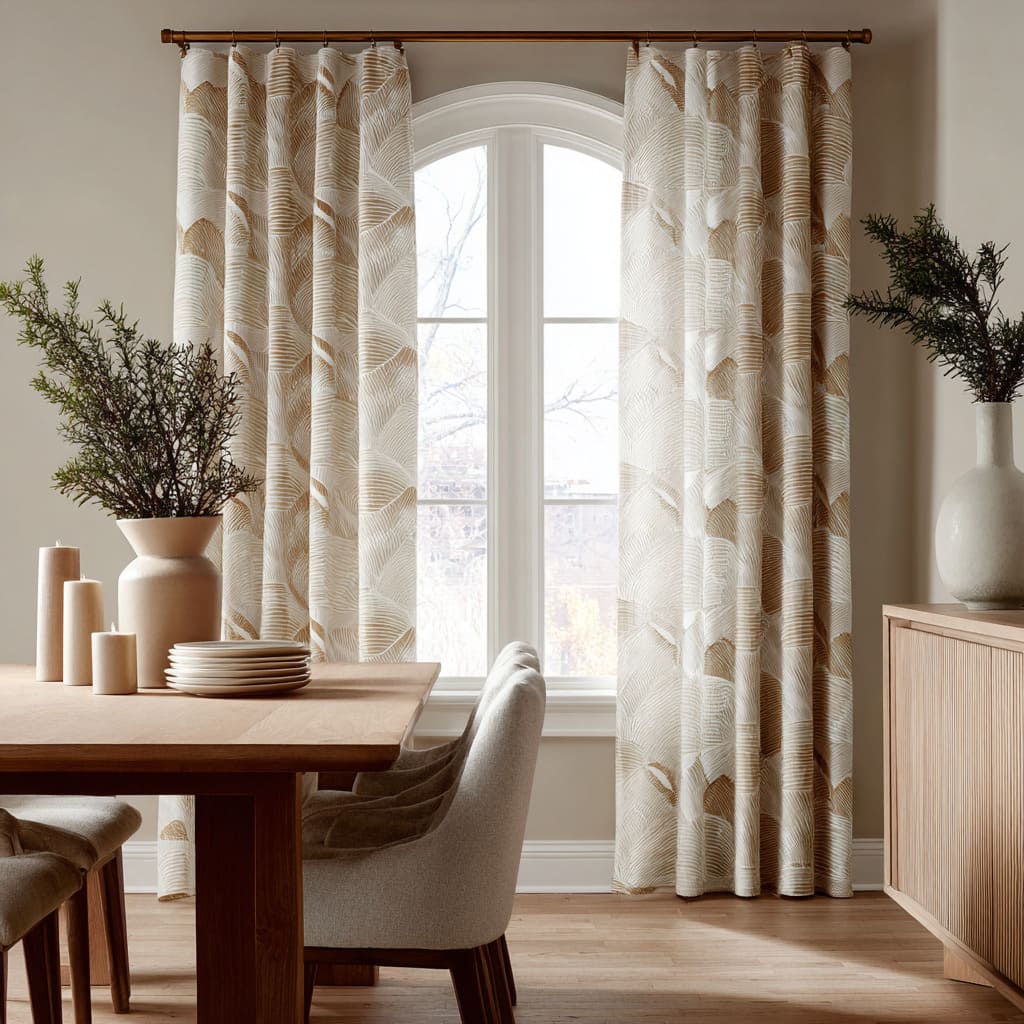
- Patterns that grow from hem to rod—tree trunks, ribbed motifs, tall fans, hanging ovals—translate the height of the room into visible stripes.
- Sheer panels with narrow pleats or ribs underline this upward pull even when the color is very light.
- Dining tables, sideboards, benches, and window sills form strong horizontal bands at seating or eye level.
- Branch drawings and wavy prints introduce diagonal energy, preventing the grid from feeling rigid.
- Curved chair backs, rounded vases, arched window tops, and soft-edged tables punctuate the straight lines with gentle arcs.
- Loose throws and frayed textiles add more irregular, organic lines that feel human and tactile.
The result is a design where the eye travels smoothly: up and down along curtain seams, sideways along benches and table edges, and gently along curved silhouettes. Curtains are the main conductors of this rhythm; their lines and shapes interact with everything else, even when the base palette is quiet.
Different Room Types, Different Curtain Personalities
The same overall vocabulary of color, pattern, and layout shifts personality depending on the type of room. Each space category tends to favor certain fabrics and motifs, and these tendencies form a rich map of modern living room curtain ideas, dining schemes, bedroom cocoons, and focused work zones.
Typical tendencies include:.
- Living areas
- Often lean on strong graphic grids of circles, leaves, or vertical ribbons in charcoal, graphite, or warm taupe.
- Sofas and rugs stay in gentle neutrals, using cushions and small decor pieces to echo shapes from the curtains.
- Coffee tables and side tables act as solid anchors against the more fluid curtain patterns.
- Frequently adopt deep plum, teal, berry, or leafy panels to create a sense of depth and evening readiness.
- Prefer tone-on-tone textured drapes, starburst scatters, or soft abstract bands that keep the atmosphere quiet.
- Patterns revolve around shadow, relief, and gentle repetition rather than highly contrasting prints.
- Benches, chaises, and low seats press closely against the curtain wall, letting textile softness extend into the furniture layer.
- Embrace bolder graphics—columns of circles, tree silhouettes on deep grounds, or flat screens of red with ritual-like ovals.
The same principles of full-height drops, balanced color fields, and sculpted motifs are often present. What shifts is the level of contrast, the density of pattern, and how strongly the curtain wants to claim attention in the daily function of the room.
Three-Band Curtain Landscapes: Sky, Story, and Ground
Many modern curtains can be read as three-band landscapes: an upper zone, a middle storytelling zone, and a base. This structure appears in both minimal and patterned designs and links naturally with ideas often grouped under modern window dressing ideas.
The three parts tend to behave like this:.
- Upper calm zone
- Near the rod, motifs thin out, fade, or stop completely, leaving color and texture to carry the top portion.
- Dark or mid-tone panels sometimes leave the upper section as solid color, with branches or circles concentrated lower down.
- This quiet upper zone keeps the area near the ceiling serene, so the window height feels generous but not busy.
- Around eye level and slightly above, patterns usually reach their peak intensity.
- Lower sections often include deeper bands of color, denser tree trunks, or a dip in tone that echoes the floor.
- In botanical concepts, leaves often emerge from this zone, as if rooted near the skirting.
- In abstract designs, stripes, zigzags, or repeated links reinforce the sense of weight and connection to the ground plane.
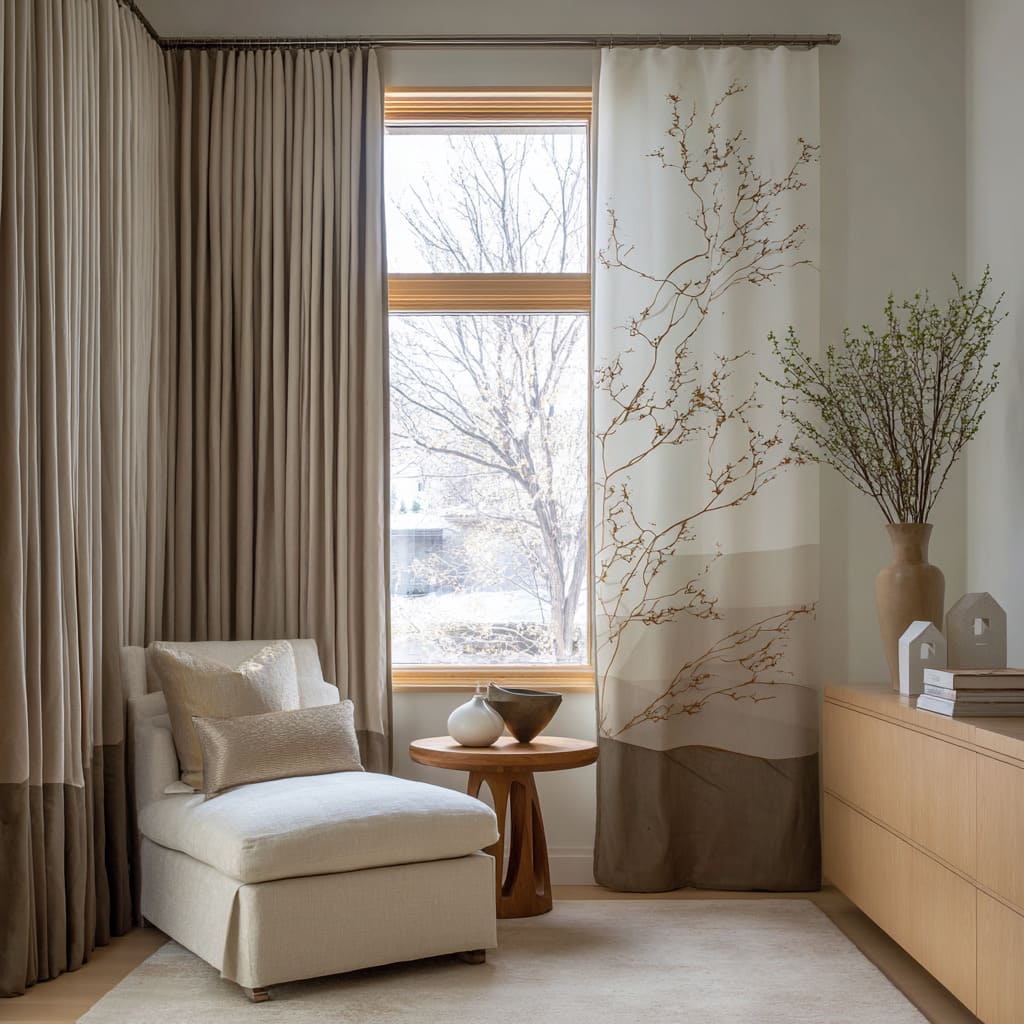
This three-part logic makes even complex textiles feel legible. The eye instinctively reads sky, middle story, and ground; the curtain becomes a vertical landscape that supports furniture placement and wall composition without demanding conscious analysis.
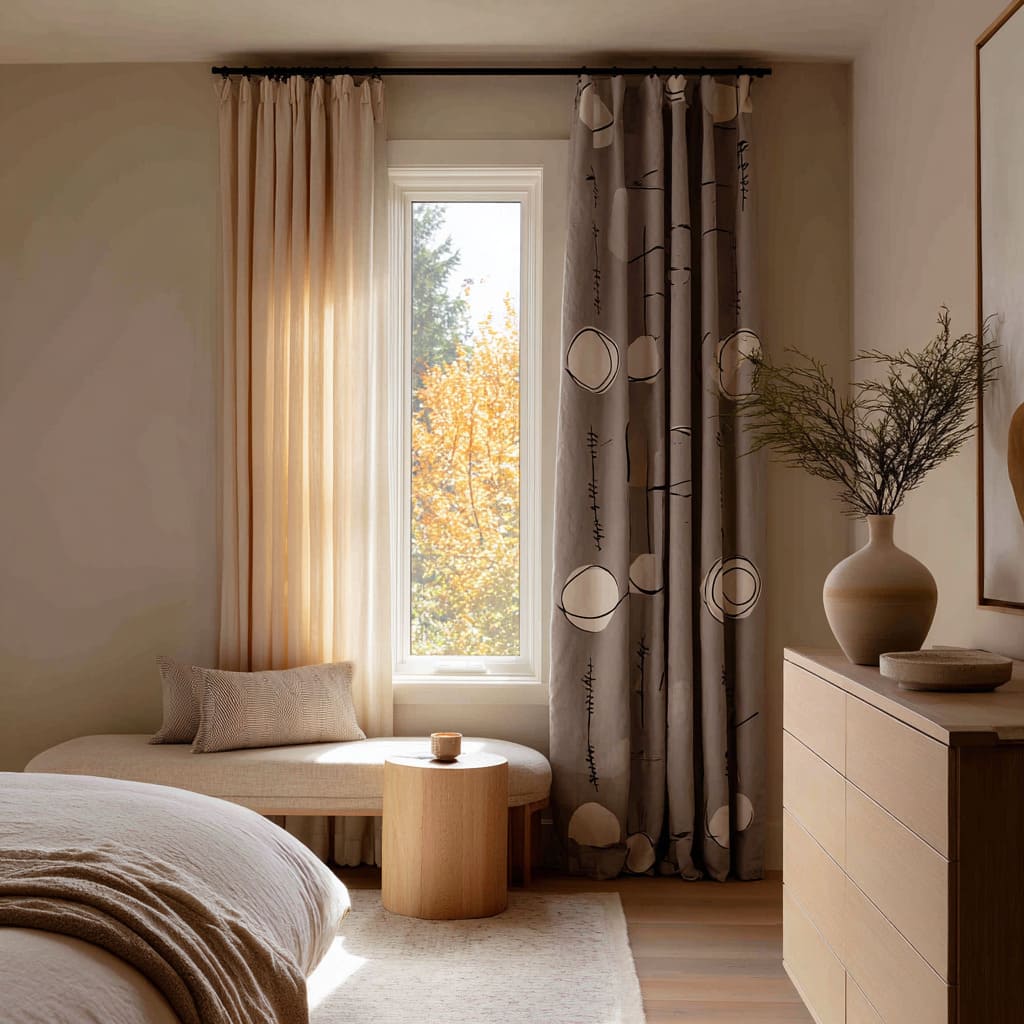
Neutrals with Relief: Texture as the Main Pattern
Modern schemes can show how a completely neutral curtain can still be the focal element simply through relief and shadow. Such concepts align closely with what many describe as modern window treatment ideas for quiet bedrooms and light-filled living spaces, where subtlety is key.
Their character comes from:.
- Raised or sculpted motifs in a single tone
- Elongated diamonds, soft leaves, or looped networks that stand slightly proud from the ground fabric.
- The motif revealed only when grazing light catches the raised edges and throws small shadows.
- Fullness of the drape amplifying this effect as patterns slide in and out of view with the folds.
- Slightly deeper hems, faint ombre shifts, or matte-gloss differences providing tiny tonal variations.
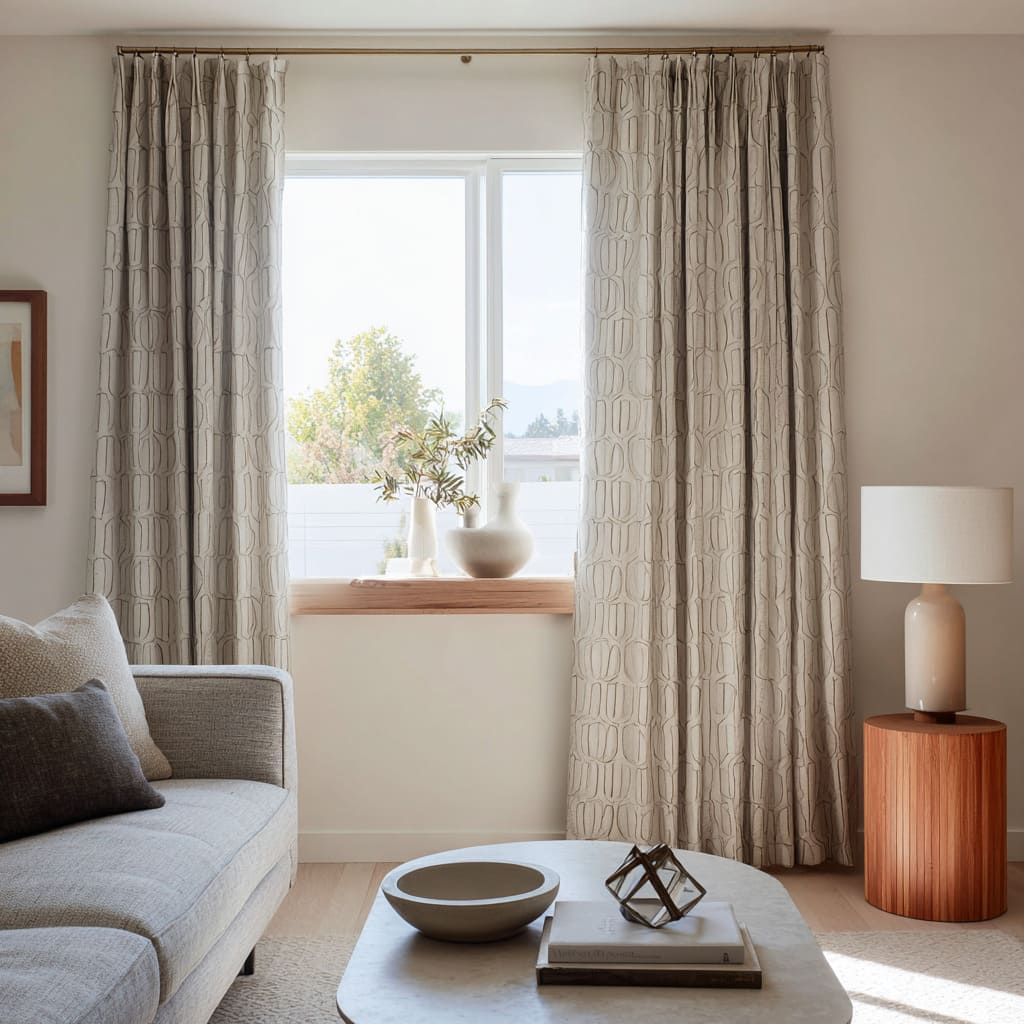
- Slim dark rods acting like eyeliner for all the softness below.
- Clean junctions between curtain and bench or curtain and window sill, reinforcing the vertical drop.
- Minimal wall art so that the eye naturally lingers on the textile’s tiny changes in light and shadow.
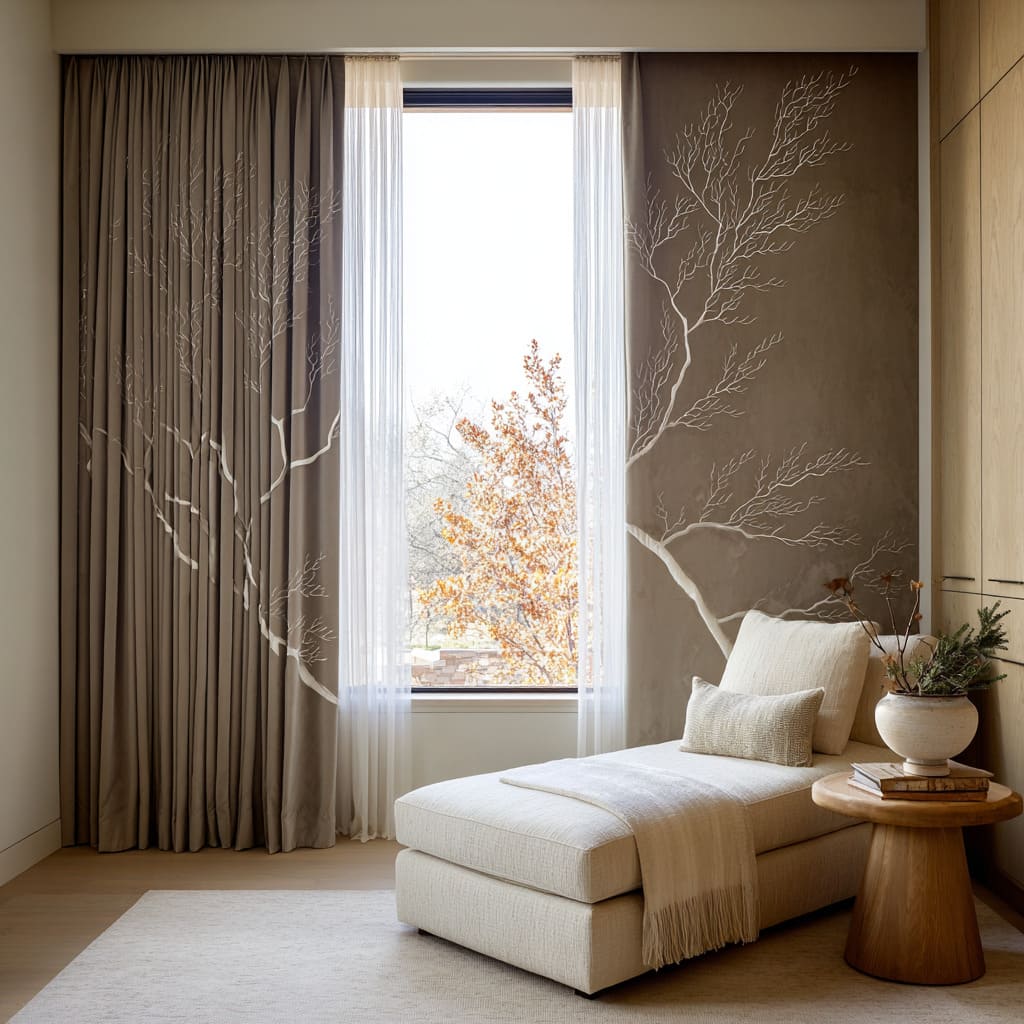
Gentle Seasonal Codes Without Literal Themes
A notable aspect is the ability to hint at colder seasons, celebrations, and holidays without relying on overt motifs. Within broader families of contemporary window covering ideas, the textile alone carries seasonal atmosphere through color, structure, and fine detail instead of obvious icons.
Typical strategies include:.
- Winter-coded colors and materials
- Deep reds, plums, and berries that recall mulled dark red, brick, or late-autumn foliage.
- Velvet and dense weaves that feel plush and warm under low light.
- Soft greiges and creams that resemble frosted landscapes when paired with bare tree views outside.
- Circular motifs filled with twiggy linework that recall wreaths or frosted glass more than simple dots.
- Branches with berries, metallic spheres in bowls, pinecones on trays, and small house-shaped objects on benches.
- These items pick up the rhythm of circles, branches, and vertical lines already present in the curtain fabric.
- When those objects are changed for more everyday pieces, the same curtain shifts back into a neutral, graphic role.
The advantage of this approach is that the curtain remains part of the room’s identity all year. Seasonal mood comes from how the existing textile is styled, not from a fabric that feels restricted to a single month.
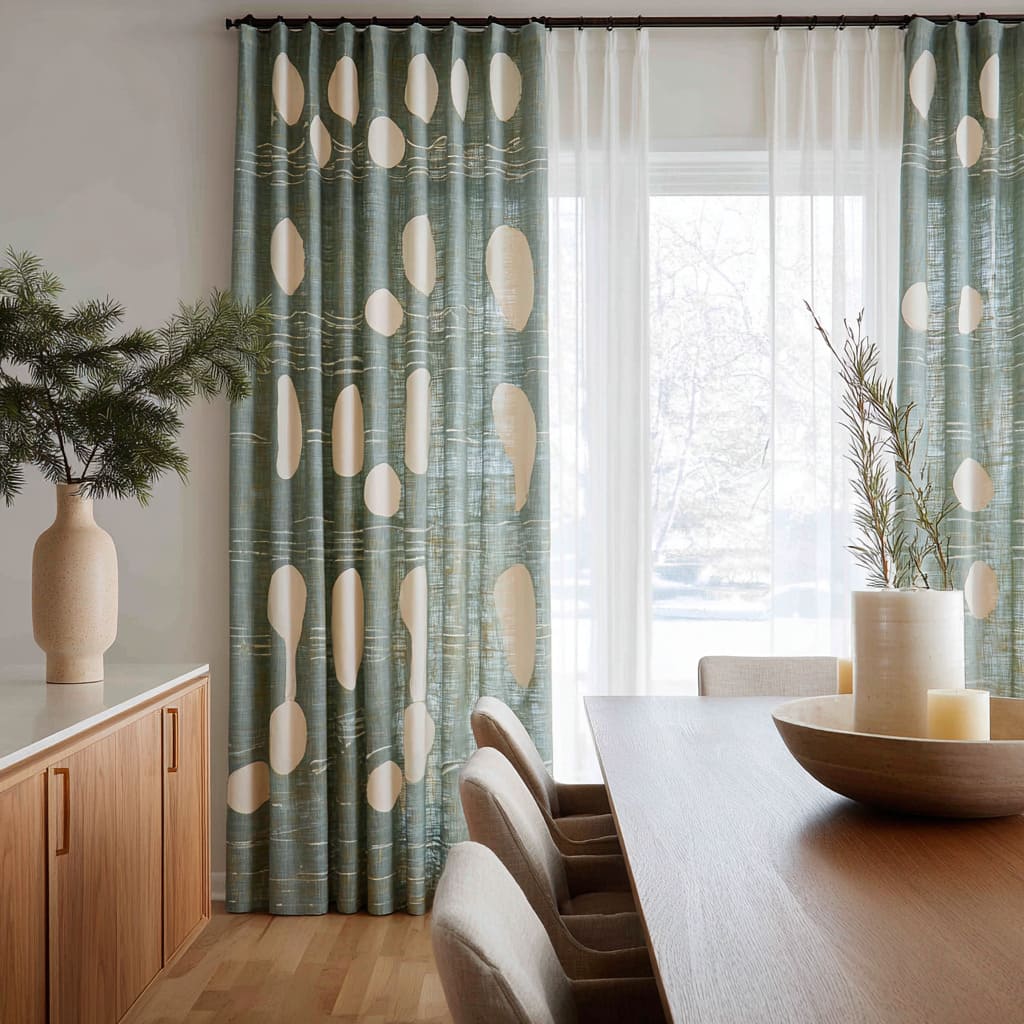
Kitchens and Dining Zones: Softening Hard Lines with Textile Stories
In kitchen and dining settings, curtains often soften the dominance of cabinetry, tile, and appliances. They work like vertical garments that “dress” the harder surfaces and connect whites and woods into a single visual language.
This is where many modern window treatment ideas for kitchens and eating zones show their most subtle effects. Common moves include:
- Two-tone and banded panels in kitchens
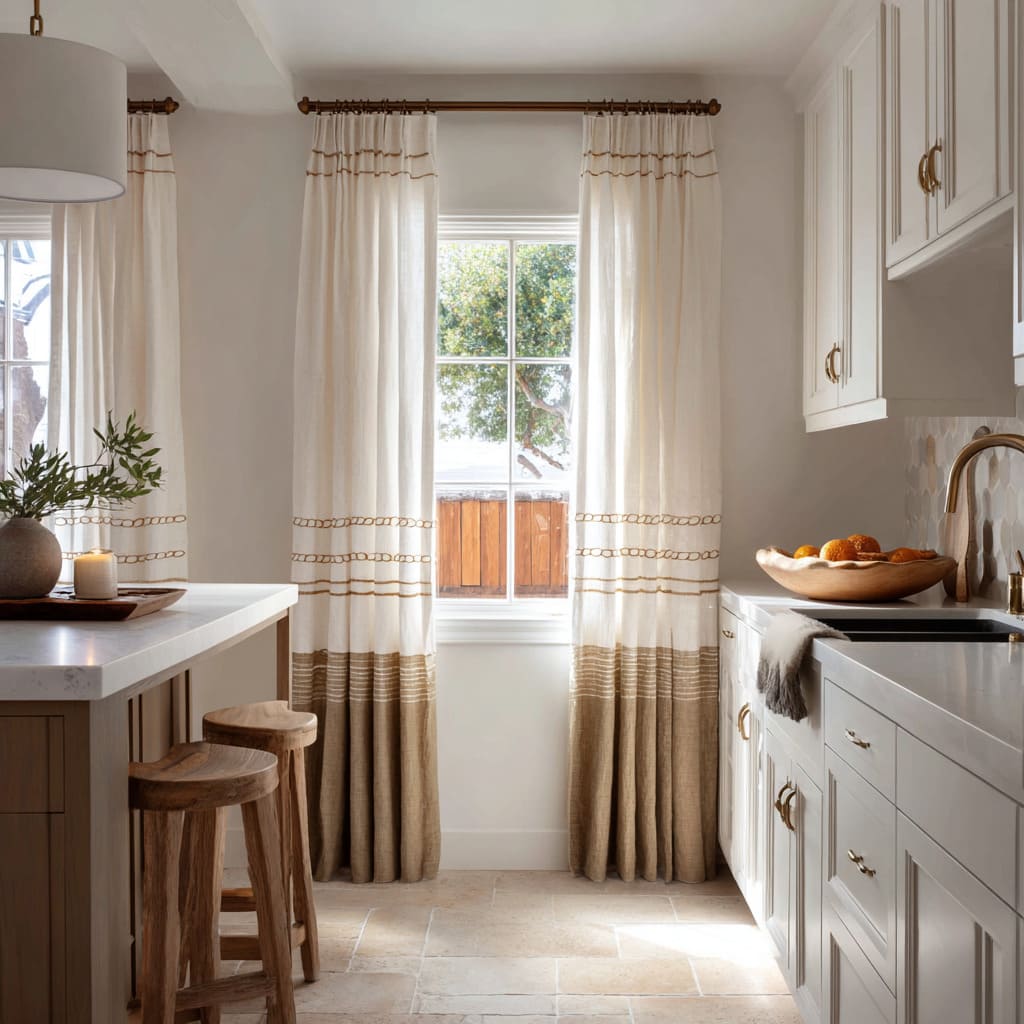
- Light upper portions blending into cabinets and walls, with deeper sand or oatmeal lower halves that link to stone floors and wood stools.
- Narrow embroidered chains or small motifs around eye level, acting like jewelry that marks the horizon line in a compact room.
- Simple rods in the same metal finish as taps and handles, so the textile feels integrated into the joinery story.
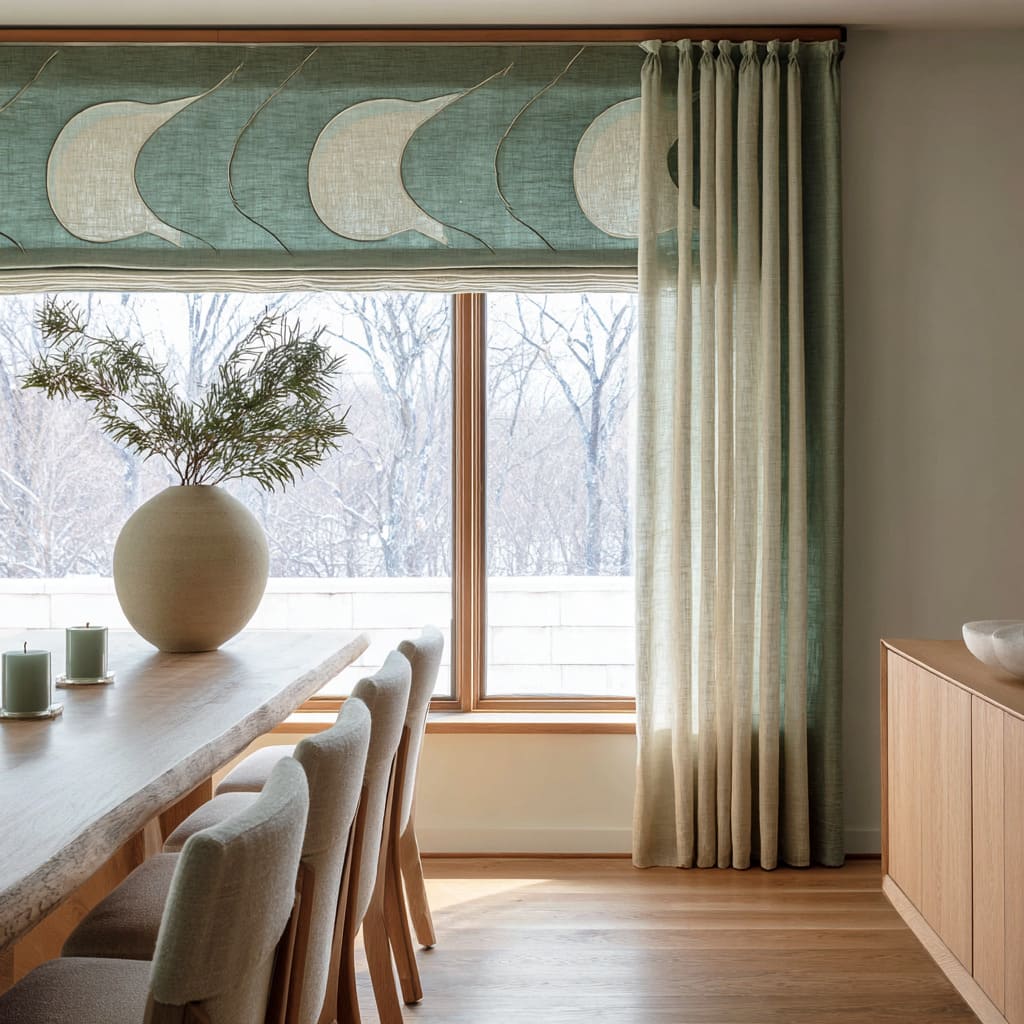
- Full-width sheer curtains printed with vertical wavy lines that ripple gently over folds.
- Bold top treatments in aqua or muted green, decorated with repeated crescent or leaf-like shapes that form a strong border under the ceiling.
- Side panels in quiet oat or stone tones with minimal pattern, letting the cornice do most of the expressive work.
- Subtle color repeats—mint candles, foliage, warm wood—tying table surface, floor, and window band into one narrative.
The curtain is not an afterthought squeezed around cabinets and built-ins. It is a carefully chosen textile story that moderates the linear nature of joinery, ties together dissimilar materials, and brings a sense of softness and ritual into spaces used every day.
Graphic Fields in Light-Filled Living Rooms
A window wall can be used as a bold yet controlled graphic field, balancing soft seating and pale flooring. Here, curtains sit at the center of many contemporary window curtains ideas, turning large picture windows into structured backdrops for quiet, relaxed rooms.
The recurring strategies include:.
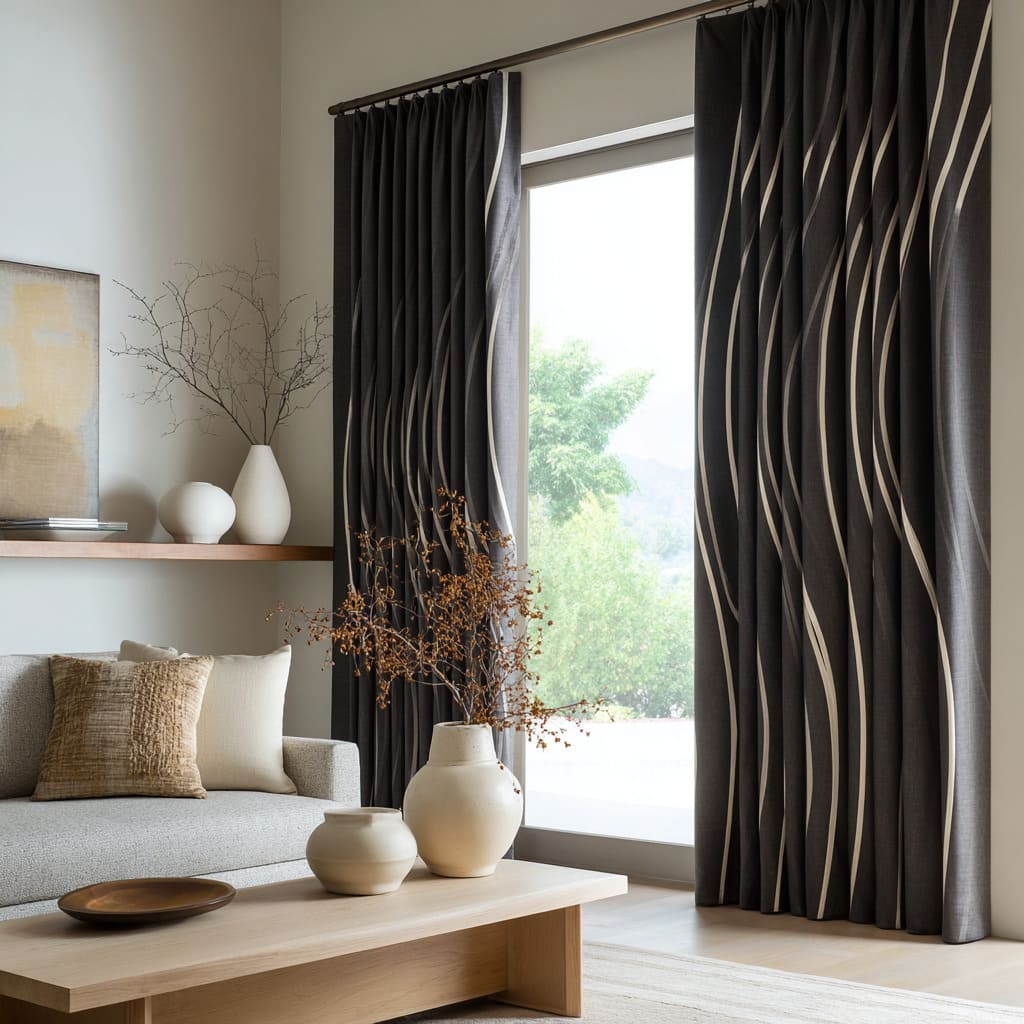
- Dark grounds with light linework
- Graphite or black panels drawn over with pale twisted ribbons, hanging pods, or leaf grids.
- Patterns that never feel busy because motifs are spaced generously, leaving broad areas of calm ground.
- Light filtering between panels or through sheers, turning the gap between two dark drops into a luminous vertical slice.
- Boucle chaises, plush sofas, and nubby rugs in cream and stone that soften the graphic strength of the curtains.
- Coffee tables with just a few sculptural objects—bowls, stones, vases—placed off-center so the room does not look staged.
- Floor lamps and table lamps using stacked, rounded bases that echo curtain circles while bringing warm light into the corner.
- Wall shelves carrying a handful of neutral objects, ensuring that the strongest drawing in the room remains on the textile.
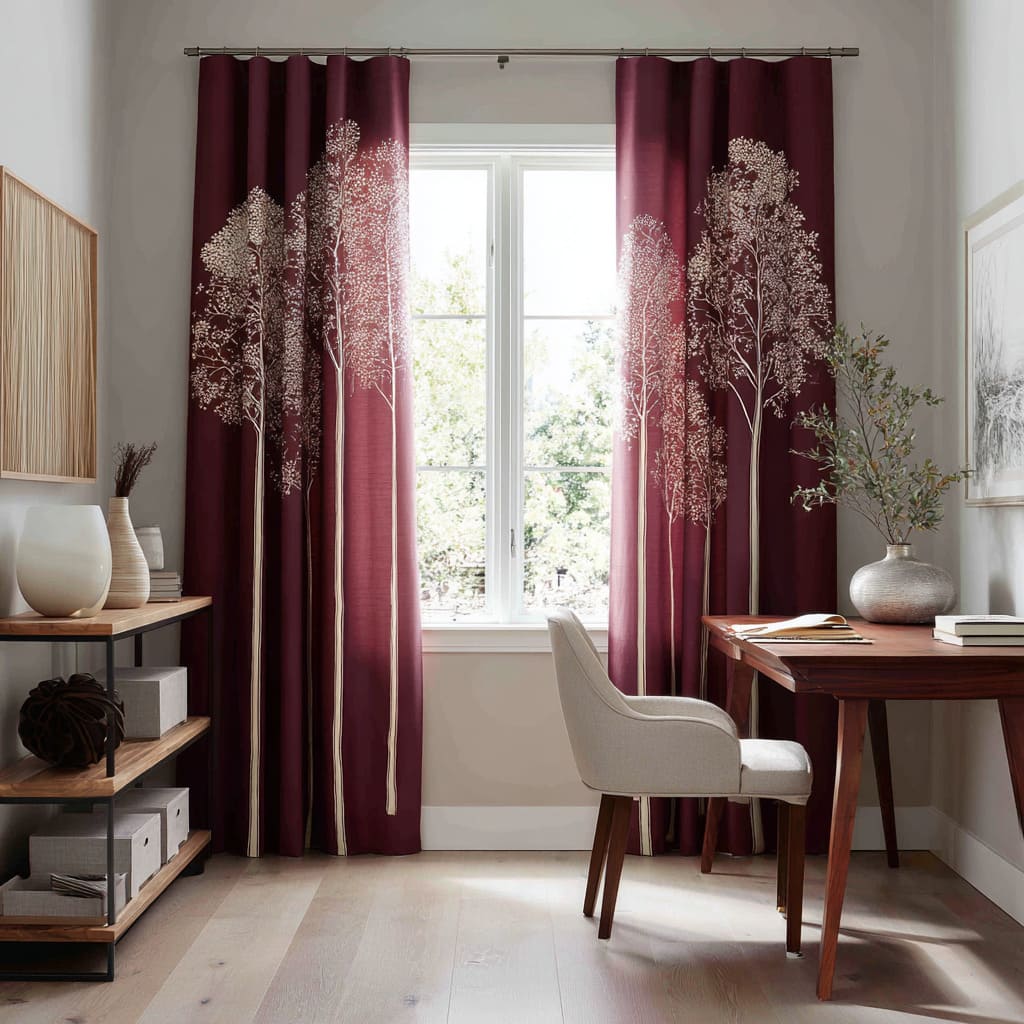
A strong curtain design can calmly structure everything around it. The fabric is bold, but the palette is restrained; the pattern is clear, but the textures are soft.
The window becomes a vertical composition that holds together furniture, decor, and view in one continuous, thoughtful field.
Conclusion
Together, these approaches show how contemporary curtain design has evolved into a sophisticated language of color, rhythm, pattern, and light. From botanical silhouettes to sculpted neutrals, from circular systems to quiet sheers, each textile choice shapes how a room feels and how its architecture is perceived.
Modern interior designs use curtains not only to manage brightness or privacy but to create visual structure, soften hard lines, and express an artistic identity within everyday spaces.