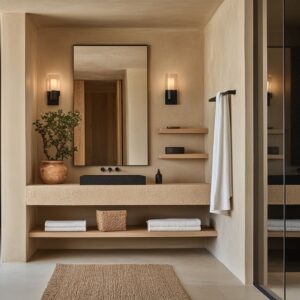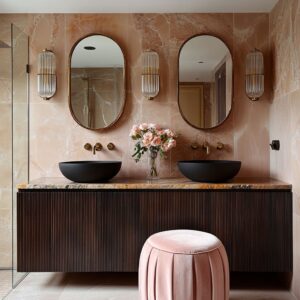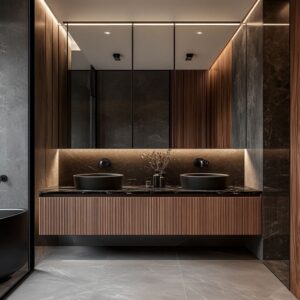
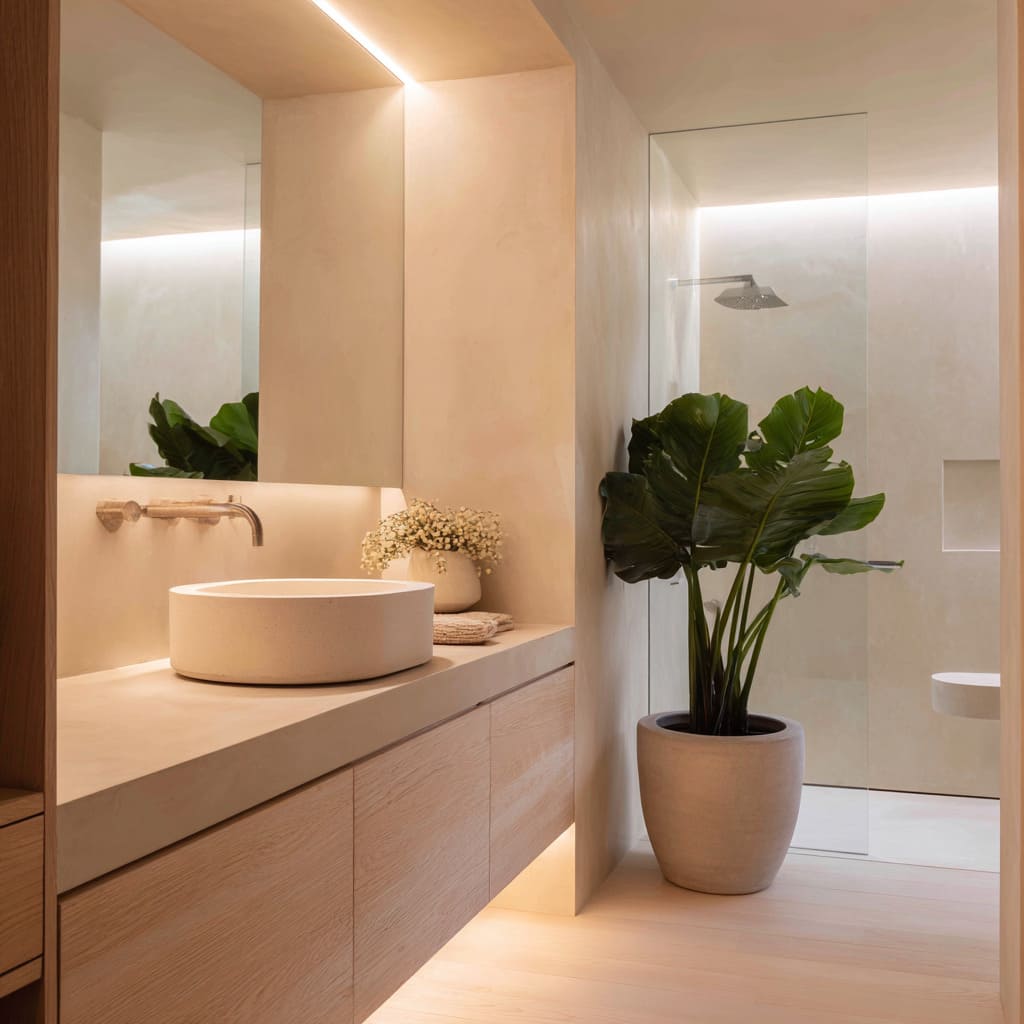
Contemporary bathroom design has moved away from visual noise and surface complexity. What defines today’s most refined spaces isn’t how much is included—but how carefully space, shape, and material are controlled.
Lines are deliberate. Volumes are calm.
Color shifts are kept within tight boundaries to let texture and light take over the work of atmosphere.
The focus is no longer on adding, but on reducing with purpose. Stone wraps entire rooms in a single tone.
Fixtures emerge without announcement. Even mirrors, lighting, and plants are positioned to reinforce rhythm, not steal attention.
These bathrooms don’t chase focal points—they create balance through contrast that feels natural: smooth against rough, light beside shadow, warm metals next to cool stone. This shift isn’t about minimalism as absence.
It’s about presence—a kind of quiet visual structure where everything aligns just closely enough to feel intentional, but never rigid. In these spaces, decisions are measured in millimeters, and the result is an atmosphere that feels settled, precise, and composed without ever looking cold.
This article explores the design moves—subtle, layered, and often overlooked—that define this visual language.
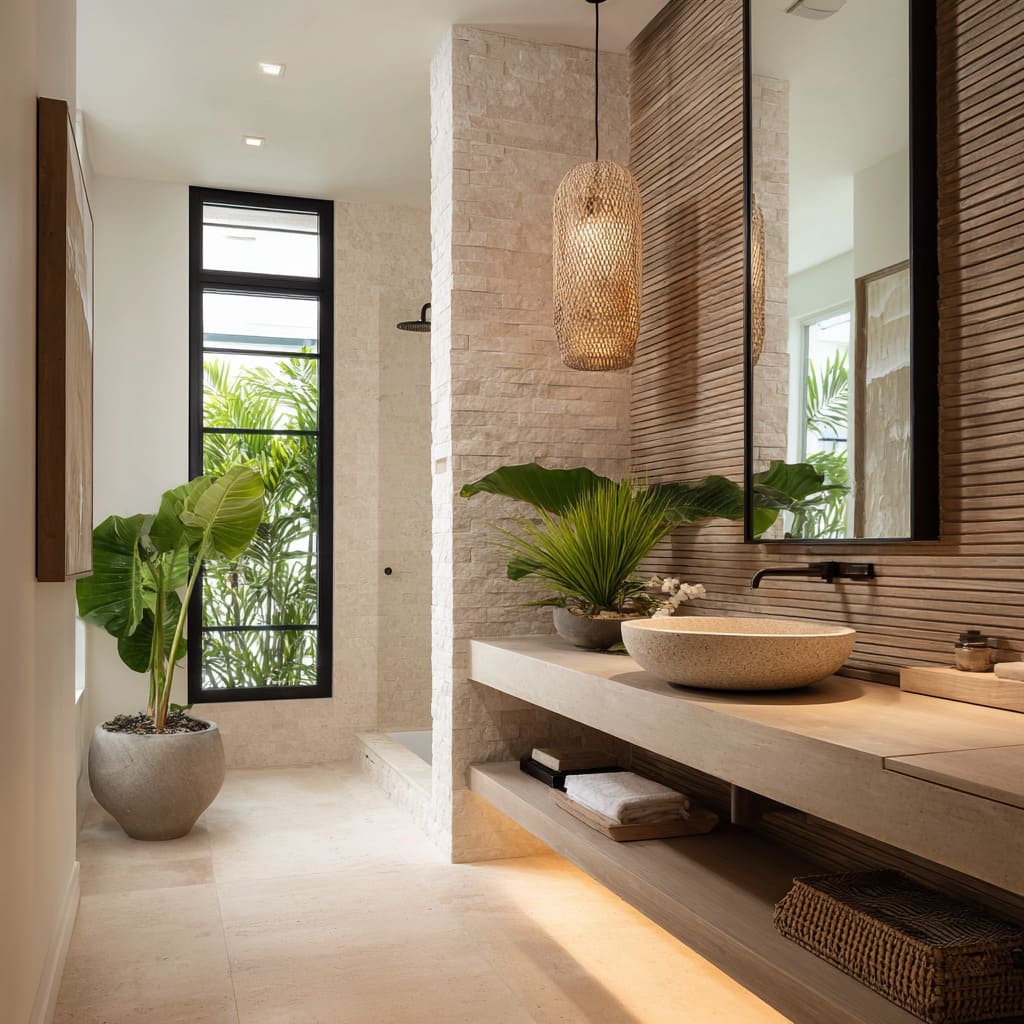
Mass That Feels Cut From One Block
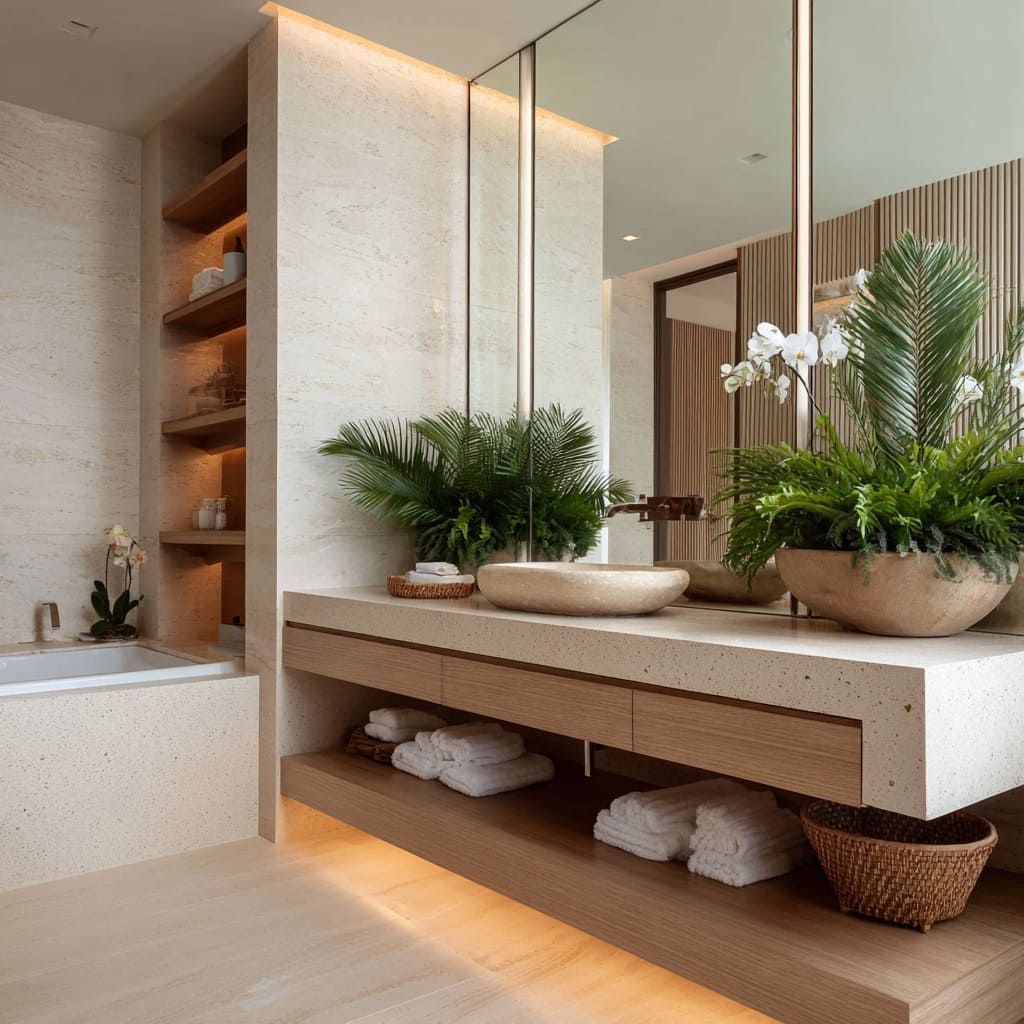
Some of the most refined contemporary bathroom ideas rely on an approach where architecture feels carved rather than built. The entire envelope—floor, walls, ceiling, and vanity—often shares a single material language, whether limestone, microcement, or slate, and presents itself in one unbroken tone.
This lack of contrast removes visual starts and stops. Instead of feeling like assembled components, these bathrooms appear as if they’ve been sculpted from a solid mass.
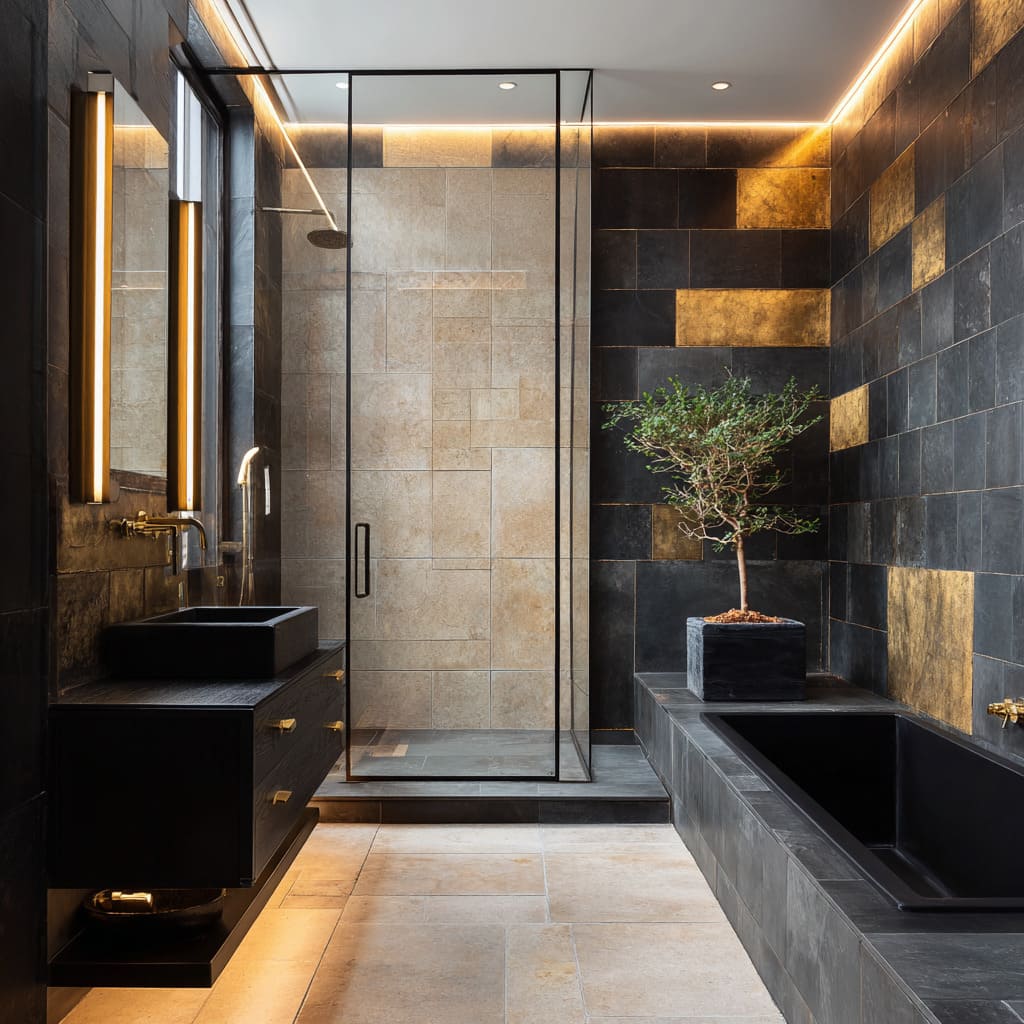
Carved-out voids, such as under-vanity gaps, recessed shelving, or tub platforms, are not added elements but controlled subtractions. Light flows into these gaps, slicing through the surface without disturbing its unity.
The result is that illumination becomes a shaping element, tracing volume rather than landing on it. Even when shadows are introduced, they don’t disrupt—they contour.
The forms hold weight and stillness, not by bulk, but by how cleanly they emerge from the shell surrounding them. These decisions support a visual stillness that feels considered rather than static.
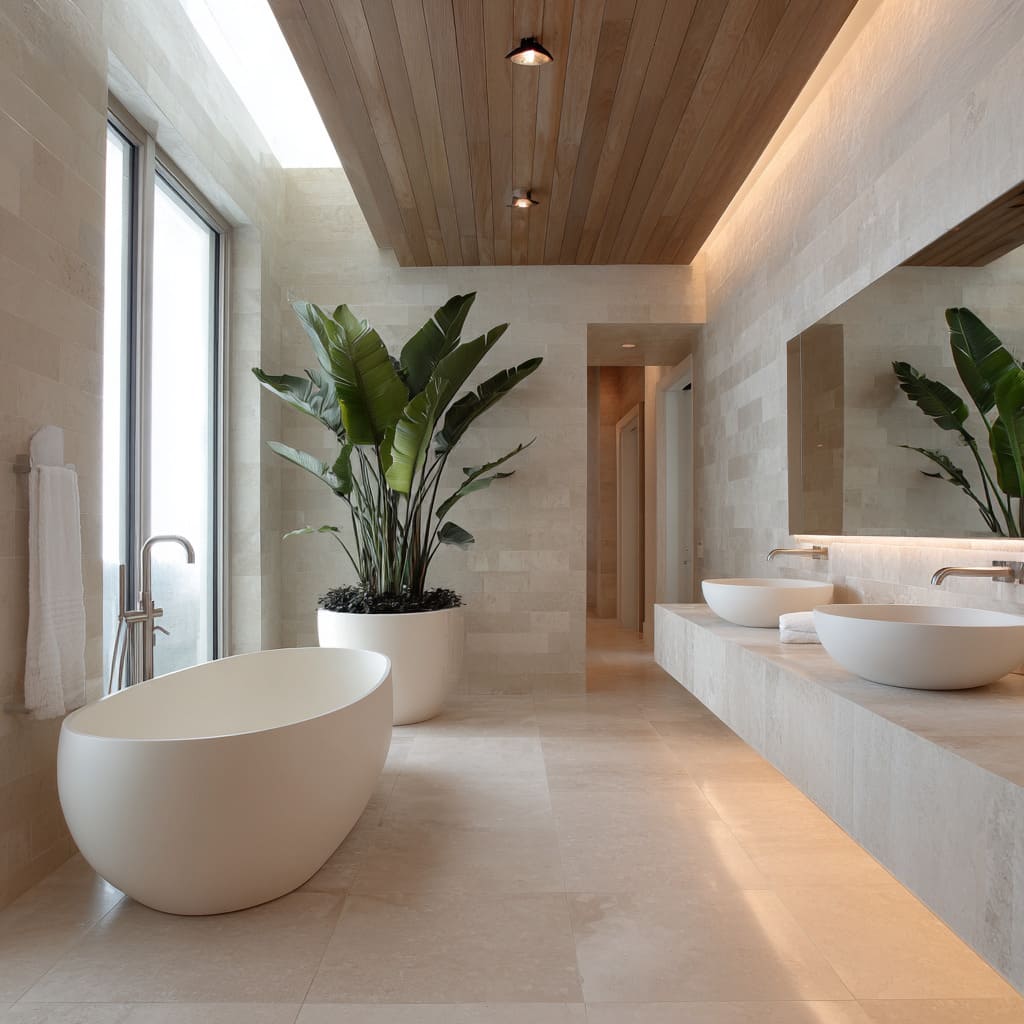
Texture as the Real Contrast
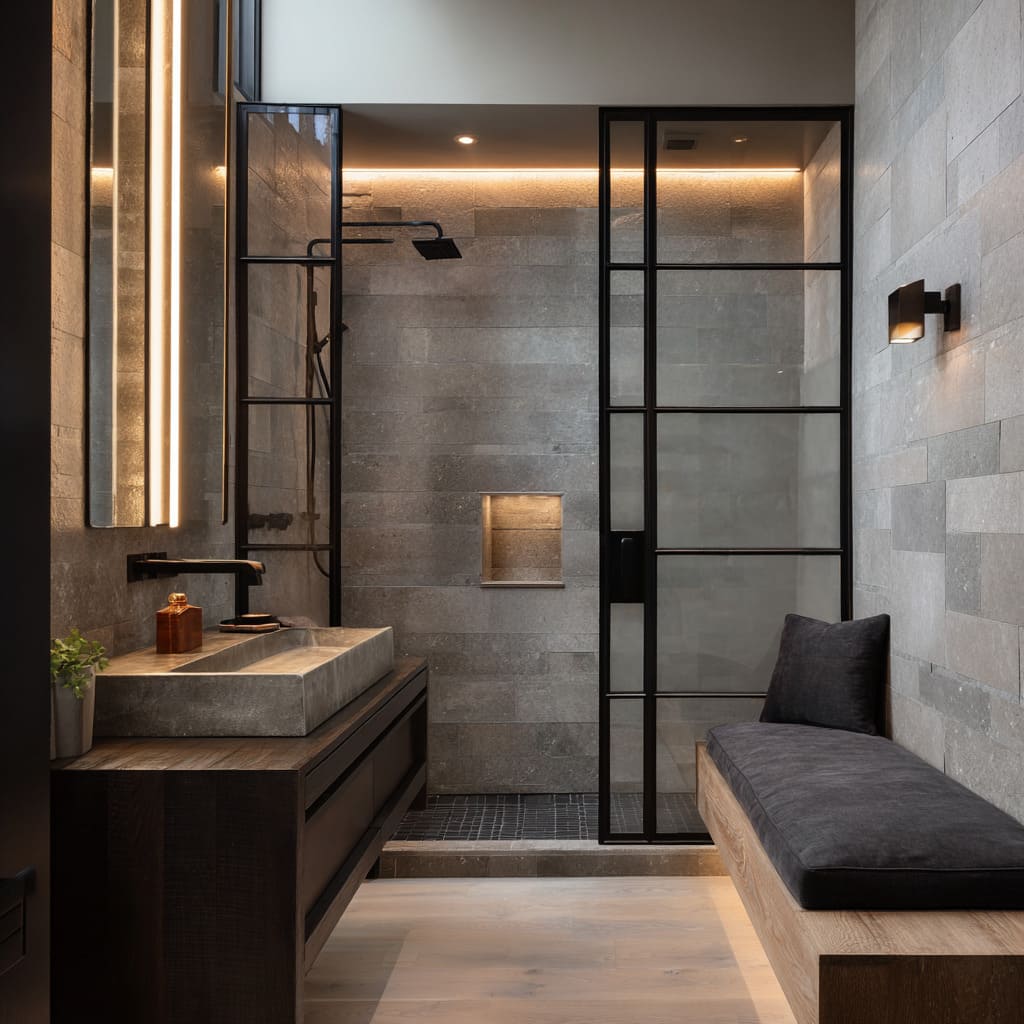
Rather than relying on loud shifts in color, contemporary master bathroom ideas use quiet material pairings to establish contrast. Grain orientation, tactile finish, and subtle sheen differences do most of the visual work.
You’ll often see a matte slab alongside something raw-cut, or a smooth curve flowing into a coarser vertical grain. These moves keep the palette tightly controlled while allowing surfaces to interact with light in very different ways.
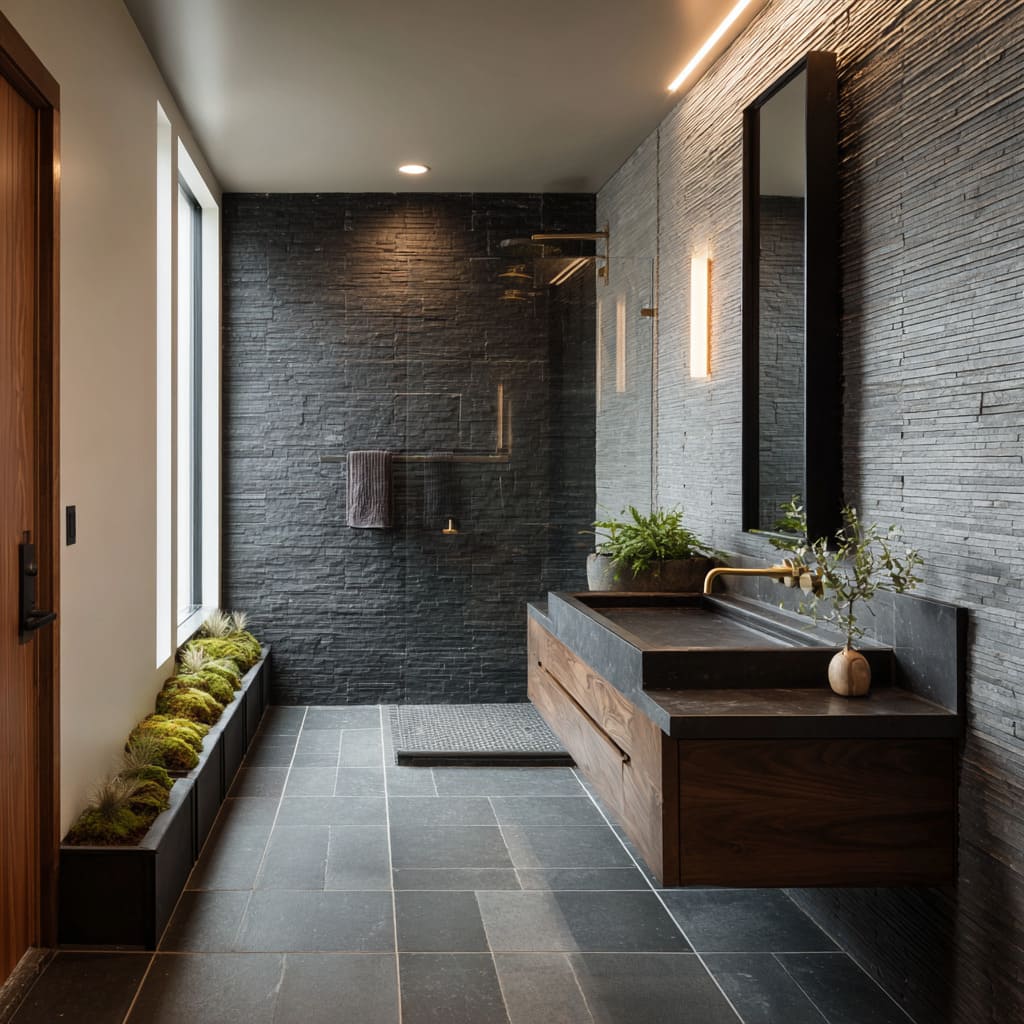
What separates one surface from another is often how it feels to the eye—whether the edge catches the light sharply or diffuses it gently. For instance, a finely honed slab may absorb light with a muted softness, while a split-face stone scatters highlights unevenly, adding depth.
These pairings don’t scream for attention—they sit quietly, but with enough variation to stop the space from going flat. Texture builds the rhythm where color steps back.
That’s where many of the richest bathroom compositions find their strength: in the quiet tension between similar tones shaped by entirely different hands.
Floating vs. Grounded Geometry
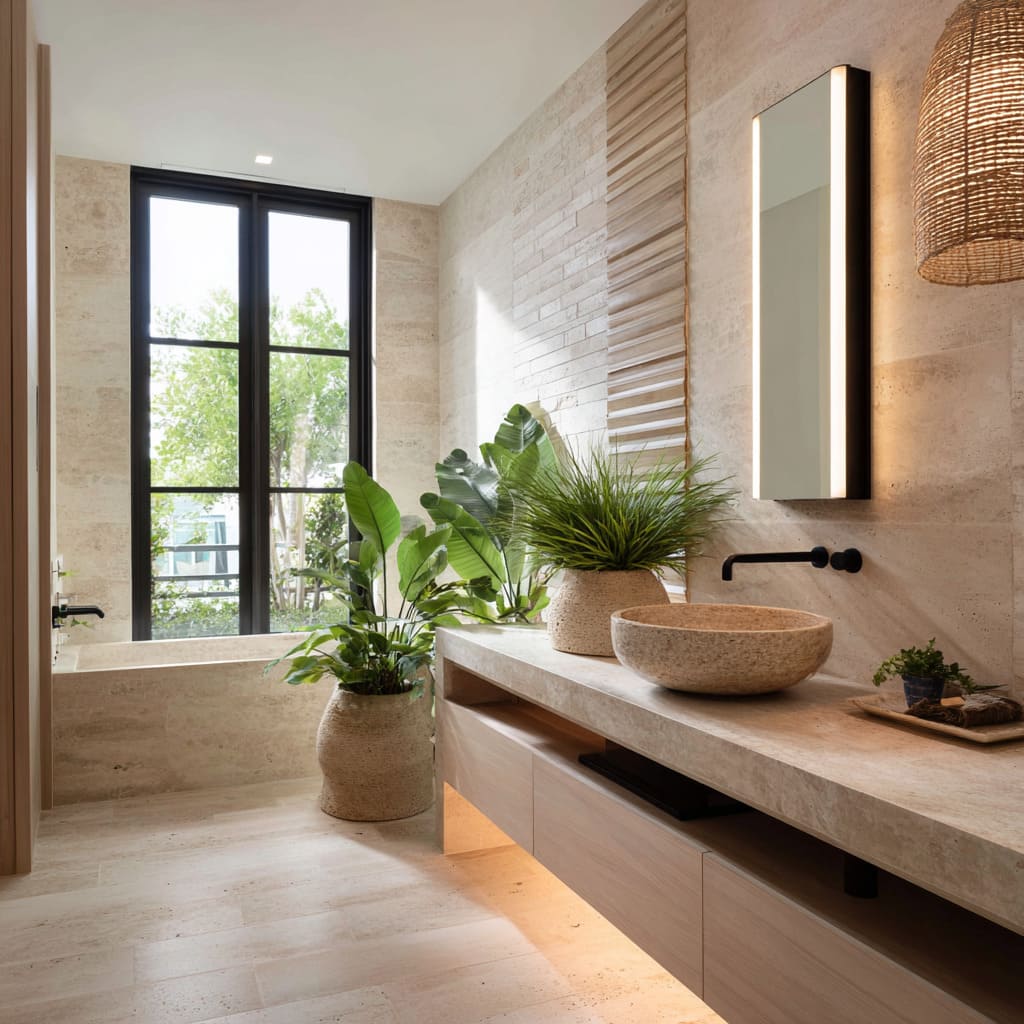
The best modern contemporary bathroom ideas often rely on visual weight—or the illusion of it—to create a balanced composition. Some spaces introduce volume through thick-cut stone vanities and blocky shapes, but then lift them gently above the floor with subtle under-lighting.
The result is a piece that feels heavy in presence but light in effect. That glow at the base doesn’t call attention to itself—it just detaches the object from the ground, letting it breathe in space.
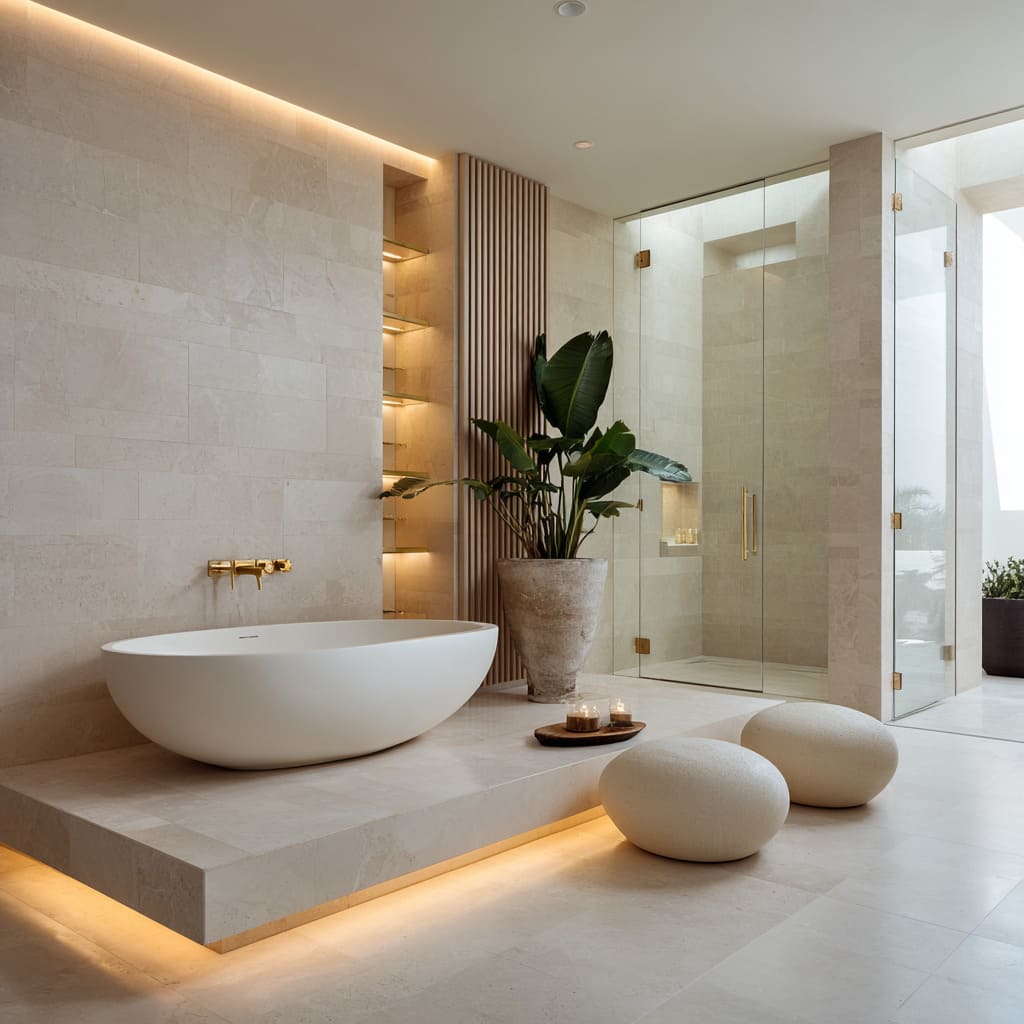
In contrast, other elements remain fully grounded. Freestanding tubs or carved limestone vanities might rest directly on the floor, no lighting, no shadow play—just mass, anchoring the space.
The mix of these two states—floating and grounded—is what builds interest. You’re never in an all-weightless or all-heavy setting.
The composition fluctuates. This contrast isn’t harsh.
It’s quiet and intentional, giving shape to stillness. A contemporary vanity bathroom doesn’t always need decoration when it has this kind of balance between gravity and lift.
Plants as Structural Devices
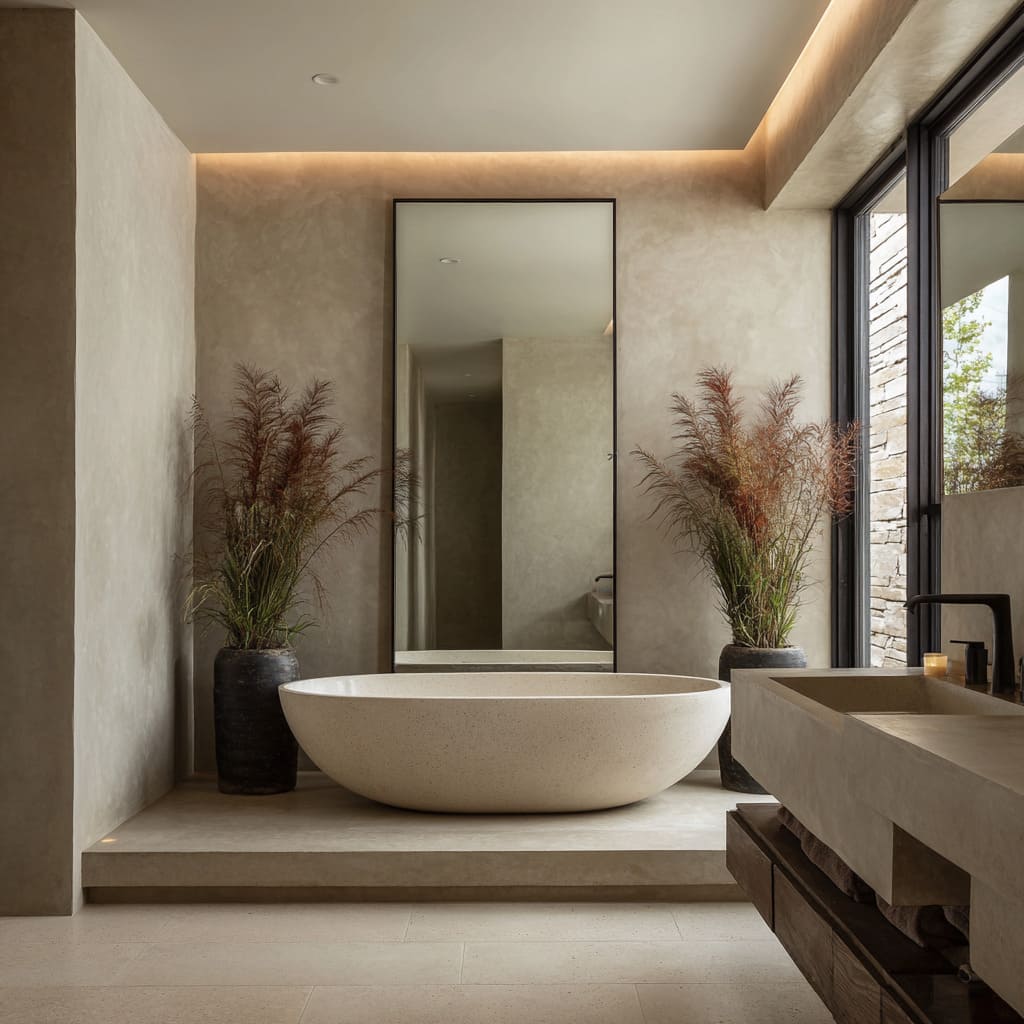
Plants in luxury bathrooms aren’t placed for color alone—they hold shape and direction. A large leaf plant with tall vertical stems can act like a visual pillar beside horizontal slabs, adding height to a flat zone.
A rounded pot near an oval tub repeats the form and softens the intersection. Bonsai trees or moss beds aren’t there to mimic nature—they’re used as geometry that lives.
Foliage creates visual punctuation. A single tree might interrupt a clean sightline on purpose, to balance symmetry.
A moss trough at window level can pull the exterior inside, giving a flat stone wall something soft to react to. These additions hold their own weight—they’re not filler.
In spaces where materials and lines are tightly controlled, greenery becomes one of the few organic elements allowed to speak, and it often does so by matching the structure around it, not contradicting it. That’s what sets apart the best layouts—they know where life belongs without making it feel like an accessory.
Lines That Stretch Space
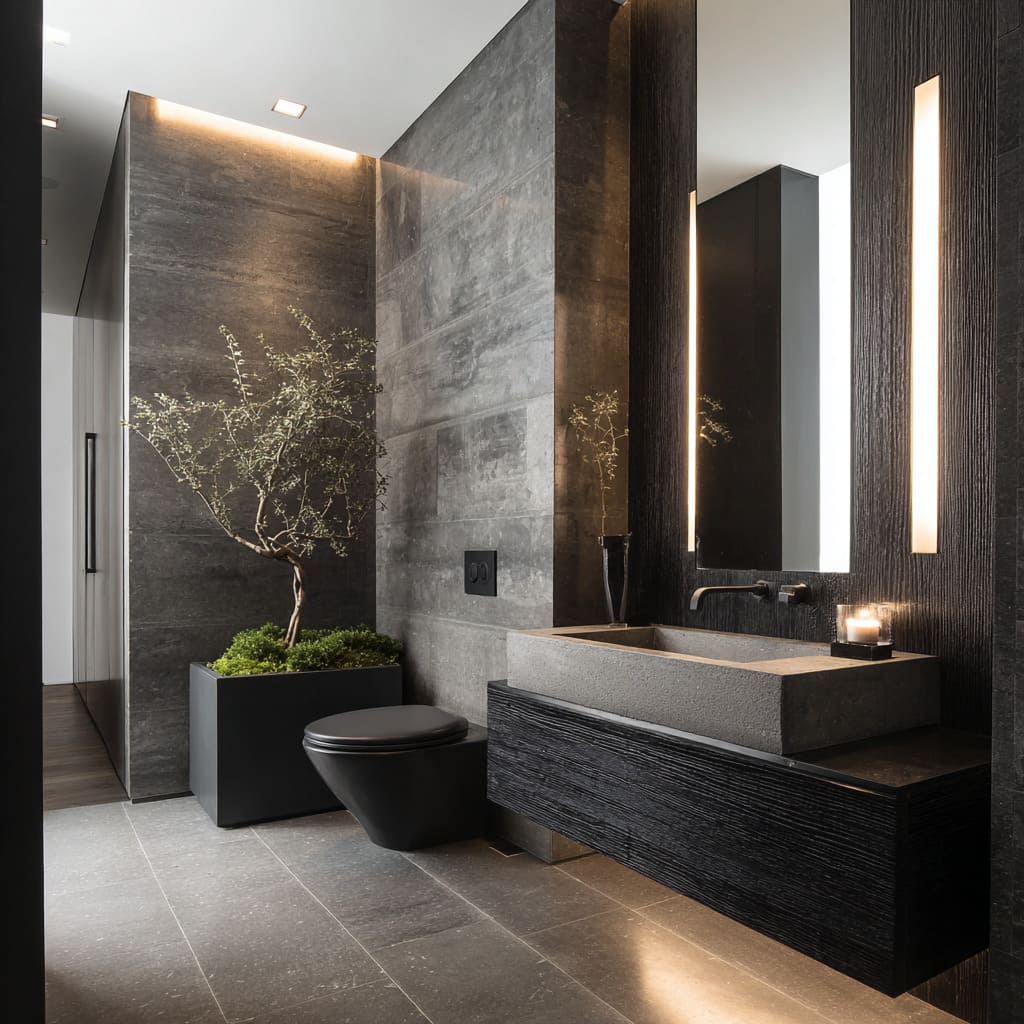
A core visual device across many contemporary bathroom styles is the use of directionality—how lines can shift the way a room is perceived. In spaces with standard or even modest ceilings, vertical design elements do the heavy lifting.
Grooved wall panels, narrow ridged tile patterns, or even backlit mirrors running from floor to ceiling act like quiet visual arrows, subtly encouraging the eye to travel upward. This vertical pull isn’t dramatic—it’s smooth, almost imperceptible—but it changes how height is felt.
At the same time, a counterbalance is introduced. Long horizontal elements—stone veining, floating shelves, or continuous ledges—gently expand the space sideways.
This dual approach, stretching vertically and widening horizontally, reconfigures the room without moving a single wall. What’s compelling is that these effects work even in muted color palettes, proving how proportion and alignment can be more powerful than contrast in shaping space.
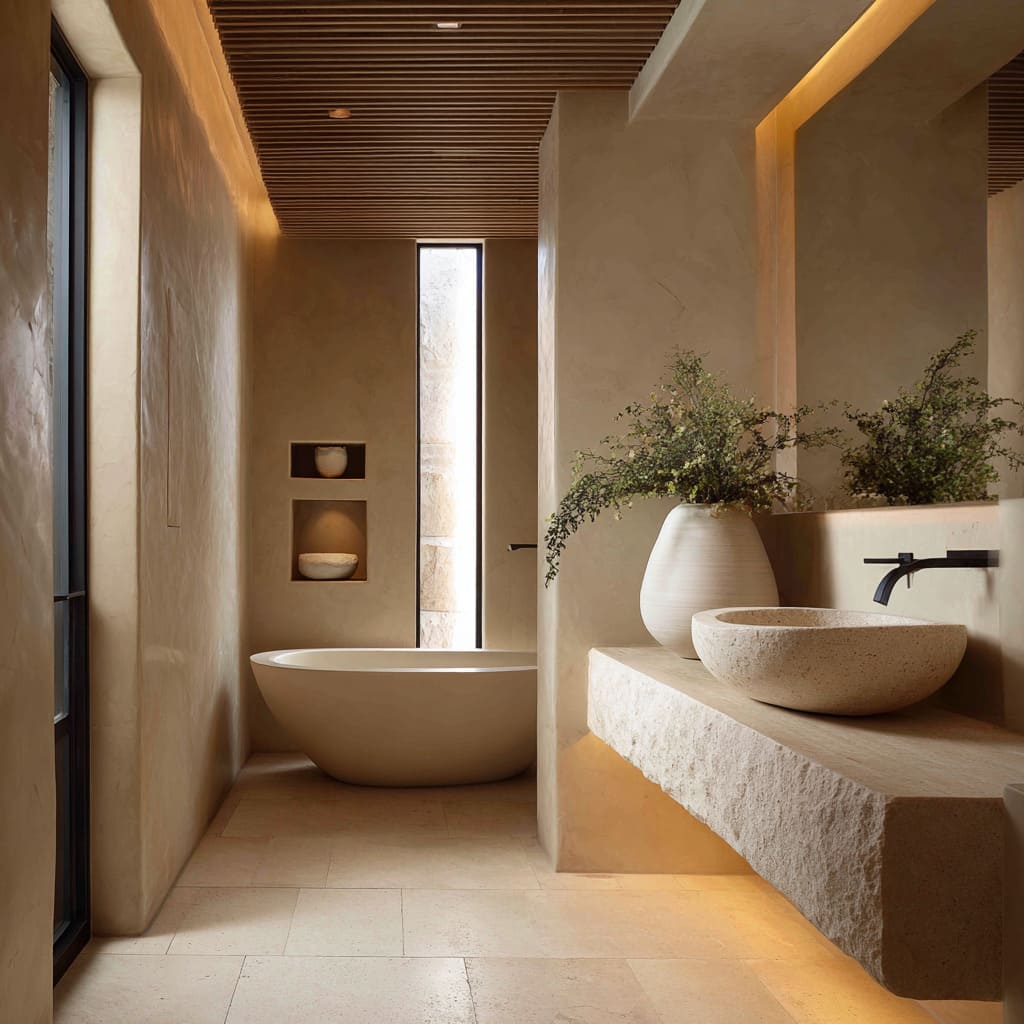
Light That Polishes Edges, Not Objects
Many standout contemporary bathroom decor ideas rely on indirect light to bring subtle definition instead of attention-grabbing brightness. Lighting is no longer used to spotlight a sink or shine directly on a tub.
Instead, it’s tucked behind mirror panels, hidden under floating vanities, or embedded along ceiling recesses. These concealed sources cast a soft glow that follows architectural edges rather than lighting individual features.
The effect is quiet but precise—surfaces begin to radiate on their own, while corners fade rather than cut. Stone, especially when matte or slightly textured, doesn’t reflect the glow directly.
It absorbs and diffuses it, creating a finish that reads as smooth or cloudy depending on how the light lands. This technique reshapes volume, letting mass feel soft instead of heavy, and creates a light environment that feels controlled without looking lit.
In the most refined spaces, this hidden glow becomes part of the material language itself—more skin than spotlight.
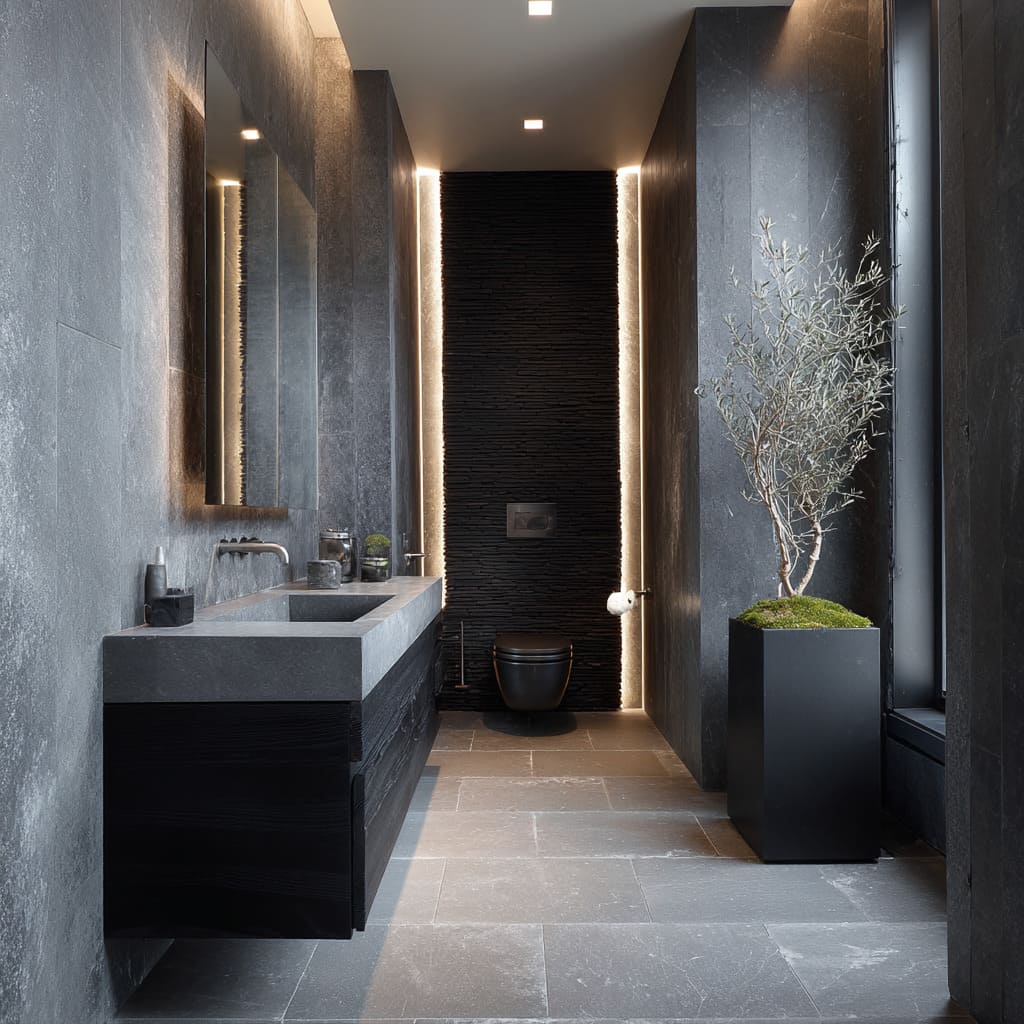
Metals as Quiet Accents
In many ultra-modern luxury bathroom design concepts, metal is no longer a focal material—it’s a line, a whisper, a trace. Brushed finishes in brass, champagne-toned copper, or softened nickel appear in narrow spouts, slim handles, or edge trims, often blending into their surroundings instead of standing apart.
Their surface sheen sits well below reflective, ensuring they catch ambient light without throwing it. These pieces are rarely placed at random.
The positioning often aligns with architectural features—wall taps line up exactly with tile seams or plank patterns, reinforcing a sense of visual order. In some rooms, you’ll notice that the metal echoes the dominant geometry: long horizontal fixtures to match stone veining, or vertical pulls echoing panel grooves.
Because of their restraint, even a small amount of metal becomes amplified, more visual punctuation than embellishment. It’s less about decoration, more about reinforcing the rhythm of the space.
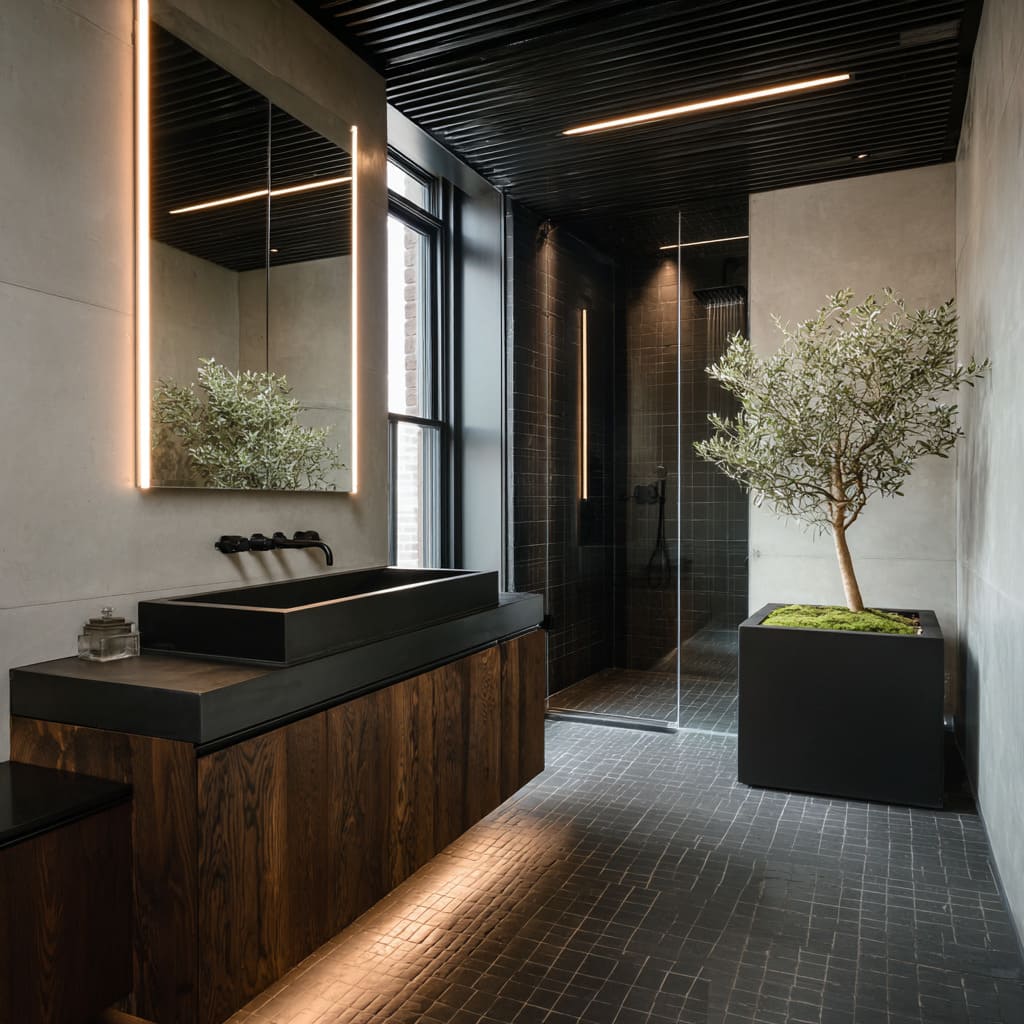
Mirrors That Double Space and Mood
In contemporary bathroom suites, mirrors serve a structural purpose beyond reflection. Full-surface glass planes—whether wall-mounted or floor-standing—create instant depth, multiplying both light and the room’s architecture without adding volume.
A skylight becomes two; a branch viewed through a window reappears in the mirror, suspended midair. These moments introduce a layered effect that feels quiet but calculated.
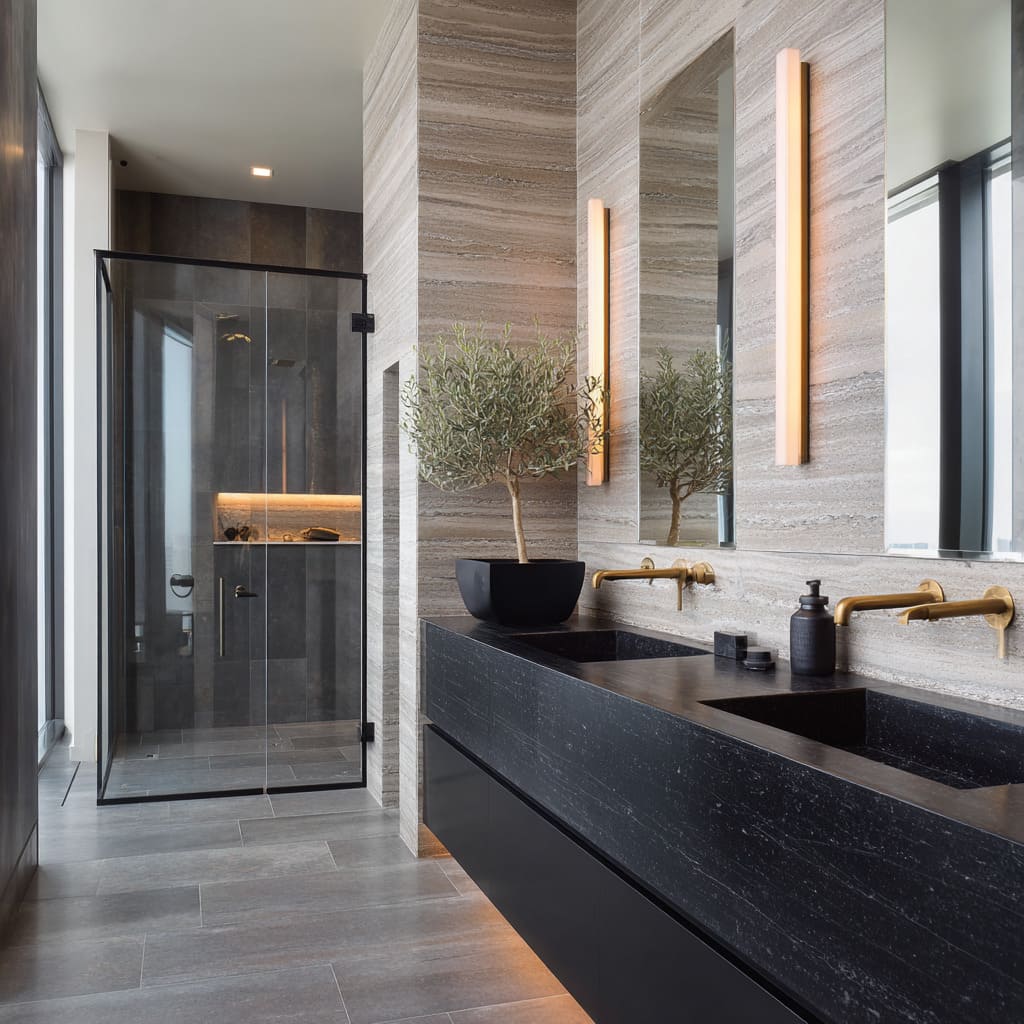
Where minimalism risks becoming too sparse, mirrors act as amplifiers for atmosphere. They echo materials, frame shadows, and repeat plant shapes, turning the background into a compositional tool.
Placement matters—mirrors are often aligned with lighting sources to soften the way brightness is distributed, or positioned opposite warm elements like wood slats or foliage to give the space a more grounded tone. Rather than just increasing scale, they build subtle repetition and balance—adding more without clutter.
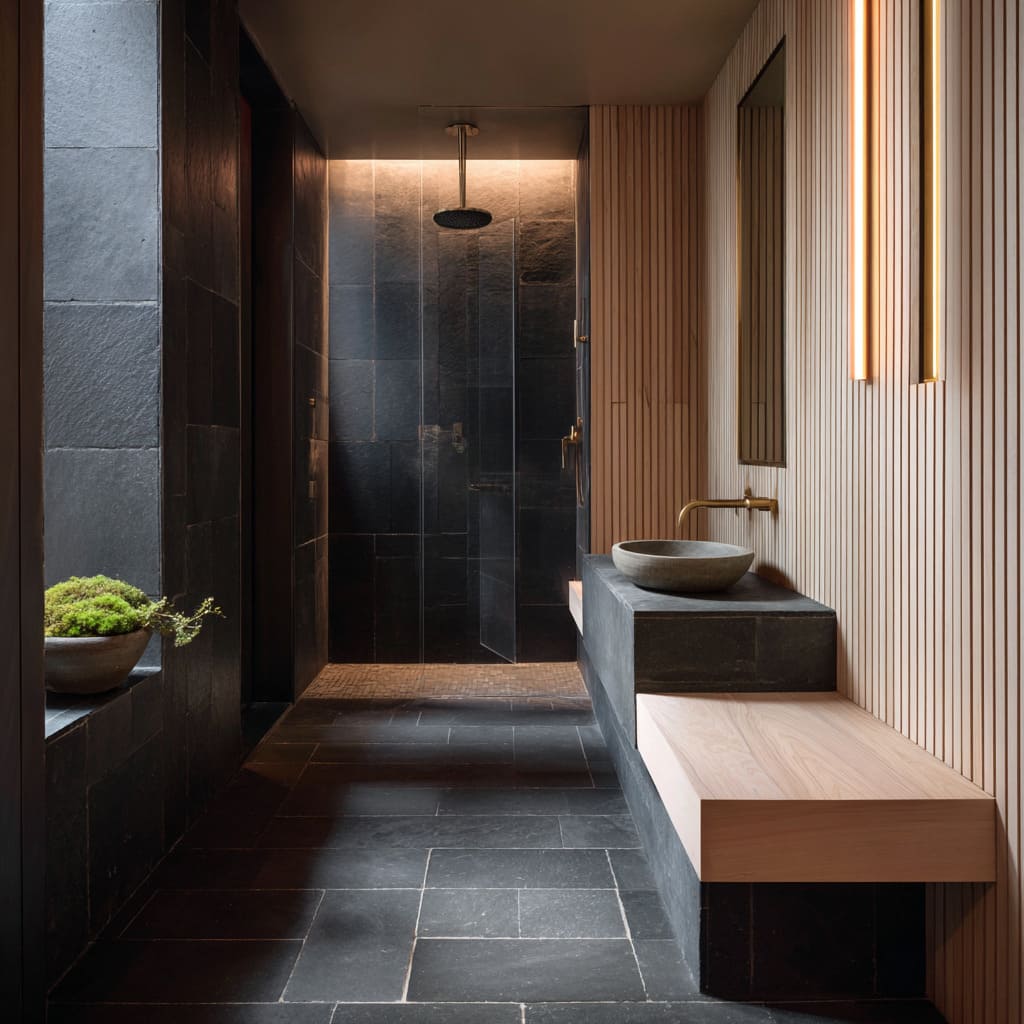
Colour Discipline as a Form of Luxury
One of the defining characteristics of a modern contemporary bathroom is its commitment to tonal control. Instead of shifting across multiple hues, the palette typically stays within two or three neighboring shades—sand, ivory, stone, charcoal—each carefully selected for how it interacts with light and texture.
This controlled repetition reduces noise. Without sudden color breaks, surfaces speak more clearly through grain, finish, and form.
Within this muted field, a single brass spout or amber-lit recess becomes the visual anchor. These warm notes aren’t flashy—they gain presence because they’re rare.
Their contrast sits quietly within the structure, never overwhelming the balance. This restraint creates a sense of material richness.
Grain reads deeper. Edges look sharper.
Shadows fall more evenly. It’s the absence of distraction that gives these spaces their sense of confidence.
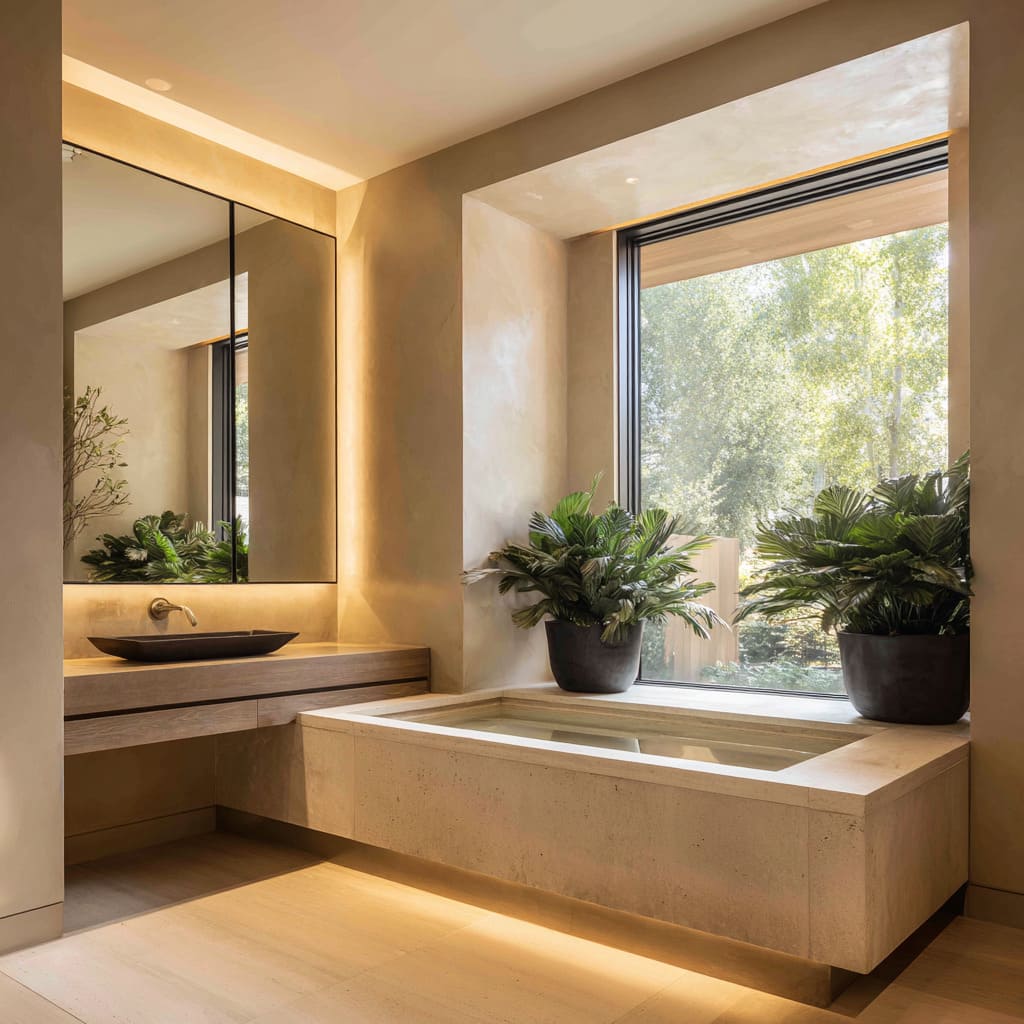
Symmetry Broken on Purpose
Many contemporary designs built around exact alignment—mirrors centered on vanities, tubs placed under skylights, shelving spaced with precision—introduce a visual twist by placing one object slightly off-axis. A solitary bench to the left of a mirror.
A planter leaning into one corner of a tub zone. A light fixture that shifts the ceiling’s balance by just a few degrees.
These are not mistakes. They’re subtle decisions made to avoid a sterile outcome.
This controlled offset keeps symmetry from becoming rigid. The space still feels organized, but now there’s a softness within the structure.
Eyes catch the rhythm but linger on the irregularity. It makes the space feel more human.
These deviations also act as points of tension, slowing the pace of the viewer’s attention and anchoring it momentarily before letting it continue. In this way, even small decor elements carry weight—not through scale, but by how they disrupt predictability without disturbing calm.
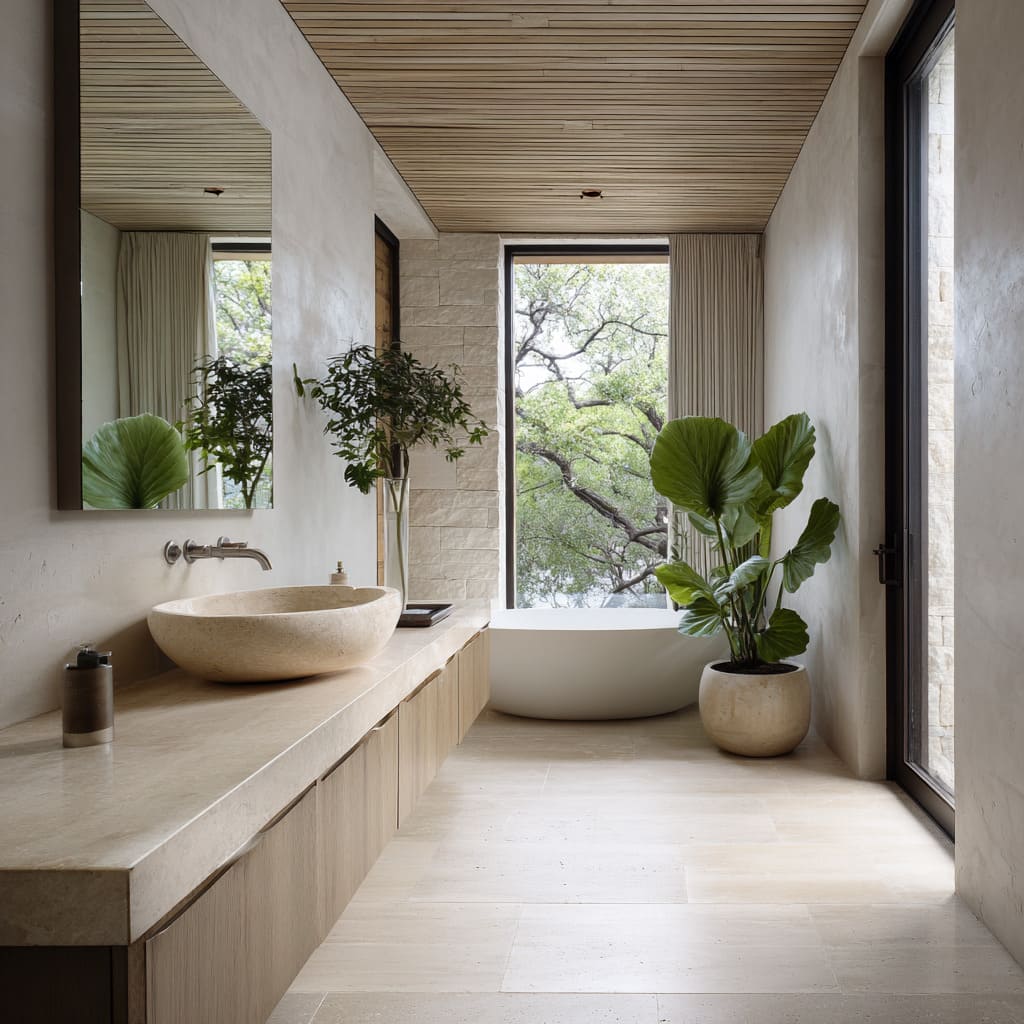
Seamless Material Transitions
In a modern contemporary bathroom, visual calm depends less on decoration and more on how materials meet. Edges are softened, not highlighted.
Corners are sometimes rounded, removing the need for visible trim. Tile layouts are planned with precision so that joints fall exactly in line with architectural elements—whether a mirror edge, floor plank, or ceiling slat.
These alignments aren’t decorative—they’re functional patterns of continuity.
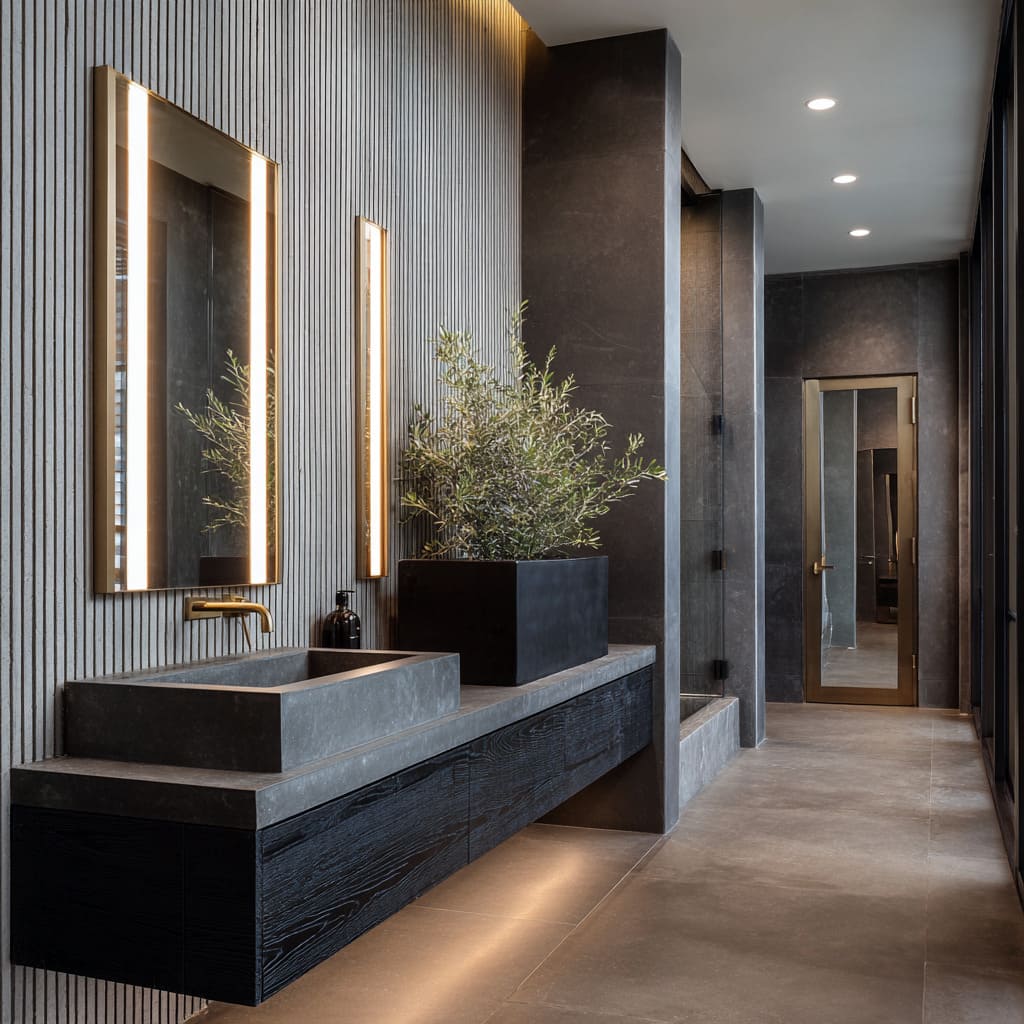
Glass panels around showers often avoid bulky framing. Instead, they float within the space, allowing boundaries to dissolve.
Where stone changes direction—like wrapping from a wall into a niche—the transition happens on a seam that already exists elsewhere. That level of coordination turns what could feel like technical joints into a part of the visual rhythm.
Even grout lines are kept minimal, sometimes nearly invisible, so surfaces read as uninterrupted planes rather than tiled sections. Everything flows, but with quiet control.
Inside Meets Outside Without Fanfare
Some of the most compelling bathroom spaces build their atmosphere by staying out of the way. Tall windows in slim black frames, clerestory slots, or narrow vertical cuts in the wall let the outdoors in—but only in fragments.
The composition is careful. The landscape isn’t shown all at once, but framed like a piece of visual architecture.
With the color palette indoors kept restrained—chalky whites, dusty taupes, pale stone—the greens from outside become the strongest hue in the room. Tree branches, dense leaf textures, or just a patch of filtered daylight all feel deliberate, even if untouched.
These natural elements ground the room’s stillness. There’s no need for a loud gesture; nature does the visual work.
In this way, outdoor scenery isn’t treated as a backdrop—it becomes part of the interior’s structure, layered into the space through glass, reflection, and shadow. This is one of the quiet signatures of thoughtful luxury—letting context shape the room without announcement.
Conclusion
The quiet strength of contemporary luxury bathrooms lies in how restraint shapes the atmosphere. There’s no chase for loud contrasts or elaborate finishes—what stands out is how every element is pared back until it earns its place.
Stone surfaces don’t fight for attention; they wrap the space with consistency. Lighting doesn’t shine—it outlines.
Mirrors reflect more than faces; they extend structure and mood.
Texture, line, proportion, and reflection are treated as tools, not embellishments. From the way a brass fixture aligns with stone joints to how a tropical plant balances a slab’s visual mass, each detail plays a supporting role.
The palette stays narrow, the materials quiet, and the layout clean—but it’s exactly this restraint that builds richness. These rooms feel composed because every part—solid, soft, matte, or green—is given space to matter.
It’s this kind of thoughtful, controlled design that continues to define today’s most refined bathroom spaces.