A mural around a fireplace often works best when it behaves like an atmosphere layer instead of a loud feature. In many fireplace wall mural ideas, the wall is treated as one calm field—value, texture, and spacing first—so the flame reads like a focused warm note inside a larger, quiet composition.
This approach is especially effective on a large fireplace wall, because the mural can fill the scale without adding visual noise, keeping the surface calm instead of empty or over-decorated. It also helps a tall, wide wall feel intentionally composed from floor to ceiling, so the fireplace zone reads finished even with minimal decor.
The result can feel gallery-clean, moody-minimal, or softly warm, while staying livable and not overly styled.
The mural acts like weather
A common approach in minimalist fireplace wall mural styling is to build the wall as a soft “climate” before the linework even starts.
- Background first: misty grey-blue washes, warm greige plaster tones, or concrete-feel mottling make the wall read deep even without objects. This is the base layer behind many textured plaster wall mural fireplace looks.
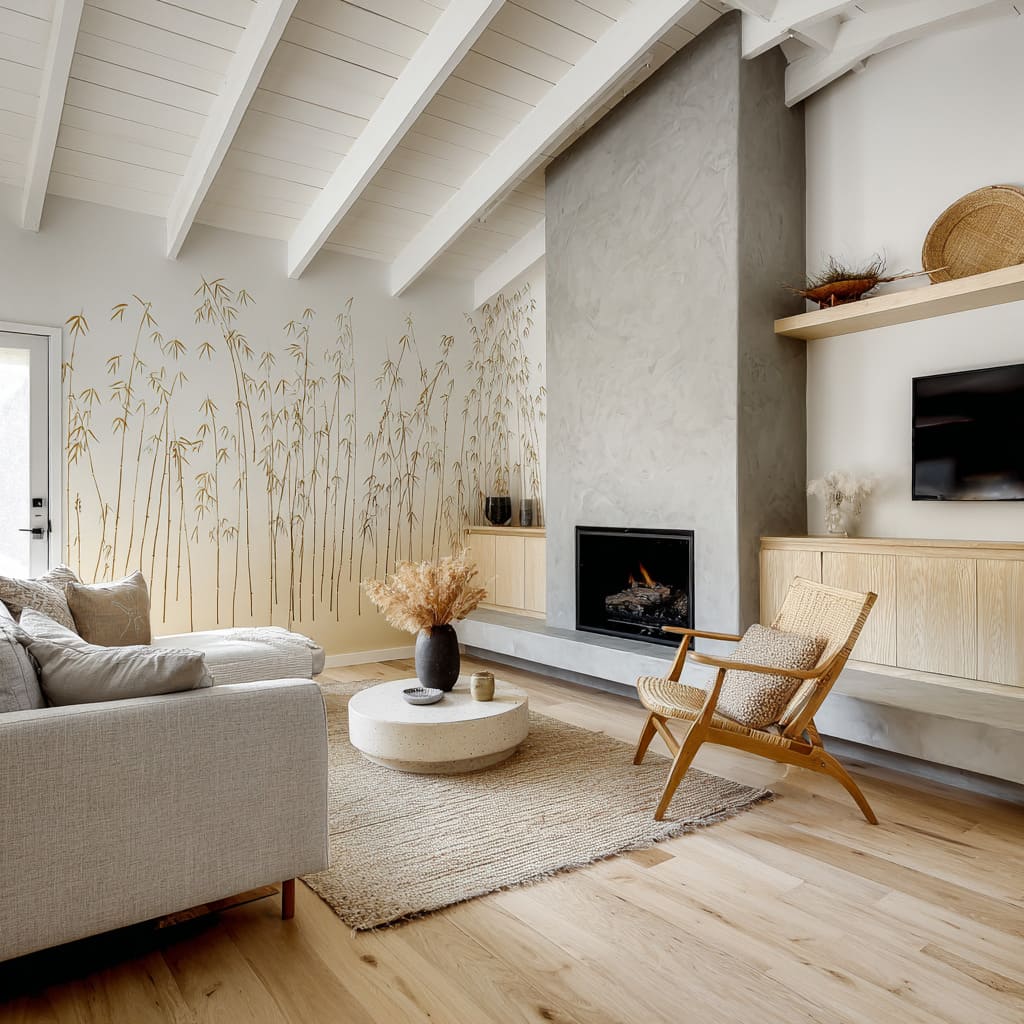
- Line second: trunks, bamboo stems, or branches stay thin and light, so the mural reads like air sitting on top of the wall surface instead of a printed graphic.
- Silence stays visible: large blank zones are kept intentionally. That emptiness is what makes “simple” look expensive, because the wall still feels complete.
This is why a design can keep very little décor and still feel finished: the wall already carries the mood.
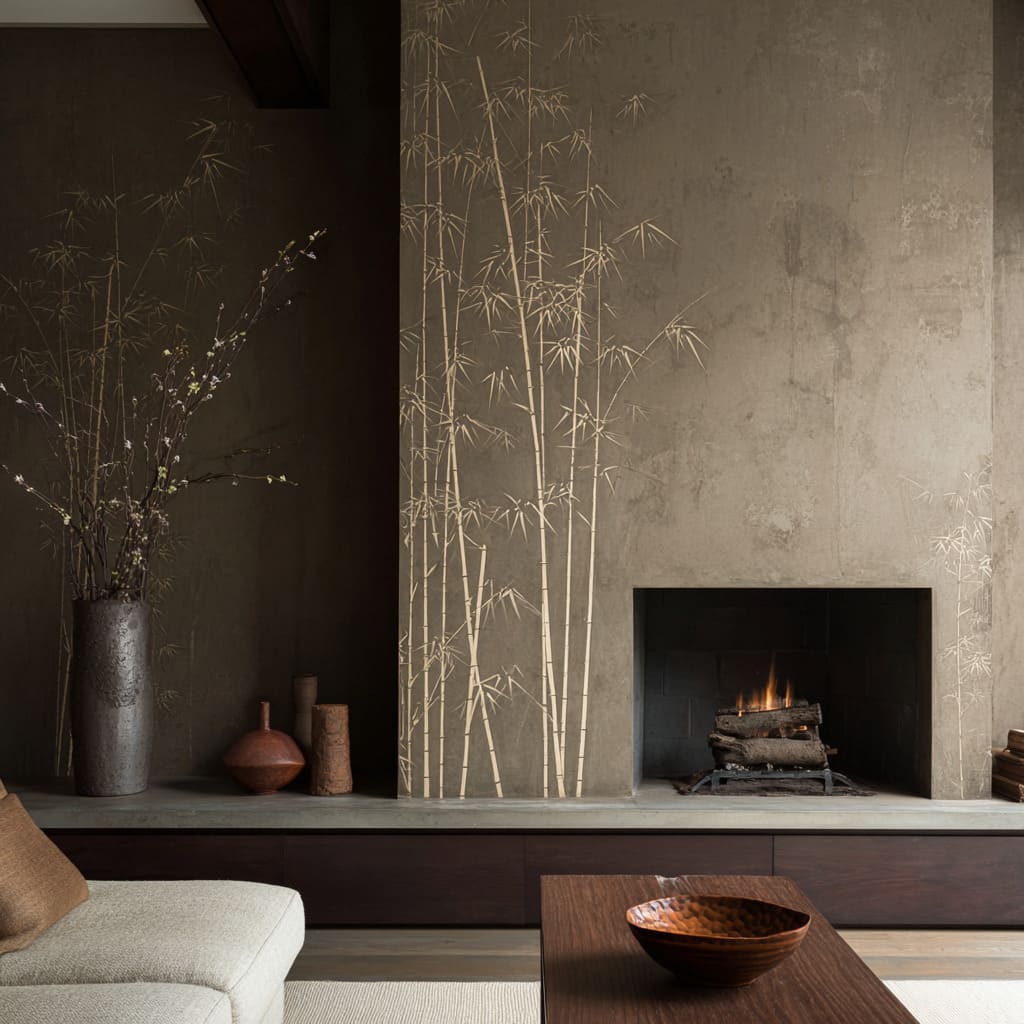
The fireplace becomes punctuation
The fireplace opening often reads strongest when it’s treated as a punctuation mark inside the mural field. Two punctuation types show up again and again in modern fireplace wall mural ideas:
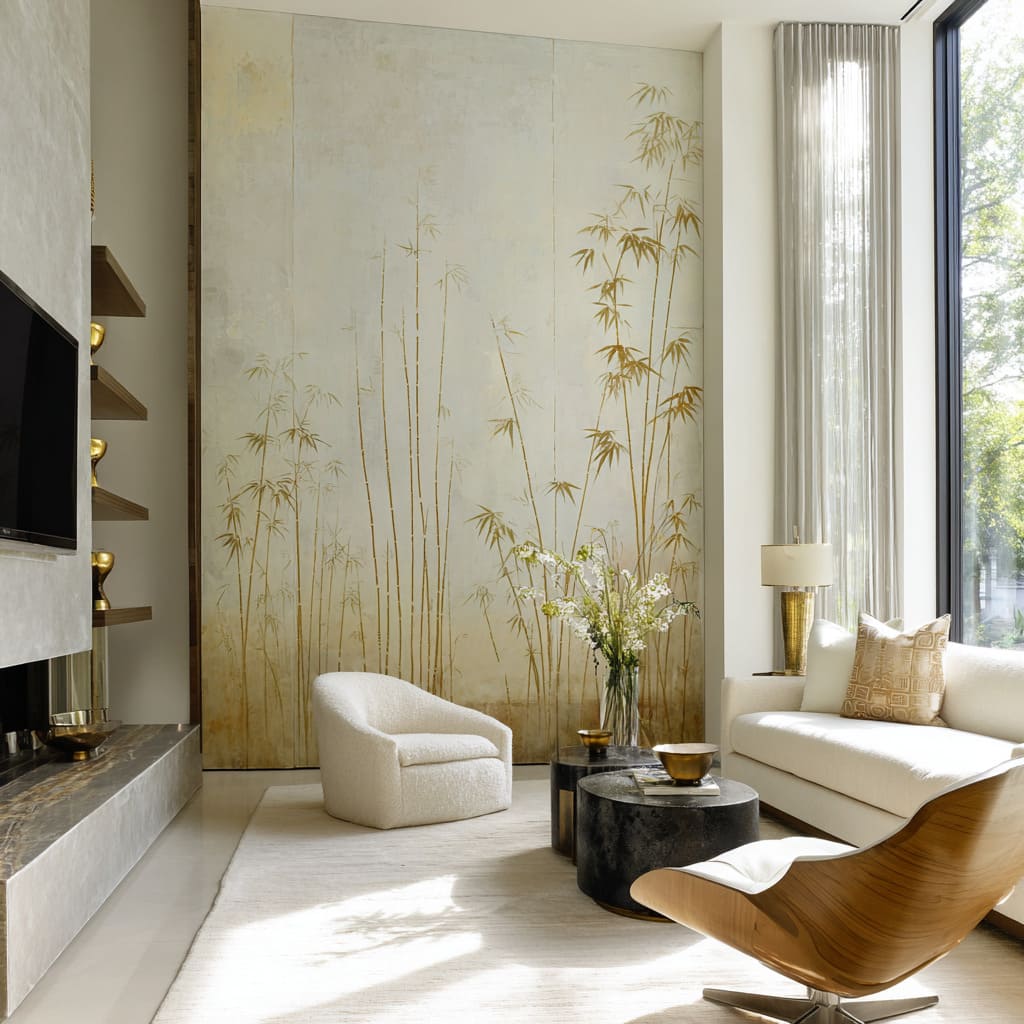
The underline fireplace
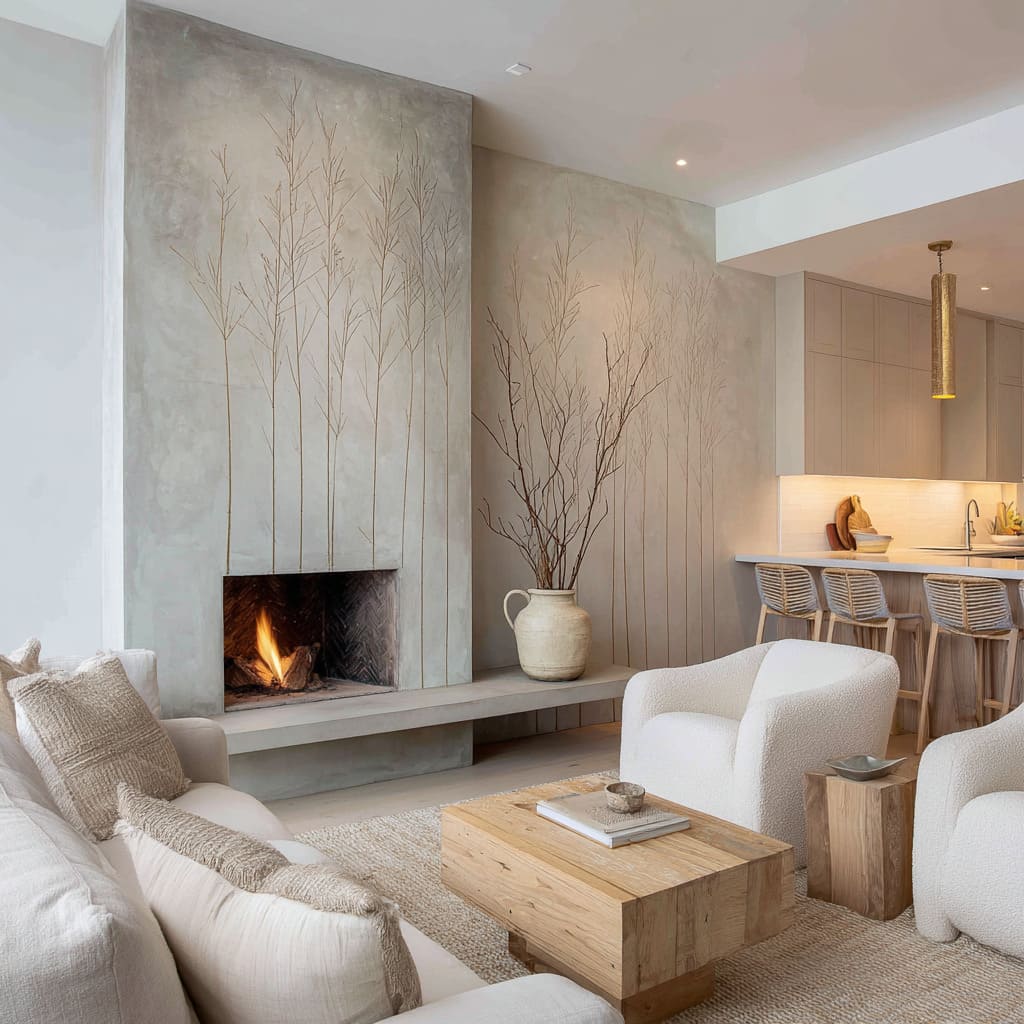
A long, low slot firebox creates a baseline that holds tall stems and trunks.
- The flame reads like an underline, and the mural reads like the sentence above it.
- This is the core visual logic behind a modern linear fireplace with mural: vertical rhythm above, quiet horizontal glow below.
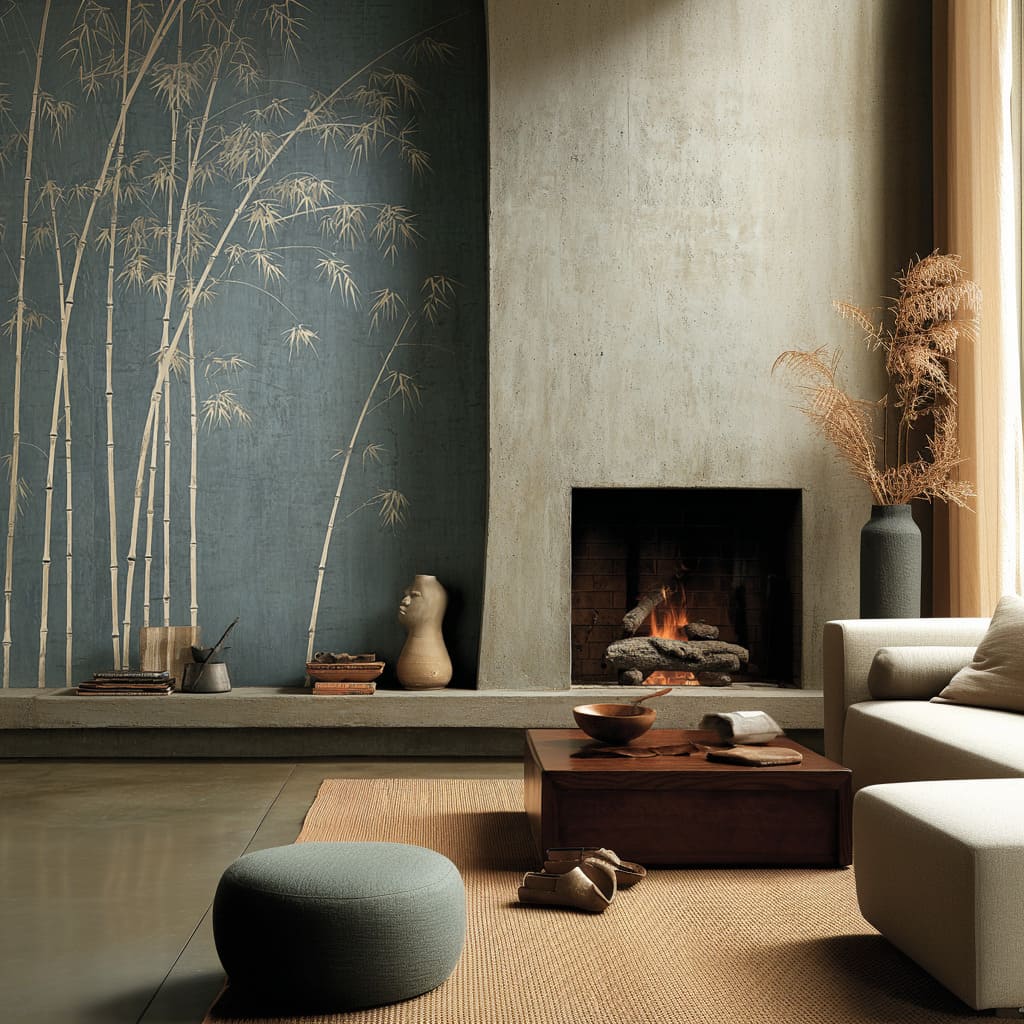
The void-in-a-field fireplace
A smaller, darker opening set inside a large calm wall surface shifts the mood toward quiet weight.
- The wall feels monumental, while the flame feels intimate.
- The firebox becomes a controlled dark “dot” that sharpens the whole composition without extra styling.
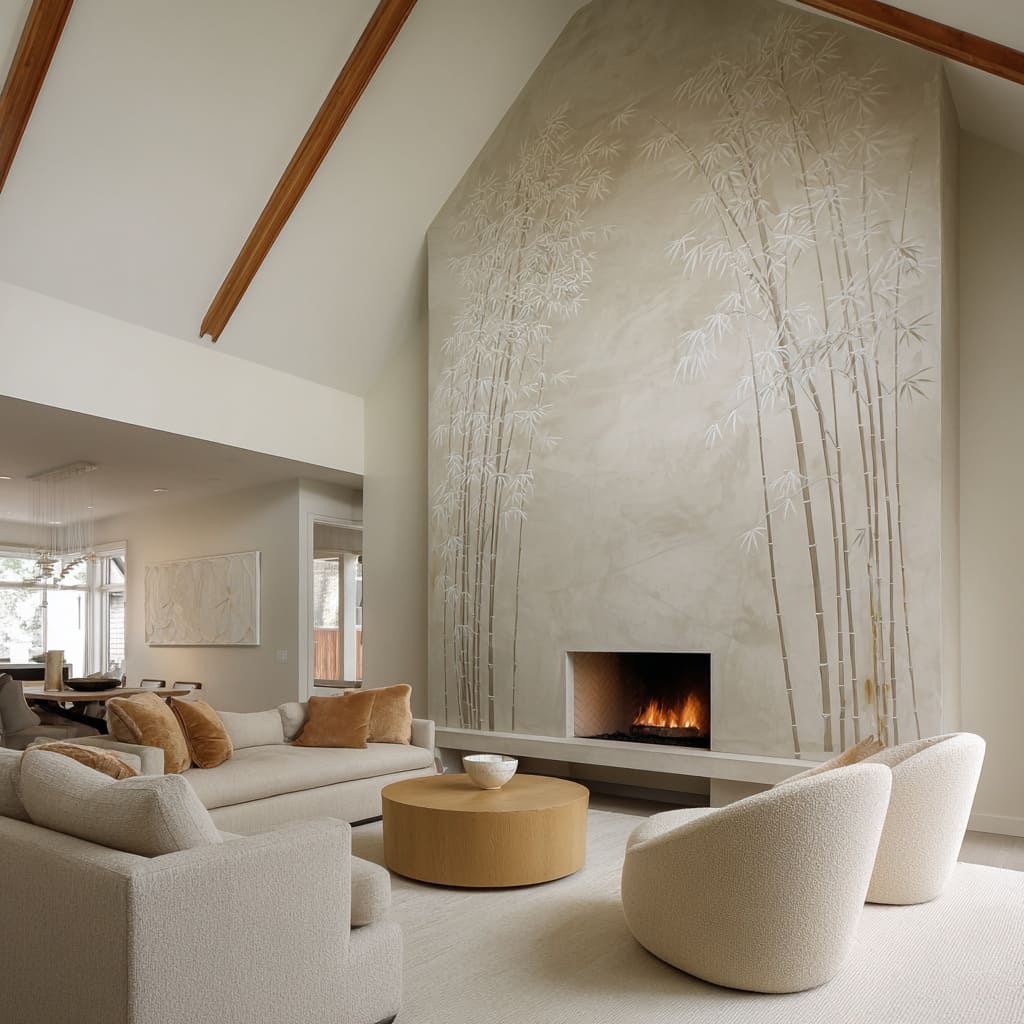
Both approaches keep the mural in charge while letting the flame stay clean, crisp, and contained.
Rhythm mapping replaces repeating pattern
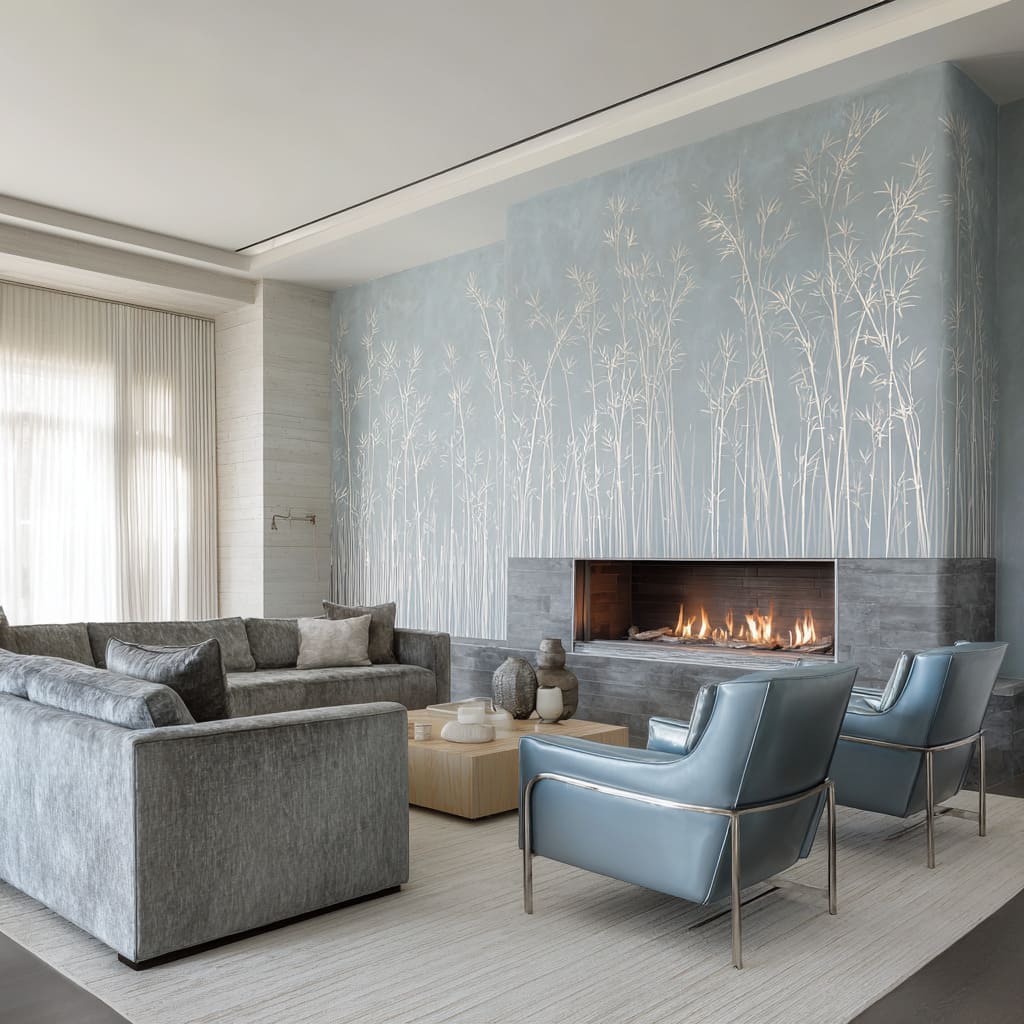
The linework looks most natural when it behaves like rhythm rather than wallpaper. In bamboo mural fireplace wall and grey birch mural fireplace wall concepts, several rhythm tools repeat:
- Uneven spacing: some zones are sparse, some are clustered, so the eye experiences pauses and beats instead of a grid.
- Density gradients: stronger activity around seated-eye height, calmer above, so the wall gives interest where people live, then quiets as it rises.
- Edge-weighting: heavier line clusters near corners and sides, with a softer center, creating a frame without drawing a literal border.
This rhythm logic is one of the quickest signals that the mural was composed for the room rather than stamped onto it.
Vertical line is balanced by horizontal weight
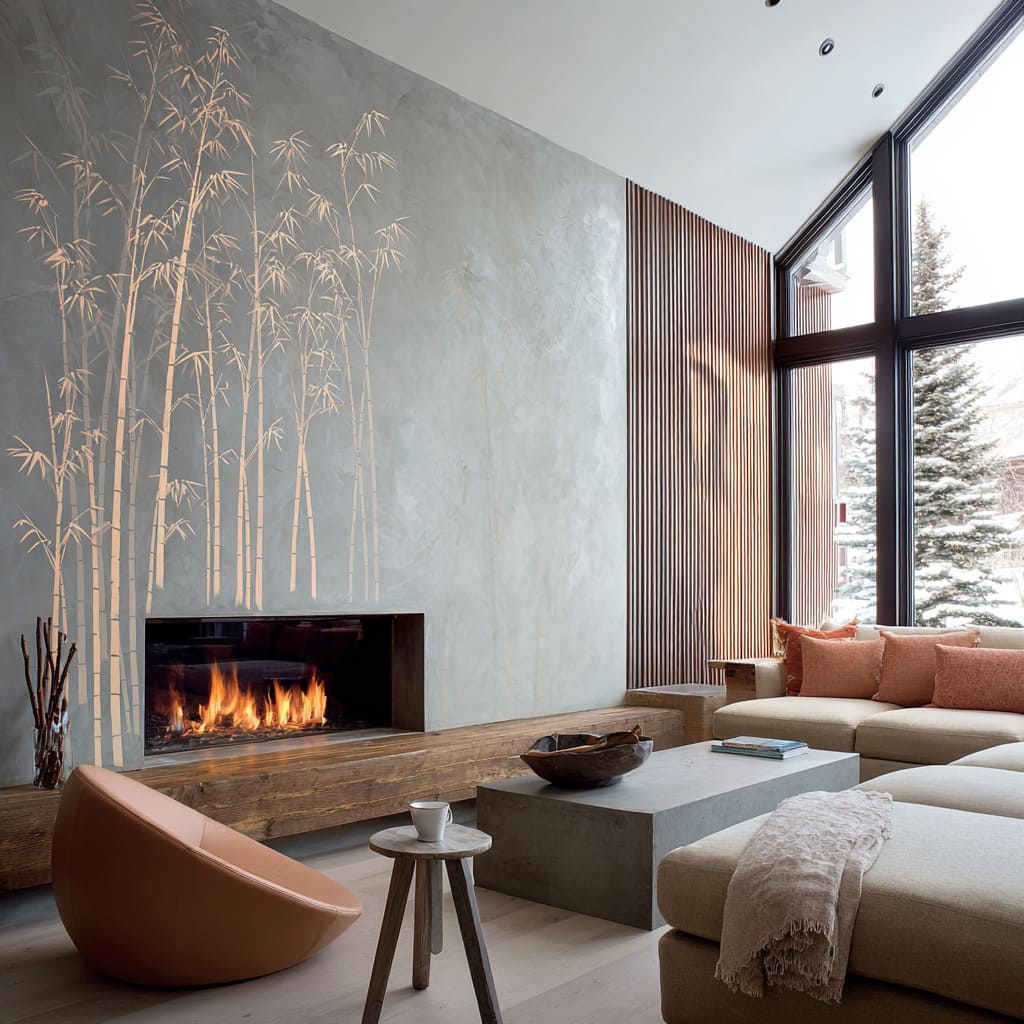
A mural full of stems, trunks, or branches needs a stabilizing counterforce. Many successful fireplace feature wall with mural compositions rely on a clear two-story structure:
- Vertical story: bamboo, birch, forest lines, slats, sheers, window mullions, thin chair frames.
- Horizontal story: hearth ledge, long cabinet run, floating shelf rail, linear firebox, bench-like base.
That horizontal “weight band” is often the hidden hero. In floating hearth ledge styling, the long ledge works like a ground line for the mural: it holds the wall down visually so the linework can stay light.
The mural’s line language is echoed in real objects
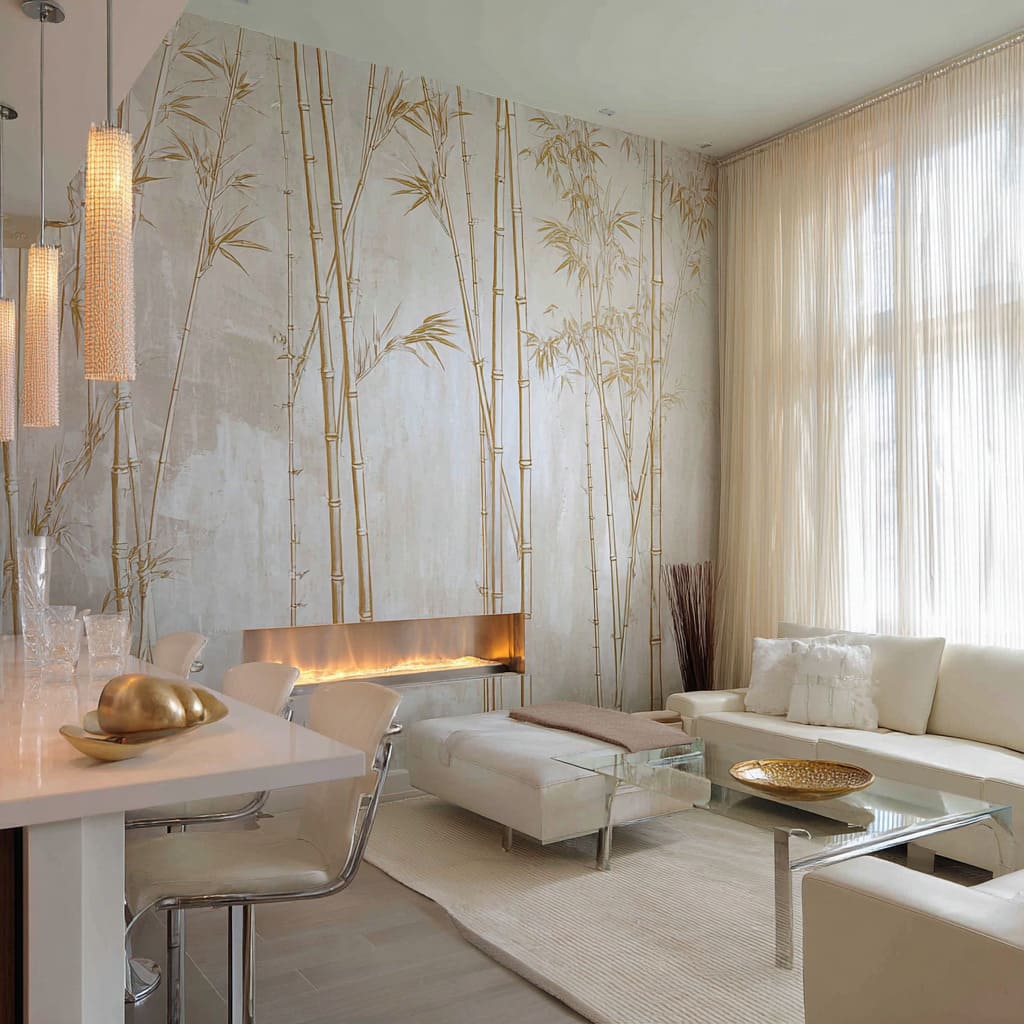
A mural looks integrated when the space repeats its line logic in 3D—quietly, not literally. In many Japanese-inspired bamboo mural living room and modern calm design concepts, line echoes show up as:
- Slatted screens that act like architectural stems next to organic stems.
- Black window grids that repeat thin strokes in a stricter, structural way.
- Sheer drapery folds that turn daylight into soft vertical striping.
- Tall cylinders (glass vessels, slim vases, pendant shapes) that behave like miniature trunks.
The interior feels “designed” because the mural is not alone; its visual grammar appears in multiple materials.
Light becomes a moving overlay on the mural
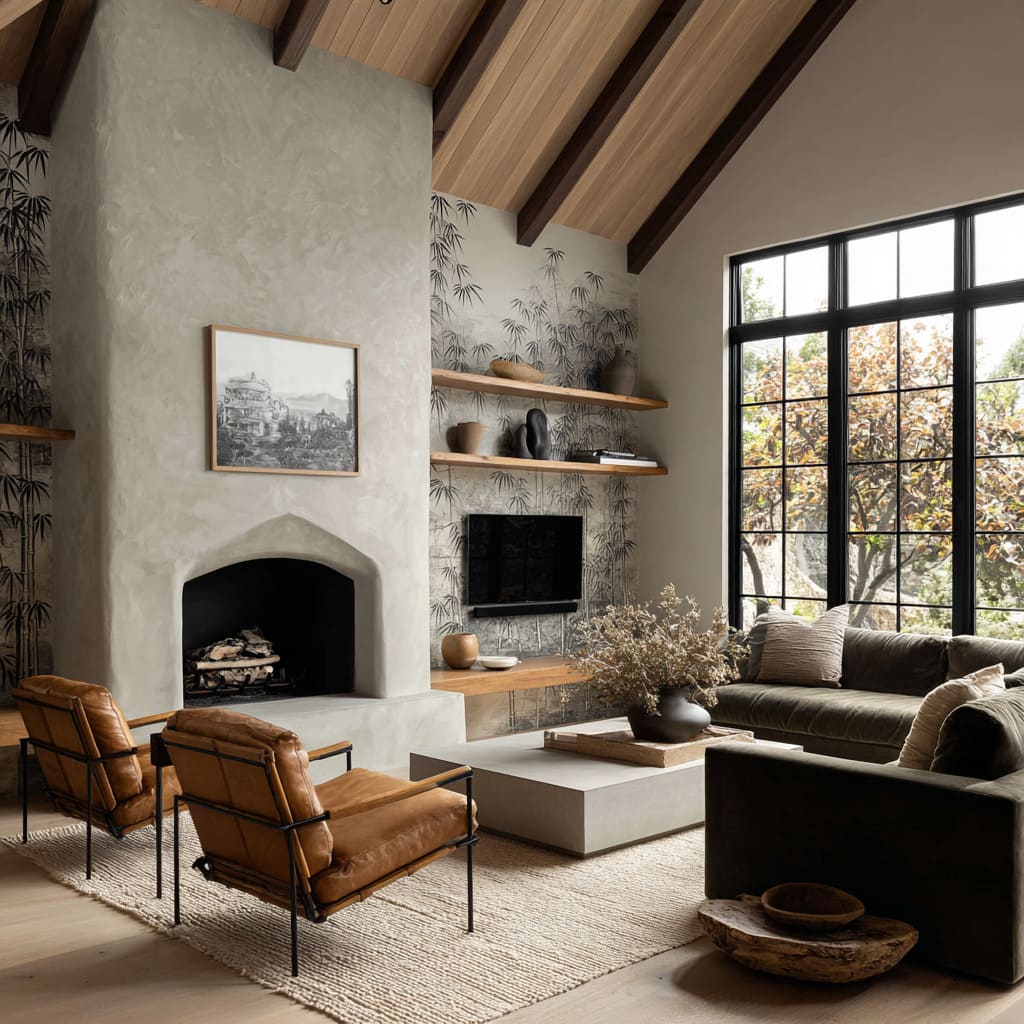
A major reason simple murals stay interesting is that they interact with light like a living surface.
- Diagonal daylight slices can erase and reveal pale trunks through the day, changing contrast without any added items.
- Grazing light on matte walls brings out plaster clouds and mineral texture, giving depth that reads calm rather than busy.
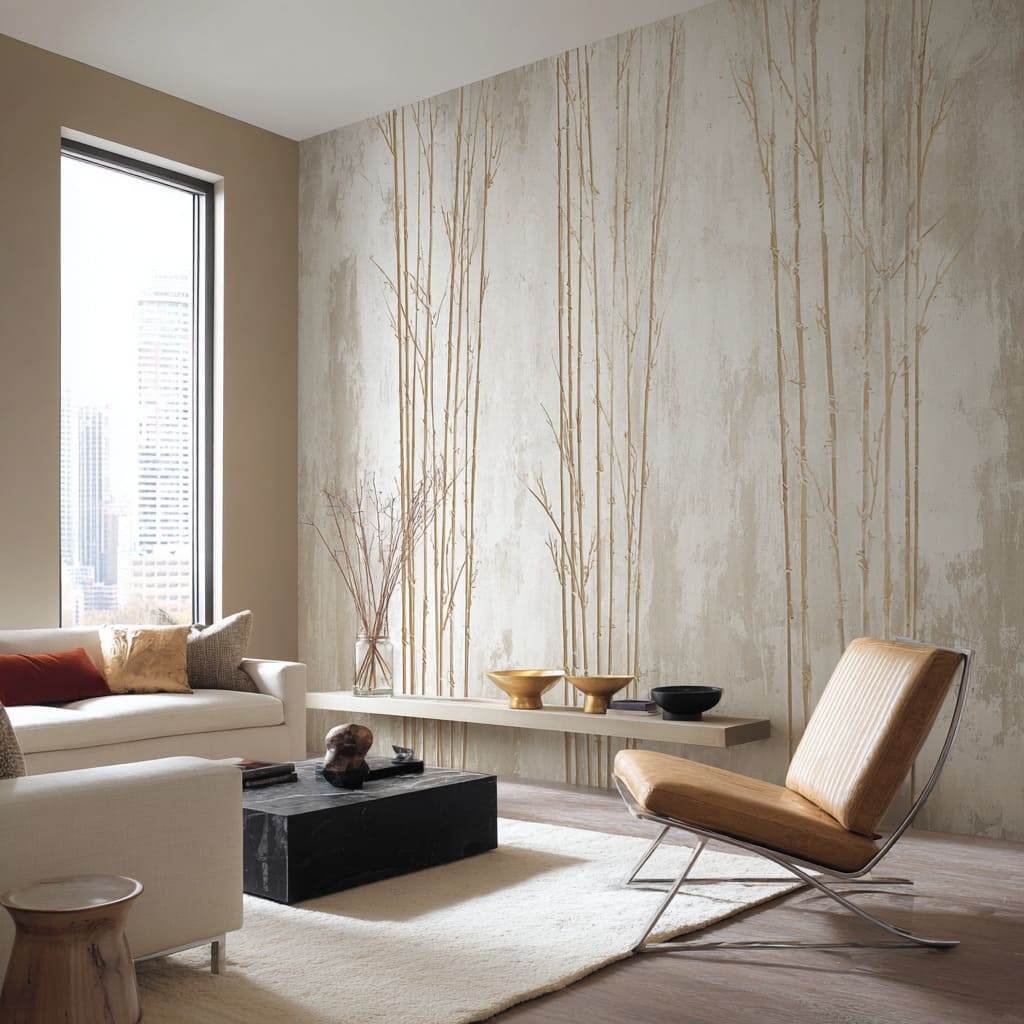
- Sheers as a filter soften metallic outline linework so gold reads smooth and refined instead of sharp.
This is a big part of why gold line art mural fireplace ideas often look best in soft, diffused daylight: the wall stays gentle, and the linework feels polished.
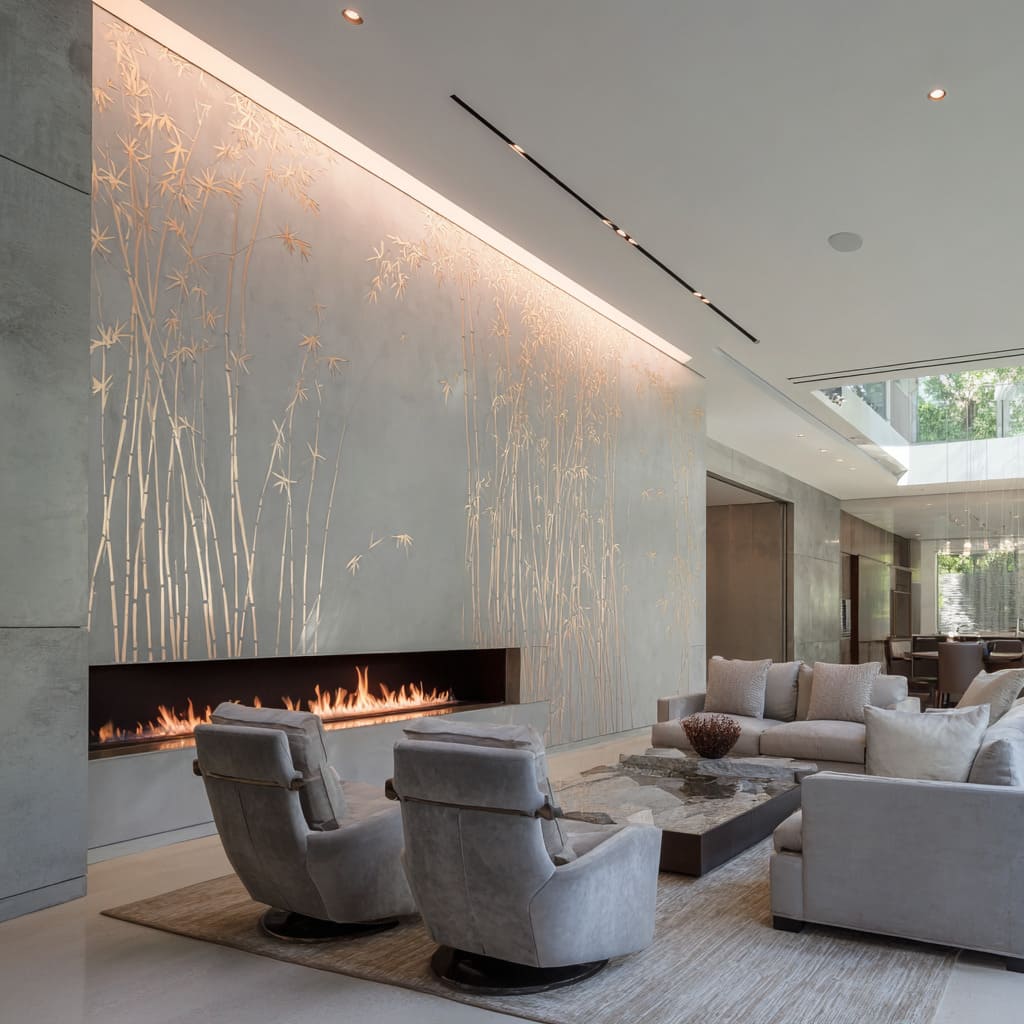
Warmth is concentrated in small, repeated notes
Many mural fireplace room designs feel warm without strong color because warmth is distributed in a controlled pattern:.
- the flame (primary warmth)
- warm line tone (gold, beige, warm grey) or warm wood bands (secondary warmth)
- small repeats in leather, clay, or brass-toned accents (micro warmth)
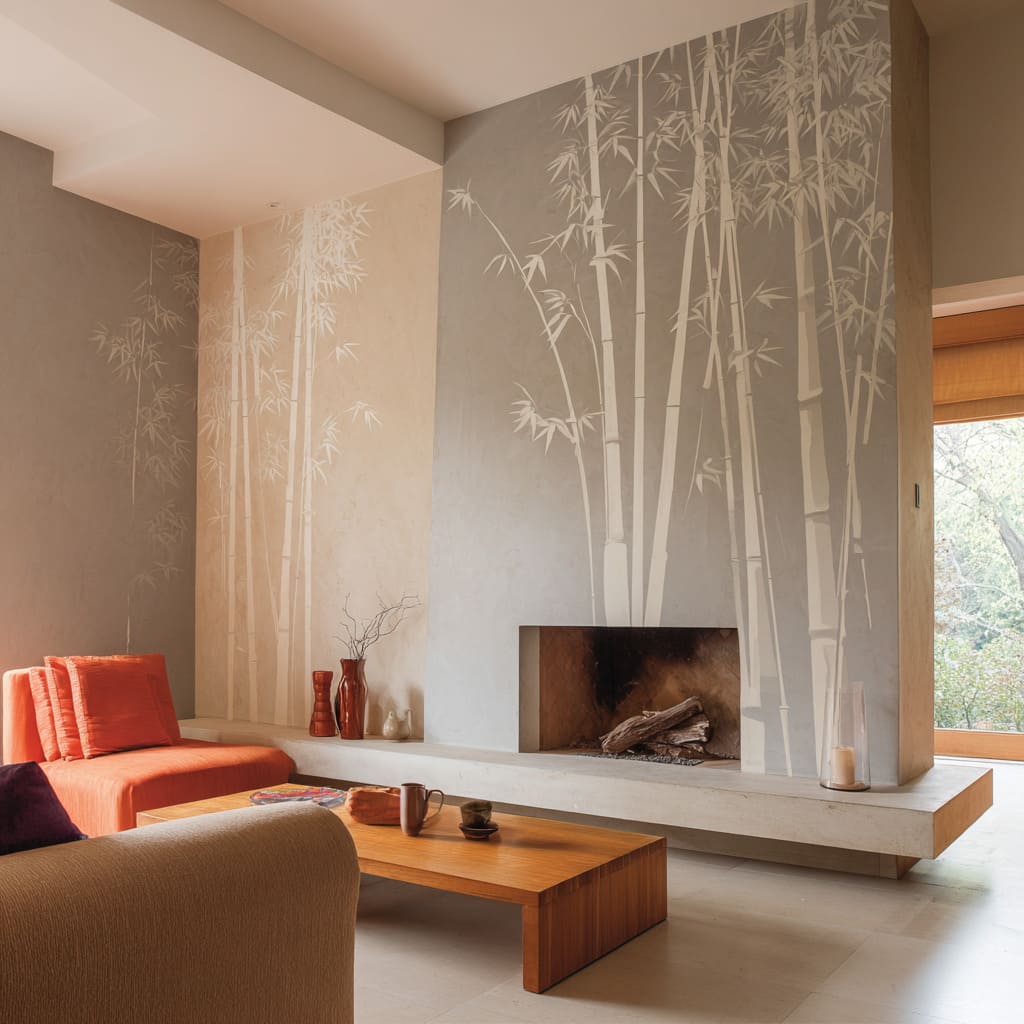
This creates a steady temperature ladder: cool or neutral wall field → warm mid-layer (wood / textiles) → hot point (fire). It’s a common foundation for warm neutral living room fireplace mural styling where the palette stays quiet but never feels cold.
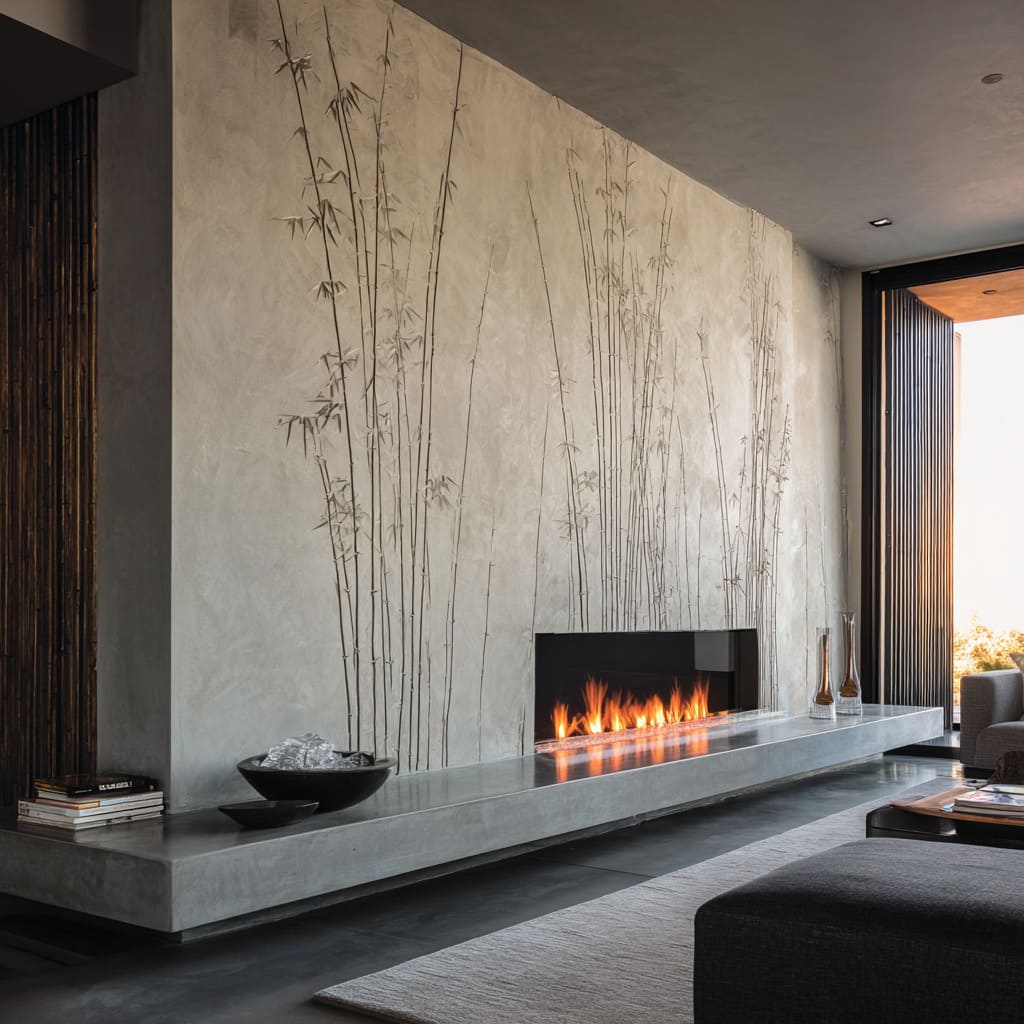
Contrast hierarchy builds depth without clutter
A consistent depth strategy is contrast layering rather than object layering:.
- Low contrast: mural field (tone-on-tone trunks or soft outlines)
- Medium contrast: wood shelves, cabinets, ledges, or a warmer adjacent wall plane
- High contrast: the firebox opening (and often one dark anchor such as a black table or deep vase)
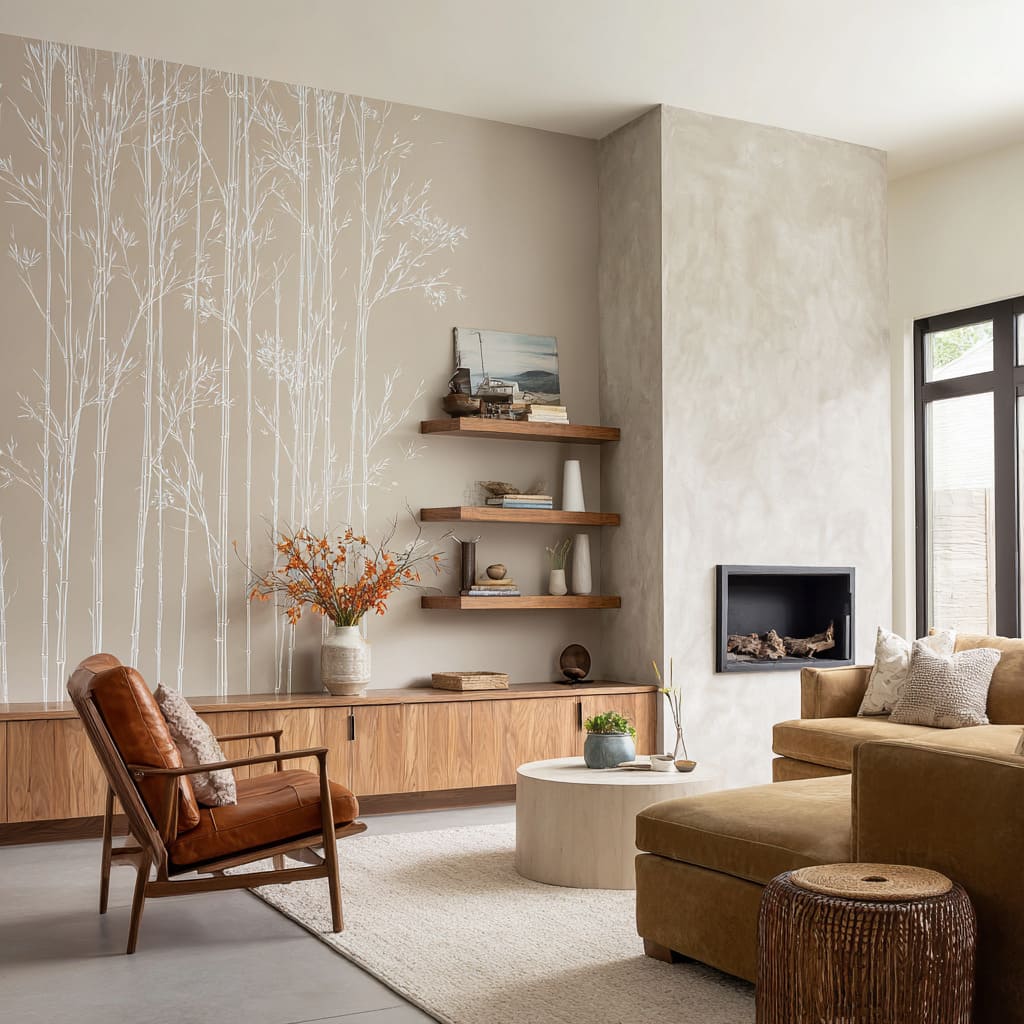
This is why a fireplace wall can feel deep even with sparse décor. The eye already has a structured path: calm field → warm band → dark void.
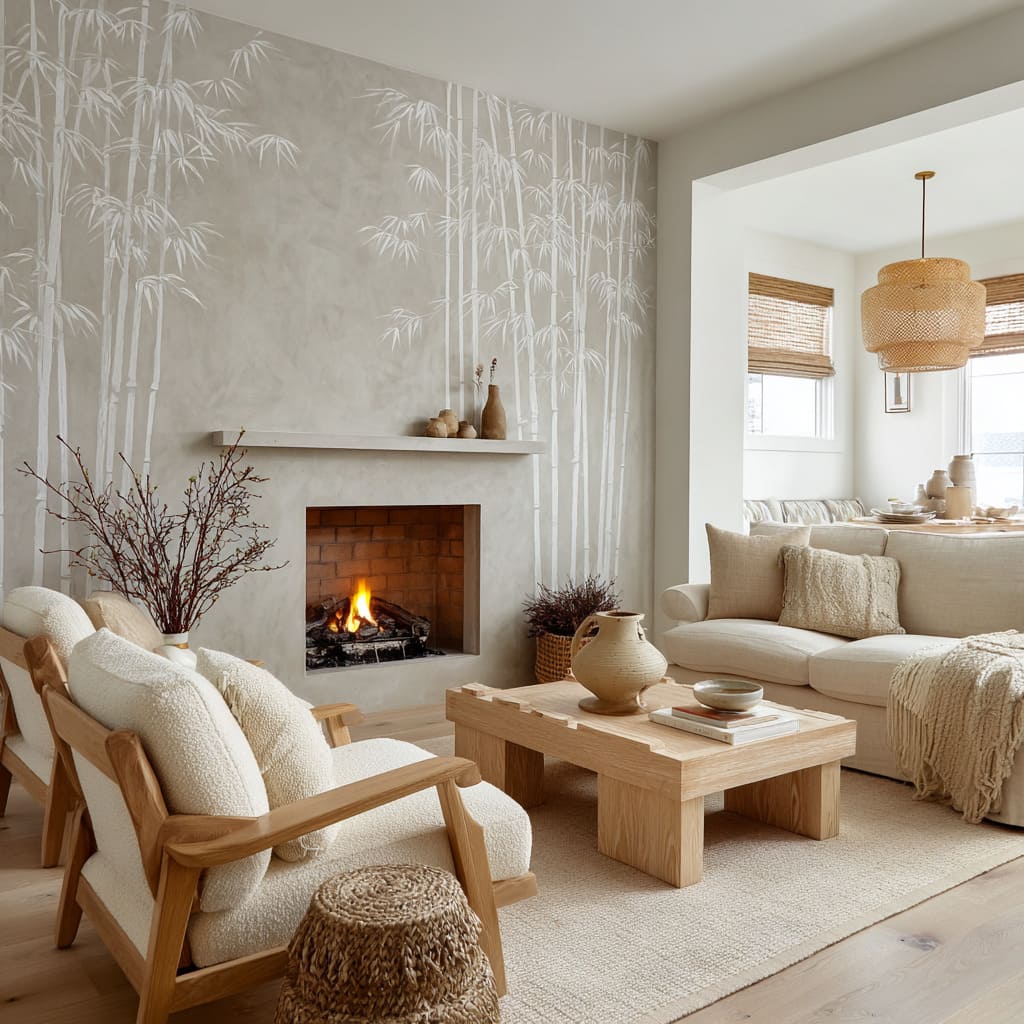
Two-surface pairings create modern confidence
Some of the strongest looks come from pairing two big surfaces with different “voices”:.
- a rhythmic mural plane (line + atmosphere)
- a quiet mass plane (plaster or concrete block)
This pairing supports concrete fireplace wall with mural compositions: the mural supplies movement, while the monolithic surface supplies silence and weight. Often the mural is intentionally off-center, so the wall reads like a composed two-part artwork: nature panel + stone block.
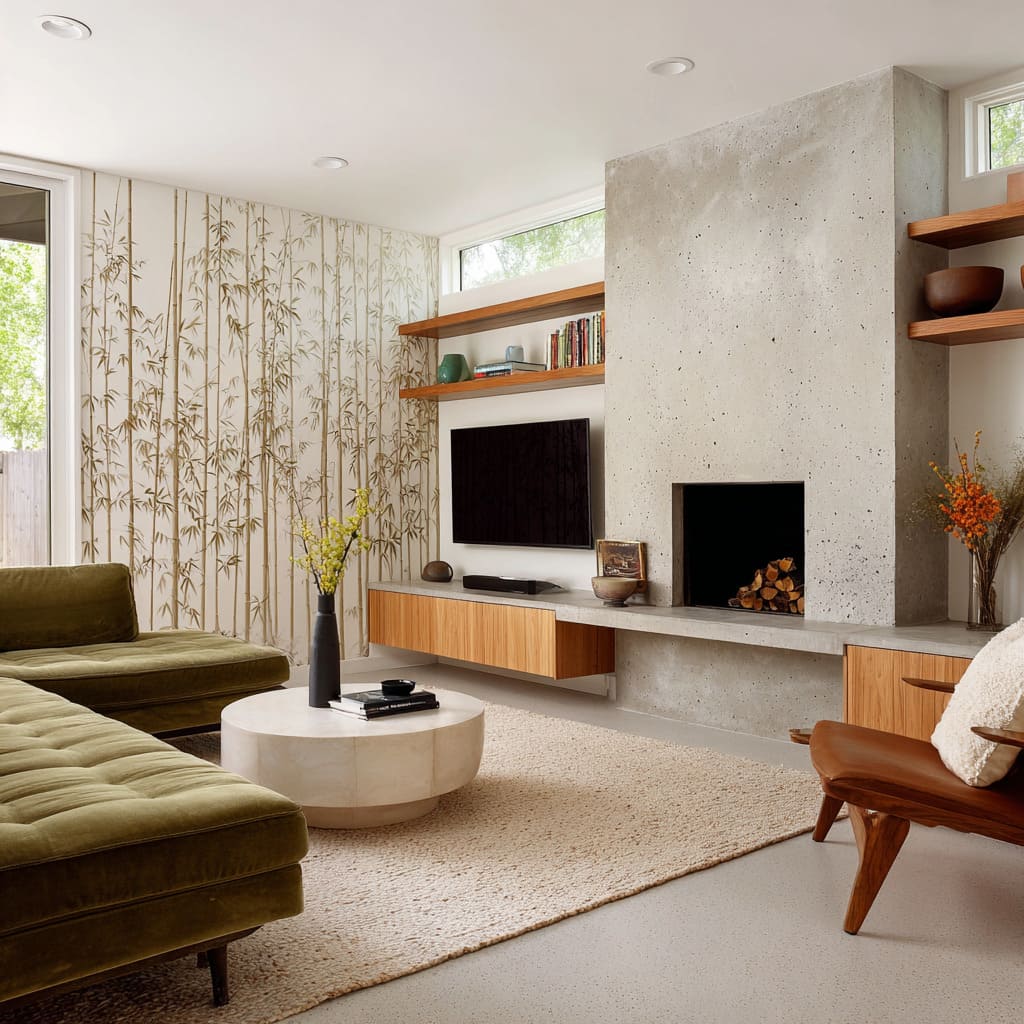
Shelves and ledges act as rests that calm the wall
In open-plan layouts, the mural wall often shares space with storage, TV, or display. The calmer solutions treat horizontals as visual rests:.
- floating shelves and cabinets form rails that “hold” rectangles like a TV, making them feel contained rather than dominant
- long ledges bridge zones so the room reads like one system, not separate features
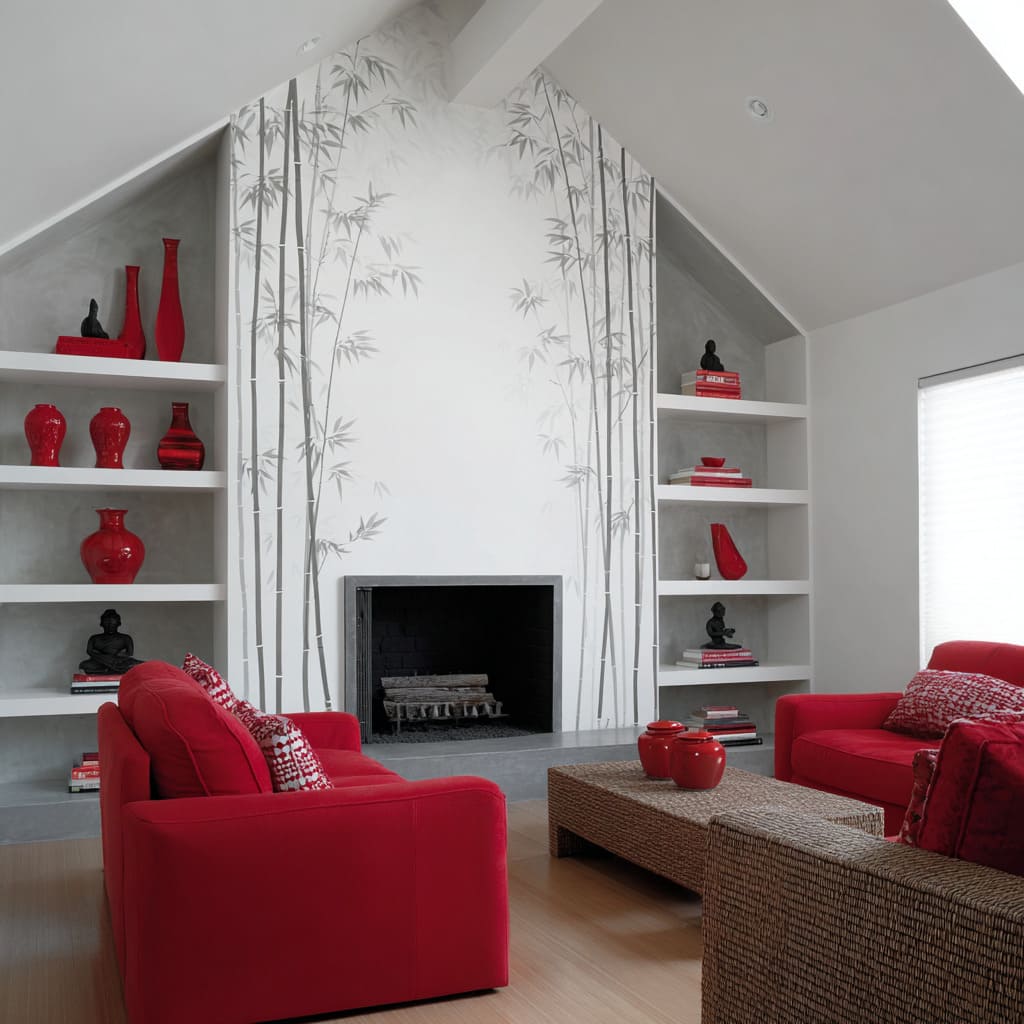
This strategy works for TV and fireplace wall design with murals, where the mural provides the soft field and the wood rails provide structure and pacing.
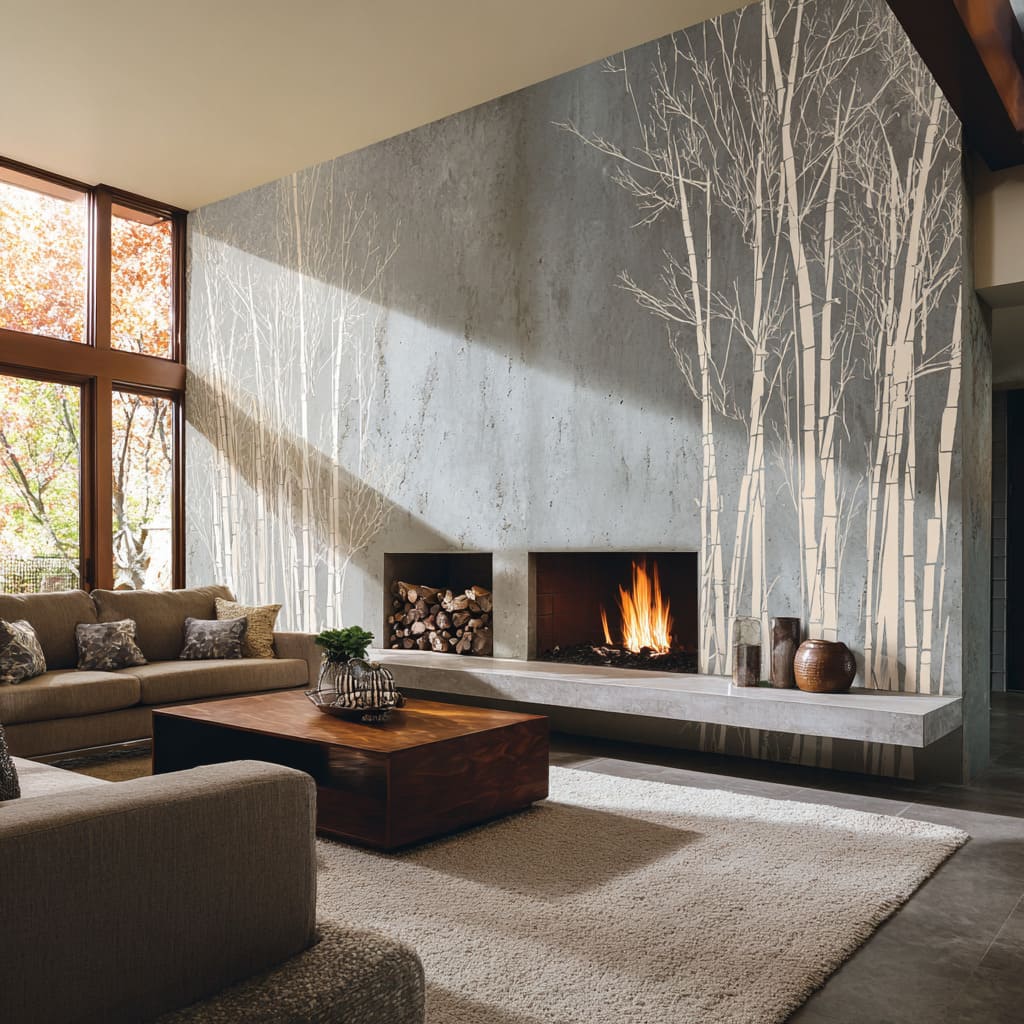
Clear mood families that keep returning
These mural-fireplace strategies tend to produce a few distinct mood families:.
- Quiet gallery calm: pale field + thin lines + long low fire line; often reads like a soft art wall.
- Warm restrained metallic: gold outline bamboo + diffused light + small reflective notes; reads refined rather than flashy.
- Moody minimal weight: deep wall field + barely-visible linework + small protected flame; reads serious and meditative.
- Bright modern nature-meets-architecture: grey line mural + black-framed glazing + slats; reads crisp but softened.
- Graphic monochrome with color punctuation: black-and-white mural + dark firebox + one strong accent color carried by objects and upholstery.
Each family keeps the mural simple, but changes the emotional effect through contrast, light, and the weight of surrounding surfaces.
What makes the look fall apart
A large mural effect depends on slow rhythm and clean negative space. The visual calm tends to break when:.
- small objects multiply near the hearth and turn the baseline into clutter
- nearby décor introduces a competing line system (busy art, high-frequency patterns)
- high-gloss shine dominates next to soft linework and matte walls
- tall pieces interrupt the mural’s vertical calm instead of extending it lightly
In the strongest compositions, the wall remains the atmosphere layer, and everything in front of it behaves like quiet punctuation.
Closing idea: the wall reads complete before it’s styled
The most consistent result comes from treating the fireplace wall as a full composition built from: a calm textured field + rhythmic linework + a grounded horizontal base + a controlled dark opening + small repeated warmth notes. That combination lets simple fireplace wall mural ideas feel rich and intentional while staying quiet enough for everyday living.
As a large fireplace wall idea, this approach uses scale in a calm way: the mural carries the height and width, while the firebox stays crisp and contained. It also turns a big surface into an intentional backdrop that feels finished even with minimal decor.