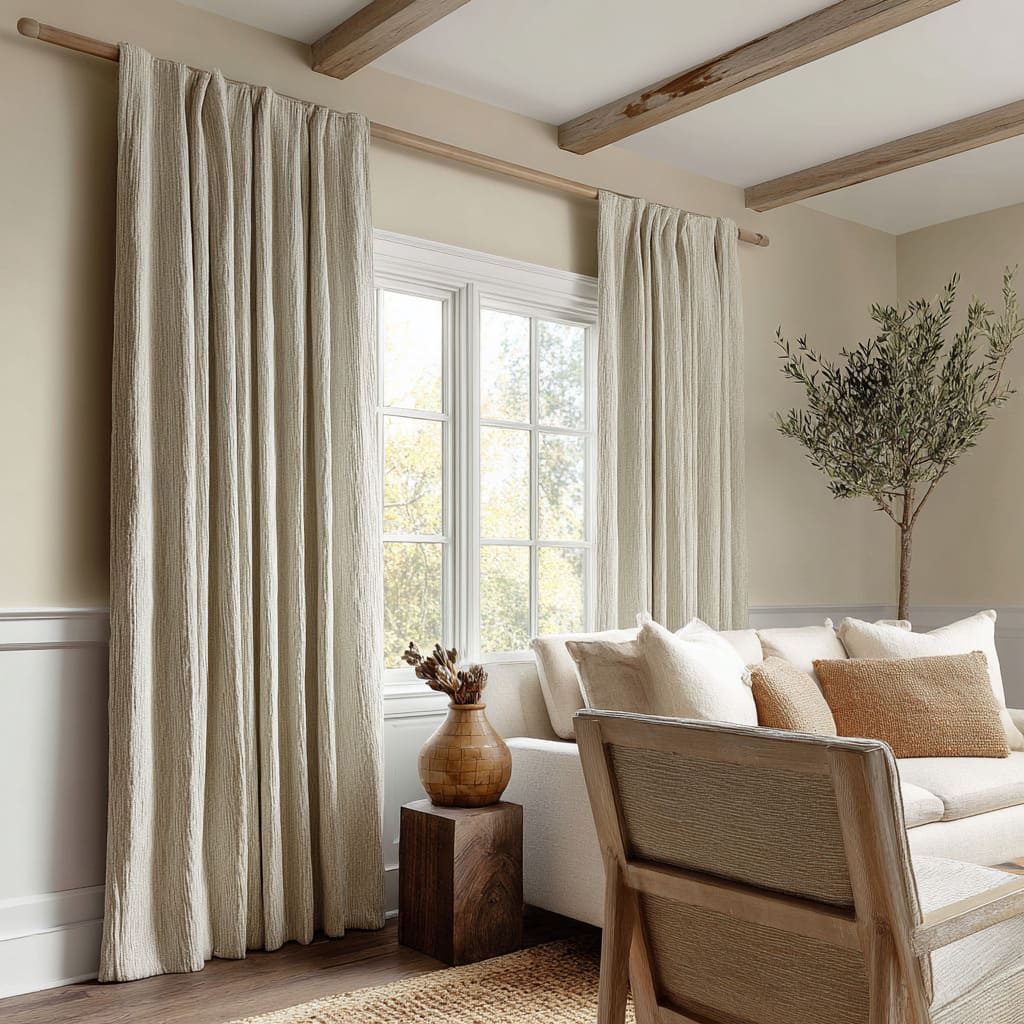
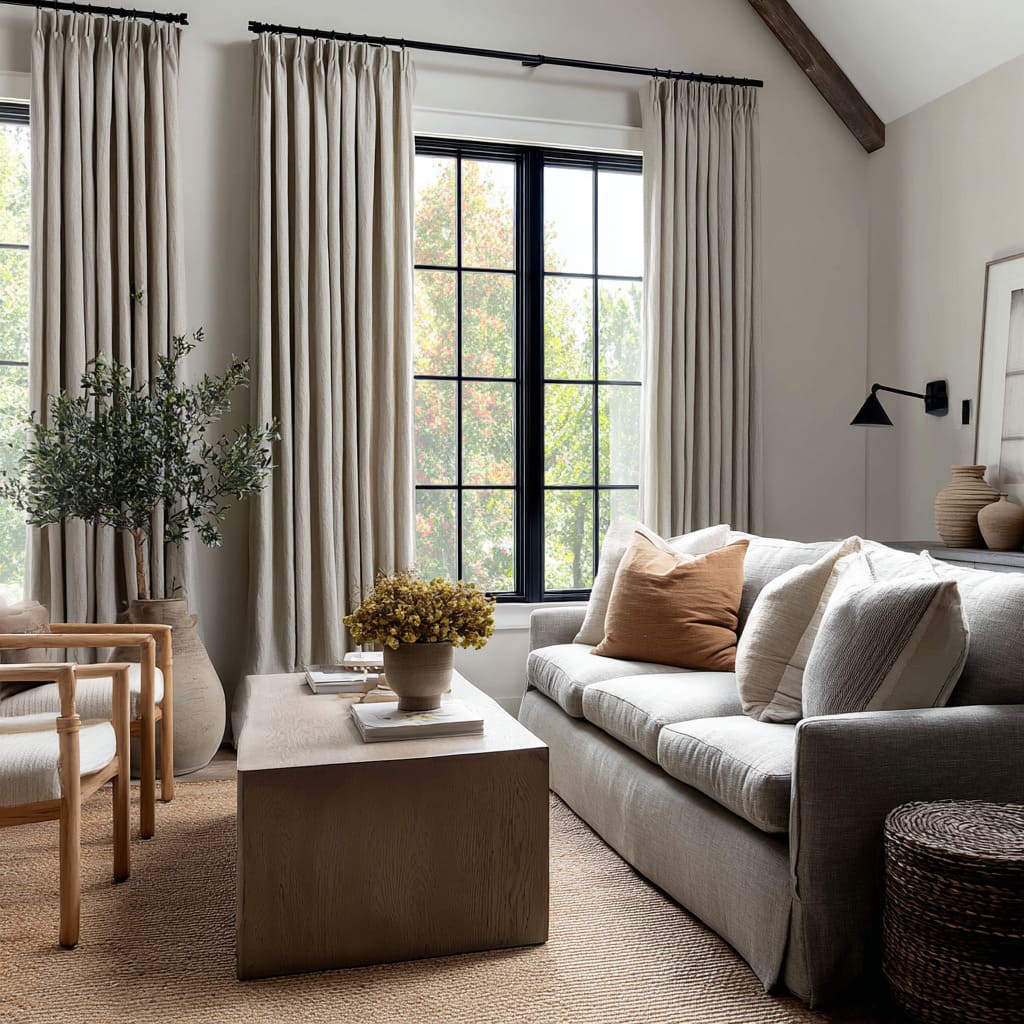
The curtains are doing far more than blocking light; they are quietly acting as a soft framework that holds the whole space design together. Full-height panels hung from just under beams or crown molding down to the floor turn window walls into tall planes of textile.
Instead of reading “window here / wall there,” the eye reads one continuous vertical surface, with the opening set inside a field of fabric. In that sense, farmhouse drapery design behaves like paneling, wainscoting, or a built-in, but expressed in linen, cotton, and textured blends.
The soft surface helps to stretch proportions (windows feel taller, ceilings feel higher), and in corners the cloth wraps the glass so thoroughly that the hard geometry of frames becomes a secondary layer. This approach is especially visible where multiple windows sit close together: a continuous rod, generous panels, and regular pleats turn separate openings into a single “soft elevation.
” The result is a room where the fabric is part of the bones of the space, not a loose accessory added at the end.
Banded and grain-sack inspired curtains as visual anchors
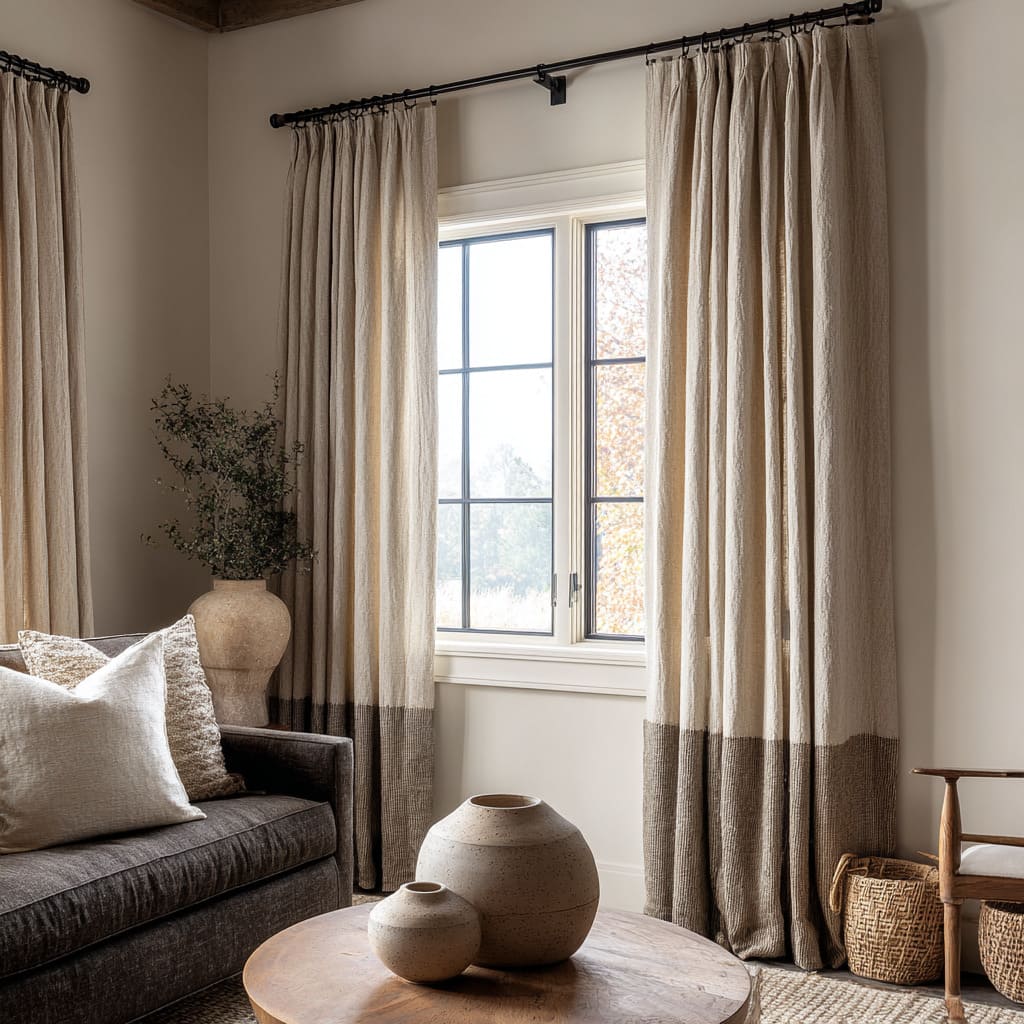
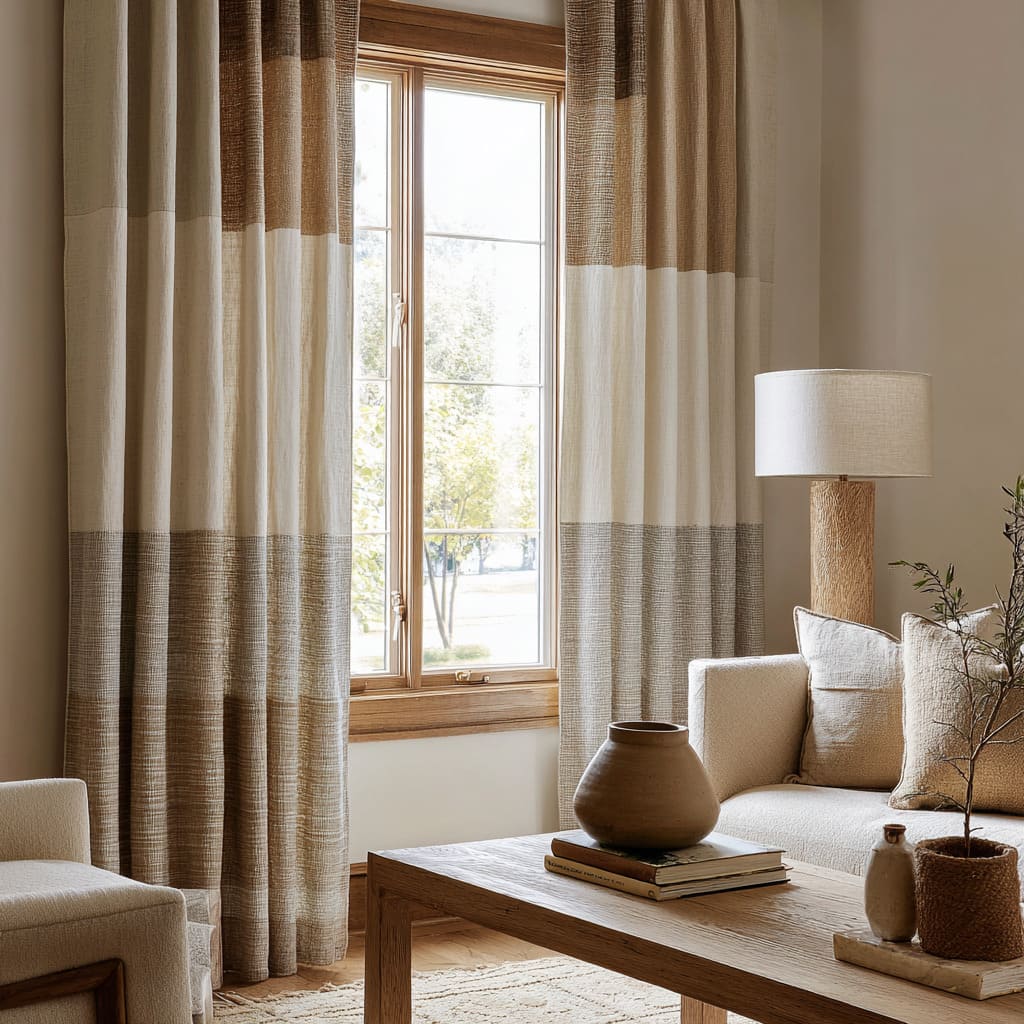
One of the clearest farmhouse signatures is the banded panel: long curtains in natural cloth with darker or denser stripes at the base, or with the height split into two or three color blocks. These bands are rarely decorative in a superficial way; they are placed like graphic anchors.
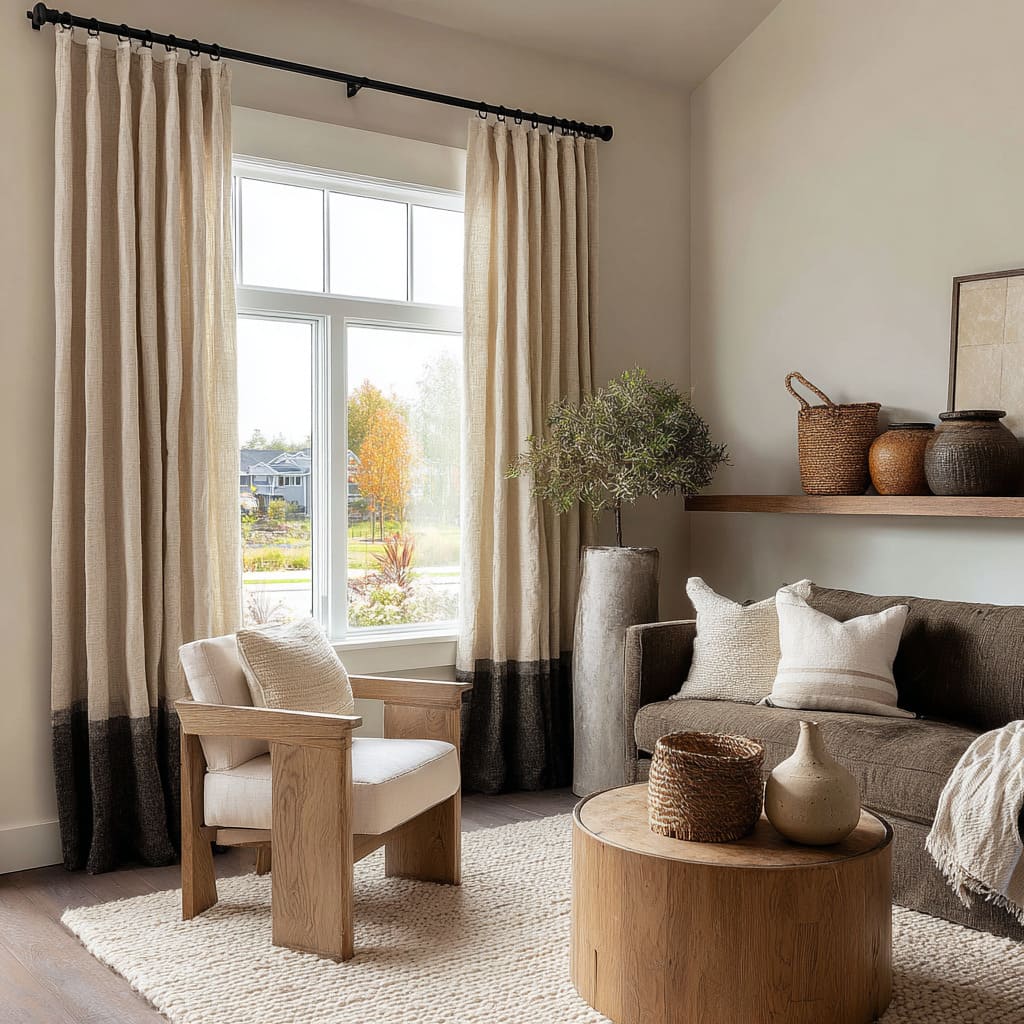
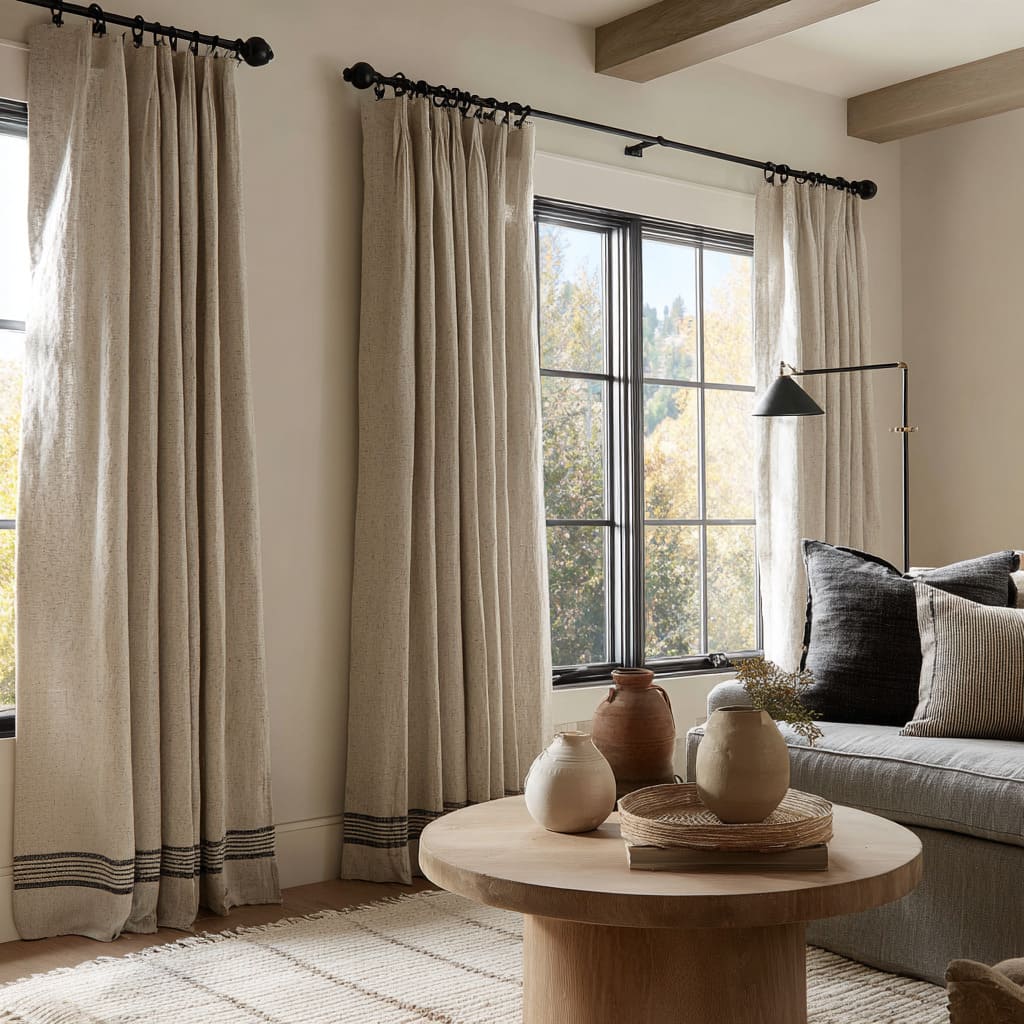
A dark hem stripe a little above the floor behaves like the shadow of the curtain, echoing the tone of a charcoal sofa or black window frame without overwhelming the wall. In two-tone designs, a deeper lower section often aligns with seating and table height, so the darker area “belongs” to the furniture zone, while the lighter zone blends into the wall.
Designers often treat these bands as part of a quiet internal grid:.
- Base level: dark or textured hems that tie into floorboards, rugs, and table legs.
- Mid level: bands that land at sofa backs, console tops, bench seats, or French door handles.
- Upper level: lighter fields that merge with wall and ceiling color.
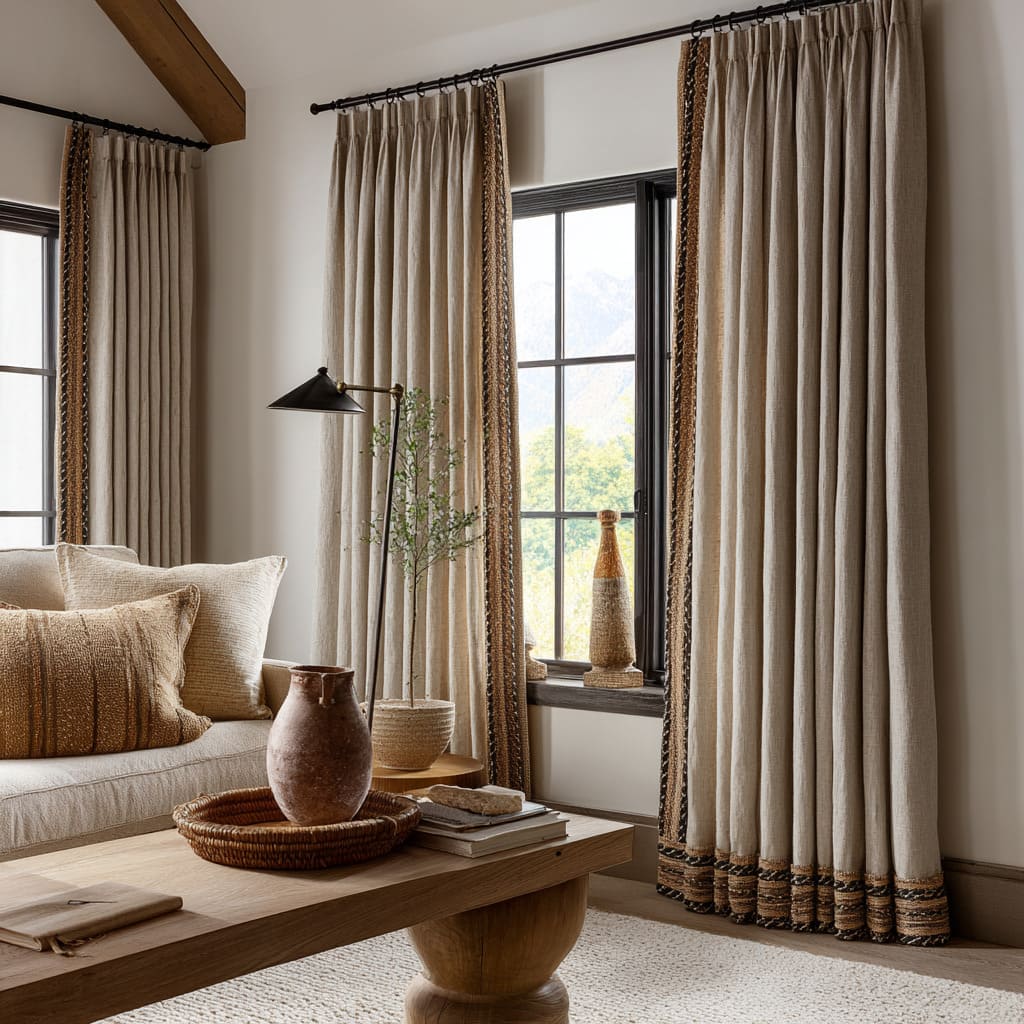
Because banding usually uses wheat, oat, mushroom, and charcoal rather than strong color, it works almost like shading on a drawing. The curtain reads as a single piece, but the eye understands where the weight sits and where the lightness begins.
Two-tone panels that collaborate with wainscoting and wall trim
In room designs with board-and-batten, chair rails, or simple panel mouldings, two-tone curtains take that division and continue it in cloth. A darker lower half in mushroom, greige, or warm stone sits exactly in the same vertical band as the wainscoting, so wall and drapery together form a consistent “base layer” around the room.
Above that, a lighter oatmeal or cream section runs upward, almost merging with the upper wall color. The effect is that the curtain does not look like something hanging in front of the architecture; instead, it plugs into the language of base and upper.
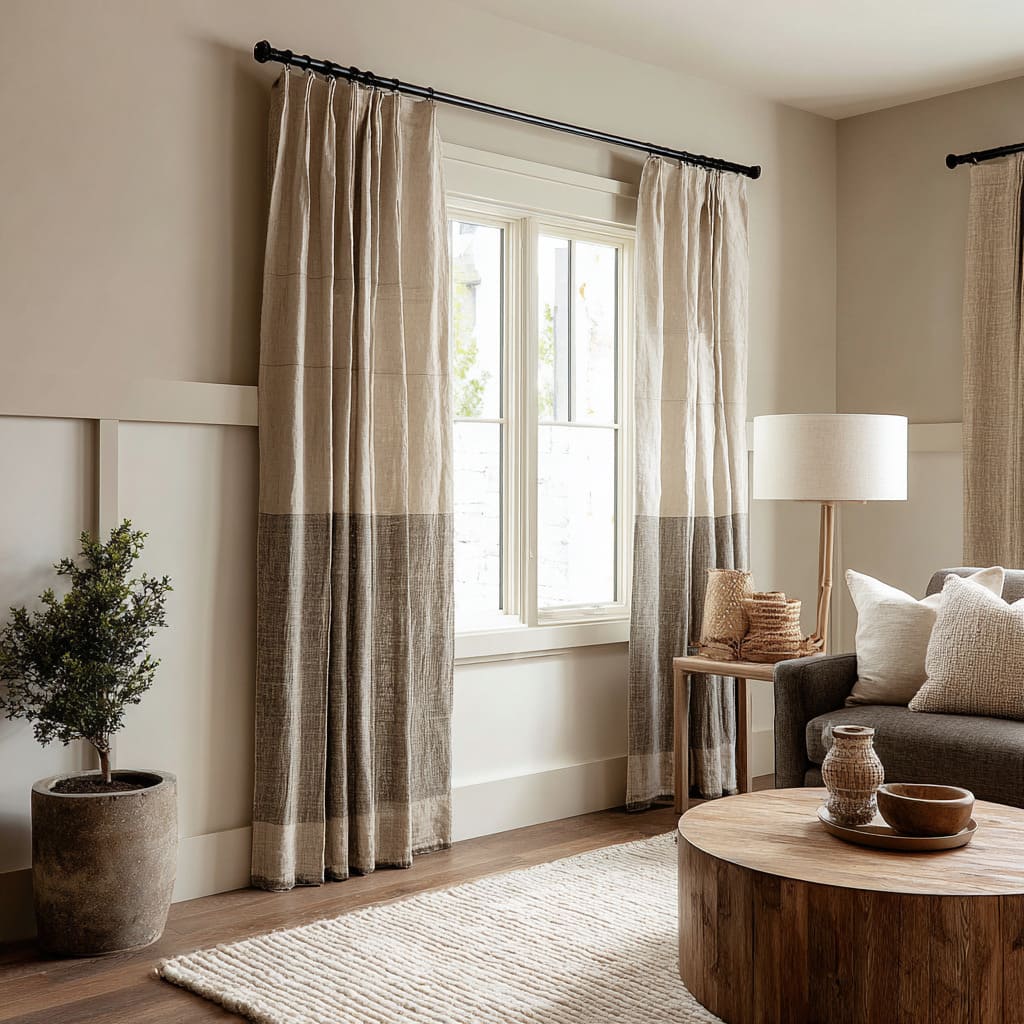
At the seam where the two fabrics meet, there might be only a subtle shift in texture, or sometimes a slim stitched line, but the alignment with existing trim does most of the work. It keeps the palette calm and lets the viewer read a simple structure: grounded below, softer above.
In spaces with French doors or sidelights, this can visually calm busy glass and complex casing, wrapping everything in a single two-tone envelope that feels consistent with painted woodwork rather than competing with it.
Rope, macramé, and mid-height texture belts
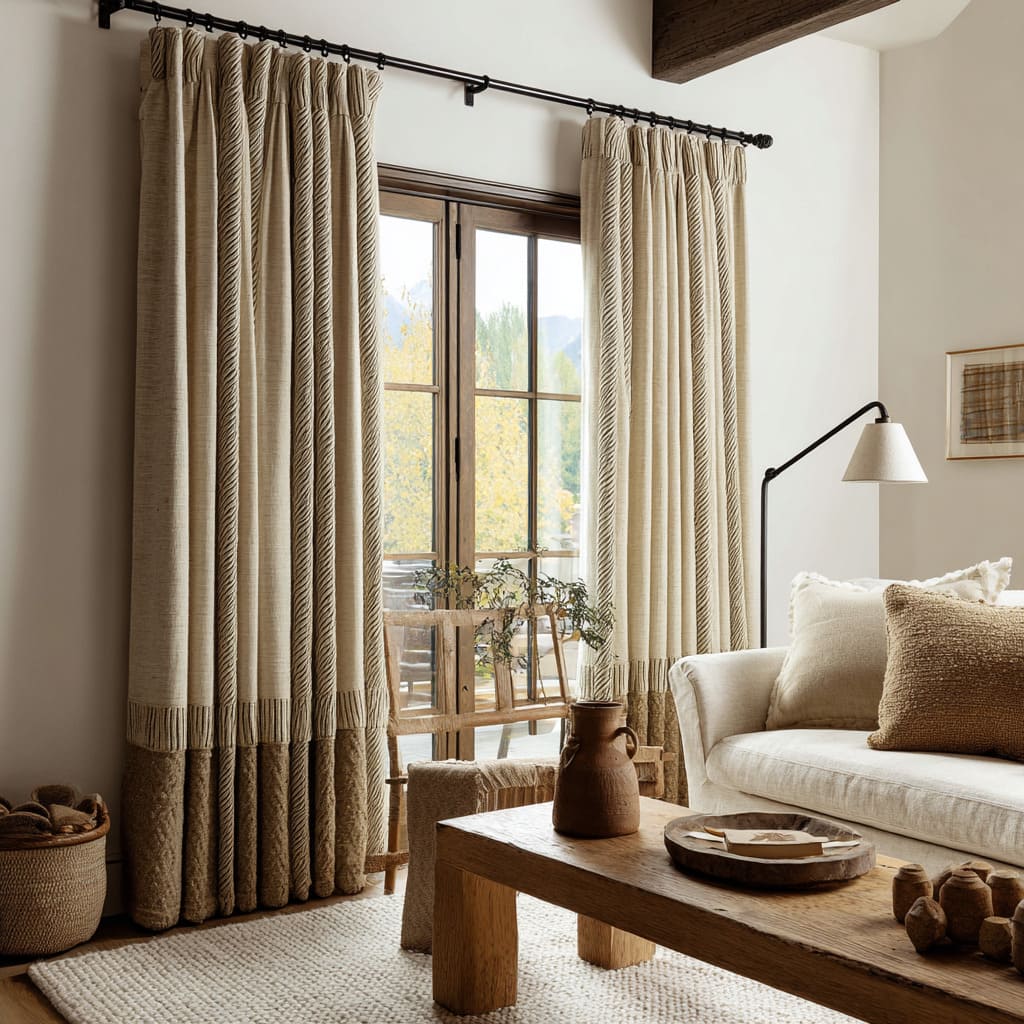
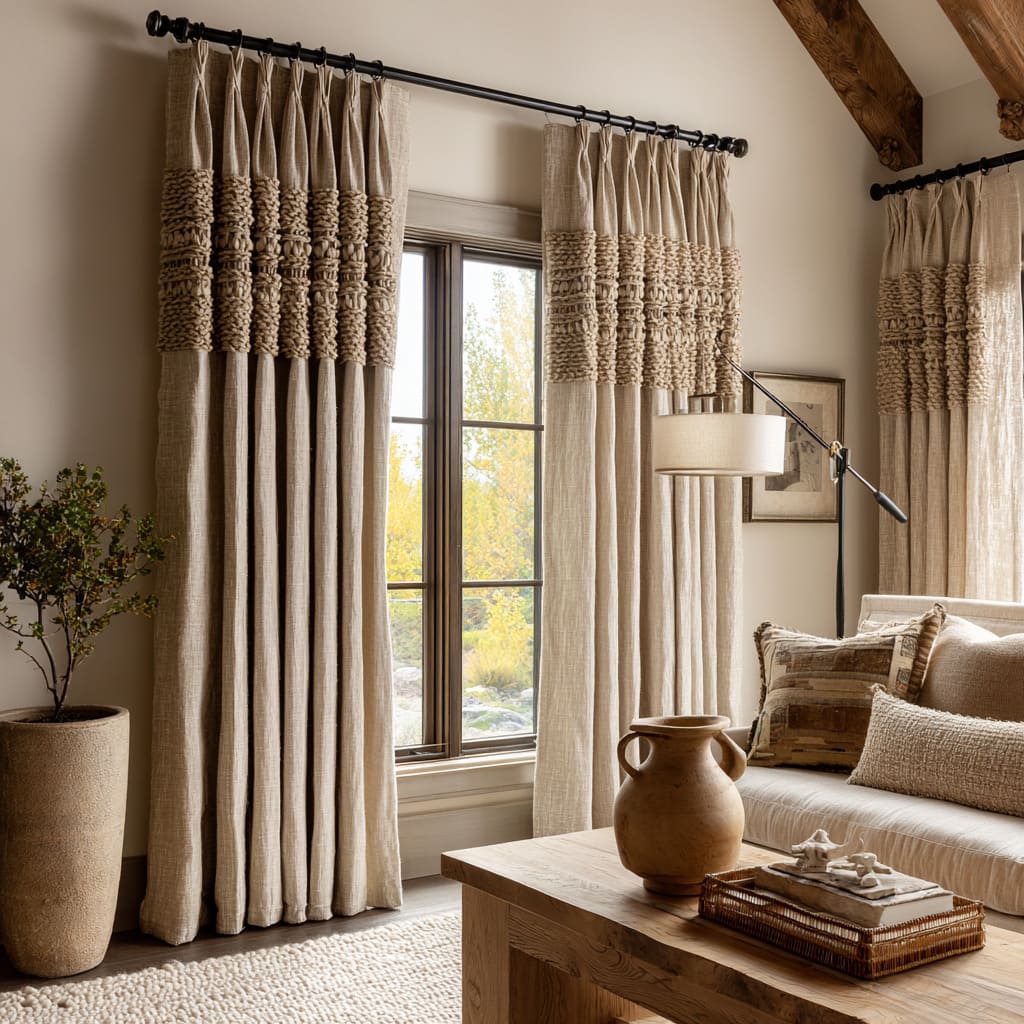
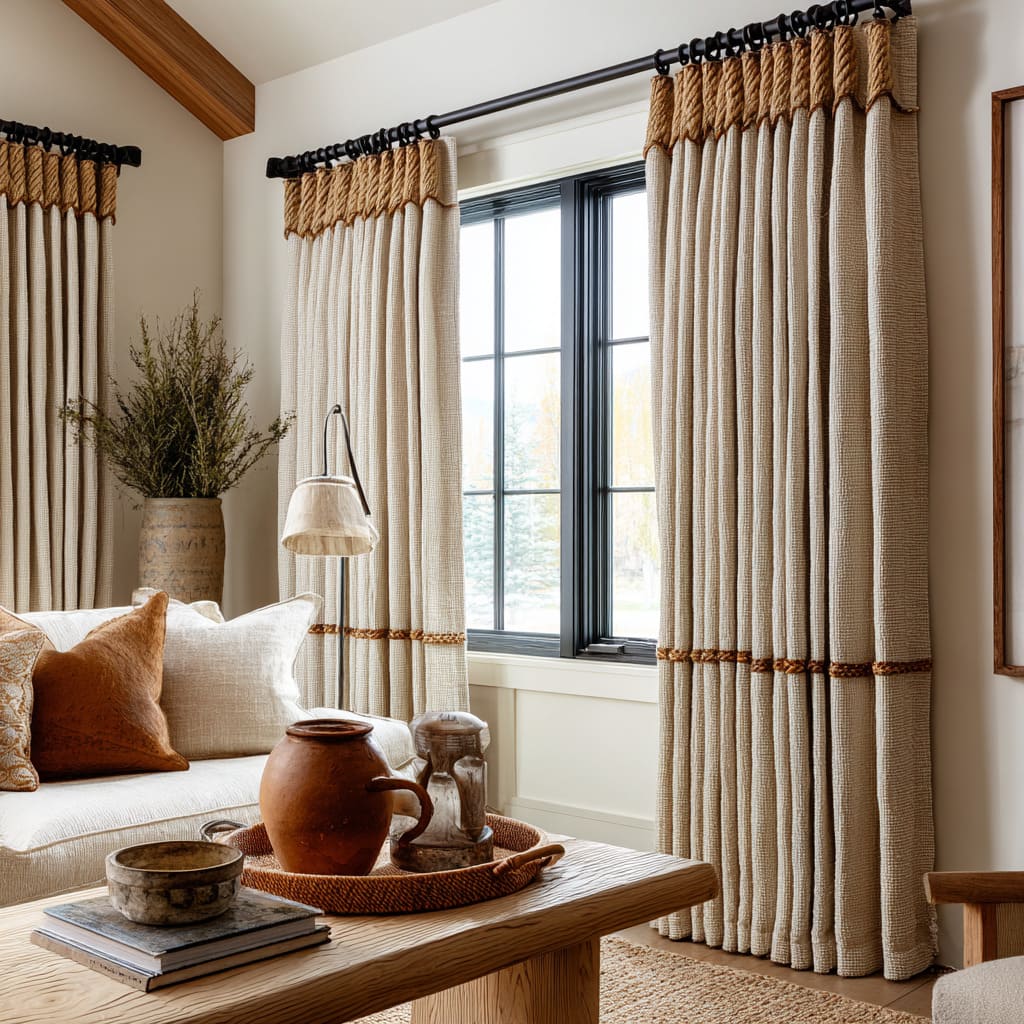
Another family of distinctly farmhouse curtains relies on strong tactile bands placed at mid-height, like textural belts. Heavy macramé sections, rows of thick knots, diagonal rope braids, or raised woven bands cut horizontally through otherwise plain panels.
These belts often sit at about eye level when standing, or just above the back of the sofa, so they become the most noticeable part of the curtain even though they occupy only a narrow slice. They recall hand-twisted jute, woven stool seats, old rope in barns, or braided straw—things associated with work and handcraft rather than decoration for its own sake.
The rest of the panel is usually kept quiet: sandy linen above, plain weave below, neat pleats at the top, and straight folds running down to the floor. This contrast between simple structure and a concentrated band of texture creates a strong rhythm in the room.
The mid-height belt lines up with other elements—the top of a console, the edge of a shelf, the level where foliage outside the window thickens—so the eye constantly passes through that textural strip while moving around the space.
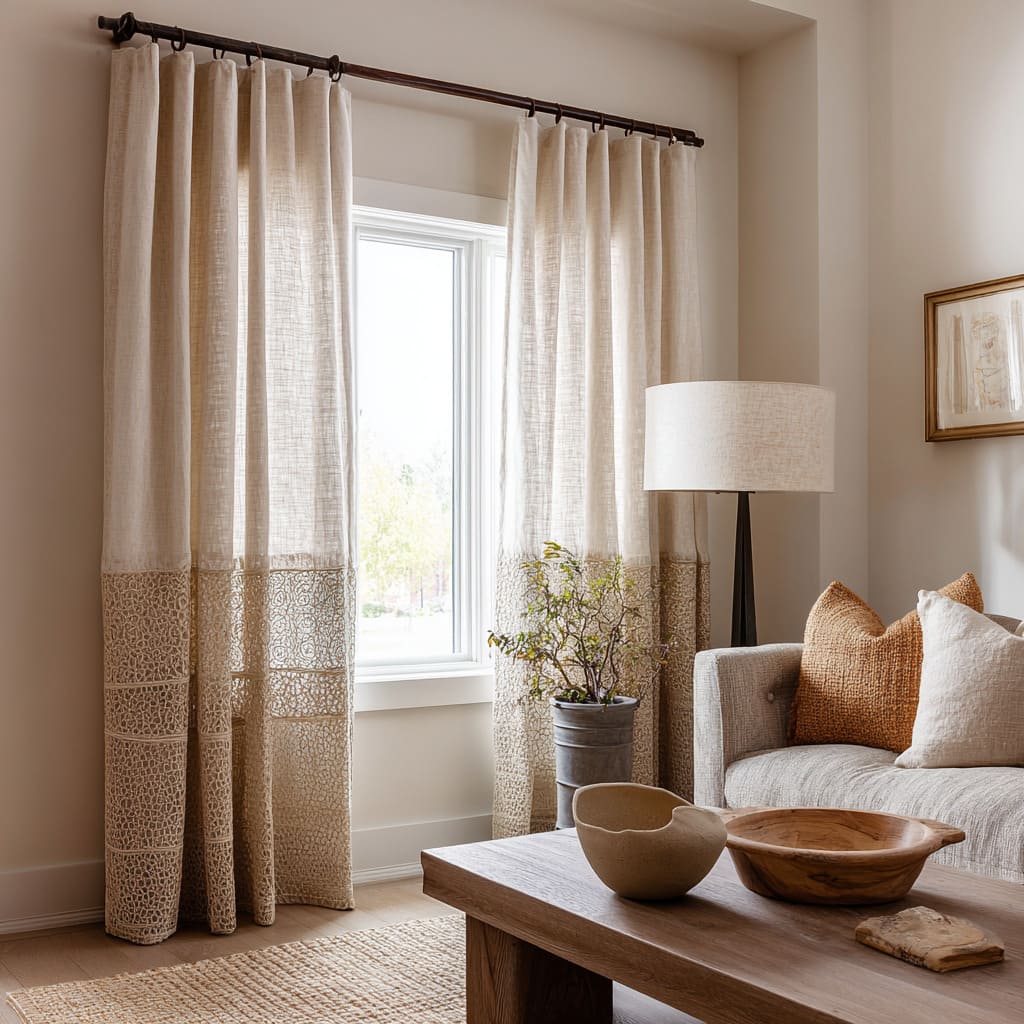
Lace, cutwork, and netted bases that filter the view
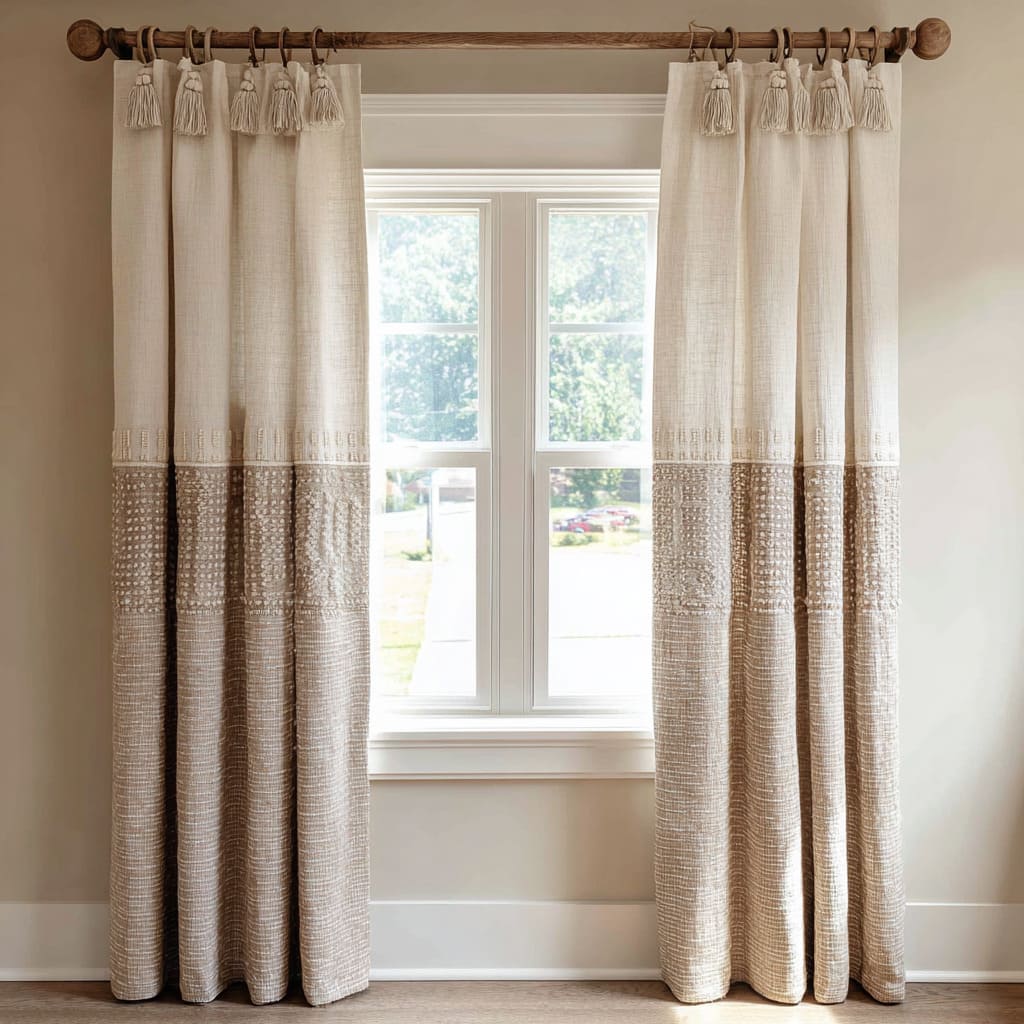
Some farmhouse curtain desings introduce pattern not through color but through openwork. A popular approach keeps the upper two-thirds in soft, slightly sheer linen and dedicates the lower third to geometric cutwork or netted fabric in a deeper wheat tone.
Circles, diamonds, and repeating motifs in the base interact with daylight in a subtle way: when the sun shines directly through them, they glow; when the light is softer, they cast delicate shadows on rugs and floorboards.
Semi-sheer crochet-like panels paired with woven shades behind are another variation. In that pairing, the solid shade set inside the frame provides privacy and a quiet background texture, while the lace-like outer layer adds depth and decorative interest.
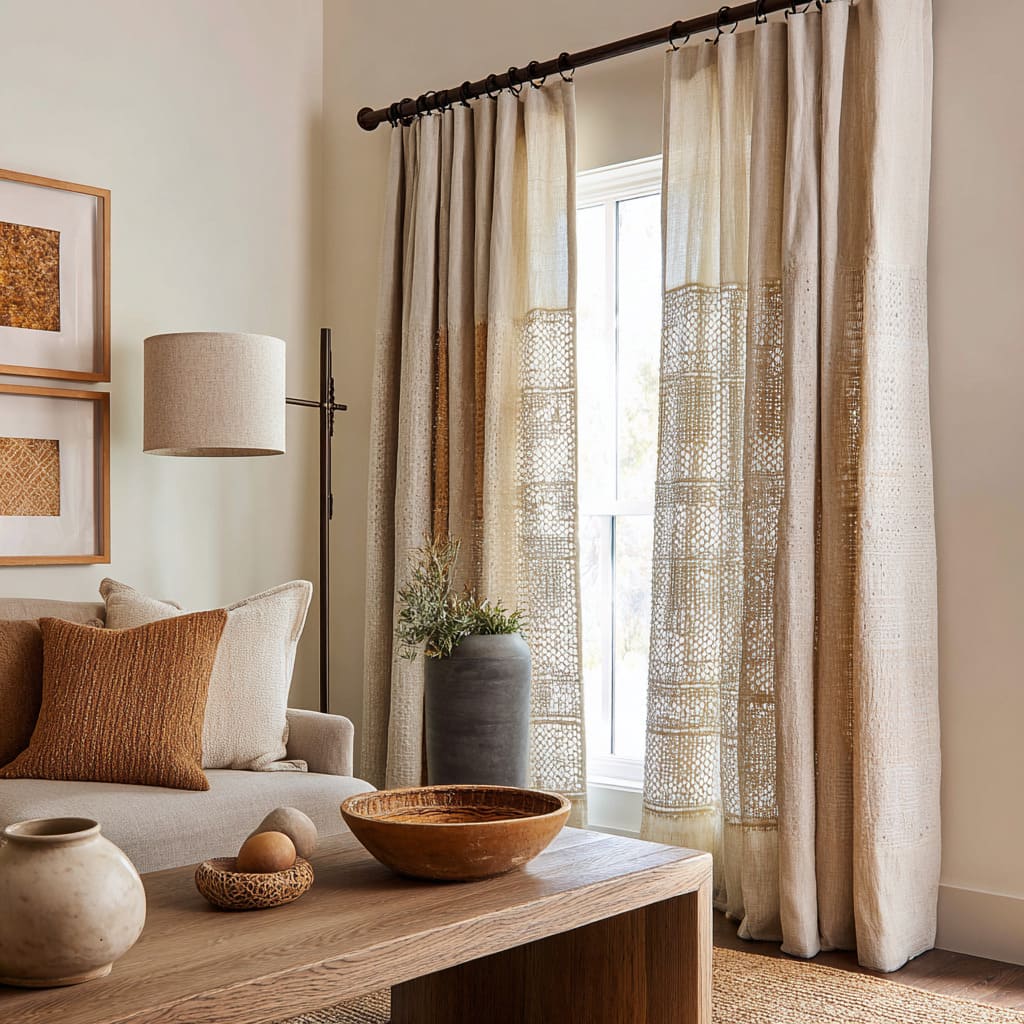
These treatments do not try to mimic traditional lace panels hung halfway up the window; instead they stretch the pattern full height or keep it focused in a strong base zone, so the overall mood stays clean. The combination of honest linen, simple geometric pattern, and layered translucency fits farmhouse spaces that want detail but still prefer hushed neutrals and straightforward shapes.
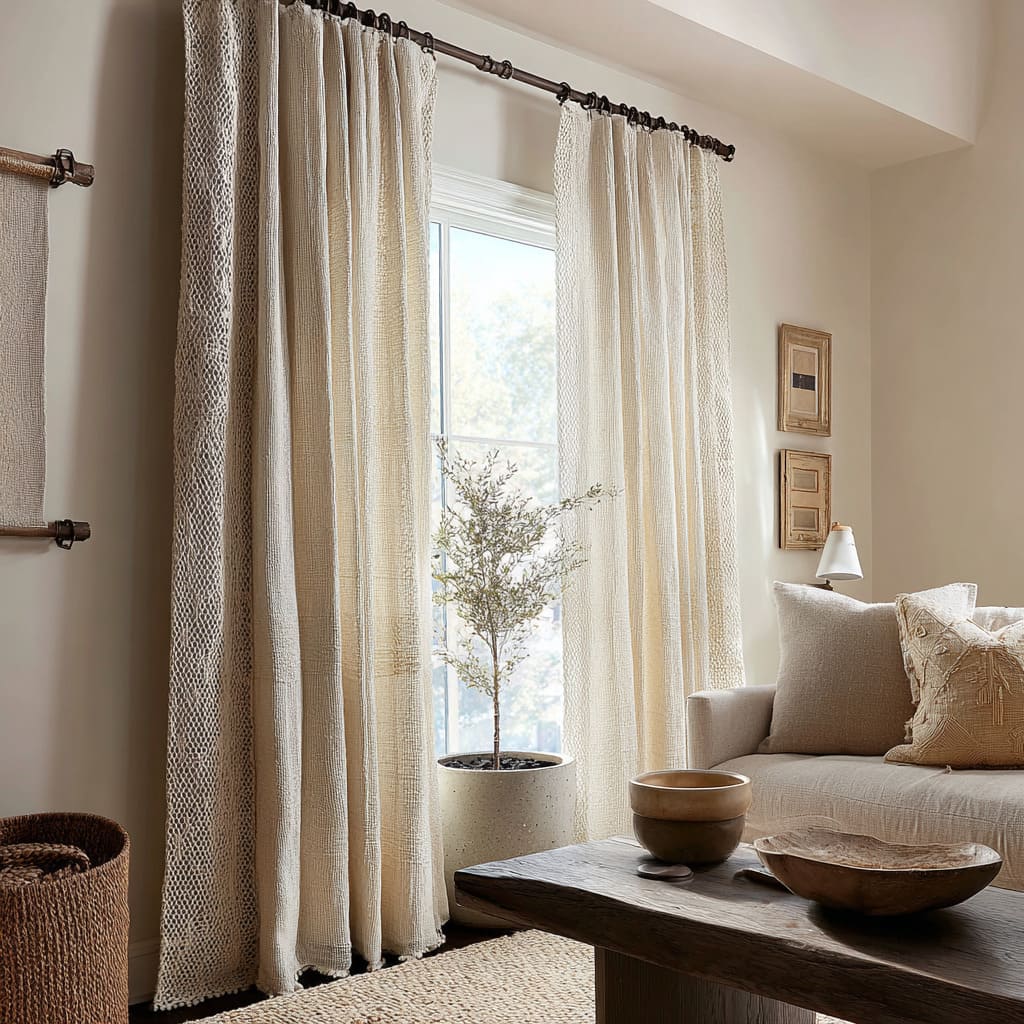
Patchwork, stitched seams, and fabric samplers as vertical features
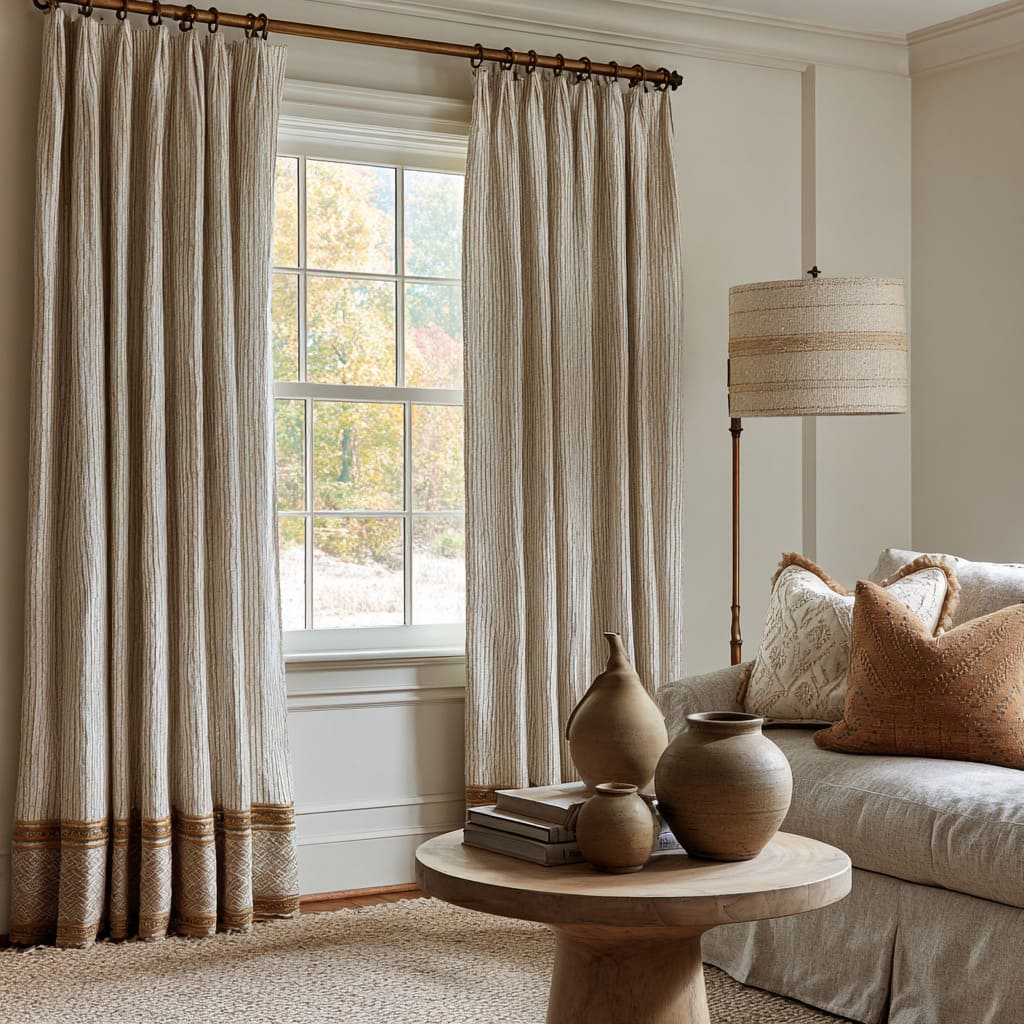
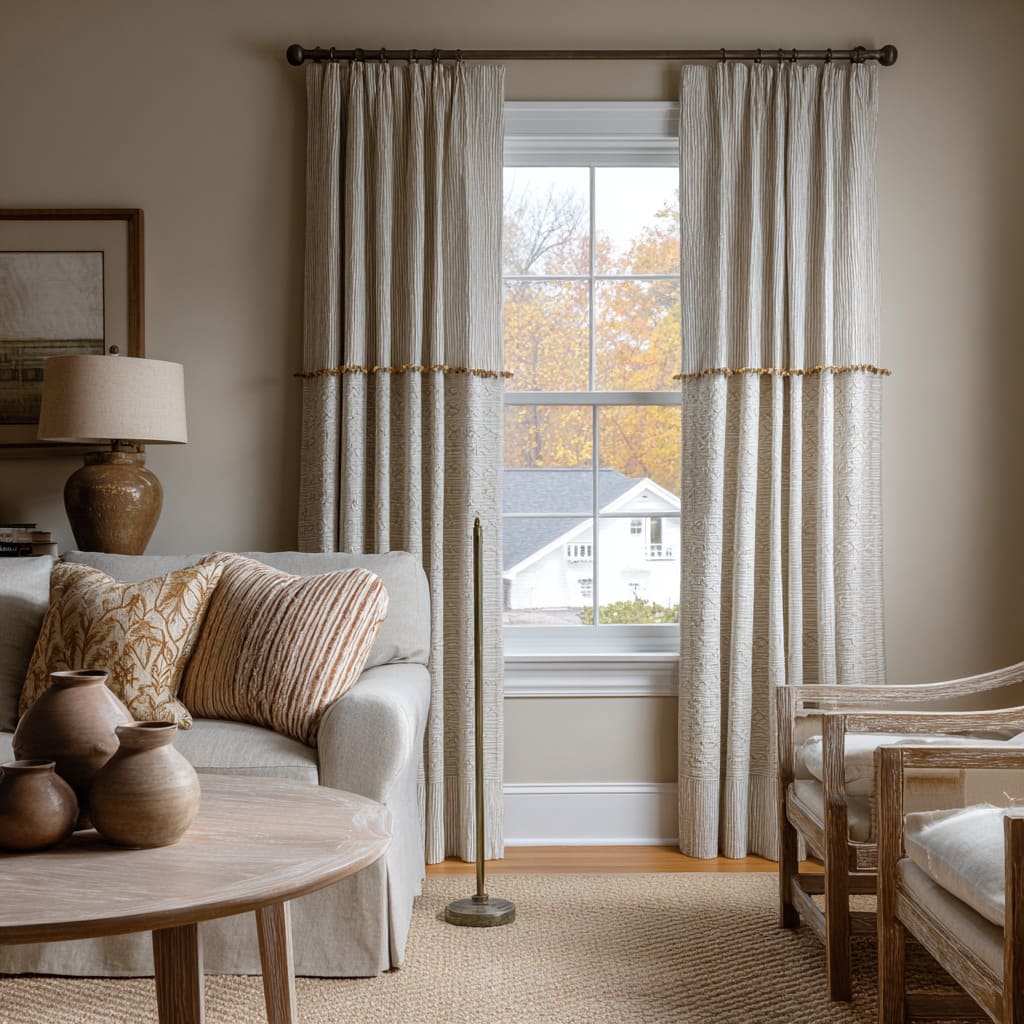
Patchwork-style panels feel like someone emptied a textile designer’s sample box onto the loom and then organized the pieces into tall columns. Each curtain might combine several bands of weave: tight grid, looser basket, small check, subtle stripe, all in related sandy and stone tones.
Horizontal seams between these bands are sometimes emphasized with a slim fringe or stitched trim in warm caramel, almost like a line of dried wheat heads strung together.
From afar, the curtain reads like a soft quilted column; up close, it reveals layers of fabric stories—each band referring to a different rural textile, from coarse grain sacks to house linens. Because the palette stays controlled, this complexity does not feel busy.
It simply gives depth to the wall and makes the drapery feel as if it could have come out of a small weaving workshop rather than a factory. Surrounded by simple furniture—blocky wood tables, neutral sofas, woven baskets—the patchwork curtain becomes a kind of textile art piece that still behaves as a practical window covering.
Garment-inspired valances, headers, and hems
A distinctive angle of farmhouse style comes from treating curtains like clothing. Long panels are given “waistlines” in the form of smocked or densely pleated bands just above a heavier hem.
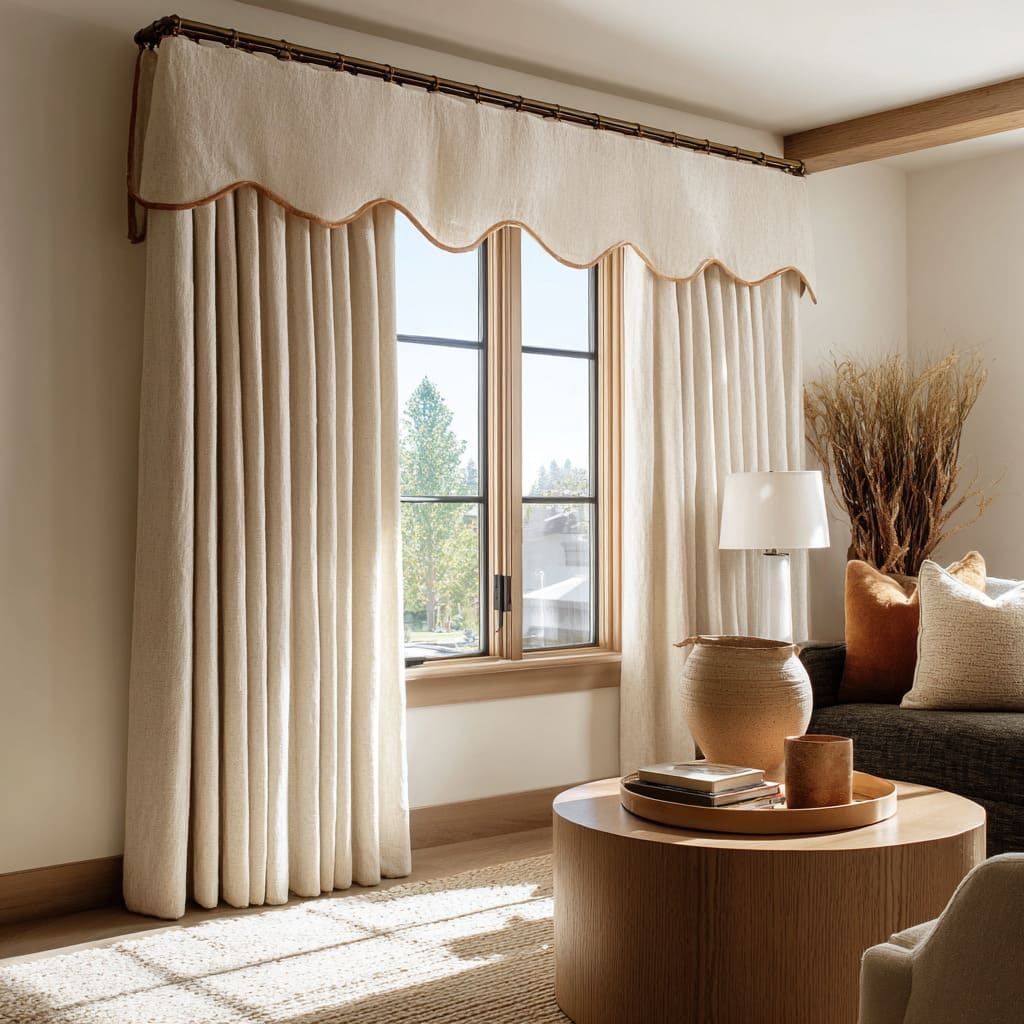
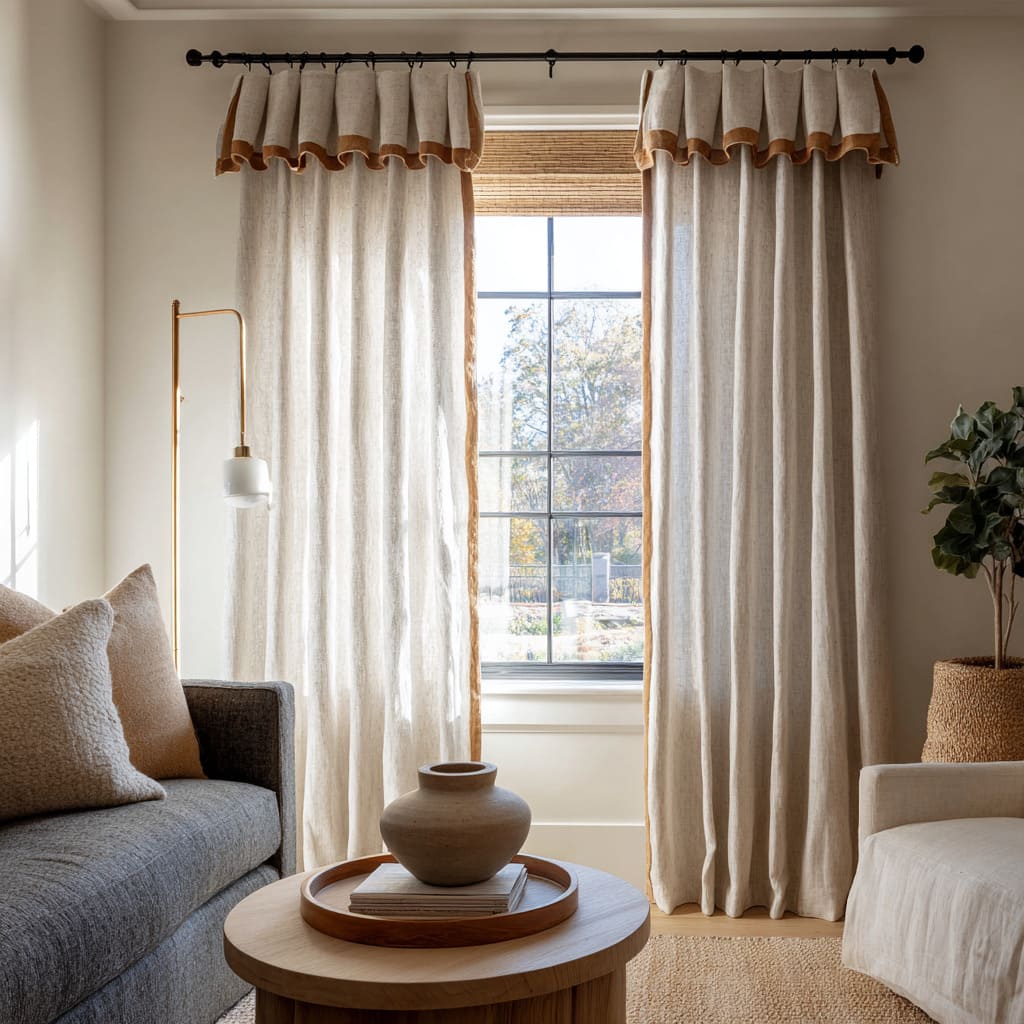
The fabric compresses tightly in that band, then relaxes into more generous folds toward the floor, much like a skirt. Scalloped valances made from the same linen as the panels sit over the top, edged in caramel or taupe binding that outlines each curve.
The scallops may follow the rhythm of the window mullions, dipping between vertical divisions and rising at each frame, so the textile seems to respond to the structure behind it.
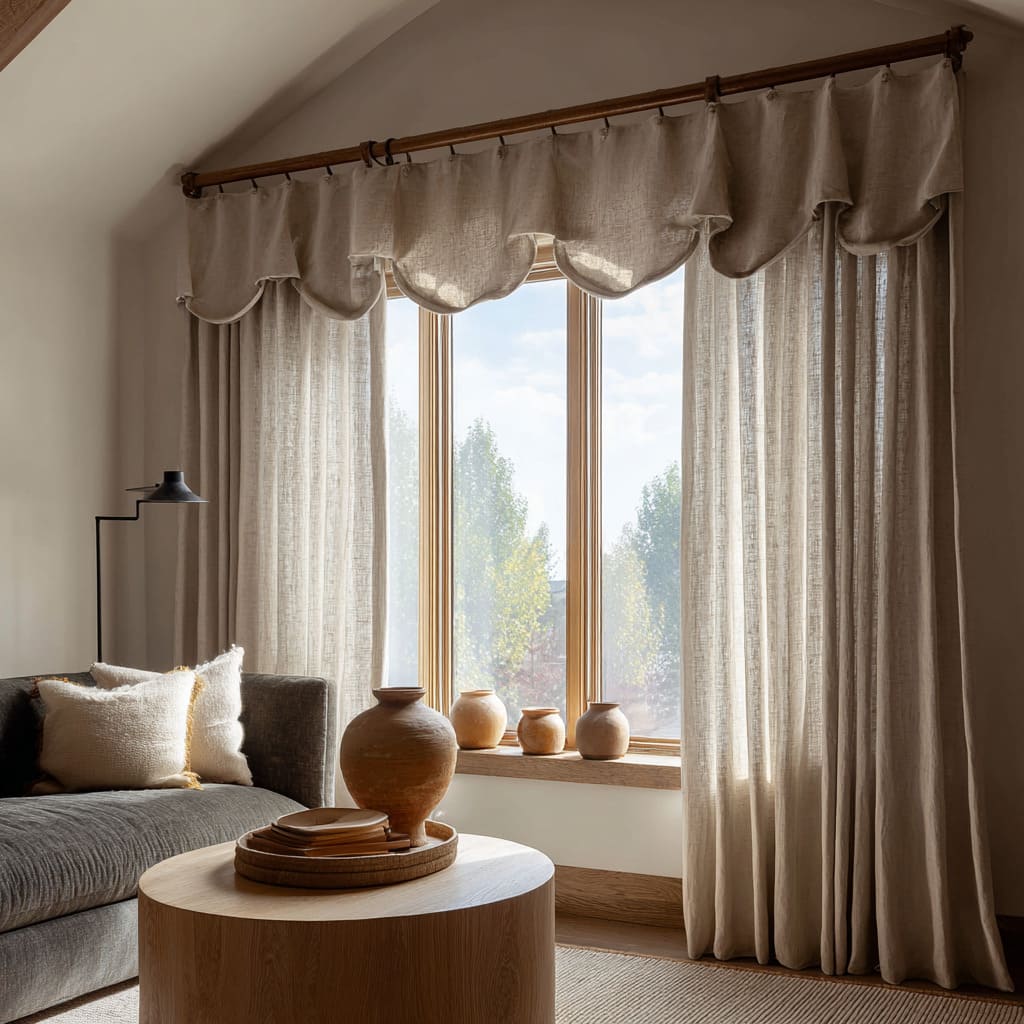
Along some rods, tassels hang in a row, each one like a tiny sheaf of straw with a small band at the neck and loose threads below. These garment-like details introduce a sense of softness and personality without relying on bright color or floral prints.
They refer back to aprons, bed skirts, and shawls that would naturally belong in rural life, but they are refined through neat pleats, consistent spacing, and a tight neutral palette so they still sit comfortably in a designed living room.
Rods, rings, and the farmhouse hardware vocabulary
The support system for such curtains plays a visible role in the style. Slim black rods with simple rings recur in many spaces, running wider than the window frame and sitting high on the wall.
This dark line at the top echoes black mullions, sconce arms, and lamp stems, giving the room a clear graphic backbone.
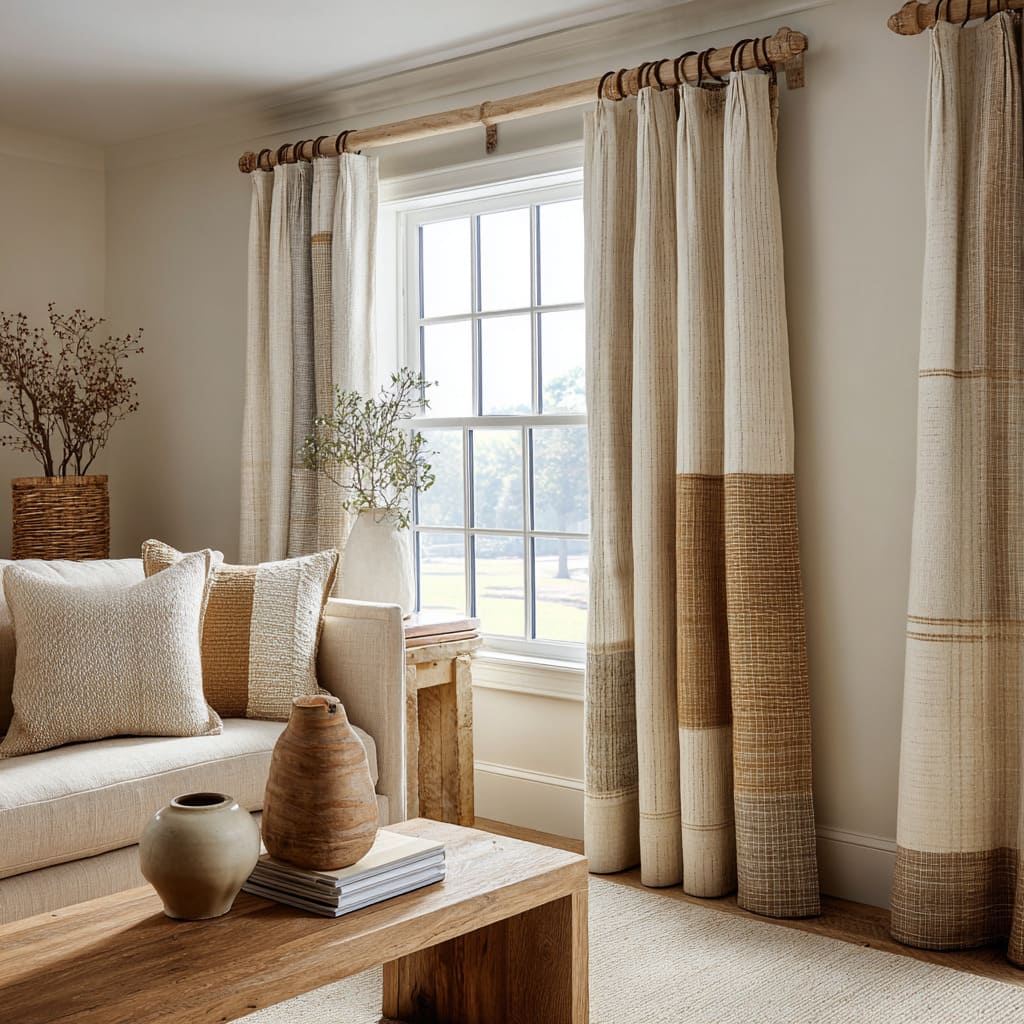
In more rustic interpretations, rods look like stripped branches or segmented cane, with knots and joints that recall fences and tools. Pale wood rods aligned with ceiling beams create a continuous band of timber around the room, so the hardware almost disappears and the fabric seems to rise straight out of the architecture.
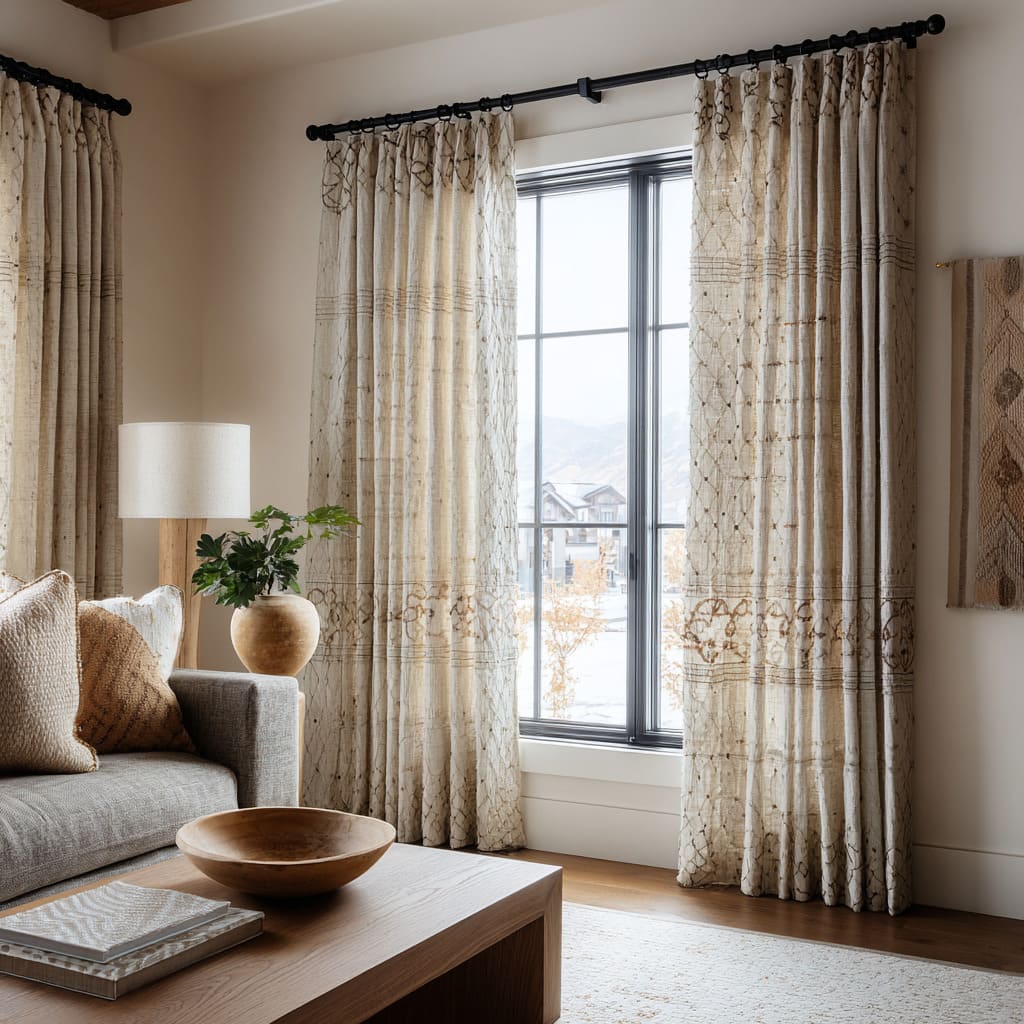
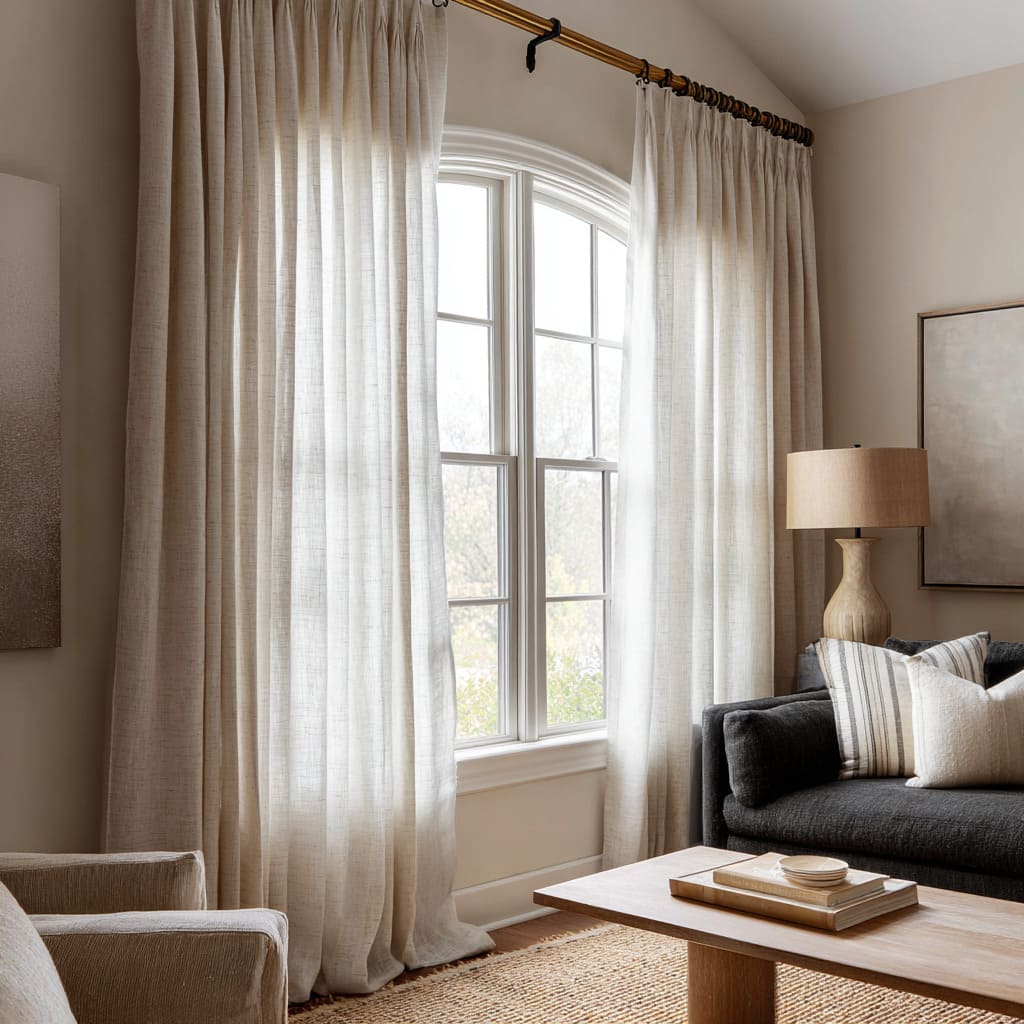
Warm brass rods introduce a softer gleam that sits between the warmth of wood and the sharpness of black metal, hinting at worn handles and latches in old farmhouses. The choice of rod is rarely random; it decides how “industrial”, how “handmade”, or how “quiet” the top line feels.
Because the rod often extends beyond the glass, the drapery composition belongs to the entire wall, and the hardware becomes part of the room’s horizontal structure rather than a small, isolated fixture.
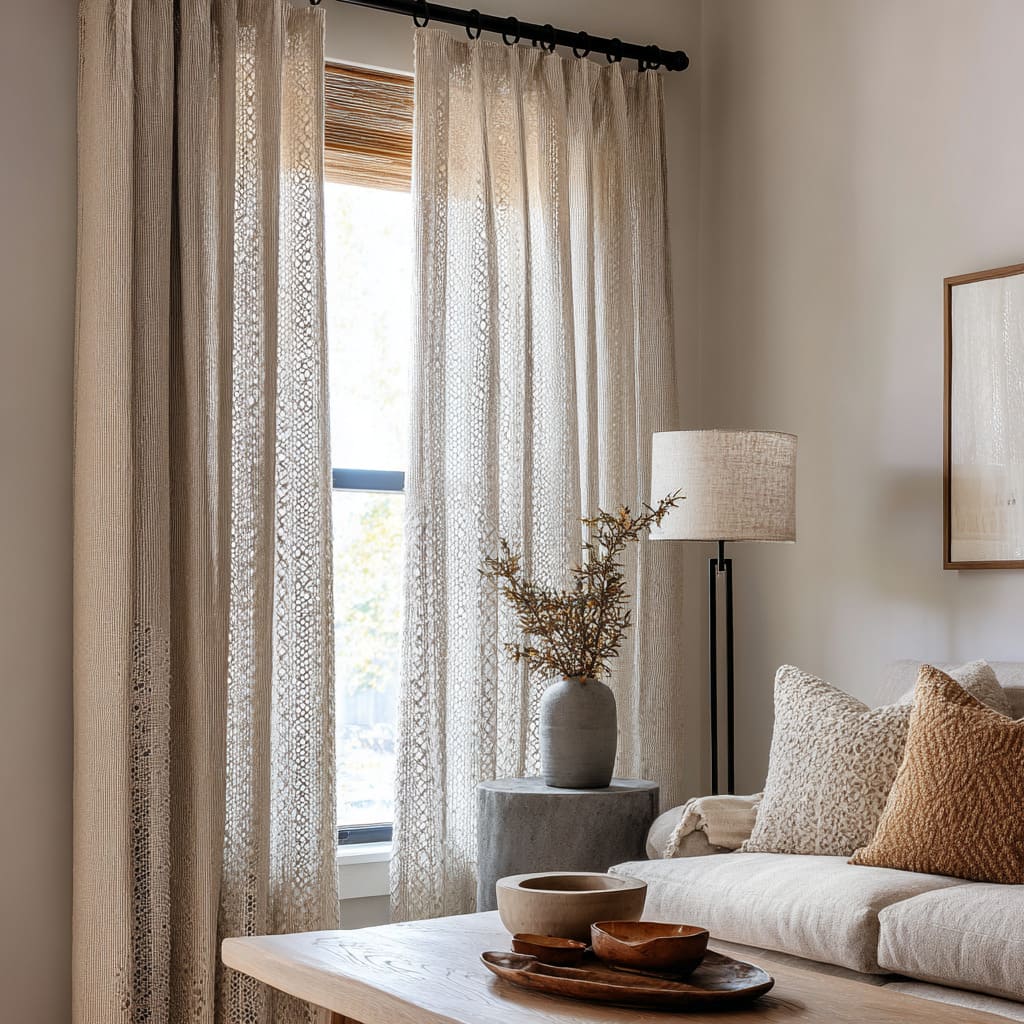
How farmhouse curtains adapt to French doors, arches, and corner windows
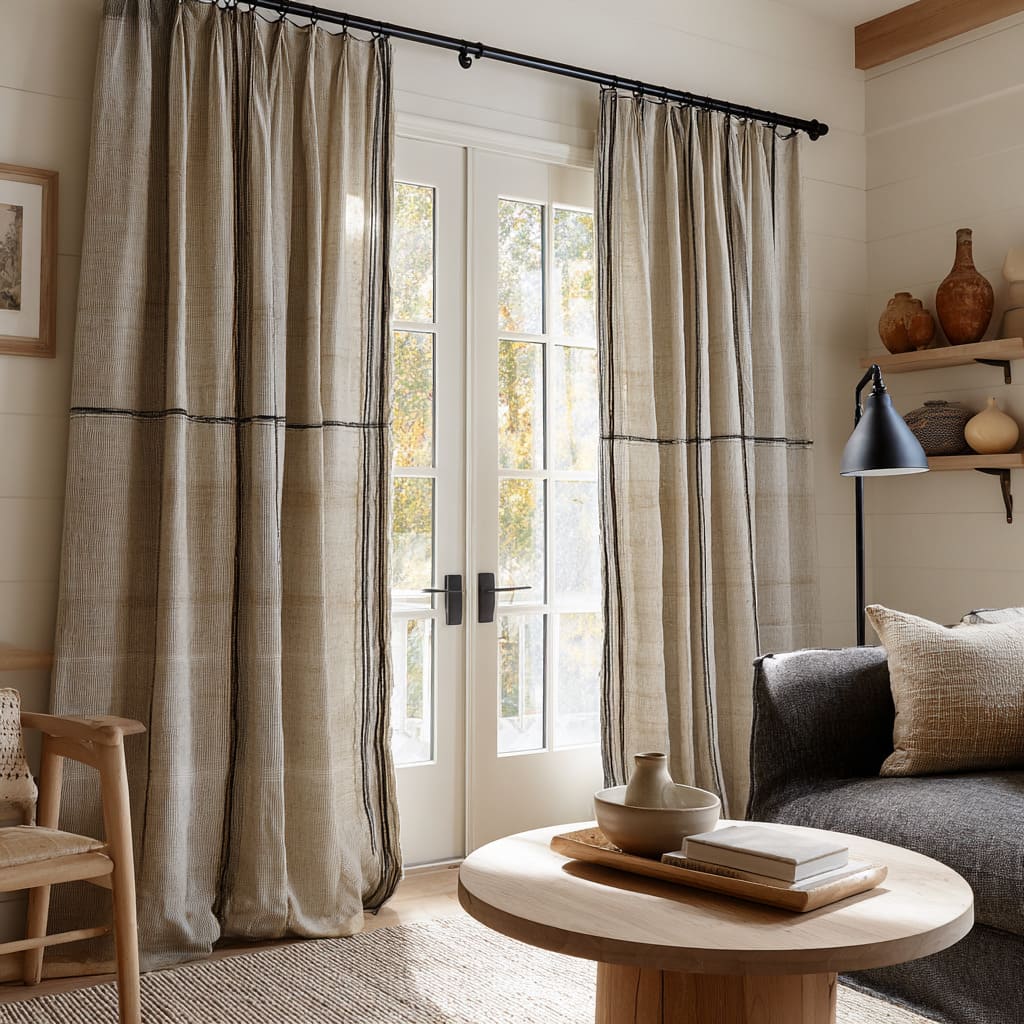
Different window shapes call for slightly different drapery behavior within the same farmhouse language. Over French doors, sandy flax panels with fine charcoal stripes at the outer edges and at handle height echo the door’s own structure and hardware.
The horizontal stripe aligns with the latch zone, working like a textile chair rail that sits exactly where the hand reaches to open the door. For arched windows, light oat curtains hung above the arch transform the wall into a tall vertical veil, with the arch quietly visible behind the folds.
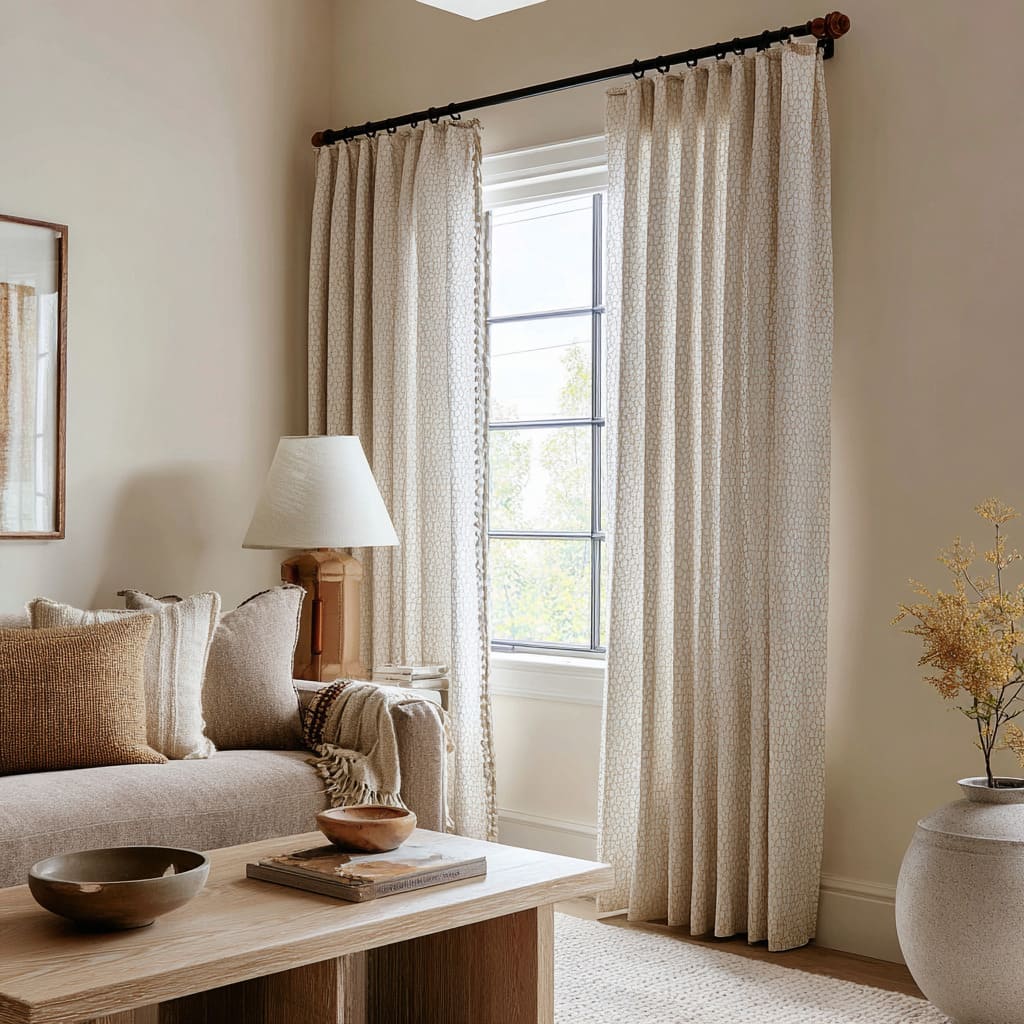
The curved top remains readable as architecture, but its strong outline softens and no longer dominates the room. Corner windows and twin windows often share one long rod, with patchwork or banded panels draped so that the corner becomes a fabric-wrapped nook rather than a hard junction of glass and plaster.
In all these cases, the curtains keep their farmhouse vocabulary—natural fiber, banding, texture belts, straightforward pleats—but adjust their relationship to the opening so the window shape feels included rather than hidden or exaggerated.
Linking curtains with seating, rugs, wood, and pottery
The rest of the interior usually follows the textiles set at the window. Sofas are covered in stone, oatmeal, or driftwood-beige fabrics that sit between the wall color and the darker curtain bands.
Cushions repeat elements of the panels: stripes from the upper section reappear in lumbar pillows; leaf-like or branch-like motifs from lower curtain fabrics show up in a single patterned cushion; caramel pillows echo rope belts, embroidery, or tassel bindings.
Rugs often mirror the curtain base in both value and texture—thick loop-pile rugs relate to macramé and rope bands, while flatweave or jute versions relate to grain-sack stripes and cutwork hems. On coffee tables and shelves, clay jugs, stone bowls, woven trays, and lidded baskets carry the same tones into three dimensions.
This creates an interior where the curtain is the starting point and the rest of the pieces feel like extensions of that textile story. The space remains quiet in color, but filled with small variations in texture that keep the eye moving.
Families of farmhouse drapery ideas and how they shape the mood
Stepping back, it becomes clear that the style splits into several recurring families of treatment, each bringing its own mood. There are strong banded panels, with dark hems or color-blocked segments that partner with black windows and solid sofas.
There are textile-studio curtains made from stitched-together weaves, with patchwork columns and stitched seams becoming the main feature. There are lace-band and cutwork designs where open, patterned bases sit at sitting eye level and turn light into a soft ornamental layer.
There are pure texture curtains, where crepe-like ridges, slubs, and crinkles carry all the interest and pattern is reduced to micro-motifs or tonal embroidery. And there are garment-inspired compositions with valances, scallops, tassels, and smocked bands that give the window something close to a dressed silhouette.
All of these can be seen as variations within one broader field of farmhouse drapery ideas, united by their reliance on natural fibers, controlled neutrals, and placements that align closely with the architecture and furniture around them.
The contemporary balance at the heart of modern farmhouse drapery
What makes this style feel current rather than nostalgic is the constant balance between softness and clarity. On the soft side sit washed linens, slubby blends, knotted belts, scalloped headers, and lace-like bases.
On the clear side sit straight rods, neat pleats, simple furniture profiles, black frames, and disciplined palettes.
Dark hardware stops delicate cloth from drifting into sentimentality; full-height hanging keeps decorative hems from feeling fussy; blocky tables and plain slipcovers frame rope and tassel details so those details read as texture rather than frill. In this way, modern farmhouse drapery lets fabrics associated with everyday rural life—grain sacks, aprons, blankets, lace, and nets—step forward as key architectural surfaces for living rooms, while the rest of the room stays streamlined.
The curtains carry the narrative of craft, harvest, and handwork; the rods, frames, and clean silhouettes keep that narrative aligned with present-day interiors rather than pastiche.