In contemporary interiors, living room wooden shelf design often behaves less like storage and more like a visual system that edits proportion, light, and calmness. Many of the cleanest-looking designs rely on small wood shelf ideas not for “more display,” but for controlled rhythm: a few strong lines, deliberate emptiness, and materials that carry the mood without extra color.
The shelf as a horizon line that edits proportion
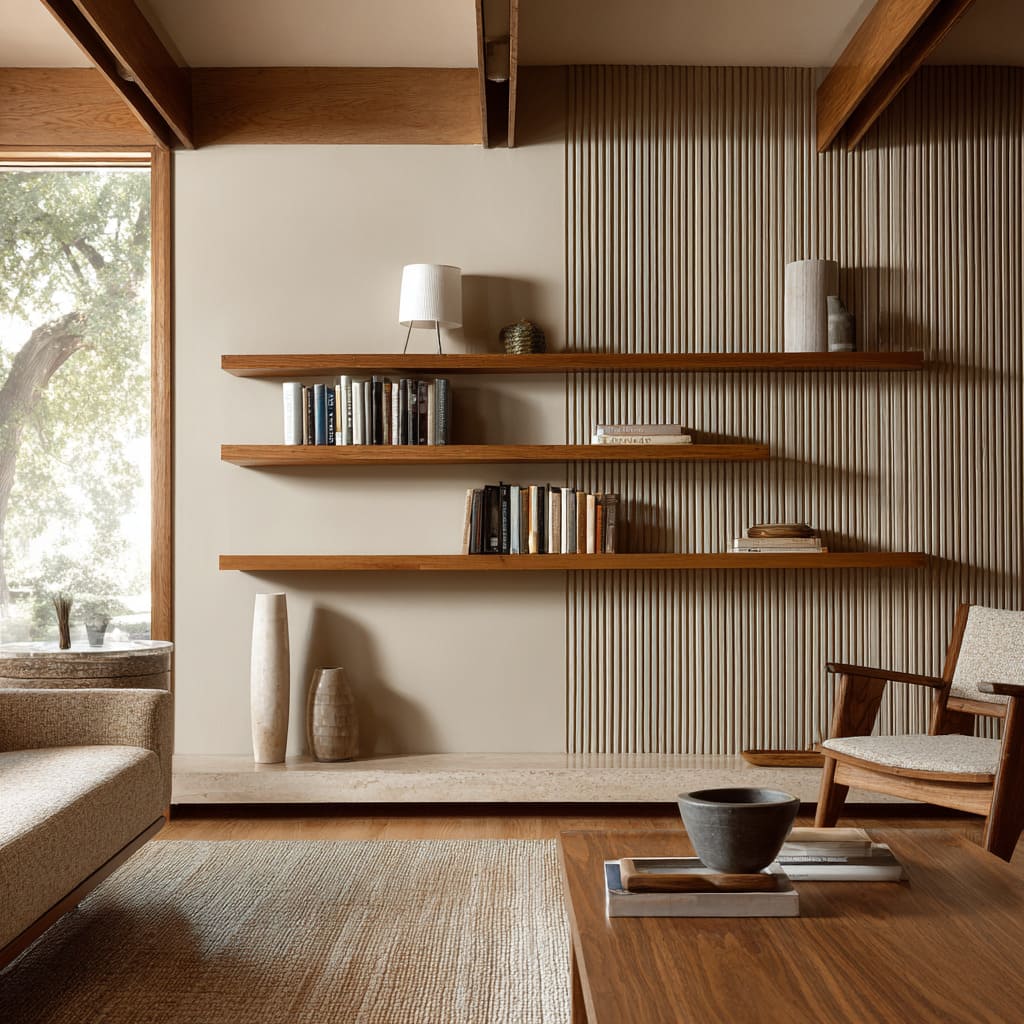
A popular strategy is to treat shelving as a horizontal “rule” that steadies the whole wall. When one long line holds visually, the design reads wider, calmer, and more finished because the eye gets a stable reference point.
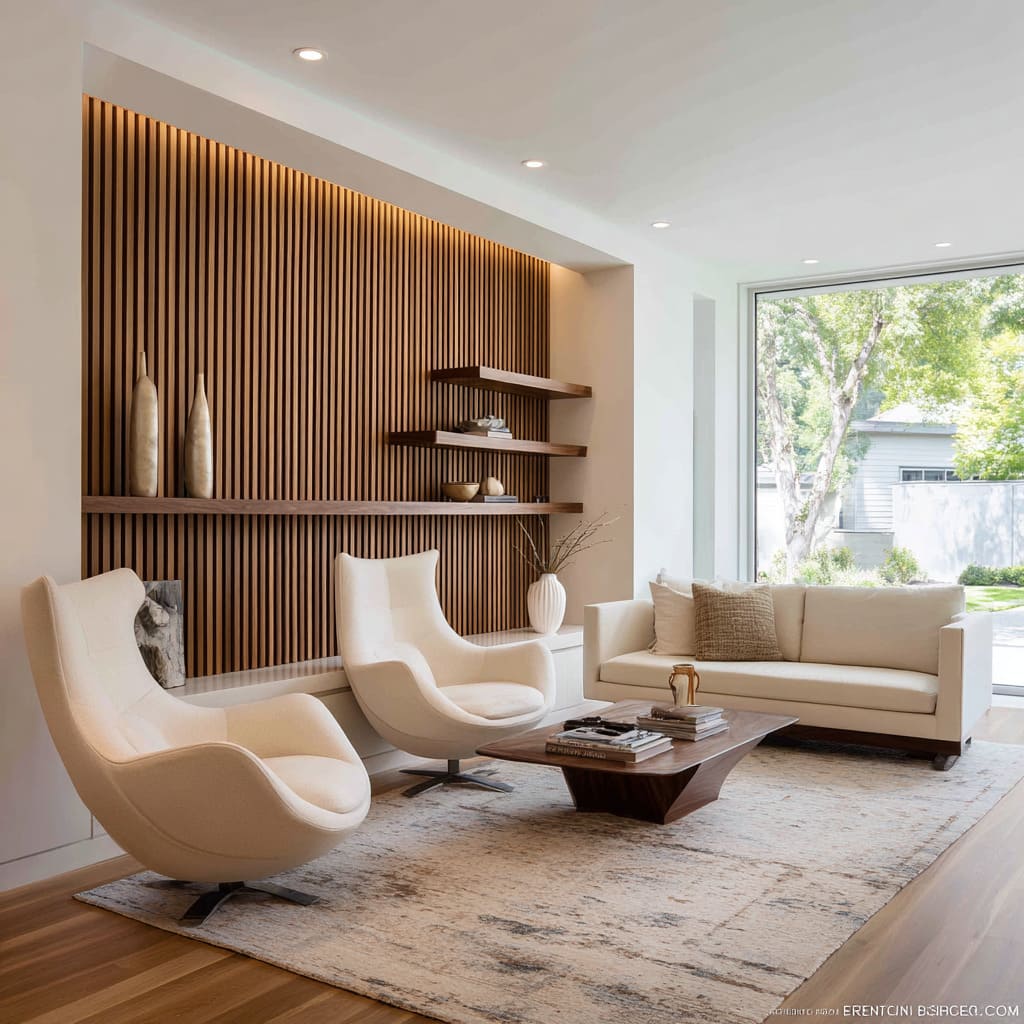
Key horizon effects:.
- A long, consistent shelf height can visually widen a compact wall by stretching attention sideways, which can make the ceiling feel quieter and less “busy” by comparison.
- When shelves run long enough to feel continuous, the wall stops reading as separate objects and starts reading as one composed elevation.
- Horizon shelving can act like a soft boundary for seating: the line sits near sofa-back height so the seating zone feels defined without needing tall furniture.
Understated detail: the “expensive” feeling usually comes from where the line stops. When a long shelf ends near a strong vertical (window frame, fireplace edge, slatted field), the stop reads intentional rather than cut-off.
Shadow becomes the decoration (and sets the mood)
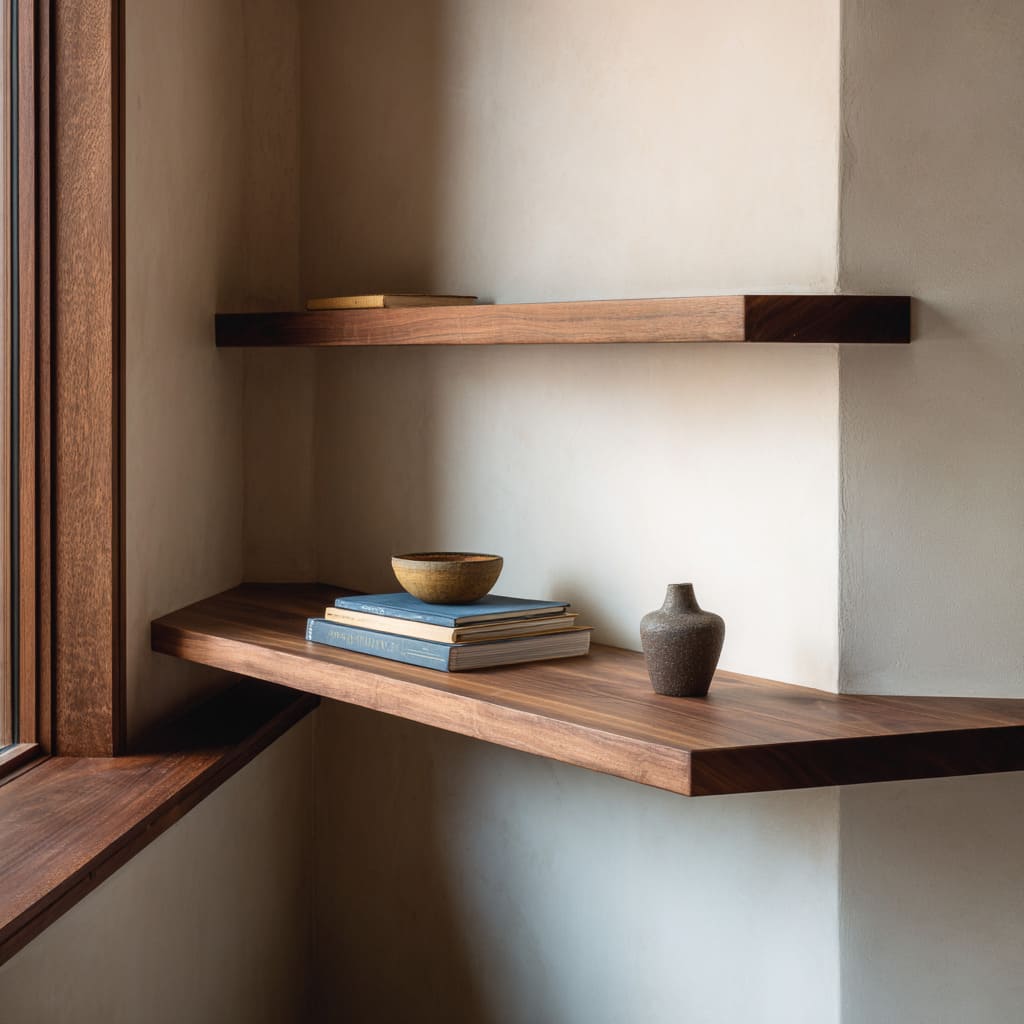
Many polished shelf walls rely on shadow as a primary visual ingredient. Floating wood shelf ideas work especially well when the underside shadow is consistent and calm, because that thin shade line turns a plank into an architectural mark.
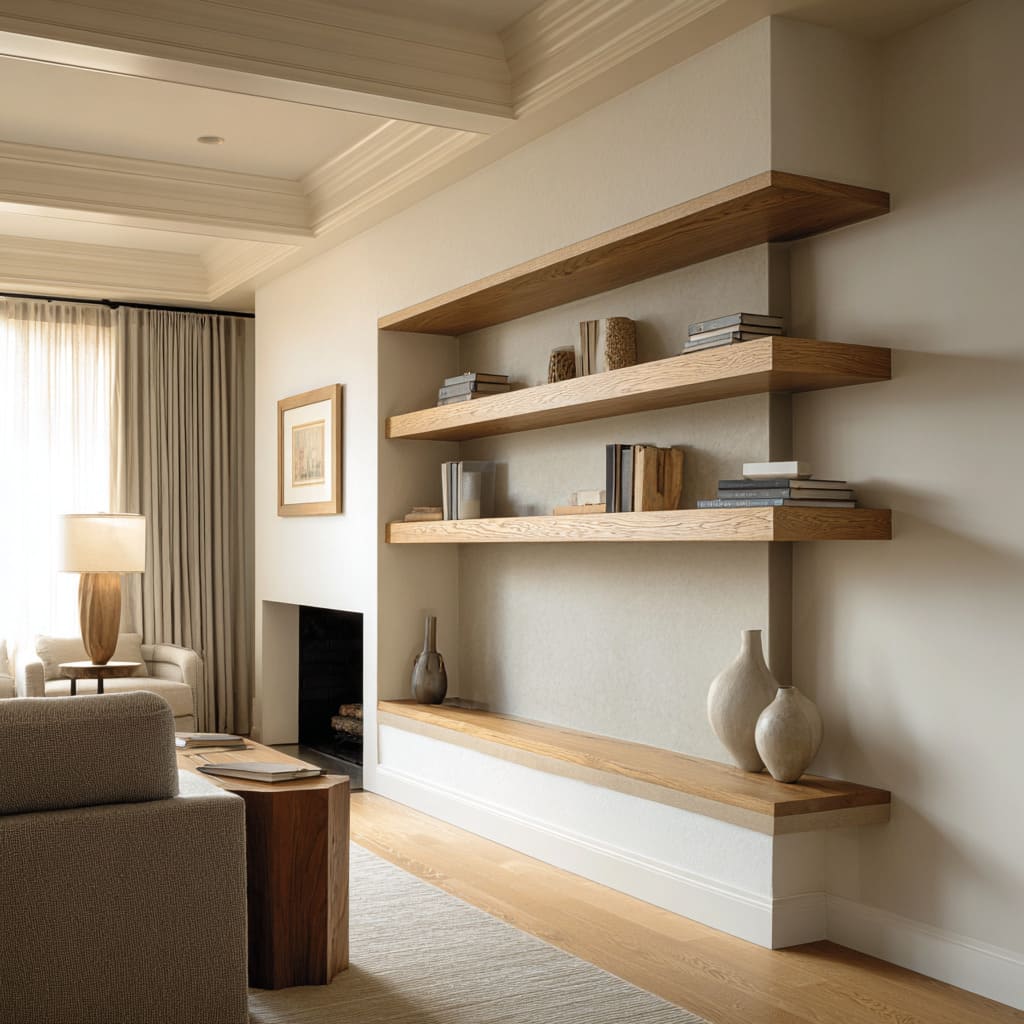
Three shadow languages, three distinct atmospheres:.
- Crisp shadow gap: sharp, modern, graphic; the shelf reads like a precise stroke.
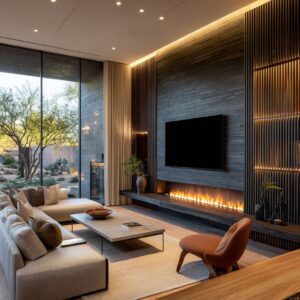
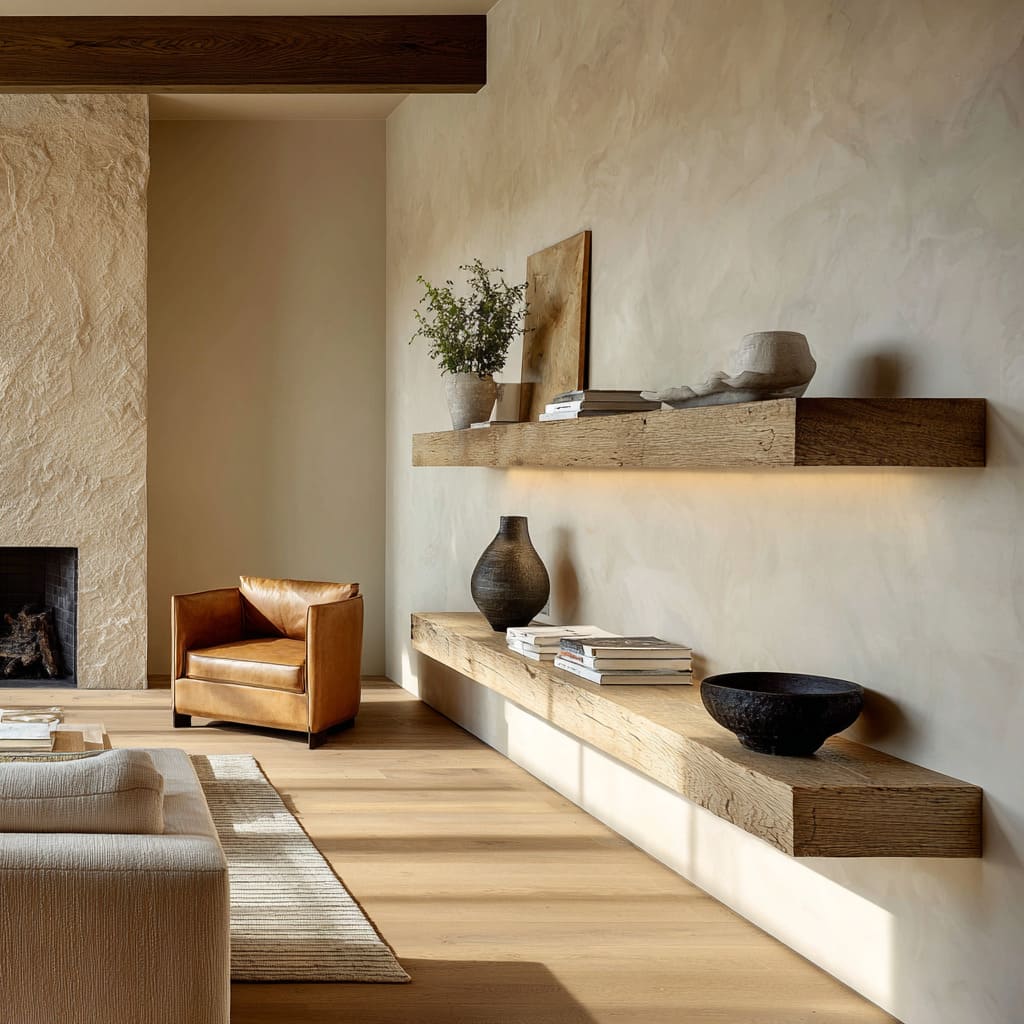
- Soft underglow wash: relaxed, gallery-like; the wall gains evening mood without adding objects.
- Textured micro-shadow backdrop: richer depth with restrained palette; the background “animates” quietly through light.
Design point: under-shelf glow often functions as a visual “weight reducer. ” A thicker shelf can still feel light if the wall receives a gentle wash that separates wood from paint.
“Public vs private” layering that keeps shelves calm
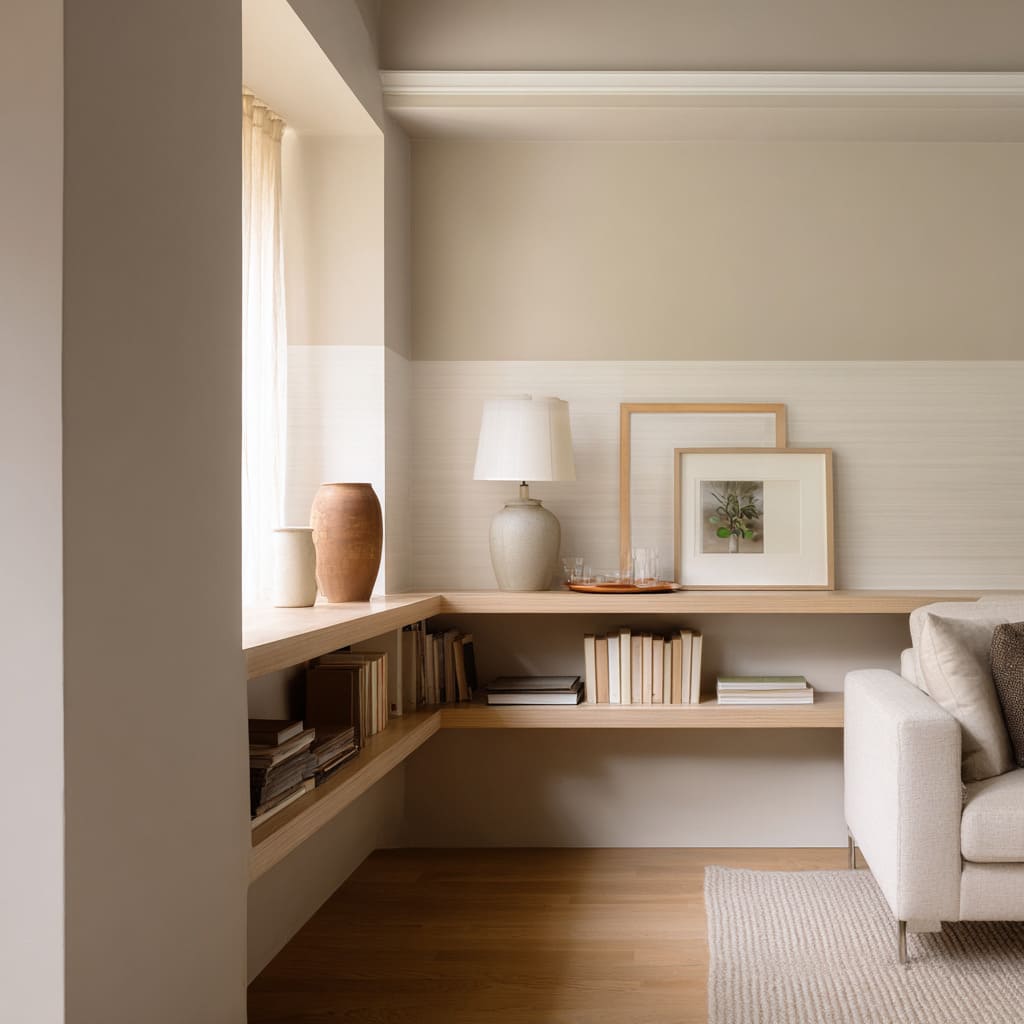
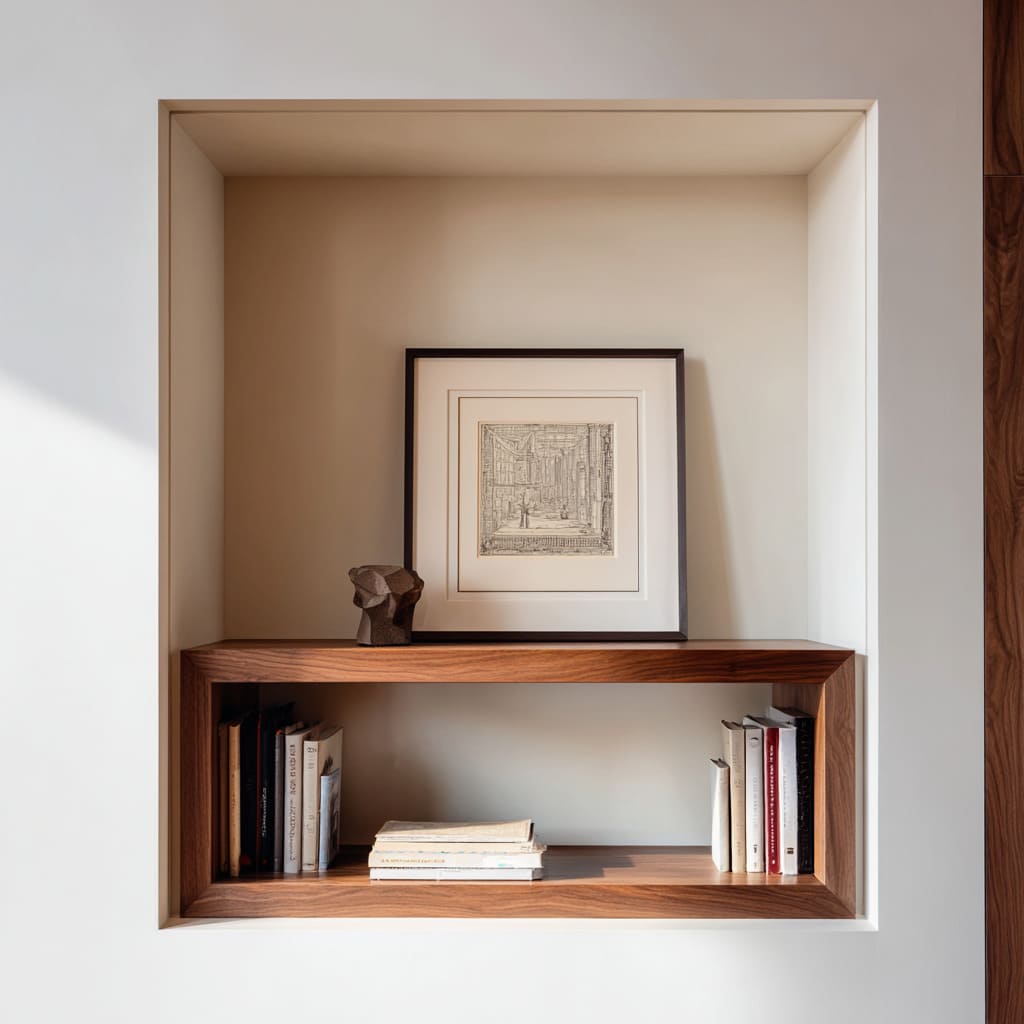
A common high-end move is building shelves around two behaviors: a “public” layer that reads curated and an underlying layer that absorbs real life. This is where ideas for wood shelves shift from display thinking into composition thinking.
Typical layer roles:.
- Upper layers behave like small vignettes (leaning art, a lamp, one sculptural object) and keep the wall plane quiet.
- Lower layers behave like grounded support (bench-like ledge, low cabinet band, deeper shelf) so the open areas can stay sparse.
An insight: “private” rarely means hidden; it often means visually compressed. Books pushed deeper, tonal spines, and low stacks create texture mass without turning into visual noise.
Books treated as a material, not as content
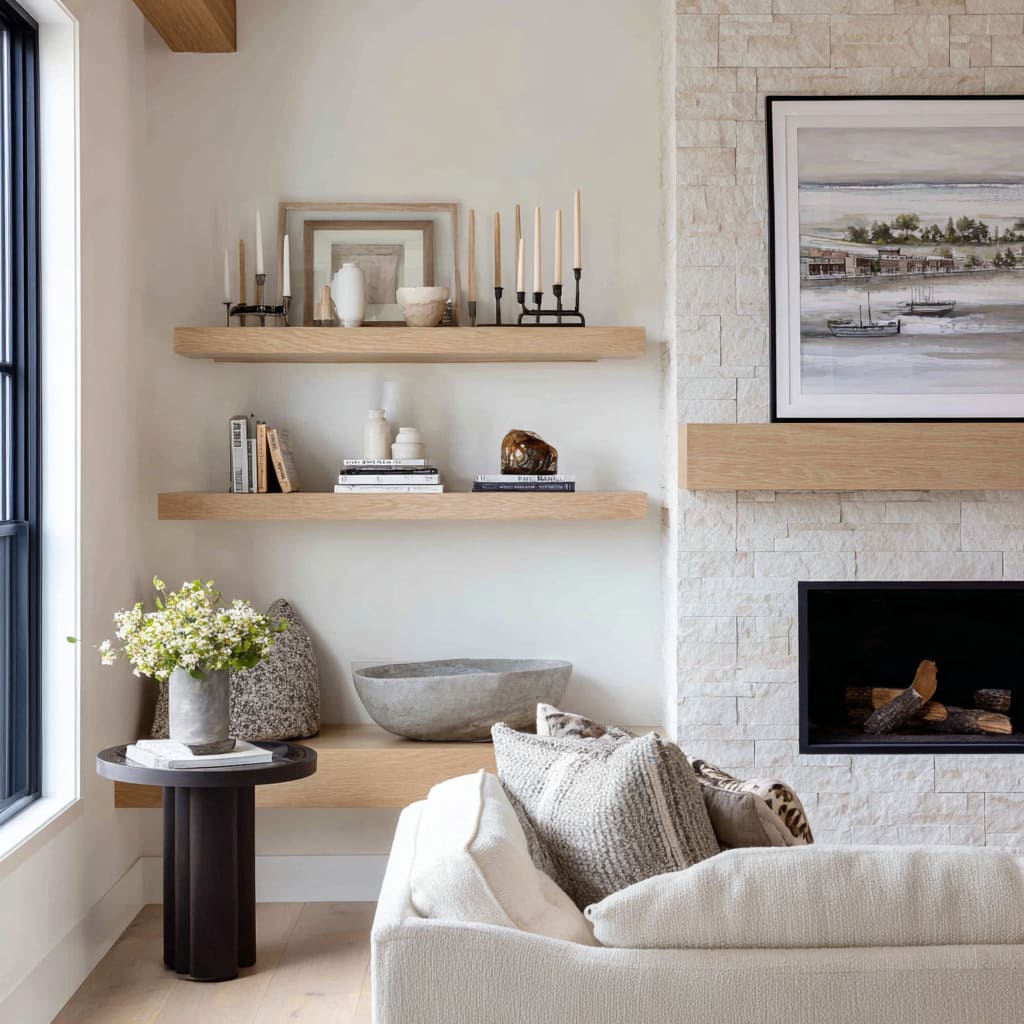
A shelf wall can often use books like a surface material—similar to linen blocks or stone stacks—so the shelf reads unified. This is why certain wood bookshelf ideas feel calm even when books are present.
Four book behaviors that change the visual read:.
- Muted spines as a soft stripe: a tonal band that feels like paneling.
- Horizontal stacks as platforms: height control that emphasizes shelf planes.
- Book columns as brackets: upright groups at the sides with a low stack in the center creates quiet balance.
- Deep placement: books become shadow texture rather than front-facing graphics.
Interesting nuance: calmness comes less from “matching colors” and more from keeping books in a shared softness range (creams, greys, earthy tones) so they behave like one material family.
Leaning art as depth without wall clutter
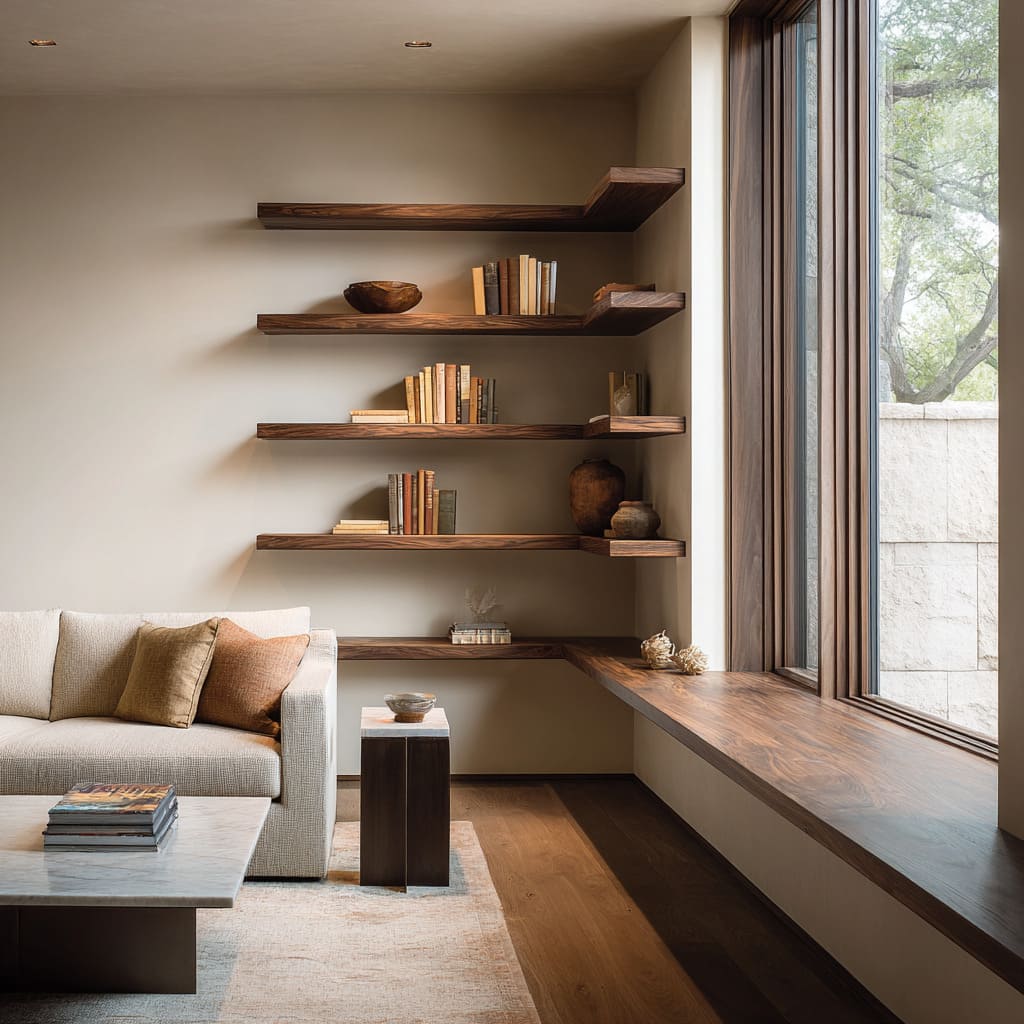
Leaning frames create a second plane behind objects, which adds depth without busy wall spacing. This is a core move inside many wooden shelf decorating ideas because the shelf becomes a layered scene: object silhouette in front, art plane behind, wall last.
Why the lean reads current and composed:.
- The wall remains visually quiet (no scattered hanging layout).
- Depth appears through layering, not through more objects.
- The composition feels flexible and “alive,” because it suggests easy edits over time.
Quiet distinction: leaning art reads especially restrained when it’s kept lower than expected; it feels “resting” instead of “announcing. ”.
Background texture as a control dial for contrast
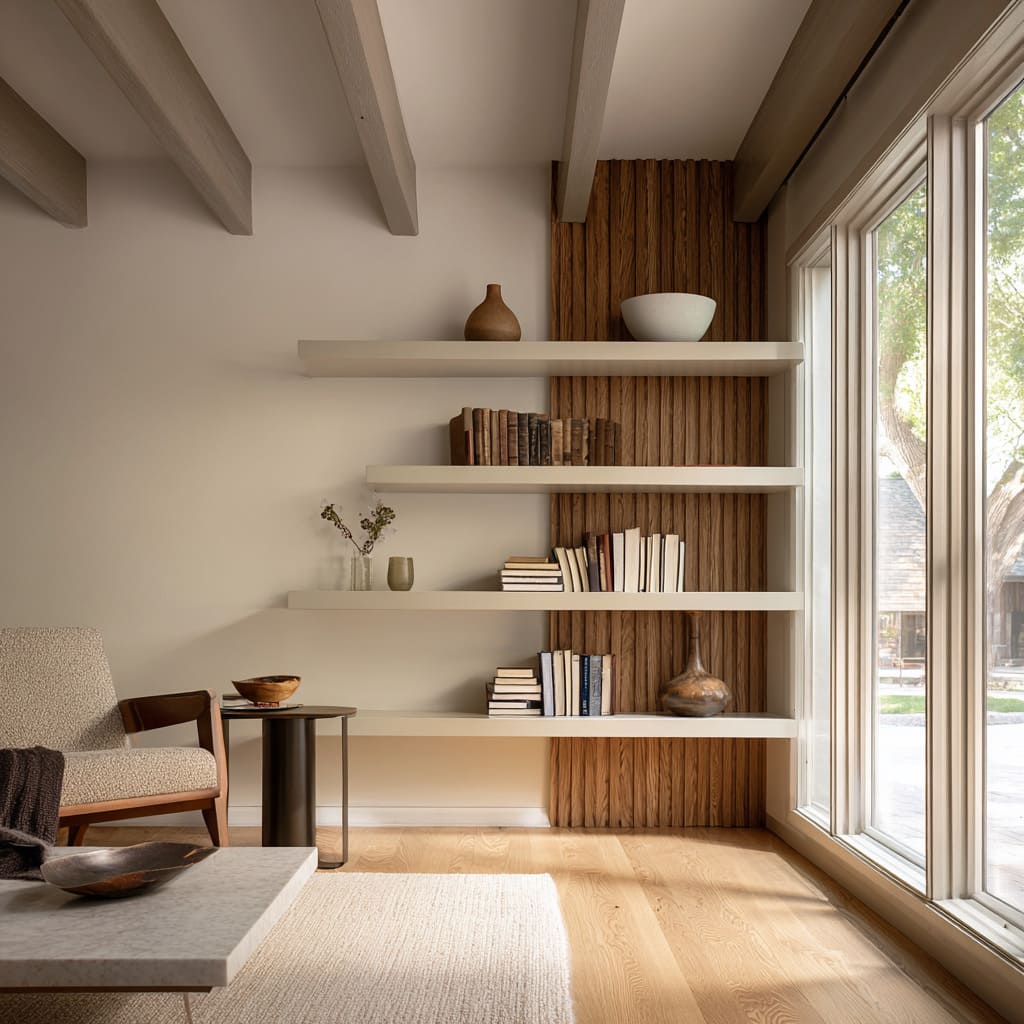
Shelf walls can gain sophistication when the background is treated as part of the composition. Modern wooden shelf design frequently pairs simple shelf lines with a textured field, so the design gets depth without needing strong color.
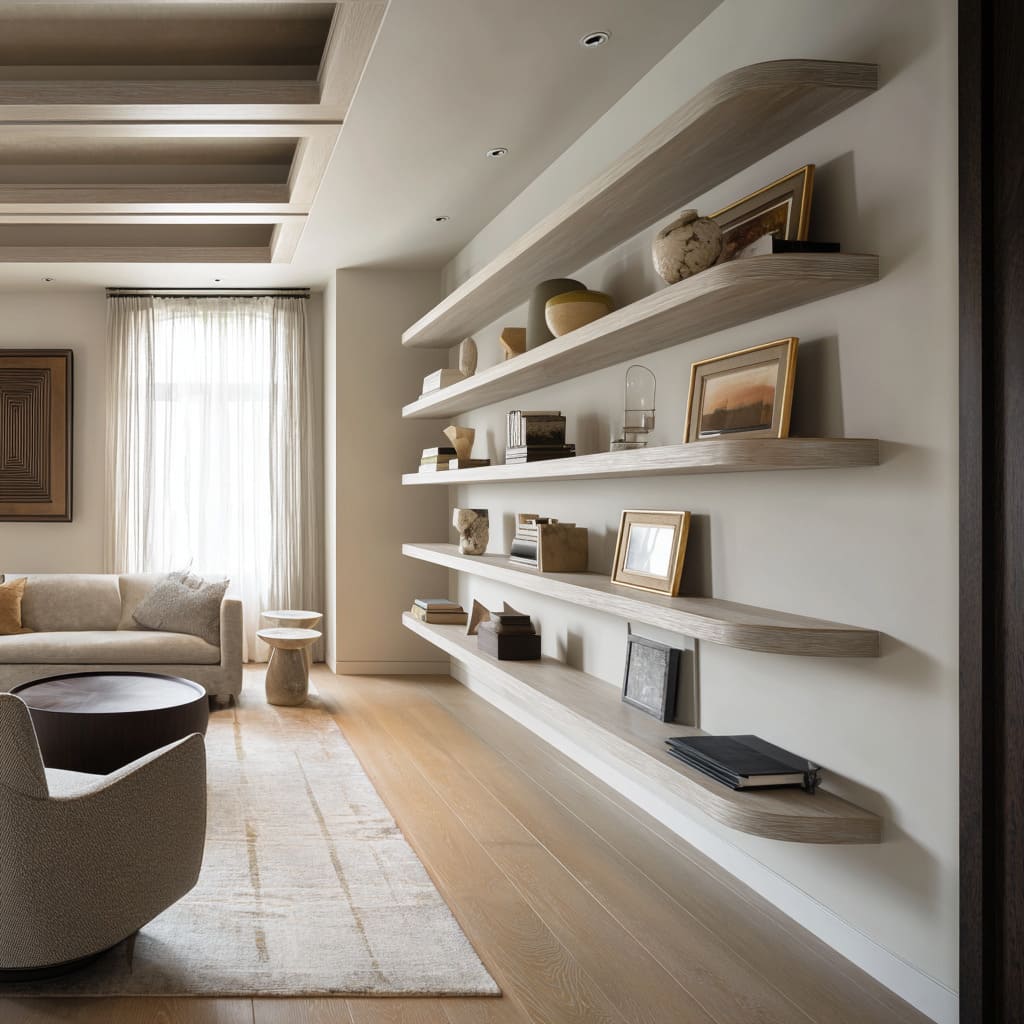
Three background families and what they do:.
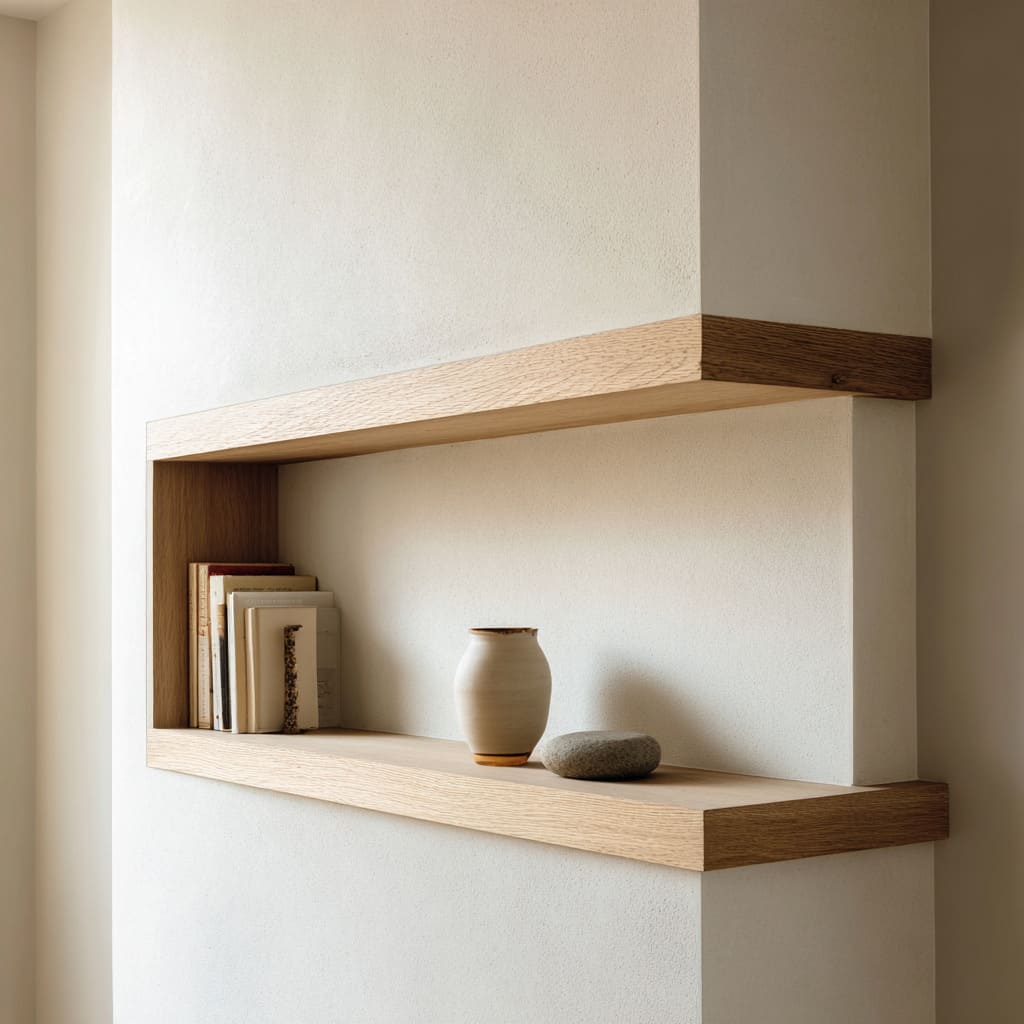
- Smooth plaster-like walls: shelves read clean and graphic; shadows look precise.
- Vertical slats: warmth and depth without pattern; shelves feel like controlled cuts through rhythm.
- Ribbed/grooved panels: silhouettes read stronger; tall vessels feel integrated because the vertical rhythm frames them.
Supporting observation: darker objects often read calmer when placed near darker textured zones (slats/ribs). Contrast becomes controlled rather than sharp.
Edge control: stops, stoppers, and “why the shelf ends feel intentional”
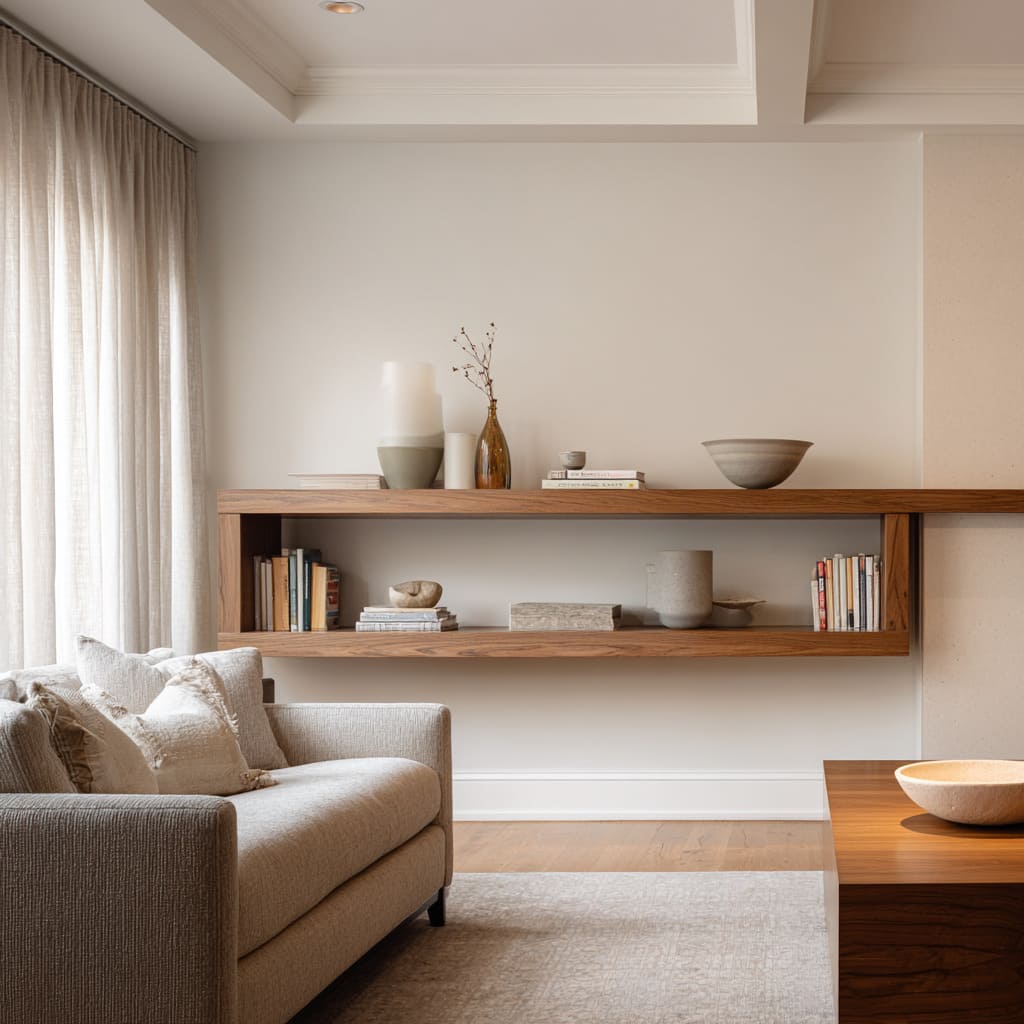
Many shelf walls fail visually at the ends: the eye slides off and the line feels accidental. Strong wooden bookshelf designs often solve this with end punctuation that quietly brakes the composition.
Common stopper types:.
- A wide shallow bowl near an end (visual “stop” without height).
- A taller dark vessel near one side (weight punctuation).
- A short return or folded end that turns the shelf from a line into a shaped object.
Low-visibility detail: the return/end fold changes perceived thickness and adds direction, so the shelf reads designed even before styling is added.
Structured emptiness as a luxury signal
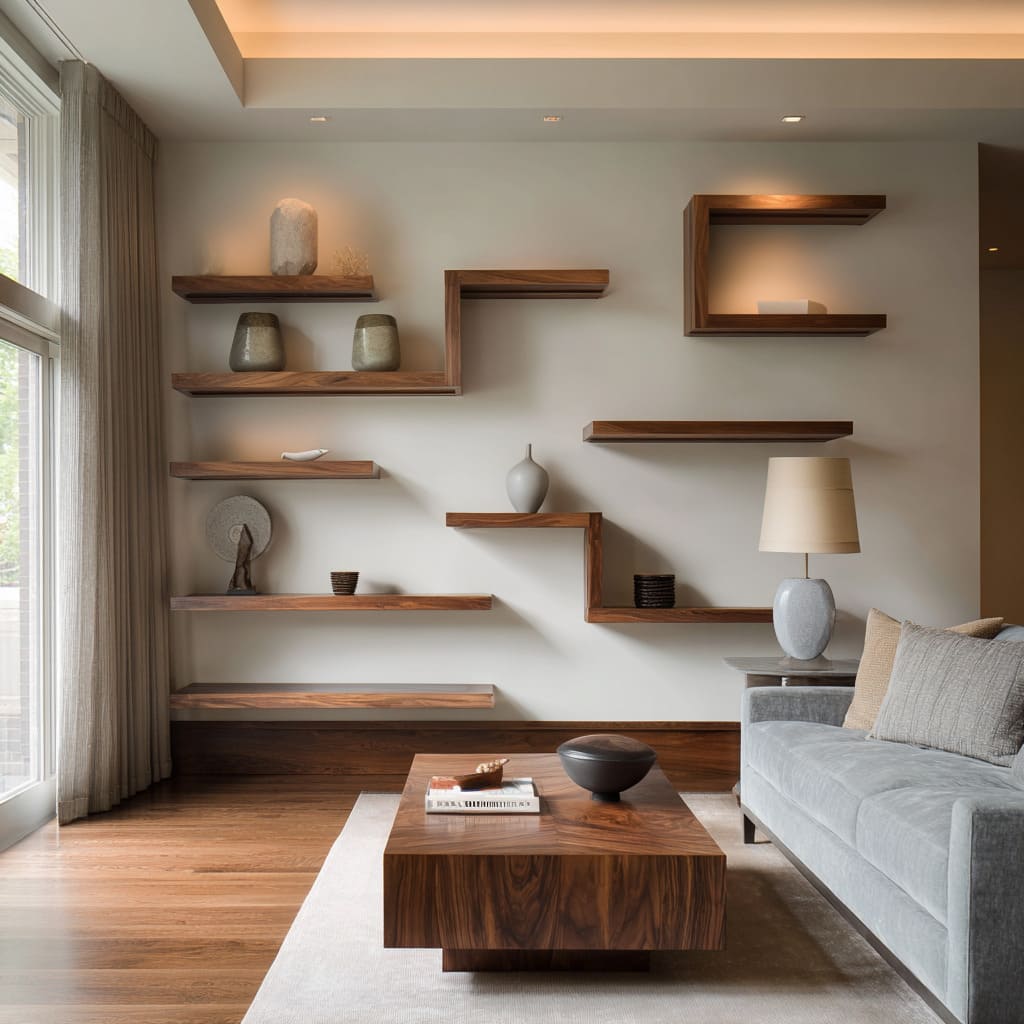
Minimal shelves look finished when emptiness feels planned rather than leftover. A simple wood shelf design can read premium through spacing discipline alone: the air becomes part of the composition.
Ways emptiness becomes structured:.
- Larger gaps between shelves so each shelf reads as its own “zone.”
- One shelf kept nearly empty so the wall gains an intentional pause.
- Open floor under shelves so the wall elevation stays dominant and uncluttered.
Quiet design move: emptiness reads complete when there’s a clear scale hierarchy—one or two pieces with real presence, then smaller supporting pieces, then air. Without a scale anchor, emptiness can feel unfinished.
Material duets that create quiet tension without color
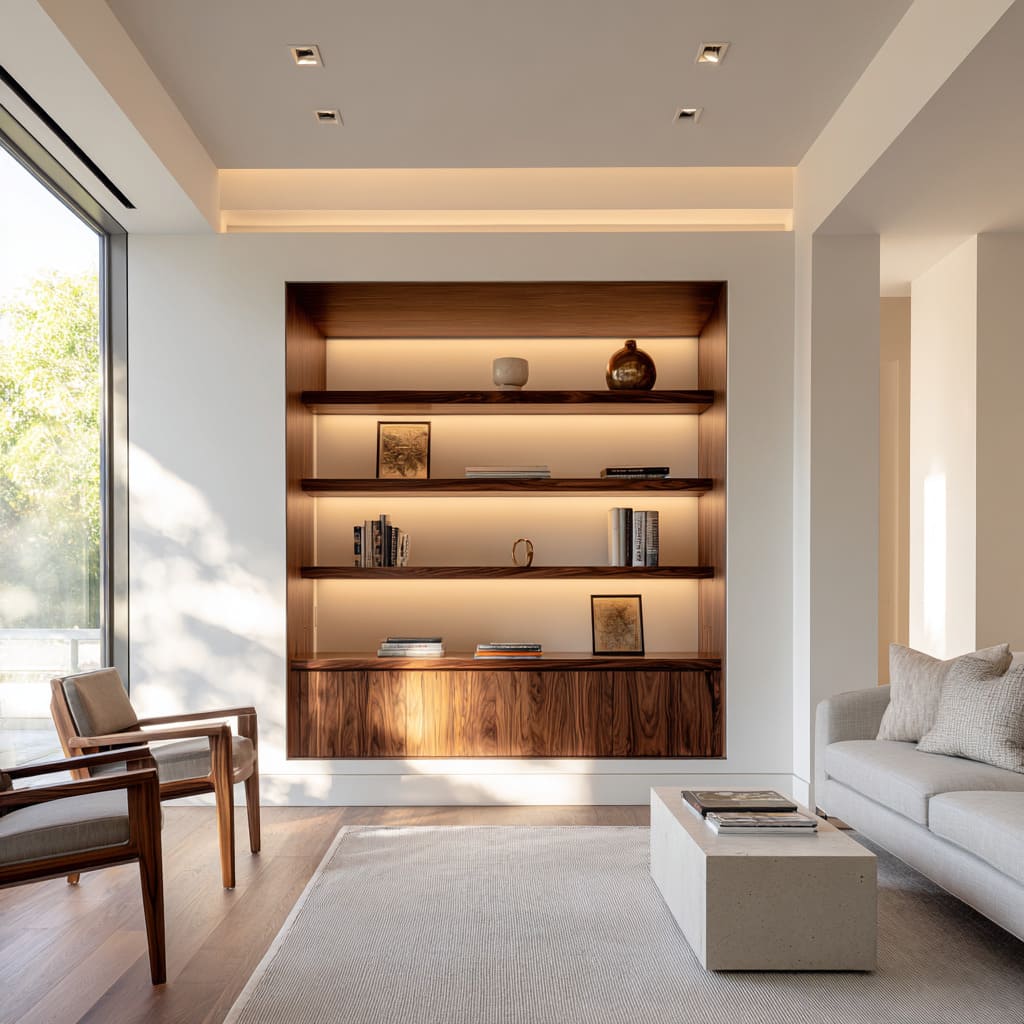
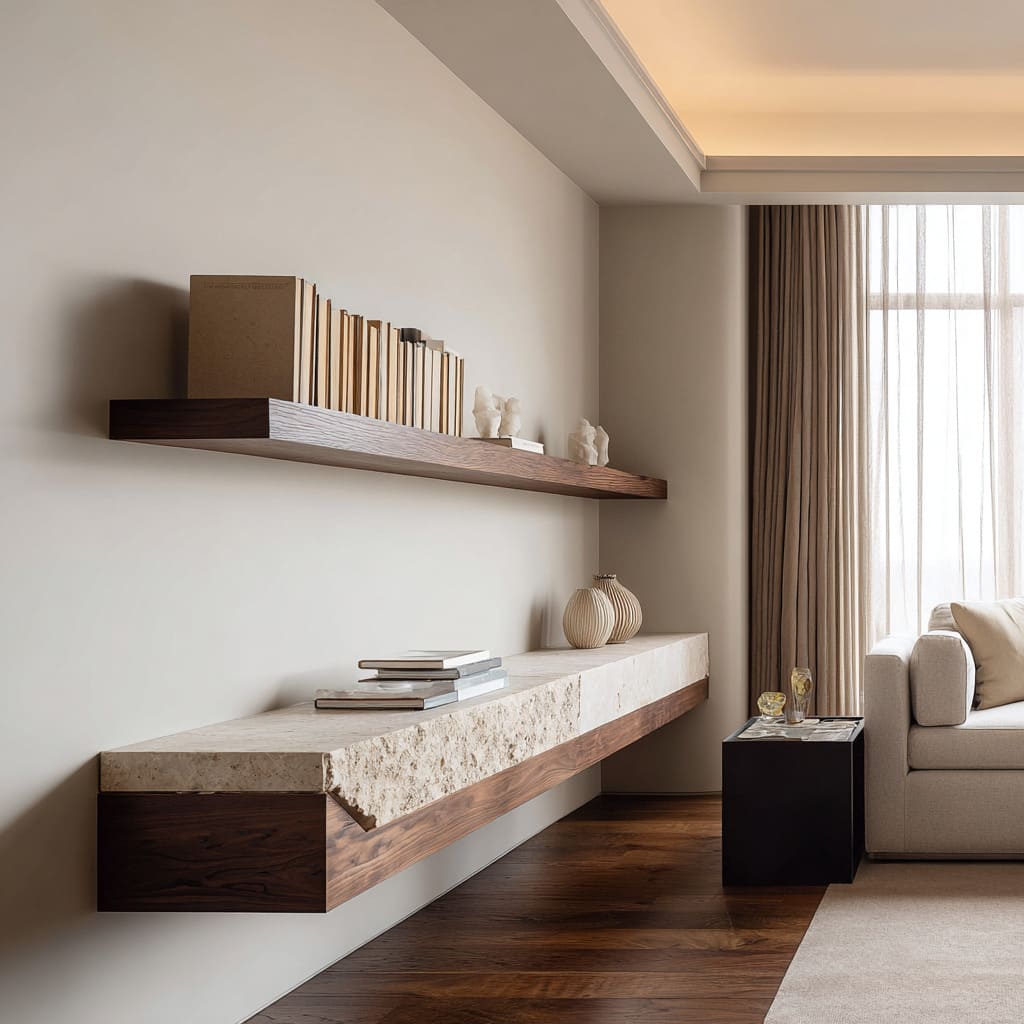
A restrained wall can still feel rich through controlled material contrast. wooden shelves design for living room often becomes most convincing when warmth and coolness coexist: wood grain beside mineral surfaces, matte textiles beside crisp planes.
Common “duet” pairings:.
- Warm wood shelf lines paired with a cooler stone-like table or object to keep the design from going overly soft.
- Darker wood paired with pale walls and pale textiles to create moody calm without heaviness.
- One intentionally rugged texture (rough stone edge, expressive grain) placed against smooth paint to make the tactile note feel valuable.
Subtle design cue: one controlled “imperfect” texture can signal quality faster than many decorative items, because it concentrates attention on material character.
Shelf geometry as choreography (how the wall guides attention)
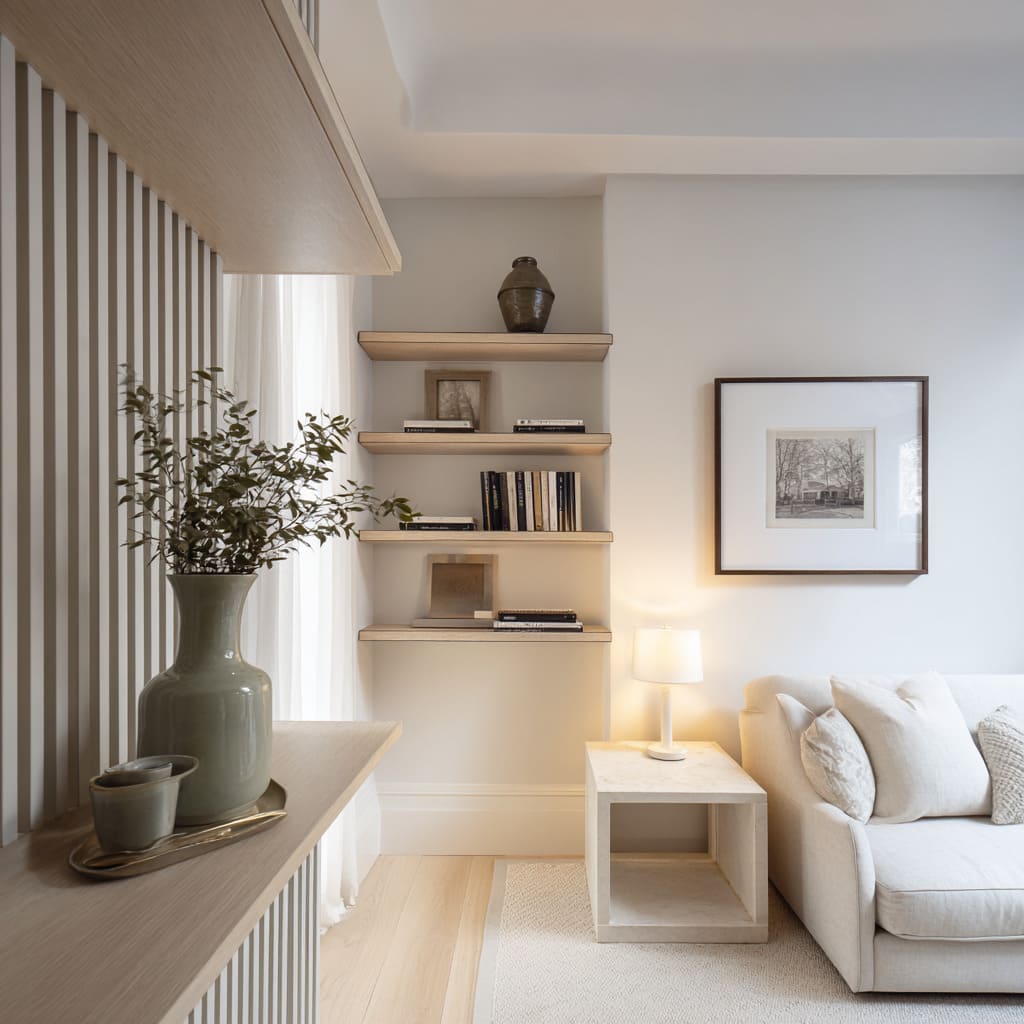
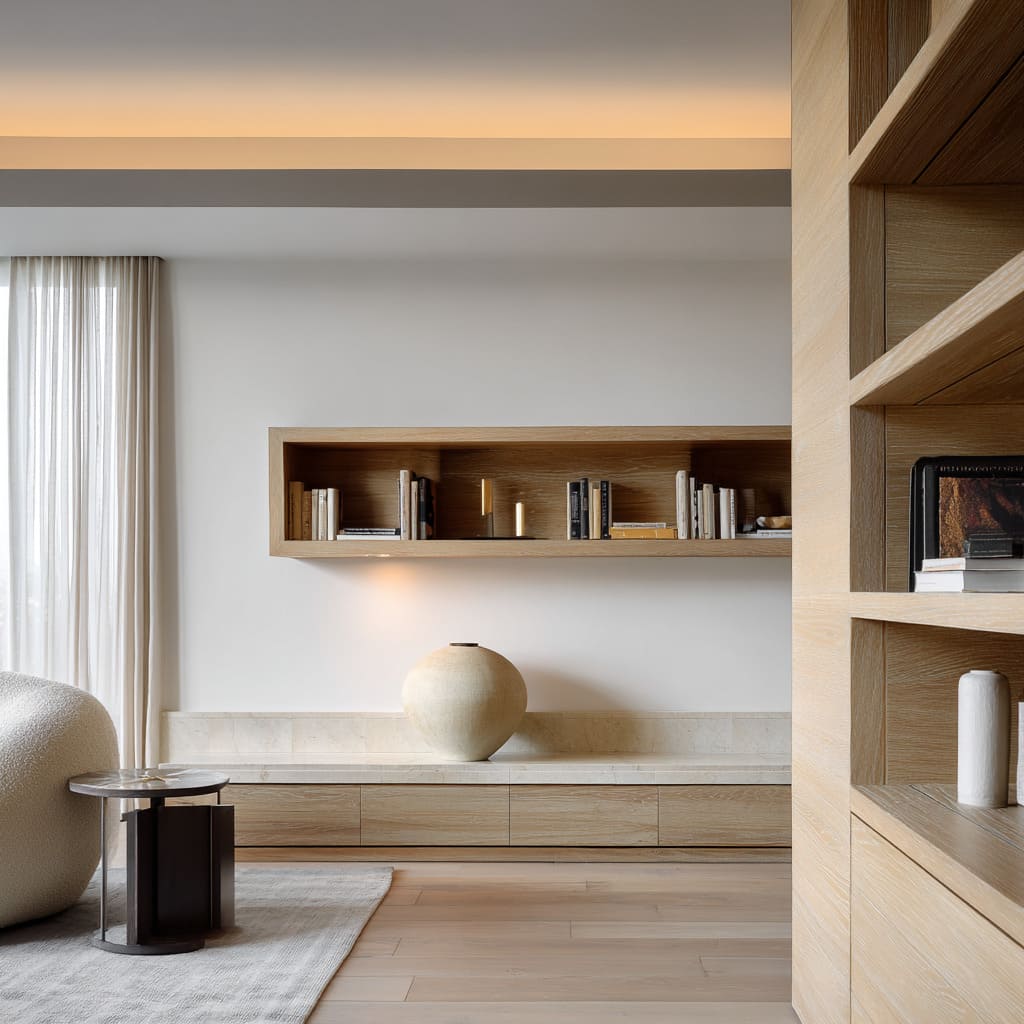
Shelving geometry can behave like wall choreography: it directs the eye, edits the dominance of other elements, and shapes how the design feels at a glance. In many wooden shelf design schemes, geometry is the main styling tool.
Geometry effects that read “designed”:.
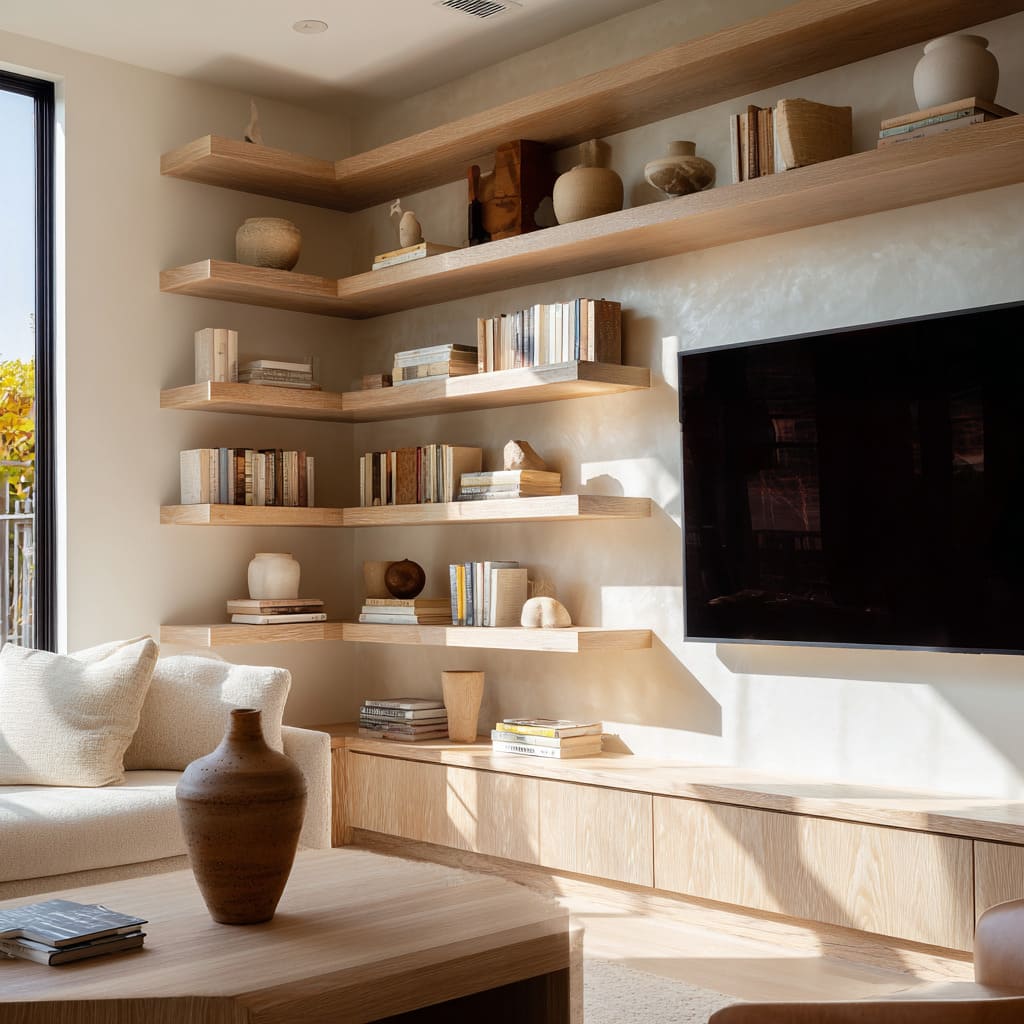
- Terraced steps: staggered shelf lengths create rhythm and dimensionality; the wall stops reading as “one object + empty space.”
- Corner wraps: the line turns the corner so the design reads continuous and intentional rather than divided into separate faces.
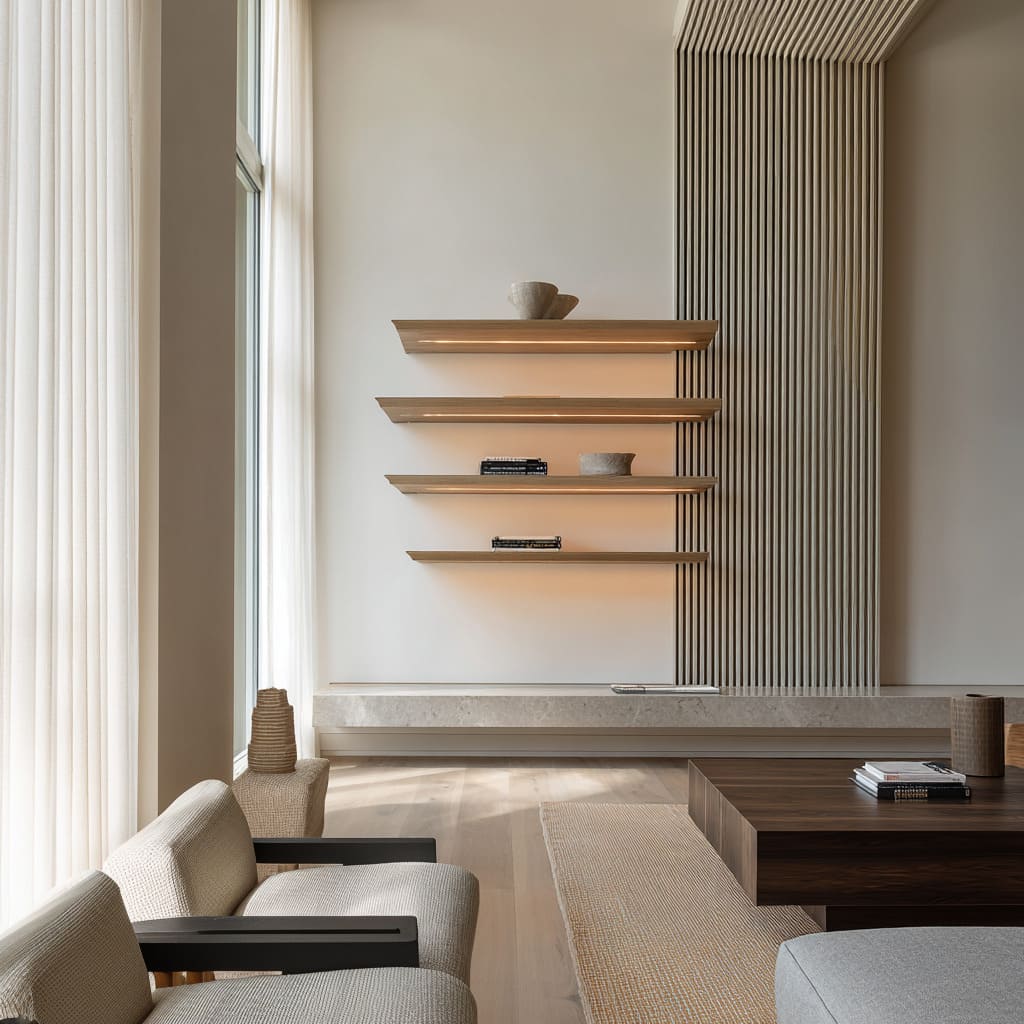
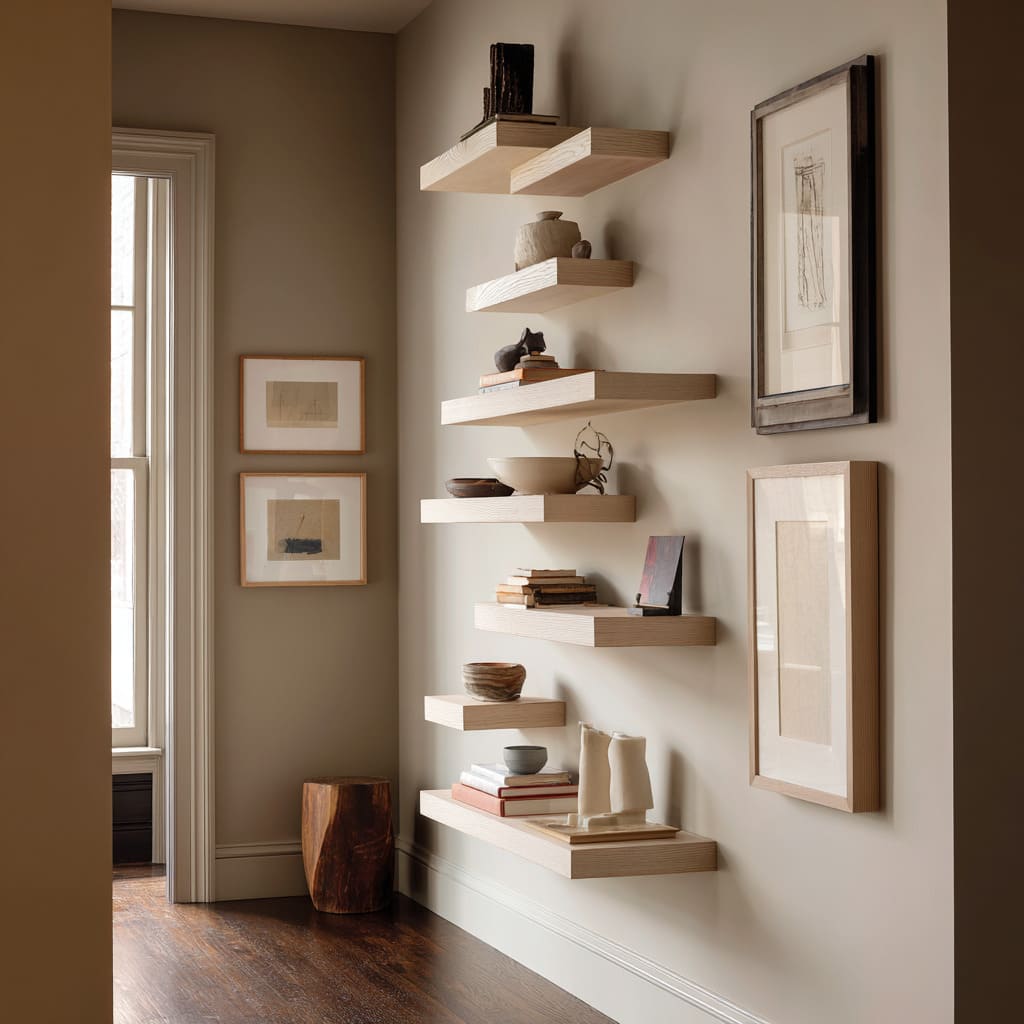
- Vertical columns of staggered shelves: the repeating underside shadows become a soft stripe pattern, giving rhythm without busy visuals.
Easy-to-miss detail: stepped layouts often feel especially satisfying when they shift from compact to extended—tight grouping that relaxes into longer lines—because it reads like planned progression rather than repetition.
Motif systems that connect shelves to the rest of the room
Refined interiors repeat a motif, but they vary it so it doesn’t look staged. This is where wood bookshelf ideas often feel strongest: the shelf wall isn’t a standalone moment; it echoes other elements quietly.
Common motif pairs that create coherence:.
- Bowl + books repeating at shelf height and again on a low table (same idea, different level).
- Lamp appearing at shelf level and again near seating (light becomes a theme, not an accessory).
- Shelf wood tone echoed in smaller touches (chair arms, trim, a side table), so the shelf wall feels like part of the room’s material language.
Non-trivial nuance: repeating the same idea at different heights makes the design feel resolved because the eye finds consistent structure in multiple zones.
A clean classification of shelf “identities” by visual effect
Many shelf compositions fall into distinct identities based on the effect they’re designed to create. The vocabulary behind modern wooden shelves design tends to repeat these roles, even when the details change.
Common identities:.
- Horizon wall: long lines that stabilize the elevation; calm, wide, composed.
- Glow niche: recess + soft light wash; focused, warm, restrained.
- Terraced field: stepped shelves that build rhythm and soften dominant rectangles; dimensional, planned.
- Wall-jewelry stack: slimmer shelves with spacing discipline; graphic, edited.
- Material duet wall: wood + mineral contrast carries the luxury signal; quiet tension, tactile richness.
- Texture-field shelving: slats or ribs as backdrop with shelves as controlled interruptions; layered calm.
Subtle but defining element: these identities succeed when shelves behave like “architecture marks” first and “storage” second—line, shadow, spacing, and material character lead the read.
Micro-adjustments that frequently signal a higher-end finish
Certain small choices consistently shift the impression from “decor” to “composed interior language”:.
- One nearly empty shelf included as a deliberate pause, not a leftover gap.
- One end “stopper” object that prevents the shelf line from visually fading out.
- Book groupings treated as tonal blocks (depth, height control, muted spines) rather than title stripes.
- Darker objects placed near darker textured backgrounds so contrast feels controlled.
- One overscaled anchor piece included so the wall reads complete without filling every shelf.
When these micro-decisions align with the larger rhythm—horizon lines, calm shadows, textured backdrops—the shelf wall tends to read as an intentional interior system rather than a collection of items.