The laces can quietly turn into the backbone of the whole December mood, especially where the goal is elegant simple Christmas decorations rather than a room full of objects. Instead of acting like a decorative afterthought, lace wraps bulkheads, trims consoles, outlines mantels, and hangs from stair rails in a way that feels almost architectural.
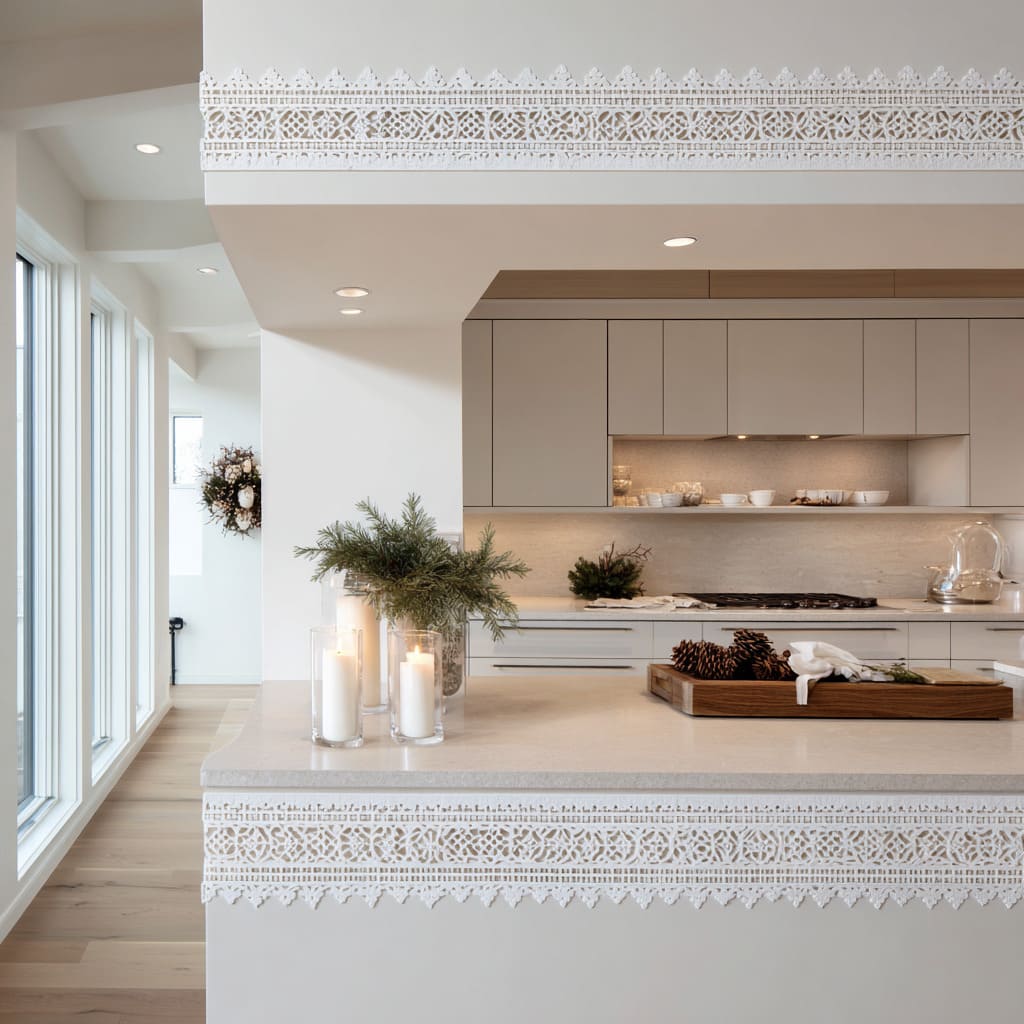
A narrow white band running around a kitchen bulkhead behaves like a soft cornice; lace under a peninsula counter falls like a delicate frieze; a scalloped panel rising behind a console reads like a temporary winter wainscoting. The decorating logic is subtle: the building stays structurally the same, but its visible “edges” wear a seasonal garment.
Because the lace often matches the wall or trim color, its impact comes from shadow and texture rather than high contrast. By day, daylight grazes the openwork and makes the small holes glow gently; by evening, candles or under-cabinet lights catch the threads and turn them into a horizontal line of tiny shadows.
This approach lets a space hold a full narrative of winter craft and warmth without crowding surfaces that still need to serve daily life. The walls, mantels, and bulkheads simply feel like they have slipped into their quieter festive clothes.
Edges and seams as the true decorative territory
A striking pattern is how often the festive treatment lives on edges and seams instead of in the middle of a surface. Door frames, shelf fronts, curtain borders, stair balusters, console lips, and counter overhangs carry the seasonal work.
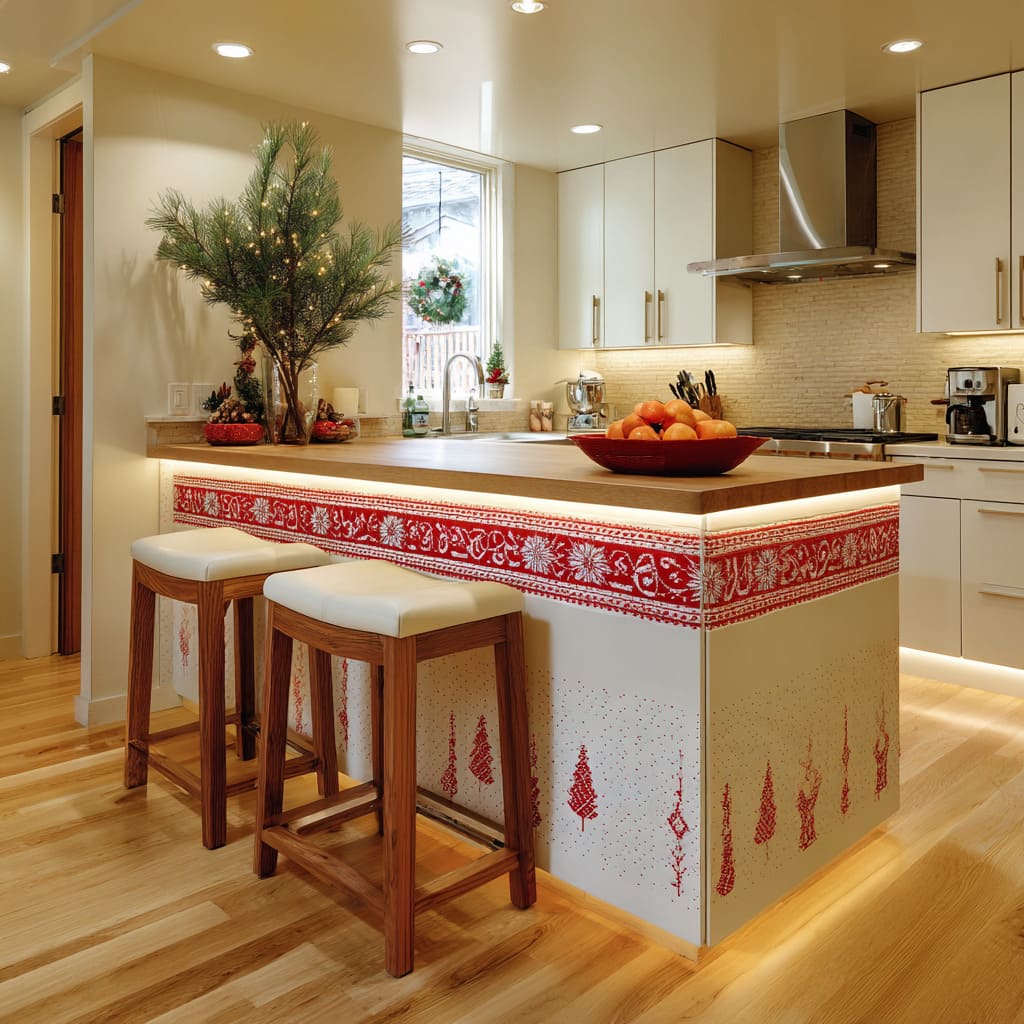
Lace runs along the top of hallway walls where ceiling meets paint, trimming the corridor in a continuous crochet band. Counter edges in kitchens are wrapped in red folk-style patterns at the point where a vertical island face meets the horizontal top, mirroring the edge position of a ribbon on a wrapped parcel.
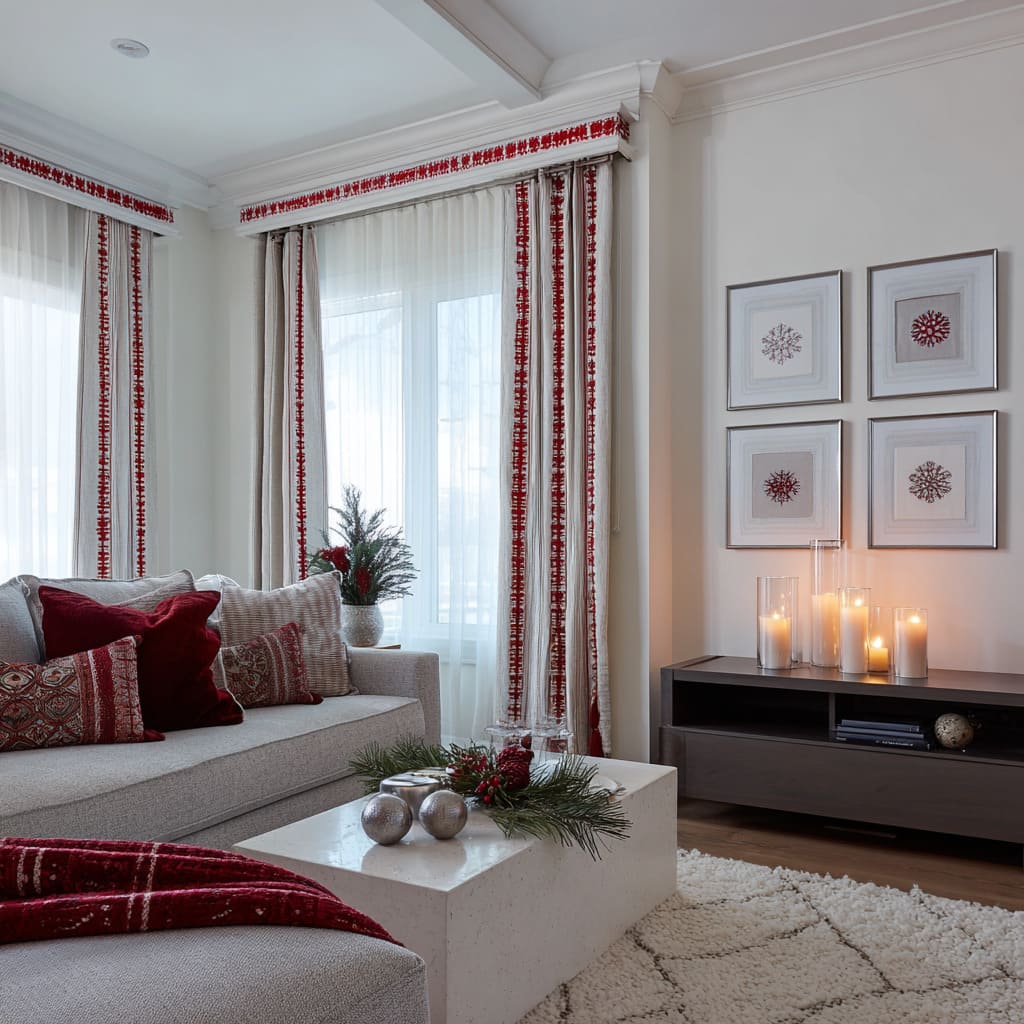
Curtain panels can remain sheer and white, but the outermost edges are finished with narrow embroidered bands; the glass stays open and bright while the frame announces winter. This edge-first strategy keeps functional zones free: worktops stay clear for cooking, coffee tables remain open for trays and books, sofa seats hold people instead of figurines.
The architecture still feels calm and usable, yet those thin decorative seams knit the volumes together visually. The house seems stitched with a continuous seasonal thread rather than dotted with scattered accessories.
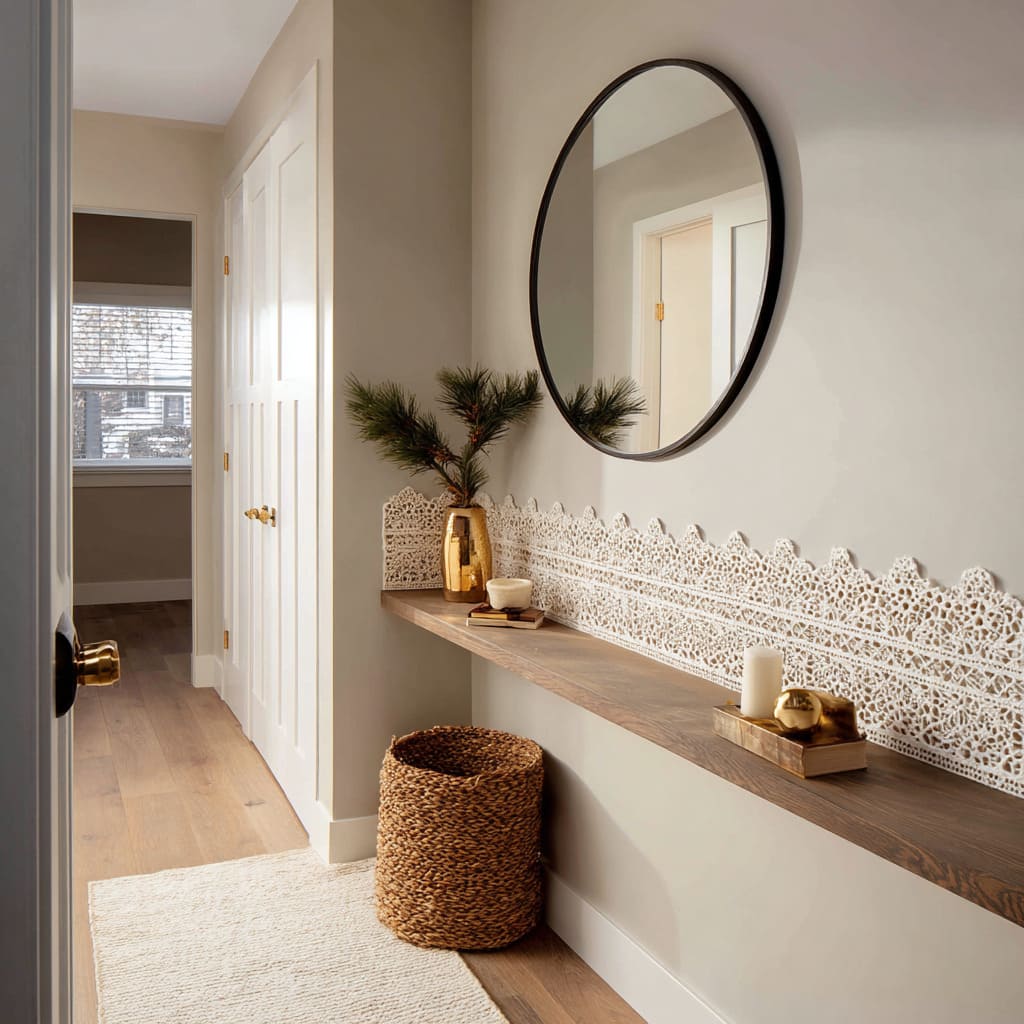
One textile idea, stretched through the whole room
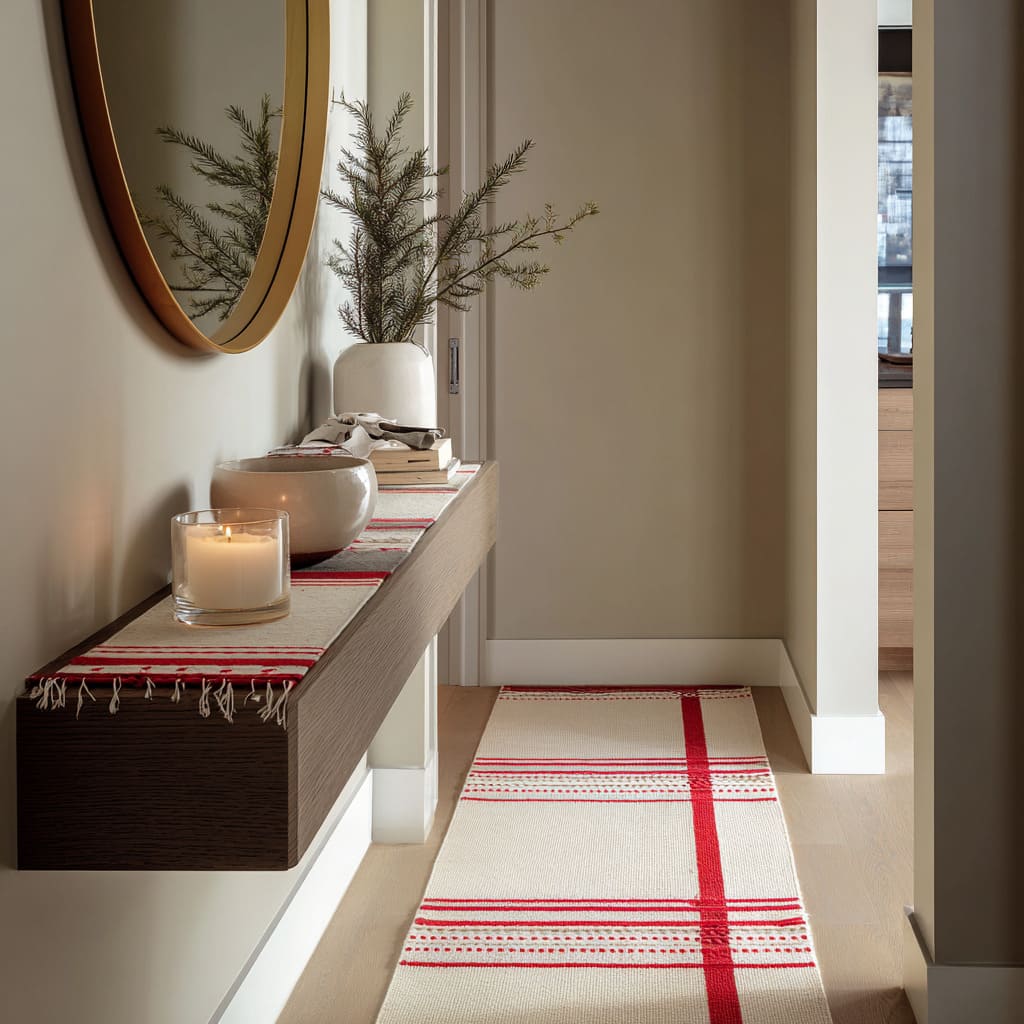
A recurring design move is to choose one textile motif and let it appear in several places, instead of layering ten different Christmas items. A red striped runner lies on a floating hallway console and then repeats as a floor runner down the corridor, so the whole passage reads as a single rhythm of stripes rather than a collection of small props.
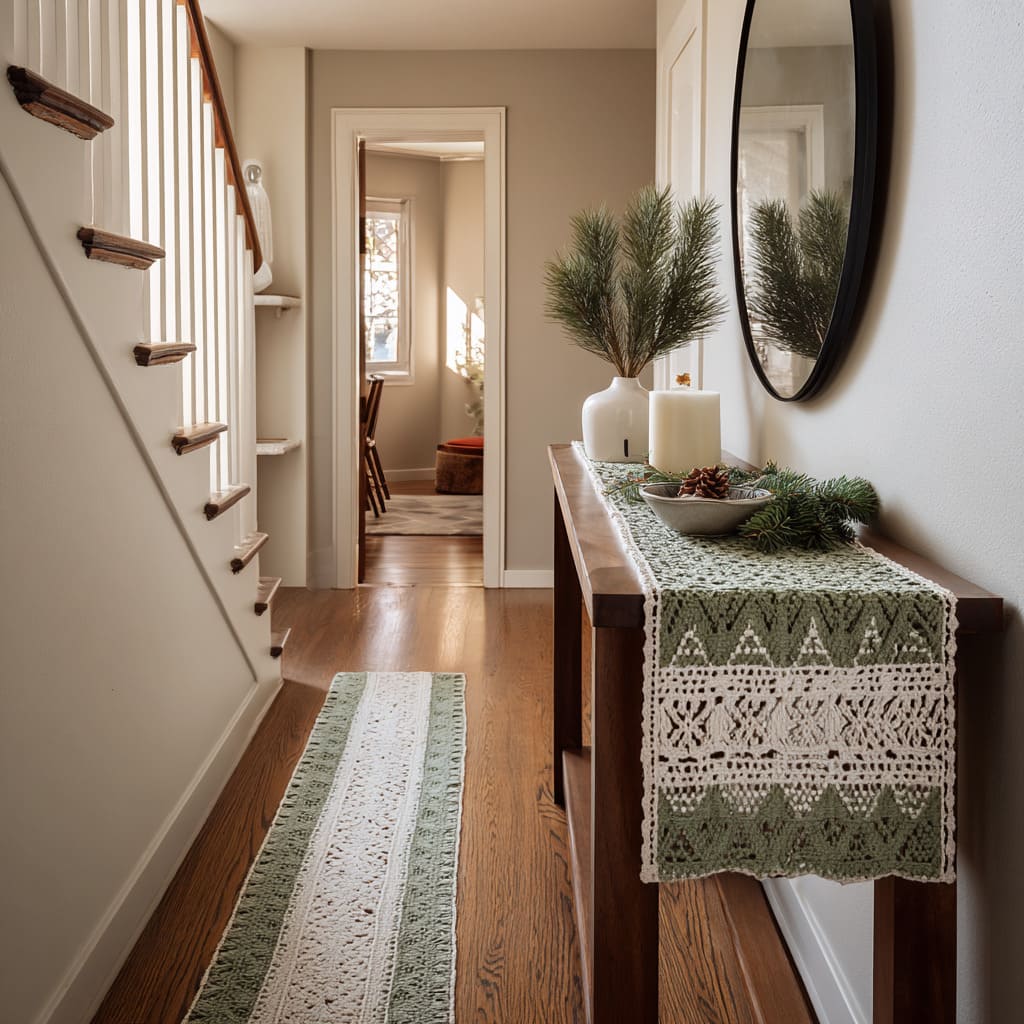
Green-and-cream crochet appears on both a console and a matching floor runner, forming a continuous visual “railroad” leading through a stair hall.
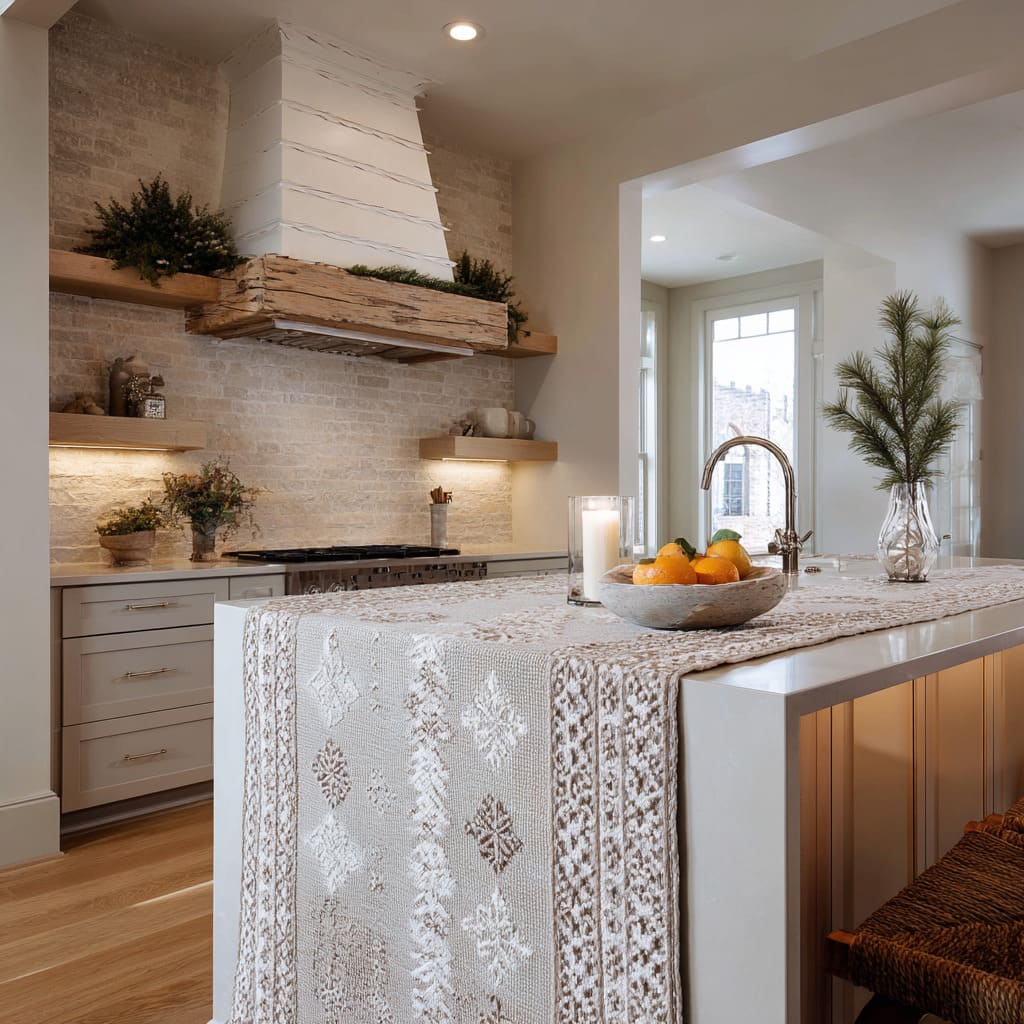
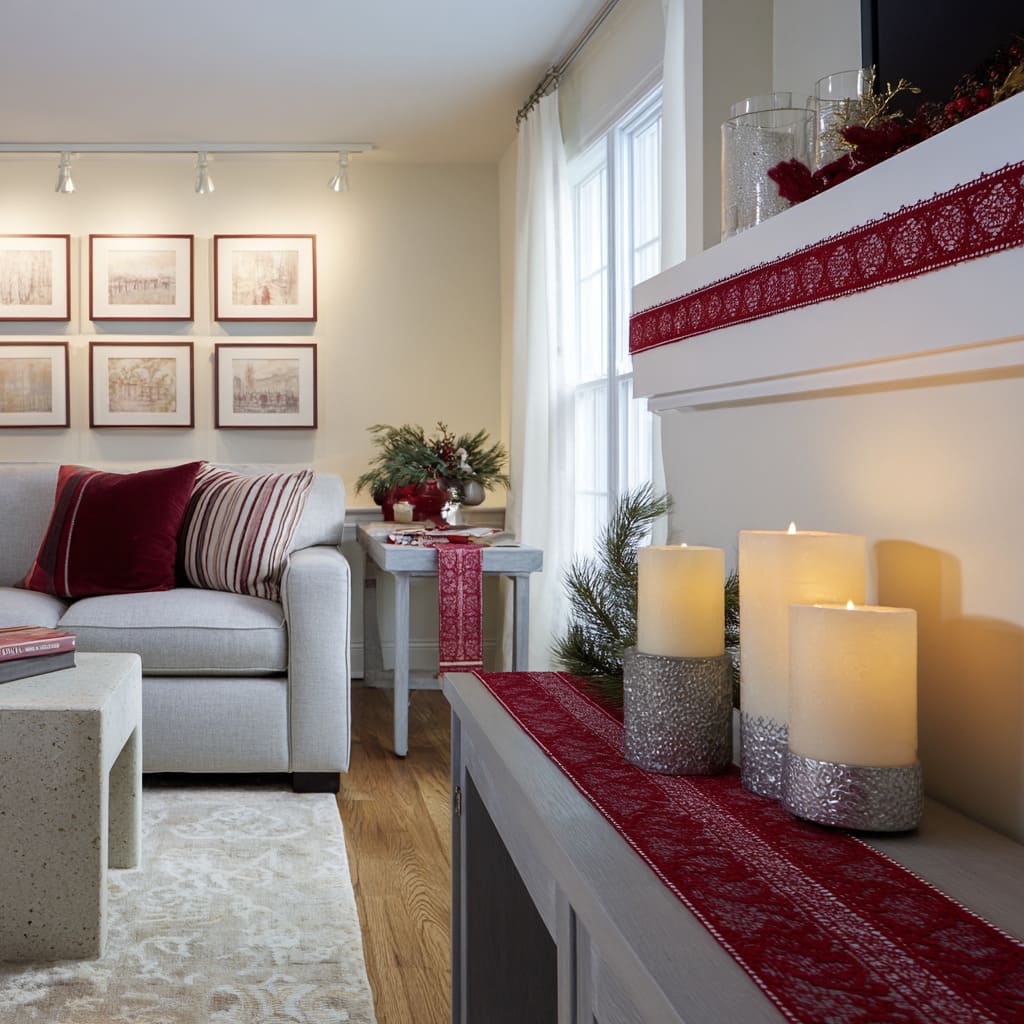
The same red patterned runner wraps a front cabinet, then a mantel, then a slim table behind a sofa, turning three separate pieces of furniture into a coordinated set. This repetition builds a kind of textile storyline: the pattern becomes the main character, and candles, greenery, books, and bowls become supporting roles that reinforce scale or color without competing.
It is a calm approach that still feels rich, because the eye constantly finds echoes of the same motif at different depths in the room. Rather than quantity of decor, the space relies on the persistence of one idea.
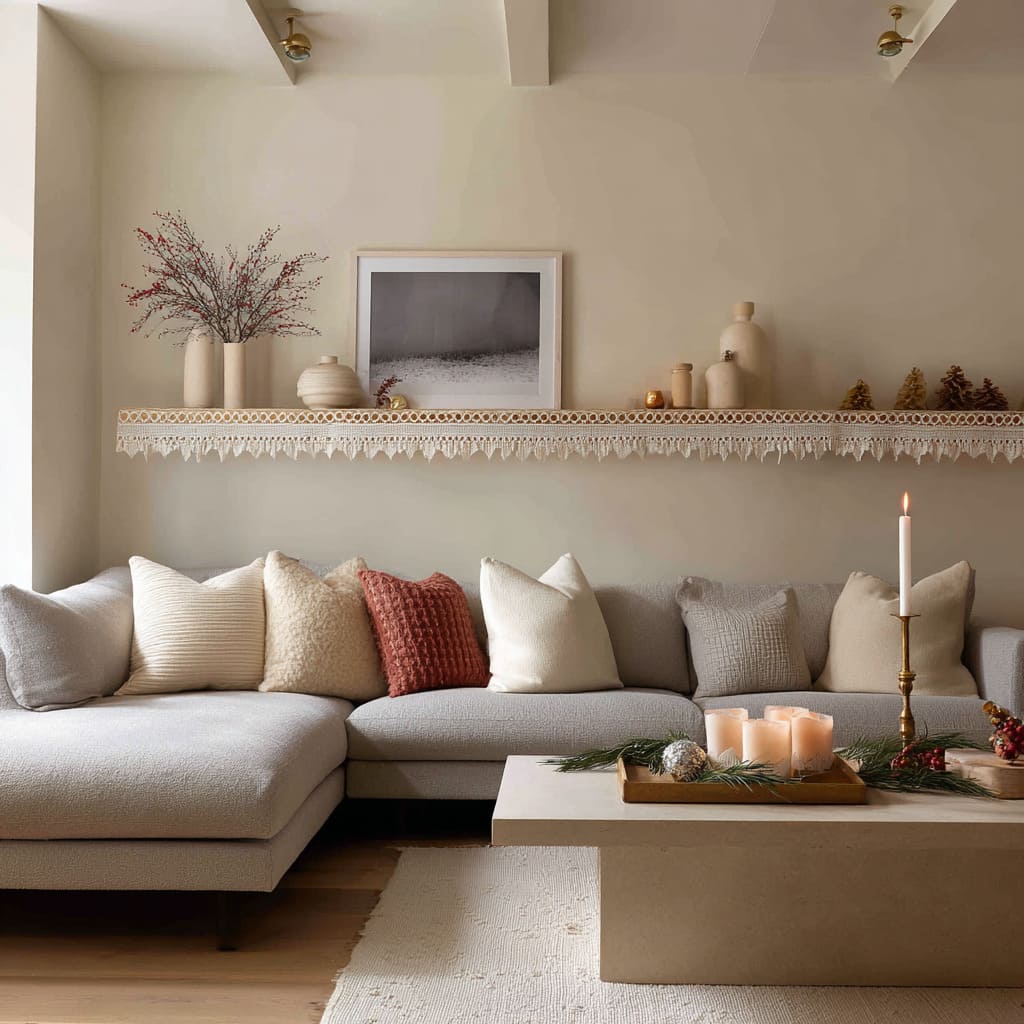
Typical repetition patterns
- Horizontal rhythm – one lace or knit band used on console, mantel, and shelf at similar heights.
- Vertical progression – the same lace or knit idea applied from floor runner to stair runner to landing textile.
- Depth linking – identical red or cream runners appearing on furniture close to the viewer and again farther, visually pulling the gaze inward.
Lace drawing paths, routes, and small seasonal journeys
Even without using figurative signs, it can guide movement through lace and runners. Narrow floor textiles in hallways form a soft path that leads from entry to kitchen, from stair to sitting room, or from front door to living area.
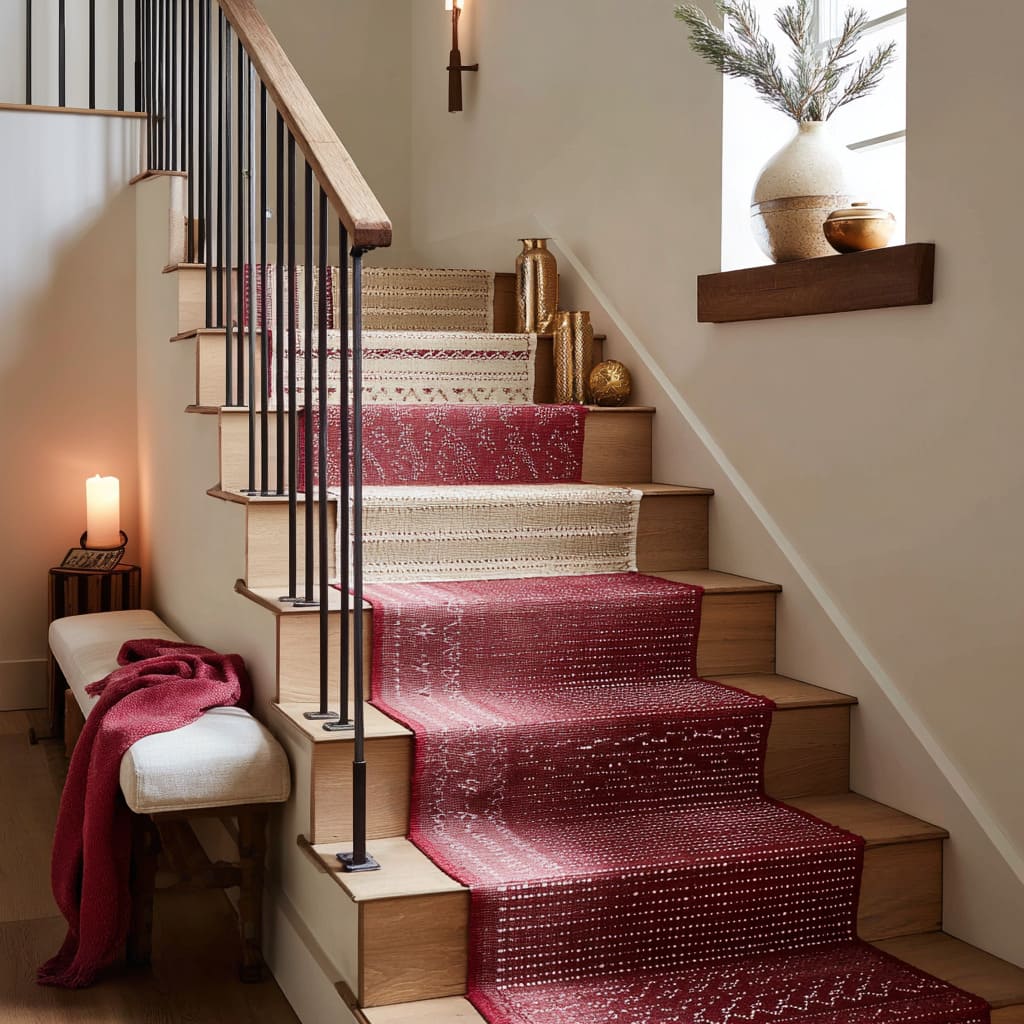
Their colors and patterns are not random; a red stripe or green band elongates the room and indicates direction, while lacy edges soften the line of travel. On staircases, alternating knit-look runners in red and cream create a sense of progression: deep red at the lower steps, lighter cream as the eye climbs, then red again near the landing.
Each section feels like a chapter in a seasonal story told by the stairs themselves.
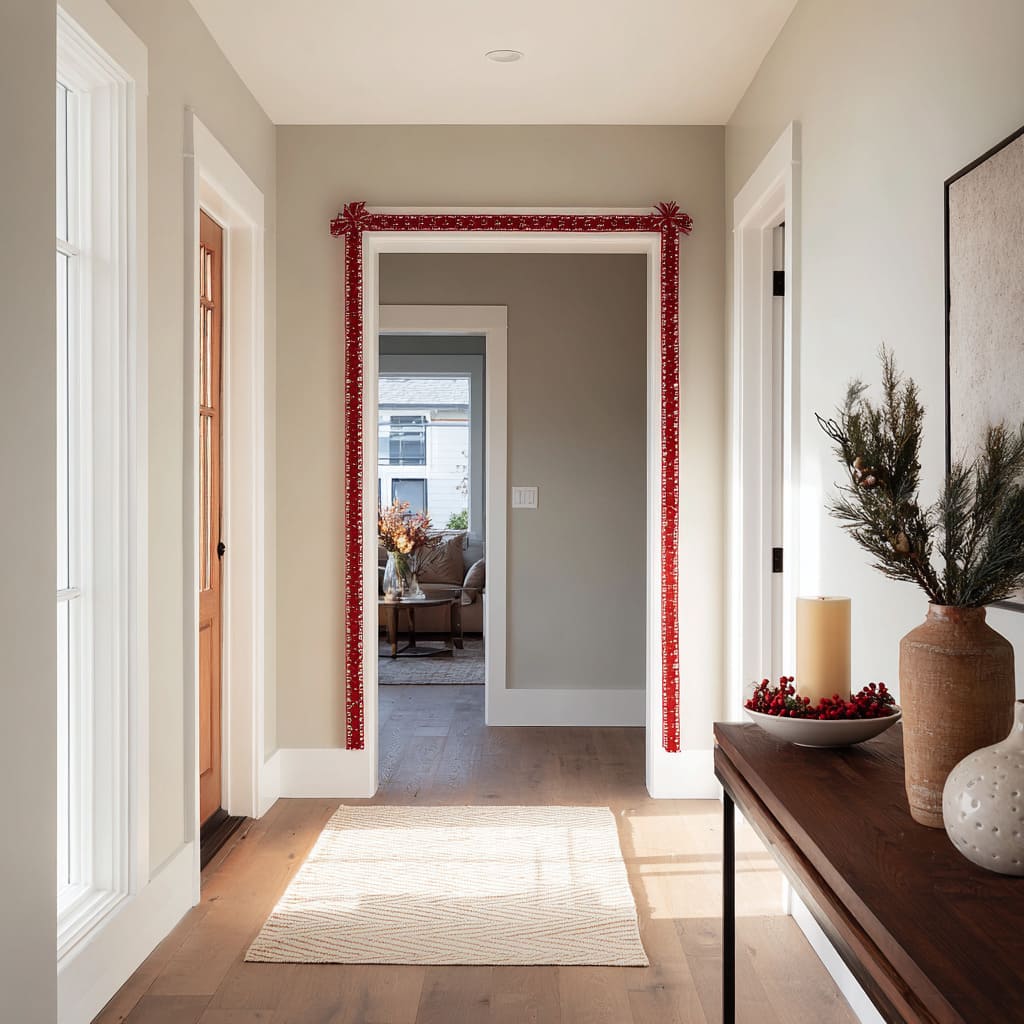
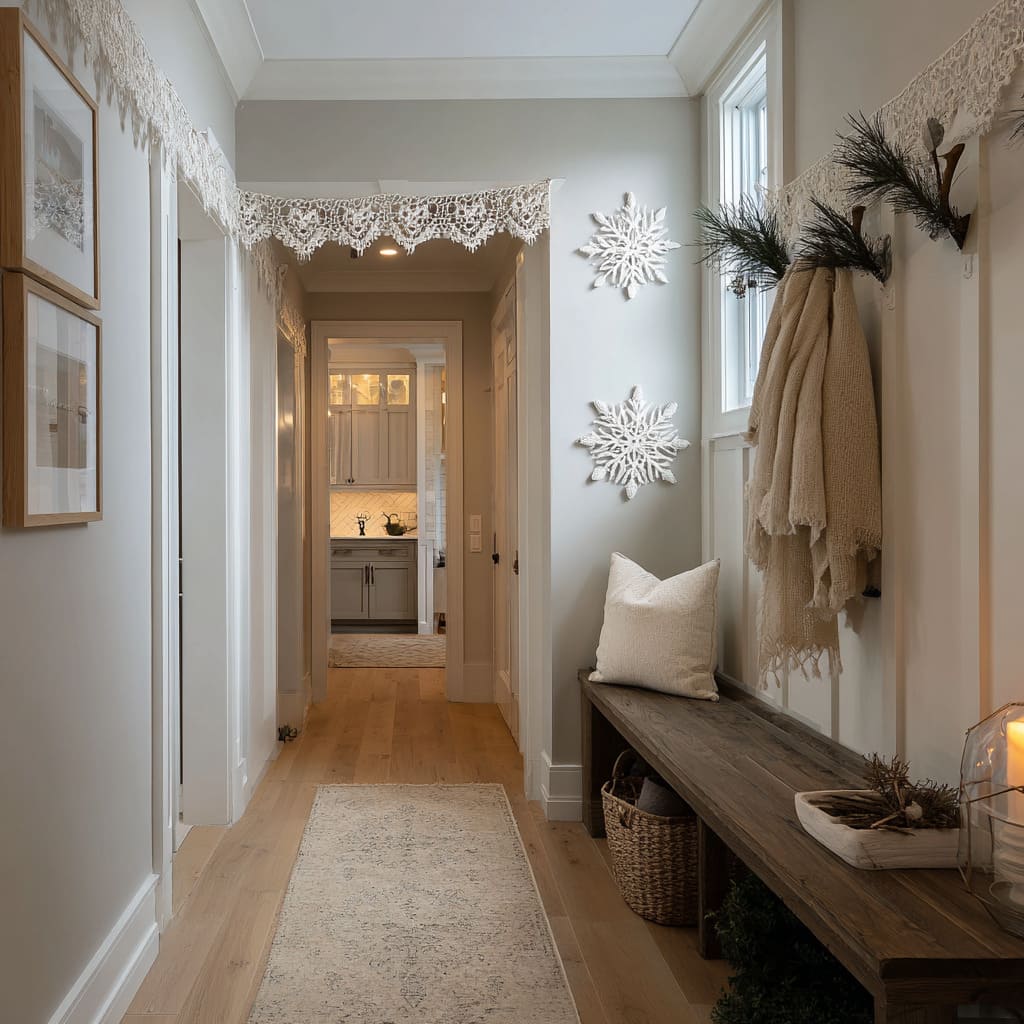
Doorways framed in red patterned bands function as visual thresholds; stepping through them feels like crossing into the heart of winter comfort, even though the floor remains simple wood. Hallways draped with ceiling-level lace and decorated with snowflake ornaments and evergreen sprigs become gentle tunnels between busier rooms.
Movement through the home becomes part of the festive experience: every walk down the corridor or climb up the steps passes through these lightly dressed routes, so the season is felt in motion, not only when sitting beside a tree.
Human-scale placement: where eyes, hands, and bodies meet lace
A subtle but important theme is how precisely the lace and patterned bands sit at human-related heights. Red patterned belts around kitchen islands run exactly where eye level lands when a person faces the island or talks to someone sitting on a stool, so the festive element registers in social conversation zones, not high above heads.
Lace valances on mantels fall in the vertical band that people naturally look at when standing by the fire. Shelf fronts with narrow lace strips sit just above the back of a sofa, in the space where a seated person’s gaze hovers while relaxing.
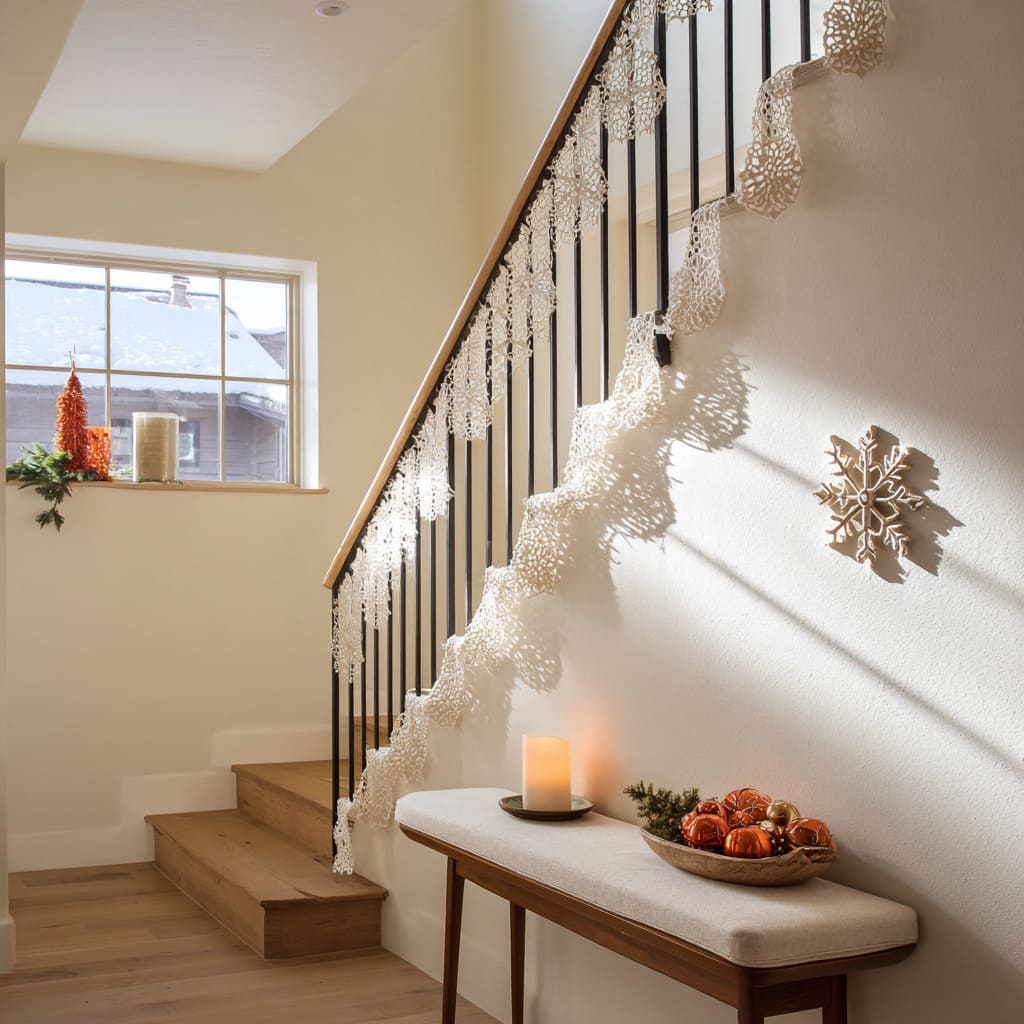
Console runners hang over edges at the height where fingers might trail along as someone walks through a hallway, offering a tactile invitation without forcing interaction. On stair railings, lace garlands follow the angle of the handrail but remain slightly above it, allowing the hand to slide comfortably on plain wood while the eye tracks the scalloped pattern nearby.
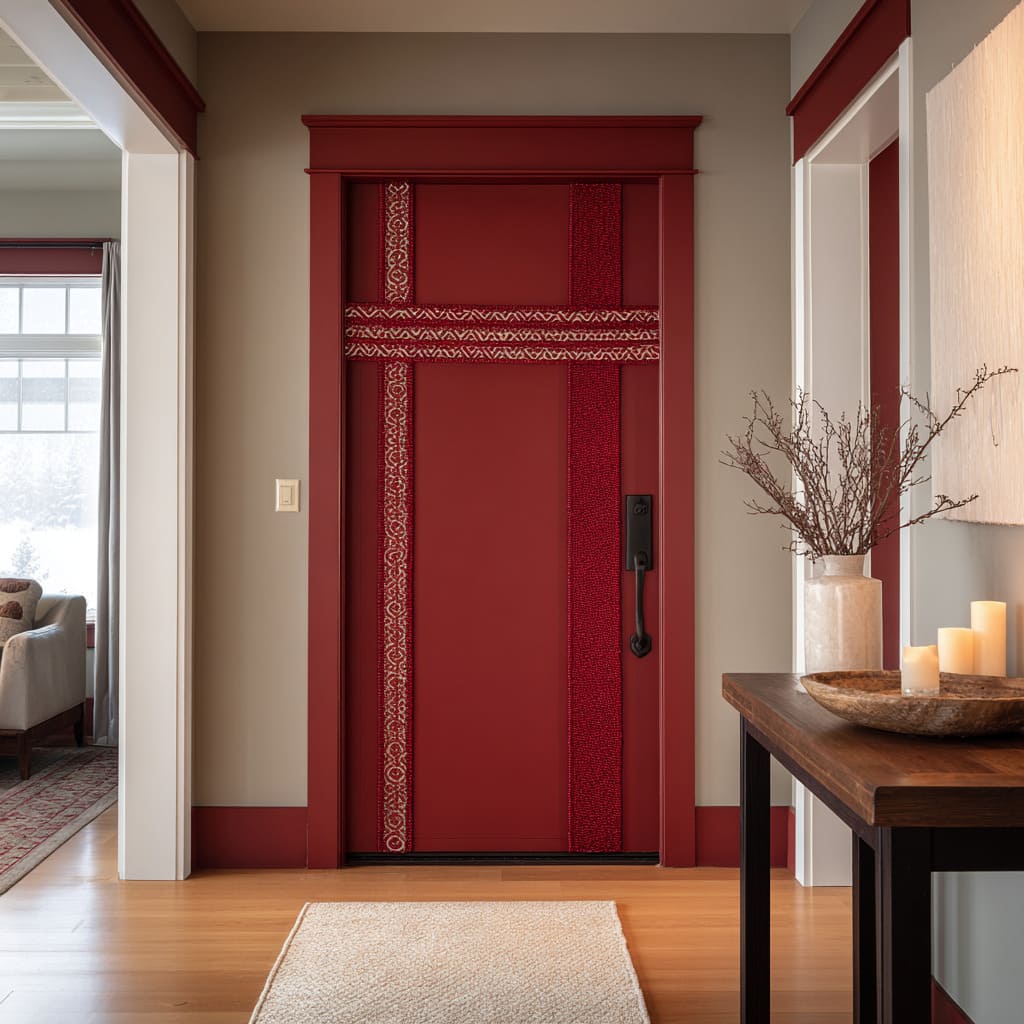
Even vertical red bands on an interior door are placed around the latch and handle, so the seasonal detail becomes part of the everyday motion of entering and leaving. The decor feels integrated into daily gestures rather than attached only to distant display zones.
Color discipline: red as a drawn line, neutrals as winter air
Color can be controlled with unusual discipline. Most decorating ideas rest on layers of white, cream, warm greige, and pale wood, then rely on carefully placed accents of red, soft green, and metallics.
Red rarely appears as a big block; instead it forms lines and frames. The curtain edges carry narrow embroidered stripes while the fabric field stays white; doorway trims wear thin red bands; runners and knit stair textiles use red as stripes, dots, and borders rather than full surfaces.
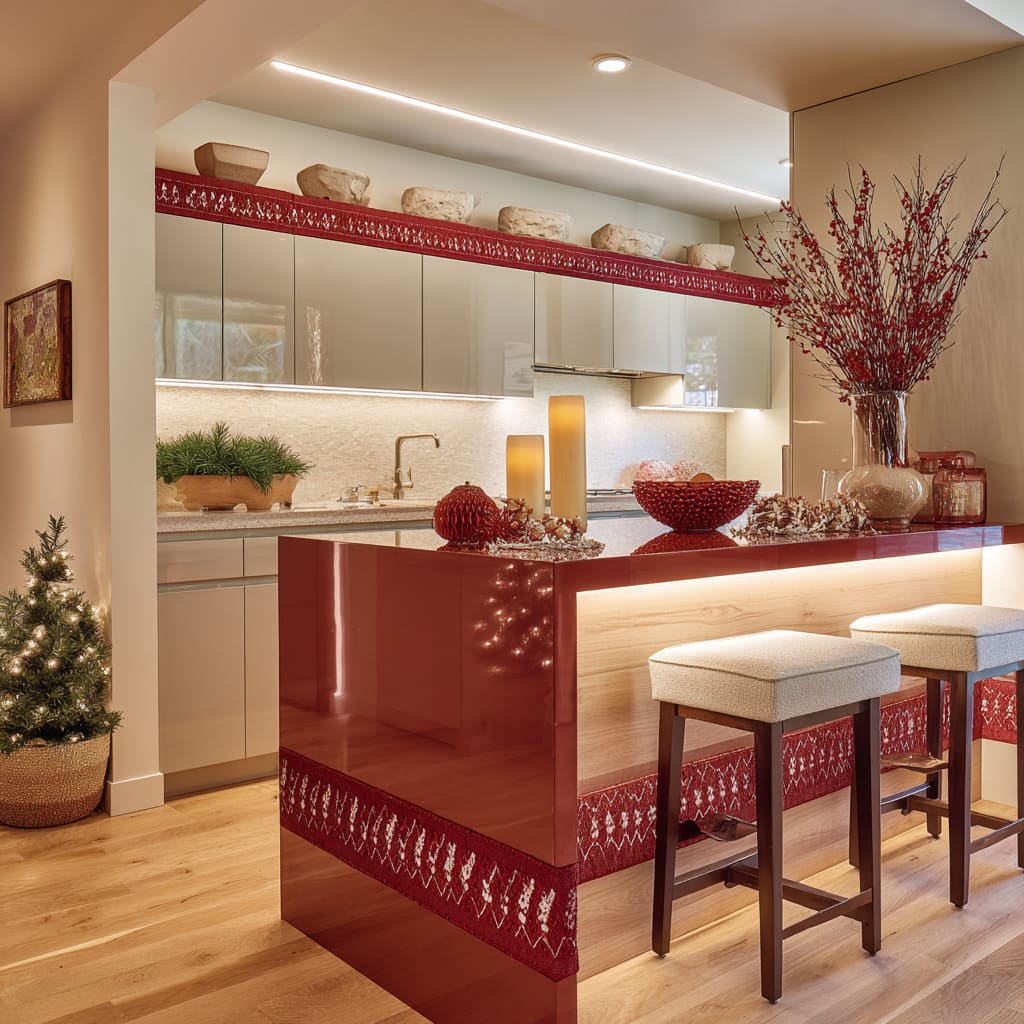
In kitchens, even when an island is wrapped in glossy crimson, the impact is balanced by white patterned bands and light cabinetry around it, so red behaves like a graphic figure against a neutral field.
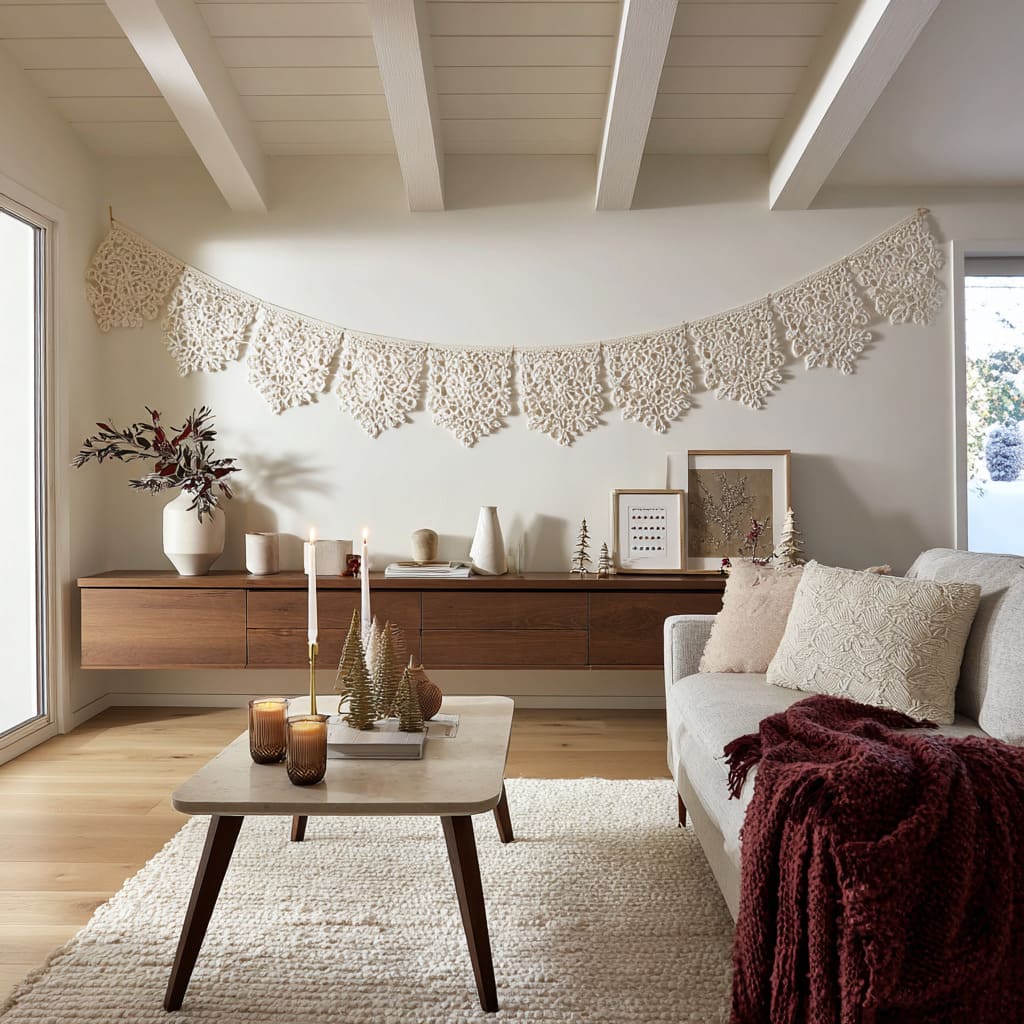
Living rooms can keep red confined to a single cushion or throw that repeats the tone of berries on a shelf or foliage in a vase. Some hallways and entries remain almost entirely neutral, with winter feeling suggested through lace, bare branches, candles, and snowflake shapes, so that they read as seasonal spaces suitable for the whole cold period, not just for a single holiday date.
A staircase combining orange pumpkins, cream lace, a snowflake ornament, and a hint of evergreen shows how color can carry a story from late autumn into full winter without a hard visual break.
Quiet winter codes
- Texture instead of bright hue – crochet, knit, boucle, and lace create richness even in all-cream compositions.
- Limited accent clusters – one group of berries, one red cushion, one patterned band provide all the intensity a room needs.
- Soft metals – burnished gold trees, brass candlesticks, and silver holders add glow but stay modest in scale.
Windows, doors, and openings dressed as festive frames
Openings in the architecture often become the main Christmas surface. Tall windows with sheer curtains framed by narrow red borders turn daylight itself into a seasonal feature: each pane looks like a glowing panel edged in a fine holiday line.
The glass stays clear; the edges tell the story. For example, a red interior door wrapped in vertical and horizontal patterned bands evokes a gift box, but with a calm textile pattern instead of a shiny bow, so the look stays grown-up and refined.
An open passage trimmed on all three sides with slim red bands works like a visual doorway into a warmer zone beyond, where neutral sofas, round tables, and dried branches continue the palette. These treatments allow architecture to carry the festive mood in a way that remains compatible with daily use—doors still open and close freely, curtains still move, circulation stays easy.
The trim and textile simply mark certain thresholds as special, as if the structure itself had decided to celebrate. Because the patterns and colors are repeated in cushions, art, or small table scenes nearby, the openings feel related to the rest of the room rather than isolated gestures.
Living rooms: shelves, mantels, and TV walls with lace as a guiding line
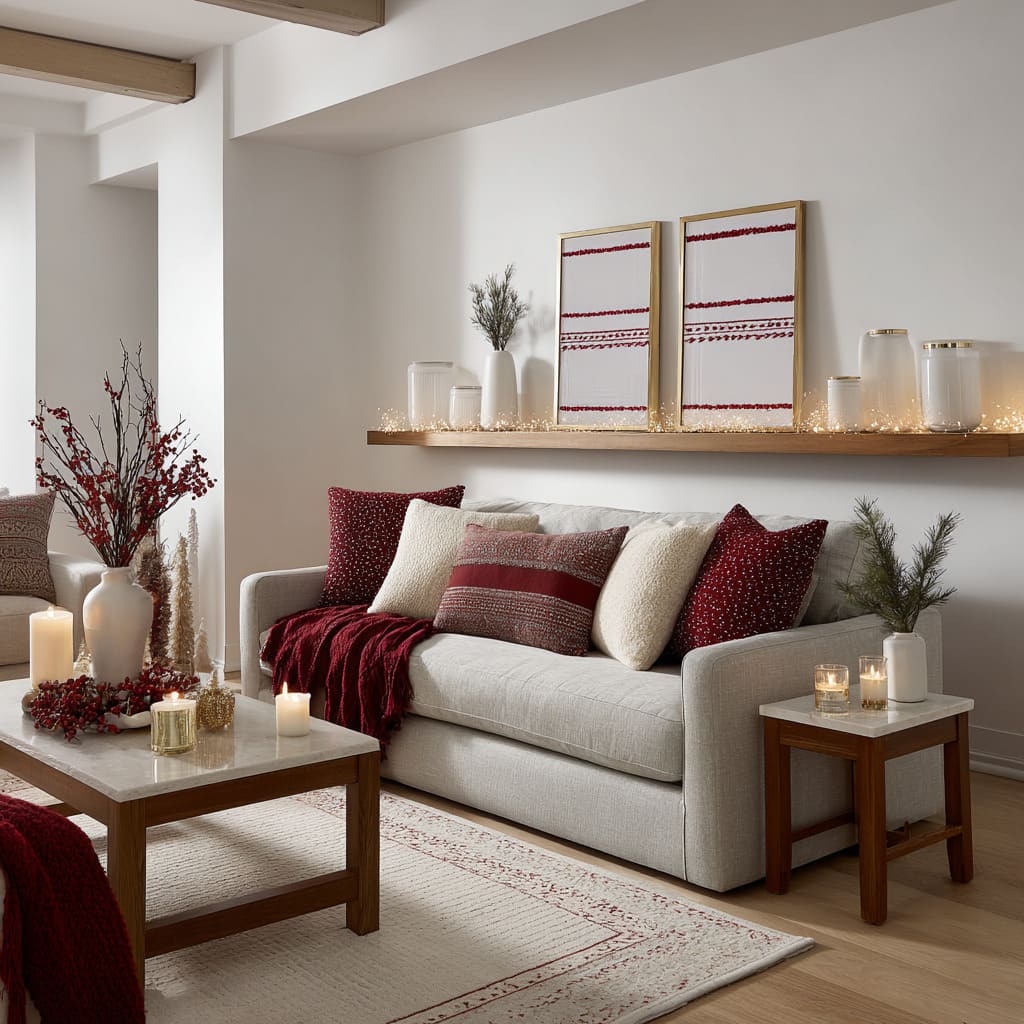
Living spaces in this style avoid heavy themed objects and instead rely on long horizontal lines and small motifs. A single floating shelf above a sectional sofa carries a narrow lace band along its front edge; on top sit neutral vases, a few tiny metal trees, a branch with red berries, and a quiet art piece in winter tones.
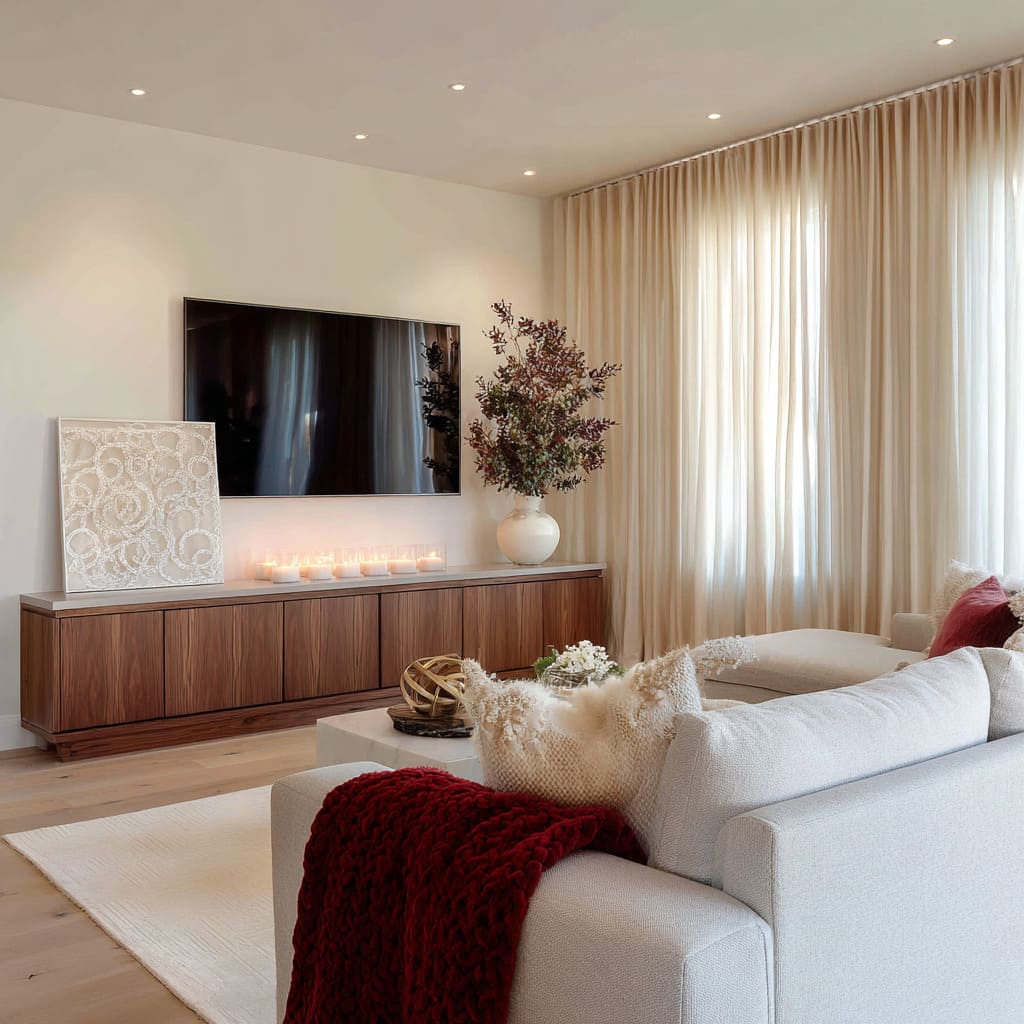
The lace acts like a thin frost line between the wall and objects, while the red in one cushion below mirrors the berry color above. Or, a long credenza under a TV supports a line of glass hurricanes with candles, and beside them leans a large framed lace panel with circular motifs.
That textile art softens the contrast between black screen and white wall, making the media area feel like part of a winter vignette rather than a purely technological corner.
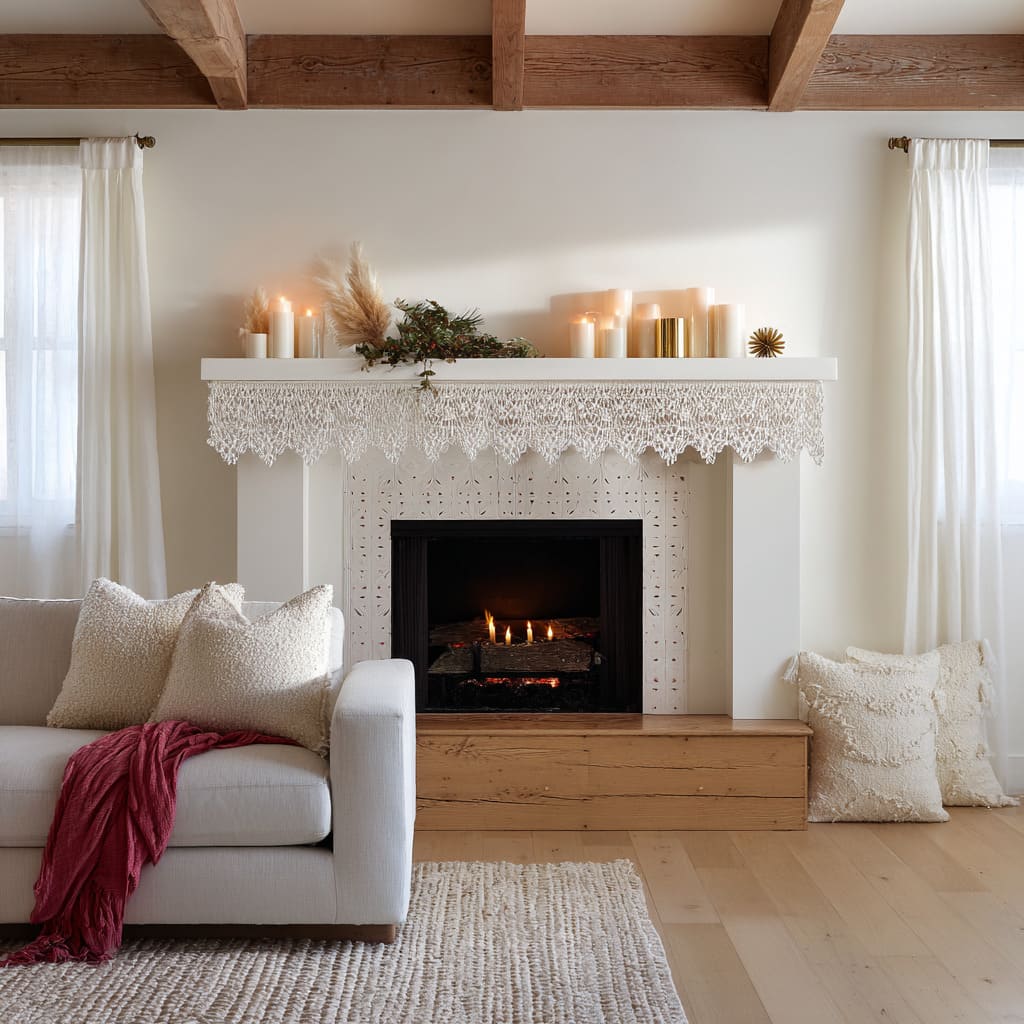
Mantels can gain a lace valance that hangs in delicate points over tile and flame; above, pampas plumes, greenery, and pillar candles form a second soft band, so the fireplace appears layered like a dressed figure: fire, tile, lace fringe, foliage, light. Evenwith red-and-cream stripe artworks and shelf lighting, the theme can stay organized: art translates textile patterns into graphic panels, while the actual lace sits as a slim underline or border.
The result is a living zone where the main shapes remain rectangles, circles, and lines, and lace simply softens their edges and connects their heights.
Kitchens: islands, counters, and shelves as patterned canvases
Kitchens in this approach often keep cabinetry and major finishes understated—a field of pale fronts, quiet stone, warm wood floors—and let lace or knit-inspired motifs carry the festive weight. One scene concentrates all decoration around a central island, where a red folk-style pattern wraps the upper part like a belt and then dissolves into small tree silhouettes and speckles near the floor.
Under-counter lighting makes the band glow gently, using light to give the flat print extra depth.
Another kitchen edges a bulkhead and peninsula in white lace that matches the wall color so closely that the effect relies on light and shadow; candles and evergreen sprigs on the counter continue the idea of winter delicacy rather than high drama. In more rustic spaces, a thick knit-look runner can pour over the side of an island, turning its hard block into something almost garment-like, while fruits, candles, and a lone pine branch sit calmly on top.
Even a highly saturated red island with glossy panels stays coherent because the patterned bands at its top and base, plus matching strip above the back cabinets, hold the color within a firm graphic system. Work surfaces can remain mostly open; the island, peninsula, or hood line becomes the main canvas for simple Christmas decorations that favor pattern, rhythm, and warmth over abundant objects.
Hallways and entries: hushed, textile-wrapped routes
Transitional spaces such as entries and corridors gain a surprisingly rich seasonal character with very little visual noise. A narrow hallway may use one red striped runner on a slim floating console and a second, coordinated runner on the floor, accompanied only by a candle, a bowl, a few books, and a vase with light evergreen branches.
The repetition of stripes creates a curated feeling in a space that might otherwise feel purely functional. Another corridor carries an extended lace band at ceiling height, turning corners and crossing door heads like a crocheted cornice; below, large tone-on-tone snowflake ornaments, a rustic bench, woven baskets, coats, scarves, and small hanging branches form a quiet mix of daily life and winter ritual.
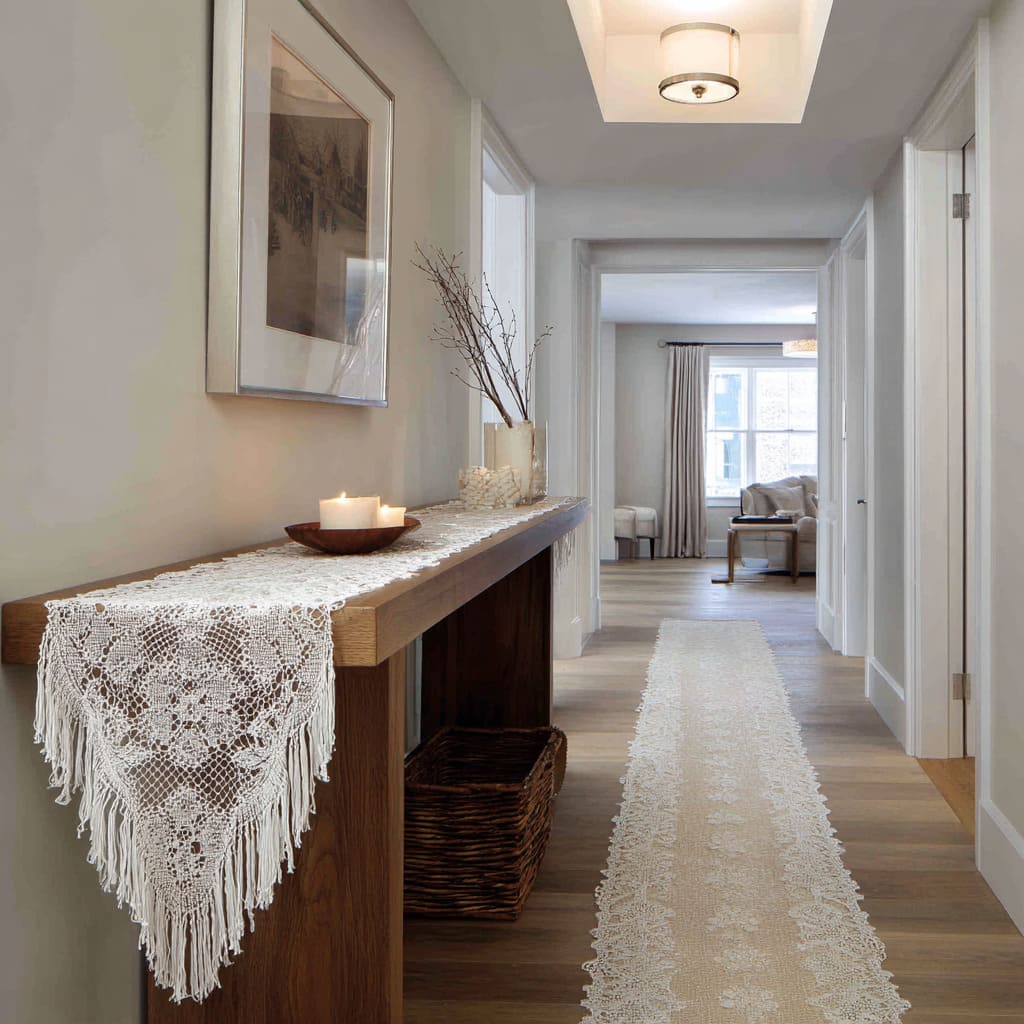
Another idea, a plank console and matching long lace runner on the floor form a calm duo of wood and crochet, guiding the eye toward a sunlit room beyond. Entries with strong red doors wrapped in patterned bands suggest a sense of ceremony each time someone arrives, while neutral rugs and consoles nearby repeat the warm wood and cream tones in a softer key.
These routes succeed because the architecture stays legible and uncluttered; textiles and small natural elements simply soften the journey from one space to another, hinting at the seasonal core deeper in the home.
Cute without clutter: small motifs, heirloom textures, and scale control
A particularly interesting element is how they express a “cute” holiday feeling without relying on figurines or large novelty items. Snowflakes appear, but as framed graphic art, tone-on-tone wall ornaments, or lace-inspired patterns in textiles.
Miniature trees in burnished metal line up on shelves like a tiny forest beside quiet vases rather than dominating a room apperance. Knit and crochet patterns evoke sweaters, scarves, and handmade blankets, so the emotional link is domestic and personal instead of theatrical.
Pumpkins, small ornaments, and berries often share the same bowl or tray, suggesting a gentle overlap between seasons rather than a complete swap of themes. Each vignette respects scale: low decor under lace garlands, modest heights under bulkhead bands, compact clusters on coffee tables.
Surfaces still function—benches hold coats and bags, islands remain ready for cooking, consoles support daily objects. The charm comes from patient pattern repetition, delicate shadows, and the sense that textiles normally associated with garments or heirlooms have been reinterpreted as soft architecture.
That transformation gives a sweet quality without tipping into visual overload.
Lace as a full seasonal language for simple elegant Christmas decor
Taken together, such ideas demonstrate how lace and knit-inspired bands can form a complete language for simple elegant Christmas decor without depending on large trees or crowded mantels. Architecture takes on a seasonal accent through edged bulkheads, trimmed shelves, wreathed door frames, and stair rails threaded with crochet garlands.
Paths through hallways and up stairs are marked with runners and alternating colors, so movement feels wrapped in subtle ritual. Designs rely on one or two textile ideas repeated with discipline, supported by candles, berries, greenery, and quiet art.
Kitchens concentrate pattern in islands, counters, and hoods while keeping preparation zones free. Windows, doors, and openings carry linear motifs that treat light and thresholds as decorative material.
Color stays carefully controlled—reds drawn as lines, greens appearing in small natural clusters, neutrals holding everything together like winter air. The overall effect is calm, softly festive, and surprisingly complete: an entire home atmosphere shaped by edges, seams, shadows, and textures, where lace becomes not only a fabric but a seasonal structure that can stay in place as long as the cold months last.