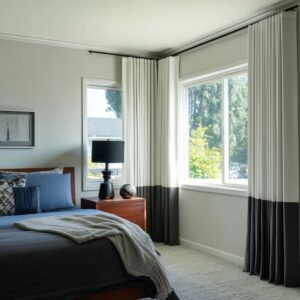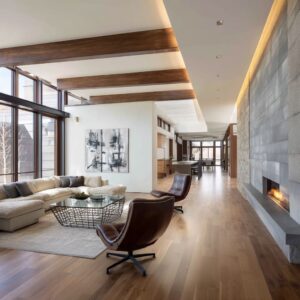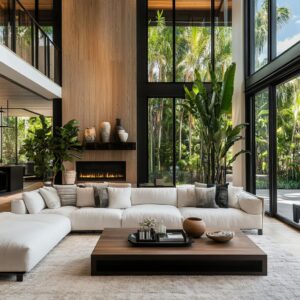
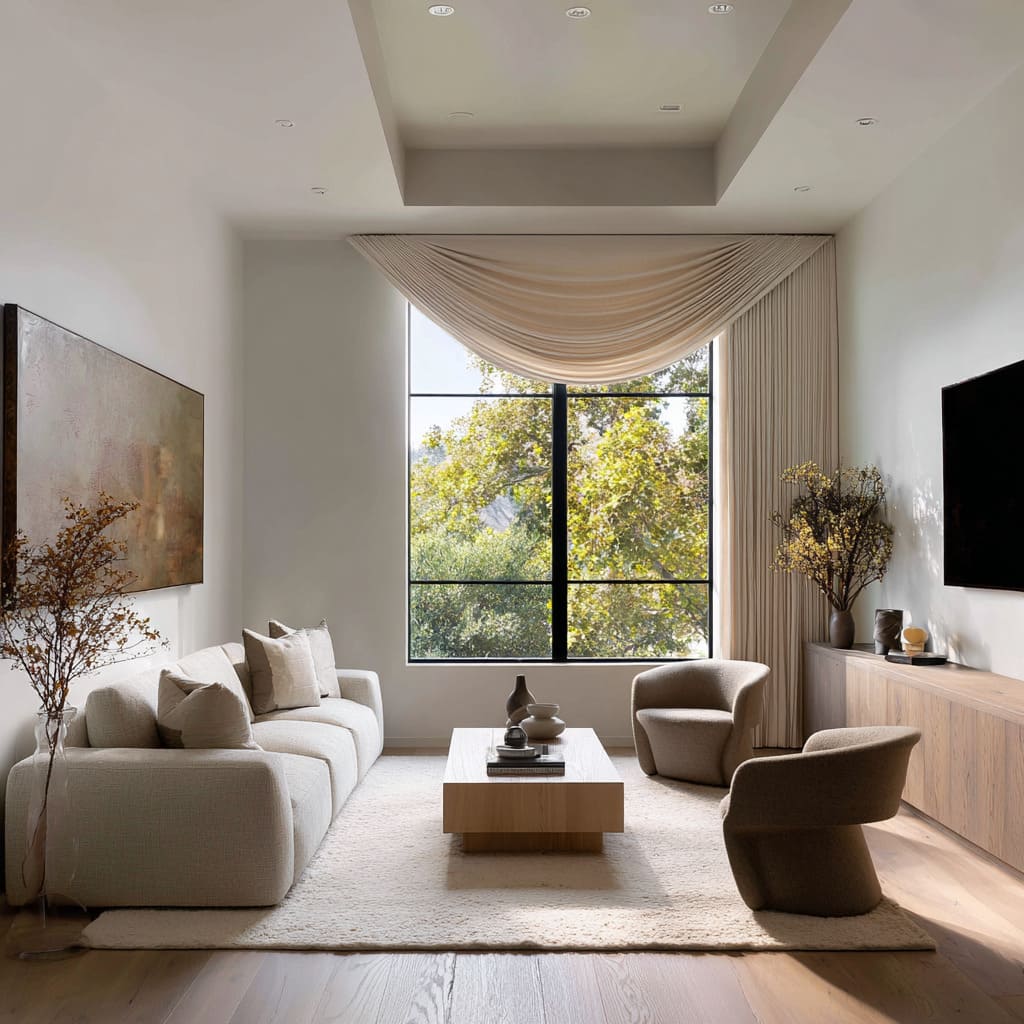
Valances often behave less like a small textile trim and more like a soft architectural line that finishes the wall. Instead of sitting there as a separate decorative accessory, it tends to merge with ceilings, soffits, and wall planes, forming a continuous upper band that quietly sets the proportions of the room.
The eye reads that band as a horizontal “cap” that anchors everything beneath it: glass, drapery, art, furniture, and rug. This is especially clear when the valance echoes existing architectural elements — for example, when a fabric-wrapped box aligns with a crown moulding step, or when a padded cornice shares the same height as a tray ceiling recess.
In those design stories, the textile is not fighting against the structure; it behaves as a soft continuation of it.
This approach is at the heart of many valances for living room ideas, where the main value of the treatment is how it completes the wall rather than simply how it looks on its own. Even very simple bands of fabric start to feel like a soft lintel, a fabric beam, or a padded fascia, especially once light begins to graze along their underside and cast a gentle shadow that emphasizes depth without using strong contrast.
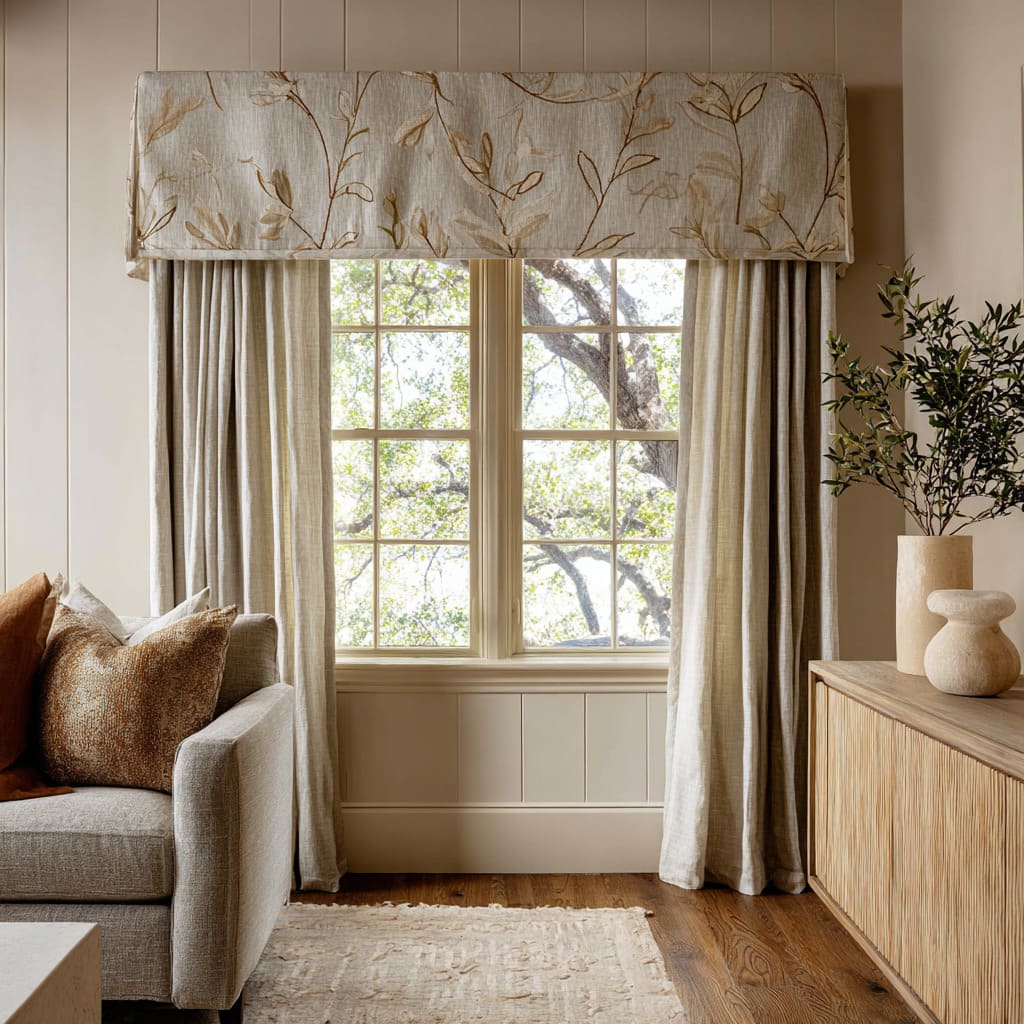
Valances as Soft Ceilings for Seating Zones
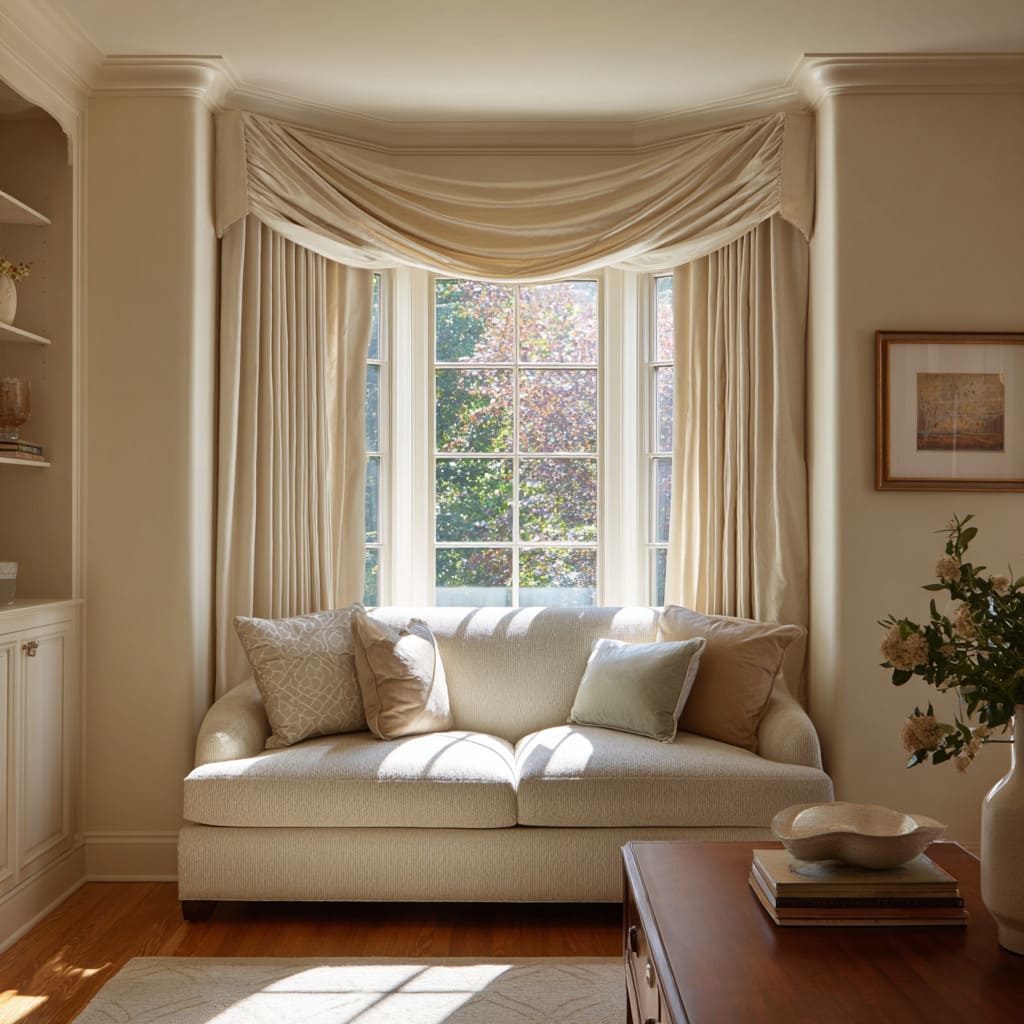
Modern living room desings often use valances to draw an invisible “ceiling” over specific zones: a window seat, a reading corner, or a sofa tucked into a bay. When a band of fabric is dropped slightly below a tall vault or tray, the upper volume stays present, but a more intimate height appears closer to where people actually sit.
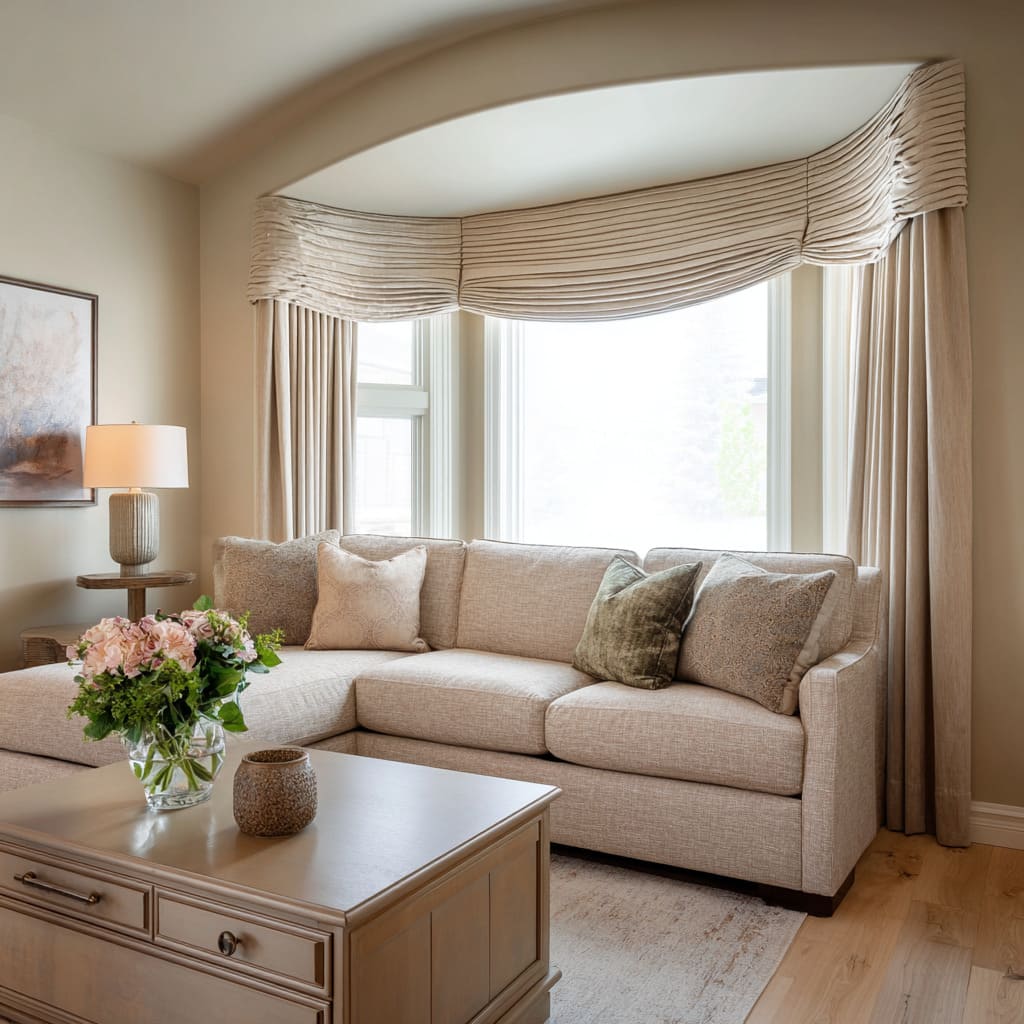
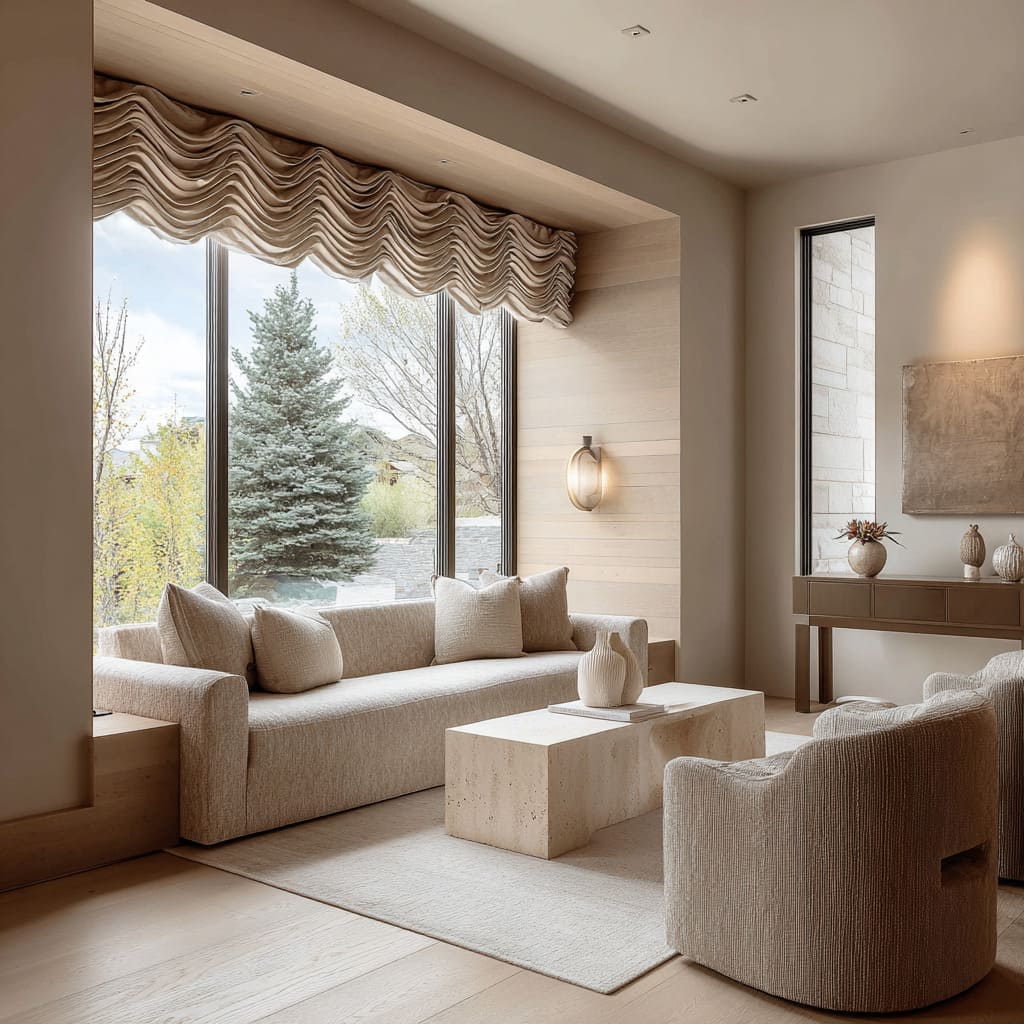
In bay windows, draped crowns or ribbed bands turn the window line into a soft canopy; a sofa or window bench placed directly beneath that line then feels as if it sits inside a smaller nested room.
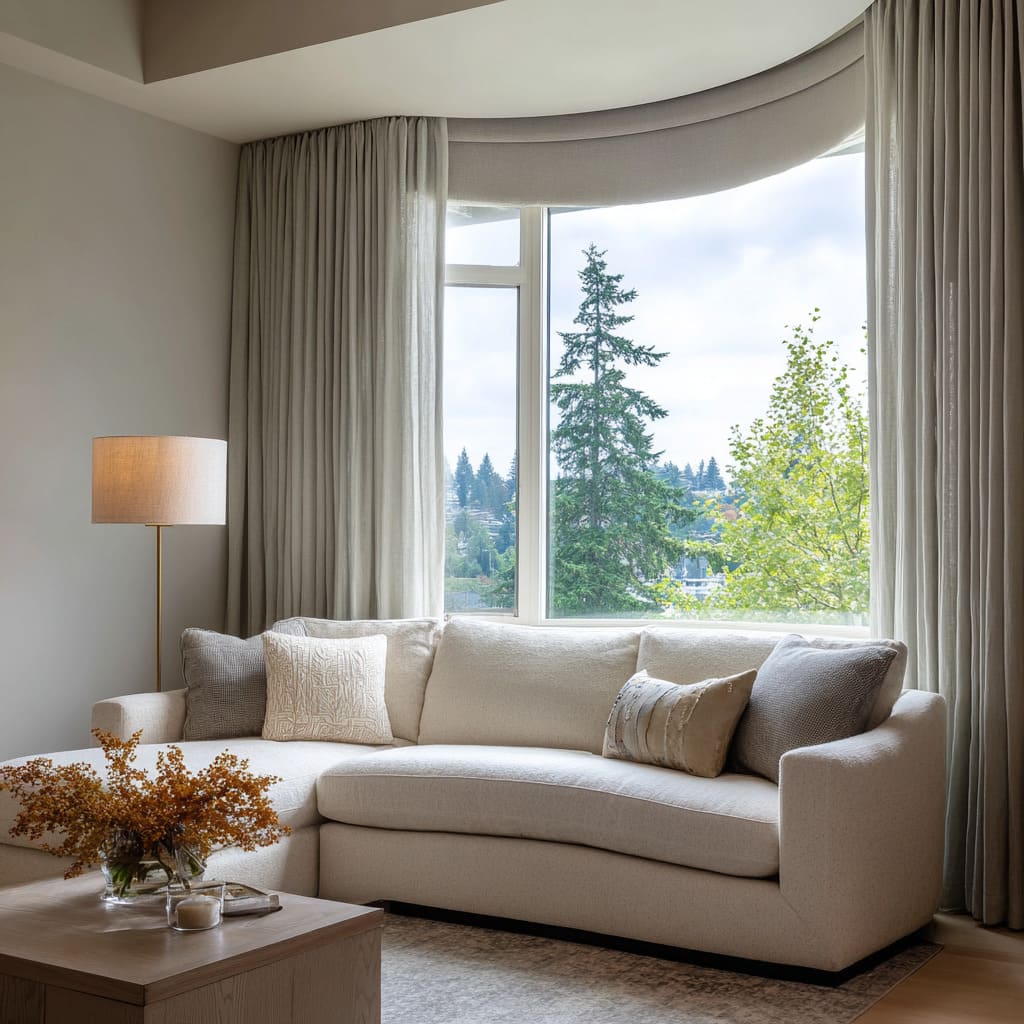
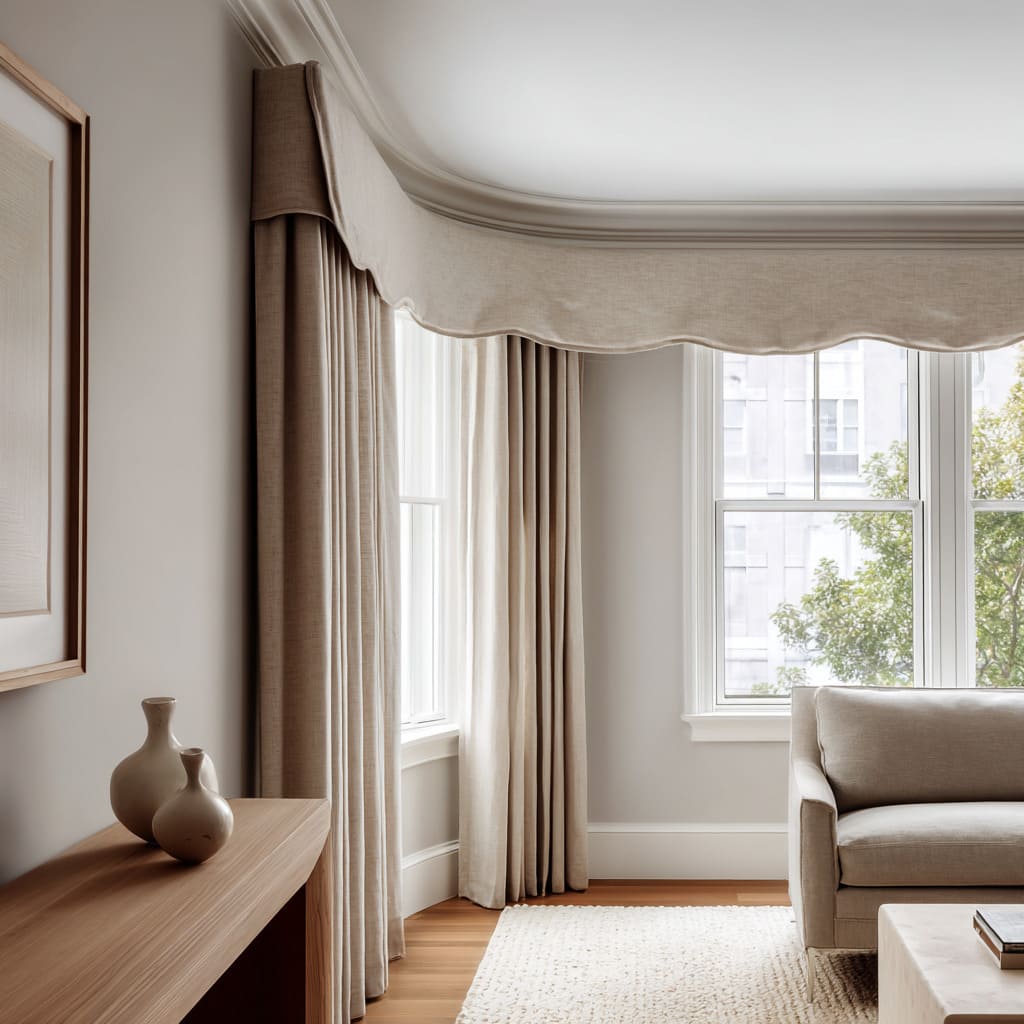
This can be especially striking when the valance follows curved geometry — for example, hugging the arc of a bow window or echoing the gentle bend of a bay. The curved line at the top and the slightly curved sofa front beneath create a soft shell, helping the zone read as one self-contained pocket inside a larger open-plan space.
This is where many of the most beautiful valances for living room compositions appear: not showy, but finely tuned to the height where daylight, seated eye level, and fabric volume meet. The space under that stitched “ceiling” feels sheltered and grounded, even when the palette stays very light and neutral.
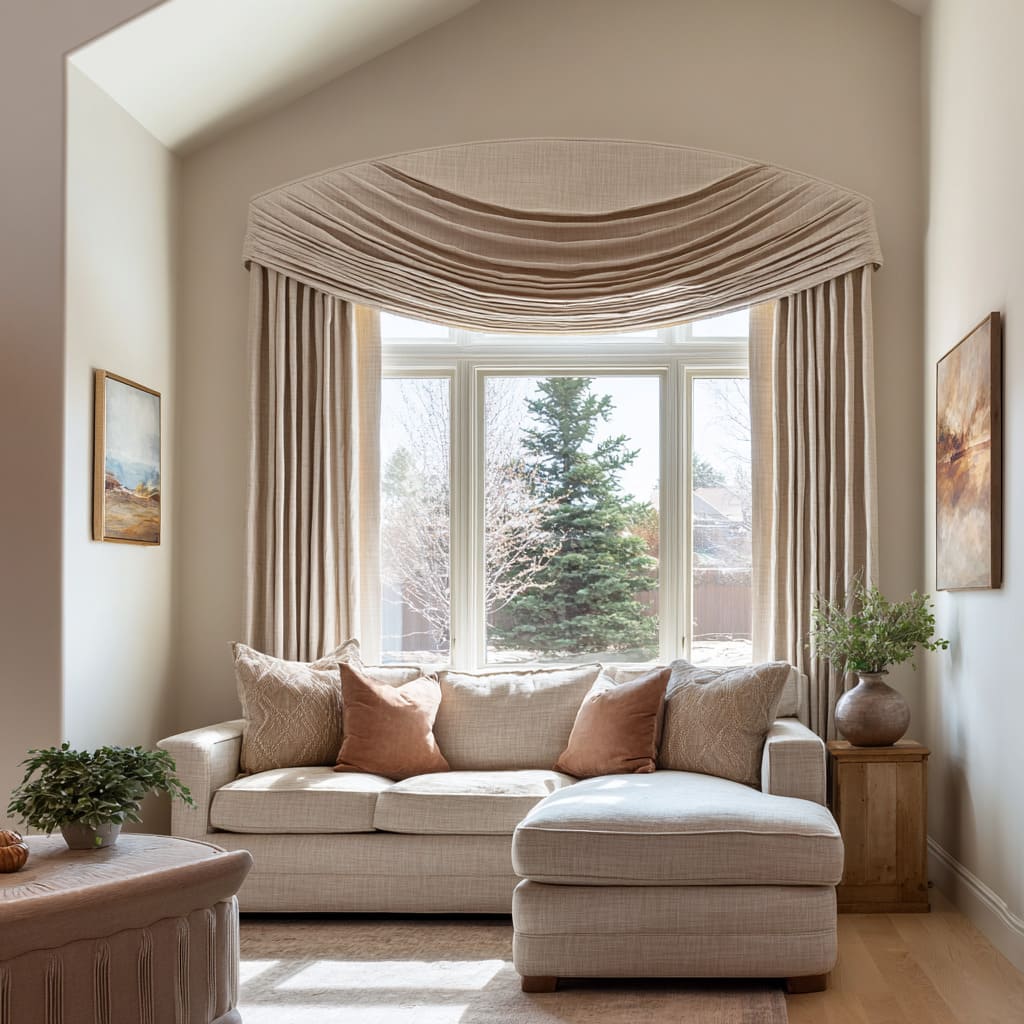
Horizontal and Vertical Rhythm Around the Window
A strong theme in modern valance design is the way horizontal and vertical rhythms are composed around the window. The valance almost always provides the main horizontal accent: a straight band, a shallow curve, a series of scallops, or a stack of folds.
Beneath it, drapery panels, window mullions, floor lamps, and tall vases supply vertical counterlines.
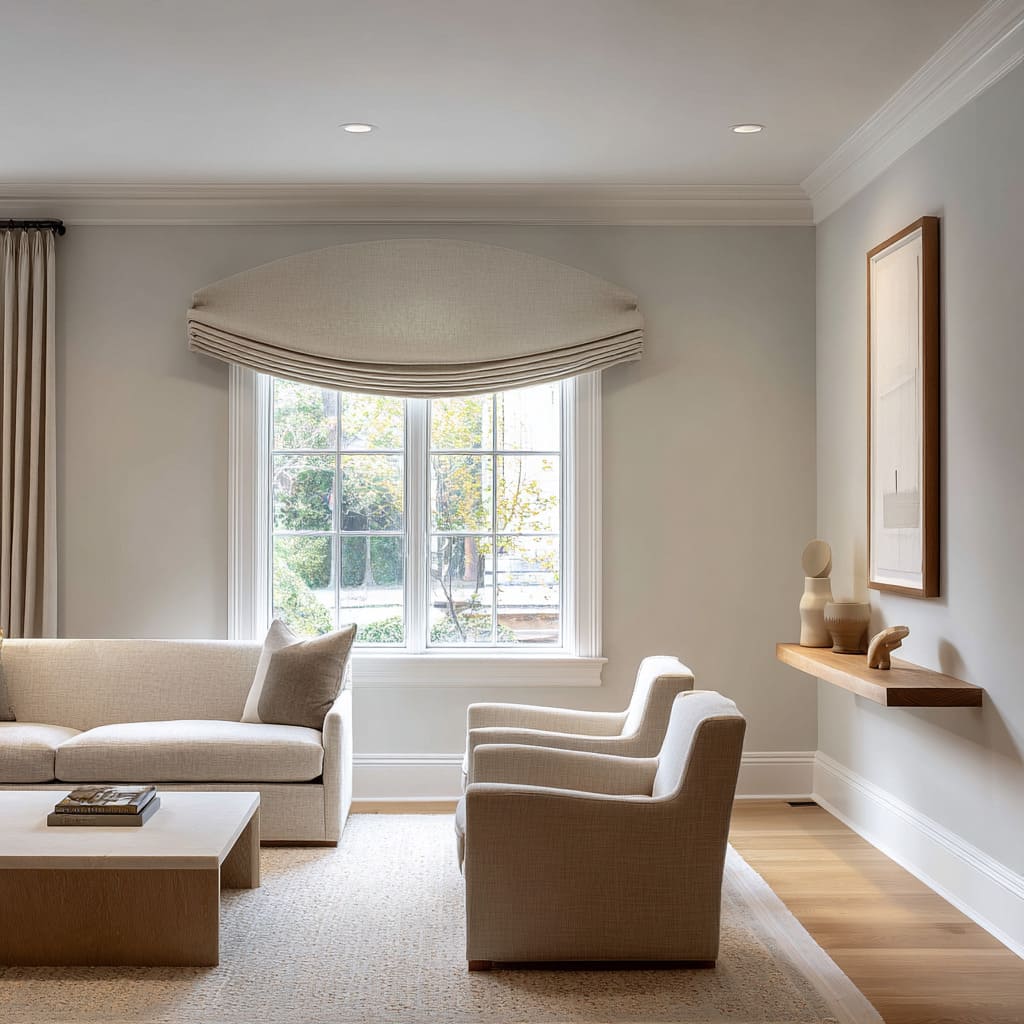
The visual game is about how those two directions interact. When a straight fabric beam sits above long, column-like curtains, the effect is a calm grid: soft lintel, soft pillars, clear glass between.
When a swag or series of arcs sits over panels that fall in strong vertical folds, the space gains a gentle tension between curve and straight line, especially when the drapery stack is parked only on one side and the other side stays bare.
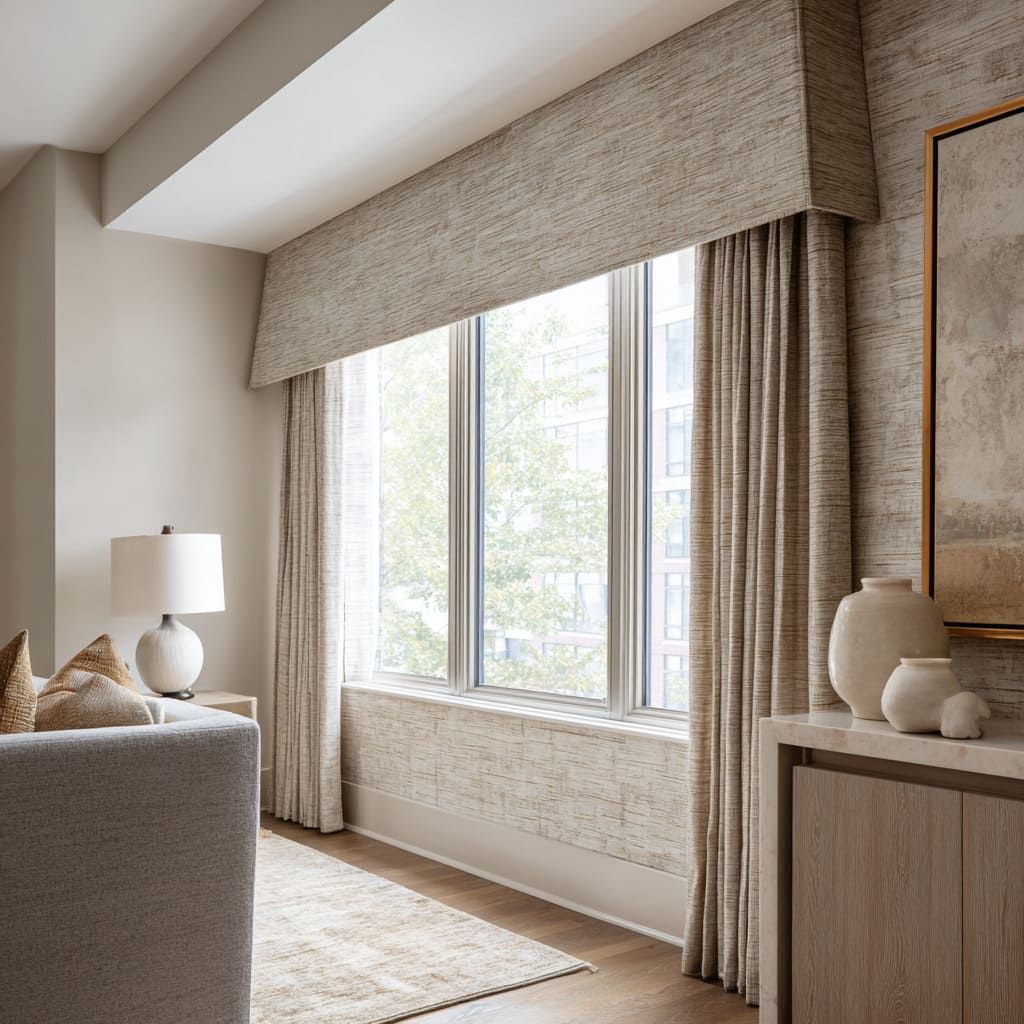
Some schemes intensify this by layering different verticals: fluted consoles, grooved wall panelling, ribbed lamp bases, and the folds of the curtains all echo one another against that single horizontal valance band. In that sense, many current window valance ideas for living room ideas are less about decoration in the old sense and more about musical rhythm: a main upper line, then quiet, repeating notes in the verticals below.
Fabric Beams, Cornices, and Boxed Headers
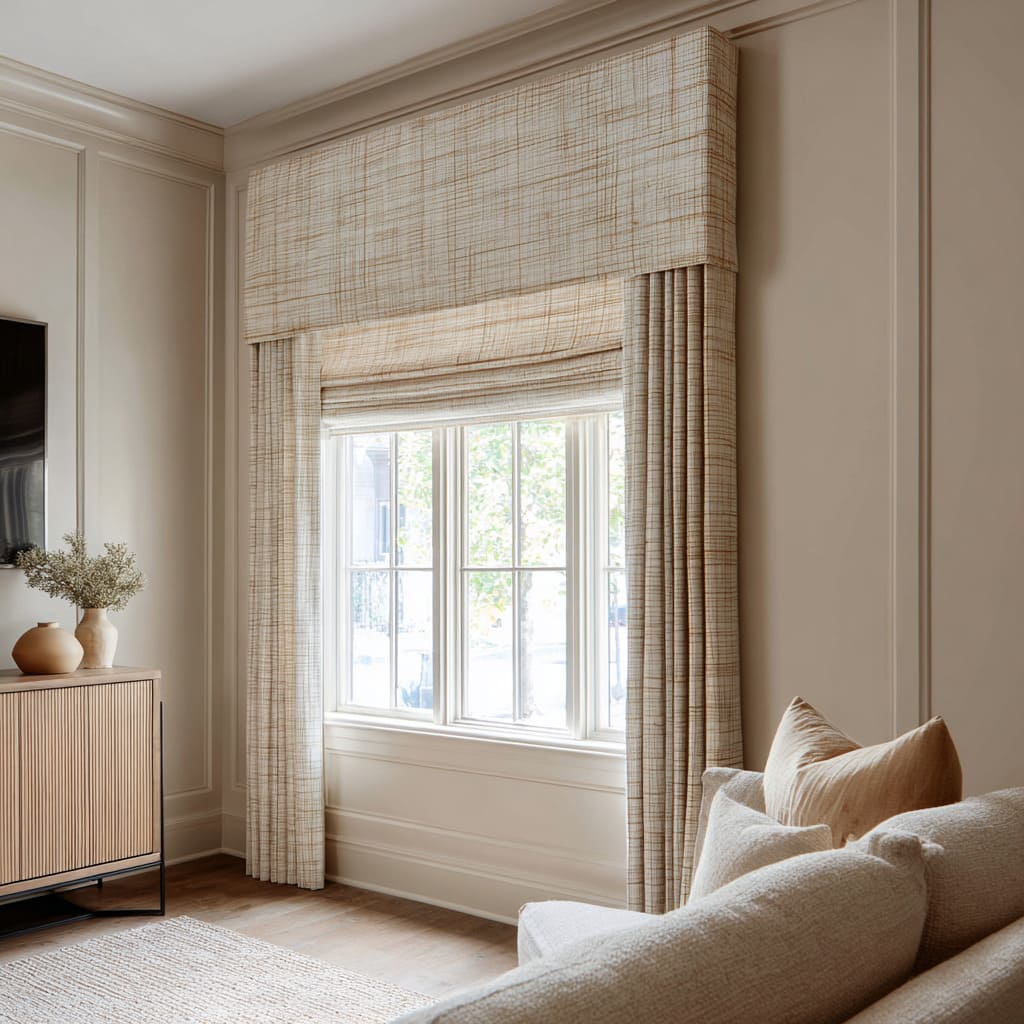
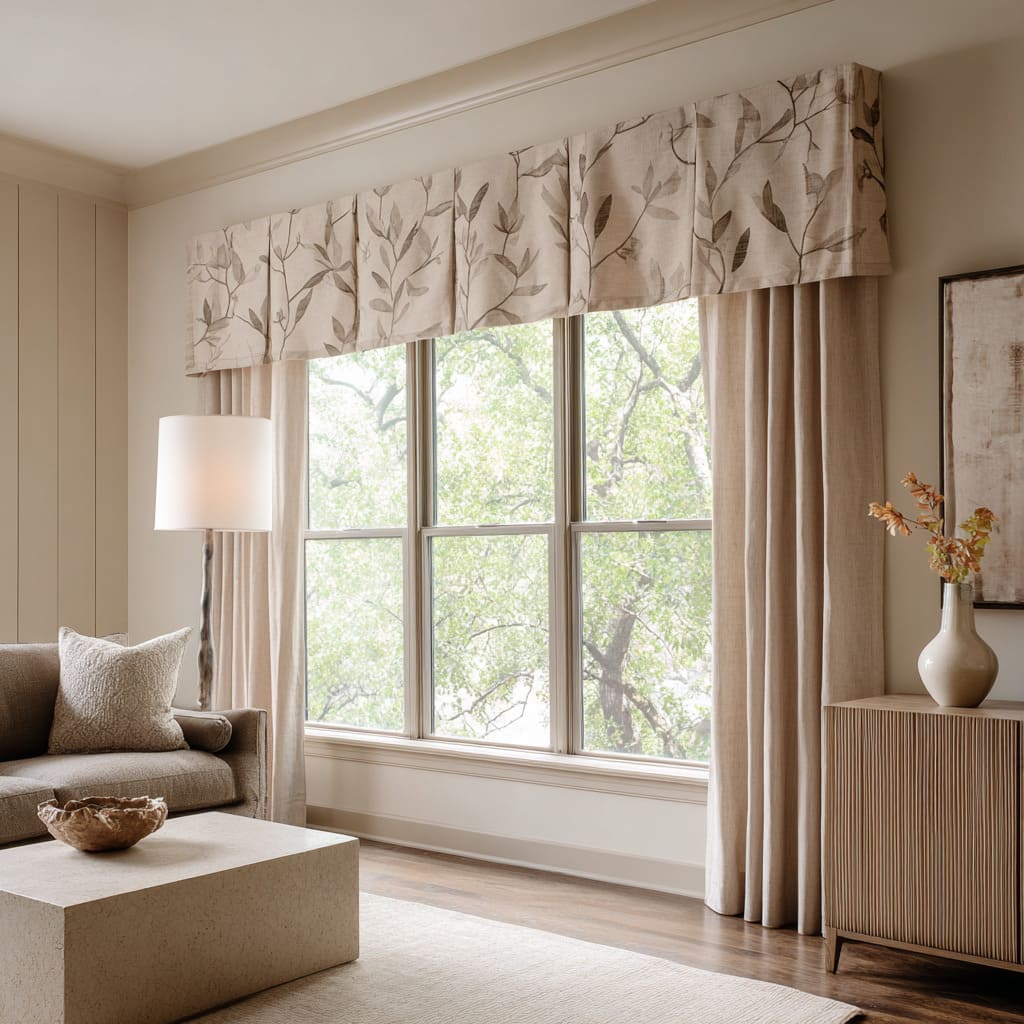
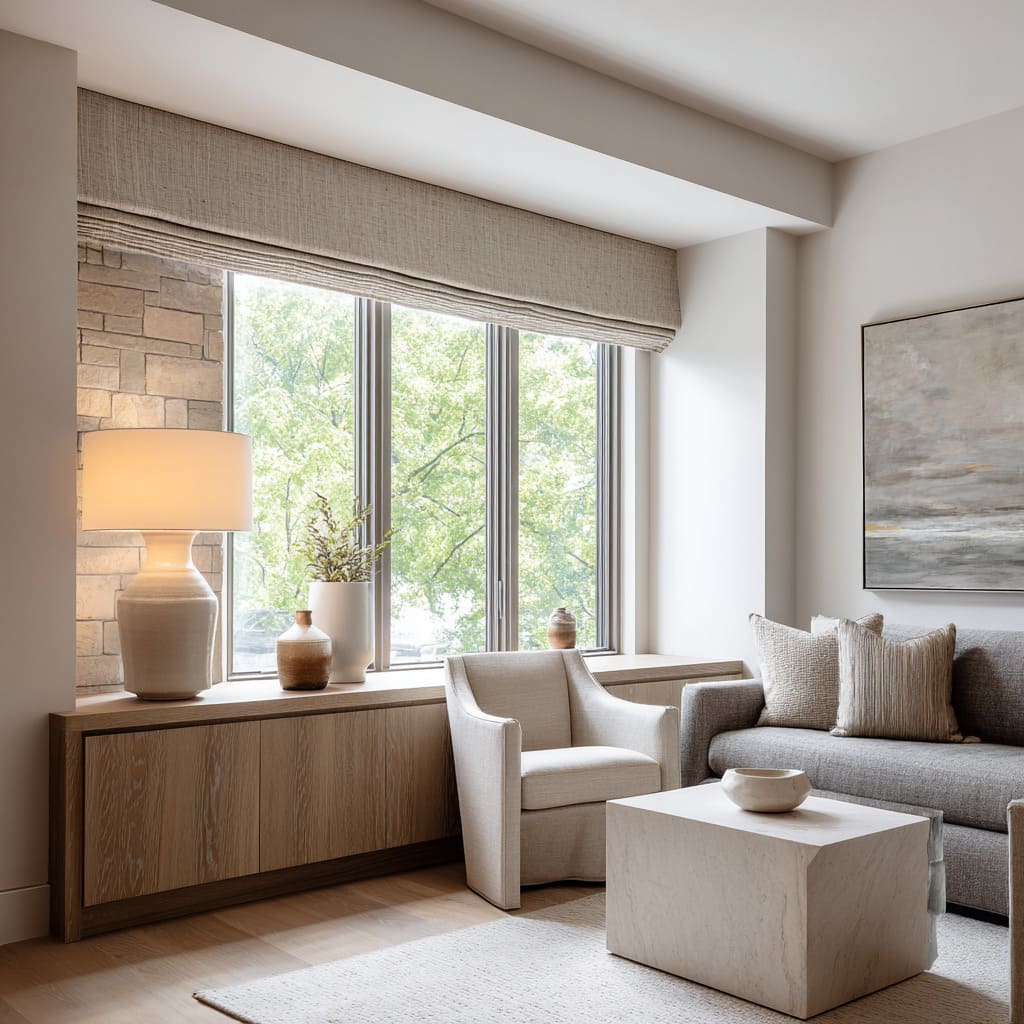
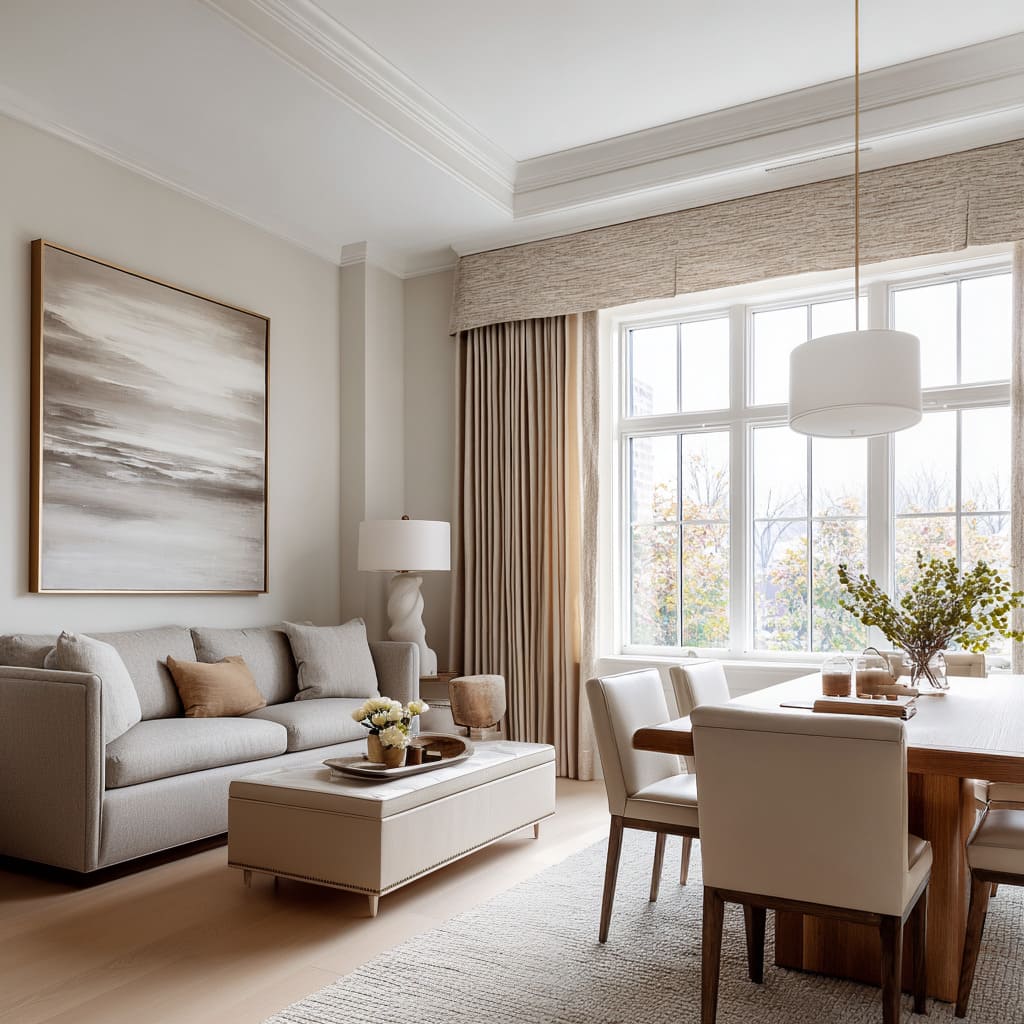
One of the strongest modern directions is the fabric-wrapped cornice or box valance that reads almost like built-in trim. These headers usually cover the full width of the window zone, sometimes extending from wall to wall so that the actual window feels nested inside a larger textile field.
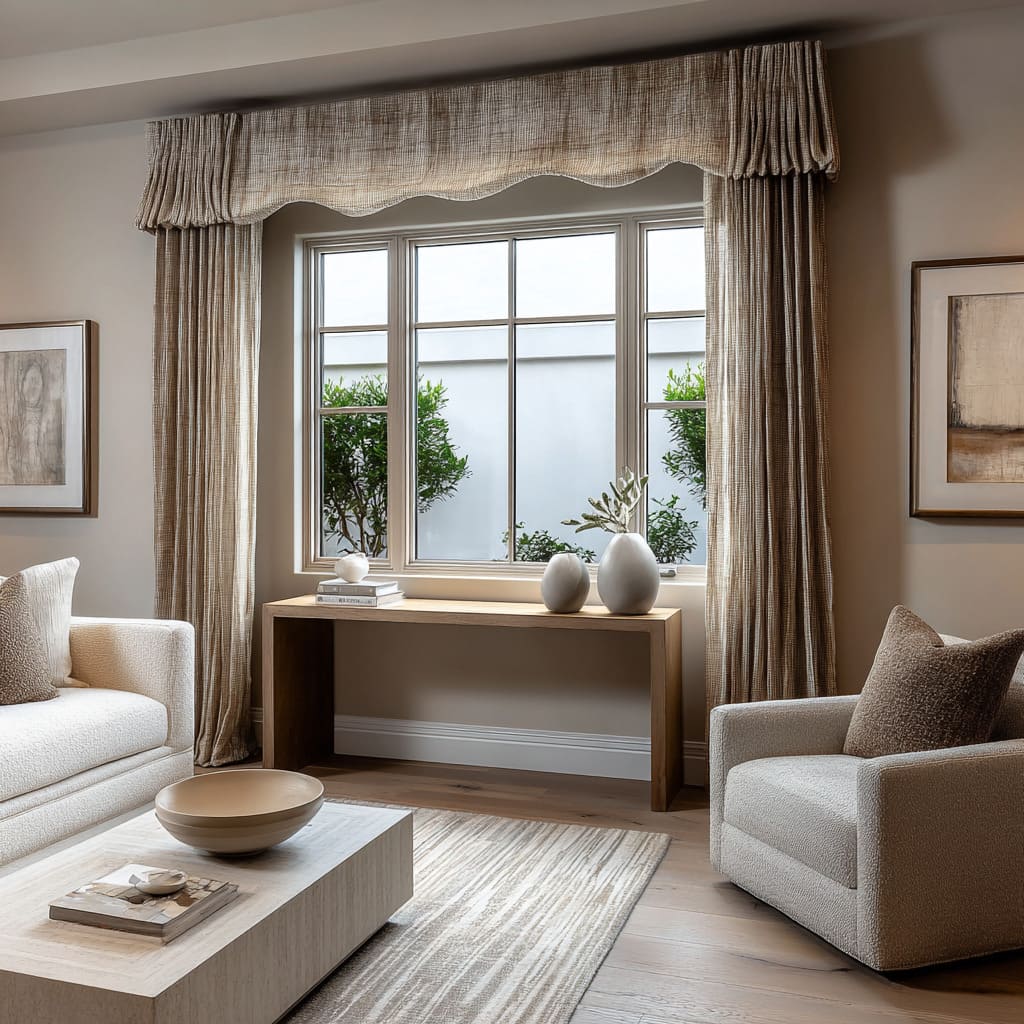
Their edges are clean and squared; the depth is enough to cast a shadow and hide any tracks, but not so large that the box steals focus. Tone is usually close to the wall or curtains, and texture often leans toward quiet weaves: linen-like plains, grasscloth-inspired surfaces, or subtle cross-hatch patterns that read as a single field from a distance.
When pleated curtains fall directly from the underside of this band, the overall reading becomes a single “soft frame” around the glass. This combination feels particularly effective above console-style setups, media walls, or long floating credenzas, where the box valance becomes a soft sister to the rectilinear furniture.
Many contemporary window valance ideas for living room work in exactly this way: a single, calm header that behaves like a textile fascia tying together ceiling line, window, and the top of tall furniture pieces nearby.
Swags, Arcs, and Scalloped Lines as Gentle Gestures
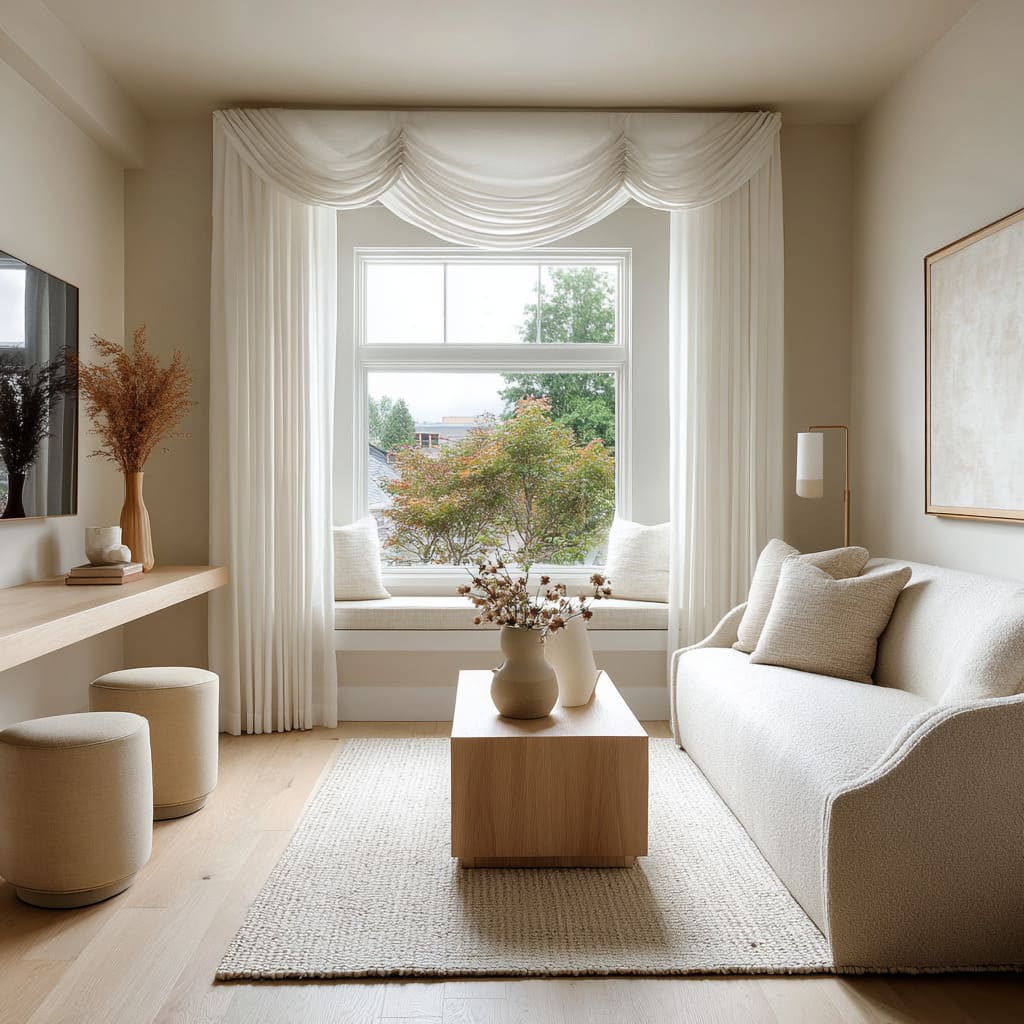
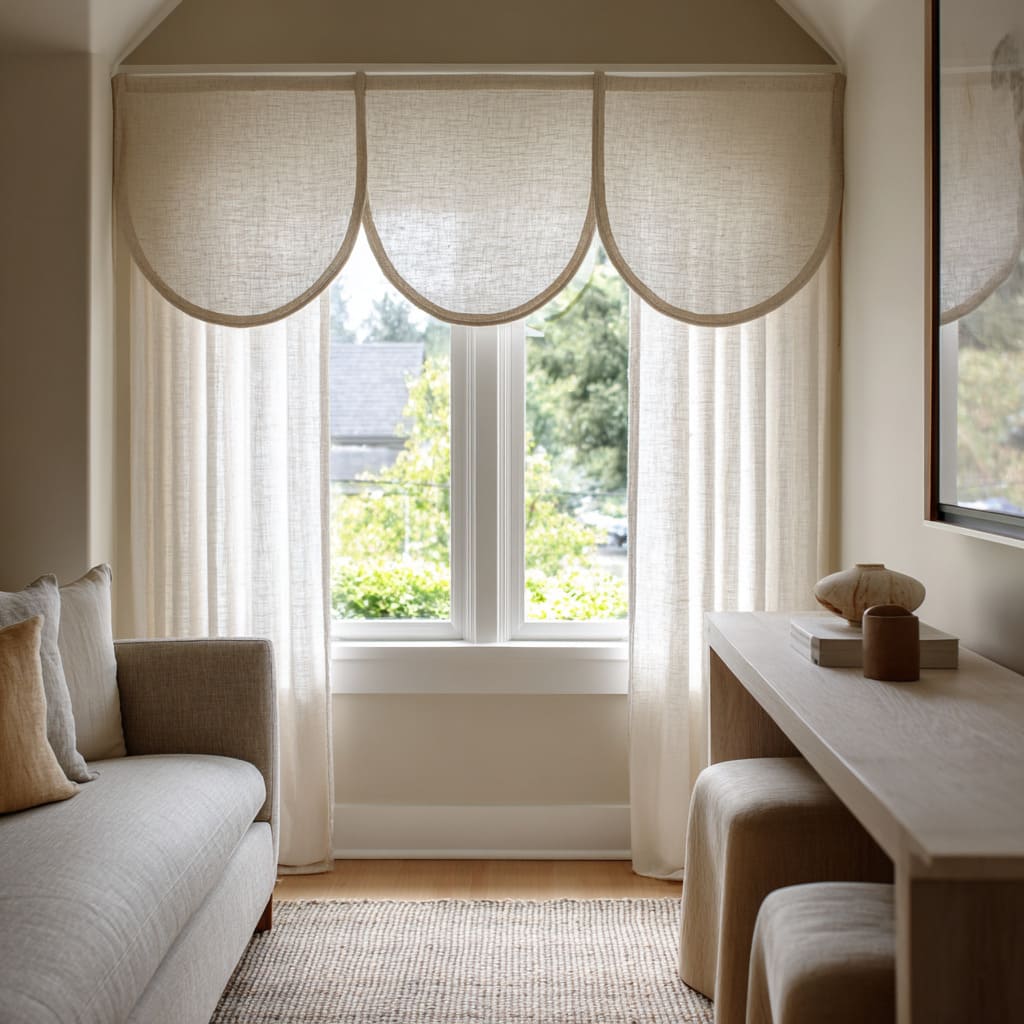
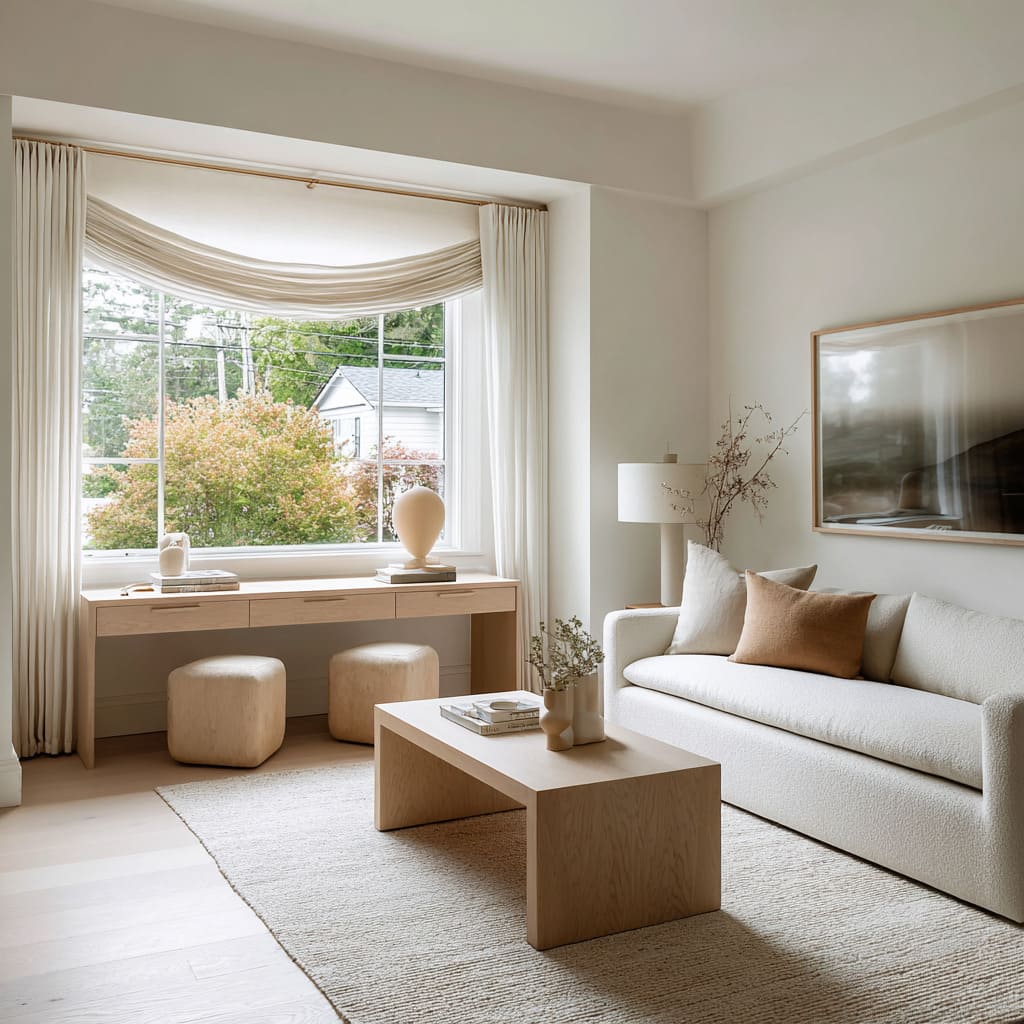
A second family of modern valances trades strict horizontal lines for arcs and scallops, but in a controlled, quiet manner. Swags are often broad and shallow rather than dramatic and theatrical; fabric is spread wide so that folds read as soft bands rather than tight bunches.
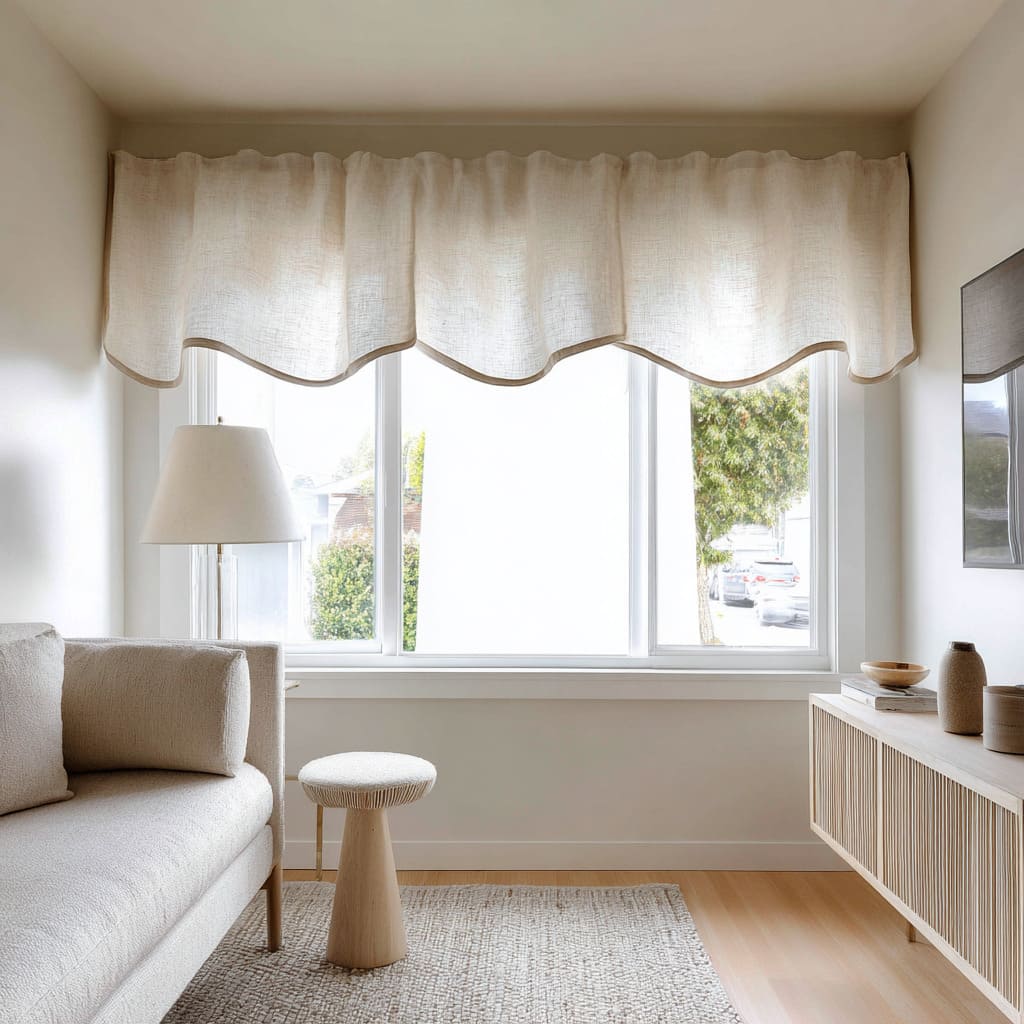
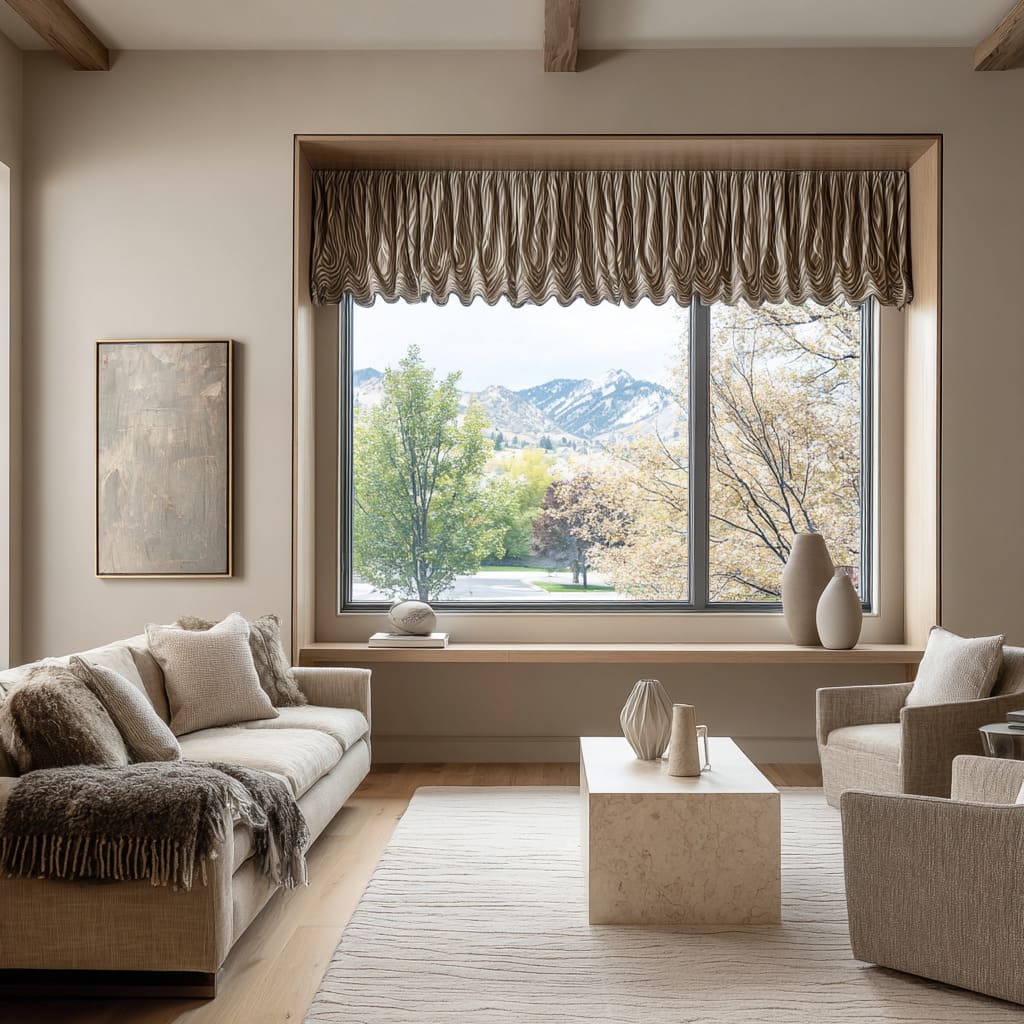
Scalloped hems tend to use long, low curves instead of small waves, and sometimes those dips are aligned deliberately with window divisions: high points above mullions, lower swoops between them. That alignment keeps the textile gesture from feeling random.
The top edge can stay straight and the softness happens only at the lower hem, so the eye reads “structure first, softness second. ”.
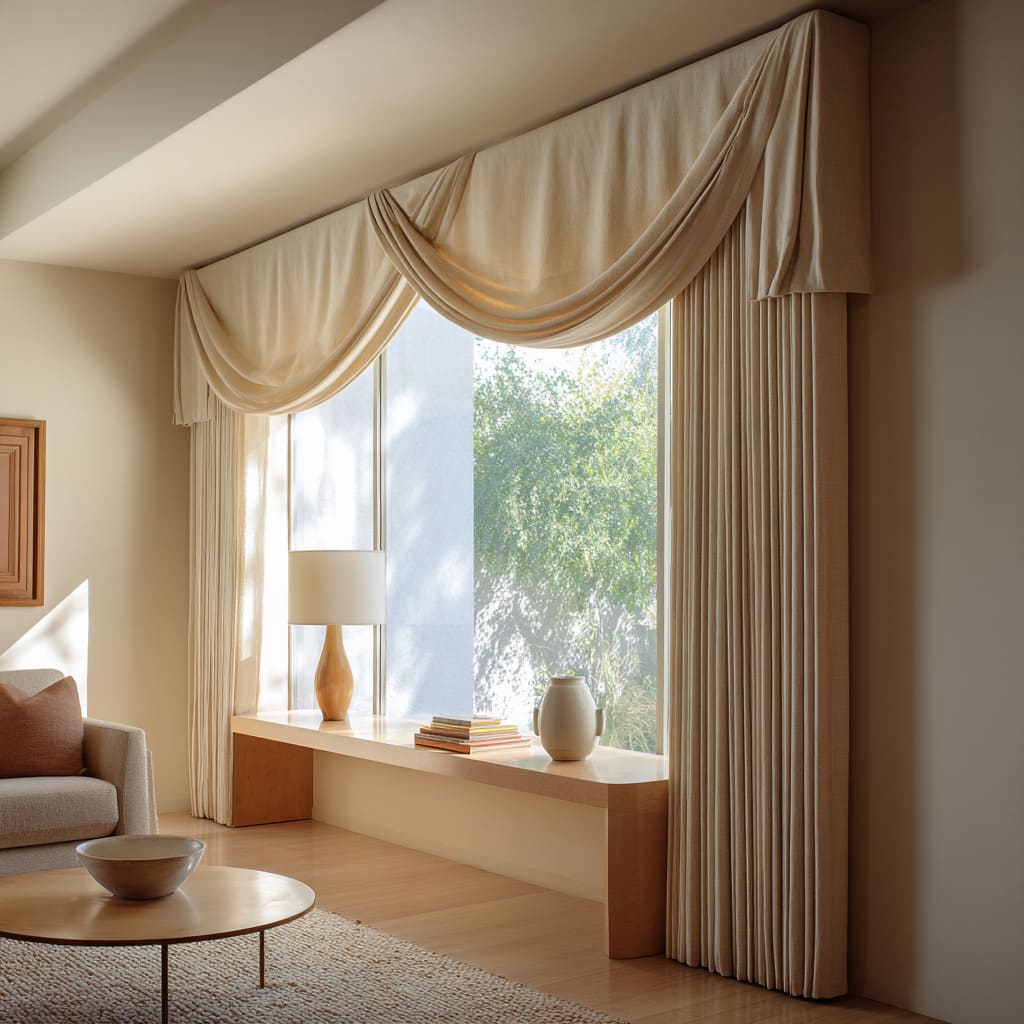
These curved decisions are frequently echoed elsewhere: barrel chairs with rounded backs, stools with curved sides, round coffee tables, and circular vases all respond to the shape drawn above the glass. The effect is a softening of strict geometry rather than a romantic statement.
It is common to see this type of arc used as the only significant curve in a room full of rectangles, letting the window carry the single relaxed line that offsets beams, cabinets, and straight-edged sofas.
Relationship Between Valance and View
The most sophisticated schemes treat the valance as an intentional partner to the view outside, not something that hides the view or simply frames it. In mountain or forest settings, slightly scalloped hems are sometimes shaped so that their rhythm loosely follows distant peaks or the rise and fall of tree canopies.
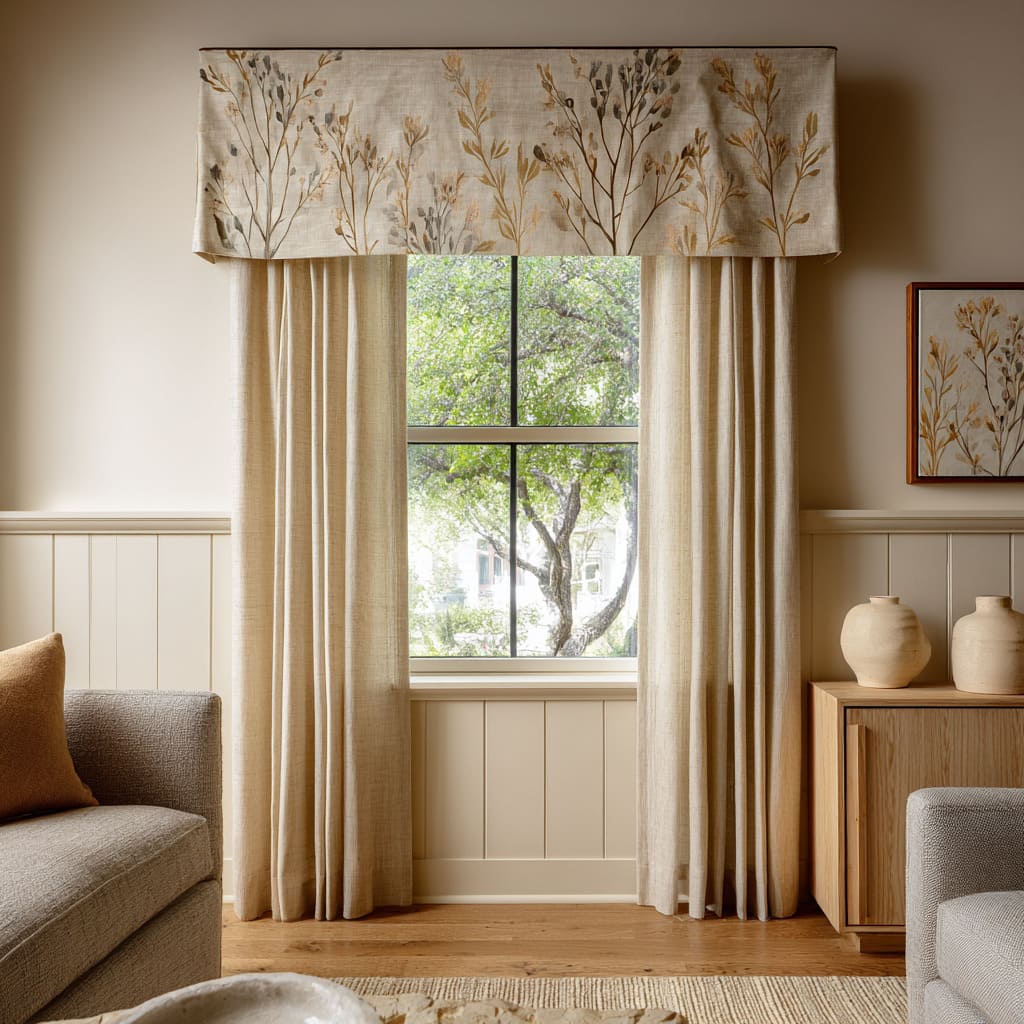
In garden-facing living rooms, botanical prints on cornices repeat the density and scale of branches just beyond the glass, turning the header into a soft, filtered version of what stands outside.
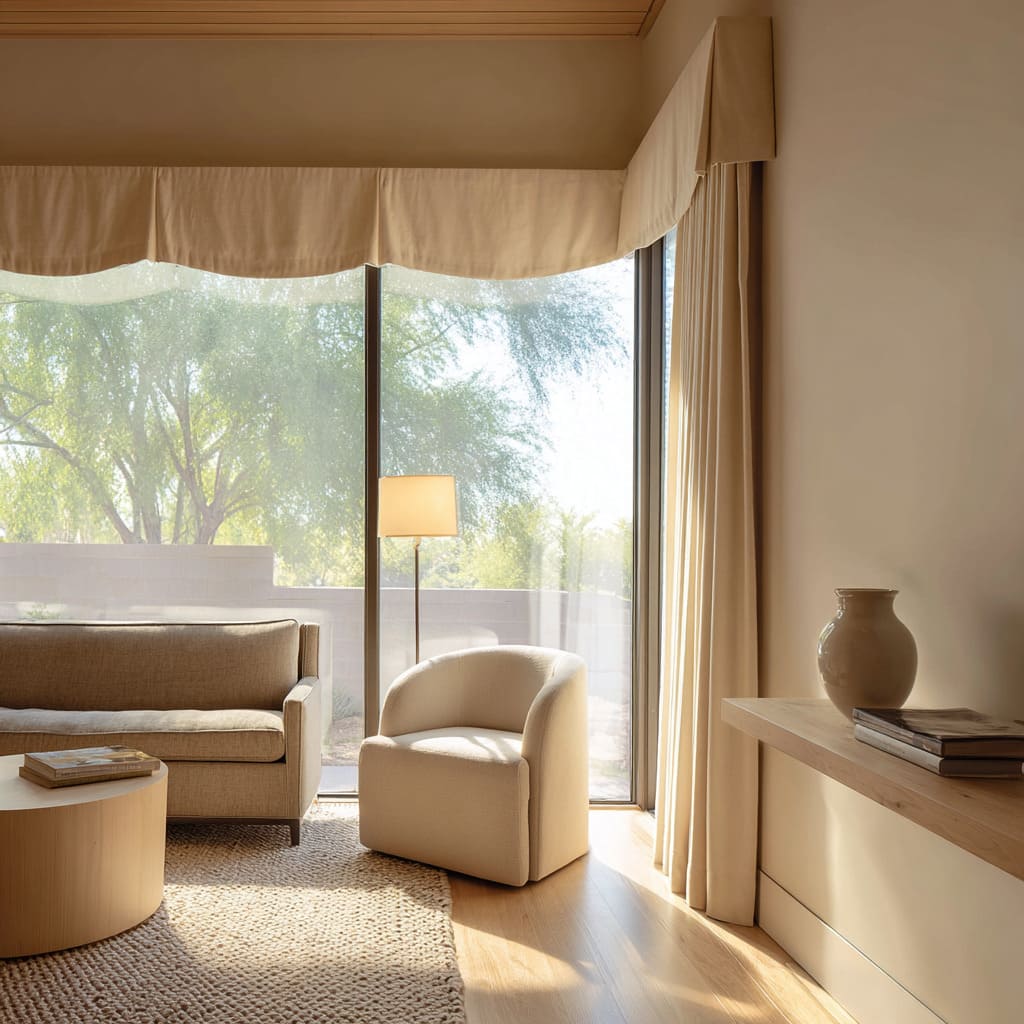
Even without pattern, sheer swags can act like a “fabric sky” above a band of greenery, while a solid bench or window seat below functions as a horizon line. In city-facing rooms, fabric boxes wrapped in matte greige or soft stone tones echo the weight of masonry blocks in nearby buildings, softening those hard grids with one smooth textile band.
The view and the valance enter a quiet dialogue: one offers lines and silhouettes, the other reinterprets those lines as texture and light. This is a key reason many modern schemes feel calm even with busy surroundings; the textile at the top acts as a translator between the raw outside world and the carefully composed interior.
Texture, Weave, and the Way Light Moves Over Fabric
Color often stays restrained in these valance concepts, so texture becomes the real language. Fine weaves, slubby linens, subtle ribs, and cross-hatched grids are chosen for how they react to daylight rather than for bold graphic impact.
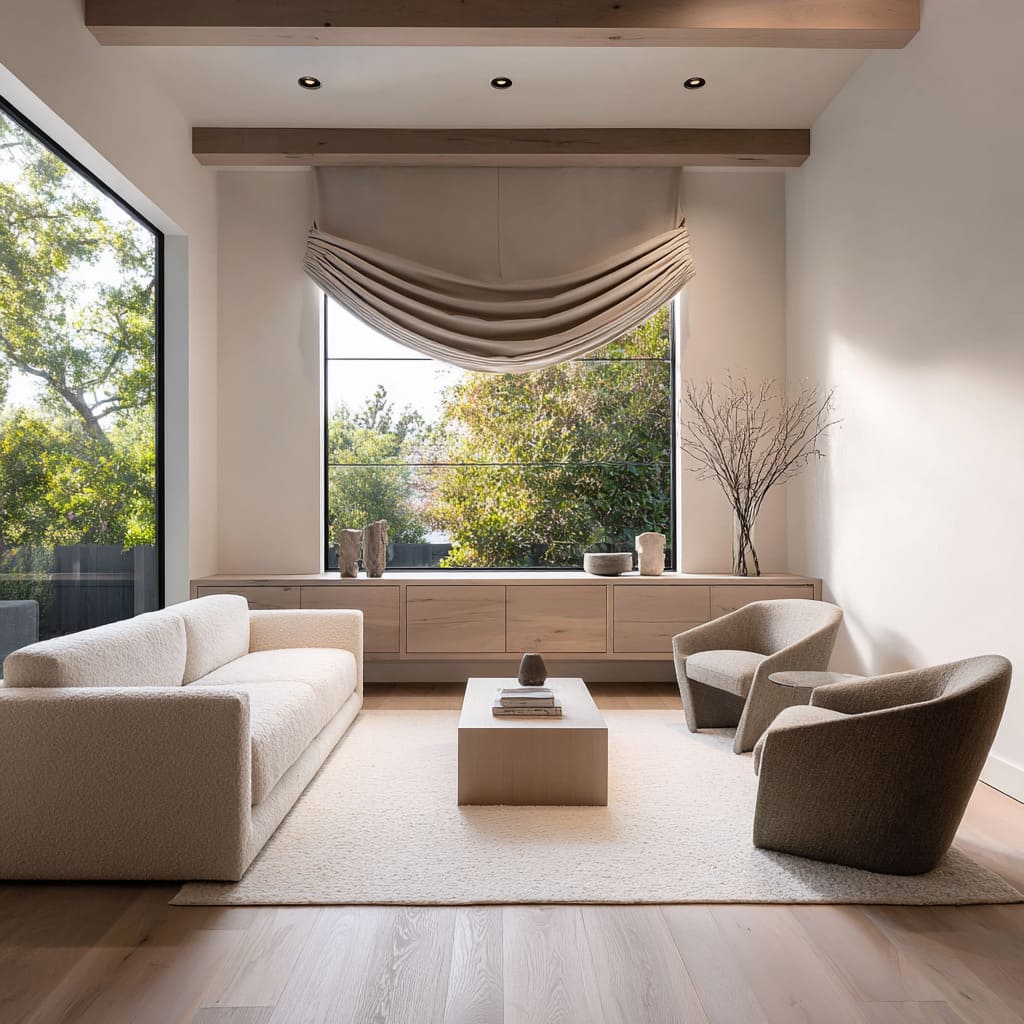
A ribbed valance with horizontal pleats will catch light along each ridge, producing a band of gently shifting lines as the sun moves; a slubby linen box will show small variations in thread thickness that soften its apparent solidity. When tones stay close — wall, header, and curtains all in related shades of cream, stone, or sand — the room gains depth not from color contrast but from how light slides over those different surfaces.
Often the same texture logic extends downward: ribbed valance above, ribbed chair upholstery somewhere in the seating, fluted doors on a sideboard, a looped rug underfoot. In this way, the valance becomes the most visible place where that texture story starts, setting the scale: large, soft waves vs fine, tight weave vs tiny nubs.
The space then layers those scales so that nothing feels flat, even when the palette is extremely quiet.
Patterned and Botanical Valance Bands
Pattern appears in a focused way, most often on the header rather than on every textile surface. Cornices covered in soft plaids, subtle grids, or leaf motifs serve as a kind of fabric artwork perched above plain curtains.
Plaid-like weaves, when used on both box and panels, create an interesting double reading: the header shows the pattern almost flat and horizontal, while the curtains transform the same motif into vertical streams once the cloth is pleated.
Botanical prints behave differently; they often present whole stems, leaves, or seed heads in a scale that can be read clearly from across the room, not tiny repeats. These motifs extend the garden or tree story upward, especially when they sit just above glass filled with similar natural forms outside.
Around these patterned bands, designers tend to keep other surfaces quiet: simple art, neutral upholstery, and calm rugs, sometimes with panelled wainscoting or shiplap that echoes the verticality of stems without repeating the figurative print. The result is a focus on one narrative strip at the top of the window, where pattern carries mood and association, while color remains controlled and compatible with long-term use.
Handling Wide Openings and Large Windows
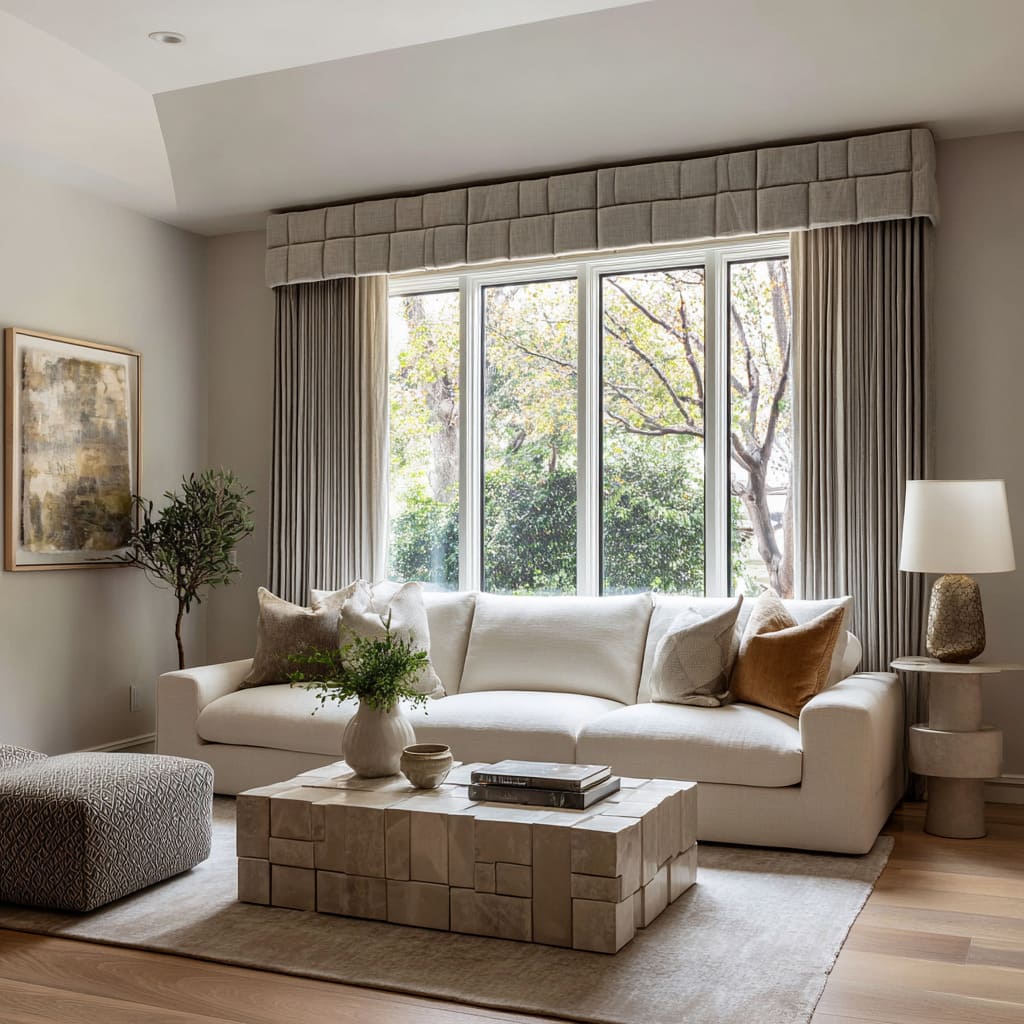
Modern living room designs with wide sliders, long picture windows, or multi-panel bays often lean on the valance to bring order to all that glass. In many cases, a single continuous header stretches from one side of the wall to the other, even if the window only occupies a central zone.
This makes the entire wall read as one composition rather than a floating rectangle of glass surrounded by blank space.
Shallow scallops, wide swags, or straight bands are used to anchor the full span, while side panels may be concentrated only at the outer edges so the center remains open. In some layouts, one stack of curtain is placed only on a single side to preserve a clear passage; the valance then balances that asymmetry by running evenly across the top.
Tones usually stay light to avoid turning a broad header into a heavy strip.
Texture and proportion carry the interest instead. This approach is especially visible in living room valance ideas for large windows, where the distance between floor and ceiling is significant and the expanse of glass is wide enough to risk feeling bare.
The continuous textile line gives the opening a sense of intention and scale that works with sofas, benches, desks, and consoles arranged beneath it.
Color and Tone in Modern Valance Compositions
Color in these schemes tends to work like a quiet background musician rather than a soloist. Most valances sit in a narrow band of neutrals: warm whites, sand, oatmeal, greige, soft taupe, or very light grey.
Their job is less to stand out and more to support the overall envelope of the room. Often the valance tone is tuned to sit somewhere between wall and curtain, “gluing” the two together so there is no visual gap at the point where fabric meets plaster.
In other cases, the header picks up the tone of a nearby element — a pale wood console, a stone coffee table, or a looped rug — so that it feels like part of a palette that is already present at lower levels. Accent colors are frequently kept to small, movable pieces: a rust cushion, a terracotta lamp base, foliage in a vase.
Patterned bands with leaves or grids may pick up those accents in softened versions, but they rarely scream with strong hues. This controlled approach allows the valance to age well, staying in tune with changing decor while continuing to give the room a finished line at the top of the composition.
Dialogue Between Valances, Furniture, and Small Objects
A subtle but important quality is how the valance “talks” to everything that sits under and beside it. Curved swags are often accompanied by barrel-back chairs, round stools, or curved coffee tables; boxy fabric beams find companions in rectilinear sofas, media units, and stone blocks.
Heights align deliberately: sofa backs close to window sills, console tops matching bench levels, all stacking under the valance edge to create continuous bands across the room.
Small objects echo motifs from above: egg-shaped vases repeat scallops, ribbed lamp bases repeat pleats, framed art with horizontal strokes repeats the band of the header. Even plants and branches have a role, standing in front of curtains in loose vertical clusters that respond to folds and window mullions.
Through these choices, the valance stops being a separate “curtain element” and becomes the starting line of a visual conversation that runs down through art, furniture, accessories, and rug. Many living room curtain valance ideas seen in current interiors lean on this type of echo — repeated curves, repeated grids, repeated ribs — to keep the room coherent even when the color story stays mostly neutral and subdued.
Atmospheres and Mood Families Shaped by Valances
Taken together, these modern valance concepts form several recognizable mood families. Some designs feel like soft retreats where tone-on-tone pleated bands and long sheers fold around window seats and sofas, creating pale cocoons of light; others are more structured and composed, with box valances and plaid headers that suit media rooms or formal sitting areas.
Another group feels garden-linked, where vine prints, branch motifs, and leafy cornices bring a quiet indoor version of the view into the textile story. A lighter, more casual family uses sheer scalloped edges and loose hems, almost café-like in spirit, ideal for sunny rooms that want a relaxed outline at the top rather than a sharp cut.
The idea is that the line above the window is treated as a serious design decision: a tool for setting proportion, mood, and visual rhythm.
The fabric at this level filters light, shapes the perceived height of the wall, and creates a bridge between the strict geometry of frames and the softer world of upholstery and objects. In that sense, modern valance thinking expands the role of the top of the window into something much closer to soft, expressive architecture in cloth.