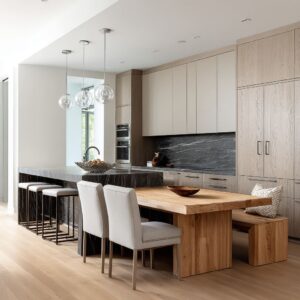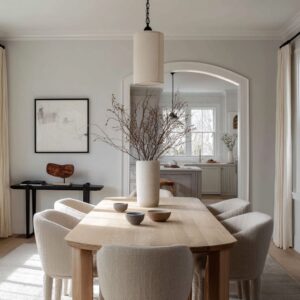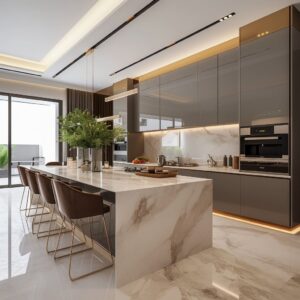
In many contemporary designs, the floor sets the emotional “temperature” long before cabinets, lighting, or decor are noticed. Terracotta does this in a particularly subtle way: it introduces warmth that feels grounded, mineral, and lived-in rather than sugary or decorative.
In design conversations, terracotta floor kitchen ideas rarely mean simply “orange tiles”. Instead, they describe a wide clay spectrum—peachy concrete, honeyed stone, dusty brick, pale blush planks—that controls how calm or dramatic the room feels.
A barely tinted clay floor acts like warm daylight trapped underfoot; a stronger brick grid behaves more like a patterned rug that defines the whole kitchen zone. What unites all of these approaches is the sense that the floor is not a separate finish but the base layer of the entire visual story, a kind of earth that cabinets, islands, and shelves are gently built upon.
Terracotta works especially well because it carries references to courtyards, farmhouses, and pottery studios, but in these designs it is handled with restraint: tones are softened, grout is tuned to be quiet, and the rest of the palette is deliberately edited, so the clay can breathe.
Color Temperature Underfoot: From Clay Whisper to Bold Brick
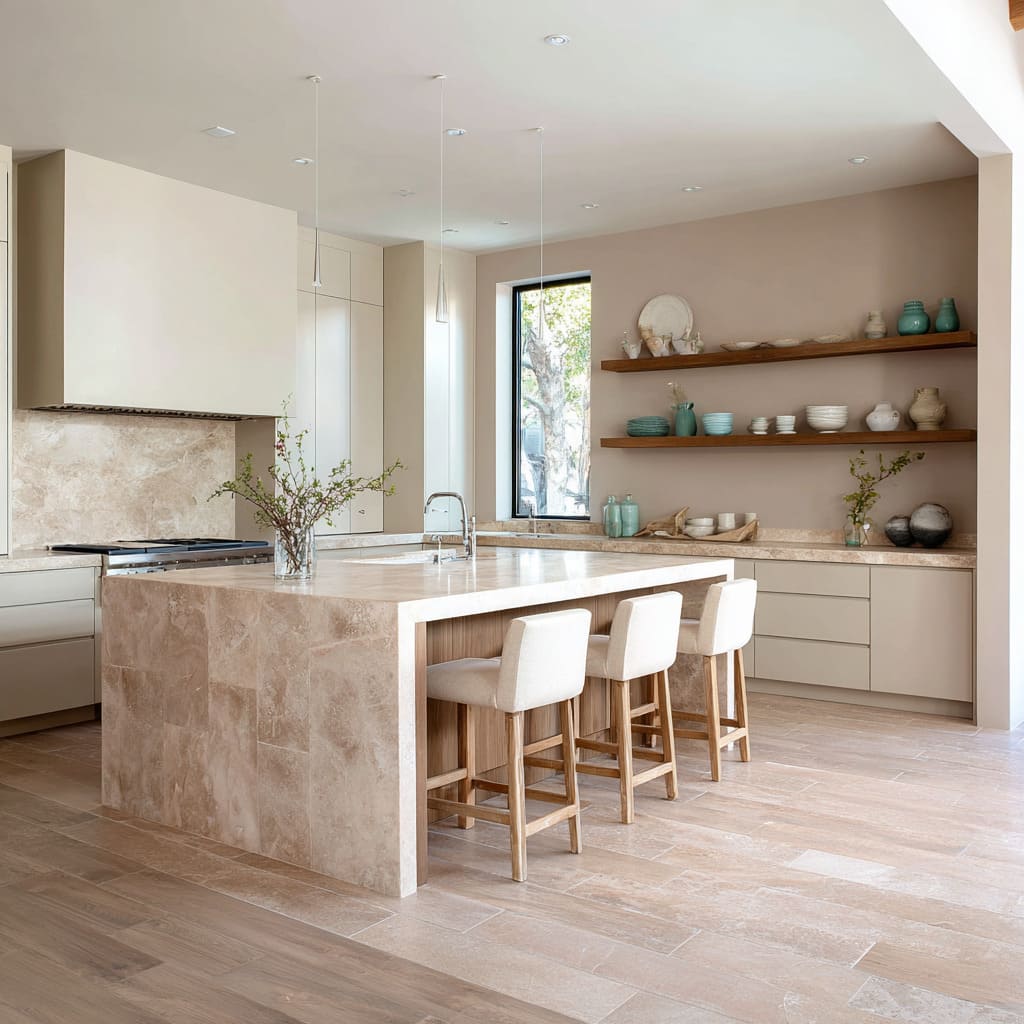
Terracotta floors can sit at very different “volumes”, and the mood change between them is surprisingly large. At the softest end, clay appears as a tint inside stone or concrete: large tiles in sand-beige with a veil of blush, or poured surfaces that seem grey at first glance but have a faint peach undercurrent.
These floor designs often feel almost neutral; they gently warm pale cabinetry and stone islands without reading as coloured surfaces. In the middle are honeyed stones and satin planks where terracotta is obvious but not loud—tones hover between café au lait, caramel, and muted adobe.
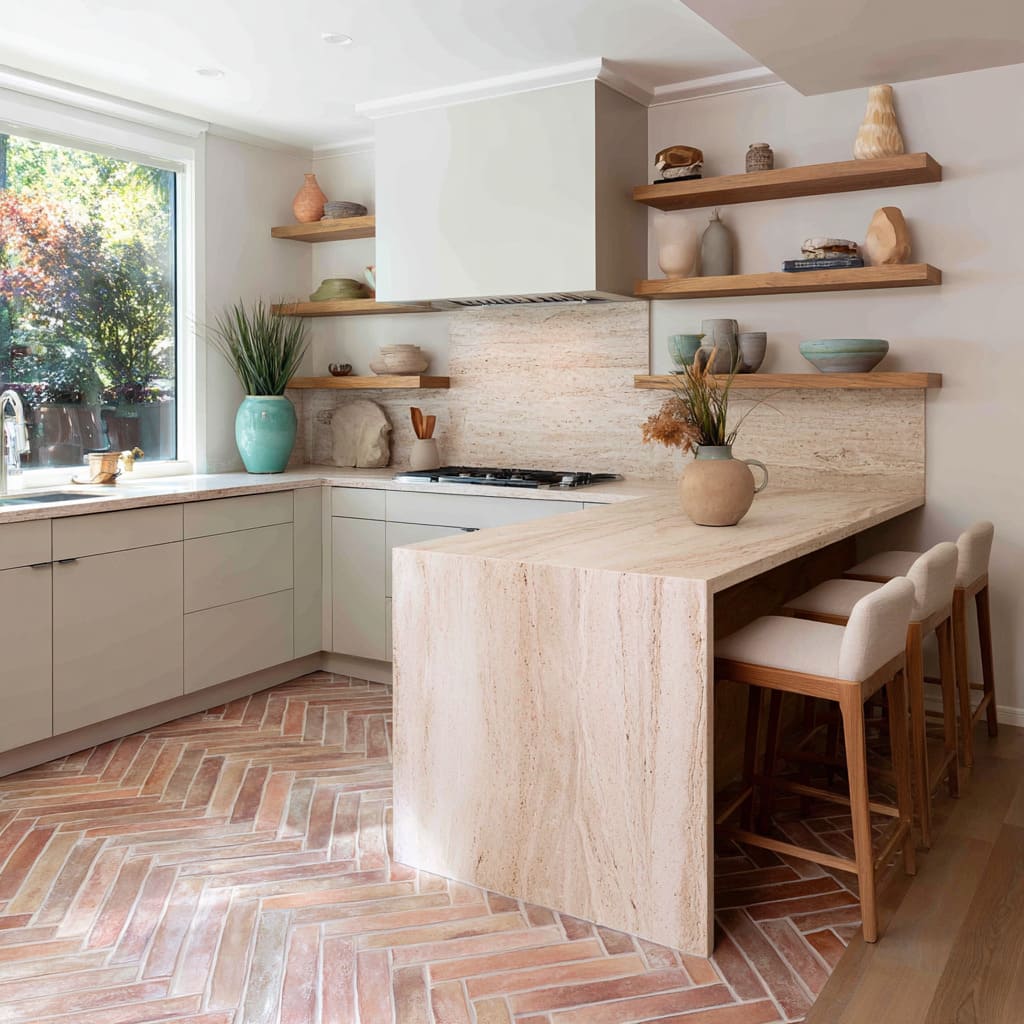
Here the floor feels like a natural ground layer, similar to worn limestone or desert earth, and sits comfortably beneath both walnut and pale oak. At the strongest end are classic brick-toned surfaces: small quarry tiles, herringbone bricks, and rustic pavers that move from russet to sienna in each piece.
The lightest grout and pastel cabinets can still keep these lively floors feeling sophisticated; the key is that only one or two other elements share their intensity.

A simple way to read terracotta “heat levels”
- Soft clay wash – stone or concrete with blush threads; works as a warm neutral that lets cabinets take more colour.
- Mid-strength mineral ground – honey, caramel, or warm beige stone; feels like natural rock and pairs with many woods.
- Bold brick field – small tiles or bricks in shifting oranges and reds; floor becomes the main pattern while cabinets and walls stay disciplined.
Designers often decide first how strong the clay should feel underfoot, then adjust everything above it. Deep berry cabinets sit comfortably on pale blush concrete, while soft greige fronts and whisper-light plaster sit quietly above herringbone brick.
The floor’s role is fixed: it chooses the emotional warmth for the entire space, even if every other surface is technically neutral.
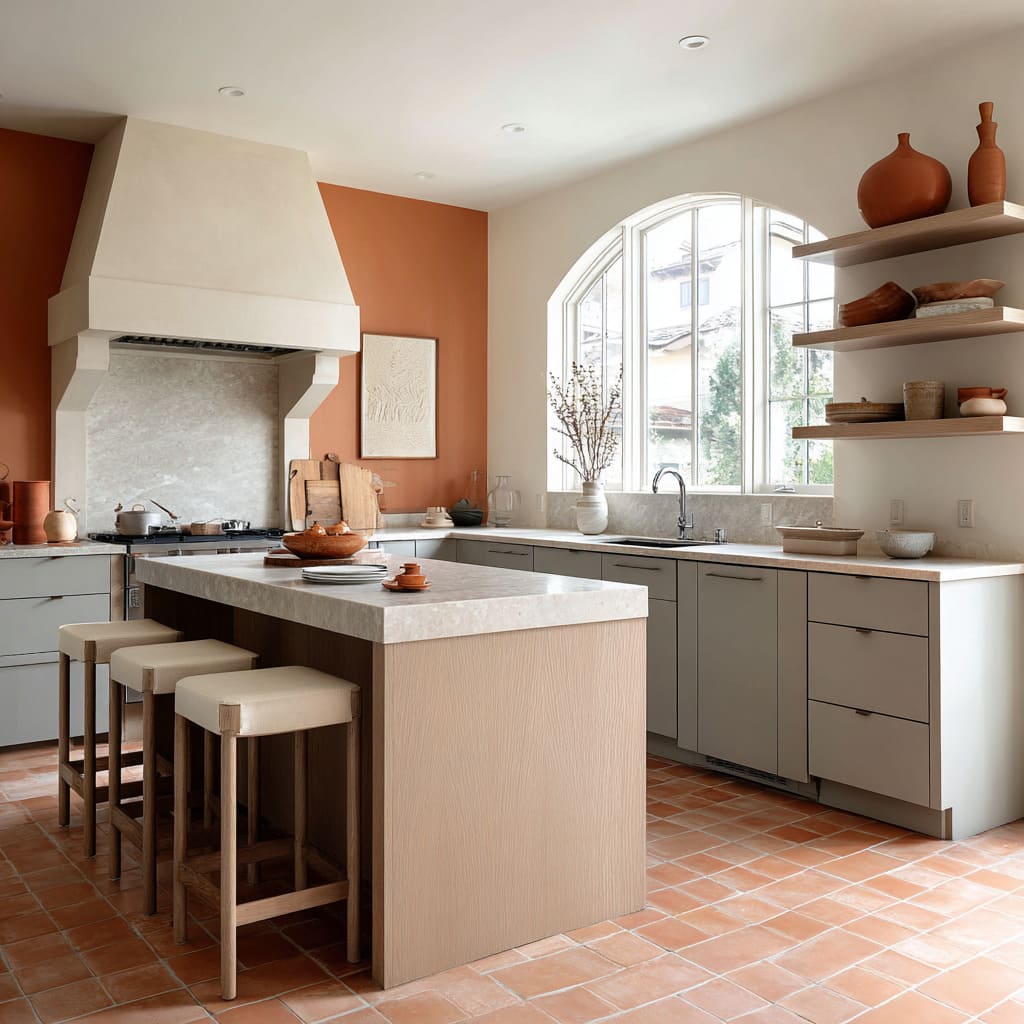
Geometric Thinking: Diagonals, Herringbone and Soft Checkerboard
The geometry of terracotta is rarely accidental. Direction, pattern, and joint layout keep appearing as quiet tools for reshaping space.
Large rectangular stone tiles set on the diagonal pull the eye toward windows and garden views; the floor gently points outward while cabinet grain runs in calm horizontals, creating a tension that lengthens the design without chaos. Herringbone layouts introduce movement of a different kind.
Slim bricks, especially when tones are close and grout is soft, act almost like woven fabric rather than a strong zigzag. This is where clay feels both historic and fresh: the pattern references old corridors and European kitchens, yet the softened color and smooth edges sit easily in a minimal envelope.
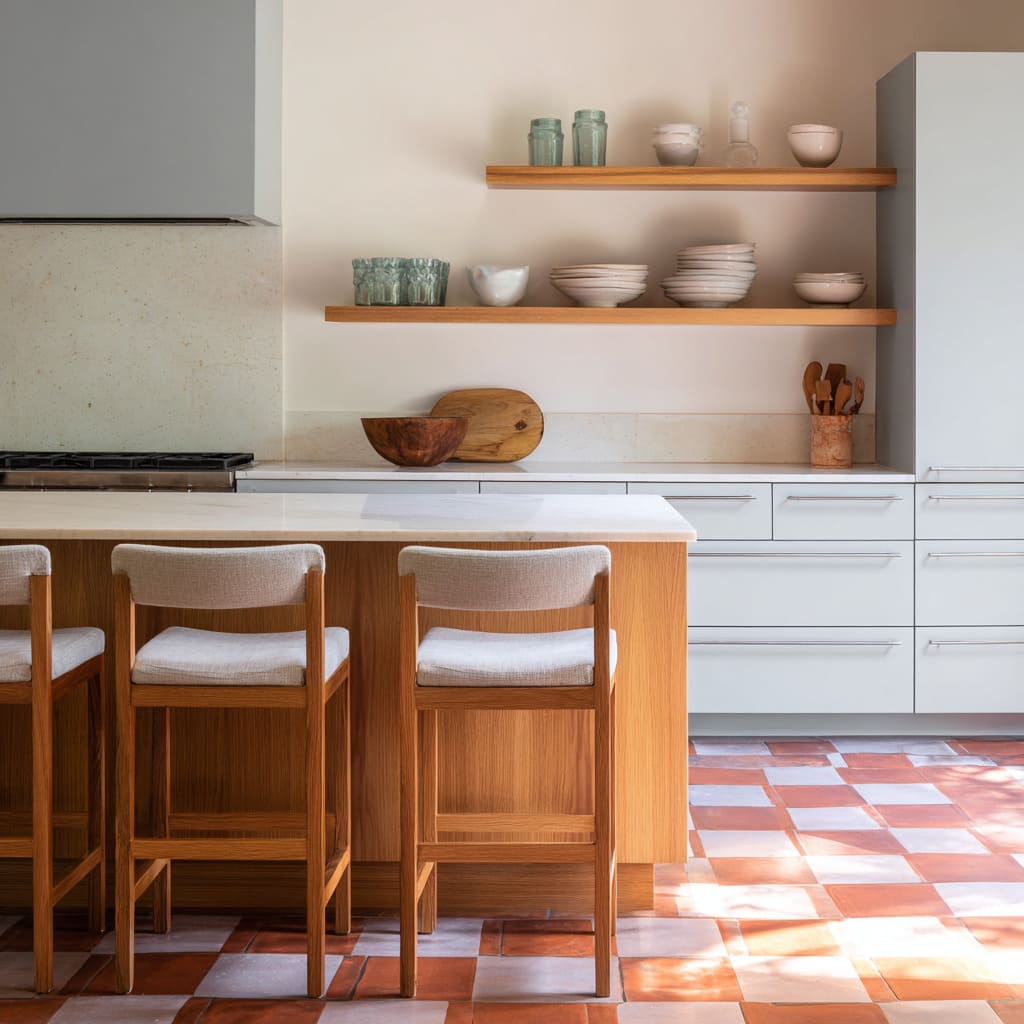
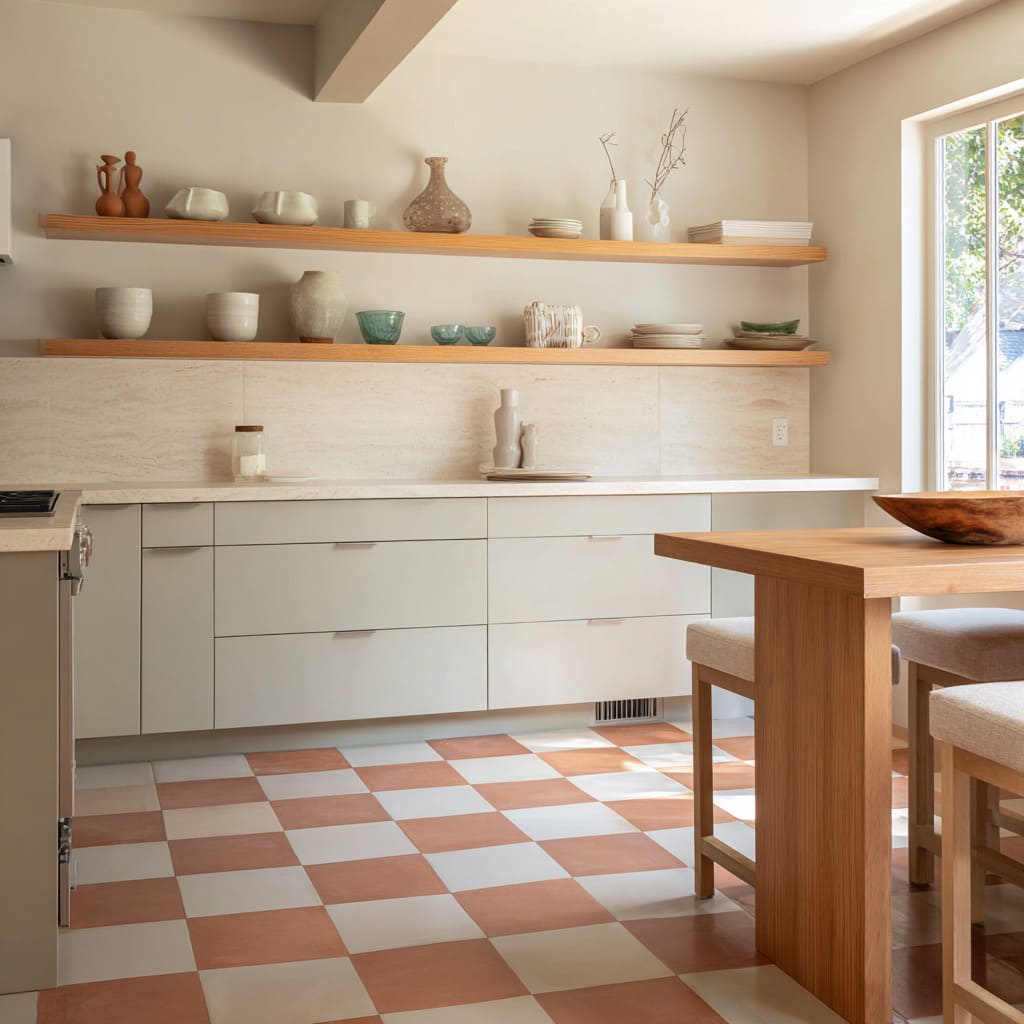
Checkerboard designs sit somewhere between geometry and textile. In contemporary versions, terracotta squares are paired with warm cream rather than crisp white, and grout is tuned to match the paler tile so the grid edges blur.
The effect is more like a hand-woven rug than a graphic game board. Cabinets often float slightly above on pale plinths, and islands or dining tables land right in the centre of the pattern, letting furniture legs become small vertical markers in the grid.
Even seemingly simple running-bond bricks have hidden directional work: laid in long bands or loose stripes, they encourage the eye to travel along the length of the room and then rest on a stone island or a timber-lined opening. Geometry in such kitchen designs is quiet but strategic; it decides how the body moves and how the gaze travels, even while the palette stays soft and earthy.
Terracotta as a Textured Rug: Platforms, Insets and Zoning
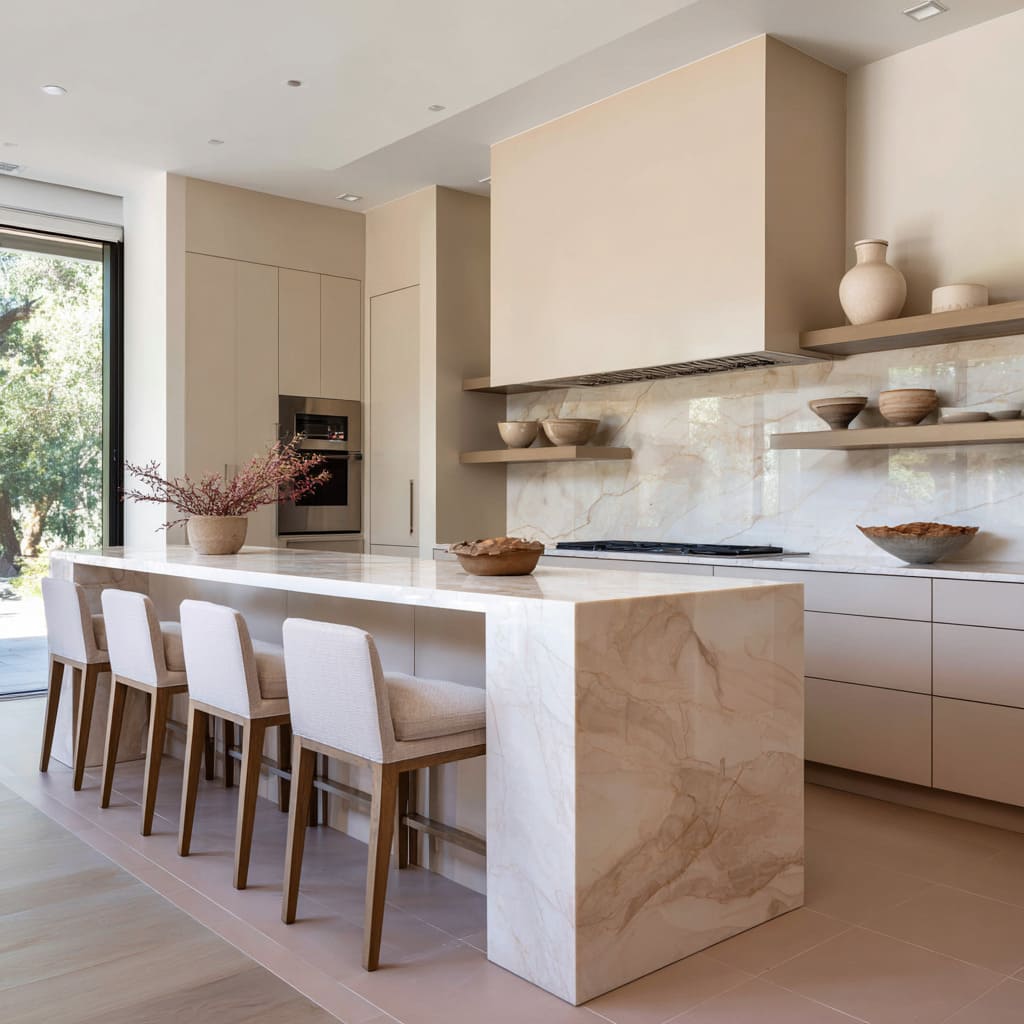
A recurring theme in terracotta floor tile kitchen ideas is the use of clay surfaces as a kind of permanent rug laid only under specific parts of the plan. Sometimes, a rectangle of blush stone or porcelain sits under the island like a flat plinth, while the circulation band beyond is finished in timber.
The tiles often match the wood in width and length, so from a distance, the entire floor behaves like one continuous plank field; only a slight difference in sheen and grain reveals the platform. In others, hexagonal terracotta outlines the working area around the sink and range, then fades into oak boards under the seating side, with a few hexes stepping into the wood zone like scattered leaves.
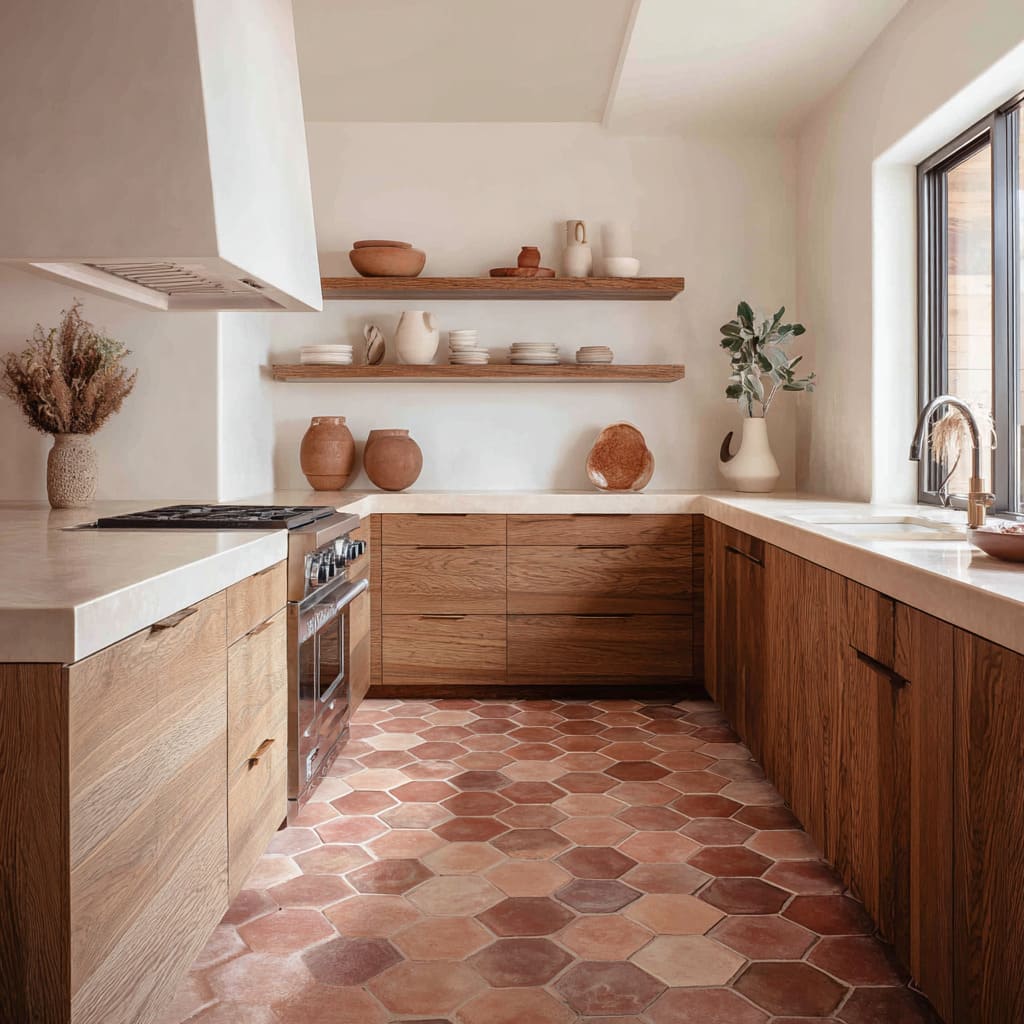
This zoning is subtle yet important. Clay defines the “hard-working” core—places where cooking, washing, and chopping happen—while wood wraps the lounging or dining side.
There is rarely a brutal straight line between the two; boundaries appear as stepped edges, staggered tiles, or partial overlaps so that one material seems to dissolve into the other. The result feels more like a woven textile that thickens in the centre and thins at the edges.
Terracotta, in these cases, reads as both functional and symbolic: a surface resilient enough for spills and footsteps, and a visual sign that says “this is where the kitchen story is most intense,” even in an open-plan room.
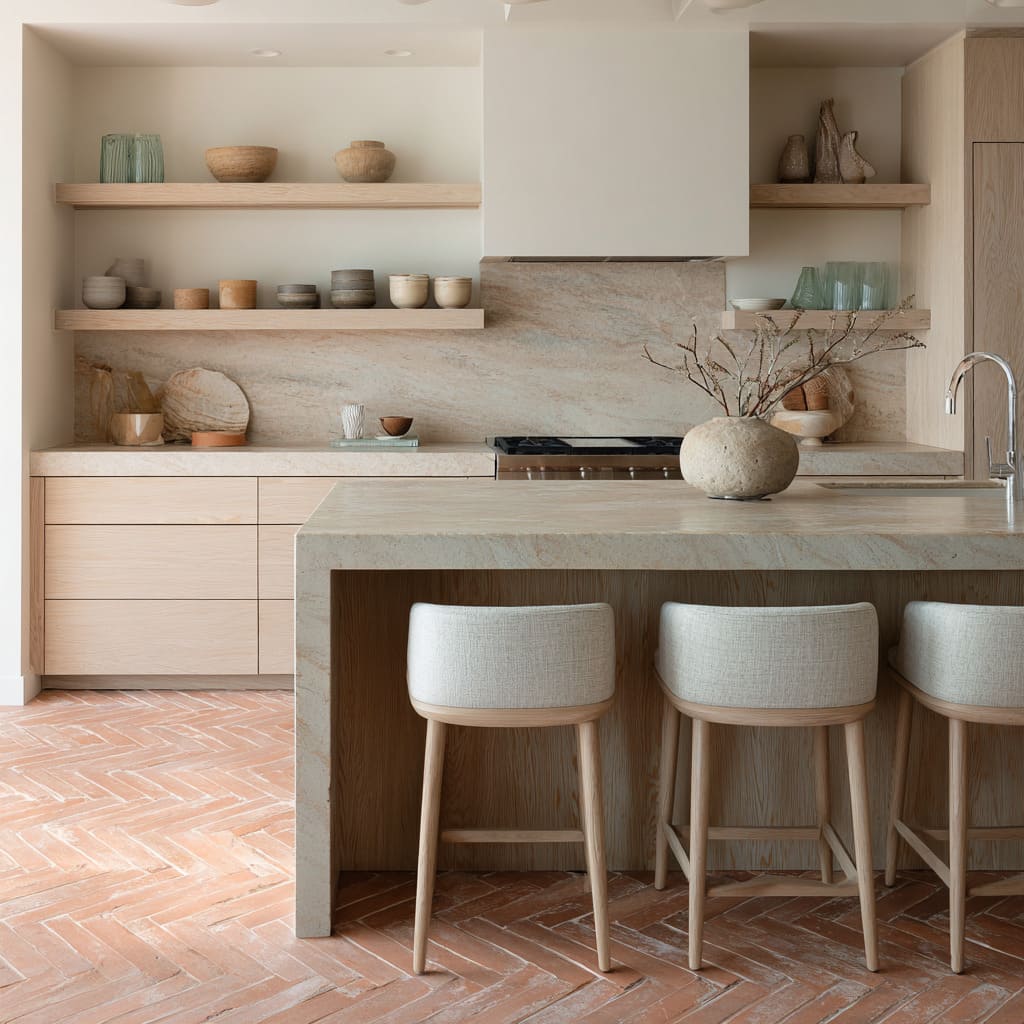
Stone as Translator: Holding Clay and Cabinets in the Same Conversation
Where terracotta sits at one end of the palette and cabinet color at another, stone almost always acts as the middle language. Islands and worktops frequently fall in a tone that lives exactly between warm clay and cool paint: creamy travertines with faint blush veining, sandy marbles with threads of pink and honey, light stones that pick up both the floor and the verticals.
This is why so many designs with strong flooring still feel calm. The stone does not compete with the floor; instead it pulls one or two of its pigment notes upward and spreads them in a smoother, more blended way.
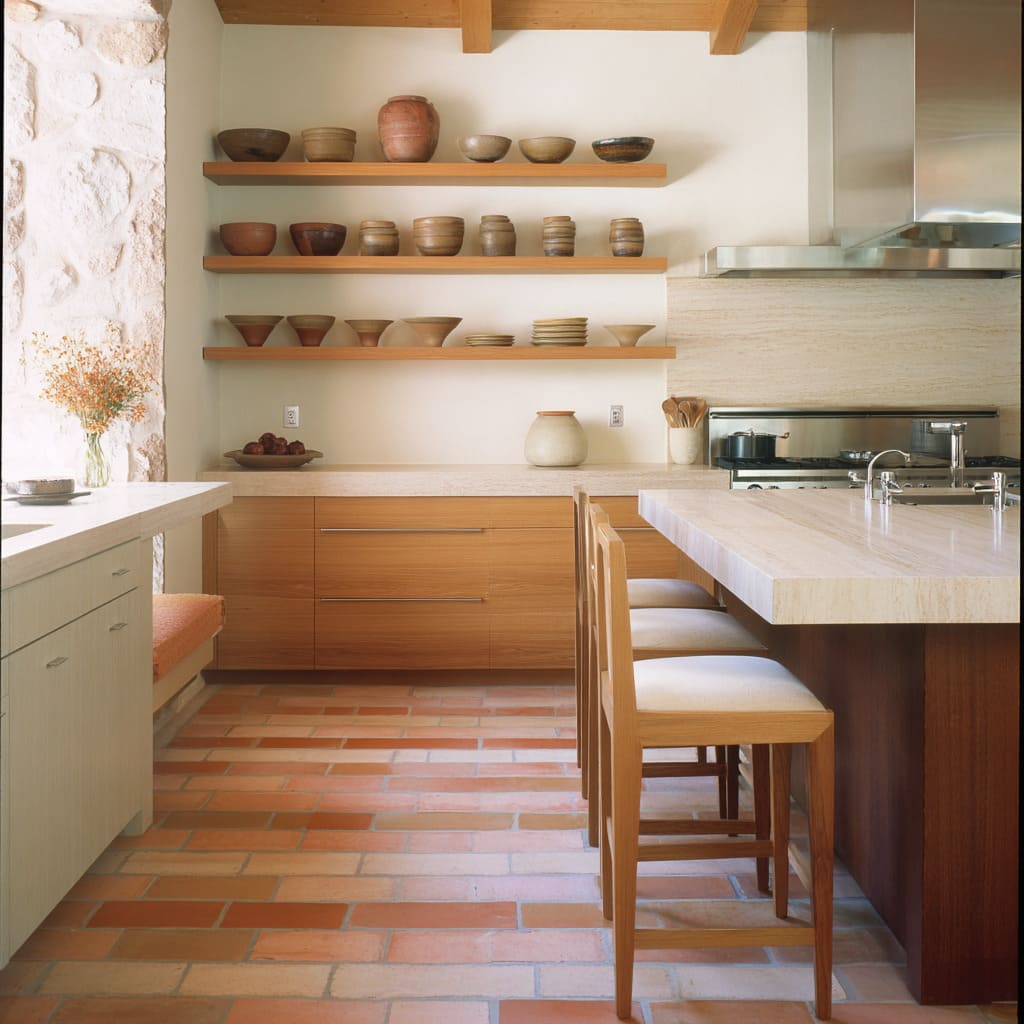
Stone above terracotta: three common roles
- Bridge between extremes – a floor in rich brick and cabinets in charcoal or deep green often meet through a pale stone island that shares warmth with the tiles and lightness with the joinery.
- Soft mirror – in spaces where the floor is very gentle (blush concrete, honey porcelain), the island stone is almost identical but slightly lighter or darker, so island sides and floor edges visually melt together from some angles.
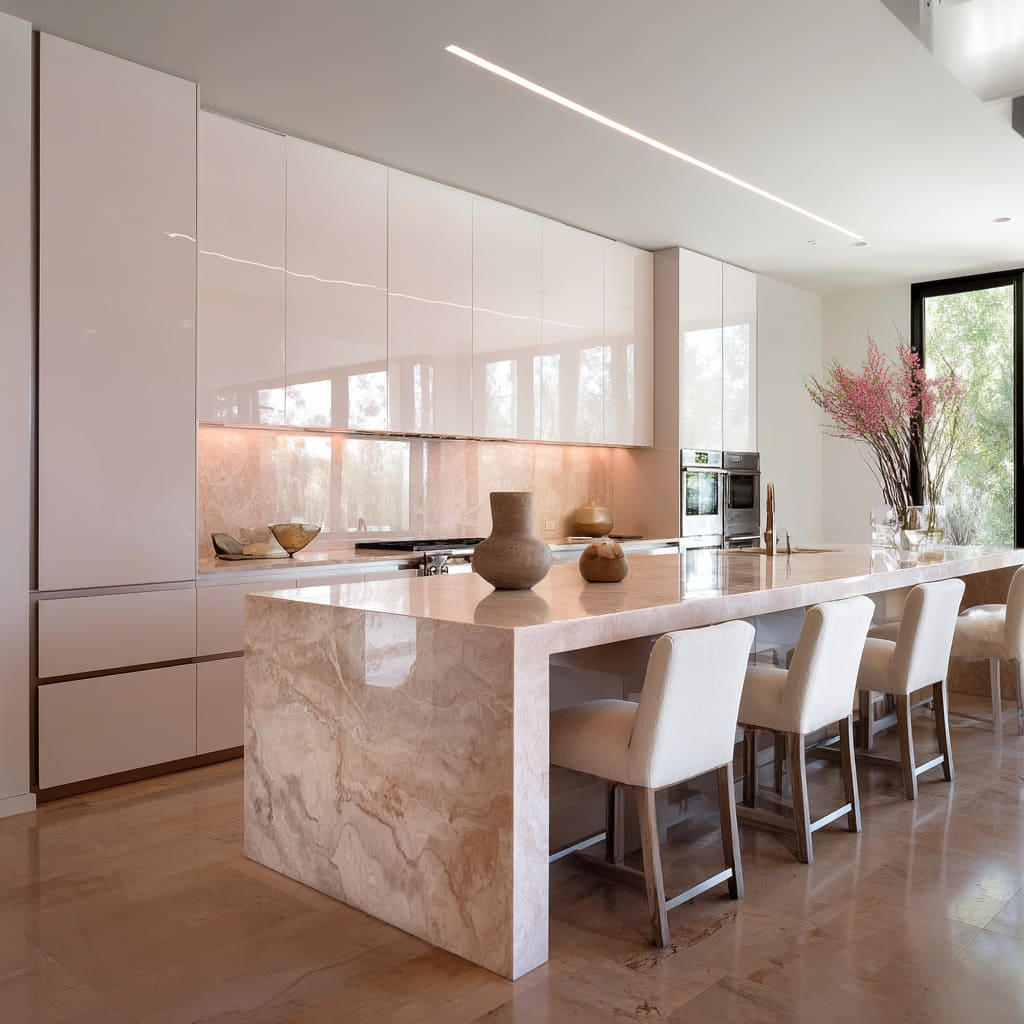
- Quiet spotlight – patterned stones with cloud-like terracotta veins (especially in glossy finishes) act almost like a spotlight on the island, while the clay tones in the floor echo that swirling pattern in a flatter, more matte way.
Because stone is smoother and often less varied than brick or hex, it is given simpler forms: crisp waterfall edges, monolithic blocks, thin ledges. This calm geometry balances the small joints and tonal shifts underfoot.
Seen as a whole, clay and stone work together as a continuous mineral story: terracotta holds the more rustic, porous side of earth; stone takes the polished, stratified side and offers it to the eye at hand height.
Timber Stories: How Wood Grain Supports Terracotta Floors
Wood is the second key companion to terracotta, and its role changes depending on how busy the floor is. Where herringbone bricks, checkers, or patterned tiles already carry strong rhythm, timber is usually pale and quiet—bleached oak, soft maple, or honey boards with straight grain.
Vertical planks on island bases or cabinet fronts are set against diagonal or grid floors to create a gentle cross-talk between directions: the floor moves at angles or in squares, the wood drops in straight lines, and the two patterns support rather than fight each other.
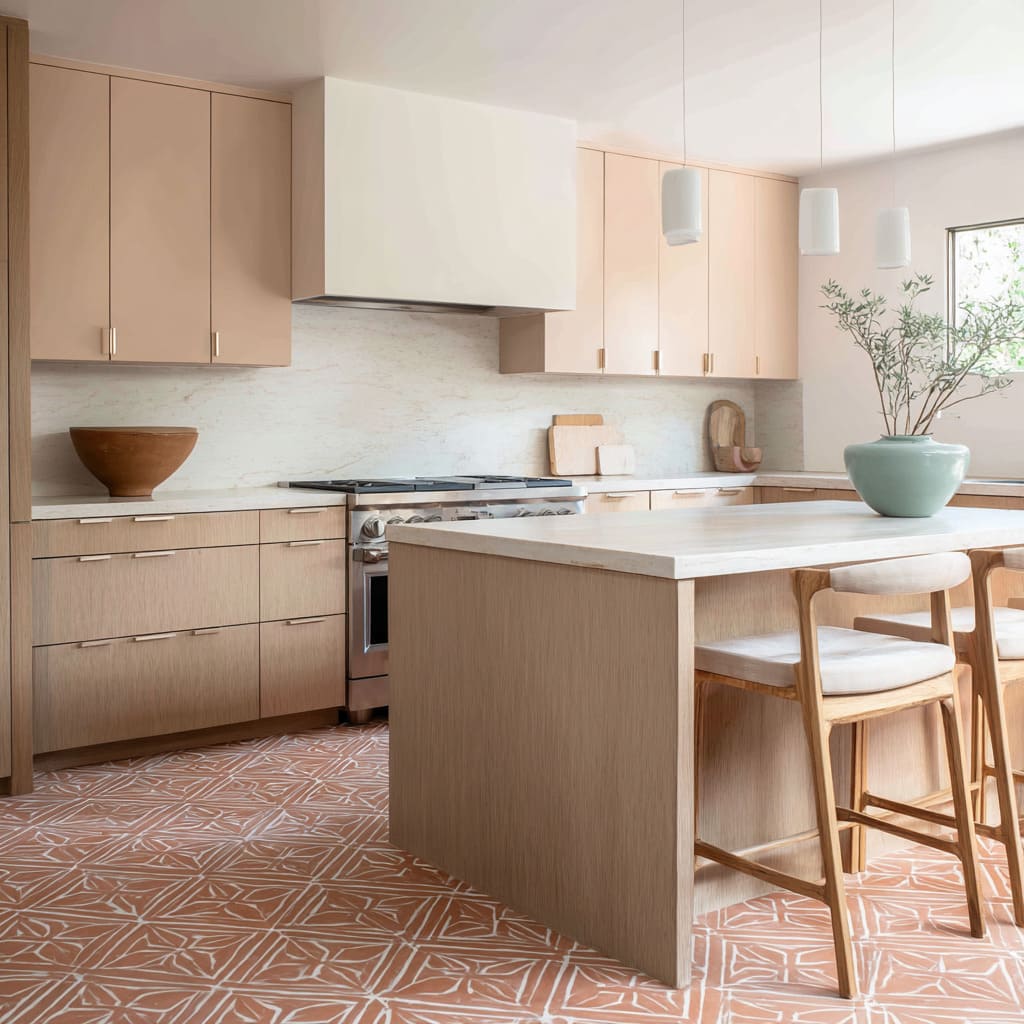
In calmer schemes, where the floor is satin stone or a clay-tinted porcelain with little joint visibility, wood often steps forward with more character: walnut cabinets with horizontal grain, chunky oak posts on islands, thick floating shelves with visible knots. These elements add warmth and depth where the floor is more like a smooth pool of colour.
A subtle hierarchy appears: terracotta governs the overall warmth, stone acts as mediator, and timber carries most of the sensory texture that hands and eyes interact with at close range.
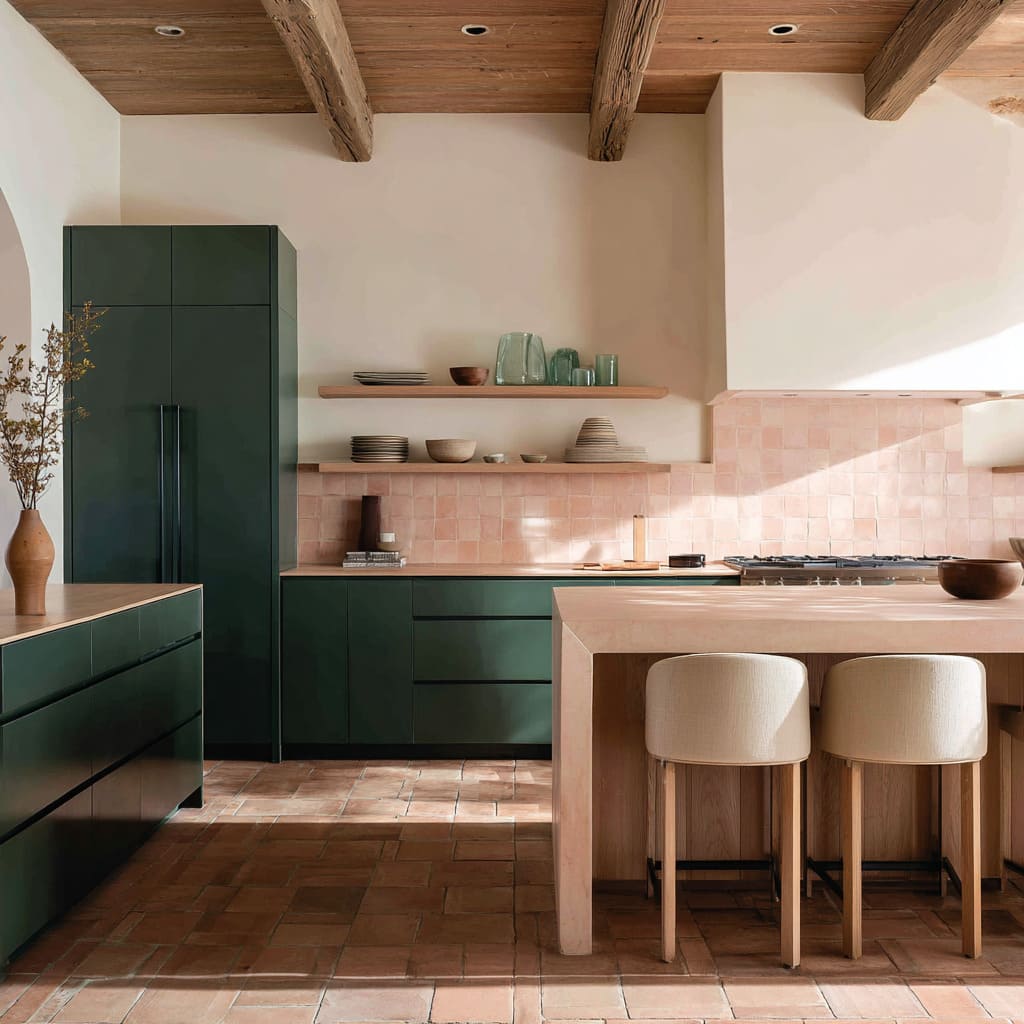
A repeated trick is to match the tone of stool legs and shelf boards to a mid-tone on the floor, not the darkest or the lightest. This makes timber feel like it “grew out of” the clay rather than being simply placed on top.
In rustic brick kitchen designs, the wood often stays a touch browner and cooler than the reddest tiles; in blush stone spaces, it moves closer to wheat and biscuit to stop the room sliding into peach overload. Timber becomes a careful counterweight to clay—never trying to overshadow it, always adjusting grain and depth to keep the overall picture balanced.
Clay on Three Levels: Floor, Objects and Walls
Terracotta that exists only as a floor can feel a bit disconnected, especially in very crisp modern shells. Many of the most resolved designs repeat the clay family at three heights: underfoot, at counter level, and at or above eye level.
On the floor, the color may be strongest—brick, russet, or multicolor hex. At mid-level, it returns through soft elements: pottery bowls, amphora-style vases, a bench cushion, a fruit bowl in a similar tone, perhaps a clay planter with branches.
Higher up, it appears as a painted wall panel, a run of blush tiles, or a handful of terracotta vessels on a floating shelf.
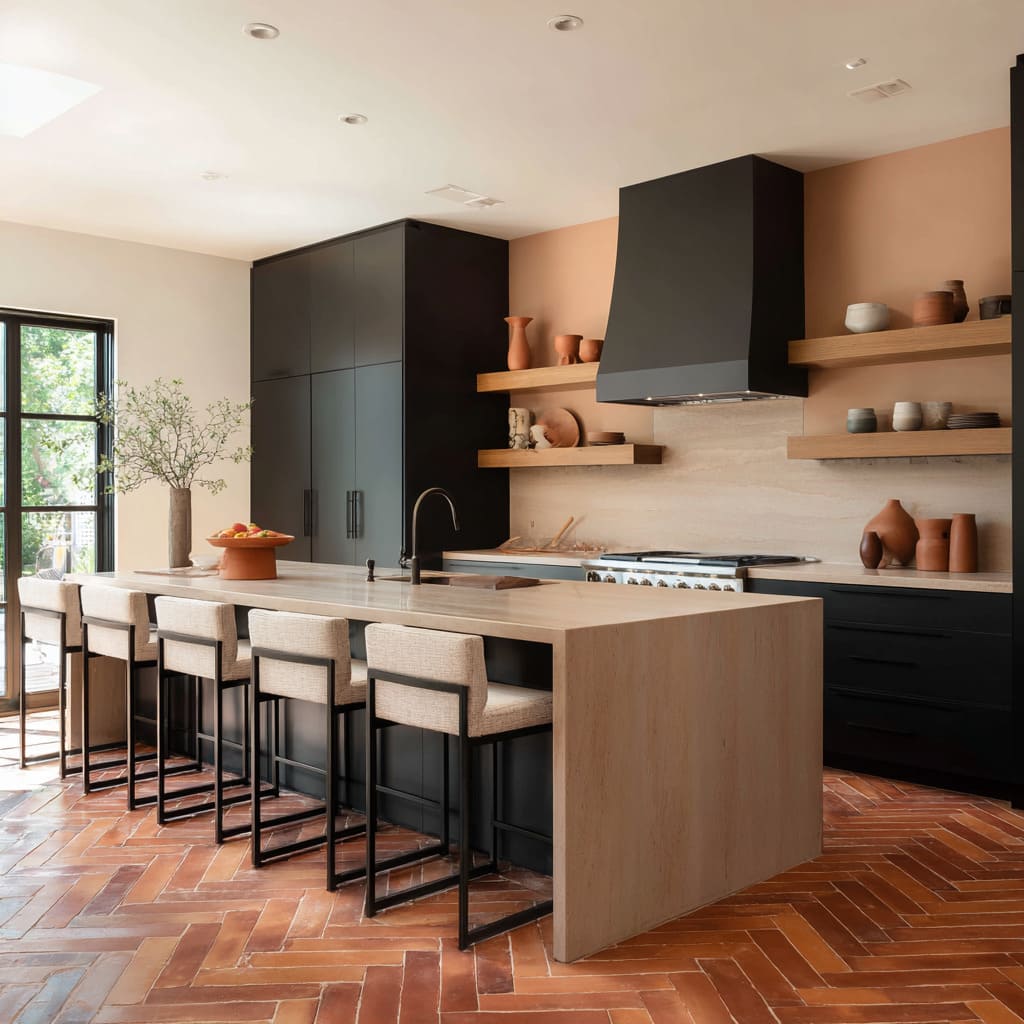
This vertical “ladder” of clay tones keeps the eye in constant contact with the floor color without overwhelming the space. A classic example is a square terracotta grid paired with soft grey cabinets and a terracotta-painted feature wall around the hood.
Another is a rustic brick floor echoed by a simple fabric cushion on a built-in bench in almost the same shade, with pottery on shelves repeating those hues again at head height. The repetition is never literal; the tones are shifted slightly dustier or lighter as they move up the room.
That way, the floor remains the richest expression of clay, while everything above whispers variations of the same idea. Terracotta becomes a thread that weaves through the entire section of the kitchen, rather than a single plane at the bottom.
Surface Sheen and Daylight: How Clay Changes Through the Day
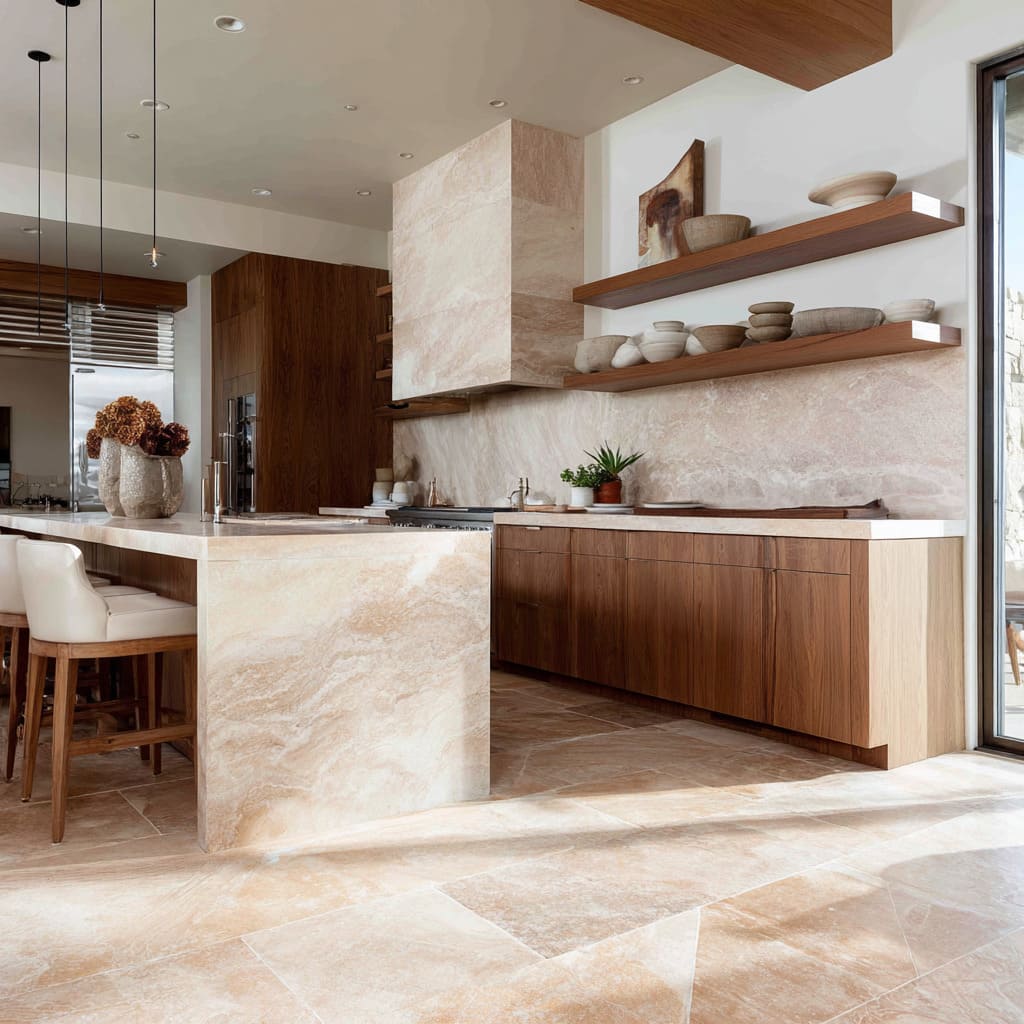
Sheen level is one of the quietest yet most impactful decisions in such kitchen designs. Slightly glossy stone with clay veining turns the floor into something almost liquid: large tiles reflect a softened view of windows and islands, making the room feel taller and brighter.
Other elements usually stay matte or satin, so the reflection is concentrated underfoot. The terracotta influence is then read as a glow within the slabs rather than as a flat colour; blush and honey threads appear when light strikes at certain angles and disappear in shadow.
Satin and low-sheen terracotta, whether in plank tiles or bricks, gives a very different sensation. The surface catches light in a gentle, dispersed way, especially on worn brick faces and micro-chipped edges.
Near windows, tones deepen and sparkle slightly; in deeper parts of the room, the same tiles look almost velvety. Rustic floors in particular rely on this uneven reflection to feel lively and timeworn, even when newly installed.
Matte or low-sheen finishes also allow rich cabinet colours—navy, forest green, charcoal—to stand confidently without having to compete with bright glare from the floor. In checkerboards and patterned clay grids, a hint of sheen helps the pale segments stay crisp so the pattern reads clearly even when terracotta squares darken with shadow.
The interplay between sunlight, reflection, and clay pigment means such kitchen designs subtly change character as the day moves: mornings can feel bright and airy, with pale squares and blush tiles glowing; evenings become more cocooning as clay deepens toward cocoa and rust while stone islands hold onto small pools of light.
Cabinet Colors with Clay Floors: From Charcoal to Soft Blush
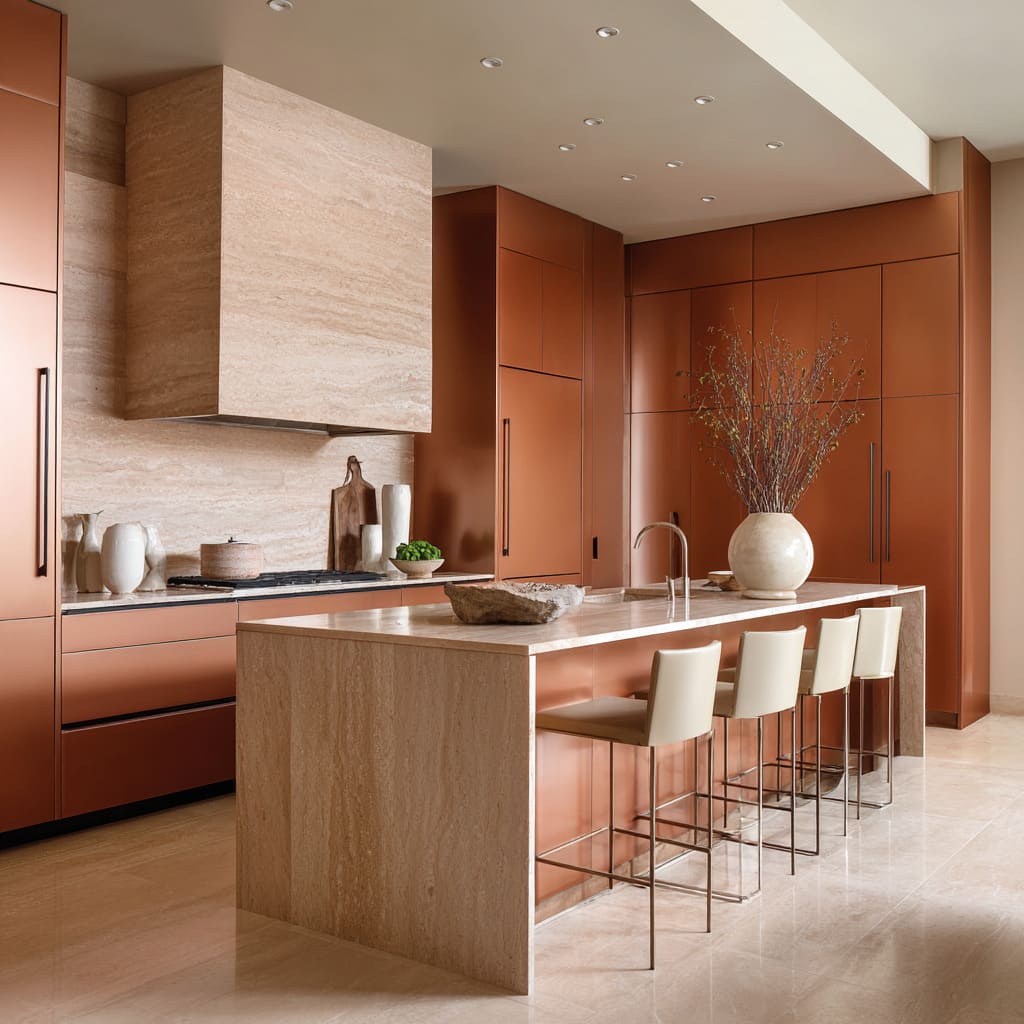
Terracotta floors have a particular way of setting limits for cabinet colors without forcing a narrow palette. Deep shades—navy blue, forest green, or charcoal—create strong blocks that sit calmly above rustic bricks and quarry tiles.
In these combinations, black or navy reads almost as a quiet backdrop, letting the floor act as the expressive surface. The darkness makes terracotta look brighter and more saturated near plinths, while pale stone worktops provide a middle band that softens the contrast.
This balance often appears in more dramatic schemes where the aim is a warm yet crisp look rather than something purely rustic. Such compositions are sometimes discussed as bolder terracotta kitchen floor ideas where clay and dark cabinetry share equal visual weight.
On the softer side, very light grey, greige, and blush-painted cabinets wrap terracotta in a pale envelope. Checkerboard floors or herringbone bricks suddenly feel friendly and almost playful when fronts hover between putty and mist.
Hardware tends to be slim and tone-on-tone, so there is no competing metallic grid guarding the lower cabinets. Clay can come up onto the wall through blush tiles or a pastel-painted section; in others, cabinets pick up only a faint echo of the floor colour and stay resolutely soft.
The common thread is discipline: when cabinets carry color, the floor clay usually sits at a quieter volume, and when the floor takes the bold role, cabinets retreat into muted shades.

Patterned Terracotta: Grids, Stripes, Hexes and Graphic Motifs
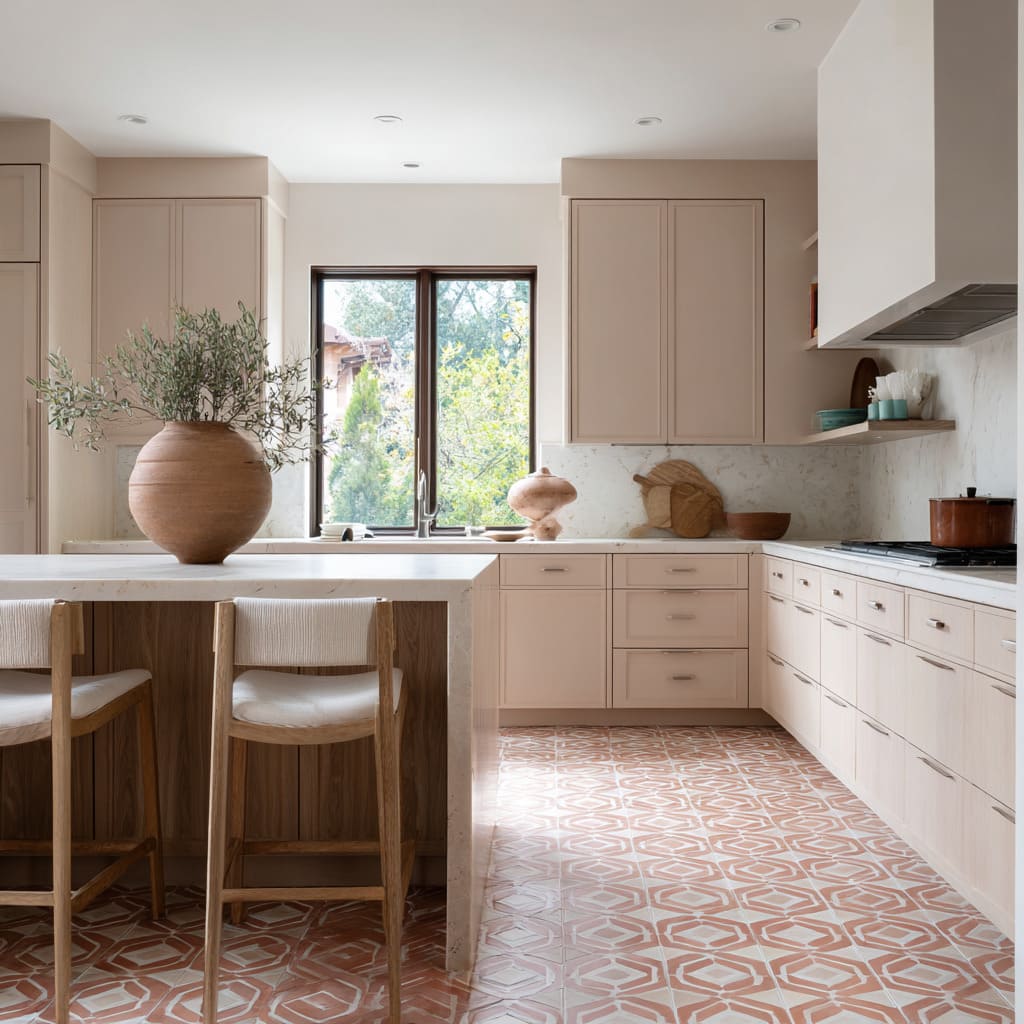
Pattern on the floor can be built entirely from terracotta tones, or from clay paired with cream or white linework. Classic square tiles in a grid feel familiar but gain new character when each piece varies slightly—some leaning orange, others brown, a few with cloudy marks—so the surface resembles a handmade quilt rather than a printed sheet.
Checkerboard layouts with warm cream and soft brick have a similar effect. They bring rhythm underfoot without tipping into retro, especially when the surrounding palette is tuned to warm neutrals instead of cold white.

There are also more graphic directions for terracotta tiles kitchen ideas. Some designs use patterned tiles where terracotta is the background and white motifs form continuous diamonds, leaves, or linked hexagons.
The pattern runs uninterrupted under cabinets and islands, and furniture legs appear like small posts inside a drawn grid. Cabinets in pale timber and pastel clay shades act as a quiet envelope so that the floor can carry the main visual interest.
Elsewhere, hexagonal tiles in multiple clay tones—deep burnt orange, apricot, coral, beige, even muted sage—form a mosaic that changes mood from one corner to another. Careful placement prevents similar colours from clustering and keeps the field balanced.
Such hex zones transition organically into timber by letting a few tiles step into the wood, as if the pattern were ebbing away. Striped arrangements introduce yet another language: alternating terracotta and sand-toned bricks laid in long bands create ladder-like floors that visually widen the room.
These stripes are often echoed in open shelving and long handles, turning the whole kitchen into a set of horizontal beats. The floor in these cases no longer reads only as a surface; it becomes the first piece of quiet graphics in the space, with every other element respecting its rhythm.
Seating, Shelving and Small Decor: Completing the Clay Story
Stools, shelves, and small accessories play a far bigger role than it might seem in tying terracotta floors into the rest of the kitchen. Many schemes treat seating as part of the floor composition.
Stool legs almost always pick up either a mid-tone in the clay or the timber that bridges clay and cabinets. Seats are covered in fabrics close to the lightest tile or stone shade—soft cream, linen, pale grey—so they read as floating pads above the floor rather than heavy blocks.
When stools line up along a herringbone or checkerboard, their legs create a repeating vertical rhythm that turns the floor pattern into a gentle 3D grid.
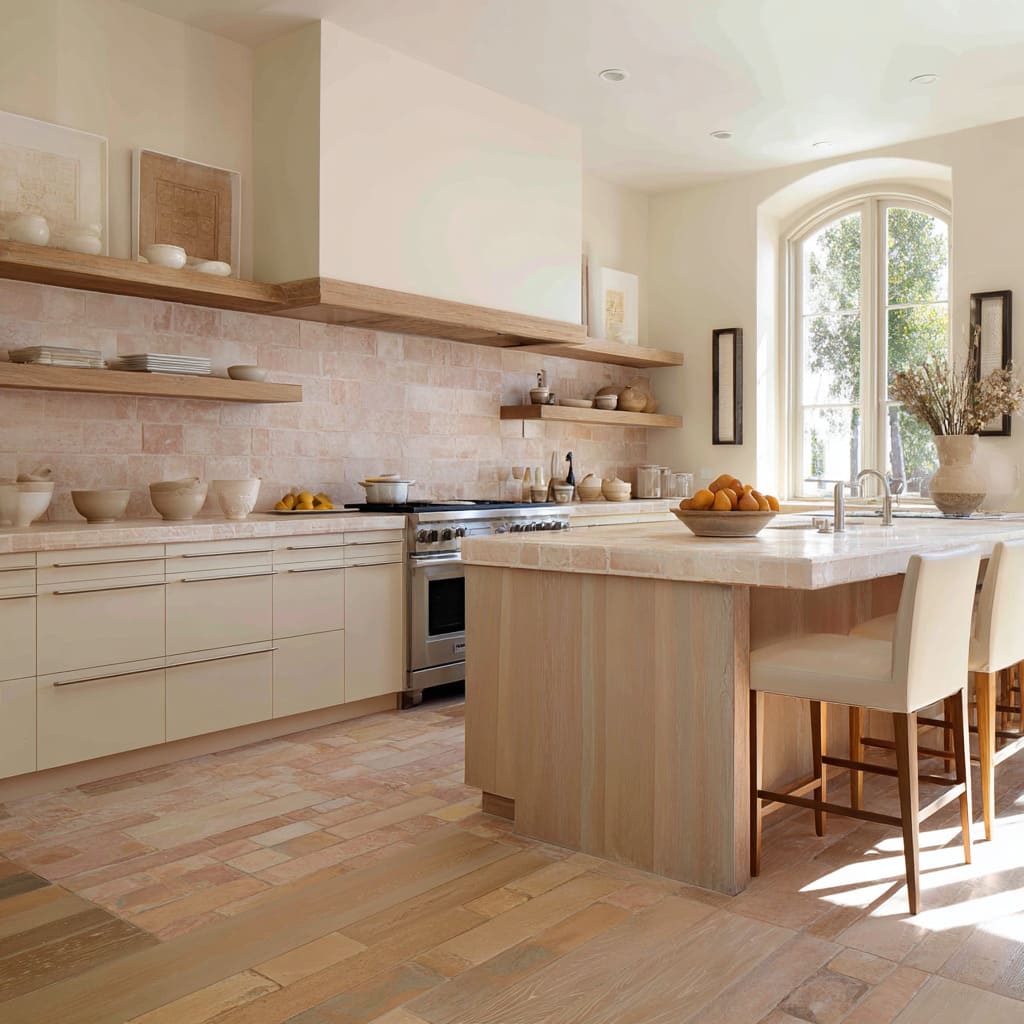
Floating shelves extend this idea up the wall. Their timber tones usually match floor-adjacent elements like stool legs, island bases, or door jambs.
Objects displayed on them are carefully edited: clusters of clay pots, pale ceramics, a few darker vessels, maybe a single brighter piece that echoes fruit on the counter. Turquoise and teal glass appear frequently as cool accents that cut through the warm palette without adding visual weight.
Often, only one or two green or blue pieces sit among a larger family of stone and clay, which keeps the mood grounded and natural.
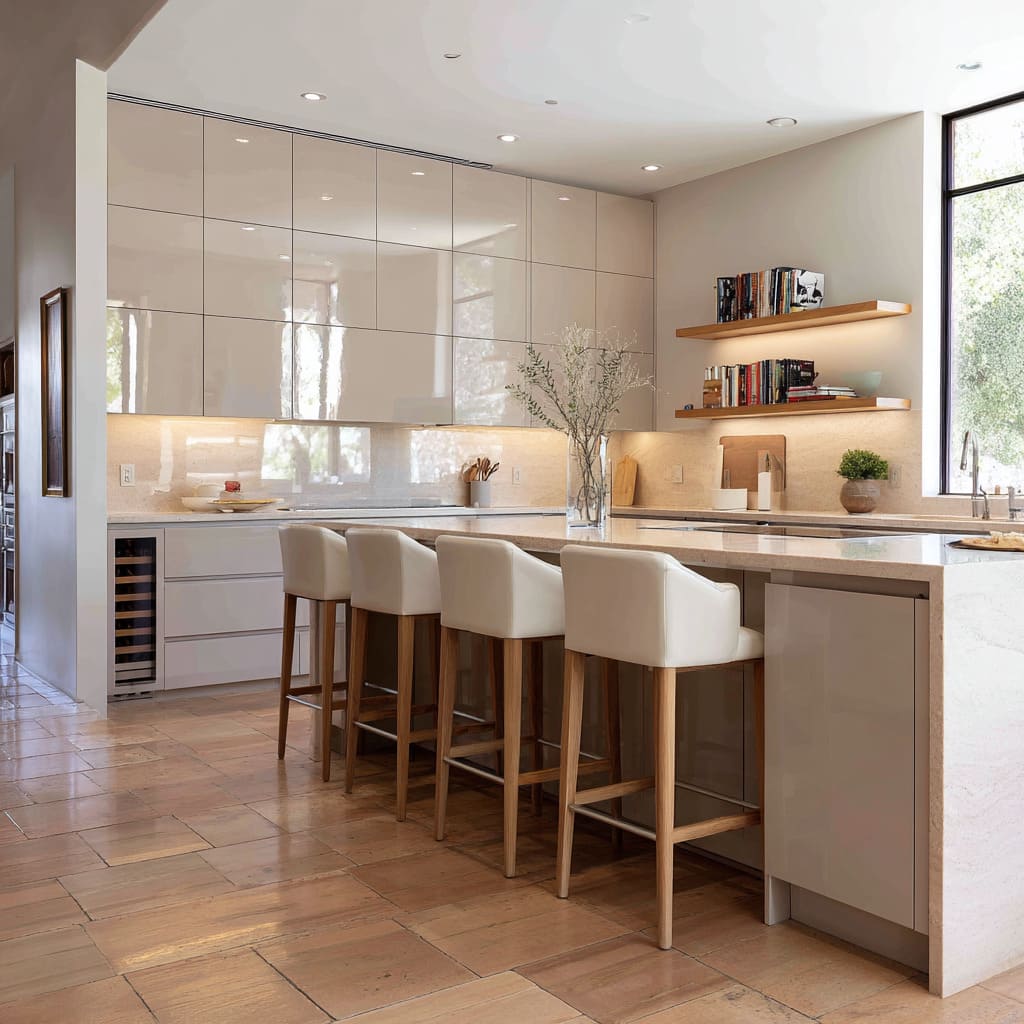
On counters and islands, decor often feels like small geological still lifes—rough stone centrepieces, bowls of limes or oranges that pull out undertones in the floor, tall branches in terracotta or sandy vases repeating the idea of vertical movement that ceiling lights or window mullions already suggest. The key is that objects rarely fight the clay; they either repeat its warmth in a softer way or provide a minimal cool contrast that lets terracotta feel richer by comparison.
Together, seating, shelving, and small decor allow the floor to connect with the rest of the room through many small, consistent echoes rather than a single bold gesture.
Mood Narratives: Rustic Detail, Quiet Gallery, and Urban Edge
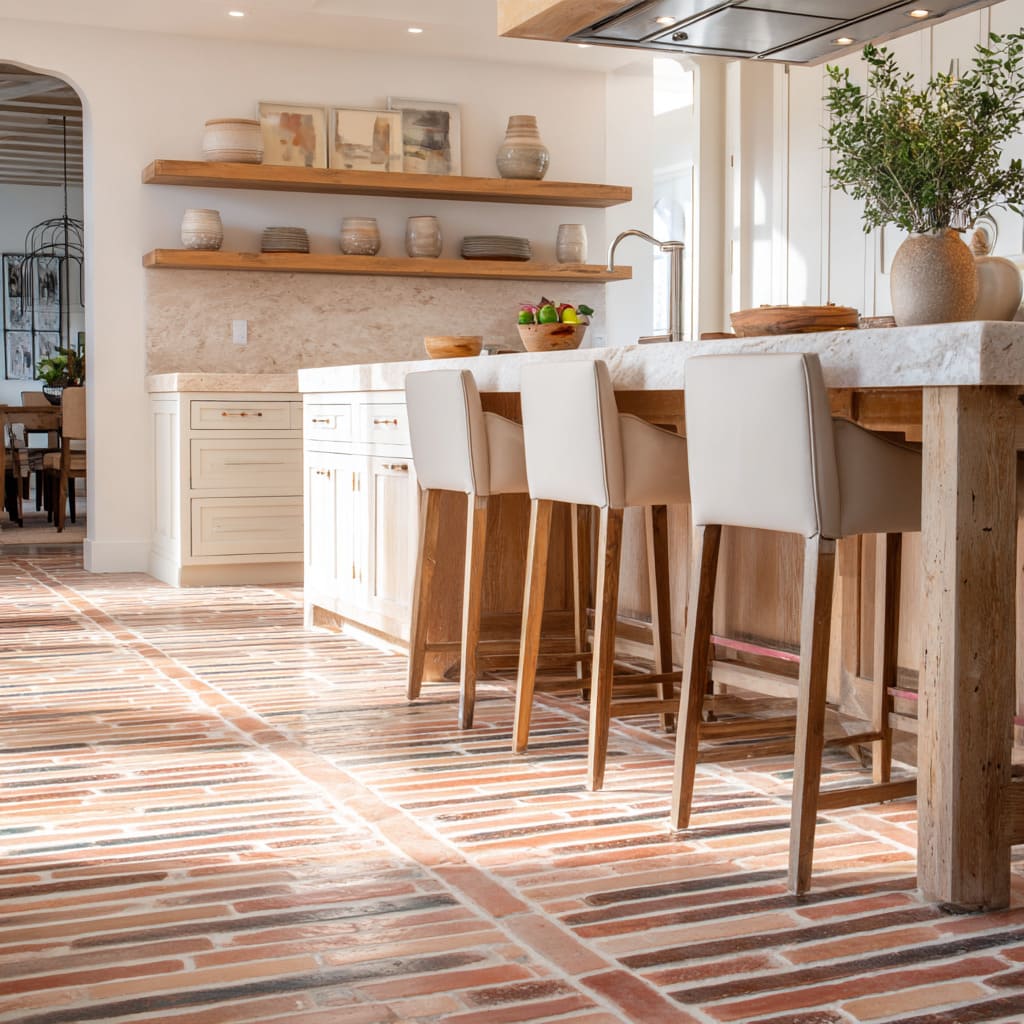
Different distinct atmospheres appear depending on how terracotta is handled. One group leans into rustic detail: irregular bricks, chipped faces, and worn edges set under navy or bottle-green cabinets, with warm wood shelves and pottery that feels hand-thrown.
These designs recall farmhouses and courtyards but are kept crisp by simple joinery and pale stone so they never collapse into nostalgia. The floor brings the story of age and craft; cabinetry and hardware bring structure.
Another group feels like gallery spaces that simply happen to contain a kitchen. Here, clay is dissolved into stone veining or concrete tints, floors are large-format and almost seamless, and cabinets are gloss or ultra-smooth in soft putties and blushes.
Terracotta appears as a glow in polished surfaces rather than as visible tiles. Islands in such designs often act as sculptural blocks, with carefully book-matched veining that drapes over edges like marbled fabric.
The mood is calm and airy, where clay is less about rusticity and more about soft color suspended in mineral surfaces.
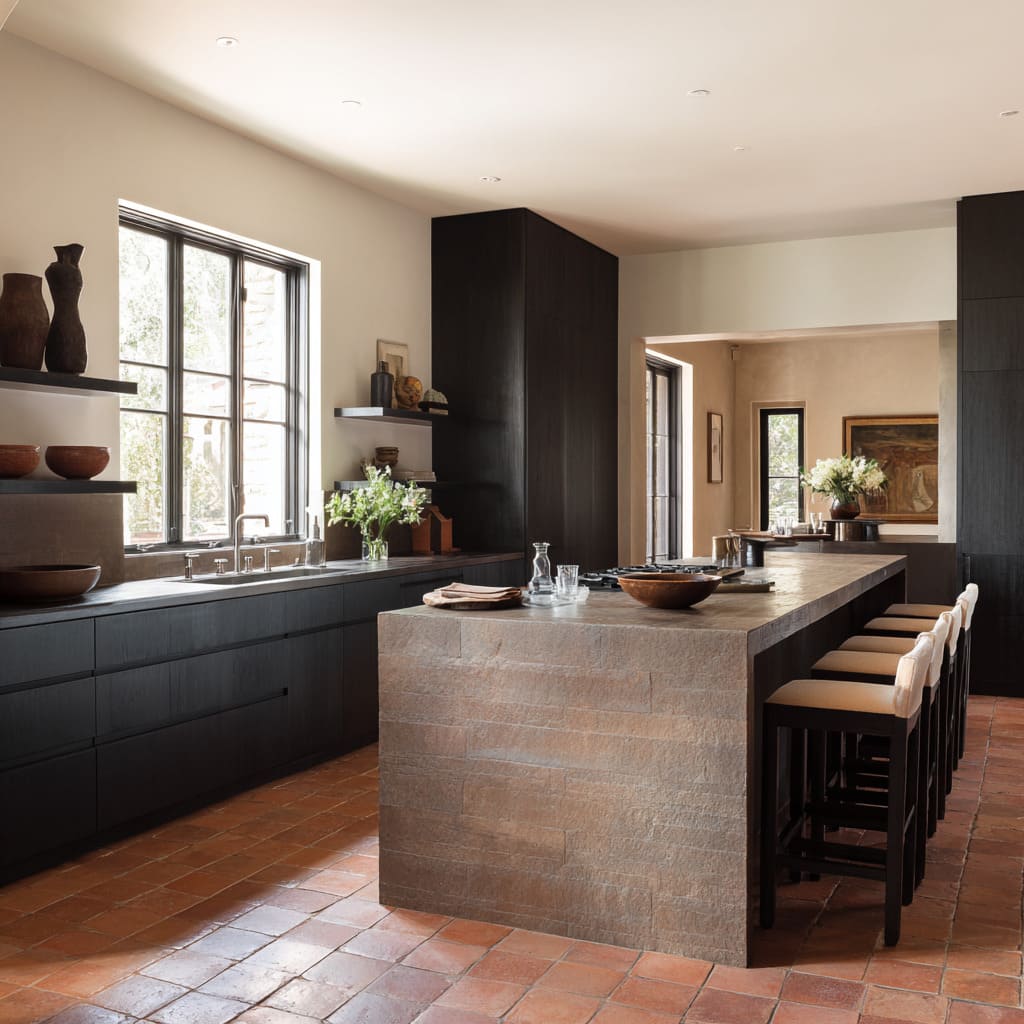
A third group carries an urban edge: bold terracotta herringbone under black cabinets, graphic patterned tiles in milk-chocolate and white under pale timber islands, or clay slabs paired with deep charcoal and dark metal. Here, terracotta is allowed to be strong and graphic, but the rest of the palette is tightly contained—stone is pale and thin-edged, hardware minimal, lines straight and spare.
The balance between warmth and shadow gives a kind of quiet strength: clay stops them feeling cold, while dark joinery keeps them from drifting into purely cosy territory. In all of these narratives, terracotta underfoot is the one constant factor; its tone, pattern, and texture decide whether the kitchen feels closer to a courtyard, a gallery, or a city loft.
Clay as a Quiet Structure in Modern Kitchen Designs
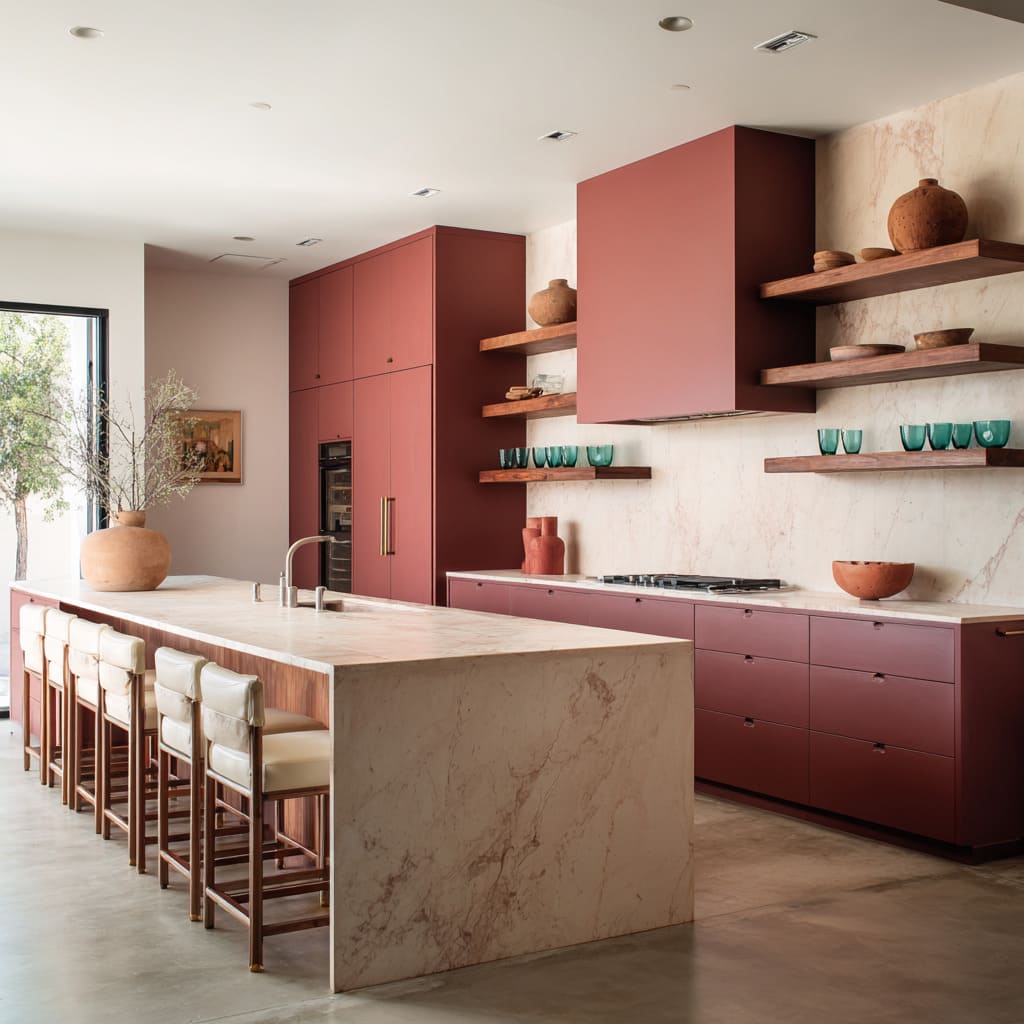
Taken together, such kitchen designs show terracotta functioning less as a decorative accent and more as a structural part of the visual architecture. Underfoot, clay controls warmth, sets movement through pattern, and often defines the active core of the room through platforms or inset zones.
In section, it climbs gently up through objects and occasional wall planes, creating a vertical chain that keeps the floor color woven into everyday sightlines. In composition, it enters into long-term alliances with stone and timber so that no single material dominates.
Terracotta can whisper as a tint in polished slabs, speak clearly as honey-toned stone, or lead the conversation as patterned brick and tile. The most successful schemes treat it as a material language with many dialects rather than as a single color: blush concrete that holds berry cabinets kindly, rustic hexes that frame walnut and pale stone, gentle checkerboards that sit under mist-grey joinery, or graphic grids that turn the floor into a living textile.
Through all of these versions, designs stay grounded in something that feels tactile and human. The clay underfoot anchors glossy doors, slim lighting, and precise appliances in a mineral story that reaches far beyond trends, giving even very modern spaces a sense of warmth and continuity.