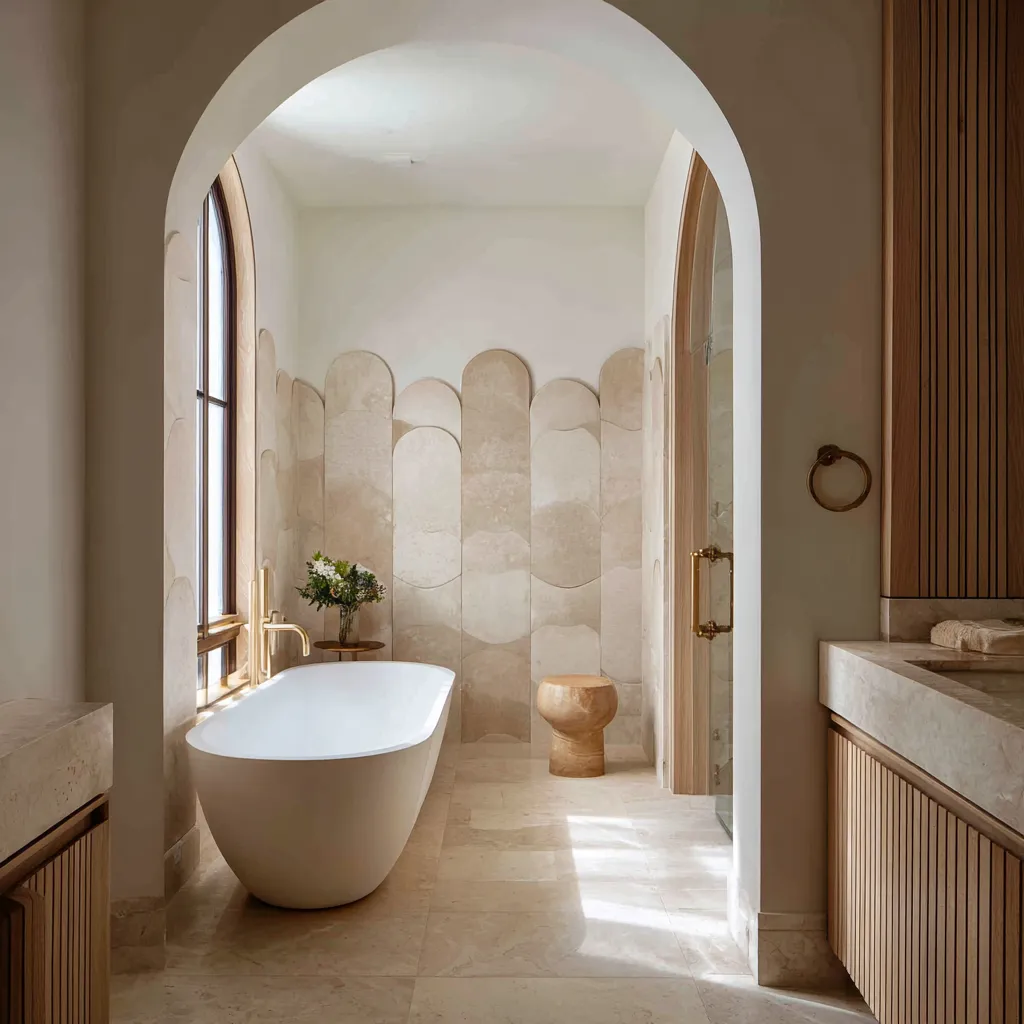
Fresh modern Spanish Revival bathroom design is not created by stripping away the style until only a neutral spa room remains. The designs keep the thick arches, shaped plaster, mineral warmth, and sense of shelter that give Spanish Revival its character.
What changes is the way those elements are edited. Ornament steps back.
The shell takes over. Fixtures become calmer.
Wood is used with more discipline. Light does more of the visual work that tile borders, carved trim, and decorative extras once handled.
That shift matters because many people are drawn to Spanish Revival bathroom concepts for their softness, warmth, and old-house soul, but they do not want a room that feels dark, busy, or stuck in a themed version of the past. Modern approaches solve that tension beautifully.
They keep the design rooted in masonry, plaster, and arched form, then sharpen the composition with a few current notes such as a leaner mirror, a dark window frame, a floating vanity, a ribbed insert, or one sculptural light. The result is a bathroom that still feels Spanish Revival in its bones, yet feels easier, lighter, and more architectural for current homes.
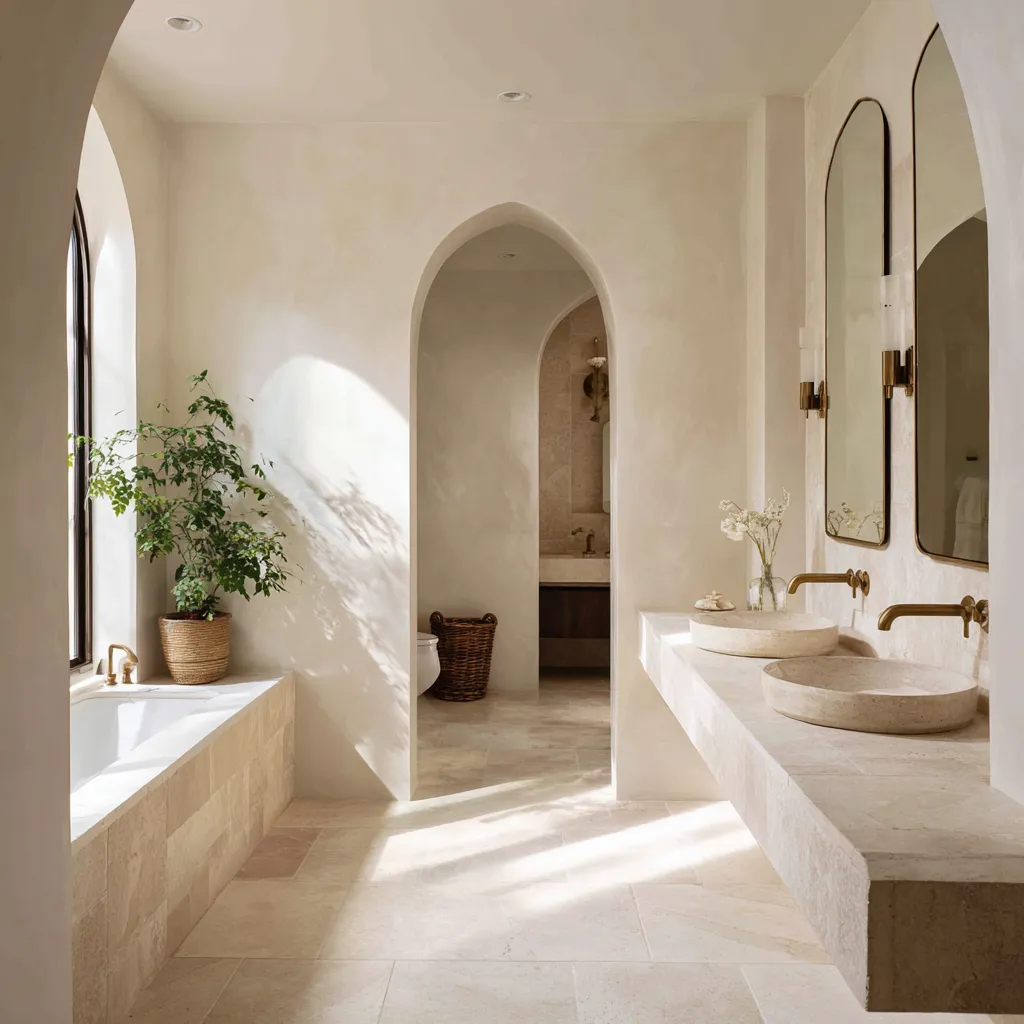
The style lives in the shell
Fresh-looking Spanish Revival depends less on decorative add-ons and much more on the room’s structure. The interior designs do not rely on many little historical references.
They rely on a few large spatial moves that carry far more weight.
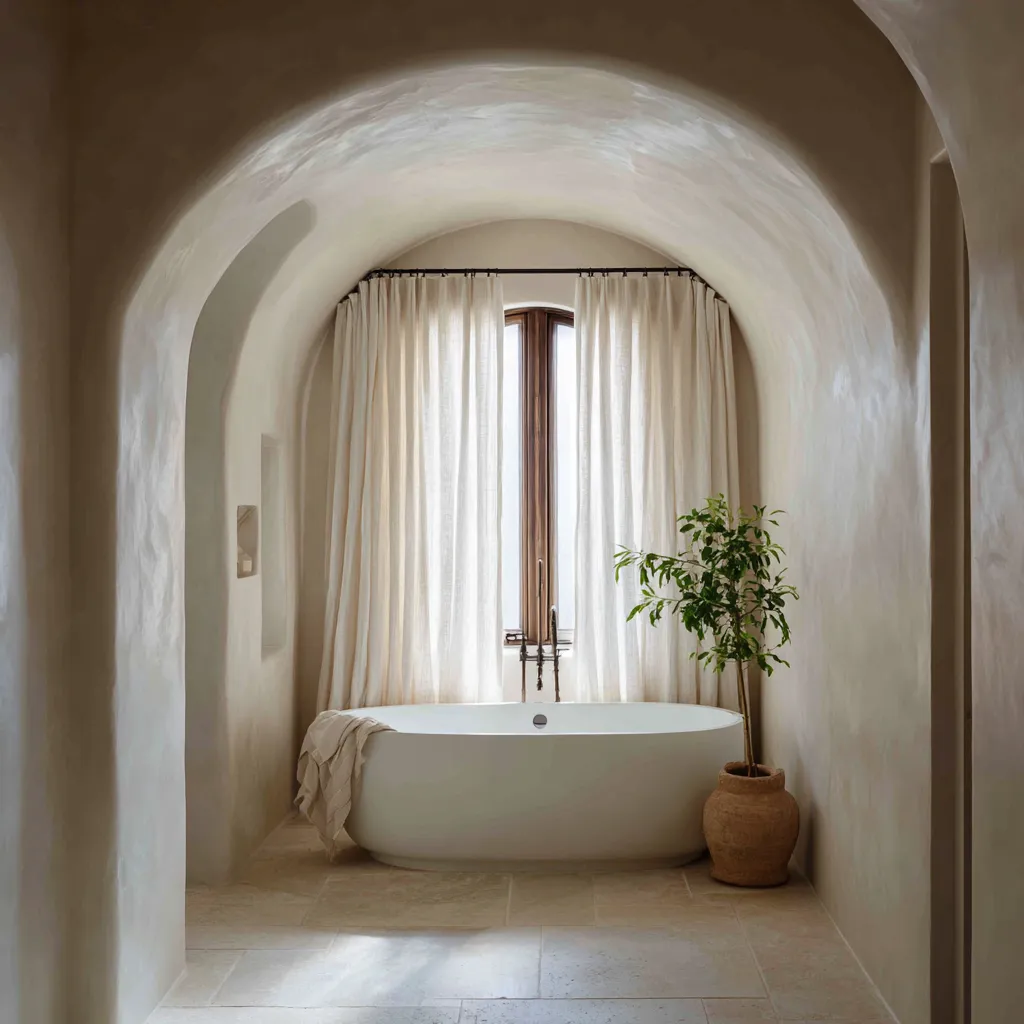
That usually means thick arches instead of many decorative trims. It means a vaulted or softly shaped plaster ceiling instead of a ceiling crowded with beams and details.
It means a tub set into a recess, beneath an arched window, or behind a threshold rather than a bath dropped into the middle of an ordinary room and then styled heavily around it. It means warm stone, creamy plaster, deep wall openings, and a sense that the room has been carved from mass rather than assembled from separate parts.
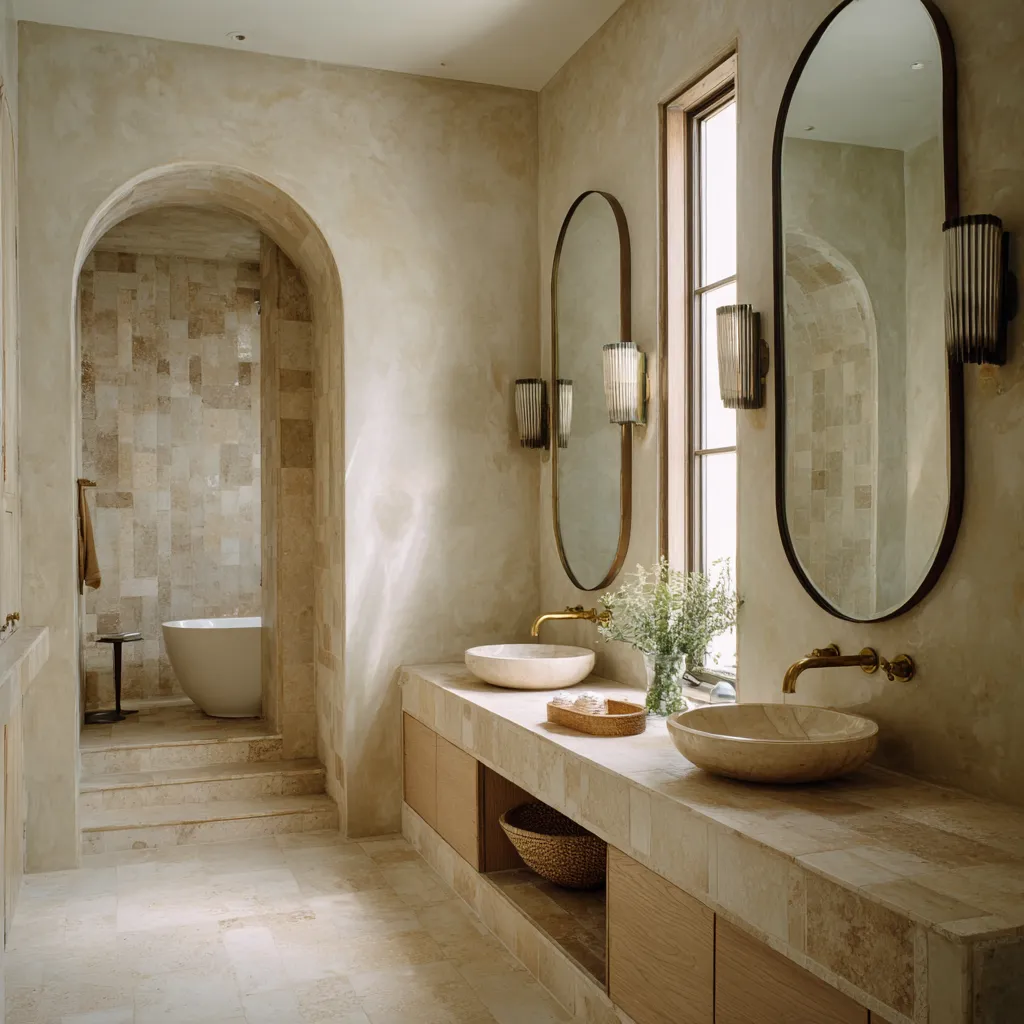
This is why the fresher designs feel calmer. The architecture is doing the talking.
Once the shell is strong enough, the room does not need much else. A useful way to think about it is this: the old side of the style carries the body, the shelter, the arch, and the mineral warmth.
The modern side carries precision, editing, line control, and openness. When those jobs stay separate, the room feels coherent instead of confused.
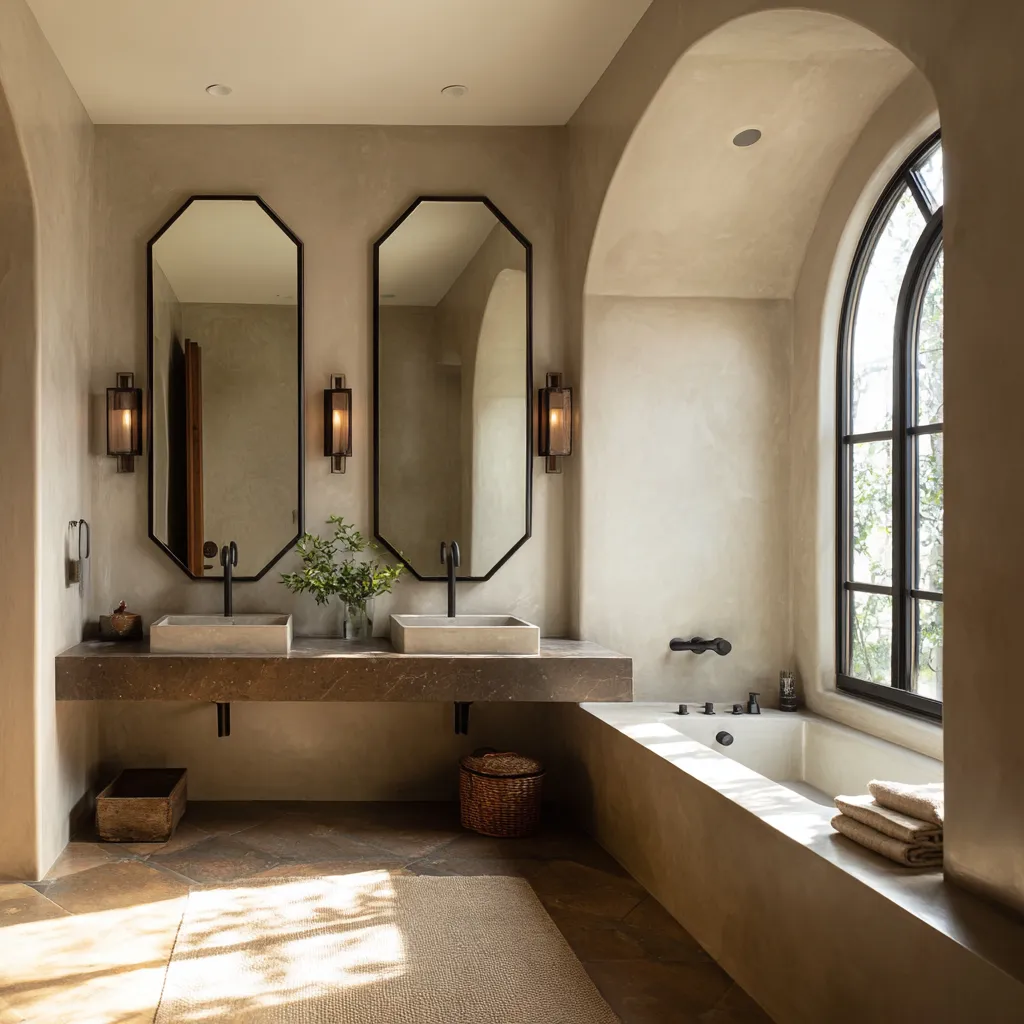
Why shaped plaster matters more than rustic detail
People sometimes assume Spanish Revival has to lean on dark beams, ornate iron, heavy wood, and obvious historical gestures to feel authentic. In bathroom design, the opposite often works better.
The fresher bathroom designs are usually plaster-led rather than timber-led.
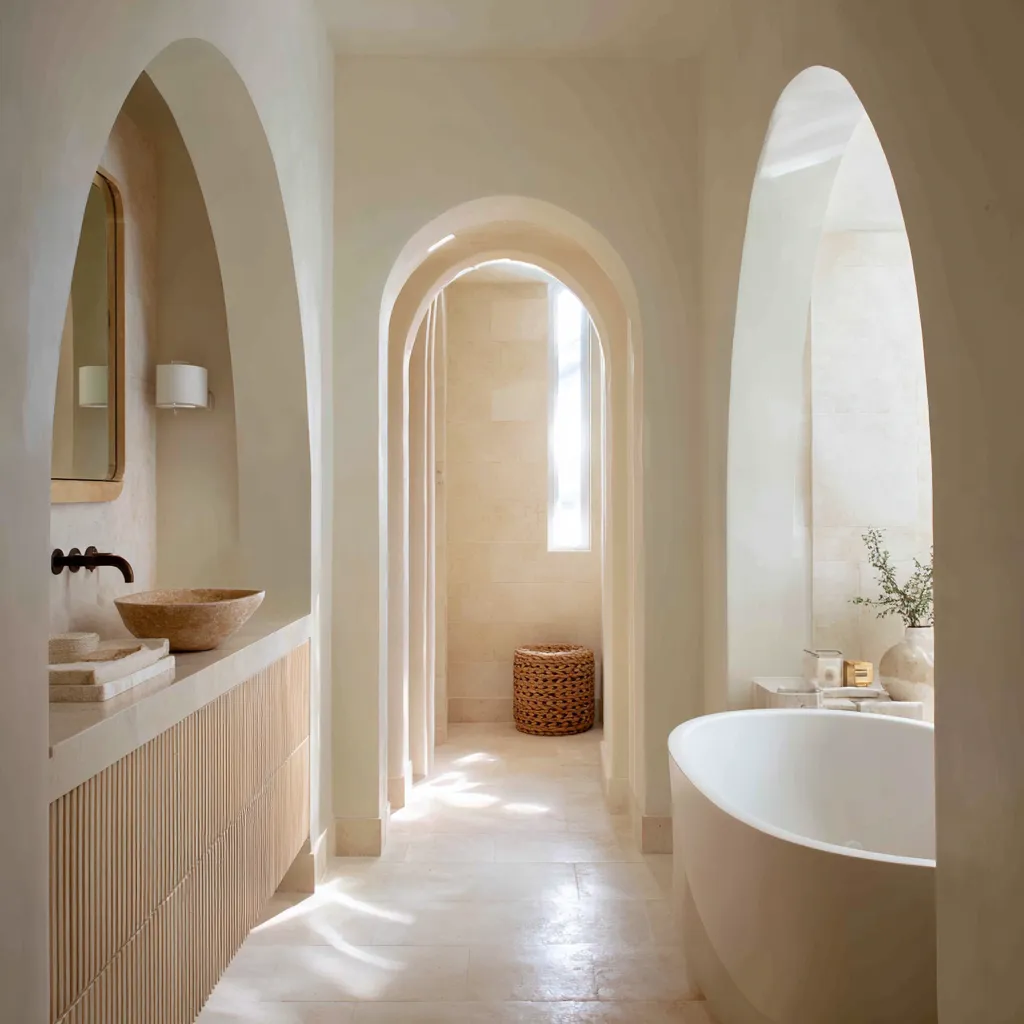
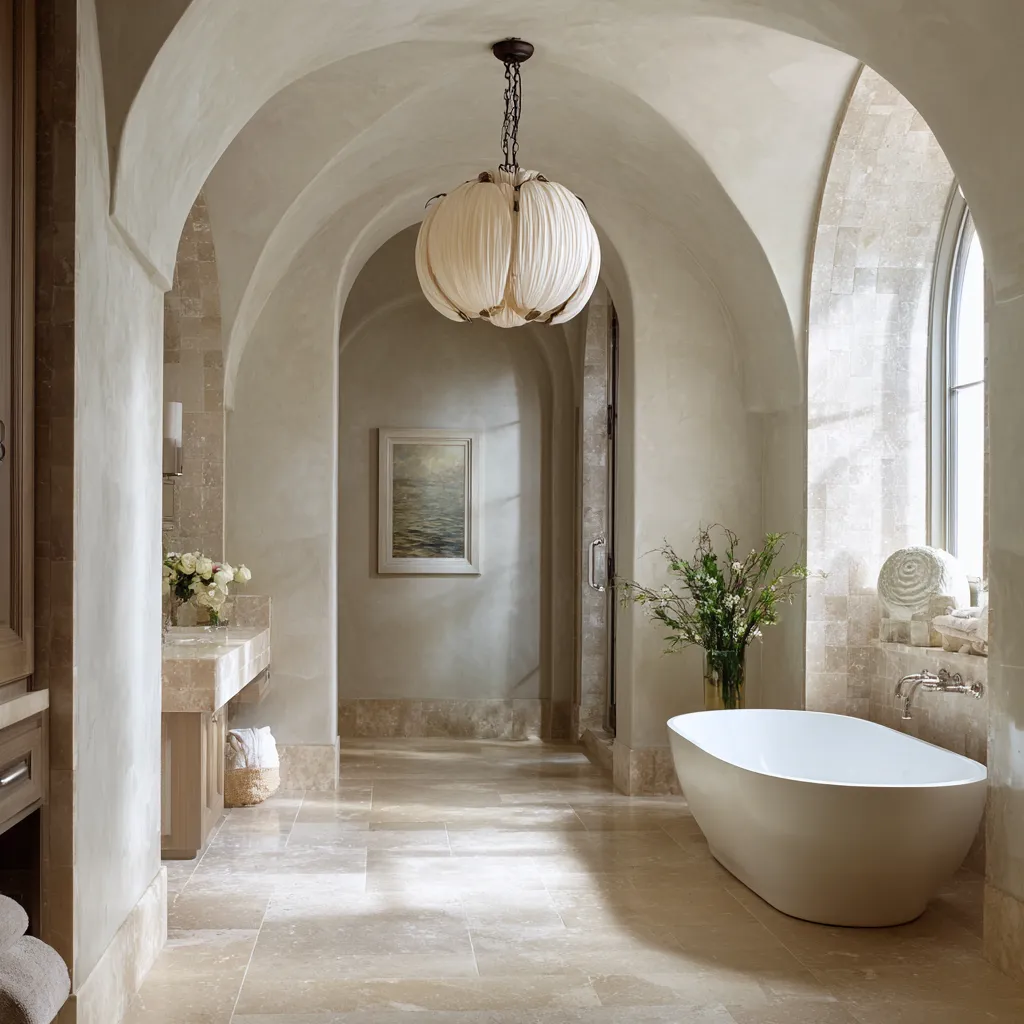
That means the ceiling and upper walls are often smooth, creamy, softly vaulted, and visually quiet. These ceilings still feel deeply Spanish because the shape itself carries the old architectural memory.
A broad vault, a softened barrel ceiling, a curved threshold, or an intersecting plaster form can give a room far more identity than a collection of smaller rustic notes.
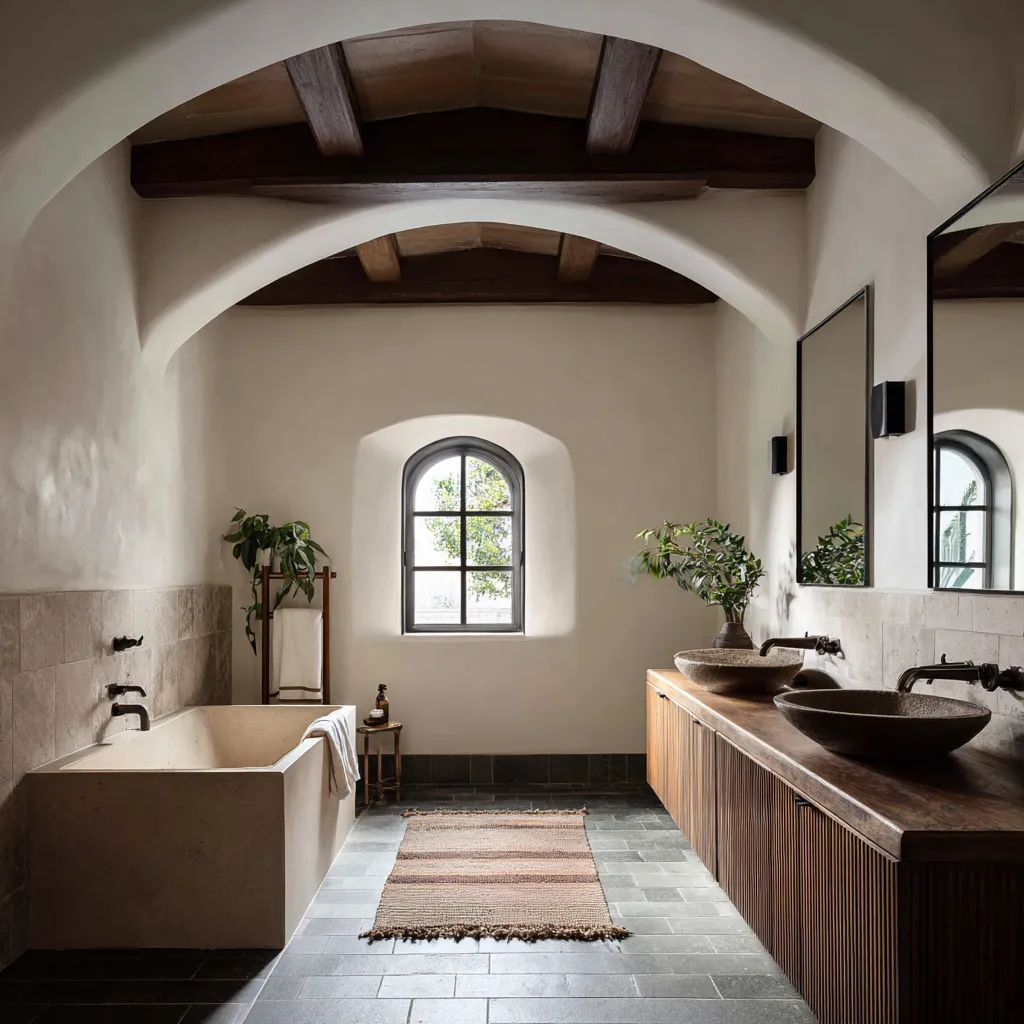
This shift is important because bathrooms need a certain calm. Strong timber overhead can bring age and weight, but too much of it can make a bath feel visually crowded or darker than it needs to be.
Soft plaster vaults hold onto the sheltering quality of the style while letting the room stay brighter and more restful. If you want a Spanish Revival bathroom to feel fresh, the ceiling is often the first place to simplify.
Instead of adding decorative features overhead, ask how the ceiling can become a better shell.
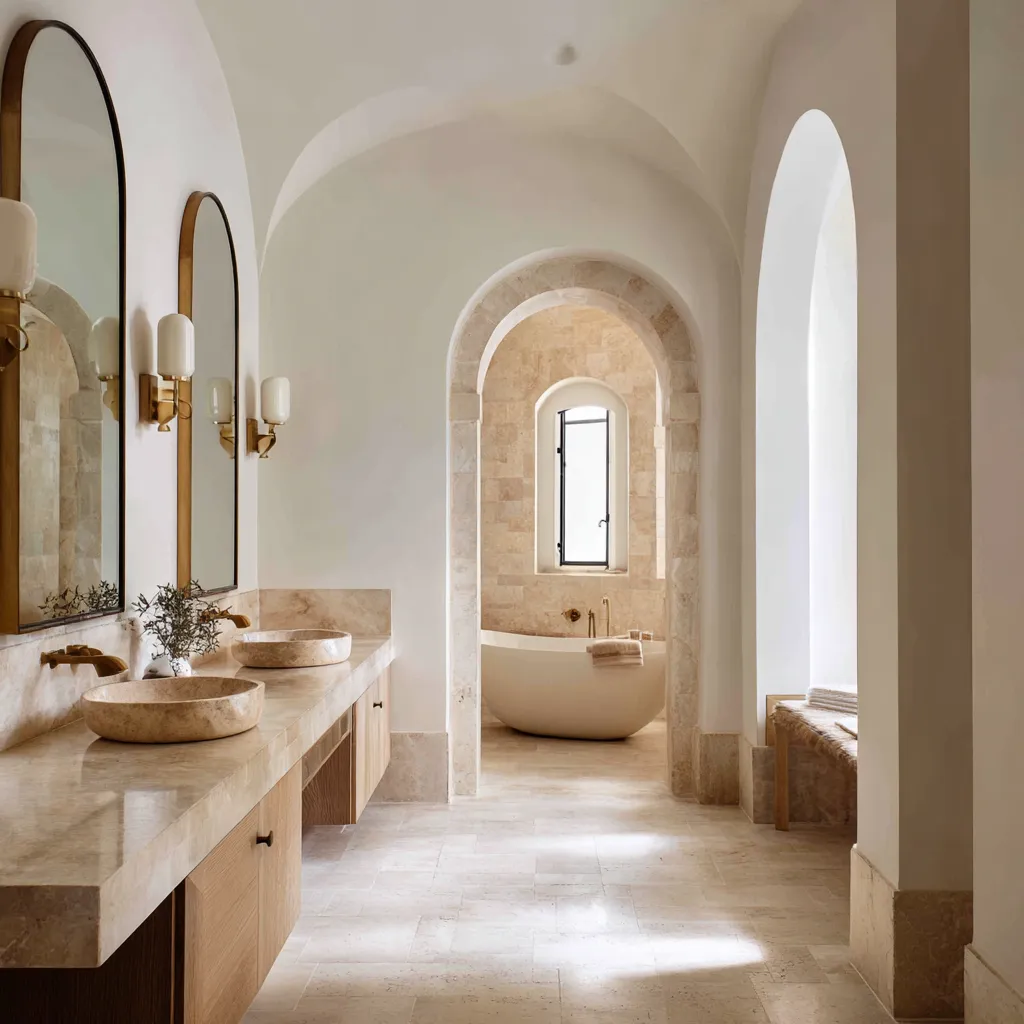
The tub should match the room’s emotional goal
One of the modern Spanish Revival ideas is that freshness does not depend on one tub type. Both freestanding tubs and built-in tubs can work beautifully.
What matters far more is how the tub behaves inside the room. A plain freestanding tub suits a bathroom that wants softness, air, and visual pause.
In a room with thick arches and a strong shell, a simple tub can act like a quiet white object placed inside a richer architectural frame. This approach keeps the bath feeling light and spa-like.
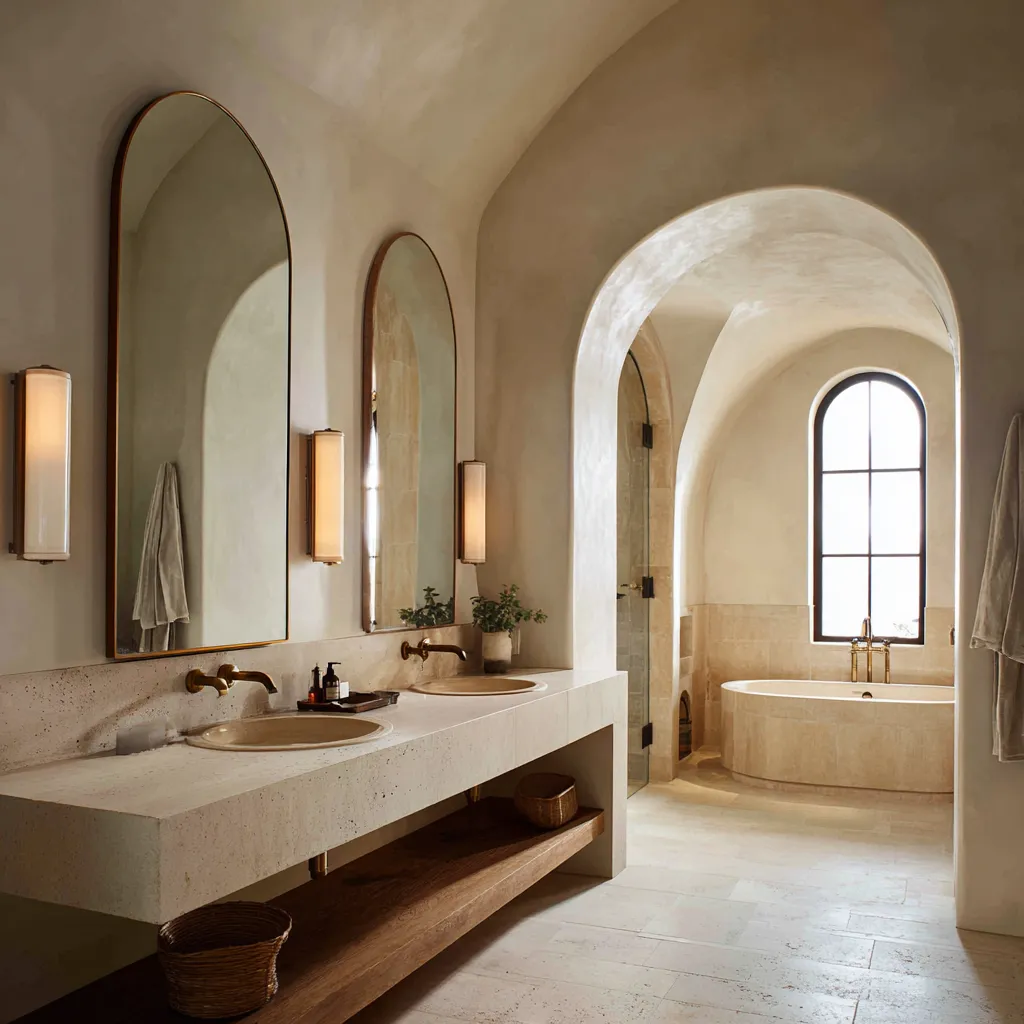
A built-in or masonry-like tub suits a bathroom that wants more rootedness and stronger wall-thickness logic. It creates a deeper sense of intimacy because the bathing act feels held by the room rather than placed inside it.
This is often the stronger route when the goal is protective warmth, old-house gravity, or a more integrated Spanish feel. A raised alcove tub adds another layer.
Once the bath sits beyond a step, inside a niche, or at the end of a framed passage, the room gains a ritual quality. Bathing feels like a destination, not just a fixture placement.
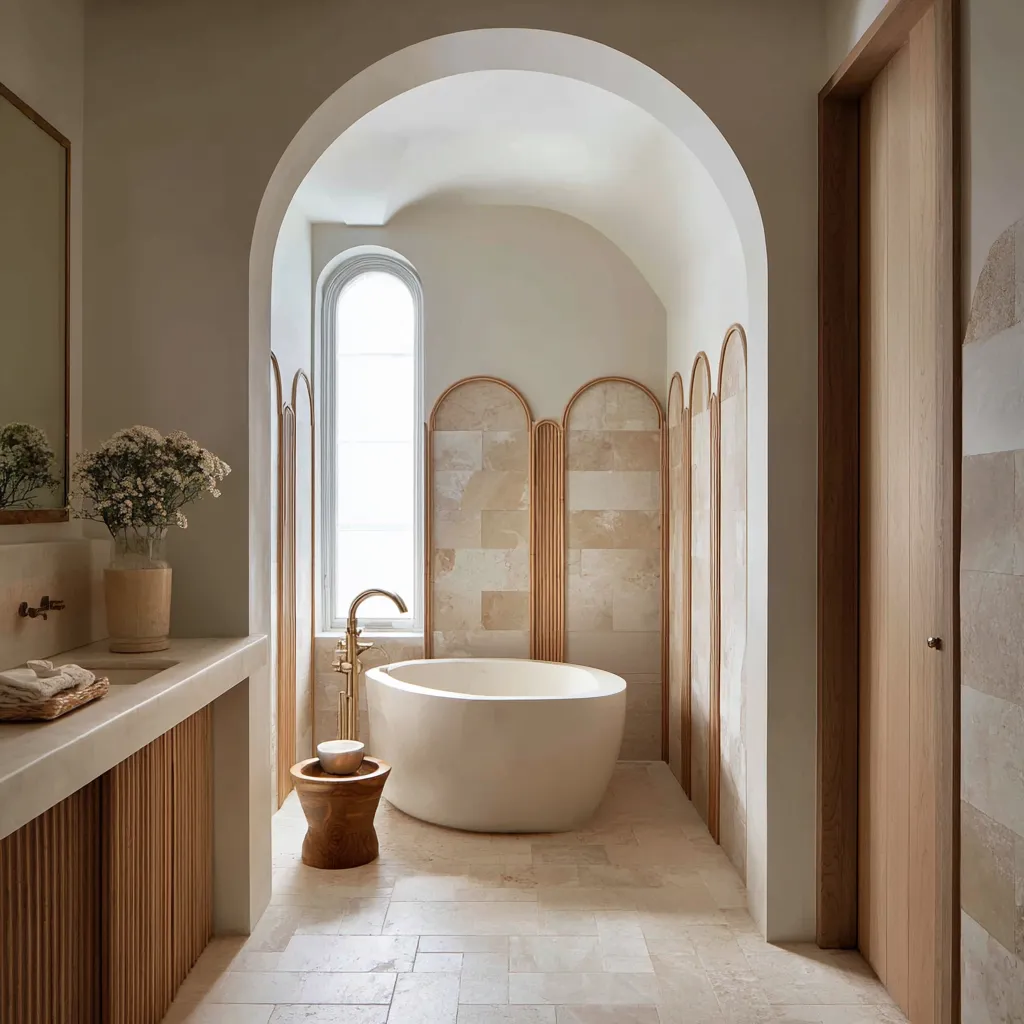
The question, then, is not simply freestanding versus built-in. The better question is how exposed the bathing moment should feel.
A fully centered tub creates ceremony and stillness. A side tub that is partly concealed creates privacy and gentler luxury.
A recessed built-in bath creates shelter and rootedness. Each choice changes the mood of the room.
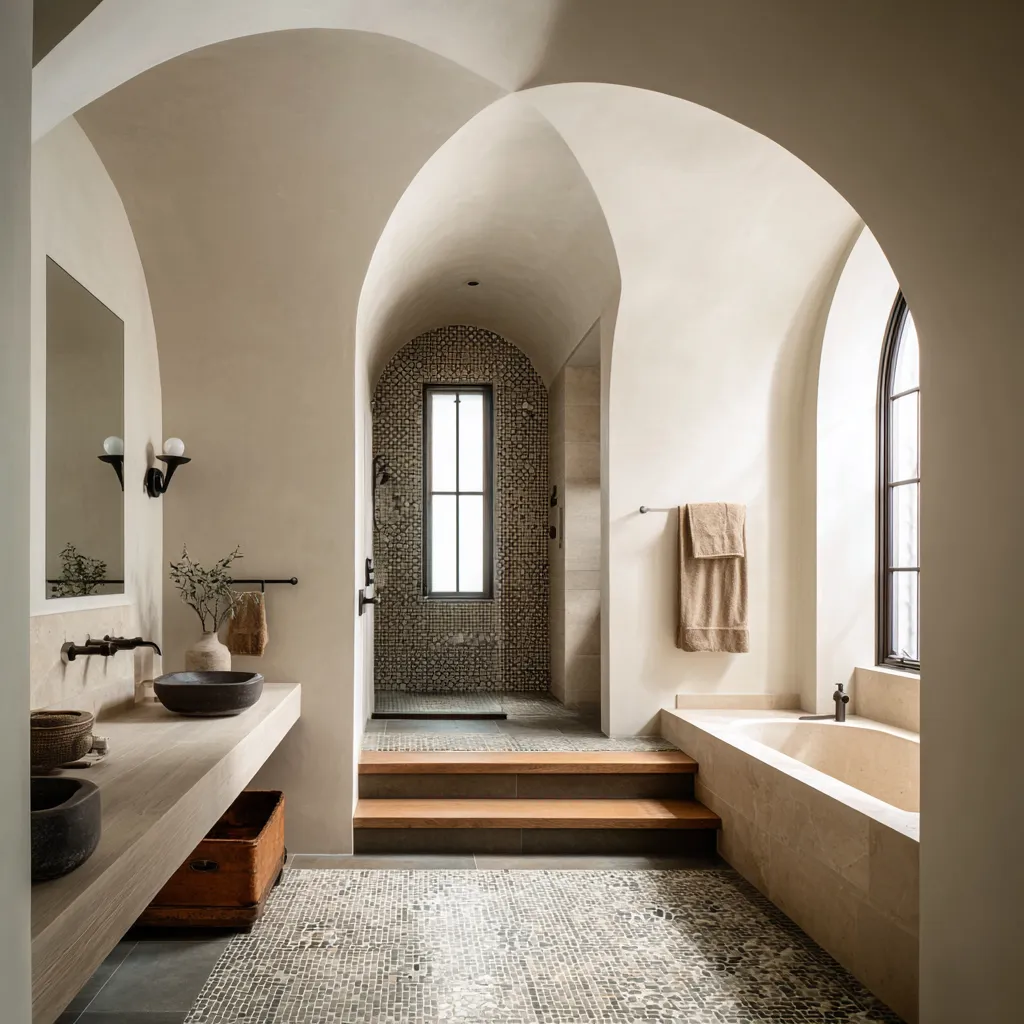
Fresh Spanish Revival is moving away from rigid centered display
Another strong modern design pattern is that bathrooms are not always symmetrical. They can be layered, processional, side-zoned, and revealed in stages.
You pass through one arch, then another. You glimpse the tub from the side rather than seeing everything at once.
The shower sits in its own recess. The vanity runs along one wall while the bath occupies another zone.
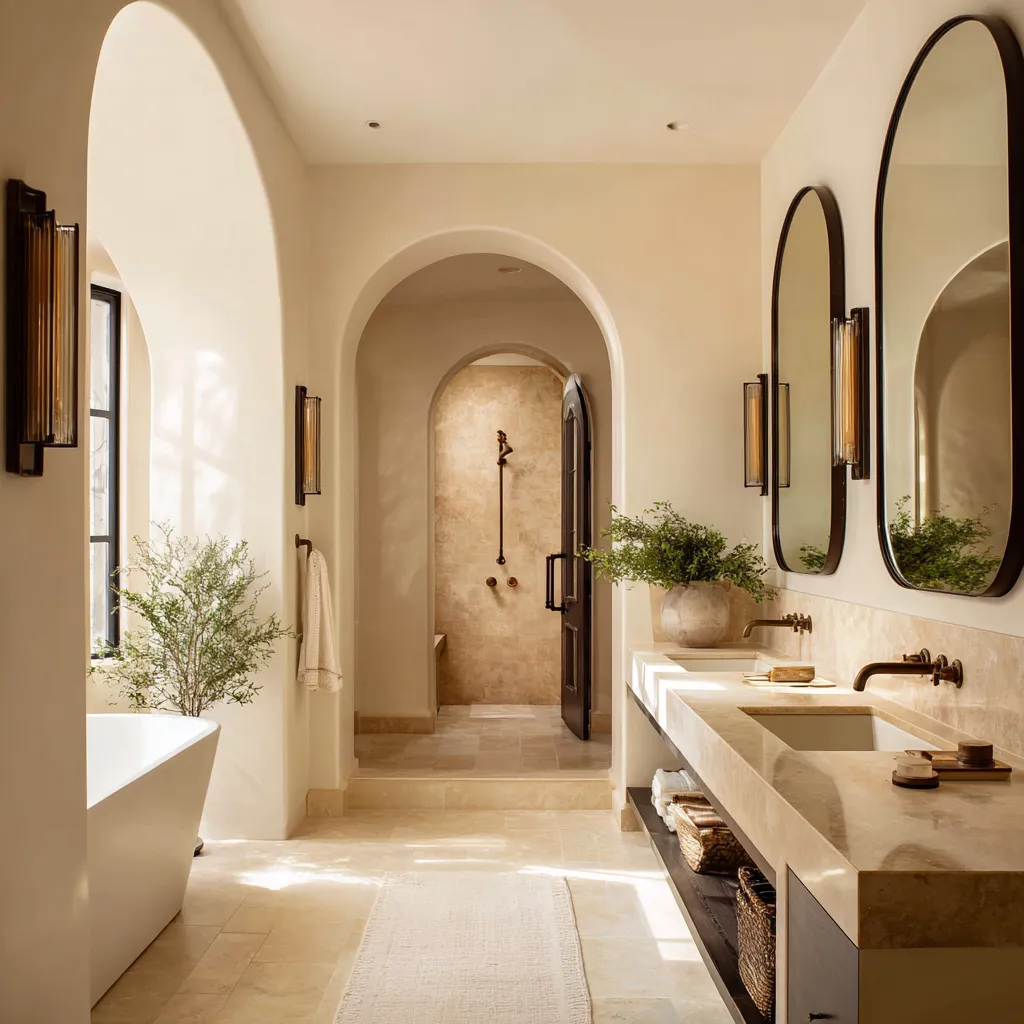
This matters because a room that reveals itself slowly often feels more luxurious than one that fully explains itself from the doorway. Partial concealment creates depth.
It also makes the bathroom feel more like part of a real home and less like a composed showroom vignette.
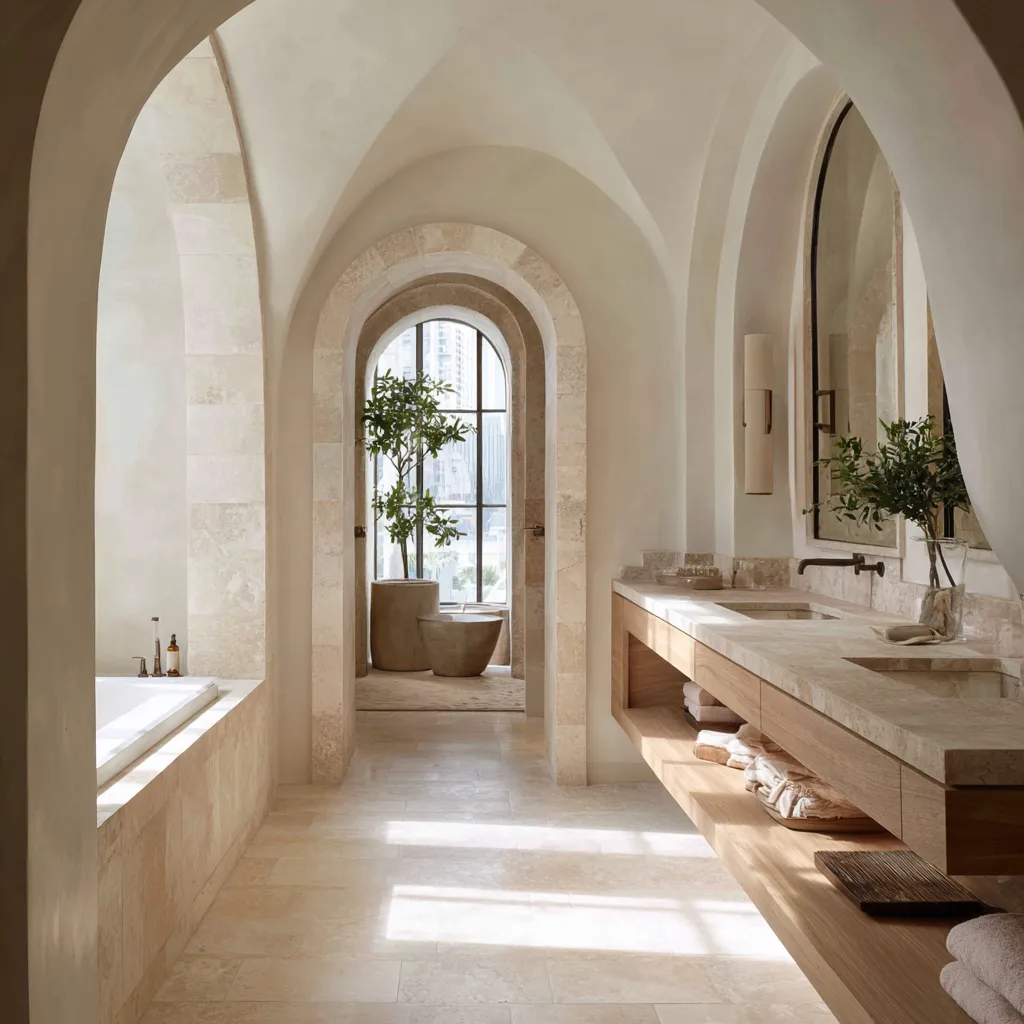
That is one reason threshold planning matters so much in fresh Spanish Revival bathrooms. The room often feels richer when the tub sits behind an arch, inside an alcove, beneath a canopy-like curve, or at the far end of a softly vaulted passage.
The architecture does not need to become complicated. It just needs to guide movement and create a sense of arrival.
Luxury in Spanish Revival bathrooms comes less from display and more from protected destination.
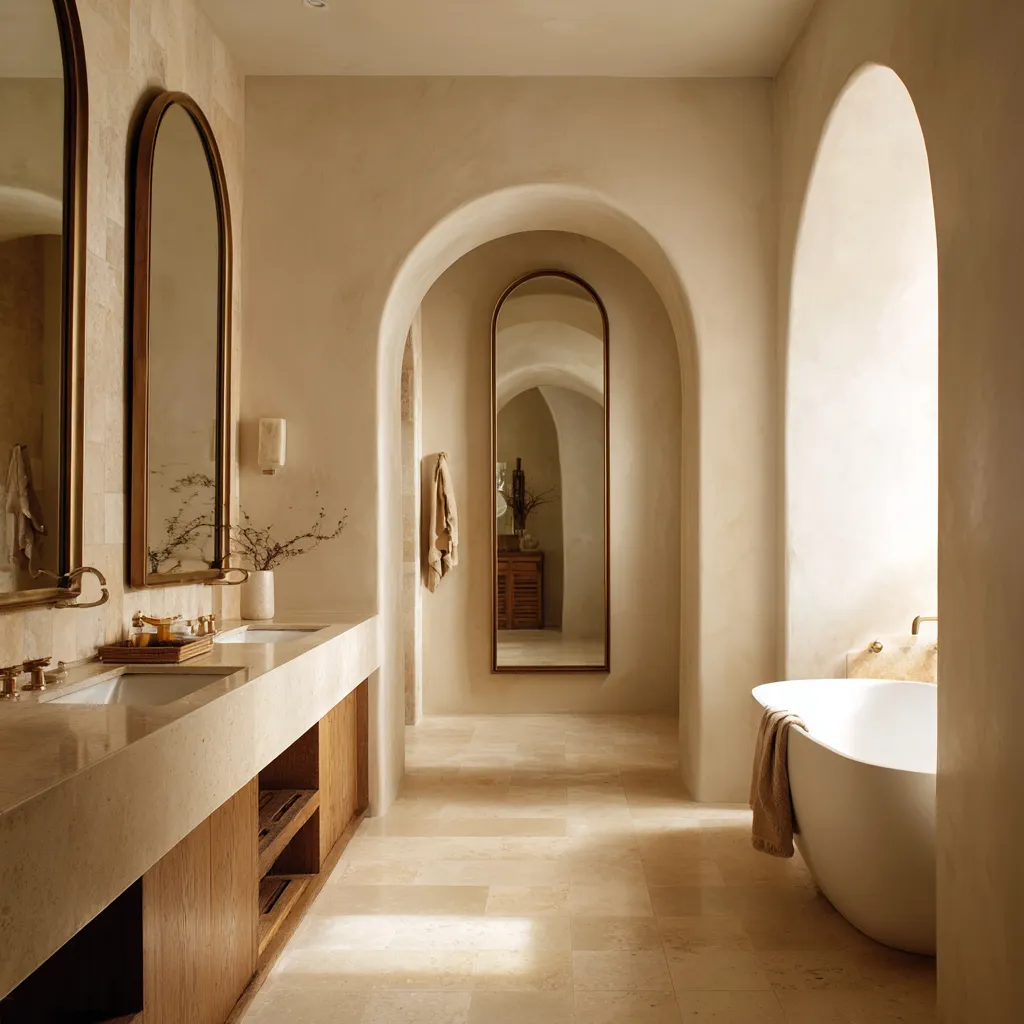
Pattern still works, but under control
Fresh Spanish Revival does not reject pattern. It simply changes how pattern is used.
The designs keep it contained, enlarged in scale, and quiet in contrast. Instead of covering several surfaces with busy tile or high-contrast motifs, the better rooms place pattern in one focused area.
That may be a shell-like wall behind the tub, a rounded stone field at the back of an alcove, a ribbed insert at the end of a passage, or a mosaic floor shift that marks the shower zone. The pattern becomes a destination rather than a constant layer across the entire room.
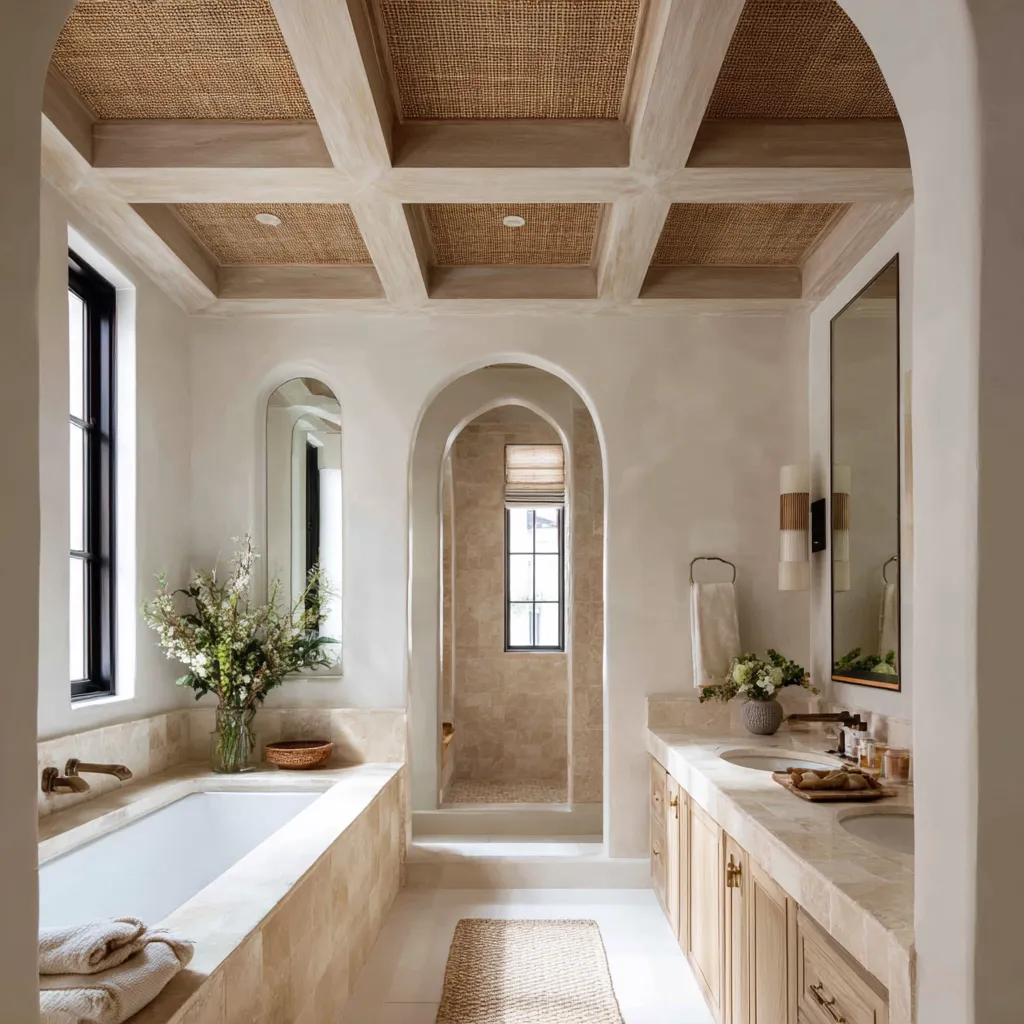
This is what makes the design stay calm. Pattern is no longer spread across the bath, vanity, floor, and shower all at once.
It is localized. It works alongside pale plaster, broad stone surfaces, and clear open floor area.
The room gets texture and craft memory without becoming visually tired.
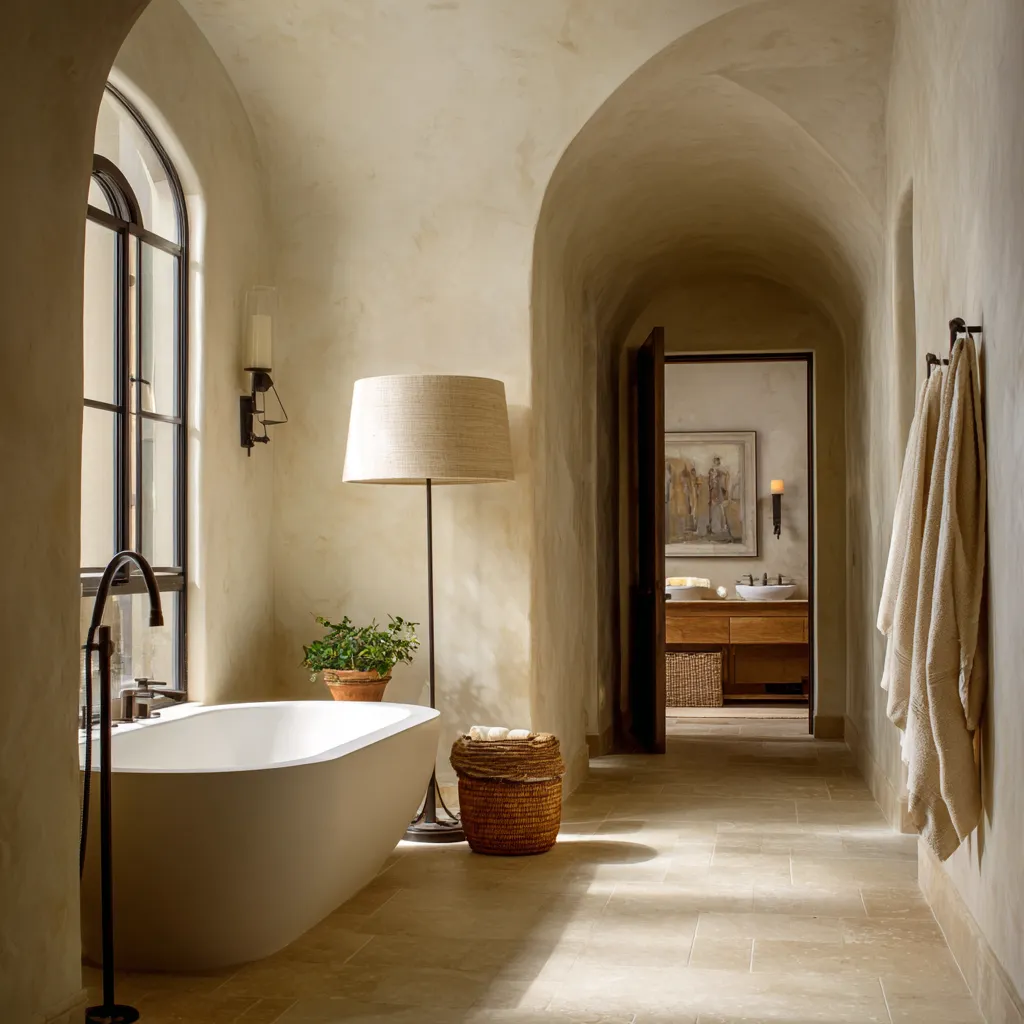
If you want a statement wall in a modern Spanish Revival bathroom, the safest direction is not louder color or denser ornament. It is one controlled field of texture, one repeated rounded geometry, or one ribbed or panel-like surface that stays close to the room’s overall palette.
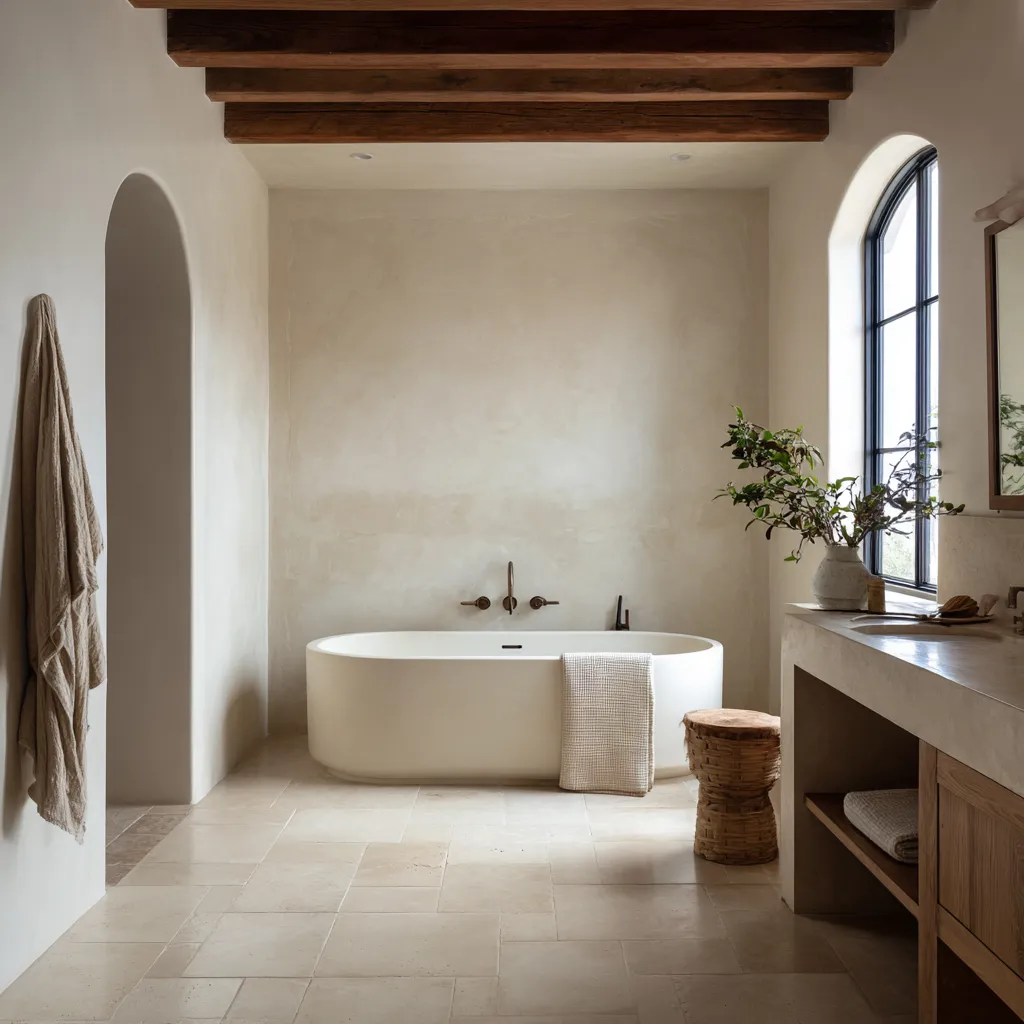
Wood now plays a quieter, more strategic role
Wood is still important in these bathroom designs, but its job has changed. In older interpretations of the style, wood often dominated the room through heavy cabinetry, darker beams, carved furniture, and strong rustic identity.
In the fresher ideas, wood usually appears in more controlled ways.
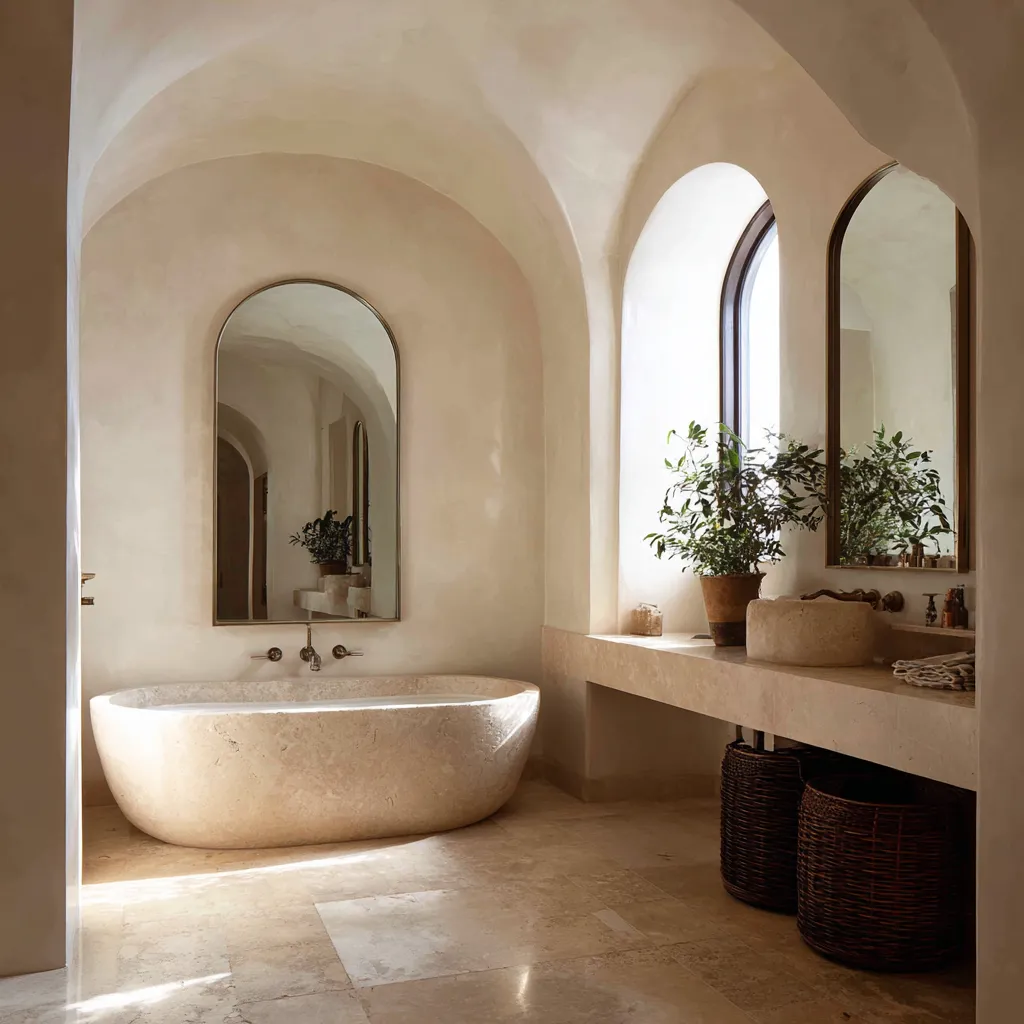
It can show up as a low vanity base rather than a tall heavy cabinet wall. It can appear as fluting, ribbing, or slatted detail that introduces line and rhythm.
It can frame one opening. It can become a stool, bench, shelf, or softer organic note near the tub.
Sometimes it can mark the far end of a room and gives the eye one warm landing point.
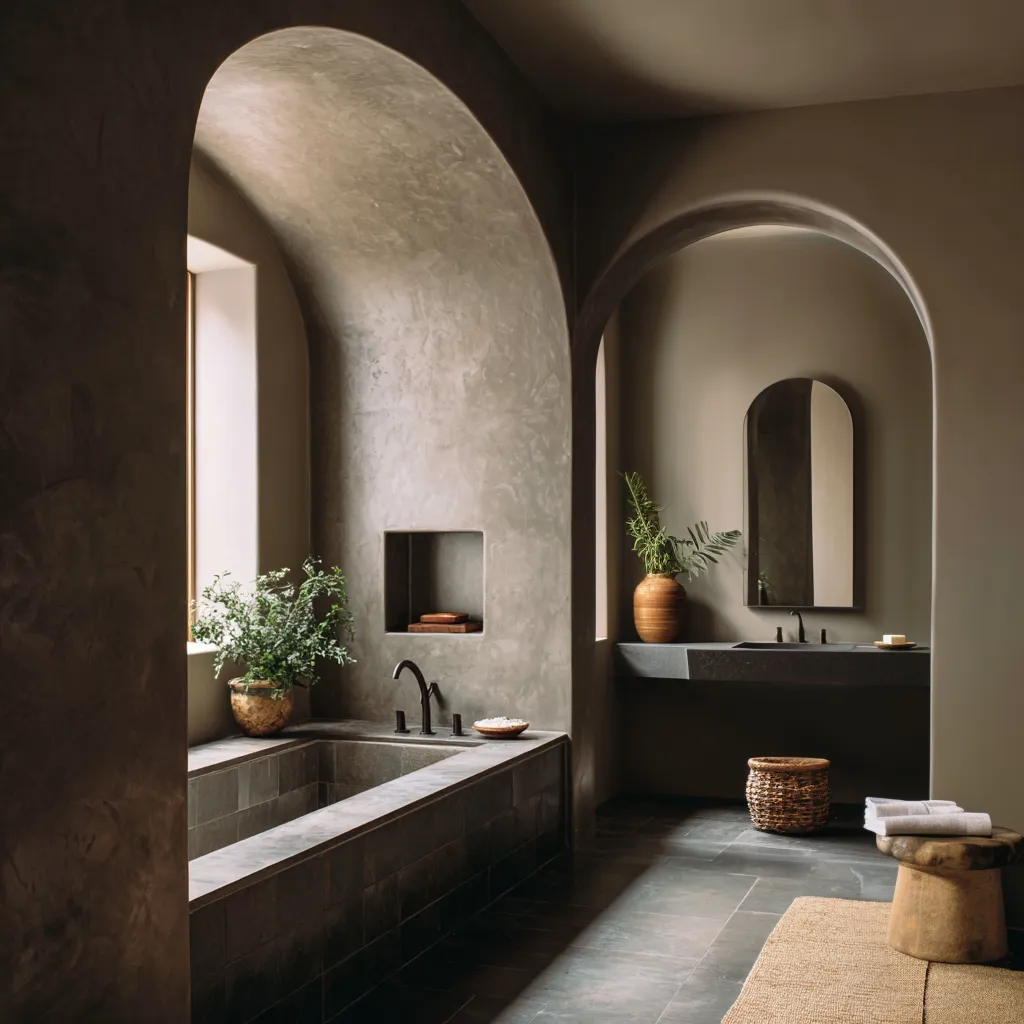
This shift is subtle but very important. Wood is no longer carrying the entire style.
It is warming the room without dragging it down. That is why modern Spanish Revival bathroom concepts often keep timber below eye level or use it as an accent rather than a dominant body of furniture.
For anyone trying to avoid heaviness, this is one of the smartest changes to make. Let plaster and stone hold the upper part of the room.
Let wood warm the lower part.
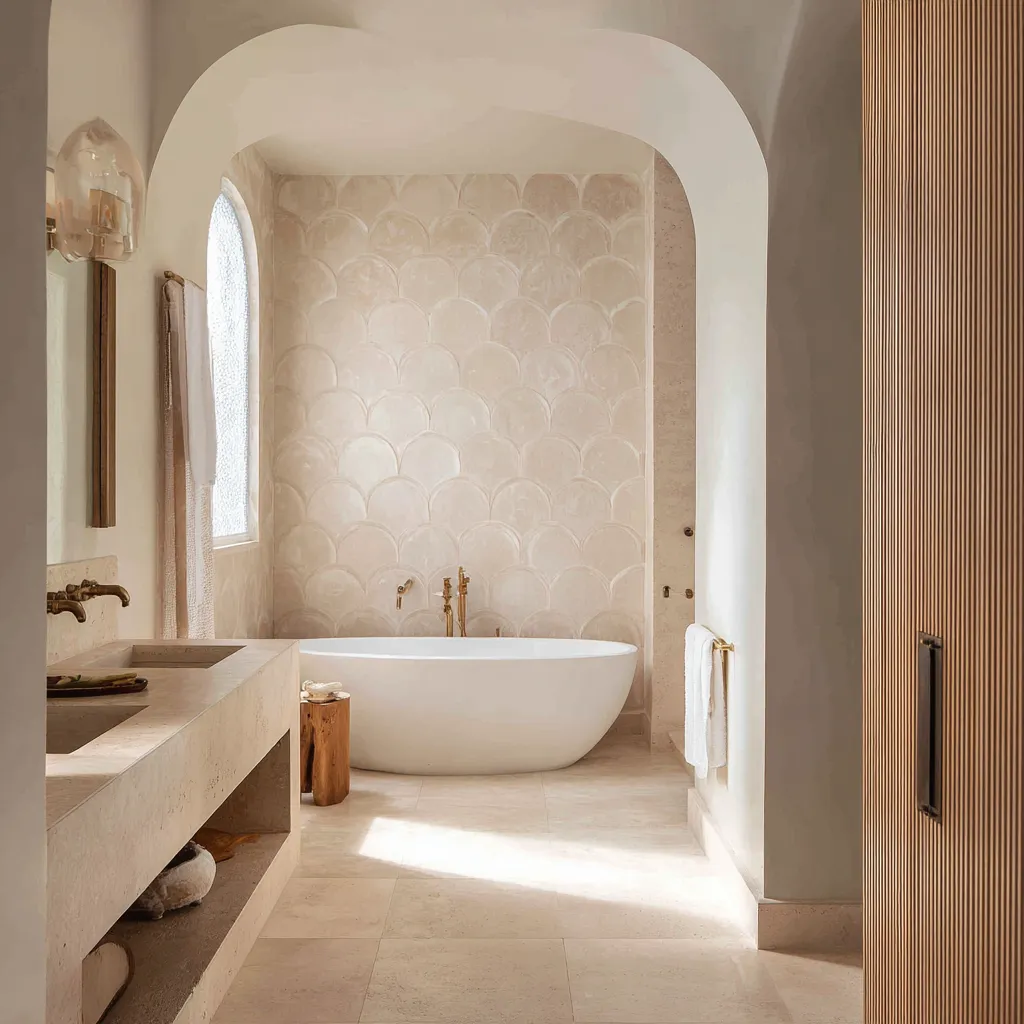
The room still needs one sharpening device
The softer designs in this style need some crispness. Without it, the bathroom design can drift into a sleepy wash of beige, cream, and curved form.
It can be solved with one or two sharpened notes, not many. A black-framed arched window can do it.
So can a darker mirror outline, a slender linear sconce, a fluted vanity front, a ribbed wall insert, a darker stone floor, or a floating slab with strong edge definition. Even a sculptural chandelier can do the job if the rest of the room stays quiet.
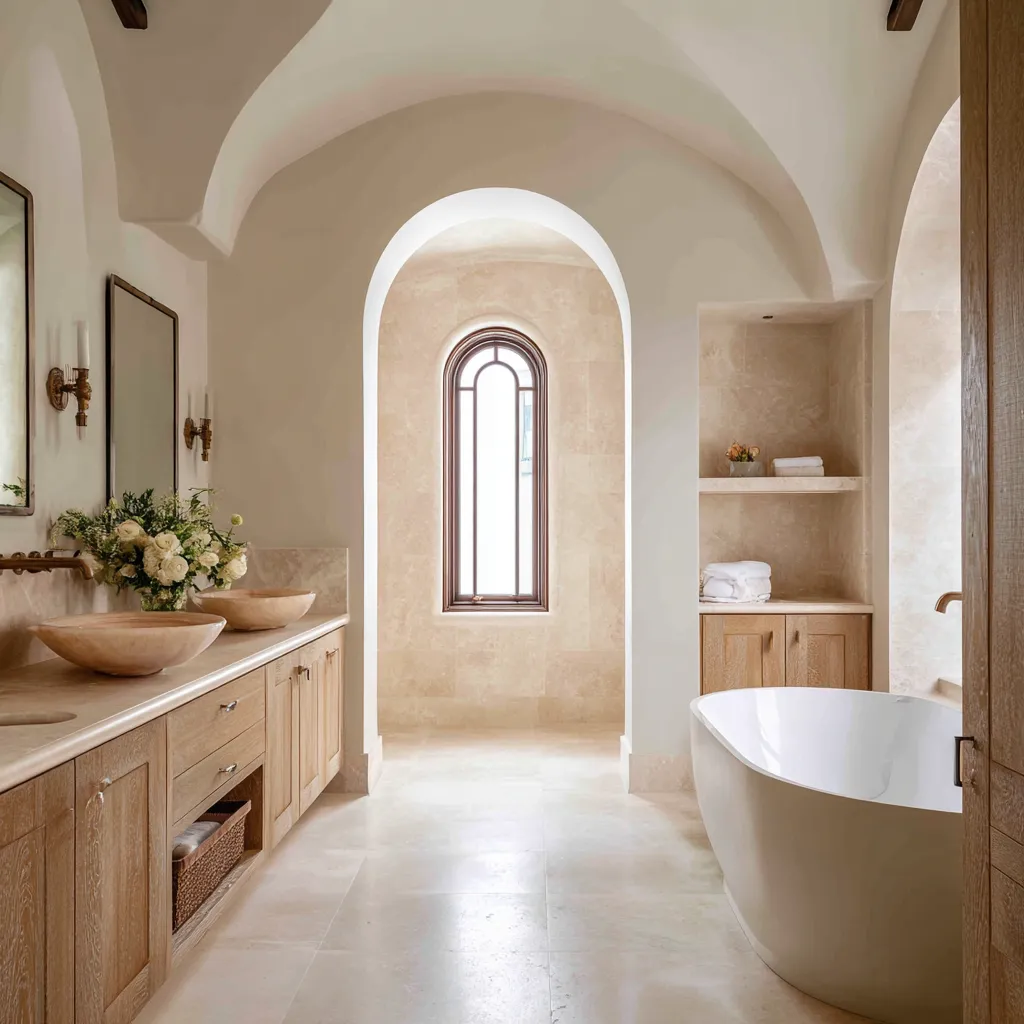
The important thing is restraint. Fresh Spanish Revival does not need a full set of modern gestures layered on top of an old shell.
It needs one place where the room tightens and becomes more precise. That contrast helps the arches feel more intentional and helps the plaster feel richer rather than vague.
Moderate edge clarity is where these bathrooms feel most complete. Too little, and the room loses shape.
Too much, and it loses softness.
Light now does work that decoration once handled
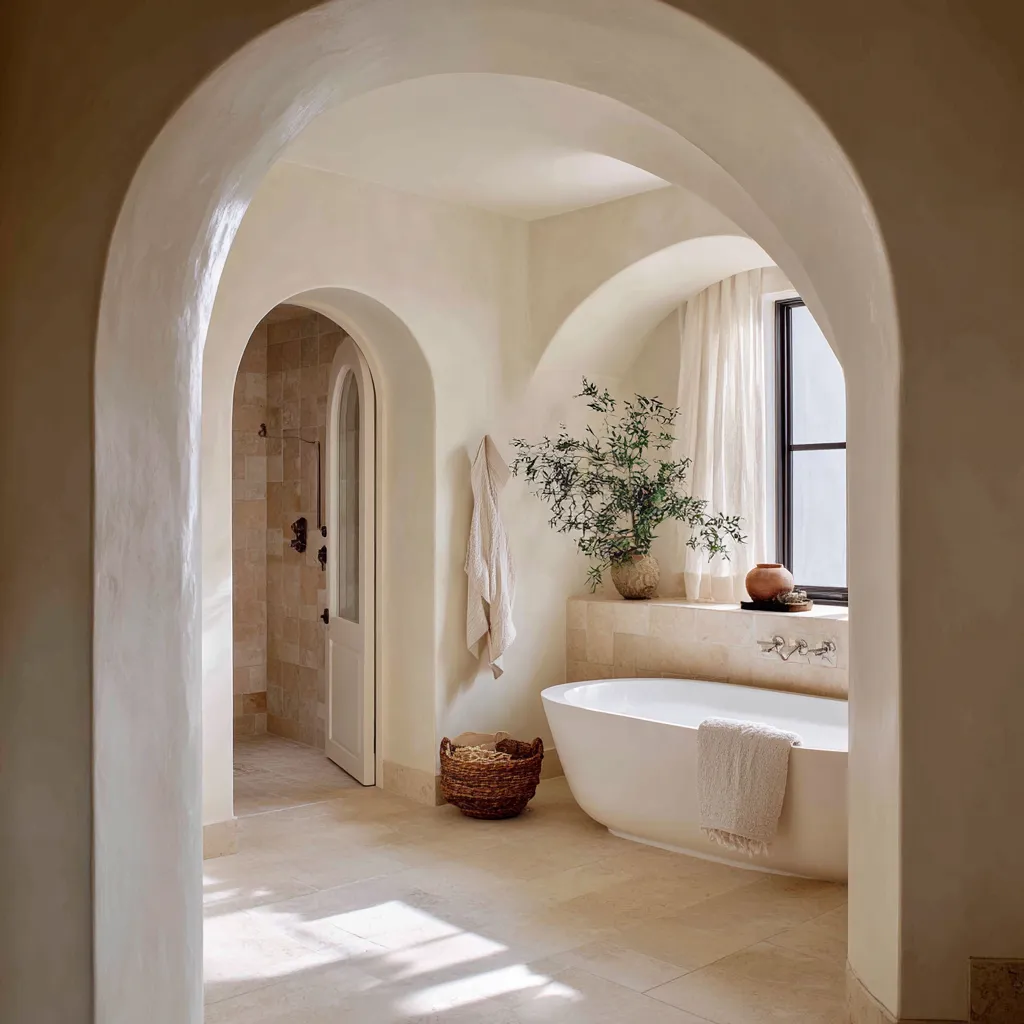
One of the shifts in such bathroom designs is the role of light. The beauty of the space can come from sunlight sliding across plaster, a vertical shaft of daylight beside the tub, a filtered glow through curtains, or the shadow inside a recess.
Even a mirror halo can take on the role that a decorative surround once held.
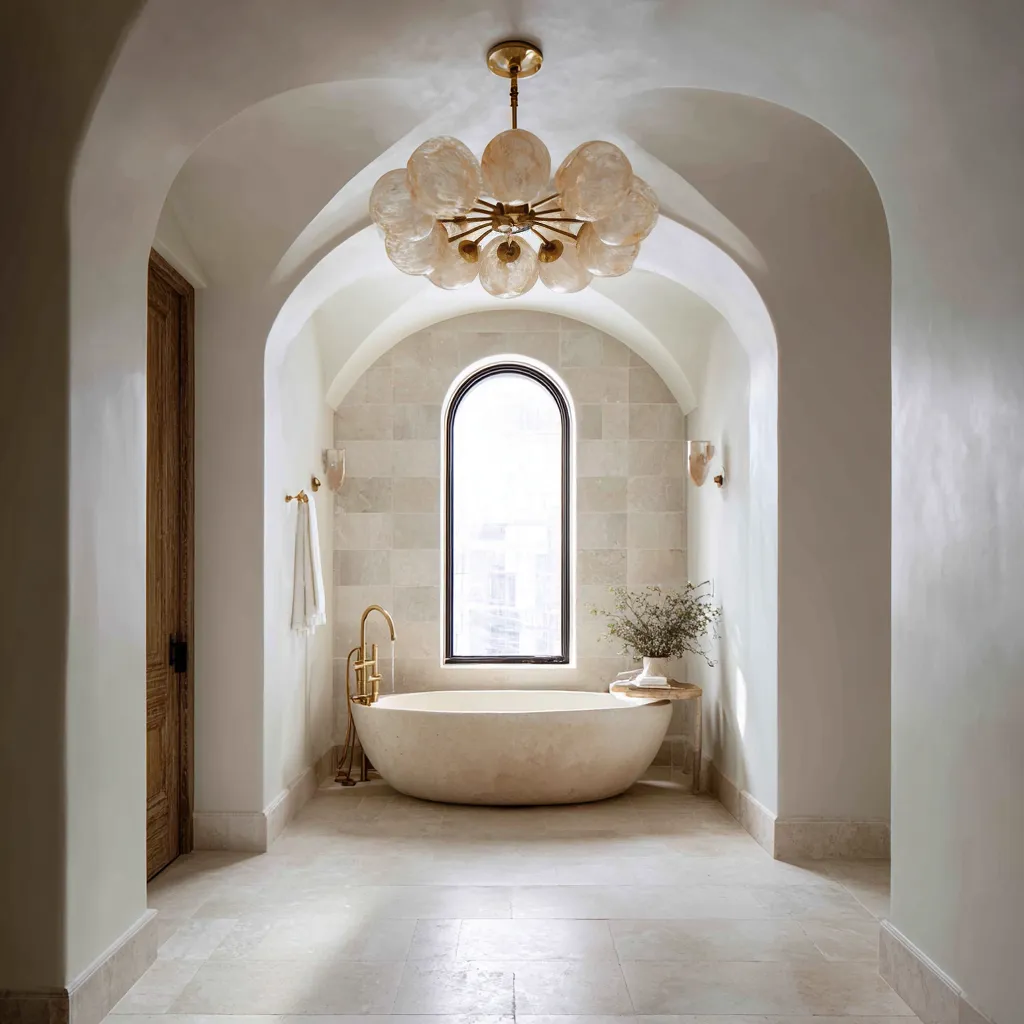
That means the room’s richness often comes from shaped wall plus light event rather than from decorated surface. A patch of sun across a hand-finished plaster wall can bring more life to a bathroom than a busier wall treatment.
A softly lit arched mirror can give a niche a stronger presence than a rustic frame. A curtain in front of a tall window can turn the whole bathing zone into a gentler, more intimate end point.
Modern Spanish Revival bathroom designs let light move through the room and interact with the architecture instead of trying to fix all the visual interest onto permanent ornament.
Four fresh directions for the style
Although Spanish Revival bathroom design ideas share a lot of design logic, they do not all create the same mood. There are 4 broad directions, and each one suits a different kind of mood to be achieved.
Luminous mineral sanctuary
This version is pale, calm, and mostly architecture-led. It uses chalky plaster, warm stone, restrained wood, a simple tub, and very few accessories.
The room design feels bright but not cold, soft but not vague. It suits those who want a Spanish Revival bathroom that feels spa-like, light-filled, and easy to live with every day.
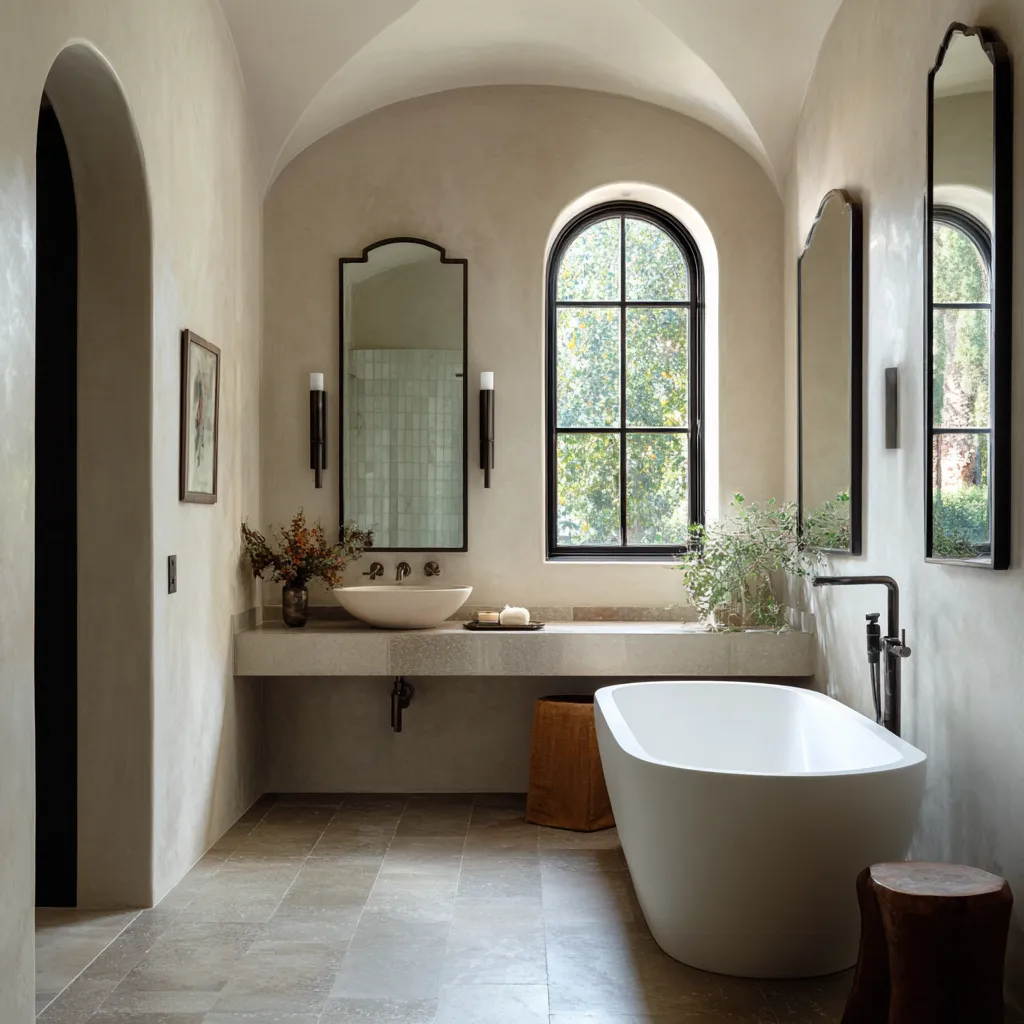
Processional retreat
This version depends on passage, threshold, and a destination at the end. The room may be long and corridor-like, with repeated arches and a tub that feels tucked away rather than staged.
It suits those who want a bathroom with more soul, privacy, and architectural depth, even if the object count stays low.
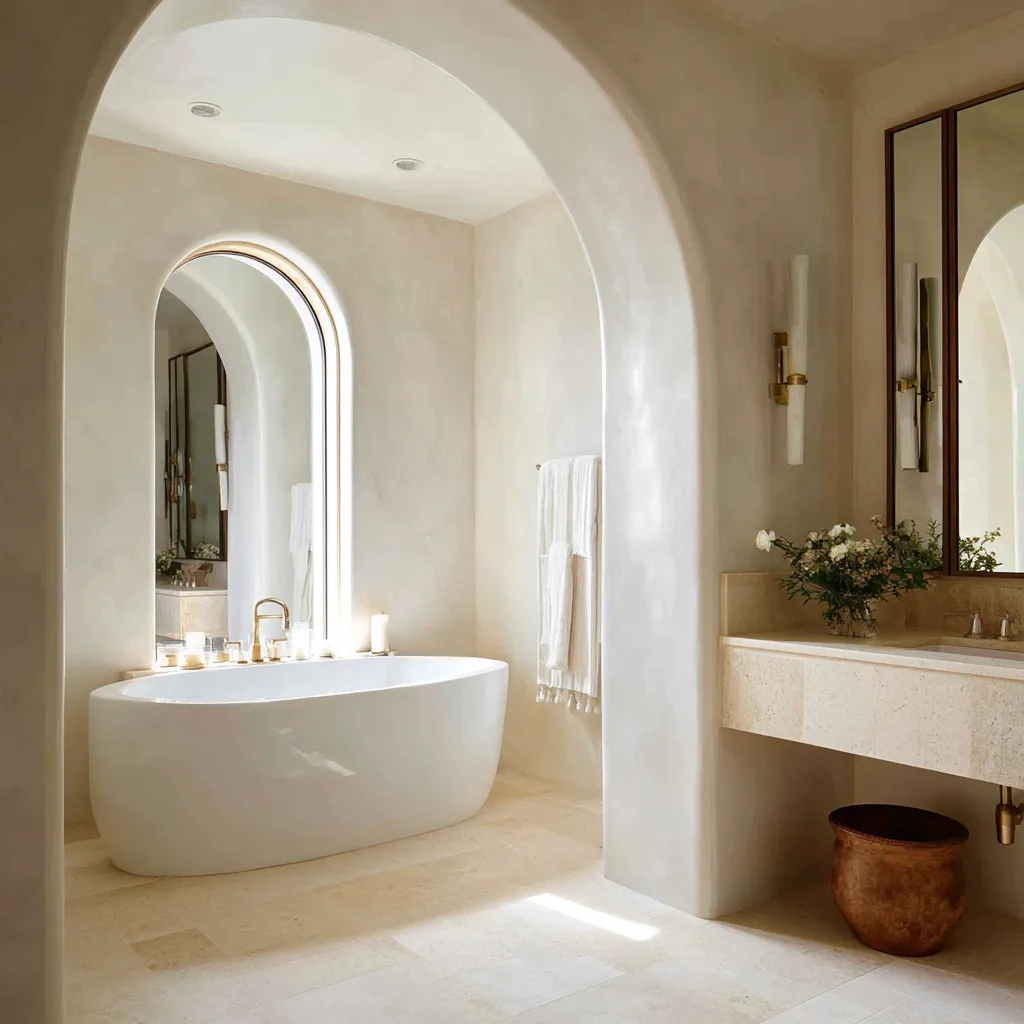
Practical dual-zone room
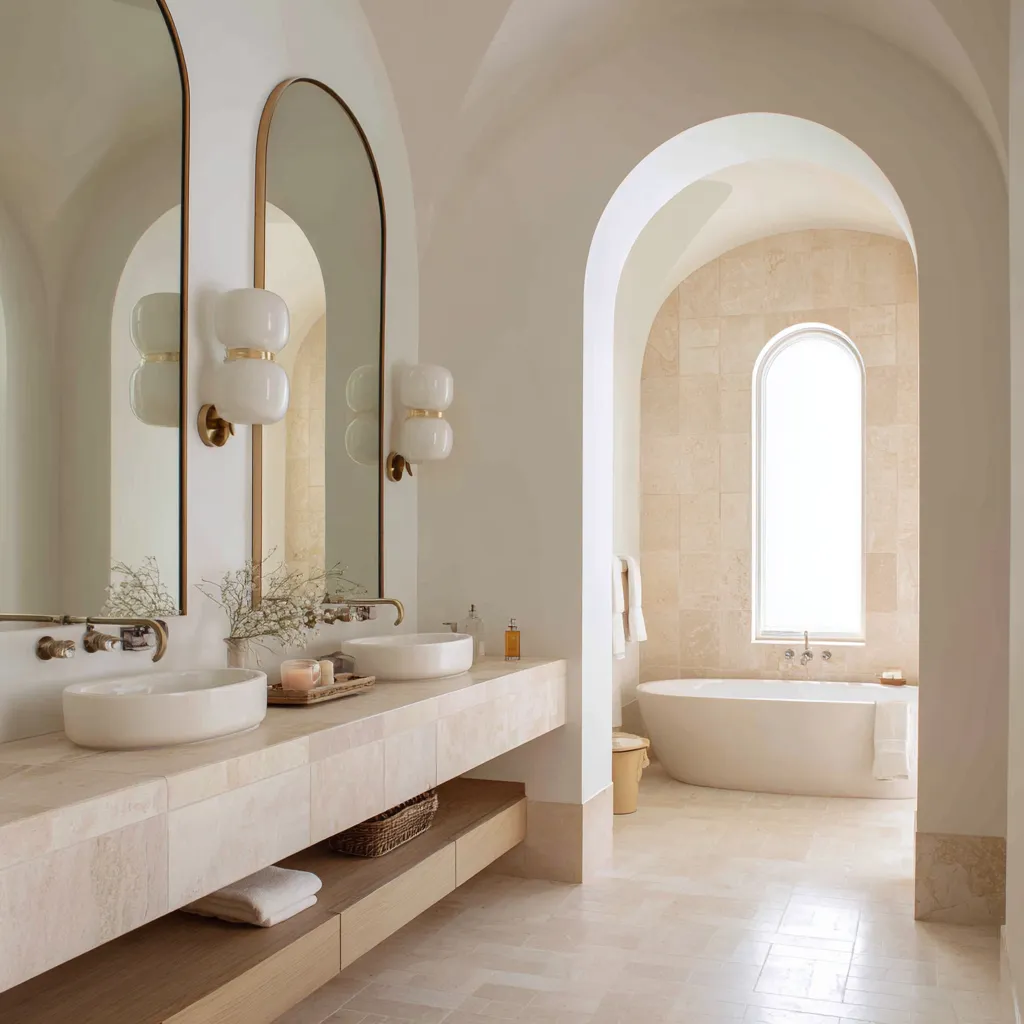
This version balances daily-use planning with shaped Spanish shell. There may be a longer vanity run, more visible storage, a tub on one side, and a shower set into a recess or framed chamber.
It suits family-use bathrooms or primary baths where function matters just as much as atmosphere.
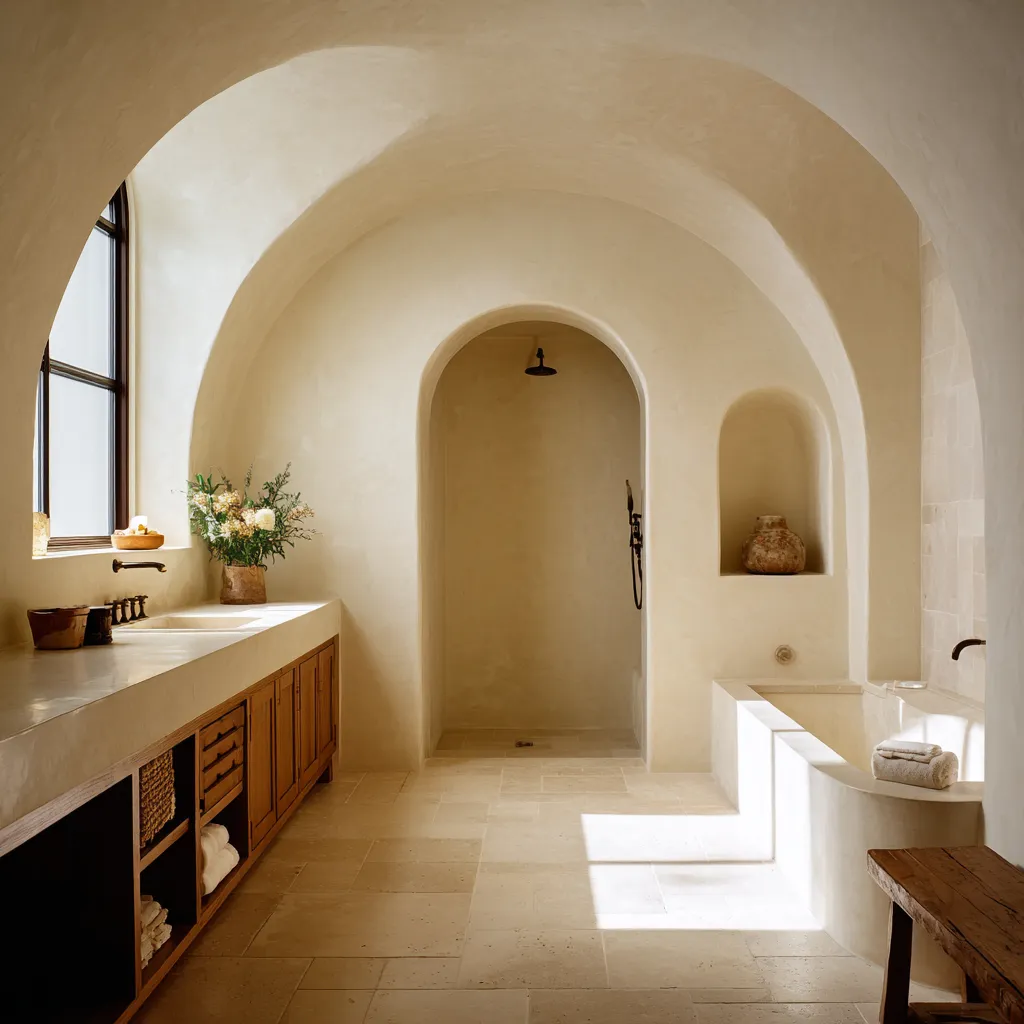
Ceremonial statement room
This version uses stronger axial planning, a centered bath view, a ceiling event, or one sculptural light to heighten the sense of occasion. It still works best when the rest of the room remains edited.
This direction suits those who want a luxury focal point without falling into a dense decorative look.
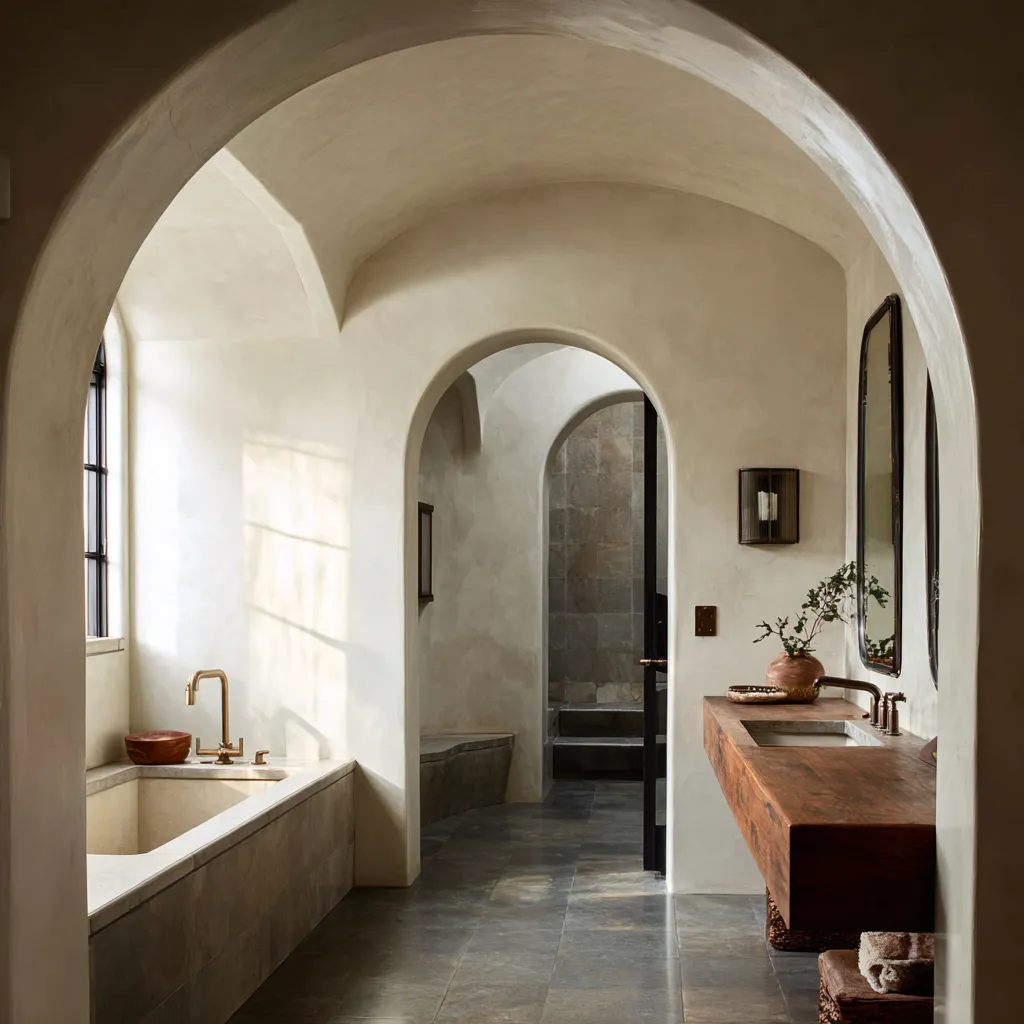
What usually weakens the fresh look
Too many small historical details can make the style feel dated faster. Extra iron scrollwork, busy border tile, ornate carved vanities, and too many rustic accessories can reduce the clarity that makes these rooms feel current.
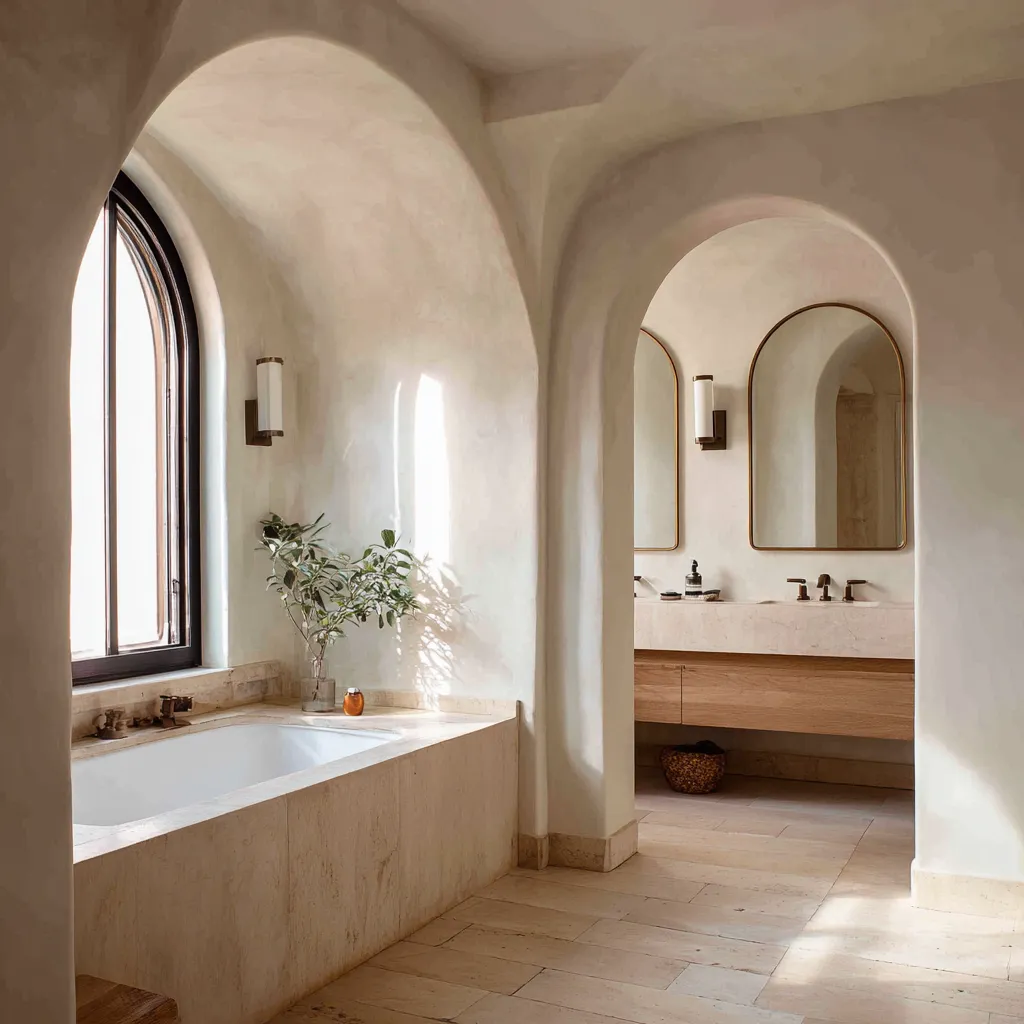
Too much uniform softness can also be a problem. If everything is pale, rounded, and textural without one sharp counterpoint, the bathroom can start to feel sleepy.
It needs at least one cleaner line, darker frame, or firmer material edge.
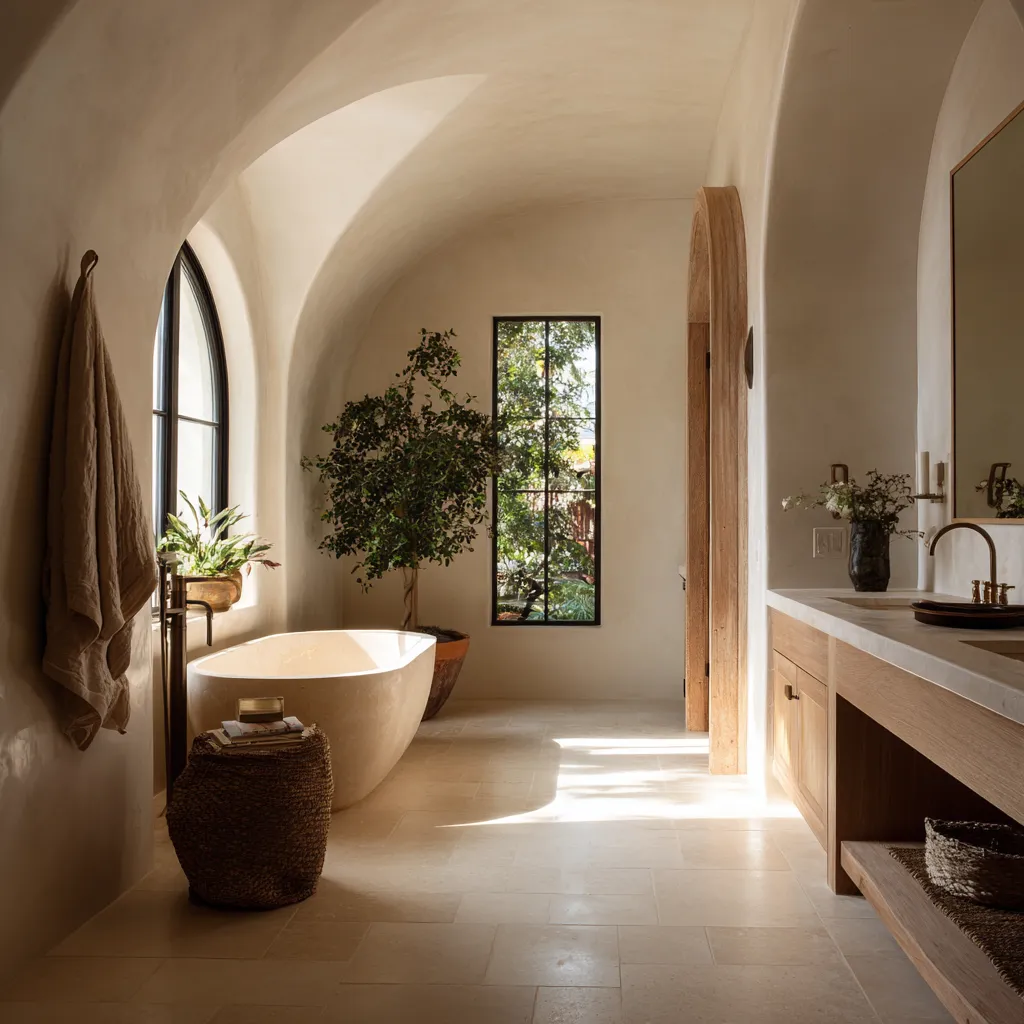
Dark versions of the style need relief. Deep plaster tones, dark stone, and richer wood can feel beautiful, but only if they are balanced by plants, woven texture, open floor area, and some controlled glow.
Without those, the mood can become heavy instead of cocooning.
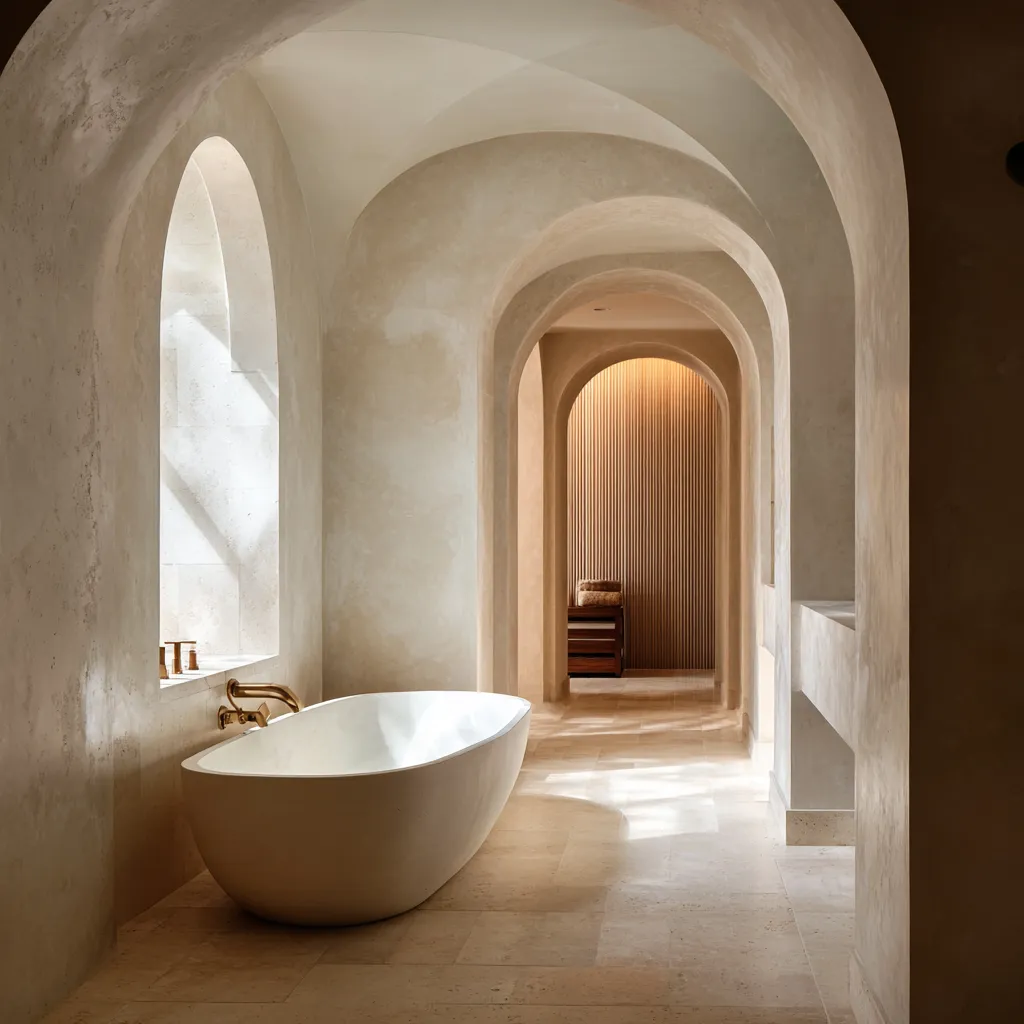
Pattern spread across too many surfaces is another risk. A modern Spanish Revival bathroom can handle pattern well, but not everywhere at once.
One destination zone is usually enough.
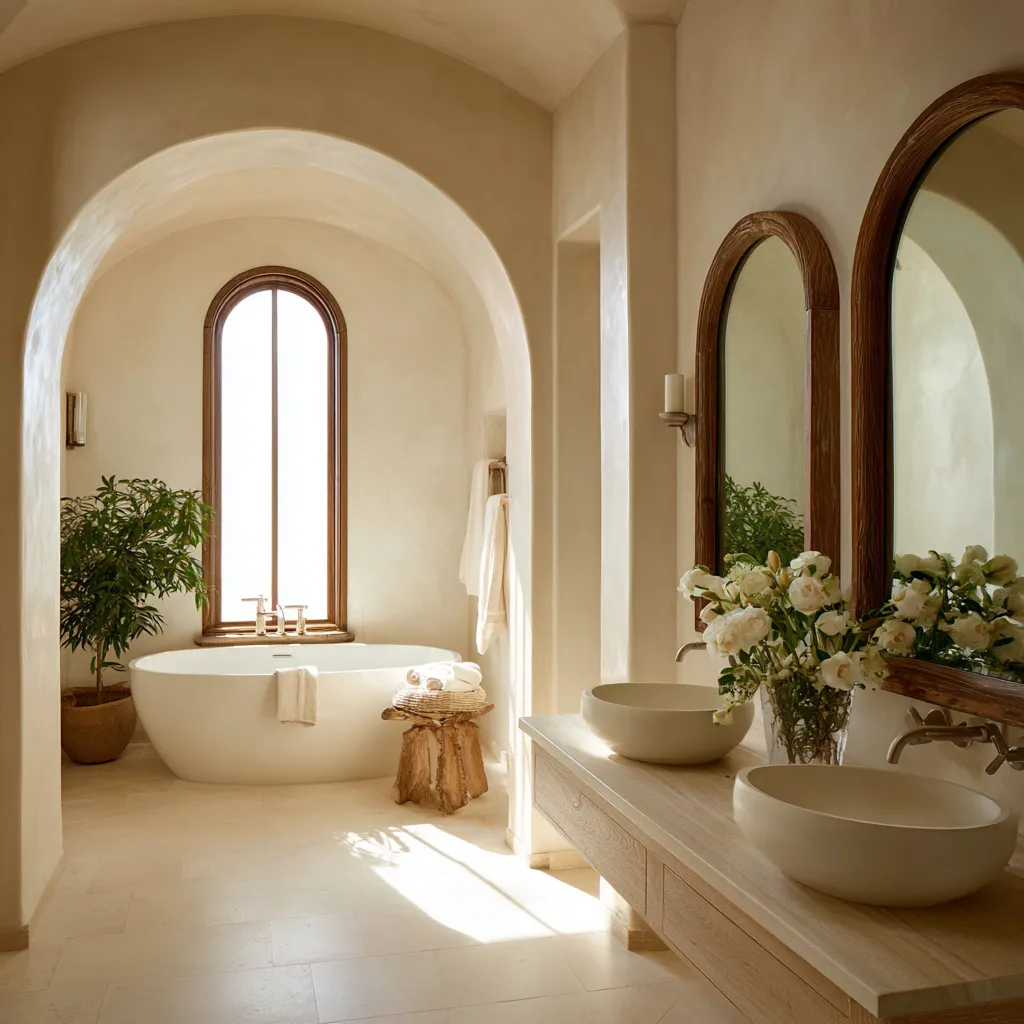
The lesson behind fresh Spanish Revival bathroom ideas
Modern Spanish Revival bathrooms do not feel like old and new have been mixed together in equal amounts. They feel more organized than that.
The historical side carries the mass, the shelter, the arch, the vault, and the mineral warmth. The present-day side carries precision, editing, openness, and the reduced object count.
That is why these rooms feel convincing. They are not trying to turn Spanish Revival into generic minimalism.
They are not trying to turn it into a decorative period set either. They keep the room deep, shaped, and warm, then make everything placed inside it calmer, slimmer, and more selective.
That is the central idea worth carrying into any fresh modern Spanish Revival bathroom design. Do not flatten the style.
Let the shell stay strong. Then let the room breathe.