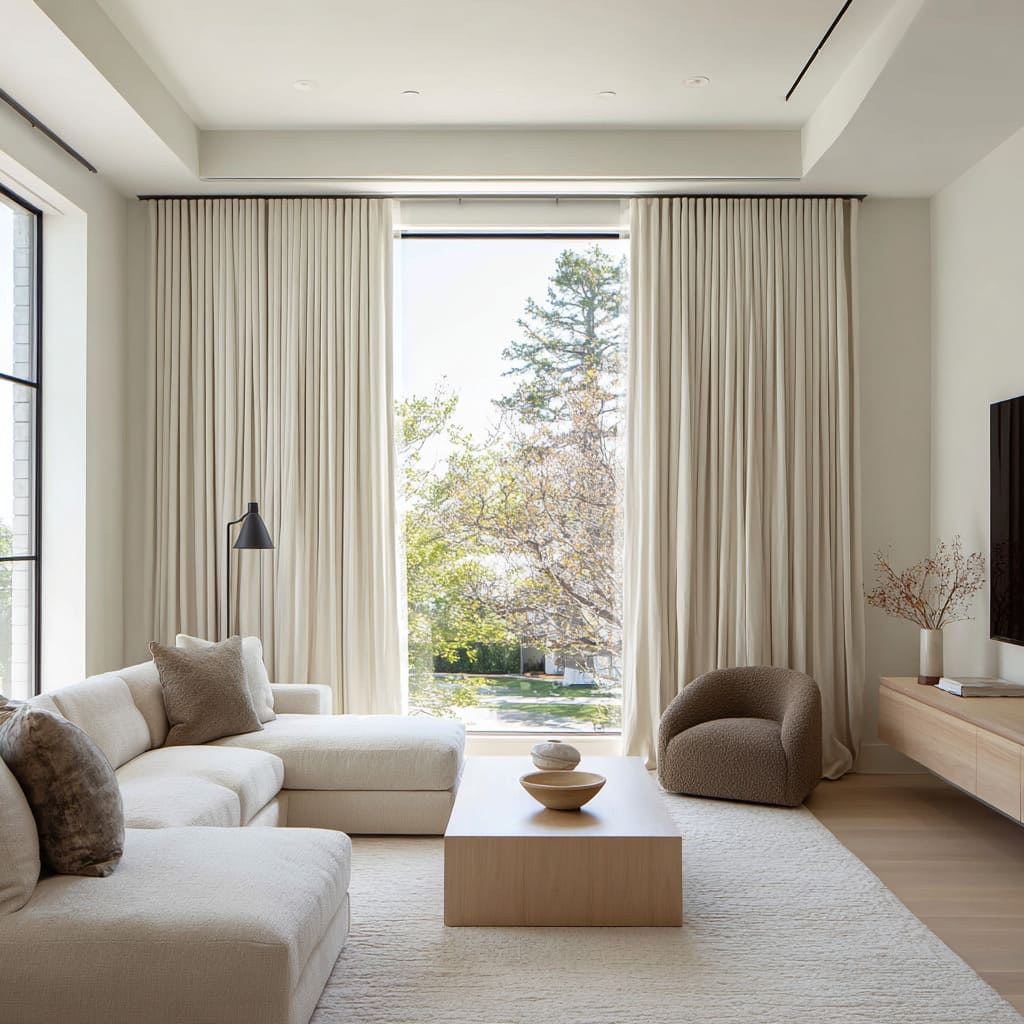
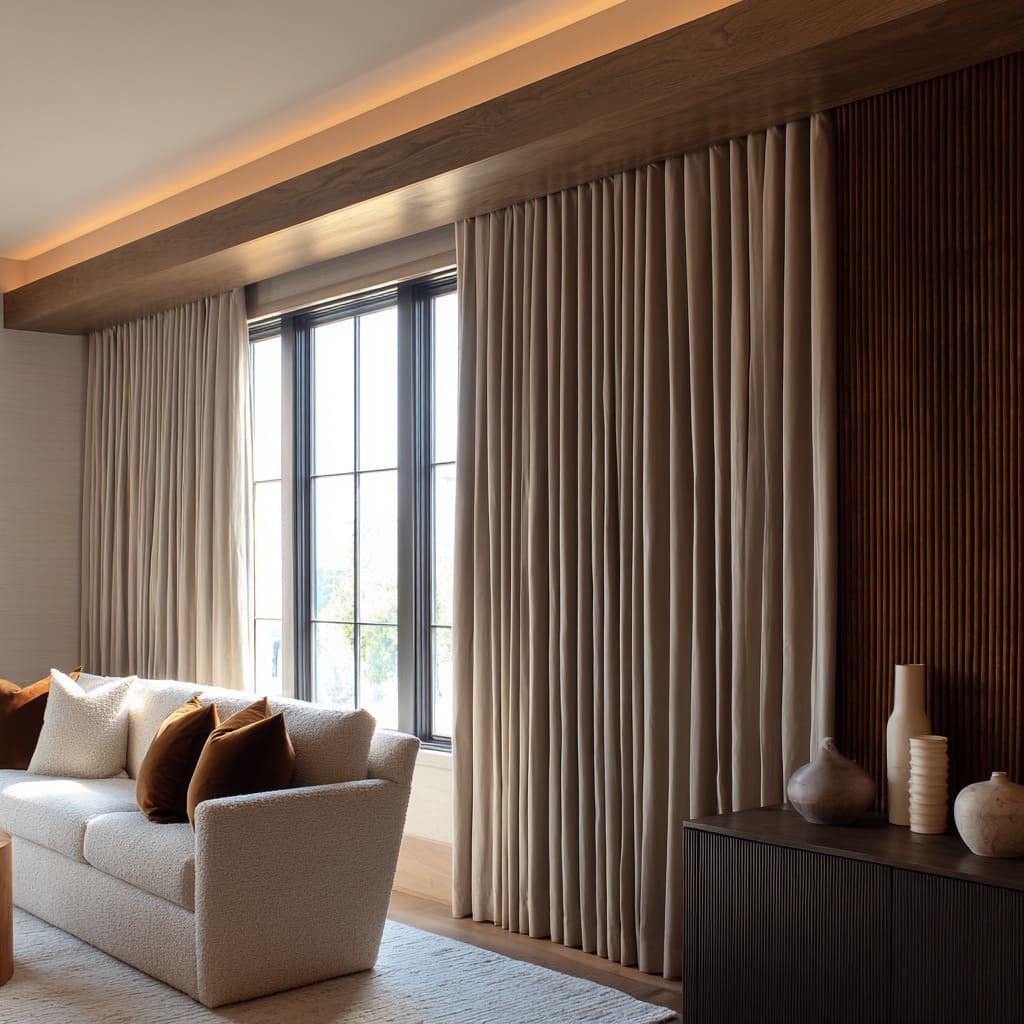
The most interesting living room drapery ideas treat cloth as part of the room’s structure rather than a last-minute covering for glass. Full-height panels running from just under beams or crown down to the floor turn the window wall into a continuous vertical plane, sometimes stretching from one end of the room to the other or wrapping gently around a corner.
Once the rod is slimmed down or concealed inside a soffit, the eye stops reading hardware and starts seeing a soft architectural layer. This layer can quietly rewrite proportions: a modest opening feels taller, wall height appears increased, and the glazing zone stops behaving like a gap in the envelope.
Where drapery extends beyond the window onto plaster or fluted wood, the boundary between wall and window softens and the entire elevation begins to read as one deliberate composition.
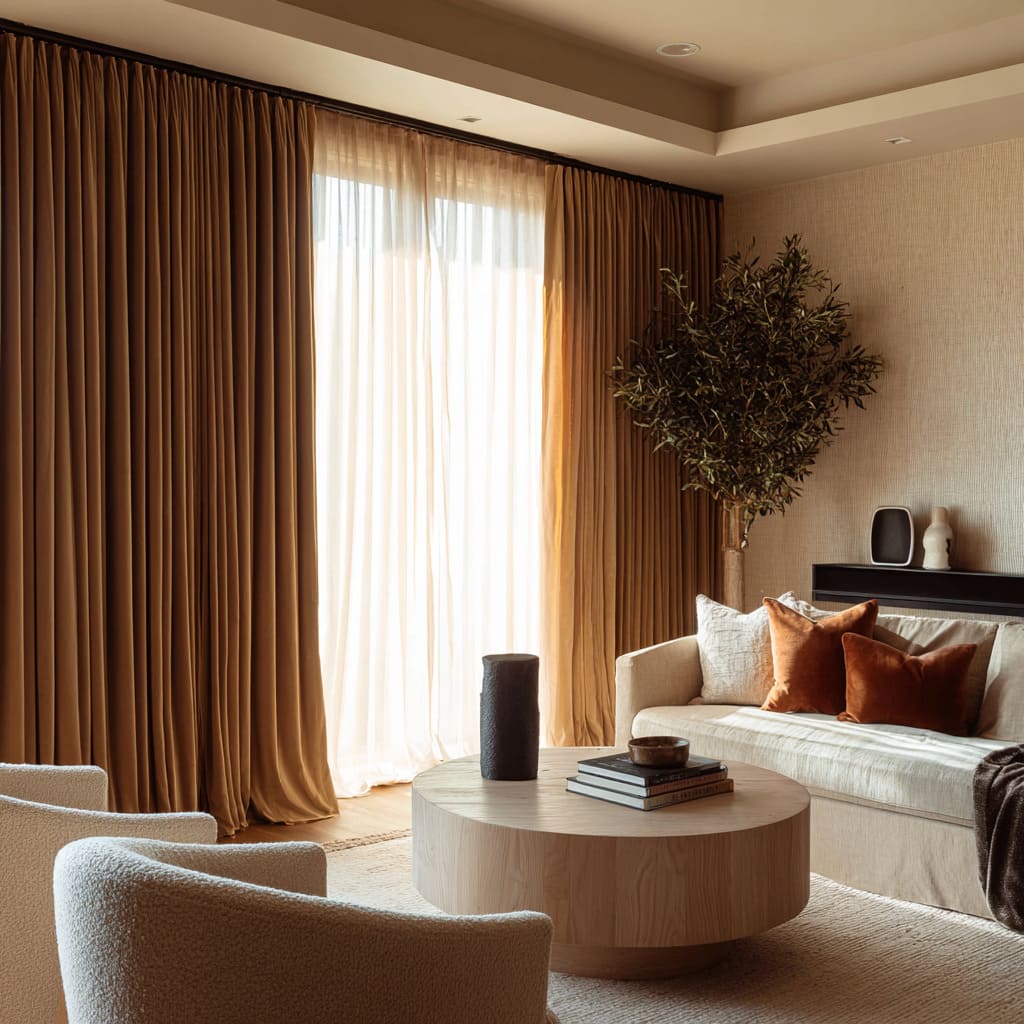
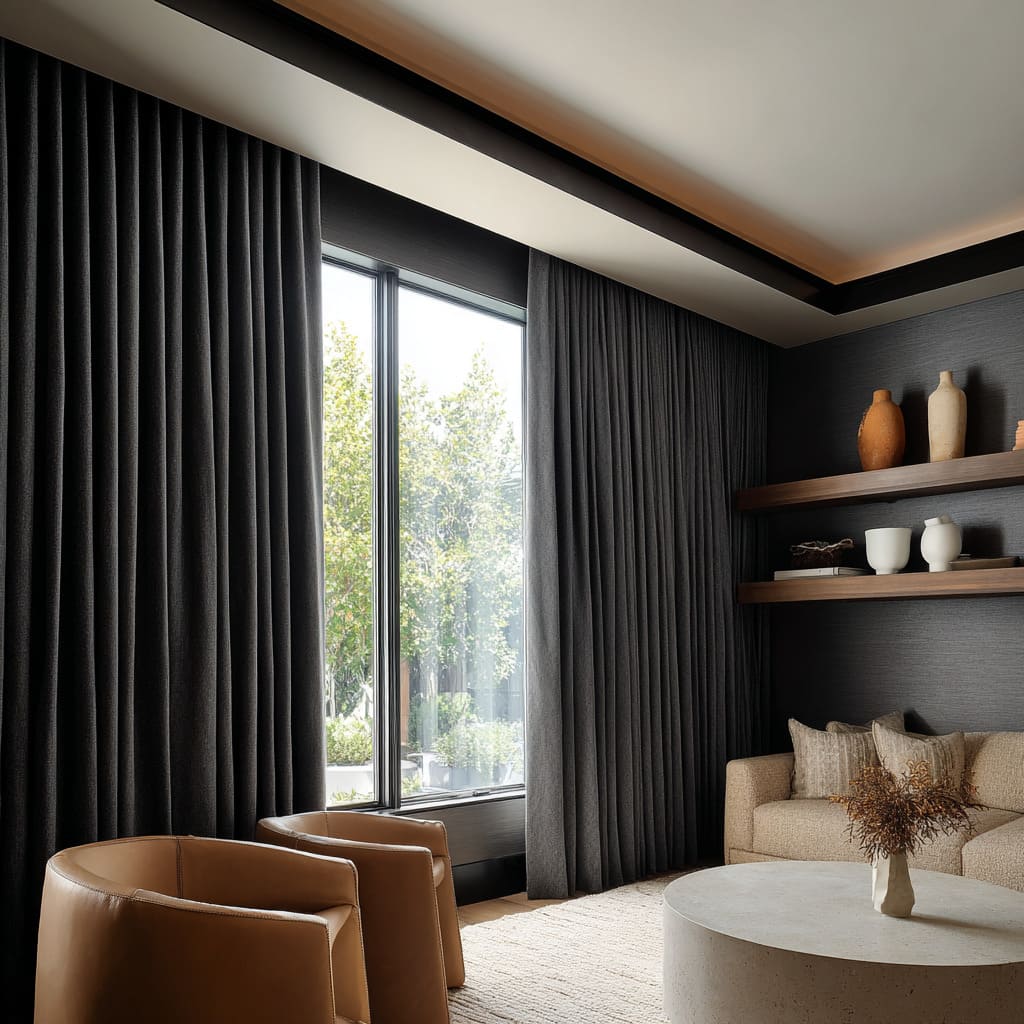
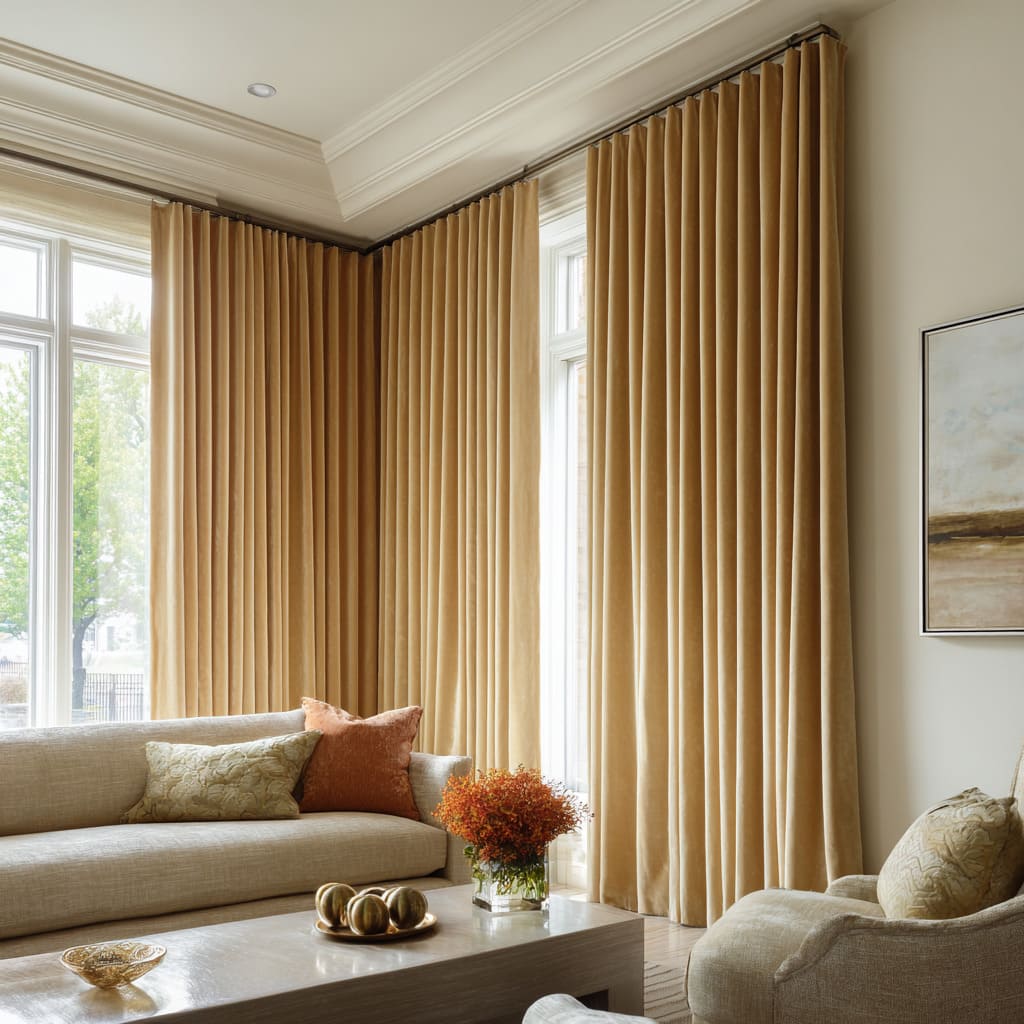
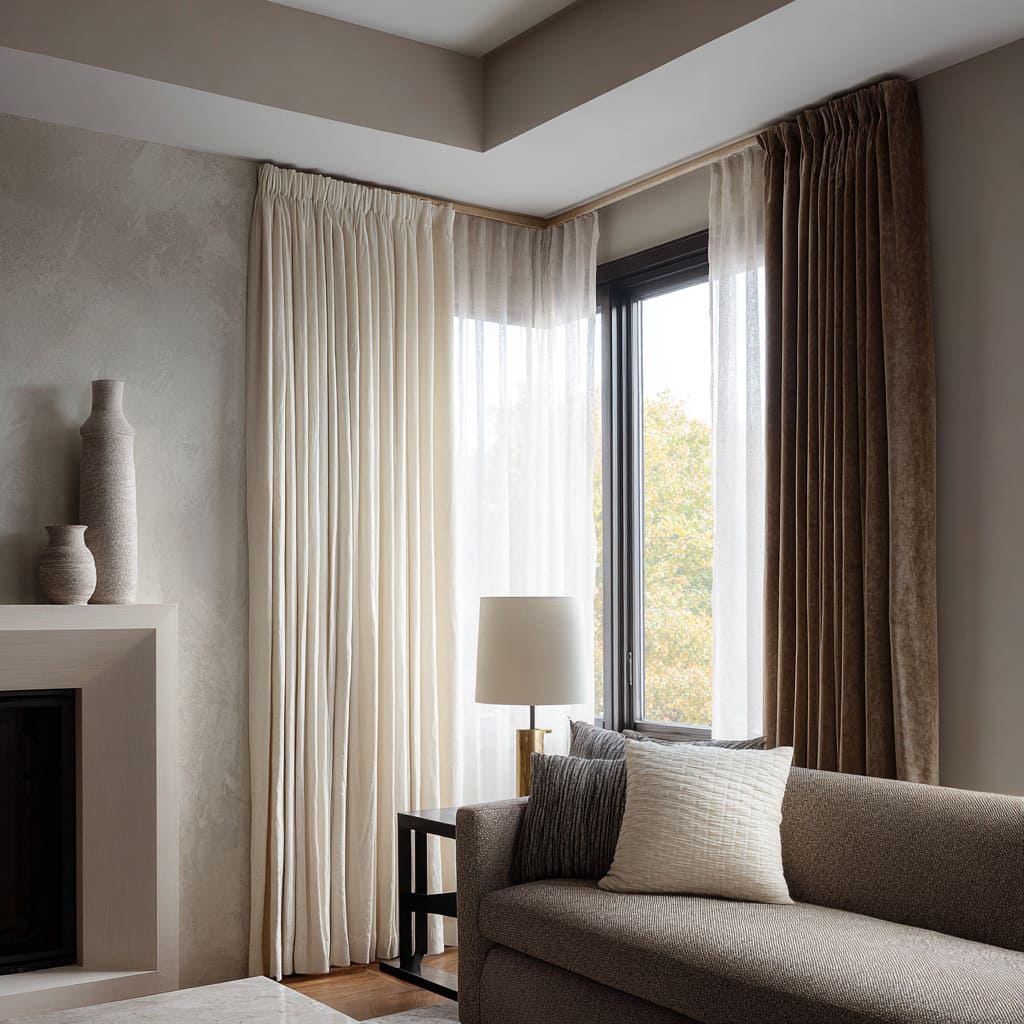
In classical shells with mouldings, neutral panels behave like fabric panelling that bridges plaster and timber; in pared-back spaces, deep graphite or warm caramel cloth replaces built columns or heavy joinery as the main source of vertical weight. Corners become especially expressive: fabric drawn around an L-shaped window creates a textile alcove that holds the sofa or lounge chair sitting in front, so the furniture appears to nestle inside a soft envelope rather than hover in front of cold glass.
Assigning a Role: Structure, Light, or Mood
Before any discussion of color or fabric type, designers often decide the primary role drapery will play in the room design. That role may be structural, atmospheric, or focused on light.
In practice, the same panels can support several roles, but one usually leads:.
- Structural role – Fabric behaves like a soft wall, defining height, width, and rhythm. Panels run wall-to-wall, wrap corners, or sit in line with crown and soffits so that they read as part of the room’s bones.
- Light role – Sheers and semi-sheers turn daylight into a filtered wash, reduce glare from large openings, and convert views into soft tapestries of greens, sky tones, or city shapes.
- Mood role – Color and texture in the drapery set emotional temperature, shifting an interior toward calm lightness, moody lounge character, or golden warmth.
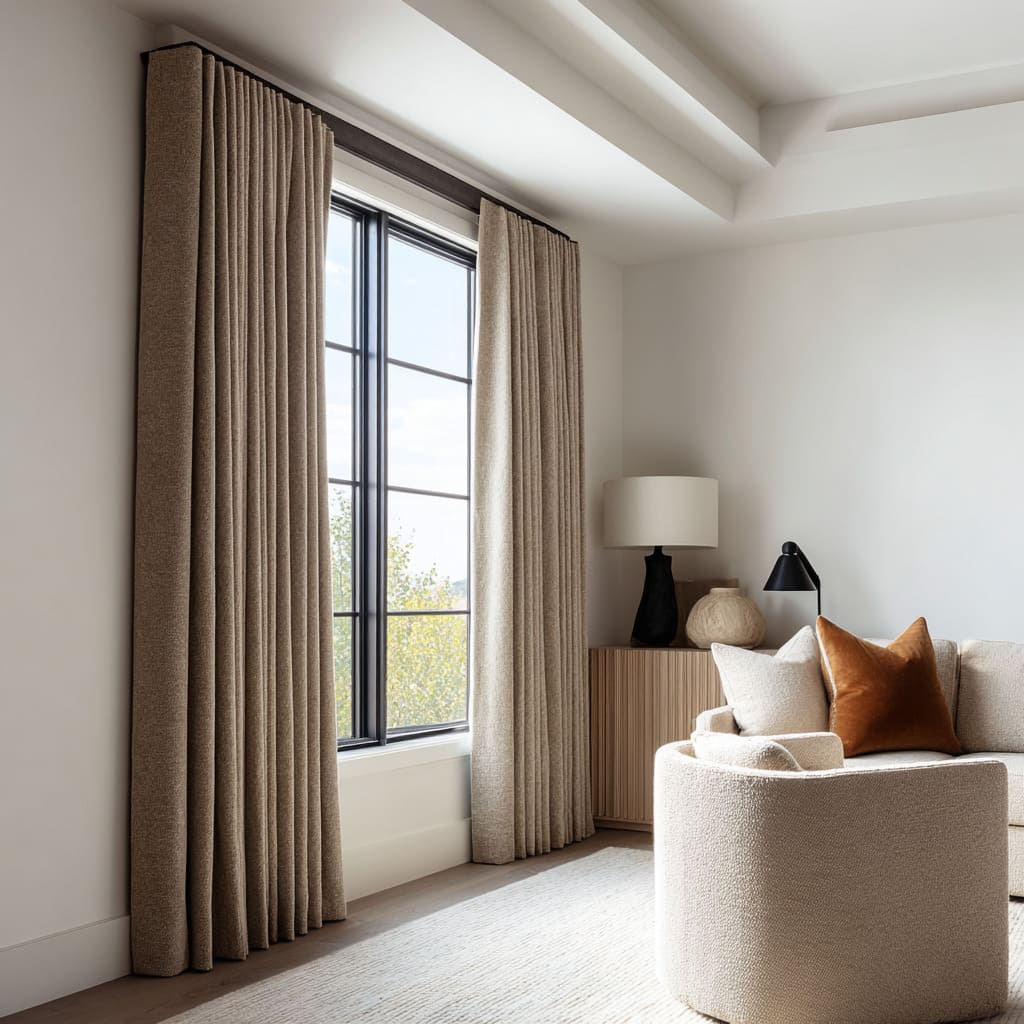
Once this role is clear, every other decision—pleat density, transparency, color depth, pattern scale—becomes a way to refine that intention. Panels chosen to support structure usually sit close to wall tones and link directly to beams, niches, or window casings.
Those chosen for light often carry open weaves, gauzy grids, or crushed textures that interact vividly with the sun. Drapery focused on mood makes more expressive use of terracotta, caramel, gold, or near-black tones, sometimes in combination with velvet or plush textures that absorb or bounce light in distinctive ways.
Vertical Rhythm and the Grid Behind Living Room Curtain Designs
Many refined living room curtain designs rely on pleats as a hidden structural tool. Evenly spaced folds create a quiet vertical rhythm that runs alongside other strong lines: black steel mullions, fluted wall panels, shelving, and fireplace openings.
In rooms with beams or coffers, the dialogue becomes more layered: beams trace one direction across the ceiling, while the curtain folds fall the other way, forming a subtle cross-grid that holds the entire composition together. This grid is rarely explicit, but it controls how calm the architecture feels.
Narrow, numerous pleats soften the impact of sharp rectangles by presenting a column of fine shadows rather than a hard edge. In more minimal spaces, a clean skim at floor level strengthens the feeling of precise order, while a slight break or puddle at the hem releases tension and introduces a relaxed note without disturbing the vertical tempo.
Pleats also act as a measuring device for objects. Lamp stems, chair backs, and console edges often align intentionally with fold intervals, so that nothing appears to float randomly in front of the textile plane.
The result is a room where the viewer senses compositional clarity even without consciously tracing lines, because every vertical gesture—from window frame to curtain fold to lamp—seems part of the same underlying rhythm.
Tonal Bridges and Middle Notes Between Floor, Wall, and View
Color in drapery frequently sits in a mediating position, acting as the “middle note” between tones above, below, and outside. Panels might fall exactly between the richness of a timber floor and the lightness of a cream rug or plaster wall, forming a gentle ladder of values: deep at the base, mid-tone in the middle, pale toward the ceiling.
This slows down visual transitions, preventing harsh jumps from dark window frames to bright walls or from white ceilings to strong floors. A similar relationship appears horizontally: curtain threads can be tuned to hold both the warmth of the wall and the cooler note of a sofa, so both surfaces feel related through the textile layer.
Outside color also enters this chain.
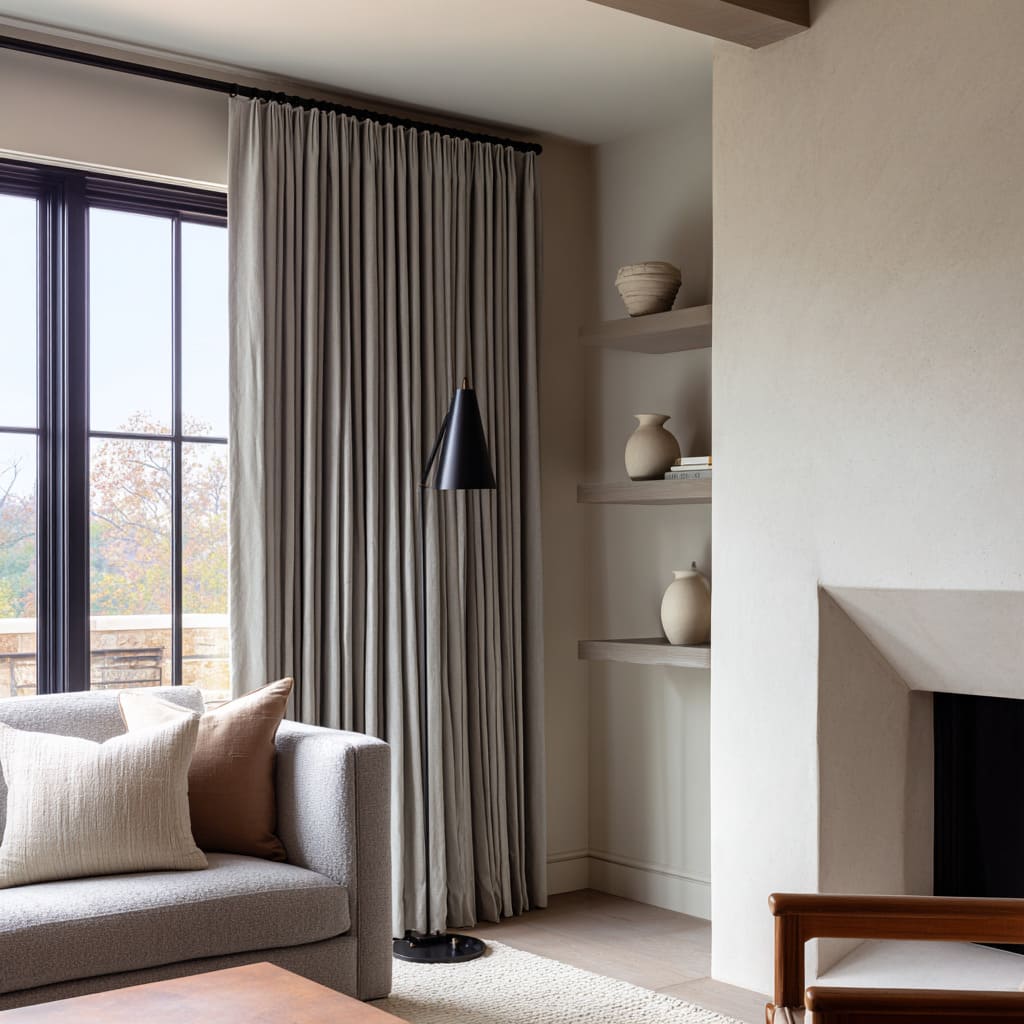
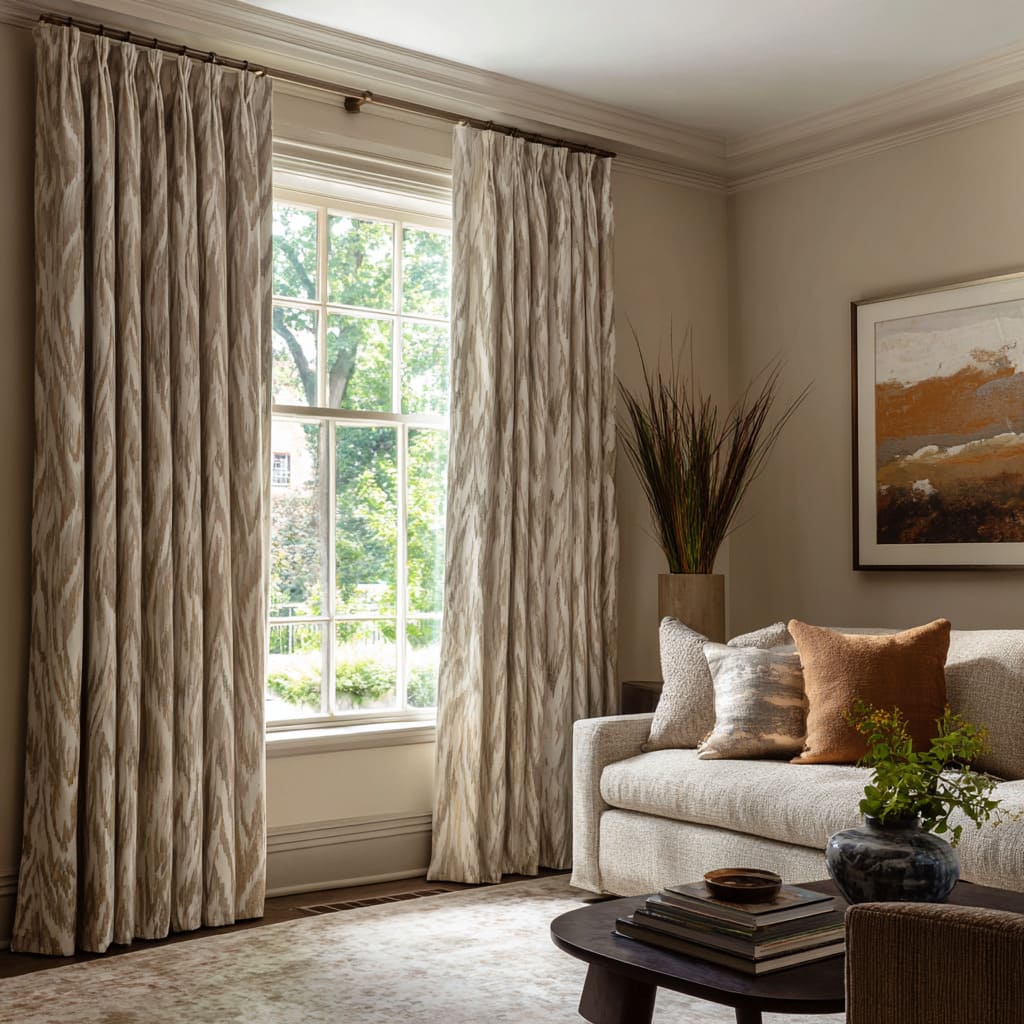
Patterns in soft taupe, beige, and greige often echo bark, soil, or stone more than bright foliage, giving a quiet echo of the landscape rather than copying its most saturated greens. When drapery is two-tone—with a lighter body and a deeper band at the hem—the same bridge logic governs the pairing.
The upper portion usually relates more closely to wall and ceiling, while the lower band leans towards floor, baseboard, and furniture legs. The eye understands the room through this gradient, reading a controlled transition from light above to grounded depth below, with fabric as the mediator between all these surfaces.
Micro-Patterns, Texture, and Controlled Movement
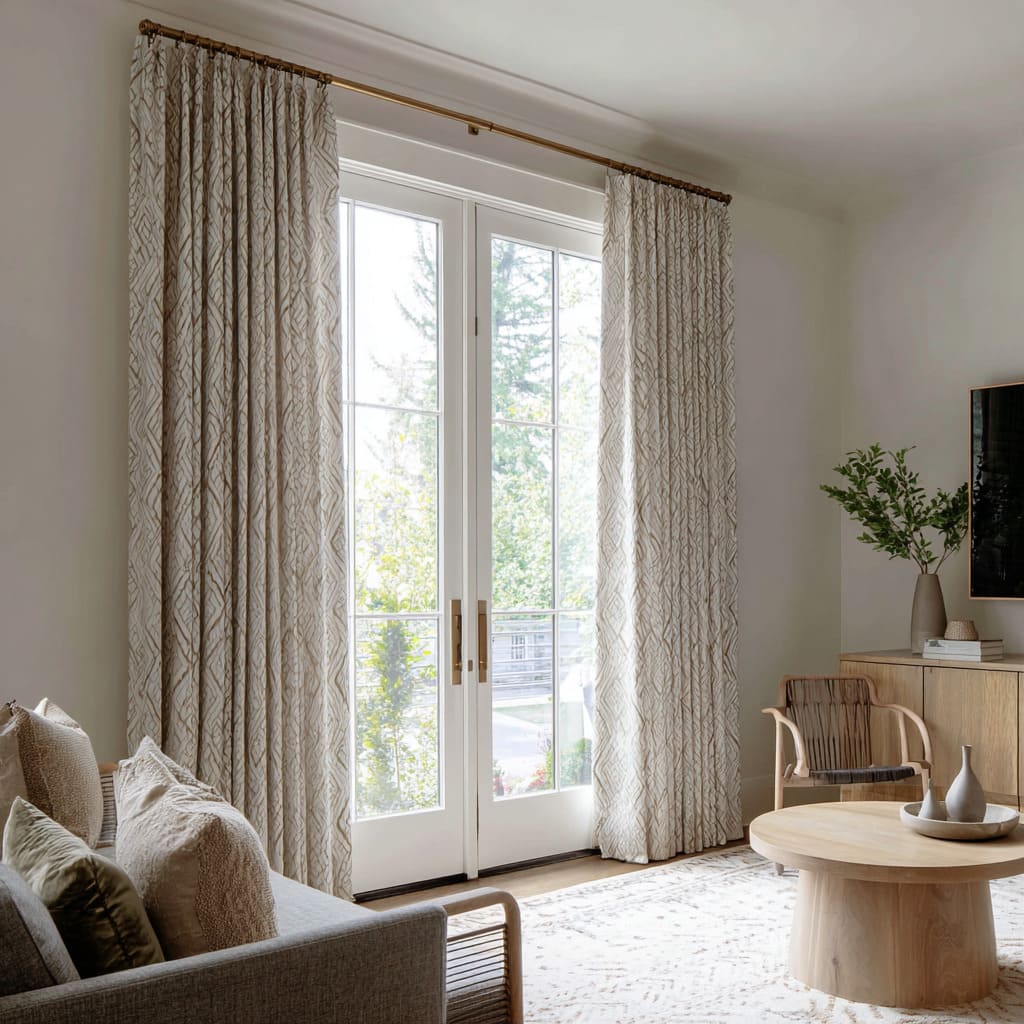
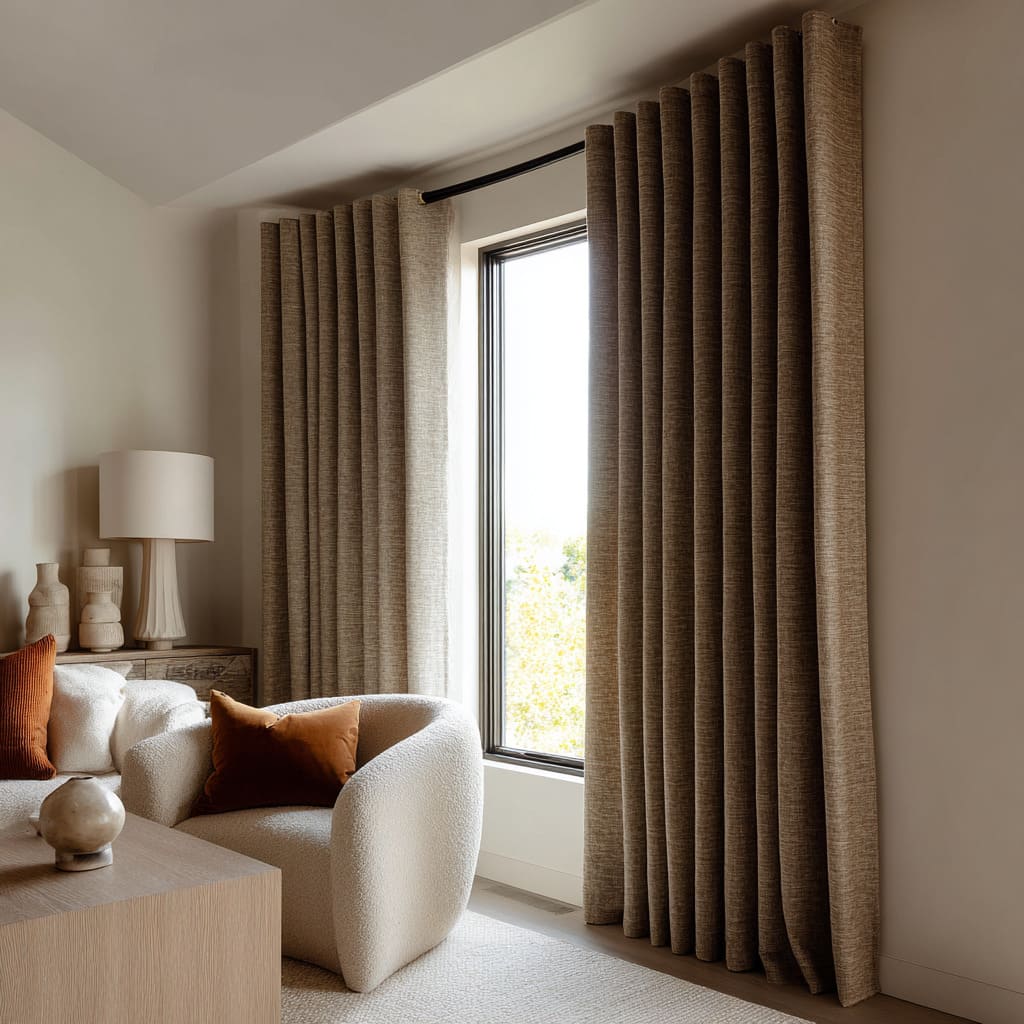
Instead of large prints, many nuanced schemes use micro-patterns and structural weaves in the drapery to introduce movement without visual noise. Herringbone and chevron weaves supply tiny zigzags that compress into vertical shimmer when pleated; ikat or blurred motifs turn into soft watercolor stripes; small geometric repeats form an almost speckled field once the panels are drawn.
From a distance, these designs read as calm texture rather than pattern. Up close, they offer richness and depth, giving the impression of crafted cloth with a story in its weave.
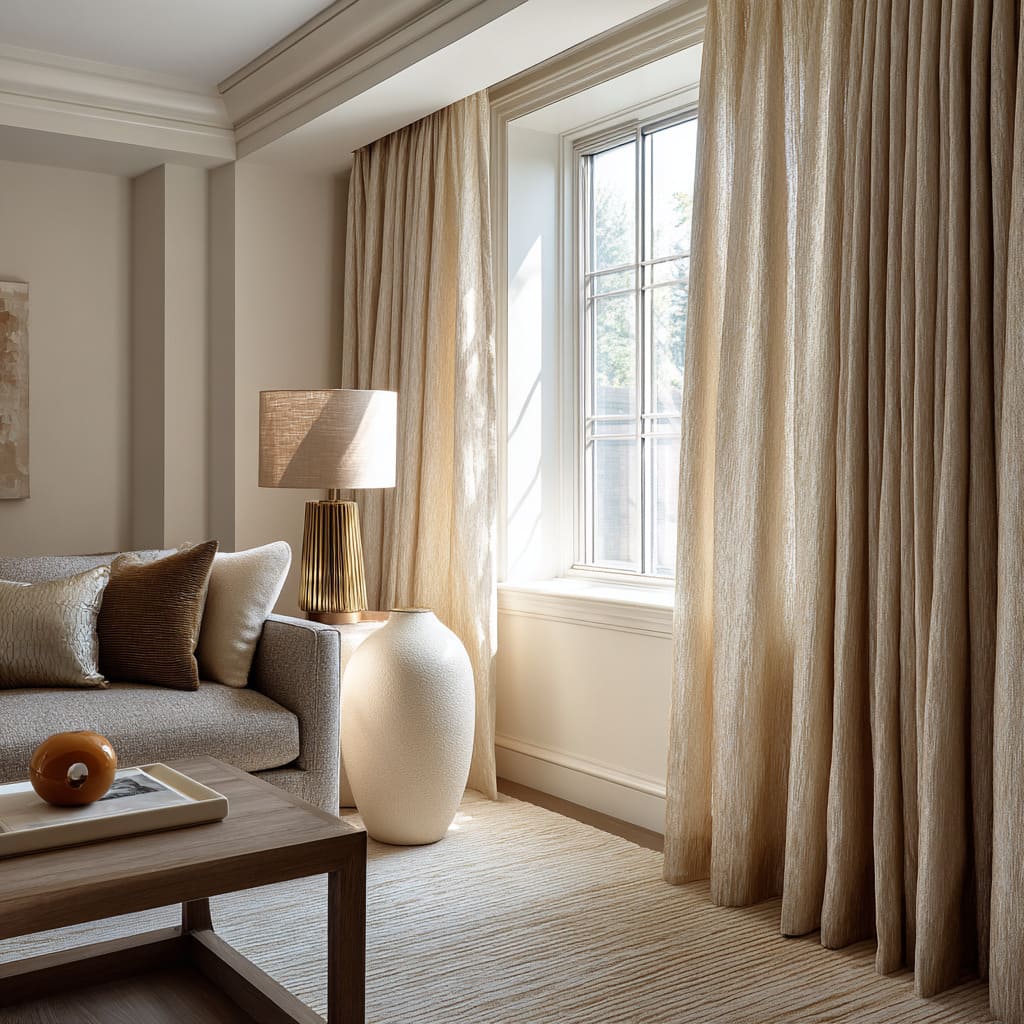
These micro-geometries often mirror or counterpoint other surfaces. Vertical zigzags might correspond to the grain of a pale timber console; small terracotta marks in the fabric may feel related to the pitted surface of a stone coffee table; gridded open weaves can project faint light grids onto floor and adjacent walls, extending the textile pattern into pure light and shadow.
The key is scale and contrast: drapery usually carries the most defined fabric story on the vertical surfaces, while rugs, art, and upholstery remain slightly more muted or operate at a different scale. This hierarchy allows the room to feel layered and detailed, yet still calm, because the eye has one leading texture to decode instead of competing statements on every plane.
Light Sculpted Through Sheer and Semi-Sheer Panels
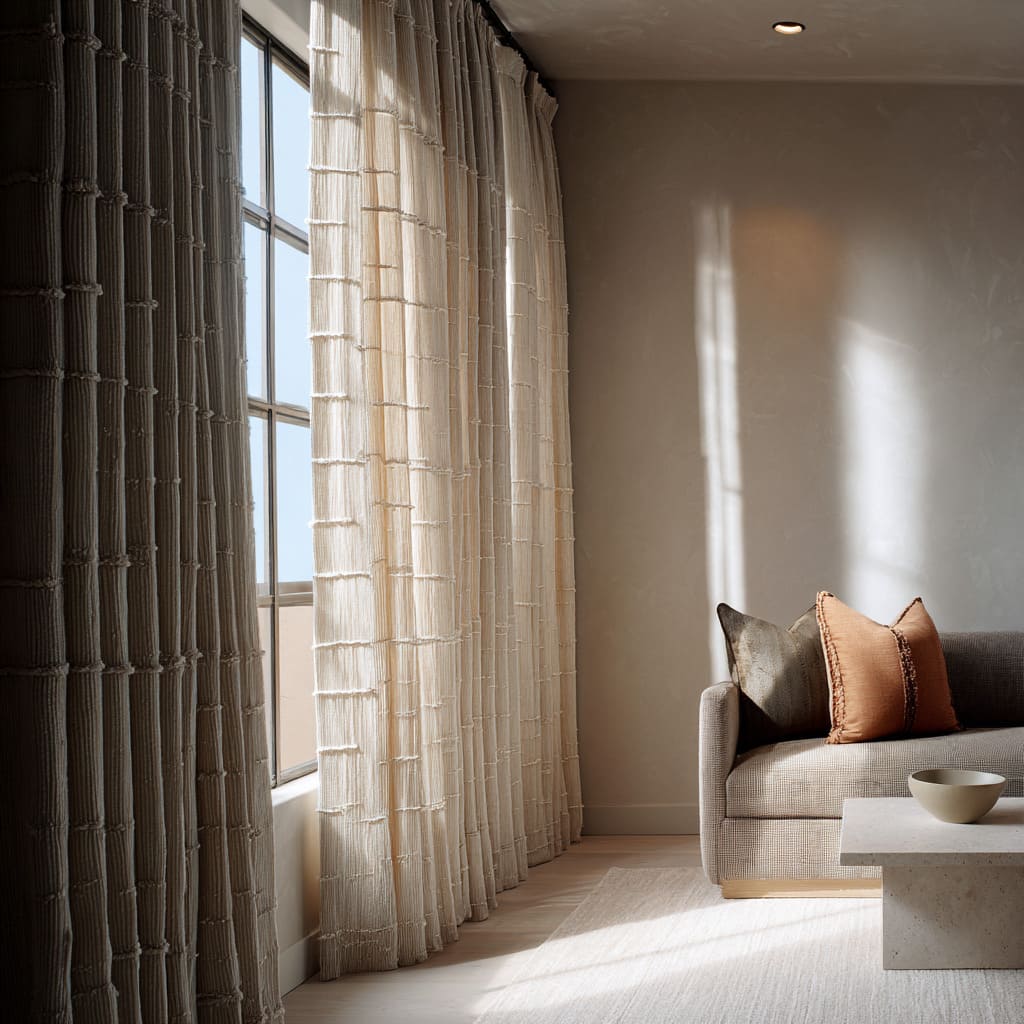
Sheers play a central role in many drapery designs for living rooms where daylight is plentiful and needs soft control rather than full blocking. Tall, generous panels in pale tones turn entire walls into diffusers, smoothing out harsh contrasts between direct sun and interior shade.
Slightly crinkled or crushed textures catch the sun in irregular streaks, producing vertical bands of highlight and shadow that move freely across the day. Open weaves with tiny grids allow views to remain visible while breaking landscape outlines into gentle pixels of color.
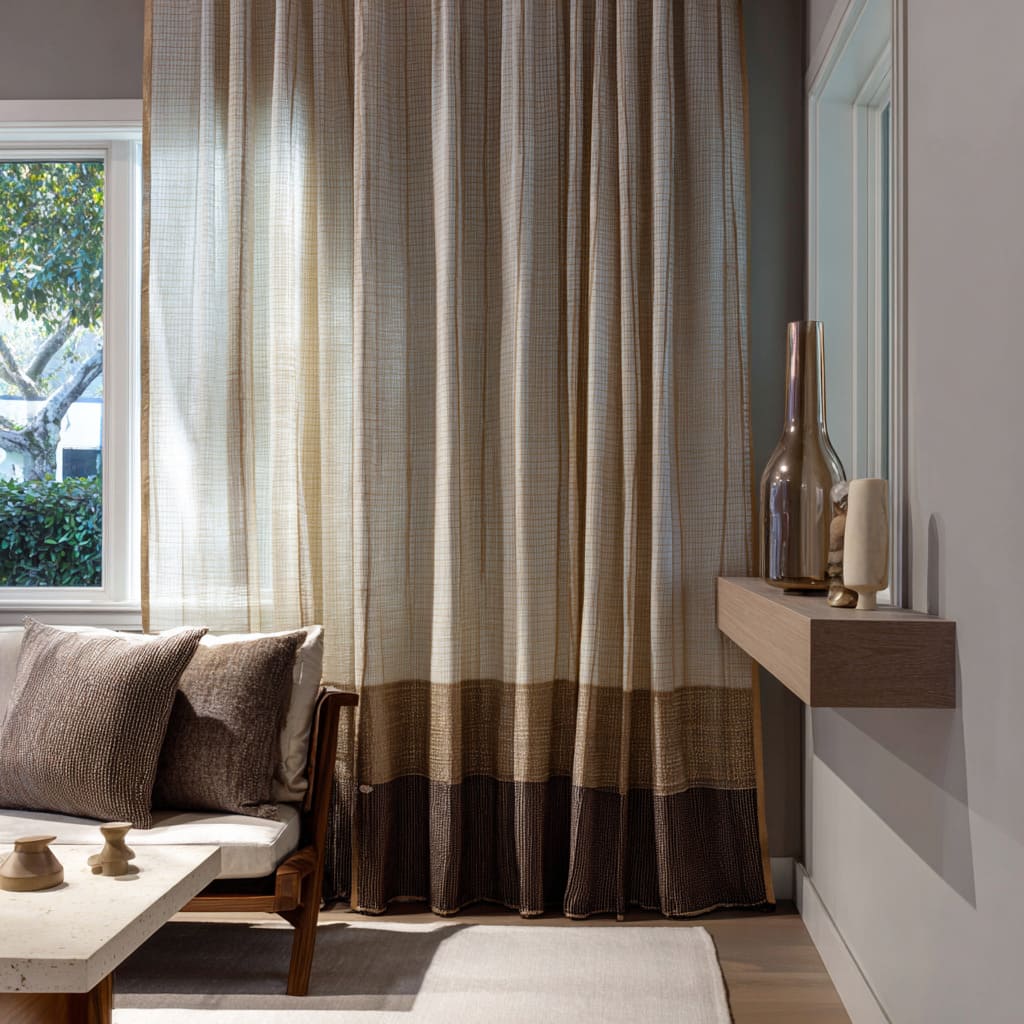
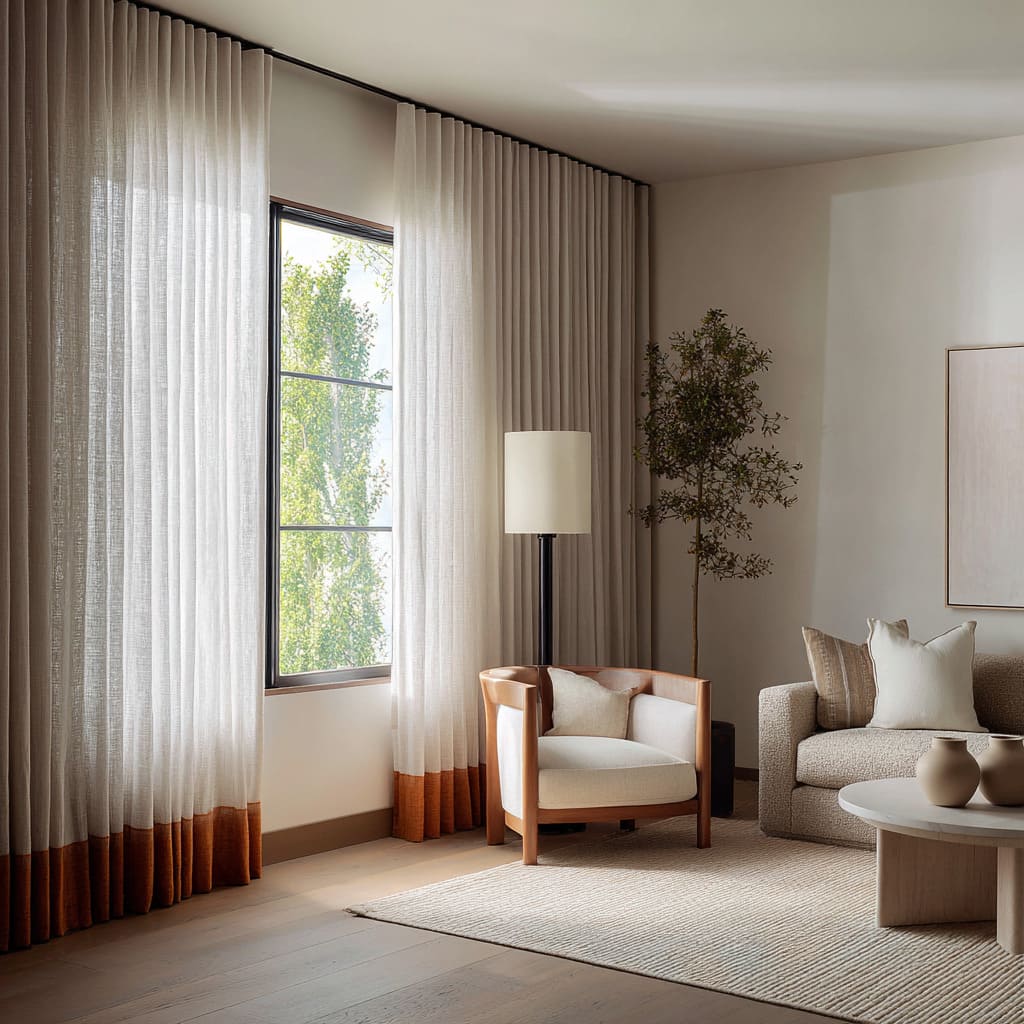
Gradients often appear naturally: portions near the top pick up cooler light from sky and soffit, while lower sections absorb warmth from timber floors and rugs, so the cloth shifts from silvery cream to golden beige without any printed design. Color-blocked sheers enhance these effects when a darker hem band anchors the wall; the upper area glows with filtered daylight, while the lower portion sits in a more settled value range, acting almost like a permanent soft shadow.
In urban environments, these textiles soften strong geometry and reflections from neighbouring buildings; in greener settings they turn trees and gardens into abstract tapestries. The room gains a sense of continuity through changing light, as the drapery records the passage of time in slow, subtle shifts rather than abrupt sun patches on the sofa.
Color and Atmosphere in Luxury Living Room Drapes
Some interiors rely on drapery to set the emotional temperature of the entire space, especially where richer color and texture are involved. Luxury living room drapes in graphite, caramel, terracotta, or golden camel tones can behave like large fields of atmosphere.
Deep, nearly black fabric absorbs light and calms contrast, giving a soft backdrop against which pale stone, ceramics, and leather seats glow with emphasis. Caramel velvet catches light in soft vertical flares, each fold moving from honey to umber, so the wall feels as if it holds a slow, permanent sunset.
Terracotta and warm clay shades rise from pale flooring like vertical bands of earth, grounding otherwise mineral schemes full of stone and pale tiles. Golden velvet around classical mouldings softens crisp white profiles and mid-tone timber floors, replacing cool formality with a mellow glow reminiscent of hospitality spaces.
In each case, saturation is carefully moderated: drapery sits darker than walls and sofas, yet lighter than black window frames or metal accents. This positioning allows the color field to dominate gently, without overwhelming the composition.
Small objects—rust cushions, amber glass, warm metallics, or flower arrangements in burnt tones—act as concentrated echoes of the curtain palette, reinforcing the mood while keeping the room harmonious.
Corners, Wrapping, and Soft Enclosures Around Seating
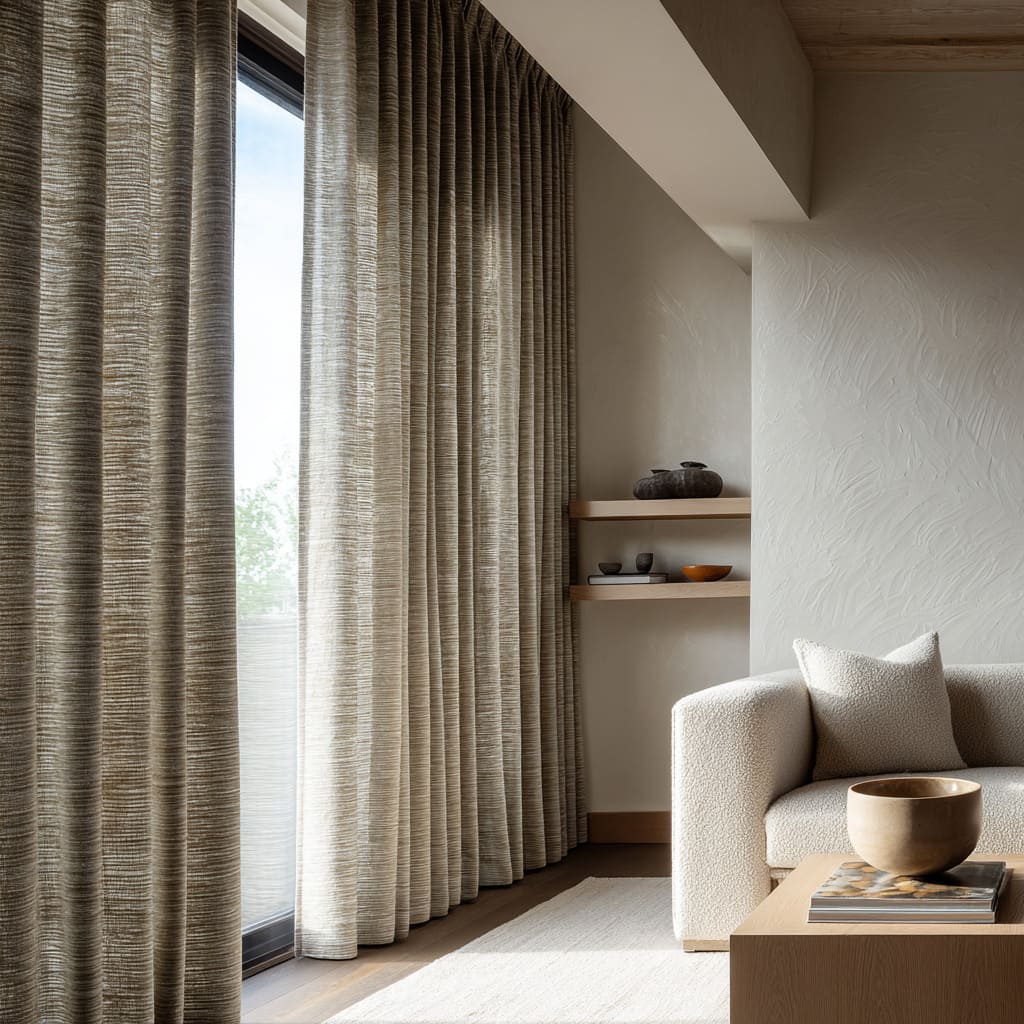
Corners are particularly revealing of drapery strategy, because treatment there decides how “wrapped” or open the main seating feels. Where tracks bend around corner windows and hold generous folds, the glazing reads as a continuous opening framed by one textile volume rather than two separate strips of glass.
A sofa, armchair, or chaise placed in front of this wrap sits inside an implied alcove; the fabric behind becomes a soft column or shell that visually holds the furniture. The curtain color usually sits only a step deeper than the wall, so the corner feels like a deeper version of the envelope rather than an added accent.
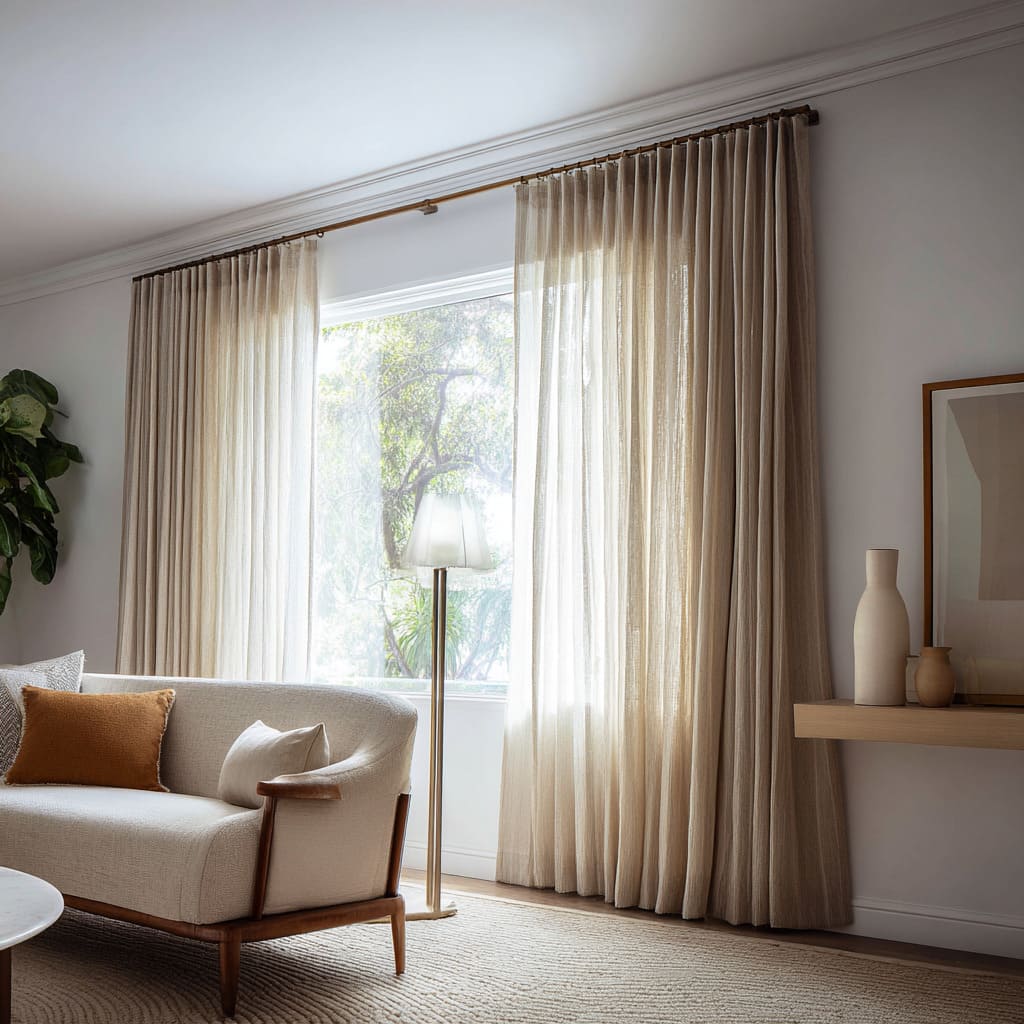
Rugs with fine linear textures that run toward the windows strengthen this effect, helping the room read as a calm flow into the corner rather than a series of breaks. In some compositions, drapery also extends onto a short return wall with shelving or a low cabinet.
Objects on floating shelves then appear against a consistent textile field, while the sideboard or console becomes a horizontal anchor beneath the folds. The amount of wrap shapes the emotional reading: light-toned sheers wrapped around a corner suggest an open, luminous sitting area; darker or denser fabric in the same configuration produces a cocooned, lounge-like niche even if the furniture arrangement remains identical.
Bands, Hems, and Graphic Strategies for Elegant Drapes for Living Room
Graphic detailing often appears in the lower third of panels, where bands and color blocks control how drapery meets the floor. In spaces that favour understated pattern, a darker hem on a sheer or semi-sheer fabric can act as a textile baseboard: the upper two-thirds remain luminous and airy, while the lower band aligns with floor, rug, and furniture legs in a more grounded value.
Two-tone designs split horizontally—off-white above, charcoal or soft graphite below—can mimic fabric wainscoting. The darker section roughly follows the visual line of seats and side tables, anchoring the composition at sitting height, while the light top preserves ceiling height and brightness.
Because folds break the junction, the transition line feels soft and woven, not painted on.
They often relate these bands to other elements of the room: the darker zone might match the tone of slim oak shelves, chair arms, or a console, while the upper portion harmonises with wall and ceiling. In more relaxed schemes, the value contrast between sections is gentle, suggesting the effect of a permanent shadow near the floor.
In more graphic interiors, the band is stronger, providing a clear horizontal accent that can replace the need for a strong stripe on the wall. Through these approaches, even quite simple panels can operate as sophisticated elegant drapes for living room settings without relying on ornate decoration.
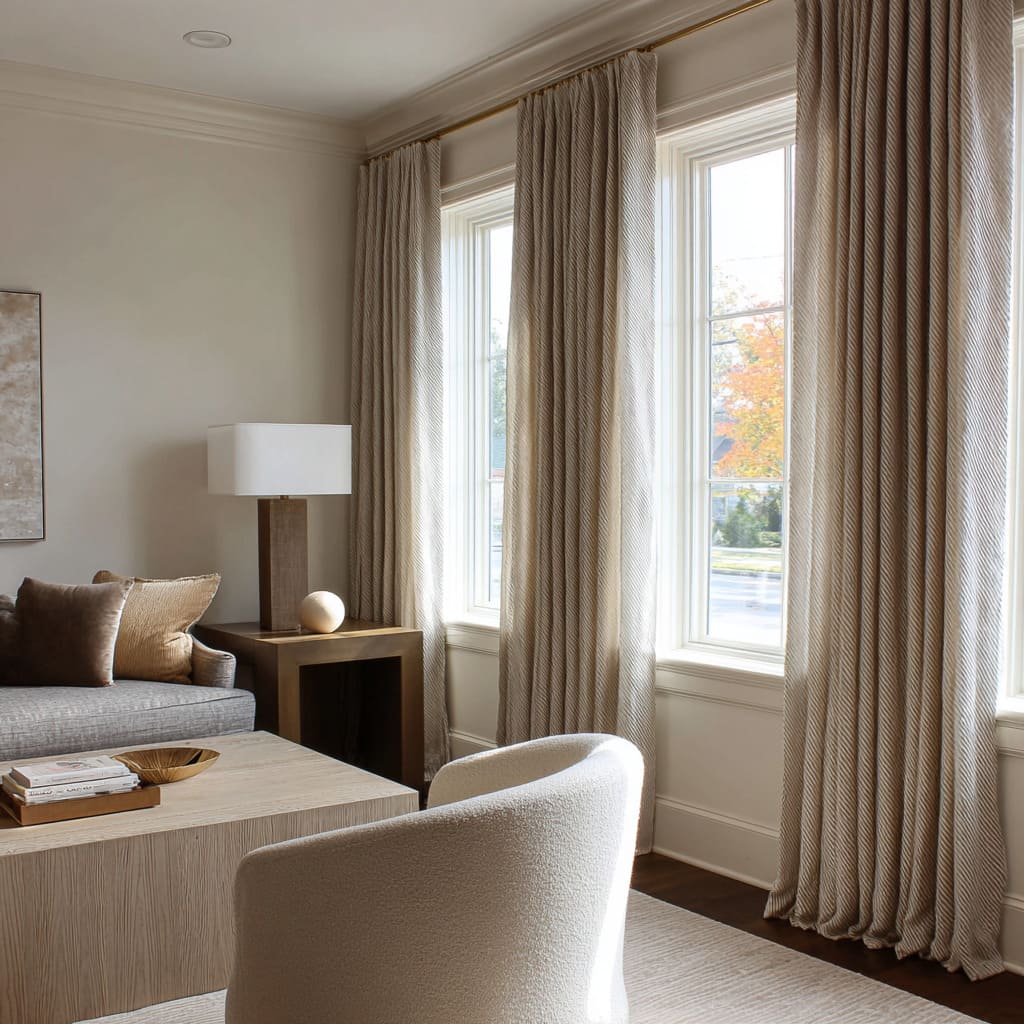
Layered Fabrics and the Language of Formal Living Room Drapery Ideas
Layering two or three fabrics in one window zone allows drapery to move through different atmospheres within the same architecture, a strategy often present in more considered formal living room drapery ideas. A sheer layer closest to the glass handles glare and frames the exterior as a soft, blurred scene.
In front of this, a mid-weight cloth in a calm neutral or gentle warm tone provides a more substantial backdrop for daytime when additional privacy or visual relaxation is required. Along one side or in select portions, a denser fabric—perhaps a rich velvet or deeper neutral—adds depth and the option for complete enclosure during evening hours.
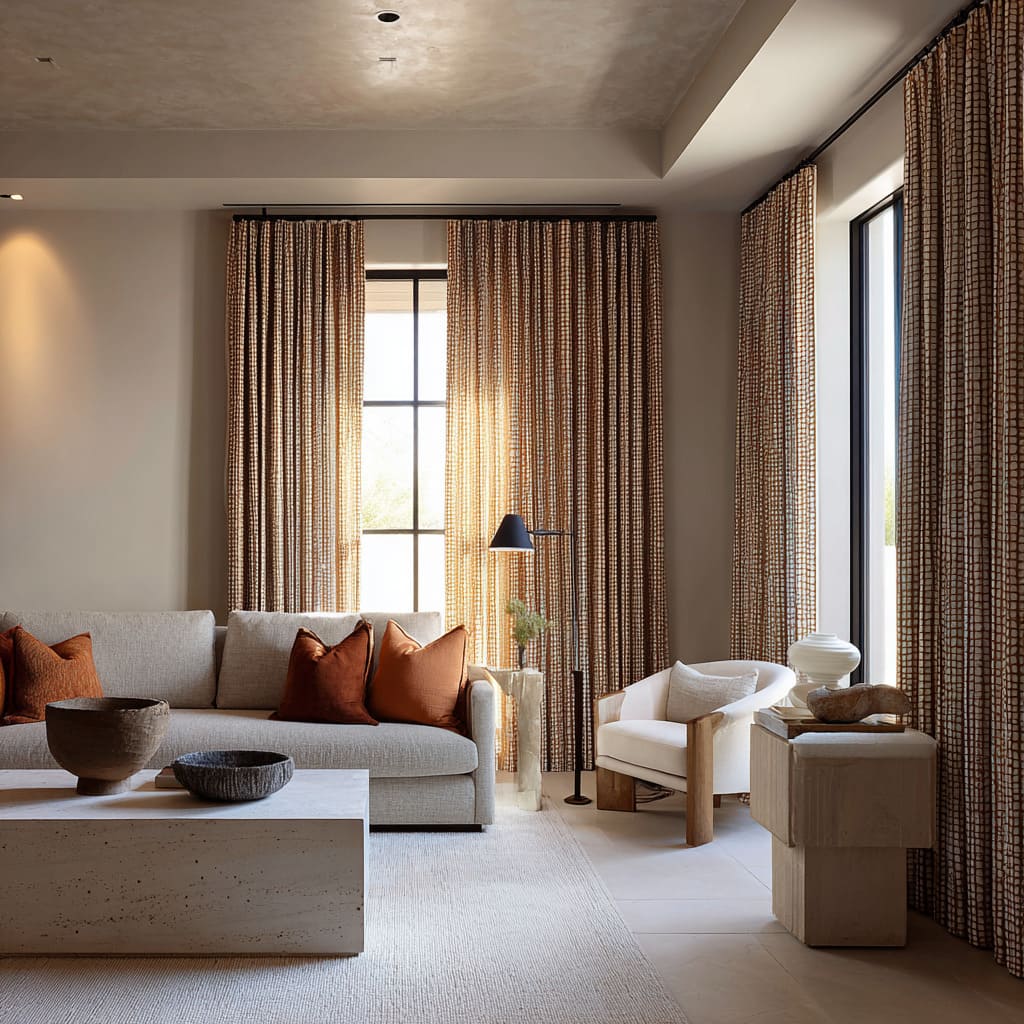
At the corner where these materials meet, the design gains a stacked hierarchy: translucency, softness, and weight all present at once in a small section of wall. When a plaster fireplace and tall vases sit nearby, the layered drapery and solid forms together read like a textile and stone composition rather than separate elements.
Even if the heavier layer normally stays open, its presence shifts perception; the room registers the potential for a more intimate, cocooned setting. Color and texture sequences are tuned carefully: sheers in vanilla or straw tones, mid-weight panels in warm greige or stone, and denser cloth in taupe, graphite, or caramel, all chosen to sit within one controlled spectrum.
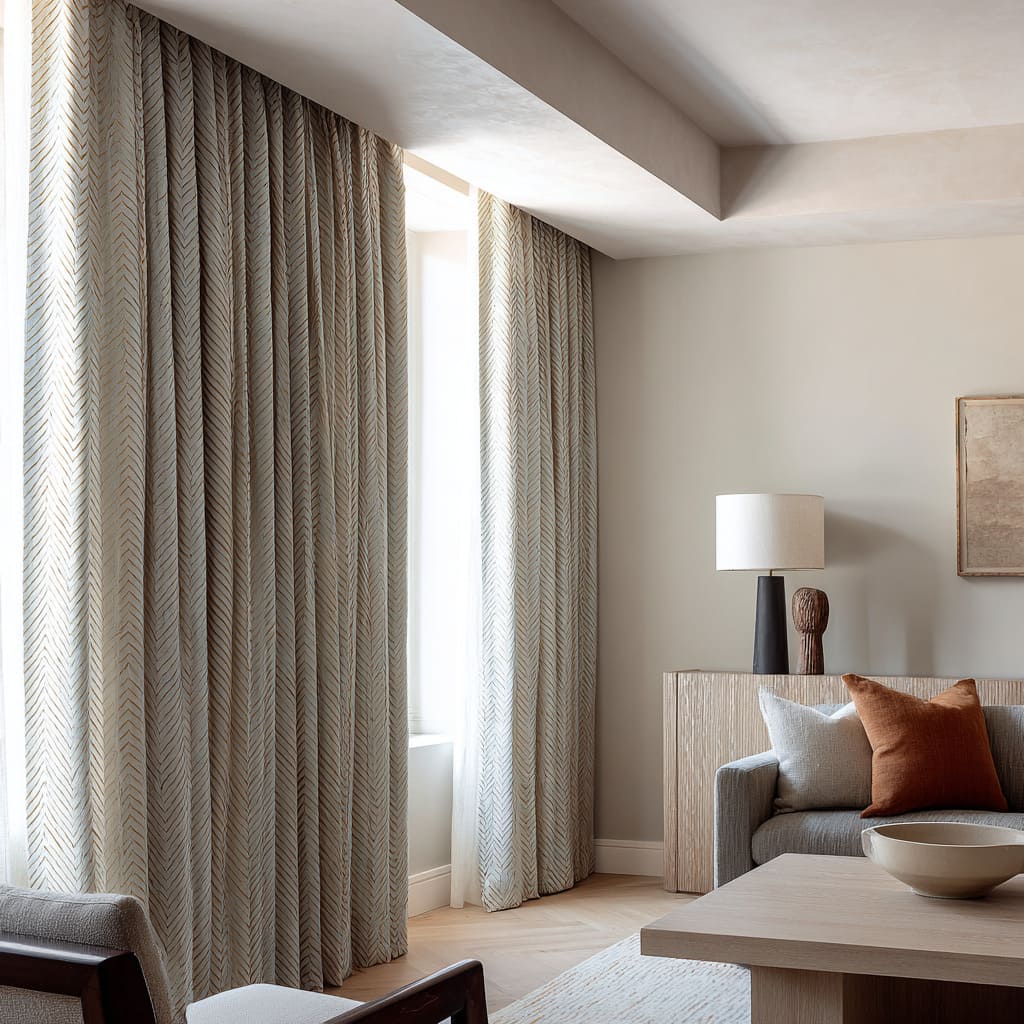
Dialogue Between Drapery, Furniture, Rugs, and Objects
Once drapery is installed as a major visual player, every item placed in front of it begins to relate to that textile backdrop. Sofas often adopt a position just lighter or darker than the panels, so the silhouette of the seating remains legible while still belonging to the same tonal story.
Boucle and other textured upholsteries provide a chunkier counterpoint to the finer weave of the curtains, making the fabric wall appear smoother by contrast. Cushions function as small condensations of the drapery palette: rust or terracotta versions pick up richer notes from patterned panels; champagne, bronze, or pale stone cushions echo highlights or shadow tones from the folds.
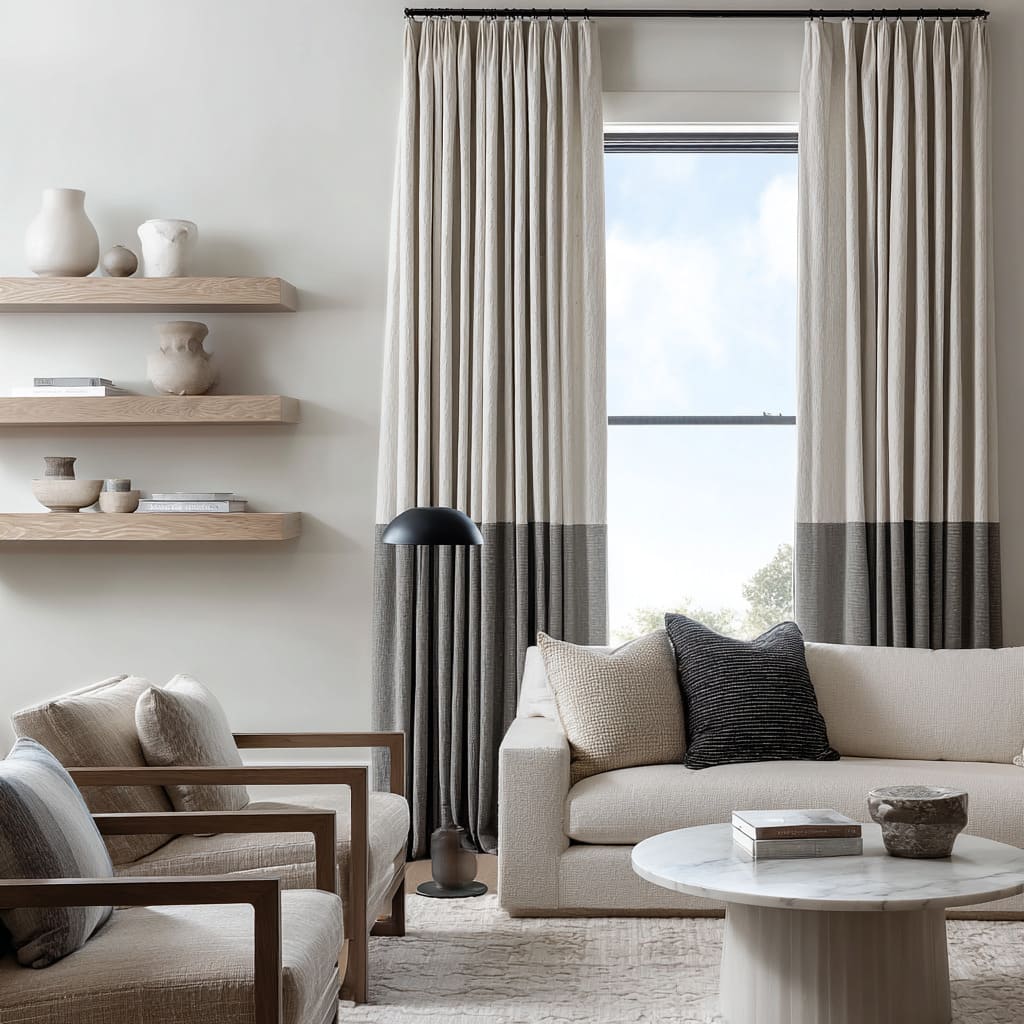
Rugs serve as horizontal extensions of textile thinking: looped or grid-like textures underneath patterned curtains provide a larger, quieter scale of similar movement; concentric or softly curving rugs under strongly vertical pleats add gentle counter-motion so that the room feels layered rather than rigid. Lamps, plants, and decor pieces interact directly with the fabric field.
A slim black floor lamp becomes a drawn line across pale folds, connecting dark window frames to objects at eye level. A tall indoor tree or branch arrangement interrupts regular pleats with organic shapes, bringing nature into the textile rhythm.
Vases on a floating shelf that stops just short of the curtain stack use the clean gap to frame fabric as part of the composition instead of a background leftover. Every placement decision becomes part of the ongoing dialogue between cloth, light, and form.
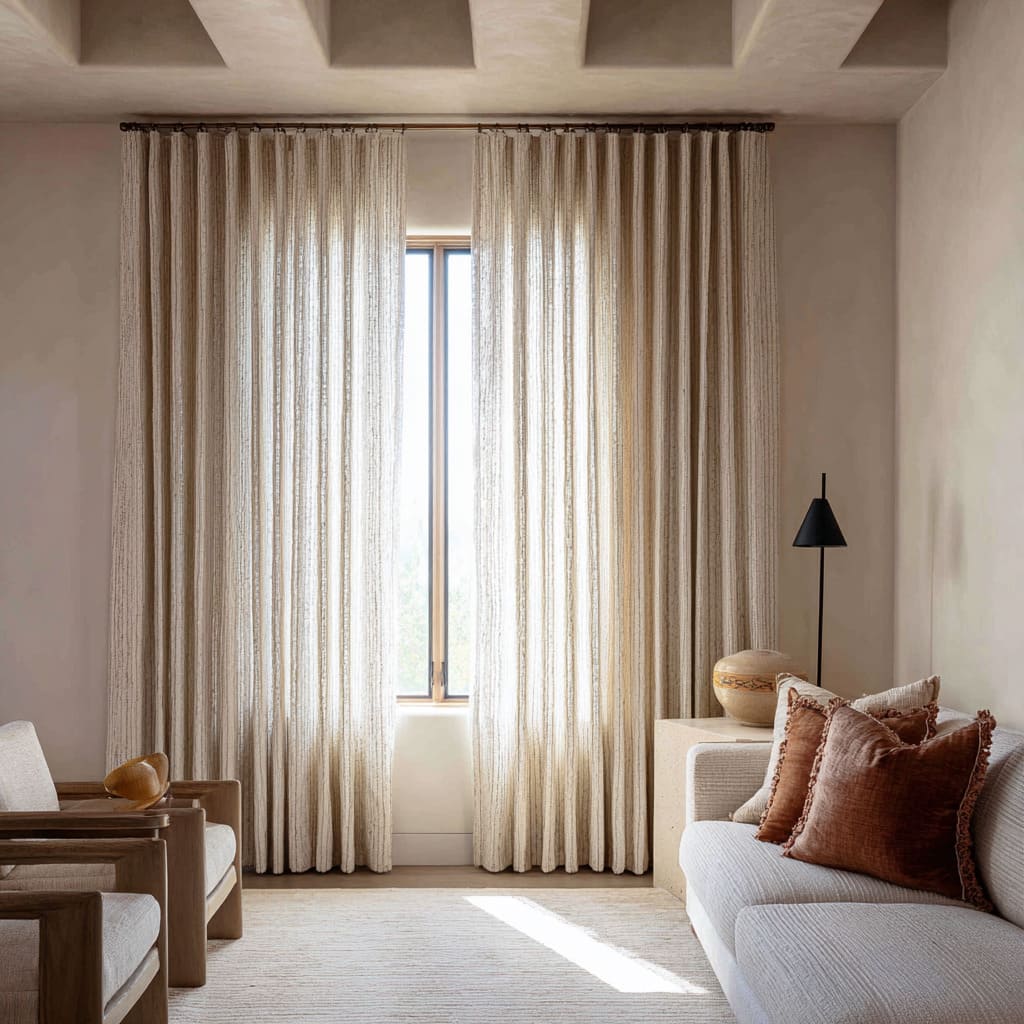
Typologies and Broader Living Room Drapery Ideas
Viewed together, these strategies form distinct typologies that guide how drapery can be styled around seating areas. Structural neutrals—soft greiges, stone tones, and muted oat shades—act like fabric panelling, giving height, rhythm, and a sense of calm scaffolding behind the furniture.
Patterned neutrals with herringbone, blurred stripes, tiny checks, or raised bands introduce controlled movement as the main vertical texture while rugs and artwork stay more restrained. Warm cocoon palettes in graphite, caramel, terracotta, and gold provide the primary color story, casting everything in a particular warmth or shadow and letting timber, stone, and ceramics glow against deeper folds.
Sheer and semi-sheer concepts turn openings into light fields, moderating glare and transforming views into soft backdrops that evolve during the day. Banding and color-blocking at the hem add graphic control, anchoring the lower third and emphasising furniture height while keeping upper walls luminous.
Layered solutions combine these approaches, stacking translucency, softness, and density in a way that allows the same architecture to support daytime openness and evening intimacy. In varied regions and climates—whether near green landscapes, coastal light, or dense urban surroundings—these ideas provide a vocabulary for drapery that shapes atmosphere, proportion, and visual coherence.
Within this vocabulary, living room drapery ideas become less about a single fabric choice and more about the entire interplay between architecture, textile, light, and the objects that live in front of the glass.