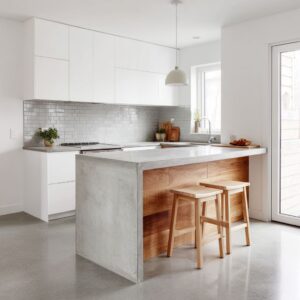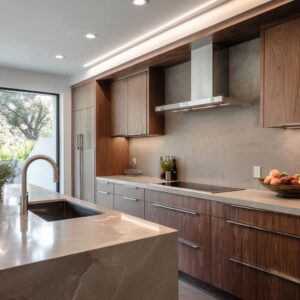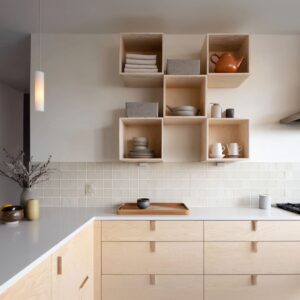
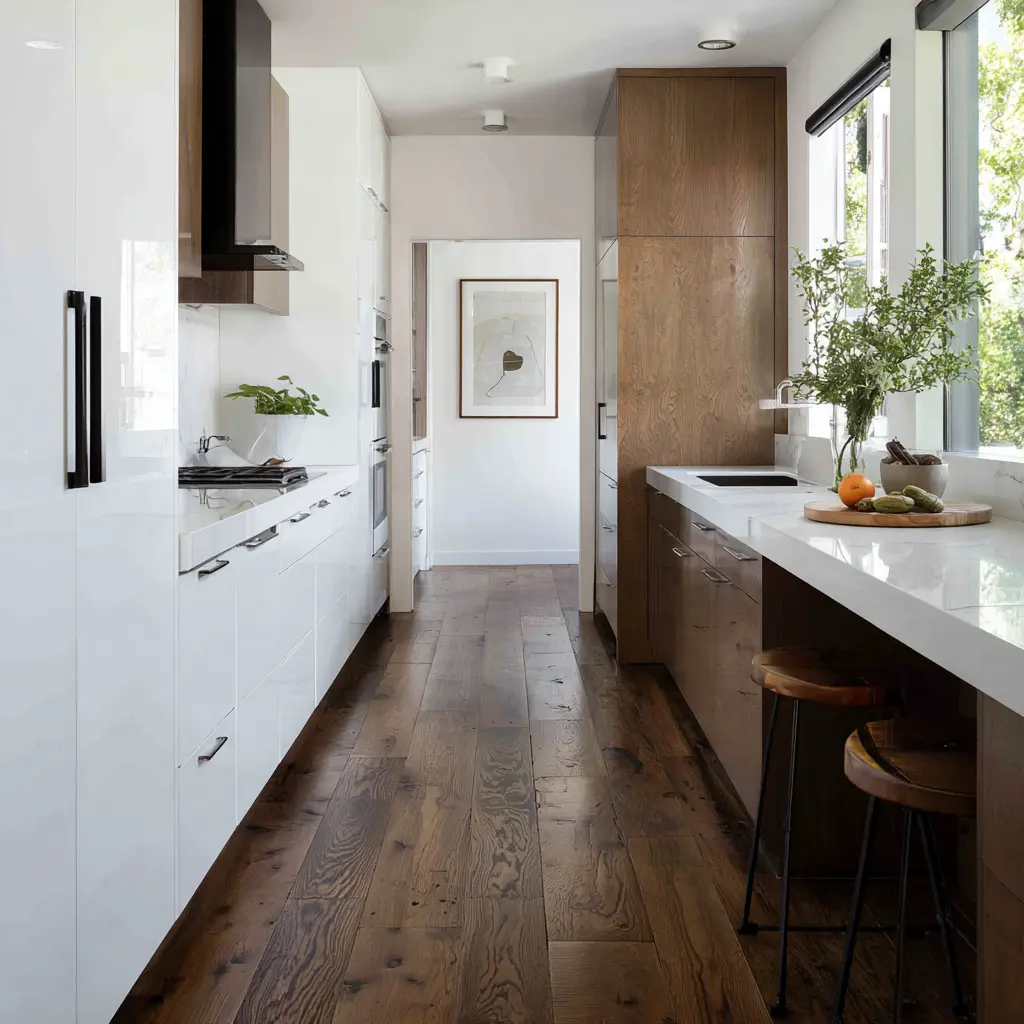
White kitchen cabinets with dark wood floors create beautiful kitchen designs for a reason. The contrast feels clean, grounded, and memorable.
Yet the kitchens that truly feel polished do not rely on white above and dark below alone.
Layered approach is the key design idea behind this look. There is a dark base underfoot, a bright cabinet shell, and one or more linking elements placed between them.
Then the darker tone appears again above floor level through hardware, stools, pendants, windows, island details, or another wood feature. Once those pieces are in place, the kitchen feels settled.
Without them, the contrast can feel abrupt.
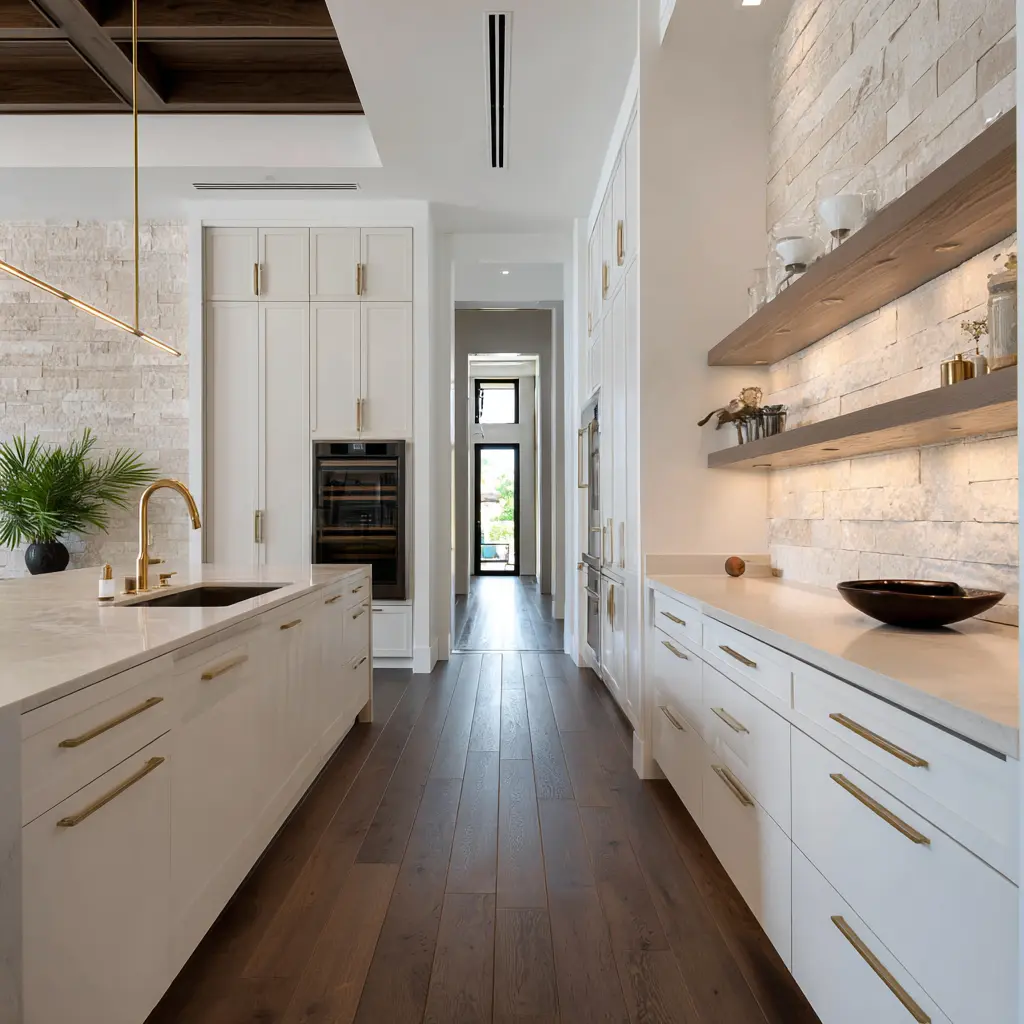
The real secret is not contrast by itself
A lot of people assume white kitchen cabinets with dark wood floors work because the pairing is bold. That is only part of the story.
What actually makes the interior design feel complete is the way the contrast gets softened and organized.
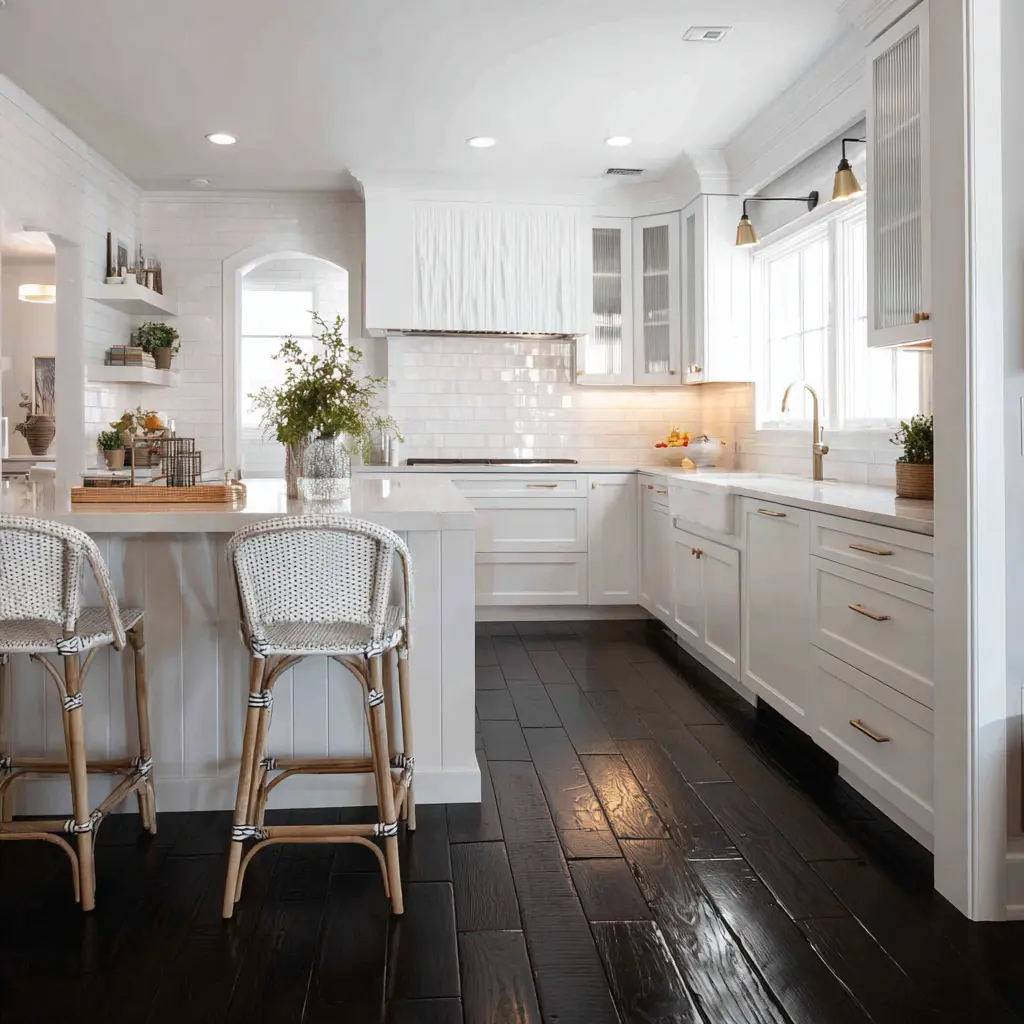
In a kitchen that works well, your eye does not jump straight from bright cabinet fronts to a deep brown-black floor. It moves through a middle layer first.
That middle layer might be a pale veined countertop, a creamy backsplash, warm metal hardware, a wood hood trim, leather stools, or even the amber undertone that appears in the floor when daylight touches it. Those in-between notes are what turn a sharp pairing into a rich one.
So the polished look comes from resolved contrast. The room gives the two extremes a way to belong to the same composition.
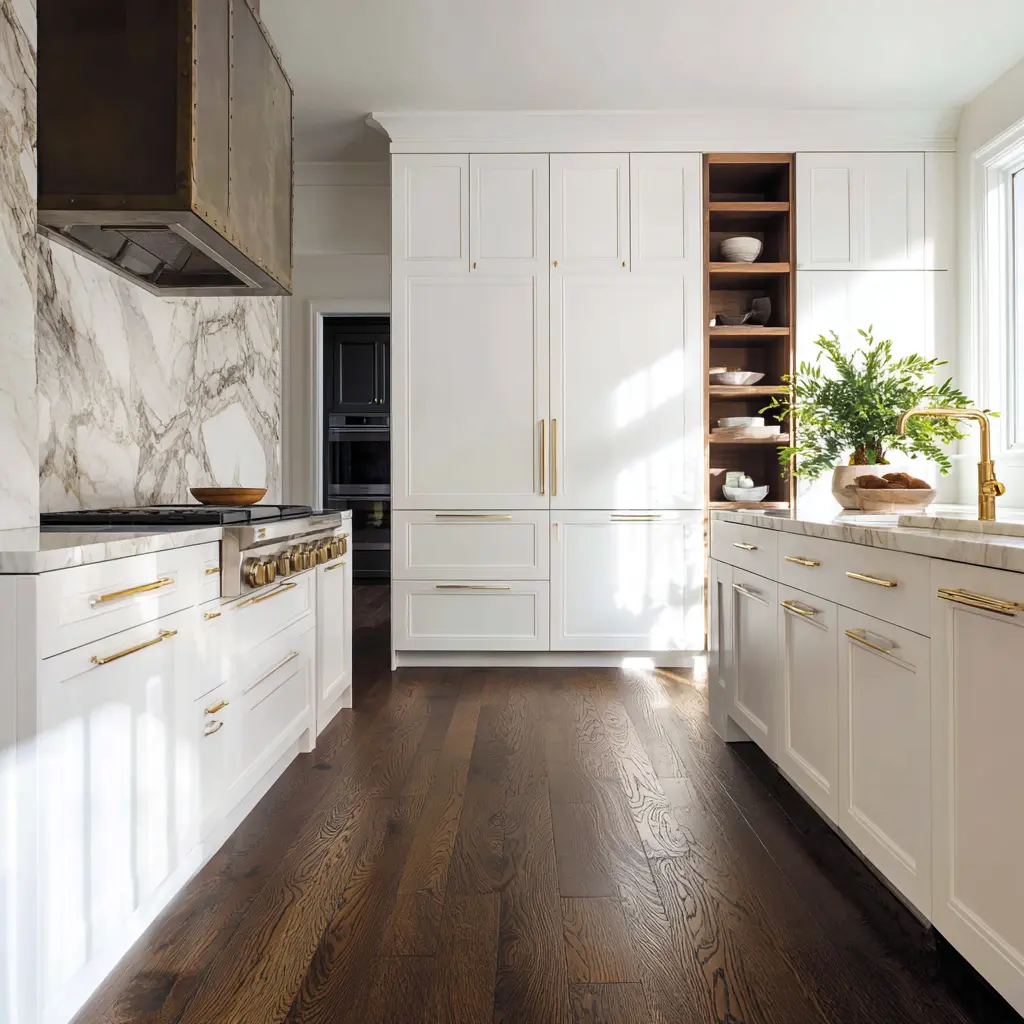
Why the floor matters
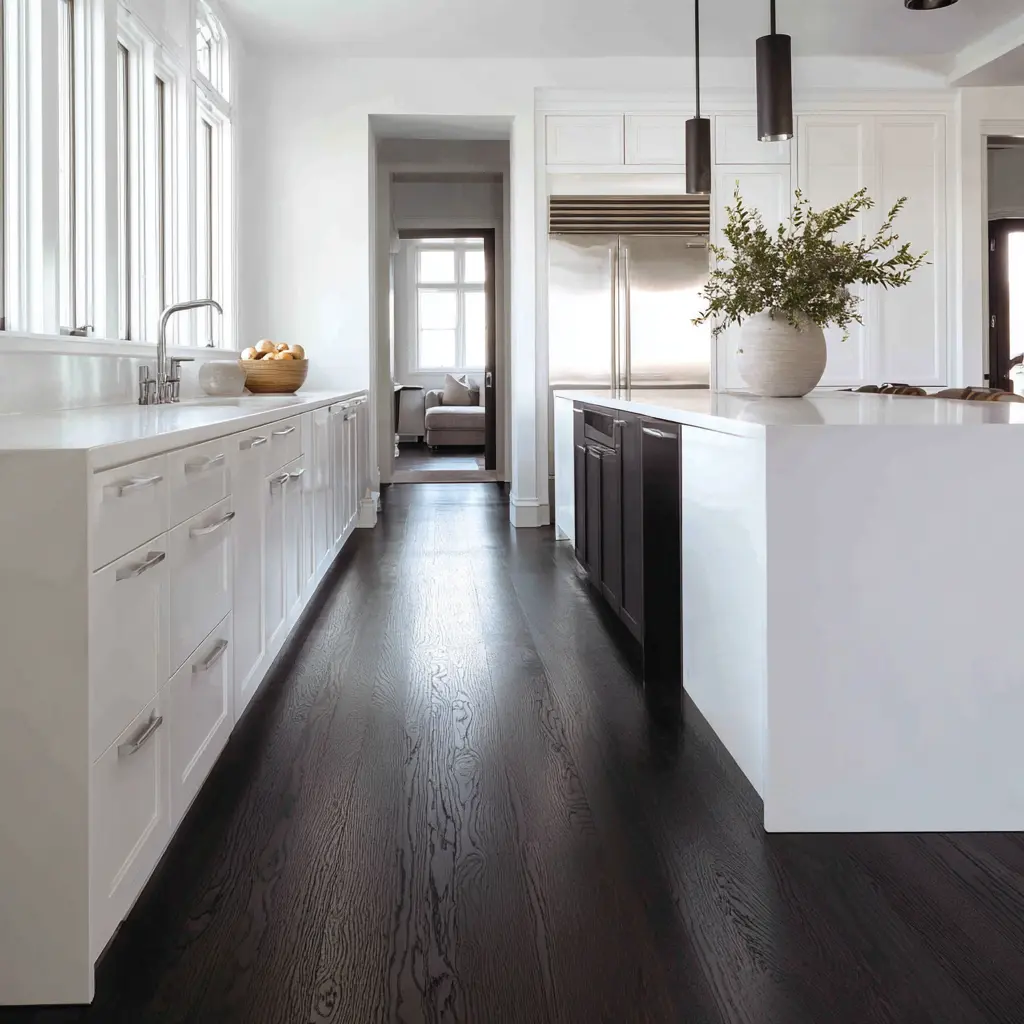
In this kind of kitchen, the floor is doing serious visual work. It is not there only to add darkness.
It becomes the grounding plane of the whole room. A good dark wood floor in a white kitchen usually has several qualities at once.
It is deep in tone, though not flat. It still shows grain.
It still has warmth. In natural light, it often reveals brown, tobacco, walnut, or amber notes inside the darker stain.
That visible wood character changes everything.
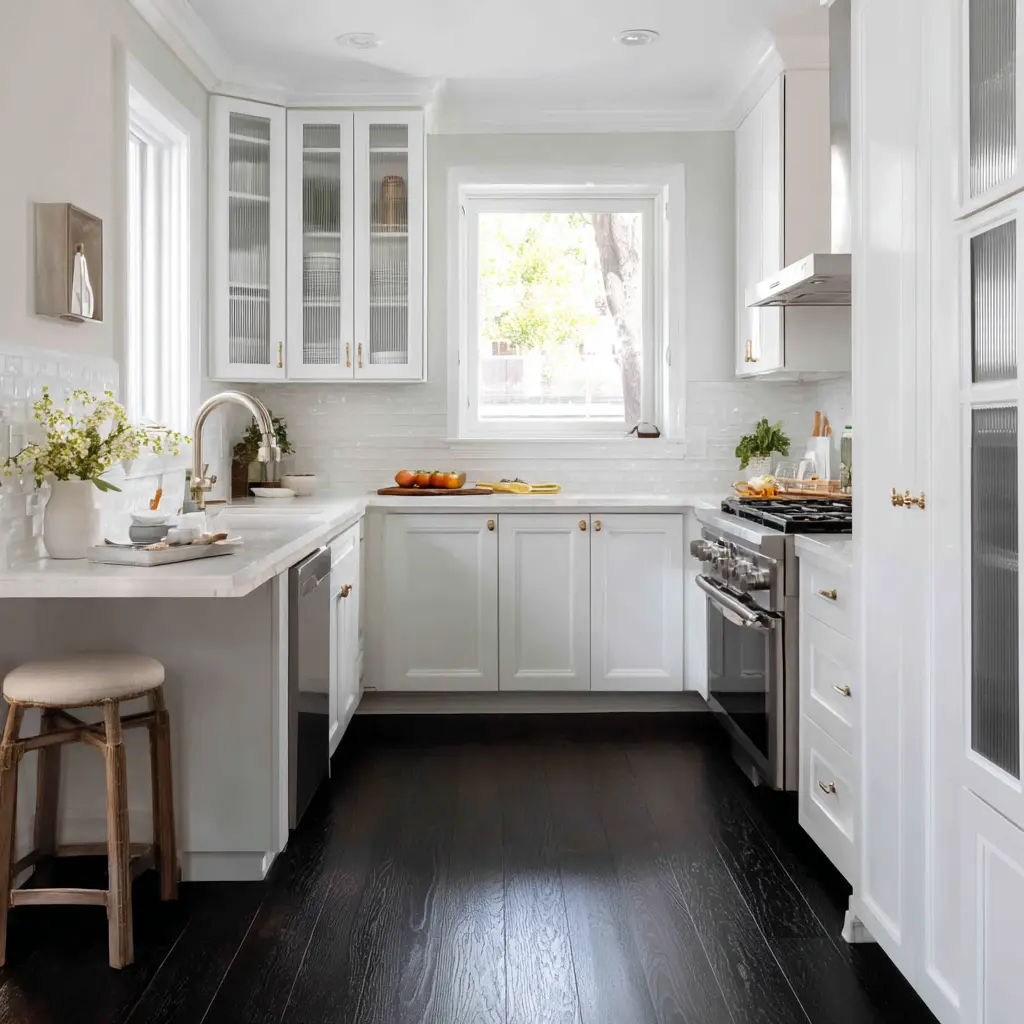
A flat near-black floor can feel heavy and mute. A dark wood floor with legible grain feels grounded, warm, and alive.
It adds movement below a pale cabinet shell. It gives the kitchen maturity.
It also helps the white cabinetry look sharper because the cabinet bases, island edges, and toe lines become clearer against a darker field. That is why the useful variable is not simple darkness.
It is dark wood with retained identity.
White cabinets need depth too
The floor cannot carry all the richness alone. White cabinetry has to bring its own dimensional content to the room.
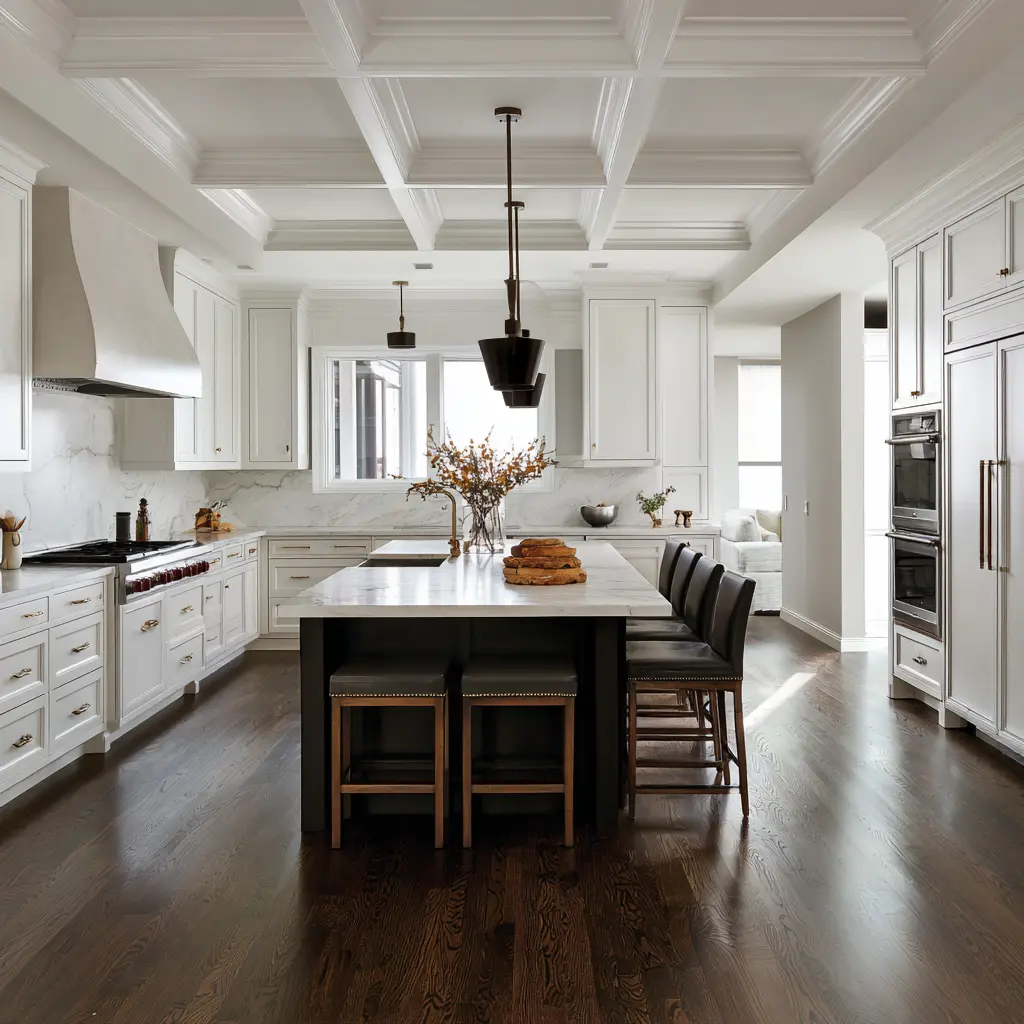
That depth can come from several directions. In more classic kitchen ideas, it may come from shaker frames, inset detailing, crown molding, ribbed glass, or shadow lines in the millwork.
In more modern kitchen designs, it may come from long clean volumes, gloss, reflection, scale, or strong hardware rhythm.
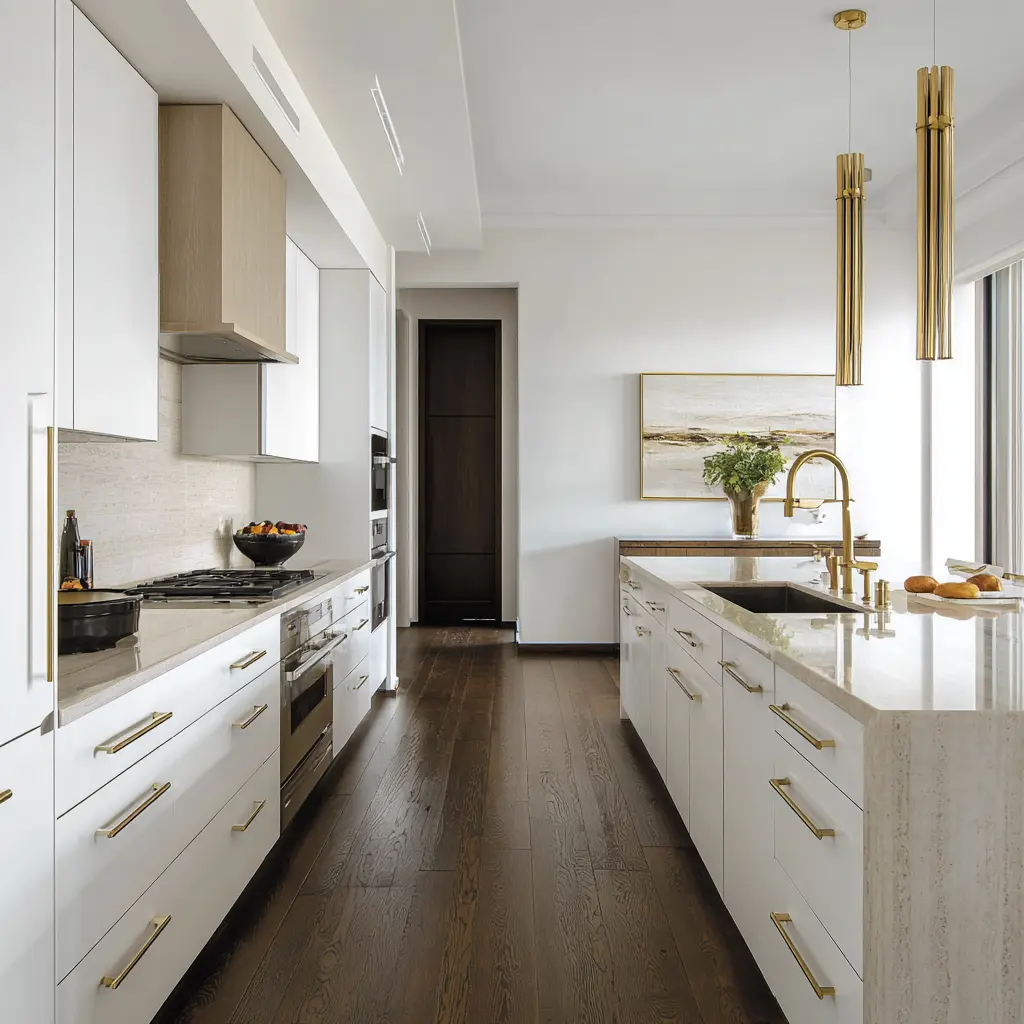
This matters because a dark floor gives the lower half of the room density. If the cabinetry is too flat, too blank, or too cold in comparison, the upper half can feel thin.
The kitchen starts to look like a contrast exercise instead of a full interior. The darker the floor becomes, the more the cabinetry needs either profile, sheen, texture, or carefully controlled proportion.
A dark floor should not stay alone at the bottom
One of the clearest patterns in successful kitchens is that the dark note almost always rises above floor level. You may see it in black or charcoal cabinet pulls.
You may see it in dark stool legs, a painted island base, a wood hood, a pantry wall, darker appliances, side panels, beams, or black-framed windows. Sometimes it appears in several of those at once.
This is what keeps the room from feeling bottom-heavy.
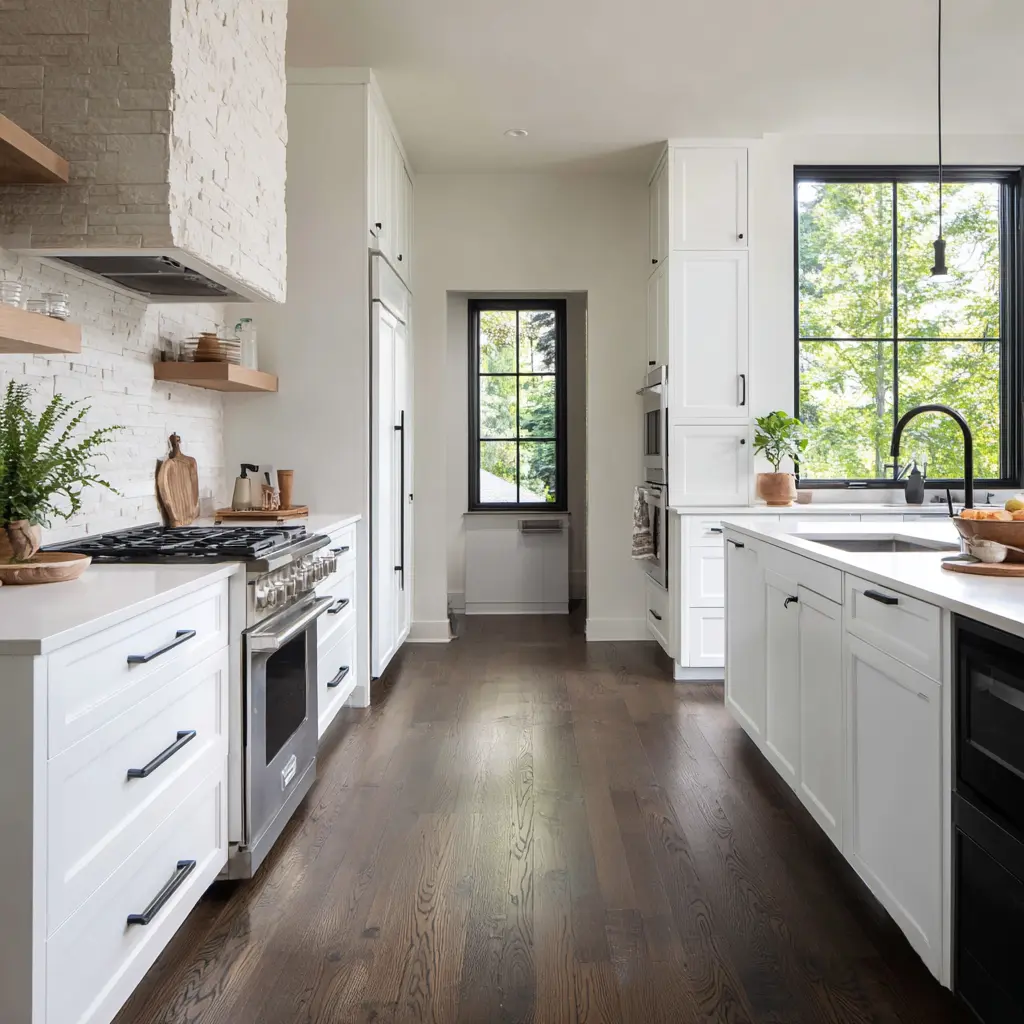
If the floor is the only dark surface, the whole composition can feel visually pressed downward. If the same dark family appears again at hand height, eye level, and sometimes overhead, the room feels stable.
The weight is distributed through the space rather than trapped below. That is one of the most useful design lessons in this pairing.
Dark value needs to travel upward in controlled doses.
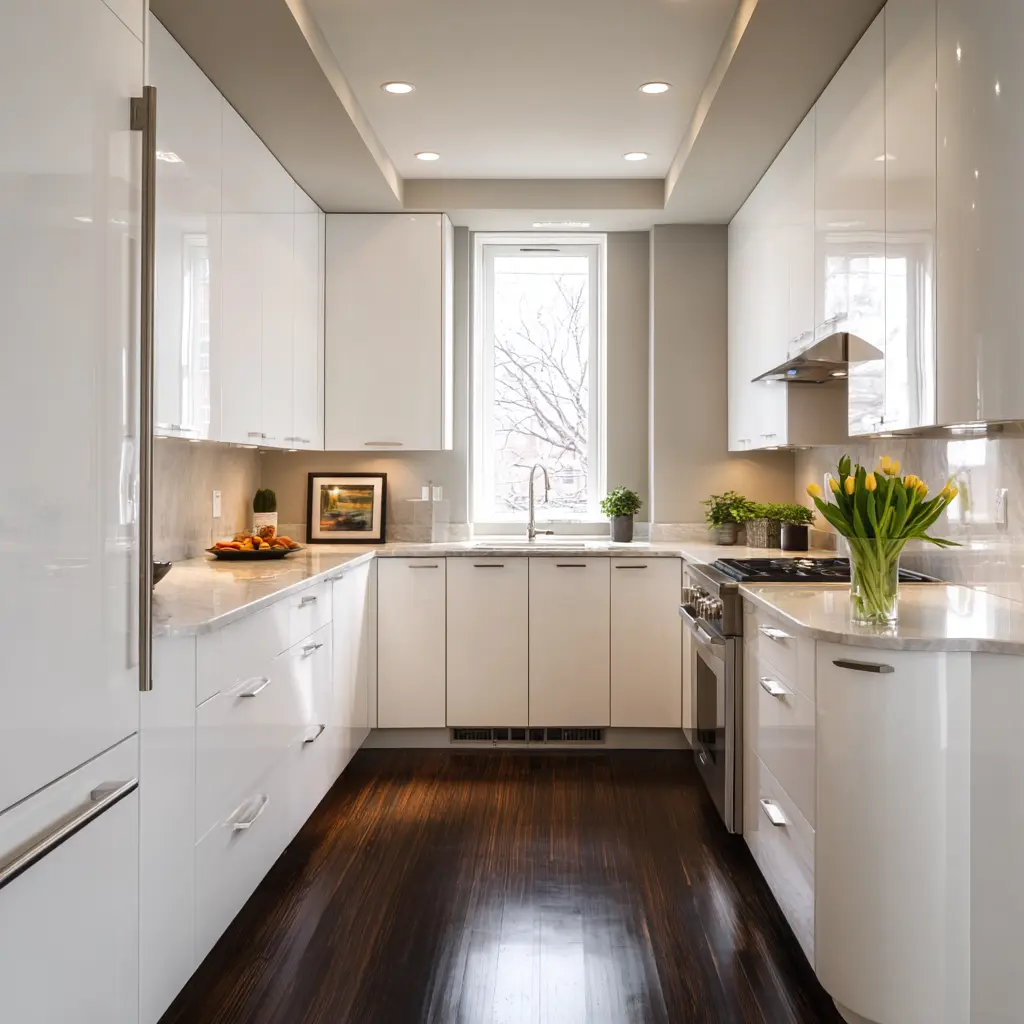
The middle layer is what makes the room feel finished
The bridge layer between cabinets and floor can take many forms, though it nearly always exists in some form in the kitchens that feel complete.
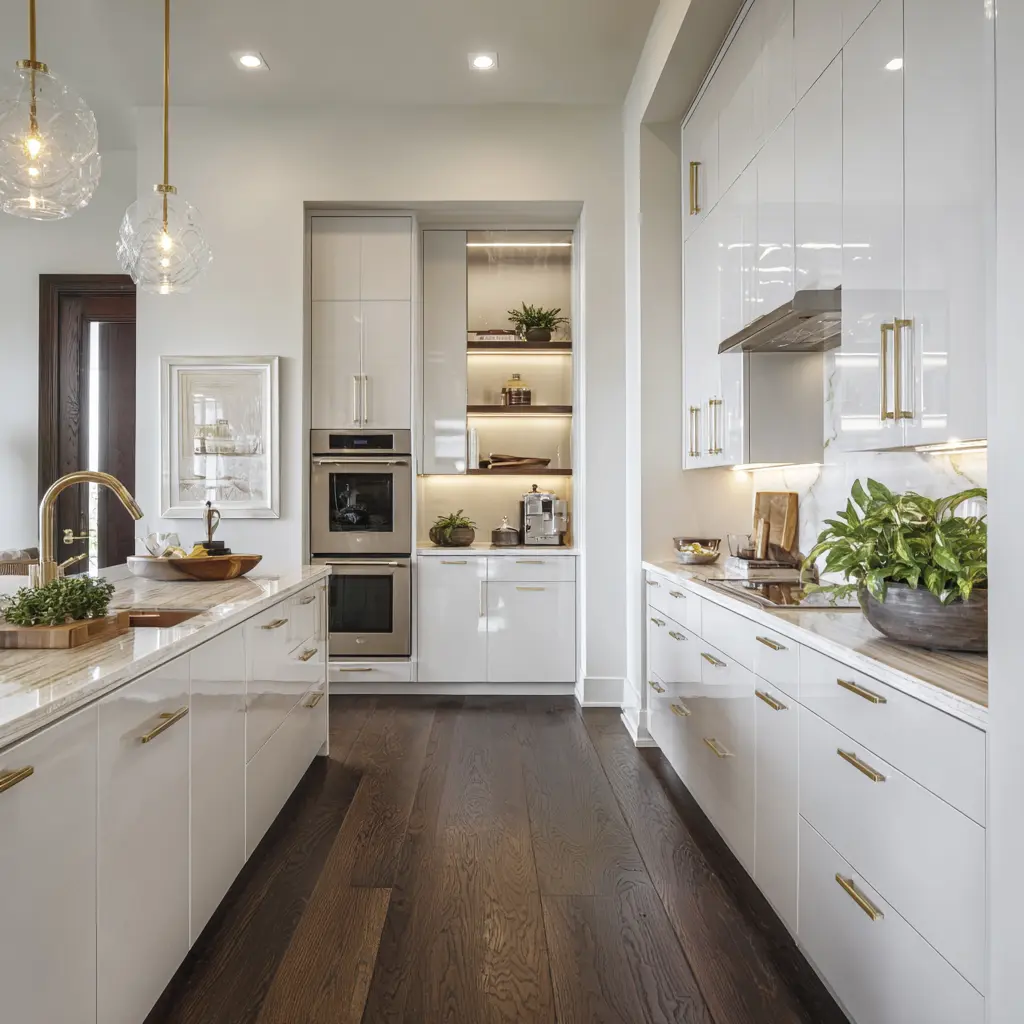
Pale stone is one of the most common solutions. A creamy or softly veined countertop helps because it borrows a little warmth from the floor and a little brightness from the cabinets.
It eases the shift between the two. Warm metal does something similar.
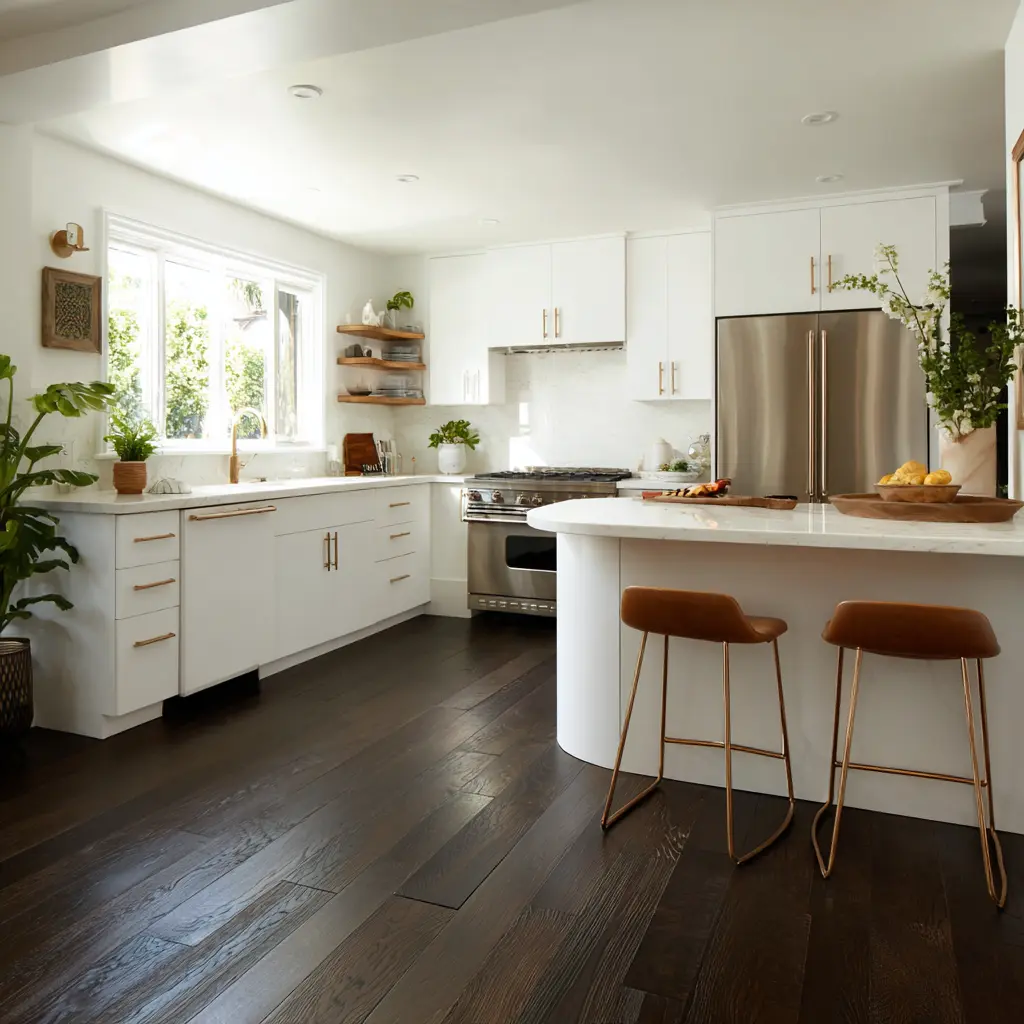
Brass and bronze sit comfortably between white and dark wood, adding glow without weakening the contrast.
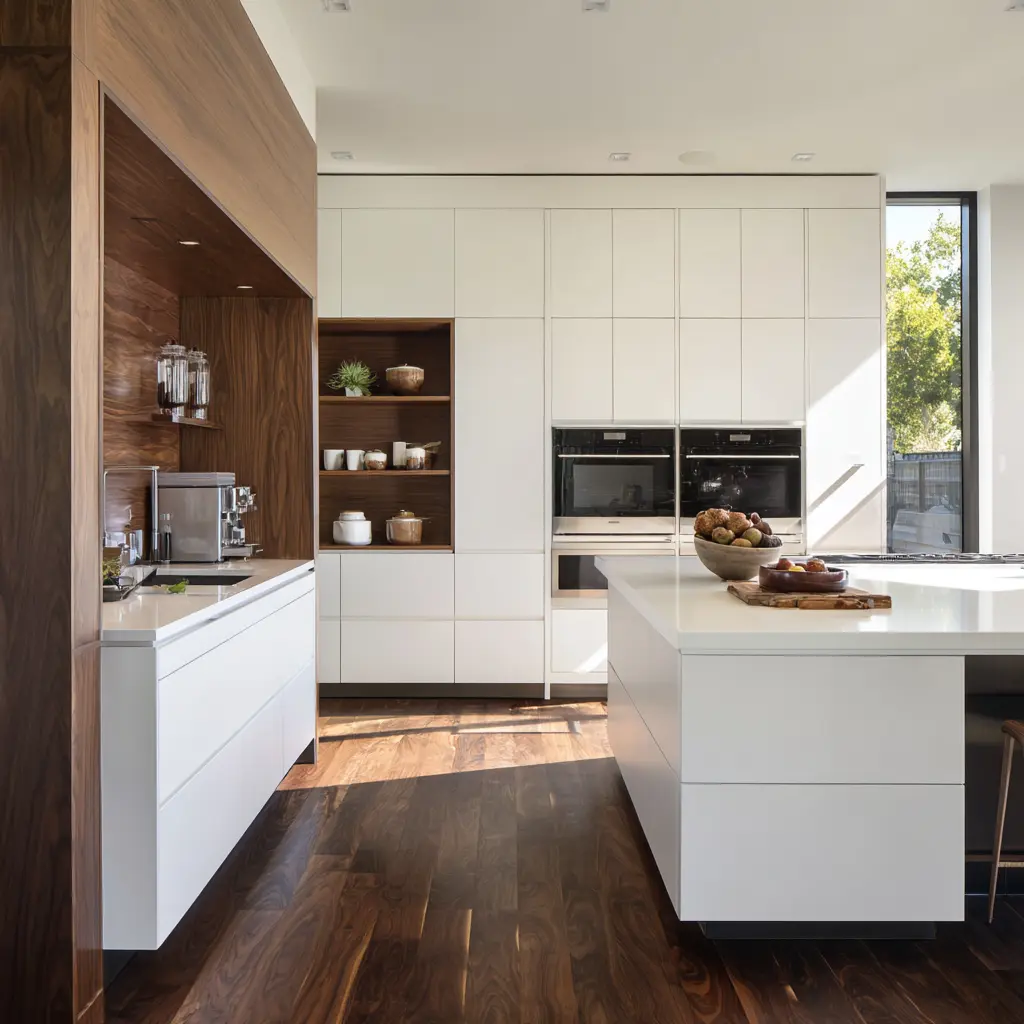
Other bridge elements work in a quieter way. A textured backsplash can soften a stark cabinet wall.
A greige wall color can take some edge off a bright white run. Leather or cane seating can bring in a warm human note in the center of the room.
Wood shelves, bowls, cutting boards, and branches can carry the brown family upward without making the room feel heavy. These are not random accessories.
They are part of the balancing design.
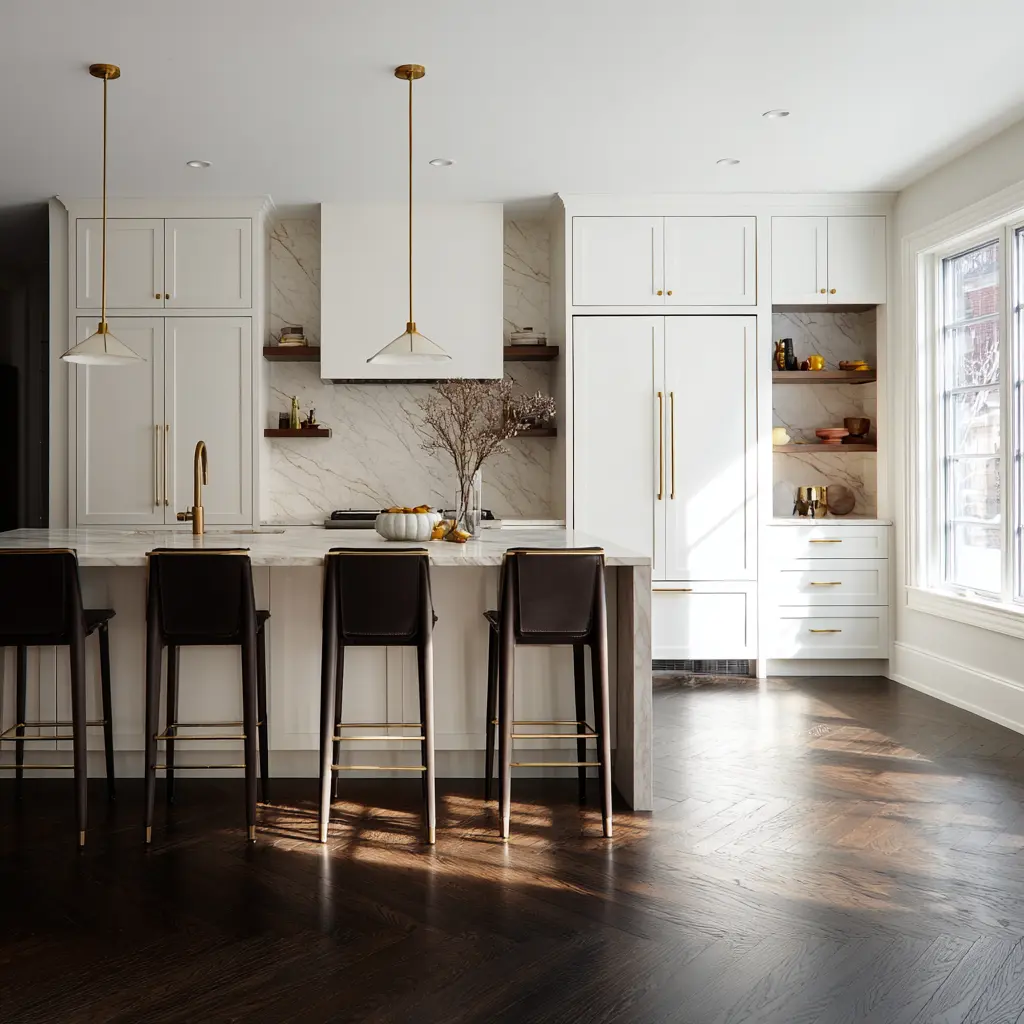
Light changes everything
White kitchen cabinets with dark wood floors are highly dependent on light. The pairing is never static.
In strong daylight, the floor often opens up and shows warmer undertones. Grain becomes easier to read.
The darker stain looks deeper rather than duller. At the same time, daylight softens the cabinetry by revealing reflections, shadows, and subtle changes in surface.
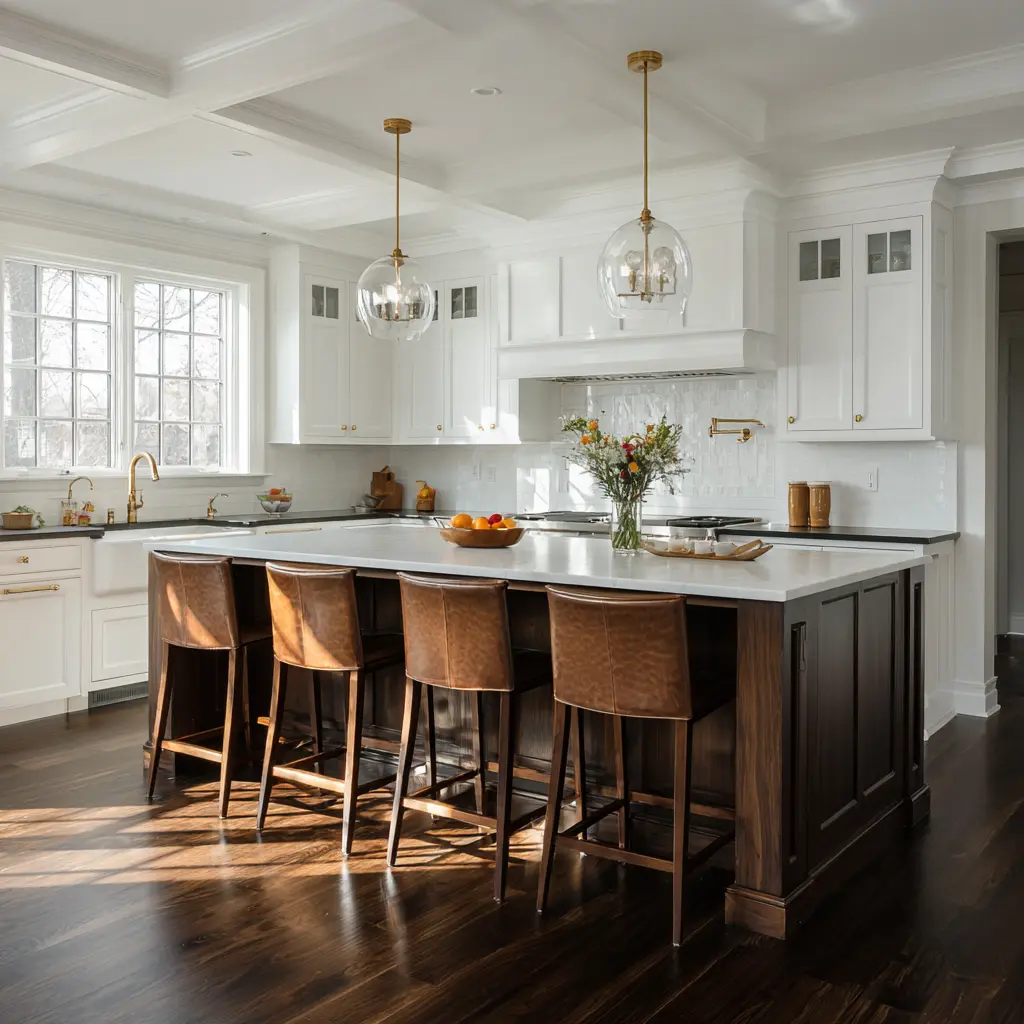
Warm artificial light matters too. Under-cabinet lighting, warm pendants, and lit shelf niches help turn the middle zone into a softer band between the white cabinet shell and the darker base.
That glow can make a major difference in evening conditions, especially in kitchens with very deep floor stains. So light should be treated like a finishing material in this scheme.
It reveals the warmth hidden inside the wood and prevents the contrast from feeling severe.
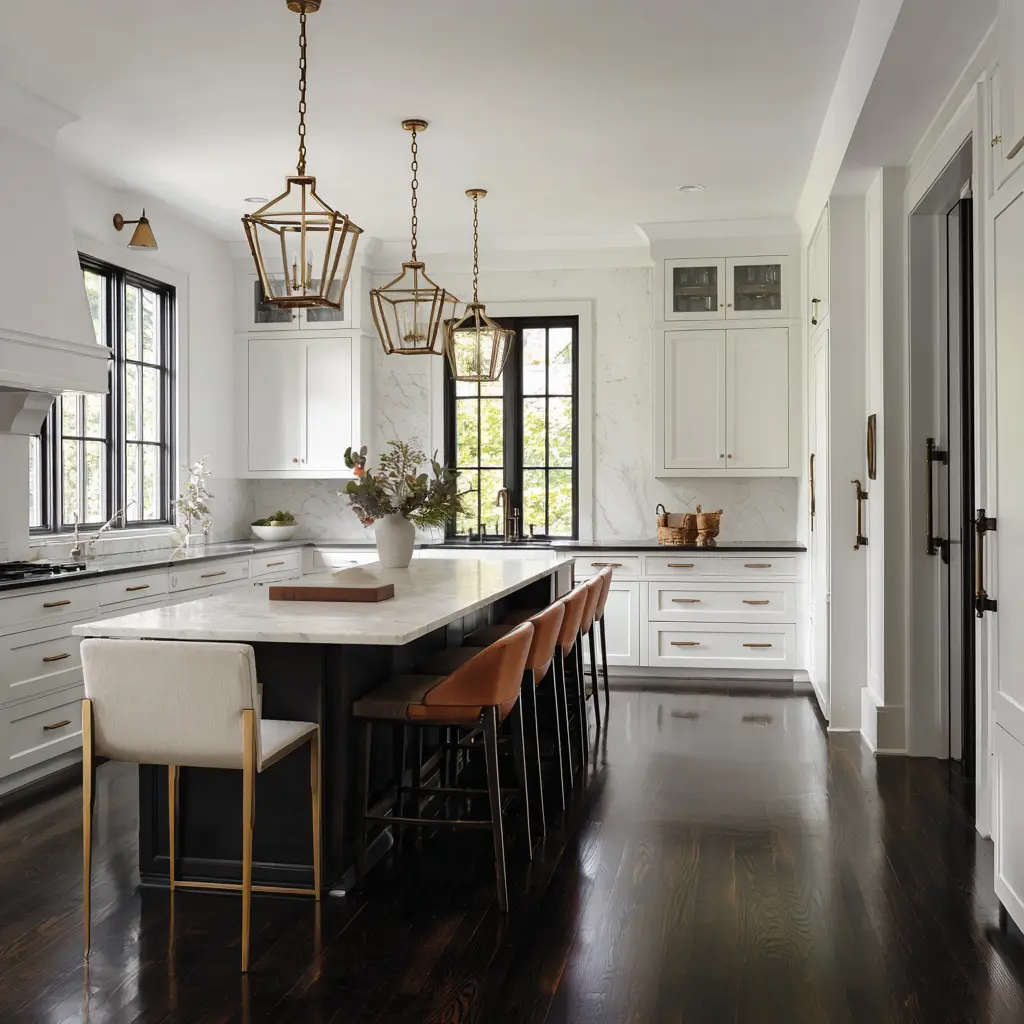
Dark floors do not automatically make a kitchen feel smaller
That idea sounds logical, though it does not hold up in every case. A dark wood floor can actually help a compact kitchen feel longer and more defined if a few conditions are in place.
The planks need to run clearly through the space. The floor should stay visually continuous rather than broken into too many zones.
The perimeter should remain bright. Sightlines should lead to a window, doorway, or bright back wall.
And the dark note should appear above floor level so the room feels balanced.
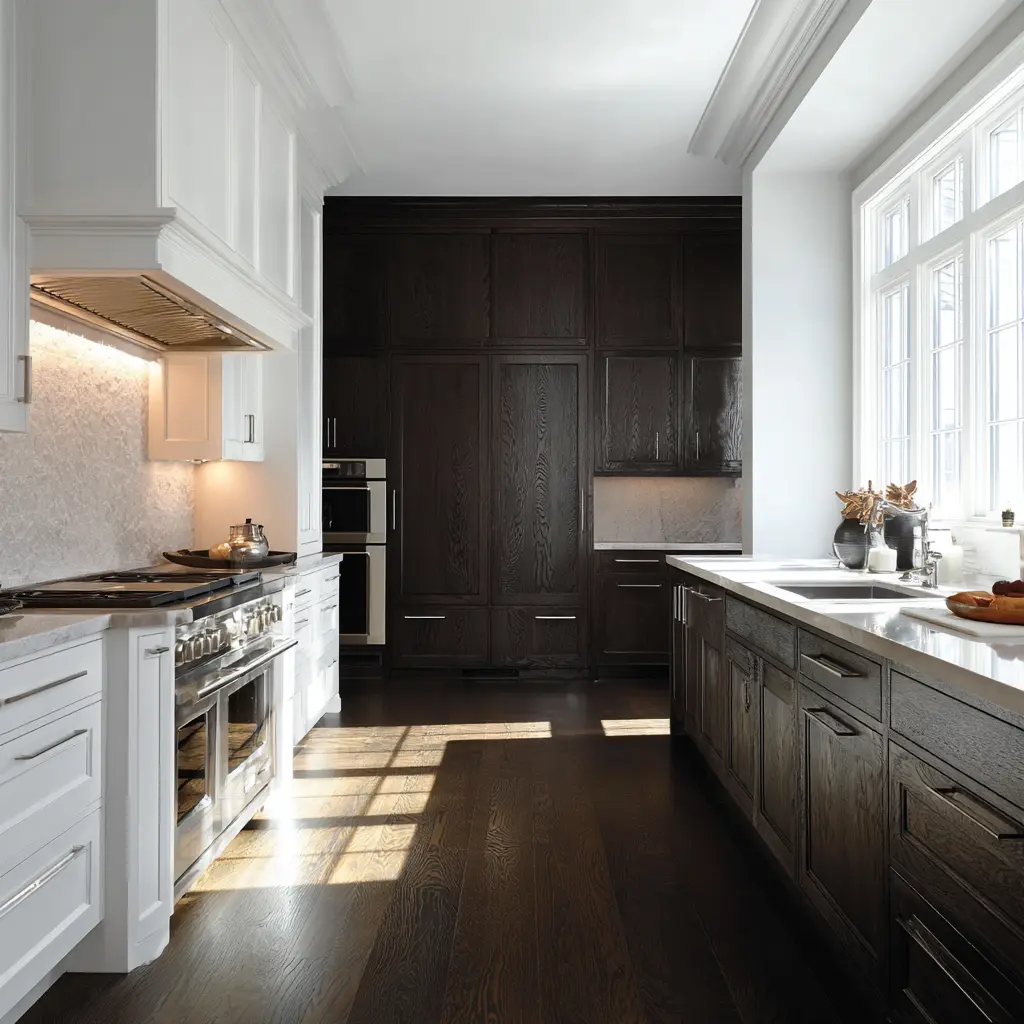
In other words, dark floor plus poor light and visual fragmentation can compress a space. Dark floor plus continuity and brightness can extend it.
That is why a narrow galley kitchen or corridor plan can sometimes benefit from dark wood more than people expect.
The island often controls the whole balance
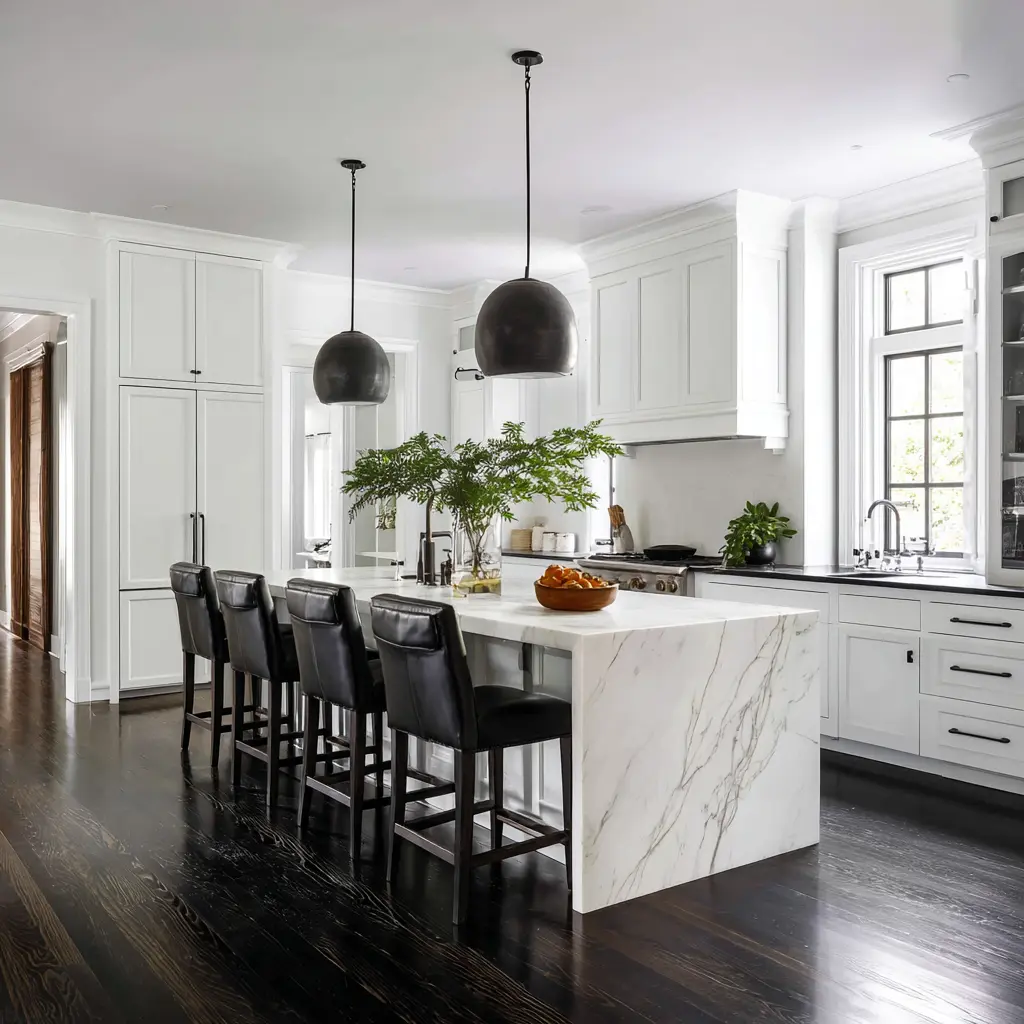
The island is one of the most important pieces in a white kitchen with dark wood floors because it often acts as the tonal regulator. There are two very reliable ways this works.
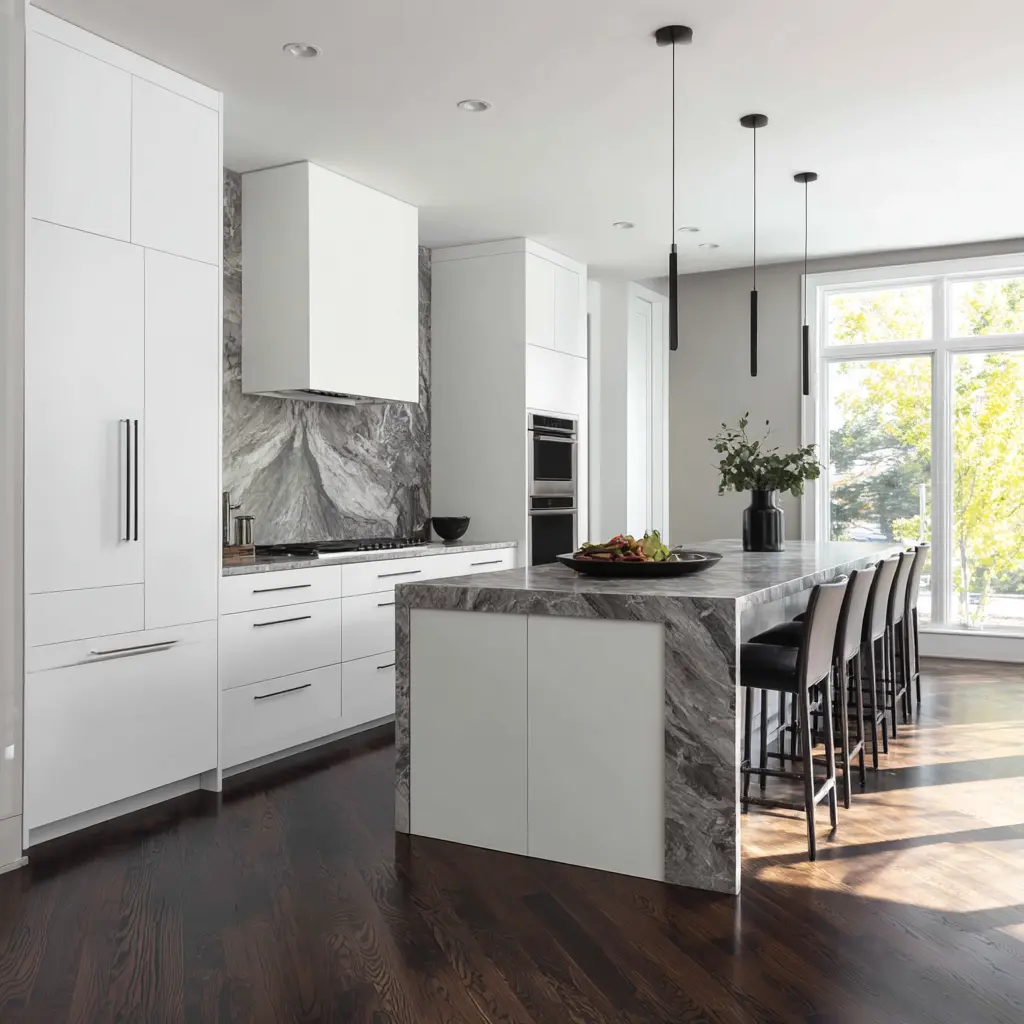
The first approach is a dark island base. This lifts the floor tone up into the center of the room and helps solve the problem of visual weight sitting only below.
The second approach is a white island with darker stools, stool legs, or dark fixture accents. That keeps the center bright, though still ties it back to the floor.
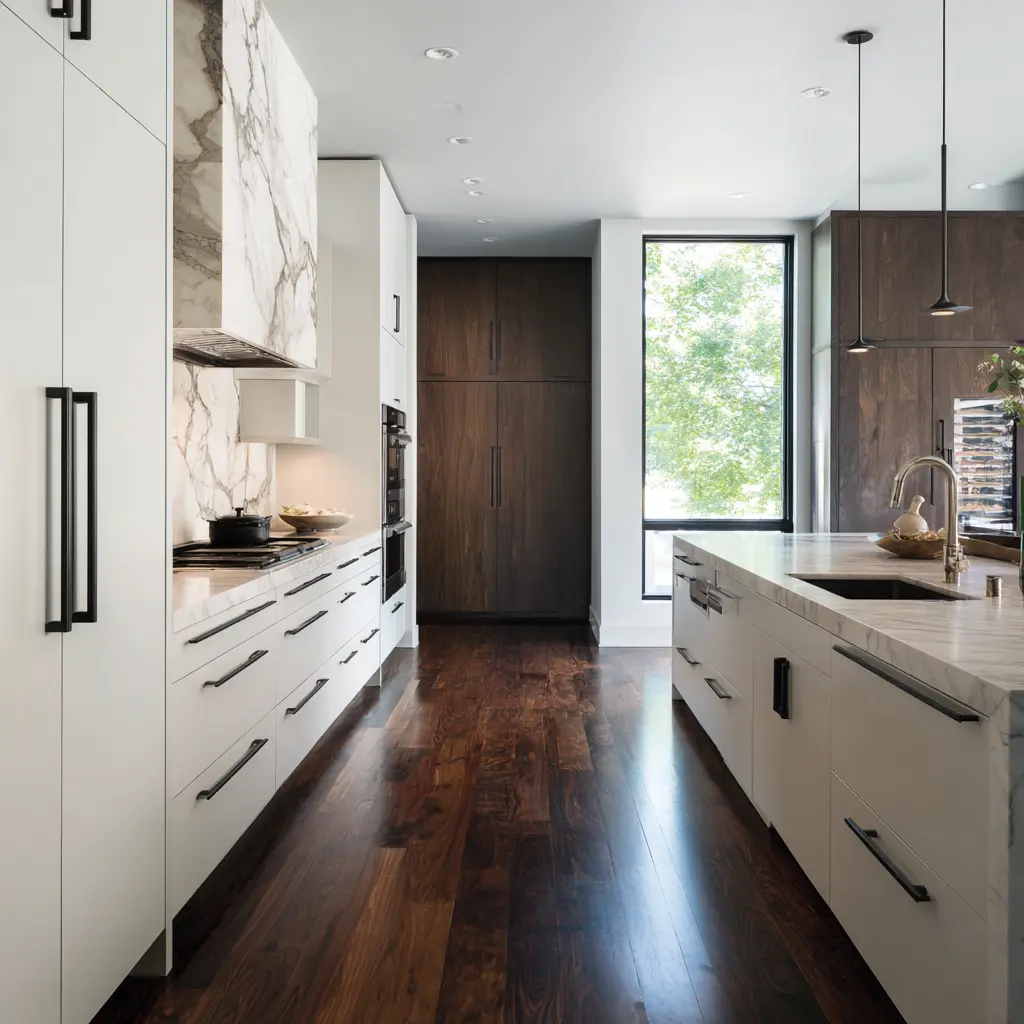
Both strategies can work beautifully. What matters is that the island participates in the negotiation between cabinet shell and floor plane.
Once it does, the room usually feels much more settled.
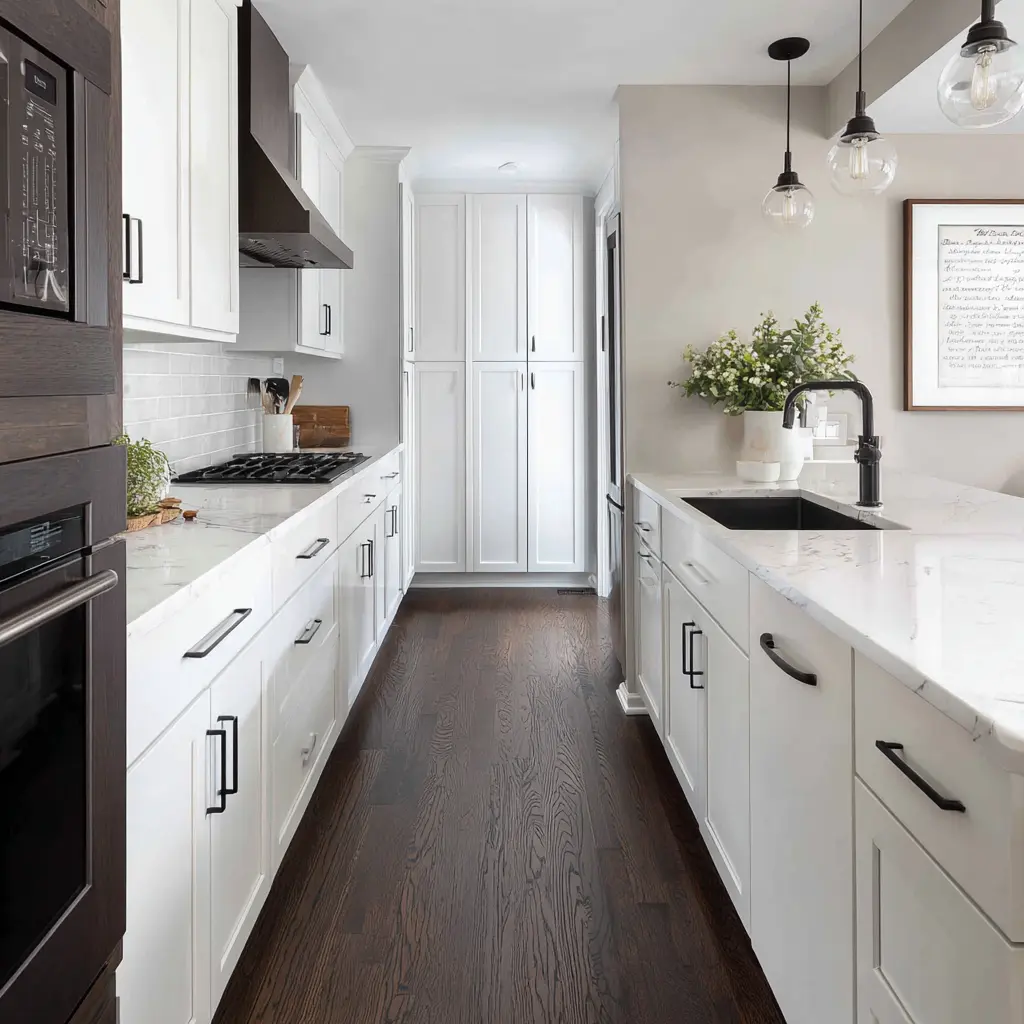
The human zone often makes the difference
One of the less obvious lessons in these pairing ideas is how much the human zone matters. The places where people sit, lean, reach, and pause are often where the room gets its warmth.
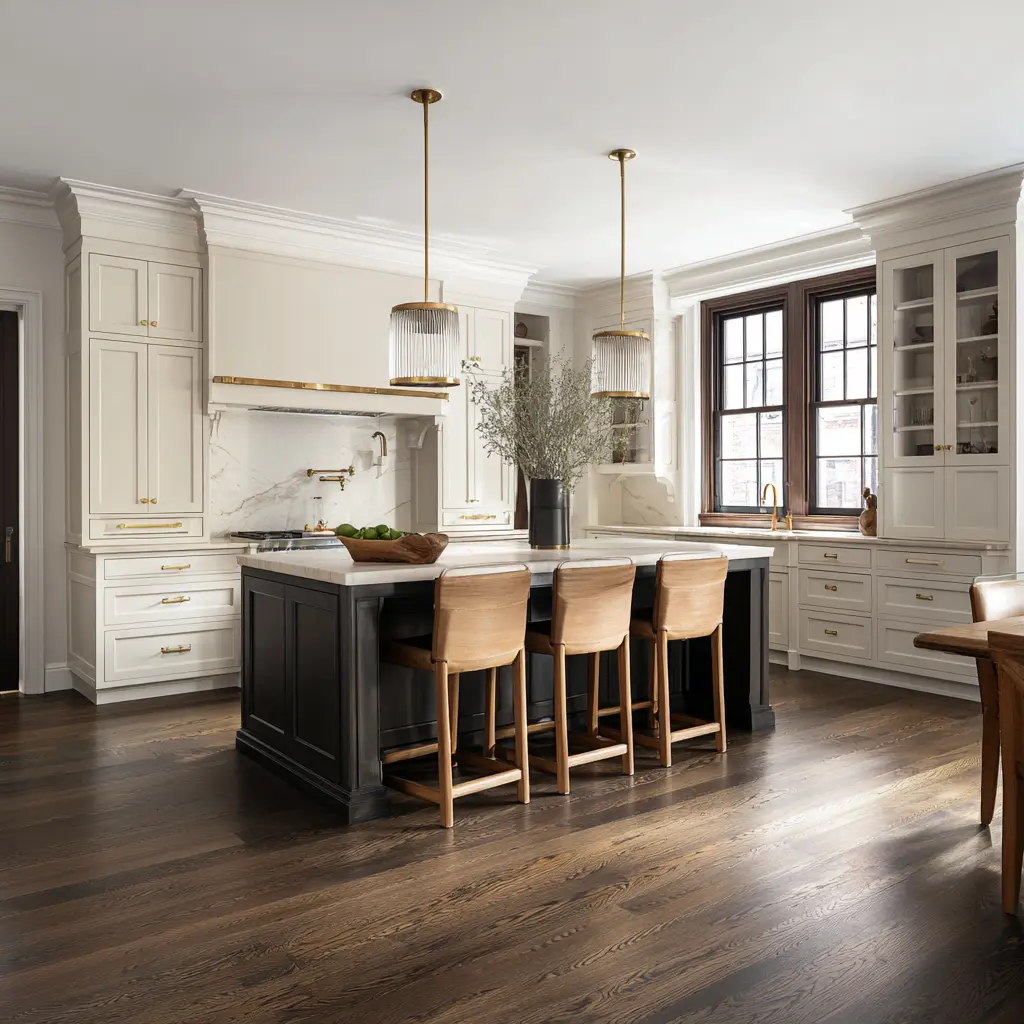
Cognac leather stools, cane seating, wood-framed stools, a bowl of fruit, a stack of boards, a vase with branches, a plant by the window, a warm metal faucet — these pieces may seem secondary, though they do a lot of balancing work. They soften the contrast where daily life happens.
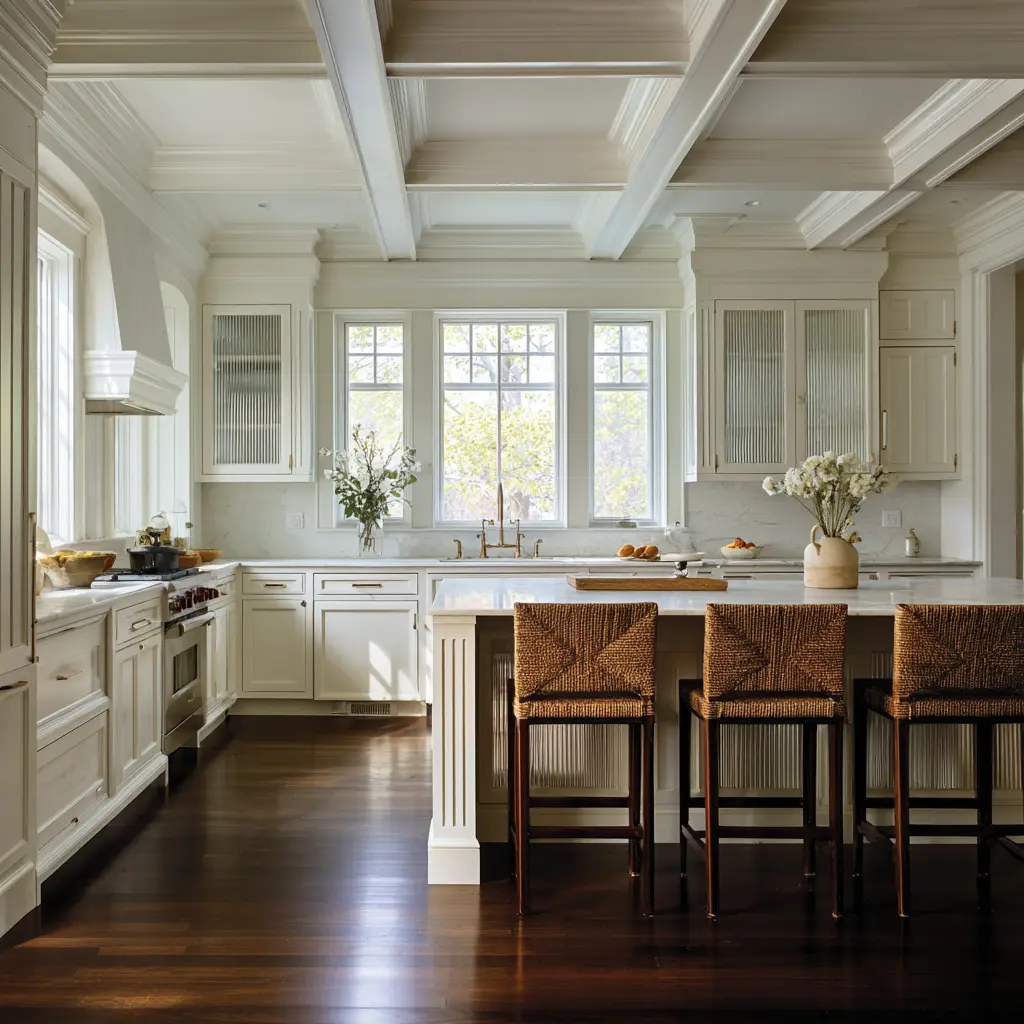
That is why some kitchens with white cabinets and dark floors feel polished and inviting, while others feel cold even though the cabinet color and floor stain look similar on paper. The difference often sits in these small, warm, mid-height details.
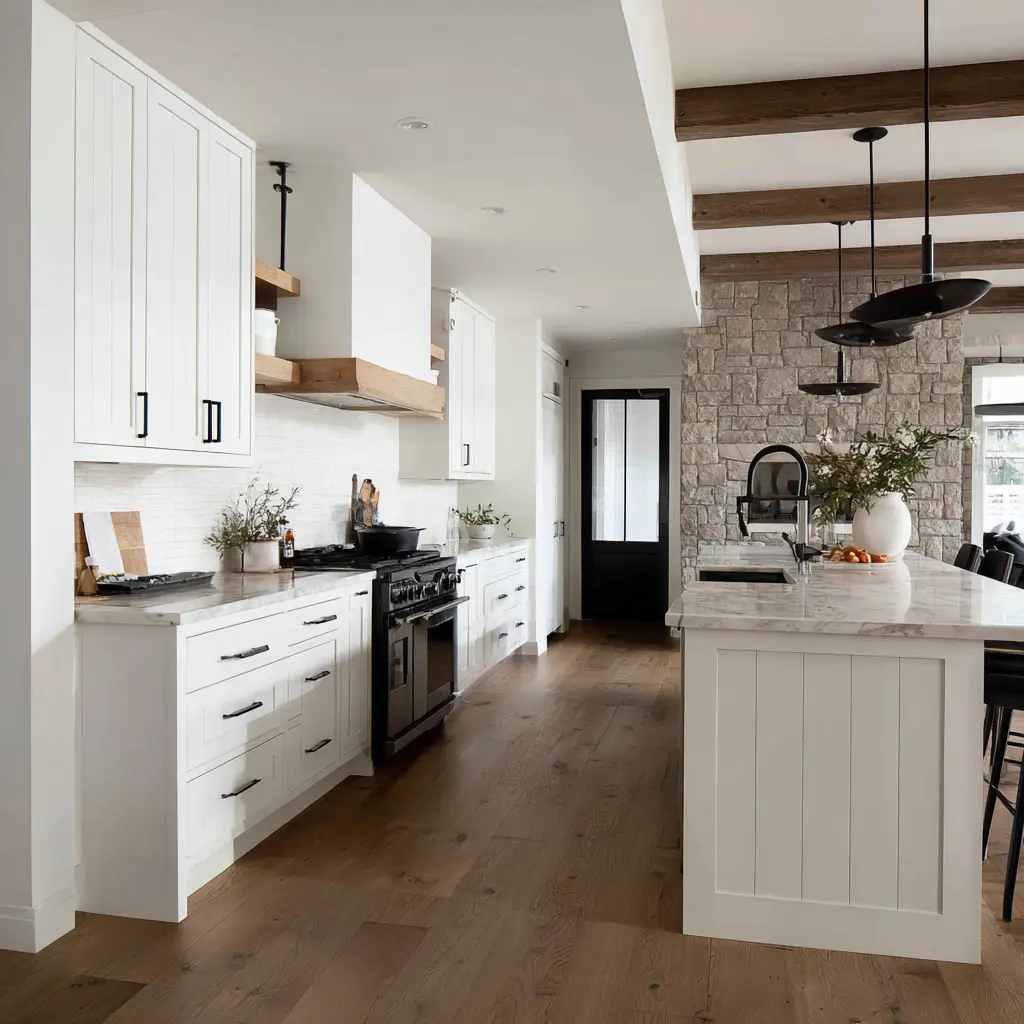
Different styles use the pairing in different ways
This color relationship is flexible, though the mechanism changes with the style of the kitchen.
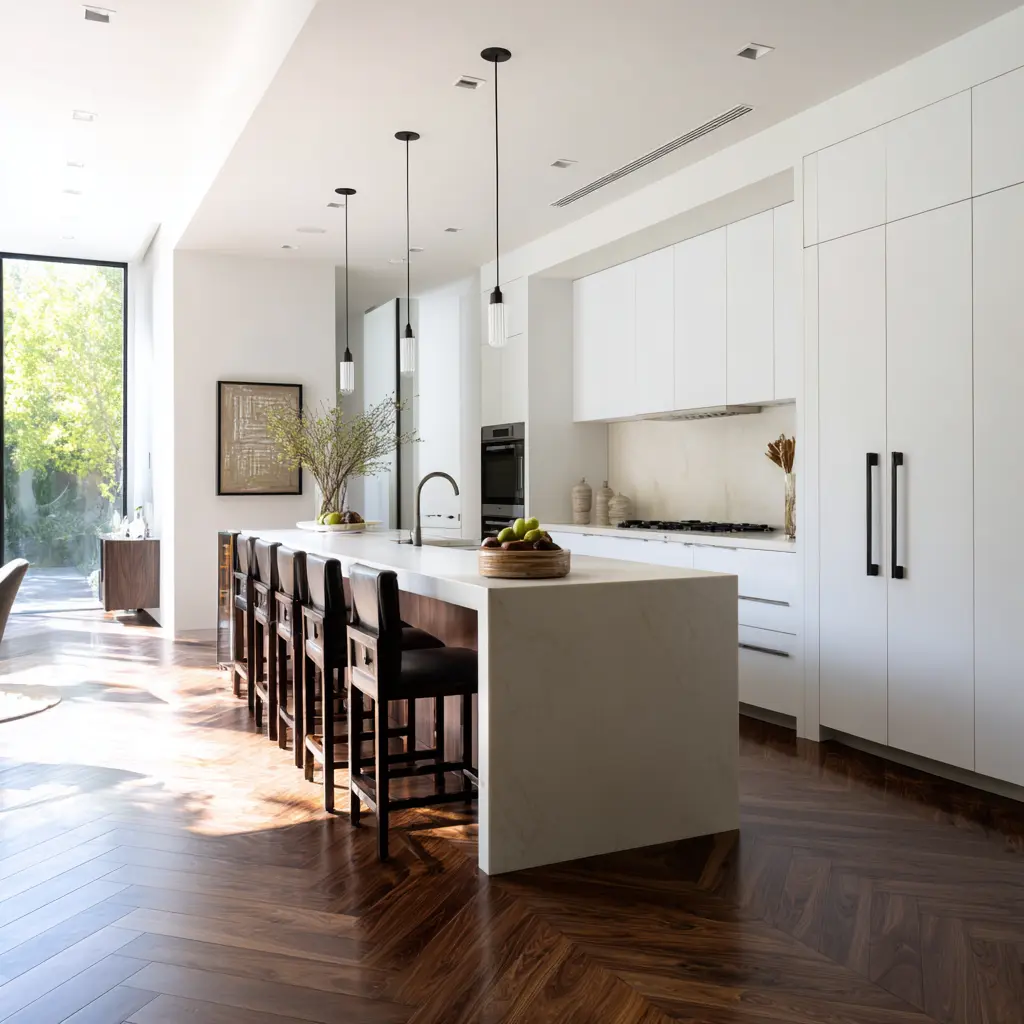
A softer, more welcoming version usually uses creamy whites, warm stone, glossy or reflective surfaces, and under-cabinet light. A modern version often uses slab-like cabinetry, black pulls, long lines, and bolder stone movement.
A more classic kitchen relies on paneling, crown details, coffered ceilings, pale island tops, and shadow-rich millwork. A warmer layered version may add wood shelves, textured stone, brass, darker islands, and warm seating.
A mixed-material version may place white cabinetry beside medium wood cabinetry and let the dark floor tie both sides together. The colors may look similar at first glance, though the room’s structure changes the whole mood.
What usually weakens the look
This pairing becomes less successful when too many of the supporting elements are removed.
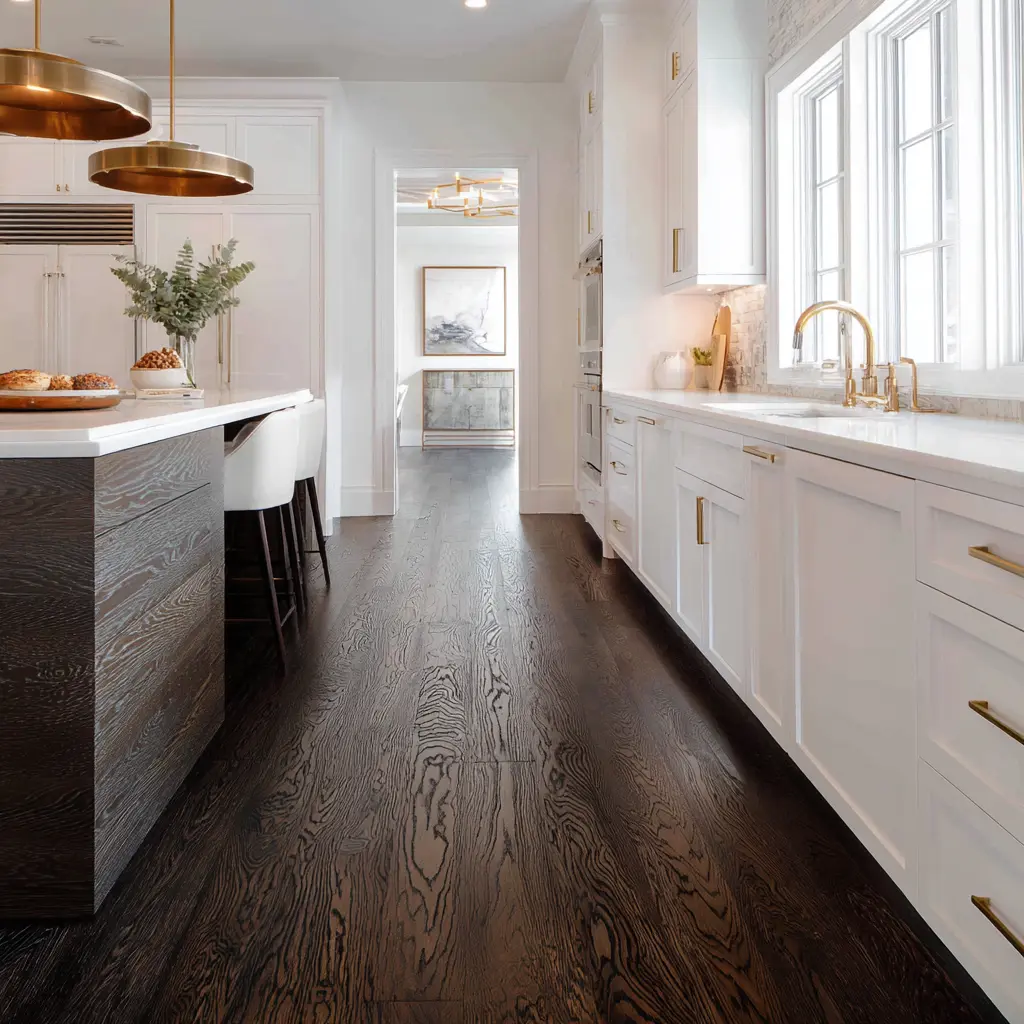
A dark floor with no visible grain can feel dead. Stark flat white cabinetry with no reflection, no profile, and no texture can feel thin against it.
A room with no bridging stone, no warm metal, and no human-zone warmth can feel cold. If the dark tone never appears above floor level, the room often feels visually heavy at the bottom.
Poor daylight or flat lighting can also make the stain feel dull rather than rich. Too much clutter can muddy what should be a clean tonal structure.
So the issue is rarely the pairing itself. It is usually the lack of good support elements around it.
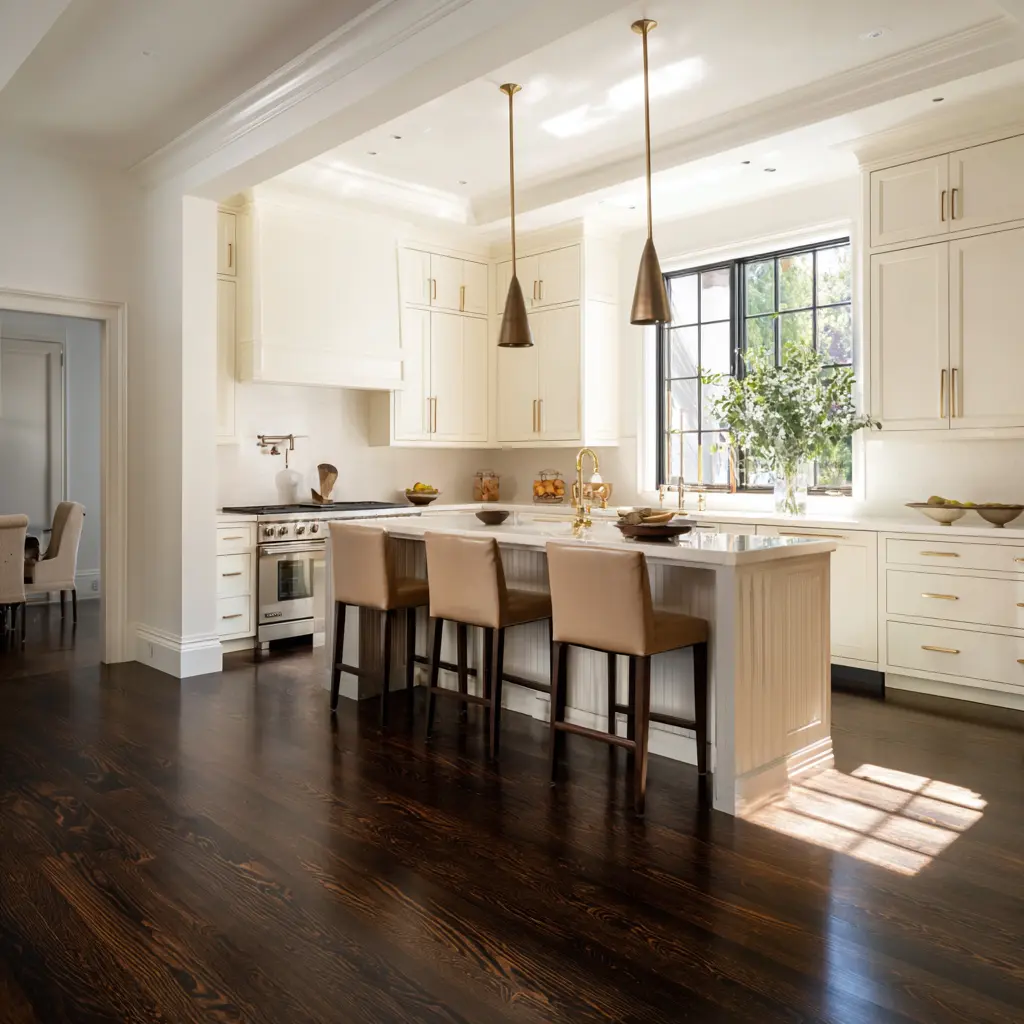
Why the combination keeps looking polished
This look holds its appeal because it combines several effects at once. The dark floor gives the kitchen weight and permanence.
The white cabinetry sharpens the architecture and keeps the room bright. Grain and undertone keep the floor from feeling cold.
Repeated dark accents create order through the full height of the room. Stone, metal, wood, leather, and light keep the palette layered and livable.
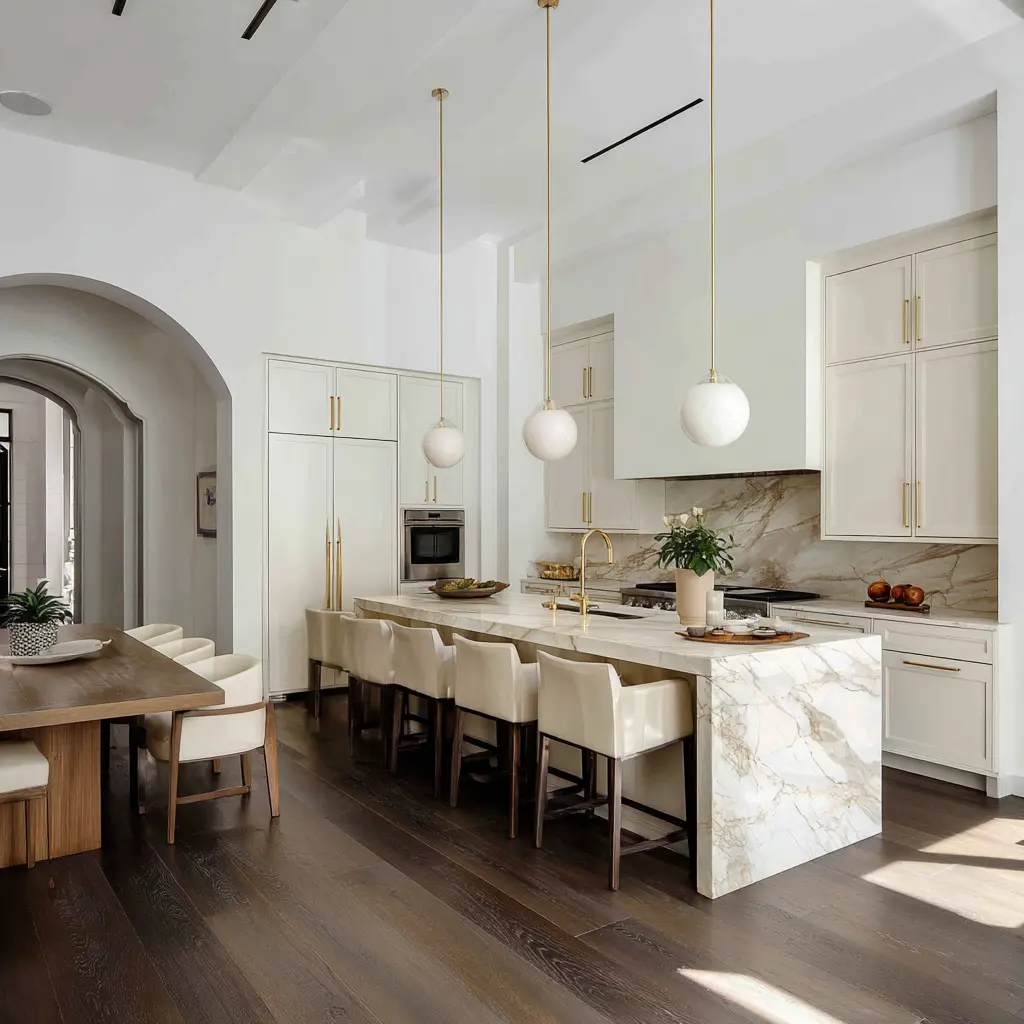
That is why the pairing feels refined in the right kitchen design. The contrast is strong, though the room stays organized.
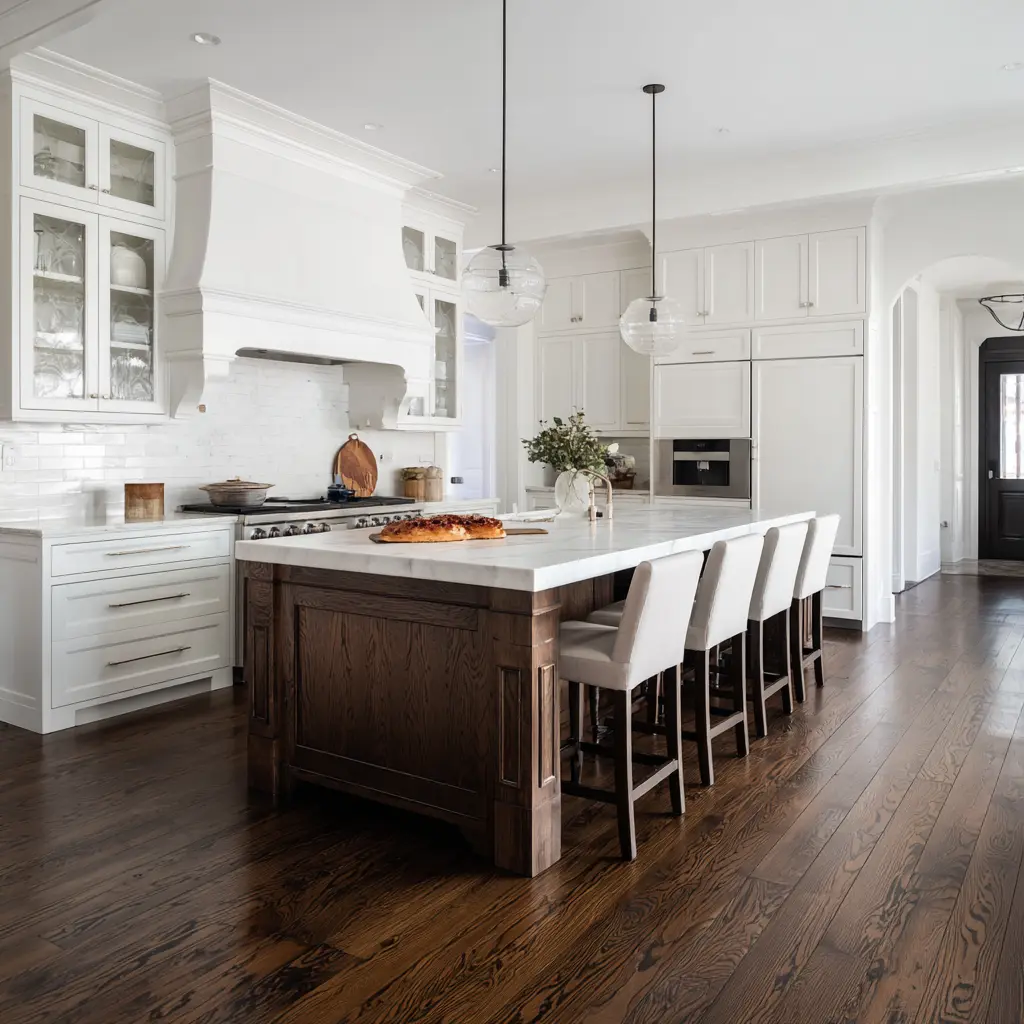
Final thought
White kitchen cabinets with dark wood floors work when they are treated as a full interior system rather than a quick color formula.
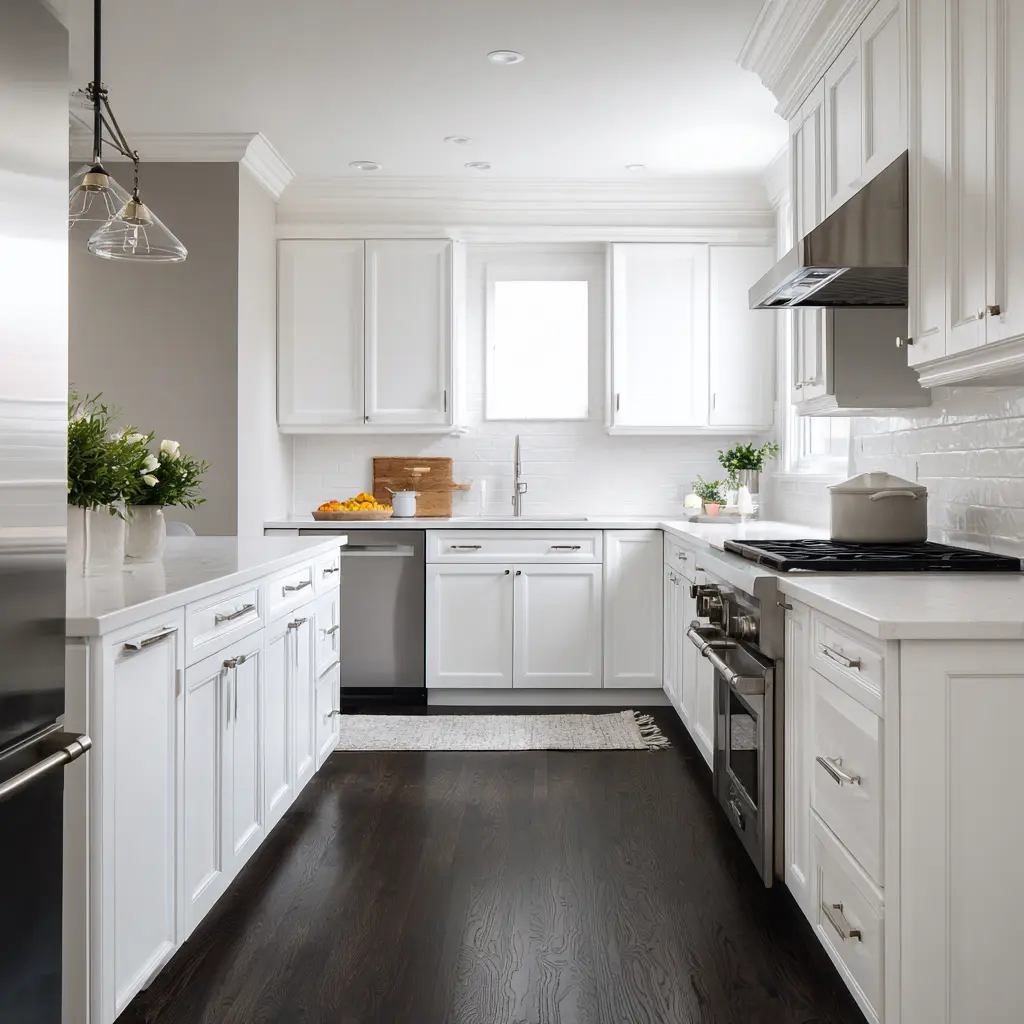
The floor should remain visibly wood. The cabinetry should carry inner depth.
The room should include one or more relay materials between dark and light. The darker note should rise above the floor line.
Warm details should appear where people actually use the space. Light should be allowed to reveal the stain rather than flatten it.
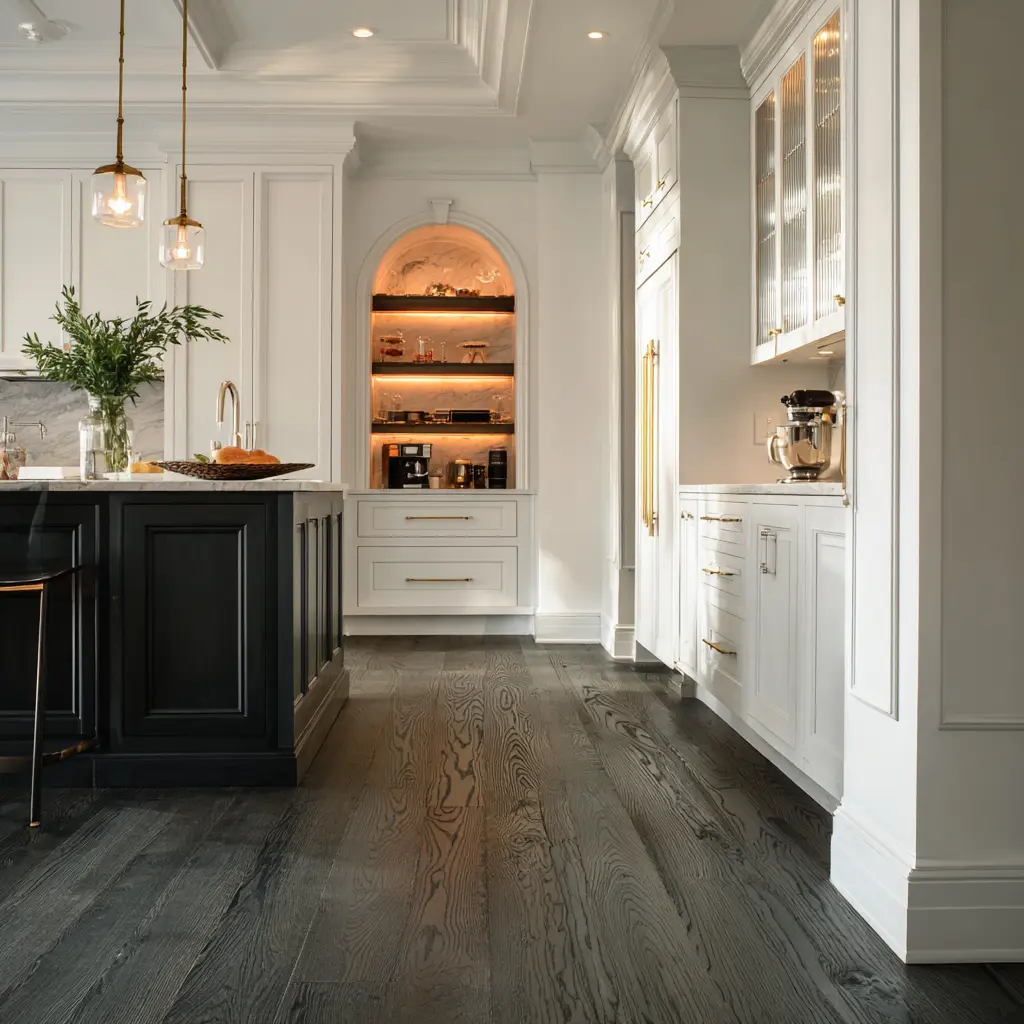
Once those pieces are in place, the pairing stops feeling like a simple white-and-dark idea. It becomes a layered kitchen with gravity, clarity, warmth, and structure.