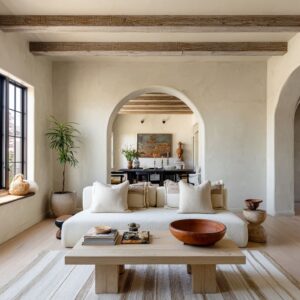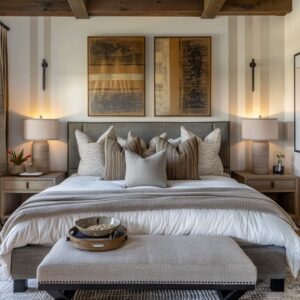
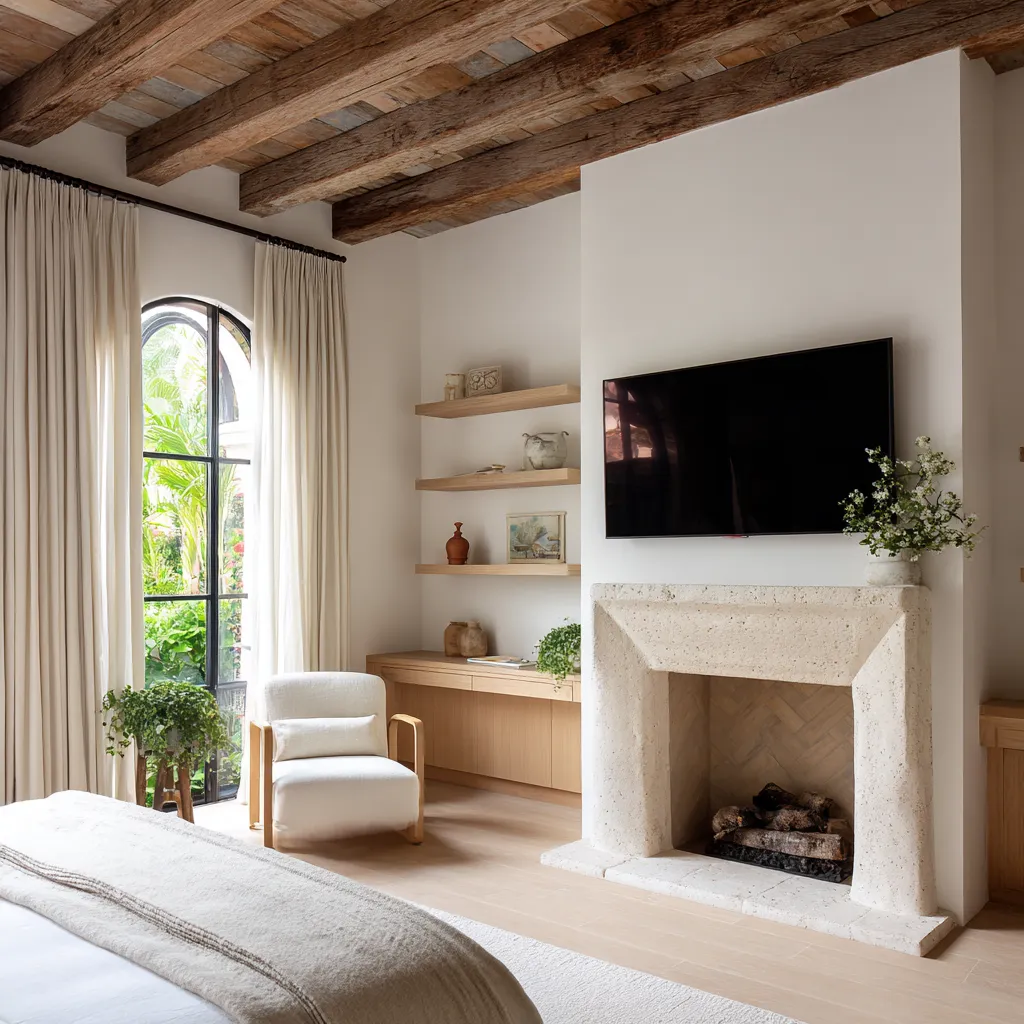
Spanish Revival bedrooms are often reduced to a familiar set of visual cues: dark beams, pale plaster, a wrought-iron light fixture, maybe a fireplace, maybe an arched door. Those elements do appear often, but they are not the main reason a room feels truly rooted in the style.
Stylish Spanish Revival bedroom design ideas do not rely on ornament, antique staging, or a heavy old-world mood. They are edited, quiet, and highly architectural.
Their identity come from thick wall language, clear arch geometry, recesses, alcoves, built-in features, and low furniture that stay beneath the authority of the shell. In other words, the designs that feel Spanish Revival style are the ones where the architecture carries the room and the furnishings supported it in a modern way.
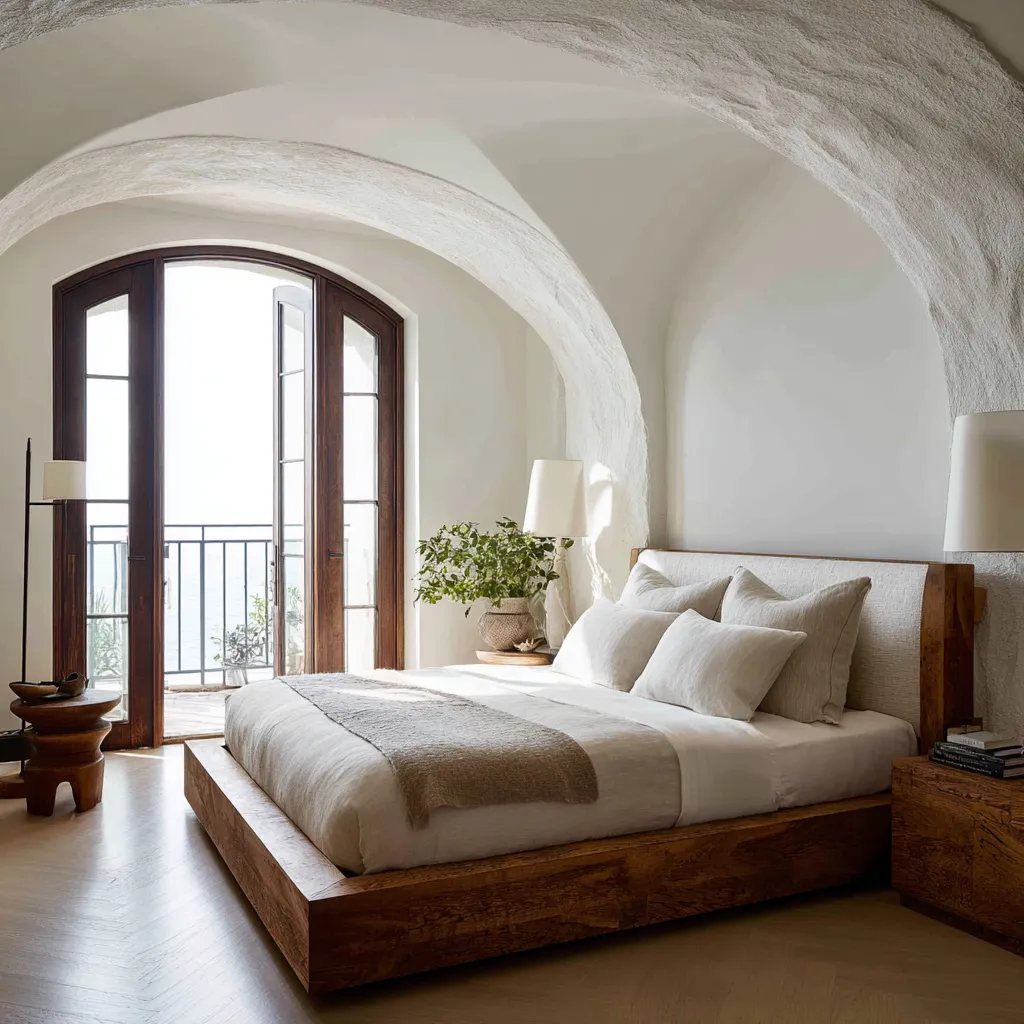
That is the key shift. A stylish Spanish Revival bedroom today is shaped less by decorative nostalgia and more by masonry logic adapted for modern bedroom life.
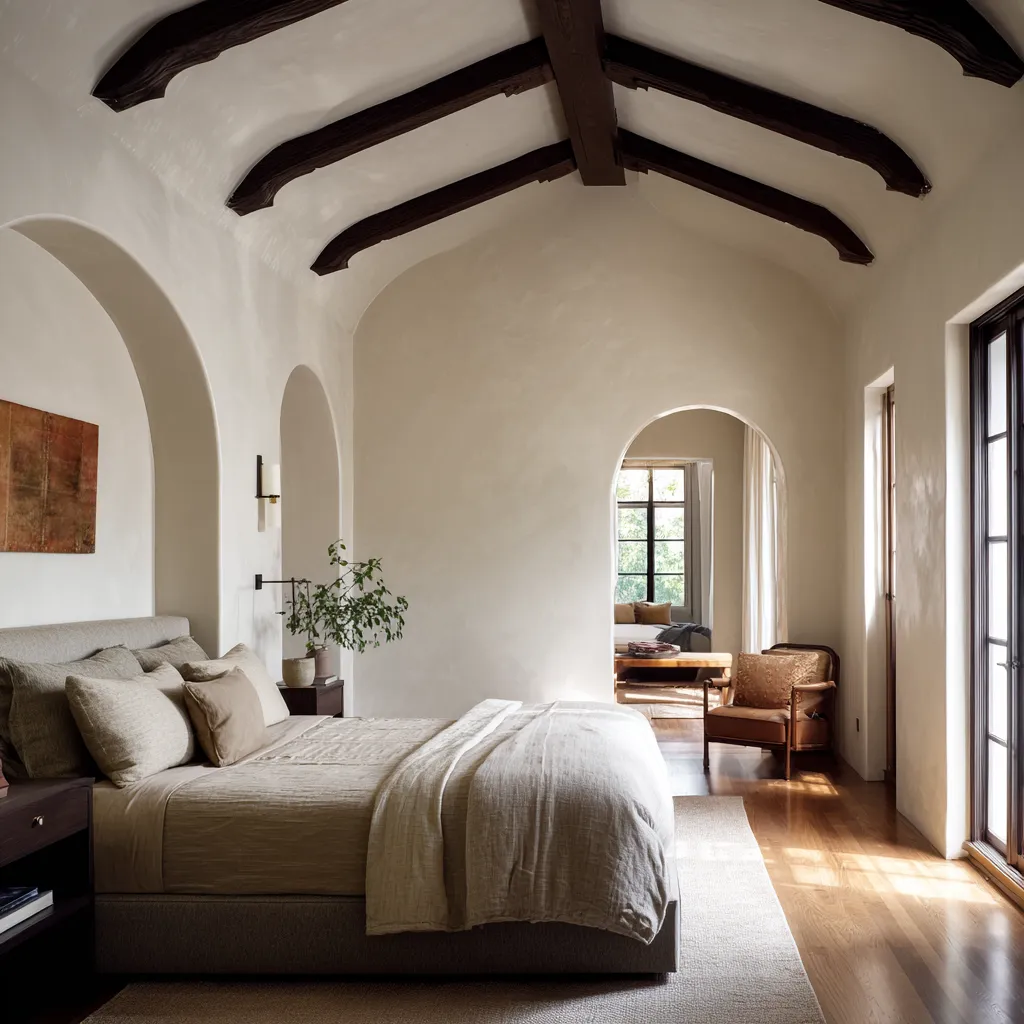
The center of Spanish Revival style is wall depth
The idea is simple: shell depth has the strongest relationship with style coherence. Not beams.
Not brightness. Not even the fireplace on its own.
That matters because it changes how the style should be designed.
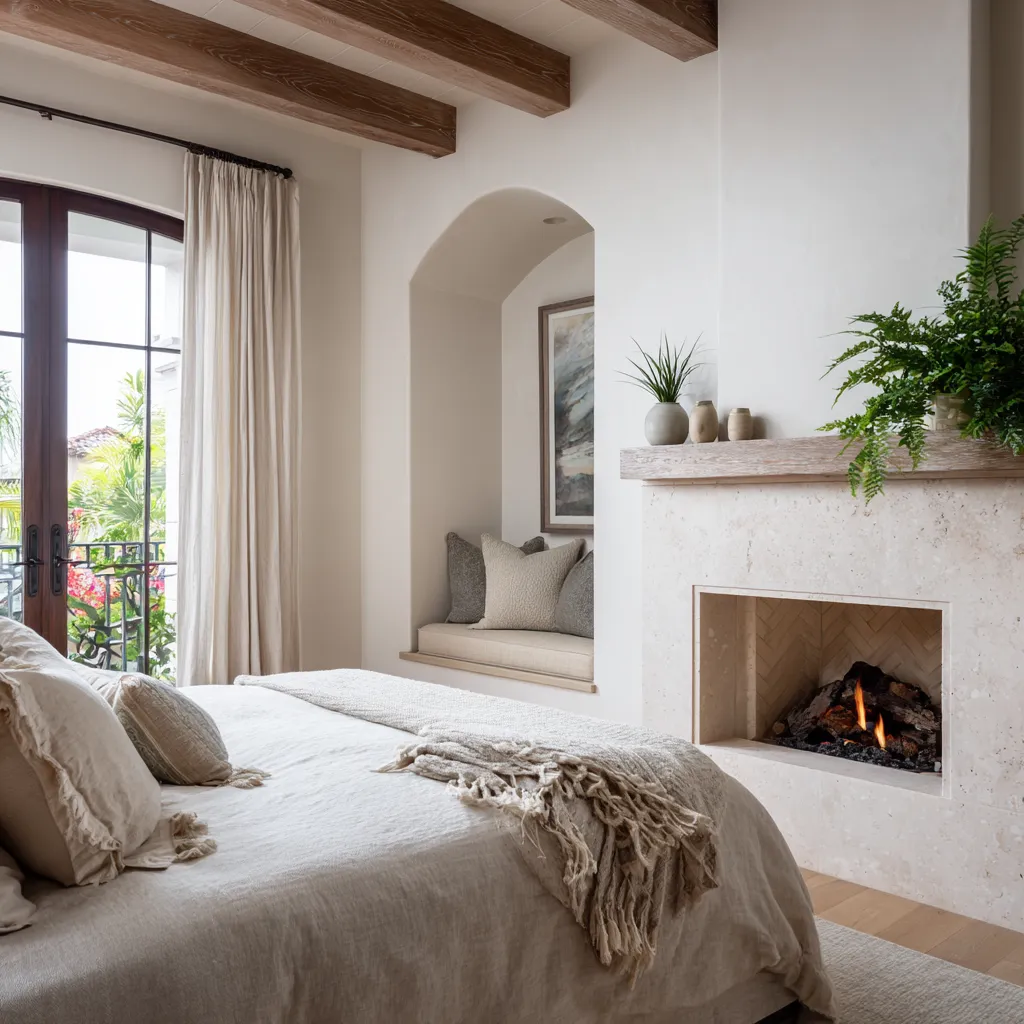
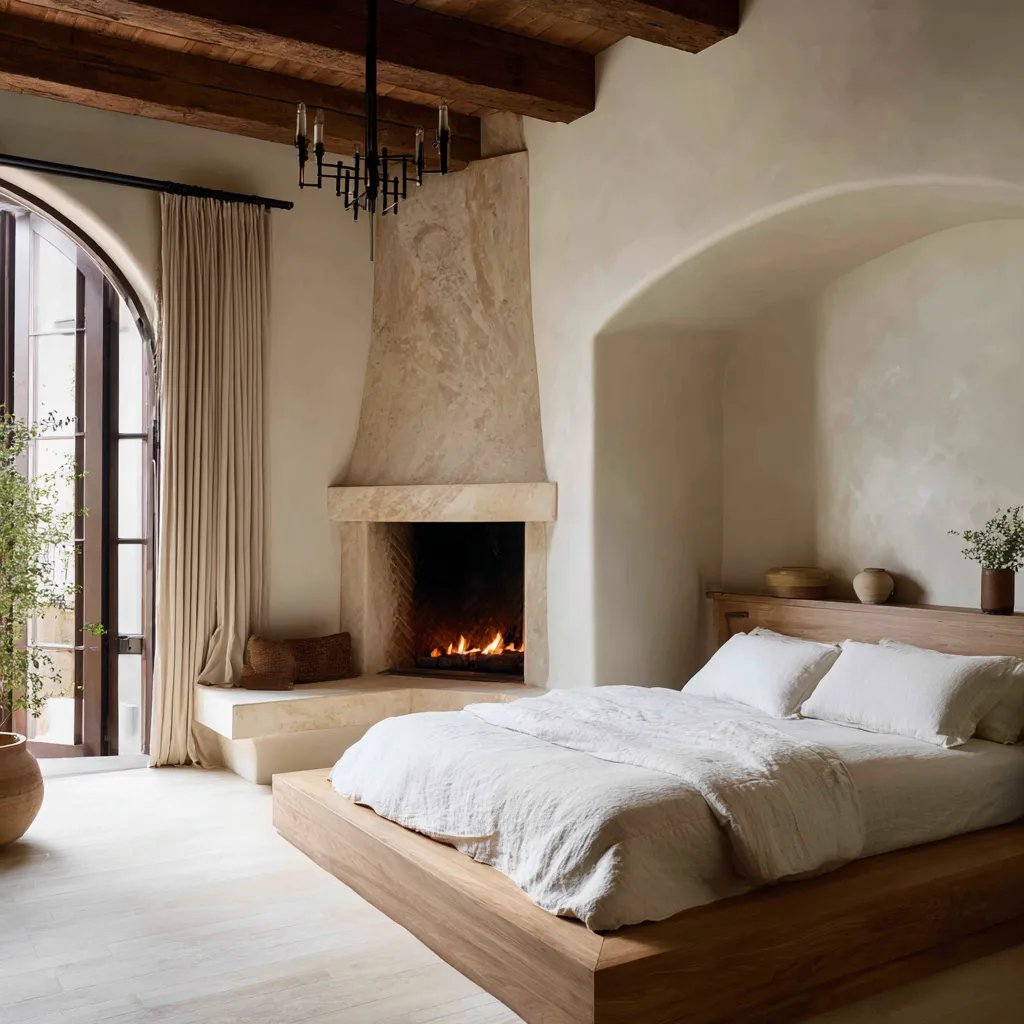
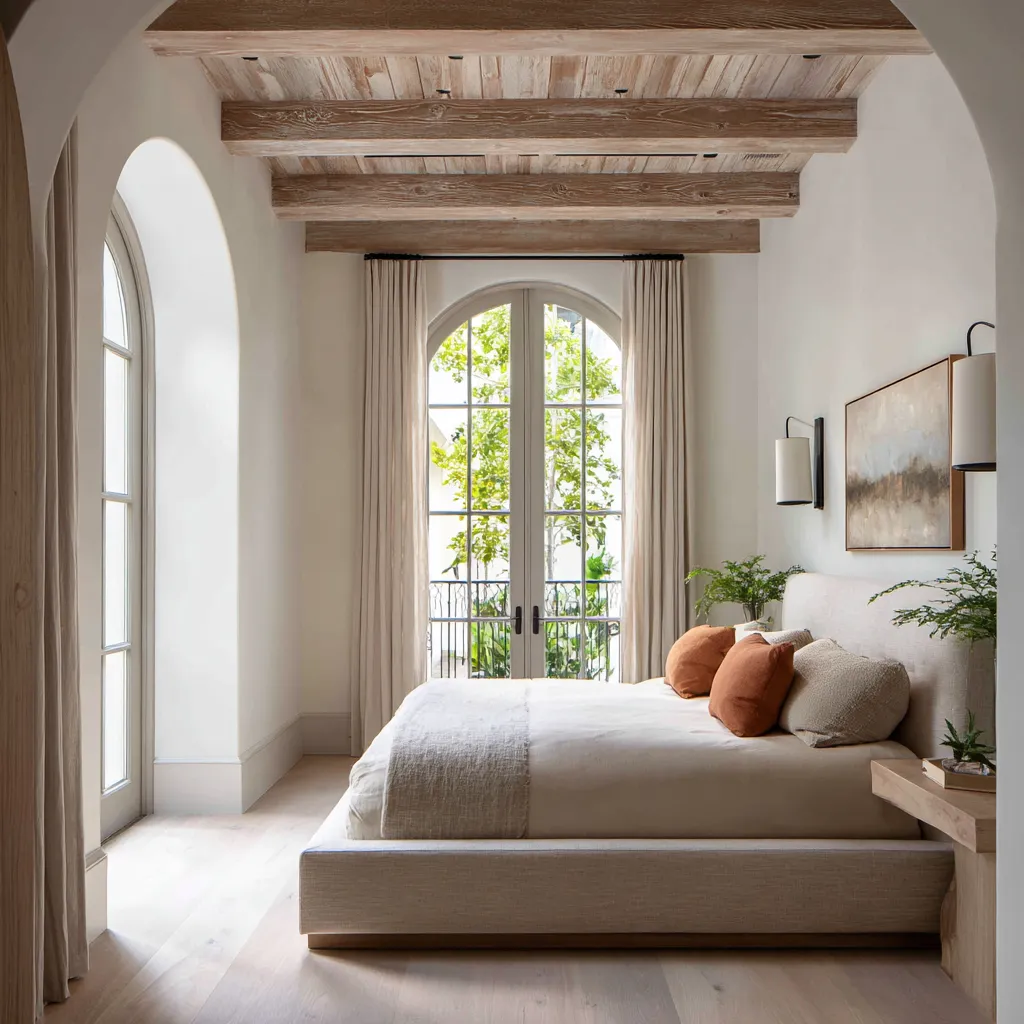
The bedroom designs that feel convincing tend to have walls that seem thick and inhabitable. You could see it in deep reveals, rounded recesses, built-in benches, carved bed alcoves, TV niches, and fireplace masses that feel part of the room itself rather than placed against it.
These are not flat drywall boxes with Spanish details attached later. They feel cut, shaped, and formed.
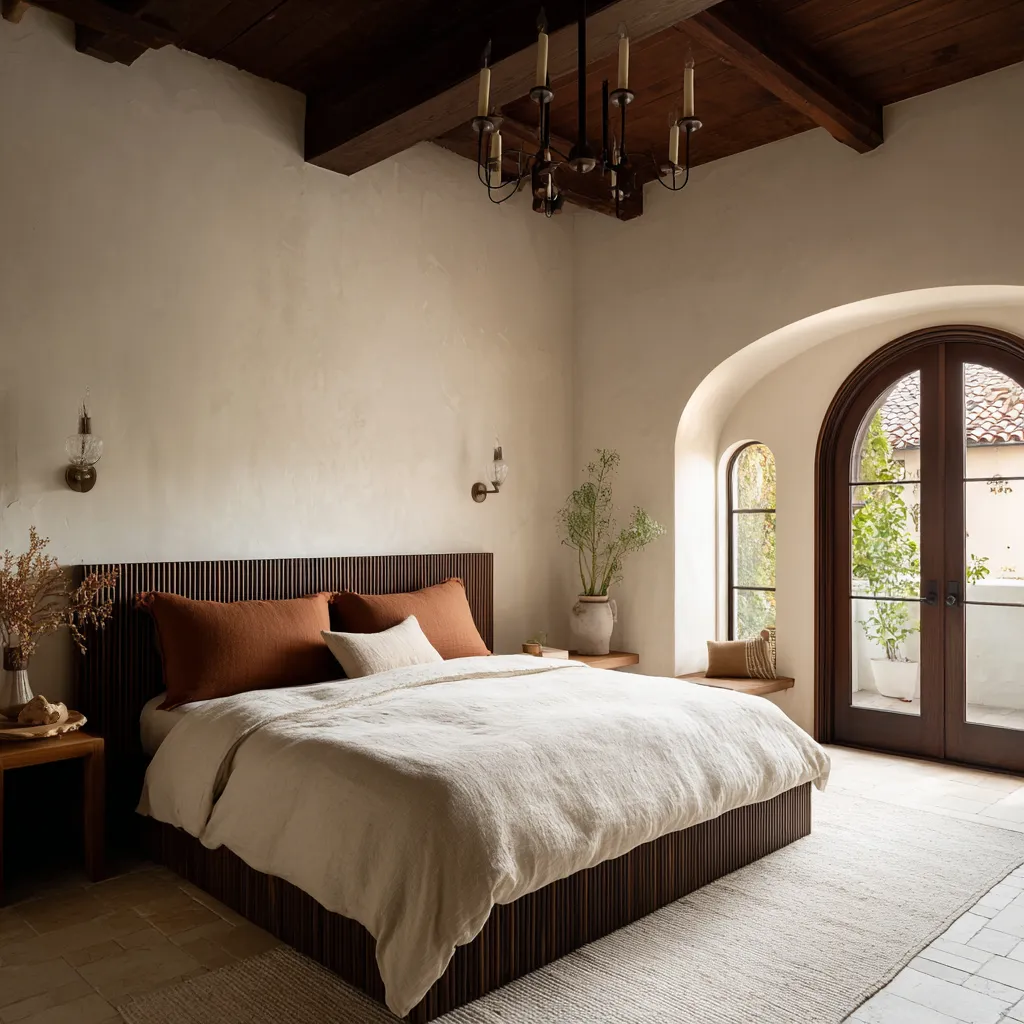
This is one of the main reasons some designs stand out so strongly. Their walls do the actual design work.
They frame the bed. They hold the fireplace.
They create side niches. They form the threshold to a balcony or courtyard.
The design gains character from depth rather than decoration.
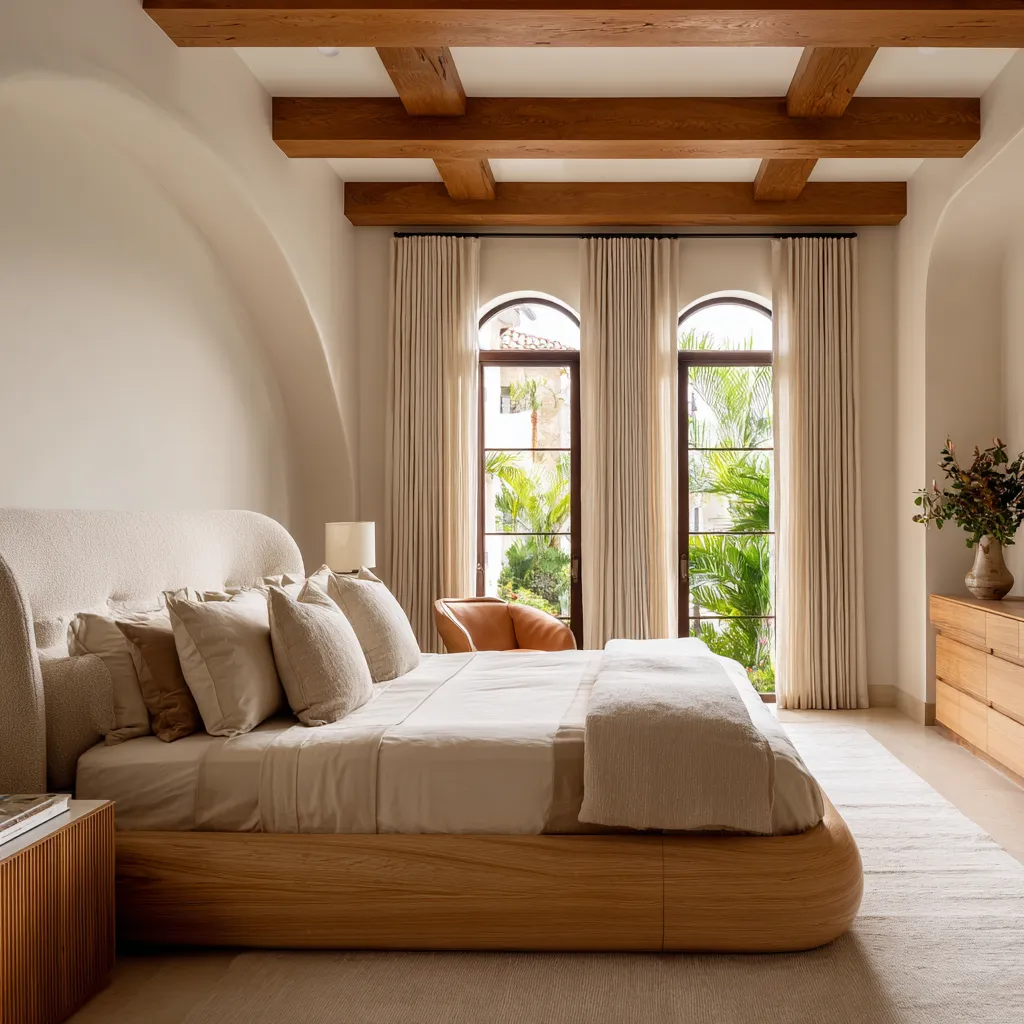
That is also why a single strong arch often does more than several smaller gestures. A thick, legible arch with a wall body gives the room a structural identity.
A weak decorative curve does not.
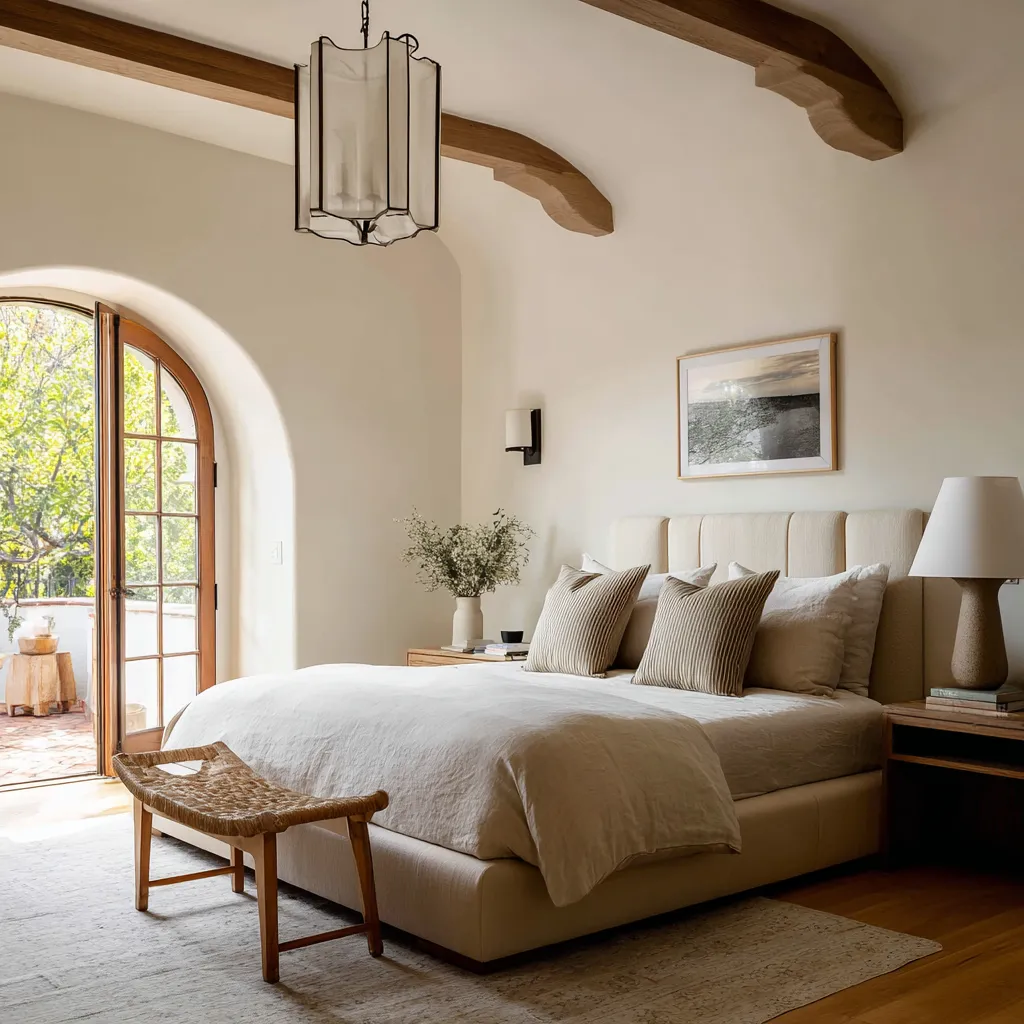
Why beams alone do not carry the room
Beams, which show up constantly in Spanish Revival interiors, are weak as a separating feature. That sounds surprising at first because ceiling beams are one of the first things people associate with Spanish Revival interiors.
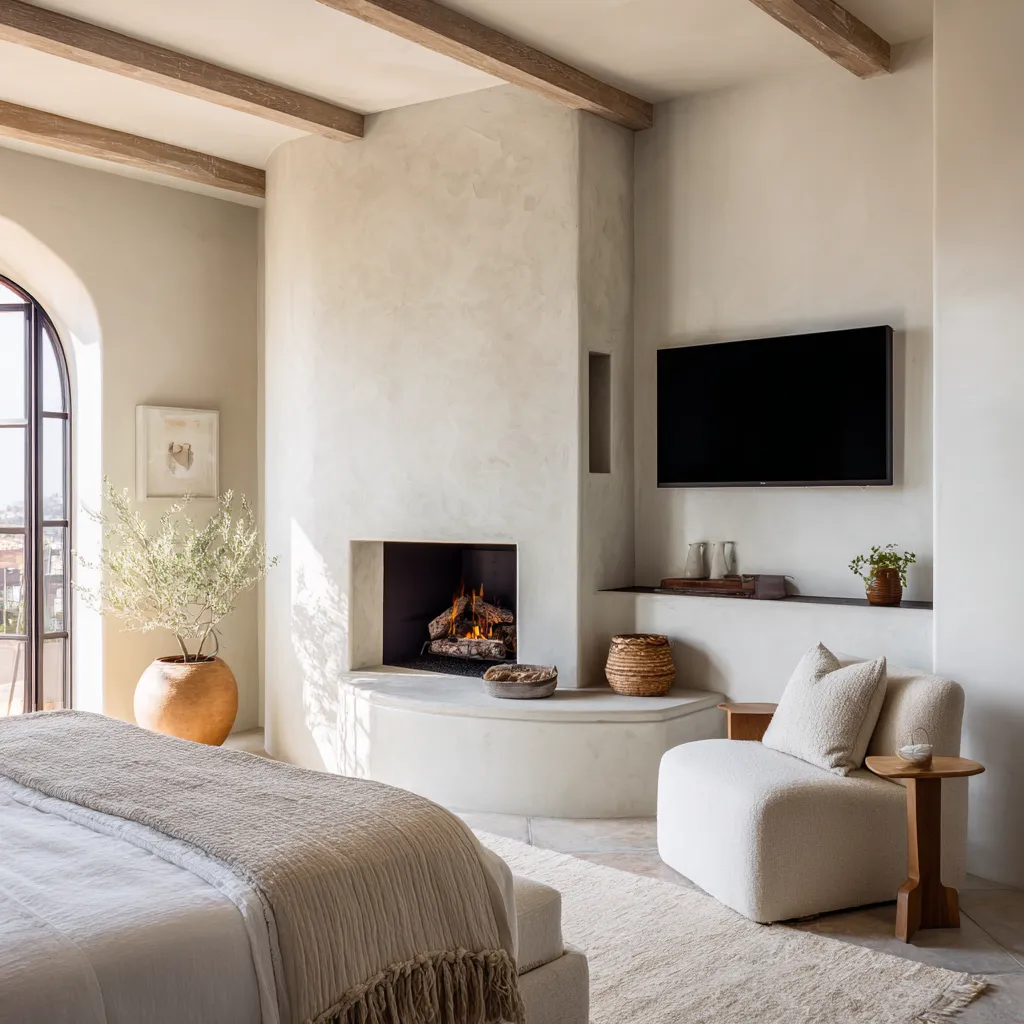
The deeper reading is better than the obvious one. Beams matter, but they behave like a baseline signal.
Many styles already have them. What separates the stronger designs from the merely attractive ones is whether the beams belonged to a convincing architectural system.
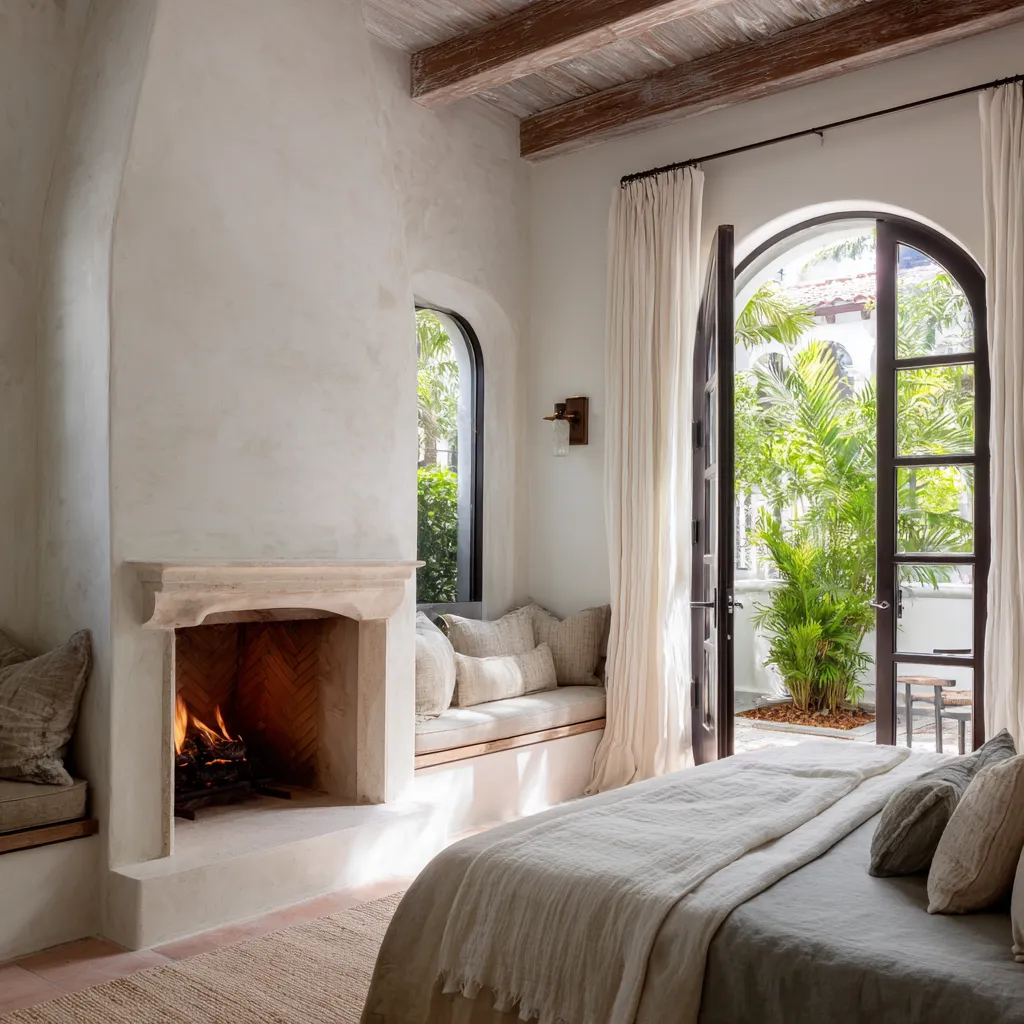
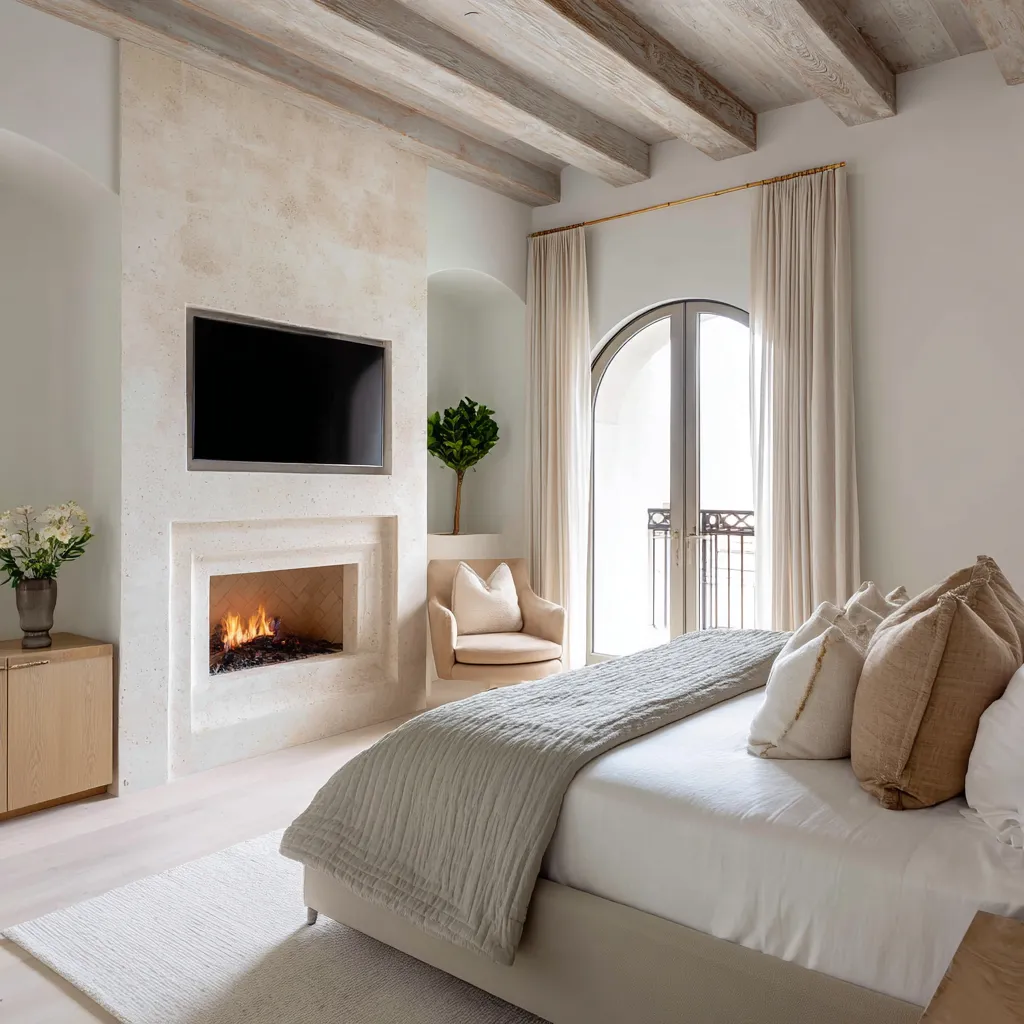
A design with dark beams, white walls, and neutral bedding can still feel thin if the walls are flat, the openings have little depth, and the furniture takes too much visual space. By contrast, an interior design with lighter beams can still feel deeply Spanish Revival if the shell is thick, the arches are clear, and the bed sits inside a strong recess or against a powerful chimney wall.
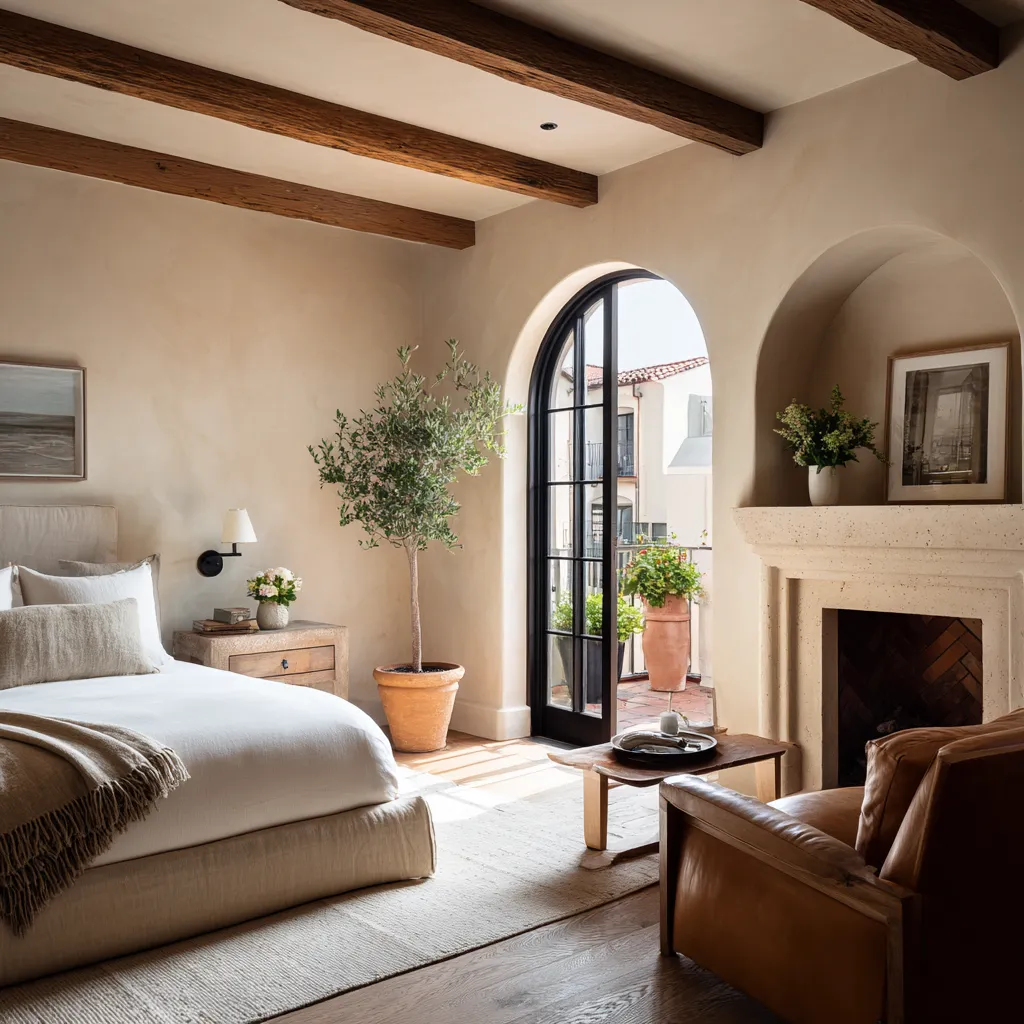
So beams should be treated as supporting structure, not as the full answer. They become effective when they are paired with wall mass, shaped openings, hearth gravity, and built-in logic.
Without that support, they can drift toward pure rustic luxury.
Brightness helps, but too much polish can weaken the style
There is a relationship between brightness and specificity. Very high in light, pale tones, and soft warm neutrals, yet very high light serenity have some negative effects on the style coherence.
That does not mean bright designs fail. Beautiful Spanish Revival bedroom design can be full of light and has a warm villa-like ease.
The issue is not brightness itself. The issue is what brightness can erase when the shell is too thin.
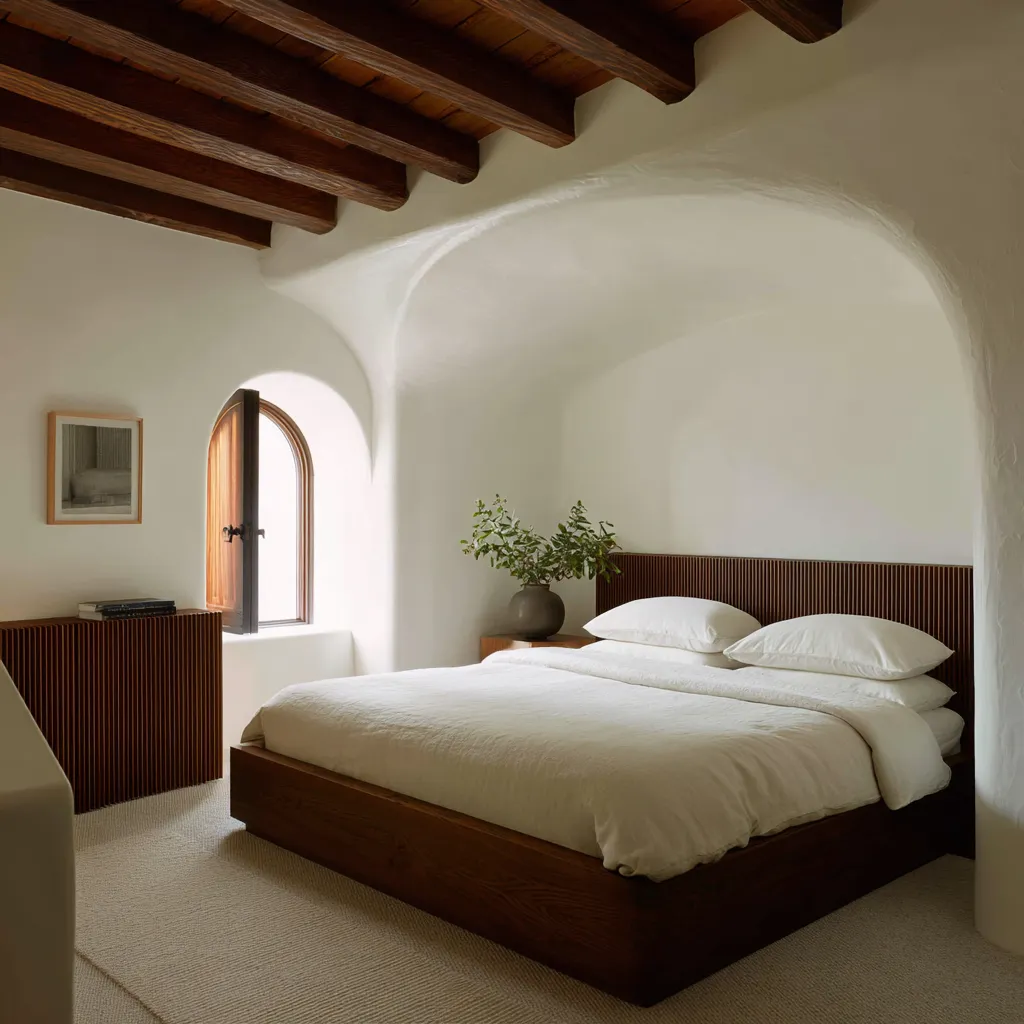
As the interior designs become cleaner, paler, and more polished, they need stronger wall definition to stay within Spanish Revival. They need thicker reveals, clearer arch shapes, more distinct recesses, and a stronger sense of plaster body.
Without those things, they begin to slide toward a contemporary coastal bedroom rather than a room with a Spanish Revival identity.
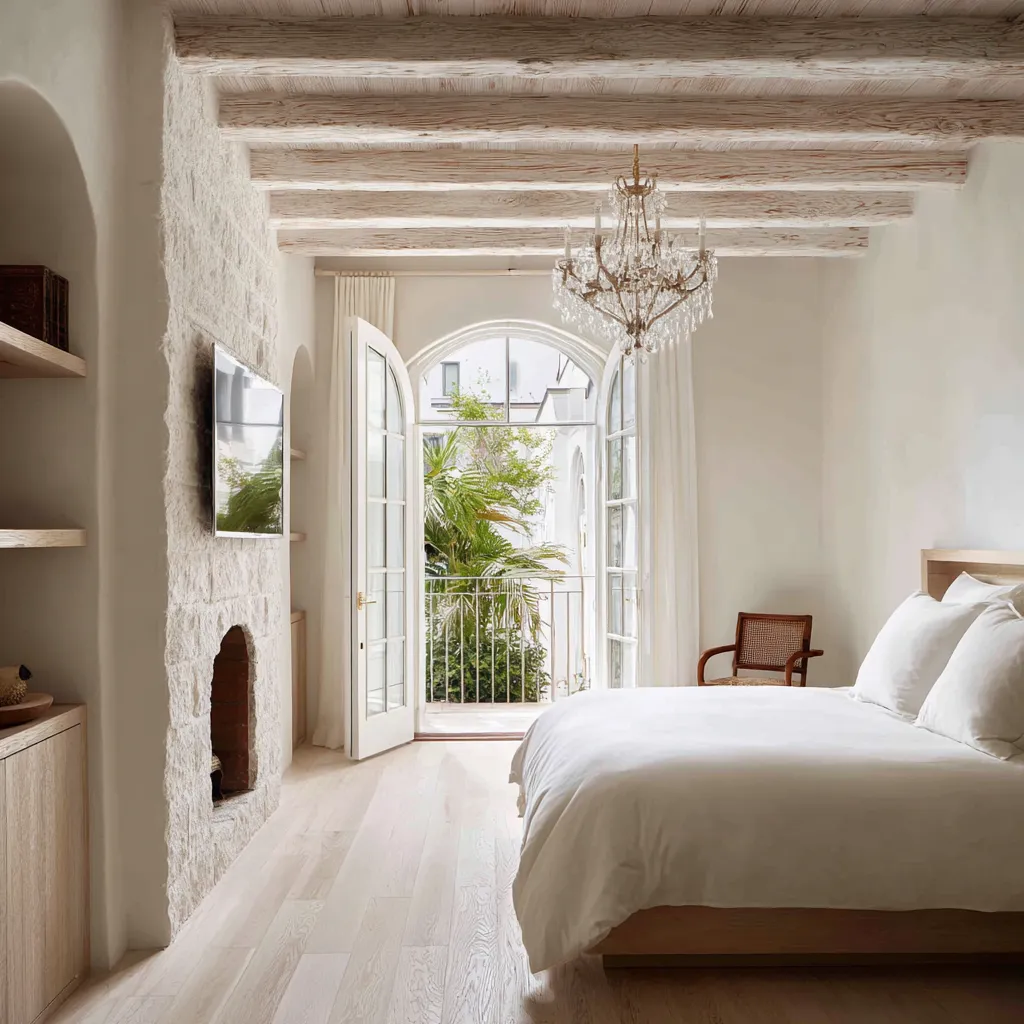
This is an important distinction because many current bedroom designs aim for airy luxury. That can work well here, but the architecture has to stay legible.
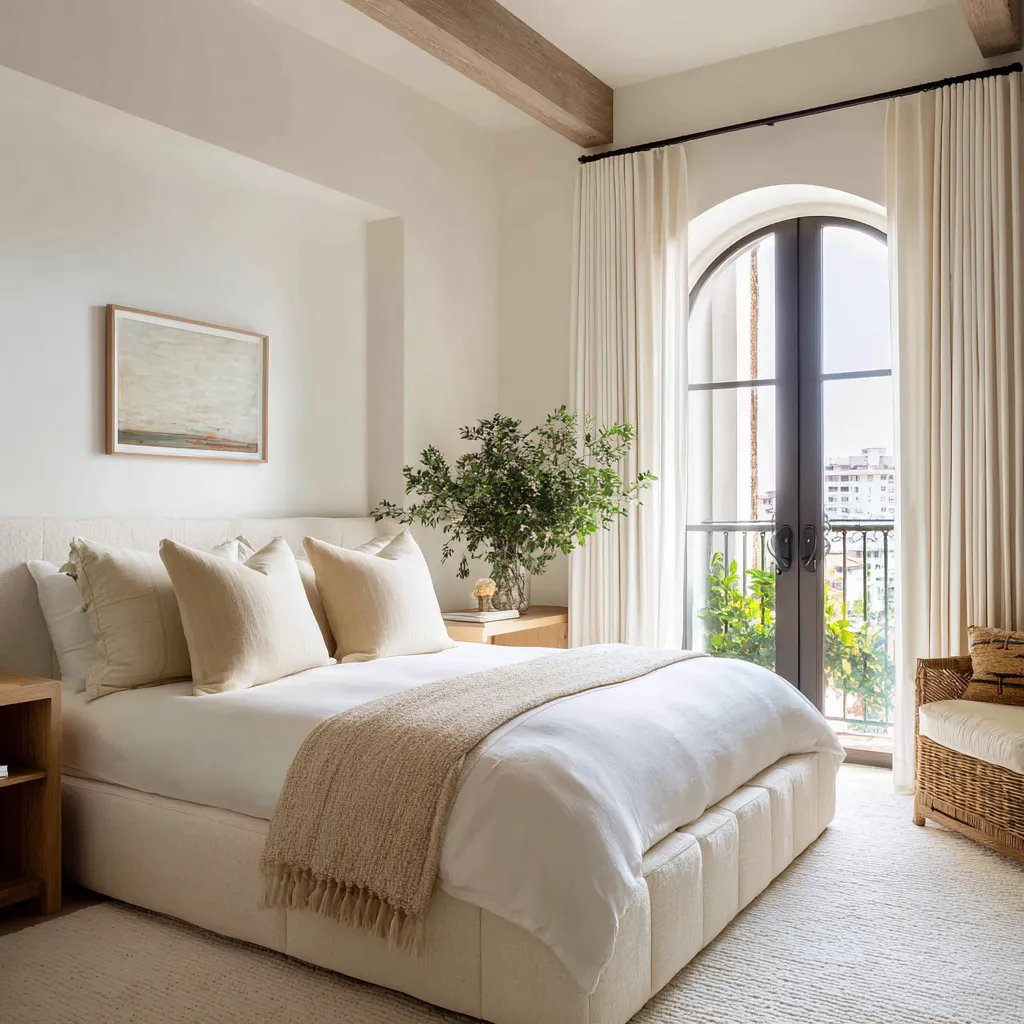
The brighter the room, the more exact the shell needs to be. That is why balcony-facing bedrooms feel beautiful but slightly less rooted in the style than the darker or more enclosed rooms.
Their mood is appealing, but their architecture needs more weight.
A fireplace matters
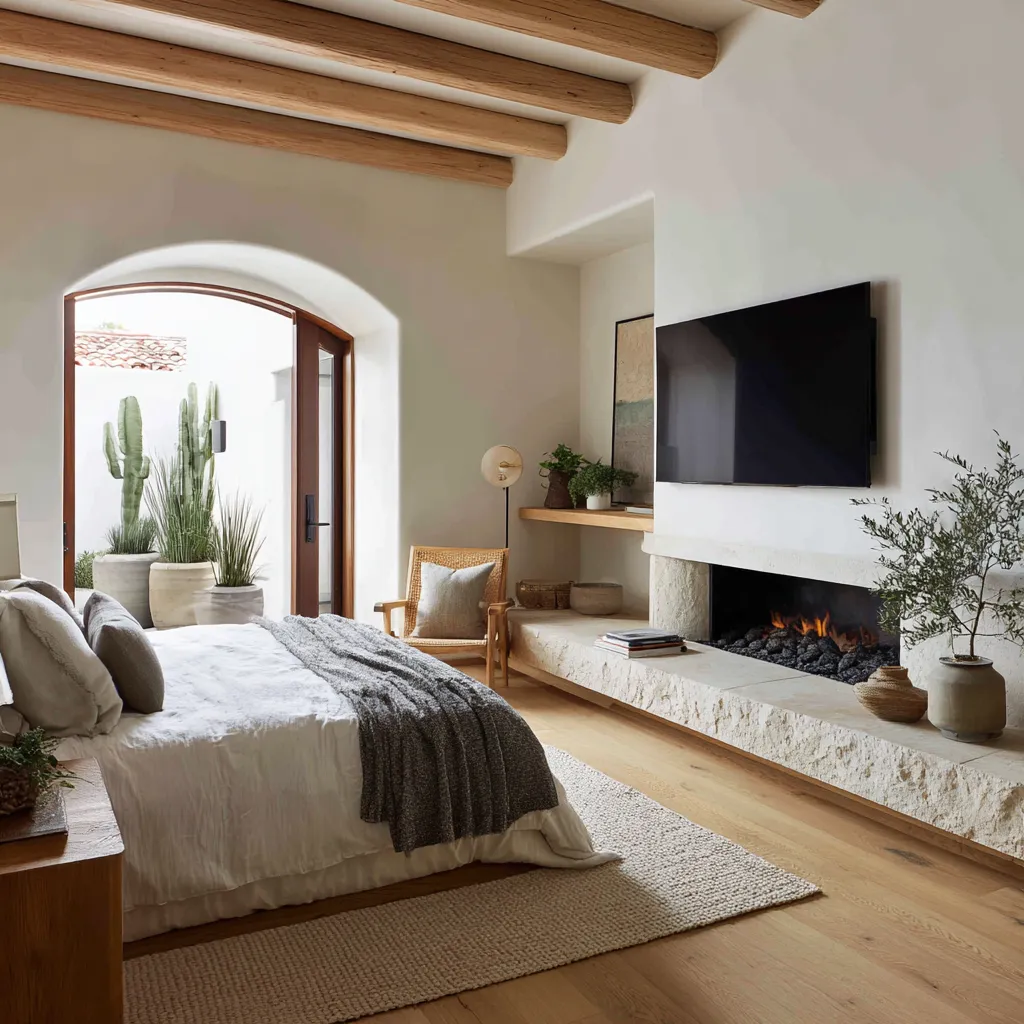
The fireplace matters, but not in the simplistic way people often expect. On its own, fireplace presence has only a modest relationship with style coherence.
Hearth gravity still contributes in a meaningful way. The difference comes down to how the fireplace is handled.
Fireplaces should not treat the hearth as a decorative insert. They should treat it as an architectural body.
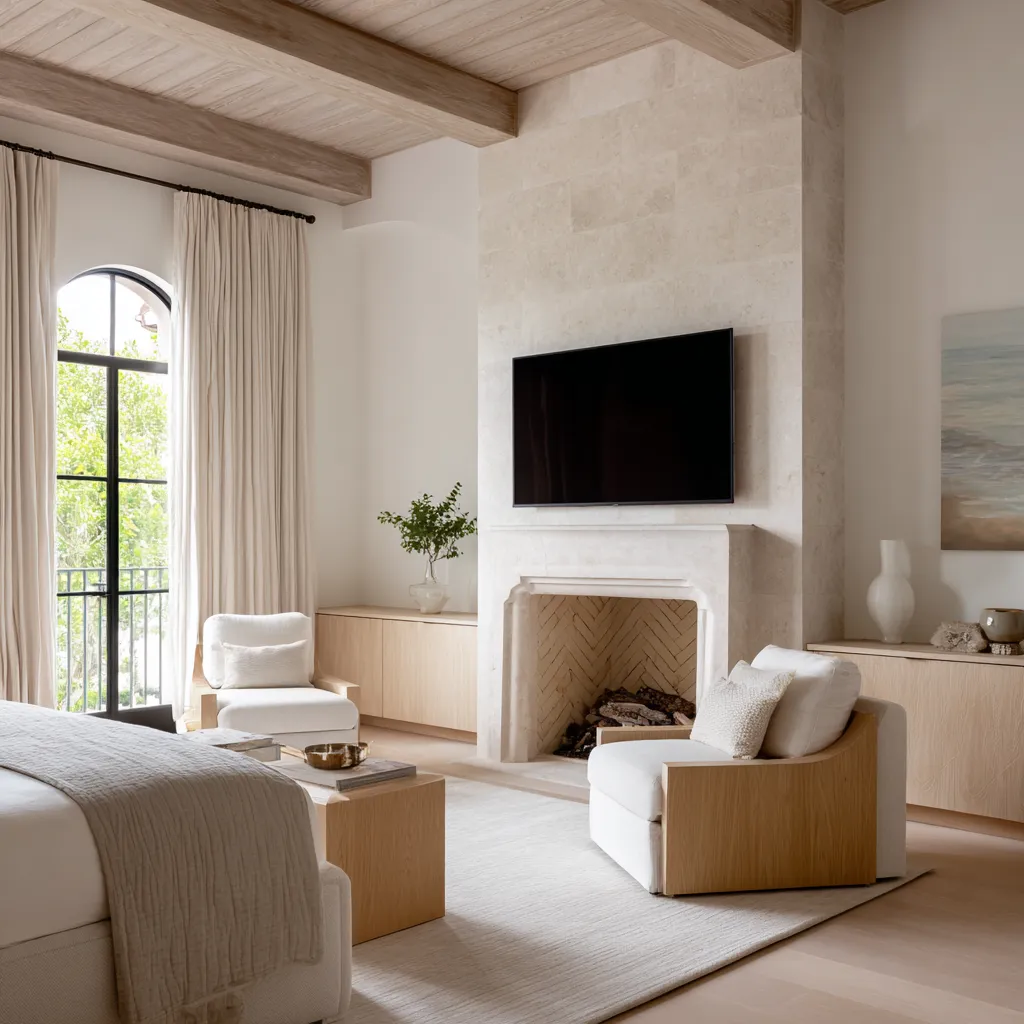
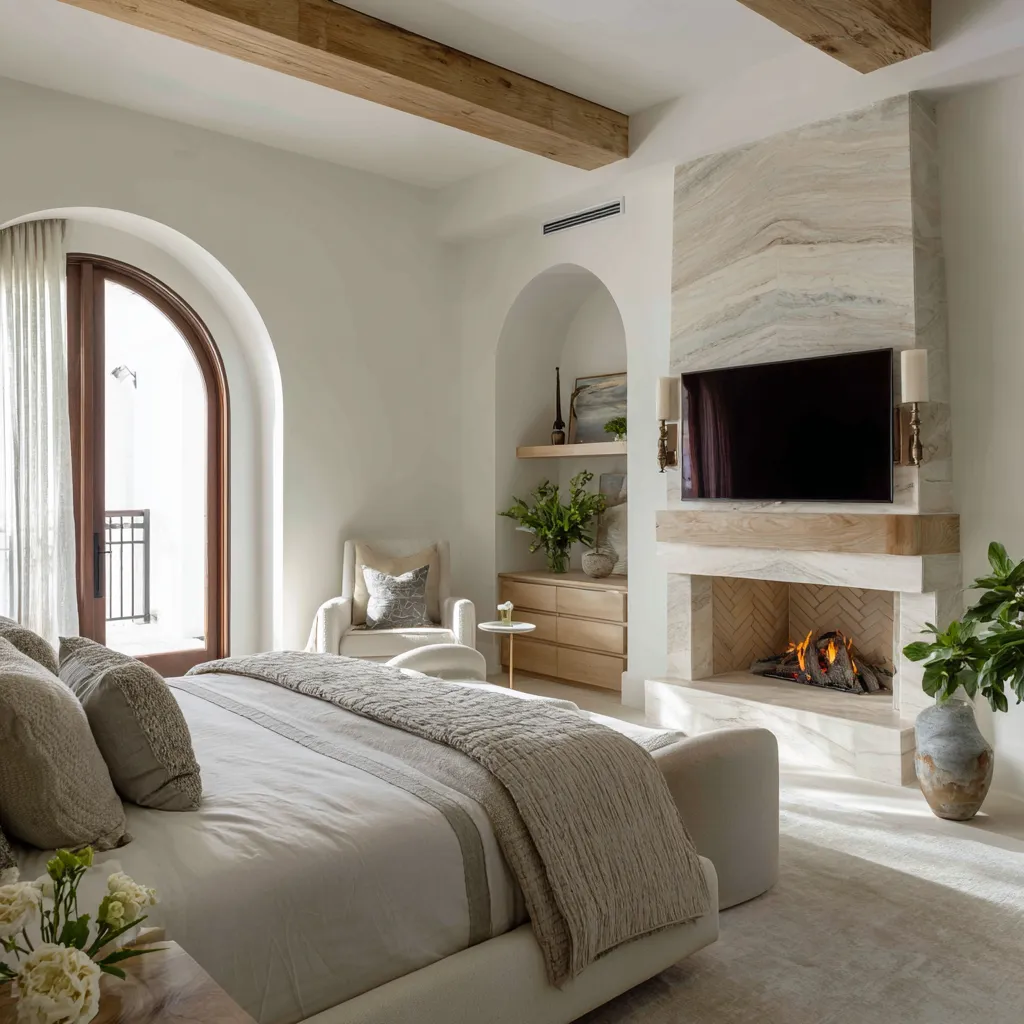
The firebox can be pared with bench extensions, side niches, built-in shelving, herringbone brick depth, thick chimney mass, or a recessed composition that make the wall feel inhabited.
A Spanish Revival fireplace works well when it feels like part of the masonry order of the room. A fire opening inside a thick wall carries much more authority than a thin applied surround.
A hearth ledge that becomes a seat or shelf gives the room a stronger sense of use. A chimney that rises with a strong presence can organize the whole bedroom interior design concept.
At the same time, the room can have a strong Spanish Revival look with having no fireplace at all. Such design can compensate through alcove logic, wall carving, and bed-zone enclosure instead.
So the fireplace is helpful, but it is optional. What is not optional is architectural depth.
Softness matters because this is still a bedroom
Softness helps hold the style together. That matters, because some design discussions frame comfort as something that weakens architectural clarity.
Both sides matter. A bedroom can have a clear, defined architectural presence while still feeling comfortable and appropriate for the way a bedroom should feel.
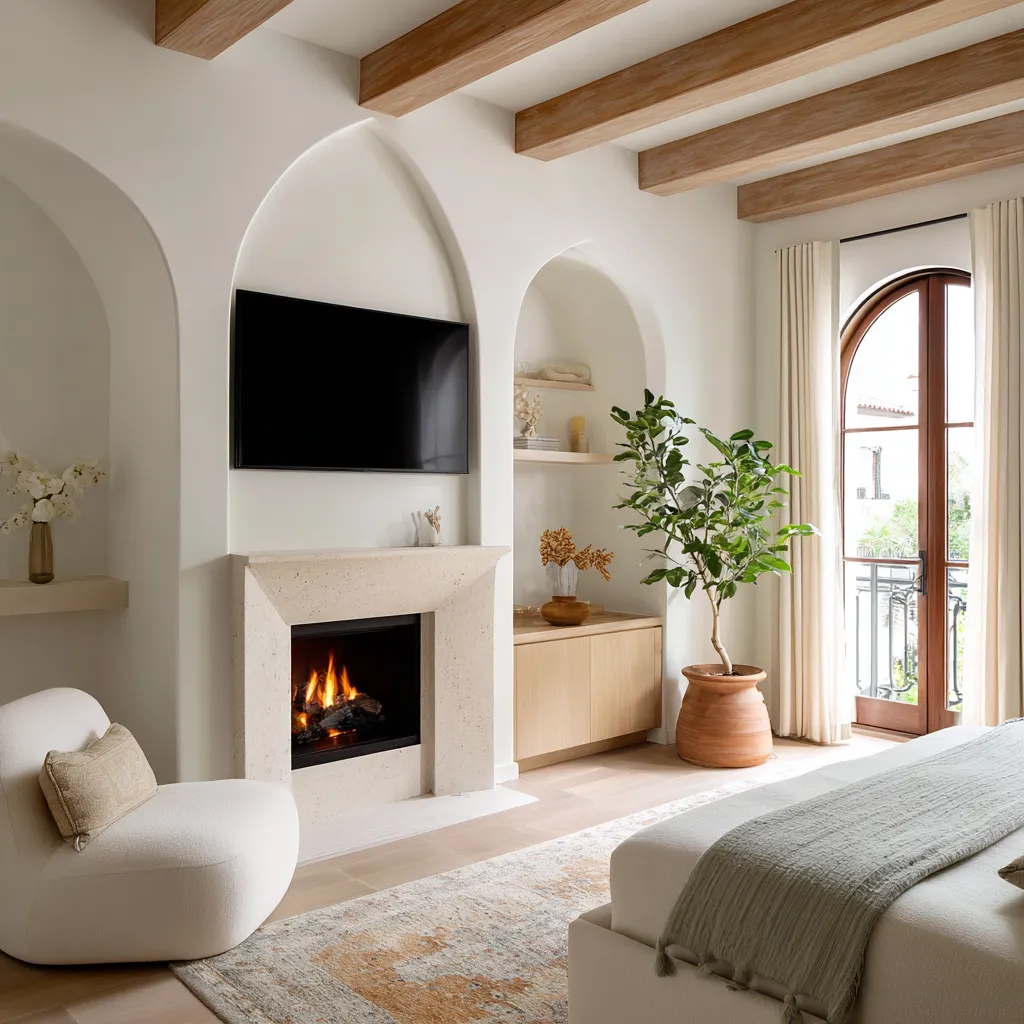
The modern furnishing traits are very consistent:
- low, broad beds
- pale natural fabrics
- restrained pillow stacks
- upholstered headboards without heavy tufting
- furniture that sits low against the wall rather than rising up to compete with it
This creates a contrast. The shell supplies structure, gravity, and identity.
The bed and textiles bring softness, rest, and human scale. That pairing is one of the reasons an interior design feels complete rather than staged.
The design is not only architecturally specific. It also feels inhabitable.
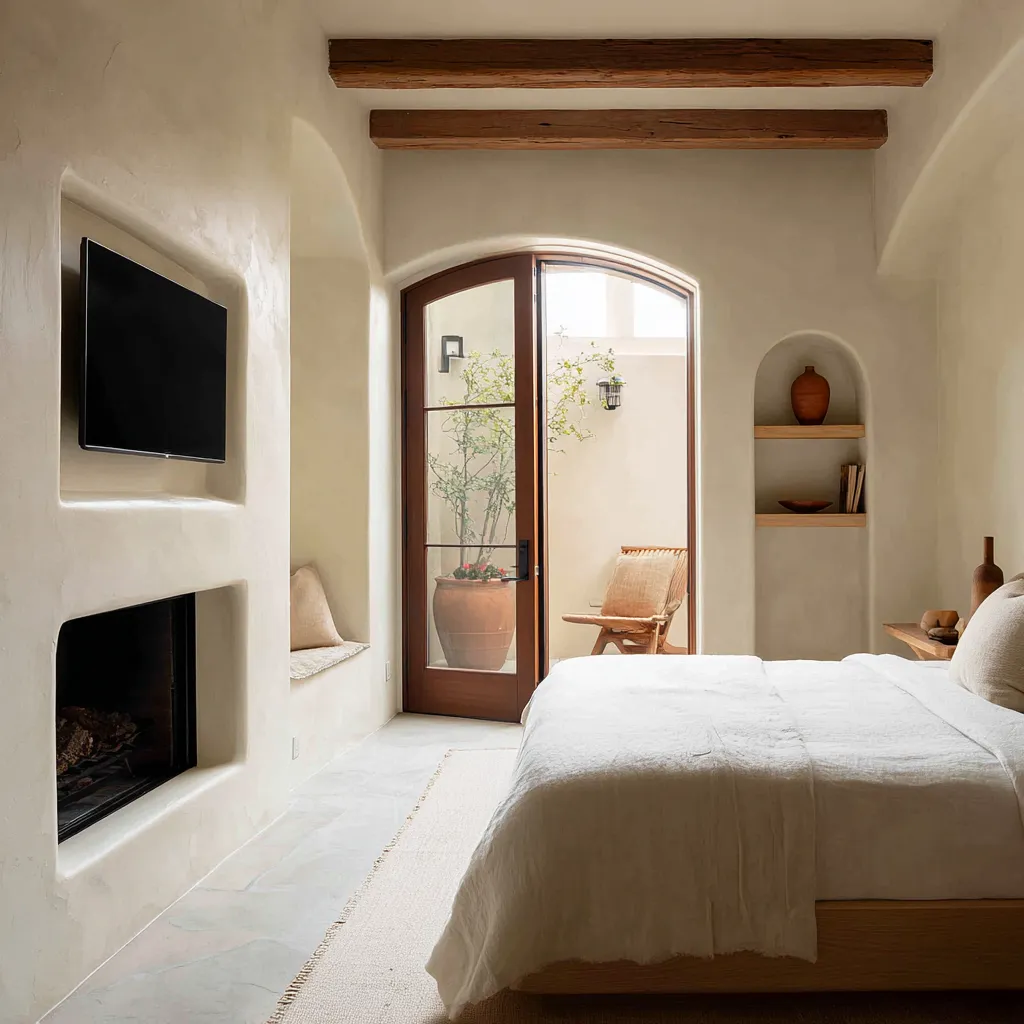
This means the bed should not try to overpower the space. It should sit within the architecture, not fight it.
The room gains far more from a low upholstered bed under a thick arch or against a carved wall than from an oversized statement bed that disrupts the hierarchy.
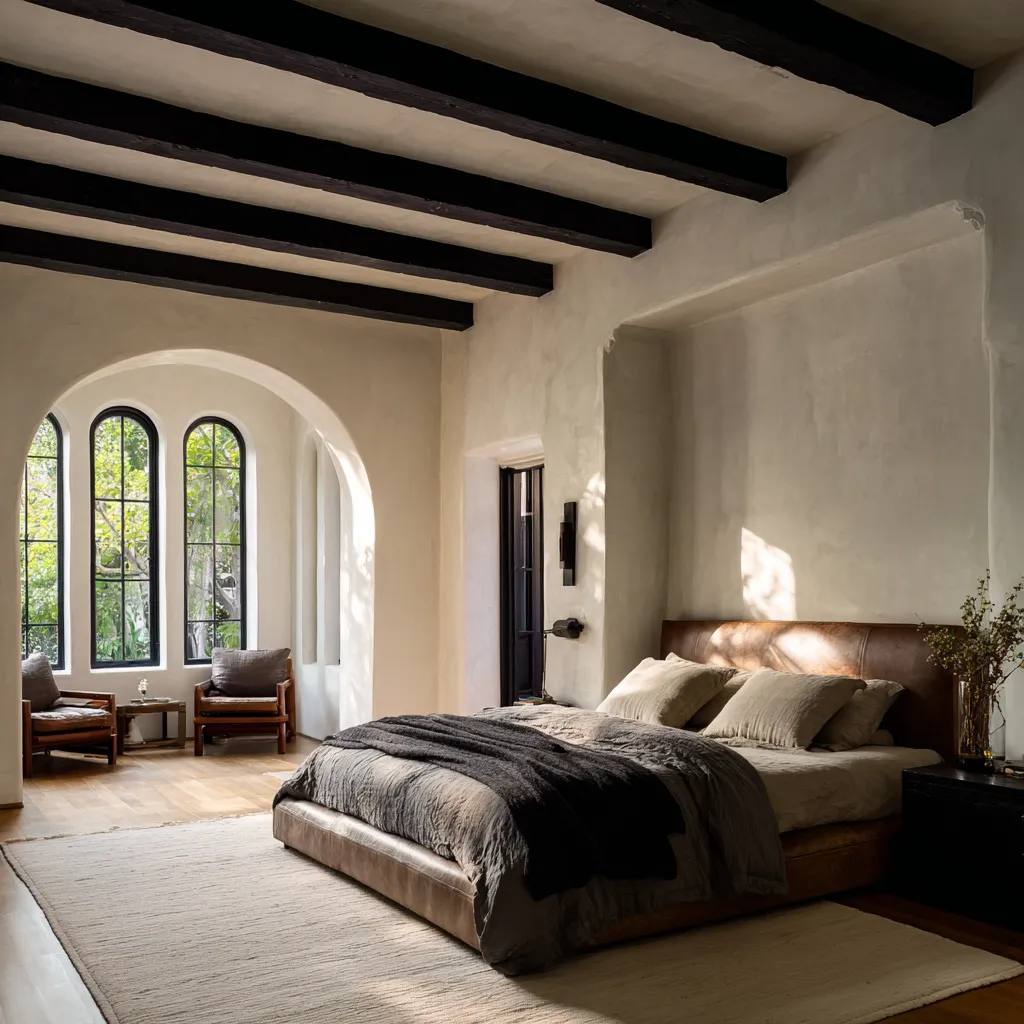
Two strong Spanish Revival design directions
Spanish Revival bedroom designs are not all aiming for the same feeling. There are at least two main subfamilies of the style.
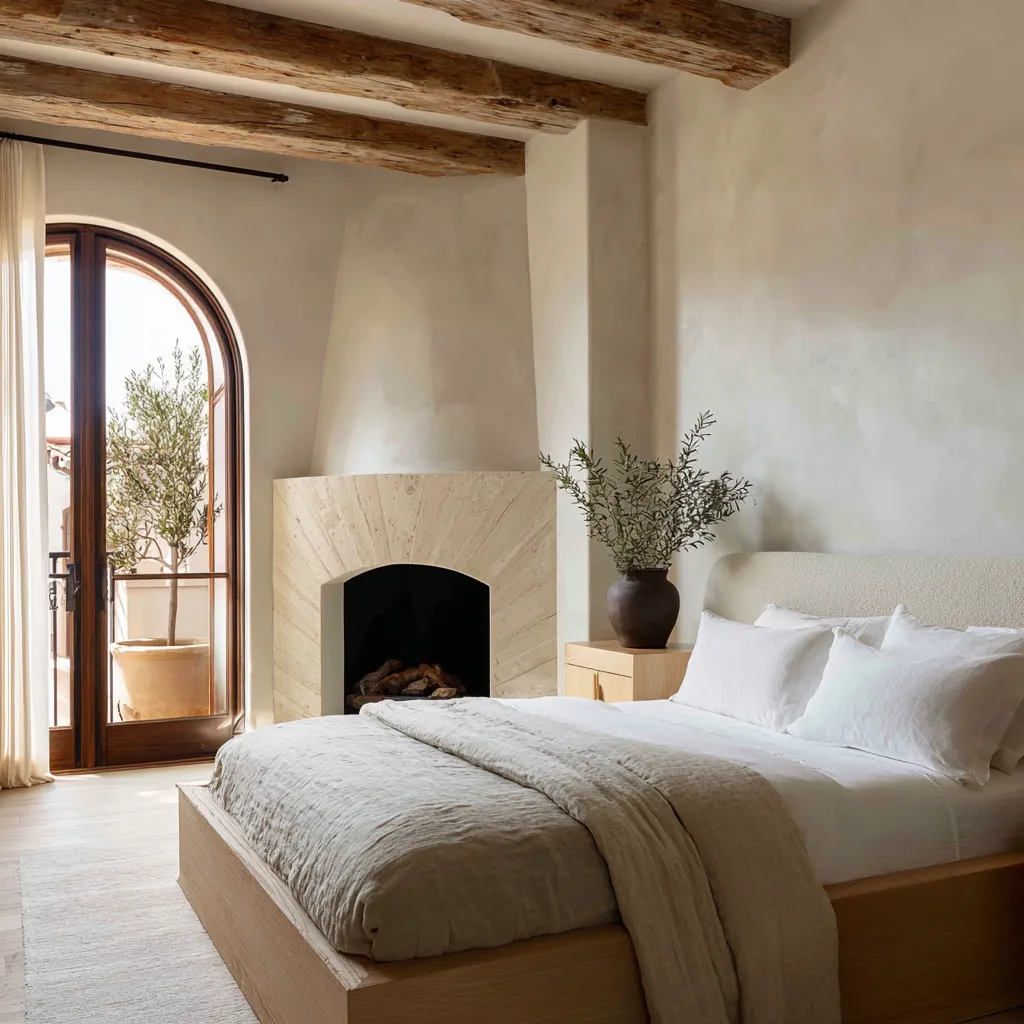
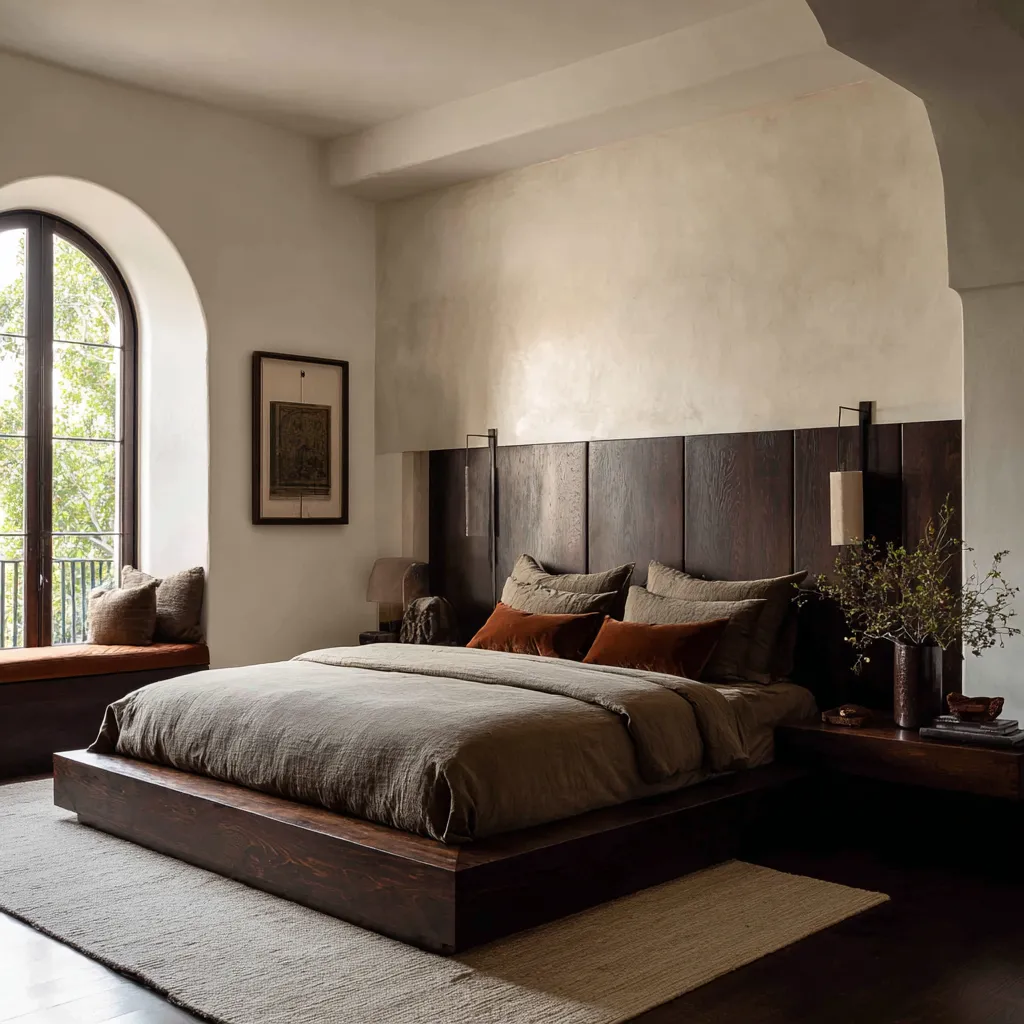
The first is the darker inward designs. These Spanish Revival bedroom ideas use deeper timber tones, less daylight emphasis, more enclosed mood, and more visual gravity.
They often feel older, quieter, and more introspective. Their strength comes from shelter, shadow, and a more grounded material palette.
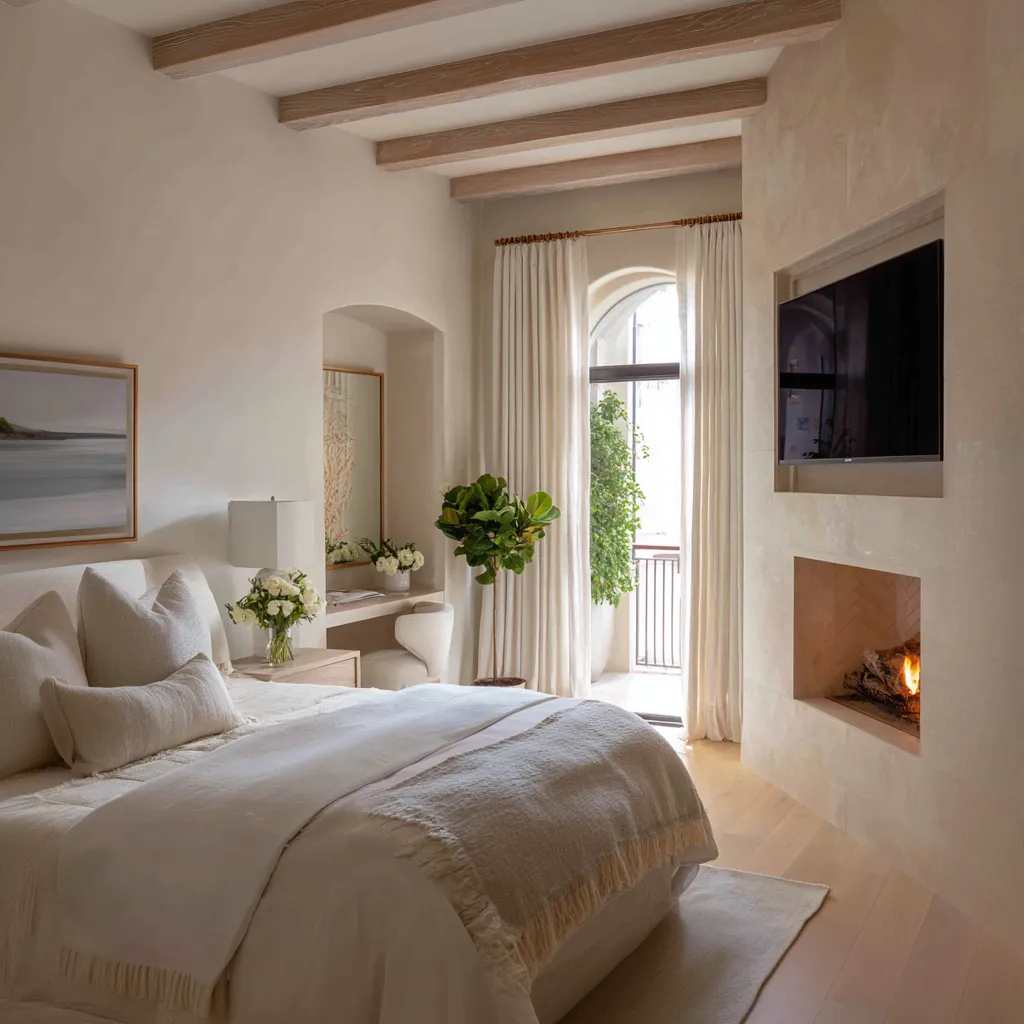
The second is the brighter design ideas. These designs lean into daylight, balcony or garden connection, lighter shell treatment, and a fresher villa atmosphere.
They often feel more open and more airy, but they still work when the arch language and plaster body remain clear.
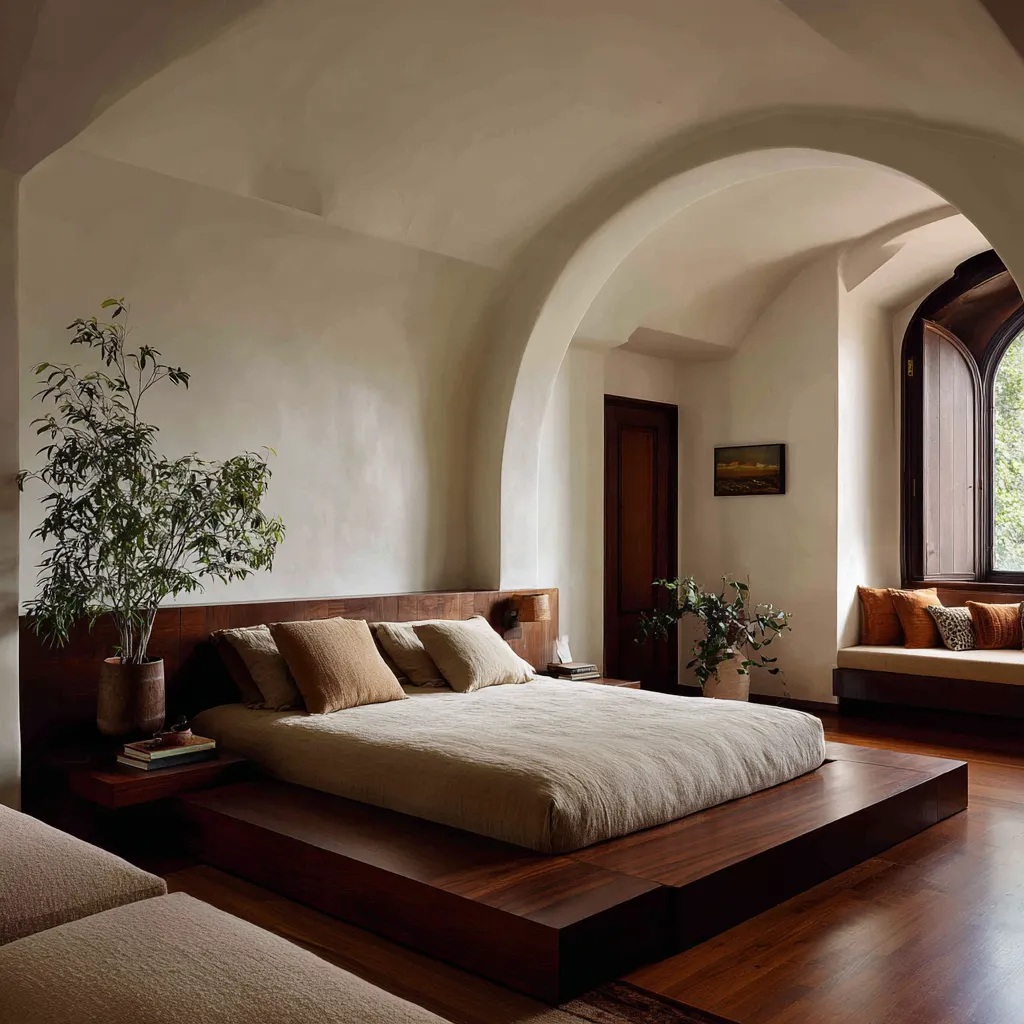
Neither route is automatically better. Both could produce strong Spanish Revival bedroom looks.
The deciding factor is whether the shell stays convincing. This matters because it gives designers more freedom.
You do not have to choose between a dark old-estate mood and a bright coastal room by asking which one is more correct. Both sit inside the family.
The question is whether the room has enough architectural thickness to support the route you choose.
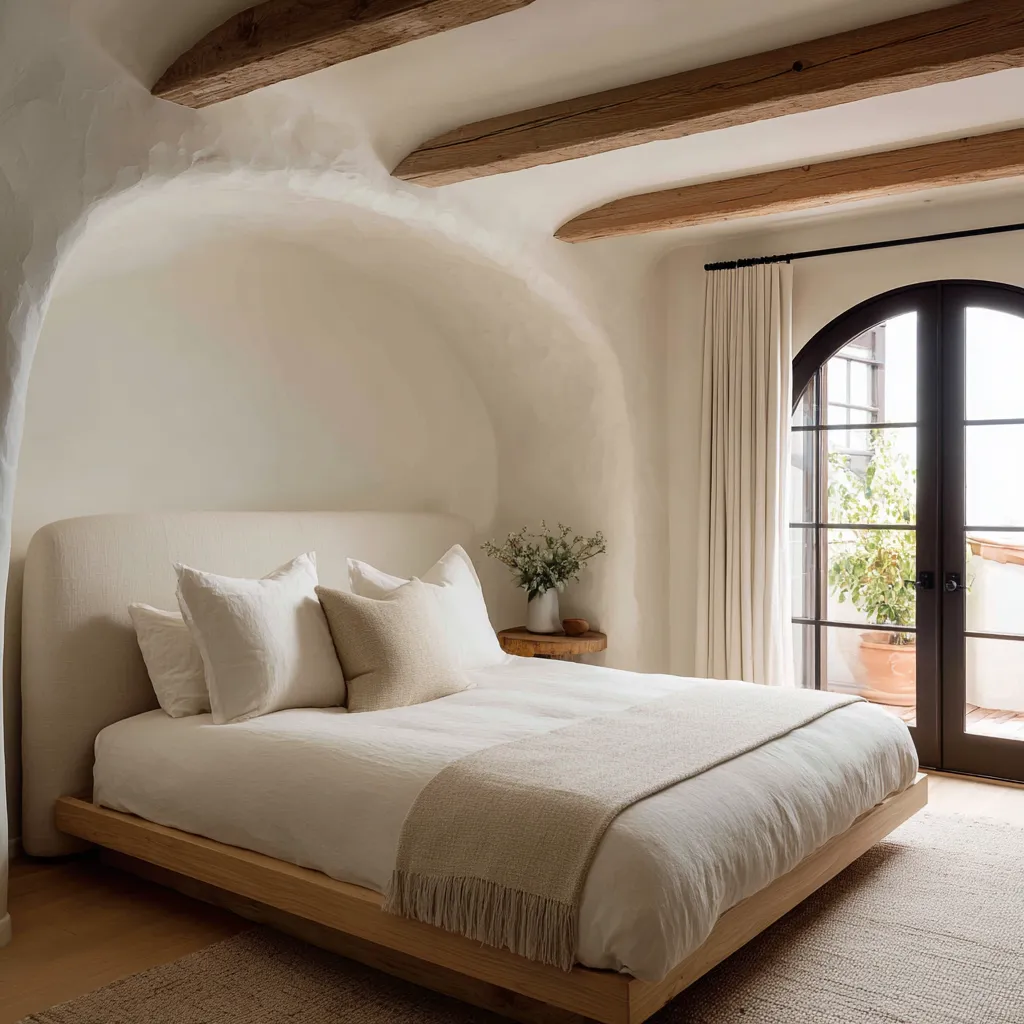
What the strongest Spanish Revival design ideas do differently
They were more architecturally programmed. On average, solid-looking designs have:
- more built-ins
- stronger wall mass
- greater shell depth
- better plaster body
- clearer arch geometry
- more integrated hearth logic
That is a powerful list because none of it depends on clutter. The designs do not become stronger by adding more accessories, more color, or more decorative noise.
They become stronger by making the architecture work harder.
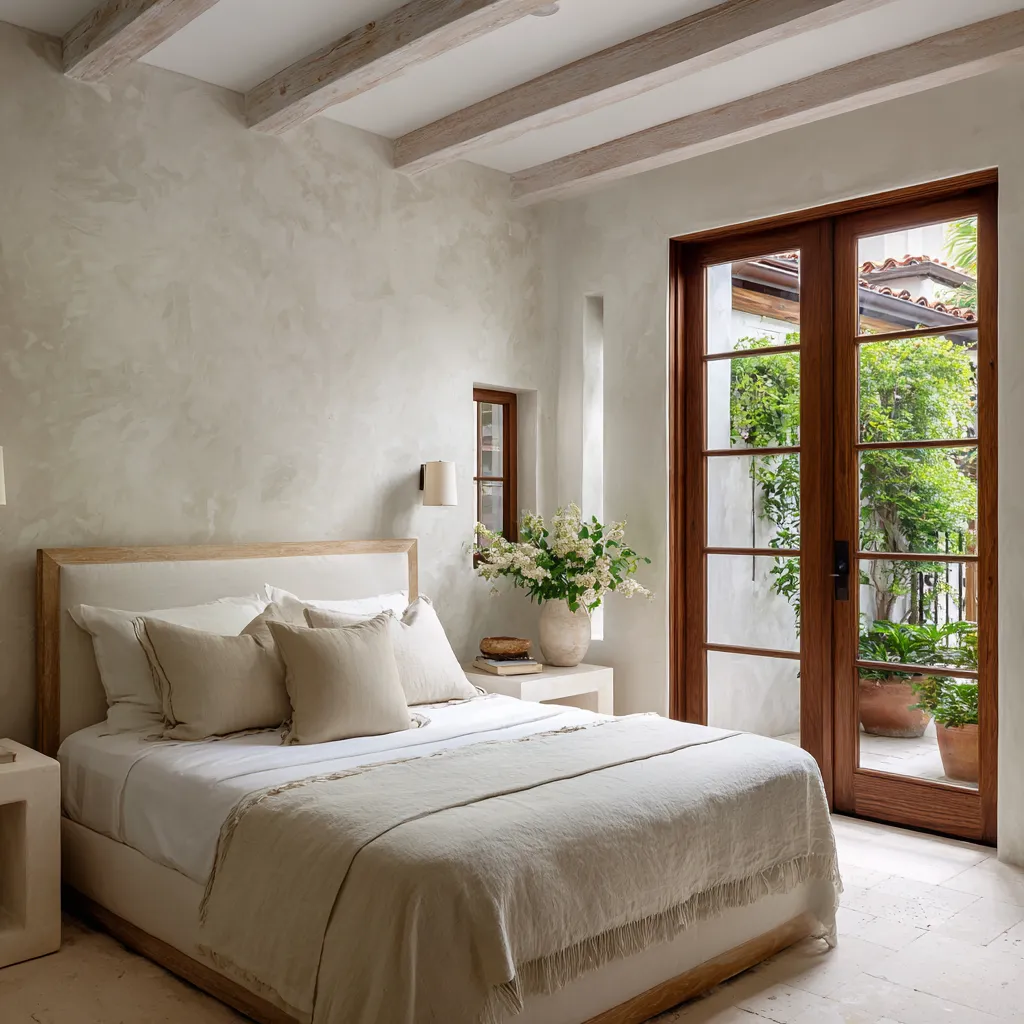
Spanish Revival is not held together by abundance. It is held together by hierarchy.
A few strong moves matter far more than a room full of small references. A deeply inset arch, a bed alcove, a plaster bench, a shaped fireplace mass, a carved niche, or a thick balcony reveal can do far more for the style than ornate furniture or a collection of themed accents.
What often weakens a Spanish Revival bedroom
The main issue is not simplicity. Simplicity actually works very well here.
The weaker outcome is simplicity without depth.
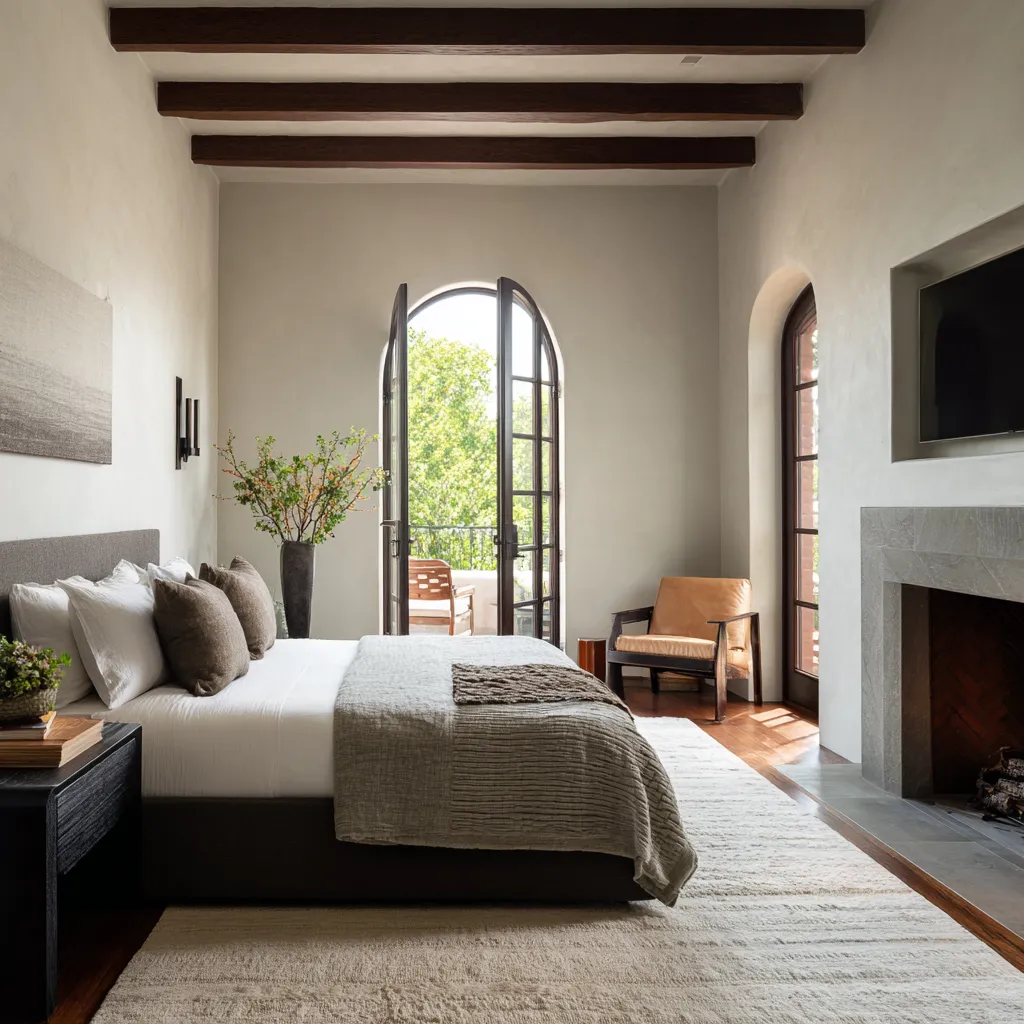
An interior design can lose specificity when it becomes too polished without enough shell character. This usually happens when:
- walls look flat instead of thick
- arches are present but too light or too shallow
- brightness smooths out all contrast
- the fireplace, if present, feels added rather than embedded
- furniture becomes too visually dominant
- texture is reduced so much that the room loses its mineral body
At that point the interior design may still be attractive, but it begins to feel like warm contemporary luxury with Spanish cues rather than a fully resolved Spanish Revival bedroom.
Spanish Revival design formula
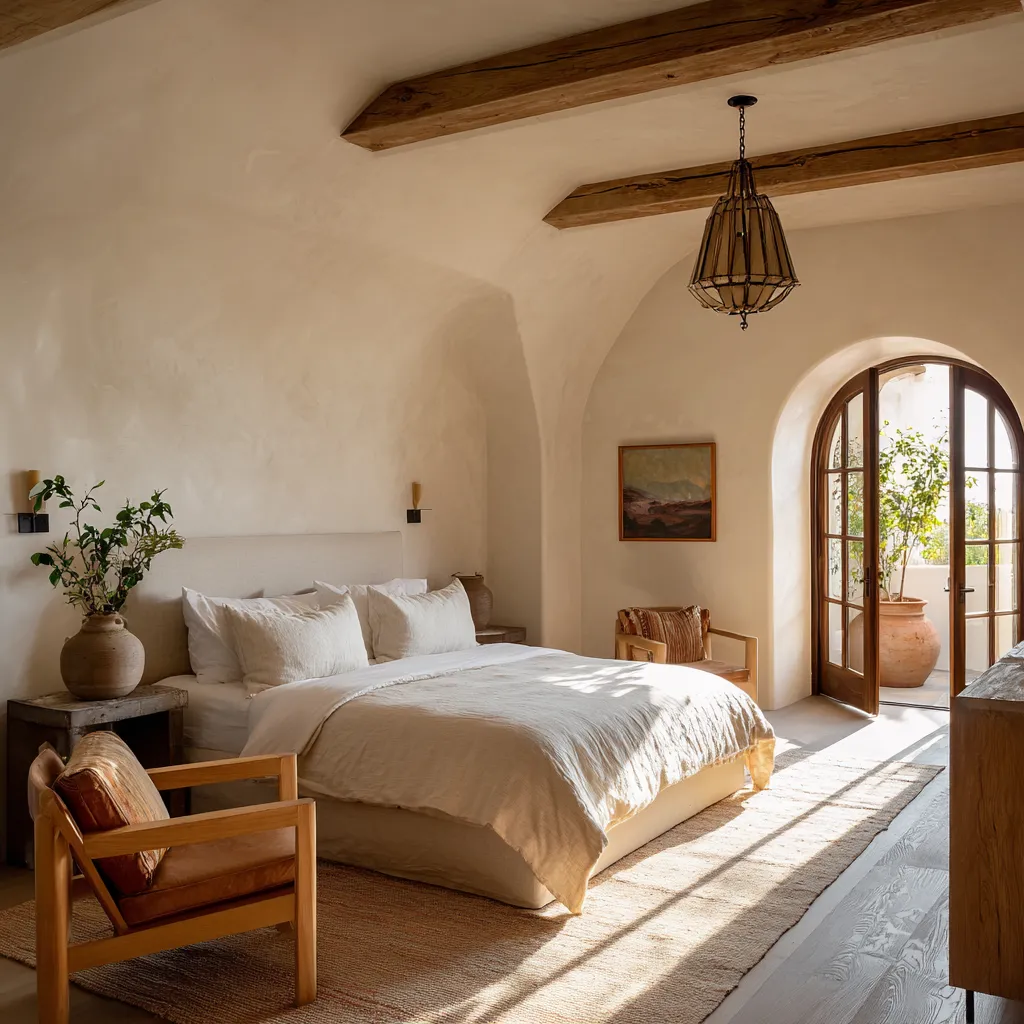
The formula is very clear. A strong Spanish Revival bedroom design tends to combine:
- a pale shell with believable wall body
- arch geometry that feels structural
- some recess or built-in logic
- a low, broad bed
- natural fabrics in a restrained palette
- one grounding material family such as dark wood, stone, leather, or clay
- enough shadow and contrast to keep the room from going flat
That formula can produce many different versions of the style. It can support a bright courtyard room, a darker inward retreat, a hearth-led bedroom, or a niche-led bedroom.
What keeps the room coherent is not a fixed list of decorative pieces. It is the relationship between enclosure and softness.
Final thought
Spanish Revival bedroom design is rooted in architectural enclosure. The interior designs that hold the style with the most force do four things well.
They make the wall feel thick. They make the arch feel structural.
They kept the bed low and secondary to the shell. And they use light, textiles, and furniture to soften the architecture rather than replace it.
Stylish Spanish Revival bedroom design ideas do not chase the style through nostalgia. They built it through form, depth, and restraint.