A stylish Georgian living room does not need to choose between history and present-day living. It can keep the old order visible, then shift the atmosphere through mass, proportion, contrast, and furniture planning.
Georgian interiors today should not mostly depend on ornate mantels, crowded paneling, or a room full of period pieces. Their power usually comes from something simpler and stronger: a clear architecture, a fireplace wall, a grounded seating zone, and a furnishing plan that supports how people actually use it.
For years, many people thought that updating a Georgian room meant whitening everything, adding a statement chandelier, and mixing in a few modern pieces. That can work on the surface, but it often leaves the room without a clear center.
The newer approach is more structural. Instead of decorating over the shell, it changes where visual interest sits.
The design stops relying on trim and mantel detail alone and starts relying on the wall plane, the fireplace mass, the coffee table, the seating geometry, and the way light and contrast move through the space.
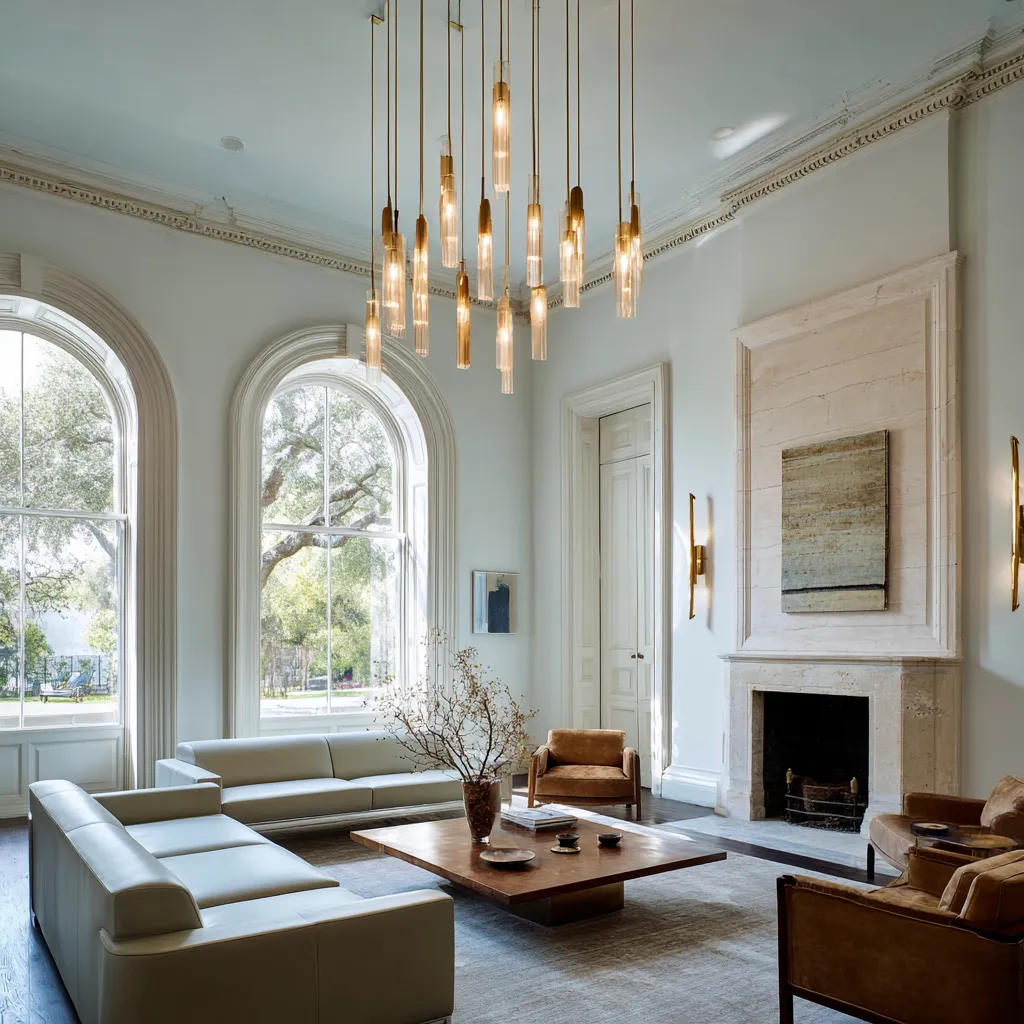
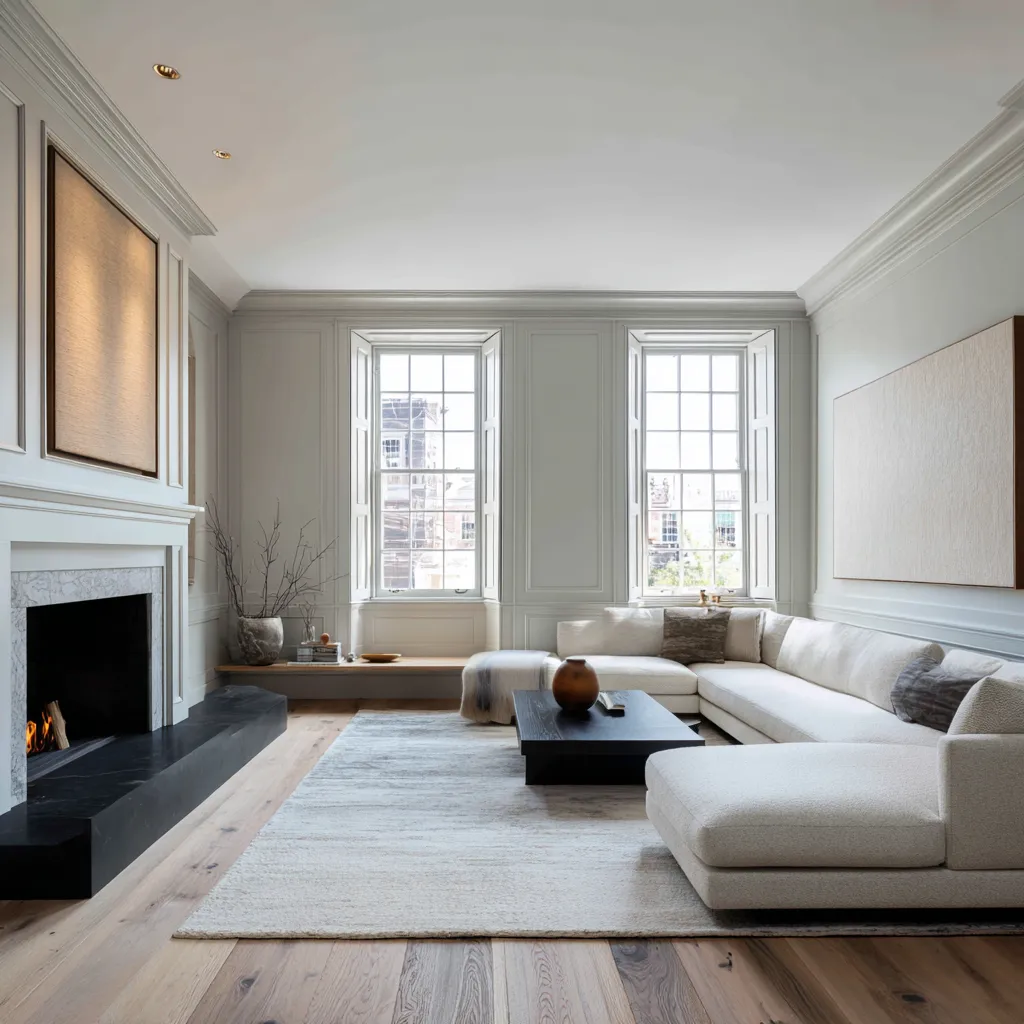
The result can take different forms. Some Georgian living rooms now feel sharper, darker, and more urban.
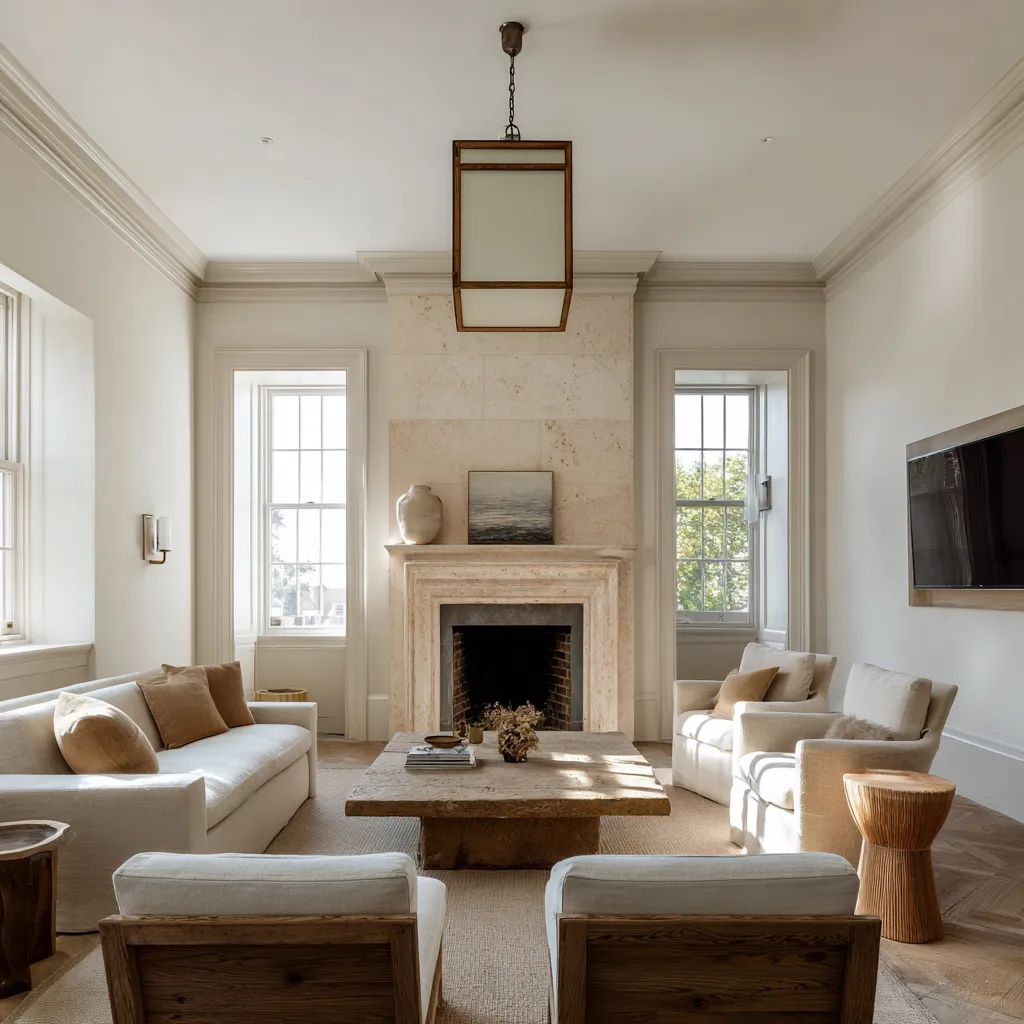
Some feel soft, sunlit, and deeply upholstered. Some lean into a monumental fireplace wall and use that as the whole room’s anchor.
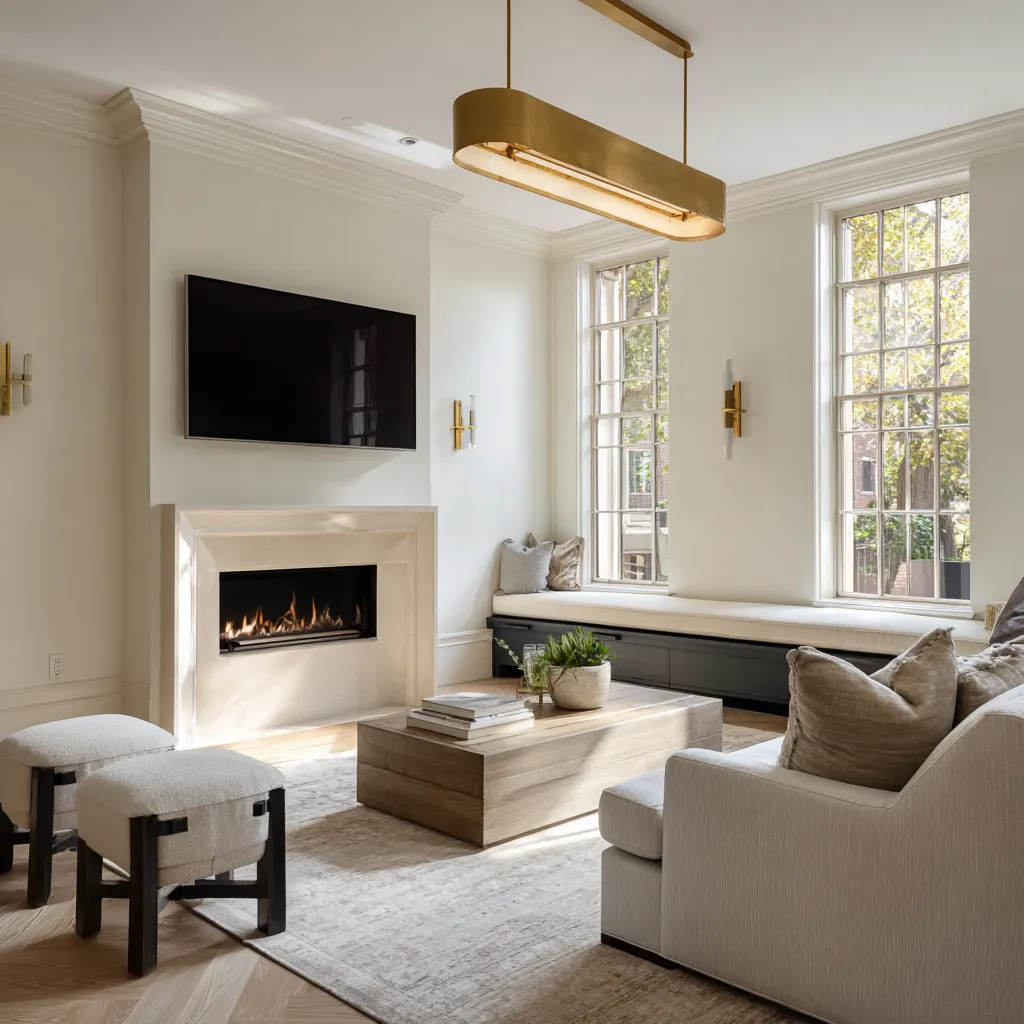
Others keep a formal axis but absorb present-day needs such as a television without losing their poise. The common thread is not one exact look.
It is a shared logic: the architecture stays legible, the room is edited rather than overloaded, and the lower half of the room is given enough weight to hold the tall walls around it.
What gives a Georgian living room its shape in the first place
Before thinking about furniture or color, it helps to remember what makes a Georgian room feel Georgian at all. It is usually not one decorative motif.
It is the total order of the shell. Tall windows, disciplined spacing, broad wall planes, deep trim, clear cornice lines, and a fireplace wall that feels central all work together to create an interior that has structure before any furnishing is added.
That is why Georgian rooms can easily feel awkward when they are modernized too casually. If the walls are treated like blank white boxes and the furniture is chosen without respect for the room’s height or axis, the whole composition can fall apart.
The shell is too strong for random styling. It needs a response that is equally organized.
A stylish Georgian living room usually keeps three things visible:
- the room’s vertical order
- the importance of the fireplace wall
- the clarity of the openings, especially windows and doors
What changes is how those features are interpreted. The trim may be simplified in color.
The mantel may be less decorative. The furniture may sit lower and broader than traditional Georgian furniture.
But the room still needs to feel structured. Once that structure is protected, there is a lot of freedom inside it.
The fireplace is no longer only a mantelpiece
One of the clearest changes in current Georgian living room design is the role of the fireplace. Before, the mantel was often treated as a decorative object attached to the wall.
It carried profile, carving, ornament, and a good deal of the room’s personality. In newer interiors, the fireplace often works differently.
It becomes part of a larger wall condition. This shift is one of the most useful ideas in Georgian design today.
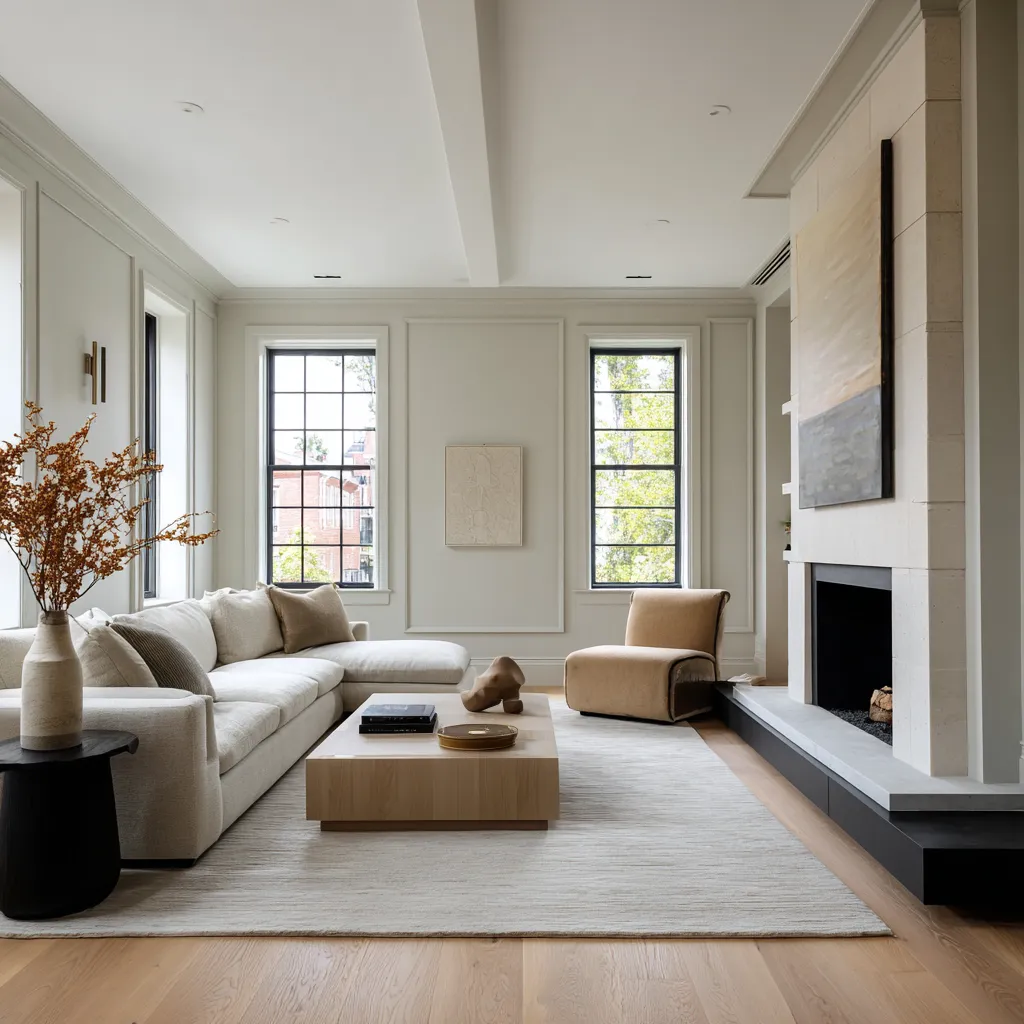
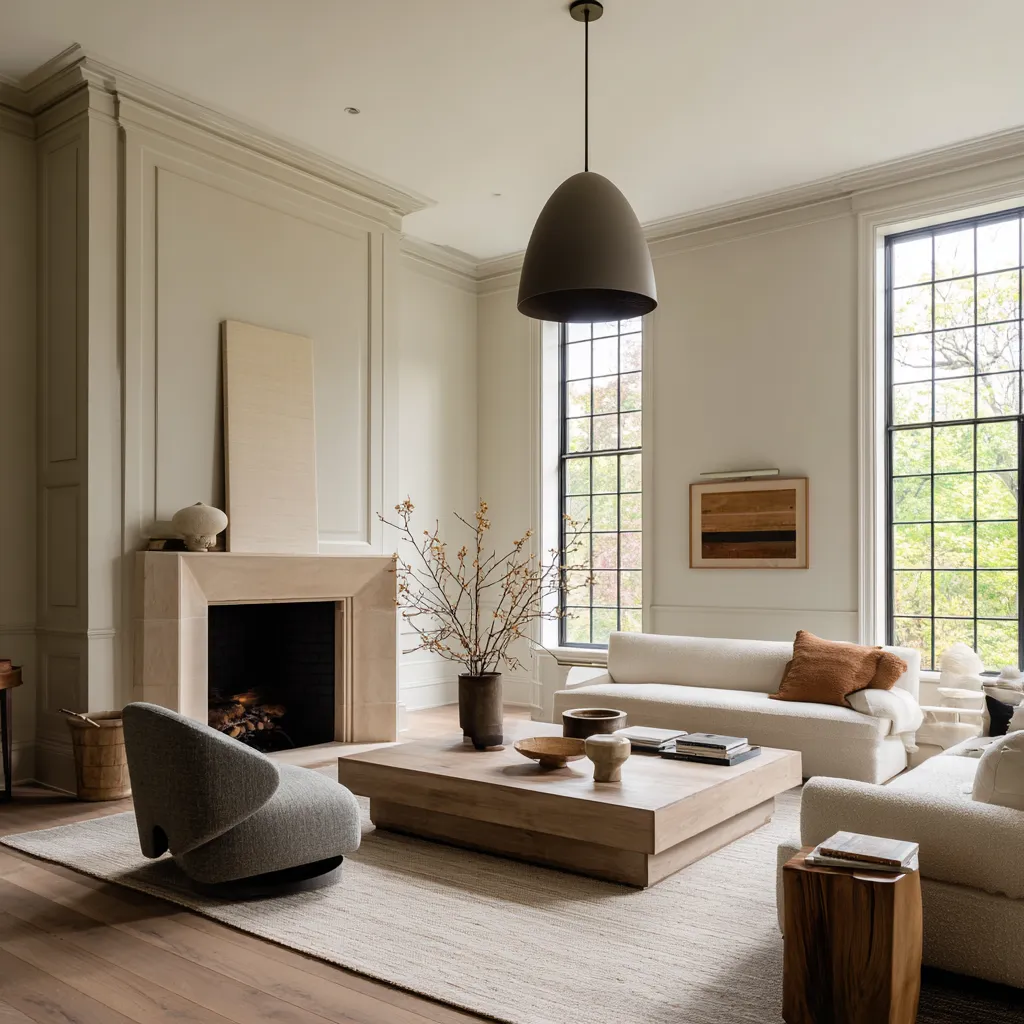
A fireplace wall can feel much more current when the eye reads it first as mass and only second as detail. That may mean a tall chimney breast faced in limestone or pale stone.
It may mean a simple plaster or stone plane with very little ornamental buildup. It may mean that the surround and the wall above are treated as one continuous field rather than as separate decorative parts.
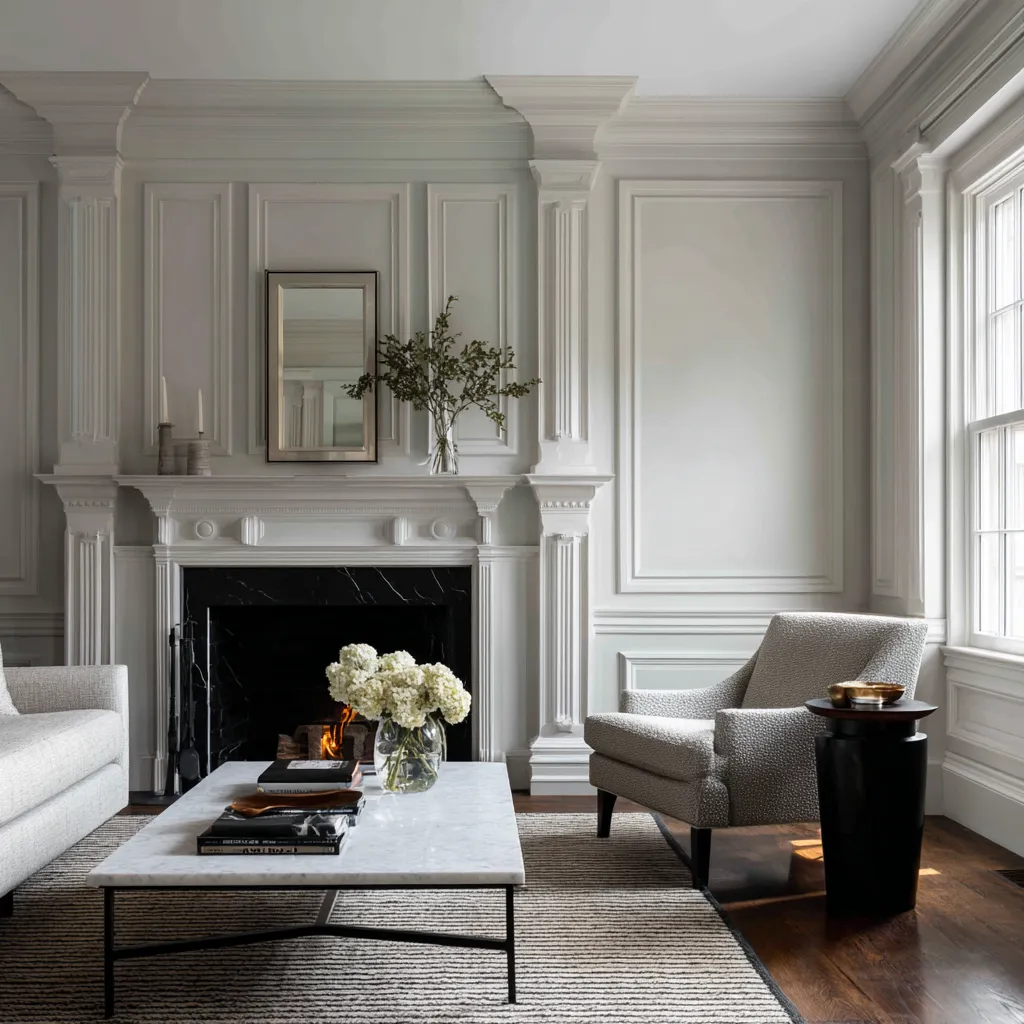
This kind of fireplace wall does several things at once. It gives the room a stronger center.
It lets the architecture carry more weight than styling. It also allows the rest of the room to stay more restrained.
Once the fireplace has enough physical presence, the designer does not need to fill every wall field with art, mirrors, sconces, and accessories. This is why fresh Georgian interior designs feel more architectural than decorative.
The hearth is not trying to entertain the eye with many small details. It is trying to steady the room.
A broad stone chimney wall with a dark fire opening can do more for a Georgian living room than a highly carved mantel loaded with objects. The first gives the room body.
The second can easily pull it back into a more costume-like version of period style.
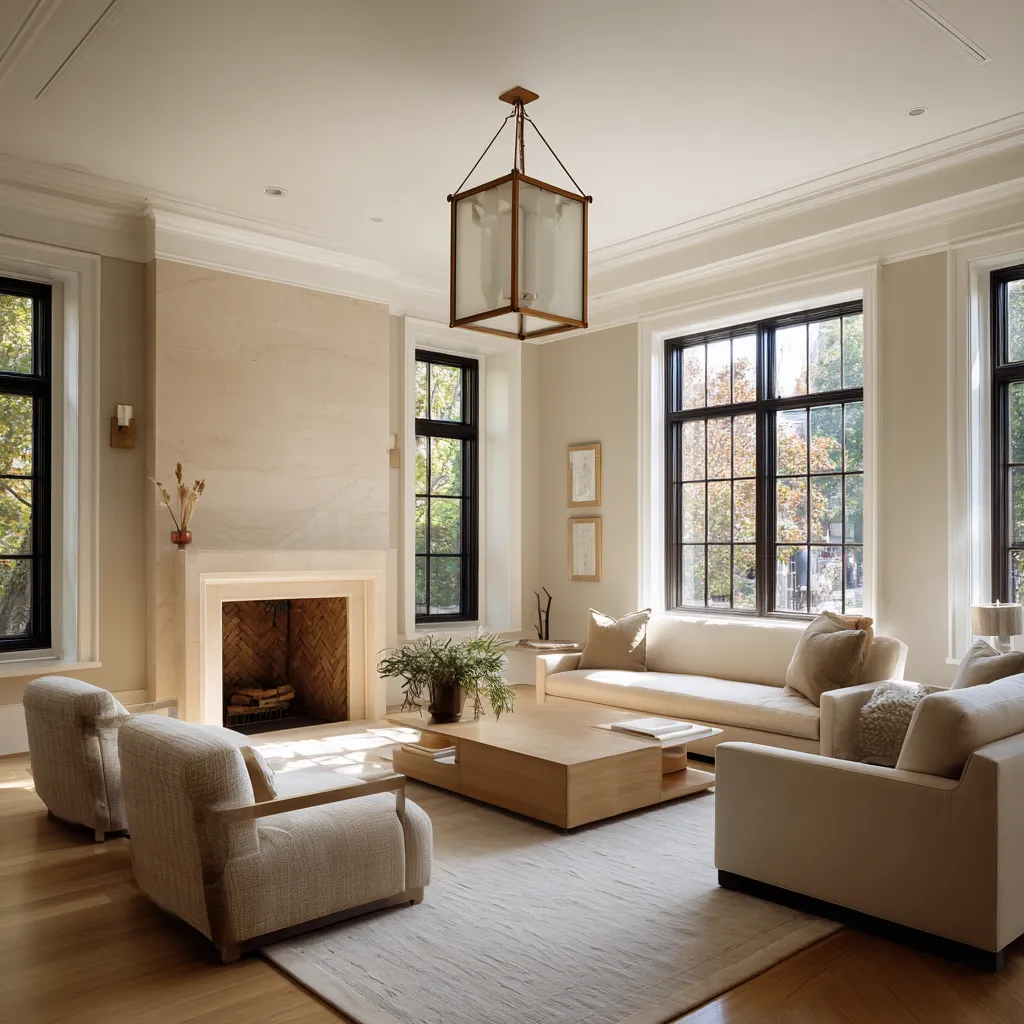
Why the lower half of the room matters so much
A Georgian living room is usually tall. The walls rise.
The windows pull the eye upward. The moldings give the room hierarchy.
All of that is useful, but it also creates a design risk. If the lower half of the room is too light, too scattered, or too delicate, the space can feel top-heavy.
That is why strong Georgian rooms are often built from the floor upward. The lower zone needs real visual weight.
This does not mean using dark colors everywhere. It means giving the seating area enough mass to hold the room.
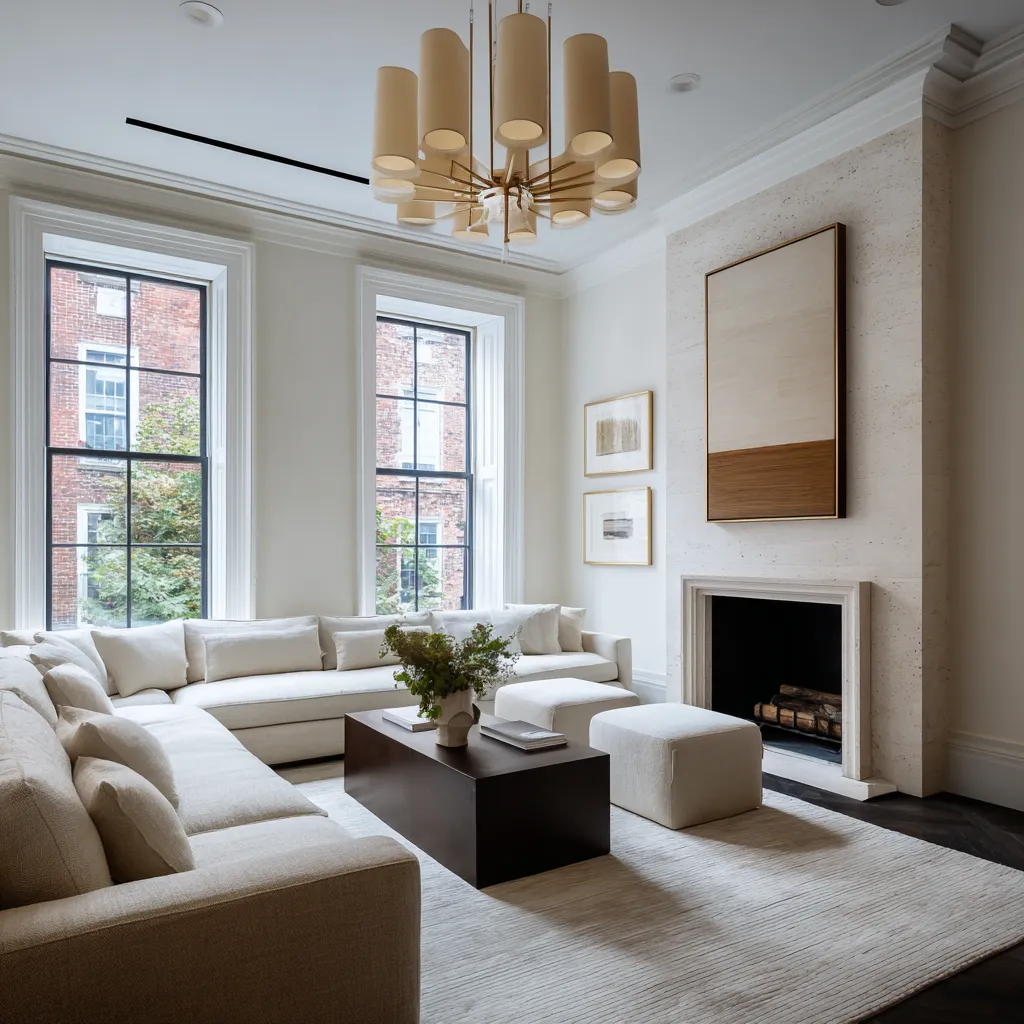
A few elements do this very well:
- a large low coffee table
- a dark hearth strip or extended hearth platform
- a bench beneath tall windows
- a broad console or case piece along a side wall
- a darker firebox opening
- one dense central object with real horizontal presence
This is one of the most overlooked parts of Georgian living room design. People often focus on the chandelier, the wall color, or the artwork above the fireplace, but the room usually succeeds or fails lower down.
If the center feels weak, the shell feels too dominant. If the floor-level zone has enough density, the whole room settles.
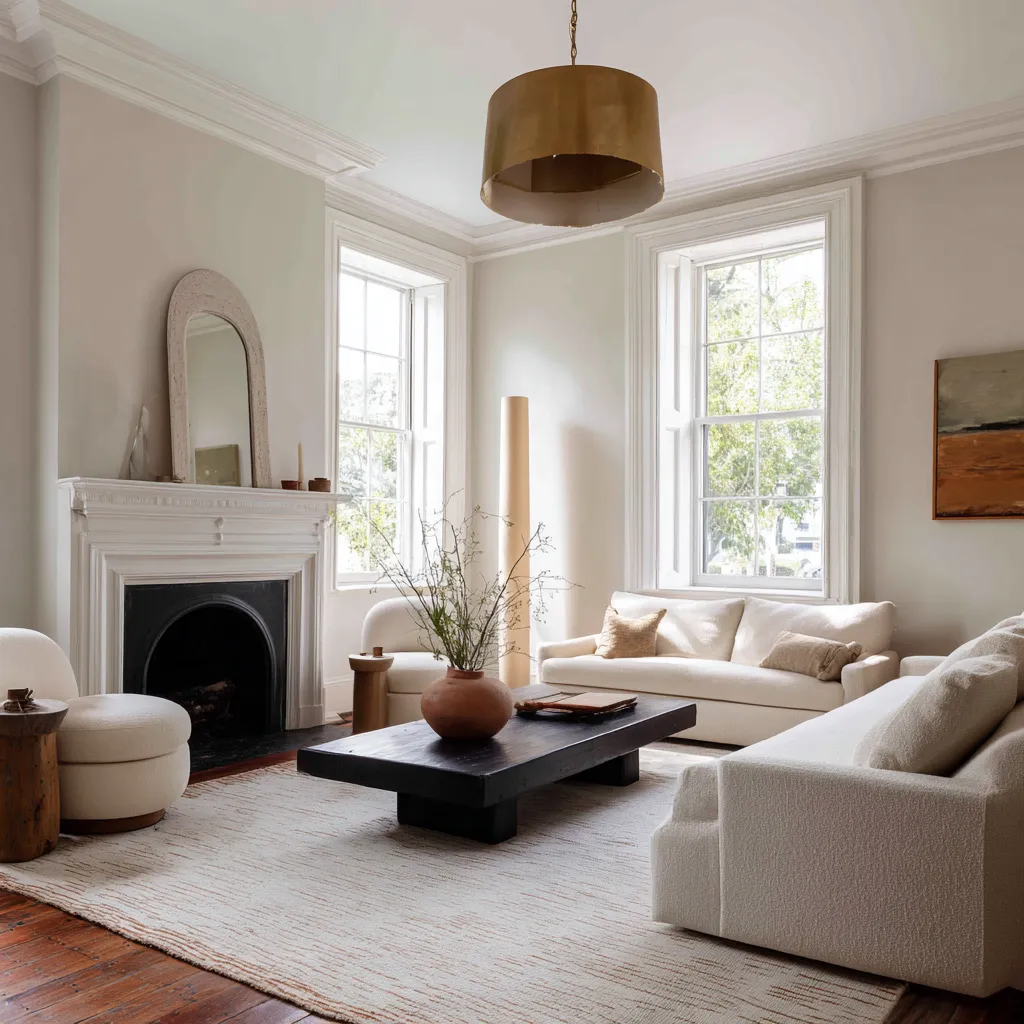
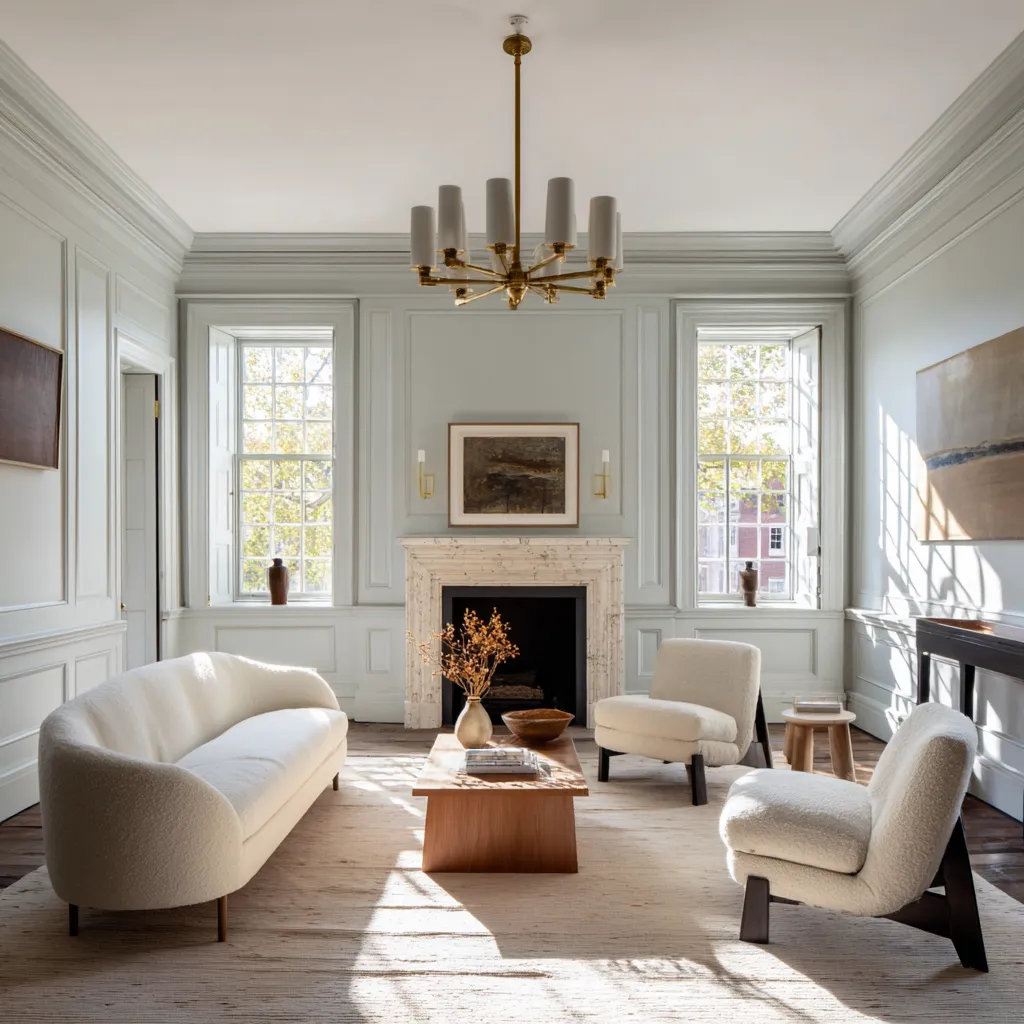
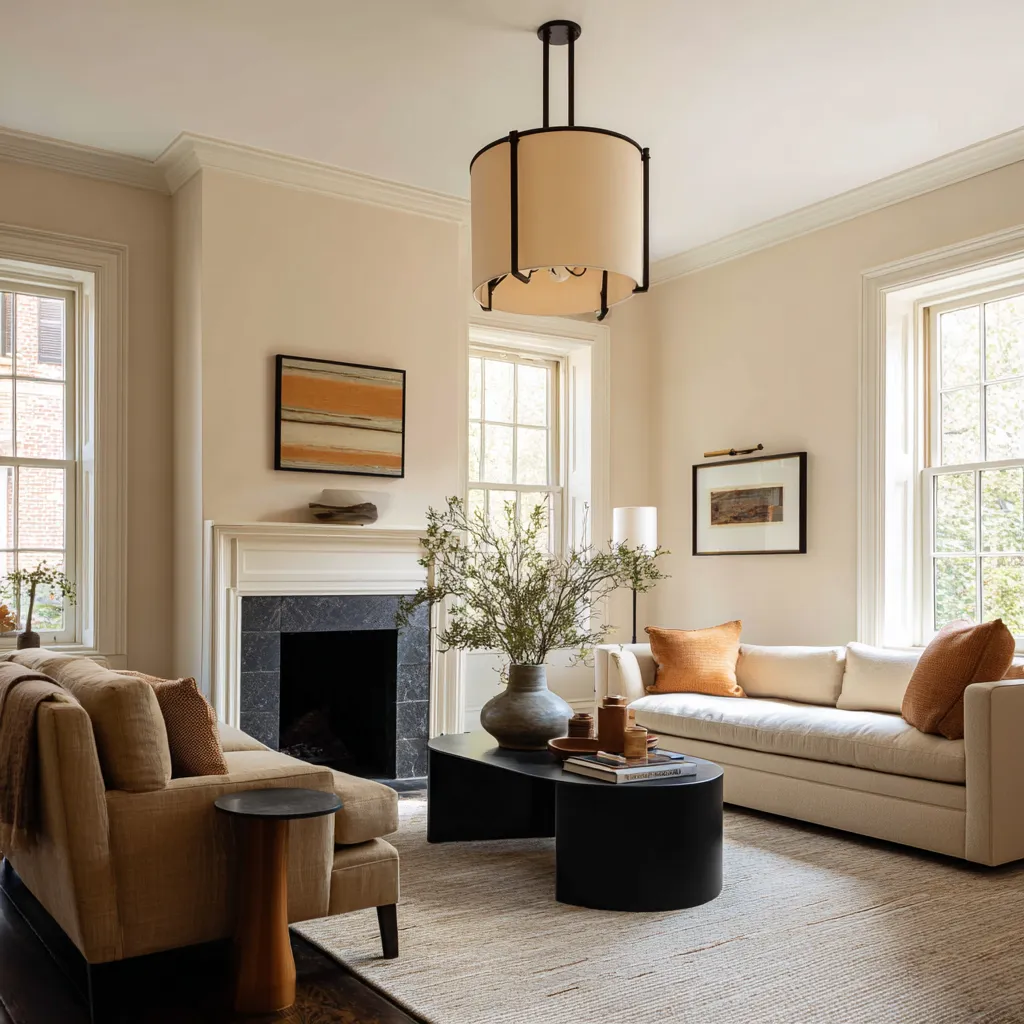
A large black or dark walnut coffee table, for example, can completely change a pale Georgian room. It gives the eye a resting point.
It brings the tall shell back down to human level. It links the sofas, chairs, and fireplace into one group.
In a room full of cream upholstery and pale walls, that table may be the element that makes everything else make sense. Even in softer interior designs, where the table is pale wood or stone rather than dark, it still needs breadth and thickness.
Thin, delicate tables often disappear in a Georgian room. Broad, low, block-like tables usually work far better because they can stand up to the scale of the architecture.
Symmetry still matters, but it cannot do all the work alone
Georgian living room designs are built on order, so symmetry still belongs. A centered fireplace between two windows, a balanced wall composition, matching openings, and evenly spaced moldings all contribute to the calm force of the style.
But strict symmetry alone can make a living room feel ceremonial, especially if the furniture plan obeys the axis too rigidly.
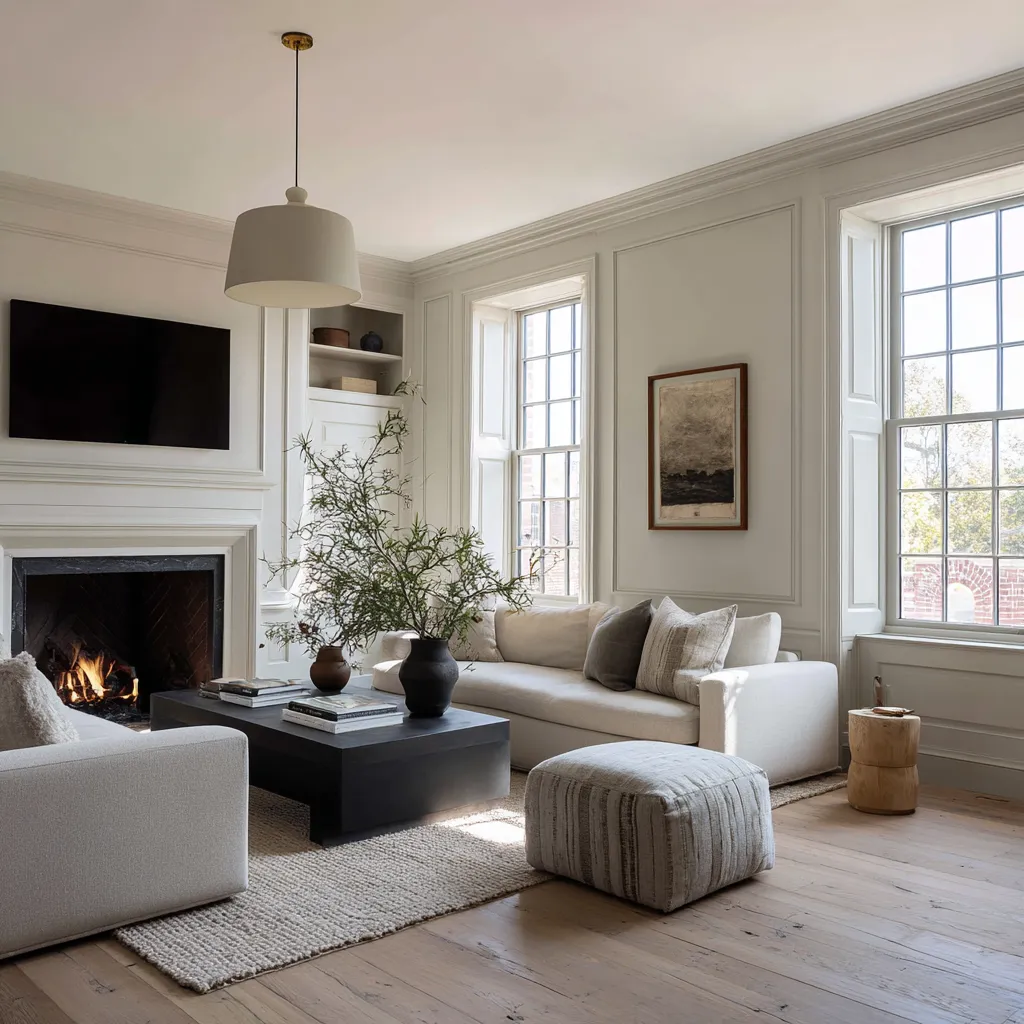
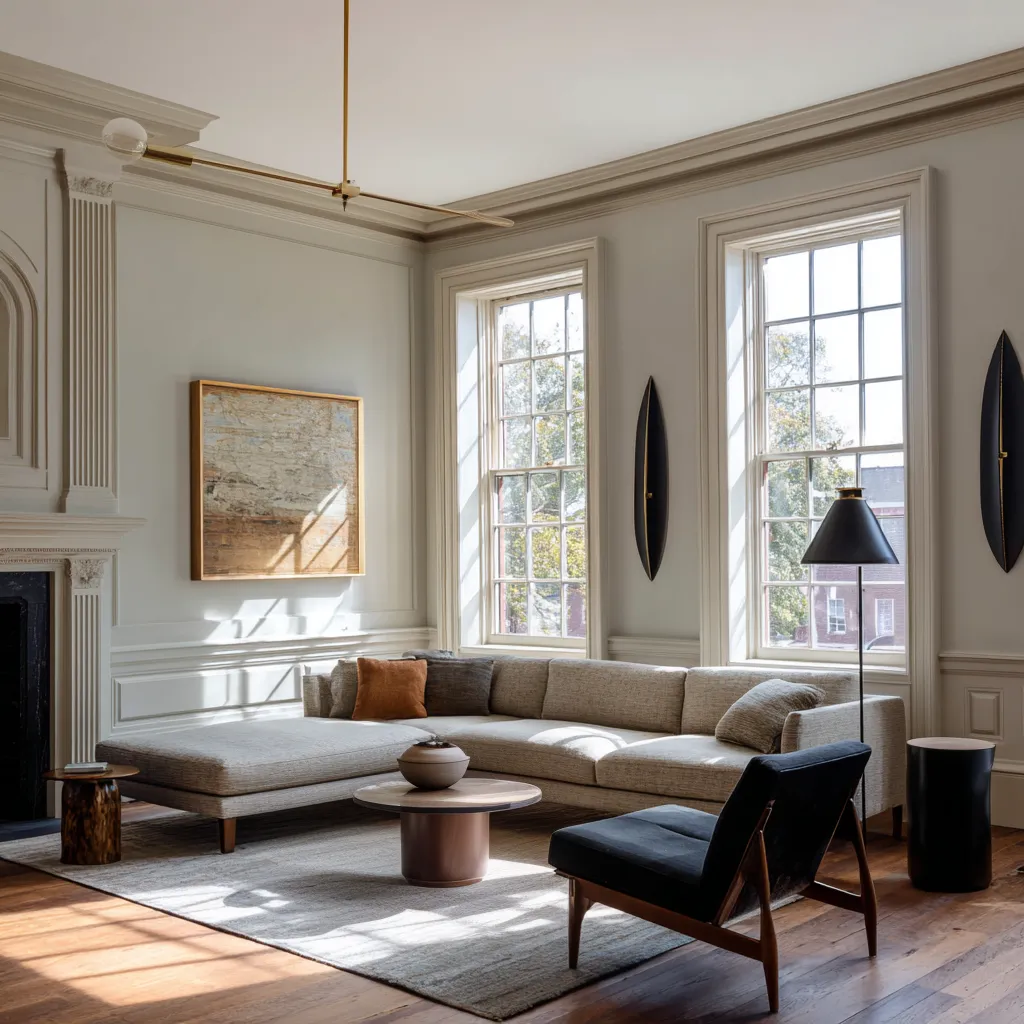
Such interior design concepts today often keep the shell symmetrical while allowing the furnishings to soften that order. The room may still have a centered fireplace and paired windows, but the seating shifts slightly off-axis.
The sofa may sit under a window rather than facing the fireplace head-on. One curved chair may be angled rather than squared to the room.
A sectional may occupy one side of the room, while the fireplace remains centered on the wall. This kind of selective relaxation is one of the most useful ways to update Georgian interiors.
It preserves dignity but removes stiffness. The room still feels composed, yet it also feels lived in.
There are several good ways to loosen symmetry without breaking it:
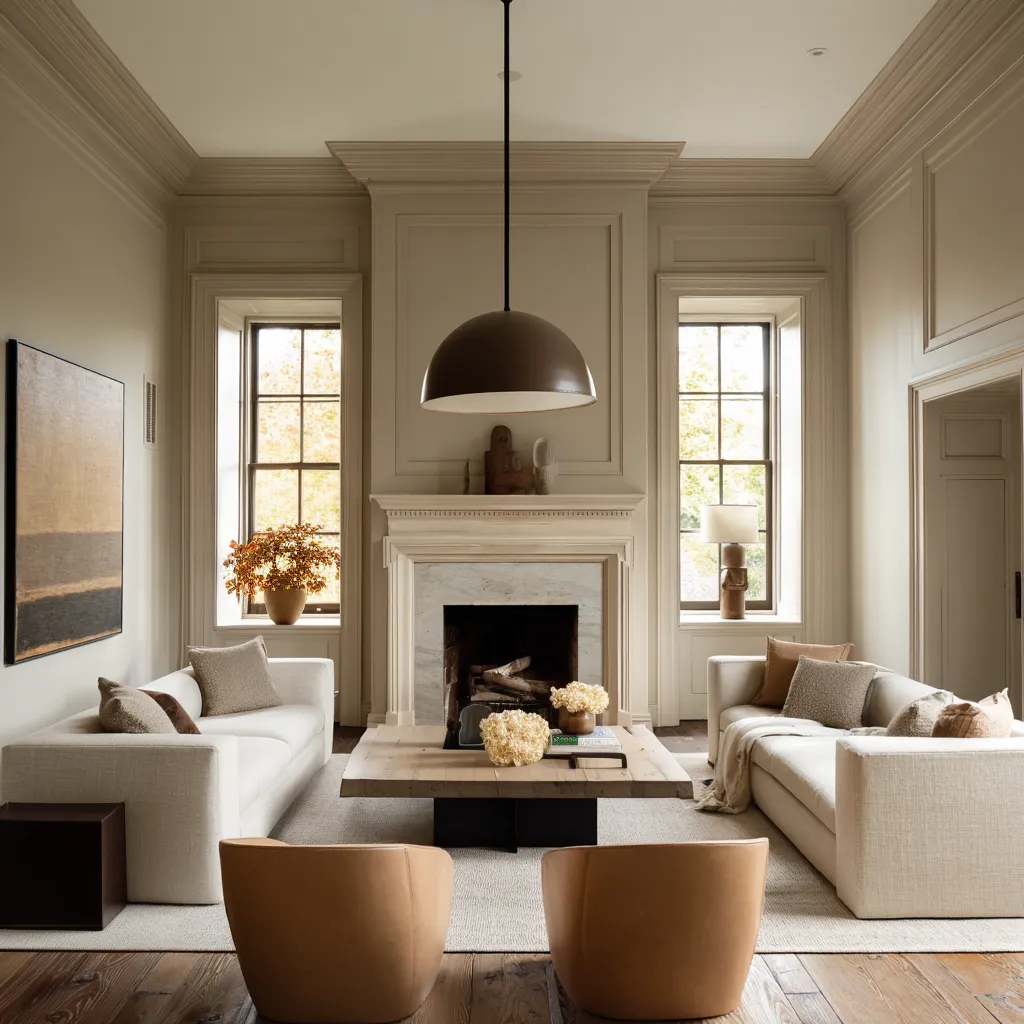
- use one asymmetrical seating move inside a formal shell
- place one sculptural or curved chair against mostly straighter pieces
- let a bench or console stretch the room laterally
- keep the fireplace centered but avoid making every seat face it directly
- use art and accessories to add slight imbalance inside a balanced frame
The goal is not to reject order. It is to let order coexist with comfort.
Black contrast sharpens the room
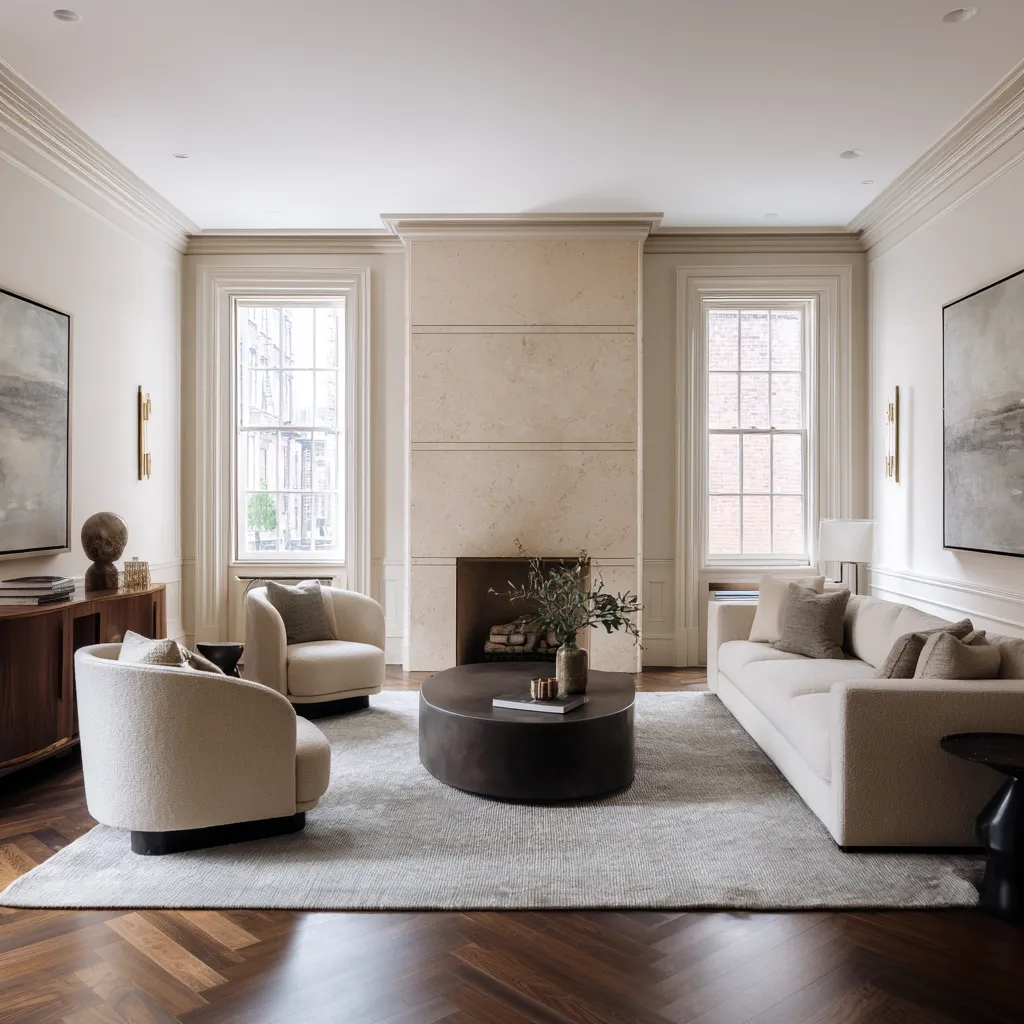
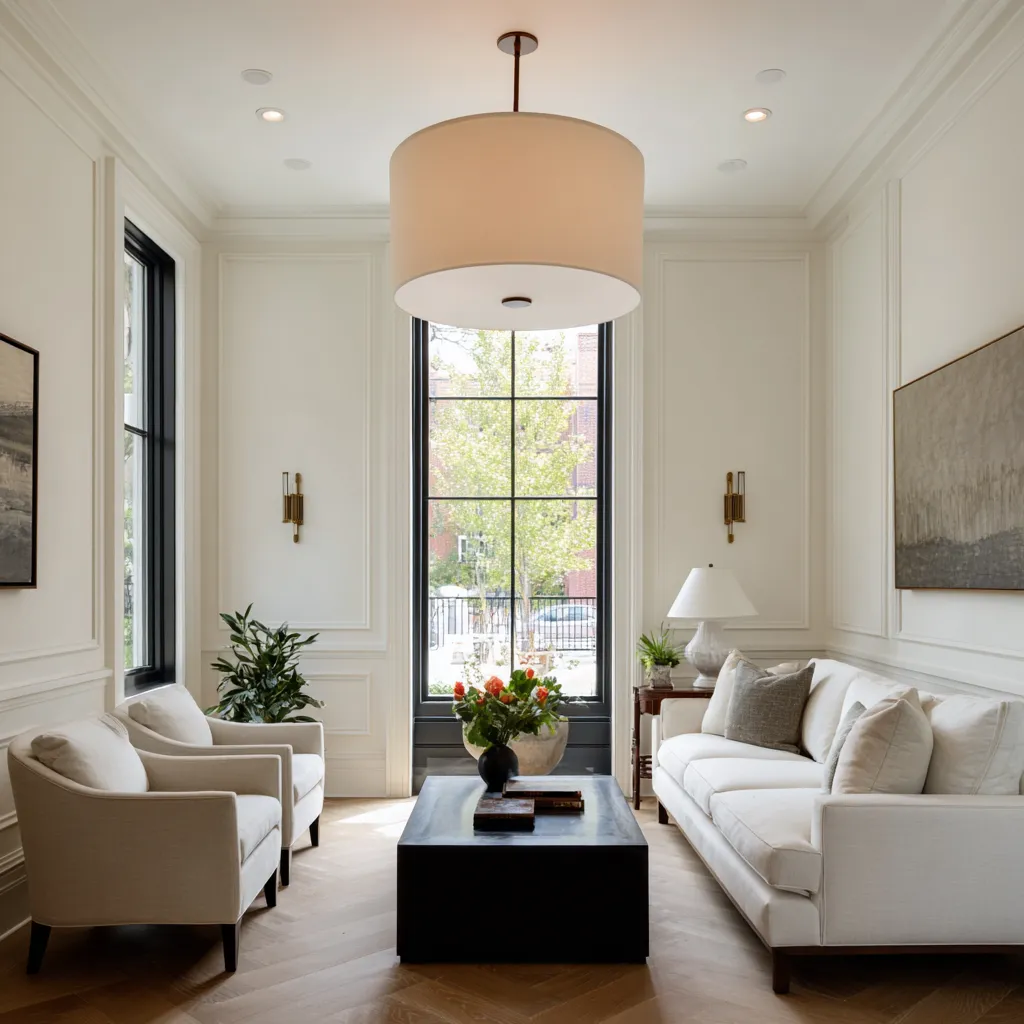
Stylish Georgian living rooms today can use black with care: black window muntins, black coffee tables, black fireboxes, black side tables, dark pendants, or black-framed televisions. These darker inserts are extremely effective for giving a pale Georgian room sharper definition.
They stop the space from dissolving into one creamy field. They also help the room feel more current.
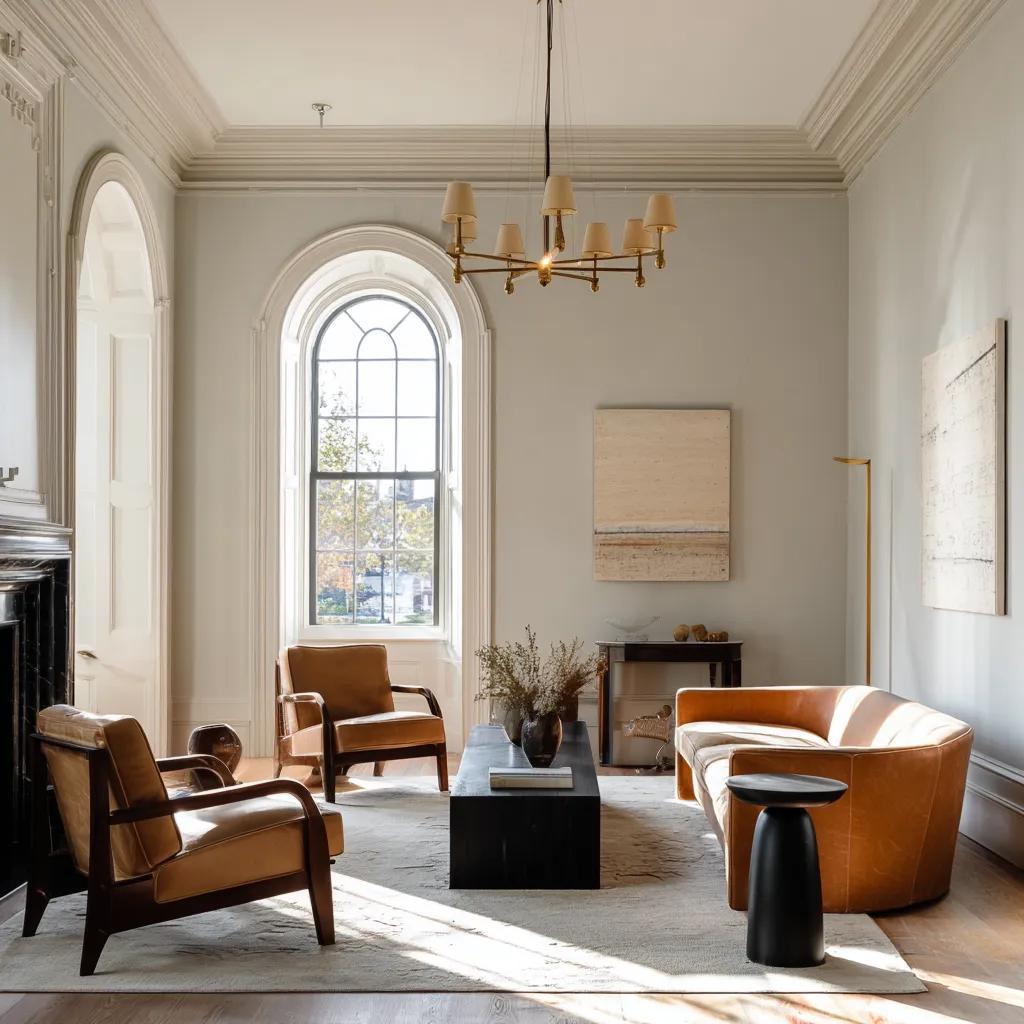
A pale room with white trim, pale upholstery, pale stone, and pale rugs can look beautiful, but it can also lose its edge if nothing interrupts that softness. Black elements give the composition structure.
They create pauses and boundaries. A black firebox deepens the fireplace wall.
A black table anchors the center. Dark window frames give the openings outline and force.
But contrast alone does not create warmth. That is an important distinction.
A Georgian room can look very current with black accents and still feel somewhat distant if nothing else softens it.
Warmth comes from a different set of choices:
- walnut or aged oak
- leather
- rust and clay tones
- dense upholstery
- woven or nubby textures
- sunlight allowed to register
- fuller furniture forms
So black is useful, but it needs a companion system. A room with black contrast and no warm material can feel hard.
A room with warm materials and no contrast can feel too soft. The strongest Georgian interiors usually combine both, but they use them for different jobs.
Dark contrast gives structure. Warm material gives life.
Softer shapes help, but layout matters more
There has been a strong move toward curved sofas, rounded chairs, softer corners, and fuller upholstery in Georgian living rooms. This makes sense.
The shell itself often provides enough straight lines, verticals, rectangles, and frame conditions. Curved furniture helps prevent the room from feeling rigid.
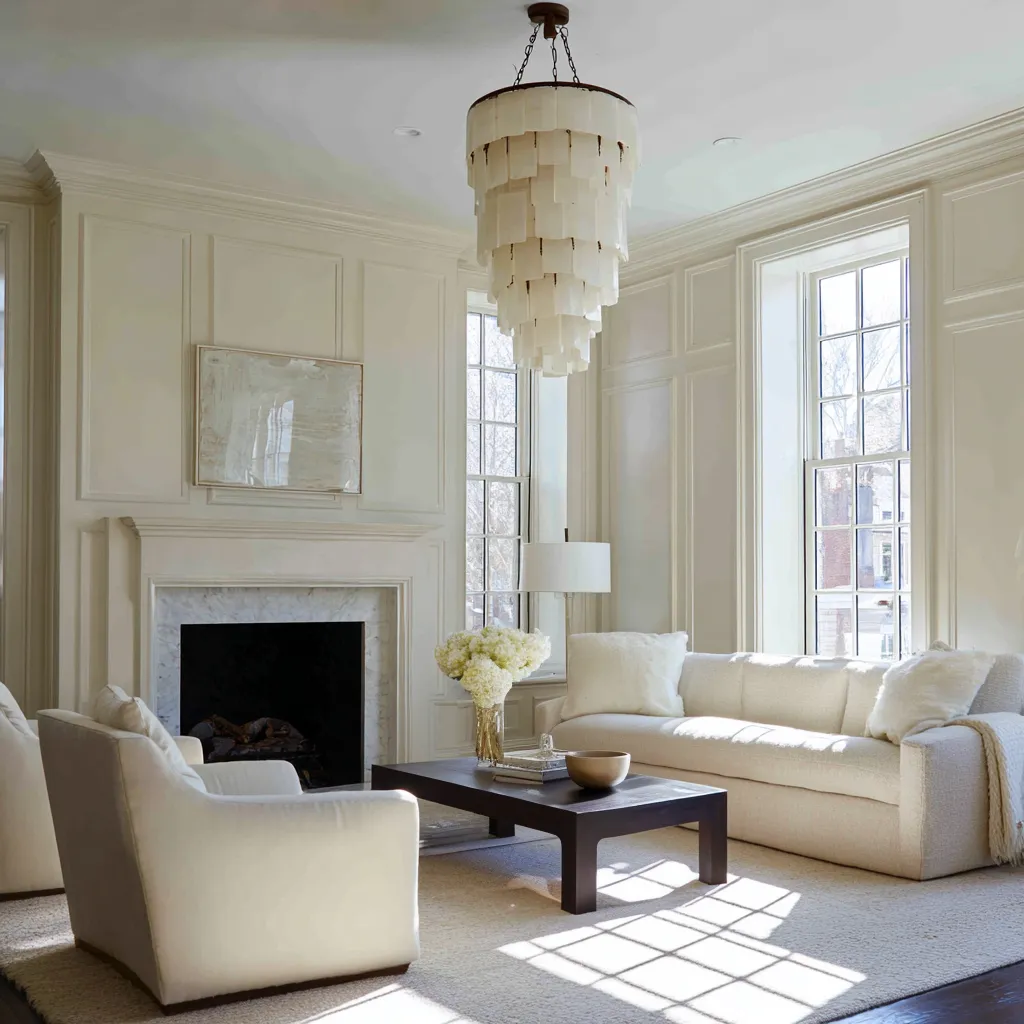
A rounded chair near a formal fireplace, a curved sofa under a paneled wall, or a circular chandelier over a square room can all soften the overall impression in a very useful way. Curves are especially effective when they answer other strong geometries in the room, such as tall sash windows, rectangular panel fields, or a square coffee table.
Still, softer shapes should not be treated as the entire solution. A Georgian room does not become warm simply because a few rounded pieces are introduced.
Shape helps, but it works best when the seating plan and material palette support it. A room with curved chairs but a stiff conversational layout will still feel formal.
A room with a rounded sofa but cold surfaces and little daylight can still feel remote. Shape softens the image, but living comfort comes more from how people sit and how the room handles warmth and light.
Georgian living room designs should use curves in measured amounts. They may keep a mostly rectilinear layout but insert one rounded armchair, one circular pendant, one softened sofa corner, or one oval coffee table.
This is often enough to loosen the room without turning it into a room of competing sculptural gestures.
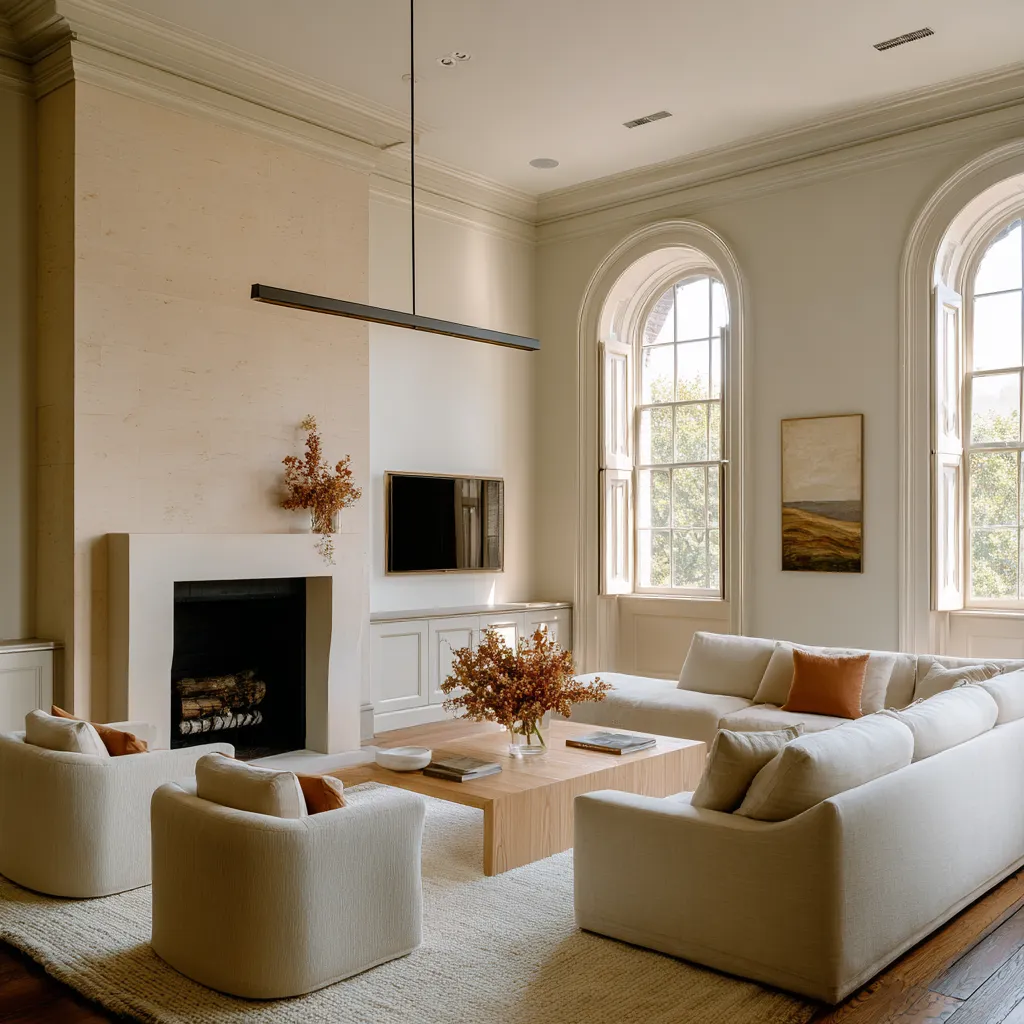
Daylight is one of the room’s strongest materials
Tall Georgian windows are not only a historical feature. They are one of the room’s greatest design tools.
In Georgian interiors, daylight is allowed to become an active layer in the composition. Sun patches, sash shadows, tree shadows, and light moving across paneled walls, rugs, and upholstery all add change and richness without the room needing more pattern or clutter.
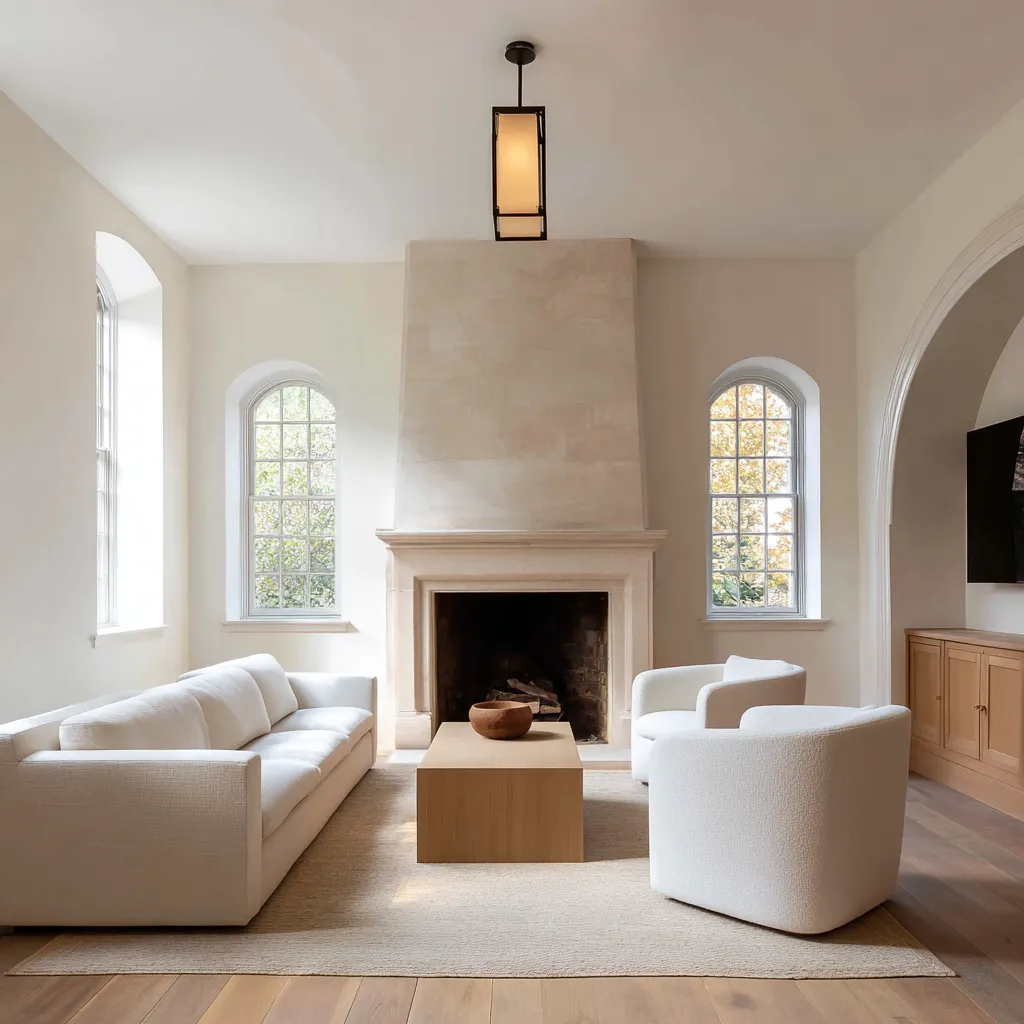
This works especially well when the room is edited. A pared-back Georgian room gives daylight more room to matter.
The wall fields are not overfilled. The furniture surfaces are broad.
The palette is controlled. That means light can create temporary drama through shifting contrast and shadow.
This is one reason pale Georgian rooms often feel richer than they first appear. Their interest may not come from strong color.
It may come from the way morning light hits a nubby rug, how afternoon shadows move across a panel field, or how a stone fireplace changes tone over the course of the day. Tall windows also work in emotional terms.
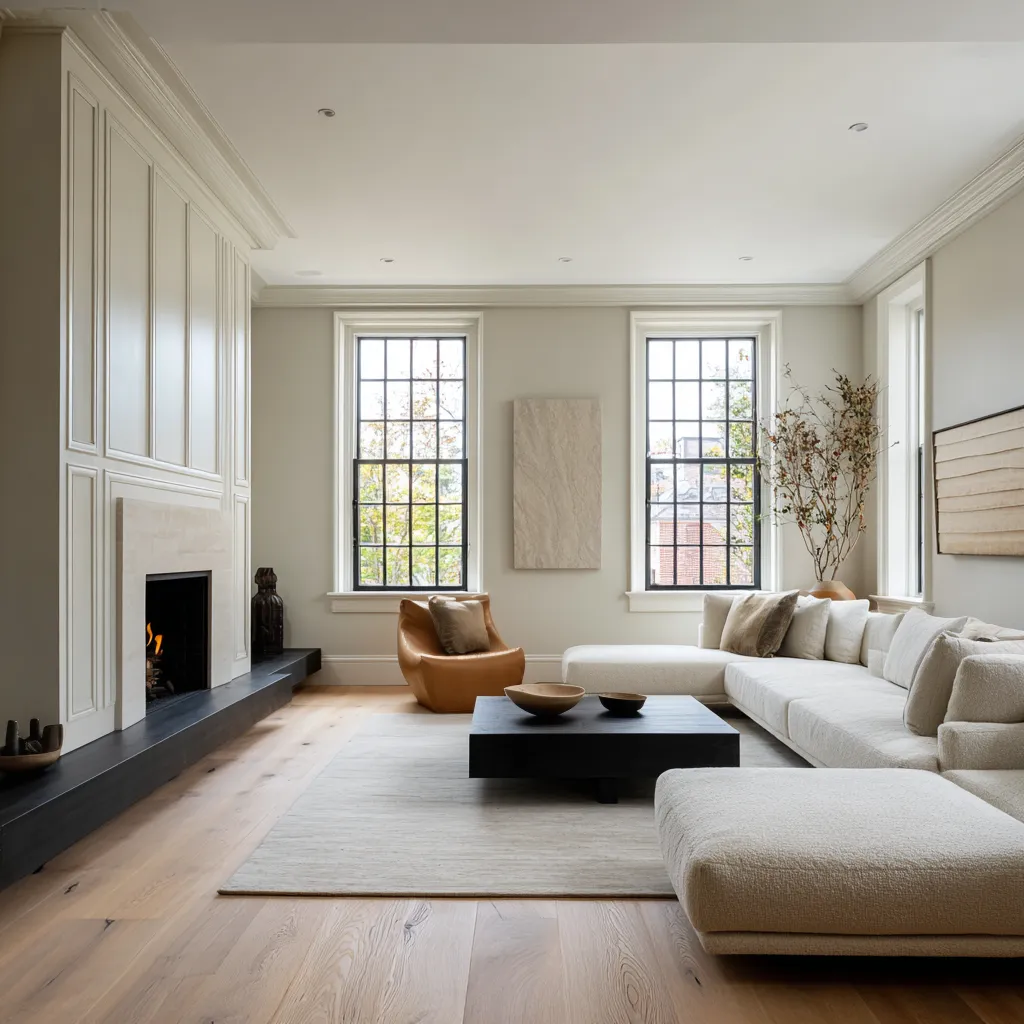
They help the room feel breathable. They prevent heavier features, such as a monolithic chimney wall or a large sectional, from making the room feel compressed.
When windows are handled well, even a very restrained Georgian living room can still feel generous and alive. Full-height drapery can support this beautifully when used with care.
It emphasizes height, softens the wall edges, and introduces textile depth. Bare windows can also work, especially in cleaner, more graphic rooms.
The right decision depends on the direction of the scheme. Softer, warmer Georgian interiors often benefit from fabric.
Sharper, more urban ones may benefit from cleaner edges.
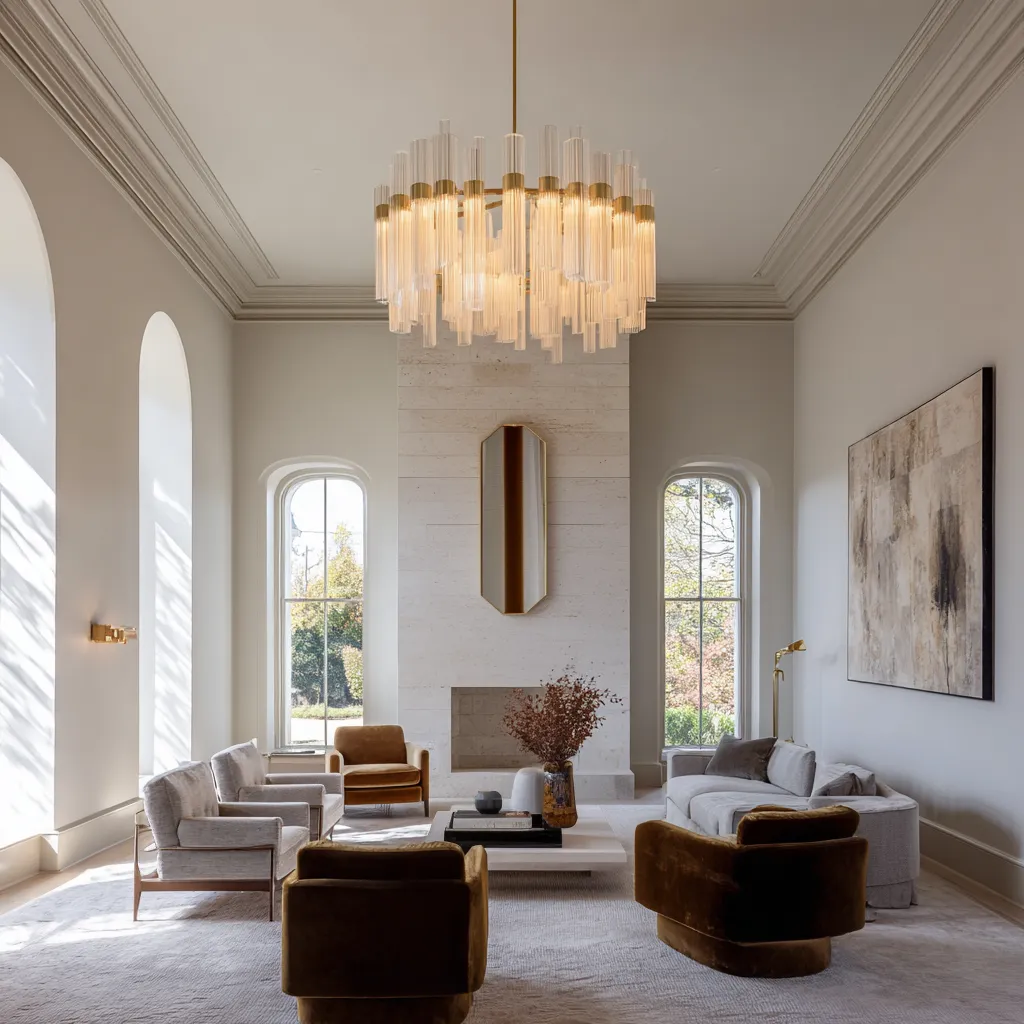
Arches bring softness in a different way than dark contrast
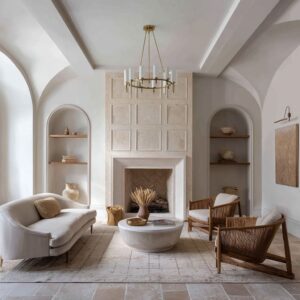
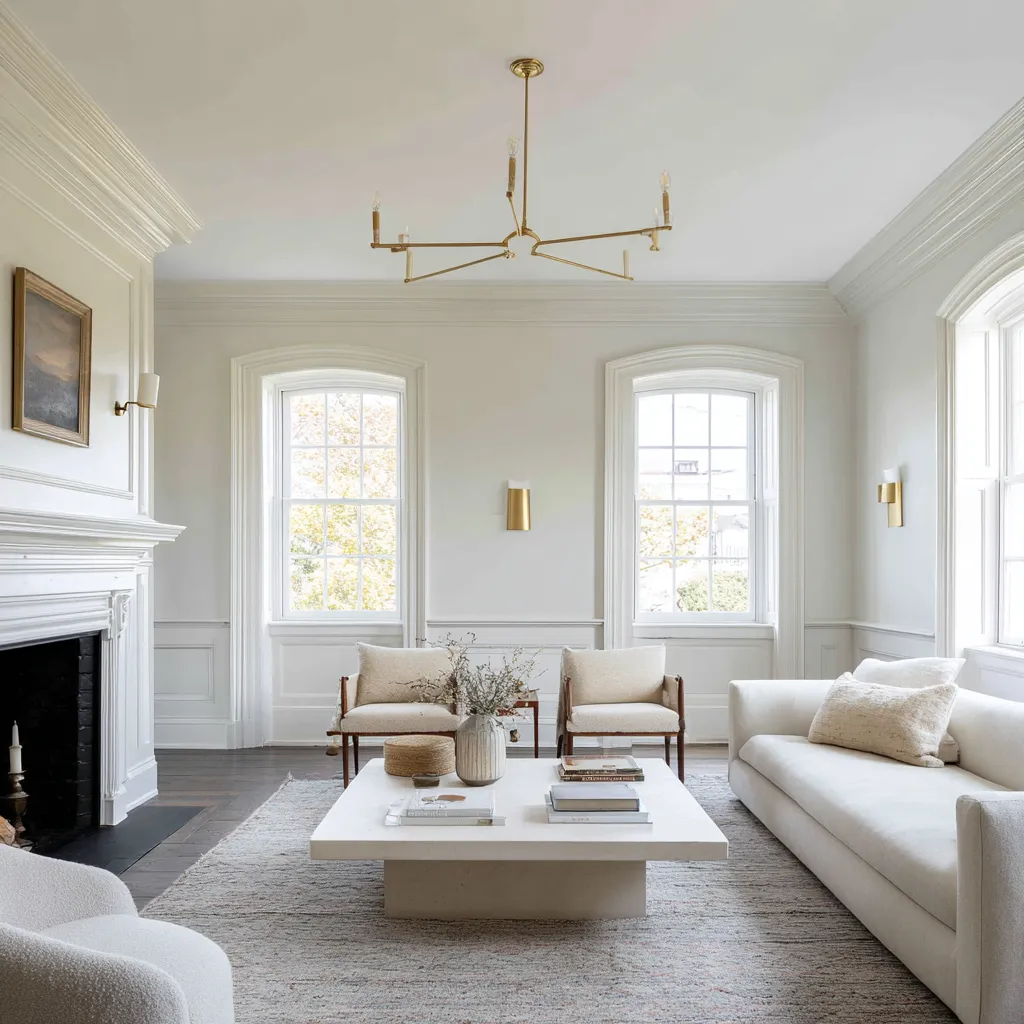
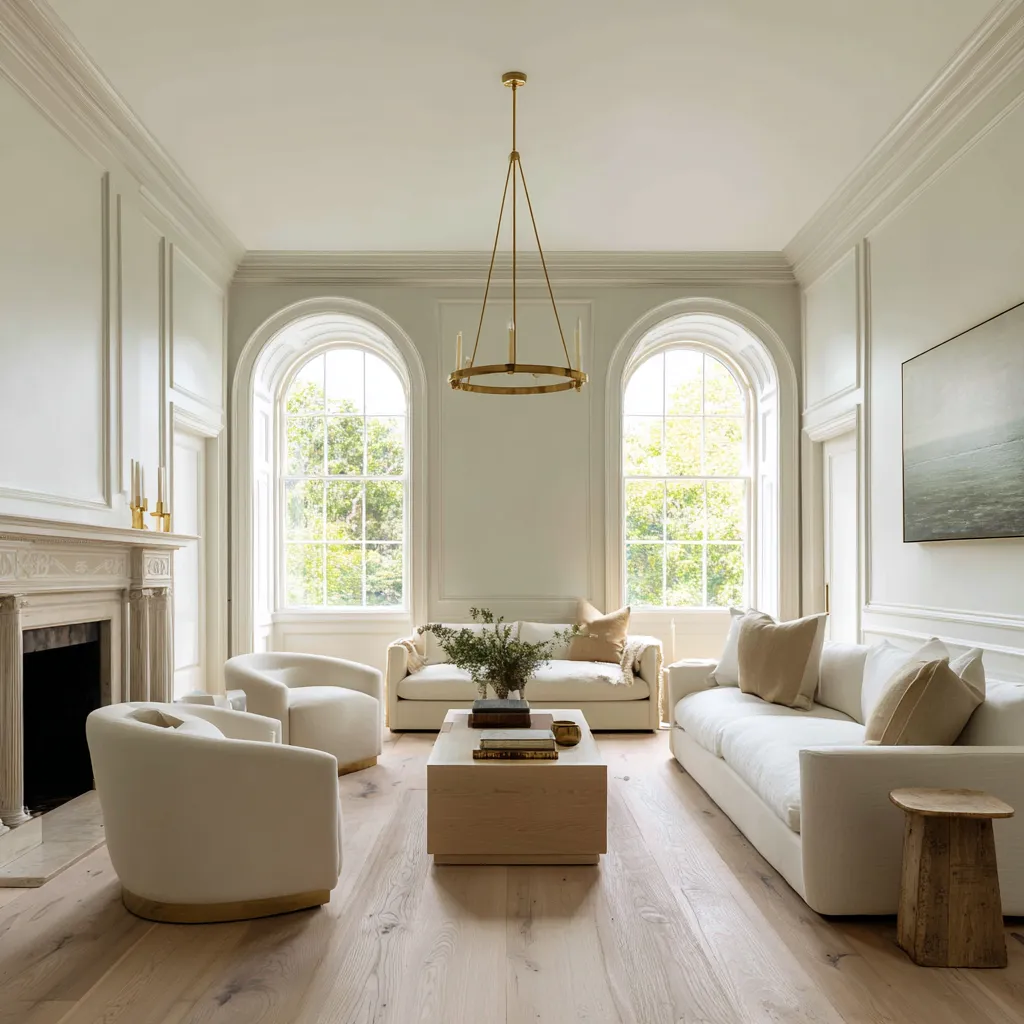
Arches are especially interesting in Georgian-style living room interior designs because they change the emotional climate of the room without relying on hard contrast. An arched opening, arched window head, or softened top line introduces grace and hospitality.
It relaxes the shell in a way that black muntins or dark accents do not. That is why arches often suit Georgian rooms that aim for warmth rather than sharpness.
A room with a monolithic pale chimney wall and arched windows can still feel gentle because the curve tempers the mass.
A living room with a broad pale sofa beneath an arched opening can feel more welcoming than the same room under a stricter rectangular window. Arches are particularly effective when the rest of the room remains disciplined.
If everything is curved, the room loses clarity. But when a few arches are paired with straighter furniture pieces, broad tables, and edited walls, they bring exactly the right amount of relief.
In Georgian interiors, arches can work as a softening device rather than a decorative flourish. They reduce severity, add grace, and help the room feel less formal even when the palette and furniture remain restrained.
The room does not need every wall field filled
One of the clearest marks of a stylish Georgian living room today is restraint in wall use. Large panel fields are often left partly open.
The wall above the fireplace may hold one piece of art, or none at all. Side walls may use a single large canvas rather than several smaller pieces.
Some rooms let the moldings and light do more of the work.
This matters because Georgian interiors already have strong wall rhythm. Every panel, trim line, and chimney breast creates a visual grid.
If every field is filled with art, sconces, mirrors, shelves, and objects, the room can become visually noisy very quickly. Edited emptiness is not unfinished.
It is part of the style. It allows the architecture to stay visible.
It gives the fireplace wall more authority. It also helps the furniture stand out more clearly, because the perimeter is not competing with the center.
The trick is not to make the room feel bare. The wall still needs intention.
One strong artwork, a pair of slim sconces, a single mirror, or a carefully chosen case piece may be enough. The idea is to choose fewer insertions and give them more room.
A Georgian room often looks stronger when the filled parts are more selective and the empty parts are allowed to remain legible.
How to make a television fit without weakening the room
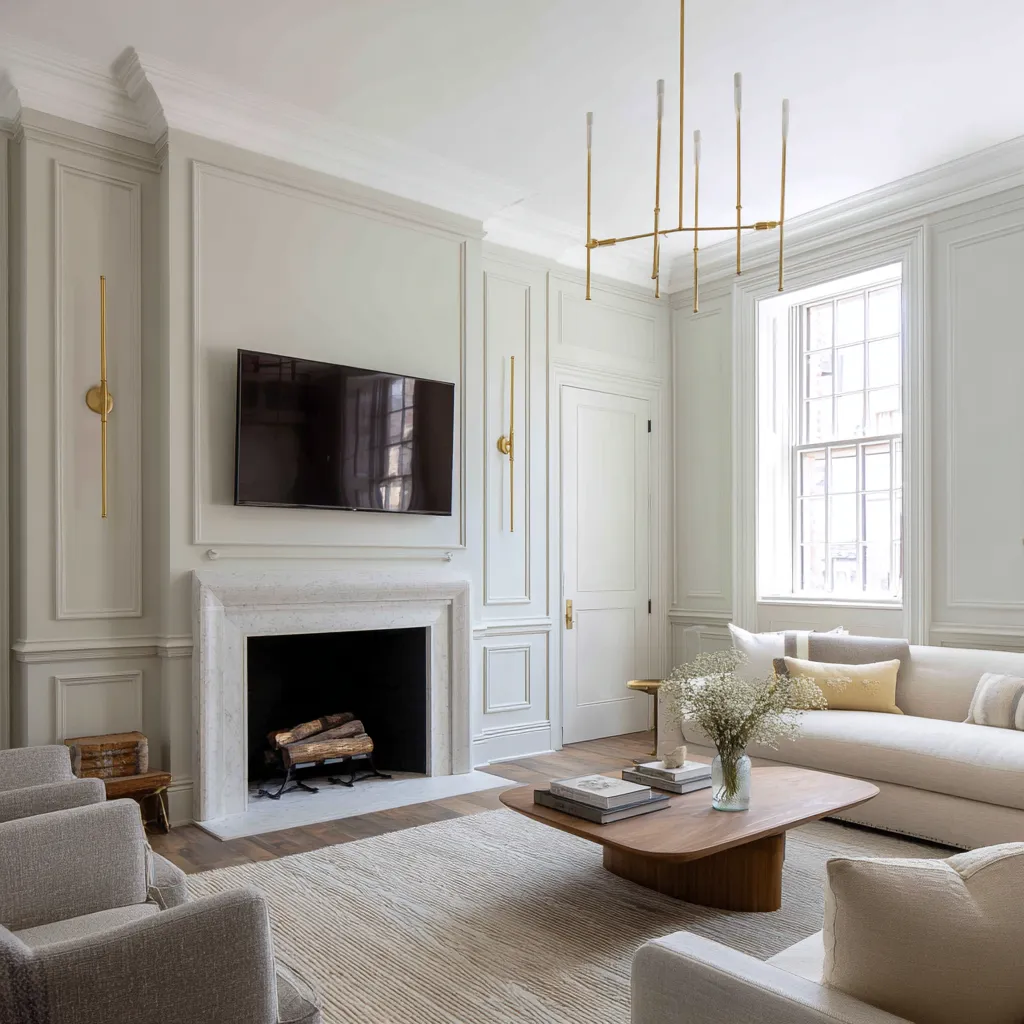
Many people assume that a television automatically ruins a Georgian living room. It does not, but it needs architectural support.
The problem is rarely the screen by itself. The problem is when the screen appears as a random black rectangle dropped into a carefully ordered shell.

Georgian TV walls can treat the screen as part of a larger composition. That may mean:
- setting it within a broad paneled field
- surrounding it with stone or plaster mass
- pairing it with thick fireplace framing
- extending cabinetry or shelving to one side
- building a long low bench or media base below
- giving the wall enough width and depth so the screen feels embedded rather than attached
This is why some Georgian rooms carry media much better than others. The screen is not asked to coexist with delicate period styling alone.
The wall is strengthened around it.
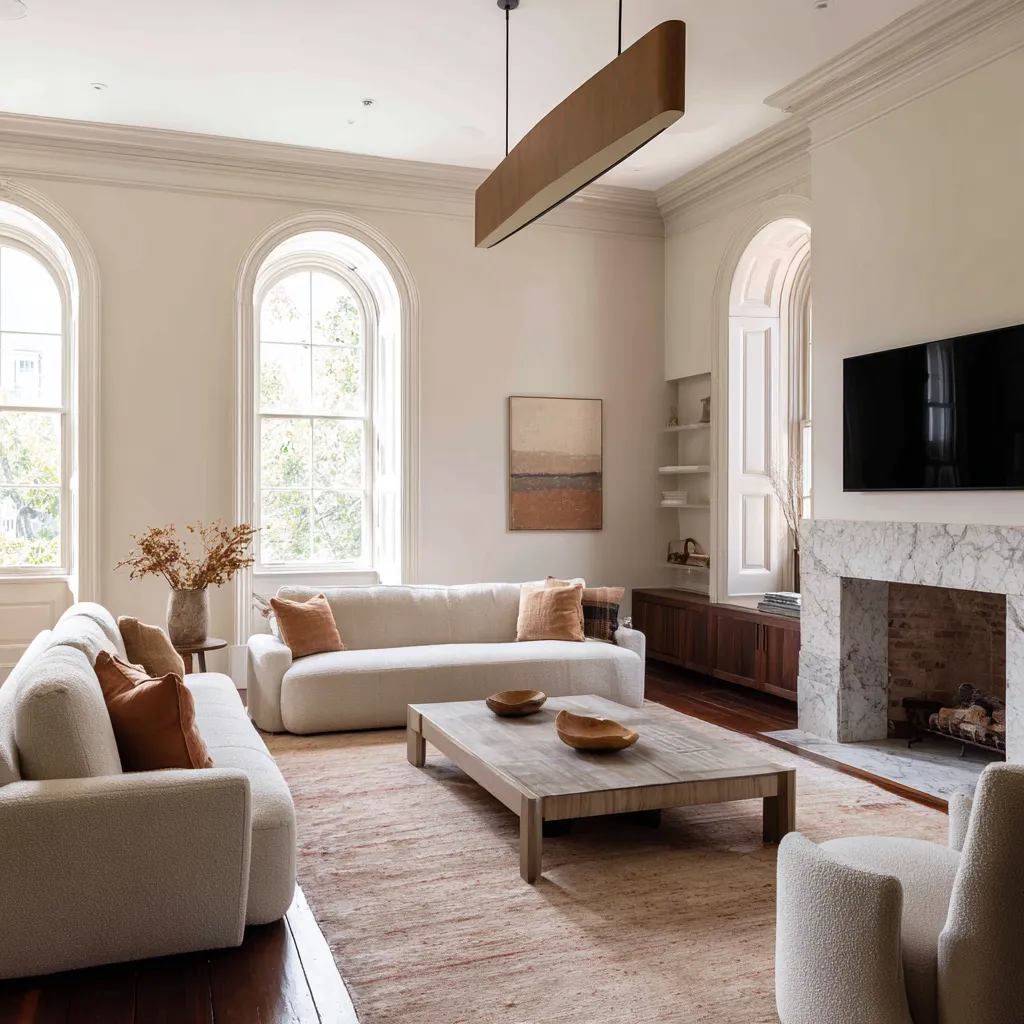
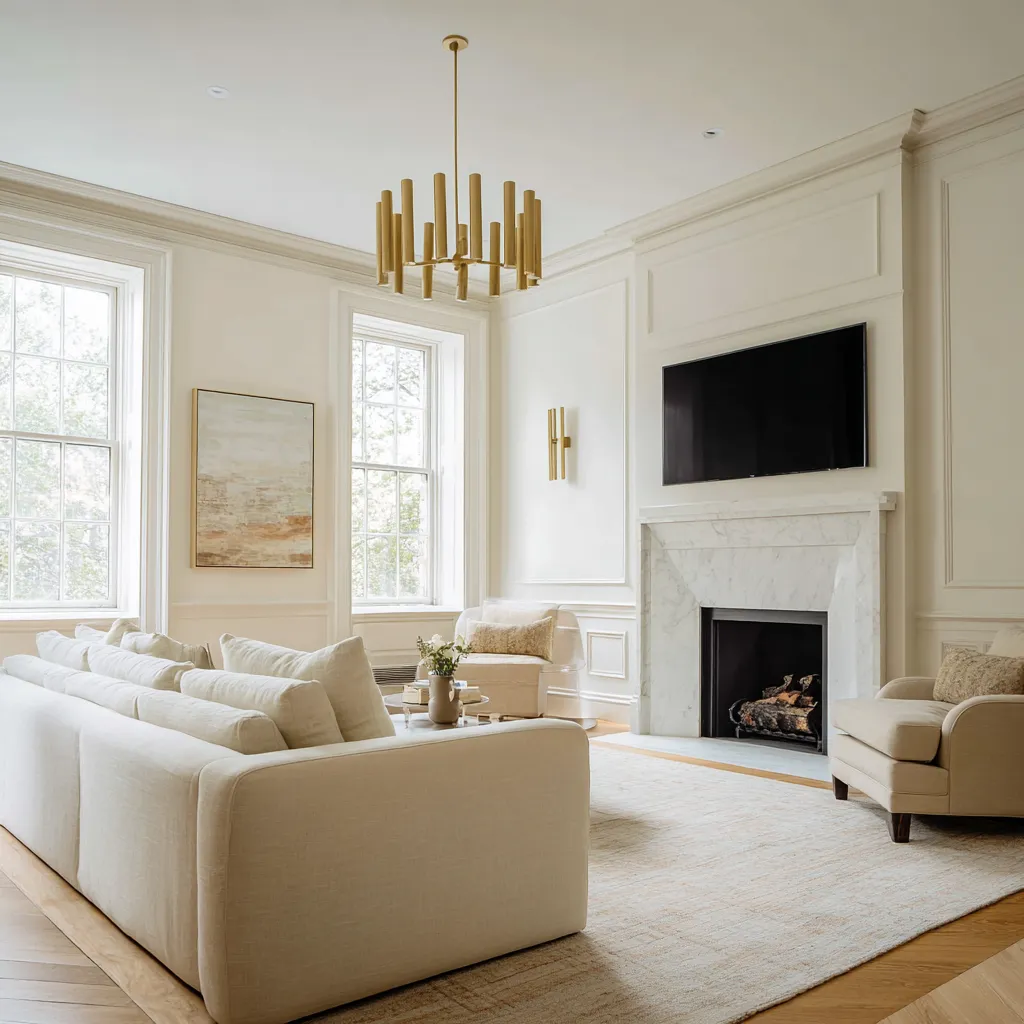
A television above a simplified stone surround can work well if the whole chimney wall feels thick and intentional. A television in a larger cabinetry run can work if the wood gives the wall continuity.
A screen on a broad panel above a marble fireplace can work if the composition below it has enough substance. What usually fails is the decorative fix: trying to hide the problem with more objects.
The better route is architectural. Give the wall more body, and the media becomes easier to absorb.
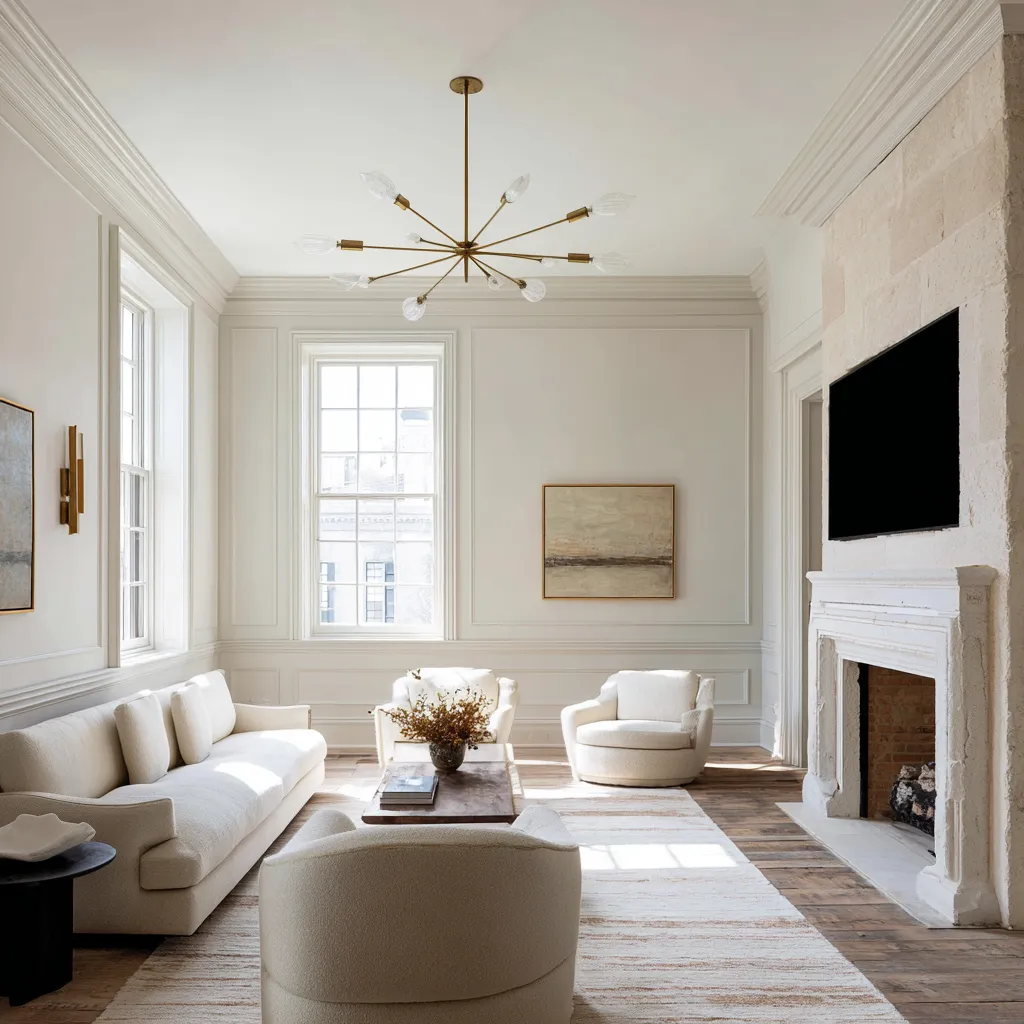
Ceiling fixtures help, but they are not the main event
Statement lighting matters in Georgian living rooms, but it is rarely the element that truly defines the room. A chandelier, lantern, drum pendant, or linear fixture can organize the upper volume, spread a metal note, or help balance the proportions.
Yet the room’s real character is more often decided lower down, through the fireplace wall, the coffee table, the seating plan, and the handling of contrast and wall space.
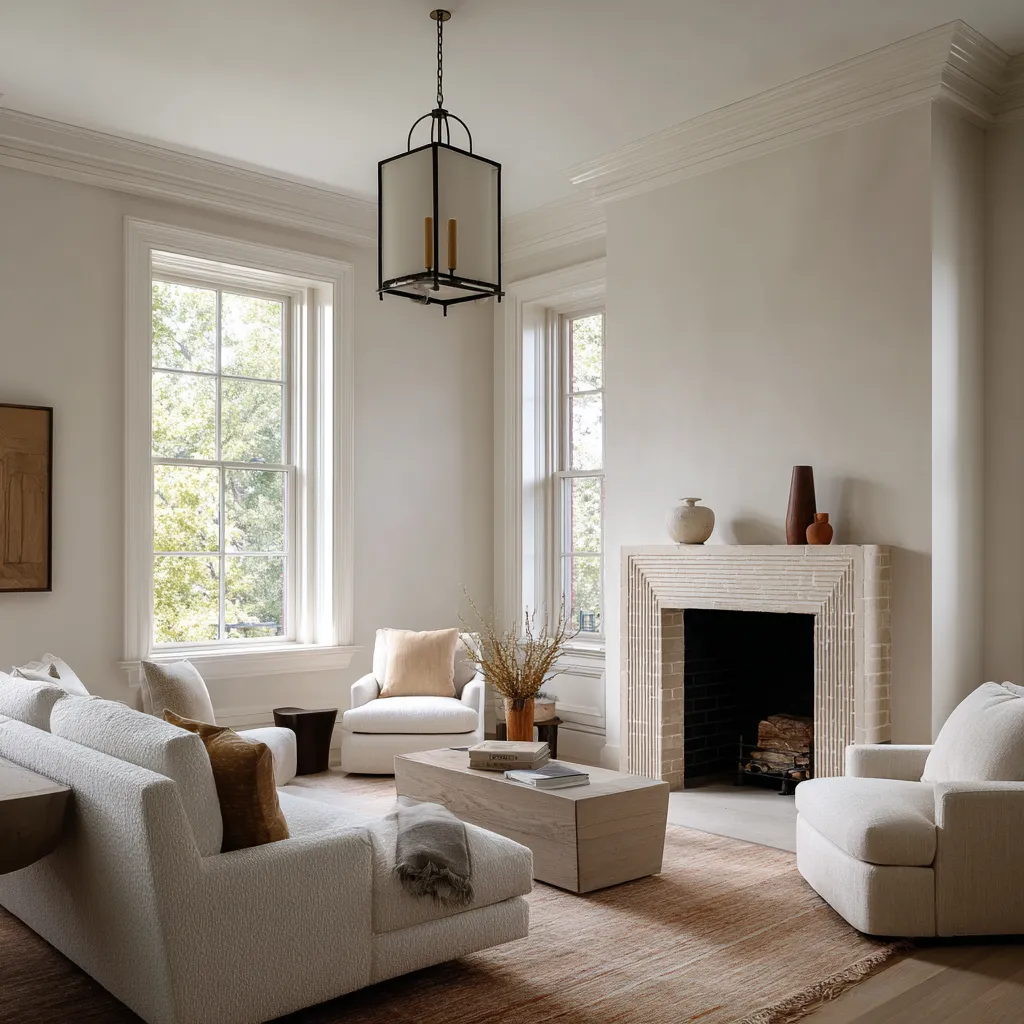
This is useful because it takes pressure off the fixture. A Georgian design does not need one spectacular chandelier to feel complete.
In fact, they can use restrained overhead lighting because the room already has enough presence in its architecture and furniture massing. Different fixtures support different Georgian moods:
- a lantern supports geometry and order
- a large drum brings softness and central calm
- a ring or clustered shade fixture gives the ceiling more visible weight
- a linear pendant strengthens present-day horizontality
- a branching brass fixture introduces a lighter, more open upper silhouette
The key is scale and role. The ceiling object should support the room’s structure, not try to replace it.
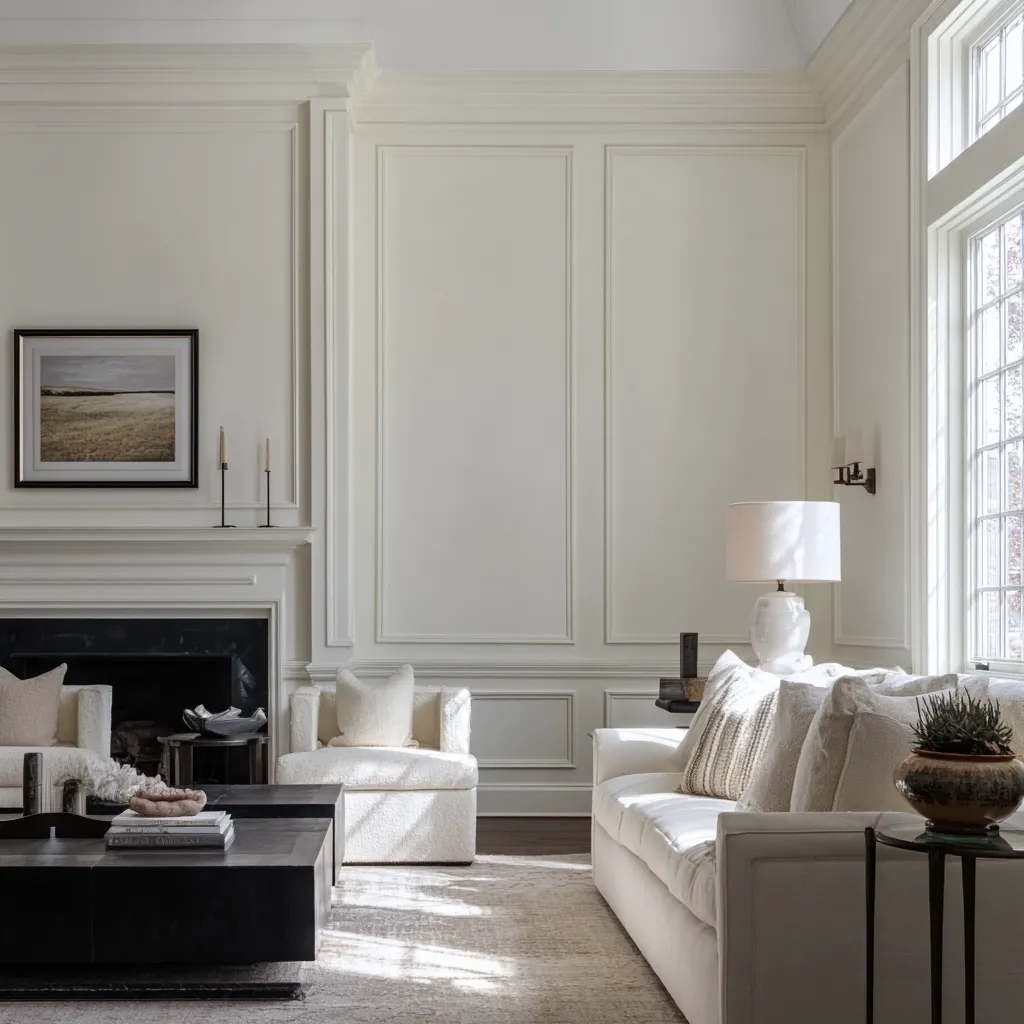
Four strong directions for a stylish Georgian living room
A Georgian living room can move in several directions while still keeping its identity. Knowing which route you want helps avoid a confused result.
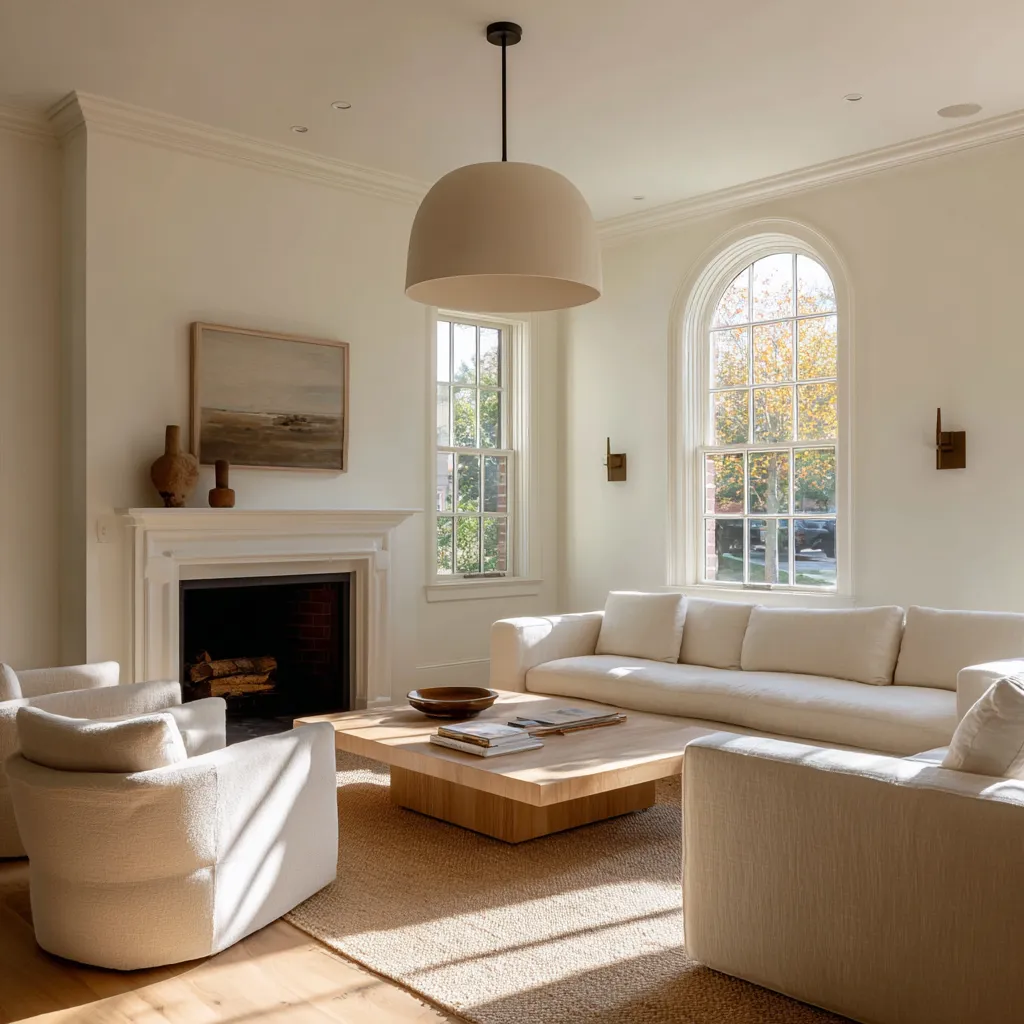
1. The graphic lounge version
This is the sharper, more urban direction. It usually includes:
- stronger black accents
- low deep seating or a sectional
- a dark coffee table or hearth strip
- edited wall fields
- a slightly looser, more off-axis furniture plan
This type of Georgian living room design feels current quickly because the contrast is stronger and the living habits are more relaxed. It is a good direction for larger townhouses or rooms that need a cleaner present-day edge.
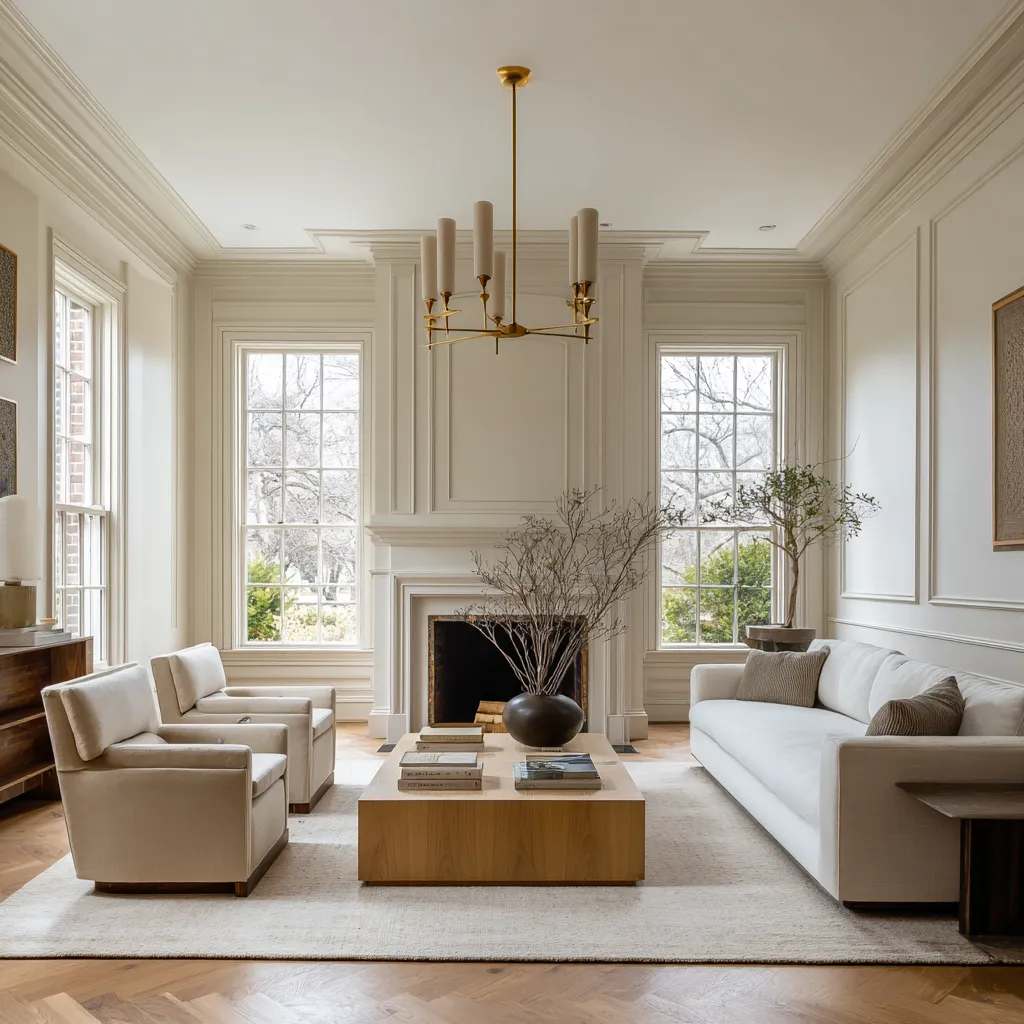
2. The monumental hearth version
Here the fireplace becomes the room’s main architectural event. The design may include:
- a tall pale stone or plaster chimney wall
- reduced mantel detailing
- arched windows or openings
- a broad low central table
- a restrained, almost sparse room dressing
This direction gives the room great weight and presence. It suits people who want the room to feel architectural first and decorated second.
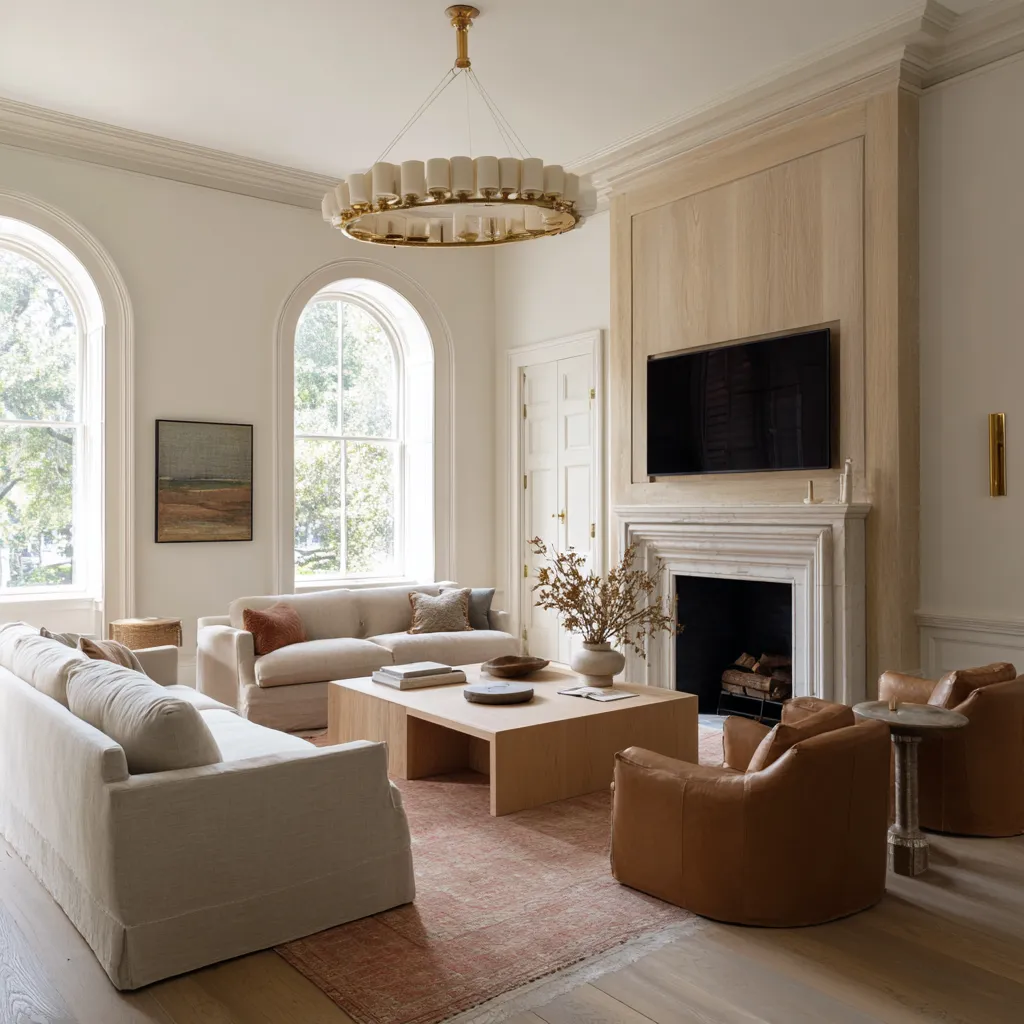
3. The warm softened version
This direction depends less on black contrast and more on comfort. It often includes:
- fuller upholstery
- curved or rounded seating
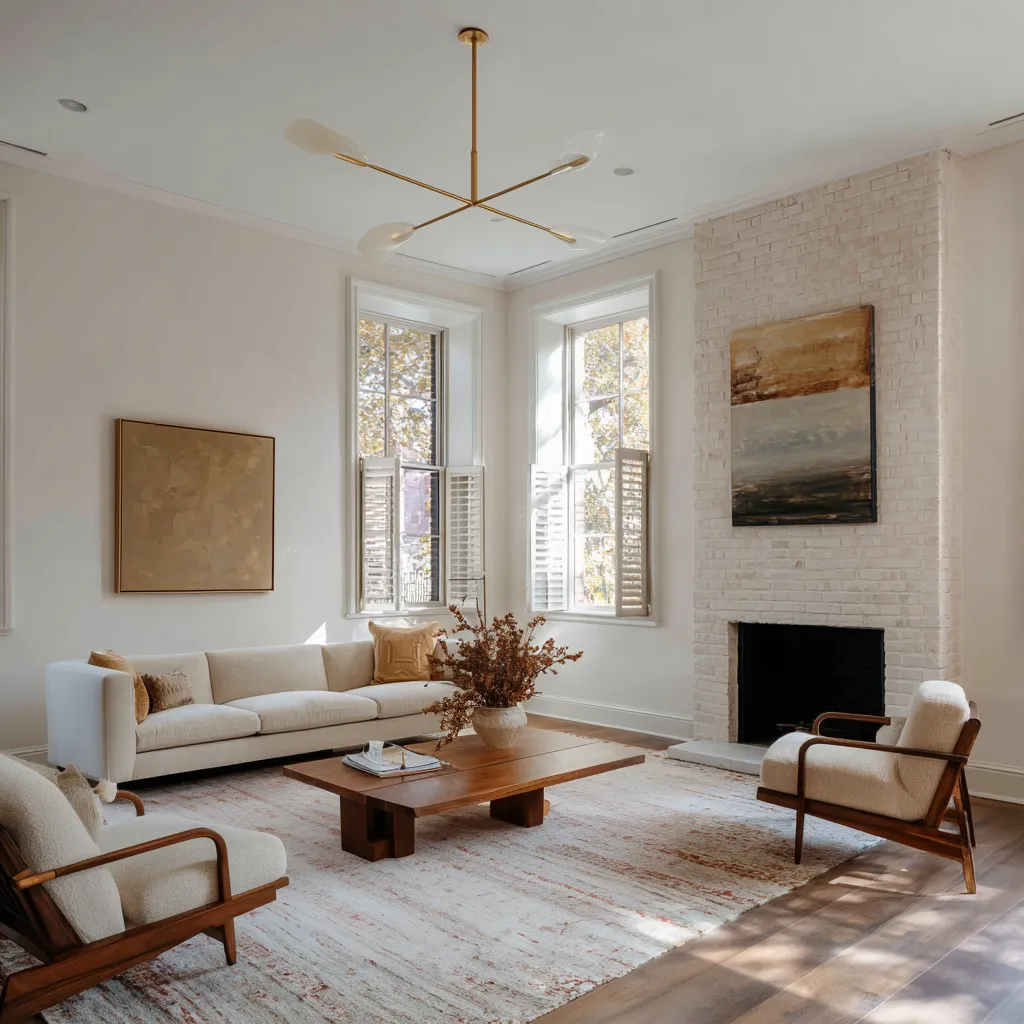
- warm timber or leather
- sunlight allowed to register
- a faded or warm-toned rug
- less rigid symmetry in the seating plan
This type of Georgian style feels hospitable and richly lived in without losing the shell’s order.
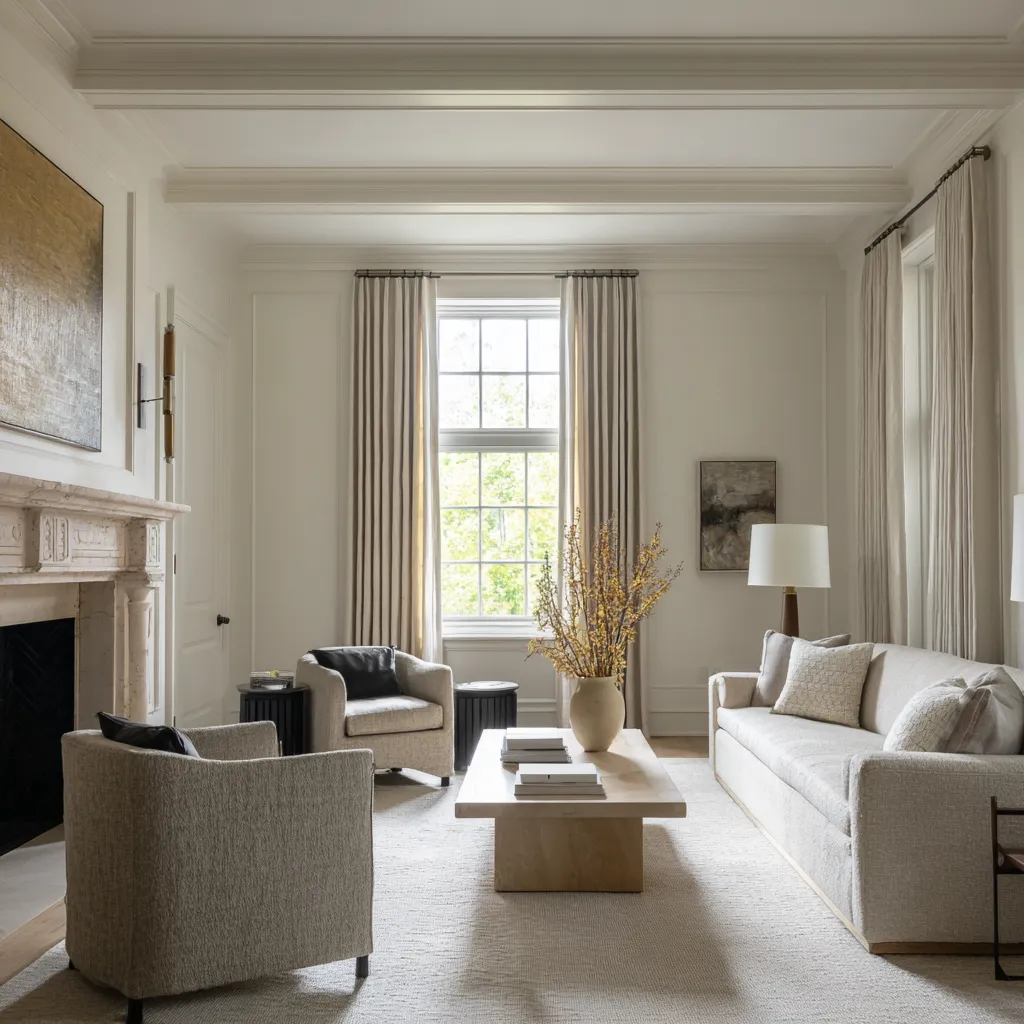
4. The integrated formal media version
This is the route for interior designs that need to function fully for present-day life. It often includes:
- a television embedded within a larger wall composition
- stone framing, panel logic, or cabinetry
- stronger ceiling presence to stabilize the room
- broad low furniture
- a fairly formal shell that remains visible
This direction works well in family rooms and living rooms where media use is central but the architecture still matters.
Materials that help Georgian rooms feel current
Material choice plays a bigger role than many people expect. A Georgian room can feel dated or fresh with almost the same shell depending on what materials are introduced.
Materials that tend to work well in current Georgian living rooms include:
- pale limestone or travertine
- softly veined marble
- walnut and aged oak
- bouclé and dense woven upholstery
- leather in camel, rust, or saddle tones
- clay and ceramic surfaces
- matte painted trim and paneling
- dark bronze or blackened metal in controlled amounts
The most useful combinations often balance pale mass and warm detail. For example:
- pale stone fireplace + walnut coffee table
- cream sofa + black firebox + leather pillow
- pale paneling + dark window muntins + aged wood floor
- broad pale rug + dark low table + clay vase
The design usually gets more depth from combining material temperatures than from adding more colors.
Common mistakes that weaken the look
A Georgian living room design can lose its strength in several predictable ways.
- One is relying too much on decorative mantel styling. If the fireplace wall is already strong, loading it with objects often reduces its authority.
- Another is using furniture that is too light, too small, or too delicate for the room’s scale. Thin tables, narrow chairs, and under-scaled sofas often make tall Georgian walls feel overpowering.
- A third mistake is assuming that curves alone will make the room friendlier. Curves help, but without warm materials, a usable layout, and enough grounding, the room can still feel cool.
- Another weak move is treating the television as a loose object rather than part of the wall. In a Georgian interior, that usually creates friction.
- Finally, filling every panel field with art or accessories often makes the room look less resolved, not more finished. Georgian rooms usually gain force when they are edited.
How to think about balance in a Georgian room
Georgian living room designs do not chase period purity, nor do they try to erase the shell. They work through balance.
Interior design might combine:
- a monolithic pale chimney wall with soft rounded chairs
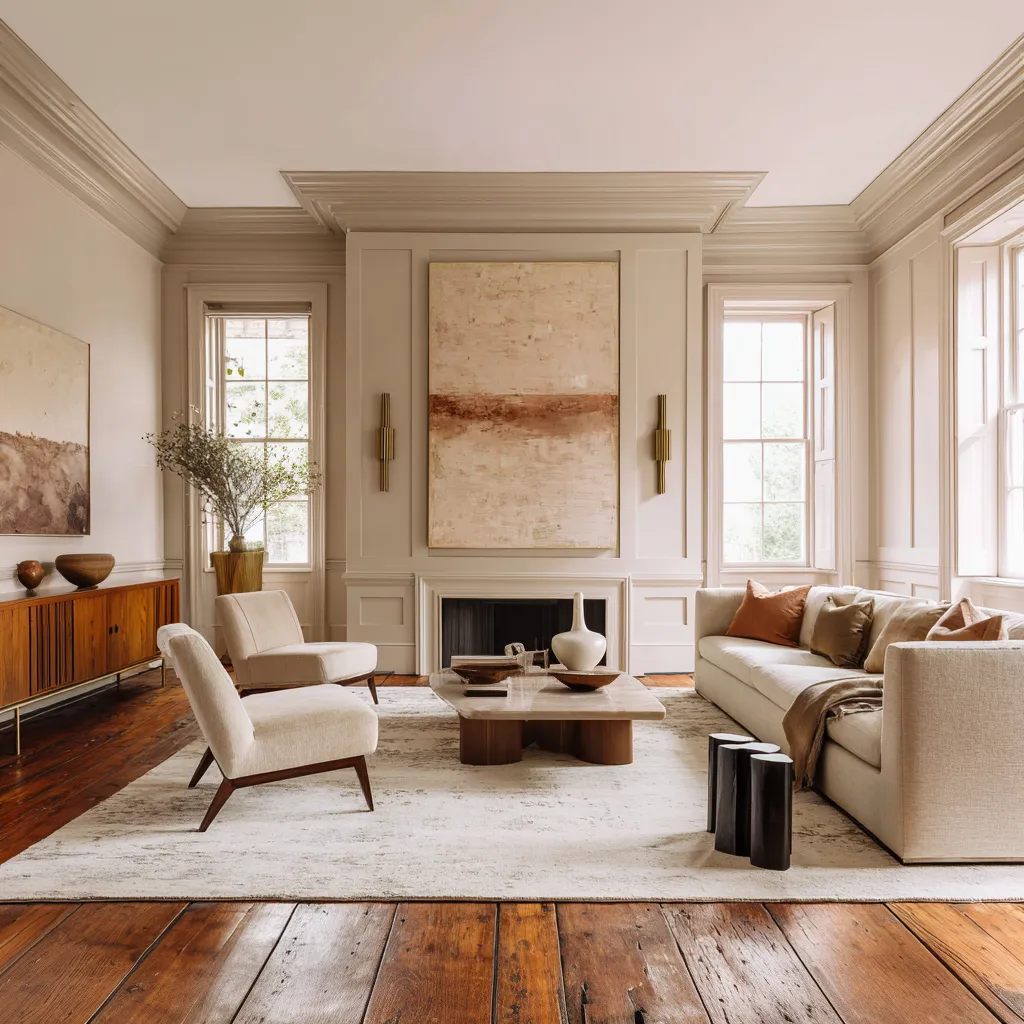
- black window frames with warm walnut and rust accents
- a formal fireplace axis with an off-axis sectional
- empty wall fields with one dense dark coffee table
- a crisp architectural envelope with a very touchable upholstery story
That is where much of the style value sits. Not in choosing old over new, but in handling the tension between them with care.
- Mass and softness.
- Order and use.
- Pale calm and dark definition.
- Historic structure and present-day life.
Once those relationships are handled well, a Georgian living room design can feel both grounded and current.
Final thoughts
A stylish Georgian living room does not need more ornament to feel rich. It needs better placement of weight.
It needs a fireplace wall with enough presence to steady the room. It needs a lower half that can hold the height of the shell.
It needs furniture that respects the architecture but supports actual living. And it needs a clear choice about what kind of mood it is aiming for: sharper and more graphic, warmer and more sunlit, more monumental, or more fully integrated for daily life.
That is why Georgian interior designs today often look edited rather than elaborate. Their force comes from broad wall planes, grounded furniture, controlled contrast, warm material, and a shell that is allowed to remain visible.
Instead of trying to make the room look busy or overtly historical, they make it feel settled, shaped, and fully inhabited.