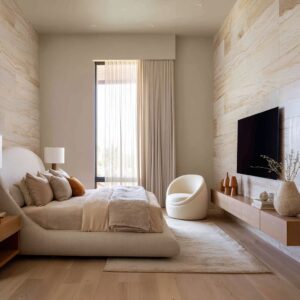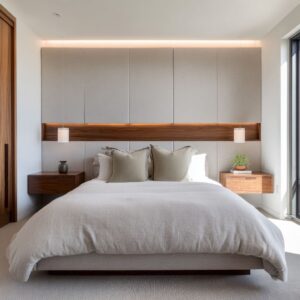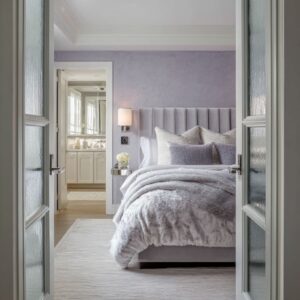
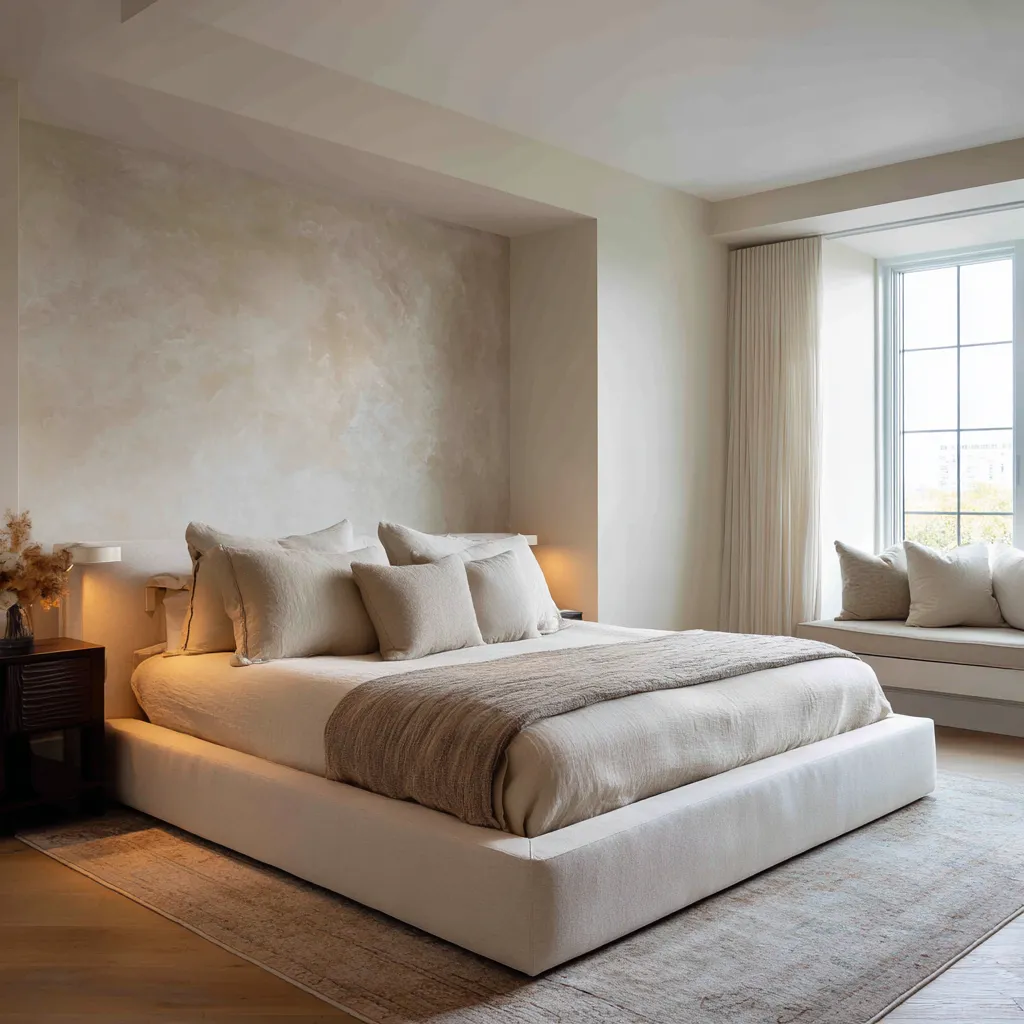
California bedroom design is often talked about as if it were one broad look: bright rooms, warm neutrals, natural materials, soft bedding, big windows, a connection to outdoor light, and a relaxed mood. That broad understanding is useful, but it also blurs some distinctions.
A California boho bedroom does not create character in the same way a California chic bedroom does, and neither of them works like a Santa Barbara bedroom.
That difference matters. Many bedroom designs borrow the same surface signals—black-framed windows, clay-toned pillows, pale wood, creamy bedding, woven textures—yet still feel completely different once the room is put together.
The reason is simple: these styles place visual richness in different parts of the room. One depends heavily on fabrics and texture.
Another depends on order, proportion, and built-in refinement. The third depends on architecture itself.
If you want to understand California bedroom design clearly, it helps to stop asking which colors or accessories belong to the style and start asking a better question: Where does the room keep its identity? In the bedding?
In the furniture plan? In the plaster walls and timber overhead?
That single shift makes the whole family of California bedroom styles much easier to read. This article breaks down the three major California bedroom directions—California boho, California chic, and Santa Barbara style—and explains how each one works, what details matter, what details are often overrated, and how to tell the difference even when the palette looks very similar.
The Shared California Background
Before separating the styles, it helps to see what they have in common. Current California bedroom designs share a recognizable base.
They tend to use daylight as an active part of the design. They favor warm neutrals over cold whites.
They lean toward natural materials such as linen, wood, plaster-like surfaces, leather, stone, woven fibers, or matte ceramics. They often keep the furniture low and broad rather than tall and ornate.
They usually avoid dense clutter. Even in fuller rooms, there is often some breathing space around the main pieces.
This shared base is why these bedrooms are so often confused with one another. A soft rust pillow, a broad window seat, a pale oak nightstand, and creamy layered bedding can appear in all three style families.
A low bed can appear in all three. Warm clay accents can appear in all three.
Black-framed glazing can appear in all three.
So color alone does not separate them. Even some furniture choices do not separate them.
What separates them is the distribution of emphasis.
- In California boho, richness sits mainly in the furnishing layer.
- In California chic, richness sits in planning, spacing, and refined material relationships.
- In Santa Barbara style, richness sits in the shell of the room itself.
Once you see that, the distinctions become much sharper.
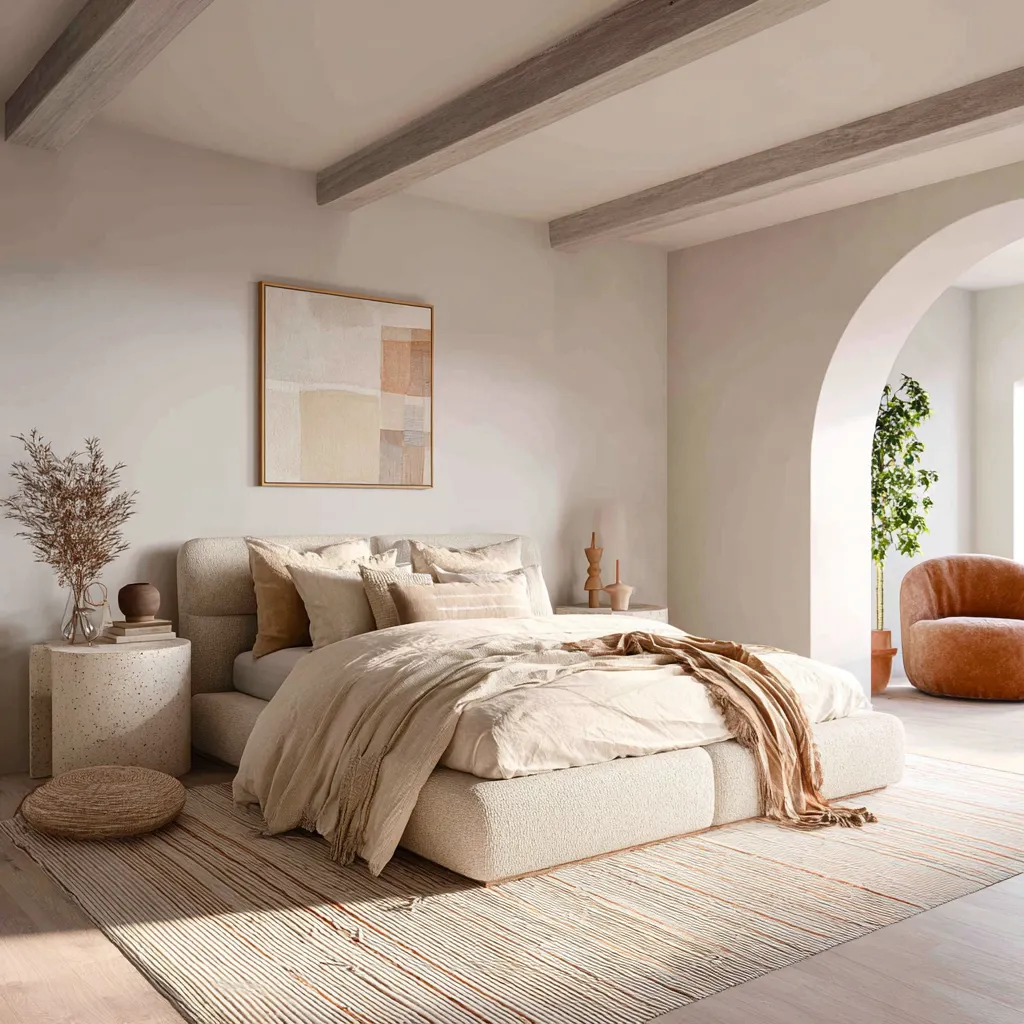
California Boho Bedrooms: Softness, Surface, and Relaxed Irregularity
California boho is the most textile-led of the three families. It usually creates fullness without relying on heavy architecture.
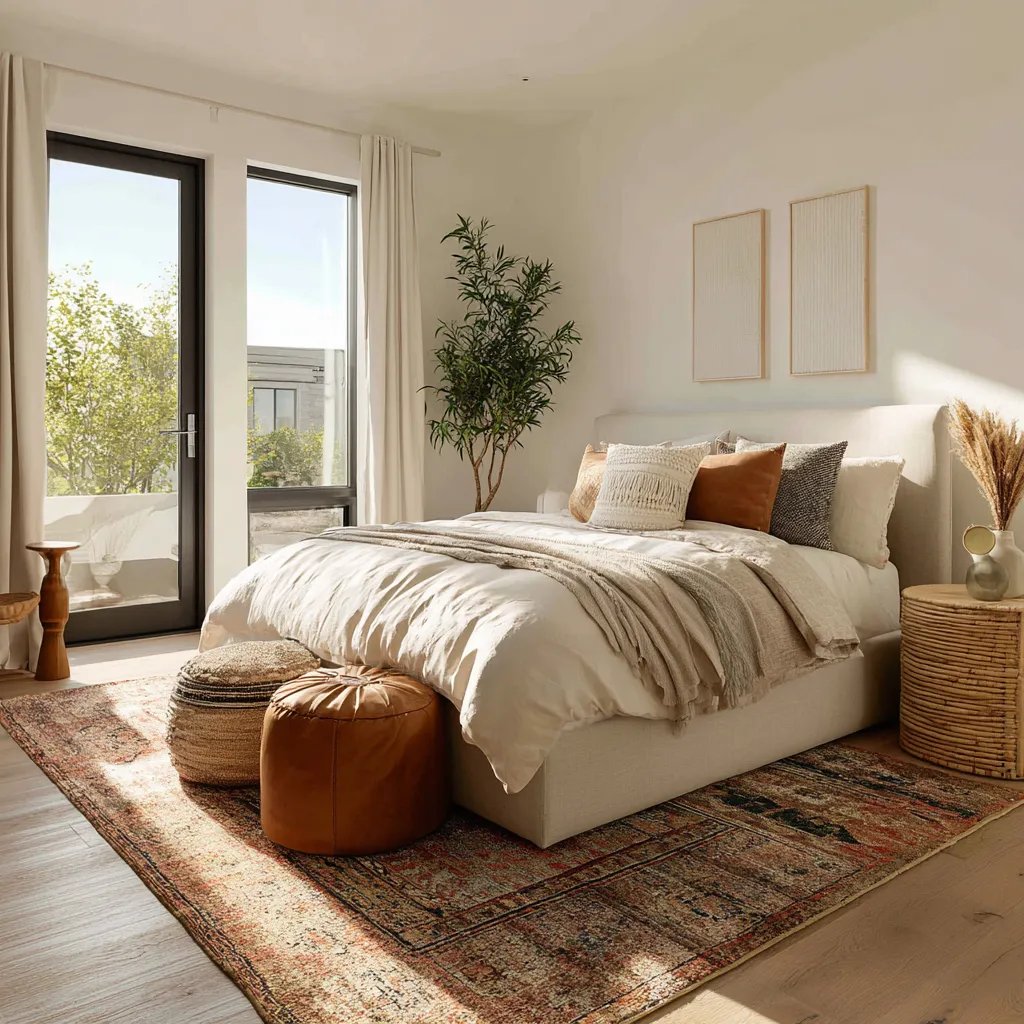
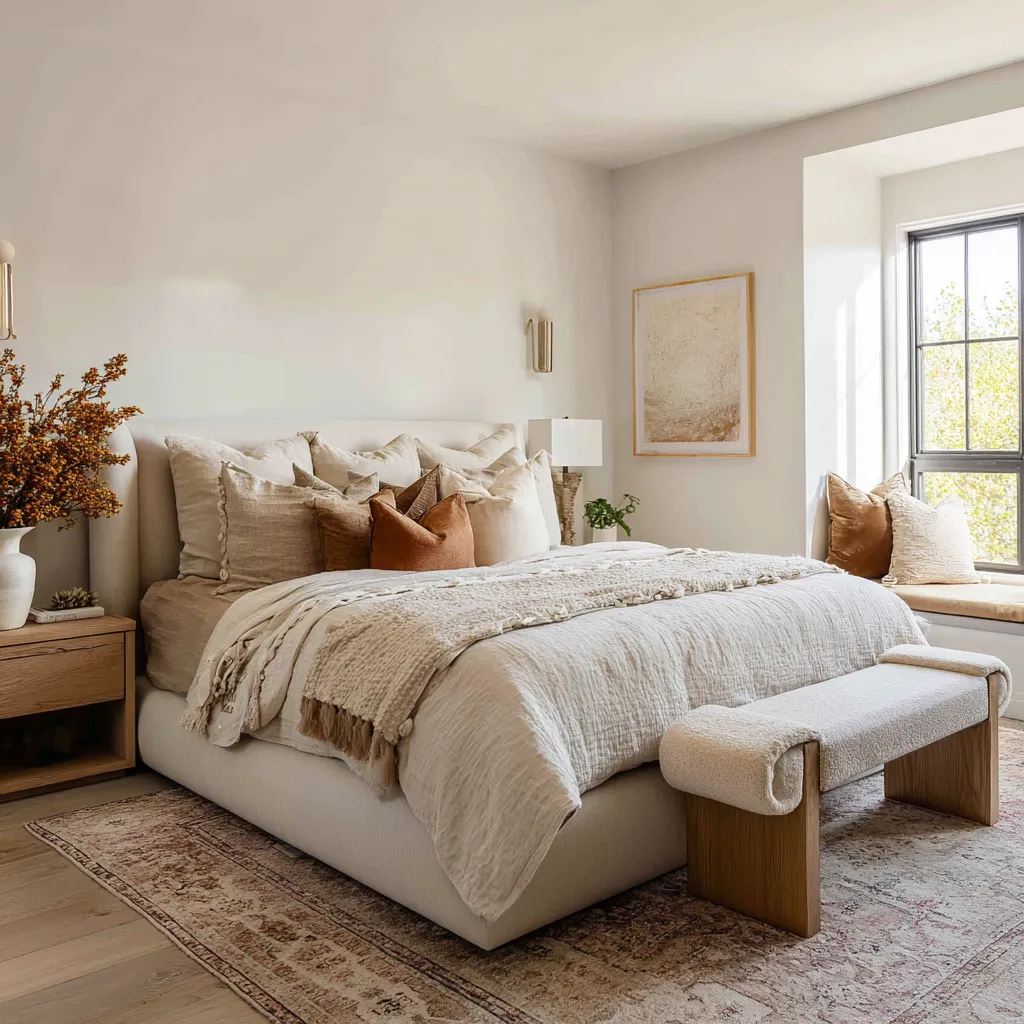
The room can have plain walls, a fairly ordinary ceiling, and a simple floor plan, yet still feel finished and deeply atmospheric because the bed, rug, pillows, throw, woven lighting, baskets, pottery, and soft natural materials are carrying the character.
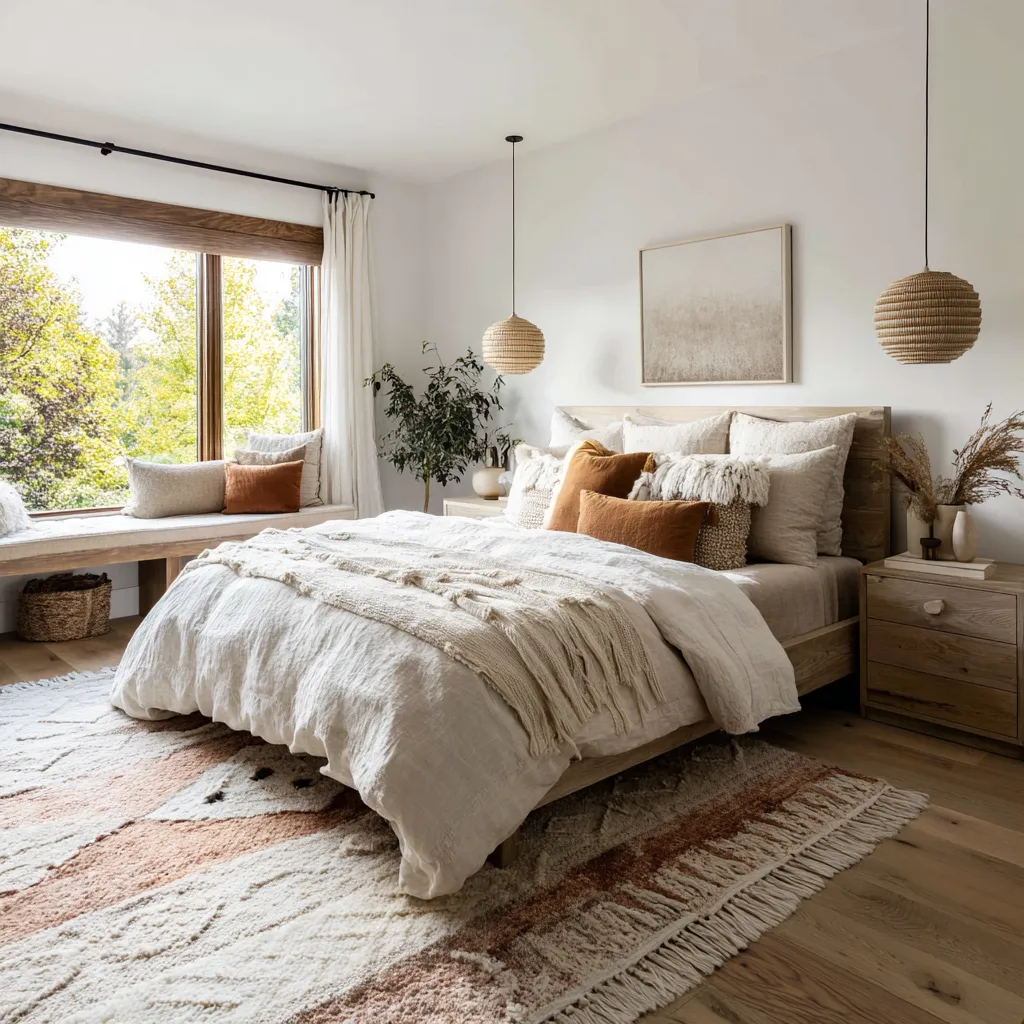
This is one of the points to understand about California boho: it often looks relaxed, but it is not random. The room may appear casual, but its warmth usually comes from carefully controlled layers of texture and small shifts in earth tones rather than from a large amount of visual chaos.
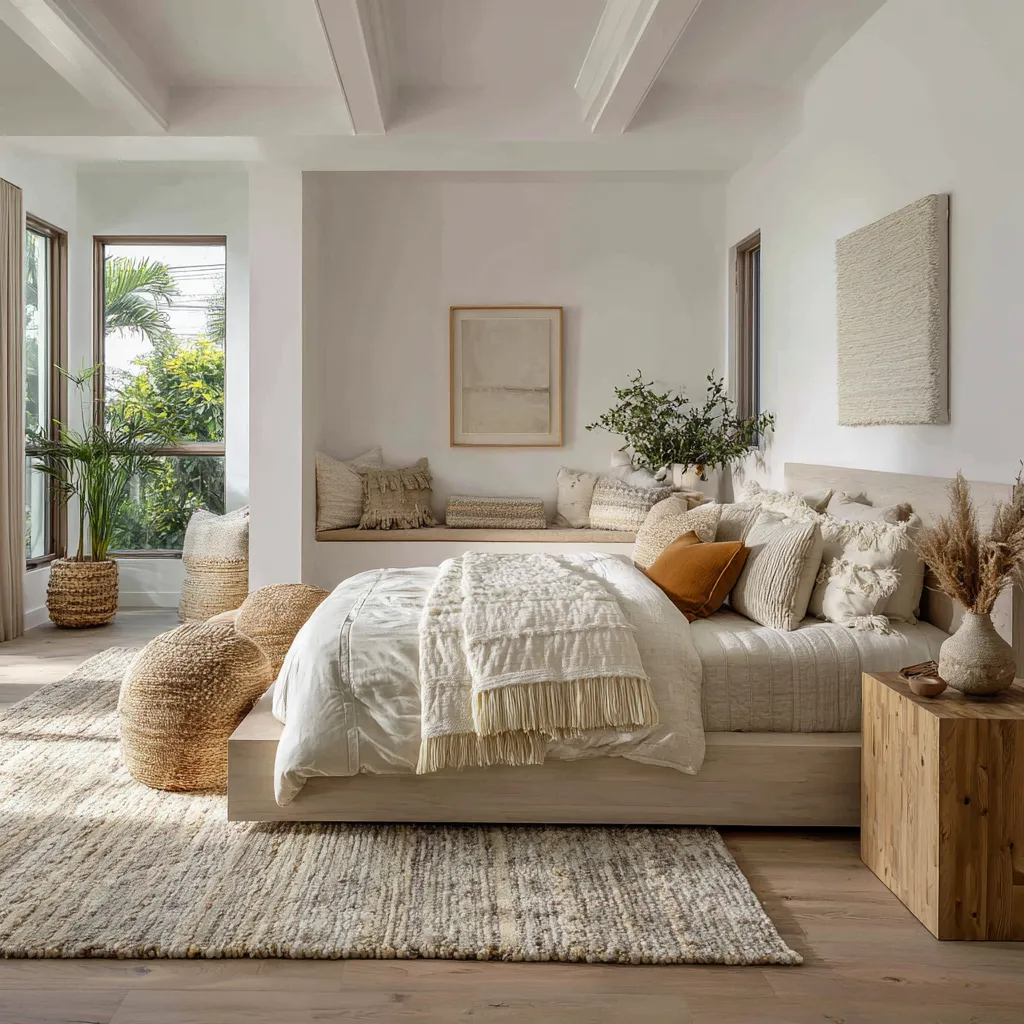
Where California boho keeps its identity
A California boho bedroom design usually holds its personality in:
- wrinkled or loosely spread linen bedding
- nubby upholstery
- fringe, tassels, braid, or soft woven edges
- vintage-style or faded rugs
- natural-fiber pendants and baskets
- handmade-looking pottery
- dried branches or grasses
- a warm cluster of rust, cinnamon, adobe, terracotta, or saddle tones
The architecture can stay fairly quiet because the bedding and floor layers are doing so much of the expressive work. That is why California boho can still feel complete even in rooms with large blank wall areas.
The room does not need every surface to participate equally. The center of gravity often sits around the bed and the floor plane, with a few supporting gestures at the perimeter.
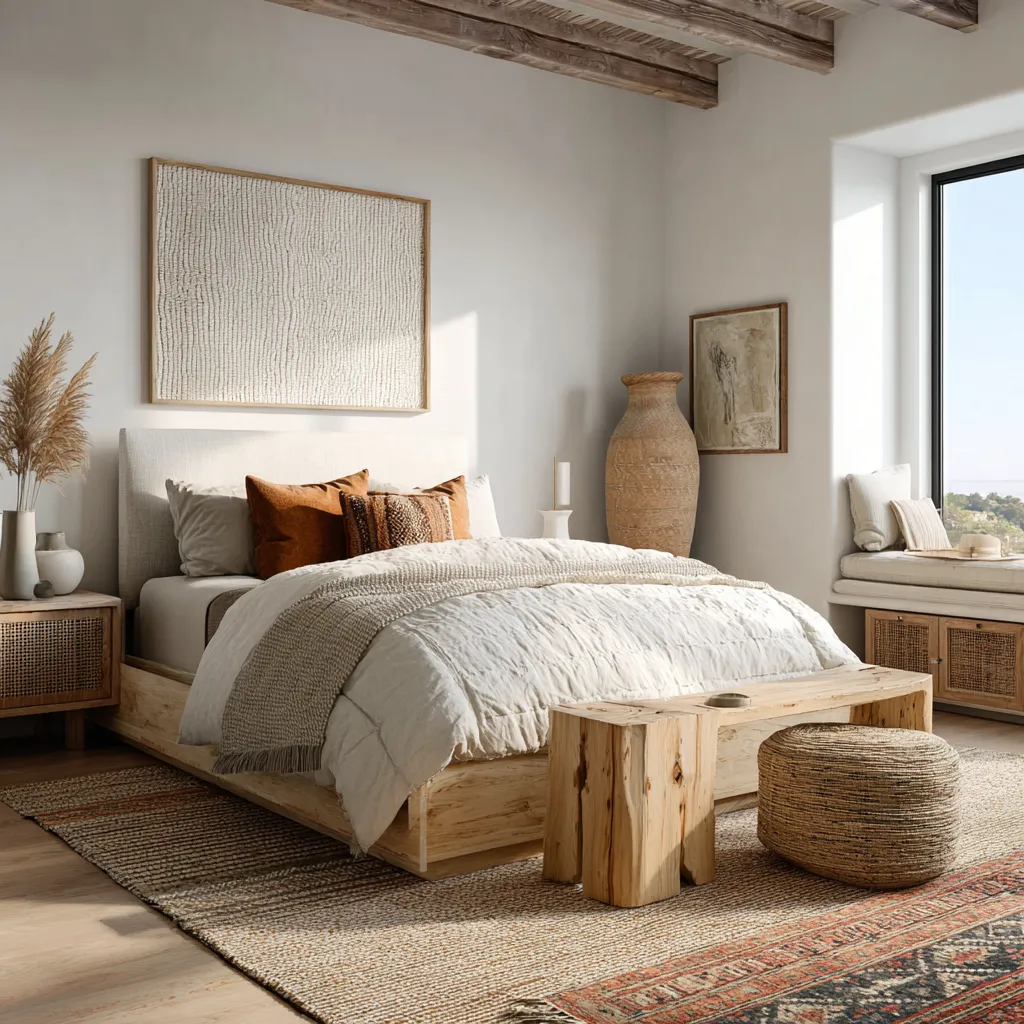
The role of texture in California boho
People often assume California boho is defined by collected decor. Sometimes that is true, but the more current version is usually lighter and more edited.
The room may not actually contain many objects. Instead, it creates density through surface variation.
A throw can be softly fringed. A pillow can have visible slubbing or a woven stripe.
A rug can be faded rather than bold. A bench can be upholstered instead of hard-edged.
A terracotta vessel can sit on a nightstand and bring in an earthen note without turning into a statement piece. These are small moves on their own, but together they make the room feel layered.
That is why California boho often works even when the accessory count is low. The room does not always need a shelf full of collected pieces.
It needs enough tactile change for the eye to keep finding warmth as it moves through the space.
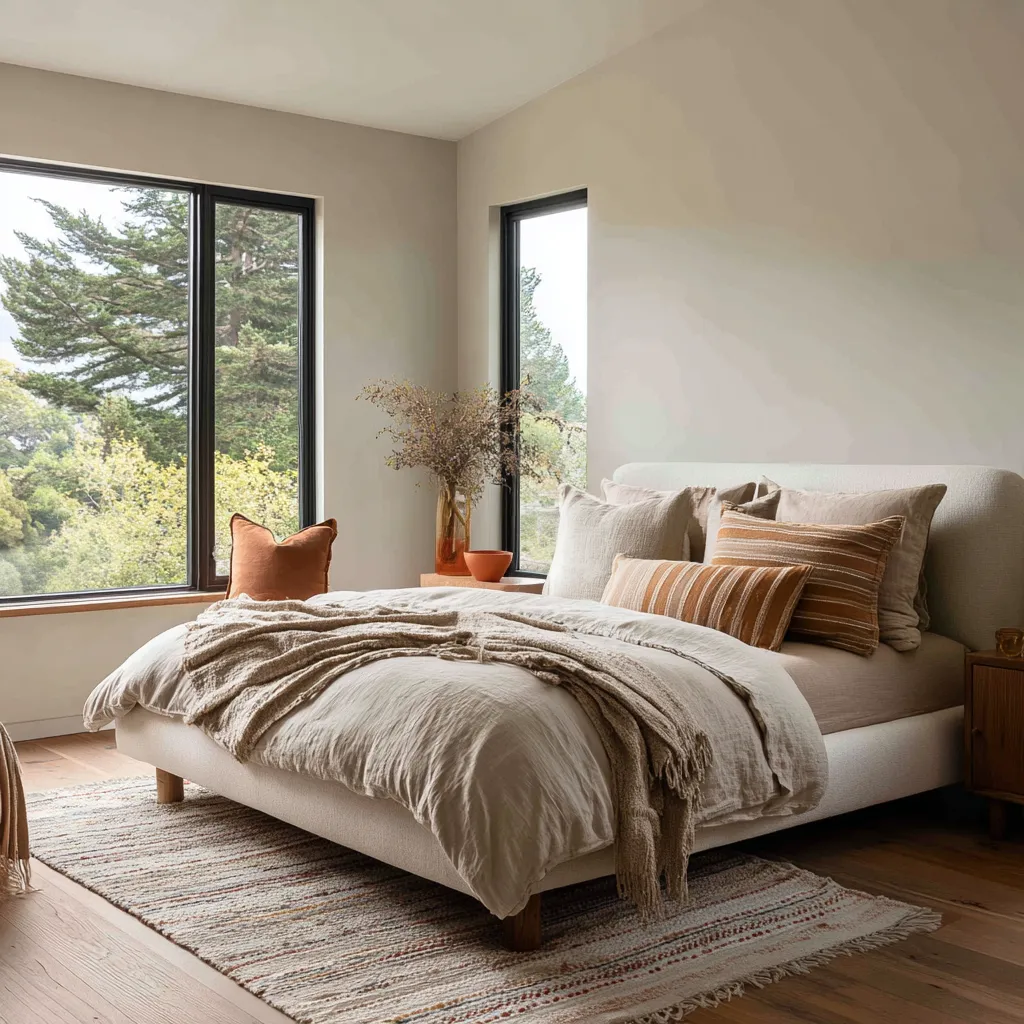
How California boho handles color
California boho is usually warm, but not loud. The dominant field is often built from cream, ivory, sand, oatmeal, pale taupe, soft beige, and blond or medium-light wood.
Stronger warmth is then introduced in compact zones: rust pillows, a faded red-brown rug, clay pottery, warm leather, dried branches, or an ochre-toned throw. This concentrated use of warmth is important.
If the richer tones spread too broadly, the room can lose the airy California feeling and drift toward a heavier rustic or global-bohemian direction. California boho tends to keep the sunlight and openness intact by limiting deeper color to smaller areas.
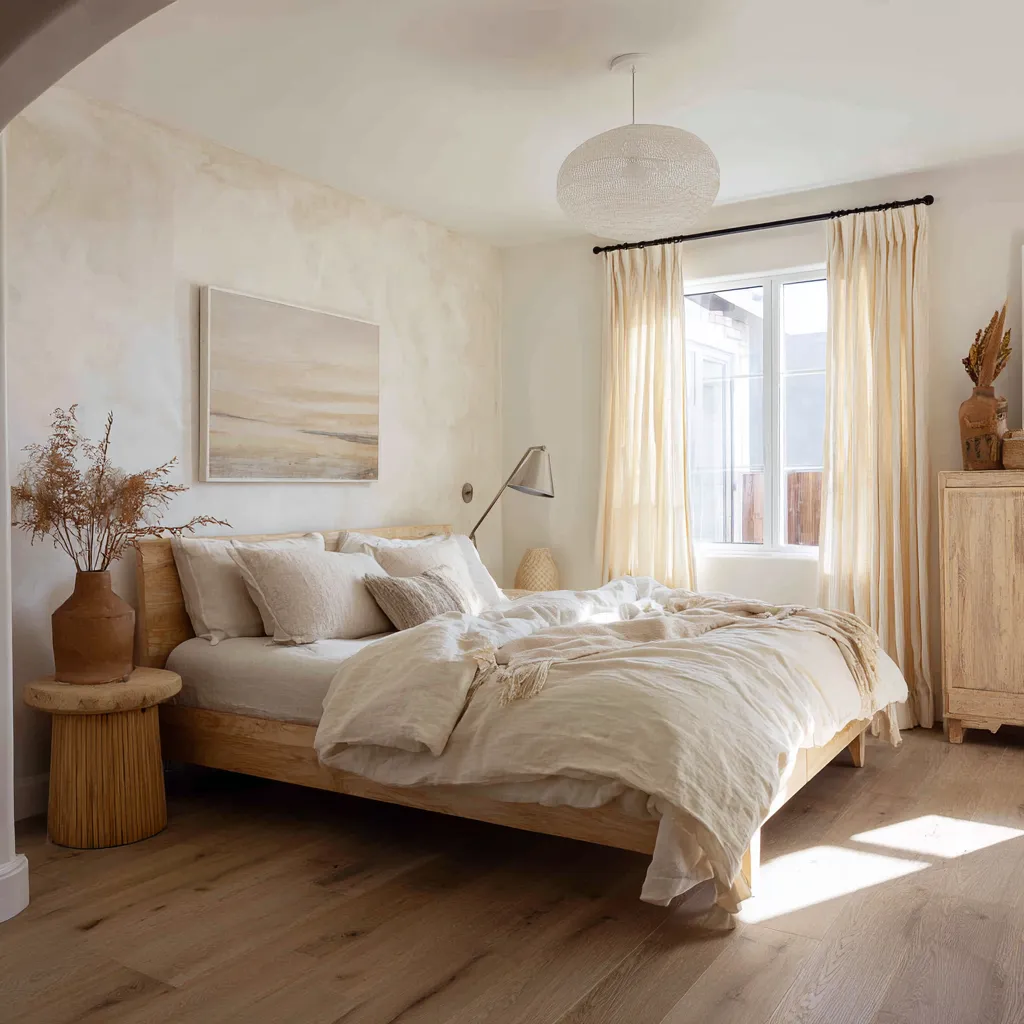
The bed in a California boho bedroom
The bed is usually the emotional center of the room. It is often low, broad, and soft-edged.
Upholstered rails, padded headboards, loosely draped coverlets, and a generous but not stiff stack of pillows are very common. The bed often feels less like a formal object and more like a soft central landscape.
This is different from the role a low bed plays in the other California styles. In boho, the low bed supports lounging and relaxed spread.
It makes the room feel easy to inhabit, not ceremonial. The softness often spills outward into a bench, a pouf, a floor cushion, or a window perch, so the whole room feels like a place to settle into rather than simply a place to sleep.
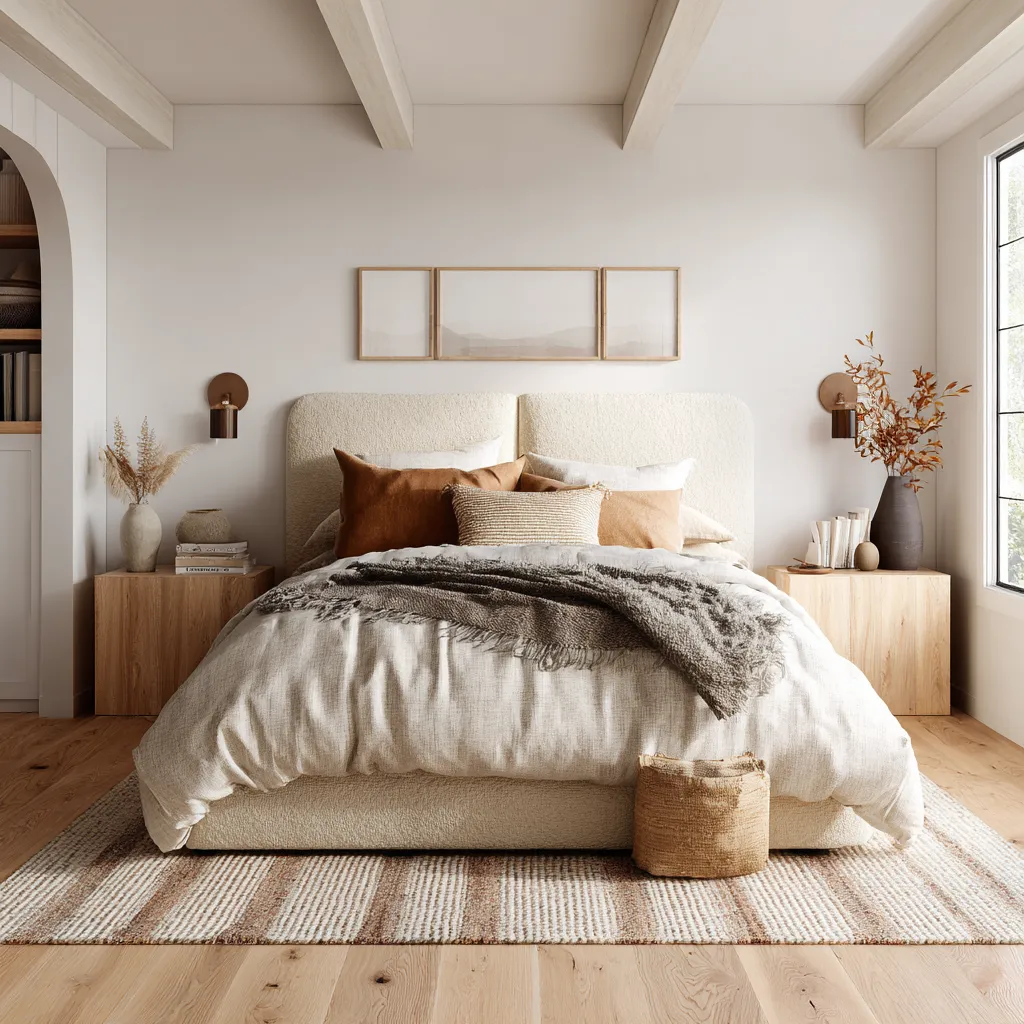
What California boho gets wrong when it is poorly done
A common mistake is assuming boho means more stuff. Too many baskets, too many wall pieces, too many small accessories, too many patterns, and too many competing craft references can flatten the room instead of warming it.
The current California version usually looks better when the shell stays clean and the tactile richness is concentrated in fewer, larger, softer elements. Another common mistake is pushing the room too far into pale monotony.
If every surface is cream and beige without enough texture or a few warmer anchors, the room can start to feel sleepy rather than inviting. California boho needs small zones of heat, some visible hand-touched materiality, and enough irregularity in the textiles to keep the softness alive.
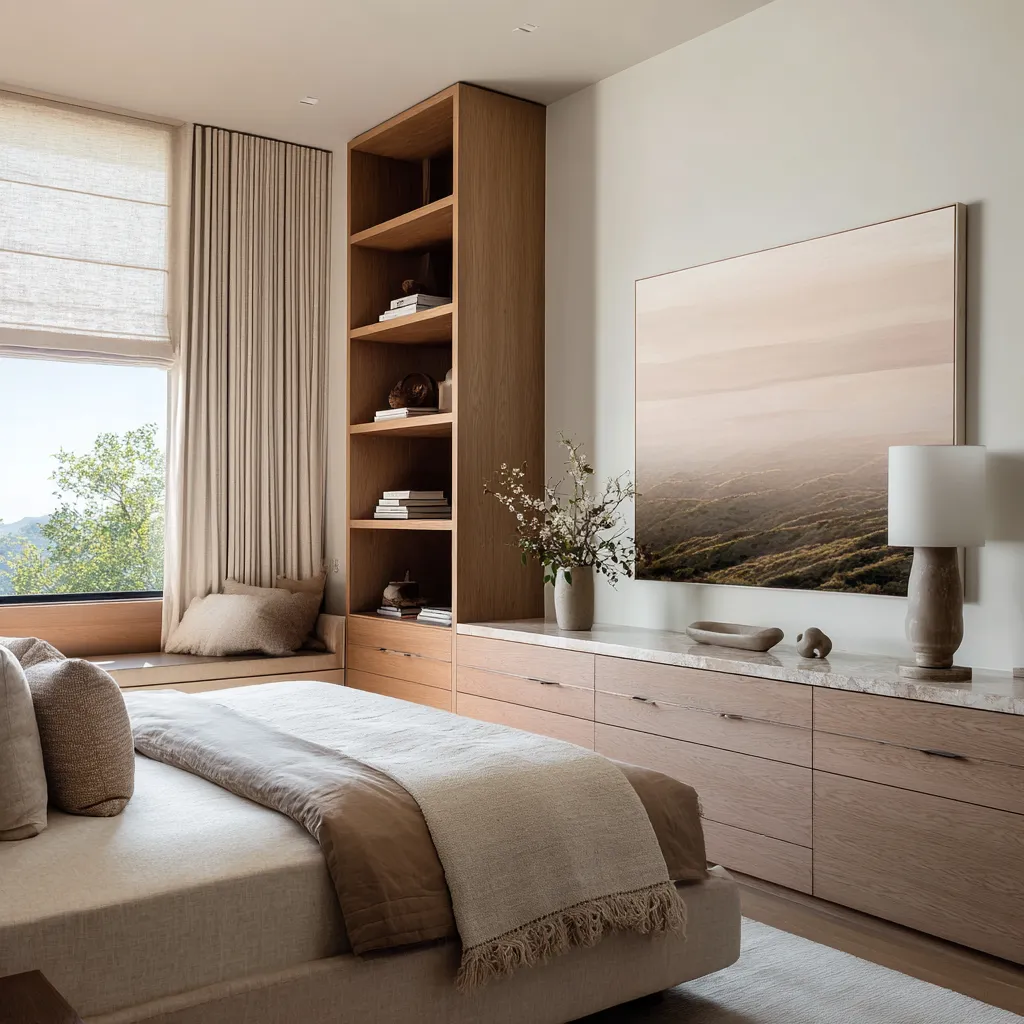
California Chic Bedrooms: Order, Editing, and the Designed Suite
California chic is often misunderstood as boho that has been cleaned up. That reading misses what makes it distinct.
California chic is not simply a less decorated boho room. It operates on a different logic.
A California chic bedroom usually feels more planned from the start. The furniture silhouettes are stronger.
The layout is clearer. The built-ins and case goods matter more.
The room often behaves like a complete suite rather than a styled sleeping corner. Richness comes less from craft scatter and more from proportion, alignment, material pairing, and a steady sense of control.
Where California chic keeps its identity
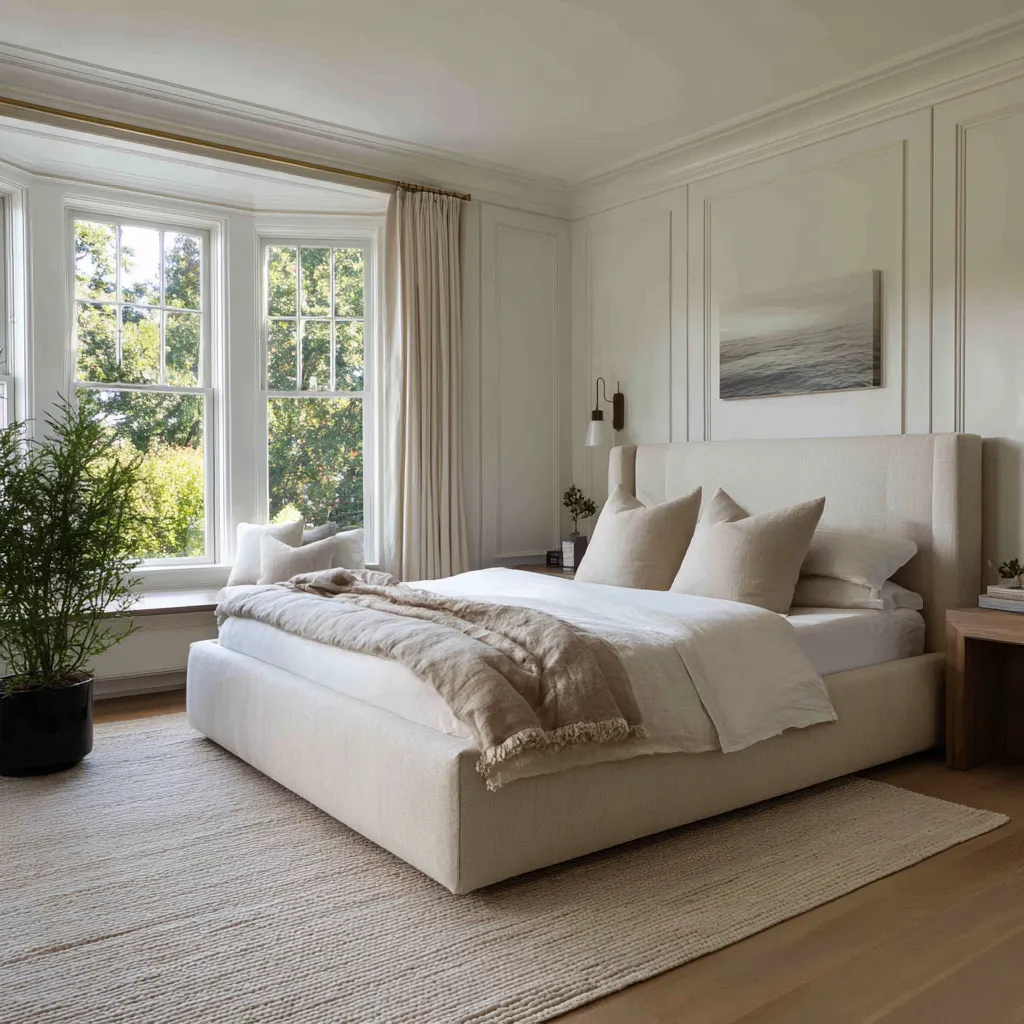
California chic usually stores character in:
- a disciplined layout
- stronger furniture massing
- paneled or plastered bed walls
- winged or structured headboards
- warm wood case goods
- stone-topped cabinetry or dressers
- built-in storage
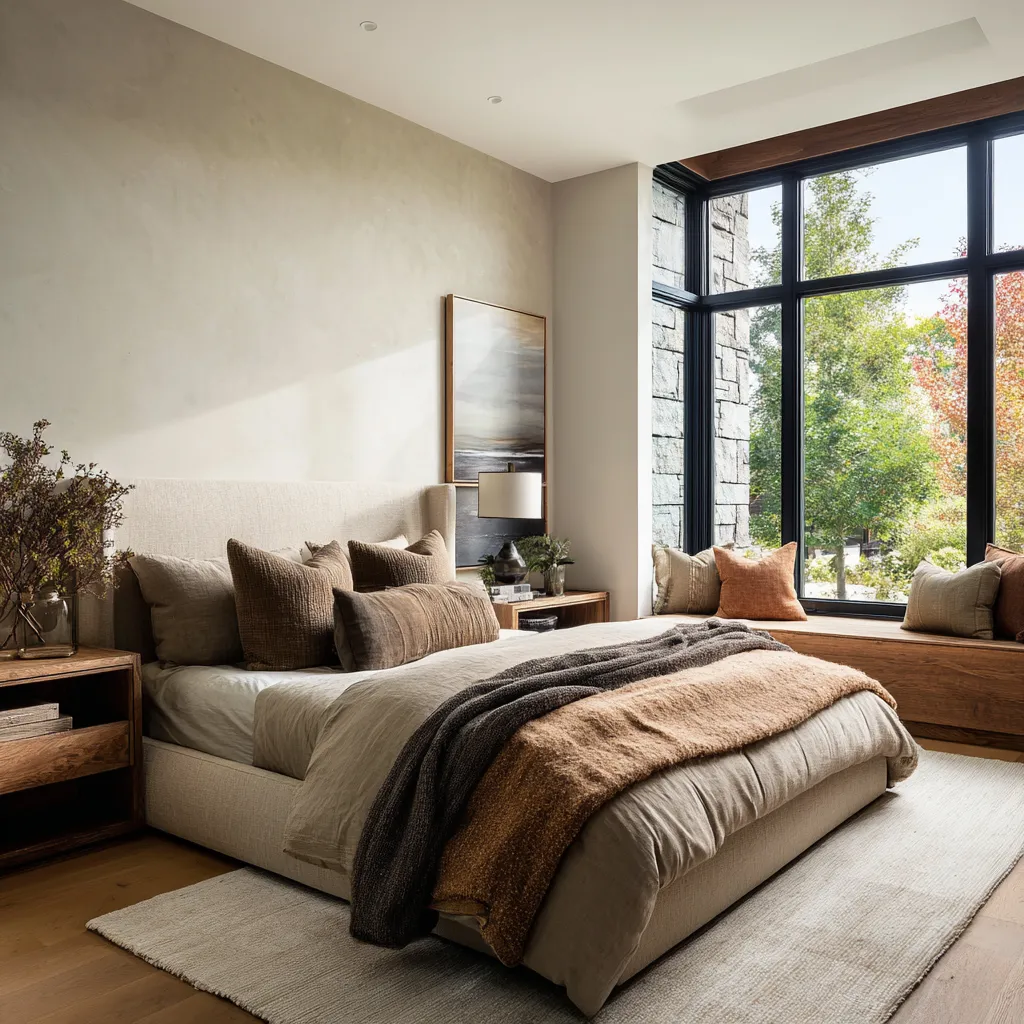
- long window benches
- large but quiet landscape art
- controlled spacing between objects
You can often strip back the pillows and decorative accessories in a California chic room and the style still holds together. That is because the room’s identity does not depend on visible craft layering in the same way boho does.
Why California chic feels more composed
One of the traits of California chic is compositional order. The room may be centered around a bed wall, balanced by matching nightstands, or built around cabinetry that gives the bedroom a deliberate plan.
Even when the layout is not strictly symmetrical, it often feels held together by a strong internal logic. That sense of order changes the mood completely.
The room still feels warm and livable, but it also feels considered. The pieces seem chosen to work together from the beginning rather than gathered over time in a softer, more intuitive way.
Material relationships matter more than decorative episodes
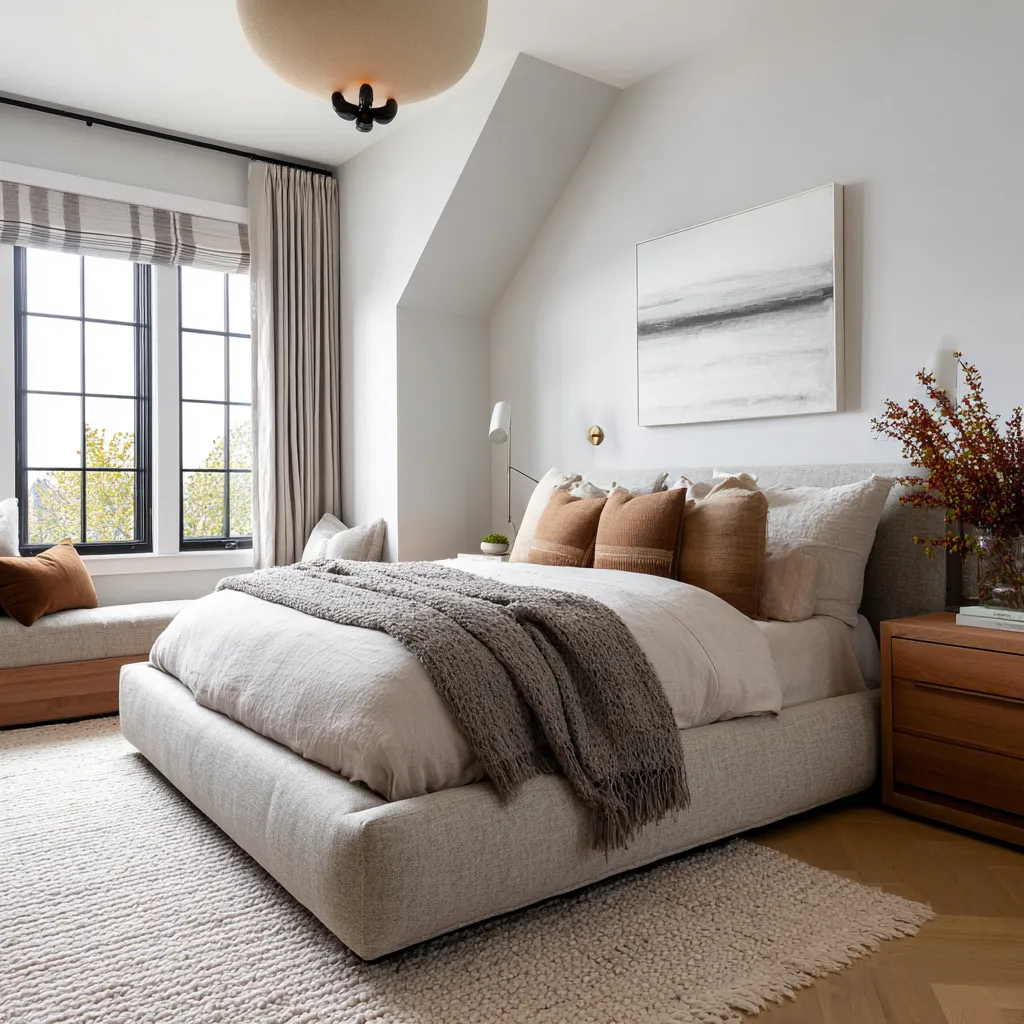
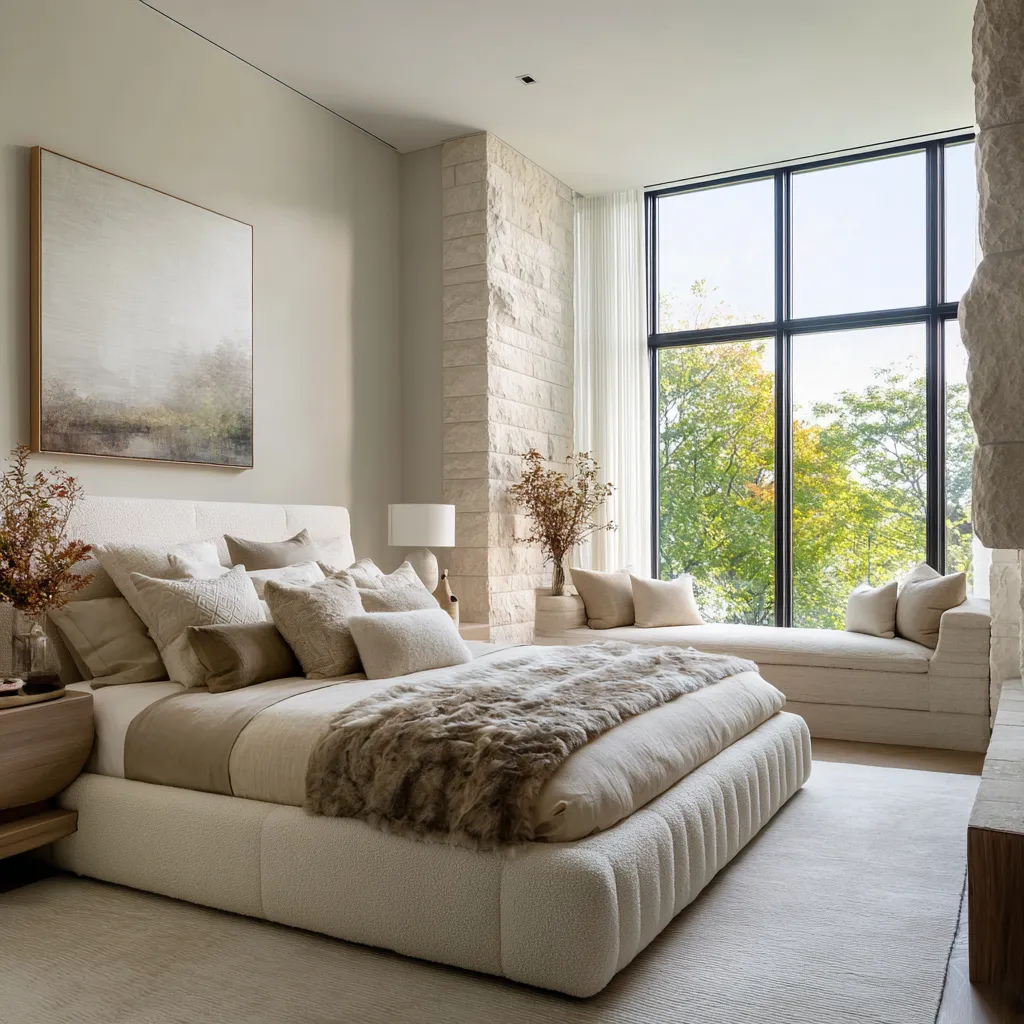
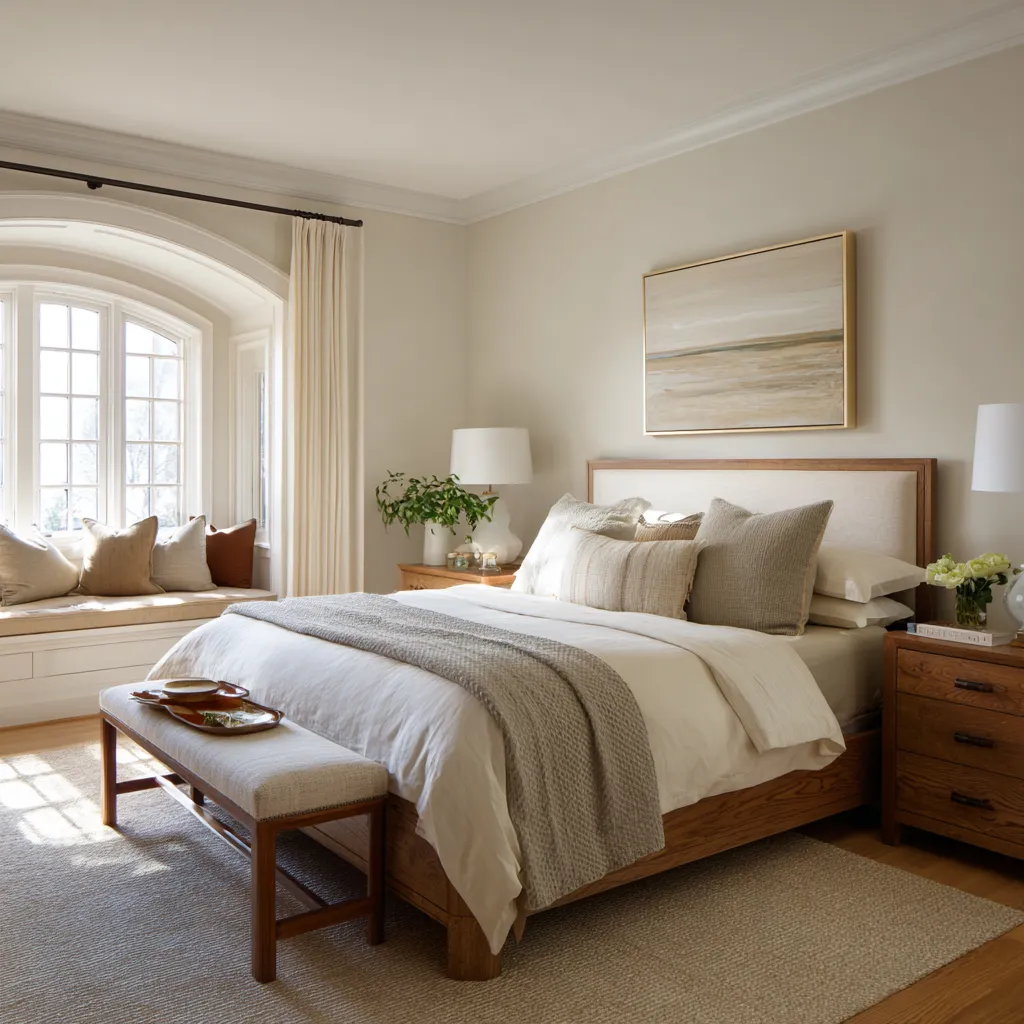
California chic often depends on the adjacency of materials. Pale upholstery against warm oak.
Stone above cabinetry. Tailored drapery beside black-framed glazing.
A bench tucked under a window as part of a built-in condition. A muted landscape artwork that extends the room’s palette rather than interrupting it.
These pairings are central to the style. The room builds depth through contrast in material character—soft fabric, matte plaster, warm wood, pale stone, crisp metal lines—without asking any single object to become overly expressive.
That is why California chic can feel rich even with very little visible pattern. It is not trying to create movement through textile ornament.
It is building depth through relationships between larger elements.
The role of built-ins in California chic
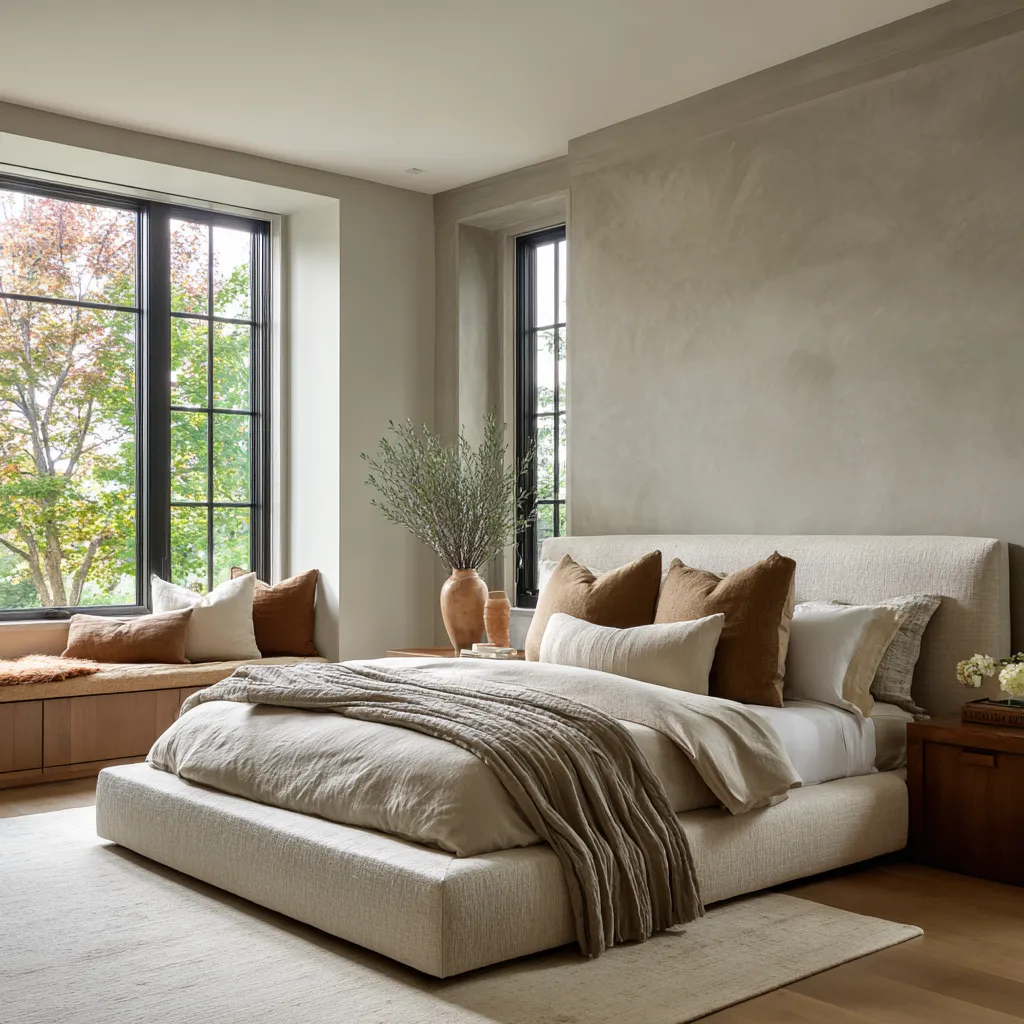
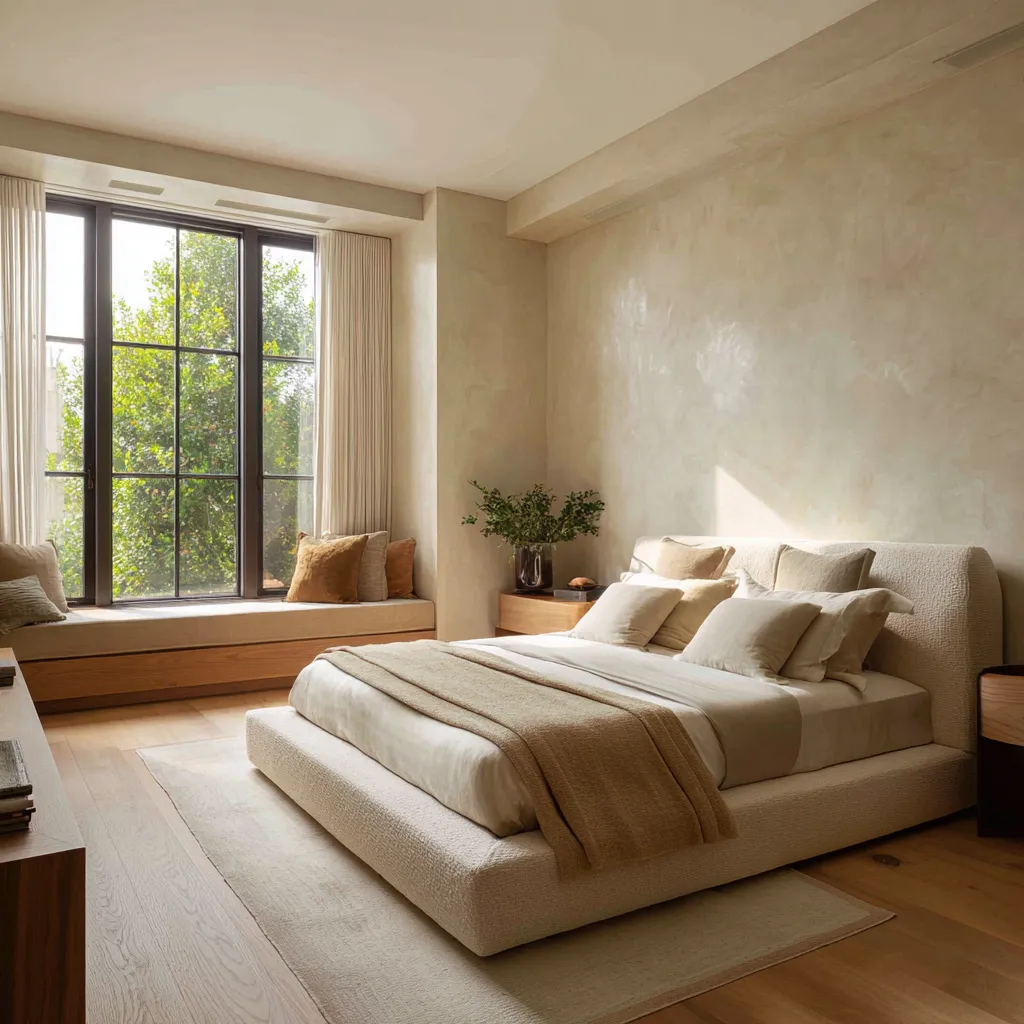
Built-ins are especially revealing. A window seat in a chic bedroom often feels like part of an intentional suite plan.
It does not exist only to add softness or informality. It helps define the perimeter of the room, stretches the composition horizontally, and turns the bedroom into a place with multiple zones of use.
The same is true of storage walls, stone-topped drawer runs, shelving towers, or integrated bedside lighting. These details make the room feel planned at the architectural-interior level rather than only styled at the furnishing level.
The bed in a California chic bedroom
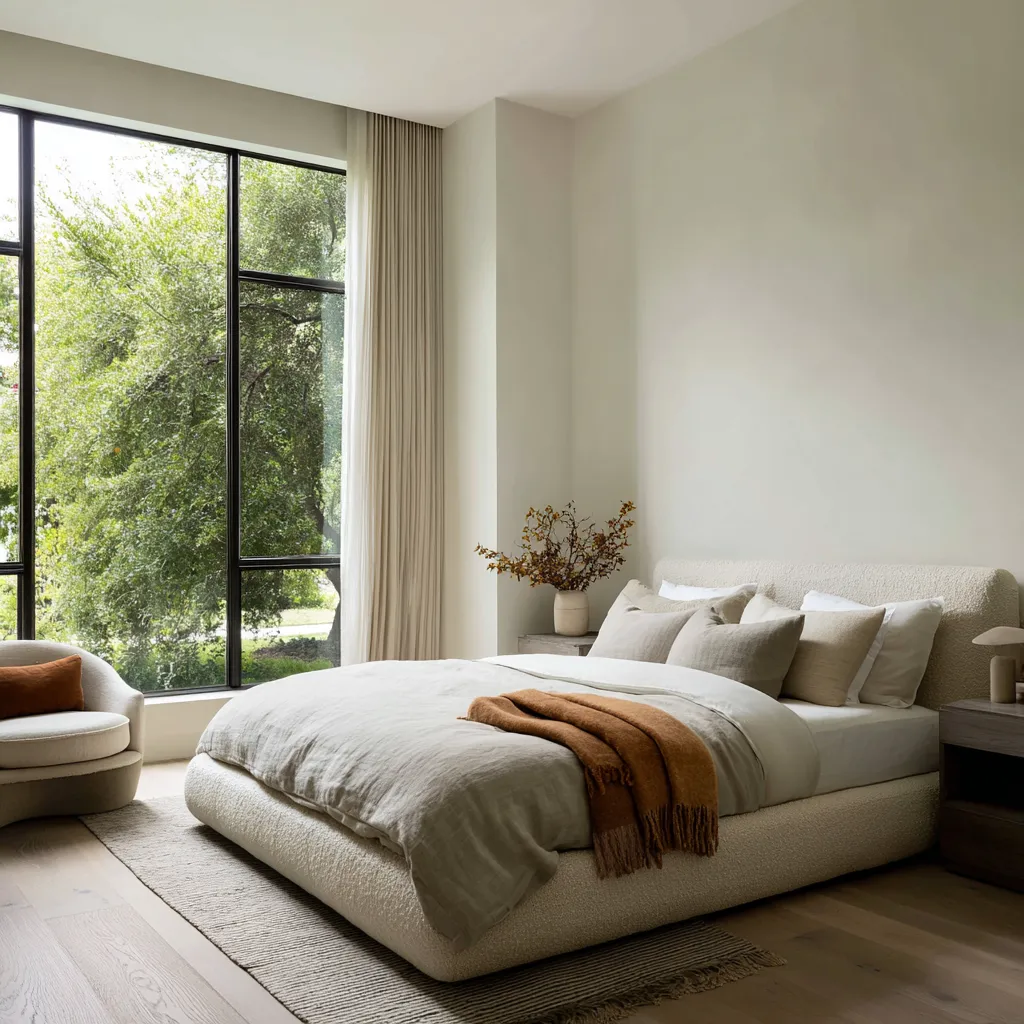
The bed is usually low and broad here too, but its role changes. In a chic room, the low bed creates breadth, steadiness, and visual poise.
It sits calmly within a more ordered framework. The styling is soft, but not loose in an uncontrolled way.
Pillows may be layered, but the group usually feels edited. The throw may be present, but it is often placed with more intention than in a looser boho room.
This distinction is small but important. California chic still wants comfort, but it wants comfort that stays inside a composed outline.
How California chic handles color
The palette usually remains compressed. Cream, warm white, oat, mushroom, sand, pale taupe, honeyed wood, muted beige, and soft stone tones dominate.
Rust, clay, or cinnamon often appear, but in smaller, sharper doses than in boho. They function almost like a thermal punctuation point: one pillow, one chair, one throw, one branch arrangement.
The room uses that warmth carefully so the whole composition stays airy and controlled.
What California chic gets wrong when it is poorly done
The biggest problem is excessive flatness. If the design is reduced too far without enough material depth, it can feel generic and undernourished.
California chic needs refinement, but it still needs warmth. The second common issue is over-formality.
If the layout becomes too rigid, the headboard too imposing, the drapery too dressed, or the furniture too heavy, the room can drift away from California ease and toward a more traditional polished bedroom. California chic bedroom designs hold a steady balance: structured, but not stiff; pared back, but not vacant; warm, but not overloaded.
Santa Barbara Bedrooms: Architecture First
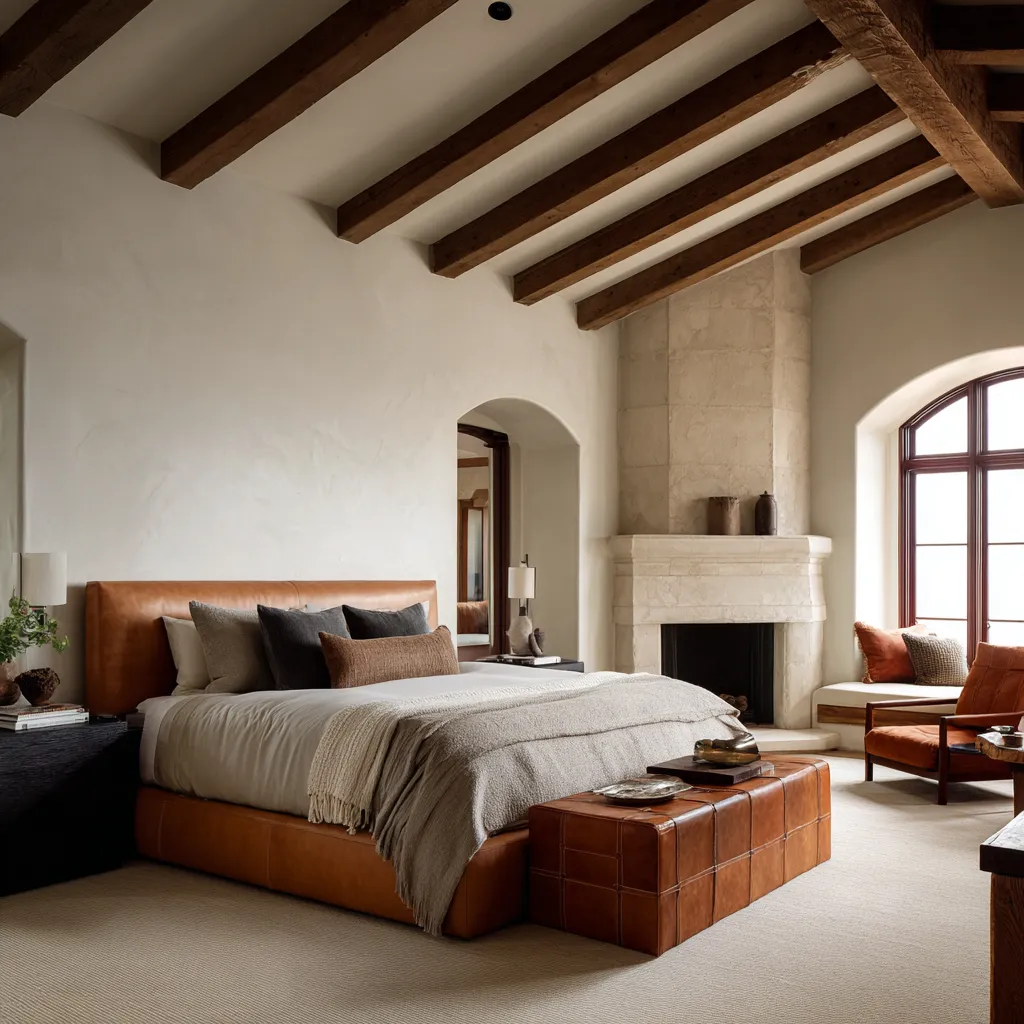
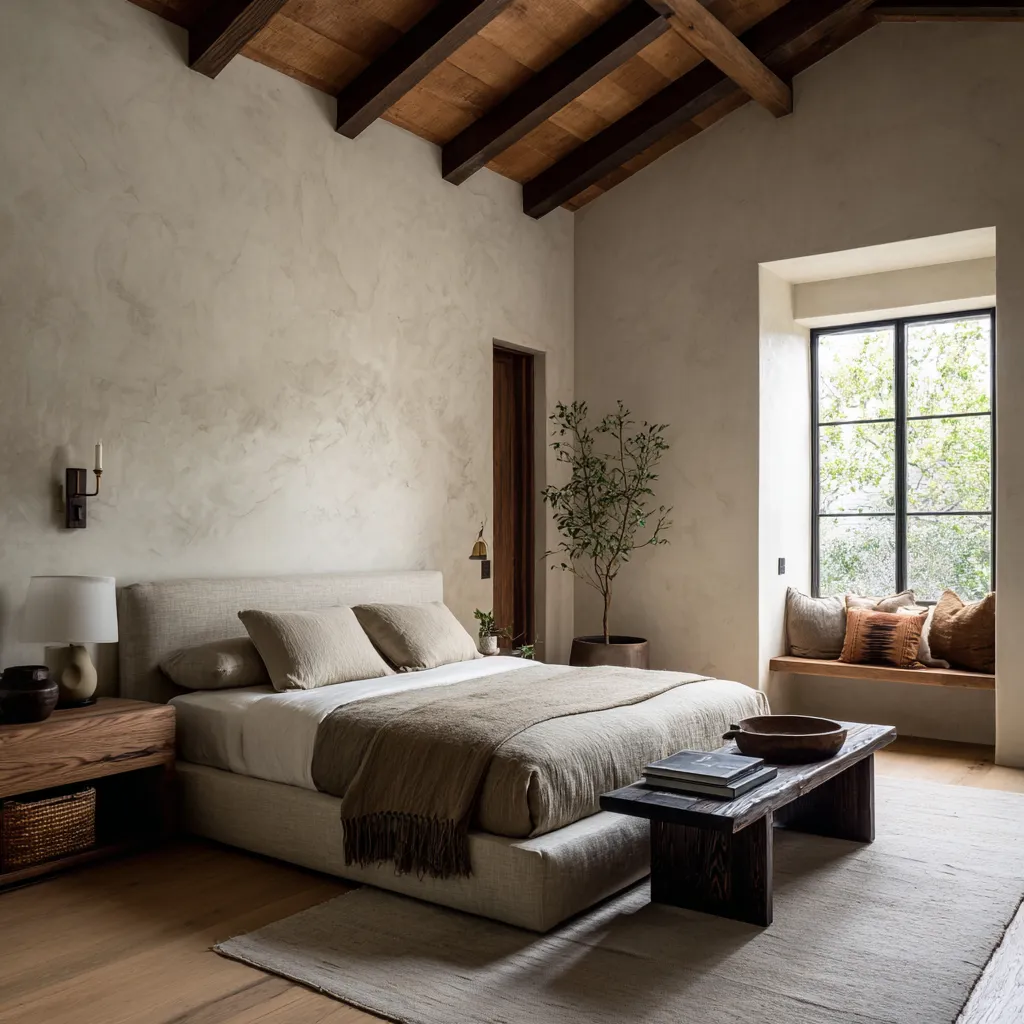
Santa Barbara style is the most architecture-led of the three families. In many cases, the bedroom design would still feel clearly Santa Barbara even if the bedding were made simpler and the accessories reduced further.
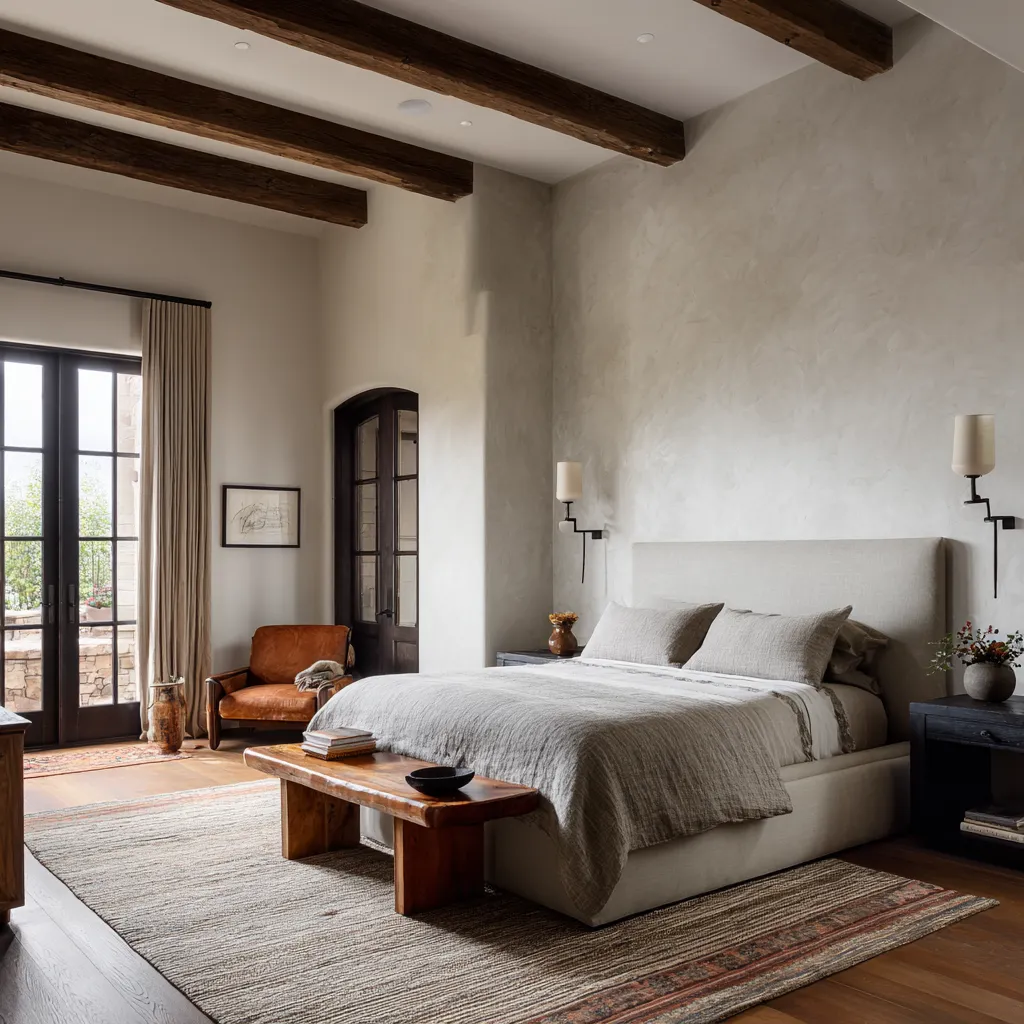
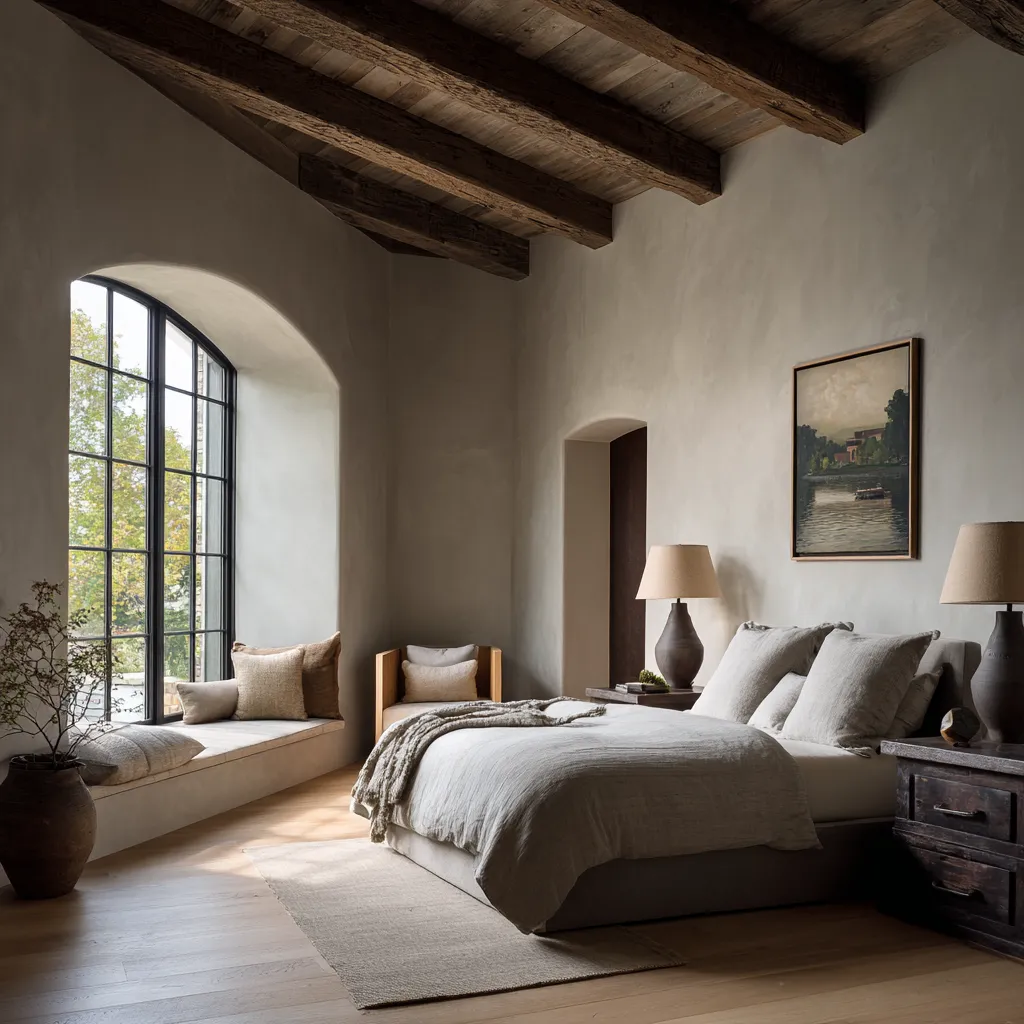
That is because the shell is doing most of the work. Dark timber beams, plastered walls, deep-set openings, arches, fireplaces, leather, stone, and a sense of wall thickness are the core of the style.
The furniture is important, but it is usually supportive rather than identity-leading. In a strong Santa Barbara bedroom, the house speaks first.
Where Santa Barbara style keeps its identity
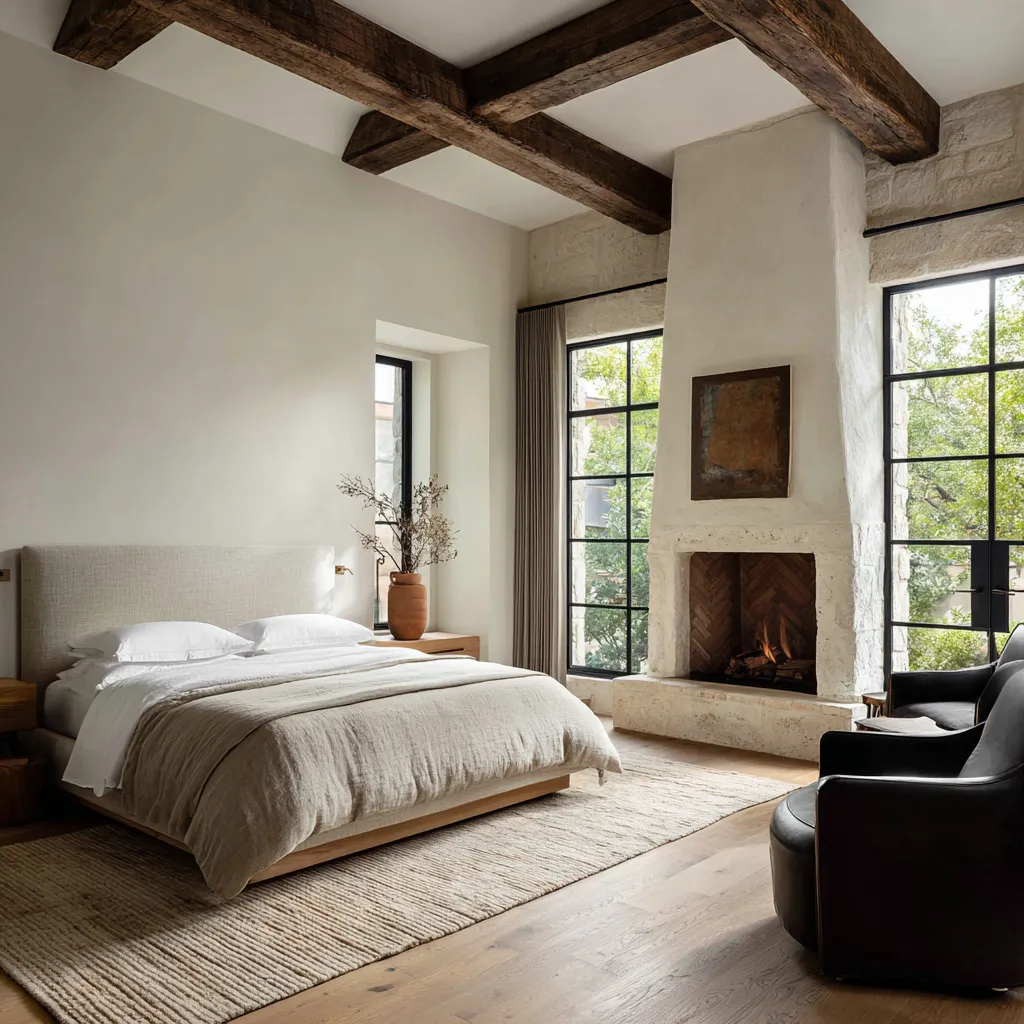
A Santa Barbara bedroom typically keeps its character in:
- exposed dark timber overhead
- thick plaster or stucco-like wall surfaces
- arched windows or door openings
- deep reveals around glazing
- substantial fireplaces or chimney masses
- leather seating or bench pieces
- dark wood furniture with weight
- restrained bedding that does not compete with the shell
- an old-world but pared-back material register
This is the least portable of the three California bedroom families. You can borrow its colors or add a rust leather chair to a generic room, but without the right shell, the style usually weakens fast.
Why beams matter here
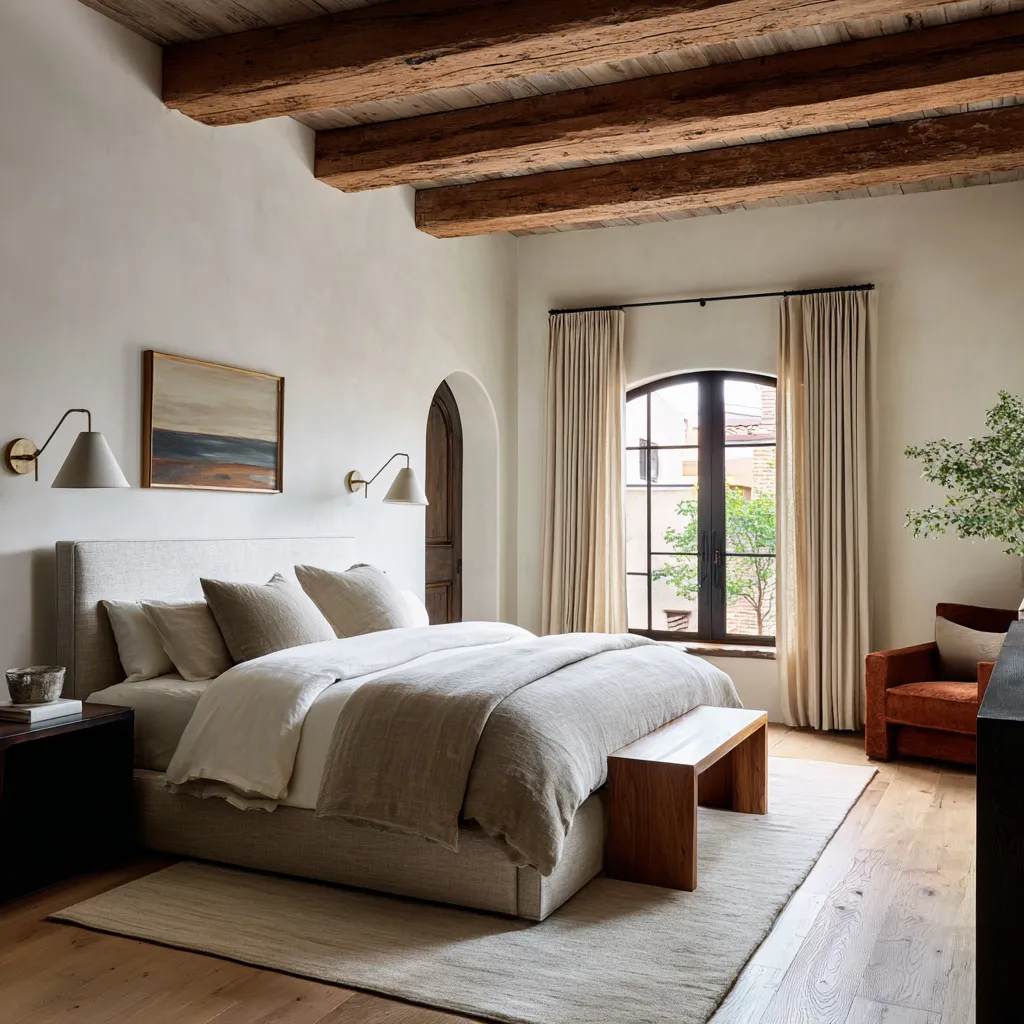
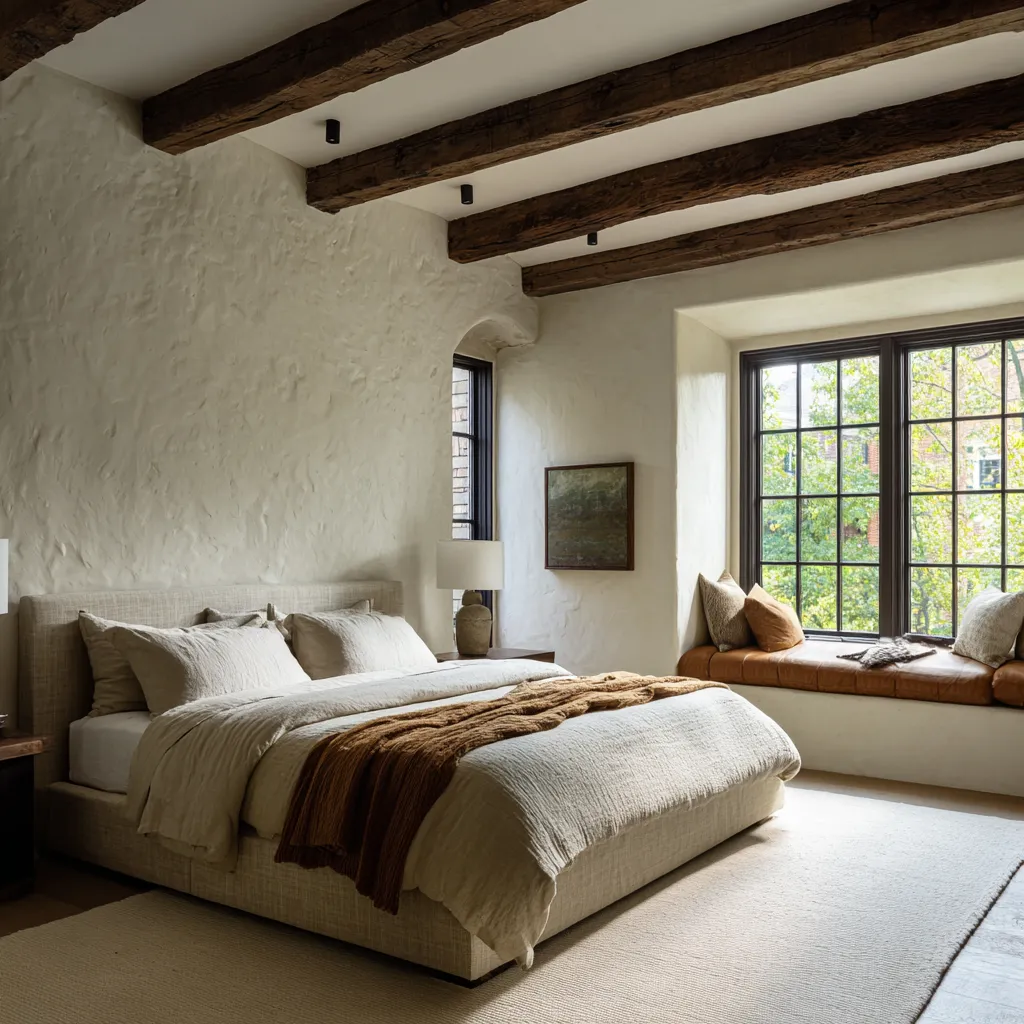
Exposed beams do not act like a decorative extra in Santa Barbara style. They carry historical and visual weight.
They lower the center of gravity from above, bring warmth into the room through aged wood, and immediately connect the bedroom to a regional architectural language tied to Spanish Colonial revival, Mediterranean house forms, ranch structures, and masonry-based living. That does not mean every Santa Barbara room must look heavy or dark.
Modern versions keep the walls pale, the bedding quiet, and the object count restrained so the timber can read clearly without overwhelming the room.
The importance of wall depth and openings
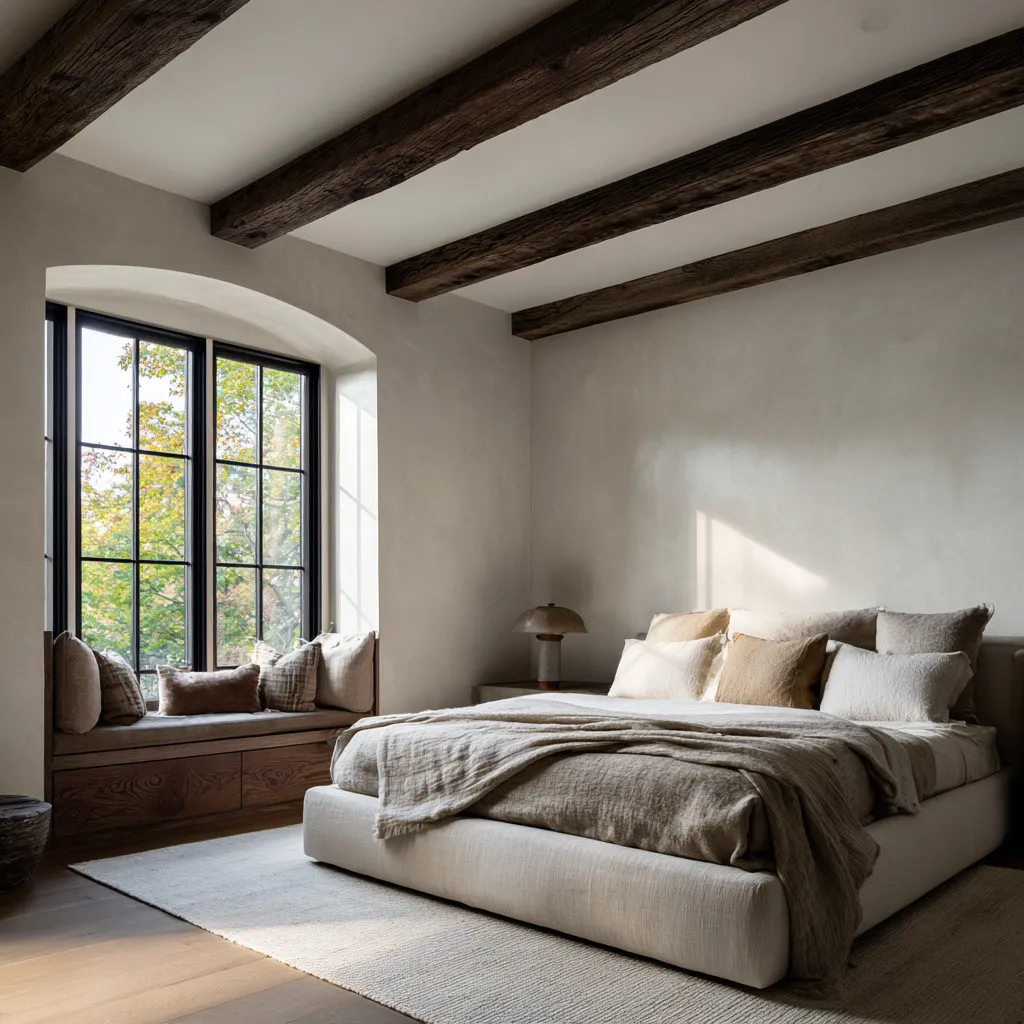
One of the Santa Barbara signals is not simply the presence of an arch, but the feeling that the opening is set into a thick wall. A deep window seat, a recessed doorway, or a built-in niche changes the room immediately.
It suggests mass. It gives the bedroom a carved, substantial quality.
It makes the shell feel inhabitable instead of flat. This is a major difference from the role a bench plays in the other California styles.
In boho, a seat supports lingering and softness. In chic, it completes a suite-like layout.
In Santa Barbara, it proves the depth and presence of the architecture.
Fireplaces in Santa Barbara bedrooms
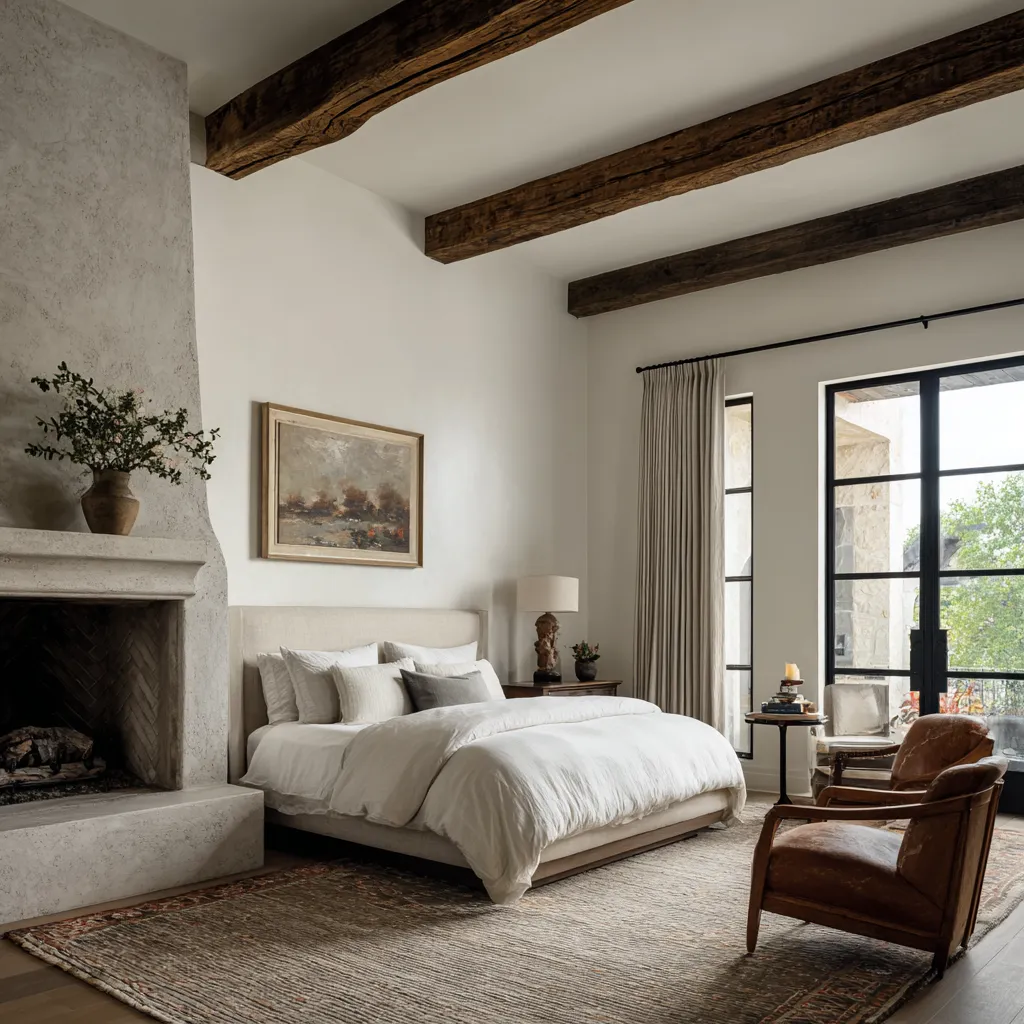
Fireplaces are not always present, but when they are, they often do a great deal of style work. A plastered chimney mass or pale stone hearth can act as a second major anchor in the room, sometimes almost equal to the bed.
This creates a bedroom that feels less like a single-purpose sleep zone and more like a substantial room within a larger house. A well-handled Santa Barbara fireplace usually does not need much ornament.
Its size, wall integration, and material weight are often enough.
The bed in a Santa Barbara bedroom
The bed is frequently low here too, but again, its meaning changes. In Santa Barbara style, the low bed helps keep the architecture in charge.
It stays broad, soft, and muted so it does not fight the beams, arches, or plaster mass around it. This is why many Santa Barbara beds are simpler than people expect.
The room does not need them to perform theatrically. Their job is to add softness and calm inside a stronger shell.
How Santa Barbara style handles warmth
The warmth often moves through different carriers than in boho or chic. Instead of relying mainly on rust pillows or woven accents, the room may carry warmth through dark timber, reddish-brown leather, terracotta-like undertones, saddle-colored seating, clay vessels, muted wood furniture, or the mineral warmth of fire and plaster.
That gives Santa Barbara bedrooms a heavier, deeper warmth than the other two styles, even when the palette is still restrained.
What Santa Barbara style gets wrong when it is poorly done
The first mistake is making the furniture too historically literal. Too much rustic carving, too many old-world decorative references, and too much period heaviness can turn the room into a staged revival interior rather than a current bedroom with regional depth.
The second mistake is thinning out the shell too much. If the room loses plaster weight, ceiling timber, opening depth, and hearth presence, then the remaining furnishings often read as vaguely Mediterranean rather than clearly Santa Barbara.
Modern designs keep the shell substantial and the furnishings edited.
Why These Three Styles Get Confused Often
Because they share a climate vocabulary, one can often mistake one style for another. The overlap is real.
All three commonly use:
- warm off-whites and beiges
- daylight as a major design factor
- natural fibers and matte surfaces
- some form of indoor-outdoor relation
- low-profile beds
- a dislike of visual clutter
- carefully limited accent color
That is why a single detail can never define the style by itself. A black-framed window does not automatically make a room chic.
A rust pillow does not automatically make it boho. An arch alone does not fully establish Santa Barbara.
A window bench can belong to any of the three. The meaning of each feature depends on the whole room around it.
The Details That Are Often Overrated
Black-framed glazing
This is one of the common California shorthand signals right now, but it is not a precise style marker. It appears in California boho, California chic, and Santa Barbara bedrooms.
In many designs it functions as a broad contemporary West Coast condition rather than a specific style clue.
Warm rust and clay accents
These are useful, but they are not exclusive to any one California bedroom family. What changes is how they appear.
- In boho, they often arrive through pillows, faded rugs, dried branches, woven pieces, and soft textile clustering.
- In chic, they are usually tighter and more concentrated—one pillow, one throw, one chair, one small warm note to sharpen the composition.
- In Santa Barbara, they often shift toward leather, adobe, terracotta, saddle, or earthen mineral warmth.
Low beds
All three styles use them, but for different reasons.
- In boho, the low bed supports looseness and lounge-like ease.
- In chic, it creates stillness and breadth.
- In Santa Barbara, it leaves room for the architecture to remain dominant.
So the bed height alone does not tell you enough.
How to Tell the Difference Quickly
If you want a fast way to read the room, ask these three questions.
1. If the textiles were removed, what would still be left?
- If the design would lose most of its identity without the bedding, pillows, rug, and tactile accessories, you are probably looking at California boho.
- If the design would still feel planned, polished, and complete because the millwork, case goods, bench, proportions, and material pairings remain strong, you are probably looking at California chic.
- If the design would still read clearly because the plaster, beams, arches, deep-set openings, and fireplace carry the atmosphere, you are probably looking at Santa Barbara style.
2. Where is the richness stored?
- In fabrics and surface detail: boho
- In order and material adjacency: chic
- In the shell and structural expression: Santa Barbara
3. How much does the room rely on architecture?
- Low reliance: boho
- medium to high reliance: chic
- very high reliance: Santa Barbara
This framework is far more dependable than trying to identify the style from one accessory or one color note.
Transitional Rooms: How One Style Slips Toward Another
Usually, bedroom designs do not sit neatly inside one category. Modern bedroom designs combine traits, especially between boho and chic.
From California boho toward California chic
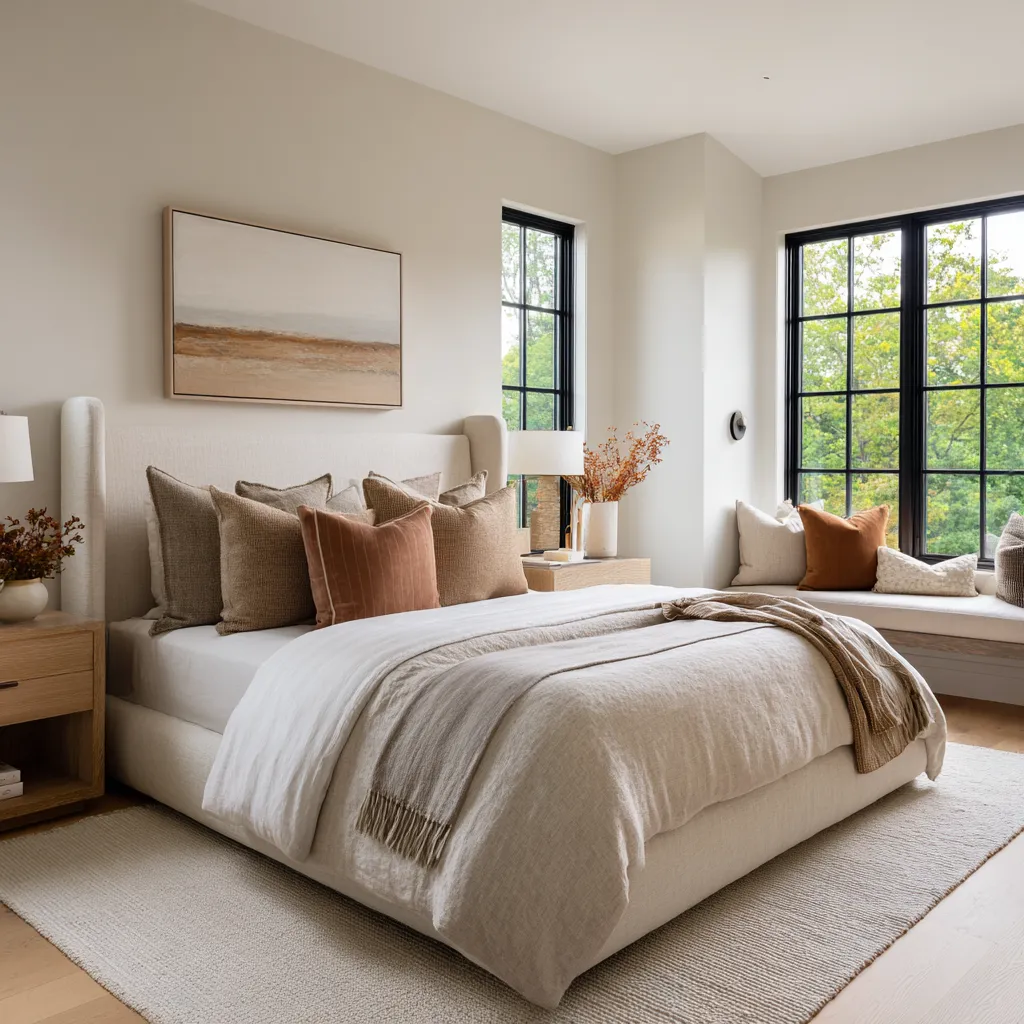
This is one of the typical design migrations today. A room can keep the warm palette and the soft bedding, then gradually become more chic by doing the following:
- reduce visible pattern
- reduce folk-leaning artifact cues
- cut back the number of accent objects
- increase symmetry or visual balance
- strengthen the headboard silhouette
- introduce more substantial case goods
- turn the window seat into a cleaner architectural element
- use quieter art with stronger placement
This shift keeps the softness but changes the organizational logic of the room. That is the key difference.
From Santa Barbara toward a current minimal direction
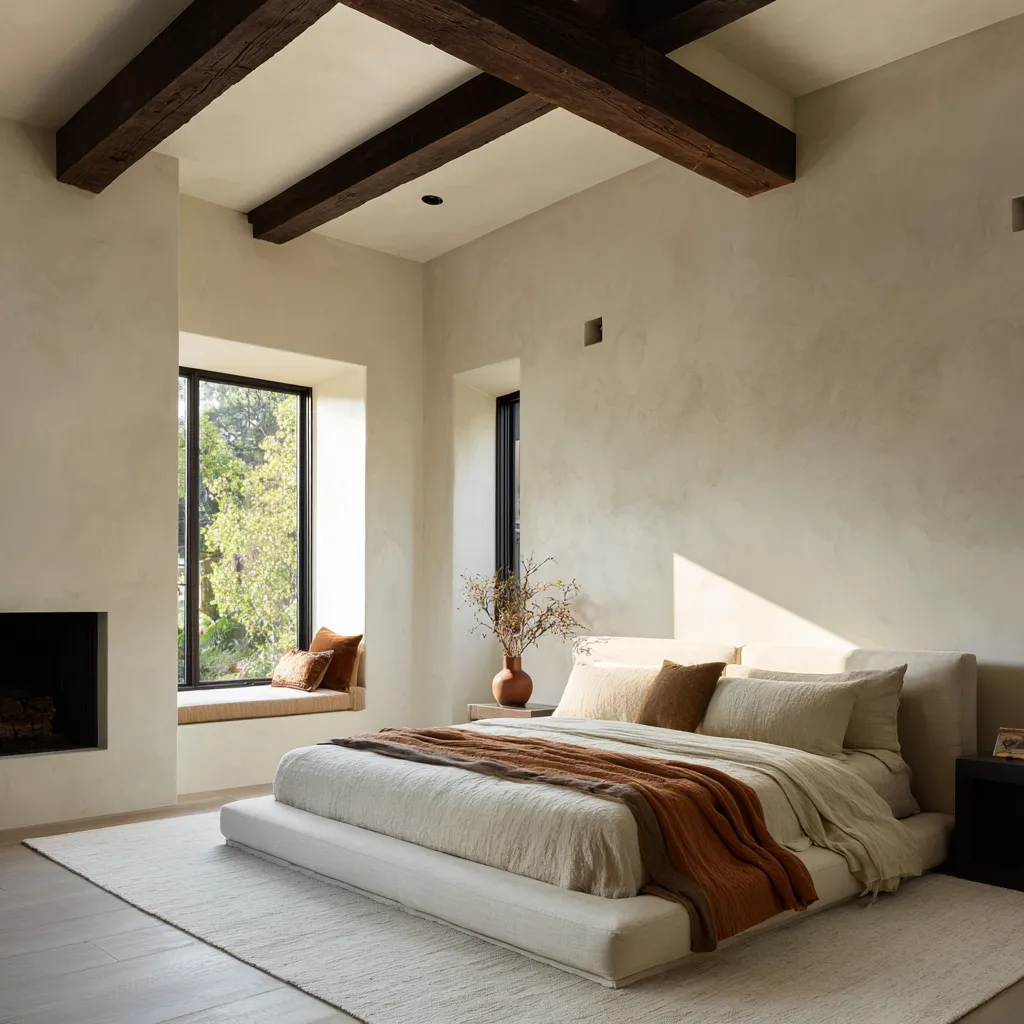
Santa Barbara can also move toward a more current mode, but the route is different. The room usually stays true to the style by keeping the beams, plaster, wall depth, and hearth presence while simplifying the furnishings.
The bed becomes quieter, art becomes more restrained, and decoration stays sparse. The shell remains strong; the furniture becomes calmer.
That is a very different process from the boho-to-chic shift. In Santa Barbara, the architecture is never the part to reduce.
The Direction Current California Bedrooms Are Moving
One of the broad patterns in modern California bedroom design is the move toward fewer objects and lower color contrast. Modern versions of all three styles still value warmth, but they usually avoid excessive display and harsh color contrast.
Richness is built through material depth, tonal compression, and the contrast between soft and hard surfaces rather than through a large amount of bright color. That is why modern California bedrooms feel calm without feeling flat.
They are not empty. They are concentrated.
Final Thoughts
California bedroom design is easiest to understand once you stop treating it as one loose category and start seeing its internal structure.
- California boho is furnishing-led. It builds atmosphere through tactile layering, warm earth accents, handmade cues, and a gentle degree of irregularity.
- California chic is system-led. It builds depth through order, proportion, built-ins, case goods, and refined material relationships.
- Santa Barbara style is architecture-led. It builds identity through plaster, timber, wall depth, arches, fireplaces, and a quiet furnishing layer that lets the shell stay in charge.
That is the main distinction. These bedrooms do not differ mainly in color.
They differ in where they keep their richness.