A modern coastal backyard design does not begin with seashells, striped fabric, or a pile of nautical references. The modern design concepts with coastal character usually work in a different way.
They borrow from shoreline life through light, surface, air, weathering, shelter, and the memory of materials shaped by time. The result feels grounded, airy, and mature.
It carries the coast without trying too hard to announce it.
That distinction matters. Many backyards aim for a coastal look and end up leaning on familiar signals: blue accents, obvious beach objects, playful motifs, or furniture that feels themed rather than rooted.
The fresher approach is subtler and far more architectural. It asks a different question.
Instead of asking which decorative items look coastal, it asks which spatial conditions, surfaces, and material relationships remind us of shoreline living in a refined way.
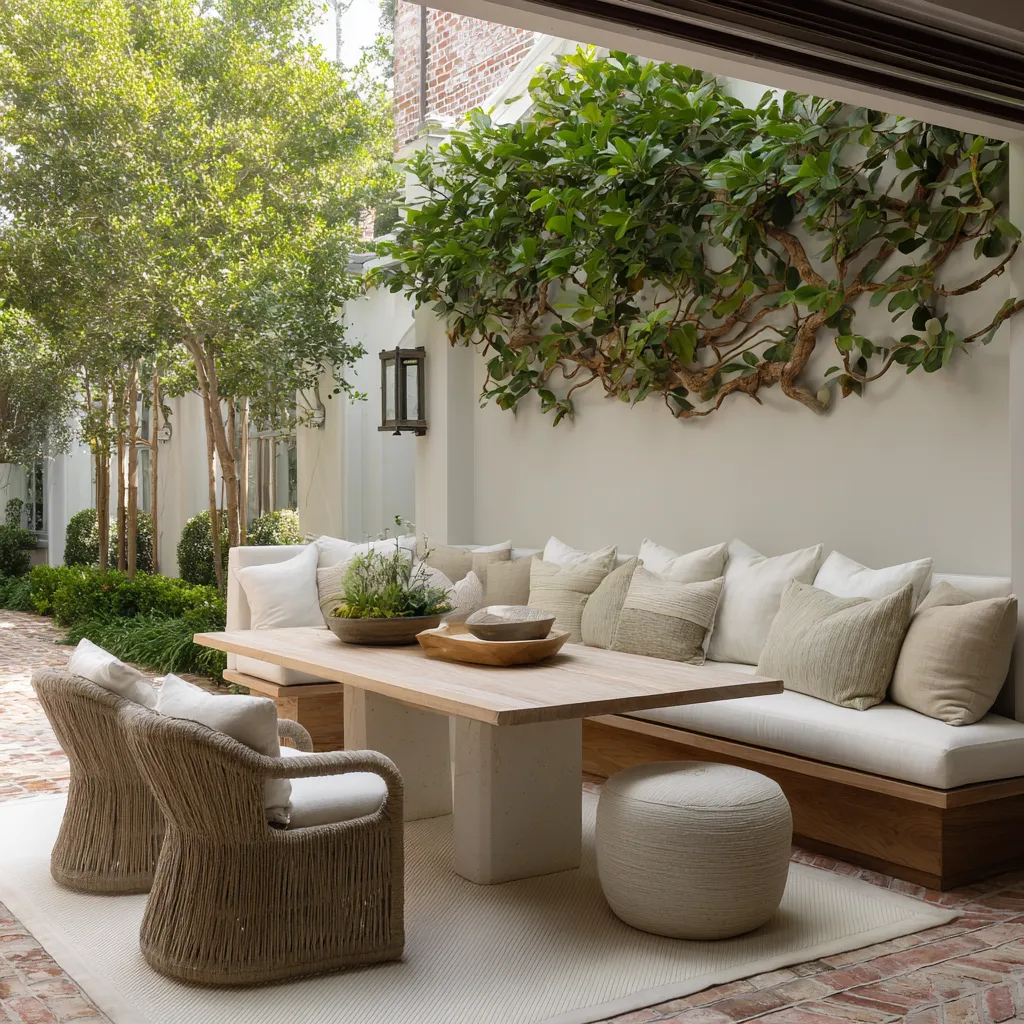
This is where modern coastal backyard design becomes genuinely interesting. The coast enters the space through chalky plaster, pale stone, woven chairs, grasses, drift-toned timber, lantern-like metal details, low seating, broad sky, and the contrast between bright exposure and shaded refuge.
Even a backyard with no visible water can still feel tied to shoreline life because it has the right atmosphere. The design captures the logic of the coast rather than its clichés.
Coastal feeling begins in the ground plane
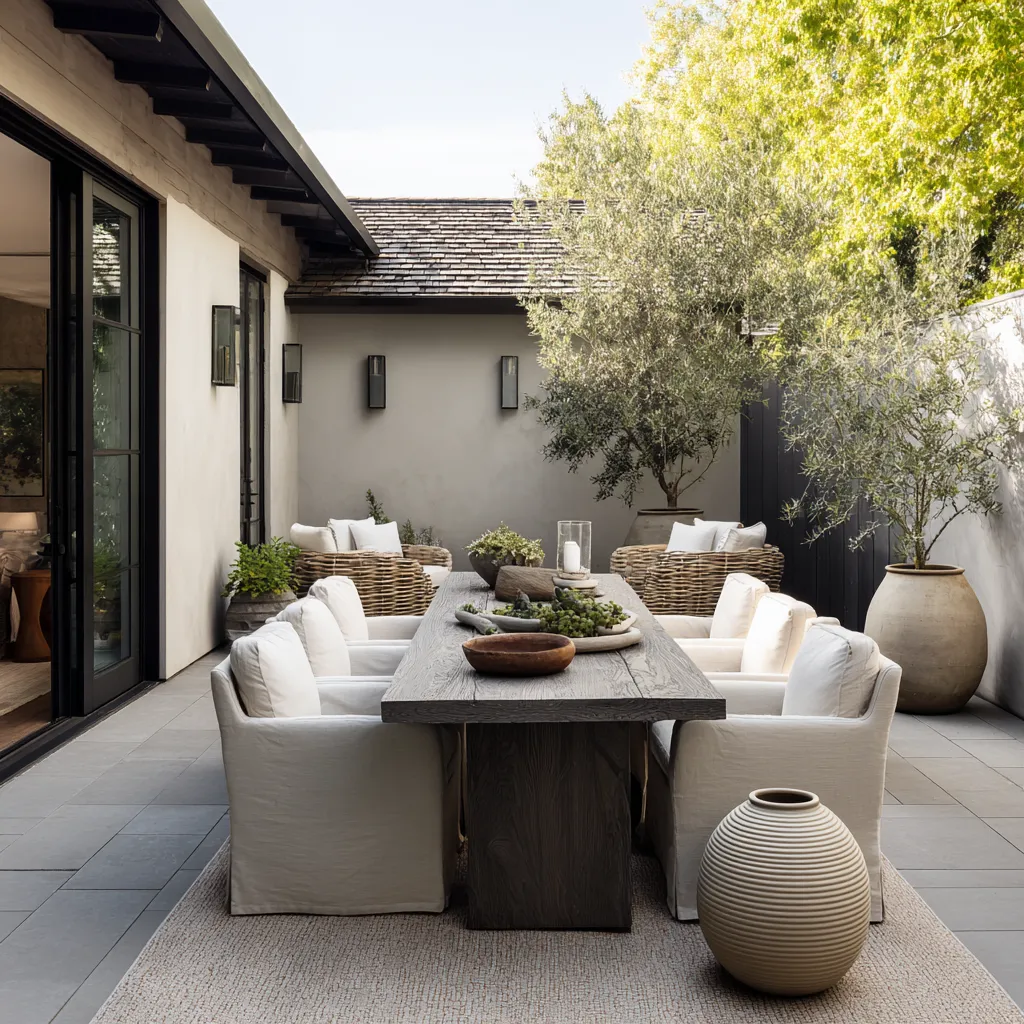
One of the ways to build a fresh coastal backyard is through the surfaces underfoot and around the perimeter. Pale mineral materials do an enormous amount of work.
Limestone, travertine, shell-toned paving, chalky stucco, limewashed walls, pale decking, white gravel, and dry-looking plaster all create a bright but softened field of reflection. That is essential because coastal settings are shaped by light bouncing off stone, sand, water, and sky.
The key is not simple whiteness. A flat bright white can feel hard, cold, or generic.
What works better is a surface with body: slightly cloudy plaster, honed stone with soft variation, a pale deck with a sun-worn look, or gravel that has a dry mineral grain. These materials hold light in a gentle way.
They create the impression of sun without glare becoming aggressive. This is why many successful coastal backyards feel calm before a single accessory is added.
The paving and wall finishes already establish the setting. They suggest exposure, brightness, and outdoor life in a place where light matters.
A backyard design becomes convincing when these mineral surfaces are allowed to stay broad and legible. Large-format stone, uninterrupted plaster walls, long retaining planes, low parapets, and open gravel fields all help the eye read the yard in horizontal bands.
That banding matters because coastlines are often experienced as layers: ground, ledge, water, horizon, sky. A backyard can borrow that same rhythm even without any direct marine imagery.
The coast arrives through weathering
Fresh coastal design has a deep relationship with time. One reason some backyard designs feel false is that every surface looks newly installed, sealed, polished, and cosmetically complete.
Shoreline places rarely feel like that. Even refined coastal environments usually contain some trace of exposure: silvered wood, softened grain, porous stone, oxidized metal, worn paint, driftwood texture, coral-like surface, or a collected object whose age gives it credibility.
Weathering acts like memory. It brings the idea of wind, salt, sun, abrasion, and repeated outdoor use into the space.
Without that note, a coastal backyard can become too clean and too showroom-oriented.
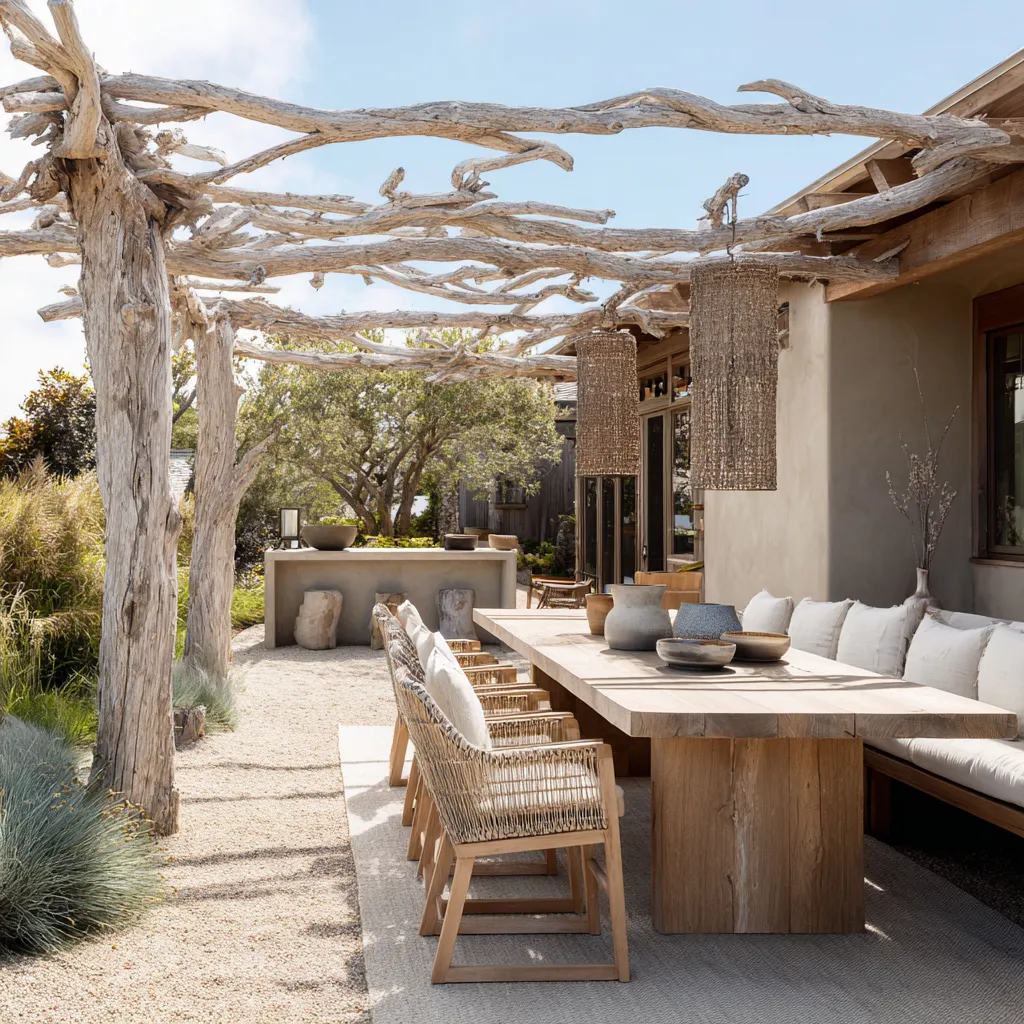
This does not mean the whole yard must look rough. In fact, the most persuasive backyards often pair fresh pale surfaces with one or two aged elements.
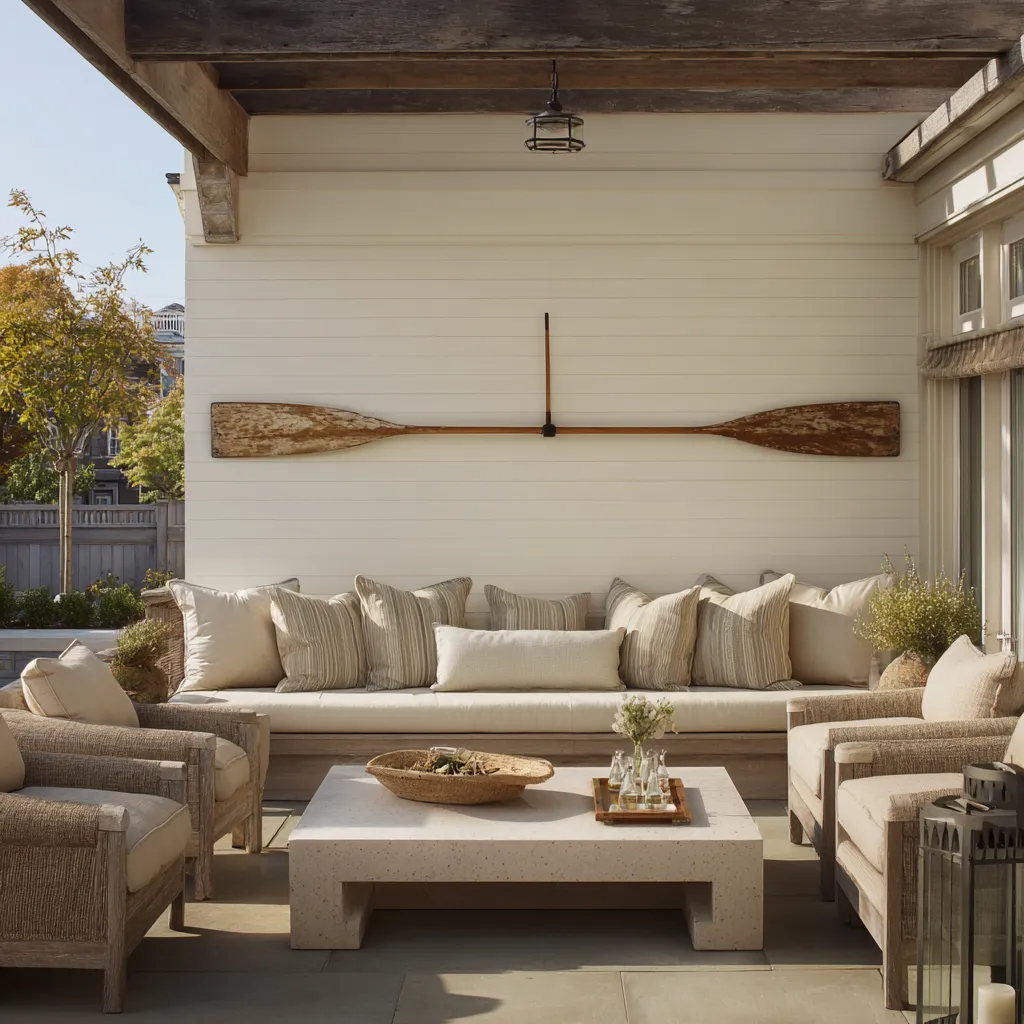
A chalky wall behind a weathered paddle. Pale paving beside a drifted timber table.
A clean banquette with a rusted chain-wrapped timber block nearby. A refined lounge area beneath a dark roof plane that suggests old dock timber.
The tension between freshness and age is what makes the atmosphere believable. That balance is especially useful in modern work.
If every element is distressed, the backyard tips into rustic styling. If everything is pristine, the coastal note weakens.
The sweet spot lies in edited contrast: a bright architectural envelope with one or two time-marked materials anchoring it.
Fiber is one of the most reliable coastal tools in outdoor design
Woven and rope-based textures are among effective carriers of coastal atmosphere because they do several jobs at once. They bring in a marine craft memory without relying on obvious symbols.
They keep furniture visually breathable in strong daylight. They soften stone and plaster without making the yard feel plush or decorative.
They also add a dry tactile quality that feels right in bright outdoor air. This is why woven armchairs, rope-sided dining chairs, cane-like pendants, basketry stools, coarse rugs, wrapped lounge pieces, and handworked shades appear in modern coastal backyard ideas.
These materials link architecture to outdoor life. They translate the language of rope, netting, basketry, sailcloth, and breathable craft into something domestic and polished.
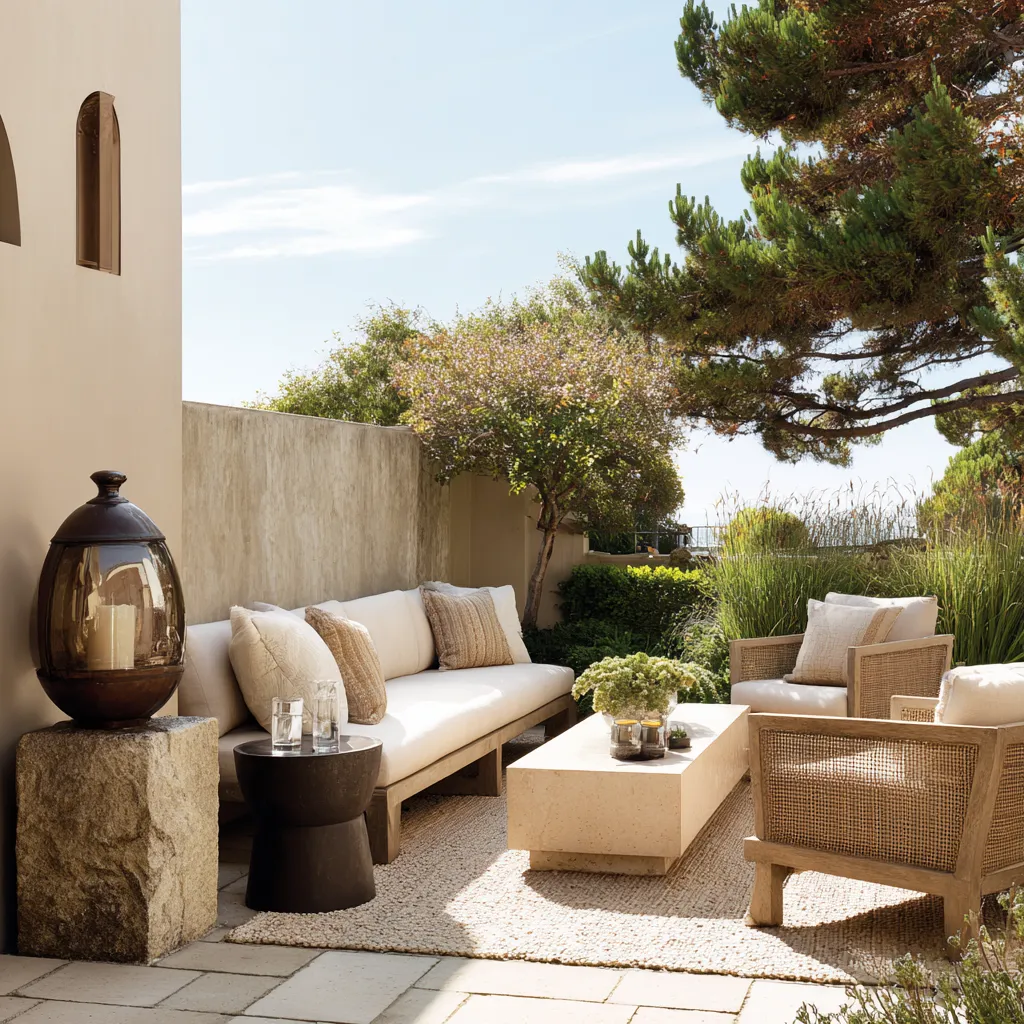
The goal is not to make the furniture look nautical. The goal is to introduce permeability.
Coastal backyards feel stronger when some of the furnishings let light and air move through them. Open weave does that beautifully.
It keeps the composition from becoming heavy, especially when the yard already contains broad pale walls, low tables, or large masonry elements. Fiber also helps connect very different parts of a backyard.
It can bridge a pale stone floor to a dark timber table, a built-in plaster bench to soft upholstery, or a gravel court to a covered pavilion. In that sense, woven texture often acts as the linking material that makes the whole backyard feel coherent.
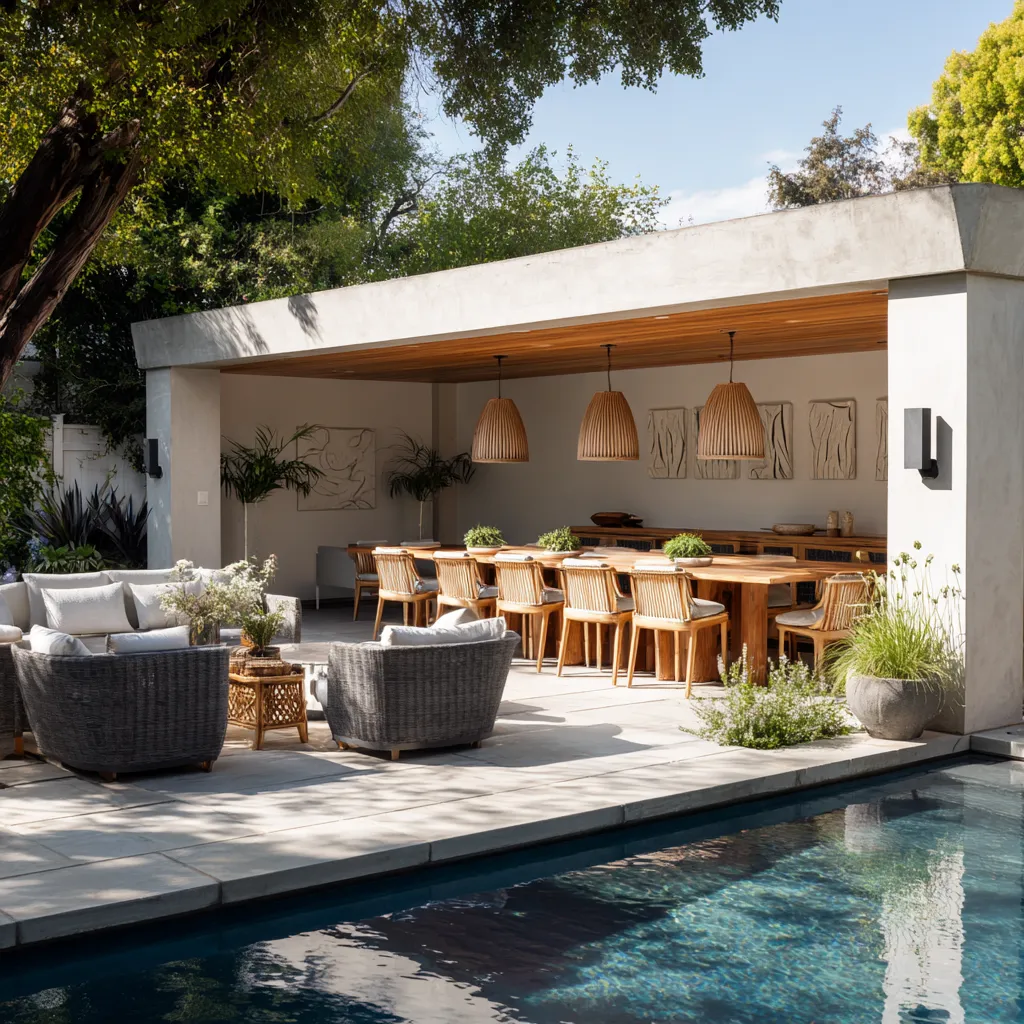
A fresh coastal backyard is often built around air and shelter
One of the least discussed aspects of coastal design is the bodily experience of moving between exposure and protection. Shoreline life is not only about open views.
It is also about the pleasure of stepping into shade after bright sun, sitting under a covered veranda while looking toward a lighter landscape, or resting in a wind-buffered court that still feels open to air. This is why compelling coastal backyard ideas are structured around threshold spaces.
Pergolas, roofed pavilions, deep overhangs, verandas, covered patios, built-in banquettes under shelter, and alcoves beside water all create the kind of refuge that coastal living often depends on.
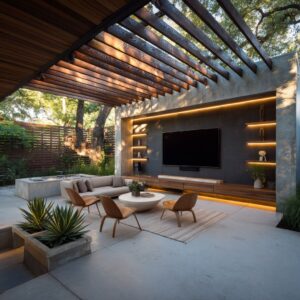
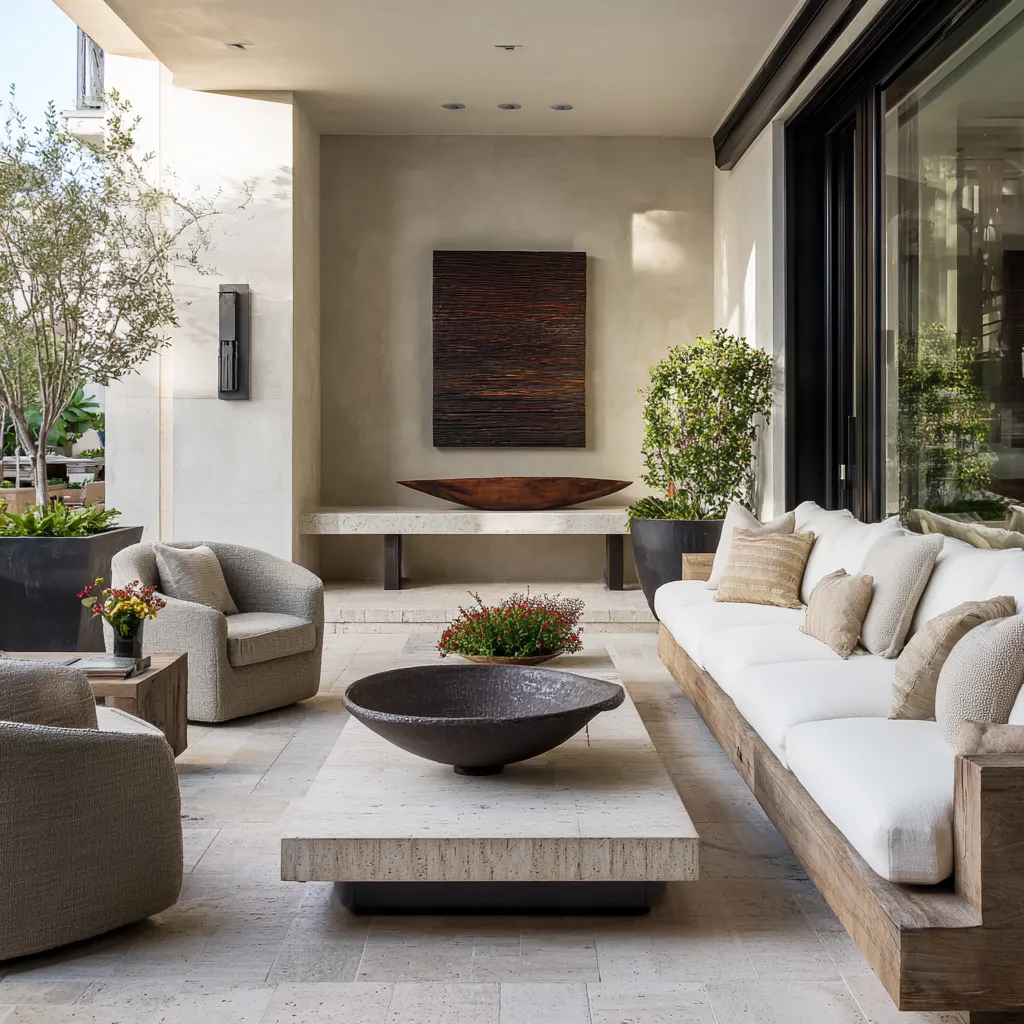
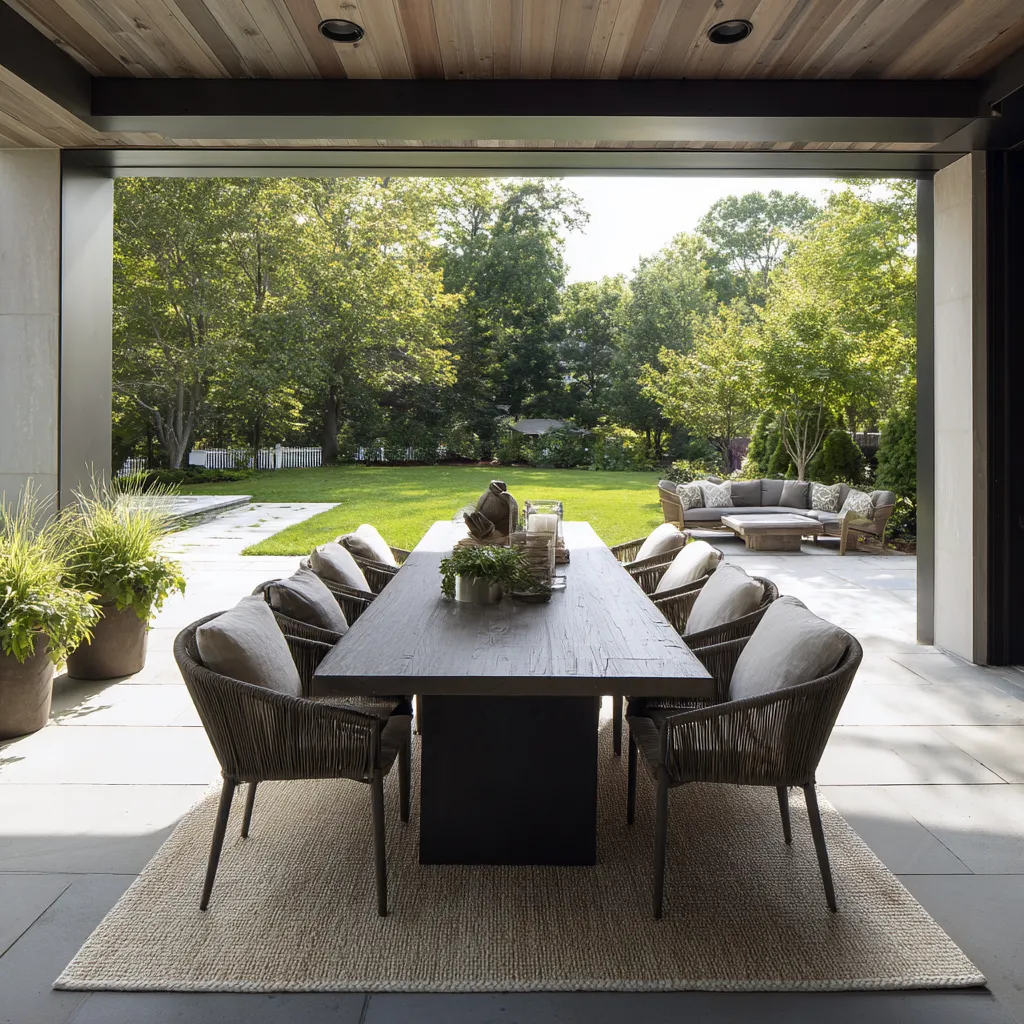
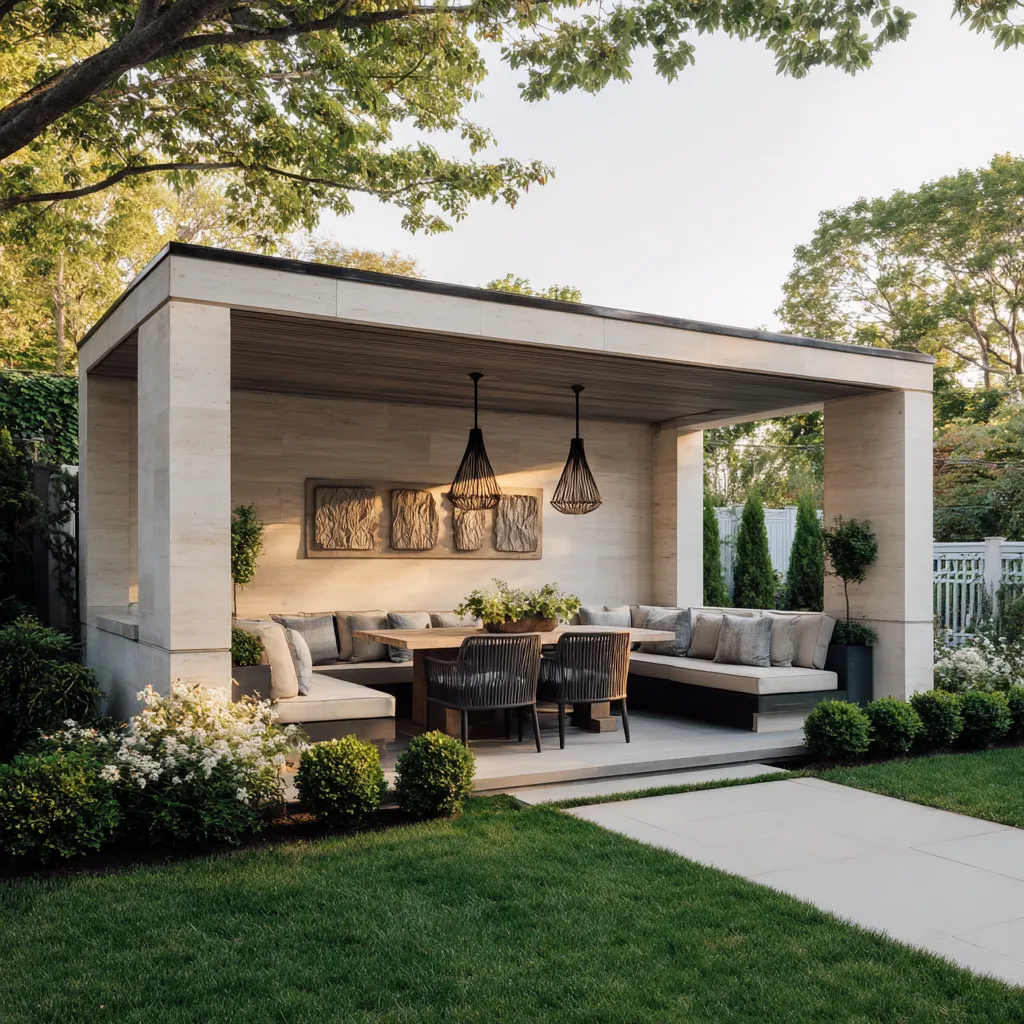
The contrast between a dark timber ceiling and pale paving below is especially powerful. A broad roof plane introduces depth, shadow, and a sense of overhead protection.
Underneath, the space becomes cooler, more grounded, and more inhabitable. If that roof opens toward lawn, sky, water, or a gravel field, the yard captures a very specific rhythm: shelter at the edge of exposure.
That rhythm has a strong coastal character. Dark timber works surprisingly well here.
Many people assume coastal spaces must stay pale from top to bottom, yet dark wood overhead can be extremely effective. It can suggest old dock timber, the underside of a boathouse roof, weathered marine wood, or simply a protective canopy that gives the bright palette enough depth.
Without a darker anchor, pale coastal spaces sometimes drift into flatness.
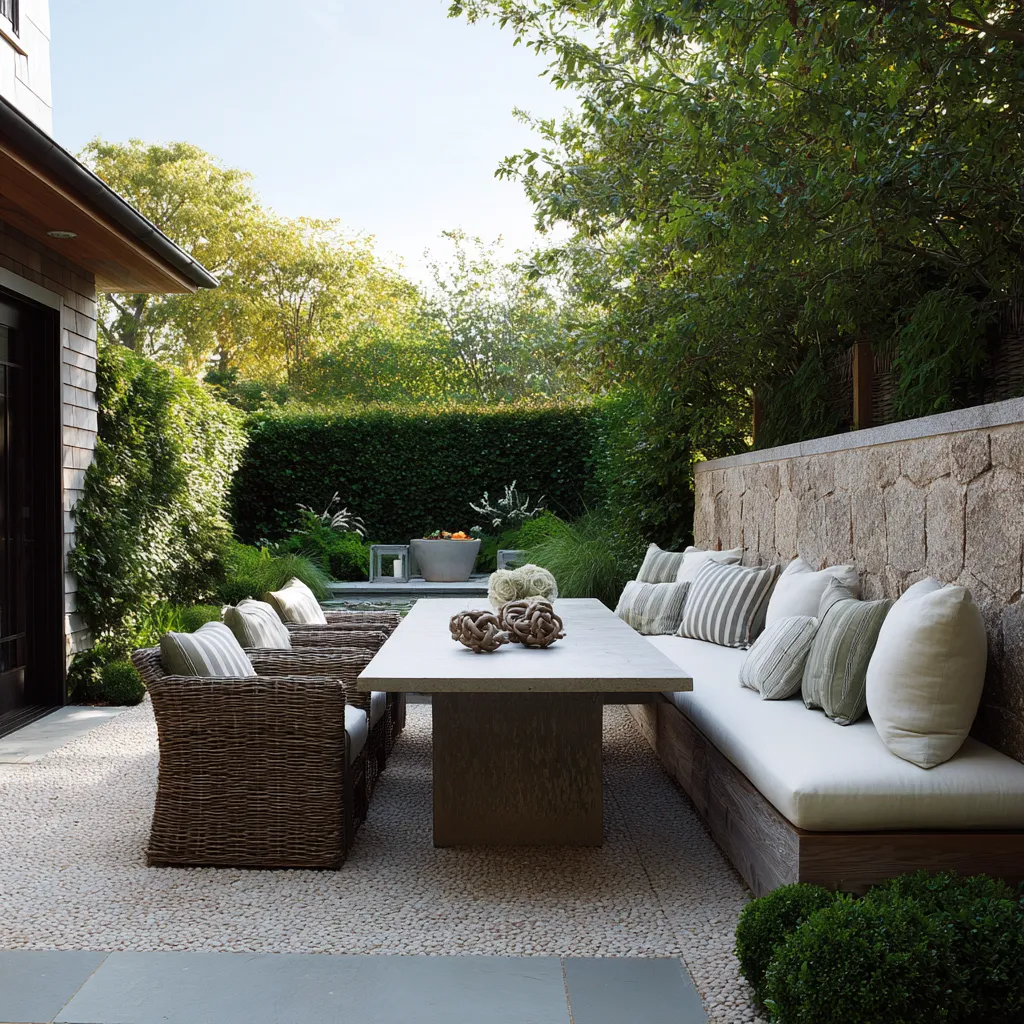
The open-sky version of coastal design feels very different from the sheltered version
Modern coastal backyards often fall into two broad moods.
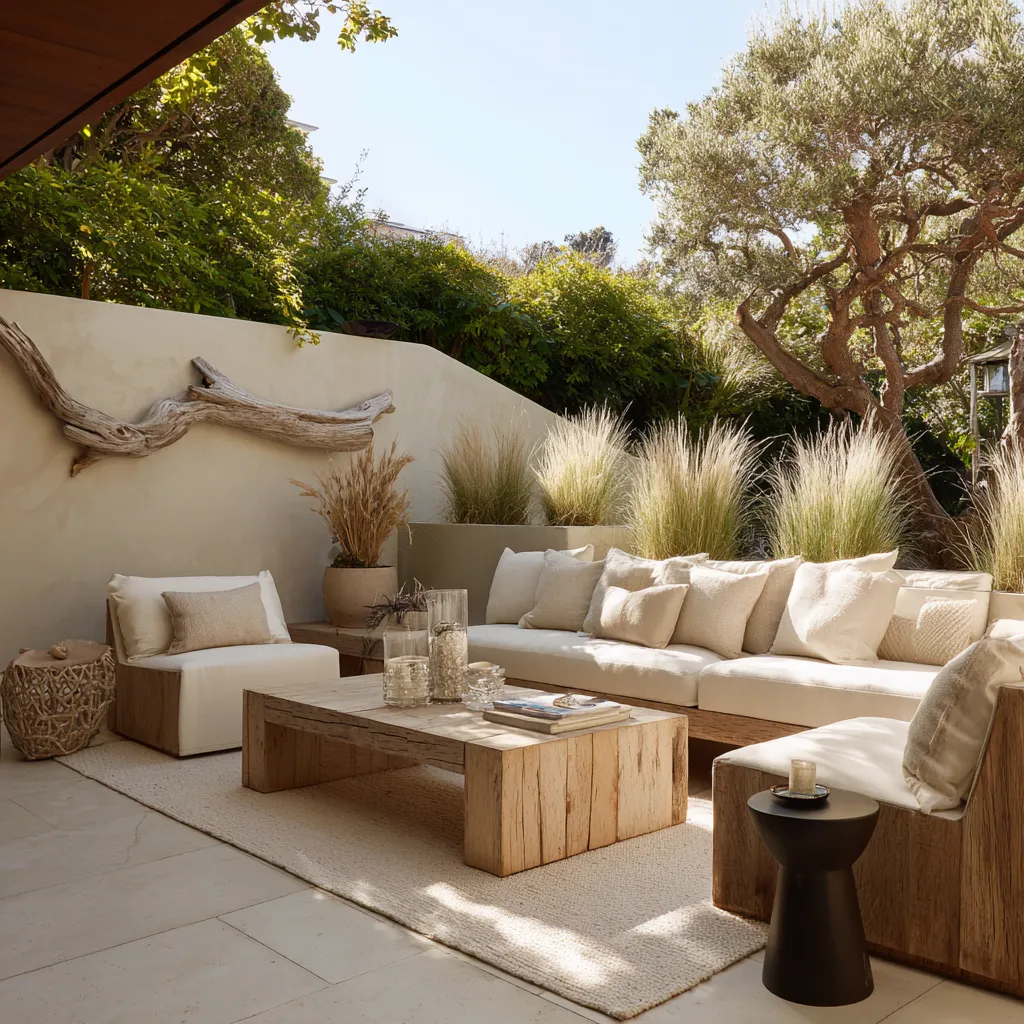
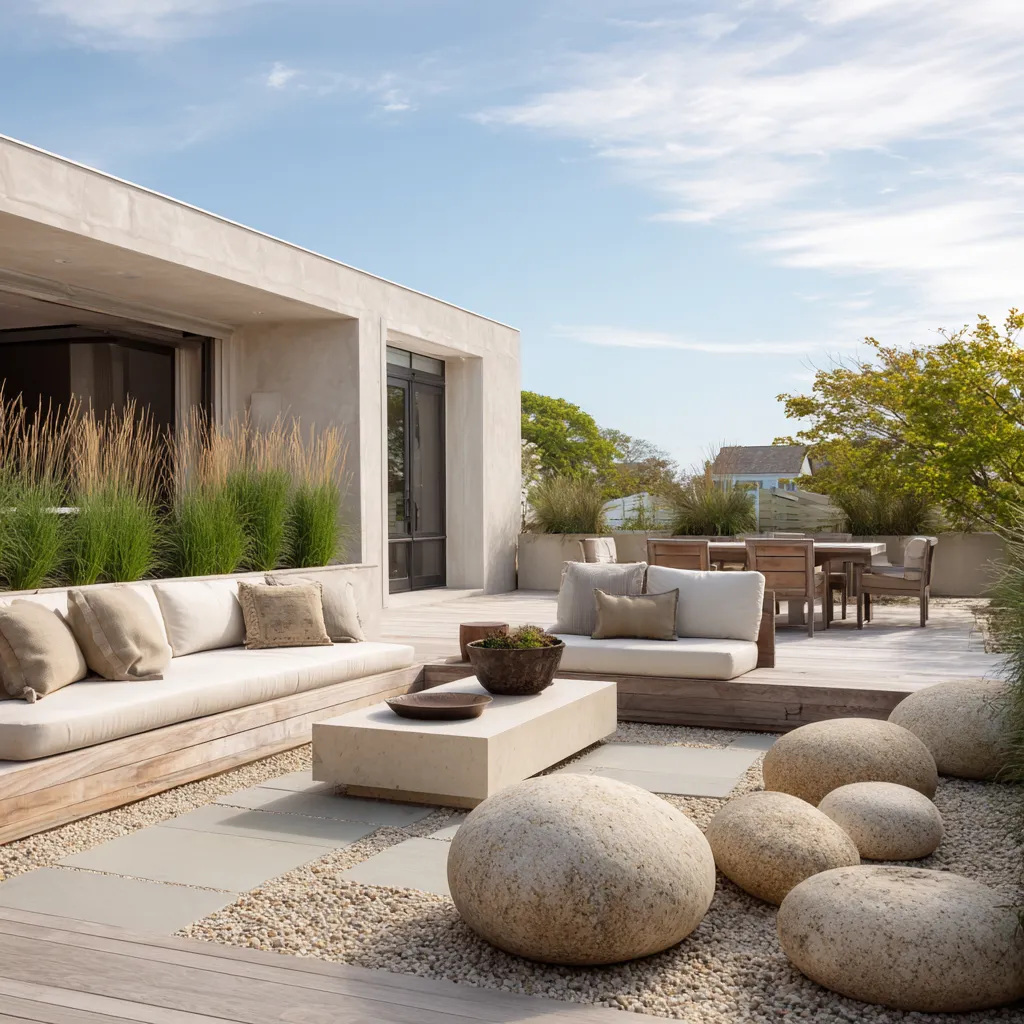
- The first mood is exposed, airy, and landform-driven. These backyards usually rely on open sky, low furniture, gravel or pebble ground, dune-like grasses, pale decks, weathered wood, and rounded stone forms. They borrow from bluff edges, beach grasses, rocky shorelines, and wind-shaped terrain. Their strength lies in openness. The furniture stays low so sky and planting remain dominant. The materials stay dry and matte. Accessories are sparse. These yards feel close to the coast through geology and atmosphere.
- The second mood is sheltered, architectural, and threshold-driven. These backyards often use covered structures, dark timber overhead, pale mineral walls, lantern-like hardware, wall-mounted objects, banquettes, and more deliberate art gestures. Their strength lies in curation. They feel like outdoor rooms rather than open landscape compositions. The coast appears through shade, aged surfaces, and a carefully framed sense of refuge.
Each route simply produces different emotional results.
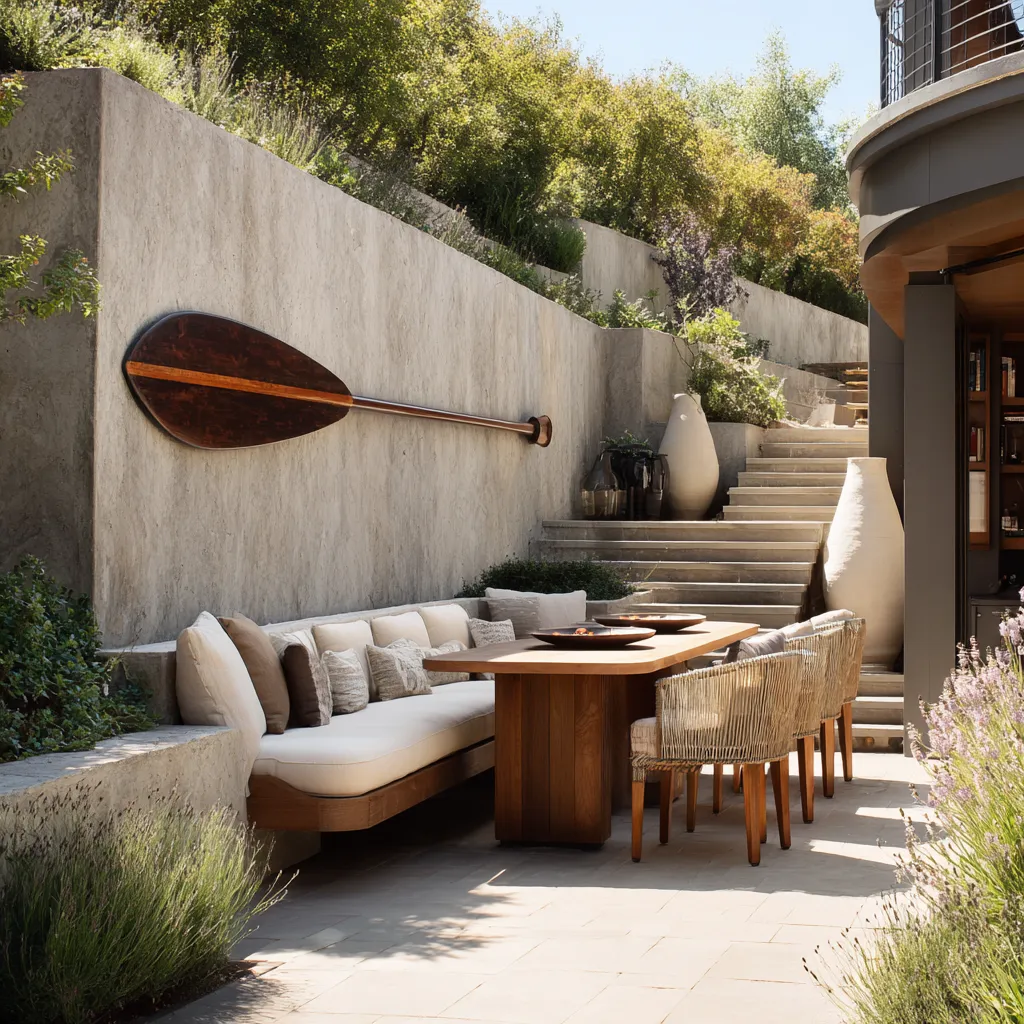
The exposed route is useful if you want the yard to feel airy, low, and tied to landform. The sheltered route works well if you want more intimacy, stronger architecture, or a backyard that can feel coastal while still operating like an outdoor living room.
Problems usually begin when a design mixes too many signals without deciding whether the mood is bluff-like or veranda-like, open or protected, geological or curated.
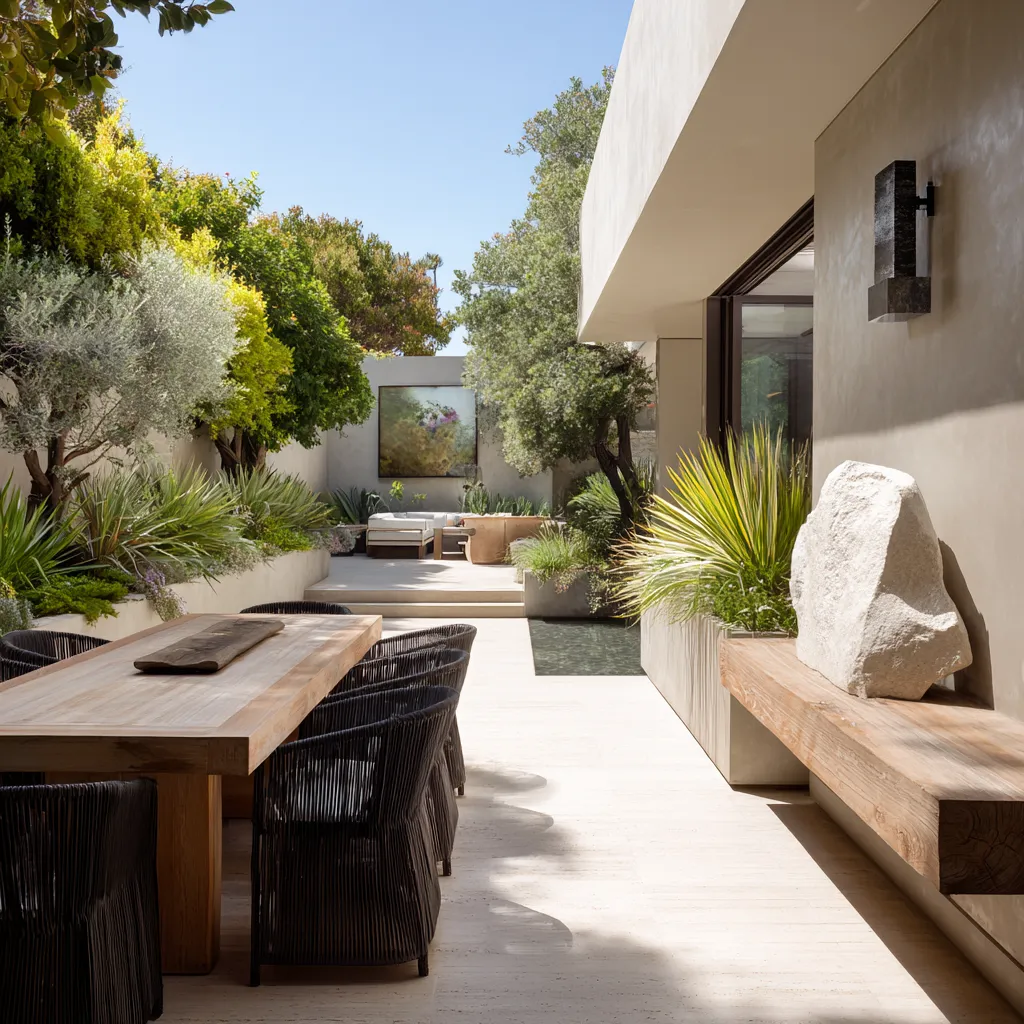
Water is helpful, but it is not required
A common mistake in coastal outdoor design is assuming that water itself must be present for the backyard to feel coastal. Coastal backyard ideas can have no visible water at all.
They create the atmosphere through mineral surfaces, fiber, planting, weathering, horizontal lines, and the relationship between openness and shelter. When water is present, the design can often be simpler.
Reflection, coolness, brightness, and adjacency do part of the work. A dining bench beside a pool edge, a pavilion next to a reflective band of water, or a narrow water channel running along a wall can immediately deepen coastal atmosphere because the yard now contains actual reflected light and a liquid surface.
Small water can be also effective. A slim reflecting channel, a narrow water edge beside paving, or a controlled linear basin often creates a more refined coastal note than a large pool treated as the main attraction.
Thin water lines feel architectural. They can suggest an inlet, tidal cut, marina edge, or calm shoreline seam.
Their restraint makes them feel collected rather than recreationally dominant. If the backyard does contain a larger pool, the surrounding choices become even more important.
Pale paving, woven furniture, tropical or breezy planting, low built-in seating, and shaded terraces help keep the water integrated into a broader coastal language. Without that support, the pool can remain simply a pool rather than part of a coastal composition.
Coastal design often relies on horizontality far more than on color
Blue is surprisingly overrated in refined coastal design. Used sparingly, a washed sea-glass green or a powder-soft water blue can work beautifully.
But heavy reliance on blue often pushes a yard toward a decorative coastal look rather than a fresh one. What matters far more is horizontality.
Long benches, stretched banquettes, low parapets, broad retaining walls, elongated tables, linear water edges, mounted paddles displayed as horizontal art, long roof planes, and wide open lawns all build the sense of a landscape that extends laterally. That lateral pull is deeply tied to shoreline memory.
The coast is often felt as a sequence of horizontal bands rather than a tight cluster of focal points.
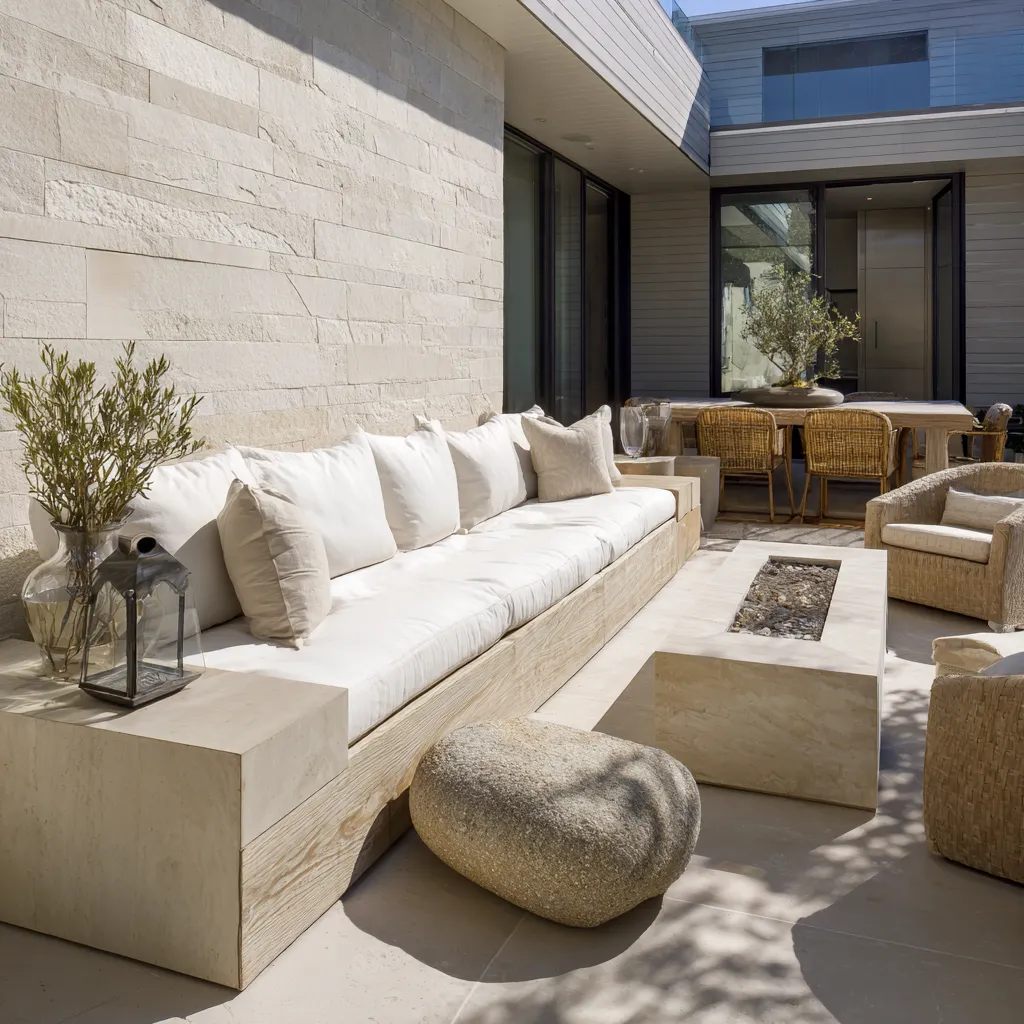
This is one reason overly busy backyard layouts can weaken the coastal note. Too many small objects, too many ornamental planting islands, too many competing zones, or too many decorative interruptions break the long calm lines that help the eye feel the coast.
A better approach is to let one long bench stay visible, allow a pale retaining wall to run uninterrupted, keep the table elongated, or let the planting mass in simple horizontal drifts rather than scattered round clusters. The backyard then begins to feel steadier, broader, and more shore-adjacent.
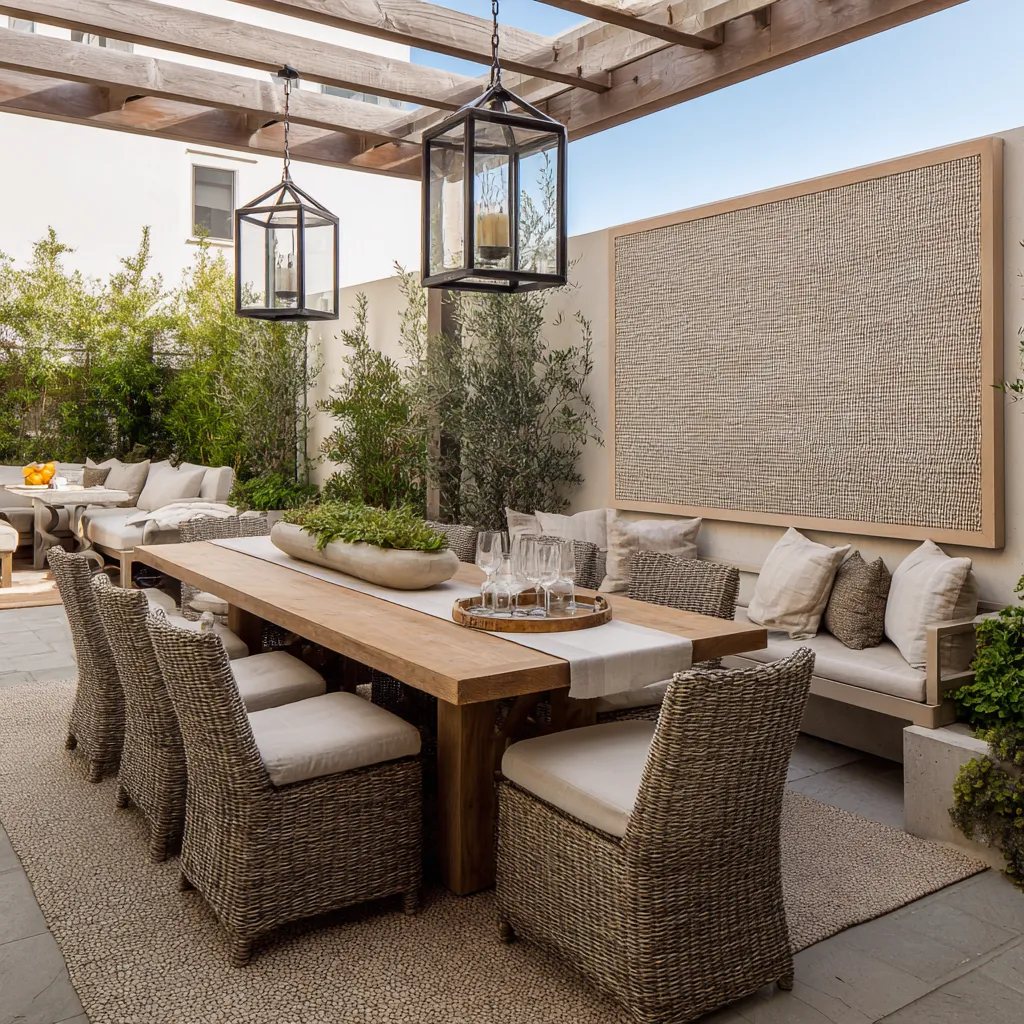
Planting should suggest exposure, breeze, and brightness
Fresh coastal planting usually avoids heavy floral display. Dense color, busy blooming beds, and overly gardened edges can pull the yard toward a generic decorative landscape rather than a coastline-informed one.
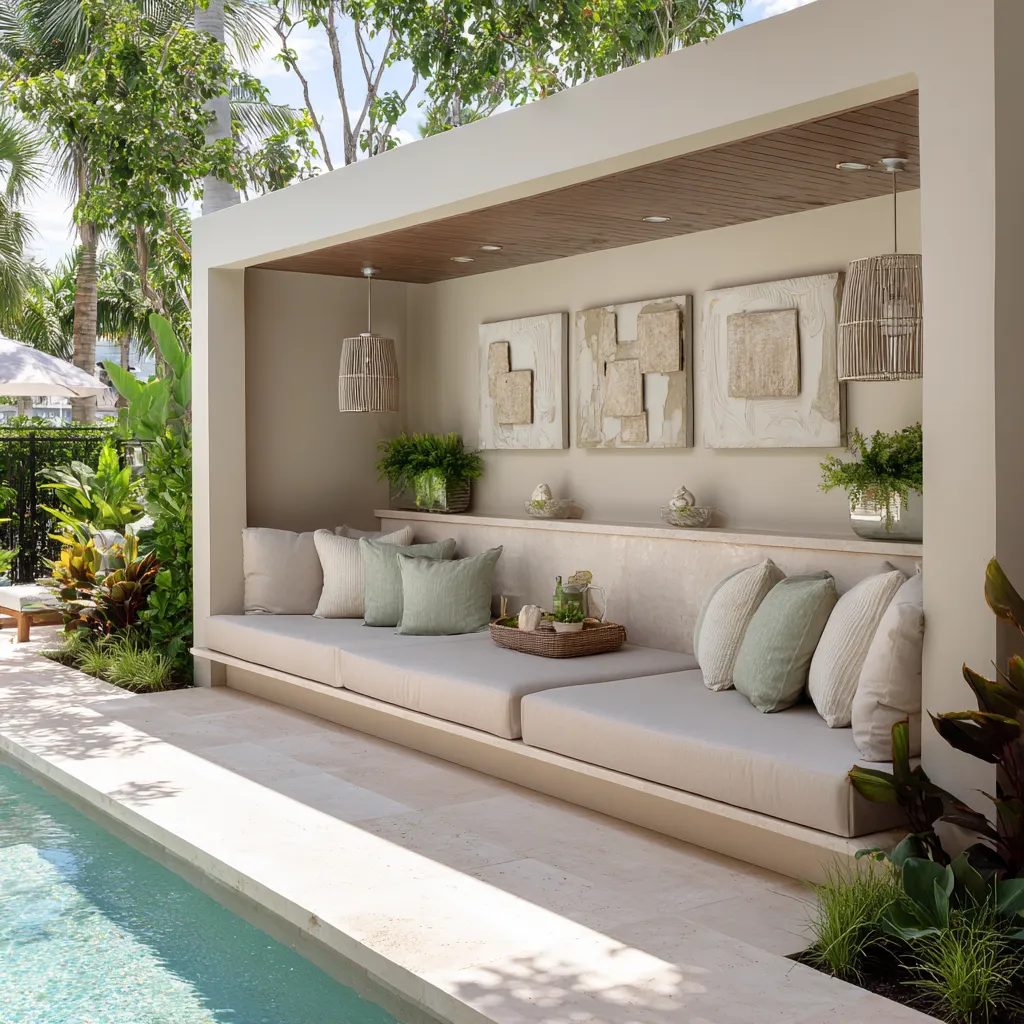
Planting with stronger coastal character often falls into a few families.
- One family is made of grasses and fine-textured plants that suggest air movement and dune logic. Ornamental grasses, feathery forms, reeds, and narrow-bladed masses create a breezy edge. They help the yard feel open, exposed, and shaped by wind.
- Another family uses silvery or muted foliage. Olive trees, gray-green shrubs, dusty leaves, and soft dry-climate planting all imply brightness, heat, and a slightly weathered landscape. These plants do not need to be literal beach species. Their value lies in their color cast and their ability to hold light in a coastal way.
- A third family appears in water-adjacent or humid-climate backyard ideas, where controlled tropical planting can support the coastal idea. Palms, broad leaves, and lush green material can work well if the architecture and furniture remain edited. The result should feel like a cultivated waterside court, not a tropical theme garden.
What links all of these planting directions is restraint. Coastal backyard ideas do not overfill every corner.
They leave room for paving, gravel, walls, furniture, and light. The planting frames the air rather than crowding it.
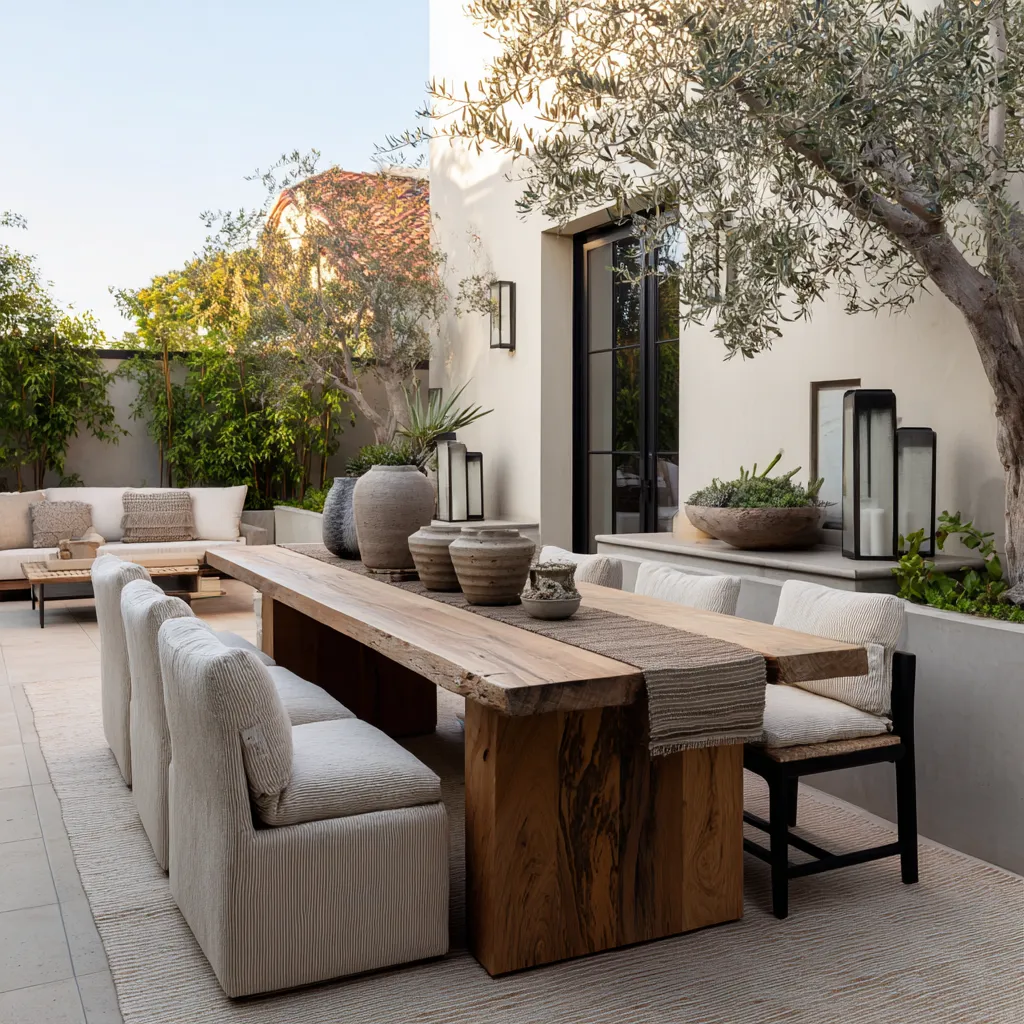
Geological forms for the shore look
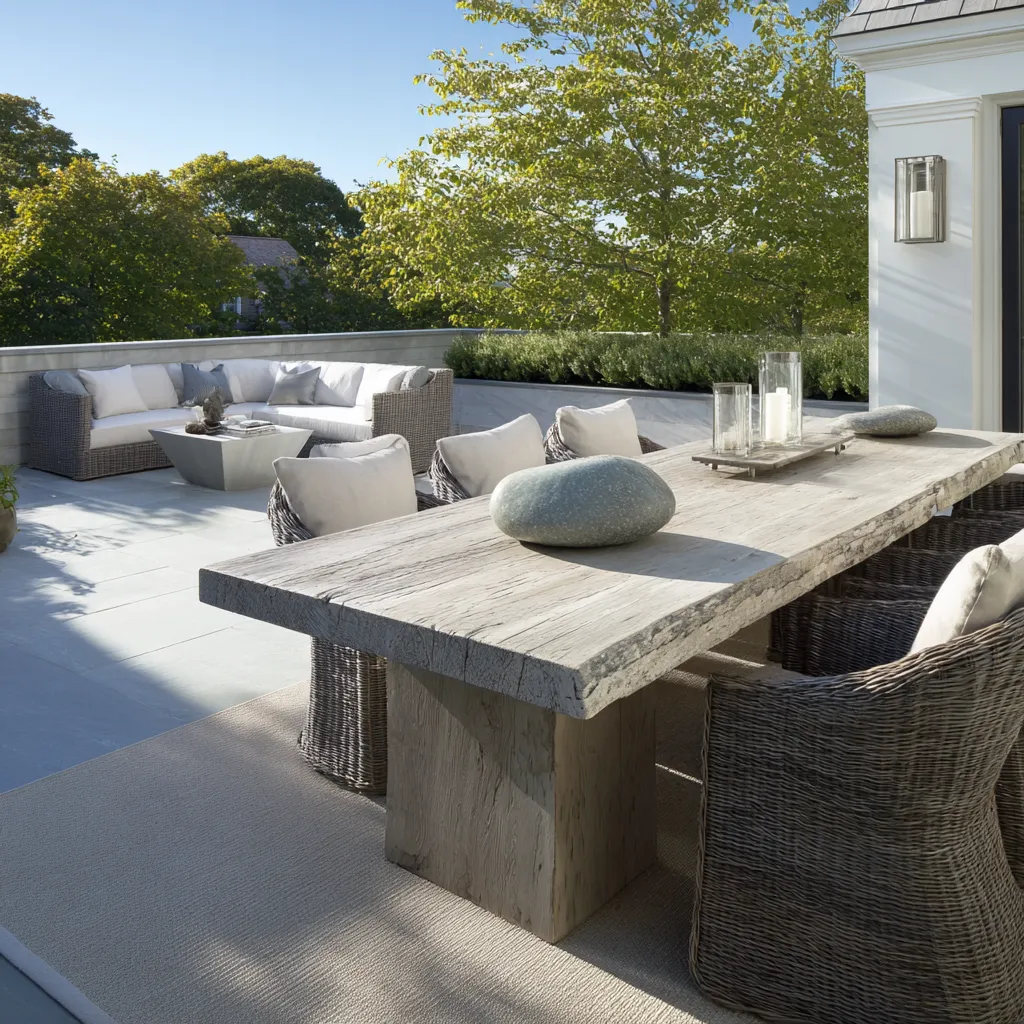
If you want coastal atmosphere without a single obvious marine object, geology is one of the most powerful tools available. Rounded boulders, pebble fields, gravel courts, shell-like stone, rough slabs, porous wall panels, monolithic tables, eroded-looking art, and smooth tabletop stones all carry the memory of water acting on matter.
They suggest abrasion, sediment, weather, and time. That makes them perfect for a backyard that wants to feel coastally informed without becoming literal.
Rounded forms are especially effective because they imply shaping by natural forces. A smoothed boulder in a gravel field, an oval stone object on a weathered plank table, or a shell-textured wall piece can all hint at the coast through form alone.
This is also where wall art becomes surprisingly important. In many refined coastal backyards, art is not pictorial.
It does not show boats or waves. Instead it resembles stratified sediment, coral texture, eroded plaster, tidal grooves, shell surfaces, or rough geological slices.
Such pieces support the coastal note while staying abstract and architectural.
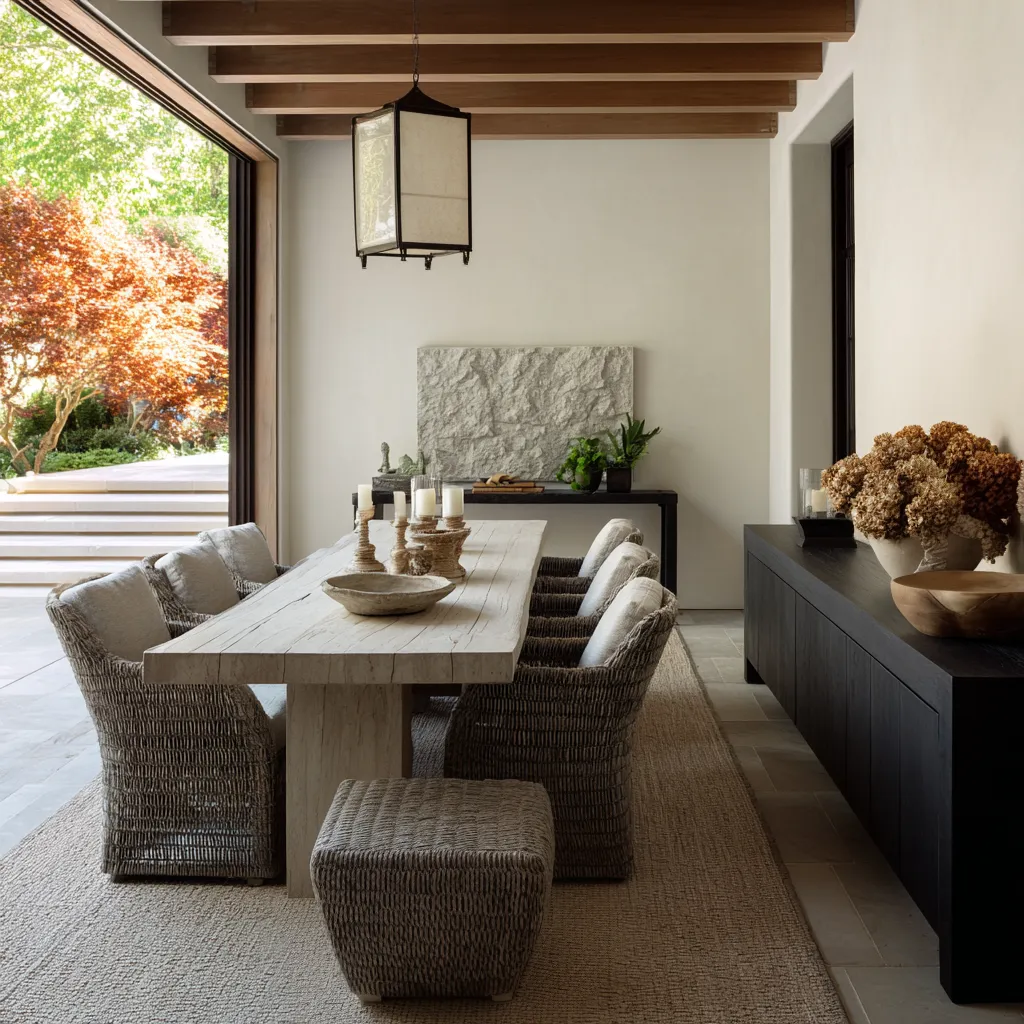
If you use a marine object, treat it like art
Paddles, surfboards, coral forms, shell-like objects, driftwood branches, mooring-style timbers, and old chain can all work in a modern coastal backyard. But they need discipline.
The problem is rarely the object itself. The problem is how it is placed.
A marine object becomes crude when it is one of many themed references or when it sits in a setting that does not support it materially. It becomes convincing when it arrives as a singular artifact inside a restrained composition.
That usually means a few things.
- It should have some age, wear, or material depth. New glossy replicas almost always weaken the result.
- It should have room around it. A paddle on a broad pale wall with little visual clutter has far more presence than several smaller nautical items crowded together.
- It should be balanced by other non-literal cues. Woven texture, pale mineral surfaces, dark timber, weathered furniture, and quiet planting all help the object feel absorbed into the backyard rather than stuck onto it.
- It should usually be treated with a gallery sensibility. Mount it deliberately. Let it hold the wall. Let scale matter.
One old paddle, one driftwood pergola, one coral sculpture, or one mooring-like timber block can bring history and shoreline memory into a backyard. Five themed objects will almost always do less.
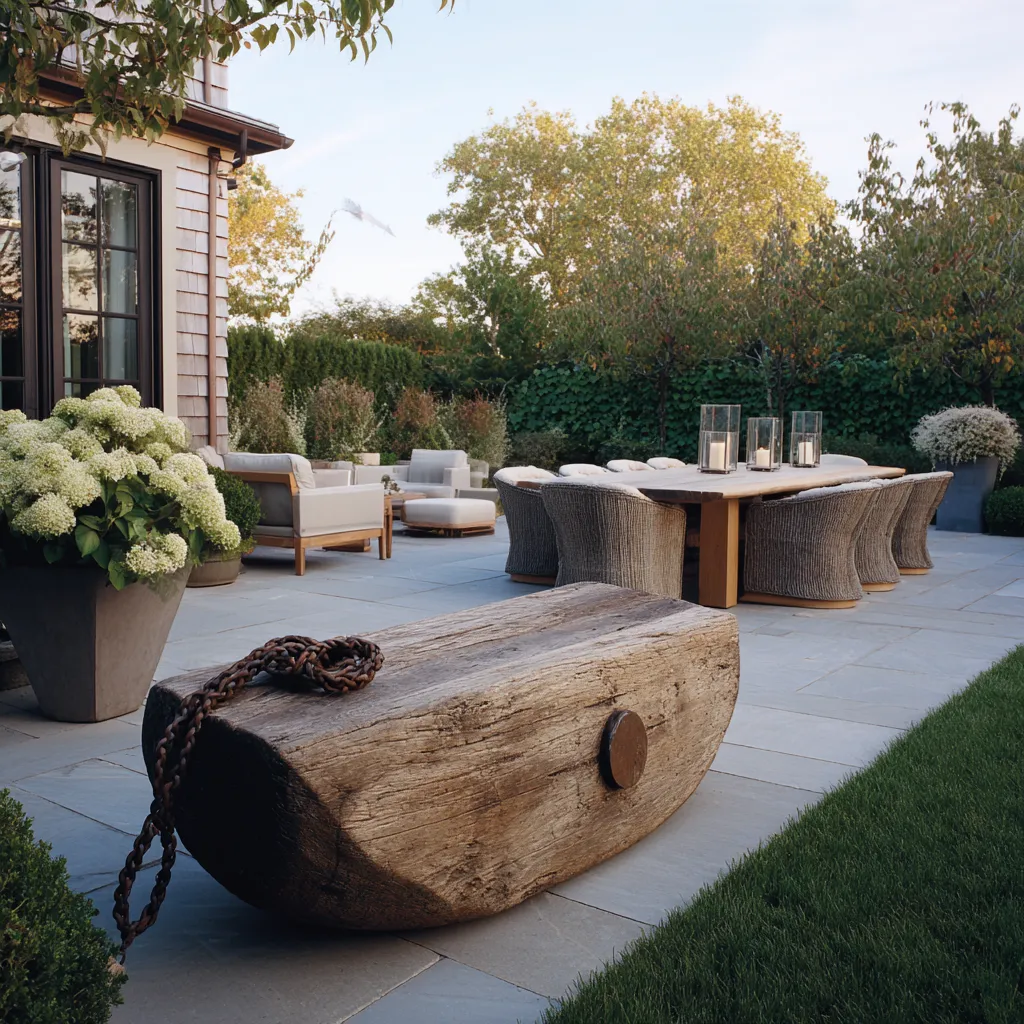
Built-in seating makes the backyard feel part of the site
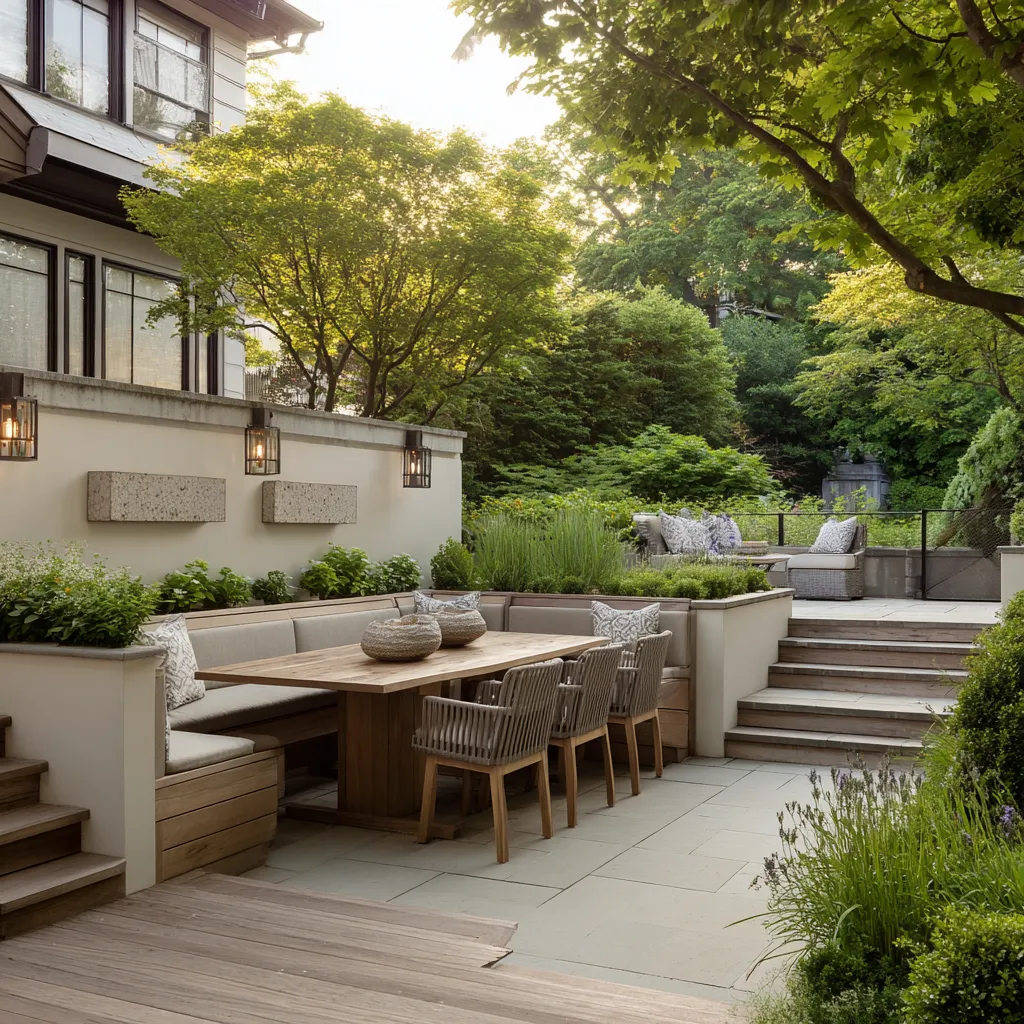
Architectural seating is one of the tools for making an outdoor space feel as though it belongs to the land rather than simply sitting on top of it. Built-in benches, banquettes, retaining-wall seating, long plaster benches, and poolside ledges all give the backyard a carved or anchored quality.
That matters for coastal work because many shoreline places feel held, cut into slope, protected from exposure, or built against thick walls and embankments. A loose furniture layout can certainly work, but a built-in edge often brings greater depth and stability.
This is especially true in smaller patios and side courts. A banquette along one side can immediately make the space feel more architectural, more sheltered, and more connected to the house.
Add pale plaster, a long table, a woven chair opposite, and perhaps one lantern or art gesture, and the whole backyard begins to take on the mood of a tucked coastal dining court or veranda niche. Built-in seating also helps preserve horizontality.
It gives you a long line at eye level, which is one of the most effective spatial cues in the entire coastal vocabulary.
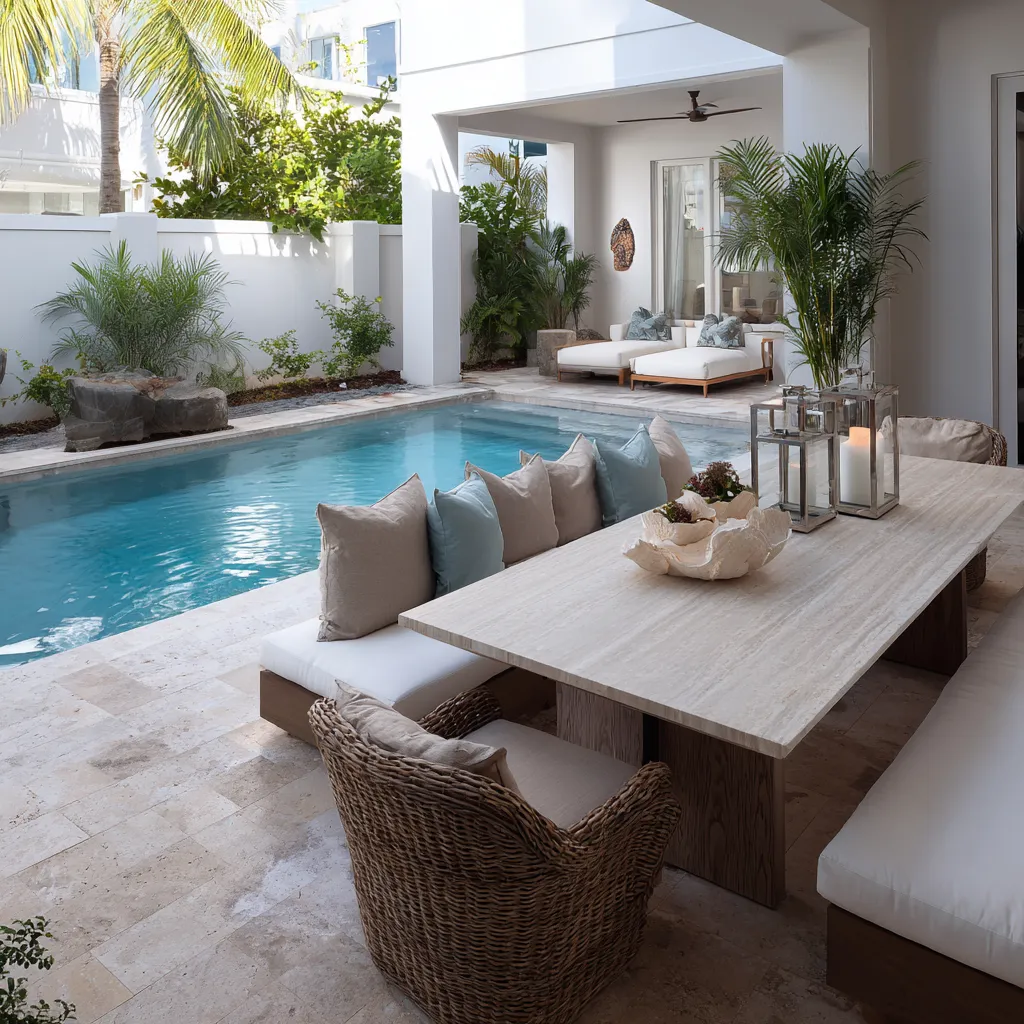
Terracing and level change have unusually high impact
Not every backyard can support meaningful topographic work, but when it can, the effect is strong. A step sequence, retaining wall, raised lounge terrace, lower dining court, or layered planting bank can instantly suggest bluffside living, dune access, embankment paths, or the stepped logic of houses built near an edge.
Terracing is powerful because it changes the backyard from a flat patio into a small landscape. The experience becomes sequential.
You move up, down, in, and out. That movement feels much closer to shoreline environments where elevation shifts often shape how outdoor life unfolds.
Even one broad step can help. A small rise to an upper lounge, a banquette built into a retaining wall, or a dining area set below a planted bank gives the yard a more site-shaped presence.
It can make a standard suburban backyard feel surprisingly coastal without relying on any decorative symbol. Because terracing has such strong atmospheric leverage, it is worth considering even in modest ways.
The full bluff effect is not always necessary. Sometimes a subtle wall thickness, a long stair, or a planted retaining edge is enough.
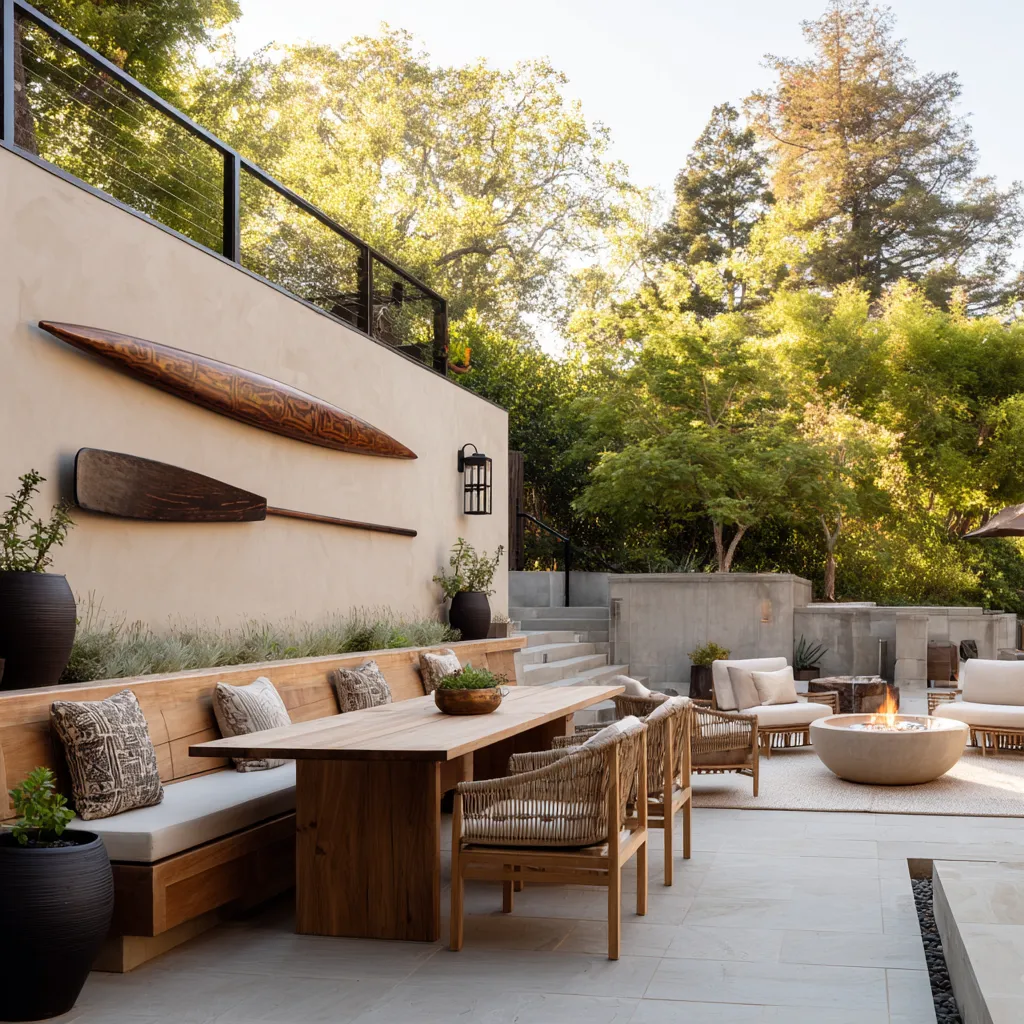
Lanterns and hardware work because they feel useful
One reason lanterns keep appearing in strong coastal backyards is that they introduce a note of purpose. They feel weather-ready, outdoor-safe, and lightly connected to porch, harbor, and boat-adjacent utility.
That is different from decorative ornament. Simple black-framed lanterns, glass hurricane forms, pared-down sconces, and metal fixtures with a practical silhouette can all support the coastal mood.
They are especially good in sheltered backyards with pavilions, verandas, and banquette walls because they reinforce the sense that the space is built for repeated outdoor use. The important point is restraint.
Lanterns should support the architecture, not turn into a theme. One pendant above a dining table, a pair of wall sconces flanking a banquette, or a few glass hurricane cylinders on a table can be enough.
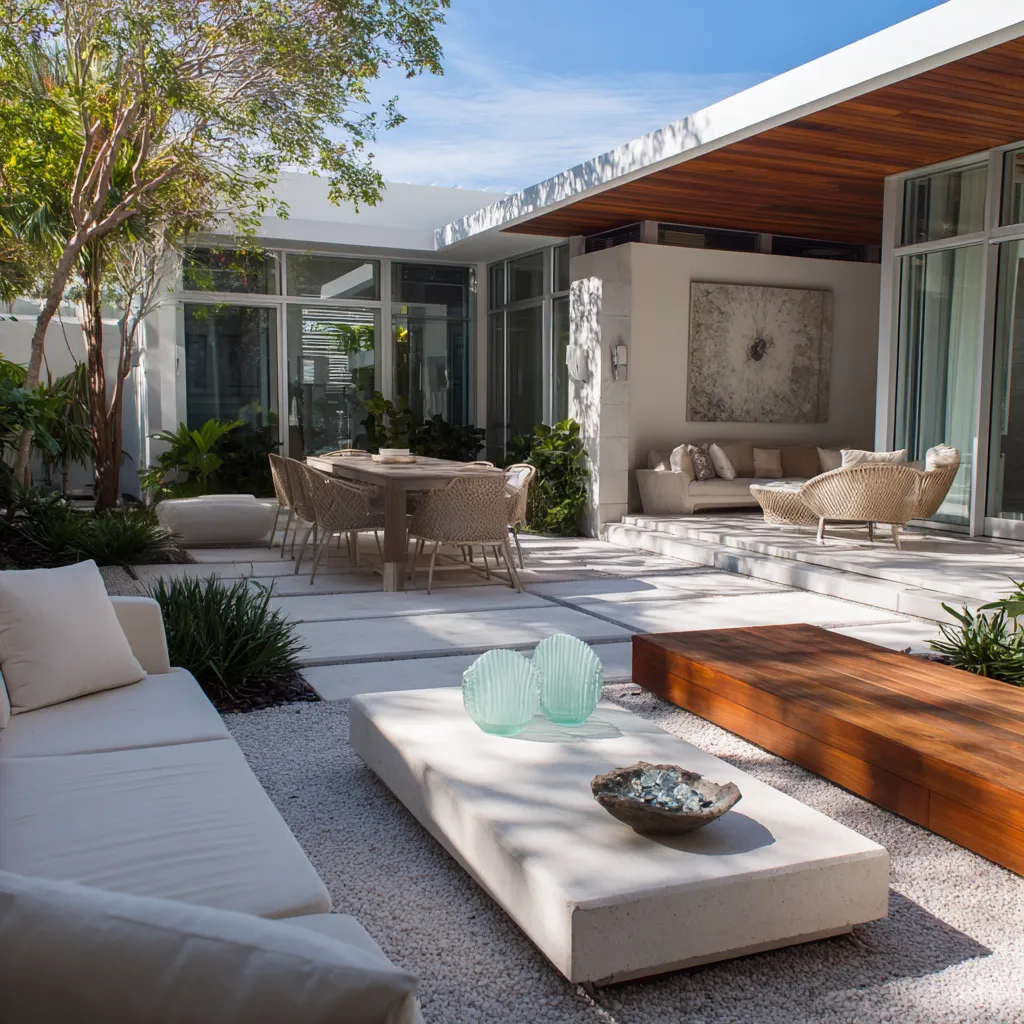
Fresh coastal backyard designs are edited
A strong coastal backyard usually has a narrow vocabulary and enough visual emptiness for that vocabulary to stay clear. This is one of the biggest differences between refined work and themed work.
The refined version often limits itself to a few linked cues: pale mineral surfaces, weathered timber, woven texture, soft grasses, one artifact, one lantern note, low furniture, open air. That edited field feels legible.
Each element has room to contribute. The weaker version tends to accumulate: blue pillows, shell objects, striped fabrics, rope everywhere, several lantern styles, driftwood, beach signs, mixed plant palettes, too many small accessories.
Once that happens, the backyard loses atmosphere and gains noise. Coastal design benefits from omission.
It is one of those styles where leaving a wall mostly bare, using one coral form rather than several, or keeping the planting restrained often improves the result immediately.
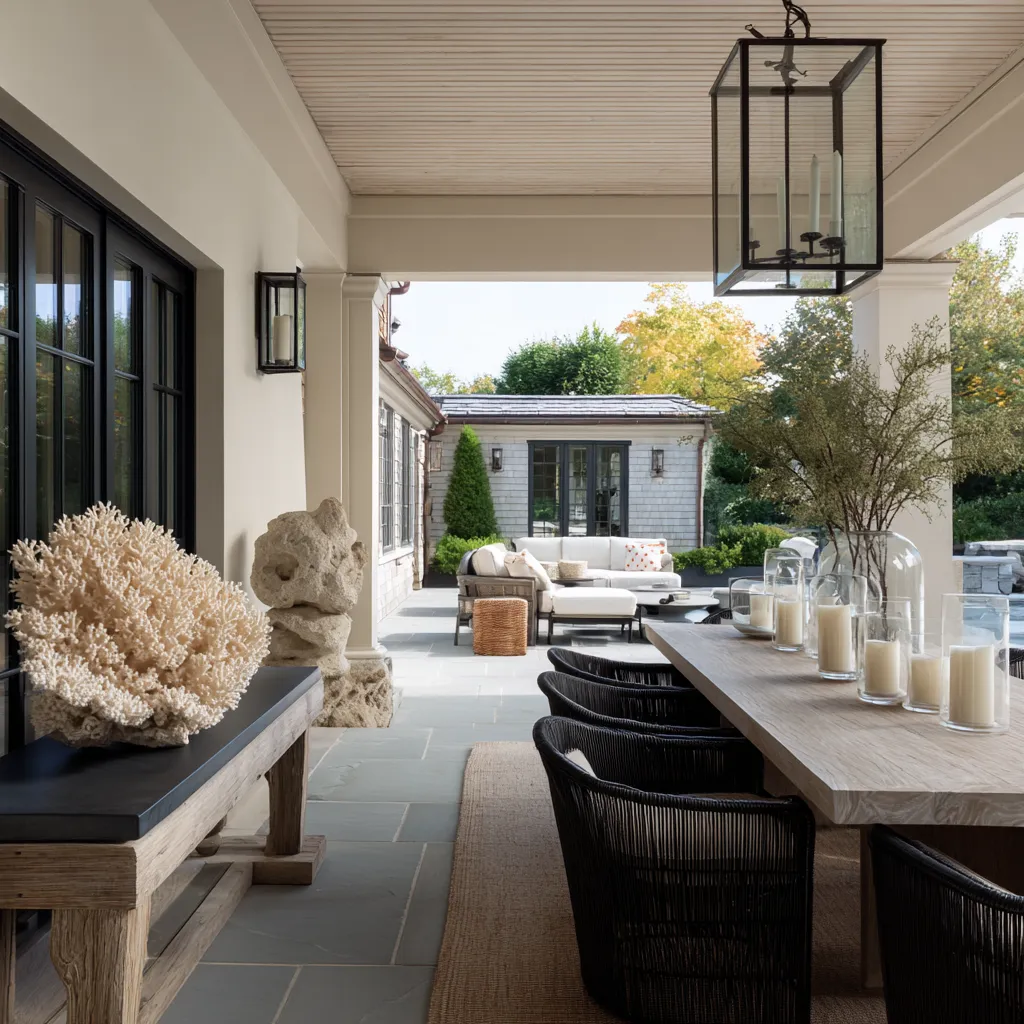
Four strong ways to approach a modern coastal backyard
Although every project is different, most fresh coastal backyards tend to fall into one of four practical directions.
1. The curated courtyard
This version uses a pale wall, built-in seating, a long table, one time-marked object or art piece, and woven furniture. It works well for smaller patios, side courts, and dining nooks.
Its strength lies in structure and intimacy.
2. The pavilion terrace
This approach depends on a shaded roof plane, dark timber overhead, pale paving, lanterns, and an open edge toward light or water. It suits larger backyards where outdoor living needs depth and shelter.
Its strength lies in the contrast between cool refuge and bright exposure.
3. The exposed field
This direction uses open sky, low seating, gravel or pebble ground, grasses, rounded stones, weathered wood, and little visual clutter. It fits contemporary homes and backyards where abstraction feels appropriate.
Its strength lies in landform memory and atmospheric openness.
4. The collected waterside terrace
This version uses a pool or narrow water edge, pale stone, woven seating, subtle glass accents, and perhaps one marine-related object handled with restraint. It is useful for homes that already have water and want a coastal note without slipping into resort styling.
Its strength lies in reflection and adjacency. Choosing one of these directions early can make decorating decisions much clearer.
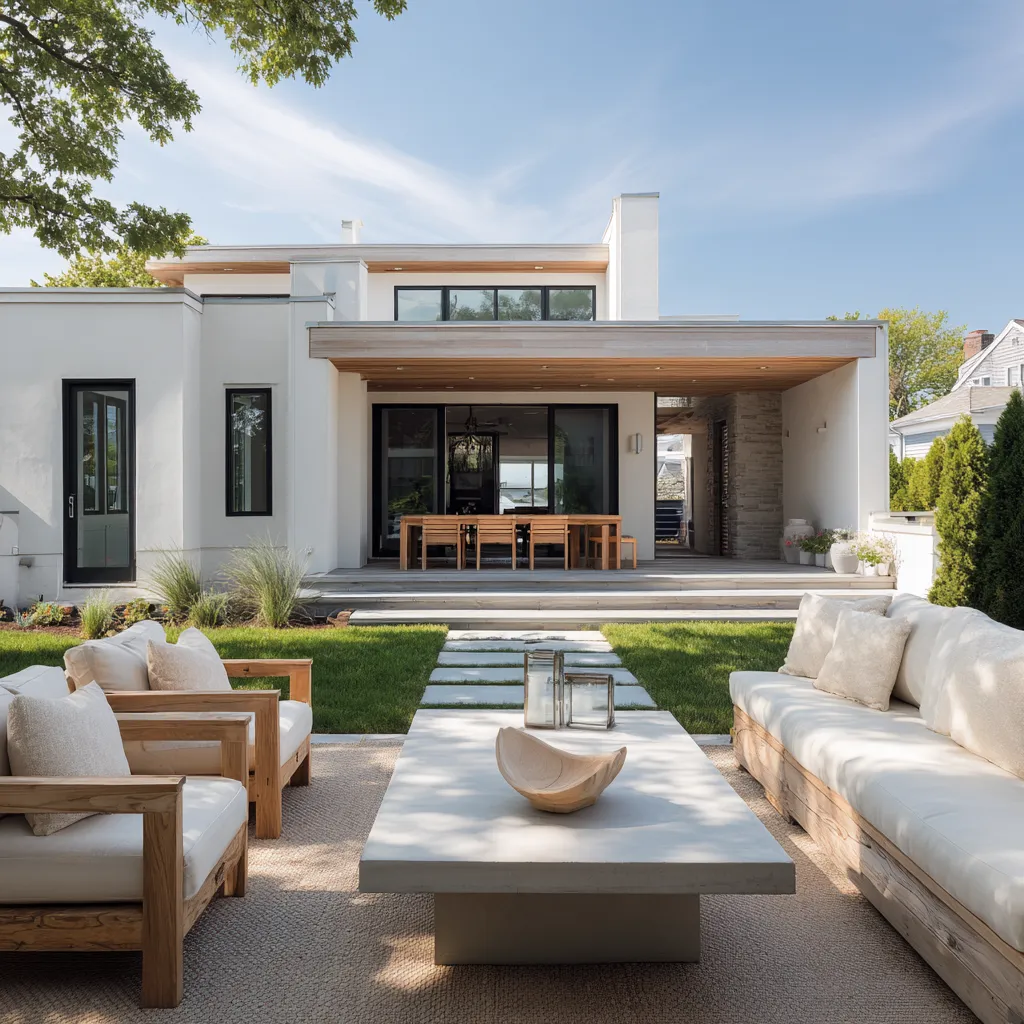
What actually gives a backyard that fresh coastal feel
In the end, the fresh coastal feeling in a backyard comes from a disciplined set of relationships:
- pale surfaces that soften and reflect sun
- materials that carry some sign of age or exposure
- woven pieces that make the outdoor room feel breathable
- planting that suggests air, dryness, brightness, or humid waterside life without becoming busy
- horizontal lines that steady the composition
- low elements that keep sky and openness active
- shelter that makes exposure feel pleasant rather than harsh
- one or two collected artifacts with depth rather than many themed references
- enough empty space for light, material, and air to stay visible
That is why modern coastal backyard ideas feel so persuasive. They do not imitate the coast literally.
They convert the coast into design language: mineral brightness, tactile fiber, weathered memory, framed openness, and a strong relationship between refuge and exposure.
A backyard design built this way can feel coastal even miles from the water. It carries the emotional structure of shoreline life rather than its costume.
And that is precisely what makes it feel fresh.