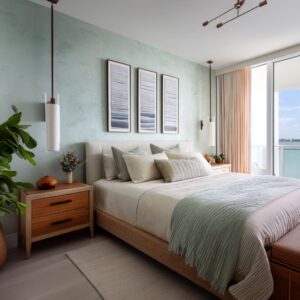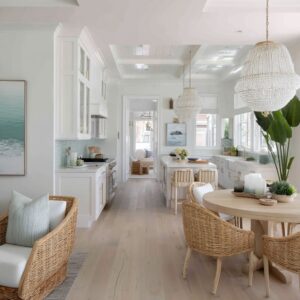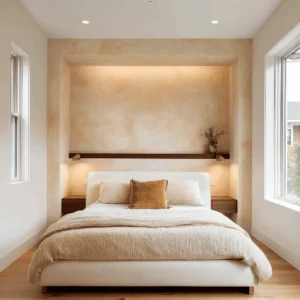
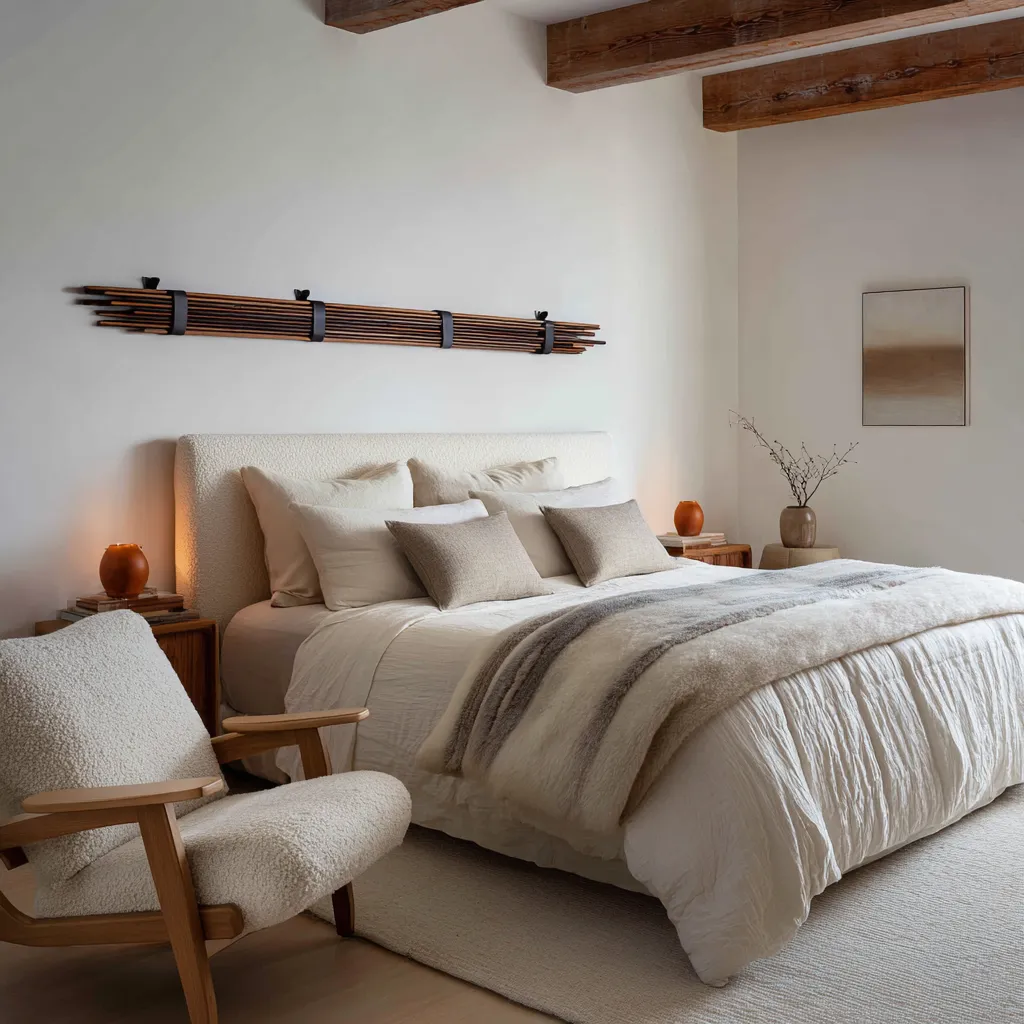
A contemporary beach bedroom does not usually lose its coastal character by becoming simpler. It loses it when it keeps the old signs of the coast but removes the spatial logic that once gave those signs meaning.
That distinction matters. Interior dessigns look less themed on the surface yet still feel dated because the change was cosmetic.
The lantern disappeared, the seashell tray disappeared, the striped pillow disappeared, yet the room still depends on a decorative idea of the beach rather than a spatial one.
The more interesting contemporary beach-themed bedroom ideas make a deeper shift. They stop treating the coast as a set of collectible objects and begin treating it as a set of physical conditions.
The beach enters through horizontal spread, pale mass, dry tactile surfaces, filtered light, timber rhythm, and the relation between shelter and openness. The room no longer points at the shore.
It borrows its structure. Modern beach-inspired bedrooms can look almost minimal at first glance.
Their coastal identity is present, but it has moved. It now sits in the wall section, the ledge line, the recessed niche, the slatted plane, the low upholstered bed, the chalky palette, the warm mineral accent, the matte timber surface, the sparse botanical branch, and the one exact dark line that prevents the whole composition from turning vague.
The theme has not vanished. It has changed location.
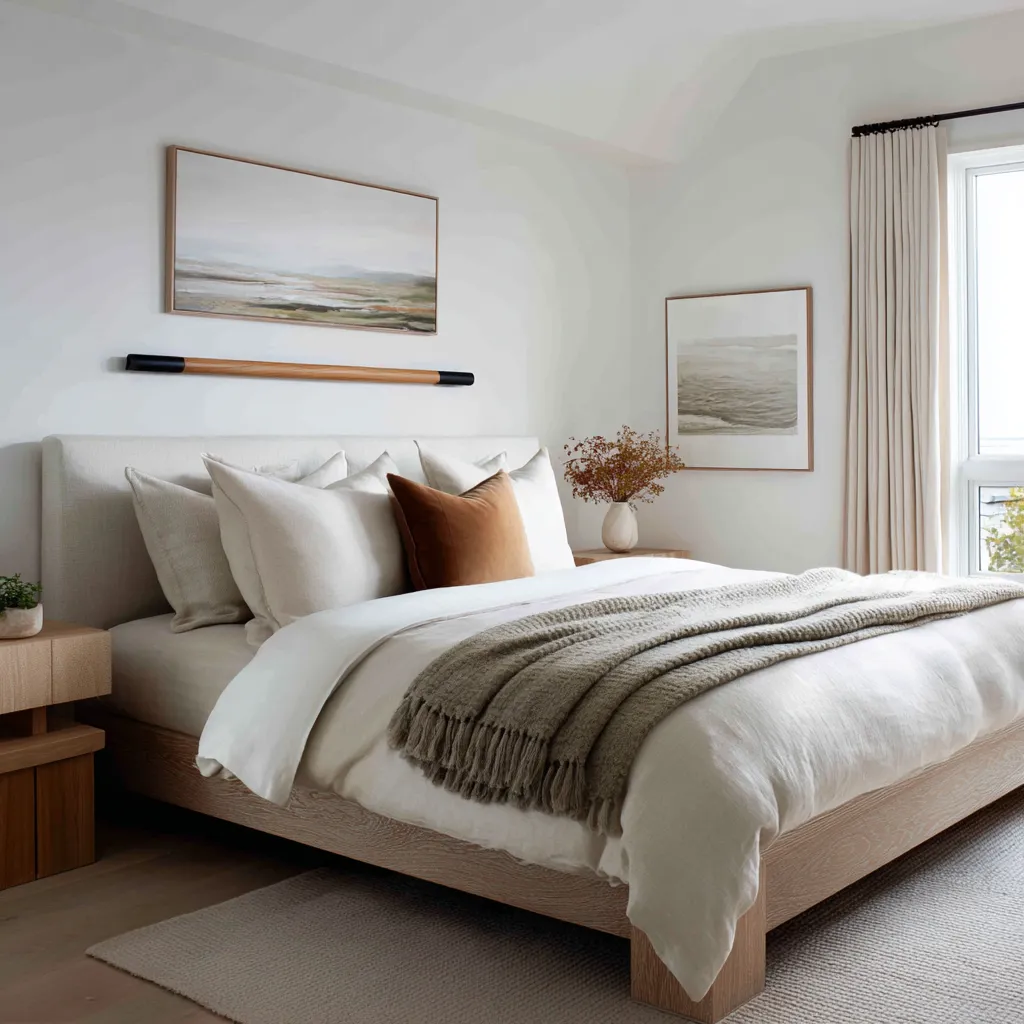
The coast moved from décor into the room’s framework
Older beach bedrooms often made their point early and clearly. Blue-and-white contrast, rope details, wicker, coral shapes, painted furniture, striped textiles, shell imagery, weathered accessories: the room announced its subject immediately.
That directness once felt charming because the decorative language did much of the identity work. Contemporary interior designs tend to reverse that order.
They begin with the shell of the space rather than with its props. A wood-lined recess behind the bed does more than add warmth; it creates the feeling of protection inside brightness, which is deeply tied to coastal living.
A long shelf above the headboard does more than hold art; it creates a horizon line. Vertical planks, narrow battens, fluting, or slatted panels do more than add texture; they bring in the memory of fencing, reeds, bleached boards, and dune grass through rhythm rather than illustration.
This shift changes the entire emotional register of the room. Instead of a bedroom decorated with marine references, you get a bedroom shaped by marine conditions.
There is a difference between placing beach symbols into a neutral room and building a room that has been tuned to light, air, grain, and distance. The second approach feels more current because it is less literal and more embedded.

Why the modern room usually chooses one coastal sign, not many
One of the defining features of present-day beach bedrooms is compression. The room may include a coastal reference, but that reference is often singular.
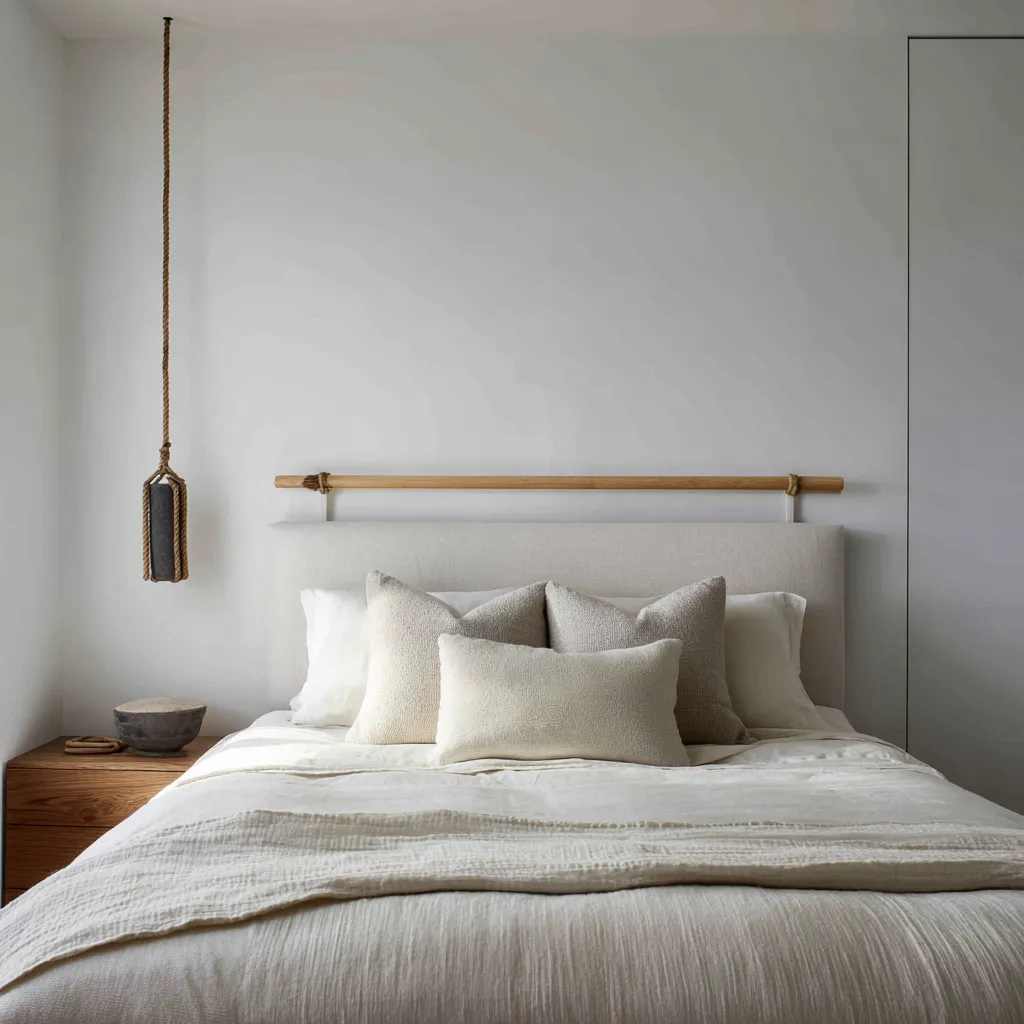
One rope pendant. One mounted pole.
One horizon painting. One long weathered shelf.
One slatted installation. One carved timber panel.
One reed-like screen suspended above the bed. Not a chain of repeating signals.
This matters because coastal styling becomes weaker when the room keeps explaining itself. The first cue can add identity.
The second may reinforce it. The fifth often begins to flatten it.
Once several marine signs are placed in the same room, the eye stops reading atmosphere and starts cataloging theme. The room becomes overly easy to summarize, and that is often where it starts losing freshness.

The contemporary solution is not total denial of place. Total denial can also create a problem.
A bedroom that removes every trace of shoreline association may become beautiful but oddly uncommitted, as though it could belong to any high-end neutral scheme in any location. That is why a faint coastal sign often helps.
It restores local memory without dragging the room back into decorative shorthand. The most convincing contemporary beach bedrooms therefore operate in a narrow band.
They are not full of coastal clues, but neither are they blank. They keep one perceptible note of place and let the rest of the room remain spacious, reduced, and materially focused.

The wall above the bed has become a coastline
A useful way to understand the contemporary beach bedroom is to stop thinking first about furniture and start with the wall above the bed. That wall is often where the entire coastal translation takes place.
In older rooms, the wall might have carried framed nautical prints, a cluster of related objects, or a decorative composition that directly named the setting. In newer rooms, the wall often becomes broad and pale, interrupted by a single organized move.
That move may be a long ledge, a band of slats, a recessed timber niche, a suspended screen, a low shelf with one small abstract landscape, or a mounted linear artifact. The point is not display.
The point is measure.

This is where contemporary coastal design becomes especially intelligent. The room borrows the section of a shore scene without illustrating it.
A broad upper field acts like sky. A low dense bed acts like land or dune mass.
One narrow line between them acts like horizon. Once that relation is in place, the room can carry coastal memory with very little literal reference.
This is also why open wall area matters so much in current bedrooms. Yet open wall area alone is not enough.
Emptiness without order can feel unfinished or generic. Emptiness with a governing line begins to feel atmospheric.
The difference is subtle, but it changes the entire result. A plain wall above a bed may be minimal.
A plain wall crossed by one measured line starts to feel coastal in a far more specific way.

Low bed mass replaced cottage furniture language
Another major shift lies in the bed itself. Many older beach bedrooms relied on furniture that spoke through profile and detailing: spindle headboards, painted frames, visible legs, cottage references, woven inserts, traditional shapes.
Contemporary beach bedrooms often move in the opposite direction. The bed becomes low, broad, thick, and upholstered.
It sits closer to the floor. It spreads horizontally.
Its materials are soft and matte rather than decorative. This move does two things at once.
First, it brings the room into a more current furniture language. Second, it supports the horizon structure of the whole composition.
A low bed allows the wall, ledge, niche, or slatted field above it to take on greater spatial importance. The bed becomes the dense lower register of the room rather than a decorative object competing with the wall.

There is also a coastal reason this works so well. A low bed wrapped in tactile neutrals has a faint resemblance to compacted sand mass, dune forms, or sedimented layers.
That may sound abstract, but in practice it changes how the room feels. The bedroom stops being an arrangement of separate pieces and starts feeling like a landscape of softened planes.
Even bedding follows this logic. Instead of graphic nautical contrast, many current rooms use close tonal steps: white, cream, bone, flax, oat, pale taupe, soft greige.
The depth comes from surface differences and layering rather than color jumps. One pillow may be smoother, another nubbier, another more ribbed, another looser and more washed.
The room keeps visual thickness without resorting to decorative chatter.

Texture is not decoration here. It is membership
In contemporary beach-inspired bedrooms, texture does not behave like embellishment added after the main design is complete. It is part of the room’s basic grammar.
Linen, boucle, brushed cotton, matte oak, ribbed upholstery, rougher throws, dry botanicals, washed plaster, woven rugs, and slightly irregular ceramics form the material field within which the room can feel both spare and inhabited. This is important because many beach bedrooms today avoid strong color contrast.
Once a room leaves blue-and-white coding behind and narrows its palette to creams, pale woods, soft mineral neutrals, and faint earth warmth, the surfaces must carry much more of the emotional content. Without tactile variation, that palette would flatten quickly.
Yet texture alone does not explain the success of a room. A bedroom can include boucle, linen, and pale oak and still feel generic.
Texture is not the special trick. It is the threshold condition.
Without it, the room feels too hard or too blank. With it, the room qualifies for the conversation.
The actual distinction then comes from what the room does with space, line, and structure. That is why richly tactile rooms can still differ sharply from one another.
One may feel like warm minimalism with only a faint coastal undertone. Another may feel unmistakably shoreline-related even with almost no overt theme.
The separator is not whether both use textured textiles. The separator is how those textiles sit inside an architectural composition.
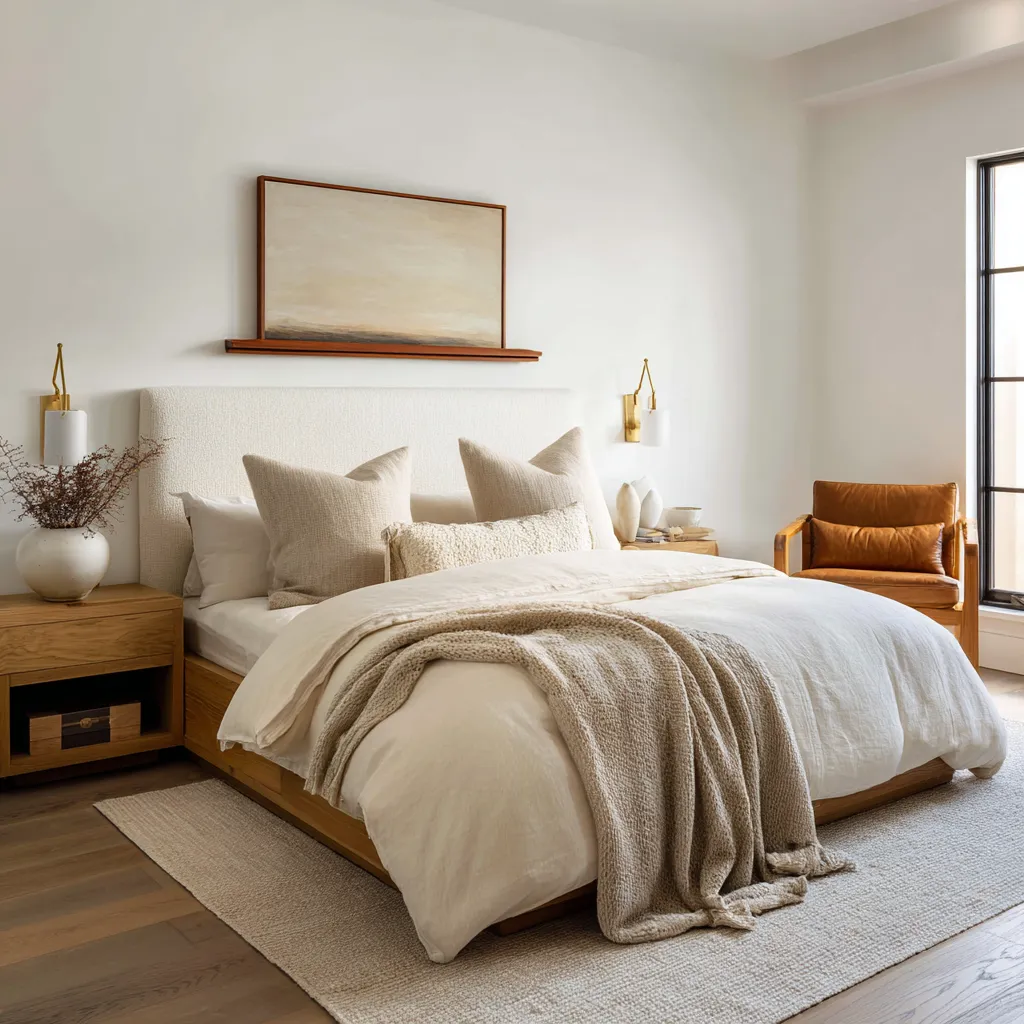
Blue stepped back, and mineral warmth took its place
One of the clearest shifts in current beach bedrooms is tonal. Blue has not disappeared completely, but it is no longer the dominant sign of the coast in many of the more refined rooms.
Instead, warmth enters through rust, cinnamon, camel, clay, blush-beige, toasted brown, weathered cedar, sun-touched tan, and other earth-driven notes. This change solves several problems at once.
Blue is efficient. It communicates the sea quickly.
But it also narrows the room’s tone range toward a familiar decorative formula. It can push the bedroom into a cleaner, breezier, more obvious direction than many current interiors want.
Mineral warmth works differently. It suggests coast through materials shaped by weather and time rather than through water color alone.

A rust lumbar pillow against cream bedding can evoke iron-rich sand, dried sea grass, cedar, oxidized metal, clay warmed by late sun, or darker sand near wet tide lines. A blush-beige accent in a pale room may hint at shell interiors or sun-softened stone.
Camel leather can bring in a tanned, weathered note that feels rooted and bodily rather than decorative. These tones do not usually carry the room by themselves.
They are not the primary engine of coastal identity. Their role is subtler and perhaps more useful.
They keep pale rooms from becoming bloodless. They add body, warmth, and inhabitation while staying close enough to natural coastal matter that they do not break the atmosphere.

Why one dark line often matters more than one more accessory
A pale beach bedroom can easily become too diffuse. White bedding, cream upholstery, chalky walls, pale timber, and filtered daylight can produce a beautiful softness, but softness without boundary often turns hazy.
The composition starts losing definition. Objects seem to drift rather than hold.
This is where contemporary rooms often use dark accents with unusual discipline. Not many dark accents.
Not broad dramatic contrast. Instead, one or two narrow, exact marks: a black window frame, a slim pendant cord, the dark end of a mounted rod, a leather strap supporting a shelf, a reading lamp, a bracket, a deep-toned ledge, a single recessed insert, a dark wood edge, a line of hardware.
These accents do not dominate the room. They stabilize it.
They act as punctuation inside a soft sentence of pale materials. The effect is especially strong in bedrooms that rely on open wall area and low bed mass.
One exact dark line can keep the room from dissolving into pleasant neutrality. This is a crucial distinction between softness and vagueness.
Contemporary beach bedrooms still want airiness, but they rarely want blur. The dark line is often what protects the design from becoming too washed out.
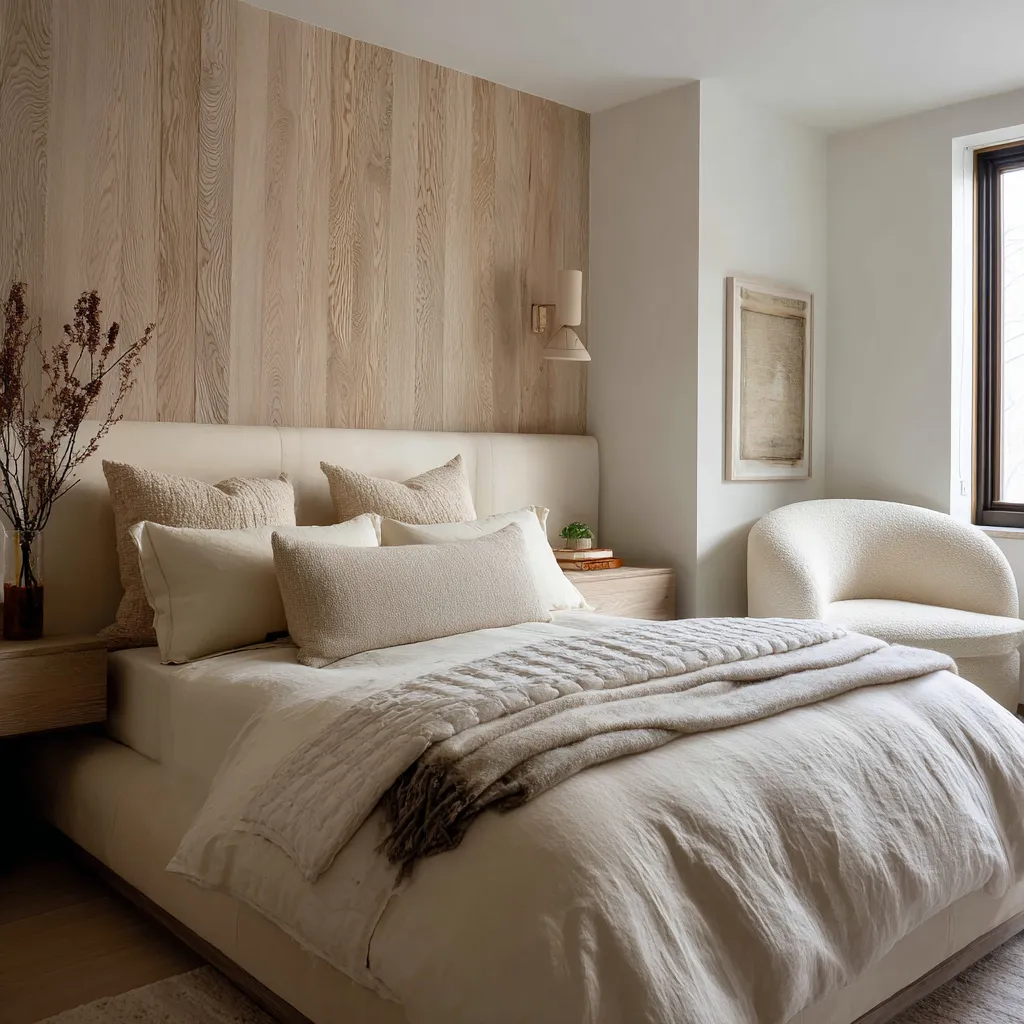
Architecture now carries mood that accessories used to carry
Once coastal décor retreats, something else must replace it. That replacement is often architecture, or at least something close to architecture: built ledges, slatted panels, recessed bed walls, deep window surrounds, integrated benches, shelving niches, continuous timber backdrops, strong wall thickness, or suspended screens that relate directly to the room’s lines.
This is where many contemporary beach bedrooms either succeed or fall short. A room can remove seashells and striped pillows and still feel empty if it has not developed any spatial carrier to take over the mood work.
The space needs section, thickness, extension, datum, or rhythm. Otherwise the theme was only erased, not transformed.
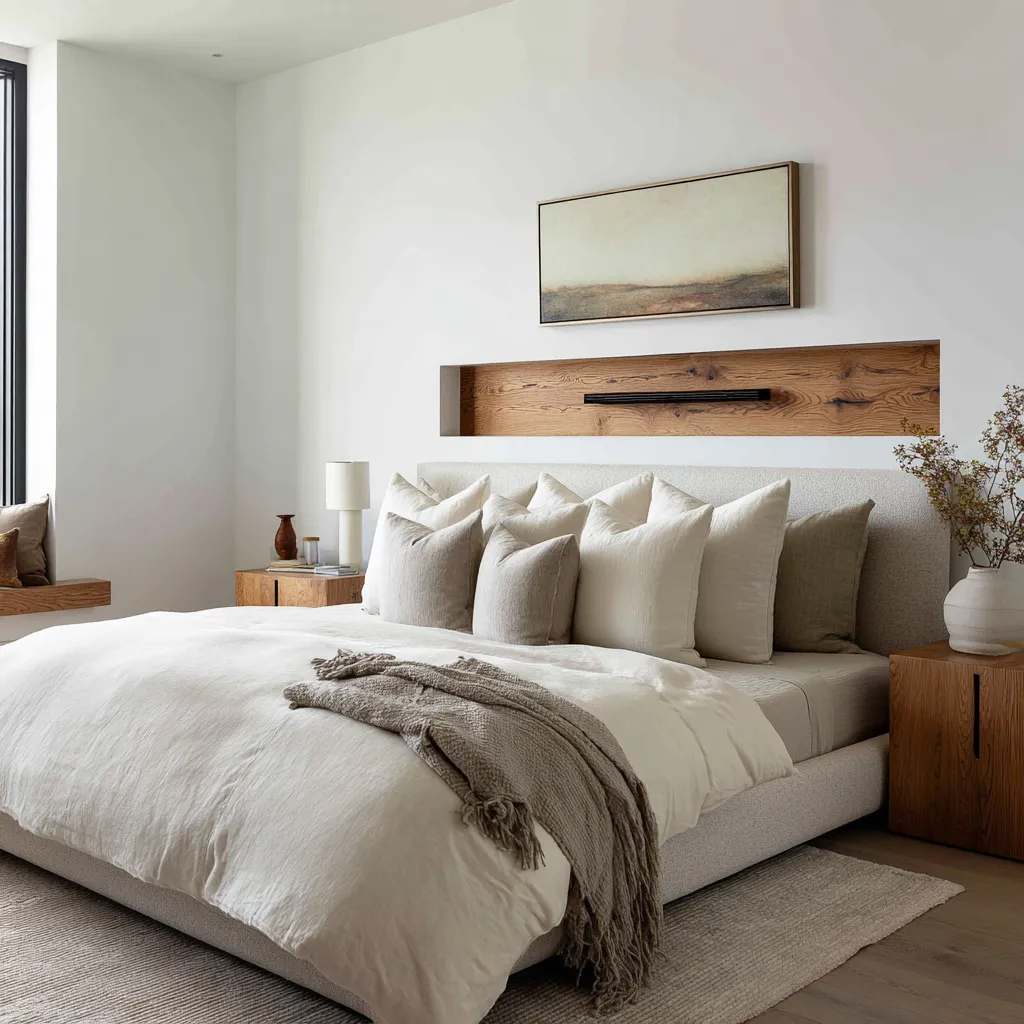
A wood-lined recess behind the bed can carry the feeling of shelter inside brightness. A deep window seat can make the room feel rooted in a house rather than styled for a photo.
Vertical planks can suggest weathered boards or dune fencing without announcing either one. A long shelf stretched beyond the bed can visually widen the room and turn the sleeping zone into part of a larger spatial order.
Slatted wall fields can catch light in a way that resembles dry reeds, filtered sun, or board-surfaced texture without mimicking them too literally. This kind of design has more staying power because it is embedded.
Accessories can be swapped out. The deeper mood is already built into the room’s framework.

Four contemporary ways to build a beach bedroom without old clichés
Although many current bedrooms share similar principles, they do not all solve the coastal problem in the same way. Several clear design directions recur.
The horizon-minimal bedroom
This version uses very open walls, low bed height, one linear gesture, and very few visible references. The wall may hold a long shelf, a slim bar, one lean object, or a small abstract landscape.
The emphasis is on air, spread, and restraint. This direction often feels especially current because it trusts spacing and proportion more than visible theme.
It suits readers who want the coast to be felt before it is identified.
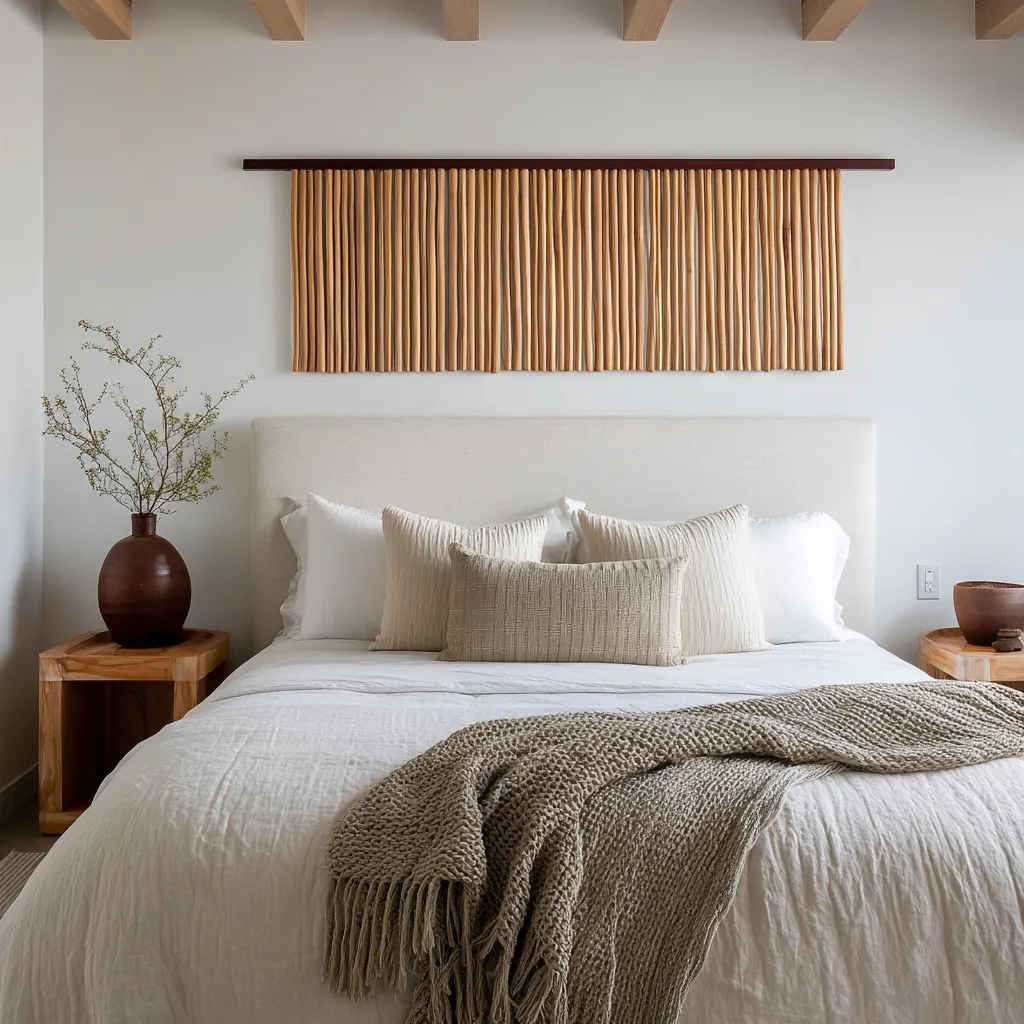
The constructed shoreline bedroom
Here the room relies more heavily on millwork, ledges, slatted panels, broad timber fields, or integrated wall composition. The beach note is clearer, but it comes through built form rather than decorative props.
The result can feel grounded, polished, and deeply tied to the room’s shell. This direction works well for interiors that need stronger identity without slipping into overt themed styling.
The warm timber envelope bedroom
This version leans on pale wood cladding, recessed bed walls, sunlit surfaces, and tactile textiles in very narrow color ranges. The coastal connection is more abstract.
Some viewers may first read it as warm contemporary minimalism, with the beach note arriving more gradually through atmosphere. It suits those who want shoreline memory without any easily named coastal sign.

The singular artifact bedroom
In this approach, the room does allow one stronger object-like reference: a rope-wrapped pendant, a mounted rod, a suspended reed-like screen, a carved timber panel, a pole with tied ends, a bundle of slender linear elements. The rest of the room remains pared back so that the object can operate as one concentrated note rather than part of a themed collection.
This direction can still feel mature, but only if the object is abstracted, isolated, and materially credible. Once it becomes playful, repeated, or too obviously illustrative, the room starts sliding toward costume.
What to stop doing if you want a more modern coastal bedroom
The contemporary shift is not only about what to add. It is also about what to stop relying on.
- Stop assuming the room needs several signs of the coast to be legible. One is often enough.
- Stop treating blue as the main route to shoreline identity. In many bedrooms it is no longer a useful color carrier.
- Stop filling the bed wall because emptiness can be valuable when it is organized.
- Stop using texture as a substitute for composition. Texture matters, but it cannot rescue a room that lacks line, spatial order, or proportion.
- Stop thinking informality alone will make the room feel beach-related. Slight asymmetry can help, but it is not the central issue. A room can remain fairly centered and still feel fresh if the main gestures are reduced and materially convincing.
- Stop removing beach décor without giving the architecture a bigger role. If the accessories retreat, the room needs ledges, recesses, timber rhythm, or wall depth to take over.

The contemporary beach bedroom is built from a different hierarchy
This is a deep change. Older beach bedrooms often worked from the outside in.
The decorative message came first, then color, then furniture, then architecture. Current bedrooms often work from the inside out.
Architecture and spacing come first. Surface and light come next.
One trace sign of place may appear after that. Accessories arrive last, if they arrive at all.
That reversal explains why these rooms feel more grounded and more current. They do not imitate shoreline life by collecting its symbols.
They absorb shoreline conditions into line, mass, texture, and light distribution. The coast is present in the room, but it has been translated into a more structural language.
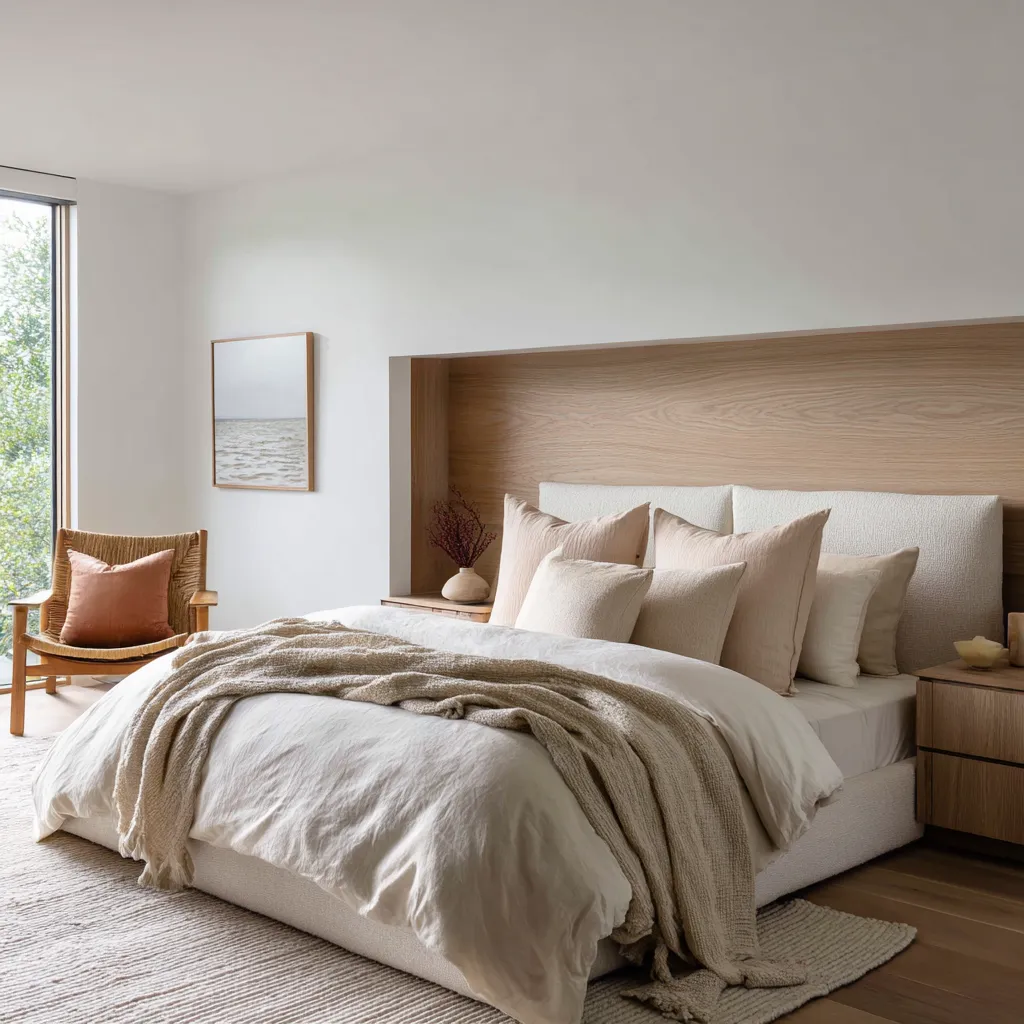
A contemporary beach bedroom therefore tends to rest on a fairly precise formula, even when it looks effortless: a low horizontal bed, a broad pale field, one governing line, dry tactile neutrals, timber or slatted structure, one or two sharpened accents, and no more than one clear coastal cue. That formula keeps identity visible without making it loud.
It gives the room place without reducing it to motif.
And perhaps that is the mark of the current approach. The beach is still there, but it arrives through memory, matter, and proportion rather than through explanation.