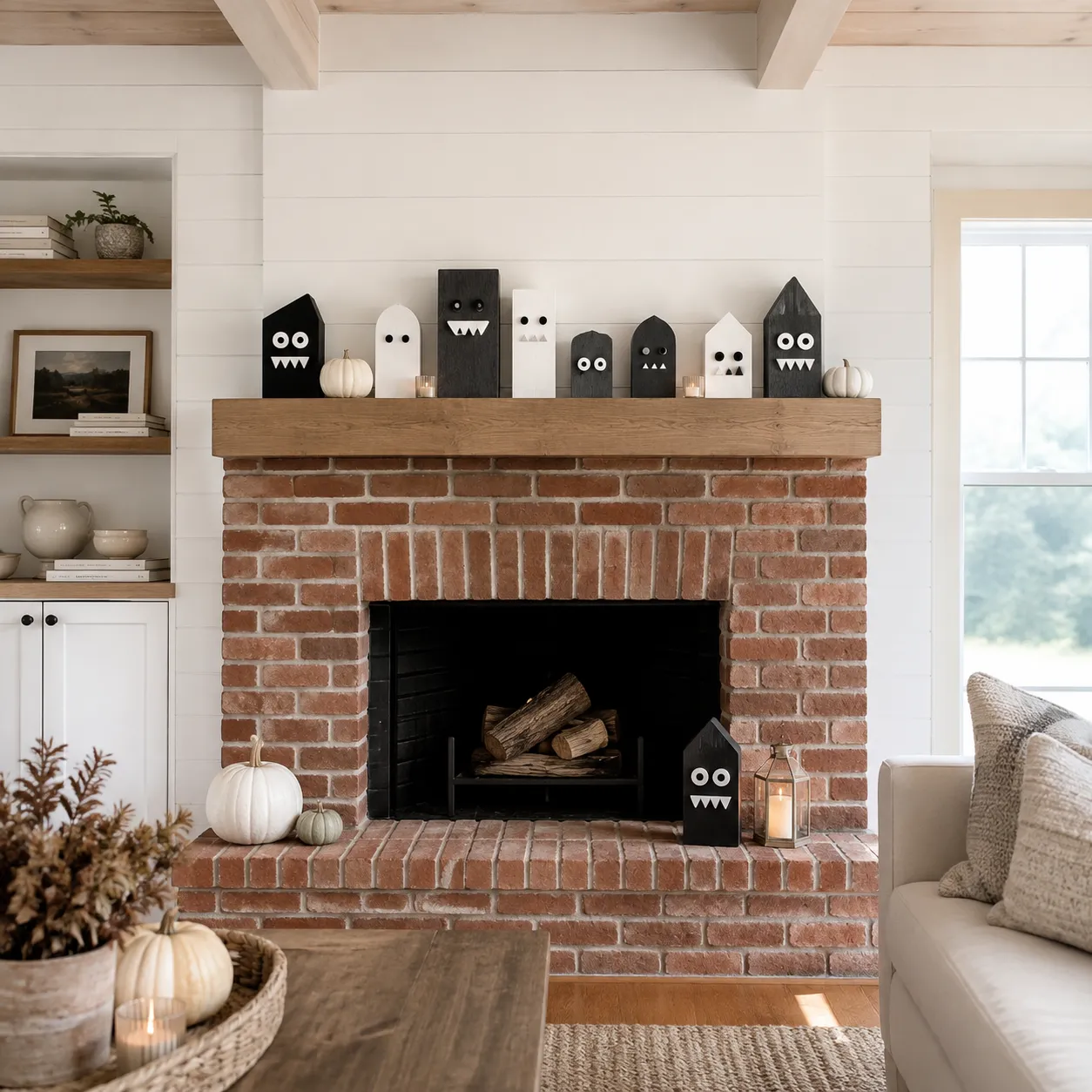
A red brick fireplace already has a head start on Halloween.
Brick carries so many of the colors we associate with late October: rusty red, burnt orange, tobacco brown, charcoal, warm grey mortar.
Add the dark opening of the firebox and perhaps a timber mantel, and much of the seasonal palette is already sitting in the room before a single pumpkin comes out of storage.
That changes the way Halloween decorating can work here.
A red brick fireplace usually looks better when the decorations respond to the masonry rather than trying to cover it. Pale pumpkins become brighter beside it.
Black details connect naturally to the firebox. Dried branches pick up the irregular character of the brick.
Even very small additions—eyes on a pumpkin, a witch hat on the mantel, a black cat print—can shift an autumn fireplace toward Halloween without turning the whole room into a themed display.
Here are some of the ideas that work particularly well.
Let the brick provide most of the orange
One of the easiest mistakes with a red brick fireplace is adding orange everywhere.
Orange pumpkins against warm red brick can blend together surprisingly quickly.
Instead of making the fireplace feel richer, the whole area can become one large block of similar warm tones.
Cream, ivory and pale grey pumpkins usually have much greater presence here.
They stand clearly against the brick while still feeling seasonal, and they connect easily with the lighter materials found in many renovated interiors: white walls, pale upholstery, painted millwork, linen, stone and ceramic.
A small orange pumpkin can still be useful.
In fact, one or two often look better once they are surrounded by lighter pumpkins. The brick becomes the warm background, the cream pumpkins add contrast, and the orange pumpkin connects the two.
A palette such as this can be surprisingly complete:
red brick + ivory + black + natural wood + dried brown foliage
There is already enough autumn color in the masonry itself.
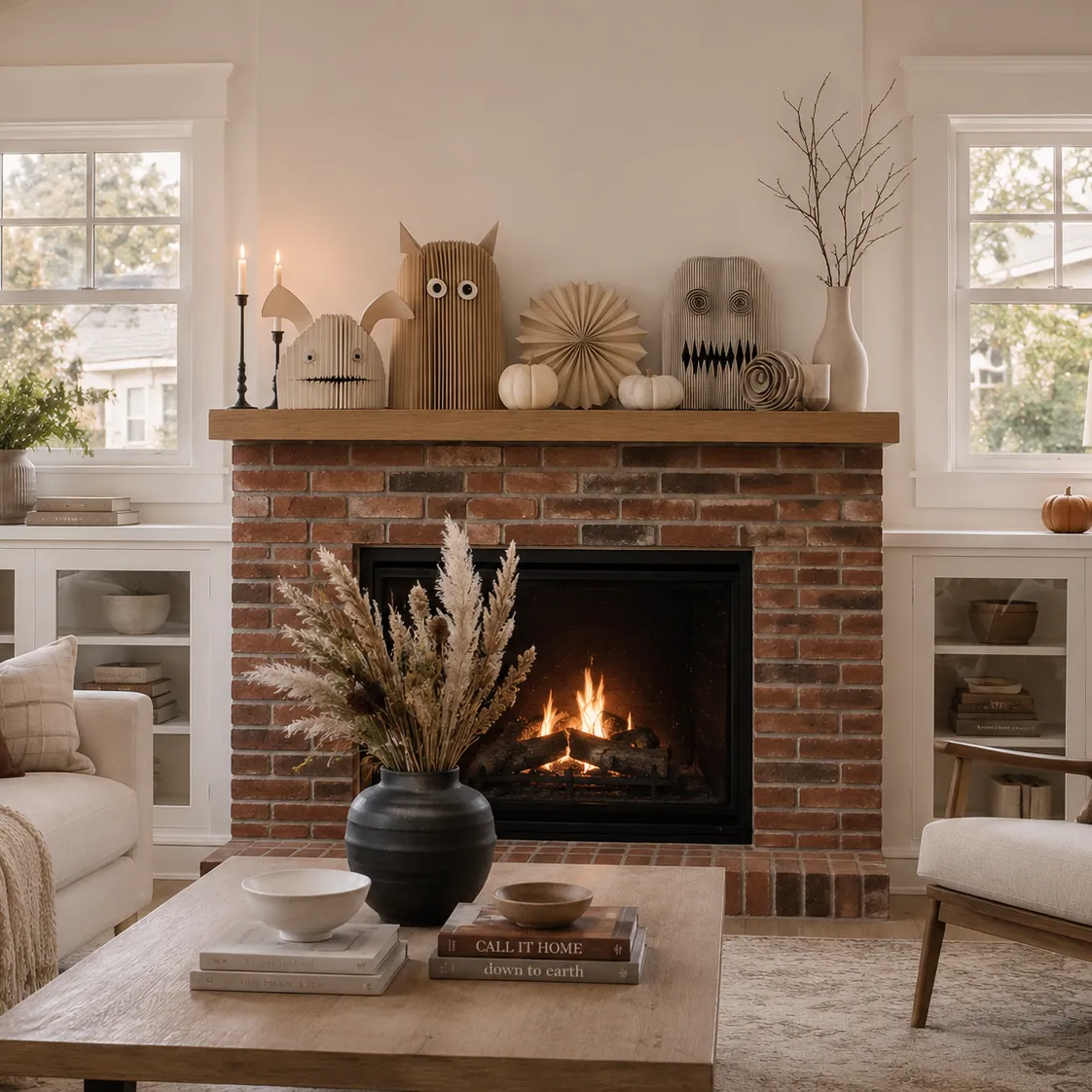
The black firebox can start the Halloween palette
Every fireplace has one design feature that is especially useful in October: a large dark opening.
Instead of treating black Halloween decorations as something new being added to the room, they can be treated as extensions of the firebox.
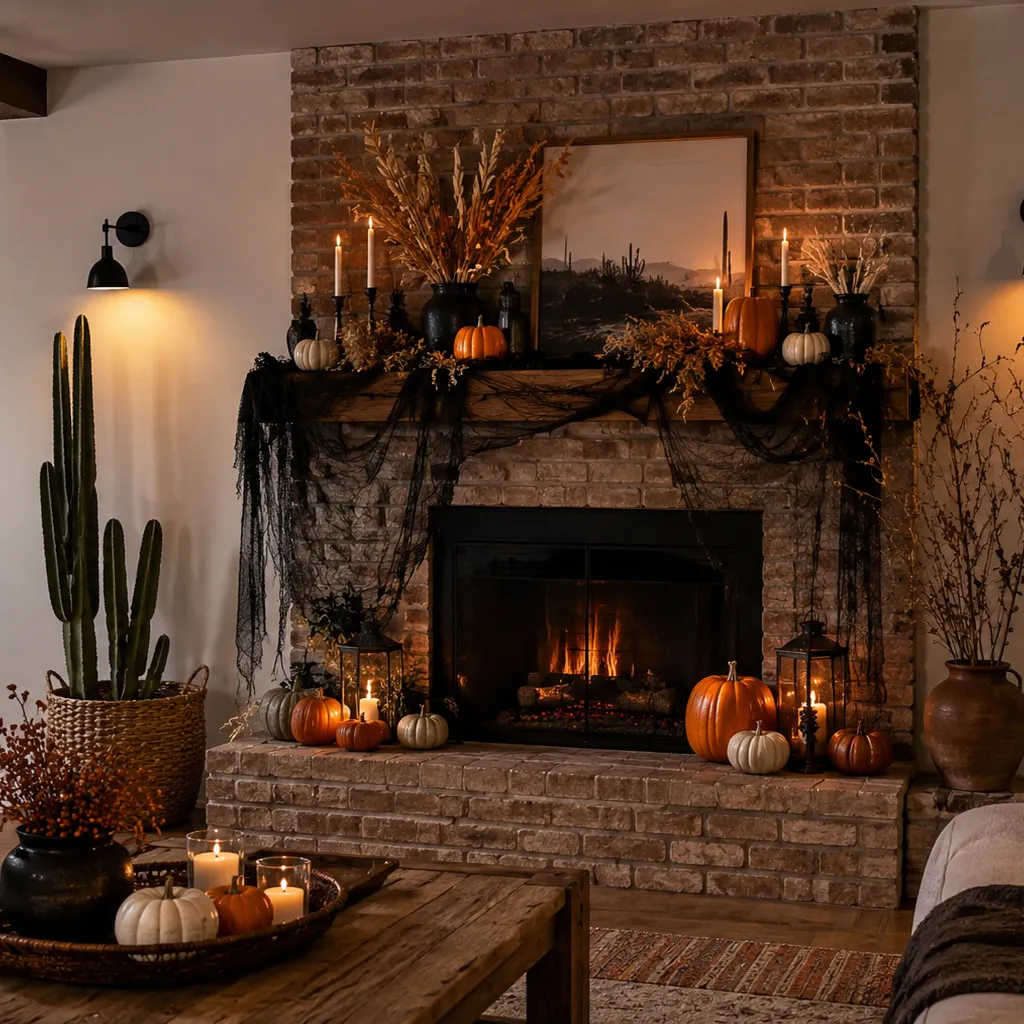
A few black taper holders, a lantern, a charcoal vase or a black-framed print immediately have something to connect with visually. The result feels much more natural than scattering black accessories around the room simply because black is associated with Halloween.
This is why black works particularly well in small doses around red brick.
A large black lantern at hearth level, two thin taper candles above, and perhaps one dark object on a nearby table may already be enough.
The effect becomes even better in the evening. Firelight softens the contrast between black and red brick, bringing out darker brown and charcoal tones within the masonry itself.
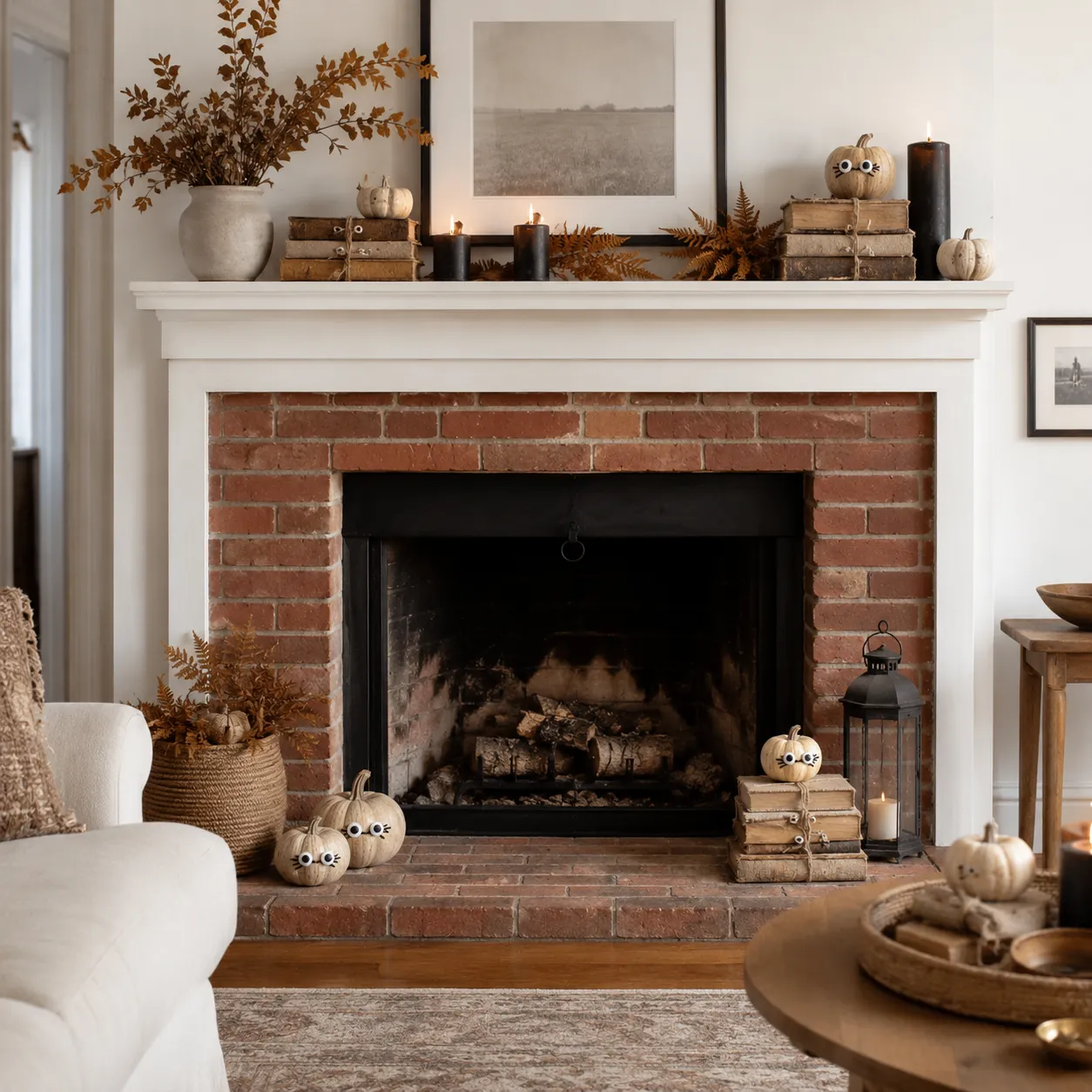
Pale pumpkins have a special advantage beside brick
There is a reason cream pumpkins appear so often around successful red brick fireplaces.
The shape still says autumn immediately, but the color behaves almost like an architectural neutral.
A pale pumpkin can relate to:
- white trim;
- plaster walls;
- linen upholstery;
- pale rugs;
- ceramic vessels;
- light mortar.
That means it can sit directly against the fireplace without looking like a separate seasonal object brought in from another room.
Large ivory pumpkins work particularly well at hearth level, where their rounded forms soften all the rectangles created by brick courses and the firebox.
Smaller ones can sit along the mantel, but they tend to look better when mixed with something taller or thinner—a candle, a branch, a framed print—rather than lined up one after another.
A pair of eyes can change almost anything
Some of the most charming Halloween fireplace ideas are also very small.
Add oversized eyes to a pale pumpkin and suddenly it becomes a character.
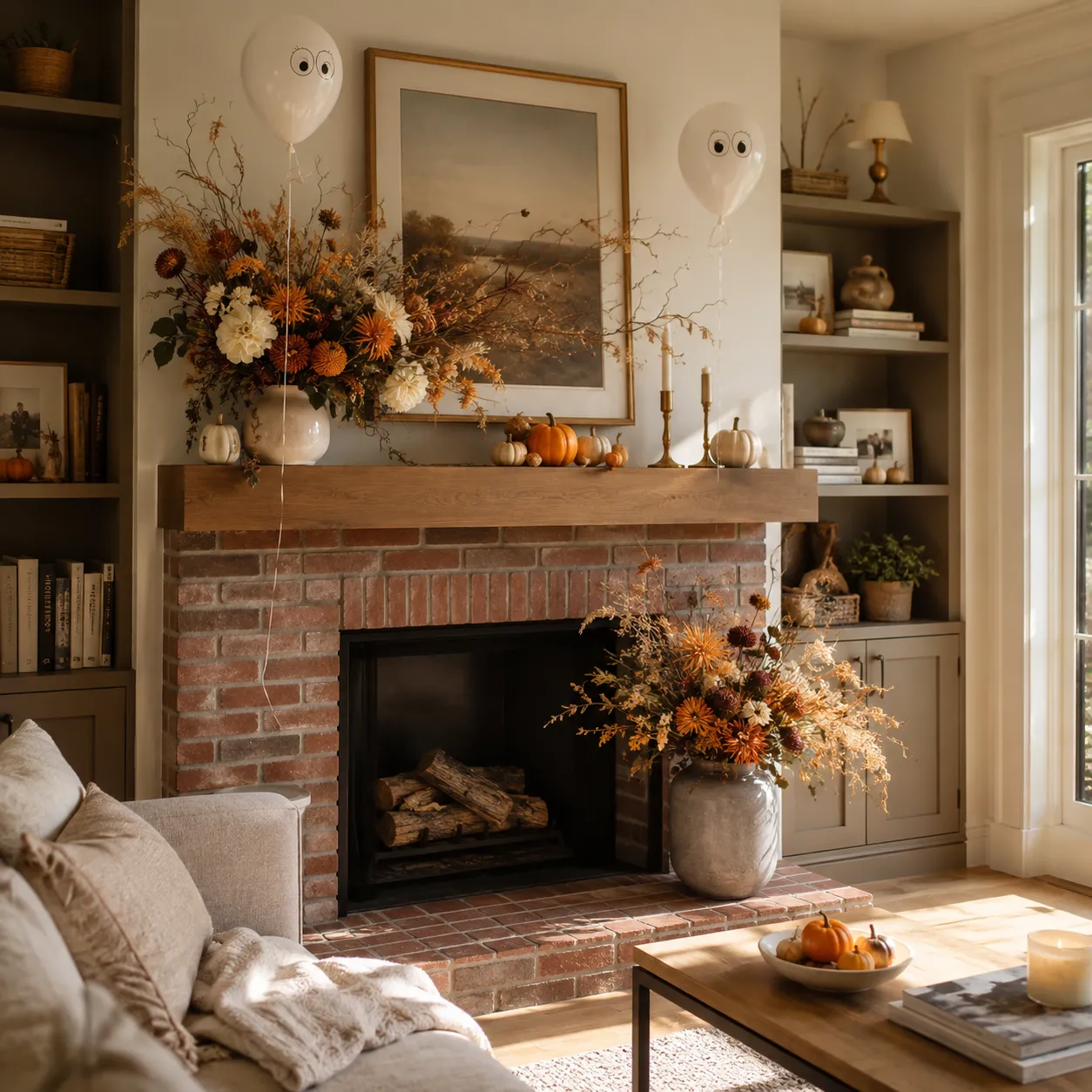
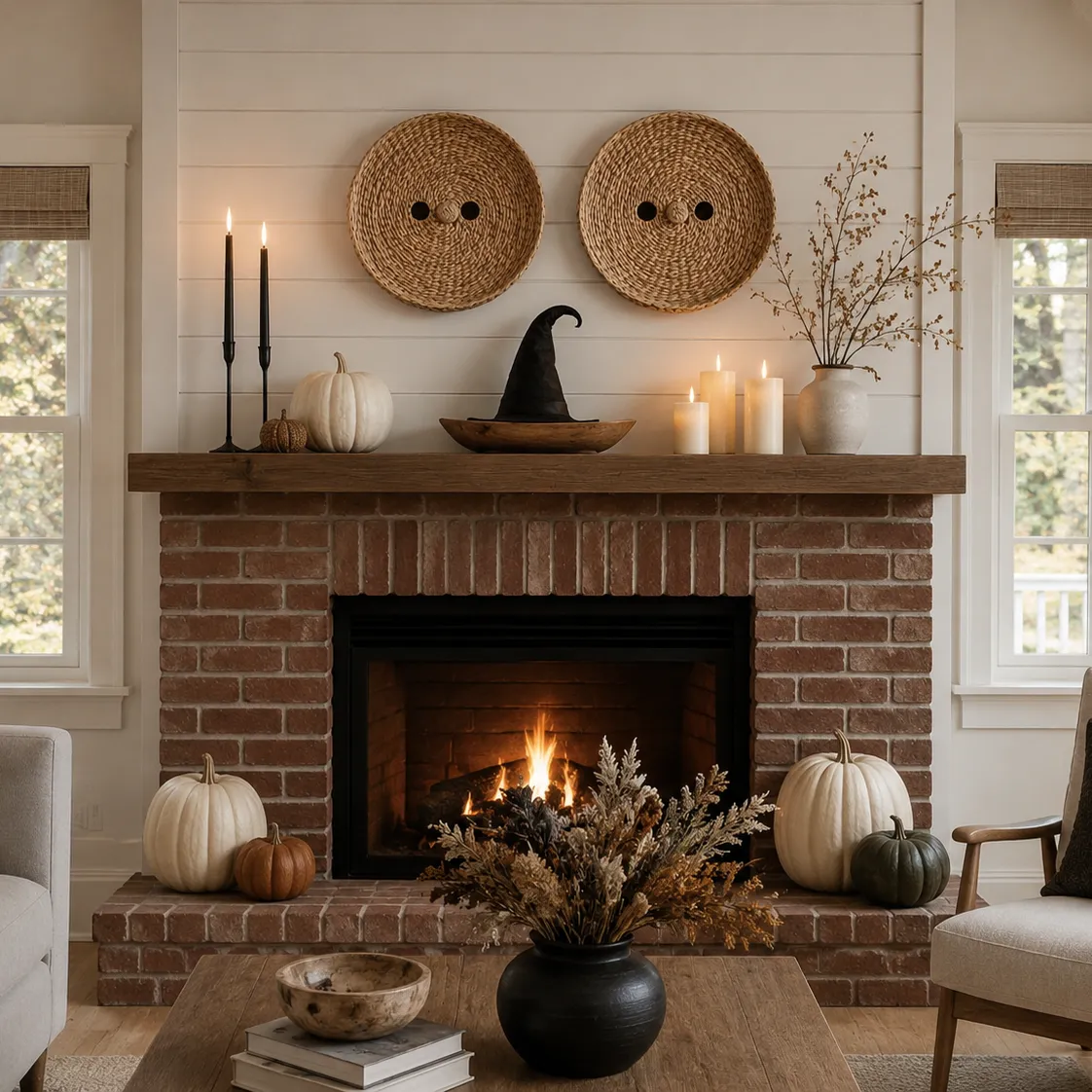
Add two dark circles to a pair of woven wall baskets and those baskets become enormous eyes above the mantel.
Add tiny eyes to folded paper shapes, simple wooden houses or balloons and ordinary objects suddenly belong to Halloween.
This works especially well around brick because the masonry already contains plenty of visual information. The decoration does not need another complicated pattern.
Eyes are simple, graphic and immediately recognizable.
There is also something useful about repeating them.
One pumpkin with eyes can feel like a novelty. Several pumpkins with the same type of eyes become a theme.
The same idea can appear at different heights—one on the mantel, another on a stack of books, two more near the hearth—without requiring different decorations everywhere.
For a family room, this can create Halloween character without introducing anything particularly dark or dramatic.
Build the fireplace for autumn first
One of the easiest ways to keep Halloween decorating from feeling temporary is to start with an autumn arrangement that could stay for several weeks.
Think dried branches, pale pumpkins, seed heads, old books, brass candlesticks, muted flowers, grasses and pottery.
Then add a very small Halloween layer.
That layer might be:
- one witch hat;
- two ghost balloons;
- black cat artwork;
- a few paper monsters;
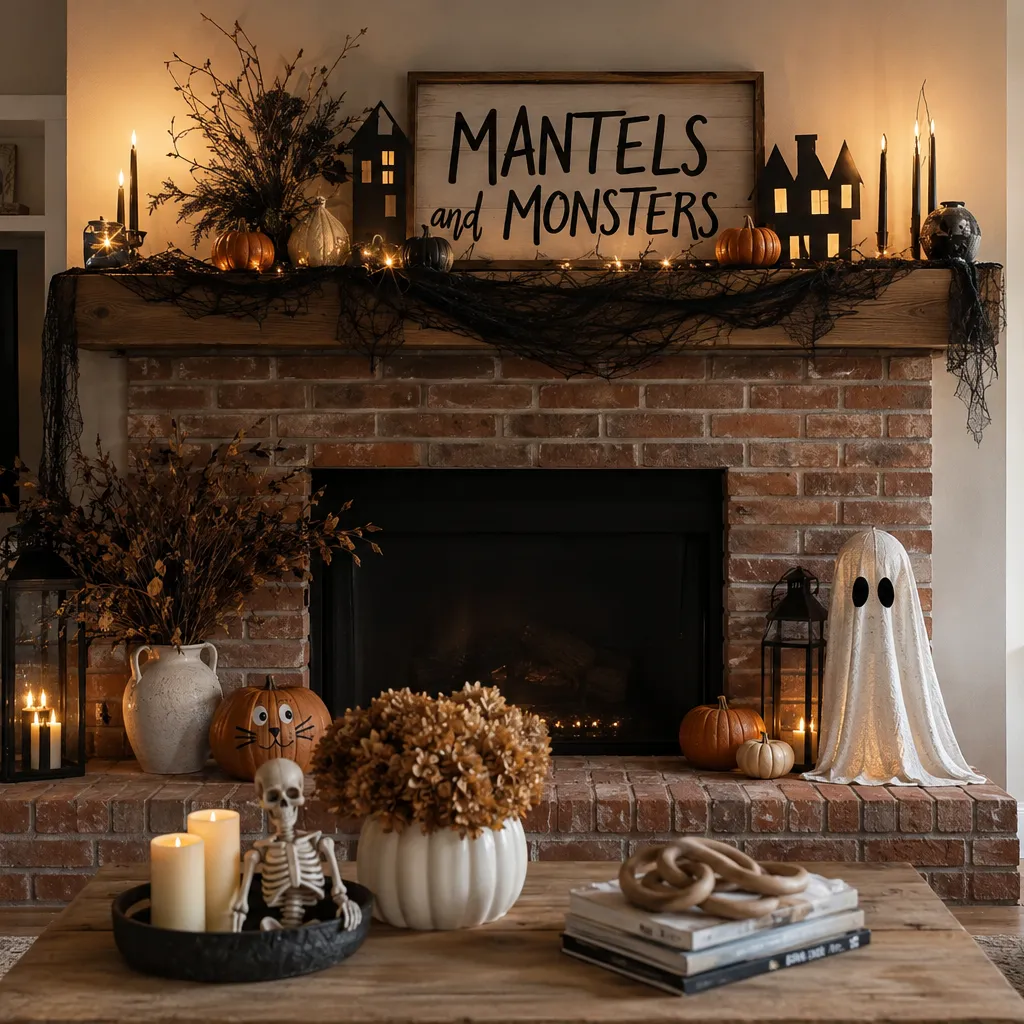
- a lightweight black gauze;
- eyes added to pumpkins.
The mood changes immediately, but most of the composition does not need to change.
Once Halloween has passed, remove the unmistakably Halloween pieces and the fireplace can return to being an autumn arrangement.
This approach is especially good in interiors where the fireplace is already a major architectural feature. The seasonal decor joins the room rather than taking it over.
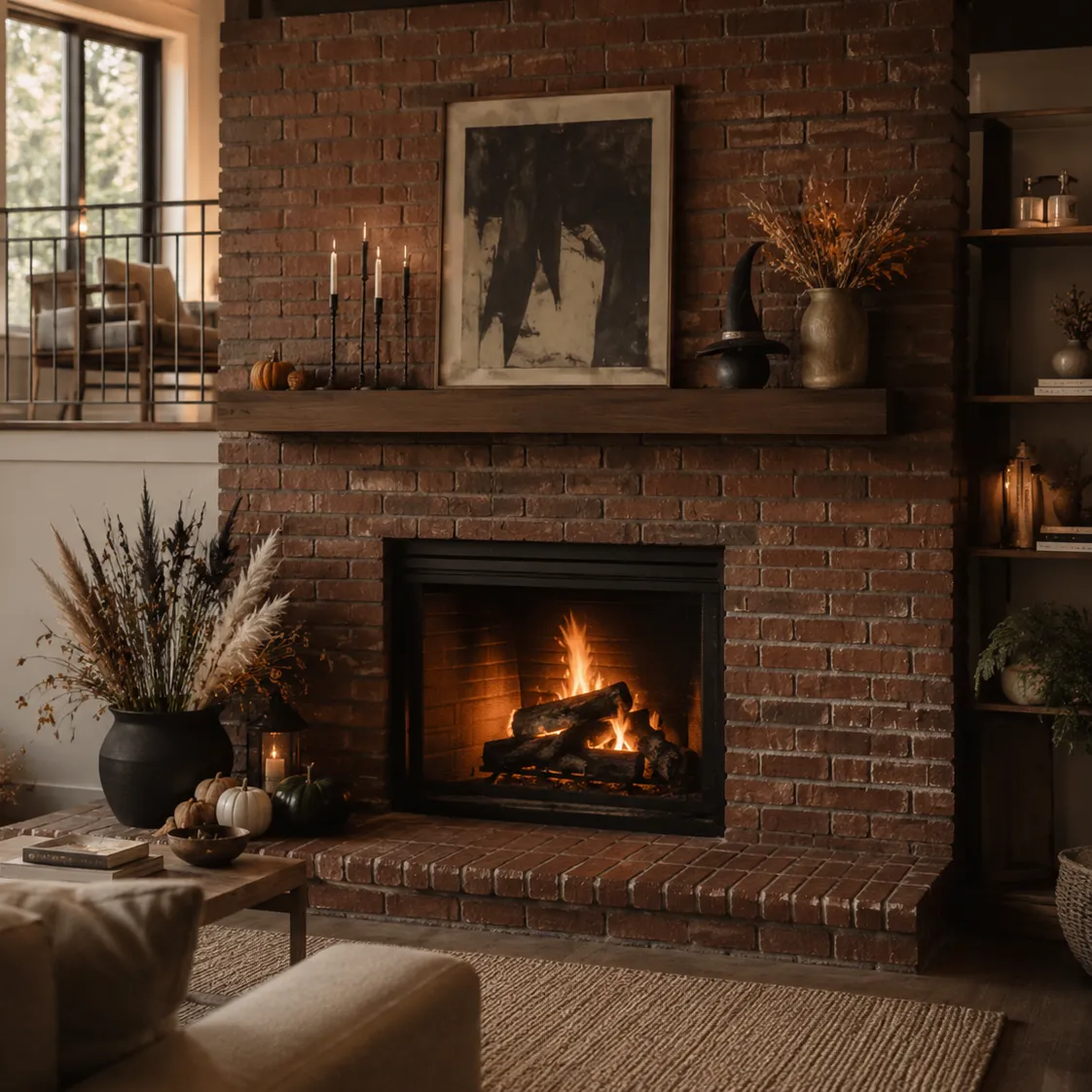
One witch hat can be enough
There is something appealing about a fireplace that looks almost completely autumnal except for one obvious Halloween object.
A black witch hat on a timber mantel is a good example.
The surrounding arrangement may be nothing more than a framed artwork, tall candles, a dried botanical vase and a few small pumpkins. Without the hat, it could stay in place throughout fall.
With the hat, the whole setting immediately takes on a Halloween character.
Placement makes a difference.
A witch hat does not always need to sit in the exact center. Tucking it beside a framed print or between a vase and a stack of books often feels more natural.
It almost looks as though Halloween has slipped into the room rather than been arranged there.
That small shift can be much more appealing than filling every surface with themed objects.
Try muted green instead of relying on orange
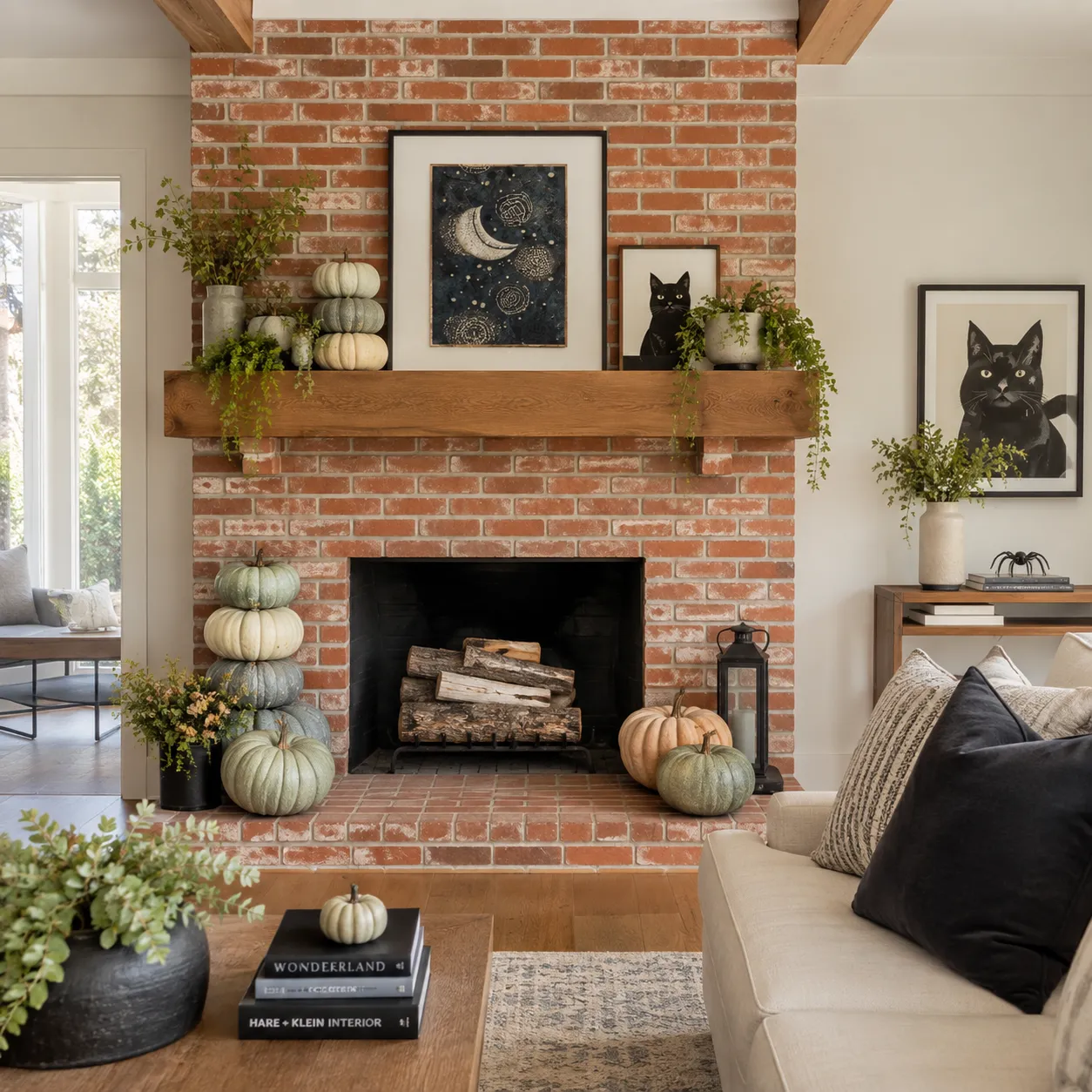
Sage, dusty eucalyptus, grey-green and muted olive pumpkins work very well with red brick.
The relationship is partly about color contrast.
Green sits opposite red on the color wheel, so even subdued green creates noticeable separation from the masonry.
But there is another reason it works: green pumpkins can connect to ordinary houseplants.
A fireplace decorated with trailing greenery, cream pumpkins, sage gourds, black lanterns and natural timber can feel seasonal without moving far away from the room’s everyday palette.
This works particularly well in interiors with:
- oak mantels;
- indoor plants;
- off-white walls;
- natural rugs;
- warm neutral upholstery.
A stack of green and cream pumpkins beside the hearth can also create more height than a row of pumpkins spread along the floor.
And because each pumpkin has a slightly different tone, the stack keeps its three-dimensional character.
Black cats can do what Halloween signs often cannot
A framed black cat print can bring Halloween into a room without adding seasonal text.
Placed near a moon print, celestial artwork or dark botanical illustration, it creates a subtle story rather than announcing the holiday directly.
This type of decorating suits red brick very well.
The flat black silhouette is easy to see against mottled terracotta brick, and framed art can remain visually connected to the rest of the room.
It also works nicely when there is another black cat image nearby on a side wall or console. That repetition extends the theme beyond the fireplace without needing to repeat pumpkins everywhere.
A tiny spider on a stack of books or a small black ornament nearby can then feel completely at home because the visual idea has already been established.
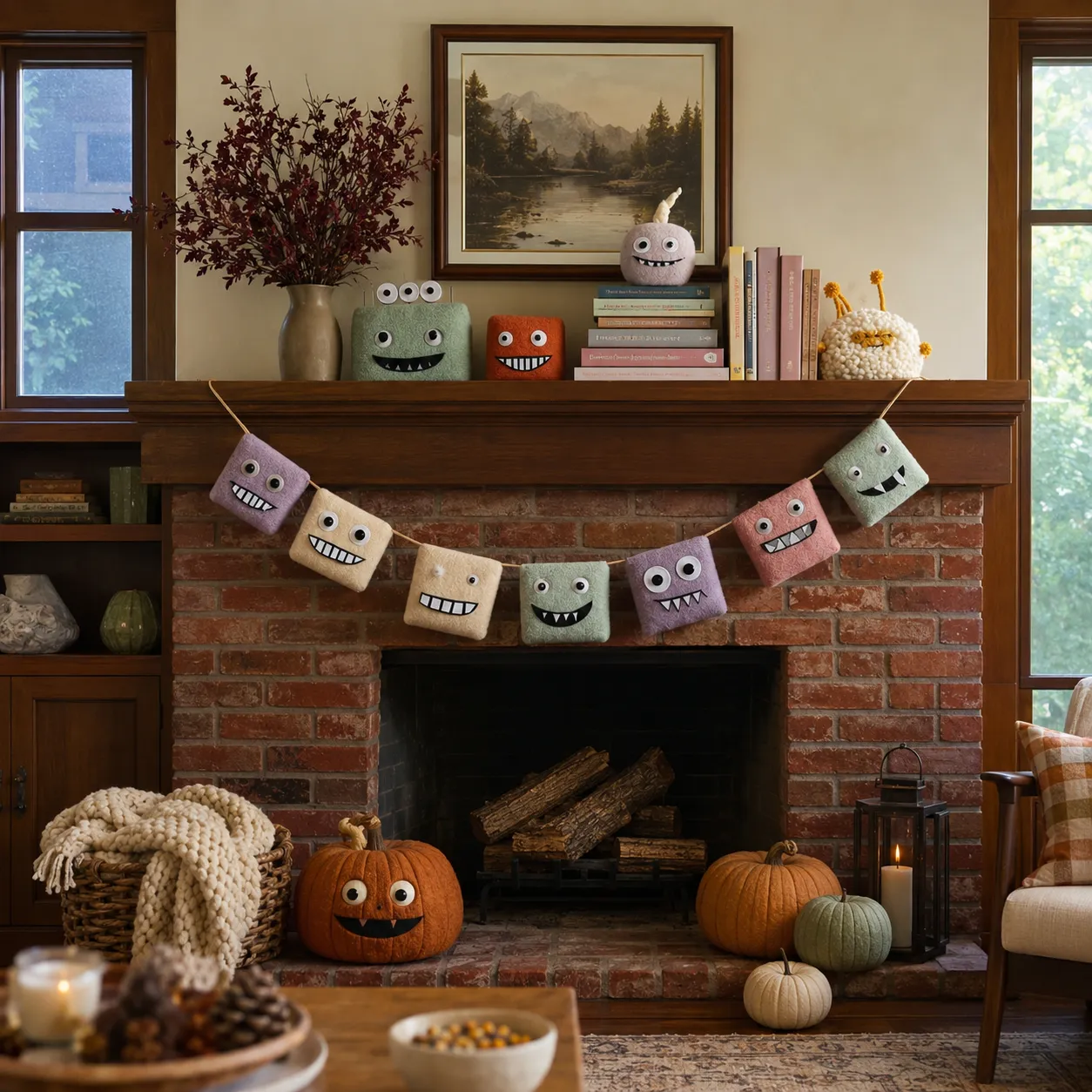
Paper monsters work surprisingly well in neutral interiors
Halloween characters do not have to be green, purple or bright orange.
Simple monsters made from kraft paper, folded cardboard or corrugated board can feel right at home on a red brick fireplace.
Their shape carries the Halloween theme:
- pointed ears;
- circular eyes;
- triangular teeth;
- strange proportions.
Their materials, meanwhile, stay close to the neutral palette of the room.
Kraft brown, oatmeal, warm grey and cream look particularly good against brick and natural timber.
There is also an interesting material relationship here. Brick gives the fireplace a strong horizontal rhythm, while folded or corrugated paper introduces vertical ridges.
The surfaces are different enough to separate clearly but textured enough to feel compatible.
Varying the monsters’ heights helps too.
A tall figure beside a shorter rounded one creates an uneven skyline along the mantel, which keeps a long shelf from feeling flat.
Give a wide mantel a changing silhouette
Wide brick fireplaces can be difficult to decorate because there is so much horizontal space.
Filling that entire length with similarly sized pumpkins usually makes the mantel feel flatter.
Changing heights and shapes gives the eye somewhere to go.
For example:
tall taper candles → low pumpkin → framed artwork → medium vessel → taller branches.
Or:
short paper monster → tall monster → pale pumpkin → circular paper ornament → another character → narrow vase.
The details do not need to be symmetrical.
In fact, one side can hold a large botanical arrangement while the other side has several smaller objects.
The fireplace opening already provides a strong central axis, so the mantel can afford some imbalance.
Use the hearth differently from the mantel
The hearth offers room for larger pieces.
This is where oversized pumpkins, lanterns, floor-level vessels and taller arrangements usually feel comfortable.
The mantel works better for smaller items and finer details.
That difference in scale helps the fireplace feel connected from top to bottom without turning it into one continuous display.
A useful example is repeating an idea rather than repeating an object exactly.
If the mantel has small pale pumpkins, the hearth can hold two much larger pale pumpkins.
If black taper candles appear above, a black lantern below can continue the same dark note.
If monster faces appear along the mantel, one larger monster near the hearth can connect the two levels.
The relationship is enough. Perfect matching is not necessary.
Dried plants often suit brick better than artificial Halloween foliage
Red brick already has irregular color, rough texture and a slightly aged character.
Dried botanicals naturally belong beside it.
Bare branches, faded fern, pampas, dried hydrangea, seed heads and brown foliage all work because they share that same late-season character.
There is a useful contrast to consider with darker brick.
If the brick is deep brown-red, dark branches may disappear against it. Pale grasses and light seed heads become much easier to see.
Against lighter brick, the opposite can happen: thin dark branches have plenty of definition.
A large dried arrangement can also create height without requiring another literal Halloween symbol.
That becomes especially helpful when the mantel already contains pumpkins, candles or character objects.
Candlelight changes red brick beautifully
Many Halloween fireplace arrangements make far greater sense after sunset.
Brick responds well to local light because it is uneven.
Candlelight catches:
- projecting brick edges;
- mortar joints;
- rough surfaces;
- darker burnt areas.
The fireplace wall develops much greater depth than a smooth painted wall would.
That is why a few candles often have a larger visual effect around brick than adding several new decorations.
Thin black taper candles have one quality; grouped ivory pillar candles create another.
Lanterns work especially well at hearth level because their black frames repeat the firebox while the light inside picks up the warm color of the masonry.
For a working fireplace, of course, real flame, textiles and dried materials need appropriate separation from heat. Battery candles can achieve much of the same visual effect in tighter arrangements.
Black gauze works because you can still see the masonry
There are times when a fireplace can support a much darker Halloween look.
Lightweight black gauze is one of the better materials for creating it.
The reason is simple: the material does not completely hide the brick.
Draped loosely over a timber mantel, it introduces irregular hanging lines against the very regular geometry of the fireplace.
Brick courses run horizontally, the mantel runs horizontally, and the firebox is rectangular. The gauze breaks those patterns with folds and uneven drops.
Because the fabric is open and translucent, the masonry remains visible underneath.
That is an important distinction.
The red brick should still participate in the composition rather than disappearing behind a solid black sheet.
Pairing the gauze with ordinary autumn objects—pumpkins, dried foliage, pottery and candlelight—also keeps the fireplace connected to the rest of the room.
Old books are particularly good companions for old-looking brick
A few faded books tied with twine can do something that shiny seasonal ornaments often cannot: they make the fireplace feel collected rather than decorated. Their tobacco, tan and aged-paper colors naturally repeat tones found in red brick.
They also introduce softer materials beside all the masonry:
- paper;
- string;
- worn covers.
Stacking a small pumpkin on top gives them a seasonal role without changing their character.
Books also help vary height.
A small pumpkin that would disappear directly on a wide mantel suddenly becomes more visible when lifted on two or three volumes.
The same stack can reappear near the hearth, linking upper and lower decorations without exact symmetry.
Look at the fireplace surround before choosing the Halloween style
Not every red brick fireplace wants the same kind of Halloween decoration.
A red brick insert inside a white traditional surround can handle pale pumpkins, old books, botanical branches and small black accents very naturally.
A farmhouse fireplace with shiplap and a simple timber mantel can support graphic black-and-white monster shapes.
A fireplace framed by dark stained wood usually needs less black because the architecture already contains plenty of it.
Muted greens, dusty pinks, creams and soft textile decorations can be far more effective there.
A darker exposed-brick wall may need very little decoration at all.
Candlelight, dried grasses and one witch hat can be enough.
A Southwestern room can keep its cactus, desert artwork and terracotta palette and still become Halloween-ready with black gauze, lanterns and a few pumpkins.
The seasonal decor becomes much more interesting when the house keeps its own personality.
Some of the nicest Halloween ideas are reversible
Seasonal decorating becomes easier when the objects you already own can temporarily change character.
A woven basket becomes an eye.
A pale pumpkin becomes a little creature.
A balloon becomes a ghost.
A framed black cat becomes the seasonal clue in an otherwise ordinary art arrangement.
A simple autumn mantel changes completely when a witch hat appears.
These ideas are useful because they do not require replacing the room with Halloween decorations.
They work with what is already there.
And that may be the real advantage of decorating a red brick fireplace: the fireplace itself is already doing plenty of the seasonal work. The warm masonry, dark opening, wood, firelight and rough surface have the right October character built in.
The most memorable Halloween fireplaces often seem to recognize that.