Boho maximalist living room design is often reduced to a quick visual formula: many pillows, layered rugs, baskets, plants, mixed prints, and a casual sense of collected life. That shorthand misses the structure.
The design ideas that feel rich, settled, and memorable usually do not succeed because they contain the highest number of objects. They succeed because they organize warmth, tactility, architecture, and human comfort into one coherent interior field.
A good boho maximalist living room does not feel random. It feels inhabited.
It feels softened by touch, use, material grain, filtered light, and a certain looseness in the way elements relate to one another. But that looseness still needs order.
Without order, the room becomes noisy. Without fullness, it becomes thin.
The style lives in the middle ground where comfort, craft, and visual density are held in balance. That balance starts with a simple idea: the room should feel full in the body before it feels full in the accessory layer.
In other words, seating, rug, center table, wall tone, plant life, and material texture matter first. Small decorative items matter later.
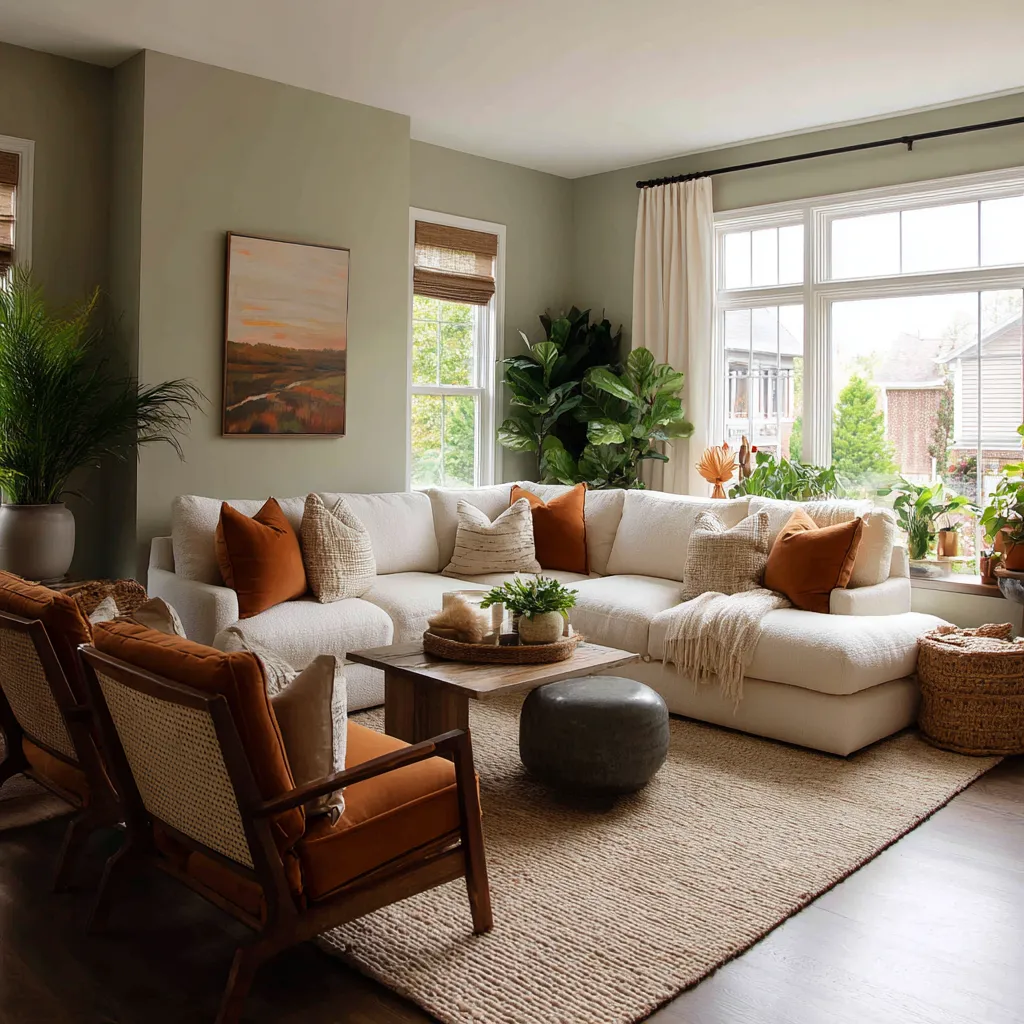
Boho identity begins where the body meets the room
One of the things about a well-made boho maximalist living room is that its character is carried by tactile contact points. You notice this in the places people actually touch, lean on, sit against, or move around: the chair frame, the woven table, the bench cushion, the pillow edge, the rug pile, the pouf, the basket near the fireplace, the plant near the window.
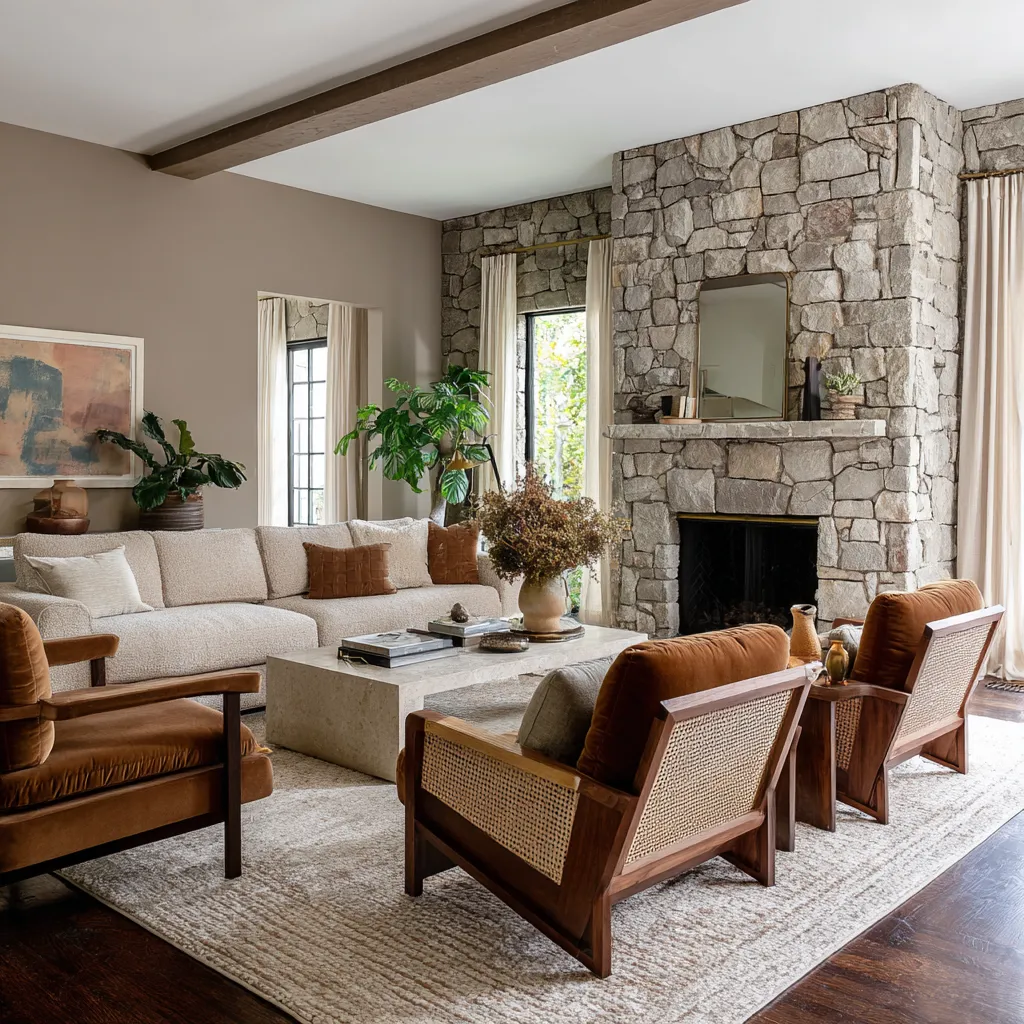
This is why cane-backed chairs appear so often in convincing versions of the style. They do several jobs at once.
They bring hand-touched craft texture. They connect wood to upholstery.
They keep the seating edge visually open. They add pattern without using print.
They also work in bright rooms and darker rooms because their woven structure has permeability. A fully upholstered chair can add softness.
A cane-backed chair adds softness, grain, and air at the same time.
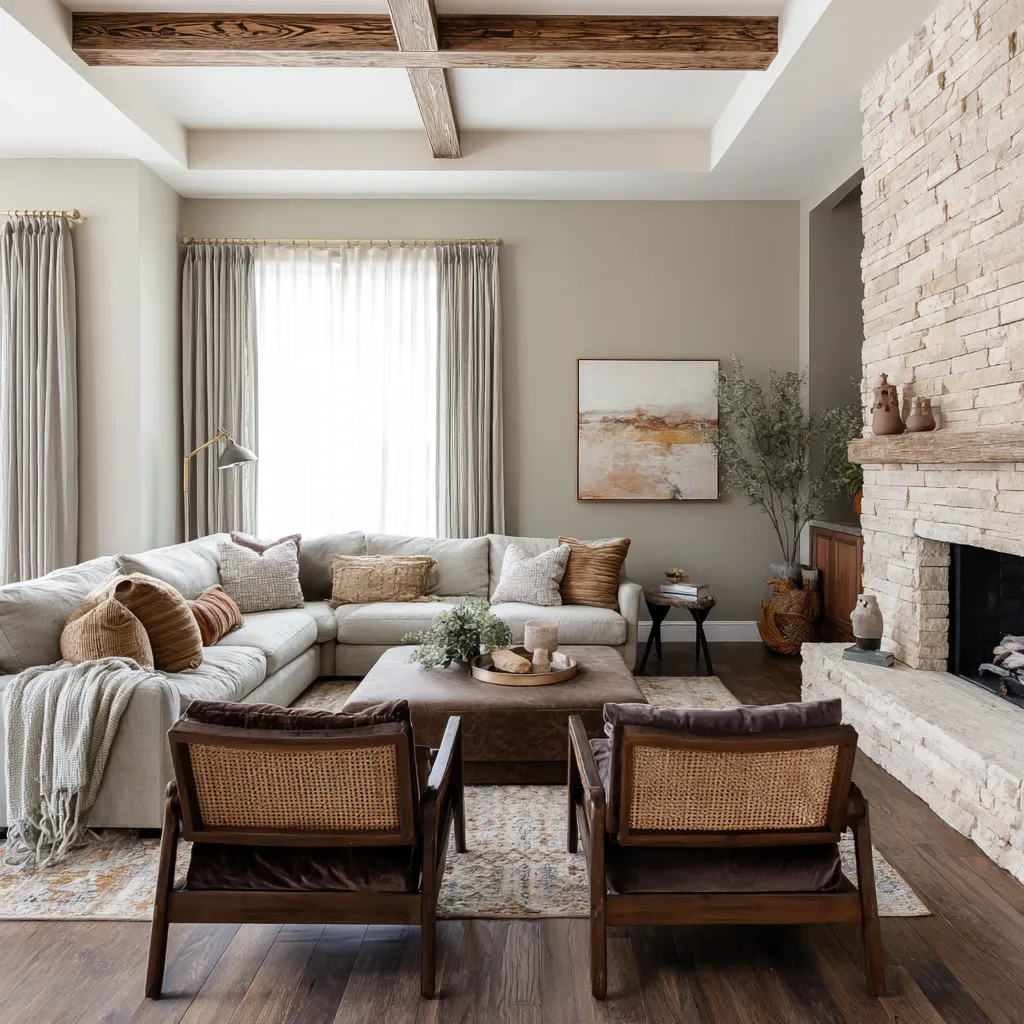
The same logic applies to woven coffee tables, rush stools, basket-like pendants, open-weave benches, natural-fiber rugs, and looped upholstery. These are not small style extras.
They are the material language that tells the room what it is. The boho side of the room becomes legible through surface behavior before it becomes legible through decoration.
That is why a room with a vintage rug and a few colored cushions may still feel only partly boho if it lacks enough visible craft signal. And it is also why a room with very little overt pattern can still feel clearly boho if it has the right tactile mix: cane, plaster, washed fabric, dry stems, wood grain, matte ceramics, and a rug with enough age and softness in its surface.
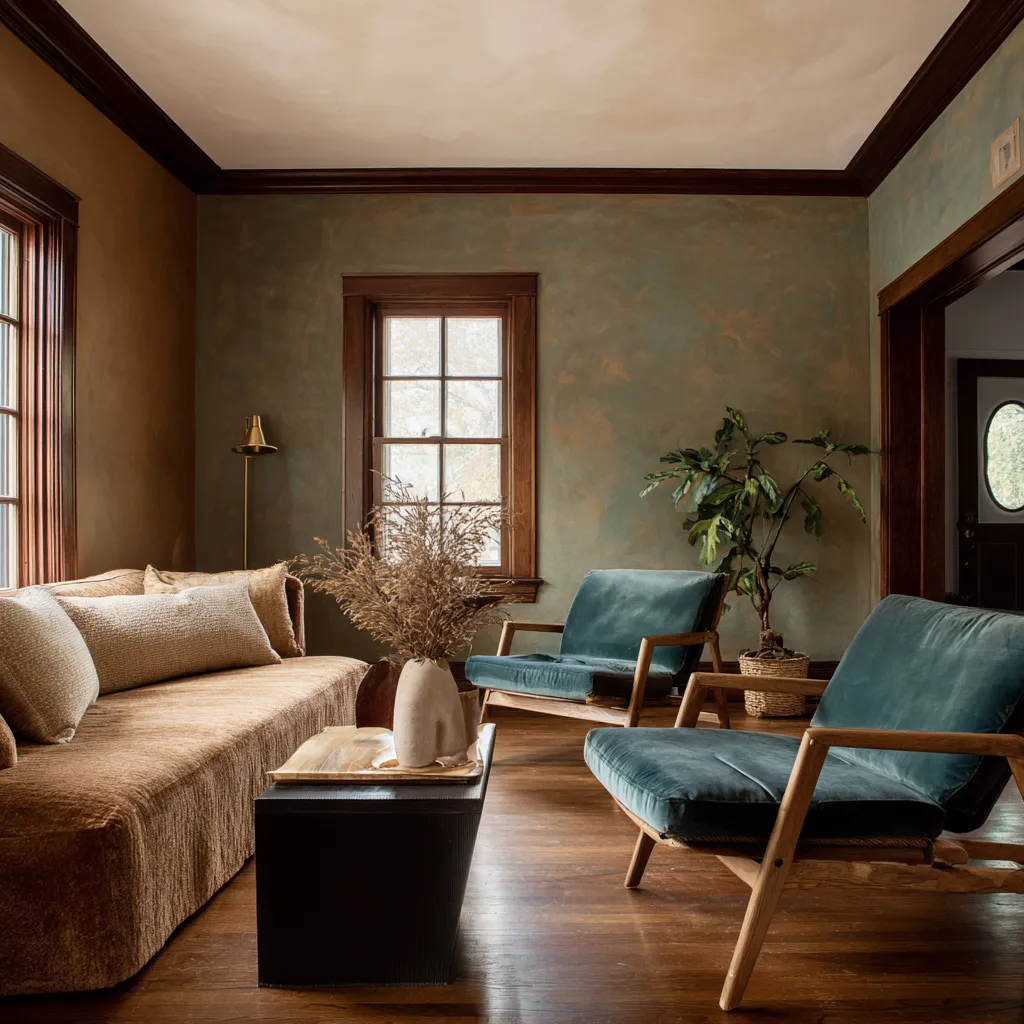
Maximalism is usually built through fullness, not object scatter
The maximalist side of the style is also often misunderstood. People tend to imagine maximalism as an everywhere-at-once condition, where every wall, shelf, and tabletop is loaded.
In living rooms that feel current, that is rarely the case. The fuller rooms often rely on much larger moves.
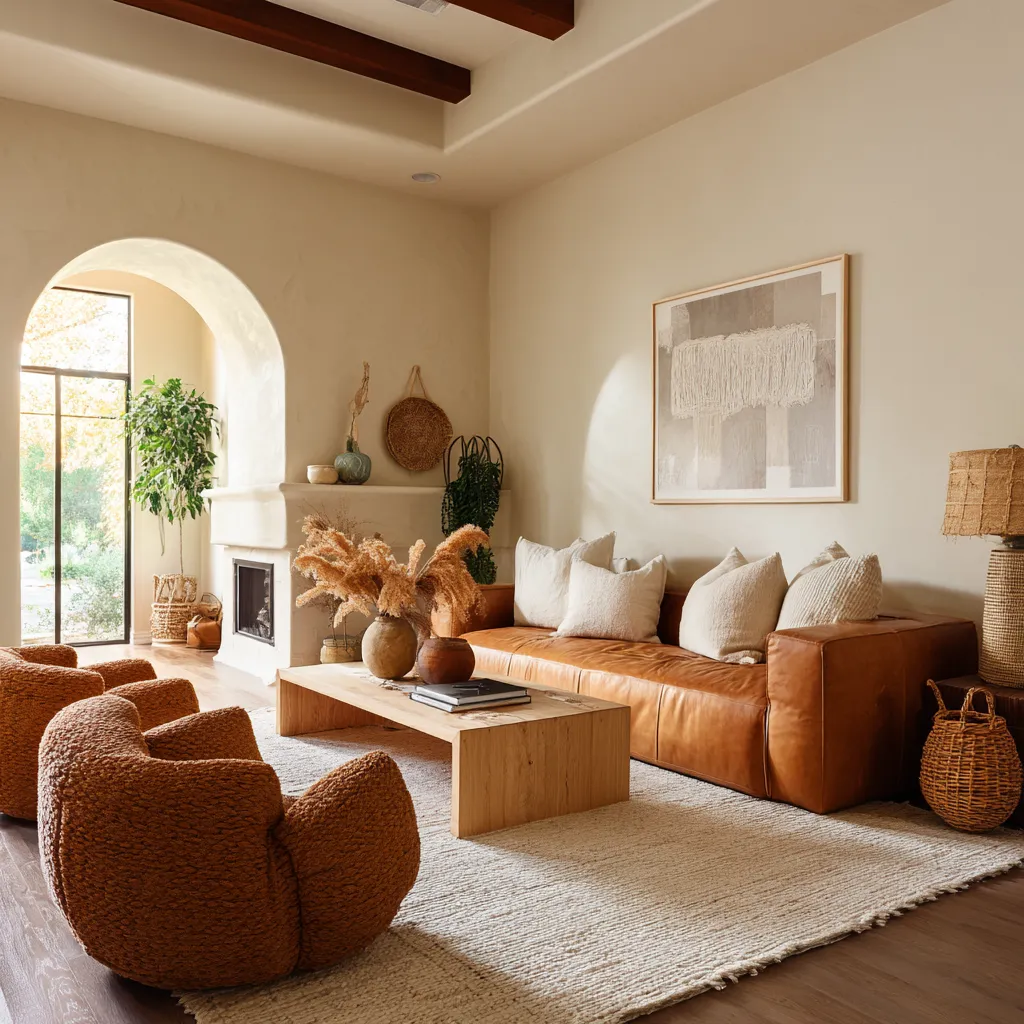
A room begins to feel truly developed when it has enough of the following:
- generous seating volume
- a room-sized rug with age, softness, or tonal memory
- a center zone with real weight
- shell features that frame, compress, or deepen the space
- a few layers of organic interruption such as plants or dry botanicals
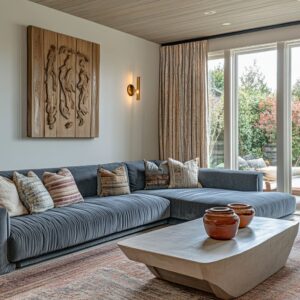
This is why a large sectional, two accent chairs, a strong rug, and a weighted center table can create more richness than many small objects scattered on open shelves. Fullness in this style often comes from how much of the room is committed to sitting, gathering, and lingering.
If the room gives most of its floor area to comfortable use, it already feels richer than a room that leaves the middle empty and tries to compensate with decor.
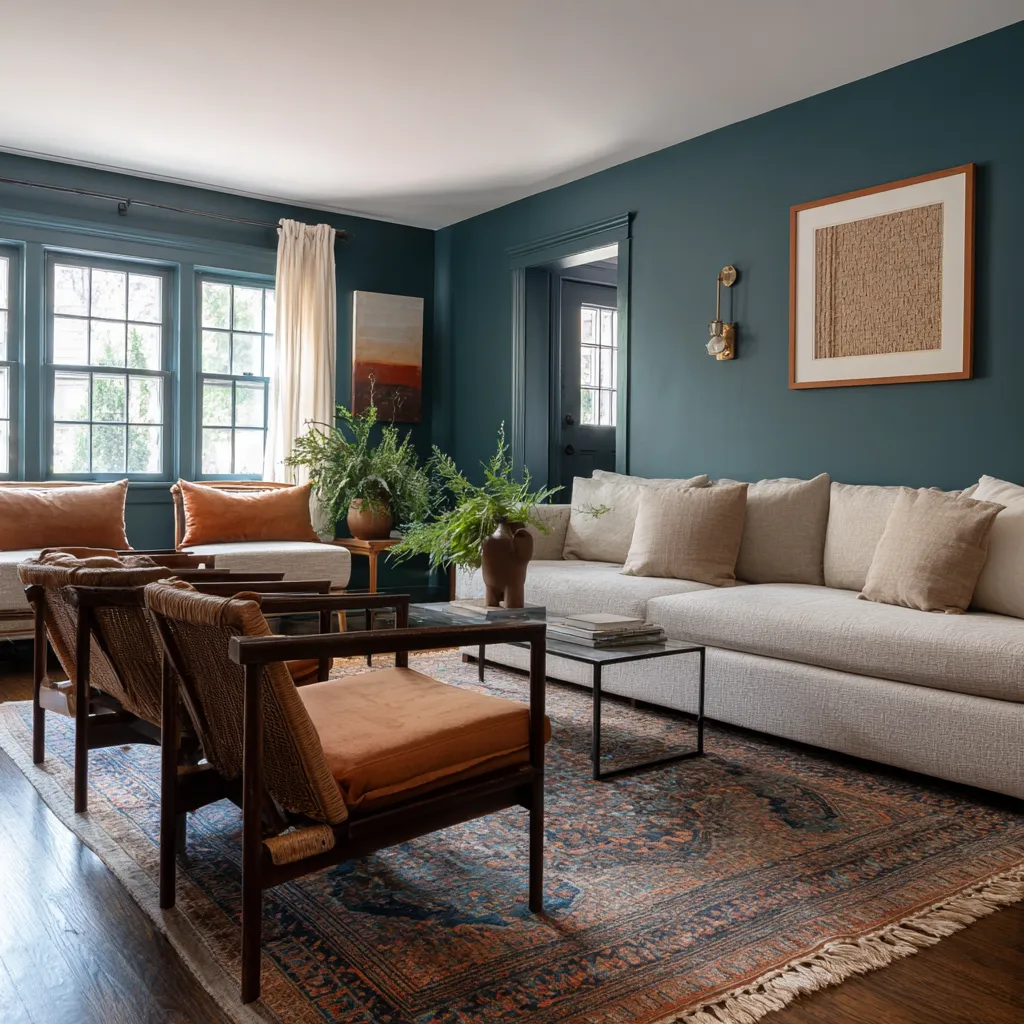
The middle of the room is especially important. In many successful boho maximalist living rooms, the center is not a leftover circulation zone.
It is one of the main places where the room announces its character. Sometimes that center takes the form of a thick woven drum table.
Sometimes it is a heavy dark block table. Sometimes it is a long upholstered bench, a cluster of ottomans, or a low stone-like slab.
Whatever the exact form, it tends to give the room gravity.
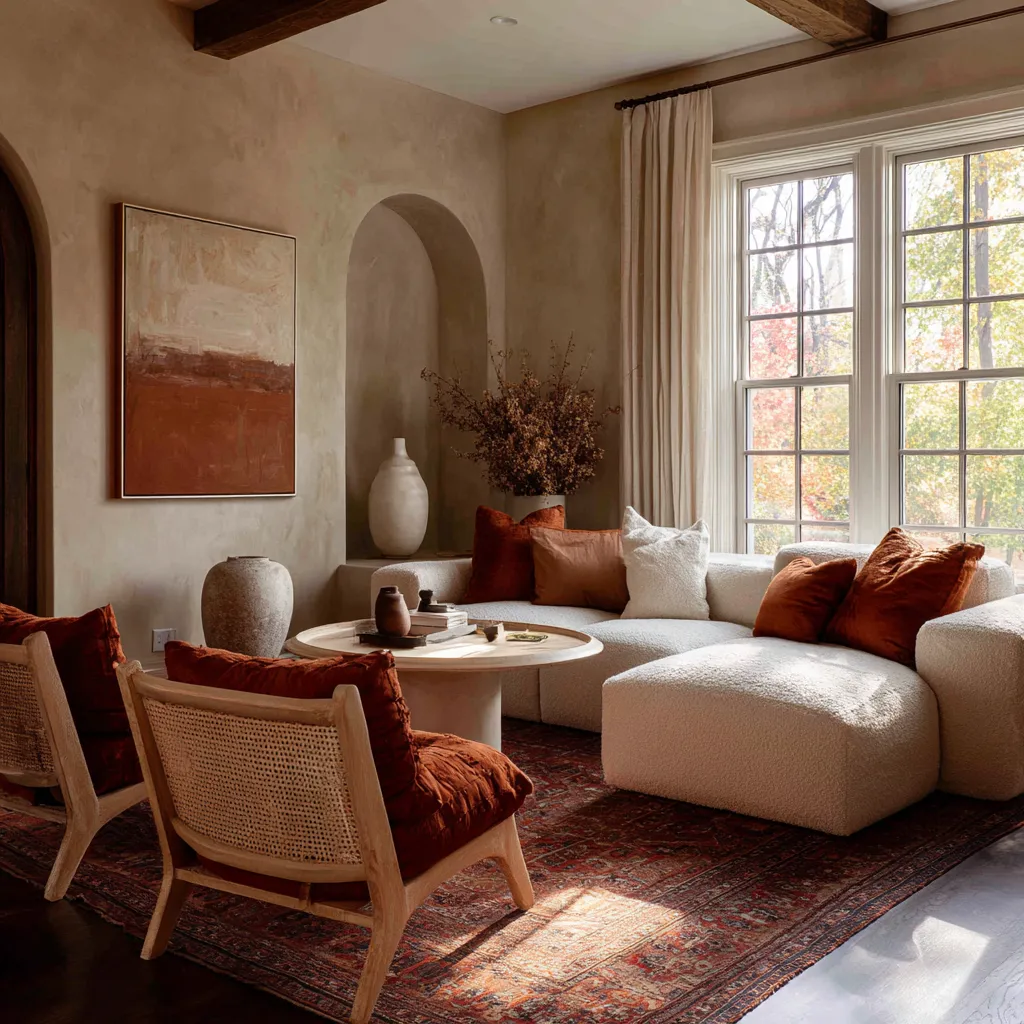
Without that center weight, the room can feel underwritten even if the perimeter is active. The sofa and chairs may be good, the wall color may be good, the rug may be good, yet the room still feels unfinished.
The missing piece is often the center anchor.
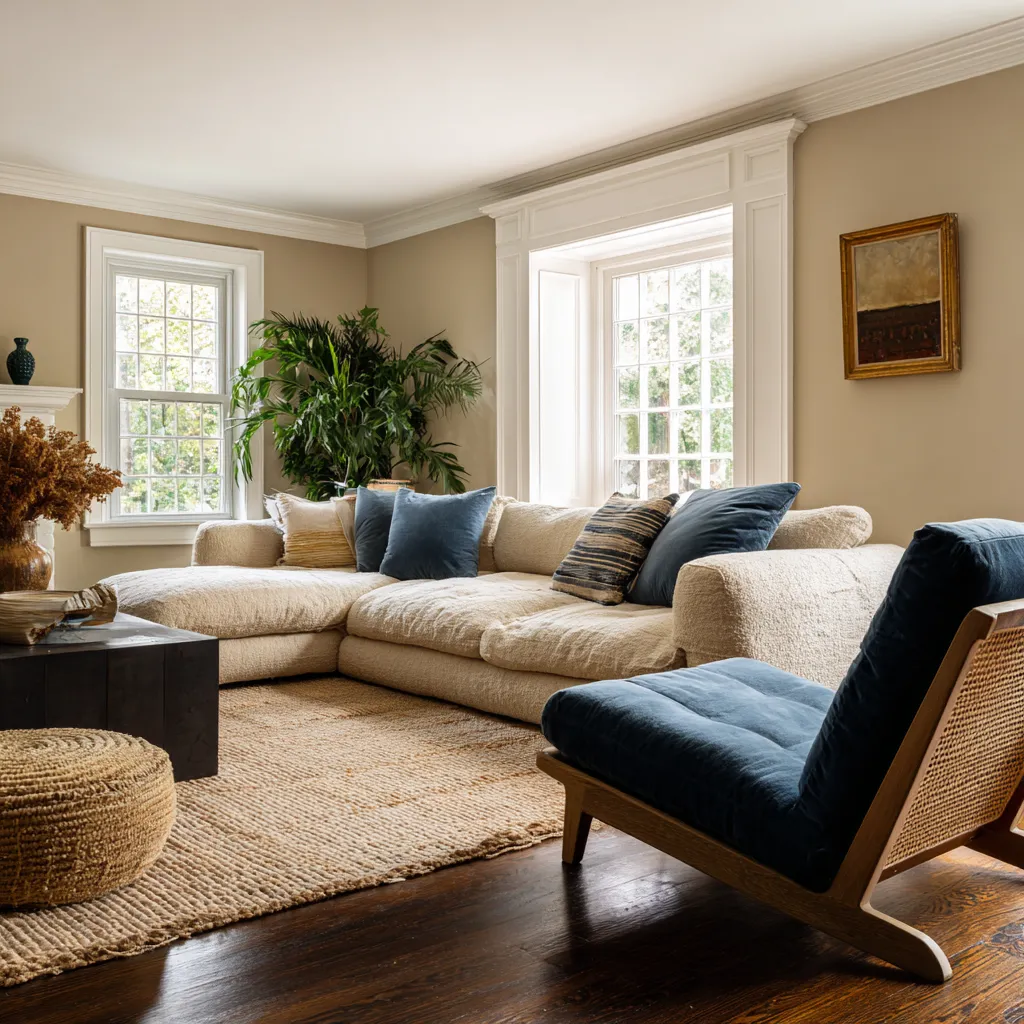
The shell determines the branch of the style
Boho maximalist living rooms are not one look. The shell changes the branch of the style before the furniture is even arranged.
That shell may be dark and cocooning, pale and arched, plastered and sun-softened, or bright and open with strong glazing. Each kind of envelope changes how the rest of the room should behave.
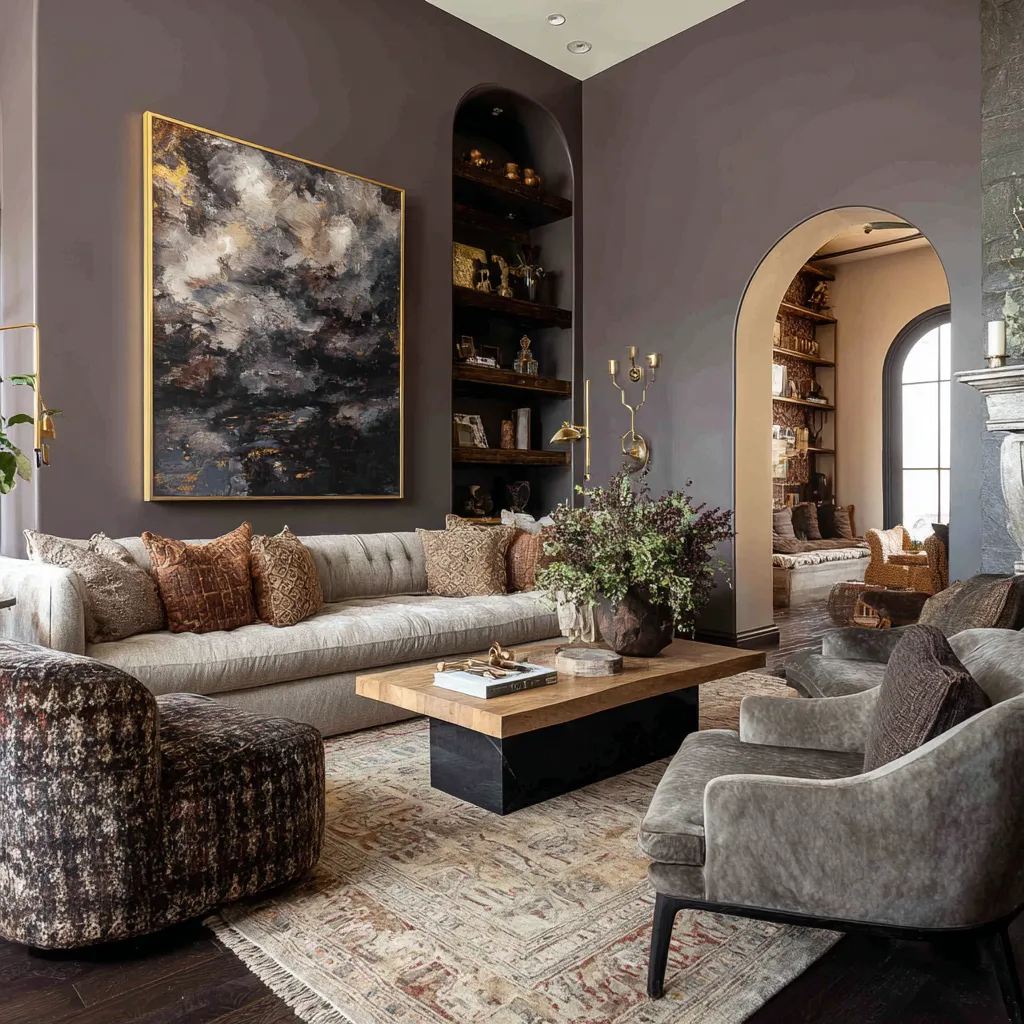
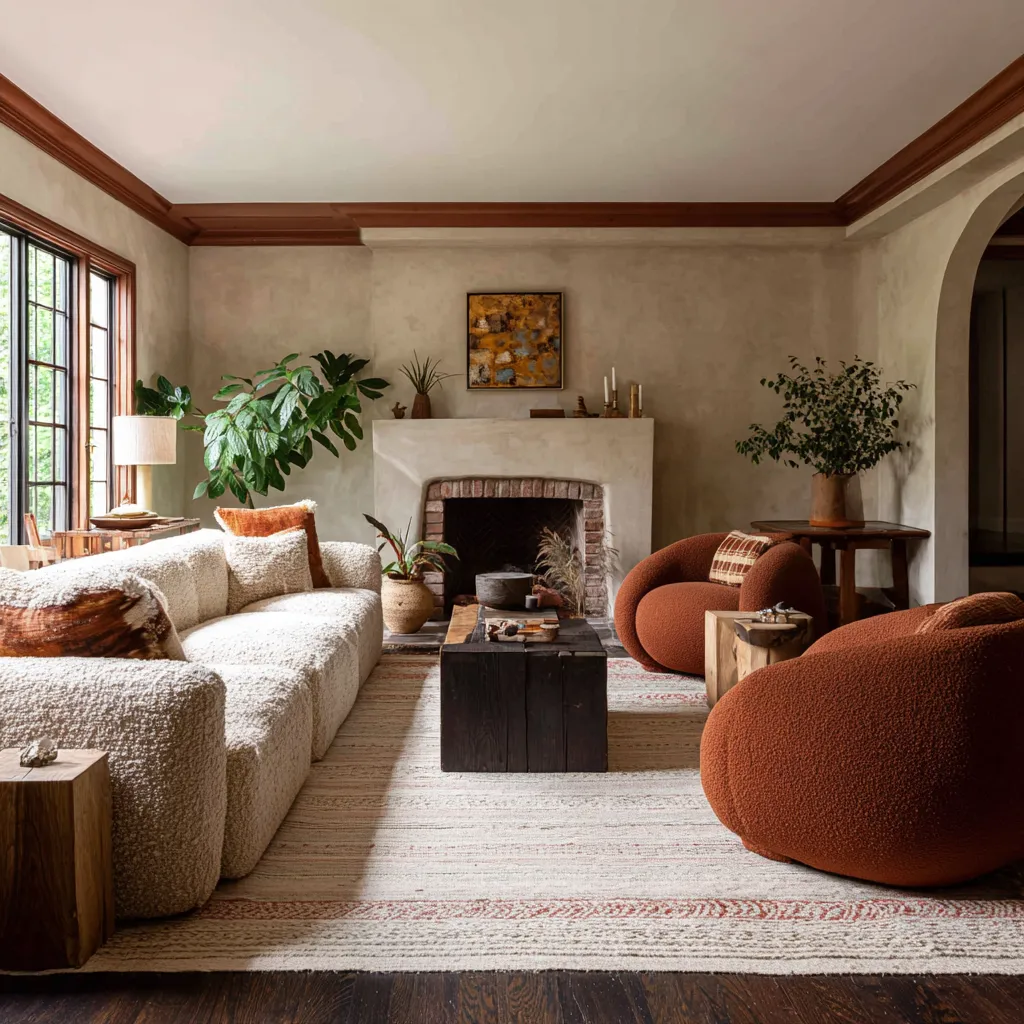
A darker shell usually creates atmosphere first. Deep walls, stronger trim, darker floors, recesses, shelving, or painterly surfaces tend to produce inwardness, visual gravity, and emotional depth.
In this kind of room, pale upholstery becomes especially important because it gives the eye relief. Warm chairs, a vintage rug, or a concentrated rust note can keep the darkness from becoming severe.
These rooms are often less cozy than people expect, but they can be deeply atmospheric.
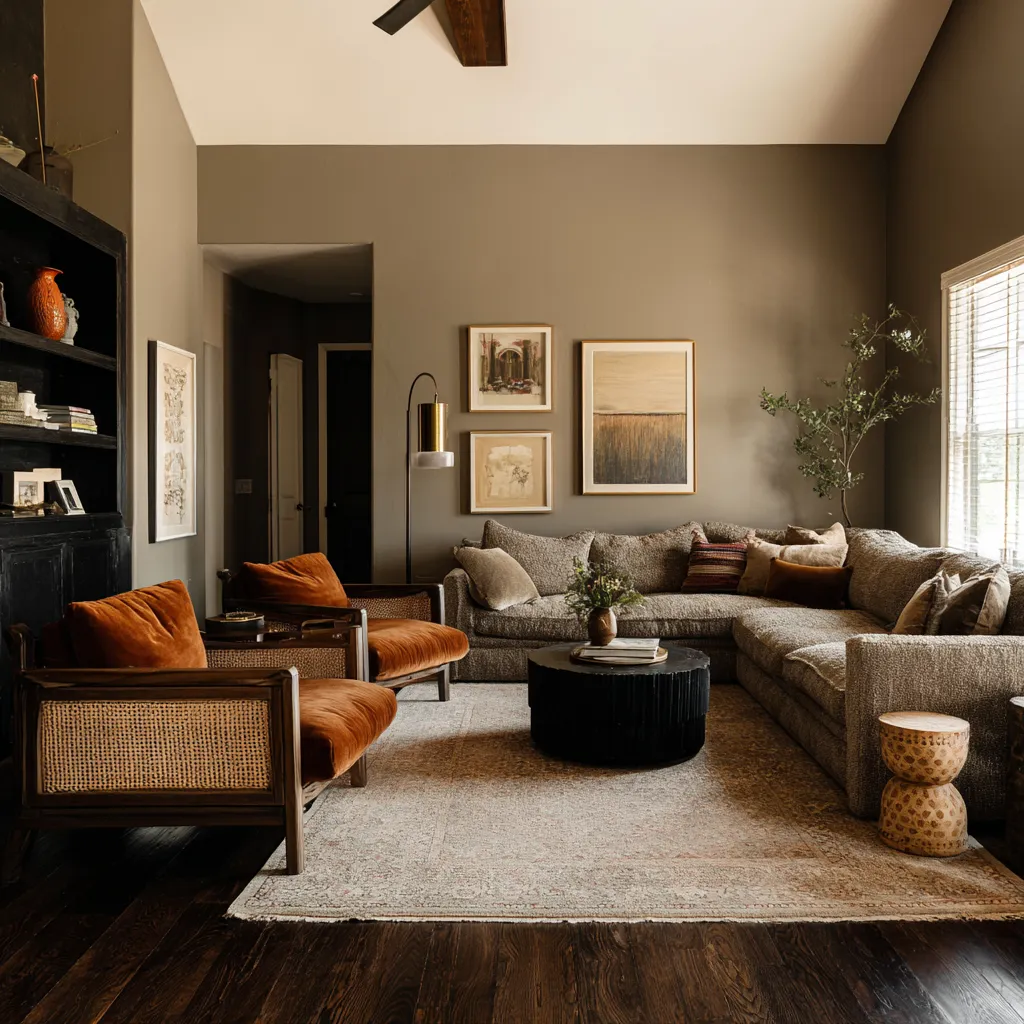
A bright shell pushes the room in another direction. Here, the danger is not heaviness but thinness.
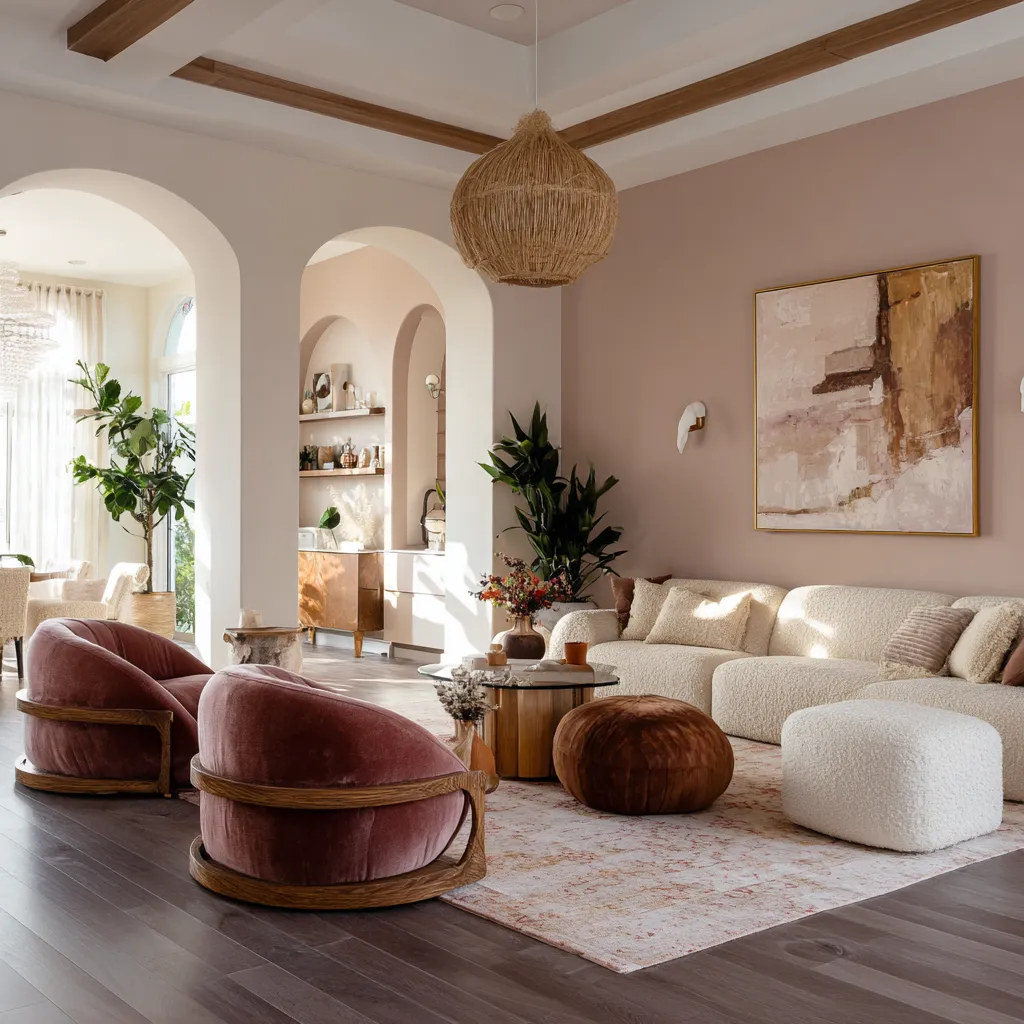
The room needs enough wrap, enough curve, enough plant life, enough woven texture, and enough center weight to avoid feeling washed out. Bench seating, arch openings, pale rugs, and layered cushions are especially effective in bright rooms because they build a softer kind of fullness.
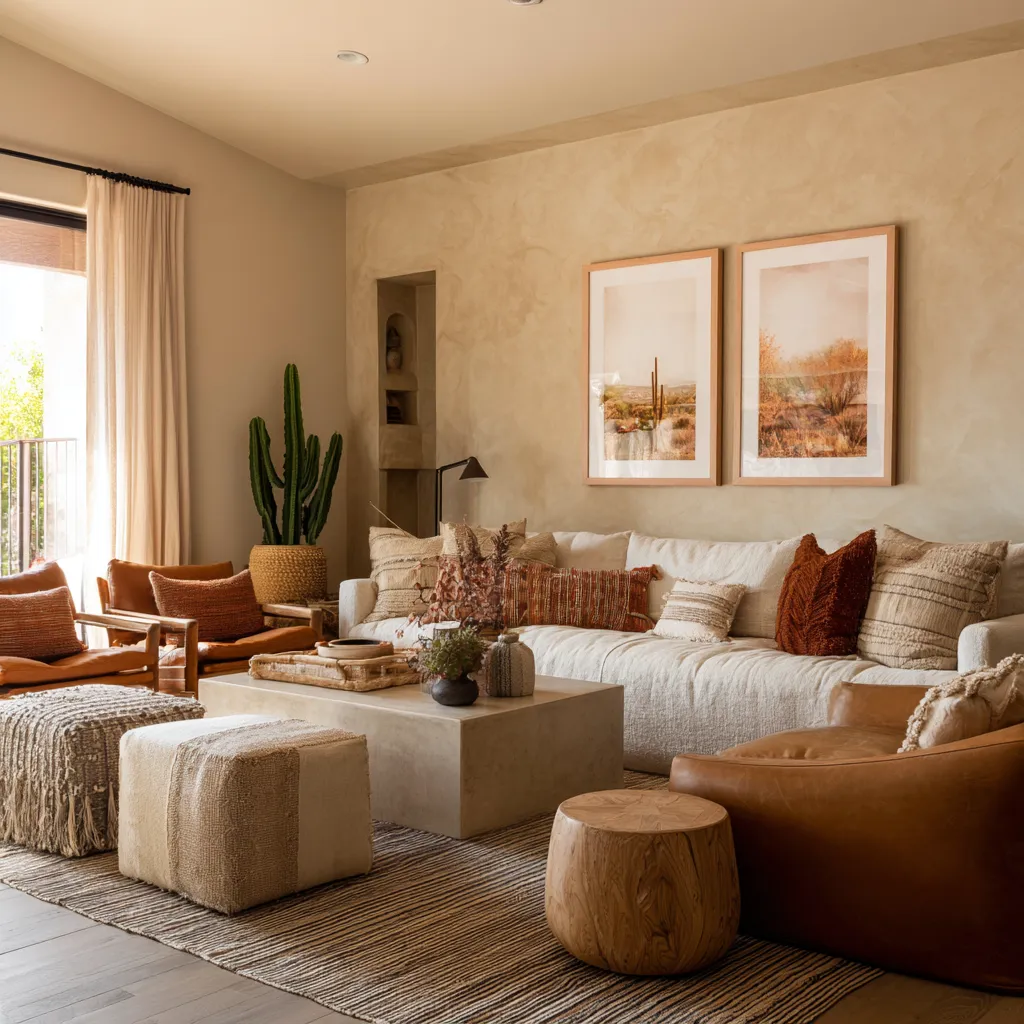
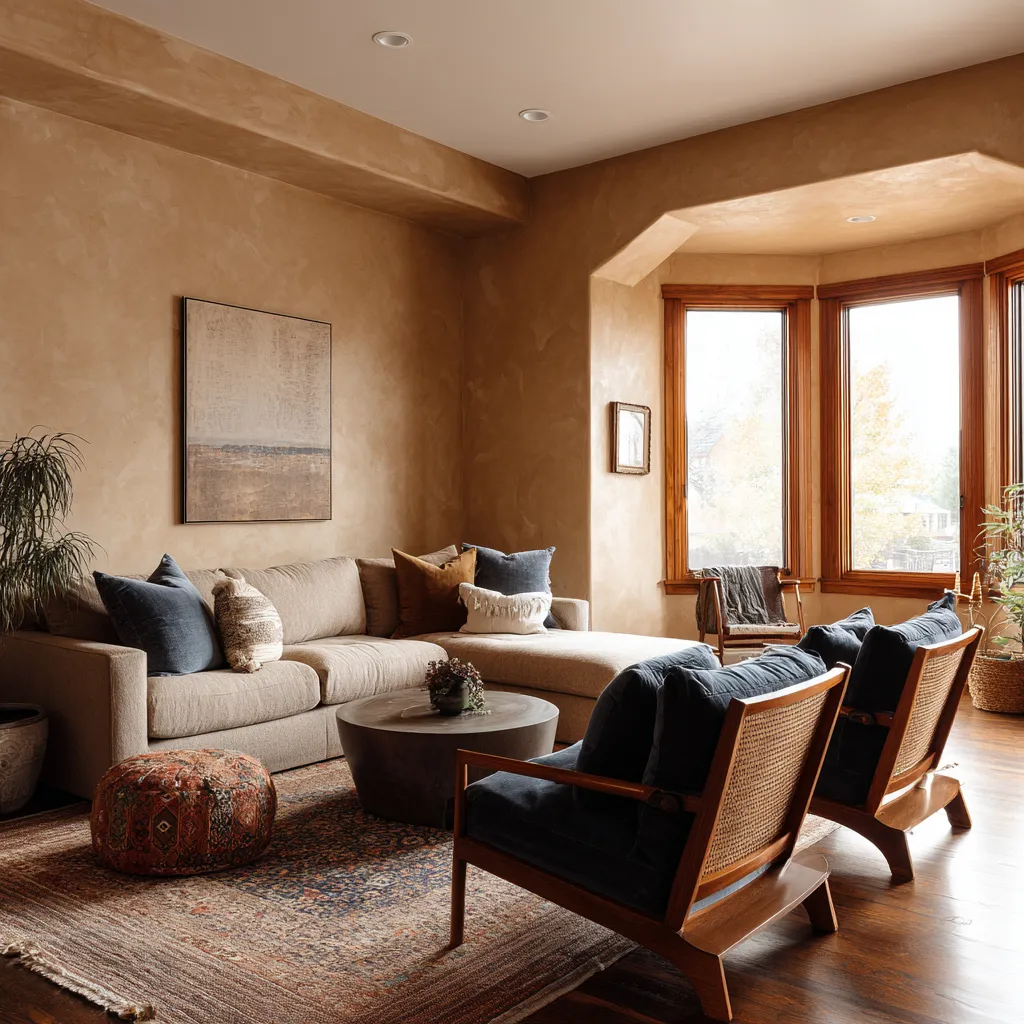
A plastered shell with terracotta, rust, tobacco, or camel notes creates yet another branch. These rooms often feel grounded without becoming dark.
The warmth comes from the wall field, the upholstery accents, the wood, and the clay-like undertone of the architecture. They can feel deeply settled if the furniture stays broad and the center remains grounded.
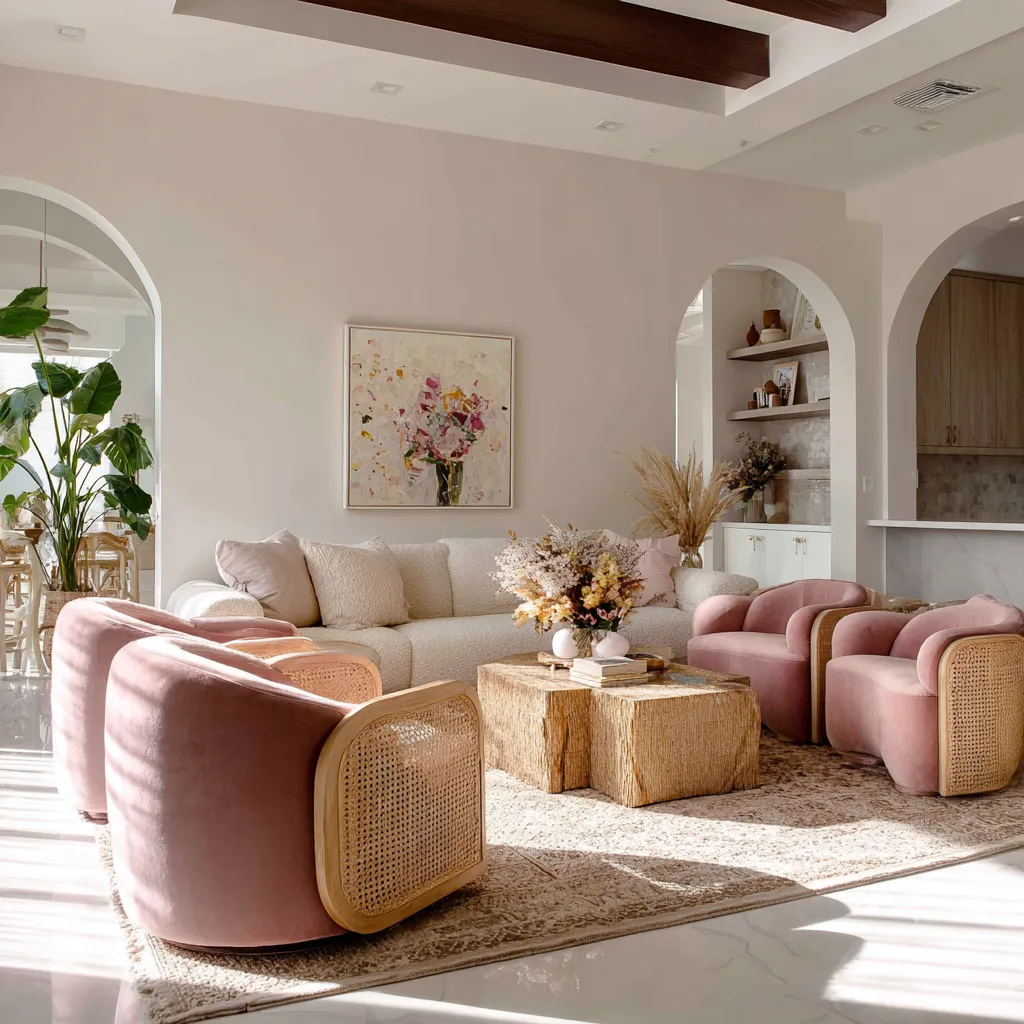
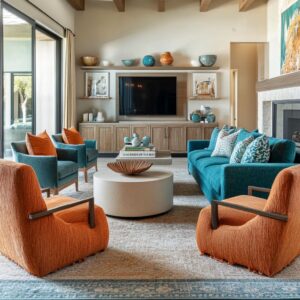
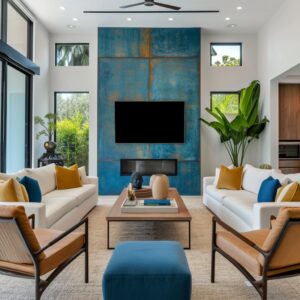
There is also an open chromatic-craft branch, where the shell is relatively bright, the major forms are simplified, and muted blue, teal, indigo, or plum deepen the room. These cooler tones work surprisingly well in boho maximalism when they are softened, textile-based, and used in a limited number of anchor points.
A blue chair, a few blue pillows, and a rug carrying faded blue can deepen the room without disturbing the earthy core.
Atmosphere and coziness are related, but they are not the same goal
This distinction is one of the useful for design decisions. Many people want both a room with mood depth and a room that feels physically inviting, and those two ambitions do overlap.
Still, they do not peak under the same conditions. Atmosphere usually grows out of darkness, compression, enclosure, and reduction in glare.
Darker walls, stronger trim, lower visual openness, and a more inward composition tend to deepen the room. If the room also has a rug with age and a palette held in muted values, it can become very resonant and almost chamber-like.
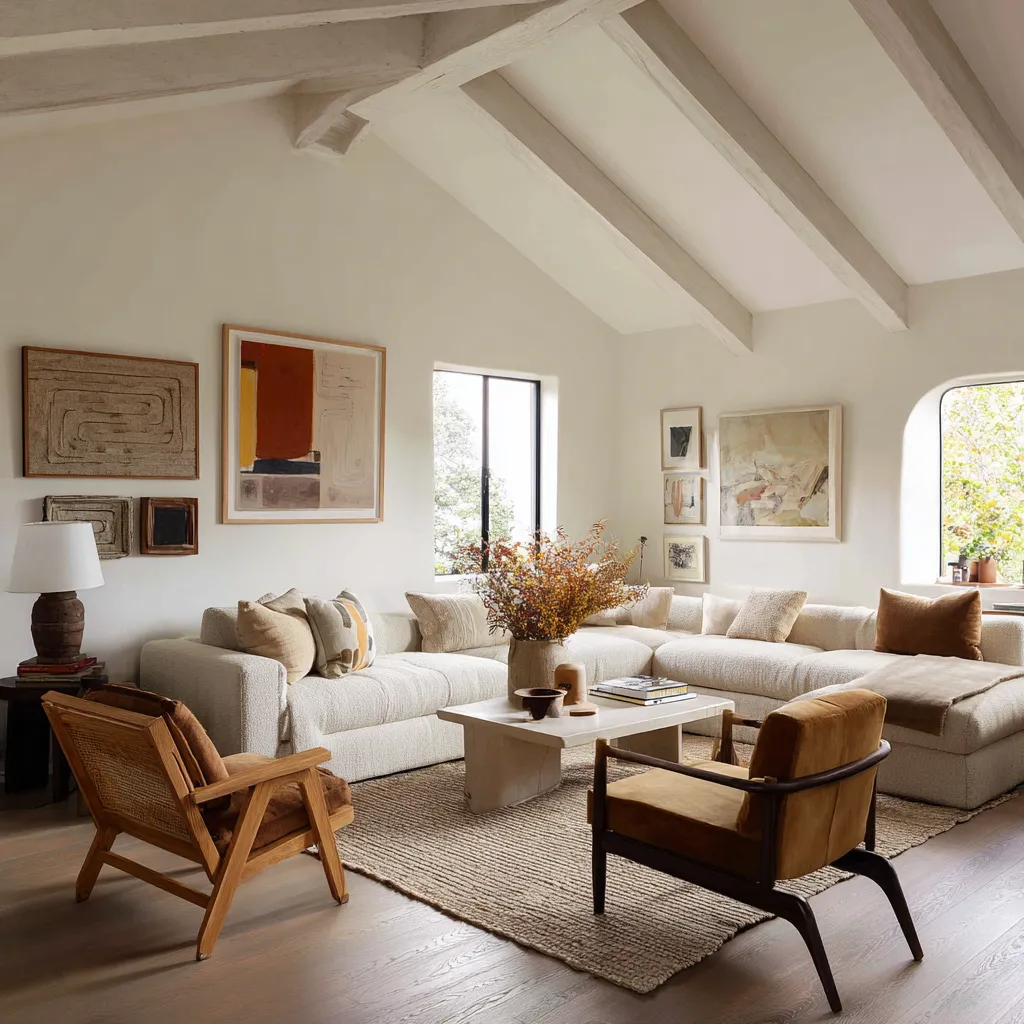
Coziness tends to come from other devices: seating wrap, rounded forms, moderate to strong daylight, pillow load, benches, soft architecture, and a room that feels ready for long use. Curved chairs, sectionals with generous corners, bench seating under windows, thick woven rugs, and visible plants tend to raise comfort.
A bright room with layered softness can feel far cozier than a dark room, even if the dark room has greater mood depth.
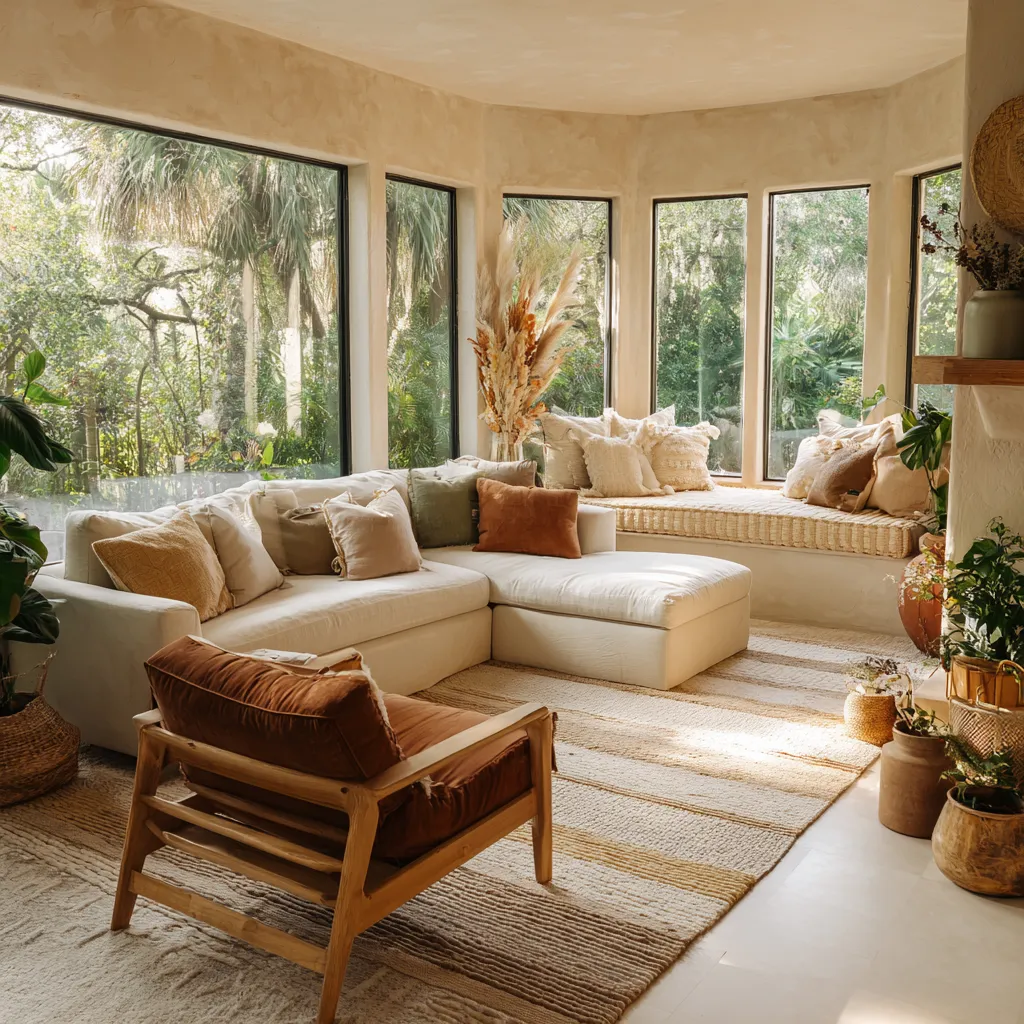
So if the goal is an inward, moody boho living room, the shell should do more of the work. If the goal is a highly comfortable social room, then the seating plan, the curves, the daylight, and the softer architectural moves should be given priority.
Trying to push both goals equally with the same devices can lead to confusion. A room may become darker without becoming more welcoming, or brighter without becoming richer.
The design improves when those two targets are separated and then intentionally recombined.
The rug is the room’s memory field
In boho maximalist living rooms, the rug is rarely a neutral supporting layer. It often carries age, tonal sediment, softness, and compositional glue.
It binds the chair cushions to the wall tone, the sofa to the accent color, the center table to the floor, and the warm elements to the cool ones. This is why rugs with faded pattern, washed color, and softened edges are so effective here.
They do not demand attention in a loud way, yet they keep the room from feeling new, flat, or too clean. They introduce time.
They suggest use. They allow large calm furniture pieces to sit on something visually alive without forcing the room into high pattern contrast.
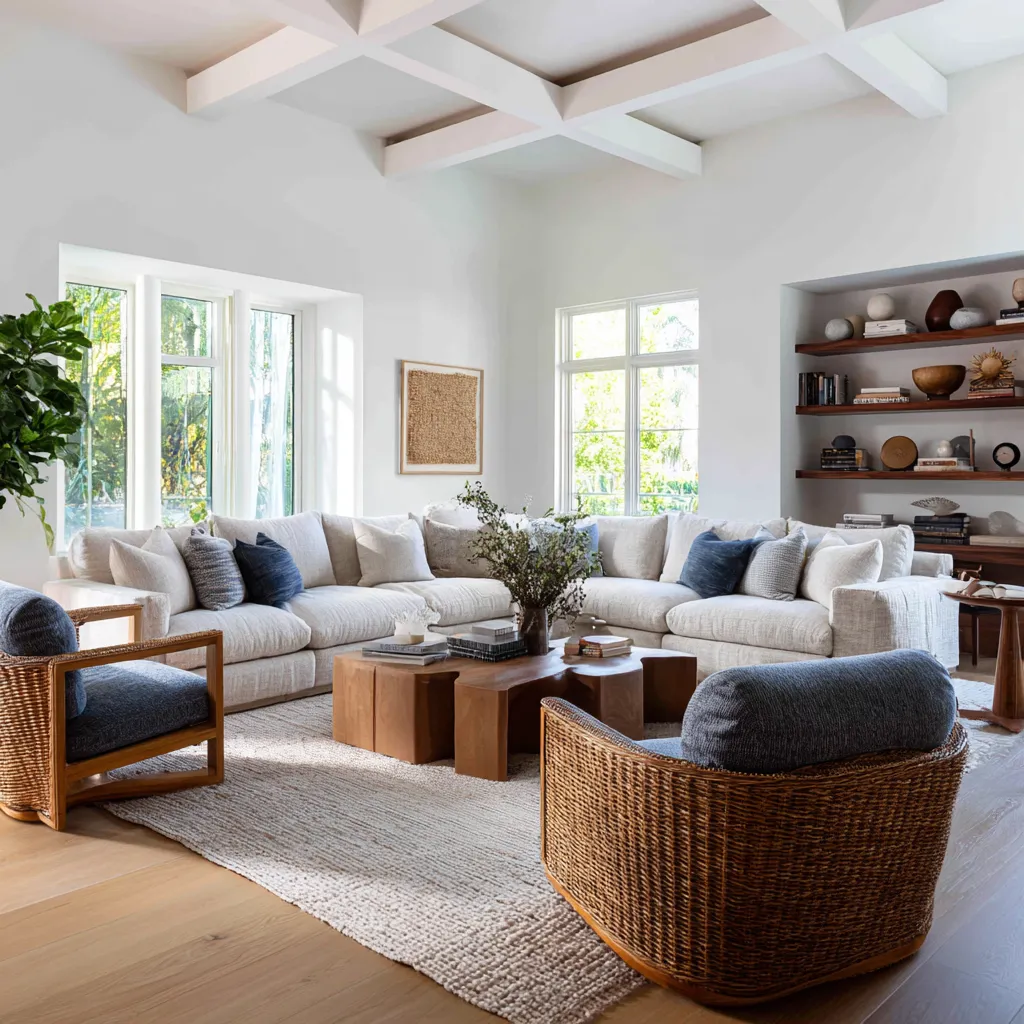
A rug in this style often performs five jobs at once:
- It softens the room’s center.
- It blends palette families.
- It introduces age without heaviness.
- It grounds pale upholstery.
- It gives the floor emotional depth.
That is why a pale sofa and a simple chair pair can still feel full if they sit on the right rug. And it is also why a room with good furniture may still feel thin if the rug has too little weight, too little texture, or too little tonal memory.
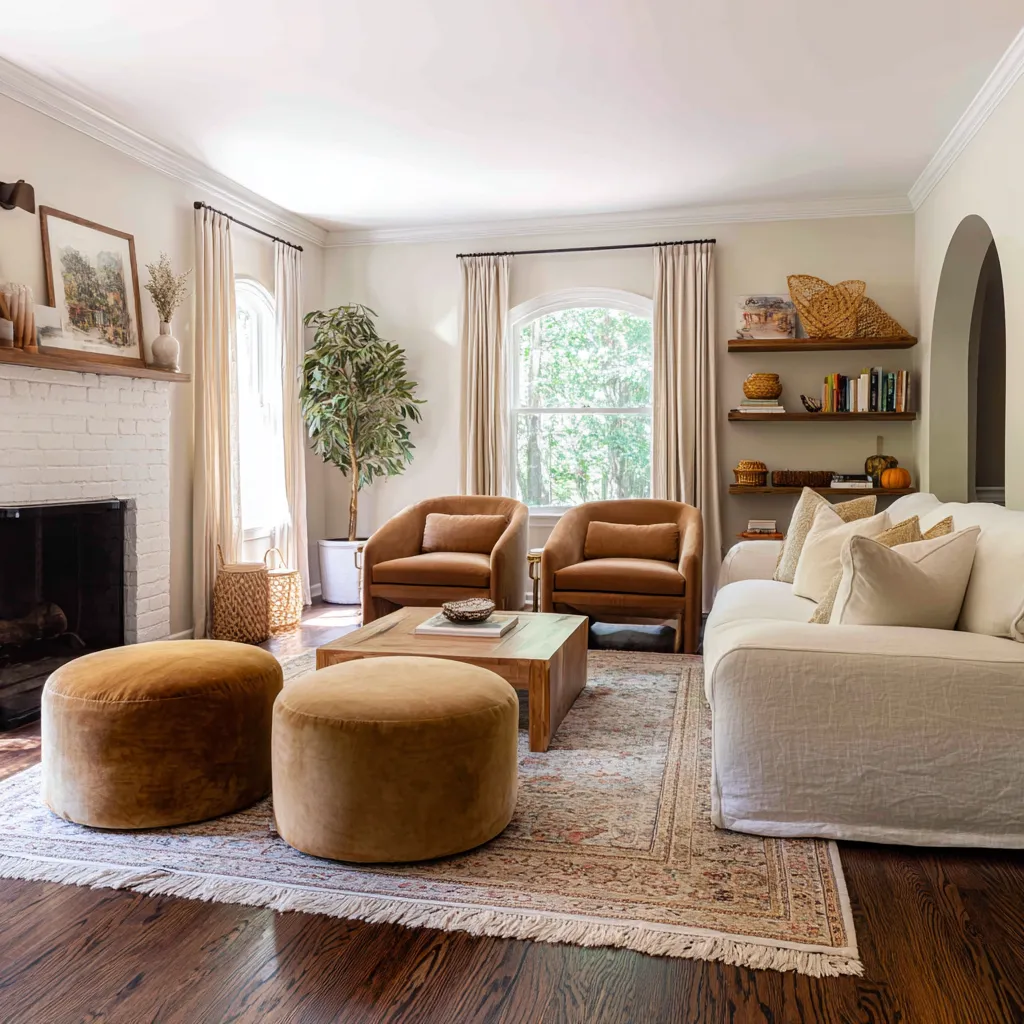
Texture matters more than pattern
Many contemporary boho maximalist living rooms use less overt pattern than people expect. The rug may carry the main motif.
Beyond that, the room often depends far more on texture than on repeated prints. This is a major shift in how the style works now.
Pattern can remain quiet. Texture cannot.
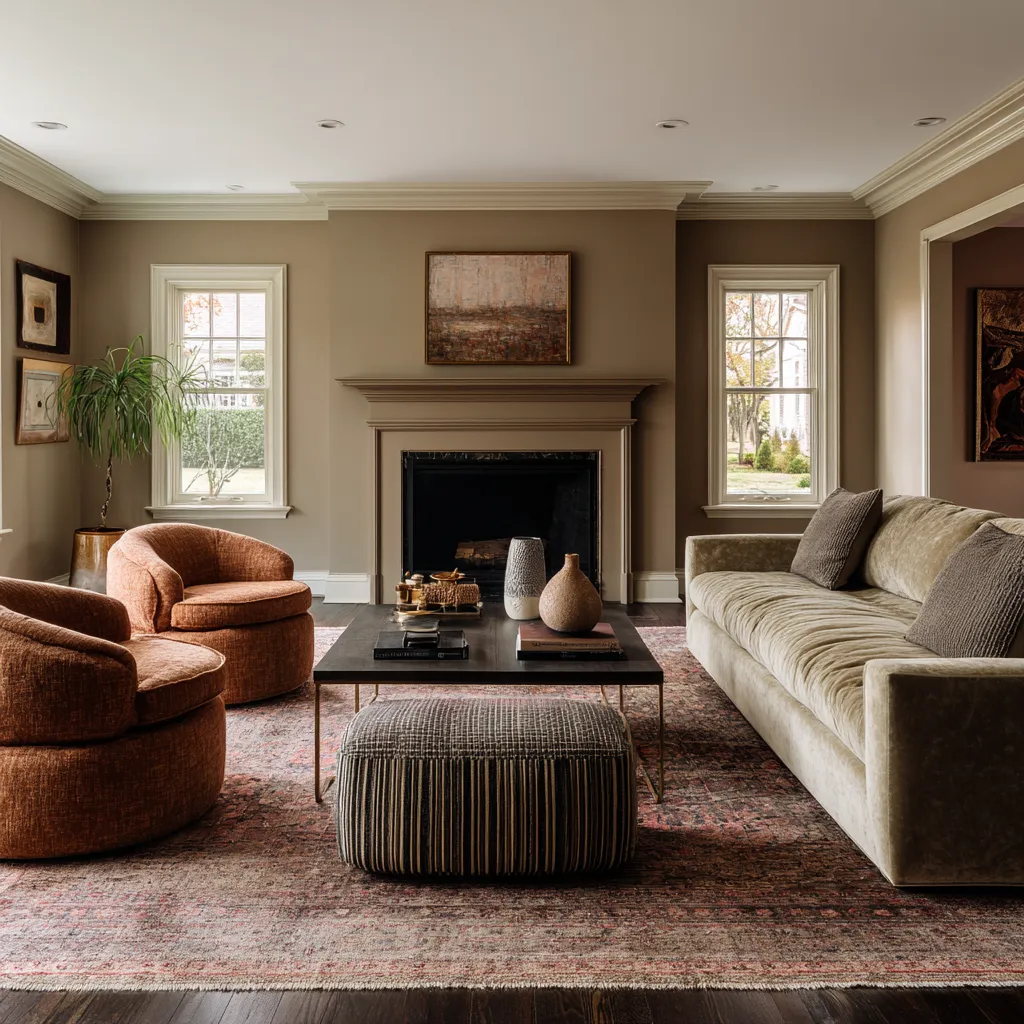
A room may combine:
- plaster with mild tonal variation
- velvet or velvety chair cushions
- bouclé-like sectional upholstery
- cane or rush chair backs
- rougher wood on the coffee table
- a dry botanical arrangement
- glossy leaves from a plant
- a woven rug underfoot
Even with almost no visible print, that room can still feel layered, collected, and full because the textures differ in touch value, density, reflectivity, and edge softness. This is why simplifying the major forms often improves the style rather than flattening it.
A broad sofa with plain lines allows the rug, the chair backs, the stems, the table, and the wall finish to remain visible as distinct material notes. Too much detail in every element causes the room to blur.
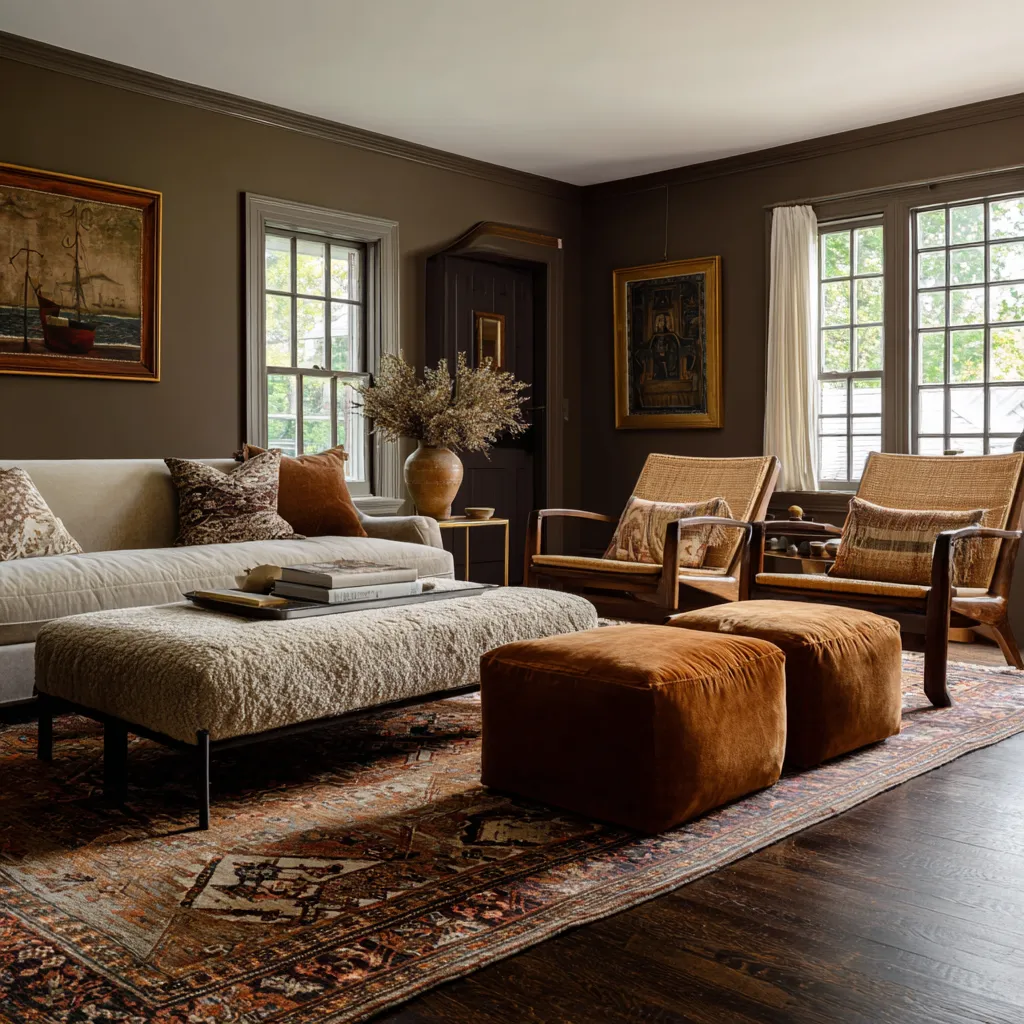
Color works when warmth is assigned by role
Another reason these rooms feel composed is that warmth is usually distributed with intention. The room does not place the same level of heat on every surface.
One zone may carry terracotta. Another may carry cream.
Another may carry tobacco wood. Another may carry only a few darker mineral notes.
This creates rhythm.
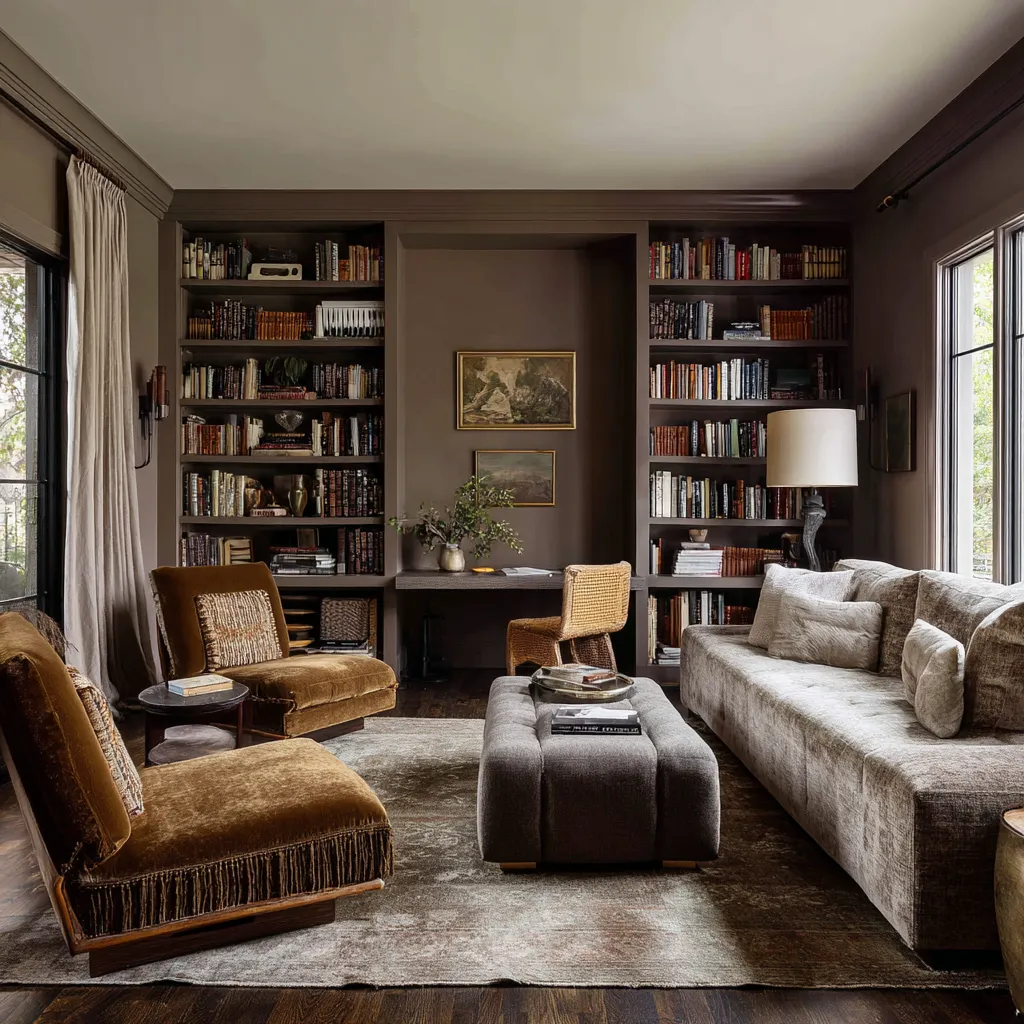
A very effective setup might look like this:
- cream sofa as the broad calm field
- rust or terracotta chairs as the concentrated warm note
- aged rug carrying clay, sand, muted blue, or faded berry underneath
- a darker center table giving the middle enough gravity
- plants or dried stems bringing vertical irregularity
In rooms with cooler accents, the same logic still holds. Blue, teal, indigo, and plum tend to succeed when they are muted, textile-based, and repeated in only a few major places.
A cool note often works well in:
- accent chairs
- a small pillow group
- one rug family
- one related art tone
That limited repetition makes the cool accent feel structural. If it appears everywhere, it starts to read as decoration rather than deepening.
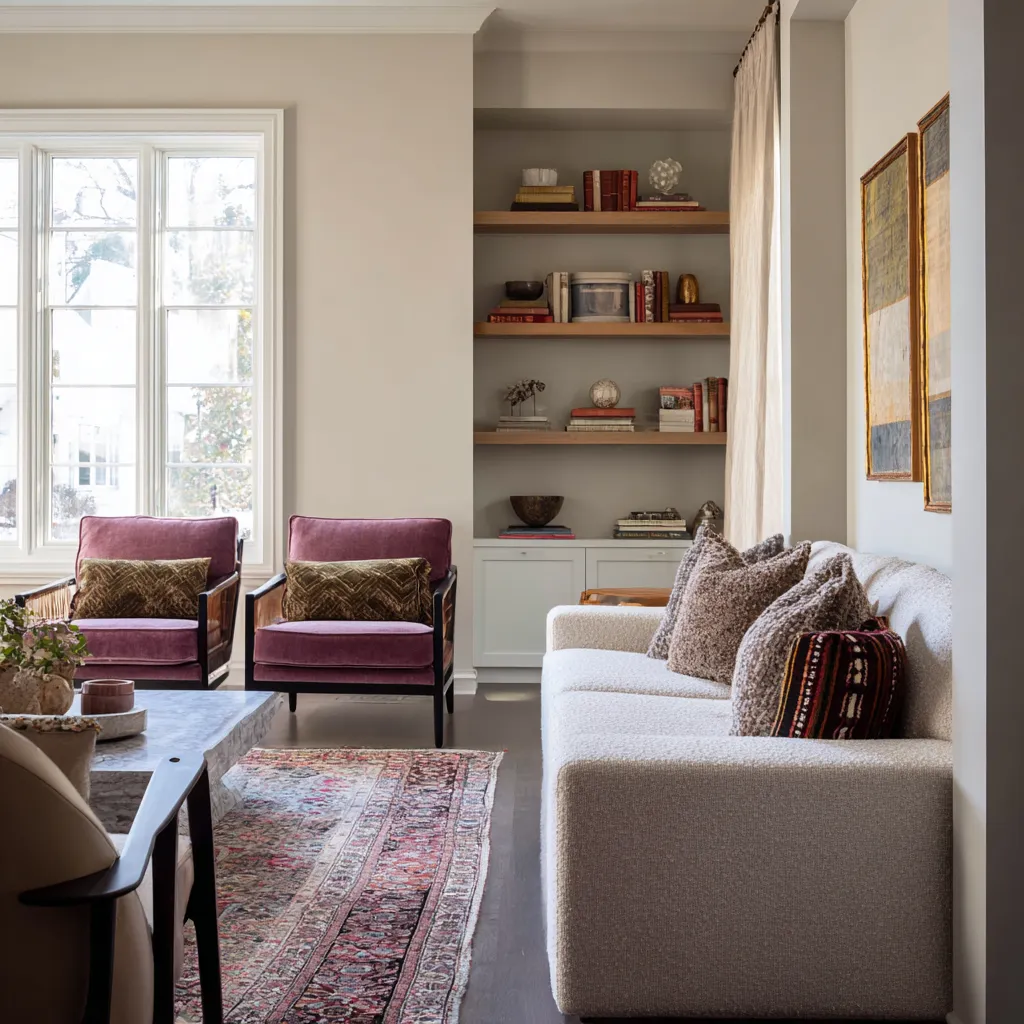
Muted plum is especially useful in pale rooms because it deepens the field without making the room feel cold. Faded indigo works well in warm plastered shells.
Teal can support more saturated wall color if the furniture stays tactile and the rug links both the cool and warm families.
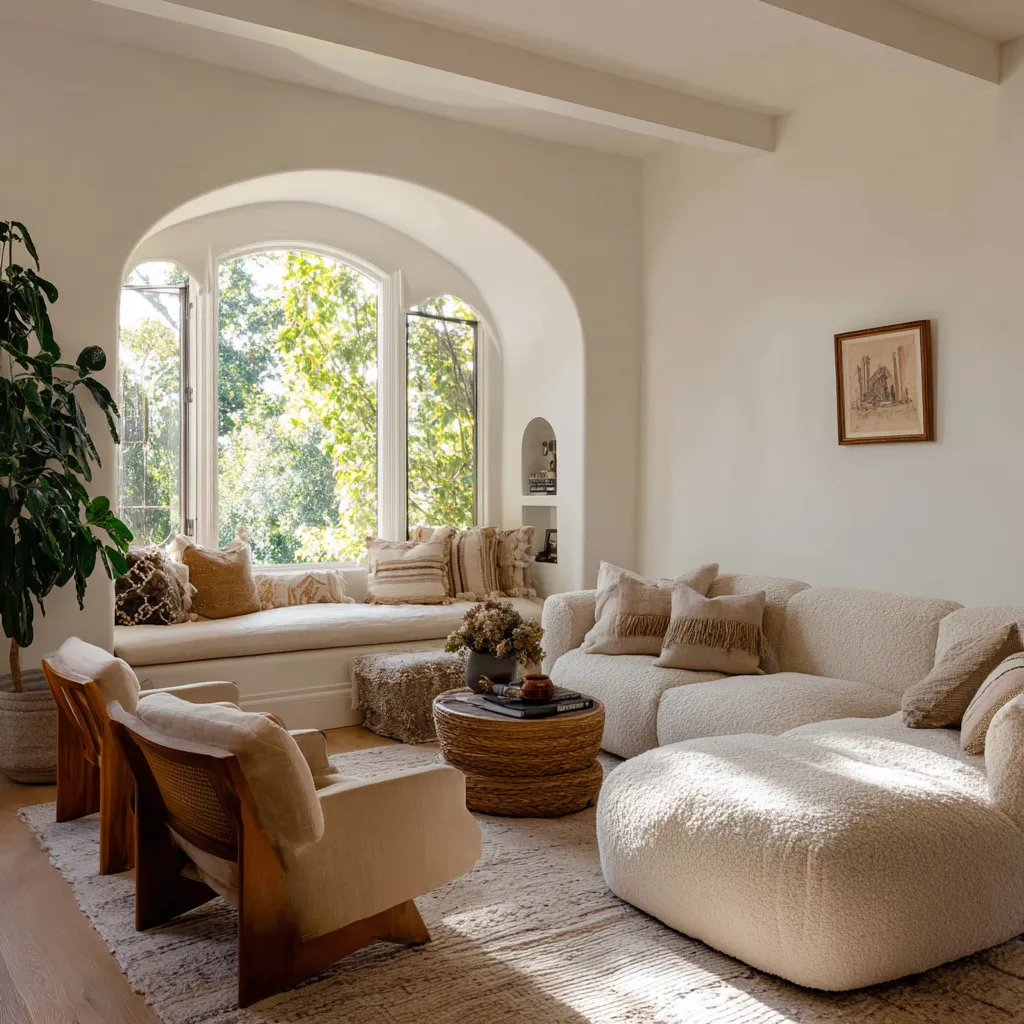
Plants and dry botanicals are shape devices, not filler
Plants in boho maximalist living rooms are often treated like a style checkbox, but their role is more specific than that. They break geometry.
They interrupt the edge of the sofa, the wall plane, the window band, or the side table. They bring a living irregularity that textiles and furniture cannot supply on their own.
Dry botanicals do something similar in a different register. They bring height, fragility, seasonal dryness, and a brittle softness that pairs well with plaster, pottery, and faded rugs.
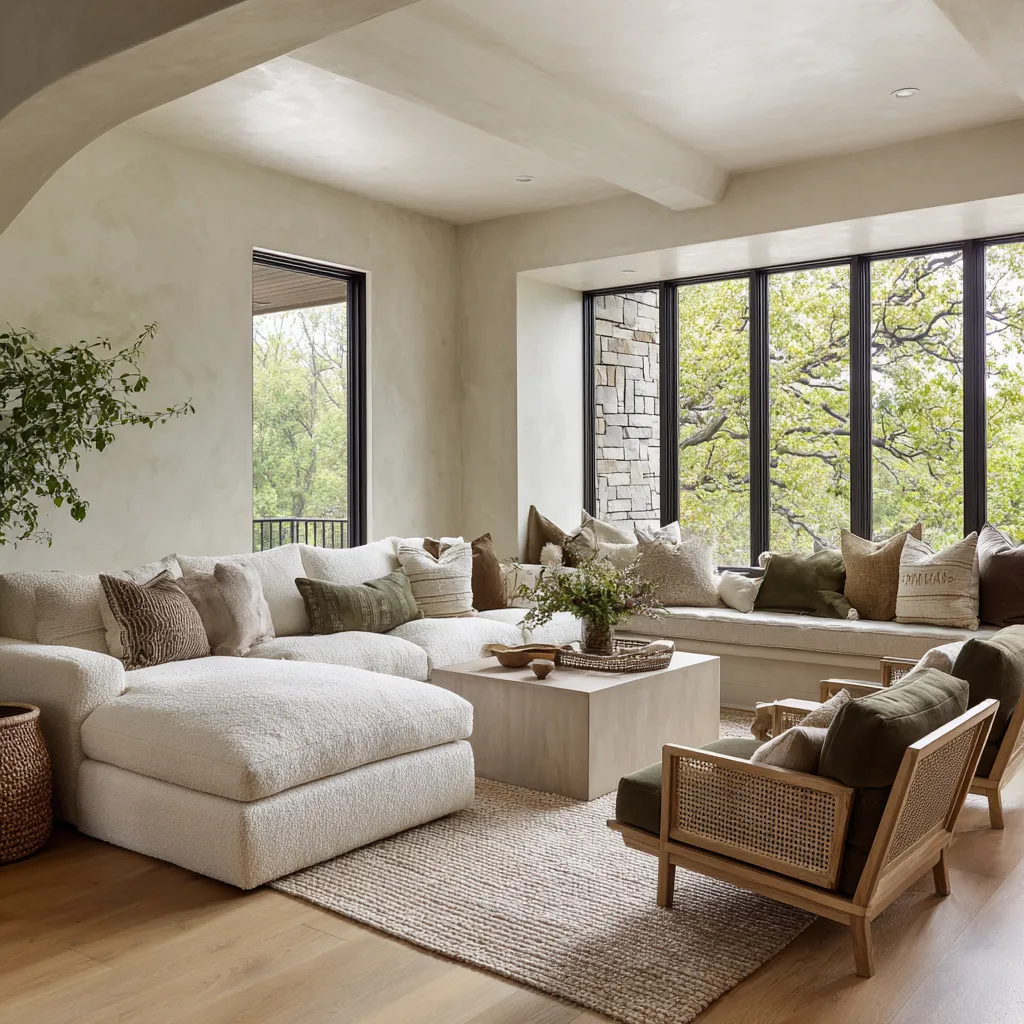
In brighter rooms, plants often help tie the interior to the exterior. In darker rooms, they act more as selective vertical release points.
In very pale rooms, they keep the composition from becoming too smooth. In more architectural rooms, they keep the shell from dominating completely.
The key is concentration. A few well-placed plants or branches can do a great deal.
Too many distributed plant moments can flatten the hierarchy.
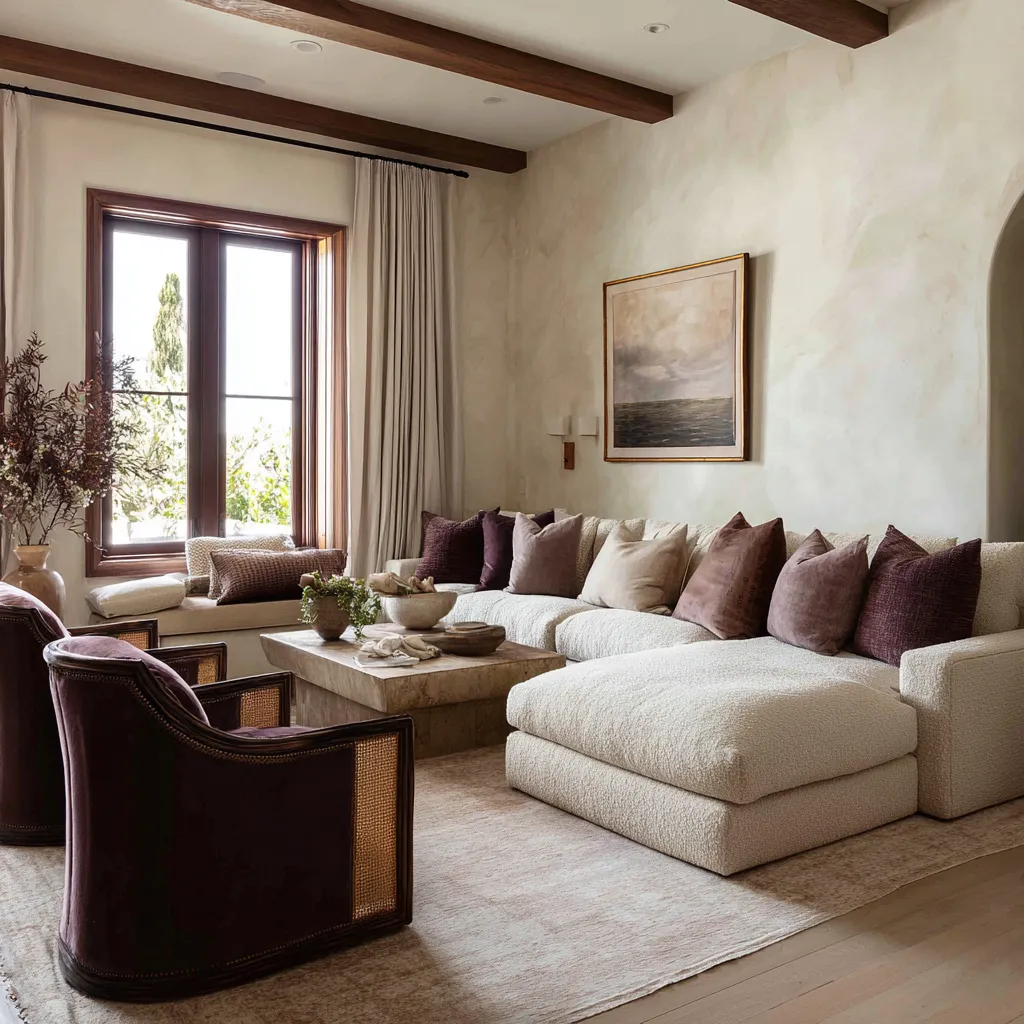
Bench seating and alcoves quietly raise the quality of the room
Built-in benches, window seats, alcoves, and recessed niches are effective devices in this style. They make the architecture feel inhabited before the room has even been fully decorated.
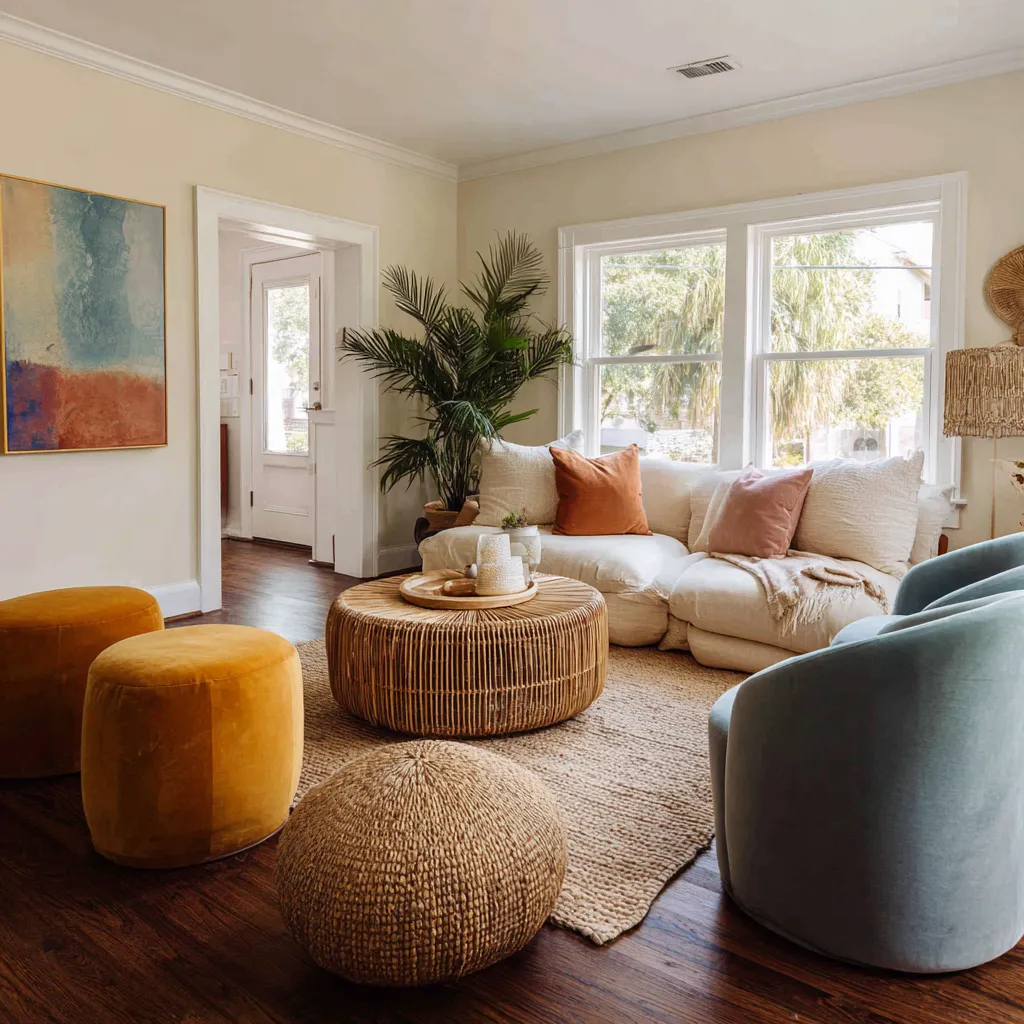
A bench seat does several valuable things at once. It adds another upholstered edge.
It increases seating enclosure. It gives the room more pillow layering without taking up extra floor area.
It makes the window zone feel like a place to stay, not just a light source. It also helps bright rooms gain fullness without becoming crowded.
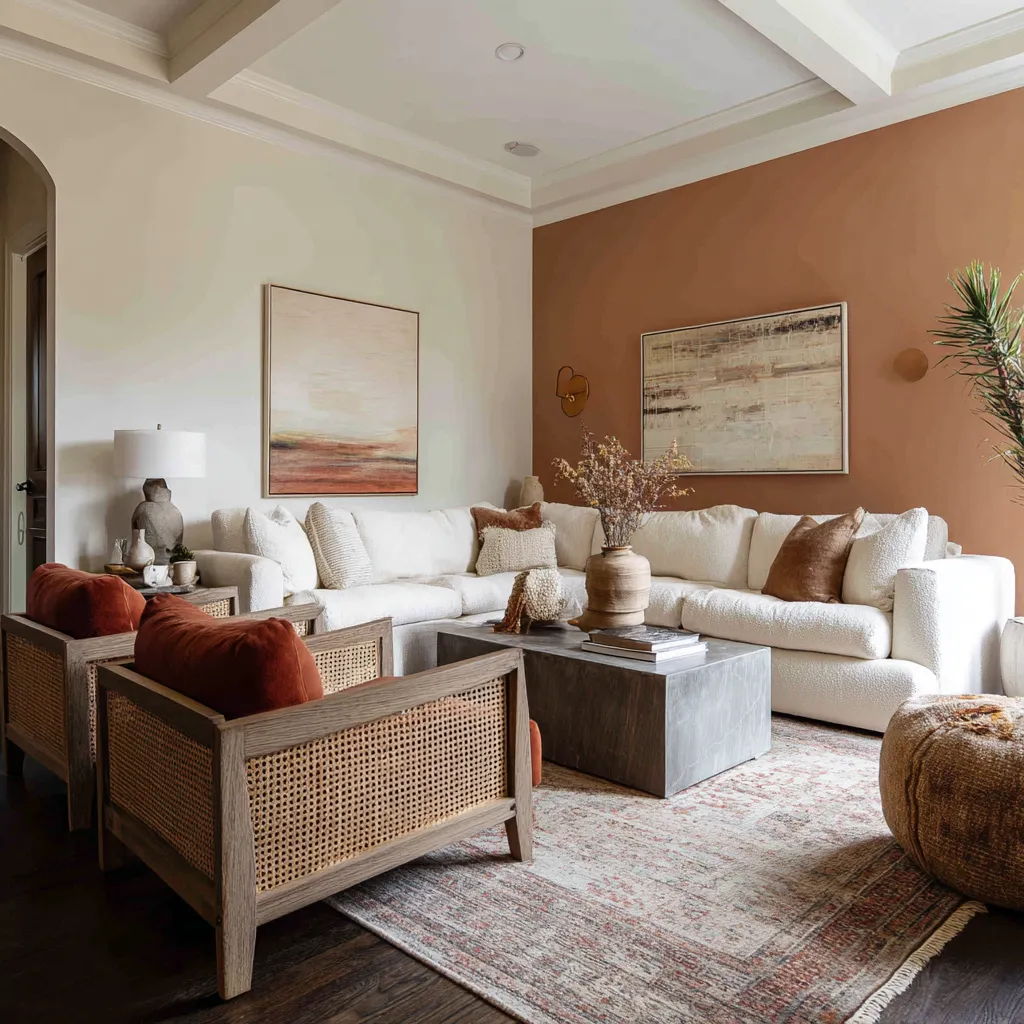
Alcoves and niches add another kind of value. They thicken the shell.
They create a private pocket within the larger room. They can hold a plant, a few vessels, a cushion band, a small shelf composition, or simply the depth of the wall itself.
In a style that depends on lived-in softness, that kind of architectural thickness is especially useful.
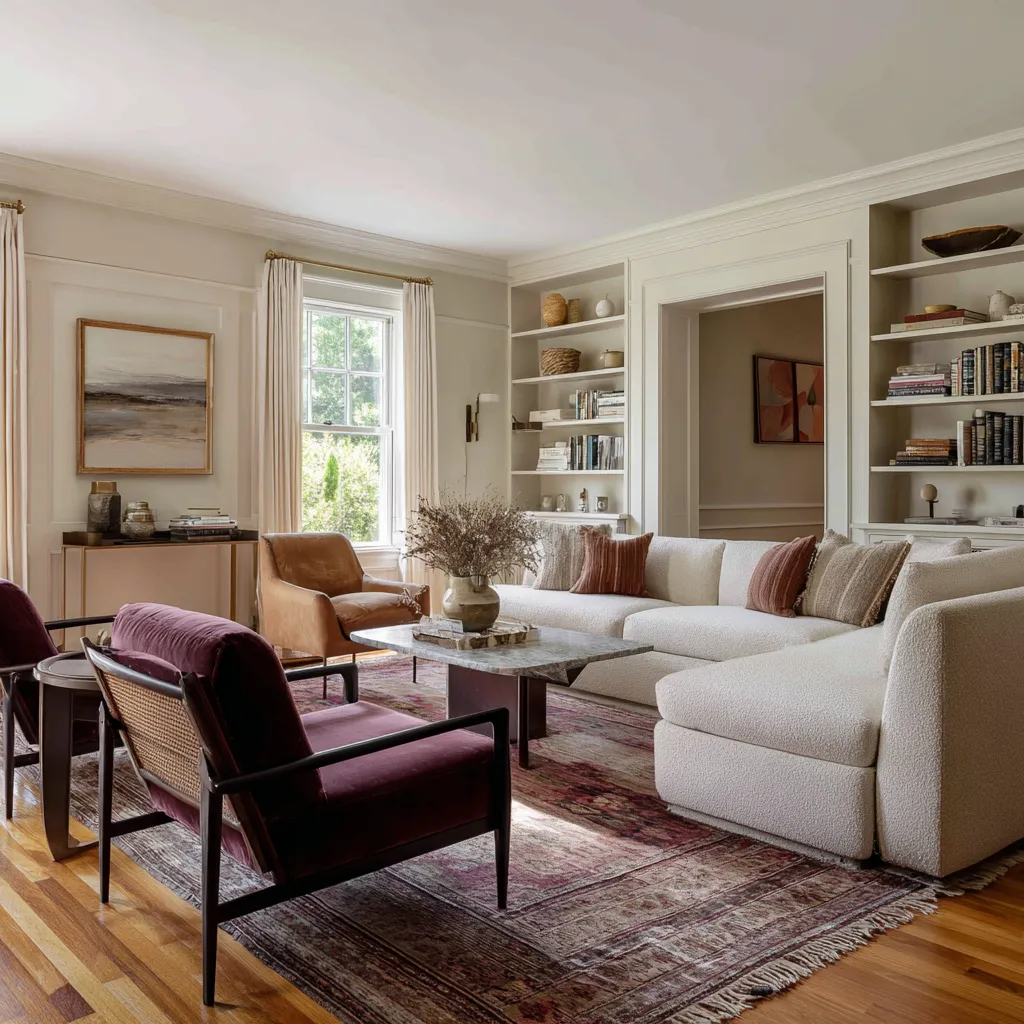
The room feels collected when the shell and furniture divide the work clearly
One reason some boho maximalist living rooms feel persuasive while others feel costume-like is that the jobs are separated clearly.
- The shell should handle mood, scale, framing, and historical thickness.
- The seating should handle bodily comfort and social use.
- The rug should handle age, blending, and floor softness.
- The center piece should handle gravity.
- Craft surfaces should handle boho identity.
- Plants and dry botanicals should handle irregularity and life.
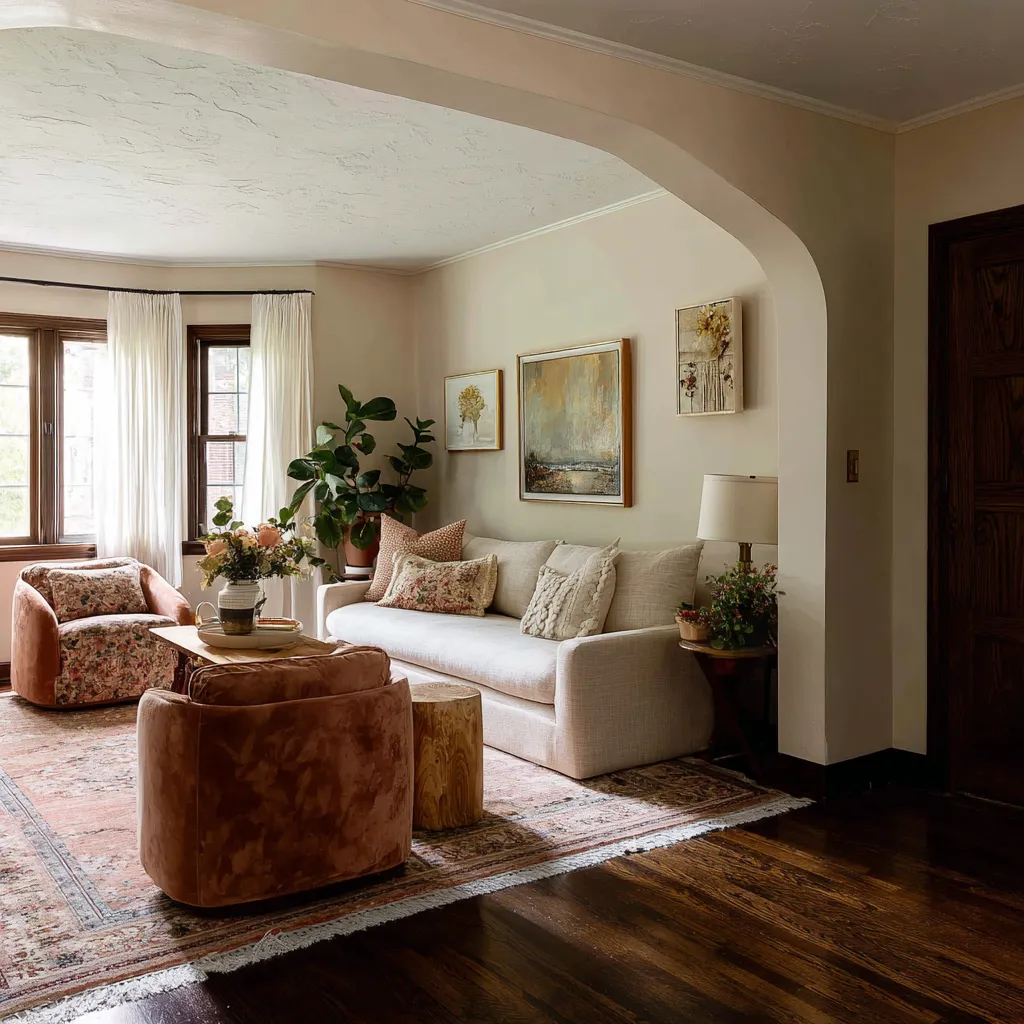
When all these jobs are divided clearly, the room has order. If everything tries to do everything, the space turns confused.
A patterned sofa, busy walls, cluttered shelves, loud rug, many small objects, and several competing accent colors can all be individually appealing, but together they often erase one another.
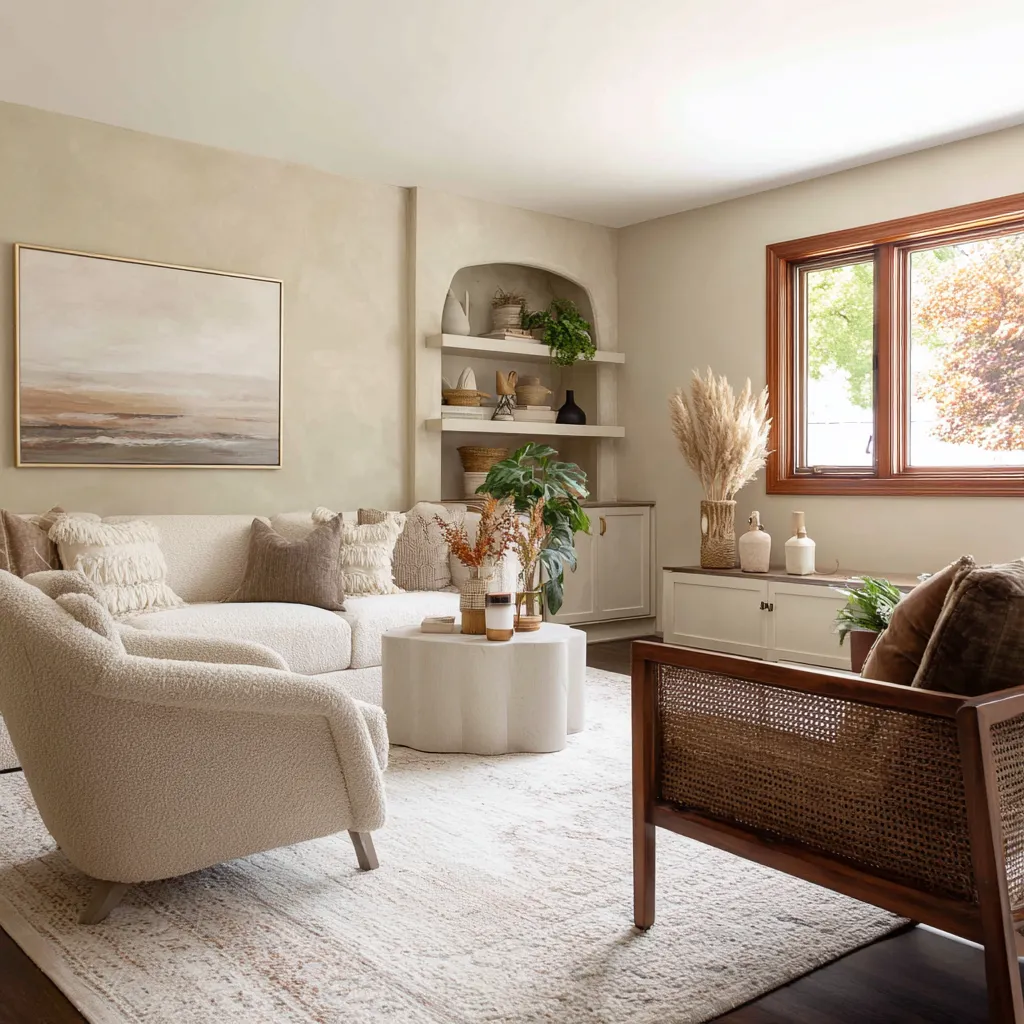
A collected room usually has one or two style-bearing systems working strongly, with the rest supporting them. That is why a room may feel full with only a few major ingredients.
It does not need every surface to perform equally.
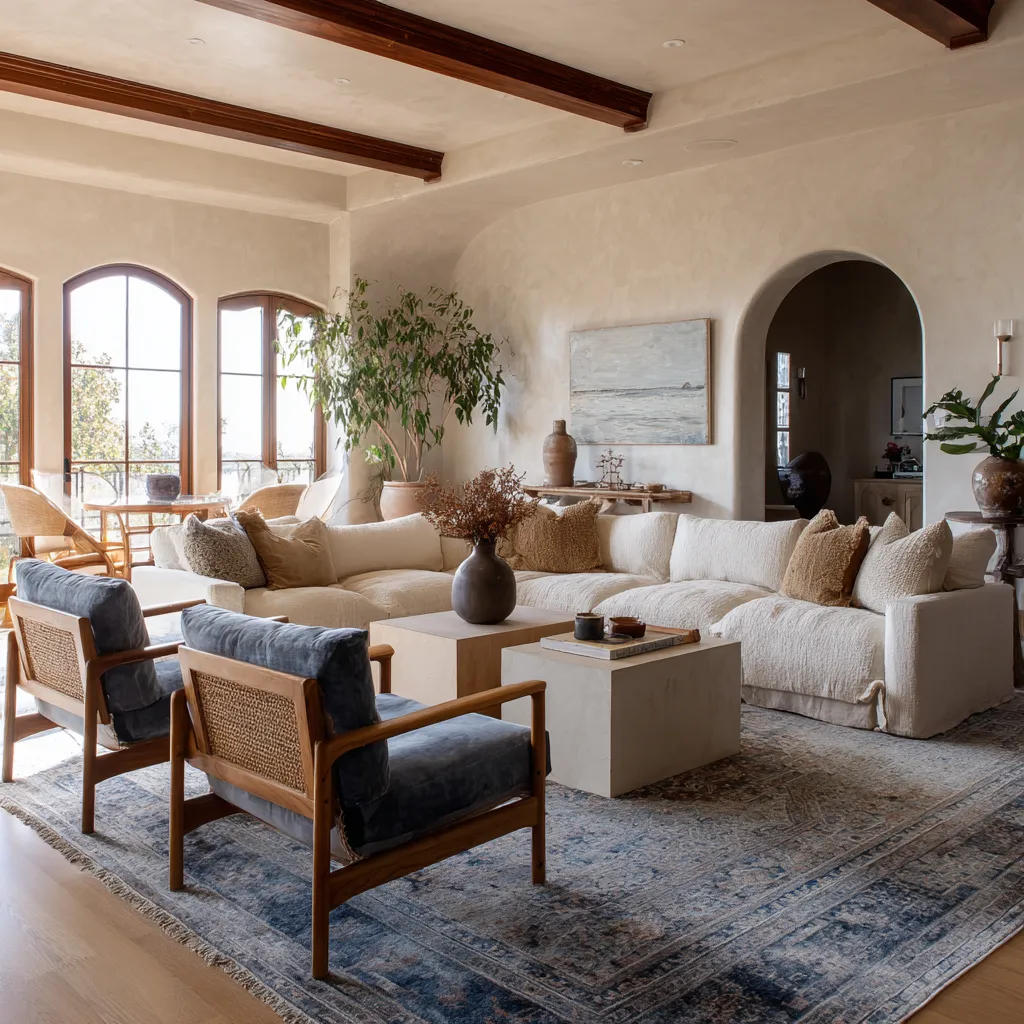
What a current boho maximalist living room often gets right
Stylish boho maximalist living room ideas usually keep these conditions in place:
- Large furniture masses stay simple.
- The palette is edited rather than scattered.
- Craft texture is visible.
- The center of the room has weight.
- The rug contributes time and softness.
- Plants or dry branches interrupt the composition.
- Relief areas remain visible so the denser zones can breathe.
This is organized abundance. That phrase gets to the core of the style.
The room is full, but not equally full everywhere. It is layered, but not random.
It is warm, but not overheated. It is collected, but not fussy.
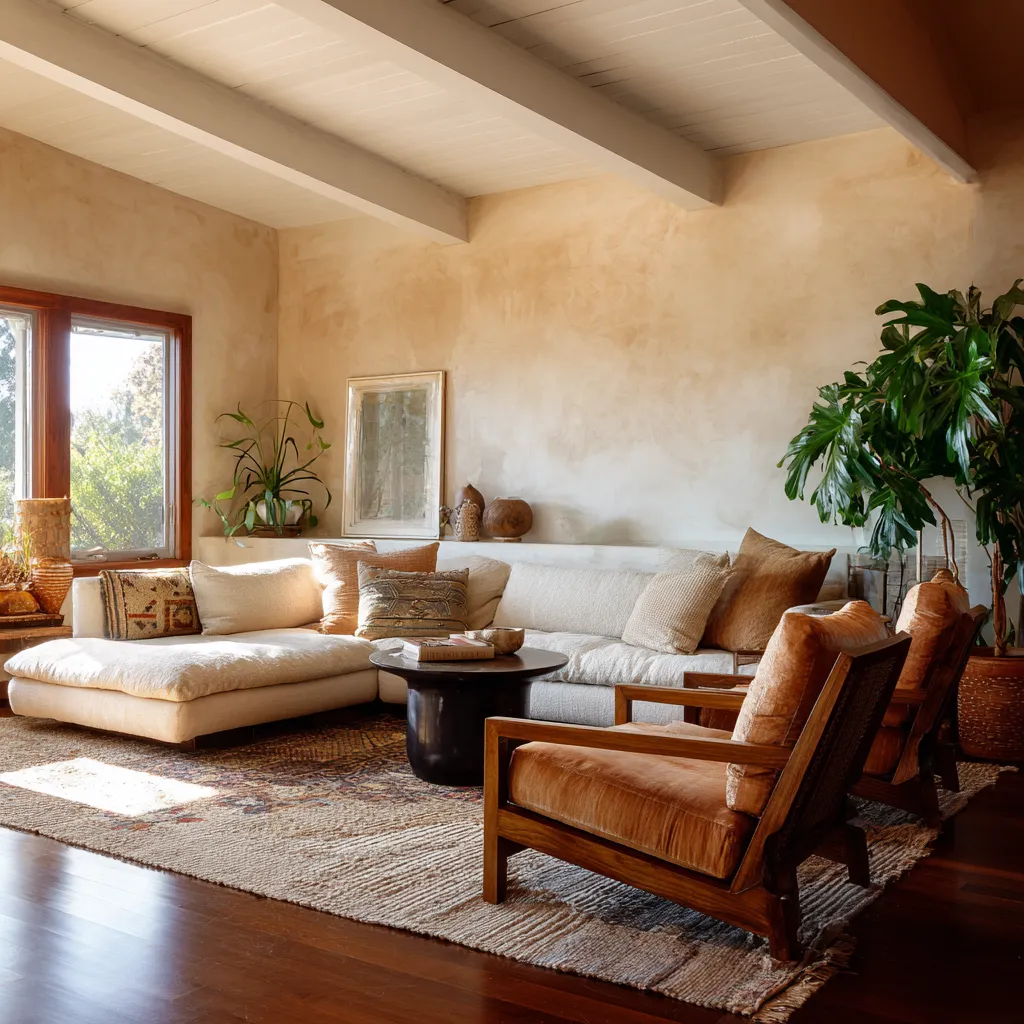
A way to build the room
A strong boho maximalist living room often comes together in this order:
- Start with the shell mood. Decide whether the room wants to be airy and cocooning, warm and plastered, dark and atmospheric, or bright with muted chromatic depth.
- Then build the seating wrap. The room usually needs a generous sofa or sectional and at least one other meaningful seating edge, such as accent chairs or a bench seat.
- Then give the center real weight. Use a piece that can hold the room physically and visually.
- Then choose the rug as the memory field, not as an afterthought.
- Then add craft signal through chairs, tables, pendants, baskets, stools, or woven details where the eye and body meet.
- Then place plants or dry botanicals in a few clear positions, not everywhere.
Only after that should the smaller styling layer be refined.
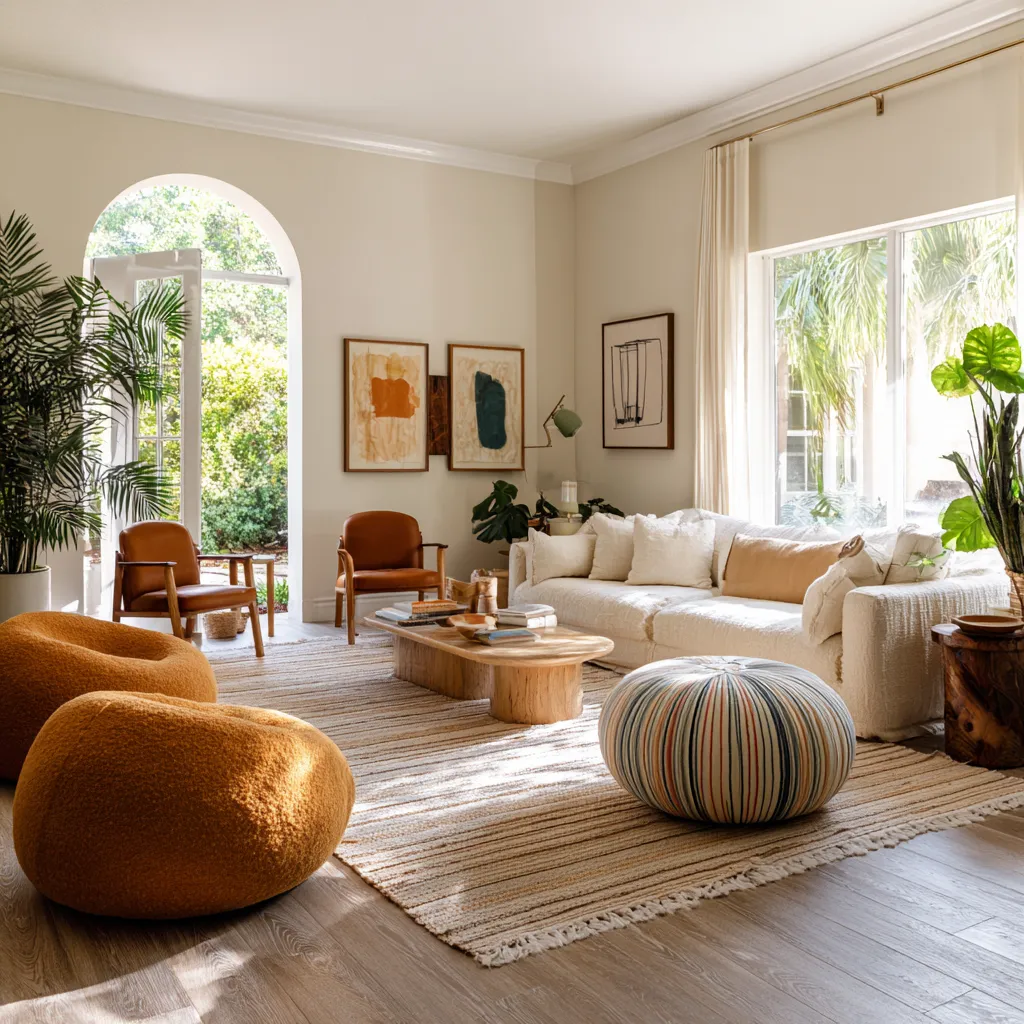
If the room is still not feeling convincing, the answer is usually not more objects. It is usually one of these:
- the shell has too little presence
- the seating does not wrap enough
- the center is too weak
- the rug has too little age or tonal depth
- the craft signal is too low
- the room lacks a living organic interruption
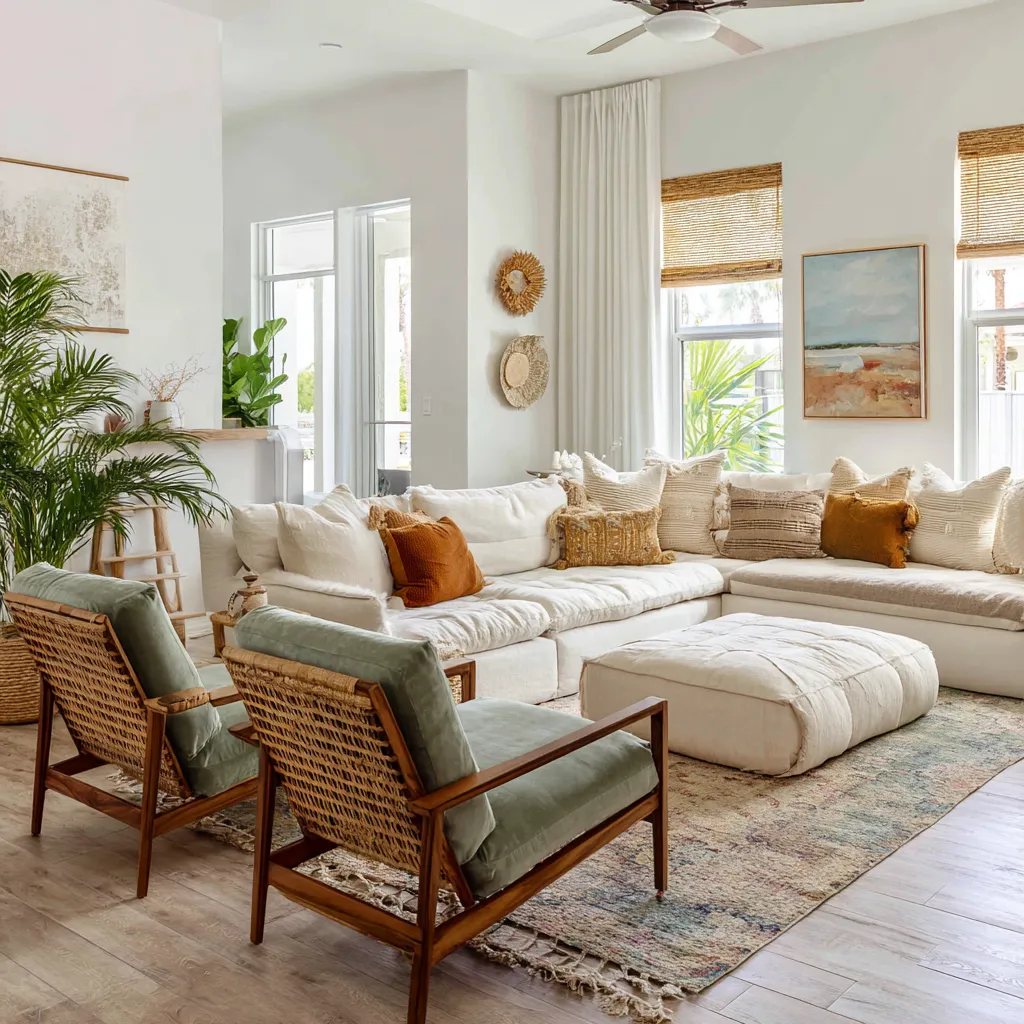
Final thoughts
A boho maximalist living room works when it feels softened by use, shaped by material contrast, and held together by structure. Its richness comes from the way warmth, texture, furniture mass, architecture, and organic irregularity are arranged in relation to one another.
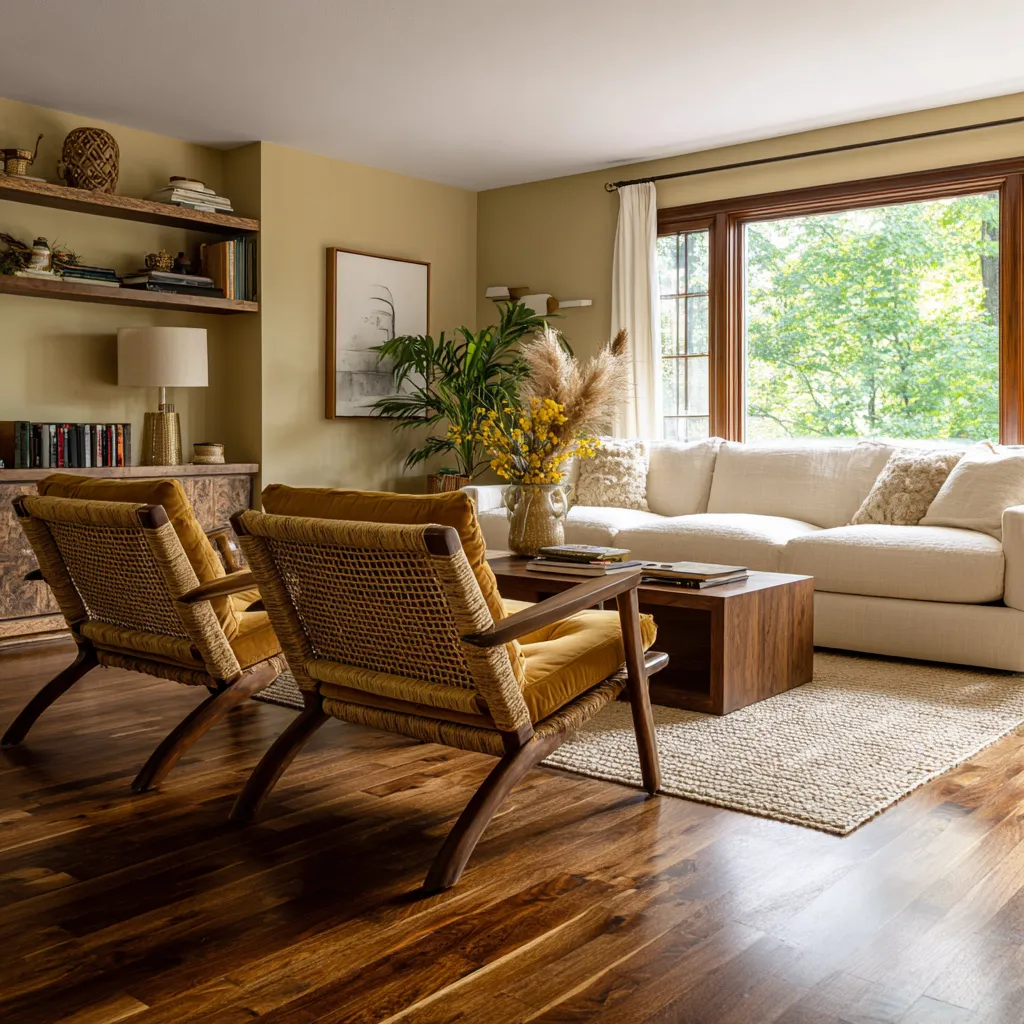
This style does not ask for indiscriminate excess. It asks for fullness with order.
It asks for a room where the shell has mood, the seating has generosity, the rug holds memory, the center has weight, and the tactile details make the whole space feel touched by human life.
That is why attractive boho maximalist living room ideas feel developed without feeling strained. They offer abundance, but they do not lose clarity.
They feel layered, settled, and deeply livable.