Modern shabby chic kitchen design has changed a great deal from the version many people still imagine. It is no longer defined mainly by frills, busy florals, painted distressing on every surface, or shelves packed with decorative objects.
The fresher design ideas are quieter, more architectural, and far more selective. It still carries memory, softness, and domestic warmth, but it does so through edited planning, pale tonal layering, tactile materials, and a few highly chosen signals of age.
That shift gives the style a far longer life. A kitchen design built this way does not depend on a constant stream of decorative additions to hold its identity.
Its character is already present in the shell, in the furniture-like pieces, in the weight of plaster, in the softness of paint, in a worn wood table, in a glazed cupboard full of everyday dishes, in a deep apron sink catching daylight. The effect is intimate and hospitable, but also current enough to sit comfortably in a present-day home.
At its strongest, modern shabby chic is a kitchen that looks softened by time without looking trapped in it.
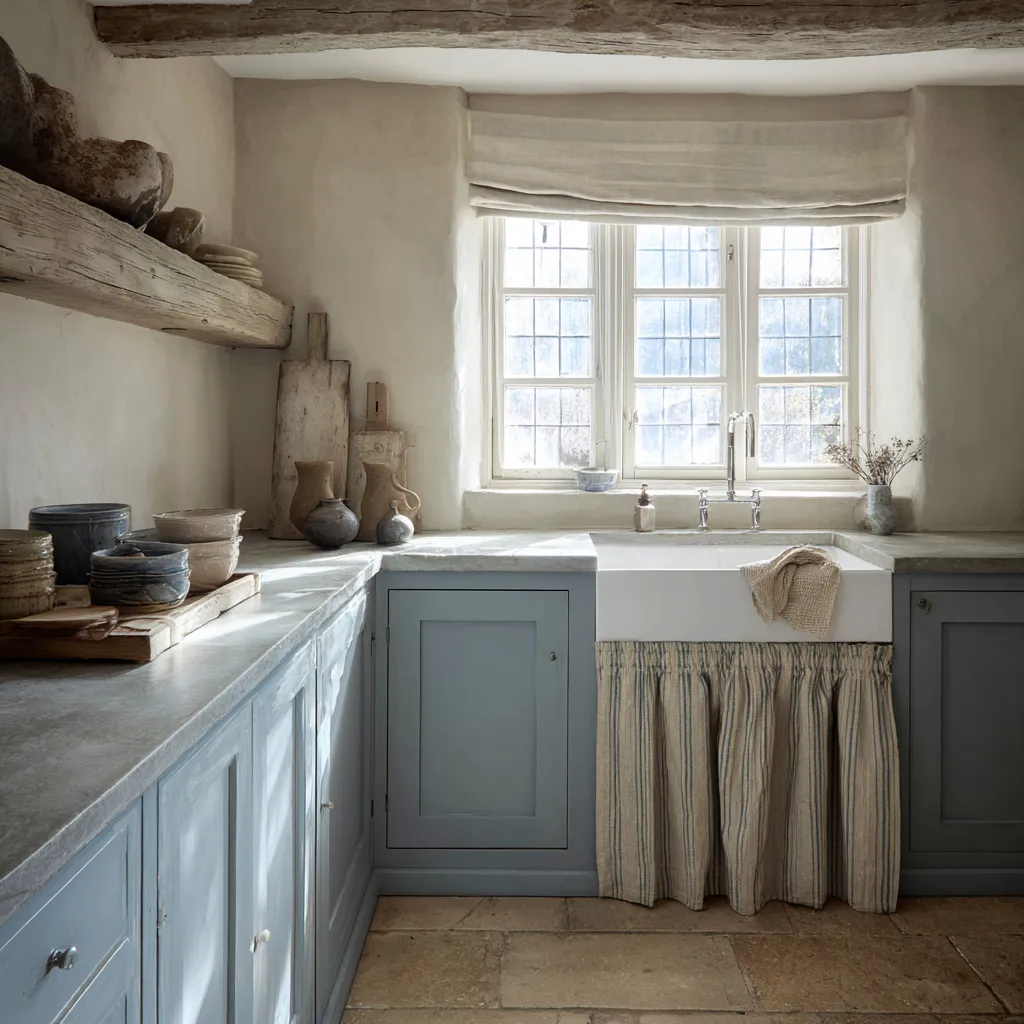
The foundation of the style
The first thing to understand is that modern shabby chic kitchens are usually built on a very restrained base. Their palette tends to stay close: cream, warm white, pale stone, limestone beige, mushroom, washed gray-beige, soft blush-beige, dusty green-gray, pale oak, muted brass.
Sharp color jumps are rare. Strong black-and-white contrast is rare.
Loud pattern is rare. The kitchen holds together by letting neighboring tones speak to each other instead of setting up visual conflict.
This low-contrast base does an amount of work. It lets plaster, wood grain, linen weave, ceramic surfaces, and stone texture remain visible.
In more graphic kitchen design ideas, those subtleties can disappear under contrast. In a modern shabby chic kitchen design, they become the language of the room.
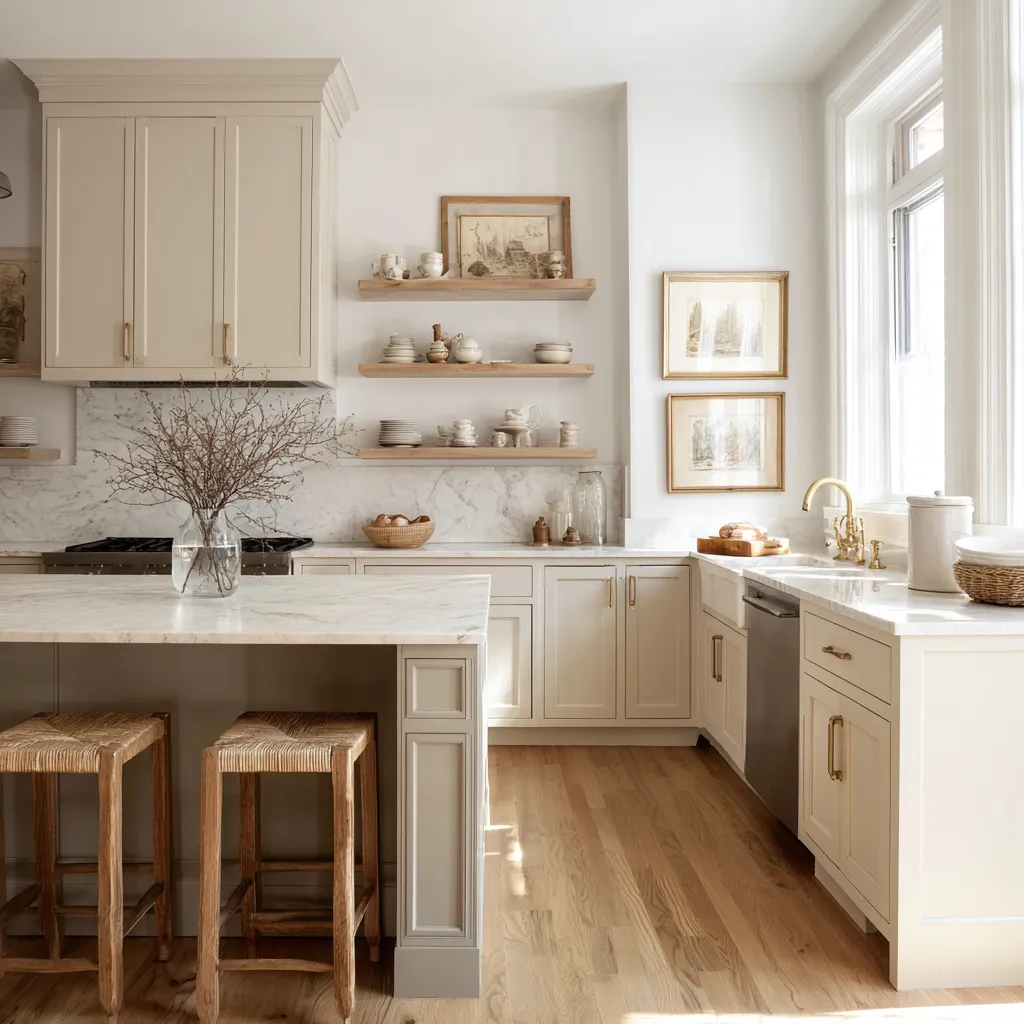
But a pale palette alone is not enough. A kitchen can be pale and still feel empty, generic, or too close to soft minimalism.
The missing ingredient is what might be called domestic memory. That memory can enter in different ways: a shaped plaster hood, old beams overhead, a freestanding worktable, a dresser-like island, a glazed pantry cabinet, a softened paint finish, a lamp on the counter, a stack of bowls that looks actually used, a banquette that turns the room into a place to stay rather than only a place to cook.
That is why the style works through selection, not accumulation. It needs one or two strong carriers of memory, then enough visual quiet around them for those elements to matter.
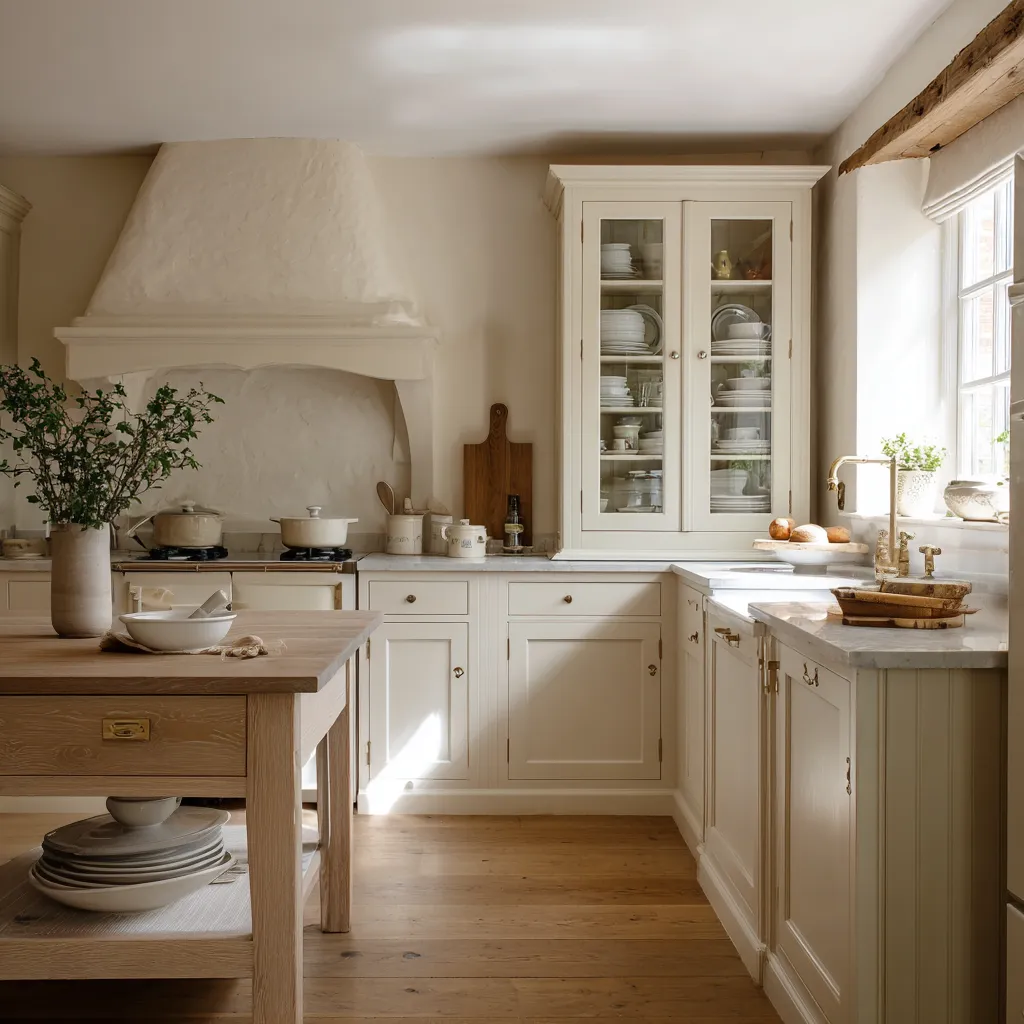
Why the style feels current now
The modern part of modern shabby chic is not a thin layer placed on top of an older country kitchen. It sits much deeper than that.
It appears in the way the design is planned, the way objects are edited, the way storage is balanced, and the way visual pauses are protected.
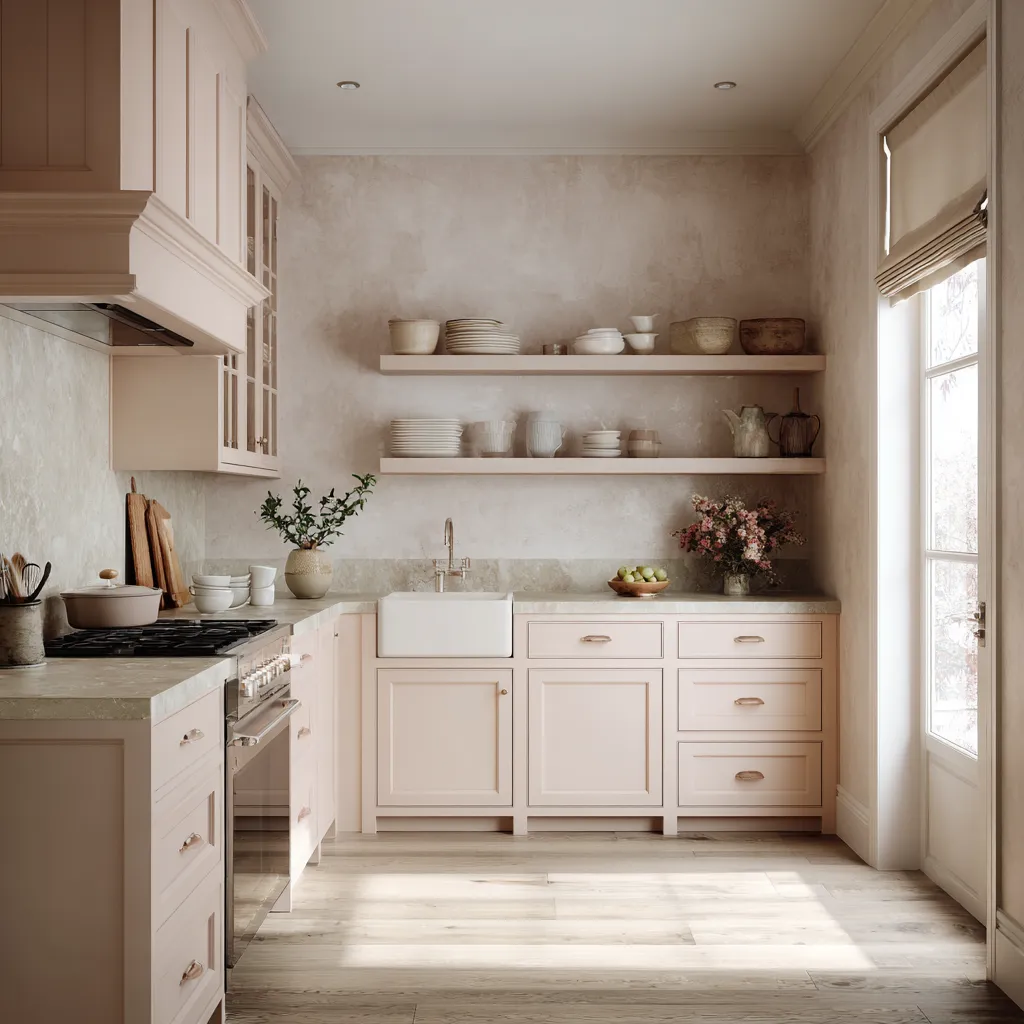
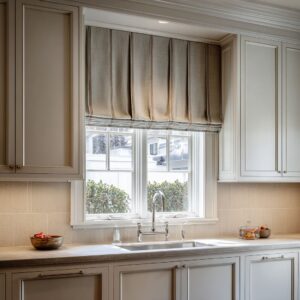
A present-day shabby chic kitchen design often leaves the center clearer than an older version would. The sink wall may be composed almost like a still, ordered backdrop: window, sink, faucet, pale counter, plain cabinet fronts.
Decorative objects are pushed outward, perhaps onto one shelf, into one glazed cabinet, onto one side ledge, or onto a table in the middle. This keeps the daily working parts legible.
The kitchen does not feel overstyled at the point where it needs to function.
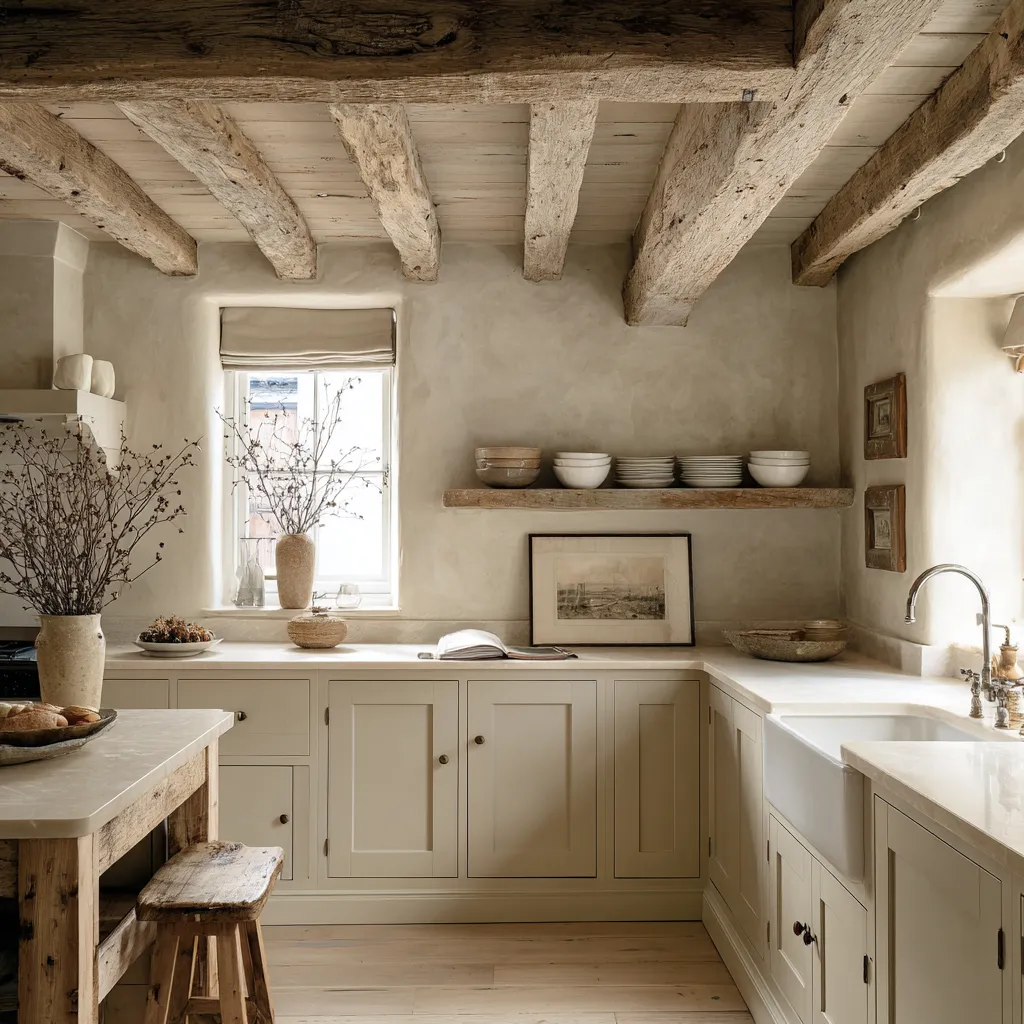
Modernity also appears in the refusal to let every surface speak at full volume. The cabinetry may be traditional in outline, but its profiles are kept modest.
A plaster hood may be broad and sculptural, but not overloaded with carved trim. Open shelving may exist, but in one measured band rather than all around the room.
A floral note may appear, but in a single botanical print, a vase of roses, or a soft Roman shade rather than across every wall and textile. The room still has romance.
It simply has boundaries.
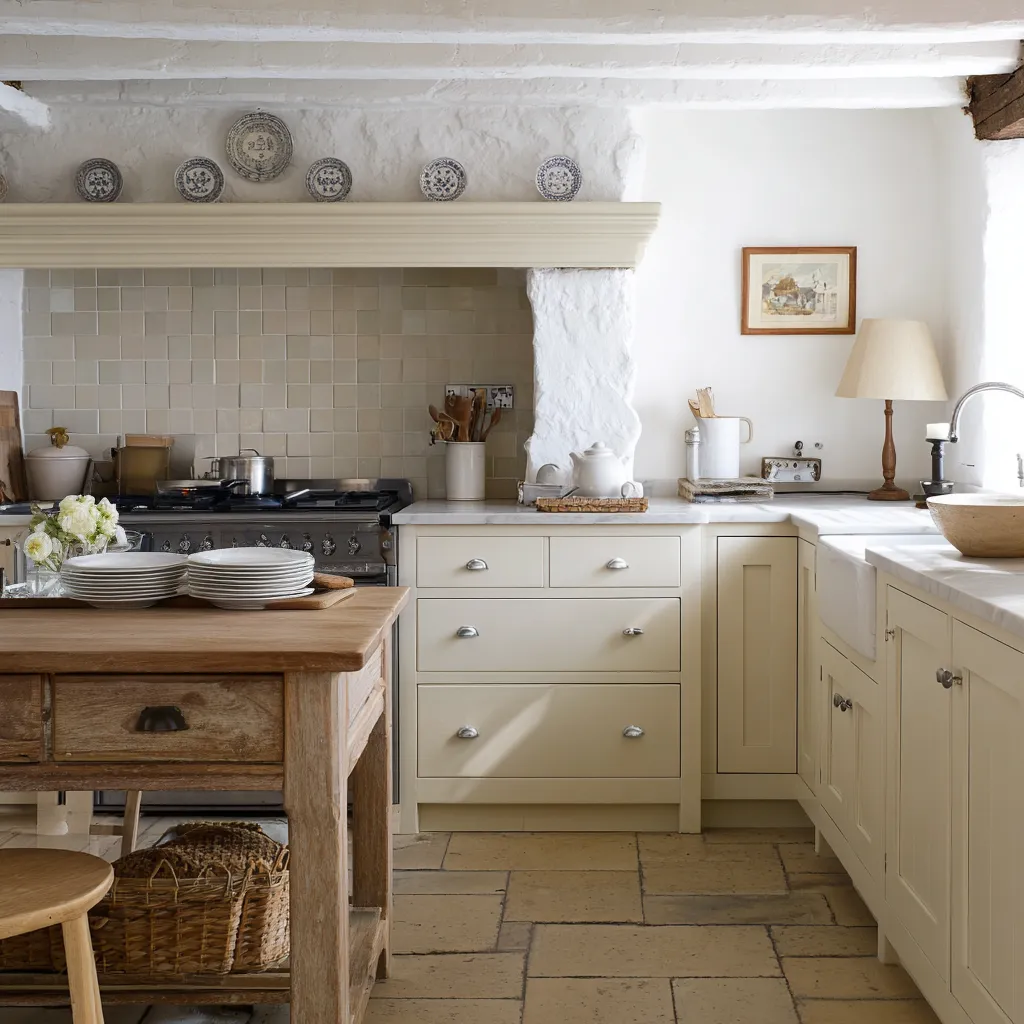
One concentrated source of age
Modern shabby chic kitchen design works better when age is concentrated. In some kitchen ideas, age lives mainly in the architectural shell.
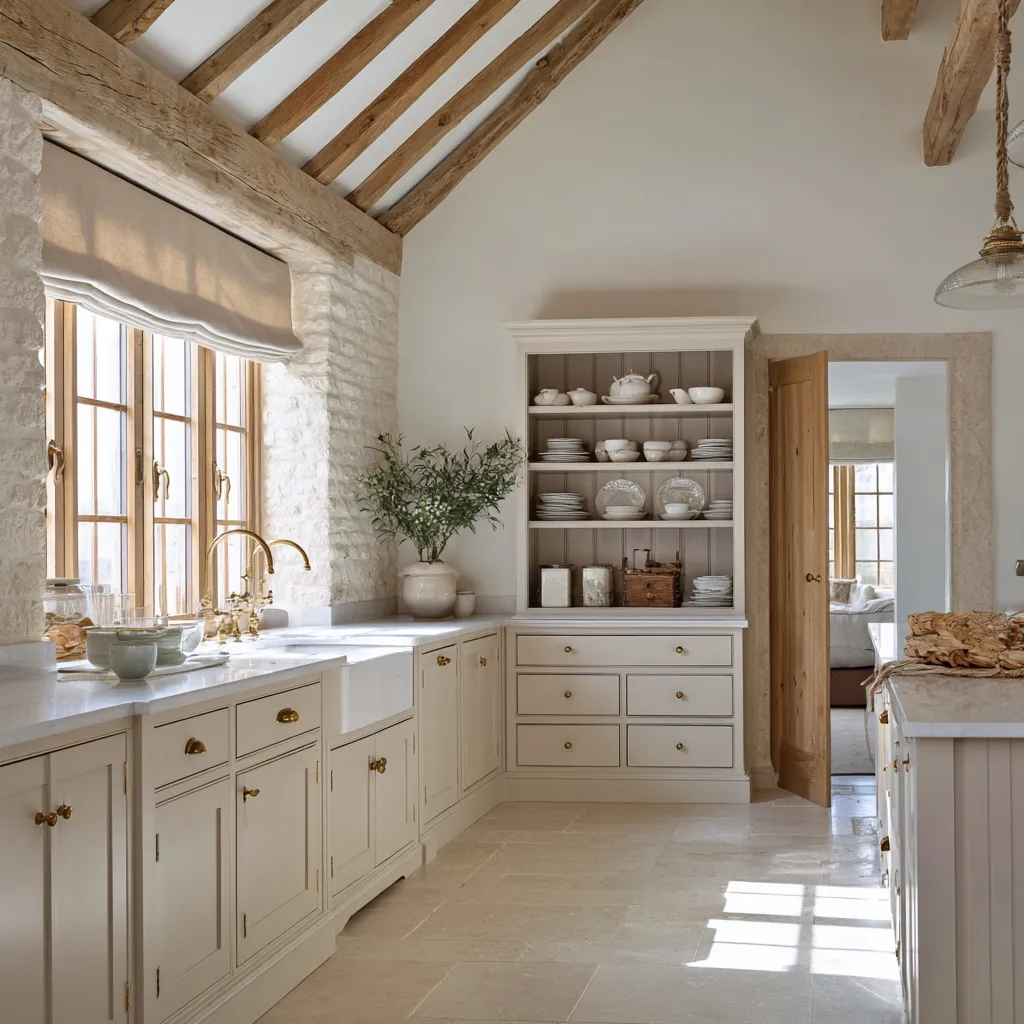
These are the designs with rough beams, limewashed or plastered walls, thick window reveals, masonry-edged niches, arches, stone floors, and hoods that feel shaped rather than manufactured. In these design ideas, the architecture already carries so much emotional weight that the rest of the kitchen has to stay edited.
Cabinet fronts grow simpler. Colors stay pale.
Accessories are cut back. Otherwise the room slips too quickly toward plain rustic country.
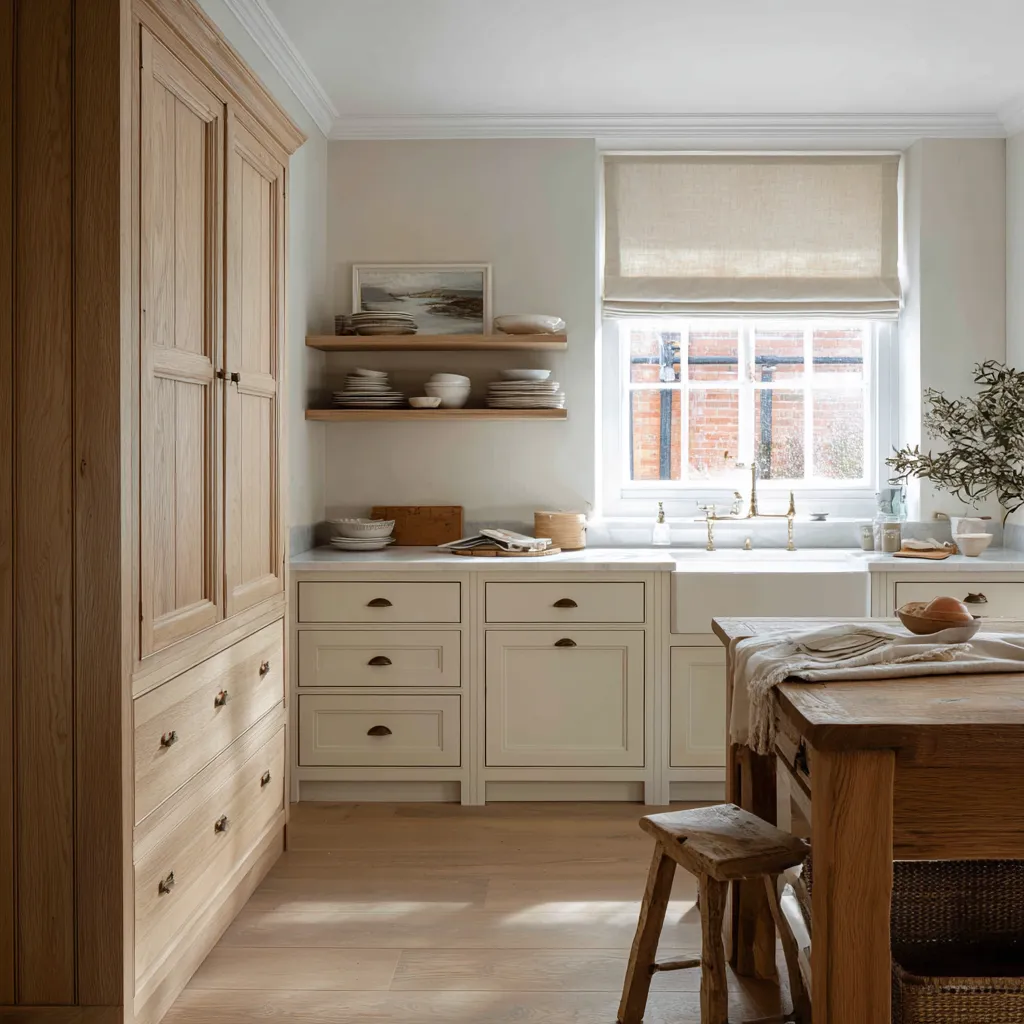
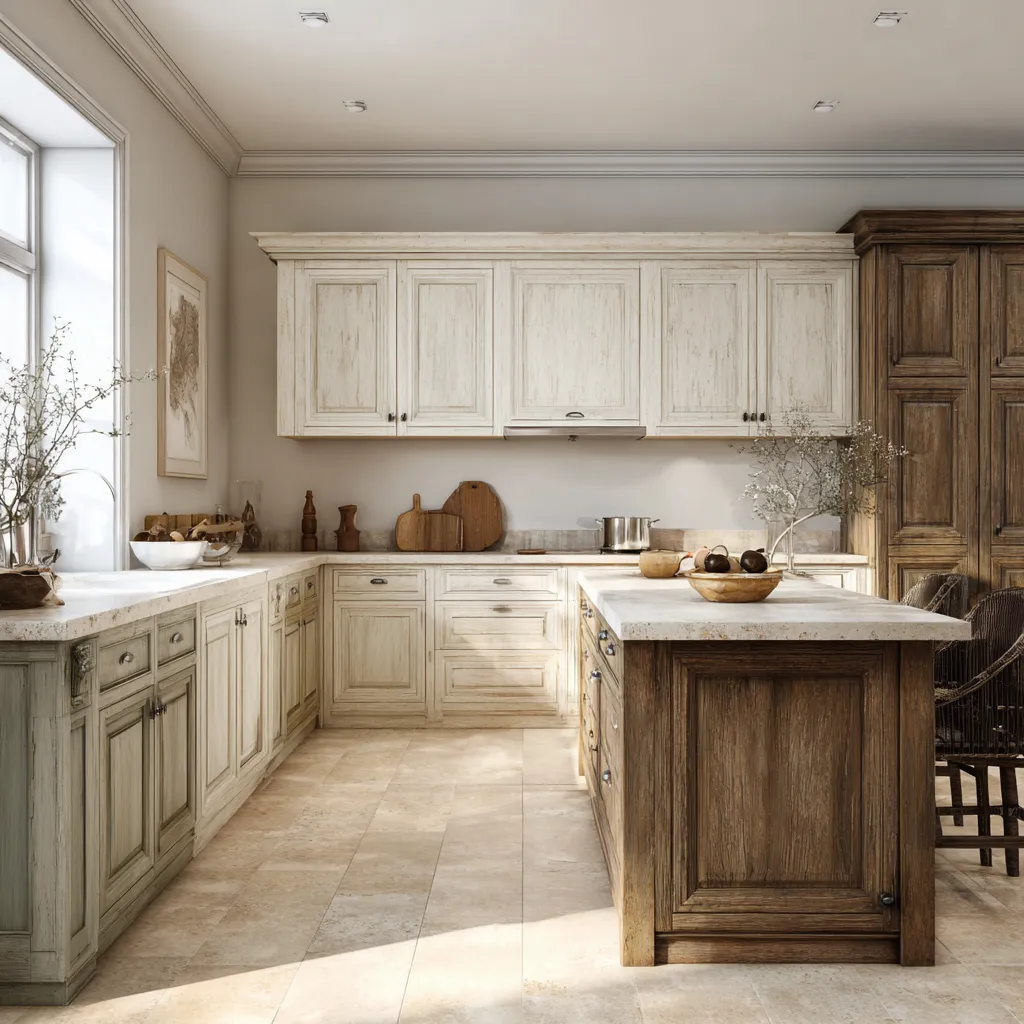
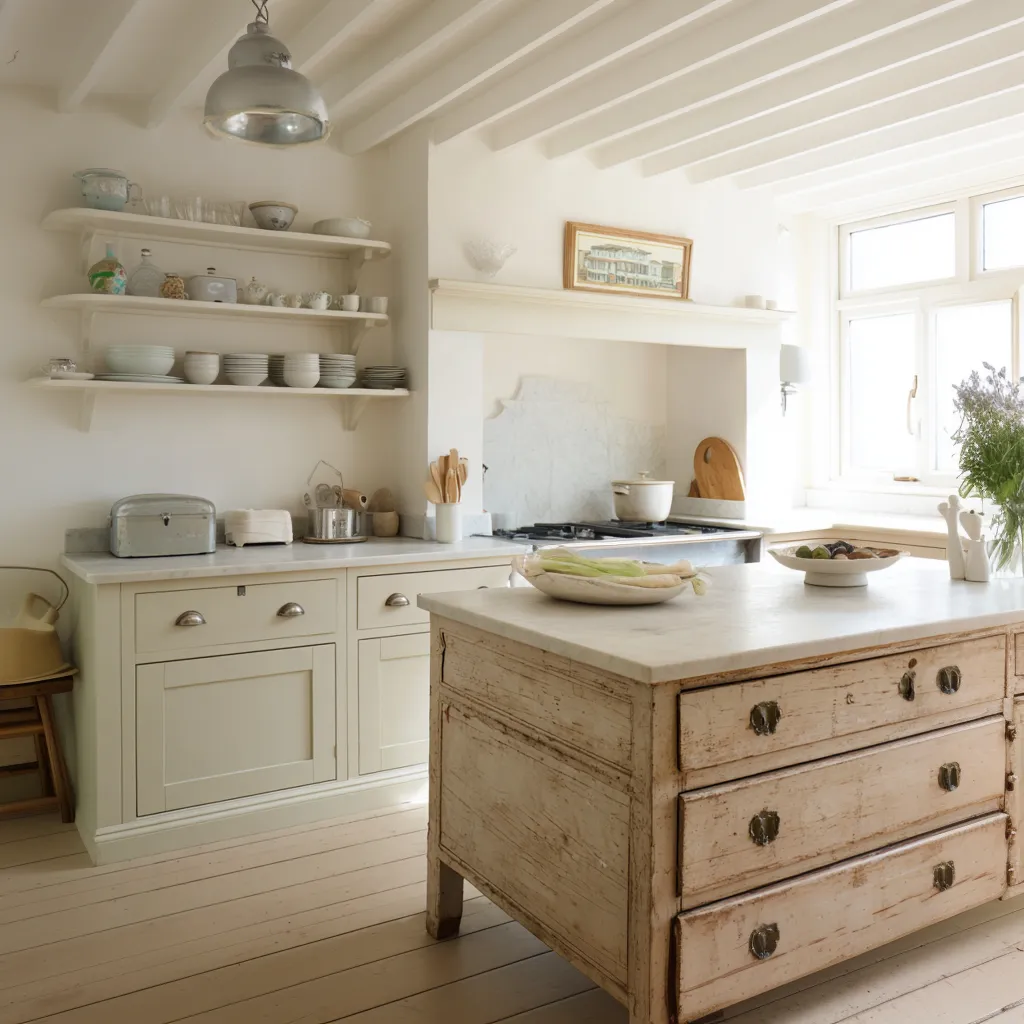
In other kitchen designs, age lives mainly in the furniture memory layer. That might mean a scrubbed oak worktable replacing a standard island, a tall glazed pantry cupboard displaying stacks of plates, an old armoire-like cabinet at one edge of the room, or a darker wood island that feels like a freestanding household piece rather than a built block of millwork.
In these kitchen ideas, the furniture gives the room lineage. It suggests that the kitchen has grown over time rather than arriving as a single package.
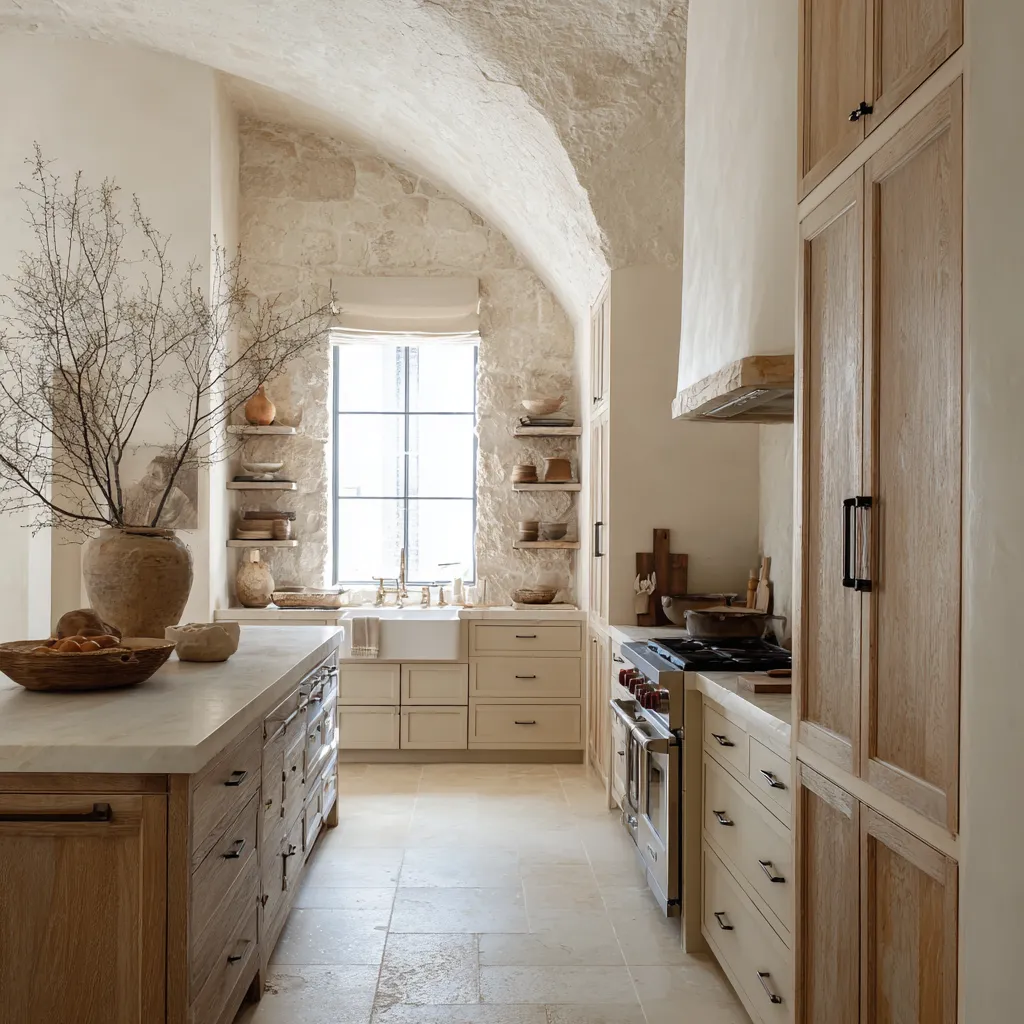
Both routes can work beautifully, but the design usually benefits from choosing one dominant source of age and letting the others remain secondary. That hierarchy is what gives the style its poise.
Plaster has become the new ornament
A particularly interesting change in this style is the role of plaster. In older shabby chic interiors, decoration often came through trim, floral pattern, lace-like detail, carved furniture lines, and visible sentiment.
In newer shabby chic kitchen ideas, plaster frequently takes over that emotional role.
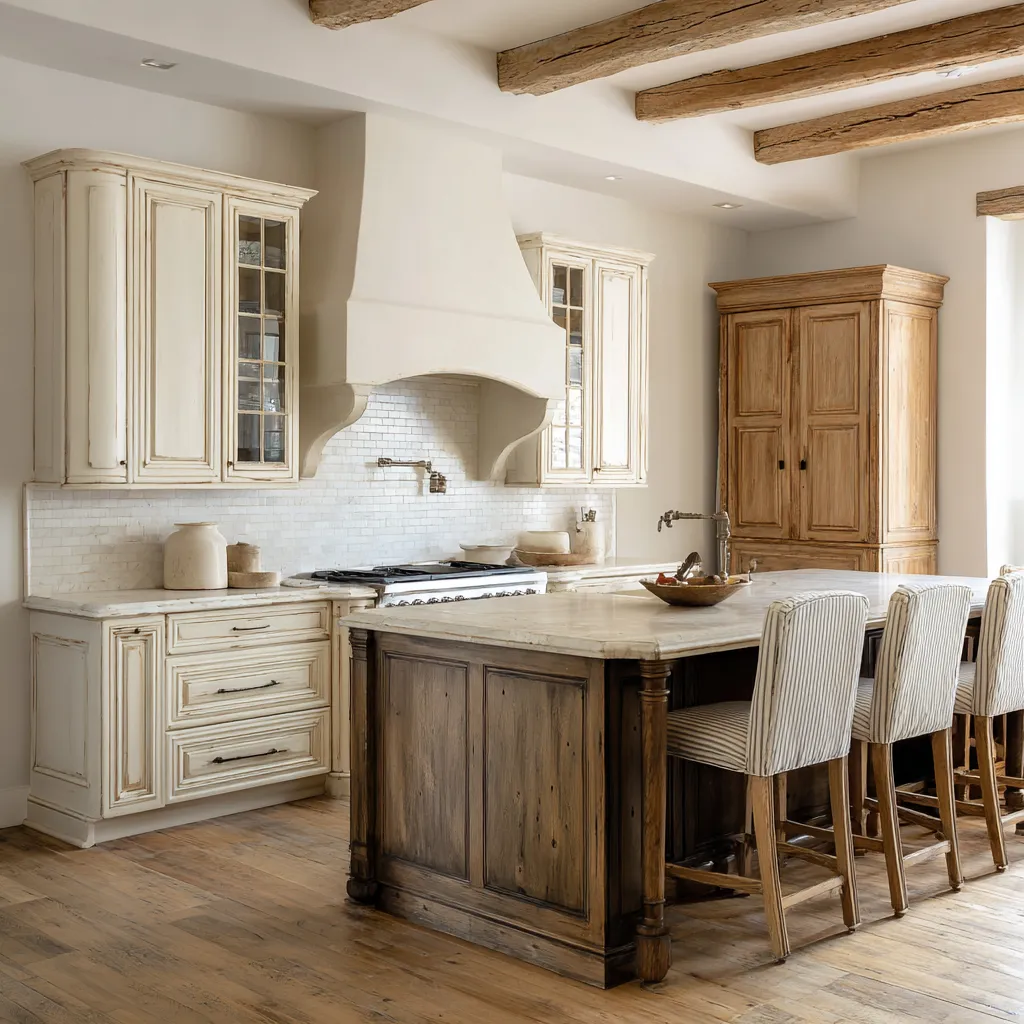
A plaster hood can create softness, age, and handwork without a single overt decorative motif. A limewashed wall can give a room depth and tonal movement without patterned wallpaper.
A thick window opening can make daylight feel richer than any applied ornament could. Even a plaster-faced island can shift a kitchen away from standard cabinet logic and toward something more elemental.
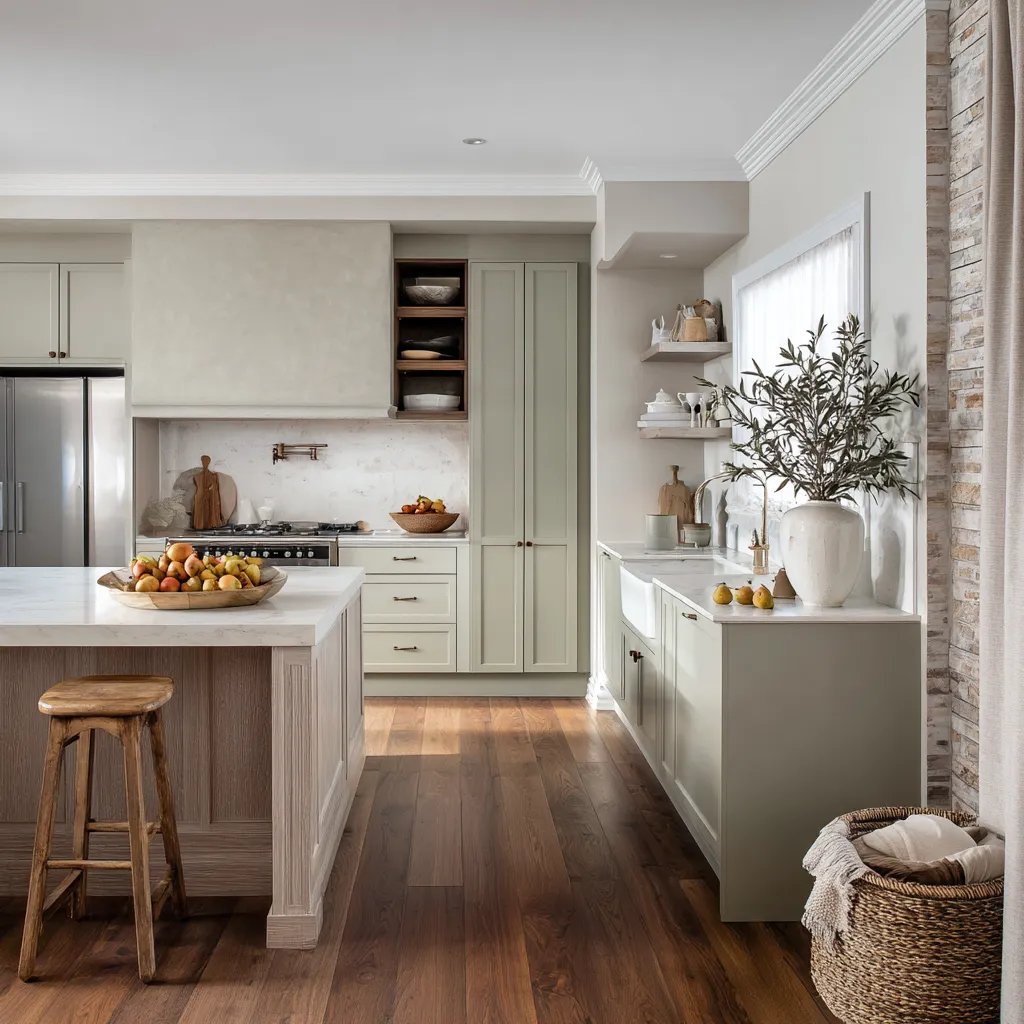
This is one reason modern shabby chic can feel so fresh right now. It can carry nostalgia without depending on obvious nostalgic devices.
The interior design still feels touched by time, but that feeling rises through material and mass rather than through visual sweetness alone.
Furniture memory matters
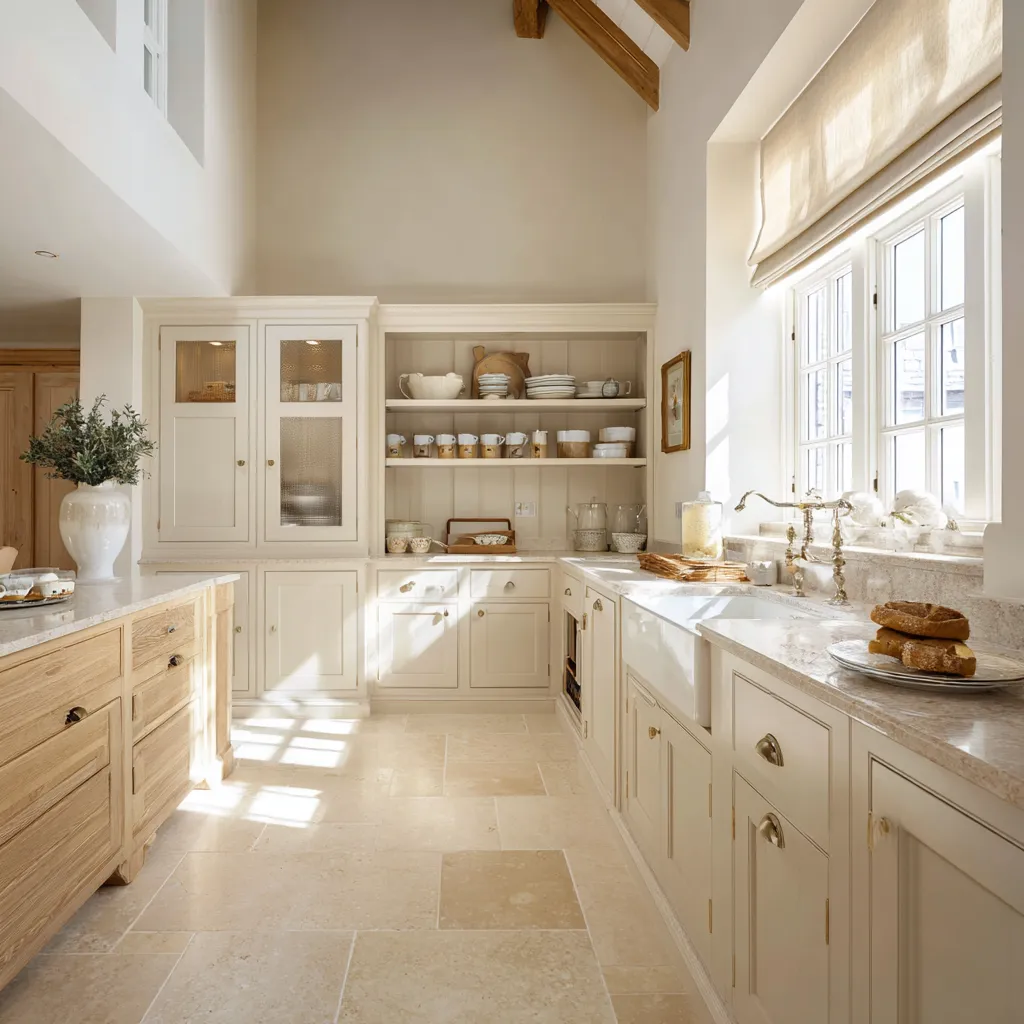
One of the ways to move a kitchen toward shabby chic is not with accessories but with furniture logic. A dresser-like island changes the mood at once.
It suggests serving, storing, gathering, laying out bread, stacking platters, setting down flowers. A glazed cabinet full of bowls and glasses gives the room a household presence that closed cabinetry cannot quite produce.
A freestanding worktable with a lower shelf, a drawer, and visible wood grain makes the center of the room feel older, looser, and more human. An upholstered stool or a weathered dining table pushes the kitchen toward the territory of everyday living.
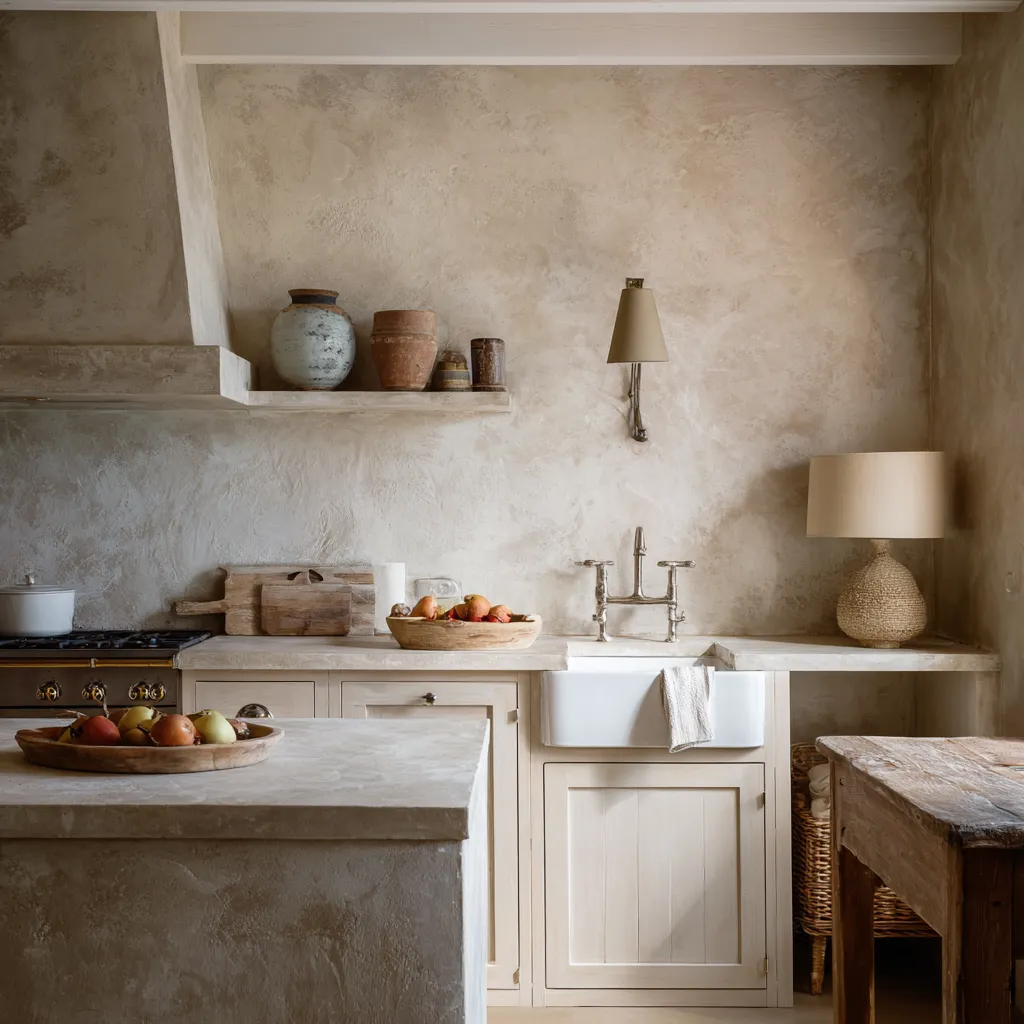
This matters because shabby chic has always carried some overlap with the dining room, pantry, or family room. It is a style that tends to resist the idea of the kitchen as a sealed technical zone.
It wants some trace of ordinary household life to remain visible. That does not mean every item should look antique.
It means the kitchen benefits from at least one piece that feels as though it belongs to the home, not only to the appliance plan.
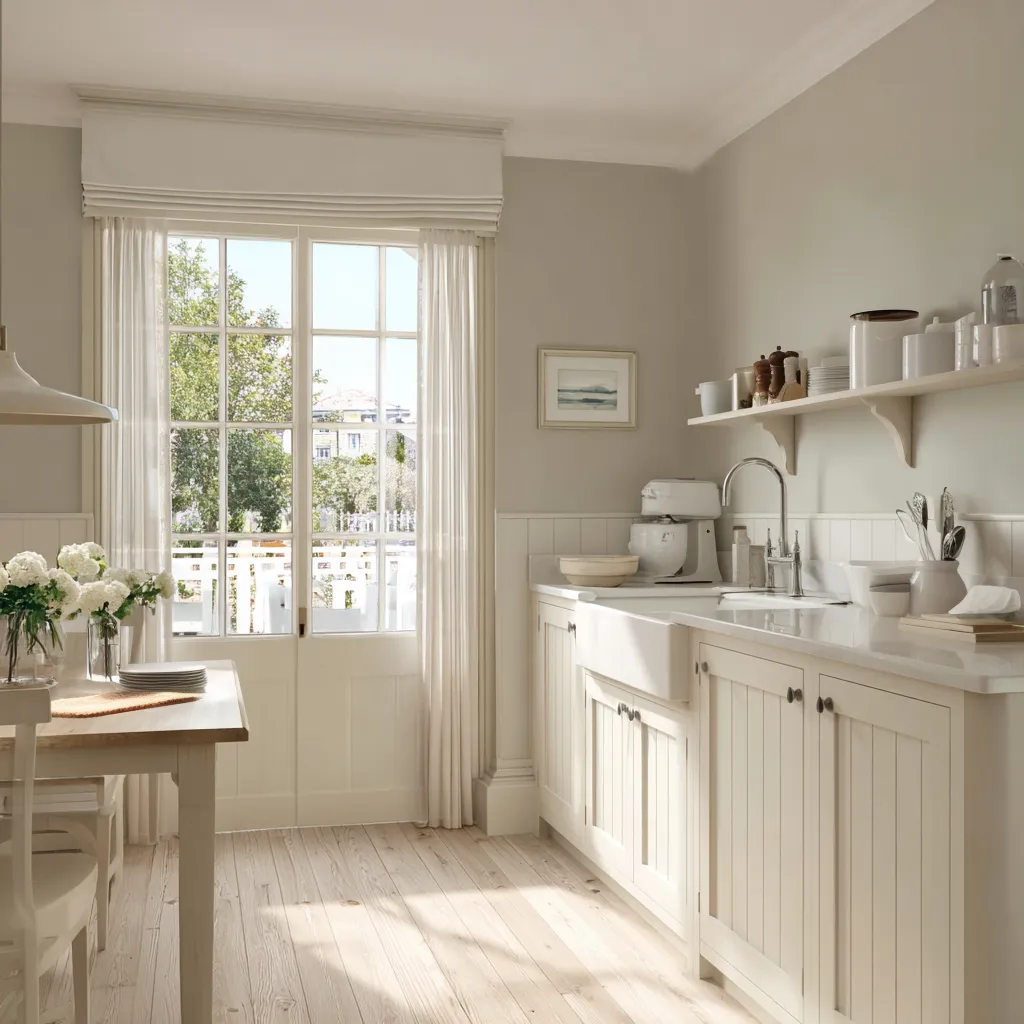
Patina needs restraint
Patina is one of the great balancing acts in this style. Too little, and the kitchen may feel merely pale.
Too much, and the room starts losing its present-day edge.
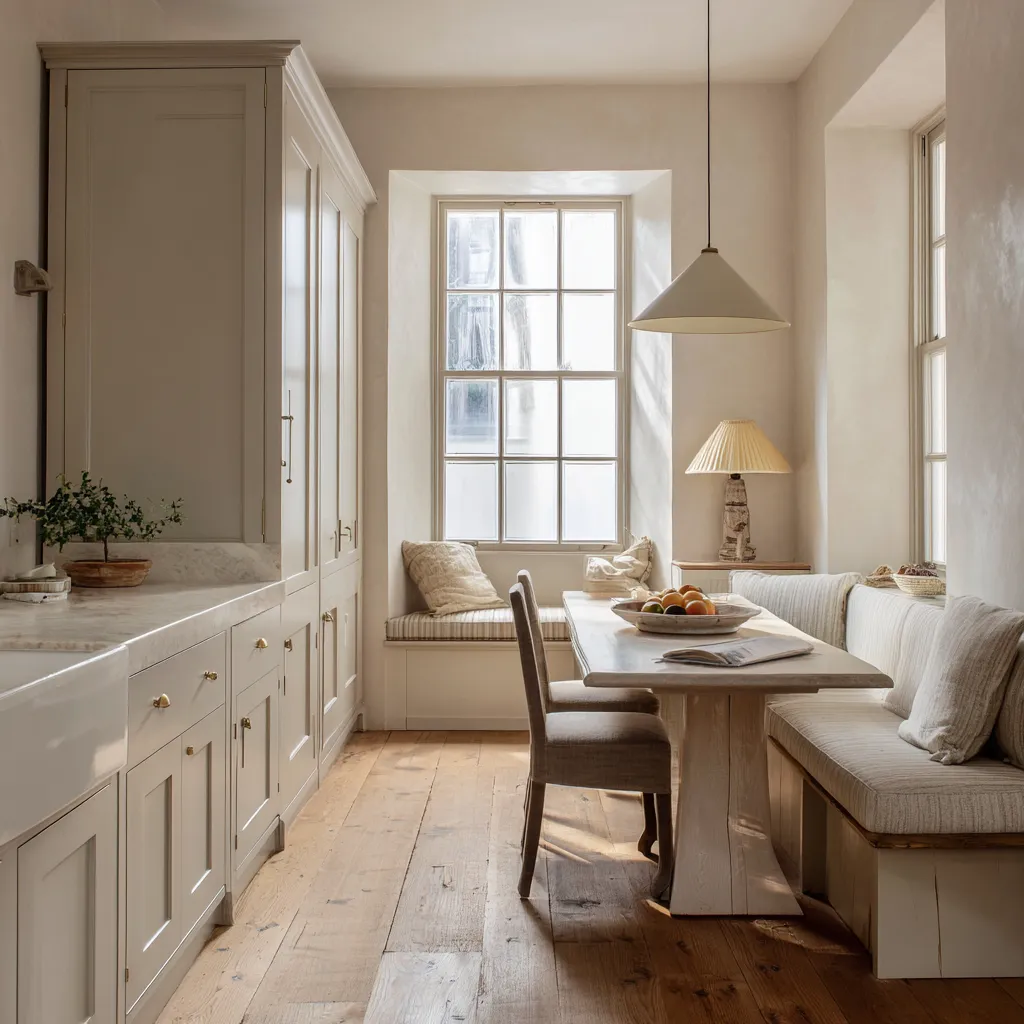
Shabby chic kitchen designs usually carry patina in a measured way. A rubbed paint finish on one cabinet.
A scrubbed table surface. Slightly worn timber.
A softened metal faucet. Stone with a matte, aged character.
Handmade pottery with irregular surface. Linen with a gentle crease rather than sharp stiffness.
These things suggest use, age, and touch without forcing the issue.
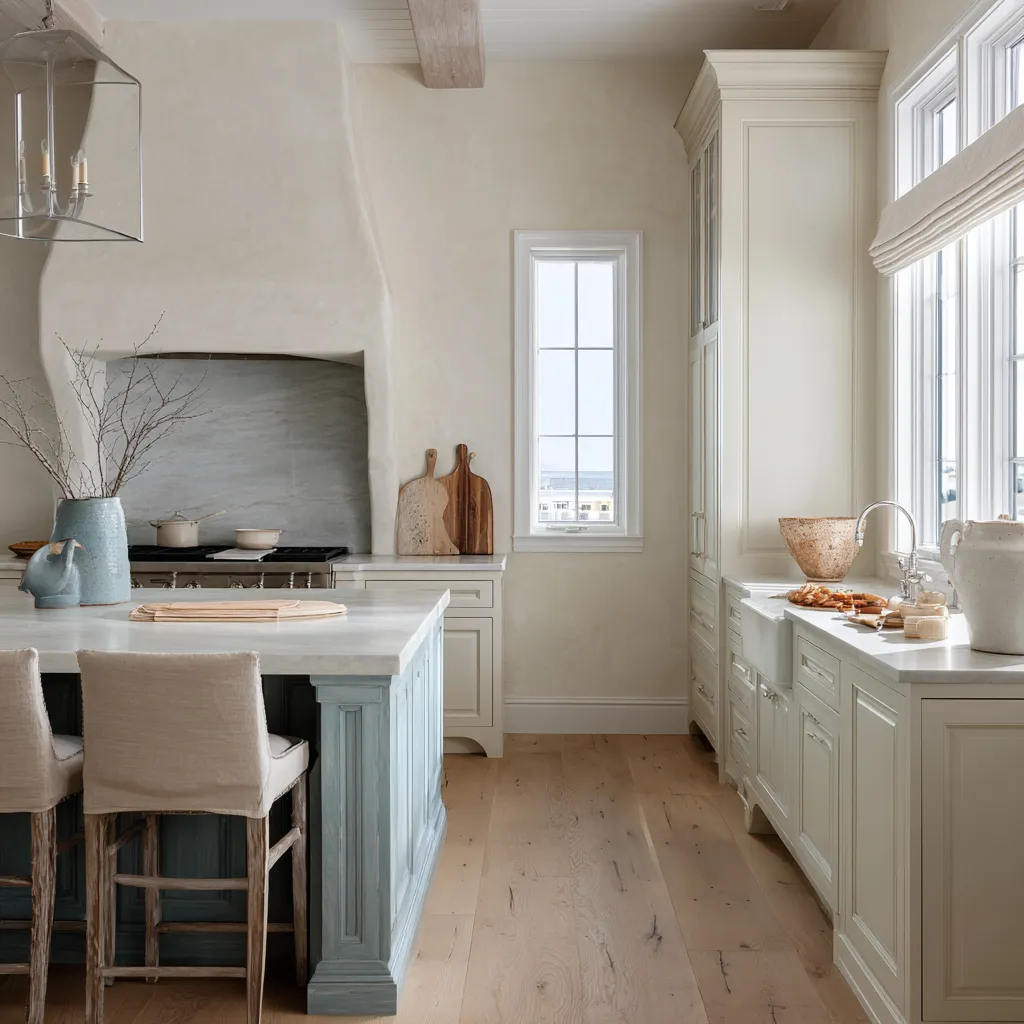
What tends not to work as well is patina spread too evenly and too aggressively. If every cabinet edge is distressed, every surface is rough, every wood is darkened, every object leans antique, and every wall is heavily rustic, the kitchen begins to leave shabby chic and move into heavier old-country territory.
The fresher version of the style needs age, but it also needs breathing room. The interior design should look softened by use, not costumed by it.
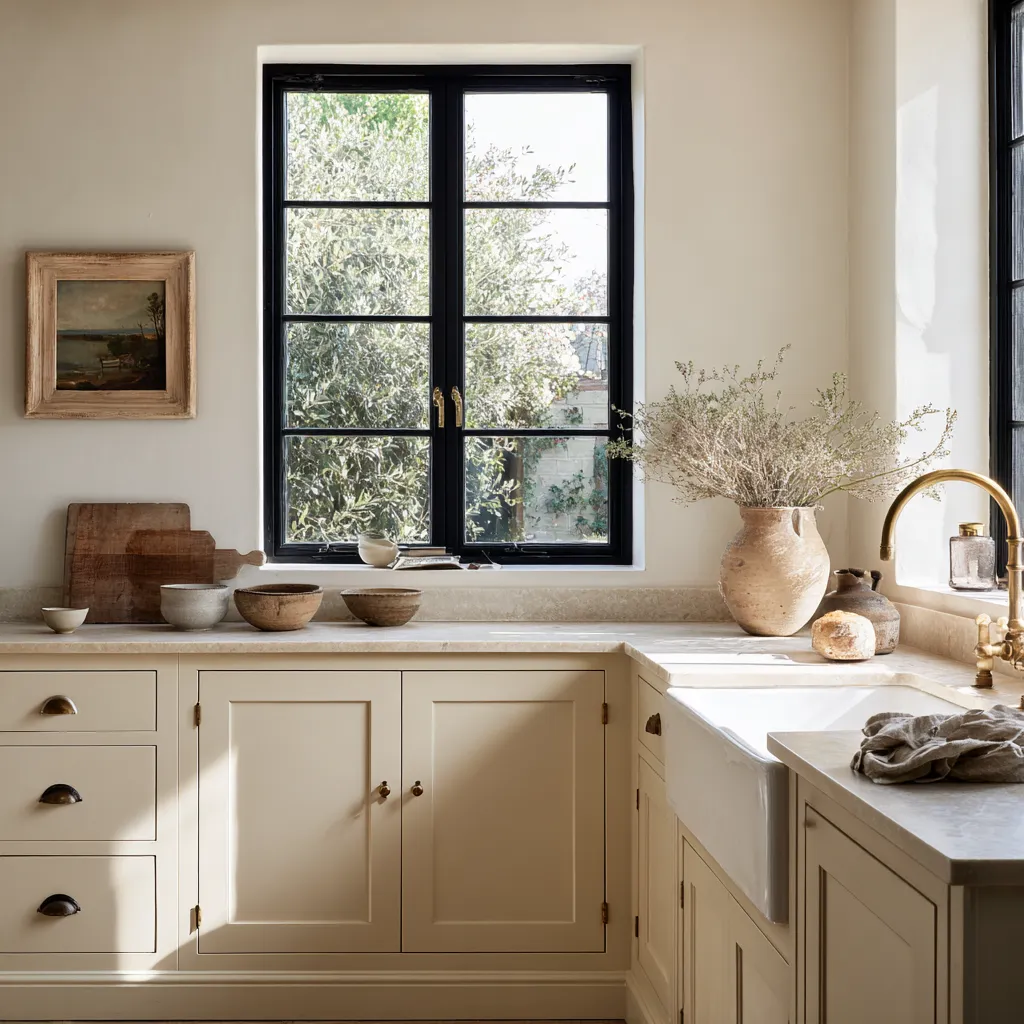
Visible display should stay selective
Open display has long been tied to shabby chic interiors, yet in a modern shabby chic kitchen it works in small, edited doses. A few shelves with stacked white dishes, bowls, and pitchers can warm a wall beautifully.
A single pantry cabinet with glass fronts can turn storage into part of the room’s character. A ledge holding pottery, cutting boards, and a bowl of fruit can make the sink wall feel inhabited.
But once display becomes too dense, the room starts losing the spaciousness that modern shabby chic depends on.
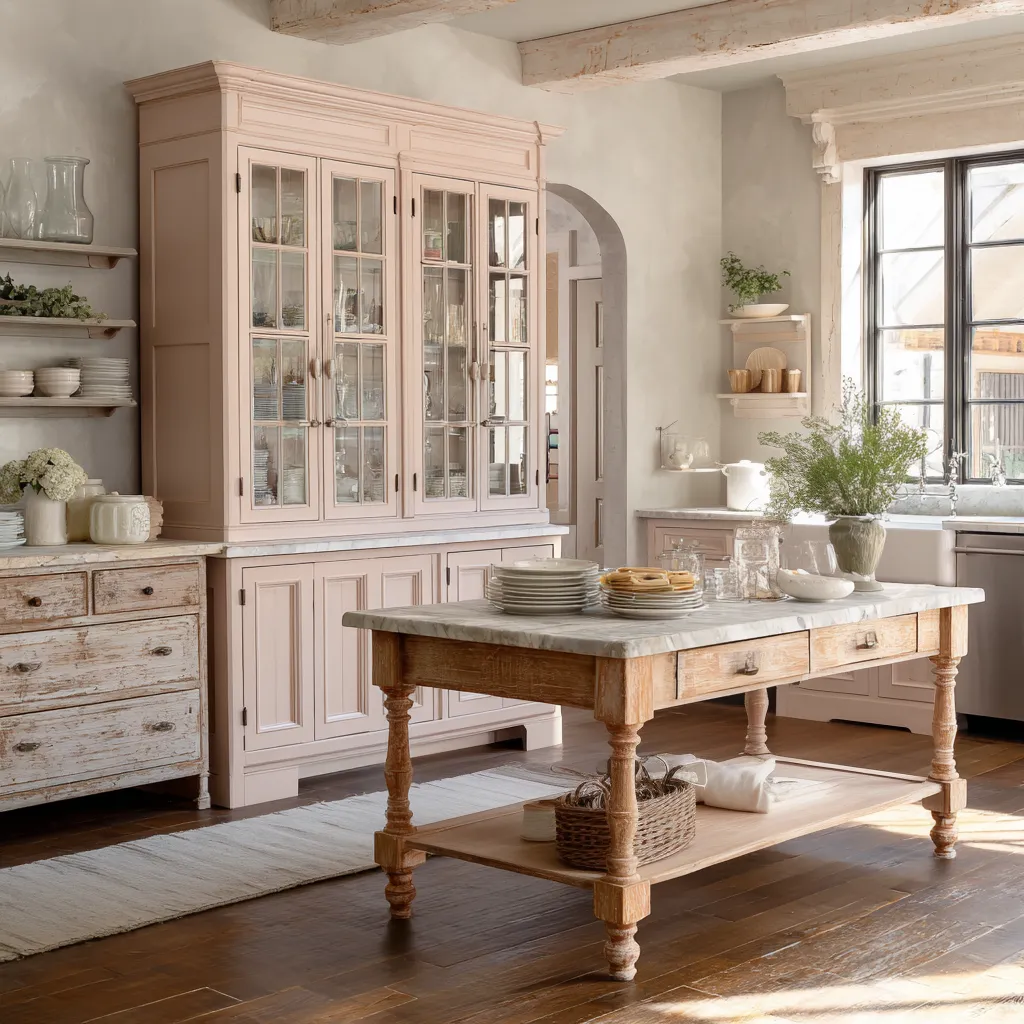
This is where many people go wrong. They assume that if a few visible household objects help, many more will help further.
Usually the opposite happens. The style gets its strength from the relationship between object and emptiness.
The bowls matter because there is wall around them. The glazed cupboard matters because not every storage piece is glazed.
The flowers matter because they sit in a room not already crowded with decorative statements. The eye needs pauses.
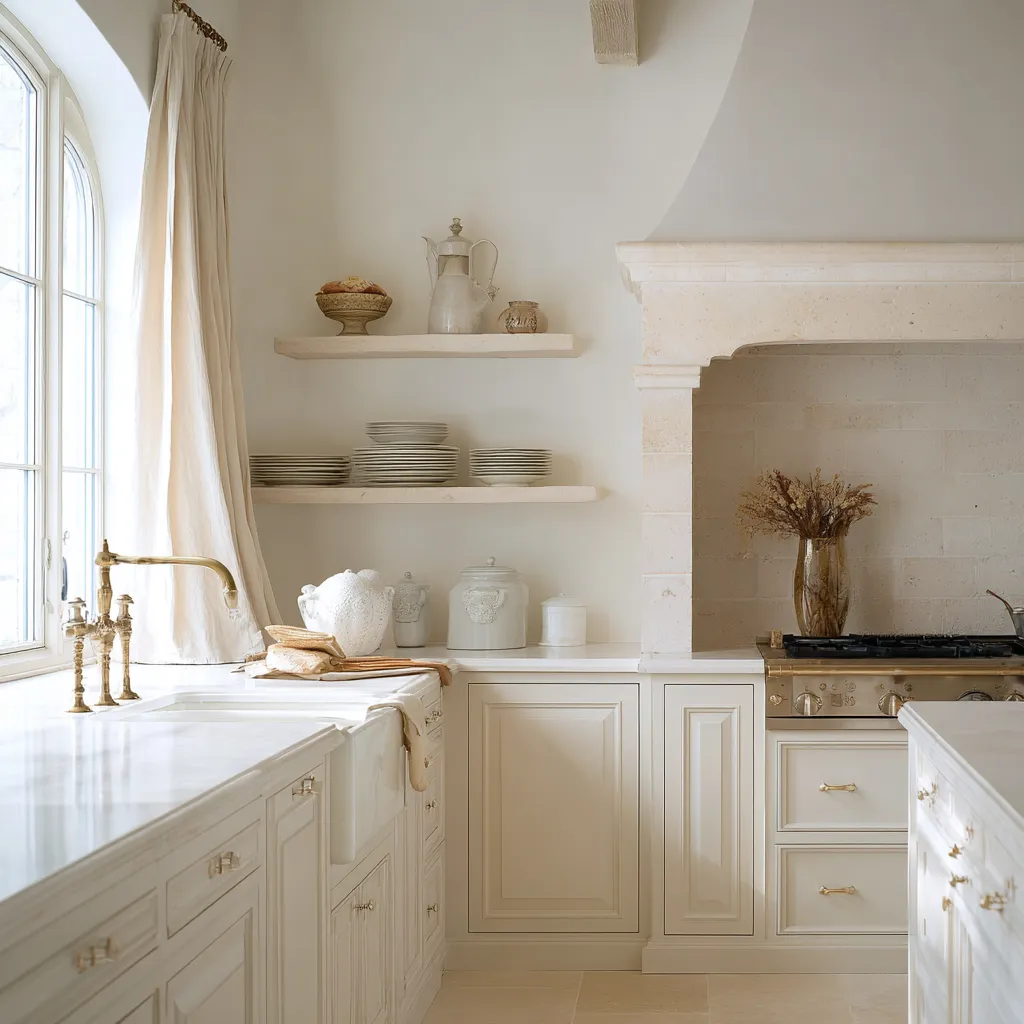
The kitchen as a room for staying
One of the directions within modern shabby chic kitchen design is the move toward inhabitation. Some kitchens now behave less like pure work zones and more like mixed domestic rooms.
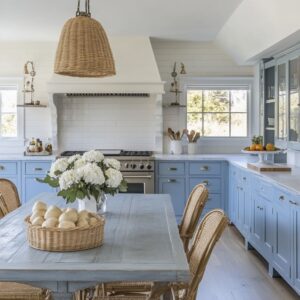
A banquette under the window, a breakfast ledge with stools, an upholstered bench, a wing chair near the sink, a table lamp on a side counter, a pleated shade, a narrow dining table running through the space, a cushioned window seat at the far end — all of these details change the emotional use of the kitchen.
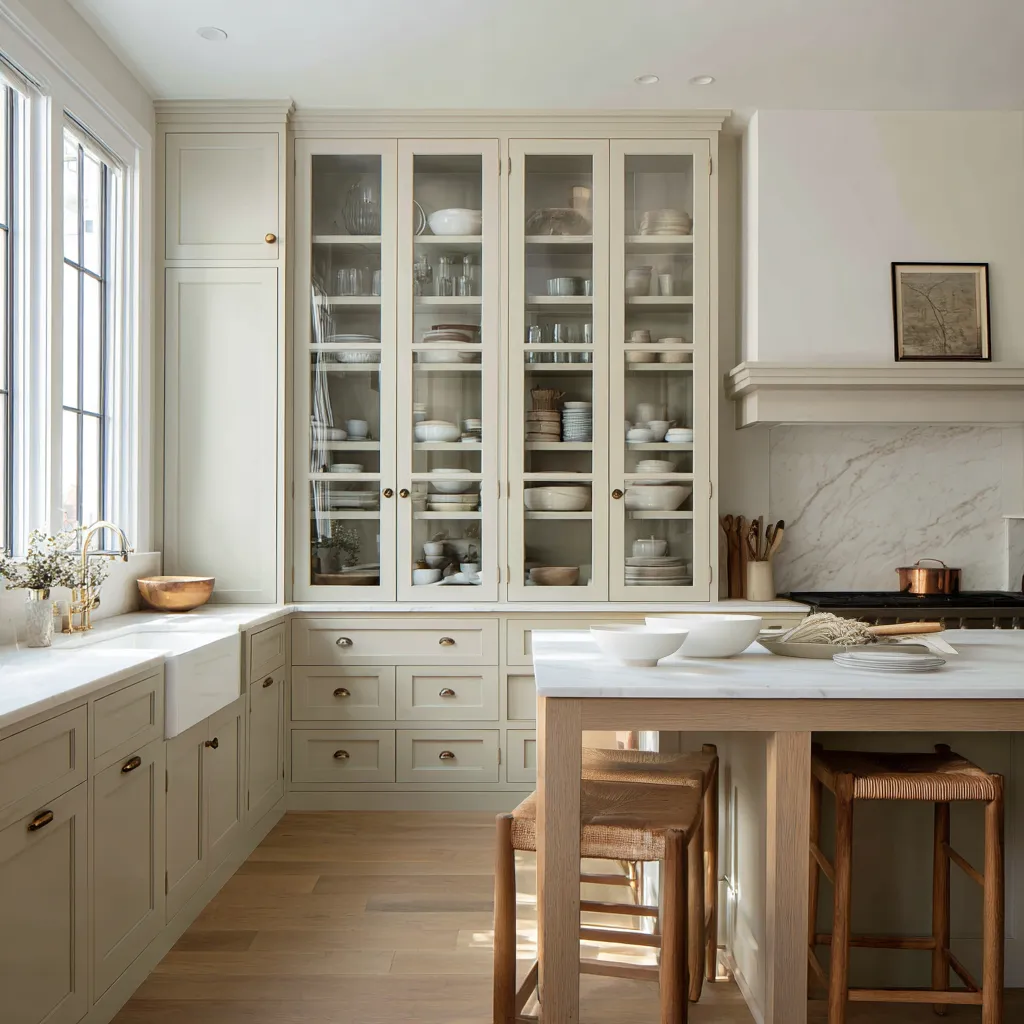
This does not necessarily make the room more shabby chic in a direct stylistic sense. What it does is deepen the domestic atmosphere.
The room becomes a place to sit with coffee, speak while someone cooks, read, sort flowers, serve tea, linger after dinner, or work for an hour with afternoon light coming through the window. That shift makes the newer shabby chic kitchen ideas often feel so persuasive.
It is not trying only to look soft. It is being shaped for softer forms of daily life.
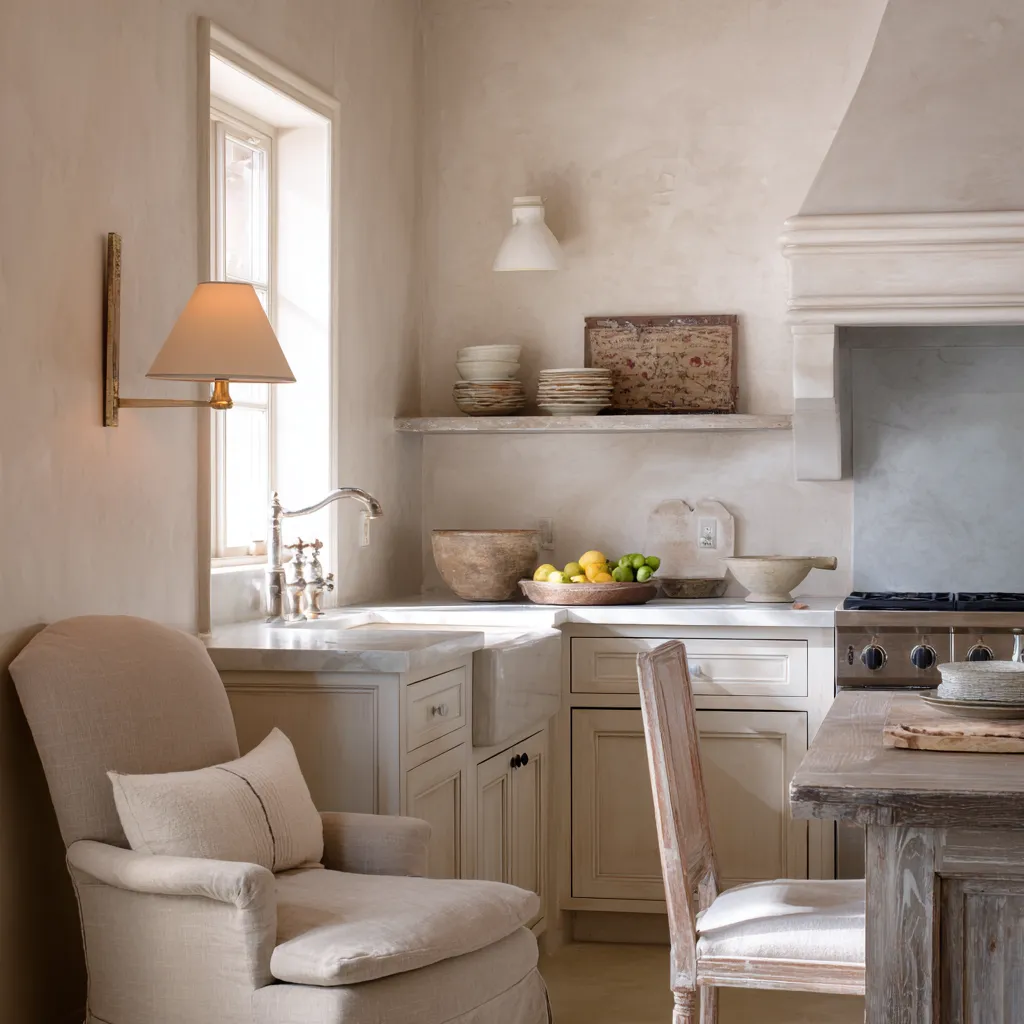
Contrast can work, but only in one place
Although this style usually avoids strong contrast, there is still room for a firmer accent. The key is containment.
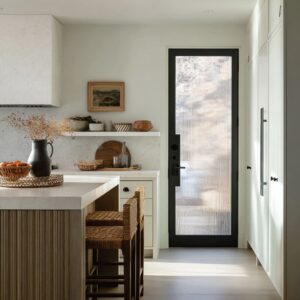
Black-framed windows can be beautiful in a pale shabby chic kitchen because they sharpen the glazing line without spreading darkness through the whole room. A dark island can ground a pale shell because it gives the eye one stable mass to hold onto.
A deeper pantry cupboard can anchor a wall otherwise filled with cream and stone. A dark sconce, a darker range, or one concentrated timber note can stop the palette from becoming too diffuse.
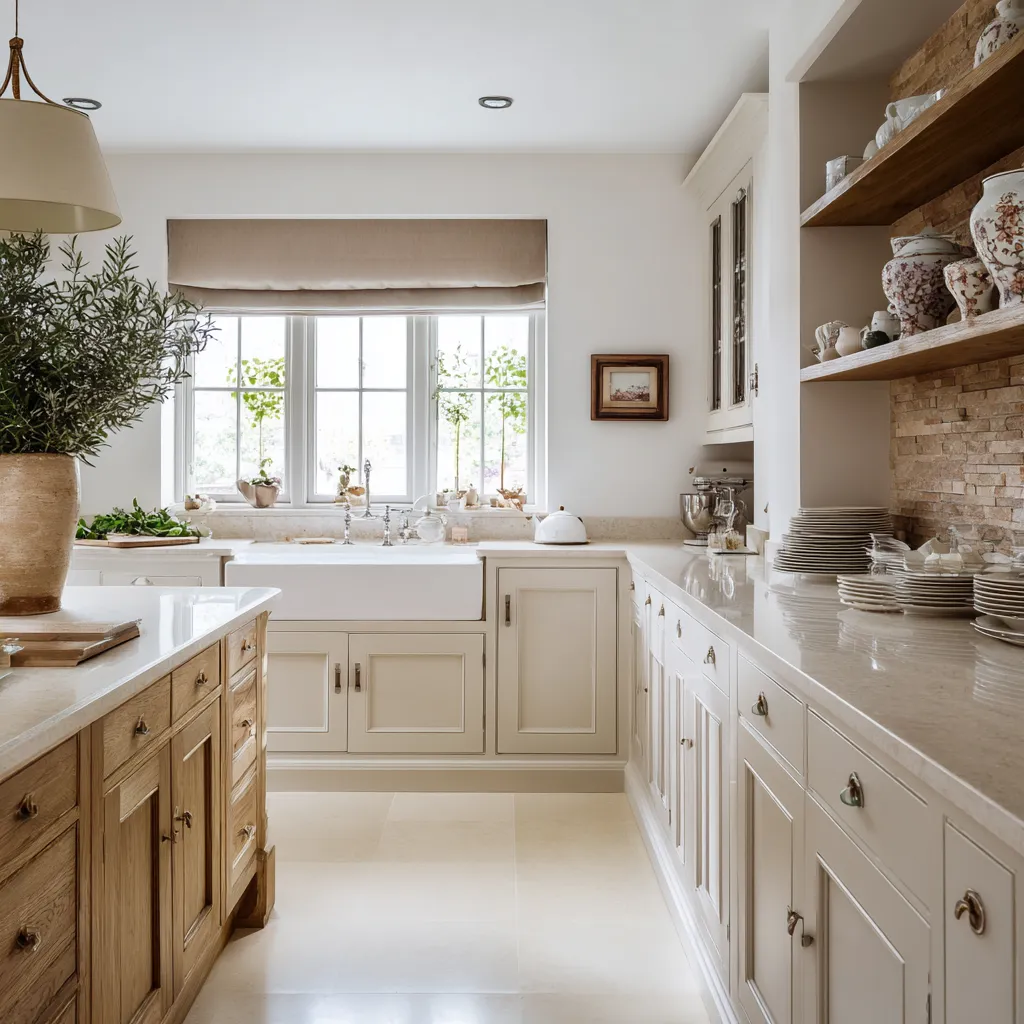
The mistake is letting that contrast migrate everywhere. Once black frames are joined by black hardware, black lighting, black shelving, and hard black decorative accents, the interior starts moving into another design family.
Modern shabby chic allows punctuation, but not a full graphic system. Its contrast is local, not global.
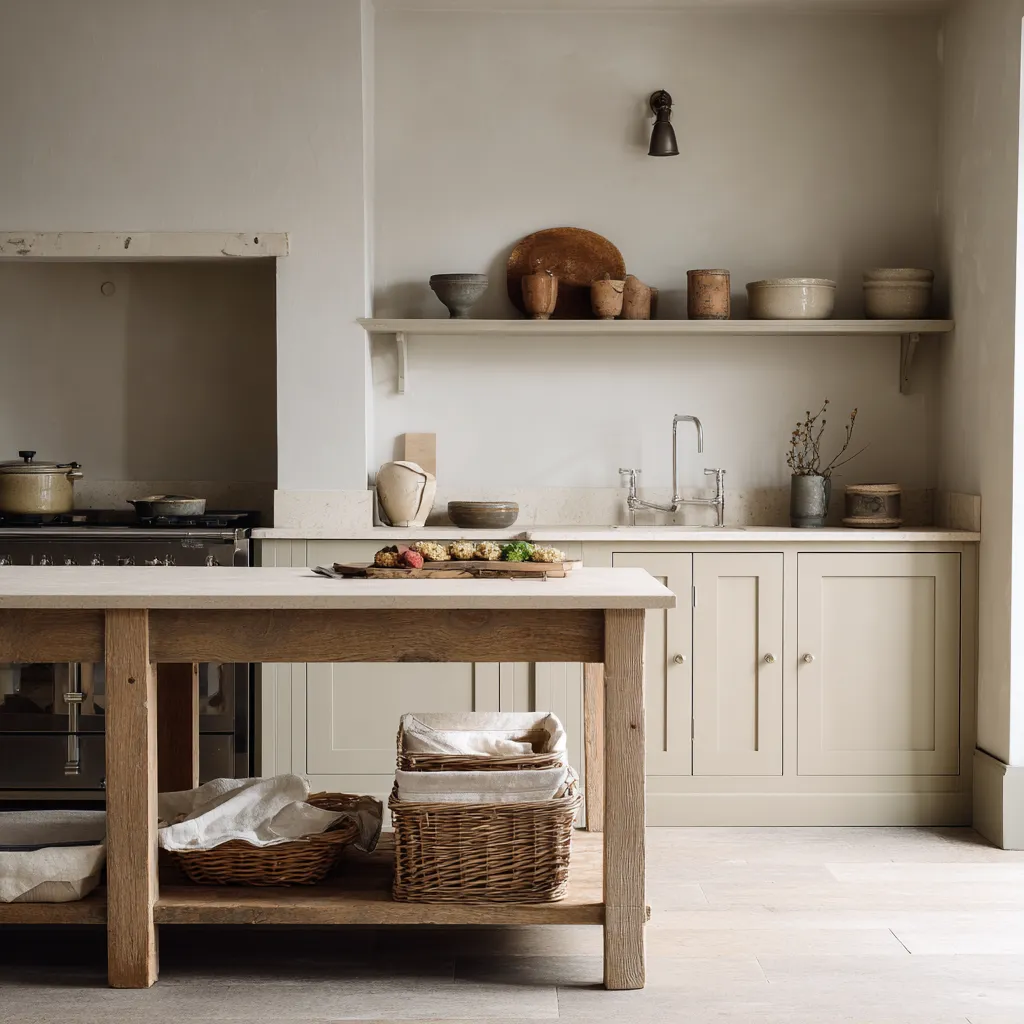
Several directions within the style
Modern shabby chic kitchens tend to fall into a few distinct paths:
- One path is the architecture-first kitchen. Here the shell carries the mood: beams, arches, plaster, masonry, deep reveals, pale stone, shaped hoods. The cabinetry remains simple and pale so the architecture can lead.
- Another path is the furniture-led kitchen. Here the room leans on worktables, dresser islands, pantry cupboards, armoires, glazed storage, rubbed wood, and softer household pieces. This version often feels especially warm and layered.
- A third path is the polished, pared-back version. These kitchens may use marble, ribbed glass, restrained shelving, light art, pale painted joinery, and careful brass details. They sit close to soft classic-modern design, yet still hold a shabby chic identity through material softness and visible domestic life.
- A fourth path centers on inhabitation. These are the kitchens with banquettes, upholstered stools, window seats, armchairs, breakfast ledges, and hybrid dining arrangements. They may carry less overt age, but they bring the kitchen into closer relation with the rest of the home.
None of these routes is automatically better than another. What matters is internal consistency.
The room should know which story it is telling.
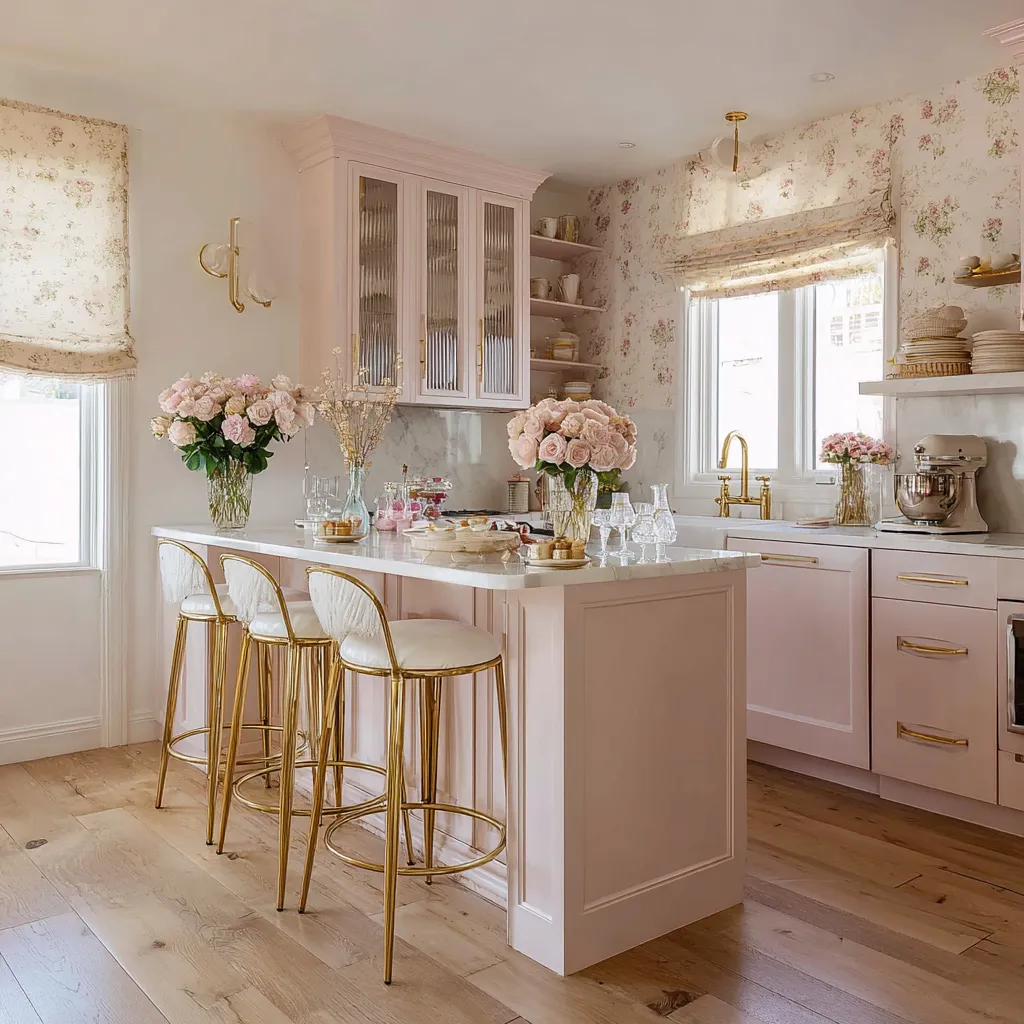
Materials that support the look
The material palette for modern shabby chic kitchens usually includes matte or low-sheen finishes. Paint should look soft, not lacquered.
Stone should have body and quiet variation, not sharp reflective drama. Wood should show grain and warmth, whether pale, scrubbed, honeyed, or slightly weathered.
Metals should sit in muted brass, aged brass, warm nickel, or restrained darkened tones rather than highly polished chrome used everywhere.
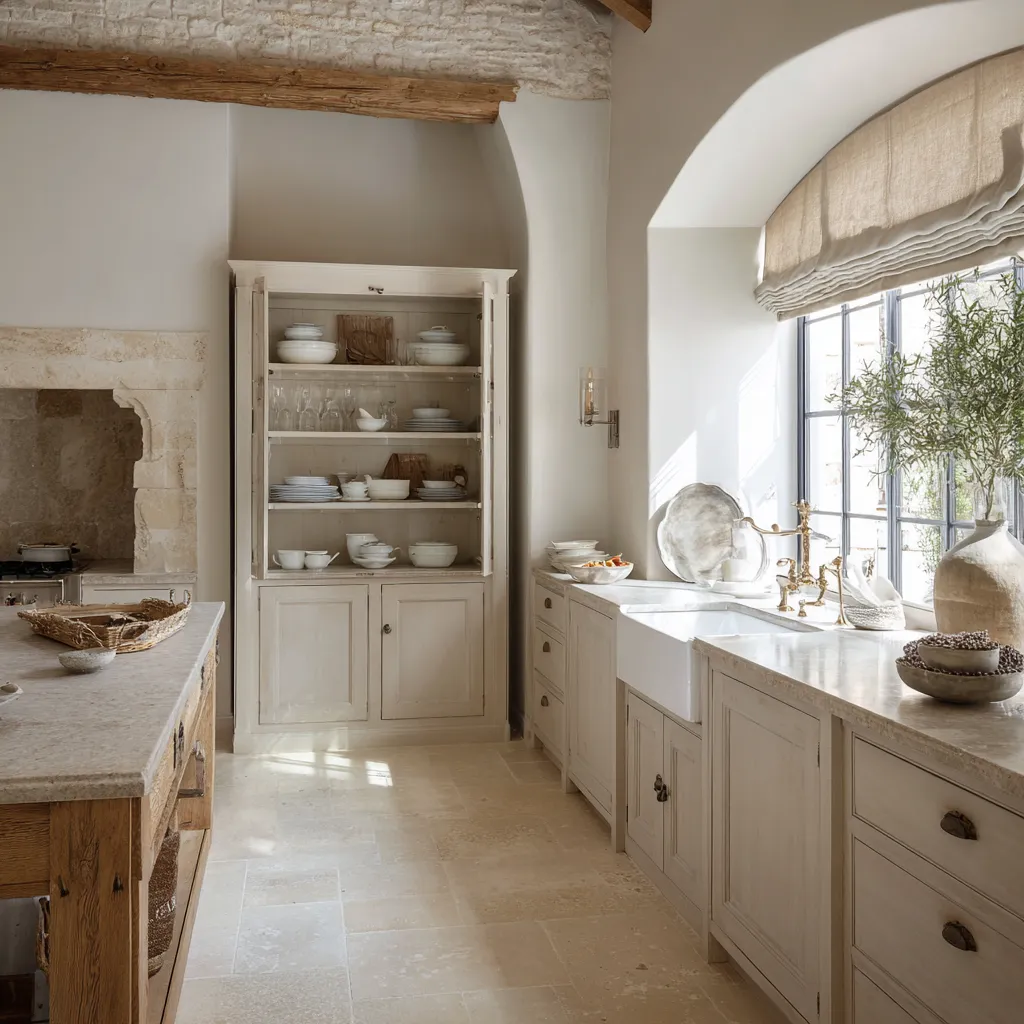
Linen remains important, though it often appears in a much lighter way than expected: Roman shades, café curtains, a sink towel, a banquette cushion, slipcovered stools, a runner on a table, a lamp shade. The role of fabric is to soften the room’s harder surfaces, not to turn the kitchen into a heavily dressed sitting room.
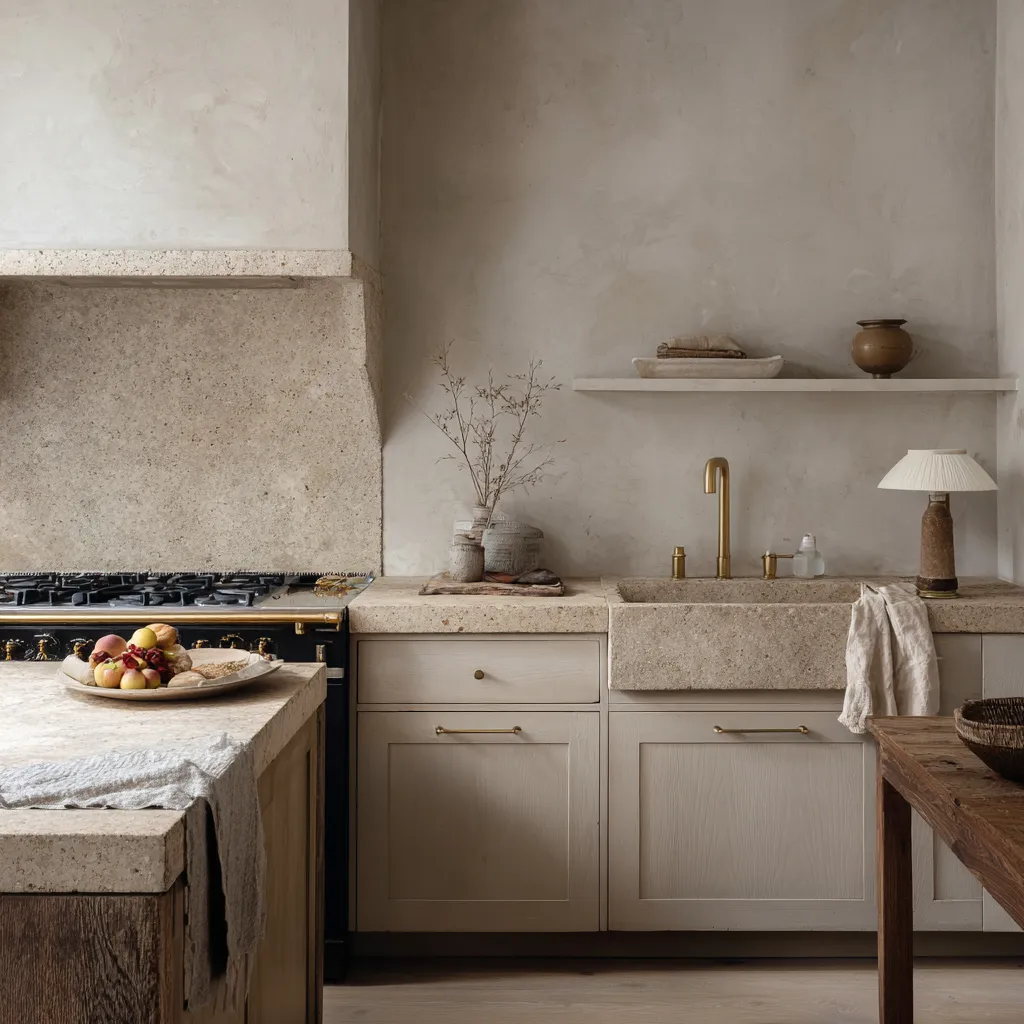
Ceramics matter too. They are one of the ways to give a kitchen tactile soul.
Matte bowls, pitchers, serving platters, canisters, and hand-formed vessels support the style far better than bright glossy objects or highly decorative novelty pieces. Their value lies in modesty and use.
Common mistakes
One common mistake is assuming that pale color automatically creates shabby chic. Without patina, furniture memory, tactile surfaces, or a few household signals, pale kitchens can drift toward blandness.
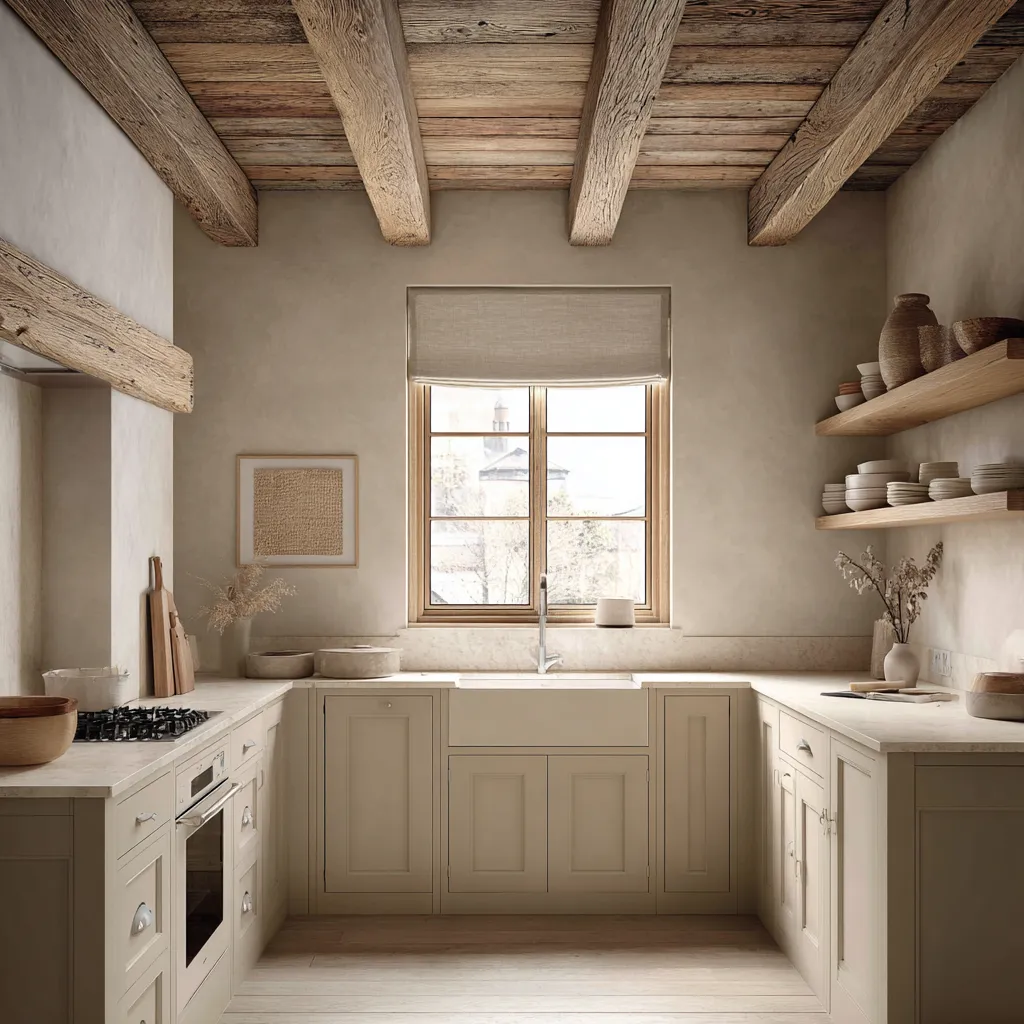
Another mistake is pushing rustic age too far. Heavy beams, rough stone, distressed paint, dark wood, sink skirts, pottery, baskets, and deep plaster can all be wonderful, but together they need strong editing or the room will tip into something heavier and older than intended.
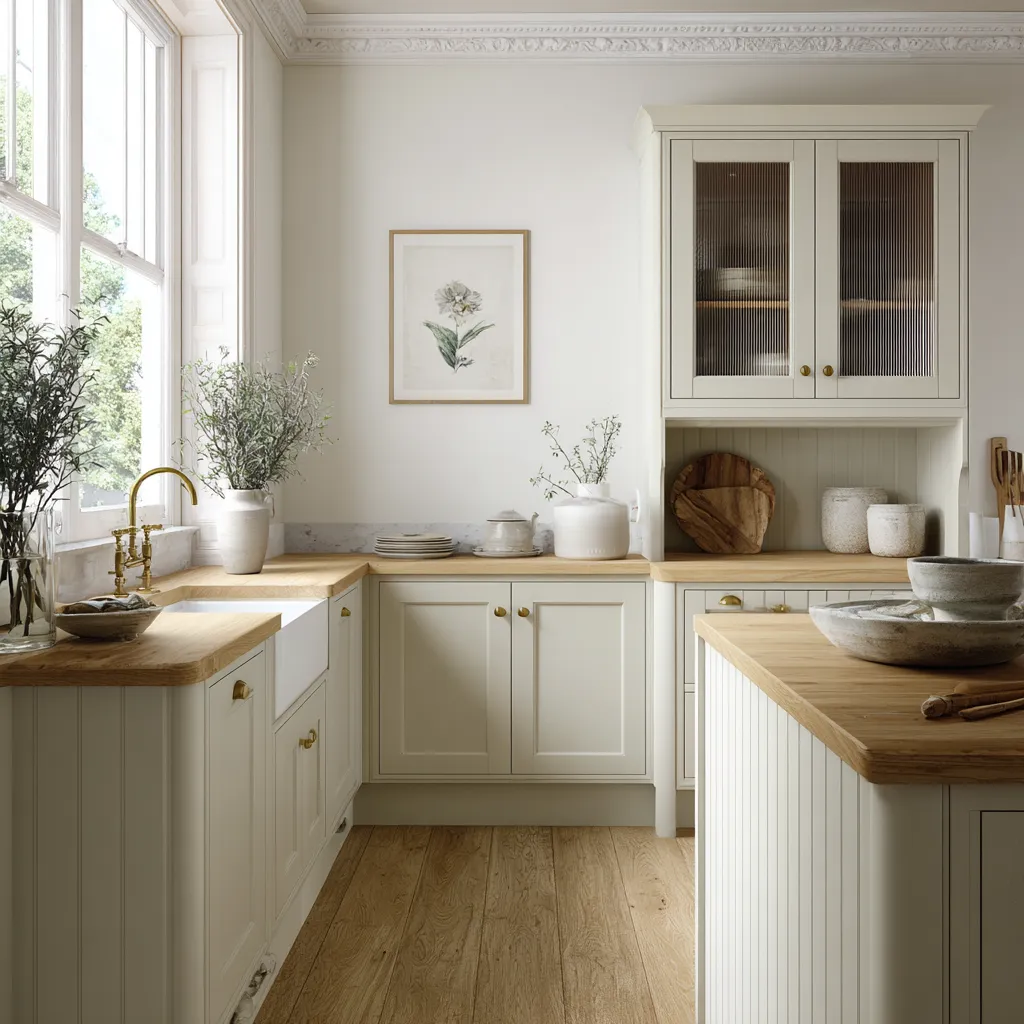
A third mistake is relying too much on florals. Floral wallpaper, roses, botanical art, and printed textiles can be lovely, yet they usually work as one note inside a larger material story.
If the room depends entirely on them, it risks feeling decorative rather than grounded.
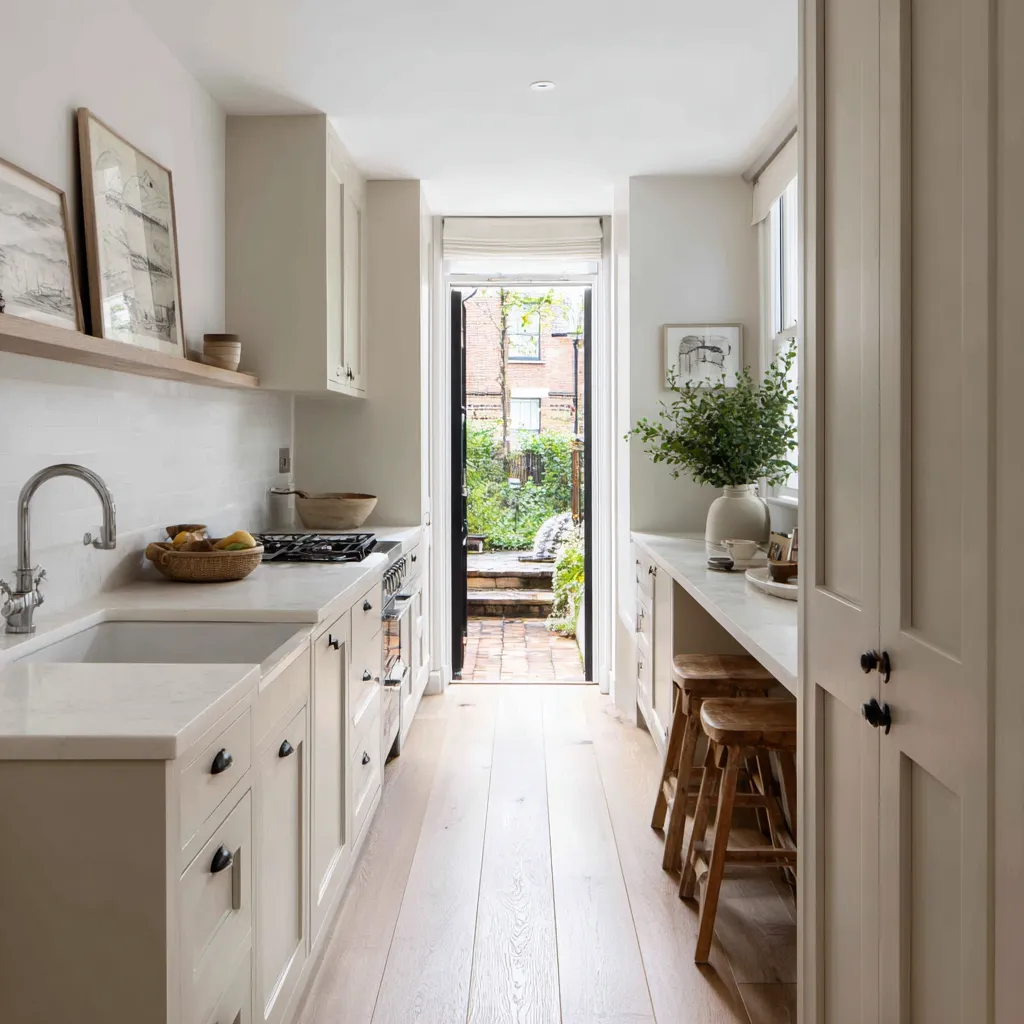
A fourth mistake is exposing too much storage. Visible dishes feel intimate.
Visible clutter does not. Open shelving should be selective and disciplined.
And perhaps a subtle mistake is forgetting that the room must still feel usable today. Modern shabby chic lives by balance.
It wants softness, but also order. Age, but also clarity.
Memory, but also function.
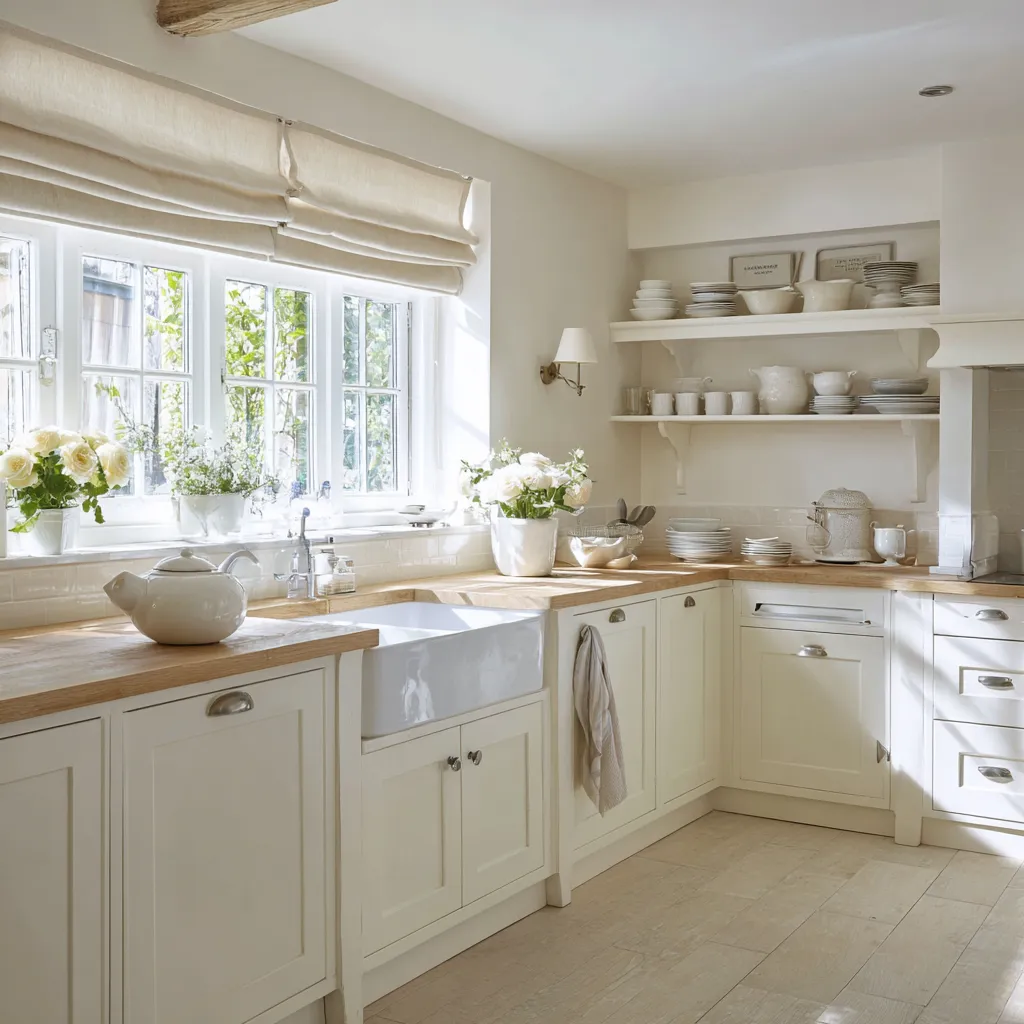
What gives the style lasting appeal
The reason modern shabby chic kitchens continue to attract attention is that they answer a desire in home design. Many people want kitchens that are practical and current, yet do not feel slick, impersonal, or visually hard.
They want designs where stone, wood, plaster, dishware, seating, and light still suggest an ordinary domestic life. They want a kitchen that can hold conversation, flowers, bread, coffee, children’s drawings, old bowls, and daily routine without losing visual shape.
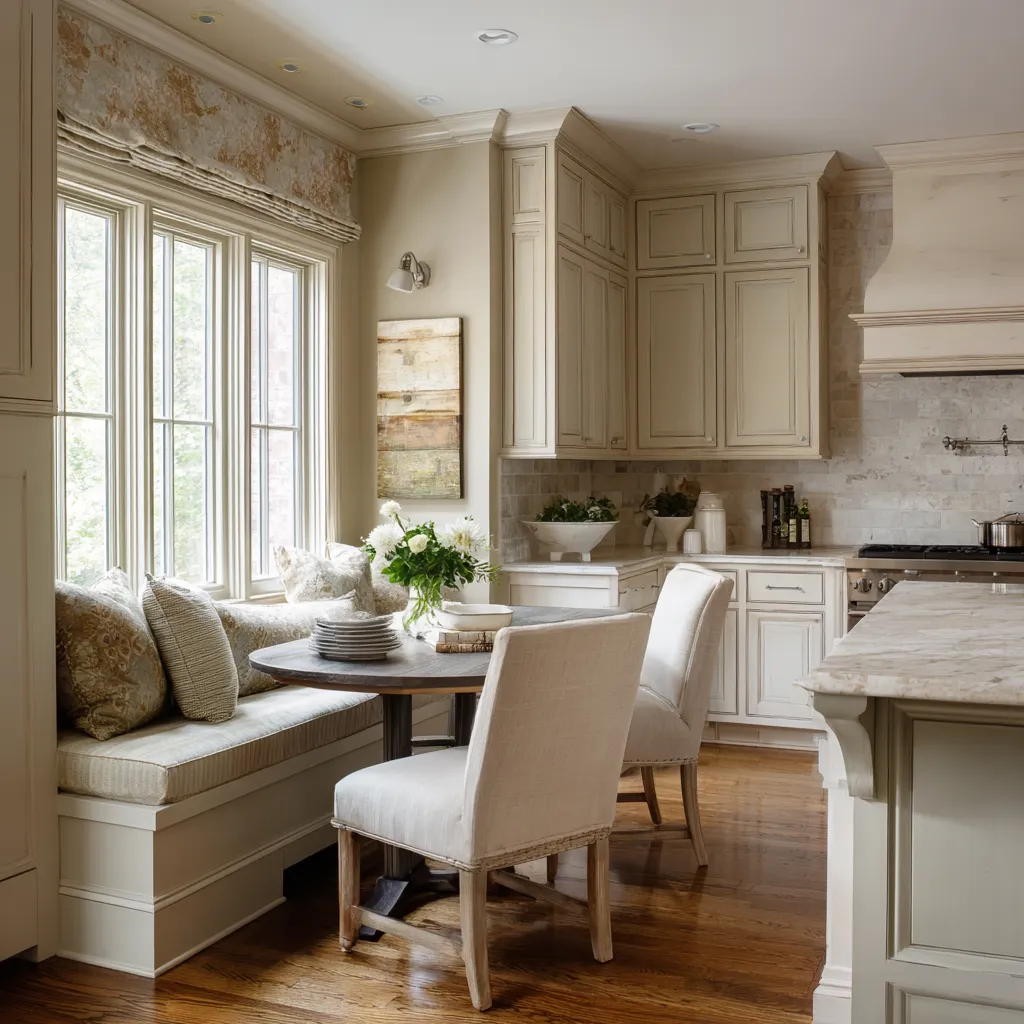
Modern shabby chic meets that need by filtering old domestic feeling through a much clearer lens. It keeps warmth but trims excess.
It keeps memory but reduces heaviness. It keeps softness but protects order.
The result can be very quiet, but it is not weak. A good modern shabby chic kitchen knows exactly where its age lives, where its light enters, where its palette rests, and where its life becomes visible.
Closing thought
A strong modern shabby chic kitchen does not try to recreate the past in full detail. It keeps a few traces of it alive: the memory of an old table, the weight of a plaster hood, the comfort of stacked crockery, the kindness of linen at the window, the roughness of beam or stone, the small proof that this is a room where people cook and stay.
Then it edits everything else. That is what gives the style its depth.
It is not built from decoration alone. It is built from soft history held inside a clear, present-day room.