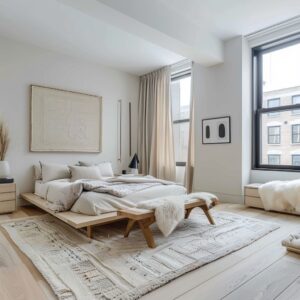
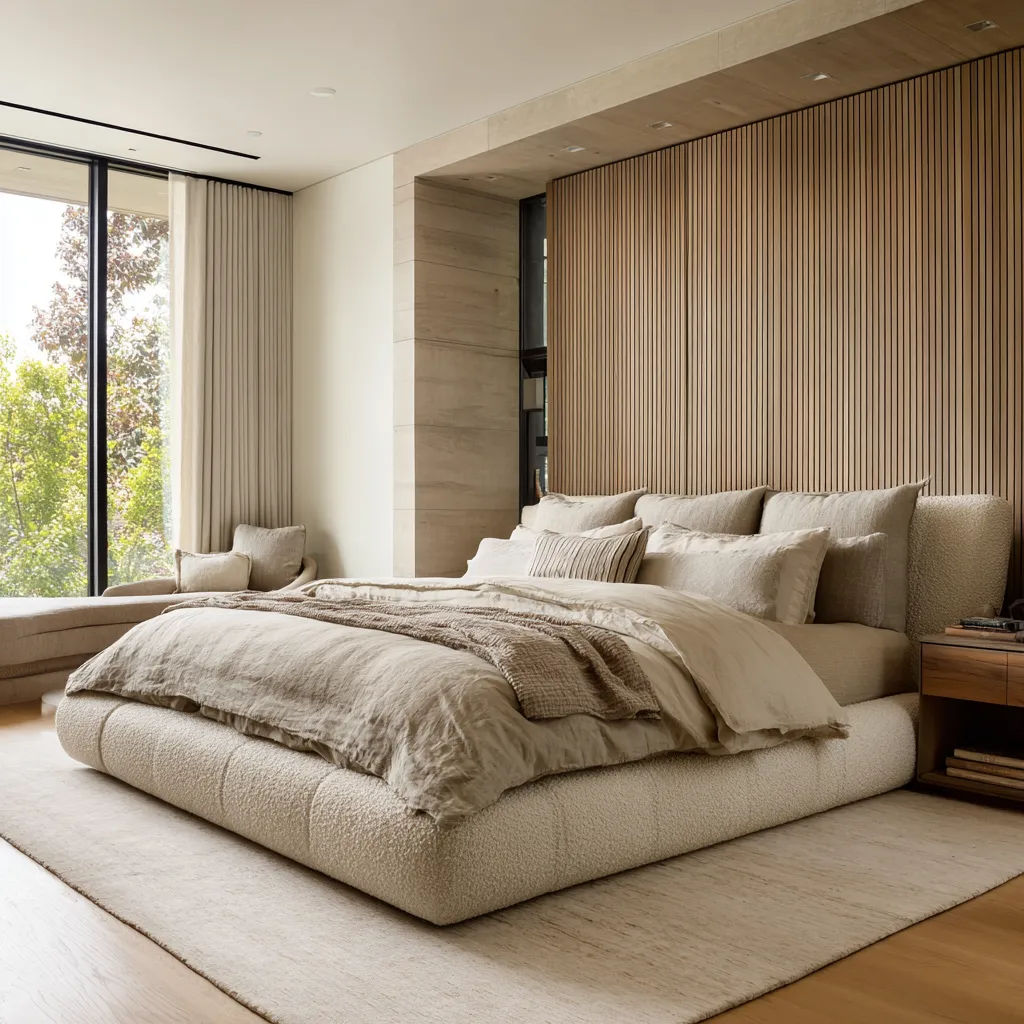
Warm Scandinavian bedroom design is based on a pale palette, a few linen layers, light wood, and a soft lamp. That description catches the surface, but it misses the deeper structure of the style.
A bedroom can have cream bedding, oak furniture, and a neutral rug and still feel generic. It can look pleasant and still fail to feel deeply settling.
It can appear soft and still lack the kind of inwardness that makes a bedroom feel like a place the body trusts.
The deeper logic of warm Scandinavian design sits elsewhere. It lies in how the room gives the bed a protected place inside the space, how surfaces hold light rather than throw it back, how warmth is concentrated rather than spread thinly, and how emptiness is shaped so it feels intentional rather than unfinished.
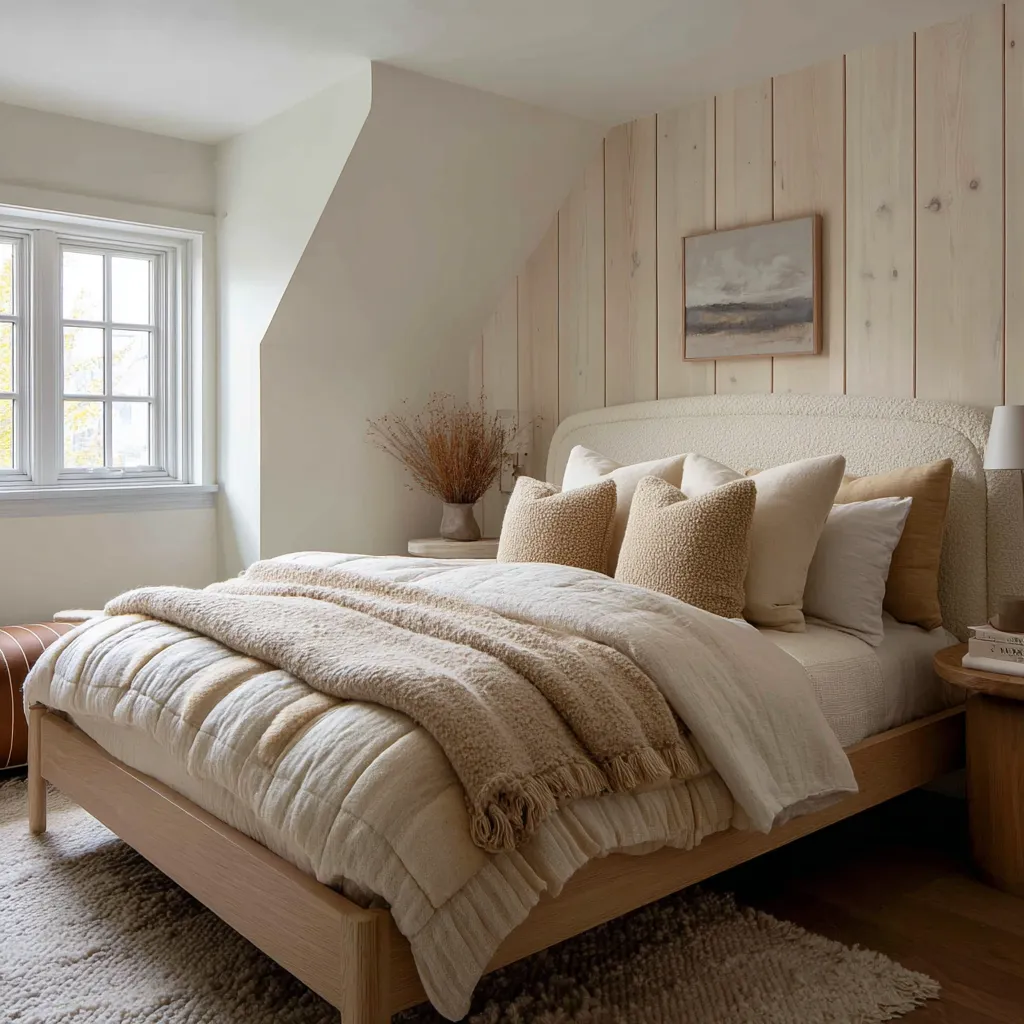
At its best, this style is not simply pale. It is sheltering.
It is not based on visual abundance. It is based on a careful alliance between enclosure, absorbent material, muted earth temperature, and edited form.
That is why some warm Scandinavian bedrooms feel deeply restorative even when they contain very little. Their comfort does not come from quantity.
It comes from structure.
Warmth begins with where the bed belongs
One of the most important ideas in warm Scandinavian bedroom design is that the bed should not feel like a loose object dropped into an empty room. It should feel claimed by the architecture.
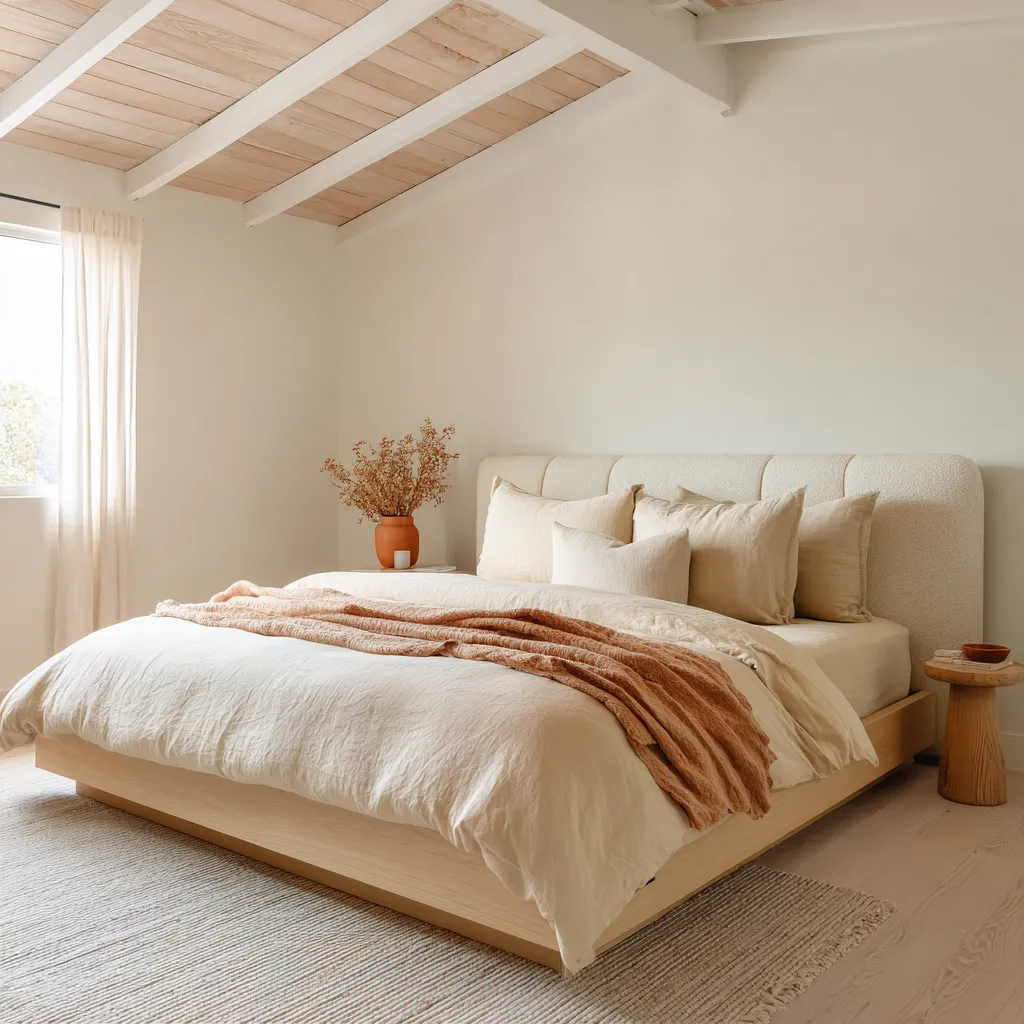
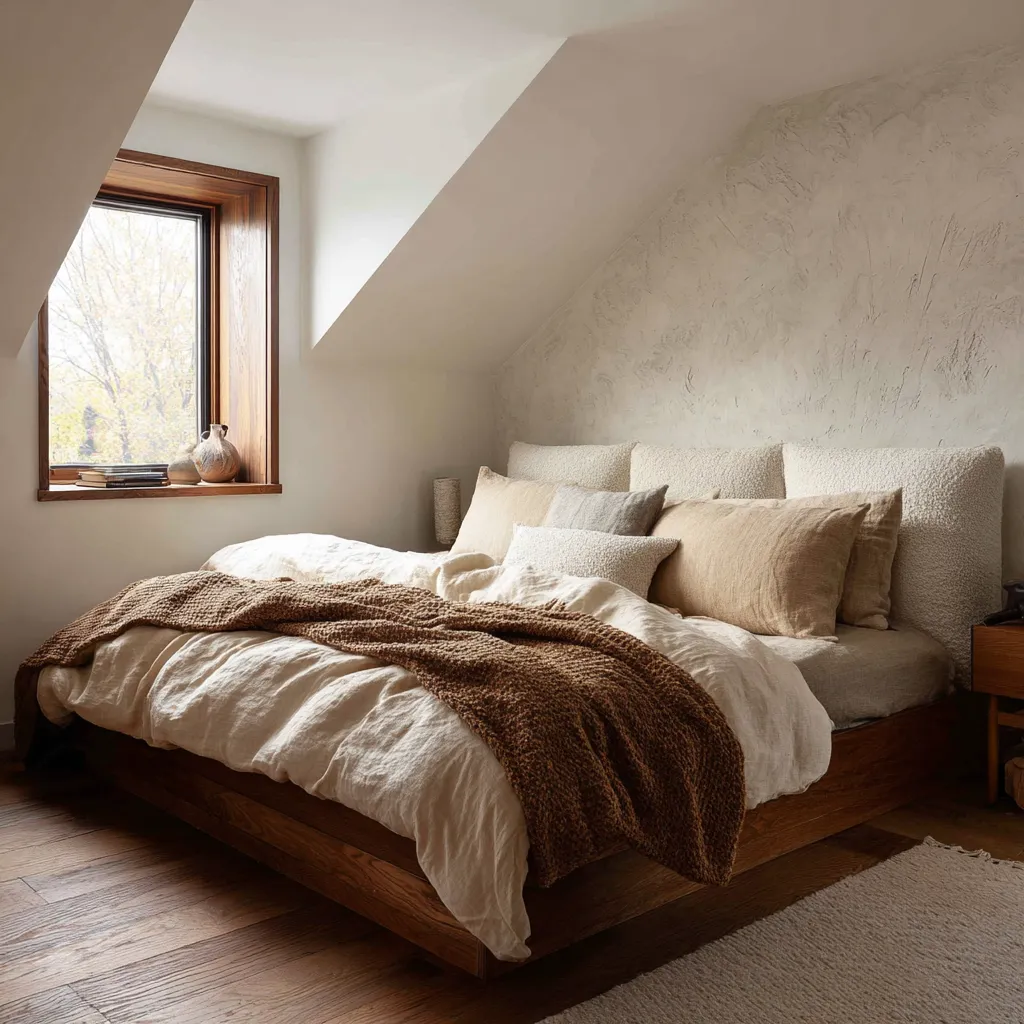
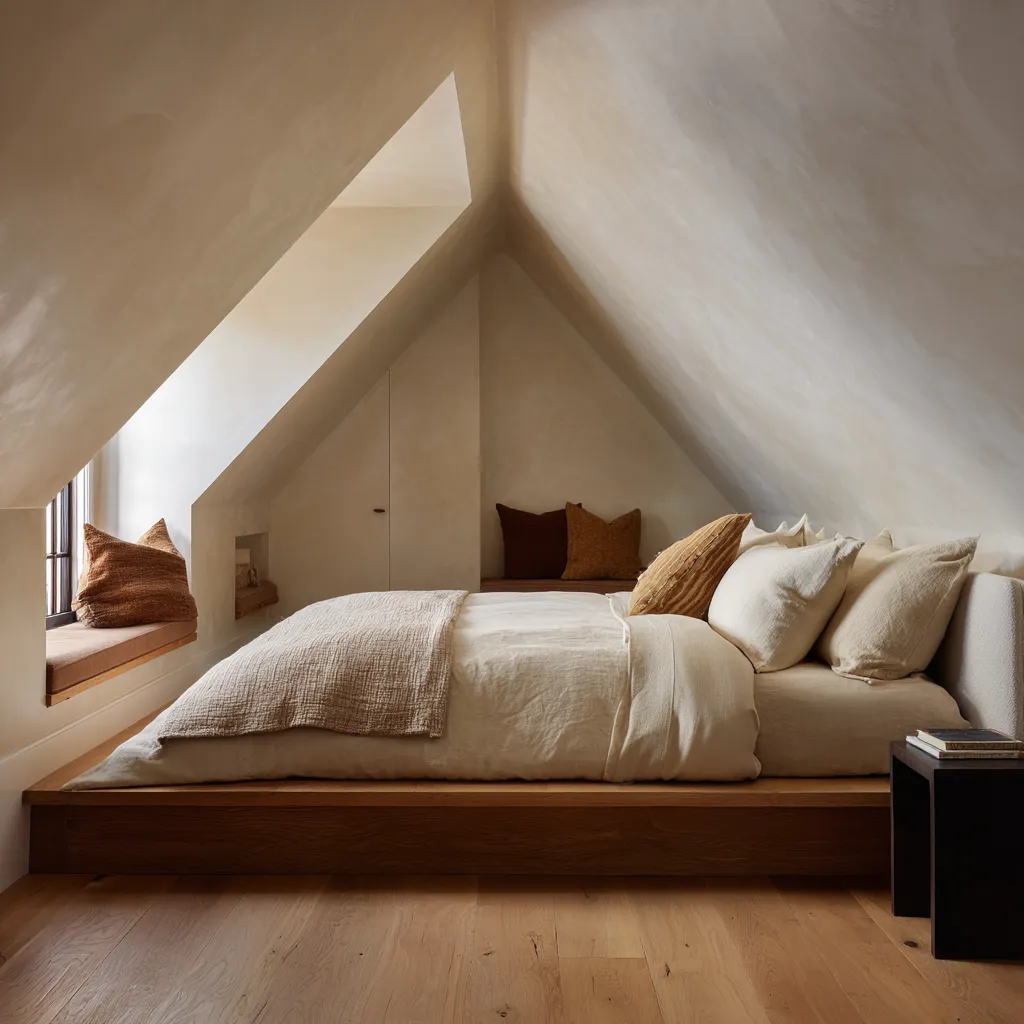
That can happen in many ways. A sloped attic ceiling can gather the bed under its lower line.
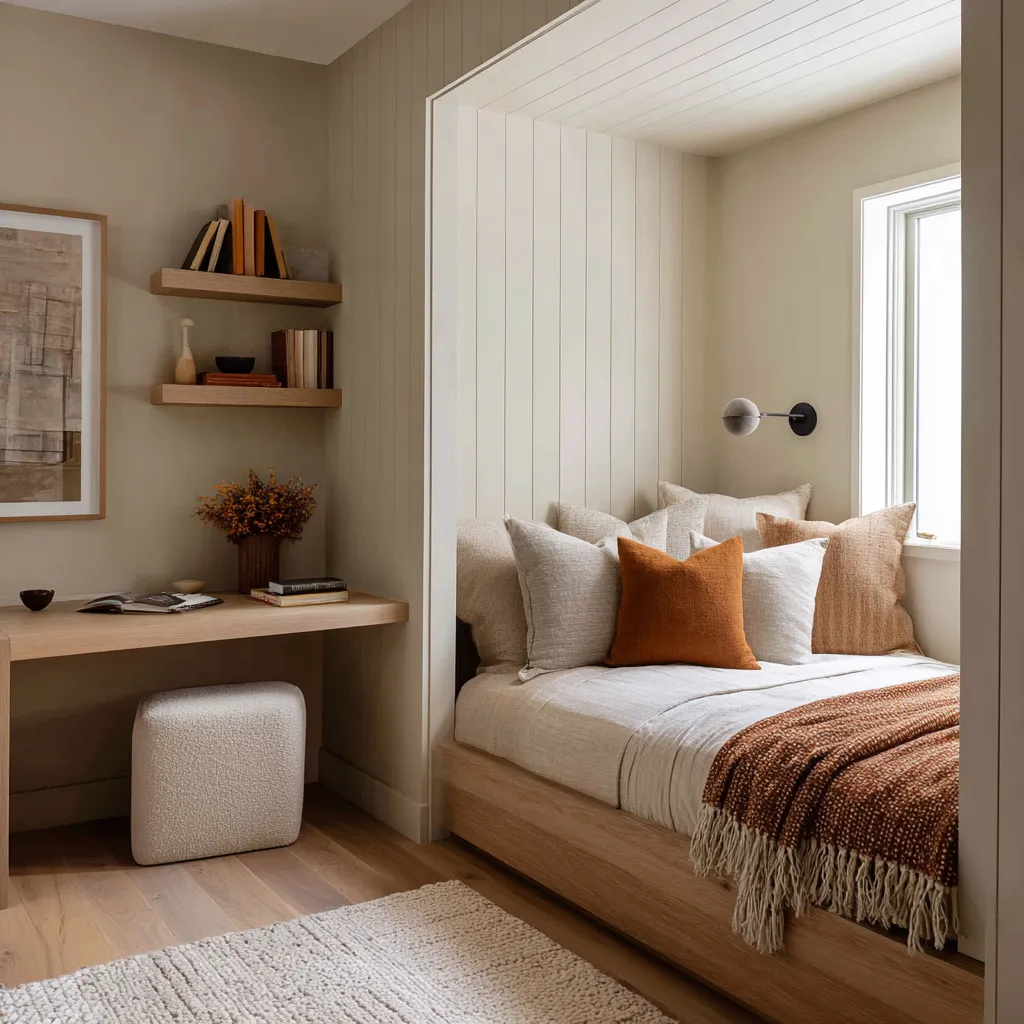
A shallow alcove can turn the sleeping zone into its own interior pocket. A canopy can draw an invisible room around the mattress.
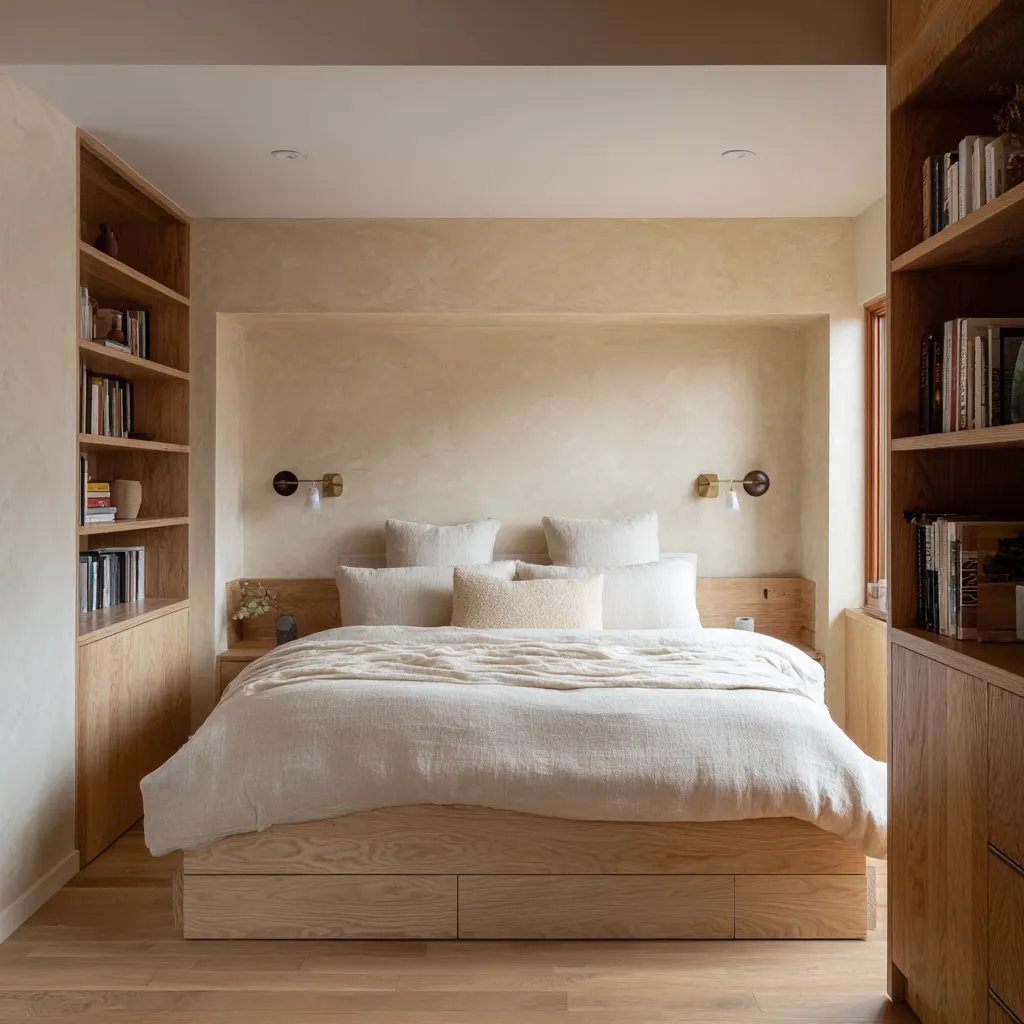
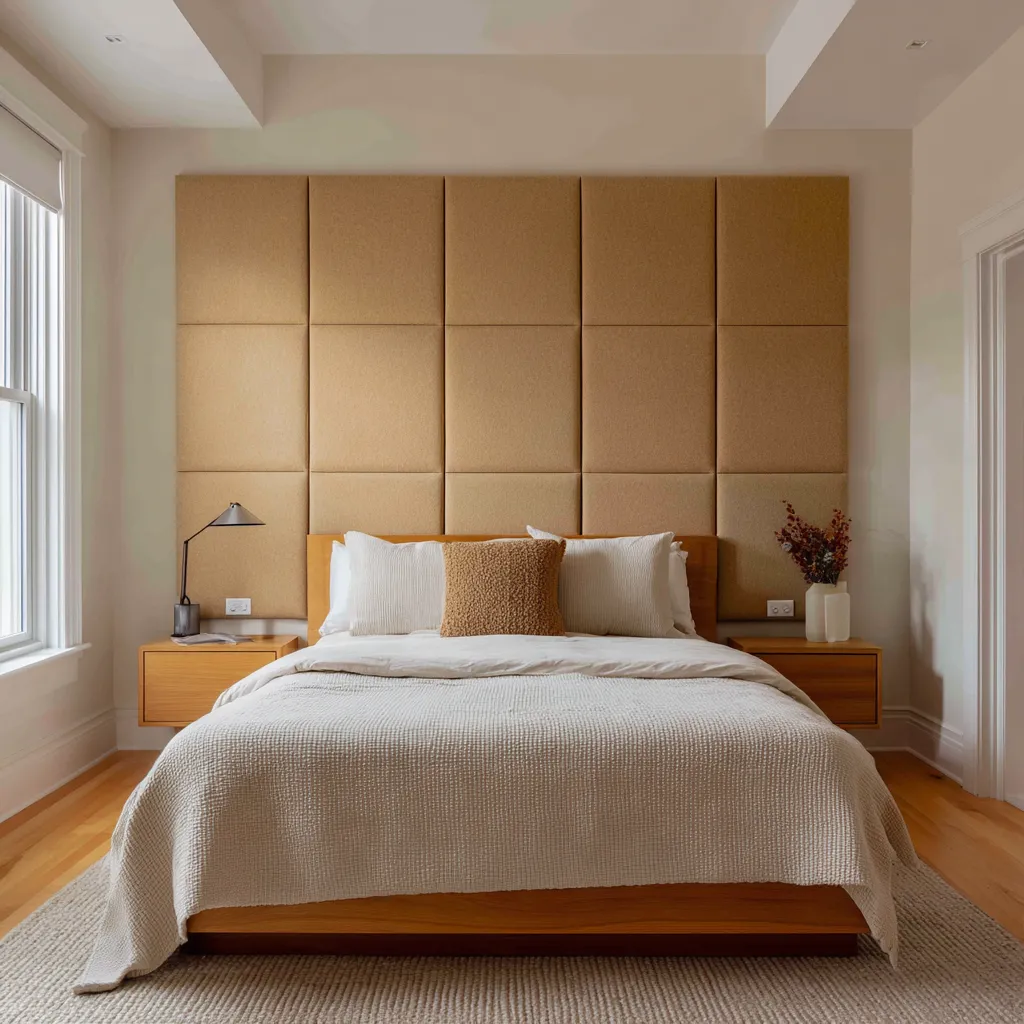
A curved headwall can hold the bed in a soft architectural embrace. Built-in shelving, a recessed bench, a paneled backdrop, or even a thick upholstered wall can give the bed a defined territory.
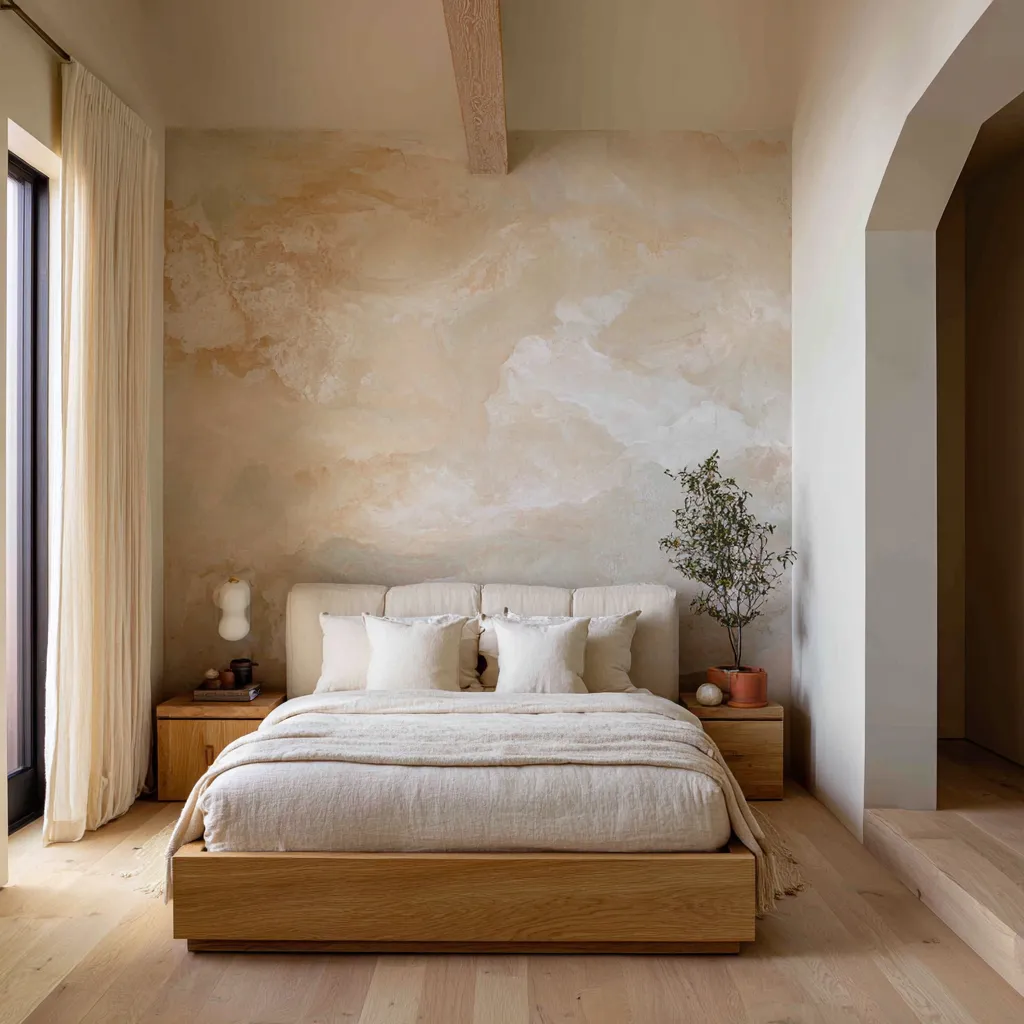
This is one of the style’s least obvious strengths. Many people try to create bedroom warmth by adjusting color first.
They warm up the beige, add camel pillows, or place a rust throw at the foot of the bed. Those moves help, but they are not the first move.
The first move is territorial. The room needs to tell the body where rest lives.
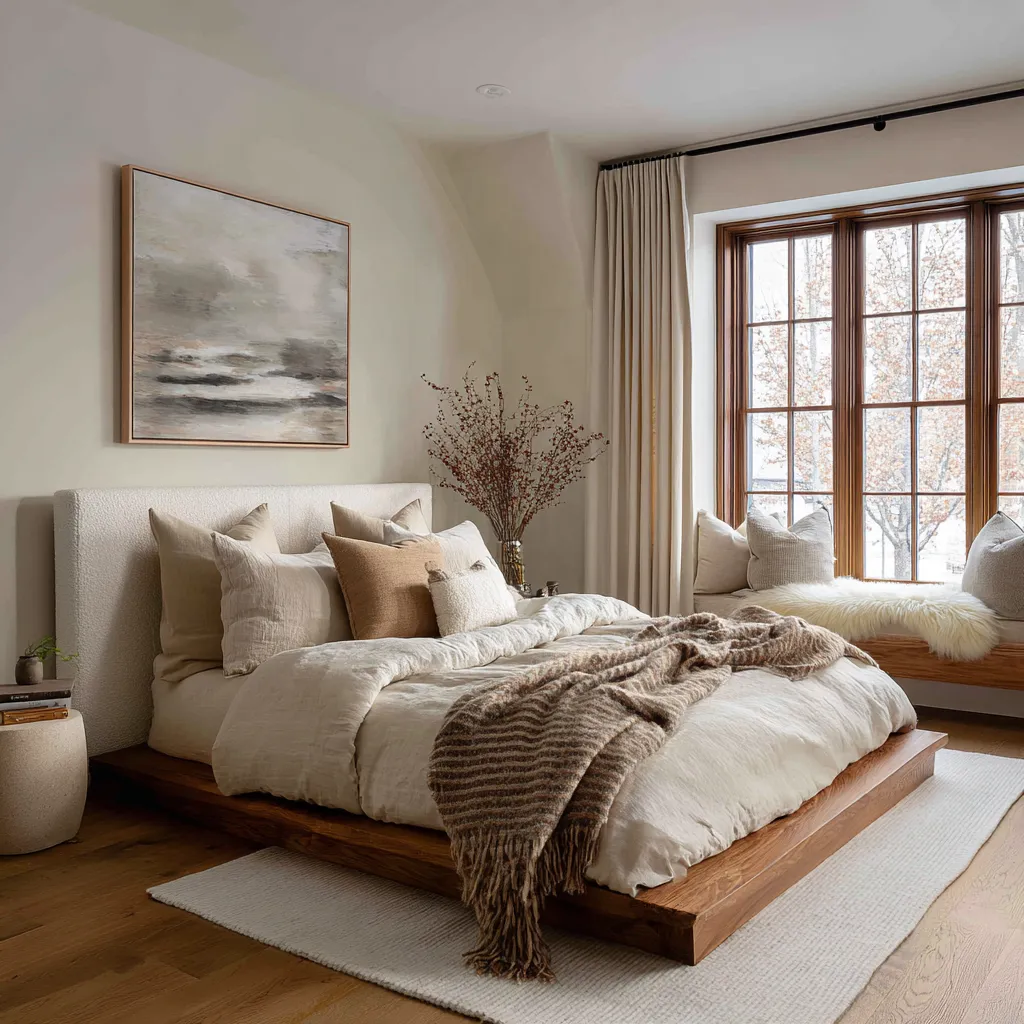
Once that territory exists, the rest of the style begins to make sense. Pale textiles feel richer.
Wood feels more grounded. Open floor space feels less exposed.
Even a sparse room begins to carry emotional weight because the bed is not floating. It belongs.
That is why sloped-ceiling rooms, niche bedrooms, canopy beds, shaped headwalls, and built-in compositions often feel especially successful in this style. They do not simply decorate the bed.
They assign it status.
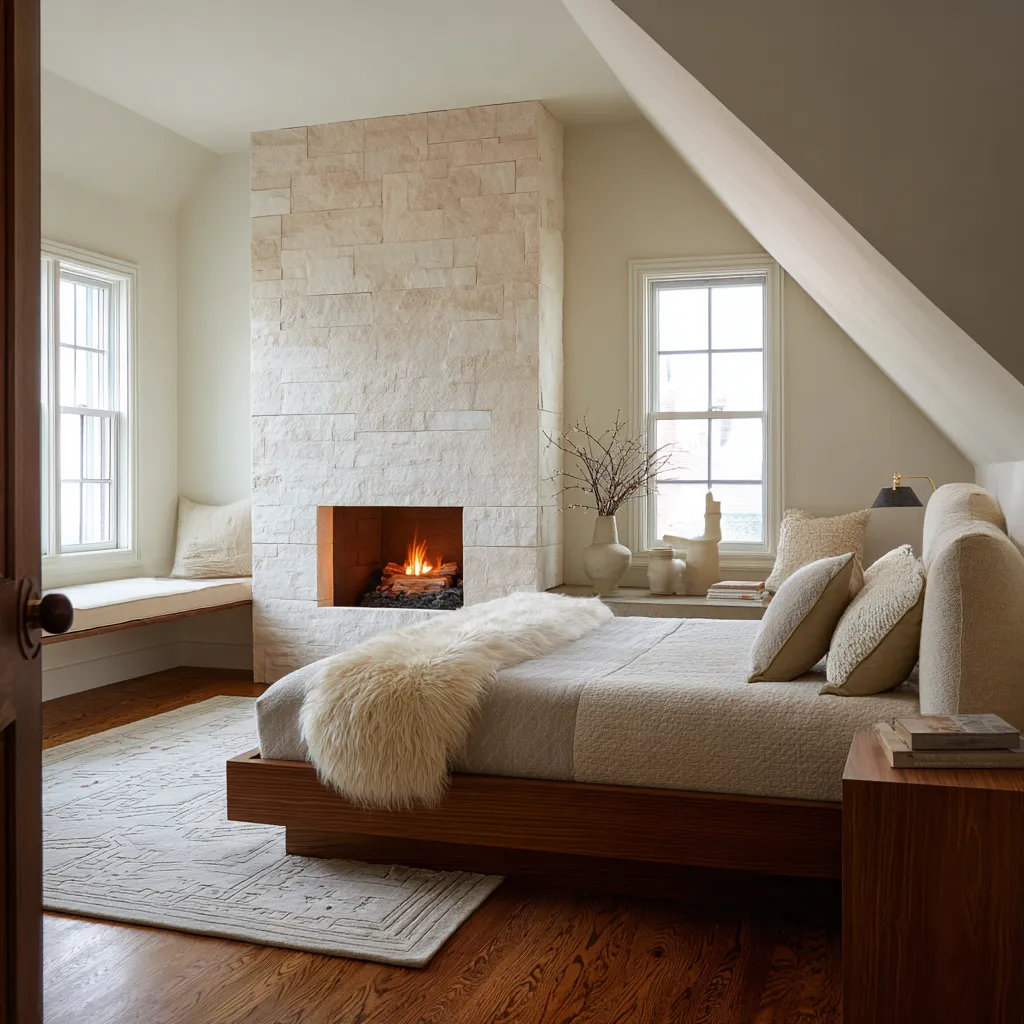
Beige is not the point
Warm Scandinavian bedrooms are often described through color, but color alone explains very little. A room can be full of cream and still feel cool, lifeless, or too polished.
Another room can remain almost colorless and still feel deeply warm. The difference lies in undertones and in the behavior of surfaces.
Warm Scandinavian palettes are usually built from a narrow range of related notes: cream, oat, parchment, pale sand, flax, dry clay, muted camel, honey wood, softened terracotta, dusty cinnamon, olive-beige, or pale stone. The important word here is related.
These tones do not fight each other. They belong to the same climate.
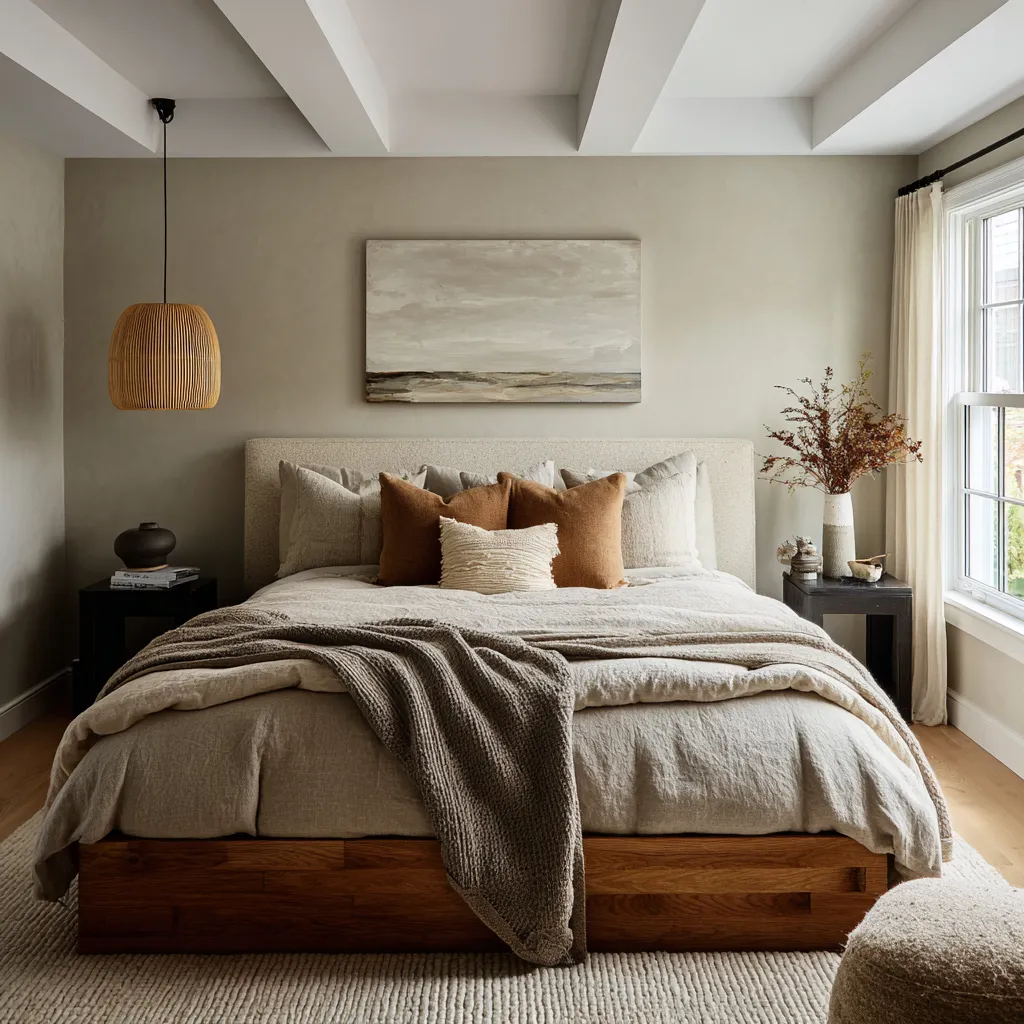
If one neutral drifts pink, another blue-gray, another yellow, and another flat white, the room starts to fracture. The eye begins to register small frictions even when the palette still looks technically neutral.
A bedroom like that rarely feels settled. In such interior designs, the undertones are tuned so closely that the space feels gathered together before any decor enters.
The wall supports the bedding, the bedding supports the wood, the wood supports the drapery, and nothing feels stranded. This is subtle work, but it is one of the foundations of the style.
Warmth here is not loud. It is cumulative.
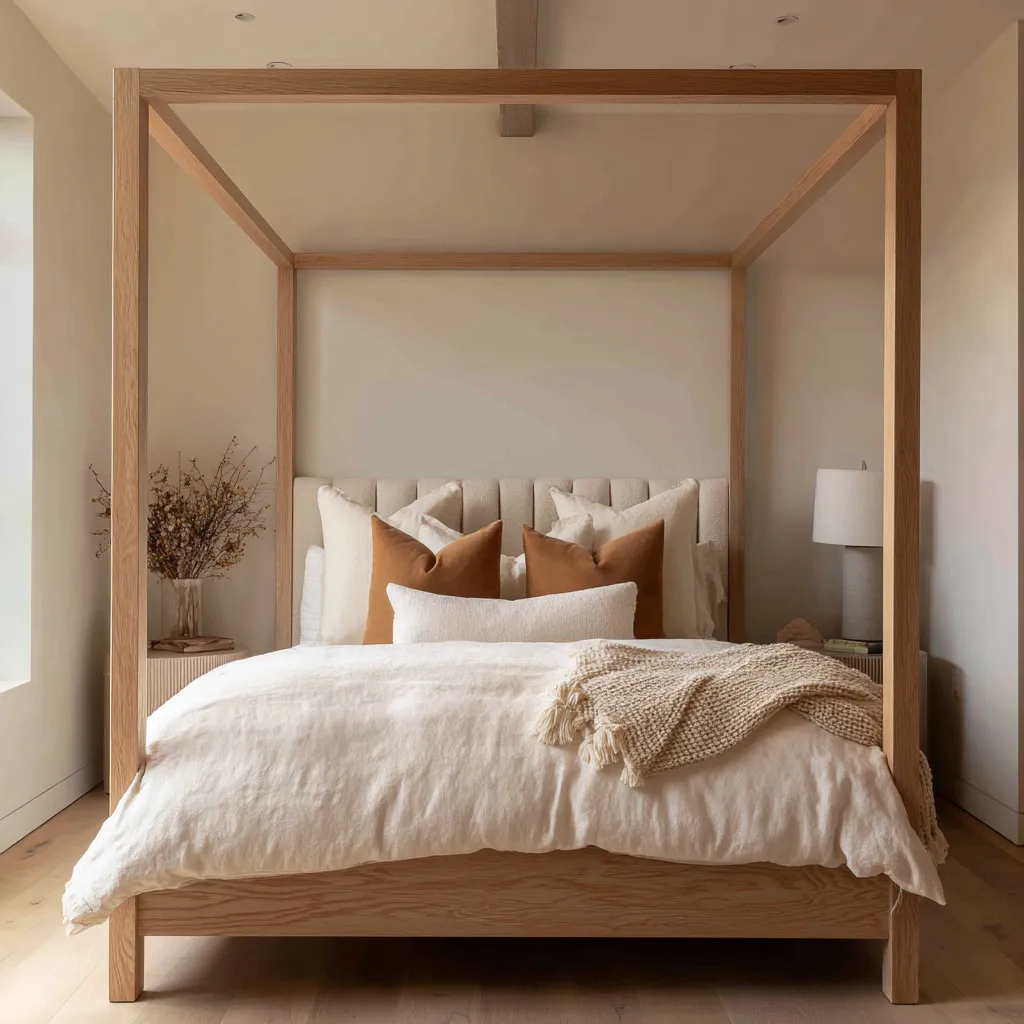
The room should absorb light, not sparkle with it
Another hidden driver of warmth is reflectivity. Warm Scandinavian bedrooms tend to rely on surfaces that soften light: limewashed walls, chalky plaster, matte paint, linen, boucle, brushed wood, woven rugs, wool-like throws, padded wall panels, washed drapery.
These materials do not create sharp glare. They slow light down.
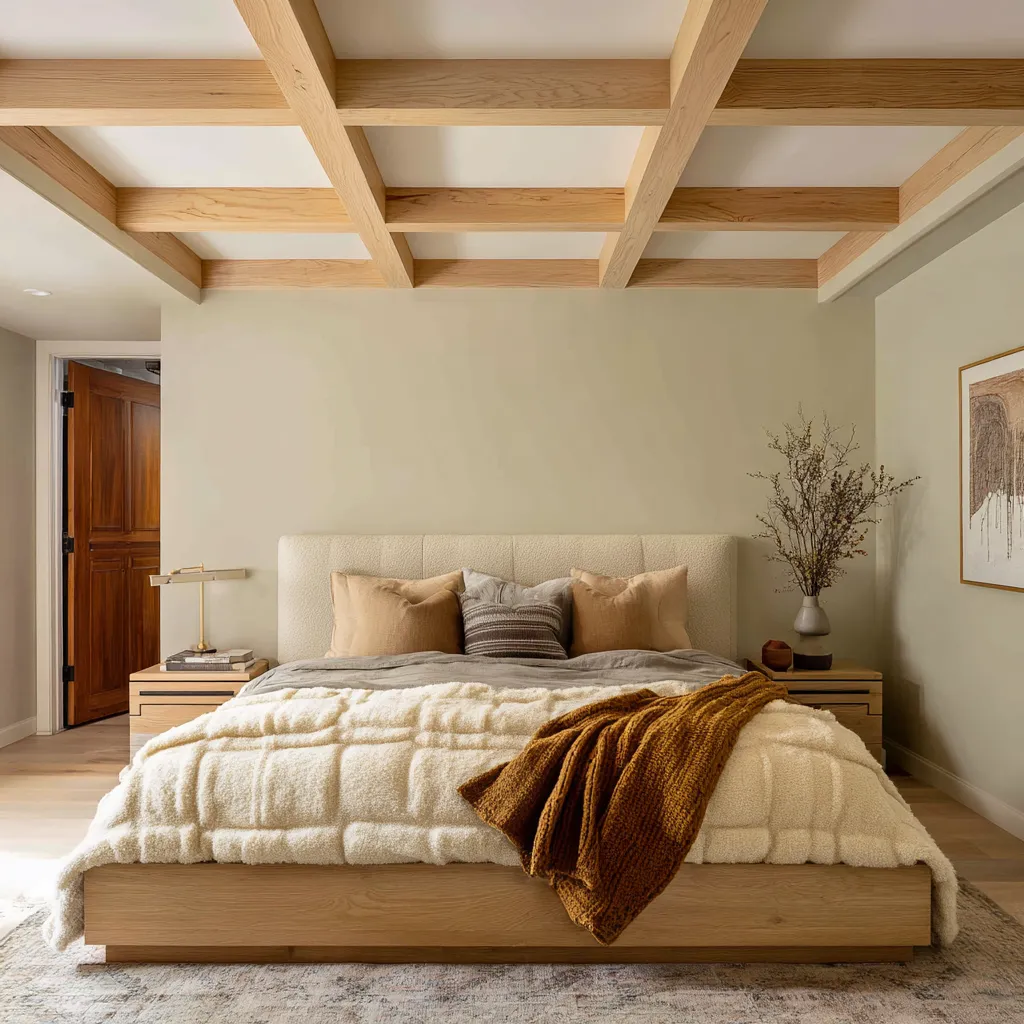
This matters more than many people realize. A room can have warm colors and still feel harder than intended if too many surfaces are glossy, slick, or sharply reflective.
In a bedroom, that kind of brightness can make pale tones feel thinner and more exposed. Matte and textured surfaces do the opposite.
They give pale colors body. That is why a plaster wall often carries more emotional depth than a flat painted wall in the same hue.
It is why a nubby headboard can make a simple bed feel fuller without making it bulkier. It is why full drapery helps even restrained rooms feel more inhabitable.
The style depends on a kind of visual absorption. Warmth is often felt first as softness in the way light lands.
Depth is not the same thing as coziness
A useful distinction inside this style is the difference between warmth and depth. A room can be warm enough and still feel shallow in character.
This often happens in airy minimal bedrooms that have pale textiles, pleasing light, and a soft palette but no hierarchy. They are comfortable, yet they do not leave a strong impression.
Their softness is even. Their atmosphere is thinly distributed.
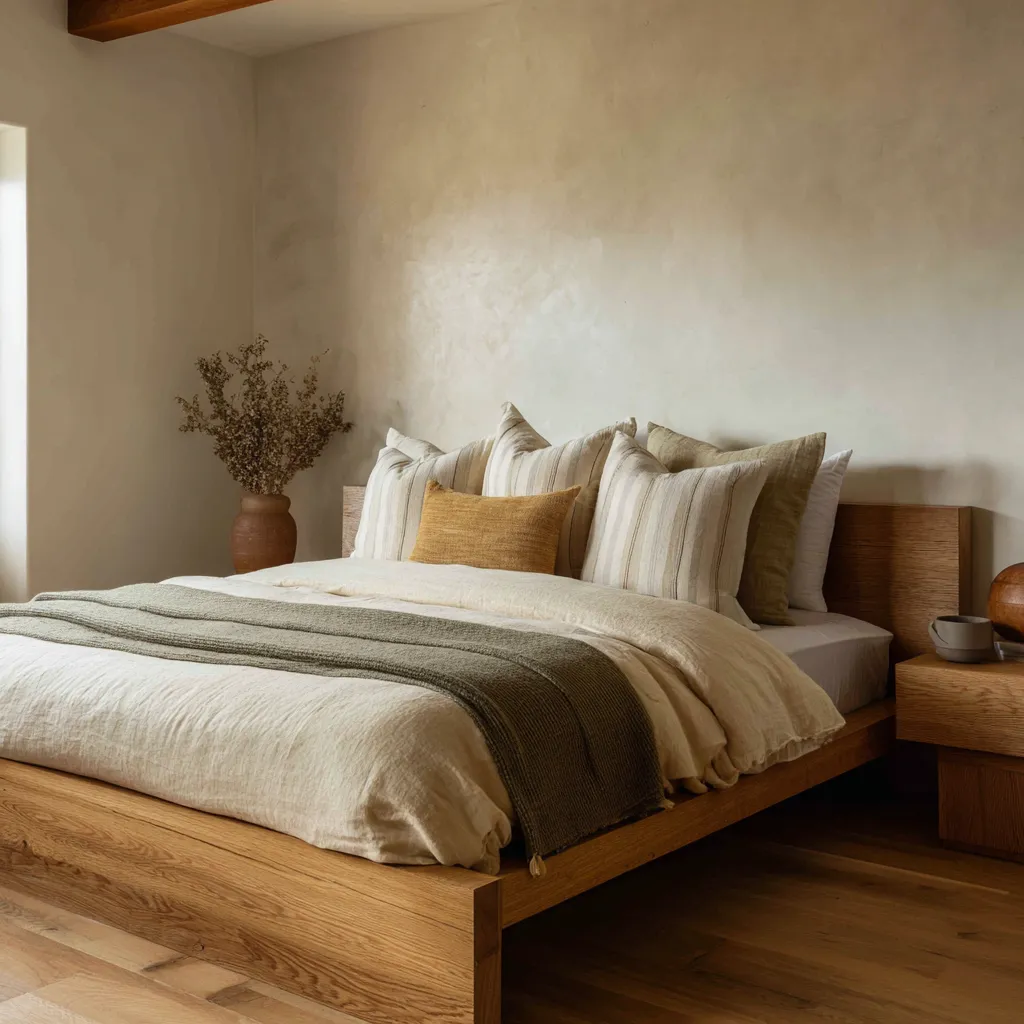
Depth tends to appear when the room has one major move. That move might be a clay-washed wall behind the bed, a strong ceiling of painted timber boards, a fireplace block, an arched sanctuary wall, carved niches, a slatted headwall, a large upholstered panel field, or a dark wood platform that anchors an otherwise pale room.
One significant element gives the composition gravity, and the rest of the room supports it. This is a key lesson.
Depth rarely comes from adding more of everything. It comes from unequal weighting.
A bedroom with one dominant backdrop and restrained support often feels richer than a bedroom with many smaller decorative gestures. Five cute accents rarely create the kind of presence that one strong field can create.
In warm Scandinavian rooms, hierarchy matters. The room needs one place where atmosphere gathers more densely.
Why airiness often weakens warmth
Airiness is easy to produce. Open floor, large glazing, pale walls, blank surfaces, light curtains, and a low amount of furniture can create brightness and visual ease very quickly.
Warmth is harder. That is why many bedrooms drift toward pale contemporary softness rather than fully reaching warm Scandinavian identity.
They achieve openness and visual cleanliness, but they never fully answer the body’s need for shelter.
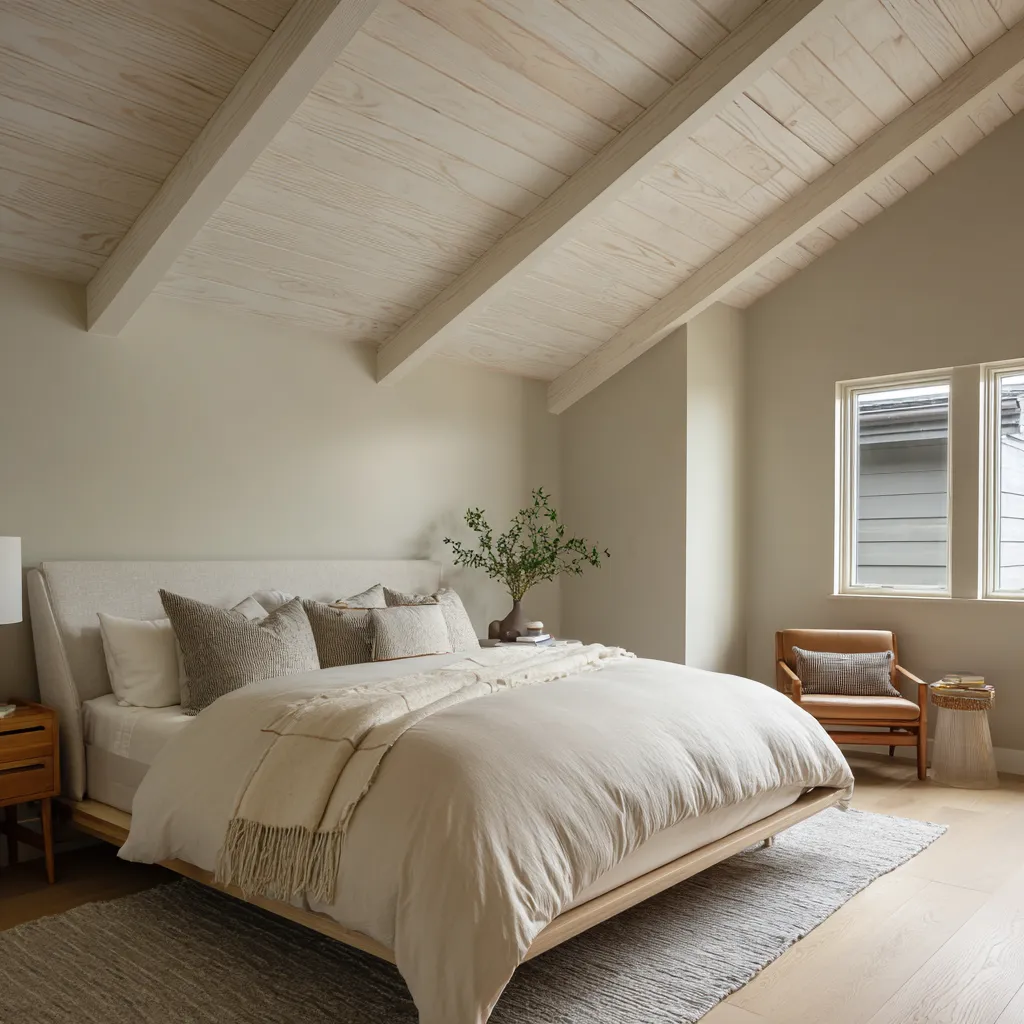
Large, bright rooms are especially vulnerable to this. They can become visually beautiful while staying emotionally distant.
The bed feels too exposed. The walls feel too broad.
The room has comfort, but not enough inward pull. The answer is not to fill the room.
The answer is to counterweight openness. A canopy can do that.
So can a bench that thickens the perimeter. A paneled headwall can do it.
A fireplace can do it. A curved sanctuary wall can do it.
So can a stronger timber base, darker floor note, or built-in window seat. The important idea is that open rooms stay warm when openness is answered by territory.
Without that answer, pale airiness often drifts into softness without identity.
Warm Scandinavian design uses focused heat
One of the most useful design ideas in this style is that warmth often works when concentrated. A single amber lamp on one side of the bed.
One cinnamon throw crossing pale bedding. A compact group of rust pillows near the center.
One ochre lumbar. One clay-toned plaster wall.
One fireplace. One warm bench cushion at the window.
These concentrated warm notes often do more than spreading warm color evenly throughout the room. Why?
Because concentrated warmth gives the eye a center of gravity. It creates density in a specific place.
The room feels warmer because the heat is legible. Broad warm saturation, by contrast, can flatten the atmosphere.
Everything becomes equally warm, and the room loses tension. This style often prefers small heat sources inside a quiet field.
That is one reason it feels refined rather than over-composed. It trusts restraint, but it does not confuse restraint with blandness.
The role of wood is structural, not decorative
Wood is essential to warm Scandinavian bedrooms, but not necessarily in the obvious way. Such interior design ideas do not use timber merely as a rustic sign.
They use it as anchoring logic. Wood often appears where the room needs grounding most: the bed base, floor, ceiling boards, beams, slatted headwall, window trim, built-ins, shelving, or bench.
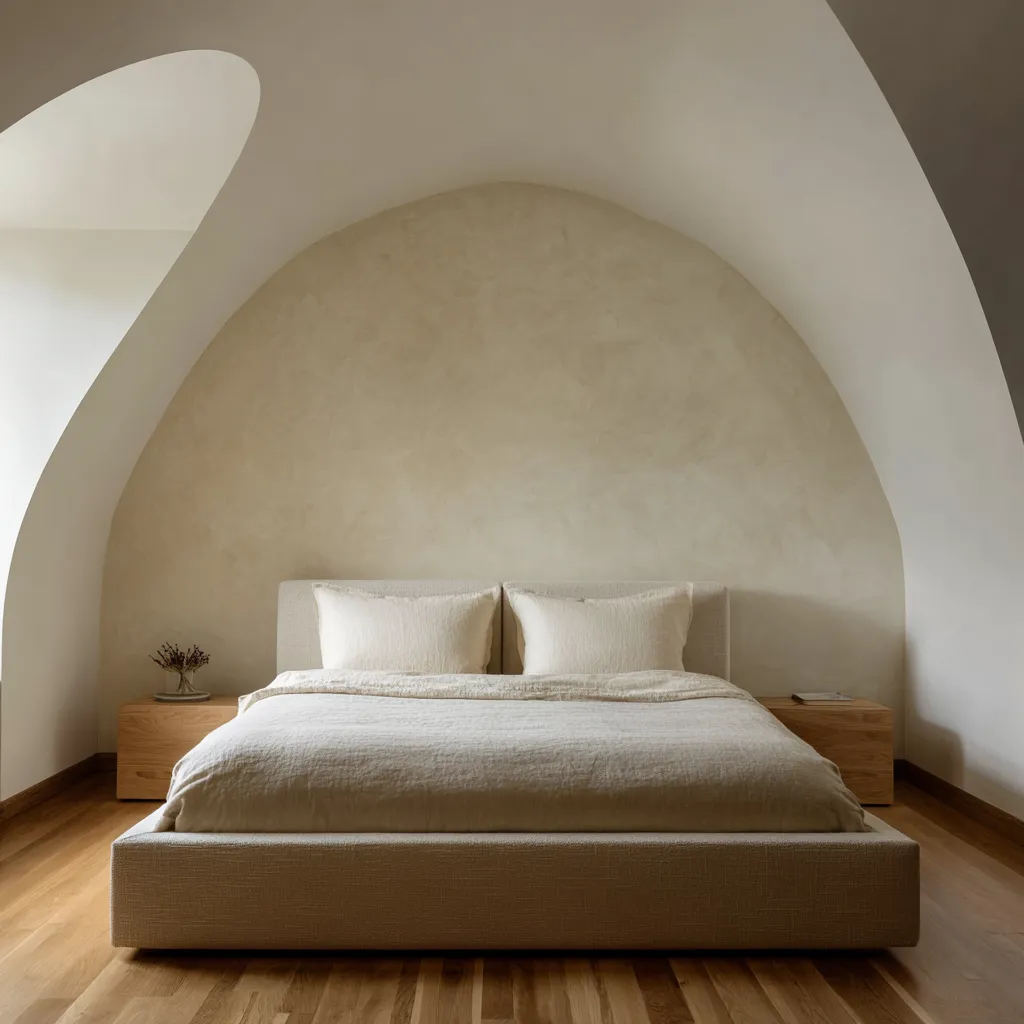
This placement matters. Timber supports the interior design when it feels connected to structure or to the lower register of the room.
It gives pale compositions a base. It prevents airy bedrooms from becoming bloodless.
It helps mineral walls and pale upholstery feel domestic rather than abstract. The wood does not always need to be dark.
In fact, overly red, glossy, or heavy timber can disrupt the softness that the style depends on. But the room usually needs some timber logic in its bones.
Without that, many warm Scandinavian bedrooms begin to slide toward hotel-soft neutrality. Wood gives the room memory, body, and attachment to material reality.
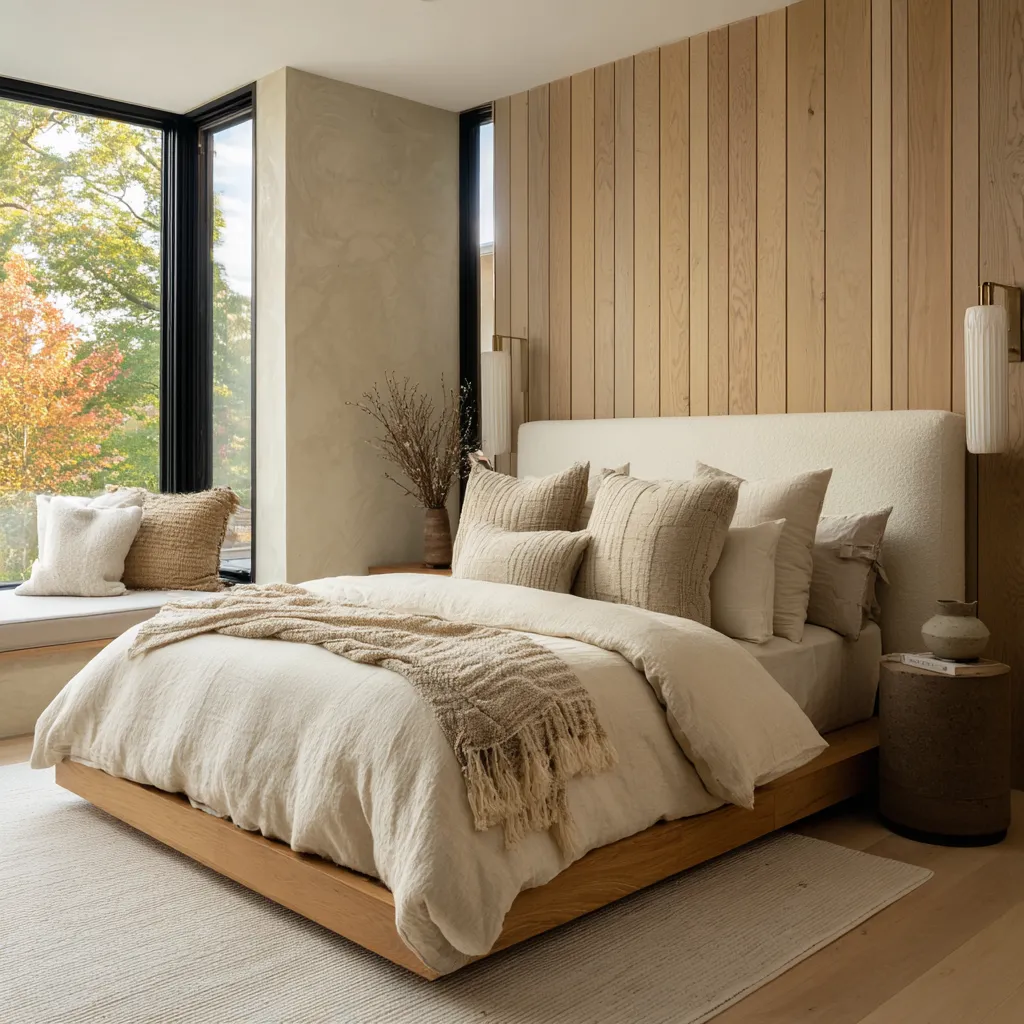
Built-ins change the emotional quality of the room
There is a practical reason to love benches, alcoves, ledges, shelves, and integrated desks. But their value in warm Scandinavian design goes beyond function.
Built-ins thicken the room edge. They make the perimeter inhabitable.
They turn the bedroom from a scene centered only on the bed into a place with more than one resting mode. A window bench invites sitting in the light.
A shelf niche holds books and pottery without scattering them. A desk folded into the wall makes the room feel lived in, not merely staged.
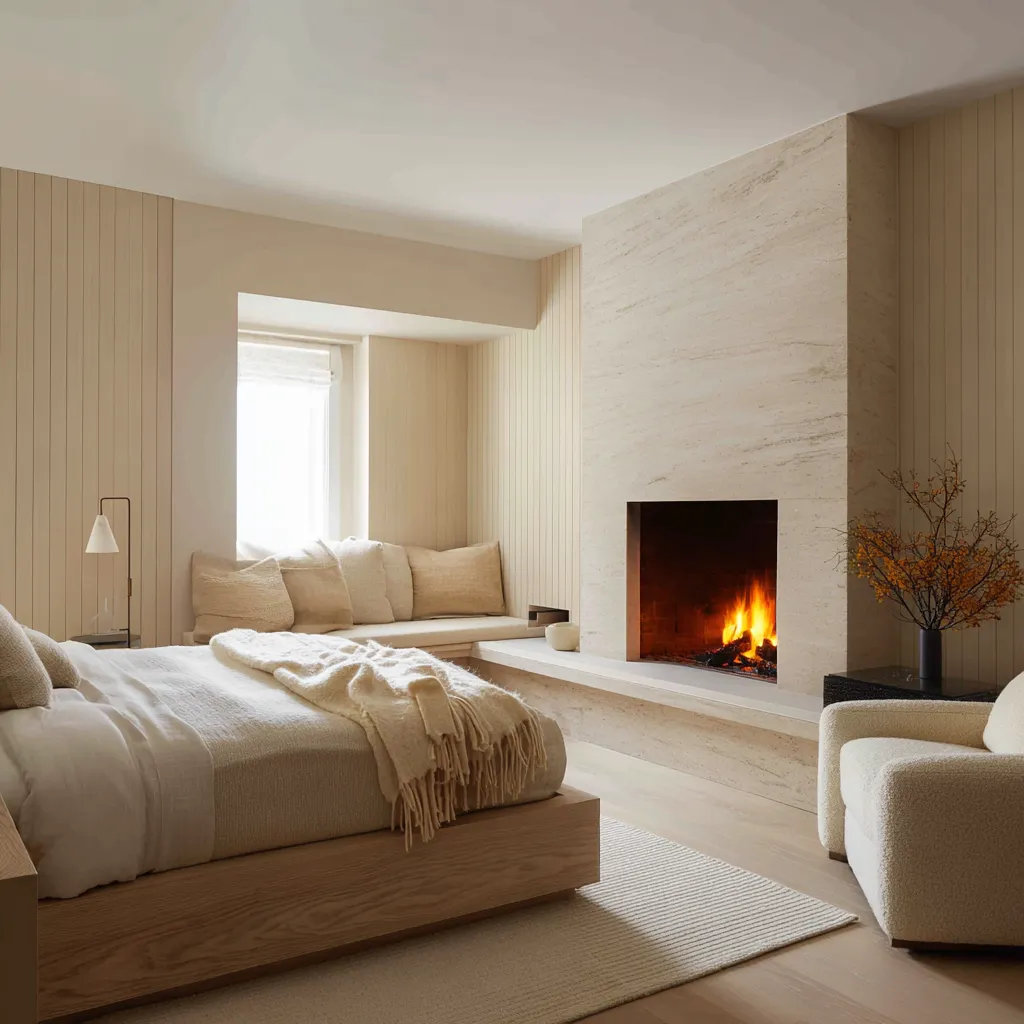
Recessed shelving can add human presence without adding clutter. A fireplace ledge broadens the meaning of rest.
A side chair creates a more upright zone of pause. All of these moves deepen a bedroom because they absorb life into the architecture rather than attaching it as loose decoration.
This is one reason some rooms feel complete while others feel simply styled. The richer rooms tend to support more than one posture of being still.
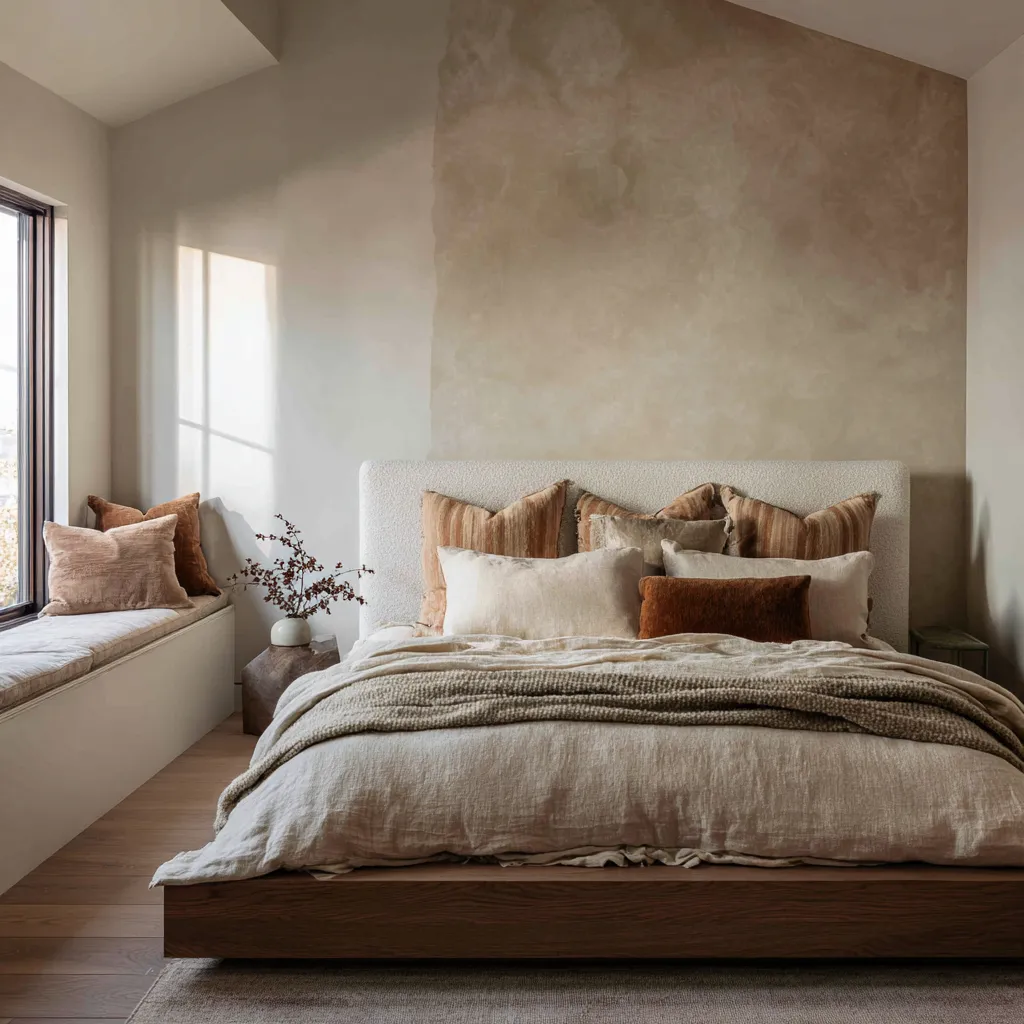
Symmetry is not the problem. Hardness is.
There is a common assumption that a warm bedroom must look loose, irregular, or casually arranged. Warm Scandinavian design proves otherwise.
Many of the most convincing rooms use strong order: centered beds, balanced sconces, paired pendants, symmetrical niches, aligned artwork, evenly framed headwalls. Yet they do not feel rigid.
The reason is that their order is buffered by material softness. Plaster interrupts precision.
Linen interrupts flatness. Grain interrupts smoothness.
Upholstery interrupts hard edge. Rounded voids or softened corners interrupt severity.
This style often benefits from moderate symmetry because symmetry stabilizes the sleeping zone. It gives the room a sense of resolution.
The problem comes only when the surfaces are too sharp, too glossy, or too crisp. Then order becomes cold.
So the distinction is not symmetry versus informality. It is hard order versus softened order.
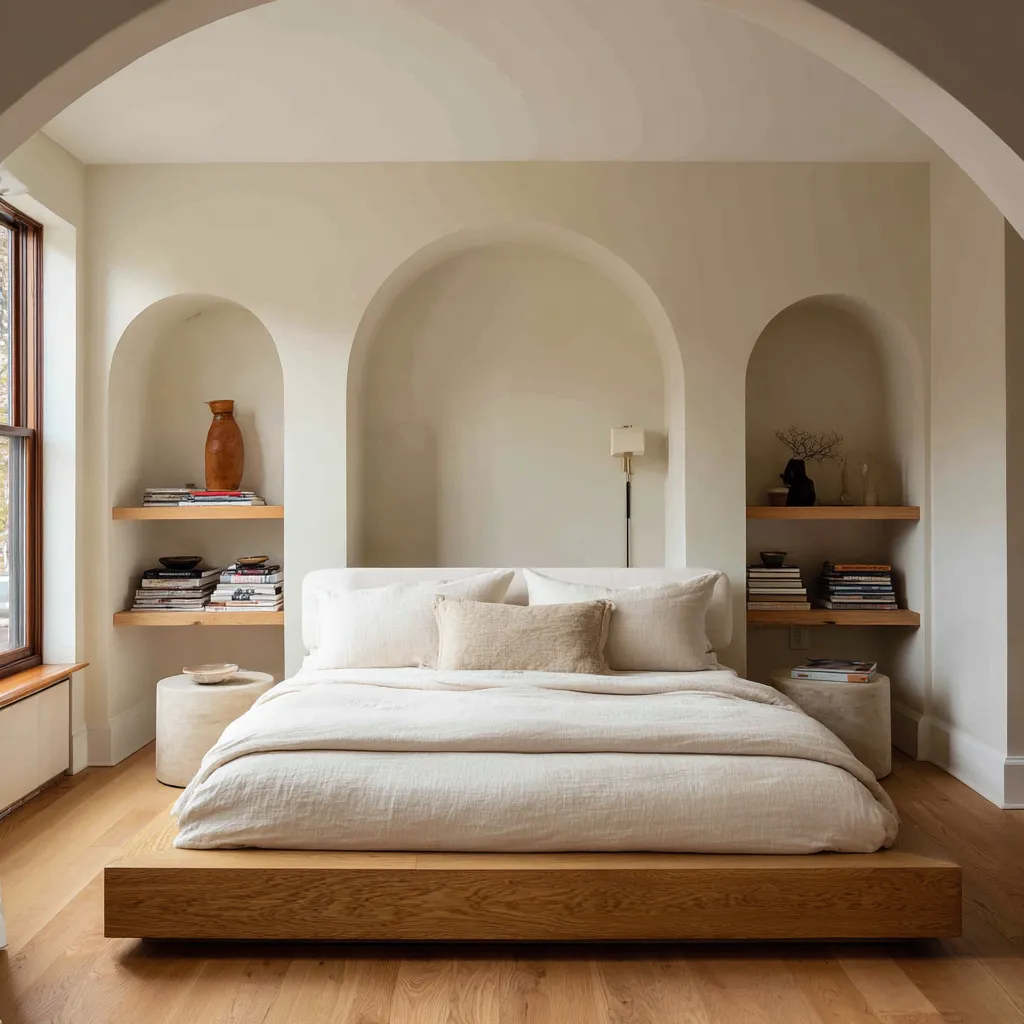
The upper part of the room matters as much as the bed
People often focus on bedding, rug, and bedside details when trying to warm a bedroom. But in warm Scandinavian interiors, the upper envelope often carries enormous emotional force.
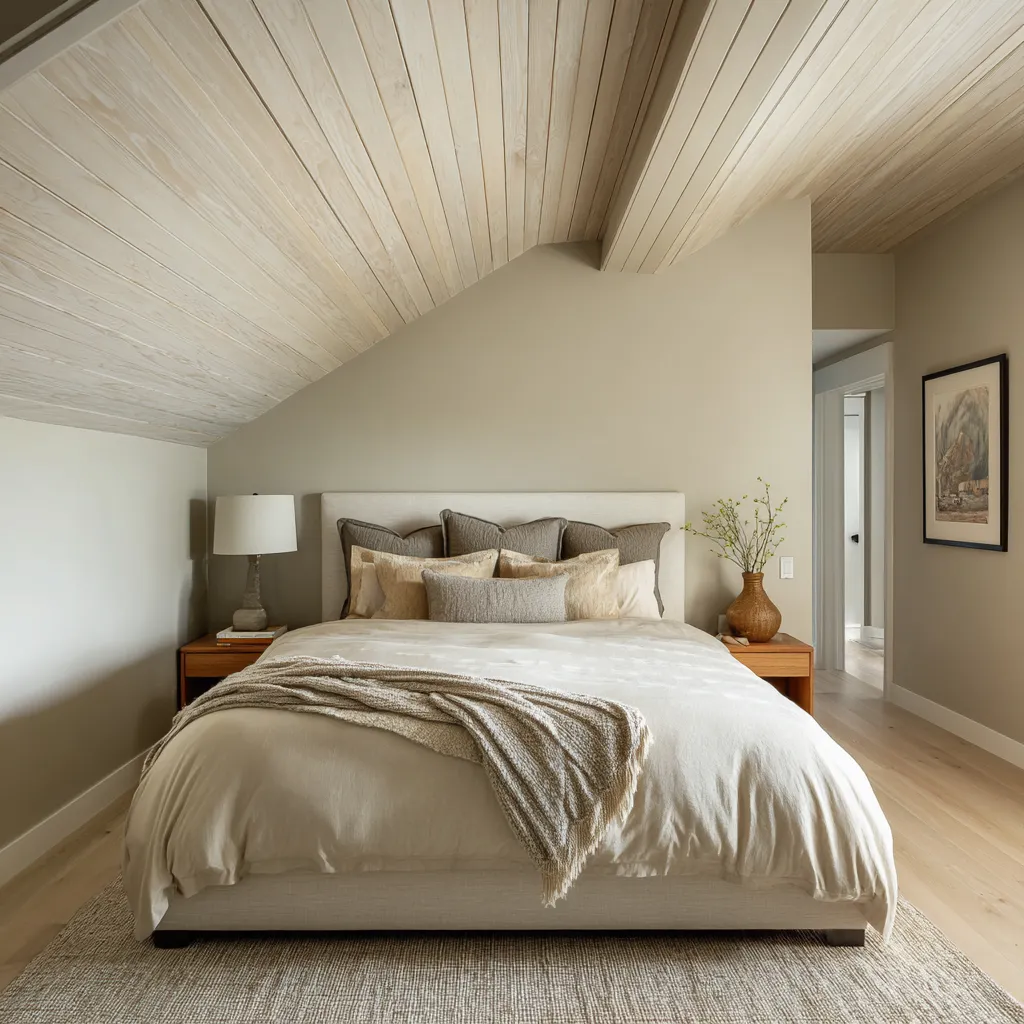
A painted wood ceiling can create shelter without darkness. Exposed pale beams can bring rhythm and bodily scale to a broad room.
An attic slope can gather the bed inward. A curved plaster form can create sanctuary without ornament.
A slatted headwall or padded wall plane can give the room an upper field of depth. These moves do something bedding alone cannot do.
They shape the air around the body. They affect how the room holds you from above and behind, not only how the mattress feels beneath you.
That is a major reason some bedrooms feel more enveloping even when their bedding is relatively simple. The room itself participates in comfort.
Softness exists on several scales
One of the most sophisticated things warm Scandinavian bedrooms do is layer softness at different scales.
- At the smallest scale, softness appears in weave, pile, rumple, brushed texture, boucle, wool, linen, and plaster irregularity.
- At the object scale, it appears in upholstered headboards, padded benches, softened lamps, rounded tables, draped throws, and thick duvets.
- At the field scale, it appears in drapery planes, textile wall panels, clay-washed walls, or large plaster surfaces.
- At the spatial scale, it appears in alcoves, arches, slopes, canopies, recessed bed zones, and curved sanctuary walls.
The most memorable interior design ideas rarely rely on only one of these. They tend to combine several.
A plaster wall, an upholstered headboard, a heavy linen bed, and an alcove or sloped ceiling together create a much more complete form of softness than pillows alone ever could. This layered softness is one reason the style feels rich even when color stays subdued.
Warm Scandinavian style has several internal branches
It helps to think of warm Scandinavian bedroom design not as one recipe, but as a family of related approaches.
- One branch is nested and sheltering. It uses alcoves, slopes, canopies, niches, or carved backdrops to create psychological refuge.
- Another branch is atmospheric and mineral. It builds warmth through clay-washed walls, undertone nuance, plaster depth, and very restrained furnishings.
- A third branch leans into timber structure. Beams, painted ceilings, slatted backdrops, and stronger wood bases create grounded warmth through visible construction.
- A fourth branch turns the bedroom into a retreat. Fireplaces, benches, chairs, and multiple resting zones expand the room beyond the bed.
- A fifth branch enlarges softness until it becomes architectural. Upholstered walls, padded headwalls, and textile fields make the room feel cushioned at room scale.
These branches can overlap, but it is useful to recognize them because they lead to different emotional results. One feels cocooning.
One feels mineral and still. One feels grounded and tactile.
One feels expansive and retreat-like. One feels bodily and upholstered.
All can belong to warm Scandinavian design if they stay within the larger discipline of muted earth temperature, low gloss, material honesty, and edited form.
What often weakens the style
The failure mode in warm Scandinavian bedroom design is not excessive coldness. It is generic softness.
This happens when the room has all the surface ingredients associated with the style but lacks spatial definition and hierarchy. The bed is placed against a flat wall with no support from the architecture.
The palette is pale but not carefully tuned. The wood is too weak to ground the room.
The openness is broad, but no counterweight is added. Textiles are present, but they do not gather into a meaningful center.
The result is usually attractive. It may even feel restful.
But it can drift toward generic beige minimalism, soft contemporary staging, or a hotel-like form of comfort that has very little local identity.
Another failure mode comes from trying to force warmth through sweetness. Too much peach, caramel, decorative terracotta, glossy warm metal, or overly styled rusticity can push the room away from Scandinavian restraint.
The style tends to remain more convincing when warm tones stay dusty, dry, mineral, or textile-based. There is also a risk in overloading roughness.
Reclaimed wood, stone, and stronger timber can fit beautifully, but only when the room keeps ornament low, the bed low, and the palette pale enough to buffer the material weight. Otherwise the room slips toward chalet or cabin language.
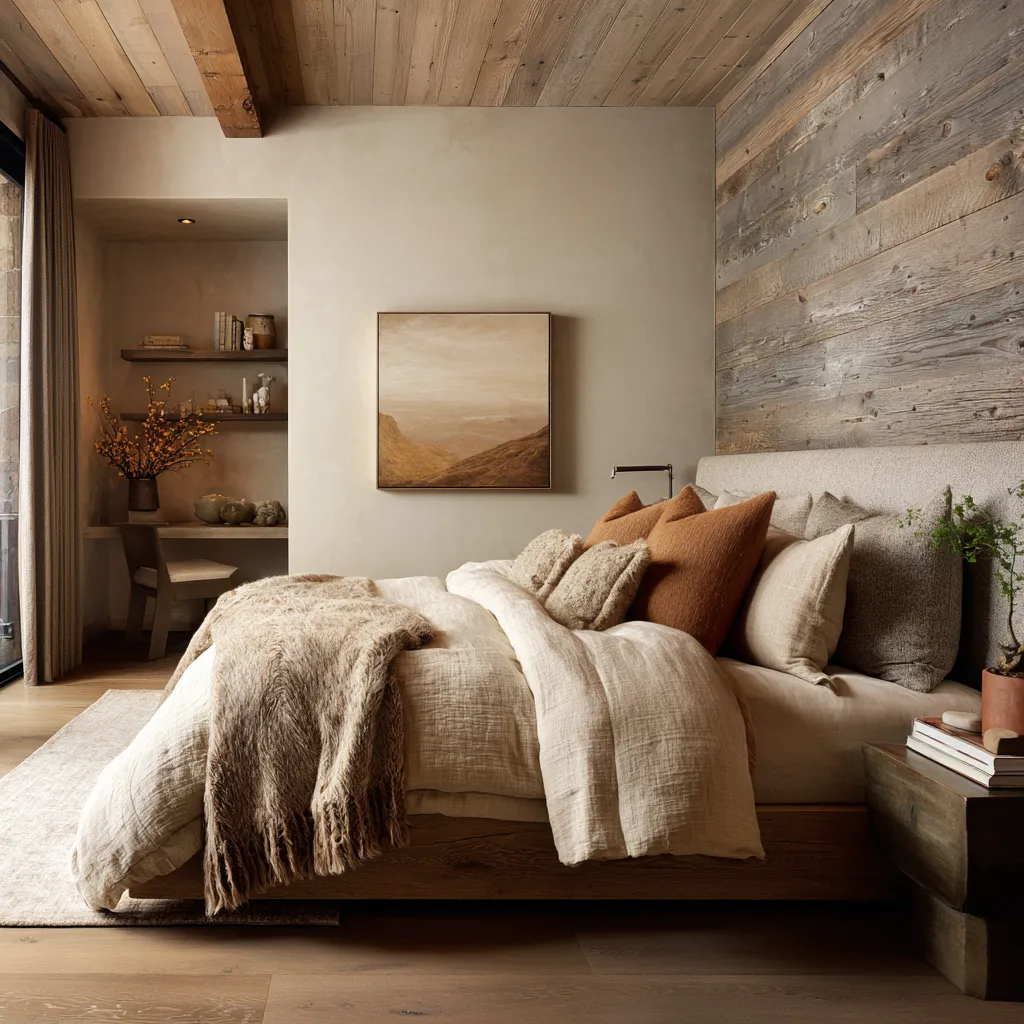
How to make a warm Scandinavian bedroom feel deeper, not just softer
If a bedroom already feels pleasant but not memorable, the problem is often not lack of softness. It is lack of hierarchy.
Instead of adding more pillows, ask a harder question: where does the room’s depth actually live? Could the bed wall become more substantial through plaster, paneling, upholstery, or a built form?
Could the bed be framed by a canopy, a slope, or a recess? Could the perimeter become inhabitable with a bench or shelf?
Could one timber note become more legible at the base or ceiling? Could one warm accent be concentrated rather than dispersed?
Could a stronger backdrop replace many small decorative gestures?
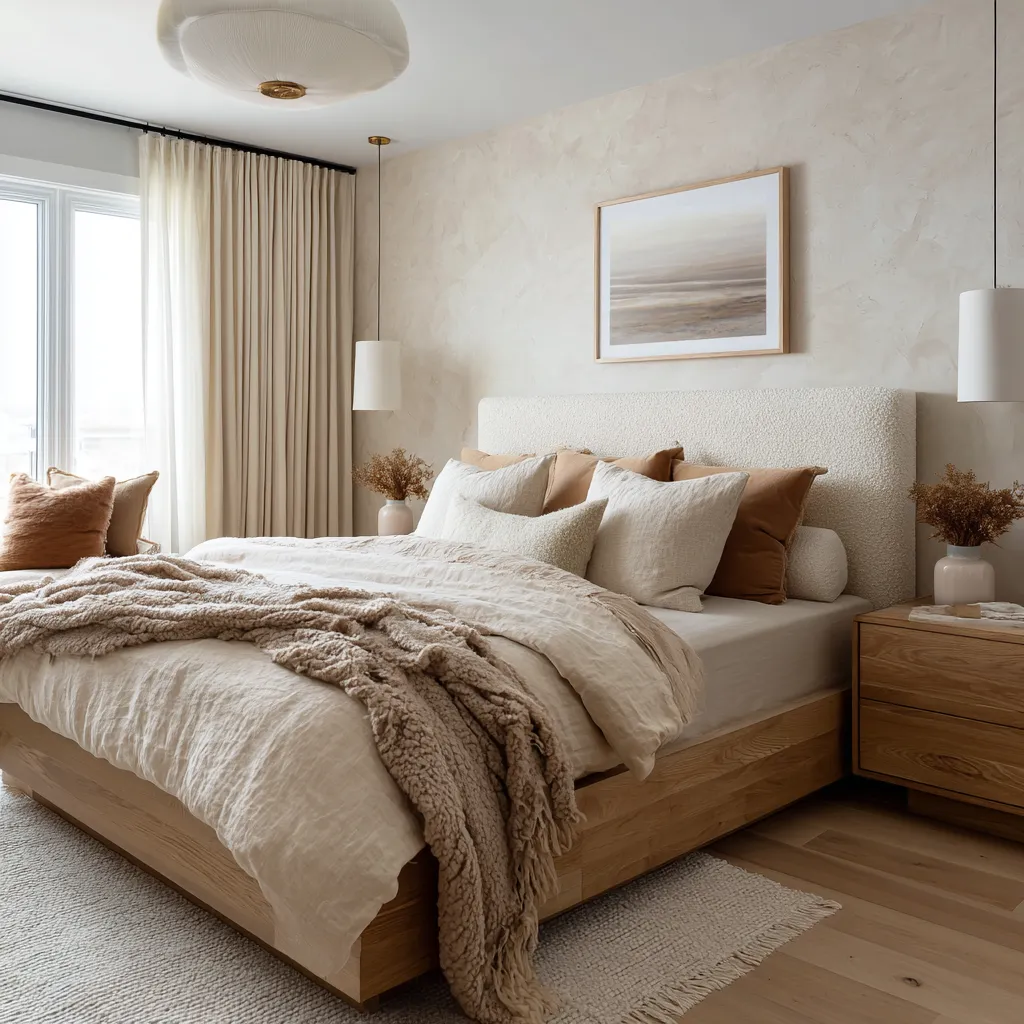
A design becomes deeper when one idea gathers enough strength to organize the rest. That is why a carved wall niche, a slatted headwall, a pale stone fireplace, an atmospheric clay wall, or a painted timber ceiling often transforms a bedroom more effectively than an extra layer of bedding.
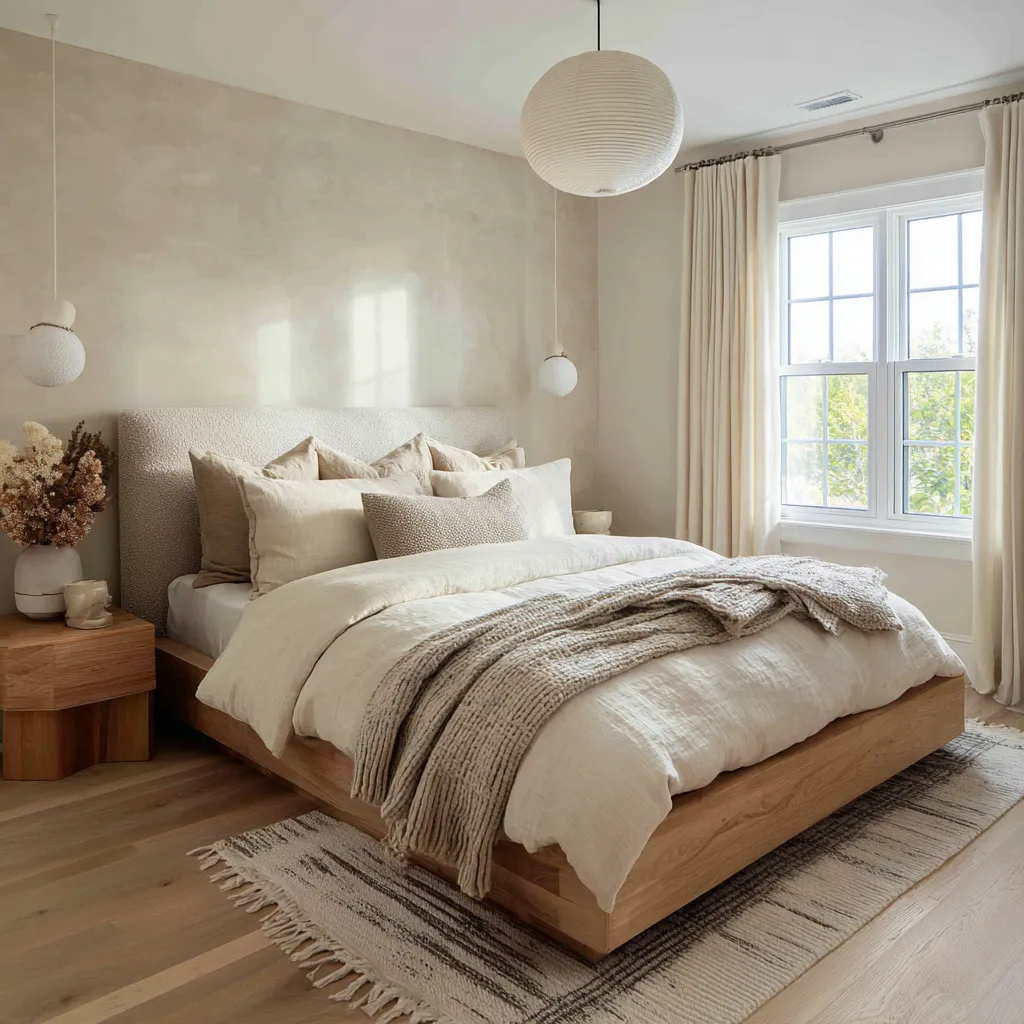
Warm Scandinavian luxury is possible, but only under certain conditions
This style can move into a more polished and upscale register, but it must do so carefully. It stays believable when luxury comes through proportion, craftsmanship, material thickness, generous upholstery, and seamless architectural integration.
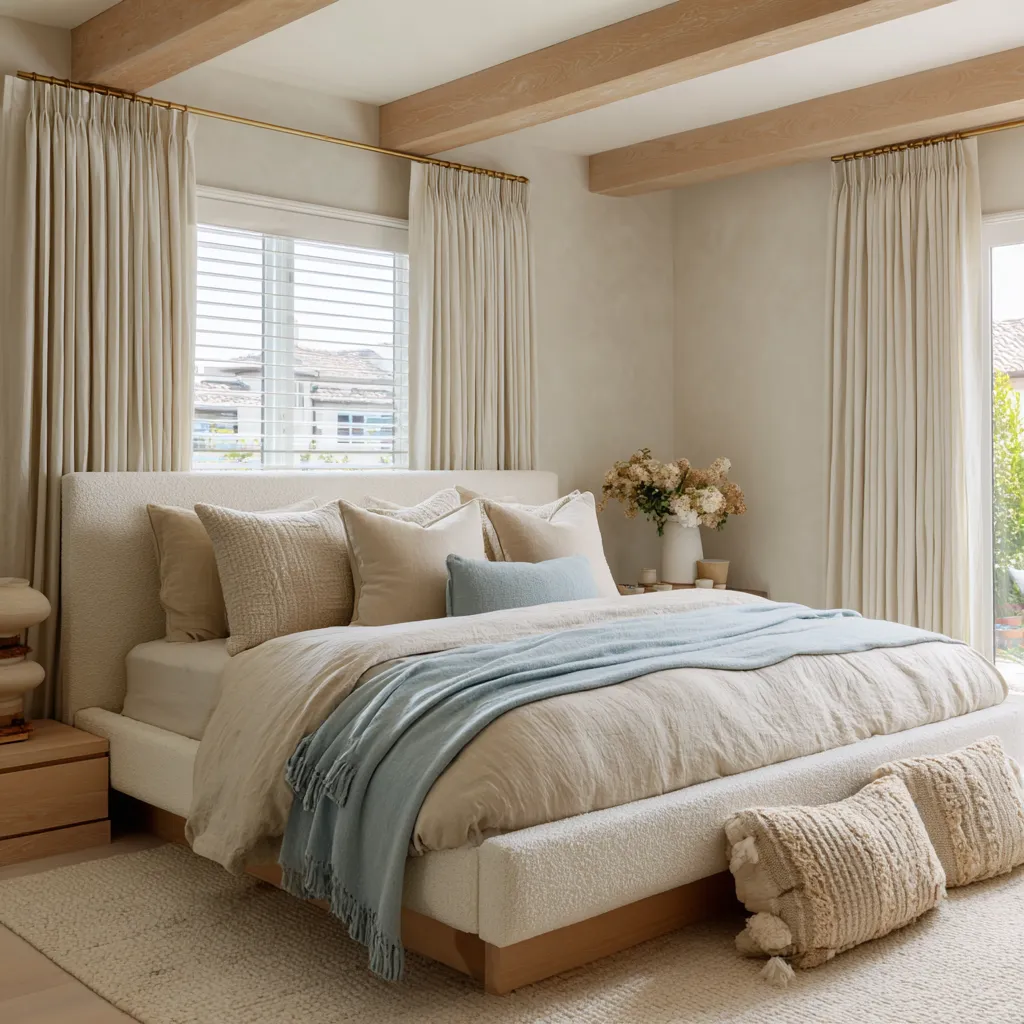
It starts to lose itself when shine, ornament, or visual performance become the main message. A larger room with a broad upholstered bed, a slatted headwall, a pale stone surround, and floor-to-ceiling drapery can still feel fully Scandinavian if the palette remains muted, the surfaces stay matte, the forms stay low and bodily, and the detailing resists glamour.
The room may be sophisticated, but it still belongs to the same family because softness remains rooted in material rather than spectacle.
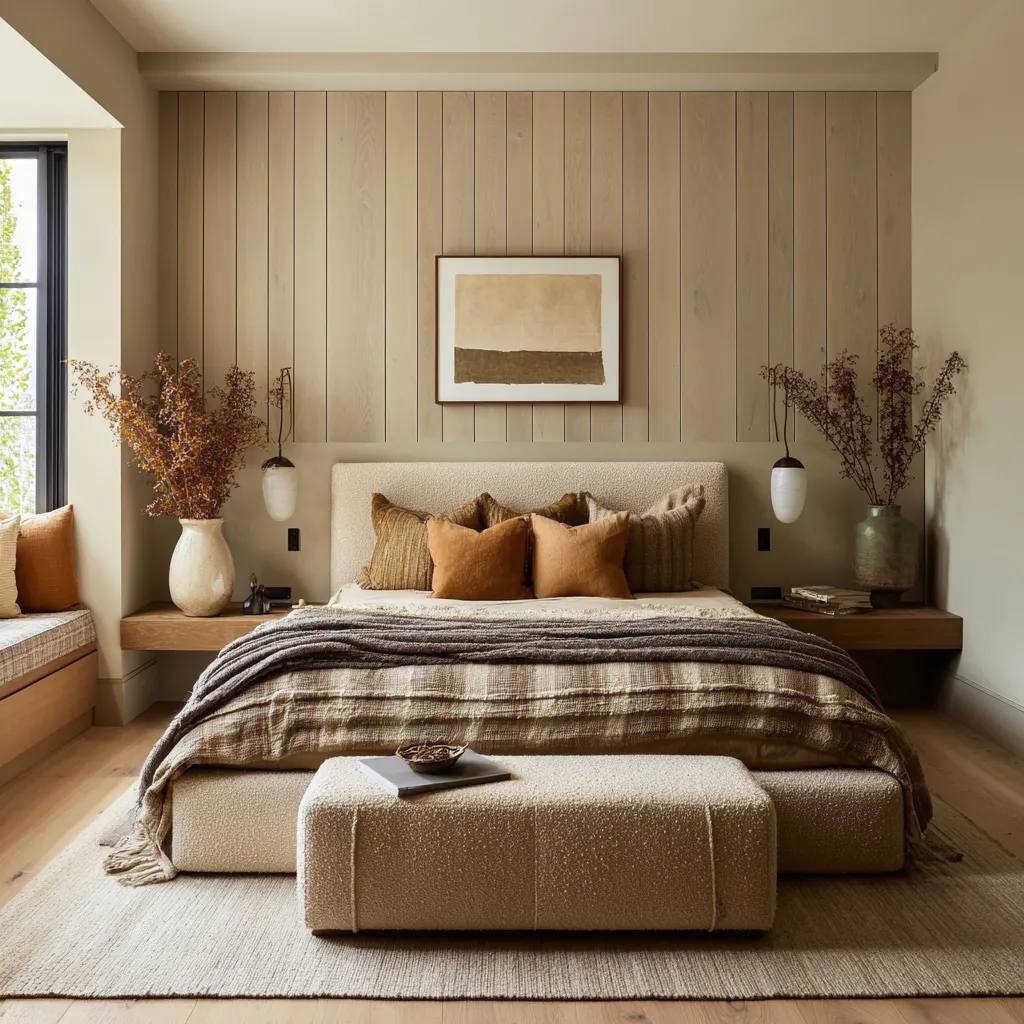
What the style is really after
Warm Scandinavian bedroom design is often mistaken for a visual look. But it is closer to an atmosphere of protected softness.
Such designs are built from a very particular set of relationships:
- a bed that belongs to a shaped place
- pale colors that share undertones instead of competing
- timber that grounds rather than decorates
- absorbent surfaces that soften light
- one dominant field or anchor that gives depth
- edited objects rather than busy styling
- open space used with intention
- small concentrated zones of warmth rather than total saturation
- enough order to steady the room
- enough material irregularity to keep that order human
This is why the style can be sparse and still feel full. It does not rely on abundance.
It relies on alignment.
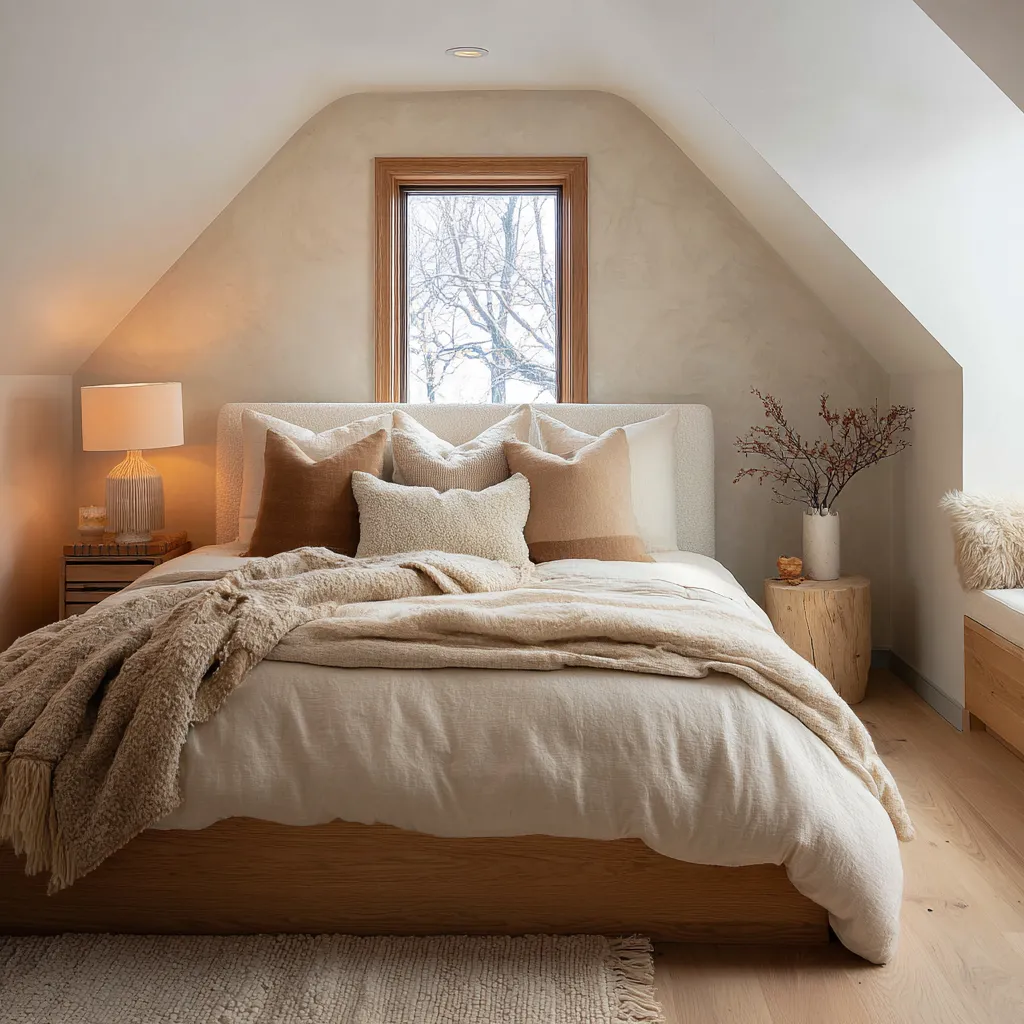
A warm Scandinavian bedroom succeeds when the architecture, the bed, the material surfaces, and the palette all point toward the same emotional condition: inwardness without heaviness, softness without vagueness, simplicity with enough depth to hold the body at rest. That is the achievement of the style.
It makes restraint feel inhabitable.