Modern tropical British colonial interior design works when it holds two conditions in the same room without letting either one erase the other. One condition is inherited order: structure, rhythm, framed openings, furniture with posture, dark timber punctuation, and a sense that the room has bones.
The other is climate response: air movement, filtered light, permeable materials, garden contact, softened boundaries, and surfaces that feel suited to heat, shade, and changing daylight. That balance is where the style lives.
Many interior designs described as tropical British colonial lean too far to one side. If the room leans too hard into tropical atmosphere alone, it can blur into broad coastal, resort, or warm-climate organic decorating.
If it leans too hard into colonial heaviness, it can stiffen into a period-minded interior that feels cut off from air, sunlight, and present-day living. The modern version succeeds in the middle.
It keeps the colonial skeleton visible, then lightens it through climate-aware materials, fewer objects, softer upholstery, and carefully framed connections to the exterior.
Convincing modern tropical British colonial interior ideas feel settled and breathable at the same time. They have weight, but they are not packed.
They have warmth, but they are not muddy. They have history in their posture, though they do not rely on theatrical props.
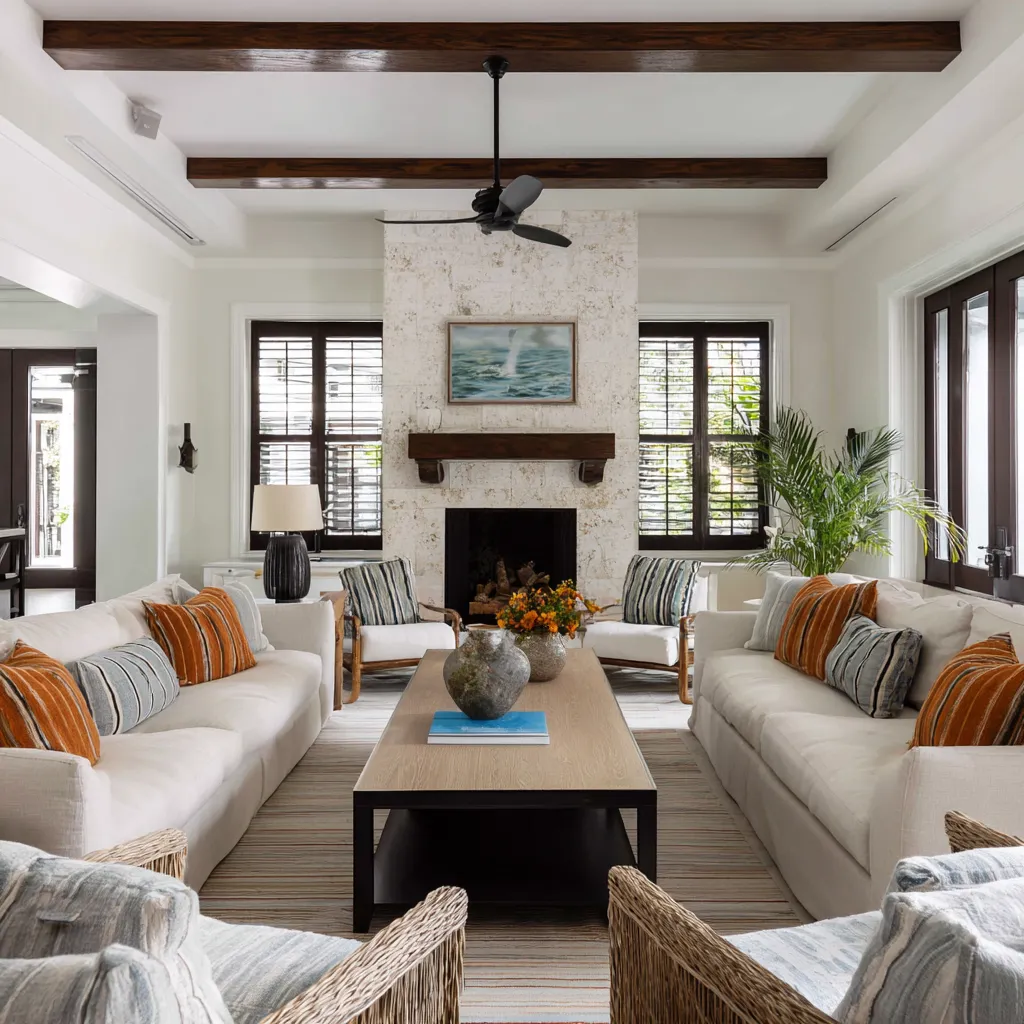
The style is defined by order before it is defined by lushness
A common misunderstanding is that tropical British colonial design becomes clearer as the room becomes greener, more open, more outdoor-linked, or more filled with wicker and palms. In practice, that is only partly true.
Tropical atmosphere is necessary, but it does not by itself make the room clearly tropical British colonial.
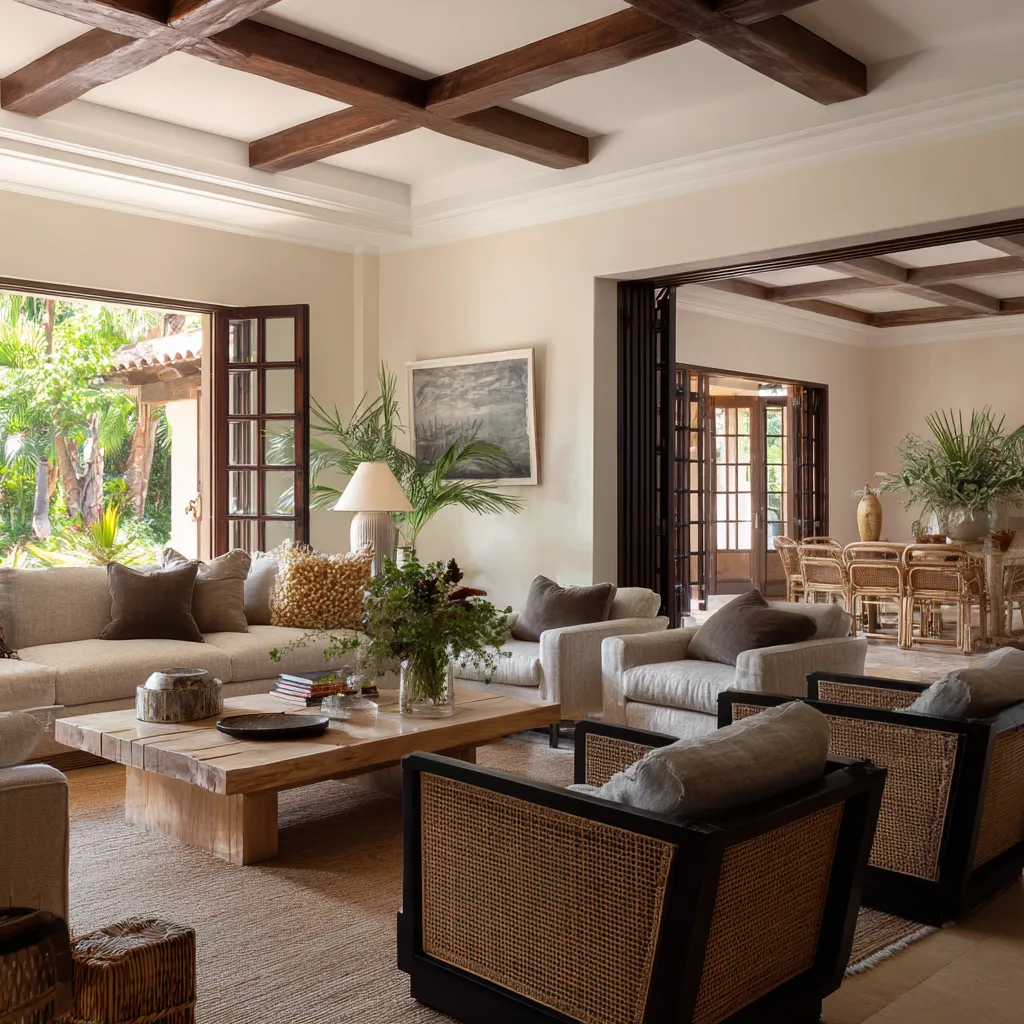
What gives the style its identity is the way tropical cues are held inside a disciplined framework. That framework usually appears through symmetry or semi-symmetry, a distinct center of gravity, dark structural notes, framed thresholds, repeated window logic, and furniture that has visible structure rather than only soft mass.
The room may be open to a terrace, but the opening still needs shape and thickness. The room may use pale upholstery, but it still needs one or two darker anchors.
The room may include a contemporary sofa, but it still needs at least one furniture family that carries colonial memory through timber framing, cane, wicker, cord, leather, or a more upright silhouette. In other words, the style is not created by tropical abundance alone.
It is created by tropical material and light conditions being organized inside a room that still has discipline.
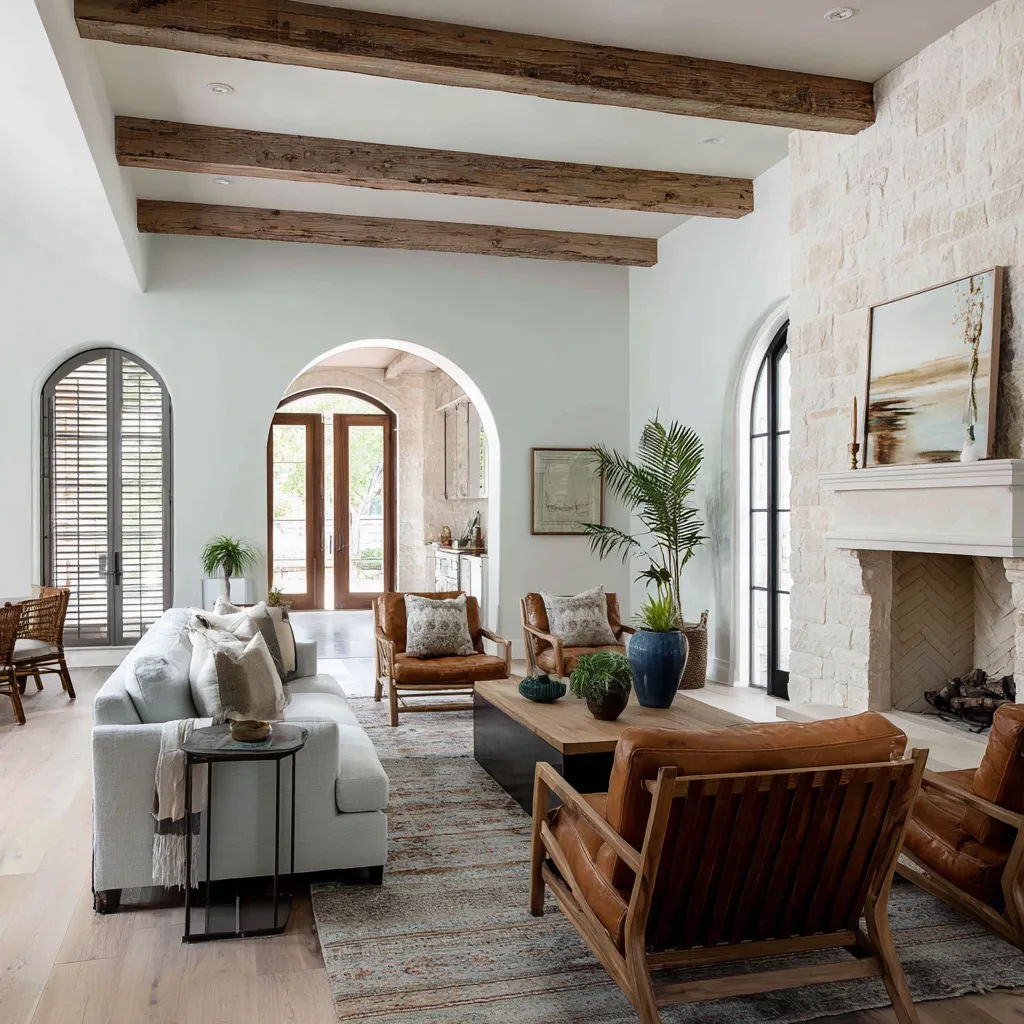
Modernizing this style usually means subtraction
Modern tropical British colonial design is usually modernized by editing, not by novelty. The room does not need a large quantity of colonial-era references.
It does not need travel trunks everywhere, historical prints on every wall, layered accessories, carved chests, or a heavy field of decorative objects.
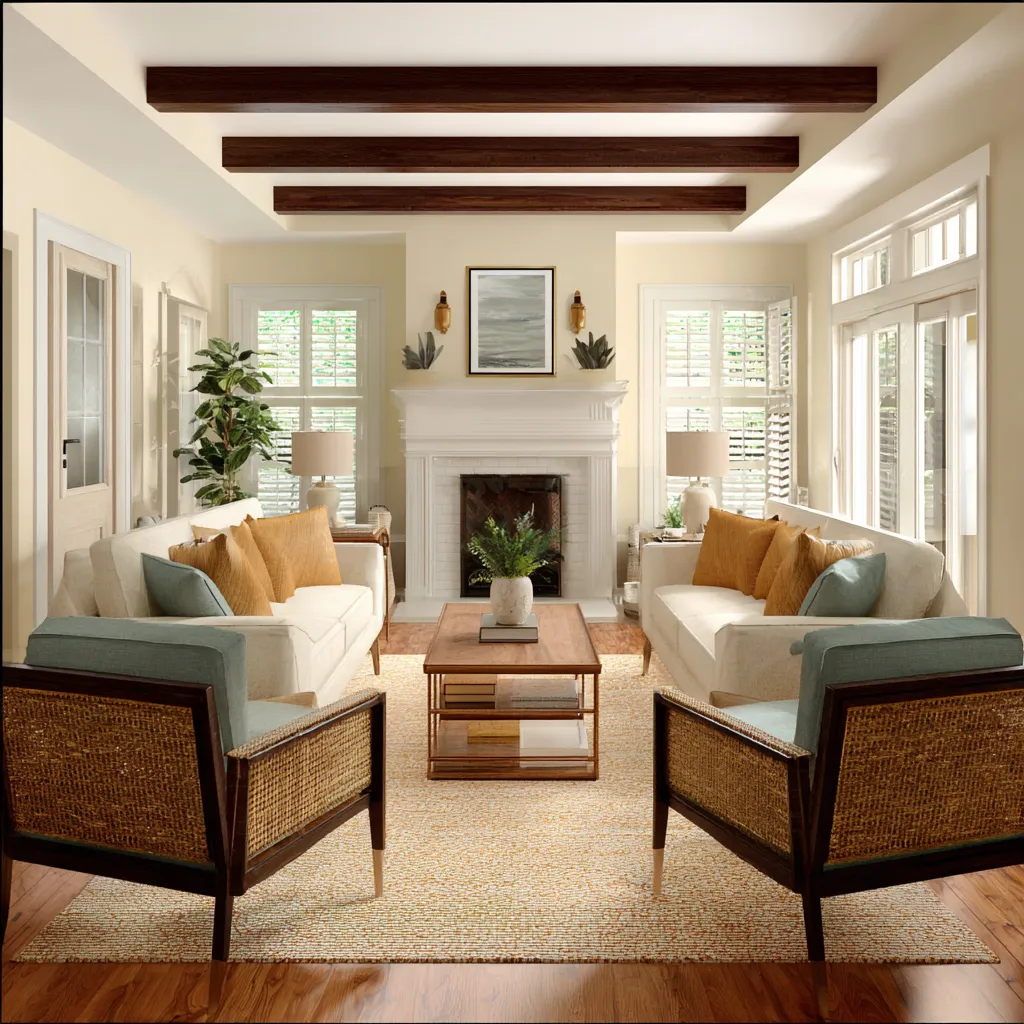
Modern tropical British living room ideas remove that visual crowding. They keep only the structural signals that matter: dark timber, cane or woven permeability, pale wall fields, one anchoring table or hearth, framed openings, and a live relation to filtered daylight or garden edges.
Because the object count is reduced, the architecture and furniture grammar have to carry more of the style. That pressure is helpful.
It forces the room to depend on proportion, threshold design, material contrast, and furniture construction instead of atmosphere-by-accessory. This is also why the style adapts so well to ordinary homes when handled well.
Once the room stops relying on collected colonial props, it becomes easier to translate into a present-day family room, fireplace room, or open-plan living area.
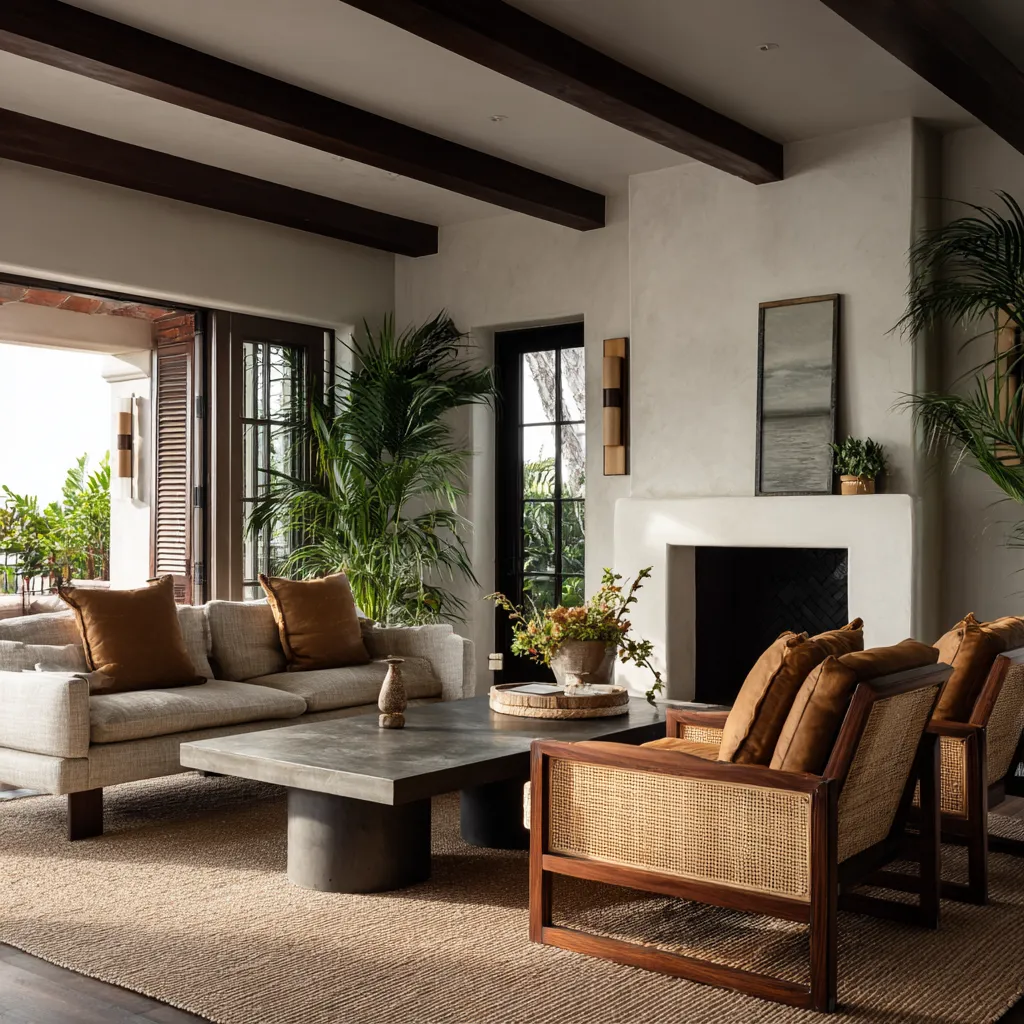
The backbone: five design moves that keep the style intact
Modern tropical British colonial living room ideas usually rely on the same five moves.
- The first is ordered room geometry. The room needs some sense of alignment, center, repetition, or measured composition. That does not mean every room has to be perfectly symmetrical, but it does mean the room cannot feel completely casual in its structure. A centered fireplace, paired seating, repeated shutters, a strong axial view, or a disciplined furniture island all help.
- The second is threshold thickness. Openings need articulation. Shutters, arches, deep reveals, framed doors, layered openings, and indoor-outdoor sequences all help the room feel culturally and climatically grounded. Large glass alone often weakens the style because it makes the boundary feel too thin and generic.
- The third is permeable seating. Cane backs, woven side panels, cord-wrapped frames, wicker bodies, rush inserts, or other open furniture surfaces reduce visual blockage. This matters far beyond decoration. These materials allow the room to keep timber authority and colonial memory without making the seating group too dense.
- The fourth is one dark anchor. A room with pale walls, pale upholstery, and generous openings needs at least one stabilizing mass: a dark coffee table, leather piece, fireplace firebox, beam field, cane-framed foreground chairs, or another concentrated weight point. Without that, the room often slides toward general tropical softness.
- The fifth is an edited object field. The room needs enough restraint that the main forms remain legible. In this style, fewer objects usually produce a clearer result. Accessories should support the room’s structure rather than compete with it.
When these five moves are present together, the style stays legible even if the room includes a television, a sectional, open kitchen connections, or patio doors.
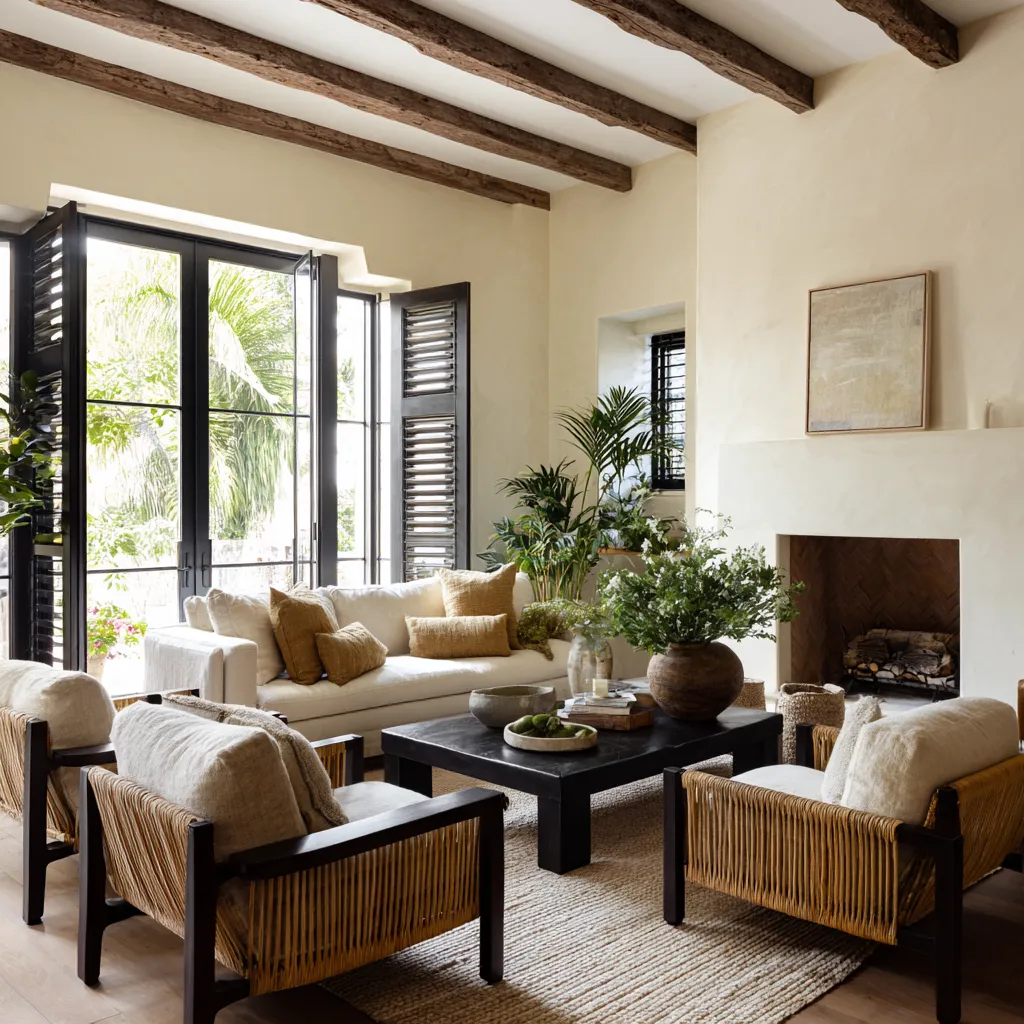
Why threshold design matters so much
A tropical British colonial room depends heavily on how it handles the edge between inside and outside. But there is a major difference between a room that simply opens to the yard and a room that uses the threshold as part of its identity.
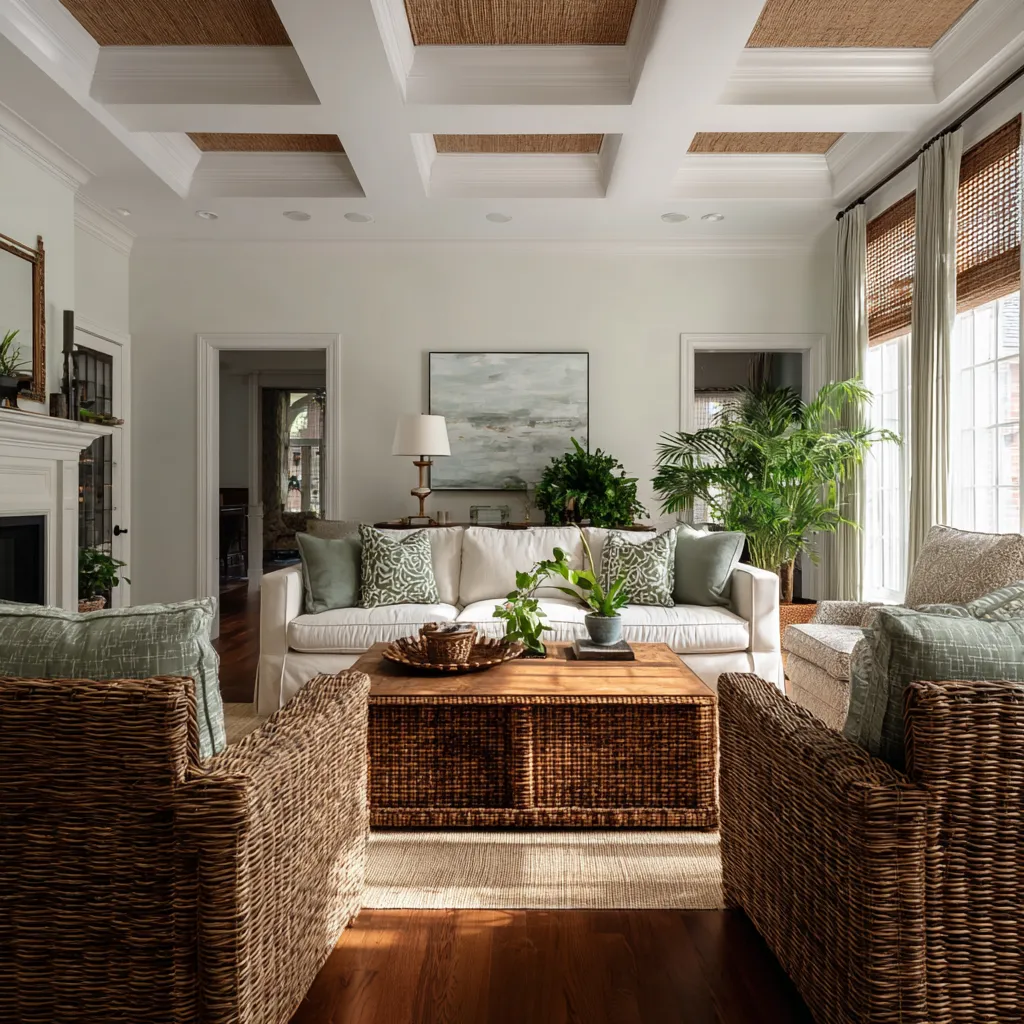
The second type is much stronger. A framed opening with shutters, an arch, a recess, a layered door set, or a sequence from living room to covered terrace to garden creates a feeling of transition rather than plain exposure.
The room remains a room. It does not dissolve into exterior leisure space.
That distinction is crucial. If a space becomes too outward-facing without enough framing, it starts to resemble general tropical luxury design, resort styling, or broad indoor-outdoor contemporary living.
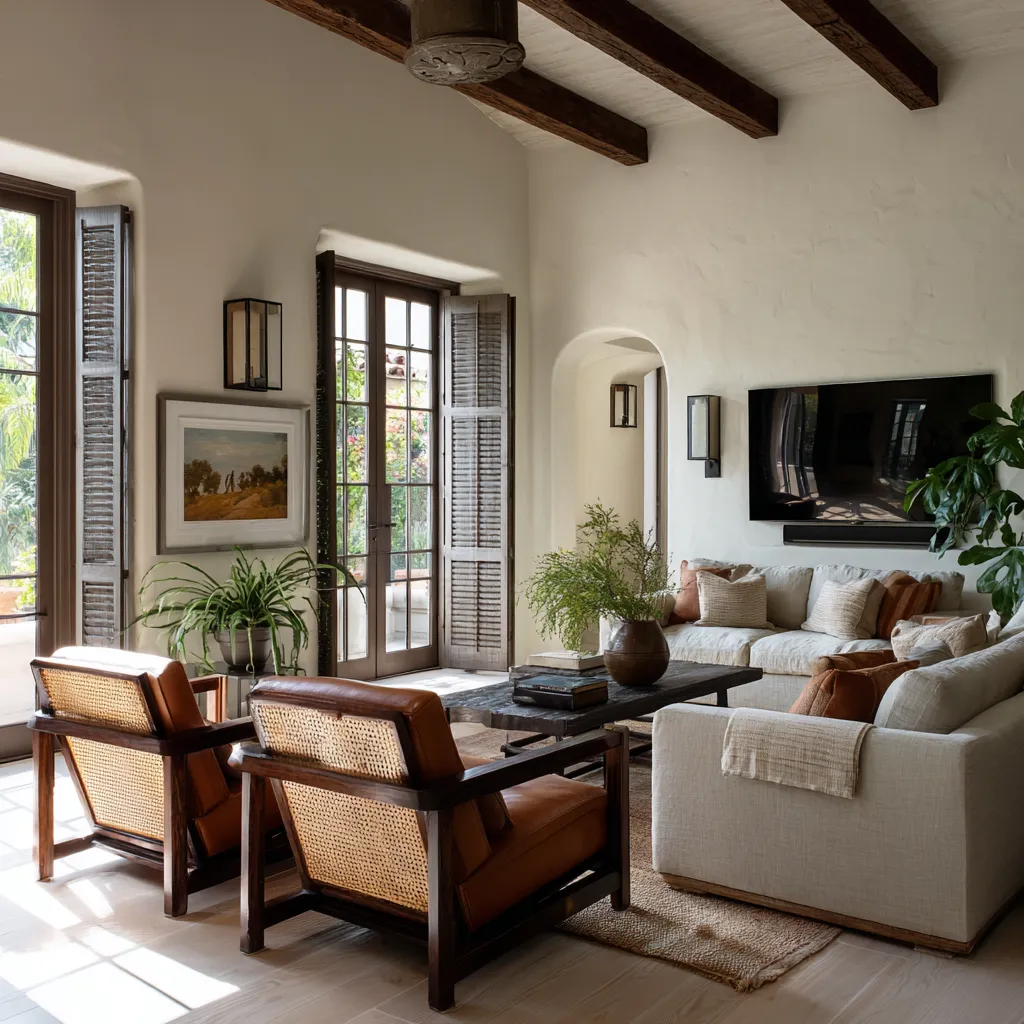
The stronger tropical British colonial room thickens the boundary. It acknowledges climate, but it also preserves architecture.
It allows air, light, and greenery to enter without making the room feel structureless. This is why shutters matter so much in the style.
They do far more than decorate a window. They imply glare control, privacy control, filtered sun, and a house designed to mediate climate rather than simply reveal a view.
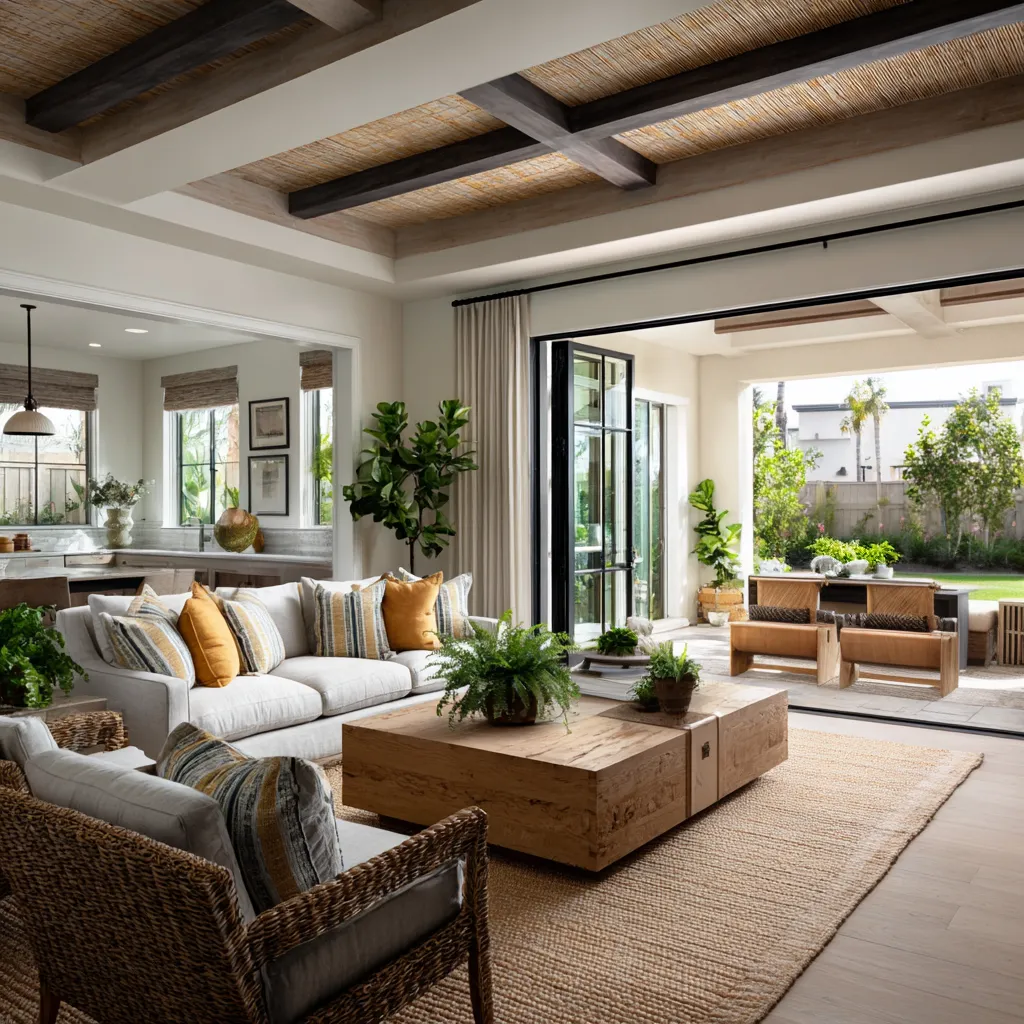
Openness helps, but only up to a point
Open-plan layouts, patio spill, and broad glazed walls suit present-day living. They also fit warm climates.
But openness alone does not sharpen tropical British colonial character. In fact, once a room becomes very open, identity depends even more on threshold framing, dark anchors, and overhead structure.
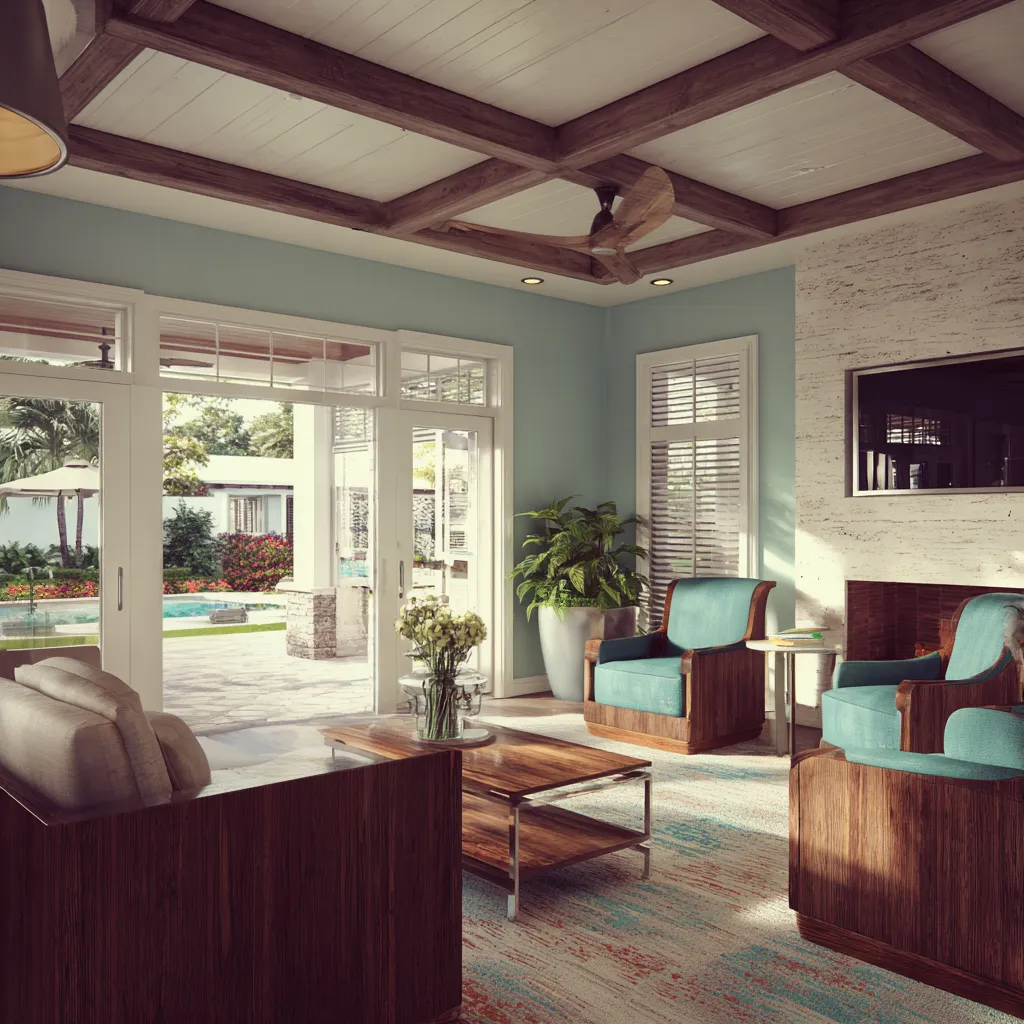
That is why some open great rooms feel tropical but not specifically tropical British colonial. They may have greenery, natural fiber, and sunshine, yet the room’s backbone is too loose.
There is no thickened threshold, no dark center of gravity, no overhead timber order, and no furniture with colonial posture.
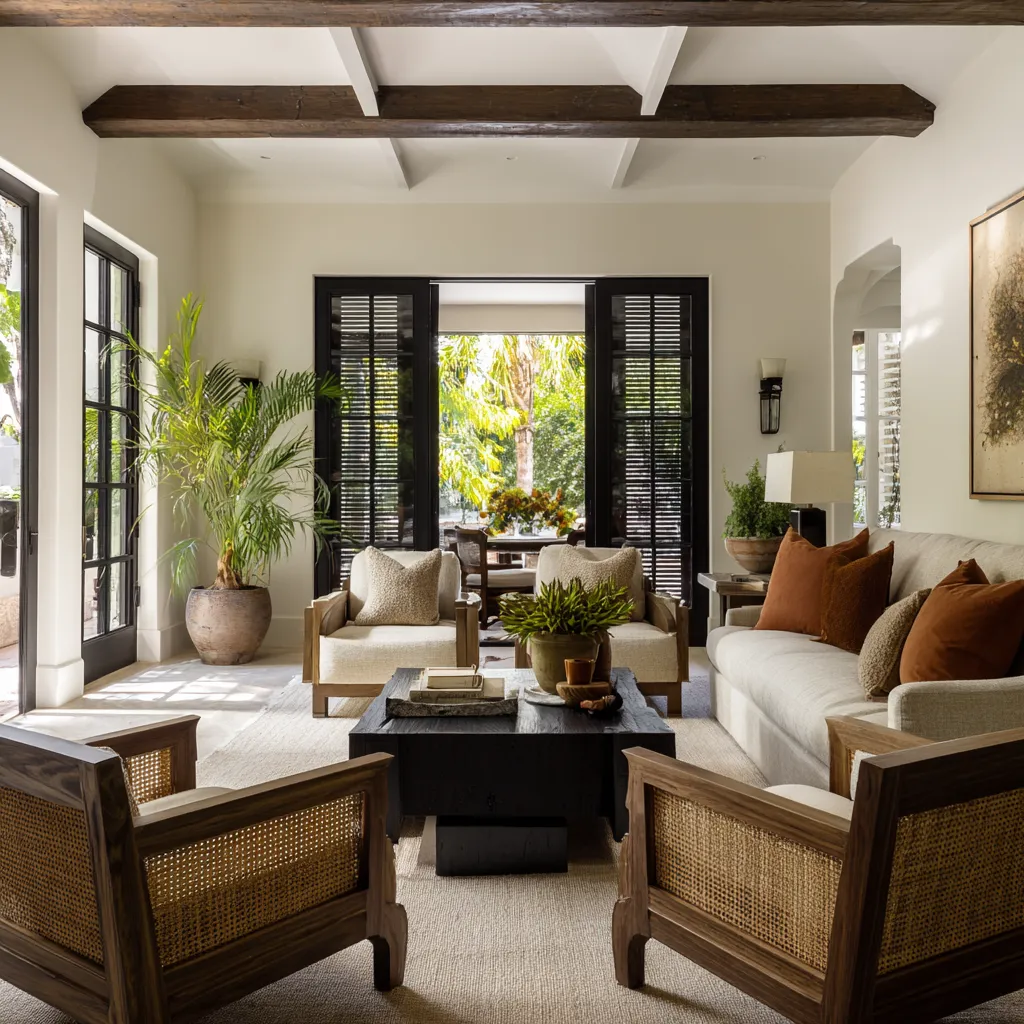
A highly open room therefore needs compensation. If the walls open wider, the center must usually grow firmer.
If the sofa becomes more casual and current, the ceiling often has to carry more lineage. If the glazing becomes broader, the woven chair family or dark table often has to become more explicit.
The goal is not to reduce openness. The goal is to stop openness from flattening the room into a generic warm-climate interior.
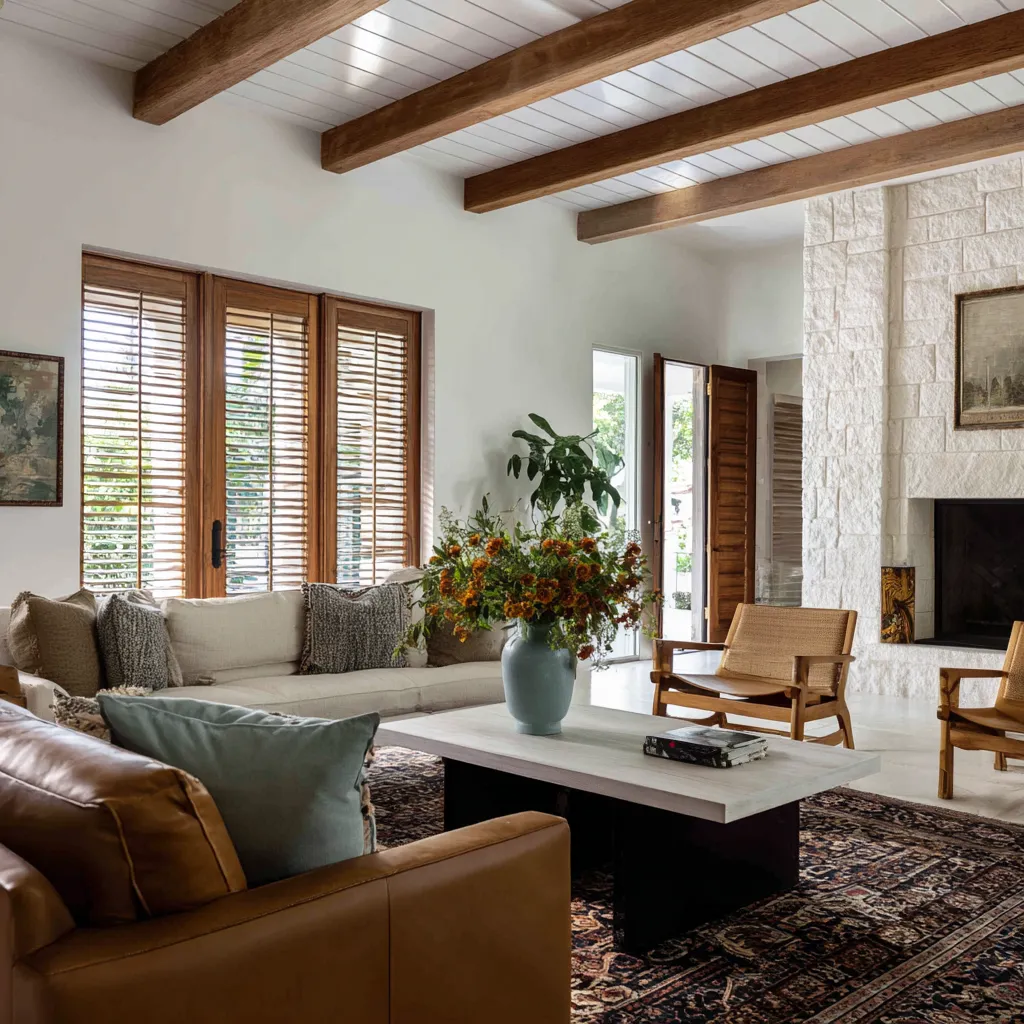
The ceiling often carries the lineage now
The ceiling has become an important style carrier. This happens because present-day sofas are often softer, lower, and less historically coded than older colonial furniture.
Media walls are common. Open plans are common.
Great rooms are common. As a result, a large part of the room’s inherited structure migrates upward into beams, coffers, planked fields, reed inserts, dark timber grids, or framed ceiling bands.
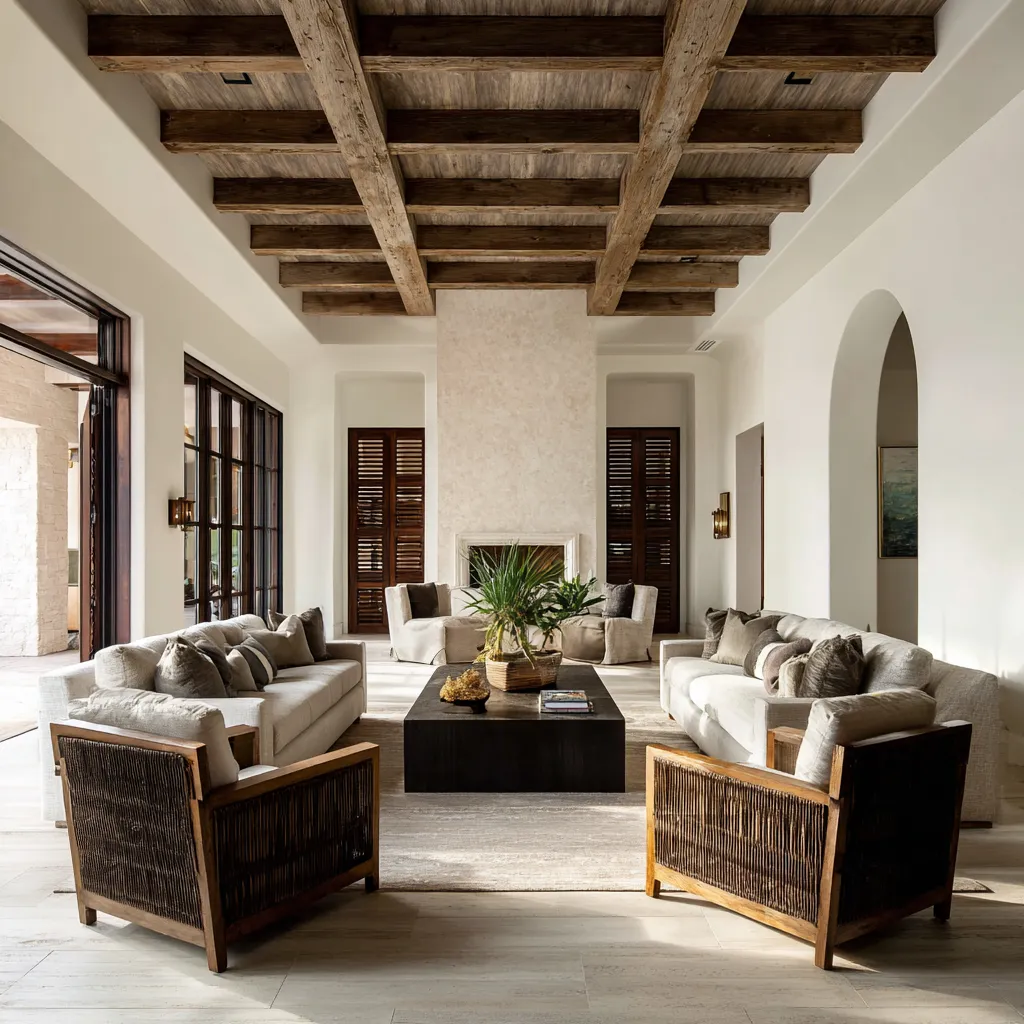
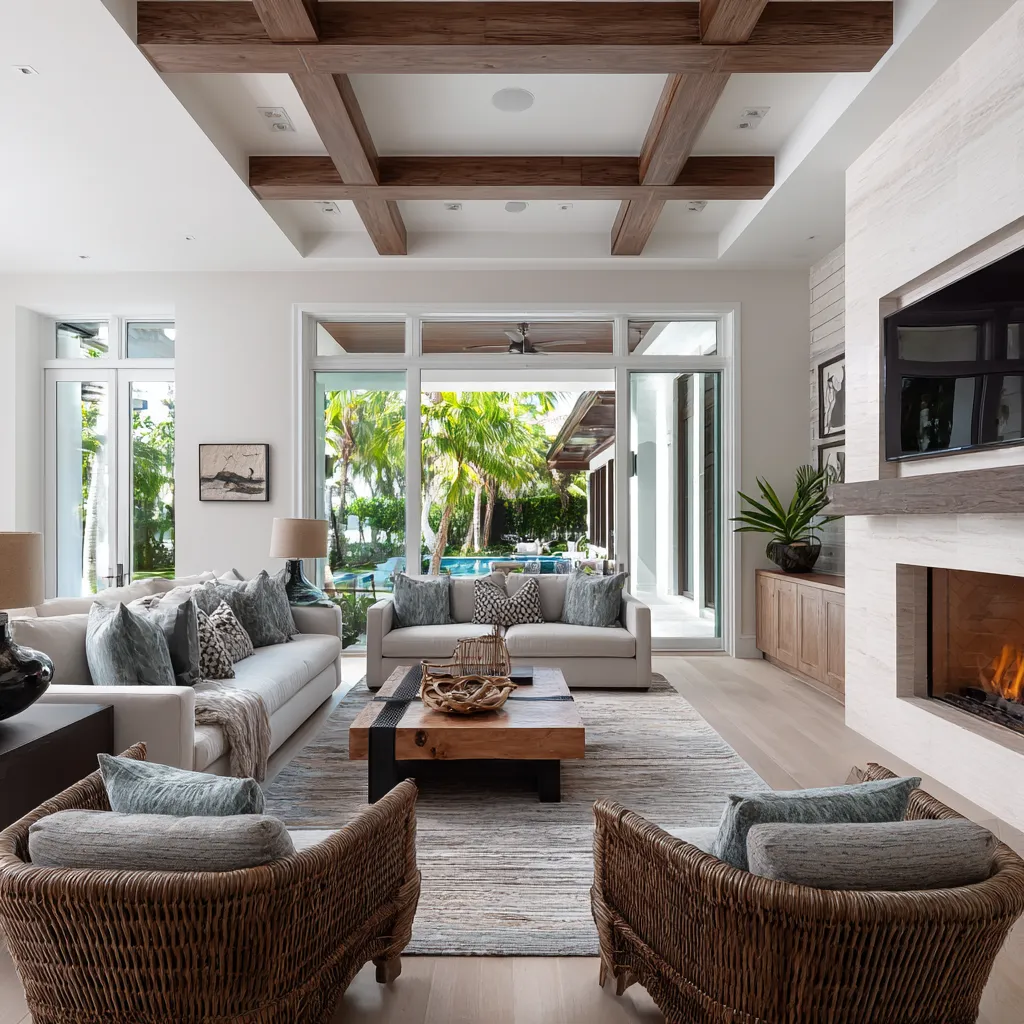
A beam ceiling can give a pale room weight without requiring dark furniture everywhere. A coffered ceiling can restore order to a large family room where the layout is otherwise loose.
A woven or reed ceiling insert can carry climate memory even in a more enclosed room with ordinary windows. These moves are especially useful because they affect the room’s atmosphere continuously, not just at the furniture level.
Still, there is a limit. Too much dark timber overhead can make a room harder to translate into an average home, especially if the walls are not large enough or the ceiling is not high enough.
The useful current version keeps the ceiling expressive, but not oppressive.
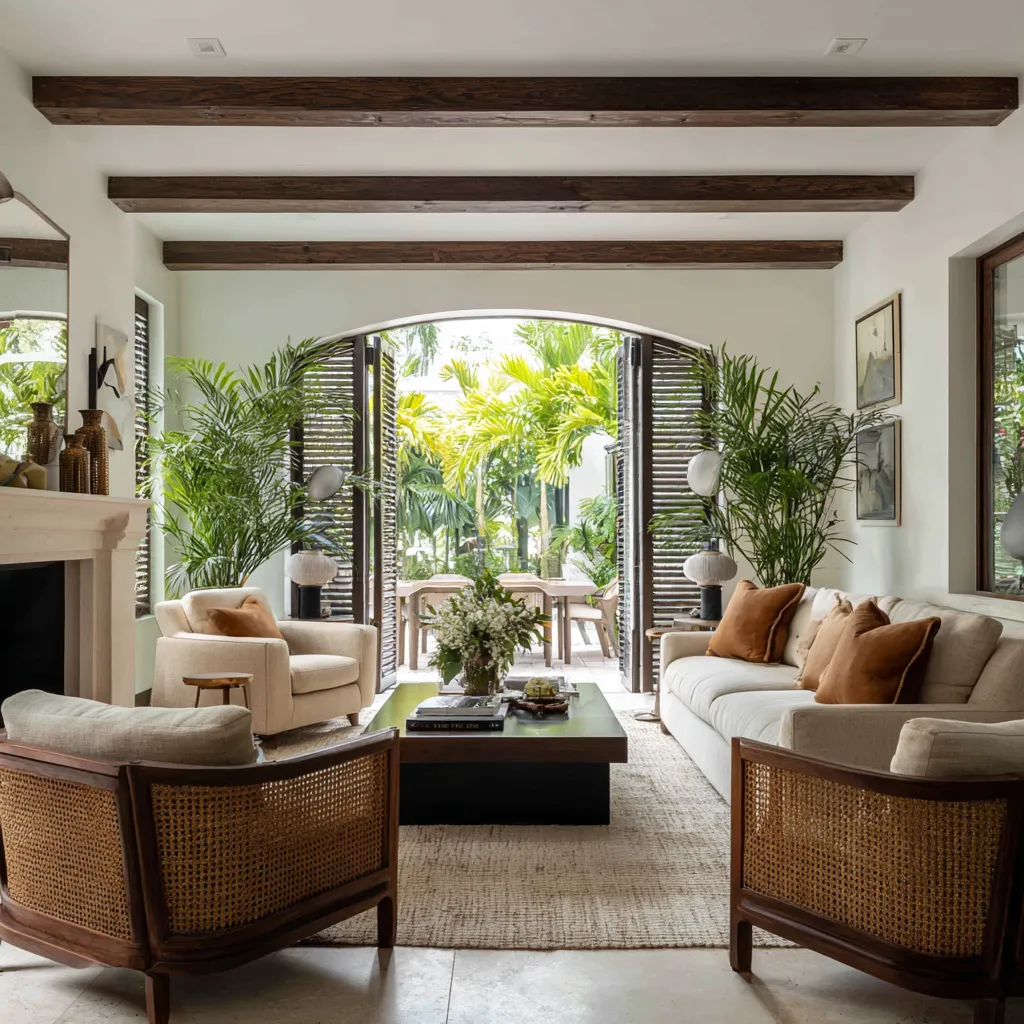
Furniture works when each piece has a distinct role
Modern tropical British colonial interiors usually become clearer when furniture is not asked to do the same job everywhere. A pale sofa often works as the room’s comfort field.
It accepts current life, casual use, and family lounging. One leather piece or dark-framed chair can then supply lineage and gravity.
Cane-backed or woven-framed chairs can introduce permeability. A low dark or mineral table can gather the center.
In that arrangement, each piece carries a different part of the style.
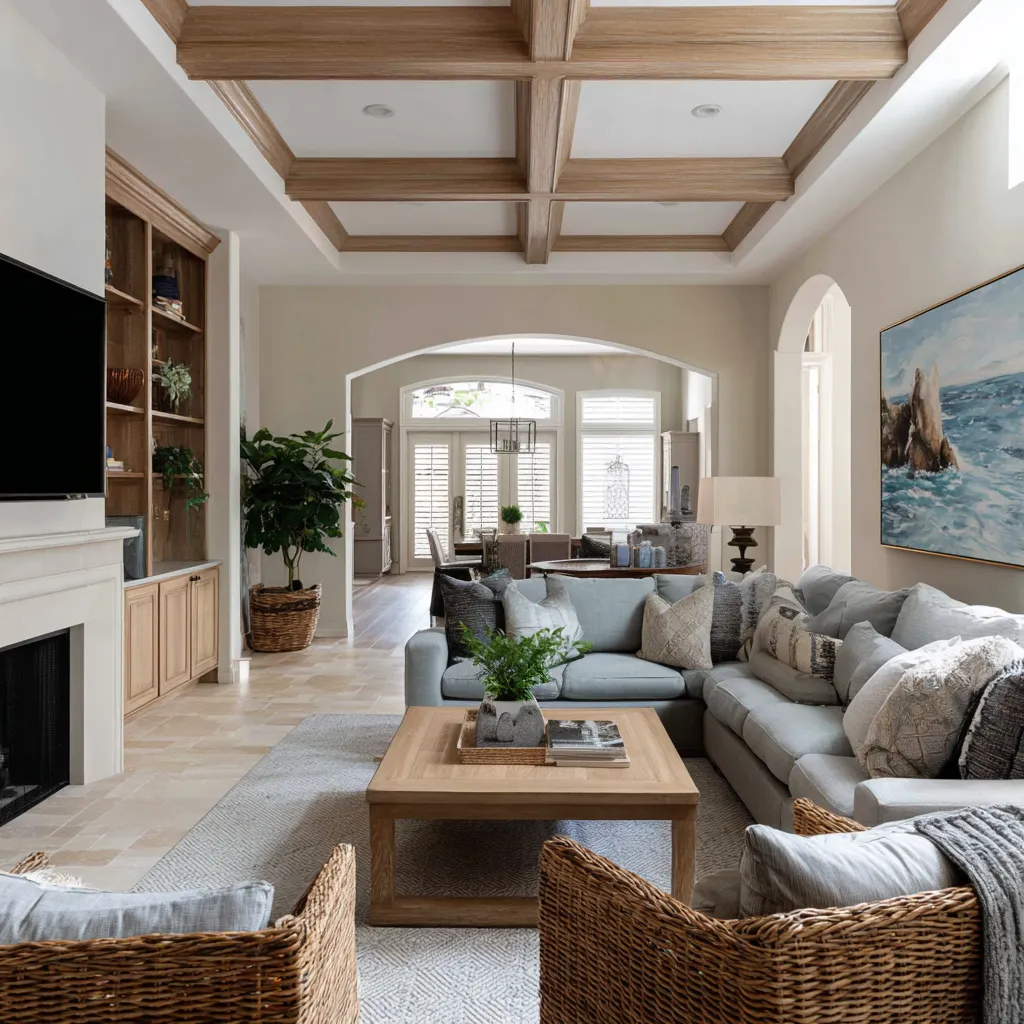
This division of labor is one reason the interior design feel convincing. They do not try to make every object equally tropical, equally colonial, and equally contemporary.
They let some pieces carry posture, others carry softness, and others carry climate texture. This also explains why cane, wicker, and woven surfaces are not interchangeable.
- Cane-framed chairs preserve line, discipline, and structural clarity.
- Deep wicker seating softens the room and pushes it toward family ease.
- Woven ceiling inserts or shades create a more atmospheric climate layer and work well in rooms that are otherwise more enclosed.
Used well, these material choices shape the room’s subtype, not only its texture.
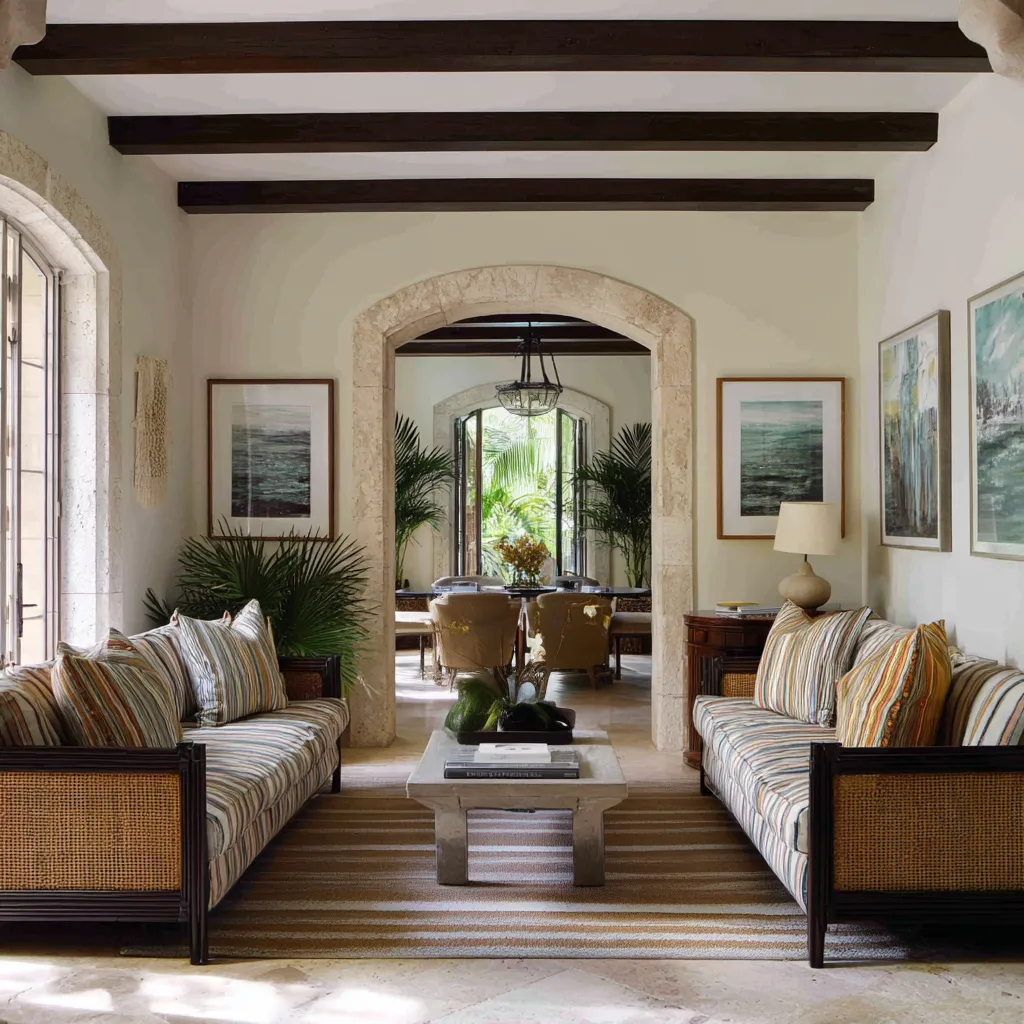
The room needs one pale field and one darker field
Elegant interiors in this style balance a pale comfort field against a darker structural field. The pale field may be walls, plaster surfaces, upholstery, or a masonry fireplace surround.
The darker field may be beams, a leather chair, a black or dark-brown table, a firebox opening, cane-framed seating, shutters, or dark wood trim.
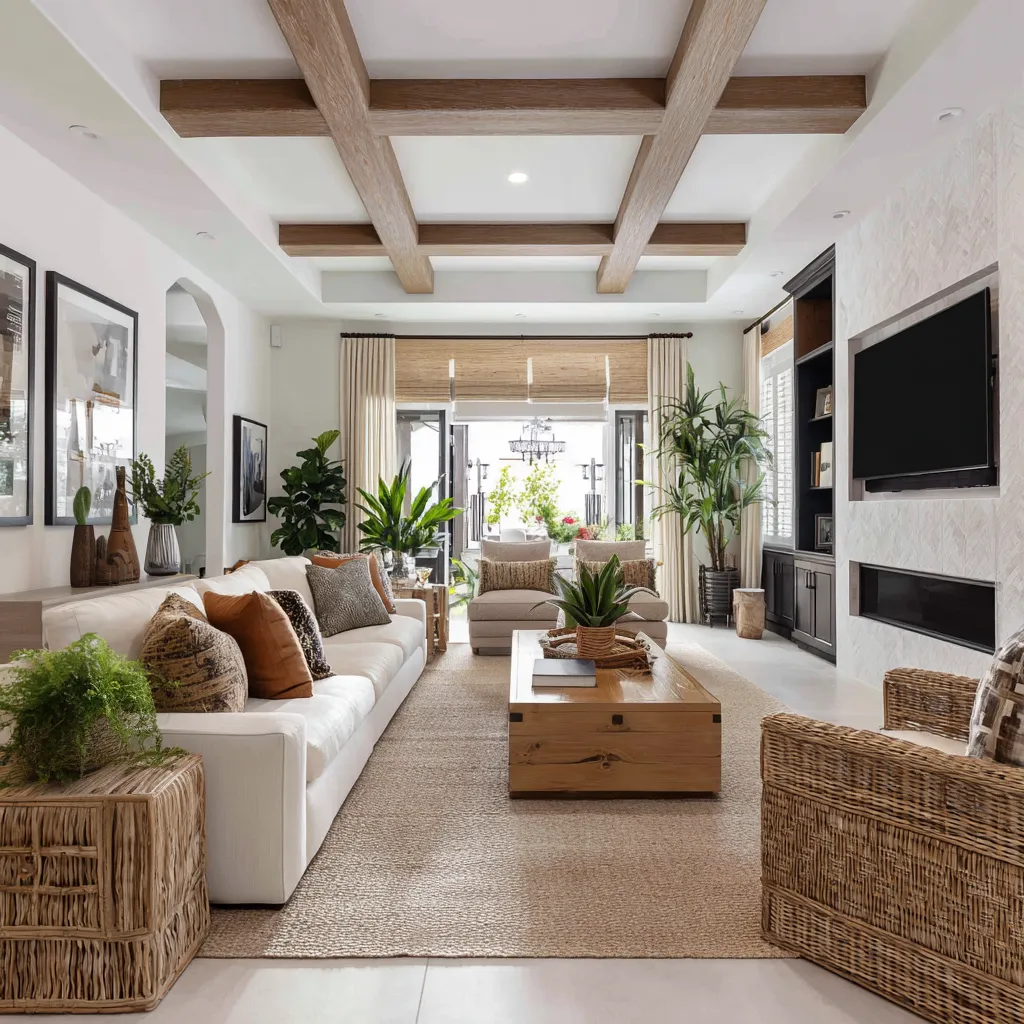
This contrast does several things at once. It keeps the room bright enough for a tropical setting.
It preserves some colonial gravity. It makes thresholds and furniture edges clearer.
It prevents pale upholstery from floating. It also stops dark timber from taking over the room completely.
That balance needs careful dosage. Too little dark weight, and the room drifts toward broad tropical-organic softness.
Too much dark weight, and the room feels overburdened for ordinary living.
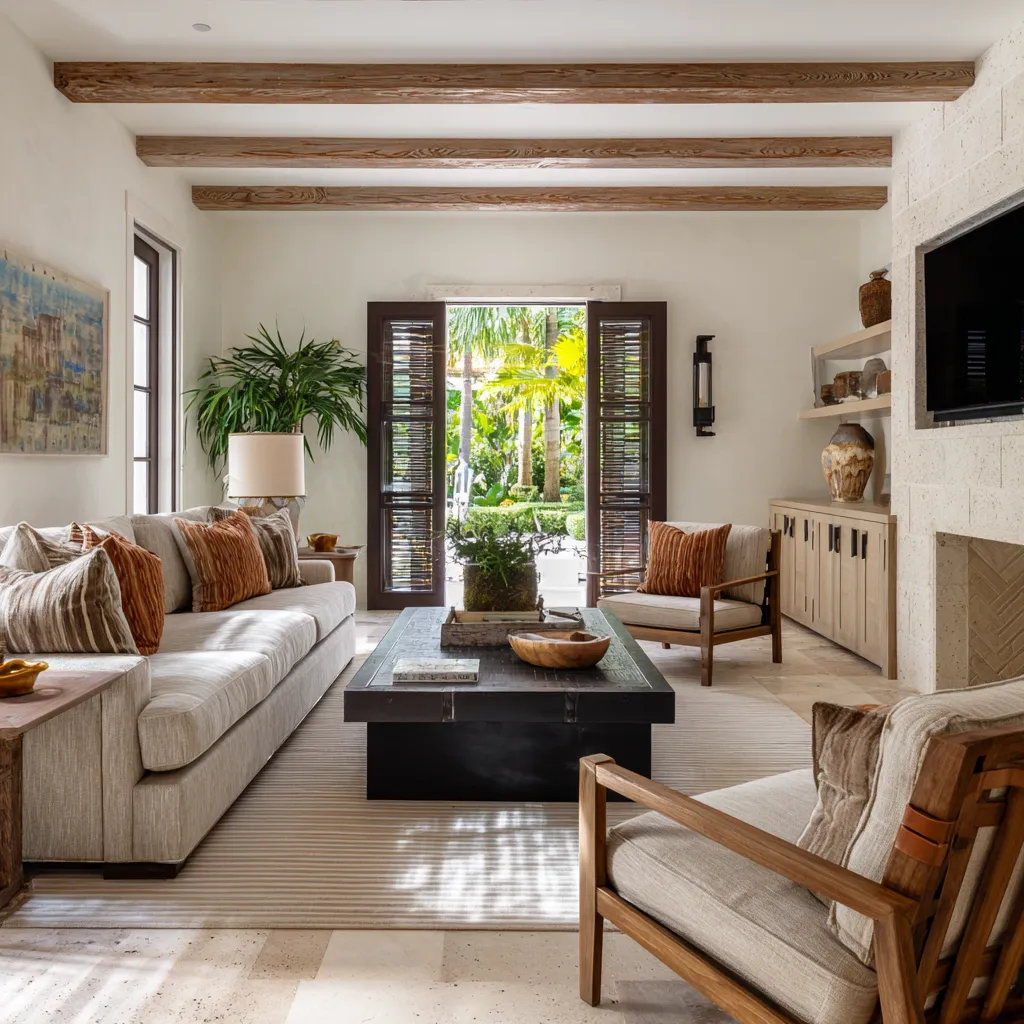
Main Color Palette
Modern tropical British colonial rooms tend to work well when the main palette stays pale, earthy, and sun-soft. White, cream, clay, tobacco, sand, muted rust, cane-gold, charcoal-brown, olive, and weathered mineral tones usually do more for the style than bright resort color.
That does not mean the room must be colorless. It means color works better when it appears as compact warmth rather than as a loud surface event.
Rust cushions, muted green foliage, tobacco leather, a sea-glass wall in a heavily anchored room, or a clay-toned textile accent can all work. But the room usually becomes less specific when color starts to dominate the structure.
The tropical color in the interior design is often the garden itself. That is why interiors in this style can remain visually restrained and let the threshold carry the richest green.
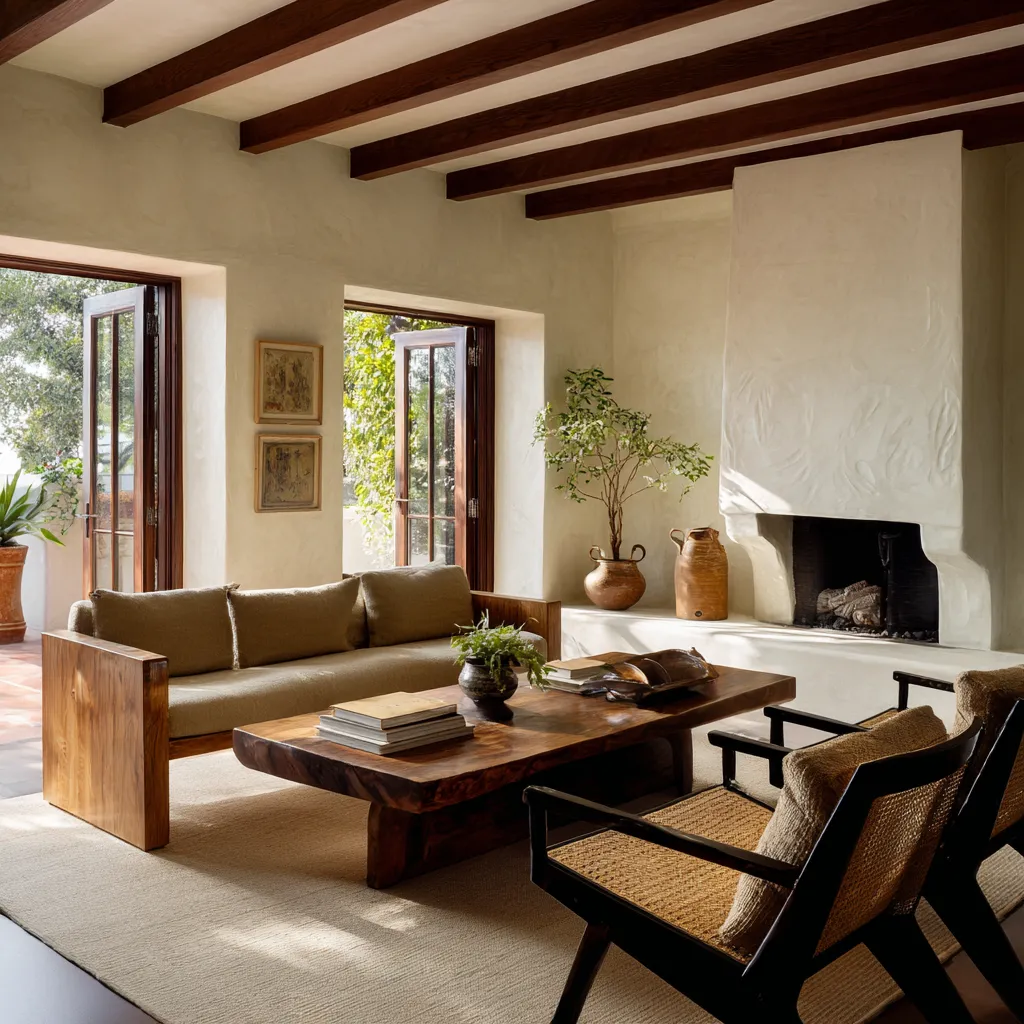
Plants should reinforce the architecture
Plant placement is often mishandled in rooms attempting this style. Scattered greenery can make the room feel decorated in a generic way.
The better approach is architectural. Place plants at thresholds, corners, side-light conditions, or transition points.
Let them reinforce an opening, soften a masonry mass, or mark an axis. A palm beside a shuttered opening, a leafy plant near a garden door, or greenery used to thicken the edge between living room and terrace feels far more integrated than many small plants spread around the room.
In this style, plants work when they help explain the room’s climate relationship.
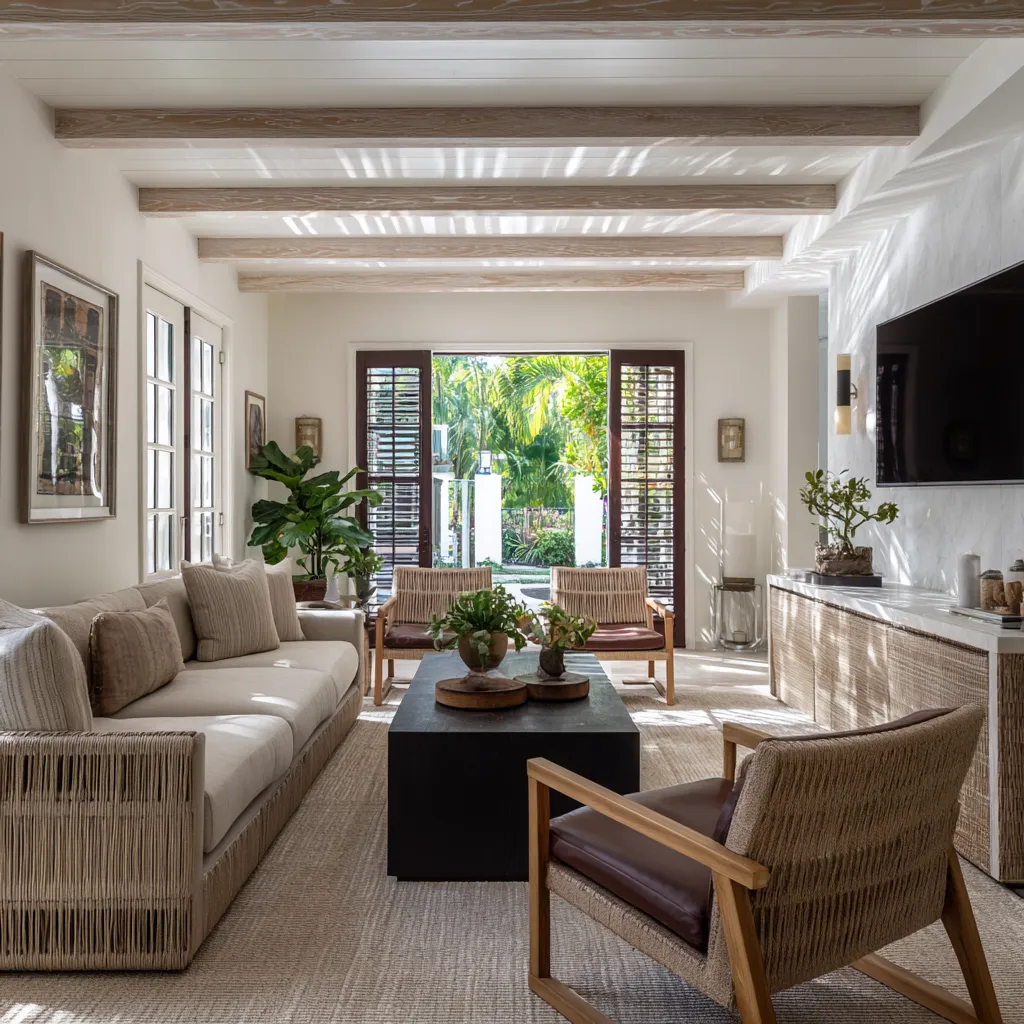
A media wall can belong here
A television does not automatically weaken tropical British colonial character. The issue is not the screen itself.
The issue is whether the media zone feels absorbed into the room’s material logic. A screen floating on a blank white wall with no depth beneath it will usually flatten the atmosphere.
A screen set into masonry, framed by dark trim, grounded by a woven-front credenza, or balanced by shutters, beams, and a strong coffee table can fit surprisingly well. This matters because the style has to work for current life.
Pretending that living rooms no longer center around media often leads to impractical design. A stronger solution is to let the media wall exist, but make sure it belongs to the same family of materials and structure as the rest of the room.
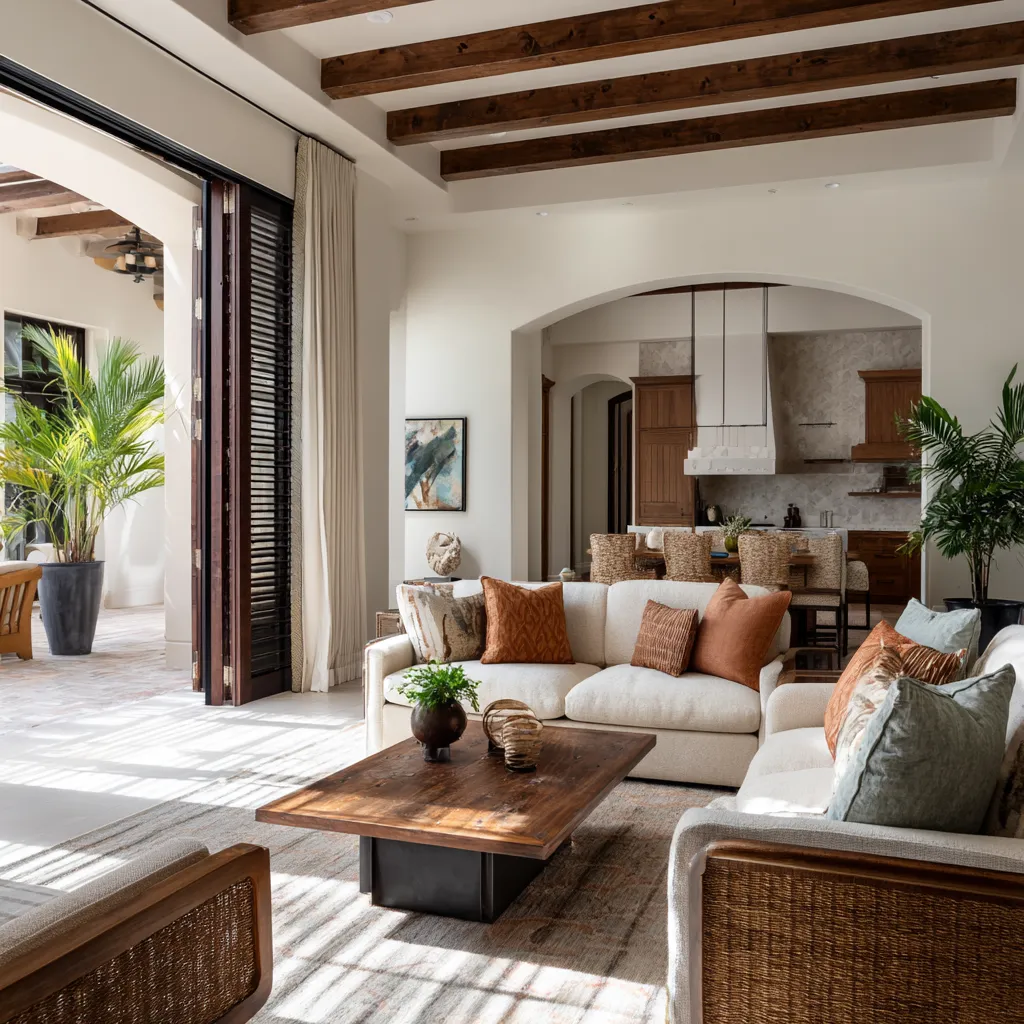
Three reliable modern versions of the style
Modern tropical British colonial interiors tend to fall into three recurring families.
- The first is the formal threshold-led room. This version uses symmetry or semi-symmetry, dark anchors, cane-framed seating, and a very articulate opening to the garden or terrace. It is the expression of the style and often visually legible.
- The second is the enclosed colonial domestic hybrid. This version is more inward, sometimes trim-heavy, sometimes more dependent on filtered light, shutters, woven shades, leather, or a pale masonry fireplace. It proves the style can work without villa-like openness.
- The third is the open-plan edited family room. This version accepts contemporary layouts, patio spill, soft sofas, media walls, and kitchen connection. It is often easy to live with, but it needs deliberate threshold framing and at least one or two stronger colonial signals to avoid drift.
Each of these versions can be convincing. They simply rely on different balances of structure, permeability, and openness.
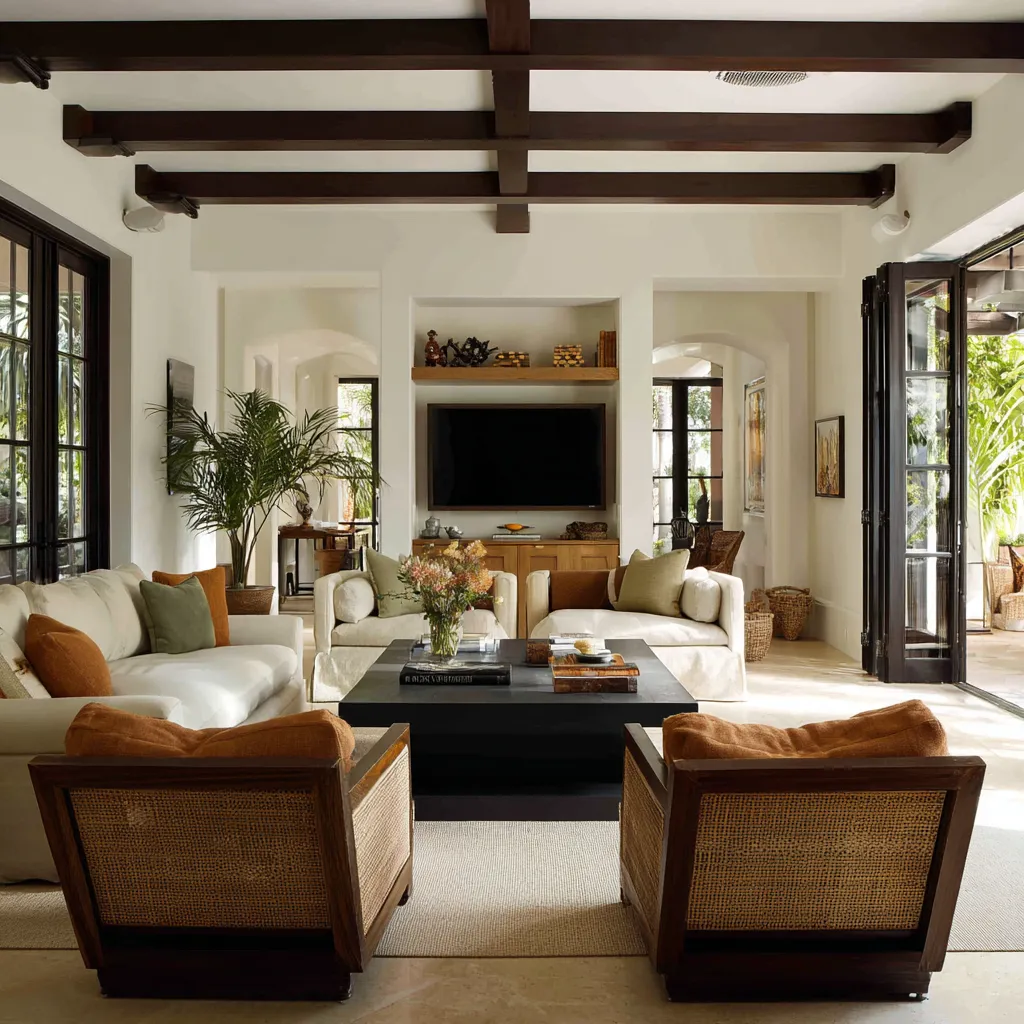
Common mistakes that weaken the style
- The first mistake is relying on tropical signs without enough order. Palms, wicker, and garden views cannot replace room structure.
- The second is letting the opening become too thin. Full-width glass without shutters, framing, or material thickness often weakens identity.
- The third is using only soft upholstered mass. A room of pale sofas without a more structured chair family usually loses colonial tension.
- The fourth is adding too many symbolic objects. This style becomes clearer as accessory pressure drops.
- The fifth is making every element dark. Colonial depth needs air around it.
- The sixth is confusing wicker, cane, and coastal casualness. Woven surfaces help, but the room still needs geometry, anchors, and some furniture with posture.
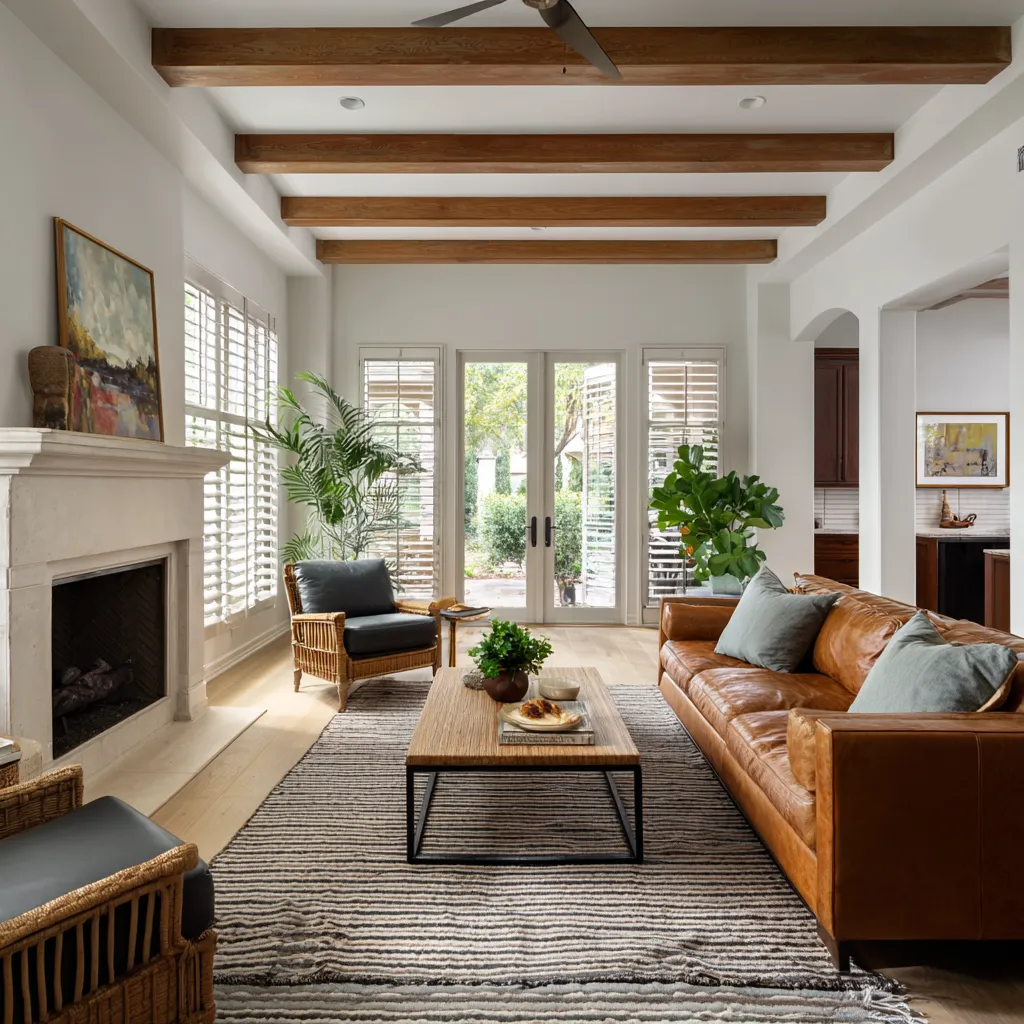
How to bring this style into an ordinary house
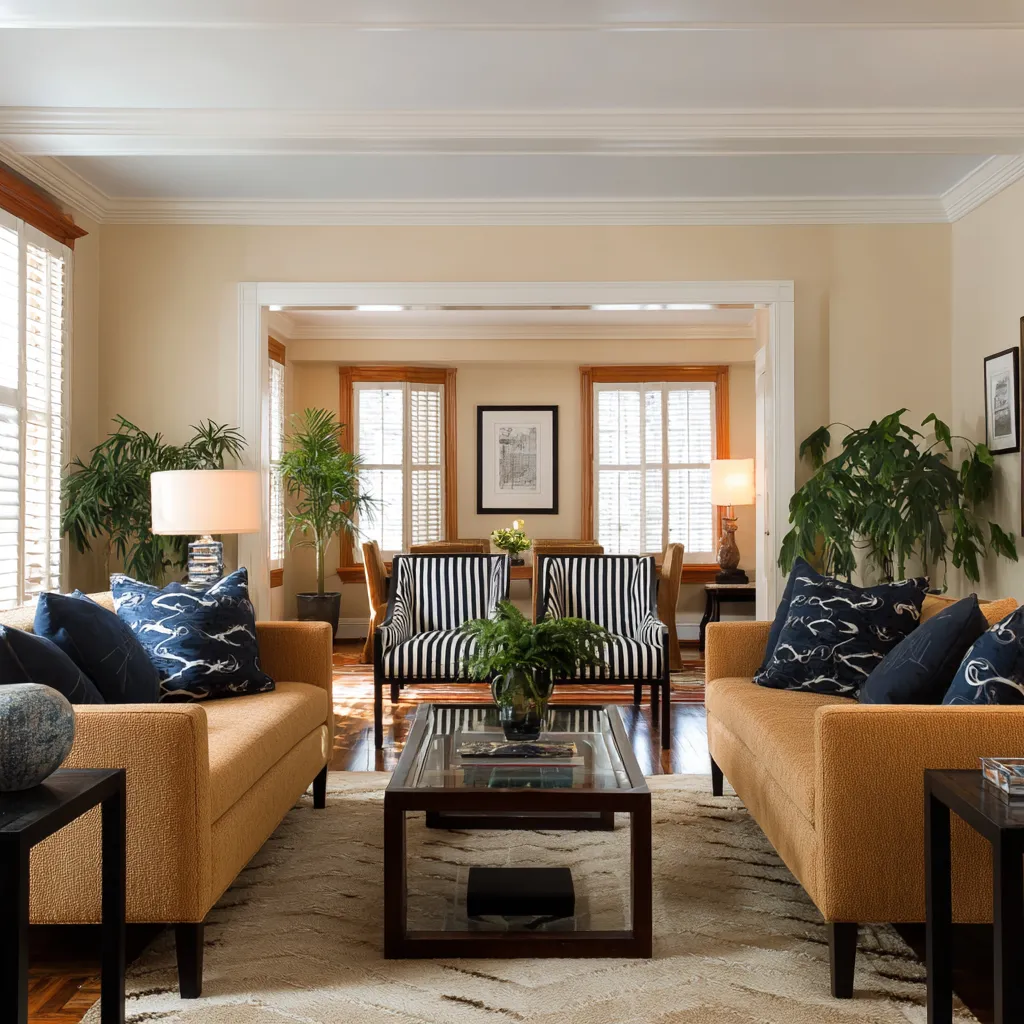
A standard fireplace room can move into this family with plantation shutters, one pale sofa, one pair of cane-backed or open-woven chairs, a dark or mineral coffee table, and one timber ceiling or trim move. Keep the mantel sparse.
An open family room with patio doors can move into this family with a beam or coffer ceiling, a strong center table, woven foreground seating, and an opening that feels framed rather than erased. Keep planting near the edge conditions, not everywhere.
A more enclosed room with ordinary windows can move into this family through shutters, layered shades, one leather or dark wood anchor piece, a pale masonry or plaster focal wall, and a chair family that carries visible timber and permeability. The room does not need to imitate a colonial house literally.
It needs to preserve the structural logic that makes the style legible.
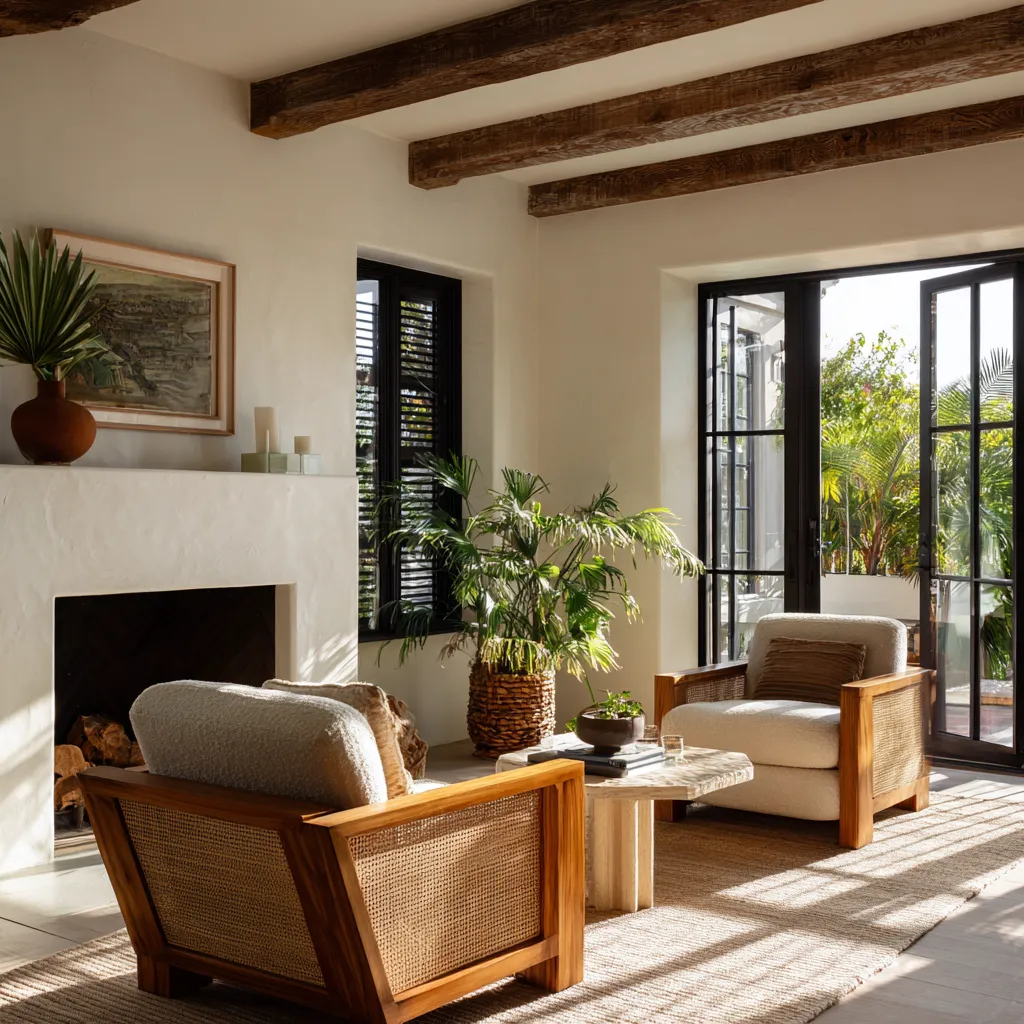
Conclusion
Modern tropical British colonial interior design holds together through a disciplined conversation between climate and structure. Its designs do not depend on nostalgia, theme, or decorative overload.
They depend on ordered geometry, thickened thresholds, permeable seating, a measured amount of dark weight, and a restrained field of objects. That is why the style can still work in houses with televisions, family sofas, open kitchens, and patio doors.
Its identity lives in the way the room organizes tropical conditions rather than in how many colonial references it displays.
The modern room in this style should feel airy, grounded, and edited. It should offer shelter without heaviness, softness without vagueness, and warmth without clutter.
When those balances are in place, tropical British colonial design and decorating ideas become usable for modern homes while keeping a clear sense of lineage.