Modern dark moody maximalist bedroom design has a very particular tension at its center. It wants depth, atmosphere, shadow, softness, memory, and richness, yet it also wants clarity, restraint, and a certain architectural firmness that keeps the room from slipping into visual heaviness.
That balance is what separates a current dark maximalist bedroom from an older decorative one. The difference does not come from using less feeling or less richness.
It comes from changing where that richness lives, how it is distributed, and which elements are asked to carry the visual weight.
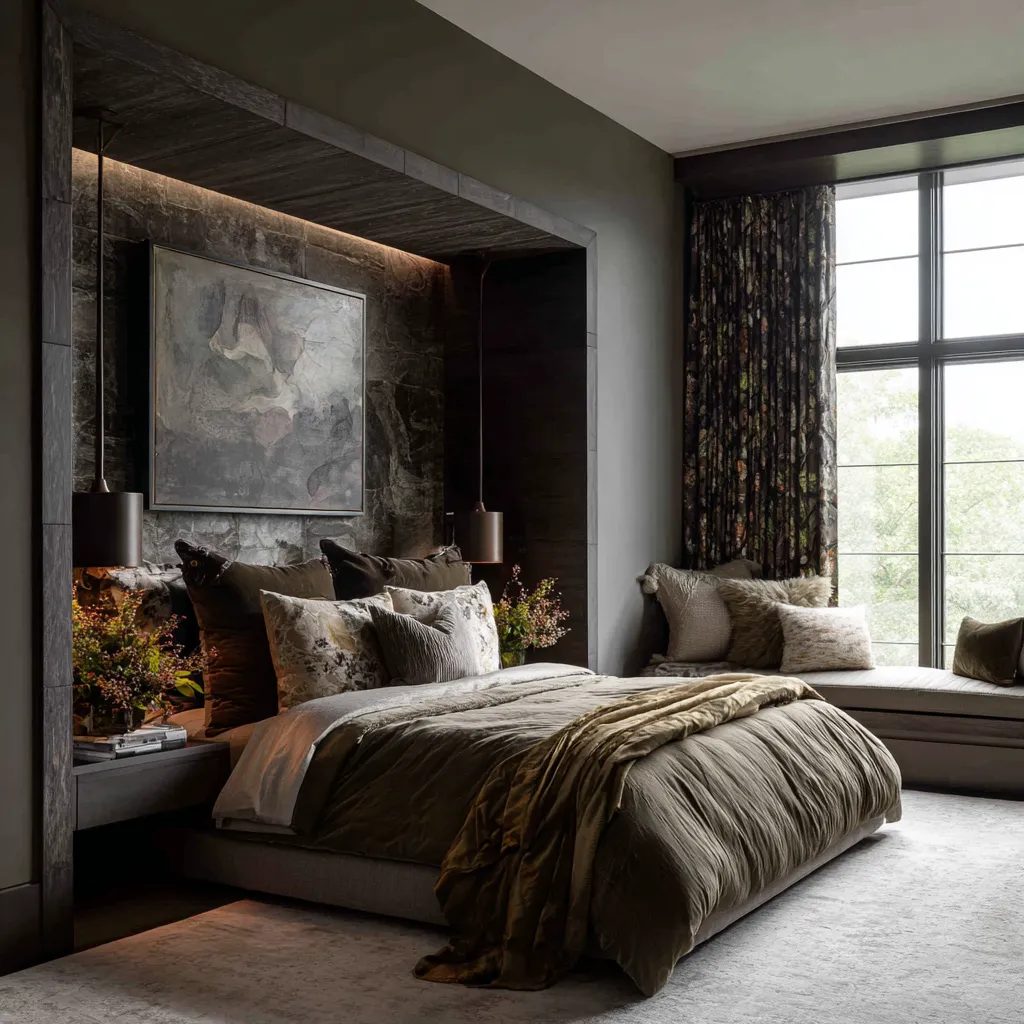
Bedroom design ideas in this style do not build intensity through many scattered objects. They do it through a few large moves: a dark enveloping shell, a pale bed with enough visual mass to stabilize the room, one major feature wall or niche, a carefully placed second seating zone, and a material palette that creates density without forcing the eye to process too many competing details at once.
The room feels full, but not crowded. It feels layered, but not noisy.
It feels dramatic, but still settled enough to sleep in. That is one of the key ideas behind the style.
A dark moody maximalist bedroom design works when it treats abundance as something concentrated and framed rather than scattered everywhere.

The modern version of maximalism is built in large fields
One of the ways this style changes in a current bedroom is scale. In older decorative interiors, richness often came from repeated medium-scale gestures: patterned drapery, patterned bedding, carved furniture, detailed lamps, framed art groupings, decorative trim, accent accessories, and ornamental finishing layered together.
A modern dark maximalist bedroom ideas usually shifts that richness upward in scale. Instead of many medium statements, it relies on one or two large ones.
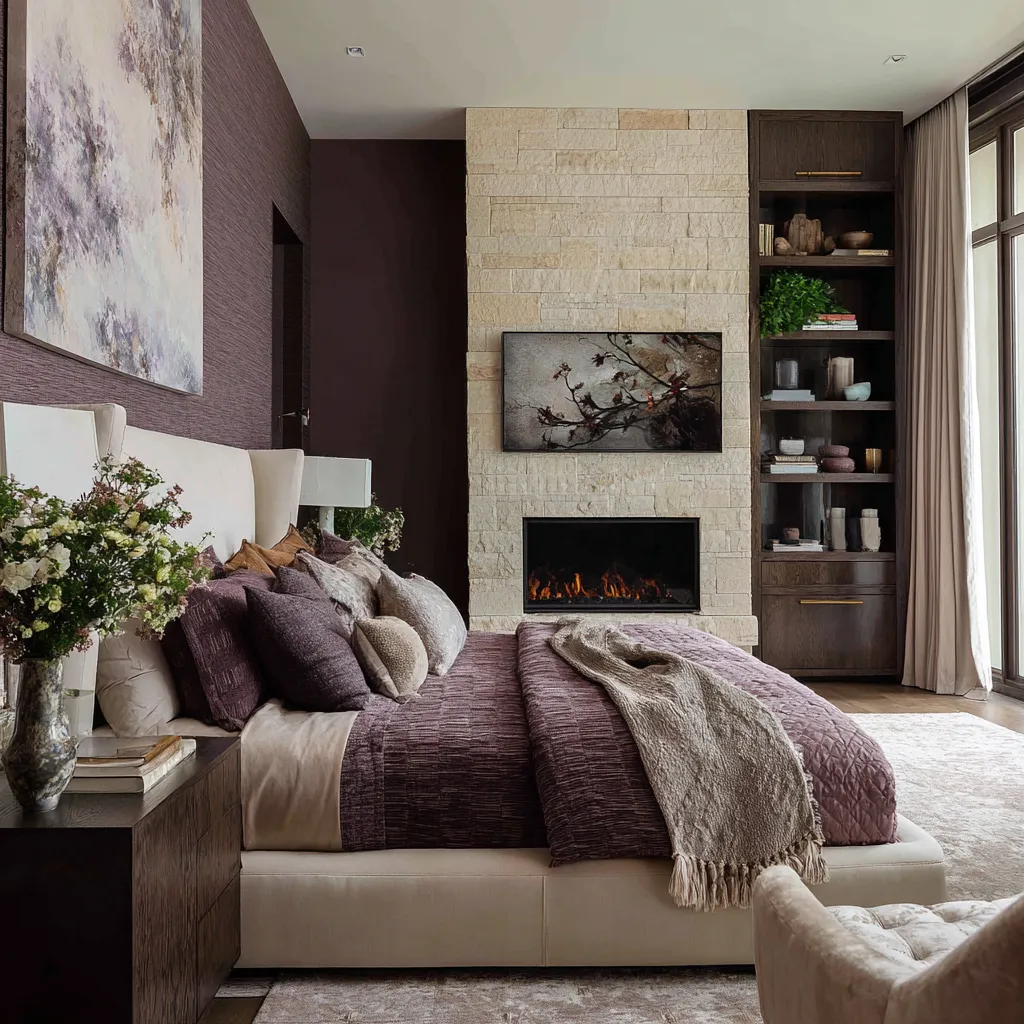
That large move might be a scenic mural wall, a recessed paneled niche behind the bed, a library-like wall of dark cabinetry, a broad mineral plaster field, a fireplace wall with integrated shelving, or a dramatic ceiling treatment. The important point is that the design gets its atmosphere from a few major surfaces with strong presence.
This creates a moody bedroom that feels composed in broad strokes. The eye can understand the room quickly, then settle into texture, depth, and tonal variation.
This is why the style often feels rich without looking cluttered. The fullness comes from wall-scale gestures and integrated architecture instead of from multiplying smaller items.
In practical design terms, that means the room often benefits from choosing one main dramatic zone and letting the rest of the interior support it.
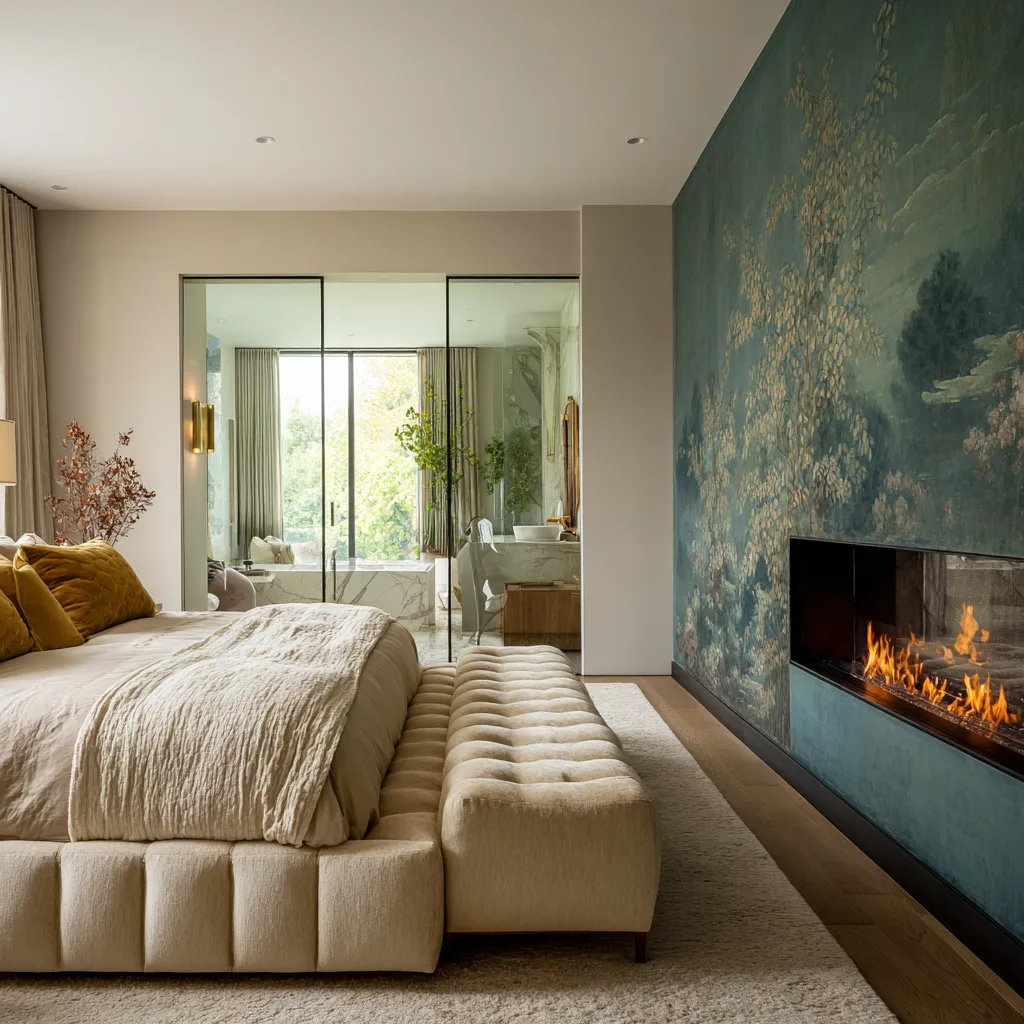
A mural wall behind the bed can carry a great deal of the room’s emotional charge. A dark niche lined in wood, metallic panels, or textured walling can do the same.
A blackened shelving wall can turn storage into the visual backbone of the room. Once one of those large moves is established, the bed, bench, rug, and window treatment can become calmer.
That calm is not emptiness. It is what lets the large gesture feel intentional rather than excessive.

Darkness alone does not make the room current
Dark paint, dark wood, plum-brown walls, blackened teal, olive-charcoal, smoky blue-green, aubergine, and deep midnight blues all contribute to the moody side of the look. But color alone does not make the room feel modern.
A dark room can still feel heavy, nostalgic, or overworked if it lacks the right kind of structure. What gives the current version of this style its character is not darkness by itself, but the way darkness is organized.
Dark maximalist bedroom interior design concepts do three things with it.

First, they let darkness behave like a continuous envelope. The wall color or wall finish often wraps large parts of the room with conviction instead of appearing in small patches.
This makes the room feel immersive. A deep alcove looks carved from one shadowy material body.
A bed wall framed by dark side panels feels deliberate rather than casually painted. A window recess finished in the same dark tone becomes part of the architecture rather than a separate visual event.

Second, they balance that dark shell with a major pale counterweight. Without that counterweight, the room loses legibility.
It becomes too compressed, especially at night. The bed is often the main pale mass.
Cream upholstery, warm parchment bedding, pale stone, soft mushroom textiles, an off-white rug, light drapery, or a pale bench create relief inside the darker field. This alternation between pressure and release is what keeps the room from becoming visually exhausting.
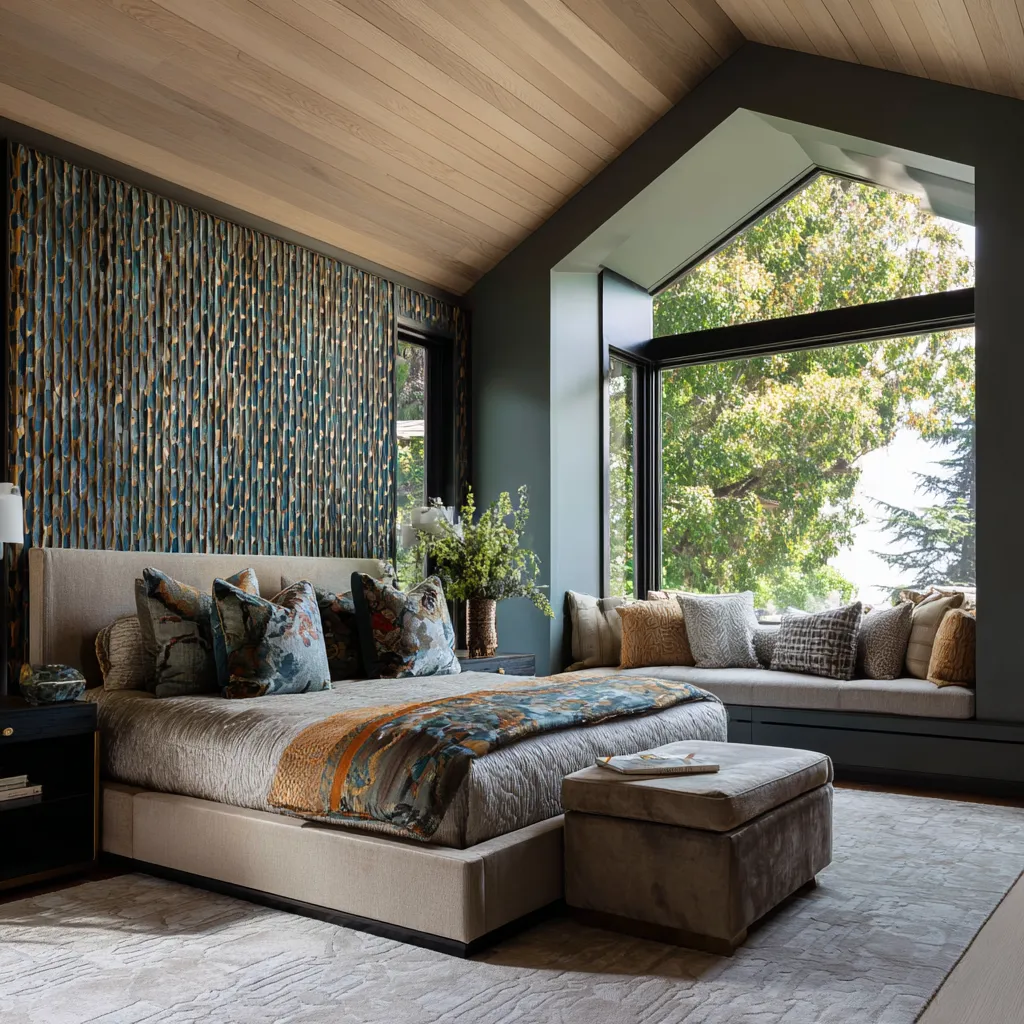
Third, they keep the forms broad and reduced. Dark maximalism becomes current when the silhouettes remain clean.
Beds are low and thick rather than ornate. Benches are block-like rather than leggy and decorative.
Side tables are simple volumes. Pendants are slender.
Storage walls are large and continuous. The richness sits in the atmosphere, the surface, the layering, and the massing, while the furniture lines stay controlled.
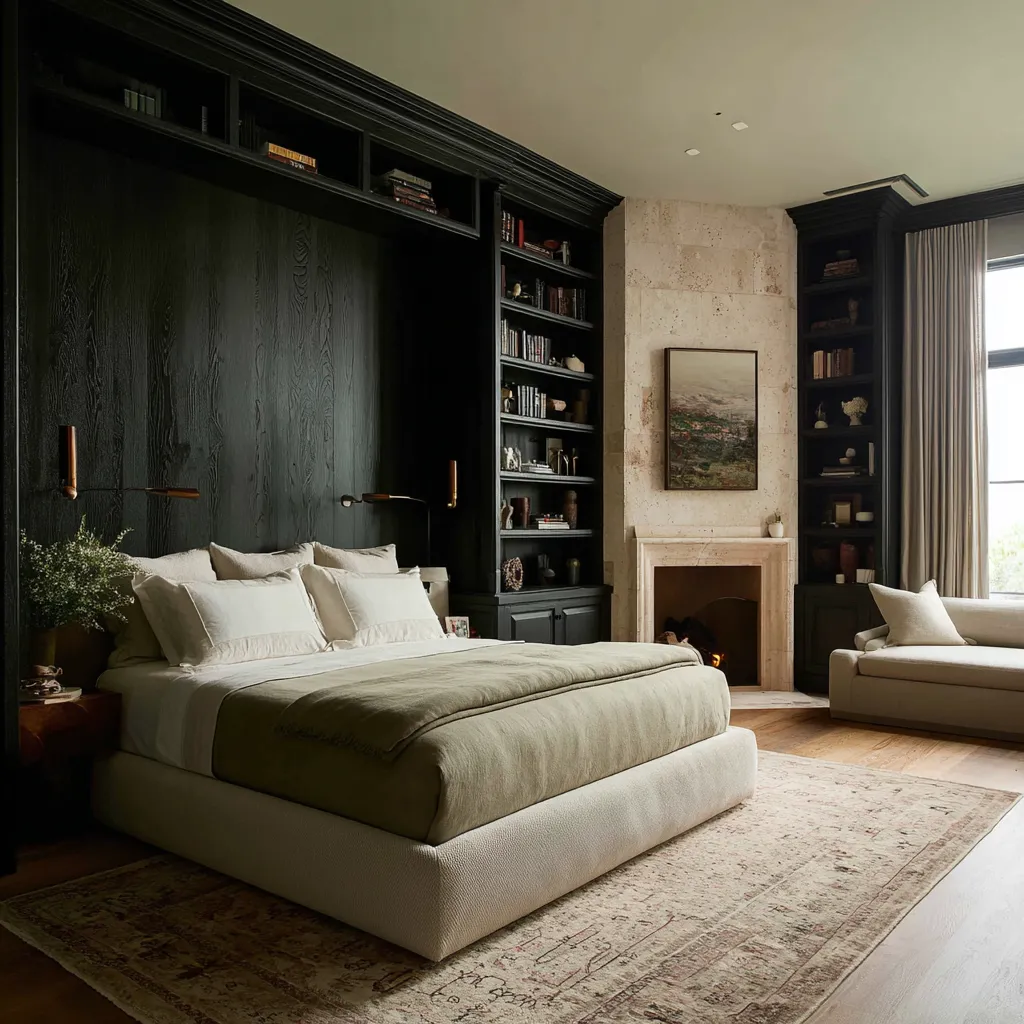
Pale relief is not optional
A common mistake in dark bedrooms is assuming that full commitment means carrying darkness edge to edge. In practice, the room usually improves when it includes a clear body of pale material.
That pale material is not a weak compromise. It is part of the structure of the room.
In a dark moody maximalist bedroom, pale relief does several jobs at once. It catches light, clarifies the silhouette of the bed, prevents the lower half of the room from collapsing into one tone, and gives the eye a place to rest between heavier surfaces.
This is why cream upholstered beds appear so often in successful rooms of this kind. The bed becomes the main stabilizer.
It sits against a mural, niche, or dark paneled wall and acts almost like a light architectural volume inserted into a denser shell.

A pale rug can play a similar role. Where the walls, drapery, and bedding are all rich and shadowy, the floor often needs to open up.
A washed rug in stone, oat, faded beige, or pale taupe can soften the dark perimeter and help benches, beds, and loungers feel grounded. Light drapery also matters.
Full curtains in warm neutral tones can soften a window opening and keep the jump from deep wall color to bright daylight from feeling too abrupt. This is one of the design rules in the style: the room needs dark atmosphere, but it also needs a body of lift.
Without that lift, the mood becomes pressure without relief.

The bed should stabilize the room, not compete with everything around it
One of the distinctions in a current dark maximalist bedroom is that the bed is rarely the most decorative object in the room. It is often the calmest large element.
That shift has major consequences for the overall look. If the room already has a mural wall, a strong niche, deep cabinetry, a fireplace, or a dramatic ceiling, then a highly decorated headboard, heavy trim, or busy bedding can push the composition too far.
The designs usually let the bed act as a soft, pale foreground mass. Upholstery is thick and tactile, but the silhouette stays clean.
Bedding is layered, but the palette remains compressed. There may be depth in the pillows, but the depth comes from tonal variation and fabric character rather than from aggressive pattern contrast.

This approach gives the room a quiet center. The wall can carry atmosphere.
The bed can carry softness. The two do not fight for the same kind of attention.
That does not mean the bed should disappear. It still needs presence.
Scale matters. A low, wide, upholstered frame with enough volume can stand up to dark walls better than a visually thin or highly articulated bed.
A broad bench at the foot of the bed can extend that mass outward, giving the composition another light horizontal band and helping the room read in deeper layers.

Fullness comes from depth planes, not from object count
Many dark maximalist bedrooms feel dense and complete even though they are not crowded with accessories. The reason is that their richness comes from layered planes.
A room feels deeper when the wall treatment does not stop at the paint layer. A mural may sit inside dark framing panels.
Art may hang over the mural. The bed may project in front of that wall.
A bench may sit in front of the bed. A rug may spread under the bench.
Drapery may hang in front of deep window glazing. A window seat may occupy the recess beneath that glazing.
Shelving may flank a fireplace. Mirror or smoked glass may sit inside an alcove rather than on a freestanding wardrobe.

This sequencing matters because it creates a sense of occupation. The room feels inhabited by multiple layers of matter and use.
Even when the palette is narrow and the object count is restrained, the space feels complete because the eye can move through one depth band after another. That is also why integrated architecture is so important in this style.
Alcoves, niches, built-in seating, framed mural panels, canopy-like wall-and-ceiling fields, storage walls, and fireplace masses all thicken the room. They make the bedroom feel less like a box filled with furniture and more like a shaped interior with inner chambers and softened edges.
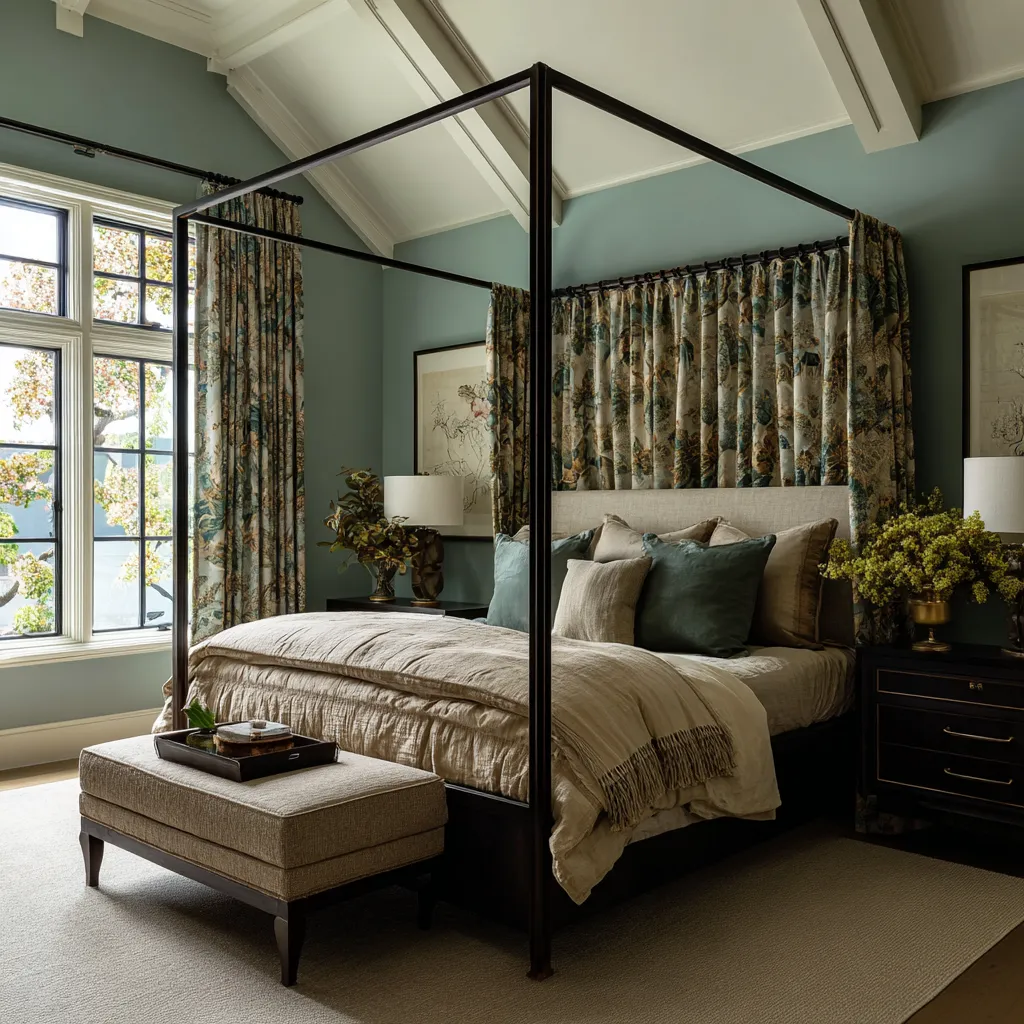
A second zone changes the whole bedroom
A moody maximalist bedroom almost always improves when it includes a second zone beyond the bed itself. That second zone may be a bay-window bench, a banquette, a chaise by the glazing, a fireplace corner, a daybed bench, a lounge chair, or even a run of integrated shelving and seating that turns part of the wall into a place to sit and pause.
This matters for several reasons. It makes the bedroom feel fuller in a spatial sense, not only in a decorative sense.
The room becomes a place to read, sit, look outside, or linger, rather than only a place to sleep. It also helps prevent the bed wall from carrying the entire emotional load of the room.
If the only major zone is the bed, then every dramatic move has to happen there. That can make the room feel too centered or too staged.
A second zone distributes the richness more naturally.

Window seating is especially effective. It gives the perimeter a function, softens the hard geometry of glazing, and creates another upholstered band that can echo the bed without copying it exactly.
In a dark room, a pale built-in bench at the window also becomes a strong counterweight to the deeper wall surfaces elsewhere. The daylight side of the room starts to matter as much as the sleeping side, and the whole interior feels more balanced.
This is one of the hidden design signatures of the style. A room often starts to feel genuinely complete once the perimeter begins doing work.
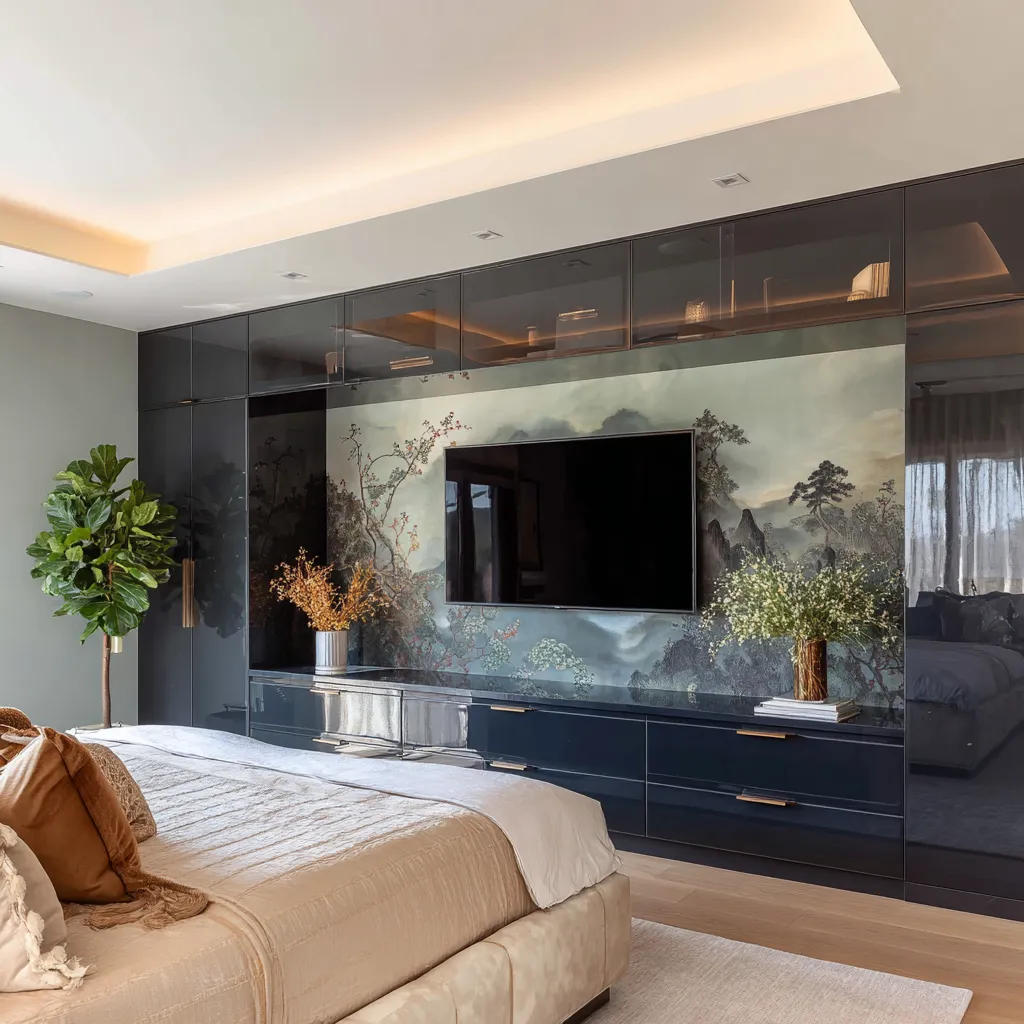
Pattern matters, but too much weakens the edited look
Pattern has a complicated role in a modern dark maximalist bedroom. It is useful because it brings memory, softness, depth, and visual irregularity.
But it can easily overpower the contemporary side of the room if it spreads too far. Such interior design ideas usually keep pattern at a medium level.
That might mean one scenic mural wall, one atmospheric artwork, one floral ceiling field, one patterned niche backing, or one faded antique-style rug, while the rest of the room remains comparatively calm. This balance is important.
Pattern gives the room character, but too many active surfaces at once can weaken the architectural clarity that makes the style feel current.
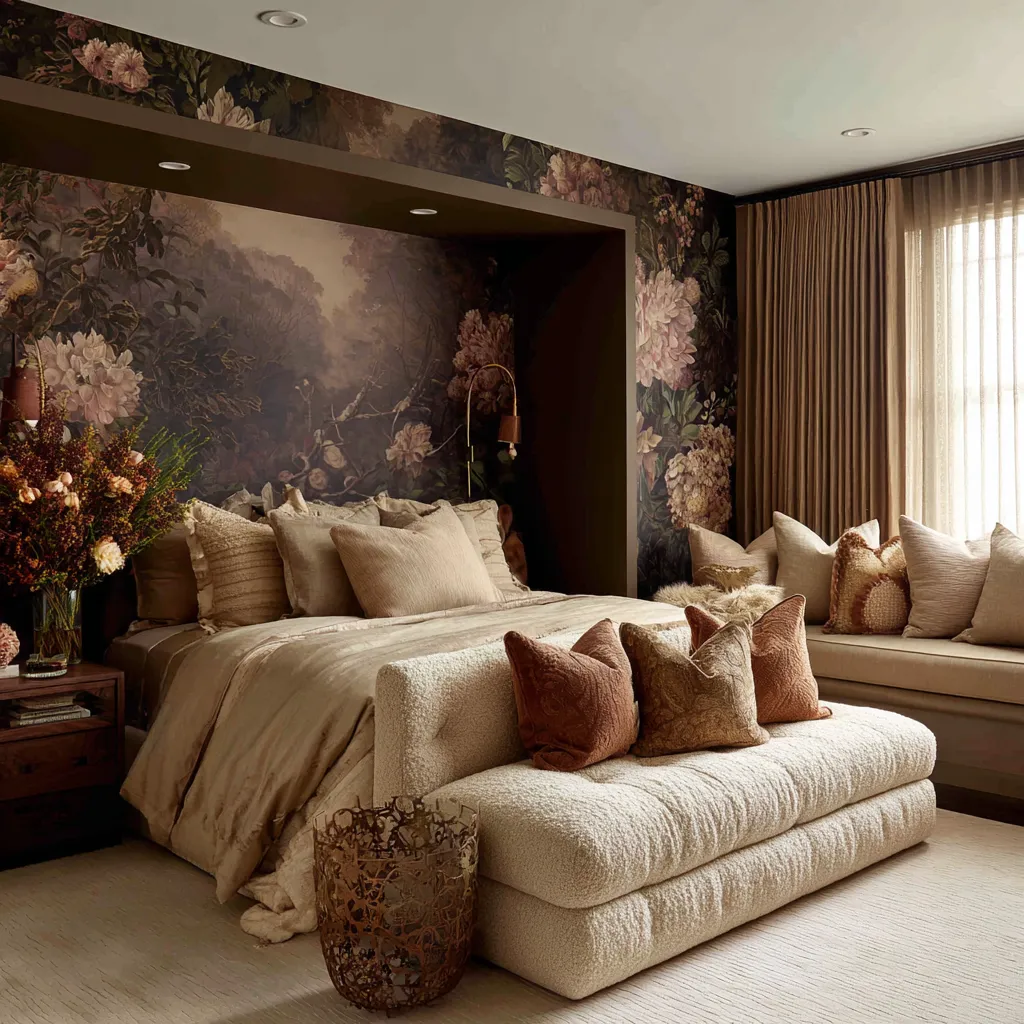
A scenic wall can be highly effective, especially when the imagery is smoky, weathered, and tonal rather than brightly literal. Murals work when they behave like atmosphere.
They should feel absorbed into the room, almost like the wall itself has memory and depth, not like a bright illustrated scene pasted onto a surface. Muted botanical walls, landscape-like fields, mountain tones, dusk florals, and weathered olive scenery all work because they create mood without forcing a sharp graphic narrative.
The key is restraint elsewhere. If the wall carries the scene, the bed can stay quiet.
If the ceiling carries the floral density, the walls can stay calmer. If the rug has age and pattern, the bedding should not fight it.
The room becomes far stronger when one active surface is allowed to breathe.

Green works as undertone, shadow, or atmosphere
In modern dark moody maximalist bedrooms, green rarely appears as a bright foreground statement. It is far more effective when it arrives in a lower, more atmospheric register.
Blackened teal, olive-charcoal, moss-brown, bronzed botanical tones, smoky blue-green, deep forest shadow, and scenic foliage all create a richer result than sharp emerald accents or fresh leafy upholstery. Green in this context works as a carrier of depth.
It sits inside the wall body, inside a mural field, inside a dark textile, inside a painted envelope, or inside the cool undertones of blackened wood and plaster. It can also appear through living plants, but even then it tends to work when the plant feels slightly shadowed against the darker room rather than bright and tropical.
This darker treatment of green is one reason the style feels mature and grounded. The palette stays tied to weathering, mineral depth, dusk, bark, smoke, and foliage under low light.
That gives green a more inward quality. It becomes part of the room’s atmosphere instead of an obvious accent color.

Warm notes should be concentrated, not scattered
Dark moody bedrooms need warmth, but an effective warmth is usually controlled and localized. Rust, ochre, tobacco, amber, bronze, walnut, caramel, and muted gold appear again and again in strong rooms of this kind, yet they rarely spread across every element.
They tend to appear in short concentrated areas. A line of pillows can carry the warm note.
A single chair or chaise can carry it. A brass or bronze pendant can carry it.
A wood ceiling can carry it. A firebox can carry it.
A passage in a painting can carry it. These warm moments keep the room alive without turning the palette into a busy conversation between too many tones at once.
This concentration matters because it gives the room a focal rhythm. A short band of rust pillows against a pale bed in front of a cool dark wall has much greater force than warm accents scattered across many small objects.
The eye registers them as deliberate heat rather than general color noise.
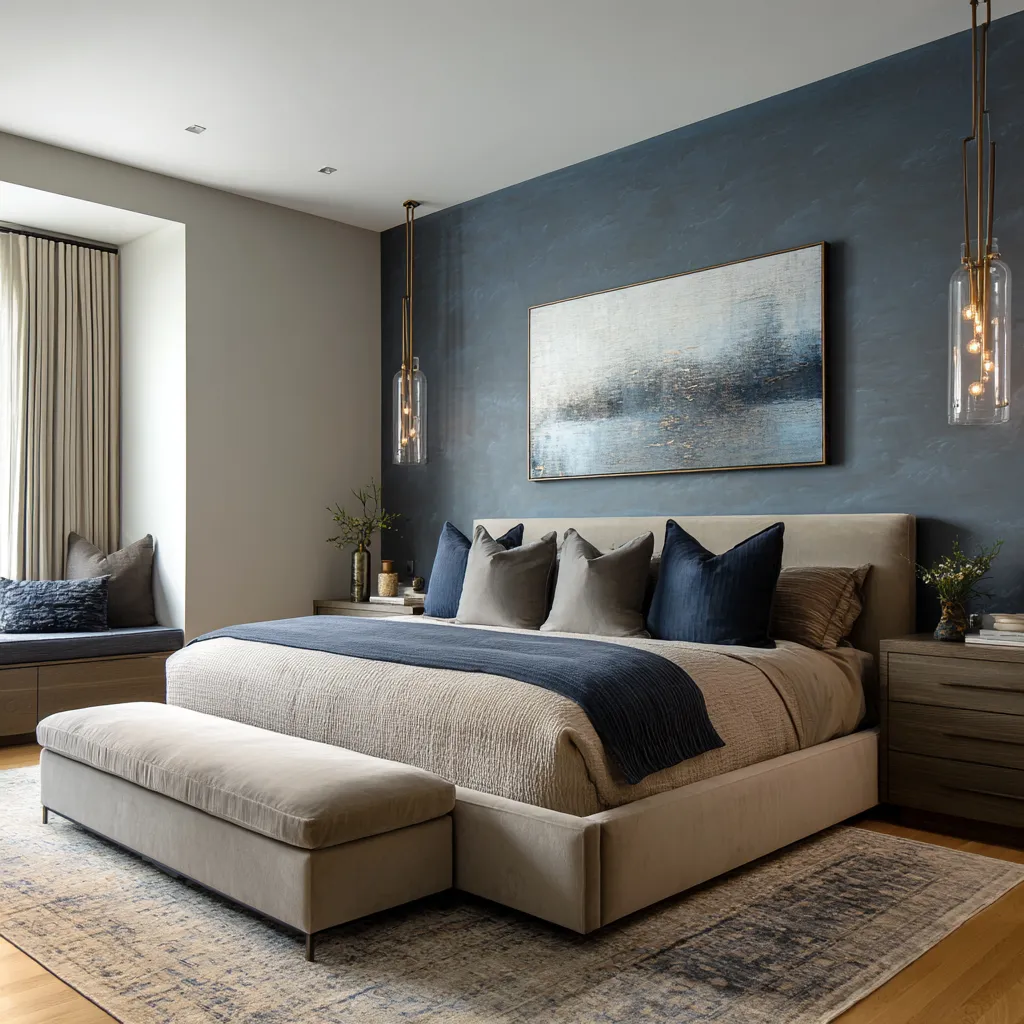
Materials should do much of the work before pattern does
Material layering is one of the foundations of the style. Velvet, bouclé, wool, brushed linen, stained wood, matte plaster, lacquer, stone, smoked glass, aged rugs, metallic panel finishes, leather, and softly reflective surfaces can create enormous richness without requiring much overt pattern.
This is one of the ways to keep the bedroom design deep and current at the same time. Pattern often brings a stronger decorative history with it.
Material can bring weight and tactile interest while remaining more architectural. A textured aubergine wall, a deep olive lacquer cabinet, a pale bouclé bench, a limestone fireplace, a blackened oak bed wall, or a smoked mirror niche can all create density while keeping the room visually controlled.

The interior design begins to feel flat only when the surfaces are too uniform. The answer is not automatically more print.
Often the better answer is greater material contrast. Stone against textile.
Matte wall against reflective cabinet. Plush bedding against cleaner wood geometry.
Heavy drapery against sharp glazing. These contrasts create richness with less risk of visual overload.
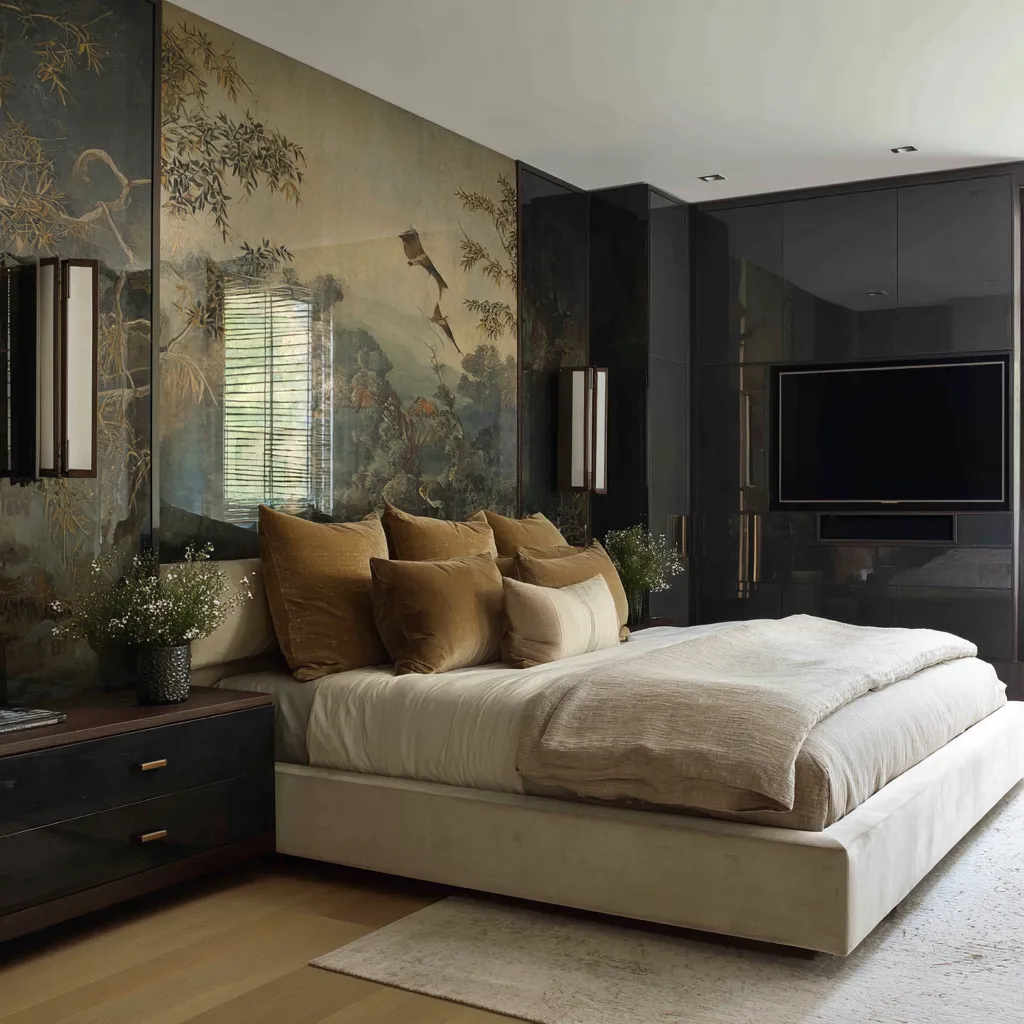
Storage should behave like architecture
One of the ways to modernize a dark maximalist bedroom is to treat storage as part of the room’s built form rather than as an afterthought. Wardrobes, library walls, floating cabinet runs, shelving niches, media walls, and built-in drawers can all become part of the design grammar instead of separate furniture events.
This changes the room in a major way. It makes the bedroom feel more like a suite.
It also allows large surfaces of dark material to appear in a controlled way. A blackened-glass wardrobe wall, a dark lacquer media wall, a paneled library surround, or a deep olive cabinet bed wall can carry a great deal of visual force while still feeling orderly because it belongs to the architecture.

There is another benefit here. Storage walls often create the hard-edged precision that balances softer mural or textile elements.
If a room uses painterly scenery, a smoky floral wall, or faded landscape tones, then glossy cabinet fronts, blackened frames, or glass panels can prevent the room from drifting too far into softness. The result is a more balanced version of maximalism, where atmosphere and sharpness exist in the same interior.

Reflective dark surfaces can sharpen the room quickly
Not every dark maximalist bedroom needs reflection, but reflective dark surfaces are one of the ways to give the room a current edge. Smoked mirrors, blackened glass, lacquer, bronzed reflective panels, and glossy cabinetry bring movement into darkness.
Instead of a dark mass sitting still, the surface begins to hold light, shadow, and faint reflection.

This matters because matte darkness can feel deep and cocooning, but it can also become visually heavy if every surface absorbs light. A small amount of reflectivity gives the room another register.
It keeps the dark surfaces optically active. That often makes the room feel cleaner, sharper, and more urban.
This is useful in bedrooms that use murals or soft scenic walls. Reflection can bring in a note of precision.
A mural behind a bed becomes more current when paired with smoked pendants, glossy cabinetry, or a mirror-lined recess. The soft wall still carries atmosphere, but the room also gains harder edges and a more controlled finish language.

Lighting should clarify the architecture
Lighting in this style works when it supports the room’s larger composition rather than multiplying decorative objects. Slim pendants, concealed washes, integrated shelf lighting, wall-mounted reading lights, and lean metal sconces are especially effective because they sharpen the architecture and add warmth without creating too much bulk.
A concealed light above a bed niche can reveal depth. A narrow pendant can add a vertical marker beside the bed while keeping the nightstand surface clear.
Amber-lit shelving can animate a fireplace wall. A dark room often benefits from lighting that traces structure rather than competing with it.
This is a way to keep the bedroom looking current. Heavy table lamps, ornate bases, and too many visible fixtures can easily make a dark maximalist room feel overfurnished.
Lighting that is lean, integrated, or hanging tends to work better because it lets the wall fields, upholstery masses, and built elements remain dominant.

Ceiling treatment is an advanced move with a strong payoff
A dark or patterned ceiling is not required, but when handled well it can change the whole room. A ceiling field can give the bedroom a canopy effect, concentrate drama overhead, and allow the walls to stay slightly calmer.
This is especially effective in bedrooms where the furniture silhouettes are very reduced and the bed remains pale.

A tray ceiling in a dark tone can focus the room and deepen the upper volume. A floral field inside a recessed ceiling can create decorative richness while leaving the bed wall simpler.
A glossy bronze-black recess can add atmospheric depth without relying on much visible ornament below. The important condition is balance.
If the ceiling becomes active, the room needs enough pale mass at bed and floor level to absorb that pressure. This technique works because it changes where the drama sits.
Instead of putting every expressive move on the walls, it shifts part of the visual load upward. That can make the room feel more immersive without making it busier.
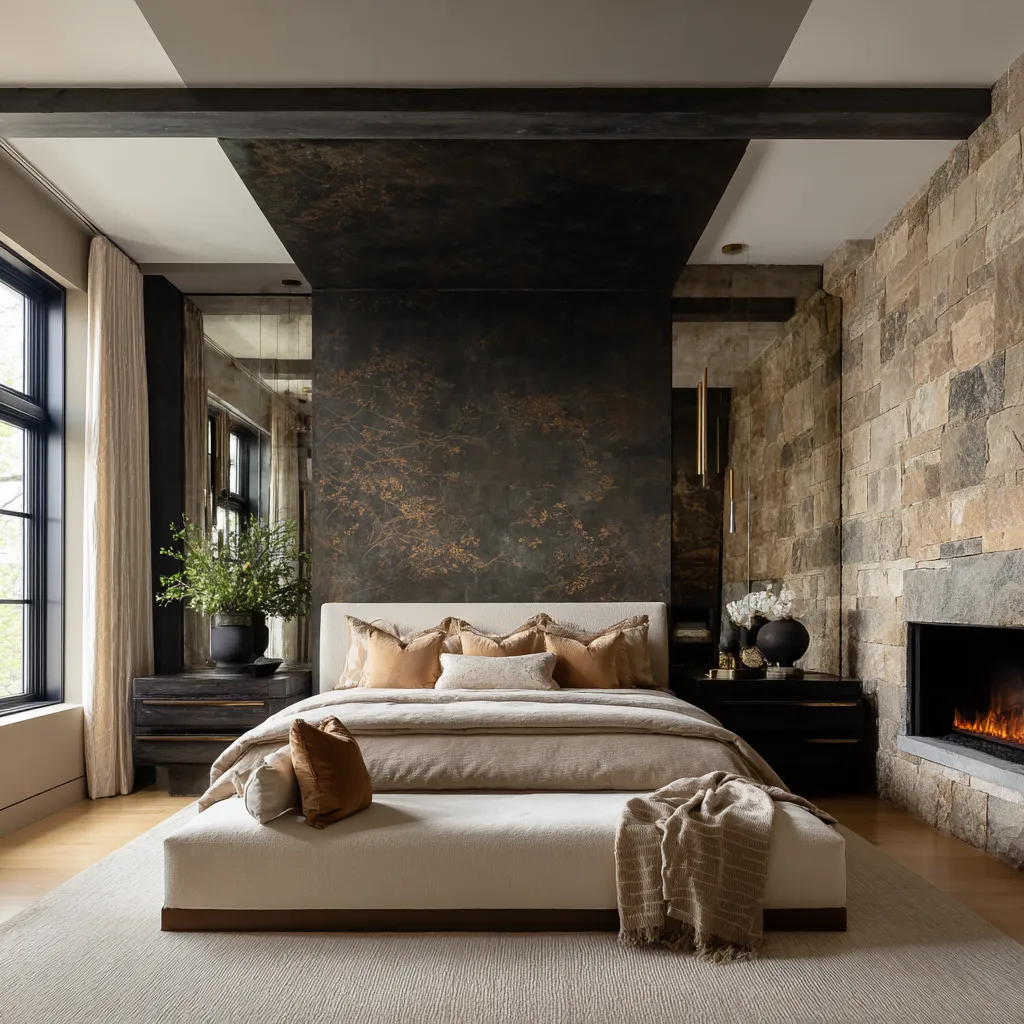
Two valid branches of the style
Modern dark moody maximalist bedrooms tend to fall into two strong branches.
- The first is the matte atmospheric branch. This version leans on plaster, stone, textured walling, velvets, aged rugs, deep wood, scenic walls, and soft daylight filtering through full drapery. It feels slower, heavier, more cocooned, and often slightly more romantic. Its richness comes from absorption, softness, and layered matter.
- The second is the sharpened atmospheric branch. This version adds lacquer, smoked mirror, black glass, metallic paneling, lean pendants, concealed lighting, and more visibly precise architectural framing. It still carries mood and density, but it feels cleaner, cooler, and more sharply composed.
Both branches work well. The choice depends on how the room should feel.
A softer branch suits bedrooms that want wrapped comfort, warmer tactile depth, and gentler transitions. A sharper branch suits bedrooms that want a more polished, metropolitan edge.
Many of moody maximalist bedroom design ideas sit between the two, using matte softness as the base and a few reflective or blackened precise elements to keep the atmosphere from becoming too diffuse.
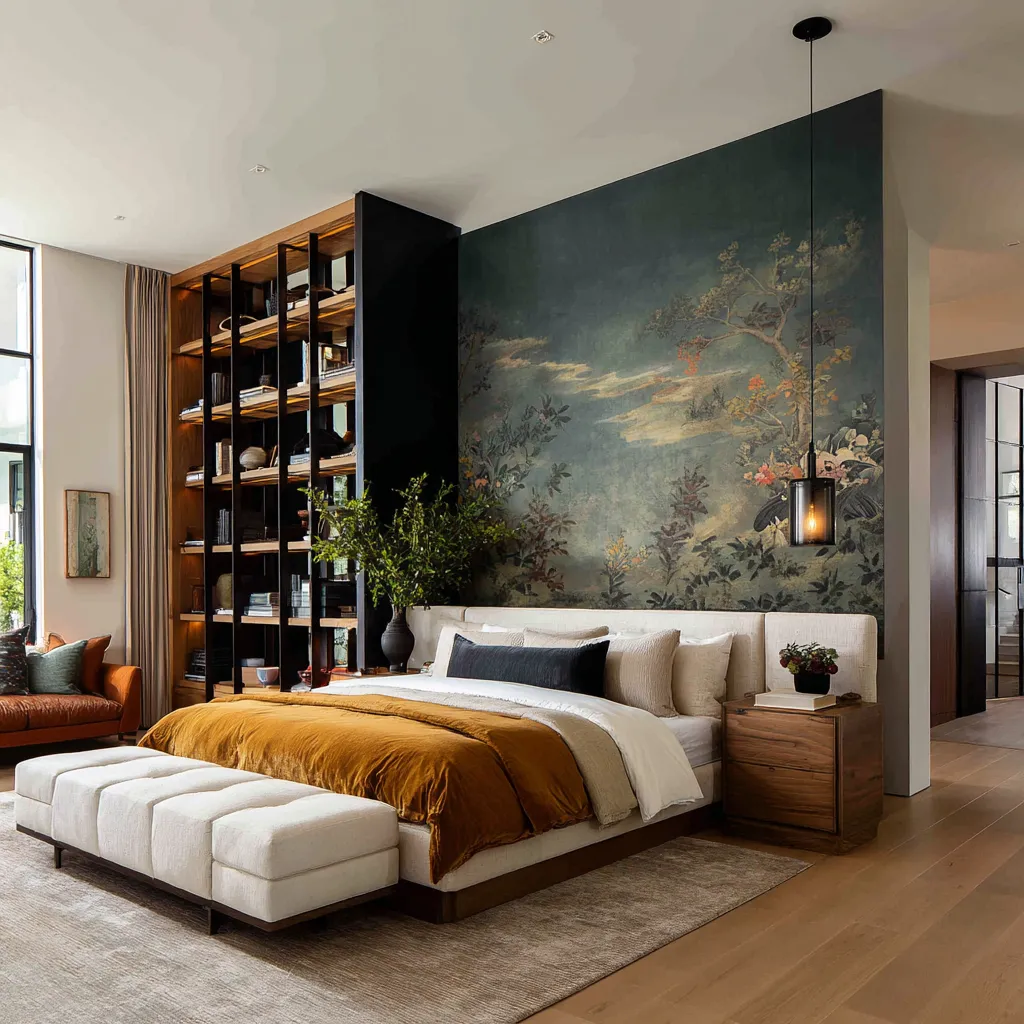
What weakens the look
There are a few moves that commonly disturb the balance of this style.
- Too many active surfaces at once is one of the biggest problems. A strong scenic wall, a high-pattern rug, busy bedding, ornate drapery, and a dramatic ceiling together can quickly overload the room. The style improves when one or two of those areas carry the drama and the others stay calmer.
- Dark-on-dark without relief is another common issue. If the walls, bed, rug, drapery, and storage all sit inside similar dark values, the room loses legibility. The eye has nowhere to pause, and the room starts to feel compressed rather than layered.
- Overly decorative furniture silhouettes can also pull the bedroom away from a current look. Carved details, fussy trim, over-articulated headboards, or leggy decorative pieces tend to fight the broad-field logic that makes the interior design concept successful. This style wants mass, softness, and depth, but it wants them carried by reduced forms.
- Bright foreground green can also weaken the atmosphere. In this palette, green tends to work better as smoke, shadow, undertone, scenic depth, or blackened teal than as vivid accent upholstery.
- Finally, small-object clutter usually works against the style. The room gains strength when the larger fields do the heavy work.
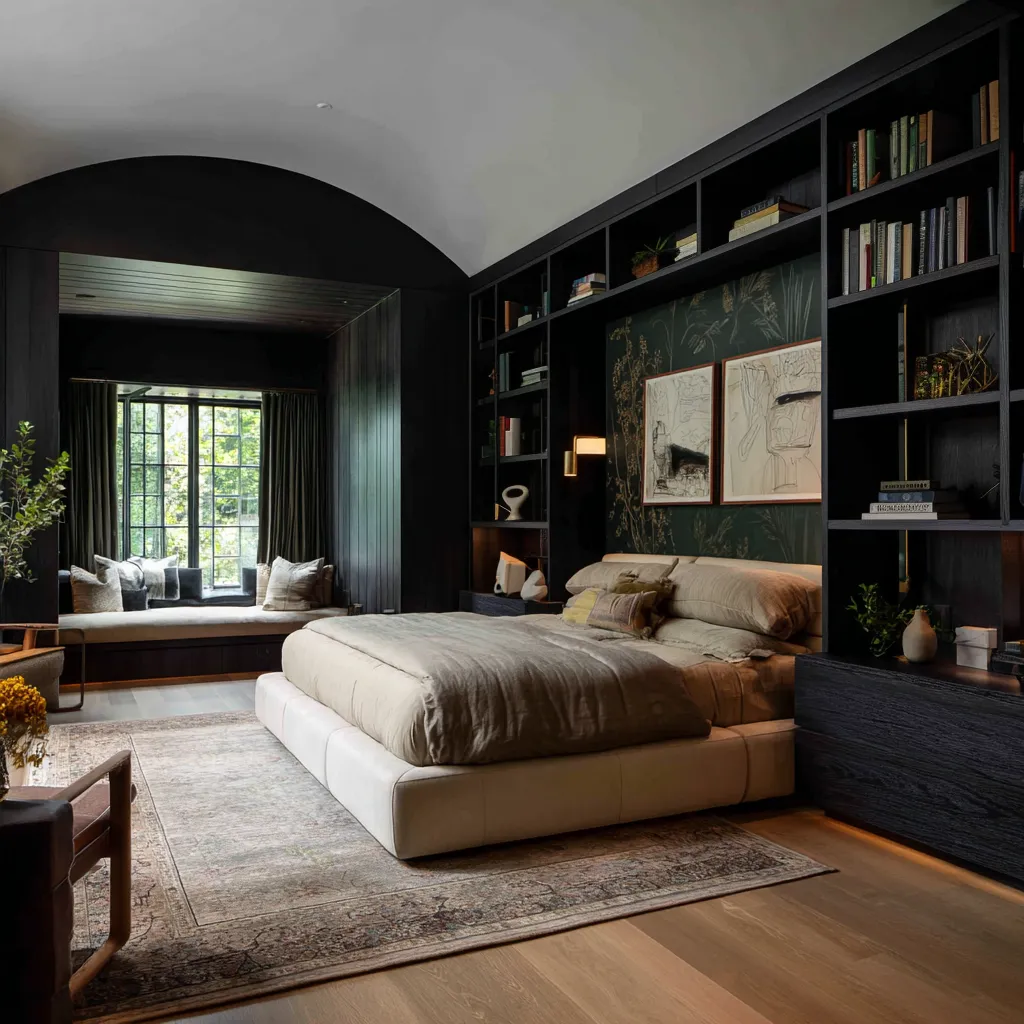
How to make the style feel current
If the goal is a dark moody maximalist bedroom with a present-day character, the route is this: build a dark atmospheric shell, place a pale bed within it as the main stabilizing mass, concentrate richness into one or two large zones, include a second seating or pause area, and keep the furniture language broad and controlled. Then let material contrast, carefully compressed color, and a few warm notes carry the depth.

That formula can take many forms. It can become a mural-backed bed wall with a pale bouclé bench and slim pendants.
It can become a blackened library wall with a cream bed and a window seat at the far end. It can become a smoky blue-green room with a broad abstract painting, rust pillows, and a built-in bay bench.
It can become an aubergine niche with pale stone, dark drapery, and a fireplace wall. It can become a lacquered media wall with an inset landscape panel opposite a simple upholstered bed.
The exact expression may vary, but the inner structure remains consistent. The room succeeds when richness is framed, relief is preserved, and the architecture is asked to do real work.
Closing thought
A modern dark moody maximalist bedroom design is attractive not because it packs the room with everything possible, but because it places density where it matters most. It creates atmosphere through large dark fields, steadies that atmosphere with pale mass, and deepens the experience through secondary zones, material layering, and integrated built form.
It knows when to let one wall speak loudly and when to let the bed stay quiet. It understands that drama needs somewhere to land.
That is why bedroom design ideas in this style feel rich without feeling chaotic, soft without feeling weak, and current without losing the emotional weight that makes dark interiors so compelling.