A Georgian bathroom has a very particular kind of beauty. Its strength does not begin with a tub, a vanity, or a decorative finish.
It begins with proportion. The sash window, the casing depth, the cornice line, the panel rhythm, the stillness of the wall planes, and the clear sense of order all create a room that already has presence before any fixture is added.
That is why modernizing a Georgian bathroom asks for a different mindset than designing a bathroom in a blank new-build shell. The room already has a backbone.
The goal is not to replace it. The goal is to decide what kind of new layer should live inside it.
That is where many Georgian bathrooms go wrong. They assume that a centered tub under a tall window is enough, or that expensive marble alone will create the right result, or that strong black contrast will make the room feel updated.
None of those moves can carry the whole room on their own. The more persuasive rooms keep the architectural shell legible, then choose one clear modern language to place inside it.
Sometimes that language is mineral and architectural, with stone, built-in mass, and low contrast. Sometimes it is softer and more domestic, with textiles, rounded forms, and warm wood.
The important thing is not to mix both directions so heavily that the room loses clarity.
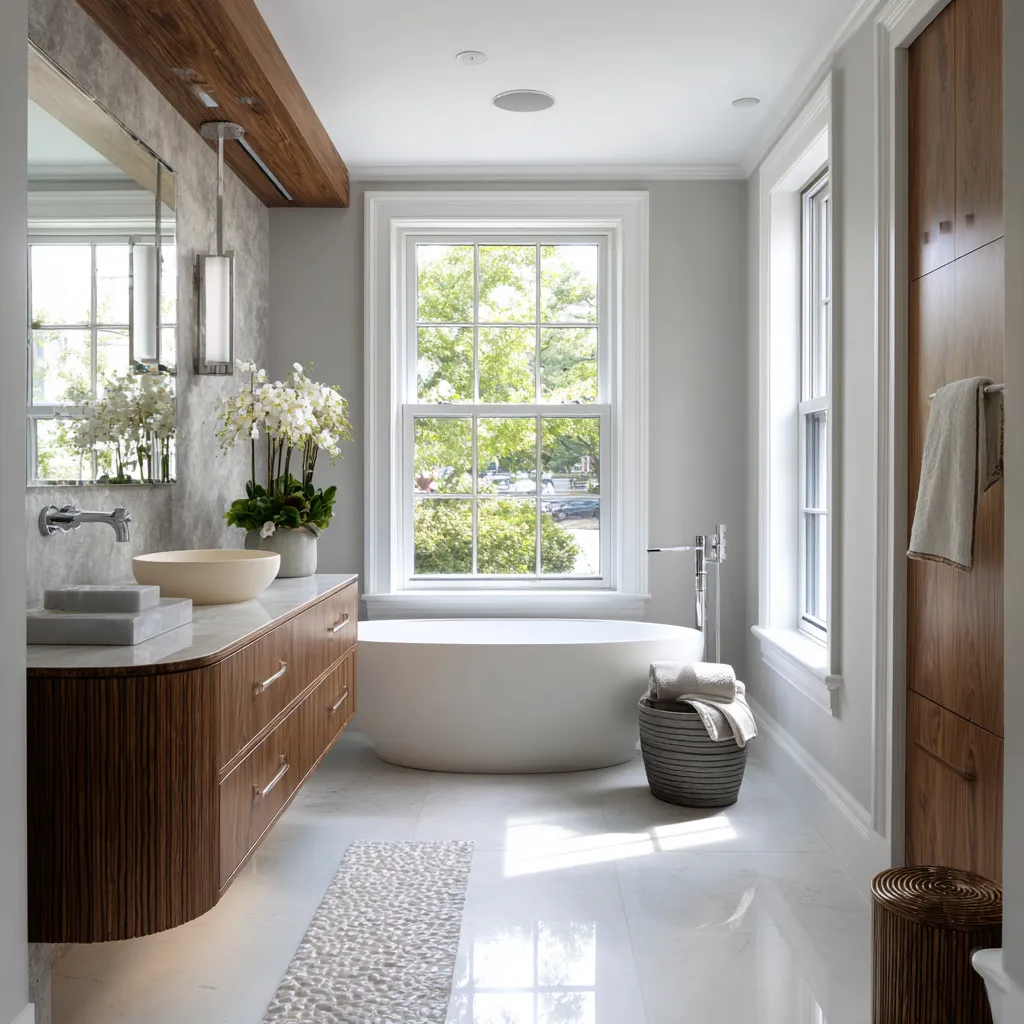
The Georgian shell should stay visible
The first modern idea is also the simplest one: do not overwork the envelope. A Georgian bathroom rarely needs constant surface activity.
If the room already has a deep window casing, broad skirting, cornice, and well-proportioned paneling, then the shell has already done much of the design work. New insertions should sit inside that framework, not bury it.
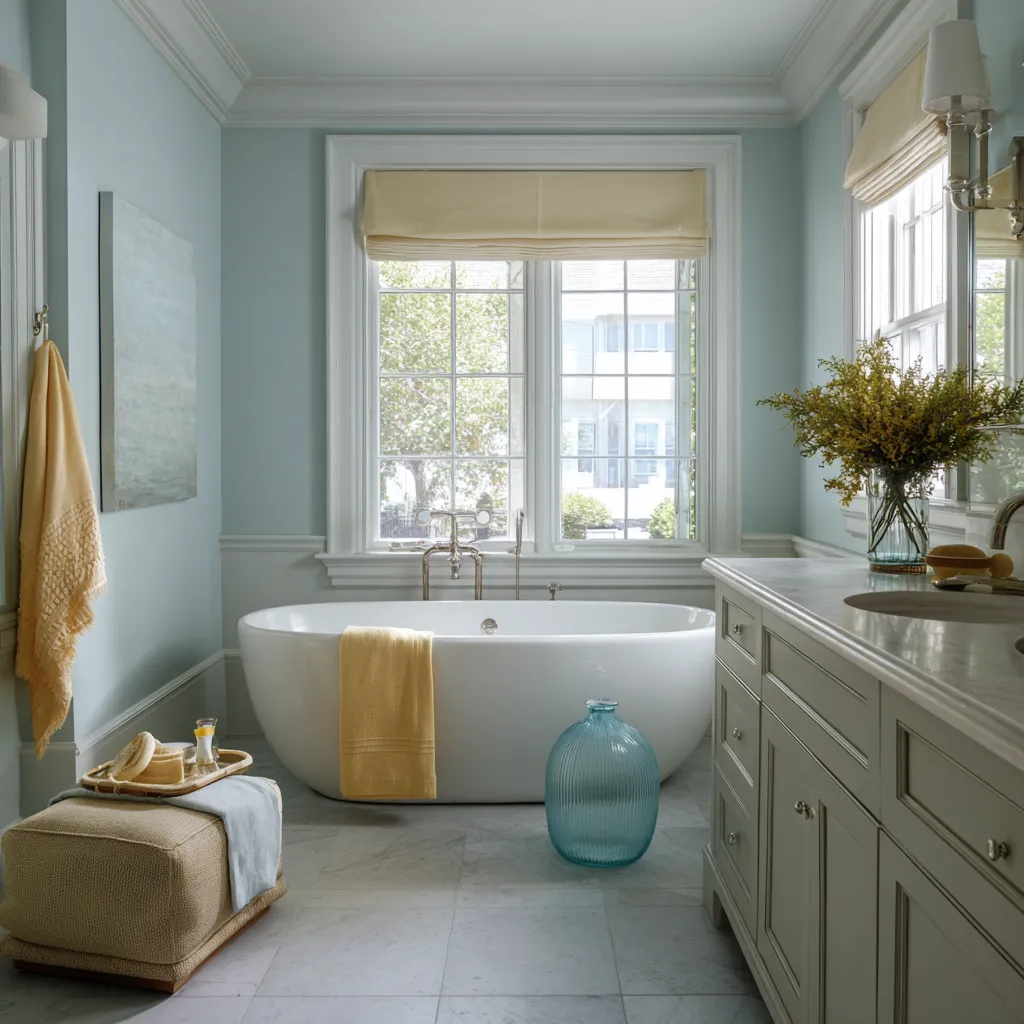
Georgian bathrooms should feel edited rather than crowded. The wall surfaces remain readable.
The casing still looks thick and important. The window is allowed to keep authority.
The room does not try to prove its quality by filling every area with feature material, trim, art, or hardware. Instead, it lets the architecture stay as the main frame and asks the fixtures to respond to that frame.
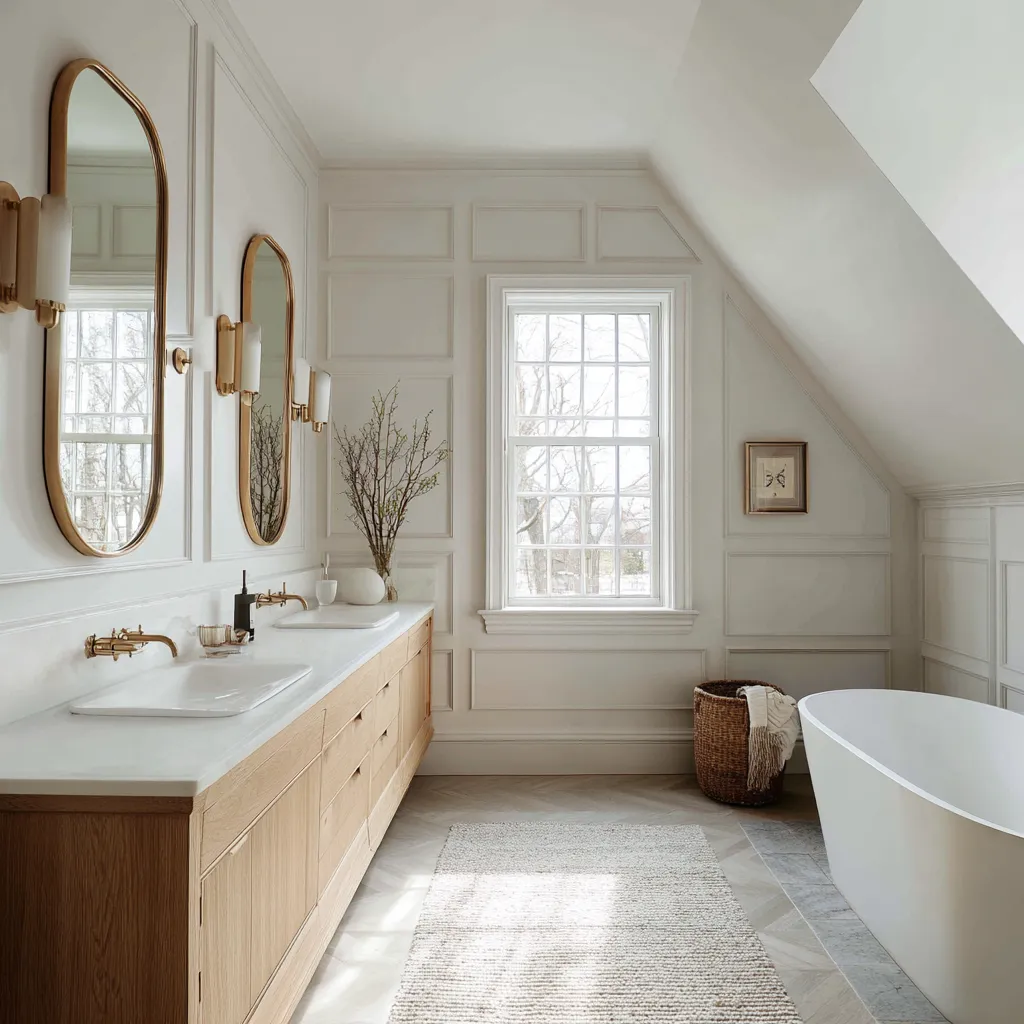
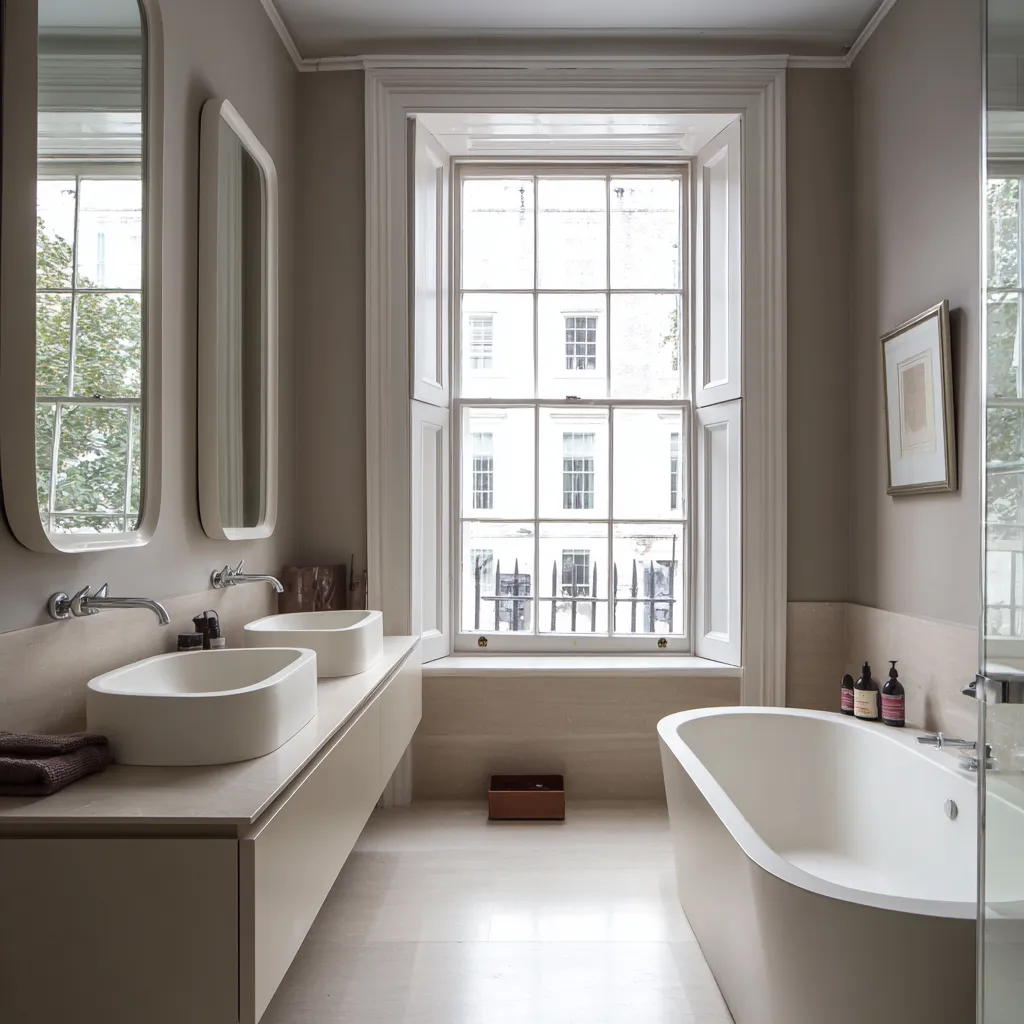
In practical terms, that means the window wall should often remain one of the clearest parts of the room. The tub can sit below it, but not so high or bulky that it weakens the opening.
A vanity can be sculptural, but not so loud that the casing and wall proportion stop mattering. Even in a more modern interpretation, the old shell should still read first.
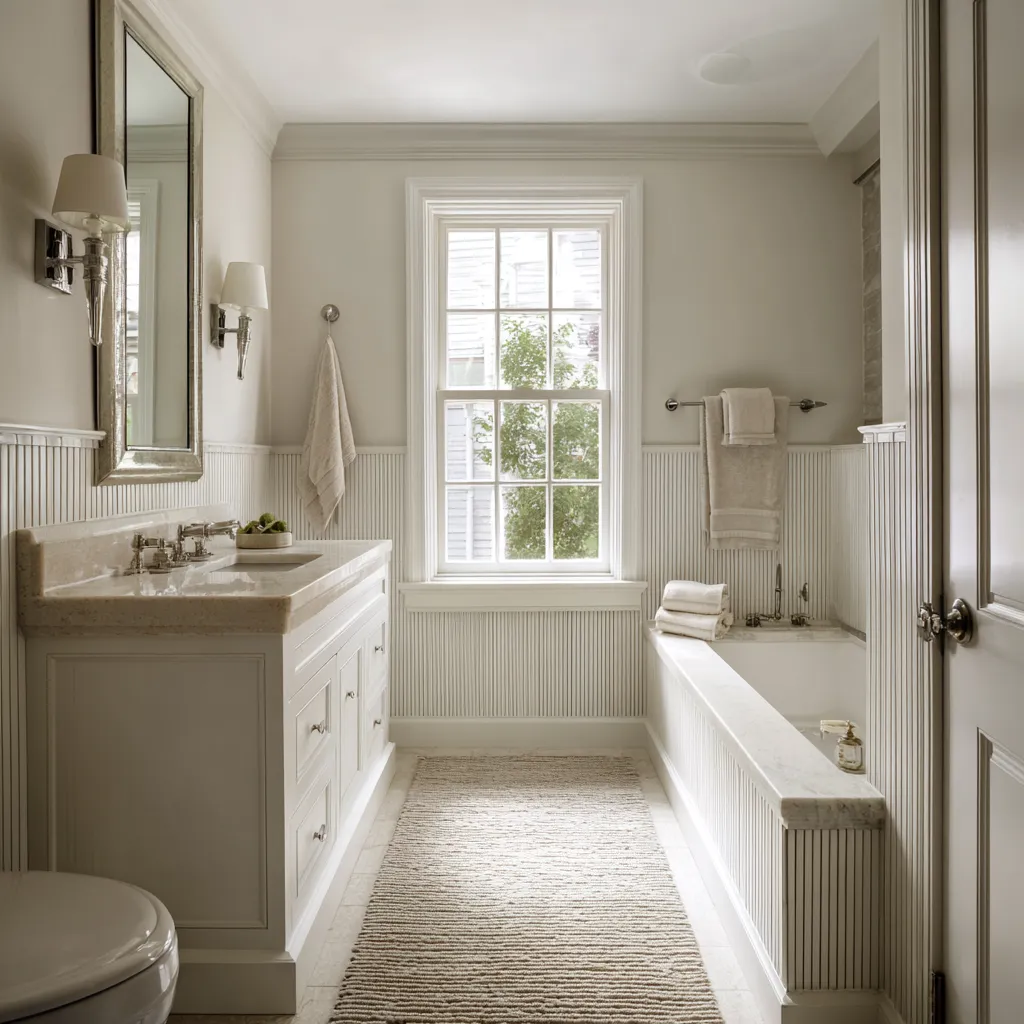
A modern Georgian bathroom usually follows one of two strong directions
There are two main ways to update a Georgian bathroom successfully. The first is the architectural-mineral route.
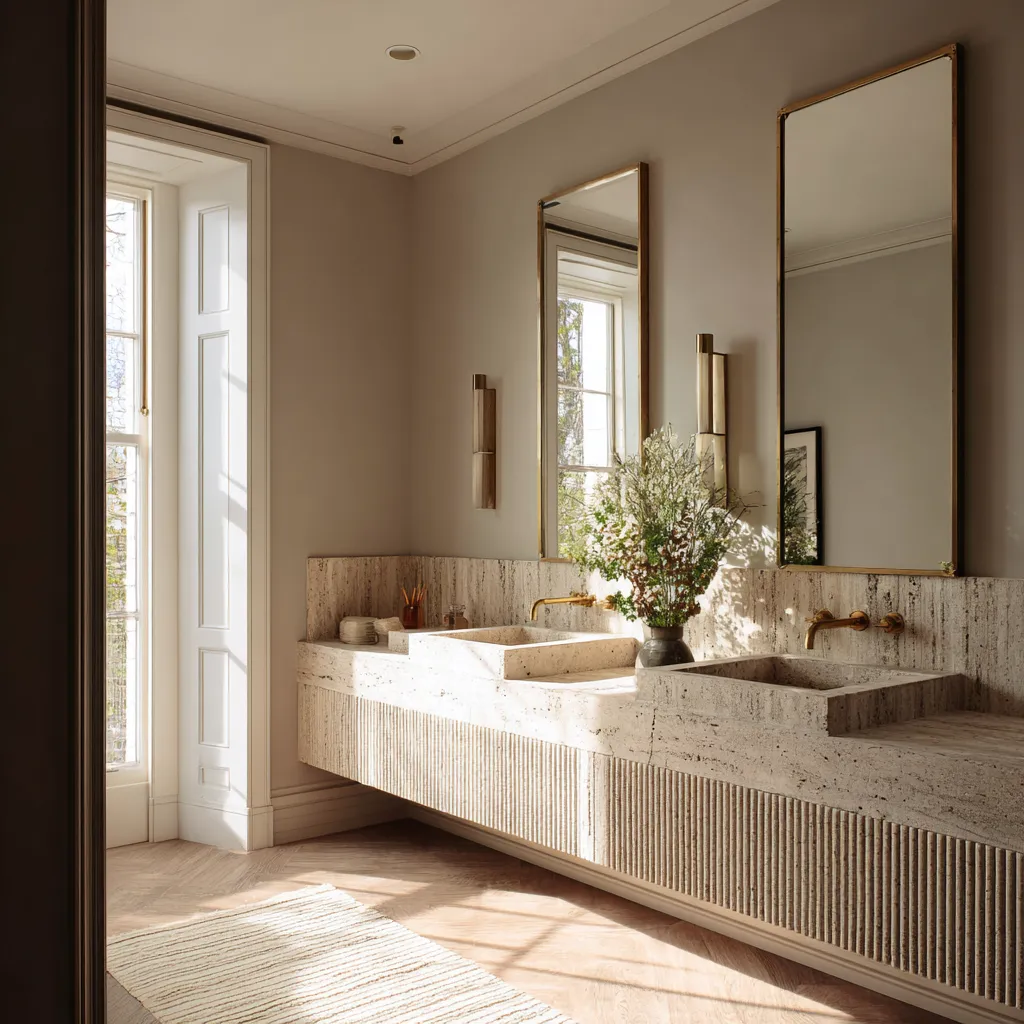
This version leans into permanence. Stone runs through more than one zone.
Tubs feel built in or anchored. Palettes stay close in value.
The room gains force from relief, thickness, shadow, and shaped mass. This direction suits bathrooms that want to feel carved, settled, and closely tied to the architecture of the house.
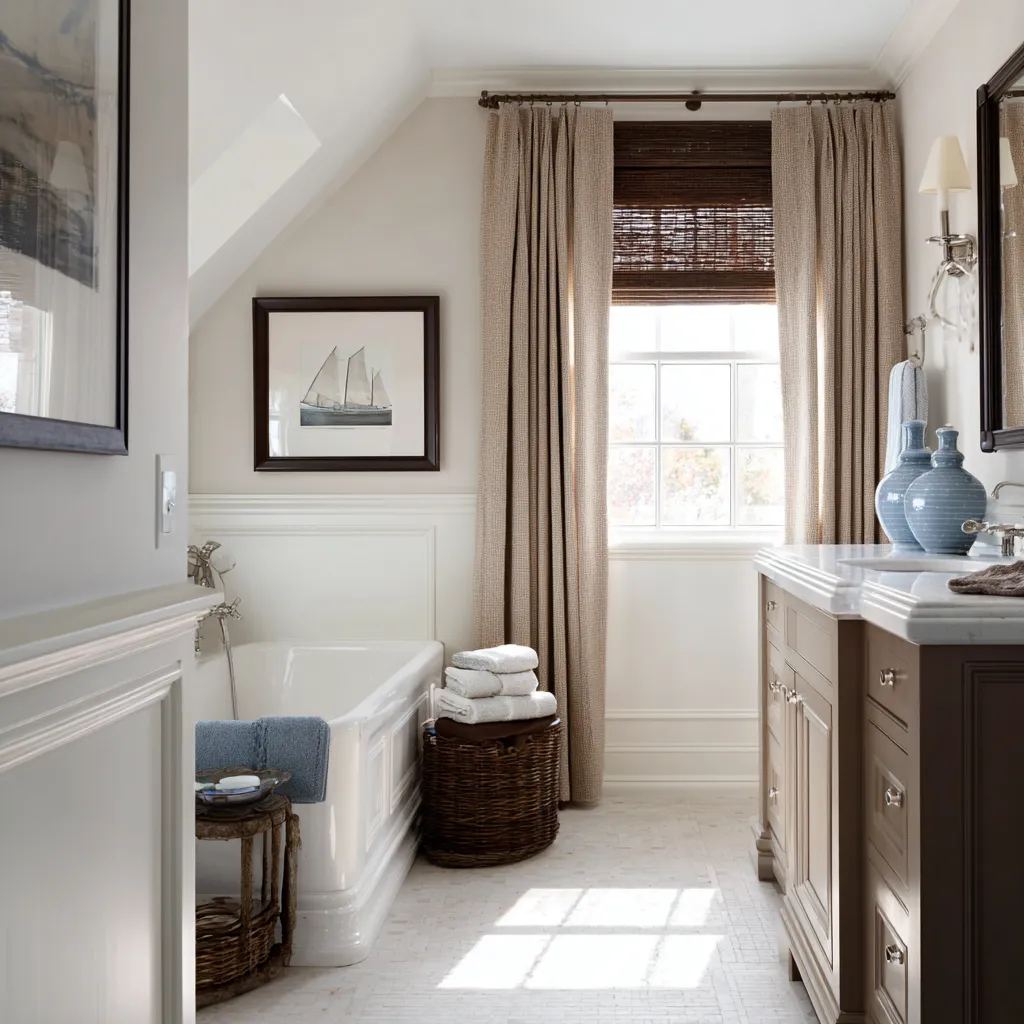
The second is the furnished-domestic route. This version softens the shell rather than intensifying it.
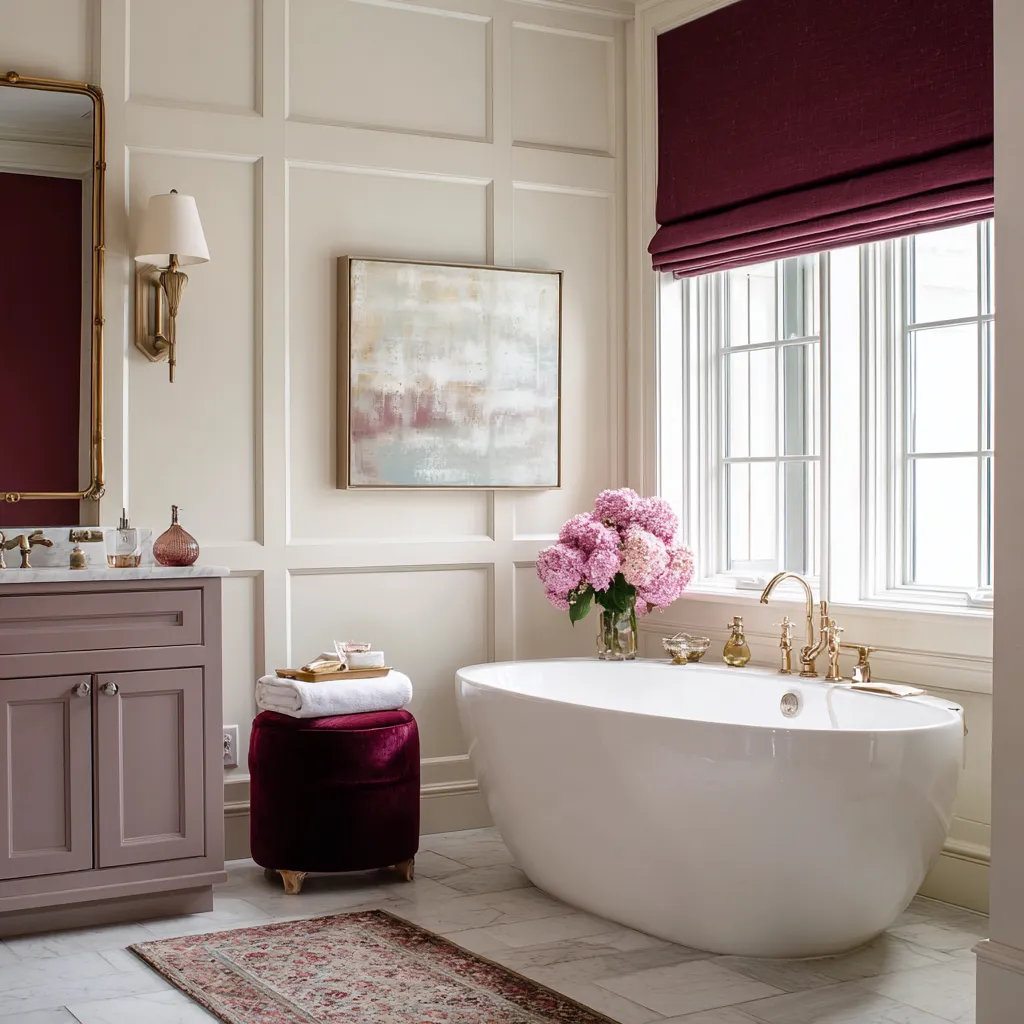
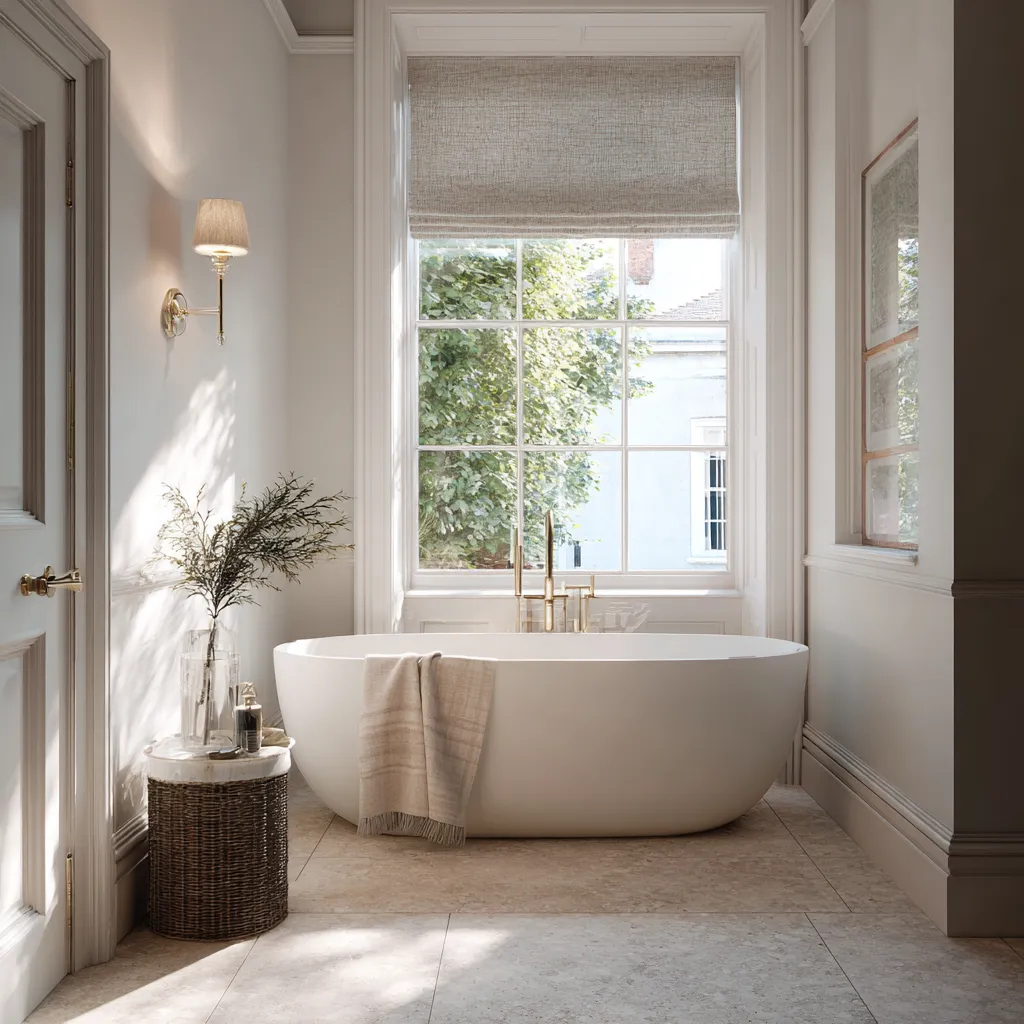
Roman shades, drapery, rugs, stools, baskets, towels, wood tones, and curved tub forms bring the room closer to the mood of a private dressing room or bedroom. This direction suits bathrooms that want warmth, softness, and a more personal scale.
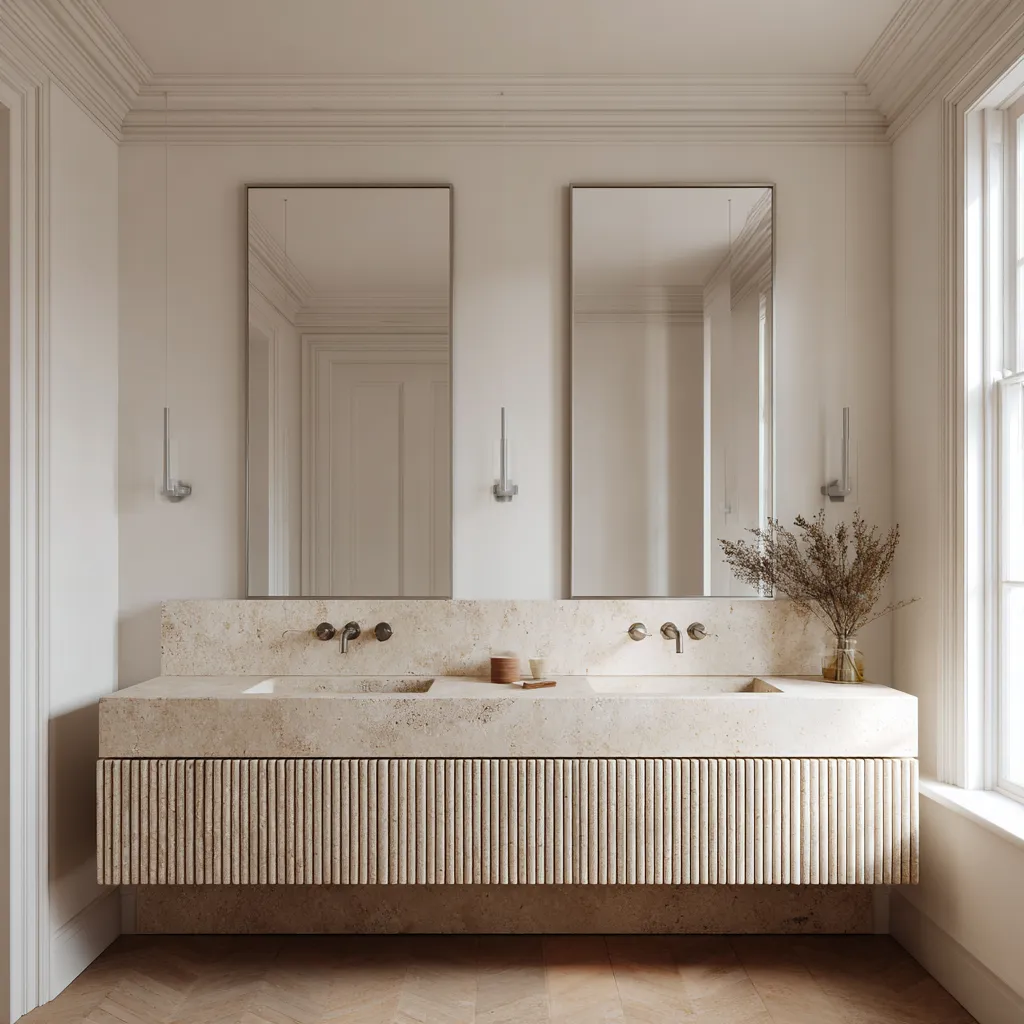
Both routes can work beautifully. Problems usually begin when a room tries to push both with equal intensity.
A heavily mineral room often loses force if too many soft furnishings are piled onto it. A highly furnished room often loses shape if it also tries to behave like a carved stone chamber.
A Georgian bathroom design becomes stronger when it knows which language is leading.
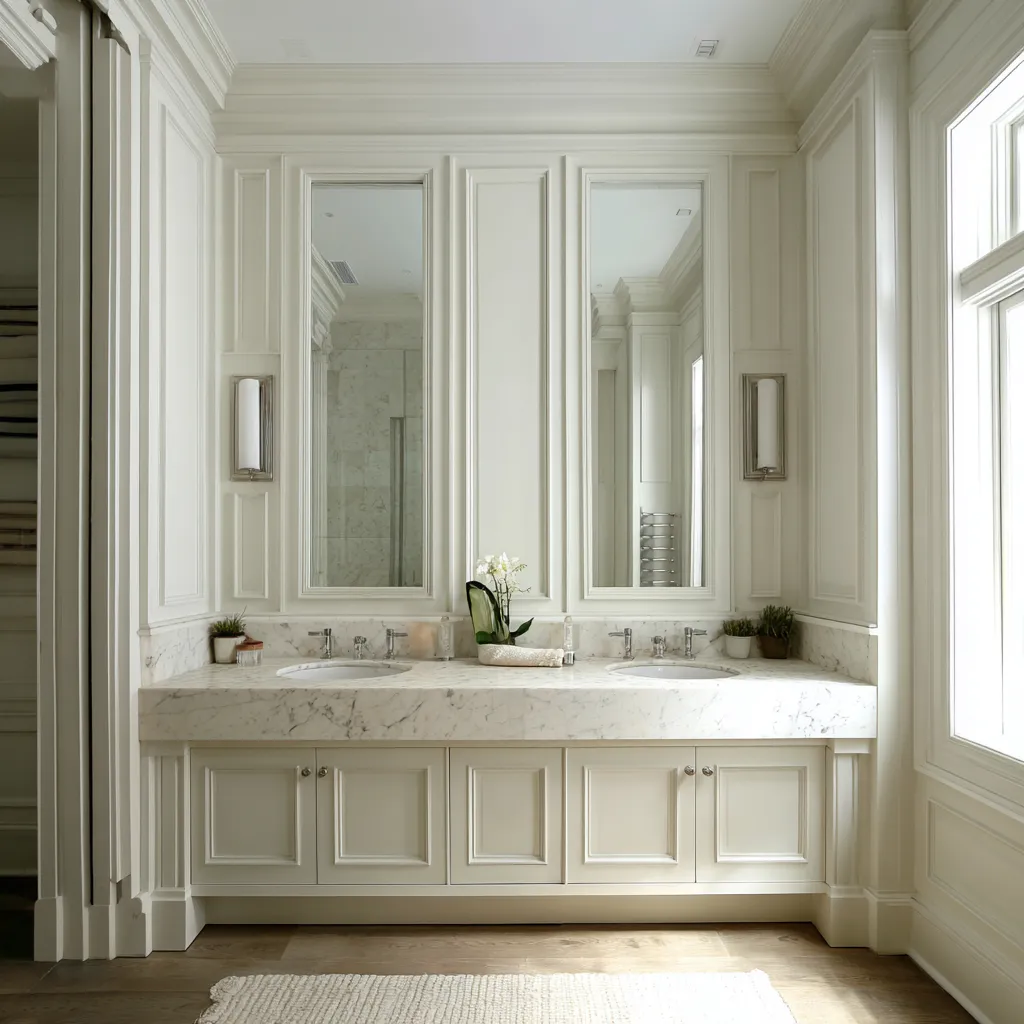
Stone matters when it behaves like architecture
Stone is one of the most effective materials in a Georgian bathroom, but it works well when it is doing structural visual work rather than appearing as scattered luxury. Design should use it to connect zones, deepen permanence, and make the bathroom feel shaped rather than assembled.
A stone countertop that relates to the tub surround is far more powerful than a countertop chosen in isolation. A tub alcove lined in the same mineral family as the vanity begins to feel like part of one built interior.
A wall band, ledge, or lower-zone stone treatment can make a compact room feel more settled because it turns the lower half into a stable architectural register.
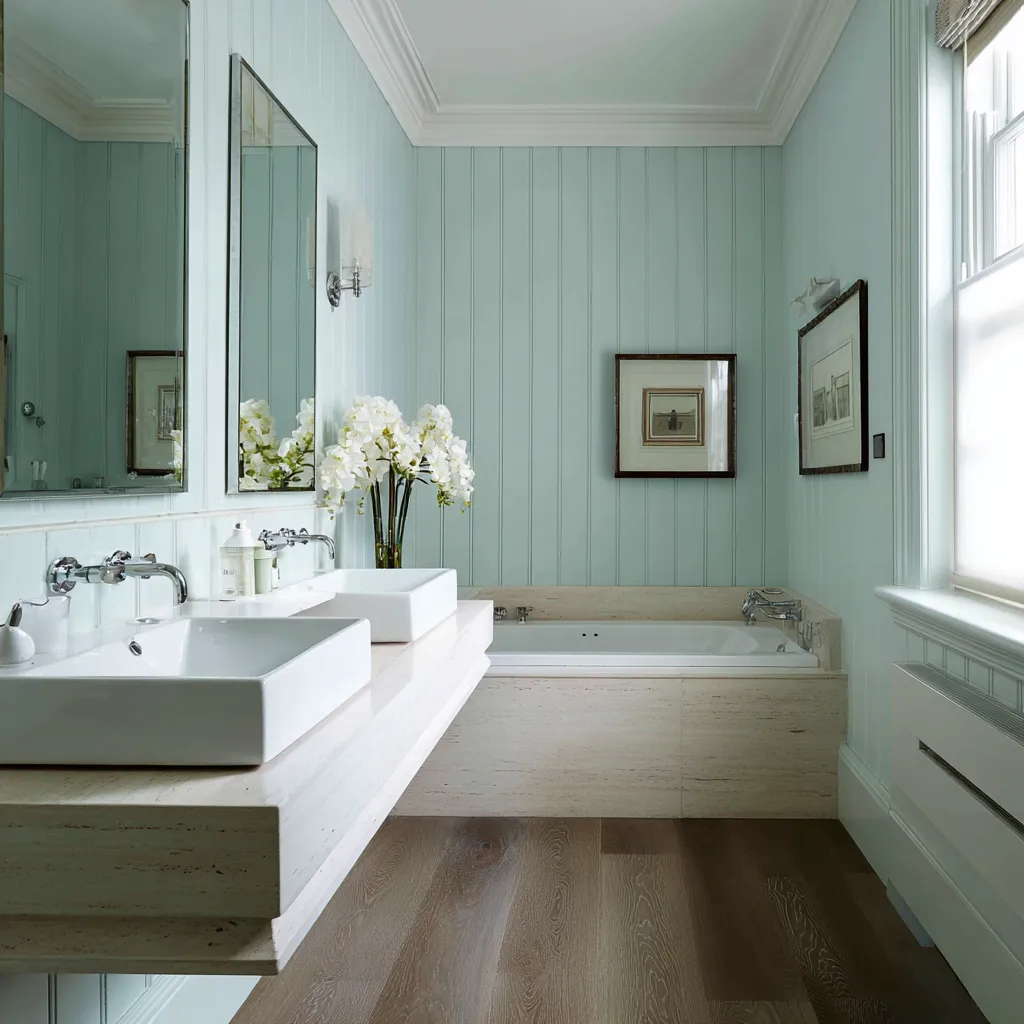
Stone-heavy Georgian bathroom designs often feel weightier and more formal. The material lowers visual noise and strengthens enclosure.
The room starts to read as one interior volume rather than a collection of separate fixtures. That effect becomes even stronger when the palette stays close in tone.
Pale stone, warm plaster, soft ivory, and brushed metal can create far more richness than a room with sharper contrast, because the depth comes from shadow and thickness rather than from obvious color breaks.
Floating vanities
A floating vanity is one of the ways to place a present-day object inside a Georgian shell without turning the room into a period set. The reason is not that floating vanities automatically make the room warmer or more grand.
They translate the old shell into a current register. In a Georgian room, the walls, casing, and cornice already carry a lot of visual gravity.
If the vanity is also thick, floor-bound, ornate, and visually dense, one side of the room can become overloaded. Lifting the vanity introduces a shadow line beneath it, and that pause between cabinet and floor becomes very useful.
It gives the room more air. It lets the architecture stay clear.
It also creates a sharper distinction between shell and insertion: the room is old in structure, current in fixture language.
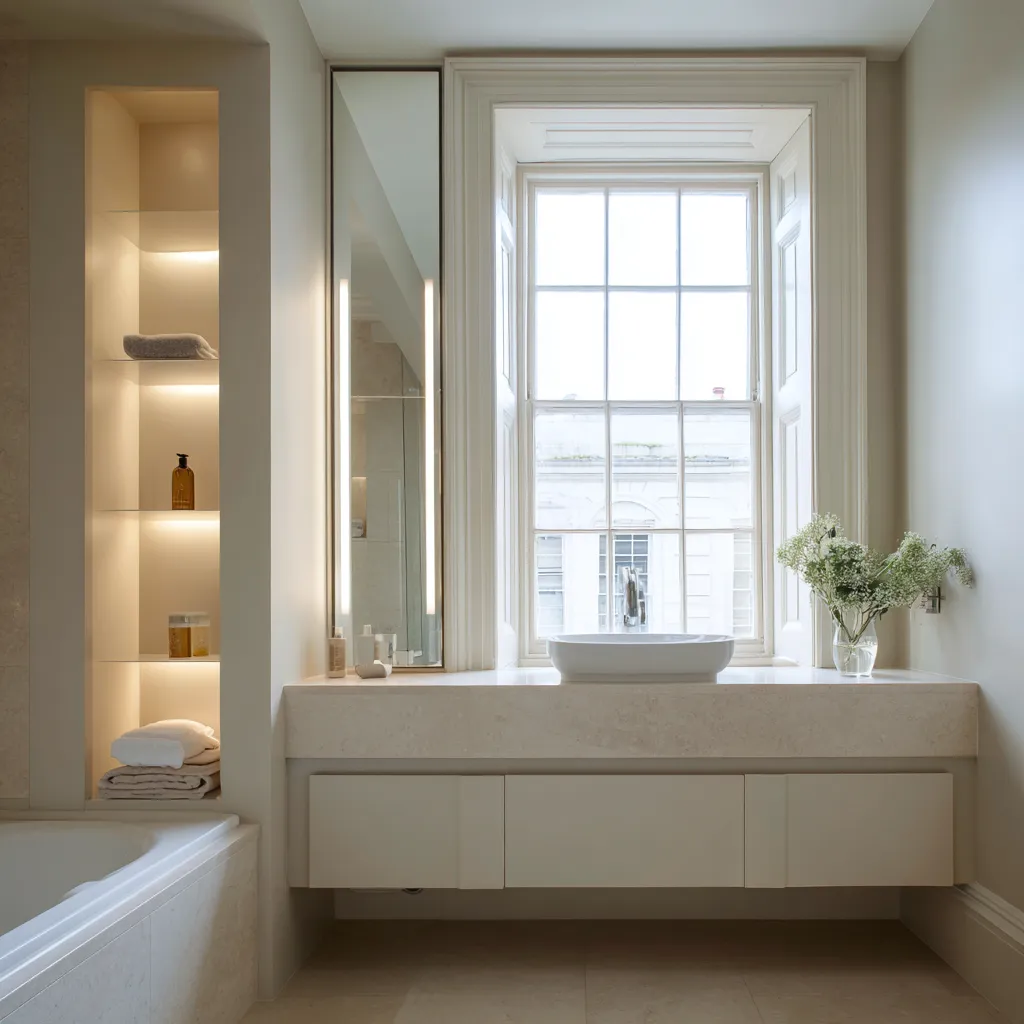
Floating vanities still have enough mass to belong the Georgian design. A stone slab with some thickness, a ribbed stone front, a monolithic counter, or a wood base with strong grain can all work.
The vanity should not feel flimsy. It should feel substantial and current at the same time.
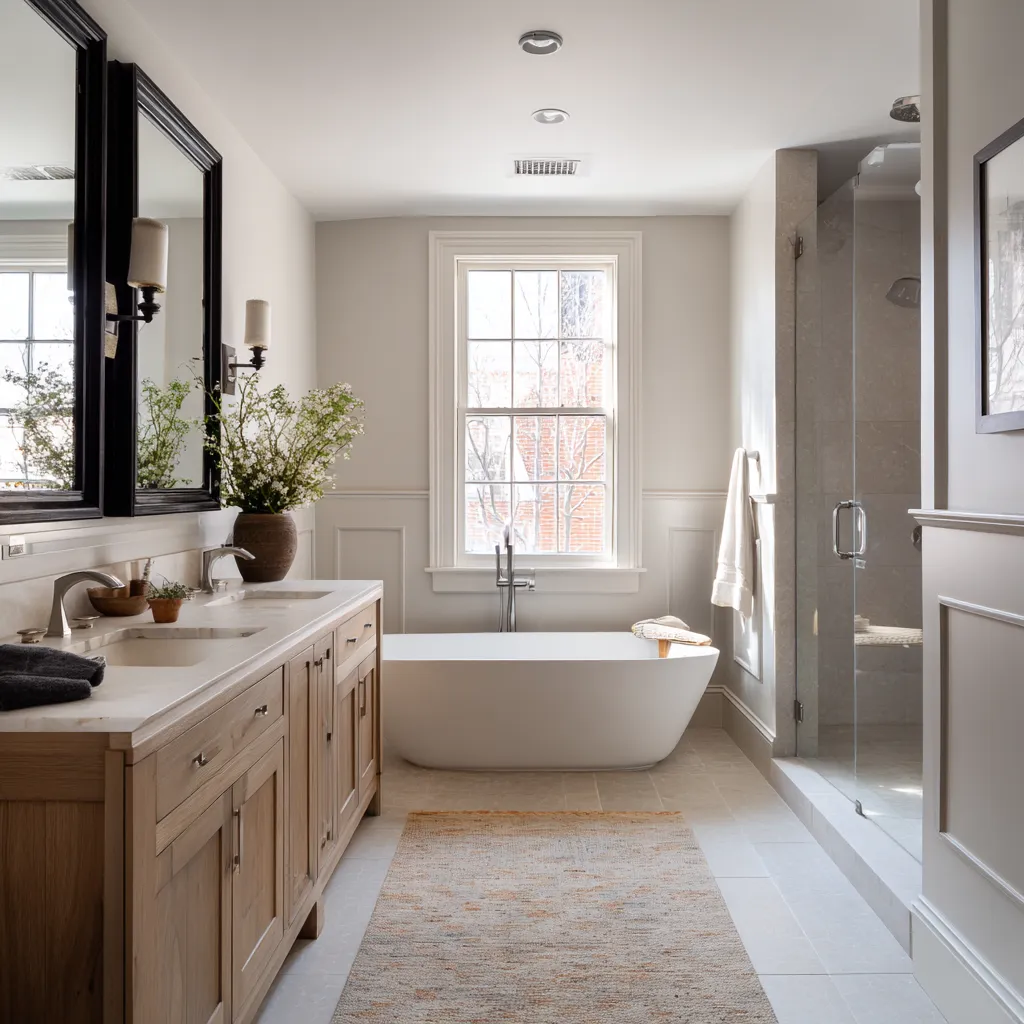
The vanity wall is where modernity should speak
The vanity wall is where the present day can show itself most openly. This makes sense.
The tub and window end of the room often carry the classical order. The vanity can therefore become the place where the new layer enters more clearly.
That modernity can take several forms. It might be a floating stone slab with integrated basins.
It might be a sculptural timber vanity with rounded corners. It might be a ribbed stone front, a fluted base, a thick marble plane, or a carefully edited open shelf.
It might be mirrors that are tall and narrow, softly rounded, or lightly suspended rather than thickly framed in historical detail.
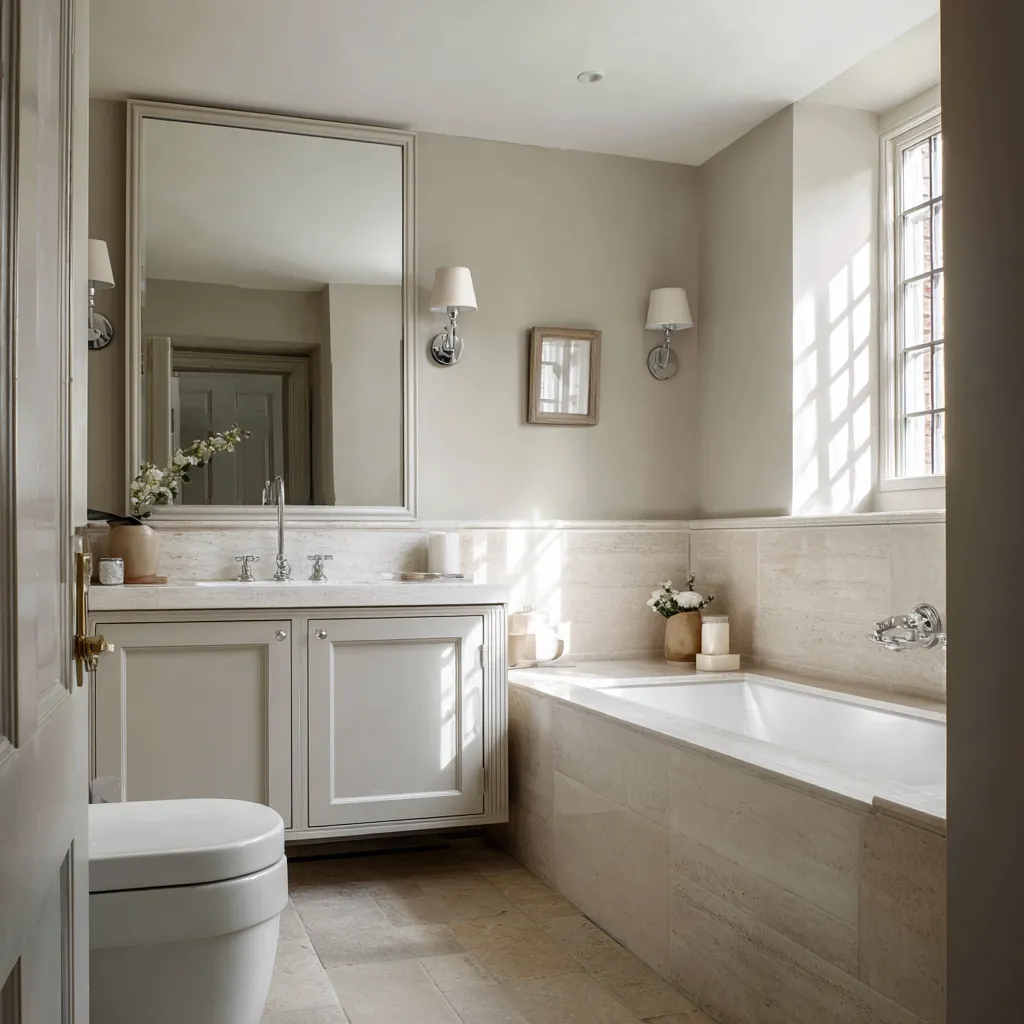
What matters is that the vanity wall should not look as though it is pretending to be eighteenth-century joinery. That usually weakens the room.
A Georgian shell paired with an obviously modern vanity often feels more honest and more developed than a shell paired with a cabinet trying too hard to imitate the past.
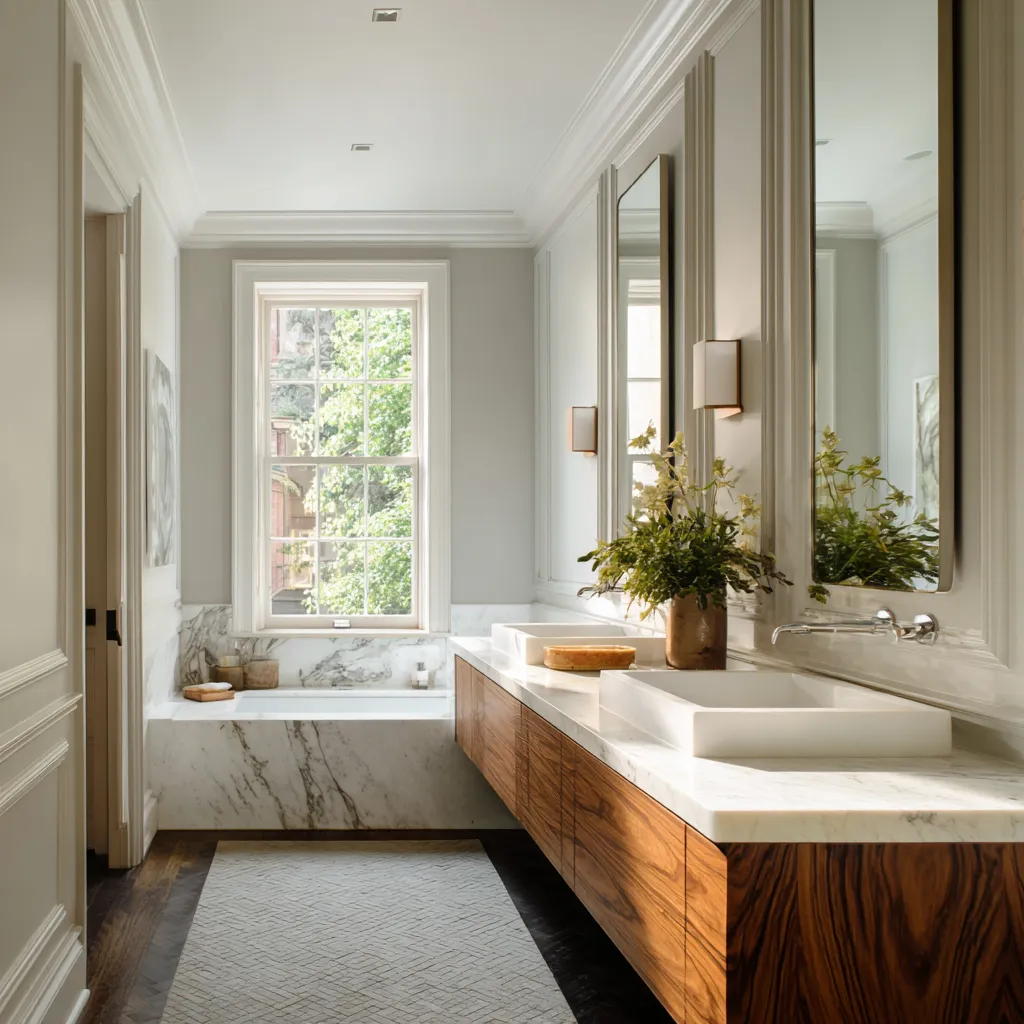
Built-in tubs and freestanding tubs
One of the biggest design decisions in a Georgian bathroom is the type of tub focal point. A built-in tub creates permanence.
It supports the idea that the bath zone is part of the architecture itself. This is especially effective in narrow rooms, processional layouts, or bathrooms with strong end-wall emphasis.
A built-in tub can help the far wall feel carved and anchored. It works well with stone integration, tonal compression, and a more architectural reading.
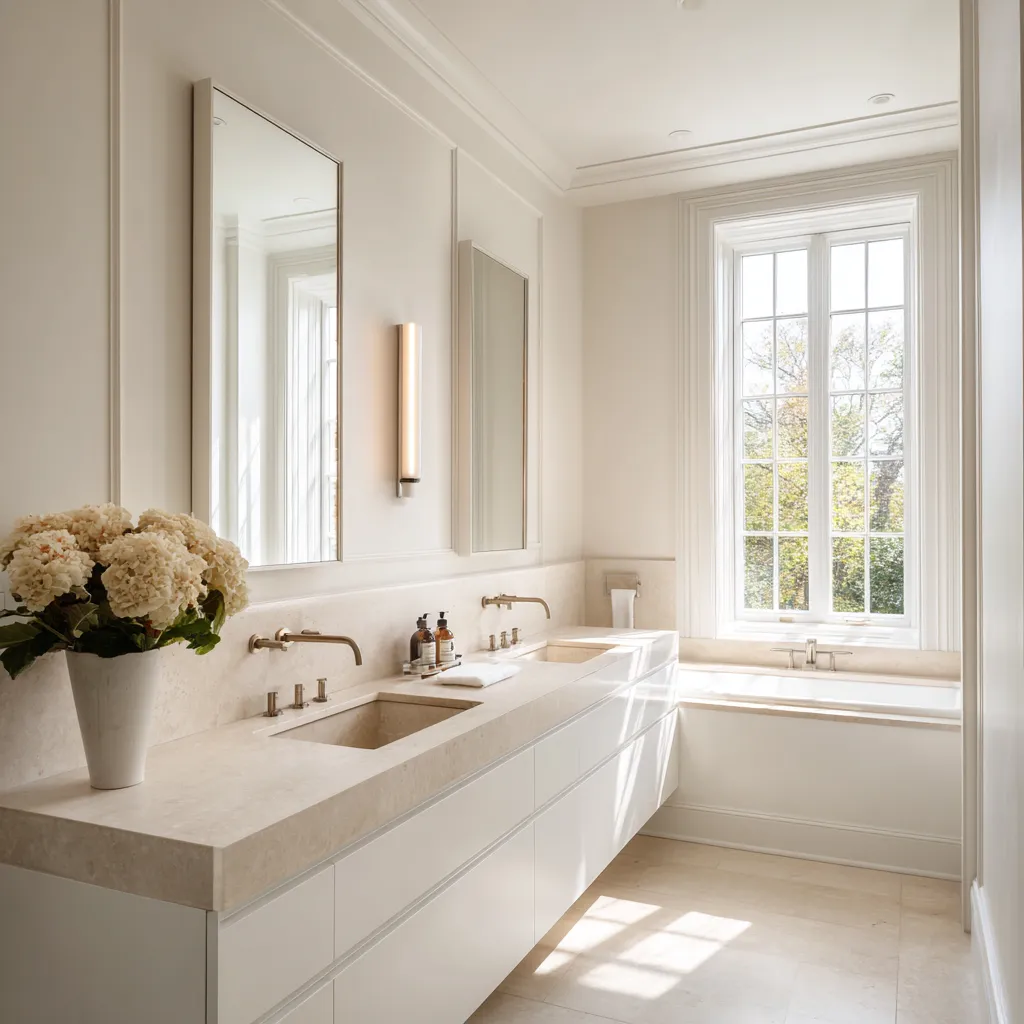
A curved freestanding tub does something else. It brings pause, softness, and bodily ease.
It loosens the rectilinear discipline of paneling, casings, ledges, and drawer fronts. It can soften a very formal room and make a centered composition feel less ceremonial.
This approach works best in bathrooms that want warmth and domestic character rather than only gravitas. Because these two tub strategies create different emotional effects, it helps to choose one logic early.
If the design is pushing toward architectural permanence, a built-in bath usually reinforces that aim. If the room requires human softness, a freestanding curved tub often gives a better result.
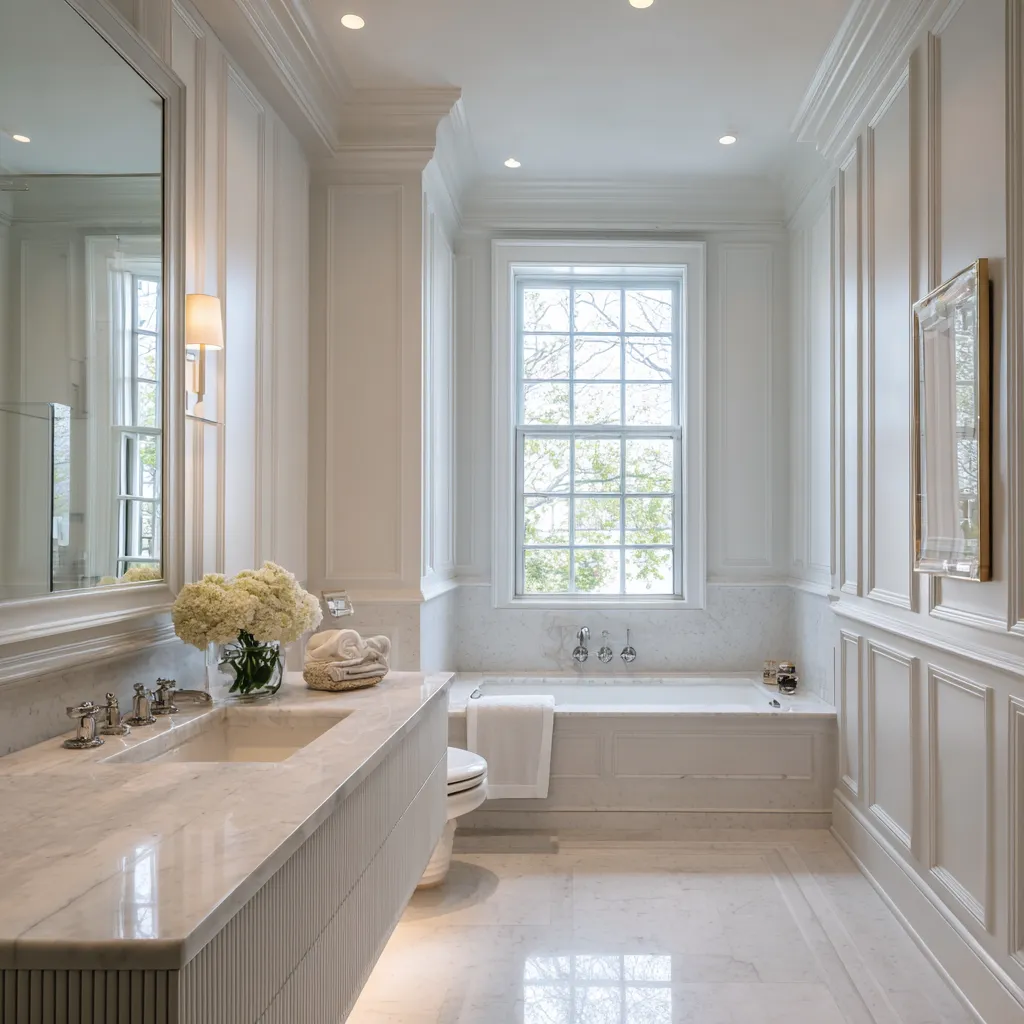
Softness turns a formal shell into a room that feels lived in
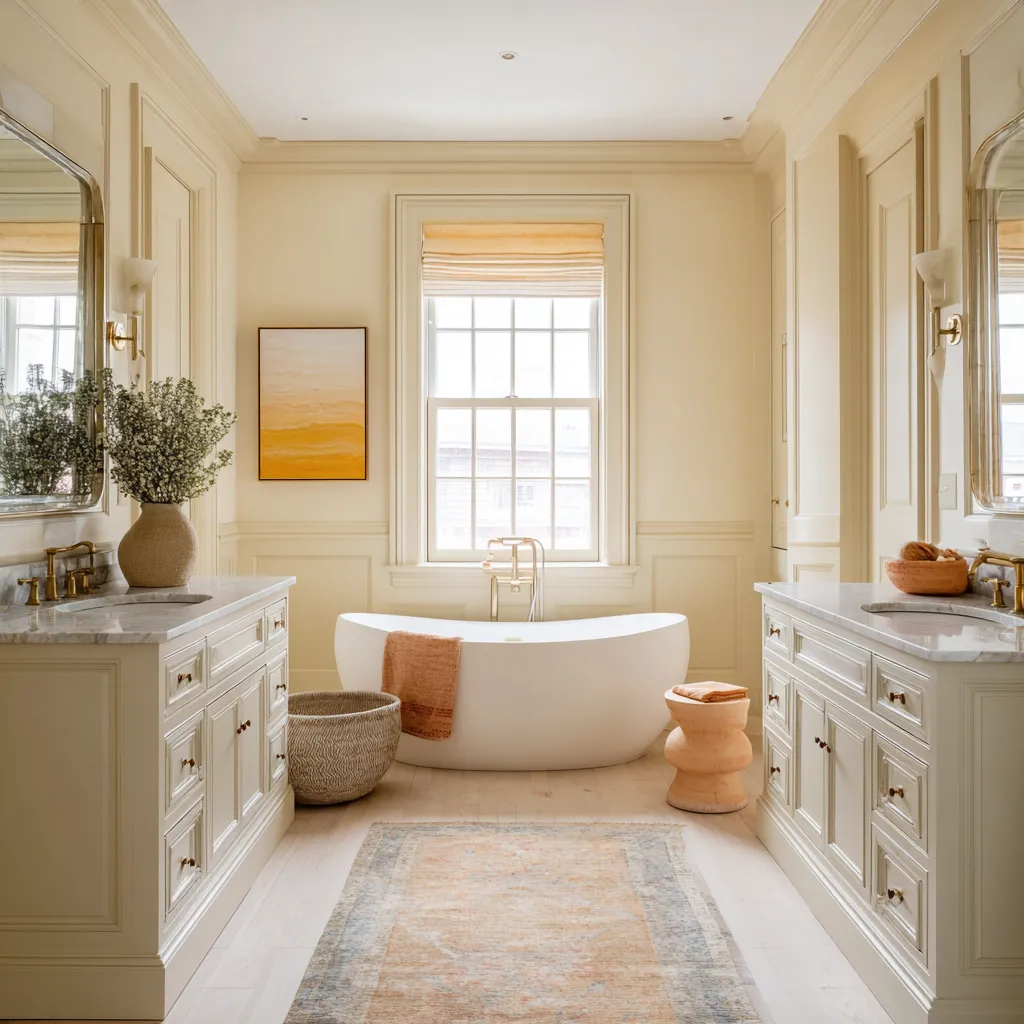
Textiles matter more in Georgian bathrooms than many expect. A woven Roman shade, full drapery, a runner, a stool, a folded towel placed with intention, or a basket at the bathing zone can transform the atmosphere.
These pieces do not merely decorate the room. They change its scale.
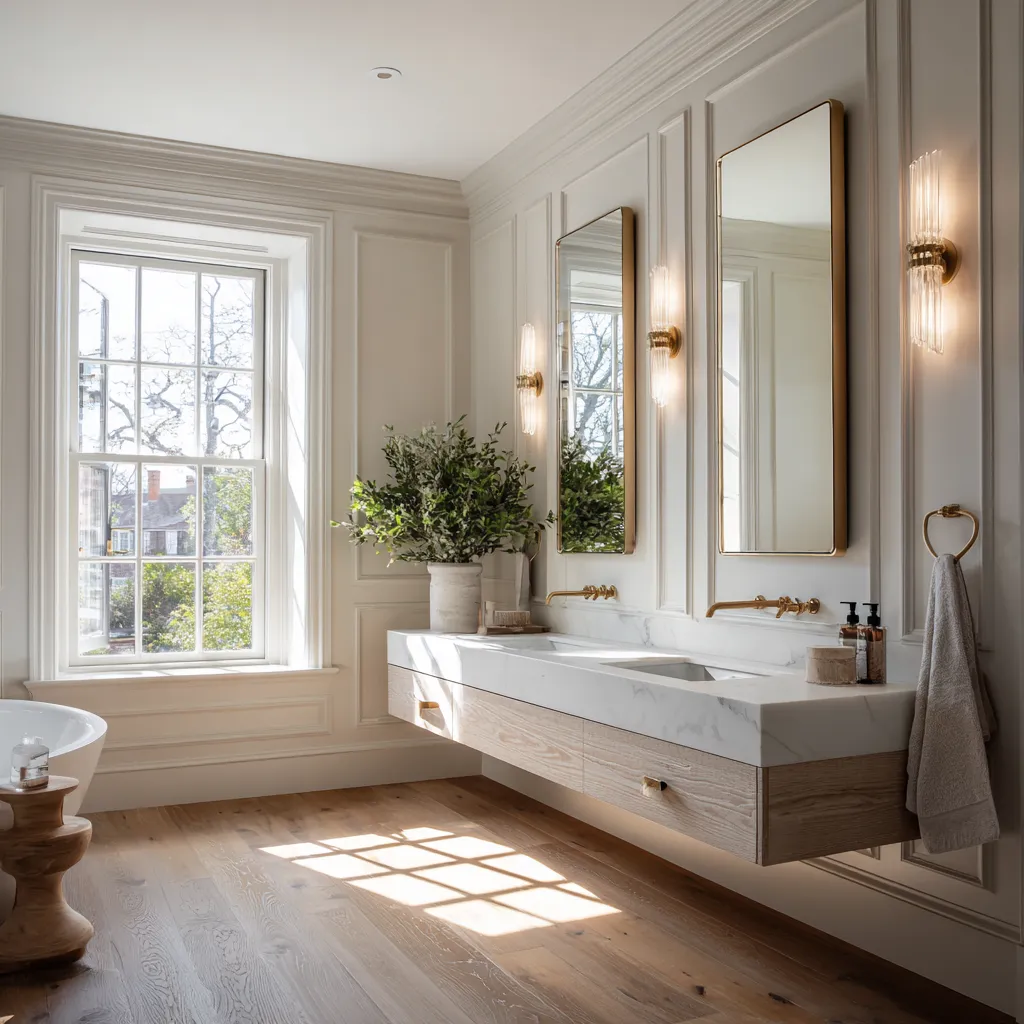
A Georgian shell can easily feel stately, even when it is beautiful. Textiles make it feel inhabited.
They soften the geometry. They lower the emotional distance between architecture and body.
A centered tub under a tall sash window can look severe if left too bare. Add a woven shade, a runner, a stool, and a towel placed across the tub, and the same composition begins to feel much more personal.
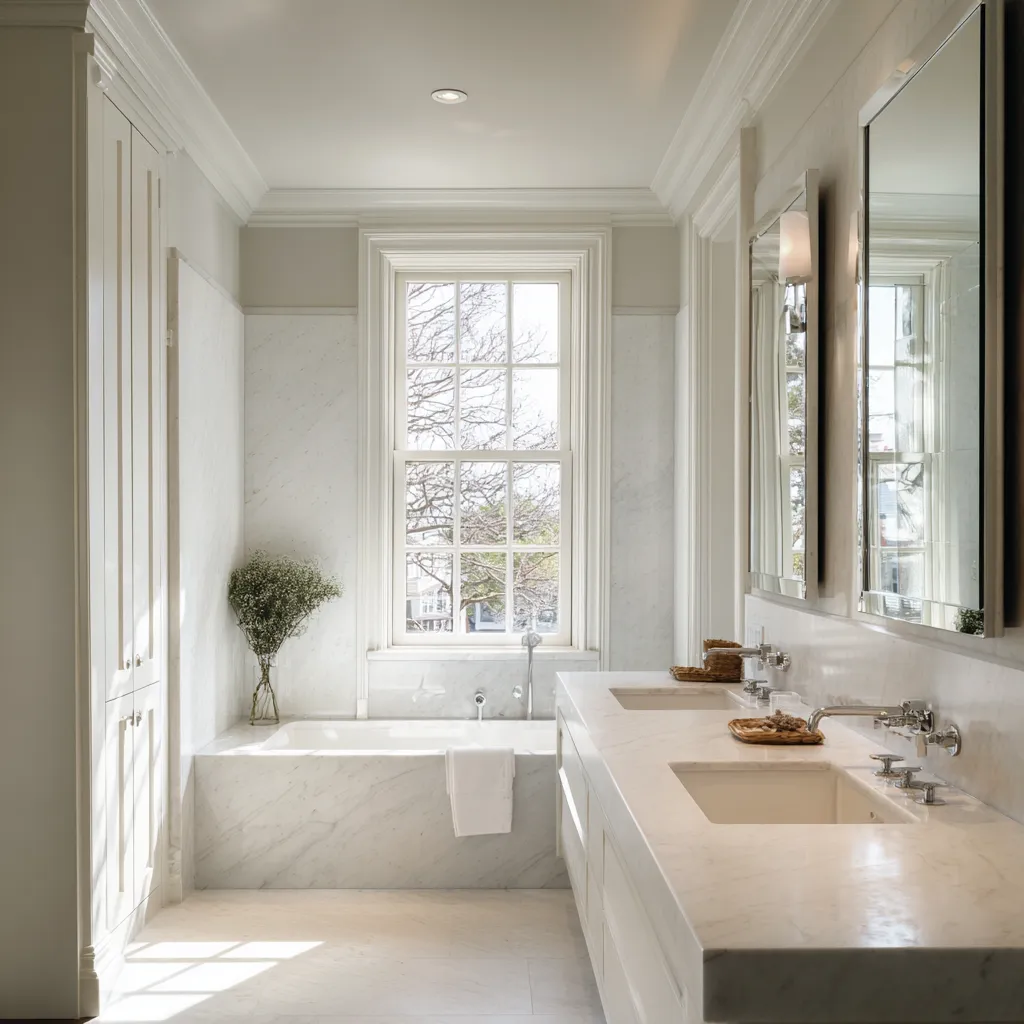
That does not mean every Georgian bathroom needs a large amount of fabric. It means that softness is usually the strongest tool for adding warmth.
In fact, textiles often do more for intimacy than wood alone. Wood brings warmth, but fabric changes the way the room is used and perceived.
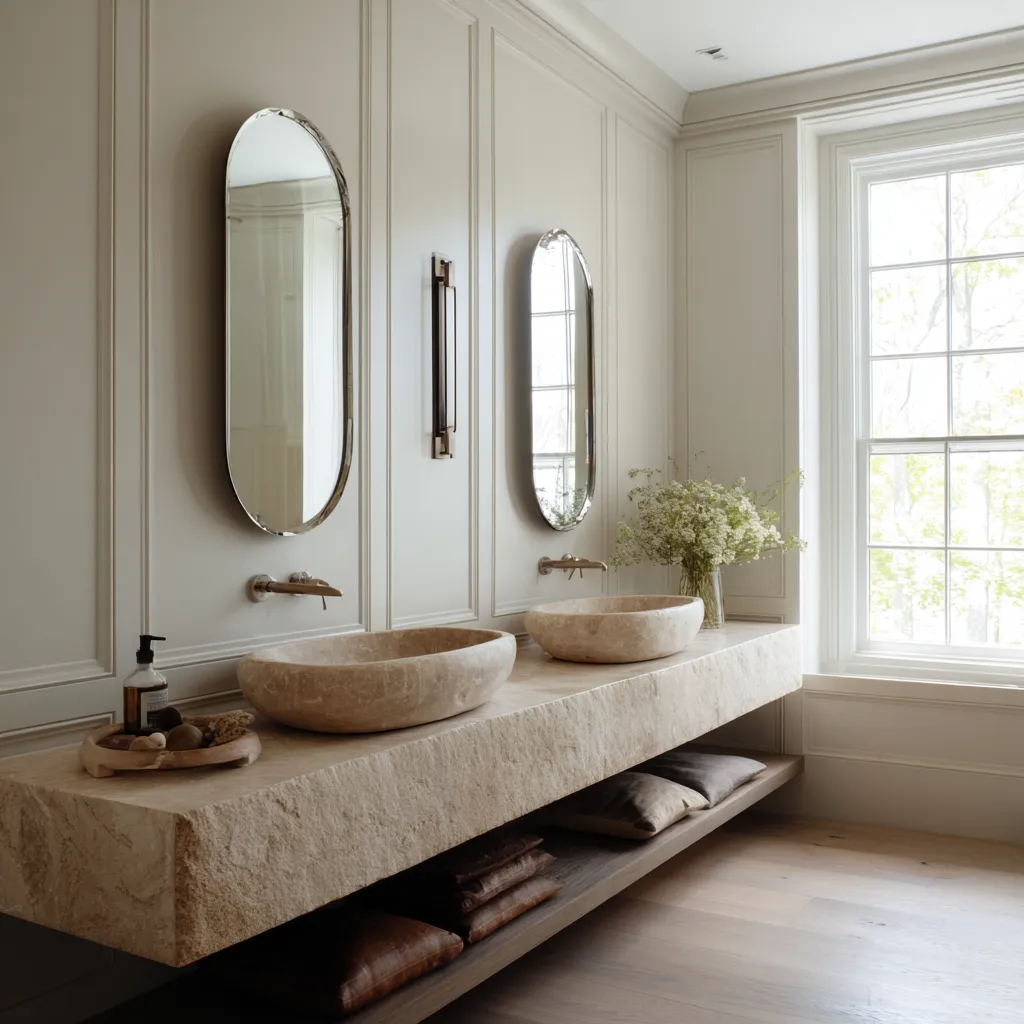
Wood should warm the room without taking over the shell
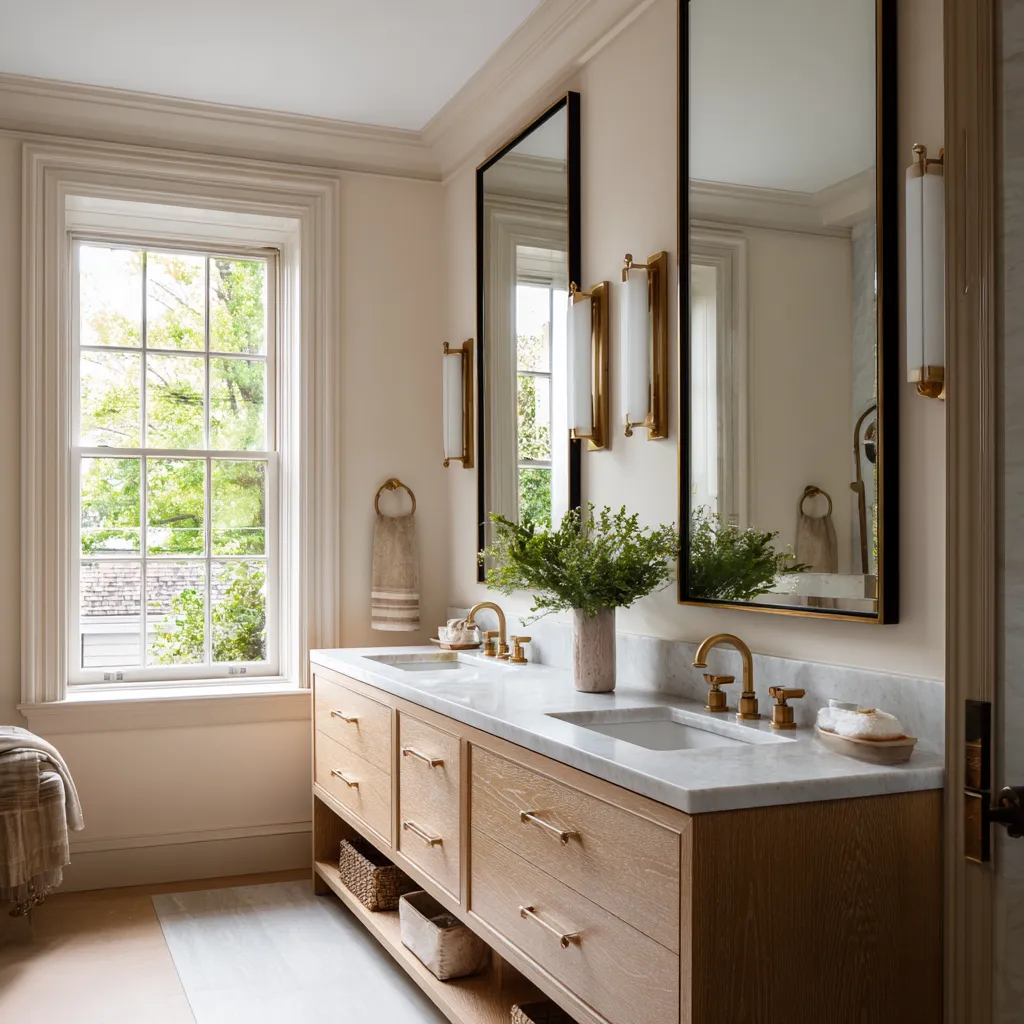
Wood works especially well in Georgian bathrooms because it bridges polished stone and pale plastered or painted walls. A wood vanity can stop a room from turning chilly.
A timber floor can reconnect the bathroom to the rest of the house. A woven shade with deeper brown notes can ground a pale palette.
But wood works best when it is measured.
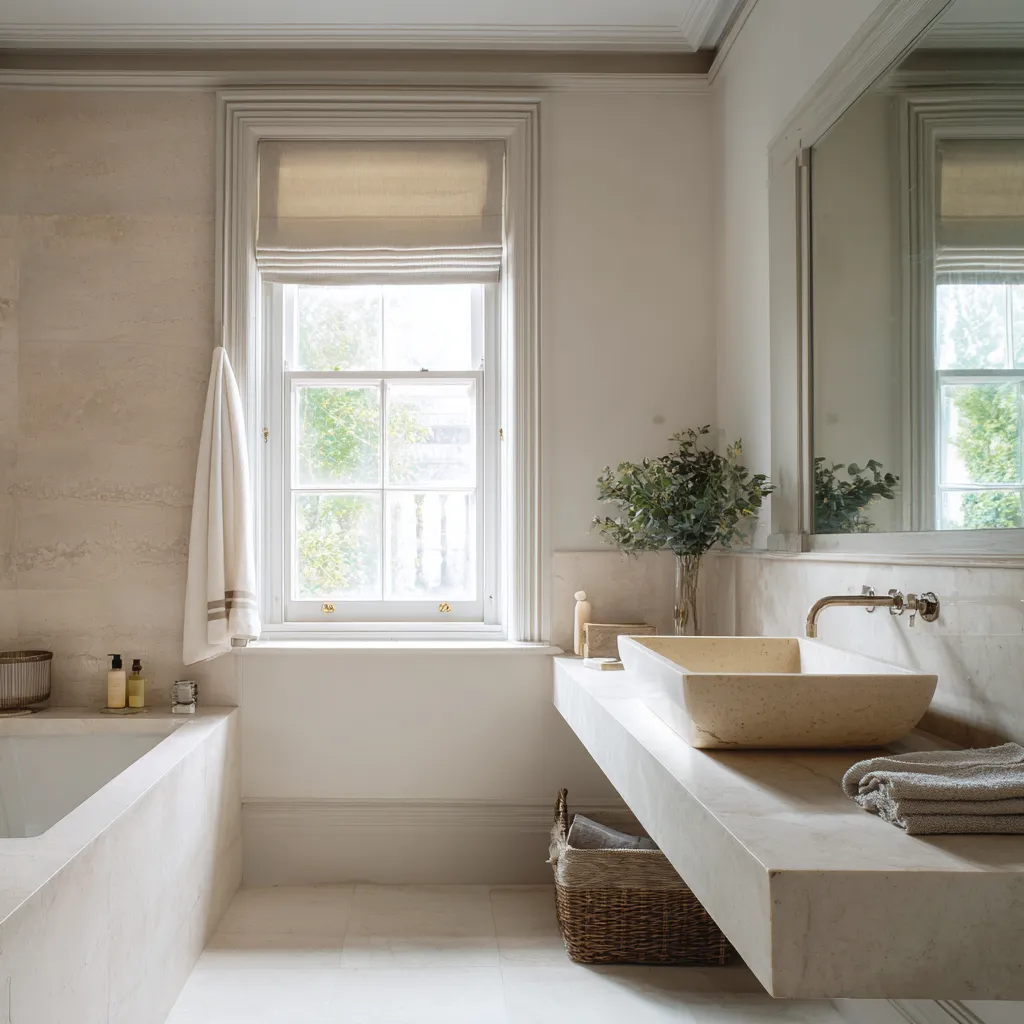
A richly grained vanity with flat fronts is often stronger than a heavily detailed cabinet. In that case, the grain becomes the decoration.
The room gets visual richness from material figure instead of applied ornament. This is a very effective present-day move in a Georgian setting, because the shell already supplies proportion and relief.
The vanity does not need to repeat that same kind of detailing.
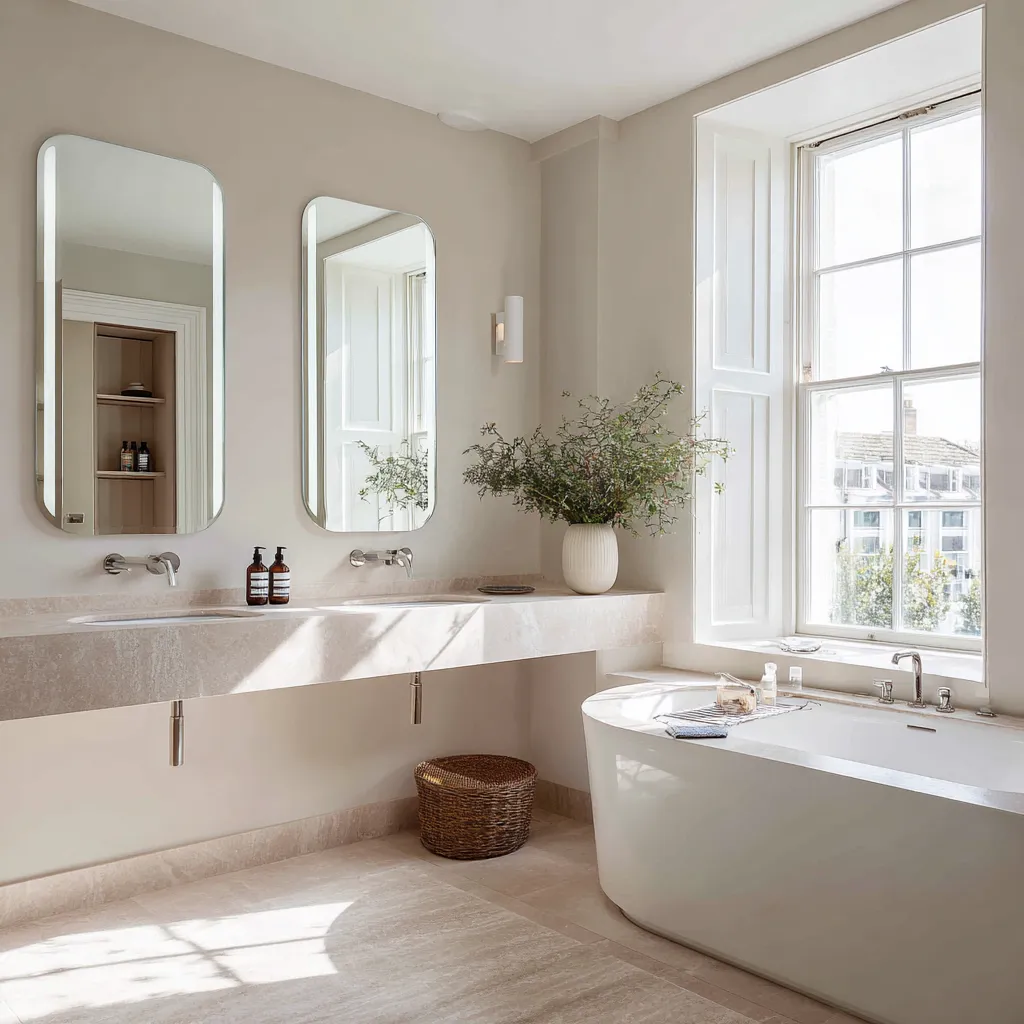
Wood also interacts with textiles in a specific way. Once a room already has a strong soft layer, adding more wood still helps, but it does not transform the room as dramatically.
The same is true in reverse. That is why the most satisfying Georgian bathrooms often use warmth in a measured three-part way: a wood note, a textile note, and one soft or rounded form, rather than trying to make every surface warm at once.
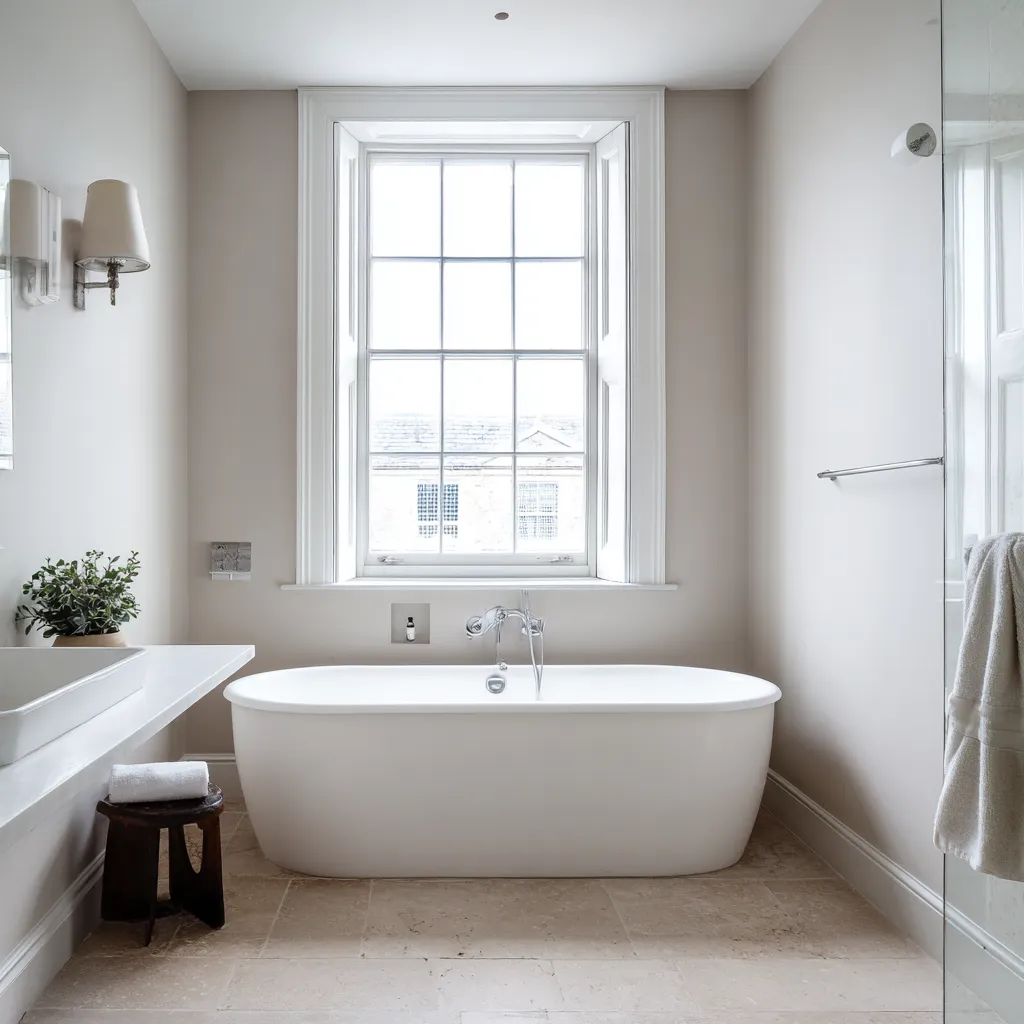
Low-contrast palettes often work better than sharp black outlining
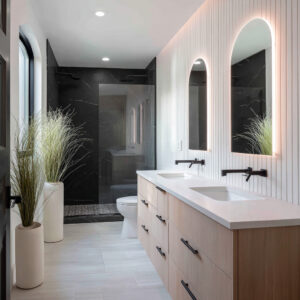
Many updated traditional bathrooms lean heavily on black mirror frames, black taps, or strong dark outlining to signal modernity. In a Georgian bathroom, that move can sharpen definition, but it often reduces the room’s architectural dignity if overused.
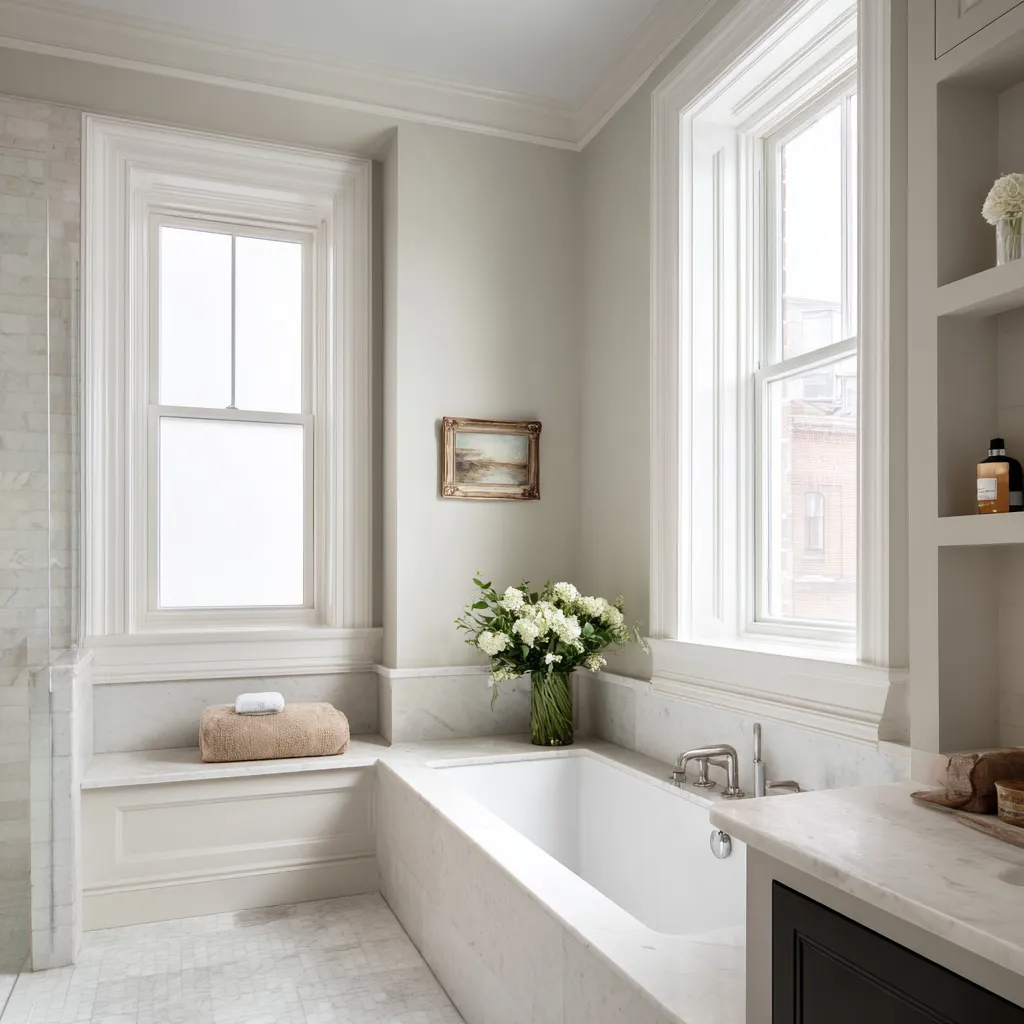
A more refined route is low-contrast layering. Pale stone, warm cream, mushroom, soft taupe, grey-beige, muted plaster, white trim, brushed metal, and filtered daylight can create a much richer room than a sharper palette.
The key is that the shell must have depth. If the cornice projects, the casing is thick, the paneling has relief, and the vanity has enough mass, then shadow becomes the contrast.
The room gains depth without depending on graphic edges. Relief, thickness, and tonal closeness often age better in this style than heavy black accents.
A bathroom can still use darker frames or selective dark notes, but those moves tend to work well as local punctuation rather than the main engine of modernization.
Texture can modernize the design
Texture is a strong tool in Georgian bathrooms because it can add newness without requiring loud color. Ribbed wainscot, fluted vanity fronts, boarded walls, rough stone slab faces, plaster variation, and woven natural materials all bring surface life into the room.
The important part is placement. If the layout is narrow, vertical ribbing or boarding can help stretch the walls upward.
If the shell is already heavily paneled, a fluted vanity front can add a different lower-level rhythm without repeating the wall language too literally. If the design is pale and compressed in palette, tactile surface becomes even more valuable, because it stops the space from feeling empty.
Texture is especially useful in Georgian bathrooms that want character but not busyness. It lets the room remain close in tone while still feeling layered.
Openness is another update path
Not every modern Georgian bathroom needs to be richly paneled or heavily mineral. Some can work through openness instead.
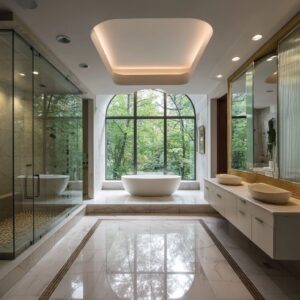
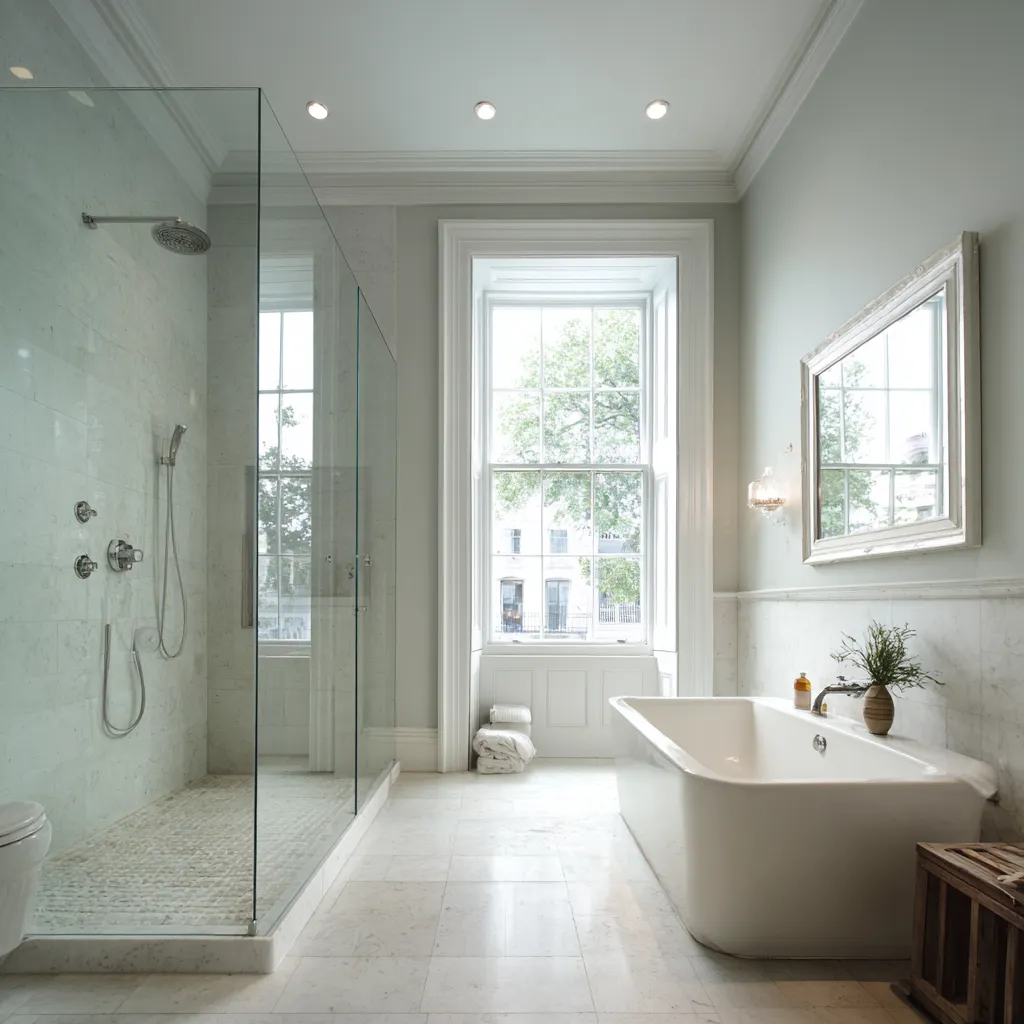
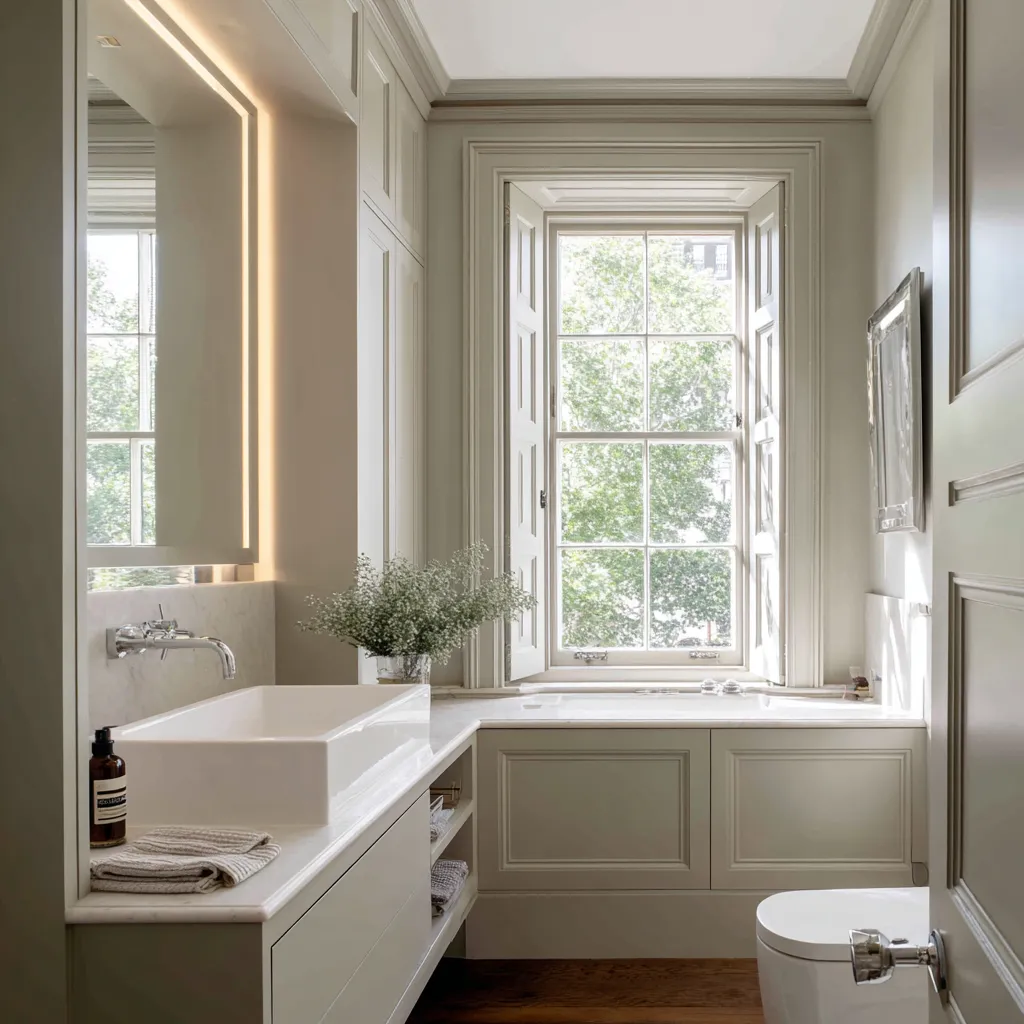
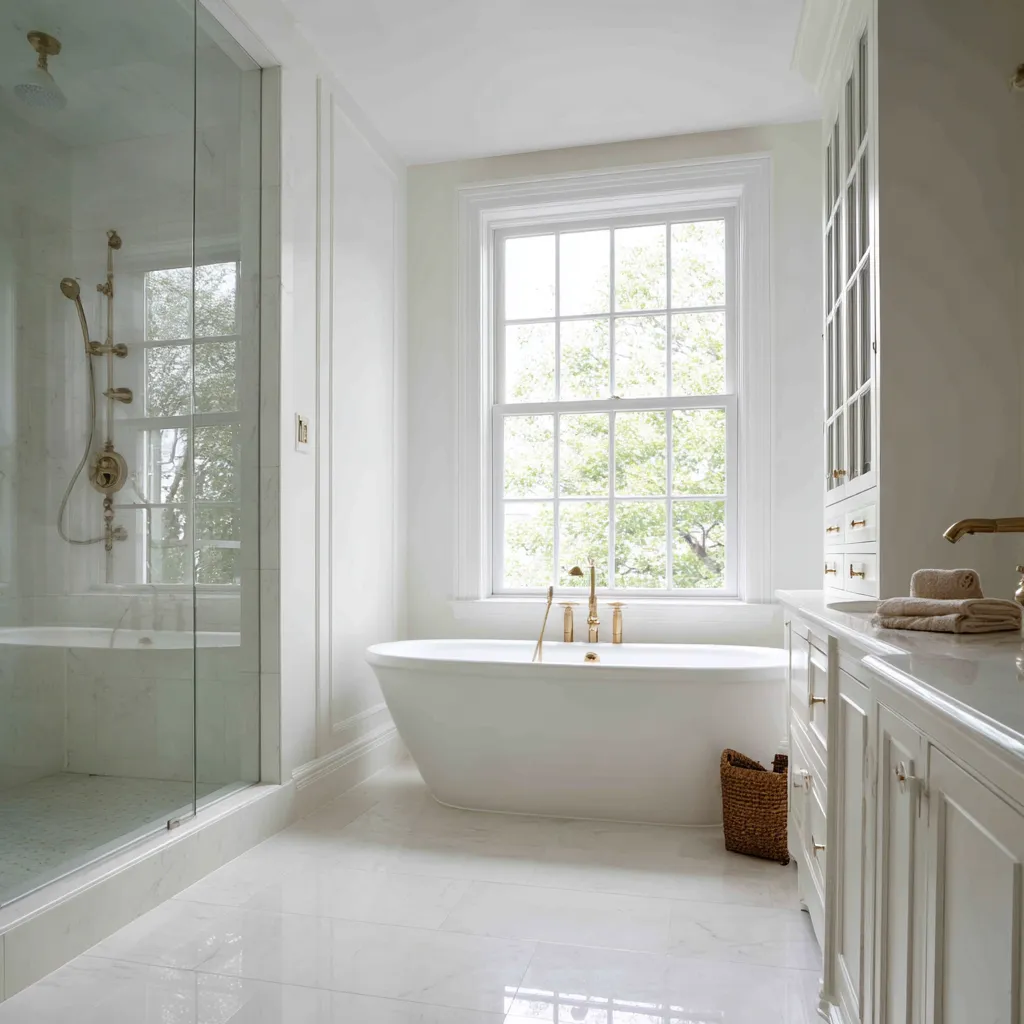
Frameless glass shower enclosures, broad still wall planes, lighter articulation, and clear three-zone planning can give the bathroom a more edited feel while still preserving Georgian order through proportion, casing depth, and the window wall.
This approach tends to work well in long bathrooms, compact spaces, or wet-room arrangements. The architecture stays legible, but the room relies more on planning clarity than on decorative density.
Shower, tub, and vanity each get a clear role. The window remains the destination.
The room feels open without losing its formal base. This is also a useful direction for those who want a Georgian bathroom that feels fresh and house-like rather than museum-like.
The room can stay rooted in older architecture while adopting a much lighter present-day visual rhythm.
Three layers, not one
Some bathroom designs lean hard into mineral gravitas. Others lean hard into softness.
Both can work. But the most balanced Georgian bathroom designs often use a three-part composition:
- one clear architectural move
- one substantial current insertion
- one domestic-softening layer
The architectural move might be a deep window casing, a tub alcove, tall paneling, a heavy cornice, or a strongly framed end wall. The current insertion might be a floating stone vanity, a sculptural timber vanity, a ribbed slab front, or a pared-back monolithic sink wall.
The softening layer might be a Roman shade, a runner, a stool, a basket, a branch arrangement, or one gentle curved object. That formula works because it prevents the room from becoming one-note.
The shell stays visible. The present day enters clearly.
The room still feels meant for living.
Common mistakes to avoid
A Georgian bathroom can lose its strength in a few predictable ways.
- One is relying on the axis alone. A tub under a sash window is useful, but it does not finish the room. The quality comes from what supports that axis: material continuity, proportion, relief, softness, or disciplined editing.
- Another is using luxury stone as a status gesture rather than as an organizing device. Stone should help connect the room, not appear in isolated expensive patches.
- A third is pushing softness too far in a room already driven by carved permanence. Too many rugs, drapes, stools, towels, and decorative notes can blur the strength of a mineral Georgian bathroom.
- A fourth is leaning too heavily on black frames and hard contrast to make the room feel current. Georgian designs often gain more depth from shadow and casing thickness than from strong outlining.
- A fifth is confusing historical reference with quality. A vanity does not need turned legs, ornate fronts, or antique-style detail to belong in a Georgian bathroom. Very often, a simpler, more deliberate contemporary piece creates a stronger result.
Final thoughts
A modern Georgian bathroom works when it respects hierarchy. The architecture should still read as architecture.
The new layer should look intentional, not timid. The room should know whether it is aiming for carved permanence or for softened domestic warmth.
Once that direction is clear, every decision becomes easier: the tub type, the vanity language, the amount of stone, the role of textiles, the palette, the mirror shape, the floor finish, the degree of openness.
It does not need to modernize Georgian design by stripping away its order. It can be modernized by choosing the right kind of insertion inside that order.
Sometimes that means a thick floating stone vanity under tall narrow mirrors. Sometimes it means a pale blue shell with soft yellow towels and a curved tub.
Sometimes it means a ribbed lower wall in a narrow bath, or a broad timber vanity set against a restrained window wall. The common thread is not one look.
It is clarity.
A Georgian bathroom can feel current, warm, and deeply rooted at the same time. The trick is to let the shell stay legible, choose a modern language with conviction, and soften only where the room actually needs it.