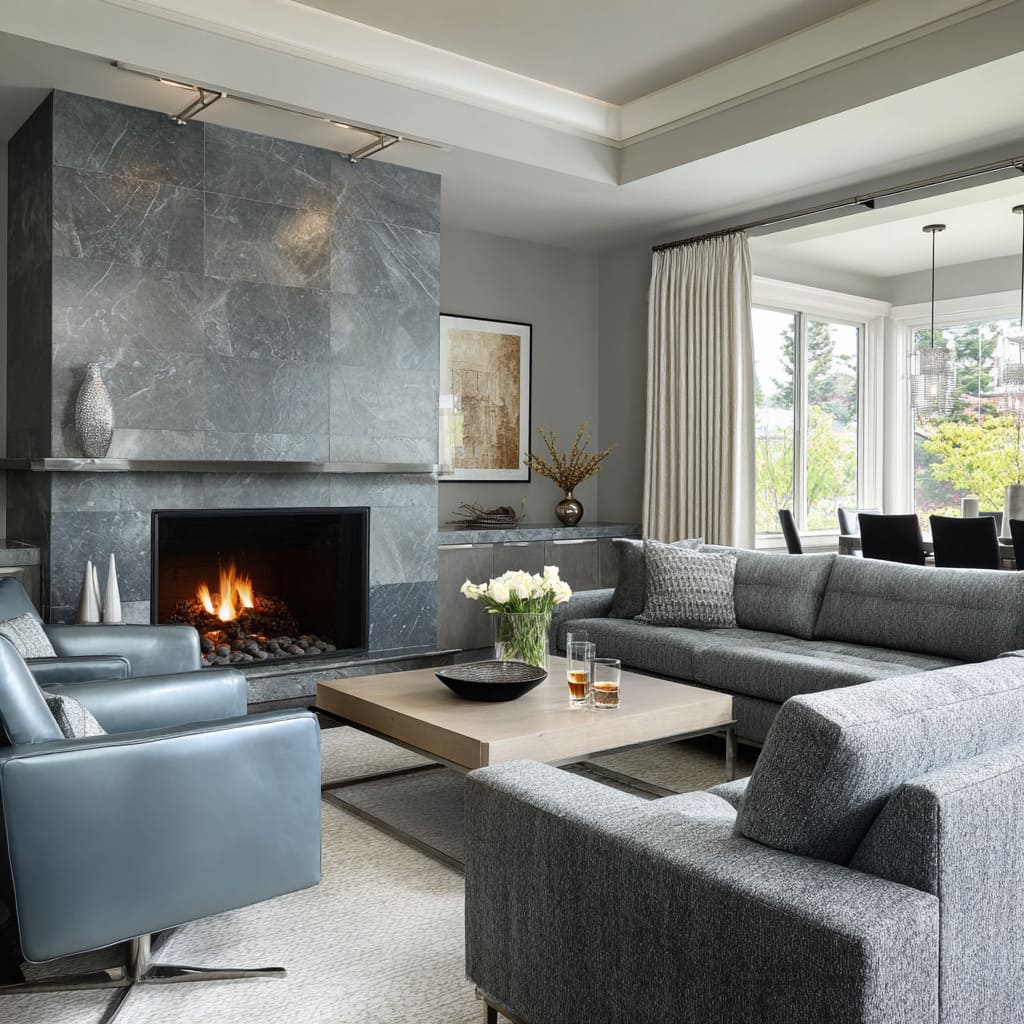
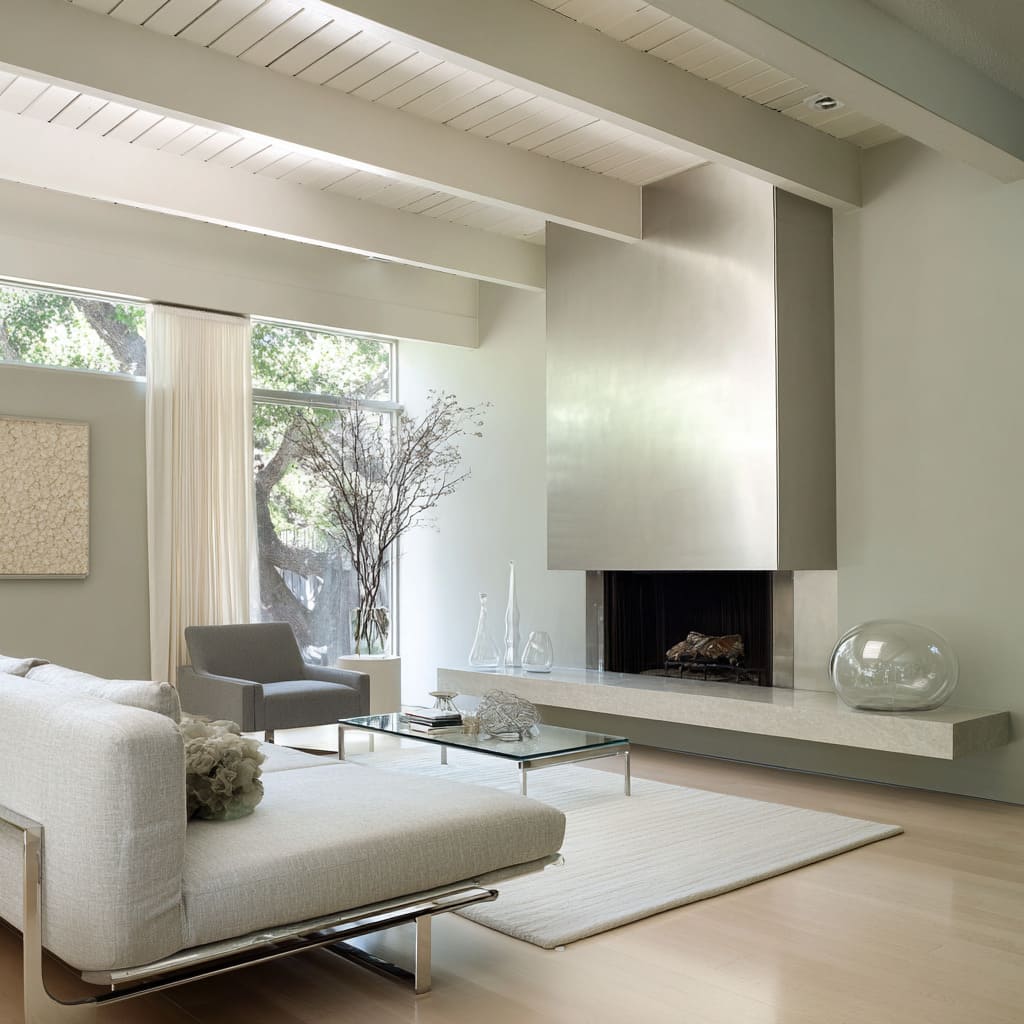
A modern gray and silver living room design succeeds by assigning clear visual jobs to each tone and finish, then arranging them so the room reads calm at a glance and layered on close inspection. Grey carries the large volumes—sofa blocks, plaster or stone chimney faces, big rugs, and broad wall fields—in soft, light-absorbing textures that make the shapes feel architectural rather than fussy; silver lives in edges, rims, and precise planes at hand height, where a brushed or polished line can catch daylight and firelight without overwhelming the scene.
Across refined silver and grey living room ideas, the strongest compositions use a small set of repeated moves: one horizontal glow at hearth level to steady the space, one luminous echo above (a ceiling cove or linear pendant) to bracket the zone, and a disciplined ladder of textures that climbs from matte stone and bouclé to brushed steel and tiny chrome accents. The result is a space that looks collected, not busy; luminous, not glittery; and quietly rich from every seat.
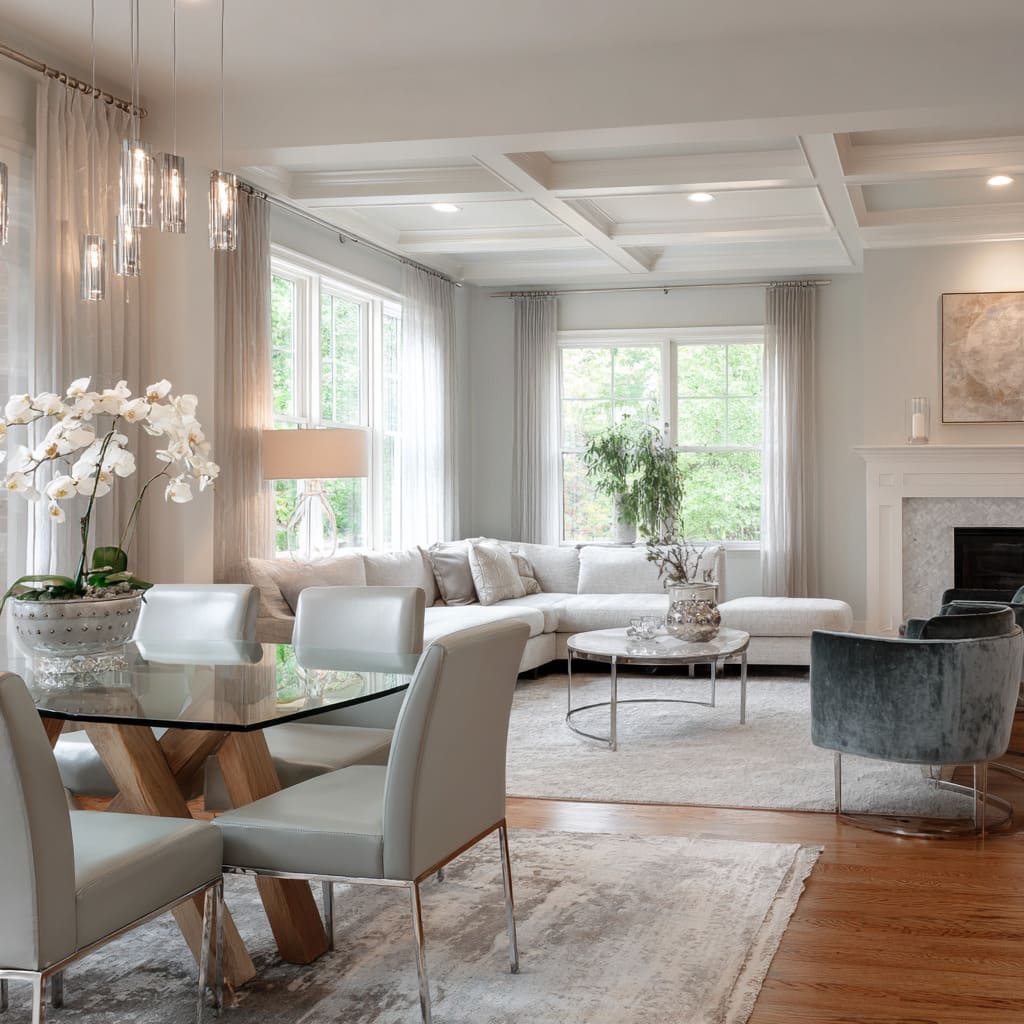
Palette Roles by Job: How Greys Carry Mass and Silvers Draw Lines
Greys do the heavy lifting because they sit comfortably on big surfaces without shouting. Pale plaster with a faint limewash, concrete-look slabs in soft ash, milk-white stone with blue-grey veining, and upholstery in heathered or bouclé weaves create broad, restful fields.
Silver then becomes a conductor for light and a tracer for edges: brushed-steel chimney faces, slim polished bases on swivel chairs, pencil-thin chrome rings under glass tables, mirror-topped coffee planes that reflect soft pools rather than hard glare.
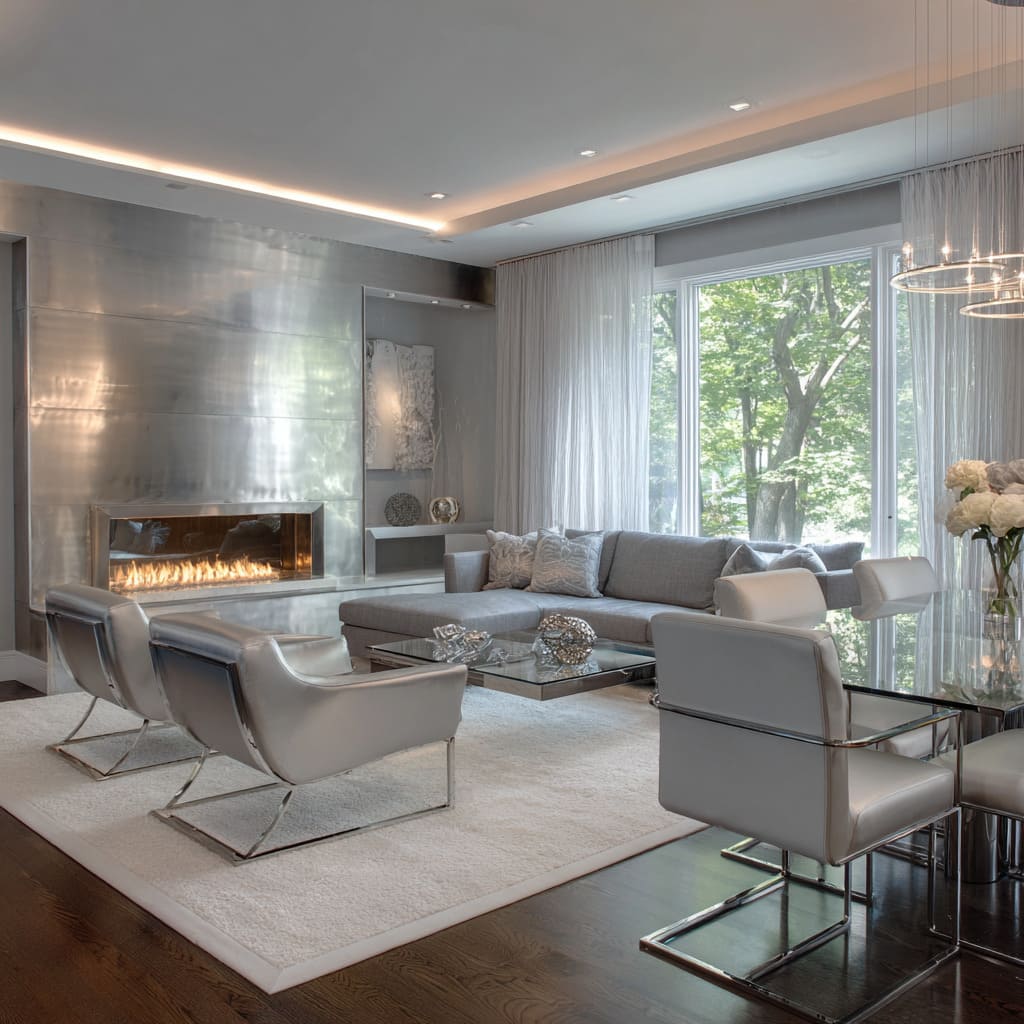
The distinction matters. A matte greige sofa block steadies the scene; a satin-nickel reveal under a floating hearth reads like a line of ink, pulling the eye along the room’s horizon.
In layered gray and silver living room ideas, the palette stays in a narrow value band, but sheen shifts constantly—matte to soft sheen to bright accent—so the room breathes as the sun moves.
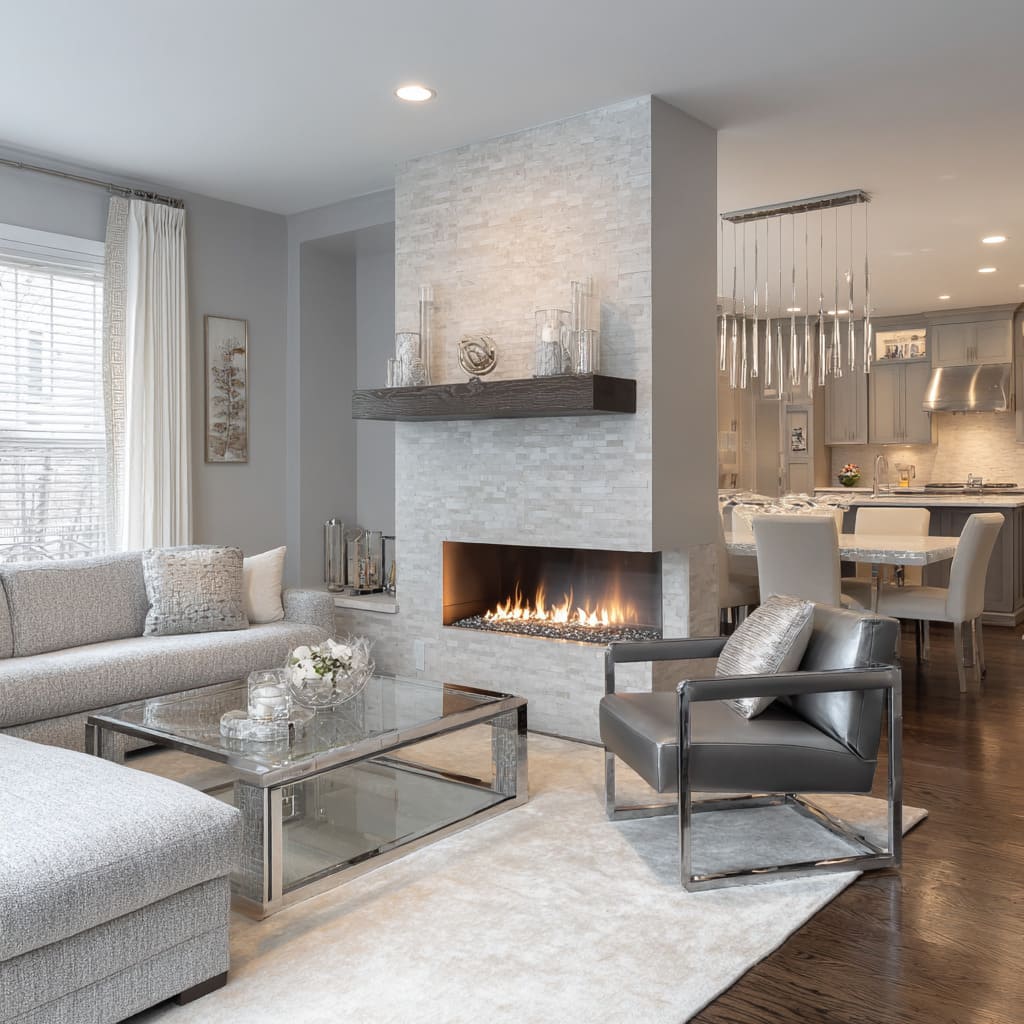
The Quiet Architecture of Datums: Firelines, Benches, and Ceiling Glows
Many compelling silver grey lounge ideas rely on datum logic: a long, low ribbon of flame sets the base line; coffee table tops, chair arms, and bench slabs hover near that height so the eye reads a continuous belt that widens the space. Above, a ceiling cove or metallic panel ceiling provides a second, softer horizon; between them, seating forms settle into an island that feels framed top and bottom.
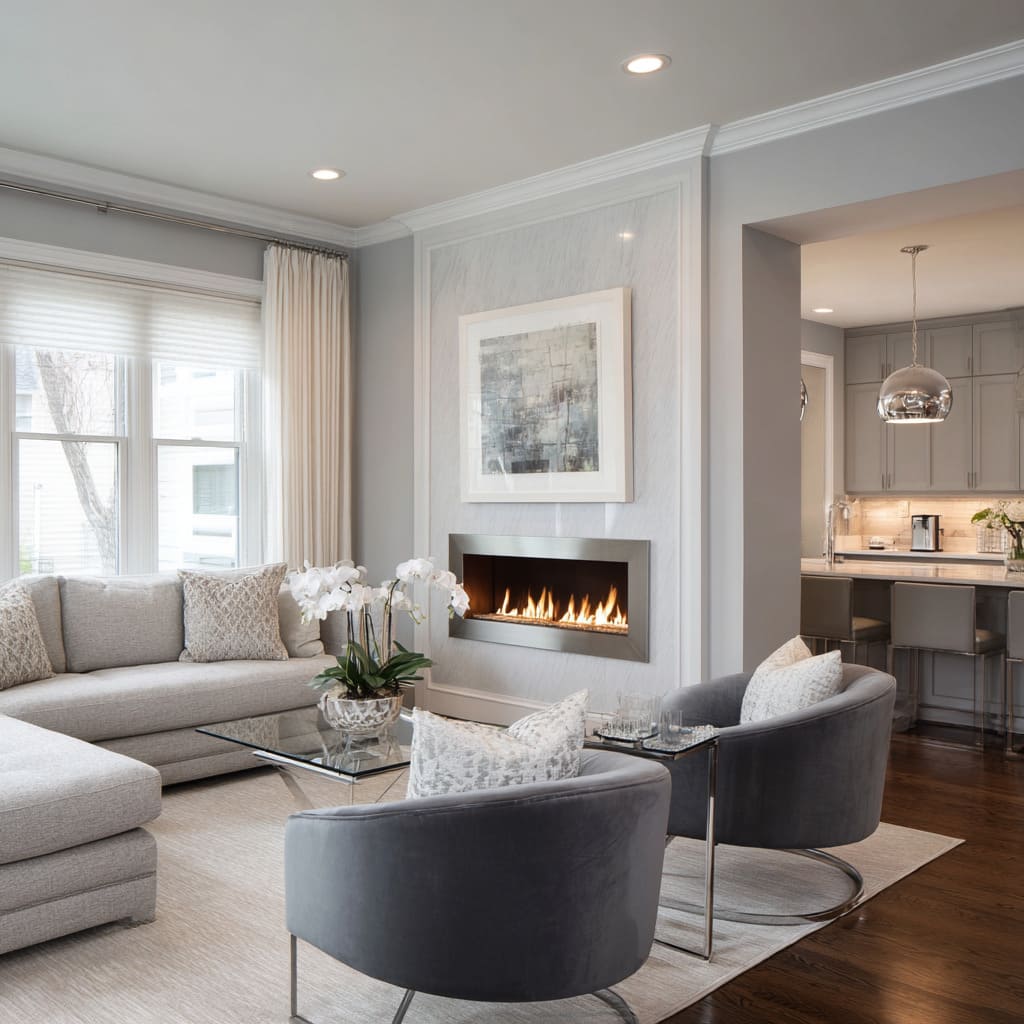
This doubled-line strategy is subtle yet powerful, turning light itself into part of the composition. In rooms with corner glass fireplaces, the flame bends around the angle and throws faint reflections onto nearby island waterfalls, chrome pendant rims, and mirror trays; the plan gains an easy connection between lounge and dine without adding objects.
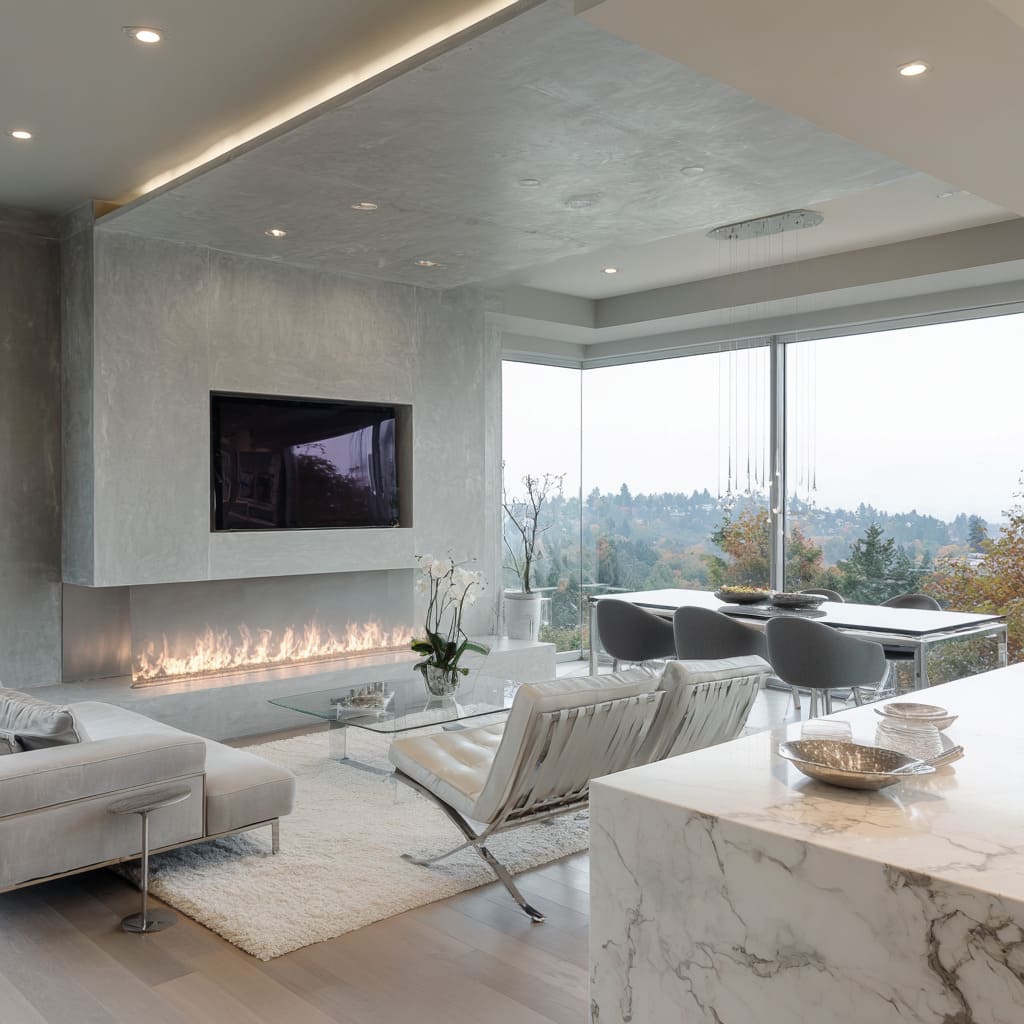
Reflection Control, Not Glare: How Silver Behaves
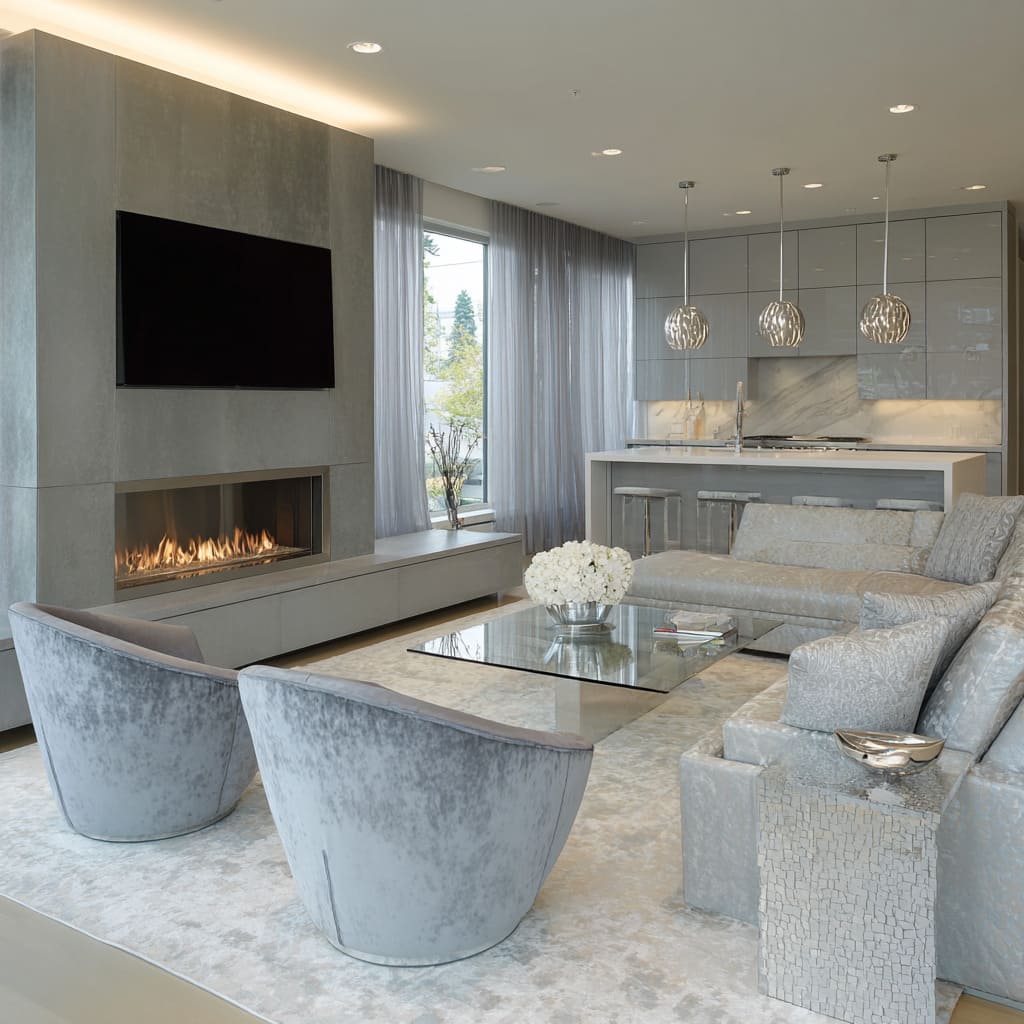
Refined gray and silver living room designs pay careful attention to how metals record light. Brushed steel throws long, milky streaks that read as atmosphere; vertically ribbed silver cladding catches daylight in narrow bands that animate a wall even when the fire rests; crackled mirrored mosaics used in a single center vein create a controlled sparkle that the rest of the room answers with softer sheens.
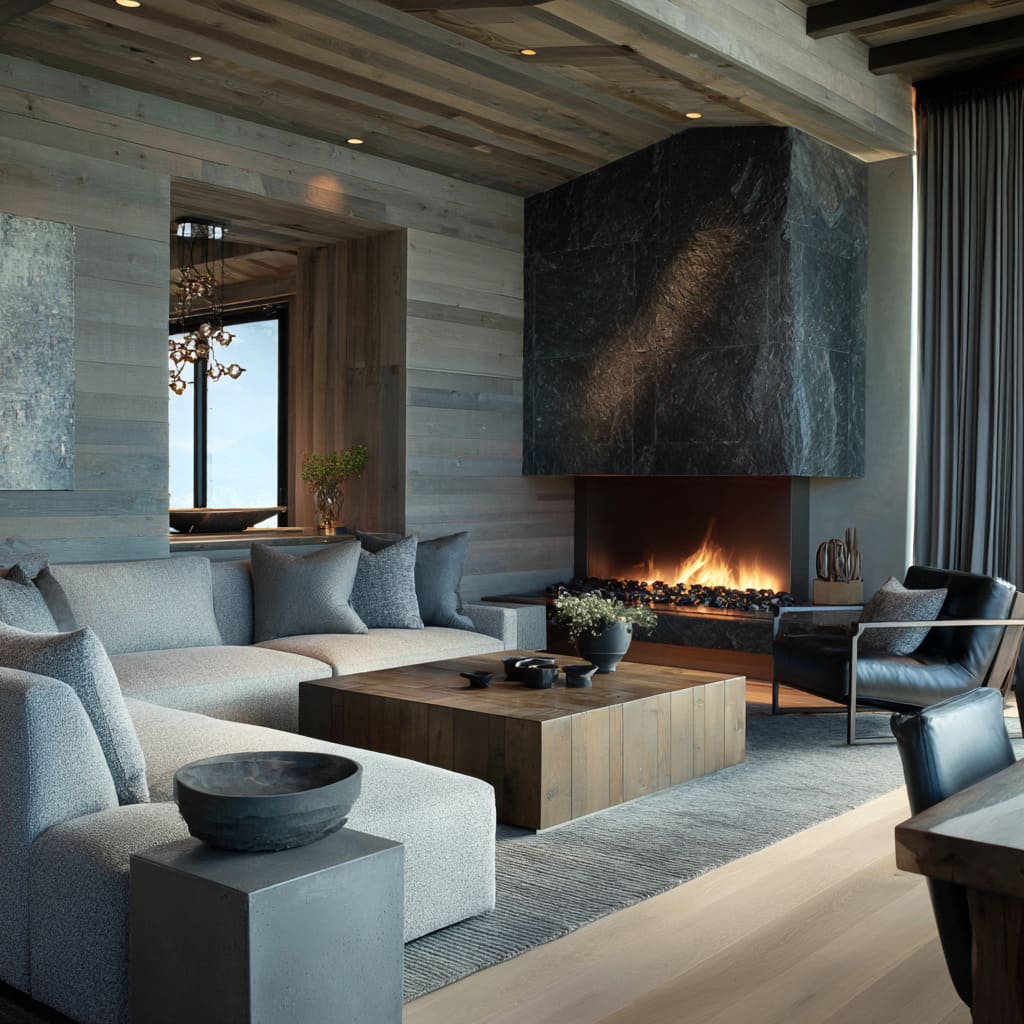
Planar reflections do the best work—mirror tops, chrome rings, polished table edges—because they read as thin highlights rather than bulky, shiny objects. The eye prefers lines and planes that skim and shimmer; heavy mirrored cabinets and large chrome boxes tend to block sightlines and compete with the hearth’s glow.
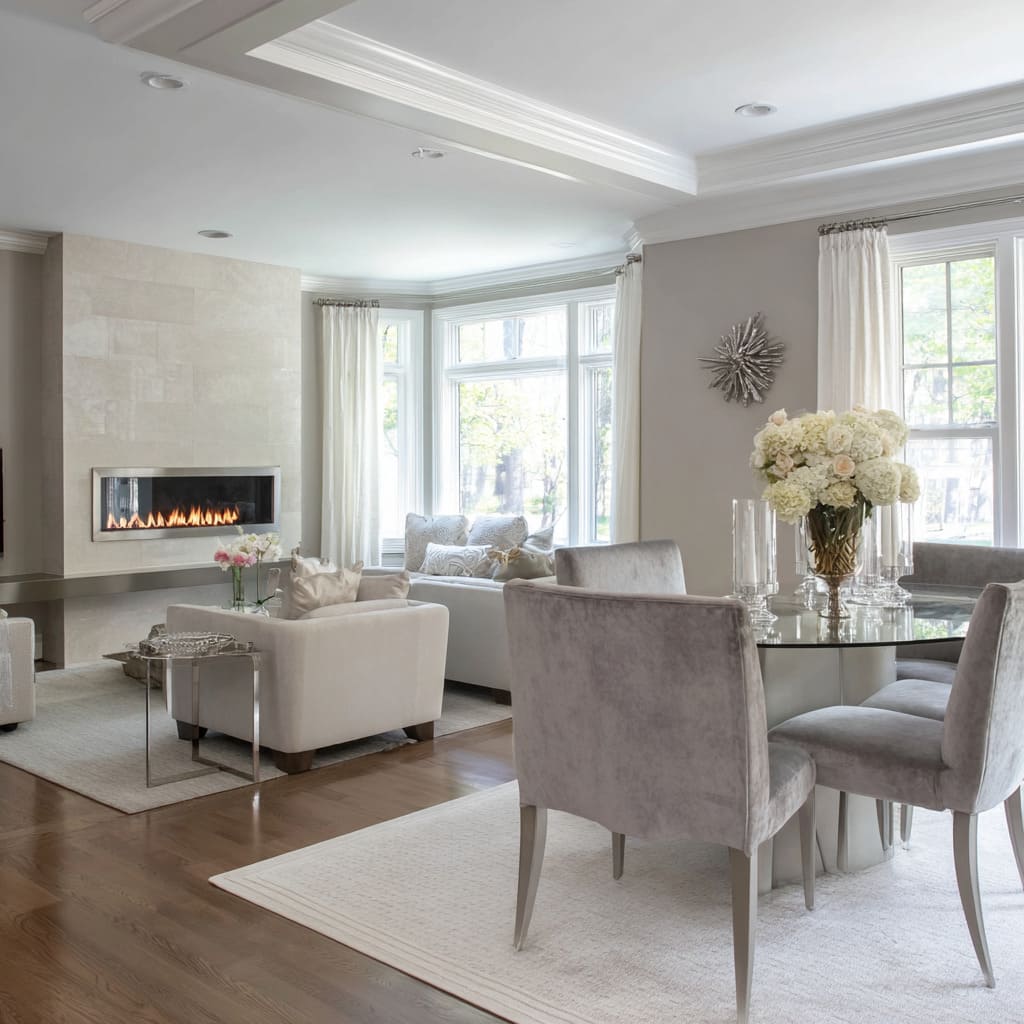
Windows and Drapery: Filtering Color Without Introducing It
Sheers operate as color filters rather than decoration. Cloud-grey or oyster-white curtains turn exterior green into a pale wash that lightly tints the palette without introducing new hues inside the room.
Pleated panels echo vertical rhythms found elsewhere—ribbed metal seams, panel joints, or timber beams—so the window wall becomes another architectural surface instead of a separate element. Strand sheers or chain-like fabrics add quiet motion across still walls, a choice that suits spaces where brushed metals and marble already handle the sparkle.
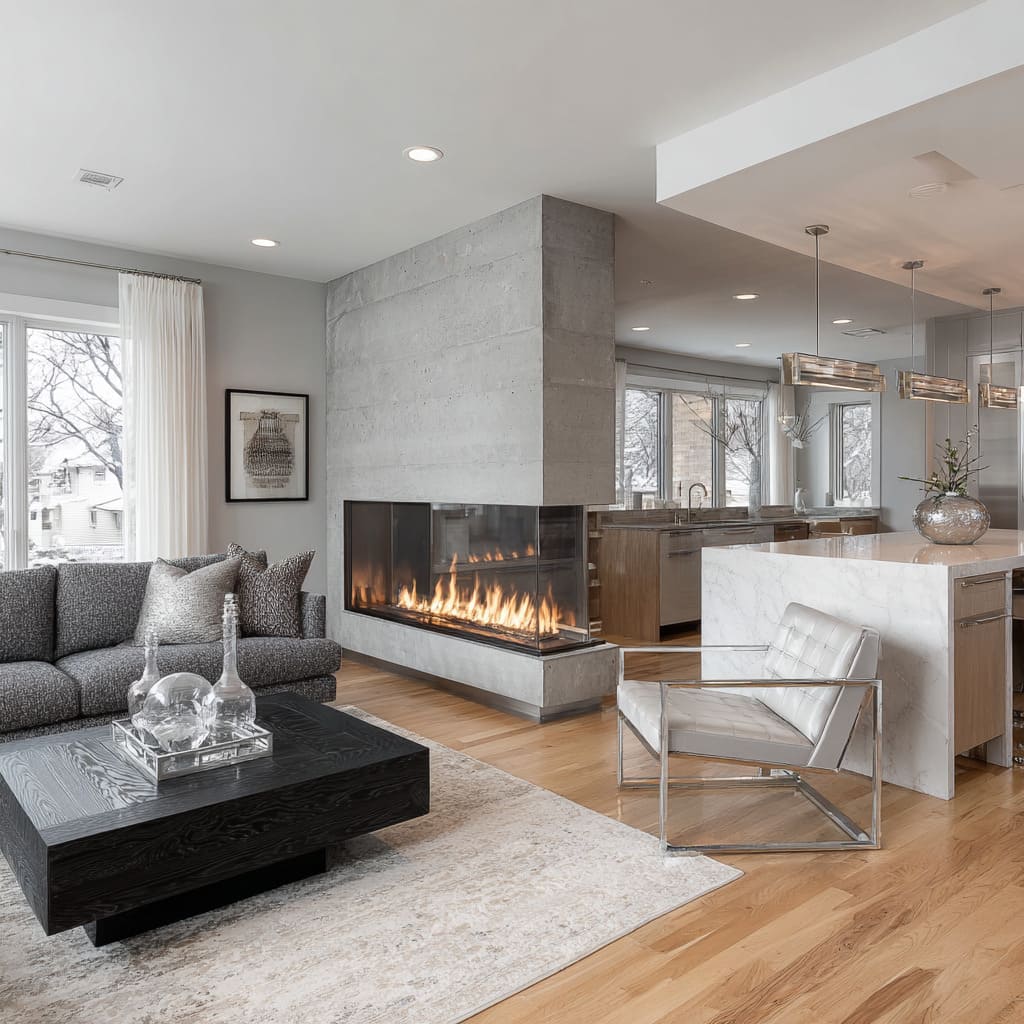
Furniture Geometry: Mass vs. Line
Across sophisticated silver and grey living room ideas, mass lives in the sofa and ottoman forms, while line lives in accent chairs and table structures. A boxy sectional in a heathered grey with low feet reads like a calm block; nearby, a classic lounge chair in charcoal leather on a polished steel frame introduces a single curved silhouette and the required sliver of silver at wrist level.
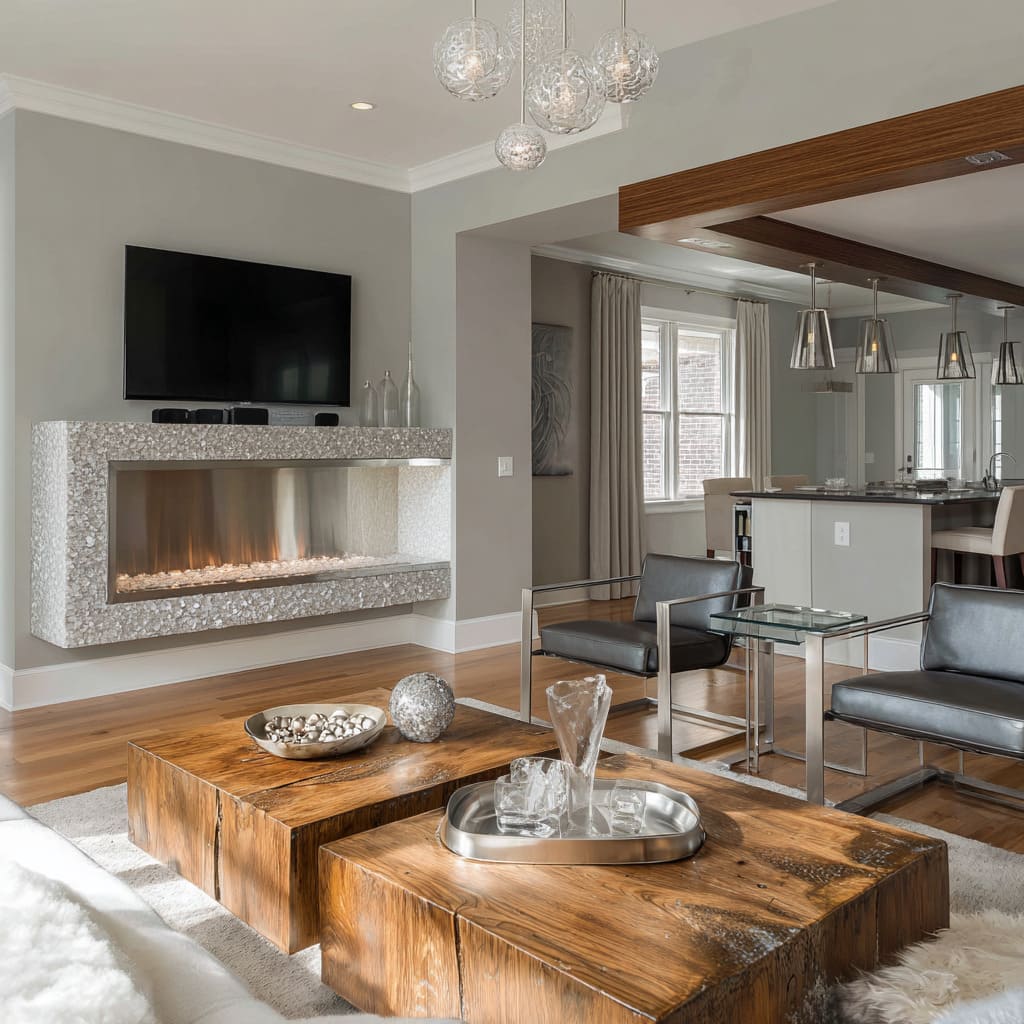
Coffee tables split the difference: glass tops with needle-thin frames keep the center open on reflective schemes; dense travertine cubes or warm timber blocks counterbalance mosaic or mirrored chimney features. Scale is deliberate—deep seating sits low so rug edges remain visible, and accent chairs carry longer legs or sled bases that mirror brushed-steel chimney planes in miniature.
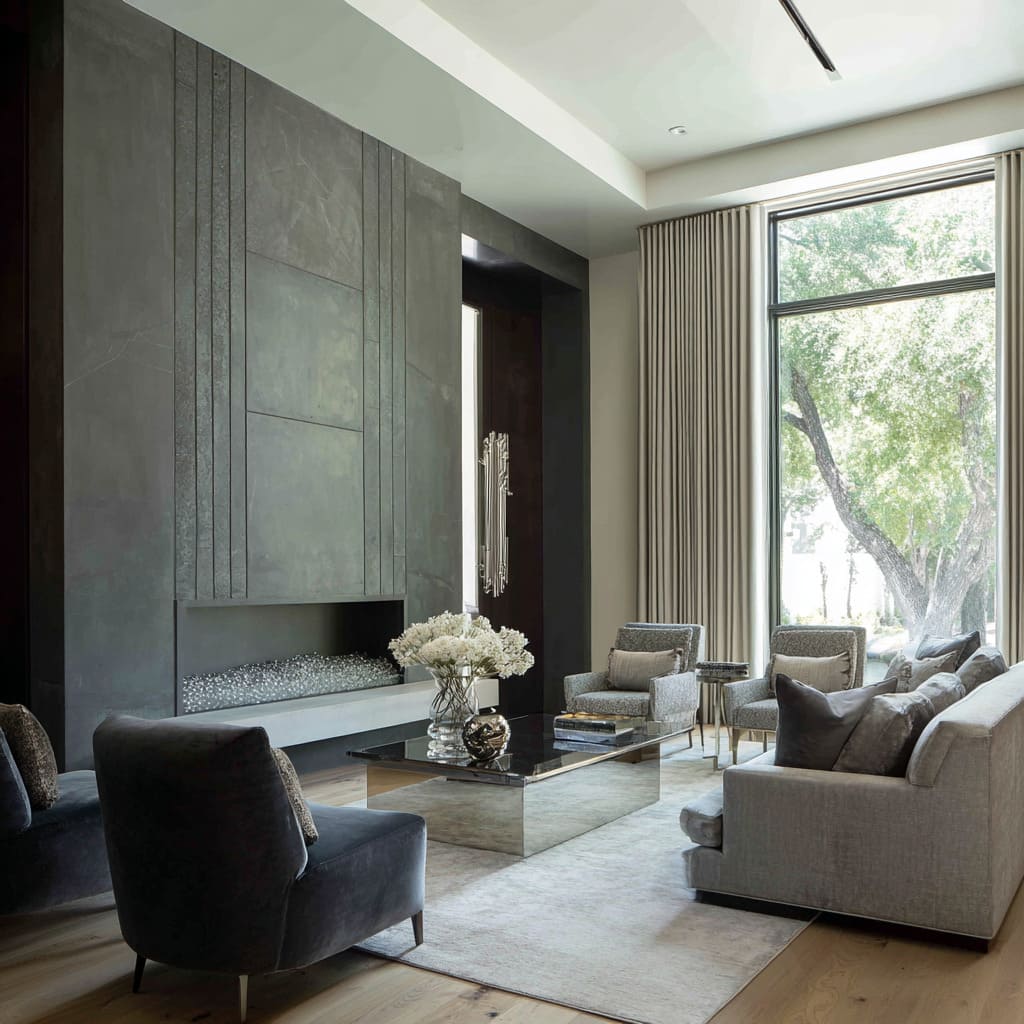
Tables and Surfaces: Mass + Gleam Pairings
Tables are where silver and grey negotiate center stage. Glass-topped circles on slender chrome rings help the hearth and the floor read uninterrupted, ideal in rooms with strong horizontal compositions.
Travertine blocks with inset glass windows ground soft seating islands while preserving visibility; mirror-topped planes reflect pendant dots as gentle stars, turning functional downlights into ornament.
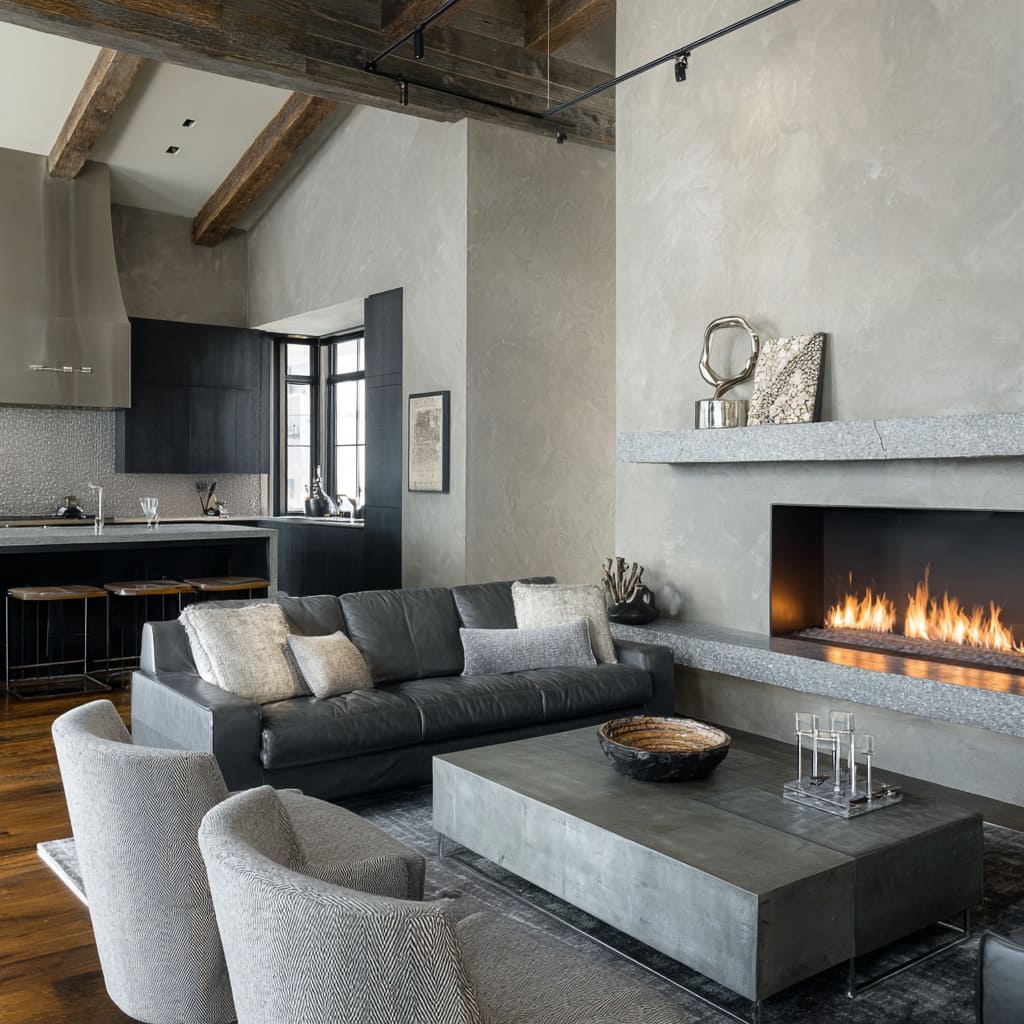
A workable pattern appears again and again: if the chimney face carries the drama (mosaic strip, mirrored rods), the table returns to mass and matte; if the fireplace reads as a quiet monolith, the table provides the main reflective plane.
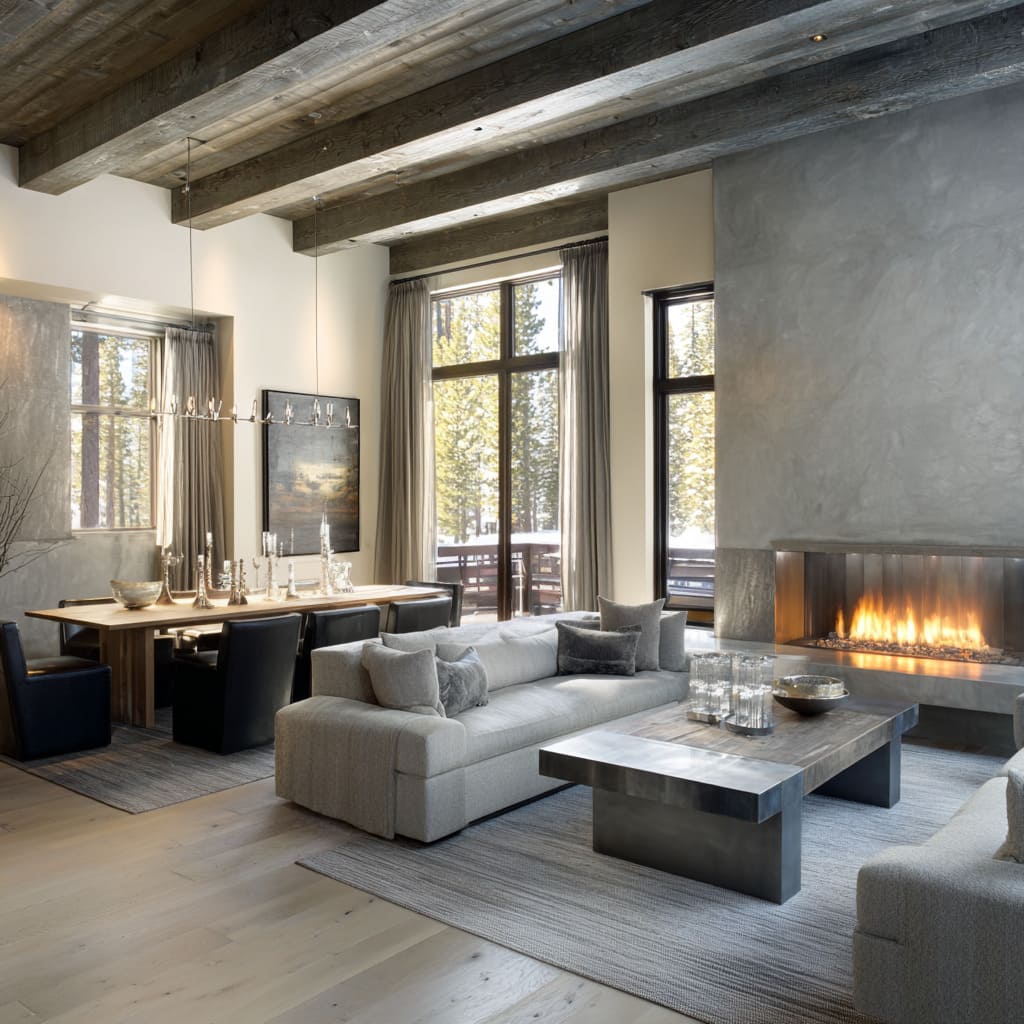
Accessories: Hand-Height Sparkle and Vertical Restraint
In polished grey and silver front room ideas, accessories are choreographed to control the travel of light. Sparkle sits near hands—satin-steel trays, small chrome bowls, hammered-silver vessels, crystal knots—placed on coffee tables, hearth ledges, and side consoles where they pick up grazing light without cluttering sightlines.
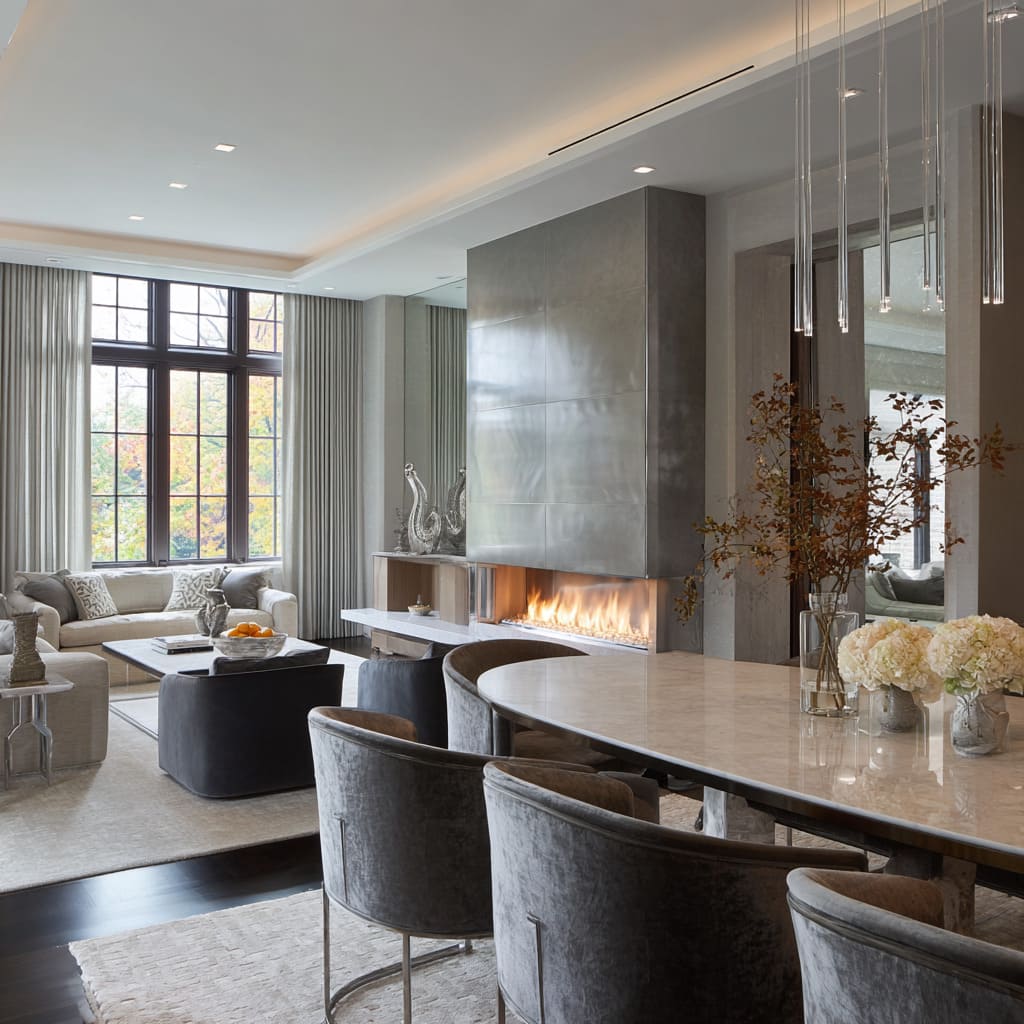
Vertical drama appears once: a rod chandelier, a mirrored stripe, a single artwork set above the fire. Everything else drops a level in sheen so the composition keeps its hierarchy.
Nature enters as pale florals, bleached branches, or a single orchid, offering form and freshness without disturbing the palette.
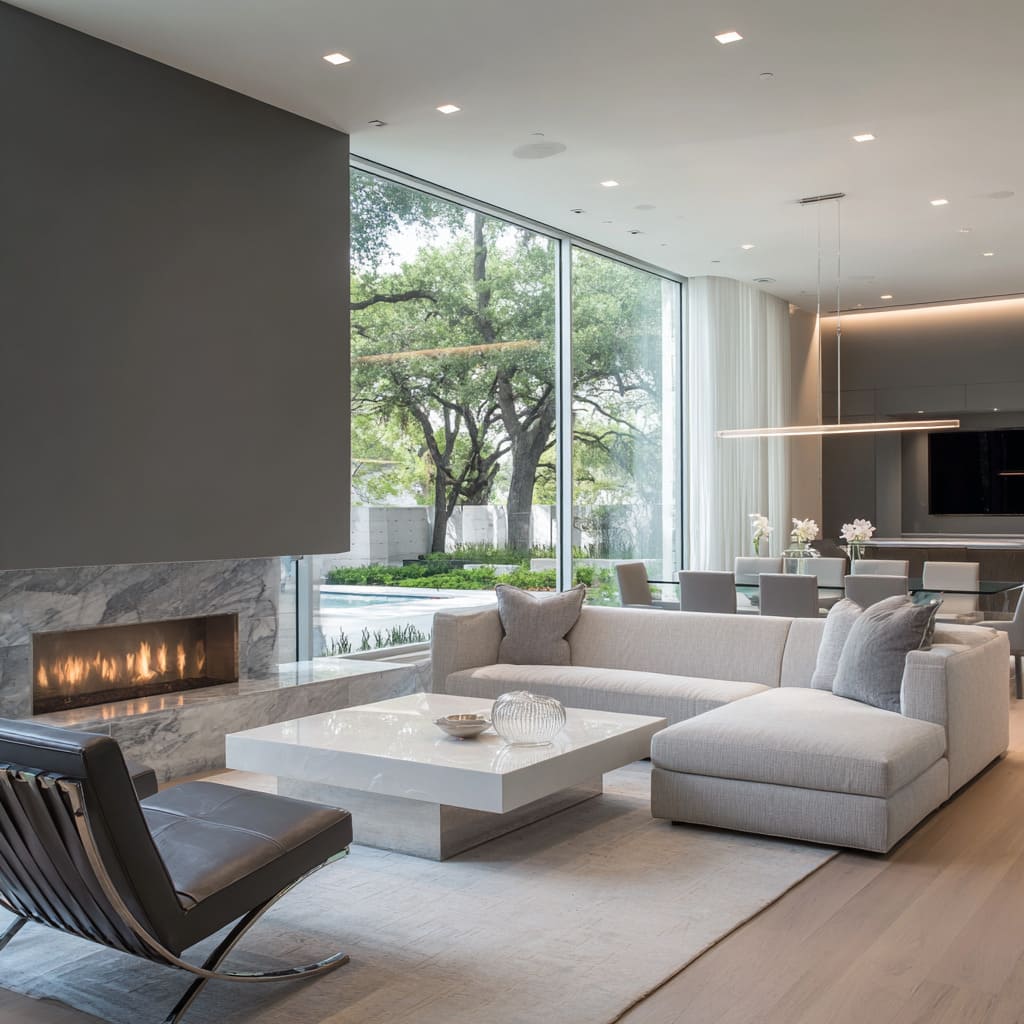
Accessory Logic: Micro-Highlights and Clear Anchors
Silver accents in front room designs work best when they feel inevitable. A hammered vessel placed on a stone ledge throws a quiet arc of light across the surface; a polished tray corralling glassware creates a single compact highlight at hand level; small chrome bases under swivel chairs flash as people move, adding life where it matters.
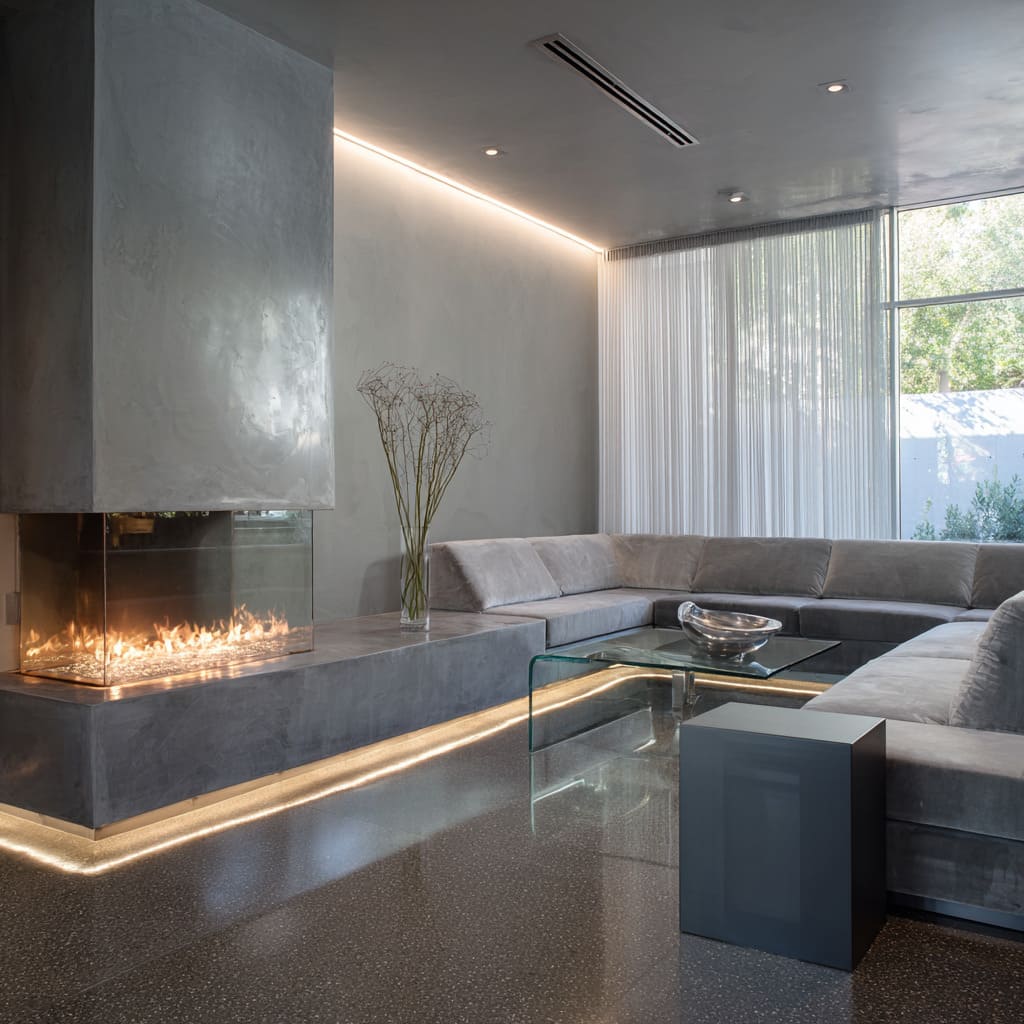
The vertical anchor is singular—either an artwork with graphite strokes on a silvery ground or a rod chandelier with slim glass; this single upright moment sets the pace for all other reflections, which stay horizontal or low.
Texture Stacking: From Rough to Silky
A successful gray and silver palette often reads as a climb in tactility. Split-face stone or gently troweled plaster handle the rough note; nubby bouclé and ribbed rugs provide medium grain; velvet in smoke and frost finishes supplies the soft sheen; brushed-steel chimneys and nickel picture lights draw bright lines at the top of the ladder.
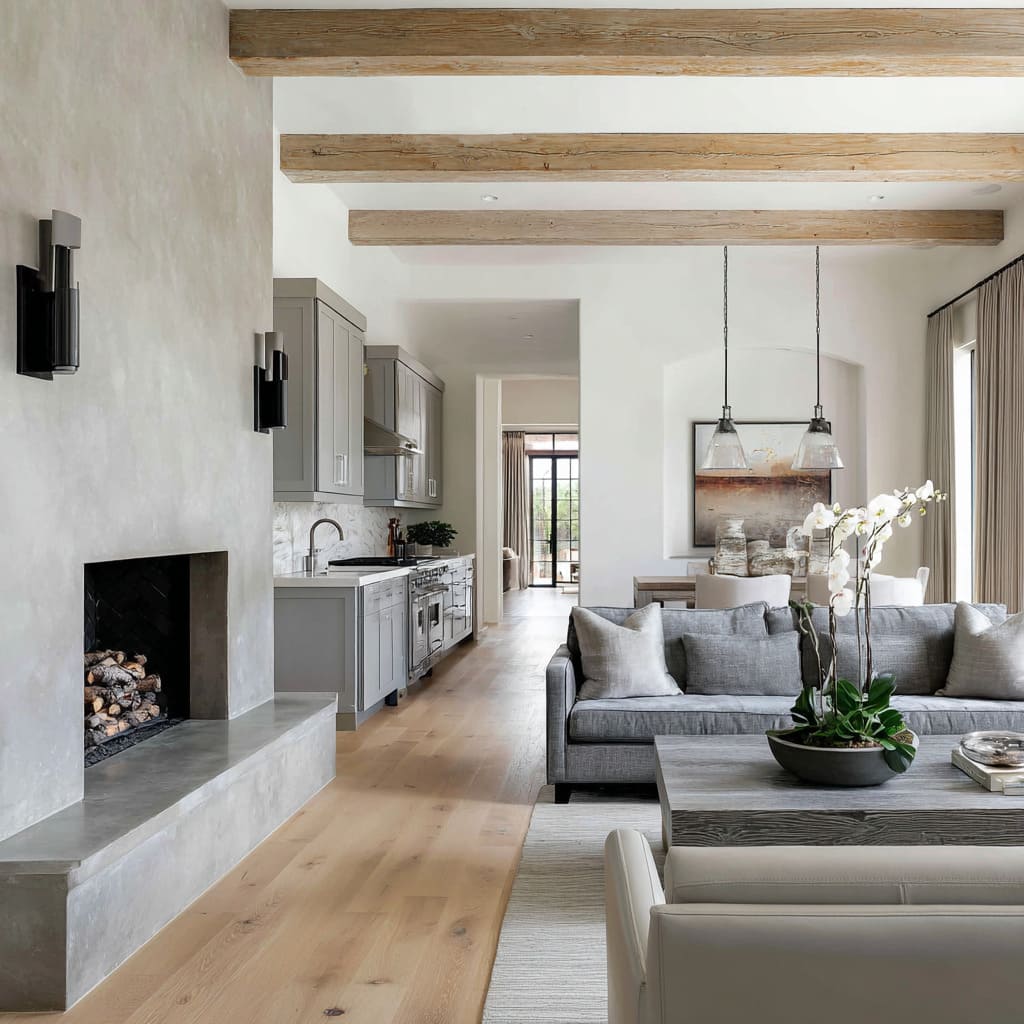
Grain direction becomes its own design element: horizontal stone striations rhyme with ribbon flames; vertical ribbing lines up with pleated drapery; diagonal marble veining energizes low, linear fire slots. With this stacking, the room gains depth without relying on extra color.
Texture Narratives
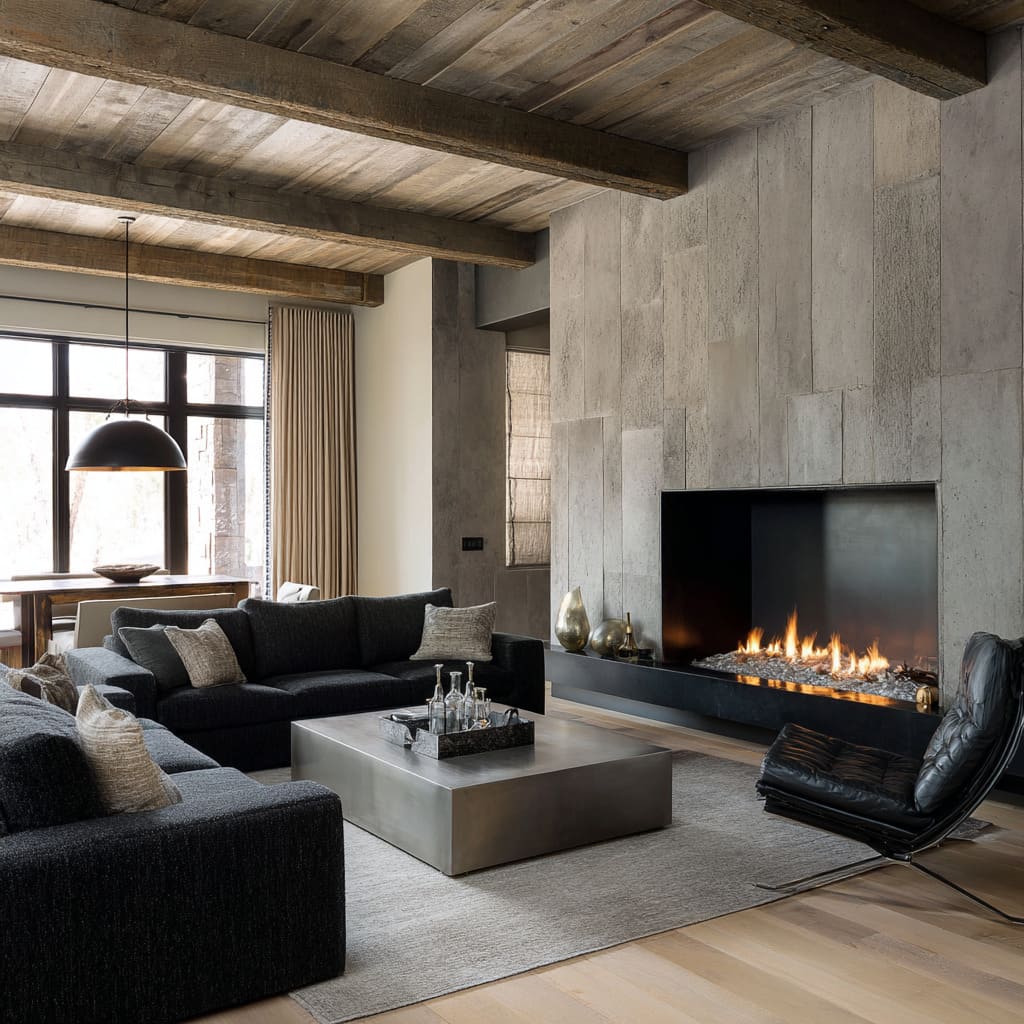
Texture tells the story that color alone cannot. Horizontal stone with shallow striations amplifies the fire’s direction and spreads warmth visually even when flames dim.
Ribbed textiles and pleated drapery contribute readable shadows that register in photographs and in person. Micro-textures—herringbone piping on cushions, crackled mirror strips in a chimney vein, looped rugs in pearl tones—bring intimacy to seating islands without tipping the palette away from grey.
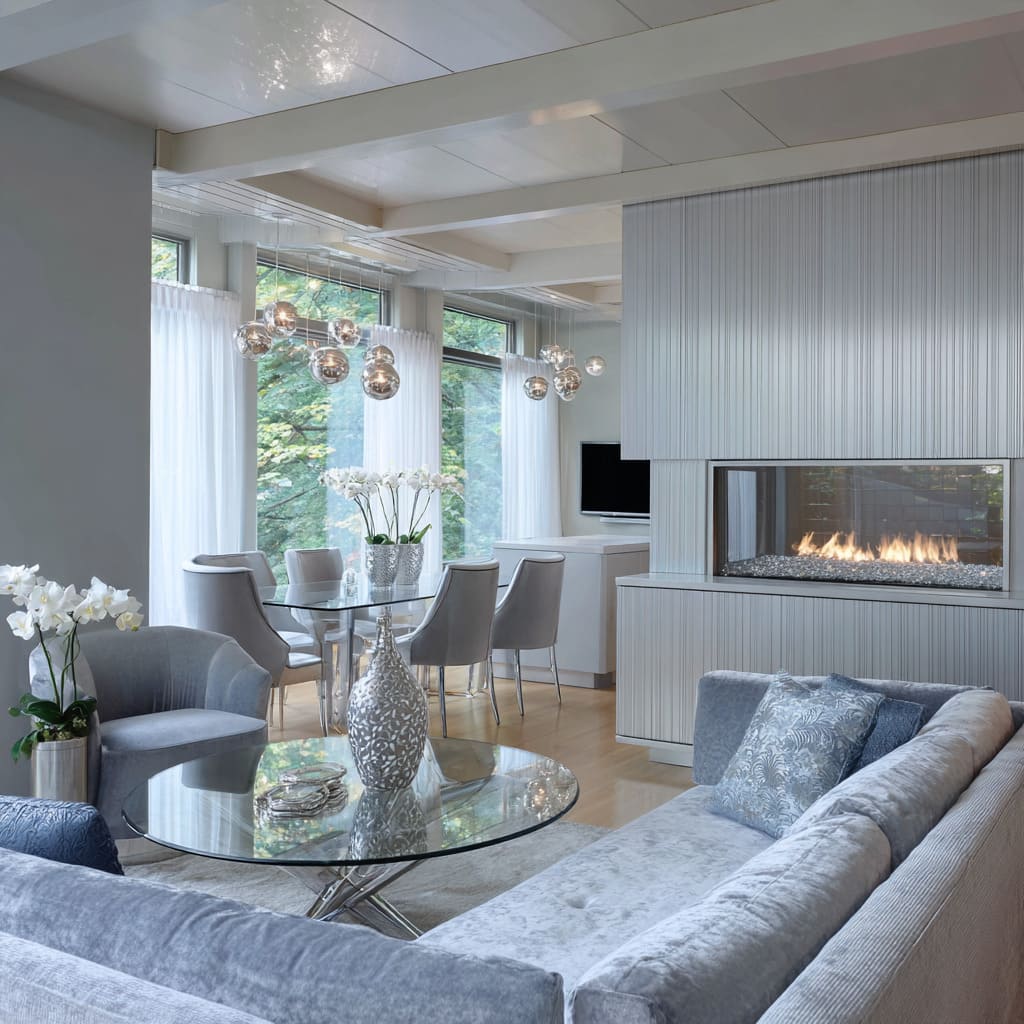
Style Families That Love Silver and Grey
Modern silver-and-grey rooms cluster into a few dependable families, each with its own rhythm and finishing logic, and all of them rank well for the search queries around silver and grey living room ideas and silver grey lounge ideas because the forms photograph cleanly and read clearly in text:
- Gallery Modern: large matte fields, planar reflections, strict linework, and ceiling coves that answer long firelines.
- Modern Organic: stone and warm timber soften the cool shell; silver appears as picture-light finishes, table edges, and subtle hardware.
- Glam Restraint: one luminous showpiece (mirrored rod veil, crackled strip), with textiles stepping down in sheen to prevent glare.
- Alpine Polished: concrete calm, driftwood or beam warmth, and metal as weighty planes or slim legs rather than bulky furniture.
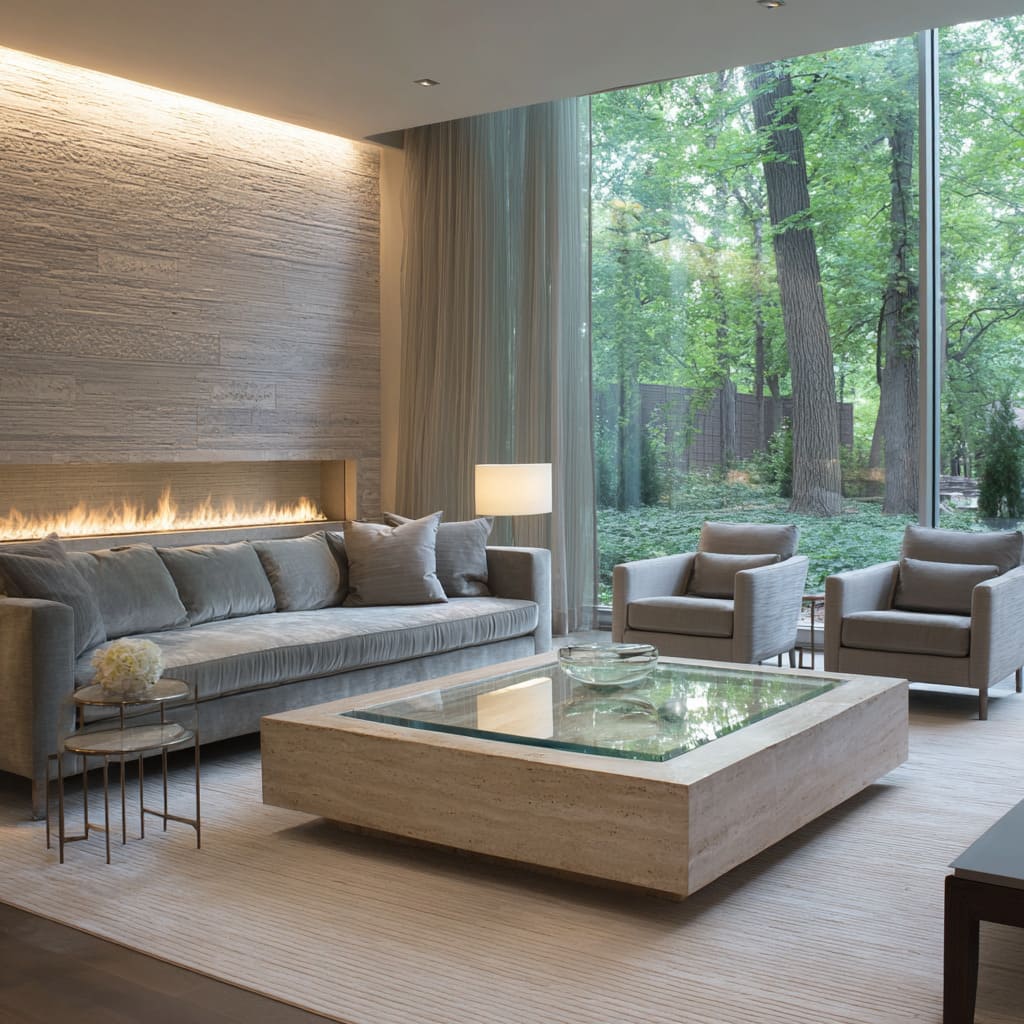
Main Feature Options That Anchor the Room
The “main feature” works because it concentrates attention and gives every other surface a clear role. Within grey silver living room ideas, these features carry rooms with minimal supporting decor:.
- Low ribbon fire in a monolithic face: the hearth line becomes the master horizontal; a slim stainless reveal under the slab reads like a hovering underline.
- Brushed-steel or ribbed-metal chimney tower: readable seams record daylight; soft verticals keep the wall active without extra objects.
- Mirrored or mosaic vein through a matte stone field: a single bright stripe provides drama; the rest of the space answers in satin and velvet.
- Monumental stone grid with picture lights: slab joints and nickel lights create a measured classicism; silver recurs as table bases and lamp stems.
- Corner glass fire stitching two zones: reflections travel across islands and pendant rims, tying lounge and dine into one optic.
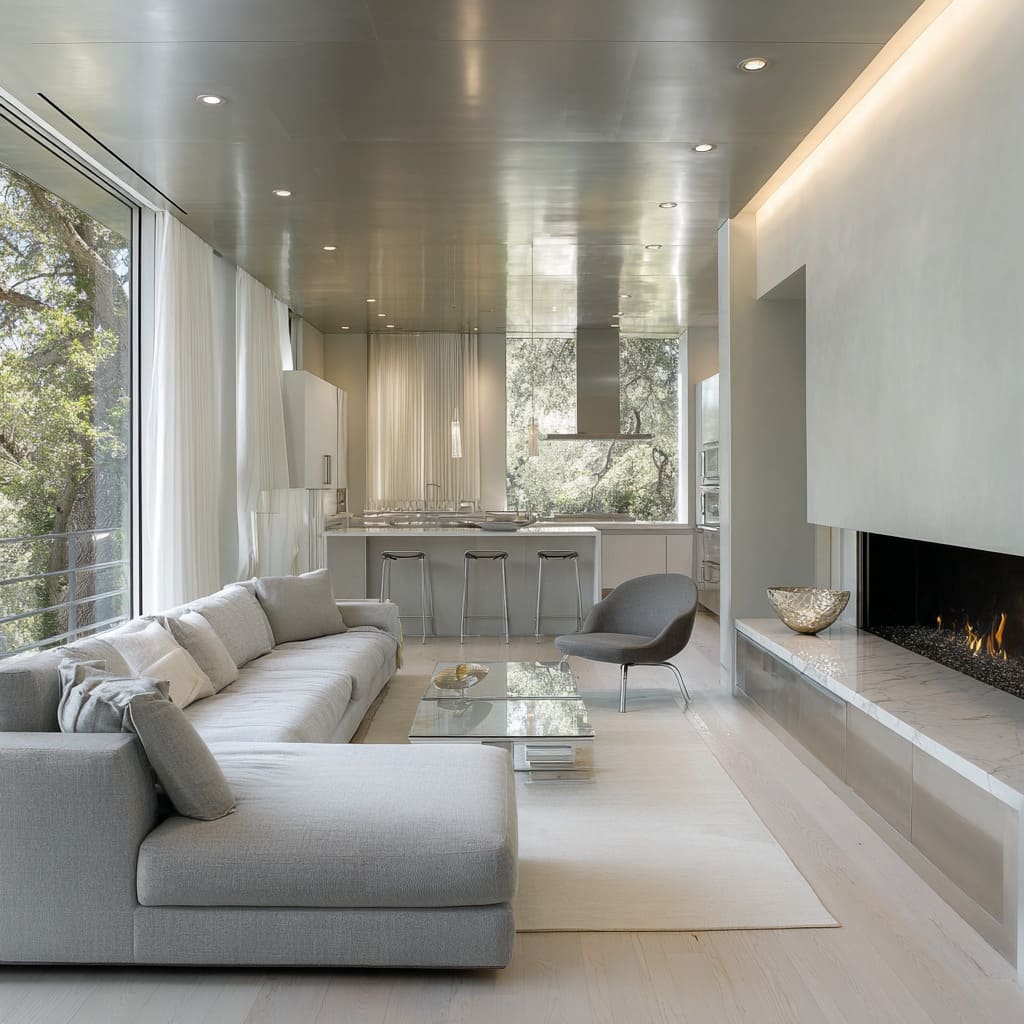
Layout Patterns: How Forms Sit Together
Plan logic governs why certain gray and silver living room design compositions feel settled. Long rooms thrive on parallel rails: ceiling cove, hearth belt, island top; the furniture cluster sits as a low island with one sculptural lounge chair as the asymmetric accent.
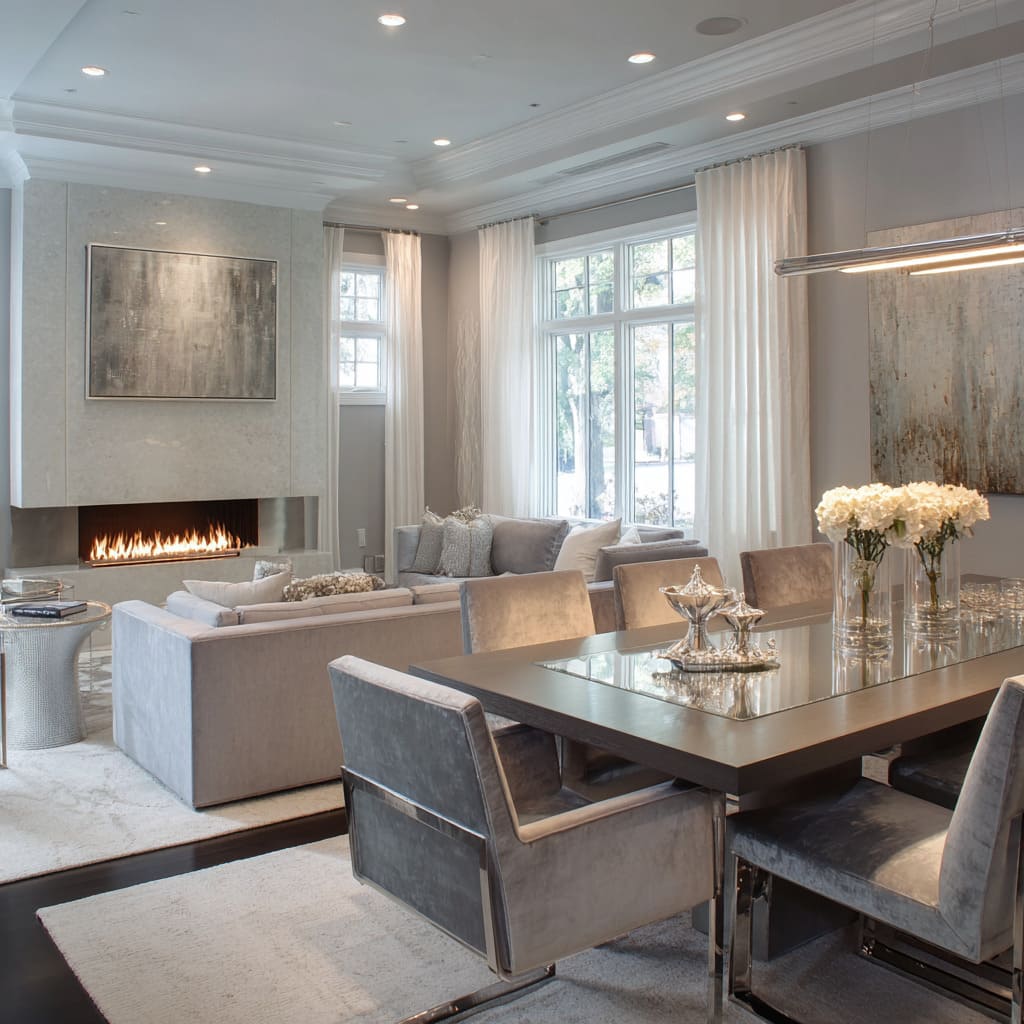
Circular elements pair with circular footprints—round table on a round rug zone, drum lamp beside a round side table—giving the plan an internal alignment that remains legible even with open circulation. In corner-fire layouts, L-shapes repeat: the fire and bench form one L, the sectional forms another, and a rounded coffee table softens the crossing.
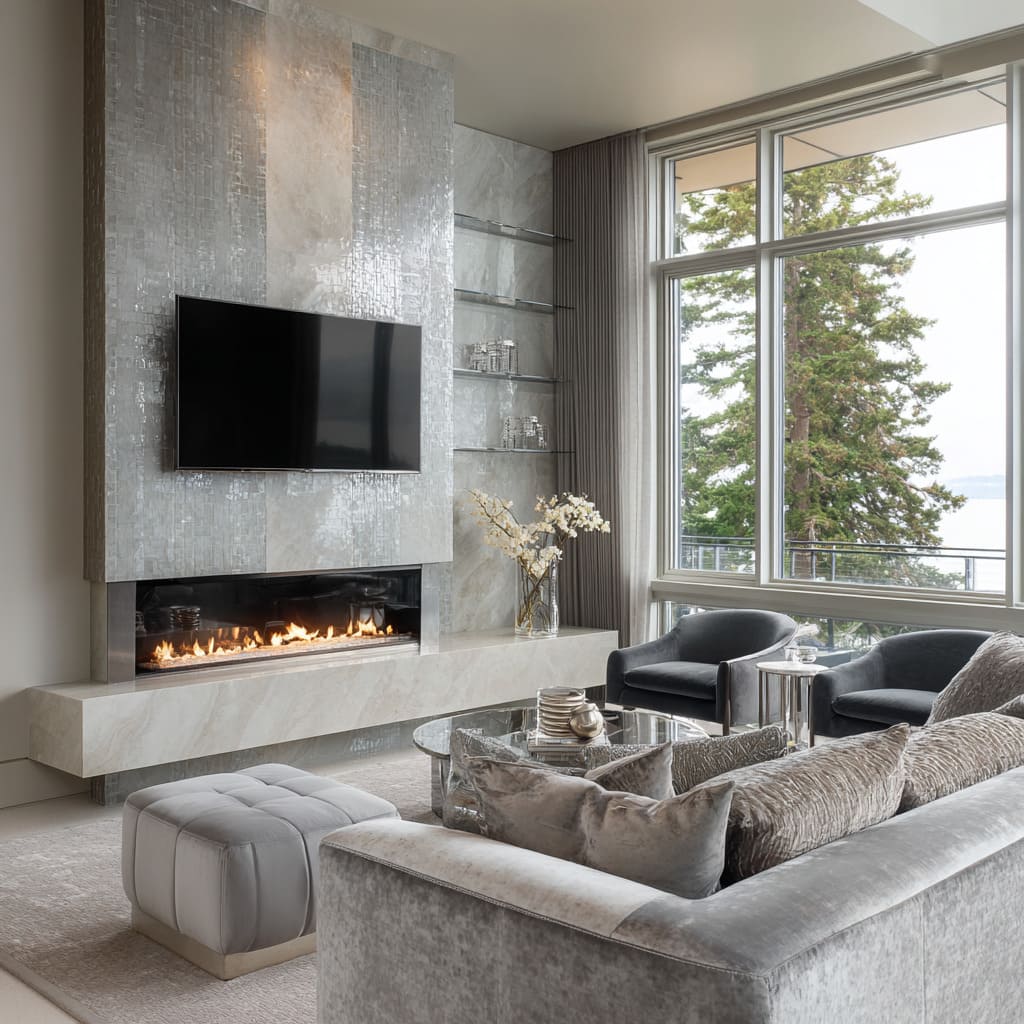
Composition Tactics
Edge and Sheen Discipline
- Large planes: matte (plaster, limewash, concrete-look slabs, bouclé).
- Medium planes: soft sheen (velvet, honed stone, brushed metal).
- Small planes: bright (mirror tops, chrome rings, crystal accents).
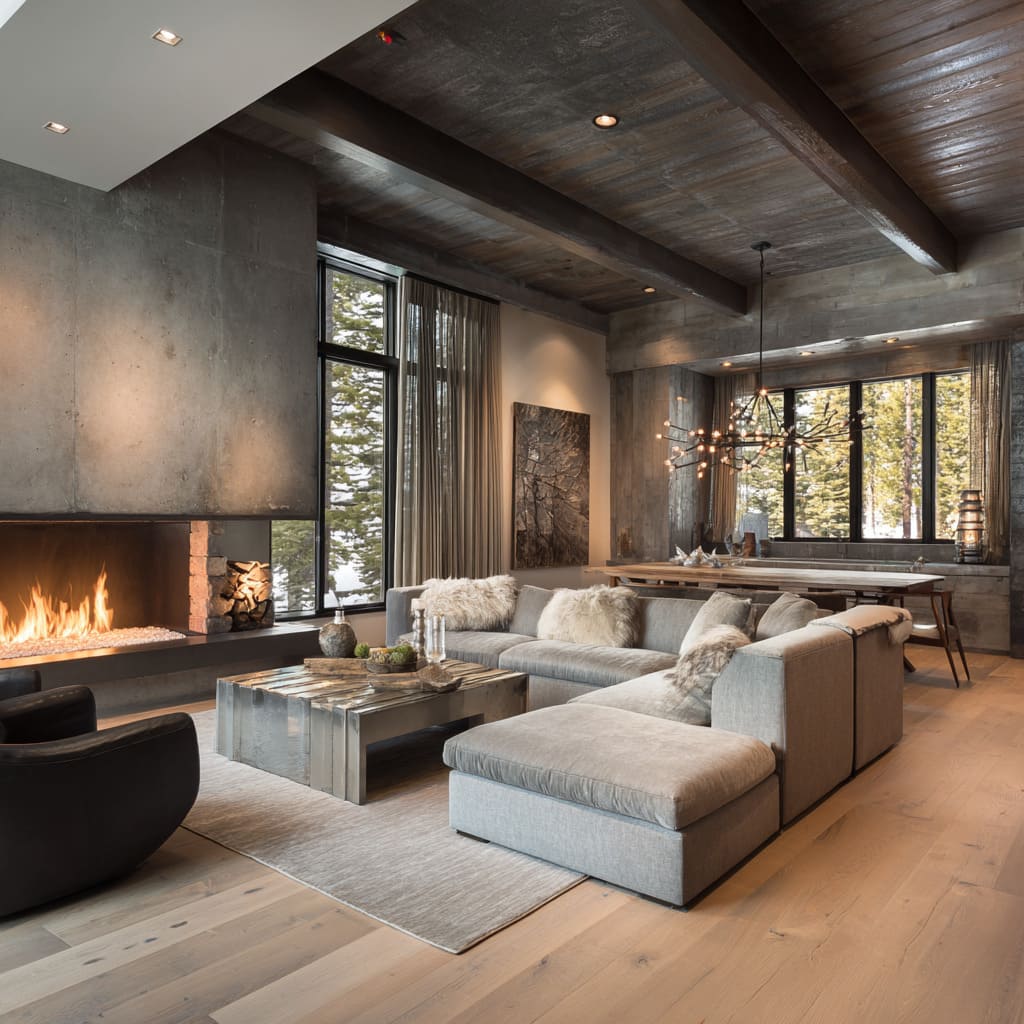
Horizon Bracketing
- Bottom: ribbon fire, floating bench, or under-hearth reveal.
- Top: linear ceiling cove, ring pendant, or metallic panel ceiling.
- Middle: seating and tables held in a narrow height band.
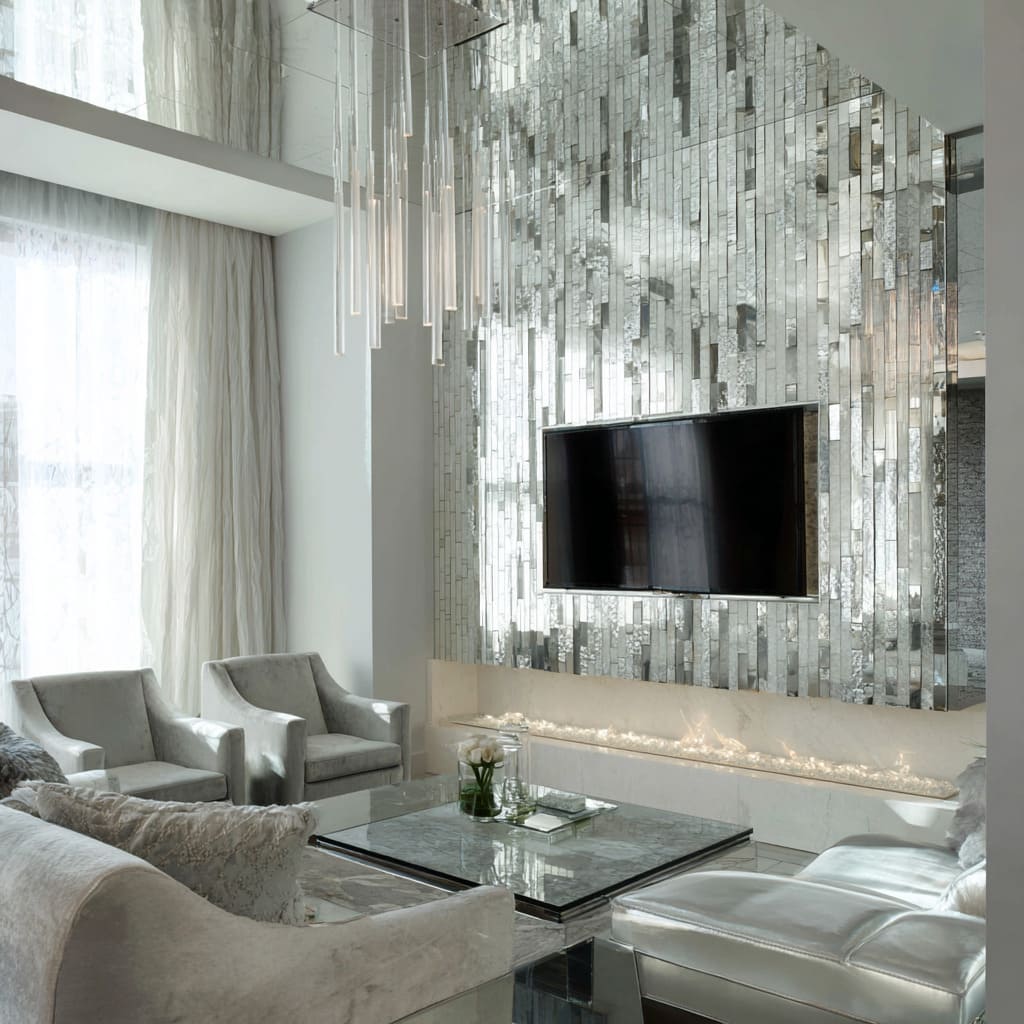
Reflection Rhymes
- Fireline echoed by pendant line.
- Ribbed cladding echoed by pleated drapery.
- Diagonal marble veining echoed by angular table insets.
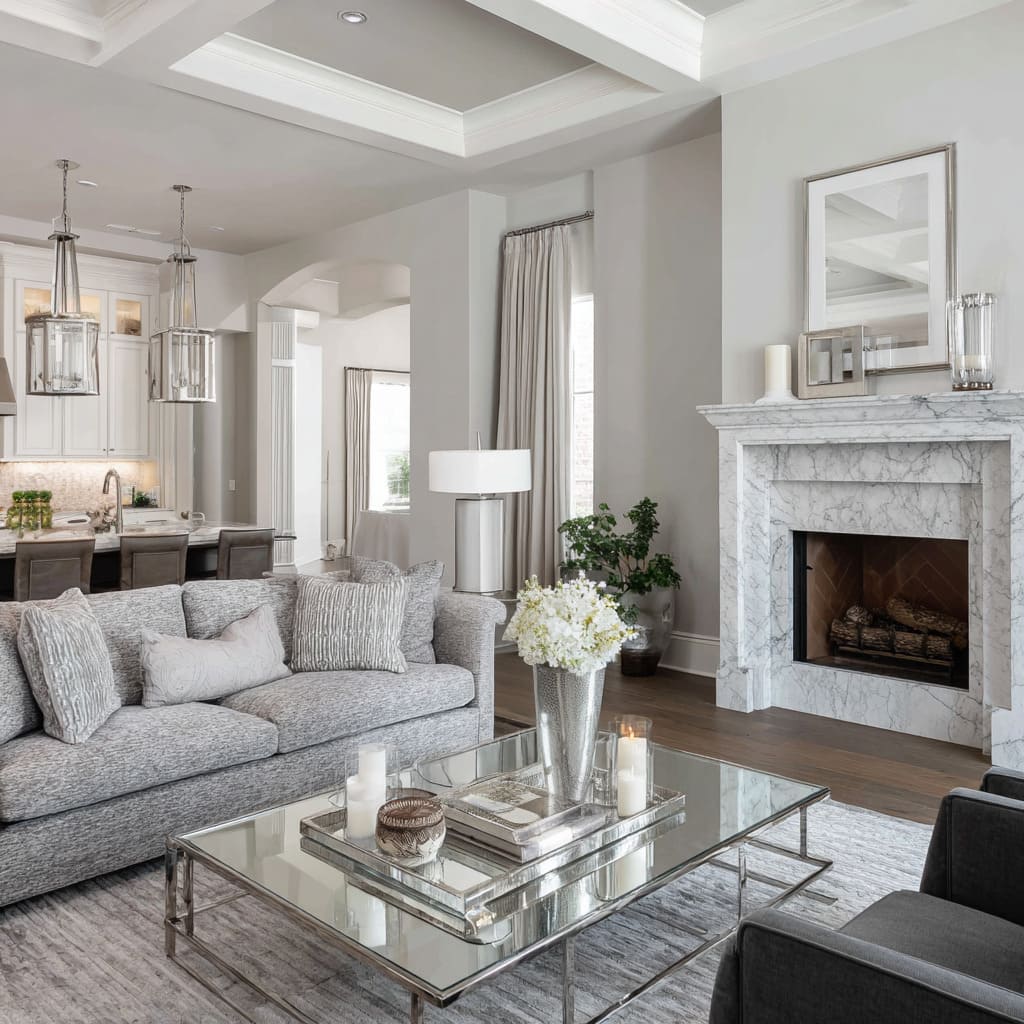
Mass vs. Line
- Sofa/ottoman = mass and texture.
- Accent chair/table bases = line and silver.
- Coffee table toggles between mass (stone/timber) and gleam (glass/mirror).
Closing Insight: Calm First, Layers Second
Across the spectrum of silver and grey living room ideas, the strongest rooms follow a simple creed: grey builds the room’s body, silver draws its anatomy, and a single warm note—wood beam, limestone hearth glow, or brass vessel—keeps the pulse steady. Keep big surfaces quiet, let brushed metals handle motion, and place micro-highlights where hands move and eyes rest; the composition holds through morning glare, afternoon softness, and evening firelight, always reading organized, luminous, and deeply composed without relying on loud contrast or novelty.