Miami Art Deco living room design is usually based on pastel color, a curved sofa, a chrome table, a palm nearby, a touch of gloss. Those details can belong to the style, but they do not create it by themselves.
A living room starts to feel truly modern Miami Art Deco when formal structure, climate-based atmosphere, and bodily comfort are all working together in the same space.
That balance is what gives the style its identity. Without formal structure, the room can slip into soft resort contemporary.
Without climate atmosphere, it can drift toward urban Deco or polished hotel glam. Without comfort, it can feel staged rather than lived in.
The rooms that hold the style with clarity usually do three things at once: they shape the shell in a deliberate way, they use color and light to suggest heat, water, brightness, and air, and they arrange furniture for lounging, conversation, and social ease.
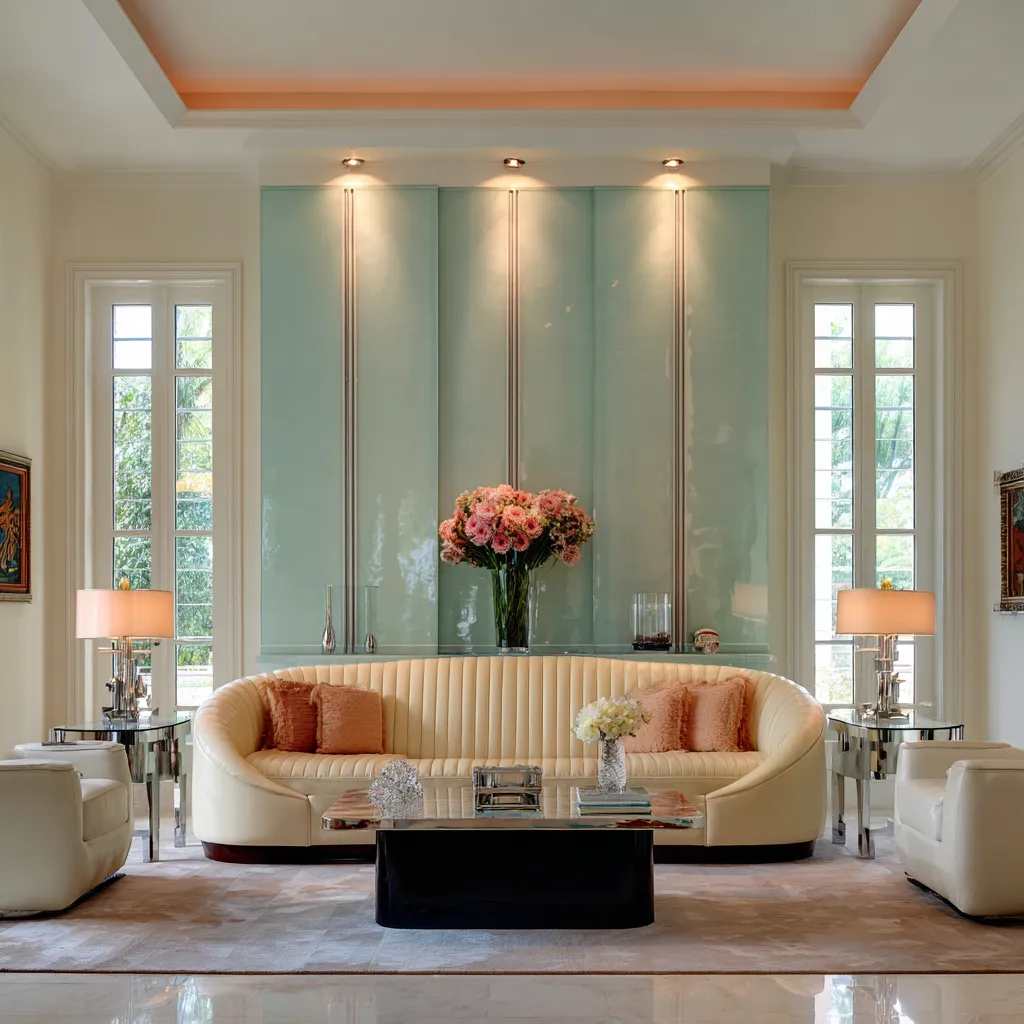
This is how Miami Art Deco feels current. It does not depend on historical imitation.
It takes the glamour, rhythm, and composure associated with Deco and translates them into larger surfaces, clearer geometry, fewer objects, and a more relaxed domestic mood. The result can be polished, but it does not have to feel rigid.
It can feel dressed, yet still easy to inhabit.

The shell does much of the work
In modern Miami Art Deco living room ideas, the architecture itself often carries more of the style than the furniture. The shell is not passive background.
It is one of the main style tools. That shell might take the form of a large rounded portal, a curved bay of windows, a fluted feature wall, a mint or blush architectural panel, a recessed focal niche, a shaped ceiling field, a built-in banquette, or a softly arched opening that frames another zone beyond.
These moves matter because they give the room a formal backbone. They create composure before any accessory has been added.

This is a major reason some rooms feel specific while others feel only loosely related to the style. If the architecture is ordinary and the room depends on a few pastel cushions and a brass side table, the result can feel pleasant but thin.
If the wall, ceiling, opening, or built-in millwork has a real role, the style becomes harder to lose. The room starts holding itself together from the perimeter inward.

A modern Miami Art Deco living room therefore often begins with one major architectural idea. It may be a wall treated as a single color field with vertical divisions.
It may be a ceiling with a large recessed oval or rounded rectangle. It may be a banquette that feels formed with the room rather than placed into it.
It may be a portal that turns a simple sitting area into a layered sequence of outer lounge and inner salon. Once that main structural idea exists, the rest of the room can become simpler.
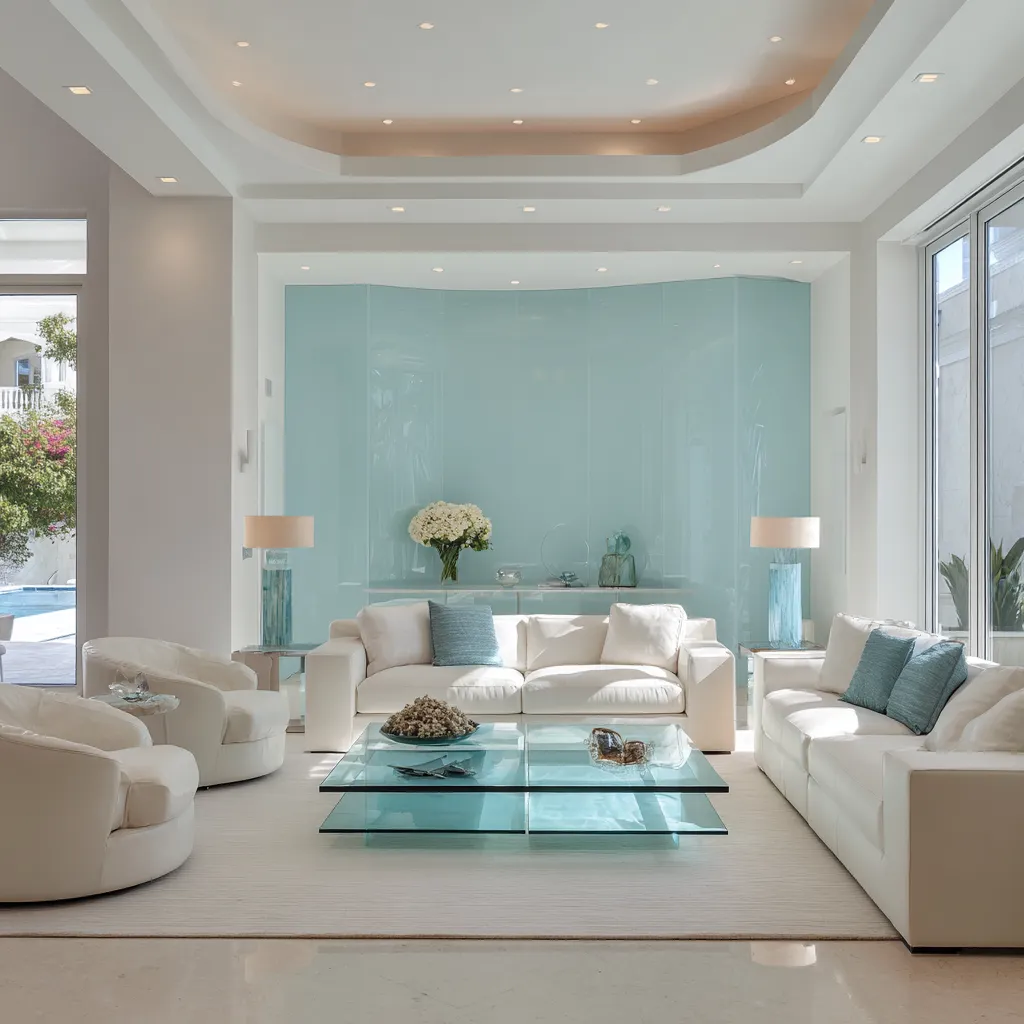
Curves matter, but they need discipline
Curvature is one of the recognizable parts of the style, but curves alone do not guarantee a Miami Art Deco result. A rounded sofa or barrel chair can easily drift into sculptural contemporary unless it is supported by some form of order.
That order may come from panel rhythm, fluting, a centered layout, a framed recess, a vertical wall cadence, or a ceiling line that echoes the furniture below. The room becomes richer when soft forms and firm structure correct each other.
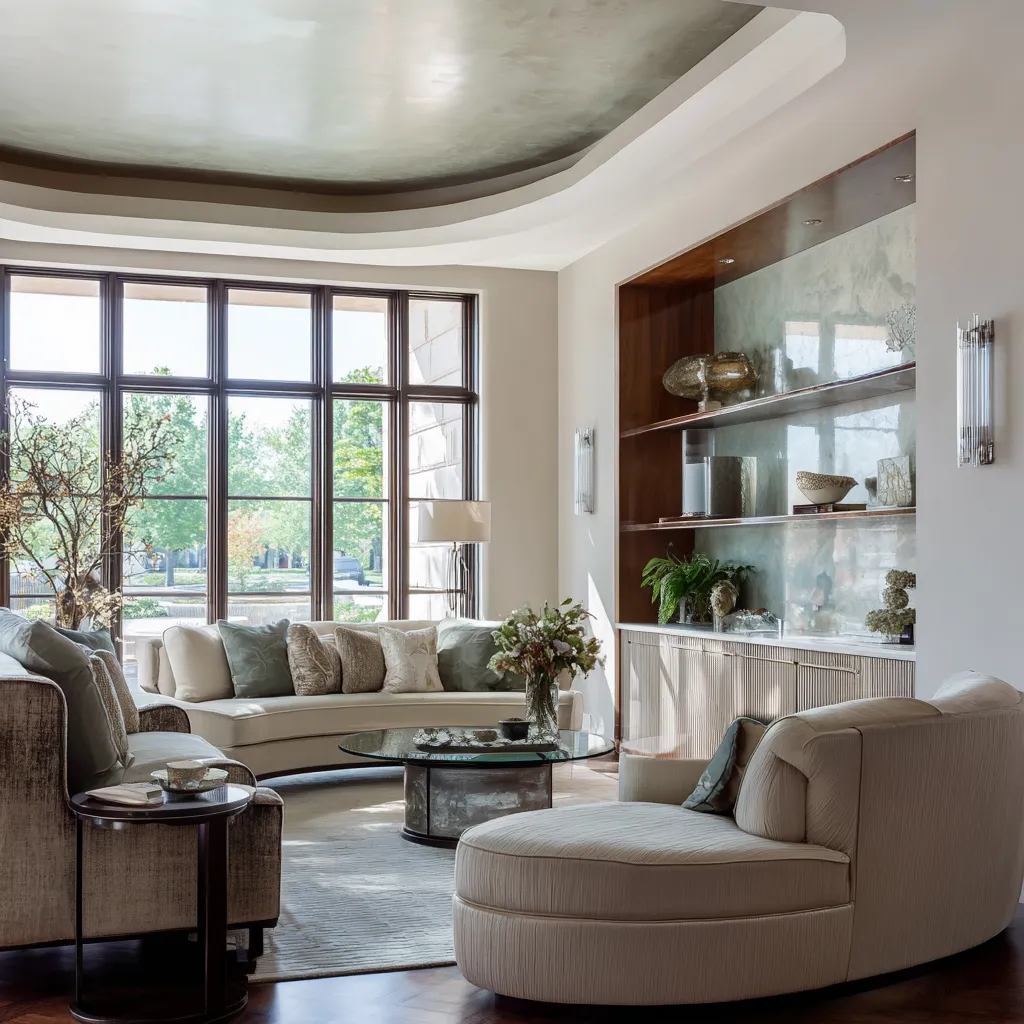
This is why the curved living rooms rarely feel vague. A long crescent sofa becomes sharper when placed in front of a disciplined wall.
Rounded barrel chairs feel more intentional when they sit against a rectilinear fireplace or beneath a framed artwork. A sweeping banquette becomes far more specific when a darker ceiling band or a tall grid of windows above it provides contrast.

The modern version of Miami Art Deco uses sweep in a compressed way. Instead of filling the room with many curving pieces, it often places one or two major arcs where they matter: a sofa, a portal, a bay, a banquette, a ceiling edge.
That controlled use of curvature gives the room sensuality and hospitality without letting it lose composure.

Color works when it becomes part of the architecture
One of the misconceptions about Miami Art Deco is that it is mainly a pastel style. Pastel can belong to it, certainly.
Blush, coral, shell pink, peach, pale yellow, mint, and powder blue all have a place. But the style is not built from pastel alone, and it is not defined by pink.
What matters more is that color feels climate-based and large enough to shape the room.
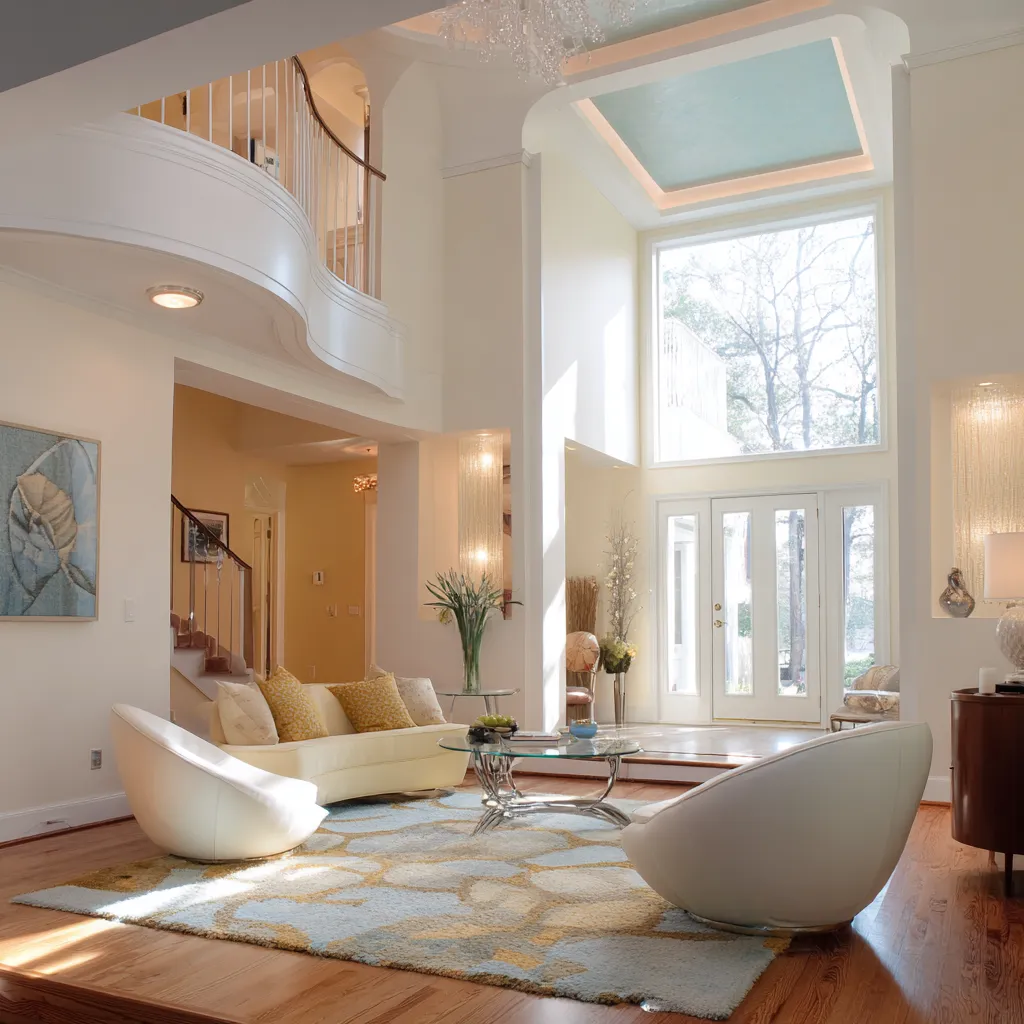
Marine tones are especially powerful when they are given architectural scale. Aqua, teal, celadon, sea-glass, pale mint, and watery blue become far more effective when they appear as a wall plane, a ceiling insert, a built-in seating mass, a deep recess, or a major artwork that functions almost like an extension of the wall.
Small doses can support the room, but they rarely carry it.
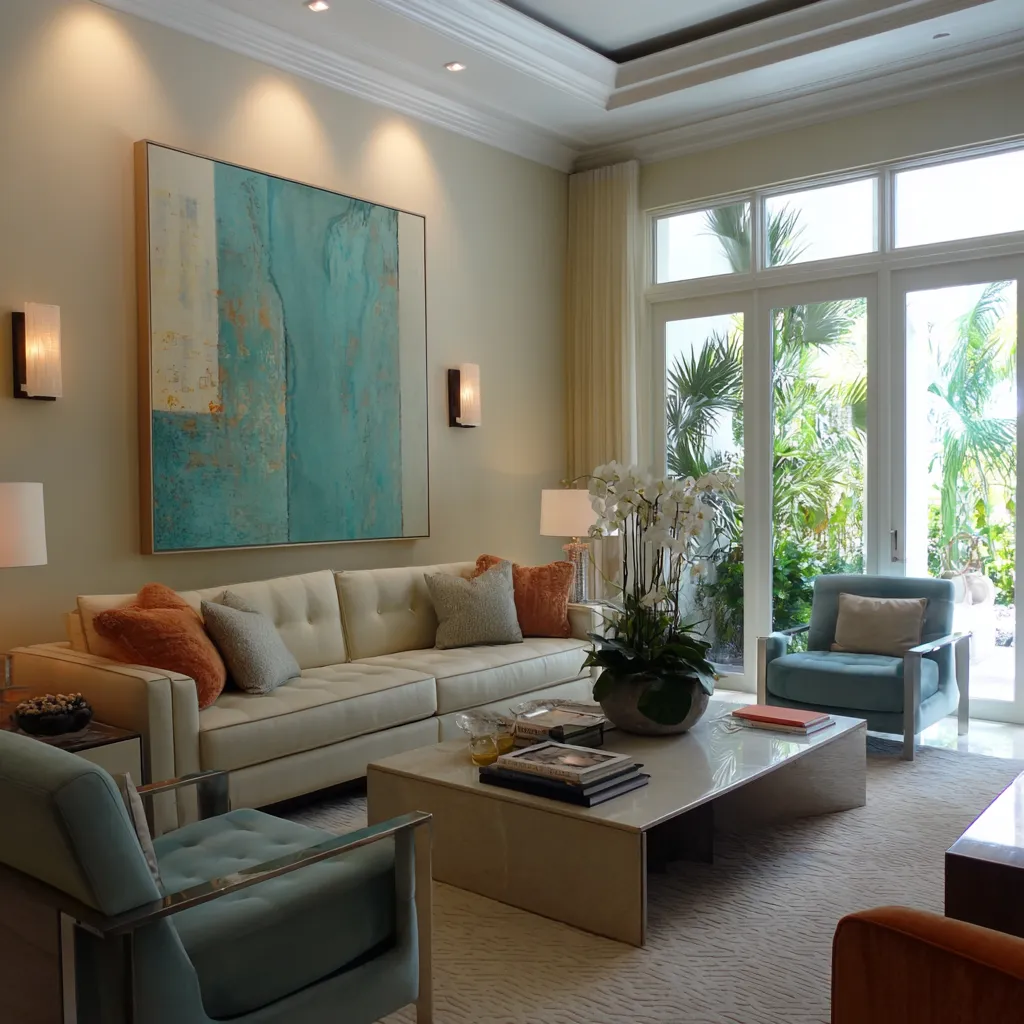
This is why a single aqua feature wall can do more than ten aqua accessories. A whole teal alcove can establish depth and atmosphere in a way a few vases cannot.
A sea-glass recess behind the sofa can turn a standard sitting room into something much more specific. A mint ceiling plane can cool the room from above and create an overhead event that links architecture and color in one move.

Warm pastel tones also become stronger when treated as architecture rather than decoration. A blush wall with vertical brass lines has seriousness and presence.
A coral or pink panel field can feel mature if it is given scale and formal framing. The same color, scattered through flowers and cushions without structural support, can become sweet very quickly.
The key idea is simple: in modern Miami Art Deco, color performs well when it occupies real visual territory.

Light is not an accessory. It is part of the style language
These living rooms depend deeply on daylight. Brightness is part of the atmosphere, part of the palette, and part of the glamour.
Pale upholstery, polished stone, glossy wall fields, chrome edges, glass tables, and sea-glass tones all become legible through light. This does not mean every room must be flooded with direct sun at every hour.
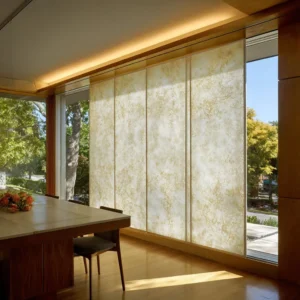
It means the room is conceived with brightness in mind. Tall glazing, wide openings, filtered curtains, reflective floor surfaces, pale wall tones, and airy focal fields all suggest a space that expects light and knows how to use it.

Daylight also changes the kind of glamour involved. In darker Deco rooms, glamour can become nocturnal, theatrical, and contrast-heavy.
In modern Miami Art Deco, glamour often feels daytime-based. Surfaces glow rather than flash.
A pale stone table reflects softly. A chrome frame gives a thin highlight instead of a hard glare.
A glossy wall catches a muted wash of brightness. A curtain diffuses light instead of blocking it completely.
The room feels warmed by climate rather than lit like a stage. That is one reason the style can feel polished without becoming severe.
Light does much of the visual work that older interiors might have assigned to heavy ornament.
Reflective surfaces are used with discipline
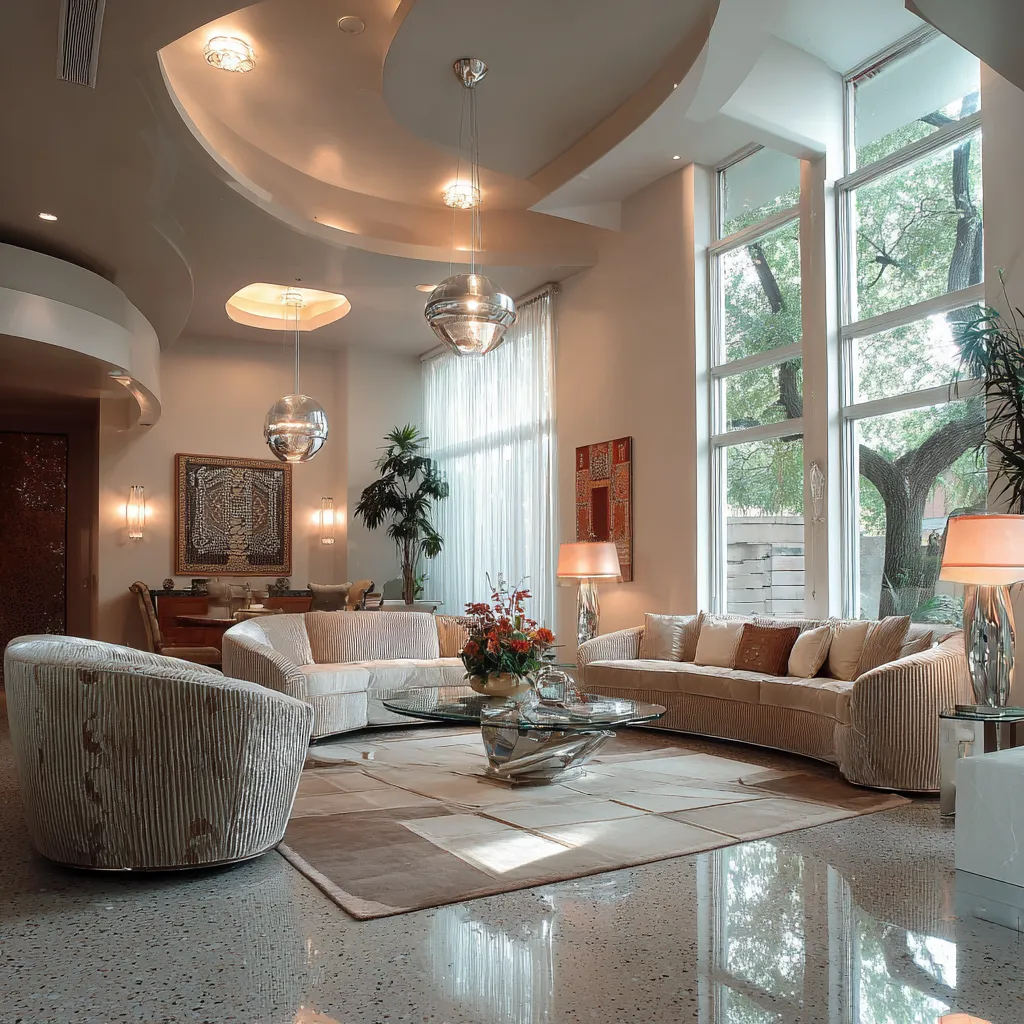
Reflection is one of the important ingredients in this style, but it is usually concentrated rather than spread everywhere. A modern Miami Art Deco living room does not need mirror on every wall or metallic trim on every object.
In fact, that often weakens the room.

The more effective approach is to place reflection in a few chosen locations:
- a polished coffee table
- a chrome-edged sofa base
- a mirrored strip inside a wall composition
- a glass table with a metal frame
- a chandelier or pendant cluster
- a lacquered or lustrous panel field
- a glossy floor that holds light near the base plane
Used this way, reflective matter gives the room its dressed quality. It introduces crispness, contrast, and a touch of formal glamour.
It also keeps pale rooms from becoming too powdery and warm-neutral rooms from becoming sleepy.

The important part is dosage. If the room already has a major shell gesture, reflection can remain relatively thin and precise.
If the shell is calmer, the reflective layer may need to take on more responsibility. In either case, the goal is not a flood of sparkle.
The goal is selective polish.

Warm neutral rooms need cooling to stay in the category
Warm plaster, creamy limestone, pale wood, beige upholstery, and mineral surfaces can all belong in modern Miami Art Deco. But warm neutral calm by itself does not automatically create the style.
Left alone, it tends to drift toward resort contemporary or a general soft-luxury interior. To stay within a Miami Art Deco language, warm mineral rooms usually need a cooling element beside them.
That cooling element may be an aqua artwork, celadon upholstery, a mint ceiling field, a sea-glass recess, teal depth in an adjacent chamber, watery reflections, or a bright light condition that sharpens the surfaces.
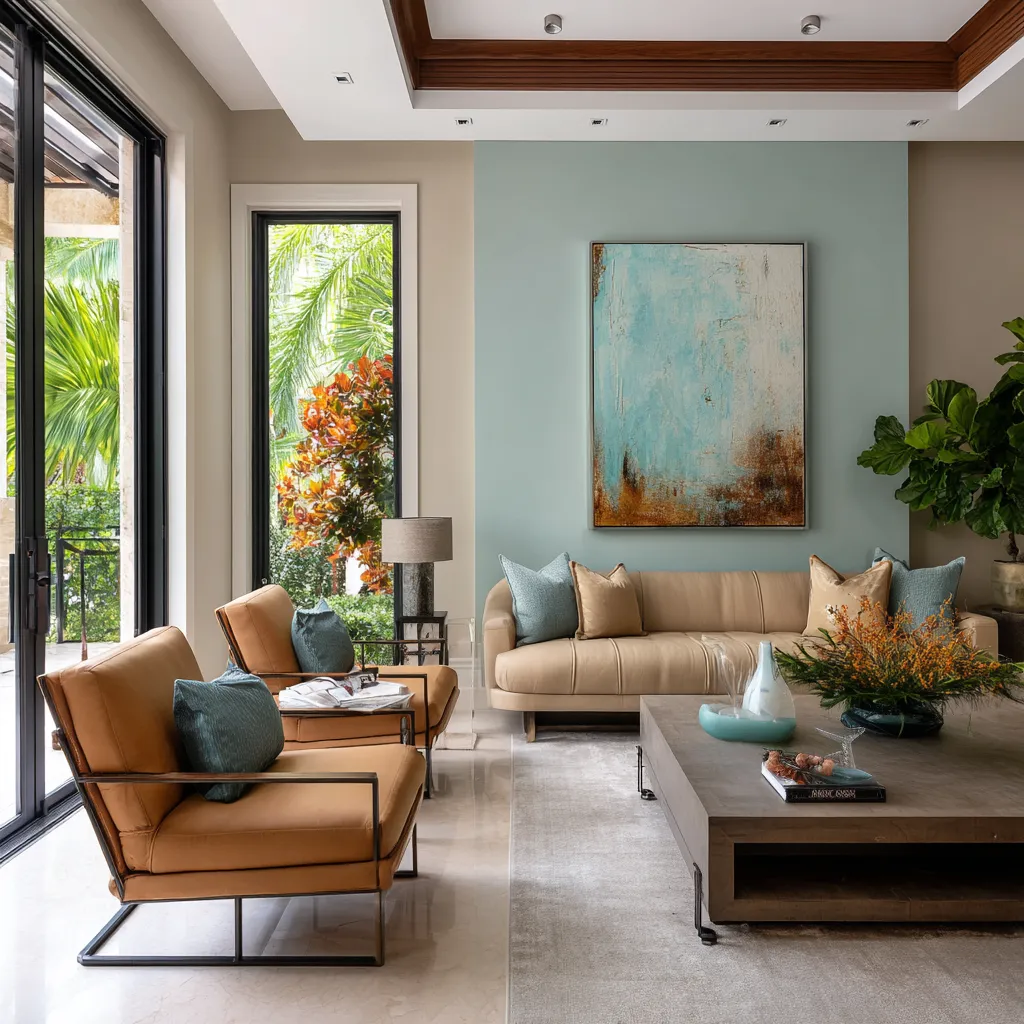
That pairing is especially effective because it creates temperature contrast inside the room. Warm plaster plus aqua art.
Pale oak plus blue-green pillows. Cream stone plus celadon seating.
Beige shell plus an oxidized aqua focal wall. These combinations give the room both calm and specificity.
Without that cooler layer, the atmosphere can become pleasant but unspecific. The room may still feel refined.
It may still feel expensive. But it begins to leave Miami Art Deco and move toward another family of interiors.
Darker versions can still feel Miami
A deeper palette does not automatically cancel the style. Charcoal, cocoa, bronze, dark wood, smoky teal, and deep sea-green can all work beautifully in a Miami Art Deco living room.
What matters is how they are balanced. Darker grounding usually needs three things to remain place-aware rather than metropolitan.
First, it needs a water-toned cue: aqua art, celadon upholstery, teal wall color, blue-green pillows, sea-glass lighting, or another marine note. Second, it needs brightness somewhere in the shell, whether through glazing, pale upholstery, reflective surfaces, or a climate-sensitive envelope.
Third, it needs enough polish and composure to keep the darkness from becoming generic moody modernism.
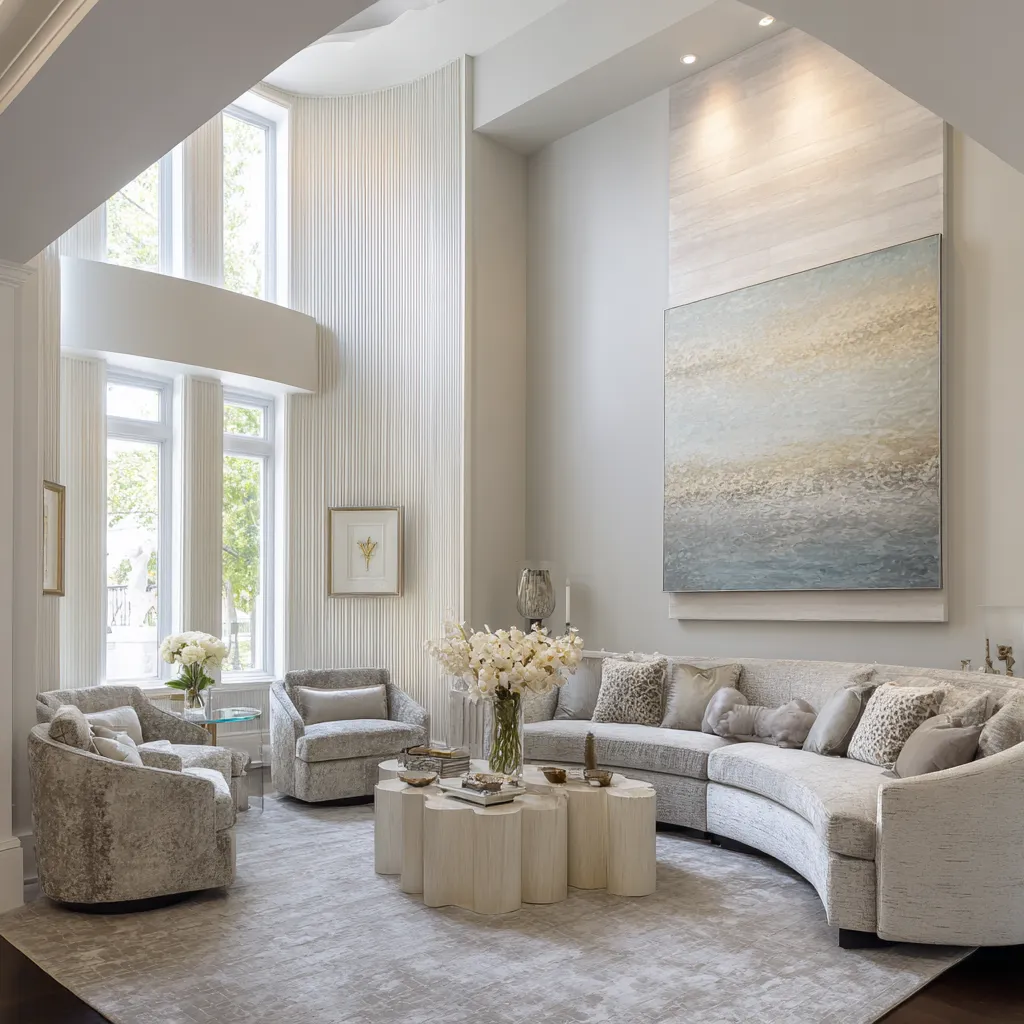
This is why a charcoal leather sofa can still belong if it sits beneath an aqua painting and beside a glass-and-chrome table in a pale shell. A cocoa ceiling band can still feel right if the room below it remains luminous and cool-toned.
A smoky teal alcove can deepen the room without making it urban if it is surrounded by champagne neutrals and daylight. The darker branch of the style tends to feel like the evening side of Miami rather than the noon side of Miami.
It is still related to water, heat, and glamour, but in a more mature register.
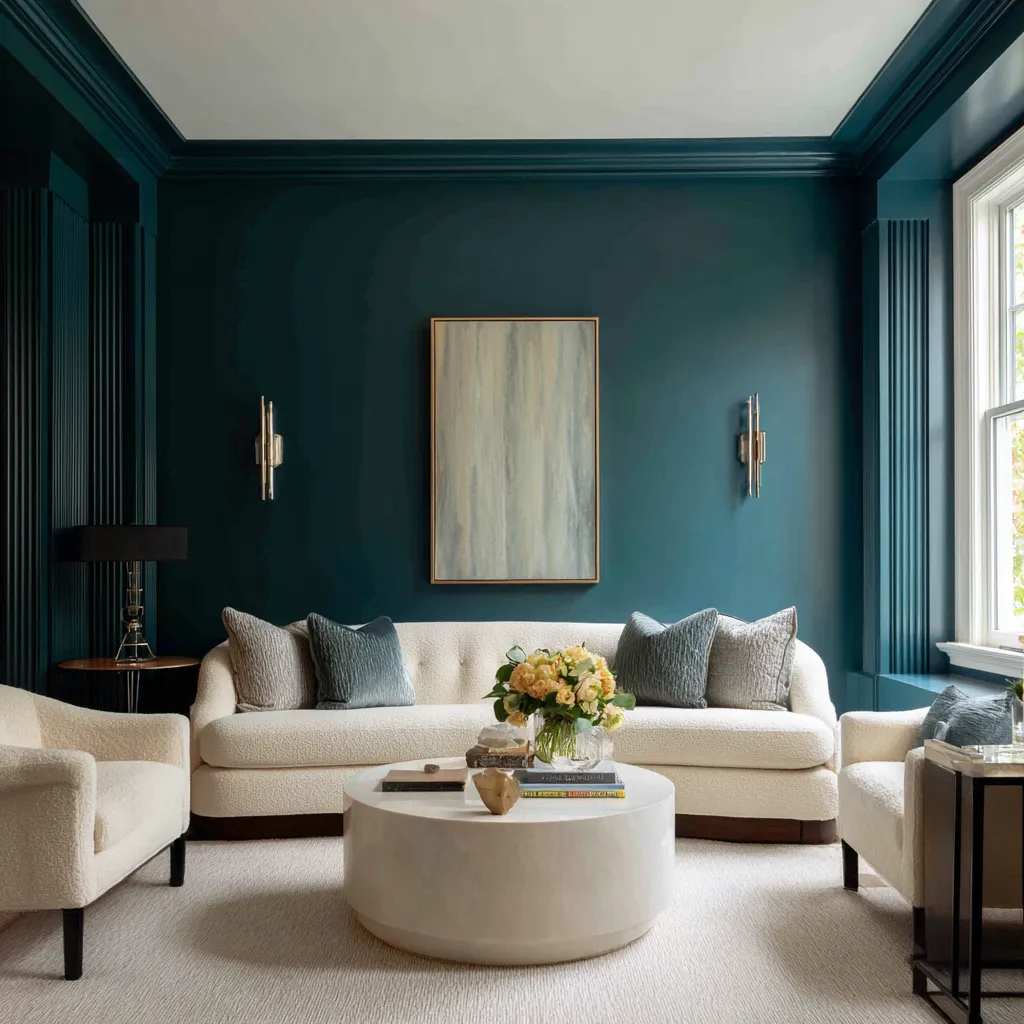
Furniture should support the shell, not fight it
One of the working rules in modern Miami Art Deco is that expressive architecture allows simpler furniture. If the room has a dramatic portal, a strong feature wall, a built-in banquette, a shaped ceiling, or a major curved bay, the furniture does not need to perform all the style work on its own.
In that situation, broad, calm pieces are often better. A long cream sofa with simple lines can be enough.
A pair of rounded chairs can reinforce the architecture without competing with it. A monolithic stone table can ground the center while letting the shell remain dominant.

The opposite is also true. If the shell is relatively quiet, the furniture has to carry more identity.
That may happen through a curved sofa, ribbed barrel chairs, channel-backed upholstery, a stronger reflective table, or a more visible color-field in the seating itself. This balance helps explain why some rooms feel resolved and others feel overworked.
A highly shaped shell paired with highly expressive furniture can become noisy. A quiet shell with overly plain furniture can become generic.
The interior designs distribute the burden carefully.
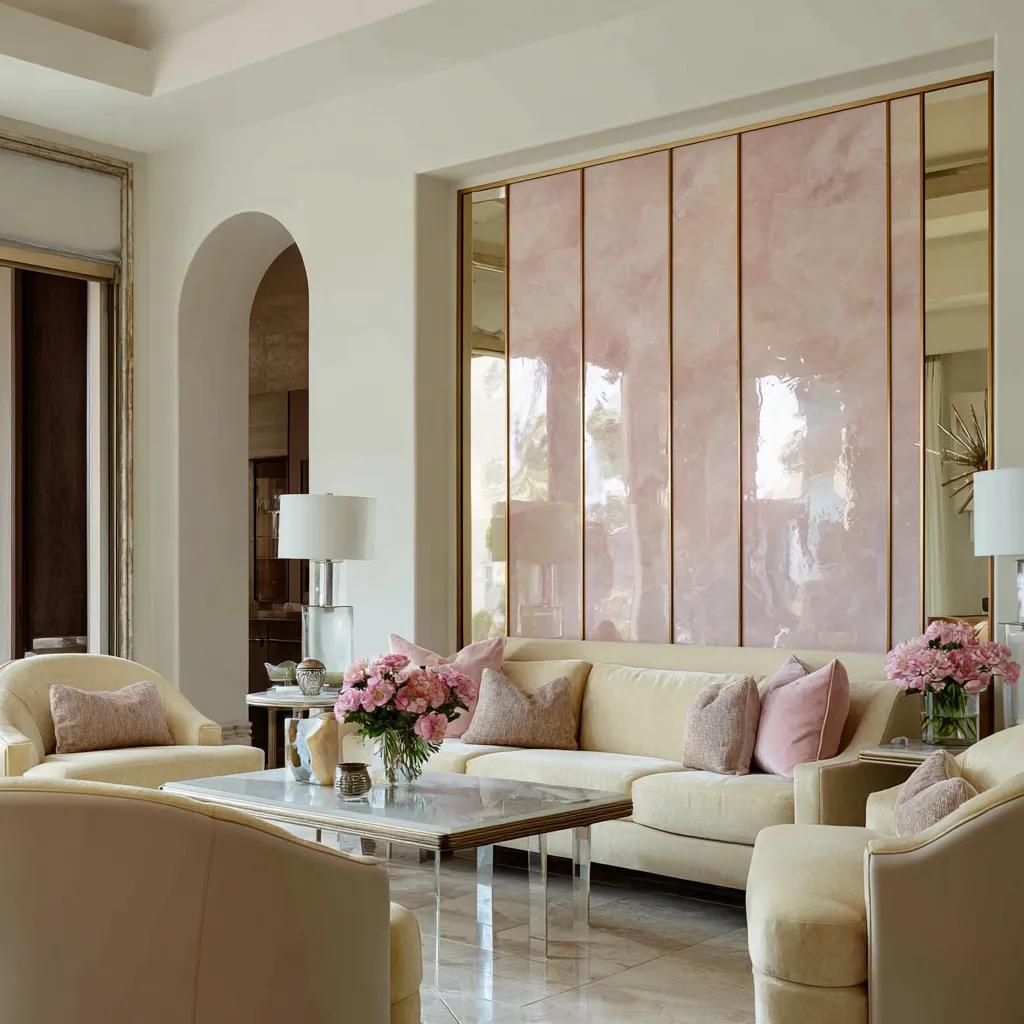
Furniture also needs to support the room’s social mood. Miami Art Deco living rooms work when they feel intended for gathering.
Conversation pits, long sectionals, circular seating islands, curved banquettes, and paired chairs facing inward all contribute to that sense of hospitality. The room should feel ready for people, not only for viewing.

Vertical rhythm keeps softness from going vague
Panel cadence, fluting, ribbing, channeling, mirrored strips, and repeated vertical divisions show up again and again in successful modern Miami Art Deco spaces. They do a subtle but very important job: they keep the room from dissolving into softness.
This rhythm may appear in a fluted wall, a paneled mint backdrop, a ribbed sofa face, pleated barrel chairs, a series of slim brass strips inside a pink wall composition, or a built-in with repeated vertical bays. It may even appear in the way pendant lights hang in sequence or in the proportion of tall windows that lift the room.

These moves matter because Miami Art Deco often works through a tension between smooth fullness and formal control. Vertical rhythm introduces order without needing heavy trim.
It gives a pale room spine. It gives a pastel room maturity.
It gives a curved room resistance. It gives a glossy room restraint.
This is especially useful in living rooms that lean toward blush, cream, pearl, or shell tones. Without some kind of disciplined cadence, those rooms can become too atmospheric and lose shape.
With rhythm, they gain architecture.

Ornament has been concentrated, not removed
A modern Miami Art Deco living room is usually edited, but that does not mean it is plain. The difference is where the ornament lives.
Instead of spreading decorative treatment evenly everywhere, the room tends to focus it in a few high-value zones:
- one portal
- one feature wall
- one shaped ceiling
- one chandelier or pendant group
- one polished center table
- one built-in rhythm
- one major artwork that consolidates the palette
This concentration is part of what makes the room feel present-day. Historical glamour is still there, but it has been relocated.
The room does not need fan motifs on every surface or many small decorative objects. Its stylization is compressed into fewer, larger, clearer moves.
That shift is one of the main reasons the style can feel current without losing its character.
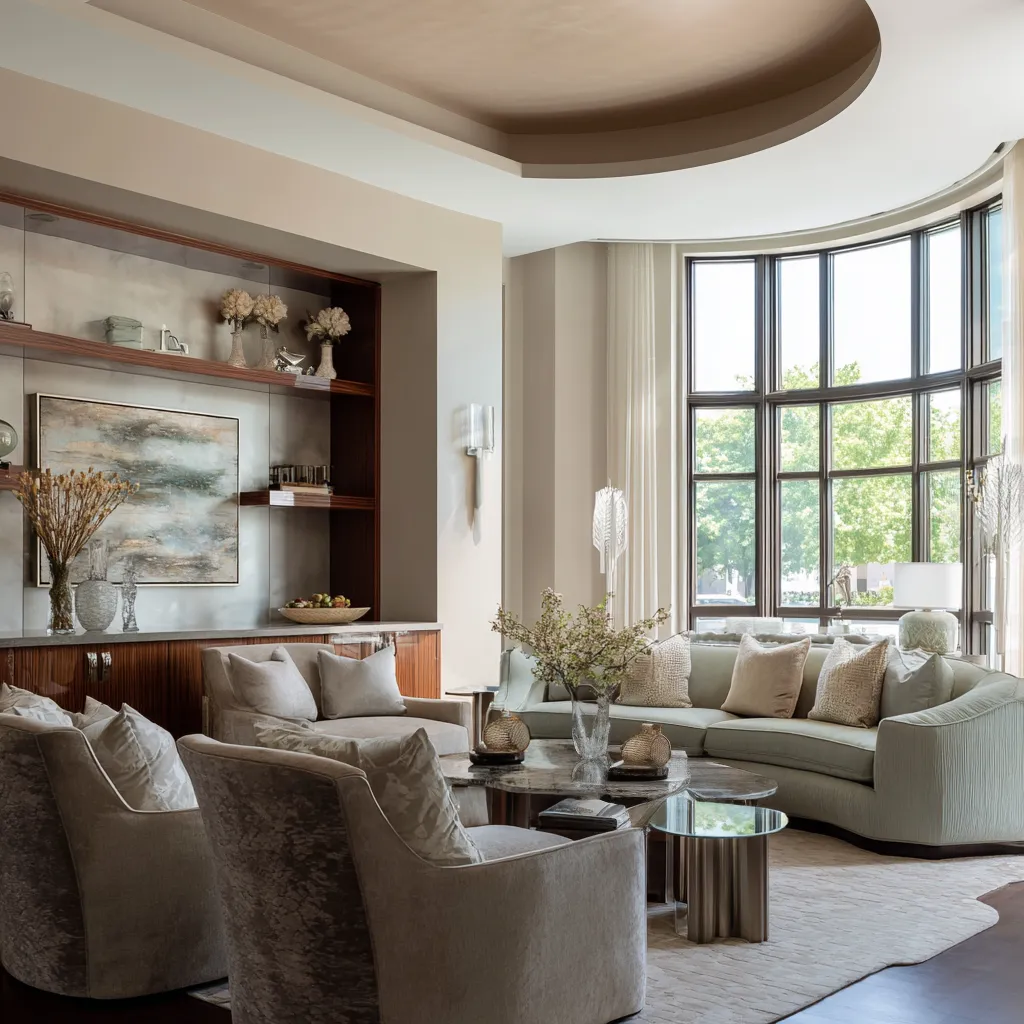
Two strong modern paths keep appearing
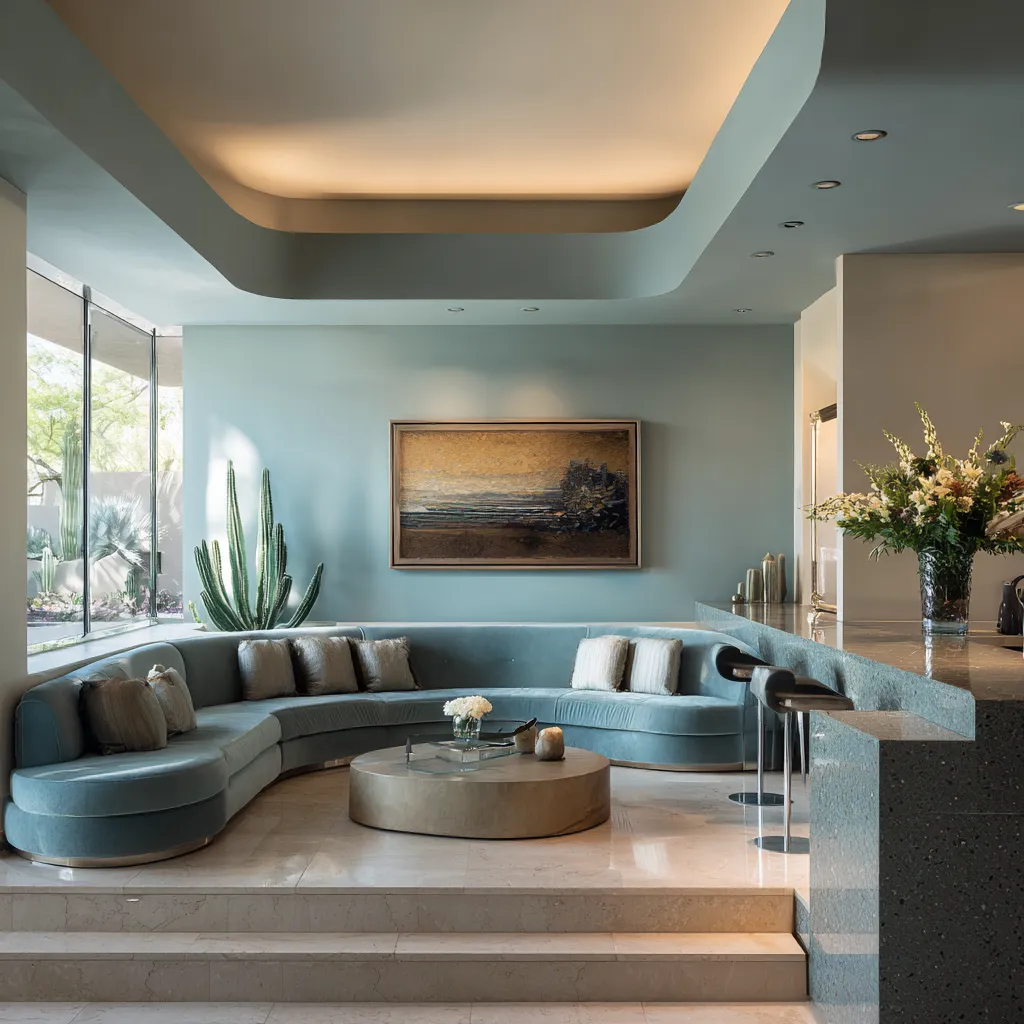
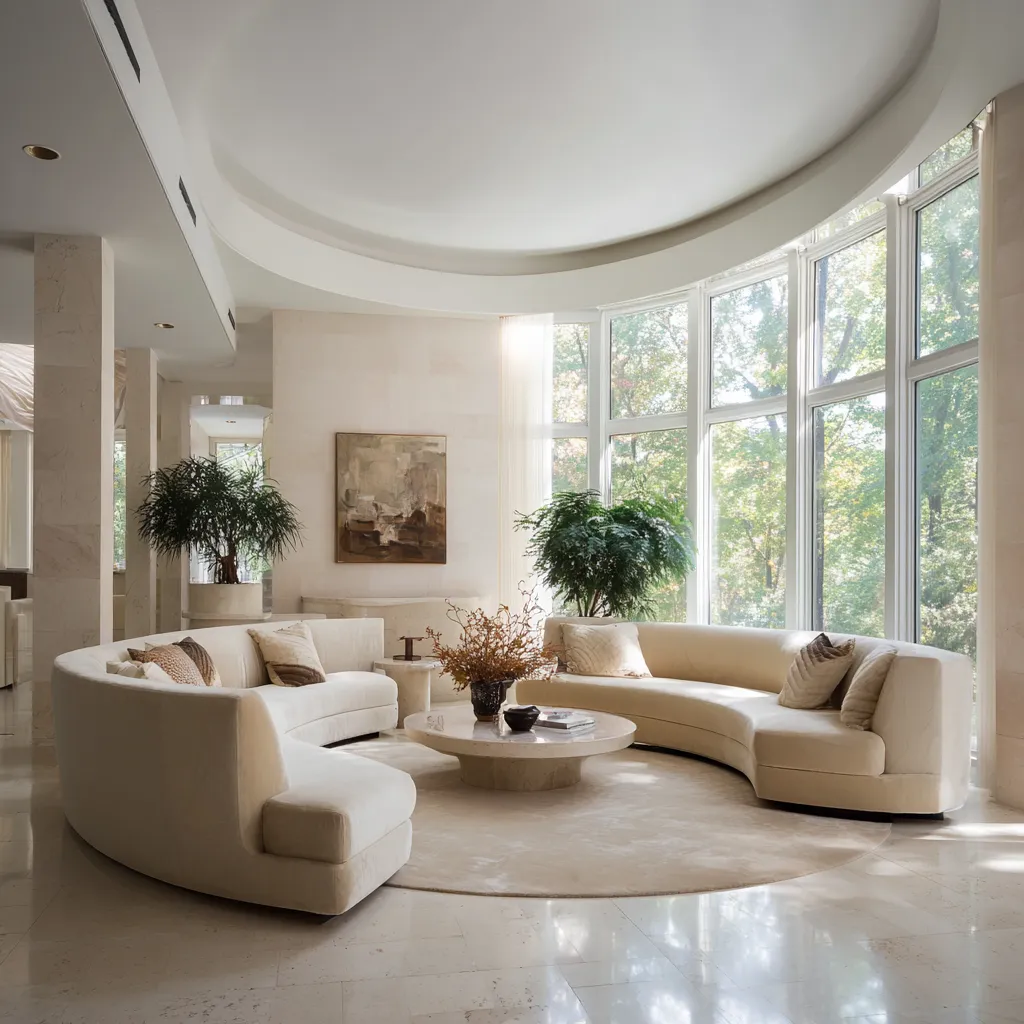
Modern Miami Art Deco living rooms tend to organize themselves around two especially clear approaches. The first is the curvilinear shell-led room.
Here the architecture carries much of the style. Ceiling sweeps, bay windows, portals, built-in banquettes, circular seating zones, and integrated lounge forms shape the experience.
Furniture follows that geometry and usually stays broad, soft, and relatively calm. These rooms often feel immersive, spatial, and highly atmospheric.

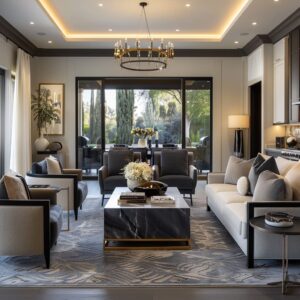
The second is the axial luminous salon. Here the room is more frontal and composed.
A mint wall, a sea-glass recess, a blush panel field, a coral focal composition, or a framed architectural backdrop sits behind a sofa. Reflection is more visible.
The center table is often polished. The arrangement is more symmetrical or near-symmetrical.
These rooms feel ceremonial in a softened way. They are less about spatial sweep and more about formal placement.
Both approaches can be very successful. The difference lies in where the room locates its authority.
One locates it in the shell’s movement. The other locates it in the wall’s composure.
Where the style begins to weaken
It is useful to understand how the room loses its identity, because that often clarifies what it needs. A room can weaken when it leans on warm neutrals and hospitality but lacks a formal carrier.
It can weaken when it has a curved sofa but no architectural support, no reflective discipline, and no climate-coded color at scale. It can weaken when pastel appears only in small accents rather than as part of the shell.
It can weaken when marine color is reduced to pillows while the rest of the room stays generic. It can weaken when reflective matter is replaced by fully matte, ordinary pieces.
It can weaken when the architecture is quiet and the furniture is too quiet as well. None of those rooms are necessarily unattractive.
Many remain appealing. The issue is not beauty.
The issue is specificity. The room stops feeling distinctly Miami Art Deco and starts moving toward softer neighboring styles.

What makes the style feel modern today
The modern side of Miami Art Deco is not created by stripping away all character. It appears through editing, scale, and hierarchy.
The room feels current when it uses fewer objects, larger surfaces, broader furniture, abstract art instead of literal theme decoration, and a clearer distinction between major moves and minor supporting details. It feels current when color is placed in architectural fields instead of scattered everywhere.
It feels current when reflection is used in a few precise doses. It feels current when furniture is generous and body-centered rather than fussy.
It feels current when the room trusts one strong shell idea instead of many smaller gestures. In other words, the style becomes modern by making its glamour more concentrated and its composition more legible.

The deeper definition
A modern Miami Art Deco living room is not defined by one color, one sofa shape, one metal finish, or one historical reference. It is defined by how several systems lock together.
- It needs formal stylization through shell, rhythm, portal, recess, axis, or curve.
- It needs climate atmosphere through marine tones, warm shell tones, daylight, watery reflection, and sun-softened surfaces.
- It needs residential ease through broad seating, lounge planning, low visual clutter, and social comfort.
When those parts reinforce one another, the room gains clarity. It feels polished, but not stiff.
Warm, but not loose. glamorous, yet still livable.
It carries Miami through light, color temperature, and openness. It carries Deco through order, sweep, cadence, and reflective control.
It carries modern life through editing, scale, and comfort.
That is where the style becomes fully persuasive: not in isolated decorative signs, but in the way architecture, atmosphere, and furniture all participate in the same idea.