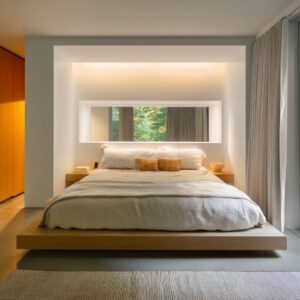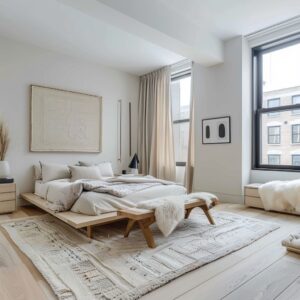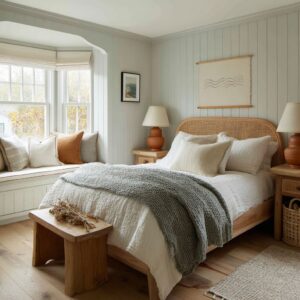
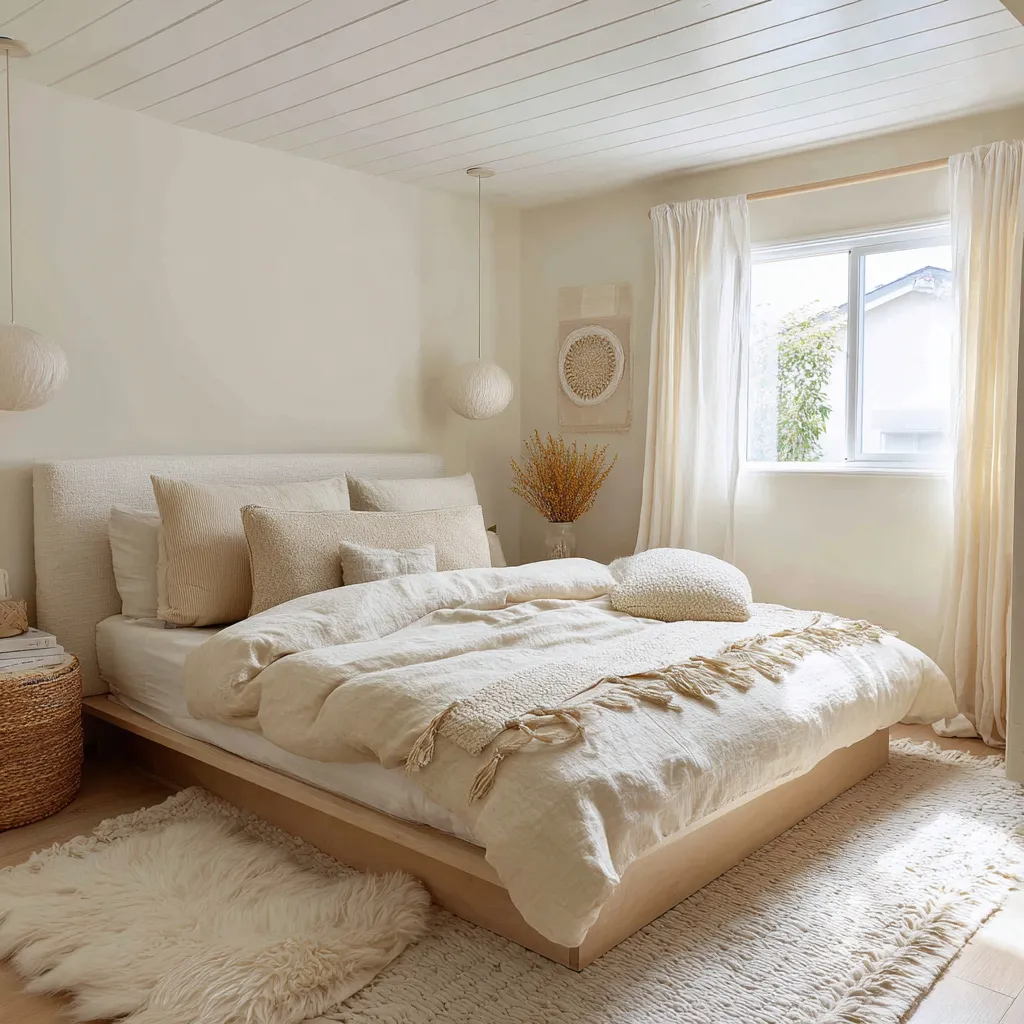
Boho Scandinavian bedroom design works well when it is built as a balanced interior language rather than a decorative formula. Many people reduce it to pale wood, white bedding, a basket, a plant, and a soft throw.
That version catches the outer look, but it misses the deeper structure. A convincing room in this style has a very clear inner logic.
The Scandinavian side brings order, legibility, proportion, and breathing room. The boho side brings tactile richness, natural irregularity, softened use, and a sense of habitation.
One holds the room steady. The other makes it feel lived in.
That balance is what gives this style its particular emotional effect. The bedroom feels settled rather than stark, warm rather than sugary, softened rather than sloppy.
It can be pale or dark, spare or layered, attic-like or rectangular, but it stays persuasive only when its warmth is shaped with discipline. A good boho Scandinavian bedroom is therefore not a room filled with boho things inside a Nordic shell.
It is a restrained room whose surfaces, materials, and use zones have been adjusted so that the space feels bodily, earthy, and gently irregular without losing composure.
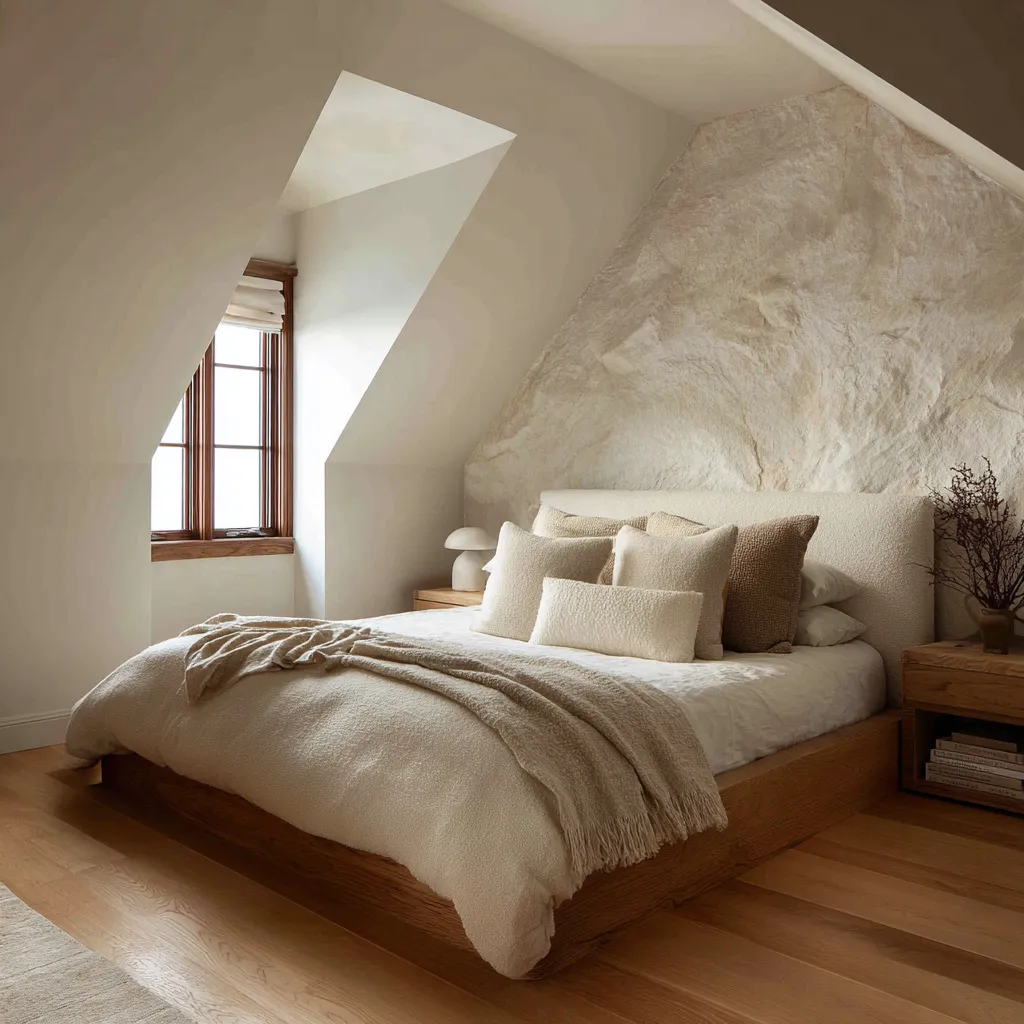
The Scandinavian side gives the room its structure
The part of this style that often receives too little attention is the Scandinavian framework. Without it, the room drifts into something else: rustic, generic boho, soft contemporary, or warm minimalism with no real identity.
The Scandinavian layer is what gives the room its order. It appears in the centered bed, the broad wall areas, the limited furniture count, the low visual noise, and the simple massing of the large elements.
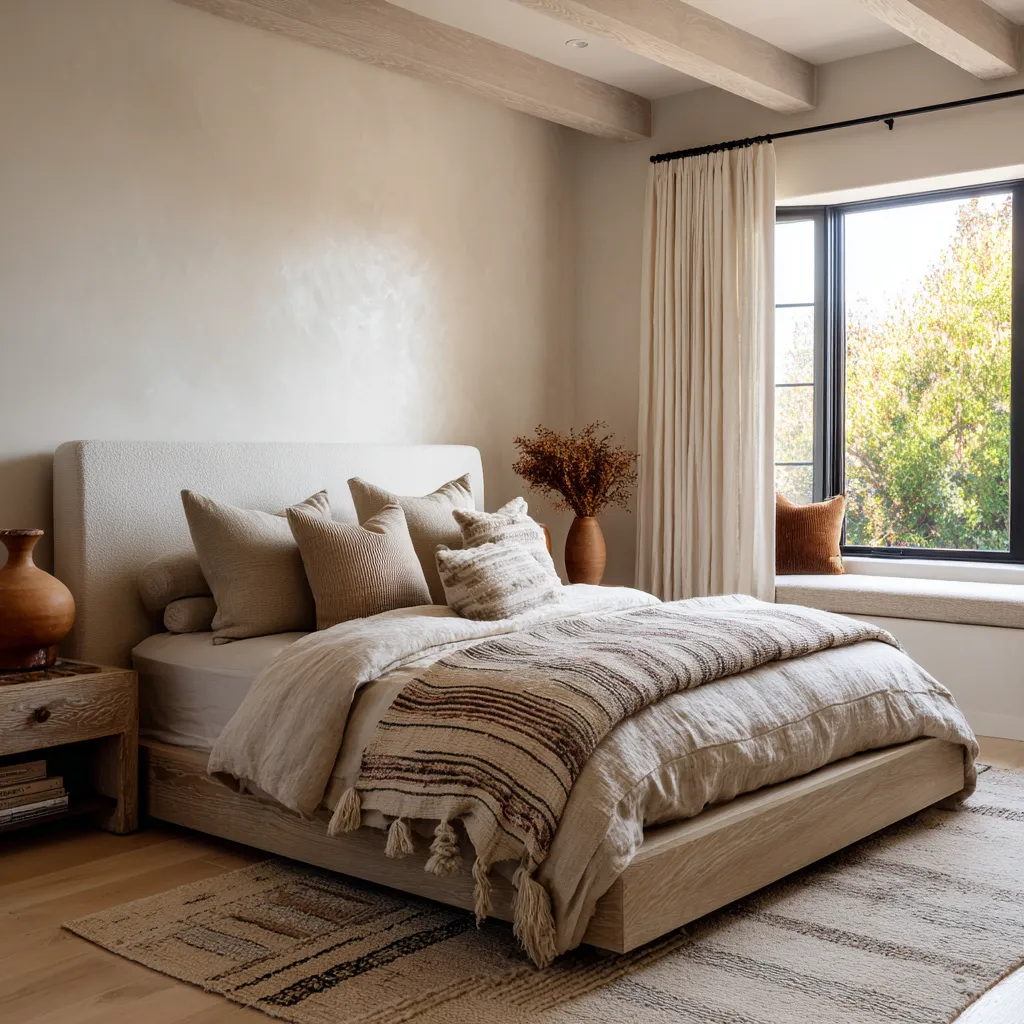
This framework matters because bedrooms depend heavily on psychological clarity. A room meant for rest benefits from easy visual orientation.
The bed should feel like the main mass. Circulation should feel natural.
The wall treatment should support the bed rather than compete with it. Furniture should look placed rather than scattered.
Even in looser versions of the style, the overall organization usually remains clear. The room can be relaxed in texture, but it should still be understandable in one glance.
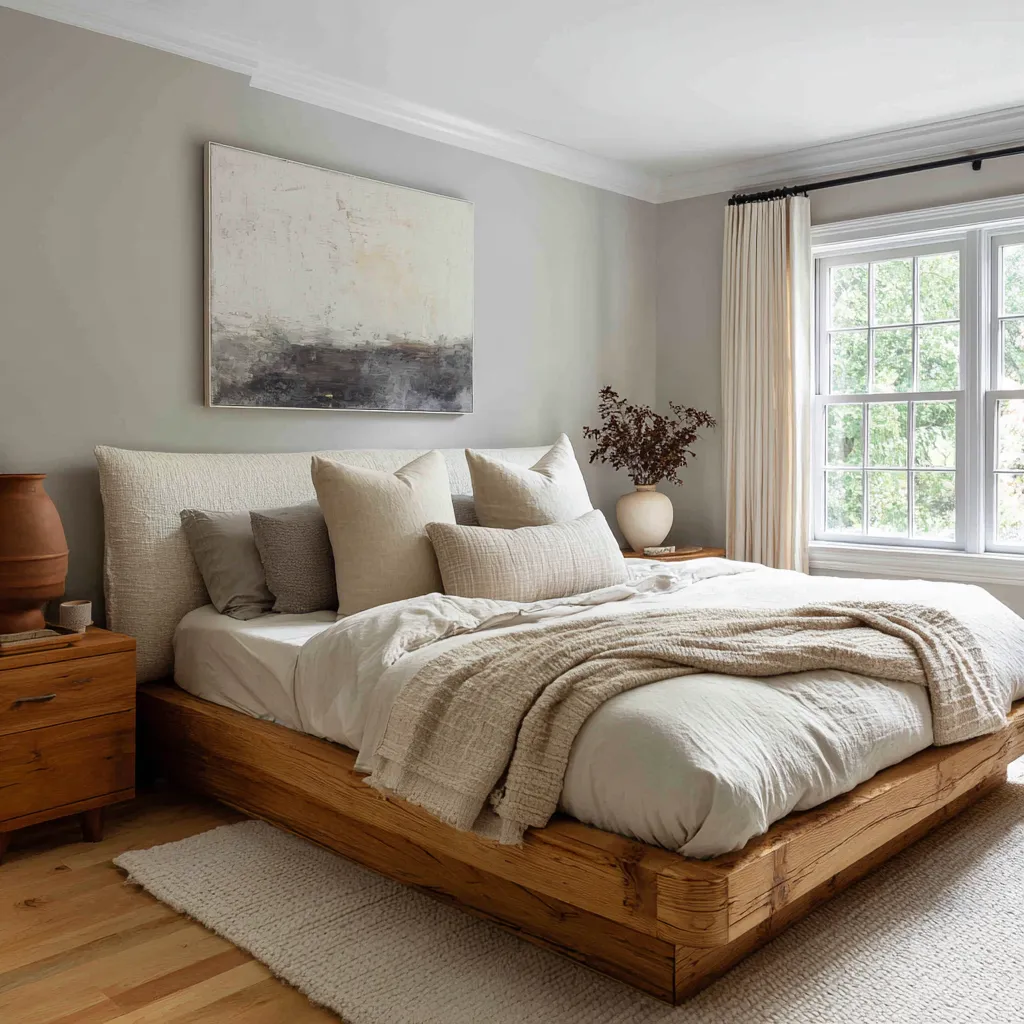
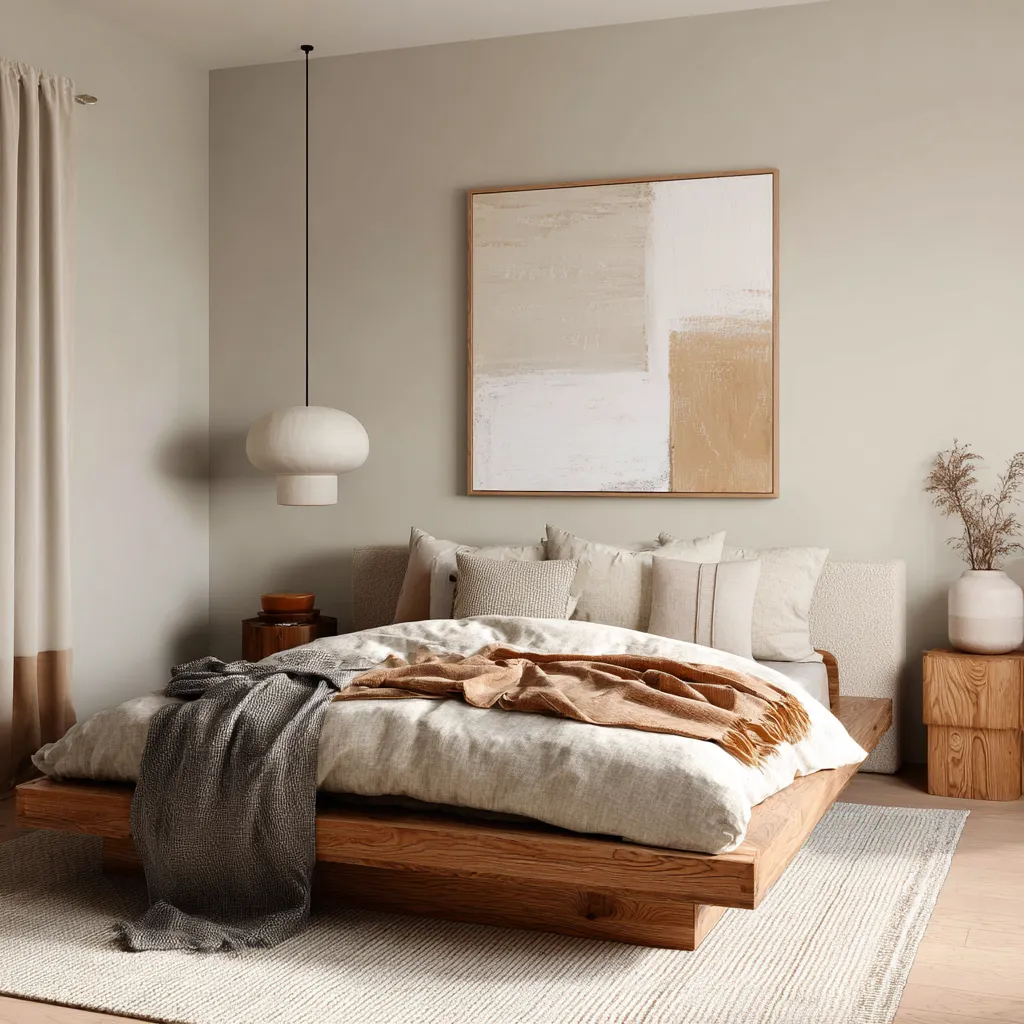
That is why many successful boho Scandinavian bedrooms rely on centered or nearly centered compositions. Symmetry, or something close to it, often helps.
A centered bed, balanced side zones, and broad negative space around the main furniture pieces give the room a stable framework. Warmth then enters inside that framework.
The room does not need to feel stiff, but it does need a spine. In practice, this means simple bed forms, edited nightstands, broad rugs, full-height curtains, and art that supports the palette rather than breaking it.
The room may contain warmth and craft, but it usually avoids fussy outlines, crowding, or too many competing accents.
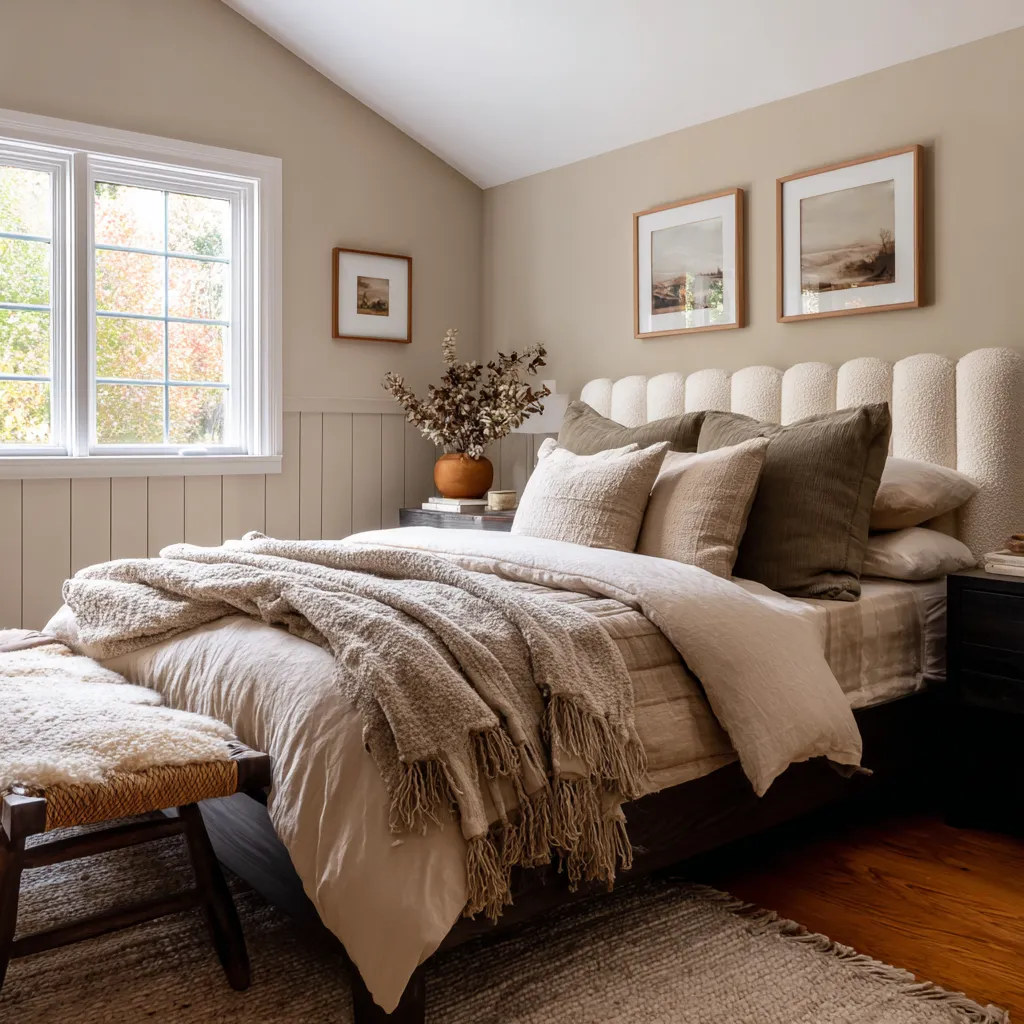
The boho side works through tactility before it works through décor
The boho part of the style is often misunderstood because people look for obvious markers first: macramé, baskets, wall hangings, tassels, patterned textiles, artisan pottery. Those can help, but they are not the deepest part of the style.
In a refined boho Scandinavian bedroom, the boho influence often enters through material character before it enters through objects.
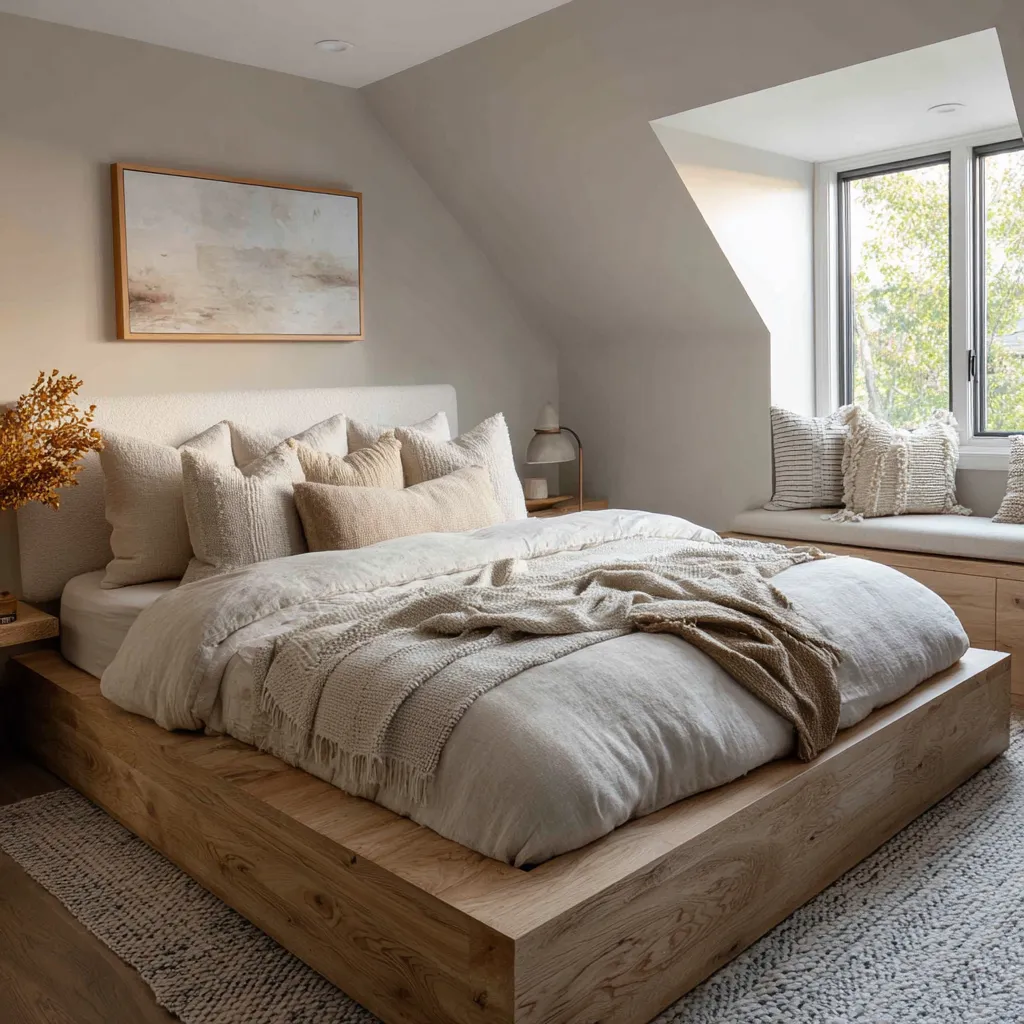
That means the first layer is usually tactile rather than decorative. Bedding is washed, nubby, crinkled, woven, or softly piled.
A throw may have fringe, a drier surface, or a heavier knit. The headboard may feel padded and textural rather than slick.
Curtains may soften the wall with a fuller vertical fall. Ceramics may be matte, chalky, or hand-shaped rather than glossy and polished.
Wood may show grain, depth, or a slightly weathered quality rather than a sleek lacquered finish.
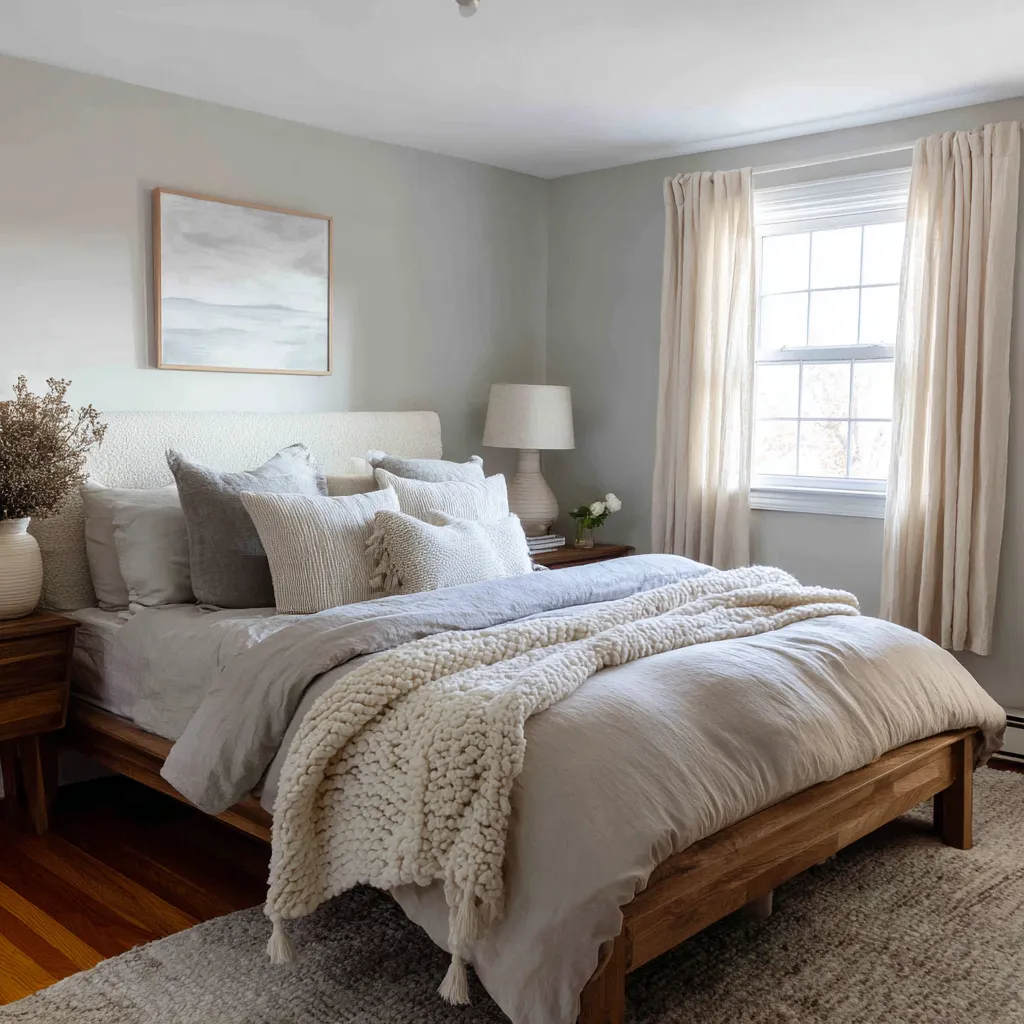
This kind of surface variation matters because the palette in these bedrooms is often close in value. Cream, flax, pale taupe, soft mushroom, warm gray, blush clay, off-white, and muted sand can sit very close together.
In that kind of room, color alone cannot create enough depth. Texture has to do the work.
The room gains richness because one fabric catches light differently from another, because wood has visual density, because plaster holds shadow, because a knitted throw pushes forward from smoother bedding. That is one of the central truths of the style: if contrast is low, tactile hierarchy must rise.
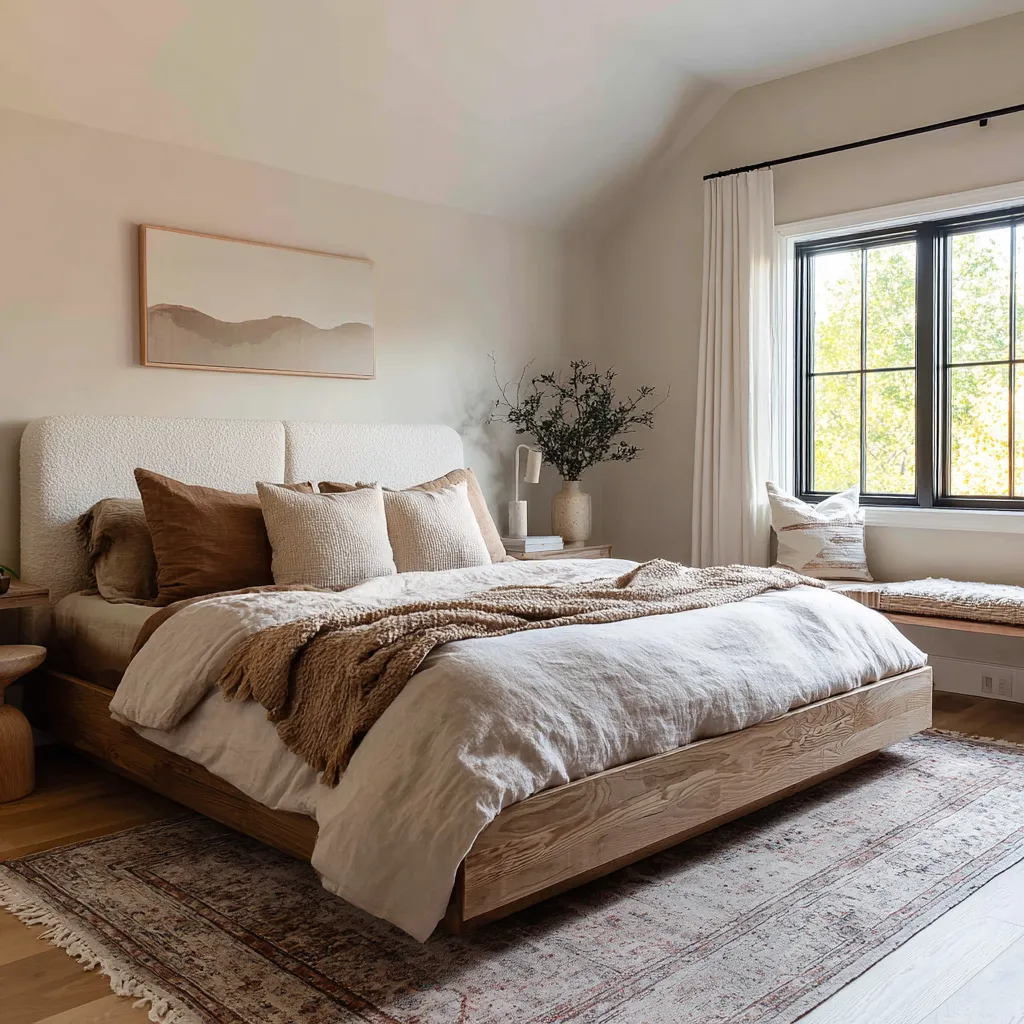
The wall plane matters far more than many people think
One of the distinctions between an ordinary soft neutral bedroom and a boho Scandinavian bedroom is the quality of the wall and envelope. A flat painted wall with pale bedding can feel pleasant, but it may not feel specific.
A wall with body changes that immediately. Plaster, limewash, mottled paint, softly clouded finishes, and other tactile wall treatments are especially effective in this style because they do several things at once.
They add craft without adding clutter. They make the room feel softer without relying on more furniture.
They help pale rooms remain specific rather than generic. They also spread the material language of the room beyond the bed, so the bedroom feels coherent from wall to floor instead of soft only in one place.
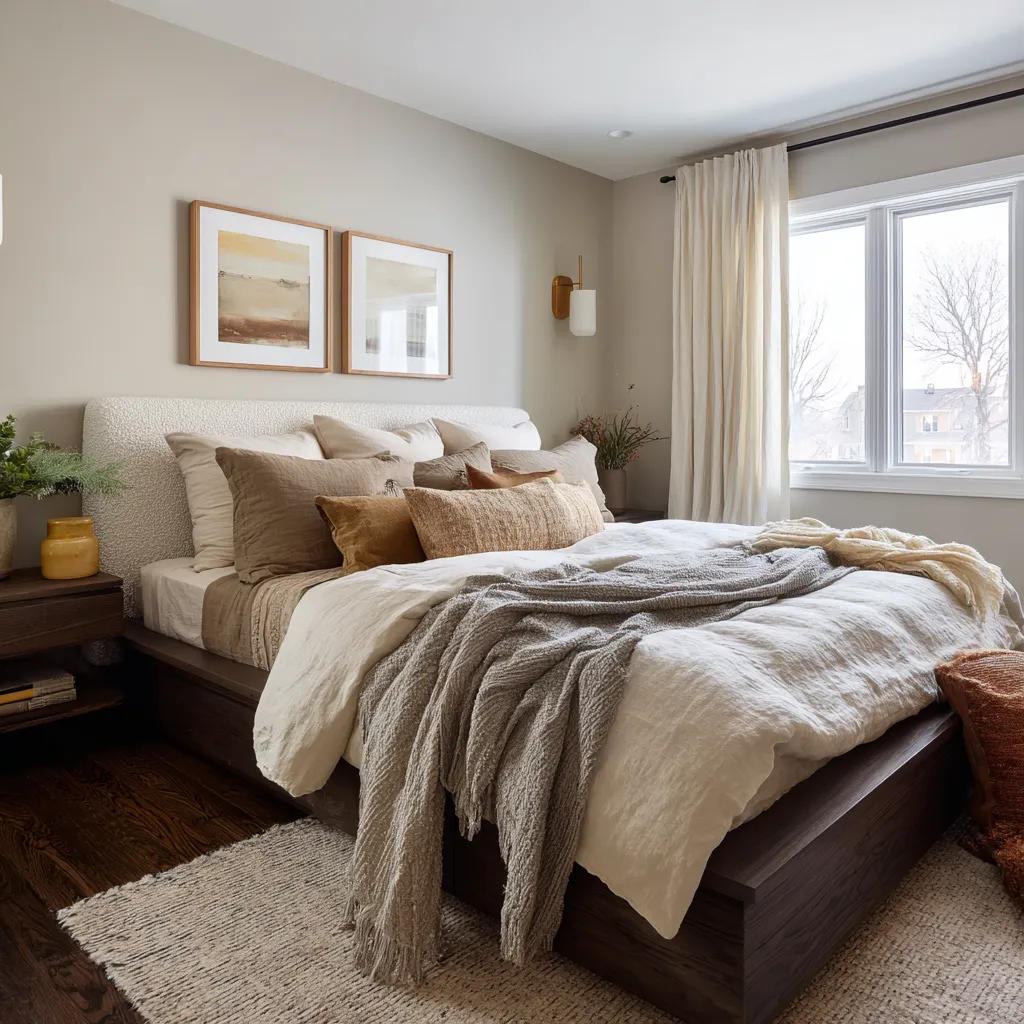
This is a major reason some boho Scandinavian bedrooms feel much richer than others even though they may contain fewer objects. When the wall itself has presence, the room already carries natural irregularity.
The boho layer is then embedded in the shell rather than perched on top of it. That makes the whole room feel less dependent on accessories.
A textured wall behind a broad upholstered bed can do the work that a collection of décor would otherwise need to do. It lets the room remain edited while still feeling warm, tactile, and individual.
Architecture can carry the style
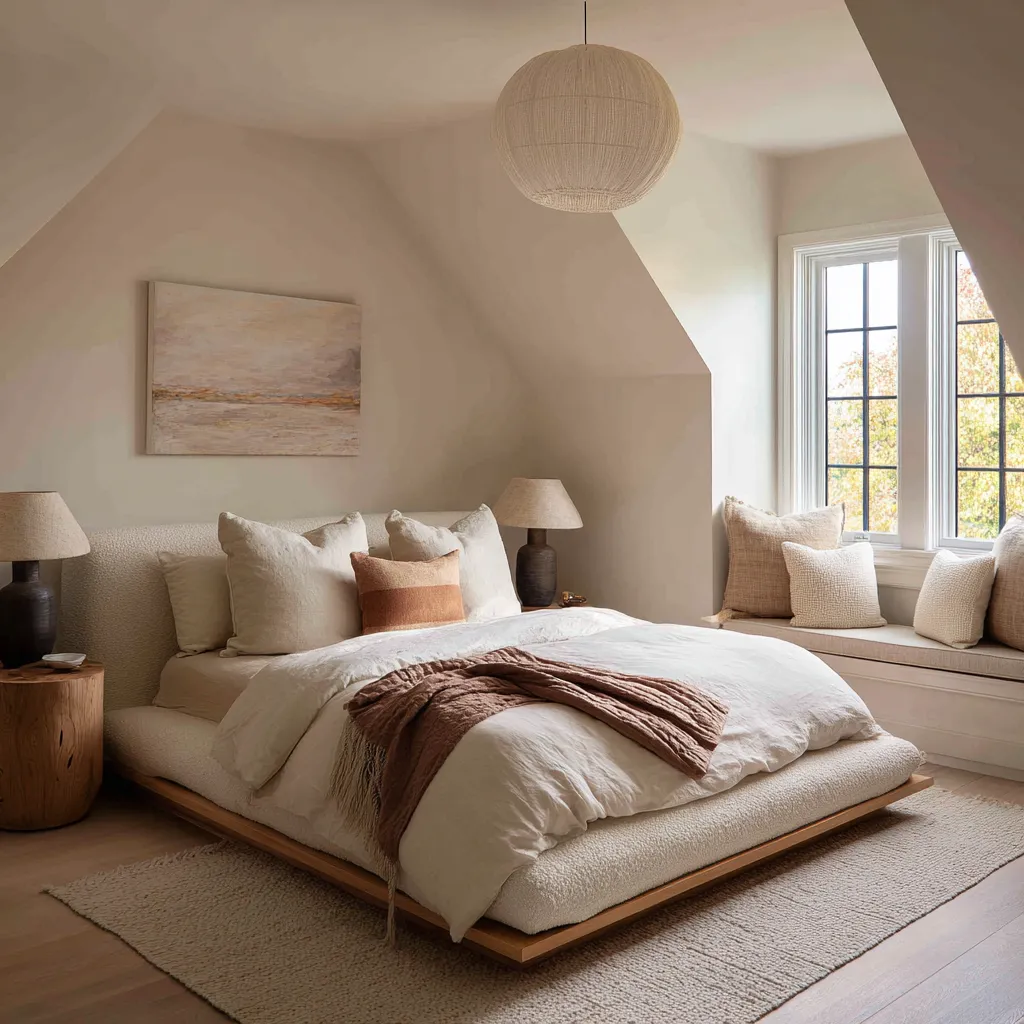
Boho Scandinavian bedrooms often become especially convincing when architecture participates in the atmosphere. Sloped ceilings, deep window reveals, built-in benches, recessed niches, exposed beams, low horizontal lines, and gently shaped attic volumes all help because they create enclosure and softness without needing decorative excess.
This is where the style becomes much deeper than a palette exercise. A room with an attic slope, a built-in window seat, and a low bed already has spatial character.
That character can replace a surprising amount of accessory styling. A bench under the window, for example, does not simply add a function.
It extends the zone of comfort. It turns the room into a place for sitting, leaning, pausing, or morning light, not only sleeping.
A niche with cushions does the same. It distributes softness beyond the bed, which is one of the ways to make the bedroom feel immersive.
A sloped ceiling can help too. It lowers part of the envelope and increases shelter.
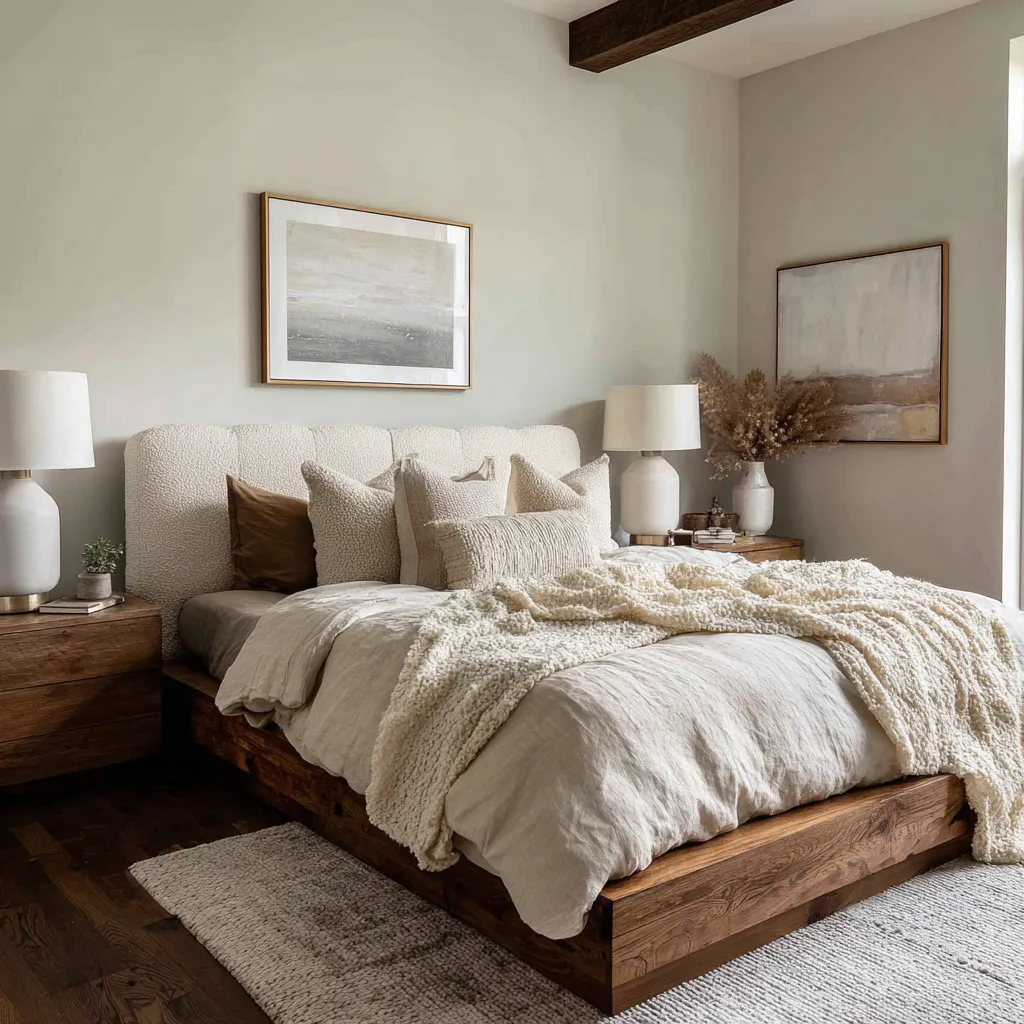
A built-in element grounds the room and makes it feel composed rather than assembled. Exposed beams can add rhythm and material depth, provided the rest of the room stays simple enough to prevent rustic heaviness.
What matters is not architectural drama for its own sake. It is architecture that supports intimacy.
The room should feel held, not crowded. A low bed under a slope often works because the furniture respects the envelope.
A taller, more formal bed would fight it. This style tends to work well when the large furniture pieces follow the architecture rather than resist it.
Warmth works when it is concentrated, not spread everywhere
A common mistake in warm neutral bedrooms is to push the same warmth into every surface. The walls become beige, the curtains become beige, the rug becomes beige, the bedding becomes beige, the art becomes beige, and the room collapses into one undifferentiated field.
Boho Scandinavian bedrooms usually avoid that by concentrating warmth rather than washing it over the whole interior.
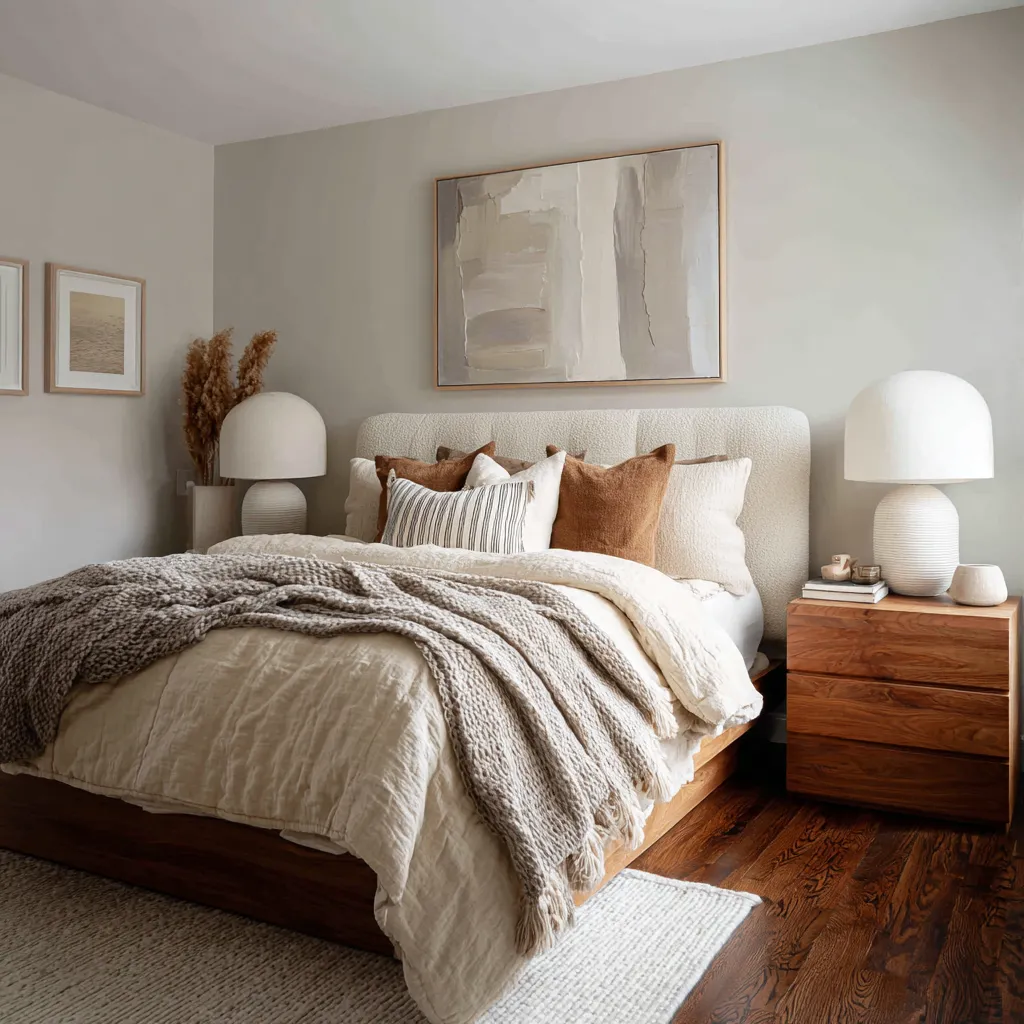
That concentration often happens near the body zone. A pair of rust pillows at the center of the bed, a clay-colored lumbar, a terracotta vessel on the nightstand, a brown bench cushion by the window, or one earth-toned throw at the foot of the bed can shift the room greatly without making it muddy.
Warmth feels more persuasive when it is localized. It draws the eye toward places of contact and use.
It also gives the room emotional focus.
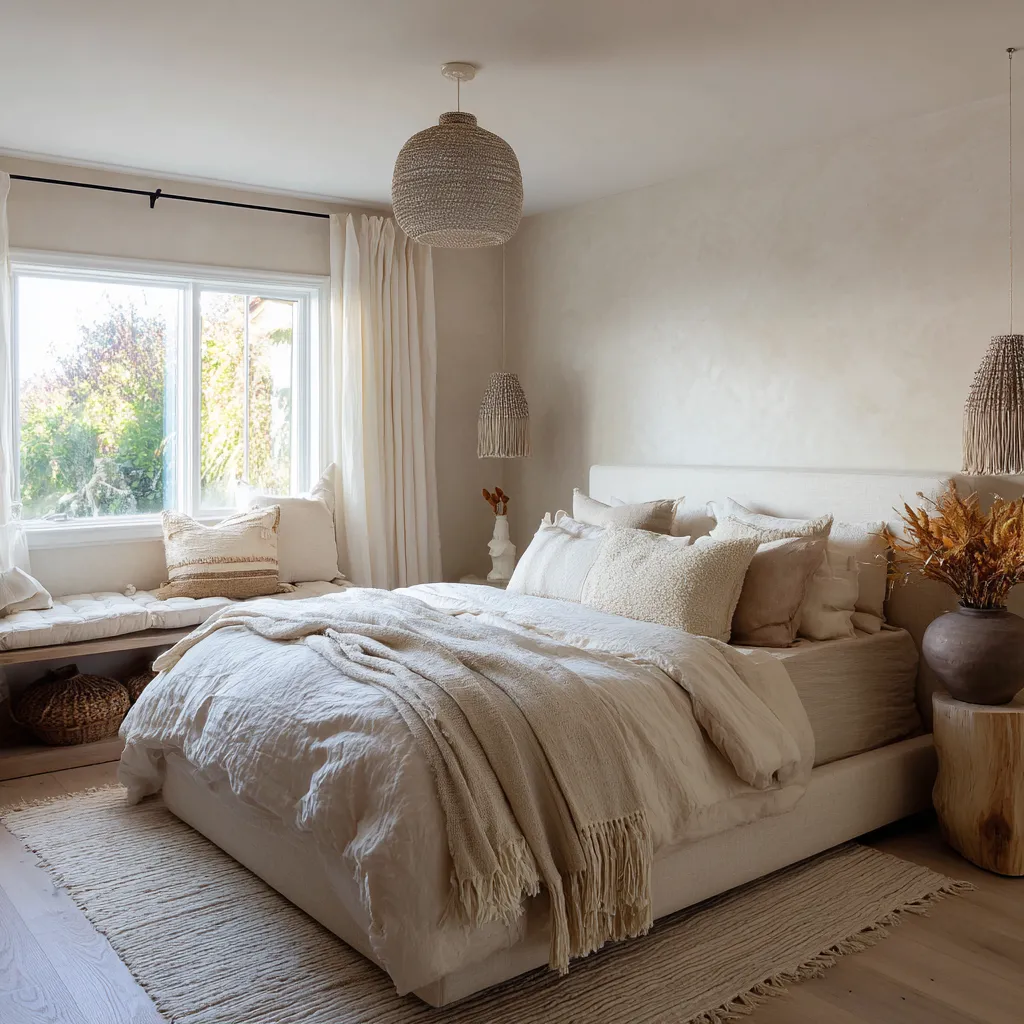
This is why accent color is helpful but not always necessary. The style does not require a bold rust or blush note in every case.
Some bedrooms work almost entirely through cream, stone, flax, oat, and pale wood. But even then, the room usually needs some kind of concentrated grounding device: darker wood, a black window frame, a richer wall, a denser textile, a stronger shadow pattern, or a slightly deeper niche.
In other words, if warm accent color is absent, something else must take over the job of definition.
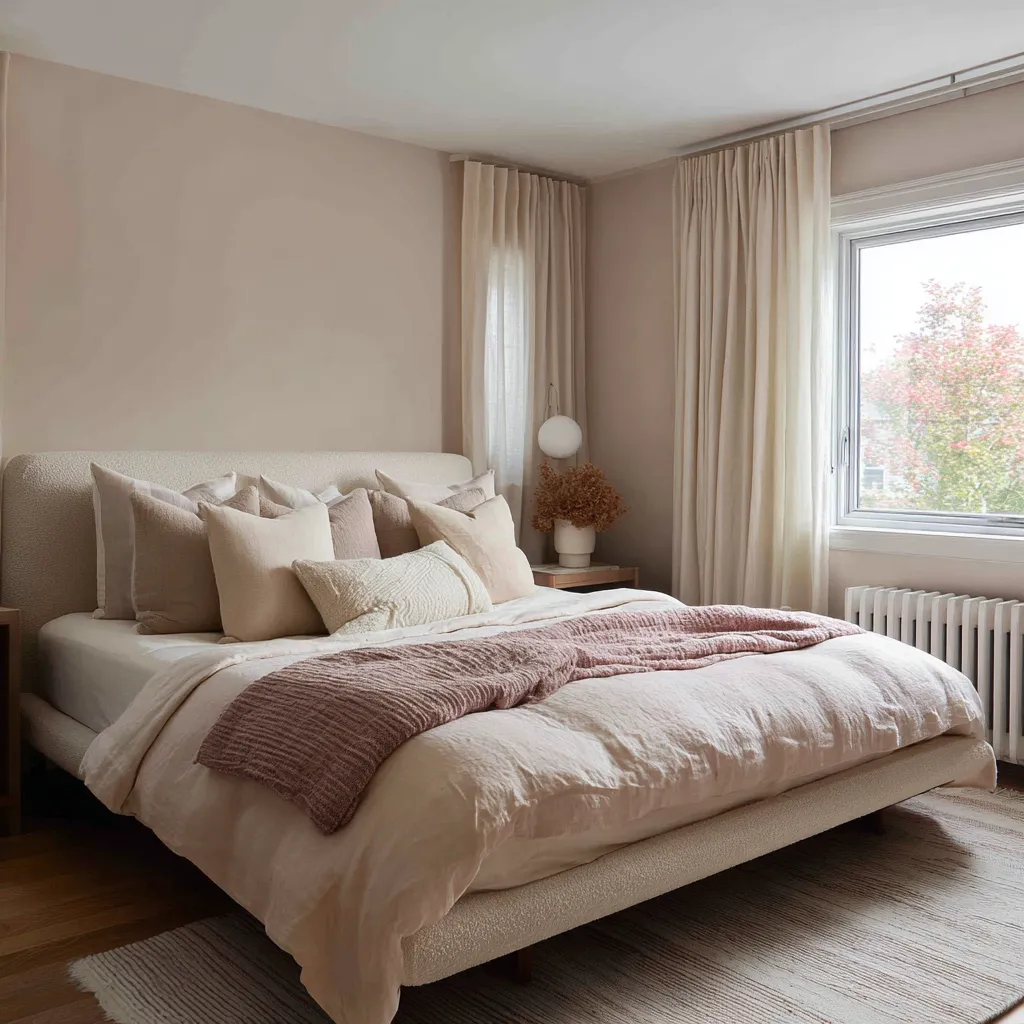
The convincing designs understand that emotional warmth and visual saturation are not the same thing. A room can feel warm because of timber depth, filtered daylight, plaster softness, and a broad layered bed, even if the only noticeable color accent is a small dried arrangement or one muted stripe.
Dark anchors keep pale rooms from dissolving
Very pale bedrooms often risk becoming vague. Boho Scandinavian interiors handle this well when they include a deeper anchoring note.
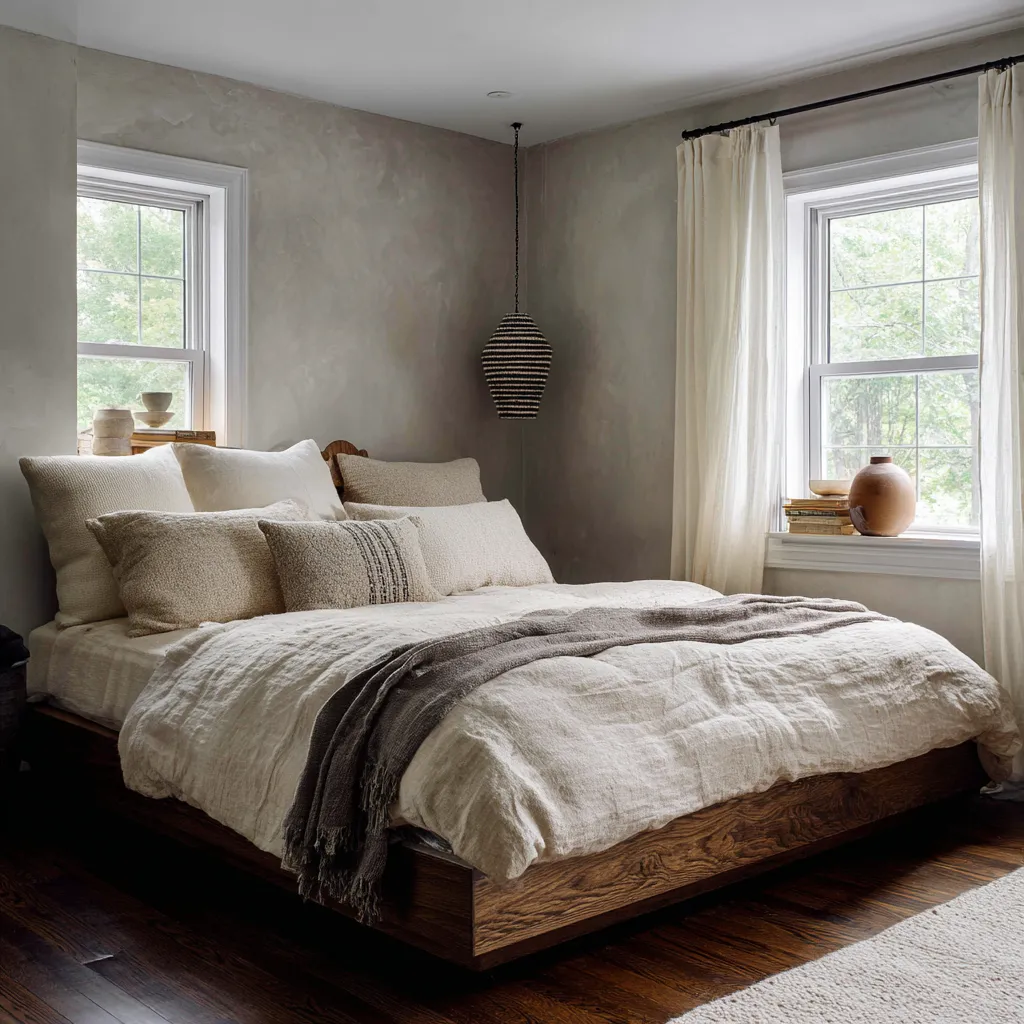
That anchor may come from walnut, smoked wood, a darker floor, black-framed windows, charcoal walls, deeper lamp bases, or a shadowy artwork with enough tonal density to hold the wall. These darker notes matter because they keep the room from floating away into one pale field.
The key is proportion. The anchor should usually stabilize rather than dominate.
A walnut bed frame under pale bedding is a good example. The dark wood gives the bed gravity.
The bedding softens that gravity. Together they create both structure and comfort.
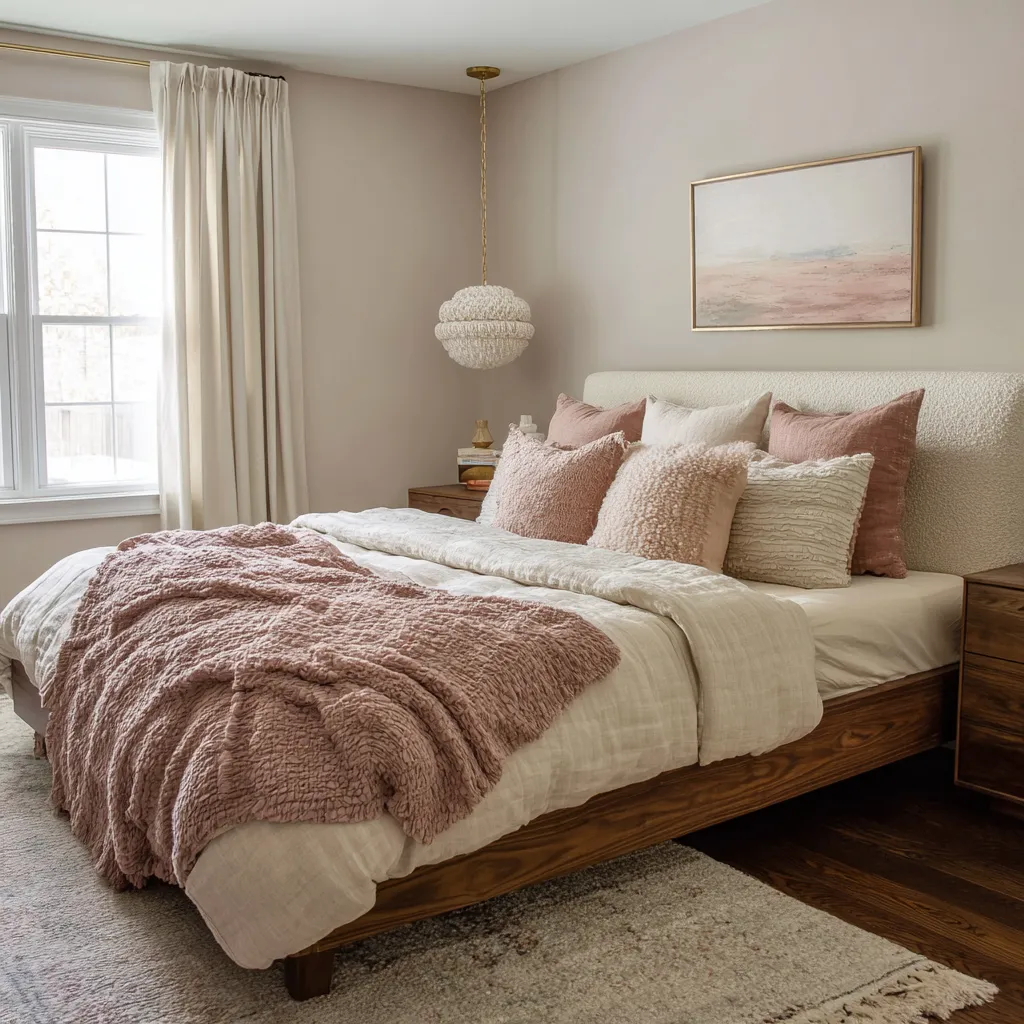
This tension between pale softness and darker grounding is one of the tools in the style. It allows a bedroom to remain restful while gaining depth.
A room with only pale softness may feel unfinished. A room with too much dark wood may become heavy.
The balance lies in letting one deeper register hold the lower composition while lighter textiles and walls keep the upper field open. This is also why some darker boho Scandinavian bedrooms work so well.
The style does not depend on white walls and pale oak alone. It can absorb graphite, mushroom, charcoal, smoked oak, or richer walnut as long as the room still contains enough soft textile field and daylight to keep the atmosphere gentle rather than severe.
The bed is often the emotional center, but not always the main carrier of identity
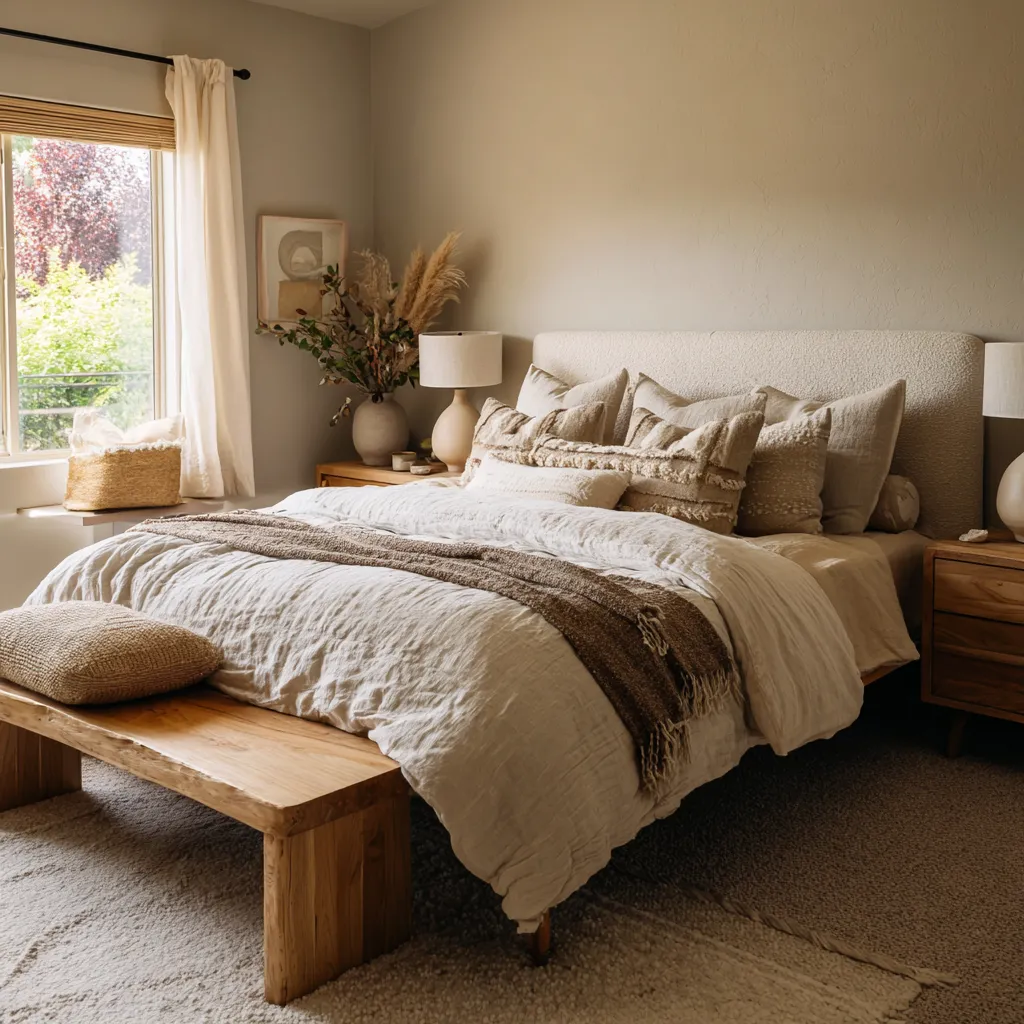
The bed is usually the emotional heart of the bedroom. In this style, that heart is shaped through pillow architecture, textile depth, and the handling of the throw or coverlet.
A good bed composition feels generous without looking overbuilt. It usually has a clear back row, one or two softer middle layers, and a final note at the front that gives the composition weight or warmth.
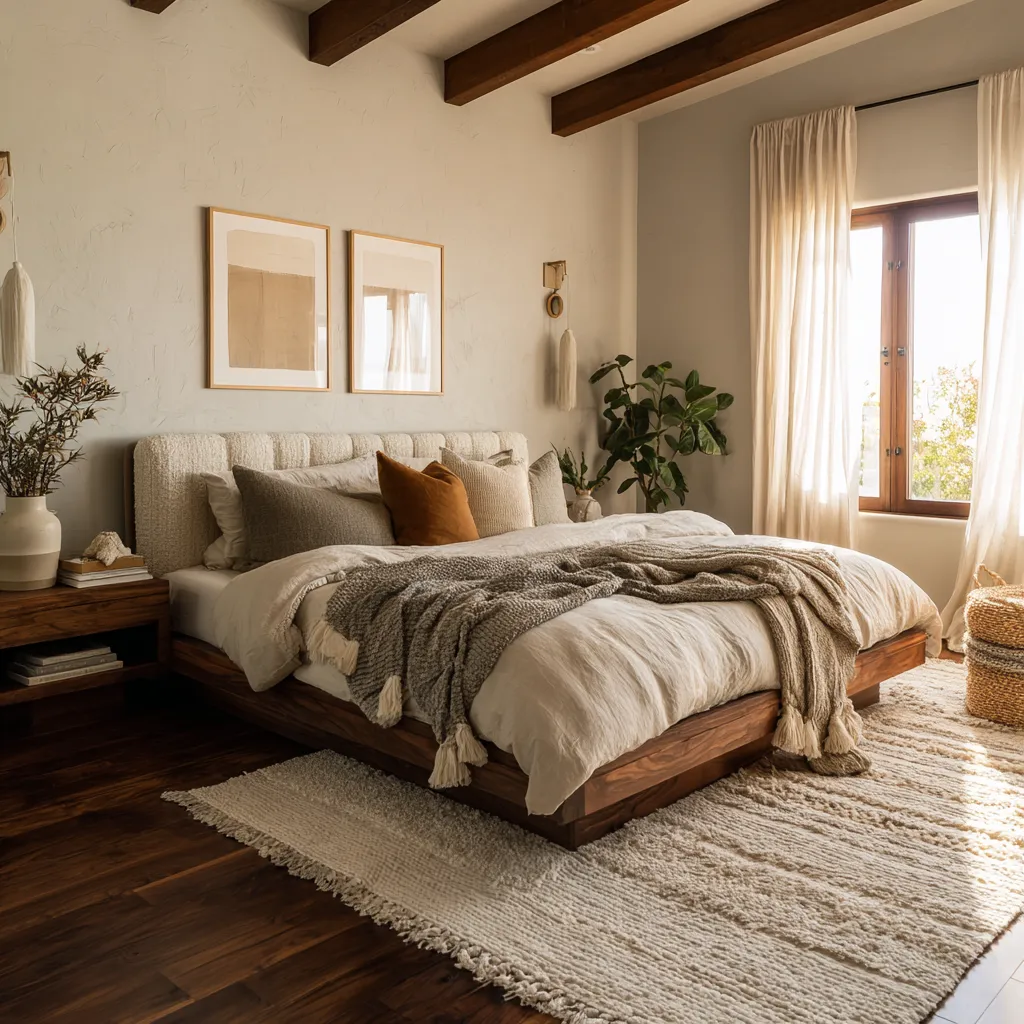
The styling tends to stay broad and horizontal. Long lumbar pillows are especially effective because they widen the bed visually and lower the center of gravity.
Throws often work when they are draped or pooled with some ease rather than folded too sharply. The aim is comfort with shape, not display for display’s sake.
Still, the bed is not always the sole carrier of identity. In some rooms, the envelope leads.
In others, a bench or niche softens the whole room and shares the work. In some darker rooms, grounding comes from wood and the bed remains comparatively restrained.
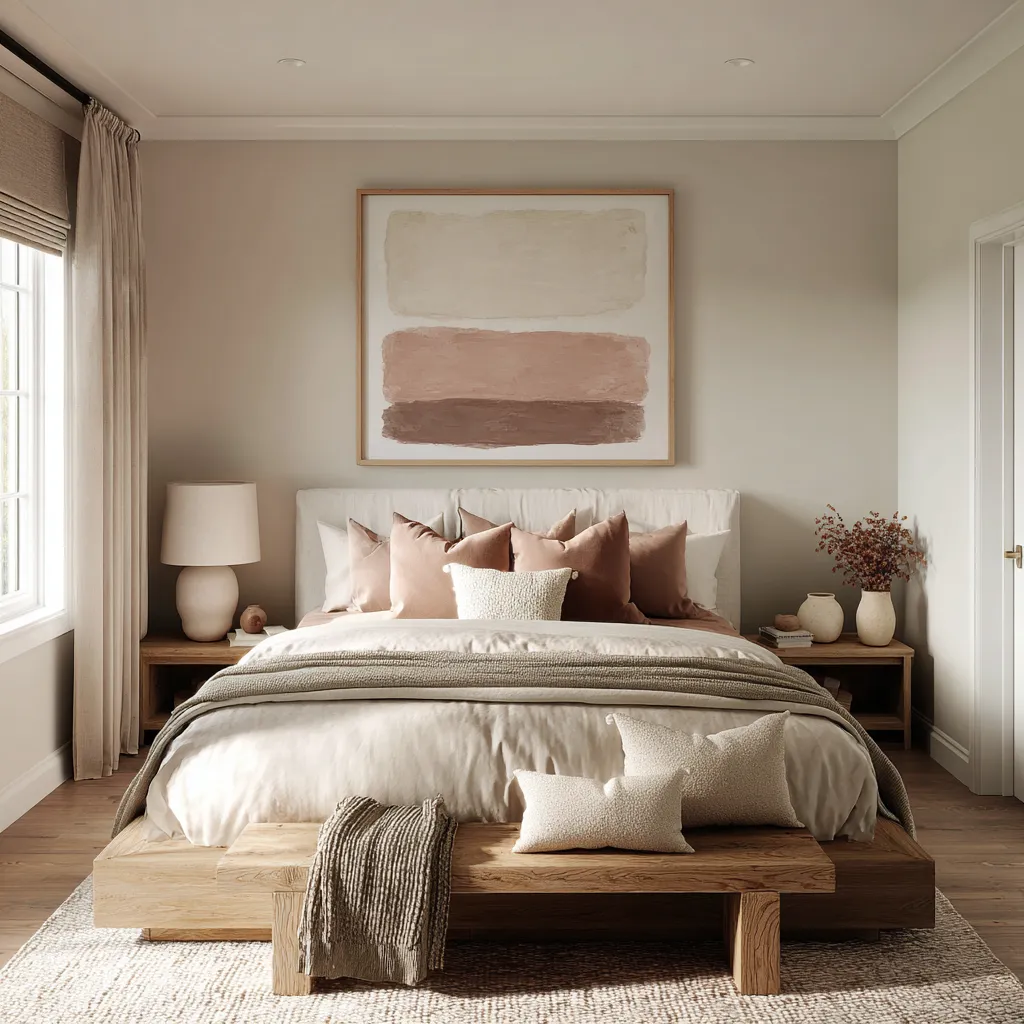
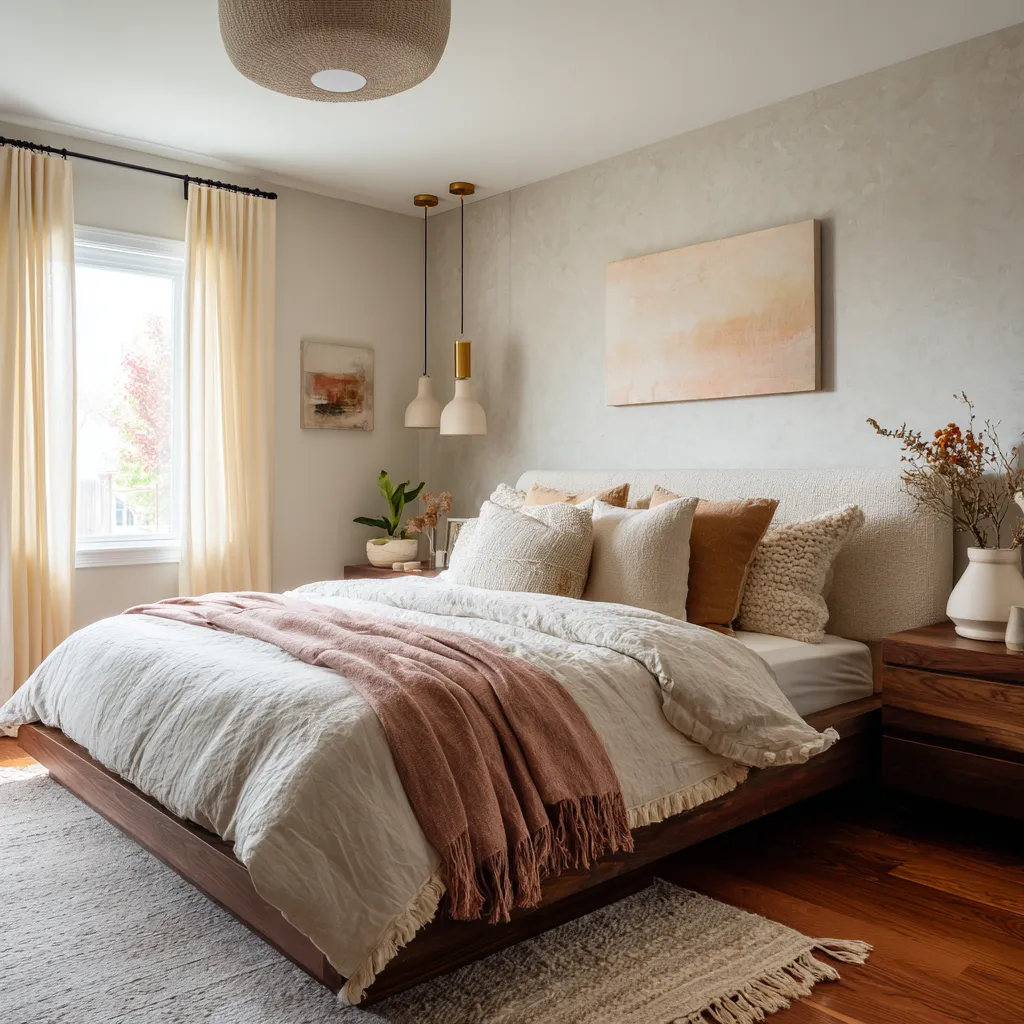
In a more symmetrical composition, a large artwork above the headboard may hold the wall while the bed carries the tactile warmth below.
That distinction matters because it frees the design from formula. The room does not need the bed to do everything.
It needs the bed to participate clearly in the overall logic. If the walls are very active, the bed may stay quieter.
If the architecture is ordinary, the bed may need to carry more of the room’s atmosphere through textiles and tonal variation.
Mild pattern can help, especially low in the room
Pattern in boho Scandinavian bedrooms works when it behaves like directional texture rather than statement graphics. A faded rug, a soft stripe, a woven band, or a restrained lumbar can bring life into the room without breaking its calm.
Pattern becomes helpful when it is low-amplitude, low-saturation, and placed where it supports grounding rather than calling attention to itself. This often means the safest places for pattern are the rug, a throw, a bench cushion, or a small pillow.
Pattern held lower in the room gives articulation to the composition without making the wall plane noisy. It helps separate surfaces in a close palette.
It also introduces the feeling of textile craft in a quiet way.
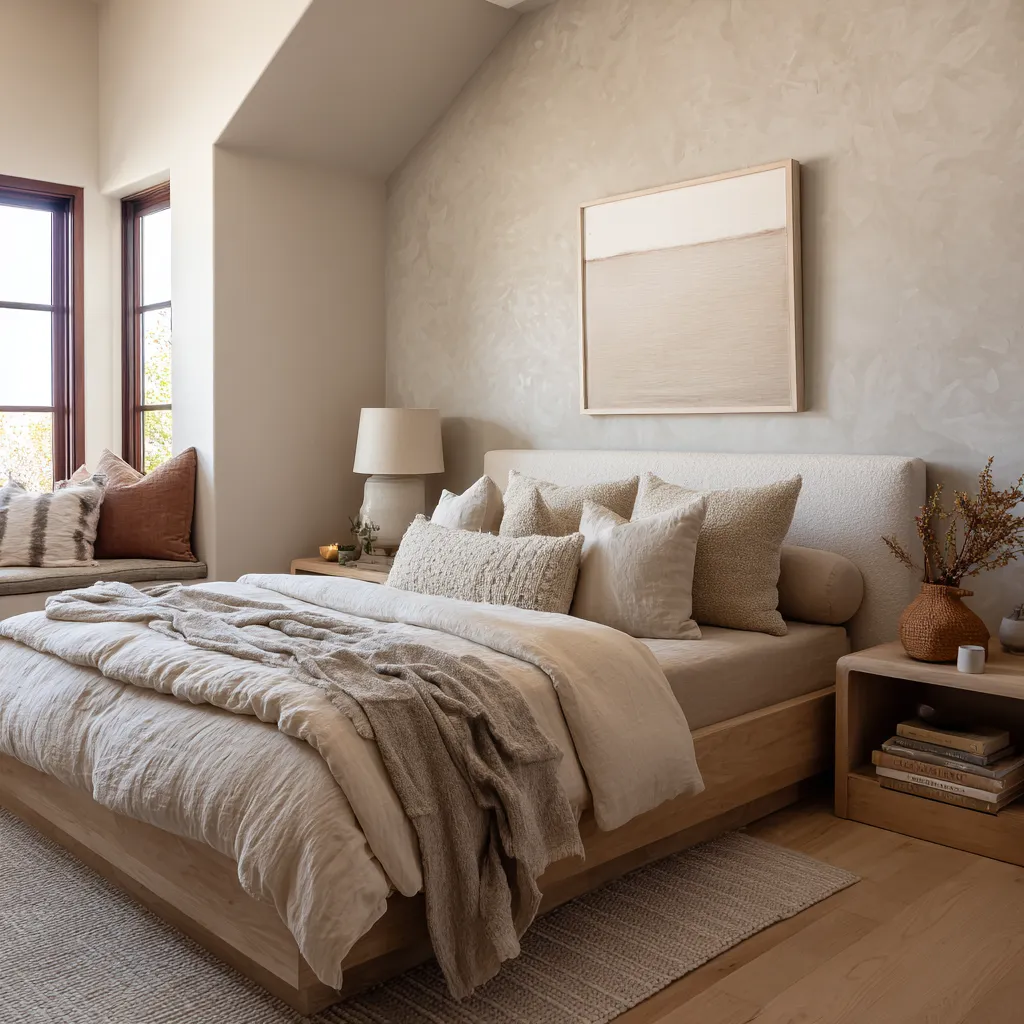
The wall behind the bed, by contrast, often benefits from remaining broad and calm. If the wall is already carrying plaster texture or a large abstract artwork, strong pattern there may become too much.
This style tends to work well when upper surfaces stay spacious and lower or secondary zones hold the more articulated textile notes. A stripe can be especially useful because it sits between pattern and texture.
It gives direction, rhythm, and a hint of handwoven character without making the room feel busy. That is why so many successful bedrooms in this language can absorb a striped throw or lumbar while still feeling restful.
Secondary soft zones increase richness without clutter
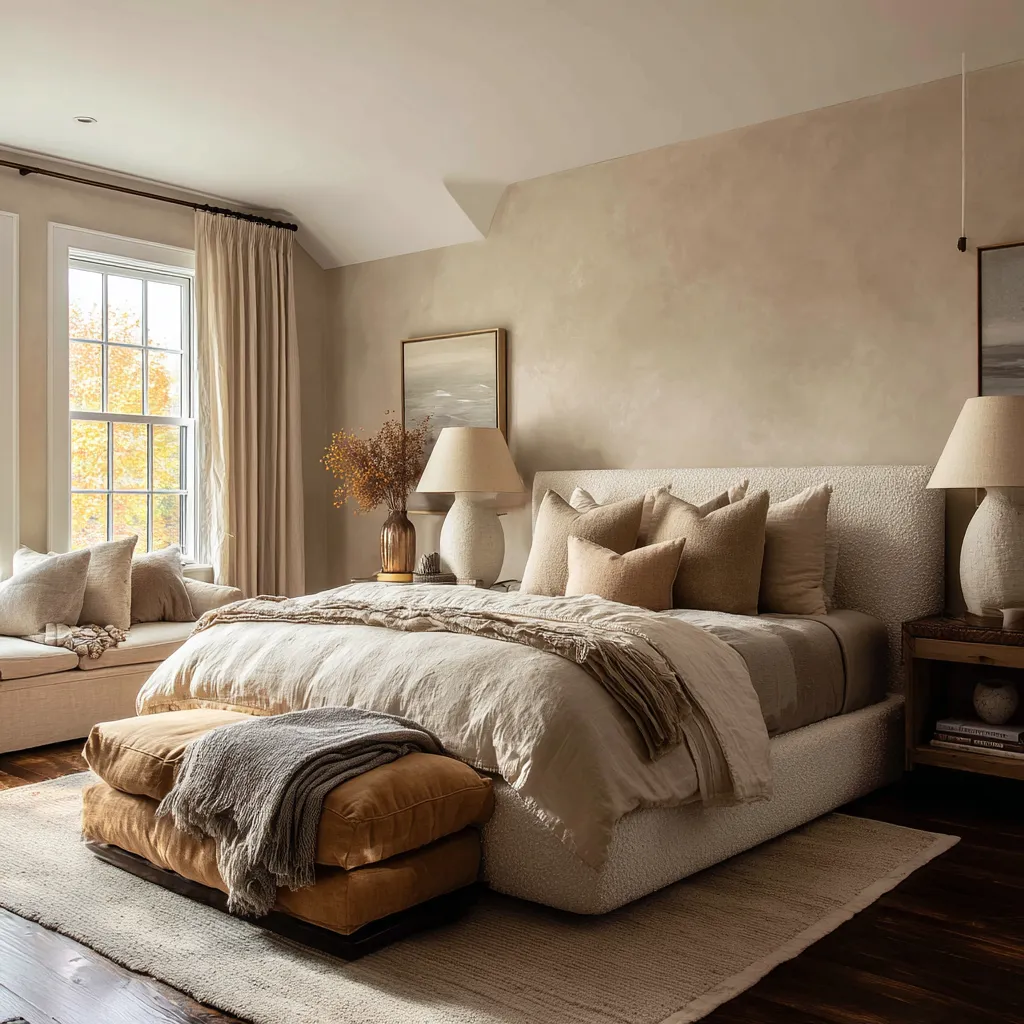
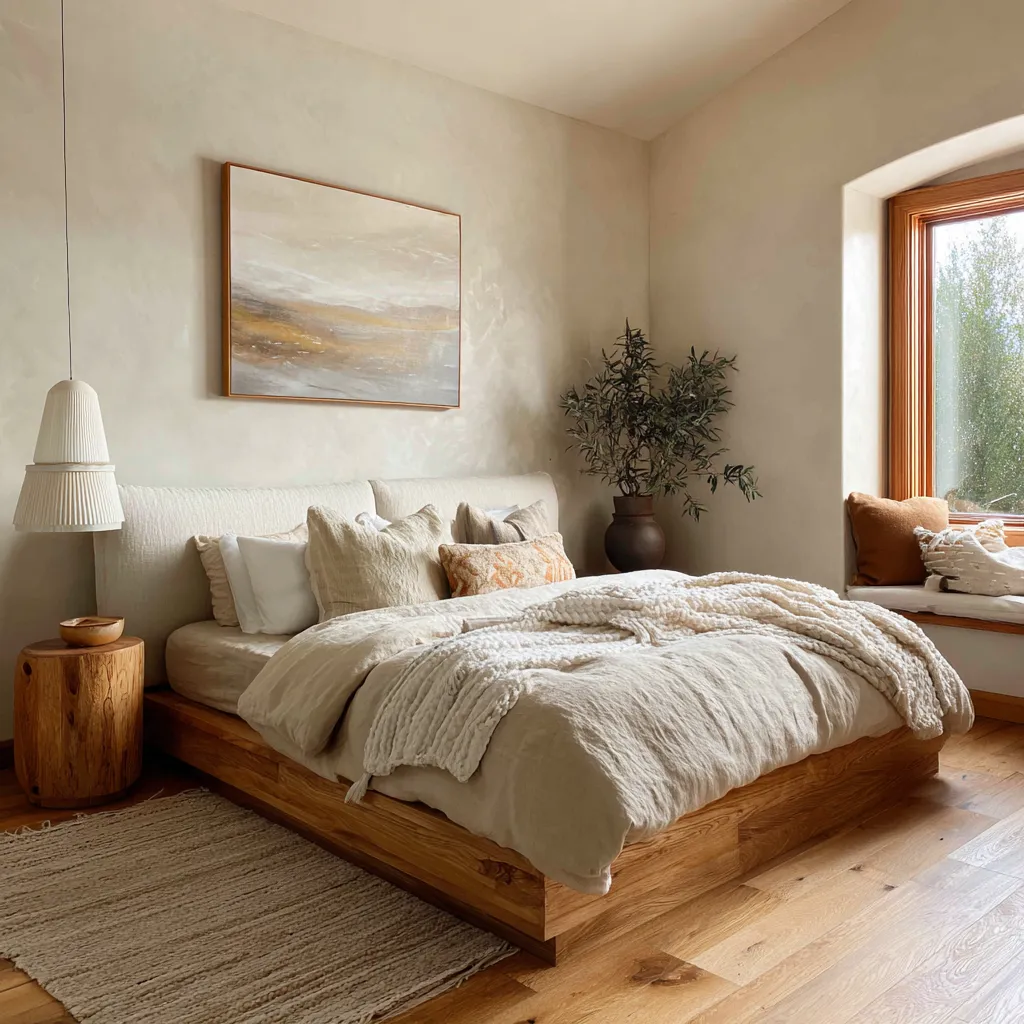
One of the effective moves in this style is to extend softness beyond the bed. A window seat with cushions, an ottoman at the foot, a bench with a folded textile, a recessed niche with pillows, or a broad rug that gives the bed a larger tactile field can make the whole room feel fuller without introducing visual crowding.
This is important because bedrooms become richer not only through more layers, but through more areas of bodily use. A room with a bed and a bench or a bed and a cushioned niche feels more inhabitable than a room where all softness is concentrated in one island.
It also feels less staged, because it offers more than one mode of occupation.
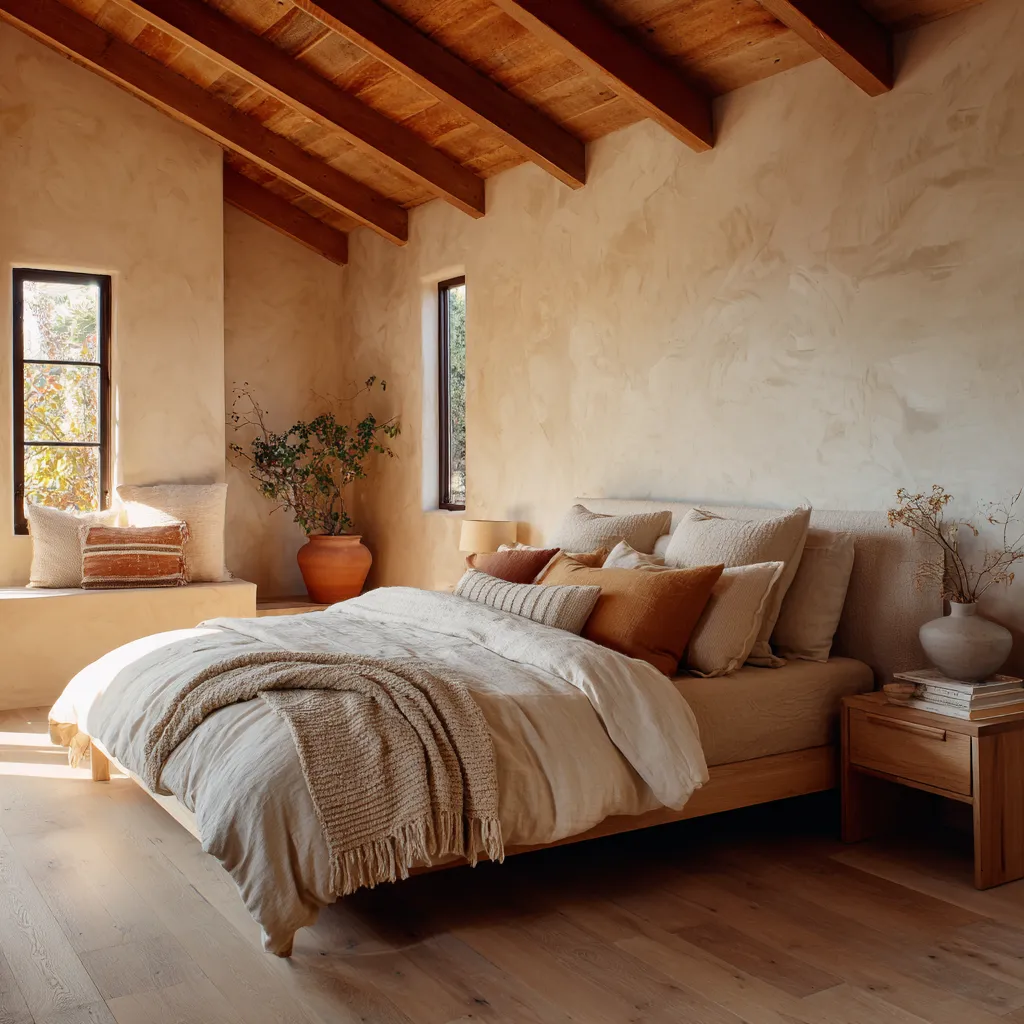
These secondary zones can be very simple. A built-in seat under the window with two pillows is often enough.
The point is that comfort spreads through the room. The bedroom becomes an environment, not just a bed against a wall.
That shift is subtle but powerful. It changes the room from a single soft object inside a shell into a spatial field of comfort.
In boho Scandinavian interiors, that broader softness often matters more than one extra basket or decorative object.
How the style can fail
Because this style is restrained, its mistakes are often subtle. The room may still look pleasant while losing specificity.
One common drift is neutral softness with too little material depth. If the palette is pale, the wall is flat, the accessories are minimal, the craft layer is weak, and the room lacks a dark anchor, the result can feel like ordinary Scandinavian softness rather than a real hybrid.
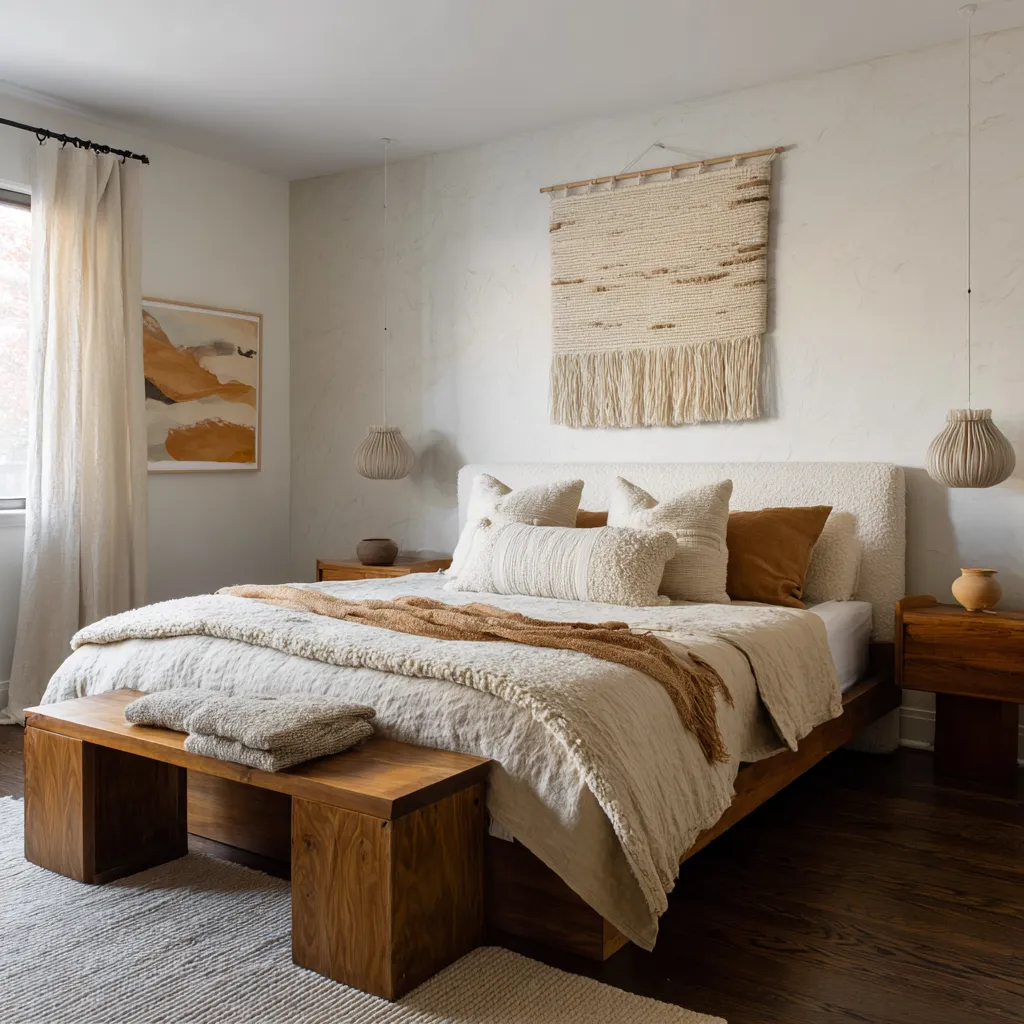
Another risk is rustic takeover. If beams, terracotta, stronger wood, and niche seating are all present, but the bed and surfaces are not simplified enough, the room can slide toward farmhouse or Mediterranean.
The solution is usually reduction in the furniture profiles, tighter palette control, and limited pattern. A third risk appears in blush-toned bedrooms.
Rose and clay can work beautifully here, but they should usually stay concentrated on the bed and perhaps be lightly echoed in the art. Once pink starts spreading into curtains, rug, walls, and multiple accessories, the room can lose its material seriousness and become sweeter than intended.
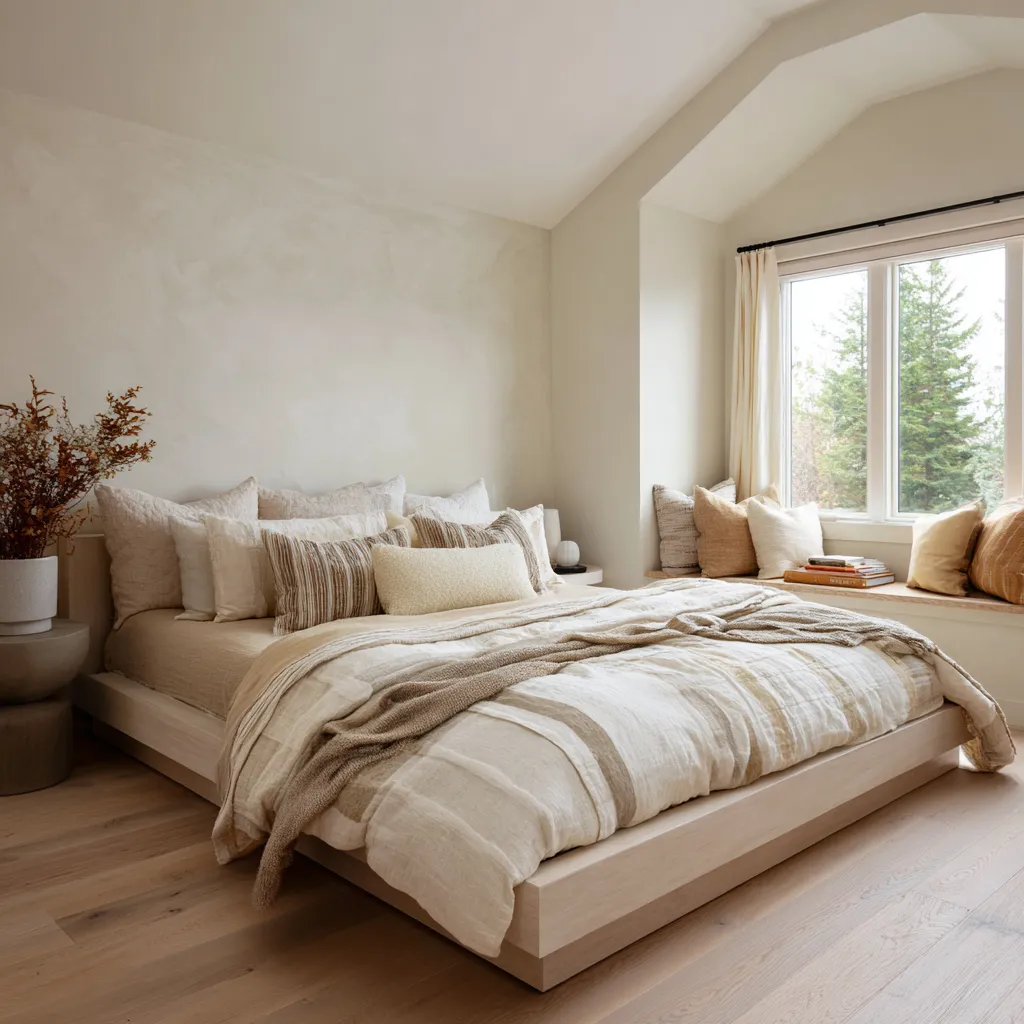
There is also the risk of over-padding. Very plush rooms need structure.
If darker wood, firmer lines, or architectural edges disappear entirely, the room can become over-softened and visually unstable. That is why deeply upholstered bedrooms still benefit from darker floors, shaped windows, firmer nightstands, or one clearer linear note.
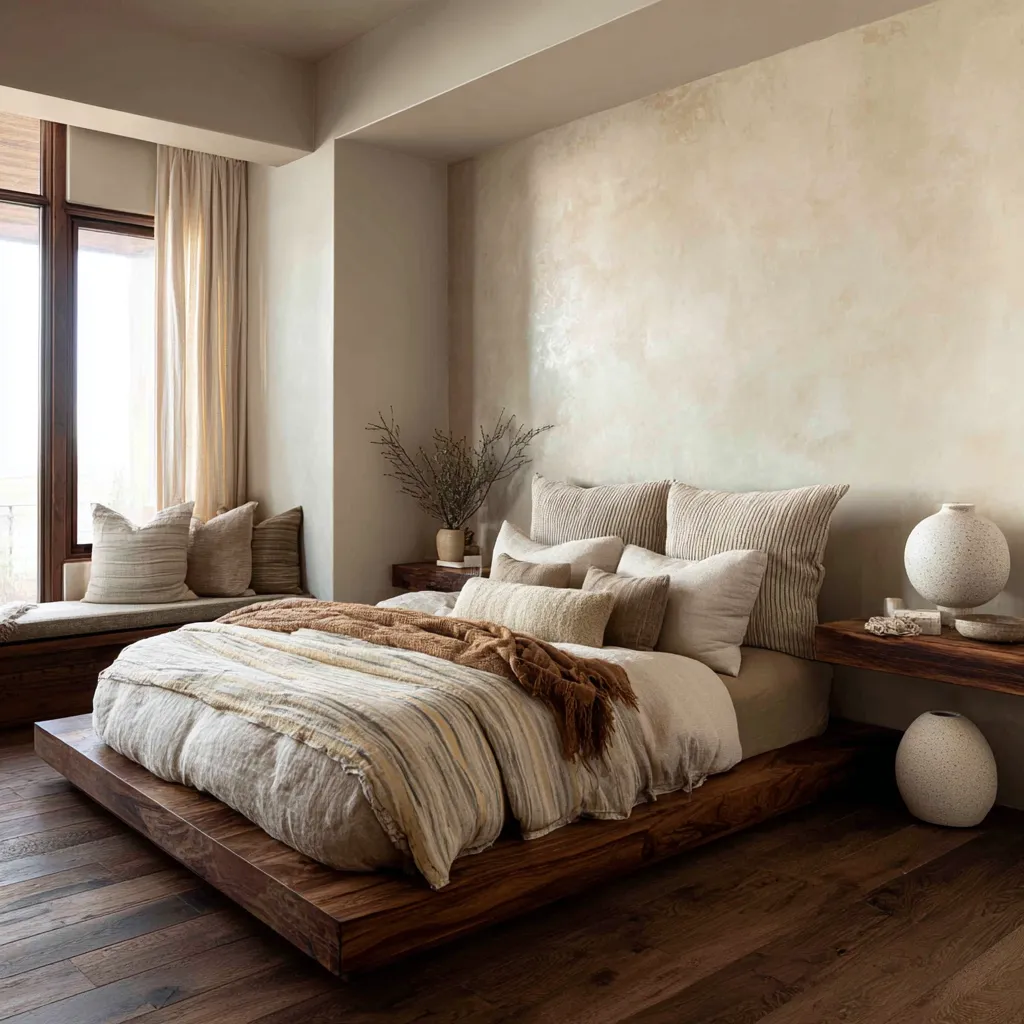
What a convincing boho Scandinavian bedroom really needs
At its core, a persuasive room in this style needs a few things working together.
- It needs order in the plan.
- It needs tactile hierarchy.
- It needs either wall body, architectural shaping, darker grounding, or a strong bed composition, and ideally two of those at once.
- It needs warmth that has been placed with intention.
- It needs enough natural irregularity to feel inhabited.
- It needs restraint so that the room stays restful.
This is why the style can hold many different moods. It can be pale and airy, warm and timber-rich, gently blush-toned, graphite-based, attic-like, centered and symmetrical, or bench-led and cocooning.
The look changes, but the inner structure remains related. The room works when the Scandinavian side organizes the space and the boho side humanizes it.
Final thoughts
Boho Scandinavian bedroom design is often at its most persuasive not when it tries hardest to look boho, but when it lets warmth enter through surfaces, weight, softness, and lived material character. The room does not need many signals.
It needs the right ones in the right places.
- A broad calm wall with body.
- A bed that feels layered and touchable.
- Wood that grounds without heaviness.
- One or two earthy notes near the body zone.
- A bench, niche, or window seat that spreads comfort outward.
- A rug or stripe that adds direction without noise.
- Enough order to let all of that settle.
That is how the style holds together. It is not casual in the careless sense.
It is relaxed inside a clear framework. It is warm without losing air.
It is tactile without becoming crowded. It is simple, but not plain.
And in a bedroom, that balance can be especially satisfying because it supports exactly what the room should offer: rest with depth, softness with shape, and warmth with restraint.